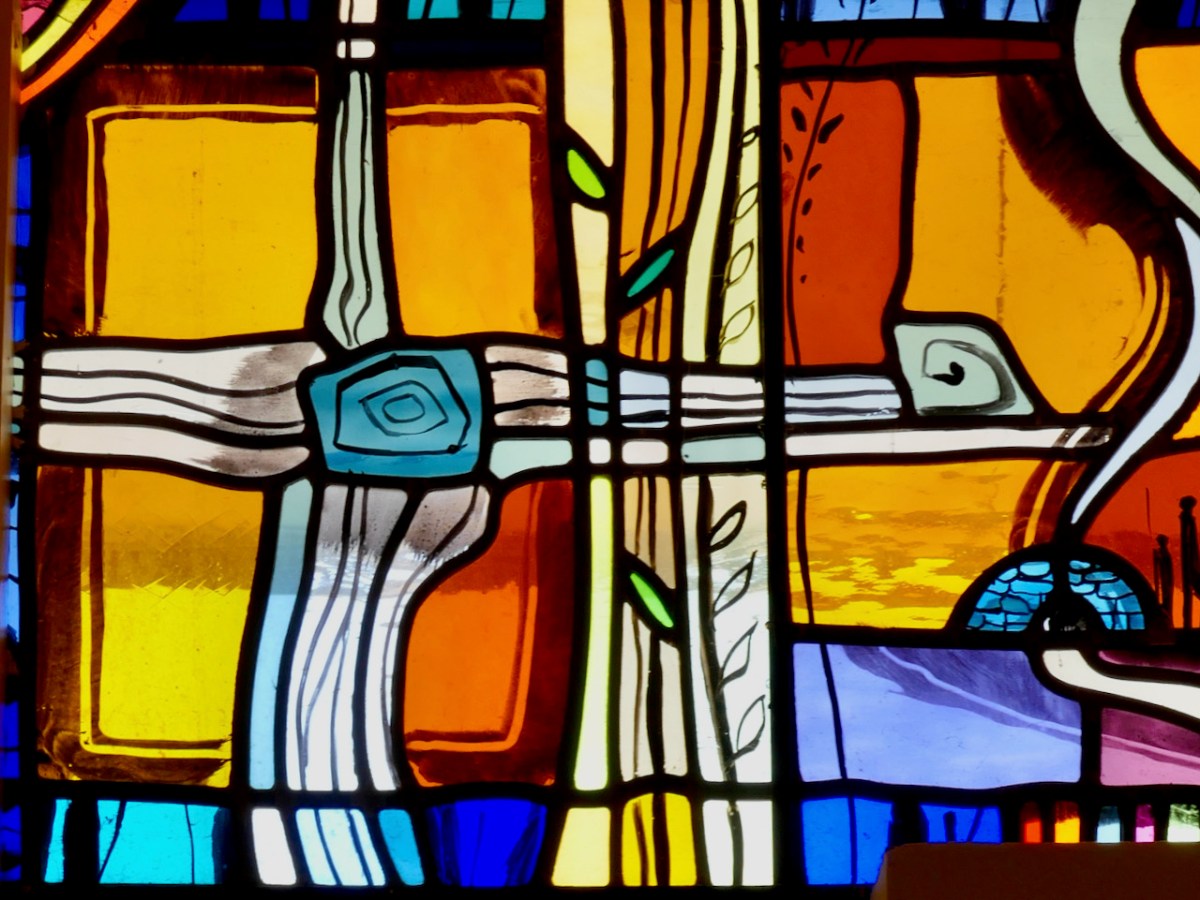
Roaringwater Journal

Skip to content
  • Home
  • About, Copyright, Contact
  • All Pages – Navigation
  • Ballydehob Pollution Report
  • Castles of West Cork
  • Charles Vallancey: A Colossus and his Collectanea
  • Flora and Fauna of West Cork
  • Mizen Magic and Mizen Megaliths
  • Rock Art
  • Saints and Soupers
  • Signal Towers
  • Stained Glass
  • The Magic of Old Maps

Biddy Boys Kerry

  • Posted on February 2, 2014January 23, 2022
  • 10 Comments

Giolla Brighde

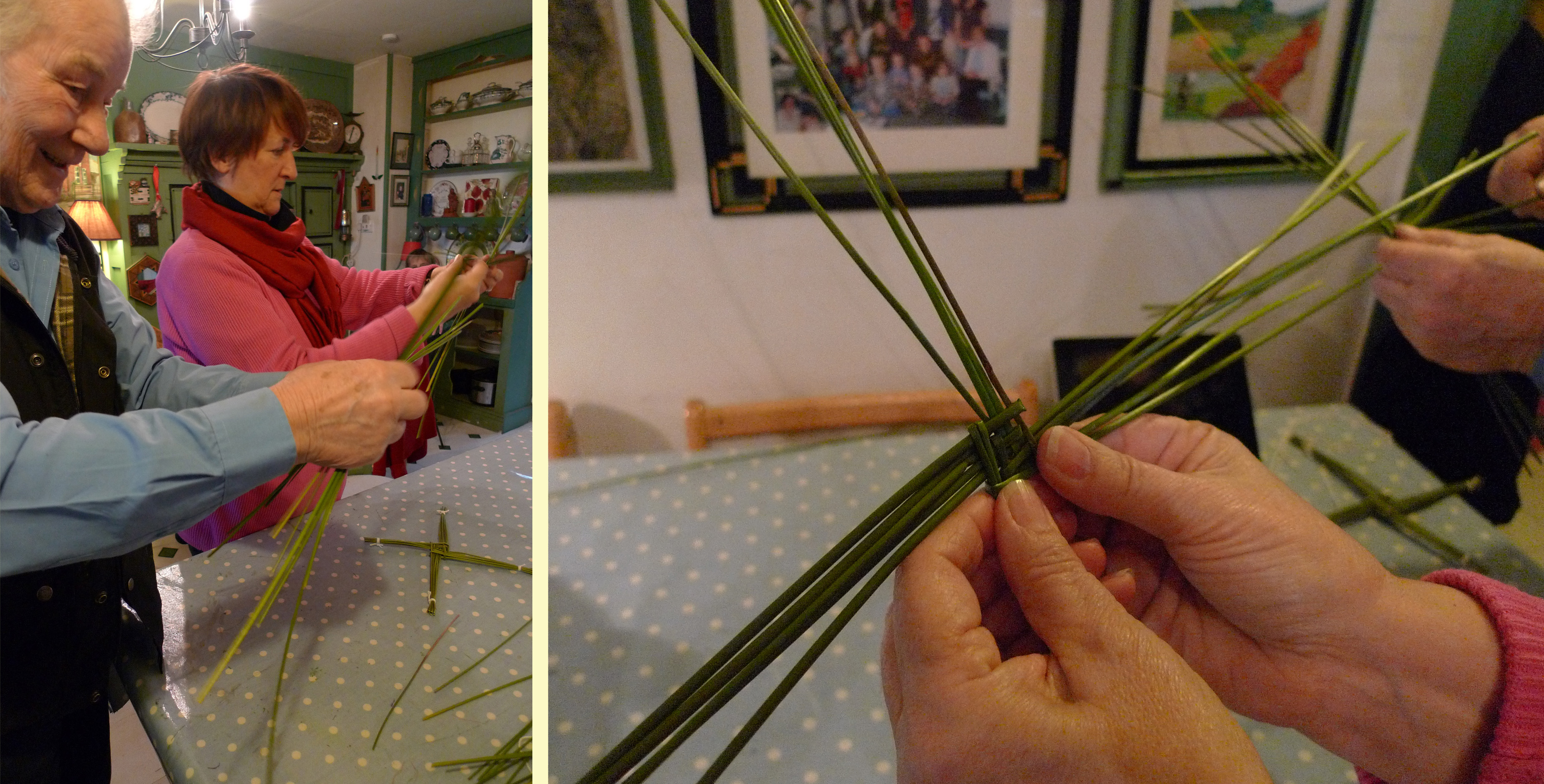
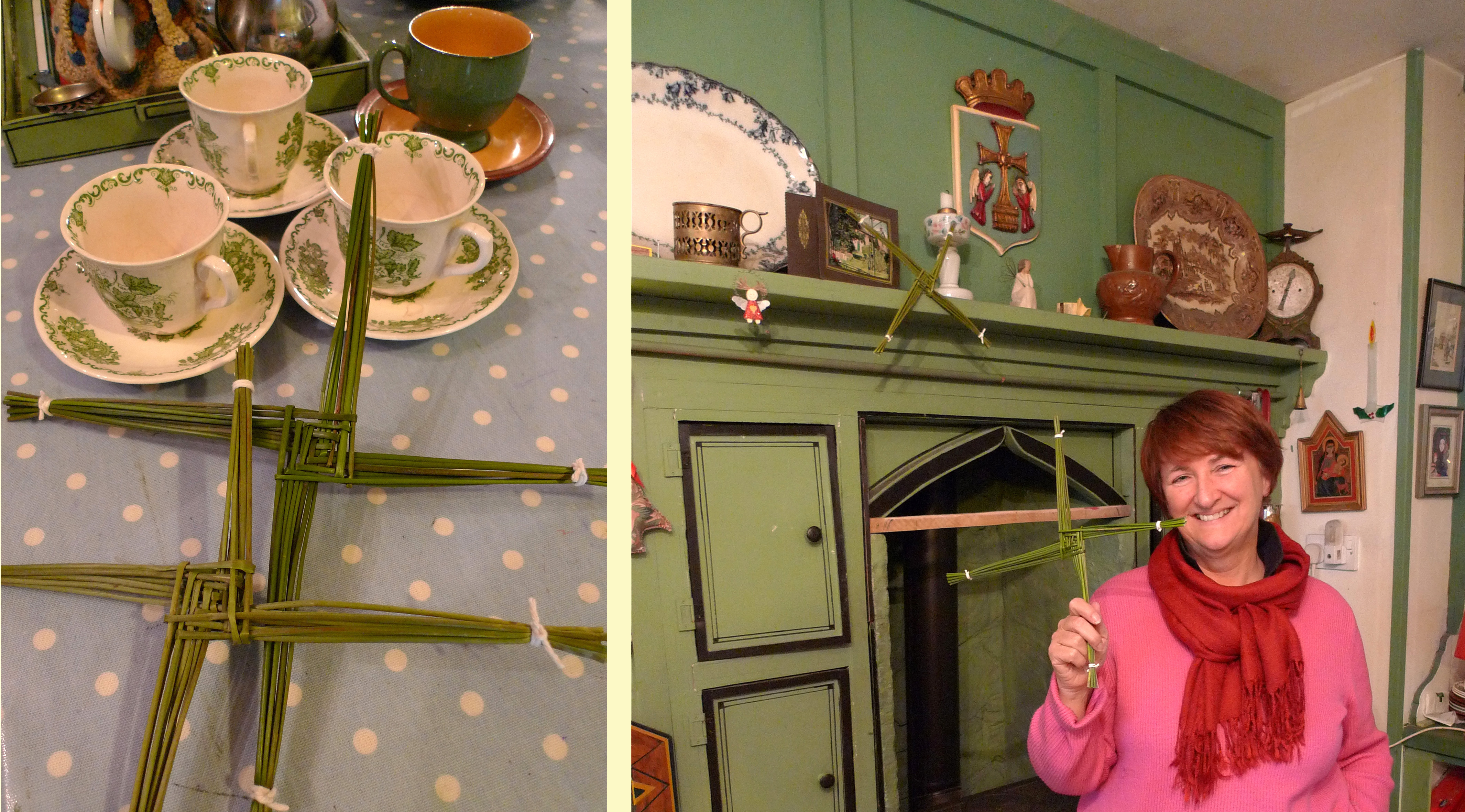
It’s St Brigid’s Day, and Danny is teaching Finola how to make a Brigid’s Cross with which to safeguard Nead an Iolair from fire and lightning. When his family and ours lived in Devon, Danny faithfully provided us with a new Brigid’s Cross every year. I always kept the old ones – until they disintegrated: that’s the tradition. Now we have both made our homes in West Cork and it seems appropriate that Danny is still the provider of these essential tokens of protection – which should be placed above the hearth, at the threshold of the byre or in the rafters.
danny + brigid
February 1st: Tradition under way in the McCormack household

There are far more stories told about the Irish Saint Brigid, Brigit, Brighid or Bride than there are about Saint Patrick himself: if I wrote down here everything I have unearthed about her so far I would fill several blogs, so I’m leaving much of it for future instalments.

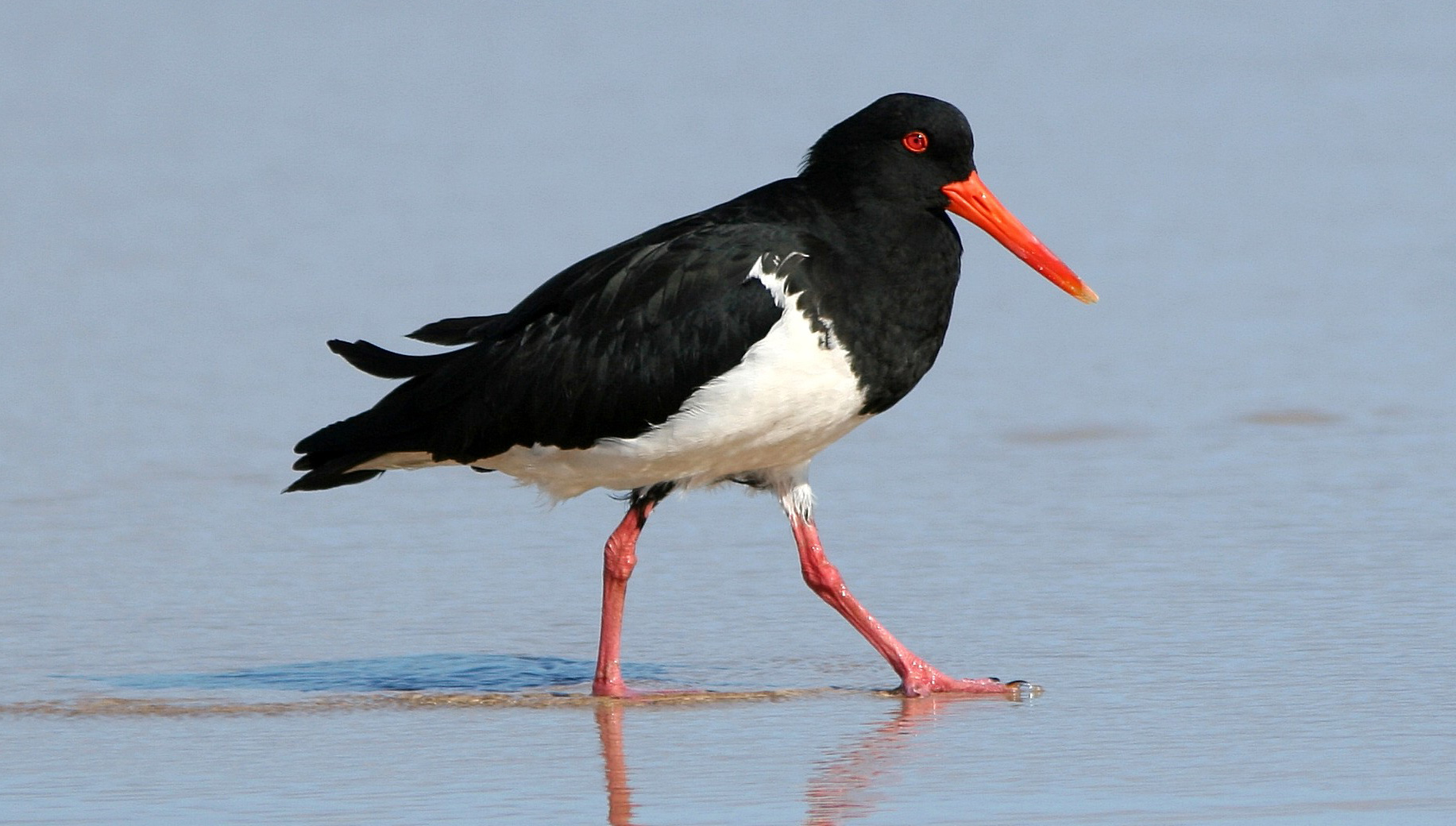
By the way, Giolla Brighde is Irish for Servant of St Brigid and it is a term used to describe the Oystercatcher. The belief is that this bird returns to Irish shores in great numbers on St Brigid’s Day, and is a harbinger of the coming of light and warmth as the days stretch out. Well, in the Cove below us we have seen Oystercatchers throughout the winter: they are spectacular wading birds with a distinctive haunting call. But I do sense that parcels of them have been arriving in the last day or two to ensure that traditions are maintained. So, Ireland’s ‘second’ Patron Saint has also provided us with a little bit of bird lore as a bonus.
oystercatcher

The Saint’s day – February 1st – is grafted on to the ancient festival of Imbolc, a cross-quarter day seen as the harbinger of Spring. It doesn’t seem much like that today – more strong winds have toppled a fourth tree in our haggart – but there are certainly signs of waking life in the hedgerows, and the daffodil bulbs Finola planted in the autumn are about to burst into bloom.

Brigid was expected to visit one’s home at Imbolc. She still does: in some parts of Rural Ireland a tradition has been maintained well into living memory.
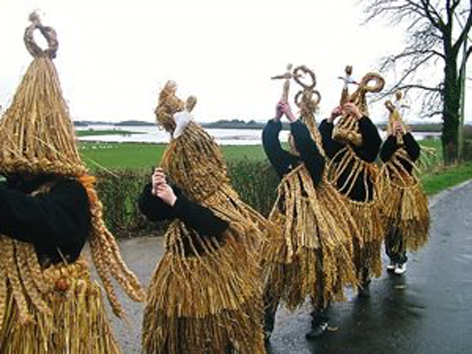
Fermanagh Biddy Boys
Fermanagh Biddy Boys (Fermanagh Herald)

“…Something for poor Biddy

Her Clothes are torn

Her shoes are worn

Something for poor Biddy

Here is Brigit dressed in white

Give a penny for her tonight

She is deaf, she is dumb

She cannot talk without a tongue

For God’s sake, give her some…”

The Biddy Boys would dress in masks – sometimes of straw – and carry an effigy of Brigid from house to house, collecting money as they went. This custom takes place more in the north now – the rhyme above comes from Fermanagh, although I have found some more local references. Here is an event from Kerry in 1965 – a Biddy Boys competition!
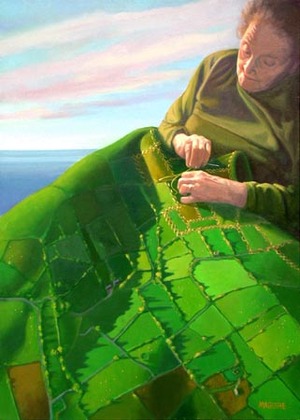
cloak
St Brigid’s Cloak – source unknown

The fifth century Saint founded several religious establishments, the principle one being in Kildare (Church of the Oaks). There she petitioned a local chief for some land on which to build her monastery. He was not inclined to provide anything until she asked for only as much as would be covered by her cloak. The chief laughed and readily conceded to this. Brigid then handed a corner of her garment to four of her followers and instructed them to keep walking. As they did so, the mantle expanded until it encompassed many acres. The chief was amazed and duly converted to Christianity; Brigid got her land. The Monastery thrived through seven hundred years after Brigid’s death in 525, and a perpetual flame was kept burning in her honour during all that time.

Back to the Brigid’s Crosses: the Saint herself was tending a dying pagan chieftain (some say it was her own father) and began to plait the rushes scattered on the floor into a cross. When the man saw this he wanted to know what the cross symbolised. When she told him he was instantly converted (she was apparently a great converter), and the cross made of rushes has been associated with her ever since. It takes many forms but reappears again and again, especially in rural Ireland. Some say that it represents a sun wheel and shows that Brigid was in fact a Goddess long before Christian times. In 1961 the Irish broadcasting service (which later became known as Raidió Teilifís Éireann)  adopted the Saint’s cross as its logo. Appropriately this was suggested by the then Head of Women’s Programming, Edith Cusack. In one form or another it remained the symbol of RTE until the end of the Millennium.
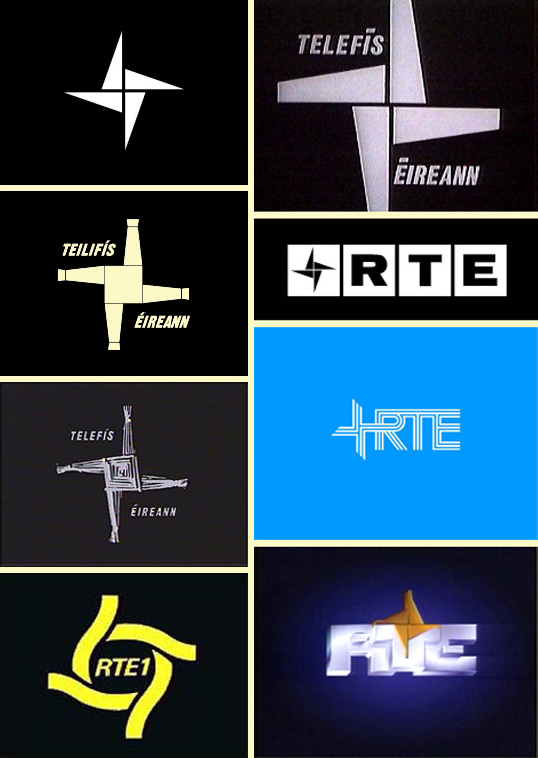
Evolution of a logo
Evolution of a logo

“…This symbol woven from rushes or straw was a feature of Irish houses for centuries. The use of the symbol [for a broadcasting medium] is intriguing. Here was a symbol that combined a wealth of meaning, familiarity, Irishness, a certain form of Celtic Christianity, myth (in the original sense of the term) and arguably superstition. But above all it contained a concept of domesticity. This was a symbol drawn directly from the domestic space, a symbol which embodied that space and all that that entailed. A protected, private family space, one which was safe, almost comforting…”*

Interesting, perhaps, that in the infant days of Ireland’s television service Eamonn De Valera – the first Head of the Irish Free State – said about it:

“…Never before was there in the hands of men an instrument so powerful to influence the thoughts and actions of the multitude…”*

In view of all these powerful influences it may be that we should place our St Brigid’s Cross over our television set – to protect us from it!

* Incalculable good, irreparable harm: RTÉ, the St Brigid’s Cross and the significations of domesticity from Design Research Group 2007

Email link is under 'more' button.

  • Click to share on X (Opens in new window) X
  • Click to share on Pinterest (Opens in new window) Pinterest
  • Click to share on Facebook (Opens in new window) Facebook
  • Click to share on Threads (Opens in new window) Threads
  • Click to print (Opens in new window) Print
  • Click to share on Mastodon (Opens in new window) Mastodon
  • Click to share on Bluesky (Opens in new window) Bluesky
  • Click to share on WhatsApp (Opens in new window) WhatsApp
  • More
  • Click to email a link to a friend (Opens in new window) Email
Like Loading...
Posted in Folklore, Religion, Roaringwater Bay Tagged Biddy Boys, Biddy Boys Kerry, Eamonn De Valera, Edith Cusack, Fenruary 1st, Giolla Brighde, Imbolc, Oystercatcher, Raidió Teilifís Éireann, RTE, RTE Logo, St Bride, St Brighid, St Brigid, St Brigid's Cloak, St Brigid's Cross, St Brigid's Day, St Brigit
© Finola Finlay + Robert Harris

Top Categories

Archaeology Architecture Ballydehob Cork Folklore Industrial Archaeology Irish Art Irish Craft Irish Heroes Irish History Irish Landscape Irish Stained Glass Irish Writers Kerry Medieval History Nature Photography Religion Roaringwater Bay Rock Art Rossbrin Cove Schull Skibbereen The Mizen Peninsula Visiting Ireland West Cork West Cork Blog Wild Atlantic Way Wild Flowers Wildlife

Tags

Amanda Clarke Angela Rolt Photographs An Túr Gloine Ballydehob Ballydehob Arts Museum Bantry Bantry Bay Bantry House Barley Cove Beara Peninsula Bohonagh stone circle Boulder Burials Brian Lalor Cape Clear Island Castles of Ivaha Castles of West Cork Charles Vallancey Copper mining Cork Public Museum Crookhaven Cupmarked stones Derrynablaha Drombeg Stone Circle Duchas Schools Folklore Collection Dunmanus Castle Dúchas Edith Somerville Fastnet Rock Fastnet Trails George Victor du Noyer George Walsh Green & Silver Harry Clarke Harry Clarke Studios High Crosses Holy Wells Holy Wells of Cork Ilen River Irish High Crosses Irish rock art Irish Signal Towers Irish Signs Irish Traditional Music Irish wildflowers Jack Roberts Ken Williams Kevin Danaher Kilcoe Castle L T C Rolt Maps of West Cork mass rocks Mizen magic Mount Gabriel Napoleonic-era Signal Stations National Monuments Service of Ireland Nead an Iolair Newgrange Nicola Gordon Bowe Northside of the Mizen O'Mahony Territory Office of Public Works Off the M8 Peter Clarke Rev William Allen Fisher Richard Boyle Richard King Robert Gibbings Rock art Rossbrin Castle Rossbrin Cove Saint Brendan Saints and Soupers Schools Folklore Collection Seamus Heaney Sheep's Head Skibbereen Skibbereen Arts Festival Skibbereen Heritage Centre standing stones St Brigid St Gobnait St Patrick Three Castle Head Tomás Ó Muircheartaigh Traditions Uillinn Uillinn West Cork Arts Centre Walking the Sheep's Head Way Watson's of Youghal Wedge Tombs West Cork Arts Centre West Cork Blog West Cork History Festival West Cork stone circles West Cork Wildflowers West meets West Wild Atlantic Way Wildflowers of West Cork William Dowling Zoë Devlin
Blog at WordPress.com.
X

Enter your email address to follow this blog and receive notifications of new posts by email.

Join 1,858 other subscribers

Our Most Recent Posts

  • Back to the Skeams: 81 Men Left the Island December 14, 2025
  • Peter Somerville-Large and The Coast of West Cork December 7, 2025
  • Back to the Skeams: The Sea Dominated Our Lives November 30, 2025
  • Back to the Skeams but Distracted by Sickles and Flails November 23, 2025
  • More Books for Christmas! November 16, 2025
  • Crookhaven Through Time November 9, 2025
  • Goat Islands and Spirit Music November 2, 2025
  • Goat Islands: Two, For Now October 26, 2025
  • Mizen Magic Miscellany: The Far End Part 3 October 19, 2025
  • Mizen Magic Miscellany: The Far End Part 2 October 12, 2025
  • Podcast! October 10, 2025
  • Mizen Magic Miscellany: The Far End Part 1 October 5, 2025
  • Mizen Magic Miscellany September 28, 2025
  • Dublin’s Stained Glass: A Review September 20, 2025
  • The Return of the Earls: The 2025 Crowley Clan Gathering September 14, 2025
  • Words on the Waves Vs Wavy Words September 7, 2025

Roaringwater Journal

Roaringwater Journal

Blogs We Like

  • Walking Away
  • La Flow Velo: From Sarlat to the Sea
  • The Way of Tours
  • Ballymaclinton
  • michael9murray
  • Danube to Dalmatia
  • Wildways Press
  • Chasing Aideen
  • Roaringwater Journal
  • Paddy Tobin, An Irish Gardener
  • Skibbereen & District Historical Society
  • The Irish Aesthete
  • Oliver Nares Photography
  • Bones, Stones, and Books
  • UCD LIBRARY CULTURAL HERITAGE COLLECTIONS
  • Jeremy Bartlett's LET IT GROW blog
  • Skibbereen & District Historical Society
  • Swantonstown Sessions!
  • Ecology is not a dirty word
  • karen minihan

Archives

Walking Away

Travels on foot

La Flow Velo: From Sarlat to the Sea

Another bicycle adventure in France

The Way of Tours

In which M & A cycle to — and over — the Pyrenees and into Spain

Ballymaclinton

the town that time forgot

michael9murray

Outside of the Academy

Danube to Dalmatia

J&M invade the Austro-Hungarian Empire

Wildways Press

Chasing Aideen

Encounters with women in Irish theatre history

Roaringwater Journal

Paddy Tobin, An Irish Gardener

Our garden, gardens visited, occasional thoughts and book reviews

Skibbereen & District Historical Society

History of People and Places

The Irish Aesthete

This is not an Oxymoron

Oliver Nares Photography

It's all about the photos.....

Bones, Stones, and Books

Archaeology -- Pseudoarchaeology -- School -- The good, bad, and the ugly about life in the trenches and life as a student

UCD LIBRARY CULTURAL HERITAGE COLLECTIONS

Welcome to the UCD Library Cultural Heritage Collections blog. Discover and explore the historical treasures housed within our Archives, Special Collections, National Folklore Collection and Digital Library

Jeremy Bartlett's LET IT GROW blog

The wonder of plants and fungi.

Skibbereen & District Historical Society

History of People and Places

Swantonstown Sessions!

Virtual Music Making

Ecology is not a dirty word

karen minihan

Take a Chair: talking theatre and creativity

  • Subscribe Subscribed
    • Roaringwater Journal
    • Join 1,858 other subscribers
    • Already have a WordPress.com account? Log in now.
    • Roaringwater Journal
    • Subscribe Subscribed
    • Sign up
    • Log in
    • Report this content
    • View site in Reader
    • Manage subscriptions
    • Collapse this bar
 

Loading Comments...
 

    %d