Vallancey: the Collectanea, Vols 2 and 3

I took a breather last week, but I’m back with more Vallancey. I’ll dispatch Vol 2 as quickly as possible now by telling you that it contains a section on Druidism by William Beauford, an ardent student of Irish antiquities and ancient music and an accomplished draughtsman. He, along with Vallencey, Wm. Burton Conyngham, Ledwich and others, founded the Hibernian Society of Antiquarians – the ill-fated organisation that broke apart under the strain of the quarrels between Vallancey and Ledwich. He was also an artist, contributing drawings to several publications. Below is a piece of his I found online. I think it’s an evidence-free depiction of how these antiquarians saw the antient Irish. And – is the man on the right about to bite the head off a fish?

In this piece, his thesis was that the druids had writing long before Christianity and we can see their symbols in Newgrange and other places and figure out their meanings. Since the cup and circle is the central motif of Irish rock art (on which I wrote a theses) I was particularly interested in his interpretation of the dot-and-circle:

Number eight is a circle found on several Irish coins. The circle among the Egyptians, Phoenicians, Carthaginians etc generally represented the Sun and sometimes the World. With the Celtic Druids it also represented the Sun, and with a dot in the centre, the whole universe. The ancient Irish retained it during the Middle Ages as the symbol of a country, and with a point in the centre, for the whole kingdom, or Ireland in general.

The spiral, by  the way, was a serpent, ‘symbols of the Divine Being,’ the cross hatch or trellis is the symbol of ‘fate, providence, chance or fortune.” So now!

One of the many problems with this, of course is that while Beauford asserts this all flows from Egypt, we know that Newgrange predates the pyramids and hieroglyphic writing. Another problem is that the above illustration bears no resembance ot the carvings at Newgrange. Volume 2 continues with more on Druids, including a spirited defence of the ancient beauty of the Irish language, which “should be taught in our university”, and a grammar of Iberno-Celtic. As might be expected, there is much discussion here about Phoenicians and Carthaginians. 

There’s more, but I’m going to move on now to Vol 3. At last – I hear you cry! This one is full of more arguments about the origins of the Irish and our language, including a lengthy section on ‘Japonese’ and Chinese ‘collated with the Irish’. And, as is his wont Vallancey provides his usual lengthy preface (70 pages!), full of interesting titbits. One that caught my eye was his claim that the Irish word Pósadh, meaning marriage, was based on the word Bósadh (Bó is a cow in Irish), and the sense of it was a dowry ‘endowed with cows’. Asserts Vallancey:  

The men of quality amongst the old Irish never required a marriage portion with their wives, but rather settled such a dowry upon them, as was sufficient maintenance for life, in case of widowhood. 

He can’t resist adding and this was the custom of the German nobles and of the Franks. This is followed by another interesting section on the Brehon Laws. These laws of medieval Ireland (a Brehon was a judge) were concerned mostly with fines and compensations for wrongdoing, and this section deals for example with trespass.

It also talks about children born to unmarried women. Although it refers to men guilty of ‘whoredom’ and the logh eineach (honour price) they must pay, it goes on to say that such bastards are sons of darkness and must not be foisted upon the tribe by the harlot. Here we see how important it is to preserve inheritance within the ruling sept of the tribe, and how women were expendable in that process.

And now we come to yet another of the cohort of antiquarian scholars that were contemporaries of Vallancey – Charles O’Connor of Belanagare. Perhaps the most learned of them all, O’Connor came from old Irish nobility. See the fascinating biography of him in the always-superb resource from the Royal Irish Academy – the Dictionary of Irish Biography. Fluent in Irish and a collector of manuscripts, he was connected to many gifted and interesting scholars and scribes in Irish. and eventually acquired or obtained sight of practically every important Irish manuscript in the country. He was, with Vallancey, one of the founders of the ill-fated Hibernian Antiquarian Society, and later the Royal Irish Academy. The portrait below is from Wikimedia Commons.

He had previously written a manuscript titled Dissertations on the antient history of Ireland in 1753, but for this volume of the Collectanea he produced a further essay, a letter really, addressed to his friend Vallancey, titled Reflections on the History of Ireland During the Times of Heathenism. In it, he coined the term “Fenian” for Fionn MacCumhaill’s band of warriors, a term that certainly had sticking power in Irish History. In this letter he appears to support Vallancey’s daft ideas about Phoenicians. However, he was a better scholar than Vallancey and pioneered the use of primary sources including manuscripts from his personal collection, to research and write about Irish history, and his familiarity with these sources is obvious in this piece. Here’s his list.

William Beauford makes another appearance now, with his Antient Topography of Ireland. Unlike what it sounds, this is actually a dictionary of place names, with an explanation of the meaning of the name and some historical associations. 

However, there is also a wonderful map! It’s a fold out, and dedicated to yet another of the Hibernian Antiquarians, Willian Conyngham. Regular readers know how I love a good map!

And now all the dictionary entries become clear, as Beauford matches the placenames with the map.

Above is his section on Corcaluighe (Pronounced Kurka Lee) while below is the section of the map showing the location of Corcaluighe.

Of course, I had to choose West Cork. But just to show you how broadminded I am, here is the area around Dublin. How many names can you make out?

I’ll leave it at that now for Volume 3. I’m actually still only half way through it, but I’m going to skip over the rest of it now, in favour of covering 4 and 5  next time – at least that’s the plan! Wish me luck.

Books for Christmas 2024

What do we need for Christmas? More books! Where will we put them? We’ll figure that out later. (You know who you are.) Or are you stuck for ideas on what to get other people? Or someone has asked you for a hint on what to buy for you?

So here are my recommendations for your wish list this Christmas, and I am doing you a favour because I’m keeping it to four. I have a personal interest in all of them – but I am of course completely unbiased. The first is On Land and Water, a truly beautiful production from Menma Books (available through their website or in bookstores) that combine the poetry of lighthouse keeper DJ O’Sullivan, and the exquisite wildlife images of renowned photographer Sheena Jolley.

I cannot overstate what a lovely production this is. DJ O’Sullivan spent his life in close communion with the birds and sea-creatures of Ireland’s remotest places. He writes with the insight of one who has honed his observations skills through long hours and days.

Sheena is one of Ireland’s top wildlife photographers. At the launch in Skull we were all transfixed by her relation of what that takes – being dropped off on an uninhabited island with your equipment and food, and making the boatman promise he will remember to come back for you in a couple of days. Then getting up before dawn and being ready for that golden light when the animals stir.

This is Sheena out to photograph some choughs

Besides the photographs, Sheena provides text that describes the creatures, their habitats and habits. This is the kind of book you will dip into over and over. And the same is true of my next choice – Cork by the artist Brian Lalor and the poet Eiléan Ní Chuilleanáin.

I have written about this book before – four years ago, in a two-part post titled Cork, Part 1: Brian Lalor and Cork, Part 2: Eiléan Ní Chuilleanáin. At that time, I was writing about a treasured gift given to me by my parents in the 70s – the amazing news is that 50 years later the book has been re-issued! It was launched (re-launched!), in a revised edition, in Waterstones in Cork at the end of October. Both Brian and Eiléan were there!

Take a look at the two posts above for a real flavour of what this book is all about. If you have ever lived in Cork, or even if you’ve visited, this is the book for you.

Wild Looking But Fine, by Ciara O’Dowd is my next recommendation. You might remember my post about Ciara and the chocolate box of letters between my mother, Lilian Robert Finlay, and other people associated with the Abbey Theatre. Eight years, and one child, later, Ciara’s book is finished and my brother and I attended the launch in Dublin. Ciara’s account of how difficult it was for women in 1930s Ireland to forge a professional and autonomous life is riveting. In her review of the book in Books Ireland, Jane Brennan asks, Why don’t we know more about their lives and achievements? Why, for example, is Ria Mooney not more widely remembered as the renaissance woman she was? Why had I never before heard of Aideen O’Connor (but am well acquainted with the name and reputation of her husband Arthur Shields)?

Shelagh Richards, Sarah Allgood and Ria Mooney in a 1937 film of Riders To The Sea by J M Synge

My final choice is a finalist in the An Post Book Awards. It’s 1588, The Spanish Armada and the 24 Ships Lost on Ireland’s Shores, by Michael Barry, published by Andalus Press.

The thing is, the story of the Spanish Armada was taught to us through an English lens. Prepare to have everything you thought you knew questioned and turned on its head. That’s because Michael has done his research in Spanish and Irish sources and, as is his wont, (see this post from eight years ago about his books) the book is profusely illustrated with lots of images sourced from unusual archives as well as his own fine photography.

The books are all available from their publishers or in all fine bookshops. You can think me in the New Year, once your loved ones have taken the hint and bought you one or all of the above.

Vallancey: the Collectanea, End of Vol I and Part of II

Remember I told you that Vallancey was not above publishing the work of others, and omitting the name of the author, thus giving the impression that he had written it?  Was this deliberate or not? Were the standards of plagiarism the same then as they are now?  He does give a kind of attribution in Vol II, below, but it’s not precise.

The second part of Vol I begins with just such a treatise: Dissertations on the National Customs and State laws of the Ancient Irish. However, although no author is given, implying this was Vallancey’s work, in fact it was written by John O’Brien, Catholic Bishop of Cloyne and Ross from 1747 to 1767, and originally titled A Critico-Historical Dissertation concerning the Antient Irish Laws, or National Customs, called Gavel-Kind, and Thanistry, or Senior Government. O’Brien was a considerable scholar, author of one of the earliest Irish-English Dictionaries (below). [Most of the illustrations in this blog post are not from the Collectanea.]

Although this is all about gavelkind – the Irish custom that dictated how land was divided between male heirs, the first section is devoted to how succession works in various countries (much talk about the Franks) and to the exclusion of daughters from succession and inheritance. Yes – those of you who think that women had more agency and autonomy in ancient Ireland than in other cultures, should bear in mind that this was a deeply patriarchal society. Here’s what O’Brien has to say about succession and property rights for women:

No inasmuch as I have treated the good old ladies of antient times with all the severity of the primitive maxims by excluding them from the enjoyment of all landed properties, it is fit and decent, that before I take my leave, I should provide for them otherwise in some becoming manner; their fortunes and natural establishments were not the less secure for such an exclusion, they were under no necessity of providing a marriage portion to attract courtiers, or satisfy husbands; on the contrary their husbands were obliged to portion and endow them according to the wise maxims of the primitive times, and without this condition they could obtain no female conforts. Women were therefore as earnestly courted and demanded in disinterested marriage in those days, as they are now haunted and in some countries run away with for their fortunes, more than for any conjugal affection. And hence we may assure ourselves the unfortuned good women of antient times found the marriage state much happier, then some of our modern ladies find it with all their thousands.

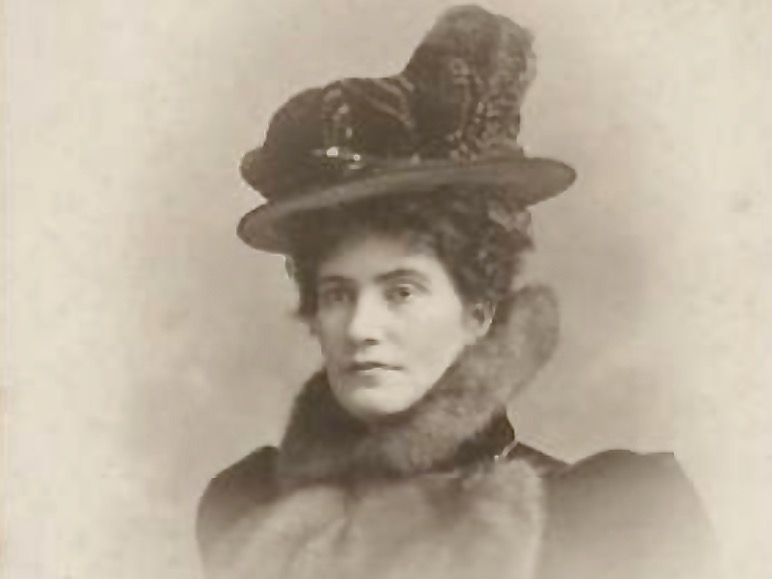
In short – the ladies, like the delightful one below*, should count themselves lucky!

He finally gets down to describing how gavel worked. Several forms existed but all consisted of dividing the property between sons or brothers. He asserts this was common in many countries – or antient lands – and also describes the practice of tanistry, whereby clan chiefs and their successors were chosen. Page after page is devoted to Scythians, Egyptians, Franks, Saxons, etc as precedents, showing it to be a common form of inheritance in the ancient world. This seems to be in service of counteracting the English prejudice agains it as barbarous and conflict-promoting. Clovis is mentioned, Gregory of Tours, the Visigoths and Vandals . . . O’Brien was obviously a man after Vallancey’s heart.

Chap 2 deals with all the tributes due to the king or chief (Above*) and his fiscal rights.  The king or chief was NOT king or chief until inaugurated. I was surprised to find that the traffic went both ways – the king bestowed gifts on the chiefs within his sphere of influence and received tribute from them in turn.

For example the King of Munster (or Cashel) paid to the Dal-Cassian king 

10 golden cups,  30 golden-hilted swords, 30 horses in rich furniture, 10 coats of mail, 2 cloaks richly adorned, 2 pairs of chess boards of curious workmanship

Another one mentions 

10 men slaves, 10 women slaves,10 golden cups, 10 horses in full furniture

The King of Cashel, in return, received from his subject chiefs large gifts of livestock – bullocks, milch cows, hogs, weathers and beehives, along with, for some reason, many cloaks, some specifically described as scarlet.

The King also paid visits to other kings, as a constitutional cement of mutual friendship and harmony between the princely chiefs of the Irish republic (sic), and as a mark of their political dependence on each other for the common interest and welfare. The photo above sets out some of those kingly visits and what was involved for the visitor and the host. Lots of mentions of cups – perhaps like this one from the Hunt Museum Collection?

The second part of this Treatise is essentially a history of the O’Brien’s of Munster, offered as an illustration  of the laws of Tanistry. It certainly offers many examples of conflict and treachery in the line of succession! And once again it wanders all over Europe and the ancient world as it traces the origin of the practice

The final, and most interesting part of Vol 1 is about the Brehon Laws. This part indeed may have been by Vallancey. It consists of a number of fragments (above and below), originally collected by Edward Lhwyd (1660-17090, below) one of the earliest antiquaries to visit Ireland, document ancient sites and collect textual material.

The section consists of individual laws, mostly pertaining to the value and goods and therefore the fines that were to be levied if something was stolen. 

My favourites of these has to do with the value of the clothing of a poetess or the wife of a bard – three milk cows, apparently. However, if the clothing is embroidered the value goes up. For work properly done and completely finished, the reward is an ounce of silver. More is to be paid for extraordinary work in proportion. However, beware – if she be divorced for adultery this law is reversed and the woman must pay two thirds of the said value.

Having spent so much time on Vol 1, I am going to gallop, if I can, through Vol II. It starts with an essay called Brehon Laws and Gavel Kind Explained. This is mainly a  defence agains the accusation by English of ‘barbarous’ customs’ and dwells on obscure points of orthography, such as when the letter P was introduced to Irish. It also deals with more of the practice of gavelkind, the exclusion of women, where else it was practiced and uses the marvellous term Strongbonian for the Anglo Norman settlers. 

An Inquiry Into the First Inhabitants of Ireland follows. This is where Vallancey introduces his claim that the first Irish Irish were Phoenicians. I have dealt with this in the first post so I will not cover this in detail. 

The next section was written by Edward Ledwich another of the early Irish antiquaries – see my post on the marvellous Monaincha for more about Ledwich. What’s fascinating about this is that Ledwich and Vallancey were subsequently at war with each other and Ledwich had views that were just as biased and erroneous as Vallancey’s.

For more on Ledwich see the The Dictionary of Irish Biography entry, which has this to say:

Ledwich afterwards openly and very strongly opposed Vallancey’s views on ancient Irish history, particularly his beliefs about the Phoenician origins of the Irish people. Ledwich was convinced that the ancient Irish had been as barbarous as the scanty Greek and Roman descriptions suggested; that they originated in Scandinavia; and that English colonisation had brought to the island such civilisation as it had subsequently enjoyed. Both Vallancey and Ledwich, along with Charles O’Conor (qv) of Belanagare and William Burton Conyngham (qv), were founder members (1779) of the Hibernian Antiquarian Society, which collapsed in 1783 in the bitter disagreements between Vallancey and Ledwich.

The piece on round towers was written by Ledwich, (although these illustrations are from his later Antiquities of Ireland) presumably before the great falling out between the two men. Whereas Vallancey saw round towers as observatories for an astral, or sun-worshipping, cult that had been brought to Ireland by the Phoenicians, Ledwich believed that the round towers were Danish works. In fact, he was as obsessed with the Danes as Vallancey was with the Phoenicians. They were built, he says as ‘watch towers against the natives’, thus neatly upending the most common belief in Ireland about round towers – that they were watch towers against Viking Raids. (In fact they were bell towers, but that’s another story.) Here, Ledwich obliquely refers to Vallancey’s work that towers were erected by Phoenicians and says ‘this description is plainly the work of fancy’.

Ledwich was convinced that nothing of any architectural value could have been constructed by the Irish themselves. Reading his argument (and Vallancey’s) I was struck by how it foreshadows the pseudo-archaeolologists who claimed that big impressive monuments must be the work of superior races – people like Von Daniken in his Chariots of the Gods in the 60s who assigned them to aliens, or more recently the conspiracy theorist, inexplicably given a platform by Netflix, Graham Hancock. Hancock’s series Ancient Apocalypse tries to find a race of Ice Age people who must have constructed many of the ancient monuments (or even odd geographical features) around the world. Hancock (‘I’m just asking questions’) is a true inheritor of the nuttiness and hubris of both Vallancey and Ledwich. Later, Ledwich felt sufficiently incensed by Vallancey’s theories to say this, in his Antiquities of Ireland:

No wonder they were at war! Can anyone translate the Latin? I suspect it’s a further insult. I do absolve Vallancey, by the way, of the baser motivations visible in Ledwich and Hancock – that is, a racist and colonial ideology that sees indigenous people as incapable of building impressive monuments. No – Vallancey had no difficulty at all in promoting the ancient Irish as one of the great and noble races.

I’ll leave you with this view of Cashel from Ledwich’s Antiquities of Ireland. Despite all my best intentions of getting through several volumes, I am still only half way through Vol 2 of 5. Any suggestions, dear readers, on how I can wrap this up so that I can get my life back?

*Kostüme der Männer und Frauen in Augsburg und Nürnberg, Deutschland, Europa, Orient und Afrika available here.

Vallancey: The Collectanea, Vol 1

Though often derided by his contemporaries and later critics for his more outlandish theories, Vallancey arguably did more than almost anyone else in the late 18th and early 19th century to stimulate interest in Irish archaeology and history. Much of this was accomplished through the essays and papers he published in his Collectanea, through which he reached an educated audience.

Let’s take a deeper dive into the Collectanea (pronounced, I have found, collecTAYnea) now. But be warned – these are  my own quirky interests on display here, not a scholarly analysis. I can’t always account for what catches my attention, but isn’t that the real delight of browsing a set of volumes like this – the treasures you will unearth? The other pleasure is just holding it – the feel and smell of such old books, and getting used to the typeface. 
There’s another reason too – the provenance of the set. Hidden inside Volume IV is a telling letter (above) that proves that this set originally belonged to Abraham Abell (1783 – 1851). A vital figure in the antiquarian community of Cork, Abell was  a true eccentric who amassed an enormous library, burnt it all in 1848, and then started again to amass thousands more. In his retirement, he rented a room in the Cork Institute (now the Crawford Art Gallery) where he lived out the rest of his days with his thousands of books stacked from floor to ceiling.

We know that this set of the Collectanea belonged to his first library since it was given to him in 1841 by John Bennett, and that somehow it was not consumed in the burning. I have read two accounts of the burning – one that he did it in a depressive episode, the other that he did it to make room so he could start afresh. However it happened, it’s a minor miracle that the set has survived that cataclysmic event.

Vol 1 begins with A Chorographical Description of the County of West-Meath,1682, by Sir Henry Piers, accompanied by a map of the county. Vallancey published this in 1770 and it is likely that the map dates to then rather than the 1680s, when map-making was far more rudimentary. Chorography, a word not much in use nowadays refers, according to Wikipedia, to the art of describing or mapping a region or district.

While some of the introduction especially refers to the geographical features of the country, much of it, in fact is made up of descriptions of customs, ancient battles, significant places (e.g. Cat’s Hole Cave), ruined monasteries and saints, ways of making a living, and accounts of the degenerate English and oppressive landlords.

Piers belongs in the ranks of those who believe the English civilised the Rude and Barbarous Irish, although he admits that some are not quite civilised to this day. By degenerate, Piers meant Englishmen who had ‘gone native’, married Irish women, spoke Irish and fostered their children with Irish families. From men this metamorphosed, he queries, What could be expected? He admits that English Kings neglected Ireland and that there was substantial corruption among officers of justice. The Irish, he says are given to learning and hospitality and the women are generally beautiful, and love highly to set themselves out in the most fashionable dress they can attain. However, the landlords of old, by which he presumably means the Irish clan heads, were and still are great oppressors of their tenants.

He describes agricultural practices (very dysfunctional and leading to many quarrels) and Bearded Owen’s Law, by which shares in bog-cutting are apportioned, and the practice of driving the cattle through water once a year. Marriages (above) are negotiated between parents and friends on each side. He writes about the May bush, bonfires on St John’s Eve, wakes more befitting heathens than Christians, and the practice of the Month’s Mind (below) which involved a great feast and many masses said in the house, after which every priest and friar is discharged with his largess.

I’ve only picked out a few details from the essay on Westmeath, but you can see from these examples what an incredibly valuable this resource is. We have very few descriptions like this of what life was like in 17th century Ireland, and the fact that Vallancey recognised its importance and published it says much about his appreciation for Irish customs and lore.

The second document is a Letter from Sir John Davis written to Robert Cecil, Earl of Salisbury (above) in 1607. This was shortly after the Battle of Kinsale (1601) which marked the end of the power of the old Gaelic families. In this letter, Davis describes the state of the counties of Monaghan, Fermanagh and Cavan, in preparation for a visit by the earl. 

In 1607 Hugh O’Neill (above) had been restored to his estates in Tyrone following the Treaty of Mellifont, but was to lead his followers into exile in 1607, an act known as The Flight of the Earls. This cleared the way for the English to plan a plantation – the Plantation of Ulster became in effect what established the modern jurisdiction of Northern Ireland. And that’s exactly what is described in the letter – who owns what land (including clerical lands) and what should be done with it. It’s crucial to understanding the development of modern Ulster. That’s a plantation map, below, but not from this volume. It lays out what land the haberdashers could have, or the skinners or the drapers.

And next – who have we here? It’s none other than Archbishop James Ussher (1581 – 1656), later the Church of Ireland Archbishop of Armagh and Primate of All Ireland. This is the same man who established to his own satisfaction that the world was created on 6 pm on 22 October 4004 BC. Harmless speculation, you say? Alas not so – there are many people in the world today who still believe this, and it was certainly a commonplace belief up to the 20th century.

[Aside – what is extraordinary to me is that Trinity College still has his portrait proudly on display (below) in their Exam Hall. Meanwhile, George Berkeley is being erased from their history – correctly, perhaps – but for the same crime of being ‘a man of his time.’]

Ussher’s piece was written originally written in his own hand in 1609. It is titled Of the Origin and First Institution of Corbes, Erenachs, and Termon Lands. All these were common terms on the early Irish monastic system, to denote land holdings and those who held them. For example, a Termon was thought to be a sanctuary, hence the town of Termonfeckin was originally Tearmon Feichín, or St Feichín’s Sanctuary. Corbe was more usually given as Coarb. In the period following the dissolution of the monasteries, and the plantations that followed the Battle of Kinsale, there was a need to define these terms so that the land could be divided among English settlers. This is a very difficult treatise, written half in Latin, which lays out the meaning and origin of the terms and also the men who held the lands, to whom they paid rents or annuities, or owed labour. Ussher disingenuously disclaims any interest in this treatise besides having described without any partiality the meaning of the terms.

However, a little reading in the late lamented Peter Harbison’s Cooper’s Ireland yields the information that Ussher, in fact, had possession of Termonfeckin. Here’s what Harbison says: 

This ‘palace’, referred to as ‘Termonfechan’ by Austin Cooper, was named after a monastery that once stood on this site, founded by Saint Fechín of Fore in the seventh century.

But the reason why the primate – that is, the Archbishop of Armagh – should have a palace here at all was not out of homage for this early Irish saint. It had much more to do with the religious politics of the later mediaeval period, when the Archbishop – usually an Englishman by birth – was surrounded by native Irish whose language he did not understand. He felt much safer when he could get away from his See at Armagh and reside at Terminfeckin, the southernmost tip of his Archdioceses, and its nearest point to the centre of English power in Dublin some 35 miles away.

The siege mentality of those within is reflected in the small, defendable window slits inserted in the severe looking wall face, as seen in Coopers drawing…Its last inhabitant had been…Archbishop James Ussher.

A Short Account of Two Ancient Instruments, by Vallancey follows. Here we can see many references to Phoenicians and Egyptians. He had recourse to the writings of Homer to inform us that the weapons of the Trojan war were made of copper, thus, of course, implying a Classical date for them. He rambles on about Sabean priests, Arkite forms of worship and fire feasts of Baal, before finally getting to describe the instruments – neither of which appear relevant to the previous discourse. In this case, the instrument are of silver. There is no attempt to interpret their use, and they certainly don’t look like musical instruments but rather perhaps cloak fasteners. 

I had intended to cover all of Vol 1 in this post, but I am not even half-way through. I will have to get a lot better at skimming and summarising if I am ever to emerge from this mountain. But I am hoping that this gives you a flavour of not only the diversity but also the value of the Collectanea. In the first 250 pages alone we have had original documents, not by Vallancey (except for the ‘Instruments’) but collected and published by him, that are invaluable to the understanding of Irish history and culture. This – the collecting, preserving and publishing important documents, as well as listing where others can be found (see Part 1) – may in fact have been his greatest contribution to Irish scholarship. 

I’ll finish with an illustration from one of the Volumes – it is not identified and is certainly not by Vallancey. In fact it looks like one of Beranger’s. Perhaps one of our readers might know what ruin this is. [EDIT: identified! See comments below] The lead image, by the way – the portrait of Vallancey, is taken from VH Andrews’ essay on Charles Vallancey and the Map of Ireland (see previous post) and is described as from an oil painting by Solomon Williams.

Charles Vallancey: A Colossus and his Collectanea

General Charles Vallancey, in the words of one of his biographers, ‘bestrode the world of Irish antiquarians for almost half a century.’ *

His origins are shrouded in mystery – although he is believed to have been born in Flanders to a French family, moved to England as a child, and attended Eton, there is no absolute proof of any of these facts of his early life. Even the date of his birth is contested – any time between 1720 and 1726. What is certain is that he joined the army, was posted to Ireland before 1760 as a military engineer, and spent the rest of his life, until his death in 1812, engaged with many aspects of Ireland, the country that one writer has called the great love of his life. Given that he had three wives (or maybe four) and twelve children (or maybe only 10, or maybe 15), that’s quite an assessment.

Dublin’s oldest bridge still in use, photo courtesy of Wikimedia Commons. It was designed by Vallancey and originally called the Queen’s Bridge, but re-labelled the Queen Maeve Bridge after independence, and eventually the Mellows Bridge

As a military engineer, Vallancey made real contributions: mapping and surveying large tracts of Ireland including the bogs and the canal systems; proposing a major transport route for Cork which, had it been realised, would have greatly aided trade and commerce in Ireland; building strong defences, such as on Spike Island; designing elegant bridges, and supervising the construction of an earlier version of the famous Dun Laoghaire Pier.

His cartographic achievements have been praised by experts – the extract above from a map of Tipperary is from Charles Vallancey and the Map of Ireland** by JH Andrews, our foremost cartographic historian who notes that Vallancey’s cartographic achievements were far from negligible. He made copies, in Paris, of the Down Survey Maps that had been lost to Ireland when they were captured by the French in 1707 en route from London to Dublin (unfortunately, those copies were destroyed in the Four Courts Fire of 1922).

But it was as an antiquarian that Vallancey made his greatest, and most controversial mark. He was a member, sometimes a founding member, of the serious societies of the time – the Dublin Society, the Royal Irish Academy and its important Committee of Antiquities, and the short-lived Hibernian Society of Antiquarians. Nevin tells us that at least three academic honours were conferred on Vallancey in the 1780s. He received an LLD from Dublin University in 1781 and became a Fellow of the Society of Antiquaries of London in 1784: he was elected a Fellow of the Royal Society in 1786. Even the French Academy of Belles-Lettres and Inscriptions honoured him.

Unusually for the English and the landed classes living in Ireland at that time, he learned Irish. This allowed him to become familiar with the ancient manuscripts and annals which were being discovered and conserved at the time, and to translate some of them, including fragments of the Brehon Laws. It also led to his interest in Ogham, an alphabet used for inscriptions in stone in a form of Old Irish and he recorded examples of Ogham and reported on others.

His interest in antiquities, fostered by his extensive travels around the Island,  led him to record and draw many, including early plans of Newgrange, and to support the efforts of others, including Beranger, and perhaps Bigari, to record them. In some cases, Vallancey’s drawings are the only early records we have of some monuments.

Most importantly, Vallancey, even if he didn’t always get it right, strove to establish for Ireland and the Irish, a noble heritage, far from the view of most Englishmen at the time of a benighted people speaking a savage tongue. In this, he prefigured the work of Petrie, Wilde, Windel and others to show how the Irish past, and incredible heritage of archaeology, language and mythology, could stand against that of any civilisation. 

His least known but most important contribution to Irish scholarship was his Rerum Hibernicarum, Scripti, et Impressi. This is a handwritten

alphabetical list of material relating to Irish history divided into two sections; a list of manuscripts held in multiple archives and a supplementary list of printed works. The volume is undated, but as the most recent printed work cited is from 1777 the compilation was probably made shortly after this time.

Taking the long way home: the perambulations of Harvard MS Eng 662, Rerum Hibernicarum, Scripti et Impressi, by Charles Vallancey

Dr David Brown

The Rerum Hibernicarum disappeared – it had an interesting journey, entertainingly told by David Brown in his essay for the Virtual Record Treasury of Ireland, in which a digital copy now resides. An incredibly valuable piece of research, it was the seminal book that initiated a more rigorous approach to Irish studies in the nineteenth century by providing sources for Irish manuscripts, folklore and language to the next generation of antiquarians. Brown says:

All four men, Larcom, Todd, O’Donovan and O’Curry, were committed members of the Royal Irish Academy, the institution Vallancey had co-founded in 1785. Together, this quartet placed Irish studies on a scientific basis and at the centre of Ireland’s main places of scholarship.

Vallancey’s best known work was his Collectanea de rebus hibernicis – Collection of Irish Matters. It is also his most complex and most characteristic – containing as it does a staggering variety of materials, much of it written by him. It contains work by others too, sometimes credited and sometimes presented as if written by Vallancey. He published it himself in limited editions, so that now it is very rare. 

I am honoured to have been entrusted with a set to examine and write about, by Inanna Rare Books and have spent many happy hours browsing through the volumes. Reading it thus, from cover to cover, I began to see how enormously clever he was – and how obsessed, as he returns again and again to his favourite theme: that the Irish were a noble race descended from the ancient Phoenicians.

In this pursuit, Vallancey was not merely riding a personal hobby horse. In fact, he was very much in the mainstream of European intellectual thought. Vallancey believed that the Irish people were descended from the Scythians, Phoenicians, and Indians, and he used linguistic analysis, comparative mythology, and archaeological evidence to support his claims. In his essay, Phoenician Ireland: Charles Vallancey (1725–1812) and the Oriental Roots of Celtic Culture, Bernd Roling posits that Vallancey’s work, while ultimately based on speculation, reveals the powerful influence of ‘orientalizing’ models of history that were popular in the 17th and 18th centuries. He argues that Vallancey’s work is not simply a collection of outlandish ideas but rather a reflection of the enduring influence of ‘baroque’ antiquarianism and its commitment to finding connections between cultures and languages, even if these connections were ultimately based on speculation and incomplete understanding of the past.

Perhaps it was his enthusiasm for technology and the continuous journeys through Ireland required by his work that led Vallancey to find there the great love of his life of his life, namely Ireland herself. . . 

In the eighteenth century Ireland was not the centre of the world. It was a land dominated and exploited by England, with a rural population who were regarded as barbarians at best by the gentlemen at home in the clubs and coffee houses of England’s cities. For them, the native language of the Irish was no more than an incomprehensible squawking that needn’t be accorded any further significance. Would it not, then, be a magnificent surprise, almost a humbling of Anglophile arrogance, if the Irish turned out to be the descendants of the ancient Chaldees, Phoenicians, Scythians and Indians, the crowning jewel in a chain of heroic acts reaching back into a prehistory, which was able to supersede any other chain of historical events? Would it not be a wonder if the Land of Saints and Scholars, with its ancient monuments, poetry and songs, were the final record of a primordial European people whose wisdom united the learning of the whole ancient East?

Yes, indeed, Vallancey, himself a bit of an outsider, was consumed with the need for that humbling of Anglophile arrogance. Unfortunately, as with anyone blindly obsessed with a cause, and simultaneously lacking self-doubt, this led him into many false conclusions and leaps of imagination in his interpretations of how Irish Gaelic related to ancient and oriental languages. His philological arguments were thoroughly debunked, starting almost immediately upon publication. 

And it wasn’t just language – he had equally startling views about round towers, proposing that they were built by Scythians. He suggested that they were part of the “Scytho-Phoenician settlement of Ireland” and linked to ancient Chaldean religion. He drew on the work of other scholars to support his argument, citing the discovery of similar towers, called misgir or “fire towers,” in the Volga region formerly inhabited by the Bulgars. Vallancey also referenced Geoffrey Keating’s account of a druid named Midghe, who supposedly taught the Irish the use of fire during the third invasion by the followers of Nemed (from the Book of Invasions, a mythological origin story for Irish History). This association with fire, combined with the architectural similarities to the towers in the Volga region, led Vallancey to believe that the round towers served as observatories for an astral, or sun-worshipping, cult that had been brought to Ireland by the Phoenicians.

Similarly, with ogham, an early Irish script mainly found carved into standing stones, he argued that the word ogham itself was derived from Sanskrit, meaning ‘sacred or mysterious writing or language’ and pointed to the visual similarities between ogham and the Old Persian cuneiform script found at Persepolis as further evidence of an oriental connection. This view aligned with his broader theories about the druids as practitioners of a sophisticated astral cult with origins in Chaldea and connections to the Indian Brahmans

His research on ogham was extensive, including the study of ogham inscriptions and the publication of scholarly articles and drawings of ogham stones in his Collectanea de Rebus Hibernicis. Next week, we will take a deep dive into that Collectanea. Meanwhile, I’ll try to figure out how to pronounce that word correctly.

*General Charles Vallancey 1725-1812 by Monica Nevin. The Journal of the Royal Society of Antiquaries of Ireland , 1993, Vol. 123, pp. 19-58

** Charles Vallancey and the Map of Ireland, JH Andrews. The Geographical Journal, March 1966. Available here. Highly recommended if you want to know more about Vallancey as a map maker, which is slightly outside the scope of this series.

Ballydehob Biodiversity Threatened by Shocking Government Neglect

Roaringwater Journal normally concentrates on being positive, and doesn’t get caught up in political issues. But we cannot stay uninvolved when we see the appalling prospect facing our beloved Ballydehob Bay and Estuary.

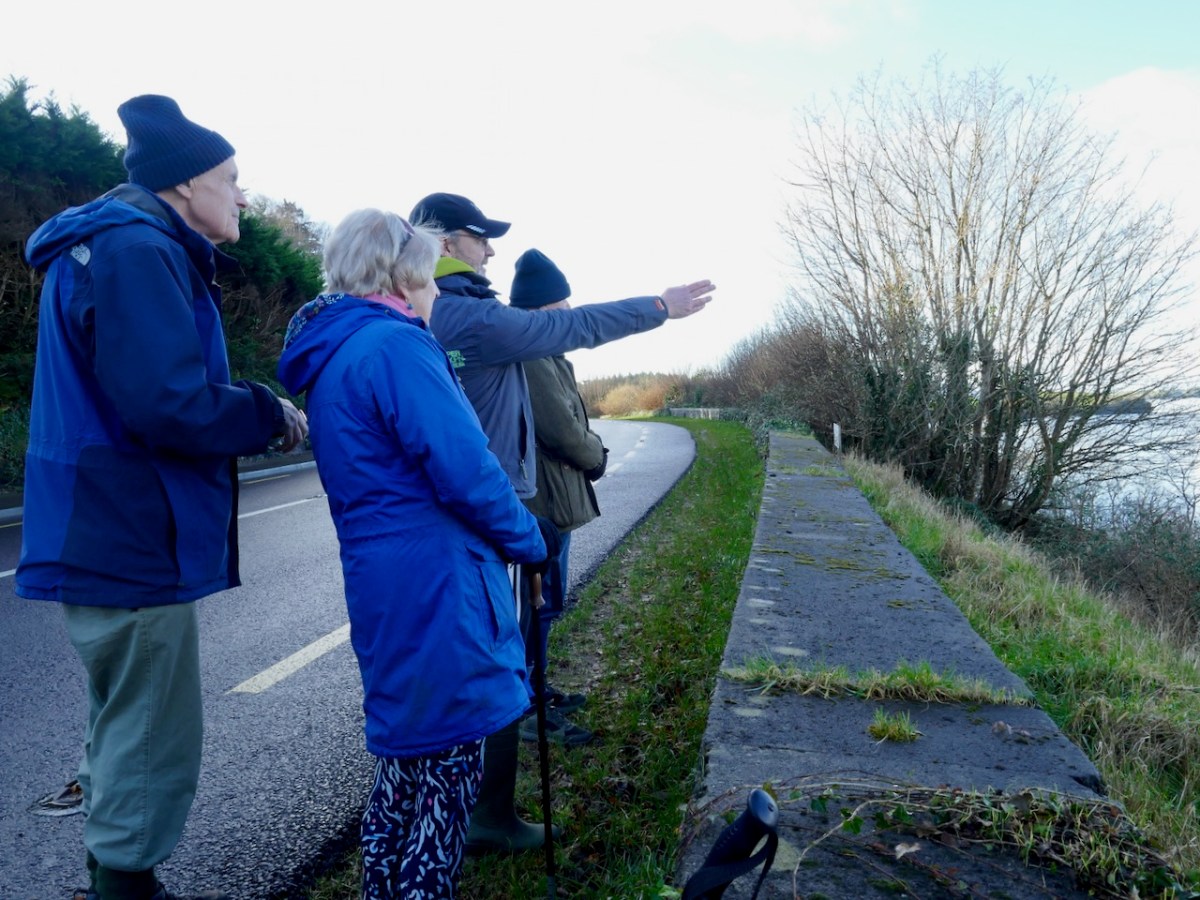
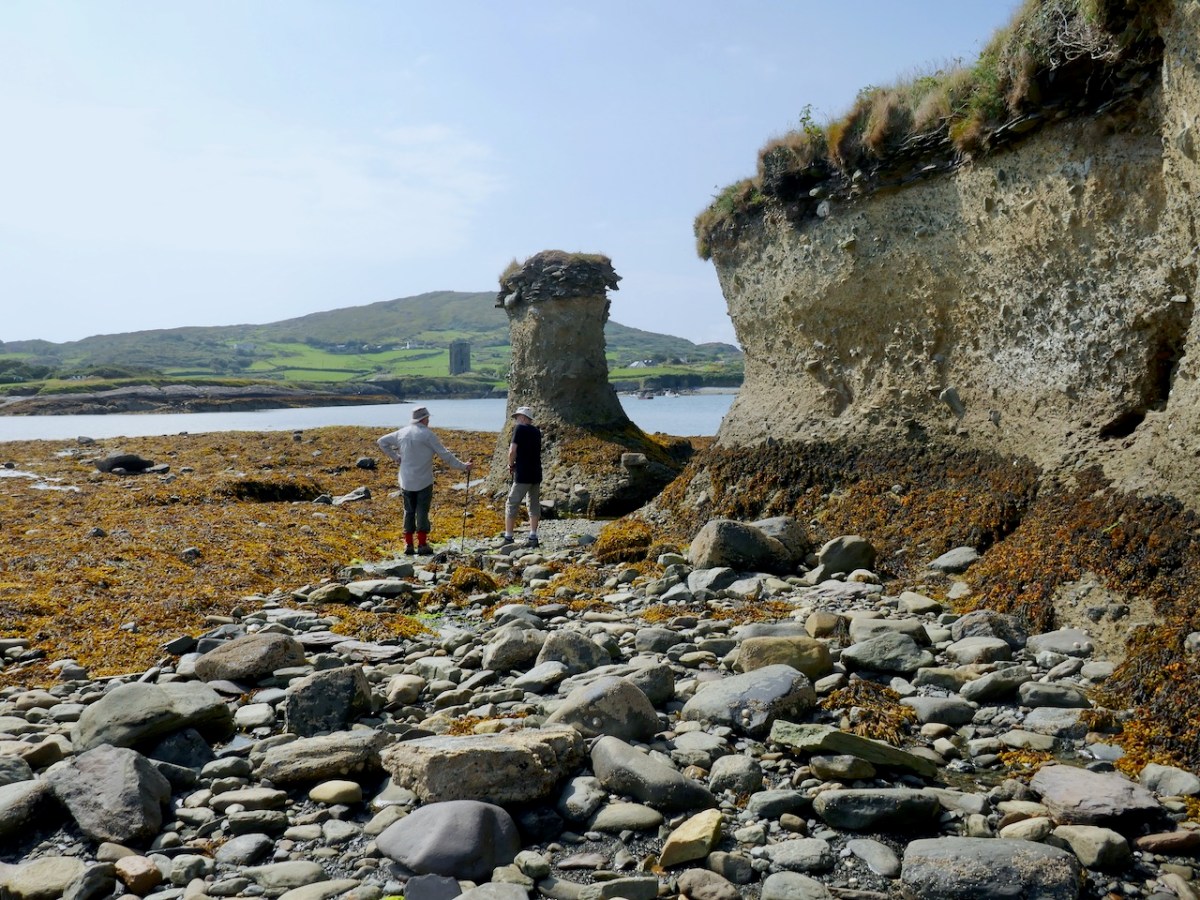
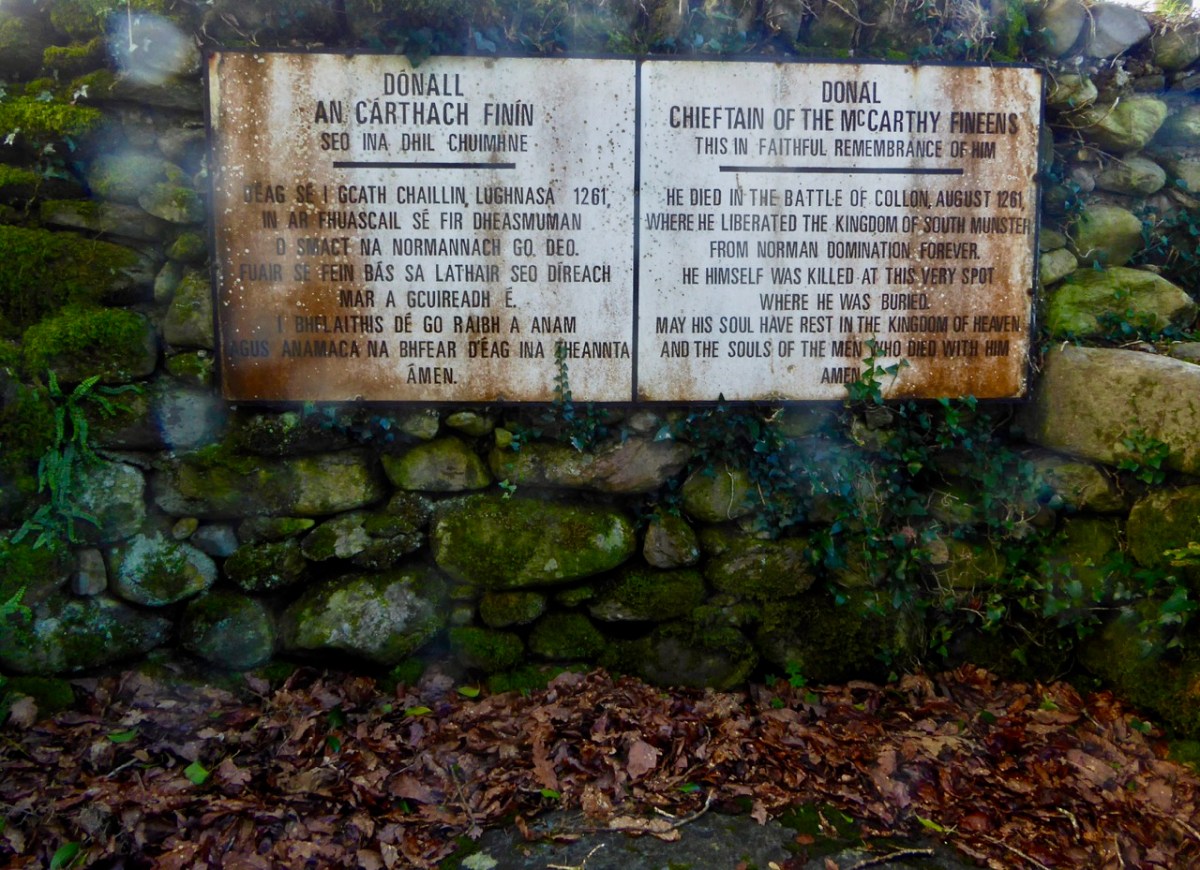
The active group that has been working on issues effecting Ballydehob Biodiversity is called Ballydonut (for an explanation, click here to read up on what a Doughnut Economy is all about). One of the members, local historian, writer and retired teacher, Cormac Levis, has put a huge effort, 250 hours to date, into researching the situation regarding waste water treatment in Ballydehob. His findings have profoundly shocked and depressed us all. Cormac, and his parents and grandparents before him, lived and worked in Ballydehob and the islands of Roaringwater Bay. He knows every inch, every story, every family, every creature, of this magnificent area and has written books and articles about it (like this one). We hung on his words on a recent trip with him, below.
Here is the executive summary of his report

Shocking Pollution caused by Ballydehob Waste Water Plant.
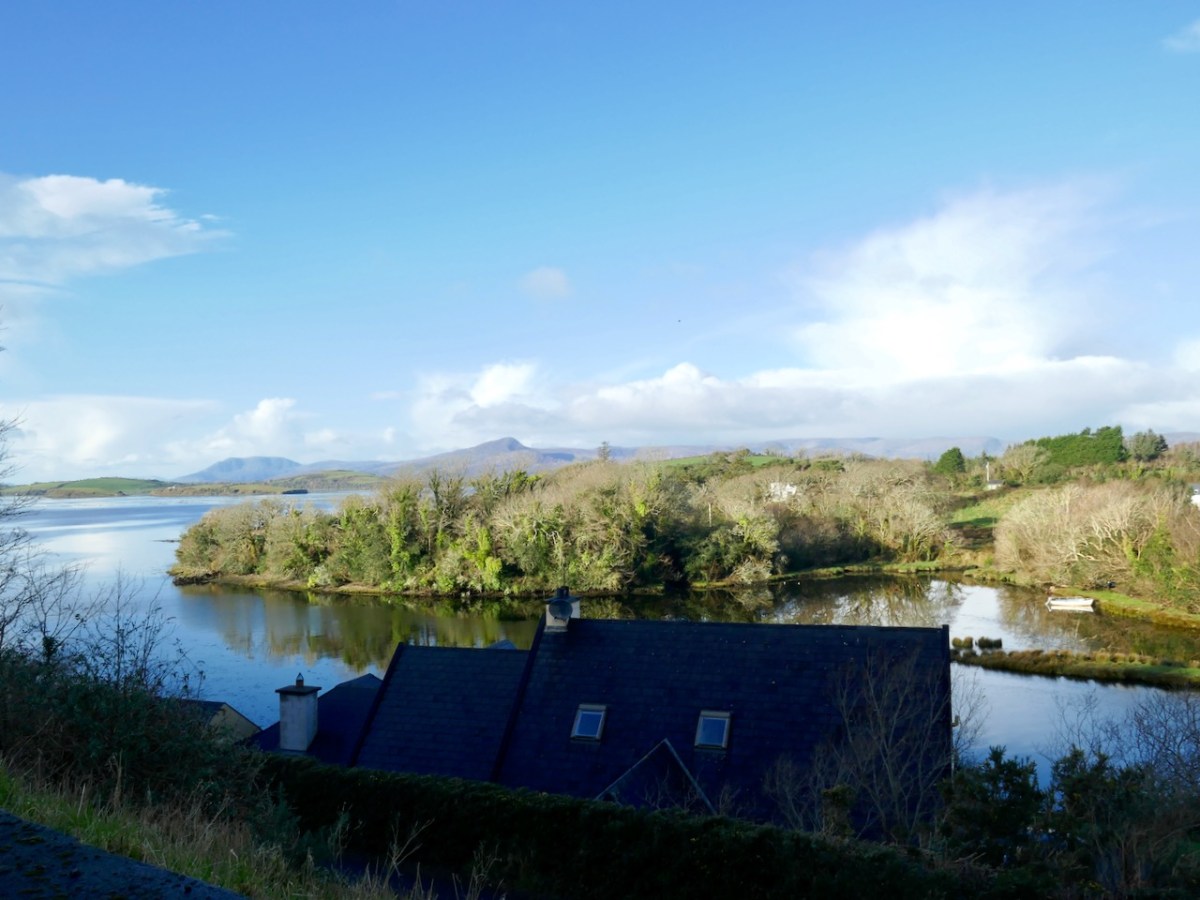
The gross neglect and mismanagement of Ballydehob Waste Water Treatment Plant  over a period of ten years has resulted in a shocking, ongoing pollution problem in Ballydehob Bay, especially in the vicinity of the quay and in the estuary adjacent to the village. A thick grey and brown coloured scum of sewage effluent can regularly be seen floating in on the coming tide from the primary discharge point, which is located just fifty meters downstream of the quay. Added to this, grey, filthy, foul smelling water, and often even faeces and toilet paper, can frequently been seen pouring out of the storm water overflow at the septic tank directly into the lagoon.

The so called Treatment Plant is nothing more than a basic septic tank and Ballydonut Waste Water Action Group, Ballydehob Tidy Towns Committee and Ballydehob Community Council are jointly spearheading a campaign to have the plant upgraded to provide proper sewage treatment for Ballydehob. To that end, a petition has been made available for the public to sign at the Post Office and most businesses in the village. It is also available at The Bank House on Mondays and Fridays.

 Also available are copies of a substantiated report, researched and compiled by Cormac Levis, which details the long history of neglect and mismanagement associated with the plant and the resulting threat to public health, community amenities and the environment. It can be picked up where ever the petition is available or email kilbronogue57@gmail.com to have it emailed to you.

Because this issue is so important, Cormac has allowed me to publish the complete text of his report and I have set up a page for it. Just click on this link to read it:

A Substantiated Account of the Neglect and Mismanagement of Ballydehob Waste Water Treatment Plant and the Resulting Ongoing Pollution of Ballydehob Bay and Estuary

Researched and Compiled by Cormac Levis on Behalf of the Ballydonut Wastewater Action Group.

A petition has been established and can be signed at the post office and at various businesses in Ballydehob. Here’s what it says:

To Uisce Éireann, the Environmental Protection Agency, the Environment Directorate of Cork County Council, our local Teachtaí Dála, Senators and County Councillors.

We, the undersigned, demand an immediate upgrade of the Ballydehob Waste Water Treatment Plant, as specified in Condition 5 of the Waste Water Discharge Licence D0467-01, pertaining to the plant, in order to end the shocking and ongoing pollution caused by the current inadequate and obsolete septic tank.

If you can’t get to Ballydehob and would like to add your name, please go to this link to sign it online. (For those who signed it below, before the online petition was established, we will add your names to one of our lists.) Thank you for your support, from Ballydonut Waste Water Action Group, Ballydehob Tidy Towns Committee and Ballydehob Community Council.

Ballydehob is our home, but it’s just one of many, many places in Ireland where the catastrophic failure of wastewater treatment is threatening our environment. See this report from RTE for an exposé that will curl your toes. The section on water pollution starts at 13 minutes in.