The Wild One

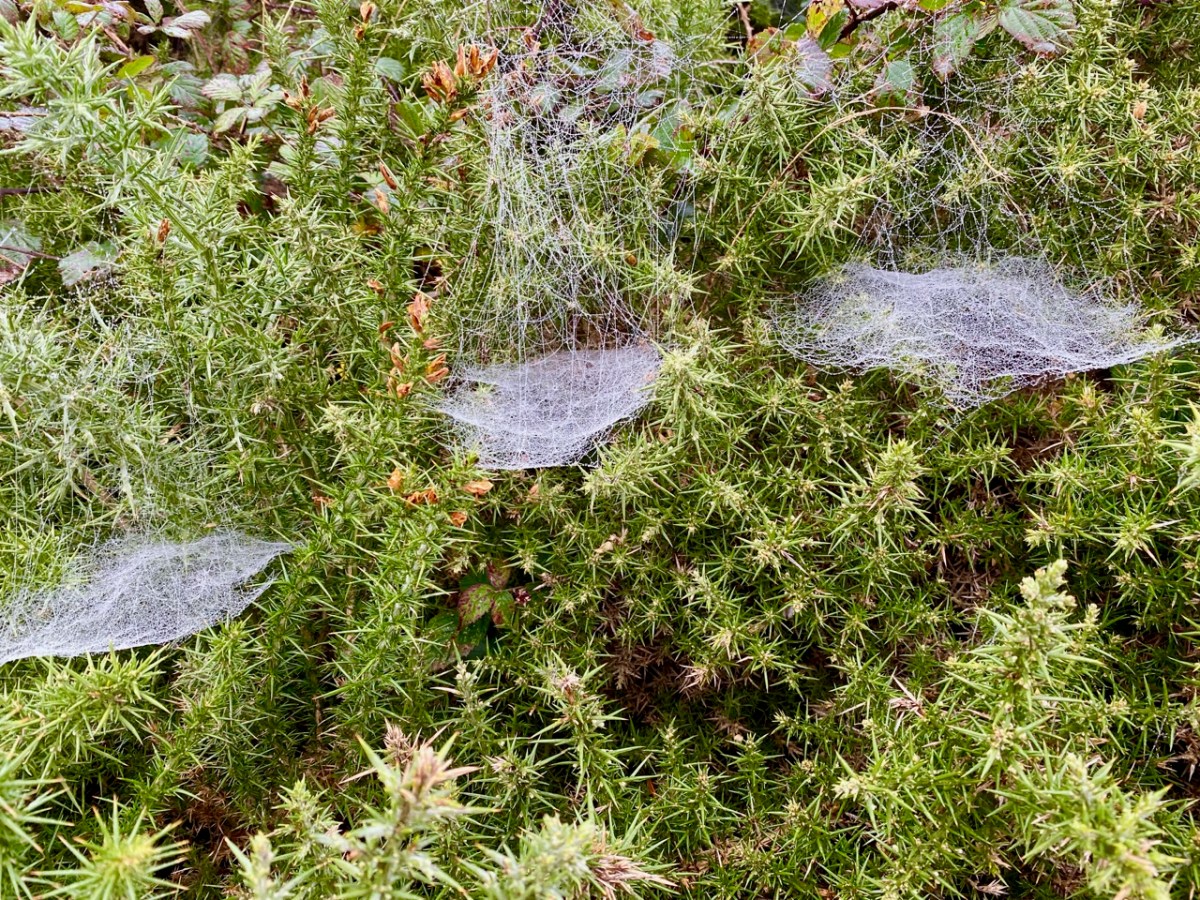
We are past November Dark – traditionally a ‘low’ time of the year when the effects of the approaching cold months begin to displace autumnal skies and spectacular sunsets: the term traditionally refers to the appearance of the new moon of the month (which happened this year on the 4th), but is probably inspired by the preceding nights when no moon is visible. For us at the moment, on the shores of Roaringwater Bay, the dark time is emphasised by a constant pervading mist which clings and covers everything in films of moisture, especially the myriad cobwebs on the gorse bushes which surround us. Gone – for now – are our fine views out across to the islands, and there is a feeling of being marooned and suspended in a lifeless grey tract which encompasses sea and sky.
November Dark has brought with it tragedy to our garden. In explanation, I should first paint the idyllic picture of what we like to call our ‘peaceable kingdom’. For many years we have considered this domain a haven. Do you remember our fox – Ferdia – who was a constant companion to us in the first few years here at Nead an Iolair? He visited on a daily basis – often waking us by barking outside our bedroom window at dawn, and presided over a mixed community of birds and animals who share our territory – without any conflict.
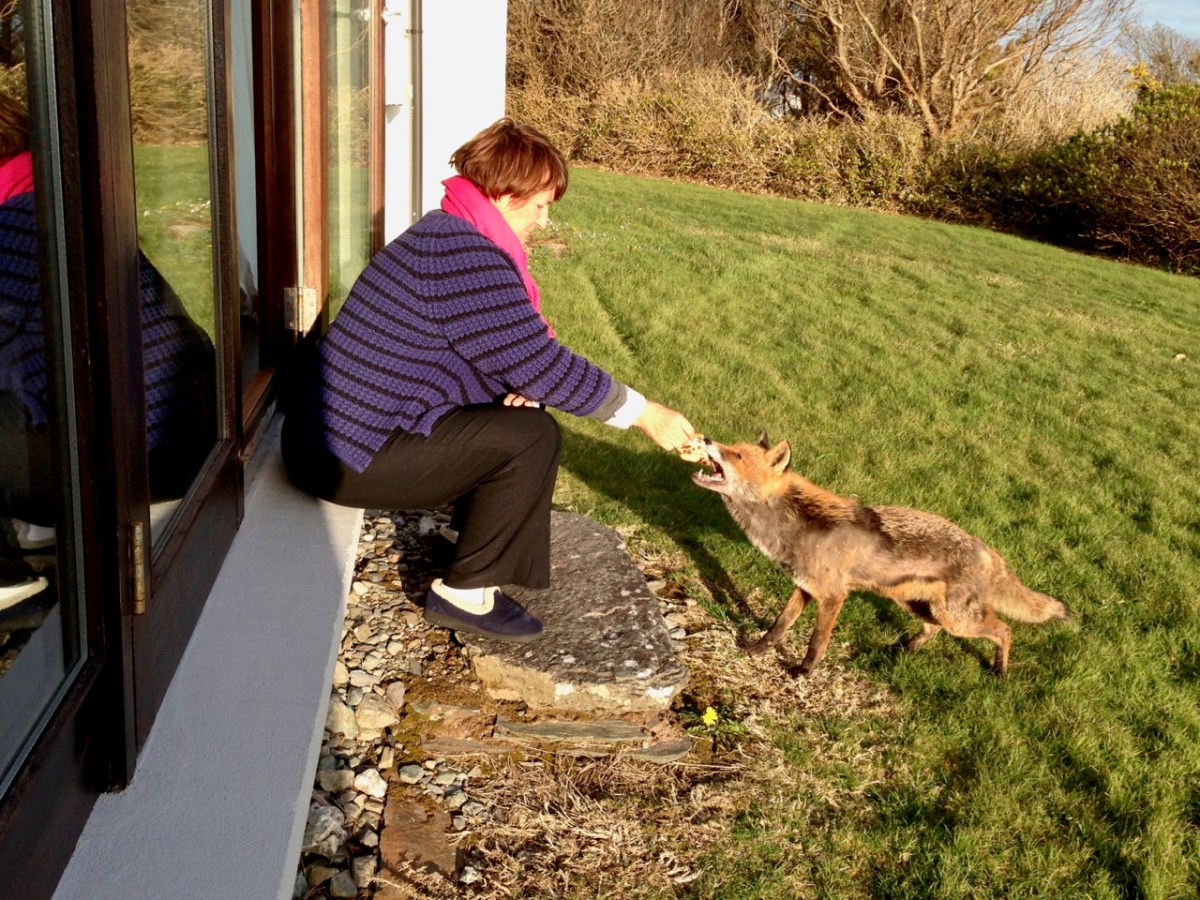
Ferdia was happy enough to co-exist with the bird and pheasant families, the rats and mice, and the occasional cat that dropped in. I have a memory of fox and cat sitting side by side on our terrace, clearly having a conversation with each other: I would like to have eavesdropped, but whatever mutual language they share was not available to me! Ferdia vanished from our garden a few years back – gone to his happy hunting grounds no doubt; but the pheasants have remained with us through much of the decade we have been here.

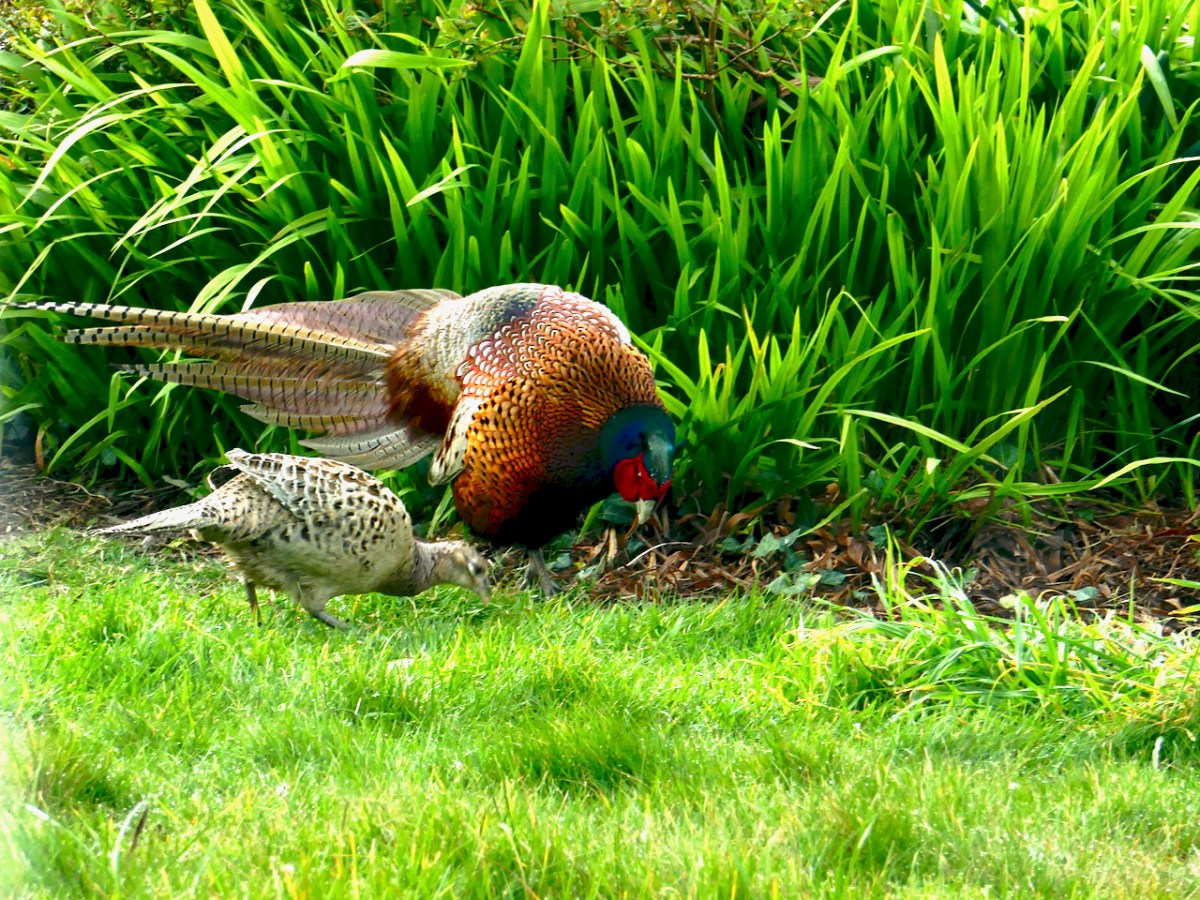
In the upper picture Finnbarr and his young wife, Fidelma, patrol our garden some five years ago. The lower picture was taken just before the start of the Pandemic, in March 2019. The couple have been a daily feature of life outside Nead an Iolair. They always appreciated feeding time, when they got a share of the seeds I put out on our patch for the many bird visitors, small and large. The picture below taken during the summer of last year shows a family group: pheasant chicks have been seen but rarely.
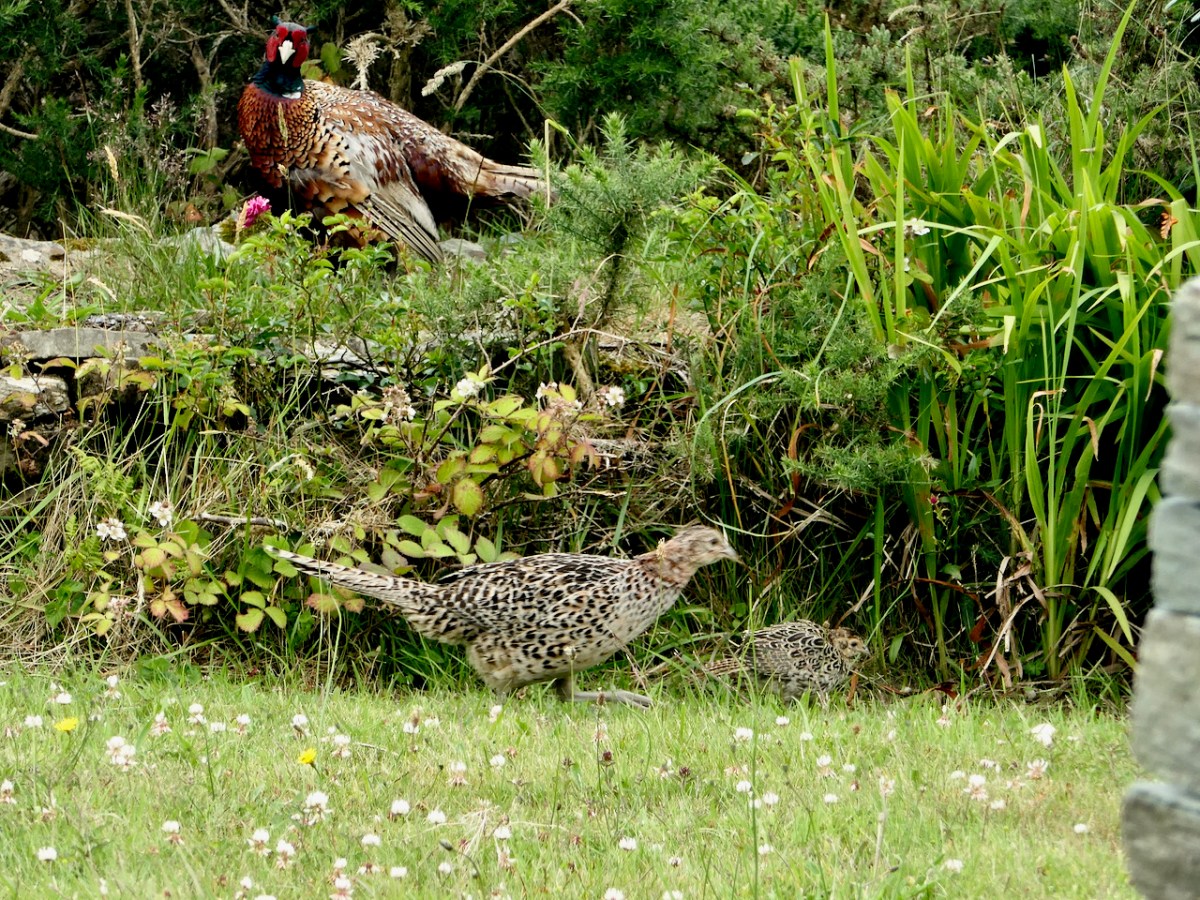
The idyll abruptly ended yesterday, when a bomb hit the garden – in the form of a small but fierce force of nature: only inches long but terrifying. I glanced out of the window where, minutes before, the two pheasants had been foraging as usual along the stone boundary wall. I was shocked to see Fidelma lying on her back, wings flapping, being dragged along the ground: there was a commotion among the small birds and Finnbarr had vanished. At first I could not see the attacker, but as I rushed outside I caught a glimpse of brown fur with a hint of white and black. My first thought – a rat! – could not have been borne out: we have lived side by side with rat families for years: they only ever appear to share the bird food, and are never aggressive.
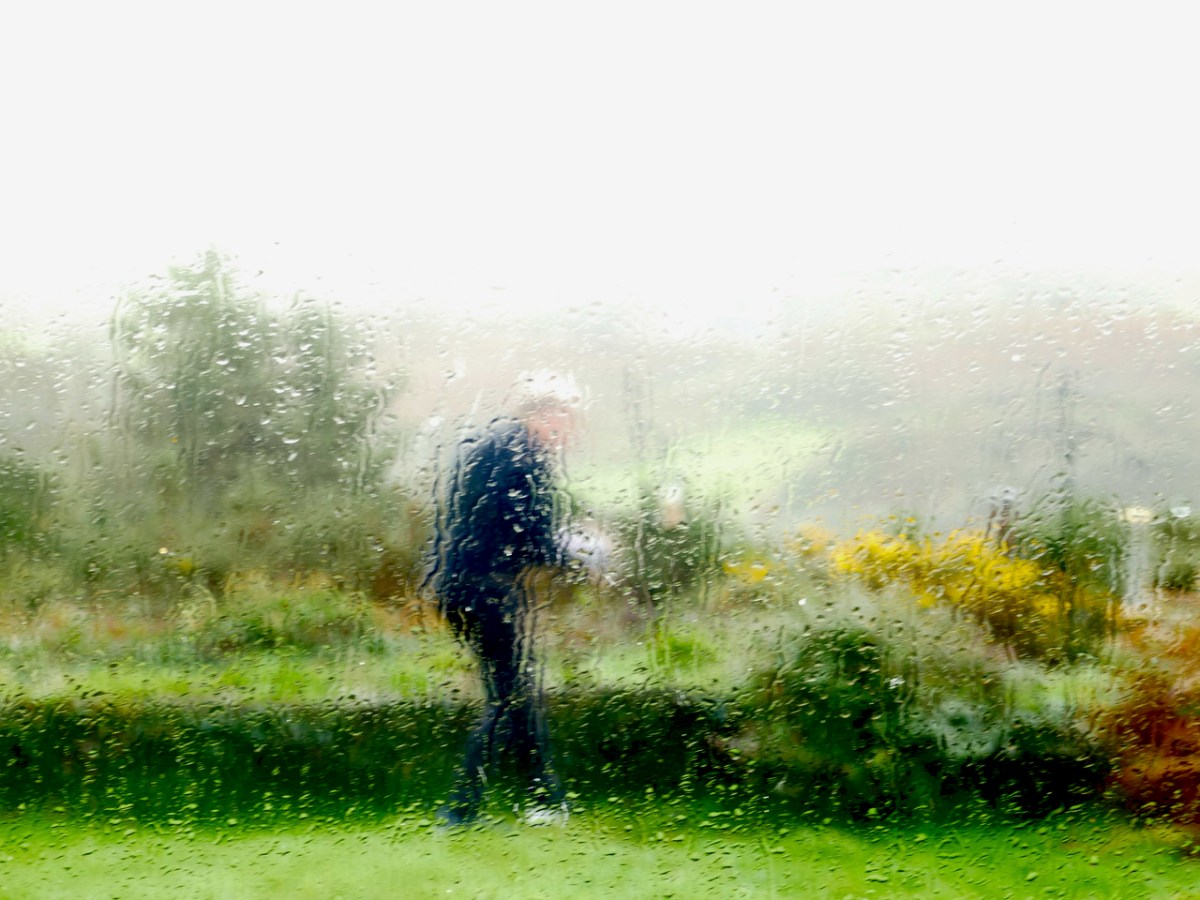
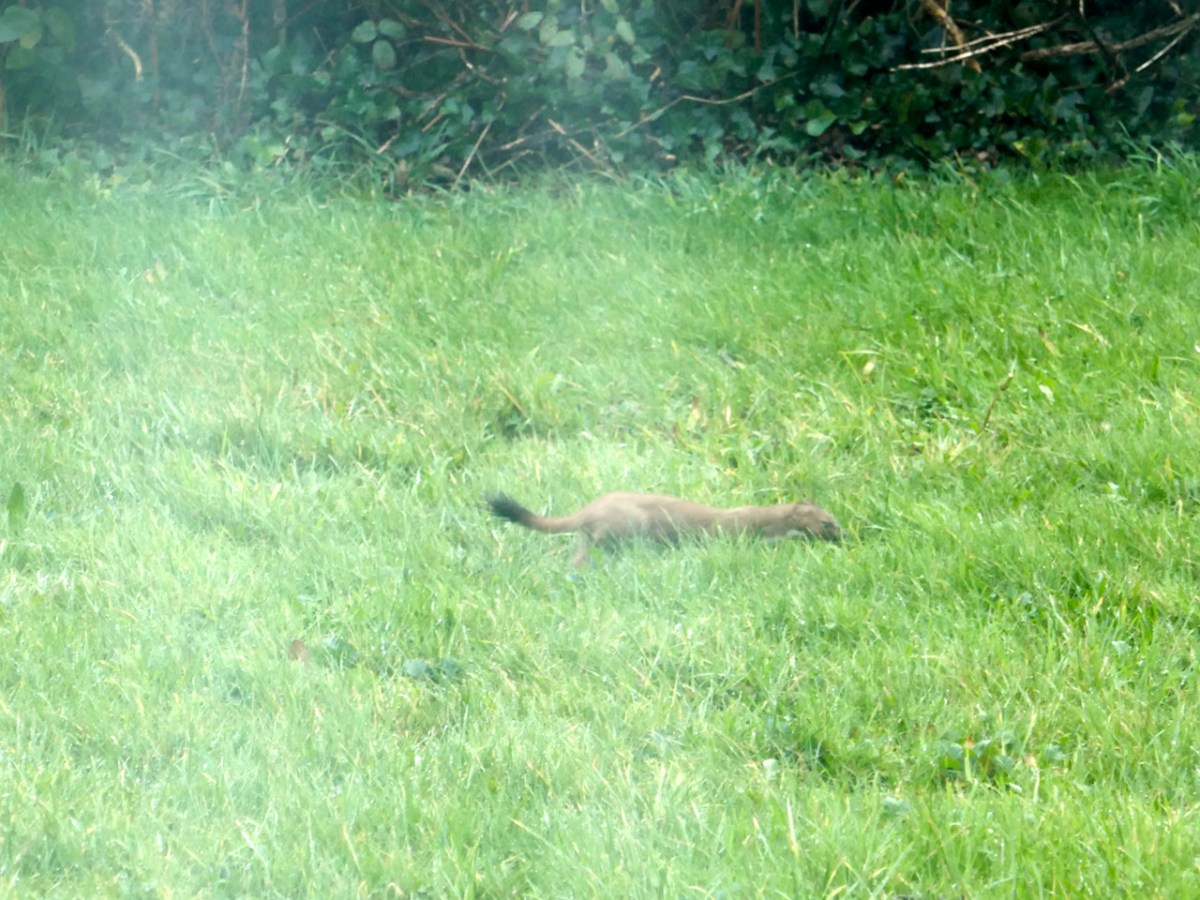
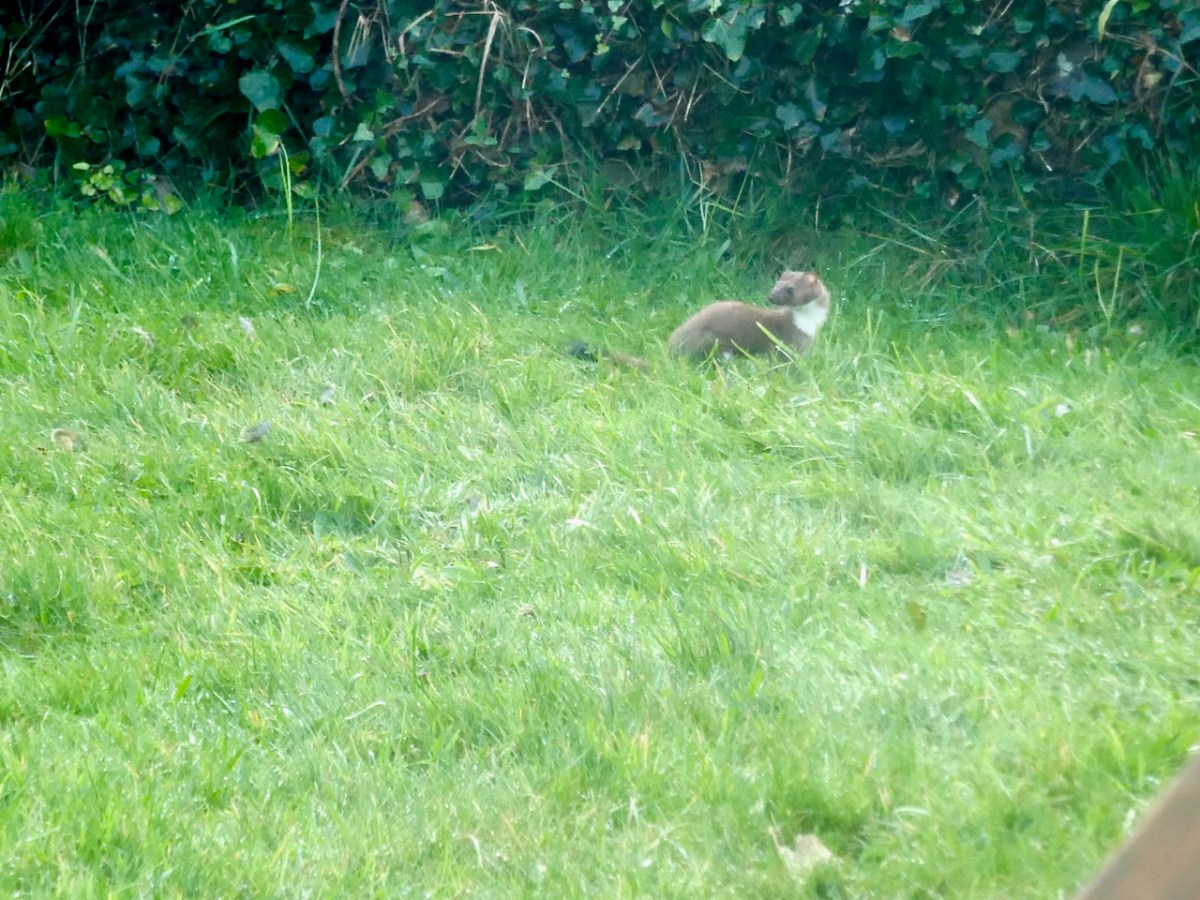
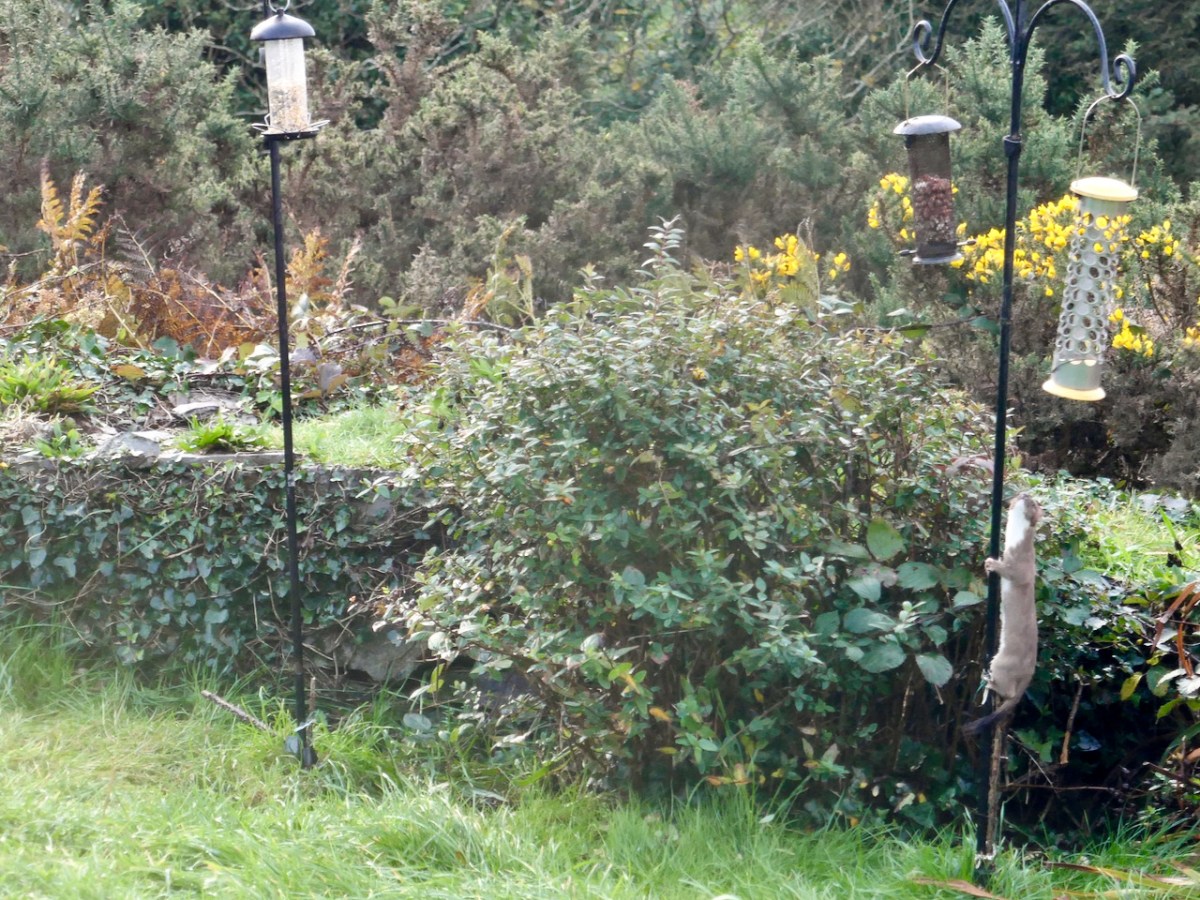
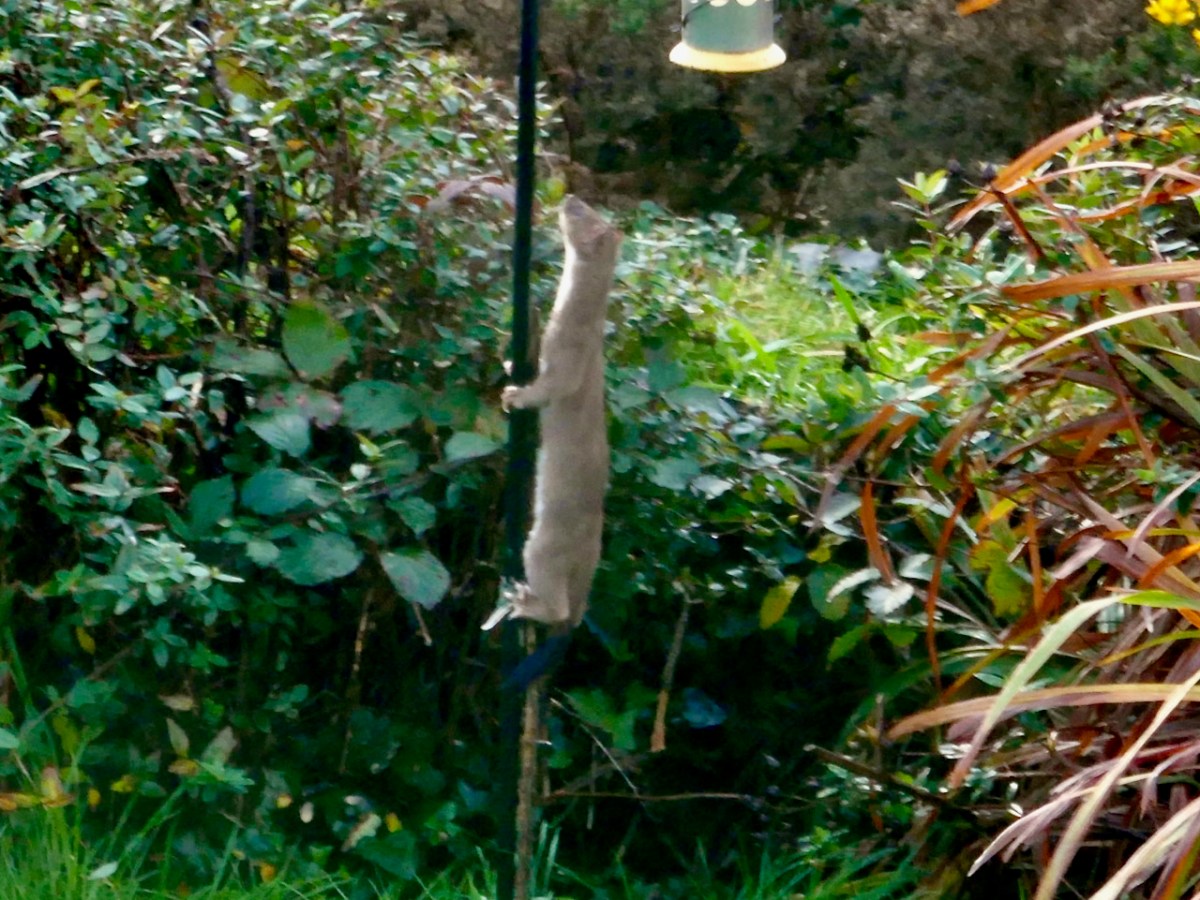
You can see the conditions that prevailed on this worst of days from Finola’s picture (top), taken from indoors through the windows. And – below that – the brazen culprit, who danced around the garden at breakneck speed, very ready to threaten me if I made a wrong move! It was our first sighting here on our land of an Irish Stoat. Having now read the books, I know in hindsight what a shocking phenomenon had hit us. Although fearing the worst, I quickly removed Fidelma to an indoor refuge and then watched the rampaging of this fur powerball traversing our territory at lightning speed; leaping from walls, trees and bushes and aiming for any likely food source.

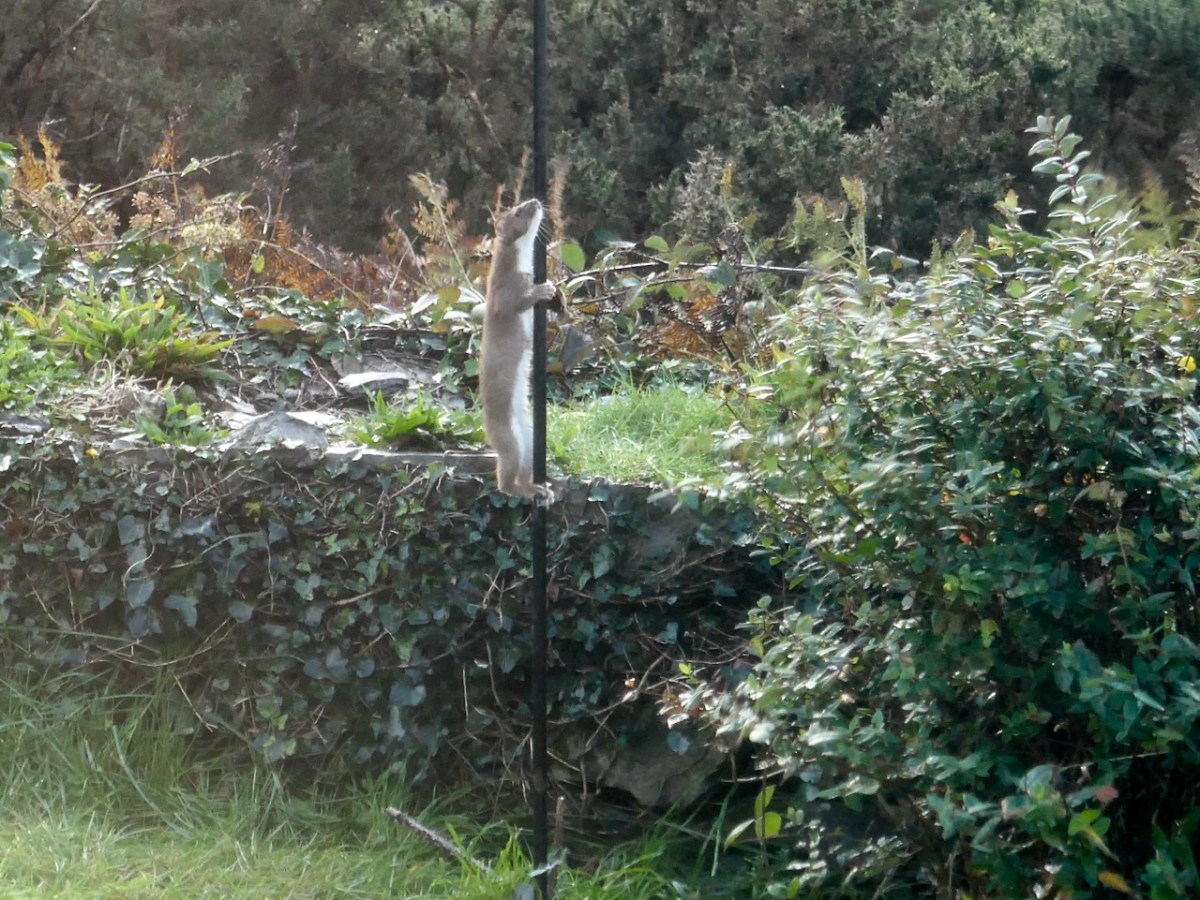
Finola has done her best to clarify the images in the photos she rapidly took through streaming wet glass (above) on this appalling day. The weather did not in any way impede the progress of the animal which circumscribed our whole acre, it seemed, in record time.

. . . The Stoat is often called the Weasel in Ireland, but although the weasel (Mustela nivalis) is very similar in appearance to the stoat, it is not native to Ireland and has never been introduced here. In Ireland the stoat or ‘weasel’ was regarded as a very intelligent animal, but also vengeful. For example, since they were believed to understand human speech, if a stoat was encountered the correct thing to do was to greet them politely. In County Clare the custom was to raise one’s hat in greeting, or even to bow. The person who insulted them, on the other hand, or pelted them with stones, could expect to lose all their chickens before too long. Deliberately killing a stoat was most unwise, since it caused all the deceased animal’s relations to descend on the house of the culprit and attack with great savagery . . .

Ireland’s Animals – Myth legends and Folklore, Niall Mc Coitir, The Collins Press, Cork 2010

The Duchas Schools Folklore Collection – gathered in the 1930s – has numerous entries referring to the stoat. Above is an example from Co Carlow. When I was sifting through these, I was struck by the fact that similar stories about stoats are repeated over and over again, but from different parts of Ireland. I could write a volume based on these accounts, but will choose only a few:

. . . One time there was a girl who was very fond of going to the seaside. One day she went to the seaside and lay down and fell asleep. Ten weasels went down her throat. So she awoke when the last one was going down. She went to the doctor and the doctor said she would need to undergo an operation and then she would die. One day she was going to the shop and her granny knew all about cures. So she went into the granny. Her granny told her to get two pounds of salt and eat all the salt and go to the seaside and drink no water and keep her mouth open and the weasels would have to come out for a drink. So this she did. The weasels came out for a drink. The girl counted them. There were ten in it and the girl came home cured . . .

William O’Donnell, Cabra Glebe, Co Donegal

. . . One day long ago two men went to cut the meadow with scythes. They cut away for a while until they came to a weasel’s nest where there were four young weasels out of the nest and left them near by on the ground. After a while the mother of the weasels came home and found her young on the ground and was very angry, She hesitated for a moment and then understood what the men had done. Now the men had had a can of milk with them for a drink which they left near the weasel’s nest, the old weasel saw the can and went to see what in it. When she saw what was in it she spat into it because a weasel’s spit is poison. When the men saw this they were terrified and put back the young weasels into the nest, and the old weasel was pleased and went back and upset the can and spilt the milk from fear the men would drink of it and be poisoned . . .

James Gormley Senior, Aged 82, Commeen, Co Roscommon

Note that the term ‘Weasels’ is used far more often in these accounts than ‘Stoats’. There can only be the one animal, however, as there have never been true ‘weasels’ in Ireland. The story above, from Co Roscommon, is the most common of all ‘weasel’ tales in Ireland, and variants of it have been recorded from all parts.

. . . Many years ago an old woman lived by herself. There was a nest of weasels under the hearth in the house in which she lived and every day the old woman fed them until they became quite tame. When the young weasels were reared they went off but the old one remained in the hearth. One day the woman was sitting by the fire when the old weasel came out and sat with her. The weasel was continually looking up the chimney and at last the woman said “What the dickens are you looking at?” and at the same time looking up herself. She saw a little bag hanging in the chimney and took it down. To her surprise and joy she found it was full of gold. This was the weasel’s reward for her kindness to her and her family . . .

Mrs L Millett, Fiddaun Lower, Inistioge, Co Kilkenny

. . . The Swarm or Drove of Weasels: the following story or rather fact come from a reliable source to wit a teacher in Ballyshannon. In the end of August or about that time some distance outside Ballyshannon a great whistling was heard as if a number of little birds and a mighty drove of Weasels was seen heading for the mountains. An old man said that he heard that weasels used make for the mountains during the Grouse Season. The Priests housekeeper saw or heard of the same thing in Antrim . . .

J Clarke, Navan, Co Meath

. . . Some time about forty years ago there were children playing on the side of a hill and they saw a few weasels. They started to run and cry. They looked round and saw thousands coming after them. Only they got away the weasels would have devoured them . . .


Written by Kathleen McKenna Bragan, Co Monoghan 25th November 1938

I couldn’t resist that little foray into weasel stories from the Folklore Collection. There are many many more pages full of them! Interestingly, stoats are a fully protected species in Ireland. If stoats are proving a problem, by killing chicks or other domestic animals, you must solve the problem by using good fencing; it is illegal to kill a stoat.

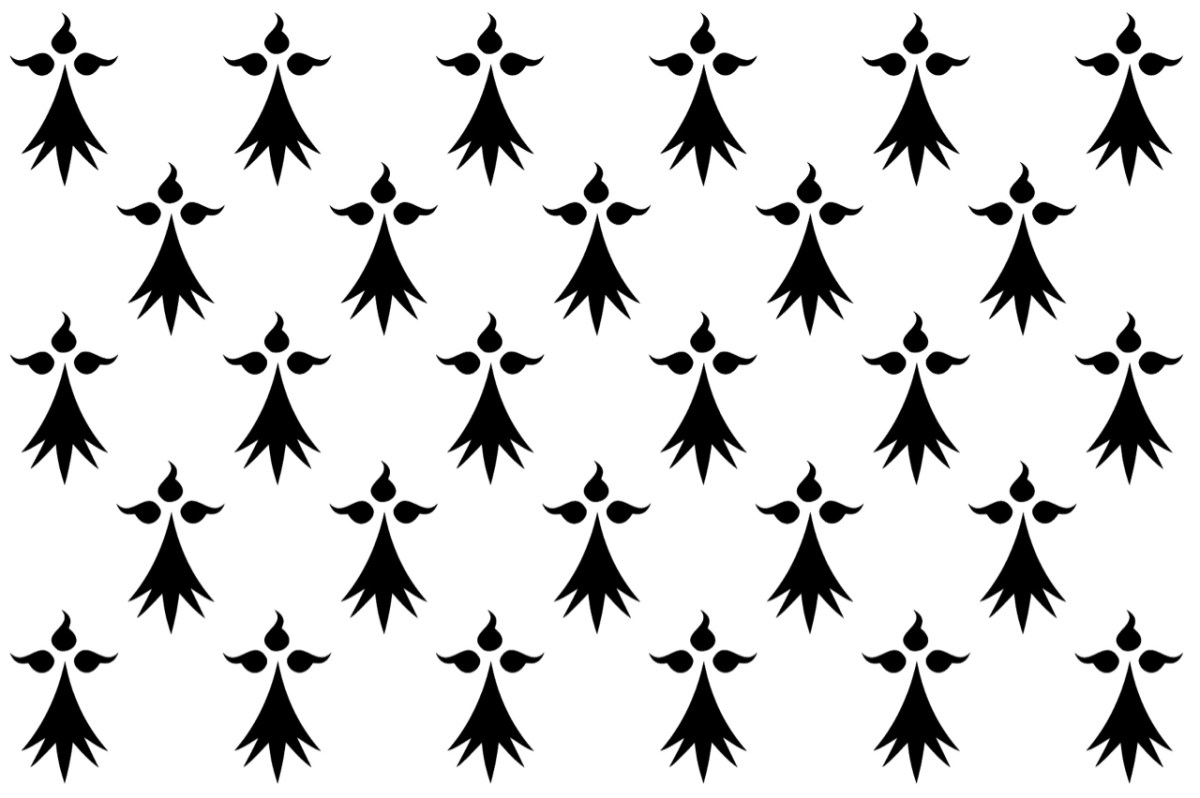
A possible reason for the attention which stoats attract in folklore is the fact that they can change colour, which adds a sense of the supernatural to them. In countries which have harsh winters the coat of the stoat becomes white in those months, offering a level of protection in the open landscape. The fur from the white – or ‘winter’ – stoat we call ermine, and the white fur is considered so precious that only royalty or nobility traditionally wear it. In the drawing above, the white stoat is wearing a cloak on which are printed the symbols of the flag of Brittany (below), which was an independent kingdom in medieval times. The white background represents the ermine fur, and the black markings are said to be based on the black tip of the tail which the animal retains, even in the winter.
Here (above) is another example of the Breton ermine representation: a finely worked silver antique brooch. In Ireland, the species of stoat which has evolved – Mustela erminea hibernica – does not usually turn white in winter, although examples have been noted. The animal is said to have been resident in Ireland from the post-glacial period and, in the present day, the population numbers are unknown: it is not a threatened species.

In spite of our attempts to care for Fidelma, she did not survive. Sadly, I decided to let Nature have her way and laid the body close to a fox-track above the house. Later, I noticed an assembly of corvids gathered in the area. When I returned there in the evening all traces had gone – just a few scattered feathers told the tale.
This morning, Finnbarr was absent from the garden. I did catch a glimpse of him wandering the distant pastures – forlorn and bereft. At least, those are the feelings my human soul projects onto him. He will find another mate, of course, and we hope they will continue to share our little bit of paradise. We will keep a lookout for unwelcome visitors, but we will always have to pay our respects to the ‘weasels’. If our stoat does return we will have to honour him with an Irish name: I am inclining towards Fiáinín – which means Little Wild One.

Lady with an Ermine, painted 1489–1491 by Leonardo da Vinci. The subject is said to be Cecilia Gallerani, the mistress of Leonardo’s Milanese employer, Ludovico Sforza. The Ermine is symbolic, rather than realistic – in fact it is pictured much larger than in real life. It has been suggested that the ermine in classical literature relates to pregnancy, sometimes as an animal that protected pregnant women. Around the time of the painting’s creation, Cecilia was known to be pregnant with Ludovico’s illegitimate son.

Castleruddery Stone Circle

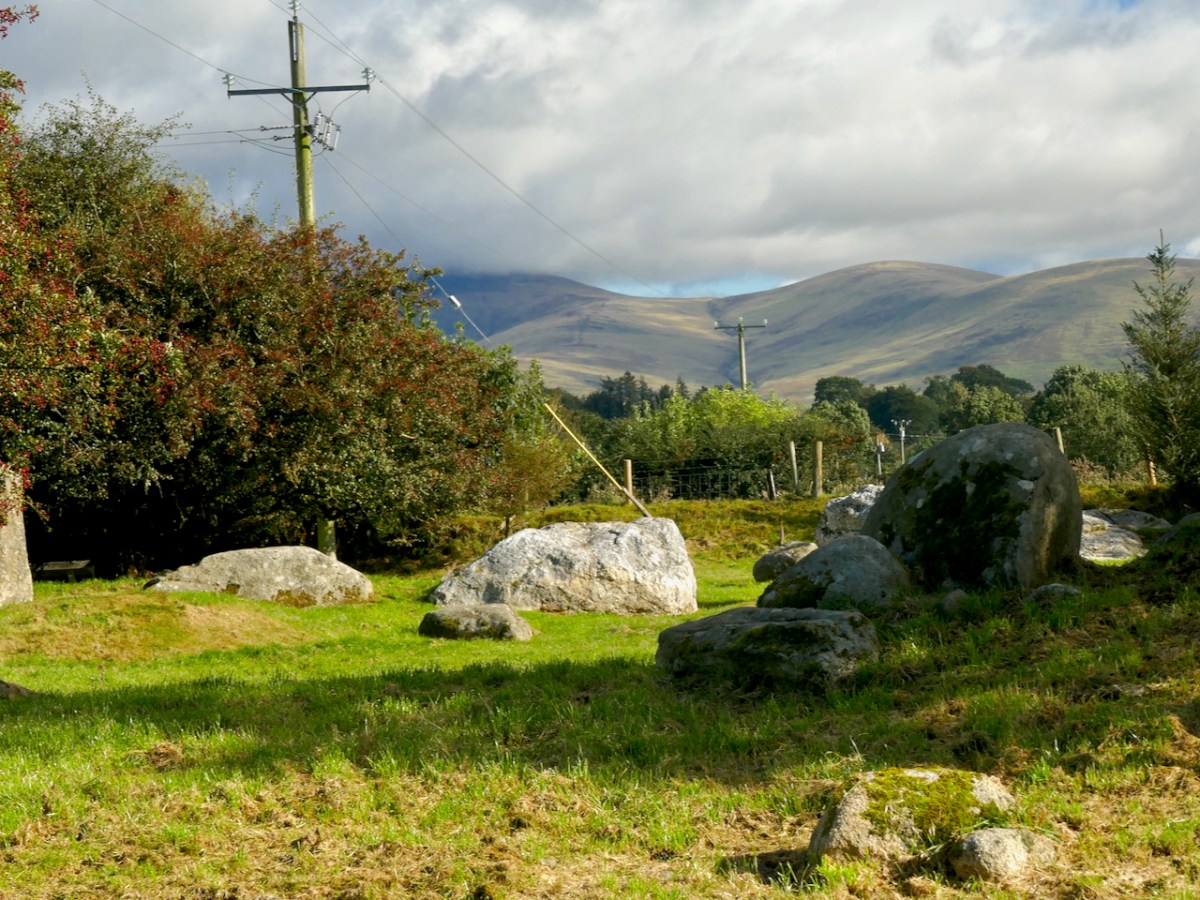
Our travels are always attuned towards our particular interests, be they history, stained glass, art or – as in this case – archaeology. We go out of our way to take in sites we have never seen before – and there are so many. When we were ‘holidaying’ in Wicklow last week we searched out this stone circle in the townland of Castleruddery Lower. It was well worth the journey.

. . . Neglected, knee-high in grass and surrounded by round-crowned hawthorns whose May blossom speckles the bank, it is difficult to appreciate how important Castleruddery must have been early in the Bronze Age when Beaker copper prospectors and the Wicklow mountain goldminers passed by its brilliant entrance. It is not properly a stone circle but a henge, with a stone-lined interior. It was constructed on the summit of a hill just east of the valley into which the Little Slaney flows. Six miles north is the lovely Athgreany stone circle and only two miles to the south is the Boleycarrigeen ring, its stones embedded in a low earthen bank . . .

Aubrey Burl, Rings of Stone, France Lincoln Publishers, 1979

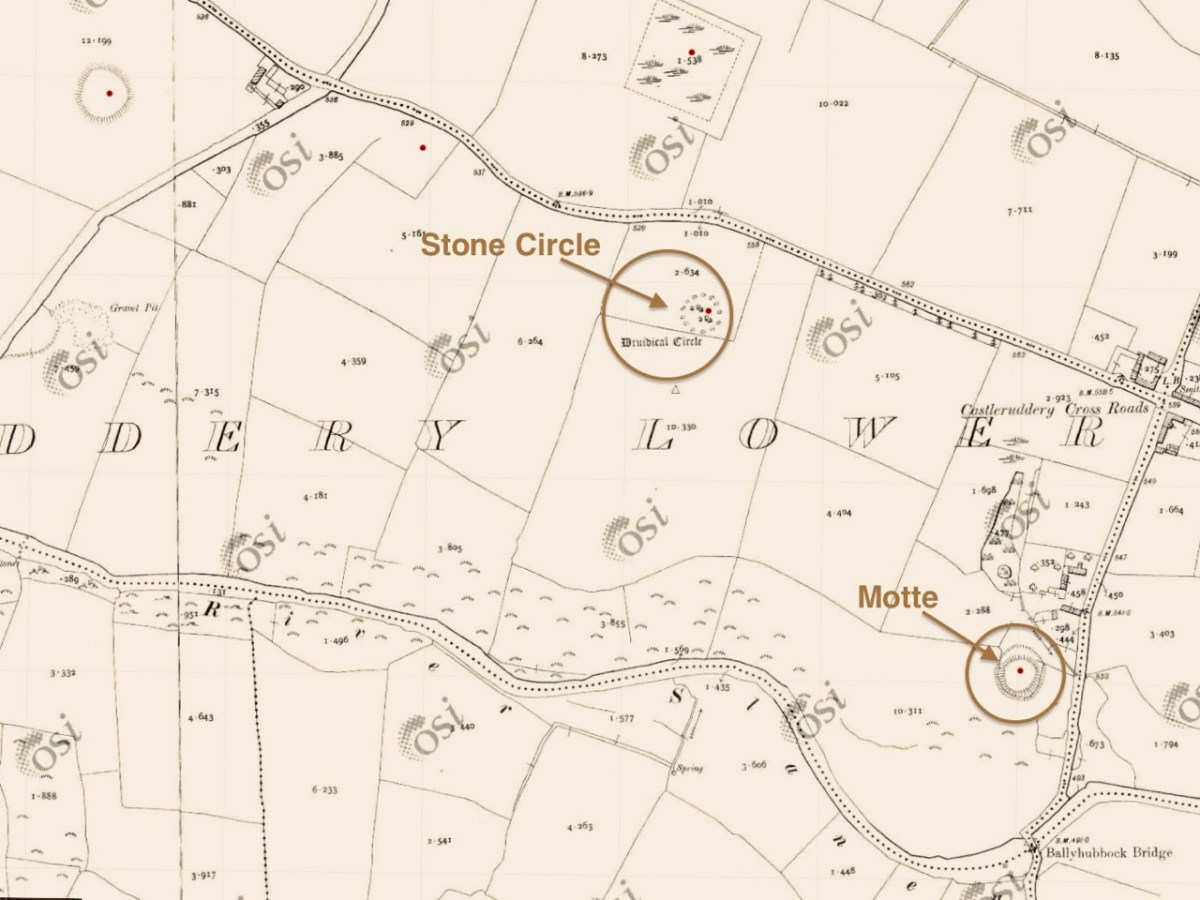
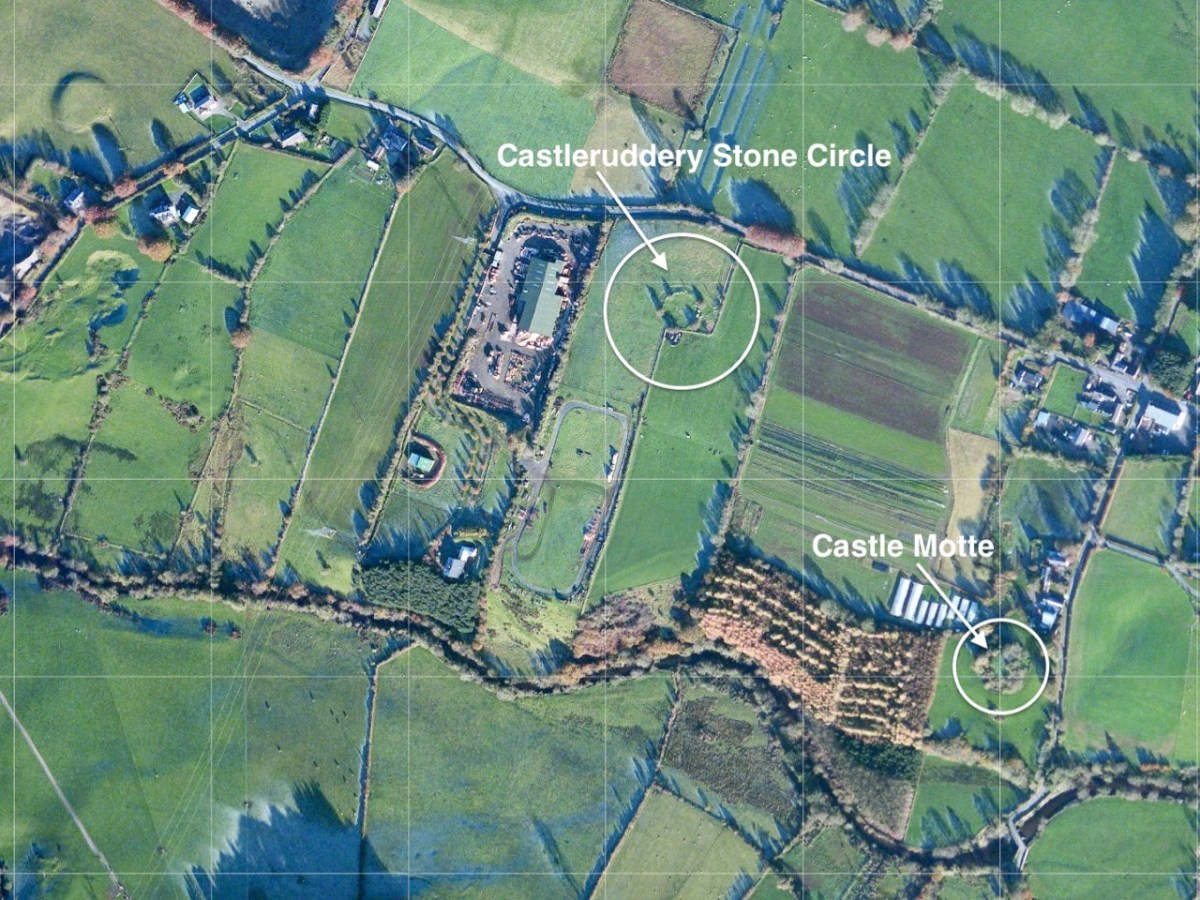
The aerial view, and the extract from the 25″ Ordnance Survey map (above) show the monument in the context of the surrounding landscape. Nearby is a medieval ‘Motte’, very much younger than the ‘Druidical Circle’ – thus named on many early maps. The local Irish name – Chaisleán an Ridire – translates as Knight’s Castle, which might make you think that there is some medieval connection between the circle and the Motte, but in fact Castleruddery stone circle is likely to date from the late Neolithic, around 2,500 BC, marking it as one of the earliest of this monument type in Ireland.

We noted this little figurine by the entrance gate to the circle: it made me wonder what folklore or traditions might be associated with the site today. I could find only one reference to Castleruddery in the Duchas Schools Folklore collection, dating from 1936:

The informer here was Michael Murphy, aged 68 – a ‘labourer’ from Colliga, Co Wicklow. The School collector was from Baile Dháithí, Dunlavin, Davidstown, Co Wicklow. There was no doubt in Mr Murphy’s mind that the stones could only have been placed there by supernatural powers!

The two quartz portal stones at the east side of the circle are remarkable: deliberately chosen, no doubt, to emphasise the importance of the orientation. The circle has 29 significant stones still standing today, but there were probably more. There is evidence of attempts to break up and remove some of the stones, which would have made good building or fencing material for someone who did not share respect for the integrity of the circle.
The two views above show iron ‘drill’ markings: these were made to try and separate sections of stone to be taken away for re-use. In the upper picture one section has been removed, but the operation was unsuccessful for the remainder of the boulder. One has to wonder whether otherworldy forces intervened – and meted out some form of ‘bad luck’ to the perpetrators.

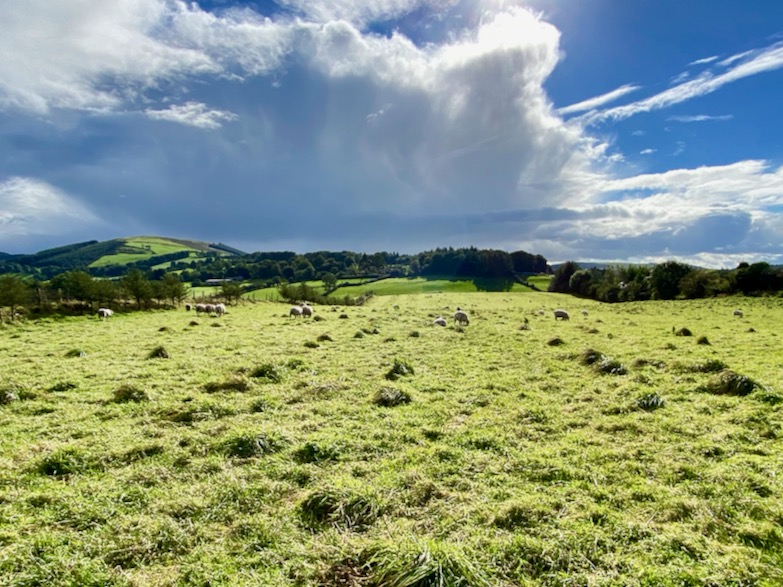
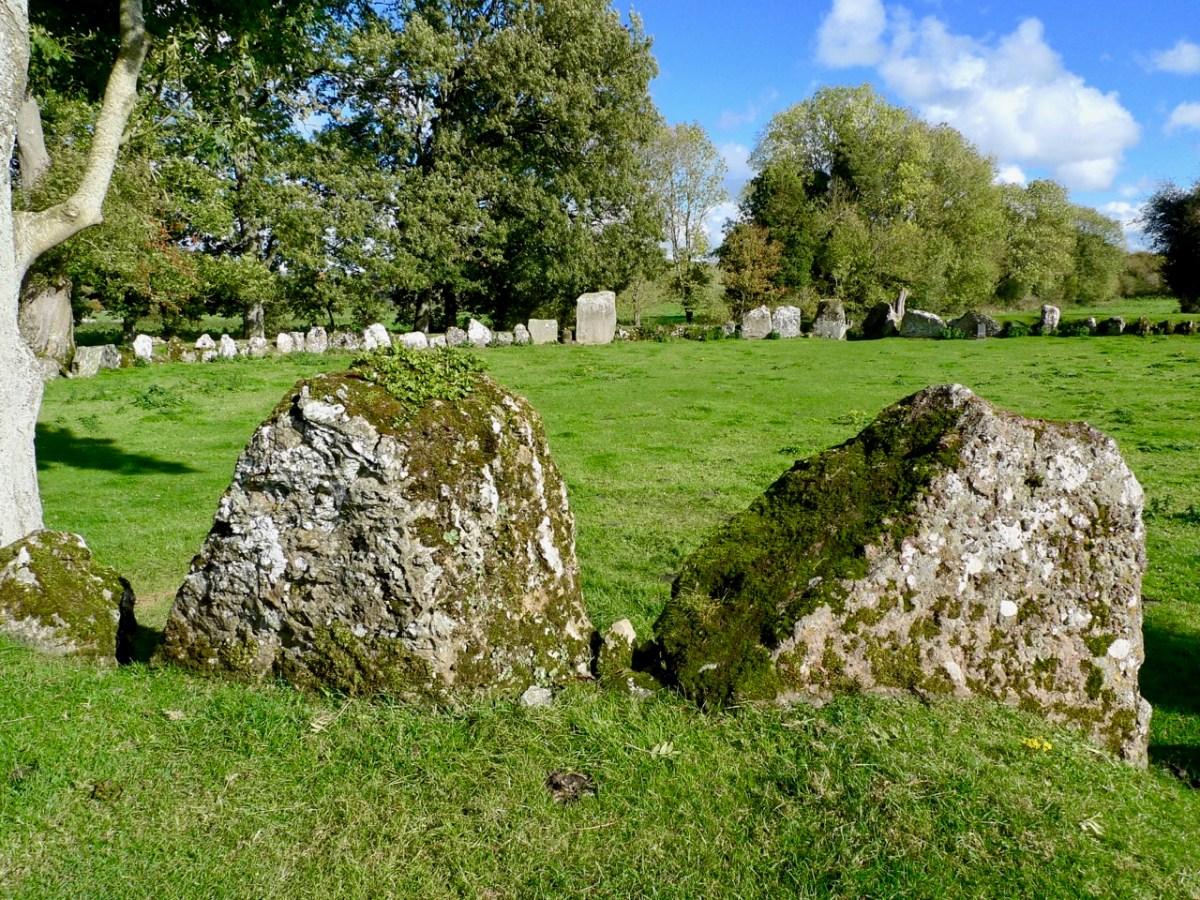
In the present day it’s territory for sheep, and they seem to be unconcerned about any ancient associations or supernatural influences interrupting their tranquil grazing. The archaeologists tell us that this is more of a ‘henge’ monument than the type of stone circle we are familiar with in West Cork. It’s certainly larger, and crop marks have shown that the 29 stones surmount an earthen ring, approximately 30 metres in diameter, and there is a further ring which was once supported or reinforced by timber. Comparisons are made with a henge circle at Grange, close to Lough Gur, Co Limerick, which we visited in 2016. There the ring of at least 113 stones has an internal diameter of 46 metres. We took the two photos below at Grange.

The Grange circle was excavated in 1939 by professor S P Ó Riordáin, and the Duchas board at the site states:

. . . The excavation indicated that the enclosure was constructed purely for sacred or ritual purposes. The bank may have provided a stand where an audience could observe ceremonies within the enclosure . . . One of the stones is known as Rannach Cruim Duibh. This suggests that the circle became associated with the festival of Lughnasa, traditionally the first Sunday in August, and a celebration of the harvest. Crom Dubh, meaning the Dark Bent One, was credited with bringing the first sheaf of corn to Ireland . . .

Duchas, Grange Circle

There must surely be connections, and common purposes, between the many similar circle monuments all over Ireland. We always want to know What was it for…? probably, we never will, but it’s part of the whole romance of archaeology to wonder about such places. We must be grateful that so much remains for us to explore.

Frank, Jack and Eibhlín Dubh: The Lament for Art O’Leary

Caoineadh Áirt Úi Laoghaire (The Lament for Art O’Leary) is a classic work of Irish literature. Composed as a keen by his widow, Eibhlín Dubh Ní Chonail (Dark Eileen O’Connell, pronounced Eileen Duv), in the immediate aftermath of his death in 1773, it survived in oral tradition until it was finally collected from an aged professional keener in Millstreet and written down about 1800. Here are the opening lines in Irish followed by Frank O’Connor’s translation. (For those who would like to read the full text in Irish, you can find it here, with a translation by Thomas Kinsella.)
Mo ghrá go daingean tu!

Lá dá bhfaca thu

ag ceann tí an mhargaidh,

thug mo shúil aire dhuit,

thug mo chroí taitnearnh duit,

d’éalaíos óm charaid leat

i bhfad ó bhaile leat.
Keening was a women’s prerogative and tradition, and this keen is powerful and poetic, with long sonorous vowels, patterns of repetitive phrases, and all the devastated grief of a heartbroken woman. To get a sense of the pronunciation in Irish, the best reading I have come across is this one by Joanne Ryan.

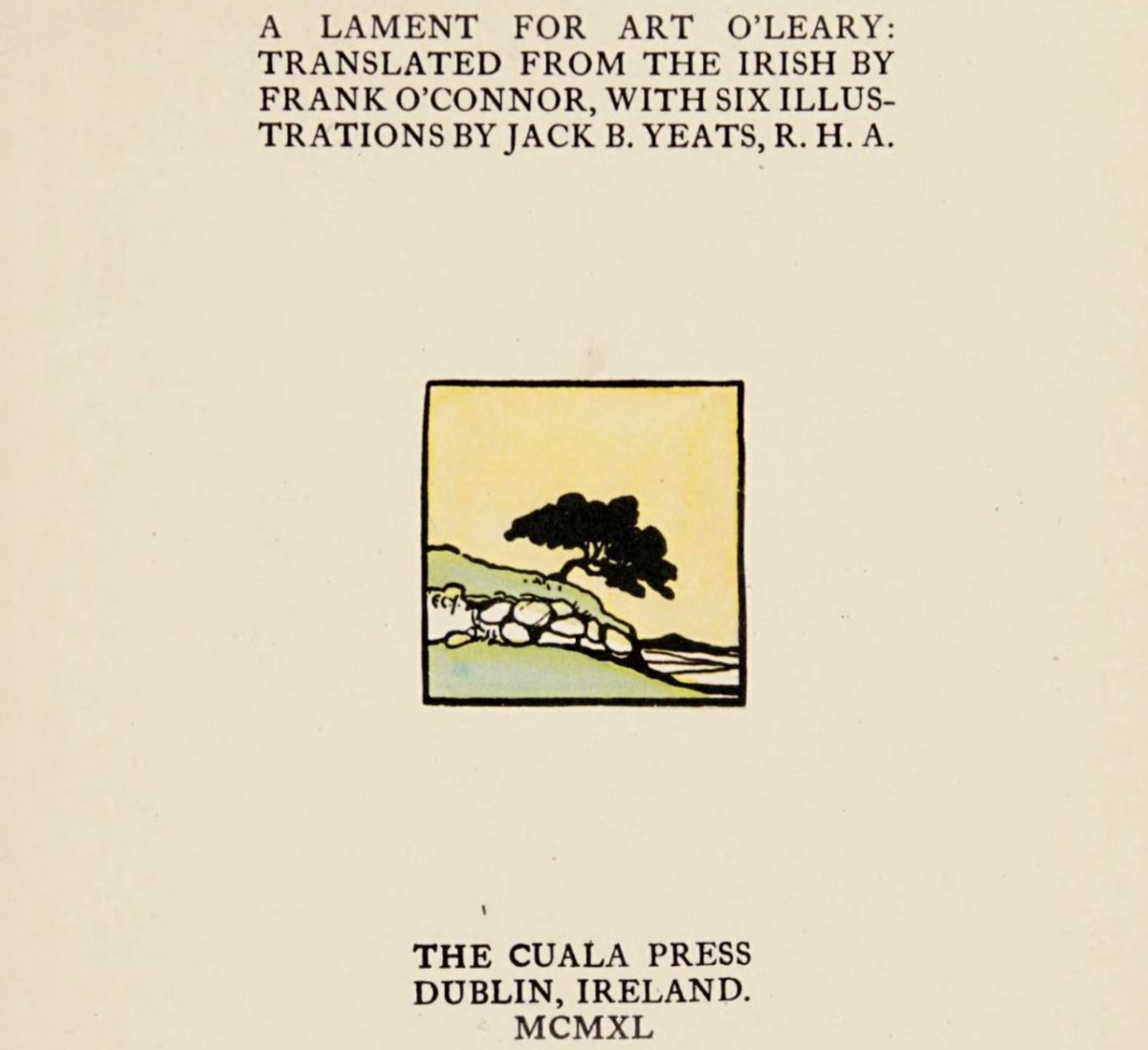
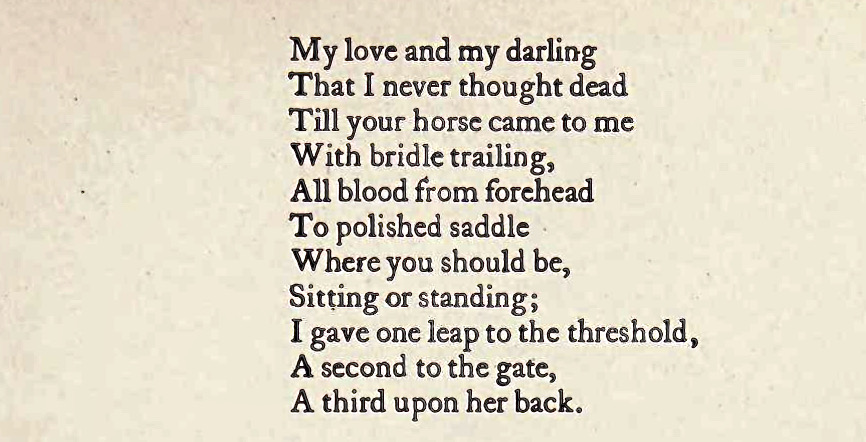
The Lament has been translated many times, including by Thomas Kinsella, Brendan Kennelly, Vona Groarke and Eilís Dillon. In 1940, the Cuala Press brought out a special limited edition of the poem, in a translation by Frank O’Connor and with illustrations by Jack B Yeats. The Cuala Press was run by Elizabeth (Lolly) Yeats, sister of Jack B and William B, and was a driving force in the proliferation of printed material, beautifully produced, related to the Irish literary and artistic revival. 

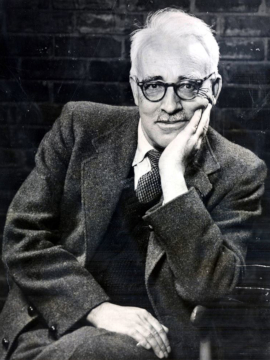
Frank O’Connor (above), although better known for his short stories, was a scholar of the Irish language and translated many poems into English. His version is magnificent, capturing Eibhlín Dubh’s passion and fierceness and the rhythm and cadence of her keen. 

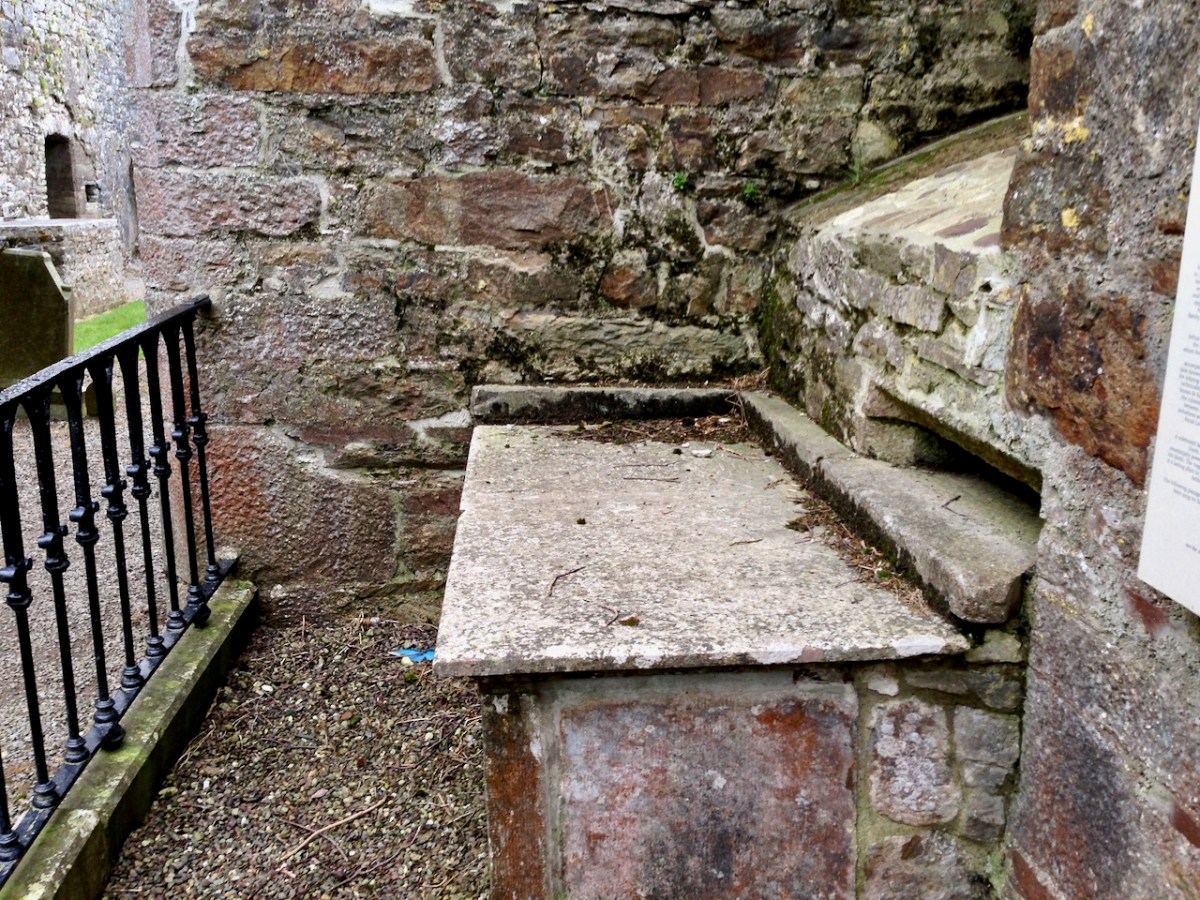
Art O’Leary was a handsome young cavalry officer in the army of Maria Theresa of Austria. He returned to Ireland upon his marriage to Eibhlín and they had two children. She was pregnant with a third (who did not survive) when he was shot dead by Abraham Morris, a local magistrate, when Art refused to sell Morris his horse for £5, as required by the Penal Laws. Art O’Leary is buried at Kilcrea Friary, above. His grave can be seen there (below).

The Lament lauds Art’s many virtues and paints a picture of him as brave and handsome, in the flower of his manhood.

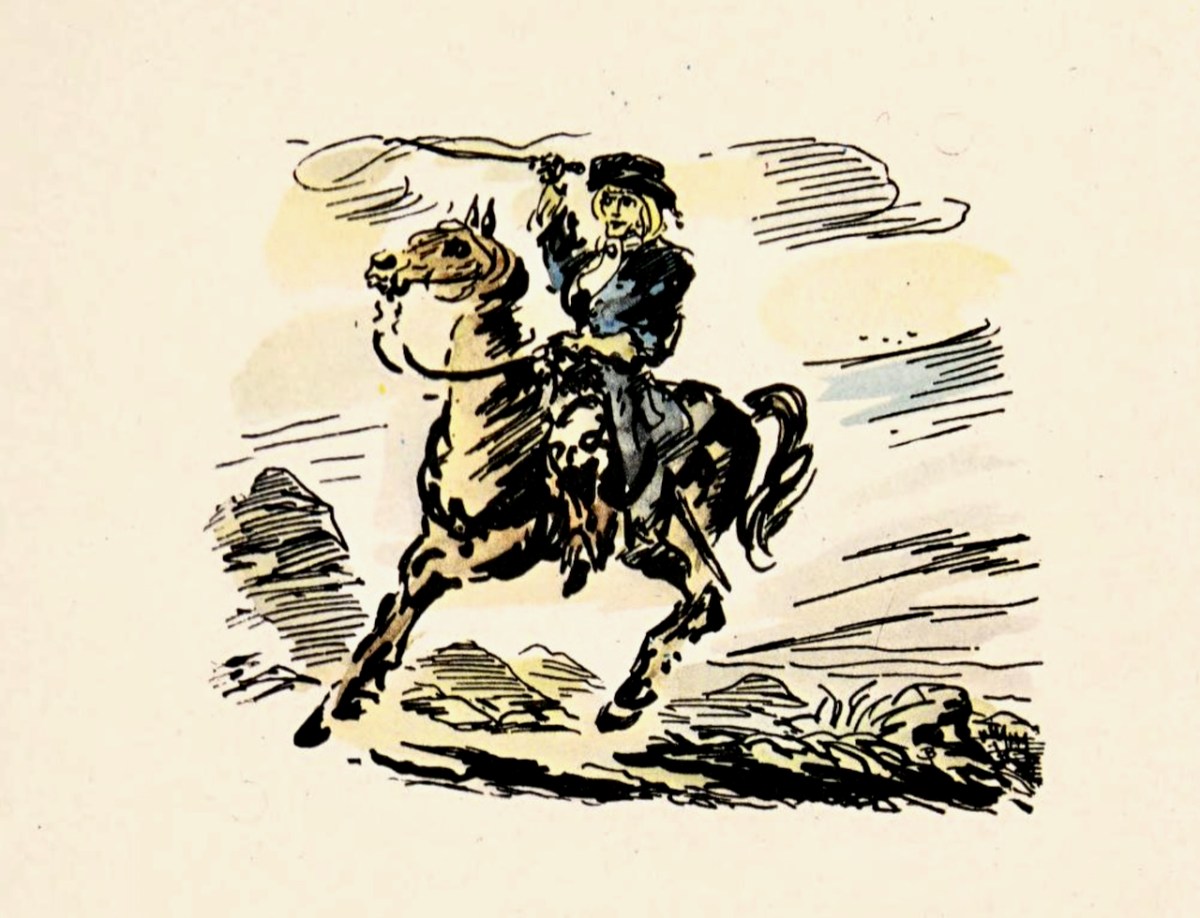
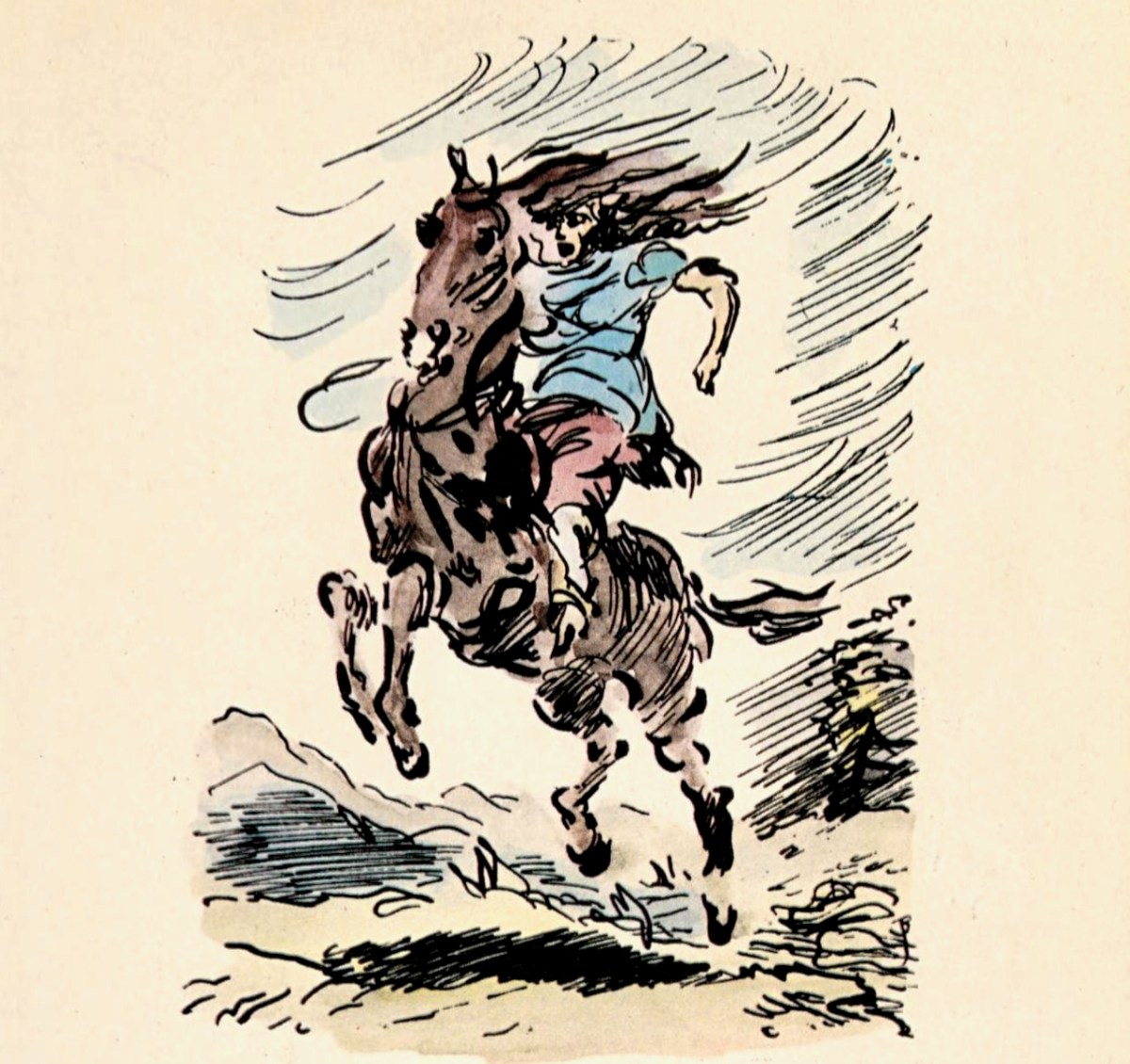
Eibhlín curses Morris, and tells how, when Art’s horse came home alone, she leapt into the saddle to search for him.

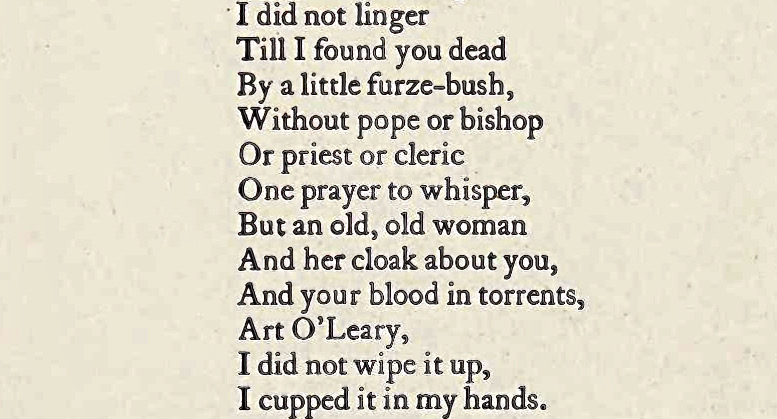
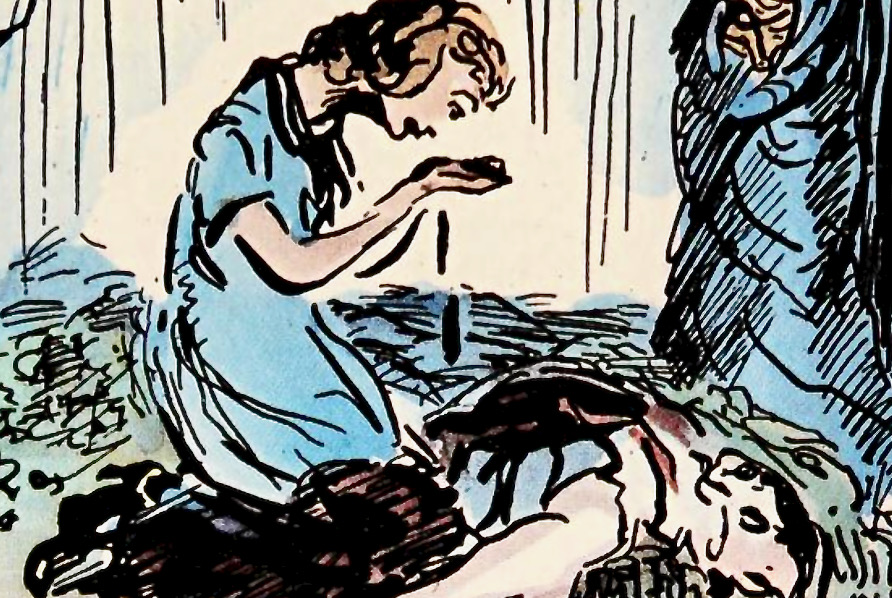
She found him lying dead in a pool of blood, which she cupped in her hands and drank.

Jack B Yeats’ illustrations have the same wild quality that we imagine was characteristic of Eibhlín Dubh – an untamed spirit who expressed the extremes of great joy and pride and deep anguish. They are pen and ink drawings, hand coloured at the Cuala Press with light washes in blues, yellows and browns for the limited edition. Very little of Yeats’ illustrative work is included in the current, must-see, exhibition of his paintings in the National Gallery, and I was very pleased indeed to find this book online as part of the Internet Archives digital library.

East Coast Archaeology

We often find time to visit the east side of the country – where we see everything from a different perspective! But we are just as interested in history and archaeology over there as we are here in our own West Cork. Today I am bringing together three sites from three different eras – all equally fascinating, and all within a stone’s throw of each other, hovering on the borders of South County Dublin and County Wicklow.

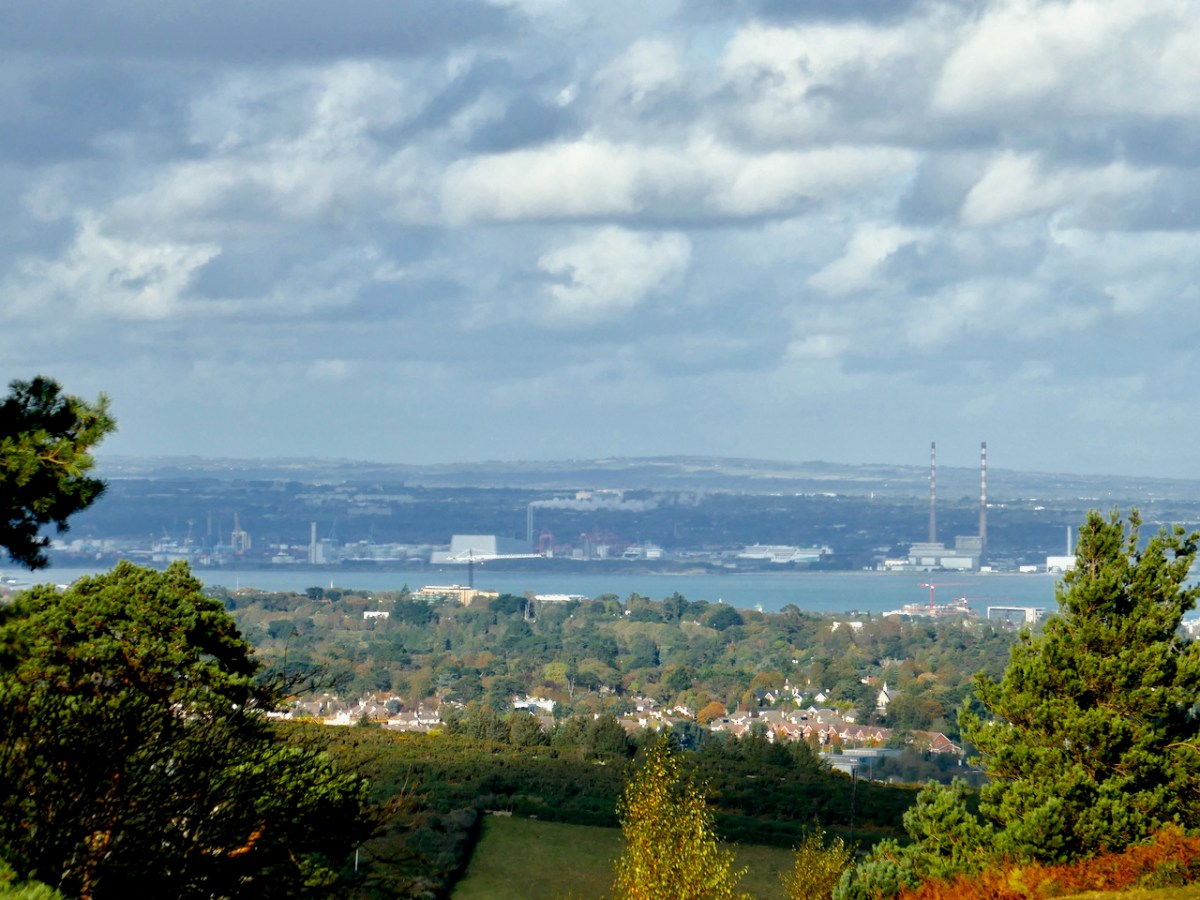
From the high ground in these two counties you find stunning views to the north out across Dublin Bay, with Howth in the distance. The twin striped chimneys on the right of this picture are protected historic structures: they date from 1971 and were built to serve the Poolbeg electricity generating station. At 270m they are amongst the tallest artificial structures in Ireland and are a visible feature on the skyline from many parts of the city. The power station closed in 2010.

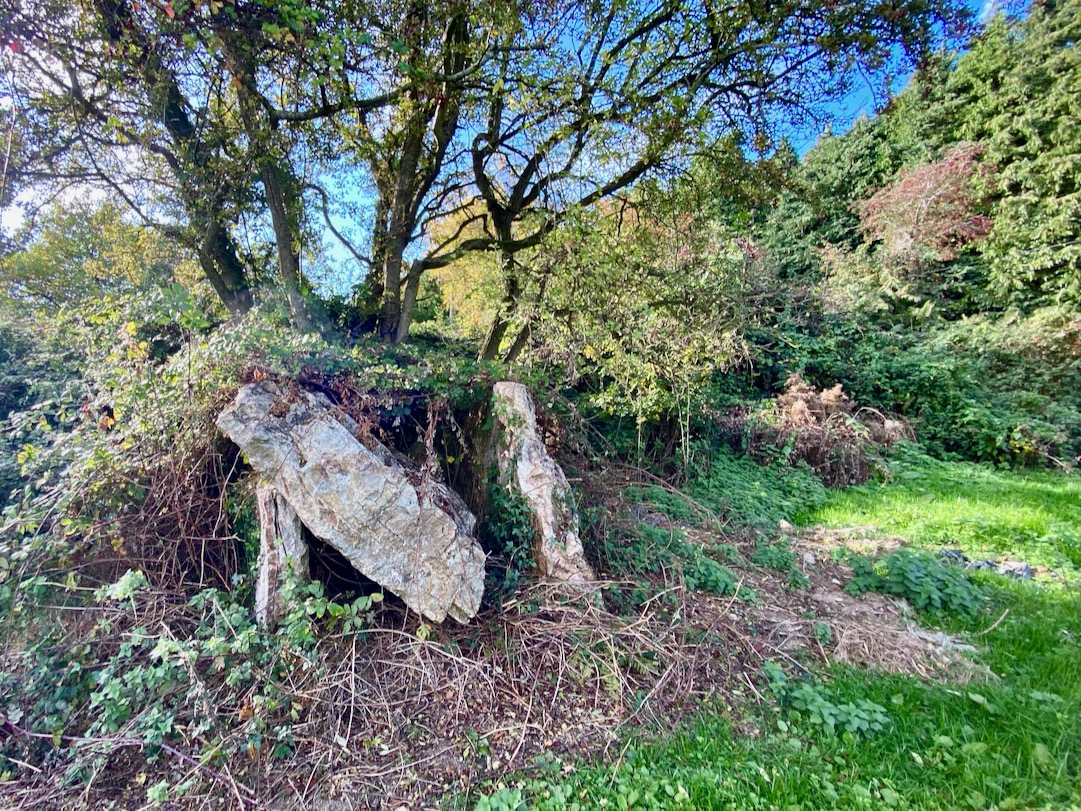
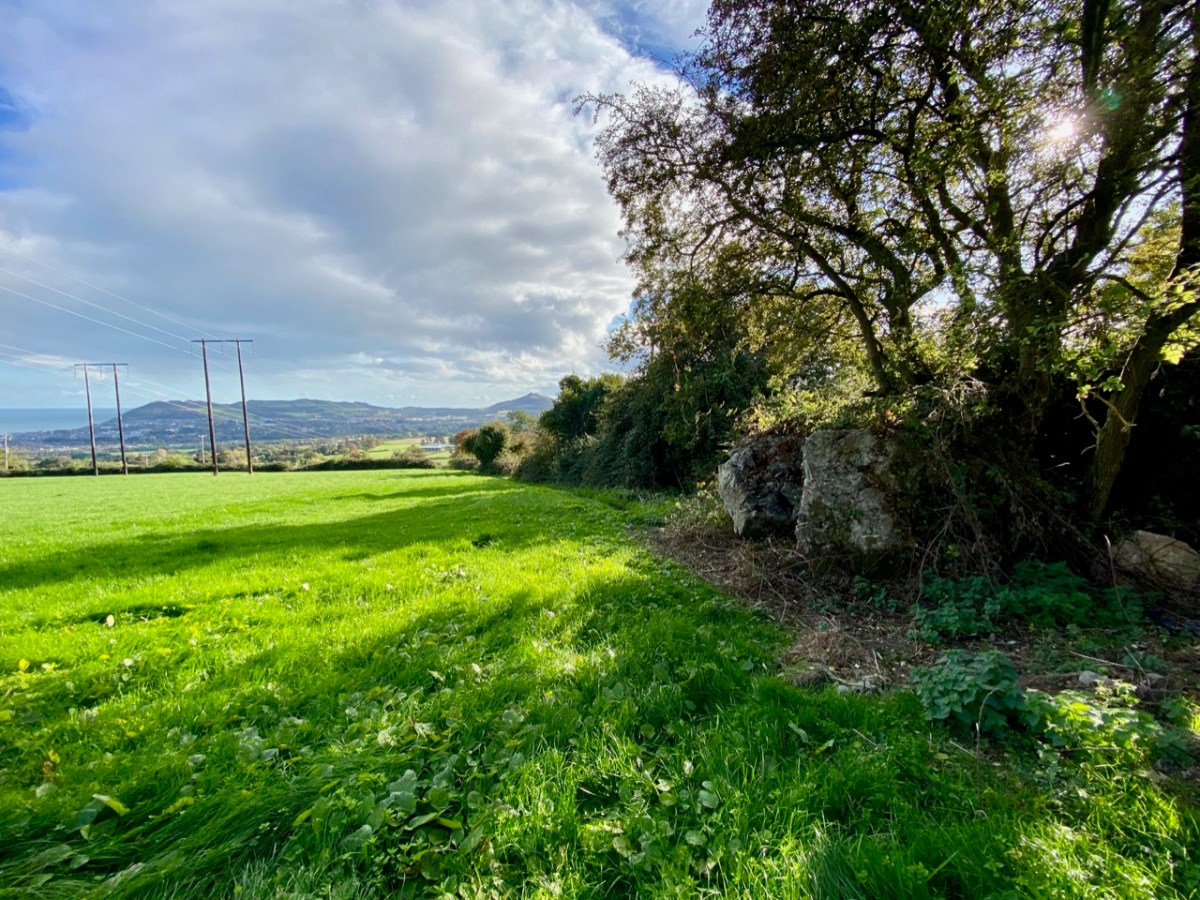
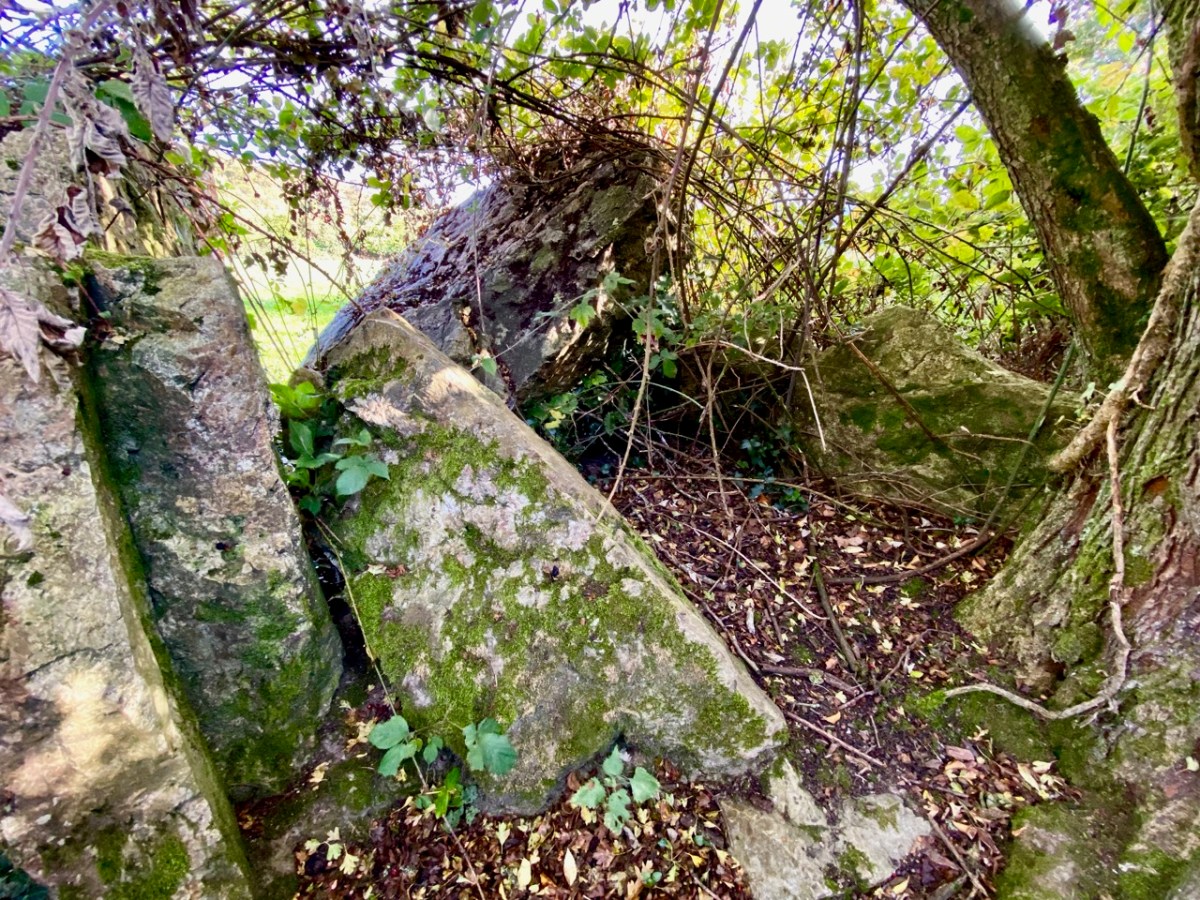
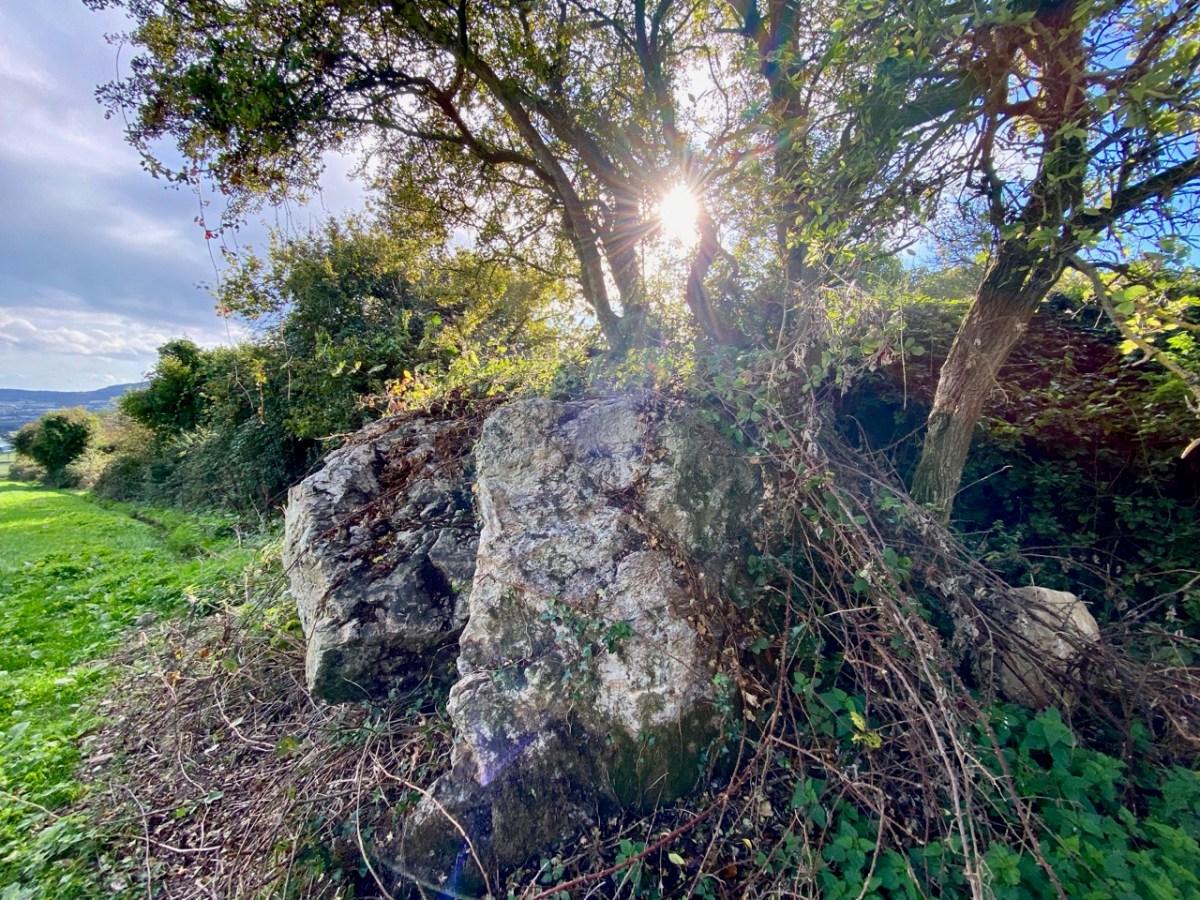
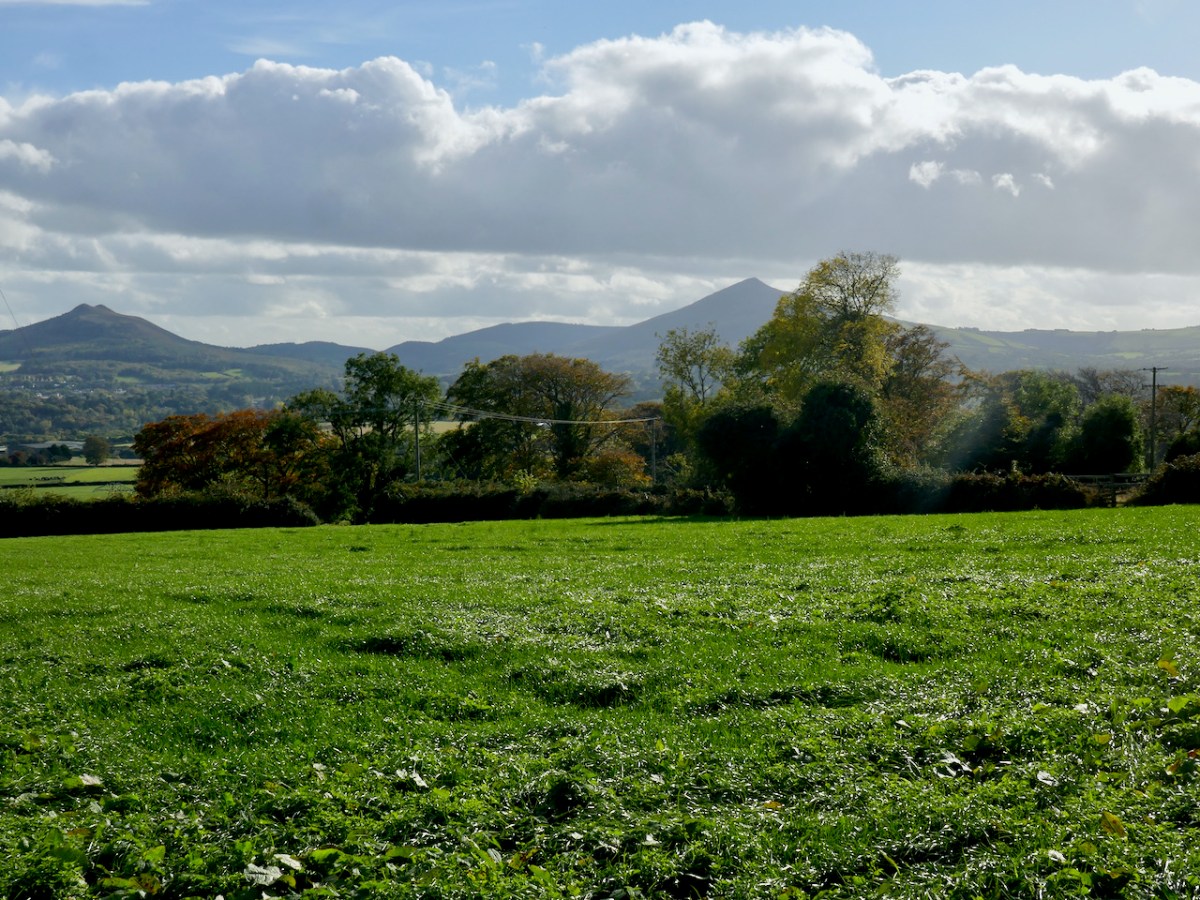
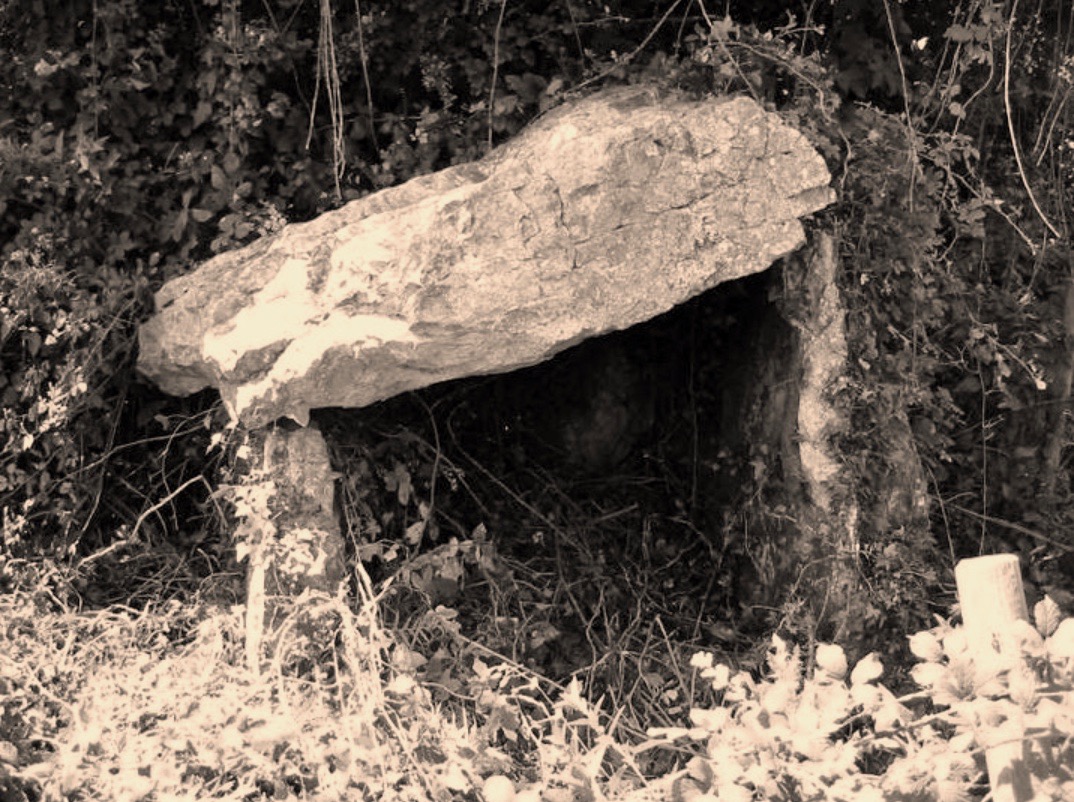
The first site we are visiting in this little tour is the wedge tomb in Shankill townland, County Dublin. It lies below Carrickgollogan hill, and commands distant views to the two distinctive Sugar Loaf peaks, which are situated in County wicklow. Or – let’s say – it should command those views, but it now reposes in a rather neglected state, engulfed by a modern hedge boundary, which you can see below.

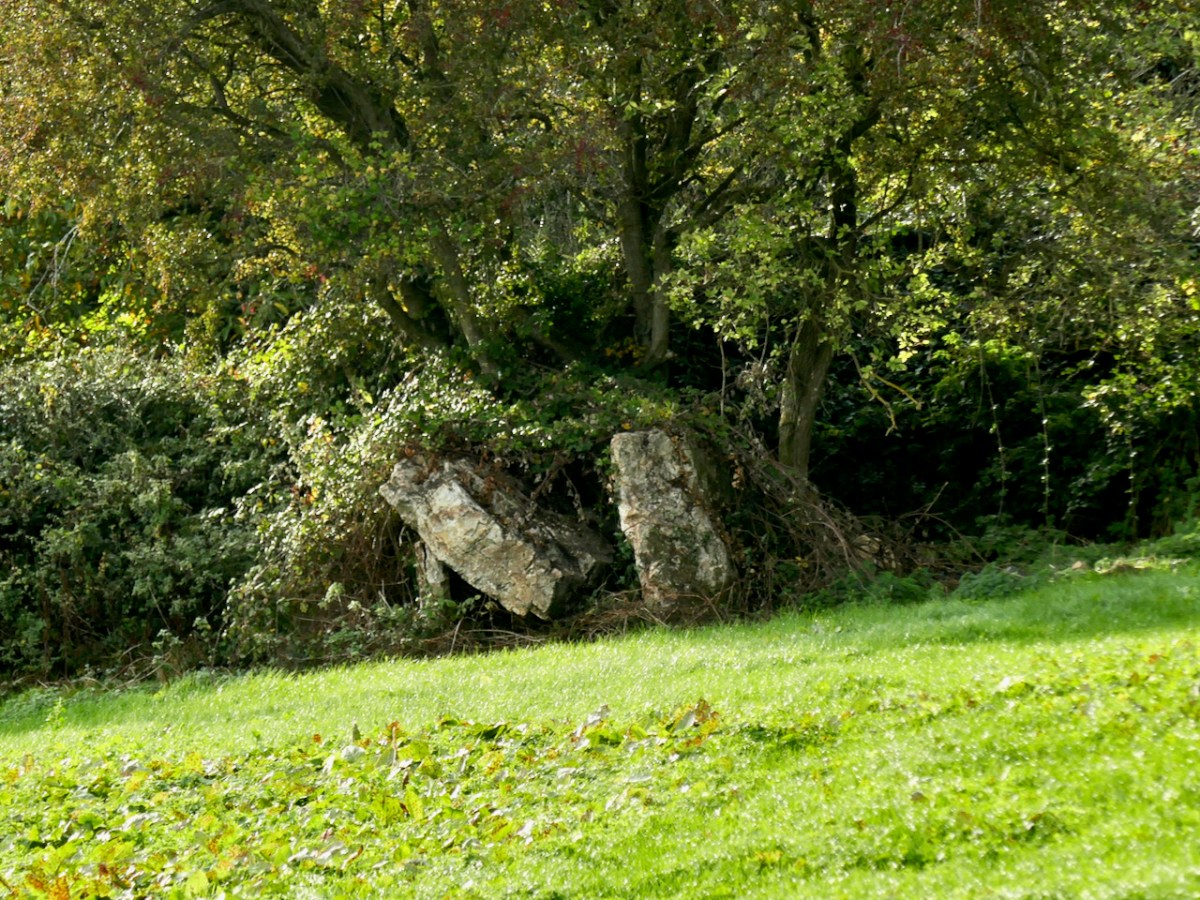
The picture above is taken a little to the west, to show the full skyline profile. The monument is not in good shape: the photo below (courtesy Ryaner via The Modern Antiquarian) shows the tomb in 2006, when the capstone remained intact on its supports. In less than two decades the capstone has fallen, as you can see from our photos taken a few days ago.

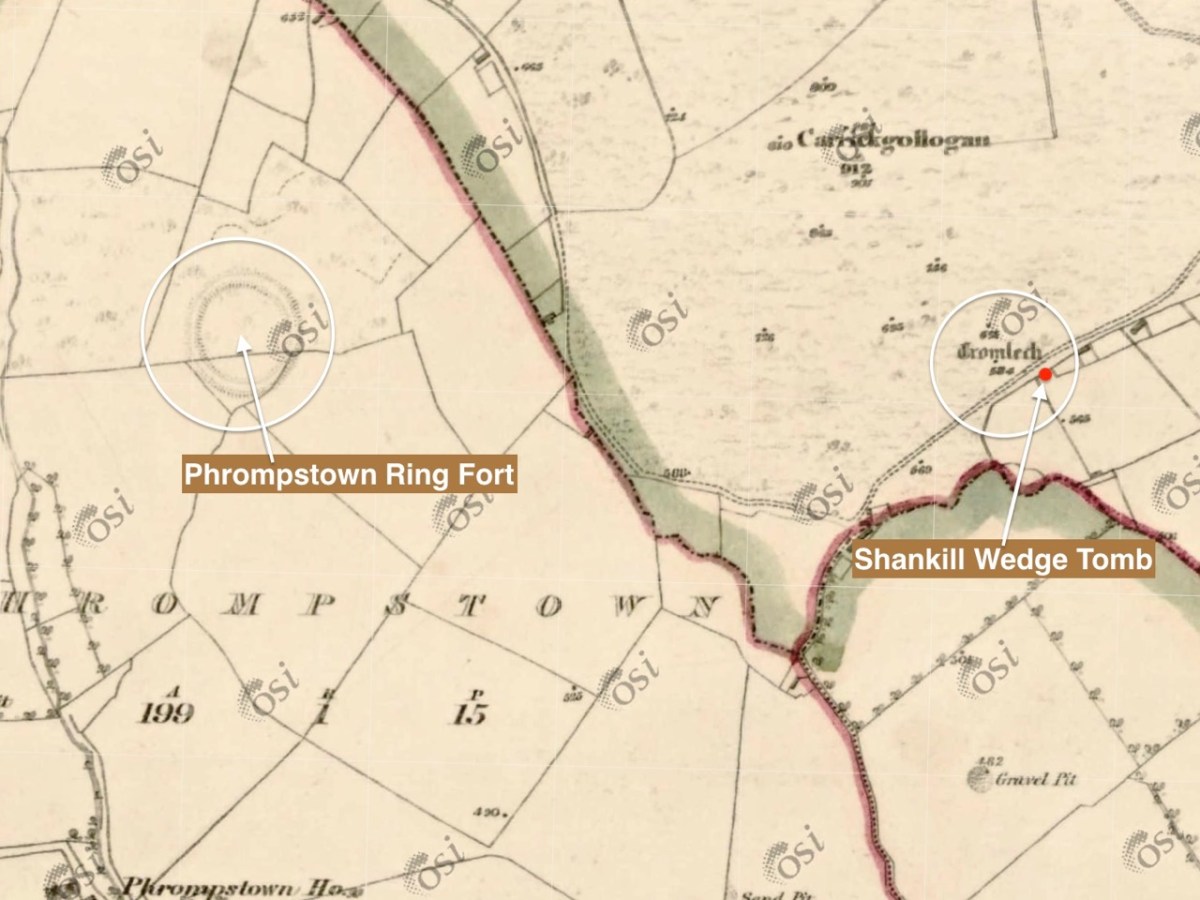
It is quite difficult to penetrate the undergrowth to see what remains of this structure, which probably dates from between 4,000 to 5,000 years ago. It seems a shame that such an ancient survival is not cared for in any significant way by our State. The tomb was recorded (as a ‘dolmen’) by the archaeologist William Borlas in 1897. Just over a century later, it has significantly deteriorated. The extract (below( from the first edition 6″ OS map gives it the title ‘Cromlech’ – and also shows nearby a substantial ring-fort: there is no trace of that remaining today.

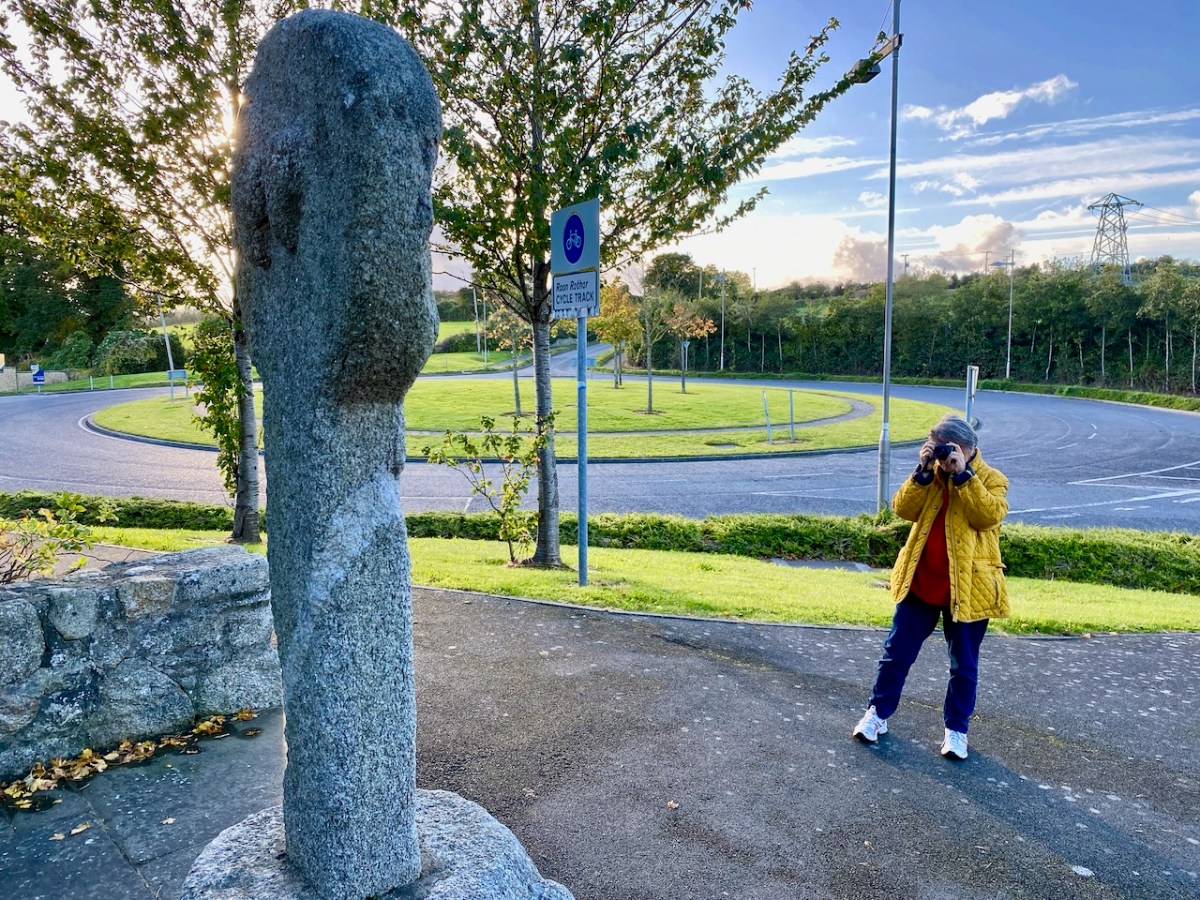
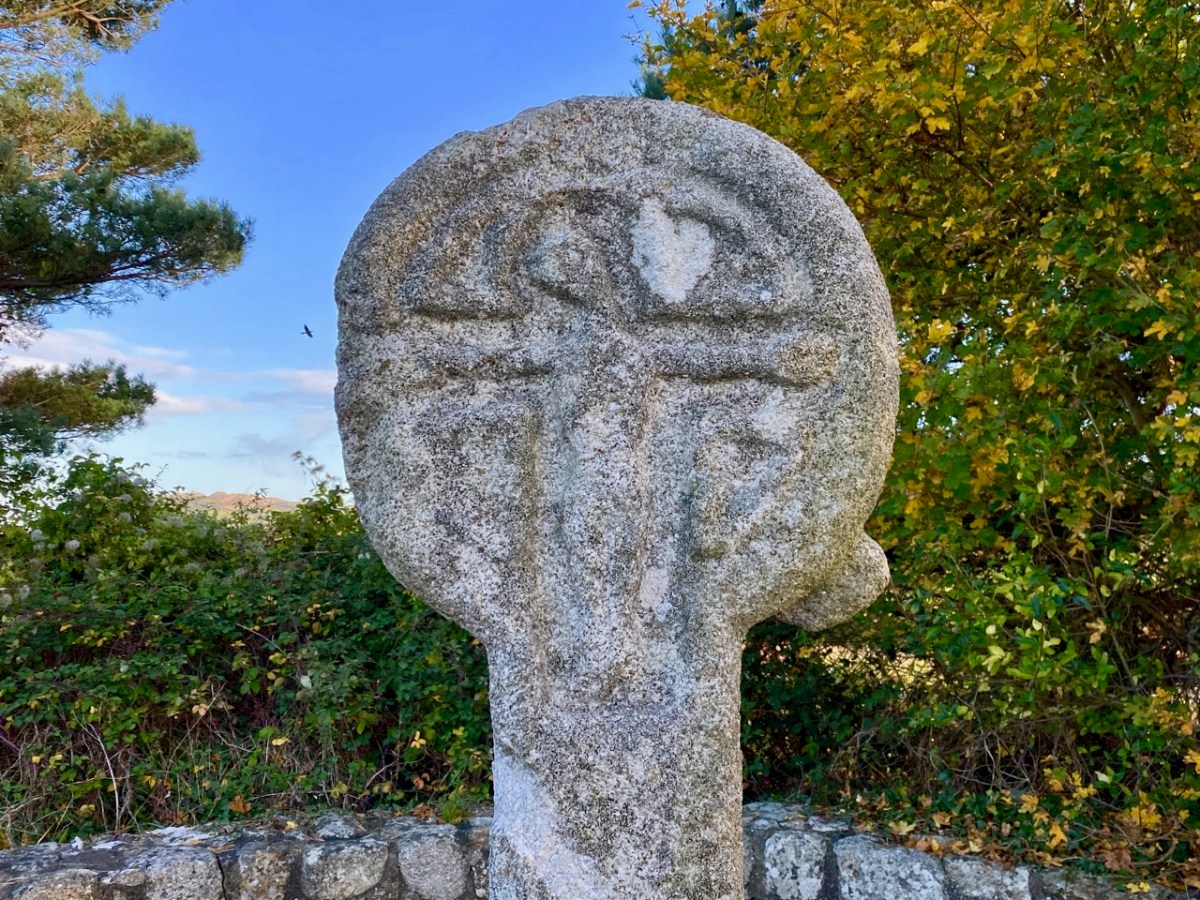
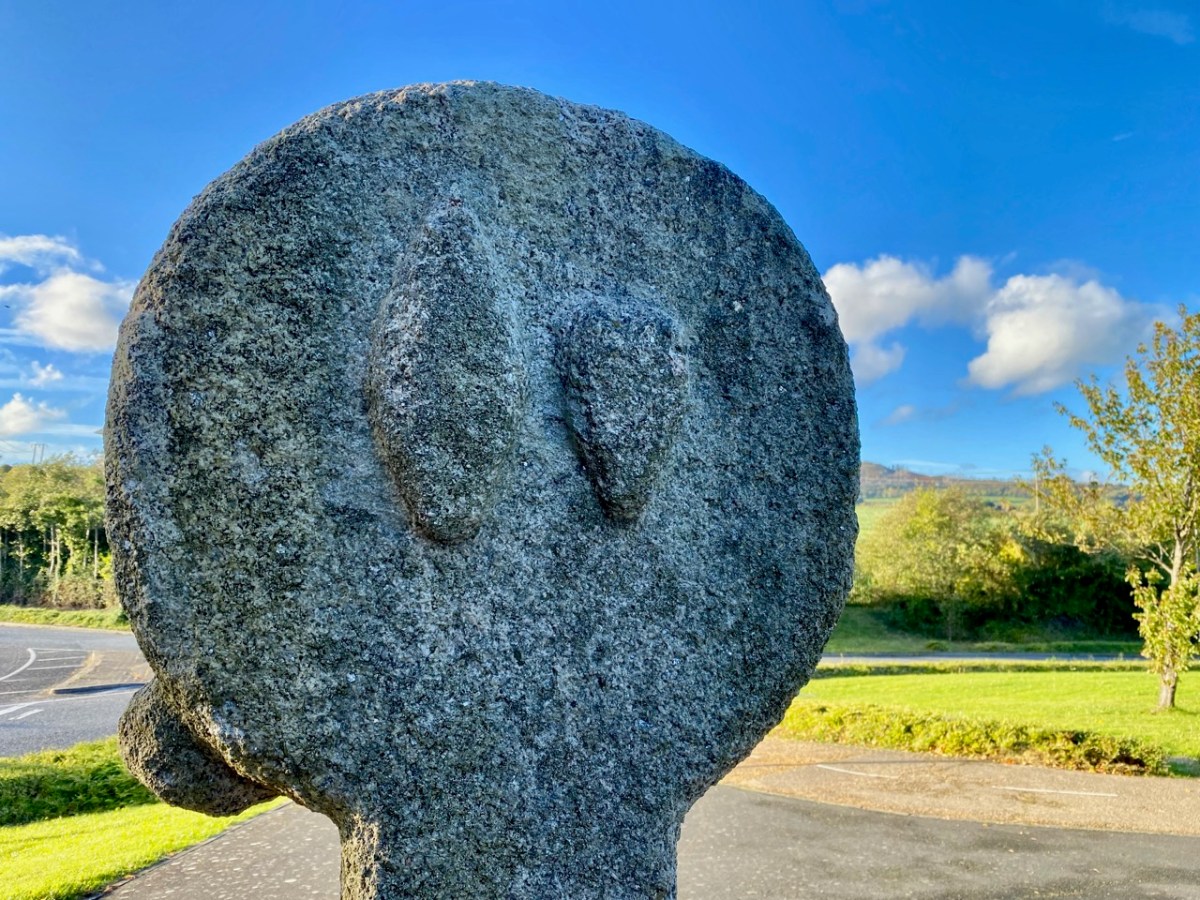
We leap forward about three thousand years for our next archaeological site, but we are only a short distance away as the crow flies – in Fassaroe, Co Wicklow, less than half a kilometre. This was a great discovery for me: a very fine carved cross, likely to date from the 12th century. Although it has been moved from its original site, it is cared for, and easily found right beside a strangely deserted modern traffic roundabout with little sign of habitation nearby.

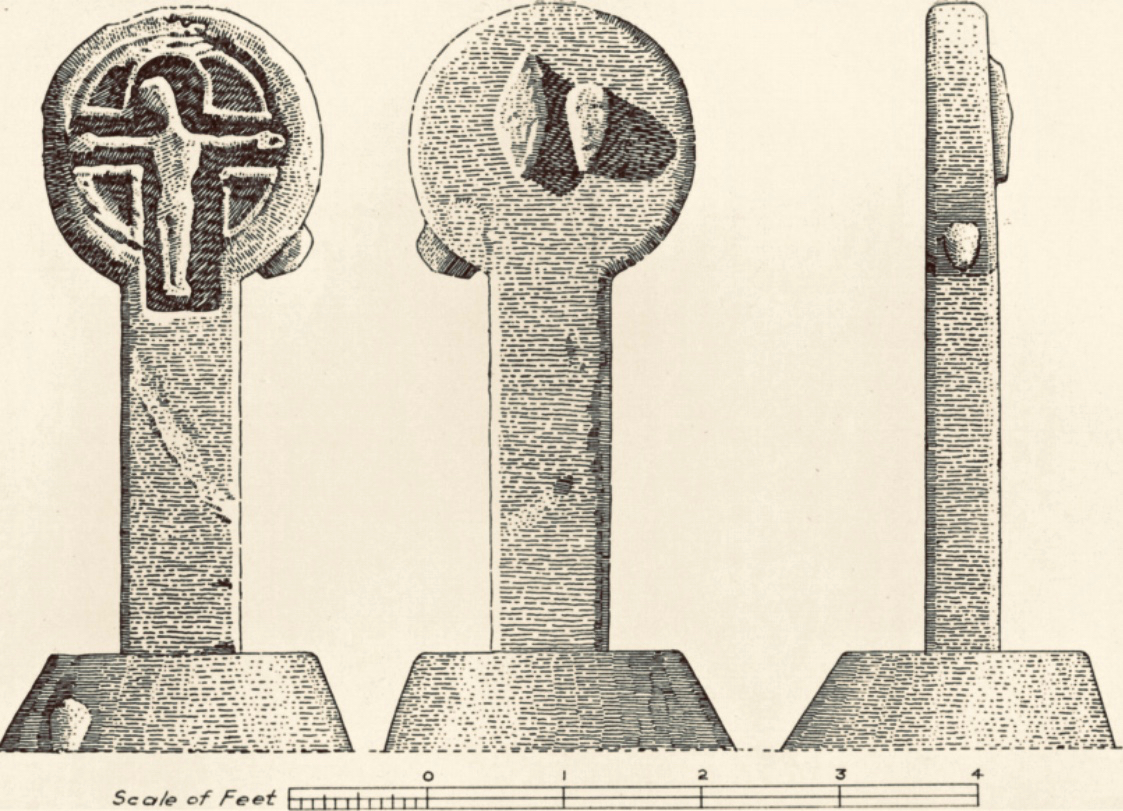
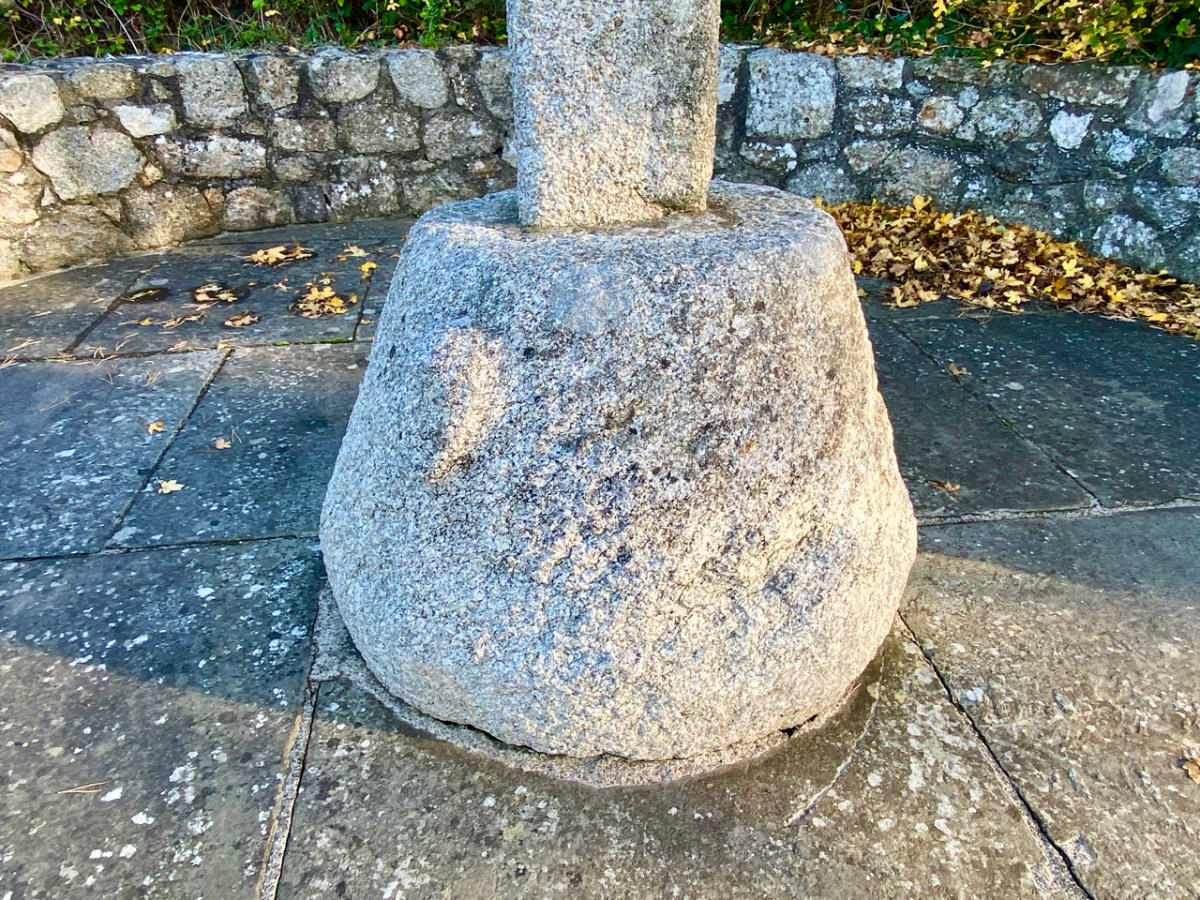
The granite cross face is carved with a crucifixion, but there are also ‘bosses’ on the back, sides and base stone. These are believed to be heads, well worn now but in good light some features can be seen: a pointed ‘ceremonial’ head-dress, and beards.

The clearest view of the carvings (above) is illustrated in The Journal of the Royal Society of Antiquaries of Ireland, Volume 88, 1958. An article by P Ó hÉailidhe discusses this cross and others nearby. The carving is popularly known as St Valery’s Cross as it purportedly came from the nearby demesne of that name. Some archaeologists theorize that it was originally brought to that estate from elsewhere.

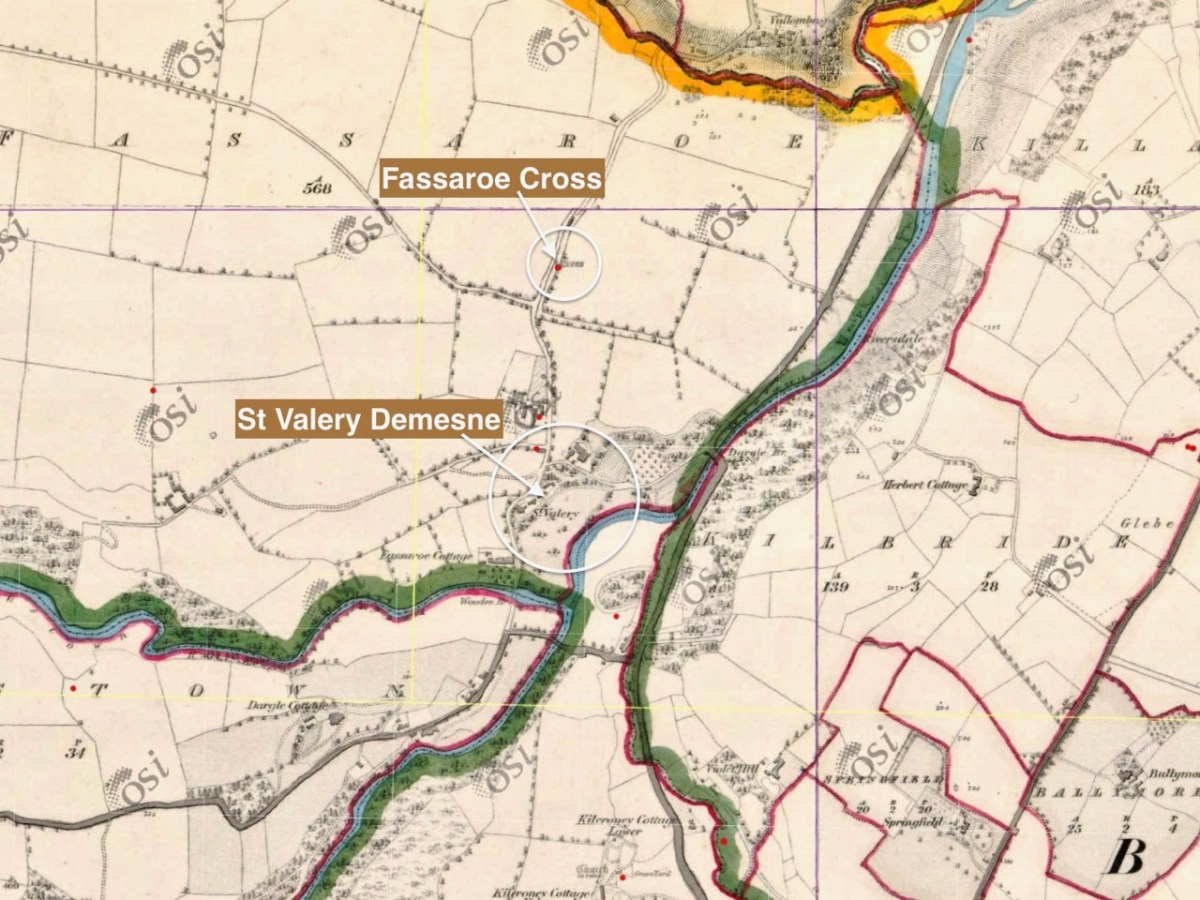
This extract from the first edition of the 6″ Ordnance Survey map (c1840) shows the location of the cross, not far from St Valery.

It’s about 7km from the Fassaroe Cross to the last stop on our journey. We have to head north on a road that takes us through The Scalp.

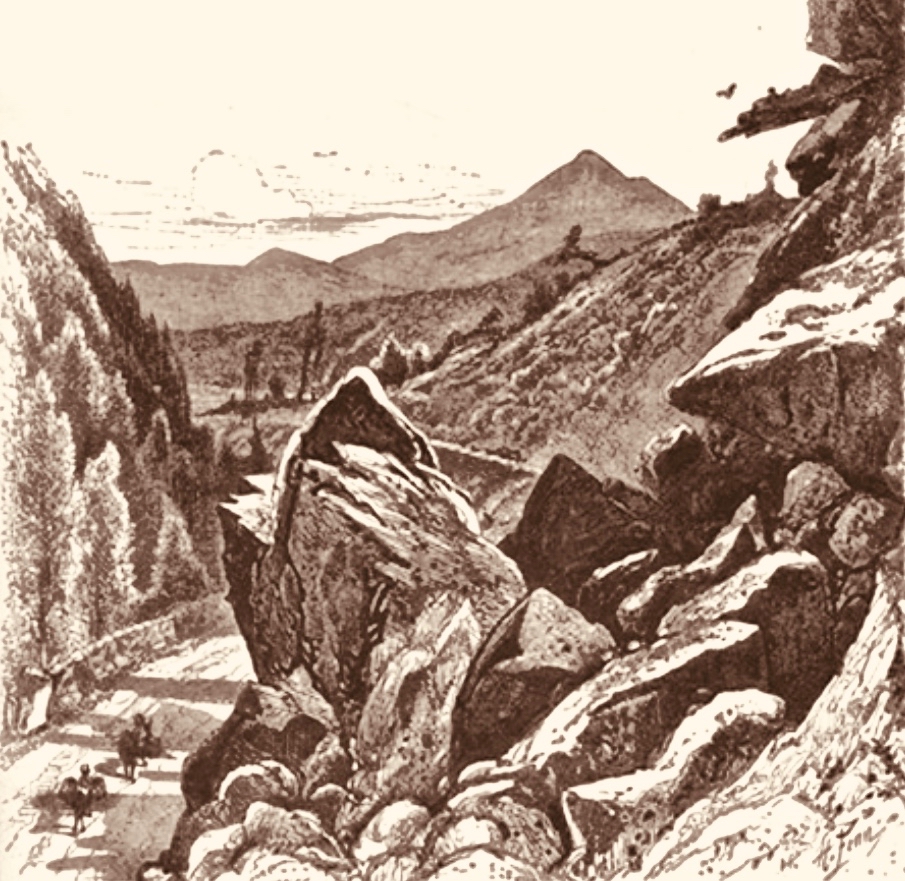
. . . Within an easy drive of Bray is a wild ravine known as the Scalp. The road runs over a shoulder of Shankhill Mountain and through this ravine; it presents a very wild appearance, enormous masses of granite being heaped up in grand and picturesque confusion on either side. It looks as if nature, in order to spare man the trouble of blasting a road, had by some mighty convulsion torn a rent through the mountain just wide enough for a high road . . .

Irish Pictures Drawn with Pen and Pencil, Richard Lovett, 1888

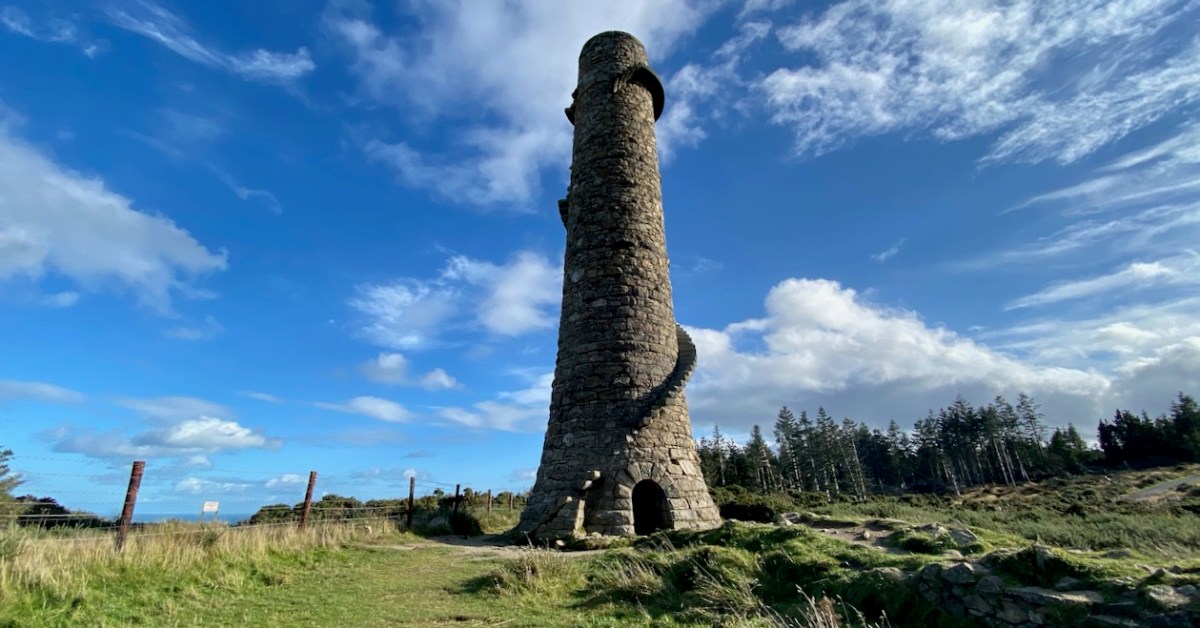
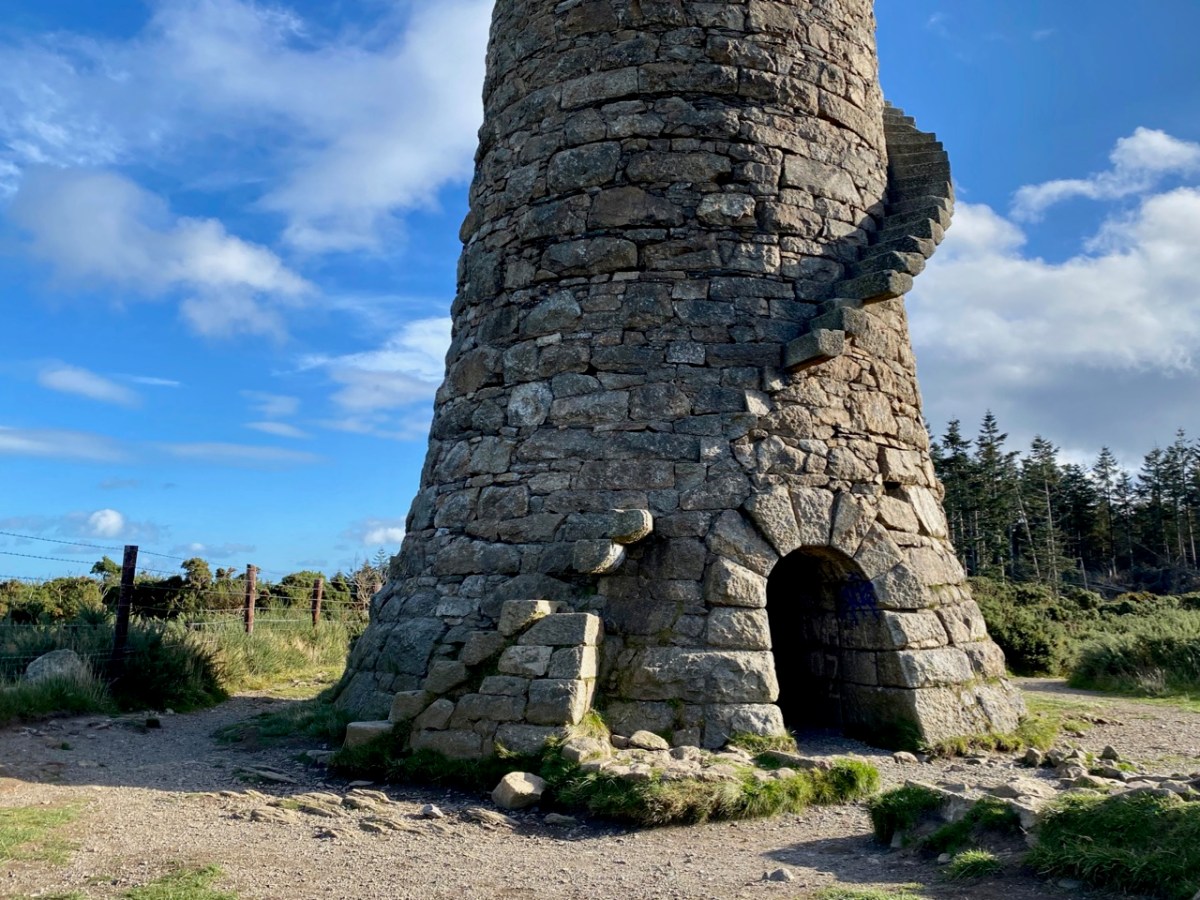
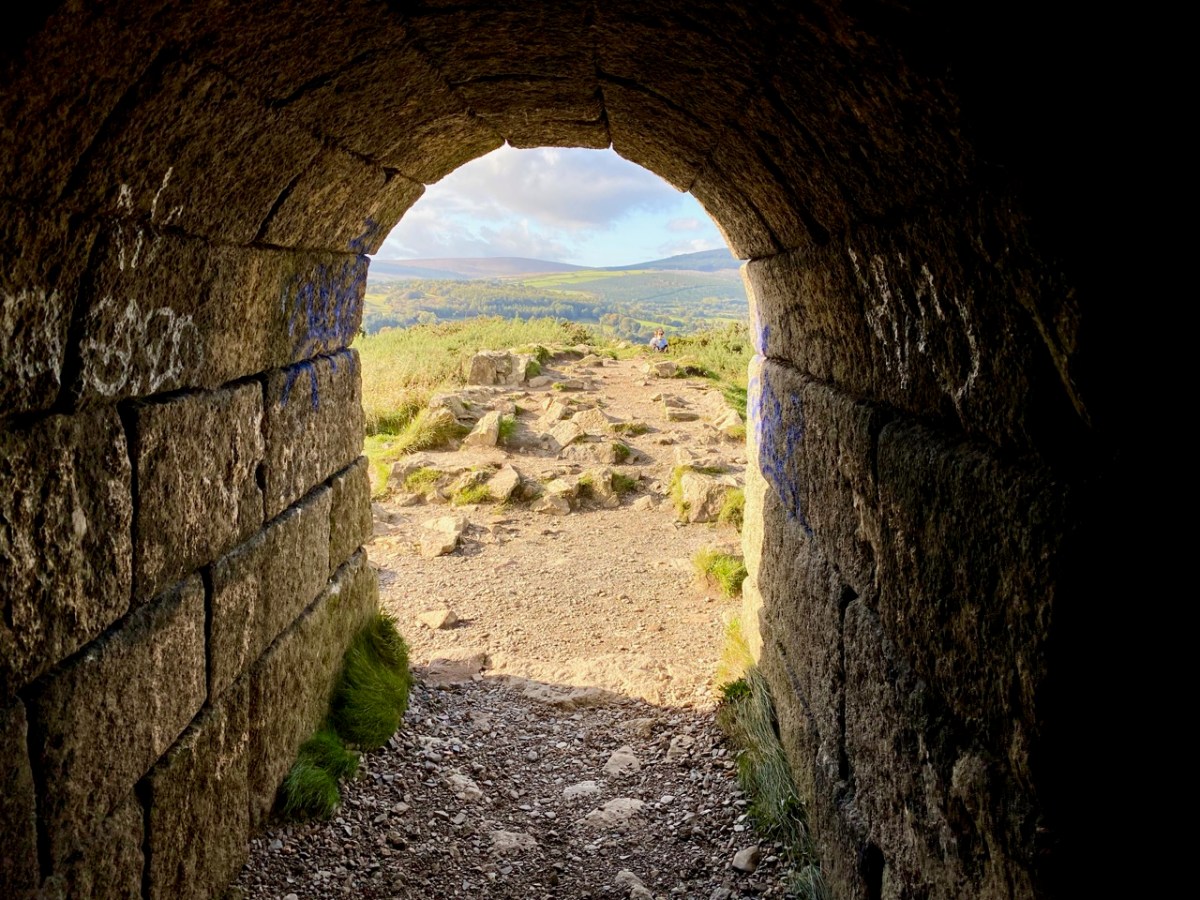
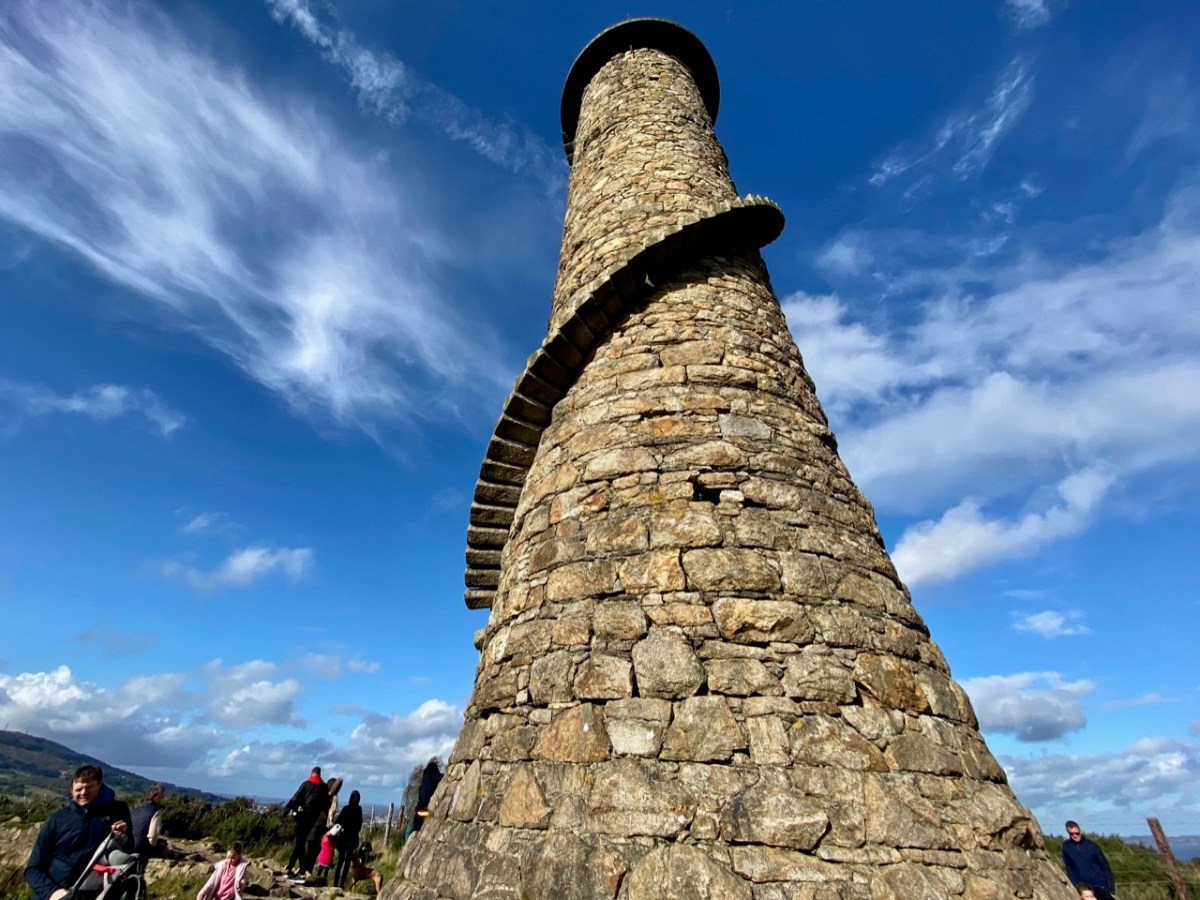
The view above accompanies Richard Lovett’s 1888 account. In spite of the topological interest of the Scalp road, our journey took us on and forward a few hundred years to our last stop – the lead workings on Carrickgollogan hill, Ballycorus townland. The hilltop mine chimney which forms our header picture is a well-known landmark in this part of the country.

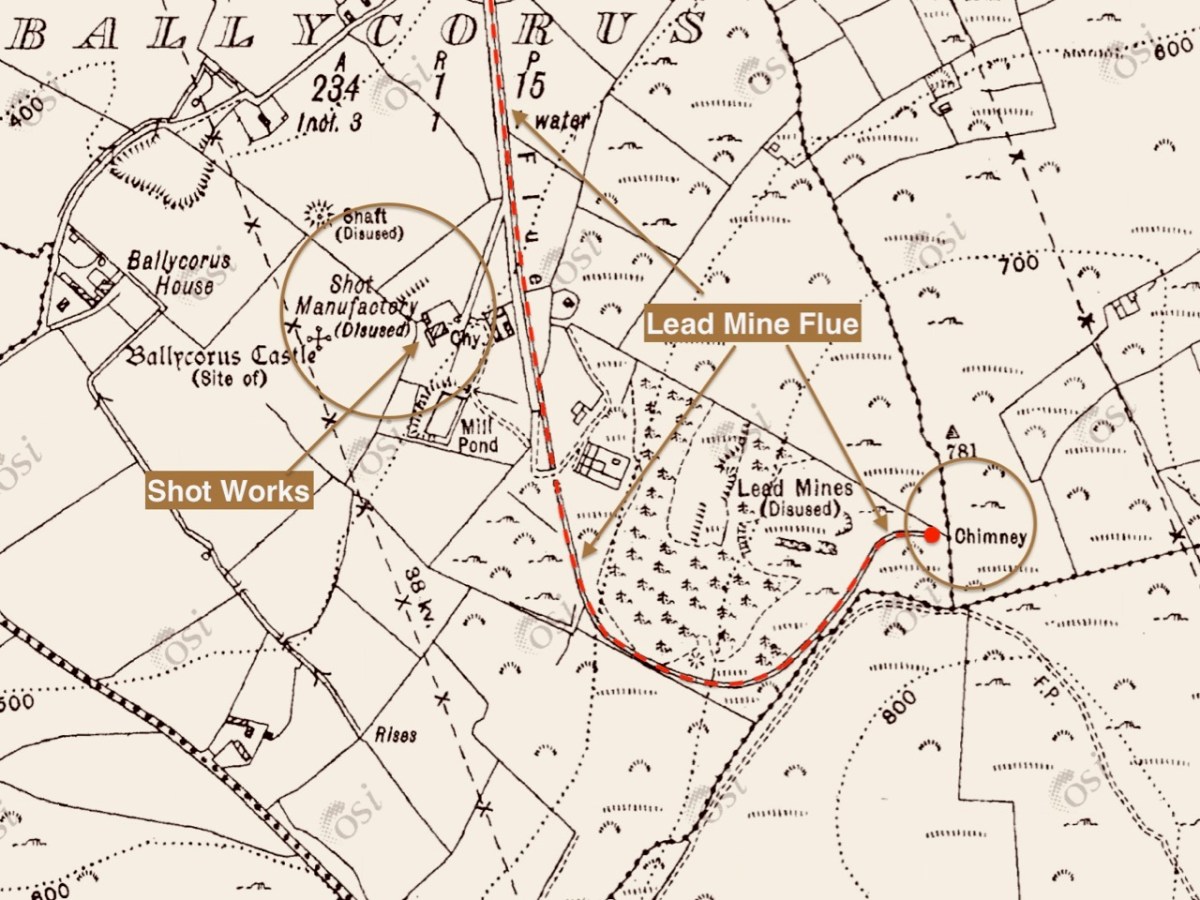
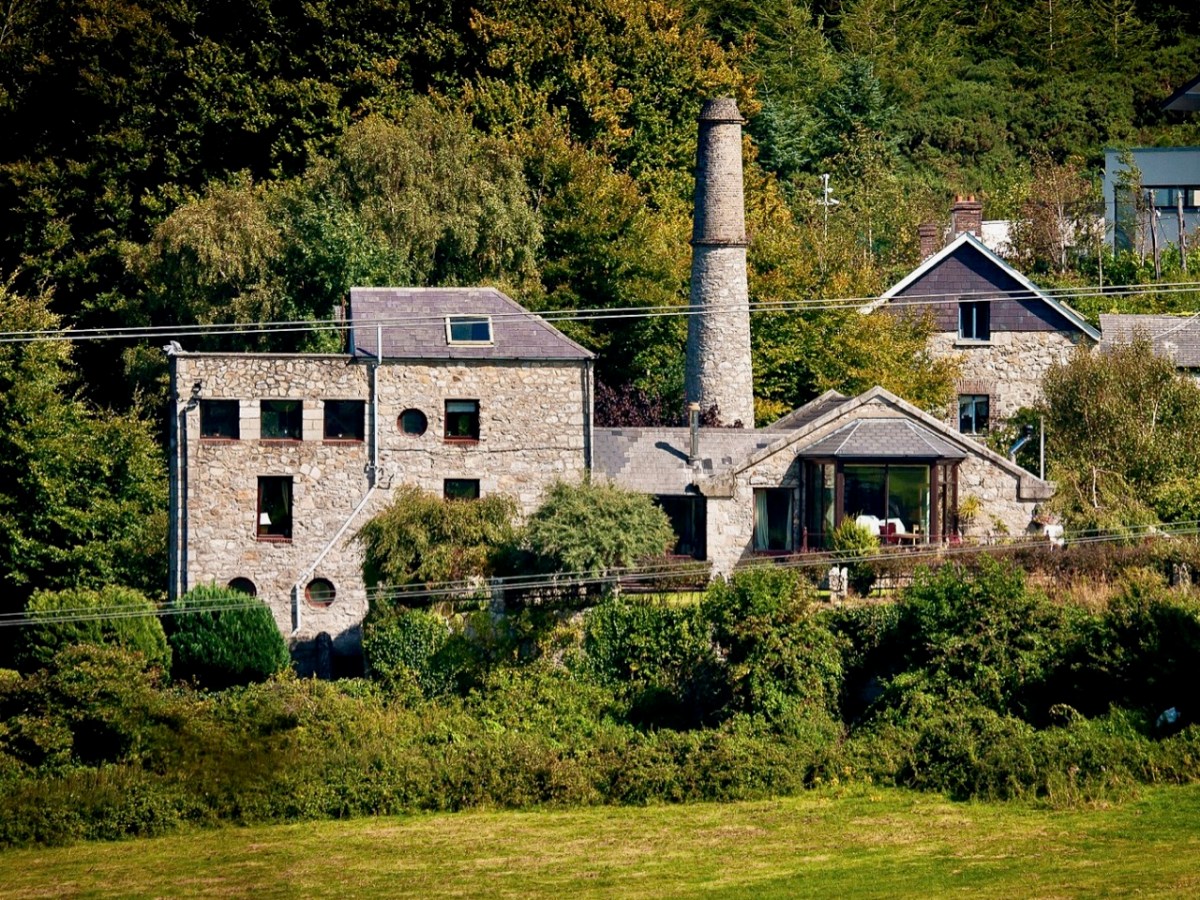
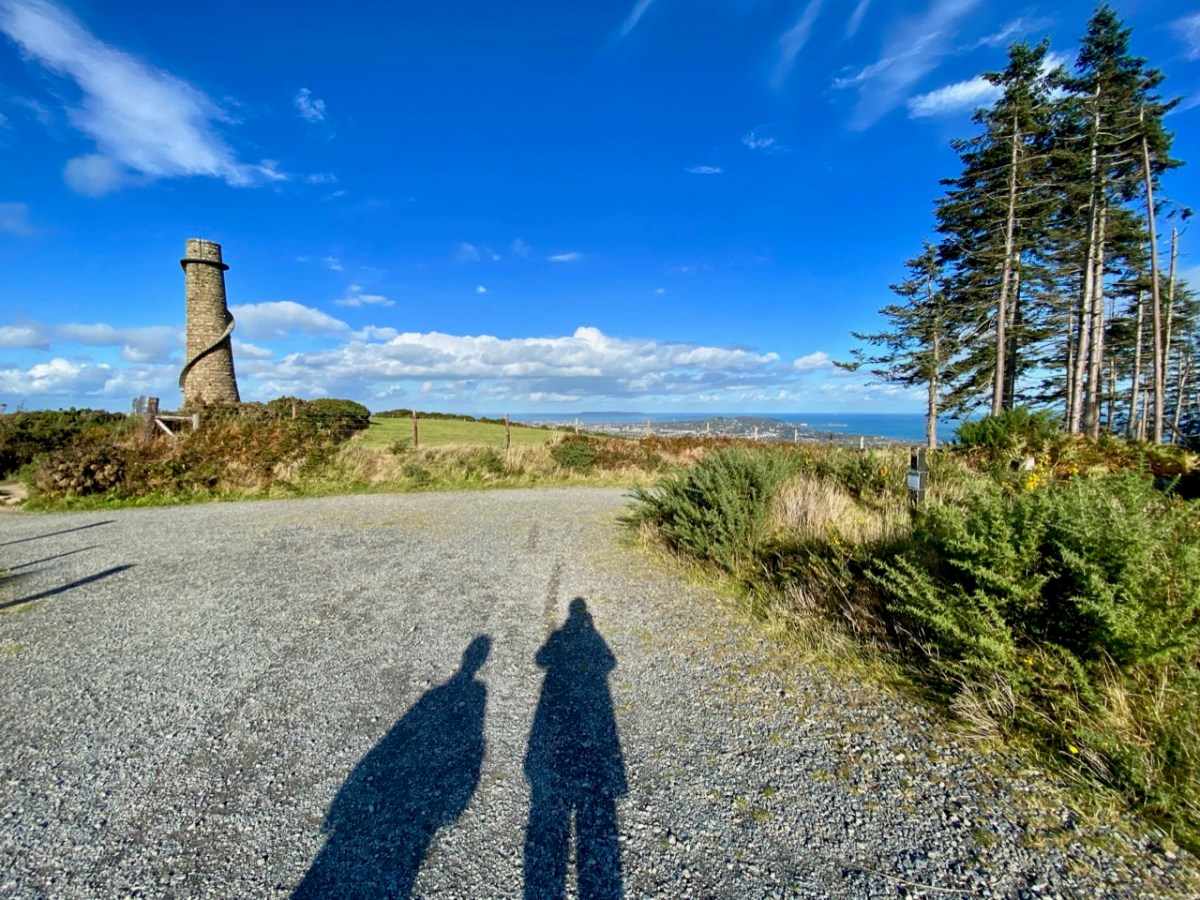
The mine was established in the early nineteenth century. Many of the lead works buildings remain today in the valley below the landmark chimney, mainly converted to modern dwellings: the photo above (courtesy Joe King via Wiki Commons) shows a distant view of the converted buildings and ‘shot tower’. The ‘Shot Works’ can be seen on the 25″ OS extract, above. This also show the location of the Lead Mine flue and chimney, which was the destination of our archaeological journey. That’s us (below) climbing the hill towards the chimney that’s on the 220m contour line, and offers views towards Dublin Bay.

Open-cast mining commenced in 1807. The Mining Company of Ireland took over the site in 1826 and began to carry out underground extraction. A 2 km long flue (shown in red on the map above) was laid out from the smelting facilities to the great chimney at the summit of the hill. You might think this was an acknowledgment of the poisonous fumes which lead working released, and an attempt to divert those fumes from the main site – but no!

. . . A process had been discovered in the 1770s whereby additional quantities of lead could be extracted from the fumes emitted by reverberatory furnaces if the vapours could be trapped long enough to precipitate the lead. To this end a flue 2 kilometres long running from the lead works and terminating at a chimney near the summit of Carrickgollogan was constructed in 1836. The precipitated lead deposits were scraped out of the flue by hand and many of the workers subsequently died of lead poisoning, giving the surrounding area the nickname “Death Valley”. . .

Wikipedia

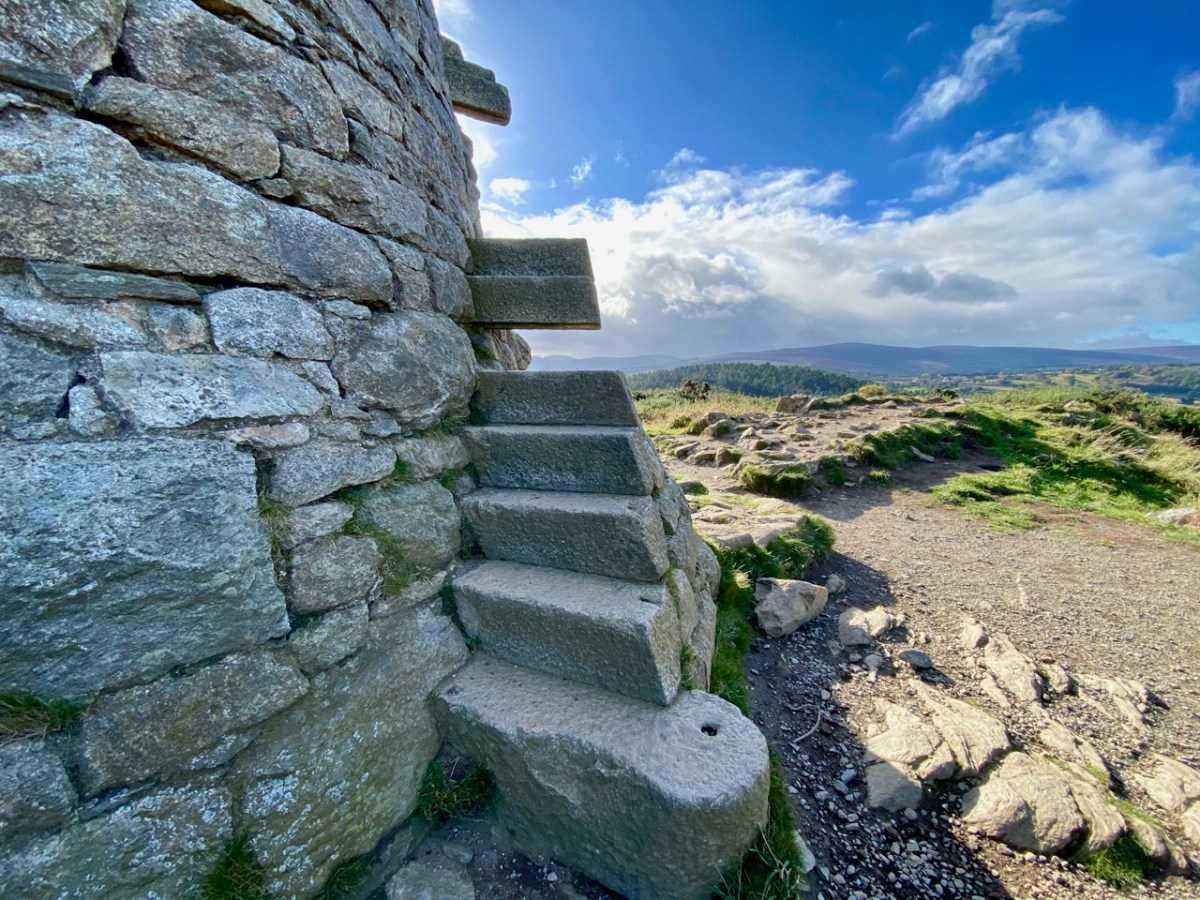
The lead mine chimney remains – although a brick upper section was removed in the twentieth century for safety reasons (see lower picture) – and so does much of the enclosed flue. A public trail follows its course to the top of the hill. The remaining chimney is a fine granite structure, in reasonably good condition. It’s certainly much visited: Finola – who grew up in Bray – has fond memories of cycling out there with her two brothers, and finding ways to climb part way up the spiral staircase which accessed a viewing platform, in spite of key parts of the stair structure being missing!

All three examples of archaeology we have studied today have one thing in common: they are constructed of local granite. Thousands of years separate the oldest and the most recent, but the inherent strength of the material has ensured survival, at least in part. As with West Cork and all other parts of Ireland, the temporal history is rich, and much of it is largely intact. We have so much more to explore!

Ireland 50 Years Ago: Jack B Yeats Special Edition 1

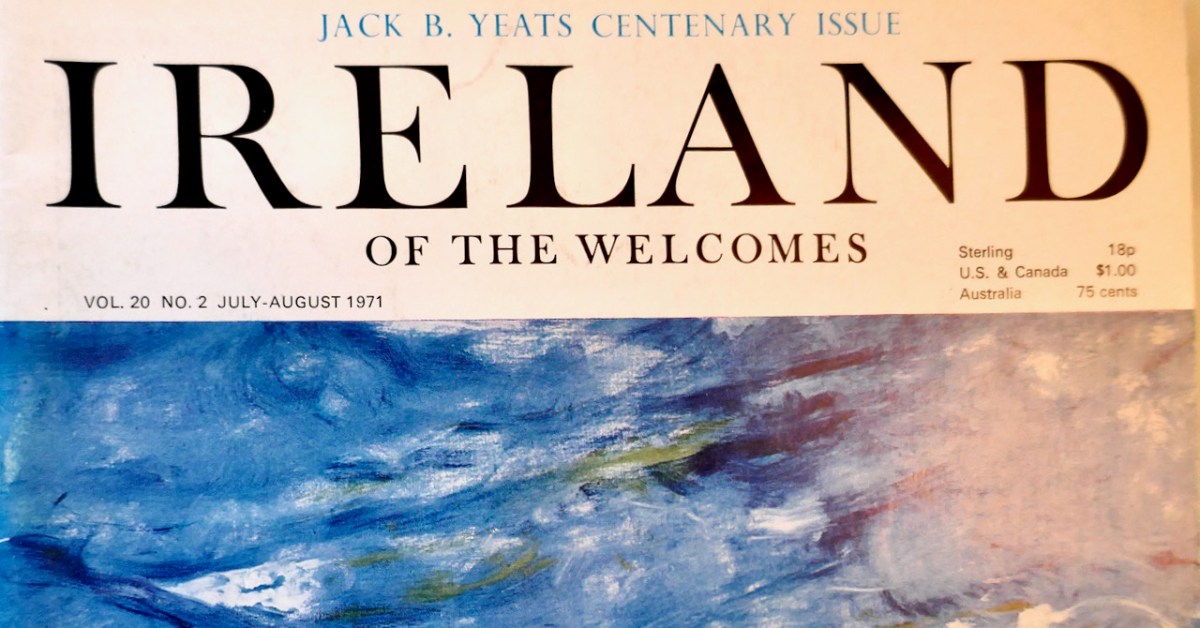
A special edition of Ireland of the Welcomes, July-August 1971, was devoted to Jack B Yeats, in honour of the hundredth anniversary of his birth. Having been intensely moved recently by the National Gallery’s exhibition, Jack B Yeats: Painting and Memory, I was interested to look at how he was viewed in 1971, as part of my Ireland 50 Years Ago series.

The illustrations are all from this issue and sorry – photographing from an old magazine doesn’t guarantee the greatest quality. This post will take us up to the beginning of his career as an expressionist painter, after he honed his drawing and watercolour skills and started to exhibit. This part of Yeats’ work is not really covered in the National Gallery Exhibition, which is almost entirely devoted to his oil paintings and is organised thematically rather than chronologically.

Island Funeral, rendered in the magazine in black and white

The long article is by Roger McHugh, based on his Introduction to the Dolmen Press book Jack B Yeats, A Centenary Gathering. Roger McHugh was himself an esteemed academic at UCC, a writer, playwright and critic, an ardent republican, and according to his bio in the Dictionary of Irish Biography, ‘an enthralling dinner-table raconteur.’ His analysis is insightful and evocative. I will simply use his words after the poem by MacDonagh and through the rest of the post, indicated by italics.

The article begins with a poem by Donagh MacDonagh (an equally  erudite man with an impressive literary and nationalist pedigree) which I will quote in full as it expresses wonderfully what it is to look at a Yeats painting.

Love of the dusty rose 

Blooming above the Square 

Lights the whole studio 

And singer, fisher, clown, 

Horseman and Saddled Horse

Surge through the winter air

Razing the years and the walls 

For the wild man of the fair

To snatch the wagered purse

And bring the champion down.

The women by Liffey side,

The pig-buyer home from the fair,

The horse taking time in its stride

Are dead, with the big-muscled men

Who bullied their way into sight

And froze in an arrogant stare;

But they and the sailors of Sligo

Are bright in a memory where

Colour condenses in light

And the starved rose blushes again.

Donagh MacDonagh

Create? The painter had his reservations: ‘No one creates’, he wrote; ‘the artist assembles memories’. By this I think he meant that the intense moment is always already past but that observation, memory and technique can recapture it. . . He thought that ‘painting was the freest and greatest means of communication we have’ and that the finest paintings always had ‘some of the living ginger of life in them’.

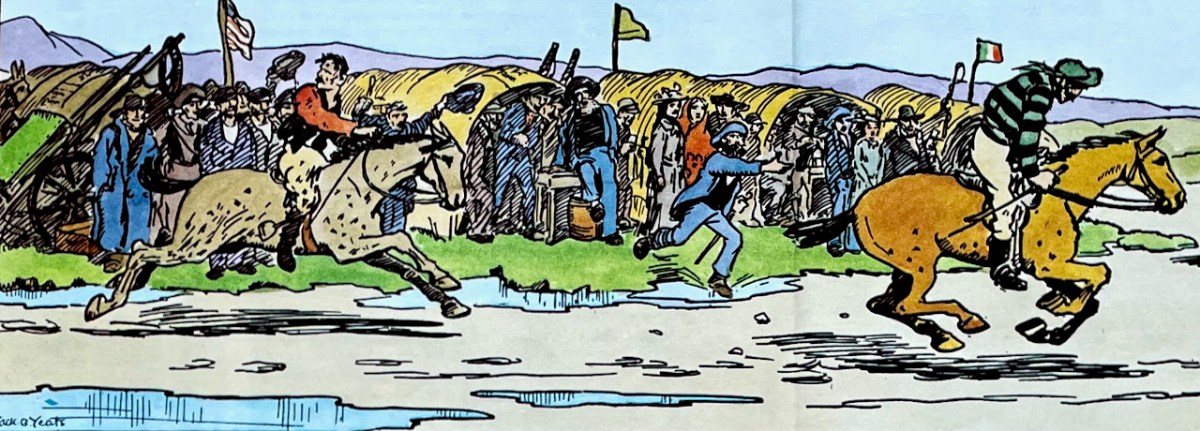
As a youth in Sligo He preferred to play around the quays and the streets, inspecting with due reverence sea captains, sailors and pilots, or at country fairs and sports observing and sketching small farmers, pig-jobbers, worried shopkeepers, untamed tinkers, shouting ballad singers, exultant jockeys surrounded  by triumphant or sullen wild faces, or the stirring arrivals of Bianconi long cars, of bands, of circuses.

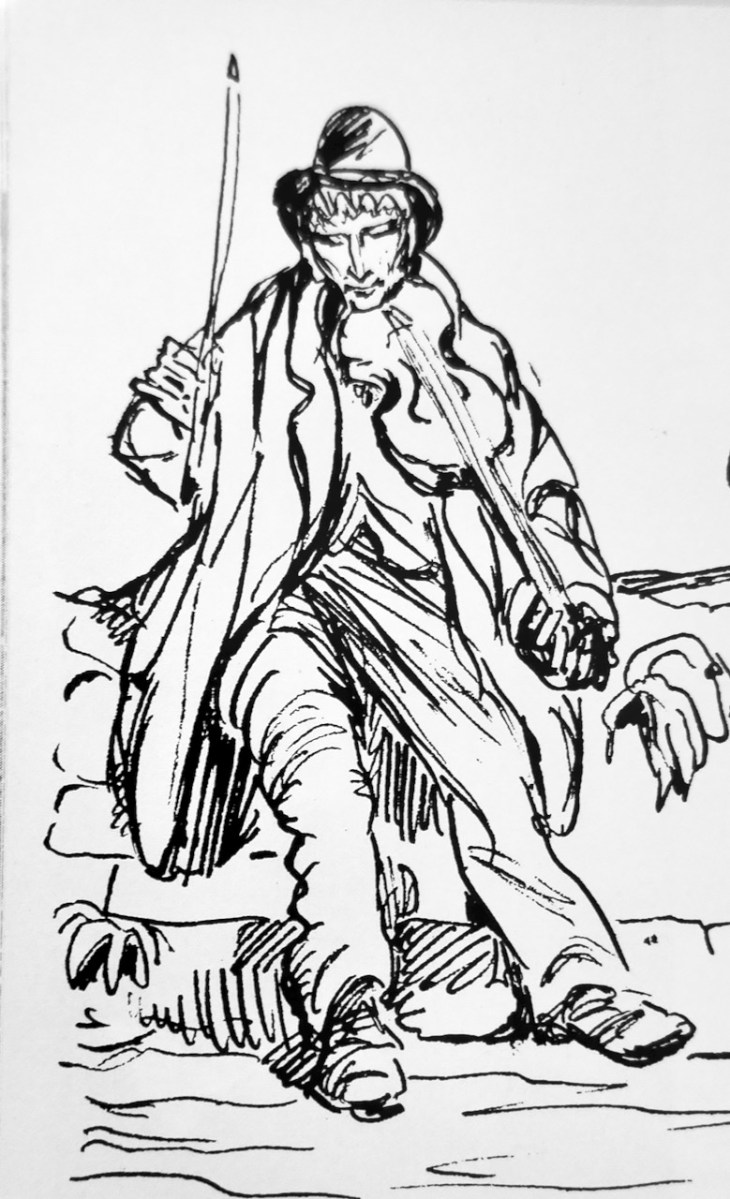
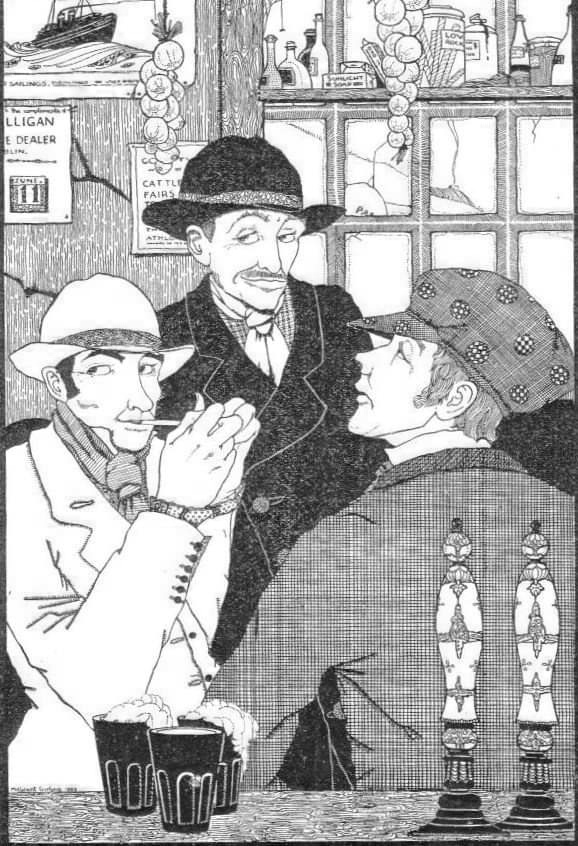
This drawing (also reproduced from Ireland of the Welcomes) is an illustration from Synge’s The Playboy of the Western World. Read more about Yeats’ and Synge’s collaborations in this post

As a background to these assorted characters was a setting of great variety; cliffs whose wildness was accentuated by the ‘crashing wind and lashing sea’ . . . legended mountains like Ben Bulben and Knocknarea, long reaches of sand sometimes marked ominously by wrecks perhaps dating to the Armada.

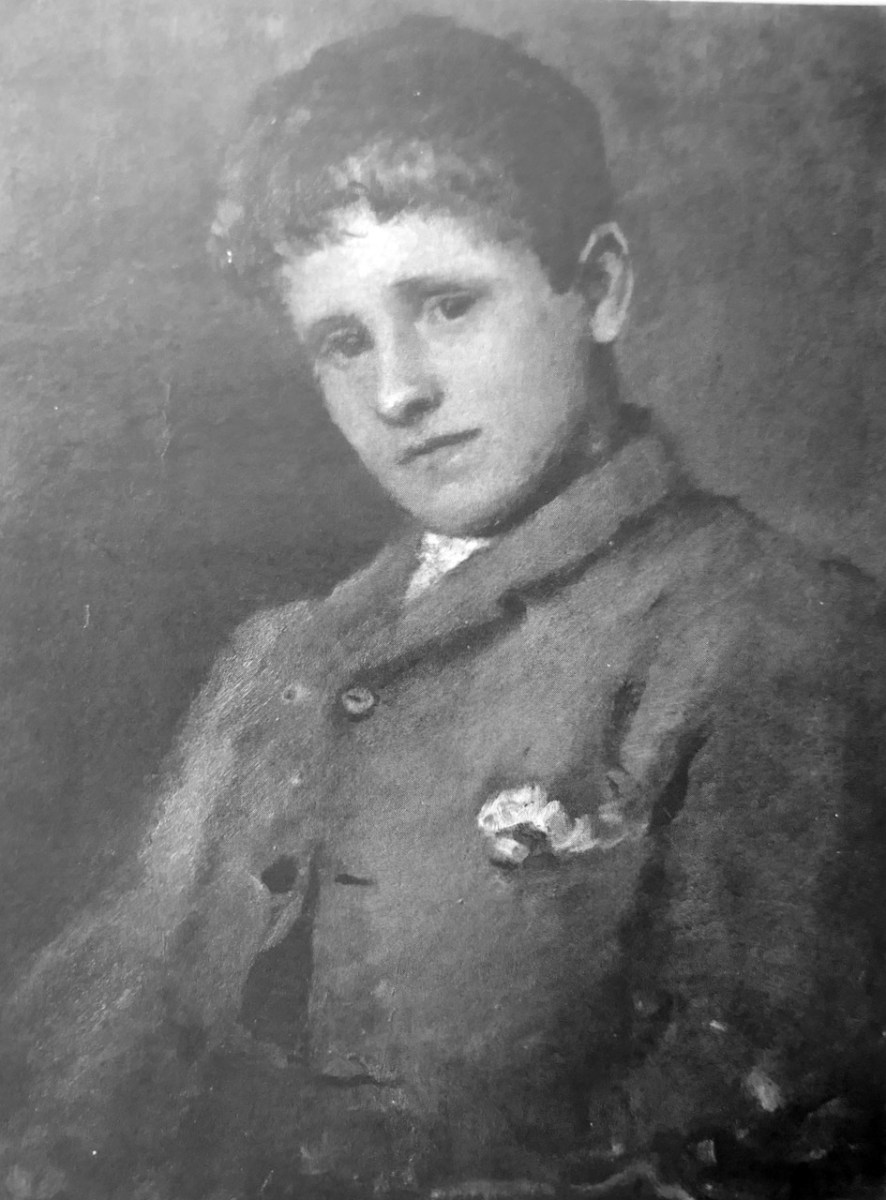
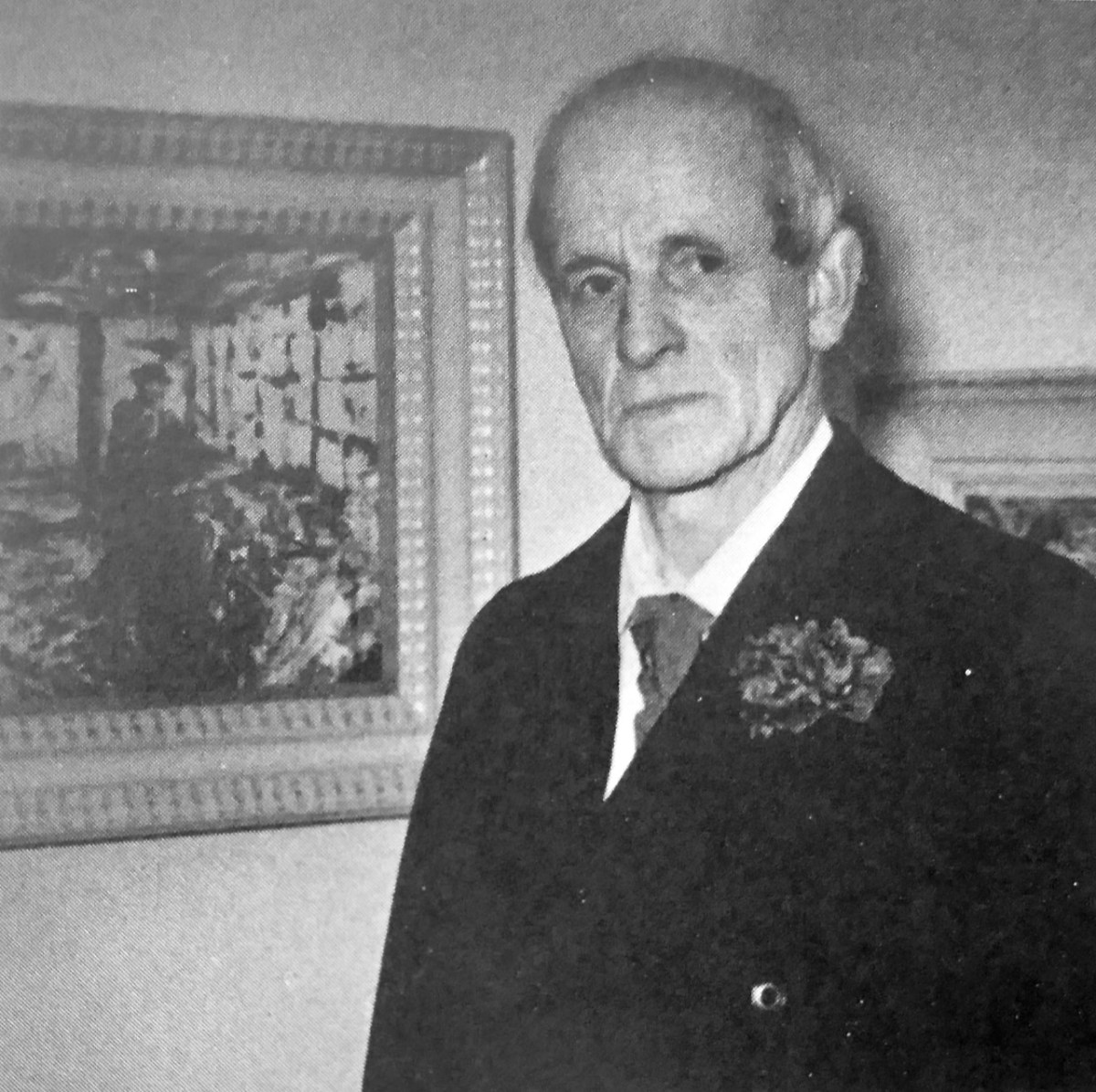
Jack B Yeats as painted by his father, John Butler Yeats. I find it uncanny how little his expression changed between this boyhood image and a photograph taken of him as an older man (below)

Even at sixteen he had started his career as a professional illustrator . . . he illustrated school-books, newspapers, periodicals, comic-cuts, racing papers.

Where England gave him many subjects for his illustrations and sketches, Ireland provided almost all those for the drawings and watercolours which he exhibited up to 1911 in Dublin and London. The Painters who exhibited at the Royal Hibernian Academy at that time were either English or Irish imitators of the Leightons and the Poynters, titled men who set the standard. ‘It was into their varnished world where it was nice to see a bit of Normandy or something from Surrey painted by an Irish artist,’ wrote C. P. Curran, ‘that Jack Yeats broke with his troop of tinkers and maggie-men, jockeys and drovers, pig-jobbers and purse-proud horse dealers, stout farmers and sea-faring men, the whole life of a little western town by the sea. It was very exciting, but was it art?

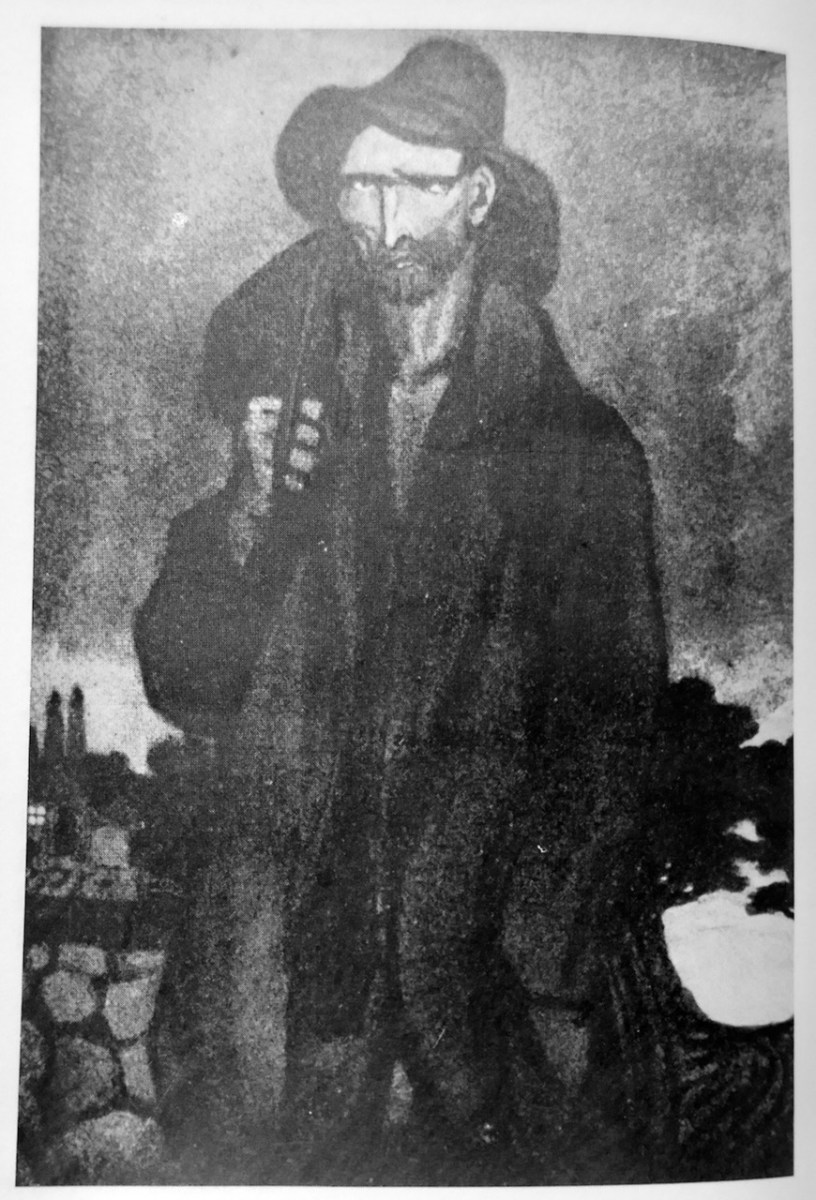
Following his own lead about the affectionate zest for life that is the basis of artistic achievement, I think that people untutored in technique but with some sensitivity can catch the essential elements of those early works. . . . They depict individuals. . . . but in such a way as to capture some essential quality which lifts the picture above its particulars. A tinker is painted in black garb which is set against the black of rock and the dark sky, relieved by a glimpse of white sea-foam. His wild eyes gleam from a ‘black-avised narrow face; he seems the embodiment of some wild night spirit.

The line-drawing of the squireen, bowler-hatted, gloomily assertive, owes much to the sharp, sure vertical lines of his coat and umbrella set against the curve of road, wall and mountain.

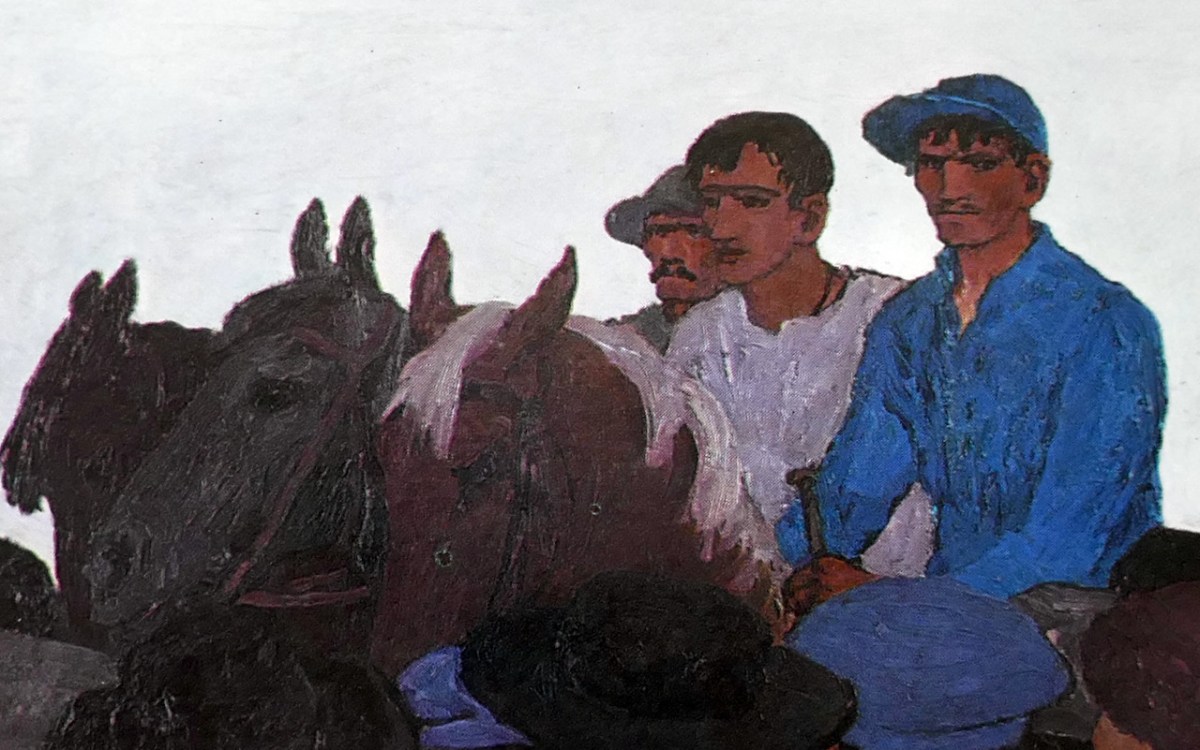
The next post will take us through his life as the greatest of Irish painters. Here’s a sample image from the article.

Clarke-style Windows

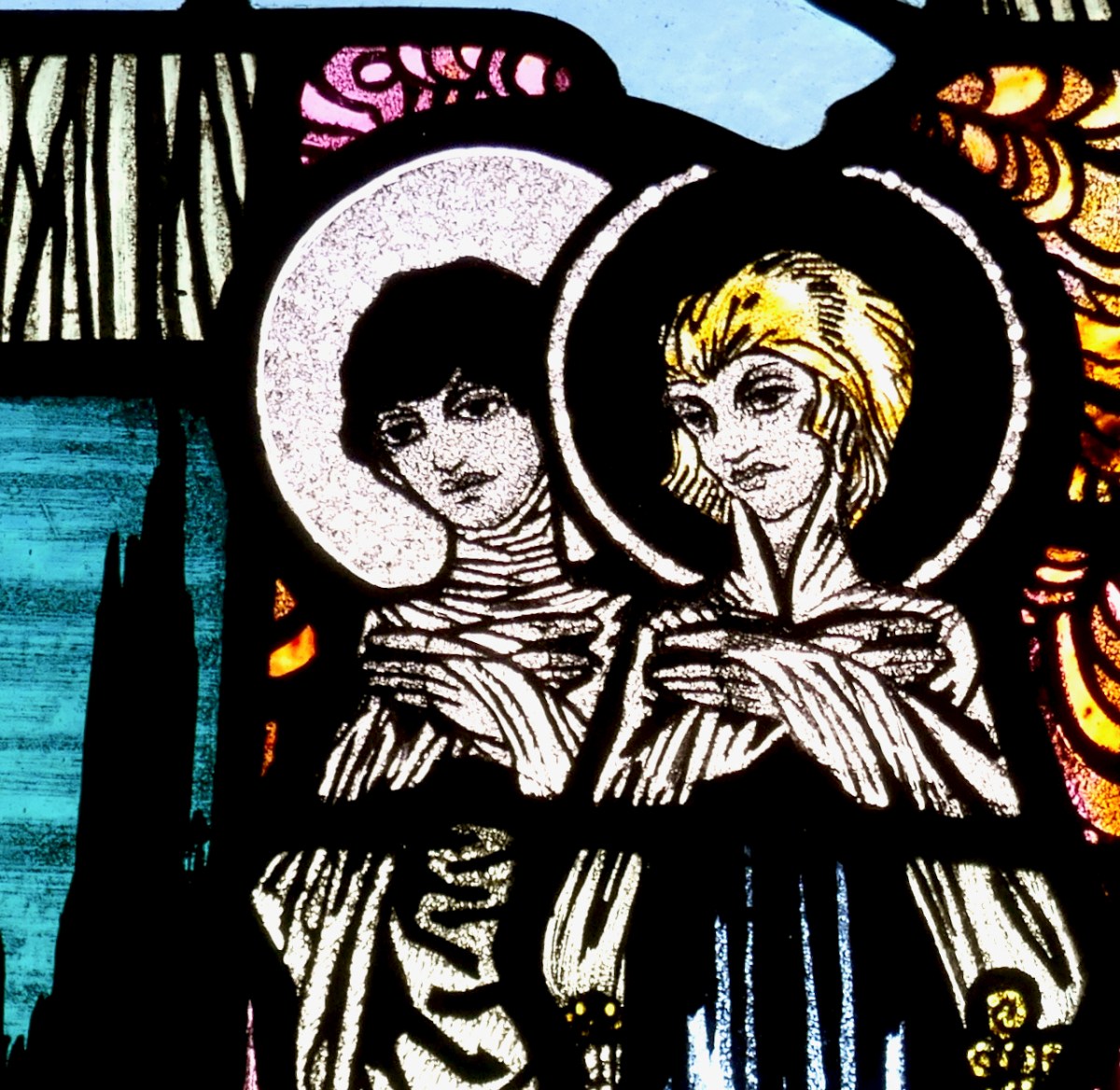
“In no time there was a large studio successfully producing Clarke-style windows to his designs or under his supervision.”

This post and this slide show is about a set of windows in a church in Leixlip, Co Kildare. The music is How Can I Keep from Singing by Enya ©, used with permission. I am hoping she will like me using her transcendent sound for this purpose. (You may need to click on Watch on YouTube for the full screen version.)

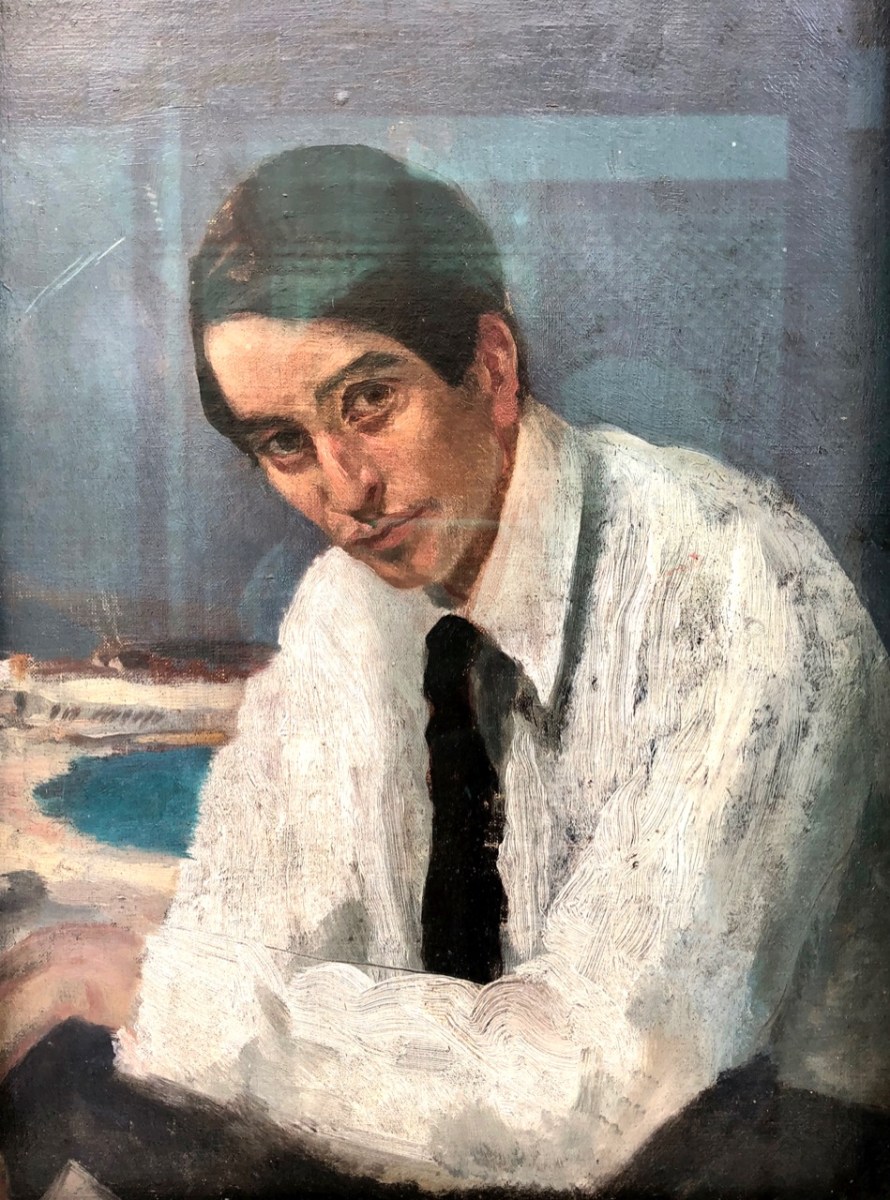
The Leixlip stained glass perfectly illustrates what a Clarke-style window is all about. The quote in the first paragraph is from Nicola Gordon Bowe’s Introduction to the Gazetteer of Irish Stained Glass. The foremost scholar on all matters relating to Harry Clarke (above, in a portrait by his wife, Margaret Clarke) and stained glass of the Irish Arts and Crafts era, she has researched his output exhaustively, and helped us to understand that he ran a busy studio with over 30 employees and was by no means able to design or paint all the windows himself. 

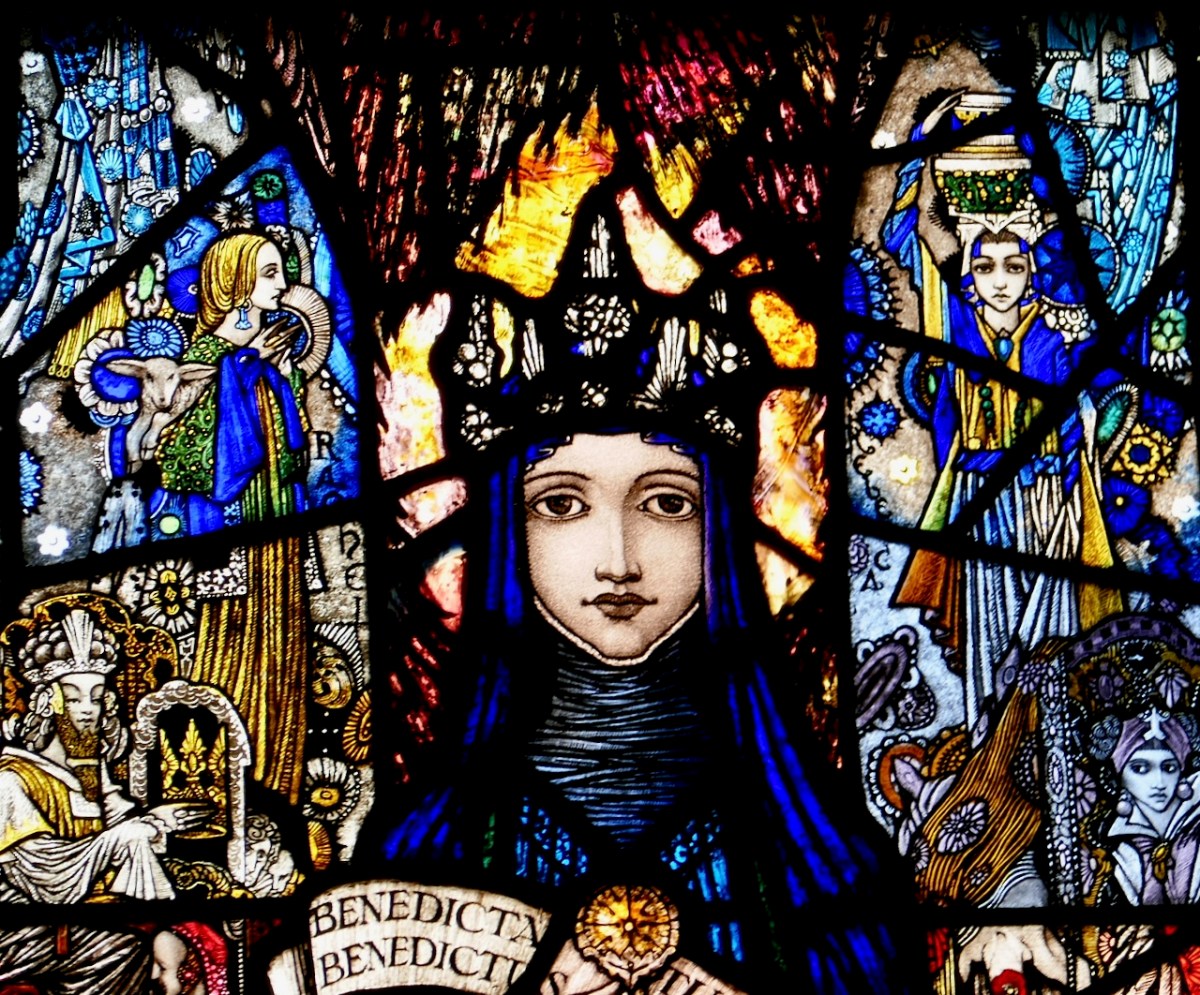
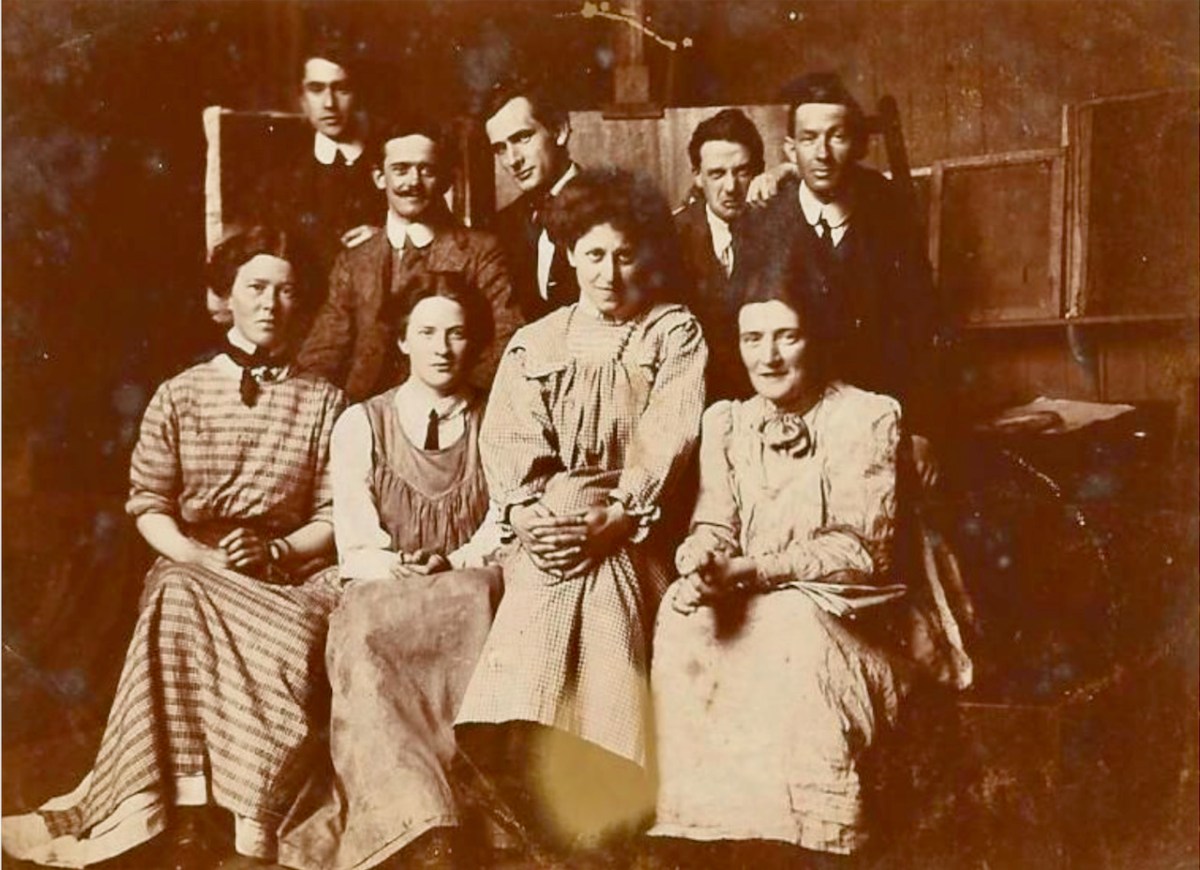
Of course he did many windows – about 150 in all – but if they were his windows, he signed them and they were expensive. Above is a detail from his Terenure masterpiece, The Virgin in Glory, to give you an idea of the difference between the real thing and a Clarke-style window. In addition to that, after his father died in 1921, he and his brother Walter ran the business – Joshua Clarke and Sons (it wasn’t called The Harry Clarke Studios until 1930) – with Walter looking after the business end and Harry in charge of the artistic output. Harry produced his own windows on the side, as it were, paying for materials and glazing time, but charging differently. To fulfil the demand for stained glass windows from around the country (and indeed from the USA, Australia, Britain, and other countries) Harry gathered around him a group of talented artists and trained some of them to reproduce his style. Some of the artists he found himself – they were either fellow students/friends at the Dublin Metropolitan School of Art (like Austin Molloy, or the group below showing Harry top left) or had arrived through recommendations (Philip Deegan from Worthing), or, like Millicent Girling, had taken one of Harry’s own classes. He taught design at the DMSA for a couple of years in the early 1920s and according to Nano Reid, one of his students, all the students were under his spell and there was a wave of Harry Clarke Style illustrations.*

However they got there, in the mid-1920s Kathleen Quigly and Leo Cartwright had joined the other accomplished artists working under Harry’s supervision. While not all the windows the Joshua Clarke studios produced in this period were ‘in the Clarke style,’ many were, and there was huge pressure to produce a Harry Clarke window although not always the budget to go with the aspiration. 

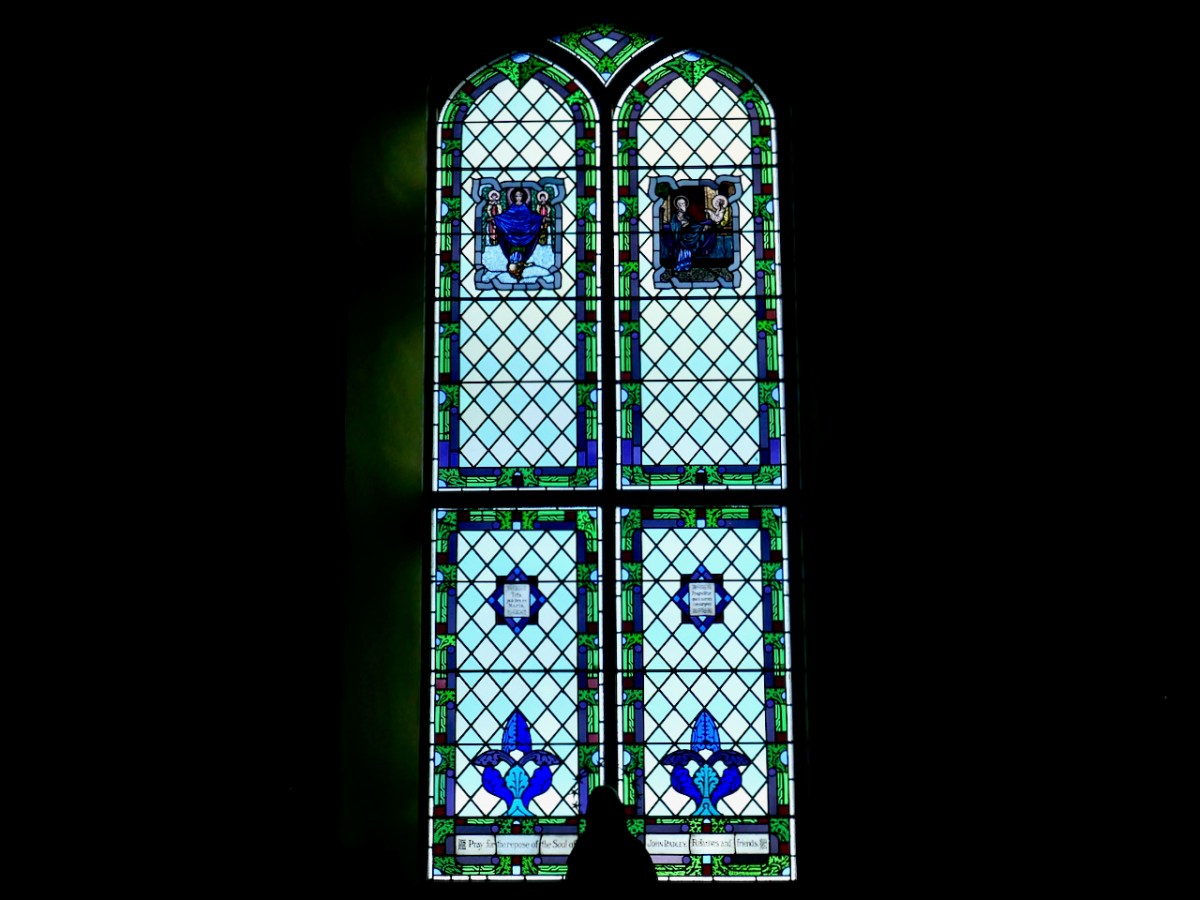
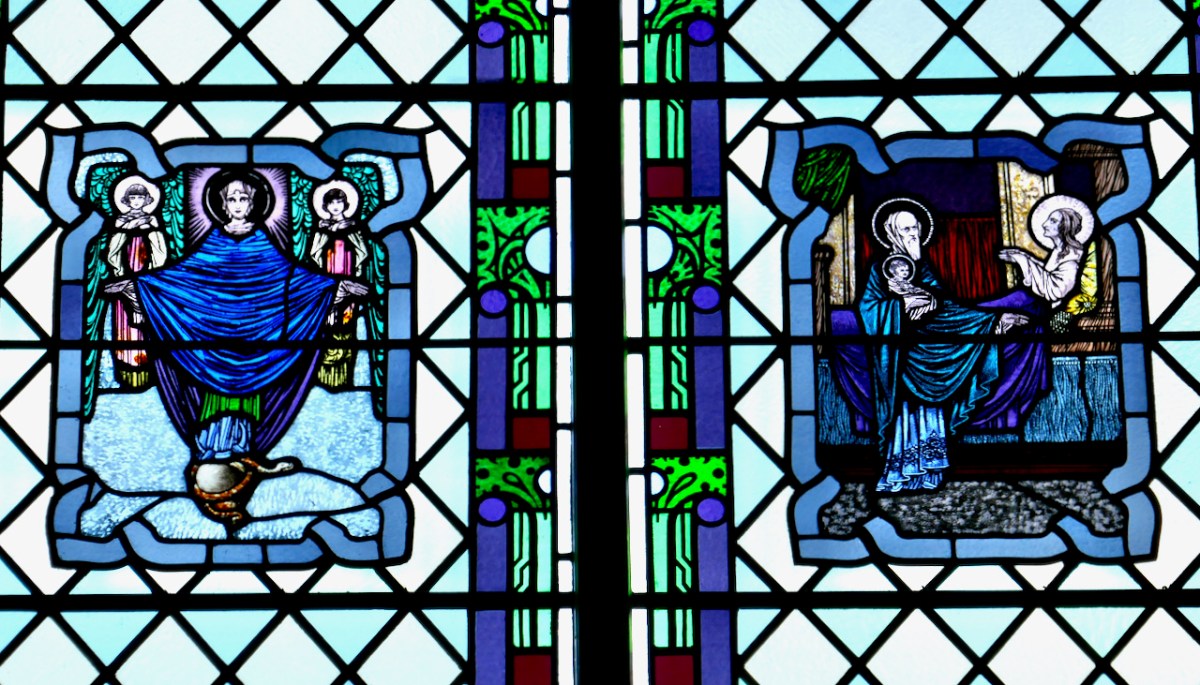
The windows in Our Lady’s Nativity Church in Leixlip, Co Kildare, fall into this category. They were installed in 1925 by Joshua Clarke and Sons and consist mainly of clear and light green quarries, with decorative borders. Each two-light window has a fleur-de-lis design in blue and a Latin inscription at the bottom, while the top panels feature two small scenes from the lives of Mary and Christ. The glass is of the inexpensive kind and the repetitiveness of the decoration meant that most of the windows could be assembled by apprentices or glaziers, while one of the studio artists produced the small scenes.

Who did them? On balance, my guess would be Philip Deegan. He seems to have been the go-to artist for Clarke-style windows. Kathleen Quiqly was also there at the time, but she was mainly assisting Harry with his own windows. Deegan was very capable of designing a near-Harry, as some of the drawings attributed to him in the TCD Clarke Archive attest. Take a look at his sketches for windows here, here and here, for example (sorry, not allowed to reproduce the images online). Not only was he working at the studios, he also signed up for Harry’s design classes and provided illustrations for the Dublin Magazine. I’ve only managed to find one of these (thank you, the amazing Patrick Hawe!) but the facial expressions remind me forcibly of the scourger in the Scourging of Christ window. 

However, that’s speculation on my part and it could have been one of the other artists, or even more than one artist. The small scenes are lacking in Harry’s signature complexity and deeply emotive expression, but taken as a whole they make a charming sequence and deserve to be more visible than they are. 

For much more on Harry Clarke and on stained glass, go to our Stained Glass Navigation Page.

*Quoted in The Metropolitan School of Art, 1900-1923: (Part 2) by John Turpin. Dublin Historical Review, Vol 38, No 2, Mar 1985