Drying Gelignite By The Fire: Extraordinary, Ordinary Women of West Cork

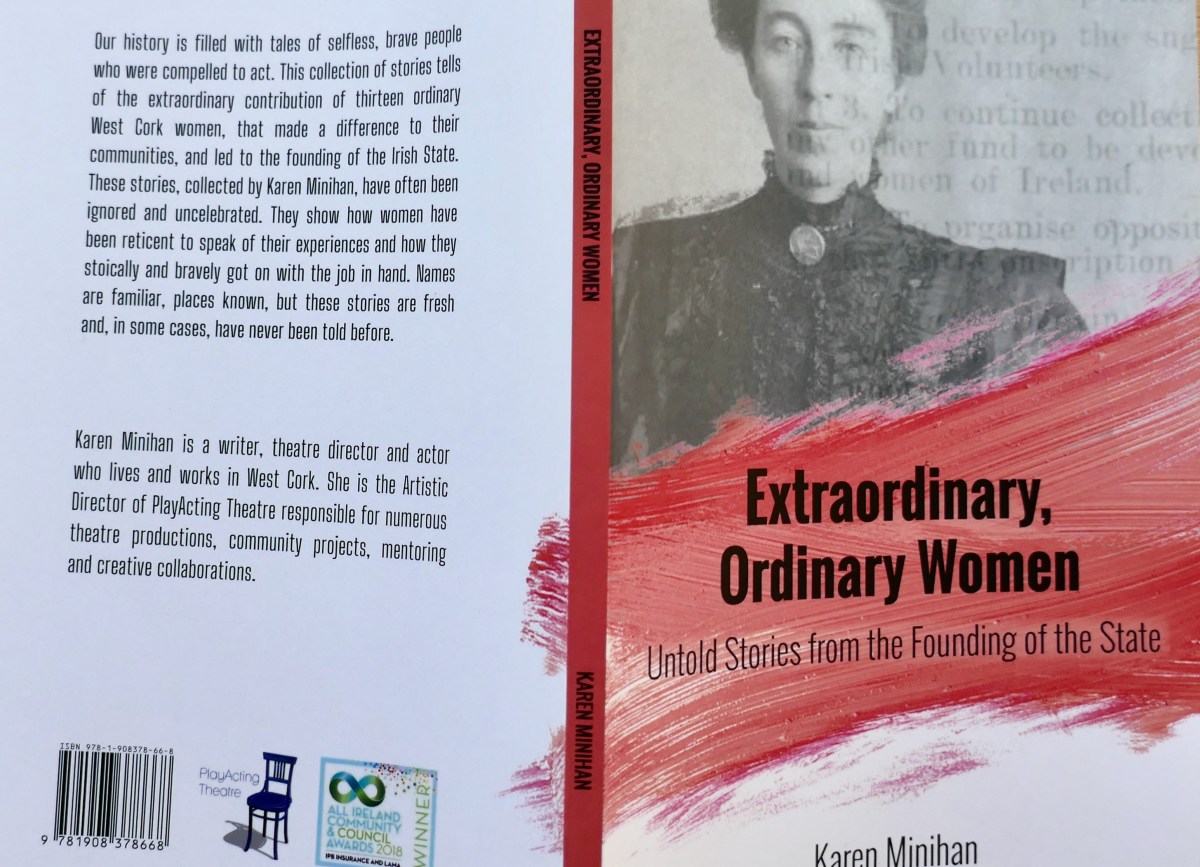
Karen Minihan has spent the last two years seeking out the forgotten stories of West Cork women who played an active role in the founding our our state. She has compiled thirteen of these stories into a compelling book – Extraordinary, Ordinary Women: Untold Stories from the Founding of the State. This book has opened my eyes to the courage and commitment of young (and not so young) women who took on dangerous roles in the War of Independence and the Civil War. Most did so as members of Cumann na mBan (the Women’s Company – the word Cumann actually means friendship), founded as an auxiliary to the IRA. This RTE piece is a good introduction to what the Cumann was all about, and includes an interview with Leslie Price, one of the women quoted in this book. Cumann na mBan, famously, was particularly well organised in West Cork and these women did everything to support the war against British occupation. 
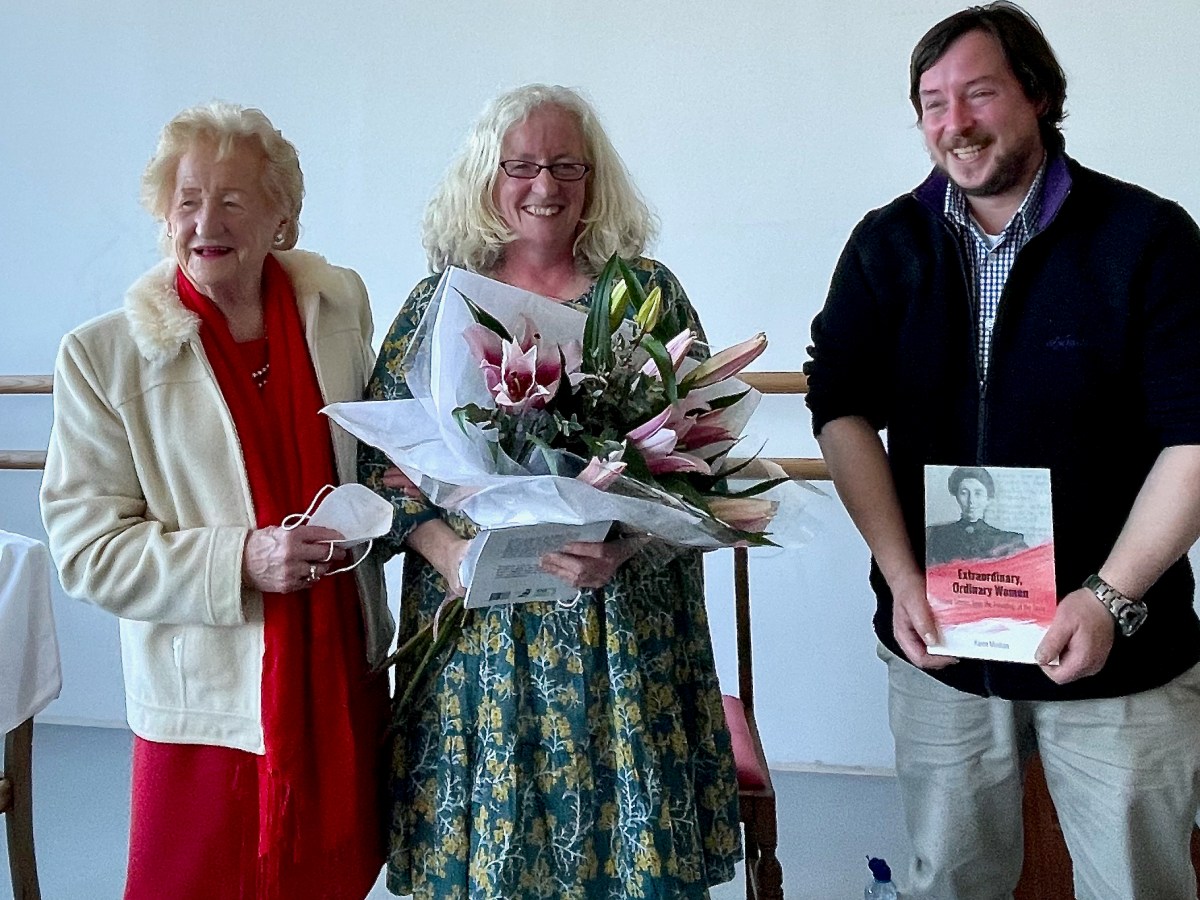
Karen (centre) with her mother and Conor Nelligan, Cork County Heritage Officer at the book launch

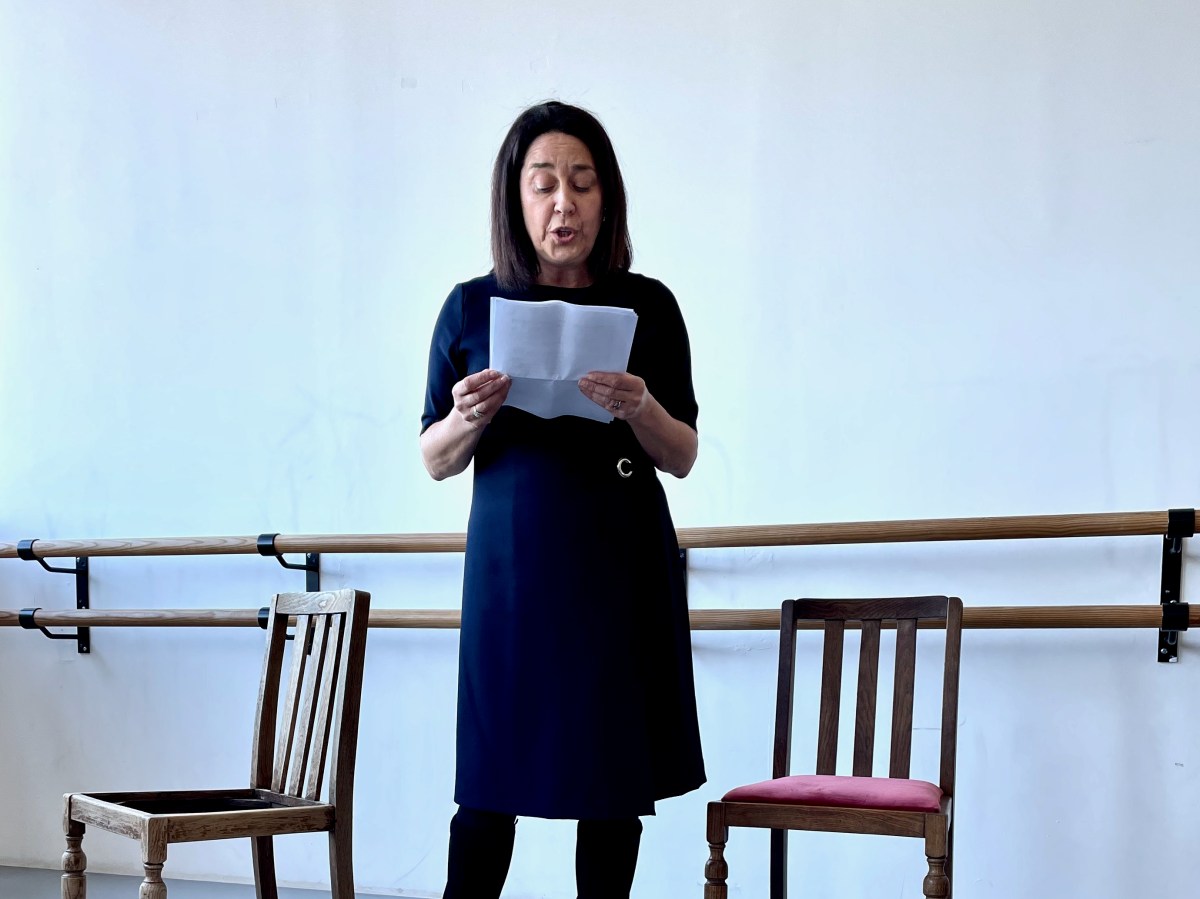
The book was launched on Friday at Uillinn (West Cork Arts centre) in Skibbereen, with a talk by Maura Leane (below), Professor of Applied Social Studies at UCC. She said:

Reading through the stories, I felt like I was watching an old, grainy, movie reel. Scenes were spooling out in my mind, providing beguiling insights into the history of the countryside around us, and into the activities that dominated the lives of many people living here, between 1915 and 1923, a time when West Cork, along with the rest of the country, was an active war zone. . . .It subtly shifts the spotlight of history, to pick out scenes that conjure up time and place, a local landscape, the atmosphere, and most importantly, a set of women characters. Characters, who have remained in the shadows, while attention was paid to the male heroes whose stories dominate our understanding of the period.
The stories are of women who were full of courage, spirit, skill and cleverness. The war would have been impossible without them – they scouted, carried dispatches, concealed and transported arms, nursed wounded men, raised money, sent essential supplies (like cigarettes!) to prisoners, passed on intelligence, cooked, sewed (many, many haversacks) and laundered for men on the run. They learned to handle firearms and to do first aid. They looked after the farms while their brothers were off with their Flying Columns. They cycled for miles through dark country roads to raise alarms or deliver messages. 

May Hickey lived in Skeaghnore – that’s her above in later life, not looking at all like the daring young woman revealed in her stories. They had a secret room where they hid men on the run – theirs being a ‘safe house’. May found herself many an evening cleaning rifles from the stashes she maintained in various hedges and ditches in the area. Also, “gelignite, tonite and detonators were given to me on various occasions to keep dry and often I was ordered to dry gelignite near the fire which was damp after the remainder being used for explosive purposes.” 
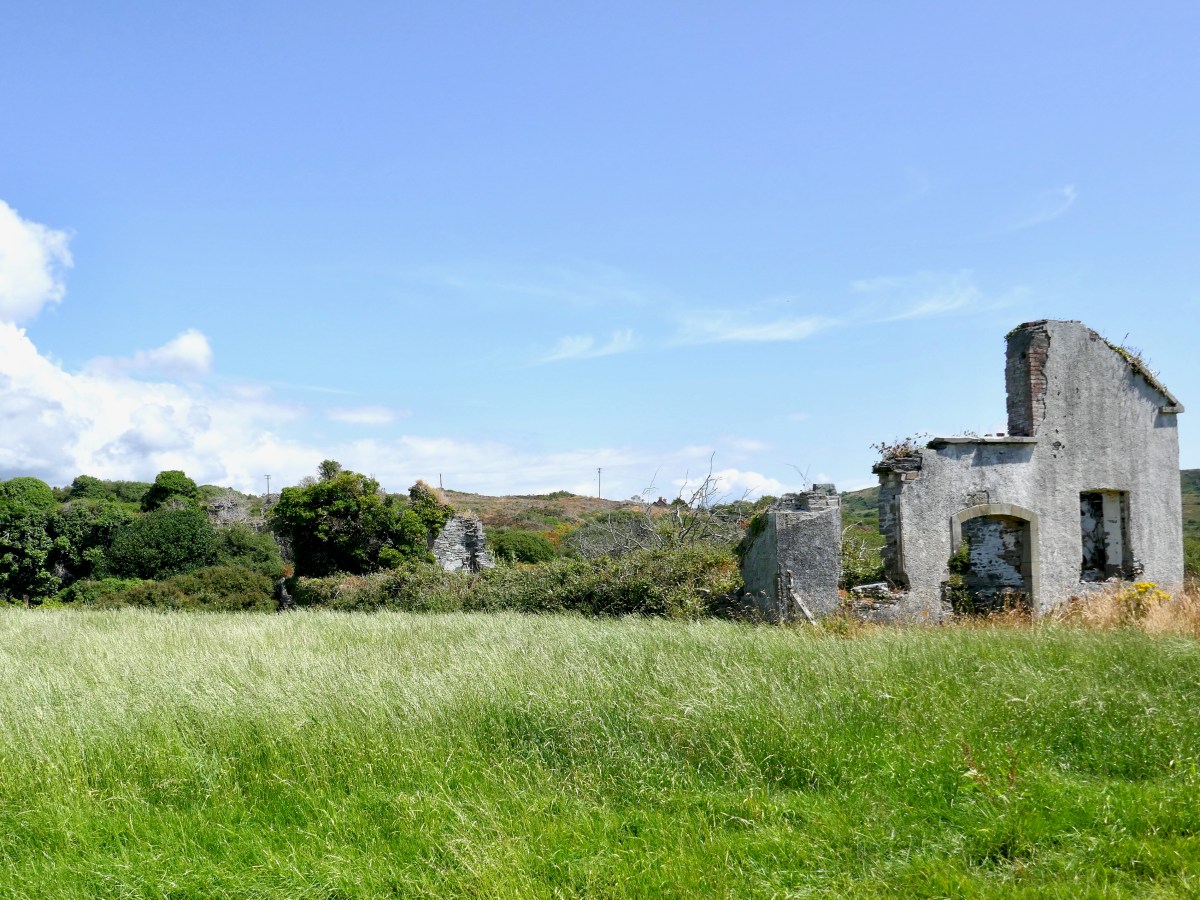
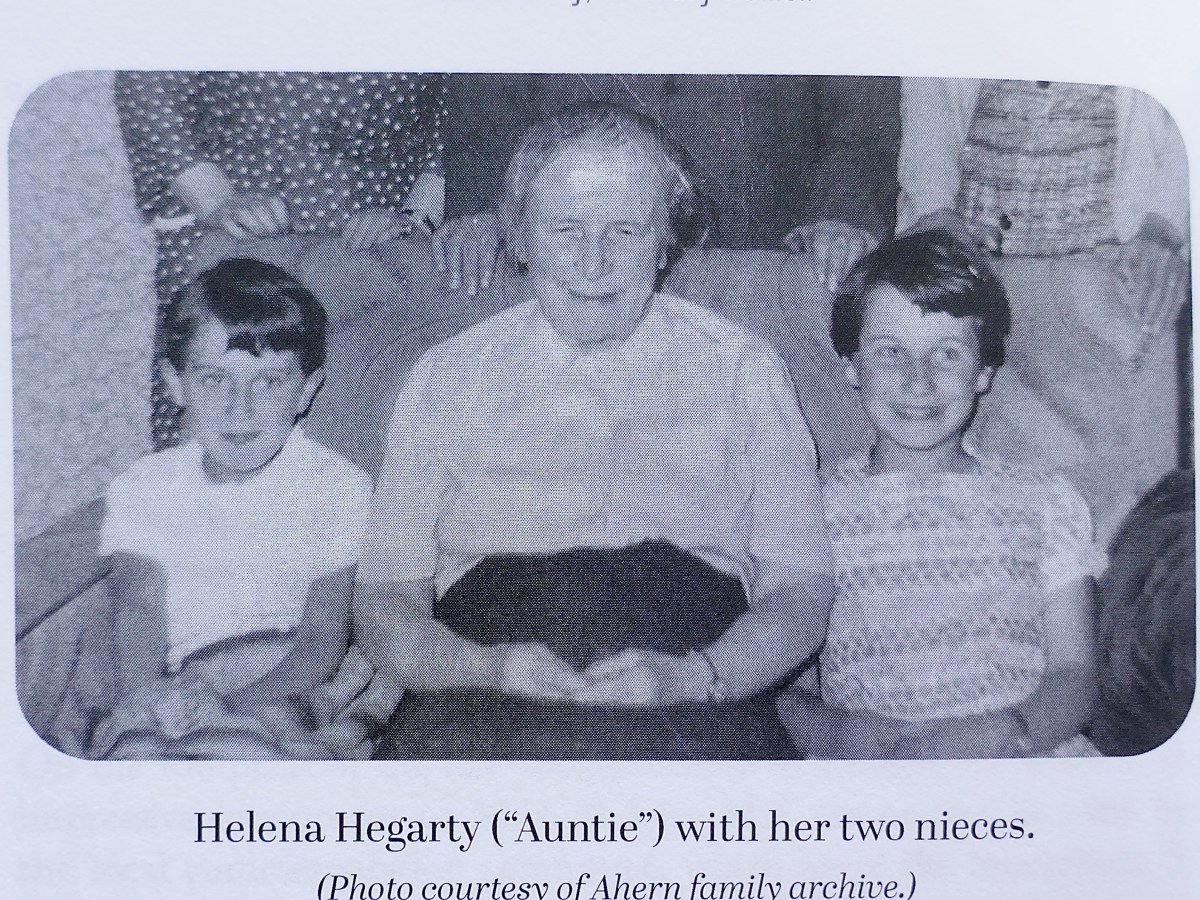
Helena Hegarty was the Matron of the Schull workhouse (above and below, as it is now). Incredibly courageous, she used her place of work to harbour IRA men and tend to the wounded. She even kept a British spy in the workhouse under lock and key for several weeks. She trained other women in first aid, and set up field hospitals. According to one account “she carried out her duties conscientiously and fearlessly.”
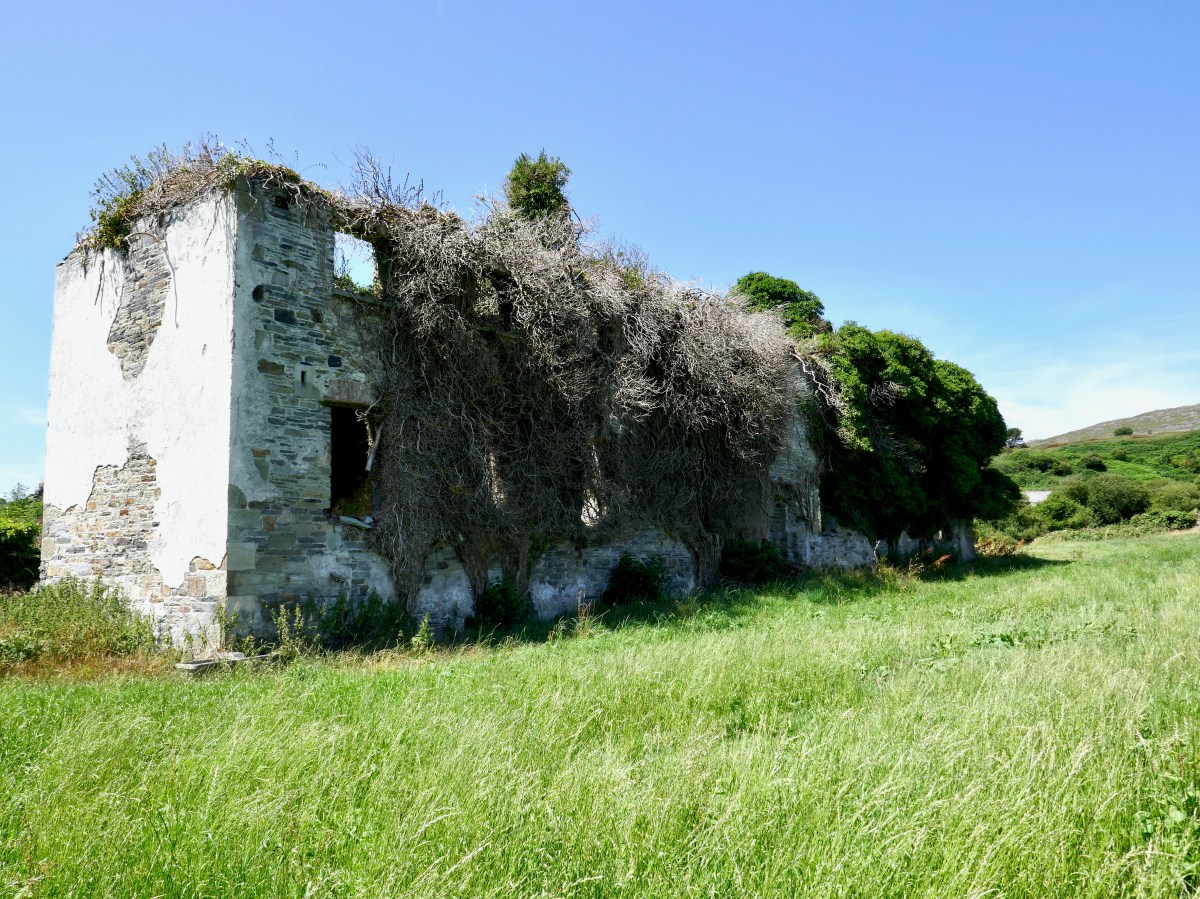
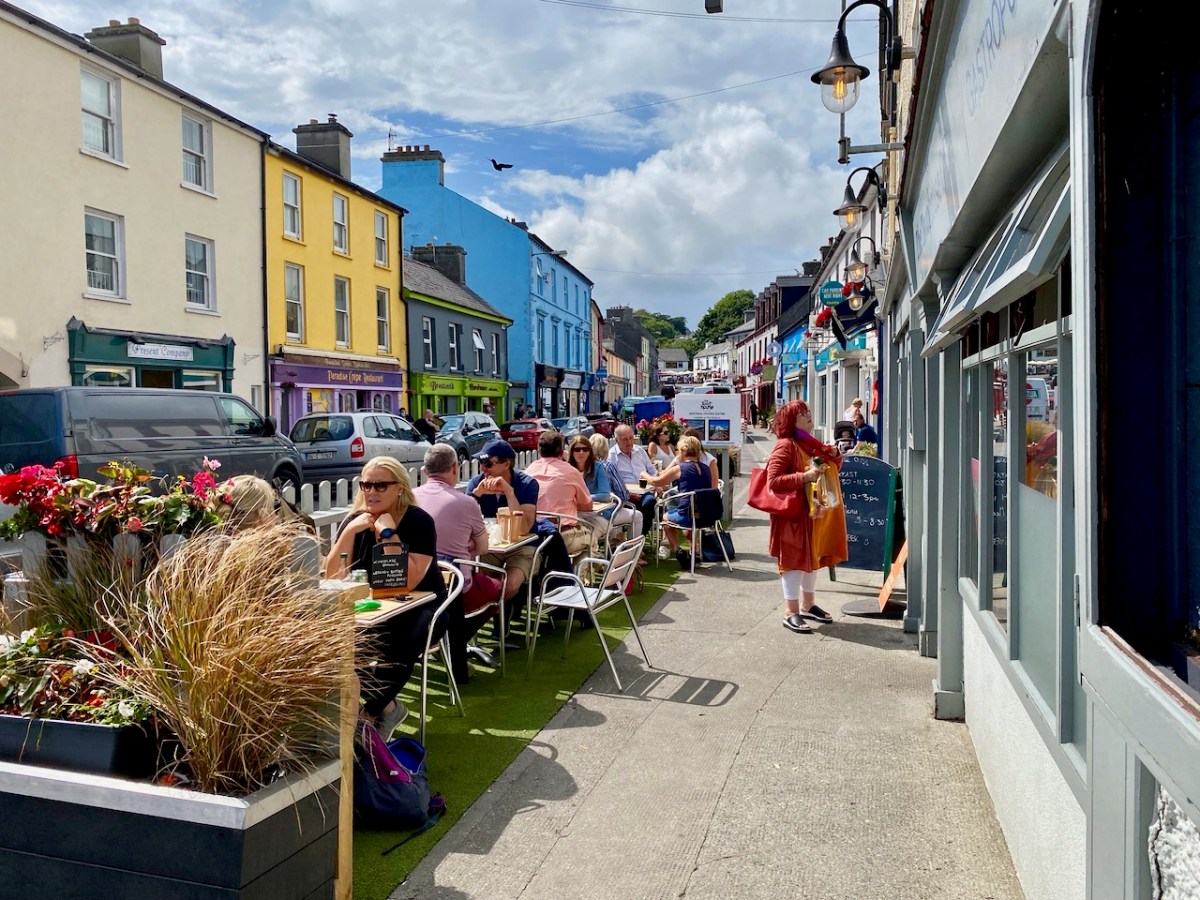
Having been given advance notice that the workhouse would be burned, she got out all the inmates and anything that could be saved. Because the British Military barracks in Schull was being attacked at the same time, she and her charges were under rifle and machine gun fire as they sheltered on the roads outside the workhouse. A recurring motif in the book is that few people knew of the heroism of the women who are portrayed. Below is Schull main street today – Helena Hegarty, warm and gentle and loved by all, ran a shop about where Brosnan’s Centra is now, after she was put out of work by the burning of the workhouse. She was known as Auntie by a generation of Schull children and their parents, who had no idea what she had done.
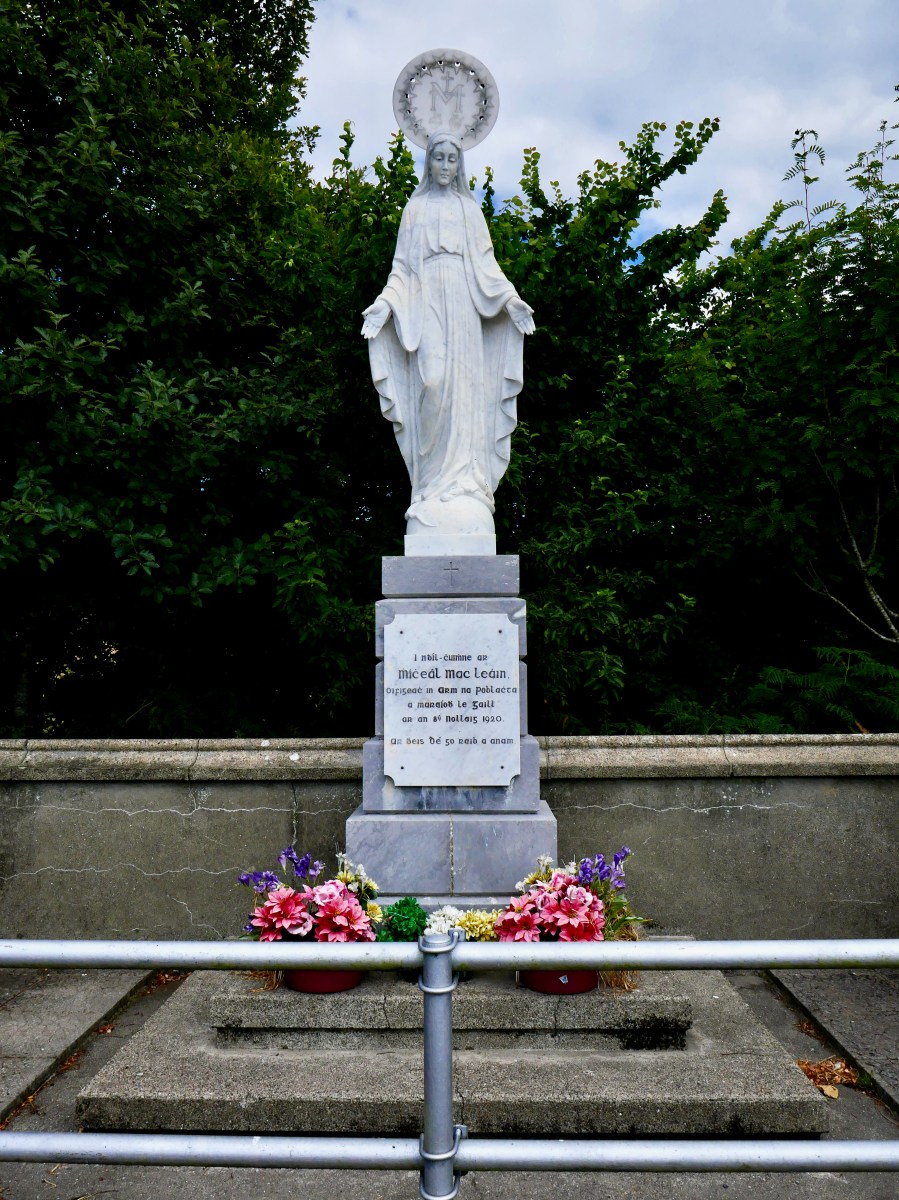
And in return the women were harassed by the Black and Tans and the RIC. Some women were roughed up and their hair was cut – it was called ‘bobbing’ and was a potent mark of punishment, used by all sides. They were threatened with having their house burned – they lived in fear but carried on. It took its toll – after Mary Ellen McLean’s brother, Michael John, was killed by the Black and Tans with appalling cruelty, she was ‘never the same.’ The memorial to her brother in Lowertown, (below), now occupies the spot where her post office was once the hub of intelligence for the region.
Most upsetting to us, as we look back from our present vantage point, is that their roles were undervalued. While heaped with praise both in the Bureau of Military History accounts of their deeds and in the Pension applications, they were routinely denied pensions by the (all-male) board, had their service downplayed and, where they were awarded a pension, were assigned to the lowest grade – E level. (Read more about that here.) Helena Hegarty was one such woman, awarded an E grade pension, despite the emphatic support by local IRA commanders for the work she had done
Karen includes the case of Bridget Noble, murdered by the IRA because she was a observed to be entering the RIC barracks. She had previously been bobbed and had lodged a complaint against the men who forced this on her, thus earning the ‘informer’ label. A thoroughly researched book by Sean Boyne (see his talk to the West Cork History Festival) has documented this case of the ‘disappeared’ woman of the Beara Peninsula.
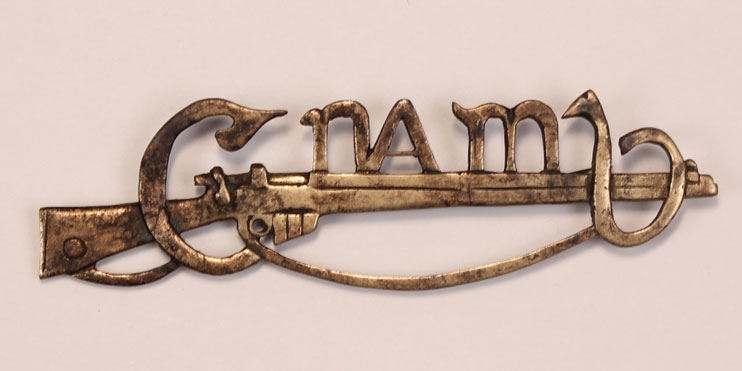
A Cumann na mBan pin – note the centrality of the rifle

At the launch, Maura Leane summed up Karen’s work thus:

By inviting us as readers to engage with Bridget’s story, Karen pulls us, uncompromisingly, into the trauma and the violence and the highly emotive reality of this period of war, in our own localities. And when this period was over, and everyone had to start the journey of living together again, side by side, and in common cause, this trauma had to be set aside. The memories had to be put away, the stories had to be left untold. And so, this time was rendered silent. And this is why Karen’s work here, is so important. Because what Karen has done is to gently and skilfully evoke voices and emotions from this troubled time. She has storied these voices and brought forth war time memories, in all their complexity and in all their nuances. And most importantly of all, she has brought into relief the feelings and the emotional resonance that is embedded in accounts of the past.
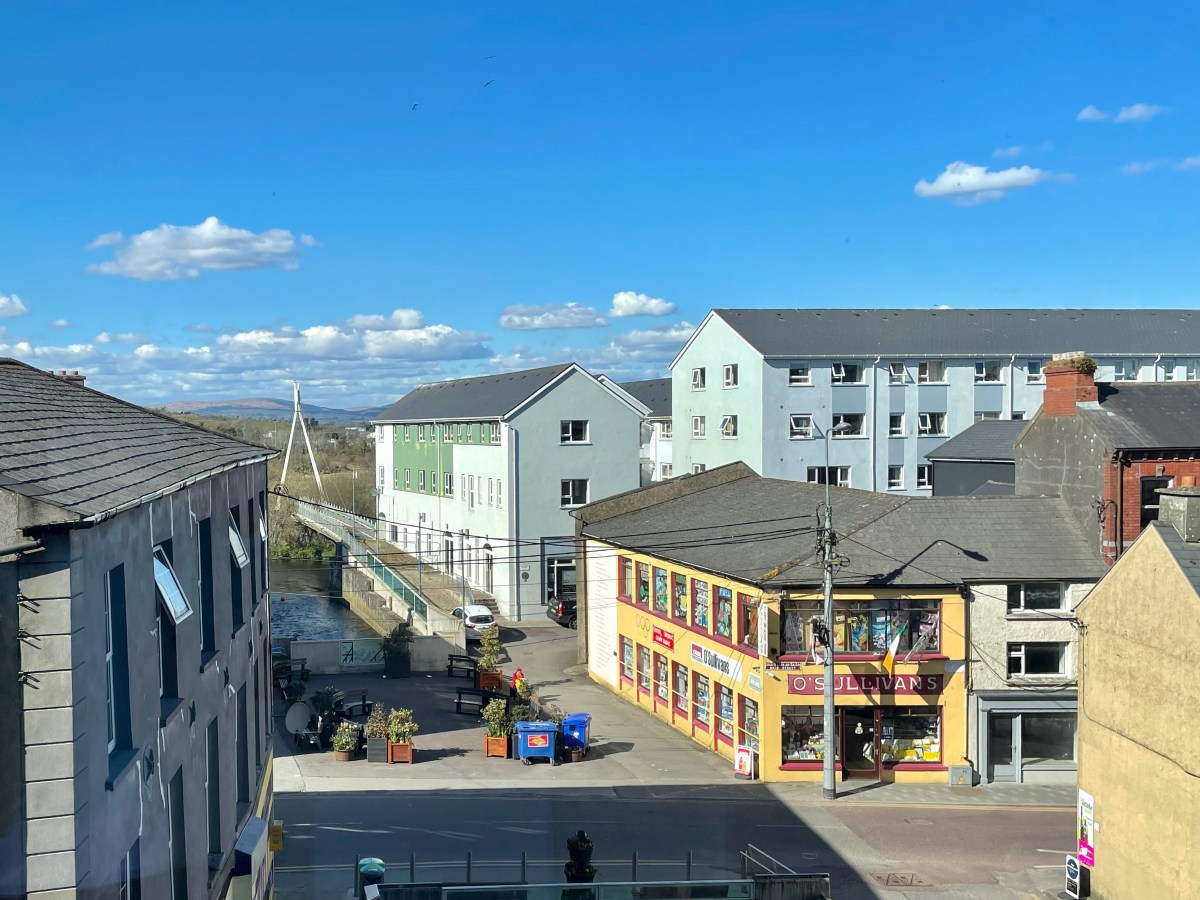
Sullivan’s Toy Shop was once the home and business of Rose O’Connell, one of the extraordinary, ordinary women

At the launch, Karen enacted a short play based on the chapter on Rose O’Connell. Poignantly, the shop where the action took place could be seen from the room, and some of her descendants were at the event. Karen’s book is available at all good West Cork Bookstores but if you’re not lucky enough to live here you can order it from Schull’s wonderful Worm Books (thewormbookshop@gmail.com). 
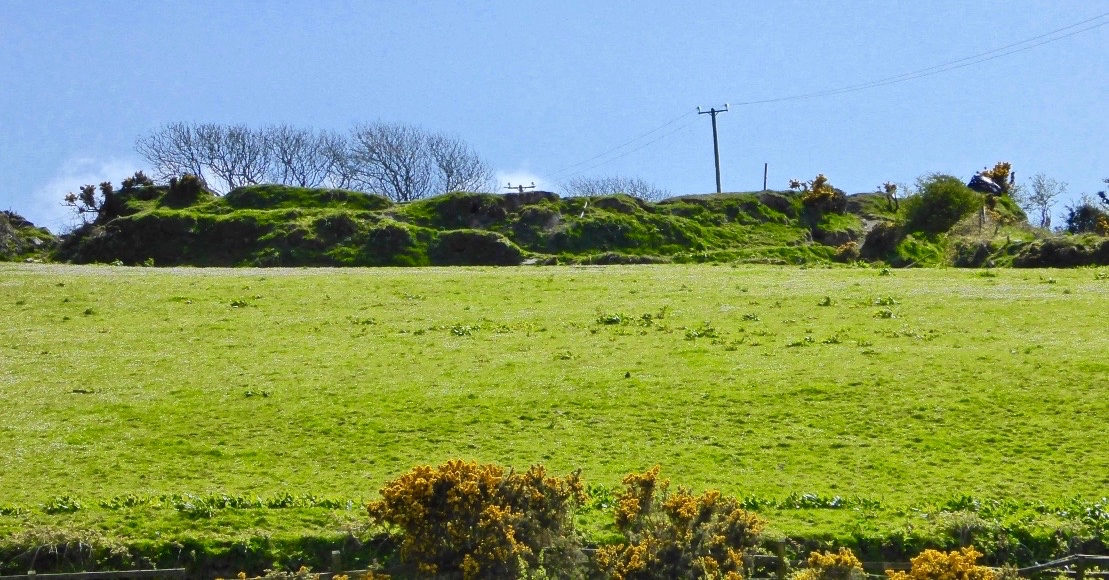
Ballycummisk Archaeology

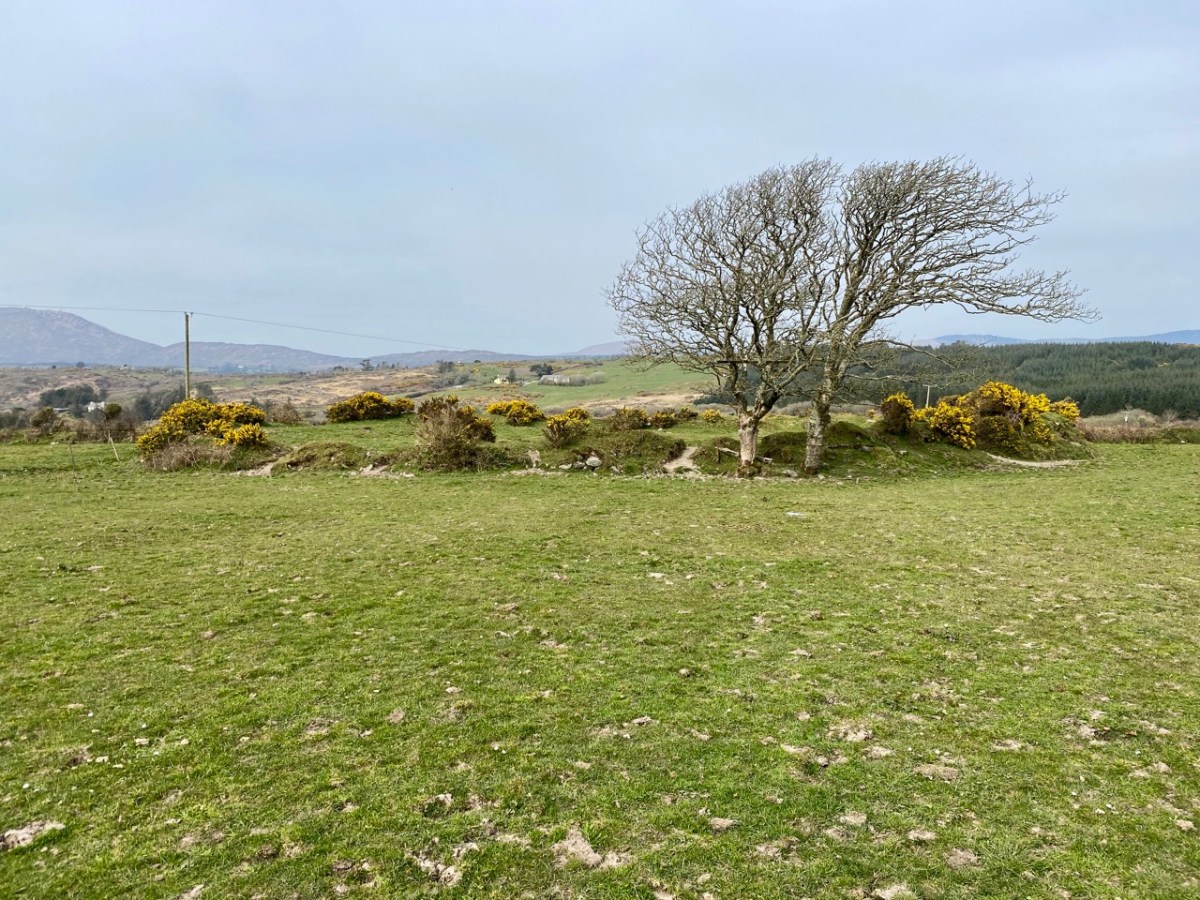
There’s a fine ringfort just over the hill from us – in the townland of Ballycummisk. A definition of a ‘ringfort’ in archaeological terms is given here:

. . . Many people lived in enclosed farmsteads known as ringforts in the Early Christian/Early Medieval period. Second to fulachta fiadh, they are the most common field monument surviving in Ireland with up to 60,000 examples, most dating to between 550-900AD. Ringforts are circular areas, measuring c24-60m in diameter, usually enclosed with one or more earthen banks, often topped with a timber palisade. In the west of Ireland the ringfort was often enclosed by a stone wall, with stone huts in the interior. Traces of iron and bronze working have been recovered suggesting some ringforts had very specific uses while others were multifunctional . . .

HeritageCouncil.ie
Significant Unpublished Irish Archaeological Excavations 1930-1997

A simpler definition comes from the monumental 1200-page Volume 1 of the ‘New History of Ireland’ series published in 2005 and edited by Dáibhí Ó Cróinín: “archaeologists are agreed that the vast bulk of them are the farm enclosures of the well-to-do of early medieval Ireland”.

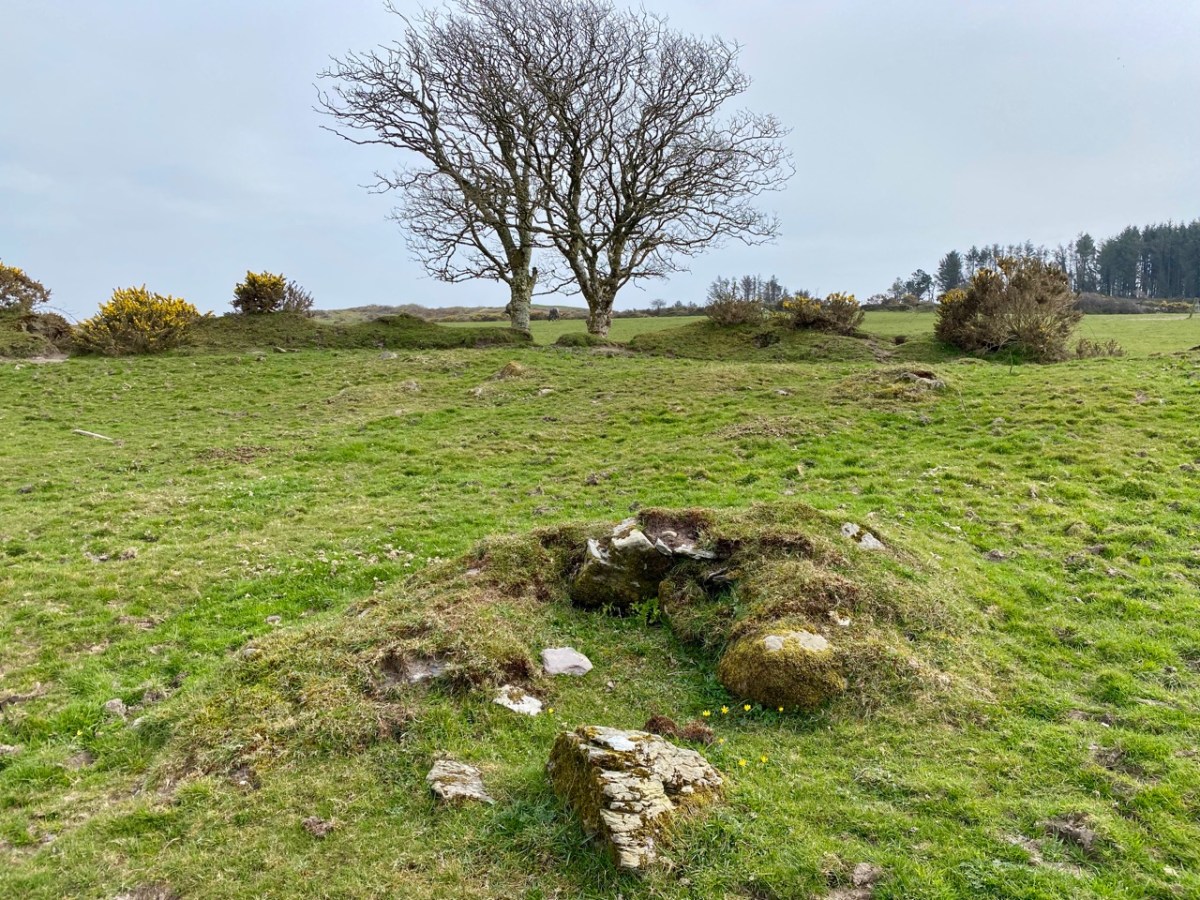
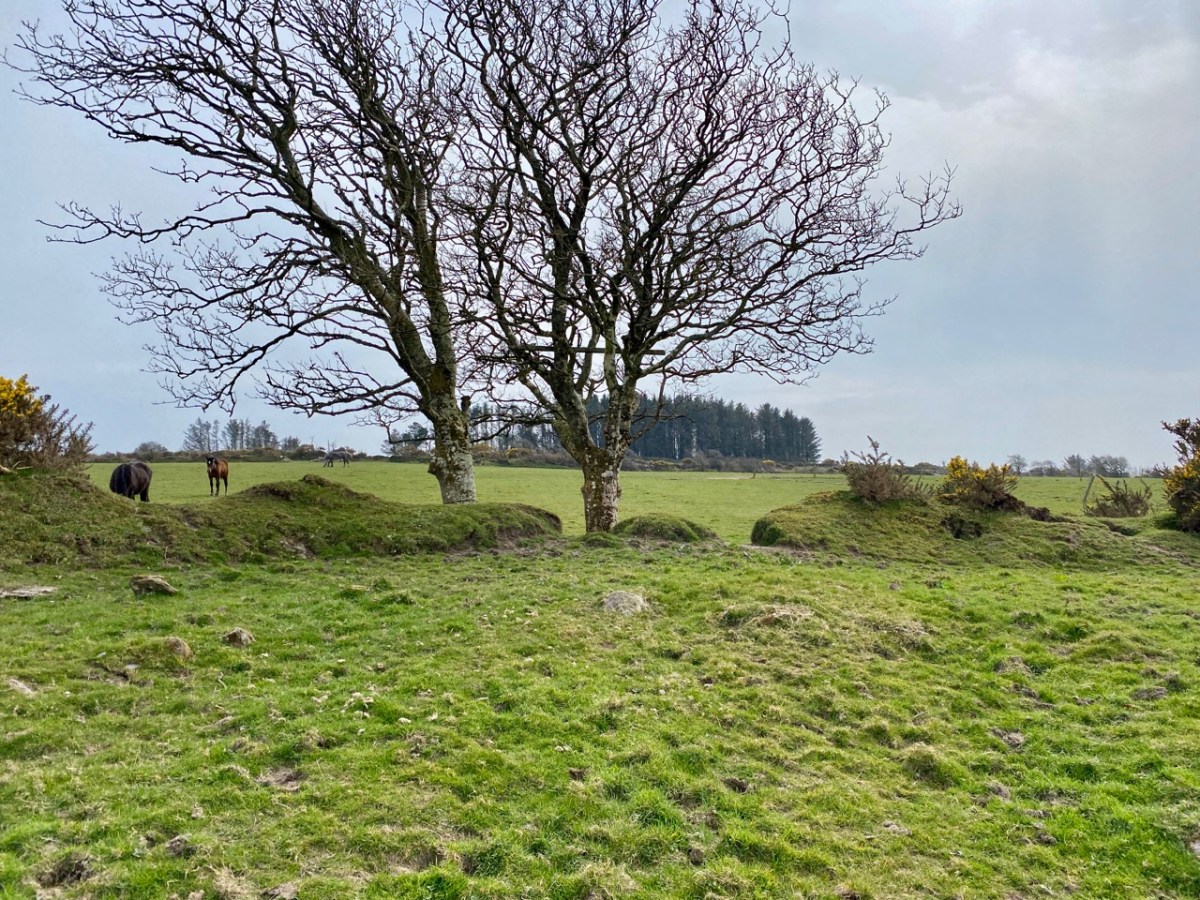
The upper picture is taken from within the ringfort enclosure; the north bank of the fort can be seen beyond a small stone outcrop which is said to be the site of a souterrain. Time for another definition:

. . . Souterrain: an underground structure consisting of one or more chambers connected by narrow passages or creepways, usually constructed of drystone-walling with a lintelled roof over the passages and a corbelled roof over the chambers. Most souterrains appear to have been built in the early medieval period by ringfort inhabitants (c. 500 – 1000 AD) as a defensive feature and/or for storage . . .

archaeology.ie/HistoricEnvironment

You can see more about souterrains – including some illustrations – in my post from four years ago about Knockdrum Fort, south of Skibbereen.

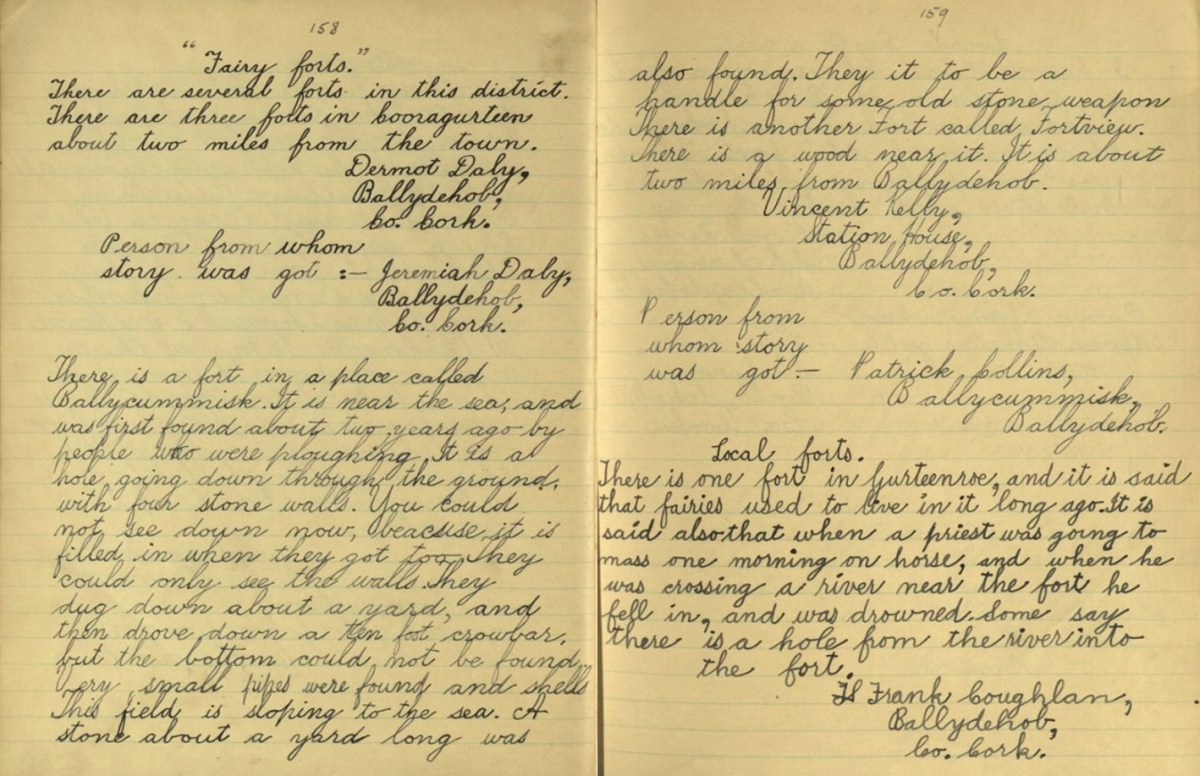
The Schools Folklore Collection is an important source of local beliefs and traditions – if not exactly historical information. The stories were collected in the 1930s but were remembered through family traditions which could go back through several generations. The example pages above – dating from 1936 – describe the Ballycummisk fort. Here is a transcription of the paragraph:

. . . There is a fort in a place called Ballycummisk. It is near the sea, and was first found about two years ago by people who were ploughing. It is a hole going down through the ground, with four stone walls. You could not see down now, because it was filled in when they got to it. They could only see the walls. They dug down about a yard, and then drove down a ten foot crowbar, but the bottom could not be found. Very small pipes were found and shells This field is sloping to the sea. A stone about a yard long was also found. They thought it to be a handle for some old stone weapon . . .

Schools Folklore Collection
Frank coughlan Ballydehob

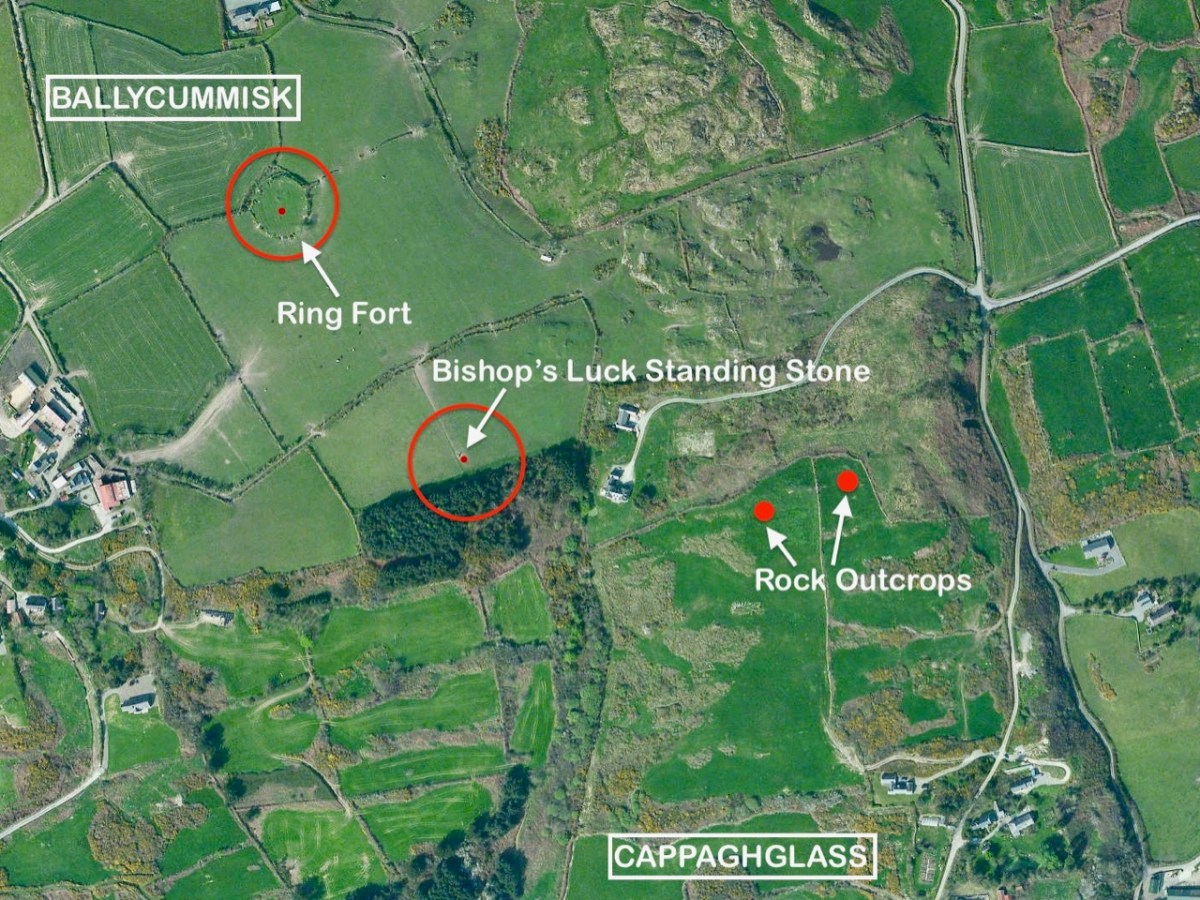
Frank Coughlan’s description almost certainly refers to the discovery of a souterrain. It doesn’t quite ring true as he says that “the field is sloping down to the sea”. In fact, the fields containing the ringfort are sloping southwards away from the sea, which is not visible at all from the site.

This aerial view shows parts of the townlands of Ballycummisk and Cappaghglass. The ringfort is marked. Another nearby feature – also shown – is a large standing stone, known as ‘Bishop’s Luck’.

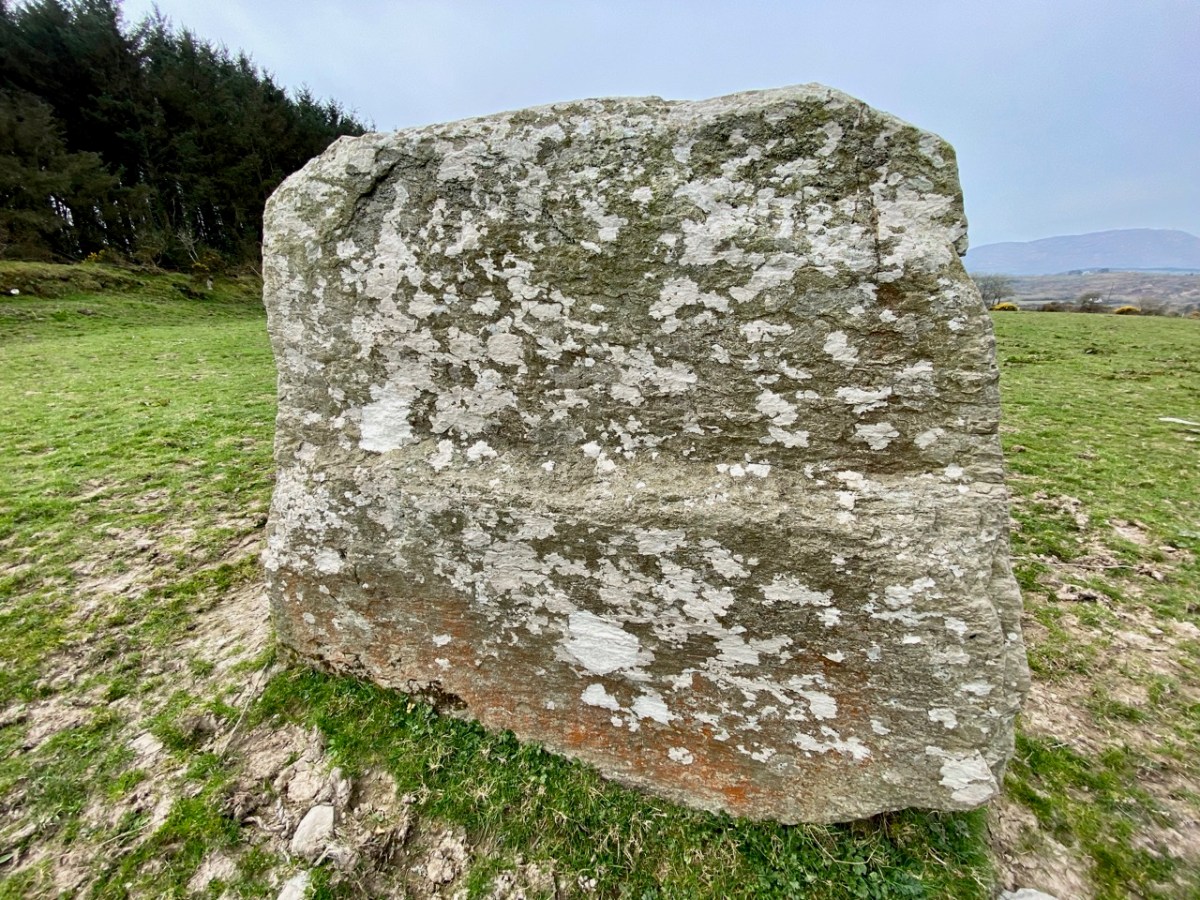
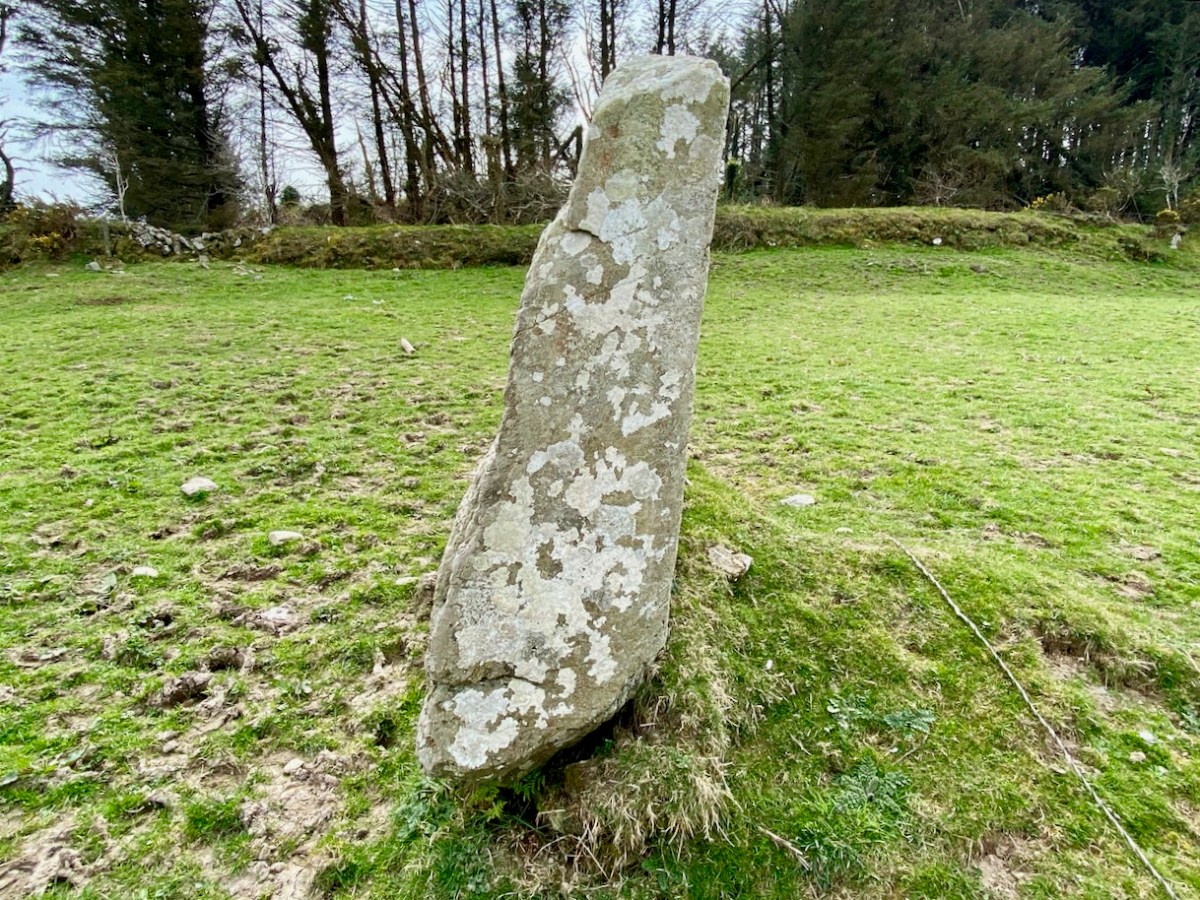
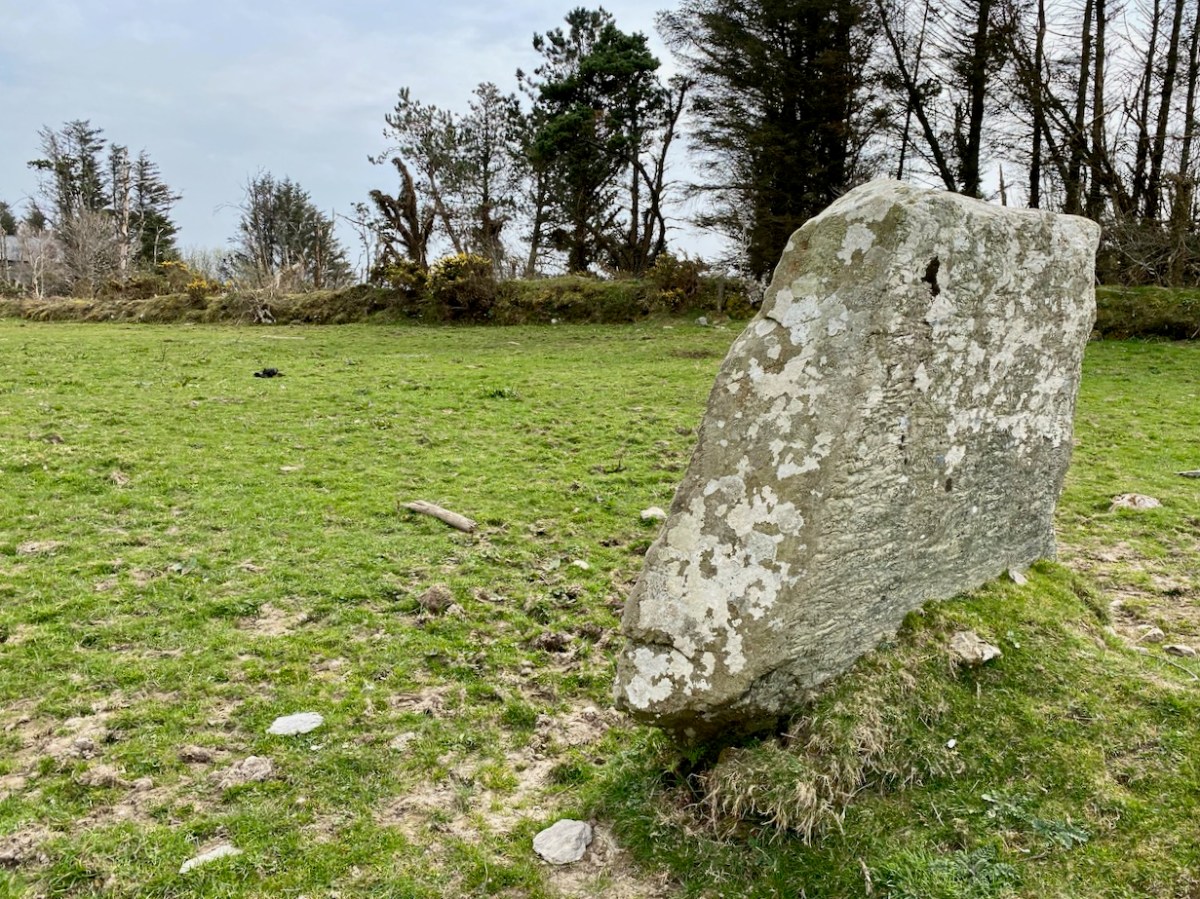
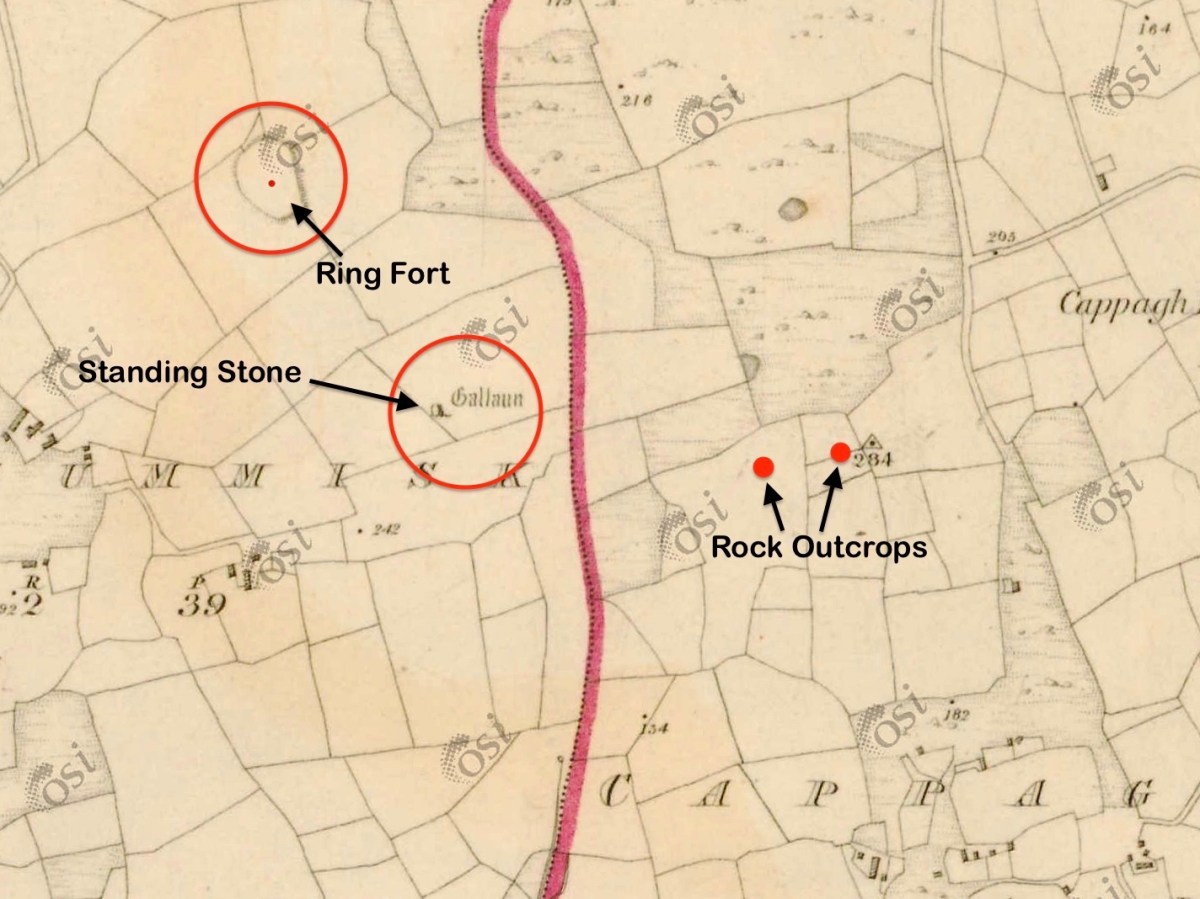
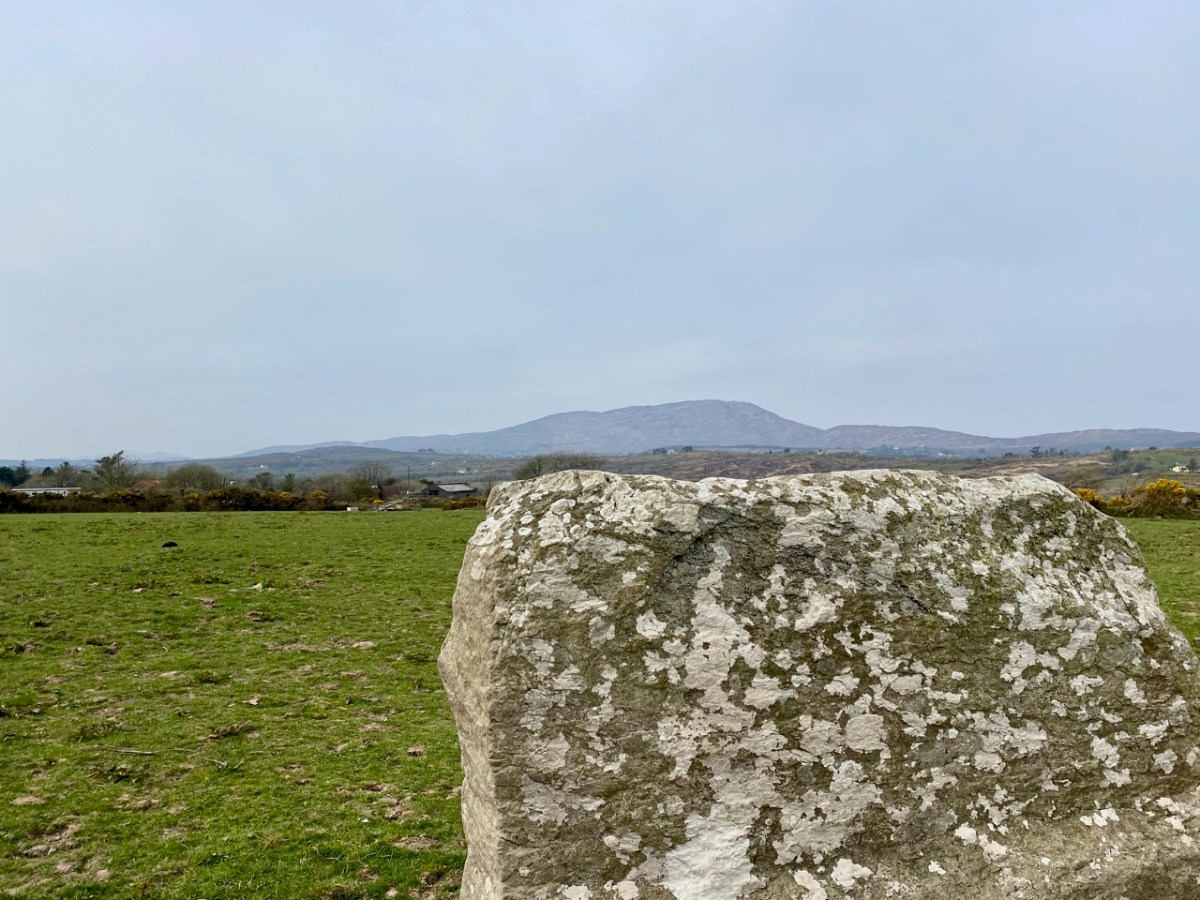
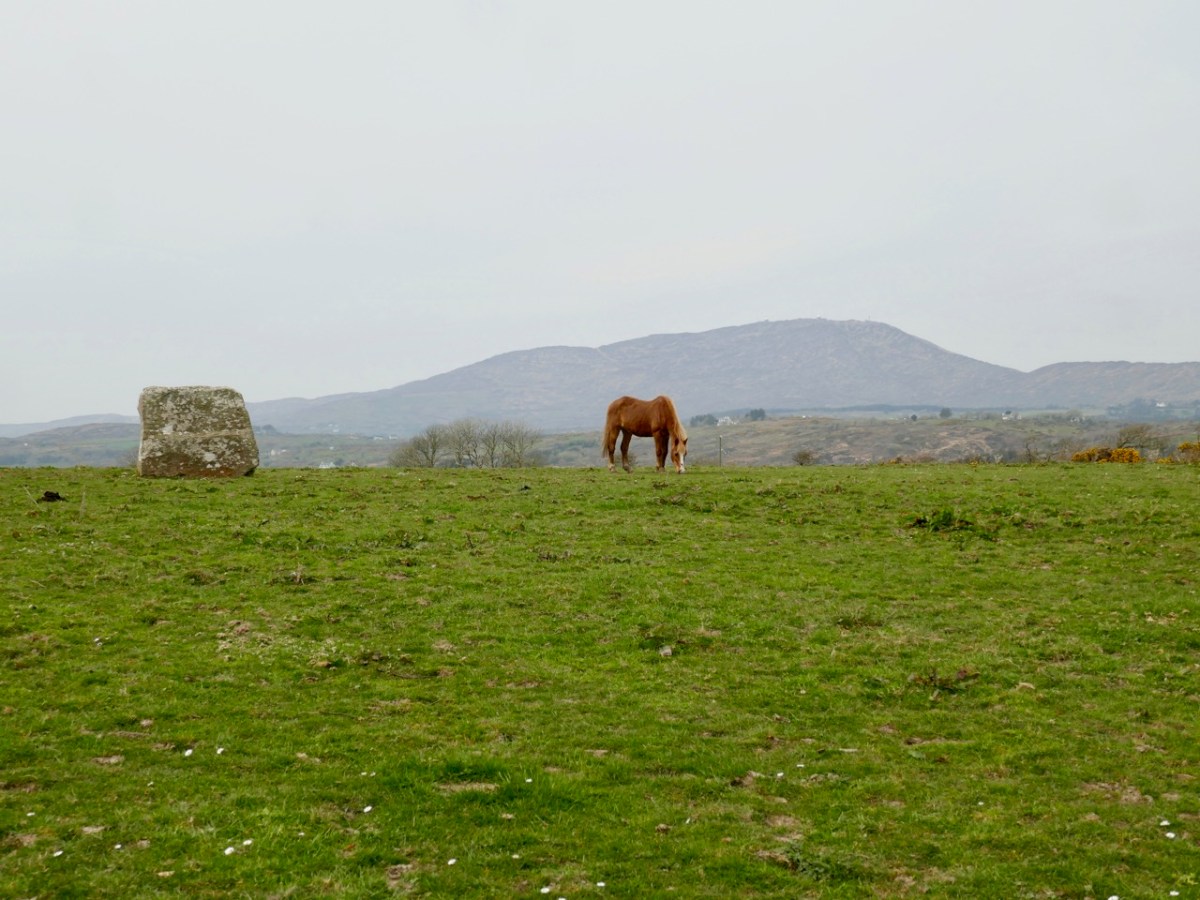
The stone is 1.6m high, 2.05m in length, and 0.45m in width: tall and wide in one direction, and relatively narrow in the other. It is also worth noting that the ‘long’ orientation is exactly North-South. This stone has been in this position for at least 180 years as it appears in the earliest edition of the 6″ Ordnance Survey (1830s), marked as ‘Gallaun’ – and even given a little illustration!

The standing stone is not far from the ringfort: perhaps there is a connection, although standing stones are generally reckoned to date from earlier times than the forts. Here is an extract from a recent article in Archaeology Ireland: Vol 34 No 1 (Spring 2020) pp 26-29, Wordwell Ltd:

. . . The classic standing stone surviving from the Bronze Age in Ireland is a rough-hewn or unshaped pillar, known as a gallaun (from the Irish gallán), generally oblong or oval in cross-section and up to 3m or more in height. Stones presumed to belong within this class vary considerably in height, from as little as 1m to as much as 6-7m in exceptional cases, the majority probably falling in the 1.5-2m range. Seán Ó Nualláin noted many years ago that in his experience the axis is generally aligned north-east/south-west. This is by no means a universal rule. Gallauns are by far the most numerous of all pre-Christian standing stones in Ireland. Approximately 600 are known in Cork and Kerryb alone. Beyond this region, examples are to be found extensively throughout the Irish countryside and many of them have attracted folk explanations . . .


Lone Standing Stones by Muiris O’Sullivan and Liam DowneY
Archaeology Ireland 2020

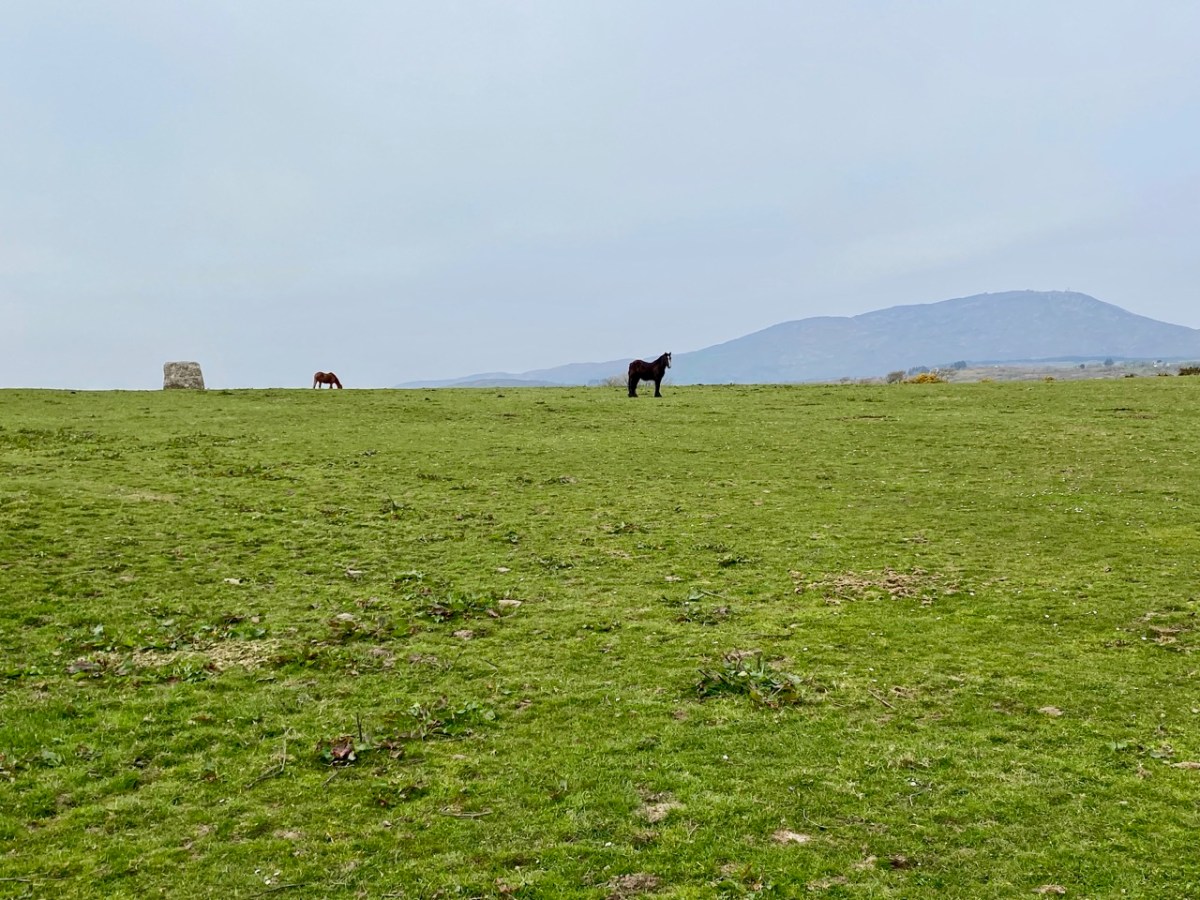
In these two pictures you can see the striking profile of the Bishop’s Luck standing stone against the skyline which features Mount Gabriel – the highest piece of land in the immediate area. Gabriel was an important place in prehistoric times as the centre of a significant copper mining industry – yet no artefacts have ever been found on the summit. In the lower picture you can see how the western edge of the standing stone ‘echoes’ the distant profile of Gabriel on the horizon. This is a phenomenon that has been noted a few times with regard to stones standing in the landscape. Here is Gabriel seen from the ringfort:

Finola has written comprehensively about standing stones in this Journal: here and here. O’Sullivan and Downey mention (above) that examples have attracted folk explanations. This doesn’t seem to be the case here: no mention is made of the stone in the Schools Folklore Collection. But surely there must be significance in the name: Bishop’s Luck?

But – hang on! There is ‘Bishop’ folklore associated with a site not very far away – in the neighbouring townland of Stouke. Finola recorded this in her 2016 post here. It’s a simple tale: The story goes that during the time of the penal laws a Bishop was confirming children nearby when the redcoats got wind of his activities and came to arrest him. He was beheaded. A bullaun stone in the graveyard at Stouke is supposed to be his head. If our possibly Bronze Age stone in Ballycummisk had anything to do with this, it should surely be known as Bishop’s Bad Luck?

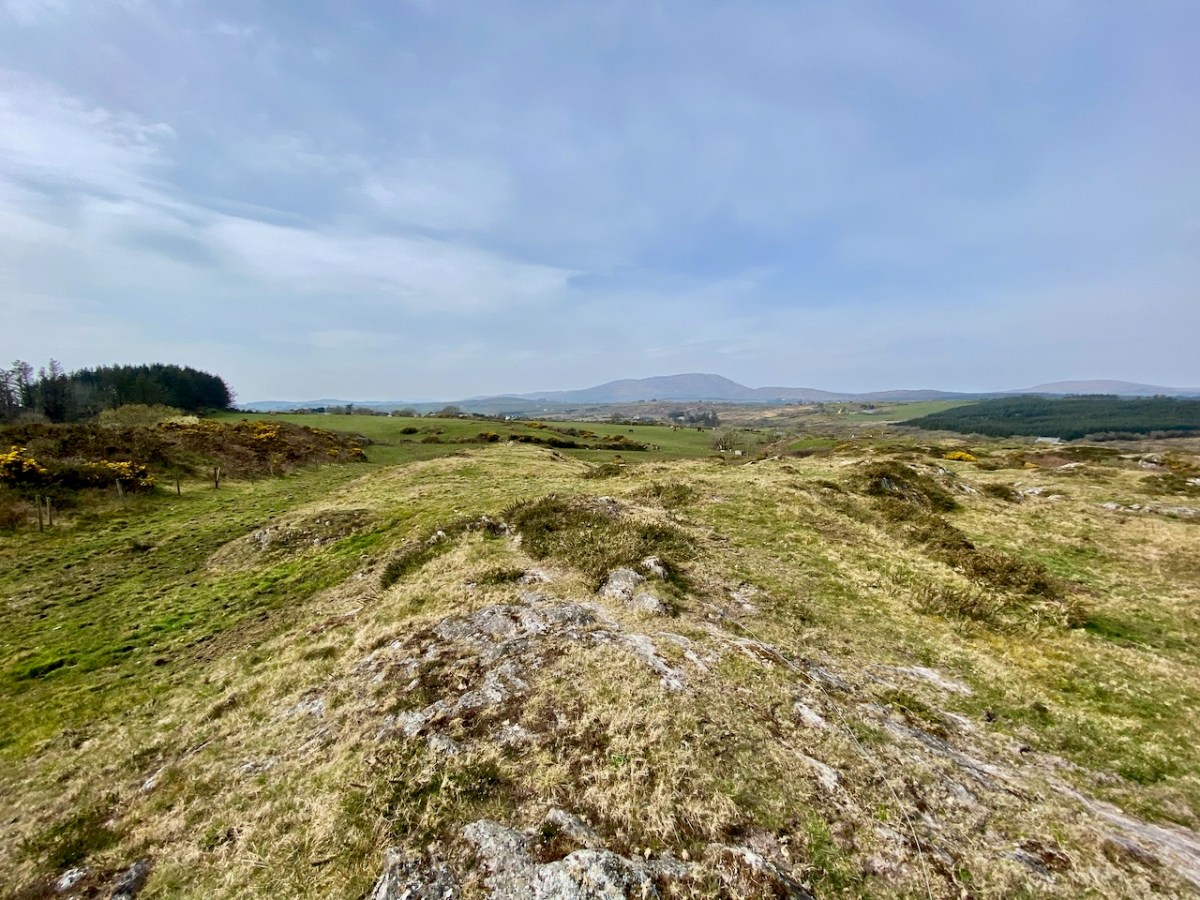
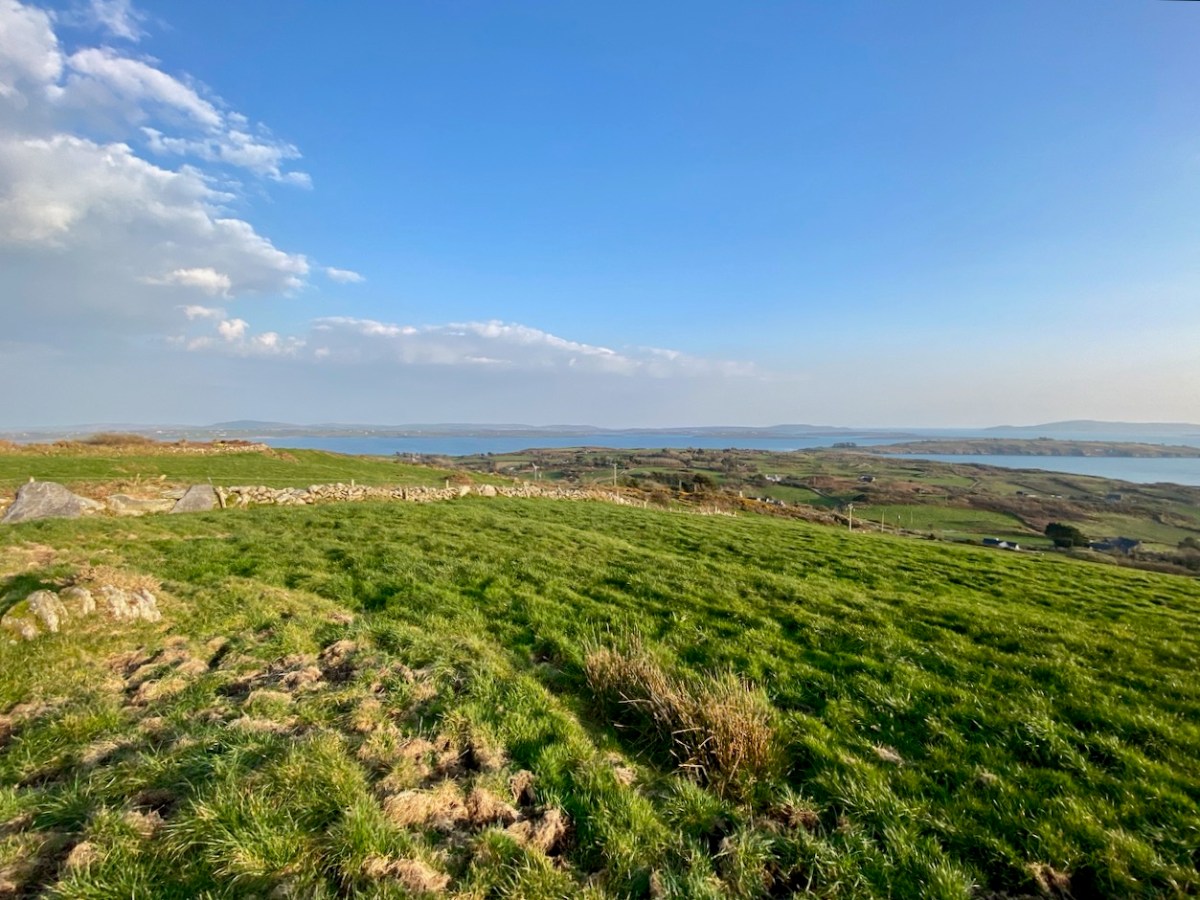
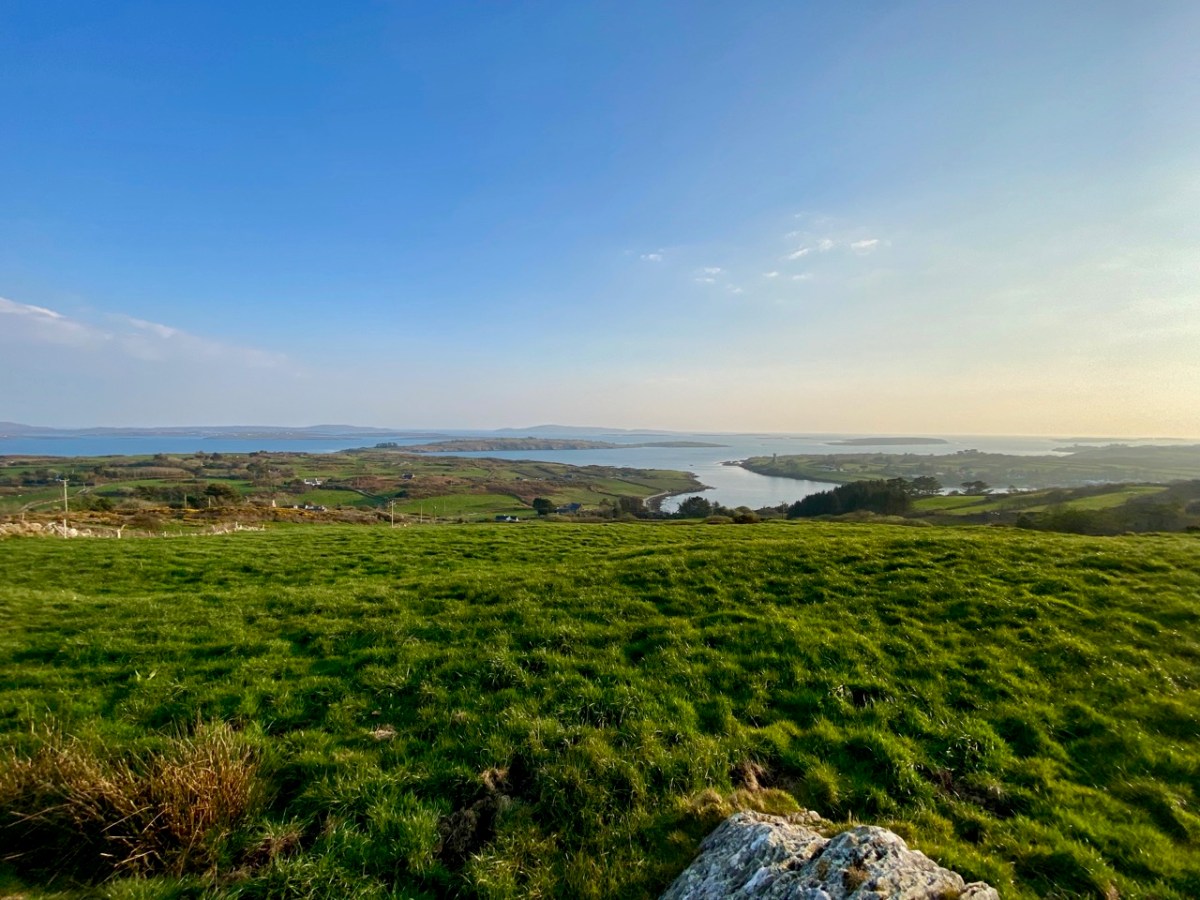
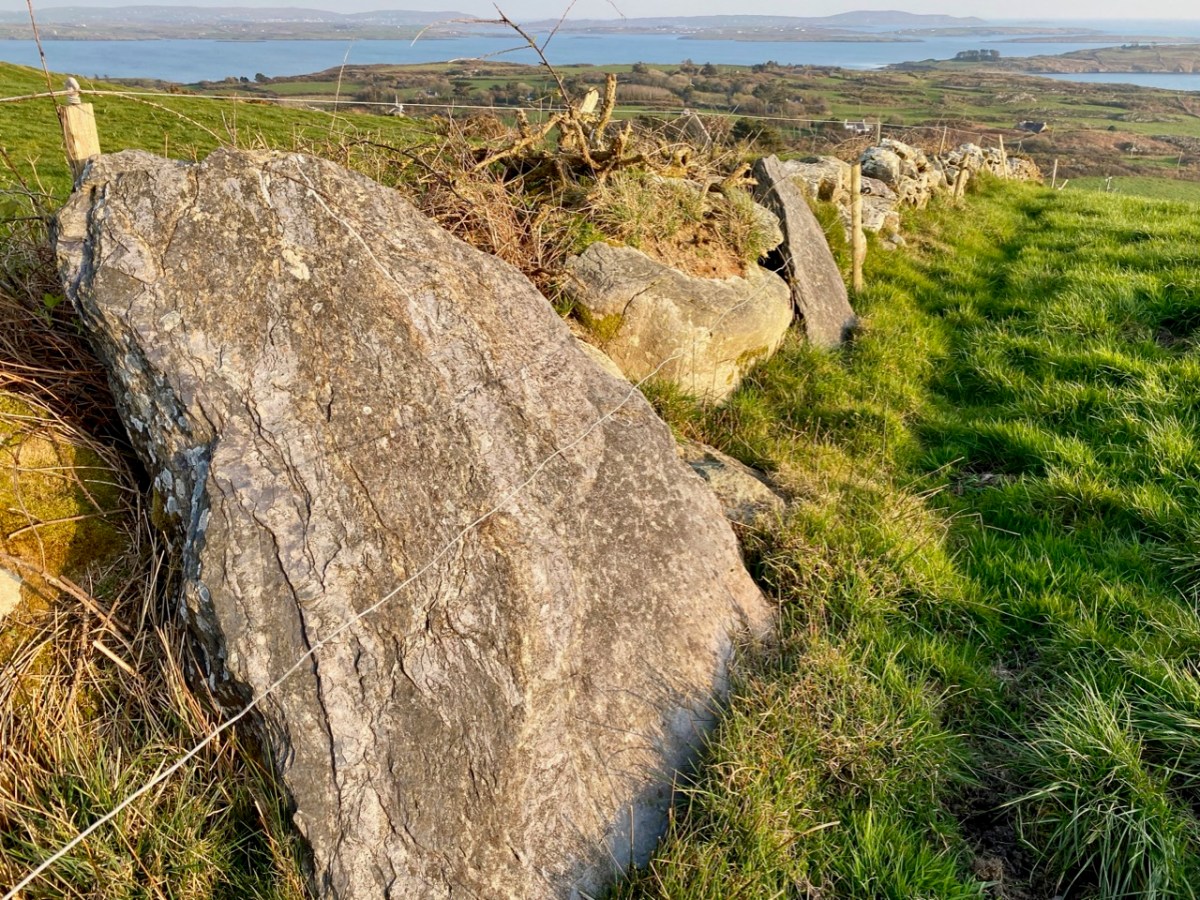
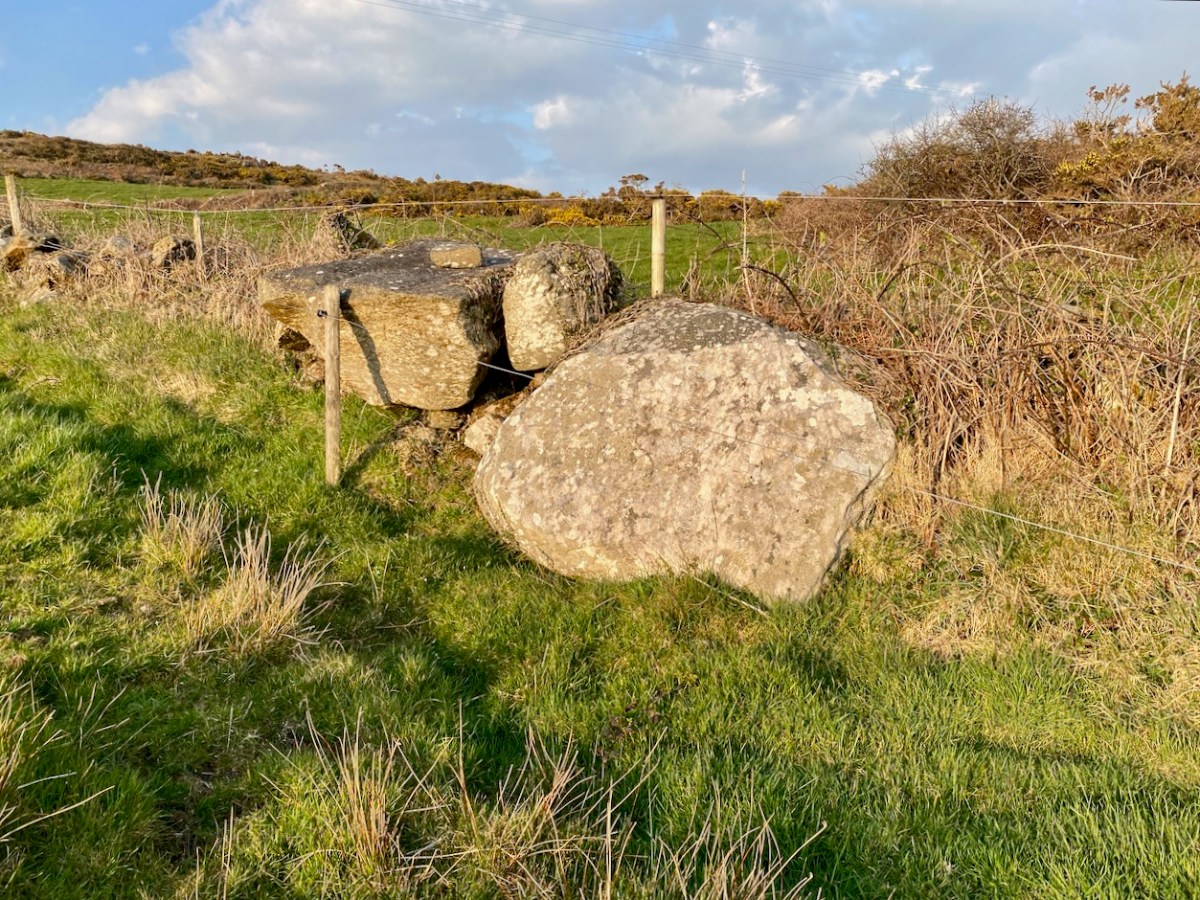
One further place that’s worth a mention here is the top of the hill to the south of the ringfort and standing stone. It doesn’t have a name, but it does have a magnificent view across to Rossbrin Harbour, with Cape Clear on the horizon in the far distance. There is a passage grave on the high point of Cape Clear. There seems to be some evidence for the inter-visibility of ancient sites, which makes me wonder whether there was ever any early structure on this hilltop. There are rocky outcrops there in the present day, and field clearance is evidenced by the presence of large slabs in the nearby field boundaries.

These are just thoughts, but I don’t mind thinking them! West Cork (and most of rural Ireland) must have much to reveal in terms of its ancient history. One point to remember: if you ever go searching yourself for archaeology or old sites, don’t forget that you will probably be entering private land. It is courteous to always seek permission: most owners are agreeable and – perhaps – may have stories to tell themselves.