
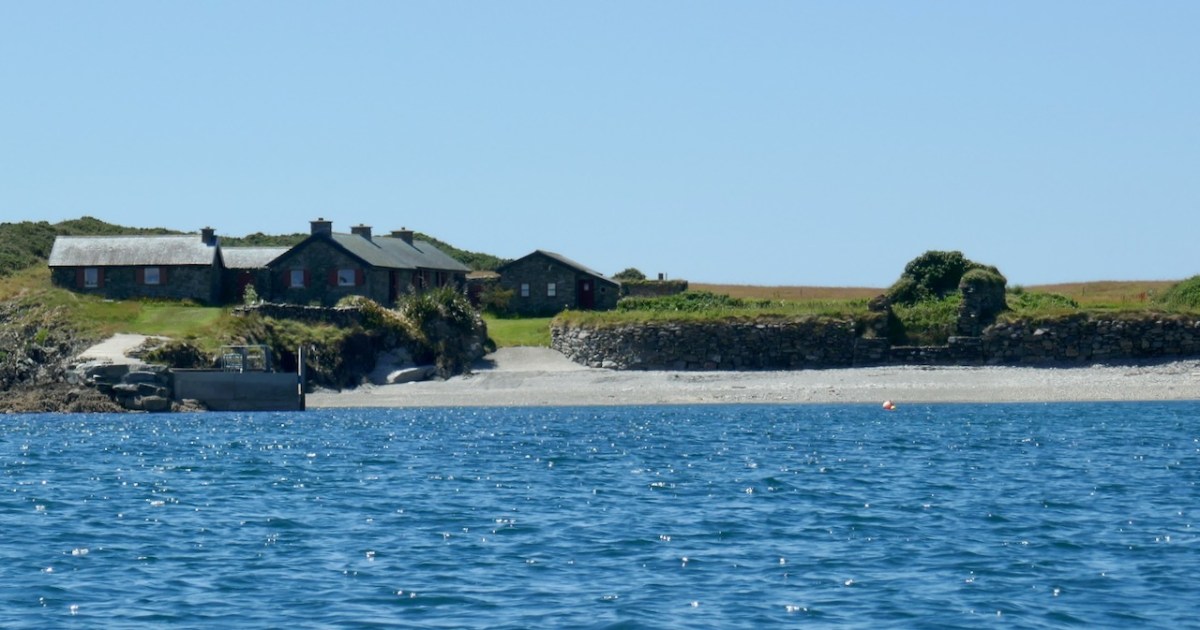
I’ve been wanting to get back to the Skeams since I wrote the first post, West Cork’s Earliest Church: The Skeams Part 1. The next part I planned was to tell you about daily life on the islands, and for this I feel very fortunate to have the recollections of two islanders, sister and brother, who spent their young lives on the Wester Skeam.
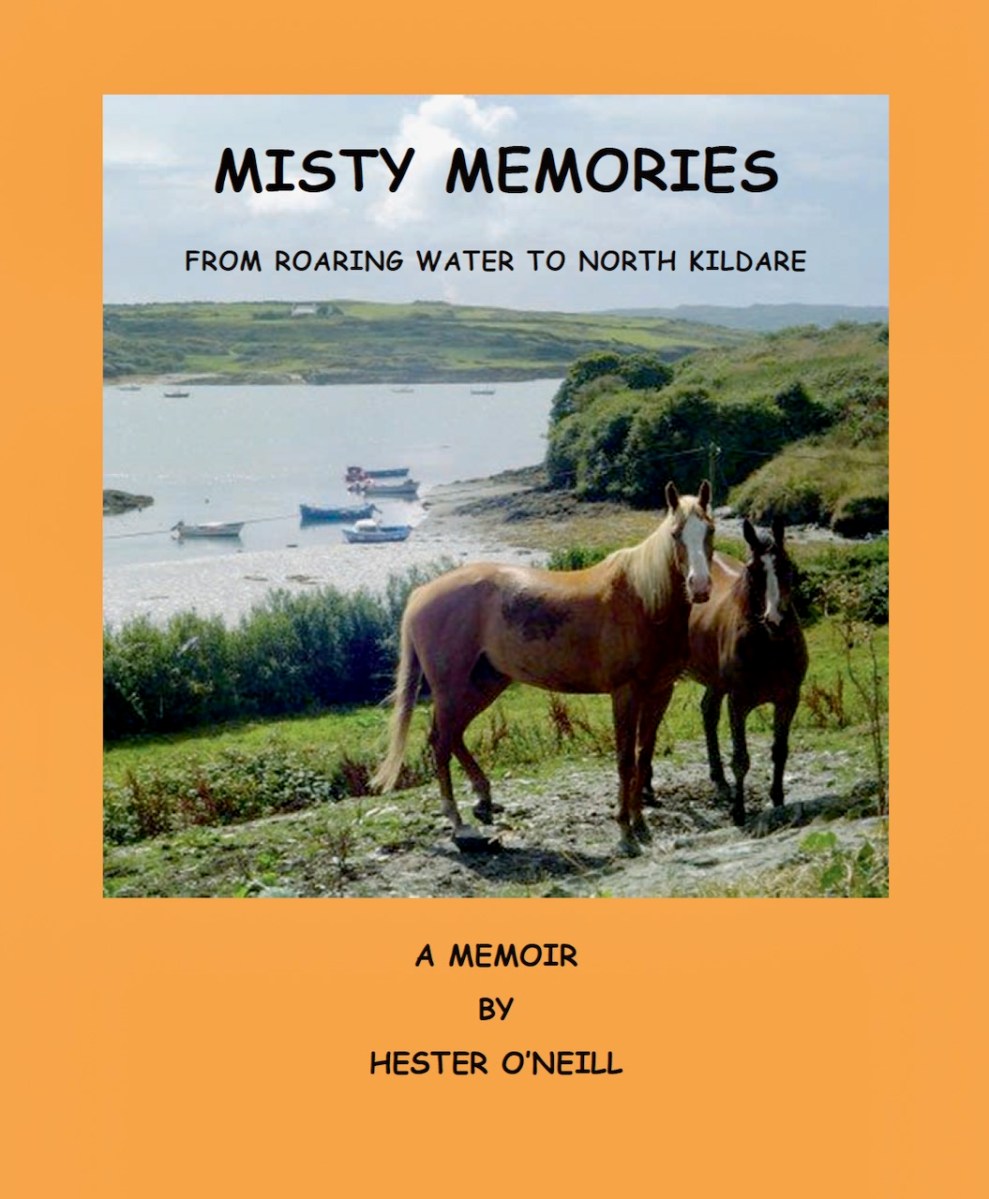
Misty Memories is a memoir by Hester O’Neill, née O’Regan, the youngest girl of the O’Regan family, born on the island in 1920. It’s a gem – compiled by her daughter Brenda, from the notes her mother had made and the conversations Brenda had taped over the years.
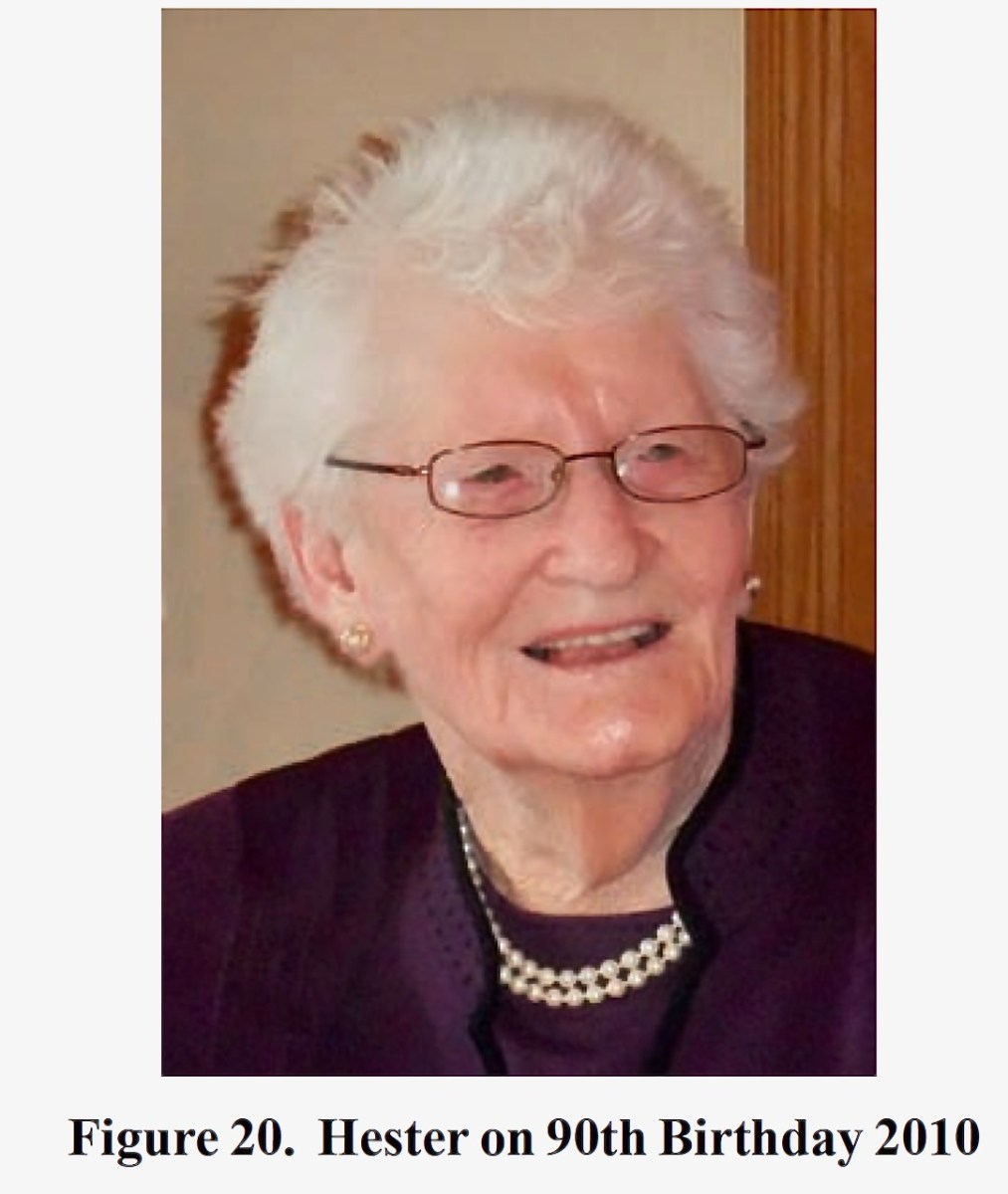
Her brother Joseph, one year younger than Hester, recorded his memories in 1993 and that was transcribed and edited by Mary Mackey, and published in the Mizen Journal in 1994. I want to do full justice to these two accounts – brother and sister wrote about many similar and some different aspects of life. But as I read I started to get distracted. Both Hester and Joe wrote about the harvest and how they grew wheat on the Island. The ploughing was often done using donkeys.
The wheat was also planted in the spring. Our land was excellent for growing it and there was no need for spraying . . . The wheat ripened in July or August and was cut with a sickle. Later, when they got more modern, they got a scythe. [Hester]
We used to cut the wheat and oats with a sickle rather than a scythe because we used the straw for thatching our outhouses, and the cycle kept it nice and straight. [Joe]
And so, of course, that sent me off looking for more information on sickles, and who should I stumble across only the remarkable Eoin Reardon. Eoin is still only 24 but has amassed a huge following on social media sites for his tutorials on traditional woodworking. 1.7 million subscribers on YouTube alone. I have met Eoin (very impressive) so I was delighted to see his tutorial on fixing and sharpening a sickle, and then using it to cut oats. Here he is, but do give him a follow on Instagram, TikTok or YouTube – he’s very engaging and you’ll be amazed at what you learn. (Hit Shorts to watch on YouTube)
The next step was to detach the wheat kernels from the stalks:
Then the straw was taken to an outhouse and, to get the grain out, was ‘slashed’ against stones placed on a long bench near the wall . The men wore sack aprons to protect them from the dust and save their clothes from being torn by the strong straw and large handkerchiefs on their heads. They looked like butchers! After that, the grain was put in bags and on a dry day with a little breeze, it was taken out to a field and winnowed from a bucket on to a clean sail to remove all the chaff. [Hester]
The cut wheat or oats outhouse to be beaten on stones which were on a long bench against the wall. It came out very clean. Then on a dry day it would be winnowed from a bucket onto a sail or something similar. [Joe]
Both Hester and Joe remark that the people on Heir Island, instead of the slashing method, used flails. Here is Joe’s account:
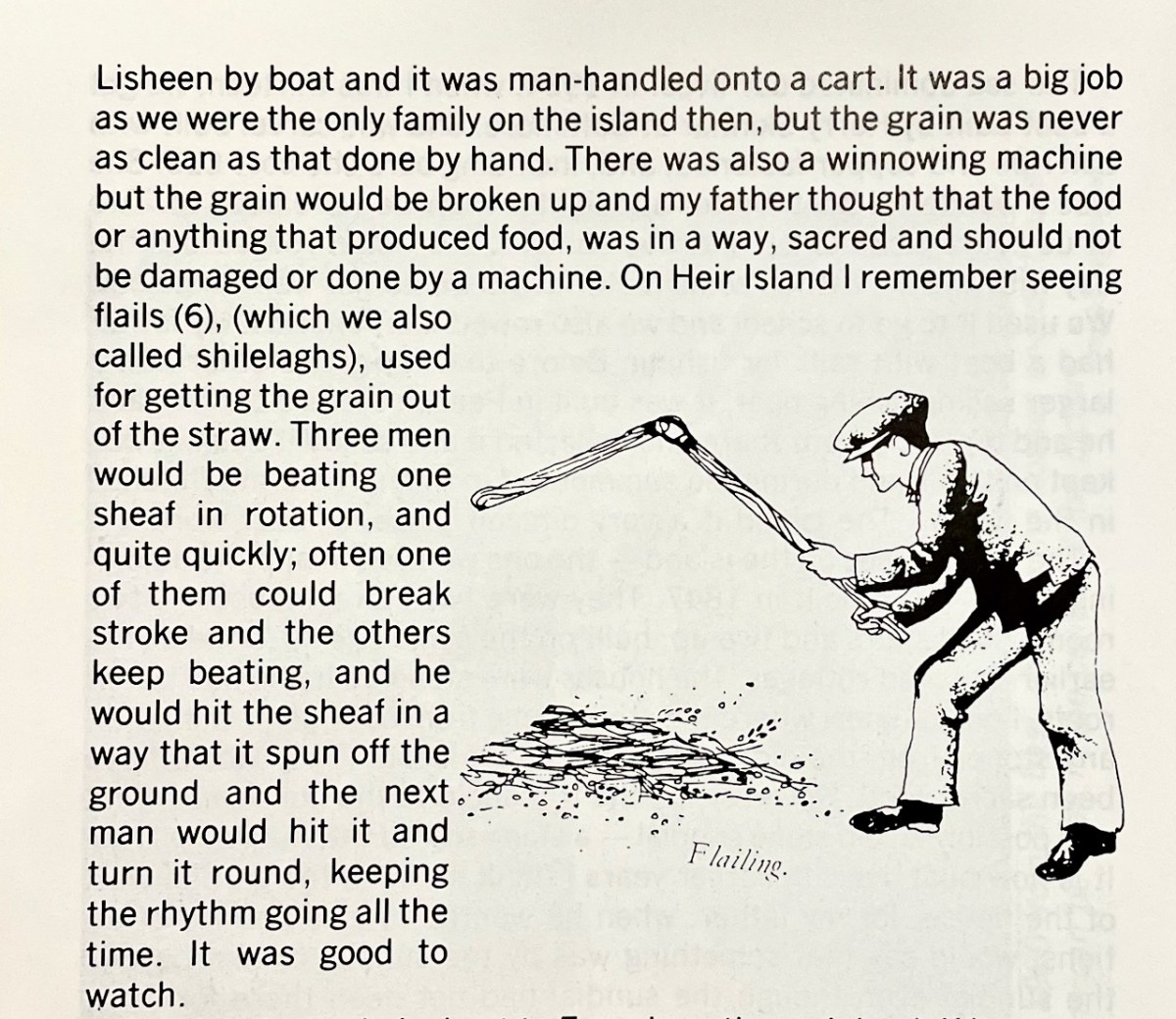
And Hester’s is similar”
I remember seeing people on Heir Island use flails to thresh the grain out of the straw. A flail was made by binding a long wooden handle to a shorter piece of wood with a strong rope or leather thong leaving a length of the rope in between so that the second stick could swing. Three men kept beating each sheaf of straw until all the grain was out – tossing and turning it with great speed and skill. Whenever a row broke out among the men, which was seldom, since the people were very neighbourly, the women were terrified in case they might be tempted to use the flail on one another.
Once again, I couldn’t resist diving into the internet to see what I could find on flailing and winnowing. Here is a video showing how back-breaking flailing was, and the challenges of keeping the rhythm going.
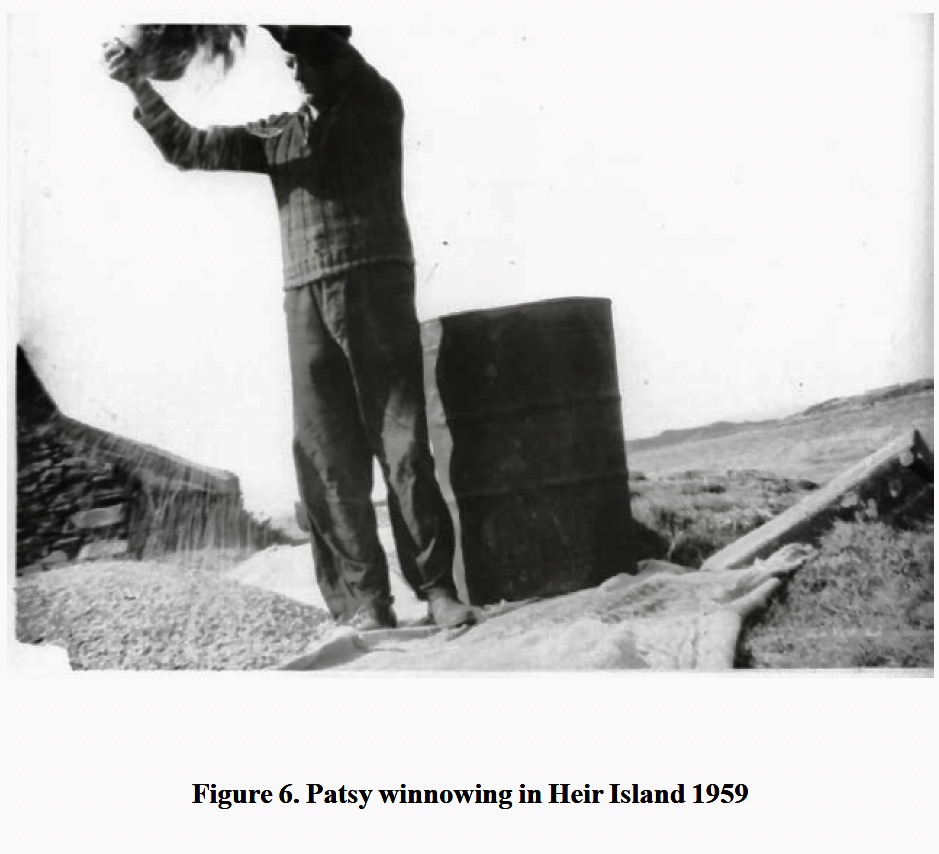
And here is Patsy, Hester’s husband, winnowing. I think the bucket contains the unwinnowed seed and the wheat or oat kernels are spread on the sail in front of him, exactly as in his children’s account.
And finally, not an Irish video, but one from Alberta, Canada, showing the whole process, including grinding for different flours.
Life on the Islands in Roaringwater Bay could be difficult and it was certainly hard work, but that’s not what shines through from Hester and Joe’s memories. Next time, I will look at some of their unique experiences.
Discover more from Roaringwater Journal
Subscribe to get the latest posts sent to your email.
 Roaringwater Journal
And of course I instantly thought of St Fanahan – he would know how to sharpen a sickle alright!
LikeLiked by 1 person
It was a “billhook” rather than a sickle for us.
LikeLiked by 1 person
Very interesting. The skill of flailing! Great stuff.
LikeLiked by 2 people
Hmm, I used to have a sickle just like the one shown here by Eoin Reardon, which was an inheritance from my mother who used it to cut young gorse on her land at Derreenatra in the 1960s (she never grew oats !). I used it for many years to slash briars on my own land in Rossbrin, sharpening it regularly with a cigar stone to a lethal edge. Unfortunately one day I left it on the ground somewhere and never found it again. Hard to find a sickle in the shops round here these days.
LikeLiked by 1 person
Maybe you will stumble across it again some day!
LikeLiked by 1 person