Of Kings and Poets

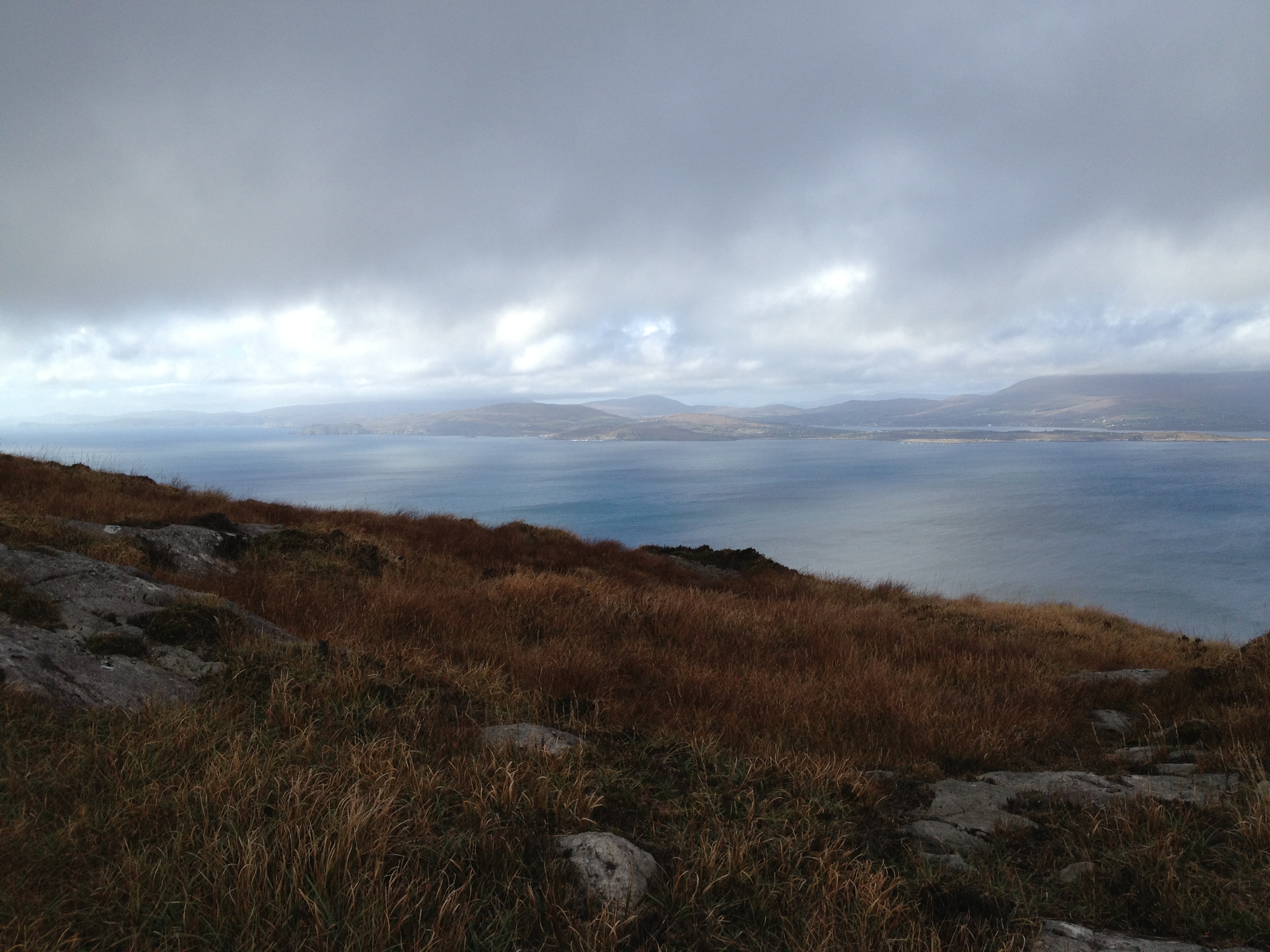
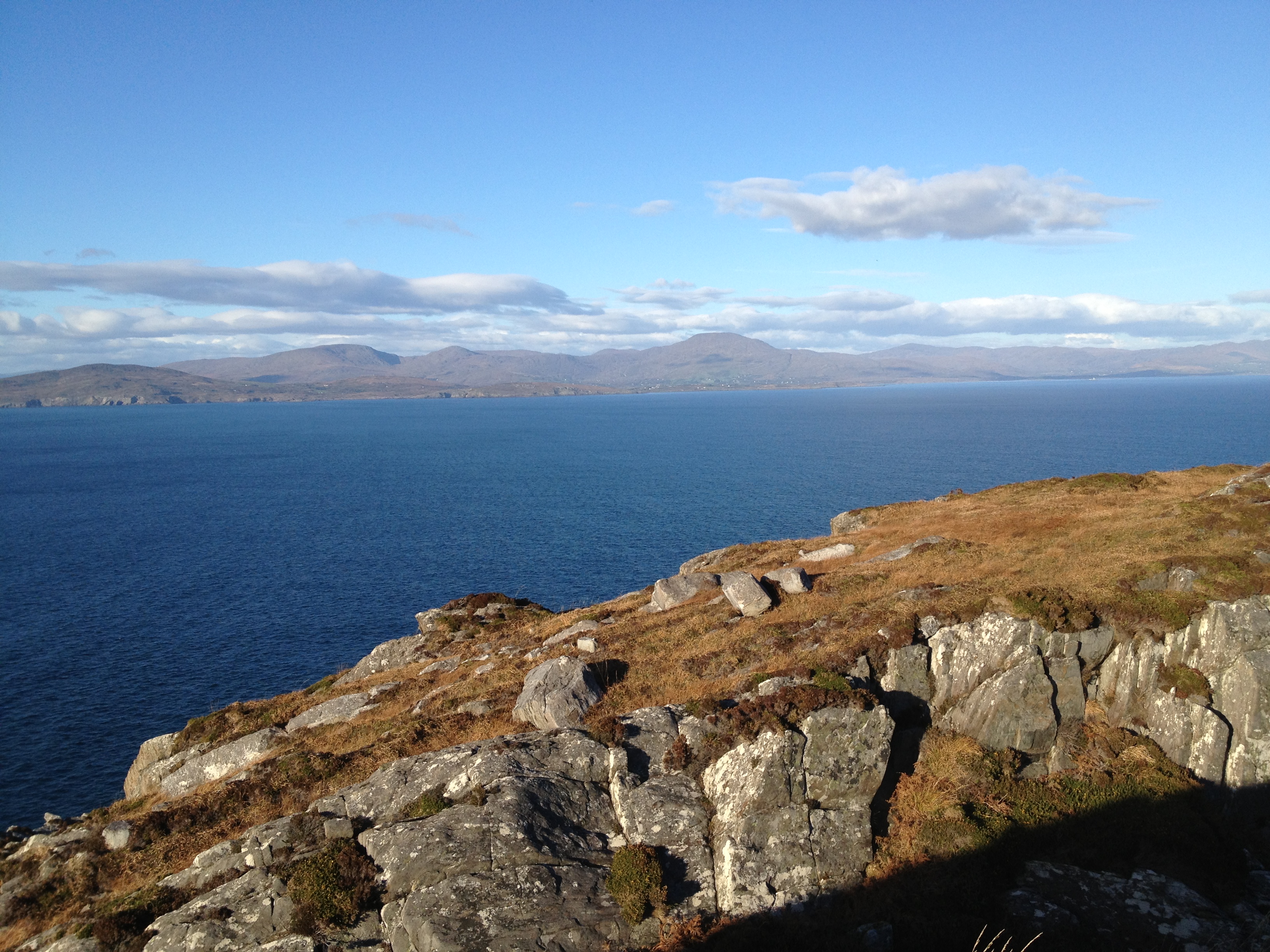
We are standing in one of the most beautiful places in the world… Or so it seems to us on this late November day as a cloudless sky casts an azure sheen over the whole sea stretched out between the Sheep’s Head and the Mizen, while the folds of the mountains behind are painted an indescribable autumnal gold by the low sun.
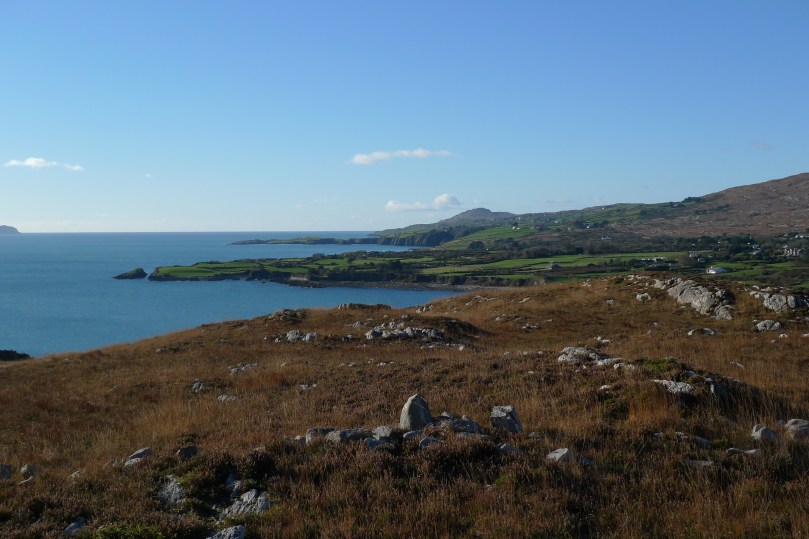
view west

We decided today that our Sheep’s Head walk would be by the water, and chose to start at Dromnea – where we were intrigued by mention of an old Bardic School. This is listed in the guide book, together with the nearby castle of the O’Mahony’s: both are picturesque ruins. In Feudal times, when they flourished, students of the school would serve a seven year apprenticeship which consisted of spending hours in a darkened cell composing poetry which was later read out to and critiqued by the whole company. They carried the traditions and history of families and communities, to be recited on their travels around the countryside, where hospitality for bards and minstrels was obligatory. The Dromnea School was owned and run by the O’Daly family, traditionally bards to the O’Mahony’s. The most famed of the poets was Aenghus O’Daly – also know as the Red Bard – who died in 1617. He is best remembered for his work – Tribes of Ireland: A Satire. As ‘research’ for our walk I read this – an 1852 edition available online: in a hundred or so verses Aenghus tells of his travels around the four provinces seeking hospitality from the ancient families of Ireland, as was the right of his profession. The whole work is a list of complaints as to how lacking the hospitality actually was. For example:

The tribe of O’Kelly—the screws whom I hate

Will give you goats’ milk, mixed with meal, on a plate

This hotch-potch they’ll heat with burnt stones, and how droll some,

Among them will tell you ’tis pleasant and wholesome.

and:

Three reasons there were why I lately withdrew

In a hurry from Bantry: its want of a pantry

Was one; and the dirt of its people was two;

Good Heavens! how they daub and bespatter

Their duds! I forget the third reason. No matter…

or:

Poor little Red Robin, the snow hides the ground.

And a worm, or a grub, is scarce to be found

Still don’t visit the O’Keeffe; rather brave the hard weather –

He’d soon bring your breast and your back-bone together.

Such was the reputation of the Dromnea Bards that the King of Spain sent two of his sons to the School to receive their education. They were both drowned while swimming in the lake by the castle: the story tells that they were turned into swans. We leave the ghosts of the school behind us and reach Lough Farranamanagh – a tranquil stretch of fresh water which flows out to the sea. We look across to the few stones that define the O’Mahony stronghold: sure enough, floating serenely in front of it are two stately swans.

After passing the time of day on the beach with a periwinkle collector (she exports great tubfuls of them to France) we walk for three hours, leaving the coast behind and going up into the the hills where we come across further ruins: this was once a village, and lazy-beds and ancient field systems are visible in the rocky moorland terrain. Finally we descend back to the now defunct old Ahakista – Kilcrohane road: a remote green trackway that has been given a new lease of life as one of the Sheep’s Head Way walking routes. This brings us back foot-weary but satisfied to our starting point after our tour through an intellectual and historical landscape in stunning West Cork.
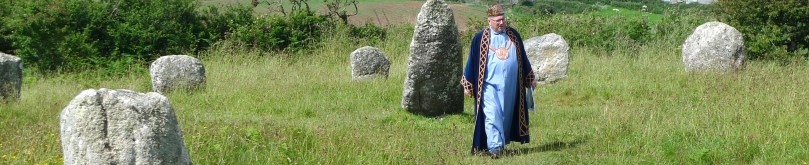
A Bard of the Cornish Gorsedd
A Bard of the Cornish Gorsedd
To Market, To Market

2012-11-02 11.36.59

This…

2012-11-25 17.55.05

…becomes this

2012-11-24 14.38.49

Lunch at Ard Glas

2012-11-10 10.49.58

West Cork Pies

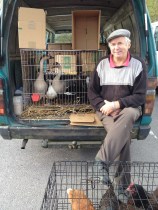
We are fortunate to have two excellent farmers’ markets on our doorstep: the Bantry Market on Fridays and the Skibbereen Market on Saturdays. We go, just to wander, not really needing anything – but we always emerge with a bag full. We love to buy carrots and parsnips covered in this morning’s earth, and scrub them up under the outside tap back at Ard Glas. The fish stall ladies will fillet a whole fish for you in a trice, and give you hints on the best way to cook it. The numerous homemade bread and cake stalls have started to load up their tables with mince pies and Christmas puddings. A new stall, West Cork Pies, sells the world’s yummiest Steak in Murphy’s Pie (Murphy’s is the Cork Guinness), Chicken and Leek Pie, and a variety of pasties. I am putting in an order for Christmas, to take up to Dublin. Our lunch often consists of cheese from the Bantry cheese stall, with Courgette and Ginger Chutney picked up in Skibb, and (I know I shouldn’t) a slice of chocolate biscuit cake from one of the baking stalls.

2012-10-20 11.06.45I love to chat to the stall owners and ask about their produce. Trouble is, it’s hard to walk away without buying something, so now I have two packets of nutritious seaweed from the charming seaweed man, and I’m not quite sure what to do with them. Fortunately, Robert rescued me after a long conversation with the wood carver before I felt I had to buy a headboard.

At Bantry there’s even a Fight for Irish Freedom stall, selling books and images and with rebel music blaring out from speakers. I stop here to wonder what all the English people who call West Cork home make of it all. We move on to the chickens, the colourful kilims, oh…and there’s the guy with the lovely French soap!

kilimsFreedom Stall

Rock Art

Most of our followers will know of Finola’s involvement with Irish ‘Rock Art’; and that has nothing to do with the Beatles or Bill Hayley (remember him?)…

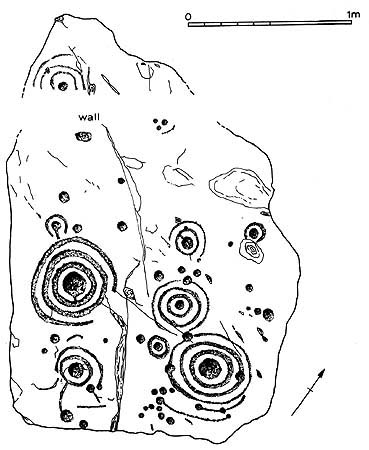
Rock Art at Derrynablaha – Robert’s ‘modern’ interpretation based on Finola’s 1973 survey

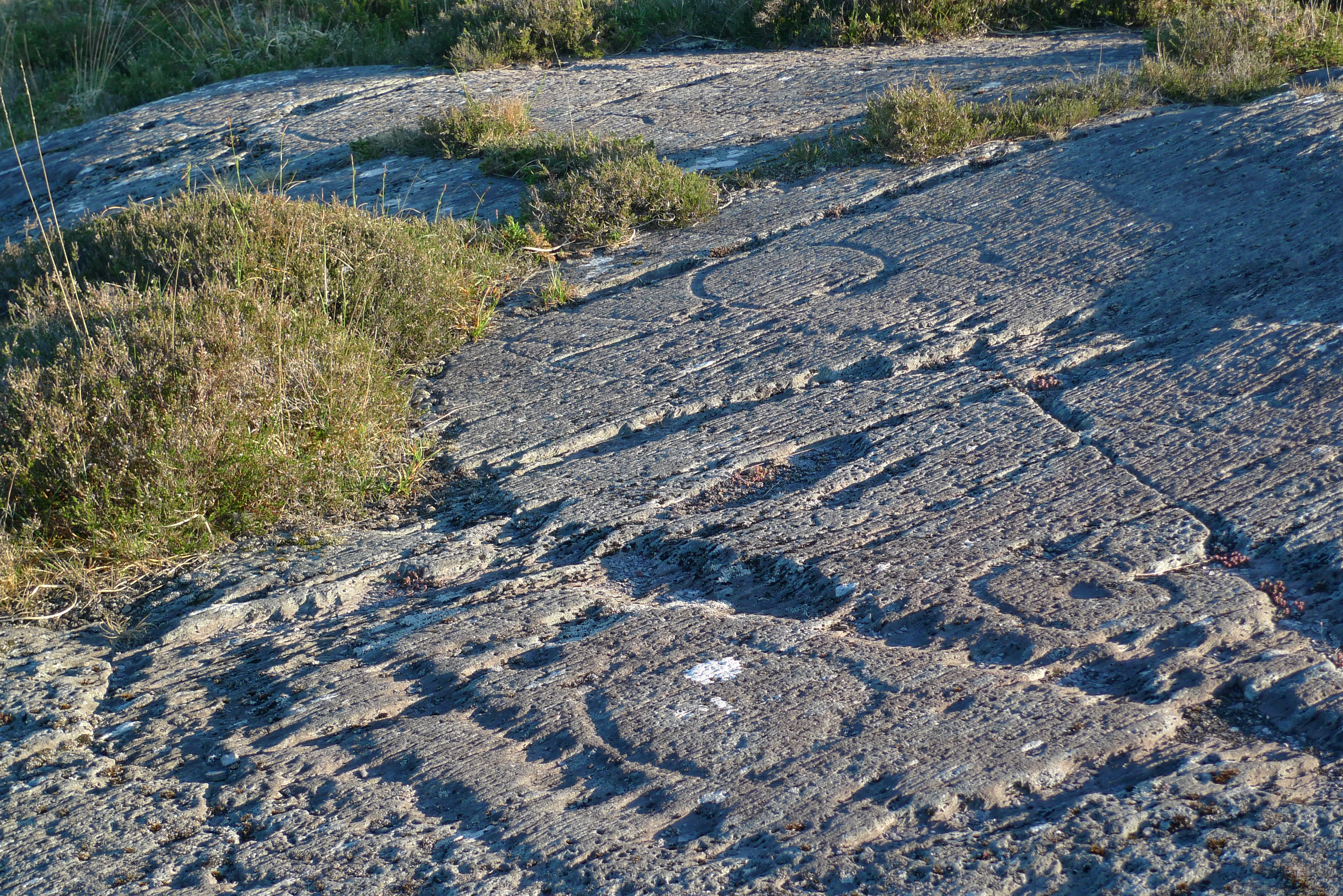
Finola’s interest in Rock Art dates from her time at the University of Cork in the 1970s, when she studied Archaeology and wrote her thesis on Neolithic and Bronze Age petroglyphs in Cork and Kerry: that is still a standard work on the subject, although since those days the number of known examples throughout Ireland has increased significantly. The closest pieces to us here in Ard Glas are up in the hills north of Ballydehob, in the townland of Ballybane West. One is on a very large, flat piece of rock outcrop, about 30 metres long by 10 metres wide: Finola had surveyed it back in 1973. We often tramp up there, perhaps hoping to see some hitherto undiscovered markings – or even to find enlightenment through contact with the rock as to why it is there and what it might mean. But – so far – we have always returned none the wiser.

Motifs from Ballybane West. They are best seen in low sun – as here: at other times they can be virtually invisible

Rock Artist Finola and her ‘new’ piece…

These petroglyphs are certainly enigmatic. Mainly, they are ‘cup marks’ (circular depressions in the rock) often, but not always, surrounded by a ring or rings – although various other shapes have also been found. It’s amazing that they continue to survive as most are on exposed sites, constantly battered by the West Cork weather – but they do. Yesterday we went to have a look at a recently discovered piece, near Schull. It is in the garden of a private house and is almost completely hidden by encroaching moss and undergrowth. With permission we pulled back some of the moss and had an initial look: it’s a good example, with deeply incised cup and ring marks. Finola found in her researches that Rock Art sites often have views of the sea and of mountains – as does this one in the Schull garden (and those at Ballybane West). It is, therefore, possible that they have a geographical purpose; there is no way of knowing, unless we are ever fortunate enough to slip through a time warp and meet up with one of the original artists (who speaks English). I am always hopeful of this, and will let you know – somehow – if it happens….

Re-Engaging

Typical cup-and-circle motifs

This week we are writing about the same topic – each from our own perspective.

One of our reasons for choosing this area to live was for me to re-engage with Irish rock art. I am incredibly lucky in that this is a subject that Robert, an architect by profession, finds as interesting as I do, so it has become a joint project.  As background, in 1973 I completed a Master’s thesis at University College Cork on the ‘Rock Art of Cork and Kerry’. I was 23, and I conducted my field work for two summers on a Honda 50 motorcycle belonging to my brother, Hugo.

What IS rock art? Glad you asked!

Can you see the carvings?

About 5000 years ago, Ireland was populated by early farmers. This era was known as the Neolithic (new stone age) period, and it was characterised by the emergence of a settled, or partially settled, way of life growing crops and herding animals. No longer nomadic and with a secure food source, Neolithic people developed a stratified society in which a noble or priestly class was able to commandeer the labour of large numbers of people to build great stone monuments featuring intricate carvings and often oriented to celestial occasions such as a solstice sunrise. Another tradition arose of carving on rocks – boulders or outcrops – not associated with monuments and with a different set of motifs. This tradition of rock art stretched along the Atlantic Coast, from Spain to Norway, with many fine examples in Ireland. When I undertook my research in the early 70s, it was thought that most Irish rock art was concentrated in Cork and Kerry (the two most south-westerly counties) but since then there have been major finds in Wicklow, Carlow, Louth, Donegal and elsewhere.

So how, 40 years later, does one ‘re-engage’ with this fascinating topic? Well first, we’ve a lot of reading to do, to catch up with the state of current knowledge. Second, we need to re-visit the sites I recorded in the 70’s, as well as those discovered since then. Third, we have to connect with the Archaeologists at UCC to discuss the nature of our project. All of these steps are under way, and we will be charting our progress occasionally through this blog.

The same rock as recorded by Finola in 1973

A Grand Soft Day

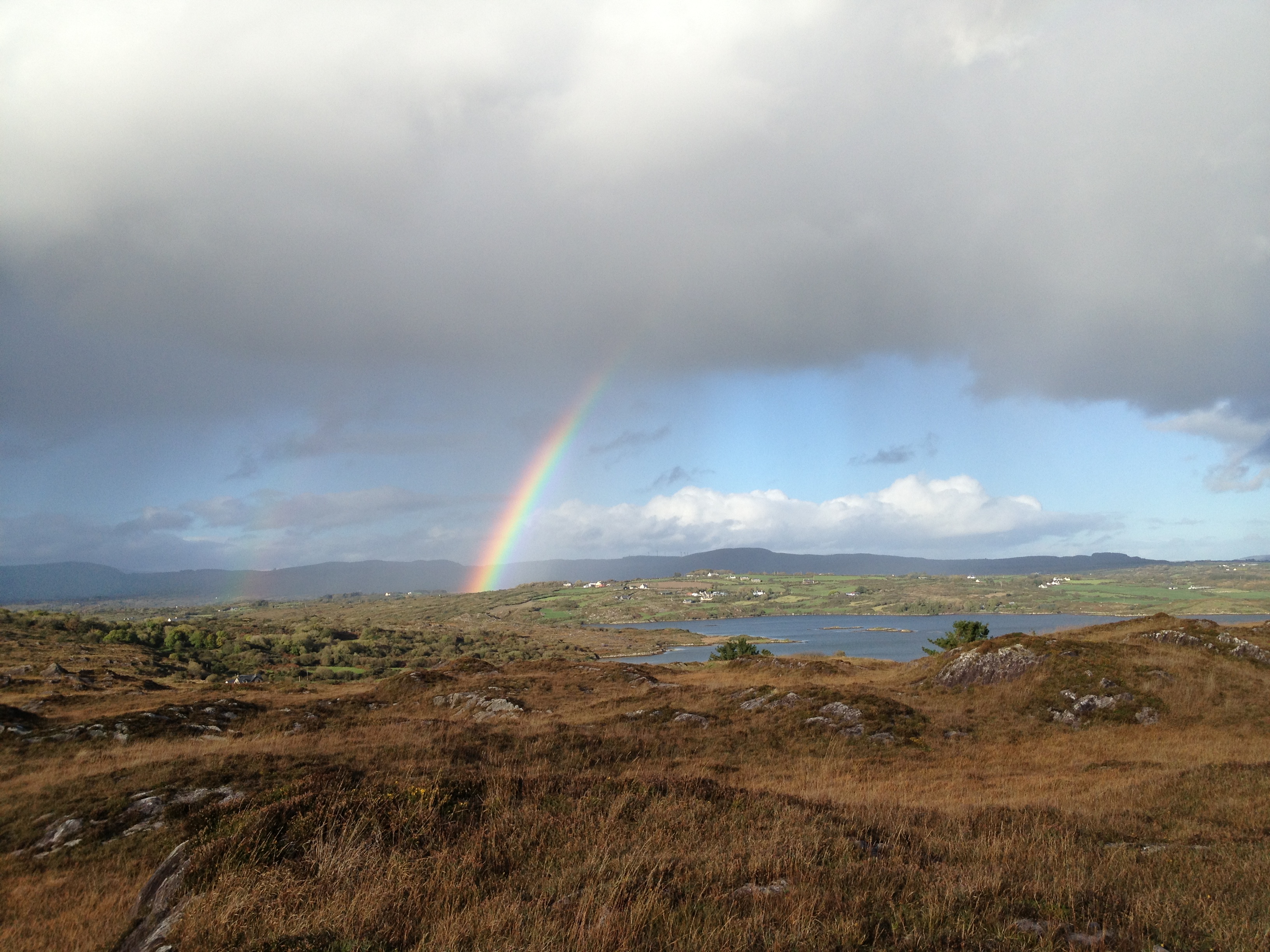
Sometimes the city in which a novel is set functions as a character in the story – a vital influence on events, unthinkable in a different place. I feel the same way about the weather in West Cork. It’s a SHE, of course – in turn tempestuous, caressing, unpredictable, always to be respected and never, ever to be taken for granted. Around here it’s ‘wait five minutes’ forecasting: what it says for the next few days on the iPhone weather app at 9am may have changed radically by noon so we never despair if we see days of rain ahead. We awake to a glorious dawn, with sunshine flooding across the bay and are enveloped in mist by breakfast, only to enjoy a sunny walk that afternoon. The clouds bank up in great mounds, lending glorious light and shade and endless colour variations to the landscape. We have stopped taking rainbow photos because we have so many already. Maybe if I see a triple…

Robert uses the word ‘mizzling’ for that soft wetness that’s one step from mist and that you hardly need a hat for. When we walk along our Greenmount Road to the rise with the great view over to Kilcoe, we can see the rain coming across the sea, slanting down here and there from grey clouds, and sometimes it hits us and sometimes it doesn’t and mostly when it does it’s gone again in a few minutes and we dry out in the breeze that follows it. Odd nights we can hear it lashing on the skylights on the top floor and we echo the Cork people who say “’Tis a hoor of a night.” I remember endless days in Vancouver of rain pelting down and everyone with umbrellas and a grey will-this-never-stop misery sinking into the soul. So far – and maybe we are lucky – that isn’t happening here. We haven’t had a day without some sunshine.

On November the 5th we walked the lighthouse loop on the Sheep’s Head with barely a cloud in sight – what they call locally a “pet day.” This was our third section of the Sheep’s Head Way and took in yet more stunning scenery and a long section where the trail runs on the brink of vertical cliffs, with the waves crashing and roaring below. It was so hot I got sunburn. That might not happen twice: but then again SHE specializes in the art of surprise.

Two Hares

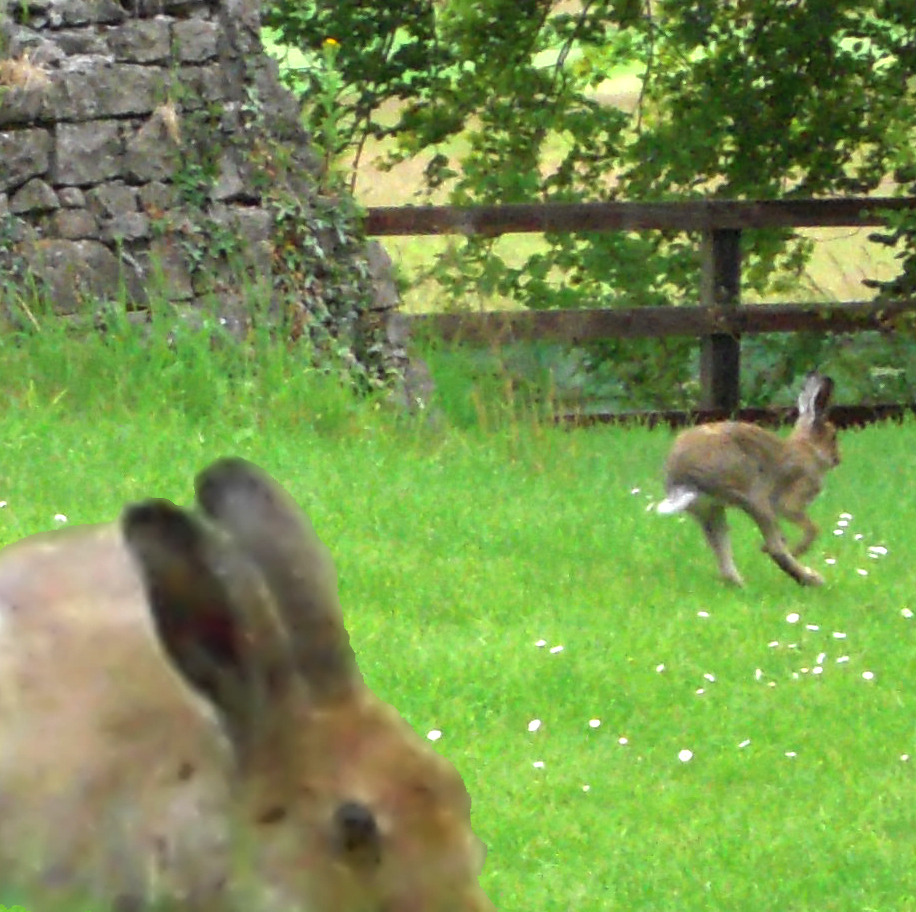
Two Hares ambling together in Ballybane West: grazing, ‘sharing the watch’…

The Irish Hare – Lepus timidus Hibernicus – sometimes confused with the Mountain Hare – Lepus timidus Scoticus – which is smaller, Scottish, and has a lighter, winter coat, is not an unusual sight for the careful watcher in West Cork. Sightings of groups of two or more are frequent enough, in fact, to cause us to question the old folklore that says that Hares are always solitary: I once saw eight Hares running in a cluster across the field next to Danny’s house. But the story goes that the female Hare escaped from the Ark and was drowned, so God gave the male Hare the power to bear children: country people recounted that the Hare is androgynous – even as recently as the twentieth century – and lives in complete isolation, without the need for a mate.

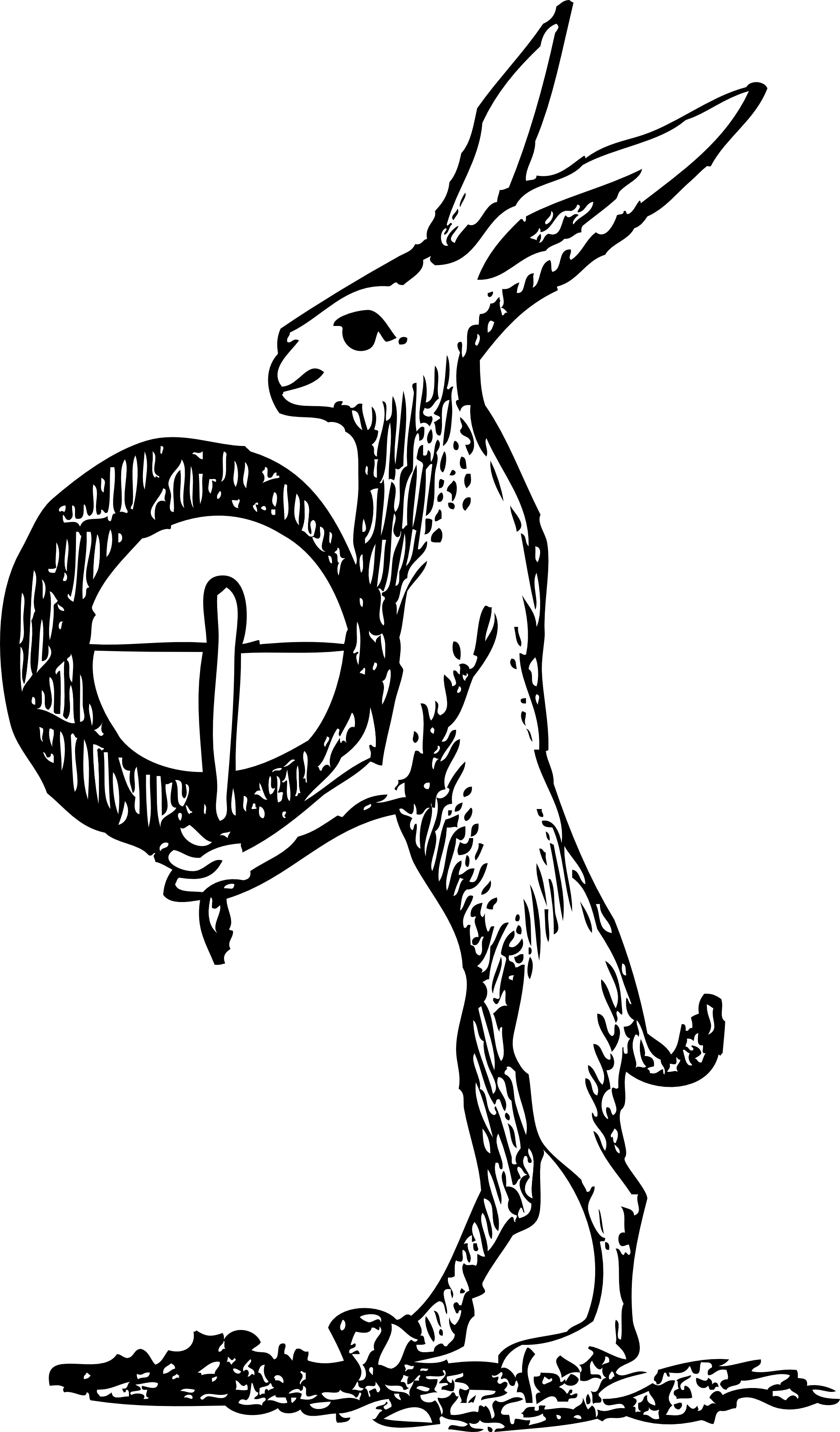
Hares walked our Earth a million years before humans did – and have changed very little in that time: a true archetype. This could explain why the Hare is such a central figure in so many mythologies: trickster, moongazer, mischief-maker… In one pan–African story, the Moon sends Hare, her divine messenger, down to earth to give mankind the gift of immortality. “Tell them,” she says, “that just as the Moon dies and rises again, so shall you.” But Hare, in the role of trickster buffoon, manages to get the message wrong, bestowing mortality instead and bringing death to the human world. The Moon is so angry, she beats Hare with a stick, splitting his lip – as it remains today.

I watch the pair: they are aware of me – but I’m no threat. Two West Cork fields lie between them and me… small fields, perhaps, but they know very well that they could vanish before I even made the gate.

When I first saw the movement I thought it was partridge: I made it out to be two female heads in the long grass. Then I realised – ears laid low, then up and turning. They are all to do with the head: those so defining ears; the nose; the liquid, fathomless eyes – never closed, even in sleep. All the senses, and always at the ready… And – if they had to take off – that confounding sense of dizziness that sends them in impossible zigzags – even doubling back – to confuse their far less intelligent pursuers. They will also leap – up to twelve feet in one bound – to avoid laying a scent.

But – if you can – look further into those eyes: the depth, the perfect attuning, the knowledge… These are not animals for the jug – these are creatures we are privileged to share the Earth’s gifts with: these are the Old Gods.