St. Brandanus: A 14th Century Graphic Novel. Part 2

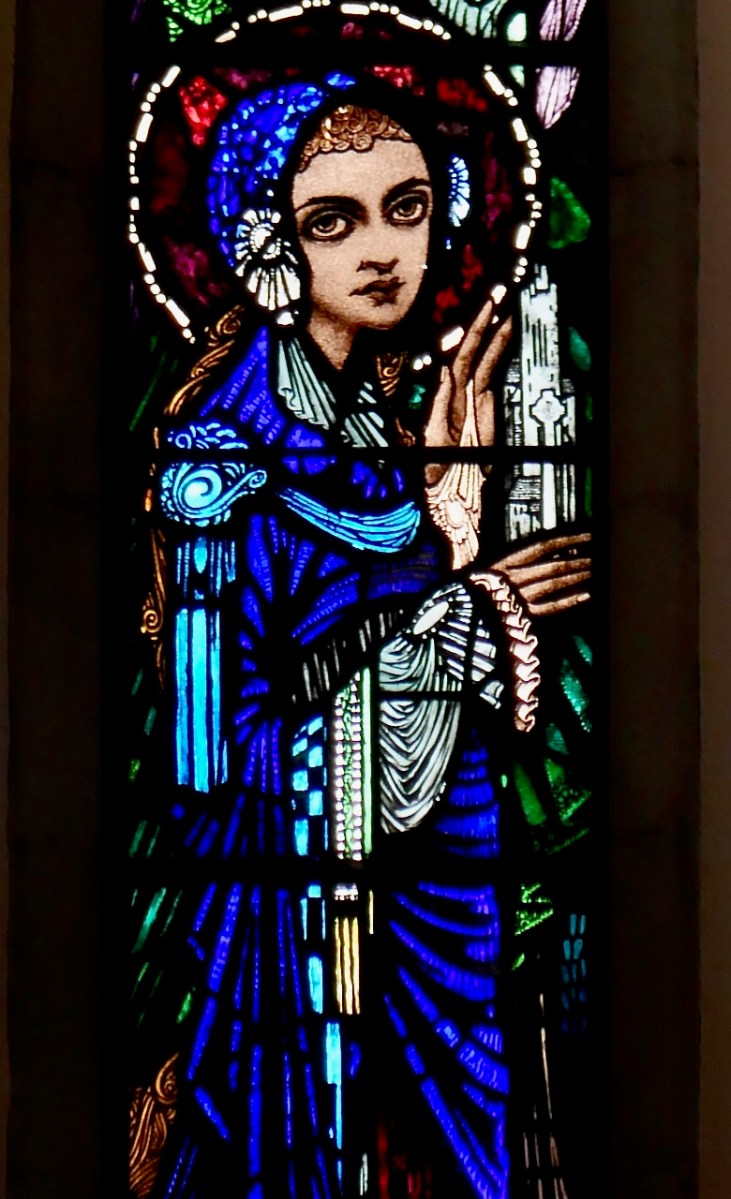
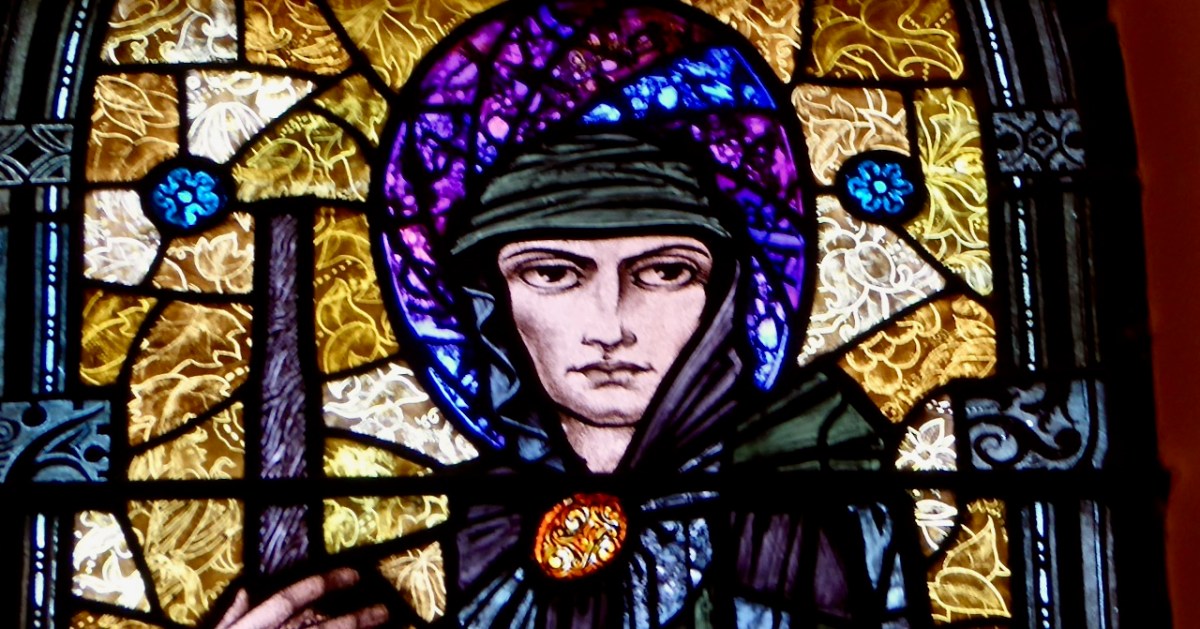
There are several versions of the Brendan story (that’s a Harry Clarke Brendan, above, from Tullamore), and some of the stories in one version might not be present in another. This particular version is told in a series of illustrations, each one captioned in what Biedermann calls “faulty monastic Latin.” It is contained in a much larger work, the Krumauer Bilder-Codex (or Illustrated Codex), and occurs at the end after many other stories of saints. A Codex, by the way, is a book, rather than a scroll. In the 14th century, vellum was used as the main writing material. The drawings are line drawings in pen and ink. They are simple, but in Biedermann’s opinion ‘joyful.’ I agree. Here’s one of the stories.

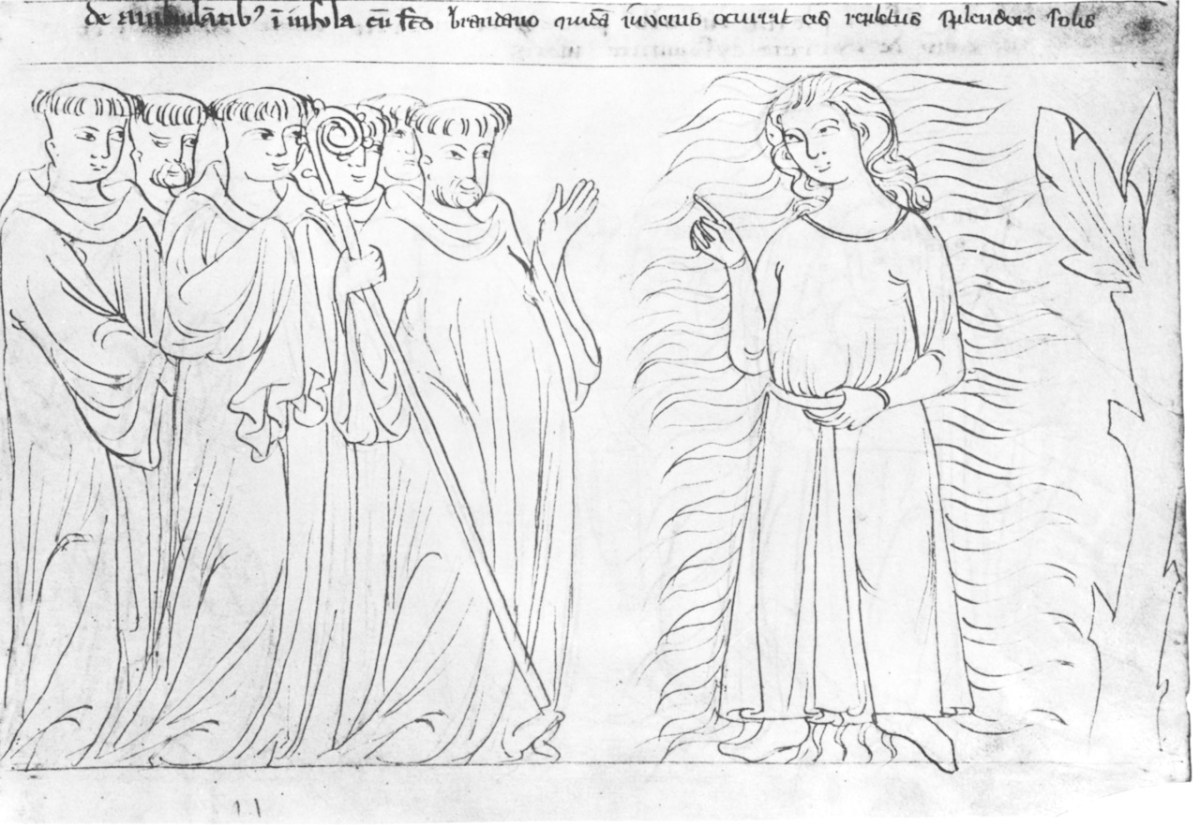
While they were walking on the island with Saint Brendan, a certain young man met them, filled with the radiance of the sun.
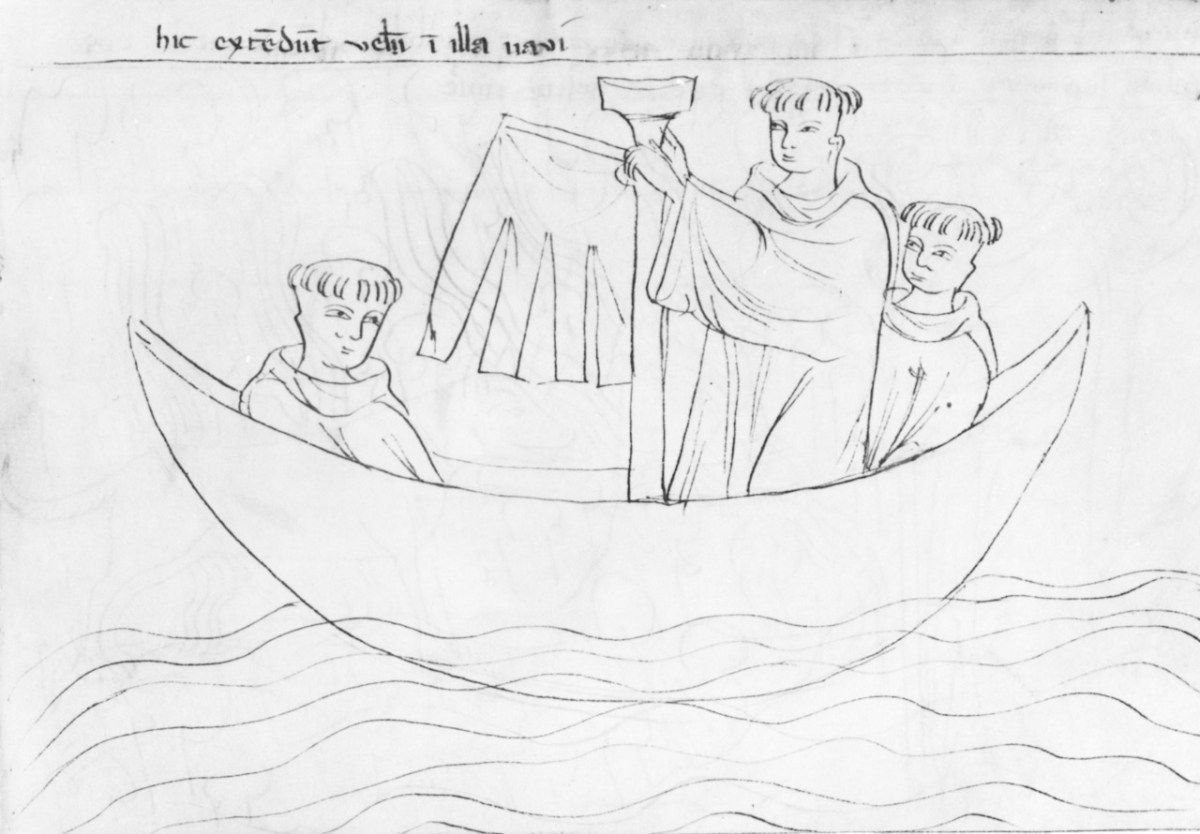
And that young man boarded the little ship with them and vanished from their sight.
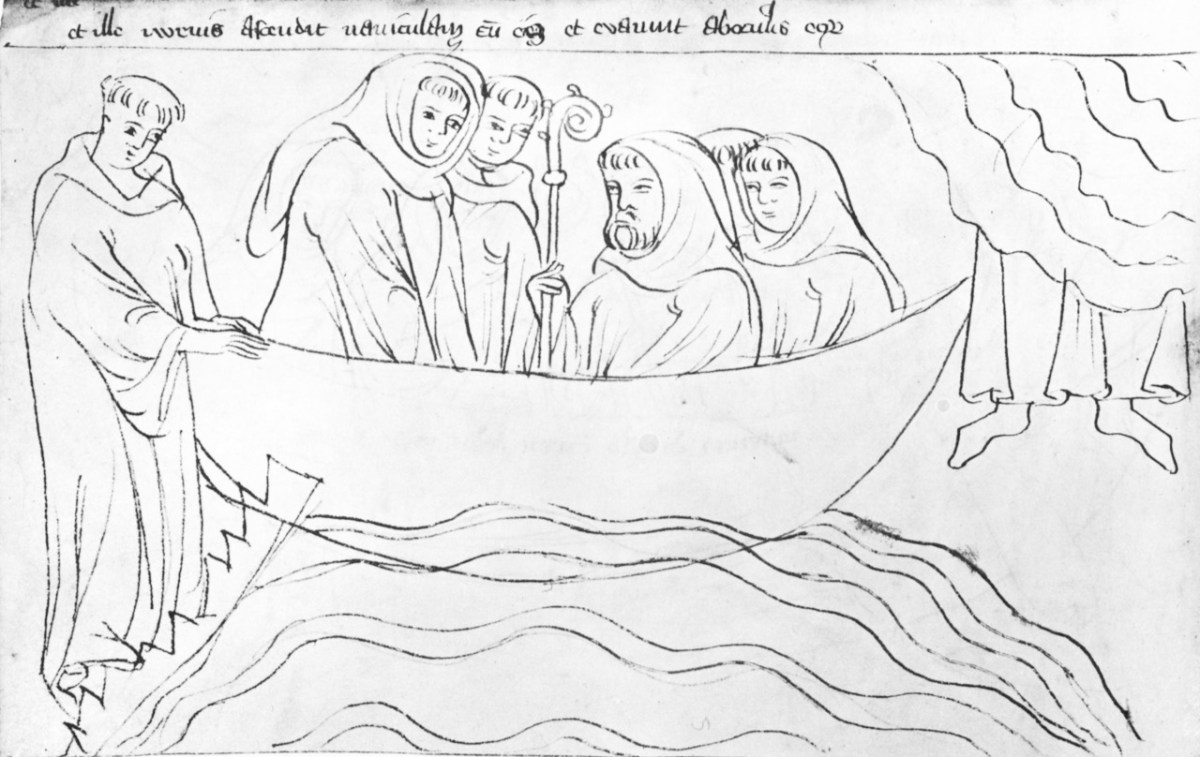
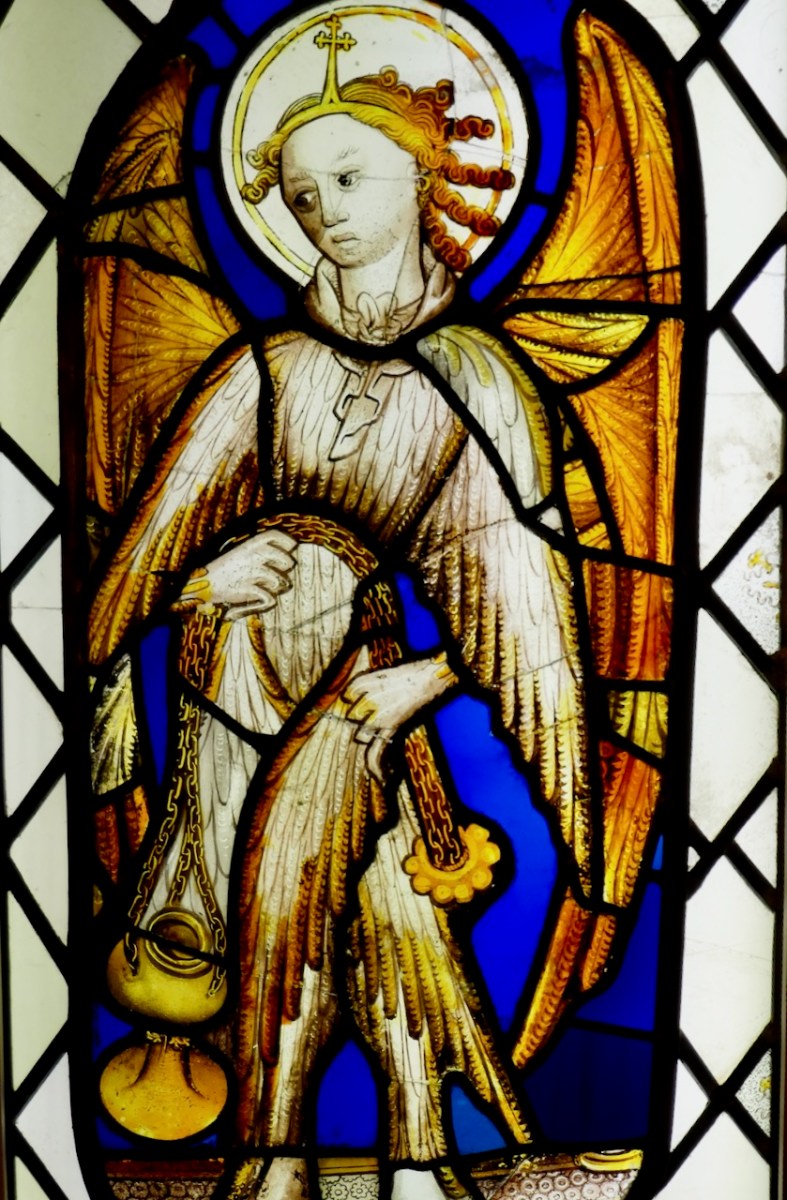
I love the way you see only his legs disappearing up into the clouds.  St Brendan, although happy to see the radiant youth in the first illustration, is looking a little grumpy in this one. “What did we do wrong, that he left us”, I can hear him say. You may note, by the way, that in some illustrations the monks are depicted in a curved shape, like Brendan in the first line drawing above. This convention, known as the S-curve, is also seen in medieval stained glass windows, such as this one from the Exeter Museum.
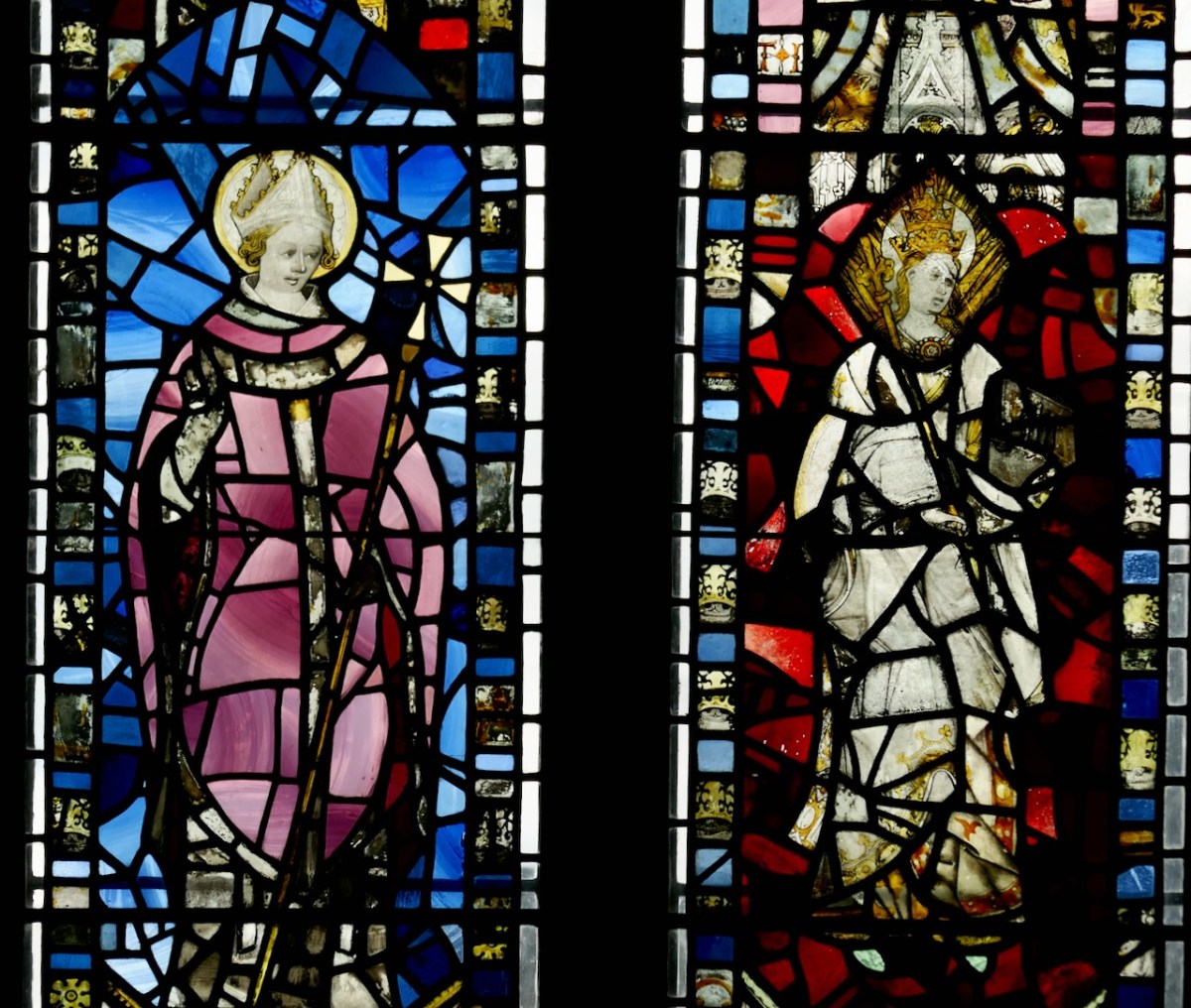
Here’s another one, from St Helen’s Church in York. This S-curve was a way of introducing some sense of movement into a figure of a saint or monk, and was a typically gothic element, perhaps an attempt to make the figure less rigid.
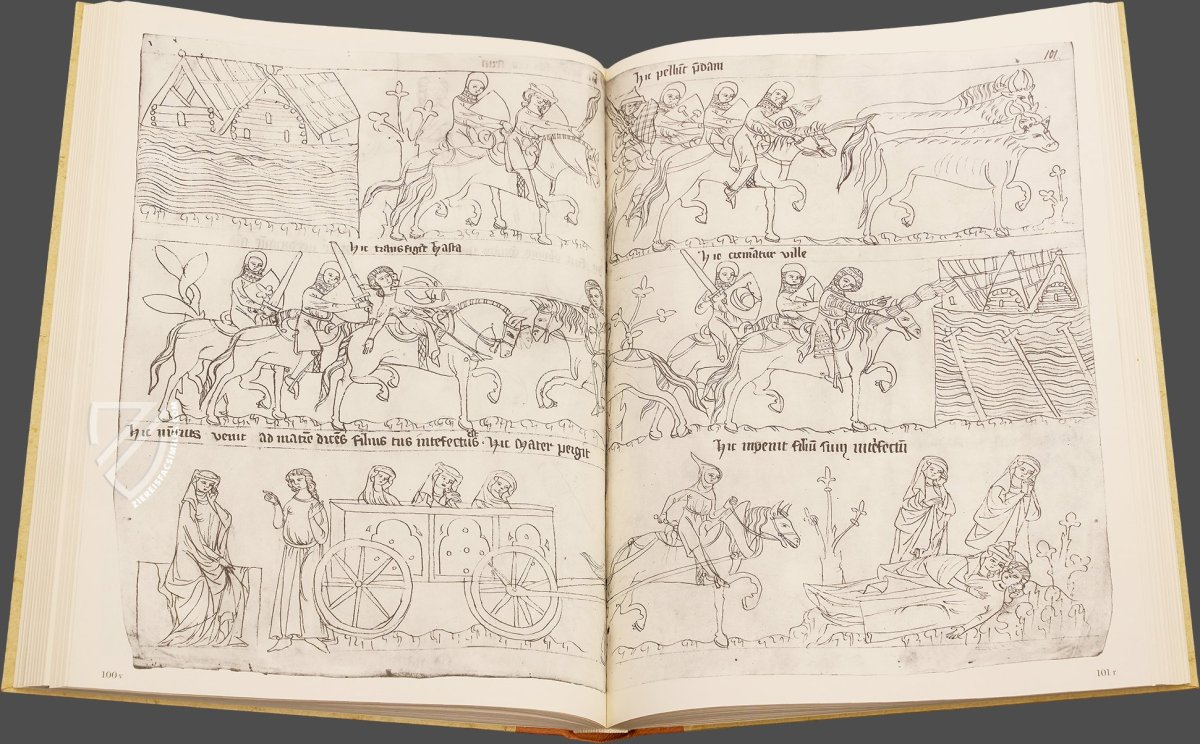
The illustrations are laid out on facing pages, so you read top left, top right, bottom left, bottom right. Although the Brendan story has four illustrations per two-page spread, most of the stories in the Krumauer Bildercodex have six, or occupy three horizontal spaces instead of two. Here’s an image of a typical lay-out, although I don’t know what story is being told in it.
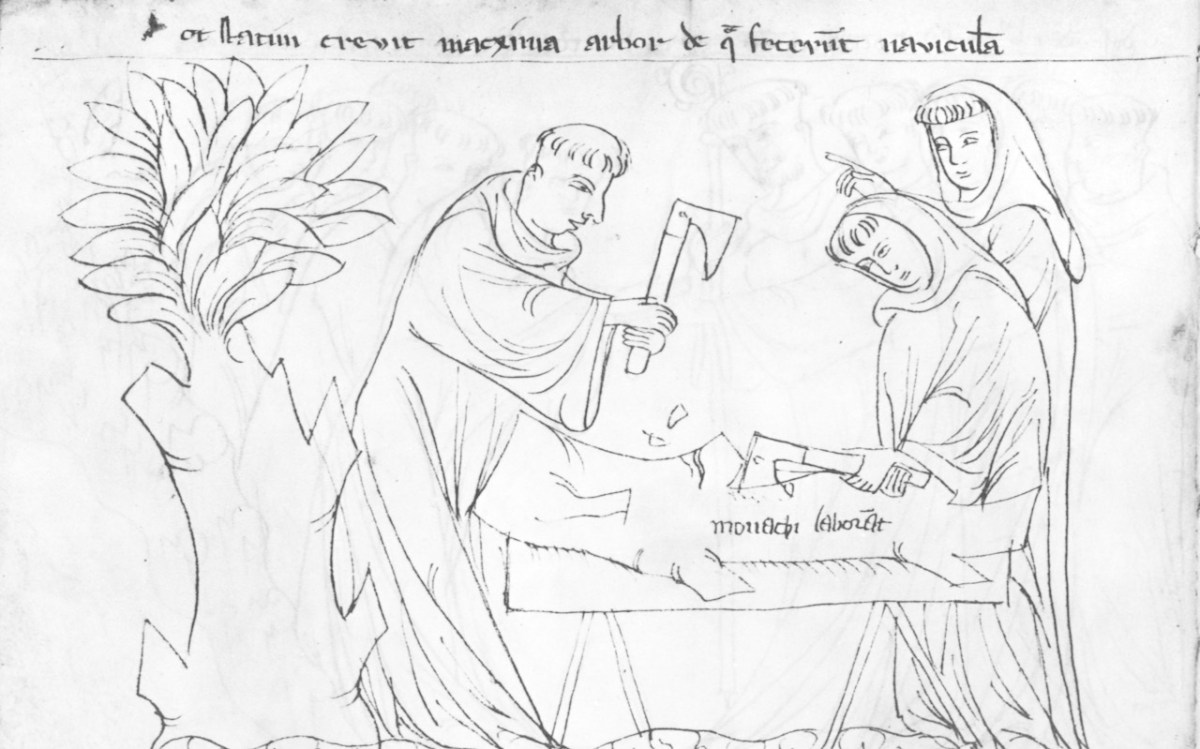
At some point there is a need for a new boat. No problem – Brendan sticks his staff in the ground and immediately a tree springs up. The monks set to work on it and in no time have carved out a boat.
In the next illustration they are at sea and raising a sail. Aha – I hear you cry, but now there are only three of them. And what kind of sail is that? And also – surely they were in an Irish curragh – what about all the hides? Alas – the Codex provides no answers to our urgent questions, although the story-teller who used the illustrations as he narrated to an eager audience may have done all that. We don’t know who commissioned the Krumauer Bildercodex, although since a production like this was time-consuming and expensive, it may have been a noble patron or a monastery. 
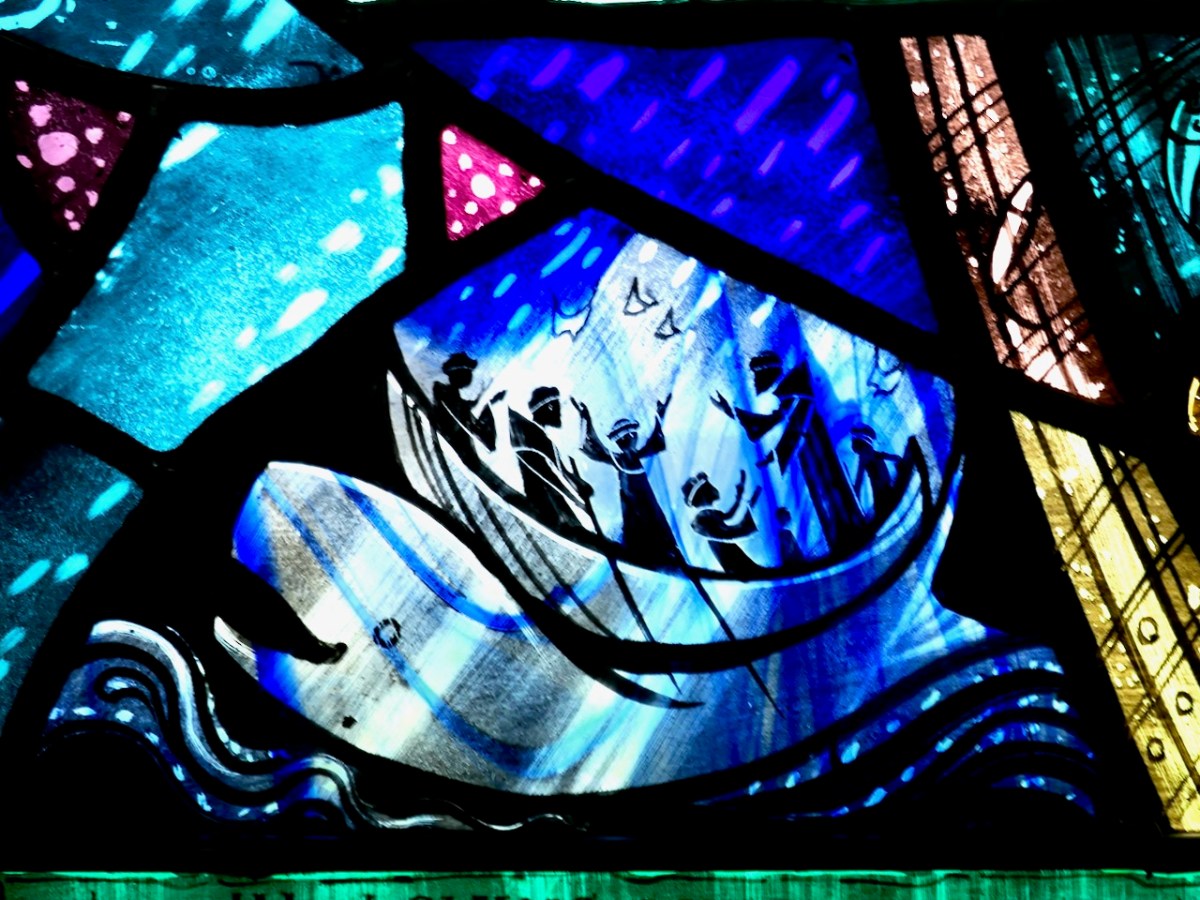
One of the most famous of the Brendan stories is that of the giant fish, sometimes called Jasconius, and often referred to as a whale. 
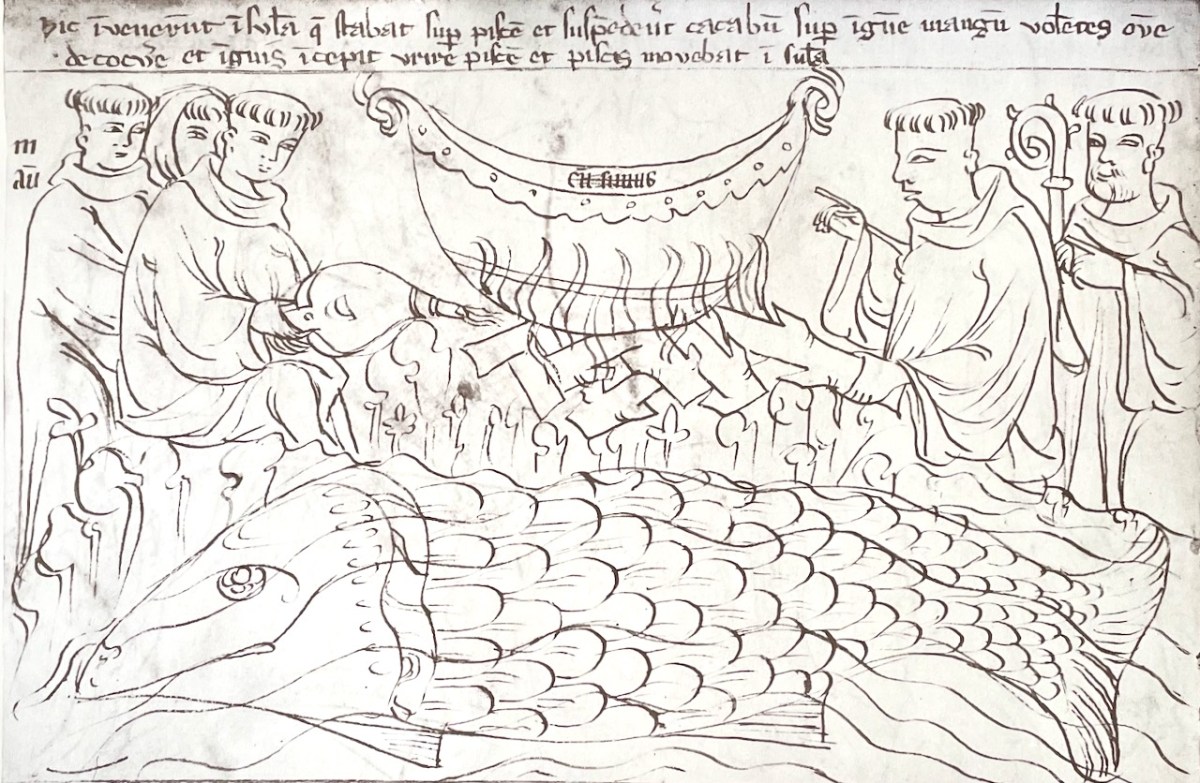
The caption reads: Here they found an island which stood upon a fish, and they hung a pot over a great fire, wanting to boil a sheep, and the fire began to burn the fish, and the fish moved the island. 

Here is Whitley Stokes’ translation of the story from the Book of Lismore

Now after the Easter had come the great sea-beast raised his shoulder on high over the storm and over the wave-voice of the sea, so that it was level, firm land, like a field equally smooth, equally high. And they go forth upon that land and there they celebrate the Easter, even one day and two nights.

After they had gone on board their vessels, the whale straightway plunged under the sea. And it was in that wise they used to celebrate the Easter, to the end of seven years, on the back of the whale, as Cundedan said :

Brenainn loved lasting devotion

According to synod and company :

Seven years on the back of the whale :

Hard was the rule of devotion.

For when the Easter of every year was at hand the whale would heave up his back, so that it was dry and solid land.
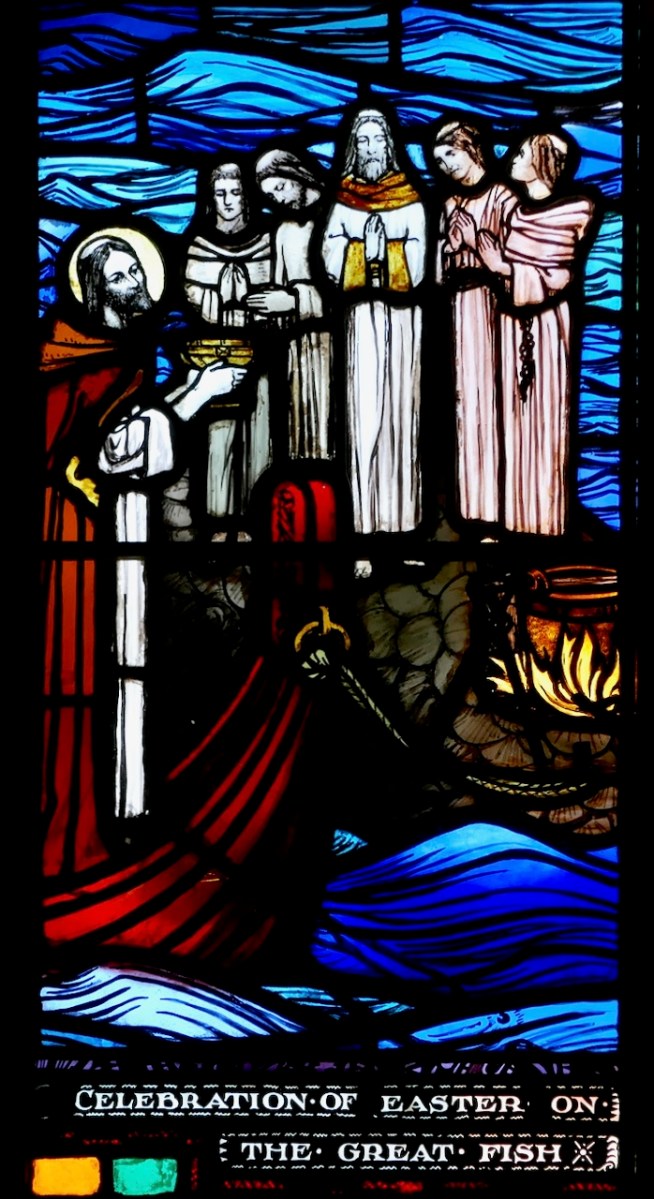
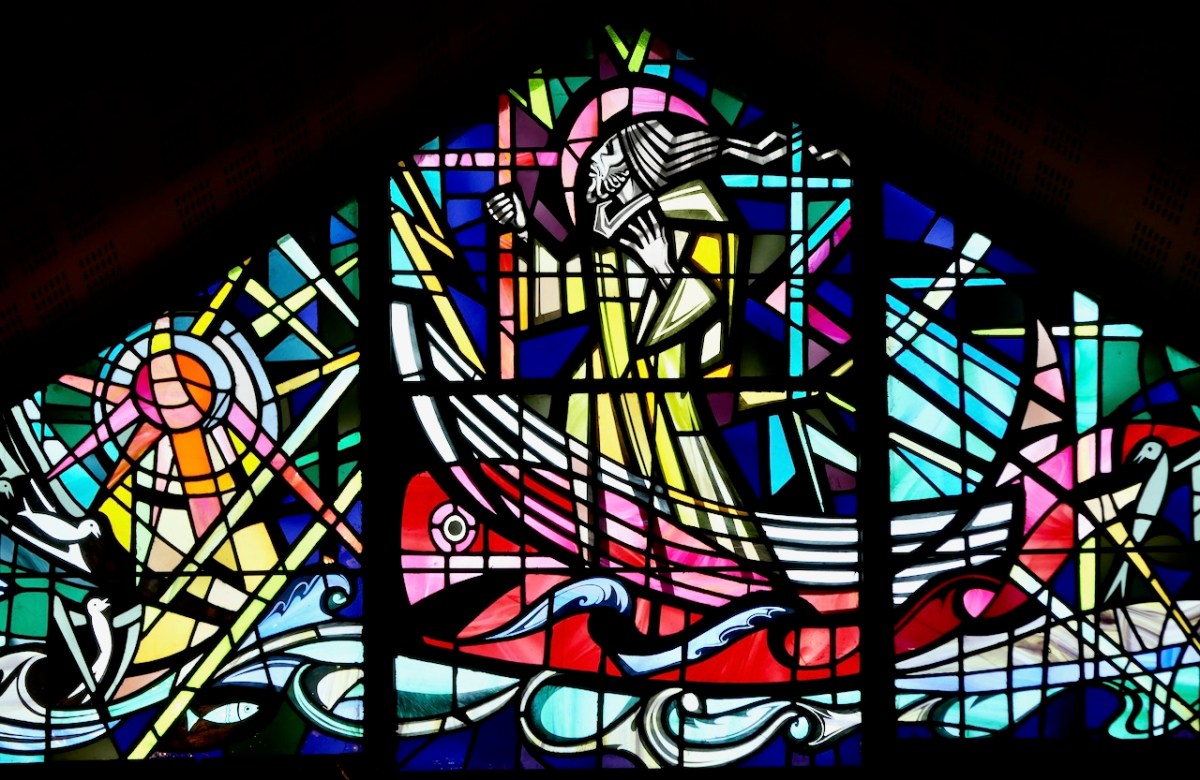
Since this is one of the most celebrated of the Brendan legends, it is not surprising that it is the story we see most often depicted in stained glass windows. Above is a beauty by Ethel Rhind of An Túr Gloine, in St Brendan’s College in Killarney. And of course, below, one by George Walsh, this one from St Brendan’s Church, the Glen, in Cork.
I will conclude this post with five illustrations for the story of the Golden Bridle, called the Silver Bit in the account I am using. This version is from the esteemed Canon O’Hanlon, (below) from his Life of St Brendan, in Volume 5 of his Lives of the Irish Saints (available online at https://archive.org/).
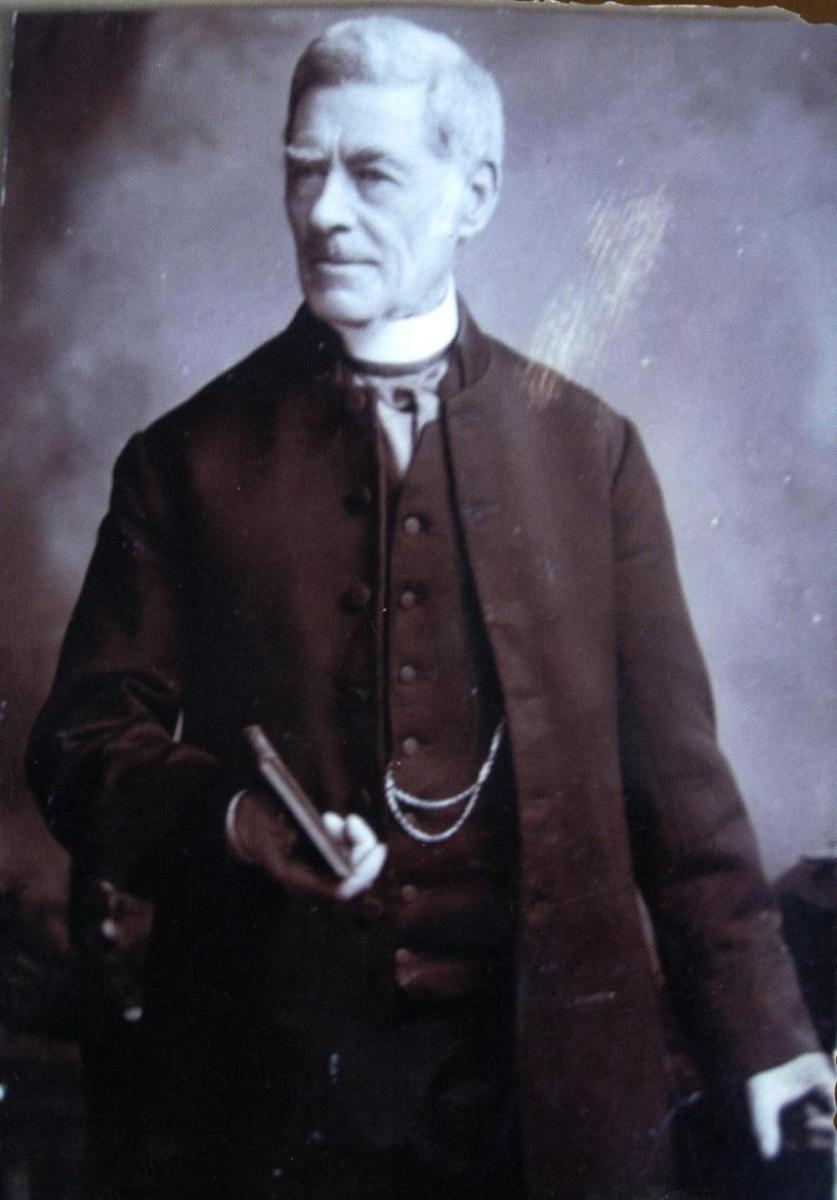
It is obvious, since the illustrations track so closely, that O’Hanlon was using the same translation as the Bilder-Codex. But I should warn you that in his translation the demon is cast in the form of a black child, an ‘Ethiop,’ as it is in other versions too. In the Codex it is simply referred to as a demon and depicted as a horned beast with a tail.
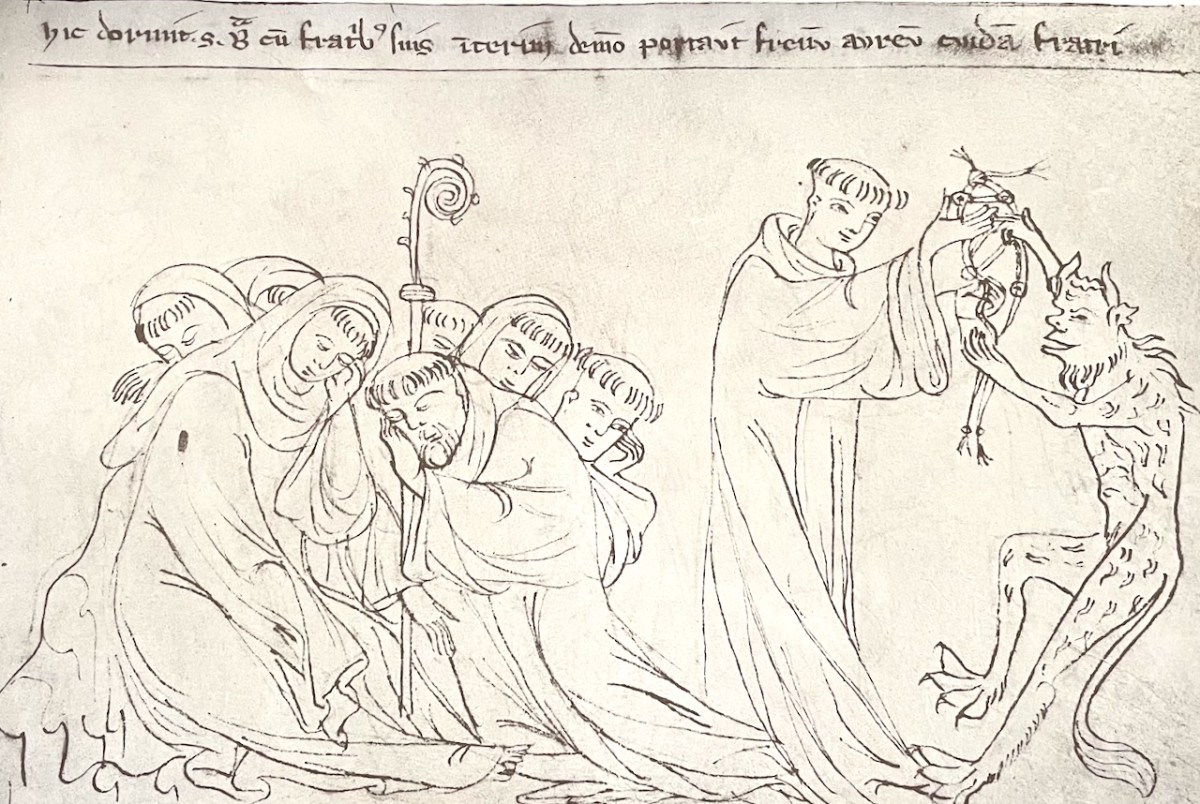
But, while they slept, Brendan saw a child, black as an Ethiop, holding a bit, and playing before the unfortunate brother, in whose eyes he made it glitter. The saint arose, and he passed that night in prayer till day. When morning dawned, the monks rose as usual, to give praise to the Almighty, and afterwards to regain their ship. Once more, the table was found furnished, as on the day preceding; and thus, for three days and for three nights, the Lord prepared food for his servants. There, too, for three whole days, by the Divine will, they rested on that isle. 
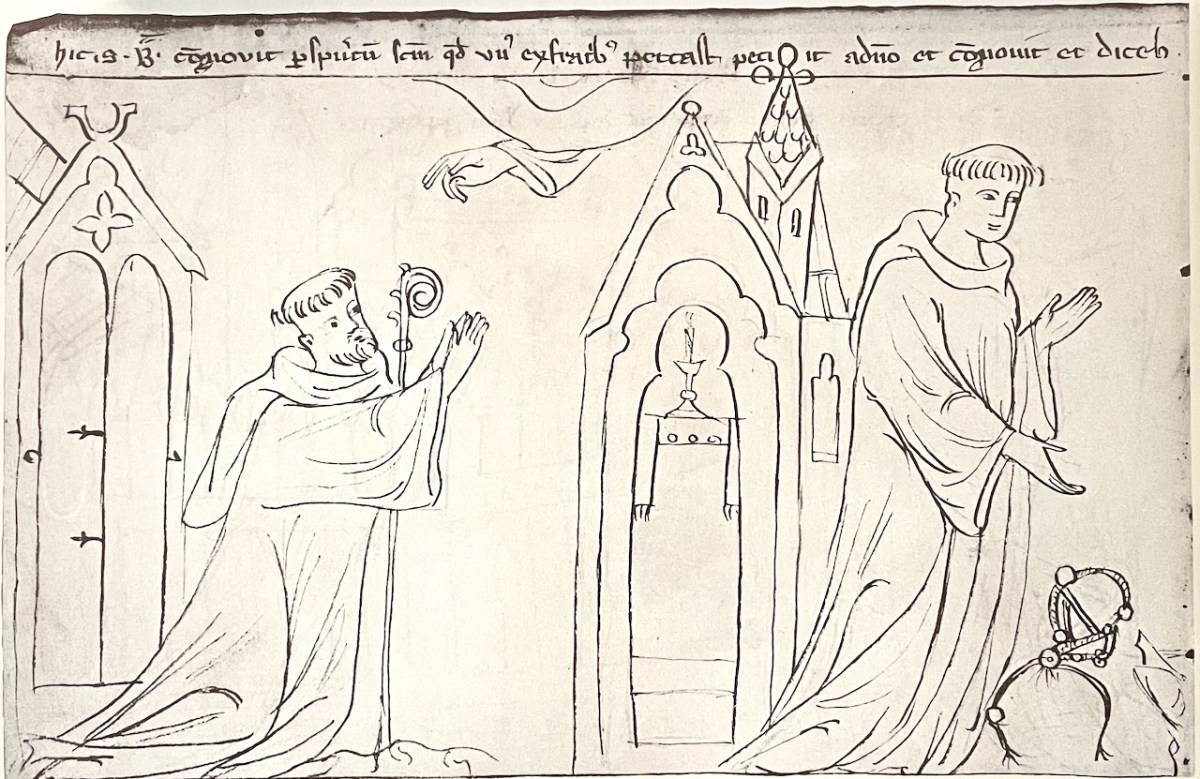
Then they returned to their ship, when Brendan said: ” See, brethren, doth not one of you carry off something from here?” “God forbid,” they replied, “that a robbery should dishonour our voyage.” “Then,” said St. Brendan, “behold, our brother, whom I warned yestereve, has now in his robe a silver bit, that the devil gave him this night.” The brother instantly flung that bit en the ground. . .
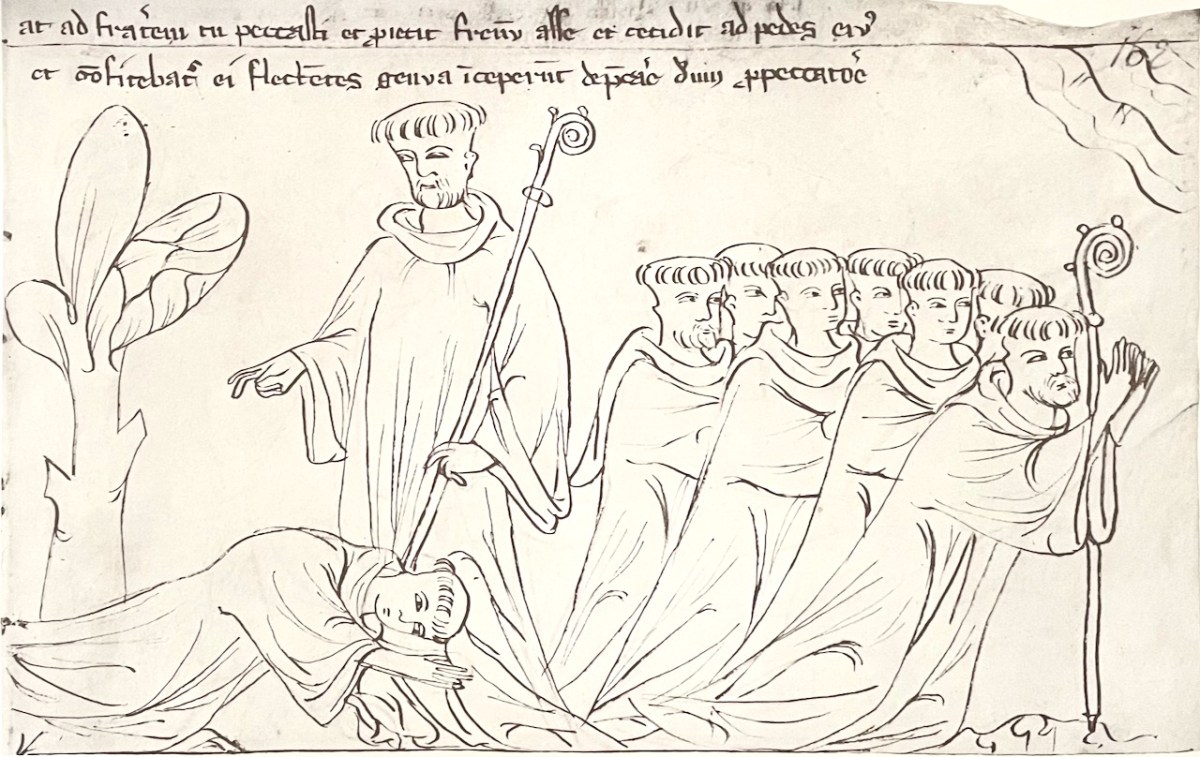

. . . and fell at the feet of the man of God, crying: “Father, I have sinned: pardon! pray for the salvation of my soul.” And, at the same moment, all fell down to pray for their brother’s salvation. 
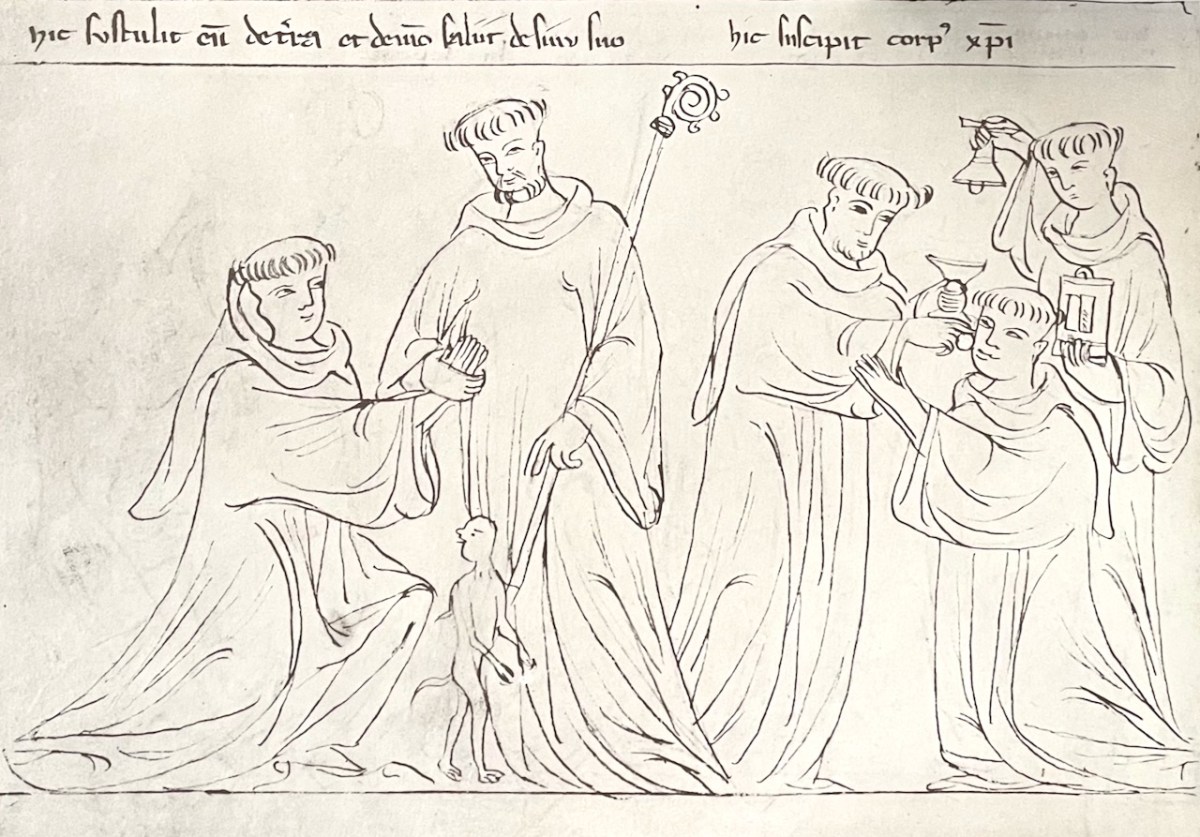
Rising up, they saw the wretched Ethiop escape from the guilty man’s bosom, howling and crying : “Why drive me, O man of God, from my abode, where for seven years I have dwelt, and thus expel me from my inheritance. Brendan immediately turned to the brother, and said: “Receive promptly the Body and Blood of Christ, for thy soul is about t leave thy body, and this is the place of thy burial. But, thy brother, who came with you from the monastery, shall find his place of sepulture in hell.” Whereupon, that penitent monk received Holy Eucharist . . .
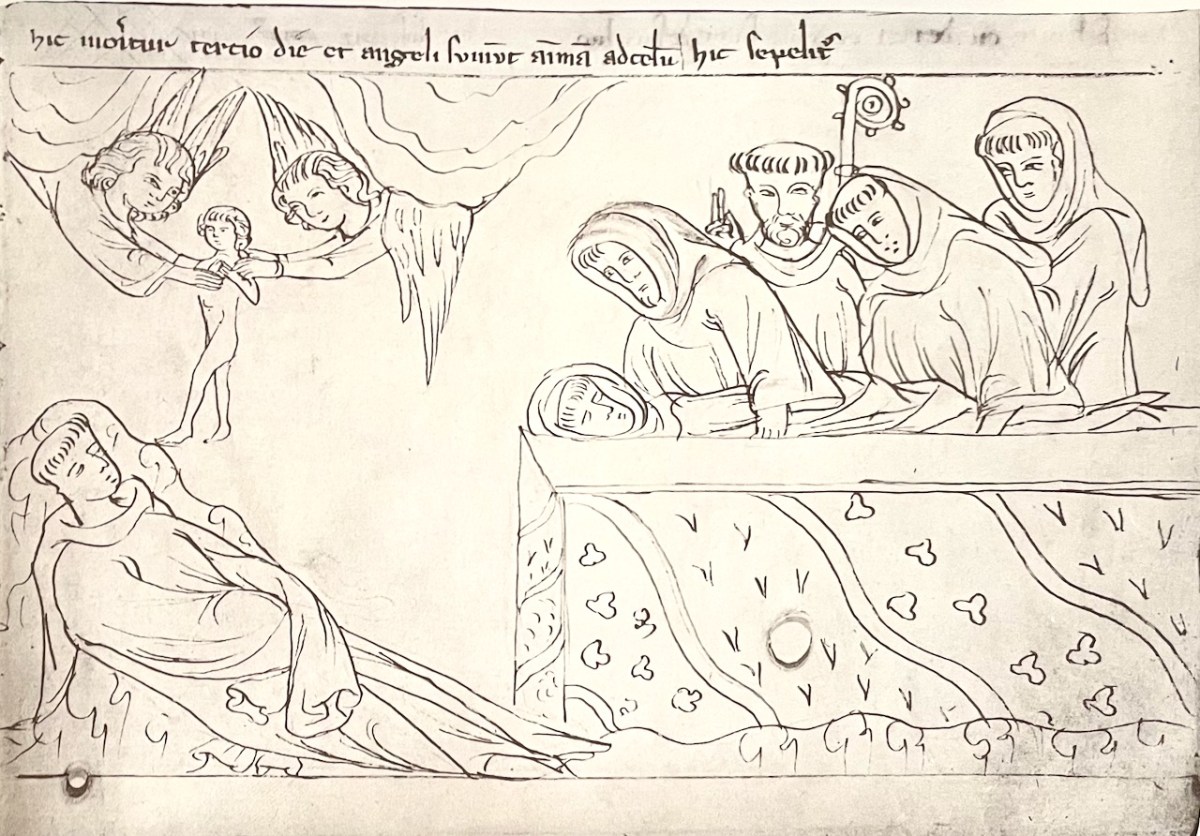
. . . and his soul departed; but, it was received by Angels, in the sight of the other monks. His body was then buried. Also, St. Brendan had ordered the expulsed demon, in God’s name, to hurt no person, until the Day of General Judgment.

There’s more of course, and I am undecided whether to continue next time or come back to it later. I’ll sleep on it, and dream of the Land of Promise and of picnicking on the back of a whale.
Part 1 is here.

Brigid 1500: Mary of the Gael

St Brigid, according to some accounts, died in 524. Therefore, we are celebrating this year the 1500th anniversary of her death. Once again, I have gone back to primary sources for incidents from her life and am illustrating them with stained glass images. This year I have added as a source the famous Canon O’Hanlon’s Life, from his Lives of the Irish Saints Series, Vol 2, a work of overwhelming erudition.

The Patrick and Brigid window in Meath Hill, by George Walsh. I love that Brigid has precedence over Patrick in this enormous cruciform window

If you haven’t already done so, now is a good time to go back and read my 2022 post, St Brigid: Dove Among Birds, Vine Among Trees, Sun Among Stars and my 2023 post, Brigid: A Bishop in All But Name. In them, I explain what the original sources for the Life of Brigid are. They all contain similar accounts and may be ultimately based on a single source – the Life of St Brigid by St Ultán – and are laid out as a series of miracles that lead us from her birth to her death.

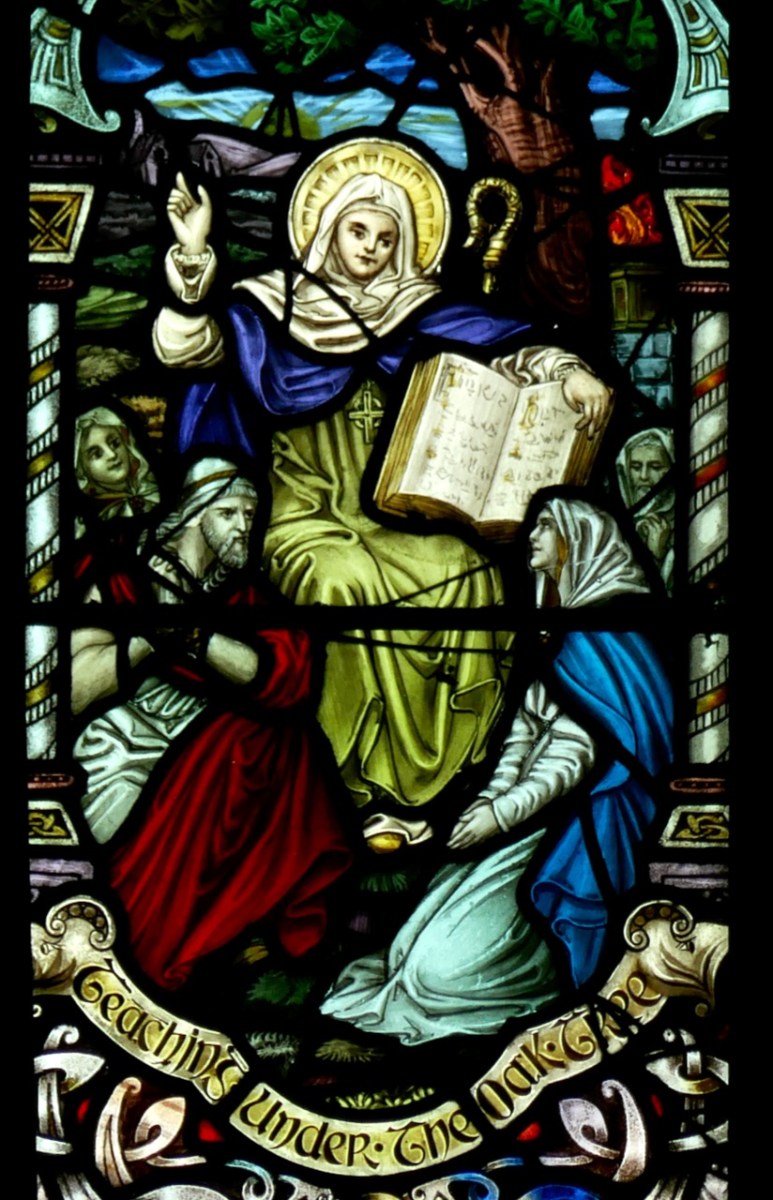
This is a detail from a window in Ballynahown, Co Westmeath, and is probably by Watson of Youghal. I like the clever way the oak leaves are used as frame and background

Many more miracles, legends, myths and stories accreted to her cult over the centuries. A good example of such a story is the one where she makes a cross from rushes – that one is nowhere to be found in the original Lives, but is an integral part of the folklore surrounding her, and therefore almost invariably found in her iconography.

This is a photo by Frank Fullard, used with permission and thanks. It is a simple treatment of St Brigid from Kilmaine, Co Mayo

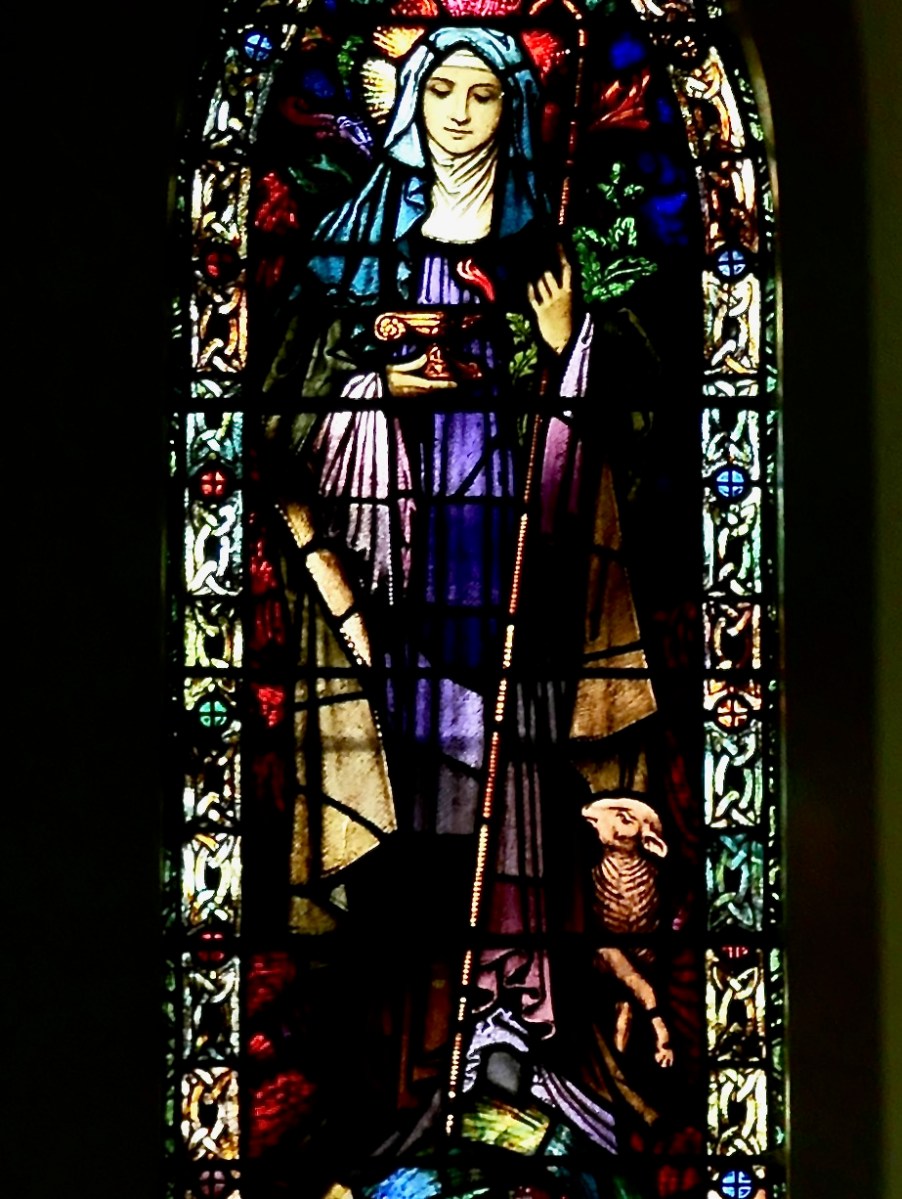
She is associated with many places and numerous holy wells – just take a look at all the St Brigid’s wells Amanda has documented in Cork and Kerry. But of course it is Kildare that rightly claims her. Kildare (Cill Dara – the Church in the Oak Wood) is where she built her church and established her city. It is the origin of three of the attributes we see in many windows – a church, oak leaves and a lamp. (For the story about the Bishop’s Crozier, see the previous posts.)

Detail from the Brigid Window in Carrickmacross – she’s consulting with her architects

The Book of Lismore has this story about building the church:

Brigit went to Bishop Mel, that he might come and mark out her city for her. When they came thereafter to the place in which Kildare stands to-day, that was the time that Ailill, son of Dunlang, chanced to be coming, with a hundred horseloads of peeled rods, over the midst of Kildare. Then maidens came from Brigit to ask for some of the rods, and refusal was given to them. The horses were (straightway) struck down under their horseloads to the ground. Then stakes and wattles were taken from them, and they arose not until Ailill had offered the hundred horseloads to Brigit. And therewith was built Saint Brigit’s great house in Kildare, and it is Ailill that fed the wrights and paid them their wages. So Brigit left (as a blessing) that the kingship of Leinster should be till doomsday from Ailill, son of Dunlang.

Detail from the Brigid window in Sneem, Co Kerry, by Watson of Youghal

It was a large establishment. O’Hanlon says:

We are informed, that her Rule was followed, for a long time, by the greatest part of those monasteries, belonging to sacred virgins in Ireland; nearly all of these acknowledging our saint as their mother and mistress, and the monastery of Kildare as the headquarters of their Order. Moreover, Cogitosus informs us, in his prologue to her life, that not only did she rule nuns, but also a large community of men, who lived in a separate monastery. This obliged the saint to call to her aid, and from out his solitude, the holy bishop, S. Conlaeth, to be the director and spiritual father of her religious; and, at the same time, to be bishop of the city. The church at Kildare, to suit the necessities of the double monastery and to accommodate the laity, was divided by partitions into three distinct parts. One of these was reserved for the monks; one for the nuns; while a third compartment was intended to suit the requirements of the laity.

Harry Clarke’s 1924 window in Cloughjordan is of the Ascension with Irish Saints – this is a young St Brigid, holding her church

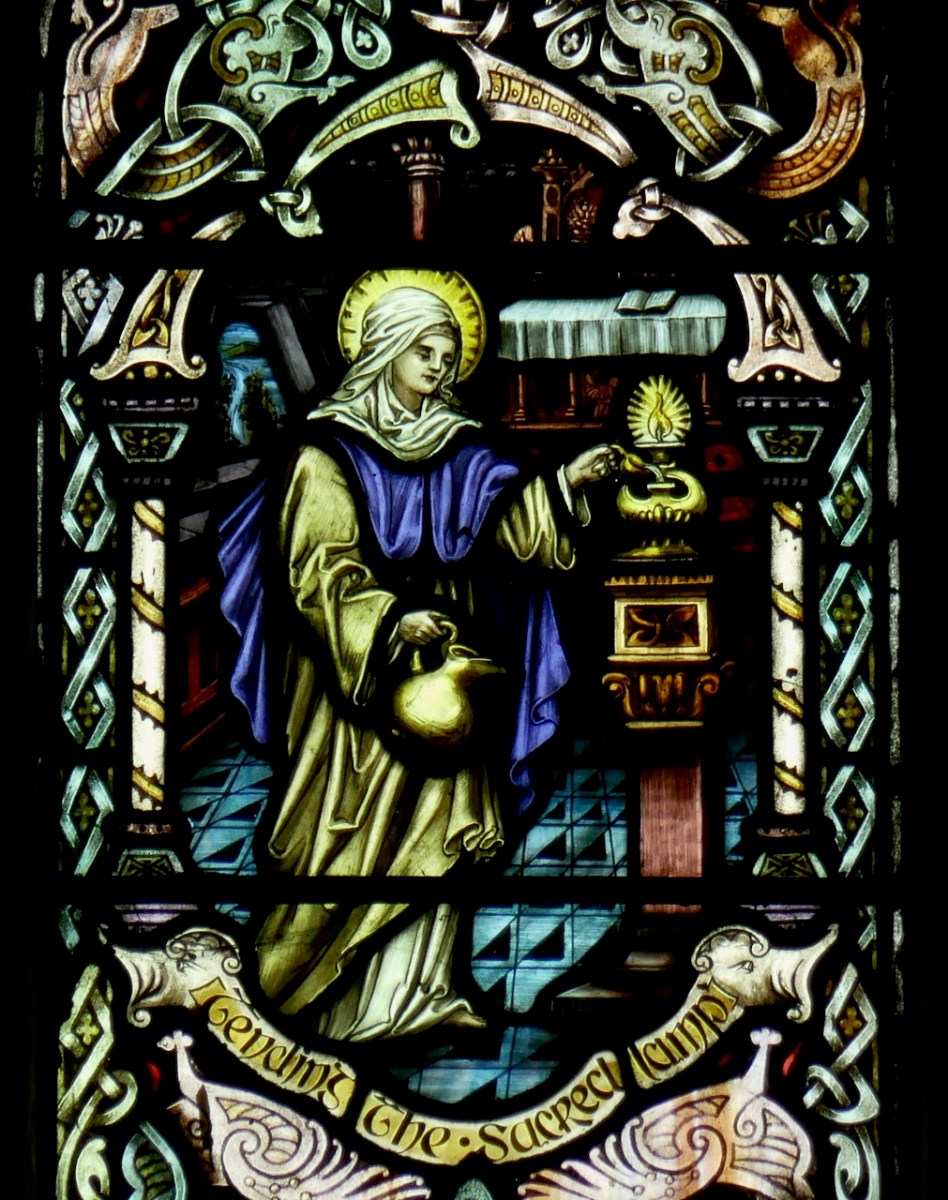
And what about the lamp? This is interesting, as its first appearance was not in any of the lives but in the writings of the notorious Giraldus Cambrensis, Gerald of Wales. He will get a post of his own in due course, but for the moment, if you are not familiar with him, there’s a delightful sketch of him and his writings about Ireland in the 12th century here.

Brigid window in Kilgarvan, Co Kerry, by Earley and Co

Here is his story about the sacred fire, now usually rendered as a lamp, as faithfully related by O’Hanlon:

Speaking of Kildare city, in Leinster, which had become so renowned, owing to its connexion with our glorious abbess, Giraldus Cambrensis says, that foremost, among many miraculous things worthy of record, was St. Brigid’s inextinguishable fire. Not, that this fire itself was incapable of being extinguished, did it obtain any such name, but, because nuns and holy women had so carefully and sedulously supplied fuel to feed its flames, that from St. Brigid’s time to the twelfth century, when he wrote, it remained perpetually burning through a long lapse of years. What was still more remarkable, notwithstanding great heaps of wood, that must have been piled upon it, during such a prolonged interval, the ashes of this fire never increased.

Another detail from the Watson window in Sneem

What is furthermore remarkable, from the time of St. Brigid and after her death until the twelfth century, an even number, including twenty nuns, and the abbess, had remained in Kildare nunnery. Each of these religious, in rotation, nightly watched this inextinguishable fire. On the twentieth night, having placed wood on its embers, the last nun said:” O Brigid, guard thy fires, for this night the duty devolves on thyself.” Then the nun left that pyre, but although the wood might have been all consumed before morning, yet the coals remained alive and inextinguishable. A circular hedge of shrubs or thorns surrounded it, and no male person dare presume to enter within that sacred enclosure, lest he might provoke Divine vengeance, as had been experienced by a certain rash man, who ventured to transgress this ordinance. Women only were allowed to tend that fire. Even these attendants were not permitted to blow it with their breath; but, they used boughs of trees as fans for this purpose.

This is the predella from the Brigid window in Moone, by the Harry Clarke Studios (see blow for the main panel)

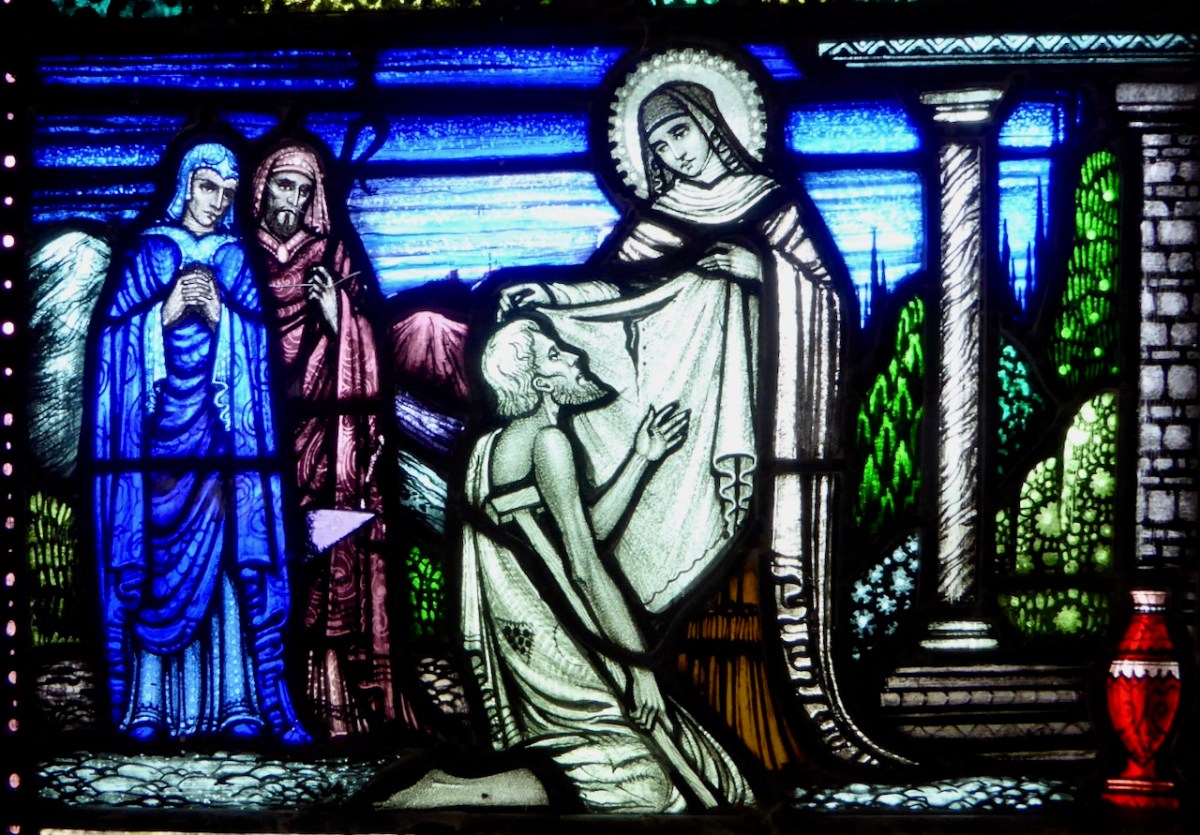
All of the Lives and O’Hanlon’s account tell of Brigid’s many miracles in providing food and clothing for the poor, in healing sicknesses, in turning the hearts of evildoers to God, in freeing slaves, and in punishing those who are selfish or cruel.

Brigid and the Beggar, by William Dowling, Gorey C of I

However, the story I like best perhaps is this one from the Vita Prima: 

In the same place also when saint Brigit was staying as a guest, a married man came with a request that saint Brigit should bless some water for him to sprinkle his wife with, for the wife actually hated the husband. So Brigit blessed some water and his house and food and drink and bed were sprinkled while his wife was away. And from that day on the wife loved her husband with a passionate love as long as she lived.

She may have been a nun, but she obviously served up a good love potion when the situation required it. This story is not only repeated in the Book of Lismore, but embellished, thus: 

When he had done thus, the wife gave exceeding great love to him, so that she could not keep apart from him, even on one side of the house ; but she was always at one of his hands. He went one day on a journey and left the wife asleep. When the woman awoke she rose up lightly and went after the husband, and saw him afar from her, with an arm of the sea between them. She cried out to her husband and said that she would go into the sea unless he came to her.

The aged St Brigid by George Stephen Walsh, in Ballintubber Abbey – another image generously loaned by Frank Fullard

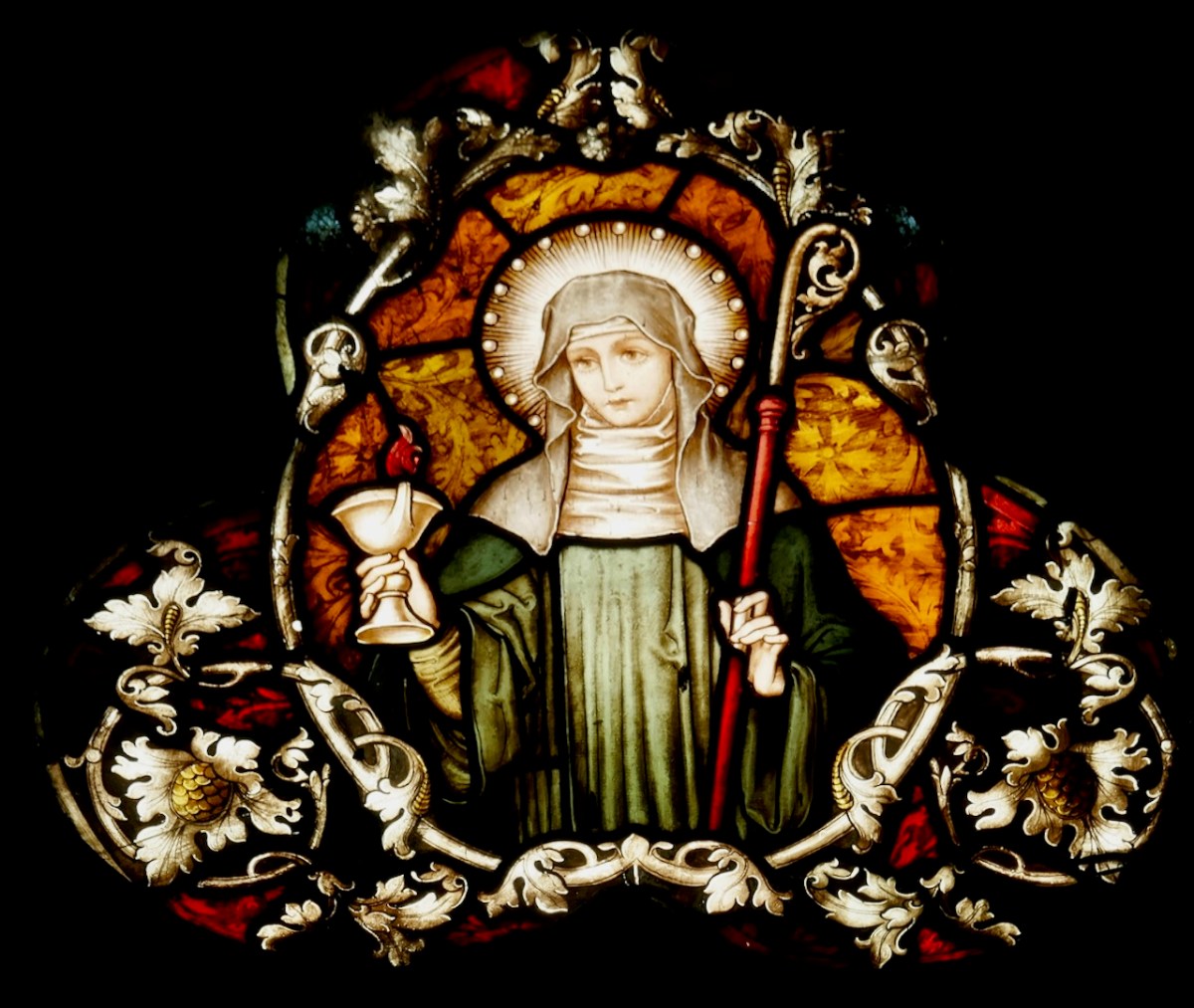
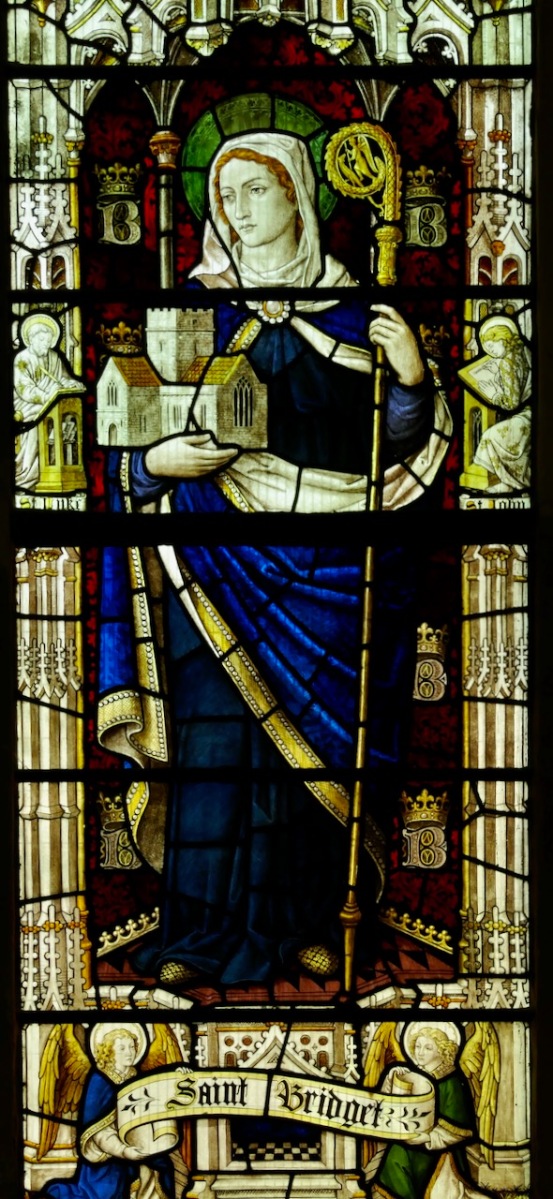
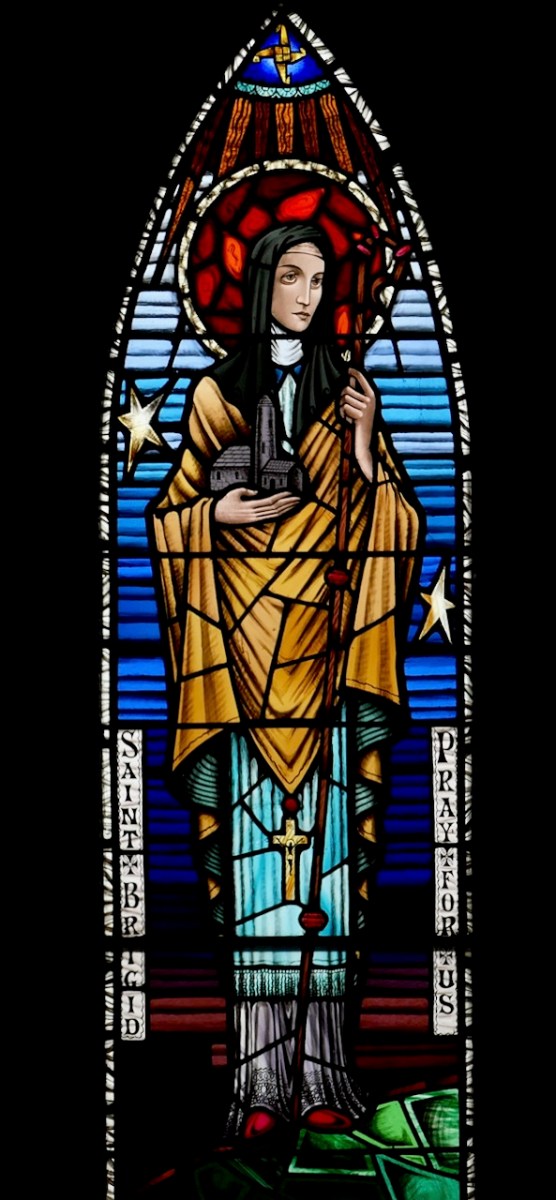
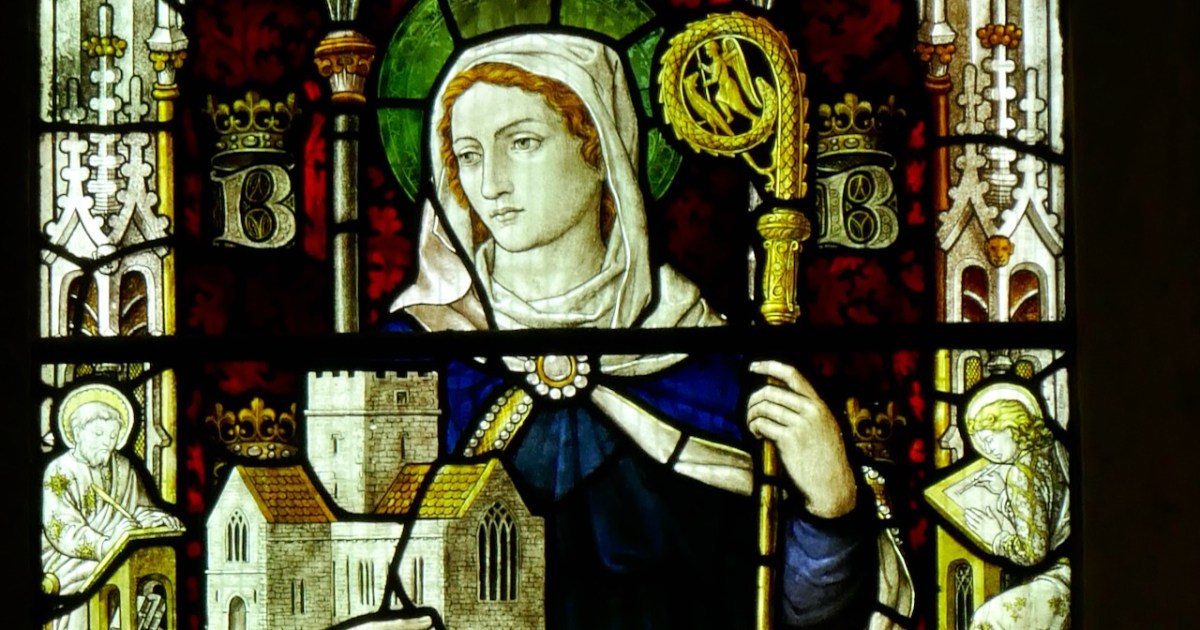
My final point for this post about St Brigid is the matter of where she is buried. Most authorities give this as Downpatrick, where she is laid to rest alongside Patrick and Columcille. However, a medieval legend grew that she went to Glastonbury in old age and died there. That is why she is venerated in Britain as well as in Ireland – the top photograph in this post is from the St Brigid window in Exeter Cathedral. Here’s the full window, in which she is flanked, for some reason, by St Luke and St John busily writing their gospels.

Here is another British window, this one designed by Nuttgens in 1952 for St Etheldreda’s Church in London. (Used with thanks under the Creative Commons License – original is here.) It’s a particularly good narrative window, showing the building of her church under the Oak Tree, her crozier, and two cows – there are many stories of milk and cows in the Lives.

But O’Hanlon is having none of the Glastonbury story.

We cannot receive as duly authenticated, or even as probable, several assertions of mediaeval and more recent writers, who have treated concerning this illustrious virgin. It has been stated, that about the year 488, Saint Brigid left Ireland, and proceeded towards Glastonbury. There, it is said, she remained, until advanced in years, on an island, and convenient to the monastery in that place. Whether she died there or returned to Ireland is doubted. But, it seems probable enough, such a tradition had its origin, owing to this circumstance, that a different St. Brigid, called of Inis-bridge, or of Bride’s Island, had been the person really meant. She lived many years on a small island, near Glastonbury, called Brigidae Insula i.e., Brigid’s Bridge. This latter St. Brigid is said to have been buried, at Glastonbury.

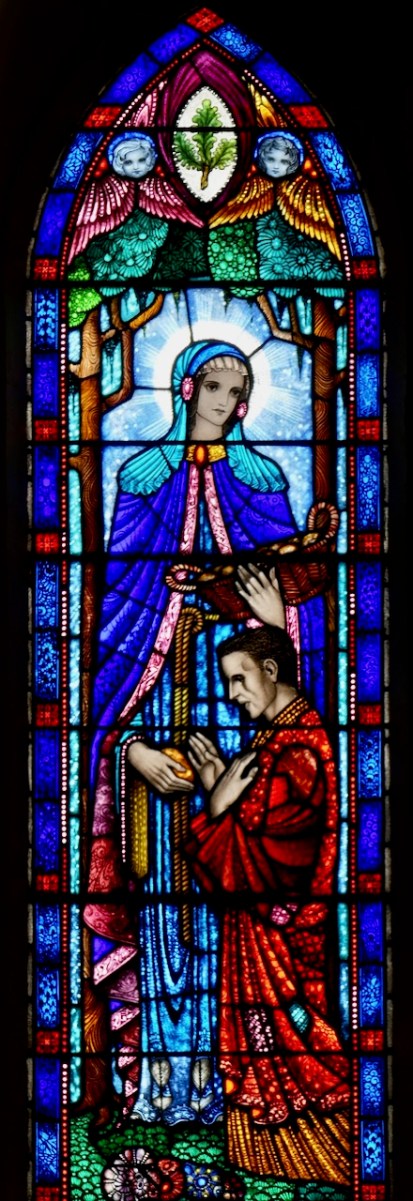
This Brigid window is in Moone, Co Kildare from the Harry Clarke Studios. It features, as do many Brigid windows I have seen, a deer, but I can find no mention of a deer in any of the Lives. Perhaps one of our readers knows where the deer icon comes from?

I will finish with a quote from the Book of Lismore, which gives me the title for this post, and gives Brigid one of her most frequent soubriquets.

It is she that helpeth every one who is in a strait and in danger: it is she that abateth the pestilences: it is she that quelleth the anger and the storm of the sea. She is the prophetess of Christ she is the Queen of the South: she is the Mary of the Gael

I don’t know whose window this is – it’s from Ballybunion – but I love the composition

And a final image from Glynn, Co Wexford, because I love the pared-to-the-bone simplicity of this Richard King medallion..

Posts about St Brigid

St Brigid and AI

Brigid 1500: Mary of the Gael

Brigid: A Bishop in All But Name

St Brigid: Dove Among Birds, Vine Among Trees, Sun Among Stars