The Anglo-Normans in West Cork: Hiding in Plain Sight, Part 2

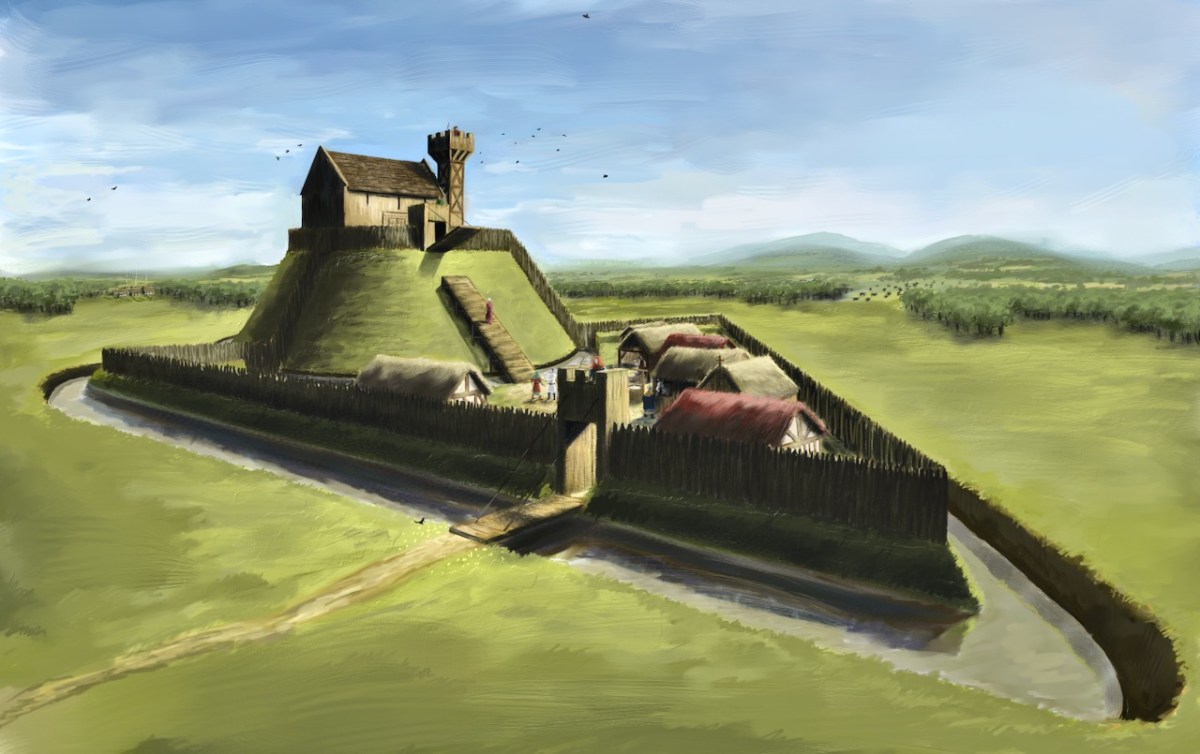
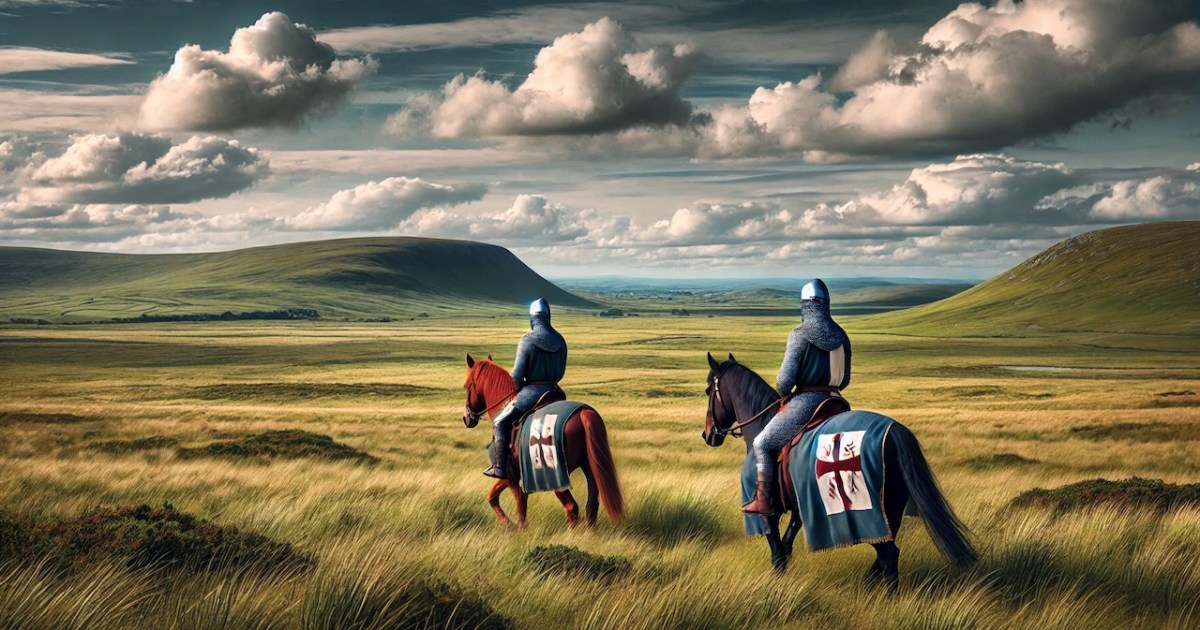
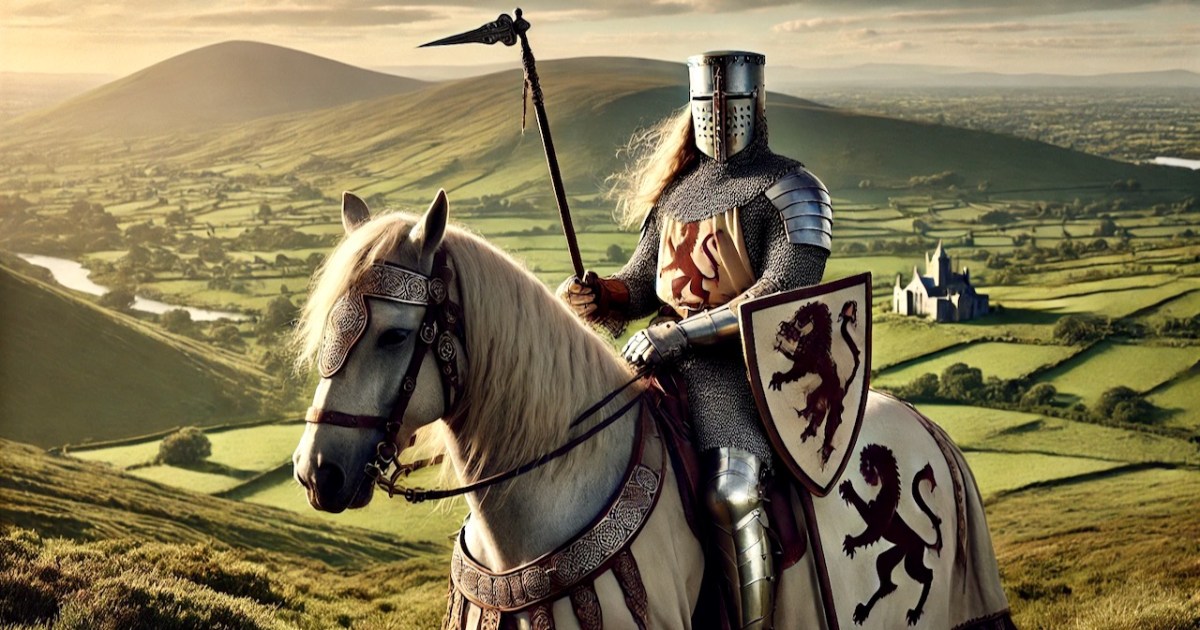
Last week we set out to figure why the Anglo-Normans are curiously absent from the archaeology of West Cork. I told you about our exploration of Castleventry, and how Con Manning immediately suspected this was not your average ringfort, and of course, eventually proclaimed it to be an Anglo-Norman ringwork. I am leading again with an AI-generated image – I am having fun playing around with DALL·E but am under no illusions about its historical accuracy!
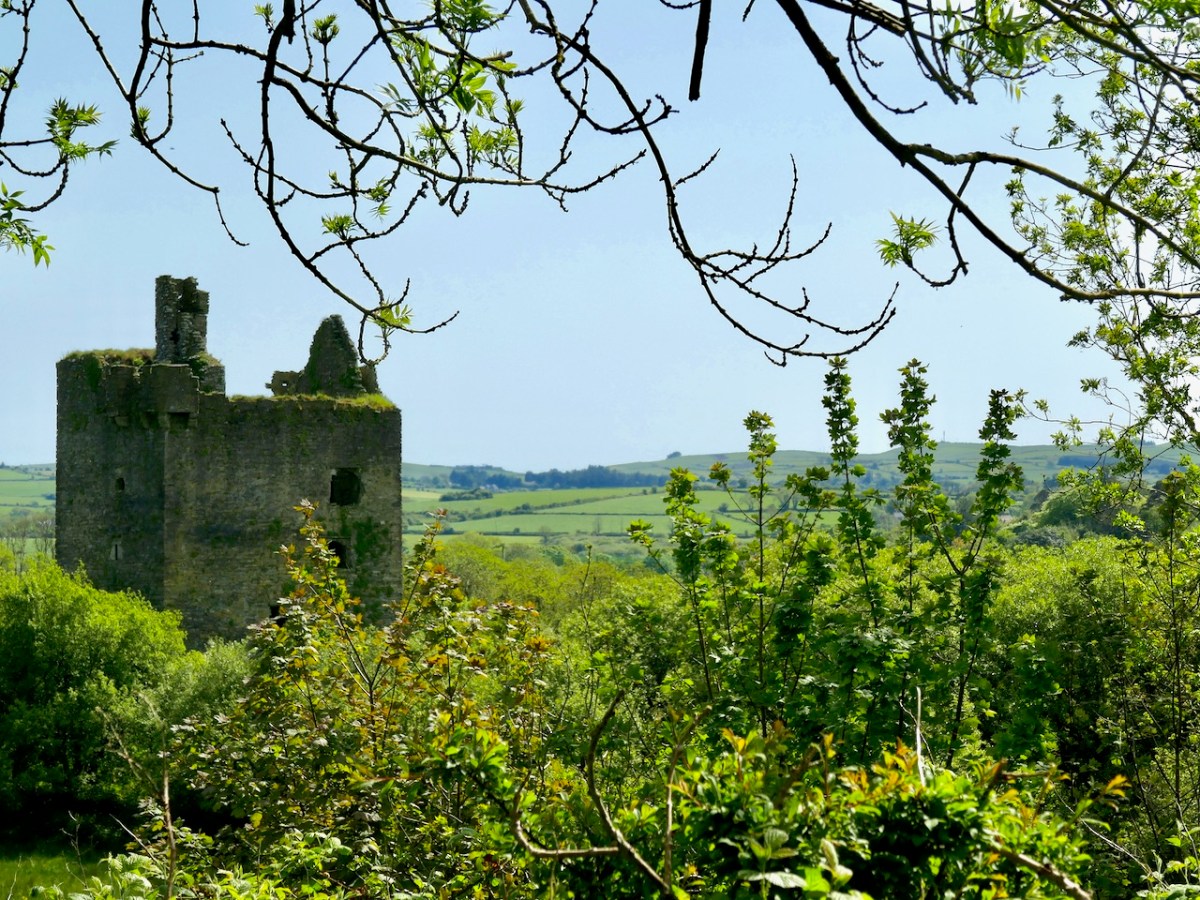
Our next site was courtesy of David Myler, author of the new Walking with Stones. He took us to see an intriguing site at Dunnamark, just outside Bantry. In his book, David also highlights the local convention that this is a Dane’s Fort – a common designation for all kinds of constructions around Ireland.
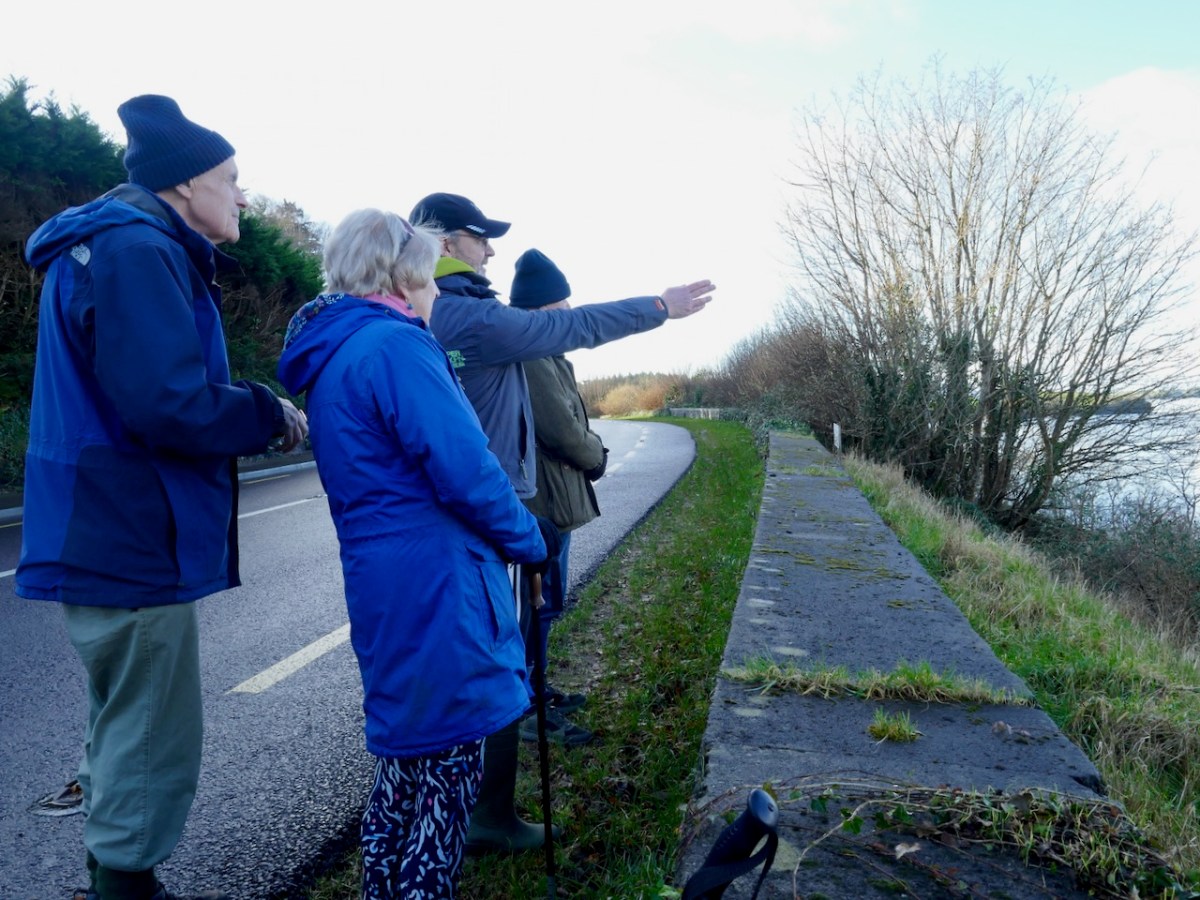
This was another of the sites identified by Dermot Twohig as an Anglo-Norman ringwork. In fact, Dermot said Dunamark is one of the best examples of a ring-work I have seen in either Britain or Ireland. Con concurred. In his book, David also highlights the local convention that this is a Dane’s Fort – a common designation for all kinds of constructions around Ireland.
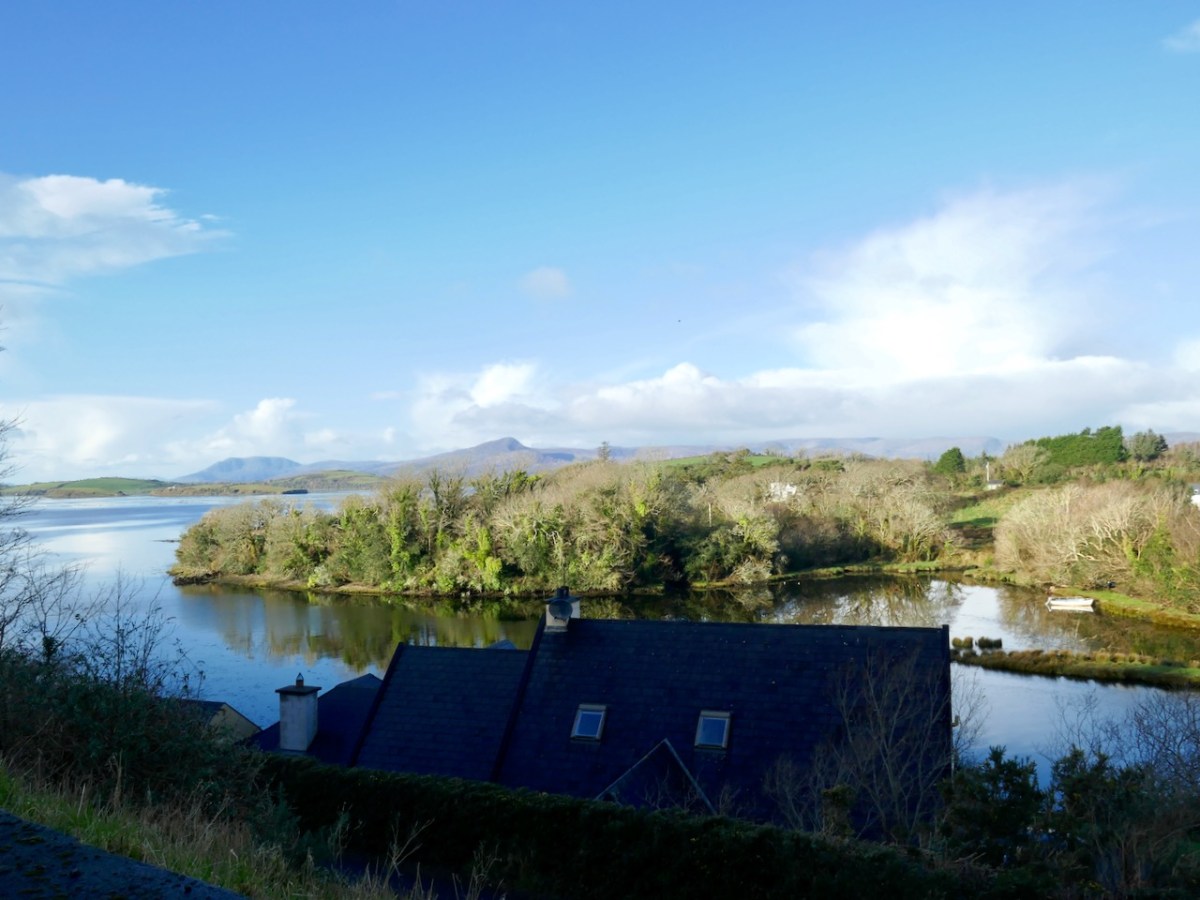
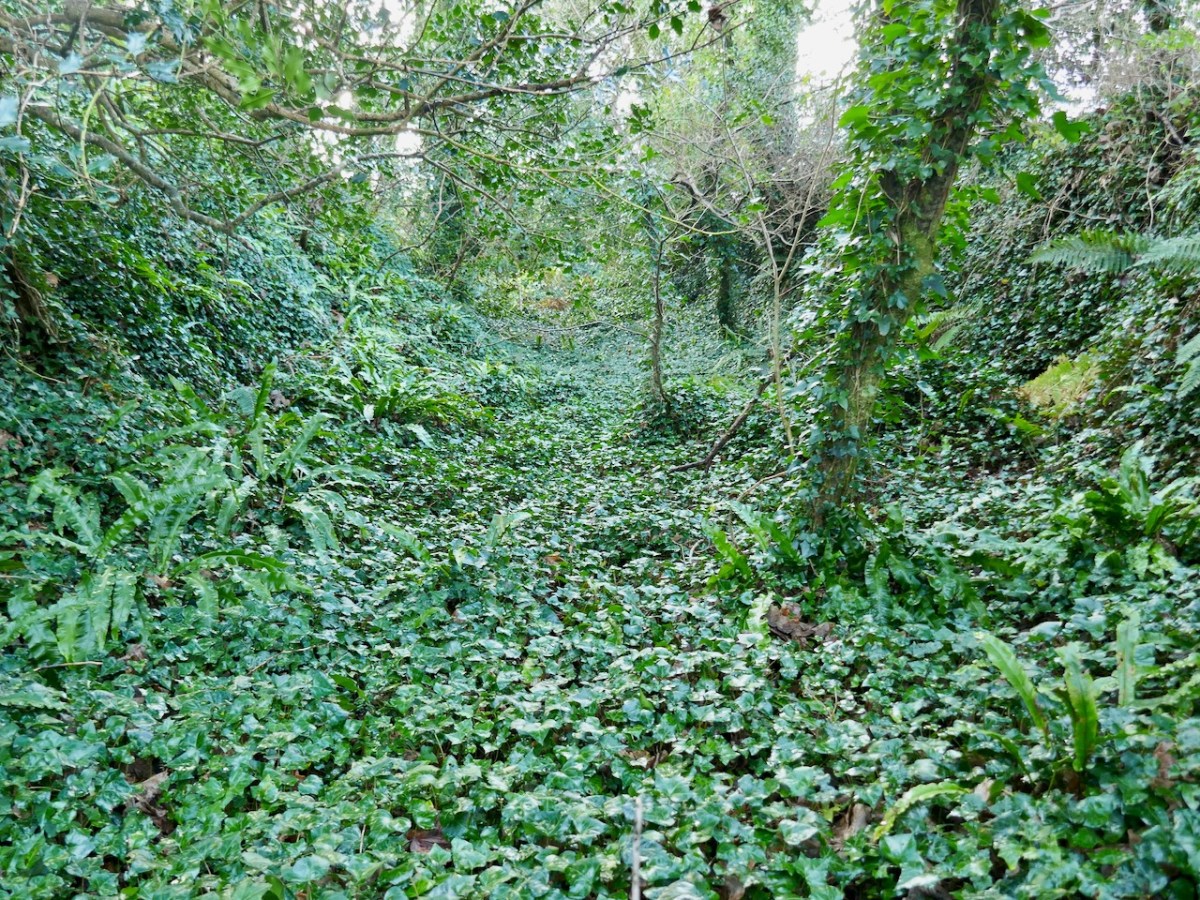
This is another massive fortification, with very deep ditches and a high ‘platform’ as the interior of the fort.
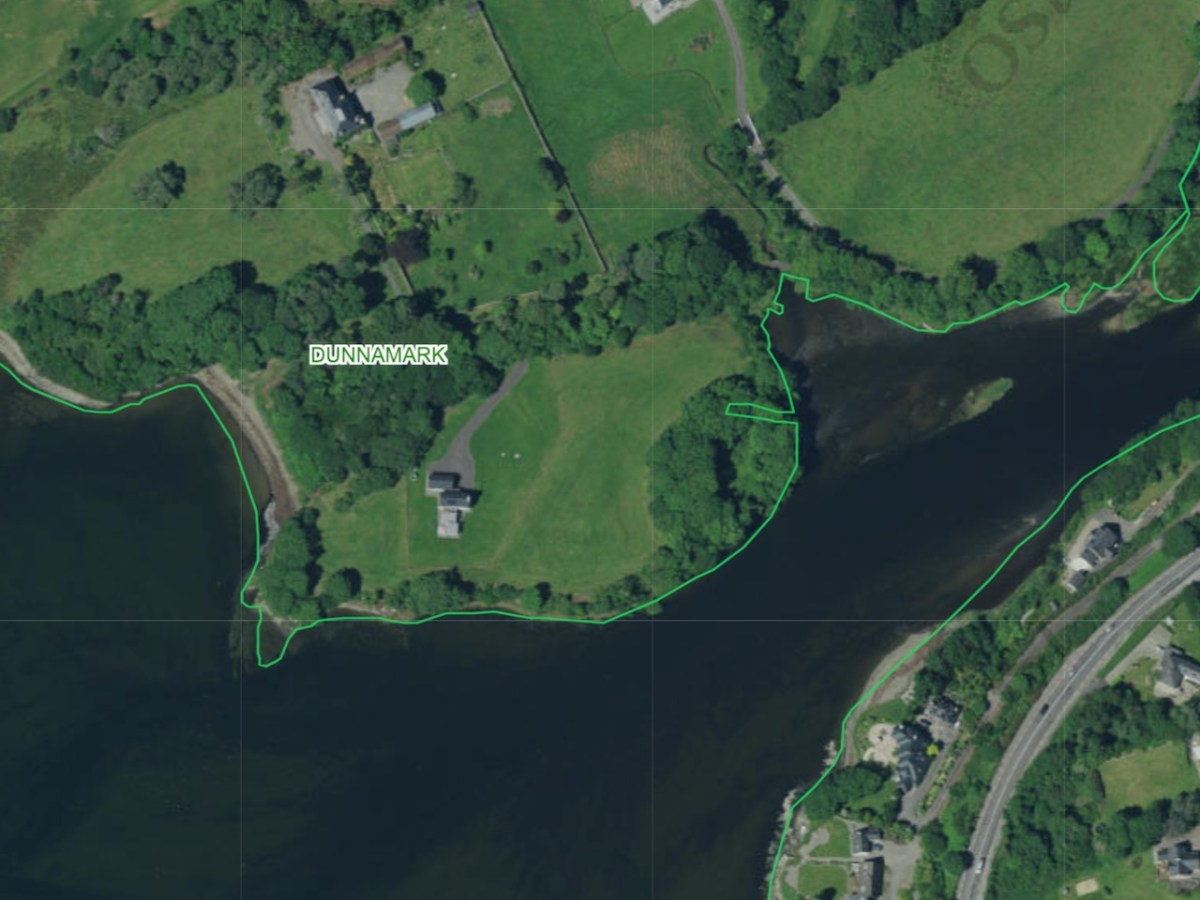
In the National Monuments record it is labelled a ‘cliff-edge fort and is described thus:

Description: In tillage, on cliff edge, on E shore Bantry Bay. Roughly D-shaped area enclosed by earthen bank S->NNE, with external fosse; slightly convex cliff edge NNE->S. Possible souterrain (CO118-004002-) in interior.
In his article in Archaeology Ireland, Con points out that 

Dunnamark was a particularly important castle, having been one of two demesne manors of the Carews in West Cork, and the caput of the cantred of of Foniertheragh.
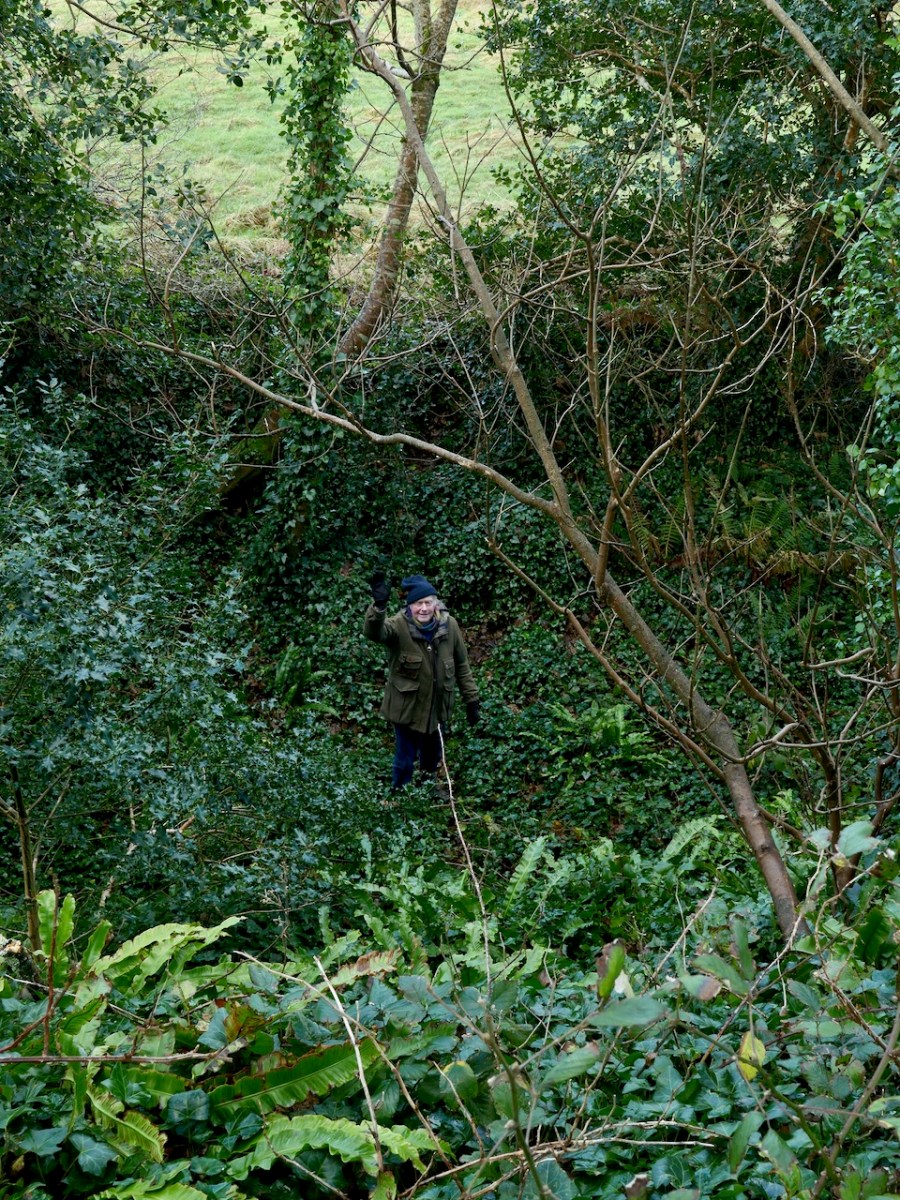
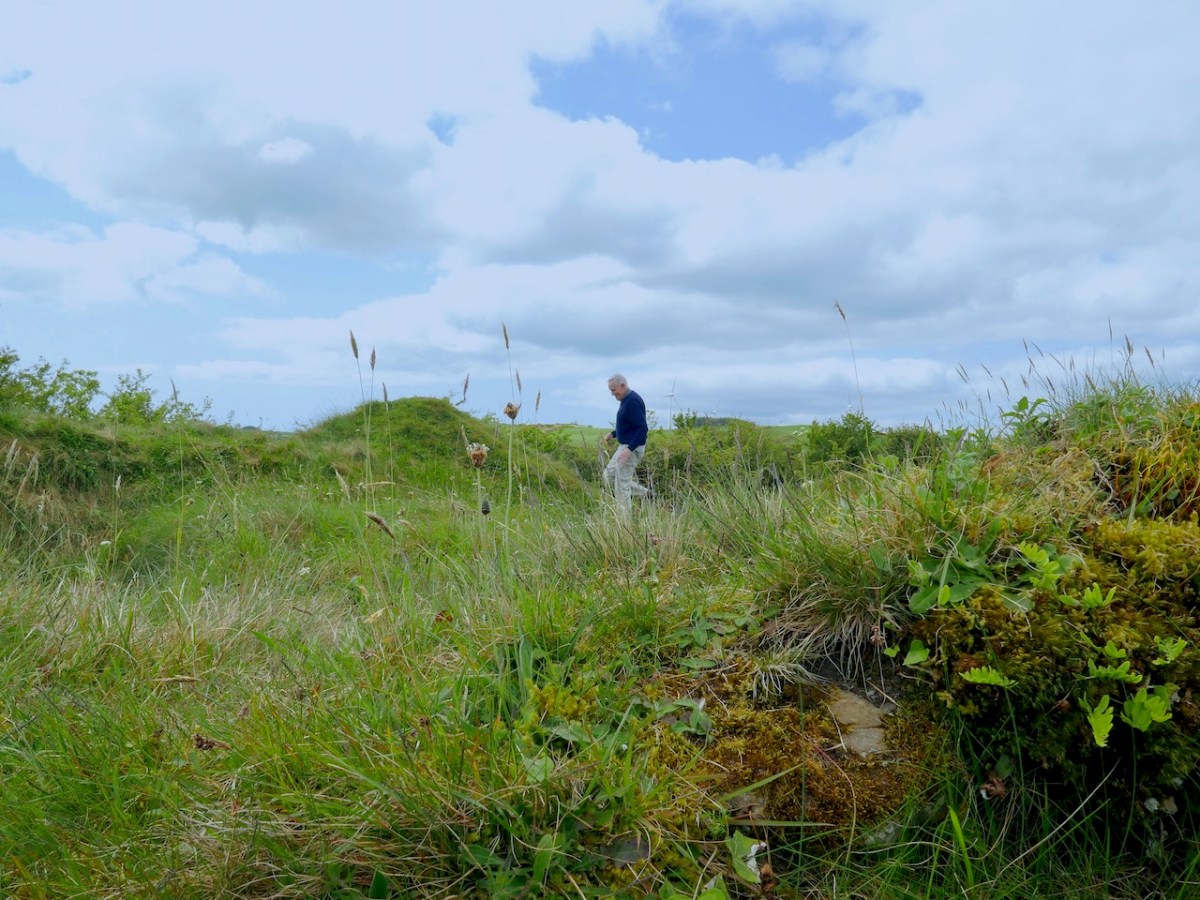
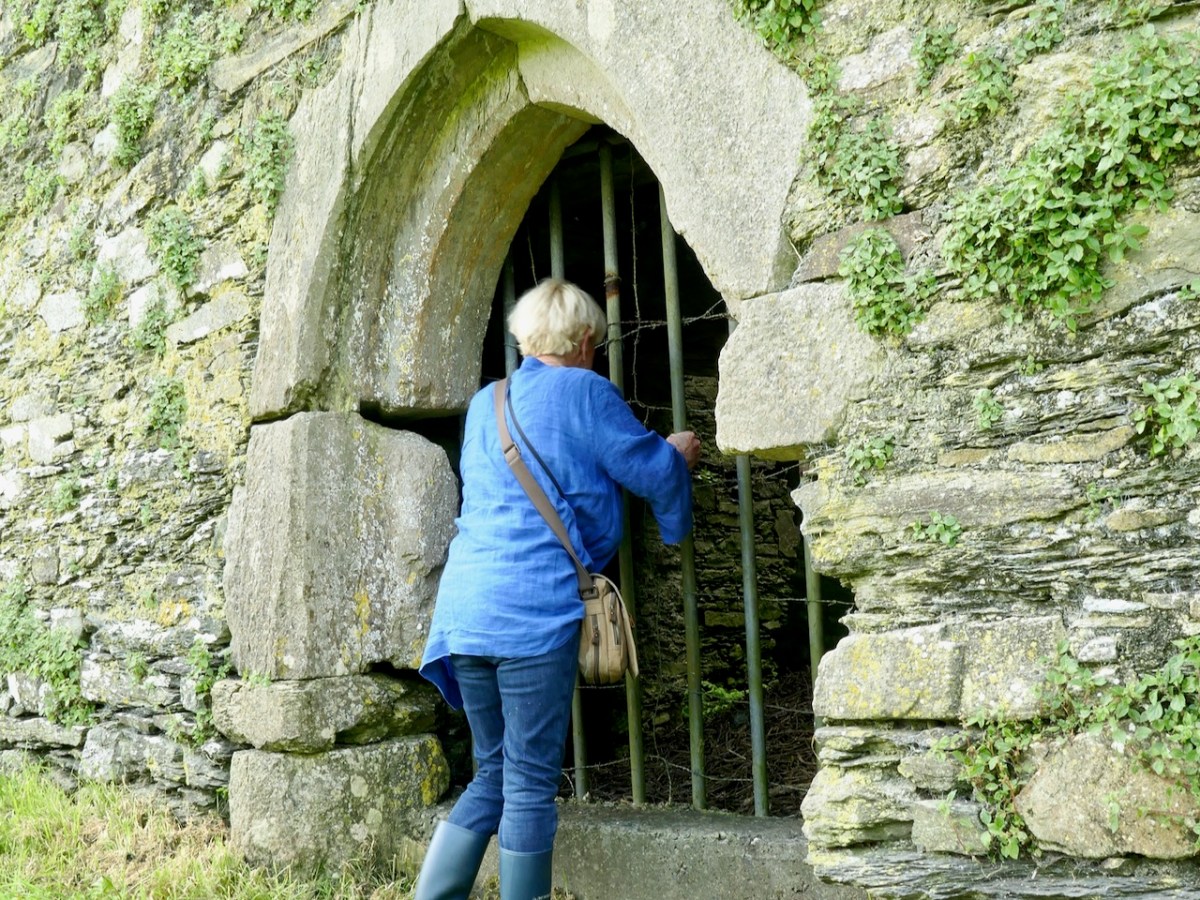
He also says that a low-level bit of a masonry set into the central mound and parallel with the entrance causeway might be part of the counter balance slots of a drawbridge. Here’s what Con was looking at – it takes a medieval archaeology specialist to recognise such an unpromising set of stones.
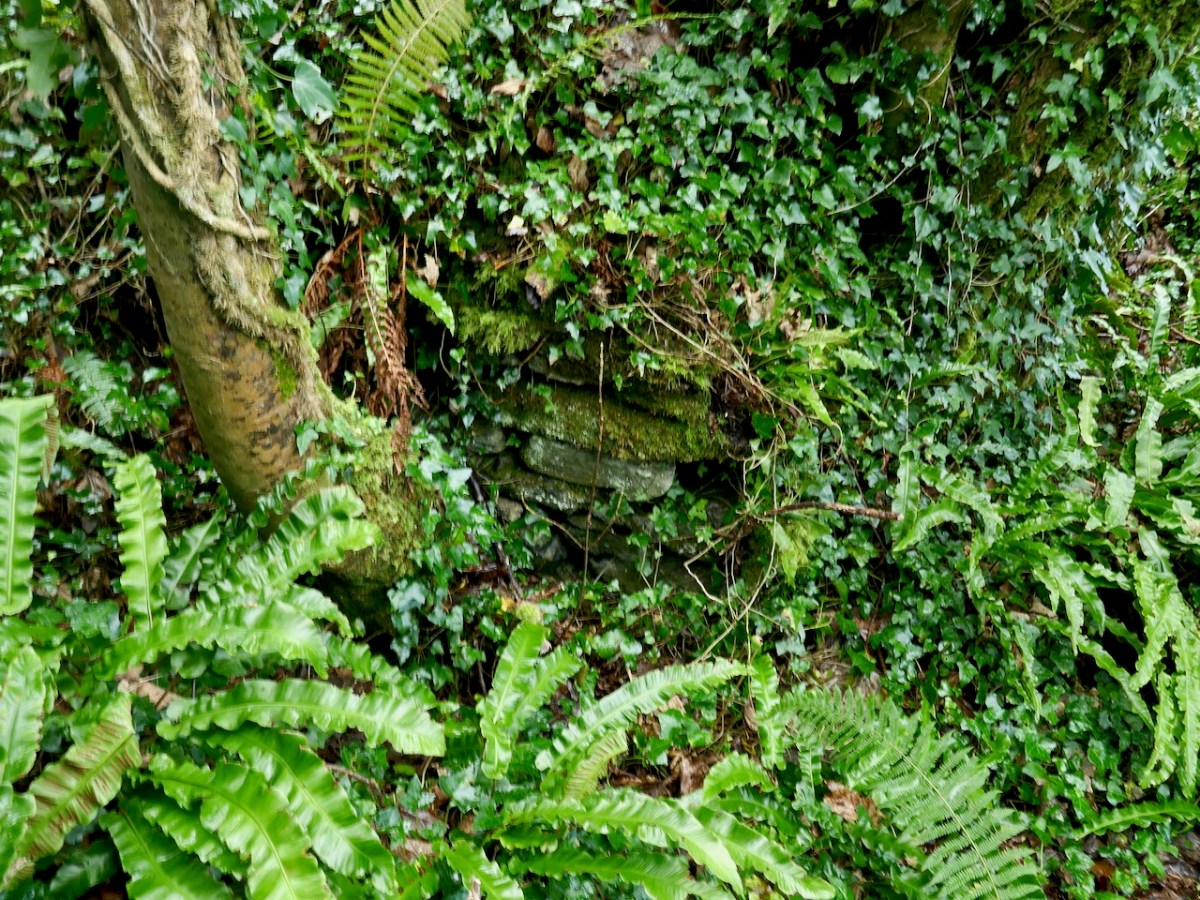
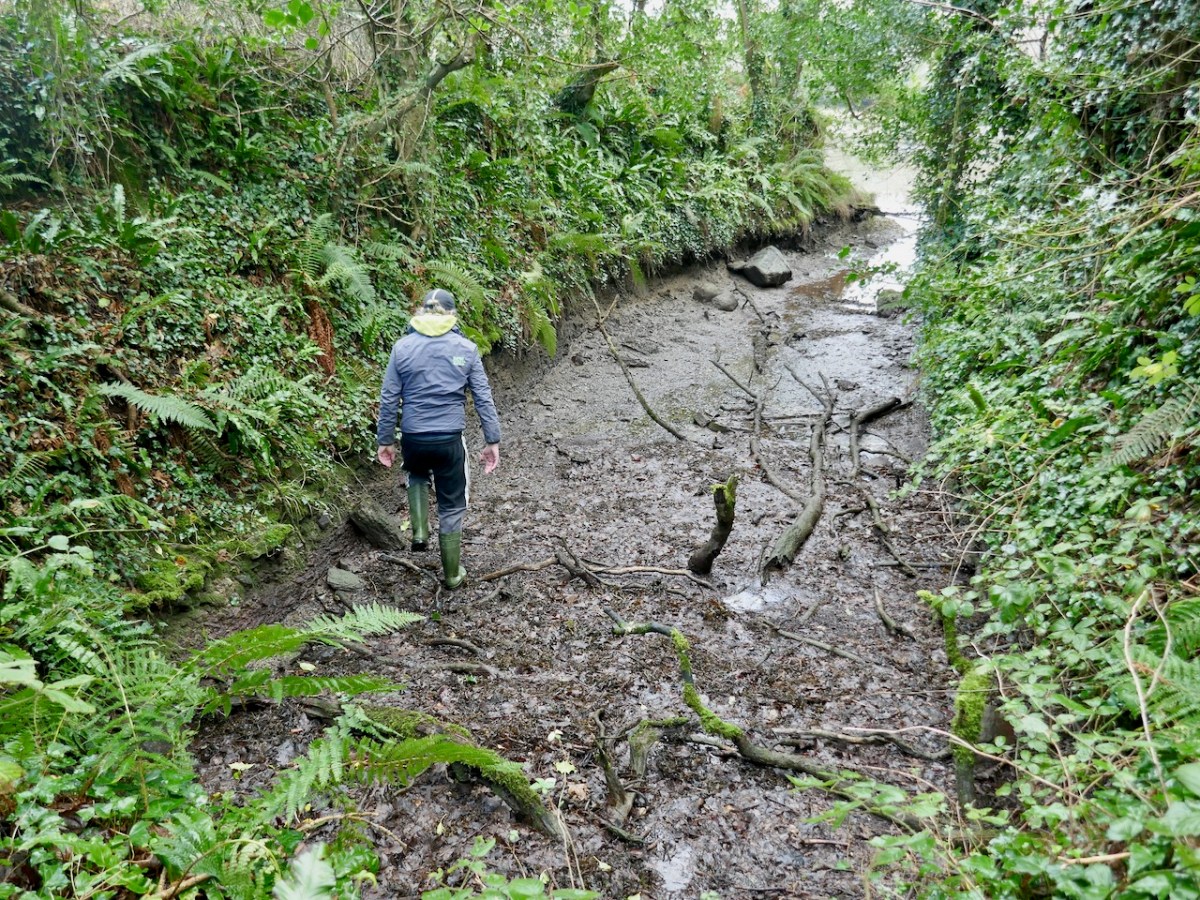
Another interesting feature of this site is the narrow channel riught beside the bank, which would have allowed small boats to come right up to the fort.
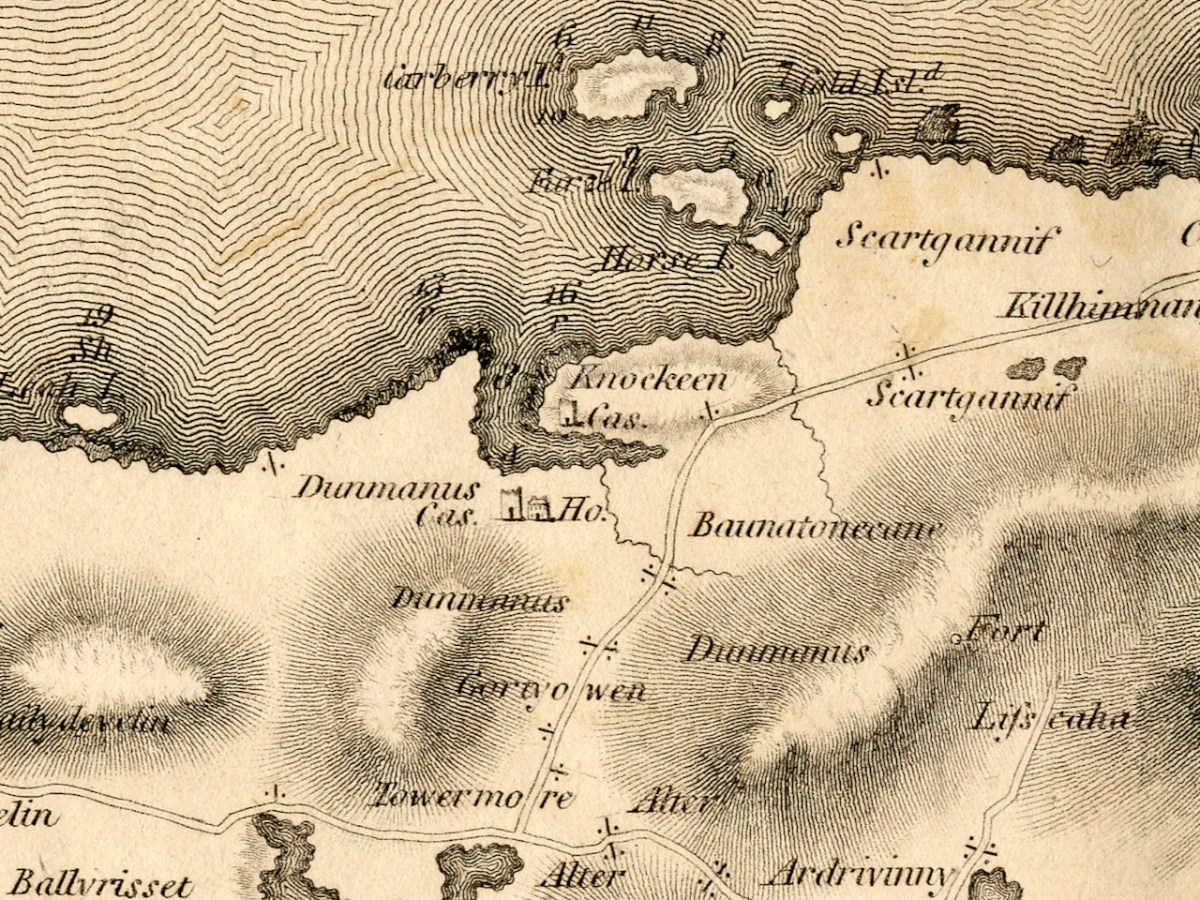
Our third site may be familiar with regular readers – it’s the site I described as the original Dunmanus Castle in my post Dunmanus Castle – the Cliff-Edge Fort. Go back and read that now and then come back here.
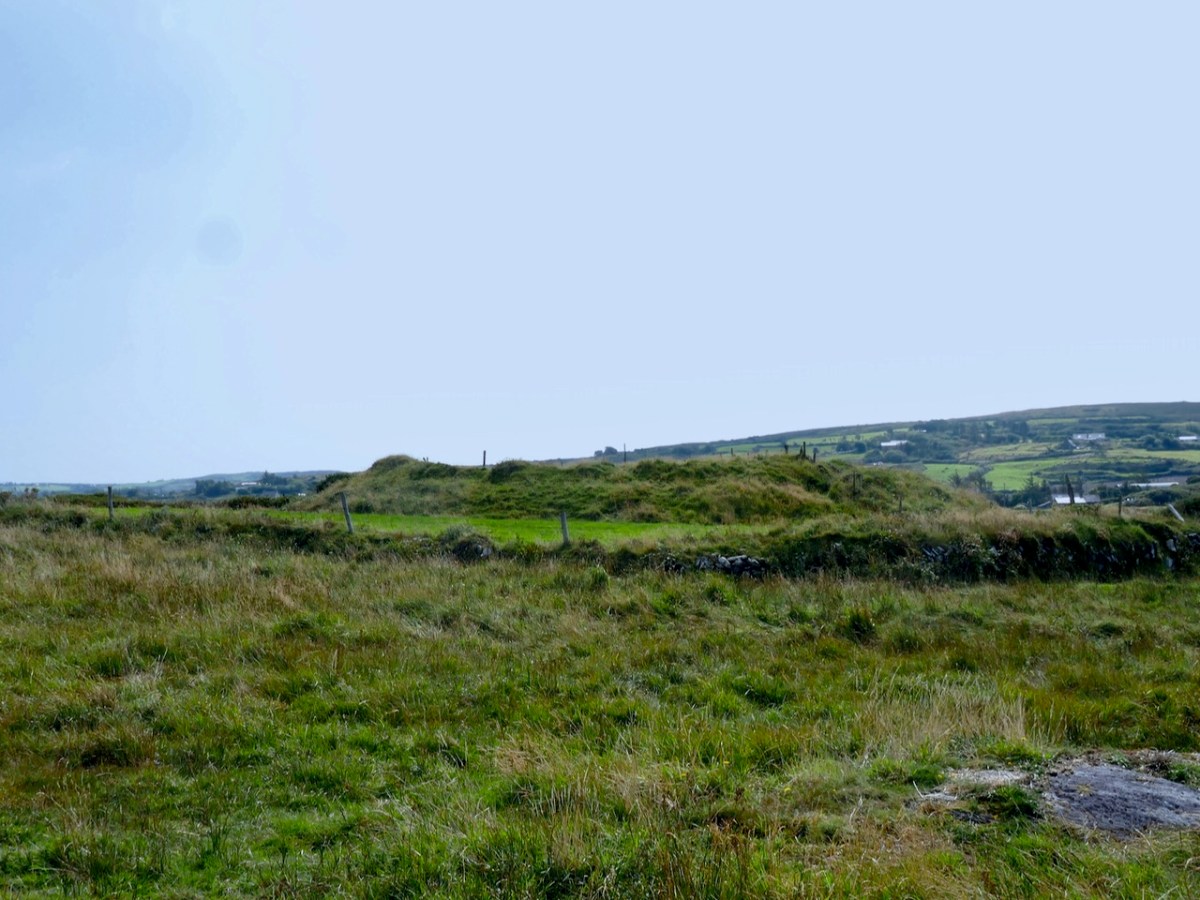
You will see that I was puzzled by it when I saw it and I was really pleased when Con confirmed on a subsequent visit that this could indeed be another Anglo-Norman ringwork. 
Interestingly, since I wrote that post I wrote about the Bath Map of Cork, which shows an actual castle – as complete as Dunmanus Castle, on the site!
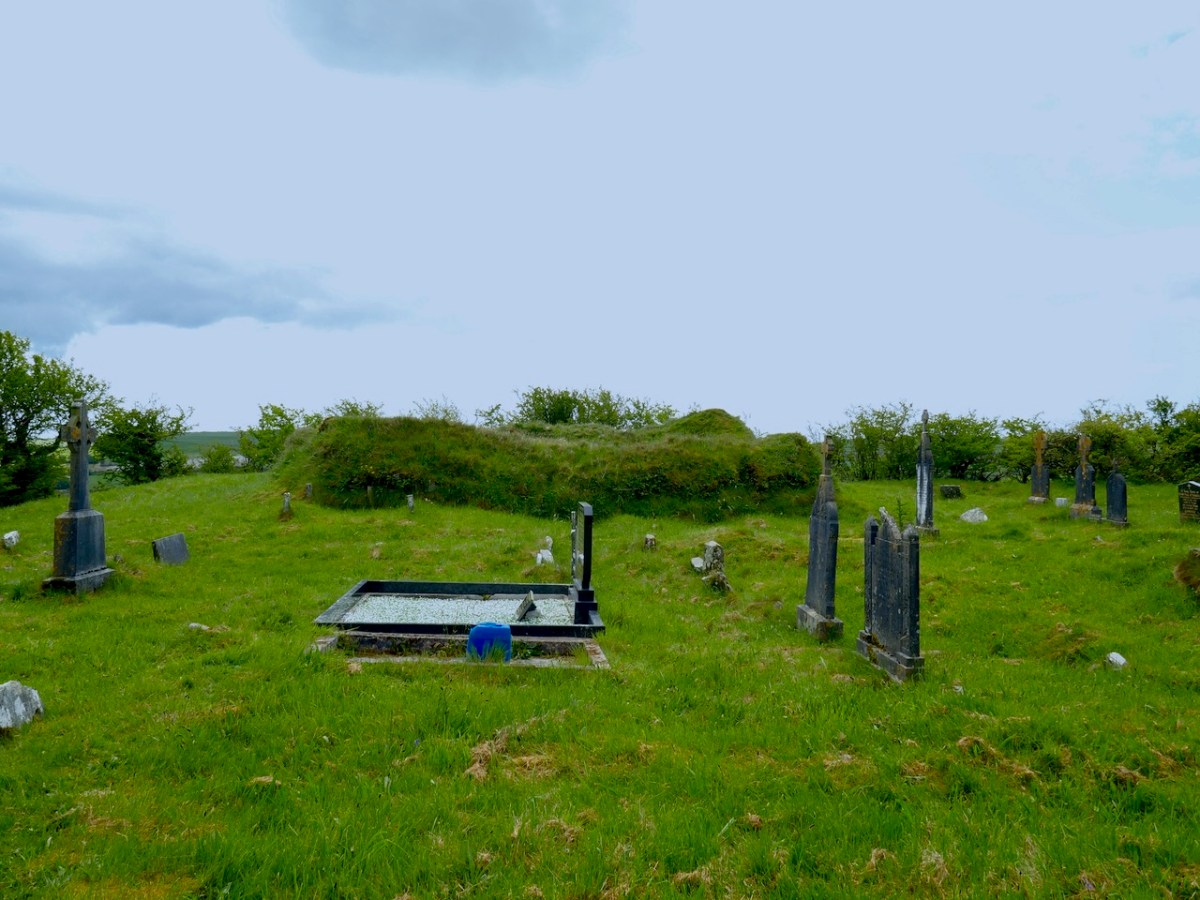
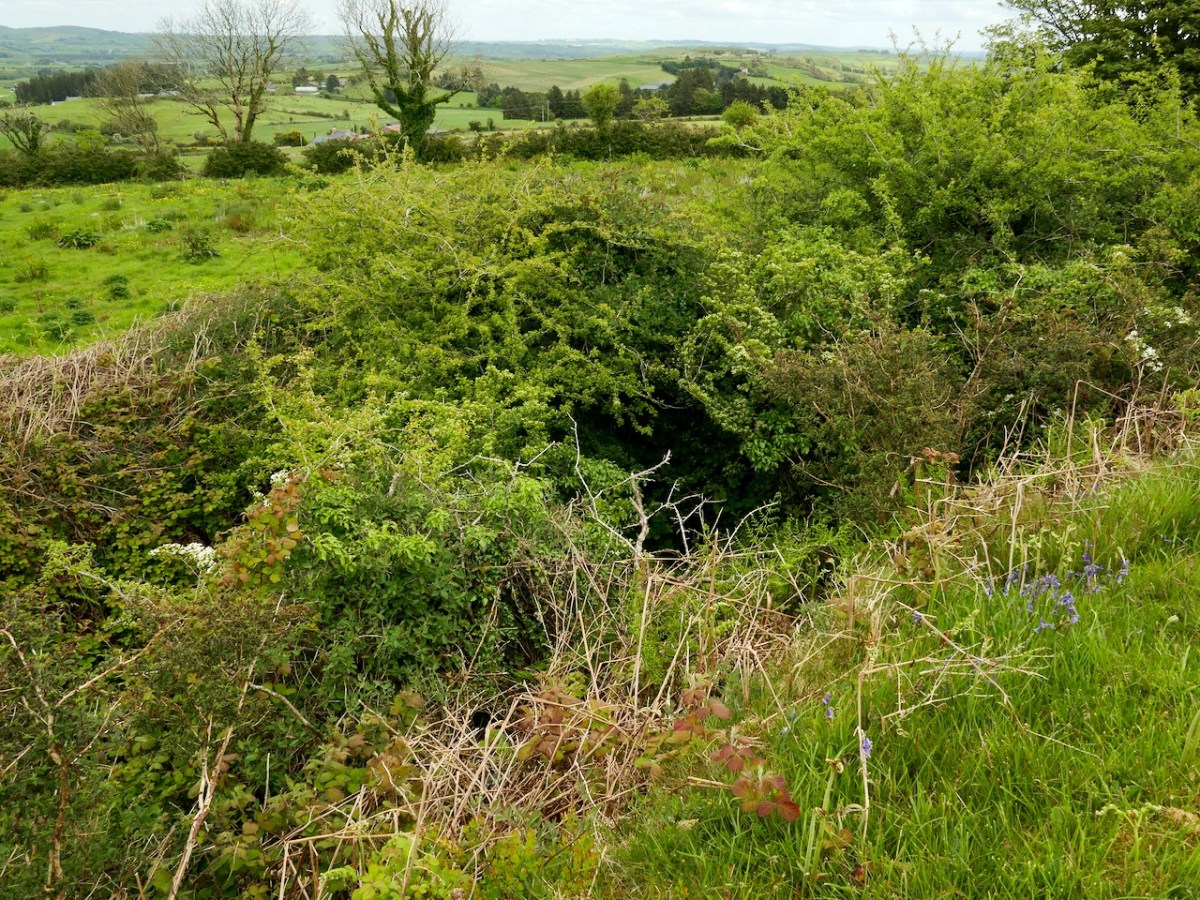
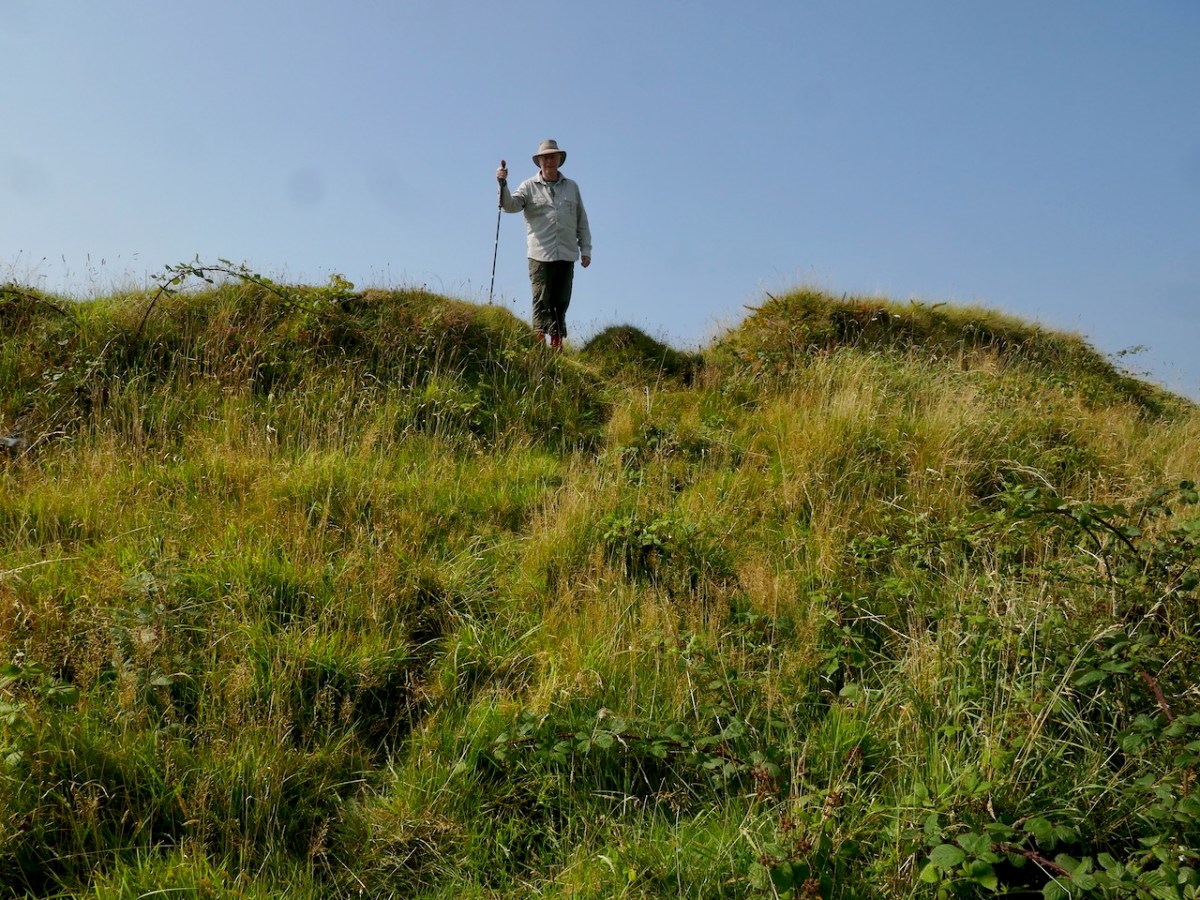
Our final site is at Caheragh, and this one is bit more speculative. A high knoll towers above the ruined church and its surrounding graveyard and on top of that hill is what has been labelled a ringfort. However, once again, it doesn’t quite feel right as a ringfort.
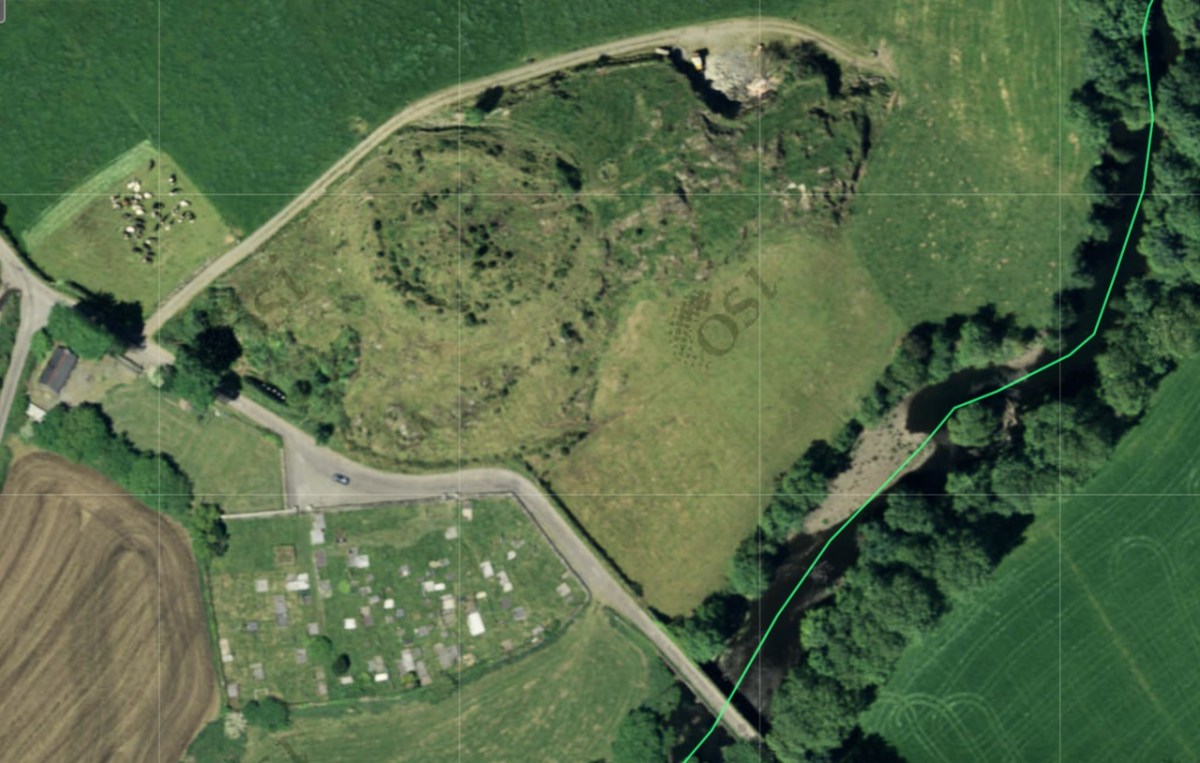
It has panoramic views across the surrounding countryside and sits on the middle of a medieval landscape that includes many ringforts, and an area known as Bishopsland, and the winding Ilen river. 
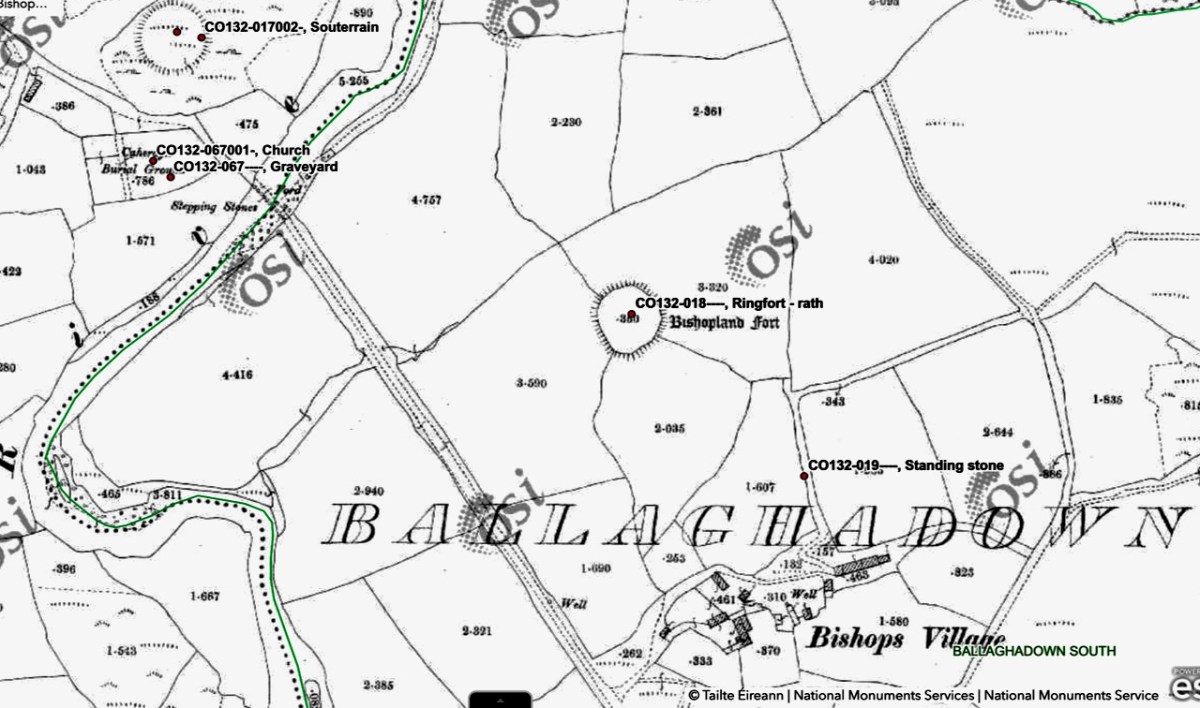
The fort on top has obvious remains of buildings, one of which may be what is left of a small tower.
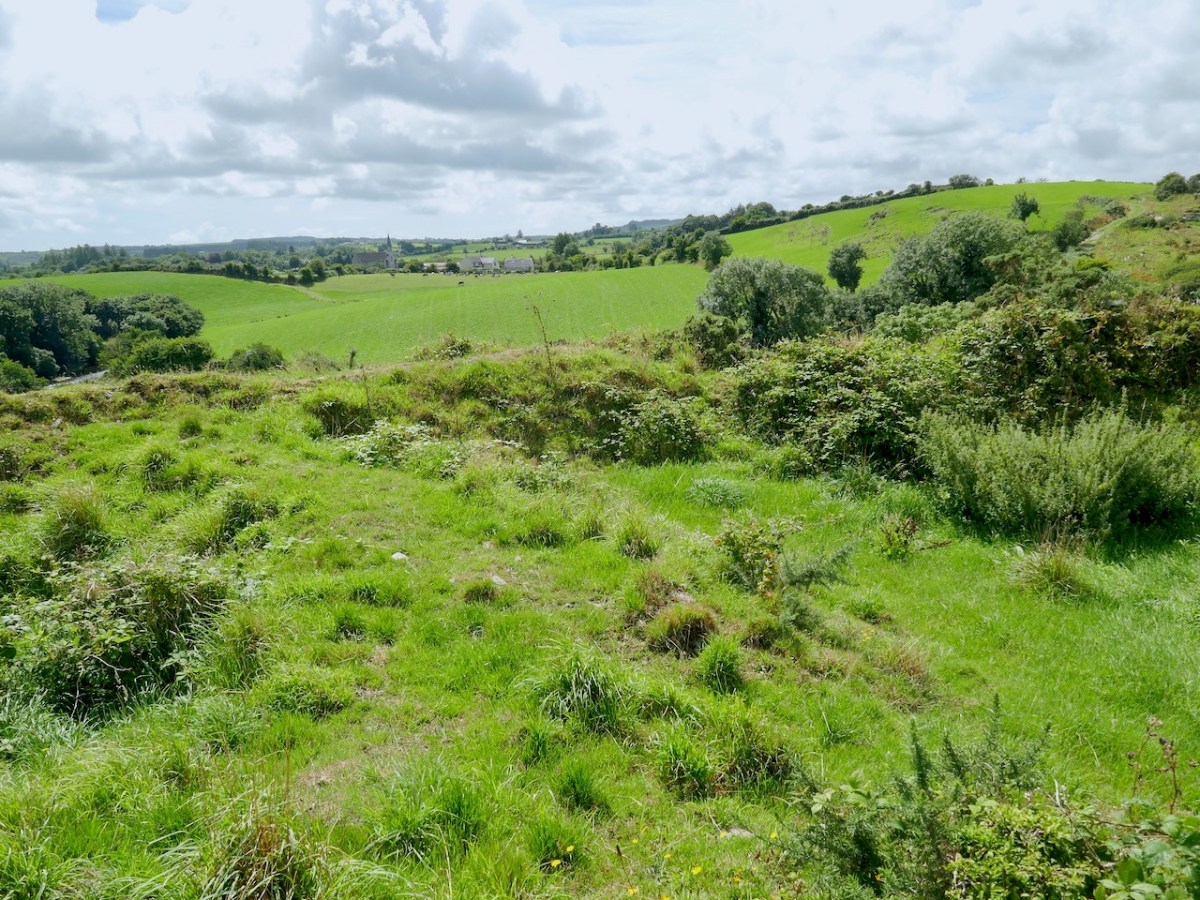
The knoll, although natural, looks like a motte – why build one if you don’t have to? From the top you can see all the way over to Caheragh village.
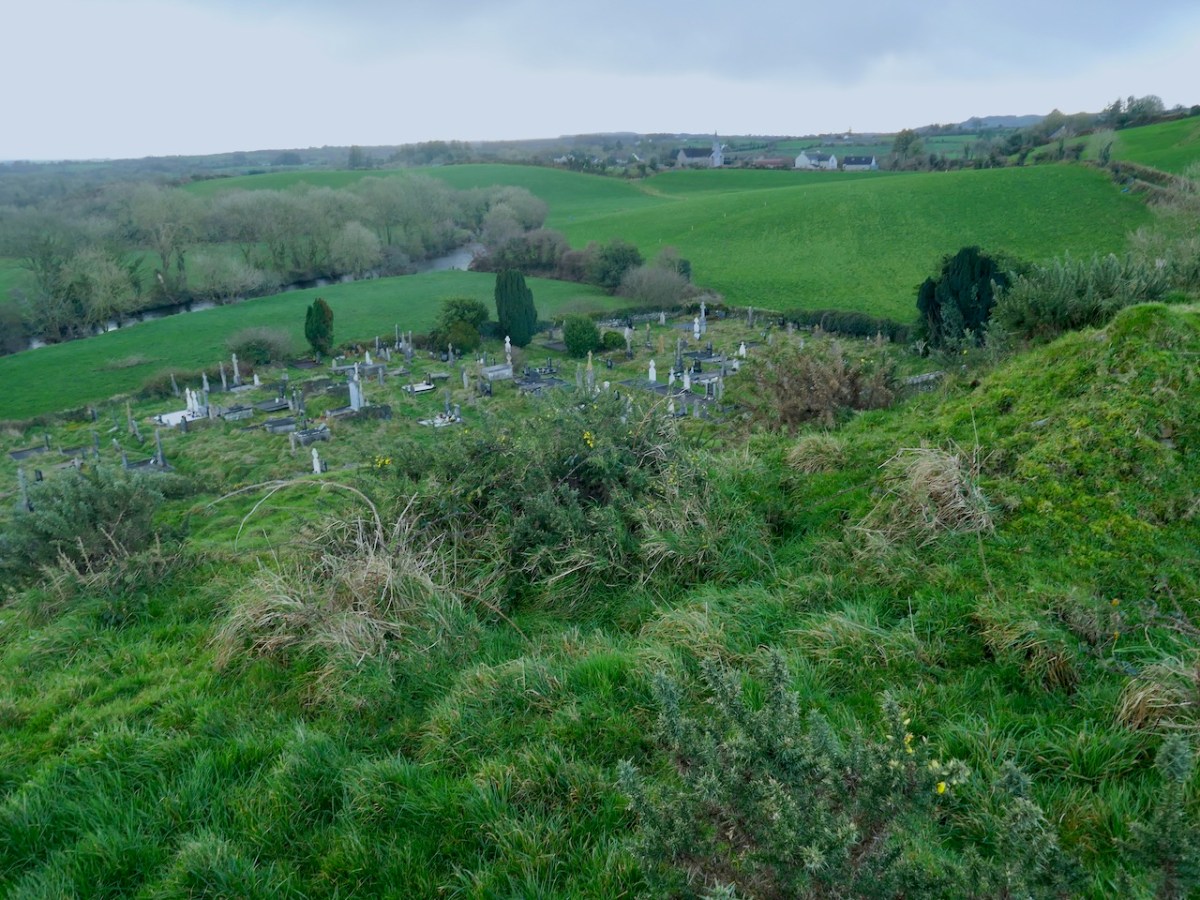
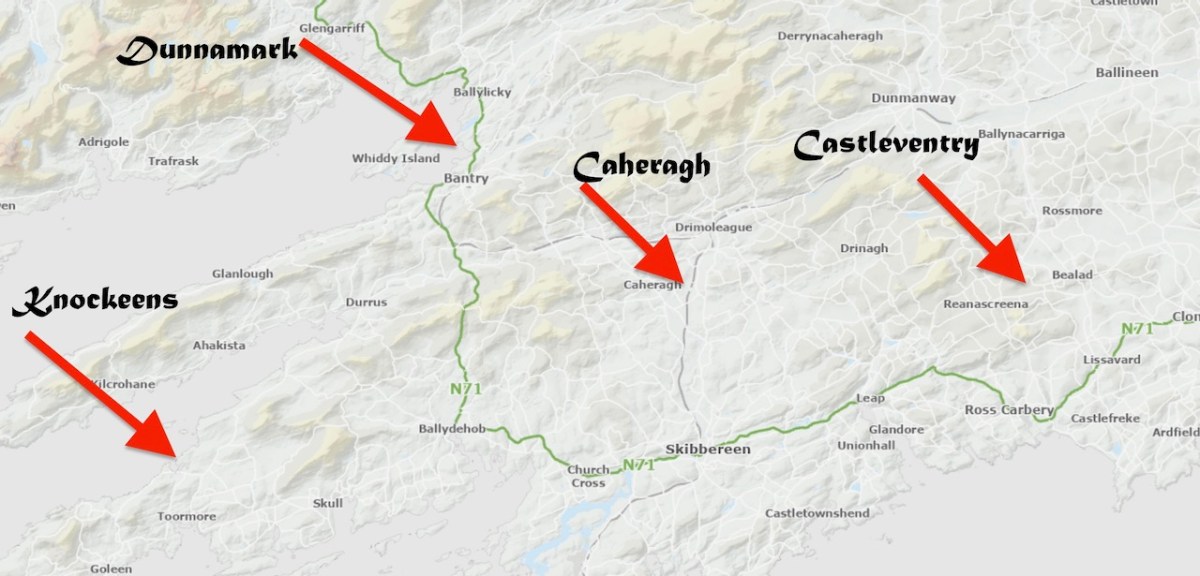
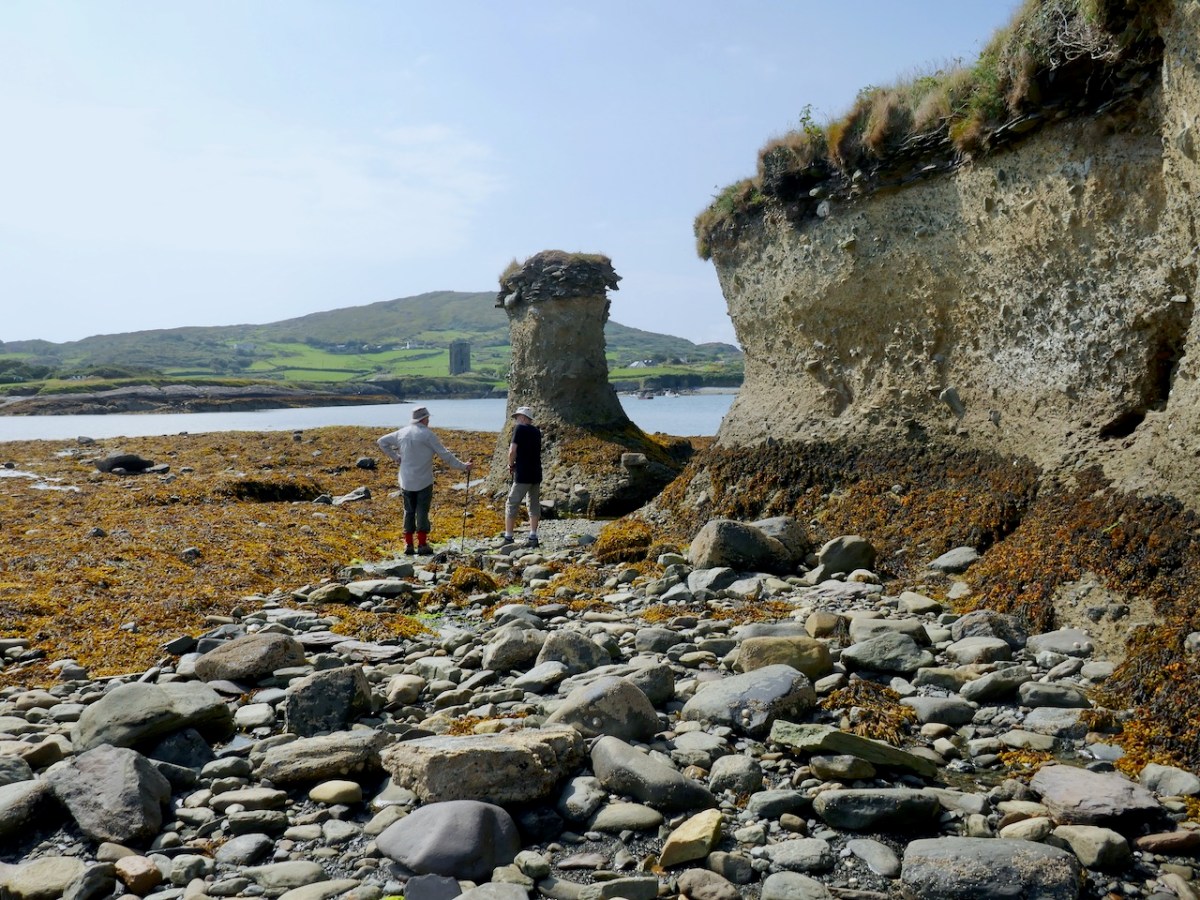
For me, the defining characteristics of these ringworks so far has been very much in accordance with what Grace Dennis-Toone laid out in her thesis – strong fortifications, situated strategically either with panoramic views or maritime location. But we know ringforts that are like that too. The extra factor for me is that they also seem like truncated mottes – raised platforms that fall short of the height needed for a motte, but still enough to dominate the landscape. Castleventry and Caheragh take advantage of natural elevations, while Knockeens and Dunnamark have constructed raised platforms within deep ditches. It may also have been that Knockeens was originally circular rather than D-shaped – see how much erosion has taken place there (below).
So – readers, do you have any other examples you suspect might fit the bill for an Anglo-Norman ringwork? It would help if it has some documentary evidence so get busy researching medieval manuscripts. No bother to you! I have already heard from one knowledgeable local, and hope to have another field soon trip in his area. We know they were here – between us, maybe we can re-write the text books for West Cork.
The Anglo-Normans in West Cork: Hiding in Plain Sight, Part 1

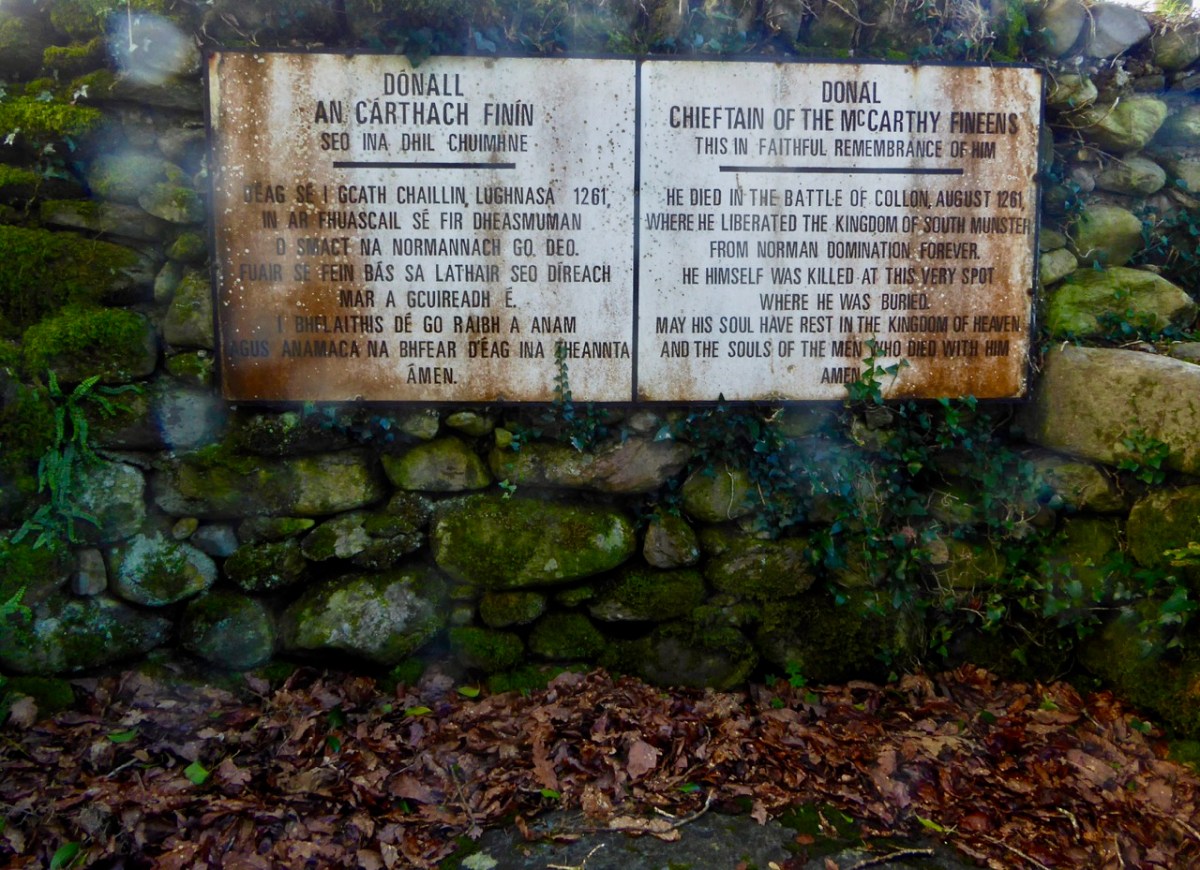
Here’s a nutshell of what I have always known about the Anglo-Normans in West Cork (cheesy and improbable image above courtesy of ChatGPT – DALL·E). After they landed in Ireland in 1169, it took them about 50 years to get to West Cork. Once here, they established some castles or fortifications and intermarried with the local families. This state of affairs lasted until 1261, when a combined army of Irish, led by Fineen McCarthy, defeated them at the Battle of Callan driving them out of West Cork and destroying all their castles. For more on the Battle of Callan, see the post Sliding into Kerry, from 2017, by Robert.

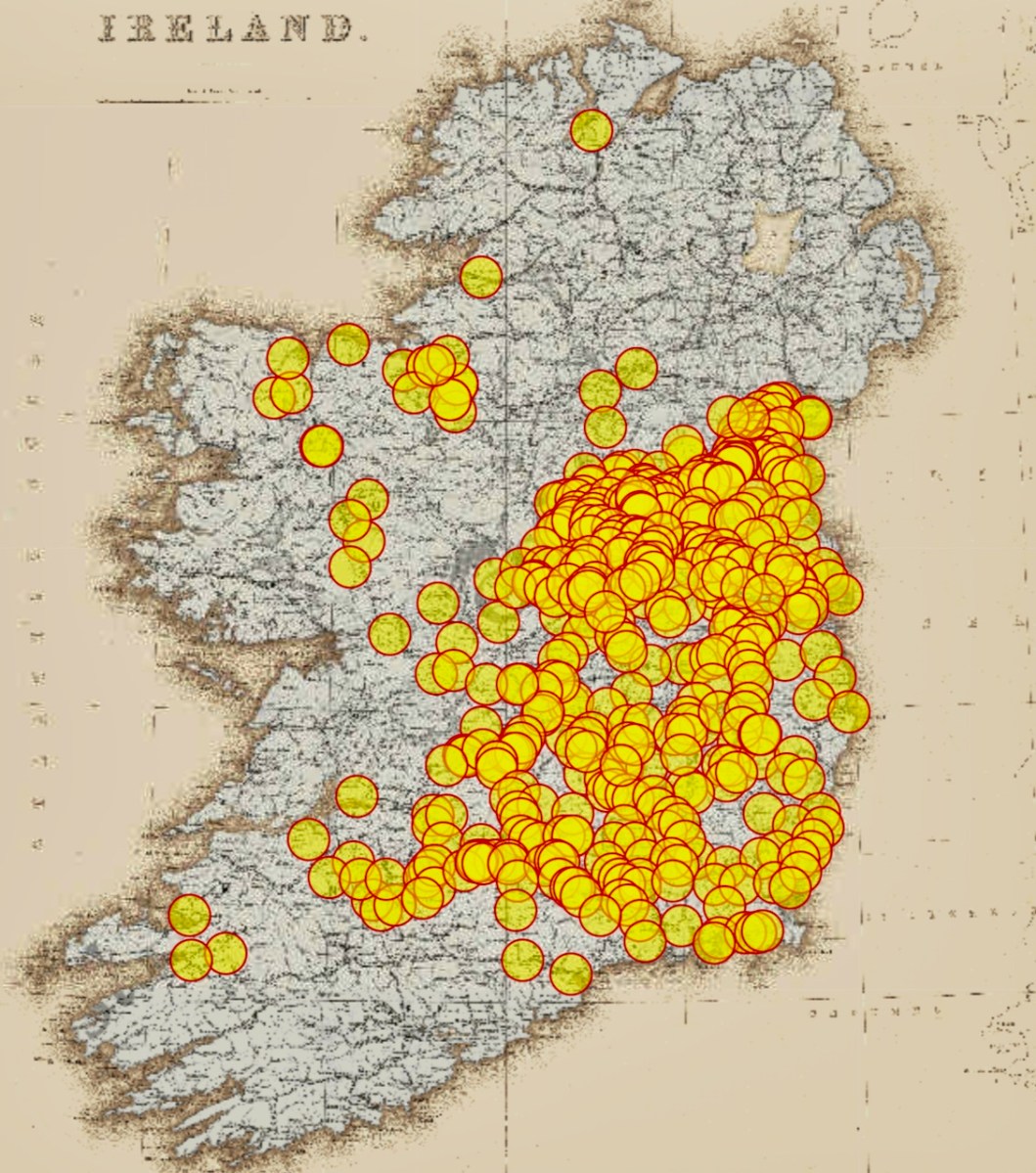
So is that why there is no trace to be found of the Anglo-Norman establishments in West Cork? In the rest of the country, at this early stage, they were mostly building motte and baileys, but there isn’t a single motte and bailey anywhere near West Cork – see the distribution map below, courtesy of National Monuments. And the masonry castles (or tower houses) we have were all built by the great Irish families. For a while I thought maybe Baltimore Castle was an Anglo-Norman building, but Eamonn Cotter has brought me up to speed on the excavation results and shown me it was much later.

There is quite a bit of documentary evidence of their presence, though, including references to their ‘castles’ so it has always been a surprise that west Cork is not littered with mottes or ruined towers. Even given the tradition that they were all destroyed after the Battle of Callan, it is impossible to imagine that a motte could be obliterated from the landscape. They were substantial earthworks, as can be seen from the brilliant JG O’Donoghue‘s reconstruction drawing below.

It turns out we have been looking but not seeing – with some exceptions, archaeologists have not recognised Anglo-Norman structures when they saw them. The most notable exception was Dermot Twohig (a contemporary of mine at UCC in the early 70s) who, as early as 1978 described Norman ringworks in Cork. In the Bulletin of the Group for Irish Historical Settlement for 1978, buried within an annual conference report, Twohig reports:

Although I have not succeeded in inspecting, on the ground, all of the early Norman castles in Co. Cork, three of the sites I have examined – Dunamark (Dun na mBarc), Castleventry (Caislen na Gide) and Castlemore Barrett (Mourne/Ballynamona), can be classified as ring-work castles. Dunamark is one of the best examples of a ring-work I have seen in either Britain or Ireland. Castlemore Barrett had a hall-keep built within the ring-work c.1250, to which a tower-house was added in the fifteenth-century. Castleventry may have had a stone built gate-tower similar to the one at Castletobin, Co. Kilkenny. . . Further field-work and excavation will, I believe, demonstrate that the ring-work castles constituted a very significant element of fortification in the Norman conquest of Ireland.

I don’t know what happened, but Dermot’s analysis does not appear to have become part of what students were taught at UCC. Those students in turn became the mainstay of the Archaeological survey of the 1980s and they labelled Dunnamark (i’m using the OS spelling) a cliff-edge fort and Castleventry a ringfort. 

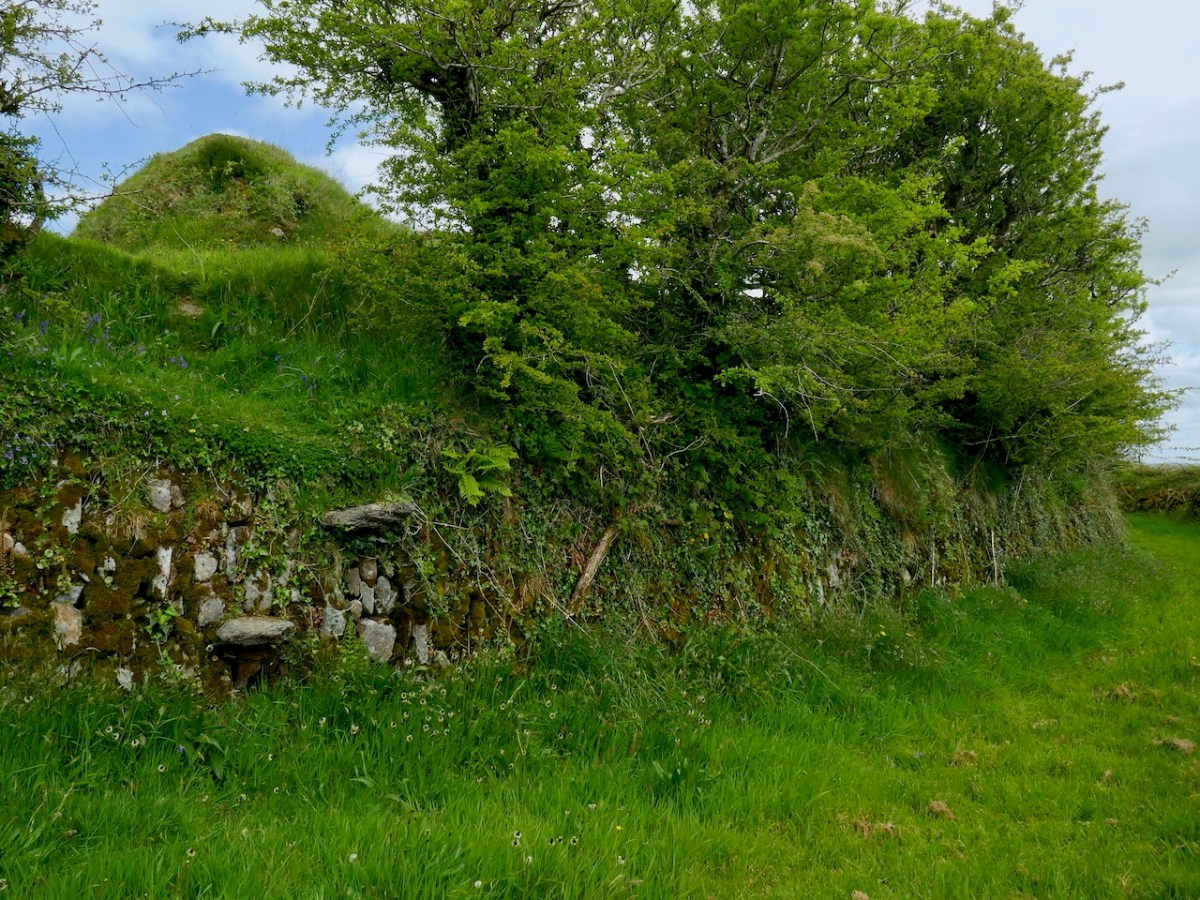
In fact, the very term ringwork (or ring-work, or ringwork castle) seems to have become an archaeological football, with some scholars asserting that we have no useful definition of its distinctive features and most of them are probably just ringforts, while others have championed the use of the term and tried to bring clarity to the debate.* in the heel of the hunt, it now seems likely that ringworks were indeed part of the system of land-claiming exercised by the Anglo-Normans, that they were usually larger and more solidly built than ringforts, and located strategically – near water or with commanding views. As you can see from the photograph below, the Castleventry banks are high, and were originally stone-faced.

In the course of 2023 and early 2024 Robert and I visited four locations with Con Manning, retired archaeologist with the National Monument Service and a recognised authority on Irish medieval archaeology. Con has now written about the four sites in the latest issue of Archaeology Ireland, naming them as Angle-Norman ringworks. The first is Castleventry, to which we were brought by local historians Dan O’Leary and Sean O’Donovan, and I wrote about our visit to that that one here. So go back now and read what we found there and how intrigued Con was by what he saw. This was the site that set him off on his investigations. 

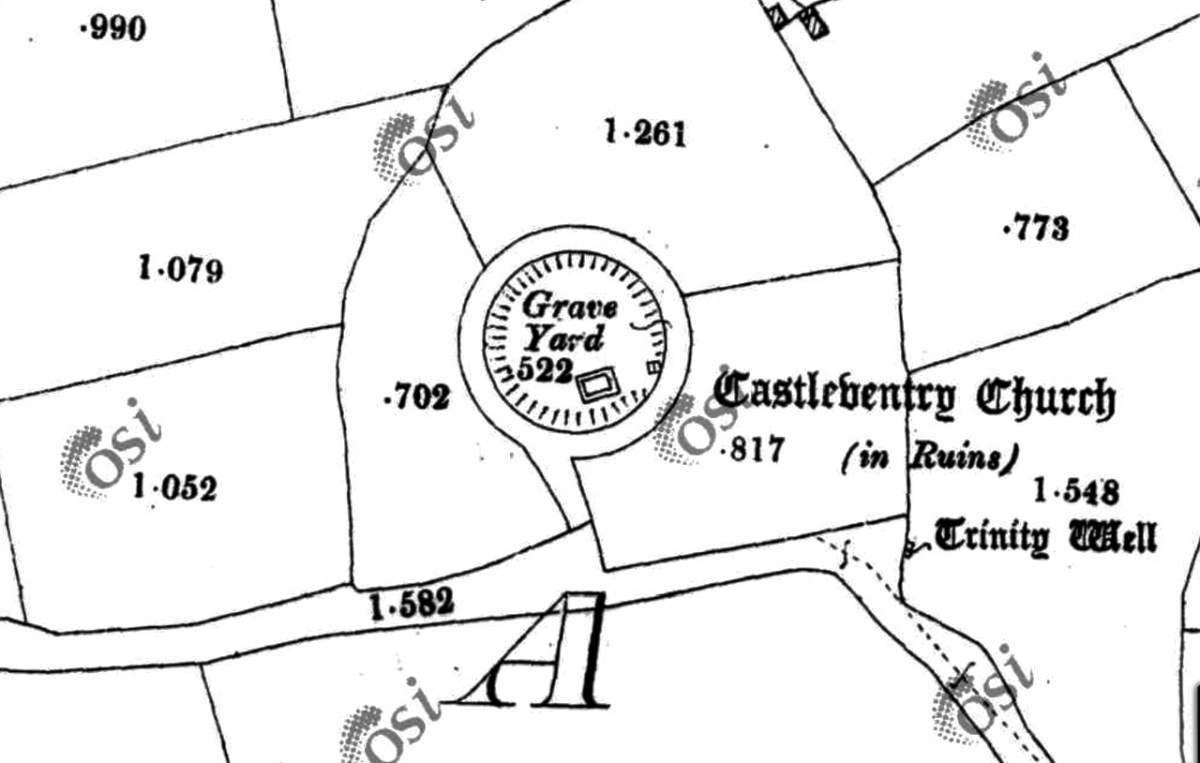
The description of this site in the National Monuments record is as follows:

In pasture, atop knoll on E-facing slope. Circular, slightly raised area (32.6m N-S; 34.5m E-W) enclosed by two earthen banks, stone faced in parts, with intervening fosse. Break in inner bank to W, now blocked up; modern steps to E. Outer bank broken to W (Wth 3.5m), blocked up; S gap leads to laneway; modern break to NNW. Church (CO134-025004-), graveyard (CO134-025003-) and souterrain (CO134-025002-) in interior; second souterrain (CO134-089—) beside outer bank to E.

Recognising that not all readers have access to Archaeology Ireland, and with Con’s permission, I will tell you that he notes that after the Battle of Callan 

in that same year many of the castles of the colonists for burnt or destroyed. Two were mentioned in a single entry in the Annals of Inisfallen as follows: “the castle of Dún na mBarc, and Caislén na Gide also, were burned by Mac Carthaig and by the Desmumu.”. Caislén na Gide has been identified as Caisleán na Gaoithe or Castleventry. . . No likely site for this clearly important castle has to date been identified on the ground. 

After more information on the history of the site and its association with the Barrett and the Barry families, Con concludes, I have no doubt but that this monument is the castle of Castleventry, a substantial and impressive ringwork reusing an older ringfort.

Next week I will write about the other three sites (spoiler alert – one of them will be familiar to regular readers already) and come to conclusions about the evidence we’ve been missing for the presence of the Anglo-Normans in West Cork.

* I applaud particularly the work of Grace Dennis-Toone, Her thesis brings considerable rigour and analysis to the topic. When is a ringwork a ringwork? Identifying the ringwork castles of County Wexford with a view to reconsidering Irish ringwork classification.

The Antiquities of Bealad

There’s an area of West Cork bounded on the south by Castleventry and on the north by Ballinvard. In between and round about there’s Bealad, Rossmore and Caherkirky. This is the territory into which we were inducted by Dan O’Leary and Sean O’Donovan, this week. It’s like a fellowship – people who are passionate about local history find each other and it’s only a matter of time before we start talking field trips.

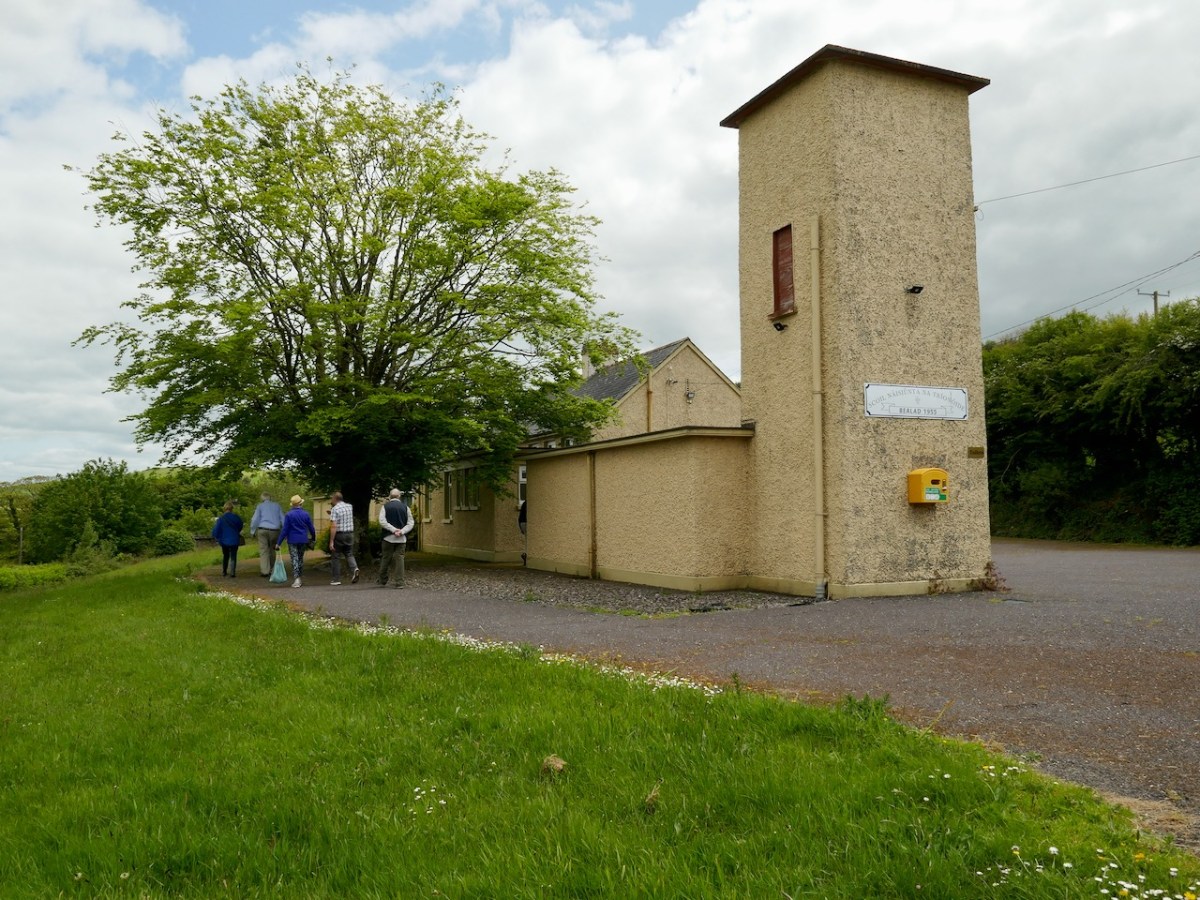
Dan and Sean had organised the whole thing – including the all important coffee and food and bathroom breaks. Our headquarters was the old National School in Bealad, now wonderfully re-purposed as a community hub – a lesson in how to do this for others with such buildings on their hands. We started with an overview of local history and then it was off to Castleventry. 

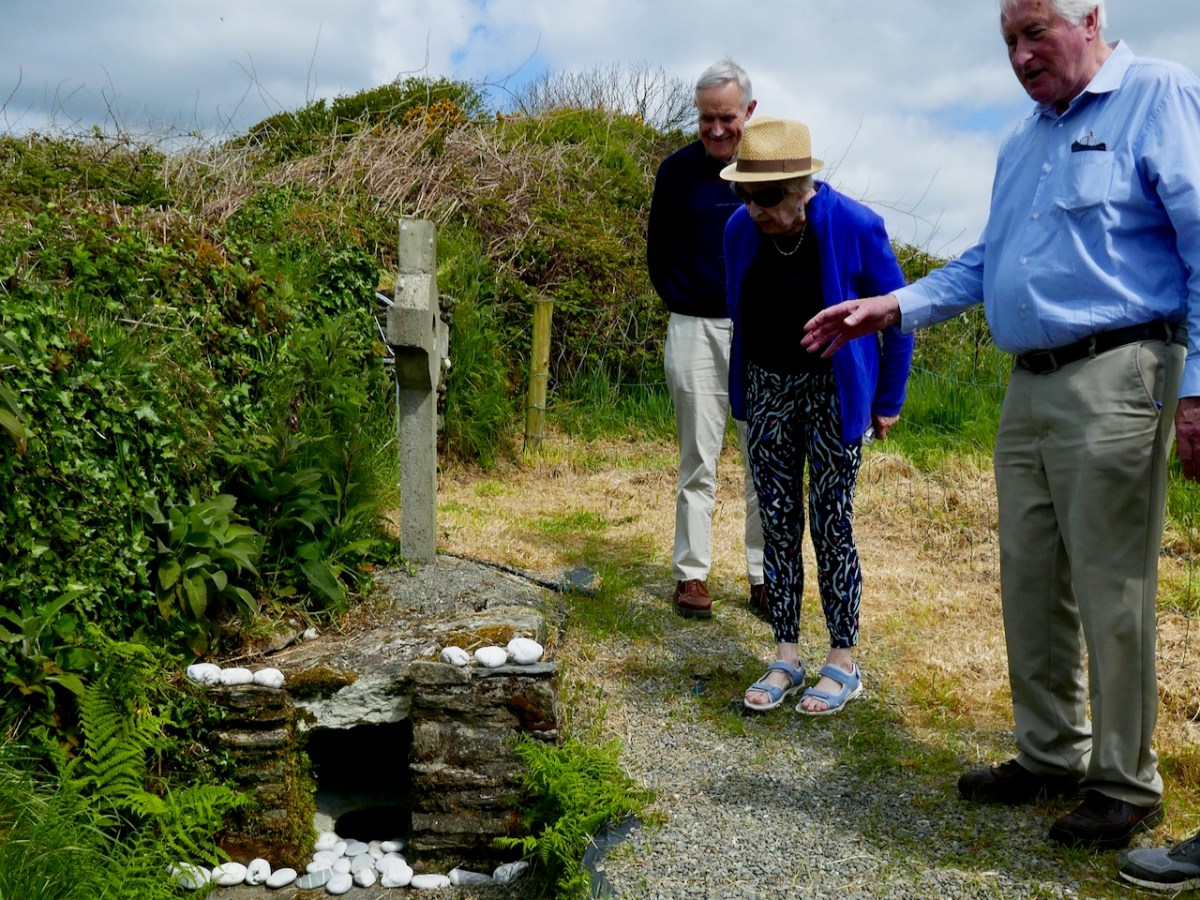
Amanda is, as you all know by now, the expert on Holy Wells (book will be out soon!) and the first time she and I visited this well, several years ago, we met Sean, who was restoring it. You can read all about that here, and more about the well itself. All are invited to the annual celebration at the well, which takes place on June the 4th at 8pm (after milking).

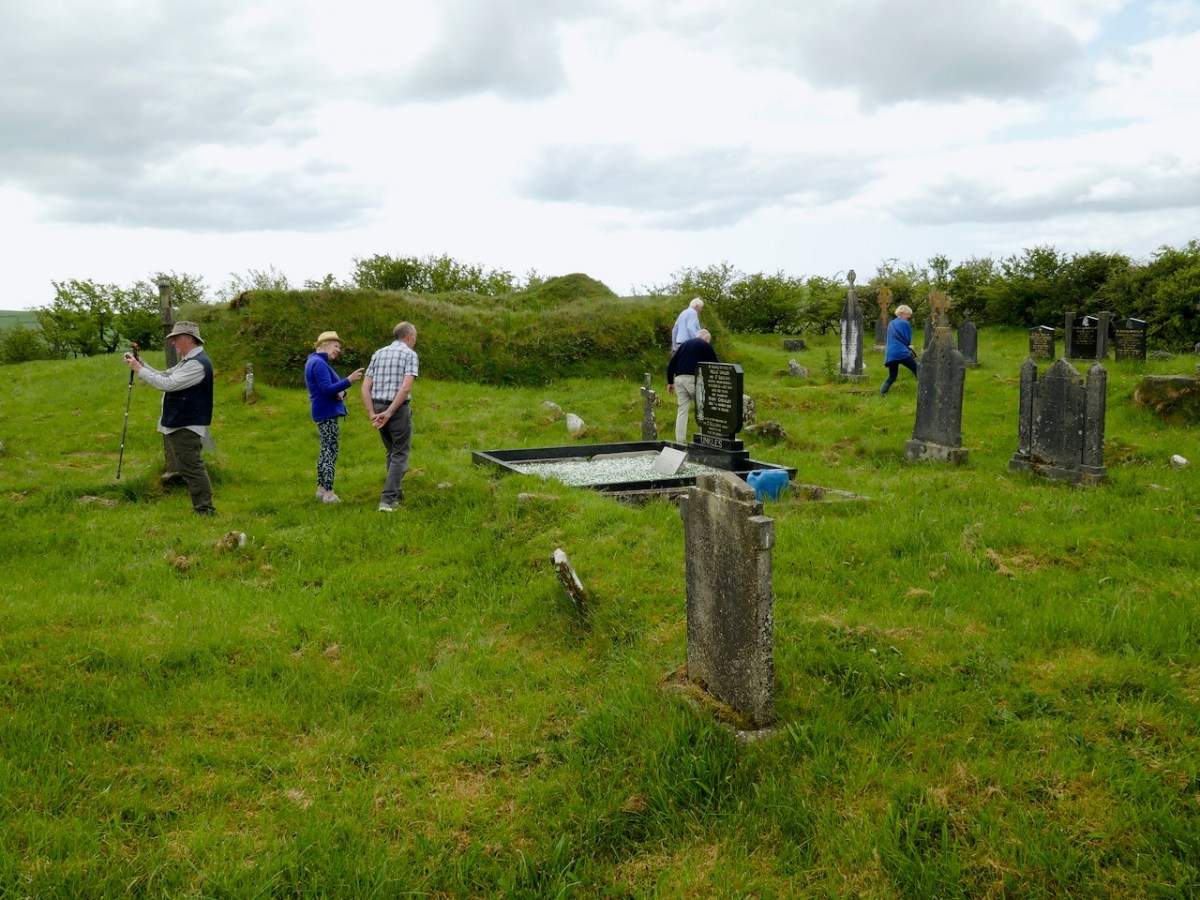
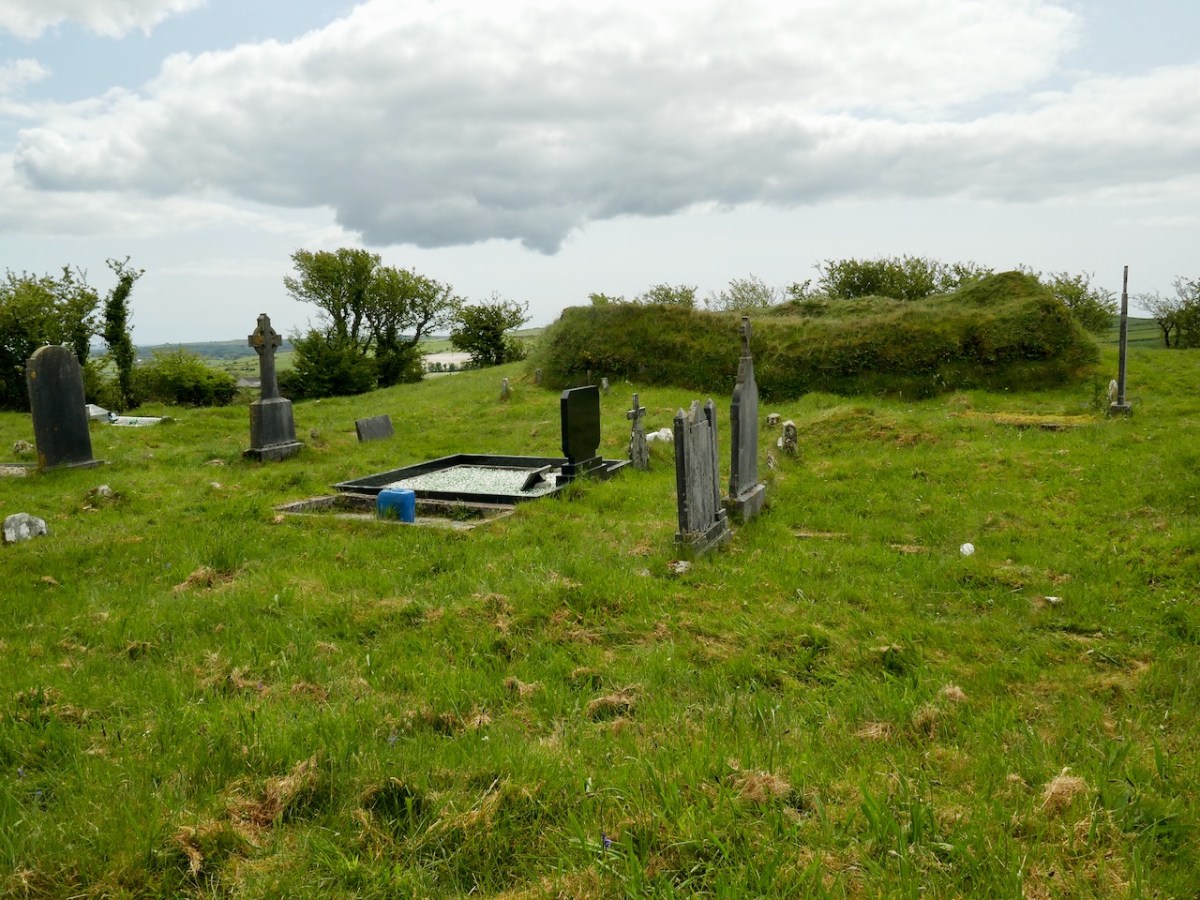
Just up the road from the well is the Castleventry graveyard and ring fort. An extraordinary site by any standards, this site encompasses an impressive bi-vallate ring fort/cashel, and a ruined ‘something’ within, as well as a graveyard. 

This was obviously the residence of a high-status individual – a chief of a local Clan. The banks and ditches are deep and would have represented a formidable fortification, along with a palisade fence on top of the inner bank. The photo below gives some idea of the depth of the ditch that separates the outer and inner banks. There are commanding views across the country in all directions – nobody seeing it would have been in any doubt as to the importance of the occupier. Souterrains, no longer accessible, were found within – see Robert’s post about Knockdrum Stone Fort for a similar type of fort and souterrain.

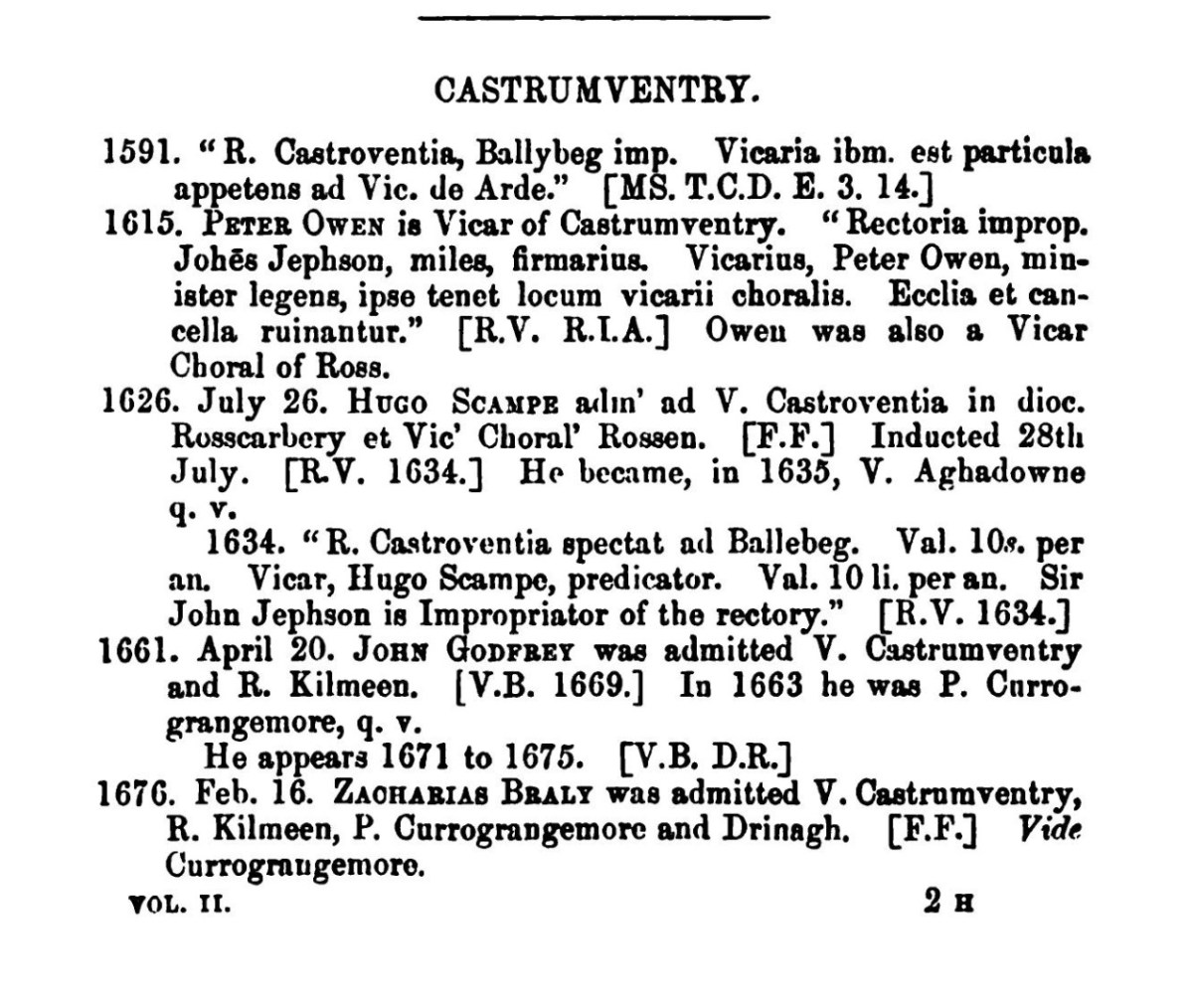
But it was the church within that presented an interesting challenge! According to its listing, this is the medieval parish church of Castleventry, already in ruins by 1615.

A screen shot of the relevant page in Clerical and Parochial Records of Cork, Cloyne, and Ross, by W Maziere Brady.

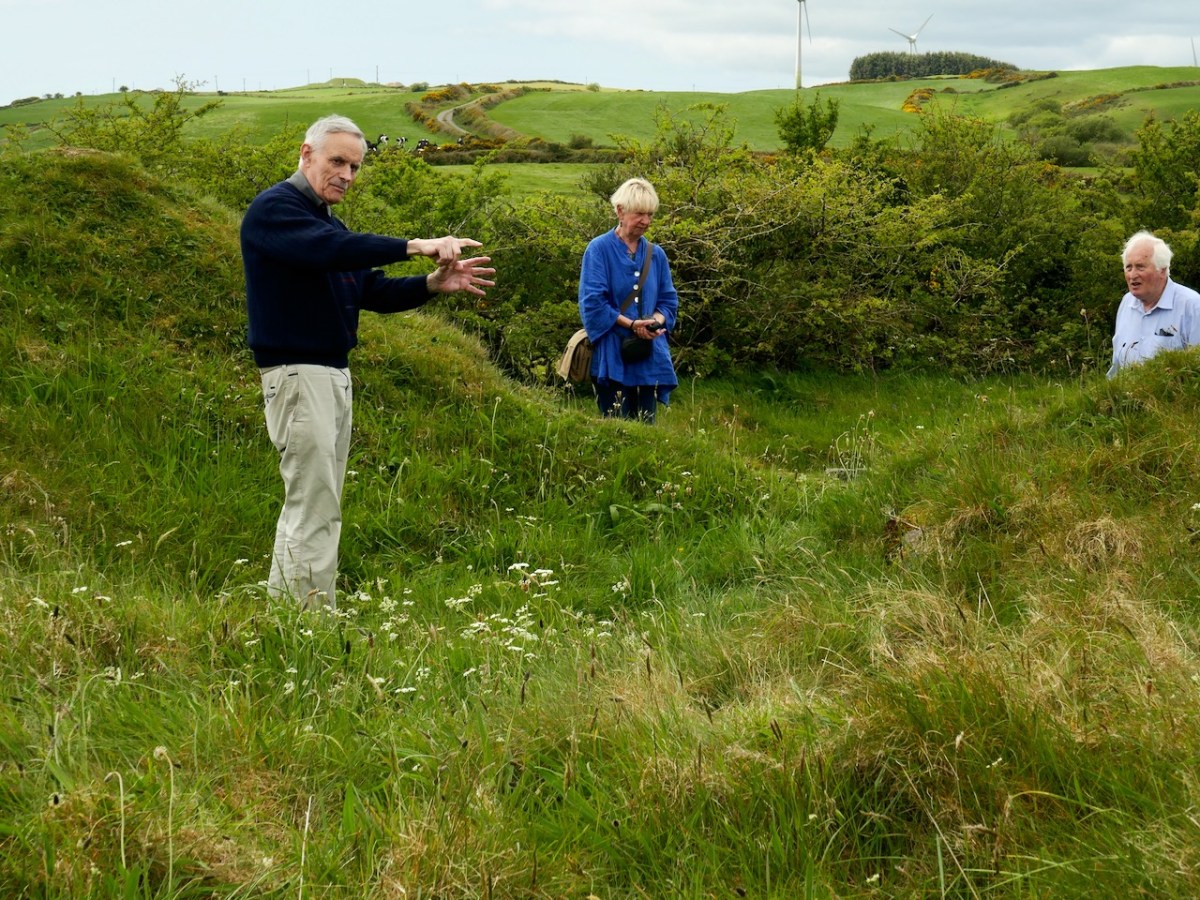
One of the participants on the field trip was our friend Con Manning, a distinguished medievalist and archaeologist, now retired from the National Monuments Service. Con was immediately struck by a couple of things. First, it’s unusual to find a church in a ring fort, and second, it just didn’t look like a church to him – in fact it looked more like a tower of some kind. Not a tower house, but perhaps a small Anglo-Norman keep.

There are no examples in West Cork of such keeps – the Castle at Glanworth, north of Fermoy, would be the closest example to an early Norman masonry tower. When Fineen McCarthy defeated the Anglo-Normans at the Battle of Callan in 1261, it is said he rampaged through West Cork, burning and destroying every structure they had built – which would certainly explain their absence. 

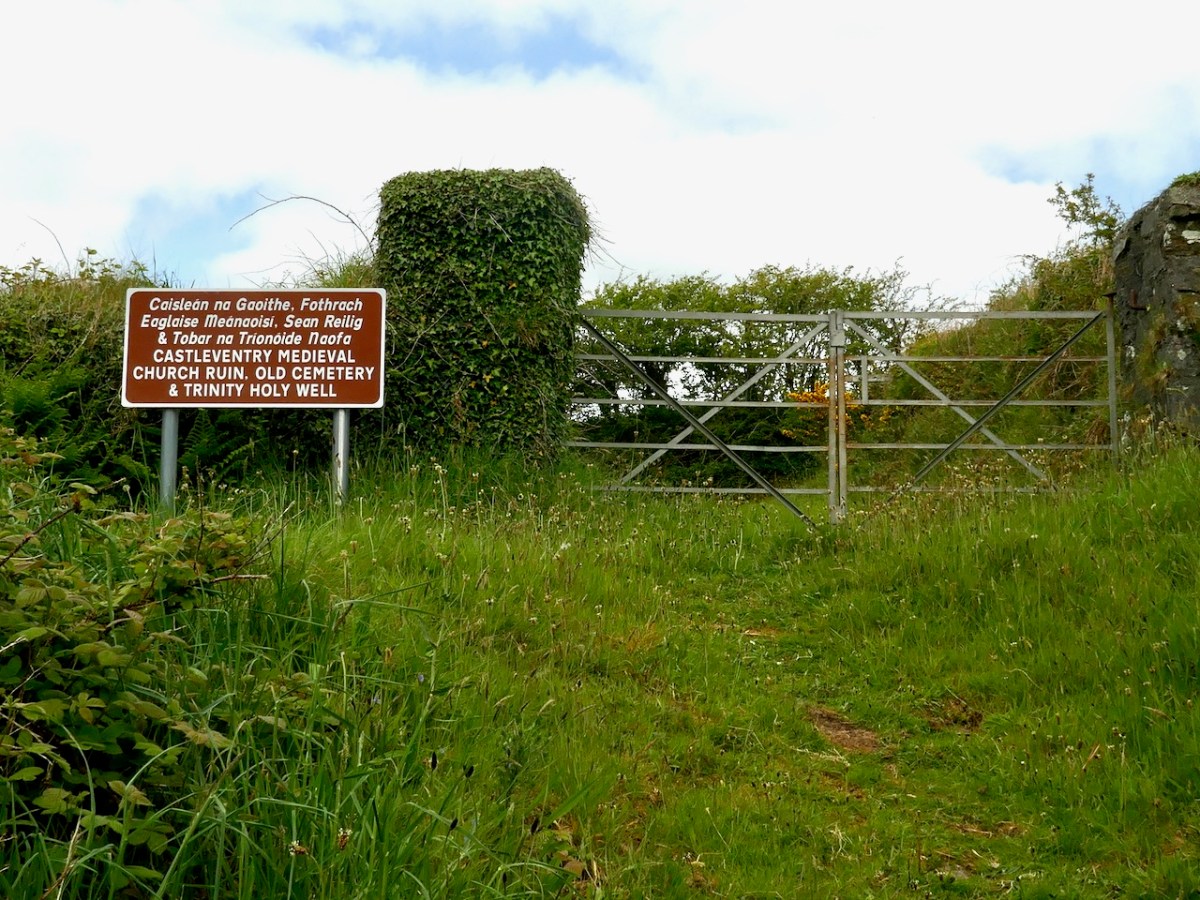
But – what if this one survived, or survived in part? What if it was taken over by the local Irish chief – there are certainly precedents for them building their tower houses inside ring forts, we have only to look at Ardintenant for that. What if, over the centuries, in its ruinous state, people took it that it had been a church? There was a medieval Castleventry church – Brady’s listing shows it clearly – but was this it? Also, Brady calls it Castrumventry and the word Castrum is applied to castles – the closest castle to here is 5kms north at Ballinvard (we’re coming to that). The Irish word for Castleventry, according to the sign at the entrance is Caislean na Gaoithe – Castle of the Winds.

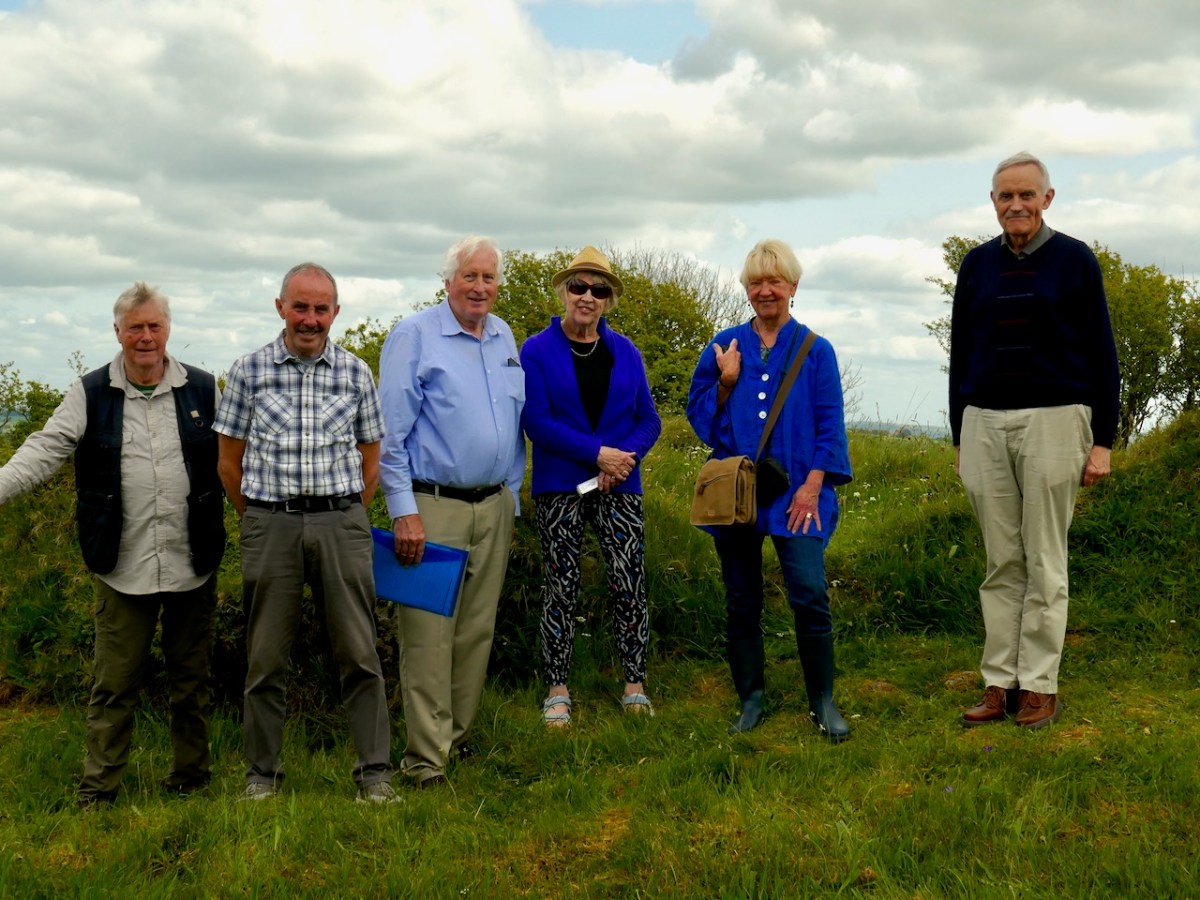
Here we are at this puzzling site: Robert, Sean, Dan, Una, Amanda and Con

So many questions! Con is continuing his investigations, raising even more intriguing possibilities about the site and so we may revisit this one at some time in the future.

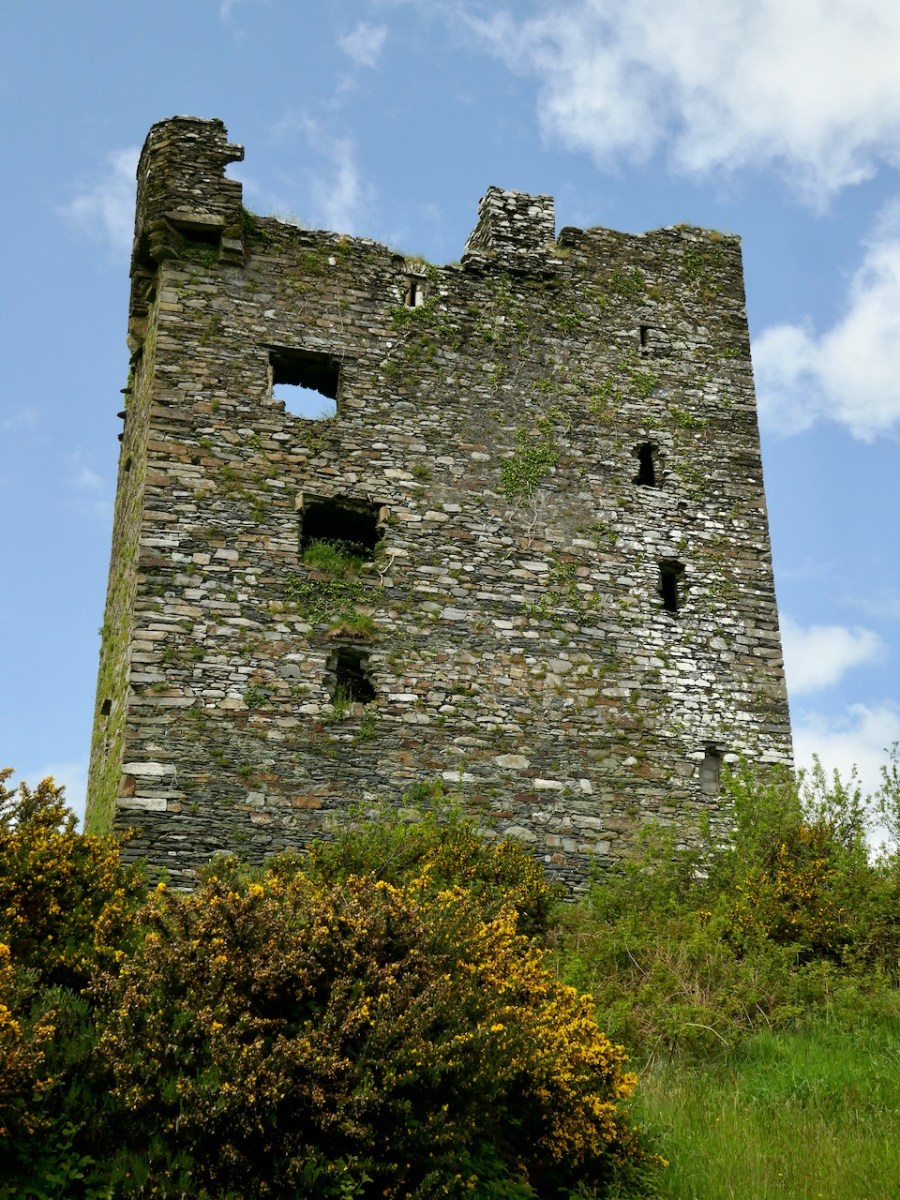
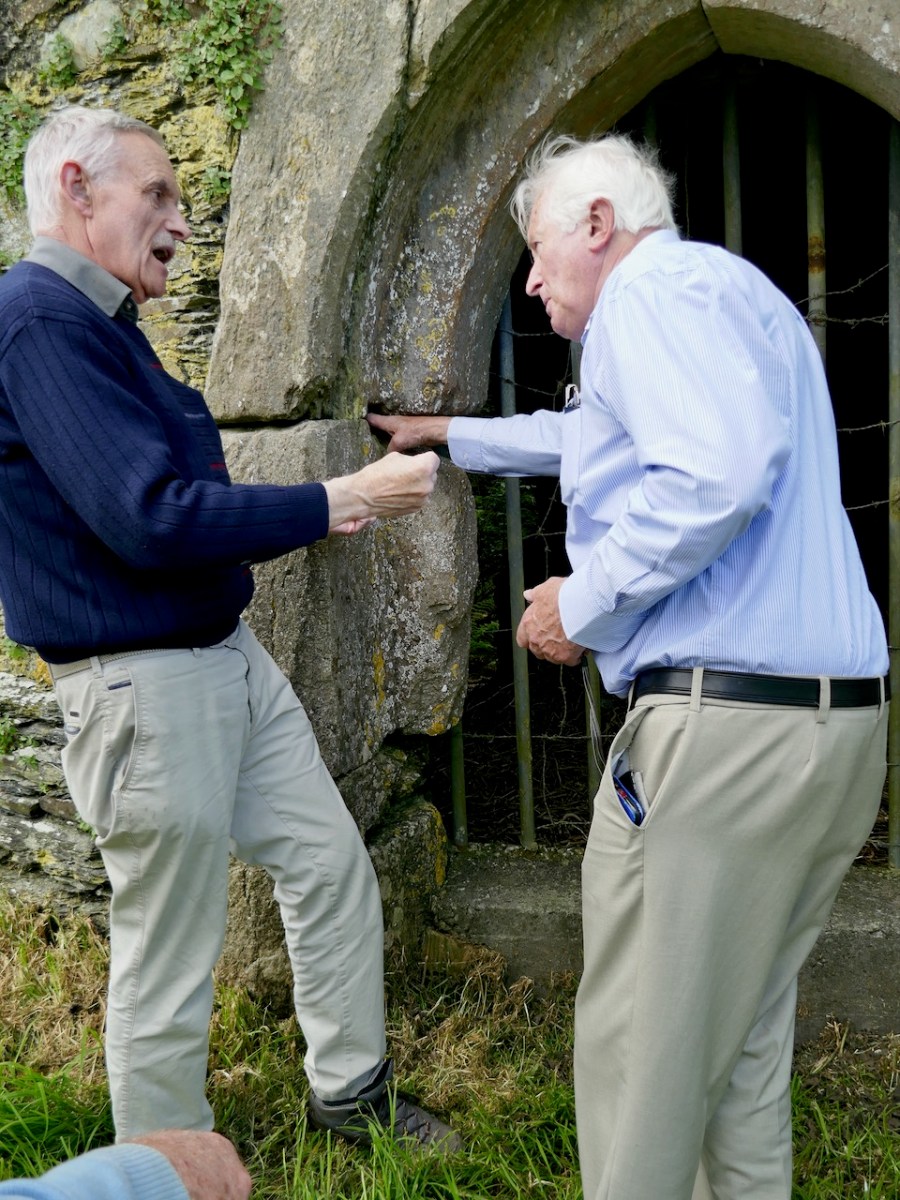
From Castleventry we travelled on to Ballinvard Castle, just outside Rossmore, where the owners, Pat and Mary Daly had kindly agreed to meet us and show us the castle, which is in a working farm and not normally open to visit. In the last few years, the ivy has died back due to heavy frosts, and this has allowed a clear view of many of the hitherto-obscured features of the castle. Once again, we were grateful to Con’s expertise as he pointed out various aspects of the building that placed it in the 16th century – a castle of the Hurley (Ó Muirthile) family.

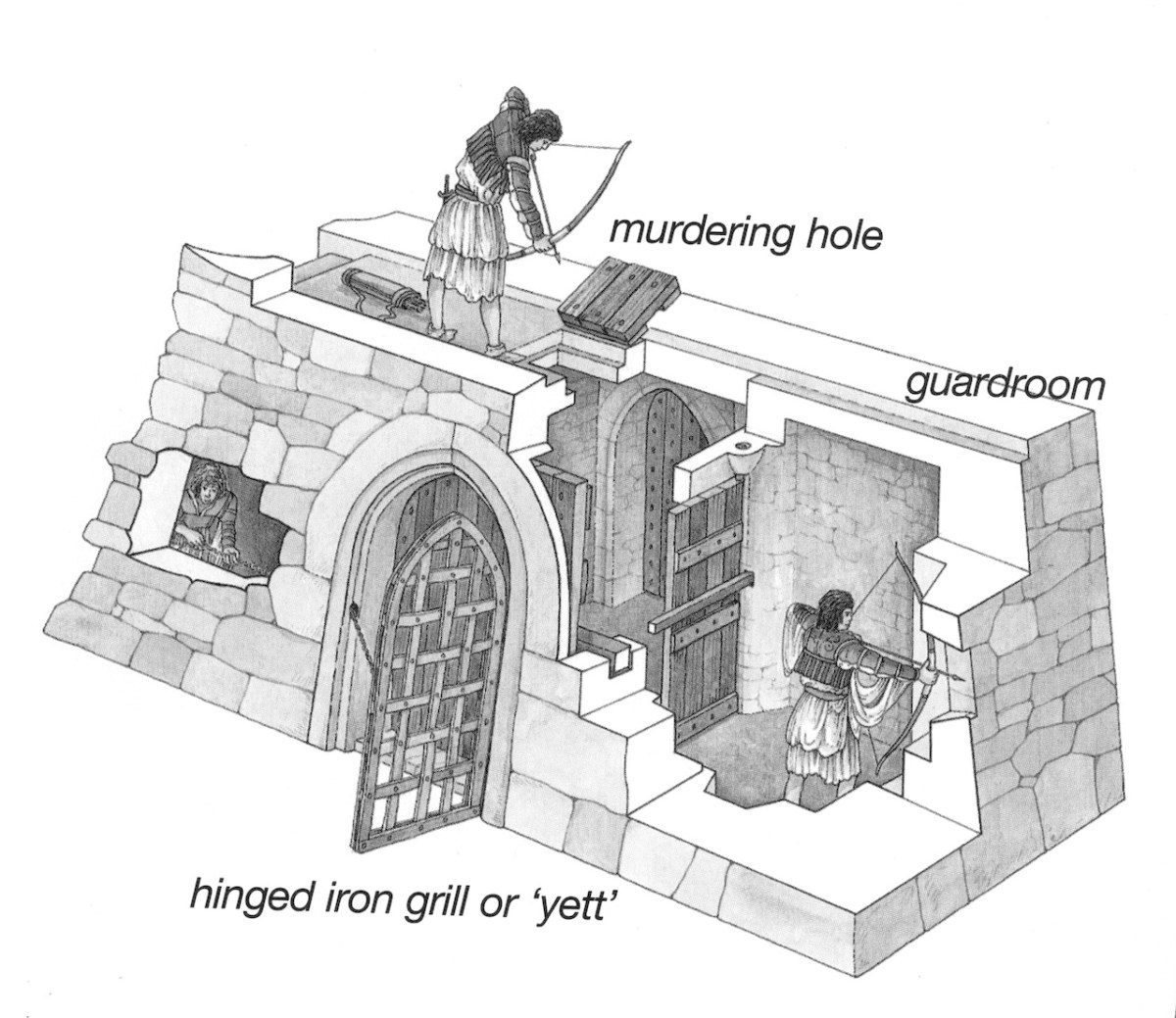
One of those was the workings of the Yett, an iron grill that sat outside the main door and could be closed from inside by way of a hole of the doorway through which a chain was pulled tight from a room inside.

Here’s a illustration of how it works. You can see the same Yett hole at Castle Donovan, which has many features in common with Ballinvard. 

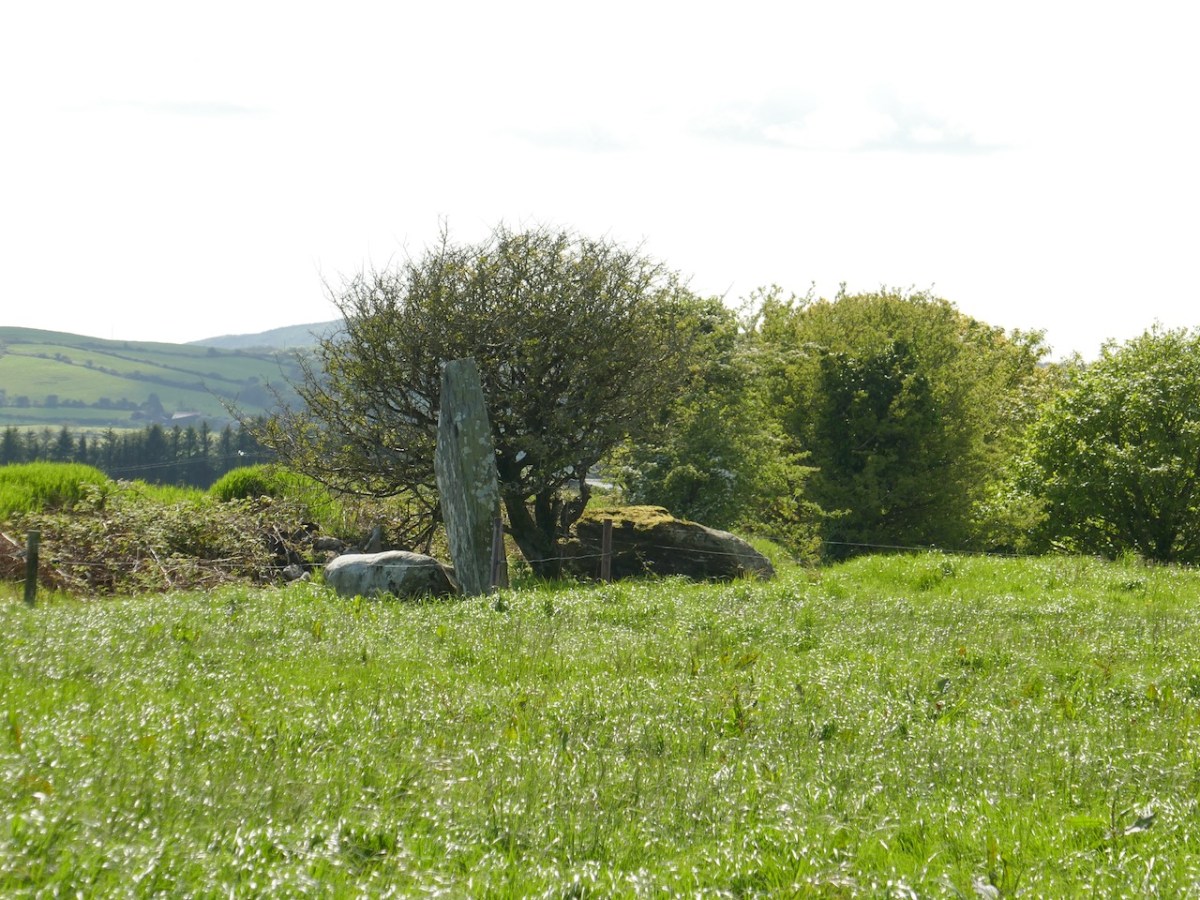
Dan had one surprise for us – he brought us to the townland of Caherkirky, to a double boulder burial with a very tall standing stone. In a previous visit to this site he thought he detected cupmarks – and he was right! There was one on the boulder burial, and several on the standing stone. See Robert’s post today for another example of the same kind of monument. It was a good feeling to be back again with my beloved rock art!

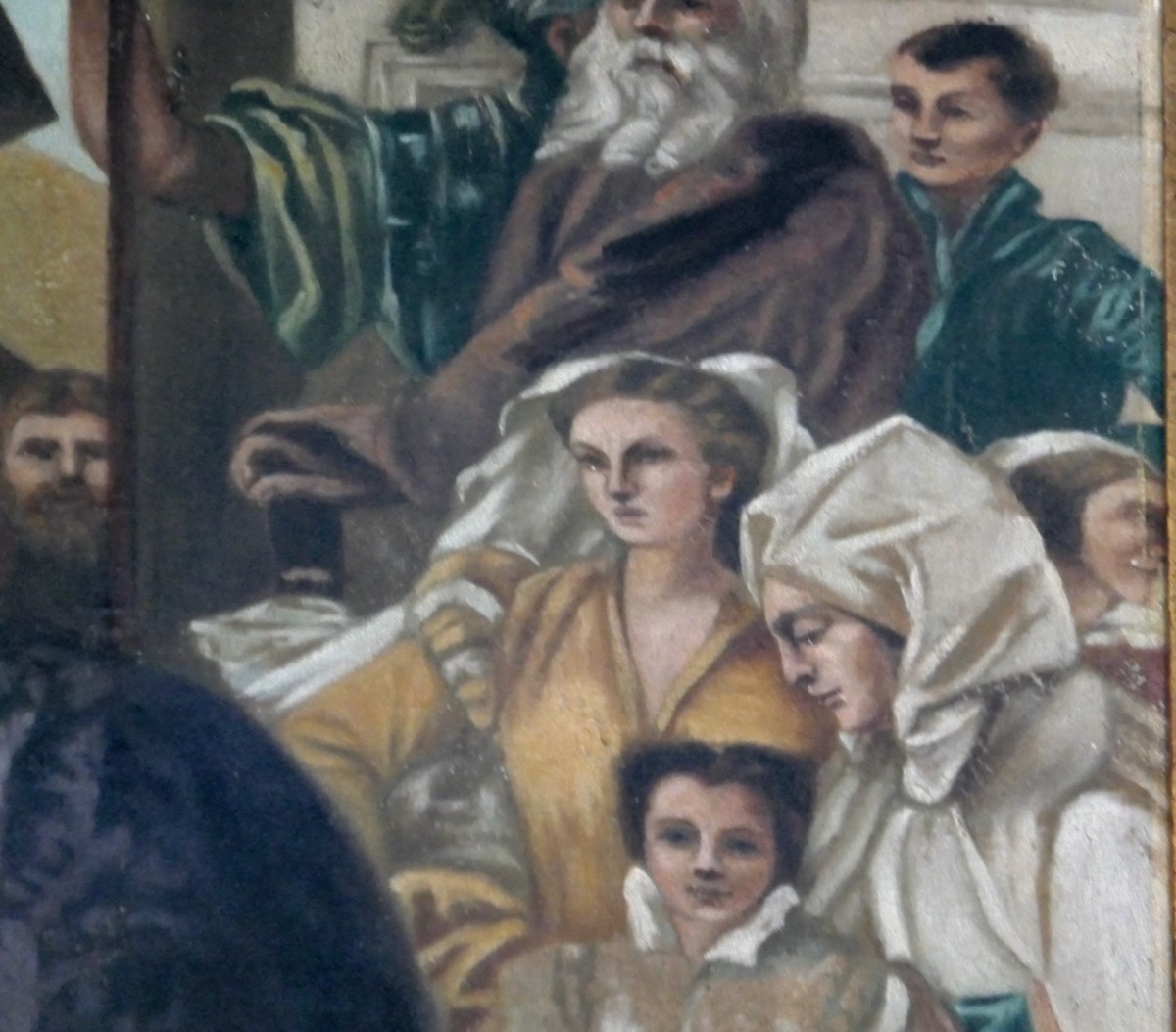
Knowing my penchant for popping into every church I pass, Dan’s final treat for us was the church in Rossmore, but this time, instead of the stained glass, what he wanted me to see were the Stations of the Cross. Obviously Italian, they were painted, and the artist had let his/her imagination take flight on the costumes – more like Spanish grandees than the biblical characters we’re used to. Not like any I had ever seen before and a real surprise.

Thank you, Dan and Sean – it was a great and eclectic day, and who knows what will come out of Con’s close examination of Castleventry – stay tuned!