Back to the Skeams: 81 Men Left the Island

Fishing was a huge part of how the islanders made a living and fed themselves and their families. For how this was conducted I am relying on Hester’s detailed account. She writes about her parents’ generation and also about her own – her husband, Patsy, also went fishing. I will use Hester’s words, from her memoir, Misty Memories, lightly edited for a bit of brevity.

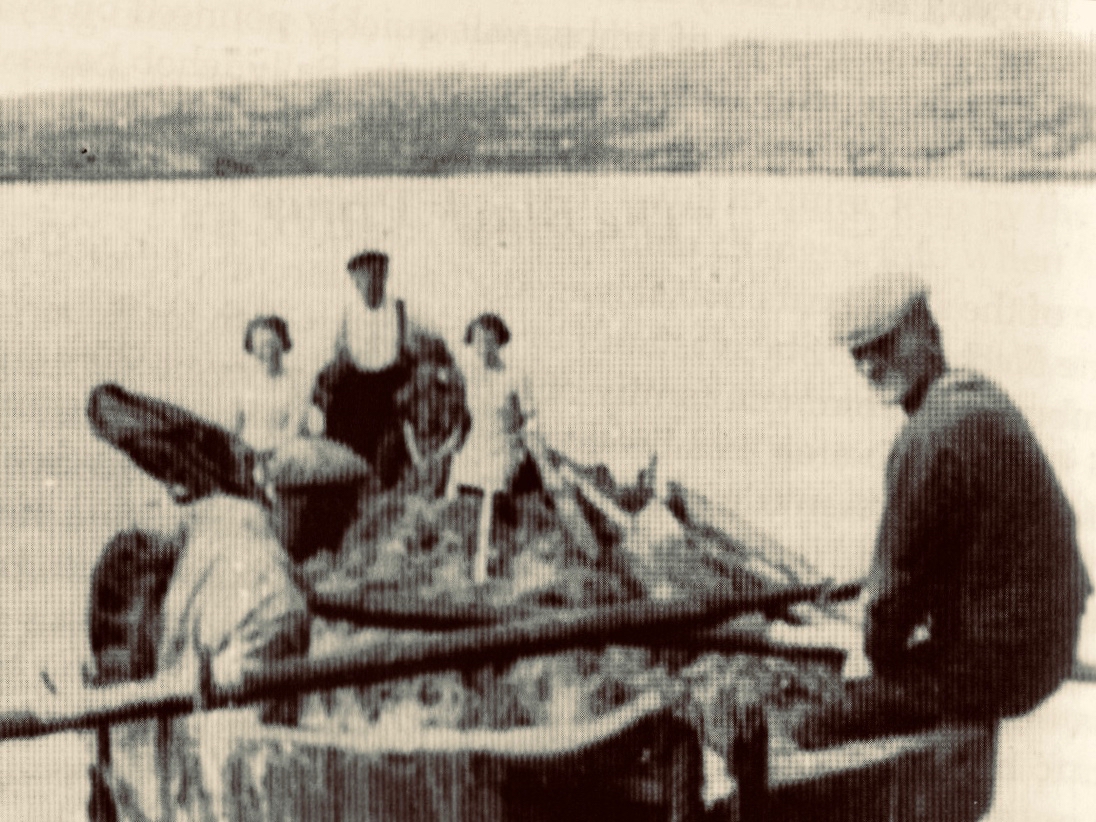
Most of the men from the islands around went Lobster fishing every Summer. There were 27 lobster boats in Heir Island when I was ten years old and at school there. Each boat had a crew of three men. That meant that 81 men left the island from May to September and went to Kinsale and Cobh – a long journey along a rough coastline in very shallow sailing boats.
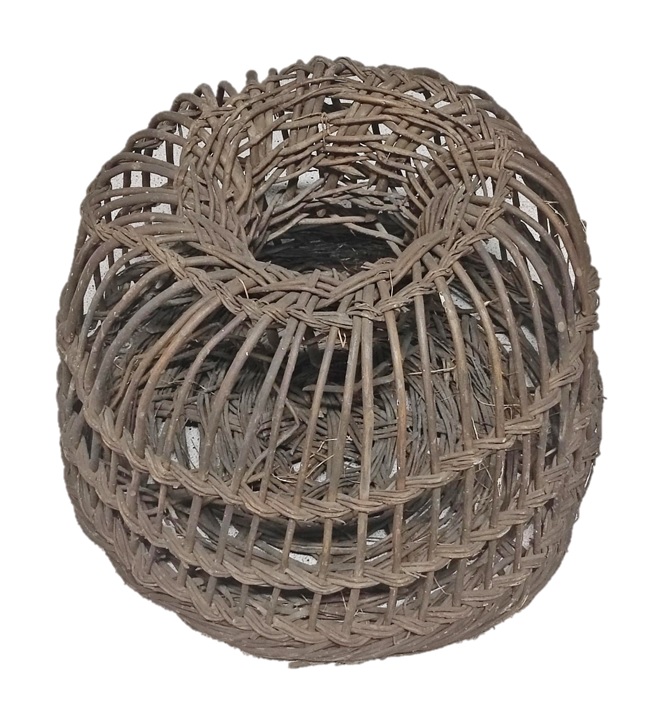
A traditional Heir Island Lobster Pot. © National Museum of Ireland*

Lobsters were caught in baited lobster pots, made of willow twigs and anchored in deep water. The men made the pots themselves during the winter months. Some were very skilled and others helped them – they worked as a team or ‘meitheal’ as it is called in Irish. They had special tools for the job and a sort of mould around which they wove the twigs so that the pots had the proper shape. Rowing for miles to the other islands and to the mainland to get enough twigs, they carried big bundles on their backs, often having to walk four or five miles back to the boat. 
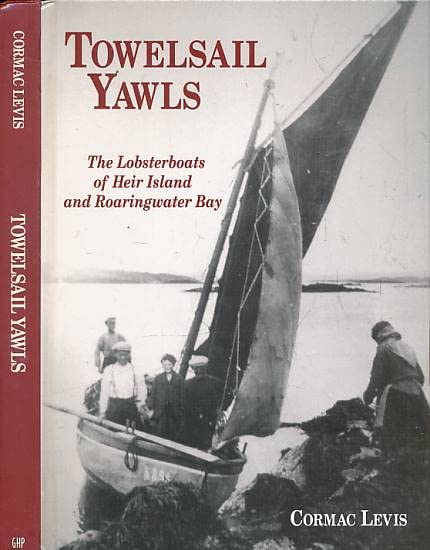
The authority on traditional Heir Island boats is Cormac Levis, and this book is a must for anyone interested in this topic. It is currently out of print but you might be able to find a copy online. Cormac is planning a second edition for 2026.

Lobster boats had three sails and the smallest one of these, called the ‘Towel Sail’, was used to make up a sleeping tent over the boat’s stem. Just as with the lobster pots, the men made the sails themselves. There was a lot of work in them and some of the men were really expert at it. Sails for the lobster boats and other bigger boats were made of canvas with a rope sewn firmly all around the edge. They made special eyelets across the sail to hold the reef cords so the sail could be made smaller in high wind. 
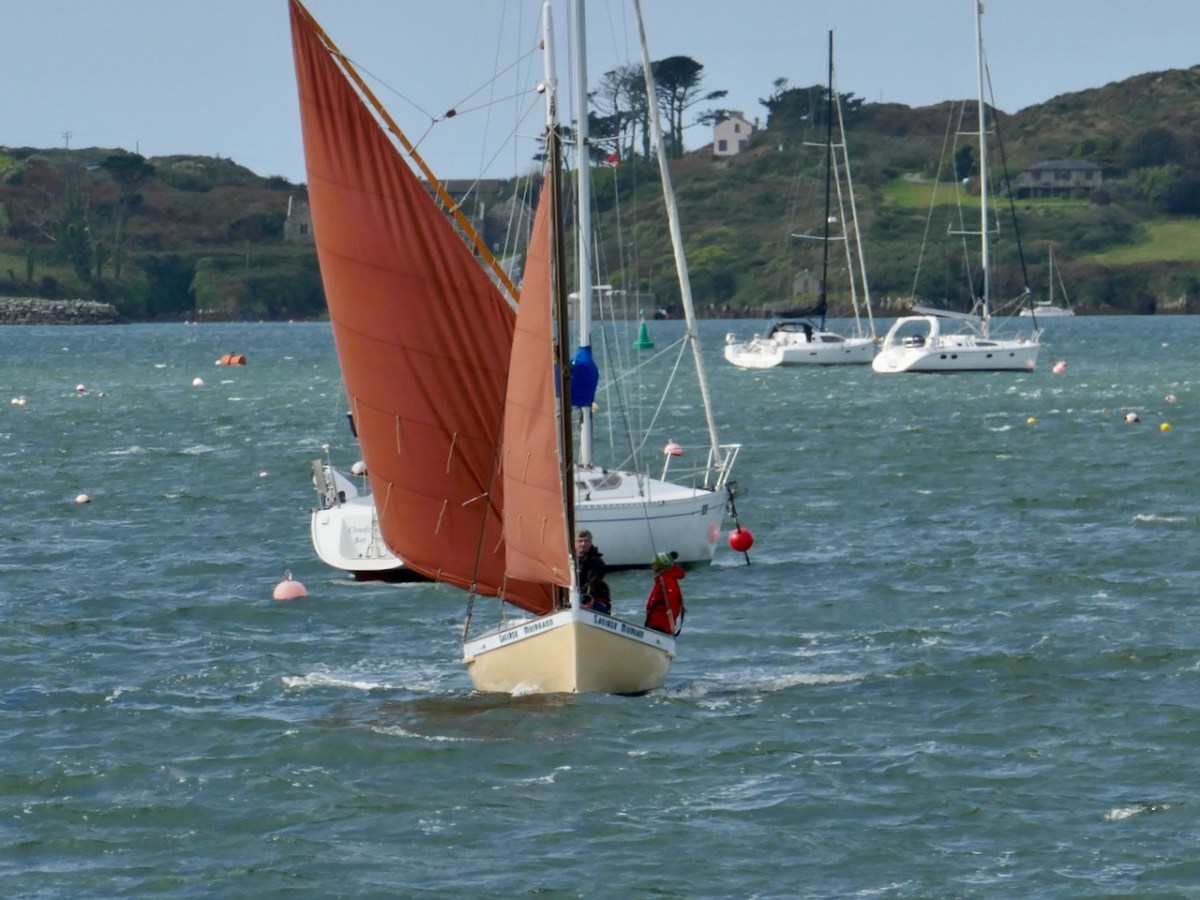
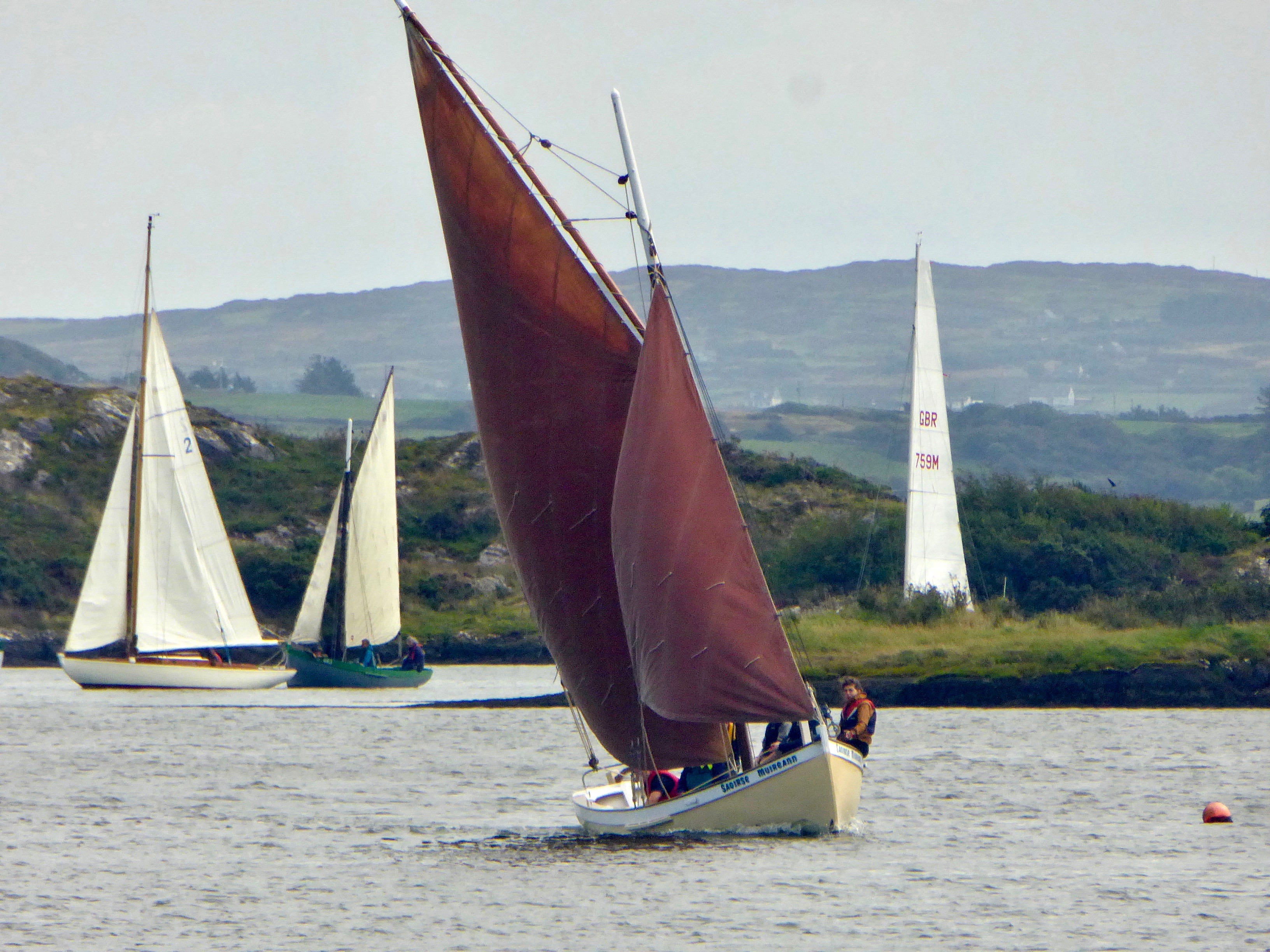
Cormac’s own boat, the Saoirse Muireann, is a traditional towelsail yawl, built at Hegarty’s boatyard

There were lots of preparations to be made for going lobster fishing. When pots and sails were right, the boats were filled with ballast and sunk in deep water for two weeks to close the seams after winter dry dock. Then they were taken up, painted inside and tarred outside. The three-man crew came together to put in the ‘pig-iron’ – slabs of iron for ballast to keep the boat from capsizing. They then put in the steer and the helm and a big anchor. Special ropes and stones were prepared to tie the pots deep in the fishing ground. They called these the ‘Killick rope and stone.’ Next, they added the utensils – a tin basin for washing and for making bread, pots, a kettle, tin plates and mugs. Foodstuffs, including the flour for making bread, were kept in the little cupboard built into the stem of the boat. Drinking water was stored in a ‘breaker’, a round wooden barrel that held a few gallons. They also brought potatoes and coal for the fire.
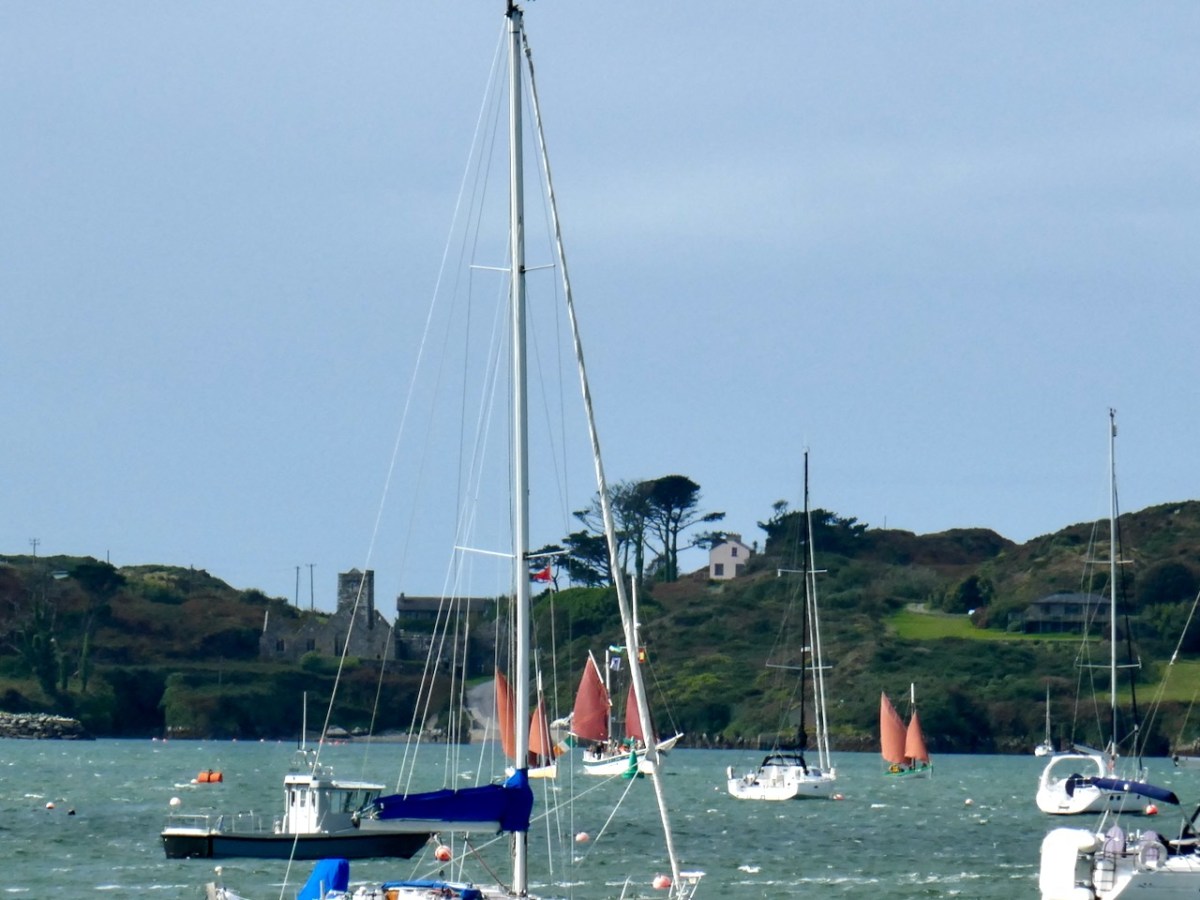
This photograph shows the relative size of the three boats used in the Heir Island fishery. Left to right is the Saoirse Muireann, the Saoirse and the Hanorah

They had an iron bastible pot they called ‘the oven’ to hold the coal fire. The set-up for the fire had to be very carefully and safely arranged. A thick piece of cast iron was placed on the thwart mid-way in the boat and the fire pot was put on top. All the cooking was done on this fire. A pig’s head, potatoes and vegetables were all boiled together in an aluminium bucket. They also cooked fish. One man was in charge of the bread-making. They made white soda bread – very thin cakes that baked quickly. Bits of soot sometimes got into the white flour and the bread would have black streaks in it.
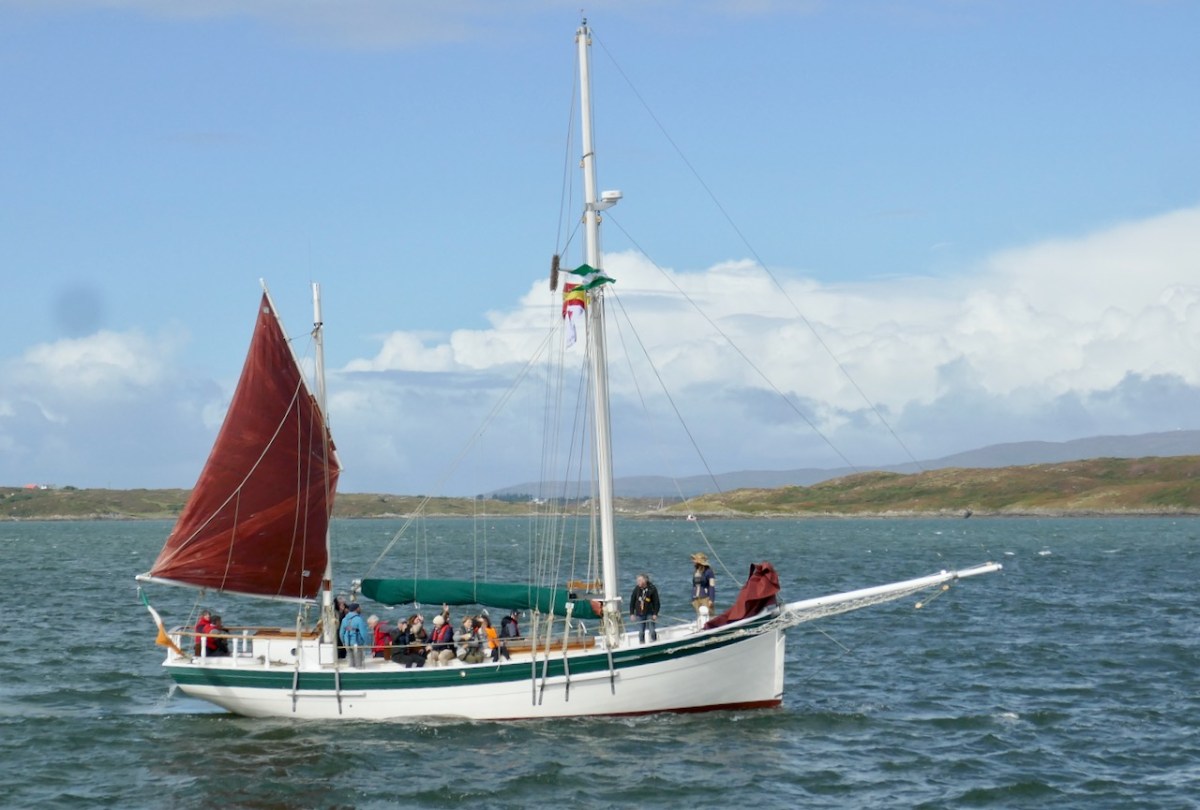
This is the largest of the boats. This is the fabled Saoirse, a replica of the boat sailed around the world by Conor O’Brien is 1923-25. It is a 42′ Ketch and the design was based on a traditional Roaringwater Bay fishing boat

There was smoke and soot everywhere and the men’s skin and clothes were black on their return home and took weeks to get clean again. The combination of soot, salt water and the hauling of ropes caused the skin of their hands to crack. Their ‘intensive care lotion’ was to ‘pee’ on their hands to toughen the skin. They all put on lots of weight during the lobster season and when they came home and their skin cleared of soot, they had a great healthy colour.
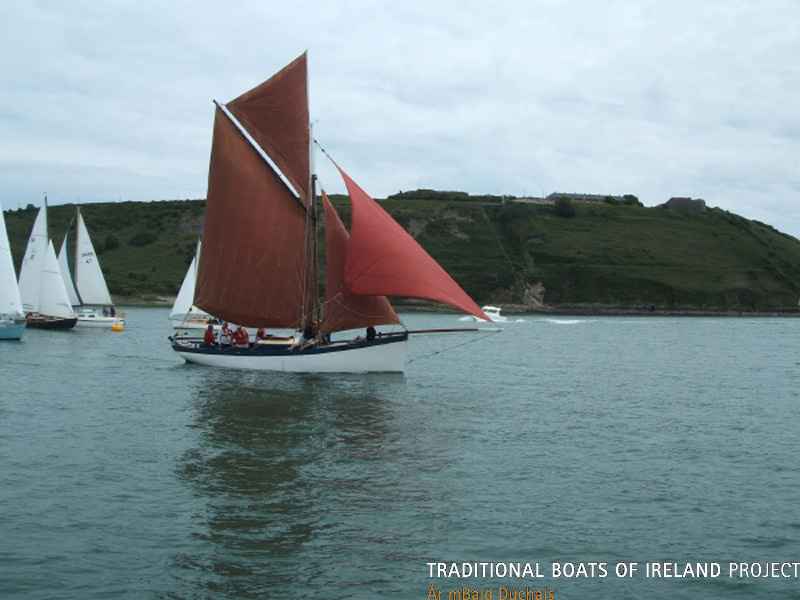
Joe says in his account In 1934, when I was thirteen, we got a boat built by Harry Skinner at Baltimore.This was a small light boat, not the boat above, but I am including this image as it is of a Skinner-built mackerel yawl. It’s from this source.

Washing and shaving were done by sitting the basin of water into the open end of a lobster pot to keep it steady. The same tin basin was used for everything – washing, shaving and making bread. Three towels had to do them for the whole time they were away and these towels were jet black when they came home. They wore flannel underwear – ‘the wrapper’ was a thick vest top with long sleeves and ‘the drawers’ were full length long-johns. The women made all these by hand from their own patterns. All the seams were sewn by hand – herringbone stitch to make sure they never ripped. The younger men didn’t like wearing this heavy underwear but they soon found they were so cold out at sea that they were glad to have them. Each man had three sets of underwear kept in a flour bag with their other clothes and a small bottle of Holy Water.
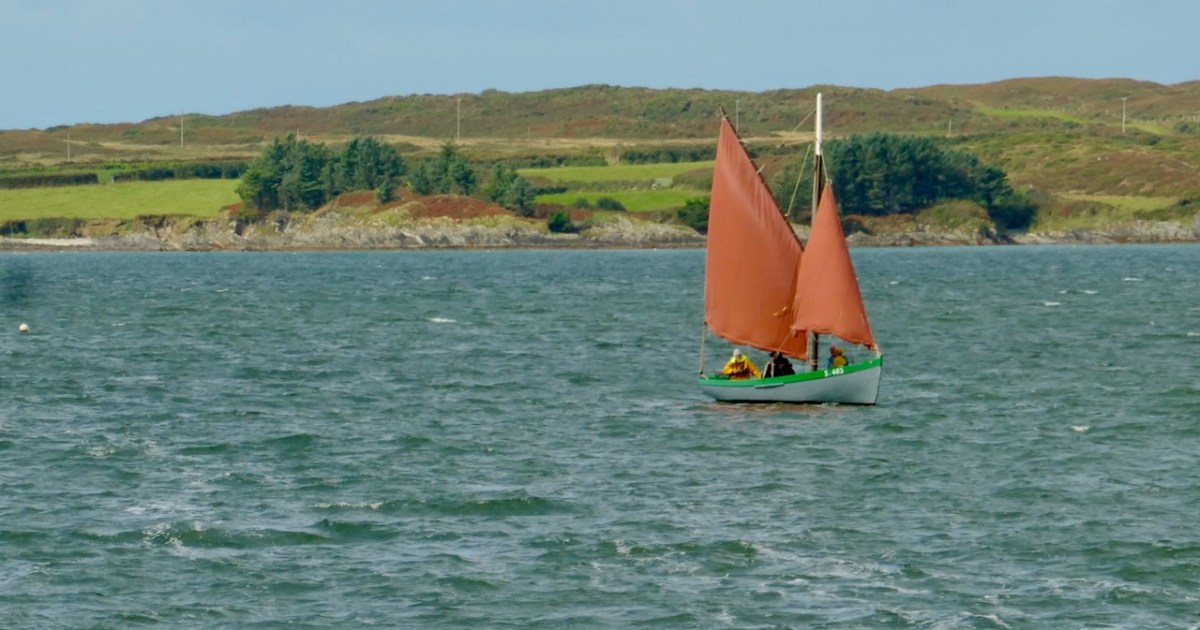
The Hanorah is another traditional boat built at Hegarty’s – this one was used for mackerel fishing

The lobster-men were really skilled at their job. They knew exactly where to get the lobsters and how to handle them without getting bitten when moving them from the pots to the storage basket. This basket had to be kept submerged under a buoy until they went ashore and sold their catch to buyers along the coast – lobsters had to be sold alive. 
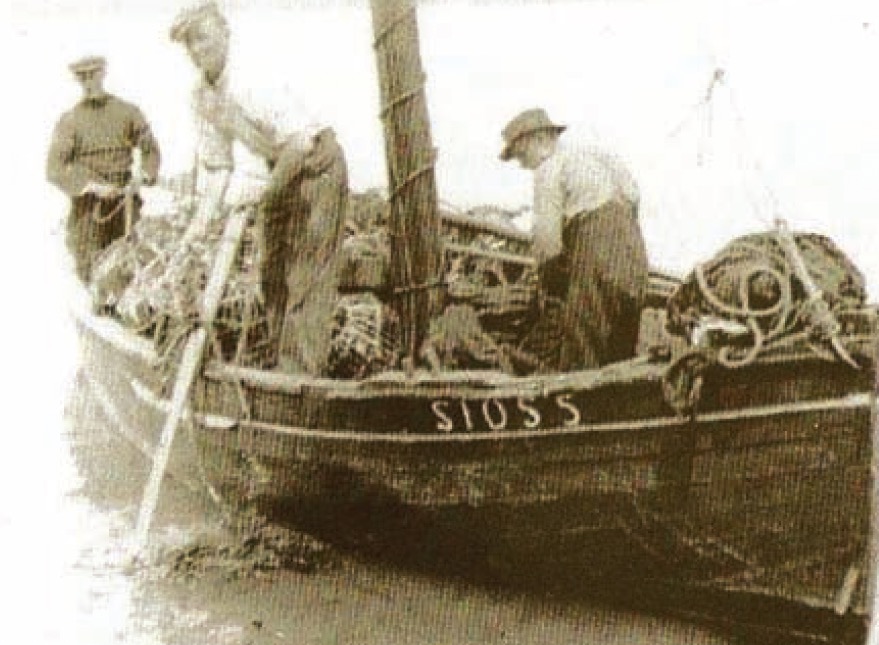
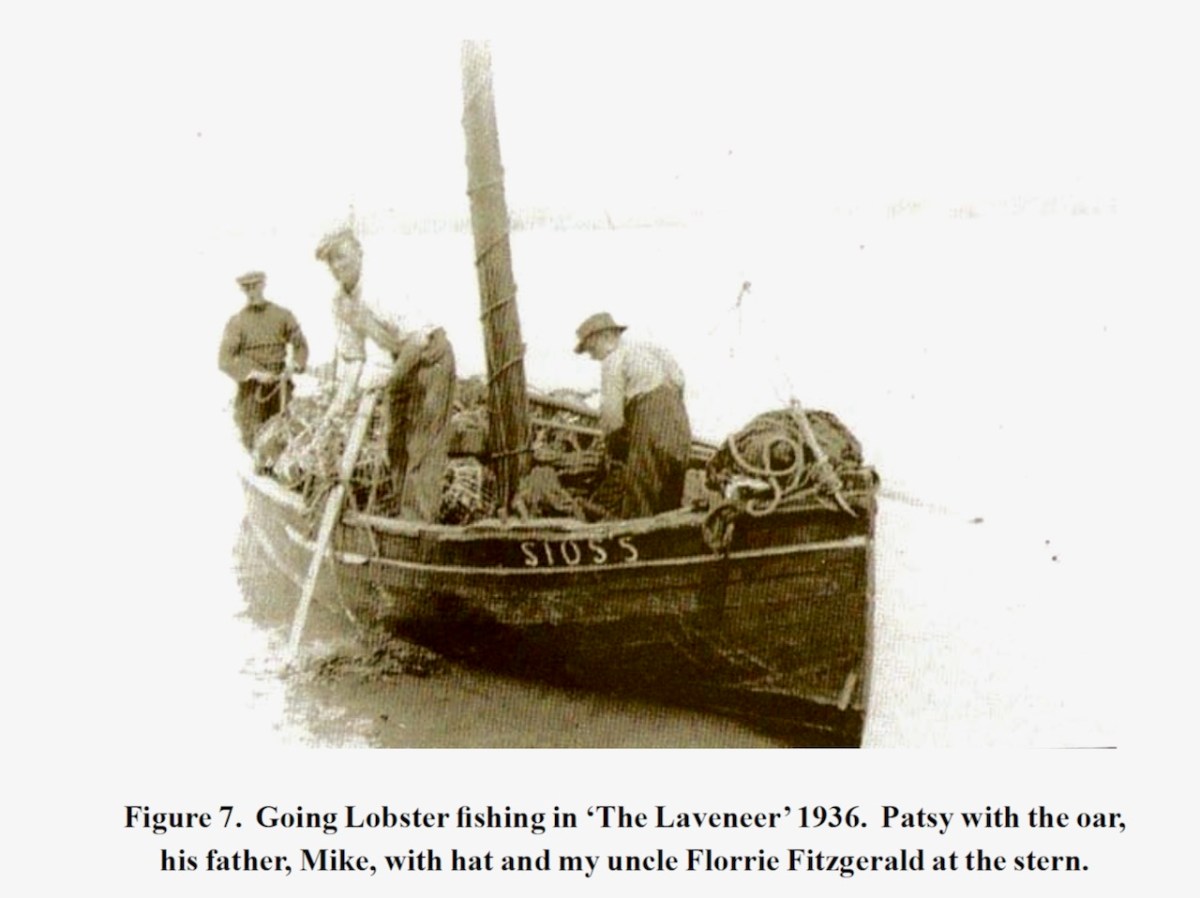
A closer image of the Laveneer loaded with lobster pots

The three men had to get on with each other in a very small space and co-operate together for their own safety. They said the Rosary together every evening and used their Holy Water to bless themselves, their boat and their pots. Patsy’s father, Mike O’Neill (called Mike, the Laveneer or Mike Mary Harte) was considered one of the best boatmen around. He was described in Heir Island as “the safest man going out the harbour mouth” (Baltimore Harbour).
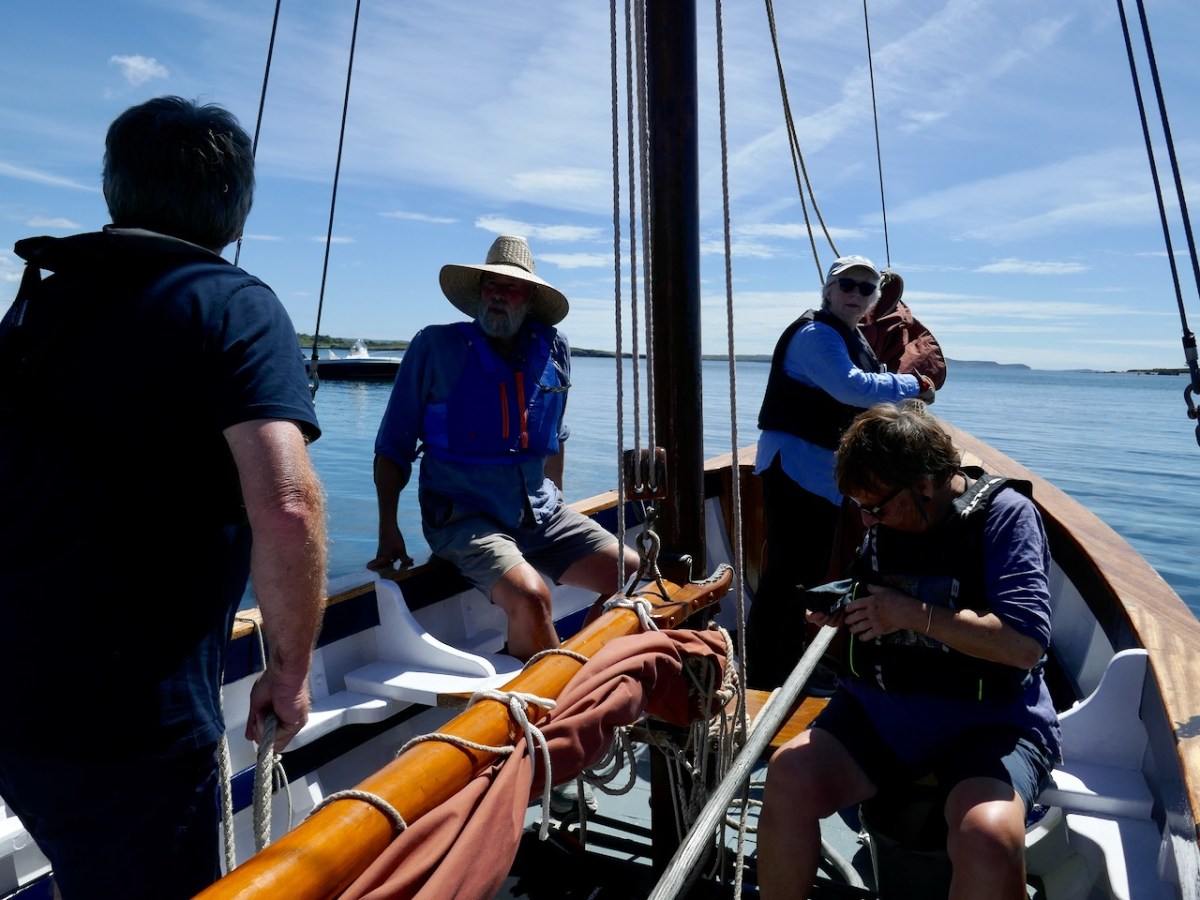
This is aboard Cormac’s Saoirse Muireann this summer – it will give you a feel for the kind of room we had in the boat

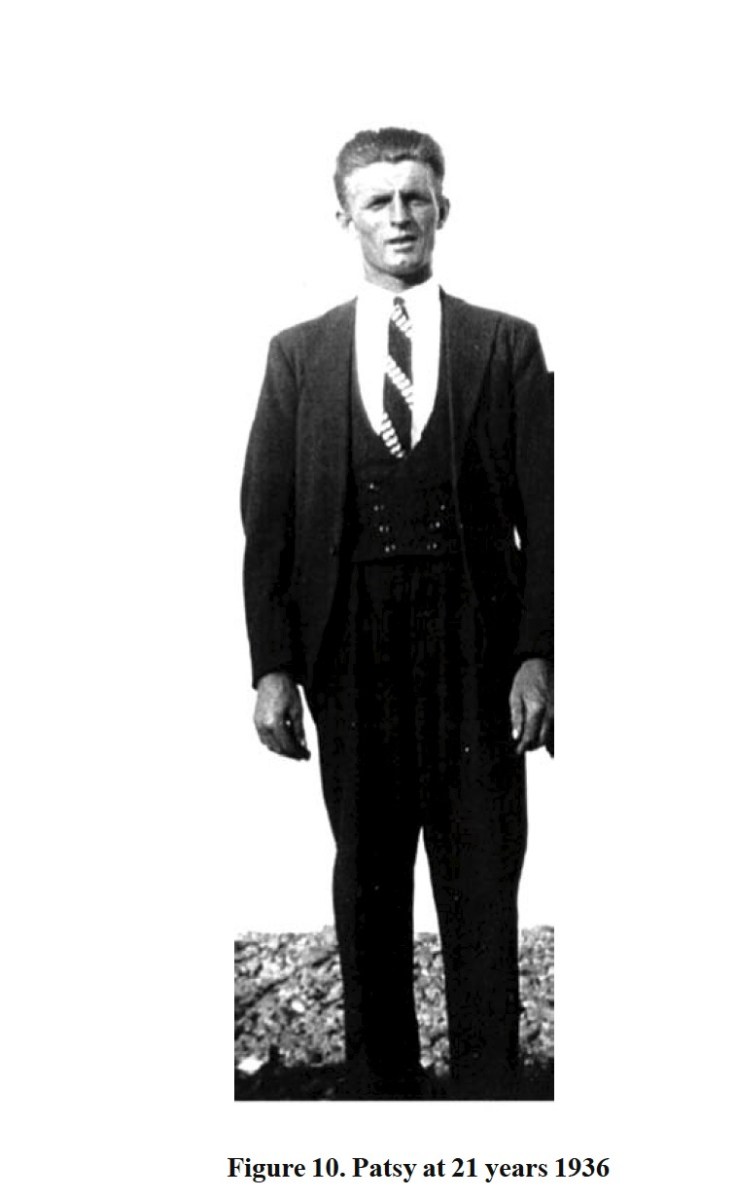
Hester’s memories above were of her father’s generation, but her husband, Patsy also went to sea when he needed to and it was an anxious time for Hester.
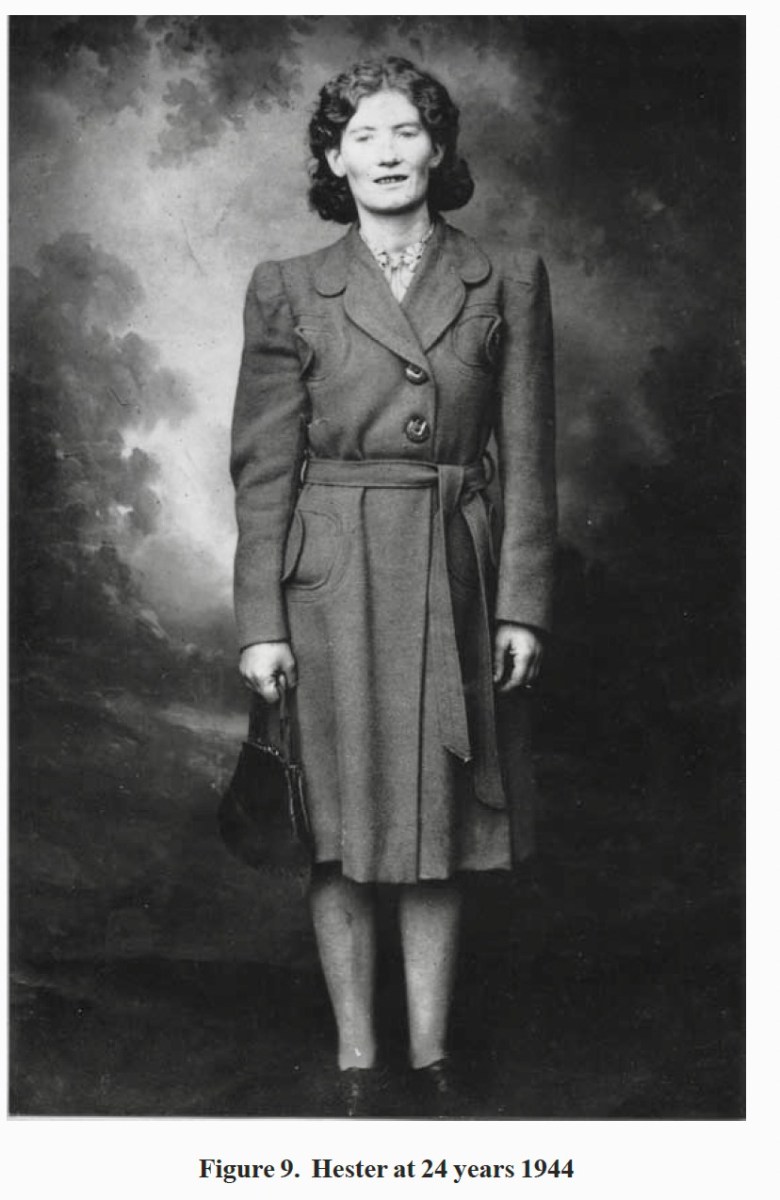
In the last few winters before we left Heir Island Patsy went herring fishing to Dunmore East in County Waterford. He went with a crew from Cape Clear in a small trawler called ‘The Radiance’. Herrings were in great demand in those days and when they had a week of good catches, he sent the money home in a registered letter. I tried to save some of it for the day when we might be able to get a place in the mainland. I remember how the children and I used to write letters to him and address them to ‘Boat Radiance’ c\o Dunmore East Post Office where he picked them up when they landed their catch, and wrote back to us. He could be away for up to three months in the depths of winter and I was always worried for his safety in the stormy seas on those cold winter nights.
It might be a while before I get back to Hester and Joe, but there is lots more to tell from their accounts on life on a small island in Roaringwater Bay

Ballydehob Biodiversity Threatened by Shocking Government Neglect

Roaringwater Journal normally concentrates on being positive, and doesn’t get caught up in political issues. But we cannot stay uninvolved when we see the appalling prospect facing our beloved Ballydehob Bay and Estuary.

The active group that has been working on issues effecting Ballydehob Biodiversity is called Ballydonut (for an explanation, click here to read up on what a Doughnut Economy is all about). One of the members, local historian, writer and retired teacher, Cormac Levis, has put a huge effort, 250 hours to date, into researching the situation regarding waste water treatment in Ballydehob. His findings have profoundly shocked and depressed us all. Cormac, and his parents and grandparents before him, lived and worked in Ballydehob and the islands of Roaringwater Bay. He knows every inch, every story, every family, every creature, of this magnificent area and has written books and articles about it (like this one). We hung on his words on a recent trip with him, below.

Here is the executive summary of his report

Shocking Pollution caused by Ballydehob Waste Water Plant.

The gross neglect and mismanagement of Ballydehob Waste Water Treatment Plant  over a period of ten years has resulted in a shocking, ongoing pollution problem in Ballydehob Bay, especially in the vicinity of the quay and in the estuary adjacent to the village. A thick grey and brown coloured scum of sewage effluent can regularly be seen floating in on the coming tide from the primary discharge point, which is located just fifty meters downstream of the quay. Added to this, grey, filthy, foul smelling water, and often even faeces and toilet paper, can frequently been seen pouring out of the storm water overflow at the septic tank directly into the lagoon.

The so called Treatment Plant is nothing more than a basic septic tank and Ballydonut Waste Water Action Group, Ballydehob Tidy Towns Committee and Ballydehob Community Council are jointly spearheading a campaign to have the plant upgraded to provide proper sewage treatment for Ballydehob. To that end, a petition has been made available for the public to sign at the Post Office and most businesses in the village. It is also available at The Bank House on Mondays and Fridays.

 Also available are copies of a substantiated report, researched and compiled by Cormac Levis, which details the long history of neglect and mismanagement associated with the plant and the resulting threat to public health, community amenities and the environment. It can be picked up where ever the petition is available or email kilbronogue57@gmail.com to have it emailed to you.

Because this issue is so important, Cormac has allowed me to publish the complete text of his report and I have set up a page for it. Just click on this link to read it:

A Substantiated Account of the Neglect and Mismanagement of Ballydehob Waste Water Treatment Plant and the Resulting Ongoing Pollution of Ballydehob Bay and Estuary

Researched and Compiled by Cormac Levis on Behalf of the Ballydonut Wastewater Action Group.

A petition has been established and can be signed at the post office and at various businesses in Ballydehob. Here’s what it says:

To Uisce Éireann, the Environmental Protection Agency, the Environment Directorate of Cork County Council, our local Teachtaí Dála, Senators and County Councillors.

We, the undersigned, demand an immediate upgrade of the Ballydehob Waste Water Treatment Plant, as specified in Condition 5 of the Waste Water Discharge Licence D0467-01, pertaining to the plant, in order to end the shocking and ongoing pollution caused by the current inadequate and obsolete septic tank.

If you can’t get to Ballydehob and would like to add your name, please go to this link to sign it online. (For those who signed it below, before the online petition was established, we will add your names to one of our lists.) Thank you for your support, from Ballydonut Waste Water Action Group, Ballydehob Tidy Towns Committee and Ballydehob Community Council.

Ballydehob is our home, but it’s just one of many, many places in Ireland where the catastrophic failure of wastewater treatment is threatening our environment. See this report from RTE for an exposé that will curl your toes. The section on water pollution starts at 13 minutes in.

Ballydehob and Boats

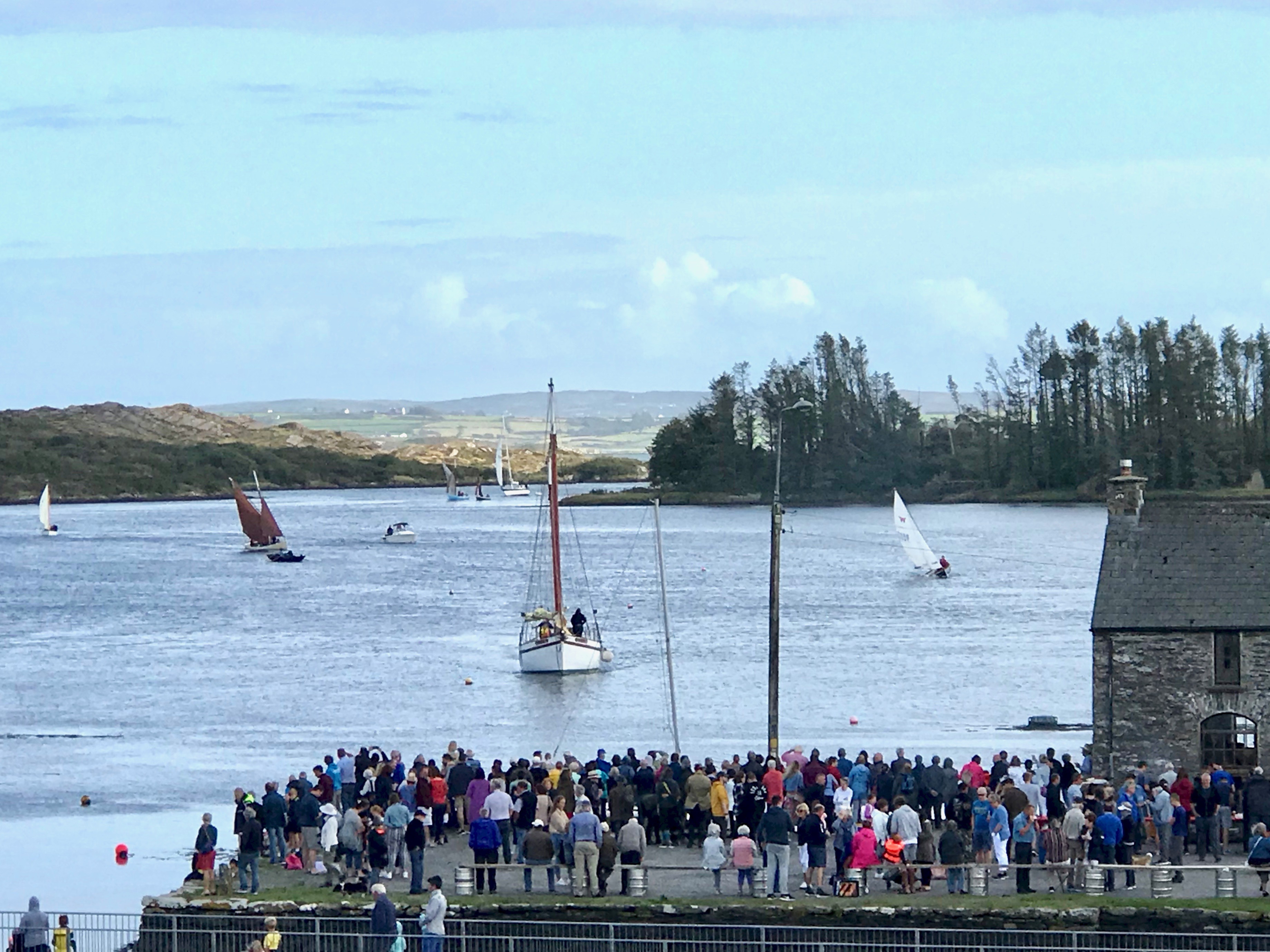
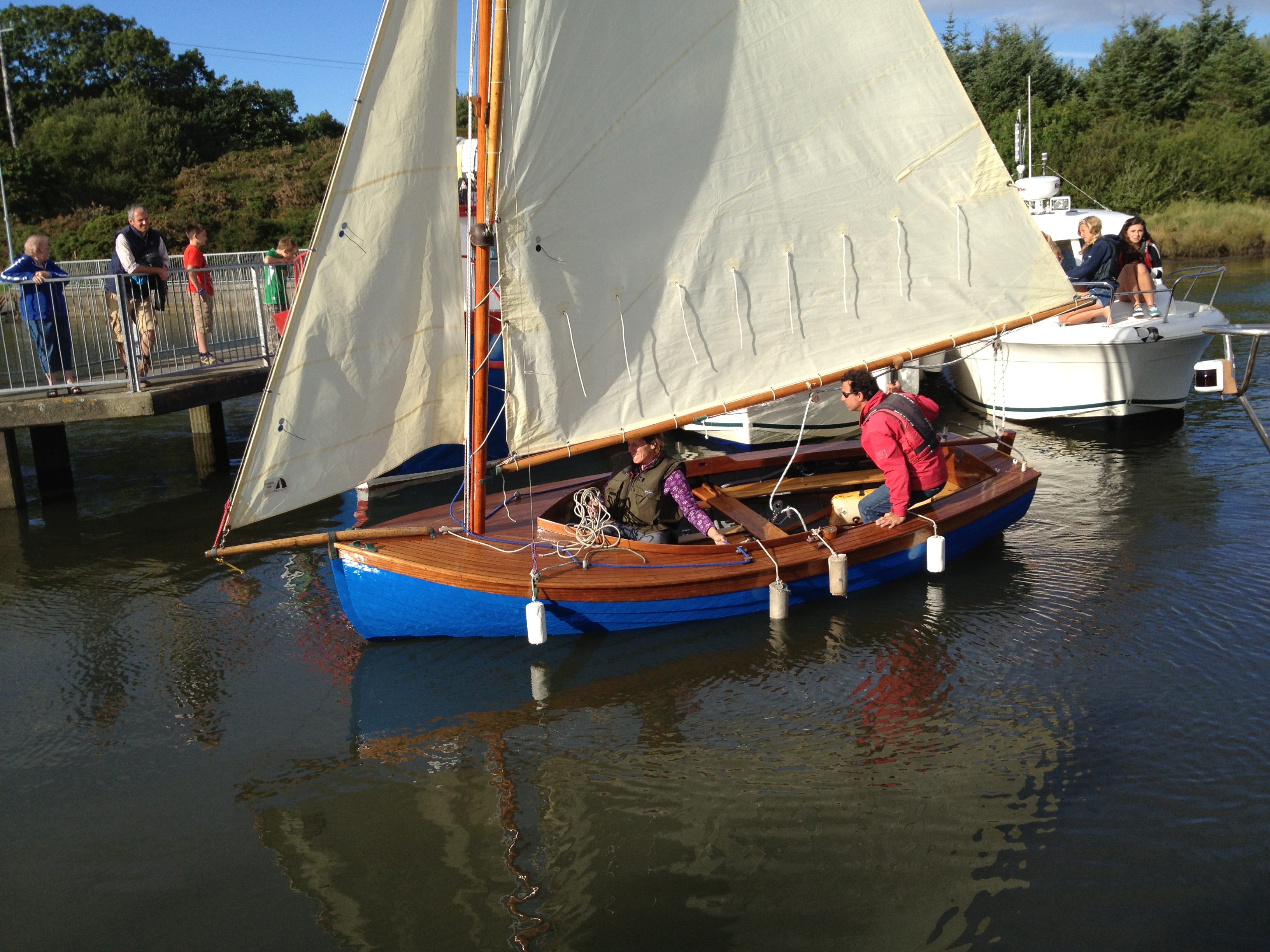
Two years ago Finola wrote about the Cruinniú na mBád (Boat Gathering) in Ballydehob. When I saw that Tidy Towns have erected some new information boards down by the quay – one dedicated to the history of the pier and its importance to the town in past times – I thought it was time to revisit the whole subject of Ballydehob and boats. By chance, our friend Jack suggested that Finola might like to travel with him in his Drascombe and sail up to the quay in this year’s gathering, so we have some ‘live’ coverage of the event from our on-board correspondent! I prefer to keep my feet dry, so watched the event from the vantage point of the 12-arch railway bridge.

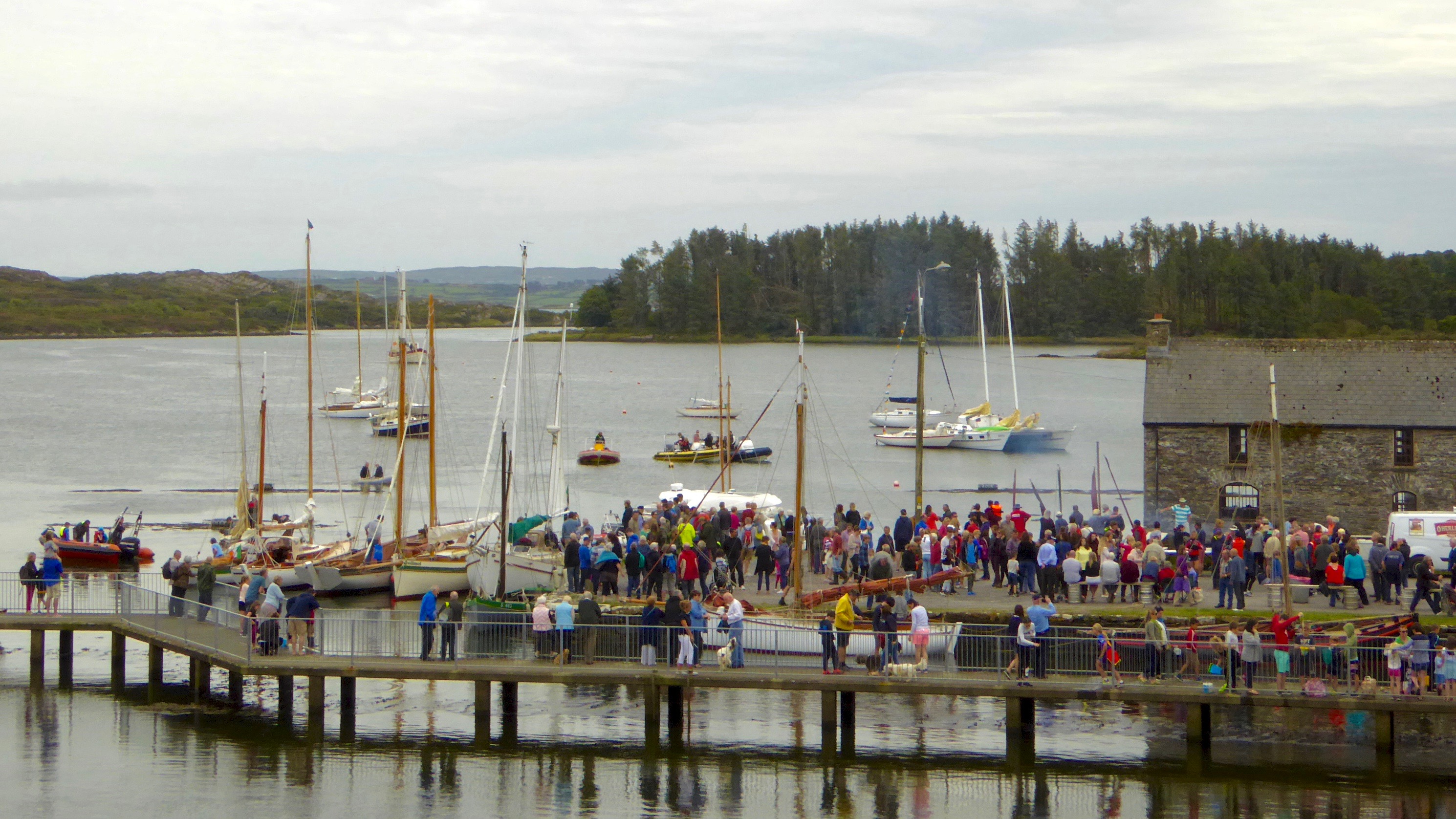
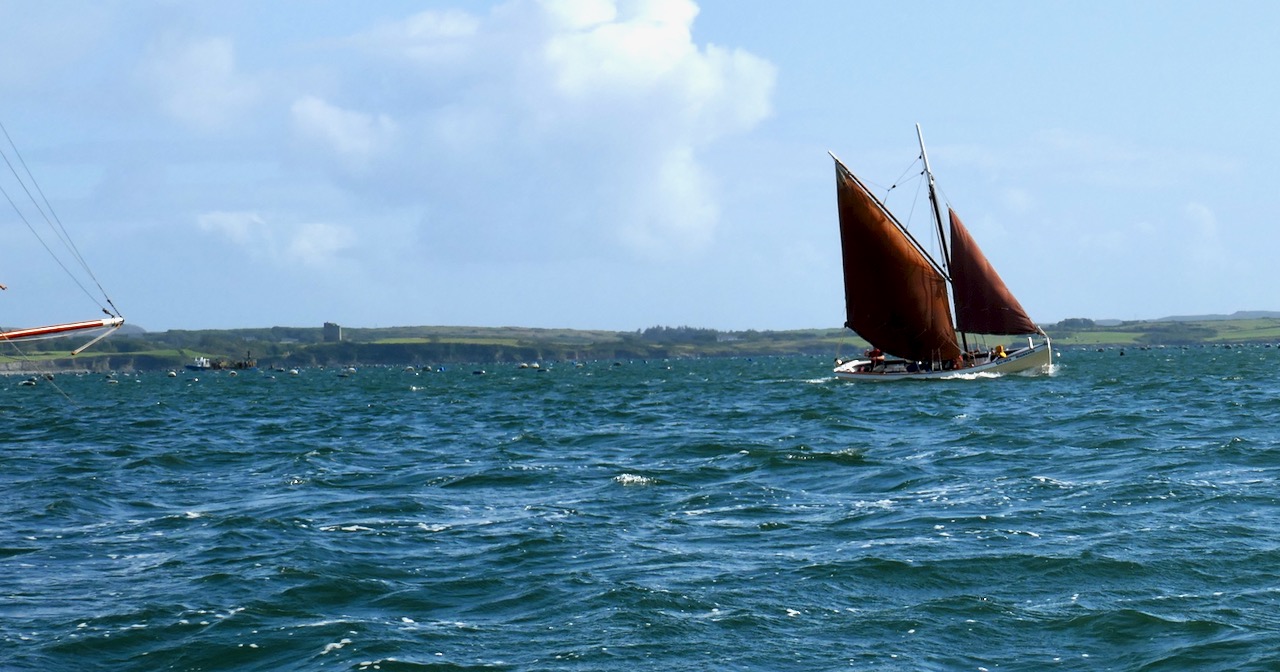
Header – Finola took this pic from Jack’s Drascombe of one of the fleet heading for Ballydehob this weekend, rounding the point opposite Rincolisky Castle and negotiating the mussel ropes; above – the view from the 12-arch bridge, waiting for the boats to arrive at Ballydehob Quay

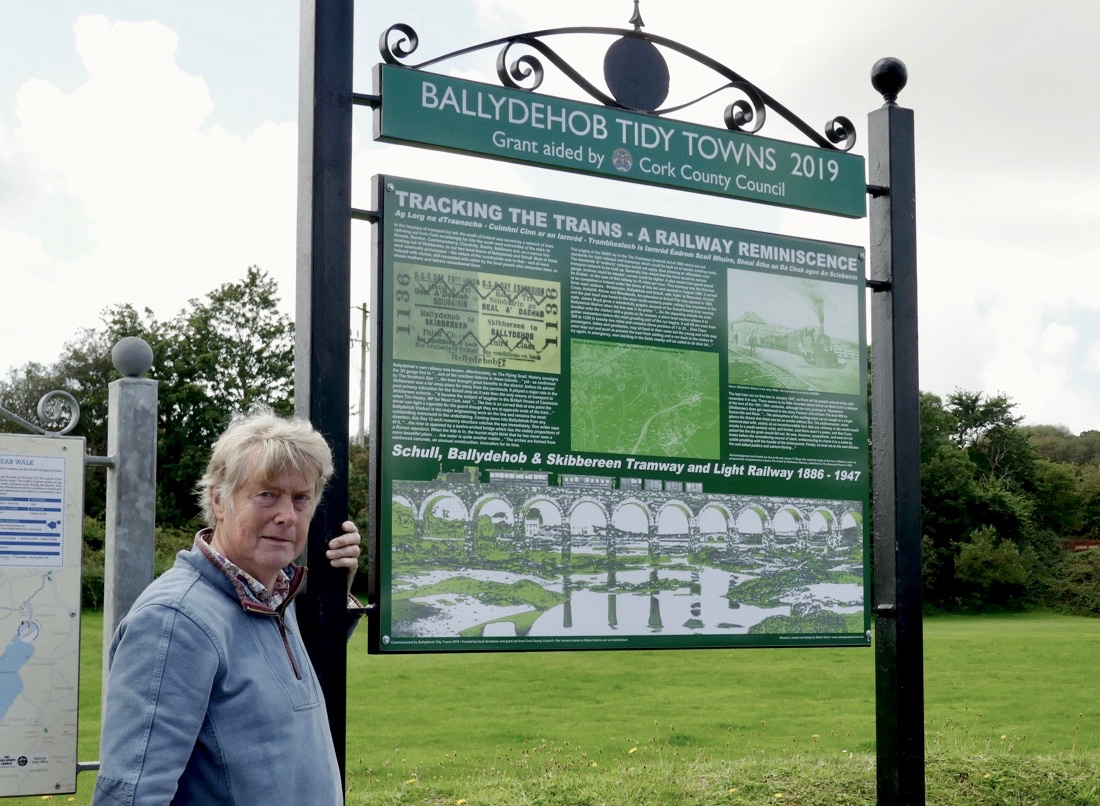
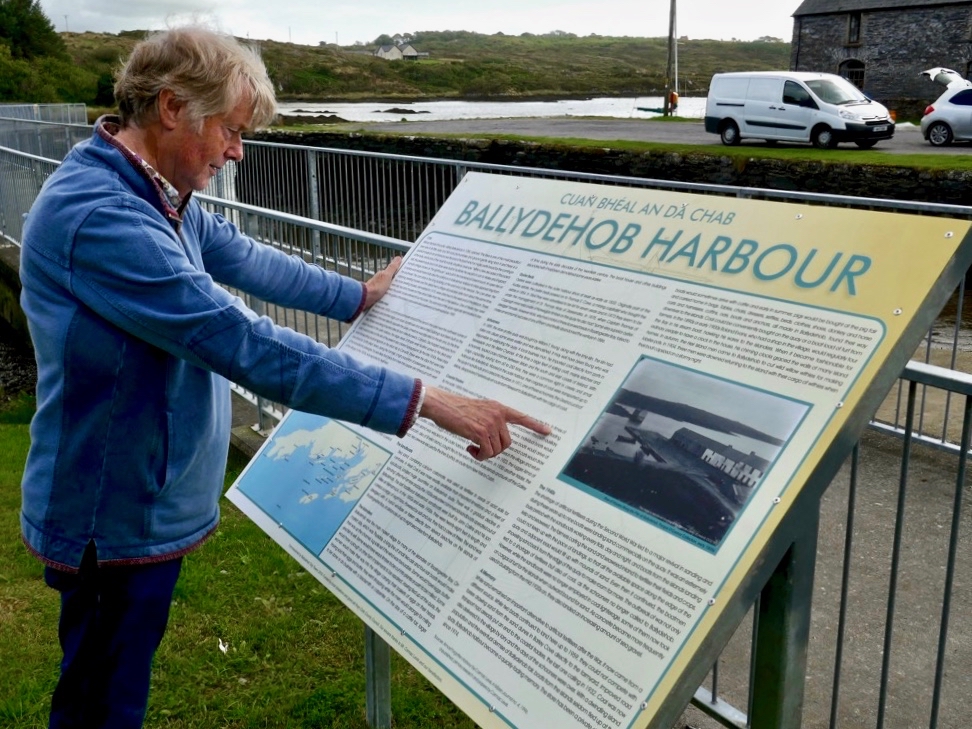
Ballydehob Tidy Towns has recently unveiled two new information boards close to the quay: one (below) is all about the railway line that connected Skibbereen, Ballydehob and Schull: I had a hand in that board! The other tells the history of the harbour itself and is full of information, collected by Cormac Levis, whose forebears worked many of the boats that traded into the town. Cormac initiated the Cruinniú na mBád in 2004 and it has been going ever since, barring the occasional cancellation due to atrocious weather conditions (which can happen, even here in serene West Cork).

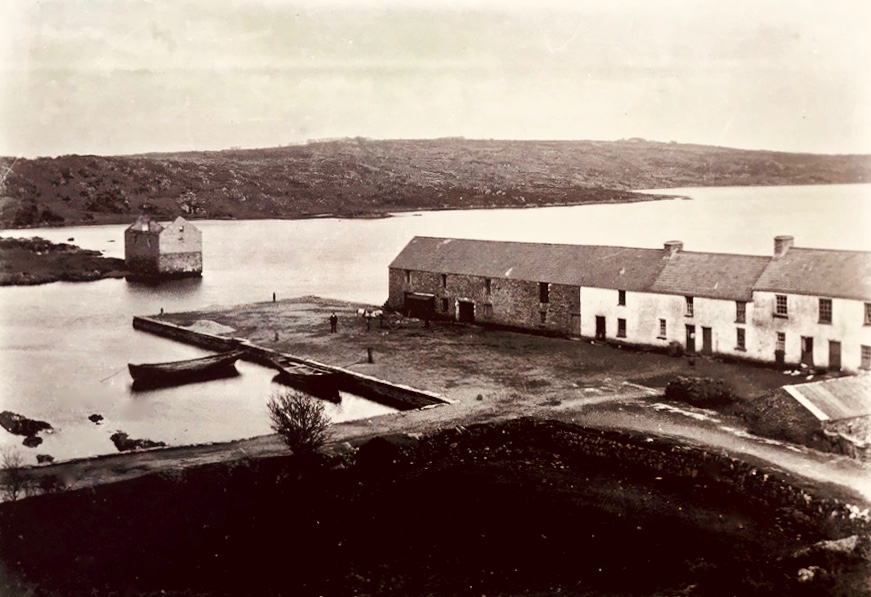
The new information boards enlighten us on many aspects of Ballydehob history, particularly within the vicinity of the 12-arched bridge and the quay. The view above, from Cormac’s board, shows the harbour in the early 1900s and is reproduced courtesy of the Fergus O’Connor Collection and the National Library of Ireland. Note the higher section of buildings to the right of the main warehouse – they are no longer there; they are said to have once housed seven families

The pier at Ballydehob is often called ‘the sandboat quay’ as one of the main commodities to arrive in the town was sea-sand dredged from beaches nearby and on the islands. This was rich in nitrates and minerals and was valued as a fertilizer. However, sand was only one of the commodities that came to Ballydehob; the following is an extract from an excellent piece that Cormac Levis wrote in the (now sadly defunct) Mizen Archaeological and Historical Journal, back in 1996:

On market day, which was Thursday, a long line of small two-oar and four-oar boats would make their way up the channel, lug sails set if the wind was favourable. One by one they would approach the quay, bringing people from the Skeam Islands, Horse Island and Hare Island to do their marketing. Some would have eggs and butter to sell, some would have a plough or other farm implement for the smith to repair. Wrack timber would be brought to be cut into planks or corn to be milled. During the summer months the Hare Island boats would be occupied by women only, their menfolk having migrated en masse to fish lobsters east along the coast as far as Ballycotton. On the arrival of the first letter bearing the fruits of their husband’s labours, they would set out to buy two pigs at Ballydehob Fair. Quite often, if the wind wasn’t in their favour, they would row the full four miles to Ballydehob . . . The day of a cattle fair would occasionally see the arrival of the 39ft MV Mary Patricia with cattle from Old Court or Sherkin. The 20ft Barker, driven by a 6/7 Kelvin, would visit to load up with provisions for Burke’s shop on Hare Island. A rather melancholic sight that would be seen from time to time, was that of two oarsmen making their sad way down the channel returning to one of the islands with a coffin across the gunnels of their small boat . . .

From the 1996 Mizen Journal article by Cormac Levis: a photograph of one of the sandboats from 1936, and a diagram showing the hessian dredge that was used for collecting the sand

Cormac provides good information on the sandboats – this is a short extract:

When William T Young of Ballydehob purchased the stores and quay from Jane Swanton of Skibbereen in 1899, the property was described as the ‘old stores’ and ‘sand quay’, indicating that the practice of discharging sand there was well established by that time . . . In 1885 John Collins moved to Filenamuck. There in the early 1890s he built two boats for W T Young. These sister boats were the largest of the Ballydehob sand boats, capable of carrying a cargo of 8 tons 5 cwt and were typical of the Collins design. They had a 24ft keel, an overall length of 28ft, a beam of approximately 8ft 3ins and, when fully laden, a draught of approximately 4ft 6ins. They had a very shallow keel and, unladen, they had a draught of approximately 1ft 9ins . . . One of the two boats described above came to be known as the Conqueror and the other simply as Levis’s boat, after her skipper Charlie Levis.

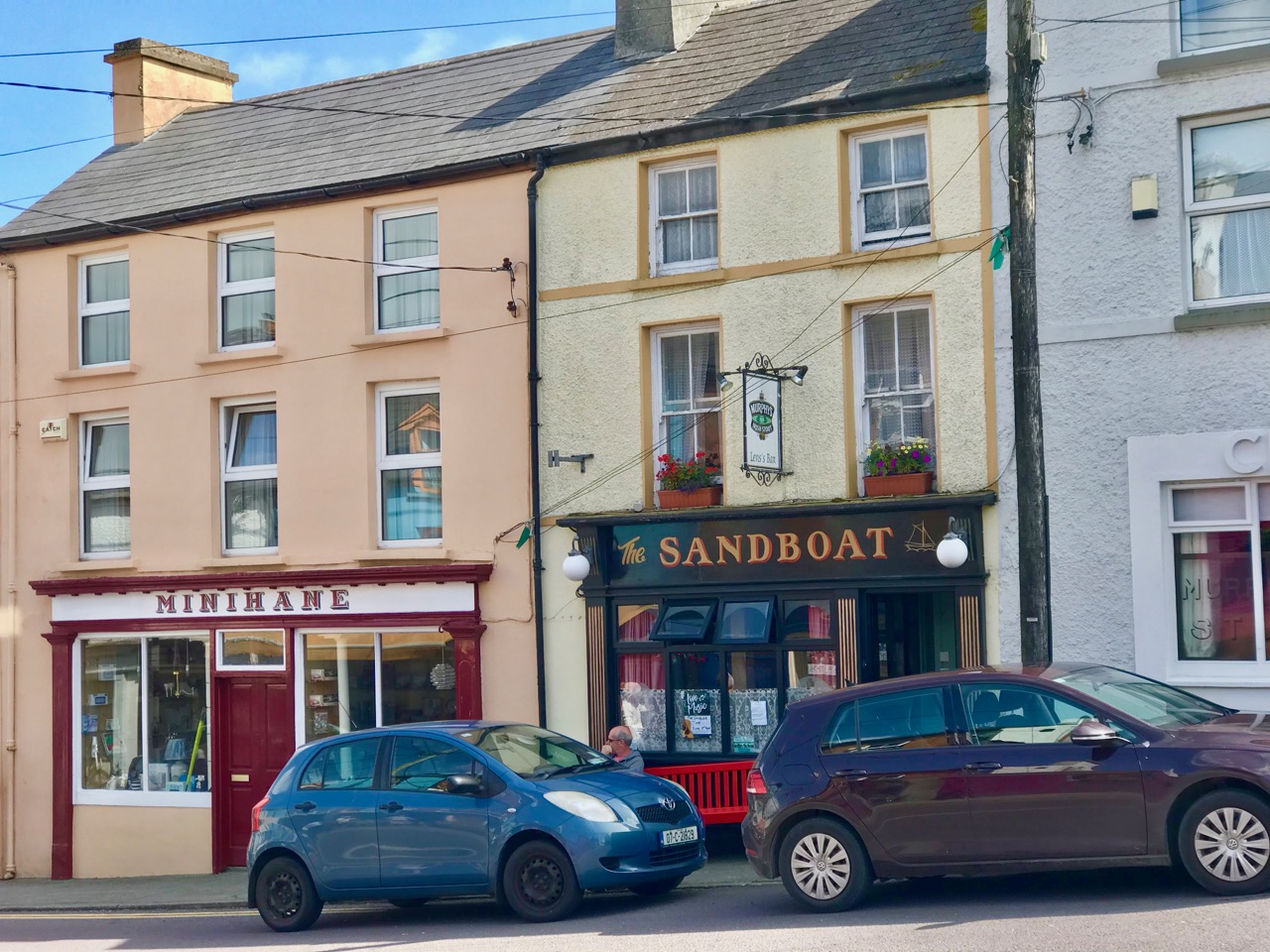
The Sandboat Bar in Ballydehob is still owned and run by the Levis family

Today, the harbour of Ballydehob – while as picturesque as ever – is quiet, and seldom hosts anyone travelling by water. Ballydehob Bay itself is silted up and it’s only on the highest tides of the year – when the moon is full – that boats of any size can make the journey. So we salute the intrepid voyagers who, every year, keep up the memory of a thriving waterfront that was once the heart of the community. If, like me, you are nostalgically inclined – on the day of Cruinniú na mBád, as you stand looking for the flotilla coming in on the rising flood, close your eyes slightly and imagine that you hear the sound of the whistle as a little train clatters over the viaduct behind you . . .

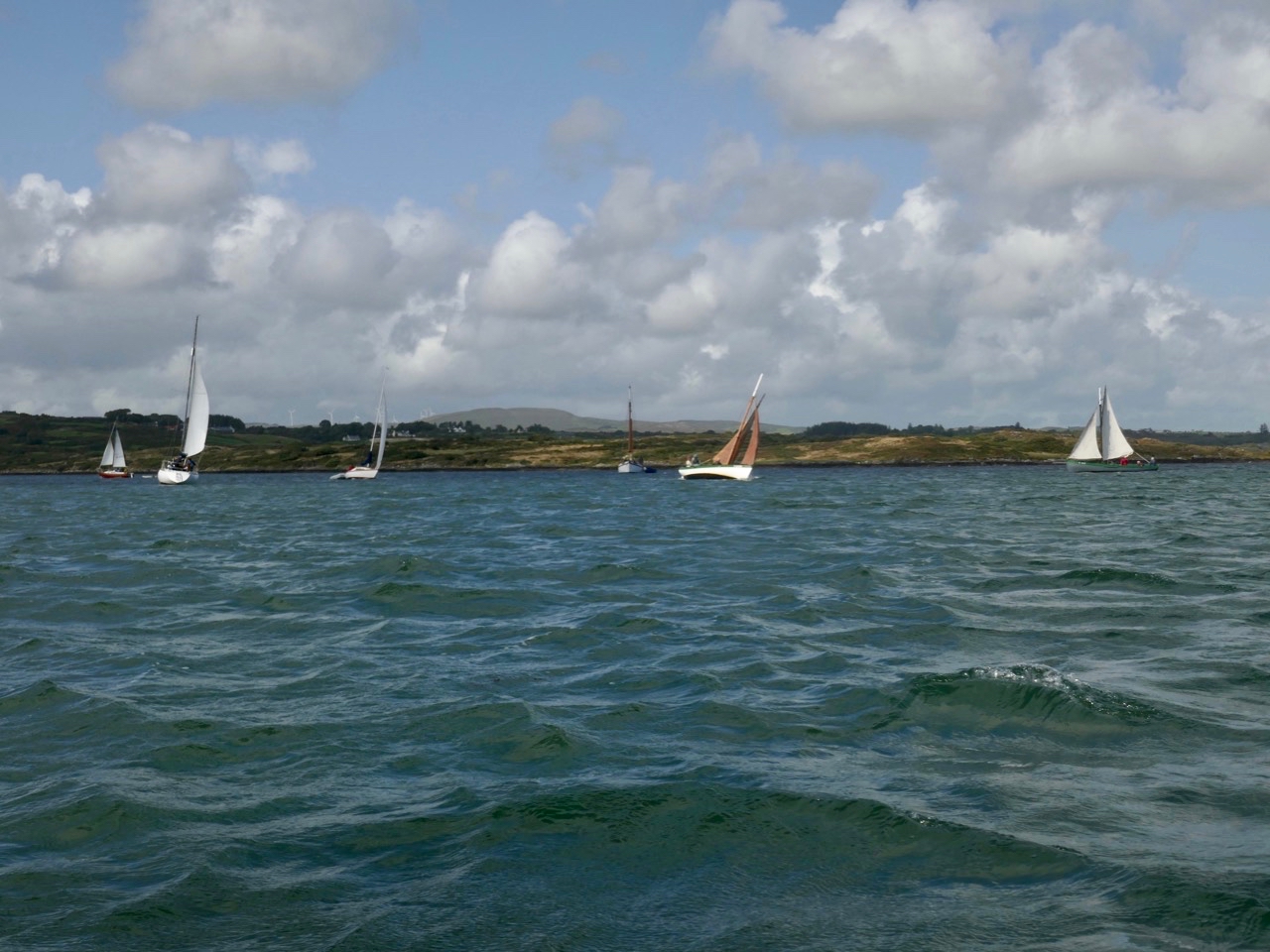
Finola (see her post this week for more on what’s happening here) will assure you that it’s an exhilarating and moving experience approaching Ballydehob by water: I’ll close with some more of her pictures: there was a stiff breeze with high gusts coming in – I’m amazed she managed to keep her horizons horizontal!

Cruinniú na mBád – the Boat Gathering

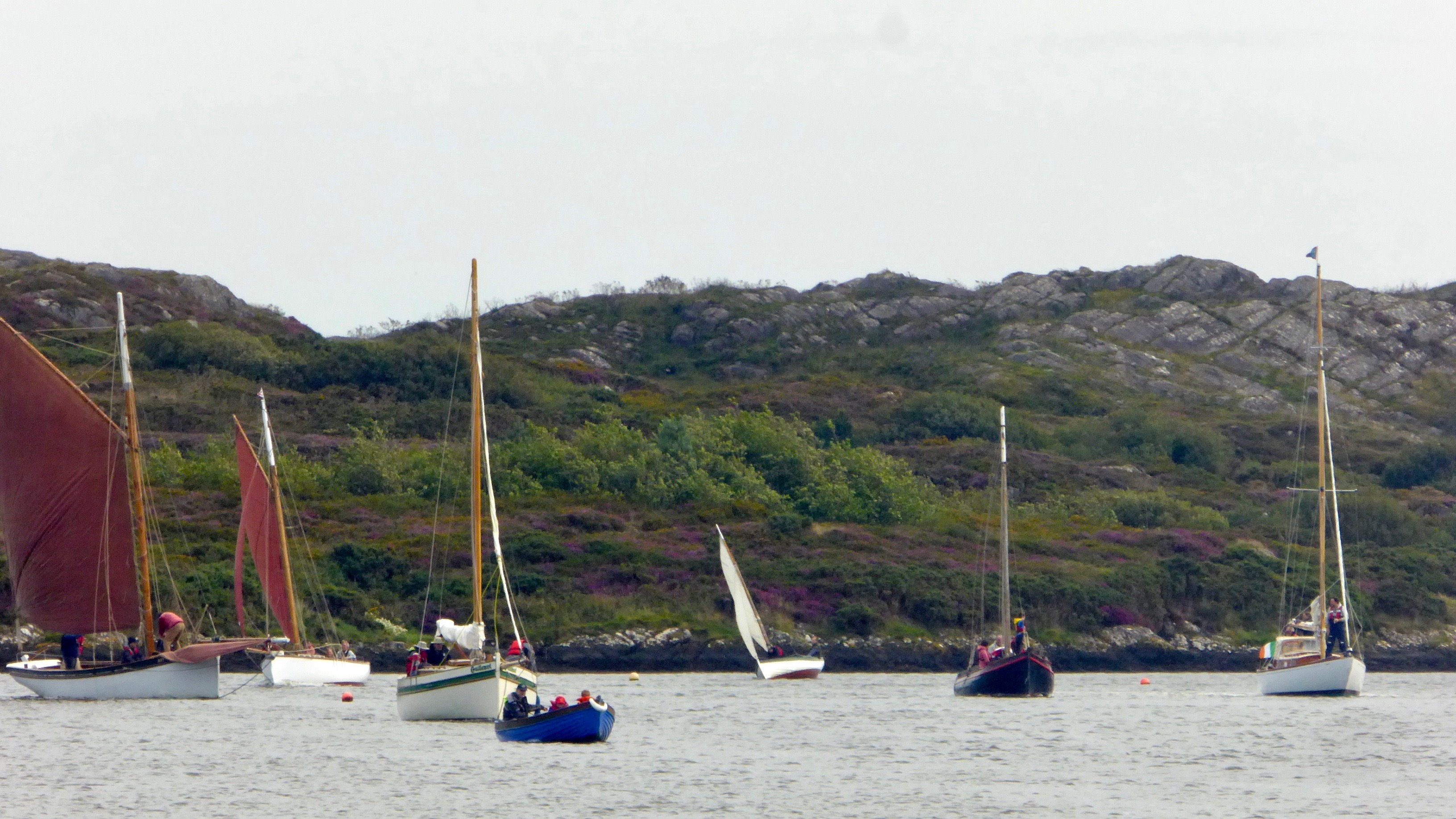
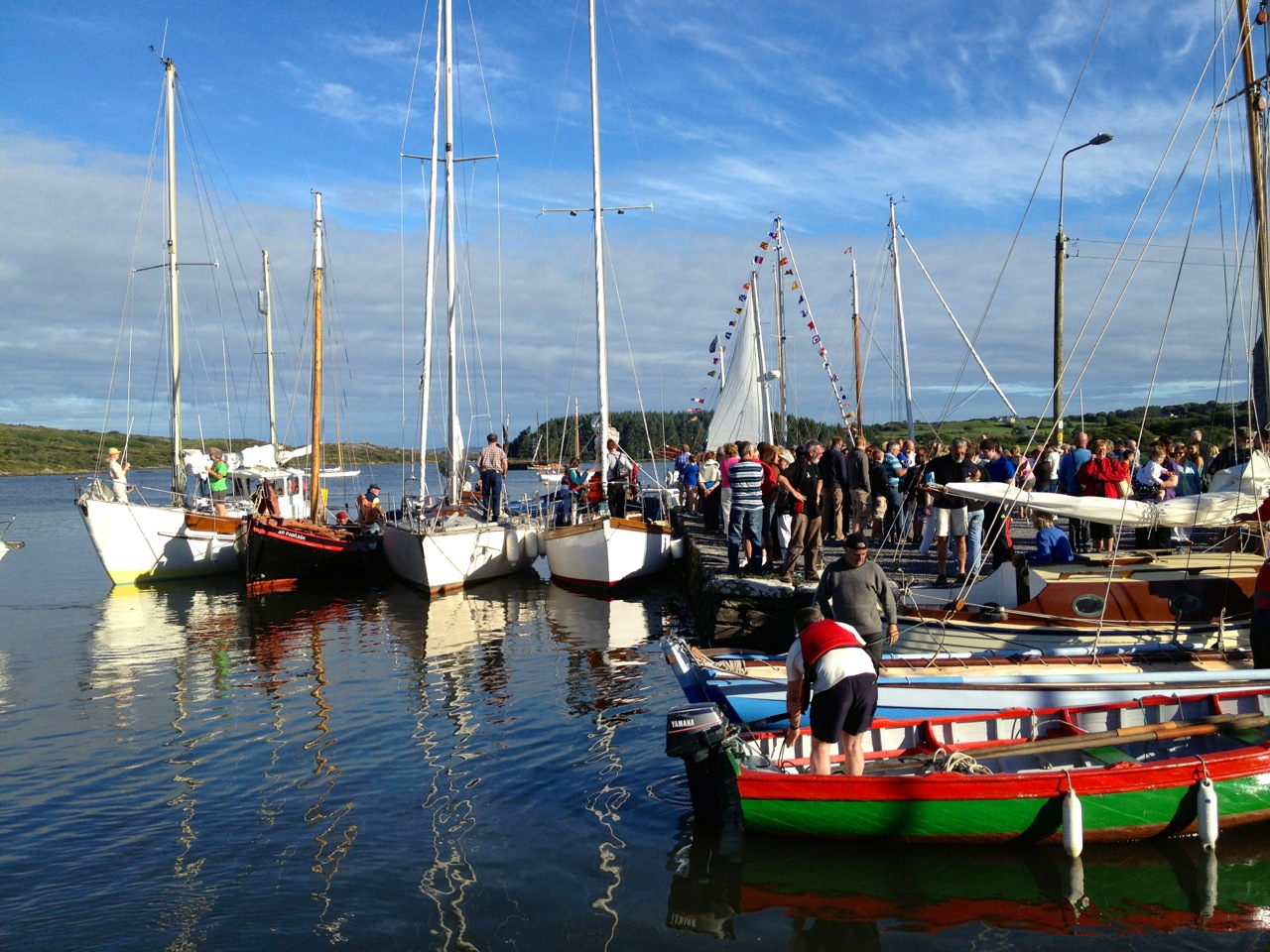
It only happens once a year! During Ballydehob’s Summer Festival traditional sailing boats gather in Roaringwater Bay and when the tide is right they sail up the shallow waters of Ballydehob Bay to the quay.*
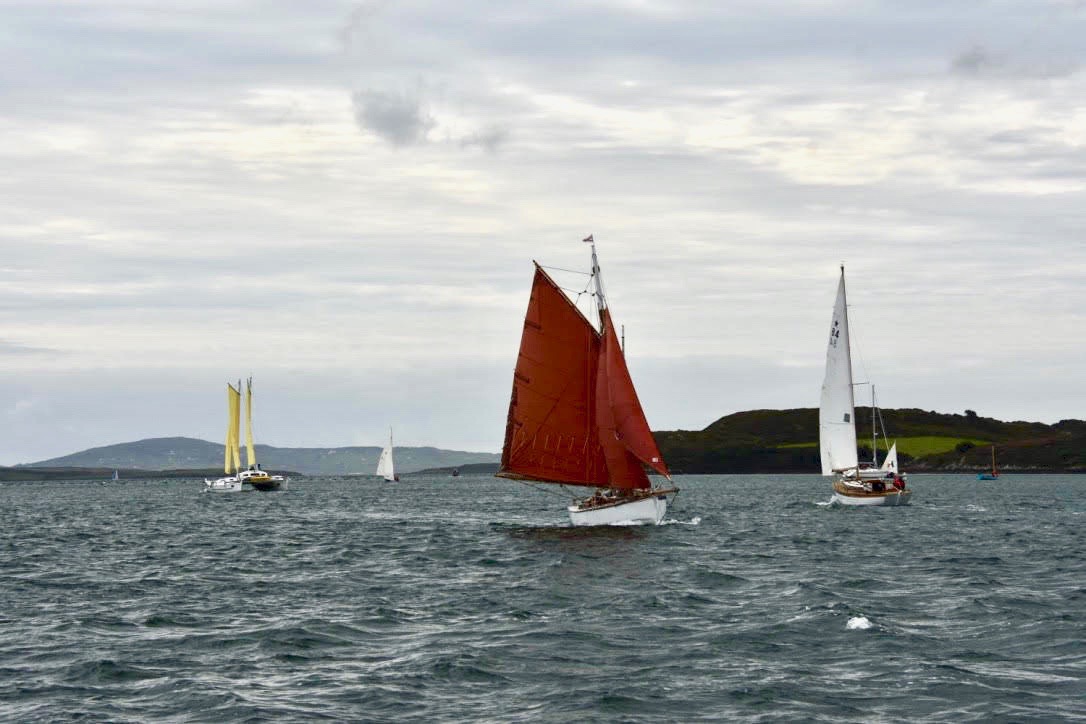
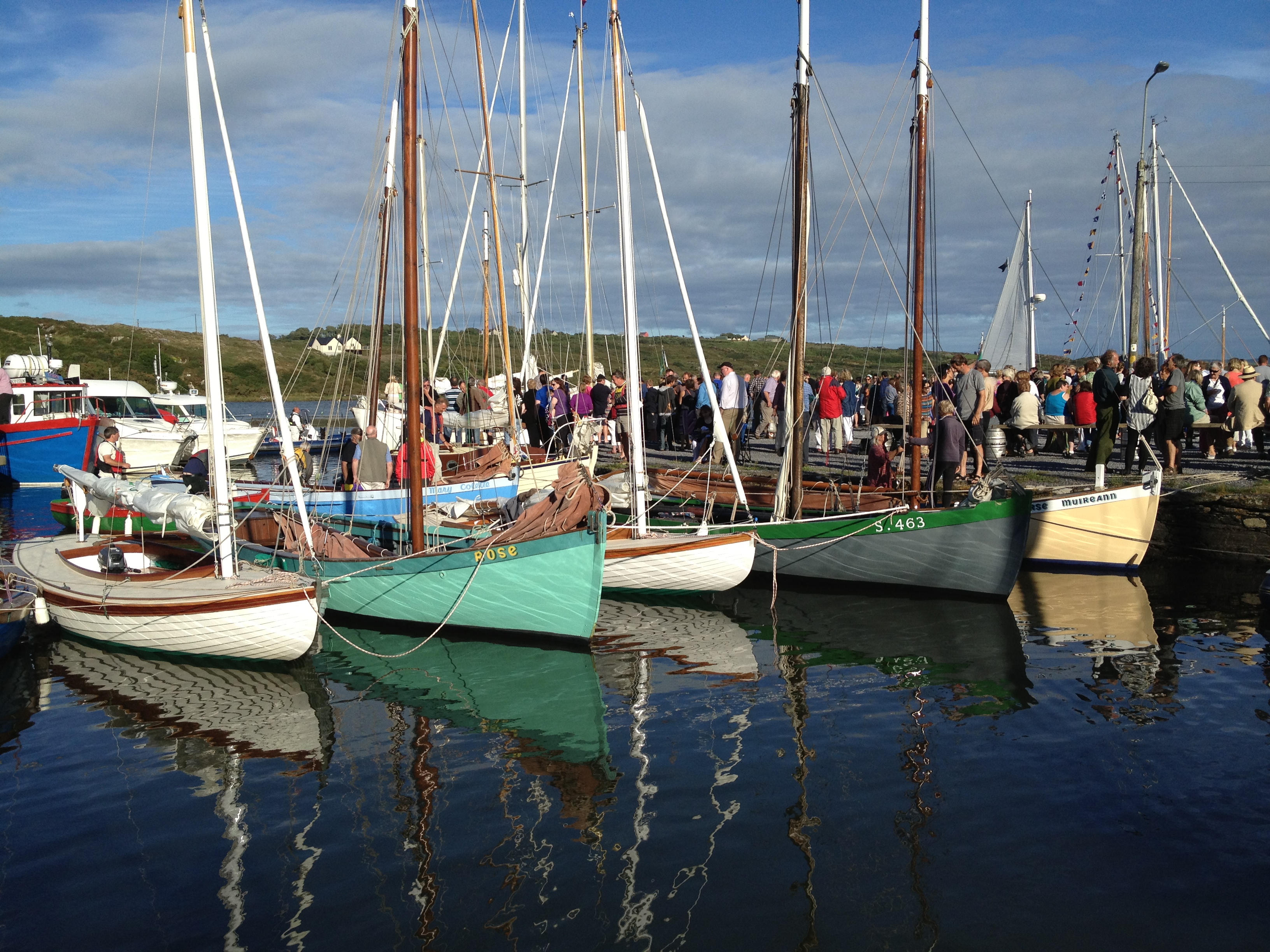
This is a tidal estuary and normally not deep enough to be a reliable port of call for boats, especially those with keels. But during the high summer tides the waters become navigable, provided you time it right, and Ballydehob breaks out the band, fires up the barbecue and invites all sailors to the quay for a gathering like no other.

The Cruinniú na mBád (pronounced krinoo nuh mawd) is part of the village Summer Festival so from year to year it’s a real community affair. The vintage cars and tractors (my goodness there’s a lot of them in West Cork) parade behind a marching band to kick off the week of festivities. The week is filled with music in the pubs, guided walks around the village, charade competitions, and an evening of street sports where we cheer on the youngsters in the madcap turnip race and a completely socially irresponsible event involving chugging beer and pushing a wheelbarrow with an occupant (only in Ireland!).

Turnip races down the main street and crab fishing at the quay

On the weekend the whole village takes to the Pier. The kids compete for medals in crab fishing, there’s a “world famous duck race” (I have no photographs as it’s been cancelled due to bad weather so often), there are fireworks (when it’s dry enough) from the Twelve Arch Bridge, and we await the arrival of the Old Boats.

This year’s entertainment was the fabulous East coast Jazz Band. We catch up on the chat, and look out for one of our popular locals sailing in

It’s an oddly emotional experience to see the boats appear, one by one, and round the bend into the last stretch to the quay. Emotional because this is essentially a re-enactment of what was commonplace in former days, when the quay at Ballydehob was a bustling hive of commerce. Bigger boats would anchor at the entrance to the Bay and lighters would haul the cargo to the quay.

Not all the boats are old – some have come just to be part of this unique gathering – but most are traditional and many of them have been lovingly restored. Some, like the Ette, have been rescued from extinction and reconstructed from crumbling derelicts by master boatbuilders Anke Eckardt and Rui Ferreira – check out their site for an illustrated guide to the slow and skilful processes involved.

Anke and Rui arrive in their Ette-class boat

At this year’s gathering Anke’s parent, Dietrich and Hildegard, our neighbours and friends, were there with their classic fishing boat, the Barracuda.

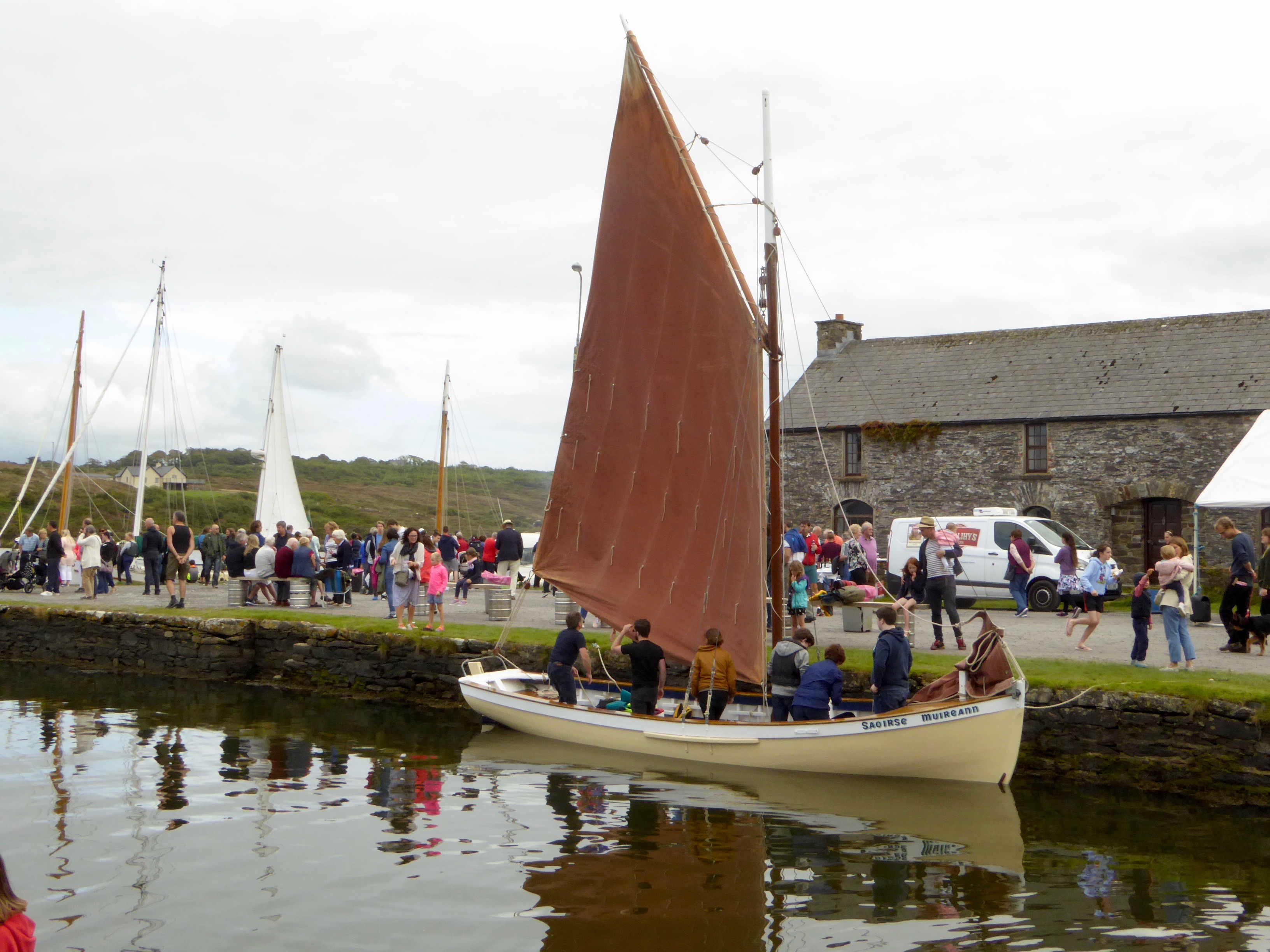
The whole Levis family sailed in on their beautiful Saoirse Muireann (seer-shuh mirren, Freedom of the Seas), a traditional Heir Island Lobster Boat. Cormac has written the book, literally, on these boats: Towelsail Yawls: The Lobsterboats of Heir Island and Roaringwater Bay. He started this gathering way back in 2004 and it’s been going strong ever since.

Saoirse Muireann coming in to dock. The term towel sail comes from the Irish word teabhal (pronounced towel) meaning shelter, as the sail could double as a kind of tent in wet weather.

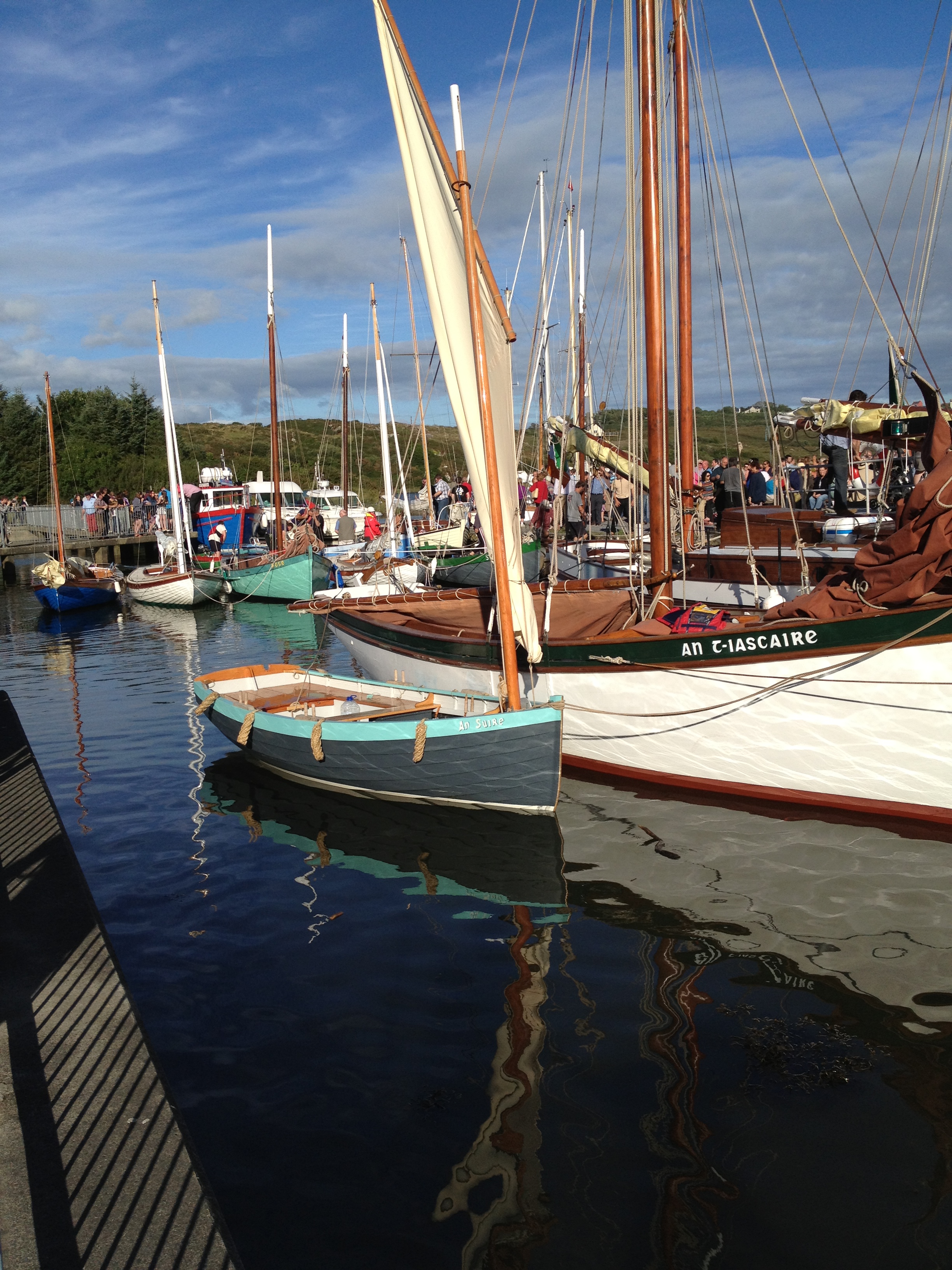
Another traditional boat was An tIascaire (on tee-skirruh, The Fisherman), a traditional mackerel yawl. Like many boats in these parts, this one has benefitted from the extraordinary knowledge of the boatbuilders at Hegarty’s Boatyard at Oldcourt – regular readers will remember Robert’s post about this wonderful place.

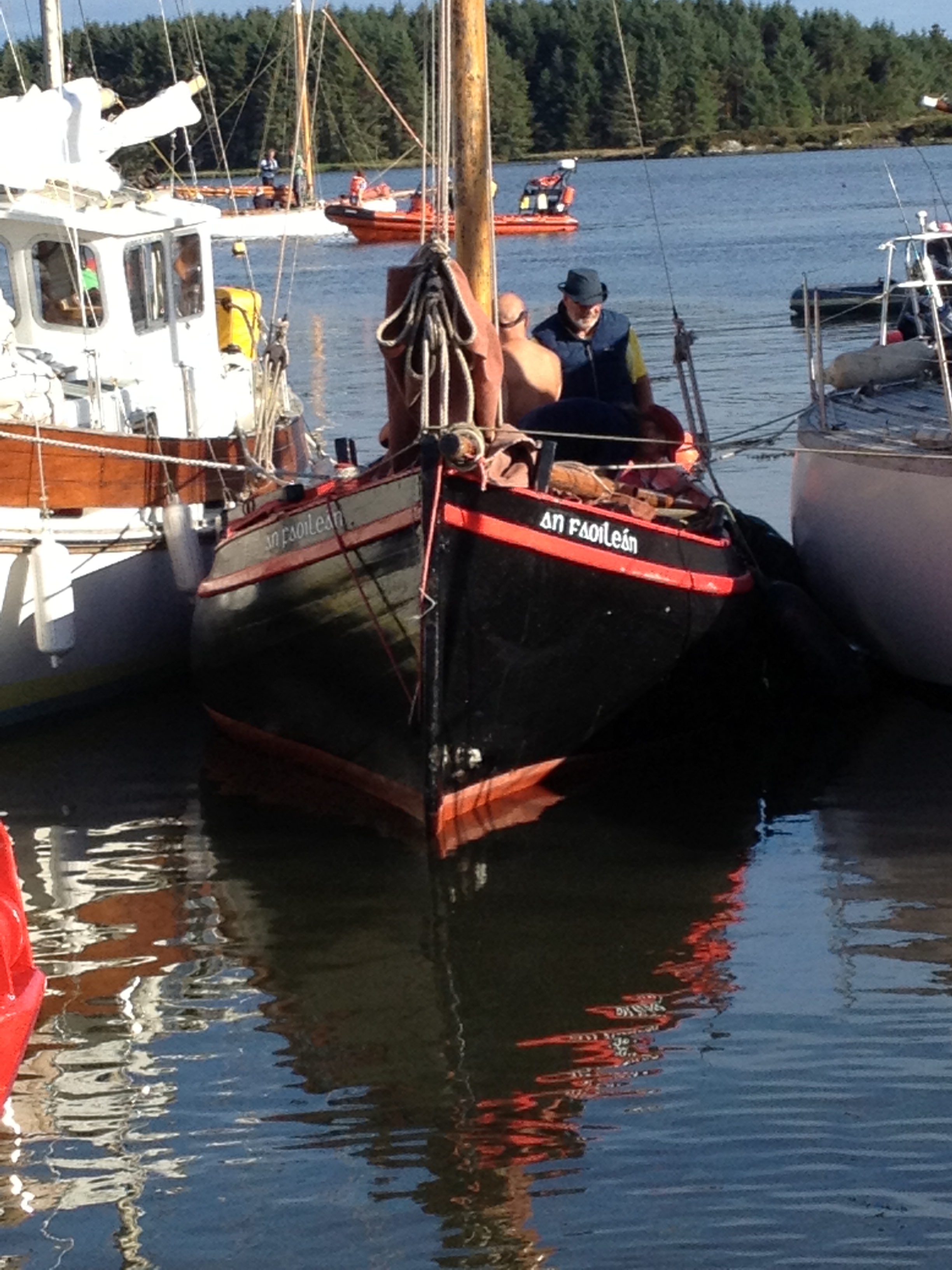
It’s also lovely to see a Galway Hooker, An Faoileán (on fwale-awn, the Seagull), participating – their black hulls and red sails are instantly recognisable. This one has quite a history – and reading it educated me as to the difference between sails that are gaffe-rigged, versus a traditional Irish rigging known as pucán-rigged (puck-awn). Of course all you sailors know this already, right?

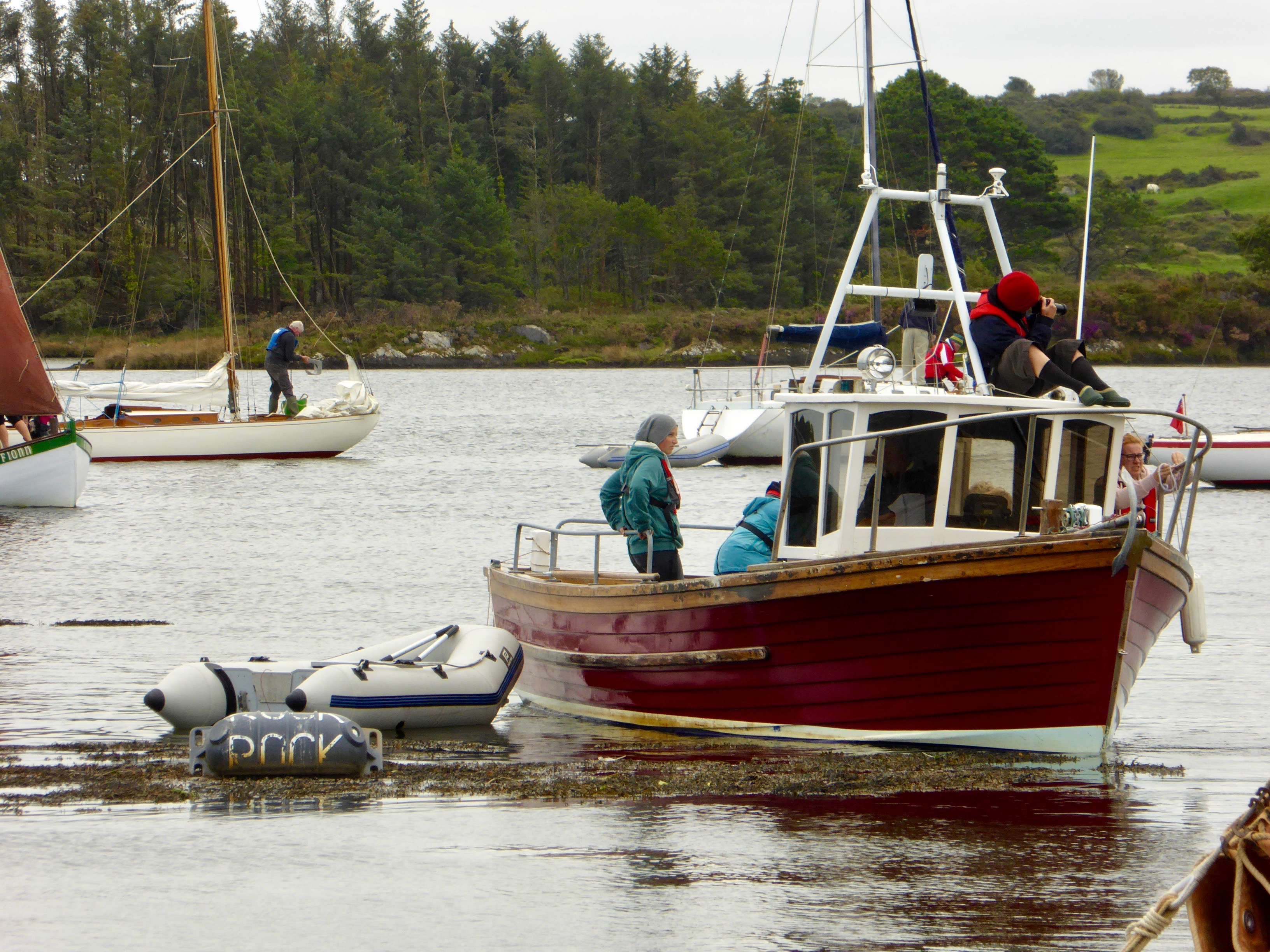
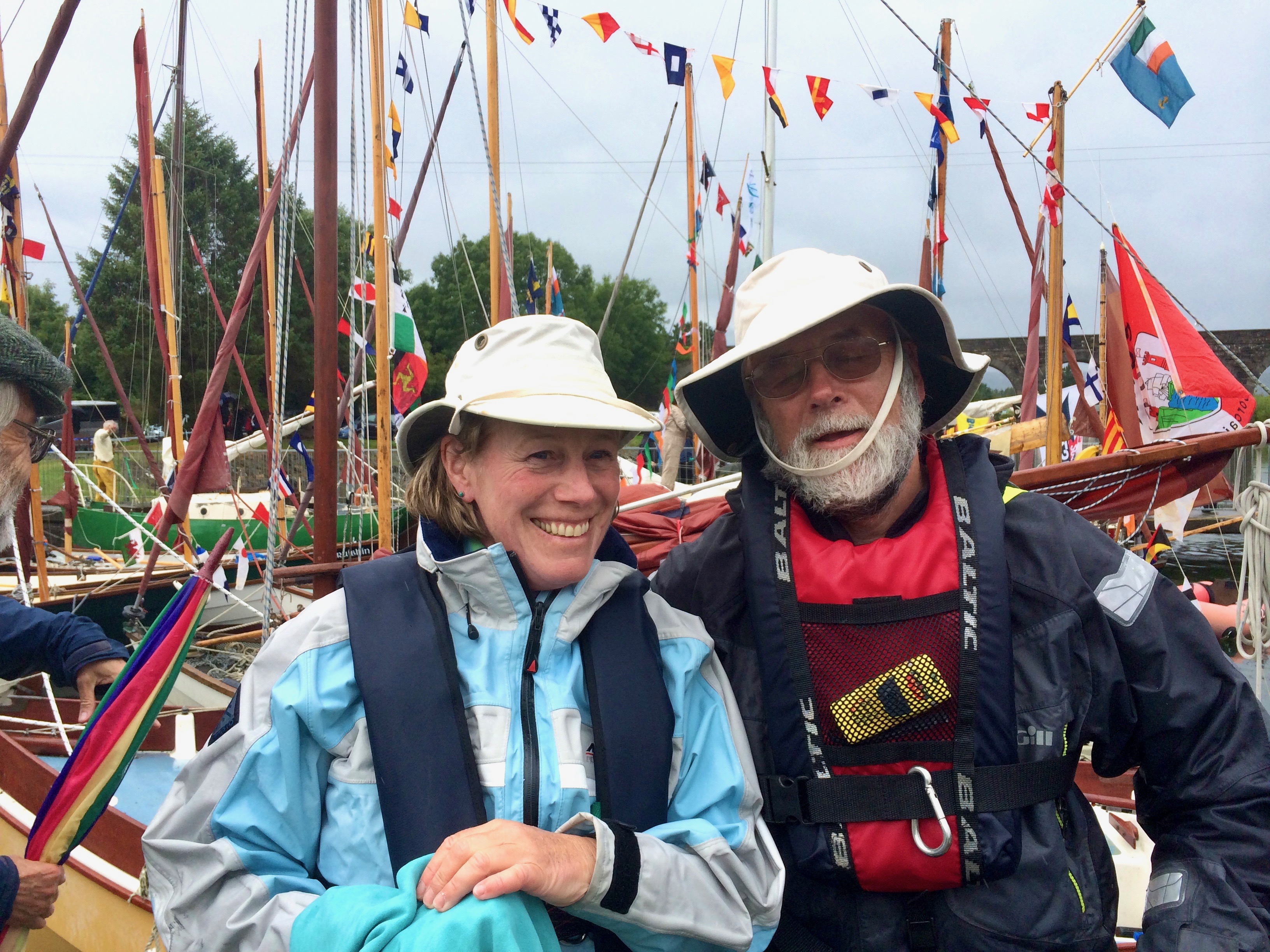
Our friend Jack O’Keefe organises a rally every couple of years for Drascombe Luggers and they joined the gathering en masse in 2014. Unlike 2013 it wasn’t the best of weather, but that did nothing to dampen the spirits of the sailors. It was lovely to be there on the dock to cheer them in.

The Drascombes raft up alongside. Jack O’Keefe and  keen sailor Sheena Jolley

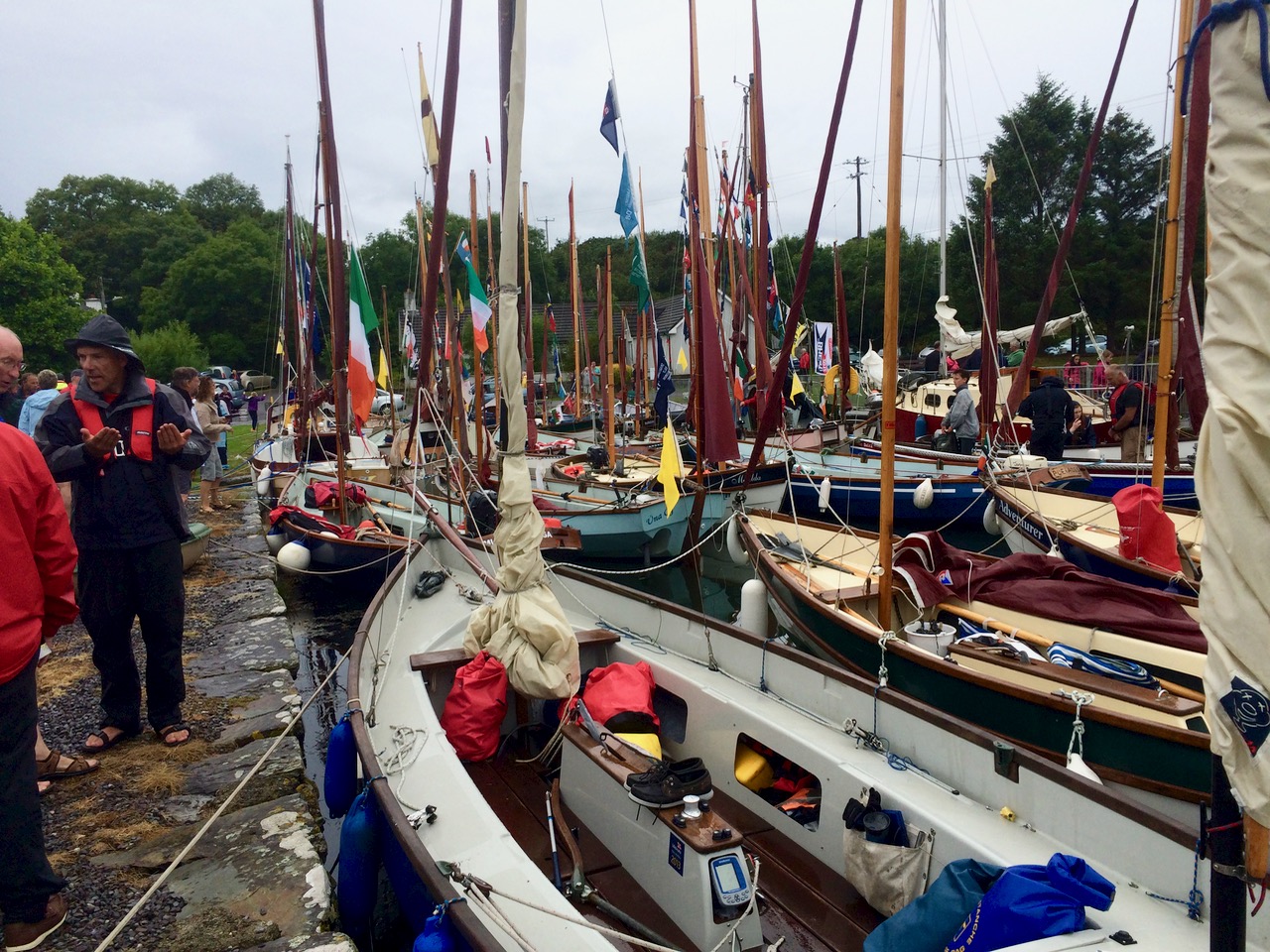
It takes lots of sailing know-how to get up the Bay, but even more to manoeuvre into the tight spaces along the quay, or raft up alongside. By the time everyone’s there, they are rafted up four and five boats deep. 

Then it’s up on shore to partake of the music, the food and the friendly camaraderie that is so typical of both the boating community and the village of Ballydehob, until finally the word goes around that the ebb tide has started and it’s time to carefully push out and take to the seas again – until next year.

 I’ll finish with a video. Sit back and enjoy it, and think about the hundreds, no thousands, of years of history that is evoked by the sight of boats sailing up Ballydehob Bay.

*The photographs in this post are not all mine. Barney Whelan (friend and follower of Roaringwater Journal) was in one of the boats and sent me some taken on the water. Thank you, Barney! Some were shamelessly stolen from the Fastnet Trails Facebook Page, and are the work of the indefatigable Margaret McSweeney (great people shots – thank you, Margaret!). The video is by Tom Vaughan of Oakwood Aerial Photography – he makes West Cork look even more beautiful than it is (and that’s saying something) in his amazing drone footage. The rest of the photos are mine and were taken in 2013, ’14, ’16 and this year.