Early Irish Photographer: Sir John Joscelyn Coghill

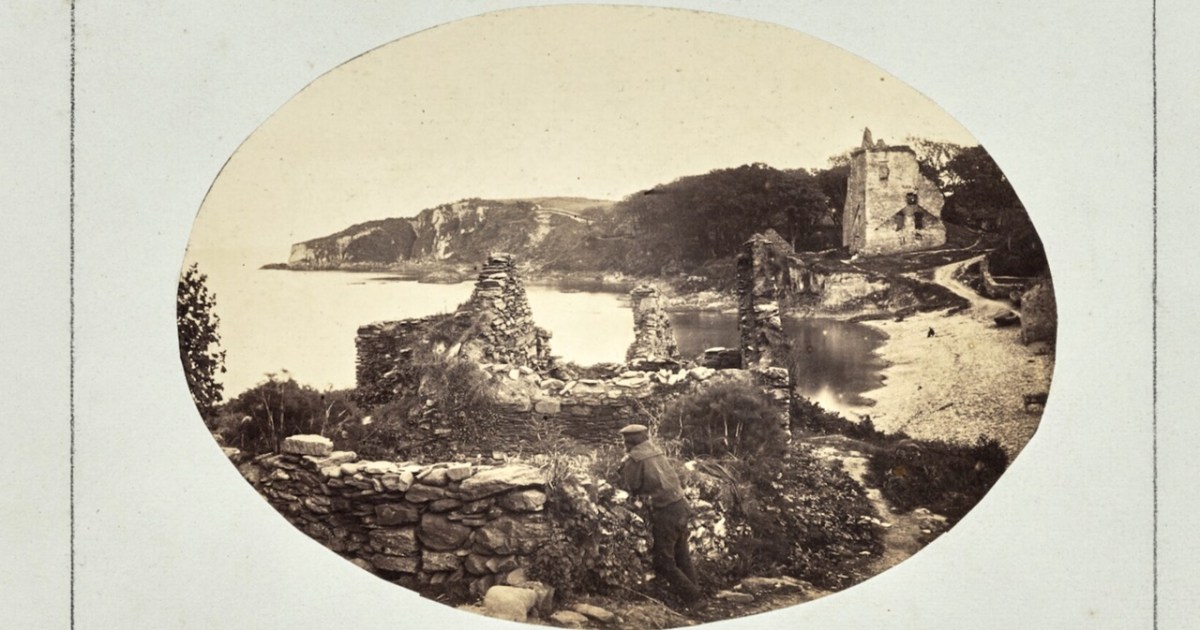
Castlehaven.an important record of what the castle looked like before it fell down

In last week’s post, which I called a Trailer, I introduced this Early Irish Photographer. Congrats to Elizabeth and Sean who knew the identity of the mystery man. The photographer was Sir John Joscelyn Coghill, 4th Baronet, uncle to Edith Somerville (Adelaide, Coghill’s sister, was her mother) and father of Neville and Egerton Coghill. Neville was to die a hero’s death at the Battle of Isandlwana during the Zulu wars, and Egerton was to marry his first cousin, Edith’s sister Hildegard. 

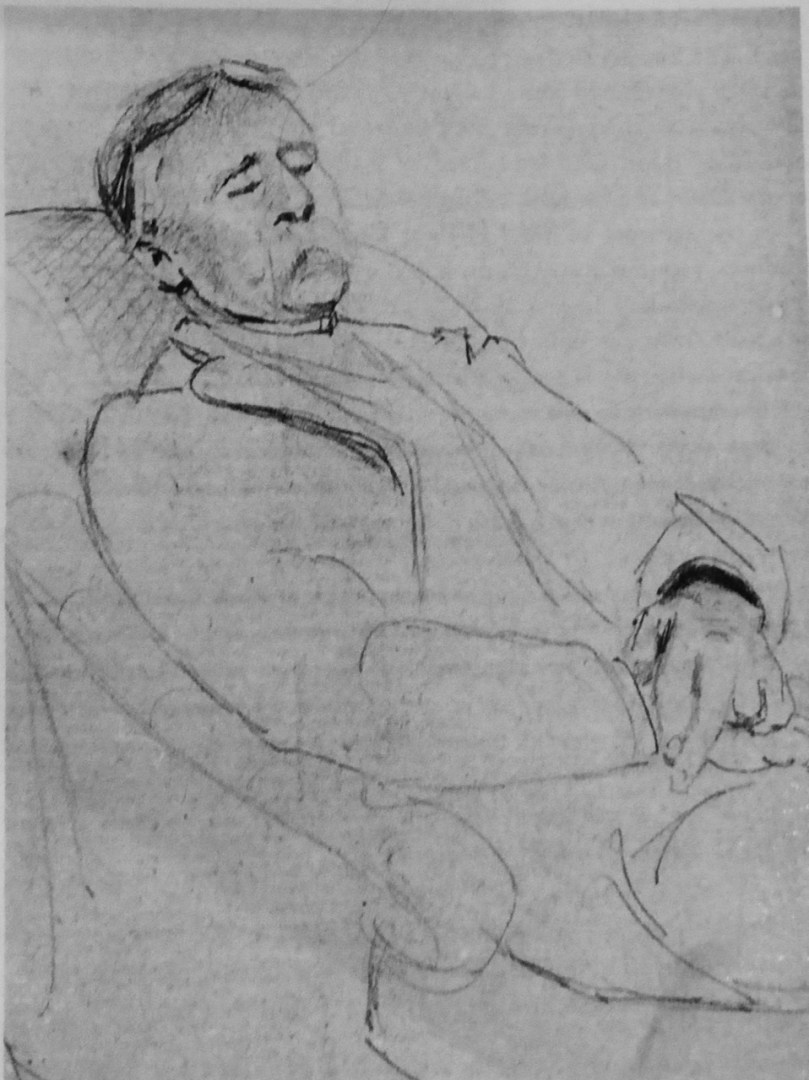
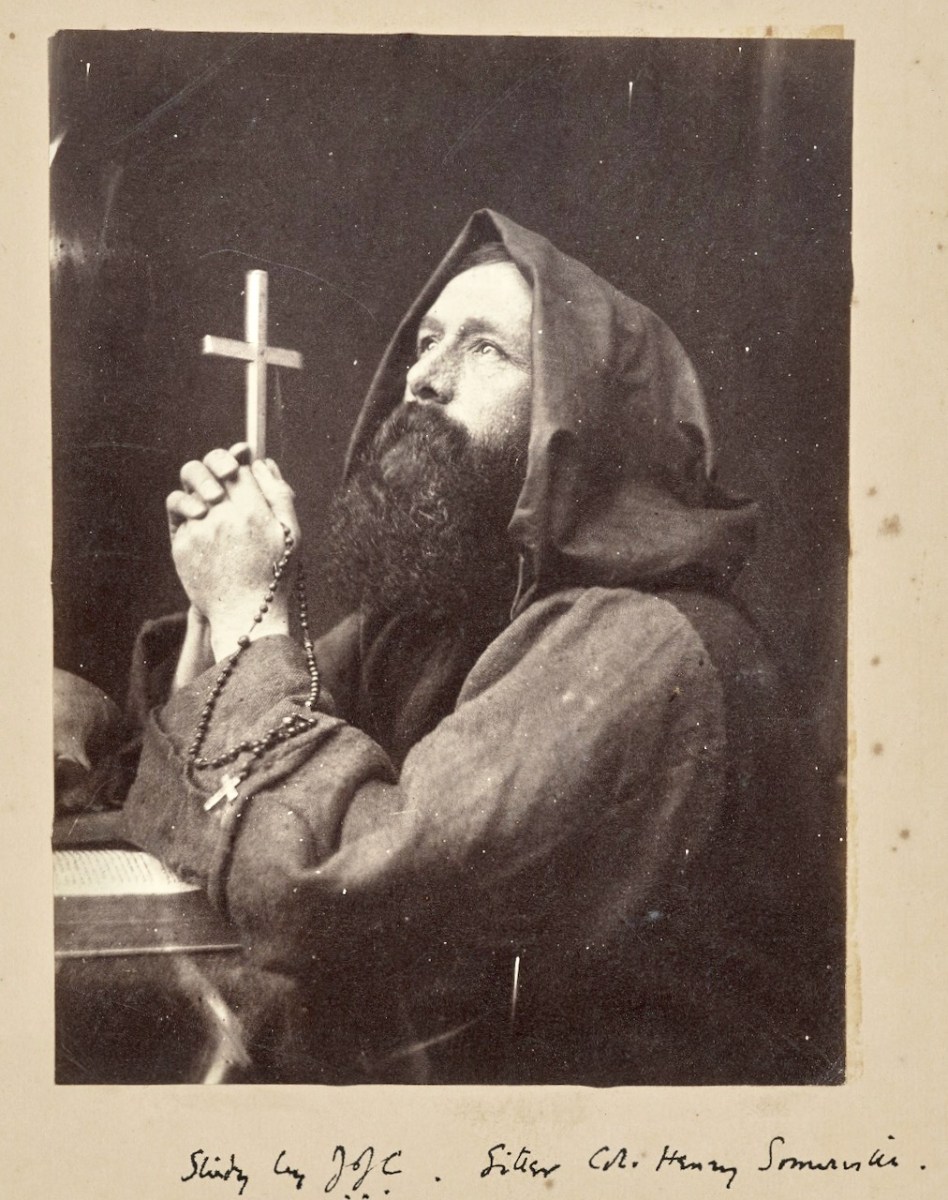
JJC (as he often styled himself) moved to Castletownsend in 1860, bringing with him a large family and several good-looking sisters, including Adelaide. Edith described him as my Uncle, Sir Joscelyn Coghill, leader of the second wave of invasion, with a photographic camera (the first ever seen in West Carbery) and a tripod. He used all his friends and relations as subjects, including himself (above).
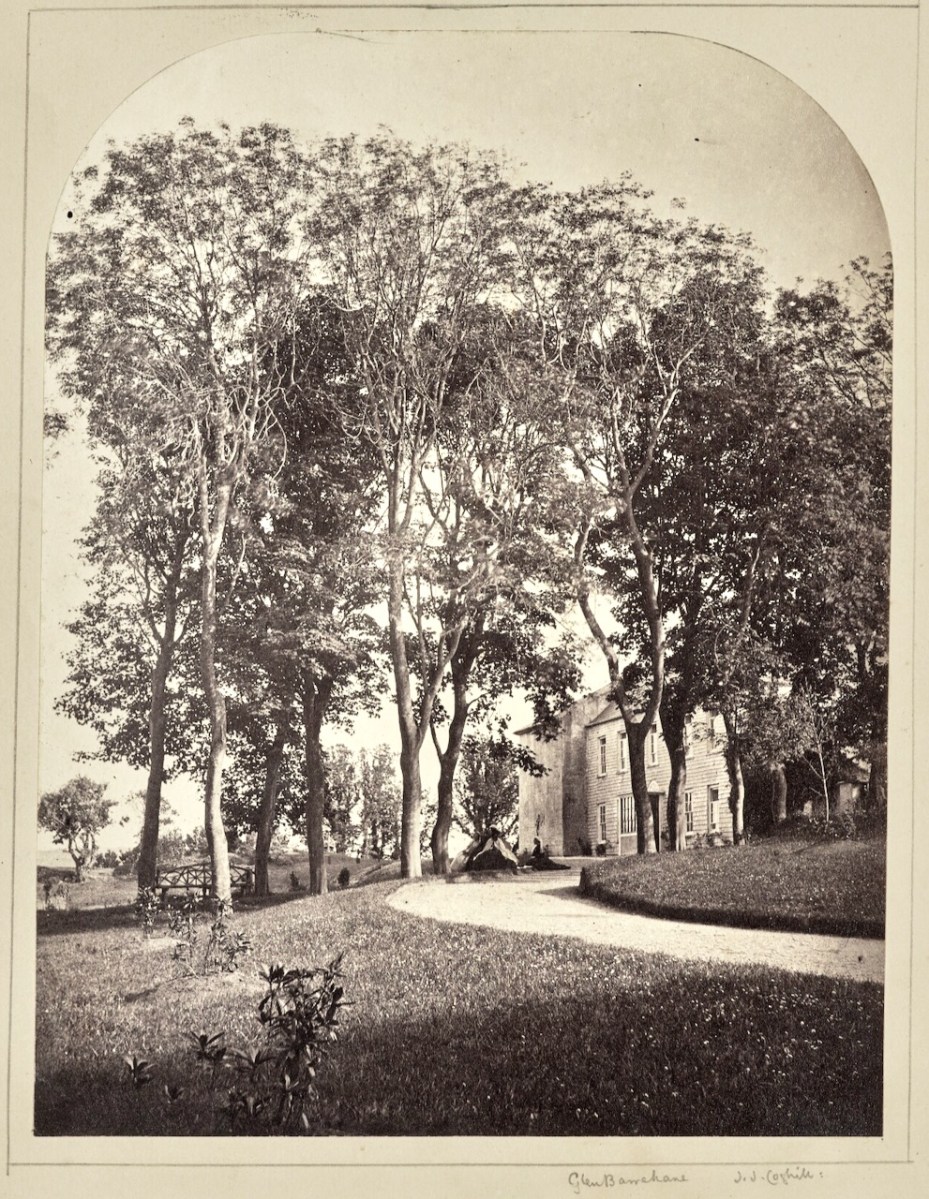
Glen Barahane, originally called Laputa, in honour of Dean Swift who had once visited Castletownshend

By this time he was already an established photographer, although this was only one of his many avocations. He came from a wealthy family and had grown up in Belvedere House, Drumcondra in Dublin. According to his entry in the Dictionary of Irish Biography (DIB):

Coghill . . . took a special interest in photography in the early 1850s, when wet-plate photography and a number of photographic paper processes became available to amateur photographers. He was present at the inaugural meeting of the Dublin Photographic Society (1854–8) on 1 November 1854 and was elected honorary secretary. He served a term as president and three terms as vice-president. In May 1858 the DPS changed its name to the Photographic Society of Ireland and amalgamated with the fine arts section of the RDS.

JJC travelled widely on the continent, writing about his photography trips and offering advice to others (e.g. Seek official permission to photograph public buildings, and, if crowds gather when a camera is taken out, do not show irritation, but encourage them to be your ally rather than your enemy.) He was a staunch defender of photography as art – a hard sell with many traditionalists. From the DIB:

In May 1858 Henry McManus, RHA, headmaster of the school of art in the RDS, delivered a lecture on art in which he pointed out that the artist’s craft could not be superseded by mechanical means. The artist’s hand required the guidance of intelligence, McManus said, and this action could not be imitated by the use of machinery, however ingeniously contrived. Coghill differed with McManus on this occasion, and later in the year (November), when he replied more fully in a lecture at the RDS, Coghill described how photographers should study and reflect on art principles and not be mere servile copyists. He believed that photographers should use their intellect, taste, and judgement on the subject matter in front of the camera lens and so raise their photographic work from the mechanical to the sphere of art.

JJC was an immediate favourite in Castletownshend, along with his brother, Kendal, with whom he was close. They brought with them an interest in spiritualism and infected everyone with it.

Her Coghill uncles Joscelyn and Kendall thrilled her by their psychic feats. On 3 April 1878 she records: “Mother heard from Uncle Jos (Sir Joscelyn Coghill Bart, the head of the family) who was at a grand seance and was levitated, chair and all, until he could touch the ceiling.’ Professor Neville Coghill his grandson has informed me of the tradition that the Baronet signed his name on the ceiling in pencil.


Somerville and Ross, A Biography by Maurice Collis,  Faber and Faber 1968

JJC’s daughter, Ethel, Edith’s first cousin and Castletownshend ‘twin’ wrote this about her father:

He was a real peter pan – a boy who never grew up in many ways, full of enthusiasms of all kinds, whether it were yachting, music, painting, writing, acting, photography, spiritualism, speculation – all had their turn and he flung himself into each and all with a fervour that lasted at fever heat for a time. At one time after my mother’s death [1881] he and his brother Kendal took a house in London for some months. To it they brought a considerable amount of the family plate and a presentation set of gold belonging to my uncle, as well as my grandfather’s medals and other valuable things. They left the house for some weeks in charge of two maids, who promptly brought in their young men, cleared the house of nearly all the valuables and had the cheek to order a sumptuous luncheon in my father’s name and a landau in which they went to [the races]. My father was in Ireland when the telegram came to inform him of what had happened. I did not see him for some time afterwards. By then, he had come to look on the thing as a huge joke. Nothing was ever recovered, but he felt as though he had been part of a Sherlock Holmes mystery, and this compensated him for everything he had lost.


Edith Somerville, A Biography by Gifford Lewis. Four Courts Press .2005

The Coghills lived in Glenn Barrahane (no longer there) and the house was the centre of many activities – amateur theatricals, singing, séances, painting expeditions. The Somervilles, his nieces and nephews, adored him and his brother Kendal. He must have had a good relationship also with their father, his brother-in-law, Henry Thomas Somerville, as he often cast him in ‘character studies.’ – Henry, in turn, must have been good-humoured and patient.
But tragedy struck too – Neville was only 26 when he died at Isandlwana in 1879. He was awarded the Victoria Cross posthumously, in 1907. When he died his younger brother, Egerton, became the heir. Originally wealthy, the family’s fortunes suffered several setbacks and most of their fortune was wiped out by bad investments. As Maurice Collis puts it, On 29 November, 1905, at the age of 79, sir Joscelyn Coghill died, and life changed dramatically for Hildegard and Egerton, who inherited the baronetcy and a load of troubles.
Egerton and Hildegard were so hard up they had to wait seven years before they could marry. Egerton died suddenly in London in 1921, and Ireland (and especially West Cork) was in such upheaval that it was many months before his body could be taken home. Read more about Egerton in my Post Harry Clarke, Egerton Coghill and the St Luke Window in Castletownshend. And more about jolly Uncle Kendal in The Gift of Harry Clarke.
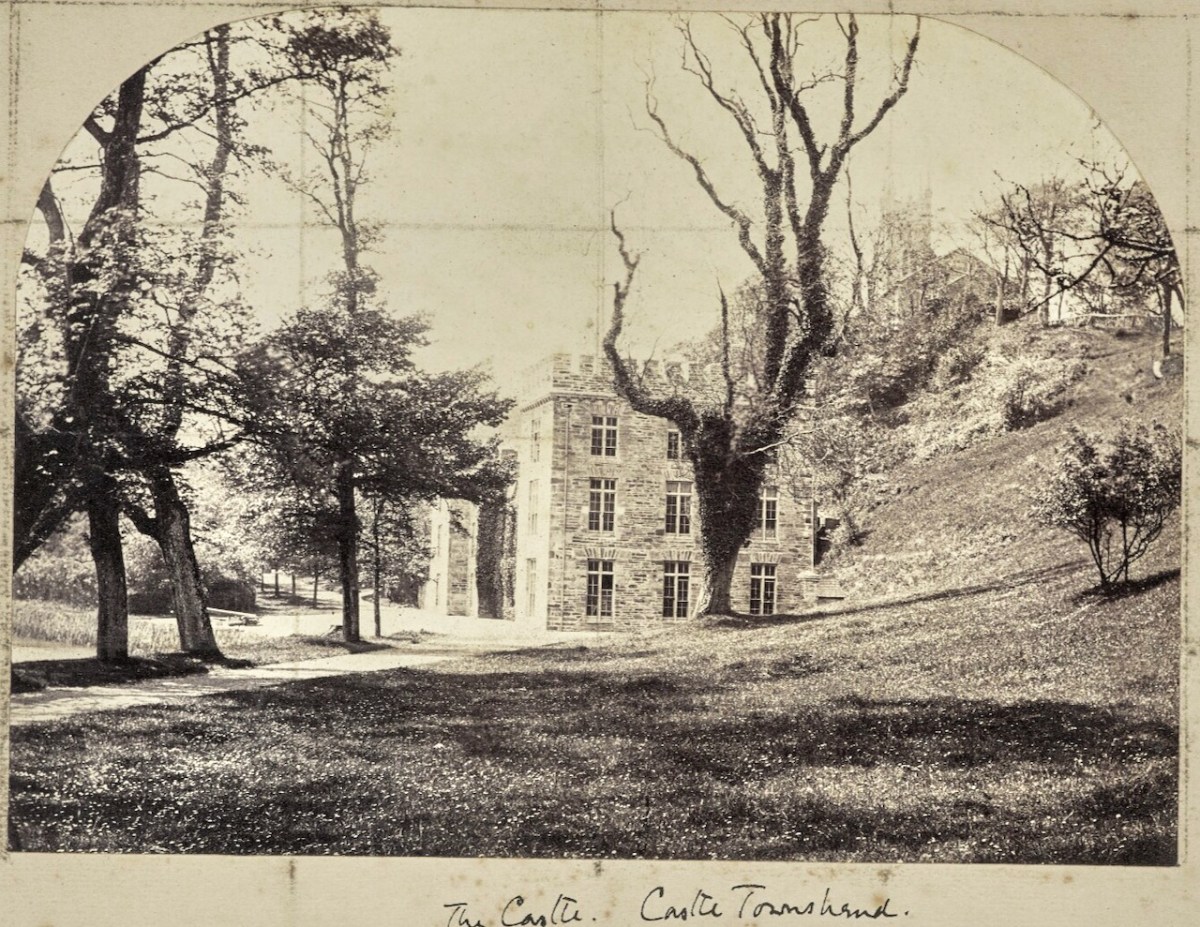
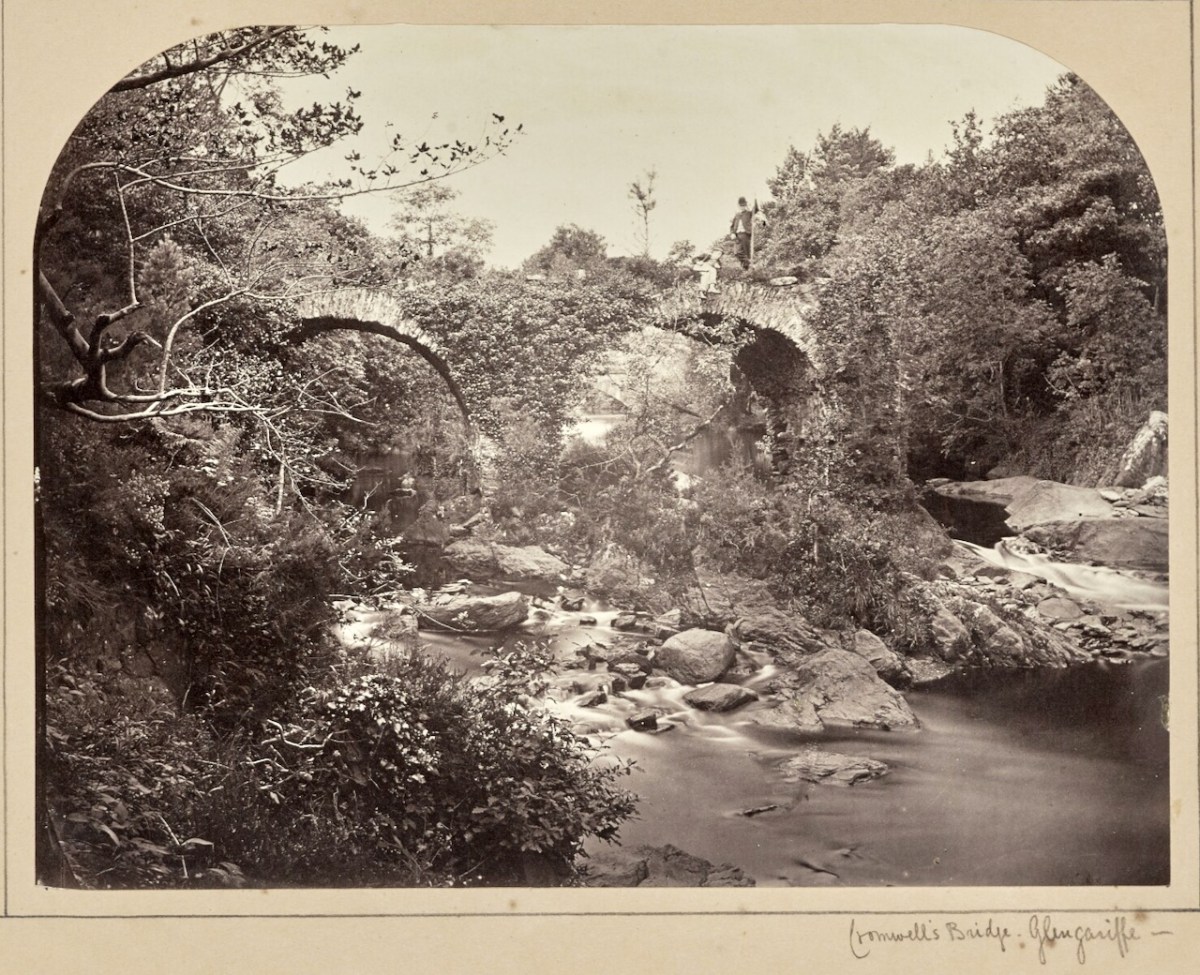
Although far removed from Dublin, JCC chaired “the photographic committee of the Dublin International Exhibition (1865) [and] was credited with the success of the photographic section” (DIB). He continued to exhibit up to the mid-1870s, winning prizes for his photographs.  I have included in this post photographs taken by JJC in and around West Cork. They constitute an invaluable record of people and places, taken between 1860 and his death in 1905.
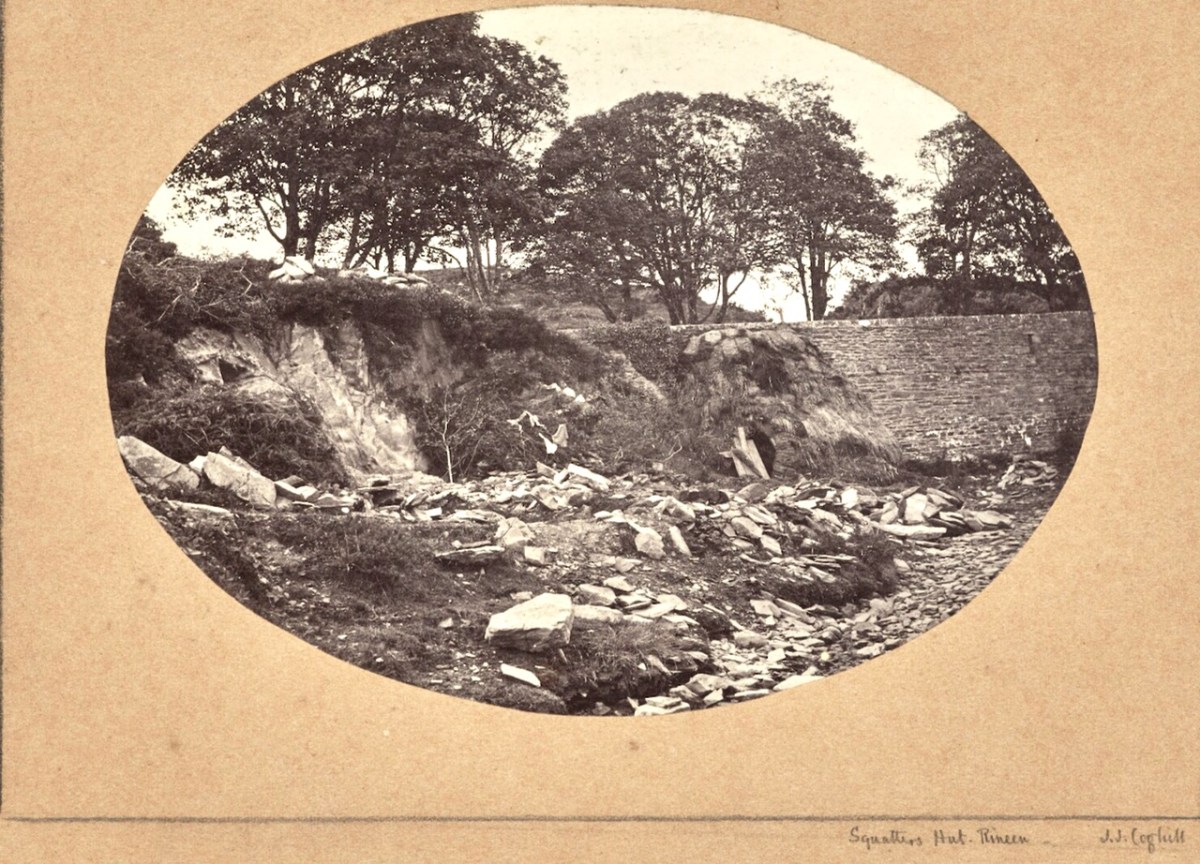
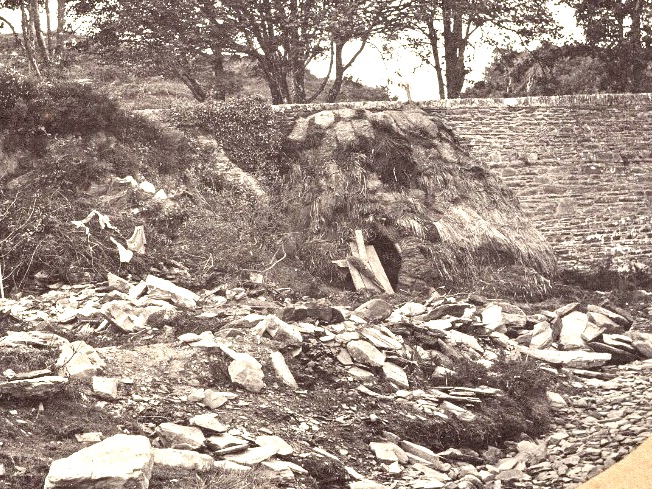
For example, the photo above, detail below, is of a “Squatter’s Hut, in Rineen (the same bridge I featured last week). It’s a fascinating and important image, as it is the only photograph I have ever seen of one of the miserable cabins (known as fourth-class housing), made of sod, in which many of the poorest people lived in West Cork before the Famine.
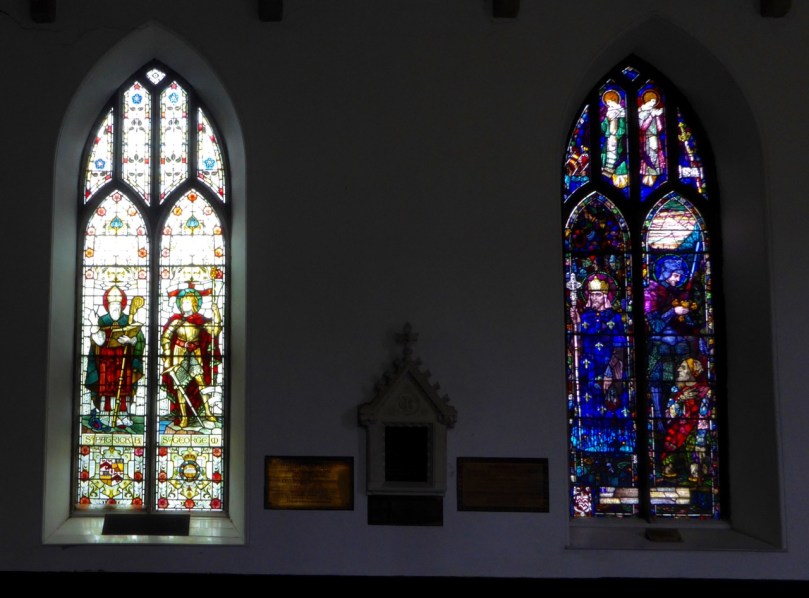
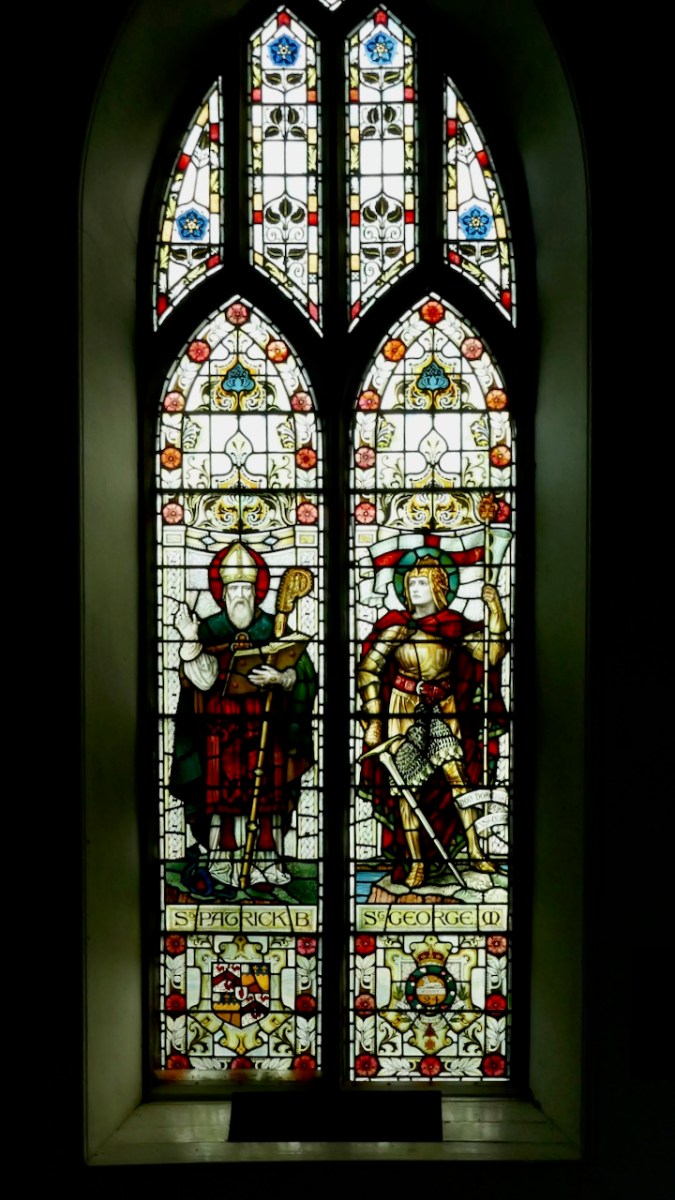
I am not sure how these photographs arrived into the Getty Museum in Los Angeles, but many of the images are now freely available on their website, copyright-free, and we are grateful for that. You can browse the whole collection for yourself. You can also visit St Barrahane’s Church in Castletownshend and see the fine windows for yourself, including this one by Powells of London, dedicated to JJC and his son, Neville. Can you spot the Victoria Cross?
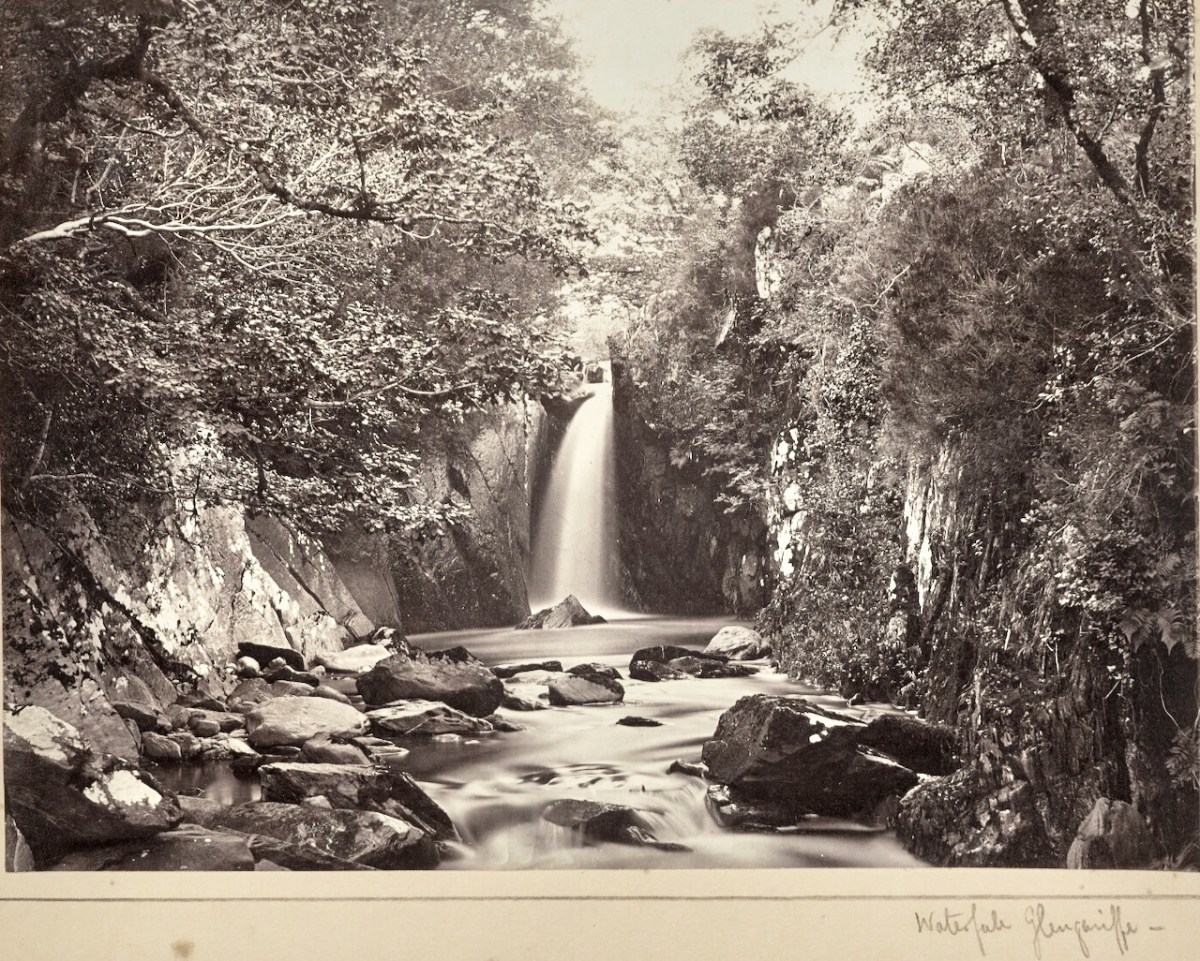
There are other memorials to JJC in that church too – take a look next time you’re there. I will leave you for now with one of JJC’s landscape photos, of a Glengarriff waterfall – a masterful shot for what was, at that time, quite a difficult subject to capture, moving water.
The Gift of Harry Clarke

The Gift

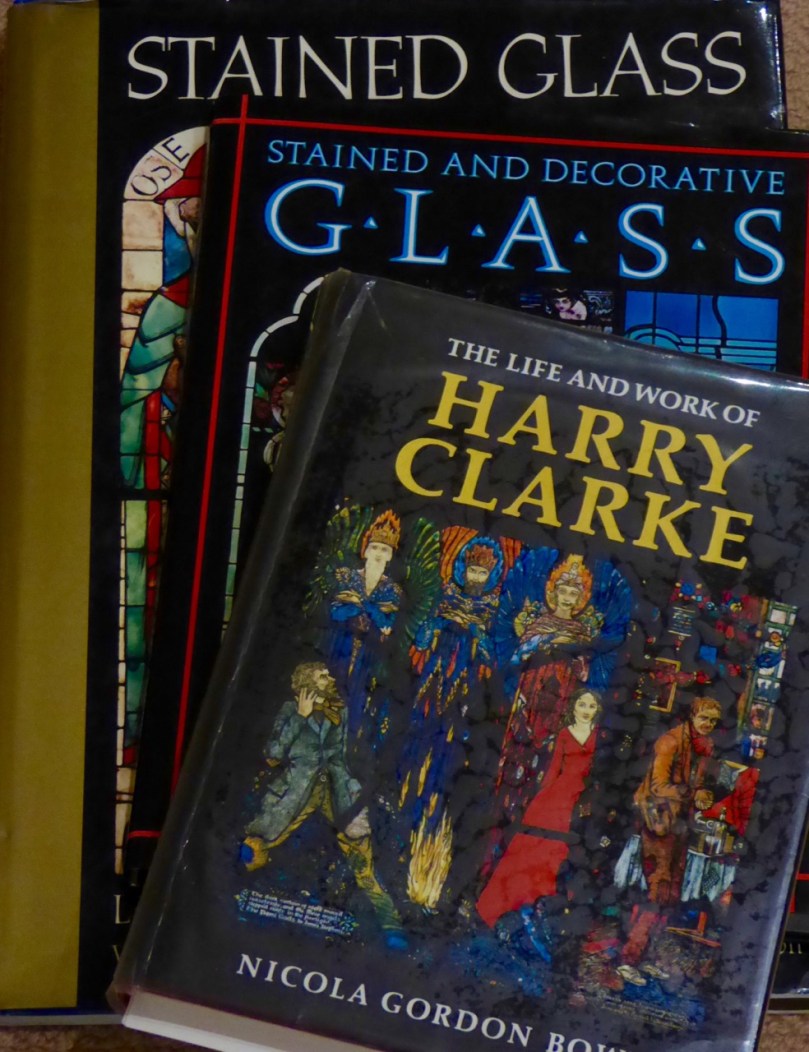
This post was inspired by a gift from my oldest and dearest friend – three books on stained glass passed on to me because he is moving from his home of the last 65 years, a home in which I spent much happy time. A loyal reader of our blog, he knows of my  enthusiasm for stained glass, an obsession I shared with his late wife, the wonderful Vera, whom I still carry in my heart.

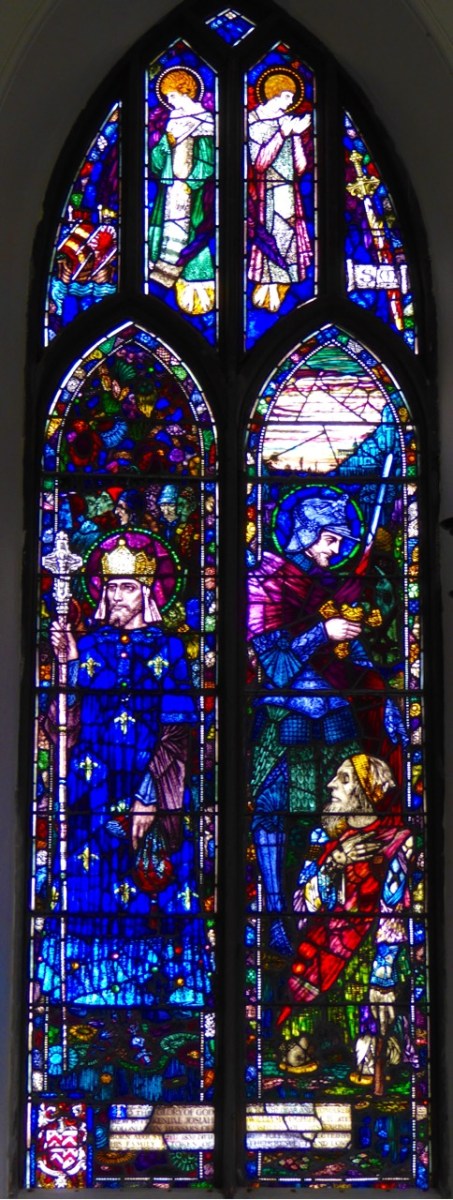
The Kendal Coghill Window, Church of St Barrahane, Castletownshend, Co Cork

The Kendal Coghill Window, Church of St Barrahane, Castletownshend, Co Cork

One of the books is the exhaustive and erudite study of Harry Clarke by Nicola Gordon Bowe. The other two are more general, although each of them devotes a section to the work of Harry Clarke. My initial intention was to look at Harry Clarke as a illustrator, with special reference to his portraiture, using a variety of windows as examples. I may still do that in the future. However, I’ve decided that for now, just one window perfectly illuminates what I want to say about Harry Clarke this time. It’s a window we have both used before in posts (Robert in his Martinmas piece, and I in a couple of places) – the Kendal Coghill window from St Barrahane’s in Castletownshend. Through this window I hope to show you the unique genius of Harry Clare, but also how he drew from life and from great art to create his stained glass panels. (For more on Harry Clarke’s life, see my previous post, The Nativity – by Harry Clarke.)

Kendal Coghill, drawn by his niece, Edith Somerville

Kendal Coghill, drawn by his niece, Edith Somerville

Who was Kendal Coghill? He was born and bred in Castletownshend, Edith Somerville’s uncle and a distinguished soldier, rising to the rank of Colonel. He served in India, where he took a kindly and active interest in the young Irish soldiers in his regiment. One of his melancholy duties was writing to their mothers to advise of their deaths. He was also “excitable and flamboyant”, writes Gifford Lewis in her excellent book, Somerville and Ross: The World of the Irish R.M.. As one of the leaders of the amateur spiritualist movement in Castletownshend he introduced Edith and her brother Cameron to automatic writing. By all accounts he was generous and warm hearted and it was his compassion that the window was to emphasise. The two subjects were chosen carefully – Saint King Louis IX of France, and St Martin of Tours. Coghill could trace his ancestry to King Louis, famed for his beneficence, and St Martin was the patron saint of soldiers.

Contrasting styles

Contrasting styles

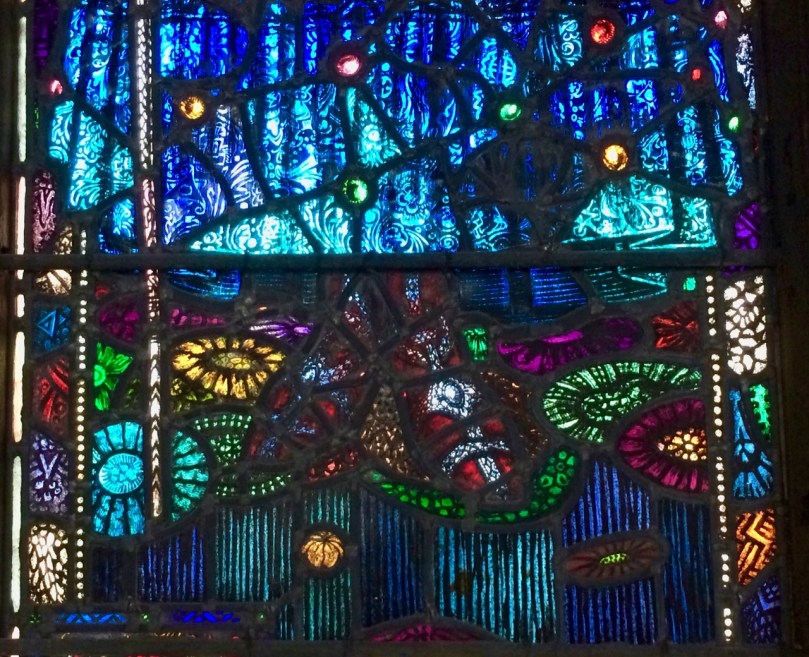
The first thing that strikes you upon entering St Barrahane’s is the contrast between this window and the others (by Powells of London) on the south side. Alongside the conventional Powells the Clarke blazes with colour and with detail. Every square inch is individually worked, there are no repeated patterns or conventional scrolls. Examine the borders, for example, filled with abstract and colourful motifs, never recurring.

St Louis detail: each motif in the border is uniquely designed and coloured. The robe intrudes in front of the border, lending a £D effect.

St Louis detail: each motif in the border is uniquely designed and coloured. The robe intrudes in front of the border, lending a 3D effect

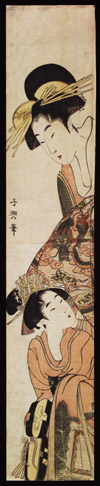
chokiHarry’s habit of placing figures at different heights adds visual interest to the side-by-side panels and may have been influenced by Japanese pillar prints, which were also a major factor in the design aesthetic of Frank Lloyd Wright. A church window is by its very nature long and narrow and the design challenge this poses had first been explored by Japanese artists whose woodblock prints were hung vertically on walls, or fixed to house posts. Contrast the static, forward-facing, identically scaled figures in the Powell window with the dynamic composition of the Clarke panels. The St Martin figure, in particular contains two figures and manages to tell a whole story, like this example of a pillar print.

The choice of the window and the management of the commission rested with Edith Somerville. Harry Clarke stayed with her in Drishane while executing the final placement and she liked him very much. Beside the Kendall Coghill window which is the subject of this post there are two other Clarke windows in St Barrahane’s. But St Barrahane’s, as Gifford Lewis explains, is not…”typically Protestant. High Church, Anglo-Catholic influence is in restrained evidence besides the astounding blaze of Clarke’s windows. Jem Barlow, the medium, claimed that at a service one Sunday in St Barrahane’s the spirit figure of Aunt Sidney appeared, caught sight of the Clarke windows, started, then exclaimed “Romish!” and dissolved.”

Above St Louis,

Above St Louis, “a parade of the poor and diseased”

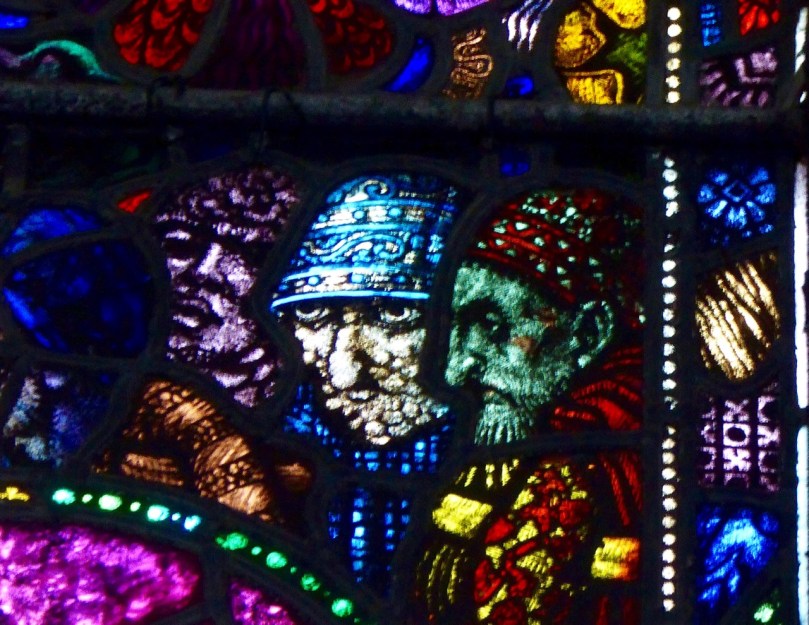
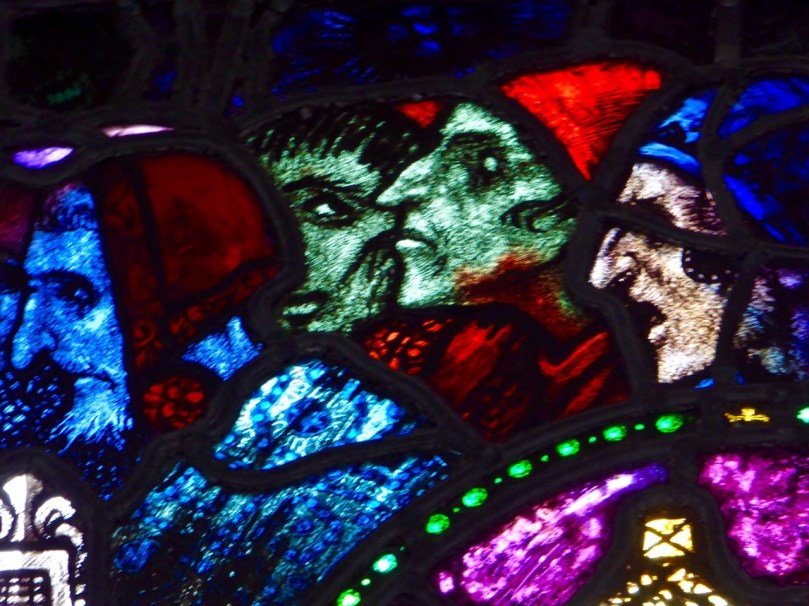
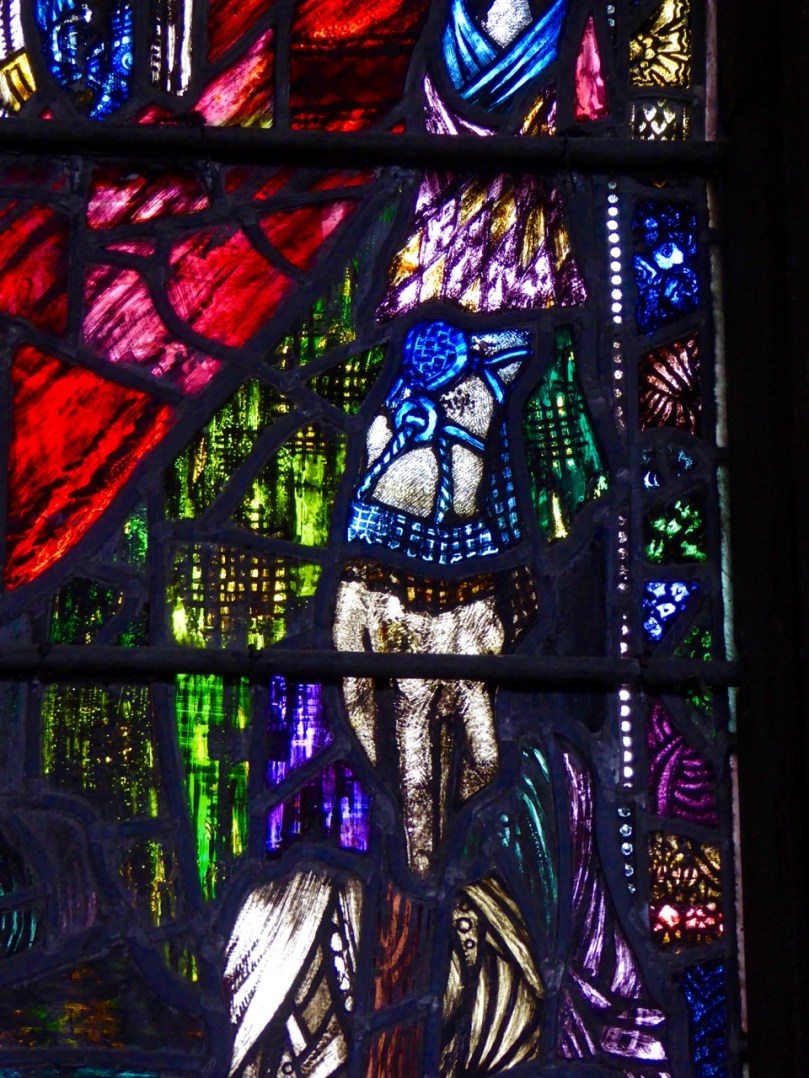
Saint Louis occupies the left panel. He is depicted with an alms purse in his left hand and a crucifix instead of a sceptre in his right hand. Look carefully – above him are the poor and sick that were the objects of his constant charity. Here’s what Nicola Gordon Bowe has to say about this section of the window:

Dimly visible…is a small procession of the heads and shoulders of the poor and diseased who used to feed at his table. These again show Harry’s unique ability to depict the gruesome, macabre and palsied in an exquisite manner…The seven men depicted, old, bereft, angry or leprous, are painted on shades of sea-greens and blues, mauves and grey-greens, in fine detail with strong lines and a few brilliant touches, like the grotesque green man’s profiled head capped in fiery ruby, the leper helmeted in clear turquoise with silver carbuncles, and the aged cripple on the right in ruby and gold chequers.

Poor men

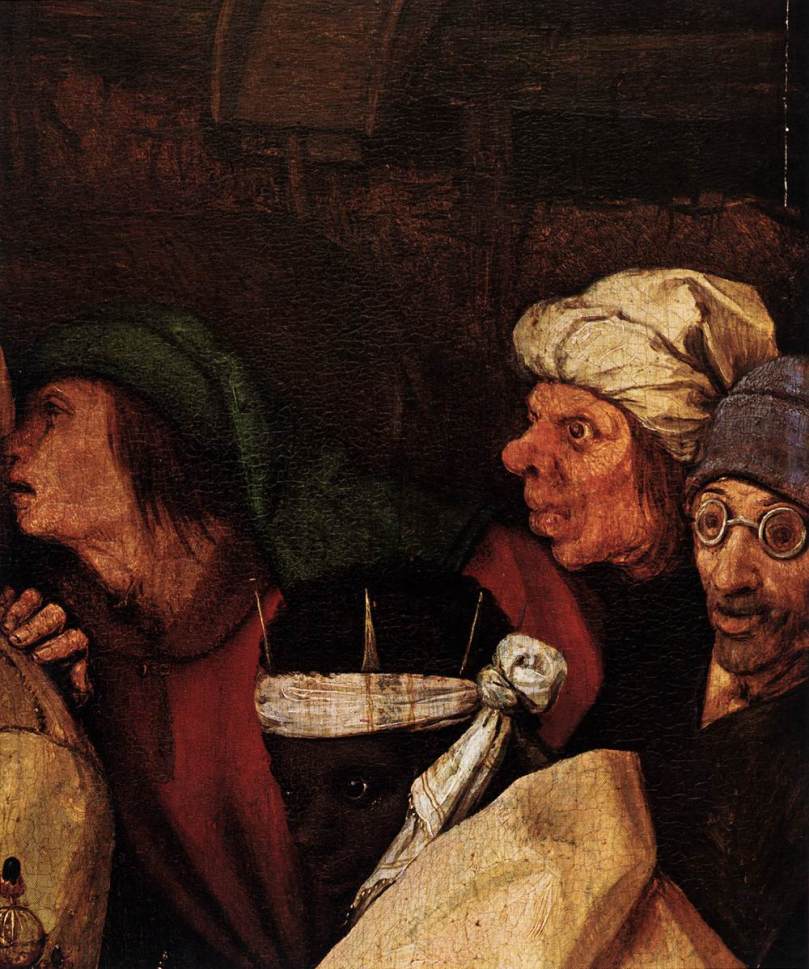
This section, it seems was likely influenced by a painting that Harry was familiar with from visits to the National Gallery in London – Pieter Bruegel’s Adoration of the Kings

Detail from Pieter Bruegel's Adoration of the Kings

Detail from Pieter Bruegel’s Adoration of the Kings

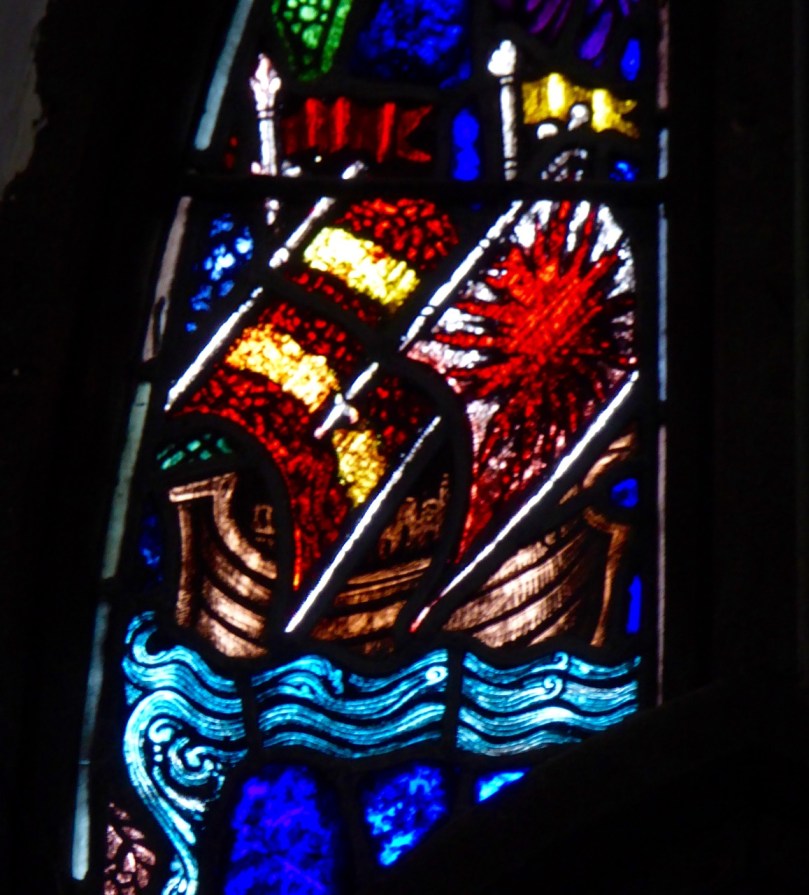
The ship in which he sailed to the crusades is depicted above King Louis.

Ship

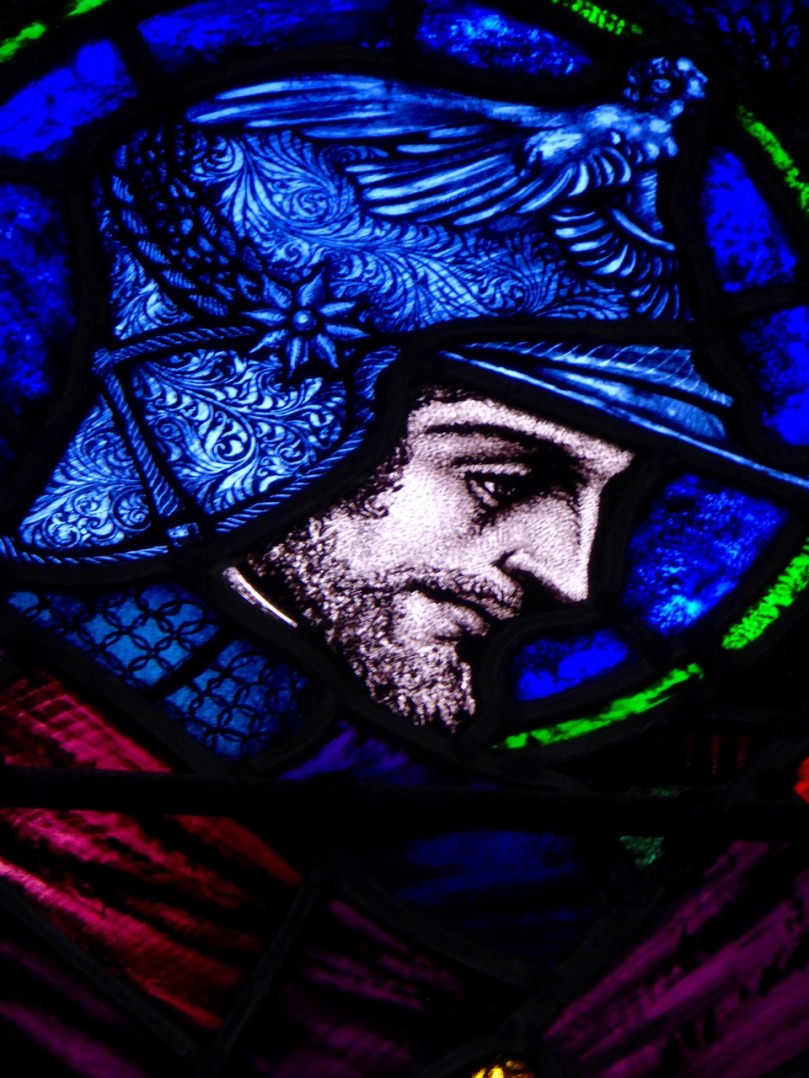
Saint Martin, in the right panel, is depicted in the act of cutting his cloak in two, to give half to a beggar. Martin’s face is archetypal Clarke – the beard, the aquiline nose, and the large eyes filled with compassion for the beggar.

St Martin of Tours

St Martin of Tours

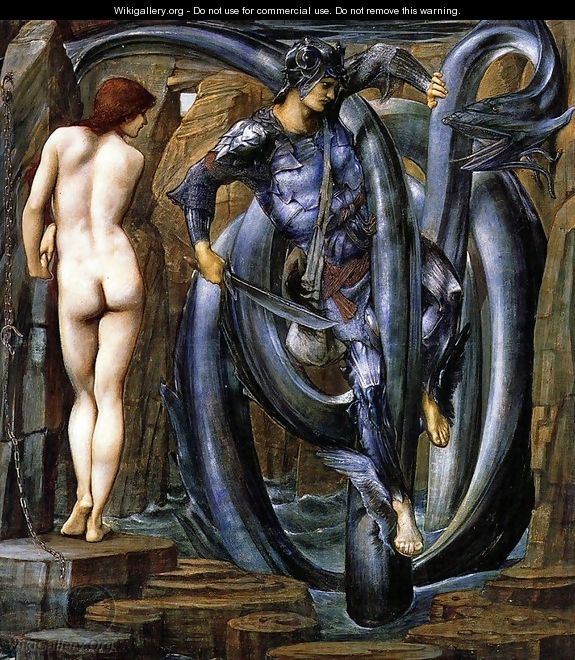
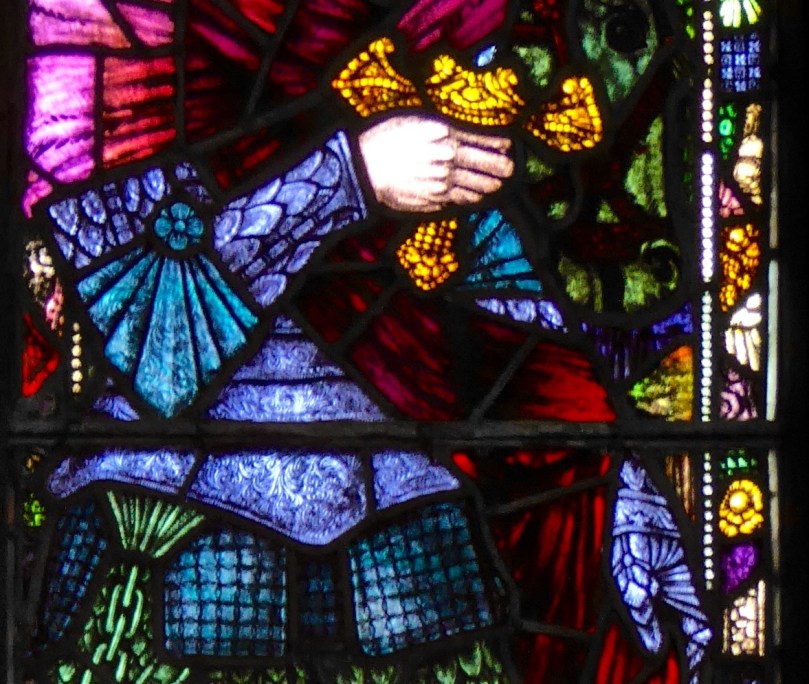
The helmet is worth a closer look. First of all, it is beautifully and finely decorated in the niello style, and second, it is topped with a tiny figure, sphinx-like, with long wings. Nicola Gordon Bowe points to the influence of Burne-Jones here, to the helmet worn by Perseus in The Doom Fulfilled.

Burne Jones' The Doom Fulfilled

Burne Jones’ The Doom Fulfilled

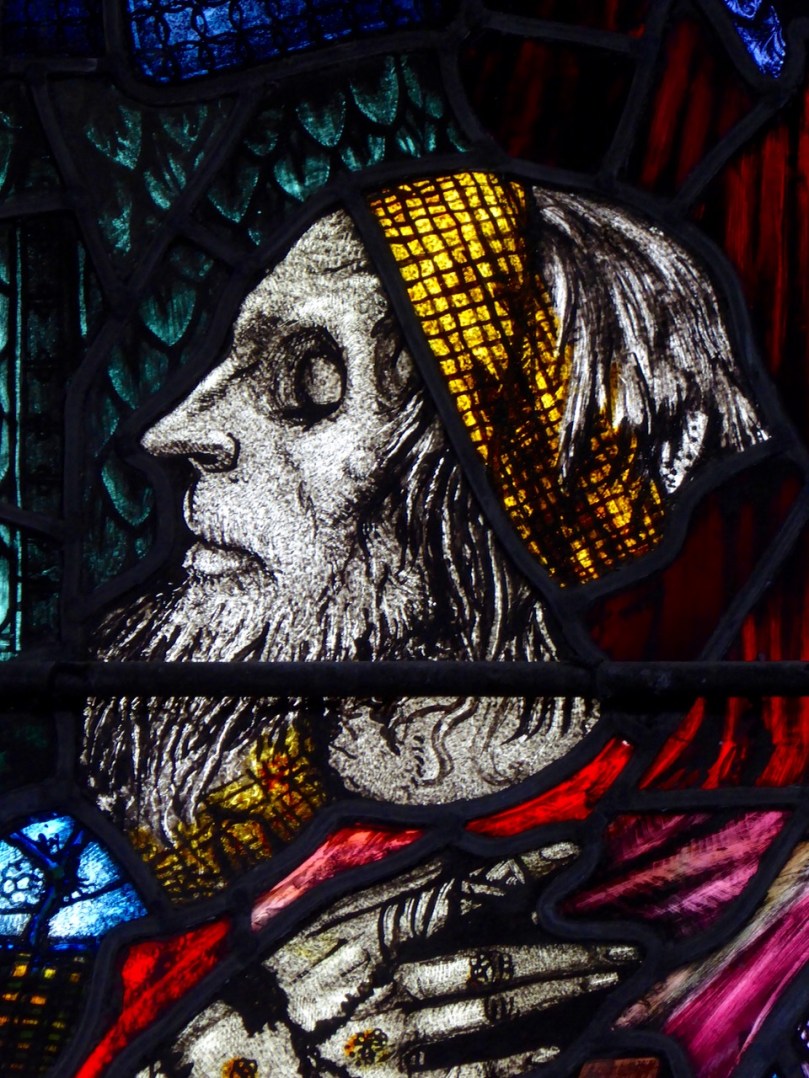
Clarke also found his inspiration in life drawing. He used himself for a model occasionally, but also ordinary people from the streets of Dublin. The beggar may have been based on one familiar to him. His face is dignified despite his wretched condition and his patches are rendered in as exquisite detail as is the Saint’s armour.

Beggar

The beggar may have been based on a familiar Dublin figure

The beggar's hand

The beggar’s hand

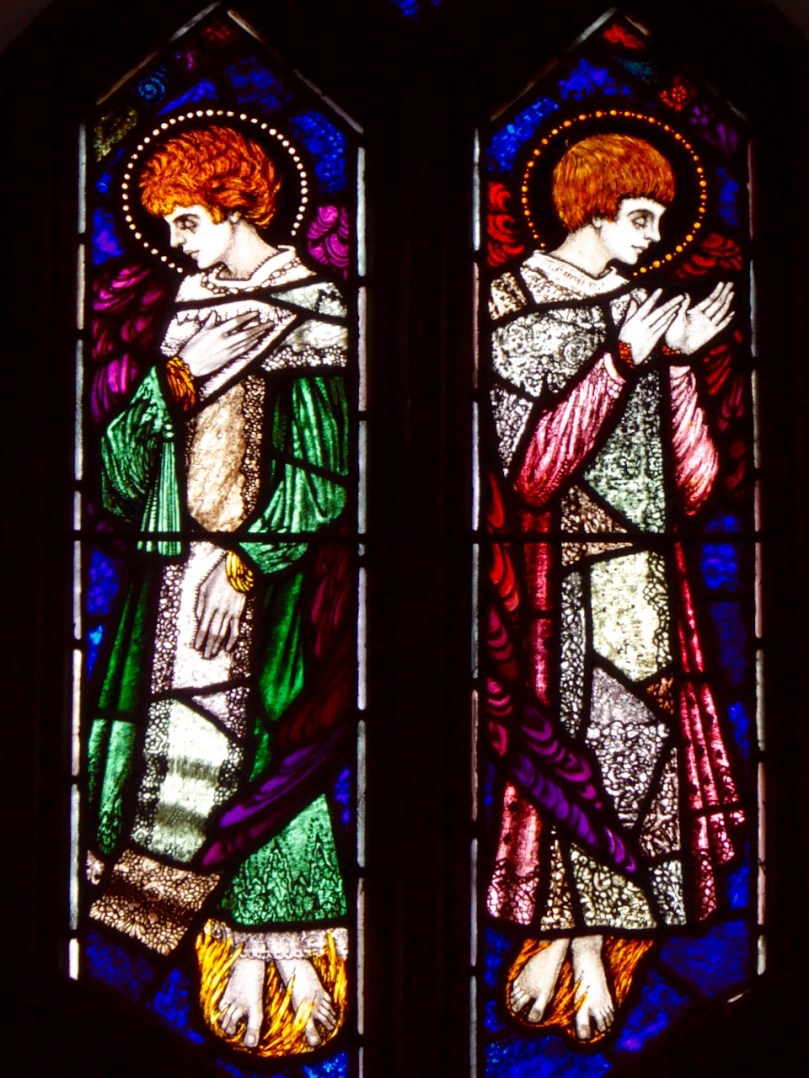
Finally, at the very top of the window two haloed figures look down. Harry Clarke had a thing for red hair and this is a perfect example of how he used that preference to good effect. Once again, although the figures are similar in size, there is no repetition – these are no ‘standard’ angels – each has his own wonderful garments and stance.

Red haired angels

Stained glass artists typically sketch their designs on paper first and these images are referred to as cartoons. Harry Clarke’s cartoons for the Coghill windows must still exist. Nicola Gordon Bowe describes them as drawn “loosely in thick charcoal, the design boldly expressed with detailing and shading minimal, but still conveying a good idea of how every part of the window would look.” The finished window, she says, “reveals a new freedom of treatment, the painting on the glass reflecting the free drawing of the cartoons.” This is an artist and craftsman working at the height of his powers – an interesting subject for the question that Robert poses in his post this week.

Saint Martin, armour detail

Saint Martin, armour detail