The Sun Stands Still

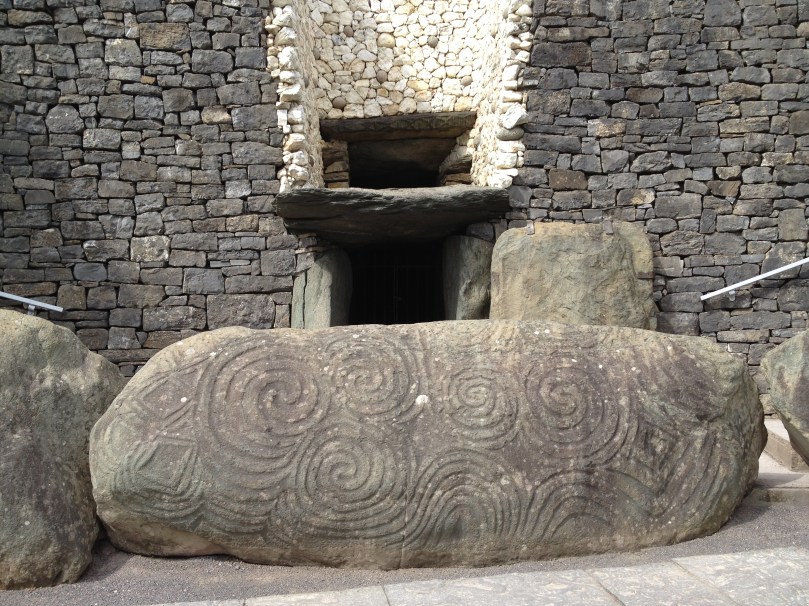
The Entrance Stone at Newgrange.

The Entrance Stone at Newgrange.

That’s what solstice means – the sun’s apparent ability to stand still at the mid-winter point. It rises no further south, hangs around that area for a few days, and then starts on its trek back to the eastern sky. For early farmers, like the ones who built Newgrange in the Boyne Valley in Ireland (and Stonehenge and the Pyramids) and like the ones who carved our rock art, such seasonal markings were critical. At Newgrange, an enormous passage tomb built 5000 years ago, the rising sun illuminates the passage and chamber only during the winter solstice. In West Cork, near here, the Drombeg Stone Circle is designed so that the winter solstice sun sets over the recumbent stone, through the two tall portal stones. Drombeg probably dates to the Bronze Age.
2012-12-20 16.17.50

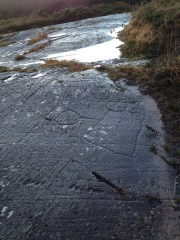
Ballybane West at sunset

There is a good argument that open air rock art may also relate in some way to equinoxes and solstices and days of seasonal change, such as those that were celebrated in the ancient Celtic festivals. So far, the only rock art that has been putatively identified as having a significant solar orientation is the Boheh Stone in Mayo. We decided to visit our favourite rock art site, Ballybane West, on the evening of the 20th December and again on the morning of December 21, to see if anything interesting showed up at sunset or sunrise. We were rewarded in the evening by the rock art glowing beautifully in the slanting sunlight, although we could observe no particular significance about where the sun was setting.
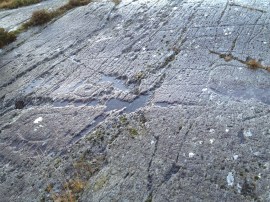
Enigmatic carvings at Ballybane West

Enigmatic carvings at Ballybane West

The next morning, although the dawn colours were spectacular when we left the house, the clouds rolled in and obscured the sunrise. Still, it was wonderful to be out on the rock at dawn, listening to the birdsong and feeling in communion with the ancient spirits of this special place.

Happy Solstice to all our Family and Friends!

Ard Glas Dawn, Winter Solstice 2012
Ard Glas Dawn, Winter Solstice 2012

Re-Engaging

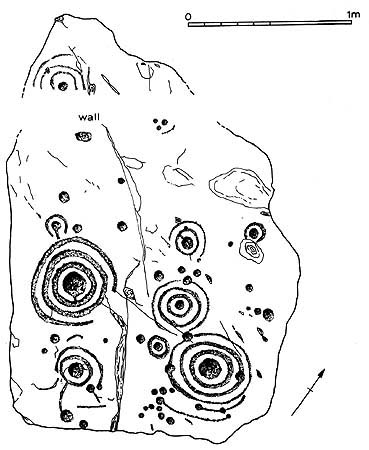
Typical cup-and-circle motifs

This week we are writing about the same topic – each from our own perspective.

One of our reasons for choosing this area to live was for me to re-engage with Irish rock art. I am incredibly lucky in that this is a subject that Robert, an architect by profession, finds as interesting as I do, so it has become a joint project.  As background, in 1973 I completed a Master’s thesis at University College Cork on the ‘Rock Art of Cork and Kerry’. I was 23, and I conducted my field work for two summers on a Honda 50 motorcycle belonging to my brother, Hugo.

What IS rock art? Glad you asked!

Can you see the carvings?

About 5000 years ago, Ireland was populated by early farmers. This era was known as the Neolithic (new stone age) period, and it was characterised by the emergence of a settled, or partially settled, way of life growing crops and herding animals. No longer nomadic and with a secure food source, Neolithic people developed a stratified society in which a noble or priestly class was able to commandeer the labour of large numbers of people to build great stone monuments featuring intricate carvings and often oriented to celestial occasions such as a solstice sunrise. Another tradition arose of carving on rocks – boulders or outcrops – not associated with monuments and with a different set of motifs. This tradition of rock art stretched along the Atlantic Coast, from Spain to Norway, with many fine examples in Ireland. When I undertook my research in the early 70s, it was thought that most Irish rock art was concentrated in Cork and Kerry (the two most south-westerly counties) but since then there have been major finds in Wicklow, Carlow, Louth, Donegal and elsewhere.

So how, 40 years later, does one ‘re-engage’ with this fascinating topic? Well first, we’ve a lot of reading to do, to catch up with the state of current knowledge. Second, we need to re-visit the sites I recorded in the 70’s, as well as those discovered since then. Third, we have to connect with the Archaeologists at UCC to discuss the nature of our project. All of these steps are under way, and we will be charting our progress occasionally through this blog.

The same rock as recorded by Finola in 1973