After the destruction of most of Ireland’s churches and ecclesiastical sites during the Dissolution of the Monasteries, what was left of Ireland’s Medieval stained glass fell victim to Cromwell and his Model Army. Puritans, called iconoclasts, rampaged throughout northern Europe, destroying all sacred figurative art, and this was followed by two hundred years in which a horror of ‘idolatry’ was the prevailing attitude of the Established Church. As a result, from 1650 to 1770 there was little-to-no glass in Ireland that could be labeled ‘stained glass’ or that contained figurative elements. What we see as commonplace in churches now – beautiful windows full of pictorial representation of Biblical scenes – was completely absent, along with sacred sculpture and paintings of any kind.
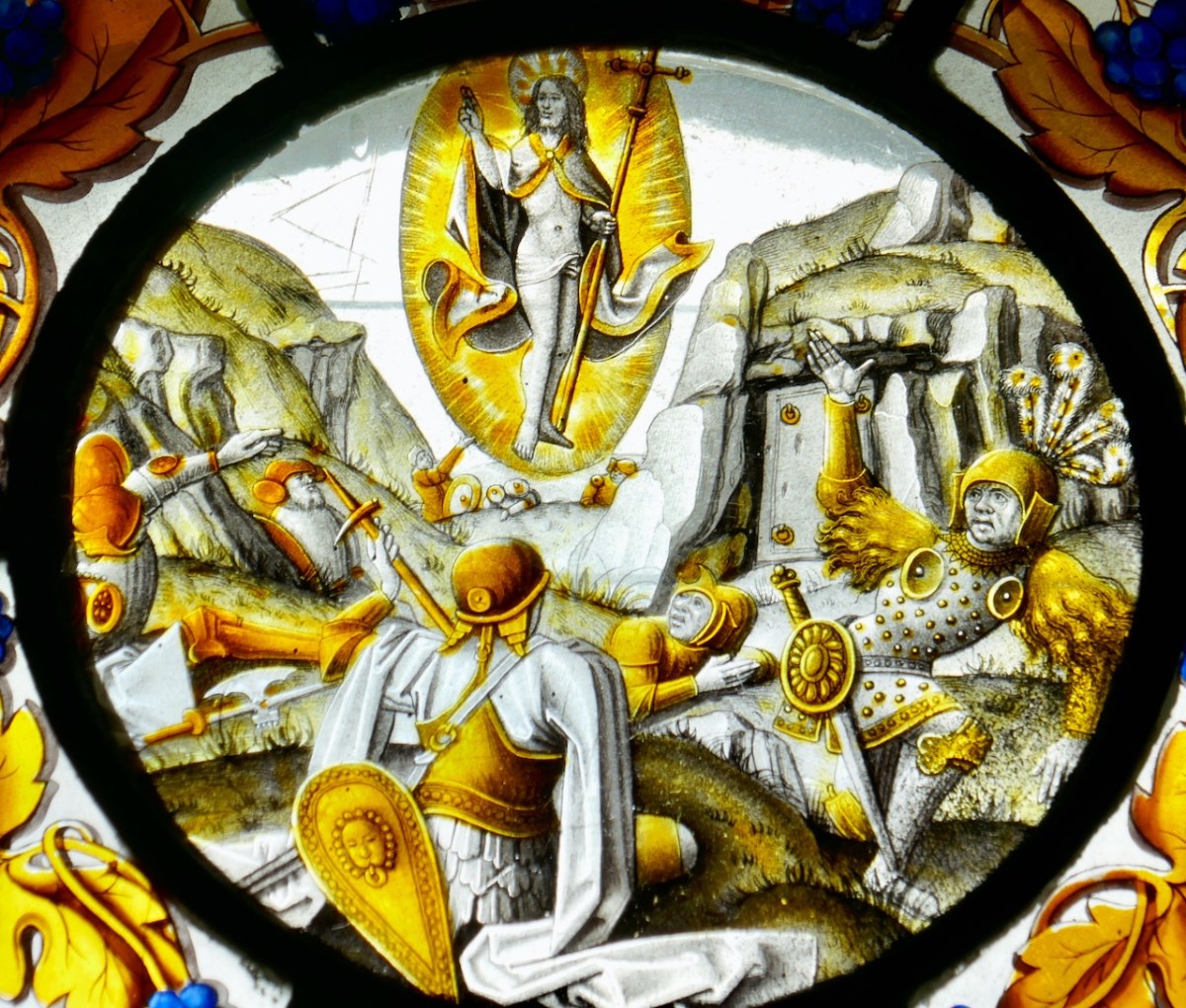
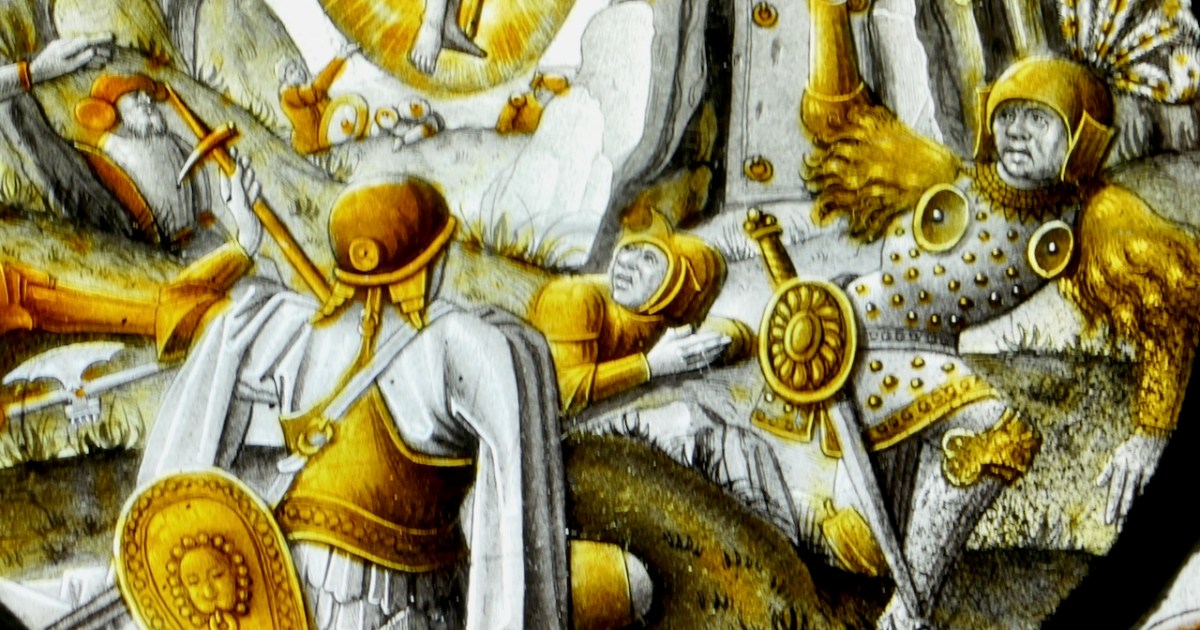
While the same was true in many northern European countries (as opposed to the more Catholic south), there was one area producing tinted glass during the early 16th century, and that glass eventually found its way to all kinds of places, including Britain and Ireland. We now call it Netherlandish Glass, since the production of it was centred in Holland and Belgium. (The two images above are of a Resurrection scene from the set of Netherlandish glass pieces I am writing about today.) It was brought back as souvenirs by travellers, since it was seen as such a novelty, or acquired through trade. Some of it also found its way here over the course of the 17th and early 18th centuries as it was sold as “antique”. At the time, it was mostly used for decorating private houses, but eventually much of it ended up in Churches.
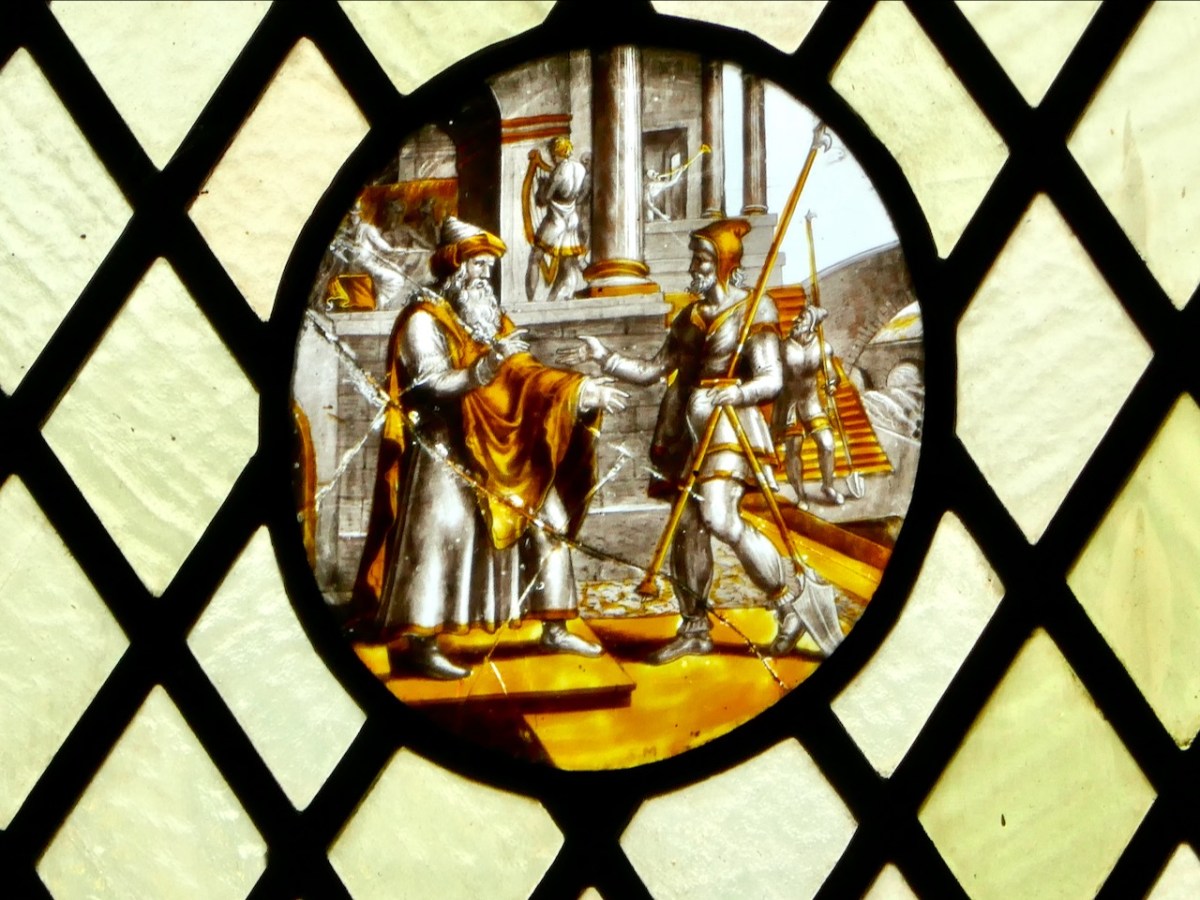
There are bits of it here and there. On a visit to York some time ago, we saw some incorporated into church windows – like the example above from St Helen’s in York. In Ireland there are only a handful of examples, mostly in Protestant churches that are not routinely accessible. To my great delight, however, I recently became aware of a set in a Catholic Church, St Mary’s, in Sandyford, Dublin.
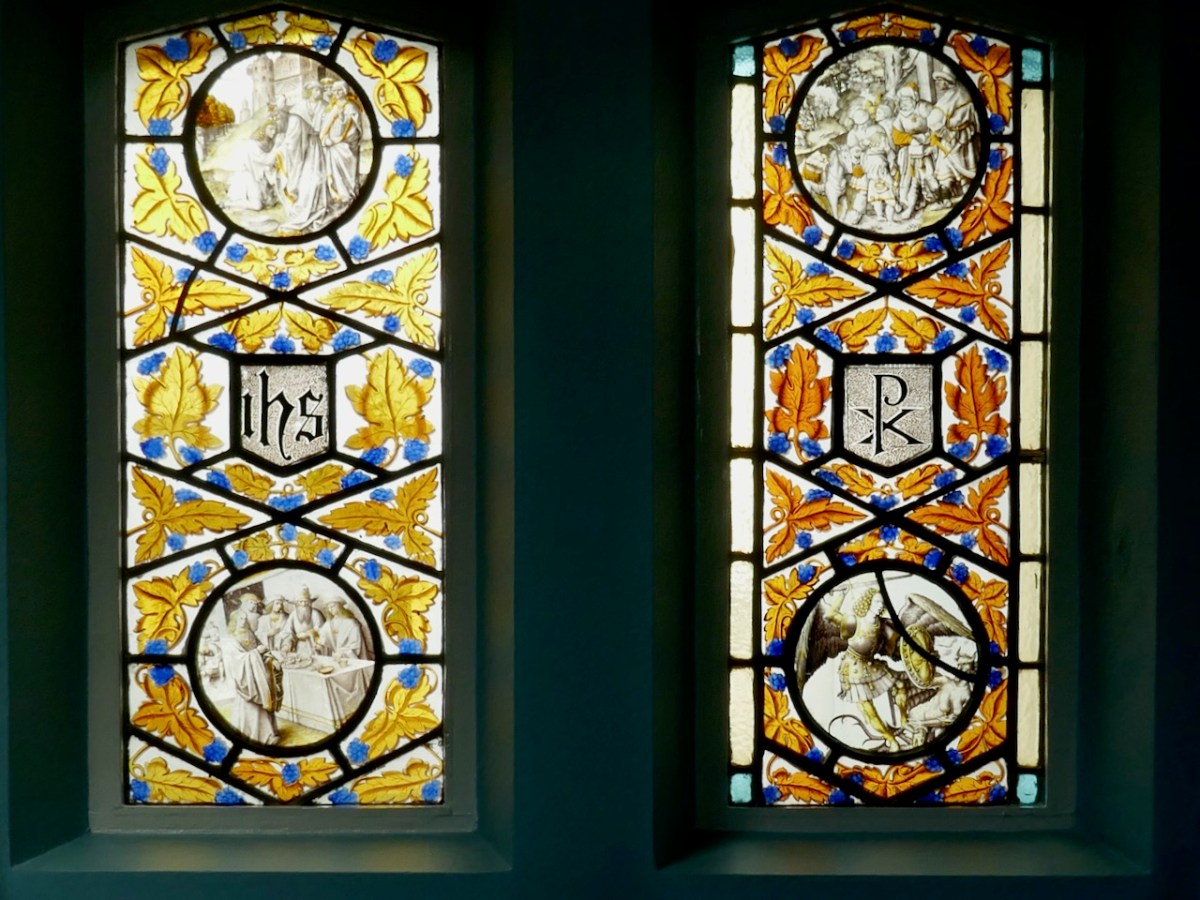
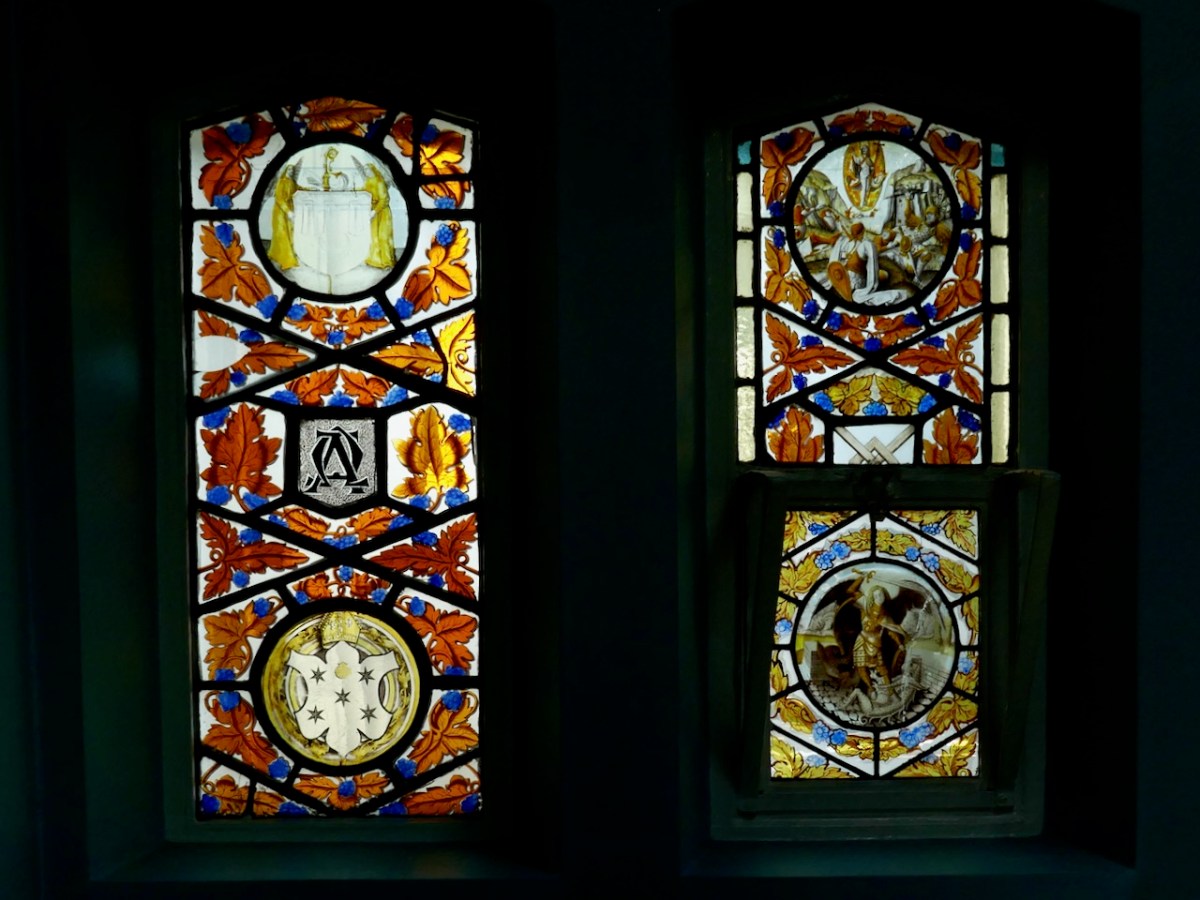
The windows are in a side chapel. There are four, each incorporating two sets of Netherlandish Glass. Only the roundels are Netherlandish – each has been set into a window of later construction (possibly 18th century), the design of which is interesting as it contains blue enamel paint (a subject for another day), see below.
I have been unable to find any information about the windows – where they came from, who donated them, when they were assembled into the arrangements we see now. However, I do have information on the roundels themselves, thanks to a paper by the acknowledged expert in this area, William Cole*. I am relying on his erudition for some of what follows.
First of all, how was this glass produced? Typically made in circles (hence the term ’roundels’) or ovals, sometimes in squares or rectangles, the lines of the design were painted using glass paint – ground glass in a medium of water or gum arabic – and kiln fired to make the paint adhere to the surface. Colour was added using sliver nitrate mixed with water or vinegar, always to the back of the glass, and the piece was fired again, this time at a lower temperature. The silver nitrate permeated (as opposed to adhering to) the glass, staining it yellow (hence the term ‘stained glass’). A longer or a third firing deepened the yellow produced by the silver stain into an orangey colour. Take a look at this video for more precise information. Silver stain is still routinely used in stained glass, but at the time these roundels were made it was the only option available to introduce colour onto a glass surface.
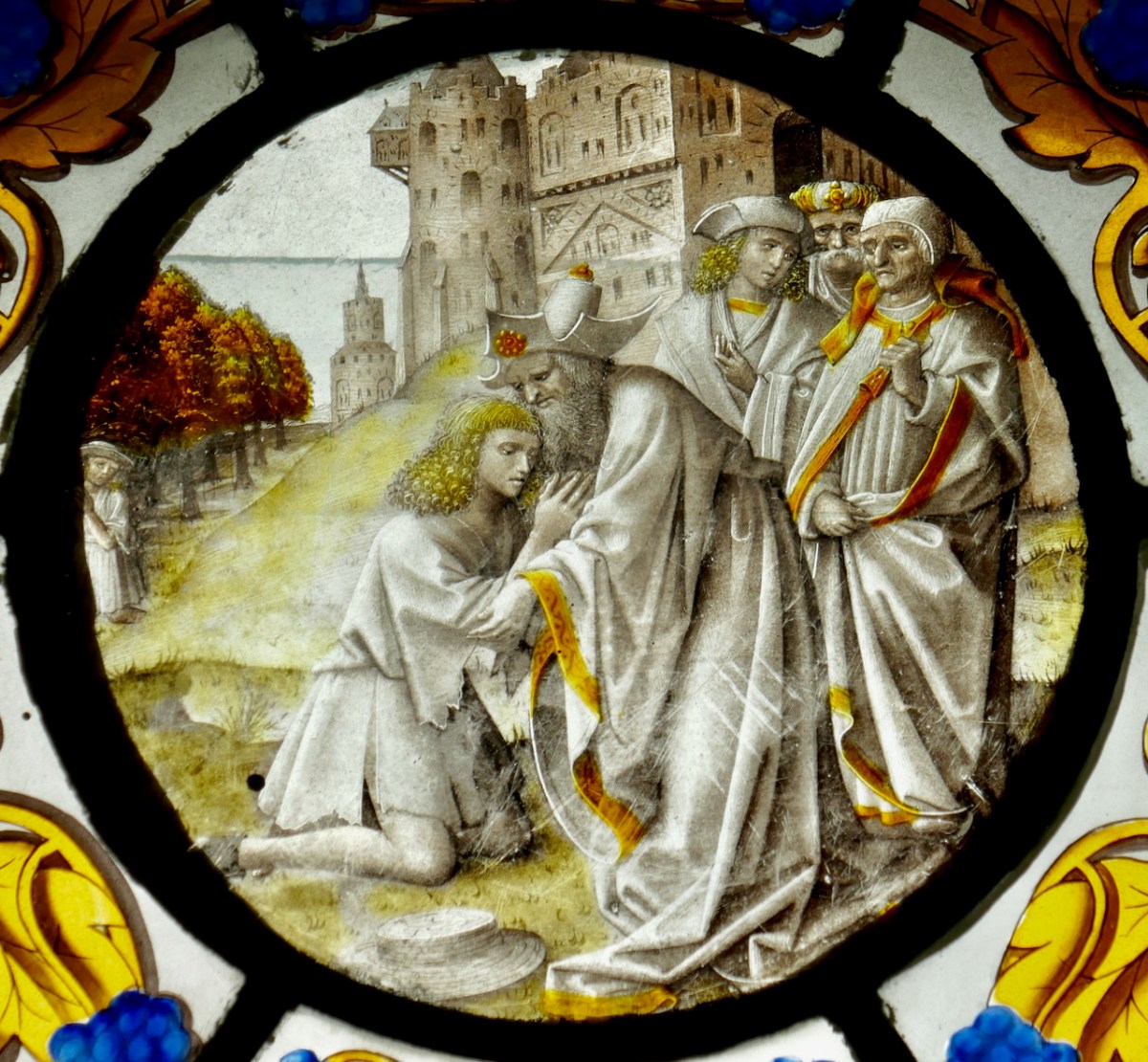
The roundels are charming. They use subjects that would have been familiar to their 16th century audience – stories and characters from the Bible. Above is the Prodigal Son being greeted by his father, the other figures may include the mother and the resentful brother. A side-scene shows the Prodigal approaching – his hat is the same as the one on the ground in font of the him. The background was how the artist imagined the Holy Land as he worked away in the Netherlands, sometime around 1510. There are three shades of yellow – light for the background, medium for clothing trim, and a deeper shade for the trees and decorative elements on the father’s hat and the mother’s scarf. The darkest shades were probably added and fired first.
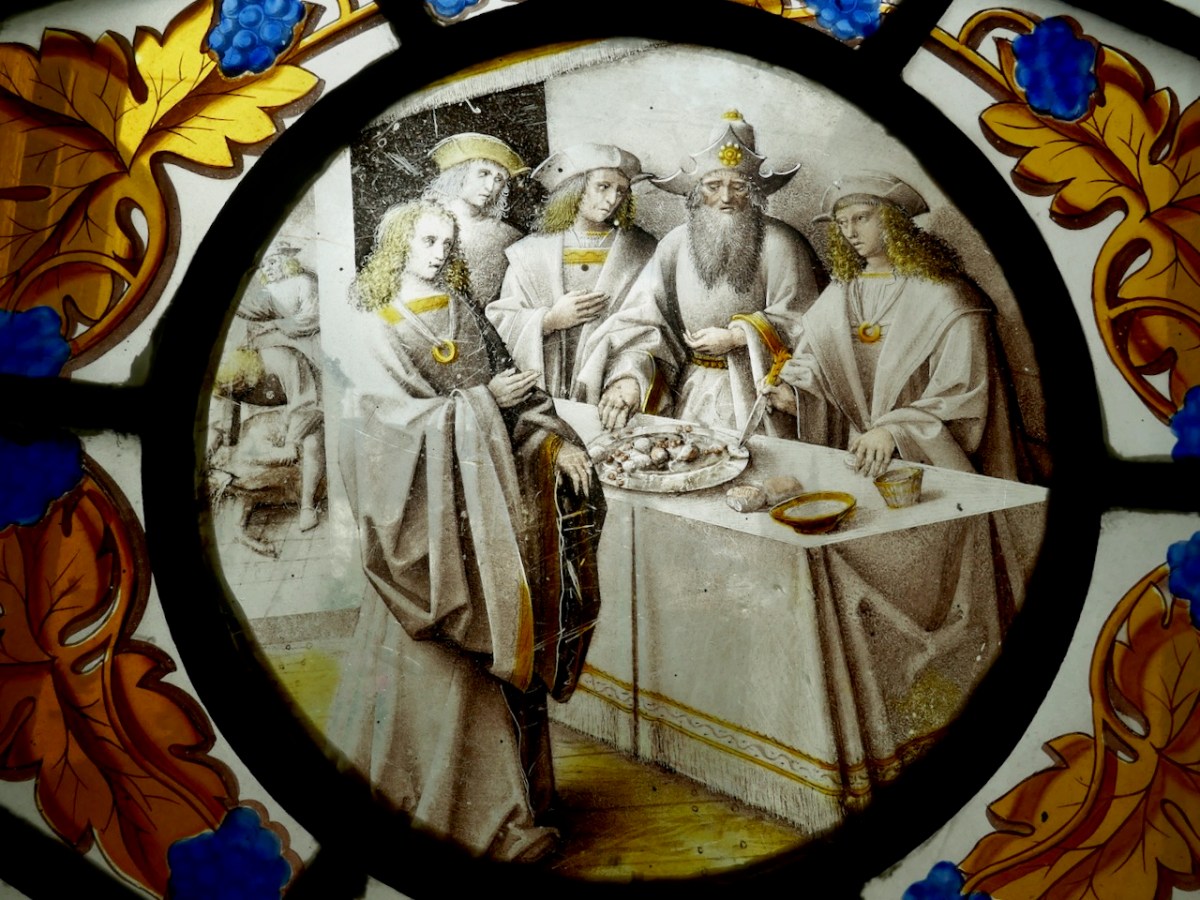
And here is the Prodigal son being invited to the feast. The feast appears sparse indeed, but look to the left and you will see the fatted calf being prepared. An article on The Prodigal Son in Sixteenth and Seventeenth-Century Netherlandish Art by Barbara Haeger points out that this was a popular image partly because both Catholics and Protestants, although they may have nuanced approaches to the subject matter, could both read the story as a demonstration of the father’s love and compassion and God’s willingness to forgive repentant sinners.
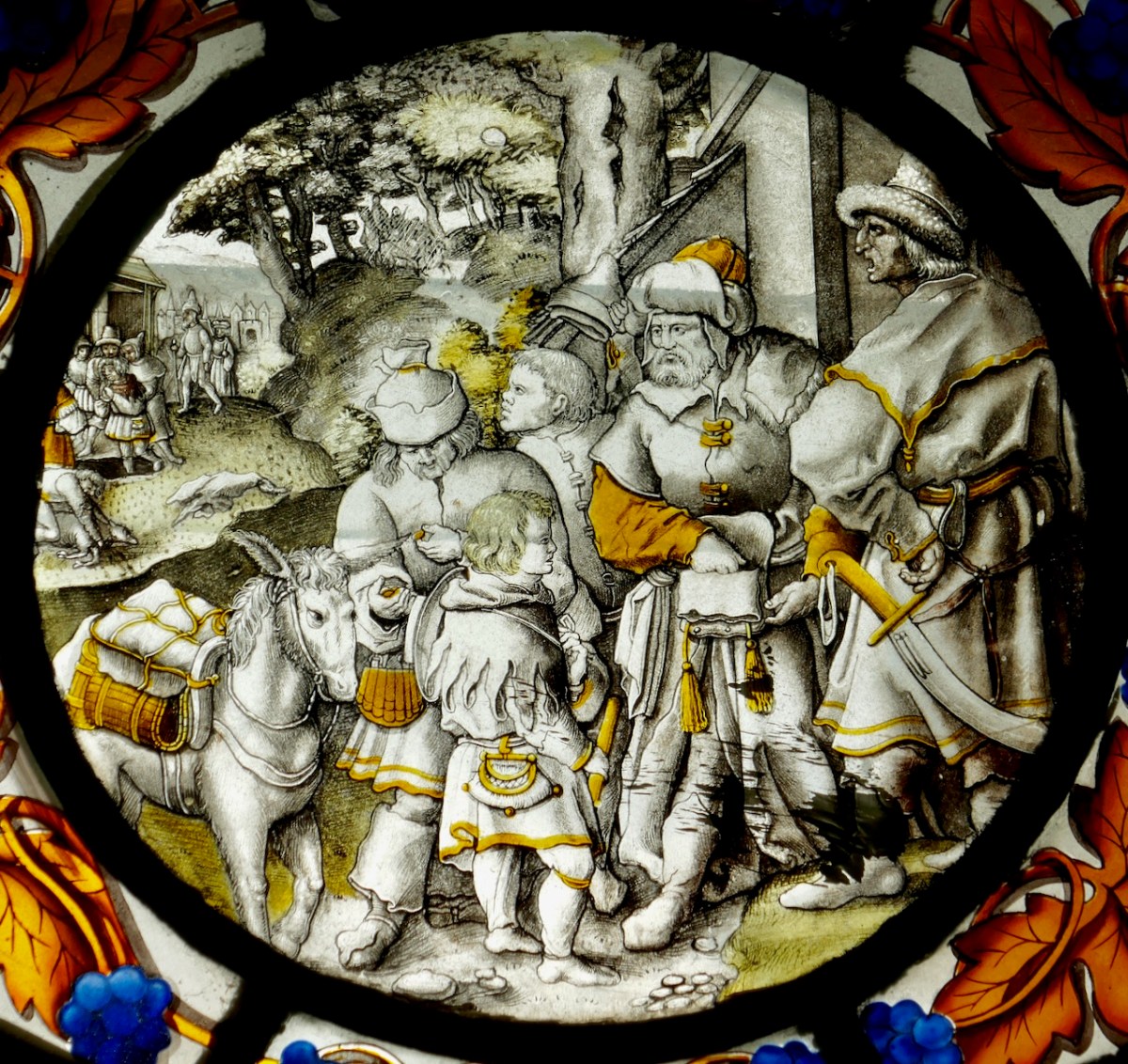
Another popular story was that of Joseph and his coat of many colours – although perhaps we can feel some sympathy for the glass painters who could only actually use one colour – yellow – so had to rely on the viewer to fill in the blanks in their mind’s eye. In the roundel, above, Joseph is being sold to the Midianites – or perhaps, as Cole suggests, being sold on to Potiphar. Subsidiary scenes on the far left show Joseph being put down the pit, and one of his brothers killing a sheep so they can dip the coat in the blood. Cole assigns this piece to around 1540.
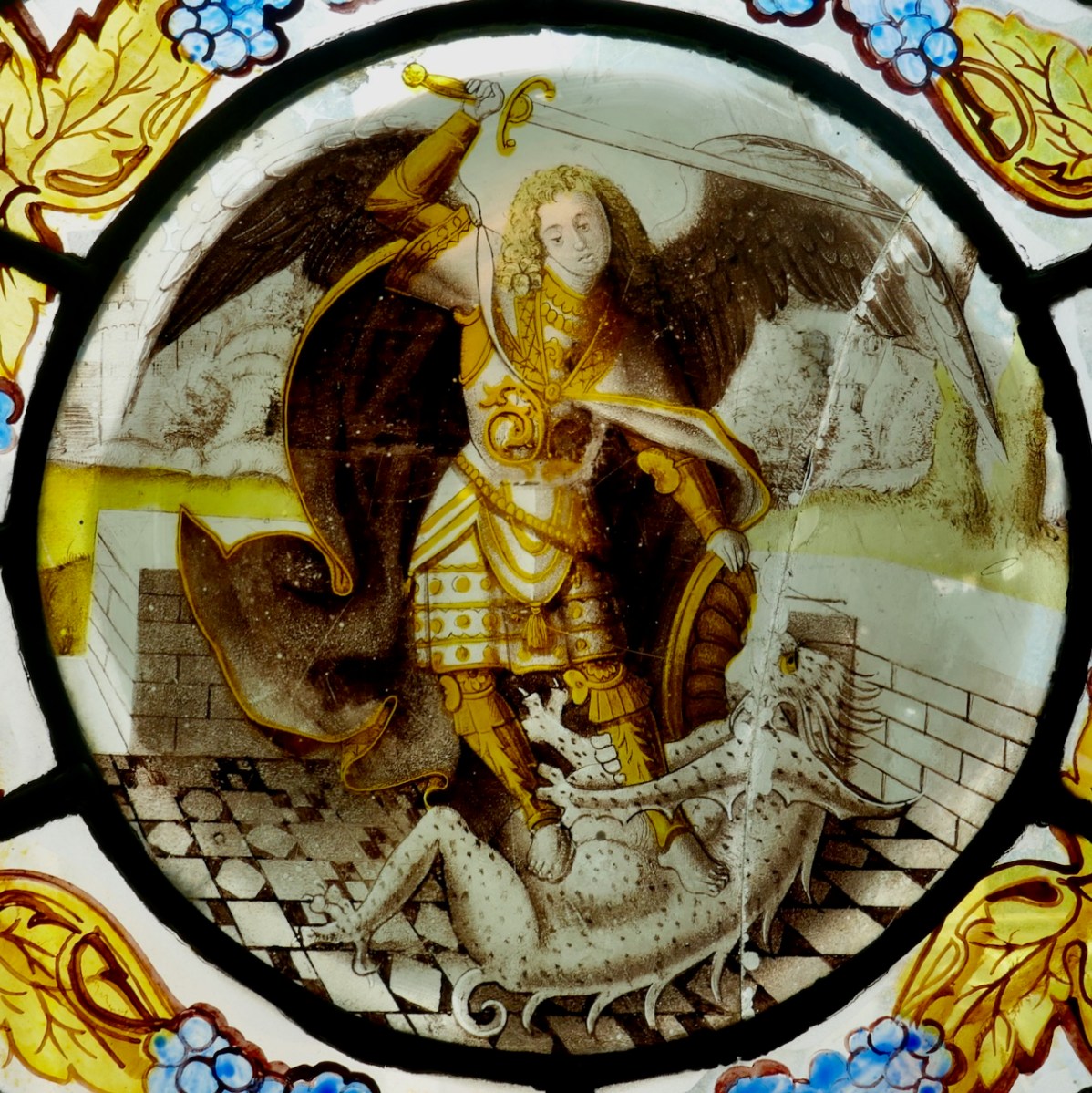
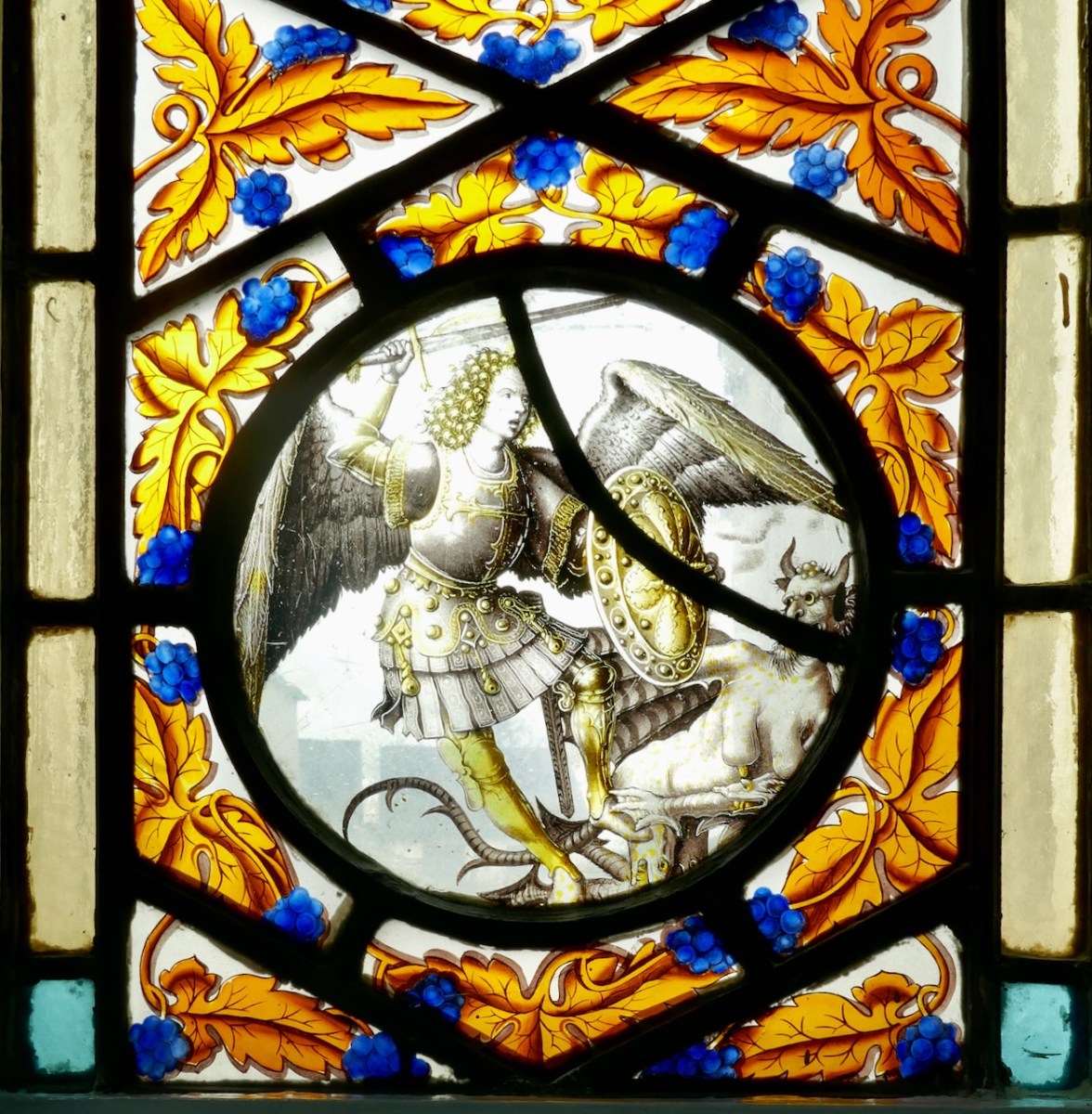
Two images of St Michael round out this collection. In the one above, St Michael stands above the dragon, sword raised ready to strike. This roundel is unusual because not only silver staine has been used for colour, but also some sepia enamel paint for the wings and the underside of the cloak. Enamel paint, although it could add another colour (at that time normally just brown) was undesirable it made the glass opaque.
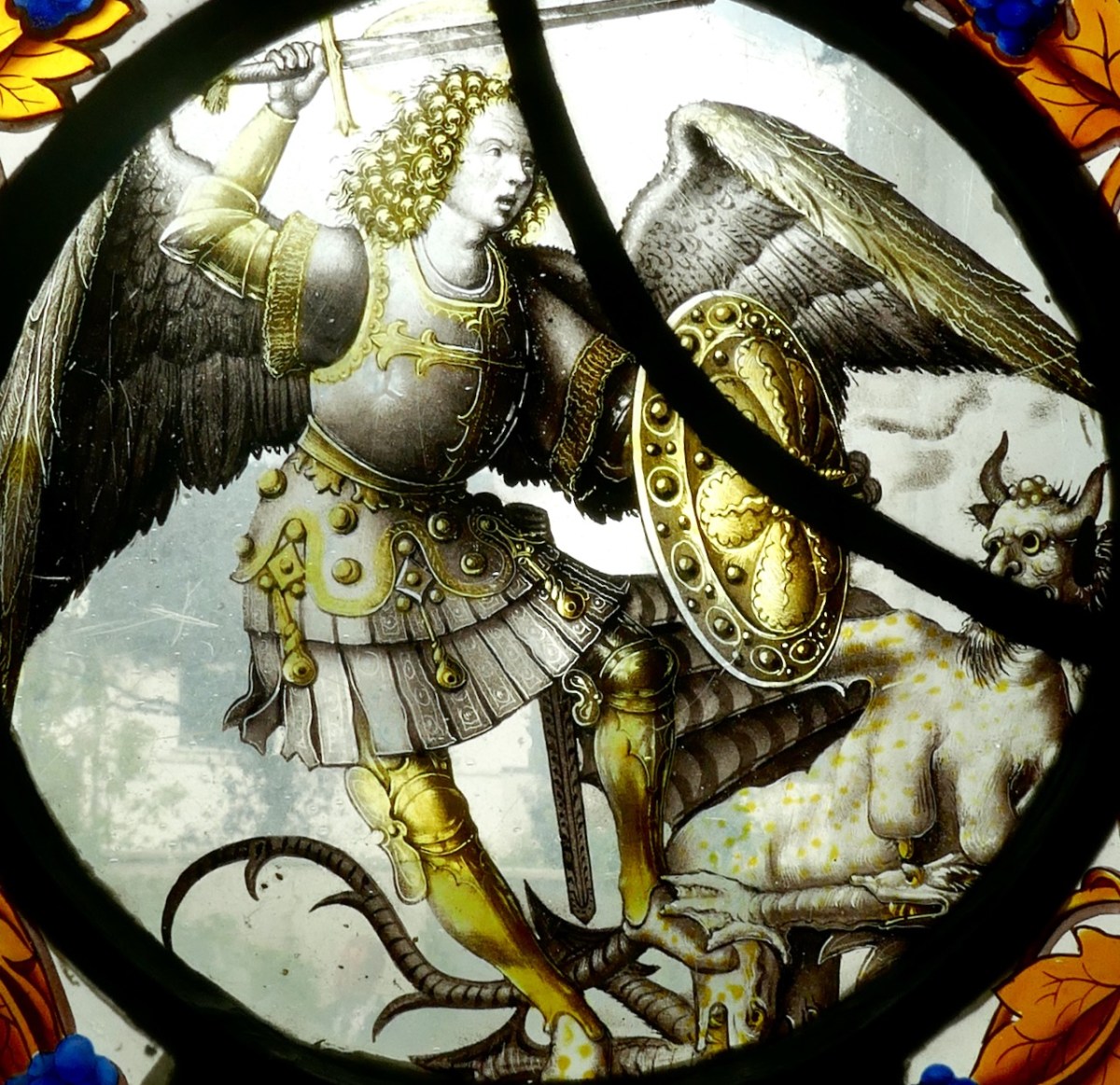
The other St Michael stands in the same pose, but the dragon is more complex and interesting. One piece of lead crosses the roundel – perhaps it broke in firing and this holds it together. I will leave you with my final selection, which Cole labels A Bishop’s Arms – note the prominent crozier.
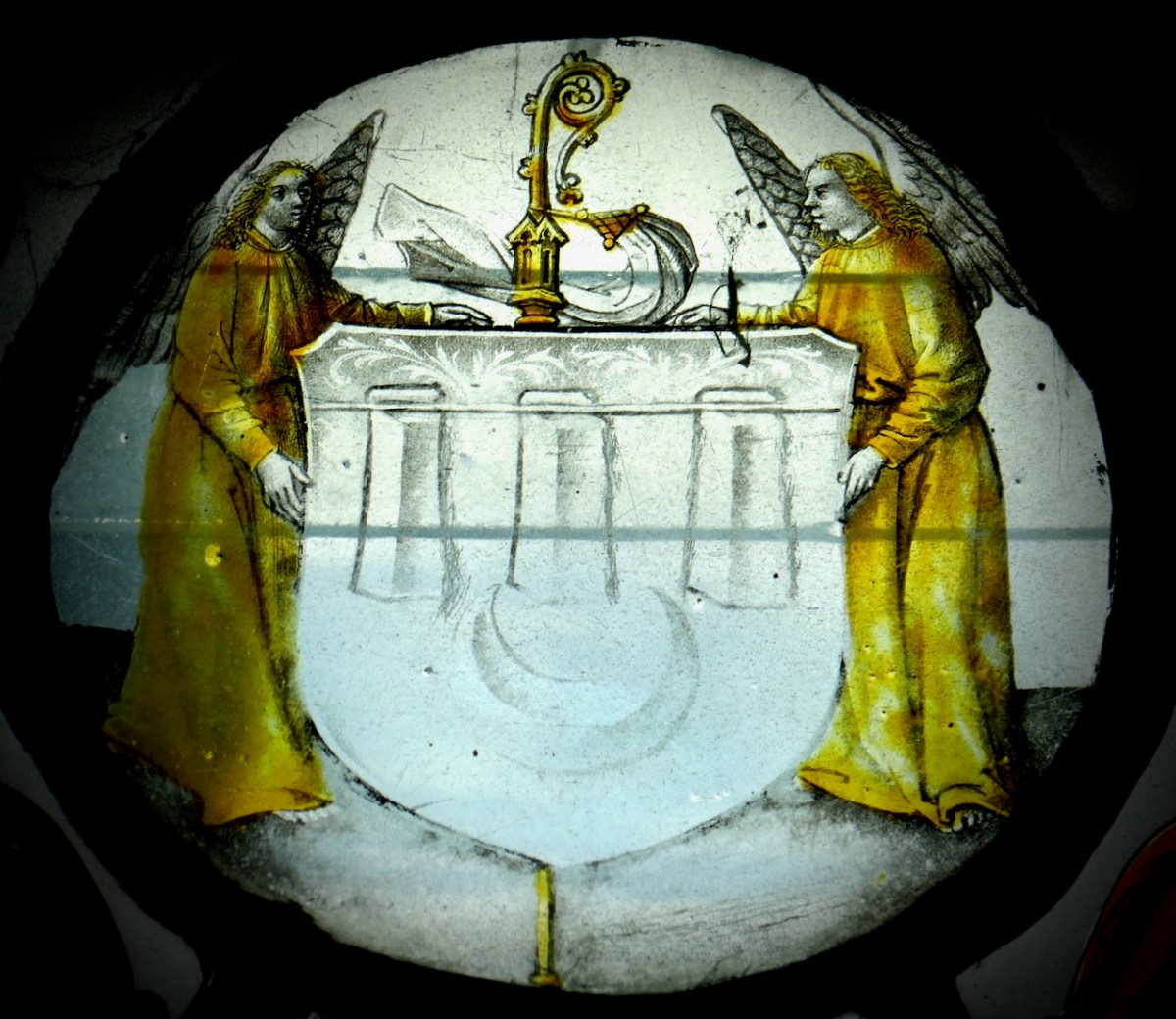
I hope to photograph other Netherlandish glass in Ireland over time. Let me know if you find any!
 Roaringwater Journal