December in Rossbrin

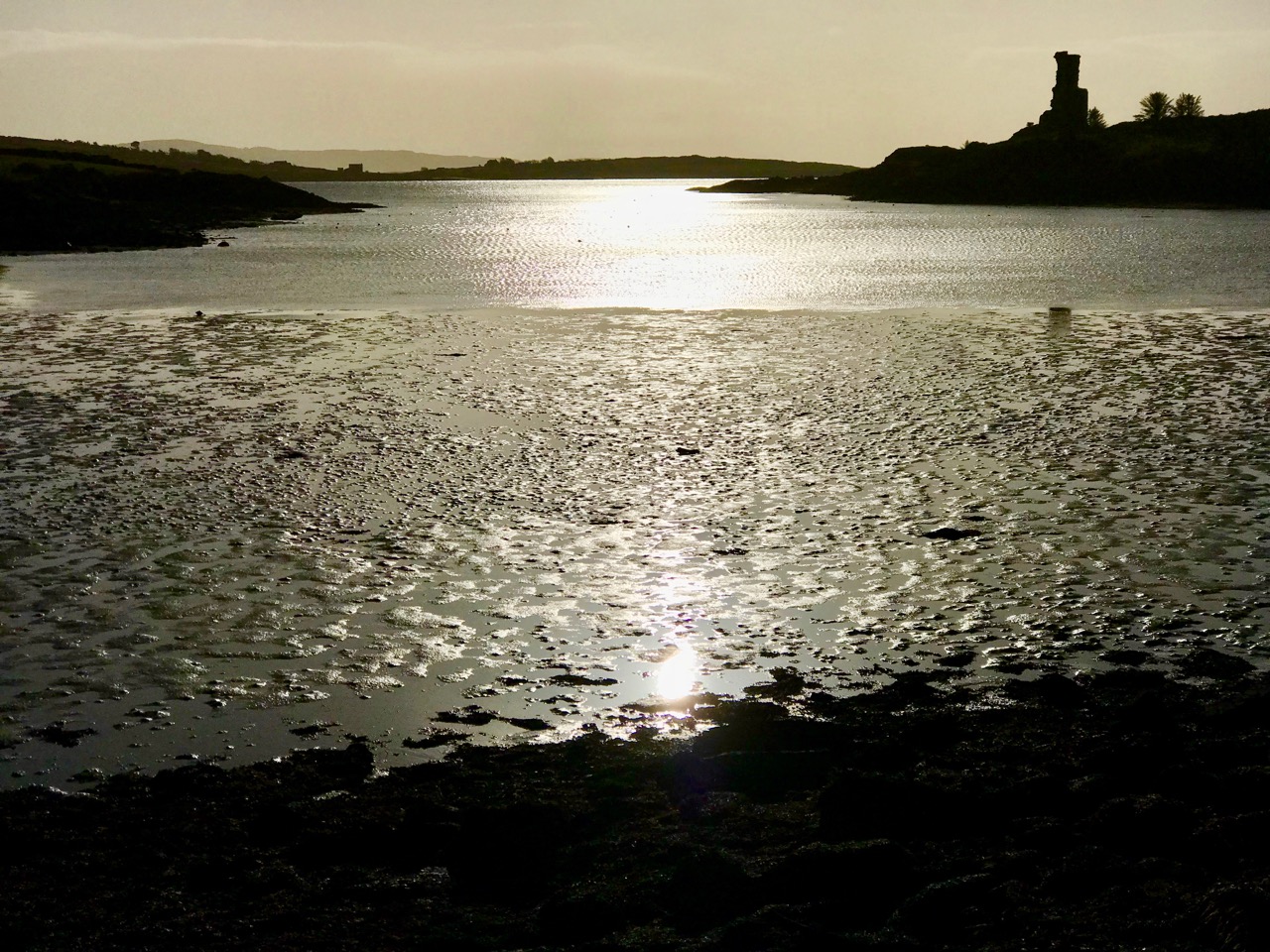
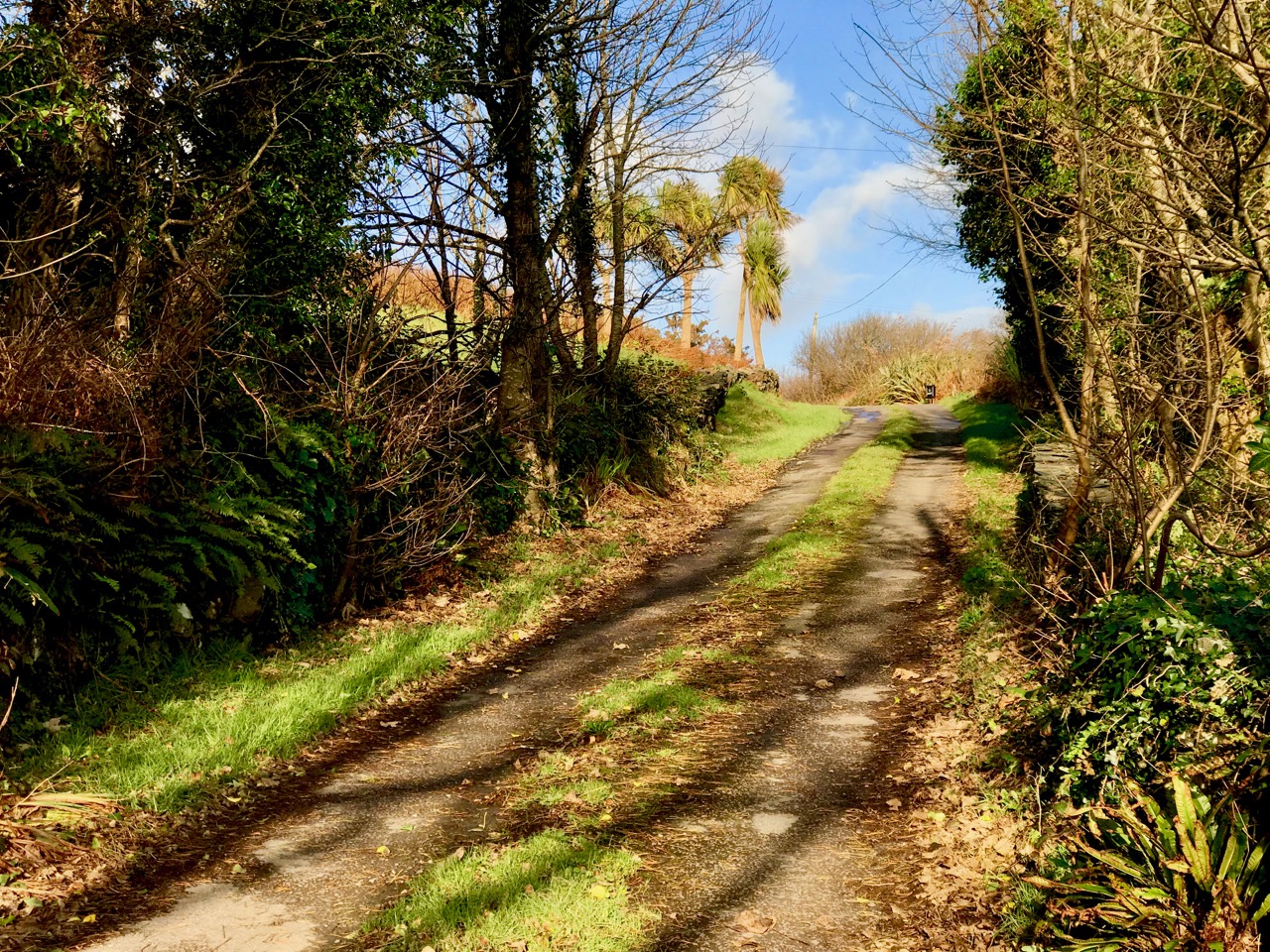
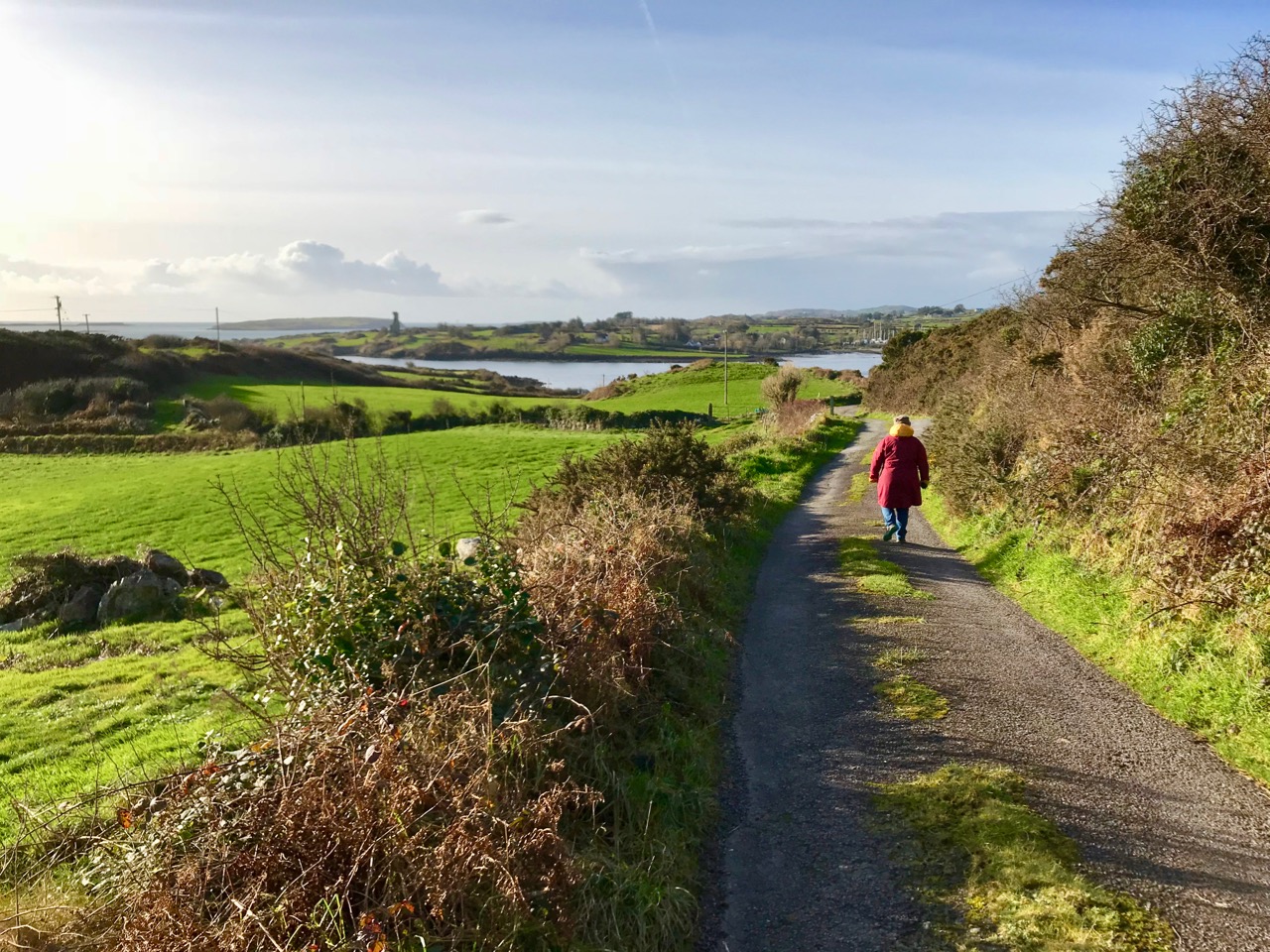
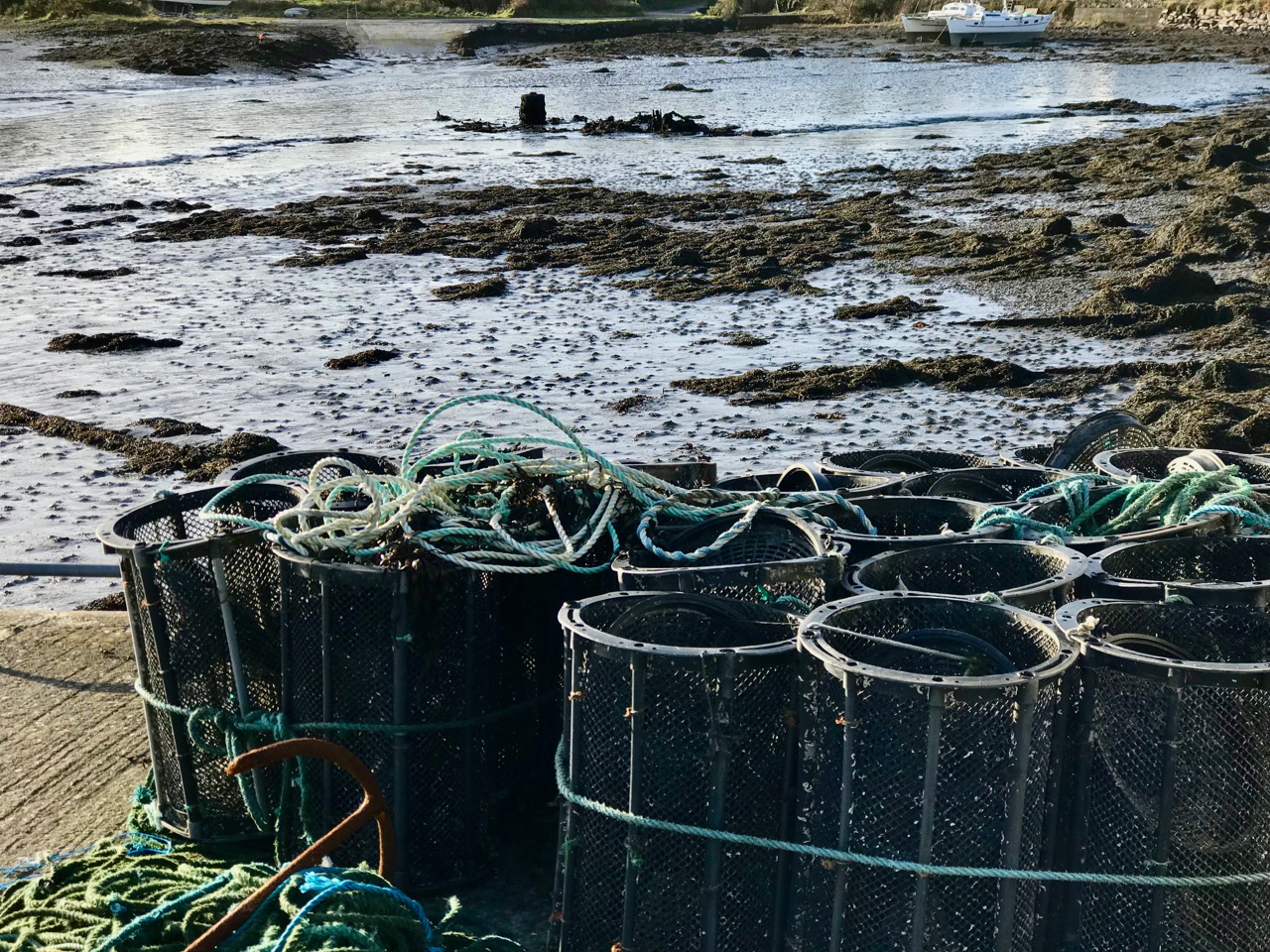
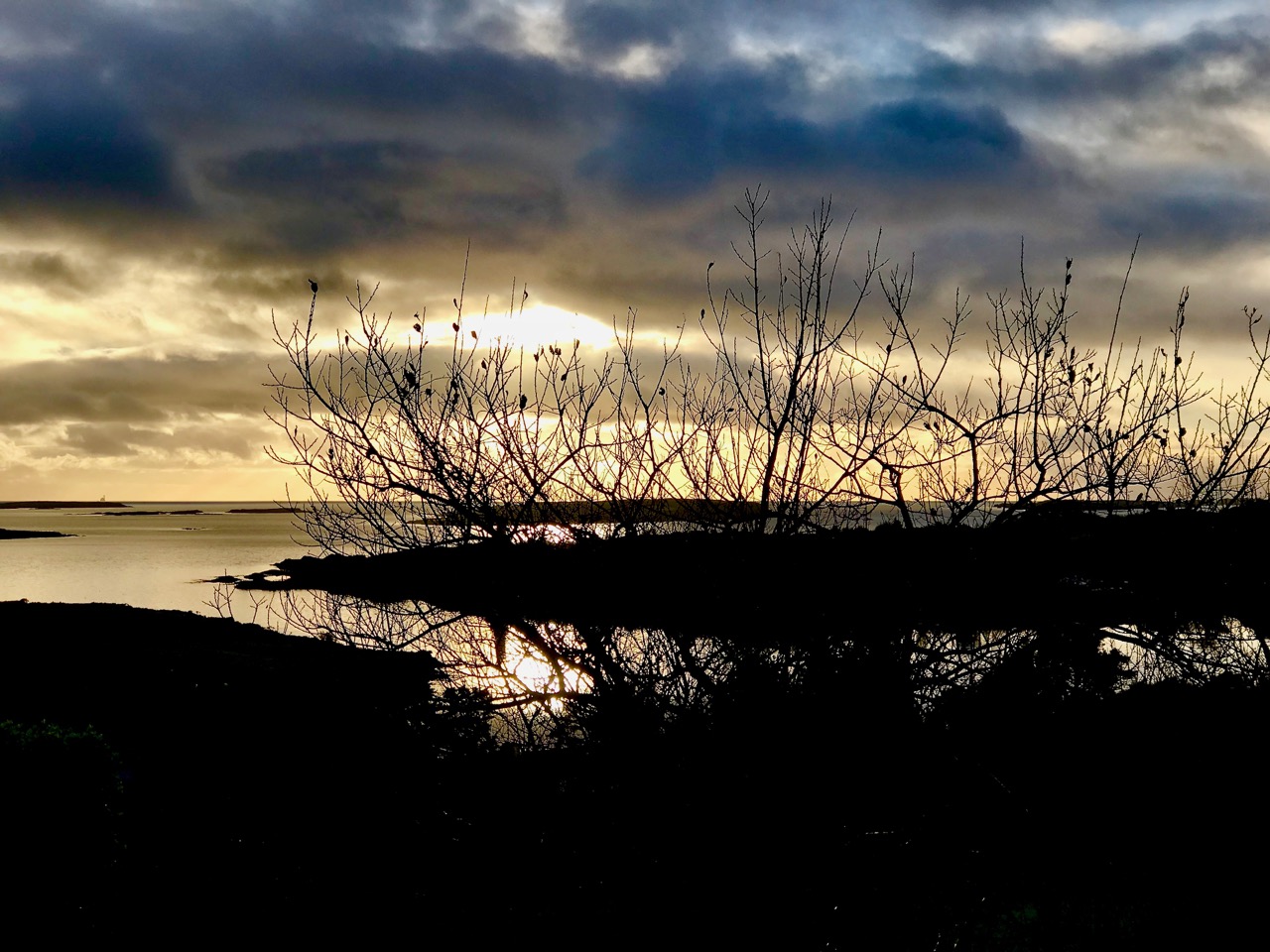
In the past year I have returned to Rossbrin again and again in my posts. That’s not surprising, as it’s just a short and always rewarding walk down our Beautiful boreens:

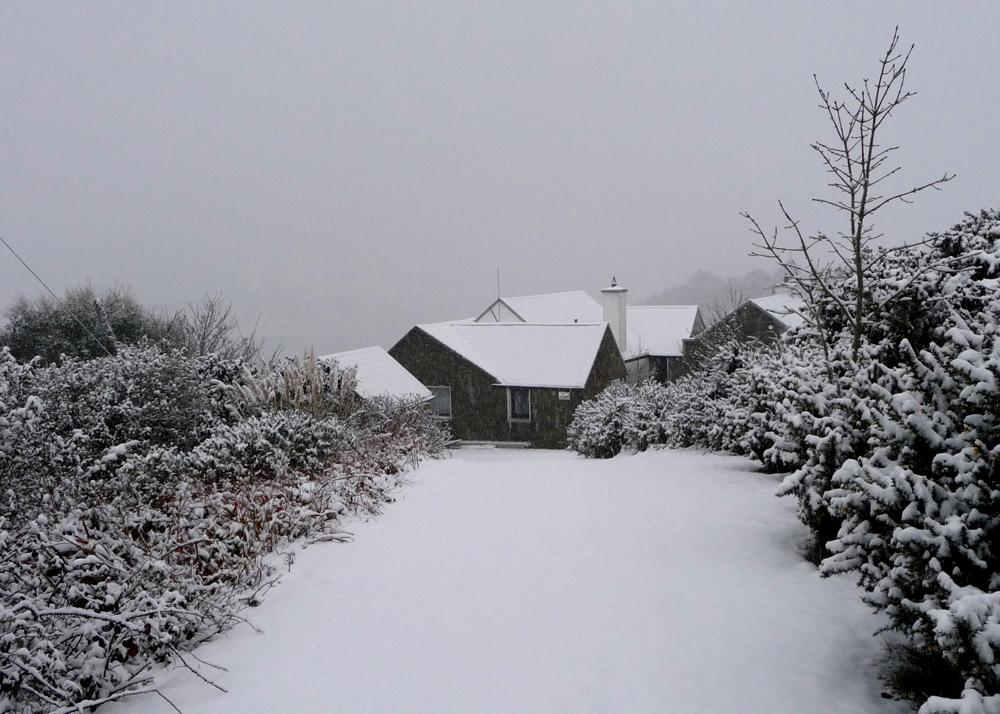
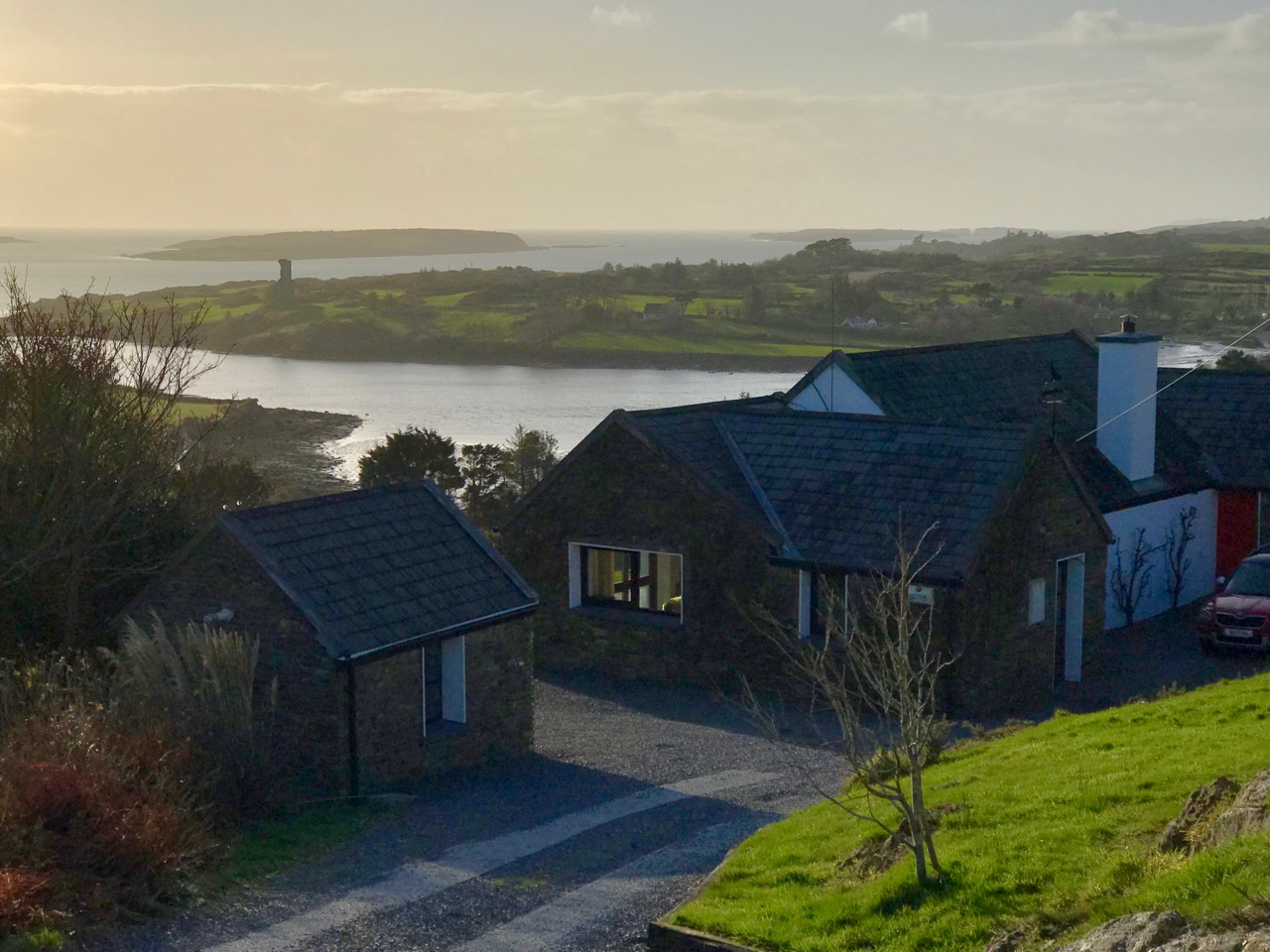
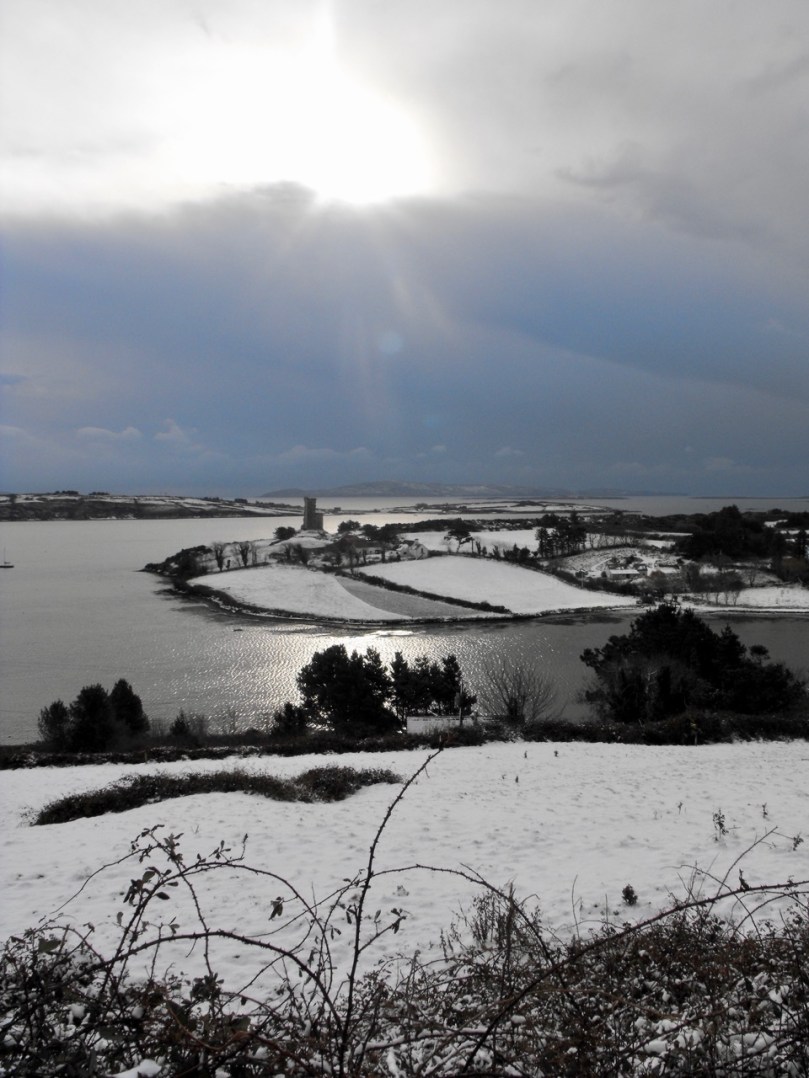
It’s December, and we can expect anything in the way of weather. This is the mildest corner of Ireland: further north and east of us today, spanning Cavan, Donegal and Wicklow, heavy snow is falling and temperatures are forecast to drop to minus 8 degrees C in the coming hours. The last real bit of snow in West Cork came along seven years ago but we weren’t here, then, to see it (image below of Nead an Iolair in 2010 courtesy of our neighbours Dietrich and Hildegard Eckardt with, below it, today’s view of the Cove seen from the house):

Whatever the weather, our cove has something to offer – and every day is guaranteed to bring a mixture. When the sun is out we can bask in it as if it was the middle of summer, but it’s just as likely that there will be a stiff and invigorating breeze to accompany our bracing walks.

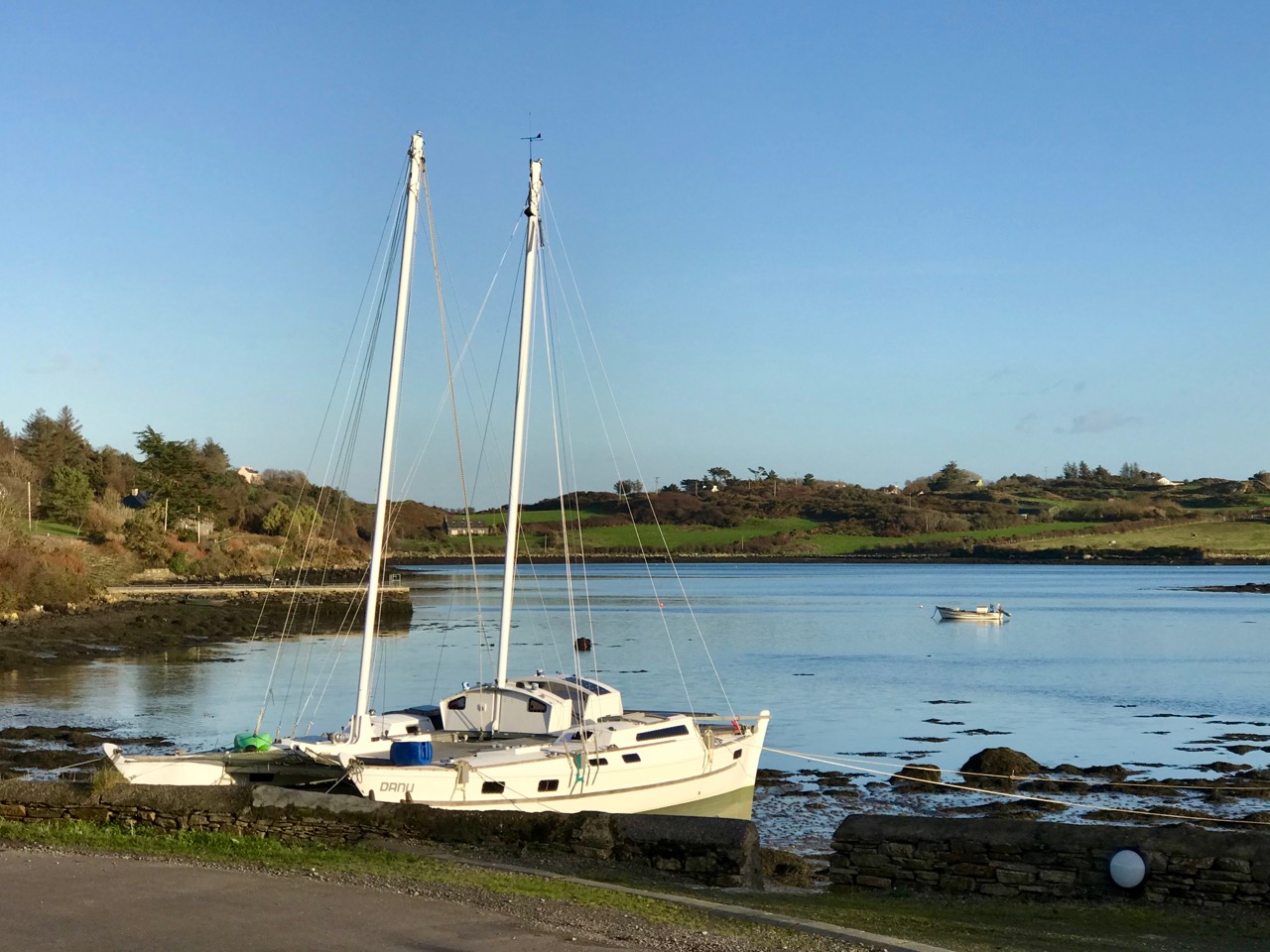
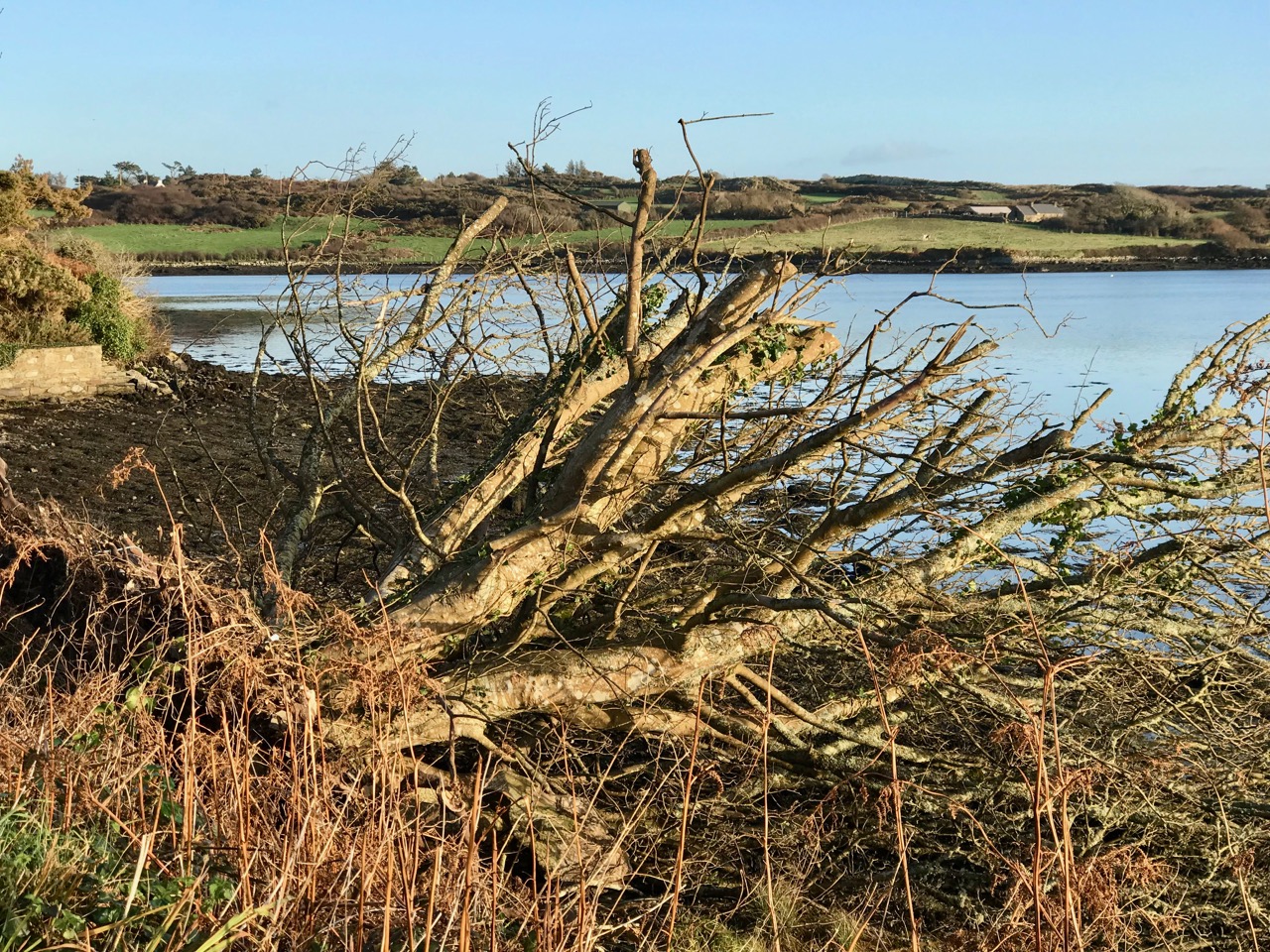
Above – reminders of summer pleasures to come as we wind down to the year’s end in Rossbrin: Andre’s catamaran – Danu – which he built himself, rides out the winter storms on a wet mooring in the Cove. The first of those storms – Ophelia – hit us last month, and there is a fair bit of wind damage still to be seen:

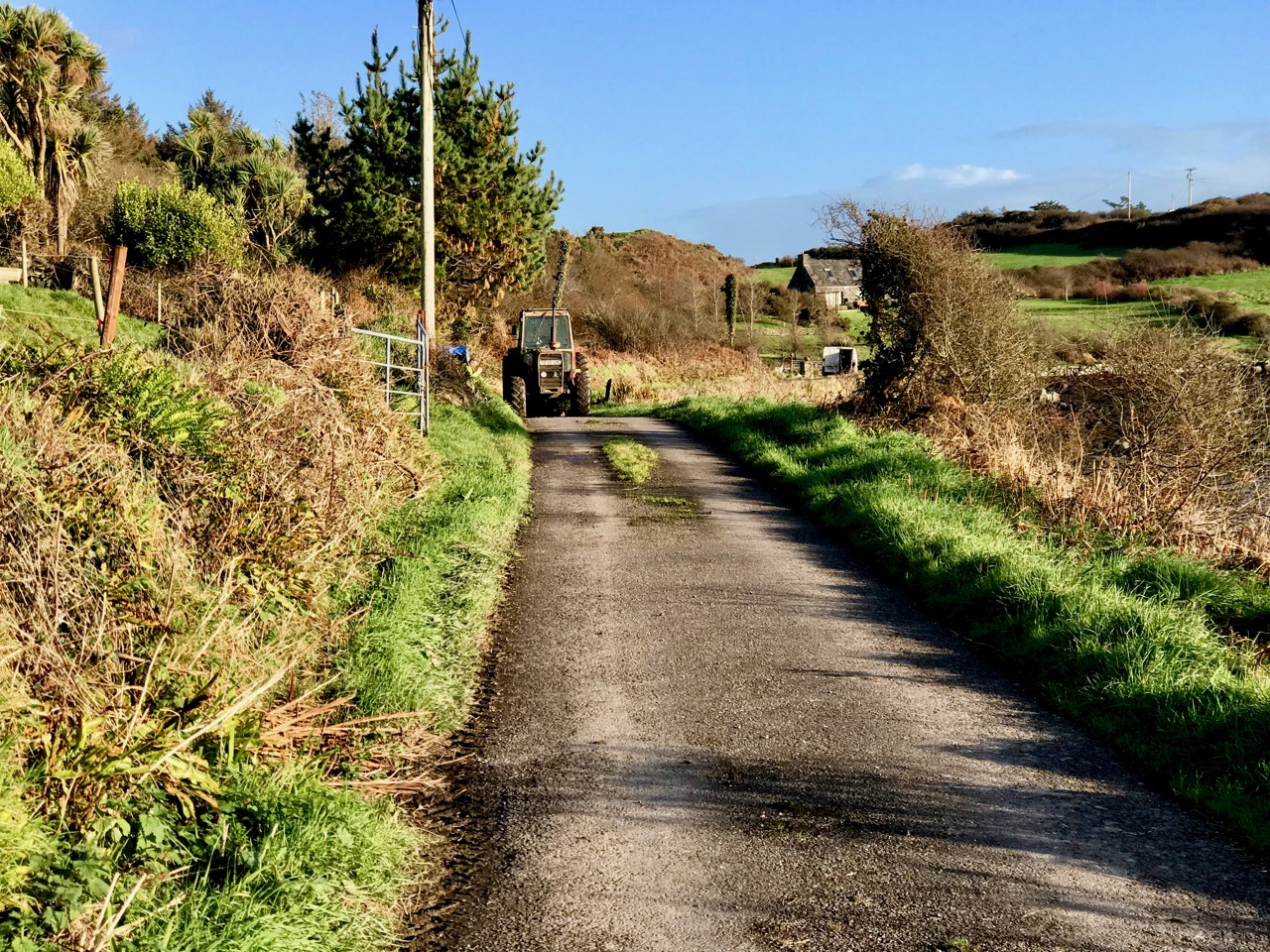
Traffic jam in Rossbrin!

Often, I will start out on the downhill walk with my head buzzing from the inexplicable madness of the outside world: British ethnocentricity, North American absurdity and worldwide chaos. Within minutes these concerns are receding, and when I reach the waterside I am overtaken by the immersive experience of natural things all around me and I find the solace of constancy: not much changes here. This little townland of Rossbrin is above and away from that buzzing, reeking world. It is a far saner place.

Since publishing this post we have received a communication from our good neighbour Julian, who lives down on the Cove, including some excellent photographs of the winter of 2010. Here’s one of them – thank you, Julian…

Cove in the snow 2010

Harry Clarke at Lough Derg

The Lough Derg Harry Clarke windows are unusual and fascinating – and generally inaccessible unless you are willing to undertake the rigorous pilgrimage. I am very grateful indeed to have been given the opportunity to photograph and write about them. I refer readers to Robert’s post about Lough Derg, Journey into Purgatory, for those unfamiliar with the place and the pilgrimage. Go off and read that first, then come back to me. If you already know all about Lough Derg, but not much about Harry Clarke, then take a browse of some of my previous posts about Ireland’s most celebrated stained glass artist. If you’re not sure what stations of the cross are, here’s an explanationDone that? Back now? Great – let’s get started.
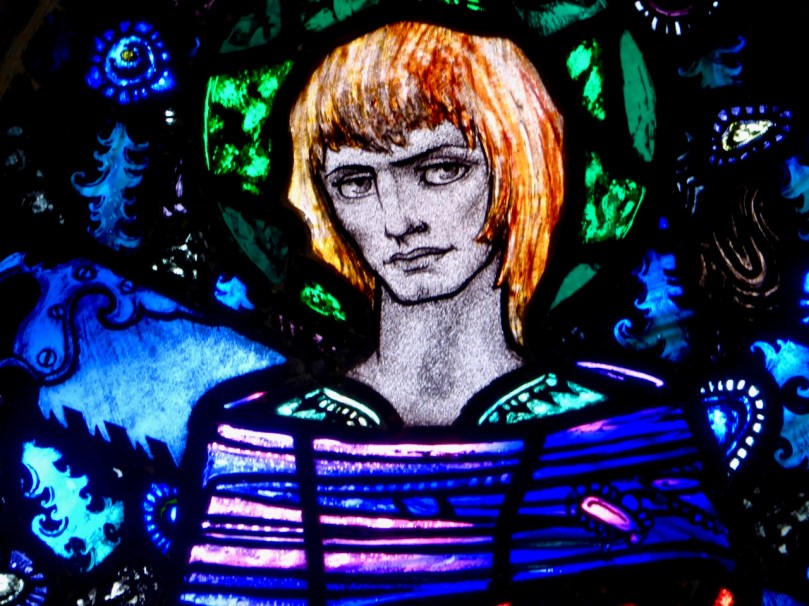
The Apostle Simon

Harry was already starting to get ill in 1927 when he undertook the commission to design a set of fourteen stations of the cross in stained glass for the Basilica in Lough Derg. He was, at the same time, very busy on numerous commissions, including graphic design and book illustration work, as well as stained glass windows for Ireland and abroad. He was so busy, in fact, that he used to absent himself from Dublin so that he could work in peace in a studio in London. Nevertheless, he was keen on the Lough Derg project, not least because the Canon, Fr Keown, was the same one with whom he had worked on the Carrickmacross windows. The design he came up with was unique: each of the windows depicts a different apostle (Judas being replaced by Matthias), rounded out to fourteen by adding St Paul and Our Lady. Each figure holds a mandorla-shaped panel upon which the stations are presented.

The Apostle James – his mandorla contains the station ‘Jesus Meets His Afflicted Mother’

In order to ‘count’ as an official Harry Clarke window, as opposed to one produced by the Harry Clarke studios, Harry himself must have designed, and created or closely supervised the execution of the window. The Lough Derg windows were definitely designed by Harry – the drawings he made for them still exist. Artisans in his studios began the work in his absence following his detailed instructions.
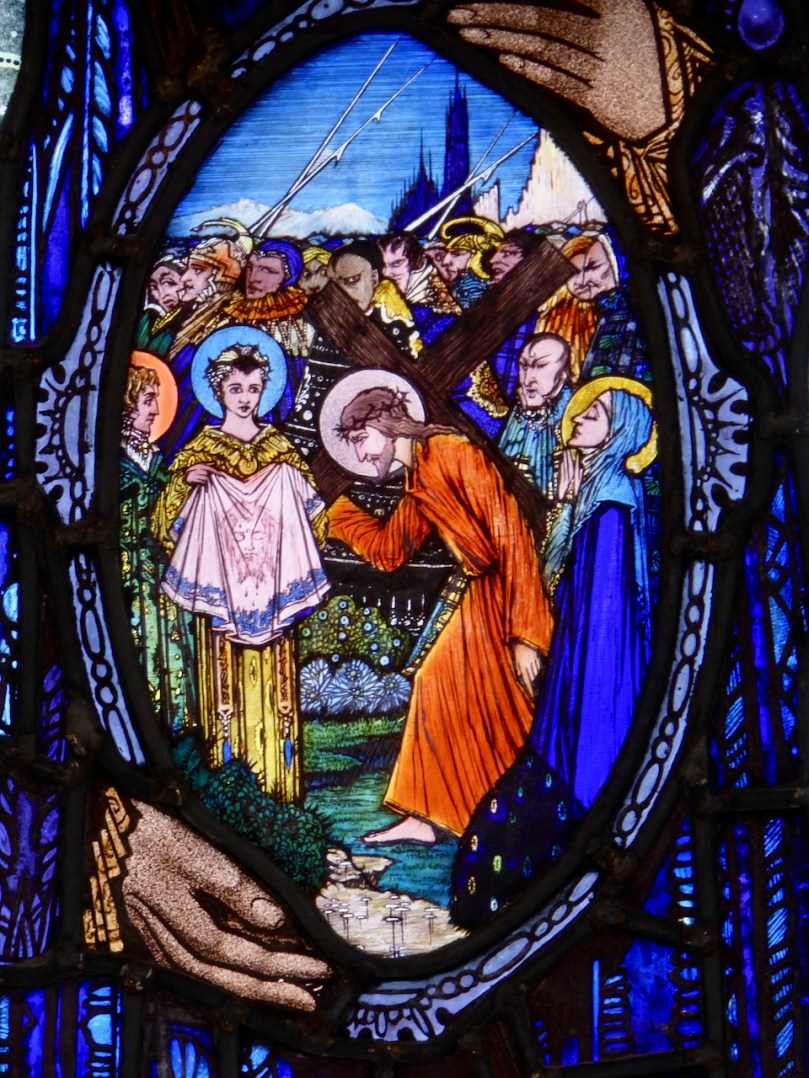
A close look at ‘Veronica Wipes the Face of Jesus’, contained in Philip’s mandorla

Nicola Gordon Bowe, the renowned Clarke scholar, described the process* thus: “His choice of glass, detail, colour, design and leading are all fully evident in the dramatically effective concept of these windows, even though any study of the original designs for the inset panels and their realization in glass will reveal his absence.” Indeed, before the windows could be finished and installed Harry had to travel to Switzerland to spend time in a sanatorium.
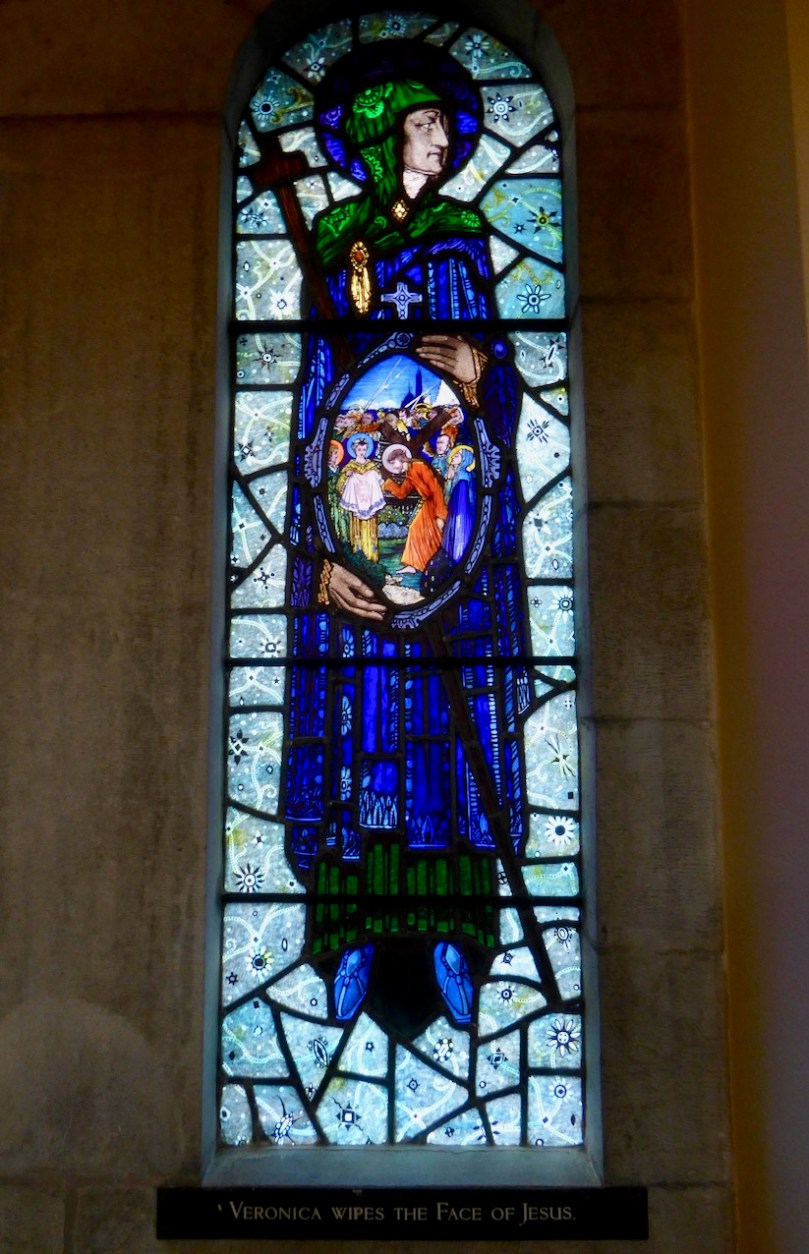
Philip and his mandorla

Each saint is shown, as is tradition, with his symbol, often the instrument of his martyrdom.  Philip, for example, is shown with a cross, as he was crucified upside down. His medallion shows Veronica wiping the face of Jesus. The apostles and Mary, as well as the small figures in the mandorlas, have all the Harry Clarke hallmarks – large, expressive eyes, long tapered fingers, highly-decorated medieval-style clothing, sleeves with hand points, complicated headgear, forked beards, pointed feet.

‘Jesus Falls the Second Time’ – note Mary in blue and John in green

Despite the absence of the master’s hand, it is hard to imagine how these tiny stations could be any more exquisite than they are. The same figures occur in all or most of them – Jesus, his mother, Mary Magdalen, John his beloved apostle, and the tormenting soldiers. There is also, of course, a host of minor characters, often peeking in from the sidelines or half-hidden behind others. Harry habitually drew from life and used himself and his friends as models. Some of the glimpsed faces in the scenes are no doubt based on people familiar to him. They range in expression from sorrowful and noble to cruel and savage.
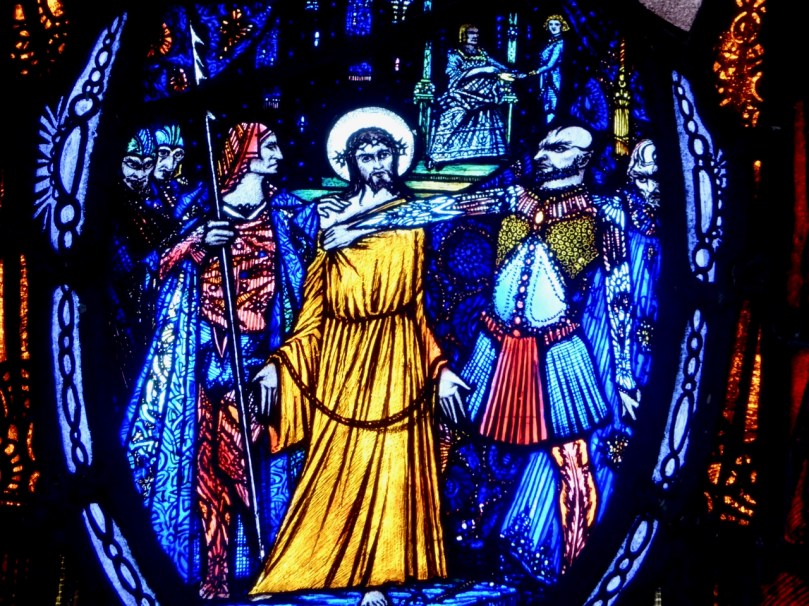
‘Jesus is Condemned to Death’

One of the intriguing aspects of these stations is that many of the figures are rendered in ways that depart radically from the conventional depictions of biblical characters, images that were for the most part based on Renaissance paintings. Indeed, some of the characters as imagined by Harry would fit more comfortably into his illustrations for Hans Christian Anderson fairy tales, or stories by Edgar Alan Poe. Look, for example at the first station ‘Jesus is Condemned to Death’. Apart from the tragic figure of Jesus, the individuals would not be out of place in a picture for the sort of fanciful and macabre tale that Harry relished illustrating. In the background Pontius Pilate washes his hands attended by a page dressed in what looks remarkably like a frock coat. The fierce executioner is distinguished by his strands of hair and by a striking outfit that combines an Elizabethan skirt with medieval armour.

We meet him again, cloaked but recognisable in ‘Jesus Falls the First Time’ (above)
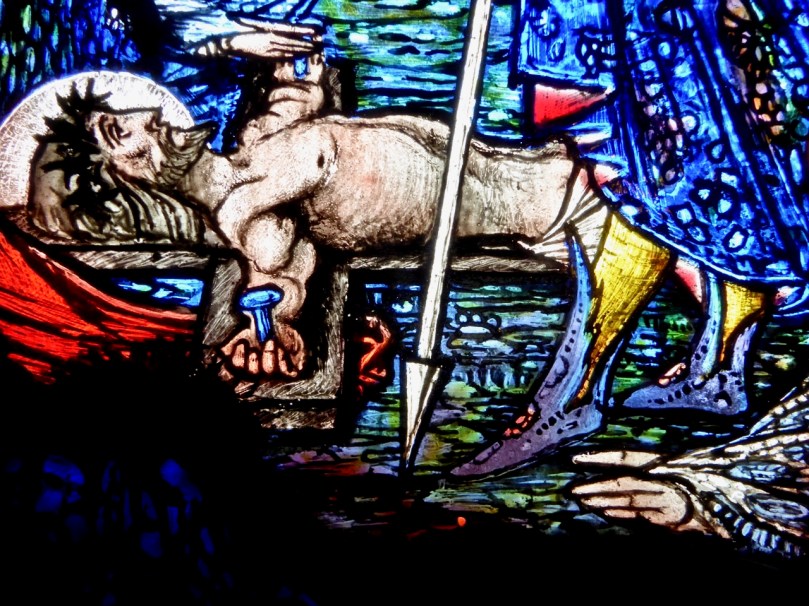
In the crucifixion station the soldier who stands gazing down is wearing a pair of elaborate shoes and yellow stockings that strikes an odd note in what is otherwise a sombre scene. Soldiers in each station wear helmets that come to points over the bridge of the nose or that are decorated with feathers and tufts. Mary Magdalen is dressed in colourful garments and hair adornments that could be suitable for a princess going to a ball, no doubt an allusion to her background.
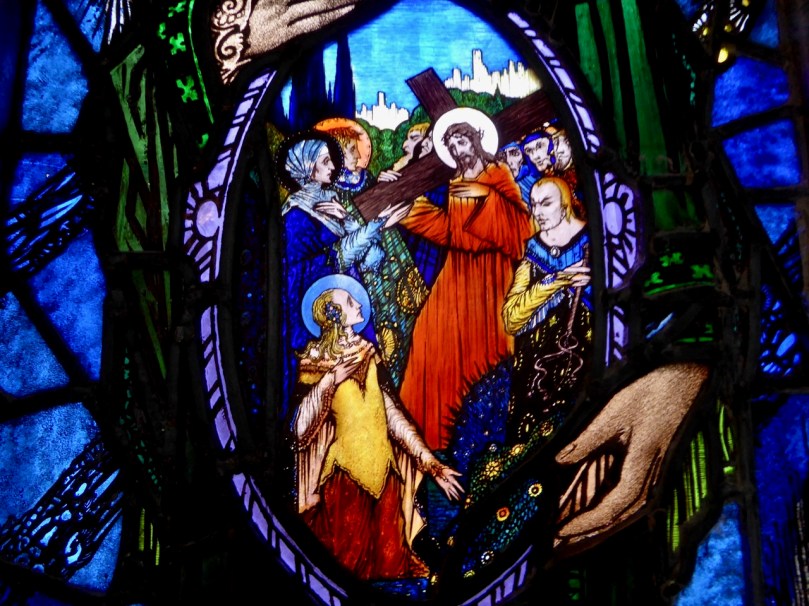
‘Jesus meets his Afflicted Mother’: Mary Magdalen’s colourful dress provides a contrast to Mary’s modest blue

On the other hand, Mary and John, who appear in many of the stations, are shown as gentle and sorrowful. Mary is dressed in her traditional blue: in the final station (below) it is she, pictured as the Queen of Heaven, who hold the mandorla showing Jesus being laid in the tomb (the lead picture in this post).
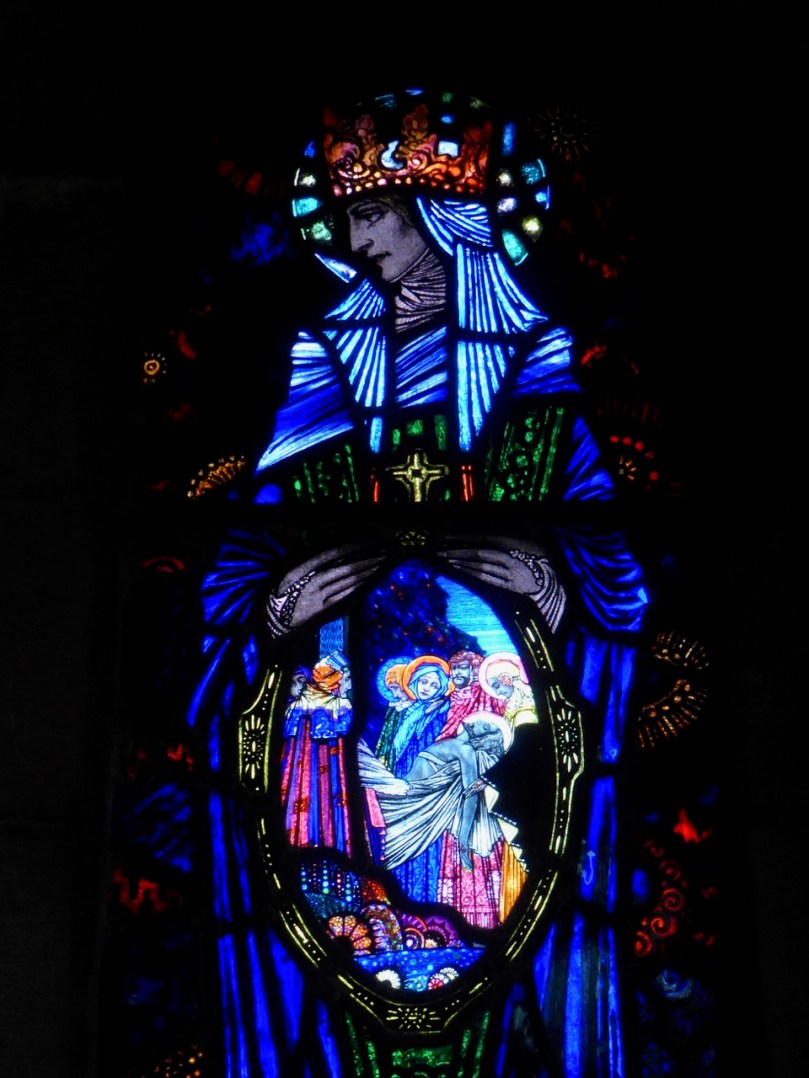
It is tempting to see in John, with large sad eyes and cropped hair, an image of Harry himself, who must have known by this point that his illness was serious. Harry poignantly dresses John in green, the colour of bountiful life and the triumph of hope over death.
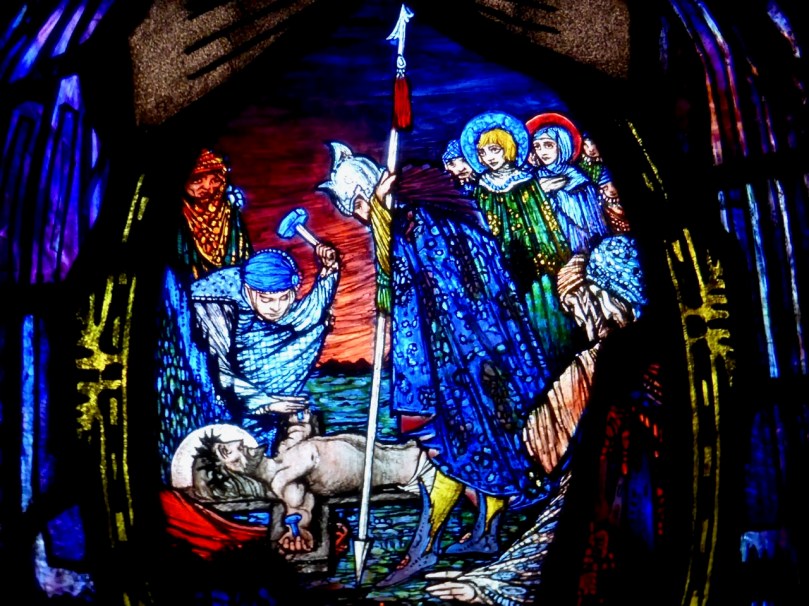
Mary and John witness the crucifixion

My sincerest thanks to Maureen Boyle for facilitating my visit to Lough Derg, and to Sharon for looking after us on the Island and sharing so much information.

‘Jesus is Laid in the Tomb’

* In 1990 the windows were exhibited in Dublin. They had deteriorated over time, and were completely overhauled and restored by the Abbey Stained Glass Studio. Before they were returned to Lough Derg they were put on display in the Royal Hospital, Kilmainham for two months. I have the program from which I took the Gordon Bowe quote, thanks to my late and dear friend Vera who was a huge Clarke fan and attended the exhibition and whose notes I now have. However, I have just discovered that the program is also available online.

The Fortunes of the Hare

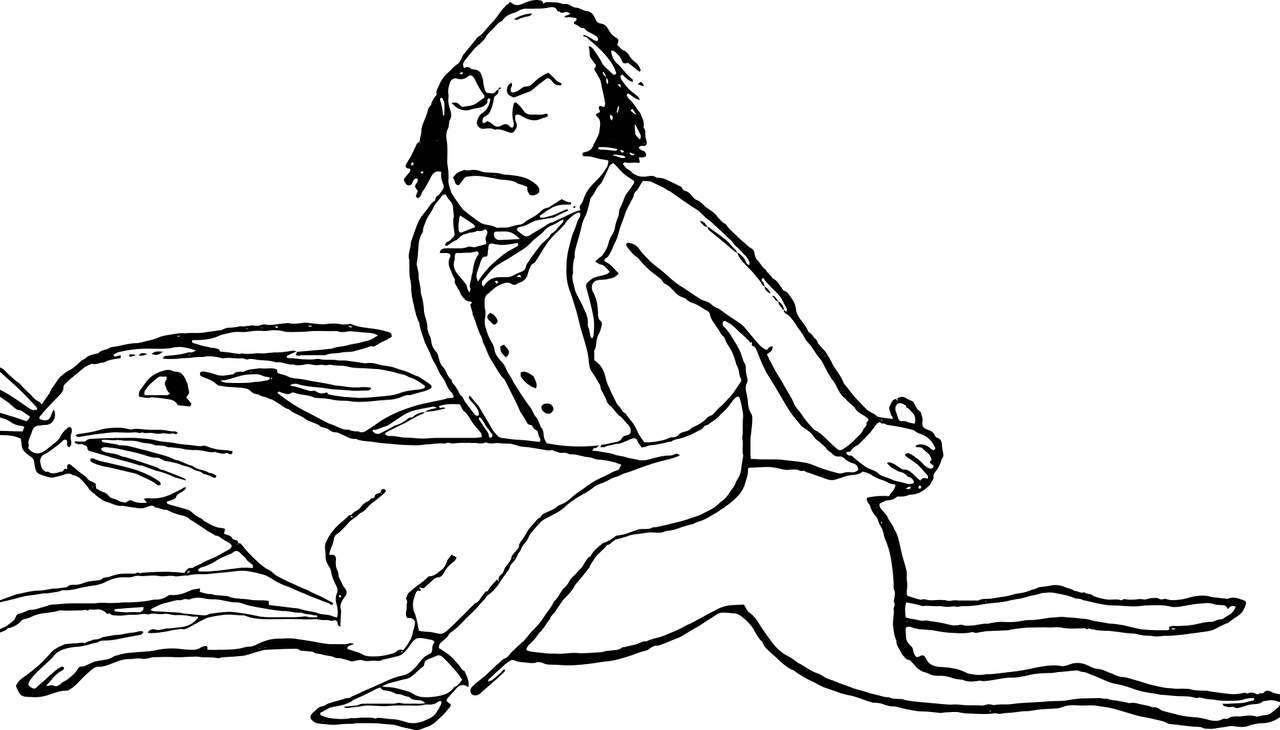
There was an old man whose despair
Induced him to purchase a hare:
Whereon one fine day he rode wholly away,
Which partly assuaged his despair.

(Edward Lear 1872)

We have been writing this Journal pretty regularly for five years now: to date we have published 460 posts – roughly half by Finola and half by me. It’s December, and at this time of the year we review what we have written and it’s always interesting to see the topics have been most popular amongst our readers. We’ll be exploring all that as we lead up to Christmas, but today I have been reviewing our post titles over the years to see what has appealed to me personally during our lives online.

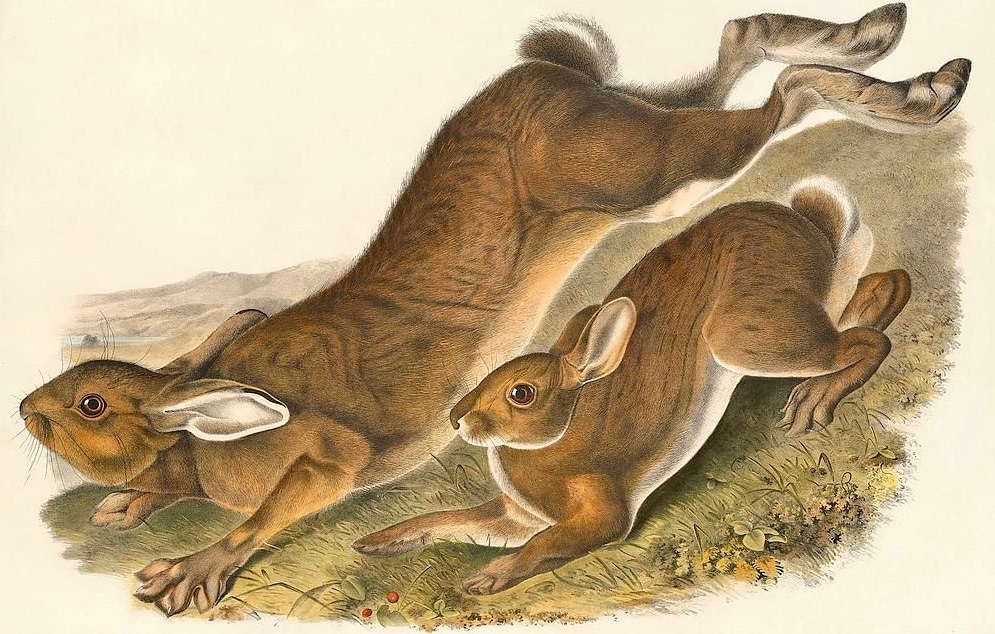
John James Audubon – Northern Hare, 1843

I have a long held passion for the hare – a creature which has inhabited the world unchanged for millions of years: we know this from fossil finds. We can therefore safely conclude that this beautiful animal is perfectly adapted to its natural environment, and hasn’t needed to evolve in any way.

In July 2015 – about halfway through our blogging career – I penned an article, Hares in Abundance, inspired by an exhibition held at the Heron Gallery in Ahakista. I was delighted to see so many images of hares by a number of artists: there were drawings, paintings and prints; ceramic sculptures and ceramic ware; jewellery, felt-work and even cushion covers. I would happily have kitted out the whole of our house with work from this exhibition, but long ago Finola declared we had ‘enough’ hares around the place, so I have to keep myself under control (although, it has to be said, hare imagery here at Nead an Iolair does seem to increase year by year).

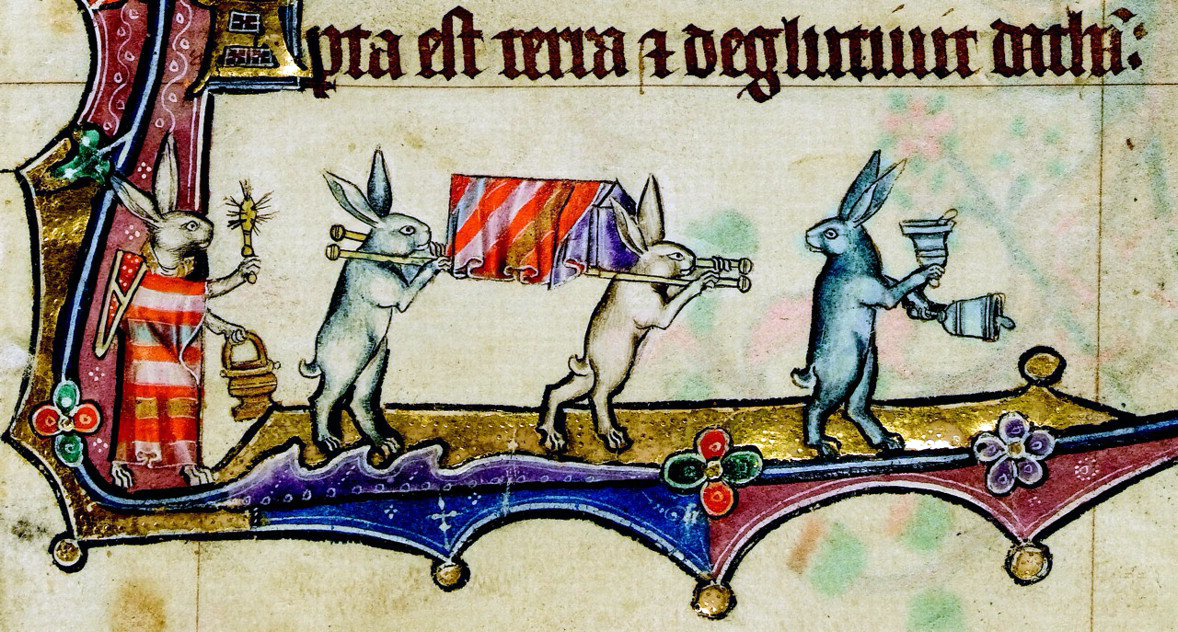
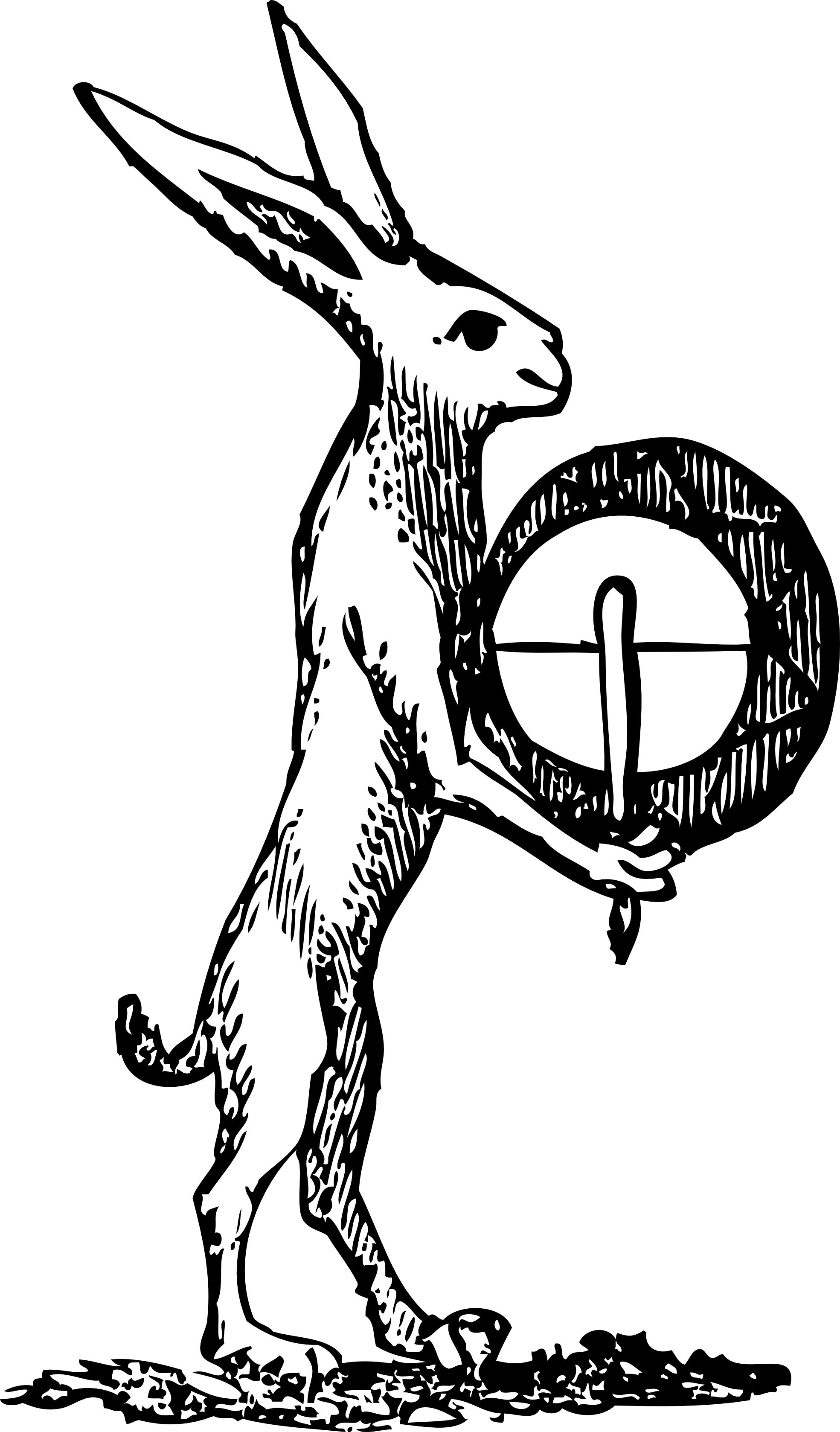
Illumination from the 14th century Macclesfield Psalter, now in the Fitzwilliam Museum, Cambridge

As I mention in that post from 2015, I have kept a ‘hare calendar’ during our time in West Cork, and any hare sightings are recorded. There is definitely a downward trend in the numbers I have spotted. In 2017, for example, I have recorded only one and a half hares (the half was the backside of an animal disappearing into a hedge, which I felt sure was a hare), whereas in past years I have recorded five or six. Back in the 1990s, when I stayed regularly with my friends Danny and Gill in Ballybane West –  just over the hills from here, I saw relatively large numbers of them. Something is surely amiss – and I don’t think it’s my eyesight.

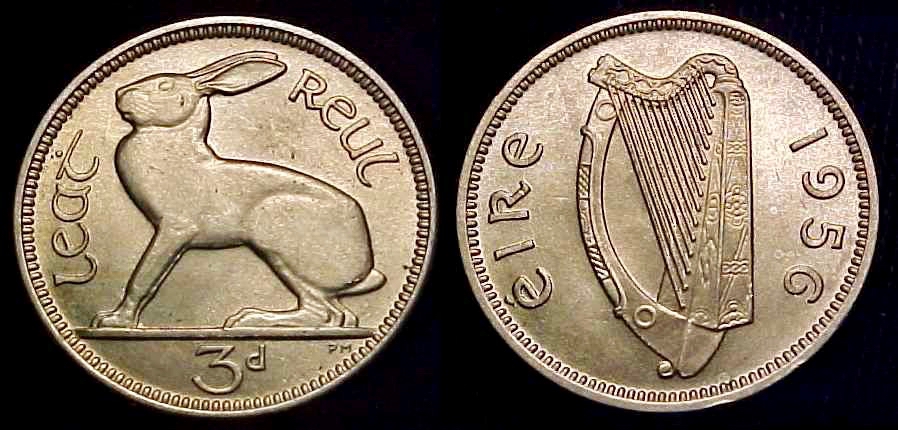
The Irish Hare was portrayed on the Irish Three Pence coin: the design was by the artist Percy Metcalfe, and the coin was continuously produced between 1928 and 1969

On a recent visit to Finola’s cousin in Mayo we were introduced to (and immediately purchased) a new book: The Way of the Hare by Marianne Taylor. If you are in any way inclined to hare adulation, I thoroughly recommend this book as being the most readable and comprehensive study of all aspects of the animal’s place in the world: history, biology and folklore. To my delight, the author even suggests that, in terms of creature relationships:

…we humans are more closely related to hares than we are to cats, bats, dogs, elephants, whales, sloths and most other mammals on earth…

Left – the new book by Marianne Taylor and right – one of the author’s wonderful photographs, showing the ‘mad’ springtime behaviour of two brown hares in the UK

Perhaps unsurprisingly, one of my very first posts on Roaringwater Journal was this one – Two Hares. Written back in November, 2012, it tells of an encounter with two Irish Hares in Ballybane West. Irish Hares – Lepus timidus hibernicus – are peculiar to this country but closely related to Mountain Hares that are found in Scotland, Scandinavia and Northern Europe; they are said to be Ireland’s longest established indigenous species of mammal. They are probably outnumbered today in Ireland by the Brown Hare – Lepus europaeus – which is not indigenous: Brown Hares were brought to Britain by the Romans and then exported to Ireland to be hunted by the owners of large estates.

This new book has crept onto our shelves (it was a present from Finola) Brown Hares in the Derbyshire Dales, published by Vertebrate Publishing: it is beautifully illustrated with photographs by the author, Christine Gregory

The Irish Hare is a protected species under EU Directive 92/43 Annex V (see page 104), but, curiously it can be hunted and coursed at certain times of the year. On June 23 2016 (on the same day as the UK Brexit referendum) a private member’s bill was brought before Dáil Éireann by Maureen O’Sullivan to ban hare coursing in order to protect this ‘protected’ species. It was heavily defeated – most TDs voted in favour of hare coursing, including your own local TDs (bear that in mind when an election comes around again). Out of 164 TDs attending the debate only 20 voted in favour of a ban. The general argument by the coursing supporters was that coursing is “a regulated sustainable rural industry”. So economics apparently outweigh animal welfare. The whole debate is available online here.

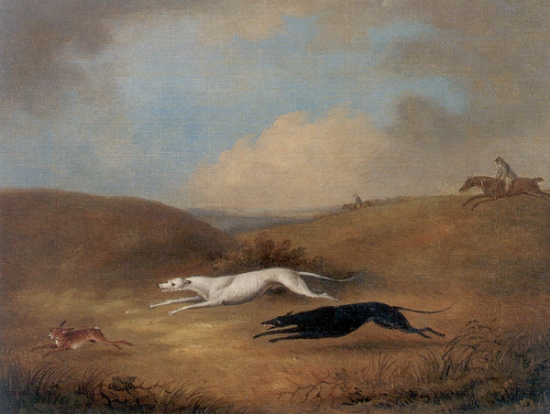
Dean Wolstenholme – Greyhounds coursing a hare – c1800

In February 2013 I wrote another post which mentioned hares in Ireland: Hare Heaven.  This was more optimistic in tone, and was an opportunity to describe the wonderful Sherkin Island Marine Station, run by the indefatigable Matt Murphy. Doubtless hares will feature in future Roaringwater Journal posts and – perhaps – in future Dáil debates. I will hope for a better outcome next time around.