Rules of the Irish Road

Directional signs in Irish and English, cars parked every which way, street names in small print on the wall. Welcome to driving in Ireland!

Directional signs in Irish and English, not enough room for two-way traffic, cars parked every which way, street names in small print on the wall. Welcome to driving in Ireland!

In my Driven to Distraction post I alluded to having to get an Irish driver’s licence. I can drive legally for a year on my Canadian licence, but if I intend to stay longer, and if I want to get insurance at reasonable rates, I have to get an Irish one.
Do not overtake

No Overtaking. RR (Rules of the Road) p79

I have driven for almost 40 years without incident, in all kinds of conditions (Northern Canadian winters!) and vehicles, standard and automatic. I have rented a car every summer in Ireland year after year. I was prepared for some kind of process whereby I would be asked to demonstrate my competence and my knowledge of the Irish road rules – a process which I assumed would also acknowledge my experience and skills. The first part of that last sentence was a realistic assessment; the second part was a hopeless dream. It turns out that I must start from scratch, as if I was 17, as if I had never driven before.
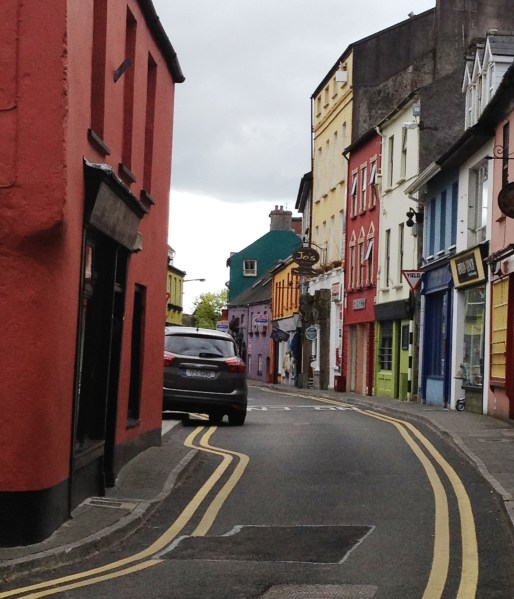
Double yellow lines: no parking at any time. RR p115

Double yellow lines: no parking at any time. RR p115

Perhaps, you surmise, this is because we drive on the right in Canada and in Ireland we drive on the left. But anybody with a European driving licence can simply swap it for an Irish one, no matter what side of the road they drive on. This also applies to those in possession of licences from Taiwan, New Zealand, Japan and South Korea. Within Europe, all countries have agreed to the principle of mutual recognition for all sorts of qualifications and Ireland happens to have concluded agreements with several other countries for mutual recognition of driving licences. But with the US and Canada, it has not yet happened. There are “talks” apparently, but no real progress. This also means that Irish drivers who emigrate to Canada must go through a staged testing process.

You MUST not park on a footpath. RR p116

You MUST not park on a footpath. RR p116


Right – fair enough – I must prove my knowledge of the road and my driving competence. OK, theory test now passed, when can I take the road test? Wait, not so fast! First I must take, and pay for, a series of 12 driving lessons from an approved instructor. The lessons must be documented and they should occur two weeks apart: that will take six months. In the meantime, I must have L plates on the car and I cannot drive alone or on Motorways. Did you get that? I CANNOT DRIVE ALONE. I have, in effect, lost my independence. I must rely on Robert to drive me everywhere (we live three miles from the nearest village) or to sit beside me while I drive.

Drive at a safe speed.  RR p88

Drive at a safe speed. RR p88

In a future post I will describe the lessons – a whole experience in themselves! Meanwhile, I must admit that studying the Irish Rules of the Road has been a salutary experience. I leave you with some photographs to illustrate the Irish approach to road signage and to the observation of the Rules.
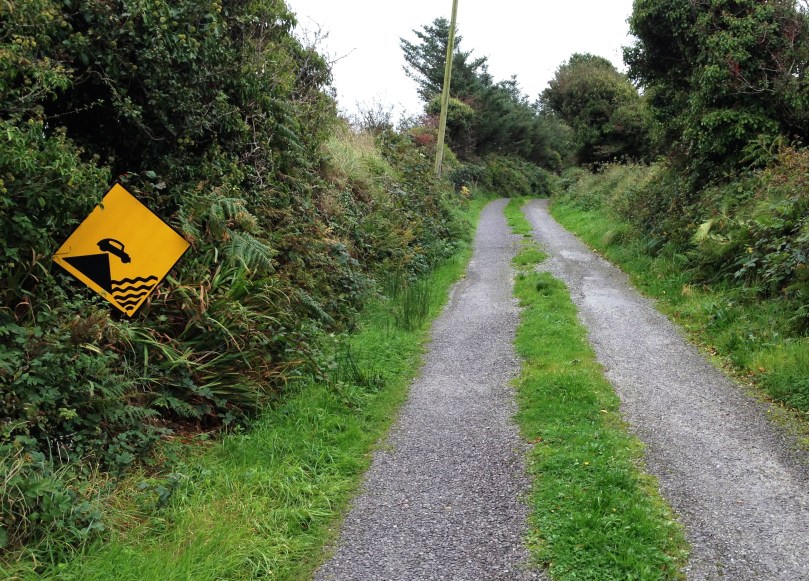
Unprotected quay ahead

Unprotected quay ahead. RR p183
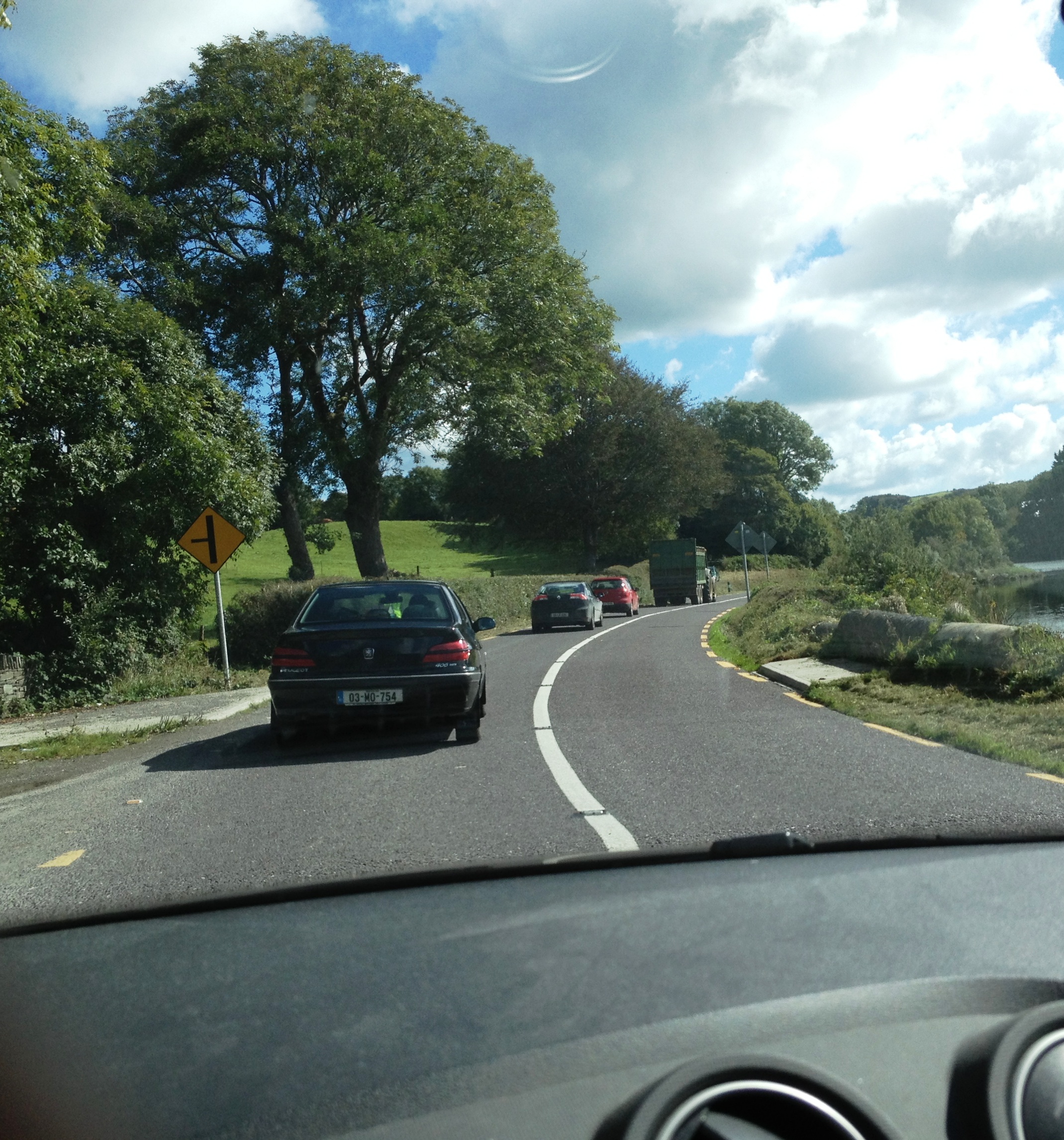
West Cork Speak: Lessons 1 and 2

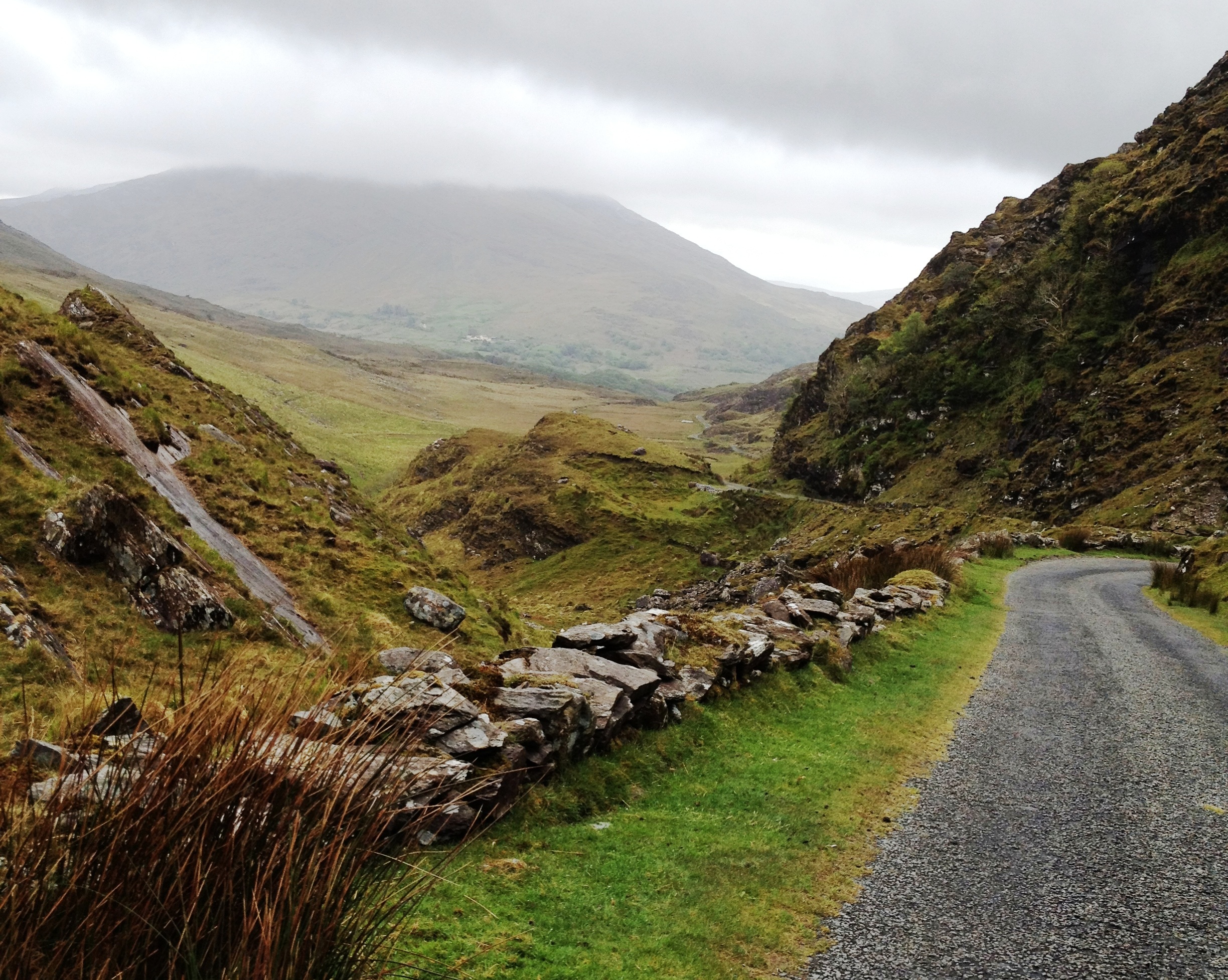
The scenic route

The scenic route

Stories abound of hapless tourists convinced that the locals were speaking to them in Irish (which foreigners typically call Gaelic) and finding afterwards that in fact it was English. (For an amusing twist on this idea see the excellent short film: Yu Ming is Ainm Dom.)

The sing-song burr of English as she is spoke in West Cork can be impenetrable to non-natives. For those planning a visit, therefore, I thought I would do the world a favour and provide a primer on sounding like a native.

Lesson 1: Grand and Like

The first thing to know is that you put like at the end of every sentence, and the word grand somewhere within it. I’ll give you an example. You have hired a car and chosen a route marked on the map as scenic. You find yourself inching along a potholed track that clings perilously to a mountain side, with yawning cliffs beneath and a mountain with a cross on it above. You are sure you have gone astray and are on a long abandoned road to nowhere. You are about to turn back (but how? The road is barely wide enough for your car) when around a bend comes a tractor, bucketing and swaying, driven by a genial man in a cloth cap. Through some miraculous process that you can’t afterwards describe, he manages to find enough ground to pull over to let you pass. You roll down your window and ask him if the road is passable ahead. He looks puzzled, then realizes you are a tourist and assures you “’Tis a grand road, like.”

'Tis a grand road

‘Tis a grand road

You are now in possession of a word, Grand, that is appropriate for all possible occasions and can be used in the most prodigal manner. Indeed, you can’t go wrong with it.

keep-calm-it-ll-be-grandHow are you? I’m grand. Better – I’m grand, thank God.

How is your husband? Himself? The back was playing up, but sure he’s grand now, thank God.

Oh, sorry – I can see I am in your way. Ah no, you’re grand.

I’ve just broken both arms and the bank is repossessing my house. Ah sure, it’ll be grand, like.

Lesson 2: Now and So

Together with Grand and Like, Now and So will get you through a surprising number of situations. Although they can be used interchangeably on occasion, they also have distinctive nuances. Now is the one that every waitress will say to you as she appears to take your order and as she delivers your food. It announces that she is here to look after things and you can relax. Its versatility doesn’t rest here – if delivered in a forthright or perky manner you can use it to indicate that you are ready for whatever the day holds as you head out the door, that you are settling down to a good conversation about your neighbours, that the kettle has just boiled, or that it’s your partners turn to hit the ball. If you say it with a slow or sad inflection – ah, now – you can use it to deflect an insult or express sympathy with one who suffers.

So contains a hint of expectancy – So, breakfast is served at 8; So, is it from Canada you are?; So, that will be twelve euros.

But the real trick is to use them together properly – Now so, or so now.

So now is a good one as you settle into a corner of the sofa for a chat: So now, Maureen, I hear Donal up the road was seen in Dunmanway last week with that American woman.

Now so can be used to wind up the conversation: Now so, I’d better be going or himself will be roaring for his dinner, like.

Now so, you’re all set for the first day of your holiday in West Cork. Yes, they drive on the left but just take your time, like, and it’ll be grand. And once you get into the rhythm of life here you’ll be ready for lesson 3 – how to manipulate every sentence into the conditional tense. Perhaps we will also touch on one of the truest Cork talents: how to insert multiple vowel sounds into the word no.

I Can't Do It

I Can’t Do It

Meanwhile, if you want to get a true flavour of the accent, try viewing some of the Sminky Shorts by the talented  Andrew James on YouTube. Be warned – the language is atrocious in some of them – back away NOW if this offends you. Otherwise, start with the Chicken Audition or the Nervous Horse.

Driven to Distraction

2013-09-24 10.15.34

Hello, Ladies!

Robert is switching his English car to be registered in Ireland and in order to be properly insured I should get an Irish driving licence. In Vancouver all of this (registering and insuring a car, getting a driver’s licence) is handled by the Insurance Corporation of BC (ICBC) – one stop shopping and very efficient. I was unprepared for the levels of bureaucracy involved in accomplishing the same things in Ireland. For anyone thinking of moving here, gird your loins for an obstacle course.

Breathe in!

Breathe in!

Registering Robert’s car is almost done, and here are the steps we have had to follow:

  1. To the VRT (Vehicle Registration and Taxing) office in Skibbereen. We find we are ‘importing’ the car so must first go to the Customs Office in Bantry (only open Friday mornings, make an appointment) with a long list of documents.
  2. To Bantry with all documentation. Customs officer copied everything and said to wait until we got relevant certificate in the mail, then make an appointment with the VRT to register the car.
  3. To Insurance agent in Skibbereen to apply for Irish insurance. This is where we learned that Robert’s English licence is fine, but I must get an Irish one. Robert must procure proof of no claims status from English insurer.
  4. Telephone calls to England requesting no claims document. Will be emailed to us straight away.
  5. Customs certificate arrives. Appointment made with VRT office. List of required documents exactly the same as we have already supplied to Customs even though it’s the same government department (Revenue). Back to VRT and receive car registration number. Registration certificate will arrive in mail.
  6. Back to Insurance office. No claims proof has not arrived, but charming Insurance agent manages to weasel enough information out of English insurance agent on the phone. Now insured in Ireland!
  7. Off to Garage that prints ‘Licence Plates While You Wait.’ They also sell us the double-sided tape with which the plates are attached and instruct us how to do it. Main direction for pulling off the old ones, “Don’t be frightened.”
  8. On to the internet, armed with registration number, to ‘Motor Tax Online’ to pay road tax. Although the tax is collected by the ‘local authority’ or county council, the payment system is operated by the Department of Transport, Tourism and Sport and it appears the tax can only be paid online or by travelling up to Cork (hour and a half). Tax discs to be attached to windshield (without which it is illegal to drive a car) will arrive in the mail.
  9. Once car registration certificate (see step 5 above) arrives in the mail, Robert can make appointment to have a mandatory NCT (National Car Test) to check the car for roadworthiness. This will take us back to the VRT office.

Whew! Got all that? That’s 5 different locations and 8 sessions: Customs, VRT X3, Insurance X2, License Place Printer, Tax Authority. Add to that the assembling of lots of paperwork (examples: original invoice for four year old car, proof of identity and residence, receipt for passage on the car ferry) and multiple phone calls to England…well, I think Robert deserves a medal for negotiating all that!

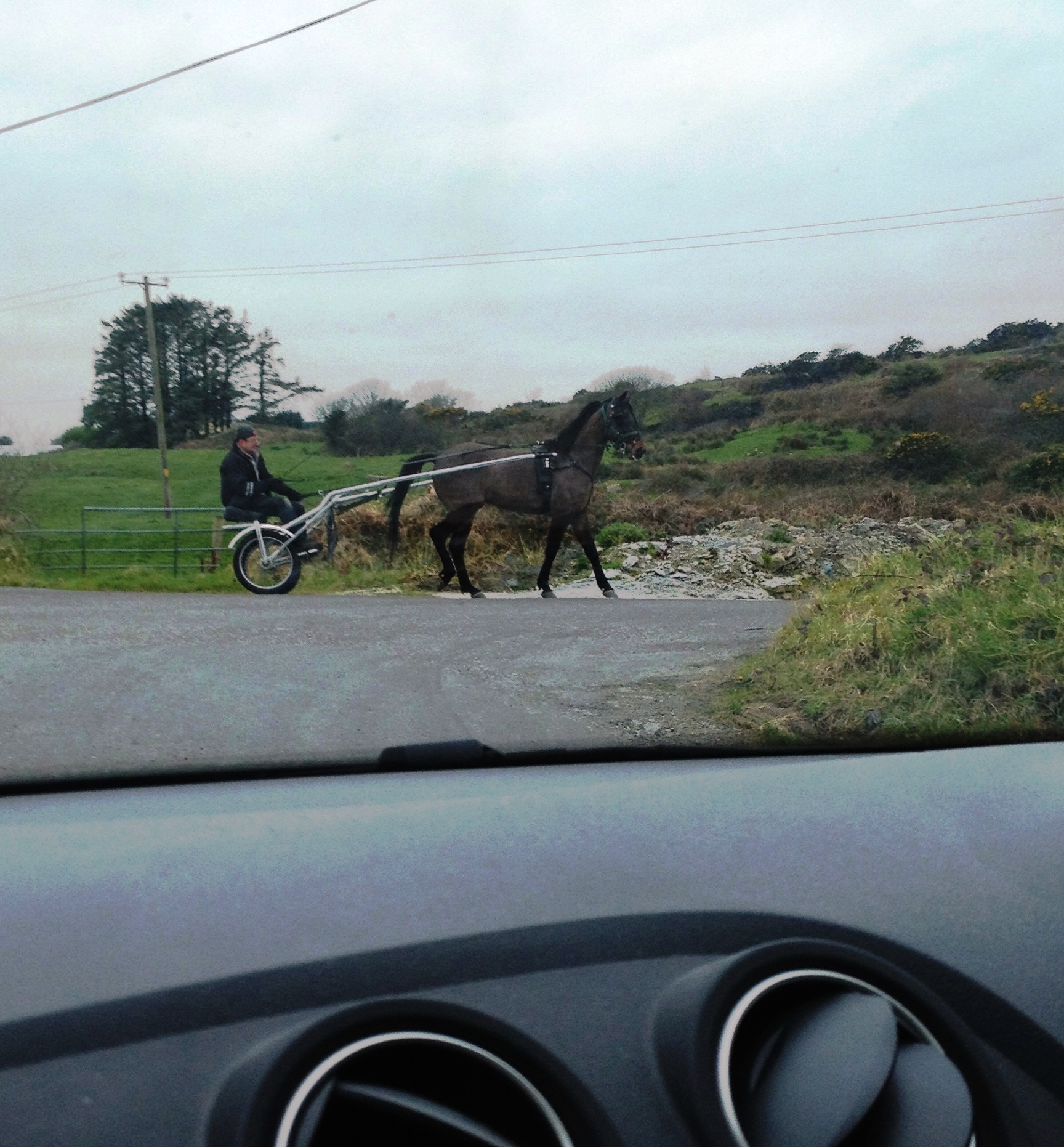
The speed limit? Tractor speed.

The speed limit? Tractor speed

Interestingly, half of the processes described here are administered within government and involve two different departments as well as county councils. The other half are privatised – insurance, license plates and the NCT are all managed outside government, thereby creating a smaller bureaucracy within government, but a much larger one from a consumer viewpoint with multiple steps, documentation requirements and agencies. The saving grace for the hapless car owner is the cheerful, helpful and friendly Irish people working in each agency. With their sympathetic smiles, their humour and their efficiency in the teeth of labyrinthine processes, they will get you through the whole painful business.

"Tis a grand road.

‘Tis a grand road

My turn next. Must get that Irish driving licence. I have been driving in Canada for 38 years, problem-free, so this can’t be a big deal, right? After all, anyone with a European licence, even from countries that drive on the right (most of them) can just trade in their licence for an Irish one.

Whoa Nelly!

Whoa Nelly!

Can you predict, dear blog reader, given the tortuous route to registering a car, how straightforward this is going to be for me? A future post will reveal all. Meanwhile, I leave you with some pictures of driving conditions in West Cork.