Storm Agnes: Agnes Clerke of Skibbereen and Nineteenth Century Astronomy

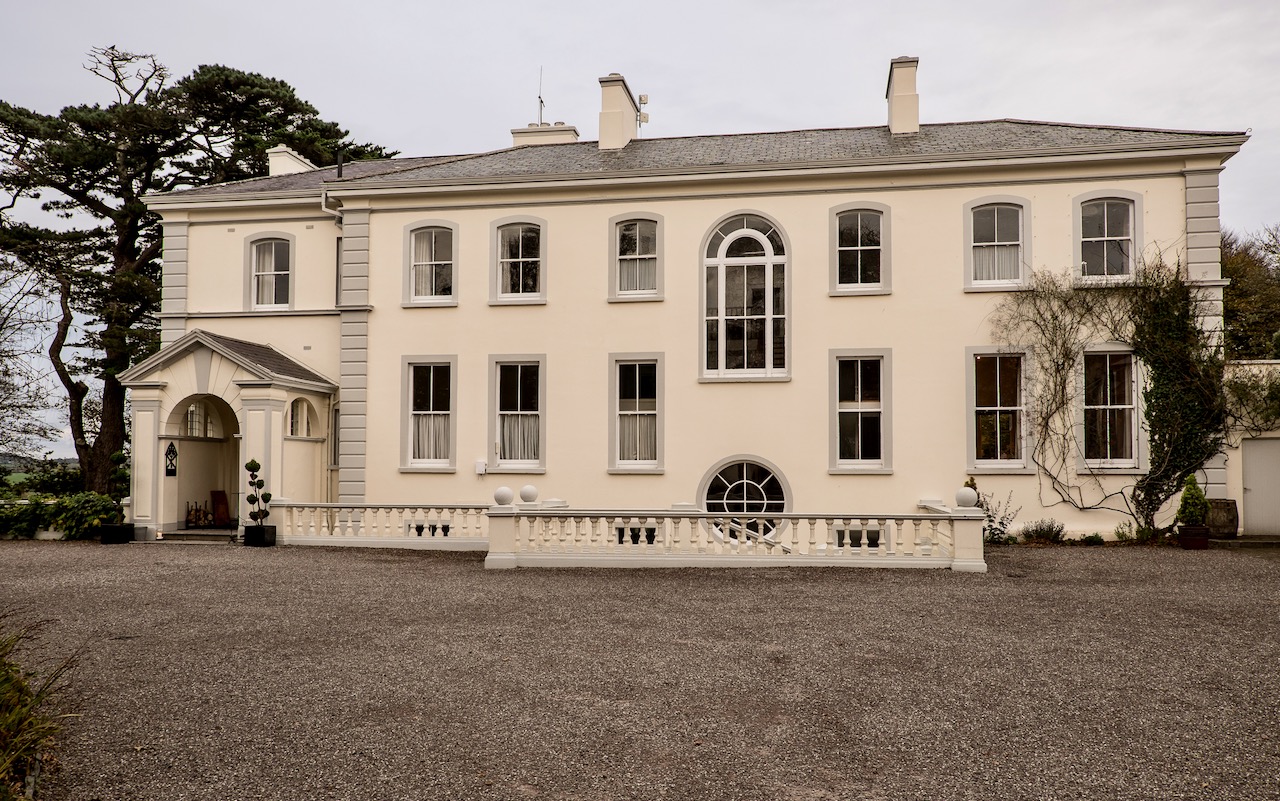
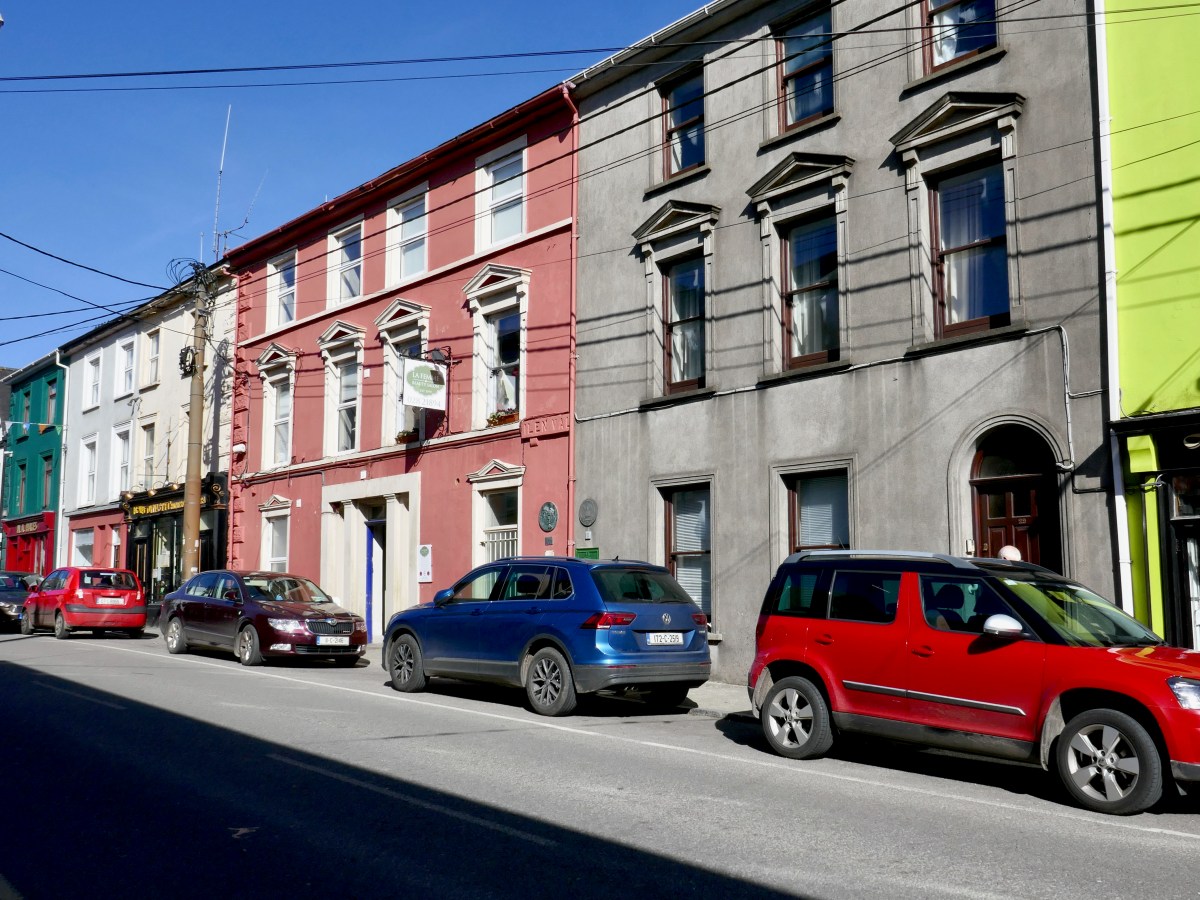
This week, I was thrilled to hear Met Éireann announcing that the first storm of this year will be called Storm Agnes, after Agnes Mary Clerke who grew up in Skibbereen (in the pink house, below) and went on to become the foremost science writer of her day and a distinguished astronomer. 
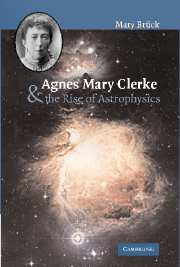
I’ve been writing and giving talks about Agnes since 2015, and it’s wonderful that she is becoming more of a household name now. Storm Agnes is especially fitting because she certainly shook up the Astrophysics establishment in her day, as a woman writing about what had traditionally been a man’s domain. The post that follows is a substantial re-writing of my 2015 post From Skibbereen to the Moon: Agnes Mary Clerke. I know a lot more about Agnes now than I did then. Mostly, that’s down to the work of Mary Bruck, a fellow astronomer, yet another Irish woman (from Meath) and author of Agnes Mary Clerke and the Rise of Astrophysics. 

West Cork is where Agnes grew up, with her parents, sister and brother. Agnes, Ellen and Aubrey were all brilliant, scholarly and published writers, each in their own fields. Their father, John William Clerke came from a long-established ‘Liberal Protestant’ family in Skibbereen – that’s John William’s own father, St John Clerke’s, grave in Skibbereen, above. At the time the children were young he was the manager of the Provincial Bank and the family lived above it.
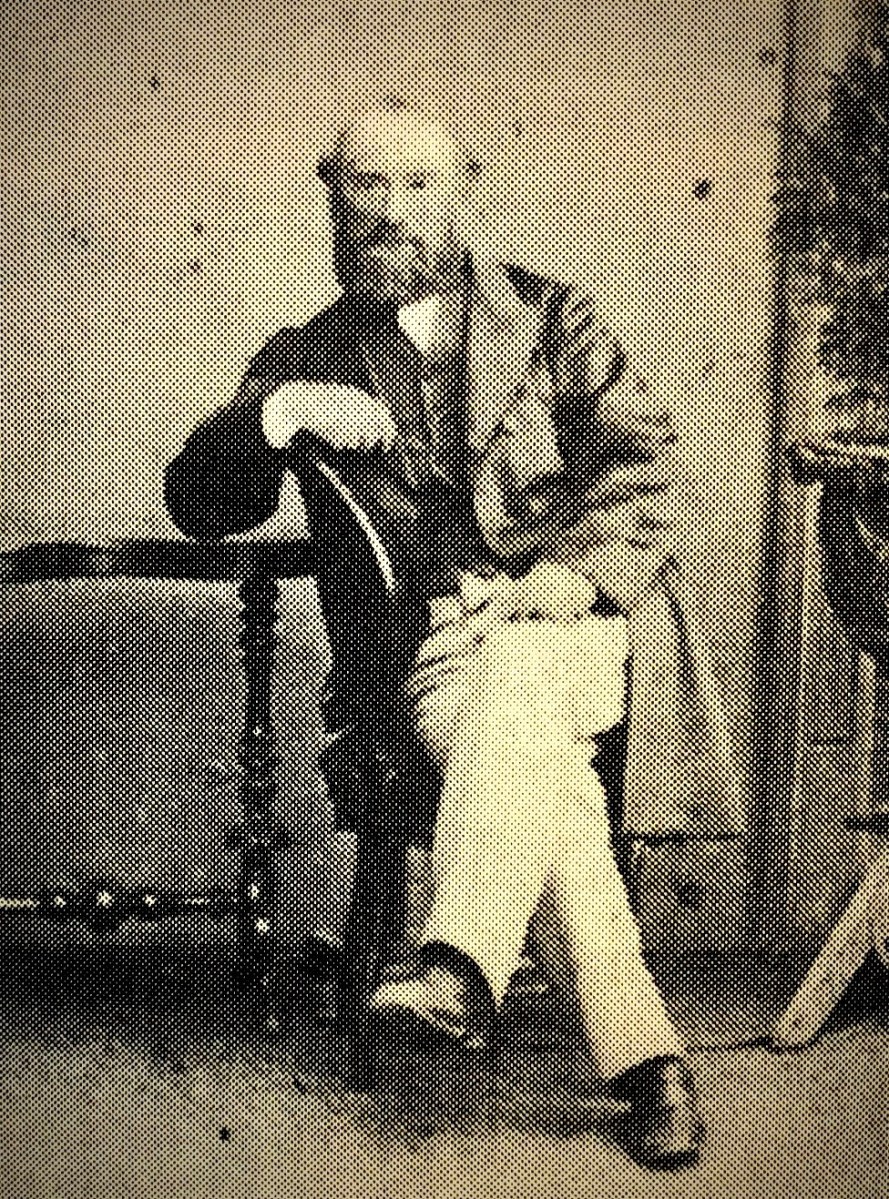
Agnes was born in 1842 and her young life was dominated by the awful tragedy of the Great Famine, which started in 1845 and blighted life in Skibbereen up to 1850 and beyond. John William (above) headed up relief efforts in Skibbereen during this awful time and was felled by Famine Fever himself, remaining critically ill for months.
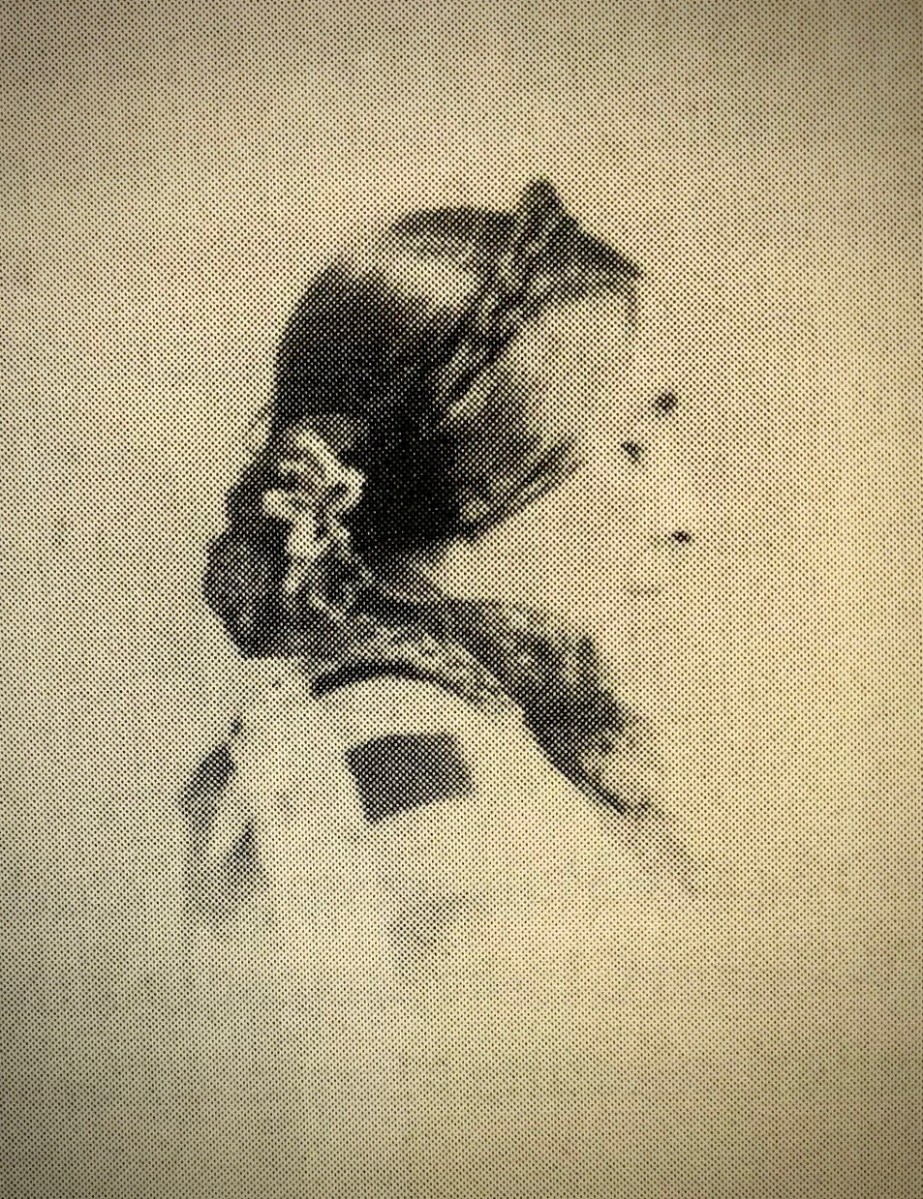
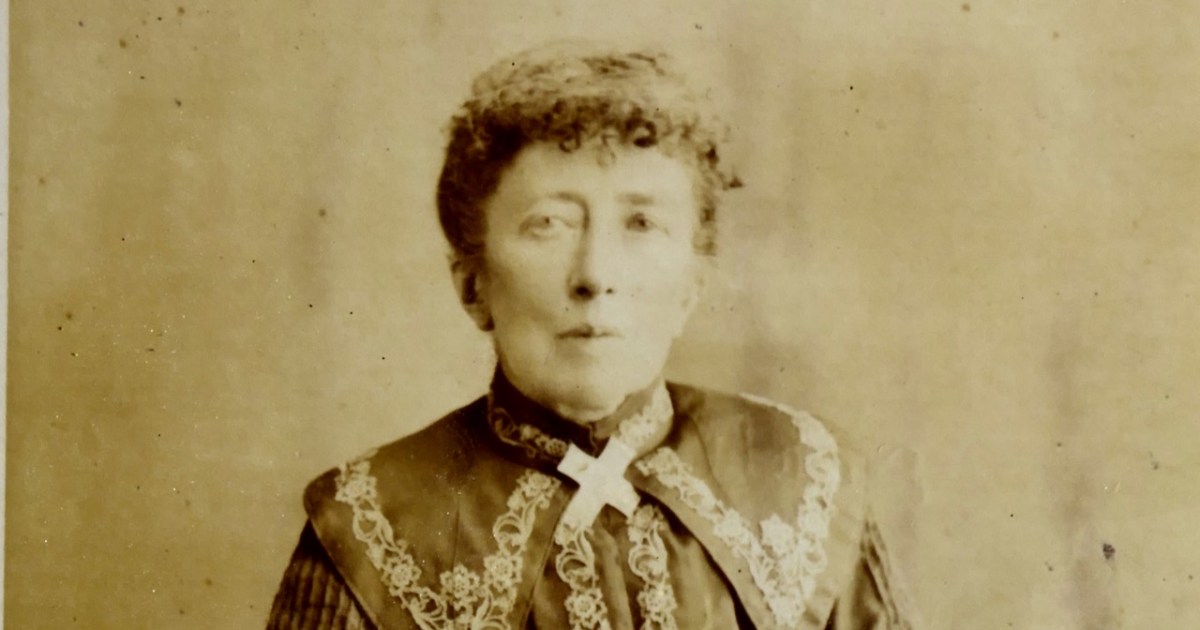
John had married Catherine Mary Deasy (above, in older age), the sister of his best friend at Trinity, Rickard Deasy, from a prosperous Catholic family in Clonakilty. Catherine had been well educated in the Cork Ursuline convent and was high-minded and musical. She tutored the children to a high proficiency in music, Latin and Greek. Catherine played Irish music on the harp and retained her ability to entertain well into her 80s. 
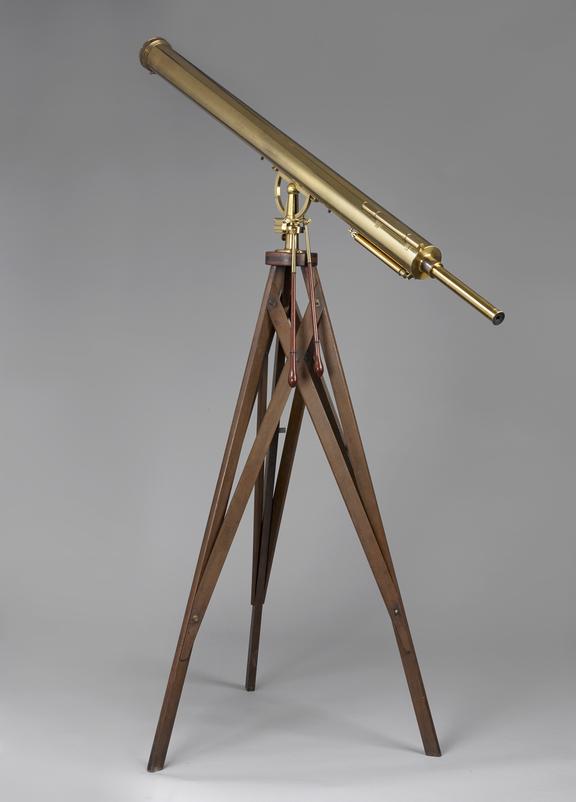
The children grew up in the 1840s and 50s with access to their father’s extensive library, his telescope (like the one above) and his chemistry experiments. The telescope, according to Mary Brück’s biography, was equipped with a chronograph for timing the transits of stars across the meridian. With this arrangement Clerke was able to provide a time service for the town of Skibbereen, which was as yet unconnected to the outer world by either railway or telegraph.

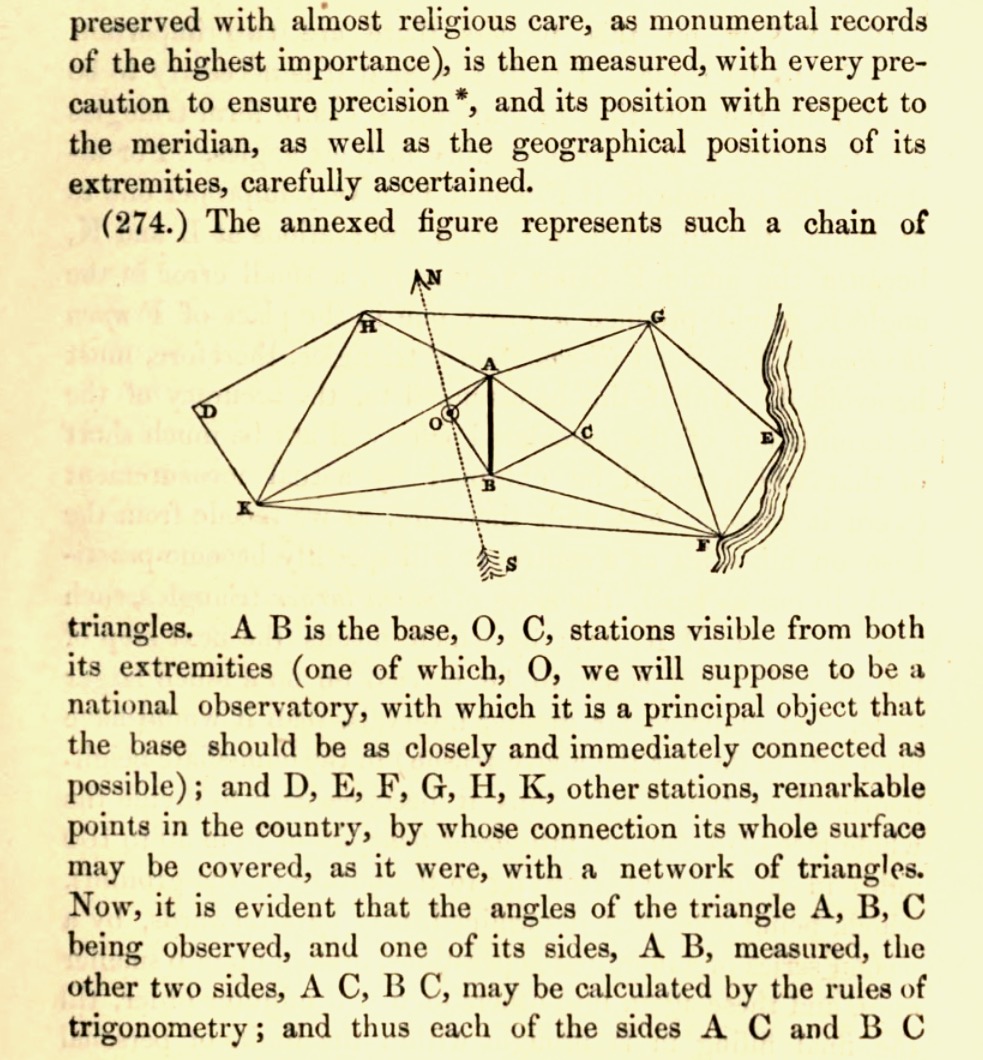
Insatiably curious, they devoured knowledge and by 15 Agnes had already begun to write a history of astronomy – a book that would later count as her magnum opus. By the age of 11, she had mastered John Herschel’s Outlines of Astronomy. (She was later to write the biography of Herschel’s father and aunt – still available for Kindle!). That’s a page from Outlines of Astronomy, below. To repeat – she was 11!
The family moved to Dublin when Agnes was 19 – her father had been appointed to a position by Rickard Deasy who was now Baron of the Exchequer Court. But her health was always delicate and her mother determined to move the two young women to a more salubrious climate. Starting with extended visits and then moving there, the Clerke women spent from 1867 to 1877 in Italy. 
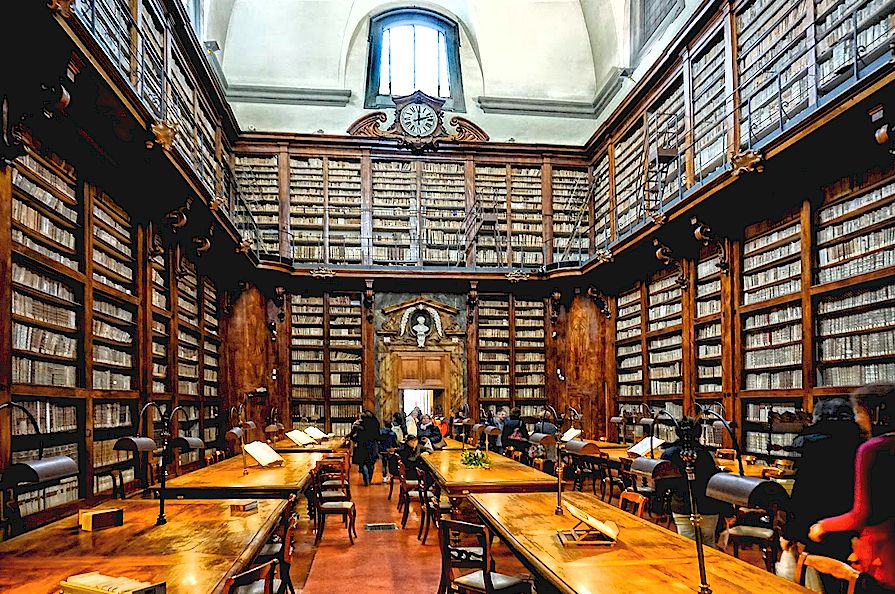
There, Agnes and Ellen, now in their 20s and early 30s, studied extensively in the excellent libraries in Rome and Florence (above), becoming proficient in several languages and going to primary sources to research their interests.

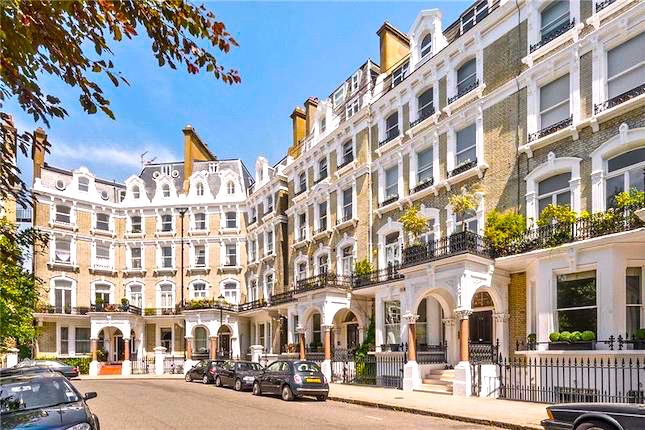
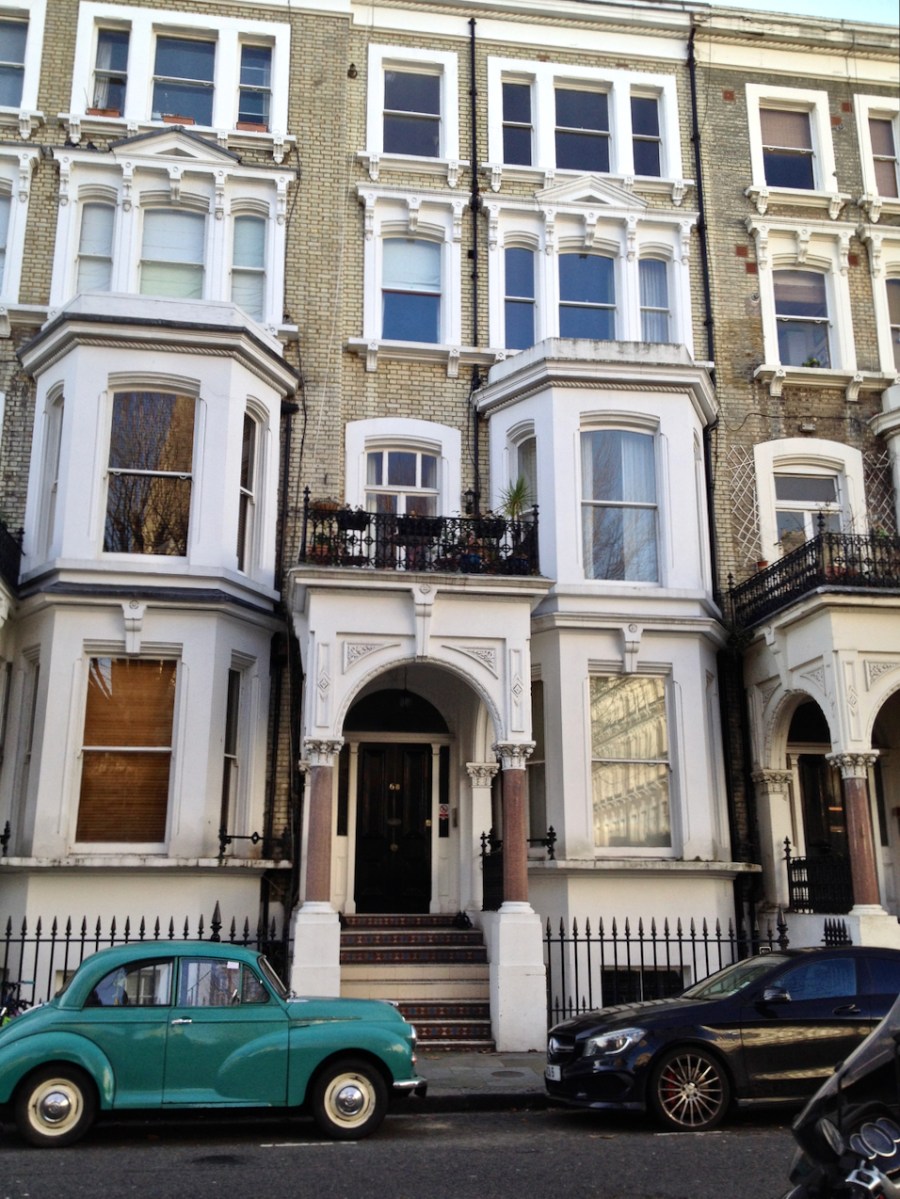
Thereafter, the family settled in London, at 68 Redcliffe Square (below). Devoted to each other, none of the siblings ever married and the family lived together in harmony and supported each other’s endeavours to the end.
Although she started off with a wide range of topics, Agnes over time concentrated on writing about astronomy. Her first published pieces (one about Copernicus, the other about the Mafia!) appeared in the Edinburgh Review in 1873. But her magnum opus, the book which brought her to the attention of the scientific community in England and the United States, was her History of Astronomy during the Nineteenth Century.

With it, she burst upon the scene in December 1885. She had spent four years writing it. It was an instant best seller – both to interested lay people and amateurs but also to serious students of astronomy, as one reviewer put it on account of its accuracy and the really remarkable skill with which the leading points on which our knowledge has been increased are seized upon and set forth. It sold out in two months and went to a second printing and an American edition. It has never been out of print since. It is still used as a text book and on lists of recommended readings. It went into four editions, each one a monumental task to update as findings came thick and fast. Illustrations only began with the second edition.

Now in her early 40s, the depth and scope of Agnes’s scholarship is awe-inspiring. To read through the book (available online through Project Gutenberg) is to see a brilliant mind at work. Her purpose in writing it was:

to embody an attempt to enable the ordinary reader to follow, with intelligent interest, the course of modern astronomical inquiries, and to realize (so far as it can at present be realized) the full effect of the comprehensive change in the whole aspect, purposes, and methods of celestial science introduced by the momentous discovery of spectrum analysis.

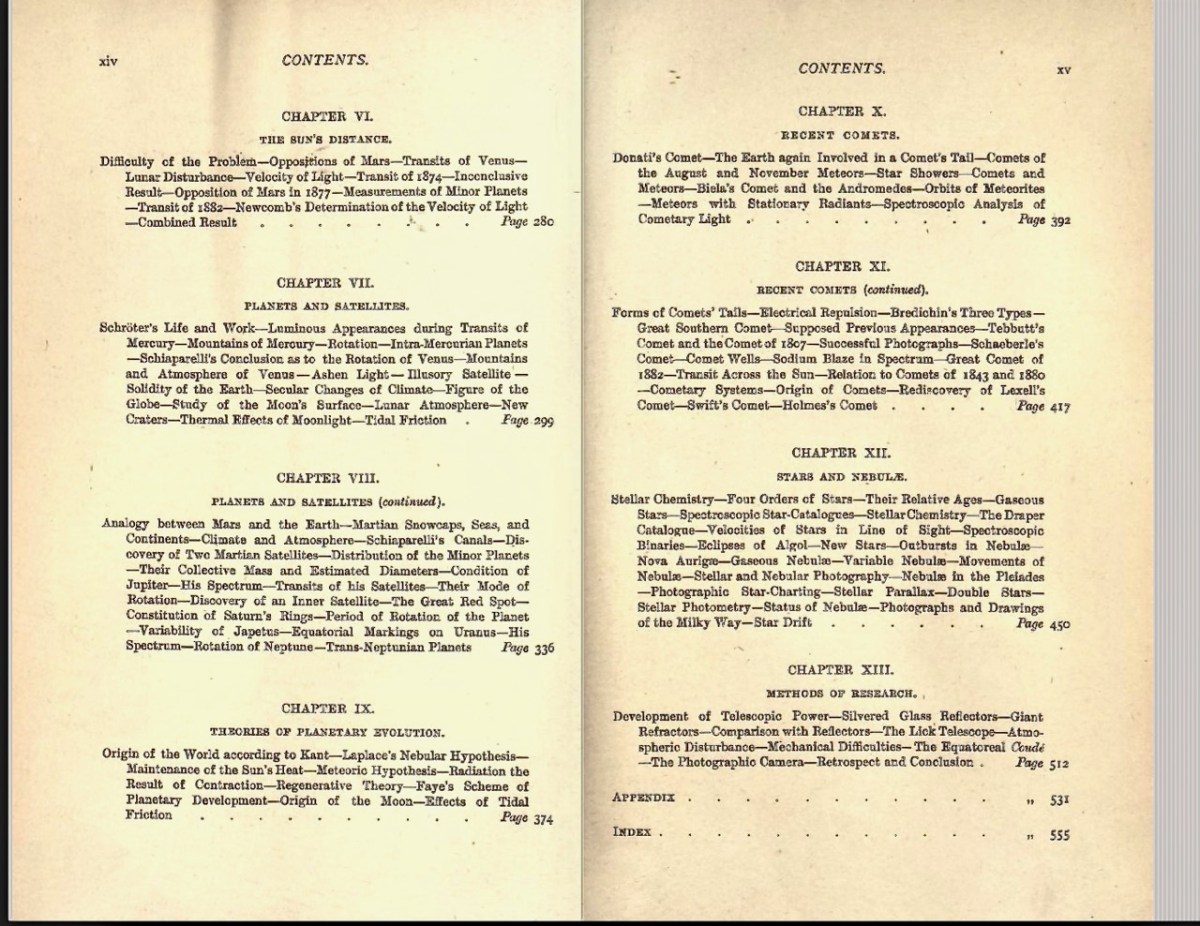
This IS the rocket science of her generation, encompassing chemistry, physics, mathematics, history of scientific thought, cosmology, the most up to date observation and measurement techniques – in short, the disciplines that made up the emerging science of astrophysics. Take a look, for example, at the headings for her Chapter IV: Chemistry of Prominences—Study of their Forms—Two Classes—Photographs and Spectrographs of Prominences—Their Distribution—Structure of the Chromosphere—Spectroscopic Measurement of Radial Movements—Spectroscopic Determination of Solar Rotation—Velocities of Transport in the Sun—Lockyer’s Theory of Dissociation—Solar Constituents—Oxygen Absorption in Solar Spectrum. Looks pretty frightening for a non-scientist, doesn’t it? And yet, this book was one of the best-sellers of the day. 
One of the huge advances in astronomy in the nineteenth century was the development of the spectroscope and Agnes’s book was the first widely-read description of its significance. A spectroscope disperses light over a much wider band than a simple prism. The pattern of colours, as well as black bands in the spectrum, all indicate the presence of certain elements. The composition of stars could now be studied for the first time.

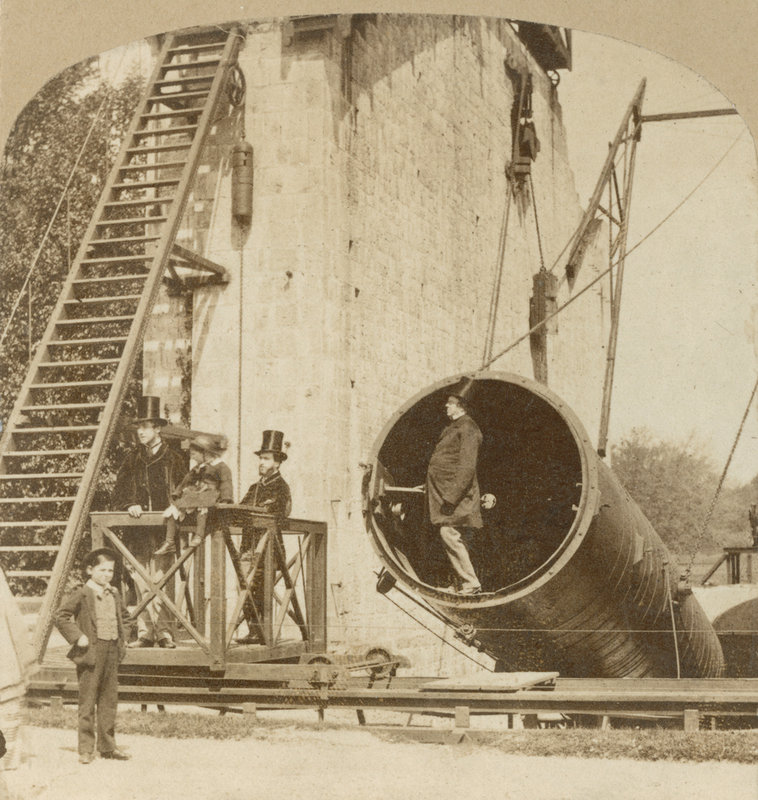
Better optics was another huge advance. Lord Rosse of Birr Castle worked with Grubb (who had been at college with Aubrey) to develop the largest telescope then in existence, capable of analysing nebulae. Agnes has a chapter devoted to Rosse’s achievements. Agnes had a unique ability to absorb and compile knowledge and then to lay it out for the non-specialist. (I got through the first chapter with little difficulty.) She is rightly credited as the founder of what is called today Science Writing. Her books (she wrote many more) and articles sold well and she made a good living from her writing.
Successful as the book was, Agnes was a woman, and a non-practitioner (that is, she didn’t work in an observatory) and many in the predominantly male science establishment of Victorian Britain were sceptical of her knowledge and resentful at her success. One who was not was David Gill who invited her to spend time at his observatory in Cape Town. She went, had a marvellous time, and gained practical experience that enabled her to write with much more confidence on certain subjects afterwards.
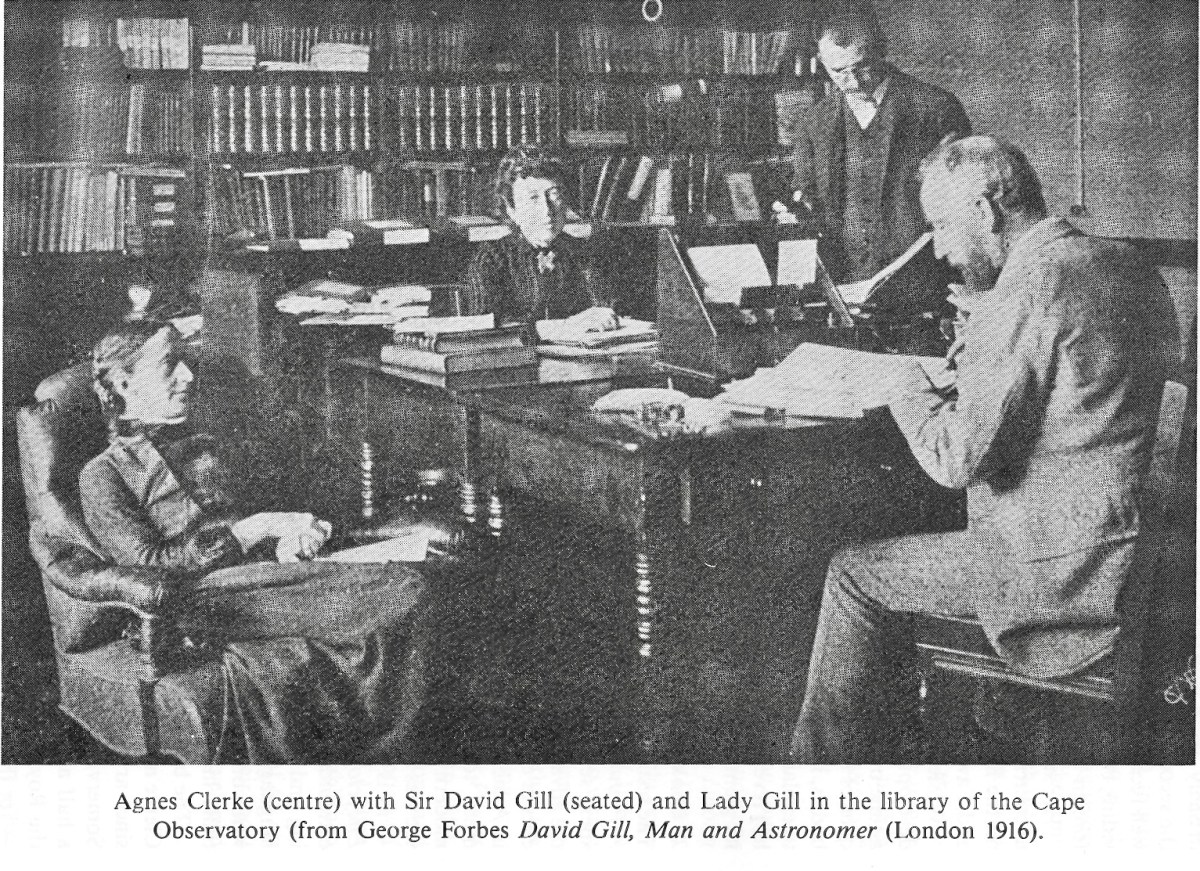
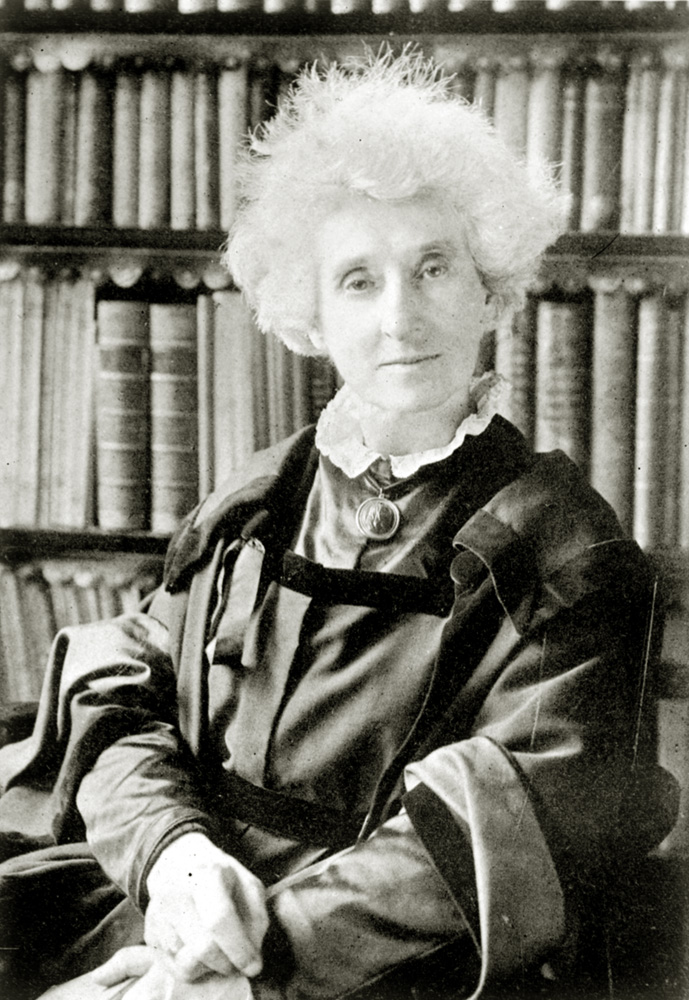
But as they read what she wrote, scientists were won over by her erudition and her ability to present their complex findings to a wide audience. Although she was a member of the British Astronomical Association, as a woman she was ineligible to be a member of the prestigious Royal Astronomical Society and had to call in favours to be allowed access to their library. But eventually even that bastion of male scientific privilege was forced to acknowledge her achievements and appointed her and her great friend Lady Margaret Huggins (another Irish astronomer, below) as honorary members. Lady Huggins was also her biographer.
Besides her new editions of A History of Astronomy, Agnes wrote several other books on Astronomy and as a diversion took a break and wrote one about Greek Literature, Familiar Studies in Homer (she knew how to take it easy).

The foremost authority on Agnes’s life and scholarship was Mary Brück. Of Agnes, she said:

This remarkable woman, educated solely within her own family and through her own private studies, not only kept abreast of astronomical progress world-wide but also had a genuine understanding of the matters on which she reported and the gift of communicating them through her fluent and prolific writings. Her books – in particular her Popular History of Astronomy during the Nineteenth Century, first published in 1885 and reprinted over almost twenty years – are treasured by historians and by amateur lovers of astronomy alike as sources of reliable and enjoyable information on that period.

I loved her description of Agnes at the height of her powers: Agnes Clerke in her sixties had become a sort of mother figure among astronomers, tactful, kind, helpful. In one account, she was described at a scientific event surrounded by leading astronomers, genuinely keen to hear her opinion on some knotty point.
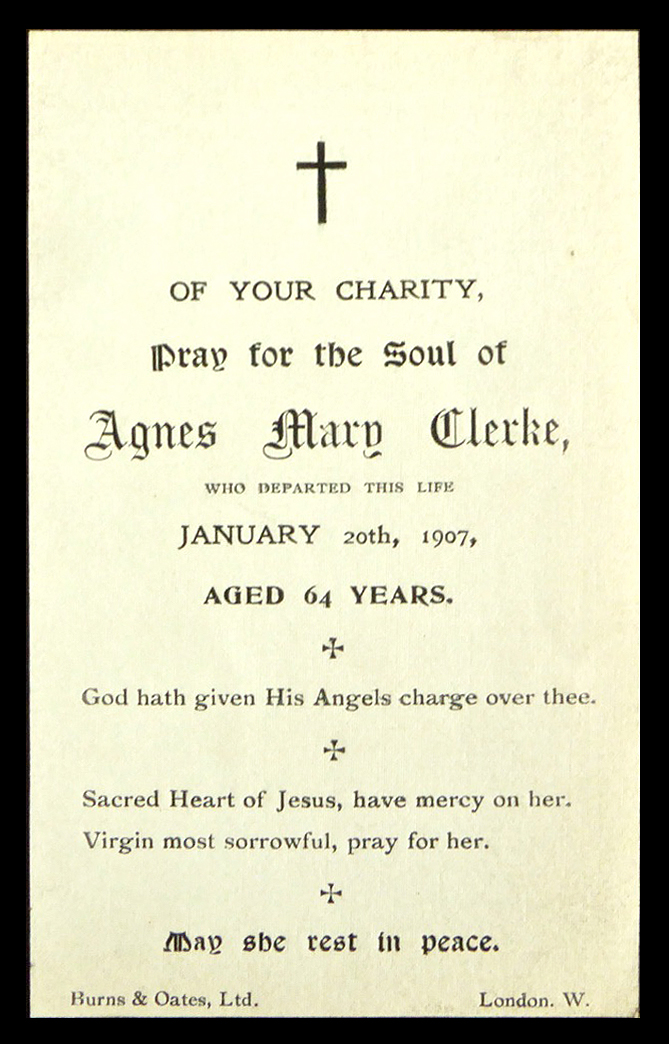
Agnes died in 1907, of the same flu that had carried off her beloved sister, Ellen, the year before. Aubrey lived on alone in the house in Redcliffe Square, the house where they had lived and worked and hosted many gatherings of eminent scientists and writers.

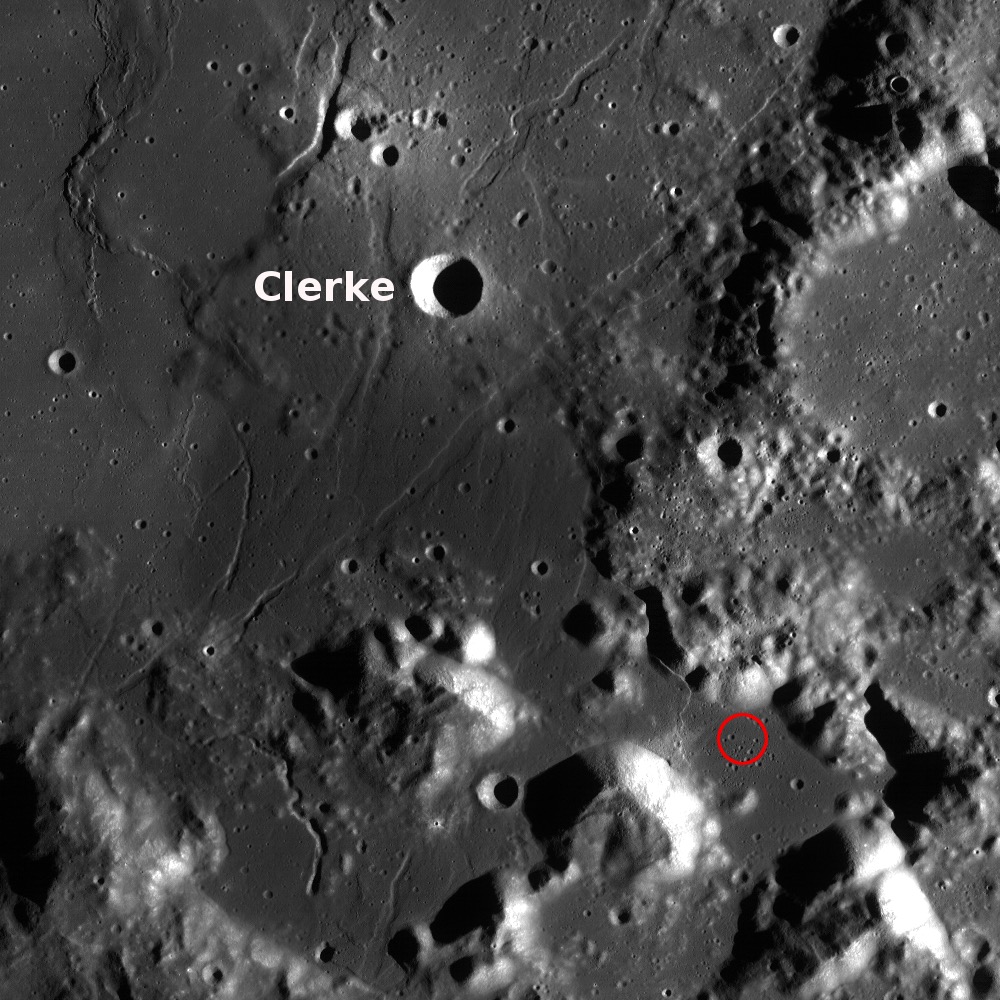
In 1981, Agnes was paid a high honour. A crater on the moon, near the Apollo 17 landing site, was named the Clerke Crater by the International Astronomical Union.

I have written about Ellen and Aubrey here. It seems apt to close this piece on Agnes with a quote from one of Ellen’s poems, Night’s Soliloquy:

                                …are not hidden things

Reveal’d to science when with piercing sight

She looks beneath the shadow of my wings

To fathom space and sound the infinite?

Thanks to:
Janice McClean for the photograph of the Clerke’s house at Redcliffe Square in London. Janice, a member of the British Astronomical Society, is endeavouring to secure an English Heritage blue plaque for the house.
Paddy Leahy, for his piece Sisters in Science: Agnes and Ellen Clerke in The Journal of the Skibbereen and District Historical Society, Vol 7, 2011
In his essay, “Agnes Mary Clerke and the Edinburgh Review,” for the Skibbereen and District Historical Society Journal (Vol 9, 2013), Perry O’Donovan points out that being accepted to write for the Edinburgh Review was the equivalent of an unknown writer today being published in the New Yorker.

Countdown to West Cork History Festival 2018!

As last year, Roaringwater Journal is very involved in the marvellous upcoming West Cork History Festival. We are both on the organising committee and this year we are leading field trips and chairing sessions, and I am giving a paper (more on that below). The Festival will be held in Skibbereen this week – 16th to 19th of August.

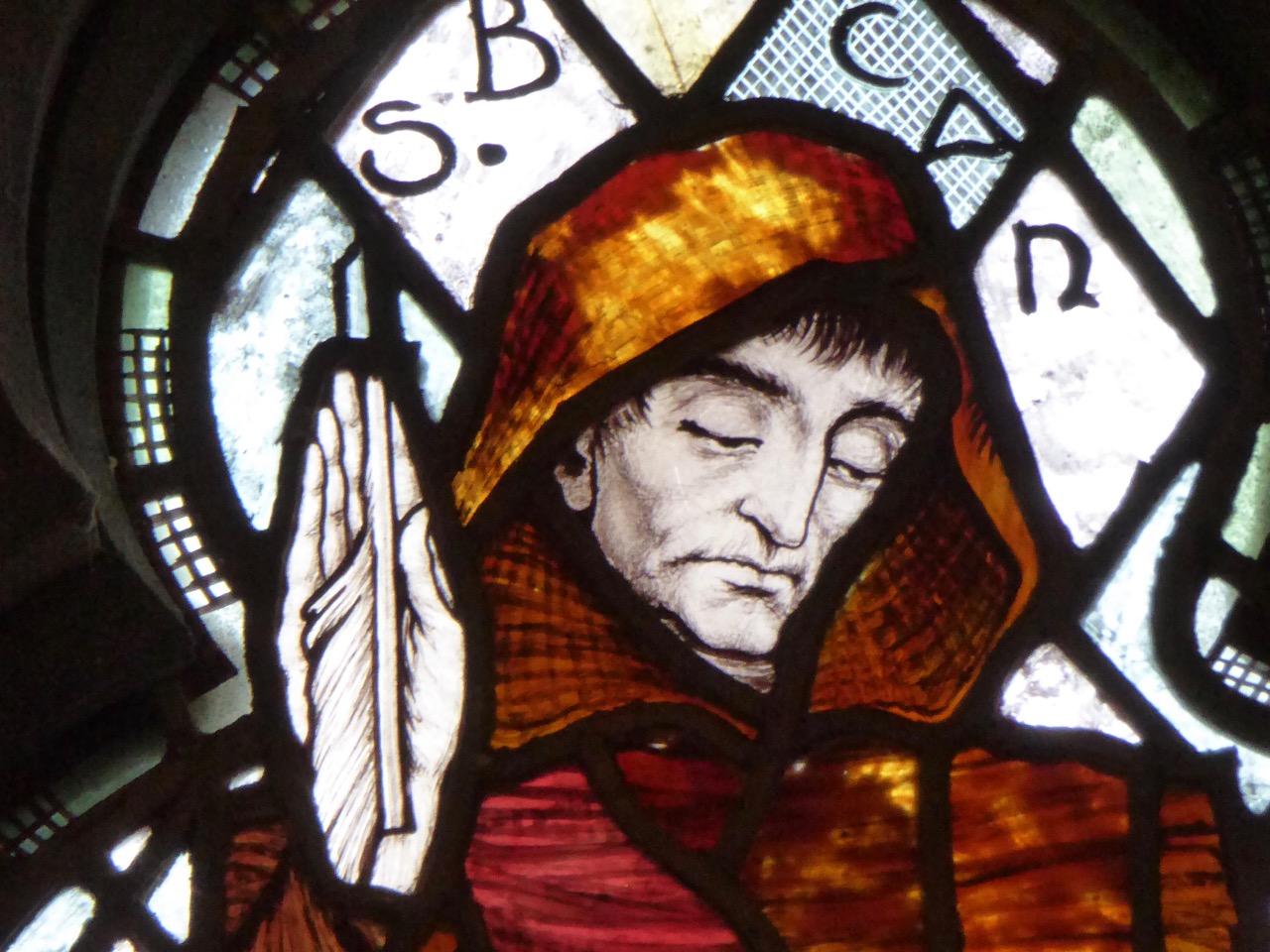
This is St Barrahane from Castletownshend. During the Thursday Field Trip we will be revealing his secret message

We haven’t had a lot to do with the detailed logistics or with the ultimate lineup of speakers – that is the purview of the Founders, Simon and Victoria Kingston. What a force they are! As you can imagine, organising a festival like this is an enormous amount of work and they do it while working full time, with two young children and a life lived between two countries – all while remaining cheerful, focussed, inventive and energetic. Here are Simon and Professor Roy Foster, our keynote speaker, talking last year about the upcoming festival.

Simon and Victoria are next door neighbours to the wonderful Liss Ard Estate. This place is dear to our heart as it’s where we were married, and they have been incredibly supportive of the festival, providing parking and accommodation.

While many of the speakers are academics and writers on the national scene, local historical societies are attending and volunteering and local experts have been persuaded to share their knowledge. The Skibbereen Heritage Centre is a big part of the festival this year, with both Terri Kearney and Philip O’Regan on the program, and William Casey giving a talk and launching a book.

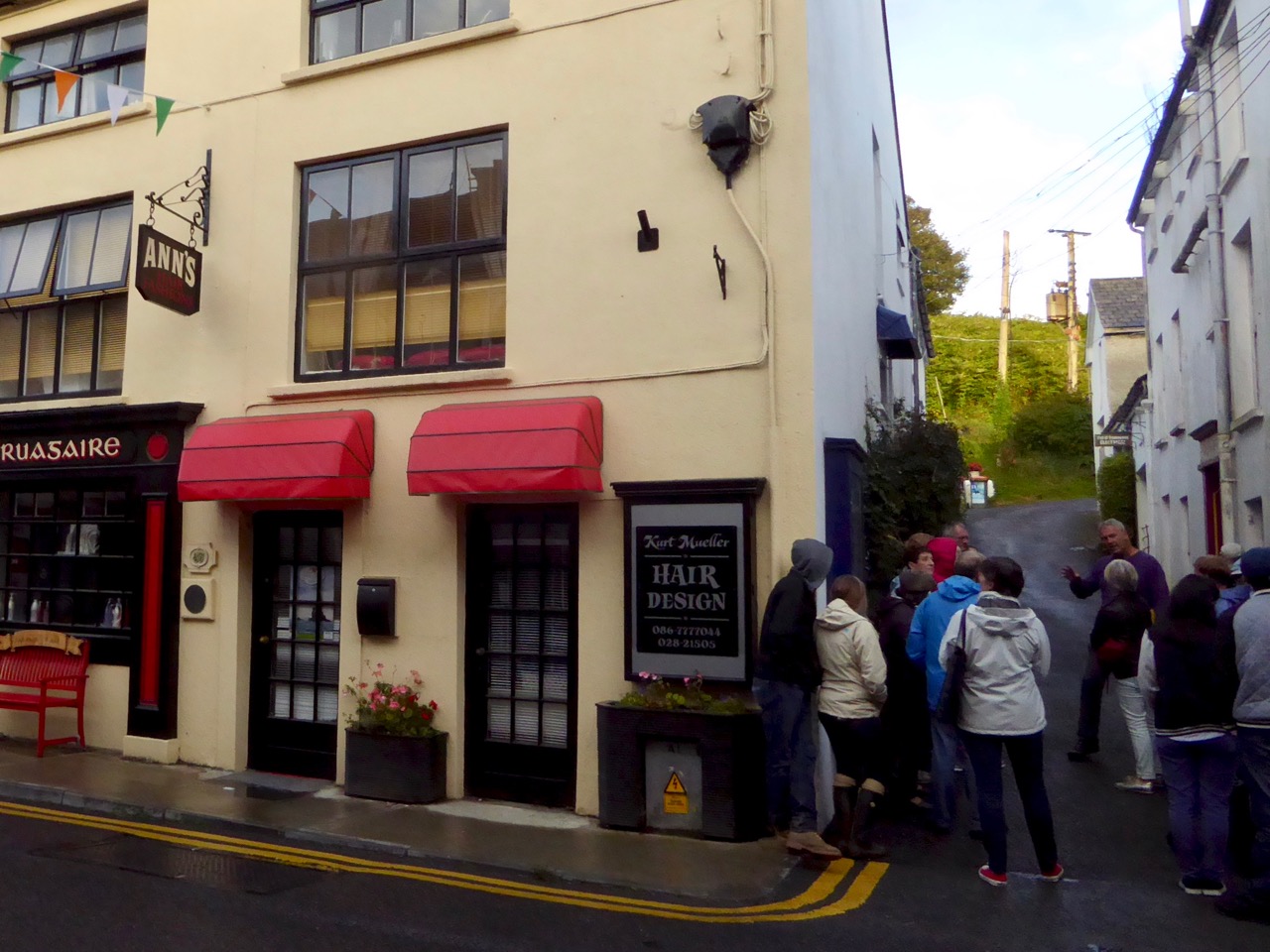
Philip O’Regan of the Skibbereen Heritage Centre leads a walking tour of the historic town. Here he points out the building where O’Donovan Rossa founded his Phoenix Society, forerunner of the Fenians

We are looking forward to the field trips, a new addition this year and a popular one, given how quickly they booked up. Thursday’s focusses on archaeology and history and Friday’s on the Famine and Art.

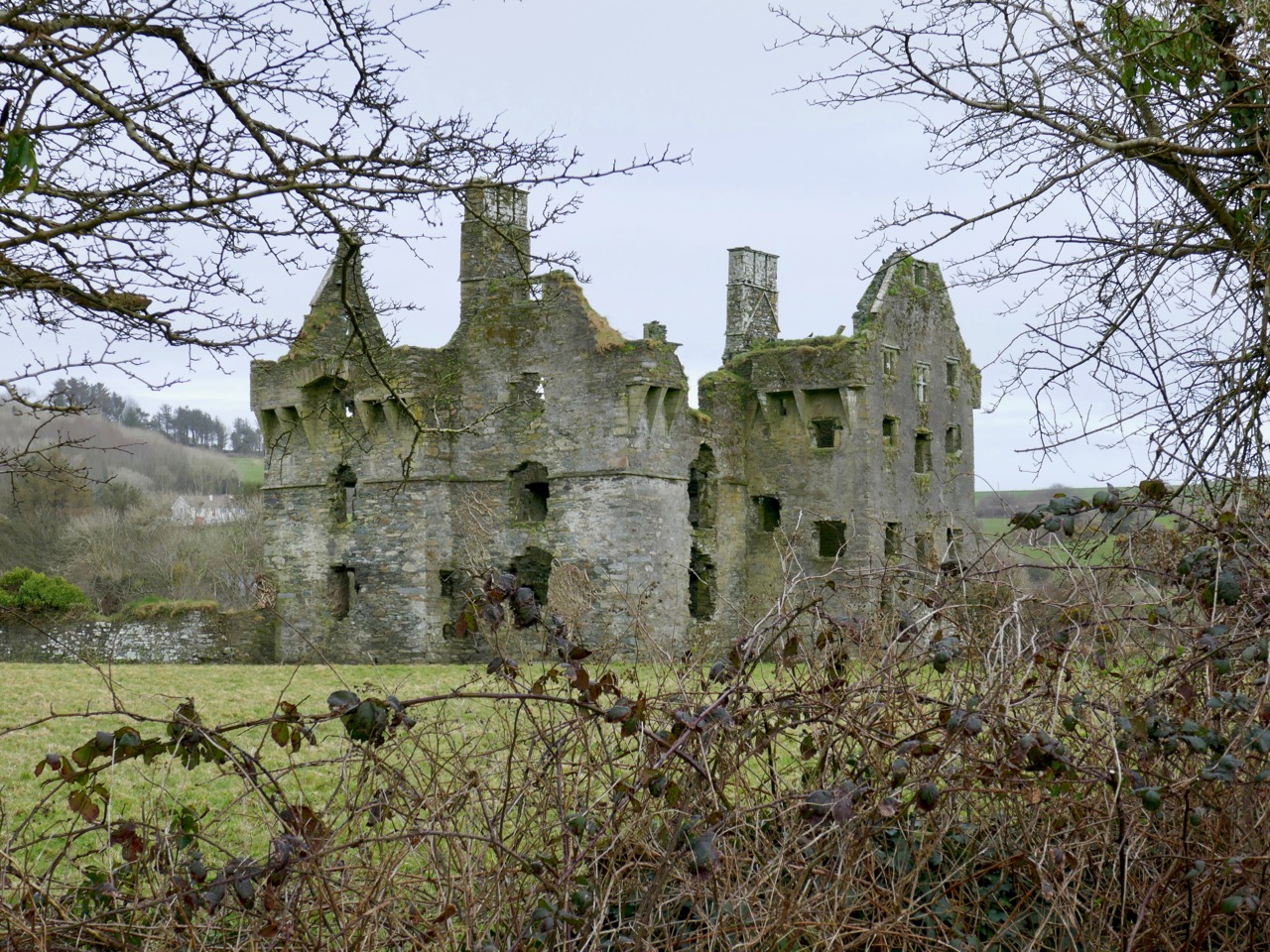
Coppinger’s Court – these fortified mansions gradually replaced tower houses in the seventeenth century, during of the series of changes from Irish to Planter land ownership

The Festival aims to cover international, national and local themes and this year will, of course, focus partly on the events of 1918, with talks on WWI, Carson and Redmond, Women’s Suffrage and the great Flu epidemic. The Irish Revolutionary Period is the subject of several talks, by both academics and non-professionals, ranging from the hot topic last year, Protestants in West Cork, to the violence suffered by some women during that period.

Inspired by the Coming Home: Art and the Great Hunger exhibition currently running at Uillinn/West Cork Arts Centre, there is also a thread that looks at the intersection of art and history. It will be the main focus of Friday’s field trip, and run through sessions on Margaret Clarke, on Gothic art, on George du Noyer and most pointedly in the talk by Niamh O’Sullivan on the Coming Home Exhibition itself.

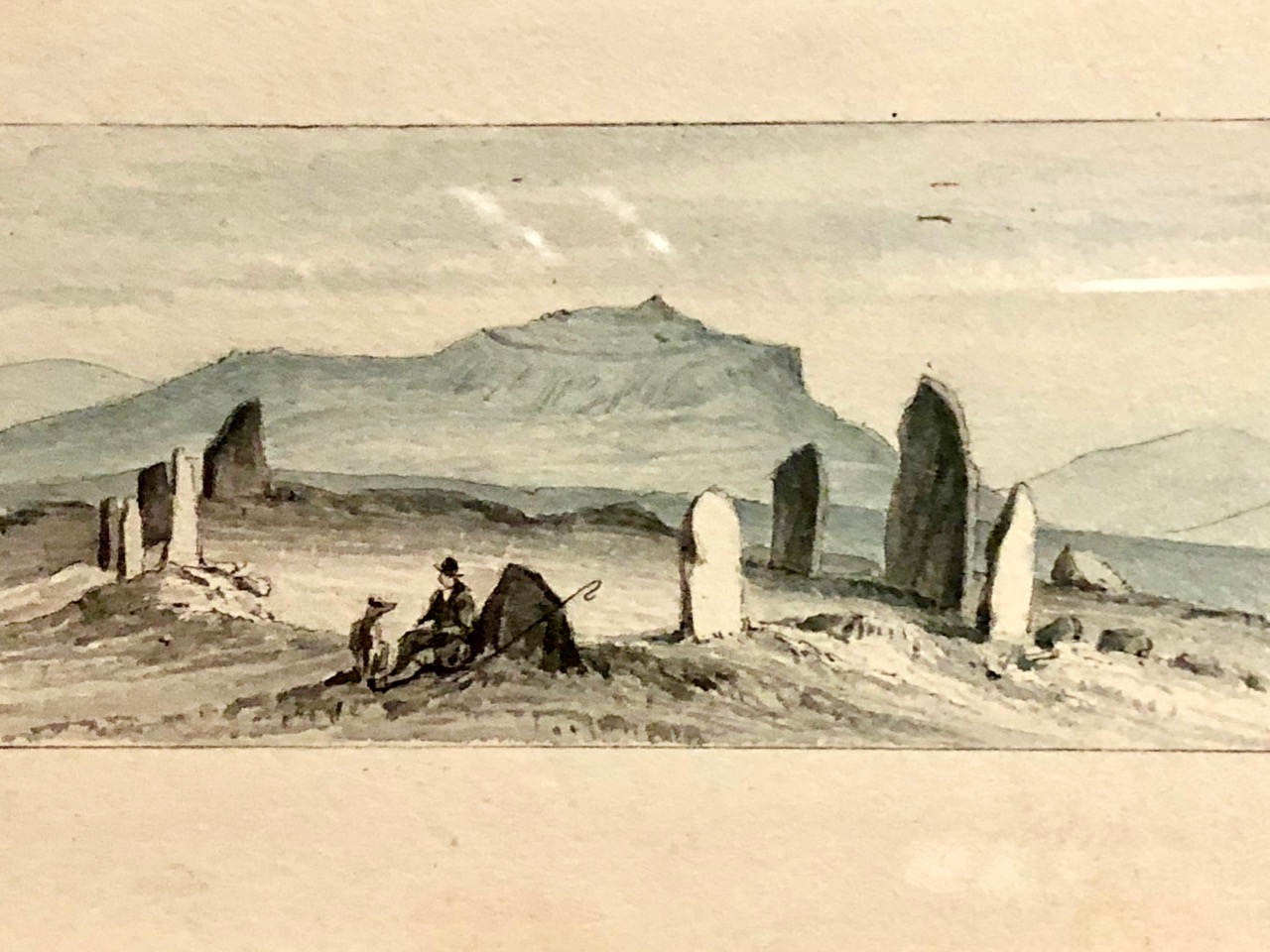
Stone Circle by George Victor du Noyer

We’re not forgetting the Medieval and Early Modern periods either. Dr David Edwards from UCC is recognised as an expert on Richard Boyle and on this period and his talk on Gaelic politics in the later Middle Ages should be fascinating. But never mind all that politics – what did people actually do back then, and what did they eat, before the advent of the potato?  Dr Susan Flavin is going to tell us that when she talks about ‘Food, Drink & Society in 16th century Ireland’.

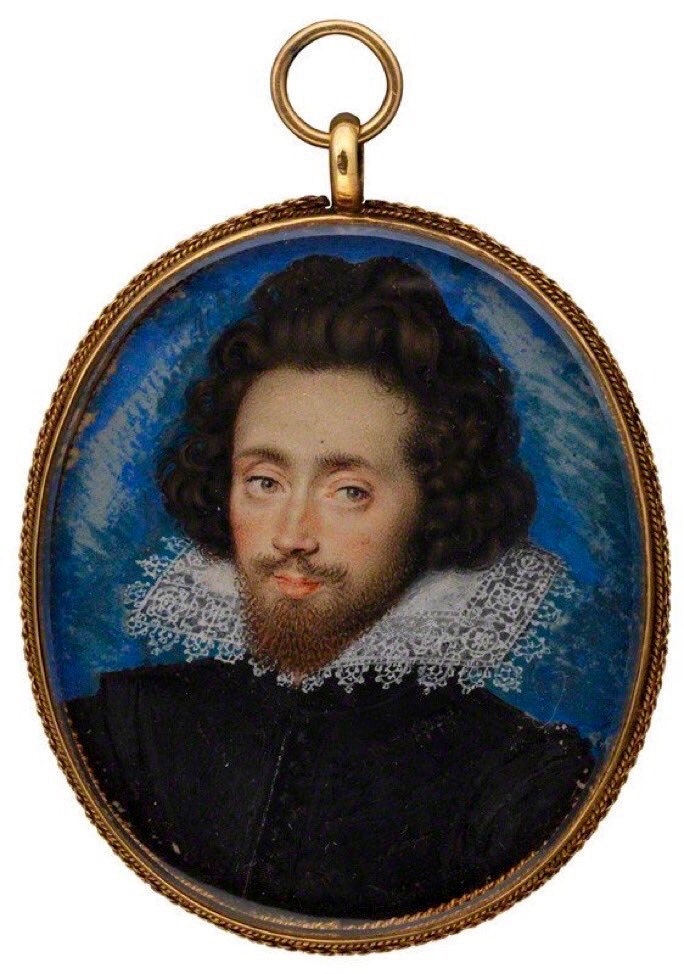
Richard Boyle, Great Earl of Cork

Lots of local history too – on Cillíní (children’s burial grounds), women in the fishing industry, Sam Maguire and his memorial bells in Dunmanway, Pirates and treasure of the Coast of West Cork, and my own talk on Agnes Mary Clerke who grew up in Skibbereen during the famine and went on to become the most successful science-writer of her day, with a moon crater named in her honour.

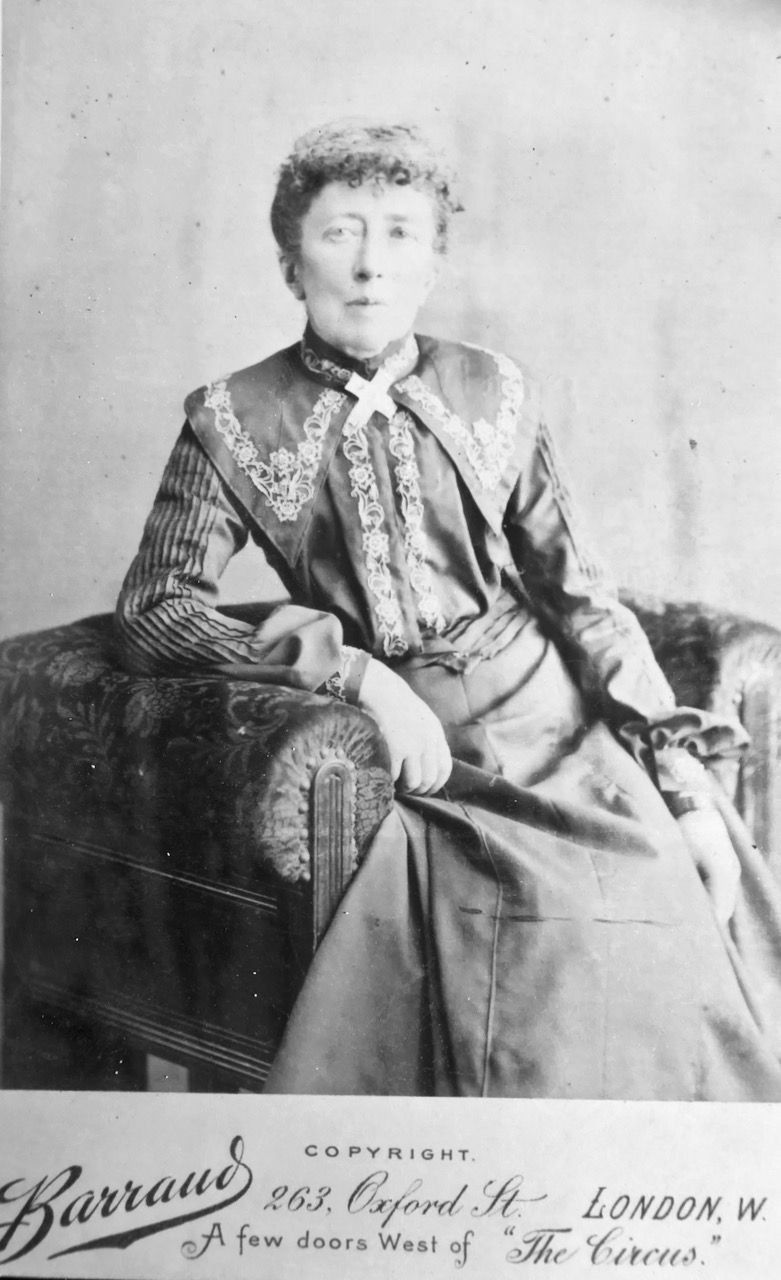
Agnes Mary Clerke

That’s just a taster of the talks – there are lots more. And if that wasn’t enough, there are also film screenings, a concert by Jessie Kennedy based on the life of Lady Mary Carbery of Castle Freke, and a poetry reading by none other than Jeremy Irons! How can you resist that voice?

So if you don’t have your tickets yet, get them now. Yes, you’ll still be able to get them at the gate, but if you want to secure them now, do it online at this link.

From Skibbereen to the Moon Part 2: Ellen and Aubrey Clerke

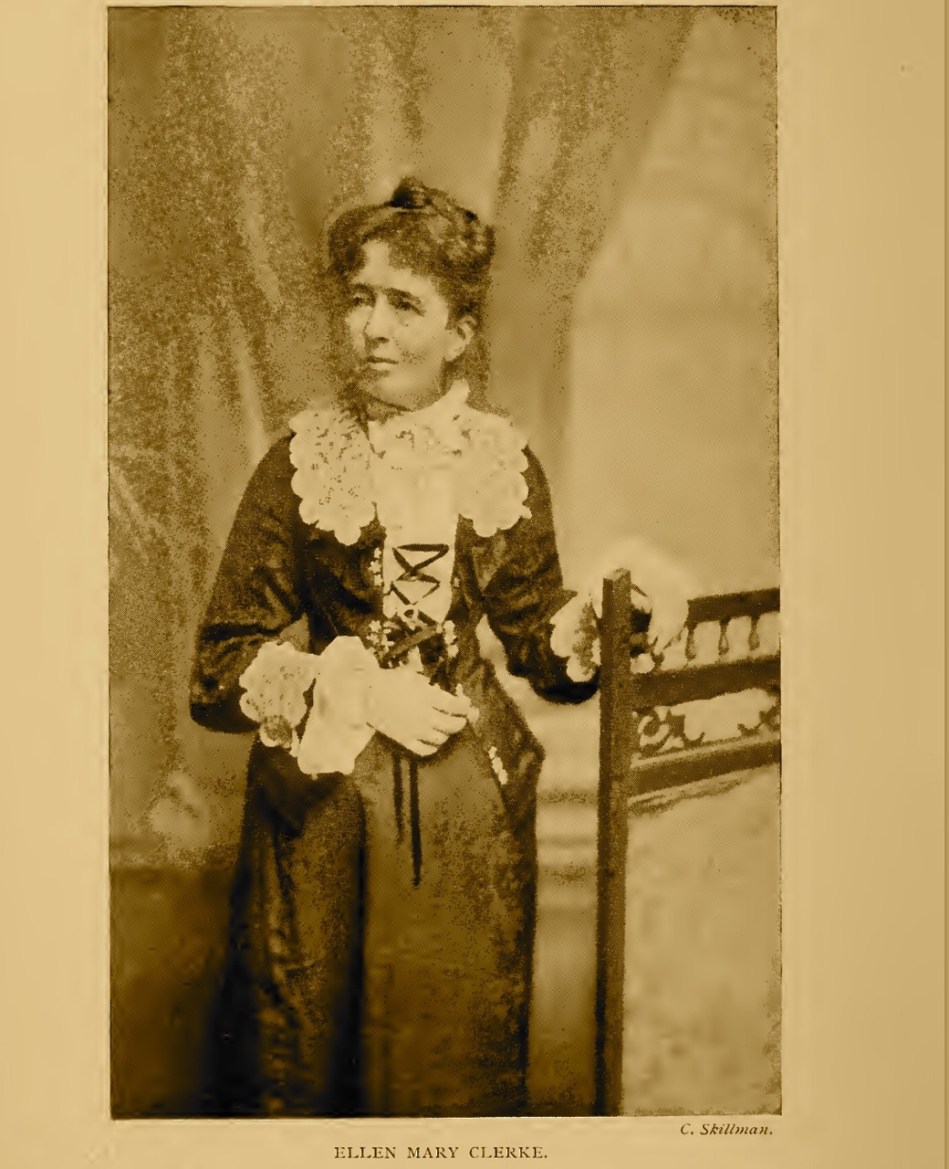
Ellen

In my post From Skibbereen to the Moon I wrote about the Clerke family of Skibbereen, but particularly about Agnes, who became one of the foremost astronomers and science writers of her day. But Agnes was one of a trio of remarkable siblings, each of who distinguished themselves as intellects and writers and I wanted to learn more about her sister, Ellen, and her brother, Aubrey. In the process, I came up with questions that reach into the heart of Skibbereen, and Irish, history.

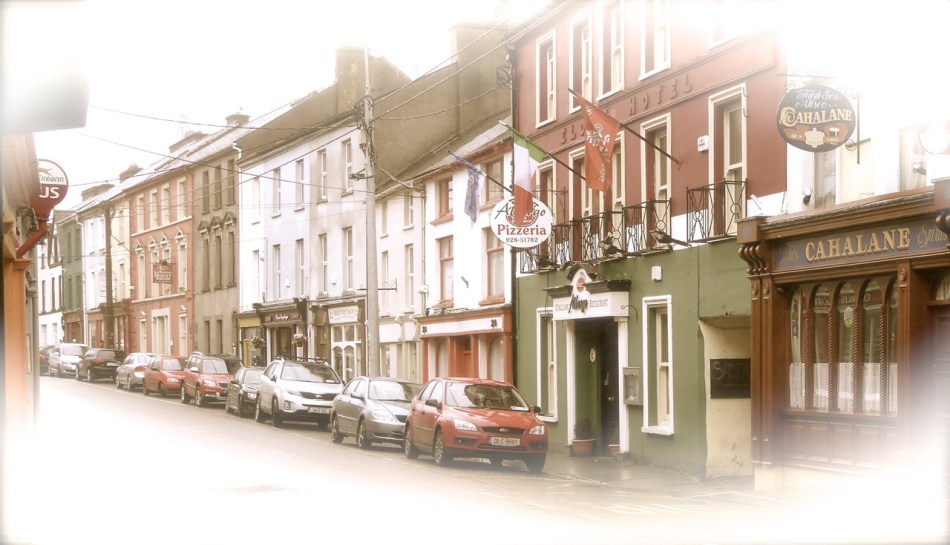
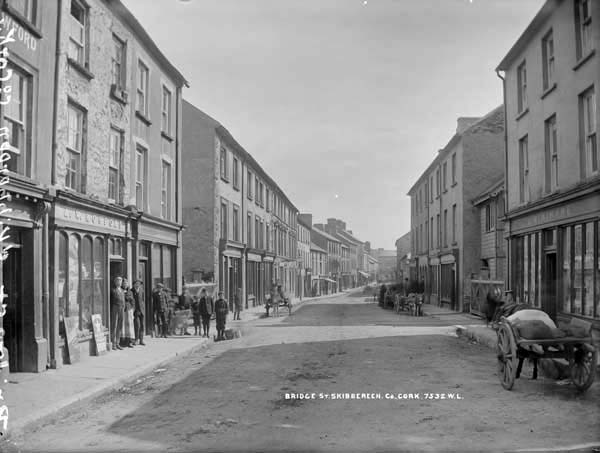
Bridge Street, Skibbereen

Bridge Street, Skibbereen

But first – the Clerke (pronounced Clark) family: all three siblings grew up in Skibbereen, above the bank that their father managed. They lived through the Famine: John Clerke was one of the subscribers to the soup kitchen relief effort. After moving away in 1861, and apart from the years the women spent in Italy, the family lived together for the rest of their lives.

It was, by all accounts, an harmonious and supportive household. The three were devoted to their parents and they encouraged and nurtured each other’s scientific and literary pursuits. Aubrey coached Agnes in mathematics when she needed to move to a higher level of understanding in her astronomy studies, and the siblings accompanied each other to the various astronomical and geographical societies that each belonged to. Ellen was the stronger of the two sisters (Agnes’s health was poor from childhood) and also the more social. According to Lady Huggins account, she played the guitar and sang well, she liked to ride and she “pulled a good oar.”

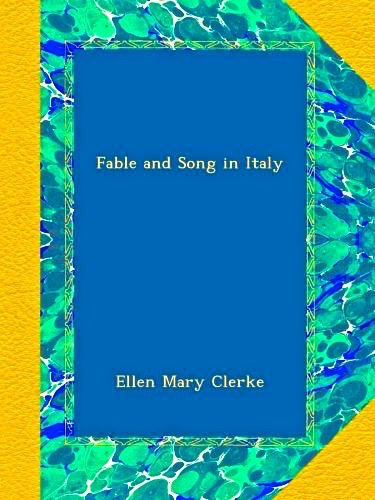
Fable and Song

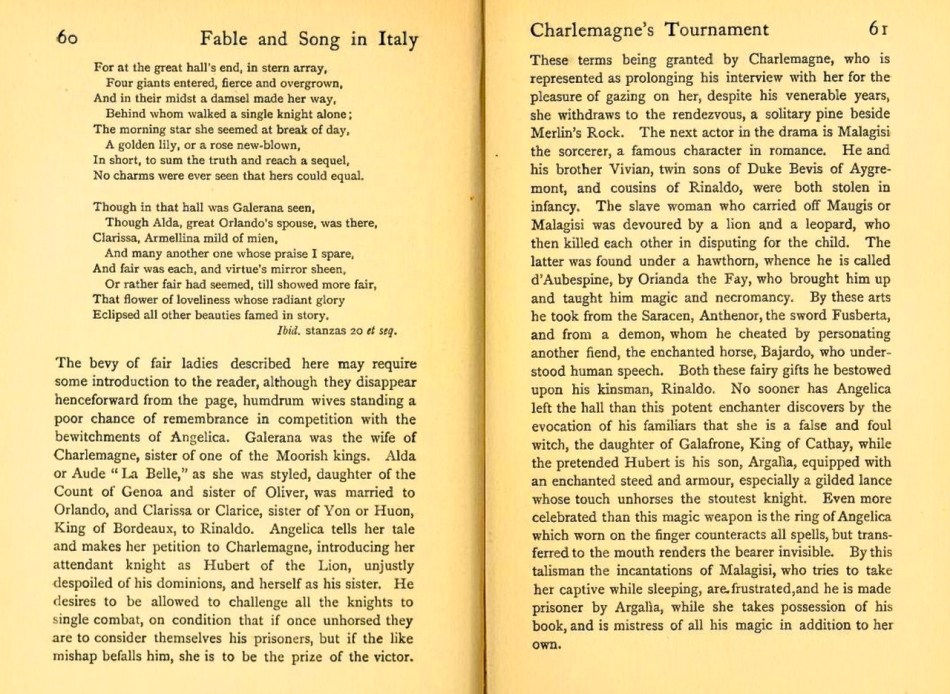
While Agnes wrote mainly (although not exclusively) about astronomy, Ellen was more literary in her leanings, publishing extensively in the areas of poetry and criticism and writing in three (at least) languages. The book for which she should be most justly remembered is Fable and Song in Italy. Ellen’s objectives with this book were twofold: to trace the influences on popular Italian song and to to introduce English readers to Italian verse. In order to do this she must have possessed an encyclopaedic knowledge of the great Italian poets and the ability to translate Italian verse to English verse. This had to be an incredibly difficult undertaking, not least because she was translating archaic Italian into a more contemporary language (that is, of her own time) in order that the “beauties” of the verse would not be “disguised by the obsoleteness of the language.” She begins in the Renaissance with the Fifteenth Century Boiardo, author of Orlando Innamorato, a classic of European chivalric literature. Her account of the piece Charlemagne’s Tournament from Orlando is complete with the story itself, discursive asides about the numerous characters and translations of selected verses.

From Fable and Song in Itlay

From Fable and Song in Italy, Ellen’s best work

She moves on to Boccacio, author of the Decameron. Crediting him with “giving the metrical romance an established place in literature” she asserts that he “supplied the poetry of the future with its main outlet of expression…” She provides many pieces of translation and compares his verbose style to Chaucer’s (an admirer of Boccacio) more succinct phrasings, tracing the influences of the Italian on the English poet with great skill and using numerous illustrations. She has a chapter on The Hercules Saga and on the verse letters of the poet Ariosto; she describes the potent roles played by Dante and Petrarch in Italian verse; she works her way through a chapter on  Italian Folk Songs to finish with a discourse on Manzoni and Modern RomanticismIt’s a tour de force, showing a strong intellect operating at the height of its powers. But it’s also fascinating in that, as a devout Catholic with a Victoria sensibility, she deals with the sometimes hot and overblown romantic verse in a calm and often wryly humorous way, noting for example that despite all the chivalry and elevation of romantic love, Ariosto’s real estimation of women was evidently “very low,” as he  “alternates between raillery and panegyric.”

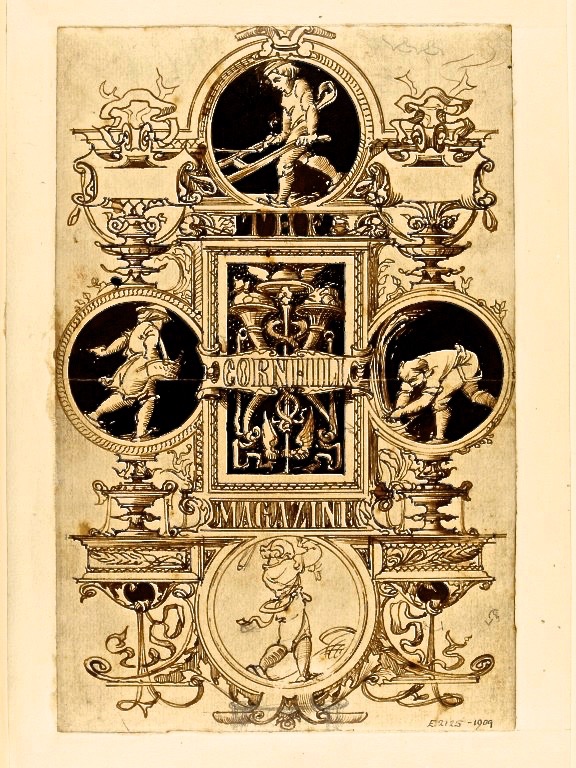
Everyone who was anyone wrote for he Famous Cornhill Magazine

Everyone who was anyone wrote for the Famous Cornhill Magazine

Ellen wrote for various magazines, especially The Tablet (a Catholic periodical which she also helped to edit), the Cornhill Magazine and the Dublin Review (another influential Catholic journal, actually published in London). Although she never reached the stature of Agnes in astronomy, she was likewise interested in that subject and wrote two monographs on Jupiter and on Venus. A review of Jupiter and his Systems calls it a “capital little pamphlet” (it was 40 pages) and says it presents “a complete popular account of our present information regarding this planet and its satellites…in an interesting and straightforward way, equally removed from dullness and from the faintest traces of “smart writing.”” She wrote literary studies in German and she studied Arabic to the extent of using original Arabic texts in her research. She was a highly regarded member of the Manchester Geographical Society (which admitted women!). One of her pieces for them was about Australian aborigines which was described as a “striking refutation of the generally held belief about them”. Another one of her journalistic essays was about the dock labourers strike of 1889 in which she displayed her understanding of economics, her insistence on factual information (she used extensive statistics) and her empathy for low paid workers and their families, although in general her politics were conservative.

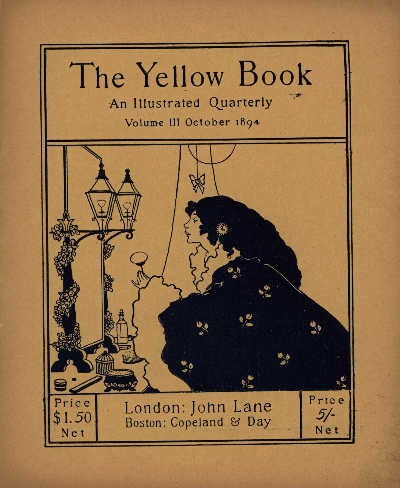
Cover by Aubrey Beardsley, Poem by Ellen Clerke

Cover, Aubrey Beardsley. Poem, Ellen Clerke

Ellen’s venture into fiction was not, alas, as well received as her journalism and science writing. Just before she died she published her only novel, Flowers of Fire. I have found a single review, which pans it. “This story is interesting,” it states, “as proving that neither Polish conspiracies nor Neapolitan courtships can fill the dreary void left in a novel by the absence of men and women…[The characters] are distinguished from each other only by some external badge, such as yellow hair or a hot temper, and by the single hard black line that marks off the good characters from the bad.”

I couldn’t find the text of Ellen’s novel online, but I did come across a poem she translated from French, with the same title. It was published in The Yellow Book – a very smart quarterly with cover designs by Aubrey Beardsley. I have appended the poem to the bottom of this post. 

Aubrey St John Clerke, like his sisters, was brilliant. He won gold medals at Trinity in Mathematics and in Science and was awarded a “studentship” of £100 per year – “the highest honour obtainable at the Degree examination.” Although trained as a scientist, he chose to make his career in law, in which profession he became a specialist in land and property law and wrote books on the land law and conveyancing and articles for magazines, such as one for the Dublin Review of 1880 on ‘The Land Question and Law Reform.’ 

These books and articles on buying and selling land were more than simple treatises on conveyancing: they were a significant contribution to Irish and British law, since a series of Land Acts, beginning in 1870 were passed, designed to transfer the ownership of property from the large landowners to the Irish people who lived and worked on it. Each Act improved on the one before, but all were complex and there were no precedents to depend on. But Aubrey did not confine himself to law and wrote on other topics too. At one point, in 1878, all three Clerke siblings were in print. According to Mary Brück’s biography of Agnes, Aubrey’s contribution was a piece in the Quarterly Review “on a political question in which he showed himself a staunch Unionist and Anglophile.”

It’s interesting to note, in this regard, that when the Clerkes lived in Skibbereen, in the Bank House on Bridge Street, O’Donovan Rossa, the Fenian leader, was running a business further up the same street. Did John Clerke, in his capacity as the Bank Manager, have dealings with Rossa (who ran into financial difficulties with his seed business)? How did the conservative Clerkes feel about the Phoenix National and Literary Society that Rossa founded with the aim of liberating Ireland ‘by force of arms.’ How usual or unusual was it for staunch Catholics, such as the Clerke siblings, to be committed unionists and anglophiles? How would Aubrey feel, do you think, if he knew that the other memorial plaque on Bridge Street is to honour the memory of a Fenian? 

Redcliffe Square, home to the Clerkes in London

Redcliffe Square, home to the Clerkes in London

Agnes and Ellen died within months of each other. Aubrey was the youngest of the family and the last to survive, living on alone in the grand house in London, becoming in the end reclusive. I can find no photograph of him or of his father: in this family it is the women who are most remembered. To his credit, Aubrey never seemed to resent that, remaining proud of and devoted to his two extraordinary sisters always.


Flowers of Fire

A Translation, by Ellen M. Clerke

FOR ages since the age of Chaos passed,

Flame shot in torrents from this crater pyre,

And the red plume of the volcano’s ire

Higher than Chimborazo’s crown was cast.

No sound awakes the summit, voiceless, vast,

The bird now sips where rained the ashes dire,

The soil is moveless, and Earth’s blood on fire,

The lava—hardening—gives it peace at last.

But, crowning effort of the fires of old,

Close by the gaping jaws, for ever cold,

Gleaming ‘mid rocks that crumble in the gloom,

As with a thunderclap in hush profound,

‘Mid golden dust of pollen hurled around,

The burning cactus blazes into bloom.

From Skibbereen to the Moon: Agnes Mary Clerke

Commemorative plaque in SkibbereenCommemorative plaque in Skibbereen

NOTE: I have rewritten this post and substantially updated it. See, from Sept 2023, Storm Agnes: Agnes Clerke of Skibbereen and Nineteenth Century Astronomy.

What follows is the original post, from 2015.

Wandering around Skibbereen, I came across a plaque on a once-imposing pink building – it showed two women, the Clerke sisters, who had grown up in the house. Intrigued, I searched for more information and what I found astonished me.

Agnes, Ellen and Aubrey Clerke, the offspring of John William Clerke (who managed the bank located on the ground floor) and Catherine Mary Deasy, were all brilliant, scholarly and published writers, each in their own fields. The Clerke (Protestant) and the Deasy (Catholic) families had long and solid histories in West Cork and lived through the awful famine period of Skibbereen during which they were said to be benevolent (see Paddy Leahy’s piece in The Journal of the Skibbereen and District Historical Society, Vol 7, 2011 for more on John and Catherine). John had been educated in Trinity and the children grew up in the 1840s and 50s with access to their father’s extensive library, his telescope and his chemistry experiments. The telescope, according to Mary Brück’s biography, was equipped with a chronograph for timing the transits of stars across the meridian. With this arrangement Clerke was able to provide a time service for the town of Skibbereen, which was as yet unconnected to the outer world by either railway or telegraph.

Bridge Street, Skibbereen, 19th Century. National Library CollectionBridge Street, Skibbereen, 19th Century. National Library Collection

The sisters were tutored by their mother to a high proficiency in music, Latin and Greek. (Catherine played Irish music on the harp and retained her ability to entertain well into her 80s.) Insatiably curious, they devoured knowledge and by 15 Agnes had already begun to write a history of astronomy – a book that would later count as her magnum opus. While Ellen and Aubrey distinguished themselves mainly (although not exclusively) in literature and law, Agnes went on to become one of the foremost science writers of her day. Devoted to each other, none of the siblings ever married and the family lived together in harmony and supported each other’s endeavours to the end.

Living in Italy for ten years, Agnes and Ellen studied extensively in the excellent libraries in Rome and Florence, becoming proficient in several languages and going to primary sources to research their interests. Thereafter, the family settled in London. Although she started off with a wide range of topics, Agnes over time concentrated on writing about astronomy. Her first published pieces (one about Copernicus, the other about the Mafia!) appeared in the Edinburgh Review in 1873. This was the equivalent, as Perry O’Donovan points out in an essay for the Skibbereen and District Historical Society Journal (Vol 9, 2013), of an unknown writer today being published in the New Yorker.

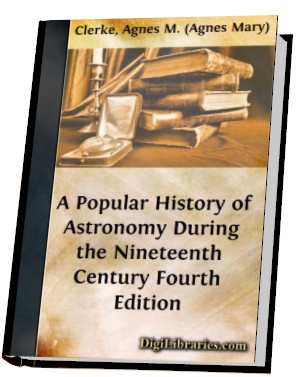
History of A 4th edition

The depth and scope of Agnes’s scholarship is awe-inspiring. To read through her History of Astronomy during the Nineteenth Century (available online through Project Gutenberg) is to see a brilliant mind at work. Her purpose in writing it was to embody an attempt to enable the ordinary reader to follow, with intelligent interest, the course of modern astronomical inquiries, and to realize (so far as it can at present be realized) the full effect of the comprehensive change in the whole aspect, purposes, and methods of celestial science introduced by the momentous discovery of spectrum analysis. This IS the rocket science of her generation, encompassing chemistry, physics, mathematics, history of scientific thought, cosmology, the most up to date observation and measurement techniques – in short, the disciplines that made up the emerging science of astrophysics.

Take a look, for example, at the headings for her Chapter IV: Chemistry of Prominences—Study of their Forms—Two Classes—Photographs and Spectrographs of Prominences—Their Distribution—Structure of the Chromosphere—Spectroscopic Measurement of Radial Movements—Spectroscopic Determination of Solar Rotation—Velocities of Transport in the Sun—Lockyer’s Theory of Dissociation—Solar Constituents—Oxygen Absorption in Solar Spectrum. Looks pretty frightening for a non-scientist, doesn’t it? And yet, this book was one of the best-sellers of the day. Agnes had a unique ability to absorb and compile knowledge and then to lay it out for the non-specialist. (I got through the first chapter with little difficulty.) She is rightly credited as the founder of what is called today Popular Science. Her books (she wrote many more) and articles sold well and she made a good living from her writing.

However, she was a woman, and a non-practitioner (that is, she didn’t work in an observatory, although she spent time in one) and many in the predominantly male science establishment of Victorian Britain were sceptical of her knowledge and resentful at her success. But as they read what she wrote most were won over by her erudition and her ability to present their complex findings to a wide audience. Although she was a member of the British Astronomical Association, as a woman she was ineligible to be a member of the prestigious Royal Astronomical Society and had to call in favours to be allowed access to their library. But eventually even that bastion of male scientific privilege was forced to acknowledge her achievements and appointed her and her great friend Lady Margaret Huggins (another Irish astronomer) as honorary members.

The Clerke CraterThe Clerke Crater

Recently, however, Agnes has been paid a high honour. A crater on the moon, near the Apollo 17 landing site, has been named the Clerke Crater by the International Astronomical Union.

Huggins memoirHuggins memoir

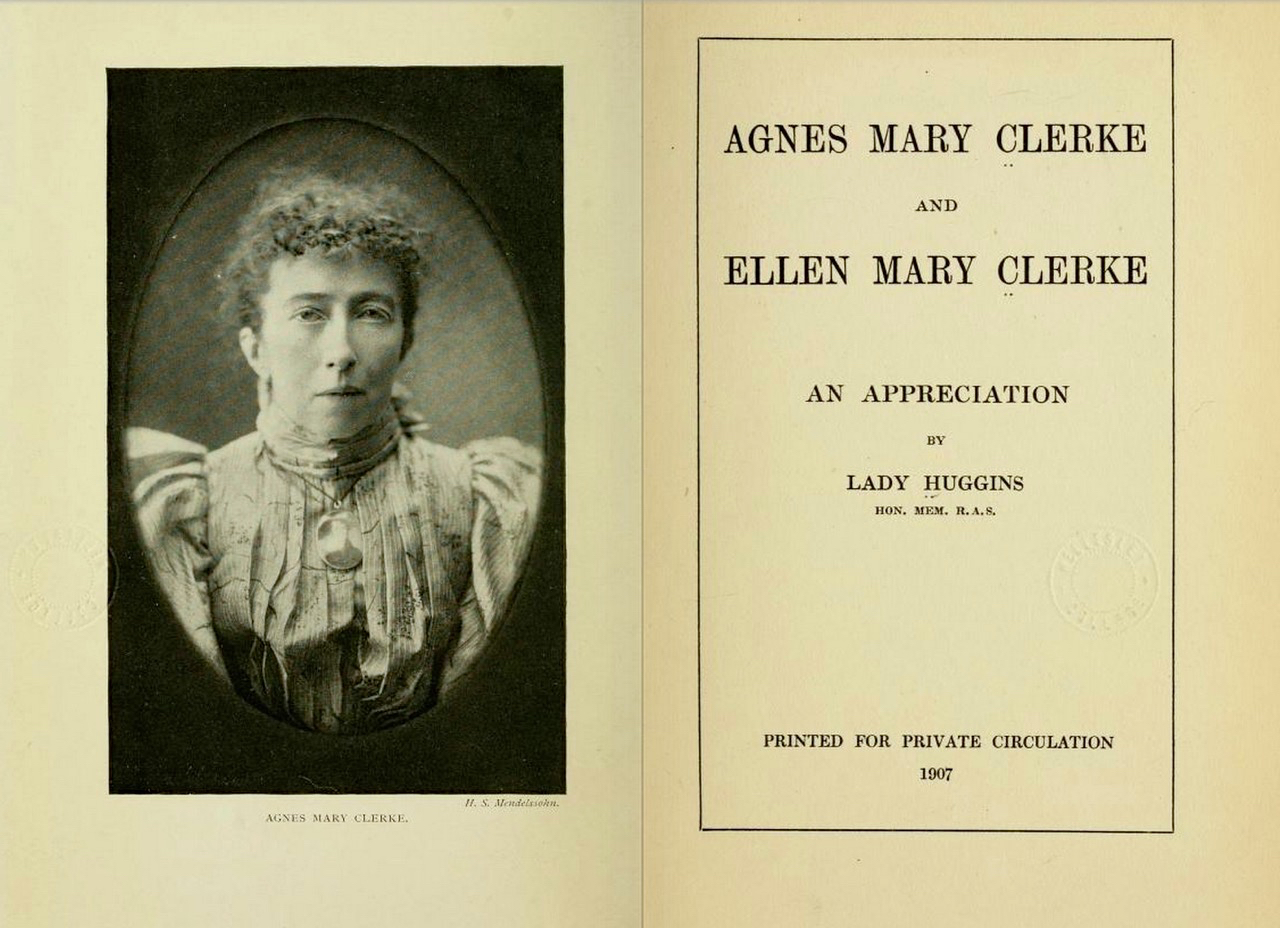
Margaret Huggins penned a small memoir about Agnes and Ellen Clerke after their deaths. However the real authority on Agnes’s life and scholarship was Mary Brück, a fellow astronomer, yet another Irish woman (from Meath) and author of Agnes Mary Clerke and the Rise of Astrophysics. 

Brück biographyBrück biography

Of Agnes, she said: This remarkable woman, educated solely within her own family and through her own private studies, not only kept abreast of astronomical progress world-wide but also had a genuine understanding of the matters on which she reported and the gift of communicating them through her fluent and prolific writings. Her books – in particular her Popular History of Astronomy during the Nineteenth Century, first published in 1885 and reprinted over almost twenty years – are treasured by historians and by amateur lovers of astronomy alike as sources of reliable and enjoyable information on that period.

I loved her description of Agnes at the height of her powers: Agnes Clerke in her sixties had become a sort of mother figure among astronomers, tactful, kind, helpful.

Ellen and Aubrey deserve their own posts (now written, see From Skibbereen to the Moon Part 2: Ellen and Aubrey Clerke). However, it does seem apt to close this piece on Agnes with a quote from one of Ellen’s poems, Night’s Soliloquy:

                                …are not hidden things

Reveal’d to science when with piercing sight

She looks beneath the shadow of my wings

To fathom space and sound the infinite?