Wrought Iron Grave Markers

Every graveyard we go into has fine example of the blacksmith’s craft – wrought iron grave markers. Ranging from simple to decorative, they are a part of our heritage that is often overlooked and forgotten.

Wrought iron was once a common material in Ireland – there were huge production facilities in Clare, for example. What is it? It’s iron made by smelting iron ore and hammering out the impurities, with little or no carbon content. How it’s produced hasn’t changed much since the start of the Iron Age 2500 years ago. But it’s no longer available as a material, having been completely replaced by steel (carbon content up to 2%) and by cast iron (carbon content of up to 4.5%). This means we are in danger of losing all the knowledge about how to work with it, since it can only be worked using traditional forge techniques. 

Graves in burial grounds in the past in West Cork were mostly marked with crude stone slabs as headstones (and sometimes footstones) and the vast majority were un-inscribed. They were carefully chosen, though, and the memory of who was buried there, and the shape and placement of the markers, would pass down through families. 
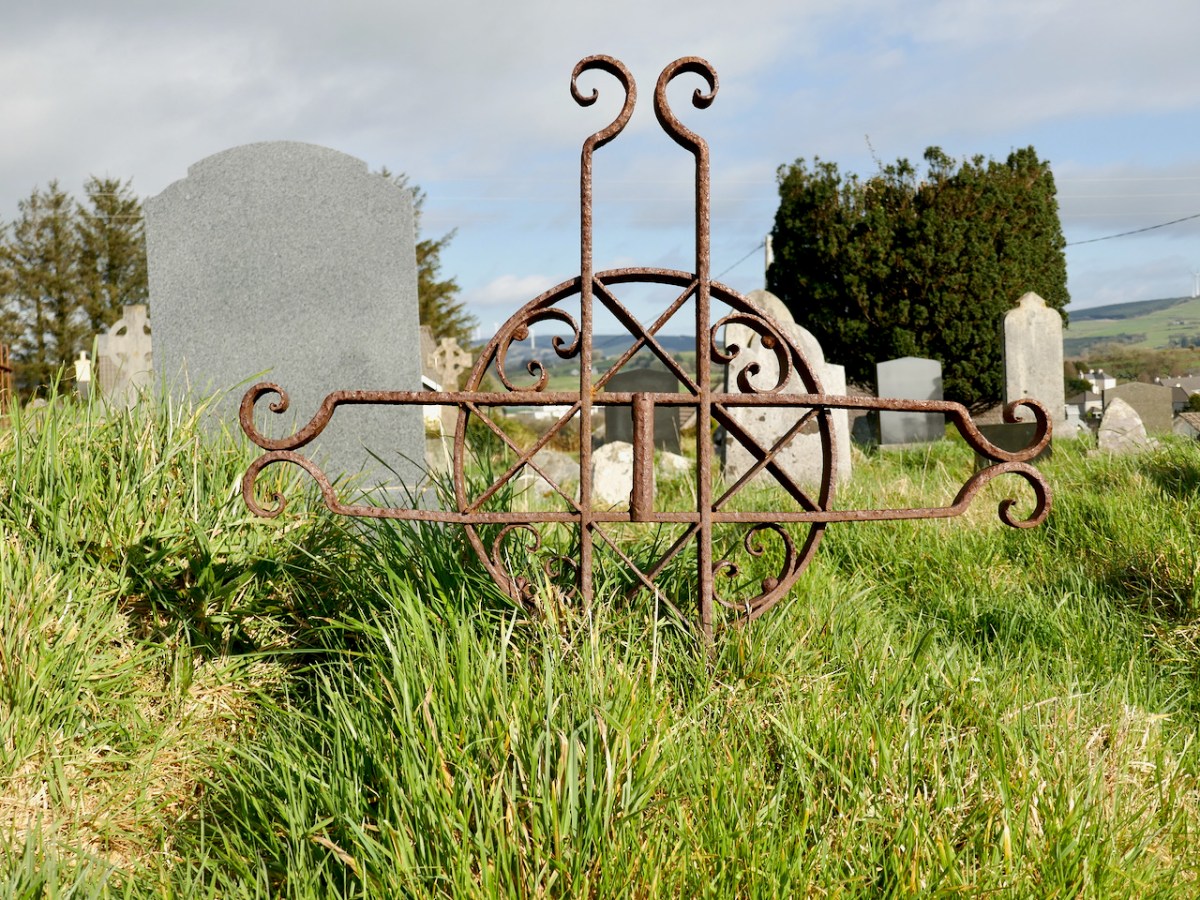
However, every local blacksmith was also adept at making grave markers, most often in the shape of a simple cross, but sometime with more elaborate detailing. As with the hand-forged gates (see A Gate Post and Another Gate Post) grave markers were forge-welded or riveted, and details were added by hammering out shapes, or splitting the iron and curling it around the anvil.

Some examples follow. All are from my local area but wherever you are in Ireland you will find similar grave markers in old burial grounds (although probably not in newer cemeteries) – why not have a wander down to your own local old graveyards and see what you can spot?

Many of the wrought iron grave markers have lost any identification over the years, but there are exceptions, such as the plaque to Timothy Keating who died in 1896 and is buried in Abbeystrewry graveyard in Skibbereen, or the simple letter PH and the date of 1907, from the graveyard in Drimoleague.

This elegant grave surround is completely hand-forged and is in the Abbeystrewry graveyard. It is likely to be the work of one the McCarthys, a family of blacksmiths whose work is still remembered and celebrated in Skibbereen – see this post from the Skibbereen Heritage Centre.

In the same graveyard, Eugene, a member of that McCarthy family, made this impressive famine memorial (above, upper) in his forge on Ilen Street. His hallmark can be seen elsewhere in the graveyard – notice the similarities between the cross on top of the famine memorial and the gravemarker (above, lower). The cross keys are associated with St Peter – perhaps this marks the grave of a Peter.
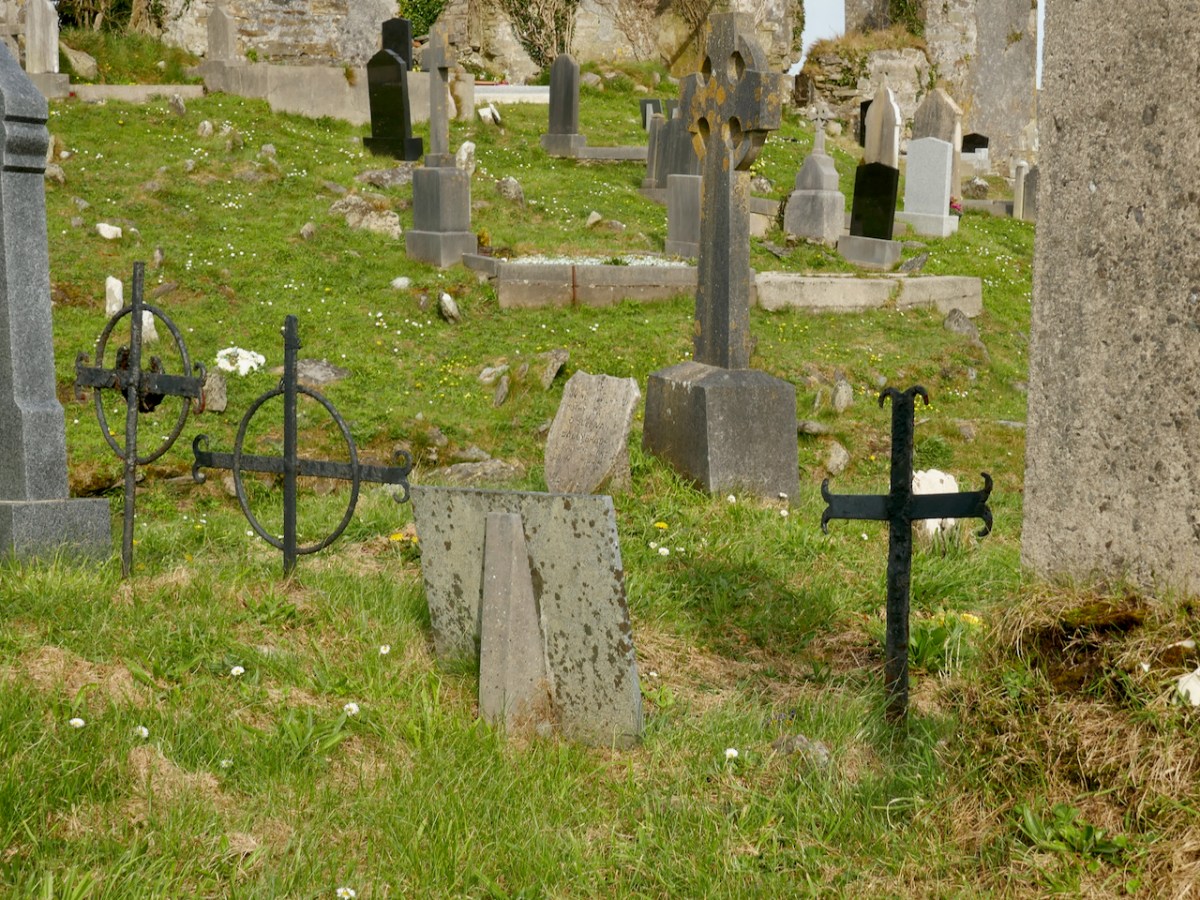
Many simple crosses such as those above can be found in the graveyard surrounding the ruined church of St Mary in Schull. The second image in this post is a more elaborate example from St Mary’s.

This graceful wrought iron grave surround is in the Castlehaven graveyard. The cast iron headstone obscures the original hand-forged IHS, just visible behind it.

Almost completely obscured by vegetation is this lovely example of a wrought iron grave marker in Creagh graveyard on the banks of the Ilen. Below are more simple crosses in Abbeystrewery.
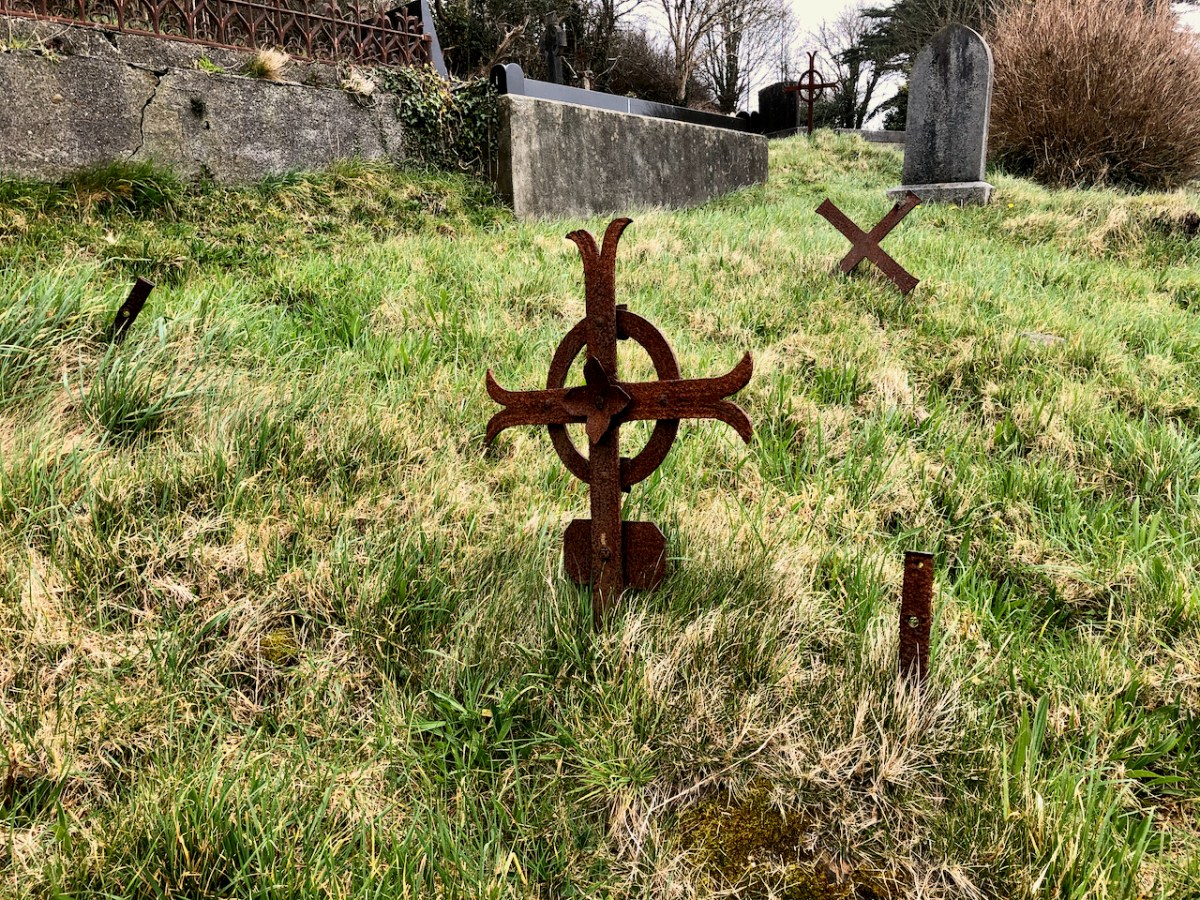
Wrought iron is amazingly durable and will last for hundreds of years with little or no maintenance. It can deteriorate under certain conditions, though, and when it does it can only be properly repaired using traditional forging methods. There are still blacksmiths around who can use these traditional methods – in West Cork we are lucky to have Pat O’Driscoll* and JJ Bowen – but the knowledge and the equipment is getting scarcer. 

This lovely memorial to the O’Brien family can be see in the Dunbeacon graveyard. The image below is of a wrought iron memorial in Schull. The circle was made from band-iron, originally used for banding wheels.

I’ve tried to limit this essay to wrought iron. I’m still learning – please point out any errors you see, in the comment section. I hope to do more about cast iron in the future. Wrought and cast iron were often used in combination and we have lots of examples of this in our West Cork graveyards.

*My thanks to Pat O’Driscoll for information and for his willingness to patiently answer my questions.

I am also grateful to Architectural Conservation Professionals – see their site for lots of information on the conservation of historic ironwork.

‘Auf der Walz’ – The Journeymen

on the summit

I am always happy to find longstanding customs and traditions still going strong, especially when they are as relevant today as they have been over countless generations. This summer we chanced upon two strangers from Germany who passed through Ballydehob. They were journeymen blacksmiths: lads who had completed their apprenticeships at home and were now ‘Auf der Walz’ (on the road) – gaining experience in the wider world.

inese-journeymen

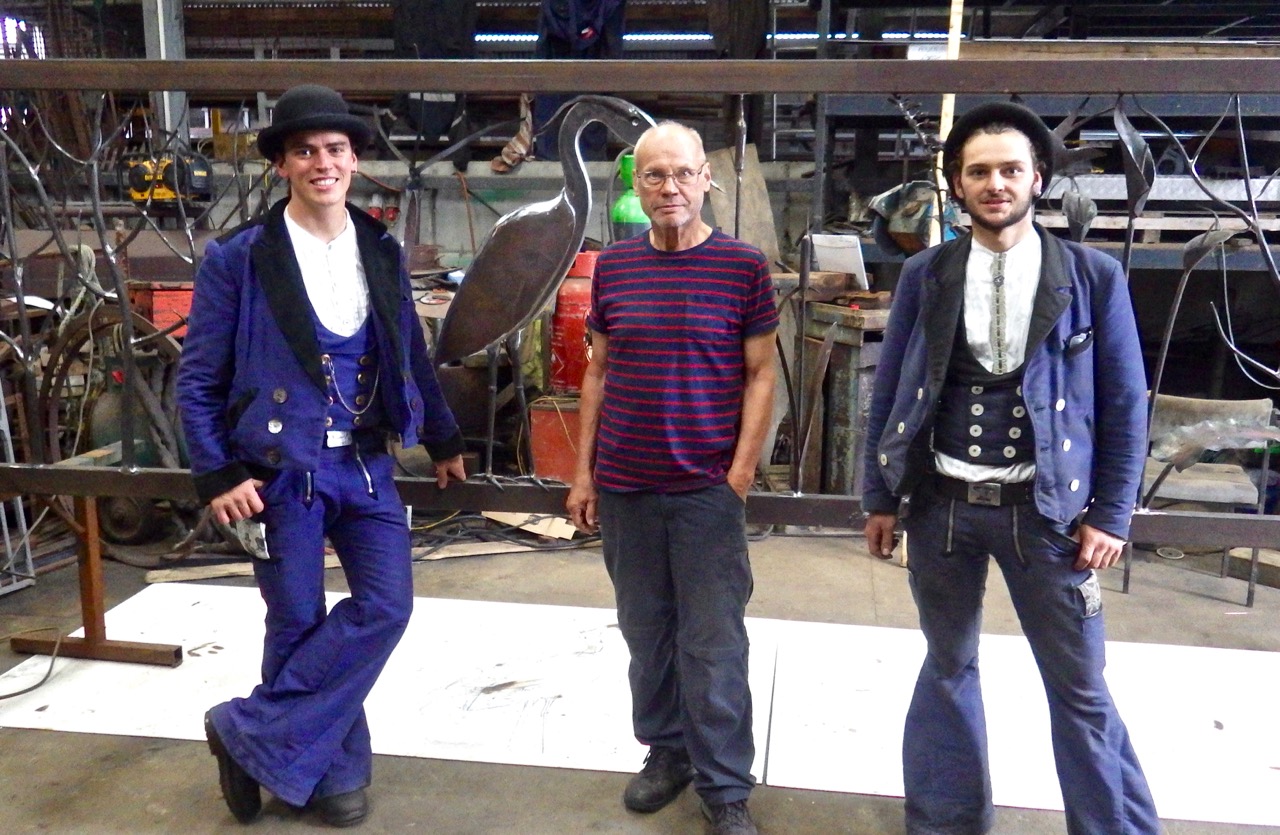
Here are the two Journeymen who travelled the west of Ireland’captured’ by photographer Inese MJ – she came across them in her local supermarket! I am very grateful to Inese for allowing me to use her excellent photograph which comes from her own blog, here.

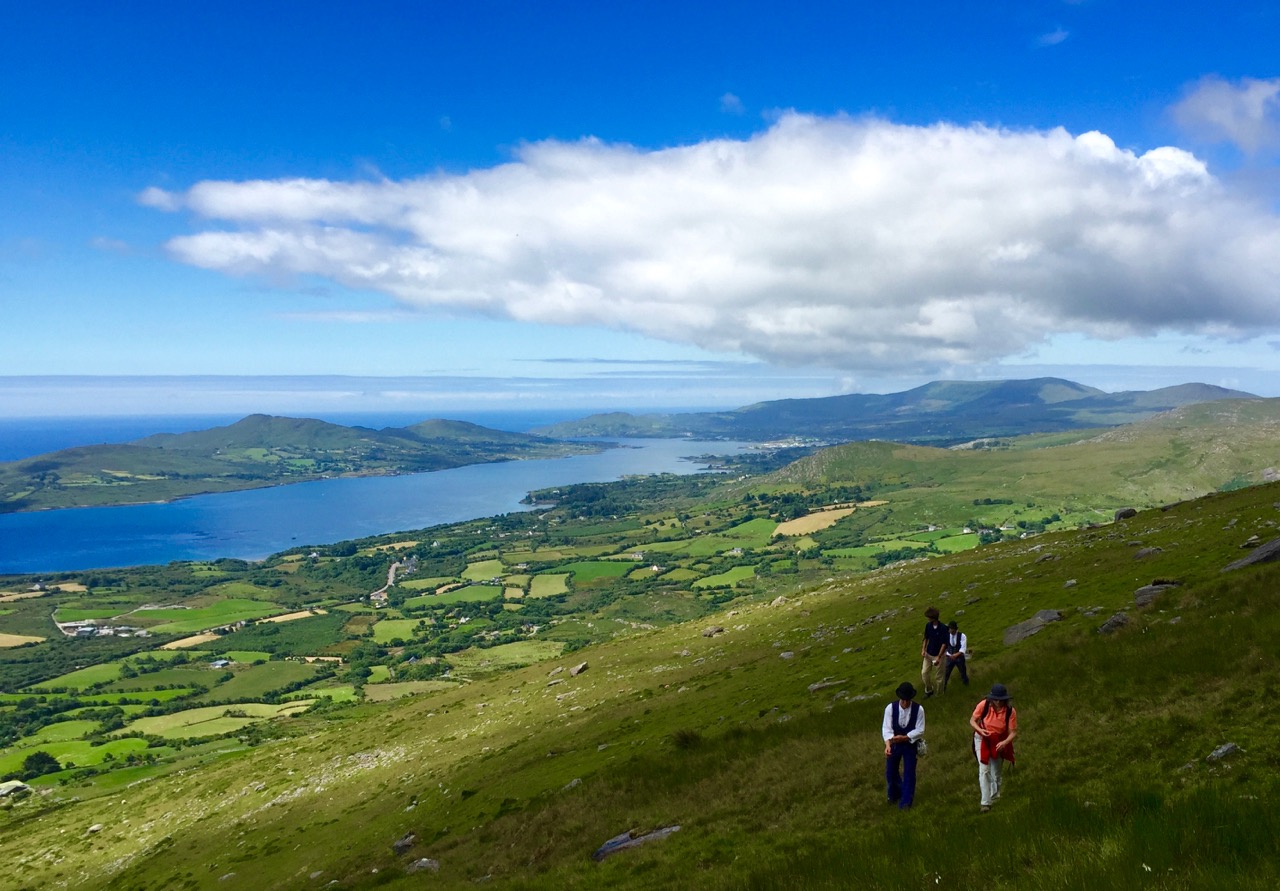
The tradition of the Journeyman Brotherhood is centuries old, originating in the Craftsmen Guilds of Europe during the Middle Ages and it is still practiced. In the past every young craftsperson who aspired to be a Master was, following his apprenticeship, required to leave home and not return for three years and a day. They had to stay at least 50 km away, but the journeys of the more adventurous candidates involved crossing oceans and continents. Simon and Benjamin – seen in the top picture after an exploratory climb to the summit of Hungry Hill on the Beara Peninsula – are from Munich and Frankfurt. They are wearing the uniform of their trade, known as the Kluft: this is how they are required to dress during their travels. The number of buttons on their waistcoats show the number of hours in a day they expect to work – in this case eight. When they leave home they have only a token sum of money each, and they must return with the same sum, no more. The purpose of the journey is not to seek their fortune, but to improve their knowledge and skills and give them a rich life experience, preparing them for becoming masters of their craft. It is a prerequisite that Journeymen cannot set out unless they are unmarried, childless and debt-free.

Left – a typical Charlottenburger used to carry the Journeyman’s possessions. Right – group of three in Germany looking for their preferred mode of transport

Other traditions which have to be observed by the true Journeymen include carrying only the most basic possessions with them: clothes to work in and the tools of their trade. These are wrapped in a small blanket, 80 cm square, known as a Charlottenburger. They also often carry a crooked walking stick, called a Stenz, which they have made themselves. Mobile phones are not allowed! Notably, Journeymen usually have gold bracelets and earrings: these may be pawned or sold, but only in cases of dire emergency… I learned that the earring tradition refers back to a time when each apprentice had a nail hammered through his earlobe to mark that he had reached the stage of his apprenticeship which allowed him to go out into the world and remain a stranger until he had completed his journey. Some sources suggest that the term Journeyman comes from the French Journée, meaning ‘journey’ – but this is not correct. Journée means ‘day’ in modern French, but its medieval root is the latin diurnata, which in fact means ‘a day’s work’ or ‘a day’s travel’.

Journeymen surrounded by the tools of their trade in the forge at Lowertown

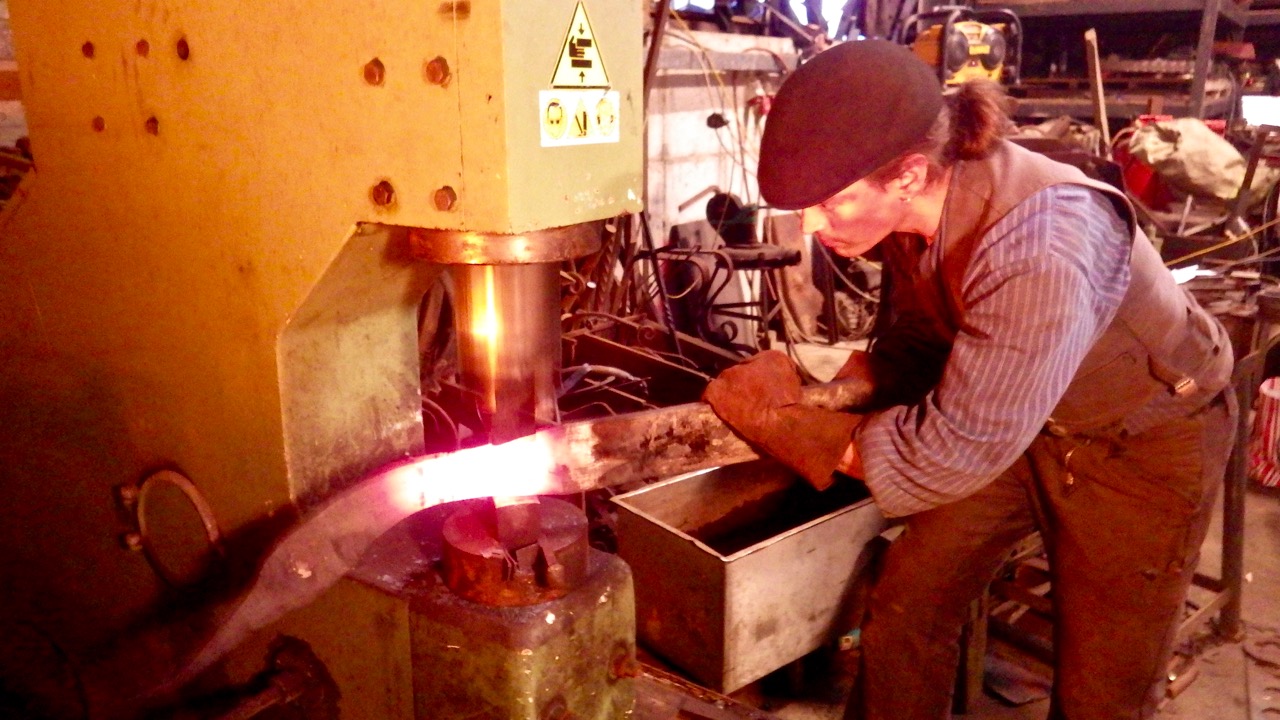
Simon and Benjamin were fortunate that in Ballydehob they bumped into our neighbour Dietrich: although he and Hildegard have lived here for much of their working lives they were brought up in Germany and were aware of the Journeyman tradition. They immediately found a project for the two young blacksmiths: constructing a new gate for their entrance. John Joe Bowen of the local forge at Lowertown was very helpful in allowing a space in his workshops for the boys to set to work.

blank canvas

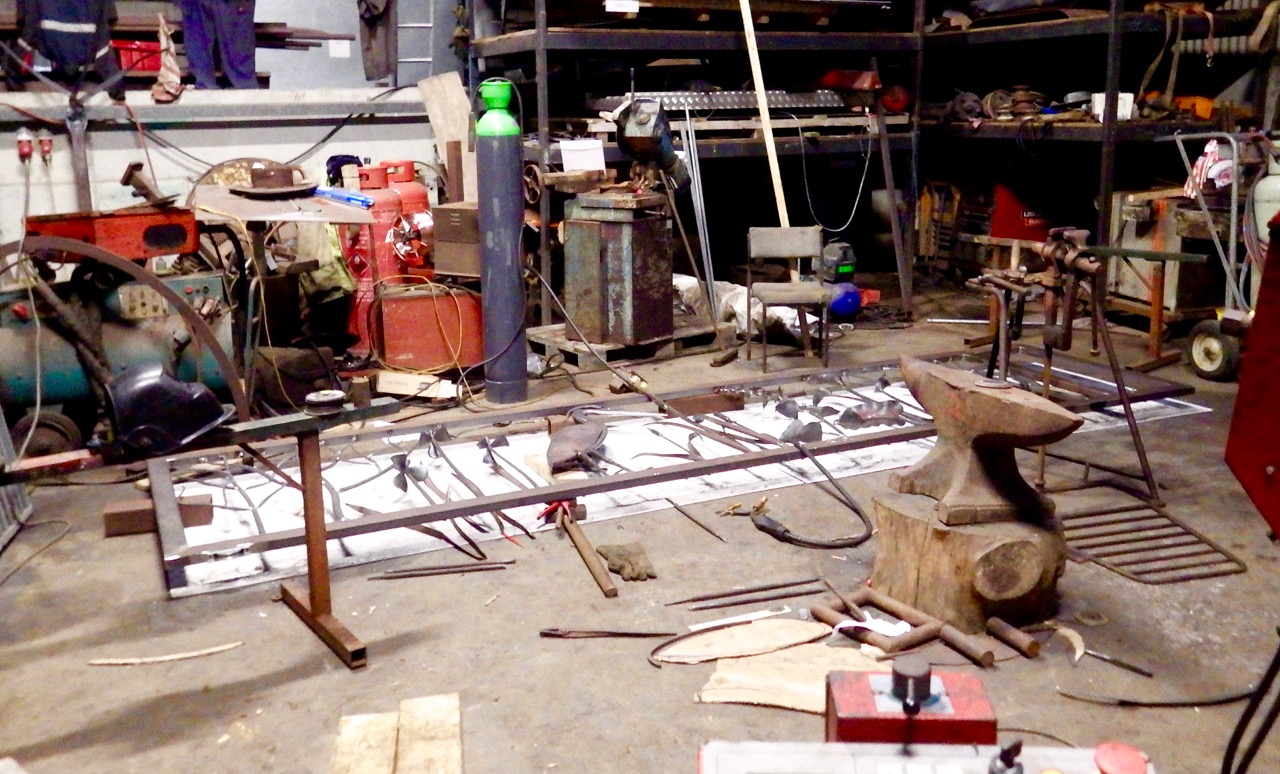
The process. Top – blank canvas: laying the full-size design out on the workshop floor. Above – learning from real life: how to fabricate a metal foxglove

We followed reports of the gate-making process with great interest, but were not allowed to see the completed design until the ‘official unveiling’. Dietrich and Hildegard recorded the various stages and have most kindly allowed me to use their photographs of the construction process (and the hike up Hungry Hill) reproduced here.

hammering

making the heron

From design to reality. Top left – Hildegard supervising the assembly and – top right – her design concept drawings. Above – a metal heron takes shape

The gate is a masterpiece. Made in West Cork, it reflects the environment of the place. It’s elegant, and unique. Although it appears complex, it is very understated: I think Dietrich and Hildegard have perfectly summed up the zeitgeist of our own time here in our small townland. Its inspiration is in nature, yet it is a technologically up-to-date piece of fine engineering.

piecing it together

on the floor

sanding the gate

dietrich, journeymen and gate

The construction process, and Dietrich and ‘The Boys’

We were privileged to be at the ‘launch party’. I have never been to a formal gate opening before! Dietrich cut the ribbon and then revealed the finished product to our eager eyes. This work must surely have been the highlight of the travels of these Journeyman from afar: they learned so much about observation and the translation of ideas into practical form.

the gate

Benjamin and Simon were not at the ‘launch’; they were already far away, continuing with their travels and their education. But they must carry with them good memories of the West of Ireland. Good luck to them both!

on hungry hill

Experiencing beautiful West Cork – the Beara Peninsula, summer 2016