We have a major new player in the arts scene in West Cork. Over the last couple of years, Cnoc Buí (cnoc buí – yellow hill) Arts Centre in Union Hall, has quietly established itself as a significant focus for the arts. I have attended several exhibitions there, always marvelling at the space, the light, the curation and the excellence of the art on exhibit. Here’s the list for 2024, although it doesn’t include the current exhibition, and that’s the one I want to write about today.
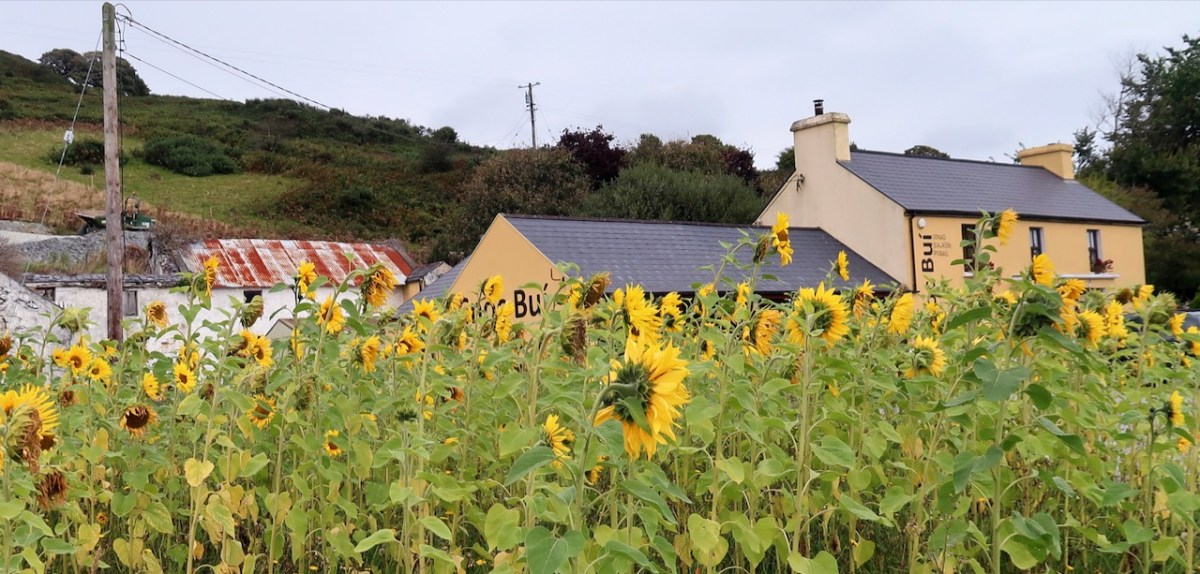
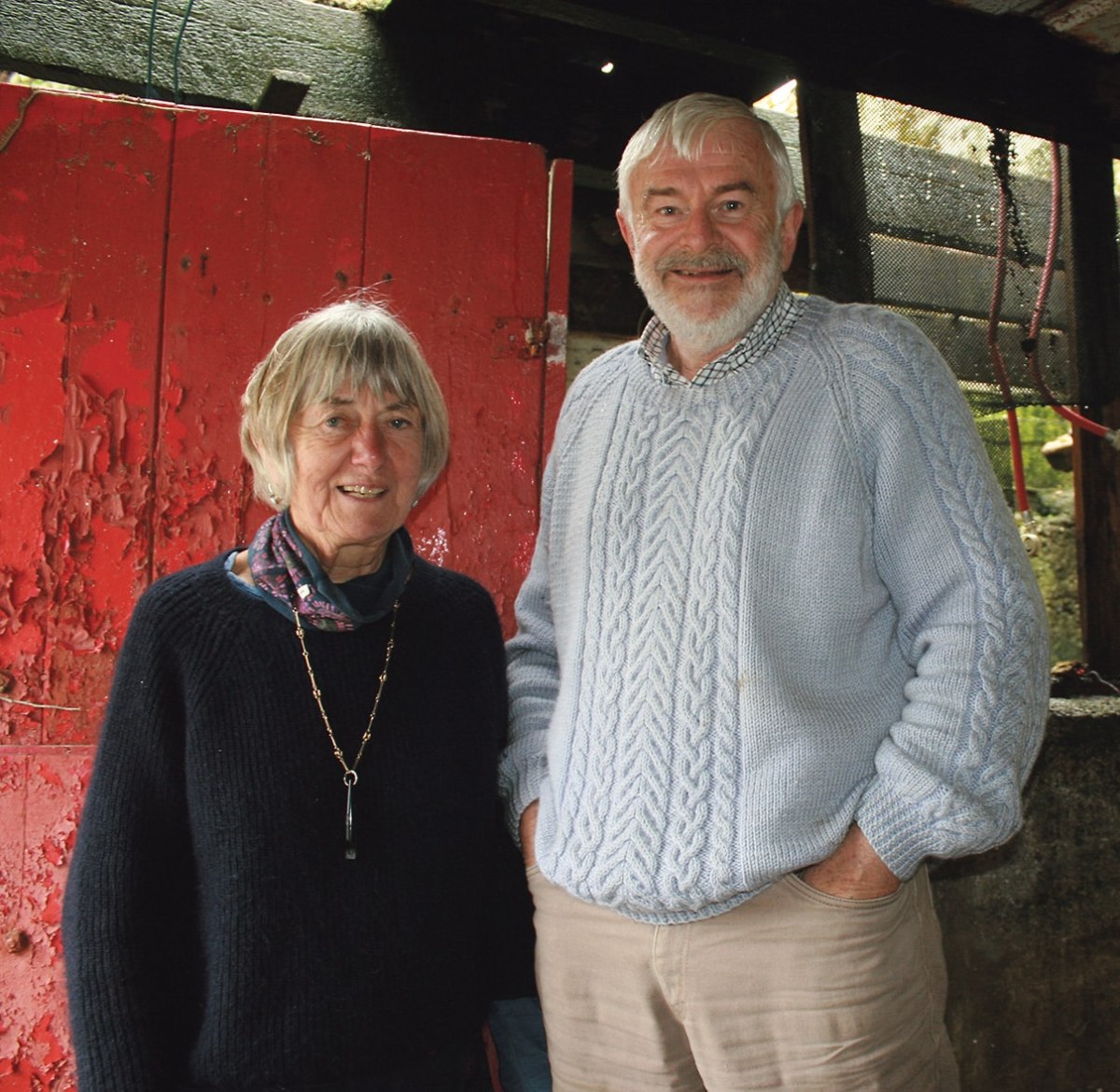
First of all, a little about Cnoc Buí itself (photo above by Amanda Clarke). As the name suggests, it’s a yellow house, beside the sea in in Union Hall, renovated and fitted out for the arts. It’s the brainchild of Paul and Aileen Finucane, who have come to live in Union Hall permanently, after owning a house here for forty years. Passionate about art, and avid collectors, they are ‘giving back’ in the most magnificent way possible through their philanthropic efforts. Read more about them and Cnoc Buí in this story from the West Cork People. (Photo below courtesy of the West Cork People.)
Those of you not living in West Cork – you have no idea how rare it is to come face to face, in your own backyard, with the great Irish artists of the 20th century. Normally we have to go to Dublin, to the National Gallery, or the Hugh Lane.
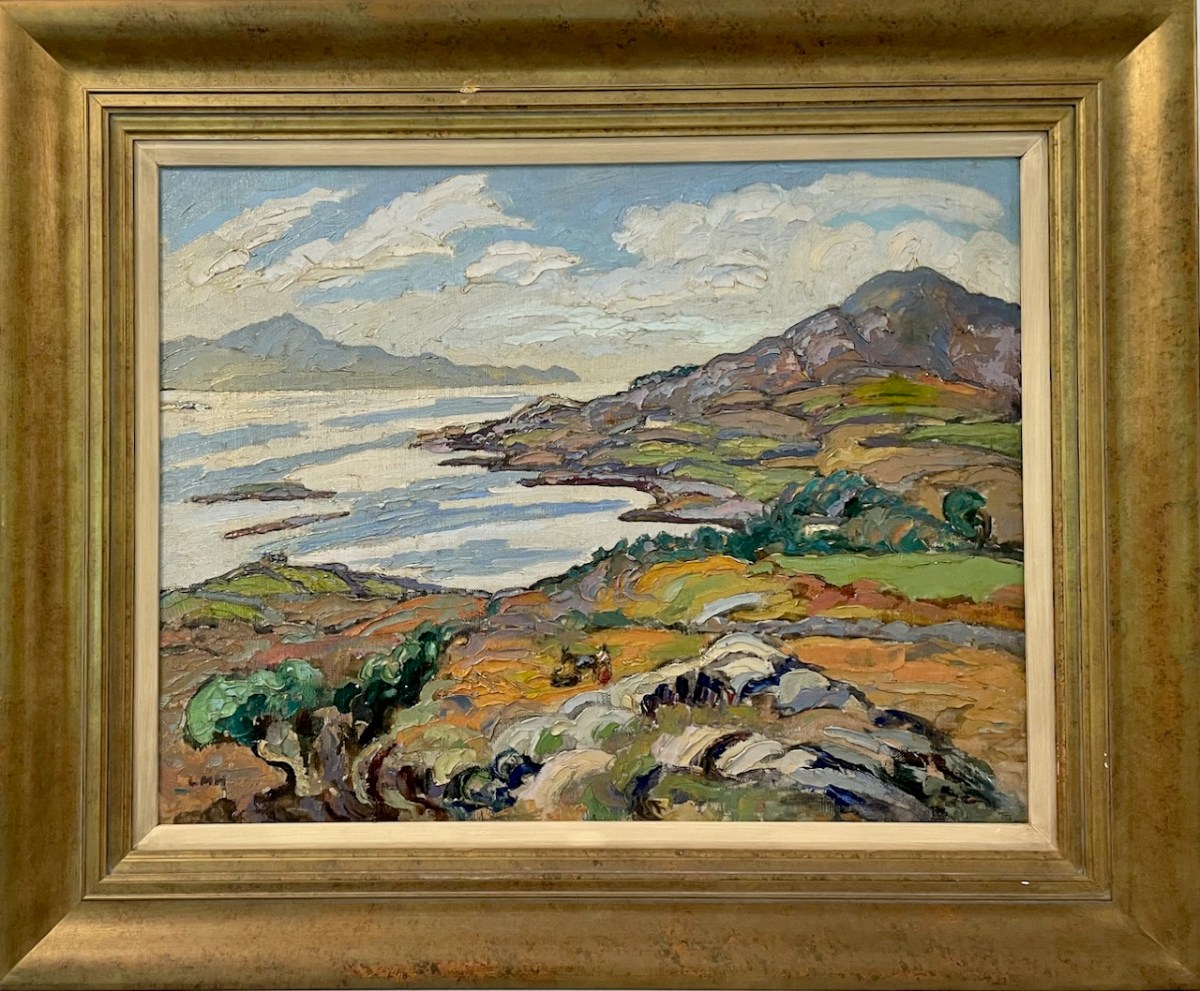
Ahakista by Letitia Hamilton
I often get my fix from the wonderful Facebook Page 20th Century Irish Art, and I have come, thanks to that source, to recognise many of the names and styles of our leading artists.
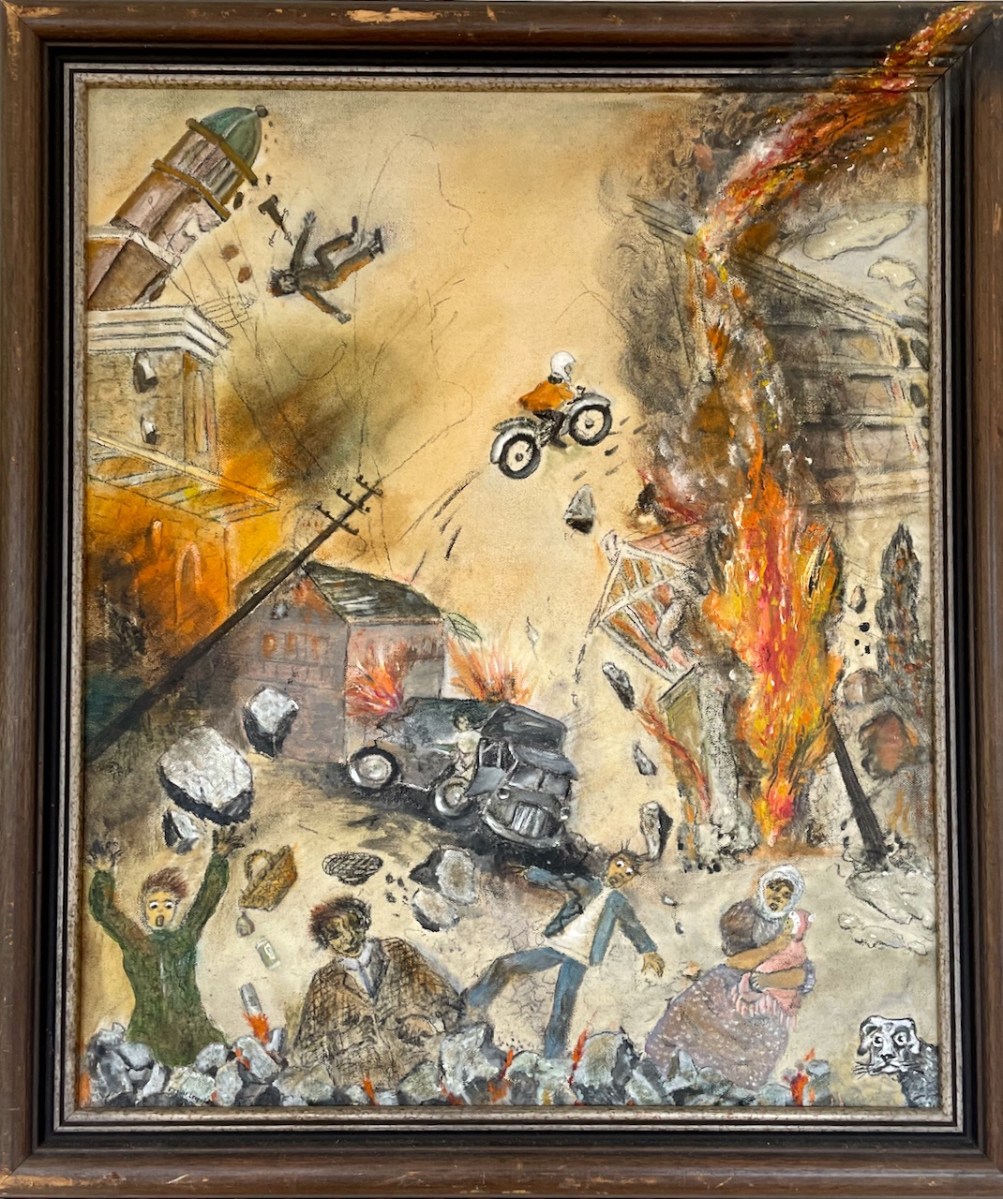
Phyllis Leopold’s The Belfast Blitz
The only other comparable experience I have had here in West Cork was with the Coming Home expedition in 2018. Don’t get me wrong – I love 21st century art and we have SO many excellent artists and great venues here in West Cork, and we have written about and reviewed many, many shows. Remember The Souvenir Shop? Rita Duffy is here as well.
Kathleen Fox, Still Life with Bust
This show emphasises Irish women artists – over half of the pieces are by women. We are all rediscovering the superb women artists who were in the shadow of famous husbands (Grace Henry, Margaret Clarke) or unjustly neglected (Kathleen Bridle, Hilda Roberts, Gladys Mccabe), better known as stained glass ‘craftswomen’ (Evie Hone, Sarah Purser, Olive Henry, Kathleen Fox), written off as mere ‘Illustrators’ (Norah McGuinness), or who were even actively discriminated against by the male establishment and dominating figures like Sean Keating. Some are getting the last laugh now – there’s a new exhibition opening now in the National Gallery devoted to Mildred Anne Butler, who is represented in this exhibition.
Olive Henry is more familiar to me as a stained glass artist, so I was delighted to see this fine portrait
But it was women who led the Irish art world into the modern era: The Irish Exhibition of Living Art was founded by women who had been able to afford to go abroad to study and had picked up newfangled ideas on the continent – women like Evie Hone and Mainie Jellett. Young artists flocked to their exhibitions, while the old guard stuck to their conservative, academic forms – echoed, of course, in the suppression of women and modernism in the new Irish State.
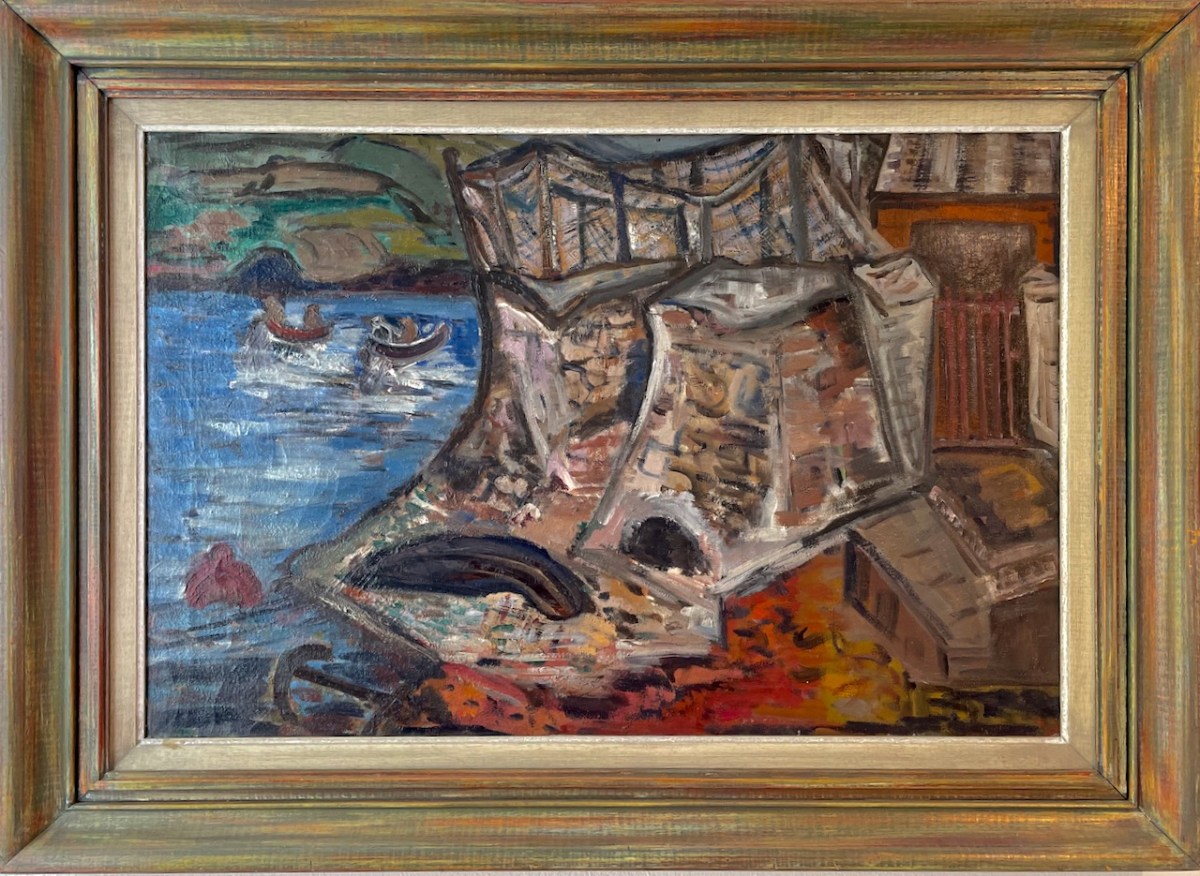
Evie Hone, Drying Nets – The Harbour Wall, Youghal
But here they all are, in Union Hall! The pioneering, courageous, persistent, driven, women of the new State.
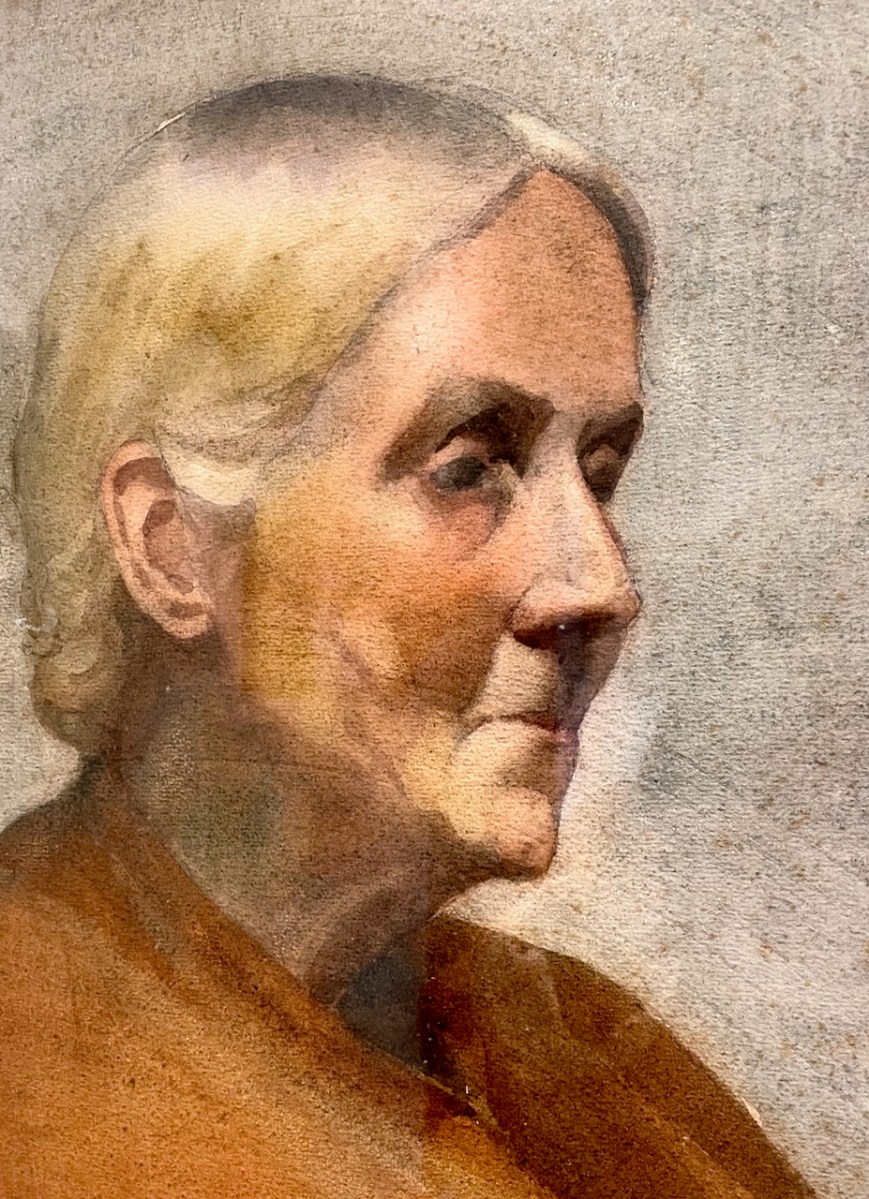
Portrait by Hilda Roberts
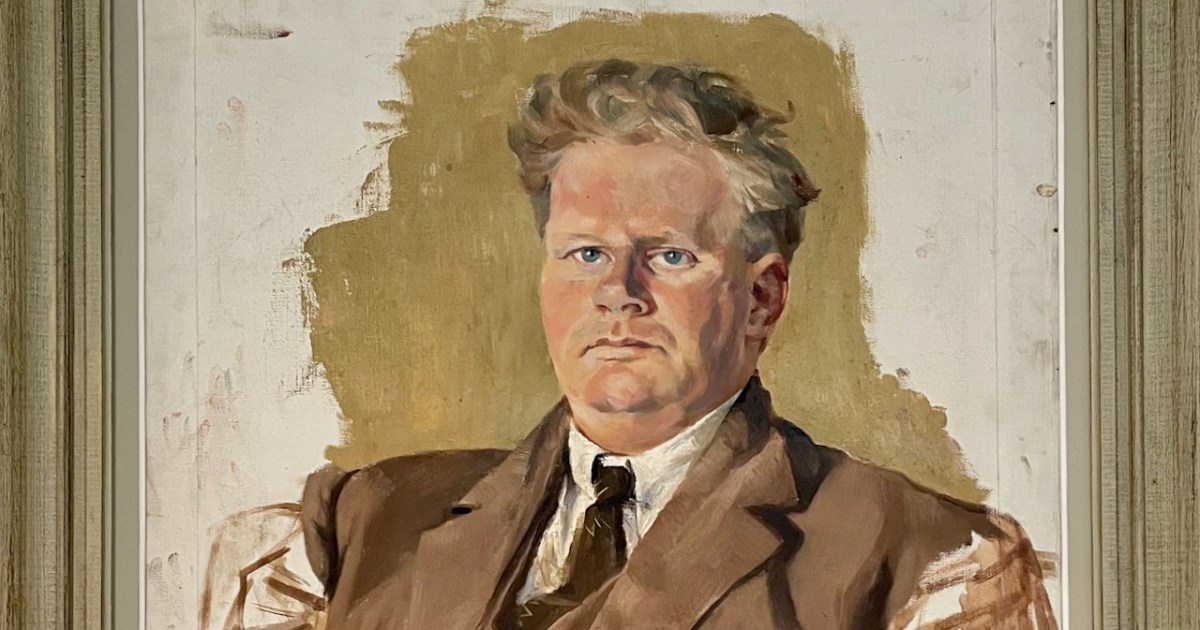
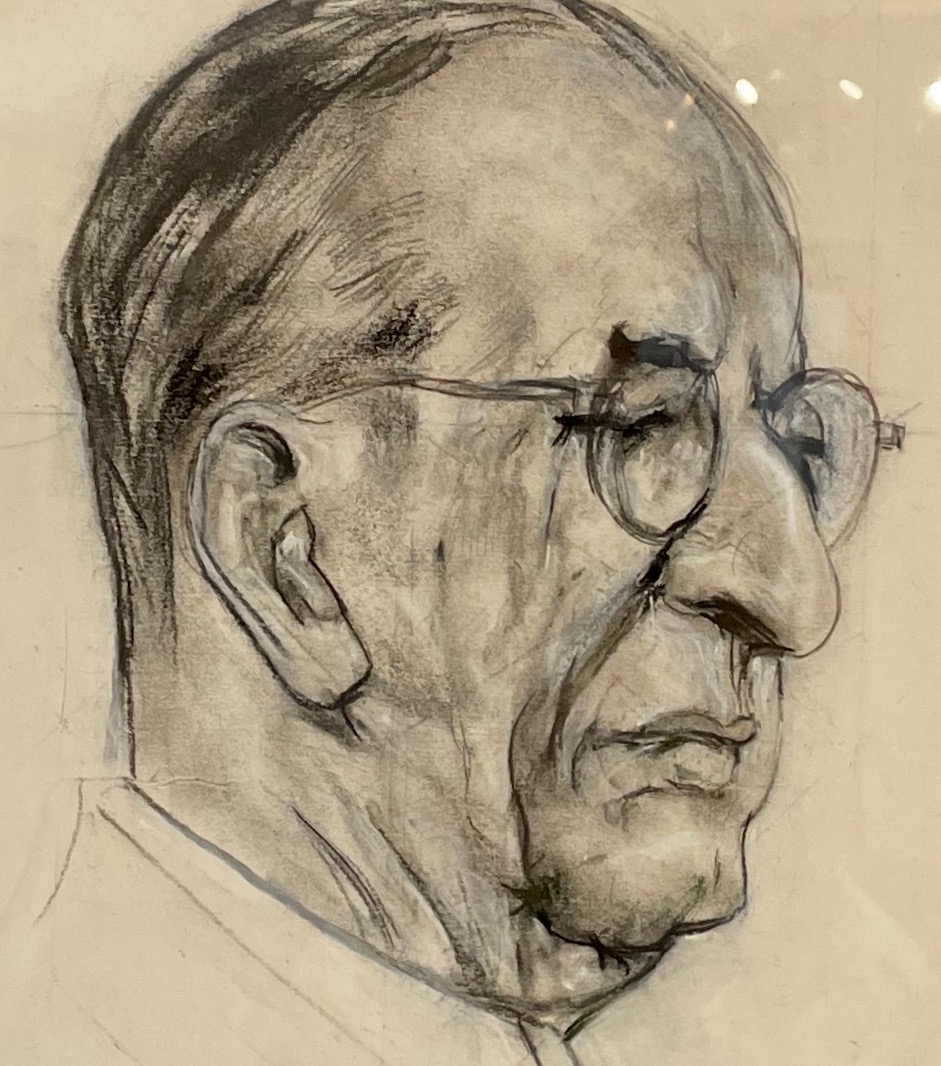
There are lots of men here too, of course – even Sean Keating, with a marvellous charcoal portrait of deValera. Did they grumble together about the goings-on over at the IELA?
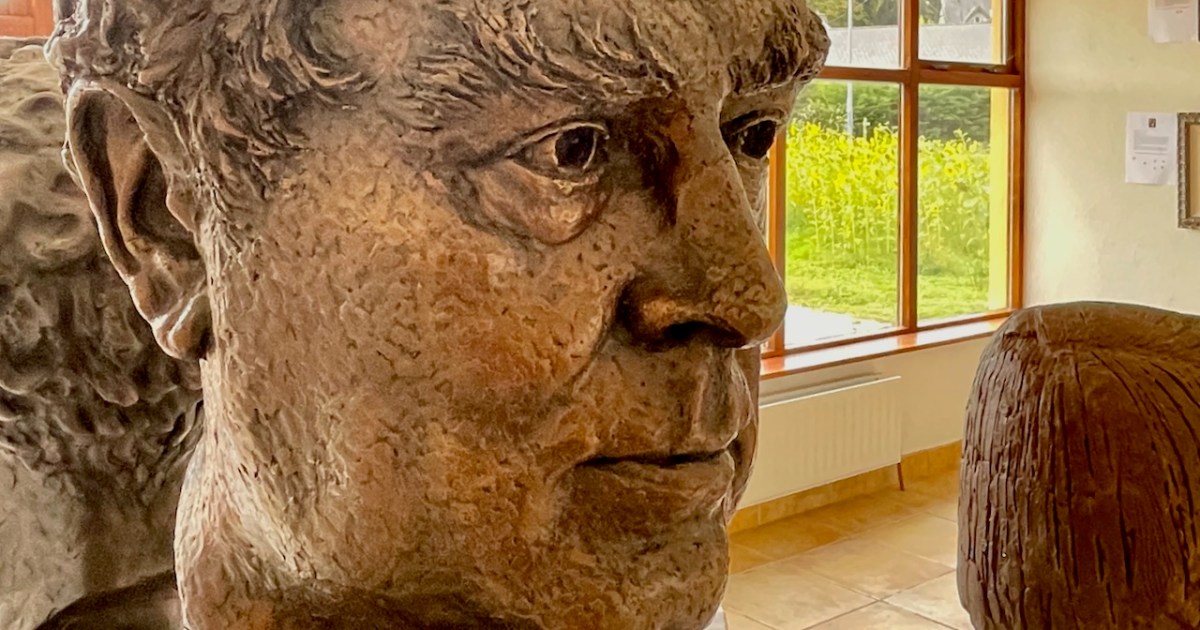
John Sherlock was new to me and a great discovery – I have used his bust of John Hume as my lead image.
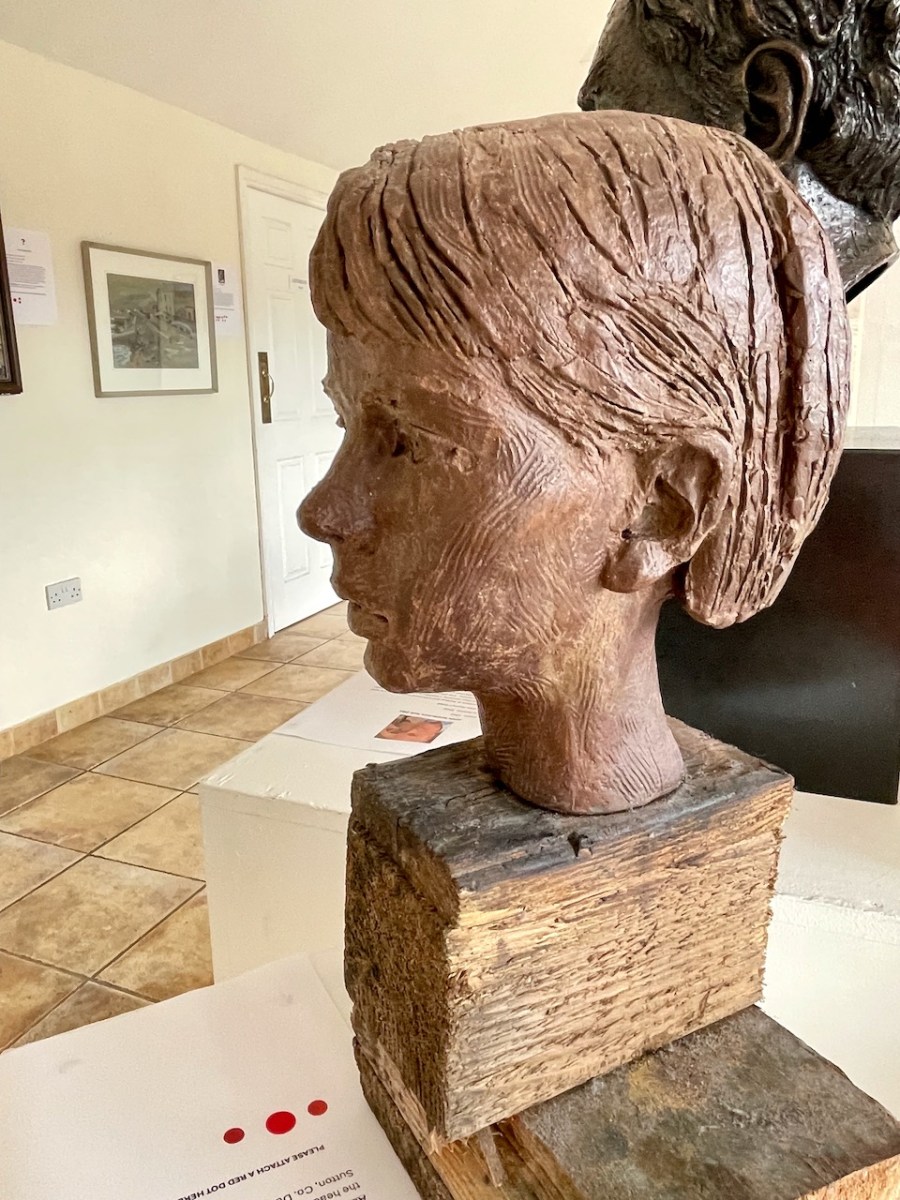
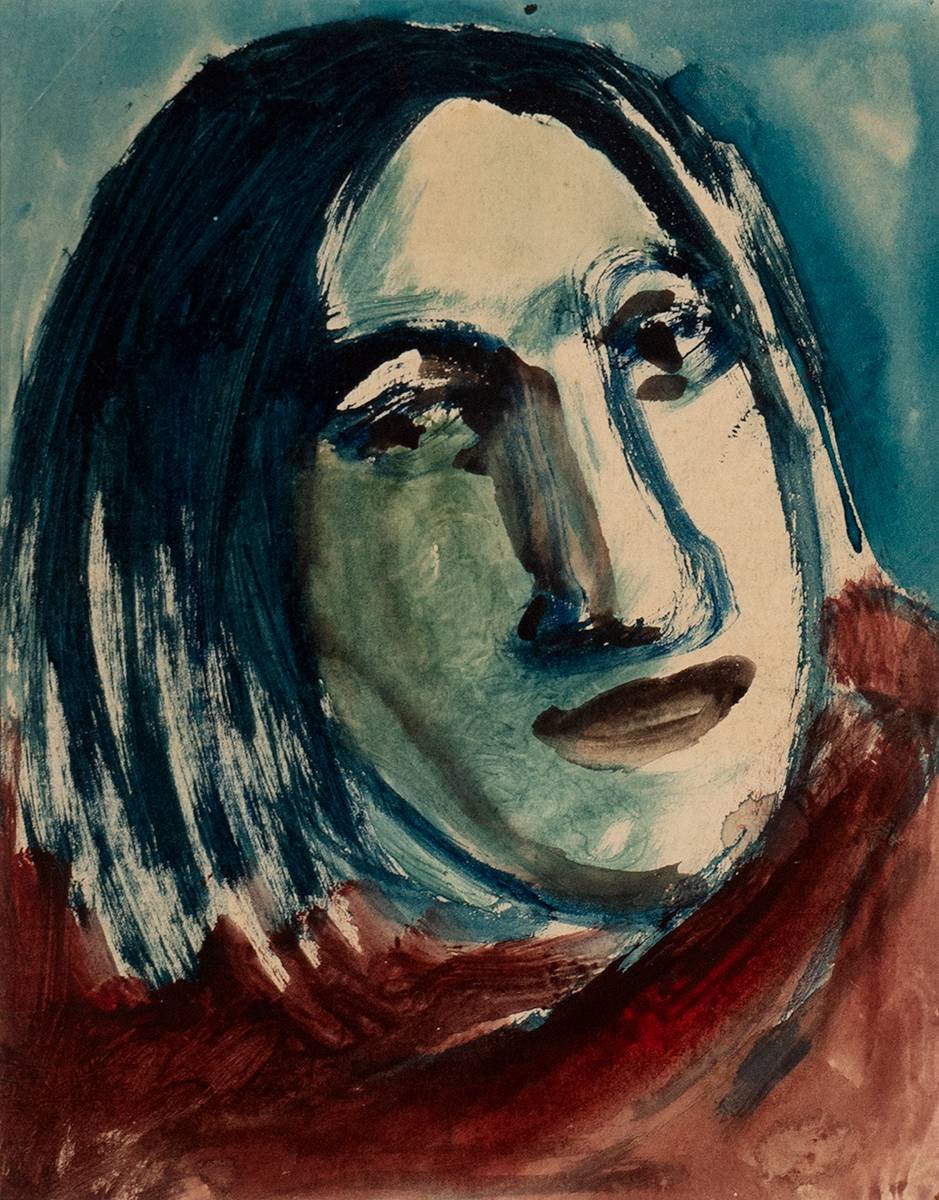
Oisín Kelly (above, Bust of a Young Girl) is a personal favourite, and I have mentioned Thomas Ryan in another context: he is also, perhaps, under-appreciated. George Campbell, despite designing windows for Abbey Studios in the 60s and 70s, never got written off as a stained glass craftsman. The portrait (below) is of his mother, Greta Bowen, who only began painting at 70 and exhibited well into her 90s.
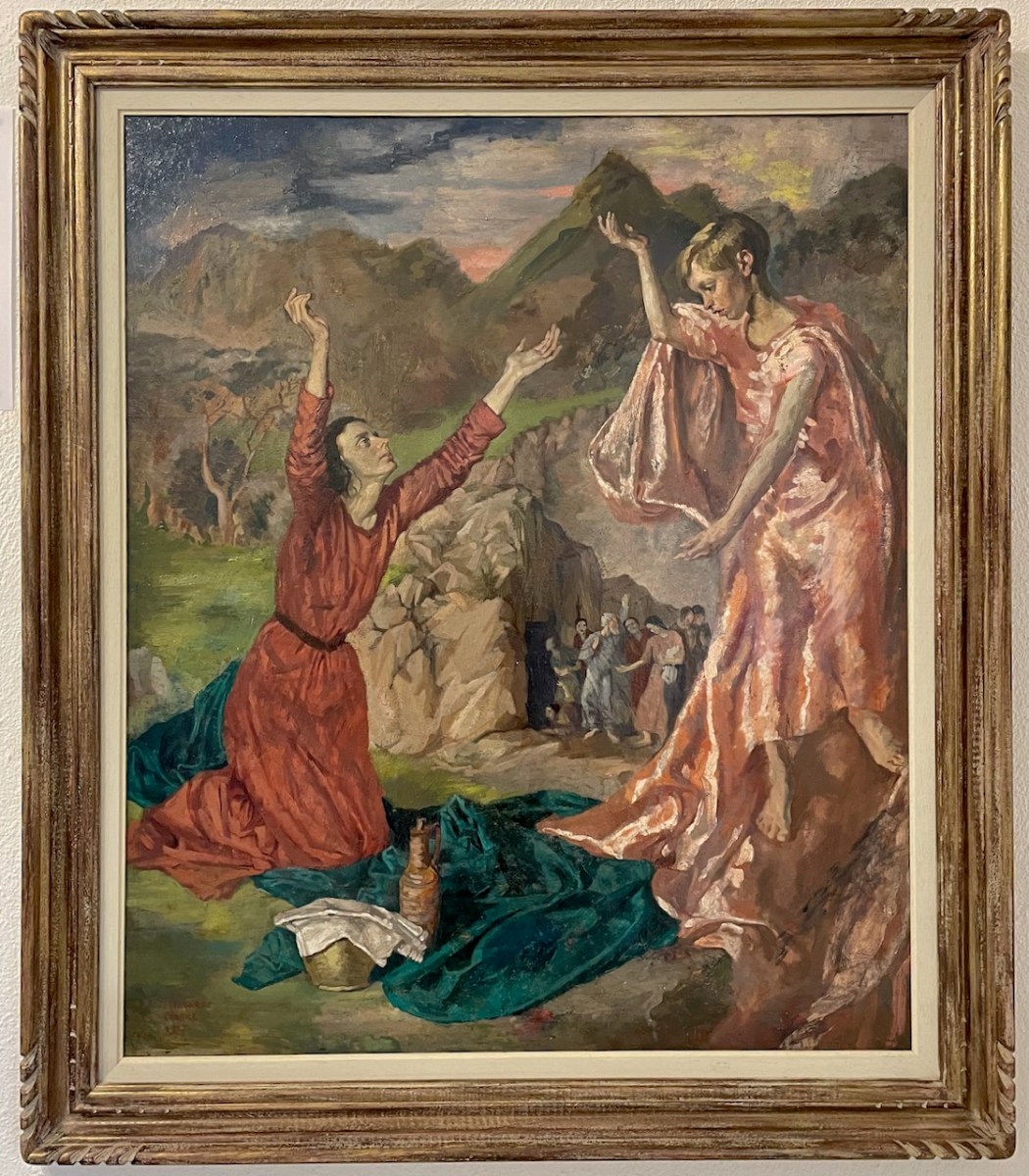
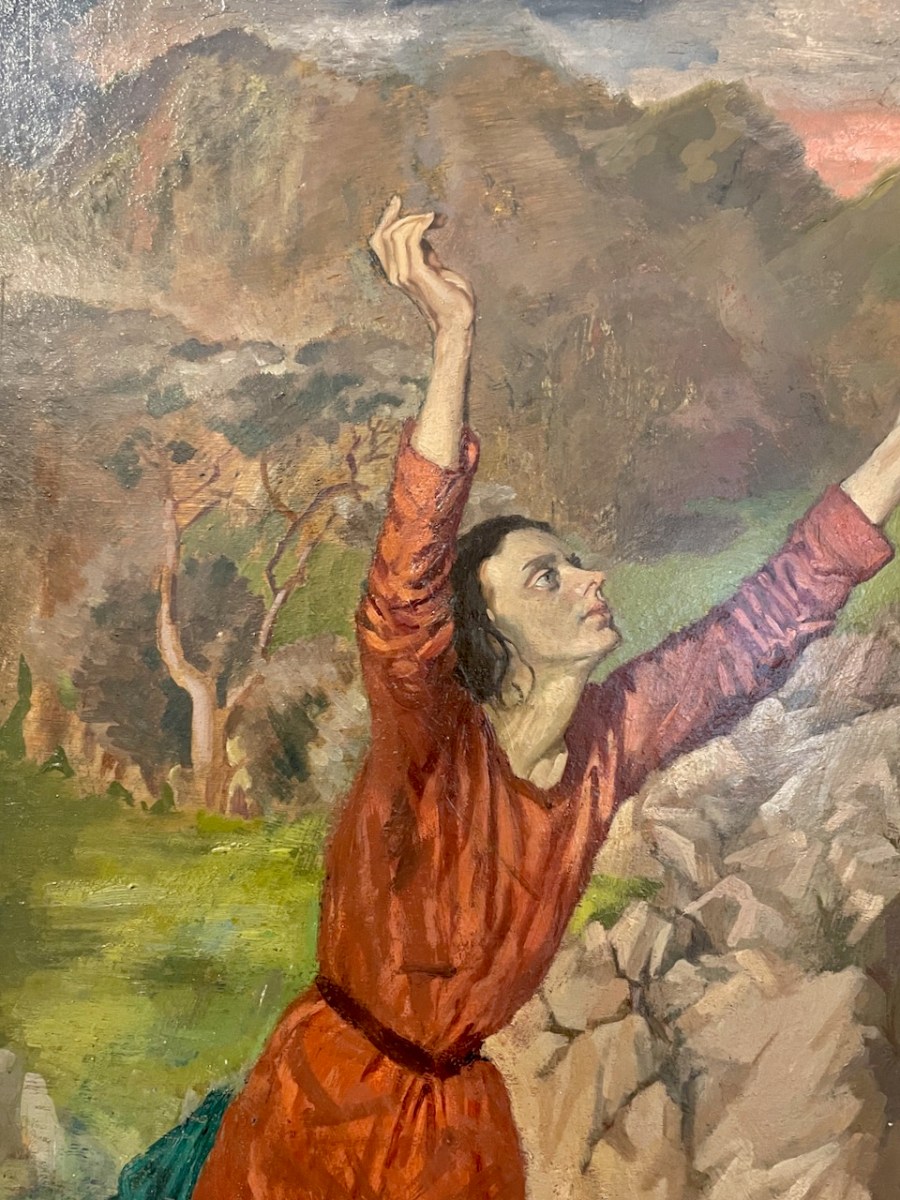
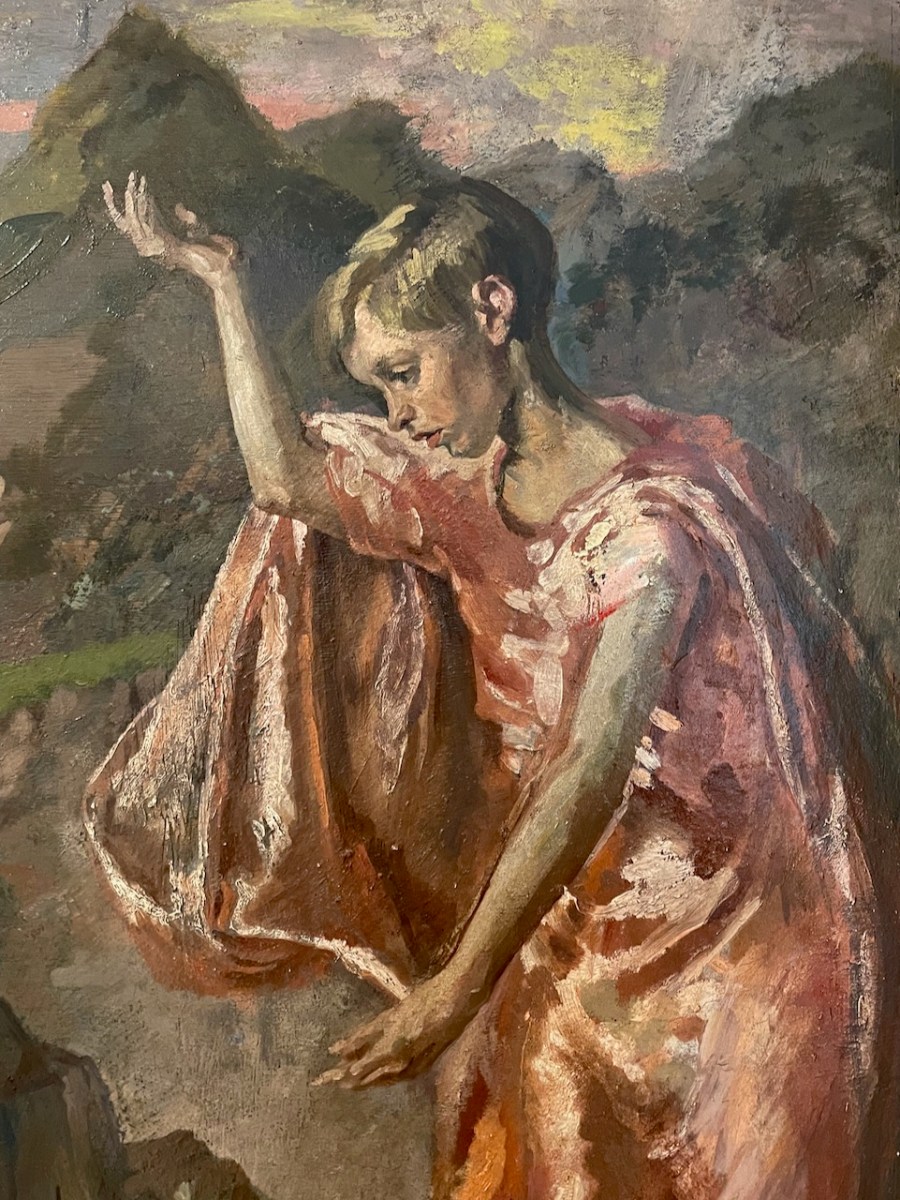
I recognised this painting, Mary Magdalen (below) as a Margaret Clarke right away, even though I had never seen it before.
It’s that combination of exact portraiture (I am willing to bet the angel was based on one of her children), the haunting expression in the eyes of Mary Magdalen, and the way the gestures mirror the scenery and shrubbery behind the figures.
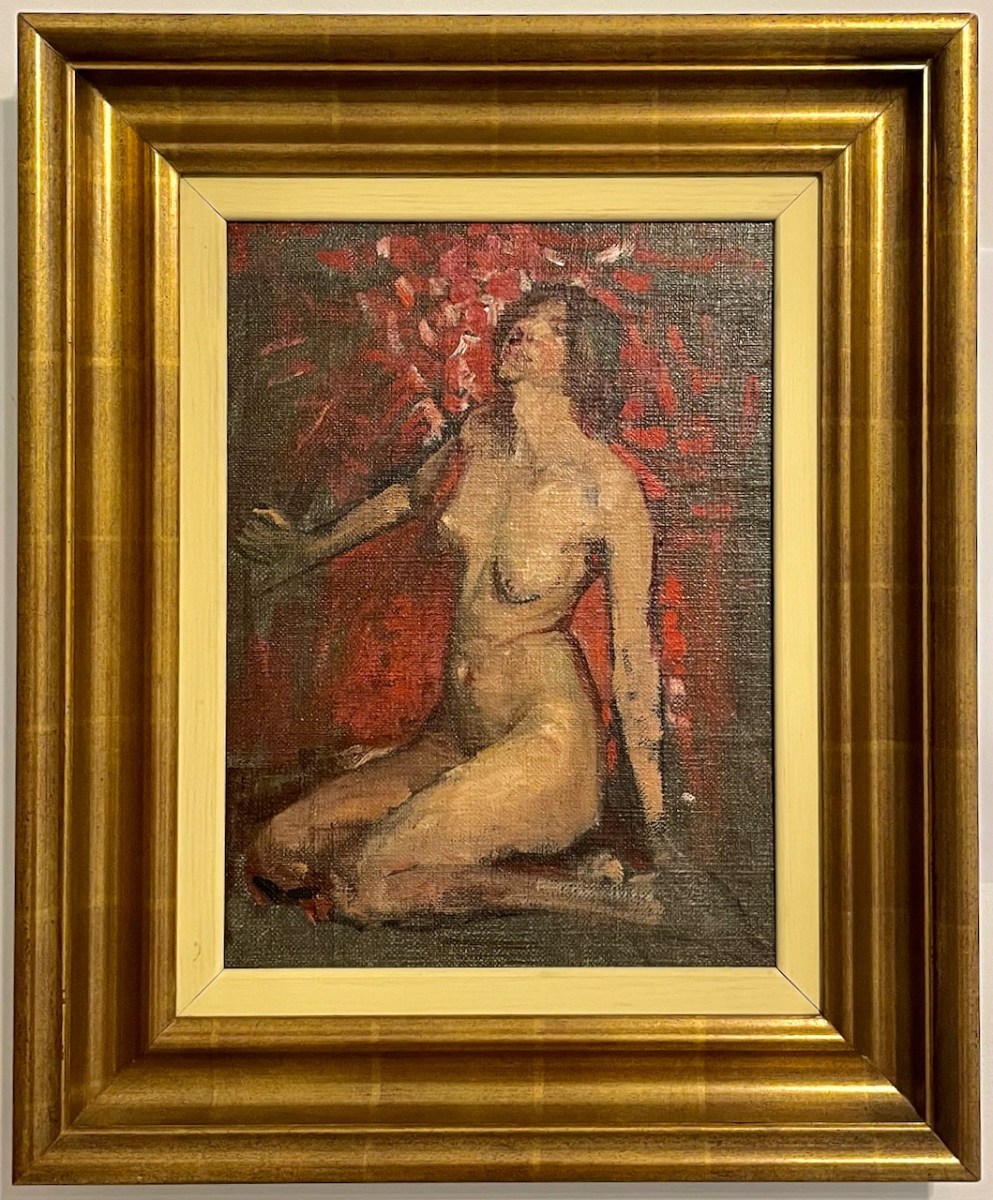
The Sarah Purser is interesting on a number of fronts. Purser made her name with portraiture, using her connections to obtain many commissions – she herself said she went through the British nobility ‘like the measles.’ But this nude (below) is of Kathleen Kearney, ‘Mother of All the Behans’, who worked for Purser as a young (and very beautiful) woman. Sarah Purser’s many talents (she was a superb manager of An Túr Gloine Stained Glass Studio among many other things) are currently on full display at the Hugh Lane Gallery.
I have only given you a flavour of what’s in this exhibition. If you can, get down to Union Hall and take a wander through it yourself. If you get there on a weekend, the charming Nolan’s Coffee House will be open.
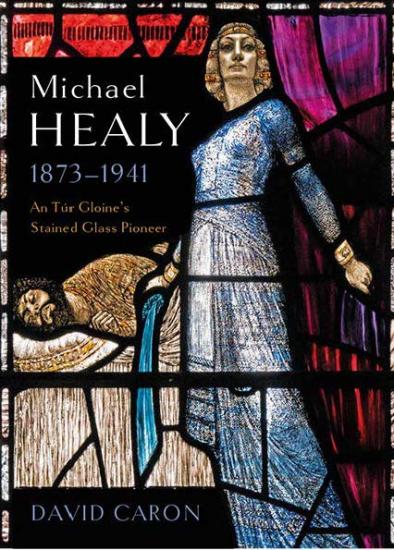
This book – MIchael Healy: An Túr Gloine’s Stained Glass Pioneer – is nothing short of a miracle. It’s beautifully written by David Caron, with superb photography mainly by Jozef Vrtiel, and outstanding production values by Four Courts Press. But a miracle? Yes – because David Caron uses his scholarship and knowledge of stained glass as well as the history and art movements of the period to produce an immensely readable book about an intensely private man who left behind practically nothing about his life except his magnificent work.
I will declare an interest right away – David Caron is a friend and mentor, editor and principal writer of the Gazetteer of Irish Stained Glass, to which I am one of the contributors. I have been looking forward to this book for a long time, as have all his friends, colleagues and collaborators. It was launched to great acclaim in Dublin on November 1 – all the available copies were snapped up at the launch, including mine (stowed behind the desk), so I had to wait until December to get my hands on it.
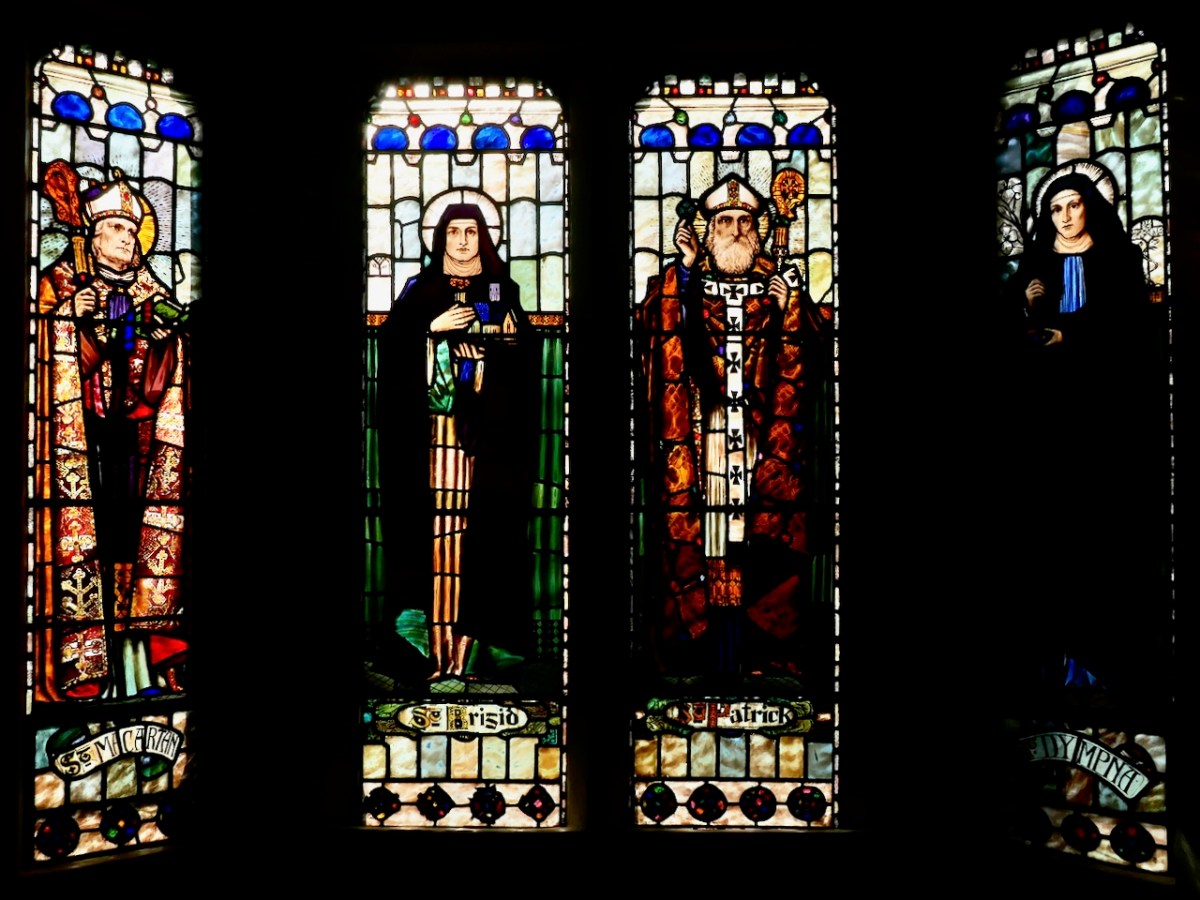
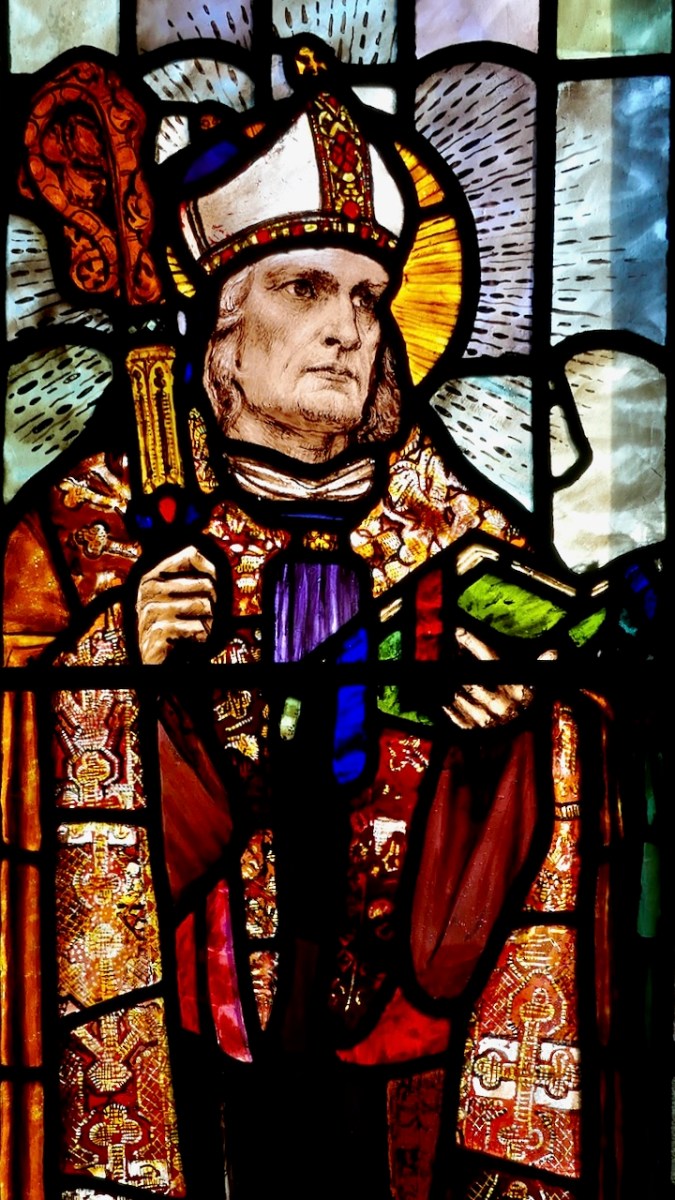
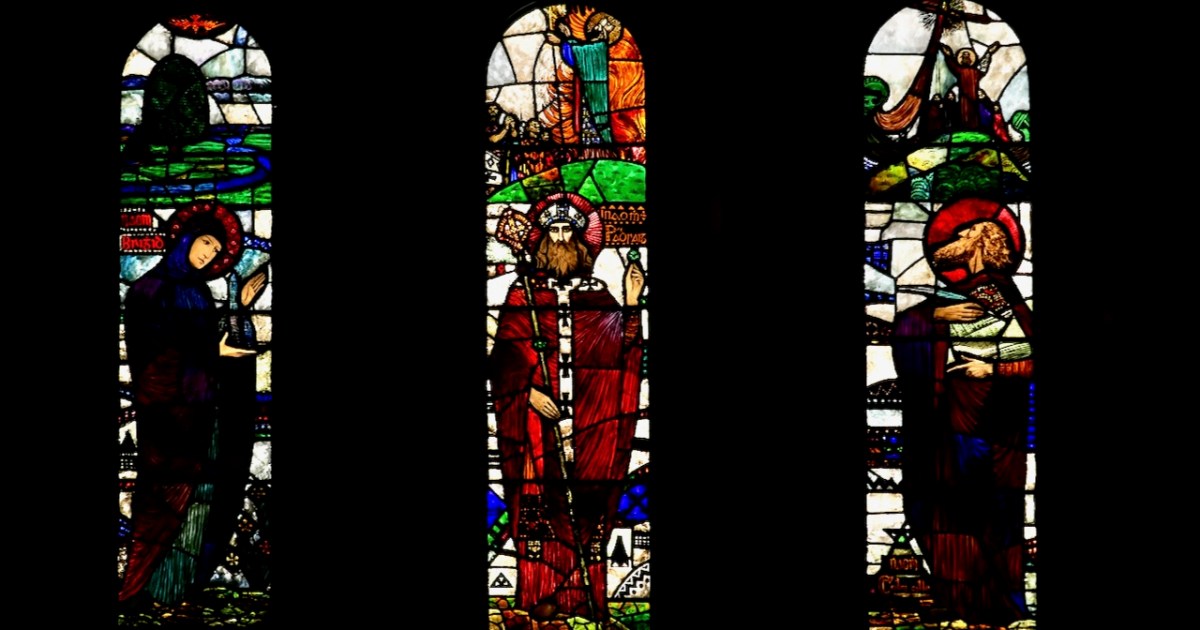
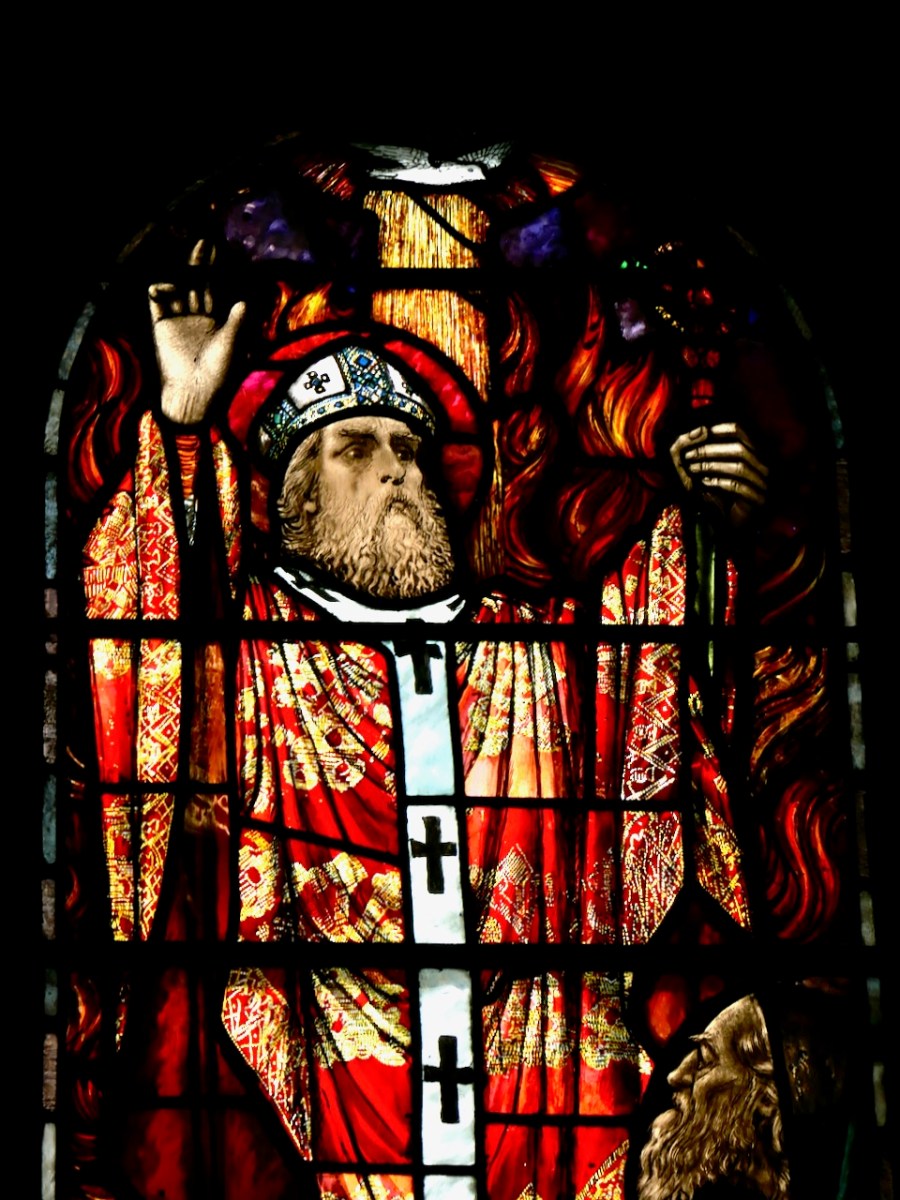
From a private bishop’s oratory, Sts Macartan, Brigid, Patrick and Dympna. Detail of Macartan, below. The rich reds and yellow shading of Macartan’s robes are the result of aciding and silver stain, described further down
All the photographs in this post are my own – but I haven’t seen that many Healy windows, and my photography does not bear comparison with Jozef’s magnificent images. The book is profusely illustrated – it’s one of its many strengths – with many photographs of the tiny details in which Healy delighted and which distinguish his windows from those of other artists. Healy spent all his working life at An Túr Gloine (The Tower of Glass) the Studio founded by Sarah Purser. If you are unfamiliar with this period in Irish stained glass, you might like to read my post Loughrea Cathedral and the Irish Arts and Crafts Movement before continuing.
Born in 1873 into grinding poverty in a Dublin tenement, through a combination of great good luck and his own prodigious talent and hard work, Michael Healy turned himself into one of the foremost stained glass artists of his time. Reading David’s account, it is difficult not to be overwhelmed at times by the hardship endured by Healy and his family in turn-of-the-20th-century Dublin. Packed into one room with miserably inadequate sanitation, whole families succumbed to disease and early death. Consumption was rampant and the only recourse for anything approaching treatment was the dreaded workhouse. Infant mortality rates were high and so we read about several Healy babies who failed to survive into adulthood, as well as adults carried to early graves, leaving widows and widowers to try to cope.
Christ with Doubting Thomas, St Joseph’s, Mayfield, Cork
In the midst of all this was the First World War, the Easter Rising, the War of Independence and the Civil War, followed by the emergence of the new Irish State. David chronicles all of this, and the effect it was having on citizens, like Healy, who were trying to go about their business, but who also had deep convictions about politics and religion.
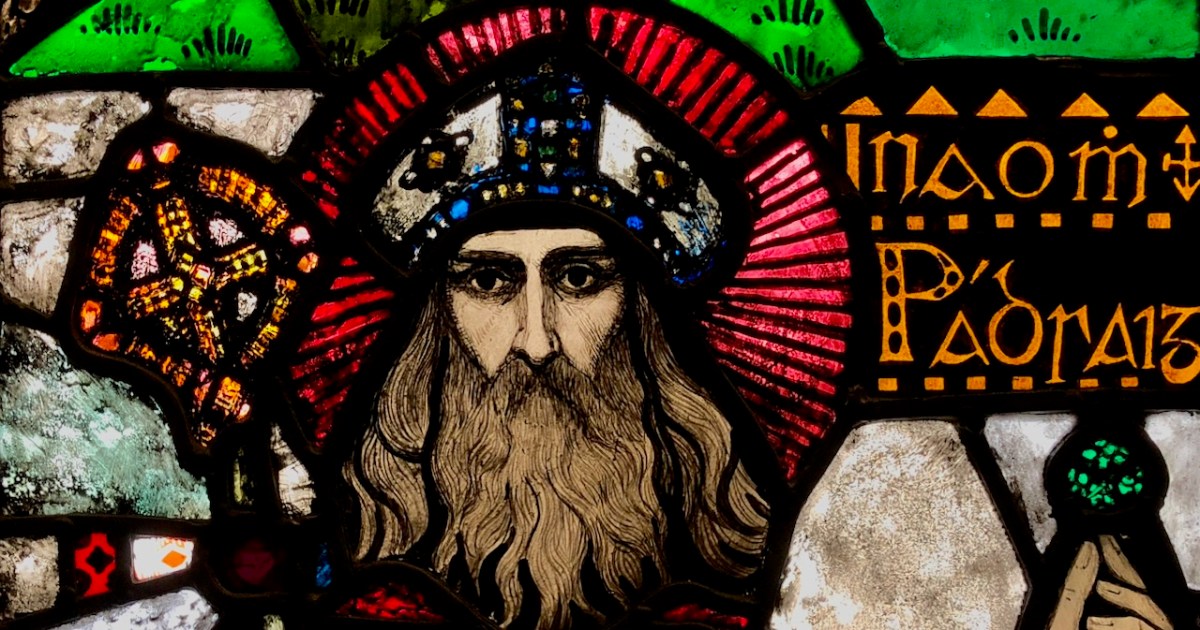
These windows, Sts Brigid, Patrick and Columcille, are in the National Gallery
In some ways, Healy was a typical young man of his time. Deeply religious, he spent some time in a seminary before deciding he was unsuited to the vocation. He belonged to a Catholic men’s lay organisation. David provides many instances where his working class Dublin accent, his republicanism, and his Catholicism must have put him at odds with his fellow artists at An Túr Gloine, mostly female, Protestant and from well-to-do backgrounds. They found him brooding and introverted, although they acknowledged his exceptional talent, and until Evie Hone arrived he did not make true friends with any of them.
The Annunciation, Loughrea Cathedral. This window was closely based on a design by the great arts and crafts stained glass master, Christopher Whall. Whall came over from England to supervise the execution of it by the Túr Gloine artists, including Healy. Celtic revival interlacing was very popular at the time, and a way of putting a nationalistic stamp on a window – note the subtle inclusions of interlacing here and there
I mentioned that he had strokes of good luck in his life, two in particular. One was the patronage of a perceptive priest, Fr Glendon, who enabled him to study in Florence for a period of time and who procured illustration work for him in Dublin. David points out here and there in the text the influence of Italian painters discernible in Healy’s windows, gained from his sojourn in Italy.
Detail of a Patrick window in Donnybrook
The other was that he found lodgings with a landlady, Elizabeth Kelly, and over time they grew close. Eventually, they become lovers and had a son, Diarmuid, together. Although the relationship was never publicly acknowledged (she was married, although her husband left her) it provided both of them with stability and comfort, and Healy was close to his son. In the 30s Diarmuid O’Kelly (although his mother went by Kelly) bought a Ford Model T and he and Michael would go on sketching expeditions up into the Dublin Mountains and out along the canals.
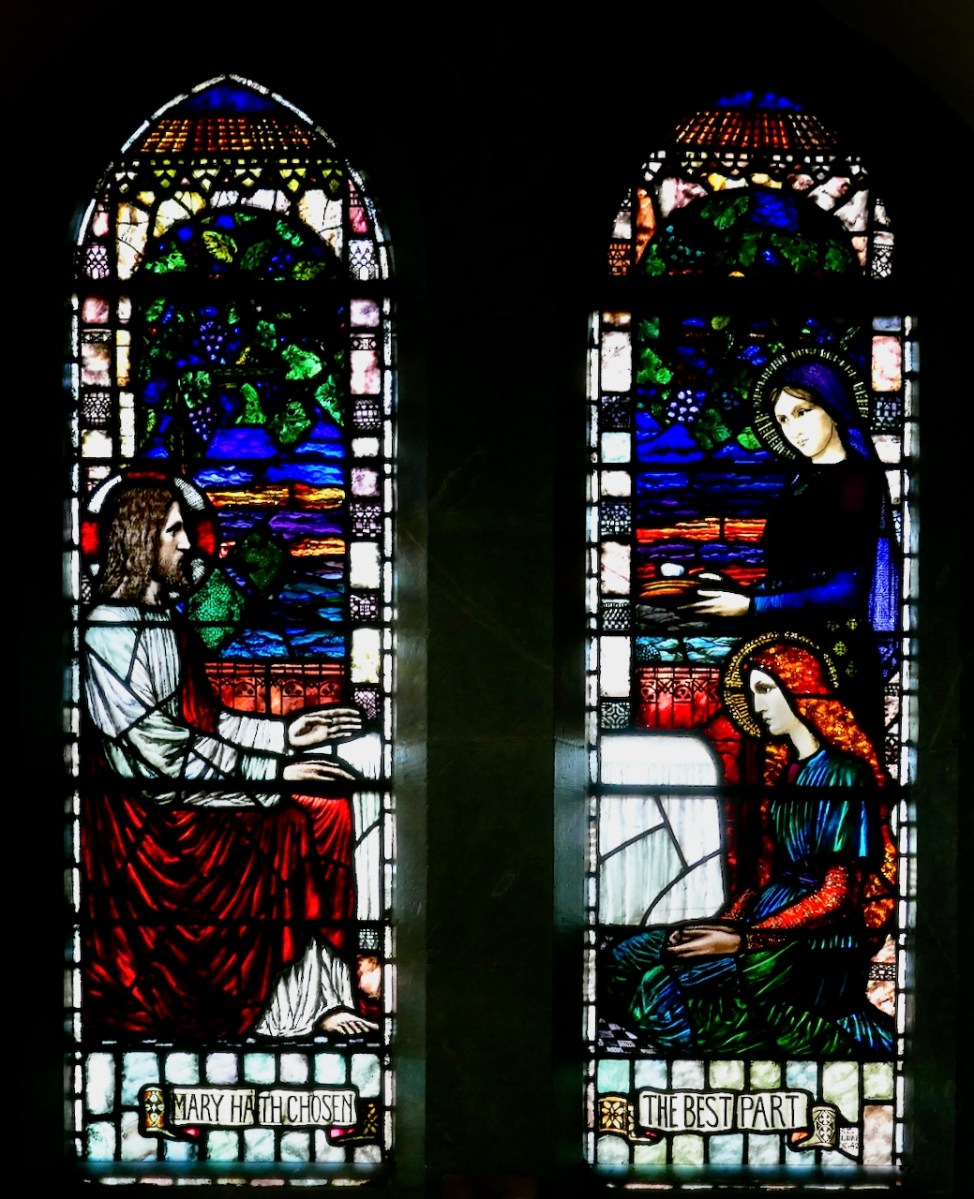
Christ with Mary and Martha, Mayfield, Cork
Because of the opprobrium that such a scandal would have visited upon both Elizabeth Kelly and Michael Healy, Diarmuid was never told that Healy was his father, but he must have suspected, and in more recent times DNA testing confirmed the relationship. Reading about the frequent tragedies that befell the Healy family and the privations under which he grew up, I find it very comforting to know that Michael enjoyed the security and love of his adopted family as he got older.
St Simeon, one of Healy’s early windows for Loughrea Cathedral
David leads us on a measured journey through Healy’s life and work. He was the first recruit to An Túr Gloine, Sarah Purser’s stained glass studio, and later co-op. There, he worked alongside AE Child (also his instructor at the Dublin Metropolitan School of Art), Catherine O’Brien, Beatrice Elvery, Ethel Rhind and Hubert McGoldrick. All of them looked up to him as the finest painter at the Studio. He, in turn, admired the work of Wilhelmina Geddes, and when her health caused problems he finished some of her windows, trying to respect her style and designs. But it wasn’t until Evie Hone arrived that he found a true colleague – Nikki Gordon Bowe described Hone as “his devoted disciple and admirer” and she finished some of his windows after he died.
Healy designed many Patrick windows – this one is in Glenariff Co Antrim
Each commission is described and through David’s detailed accounts we come to understand Healy’s style – what iconography he was attracted to, how he decided on the myriad details with which he embellished his windows, and most of all, his decorative methods.
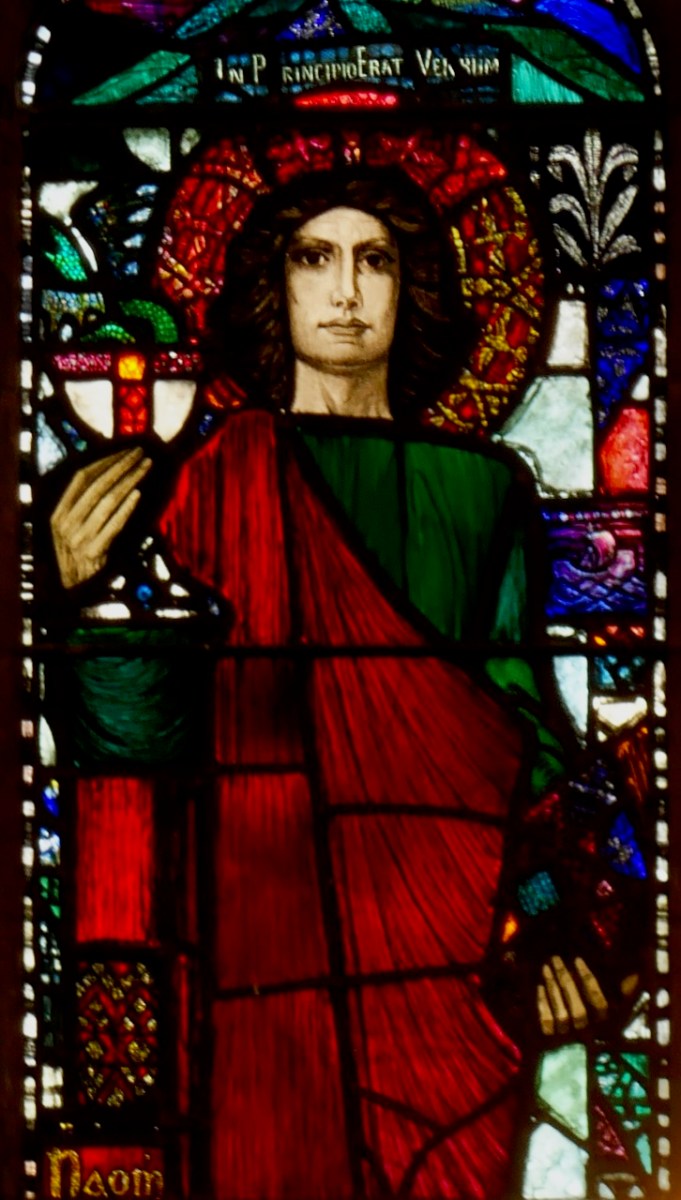
John the Evangelist, Loughrea Cathedral
Long before Harry Clarke made it is his signature, Healy was a master of aciding, a difficult (and dangerous) process used to remove colour from the surface of flashed glass. Flashed glass is clear glass which has a skim of coloured glass fired onto its surface. This top layer could be removed by scratching or etching it away, or by immersing the glass in a bath of hydrofluoric acid, having first applied beeswax to any surface where the colour should remain intact. By waxing and immersing, often several times, colour could be altered from, for example, a rich ruby red to the merest hint of pink, and all shades in between.
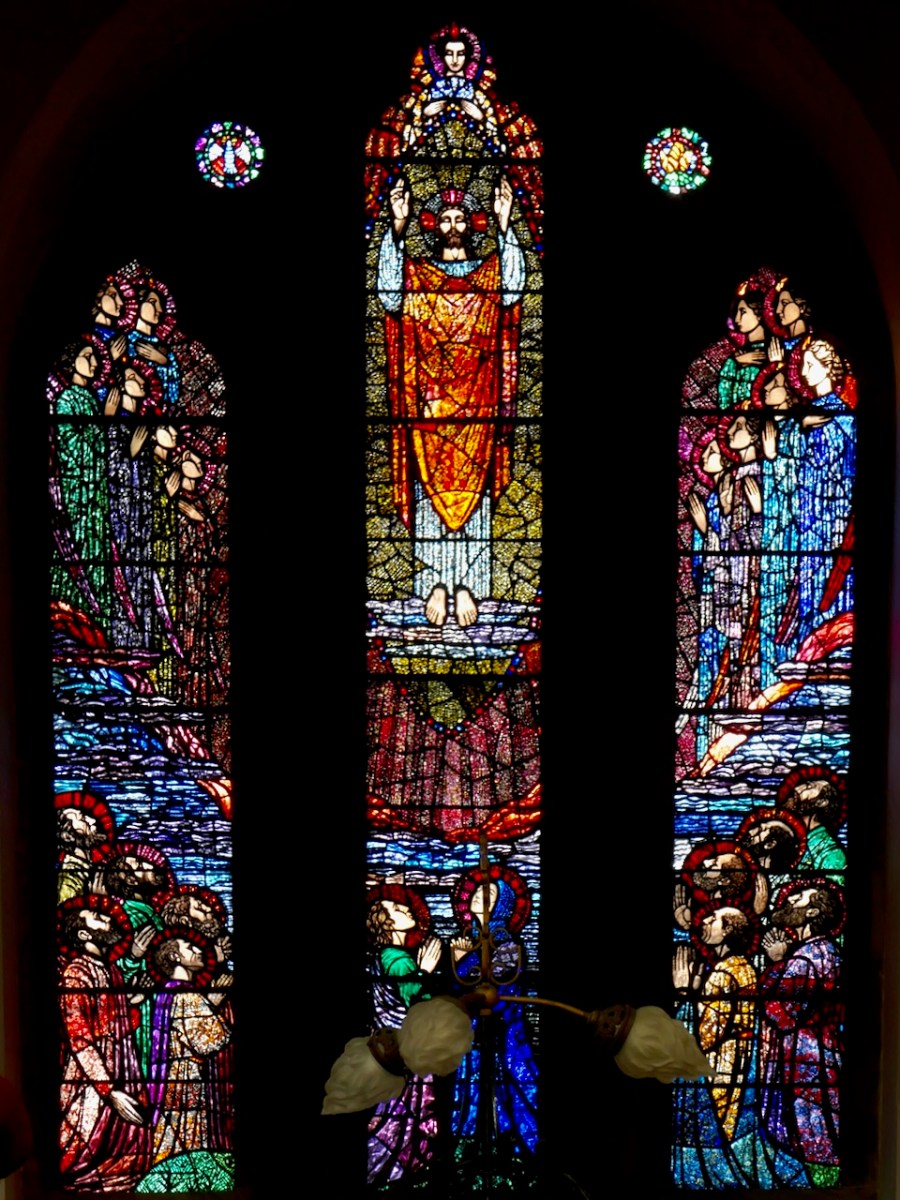
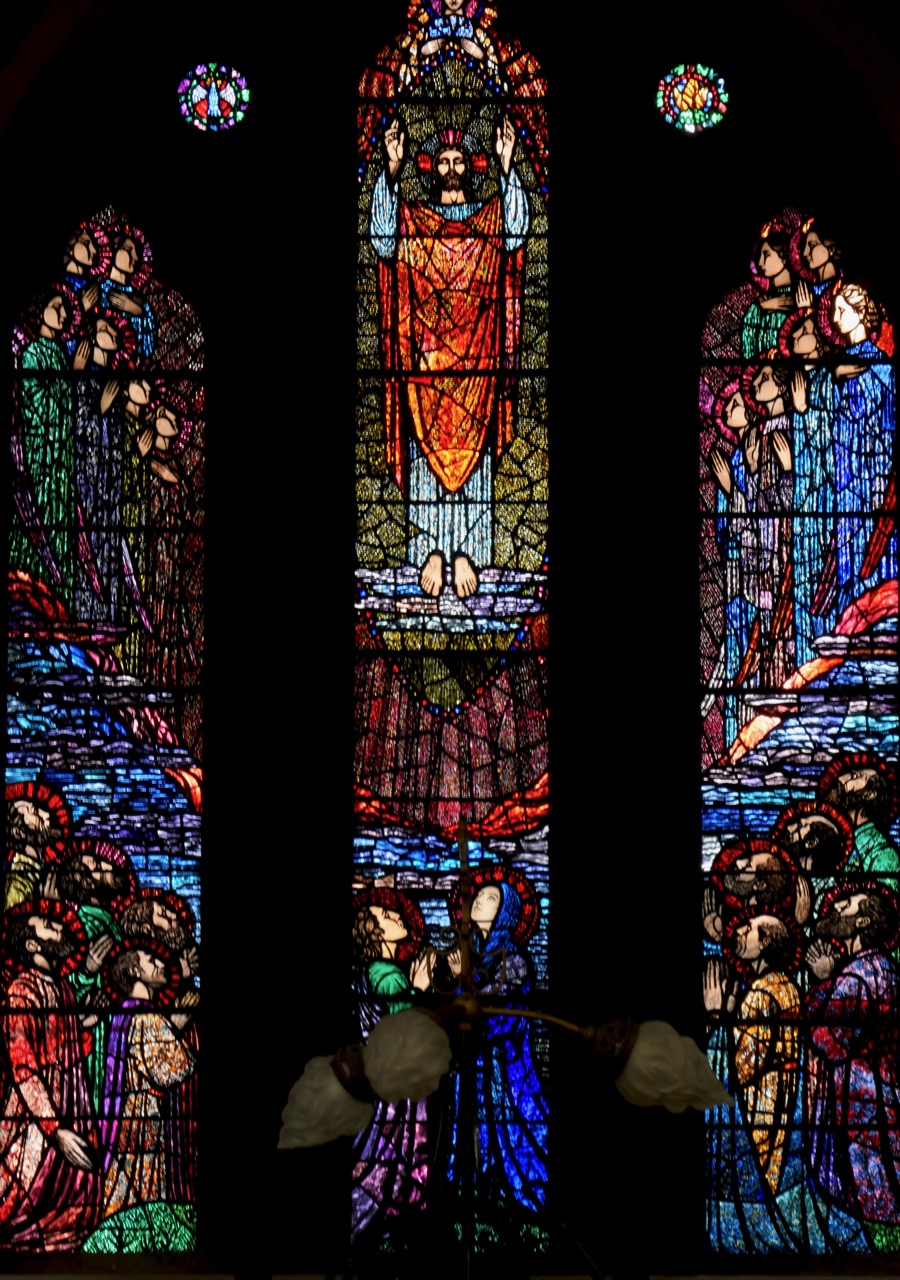
Healy’s Ascension, in Loughrea Cathedral
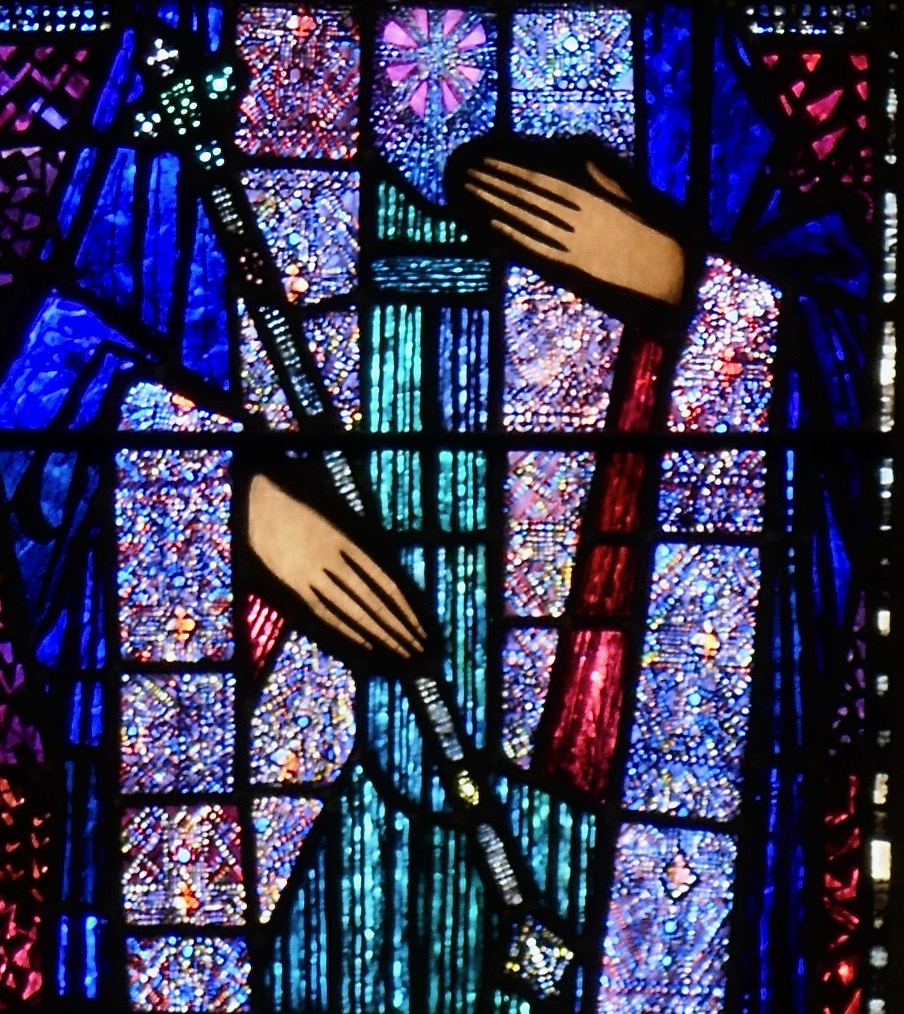
Healy would often plate two sheets of glass together – for example, one red and the other blue – each one carefully acided, and could by this means achieve an astonishing array of colours from the red-blue side of the spectrum. Added to this, he would often use silver stain on the back of the glass. Once heated in the kiln, the silver stain would permeate the glass, turning it yellow (repeated firings could deepen this from bright yellow to a rich amber colour). Finally, all the figuration would be painted and stippled on to the surface of the glass and the individual pieces of glass would be assembled and leaded together to produce the finished window. Healy was a perfectionist and Purser would despair of ever making enough money to keep the studio going since he spent so long on each commission.
This detail from Healy’s Virgin Mary window in Loughrea illustrates well his aciding technique using red and blue flashed glass plated together to produce not only infinite shades of colour but a sparkling jewel-like effect
It is through David’s lively analysis of each window that we truly come to appreciate Healy’s genius and his evolution as an artist, his style developing according to his exposure to more modern influences.
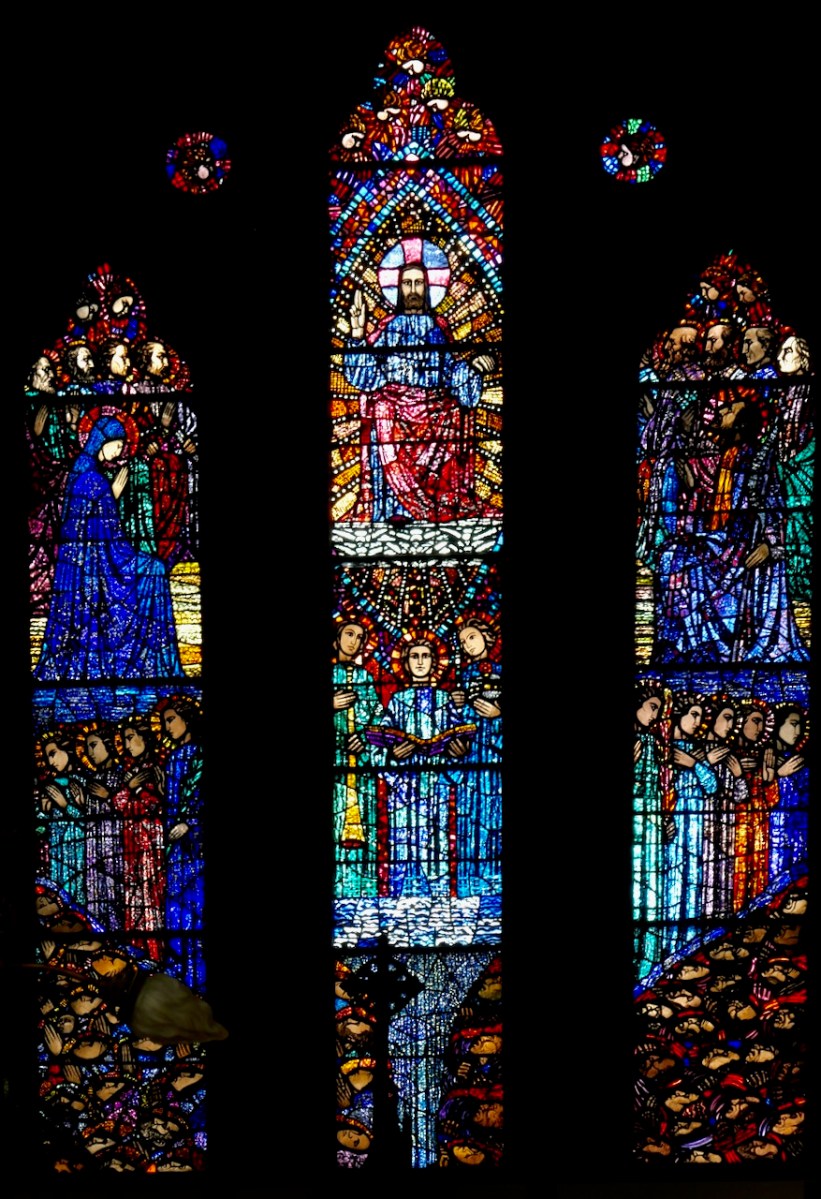
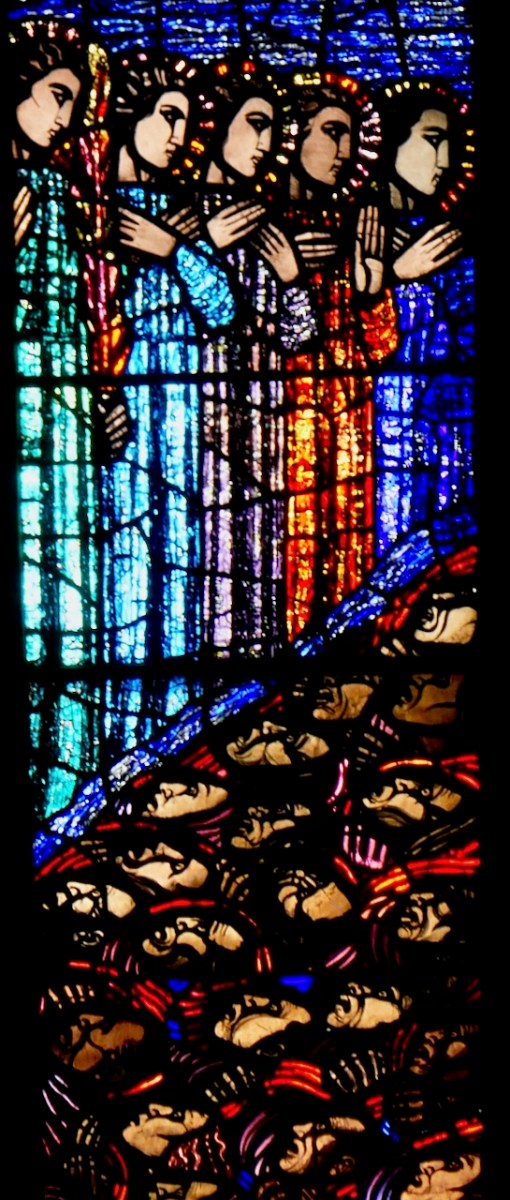
Considered one of his masterpieces, this is the Last Judgement Window in Loughrea, completed towards the end of his life. A detail from The Damned(right -hand light)is below
David wears his erudition lightly and when he dissects a window, pointing out elements that are easy to miss, and explaining what they mean and why Healy used them, I found myself pouring over Jozef’s wonderful photographs, picking out each separate item of iconography, and marvelling anew at the depths of learning that Healy brought to his designs. For example, David devotes five pages to the St Augustine and St Monica window in John’s Lane Church in Dublin and not a word is wasted.
Along the way we meet a host of characters – the redoubtable Sarah Purser and his colleagues at An Túr Gloine, enterprising priests and bishops, citizens memorialising their dead family members (CS Lewis!), art critics such as C P Curran, American heiresses, patrons of the arts, Celtic Revival influencers (OK, modern word, but you know who I mean). We get insights into the inner workings of the studio, wherein frequent bouts of unprofessional behaviour created tensions, and where Sarah Purser often had to crack the whip when productivity lagged. We come to understand the difficulties of soliciting business, agreeing on final designs and delivering orders, especially to overseas clients, in days when postal service to American and New Zealand took weeks.
A detail from the Patrick window in the National Gallery
We also come to see Healy as a rounded artist who did more than stained glass. His quick sketches of Dublin characters, drawn from life have all the attraction of immediacy and familiarity, while his watercolour landscapes are charming.
An early Loughrea window, Virgin and Child with Irish Saints
Healy died in 1941. By the time you finish the book, you feel you have lost a friend – a difficult and complicated one to be sure, but one whom you admire and will never forget. While obviously a gruff character on the outside, David allows us access to his humanity, and points out the obvious sympathy with which he portrays some of his subjects. His Loughrea St Joseph (below), for example, shows, in the words of the art critic Thomas McGreevy, a “Joseph who knows the tragedy of the world and who has some special understanding of the destiny. . . of the child”. We are, of course tempted to see in the tenderness with which Joseph gazes down at Jesus a revelation of Healy’s suppressed feelings for his own son.
This book is not just for stained glass enthusiasts, though they will delight in it, but for anyone interested in life in Ireland at the end of the 19th and beginning of the 20th century, and indeed for anyone who enjoys good writing and a story that propels you through almost 70 years of the life of a significant artist. Available from the publisher or in all good bookstores.
This year, I am taking the Vita Prima as my starting point. It’s the Life of Brigid that was written about the middle of the 700s. As we saw in my first post about St Brigid, a year ago, Cogitosus wrote his Life in about 650, about 125 years after the death of Brigid. So this Life, the Vita Prima, was written 225 years after her death – but there is sound evidence that it is was based on the writings of St Ultan, who died around 650. In fact, the author of the Vita Prima and Cogitosus may both have drawn from this common source. *
My illustrations are all taken from stained glass and all the images are my own except for the wonderful Kilrush window, kindly shared with me by the photographer, John Glynn. John has undertaken extensive new research on this window and is now convinced that it was mostly designed by Harry Clarke, even though it has been up to now designated as by his Studio rather than by himself.
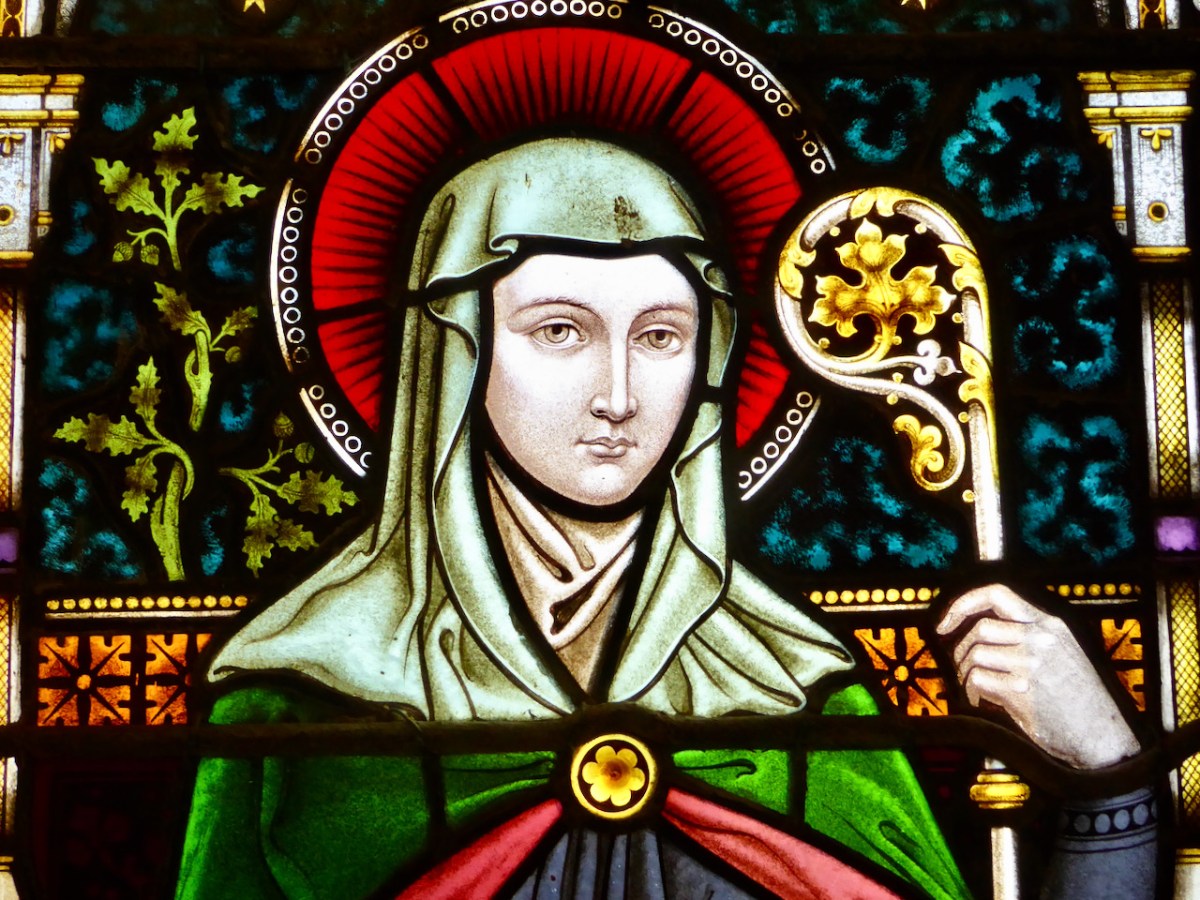
St Brigid, detail from St Fachtna’s Church, Rosscarbery, Co Cork, unknown artist
St Brigid – and yes, the evidence also points overwhelmingly to the fact that she was a real person – was born around 452 and died in either 524, 26 or 28, in her 70s. That means, by the way, that next year is the 1,500th anniversary of her death.
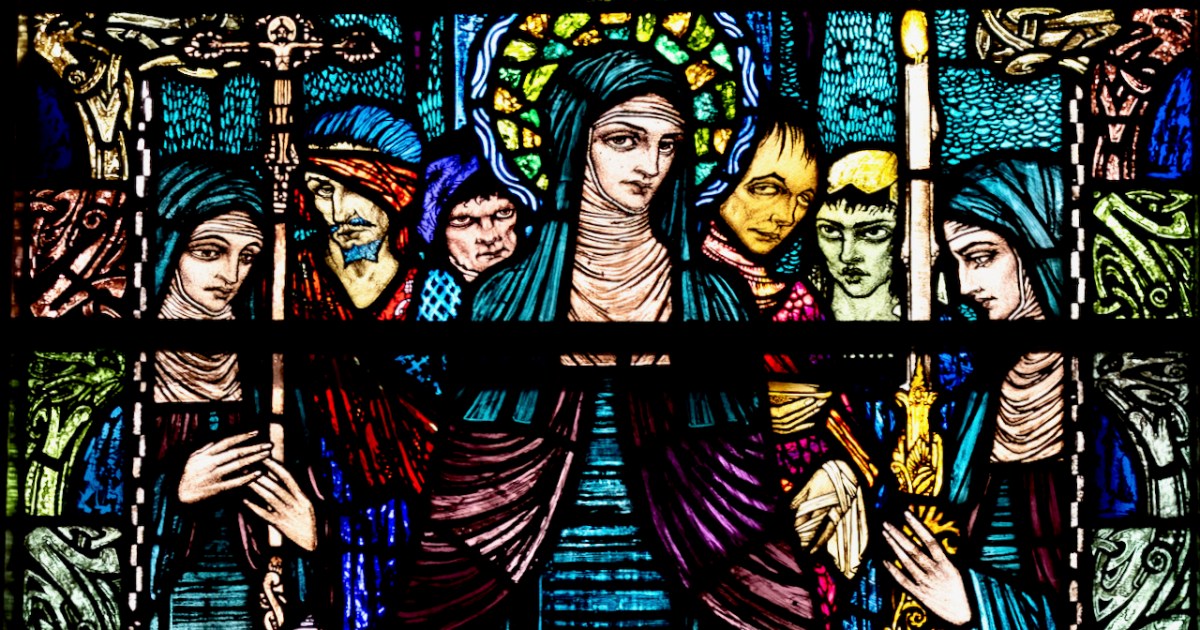
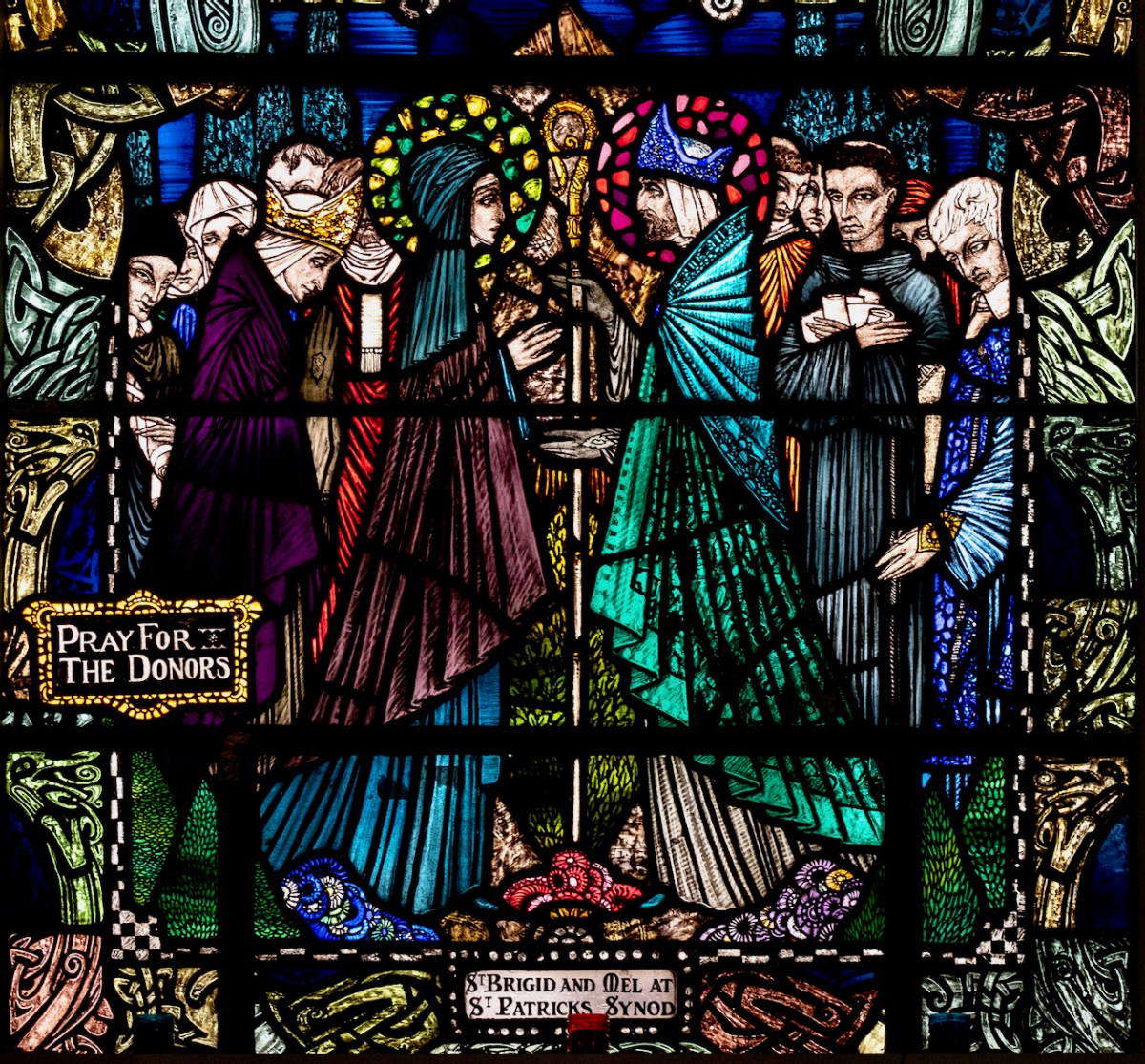
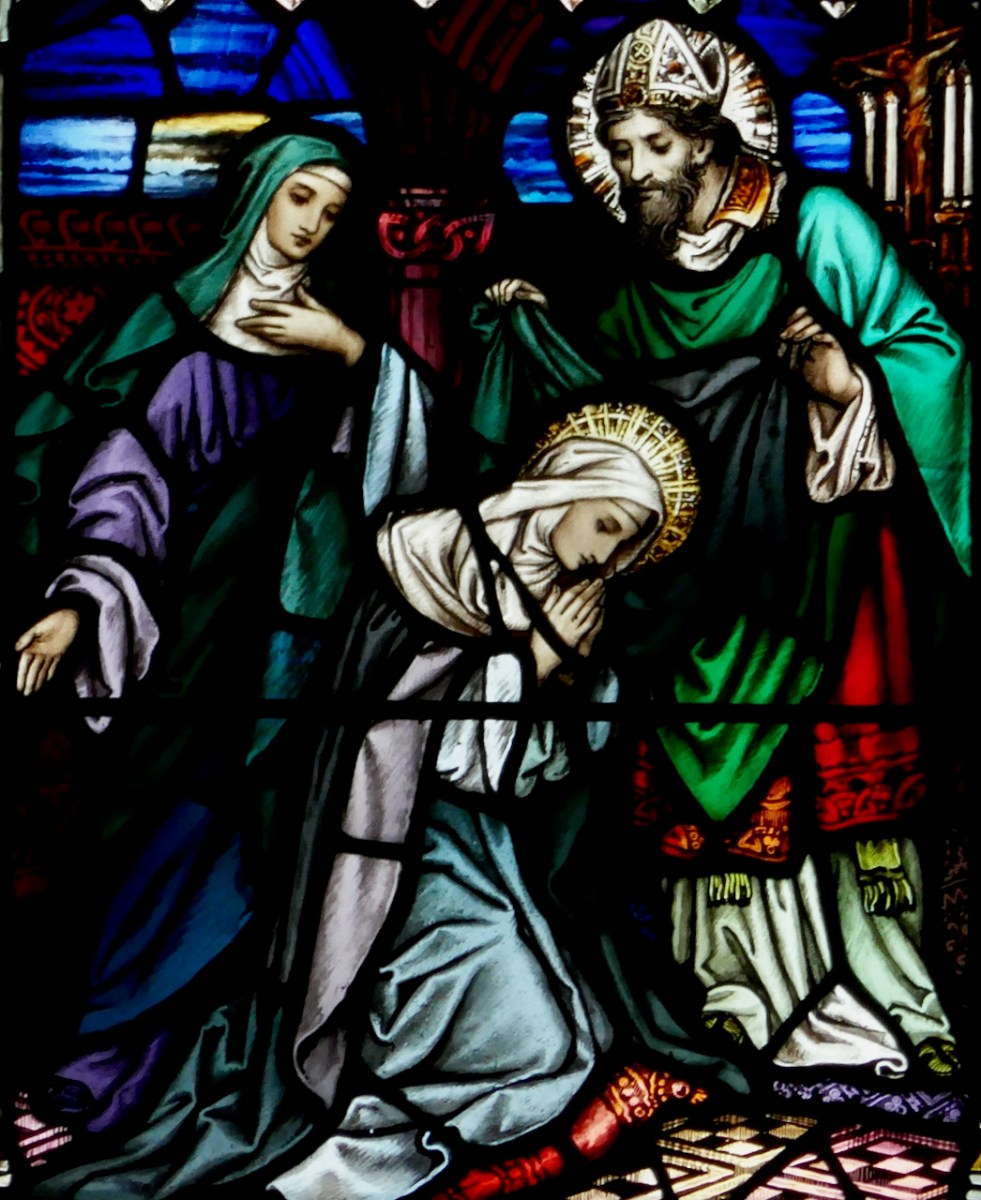
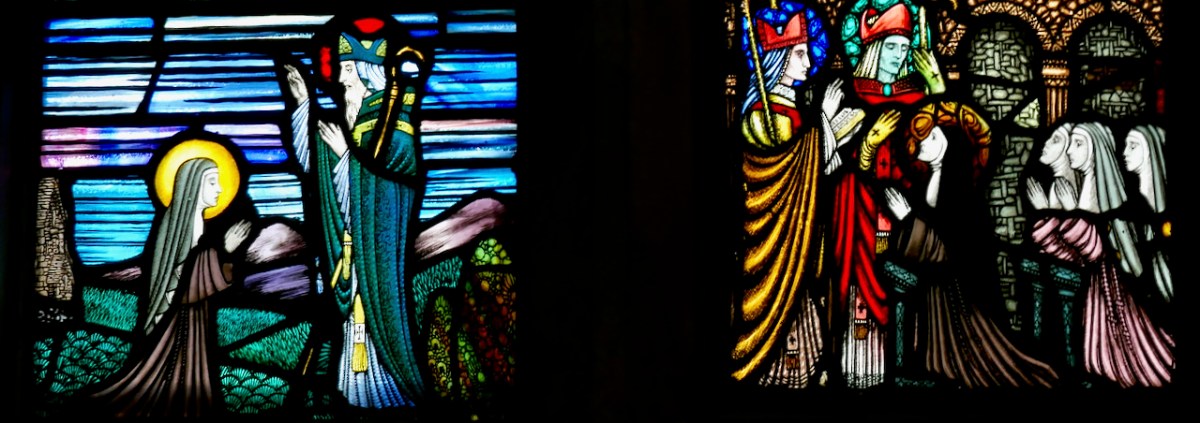
This version assigns her ‘veiling’ as a nun to Bishop Mel, but does not include the story of his accidentally making her a bishop. The image above shows him handing her a crozier, this referencing the story I included in last year’s post.
Then saint Brigit taking three nuns with her went to the territory of the Ui Neill to the two holy bishops, Mel and Melchu, who were disciples of St Patrick and lived in the towns of Mide. And they had a certain disciple called Mac Caille who said to Mel, ‘Look, there are holy virgins outside who wish to receive the veil of virginity from your hands.’
Then he ushered them into the bishop’s presence, and while bishop Mel was gazing intently at them, a column of fire suddenly appeared rising from Brigit’s head up to the very top of the church in which she dwelt. Then the holy bishop Mel placed the veil on saint Brigit’s head and when the prayers had been read Brigit bowed her head and seized the wooden foot of the altar in her hand and since that moment the altar foot has permanently remained fresh without any decay or blemish. And saint Brigit’s eye was healed forthwith when she received the veil. Then eight other virgins also received the veil together with saint Brigit and the virgins with their parents said, ‘Don’t leave us. Instead stay with us and make your home in these parts.’ Thereafter saint Brigit stayed with them.
Brigid’s veiling, Earley Studios, Drumcong, Co Mayo
The reference to eye healing, by the way, related to another story. When she was pressured to marry a man
Saint Brigit asked God to afflict her body with some deformity in order that men might stop paying suit to her. Thereupon one of her eyes burst and liquefied in her head. For she preferred to lose her bodily eye than the eye of her soul and loved beauty of soul more than that of the body.
Predella of Brigid window in Carnew, Co Wicklow
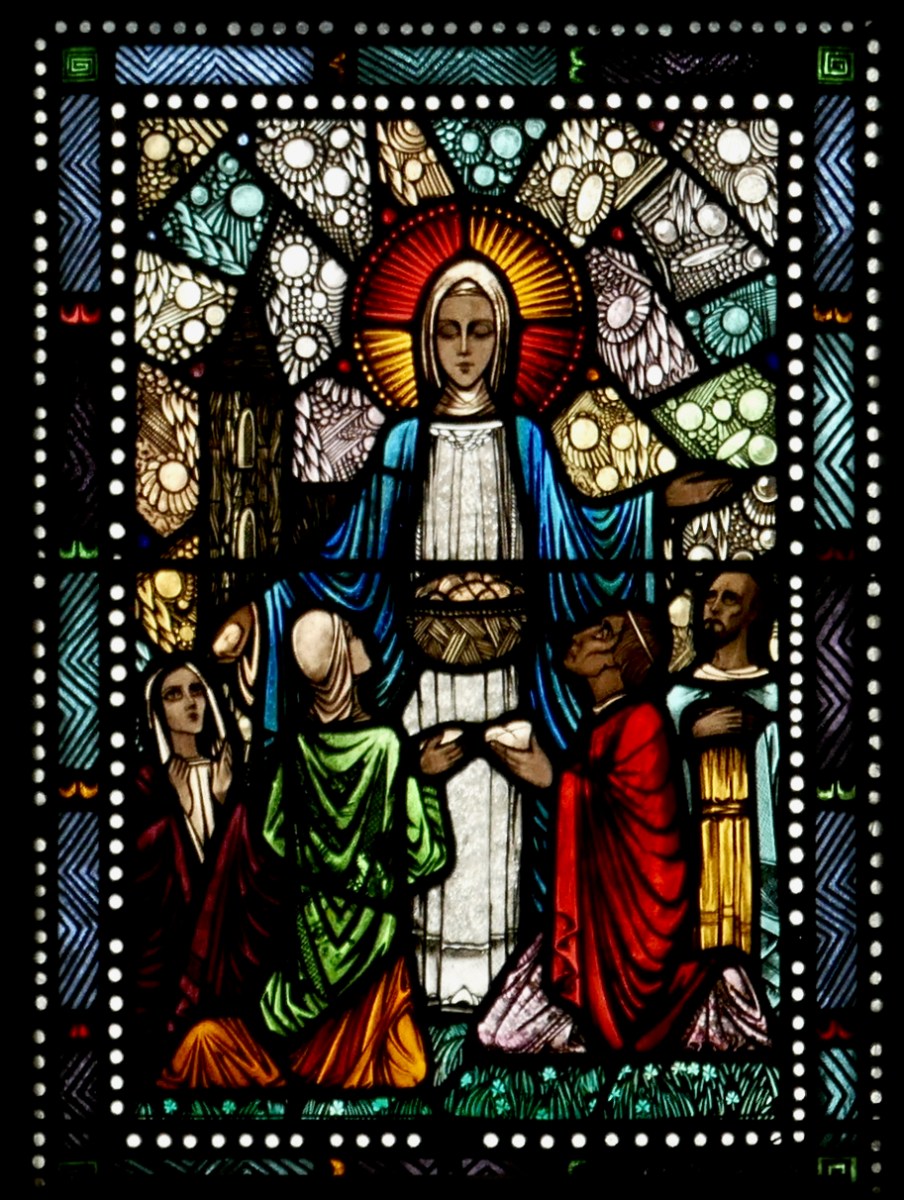
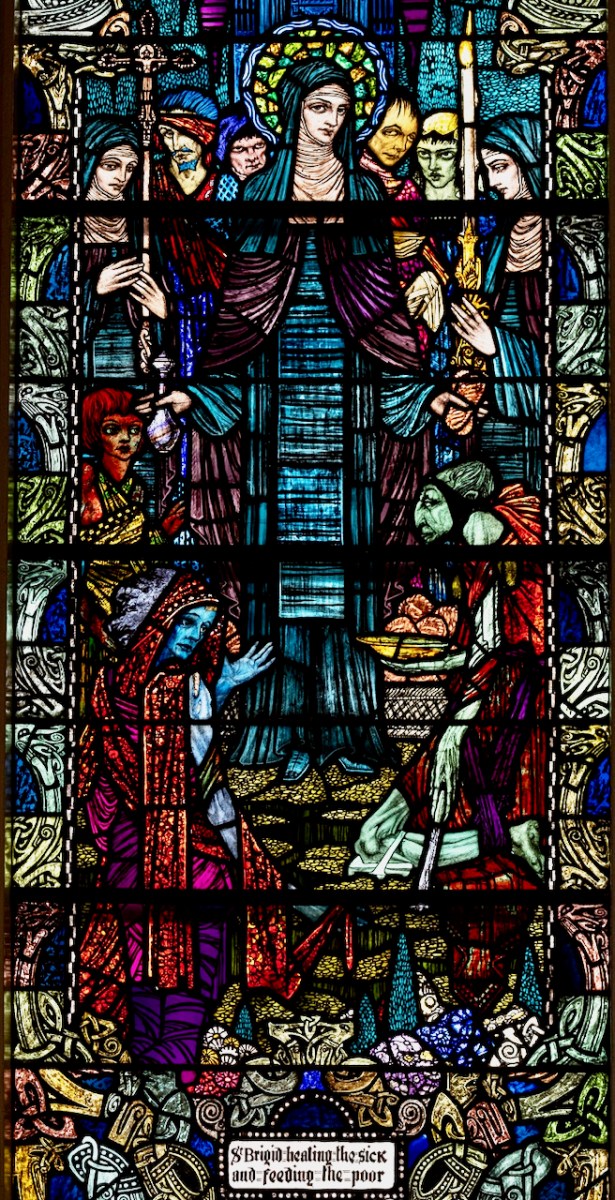
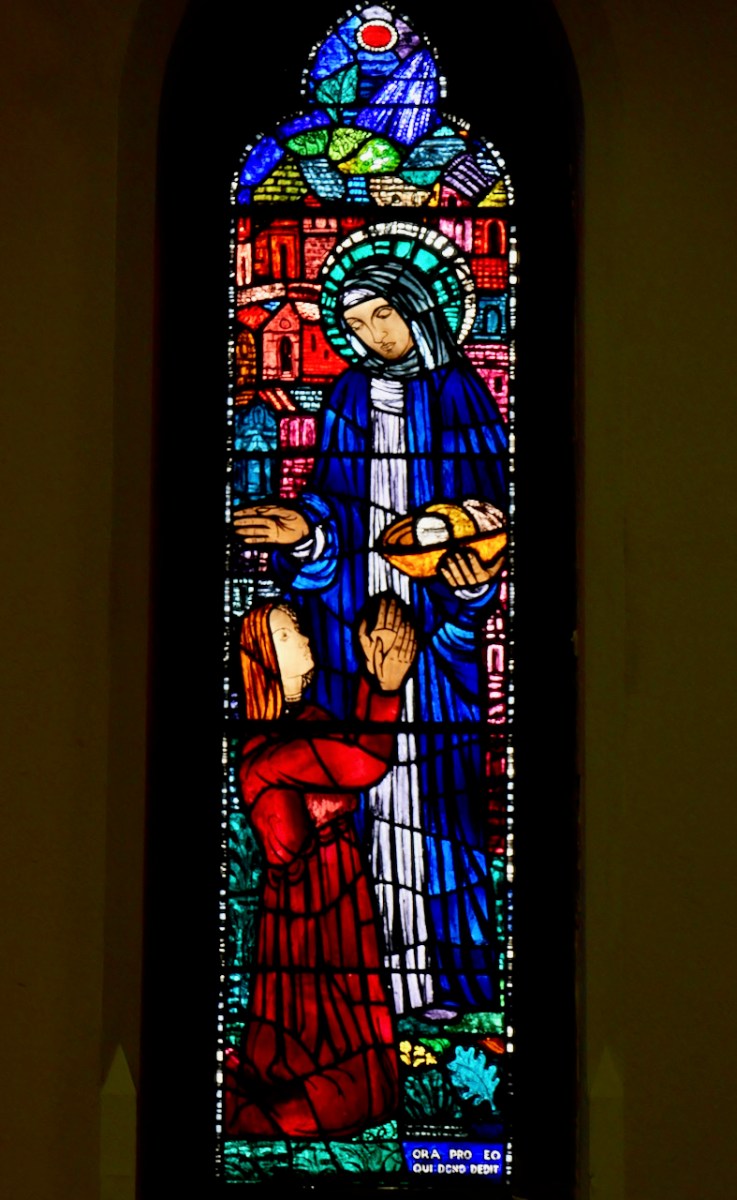
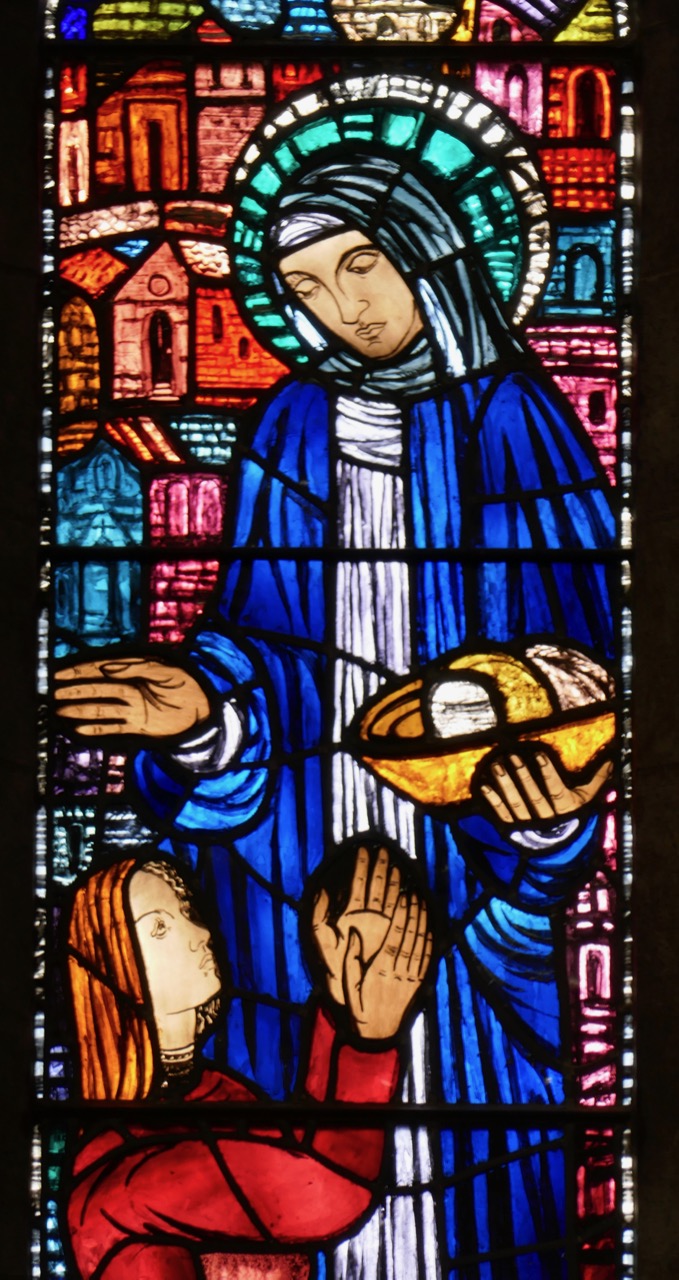
You’ll be pleased to hear I don’t have an illustration of this episode. But this book (like the Life in The Book of Lismore, see last year’s post) rather than a biography, is a relating of miracle after miracle. Many deal with her ability to provide food – bread, meat and beer – to hungry people (as above). Here’s just one:
At this time saint Brigit was a guest at the monastery of St Laisre. Now one day towards evening St Patrick came with a large crowd to put up at that monastery. Thereupon the local community was worried and said to Brigit, ‘What are we going to do. We don’t have food for such a large crowd.’ But Brigit said to them, ‘How much do you have?’ They said to her, ‘All we have is twelve loaves and a little milk and one sheep which we have cooked for you and your folk.’ But Brigit said, ‘These will be enough for the whole lot of us, for the sacred scriptures will be read to us, thanks to which will we shall forget about bodily food.’ Whereupon the two groups of people, namely, Patrick’s and Brigit’s, ate together and had their fill and the amount of scraps they had left over was greater than the supplies which St Laisre had offered them in the first place, and later St Laisre offered herself and her place to saint Brigit in perpetuity.
Knockainy, Co Limerick, window by William Dowling for the Harry Clarke Studios
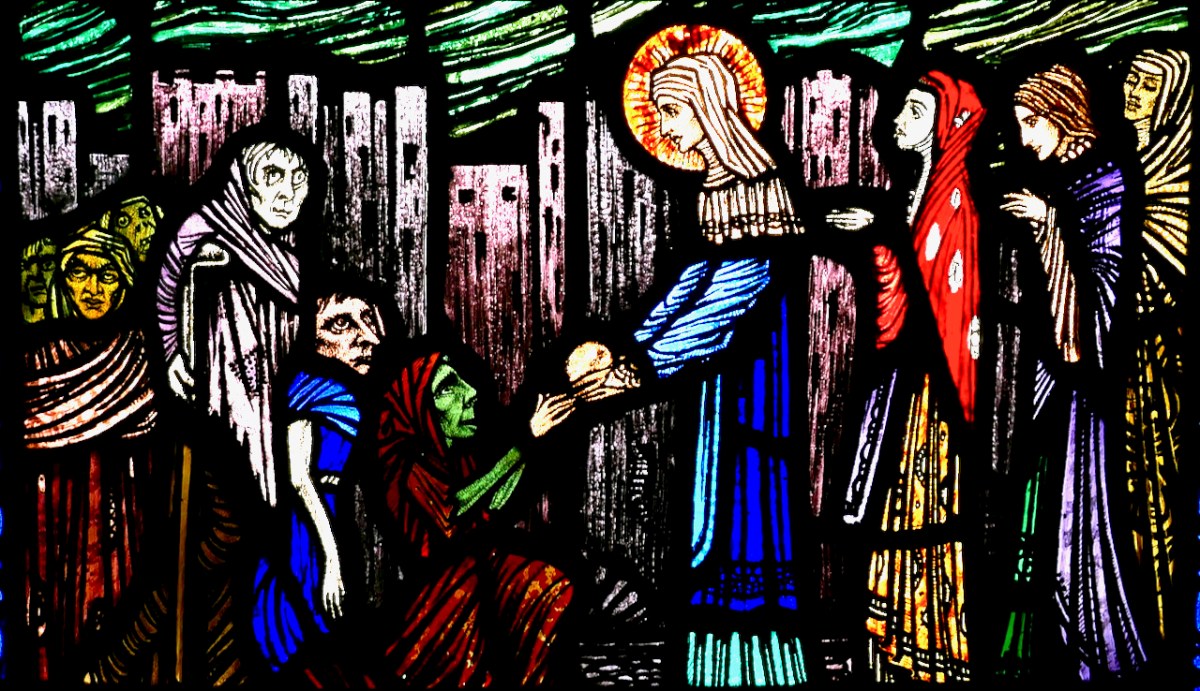
She was also famed for her ability to heal – the blind, maimed, mute, paralysed, deranged, bulimic (I’m not making this up) and leprous all came to her in their afflictions and were healed. She healed the poor and the kingly equally.
Here’s an interesting instance of her using her powers to ‘heal’ a pregnancy:
Another day saint Brigit by the very powerful strength of her faith blessed a woman who had fallen after a vow of integrity and whose womb was pregnant and swelling and the conception in the woman’s womb decreased and she restored her to health and repentance without childbirth or its pangs. The woman was healed and gave thanks to God.
From the Brigid window, Collon, Co Louth, probably by the Harry Clarke Studios
The Vita Prima has Brigid and Patrick as contemporaries who knew each other and there are several stories of them together. Here is one:
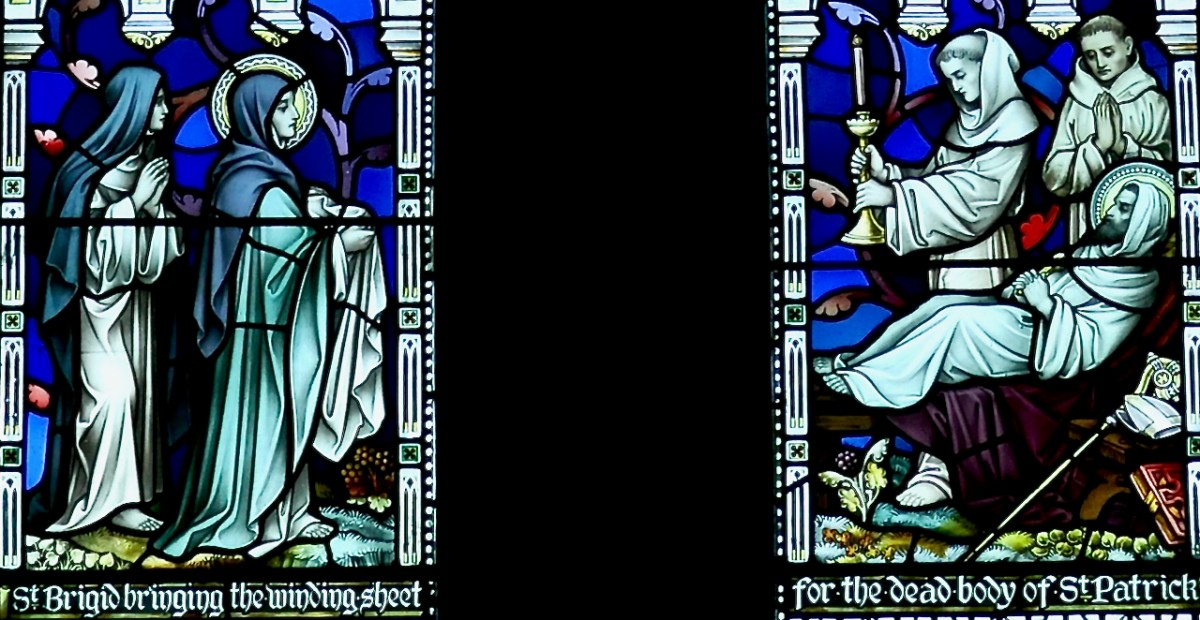
Patrick was preaching the word of God one day to the crowds and saint Brigit. Then everyone saw a very bright cloud coming down from the sky to the dark earth on a rainy day. Gleaming from an enormous flash of lightning, it paused for a little while at a spot nearby beside the crowd. Afterwards it went to Dun Lethglaisse where Patrick is buried. Lingering there a while longer the cloud then disappeared and the crowds did not dare ask what this extraordinary apparition meant but asked saint Brigit. And Brigit said, ‘Ask Patrick.’ When Patrick heard this he said, ‘You and I know equally well. Reveal this mystery to them.’ And Brigit said, ‘This cloud, in my opinion, is the spirit of our father St Patrick who has come to visit the places where his body will be buried and rest after his death. For his body will rest for a short while in a place nearby, and afterwards will be taken to be buried in Dun Lethglaisse and there his body will remain till the day of judgement.’ Then Patrick told Brigit to make with her own hands a linen shroud to cover his body with after his death, as he desired to rise to eternal life with that shroud. Brigit accordingly made the shroud and it was in it that St Patrick’s body was later wrapped and it is still in that place.
I have used St Brigid bringing the winding sheet for St Patrick in last year’s Brigid post, but here it is again. It’s from Killarney Cathedral and by Hardman.
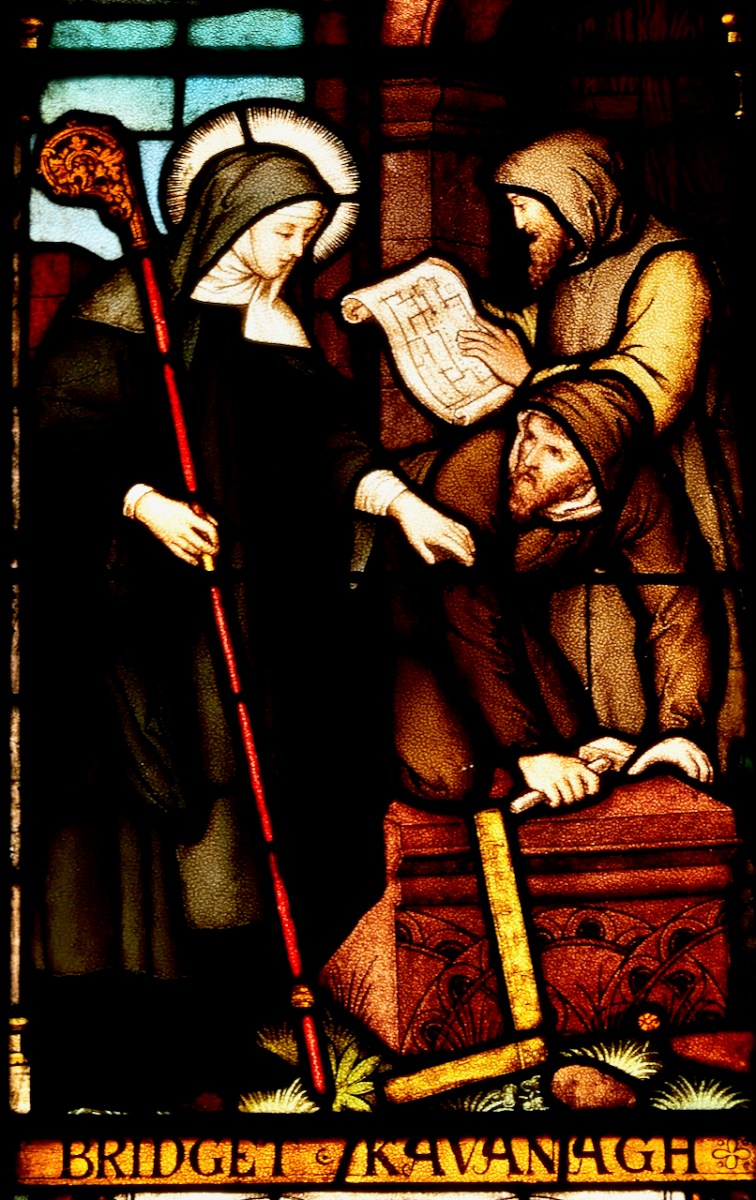
Interestingly, the Vita Prima contains only one direct reference to Kildare, where St Brigid established her foundation. Here she is instructing her masons in how she wants it built (as a 15th century church, apparently). This one is from Armagh Cathedral and I think it’s by Mayer of Munich.
The author of the Vita Prima brings us to the end of Brigid’s life in surprisingly modern language.
But after having fought the good fight and run a successful race, saint Brigit departed this life for the kingdom of heaven escorted thither by the ranks of angels and archangels and having been accorded a place amid the choirs of patriarchs and prophets and apostles and martyrs and confessors and virgins she now possesses everlasting joy with Christ to whom, with God the Father and the Holy Spirit, be praise and glory forever and ever. Amen.
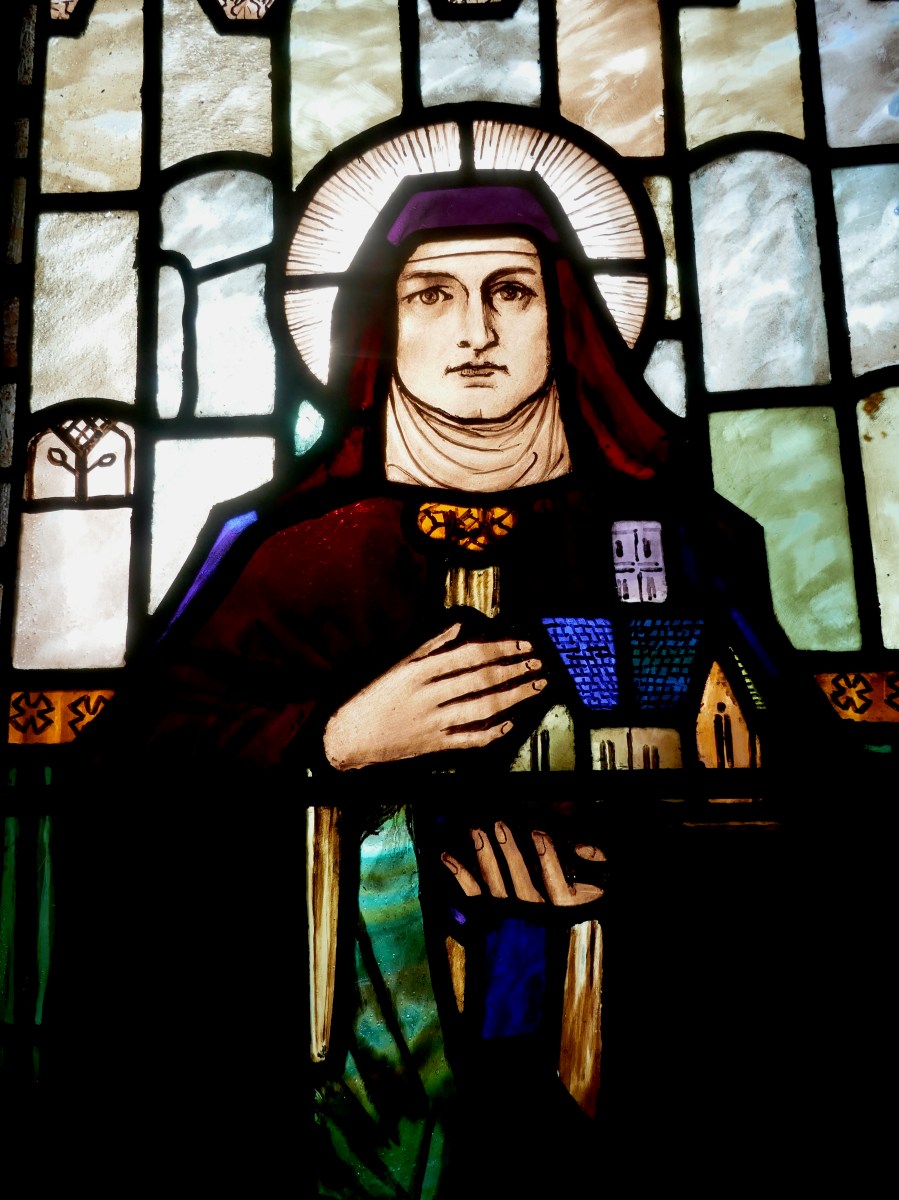
This image of Brigid is from a window by Michael Healy, in the Bishop’s Palace in Monaghan
St Brigid, I am discovering, can be all things to all people – a pagan goddess for the New Agers, a saint for devout Catholics, and an empowering symbol of female leadership. While there has been much speculation (some of it offered as assertion) about her links with a pagan goddess, Brigantia, the evidence is very slight and the goddess connection mostly lies in the realm of conjecture, leaps of imagination and wishful thinking.
Evie Hone’s St Brigid, from Loughrea Cathedral
What the various writings about Brigid do point to is a powerful, benevolent and influential ecclesiastical woman who established a centre of devotion and learning and a city in Kildare, and whose cult spread across Europe in the centuries that followed her life. That, in itself, is more than enough, to mark her out as momentous, and worthy of commemoration. Here’s how Padraig O’Riain, the pre-eminent scholar on Irish saints, puts it:
For all her dubious origins, therefore, Brighid’s record shows that she stood alone among the women saints of Ireland, a rival in importance to Patrick and Colum Cille, an abbess whom all other abbesses revered, a bishop in all but name, of such high status that she came to be regarded, possibly as early as the seventh century, as “Mary of the Irish”.
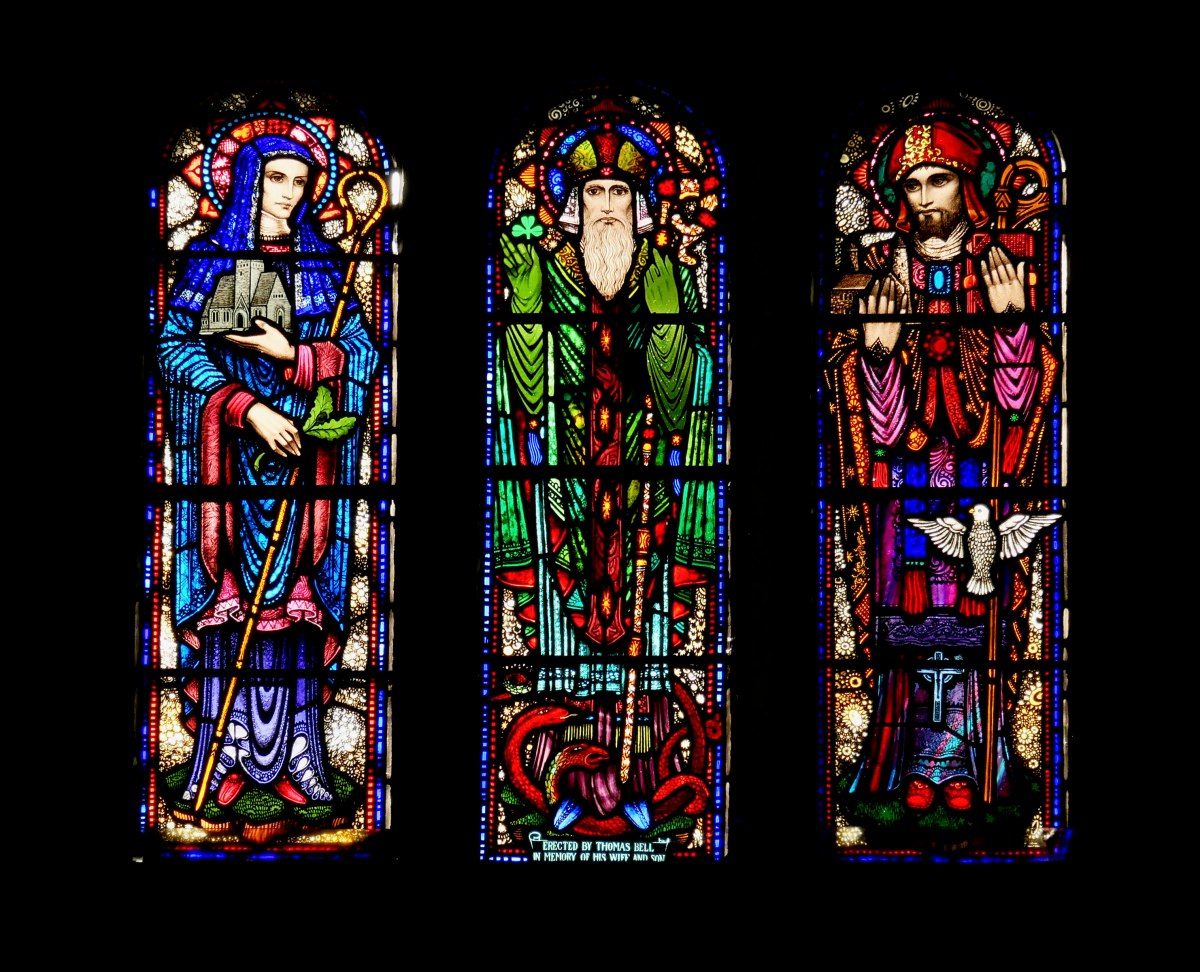
Brigid, Patrick and Columcille from Lusk, Co Dublin, by the Harry Clarke Studios
Therefore, tomorrow, Feb 6th, 2023, no matter which version of her you prefer, let us celebrate together our first National Holiday in her honour. She deserves it – finally!
*I am relying for this post on three main sources:
Vita Prima Sanctae Brigitae Background and Historical Value Author(s): Seán Connolly Source: The Journal of the Royal Society of Antiquaries of Ireland , 1989, Vol. 119 (1989), pp. 5-49 Stable URL: https://www.jstor.org/stable/25508969
St Brigid of Kildare, Life, Legend and Cult by Noel Kissane. Four Courts Press 2017
A Dictionary of Irish Saints by Pádraig Ó Riain. Four Courts Press, 2011
The first story is about a boy, Bobbie Bole, a student at Drogheda Grammar School in the 1940s. He’s the part of this account we don’t know much about, but he must have been a special boy. When he died, in 1942, many people donated money to create a memorial in his memory. It was decided that a stained glass window would be a good way to remember him,
Story 2: The Competition
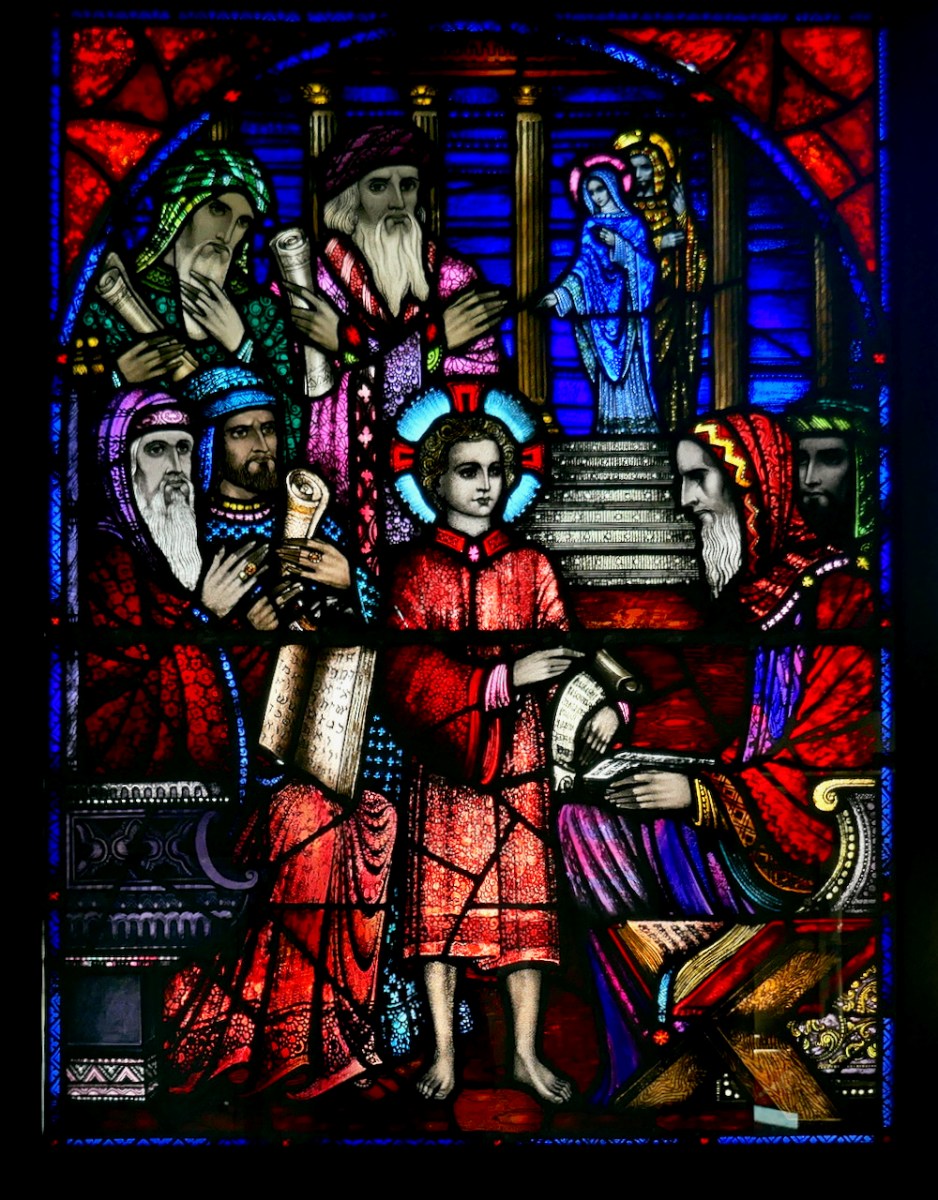
The school established a competition for the window, and invited stained glass artists to submit designs. The subject was to be Christ Among the Doctors, also known as The Finding in the Temple. Here’s the story, from the King James Version (just because I love the language of it):
Now his parents went to Jerusalem every year at the feast of the passover. And when he was twelve years old, they went up to Jerusalem after the custom of the feast. And when they had fulfilled the days, as they returned, the child Jesus tarried behind in Jerusalem; and Joseph and his mother knew not of it. But they, supposing him to have been in the company, went a day’s journey; and they sought him among their kinsfolk and acquaintance. And when they found him not, they turned back again to Jerusalem, seeking him. And it came to pass, that after three days they found him in the temple, sitting in the midst of the doctors, both hearing them, and asking them questions. And all that heard him were astonished at his understanding and answers. And when they saw him, they were amazed: and his mother said unto him, Son, why hast thou thus dealt with us? behold, thy father and I have sought thee sorrowing. And he said unto them, How is it that ye sought me? wist ye not that I must be about my Father’s business? And they understood not the saying which he spake unto them. And he went down with them, and came to Nazareth, and was subject unto them: but his mother kept all these sayings in her heart. And Jesus increased in wisdom and stature, and in favour with God and man.
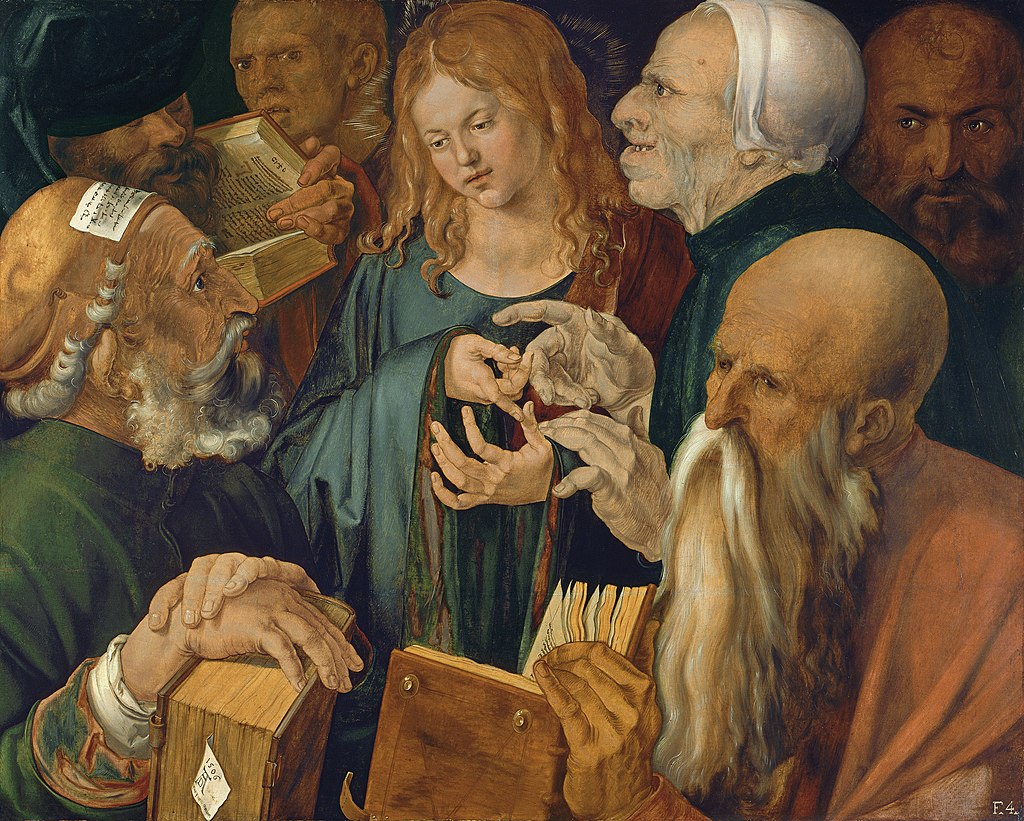
It’s a Biblical Verse that is, for obvious reasons, associated with students and scholarship, making it an appropriate subject for this occasion. It’s been the subject of many famous paintings, including this one by Albrecht Dürer.
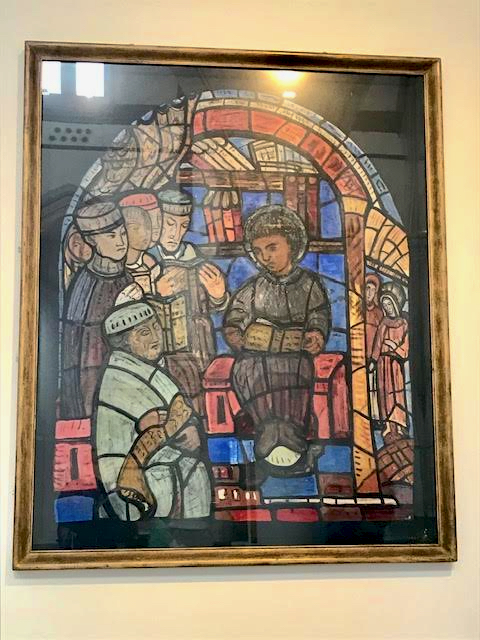
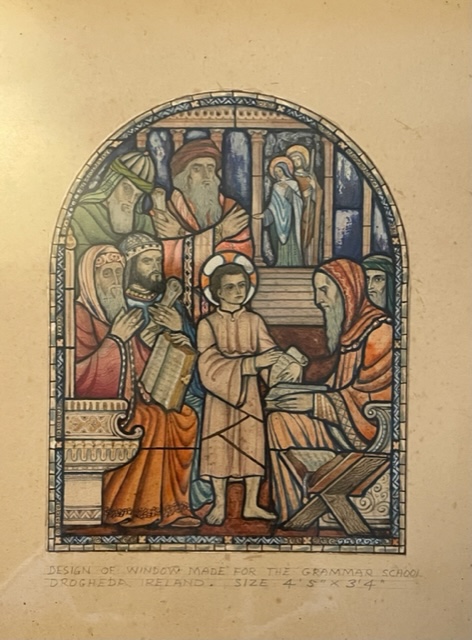
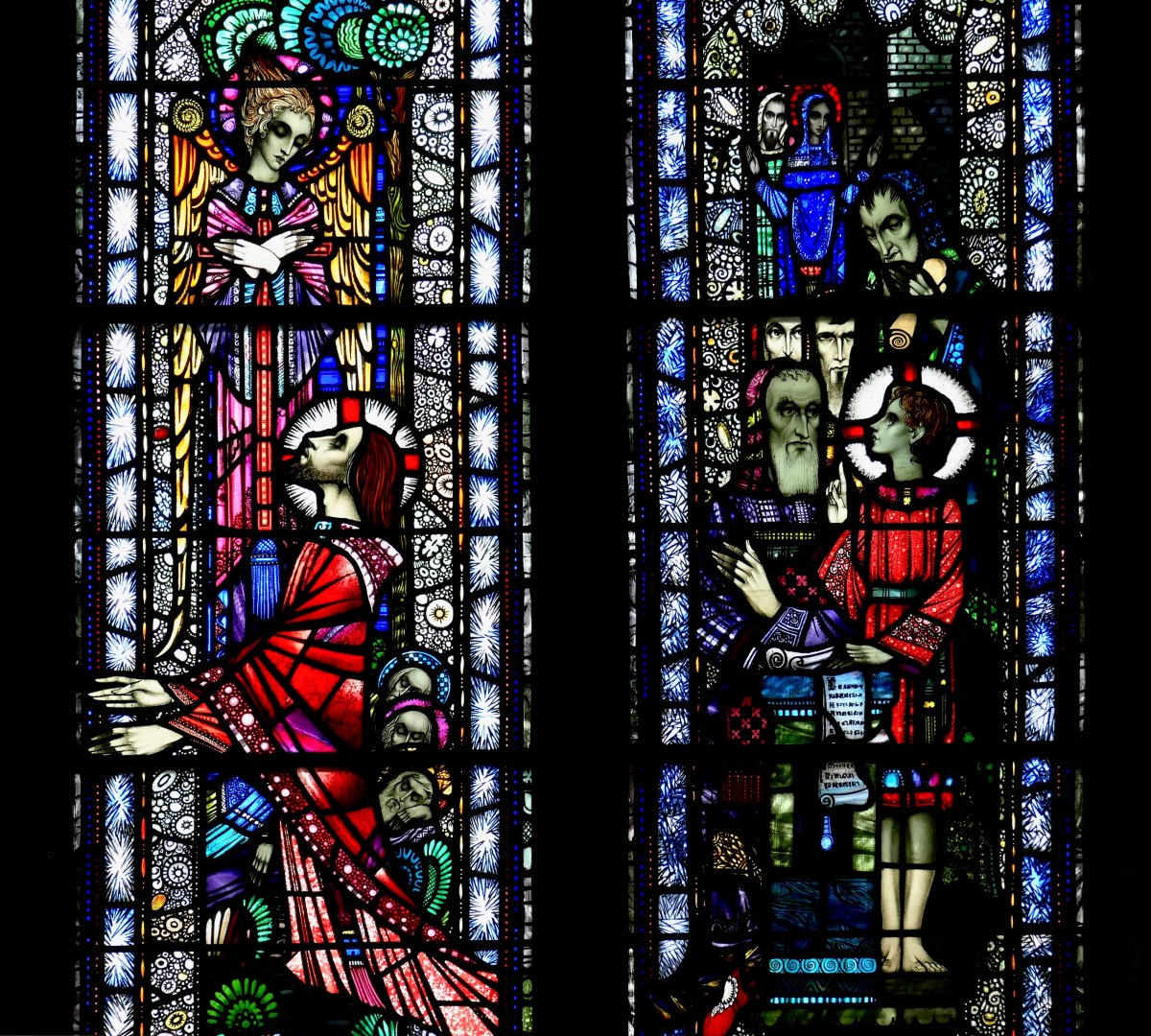
There were two submissions that we know of, and the first was by none other than Evie Hone. We know this because her full-size sketch for the window is displayed on the wall of the Holy Cross Church in Dundrum, having been acquired for the church by Fr Kieran McDermott. I am grateful to David Caron, General Editor of the Gazetteer of Irish Stained Glass, and administrator of Irish Stained Glass on Instagram, for the photograph and information. The accompanying text refers to the drawing as a cartoon and states that it was done for the Drogheda Grammar School, but ‘never realised.’ It does indeed look like a cartoon, in that glass cutlines have been included, and is very recognisably in her 1940s style.
The second submission was by the Harry Clarke Studios. The Studio won the commission on the merits of the sketch they submitted, but that bit comes later.
Story 3: Erasmus
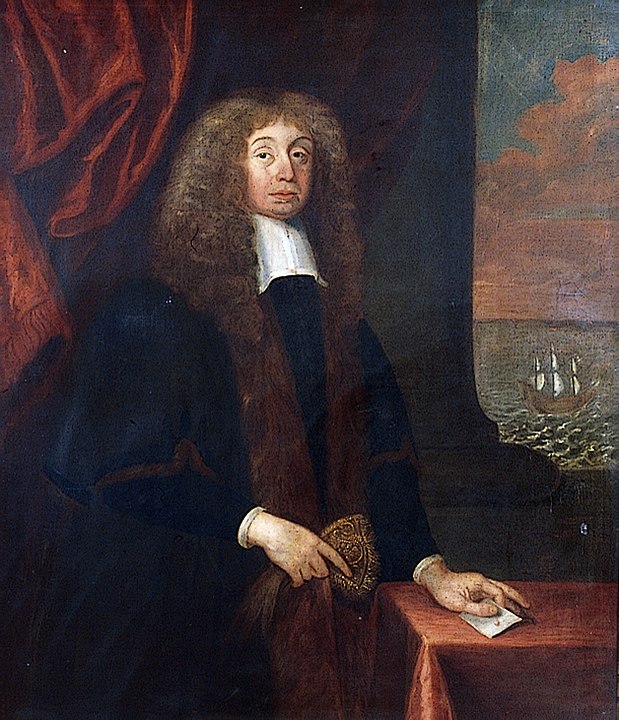
The window was duly installed in the chapel in the Drogheda Grammar School, an academic institution originally part of the Erasmus Smith Charter Schools. Erasmus Smith made his money supplying Cromwell’s army. In part payment he was given land in Ireland. After the Restoration, this put him in an awkward position with the Crown and so he
manoeuvred to protect his position and to further his essentially Puritan religious stance, which he modified to suit the religious sensibilities of the new Royalist regime. He achieved this in part by creating an eponymous trust whereby some of his Irish property was used for the purpose of financing the education of children and provided scholarships for the most promising of those to continue their studies at Trinity College, Dublin
Erasmus Smith By Circle of John Michael Wright Public Domain
One of the schools that was established under the Trust was the Drogheda Grammar School – which is both ironic and fitting, given that Drogheda was one of the towns notoriously devastated by Cromwell.
Story 4: The School
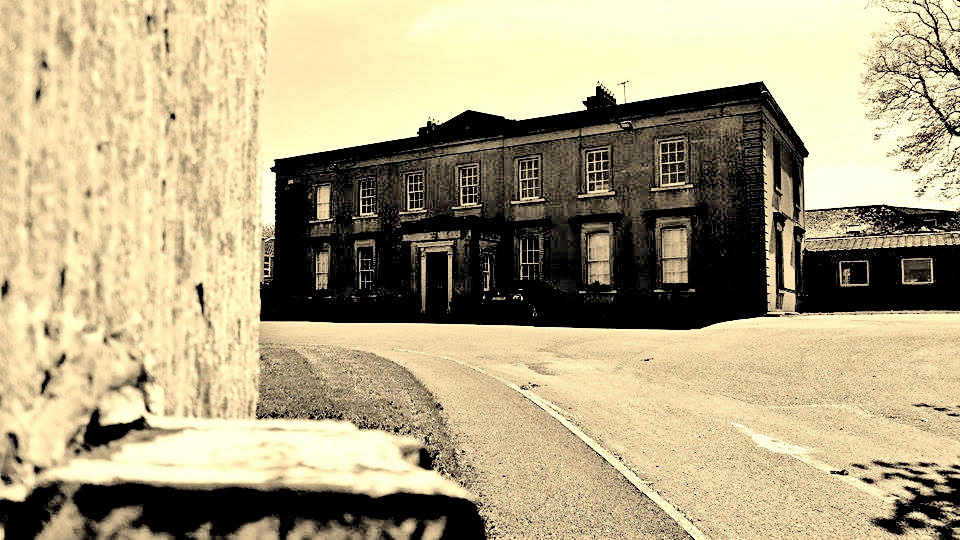
Today, Drogheda Grammar School is a respected non-denominational, co-educational secondary school. It is operated under a management committee and subscribes to a Quaker ethos. Originally a boys’s boarding school, up to 1976 it occupied a prominent place in the town centre, right beside St Lawrence’s Gate, but even by the 1950s was becoming in need of refurbishment.
When it moved out to the present site, the window was put into storage, where it remained until 2012 – out of sight, but not forgotten. A brand new school was completed in 2012 and the window was installed into a Reflection Room.
Story 5: Brittas Bay Antiques
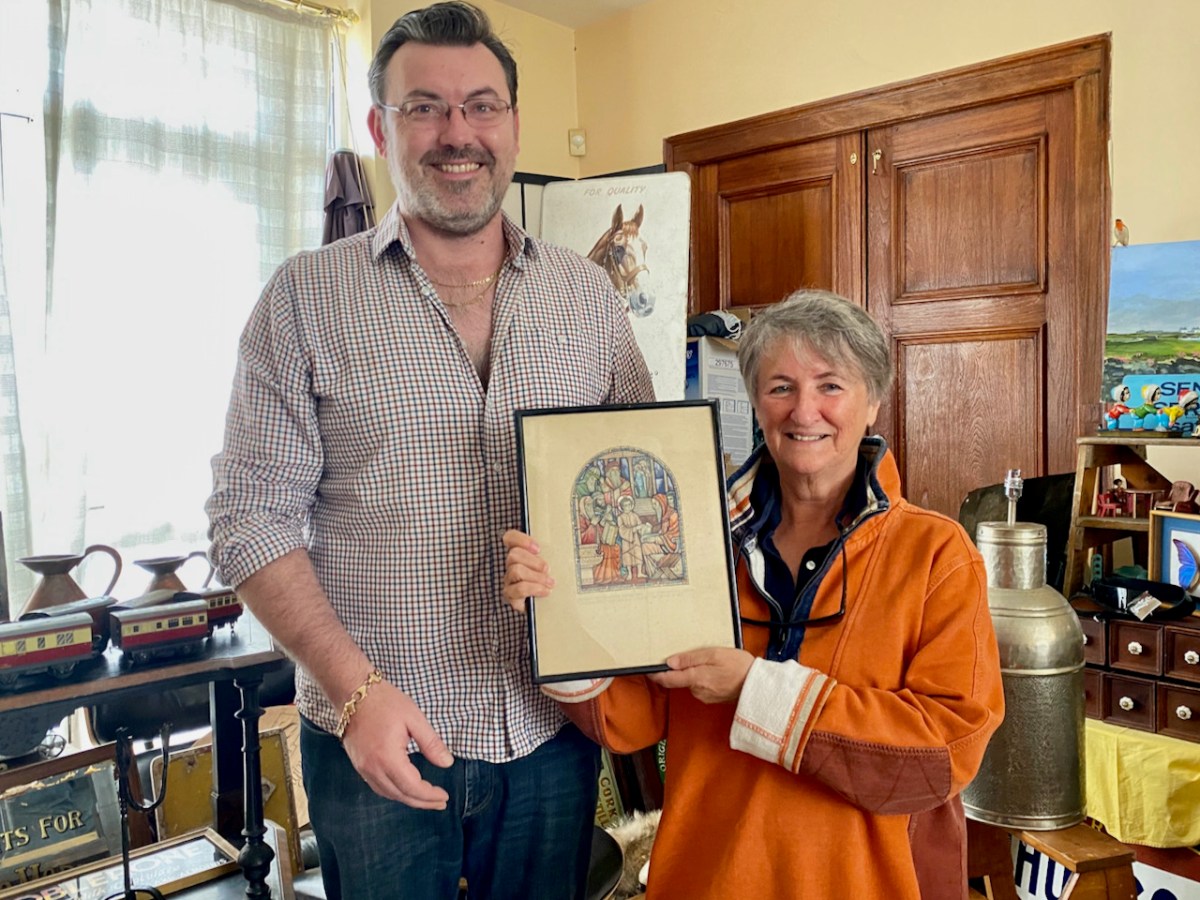
Wait – how did this story manage to wind its way to a quirky antique store by the beach in Wicklow? Well, at some point in the last couple of years Niall (below and yes, he really is that tall) and Chrissie, the proprietors, picked up a box of curios from someone, and discovered a Harry Clarke Studio sketch inside it. They advertised it online and someone stumbled across it, paid for it, and asked me to pick it up for her. I was happy to do so. (The shop is an Aladdin’s Cave, by the way – most enjoyable browsing I have done in years!)
Story 6: Etain
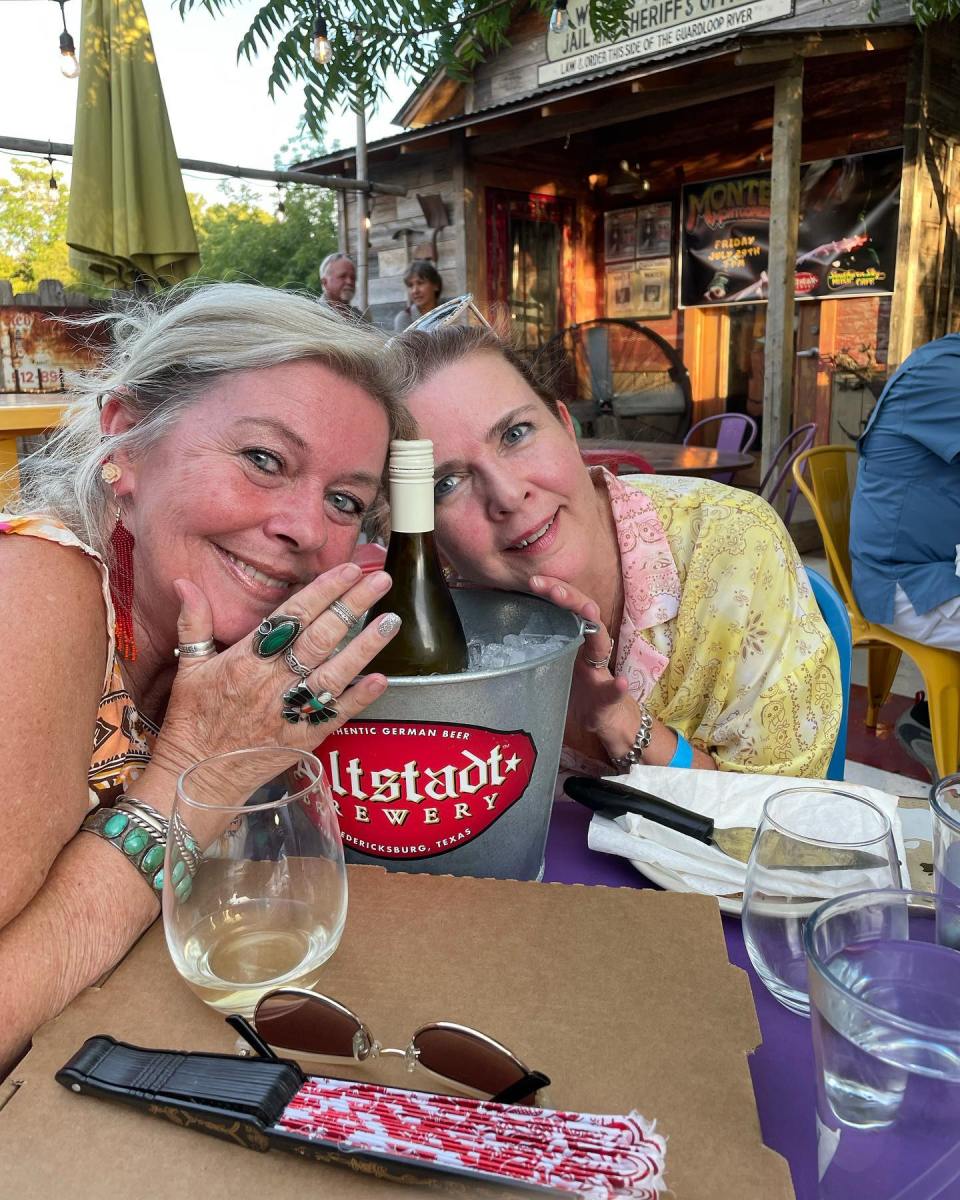
So c’mon Finola – ‘someone’ asked you to pick it up? Who exactly? It was my friend, Etain Clarke Scott, daughter of David Clarke and grand-daughter of Harry Clarke and Margaret Clarke. She and her siblings live in Texas, although they grew up in Dublin and make frequent visits over here. It was on her last visit, with her sister Veronique, that she asked me to pick up the sketch.
This is Etain (left) and Veronique (right) – as you can see they are both beautiful, and lots of fun! (And she will probably kill me from stealing this photo from her Facebook page.)
Story 7: The Research
At this point, we knew that the sketch was a window design produced by the Harry Clarke Studios for the Drogheda Grammar School – it said so right under the sketch, but we didn’t know whether the window had ever been made or whose work it was. The first question was easy – a quick Google led us to the school website and to the story of the window. I suspected that the artist was the Studio’s manager and chief designer, William Dowling, who took over the role from Richard King upon King’s departure in 1940. Regular readers will know by now that long after the death of Harry (in 1931) the Studios had continued with what I have called The House Style since what people wanted was ‘A Harry Clarke’.
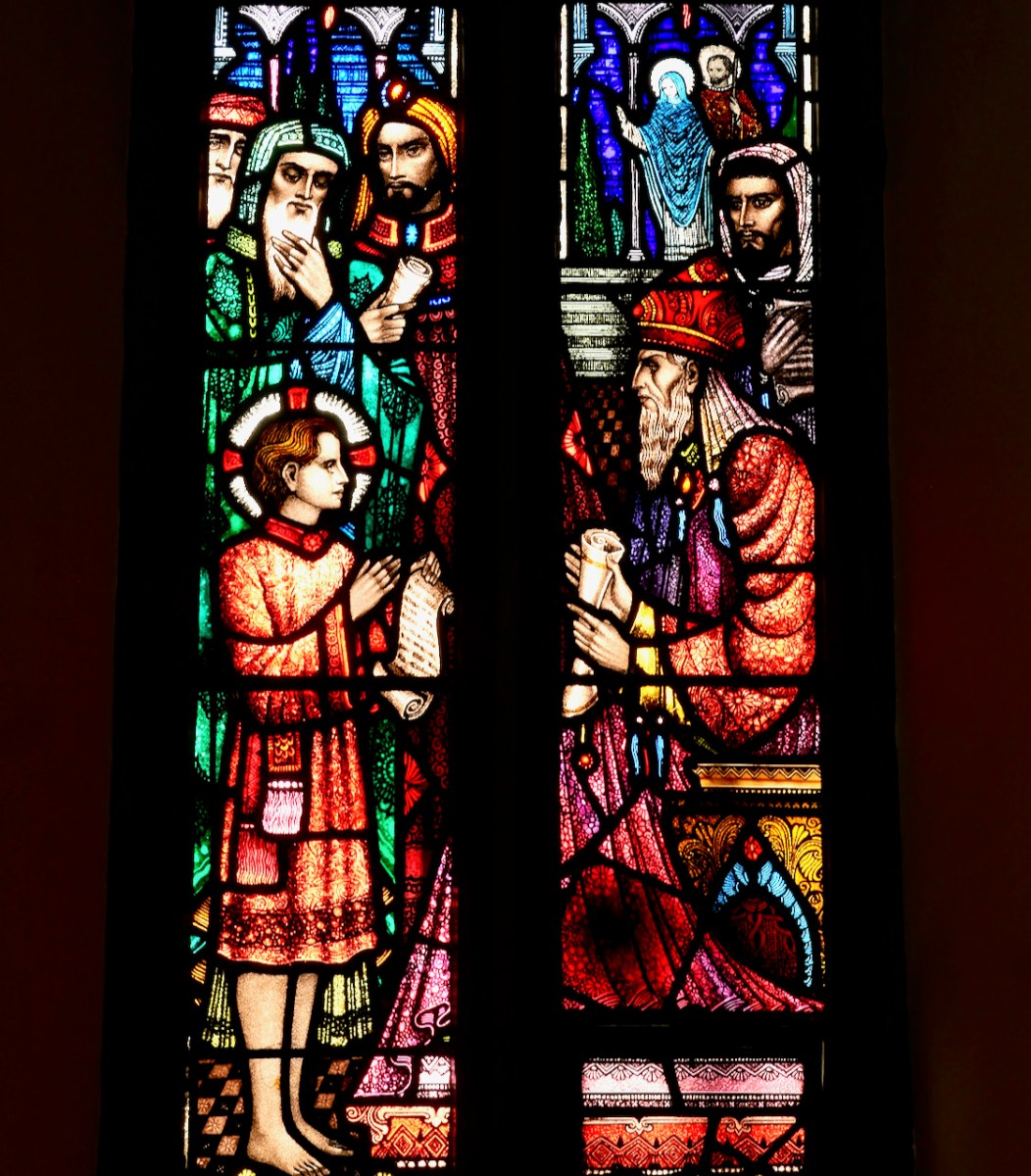
I consulted with my stained glass colleagues – David Caron, Paul Donnelly, Jozef Voda and Ruth Sheehy, all contributors to the Gazetteer of Irish Stained Glass and all very knowledgeable indeed on the work of the Studios during this period. I offered in evidence a couple of examples of Dowling windows of the same subject – Christ Among The Doctors or The Finding in The Temple. The one above is in Wicklow and the one below in Balbriggan.
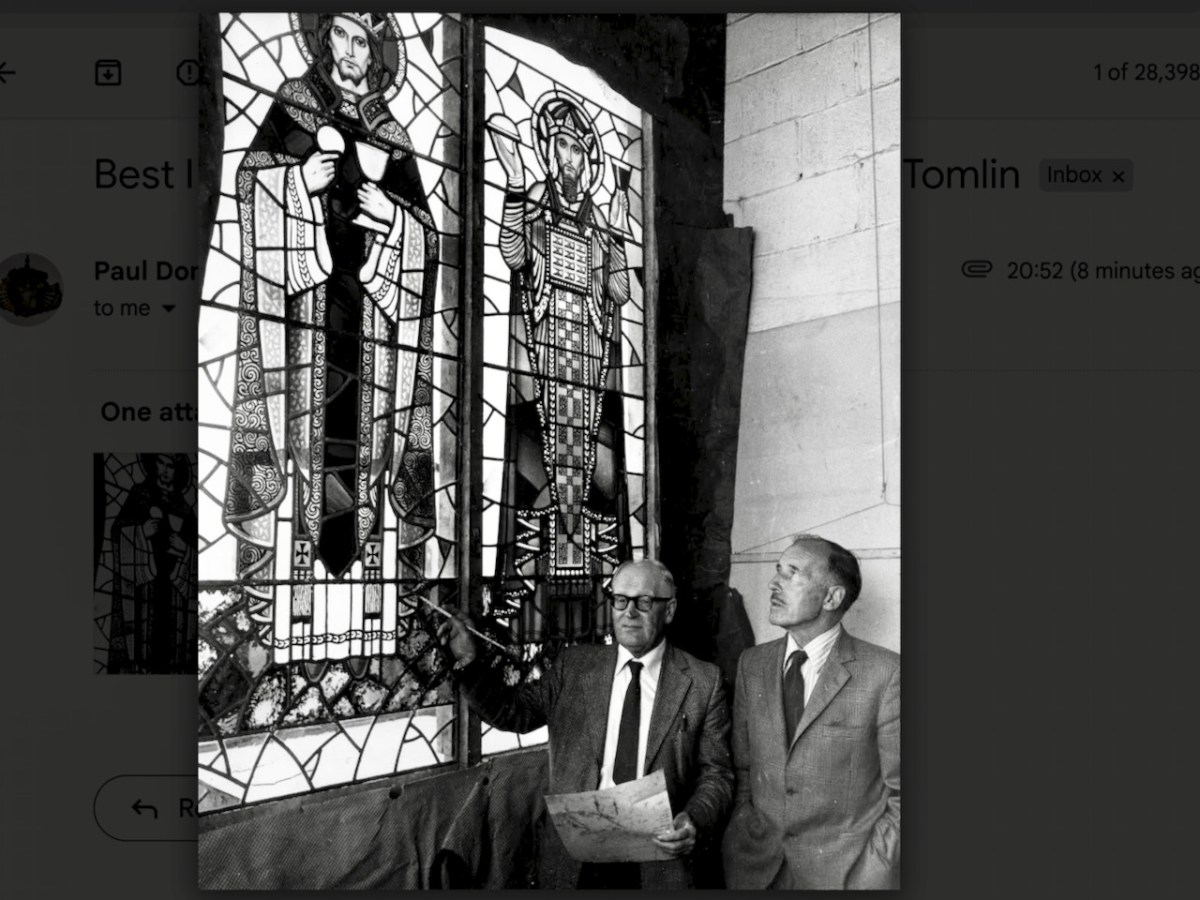
There was much helpful discussion by email: it was at this point David contributed the information and photograph about the Evie Hone cartoon, and both Paul and Ruth identified the handwriting as Dowling’s and agreed that the style was his. Etain remembers Willie Dowling well as a kind and avuncular presence in the studio, always impeccably dressed, and she was pleased at this attribution. That’s Dowling below (left), with Stanley Tomlin, at the Studios at a later date.
Story 8: Taking the Photographs
We had the sketch and now we knew whose work it was and also that it was in situ in the school. What we didn’t know was what the window actually looked like. Was it exactly as the sketch has intended? Had changes been made to the shape or dimensions of the window? This often happens when older windows are inserted into newer openings. I contacted the school and asked for permission to come and photograph the window, which was graciously given.
What I found was that the stained glass had been carefully inserted into a larger window, protected front and back with toughened glass, and the story of the Bole Memorial Window was provided in a framed script on the wall. Although Etain’s sketch shows a window with a rounded top, this opening was square. If the window had been changed to fit more recently, it had been done so skilfully that it was not obvious or indeed detectable.
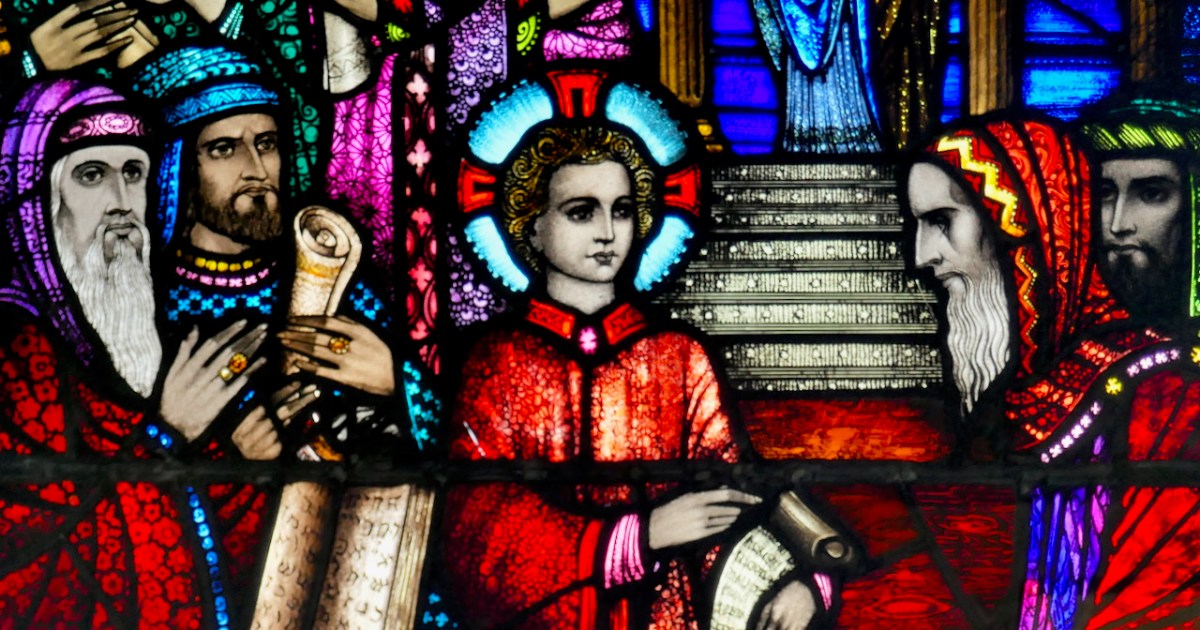
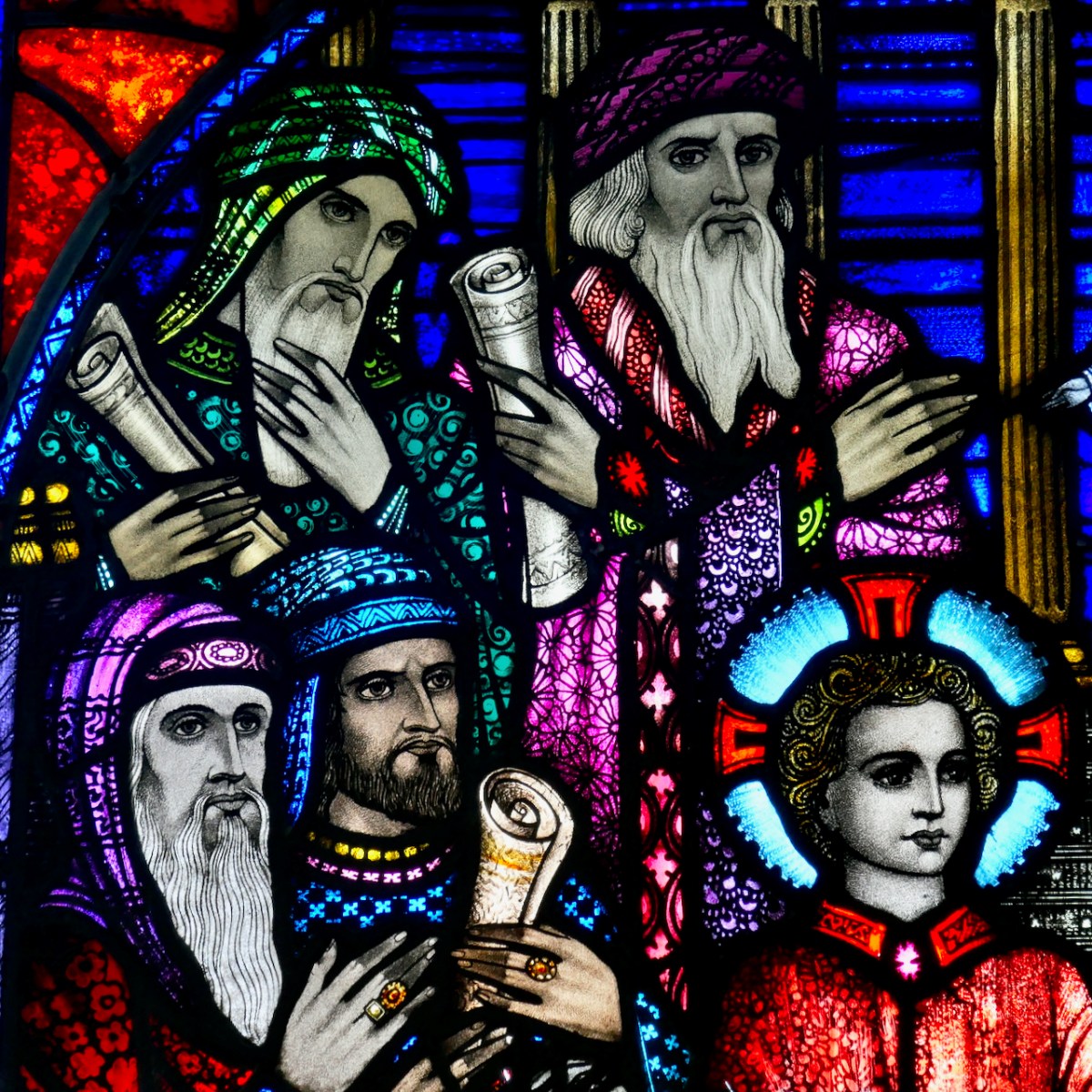
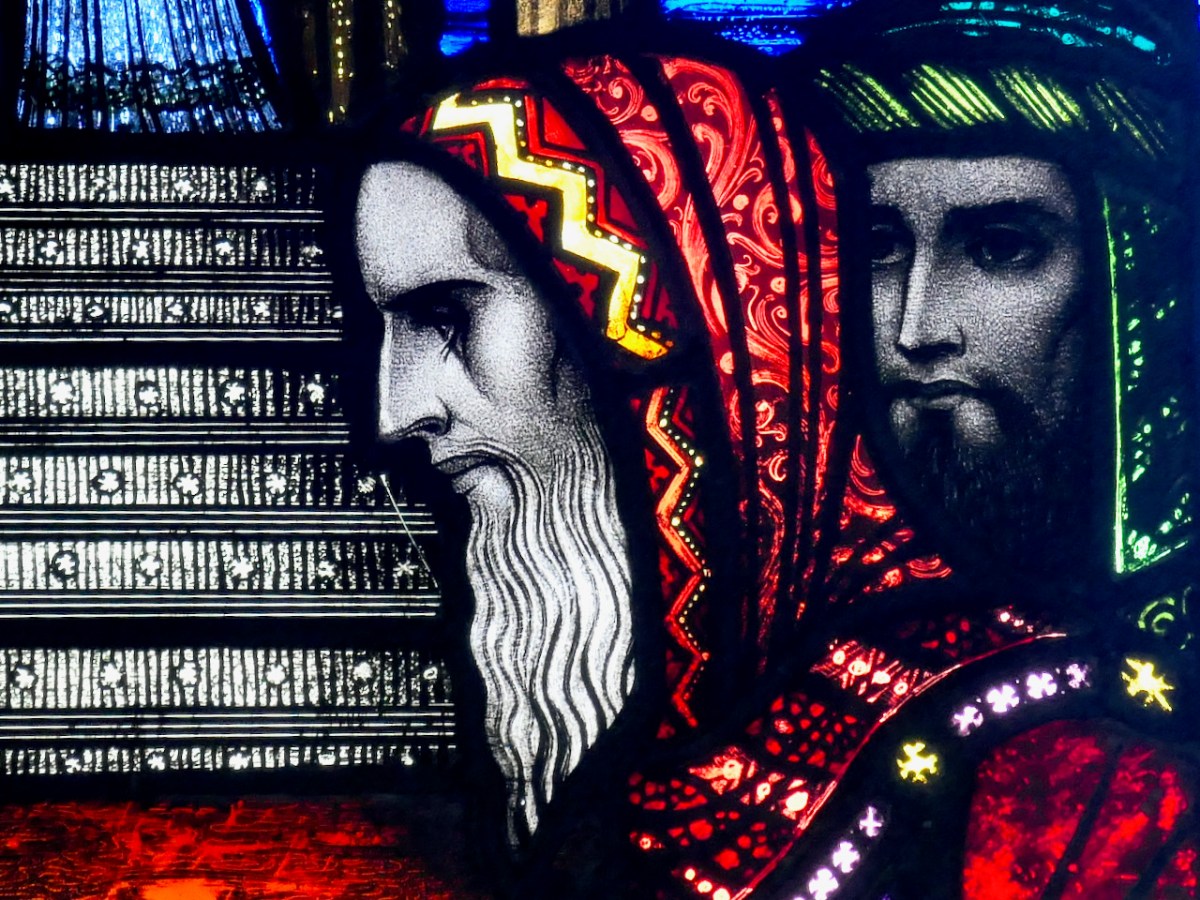
In fact, the window far exceeded my expectations. It is beautiful. Dowling had used good glass and the effect is jewel-like and vibrant. He has gone to town on every panel, painting, aciding, scratching, and filling even the smallest piece with decorative detail.
The figures of the Doctors are expertly rendered, while the small Joseph and Mary are similar to his Balbriggan and Wicklow panels. Jesus looks suitably solemn and earnest, as befits the good model that was intended for the students.
Afterword
Thank you to the Drogheda Grammar School for facilitating the photographic session. It was wonderful to hear, from the school Principal, Hugh Baker, that the window is treasured. Thanks to my collegial group of stained glass scholars for their advice and additional photographs. Most of all, thank you to Etain for entrusting me with the sketch and sending me down this story lane.
Dear Readers – we know you aren’t all on Facebook, so this is for those of you who follow us on WordPress or other platforms. On our Facebook page, we’ve been running a series on The Nativity in Stained Glass in the lead up to Christmas, so here, in one post, are those photographs and text. All the windows are Irish and 20th century. Merry Christmas to you all!
This one is by George Walsh and it’s in Frankfield Grange Catholic Church in Cork. This scene is part of a larger window, the main scene depicting the Annunciation. More about George Walsh here.
Kevin Kelly was a long-time stained glass artist for Abbey Studios. He loved doing Nativity windows. This one is in Inchigeelagh, Co Cork and featured on a UNICEF Christmas Card. It’s worth taking a look at the detail – amazing for what’s quite a small window.
This beautiful Nativity window is in Mayfield, Cork, in the Church of Our Lady Crowned. The Murphy-Devitt Studios were a group of young, dedicated artist and designers, determined to bring something new to traditional stained glass. We think they succeeded magnificently.
The Dominican Convent in Wicklow town has a gorgeous series of windows – the Mysteries of the Rosary. They were done in the Harry Clarke Studios in 1938, several years after Harry’s death, but his influence is very evident. They were mostly designed and painted by William Dowling, but with much input from Richard King. To see if you know the difference between Harry Clarke and Harry Clarke Studios windows, take the quiz, or just cheat and go straight to the answers.
Patrick Pollen, although he grew up in England, made his stained glass career in Ireland. Having been bowled over by Evie Hone’s Eton windows he came to Dublin to work with her. Hone’s influence is readily apparent in these two panels, which form the predella (lowest section) of a window in St Michael’s church in Ballinasloe, Co Galway, dating to 1957. I haven’t written about Pollan (yet) but you can read about Evie Hone here.
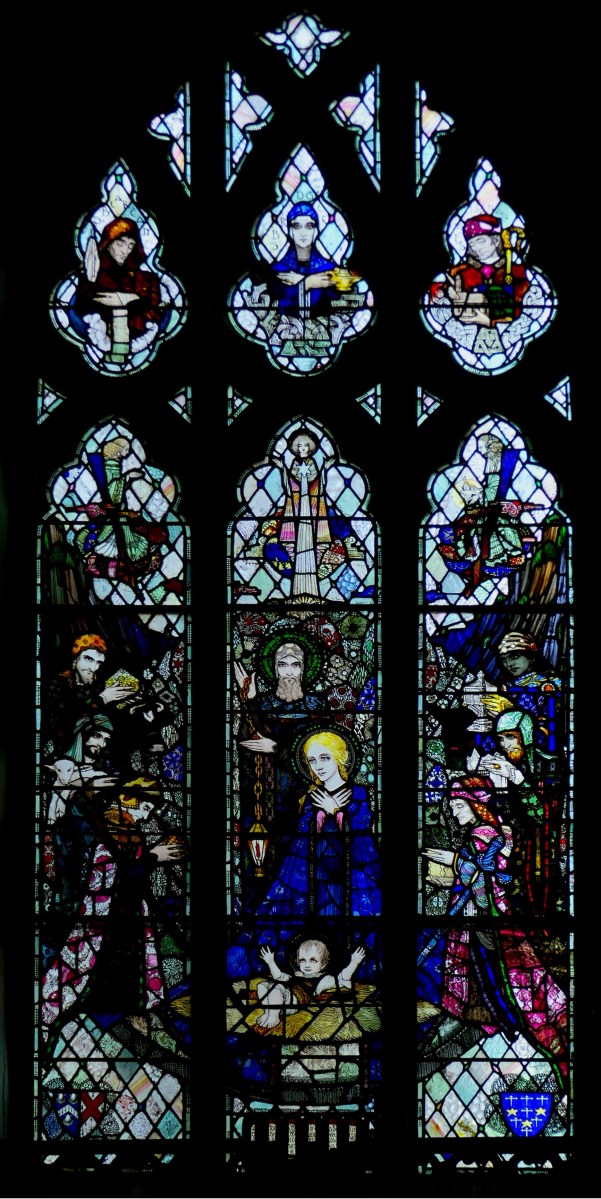
We’ve kept the best for last – the genius that is Harry Clarke. This is his Nativity Window, done in 1919 for Edith Somerville and her family, for the C of I Church of St Barrahane in Castletownshend, Co Cork. Lots more about Harry Clarke, Ireland’s greatest stained glass artist.
How did a church in an Irish country town become a repository for some of the greatest treasures of the Arts and Crafts movement of the early 20th century? That church is St Brendan’s Cathedral in Loughrea, Co Galway, which we visited last week.
Evie Hone’s St Brigid window
The Arts and Crafts movement was a reaction against soulless methods of industrial production which emphasised repetitive tasks and removed the link between the worker and the final product. Such factory processes were eventually applied to works of art, such as stained glass windows, where numerous workers would be employed to assemble a final product. Within the movement, artisans, artists and makers sought to get back to a former time, often conceived as medieval and highly romanticised, when craftsmen and women designed and executed exquisite works from start to finish.
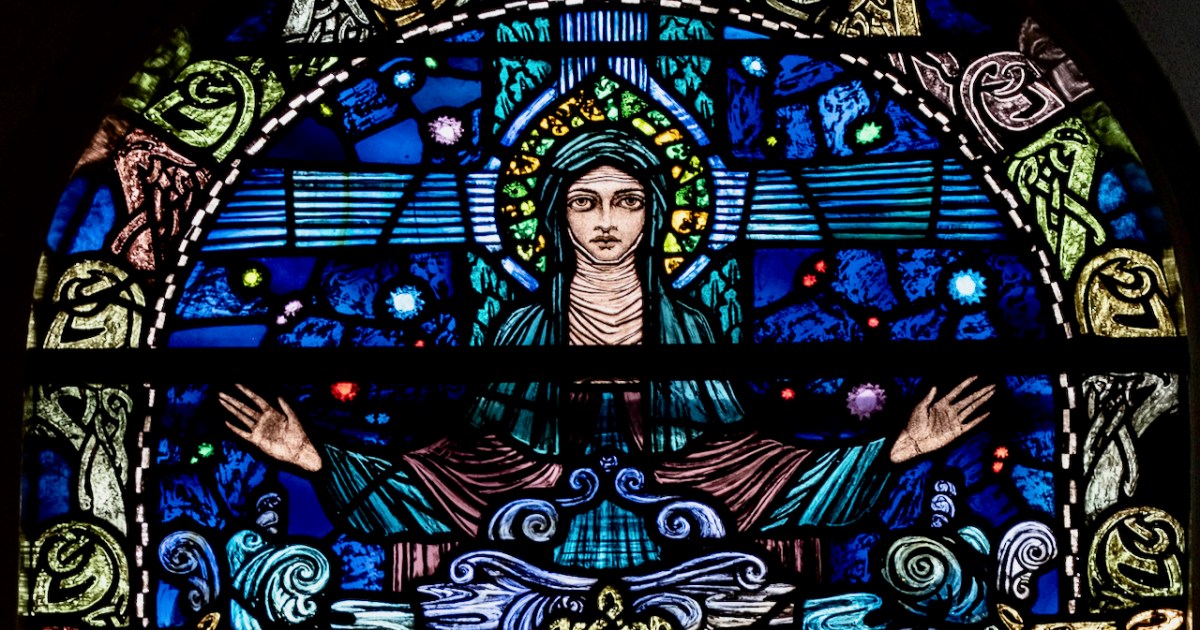
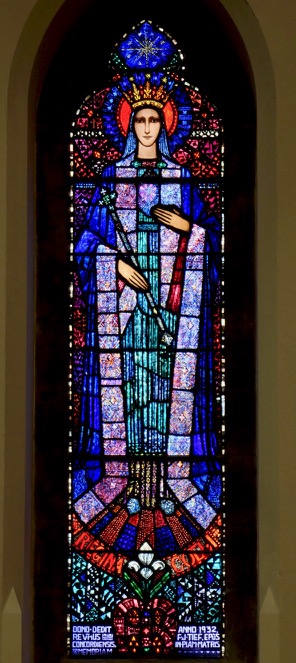
Queen of Heaven window by Michael Healy
So where does Loughrea come in? Well, for a start, it was the home of Edward Martyn, a wealthy enthusiast for all things Gaelic Revival including language, theatre, literature, music and art. Heavily influenced by the philosophies of the Arts and Crafts movement, particularly by those of William Morris, he worked with Sarah Purser to found An Túr Gloine (The Tower of Glass) as an artist/maker stained glass studio. Not a small part of their initial success was his ability to promise commissions from the decoration of St Brendan’s Cathedral.
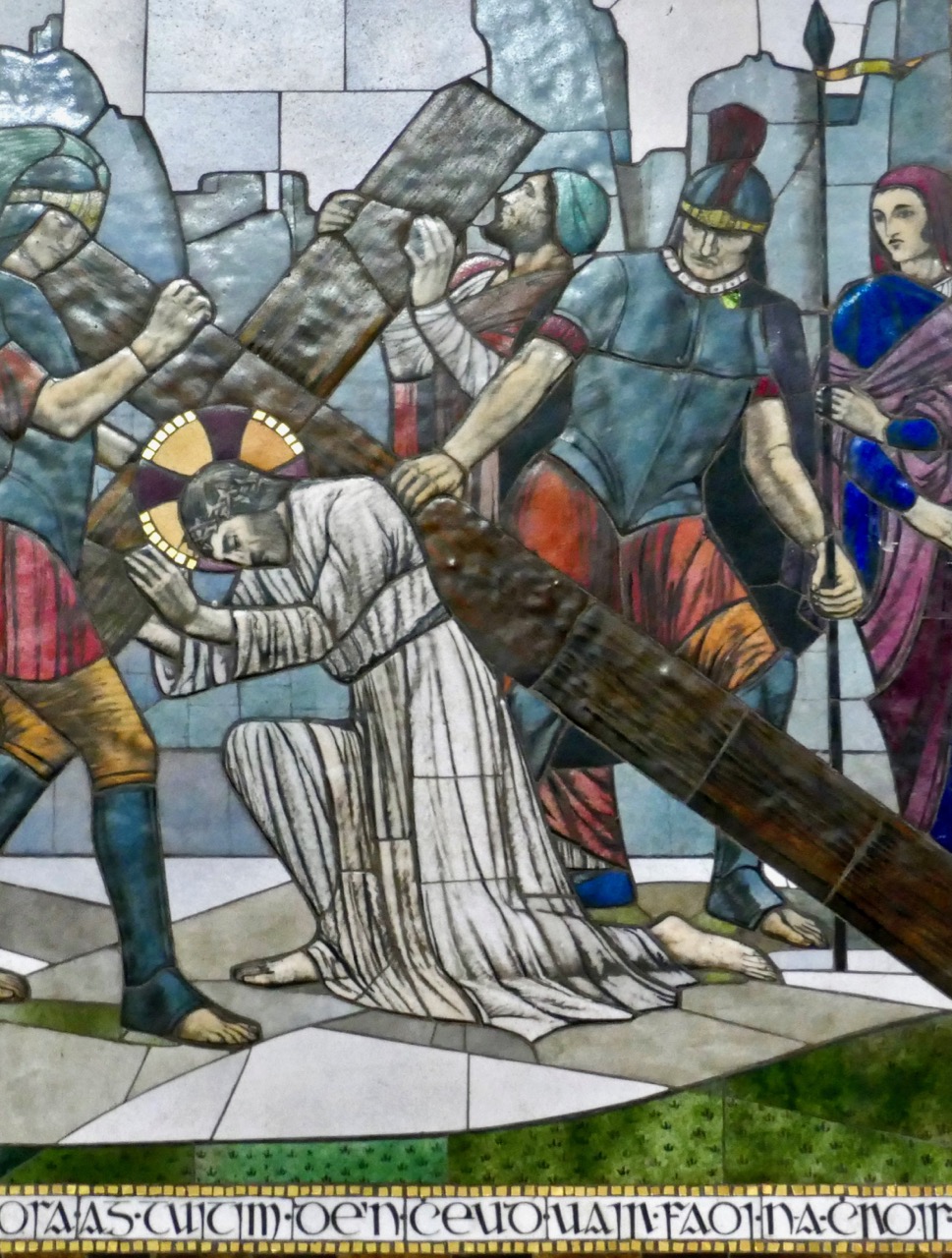
The Stations of the Cross are by Túr Gloine artist Ethel Rhind and are executed in the unusual opus sectile mosaic technique
Thus it is that this church, in outward appearance very much like the prevailing neo-Gothic style of the end of the nineteenth century, is packed with the work of the most eminent women and men artists of the opening decades of the 20th century. Yes, that’s right, women and men – the Arts and Crafts movement empowered women artists like few such movement had before (or since, perhaps).
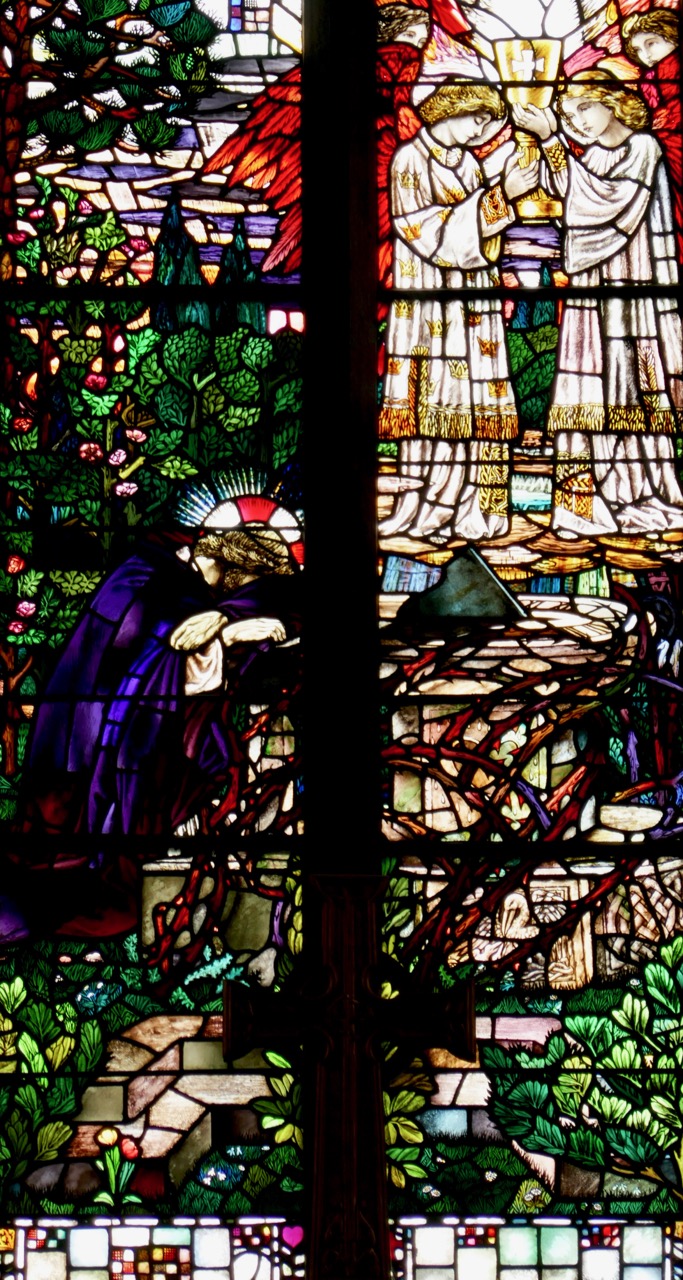
The Agony in the Garden by A E Child, detail
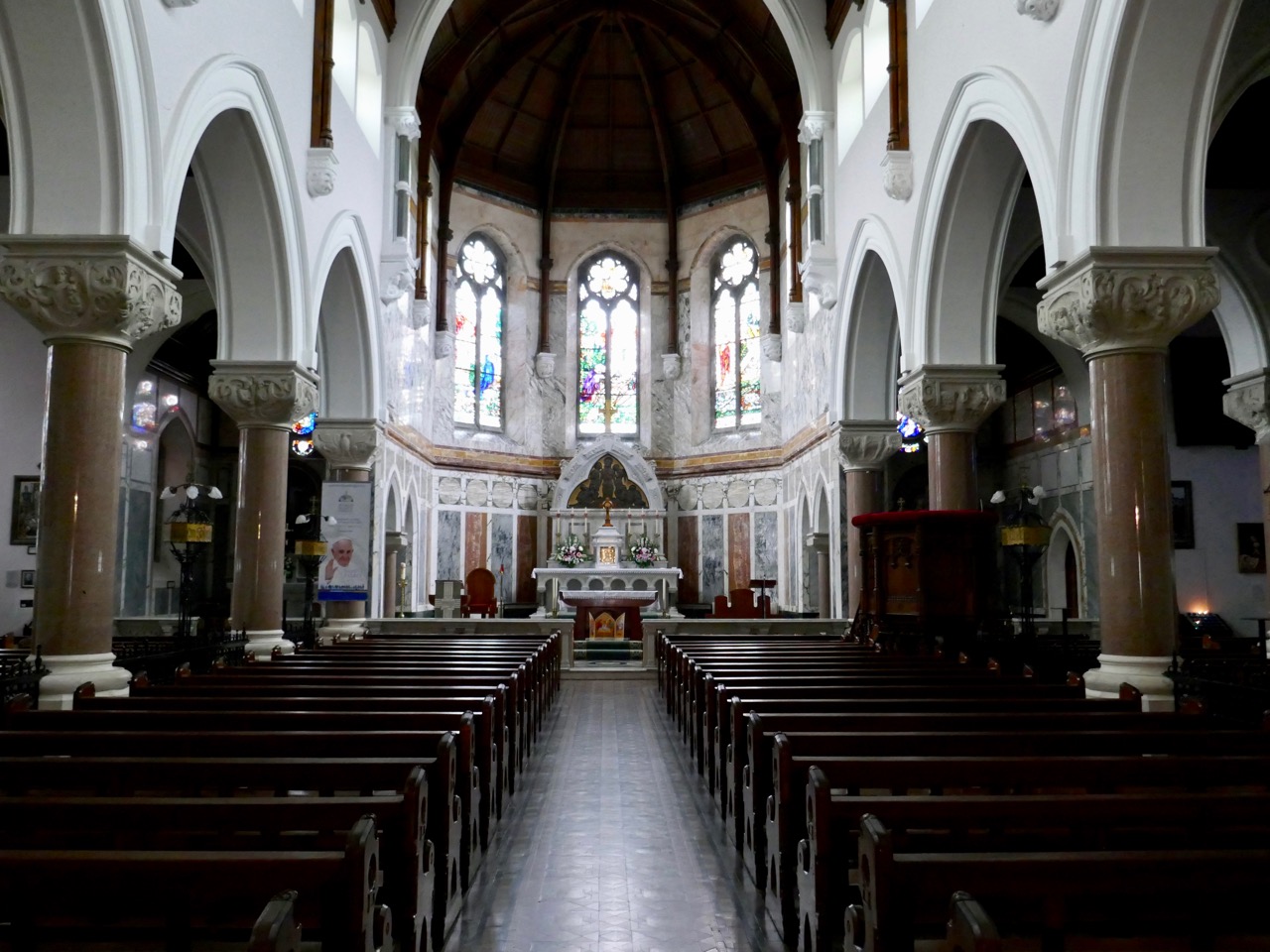
It takes a moment to realise what you have entered – initially the church interior seems familiar and unremarkable, almost heavy in its preponderance of marble, tile and dark wood.
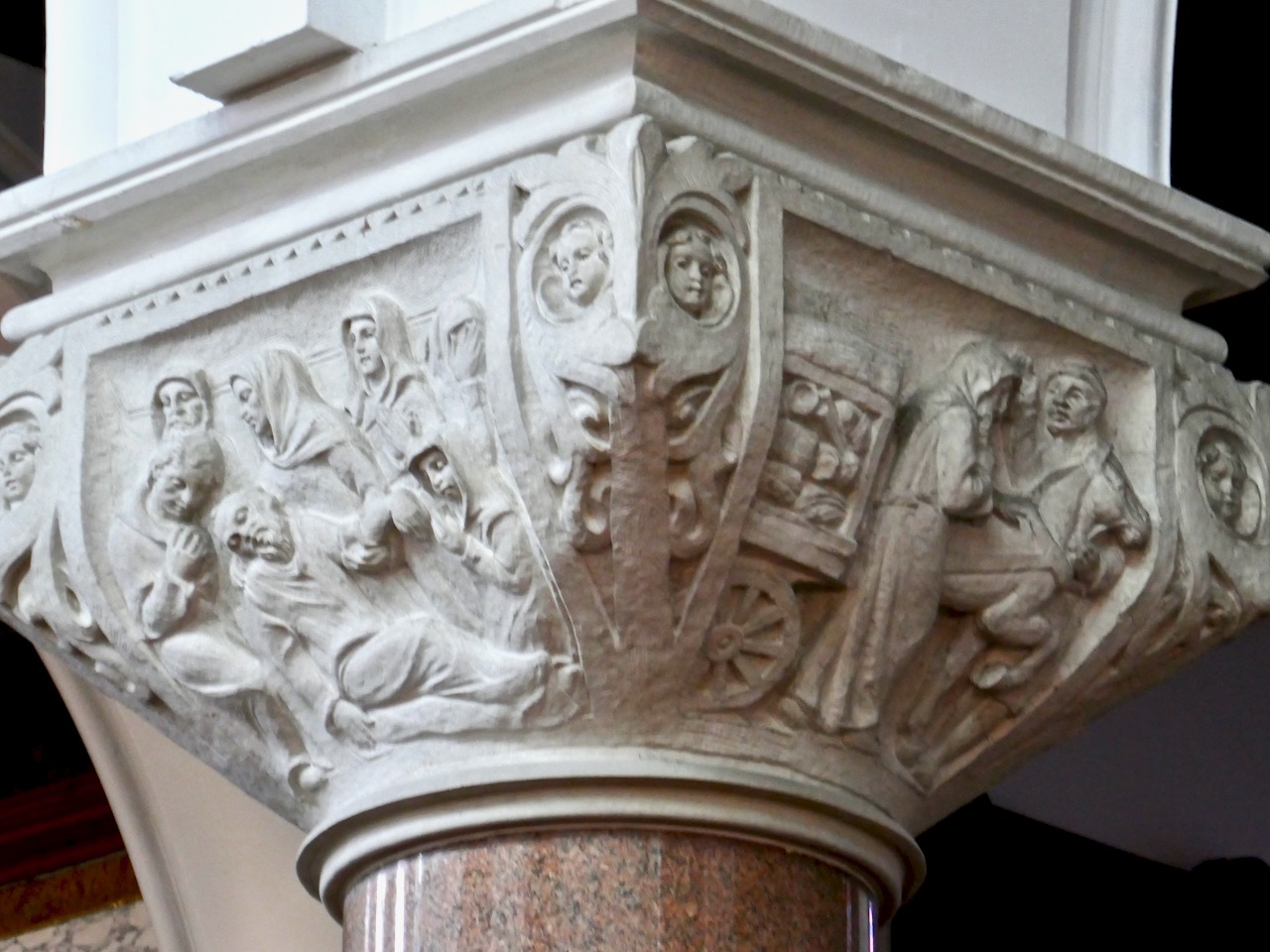
But as the eyes adjust, you can be permitted a gasp or two as you realise that all the capitals are carved with scenes from the life of St Brendan, that there are fine sculptures here and there, that the arm of each pew has been individually decorated with idiosyncratic characters, that are are art-nouveau-looking light standards throughout the aisles, that the stations of the cross are unlike any you’ve seen before, and finally that the stained glass windows are numerous and beautiful.
Two scenes from the Death of Brendan, carvings by Michael Shortall
All the Túr Gloine stained glass arts are represented here: A E Child, Michael Healy, Ethel Rhind, Catherine O’Brien, Beatrice Elvery, Evie Hone and Hubert McGoldrick. There is even a small St Brendan window by Sarah Purser herself – a rarity as she mostly confined herself to the management of projects rather than glass-painting.
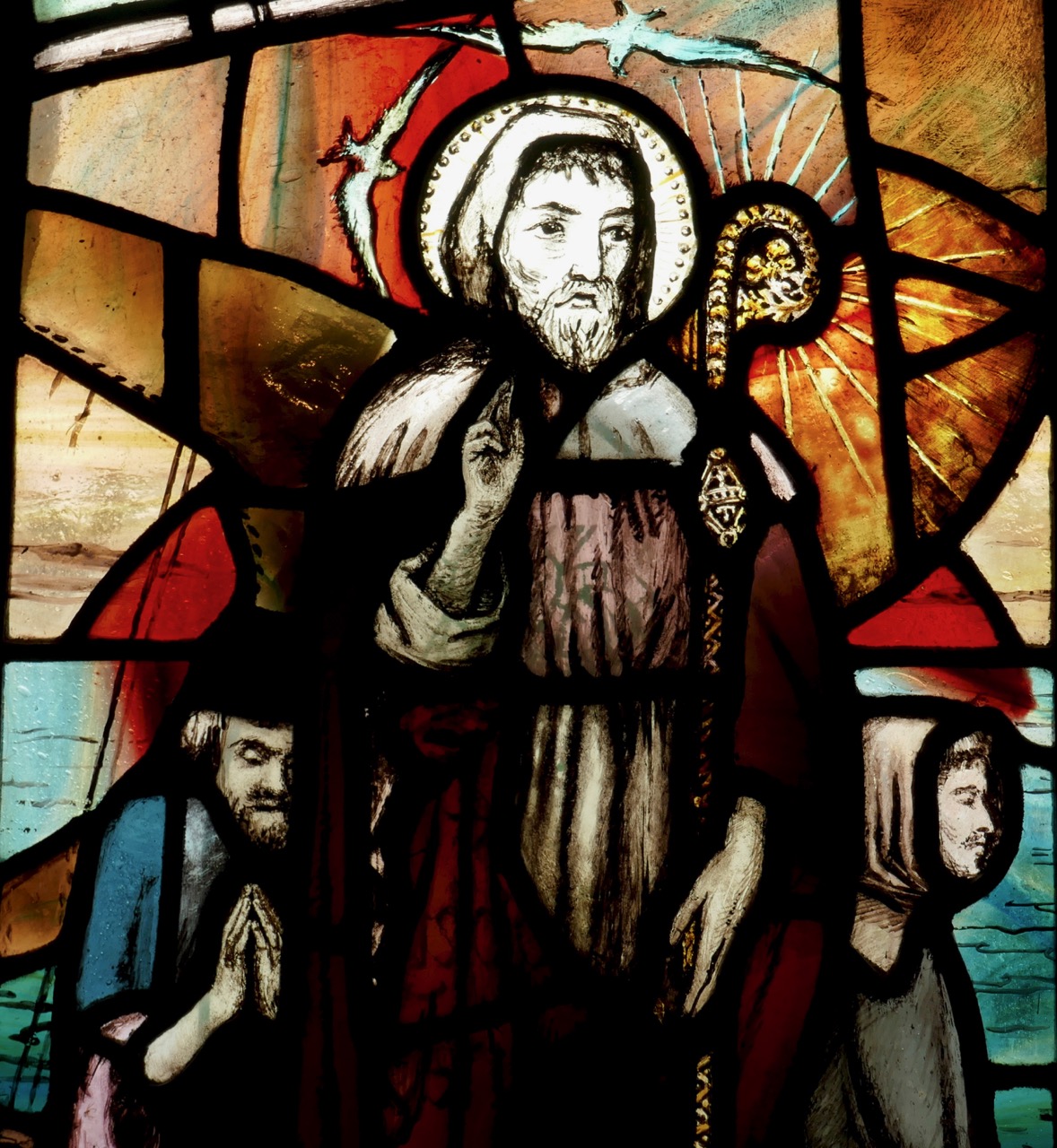
One of the very few stained glass windows actually executed by Sarah Purser herself – a Brendan image in the porch of the church
The stone carving is mostly the work of Michael Shortall, a student of John Hughes, the foremost sculptor of his day who provided bronze figures for the church. Eminent architect William Scott was engaged to design church furnishings and was responsible for the side altars, the entrance gates, the altar vessels and candlesticks, the baptismal font and altar rail.
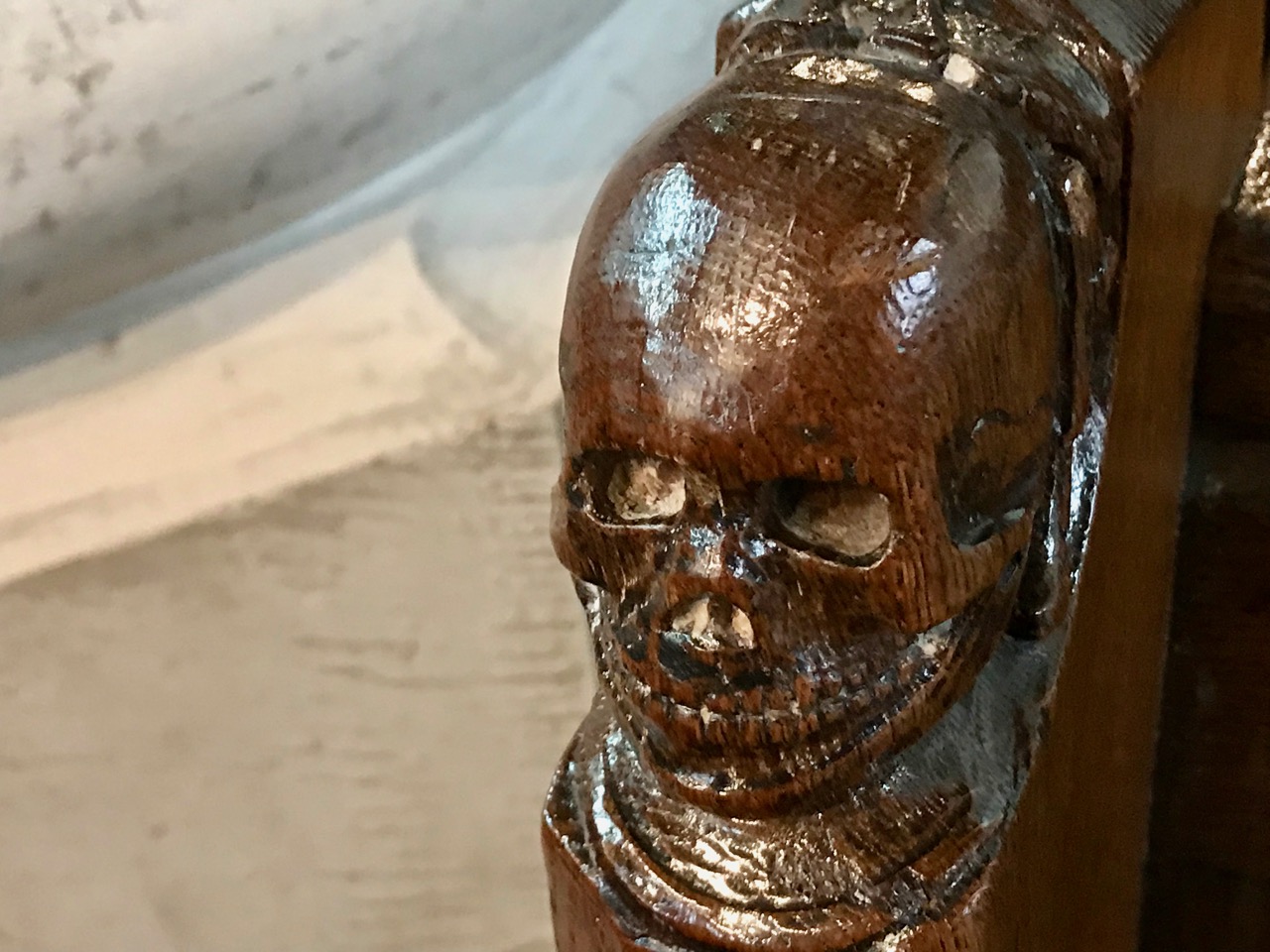
Each pew arm has a whimsical creature – this one was no doubt intended to concentrate the mind on mortality
The woodwork was all done locally, with the workers encouraged to use their skills to depicts beasts and mythical figures, in much the same way that medieval craftsmen had done.
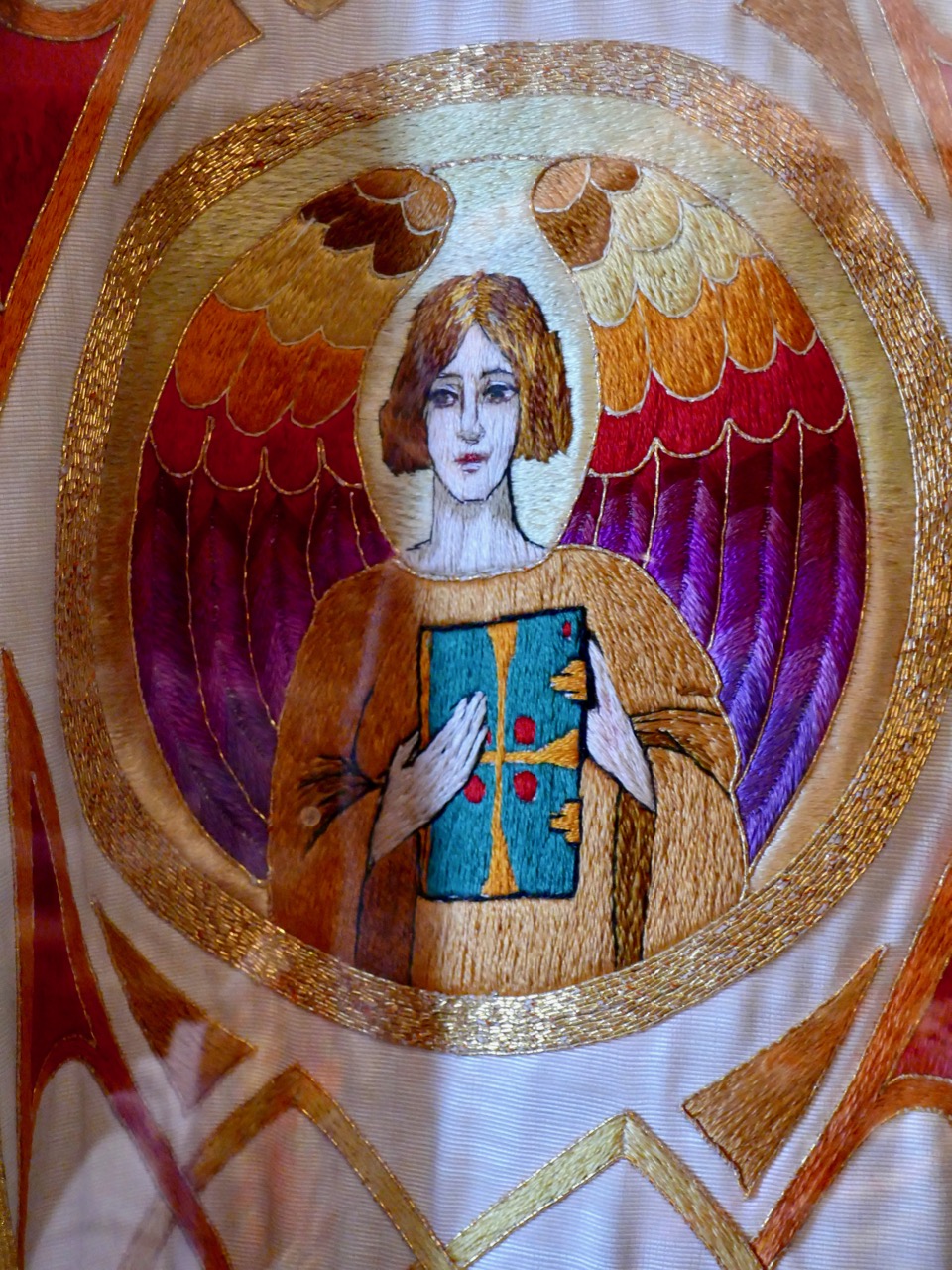
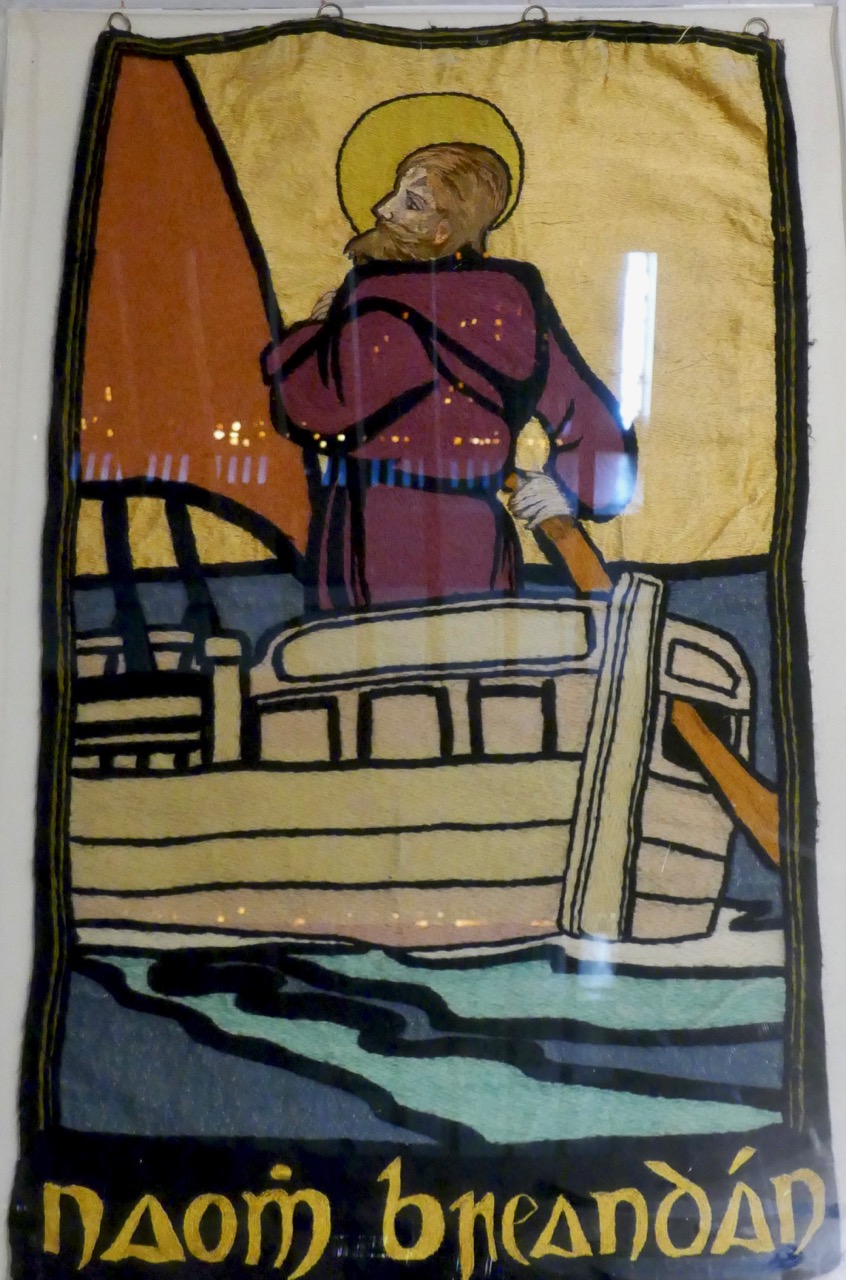
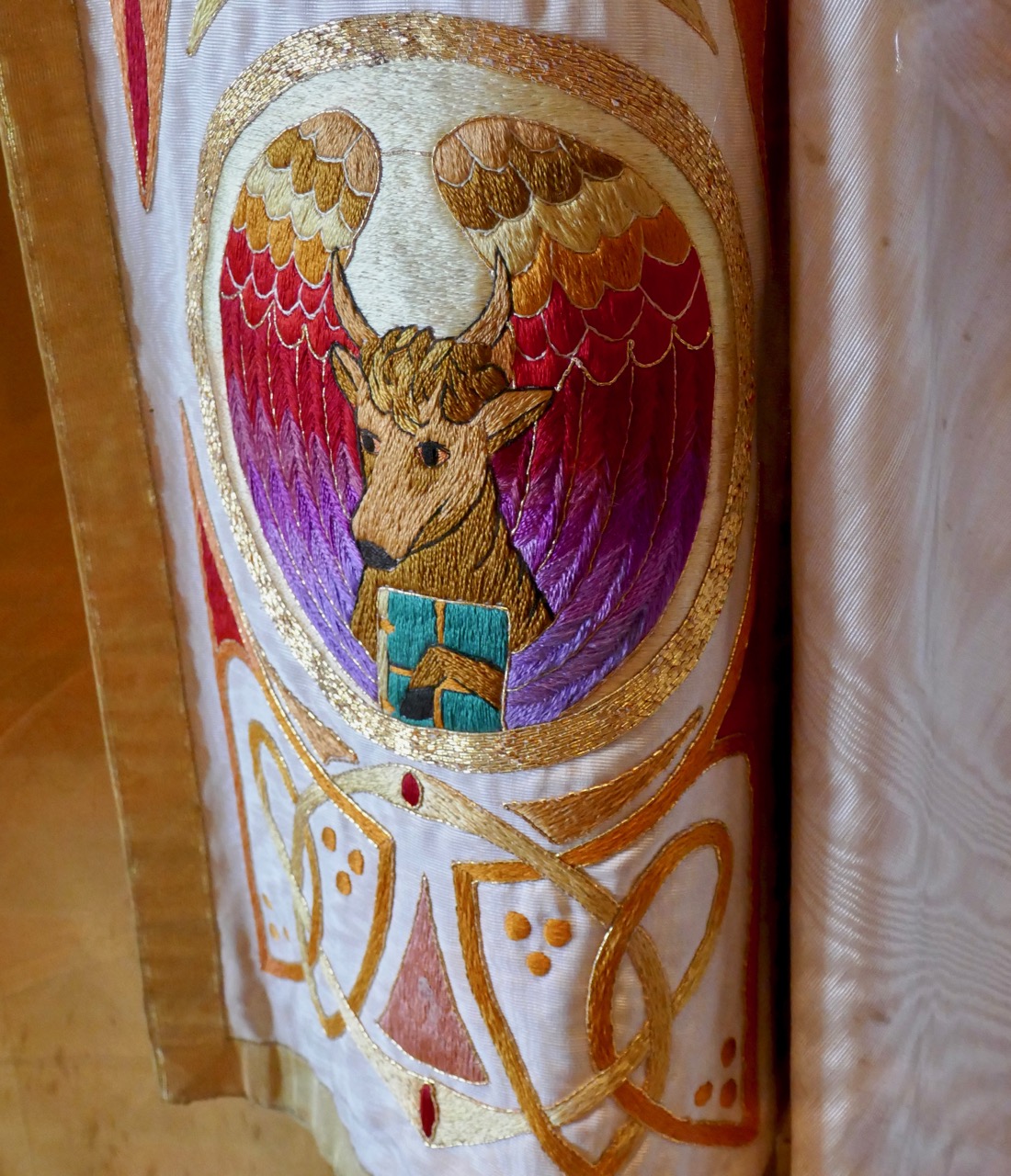
But that’s not all. Beside the church is a small museum, similarly packed with treasures. In particular, here is where you will see the work of the Dún Emer Guild, a women’s cooperative enterprise that designed and supplied materials (altar cloths, vestments, rugs, tapestries) to churches and others. Strongly influenced by traditional Irish designs such as scrollwork, interlacing, high crosses and Book of Kells symbols, the works supplied to St Brendan’s are wonderful examples of Irish Revival motifs, skillfully embroidered in gorgeous colours.
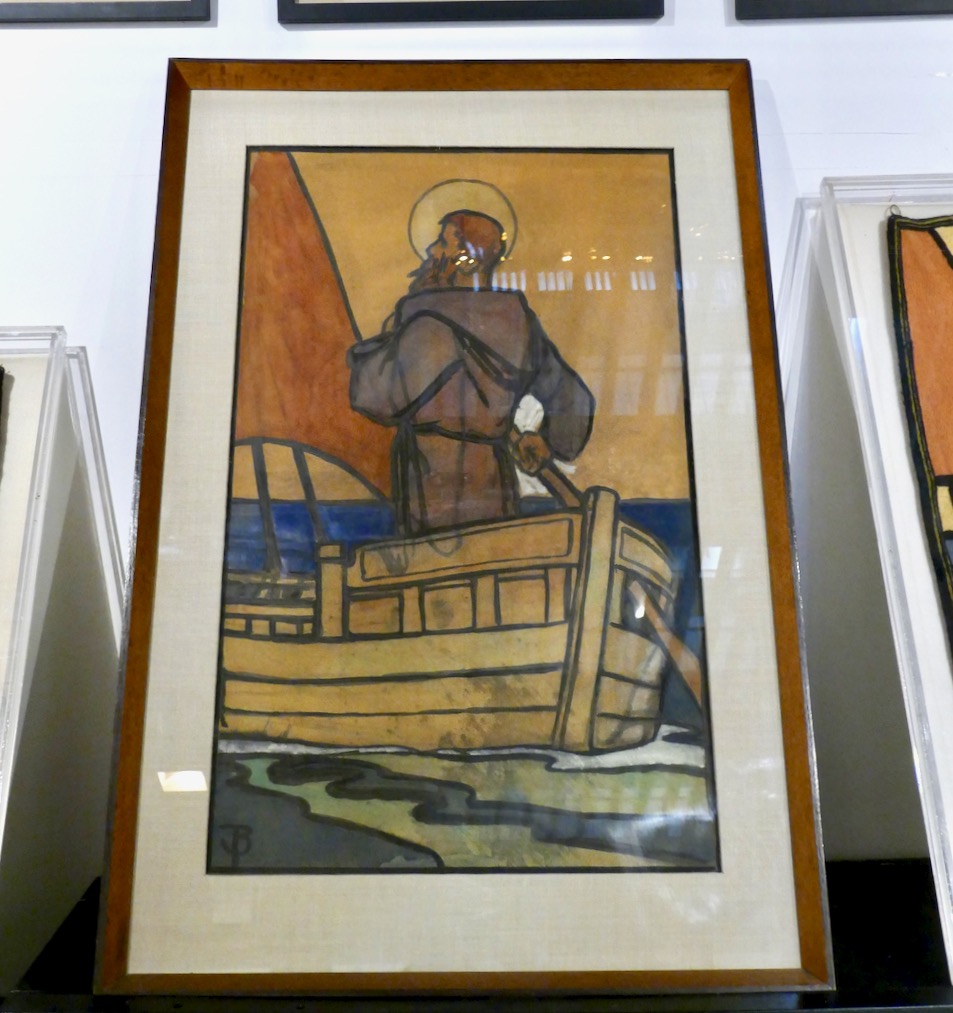
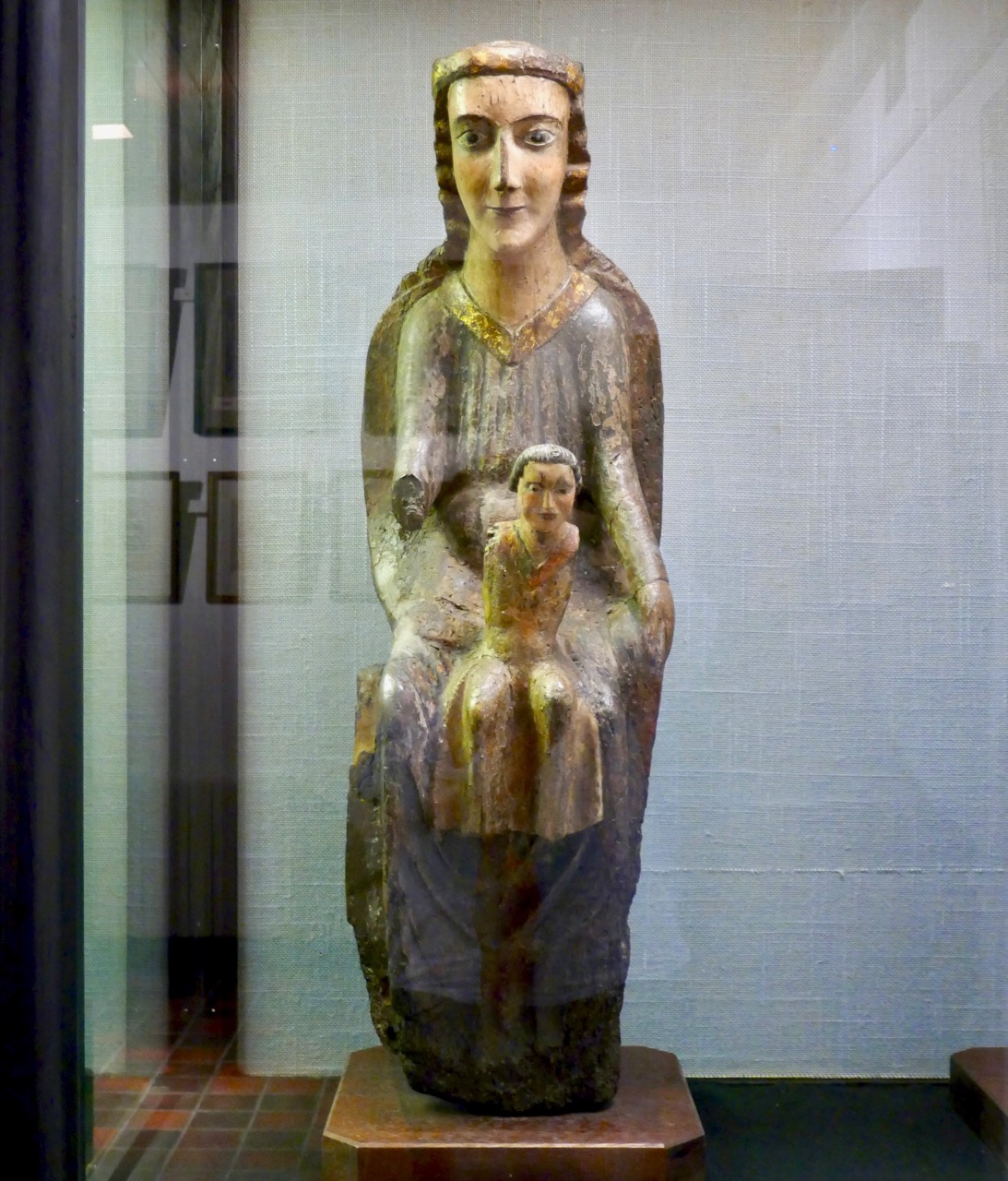
The Museum holds other artefacts too, including extremely rare medieval wooden carvings: most wooden statues were destroyed by the Puritans and very few have survived. There are also fifteenth century vestments, original drawings and sketches by Irish artists, altar vessels, and stained glass cartoons.
Twelfth or Thirteenth century wooden statue of the Virgin or Child
This post is a small introduction to the wonders of Loughrea Cathedral. About 40 minutes east of Galway and just south of the M6, this church is a must-see for anyone interested in the history of Ireland and its Arts and Crafts movement. The only comparable experience is the Honan Chapel in Cork.
Michael Healy’s magnificent Resurrection window
All I can do here is show you a representative sample of what we saw and encourage you to go see the totality for yourself. You won’t regret it.
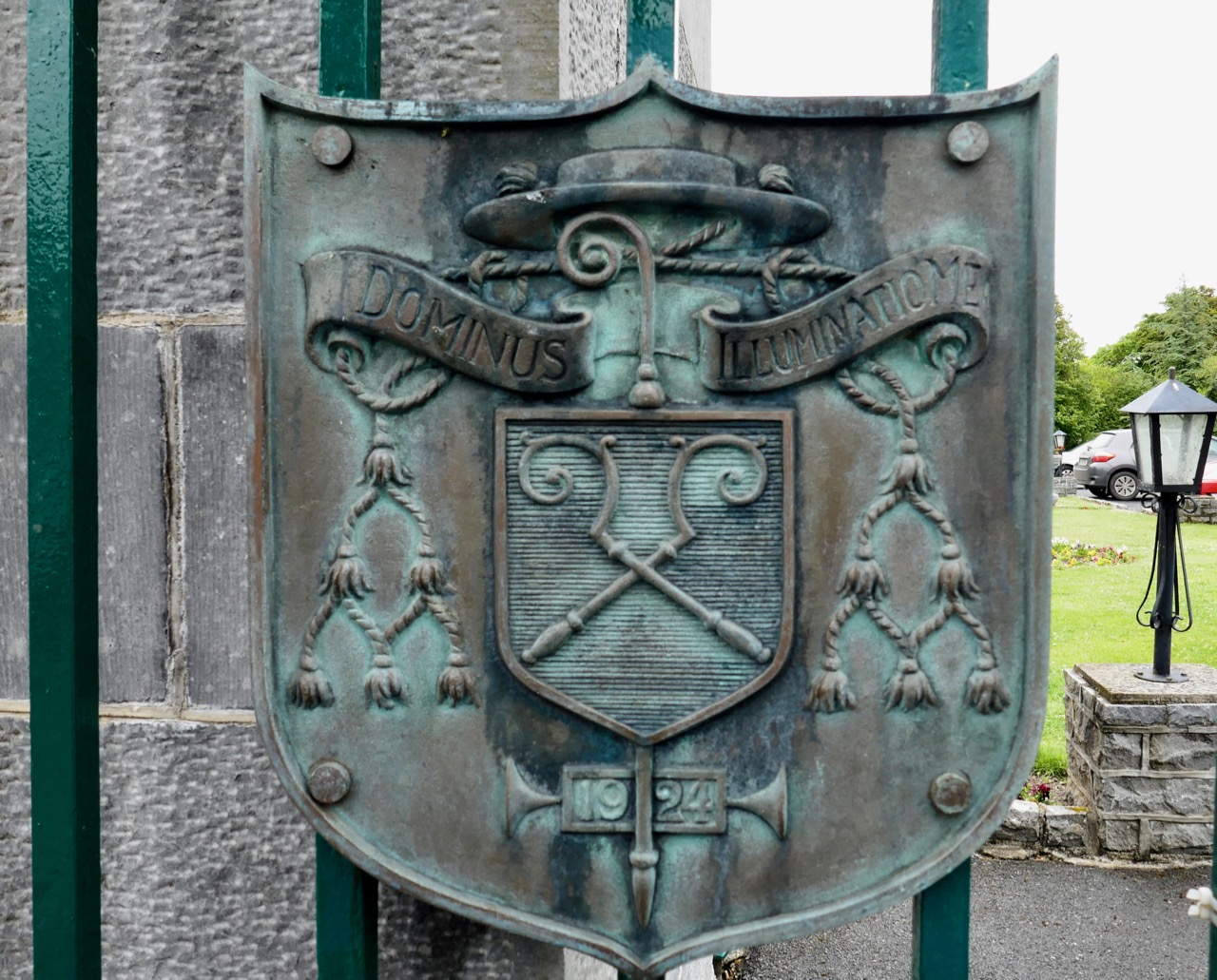
The massive cathedral gates, designed by William Scott
Welcome to the UCD Library Cultural Heritage Collections blog. Discover and explore the historical treasures housed within our Archives, Special Collections, National Folklore Collection and Digital Library













 Roaringwater Journal