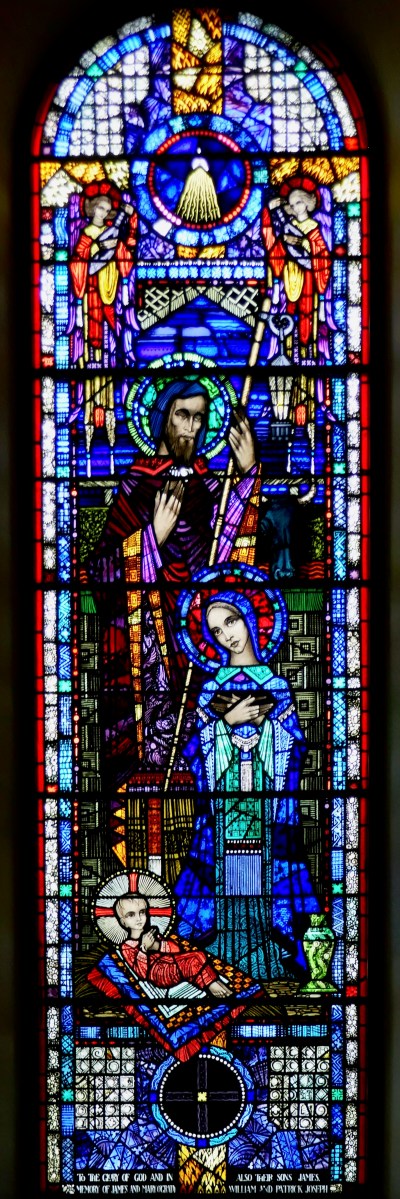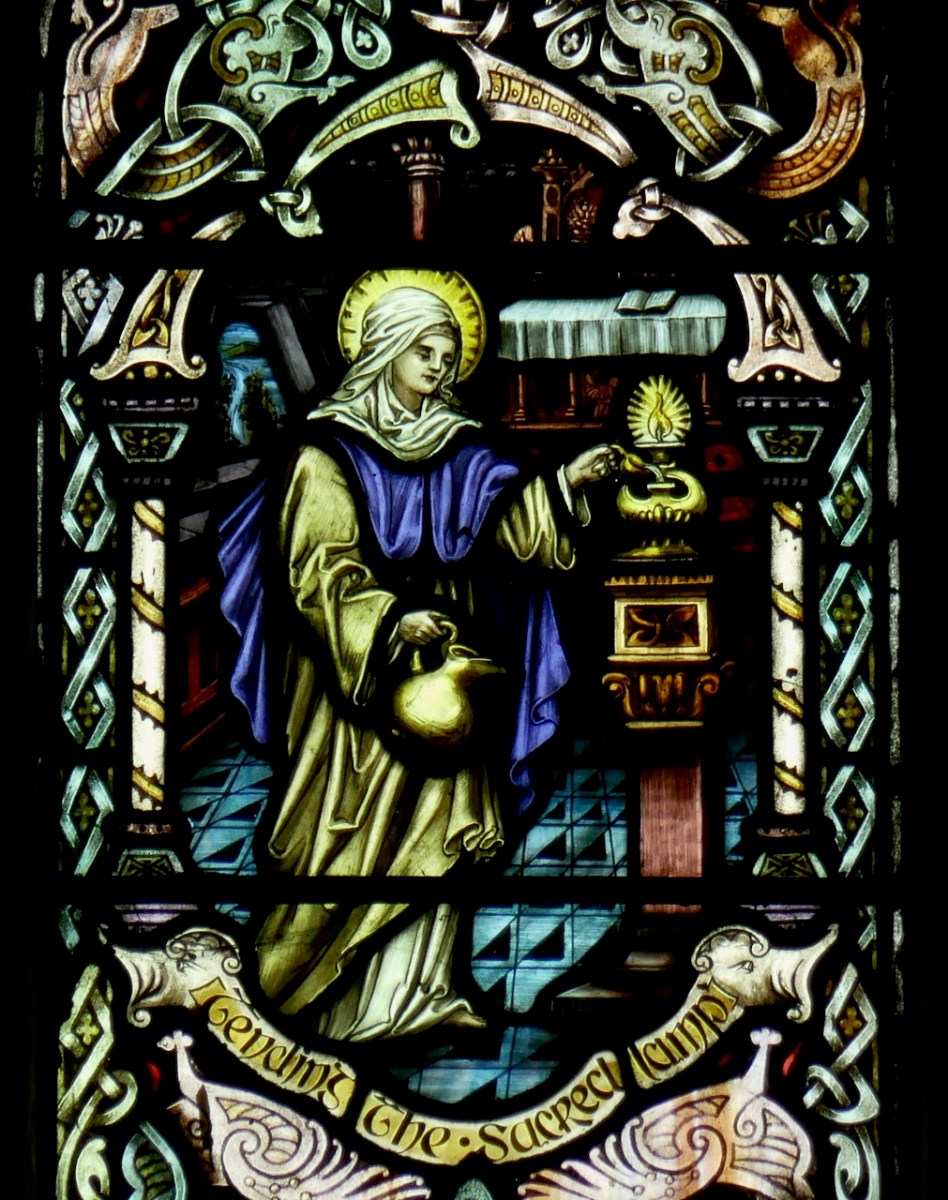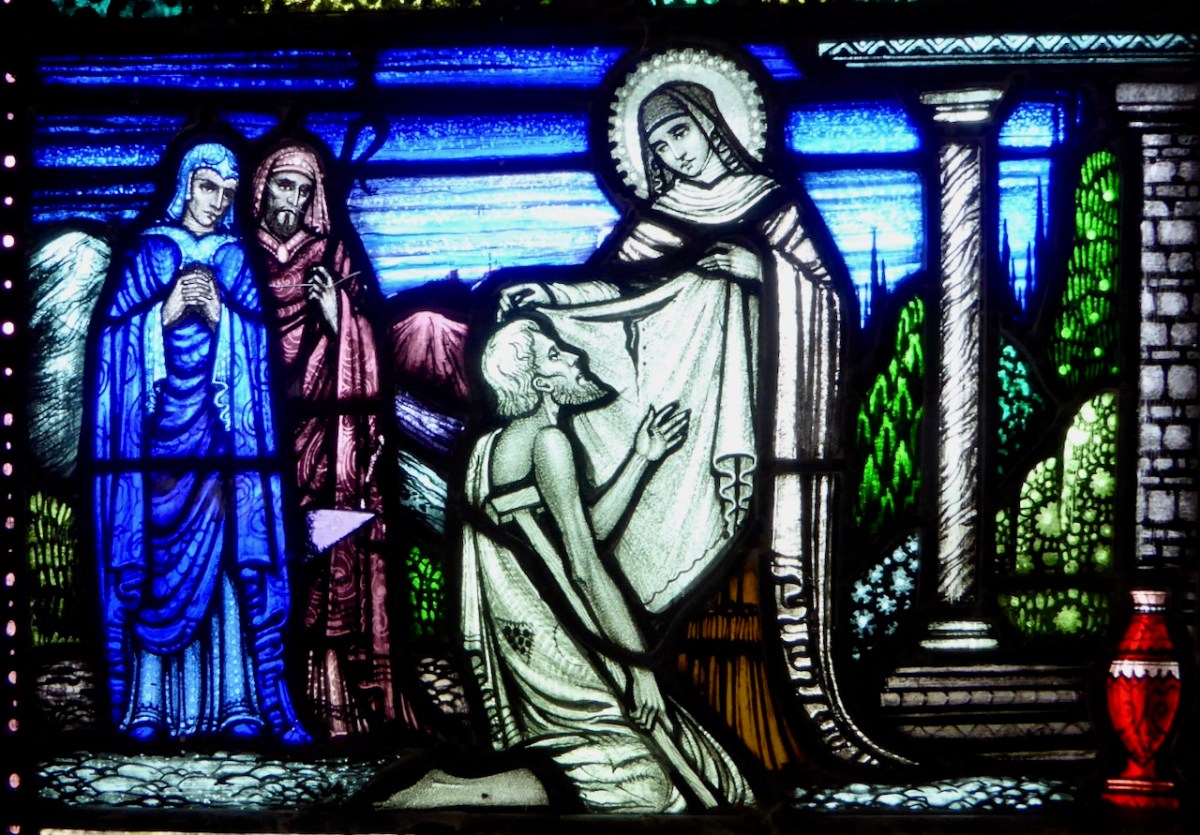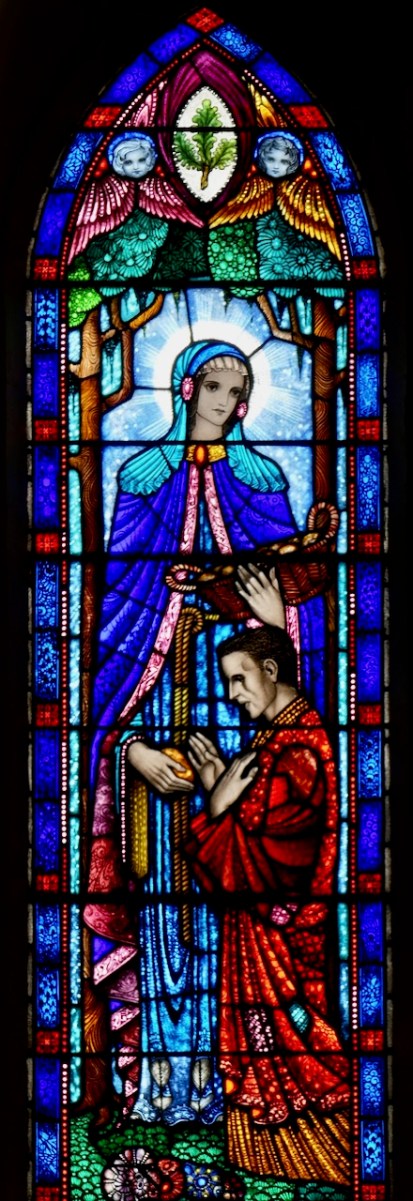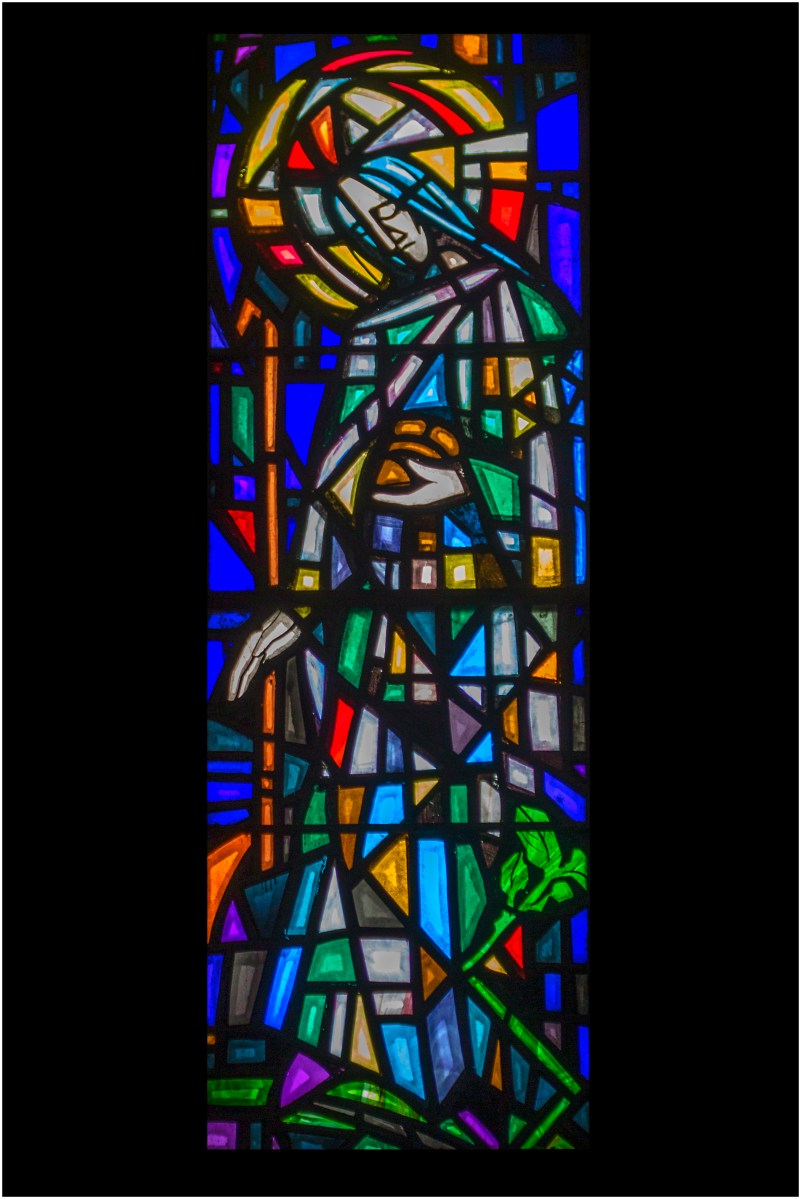
Harry Clarke’s Brigid

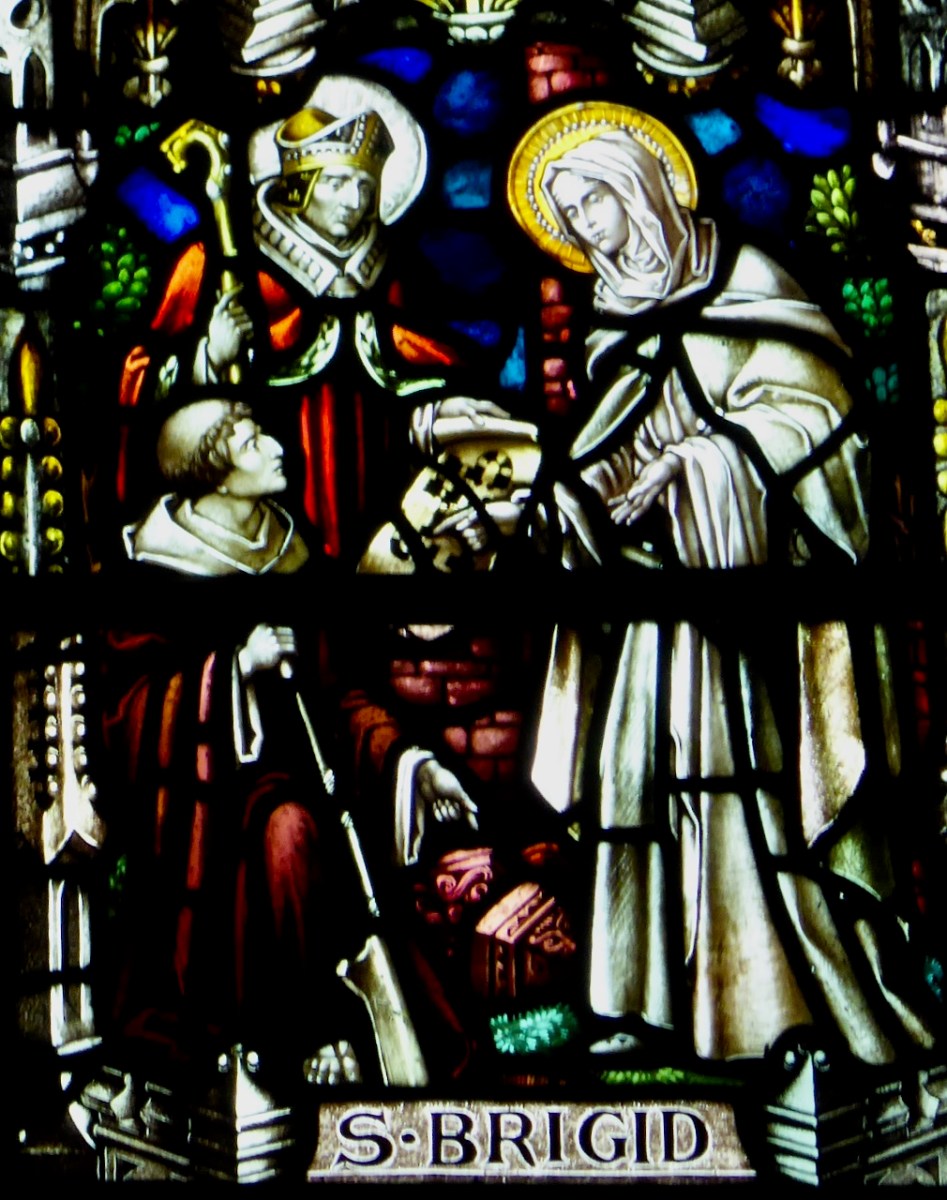
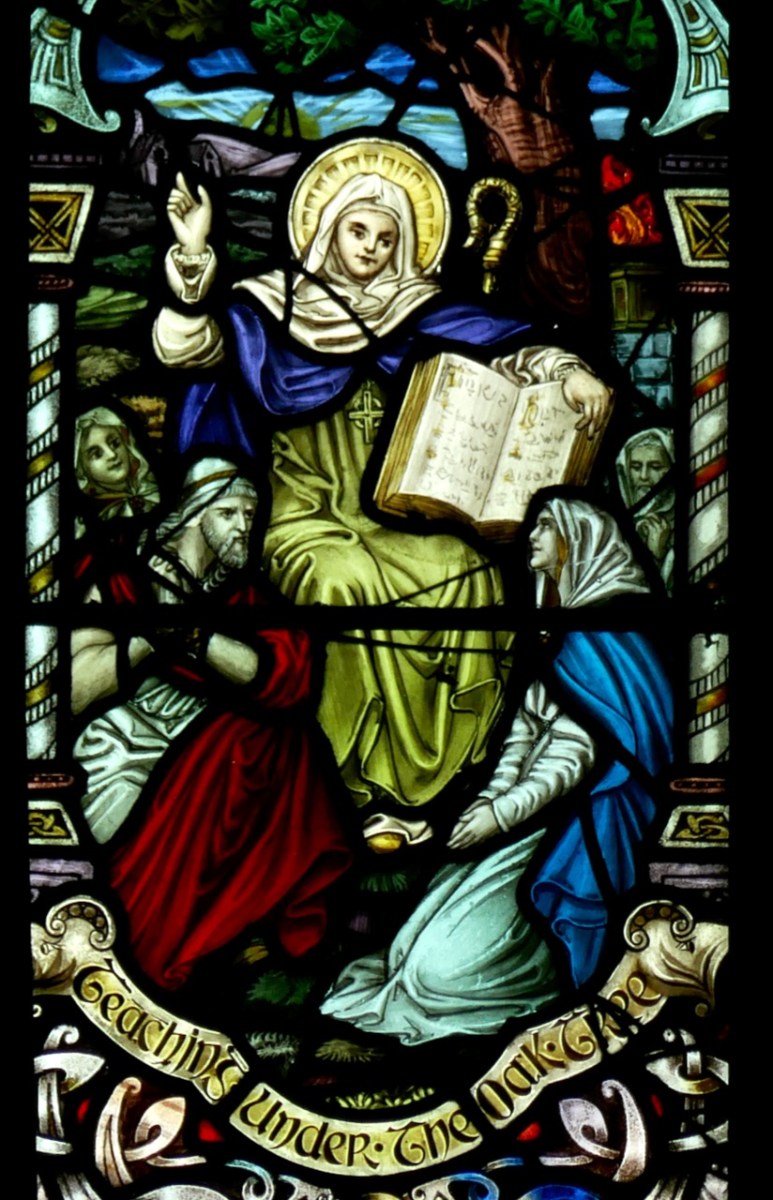
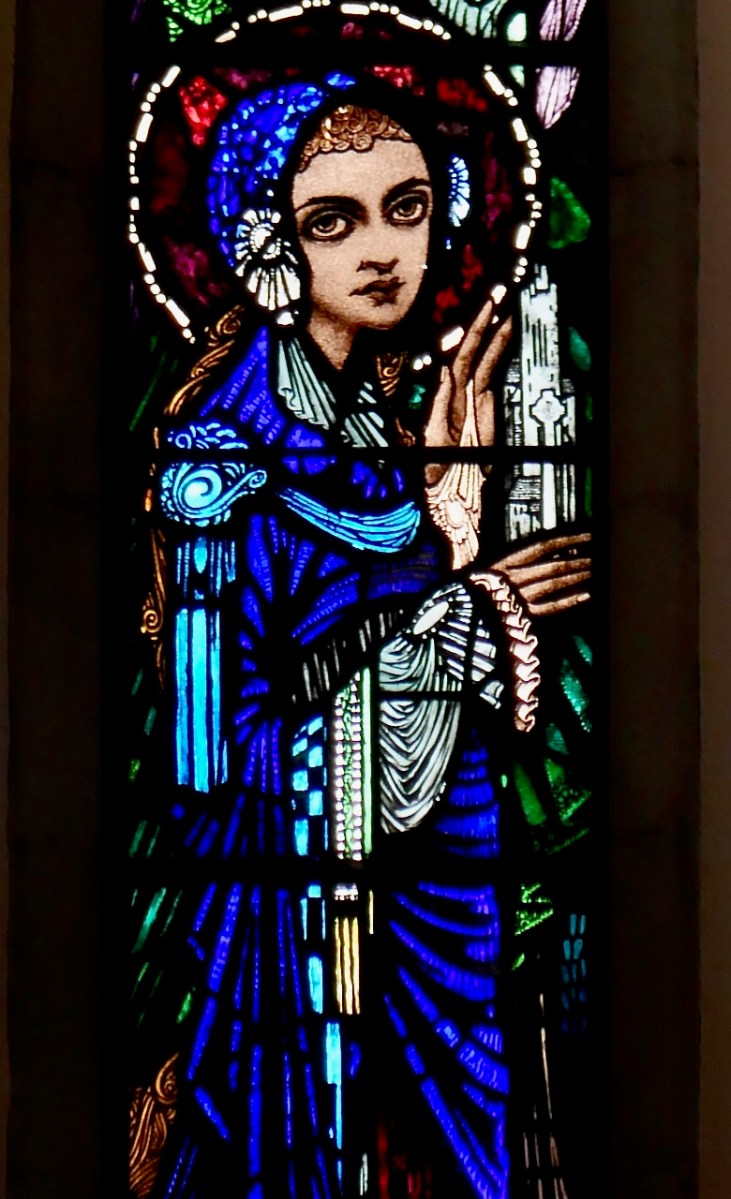
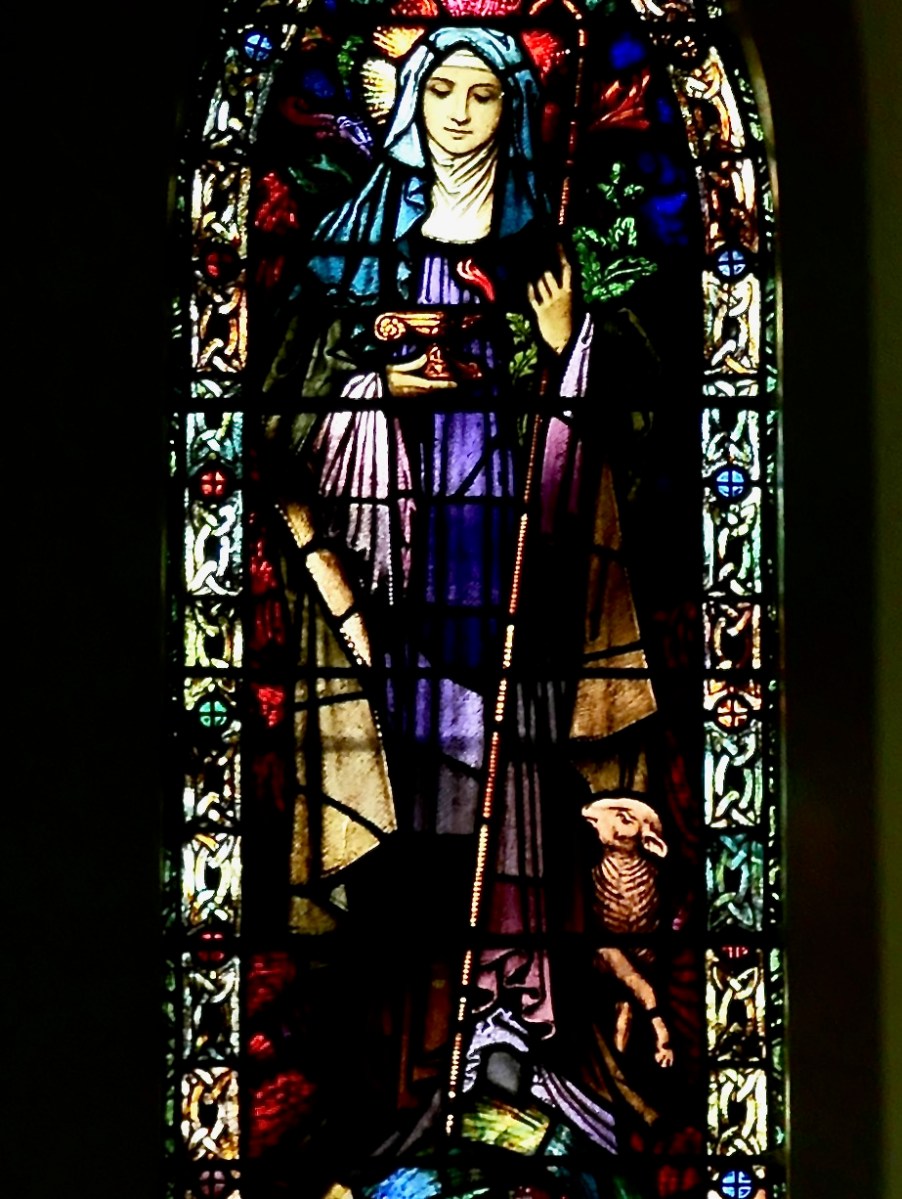
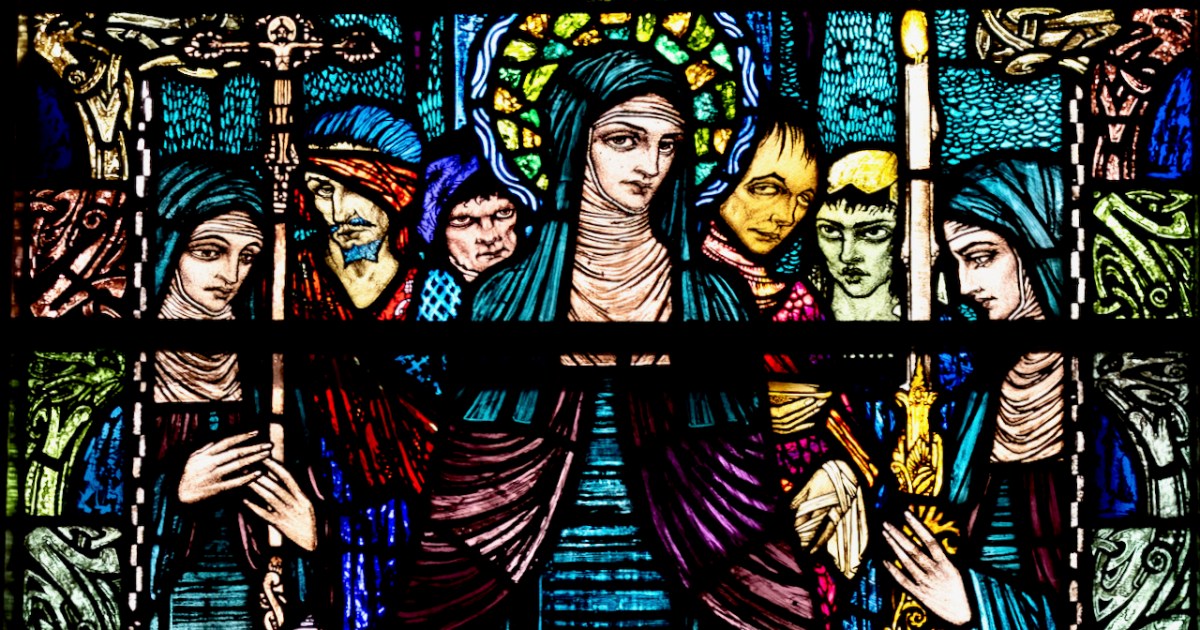
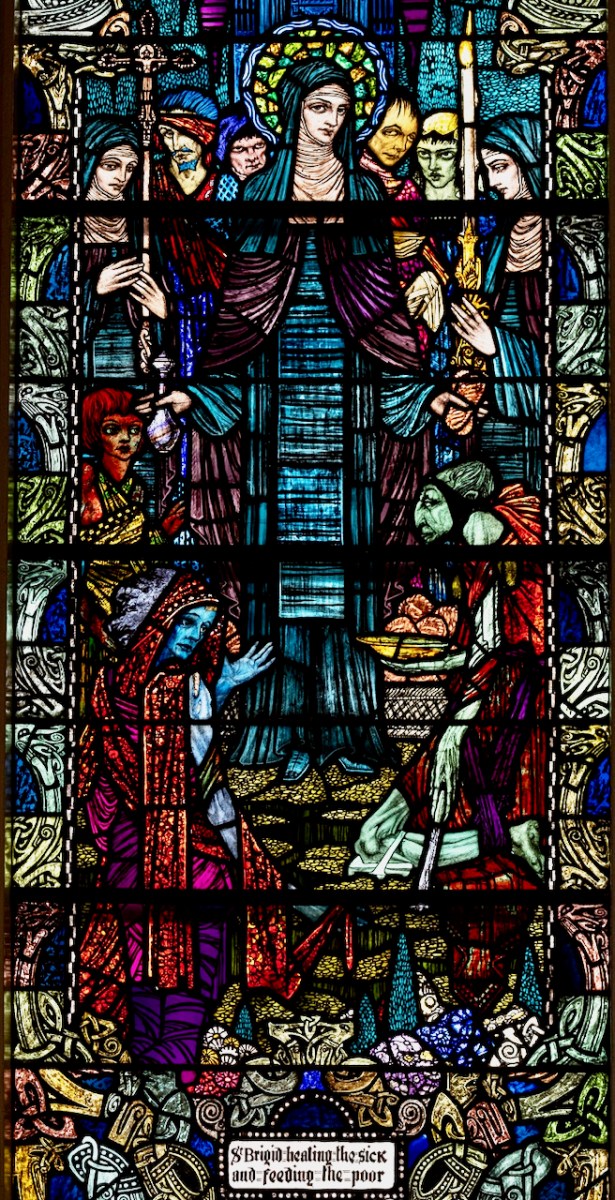
Harry did several wonderful St Brigid windows, and included Brigid as a saint in larger scenes. There are also Brigid windows attributed to him that he actually didn’t do, but that’s a blog for another time. Today I want to give you a flavour of his take on Brigid, because this was a saint that must have been especially meaningful to him – his mother was a Brigid!
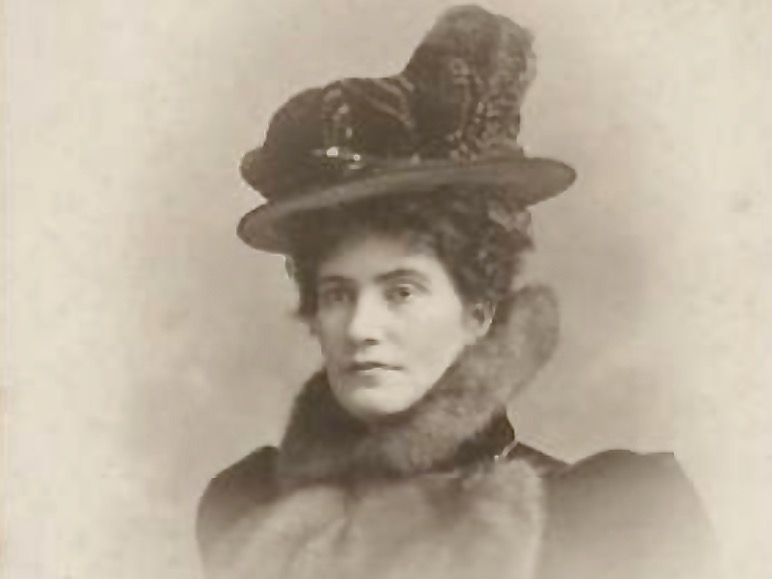
Brigid (sometimes given as Bridget) MacGonigal was born in Sligo and married Joshua Clarke, then an up-and-coming church decorator in Dublin and they had four children. Harry, their third child arrived in 1889. Brigid was never strong and died in Bray in August 1903, leaving her family bereft. Harry was 14 and that year marked the end of his schooling at Belvedere as he and his older brother Walter joined the family business to help run it. Harry was a sensitive child and it is likely that he missed and mourned his mother for many years. He also inherited her weak lungs and struggled, as she did, with his health.
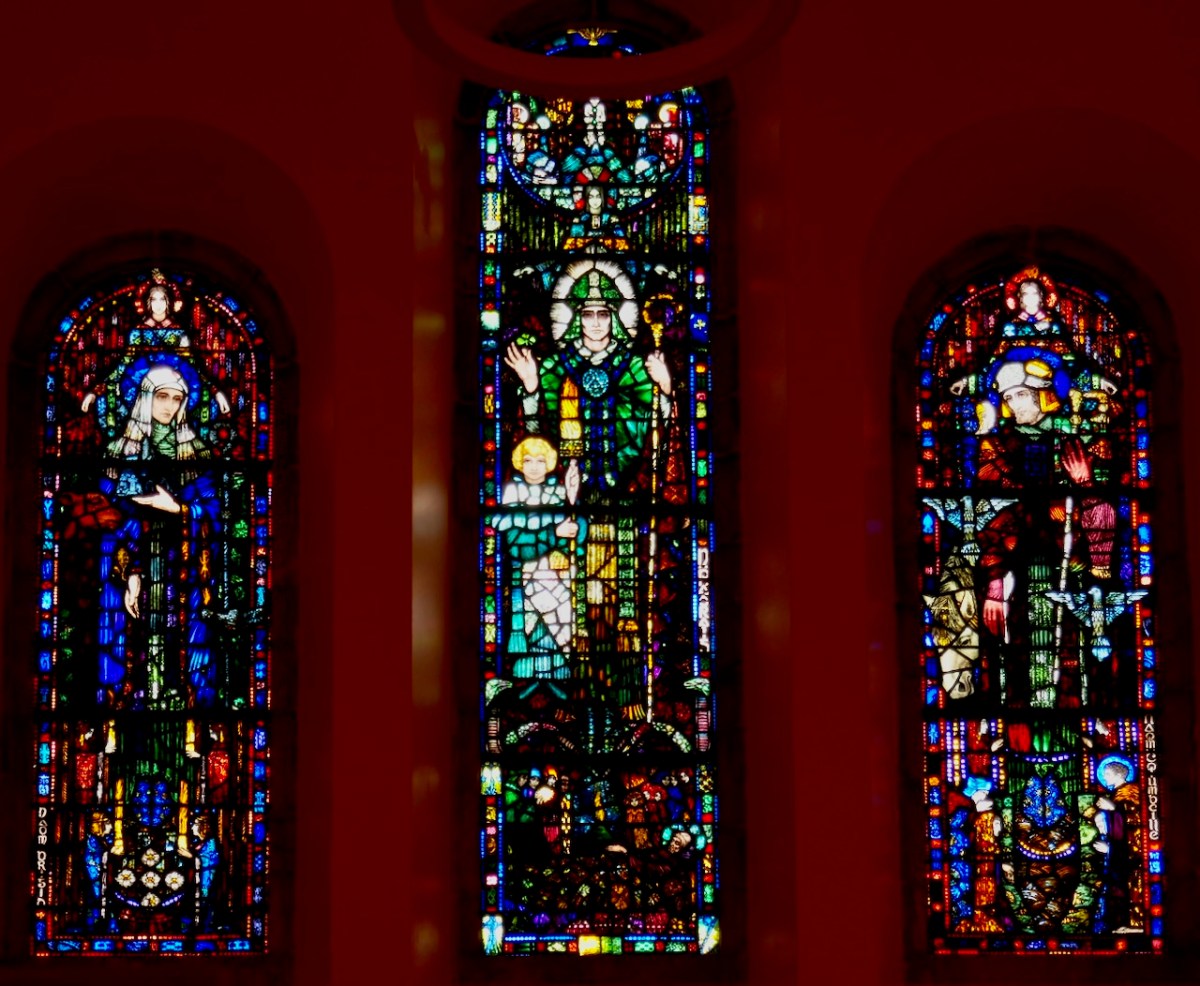
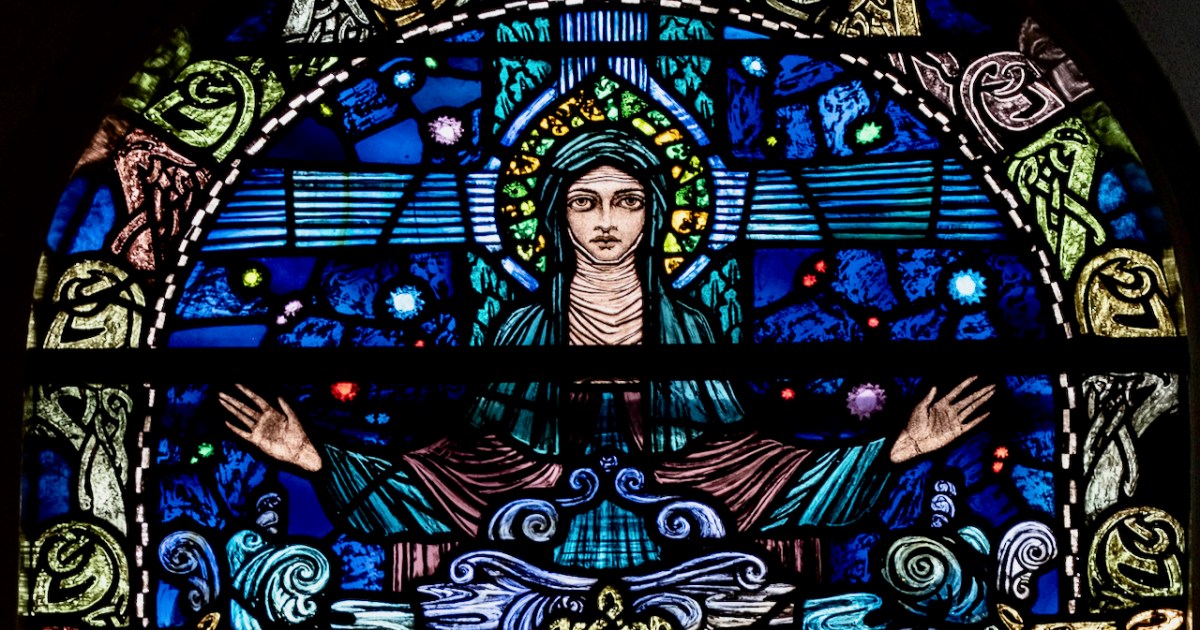
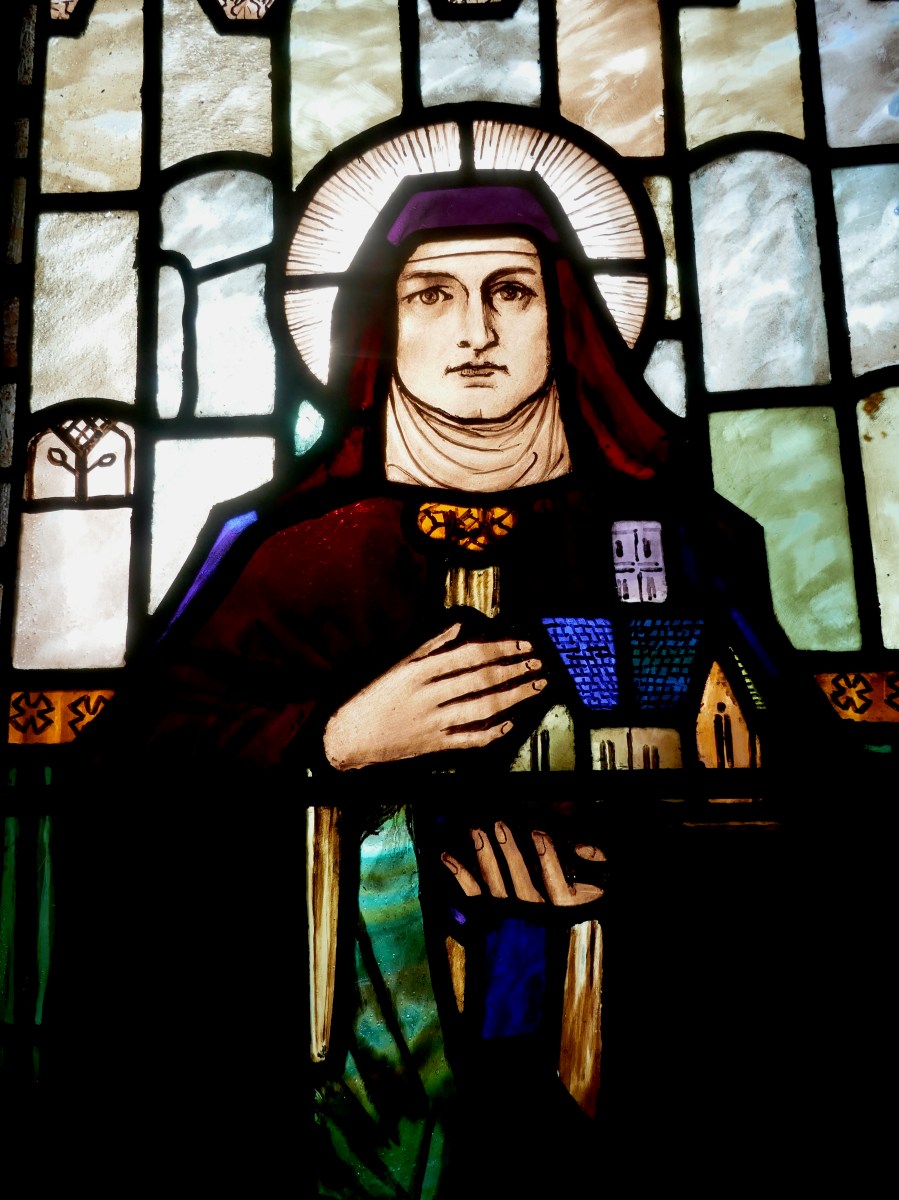
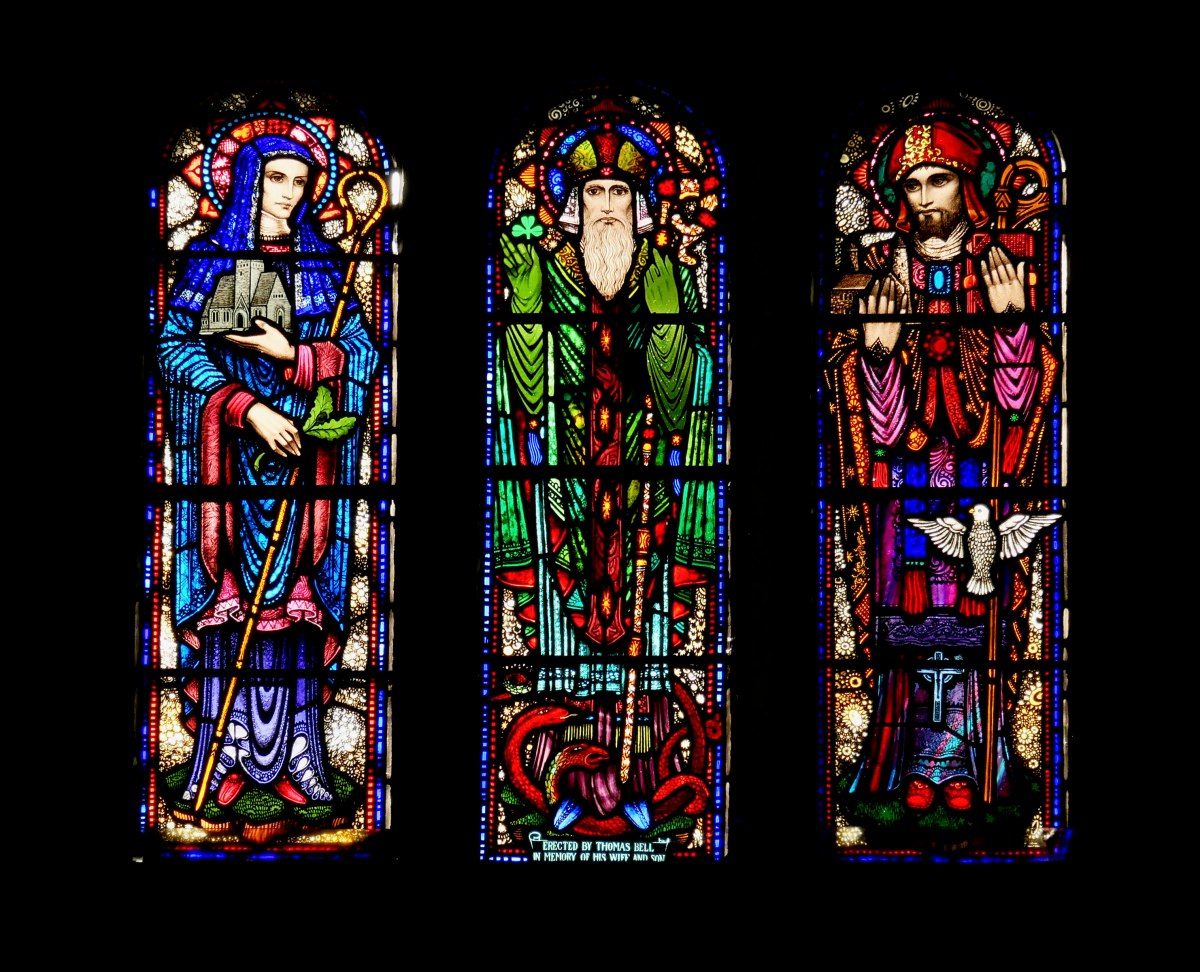
I will start with the place that launched Harry’s career, the Honan Chapel at University College Cork (I’ll finish with the one that is on my lead photo). And in fact it is his first windows for that Chapel – a three light, depicting Brigid, Patrick and Columcille, our three Patron Saints. This window is over the entrance, facing west, which, with Harry’s preference for dark colours and some internal lighting issues in the chapel, makes it hard to photograph.
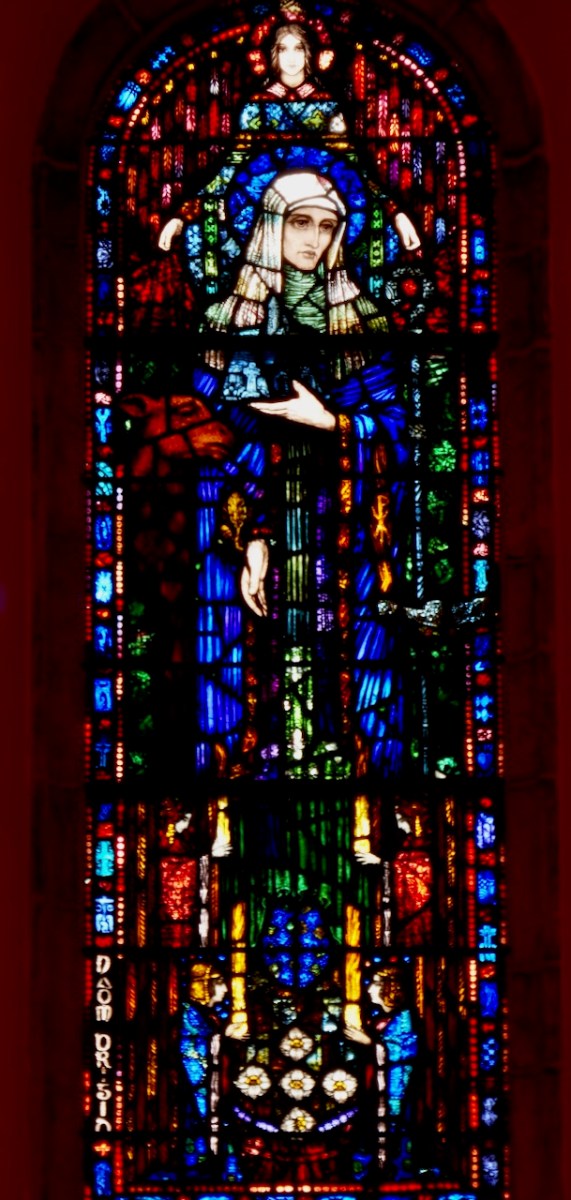
Harry had completed a detailed sketch design for this window in 1914 (Nicole Gordon Bowe has an image of that design in her magnificent The Life and Work of Harry Clarke) and the window was made in 1915. There are a few differences between the sketch design and the finished window, but on the whole, the window is true to Harry’s original vision for it. His notes for the window refer to 

Top: The Angel with the cloth of heaven forming background

The Figure: With emblems – the church, the inextinguishable spiritual lamp – the calf and the oak.

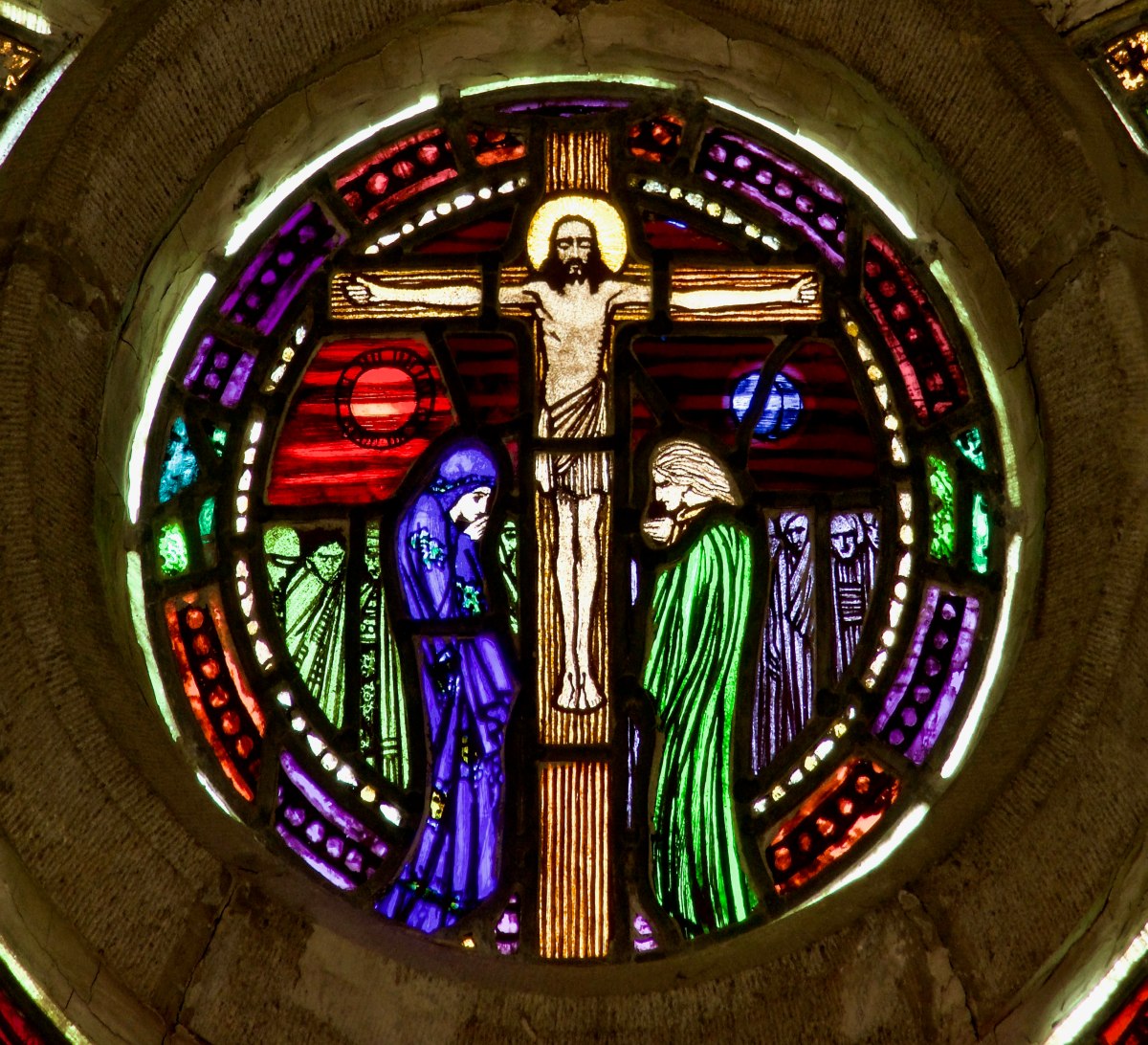
The Base: Are four angels carrying the prayers, prophesies, miracles and charities of St Brigid, also are shown the five lilies – she has been called the Mary of Ireland and these lilies symbolise the five provinces of Ireland over which she held spiritual control.
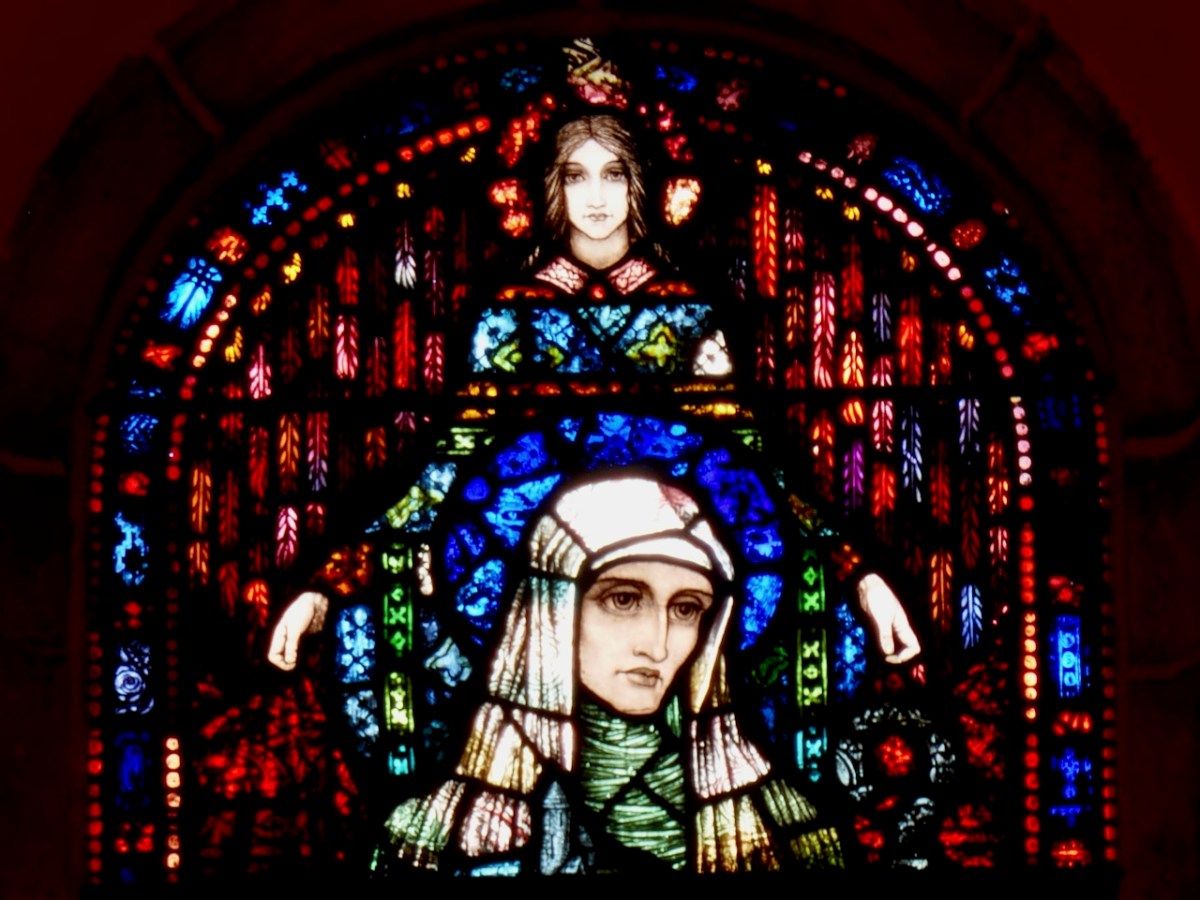
The cloth of heaven has been imagined as fronds in deeps reds, while St Brigid is shown as mature, wise and compassionate. She is holding a church which looks a lot like St Kevin’s Kitchen in Glendalough. In her other hand is a brown oak leaf, threaded through her fingers. The calf peers out from her right side. As befits a Mary of the Gael, she wears a deep blue robe. 
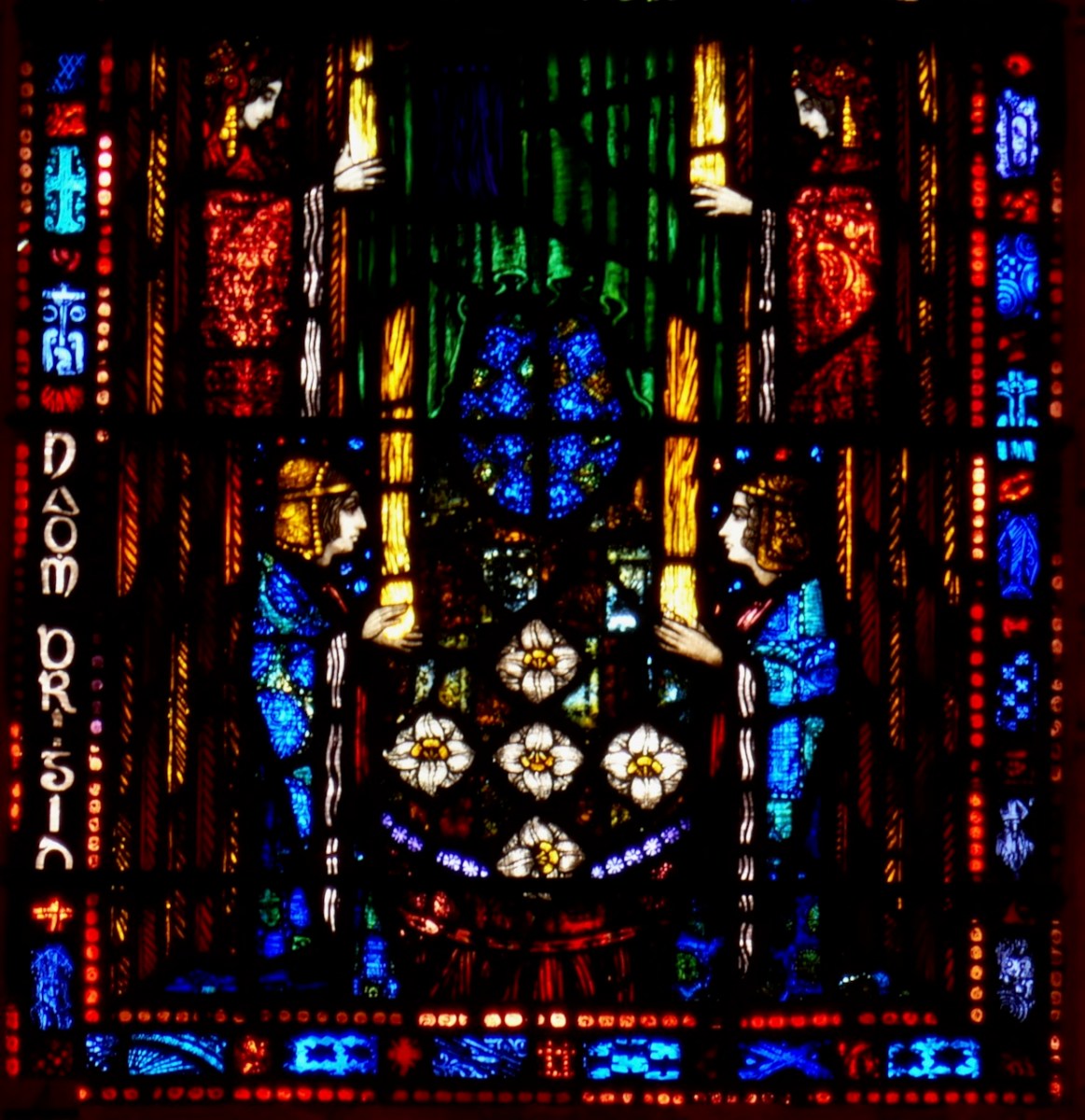
The predella (lowest section, above) shows four angels, but what they are carrying are torches – a reference to the spiritual lamp and the fire associated with Brigid. The symbols of the five provinces, recognisably lilies in the sketch design, have changed to another flower I can’t name. Note the tiny details, though – the crucifixion scene in the borders on the left and the right. The other detail to note here is that the fingers, of Brigid and the angels are ‘normal’ – Harry has not yet developed his signature long tapering fingers and pointed sleeves (among the idiosyncratic elements he called his “gadgets’).
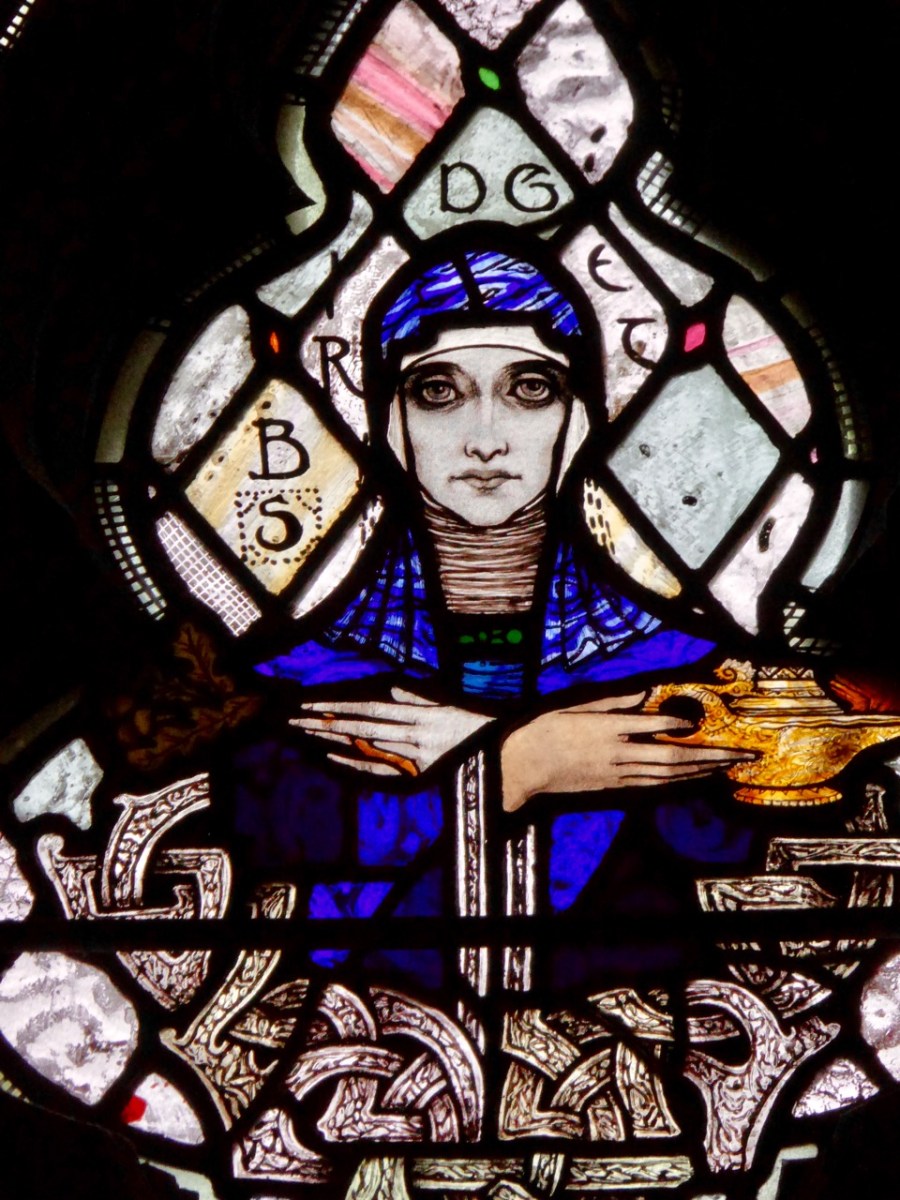
His next Brigid (above) was for the Nativity window in Castletownsend – I have written about that window extensively here so pop over and have a browse if you fancy. The Castletownsend Brigid, done in 1918, looks quite similar to the Honan Brigid and has the same oak leaf entwined in her fingers. The difference is that she is carrying the sacred lamp, has the Harry Clarke fingers, and is spelled S Bridget – the English version rather than the Irish Naomh Brighid of the Honan. [For non-Irish speaking readers – the small dot on top of consonants in Irish is now normally rendered as H – as in Briġid is now Brighid.]
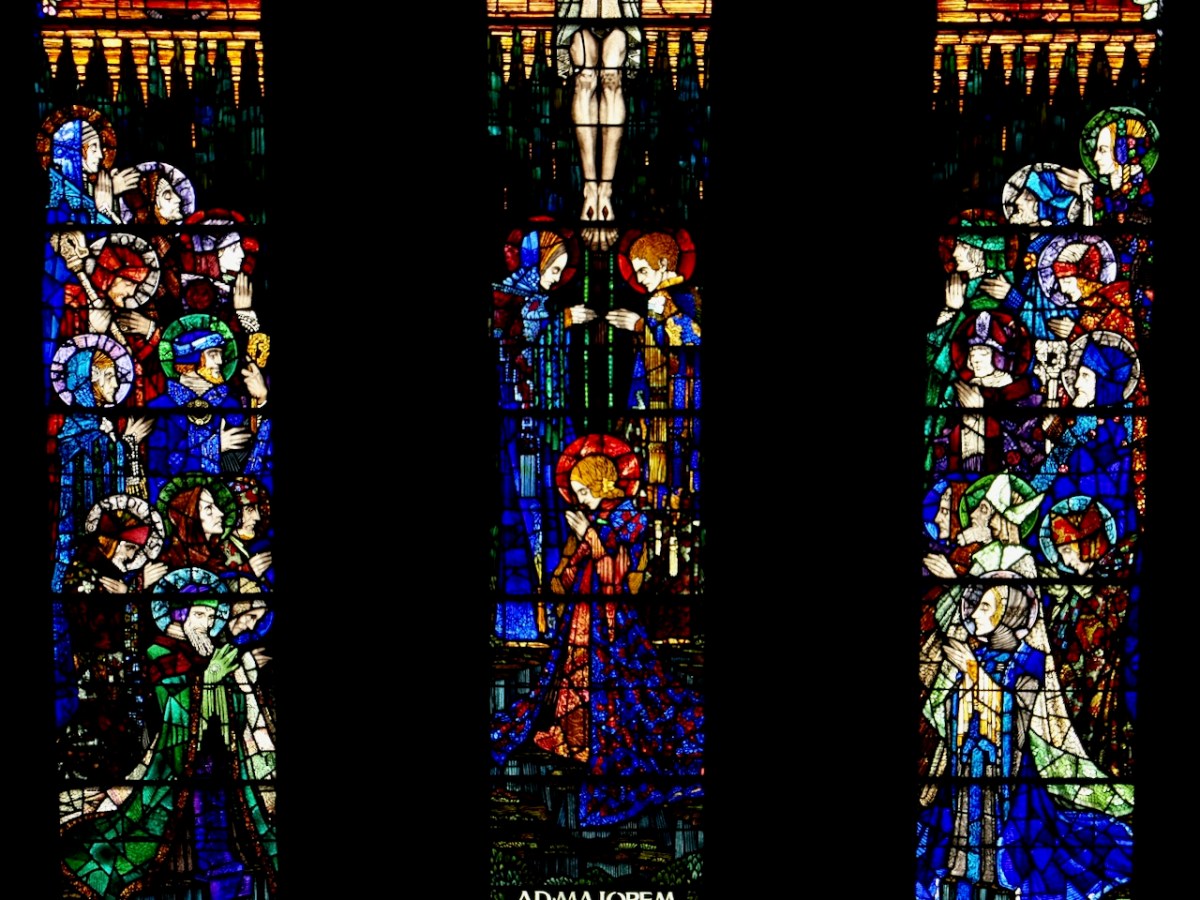
The next two windows, Terenure (above and below, details) from 1920 and Cloughjordan from 1924, show Brigid among a host of other saints. In Terenure the subject of the large window is The Crucifixion and the Adoration of the Cross by Irish Saints, and this is a large, three-light window behind the main altar. The saints are not all easy to identify, despite having their names in their haloes, but first and foremost among them are Patrick on the left and Brigid on the right.
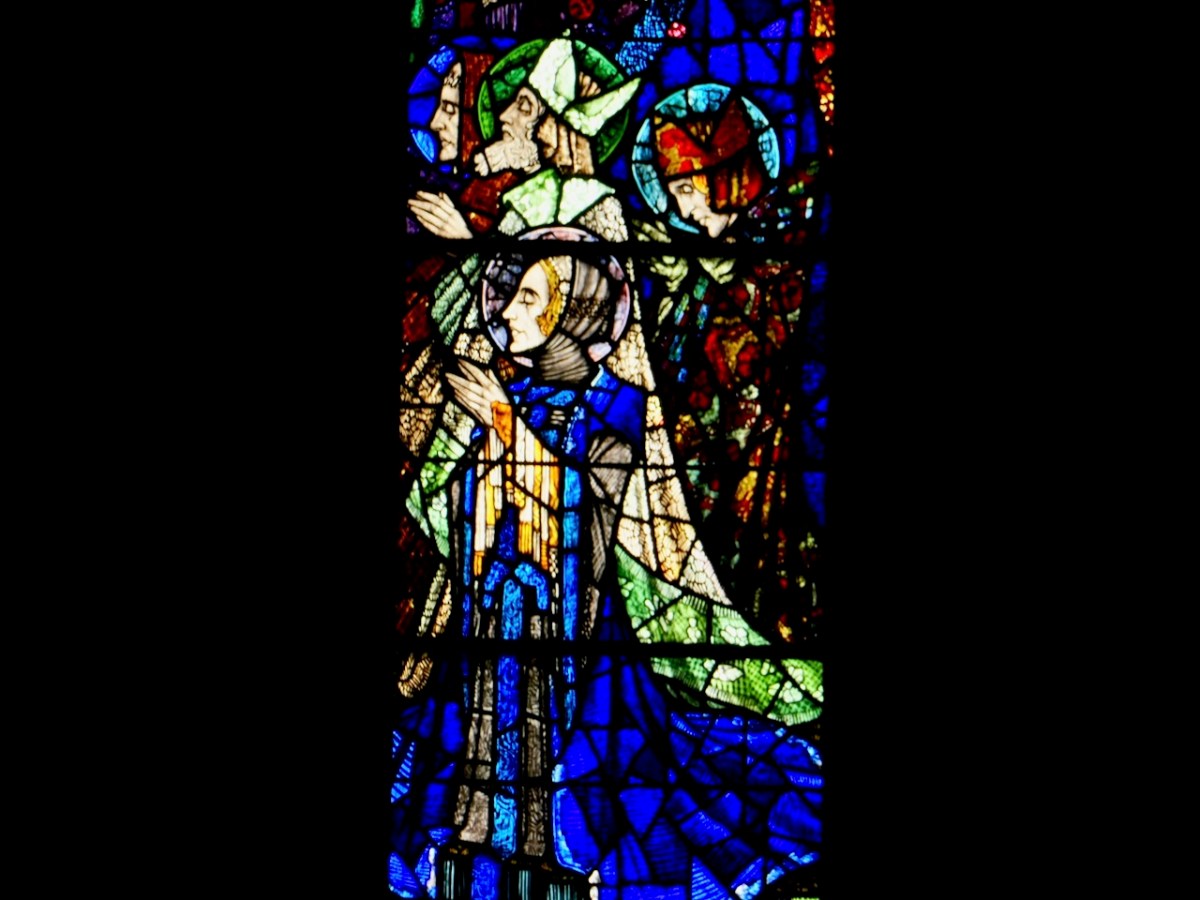
Brigid is dressed in a blue robe which drapes on the ground around her, and has a golden trim to her sleeves.
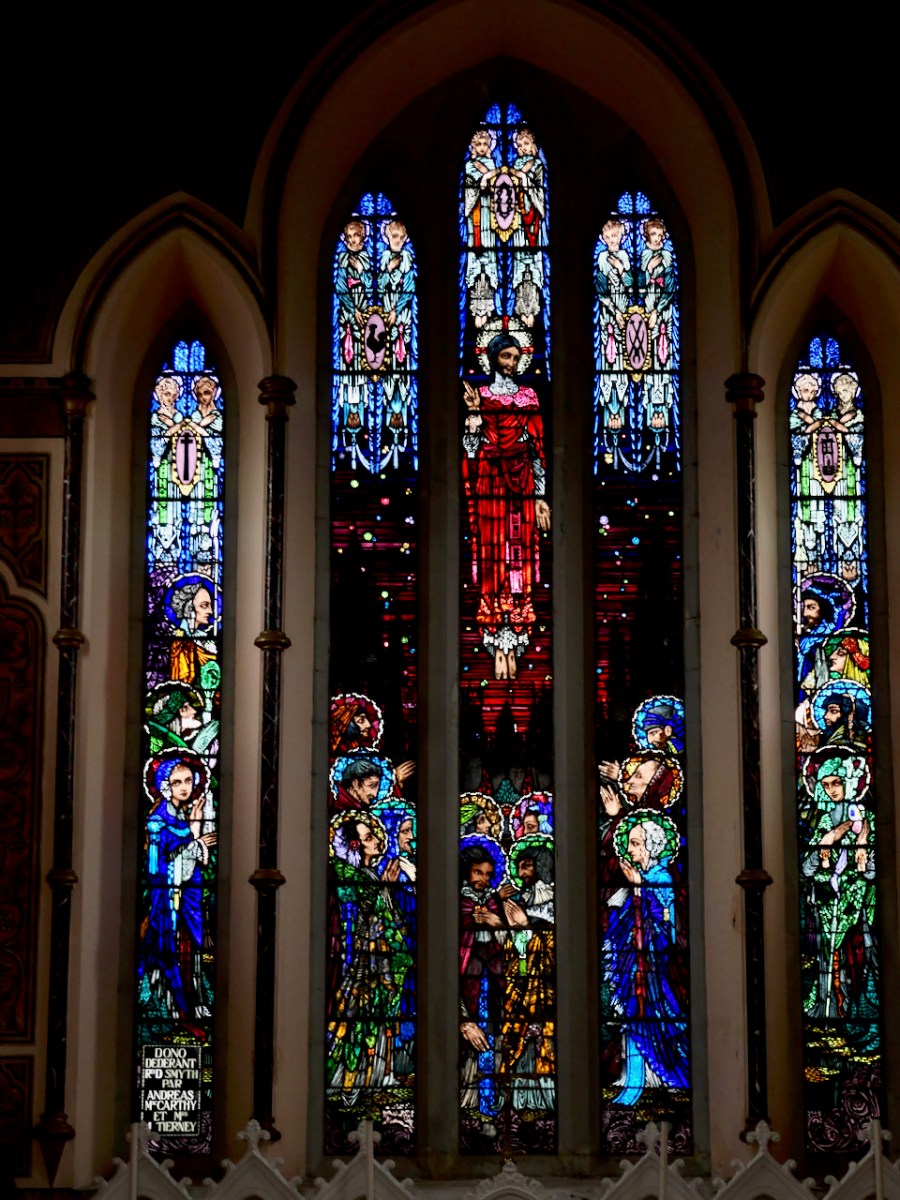
In St Michael and St John’s Church in Cloughjordan, Co Tipperary, the theme of the large, five-light, window is The Ascension with Irish Saints and St Michael and St James. Gordon Bowe designates this one a Harry Clarke (B). That means that this window was initially conceived and designed by him but executed by his studio under his close supervision. This is the first window we have come across, in this series, that is not wholly Harry’s own work, and this is a measure of how busy the Studios had become with Harry at the helm. 
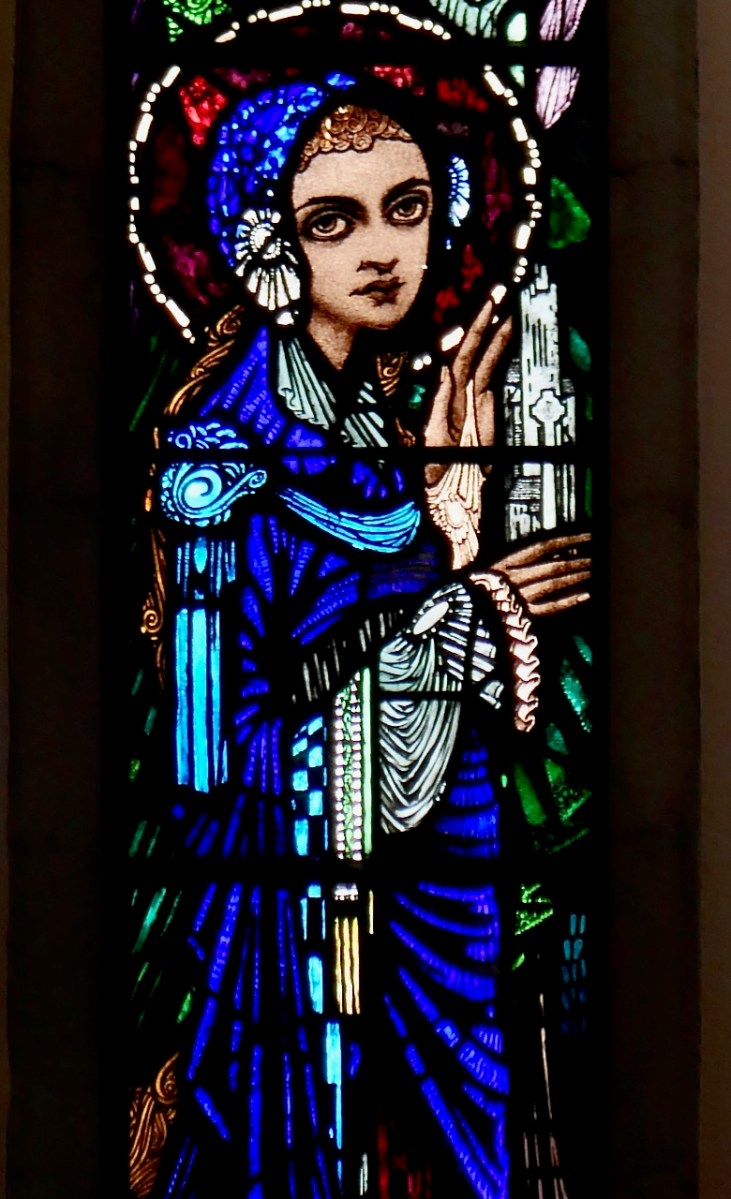
As in Terenure, Brigid is here as one of the Irish saints. She is depicted as very young, wide-eyed, and carrying a church which now looks more medieval than Romanesque (neither would have been appropriate to her era) and is probably a nod to the Cathedral in Kildare.
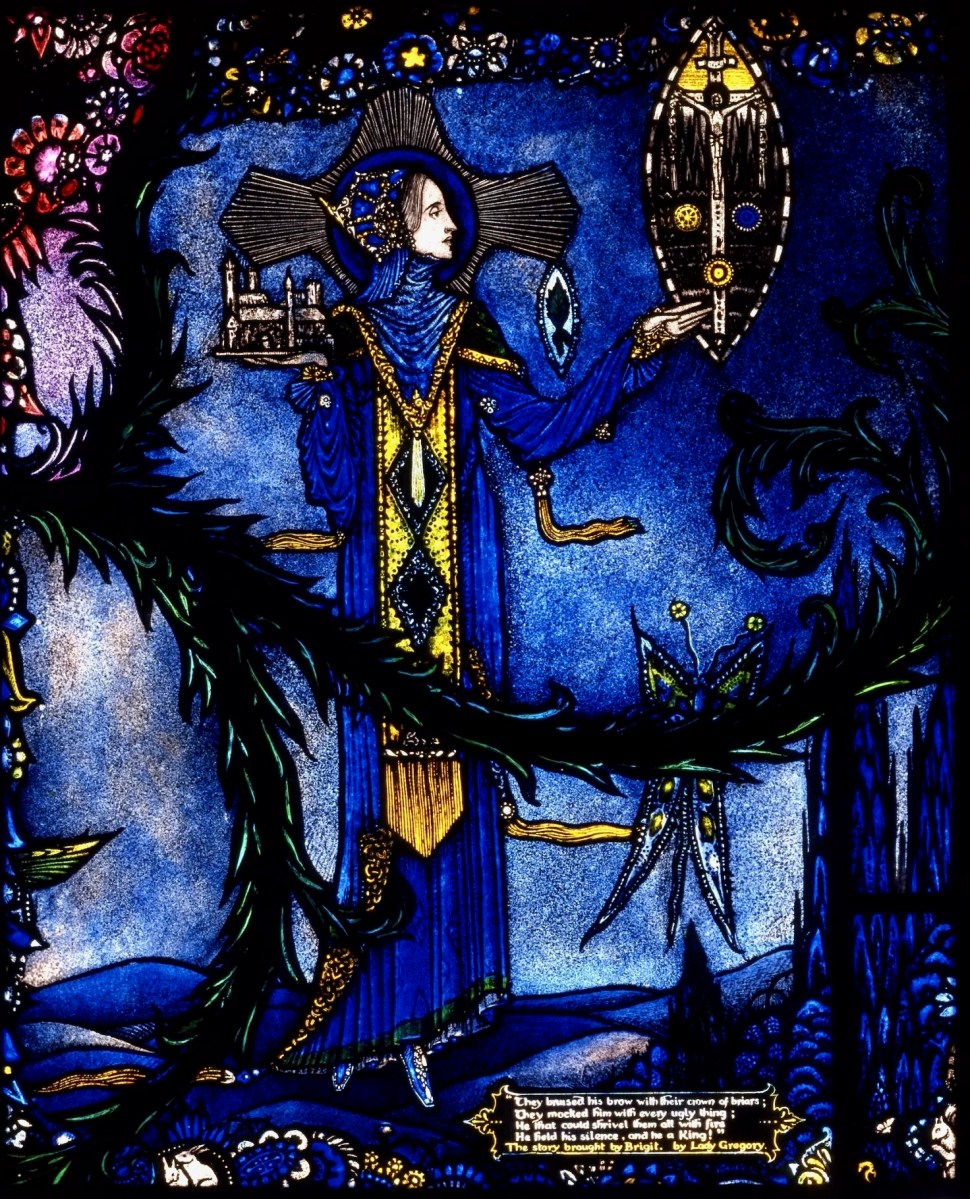
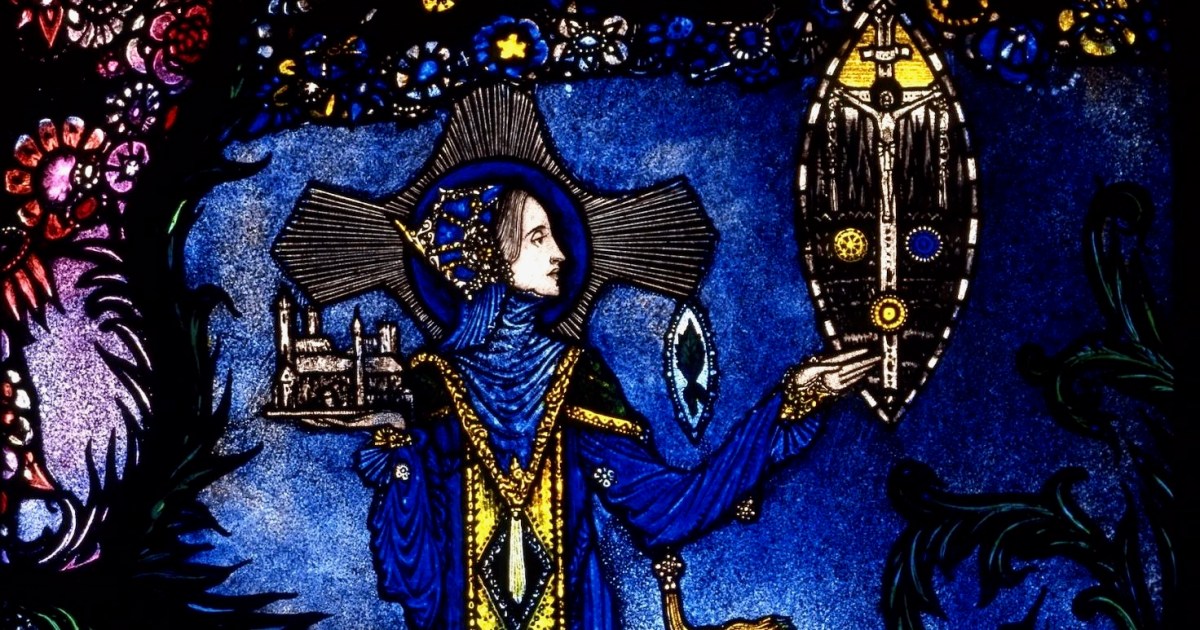
And so we come to the last Brigid that Harry ever did*. It is from the famous and controversial Geneva window, now in the Wolfsonian Museum in Miami. If you have not yet seen the marvellous documentary that Ardall O’Hanlon has made about this, I highly recommend you do. It’s available on the RTE Player as of this time of writing. The Brigid panel is among the less controversial images in the whole window. It’s based on a play by Lady Gregory called The Story Brought by Brigit. According to Marie T Mullan in her lovely book, Exiled from Ireland: Harry Clarke’s Geneva Window

The play is a passion play, but it is based on the legend, popular in Ireland and Scotland, that St Brigit was present at the birth and crucifixion of Jesus. Brigit mingles with the crowds from the time of Jesus’s triumphant entry into Jerusalem until after his death. She is a foreigner, observing and commenting. She tells people she is Jesus’s foster mother and brought Mary and Jesus to Ireland to escape Herod. . . The icon of Christ Crucified is a the vesica, a shape used often in art for a picture within a picture, and has the traditional beaded frame. Brigit is absorbed in the icon.

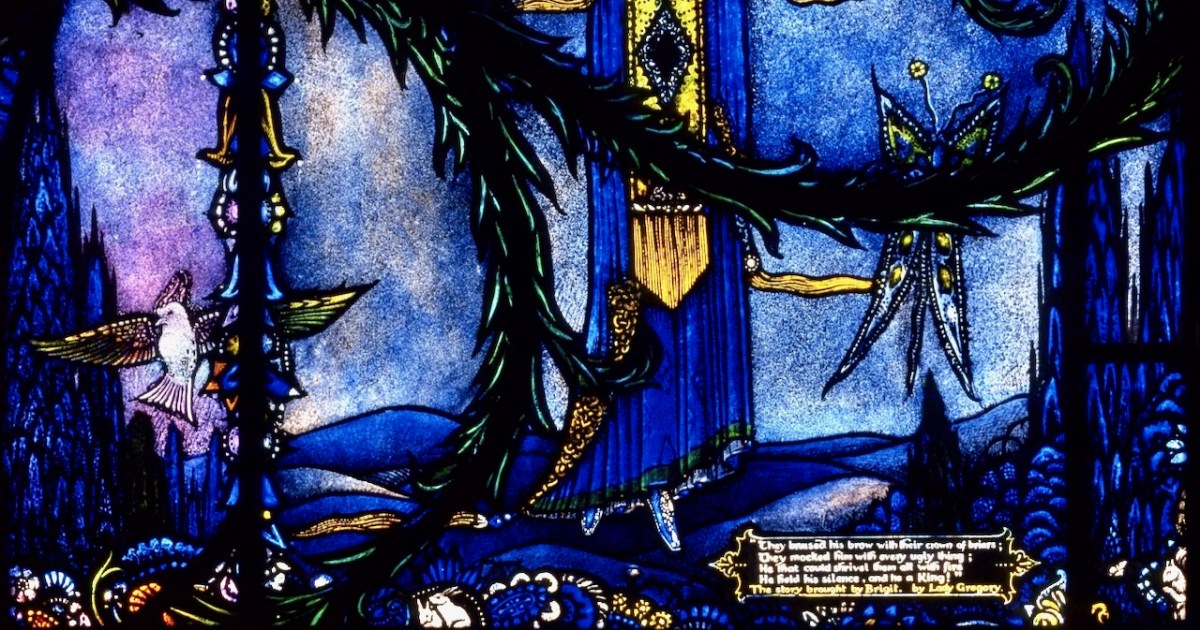
Note Brigid’s golden scapular and elaborate headdress. Also the stylised butterfly and the little woodland creatures in the scene.
I think that’s a good place to stop. Harry did another Brigid, for the Oblate Fathers in north Dublin’s Belcamp Hall. This is a sorry tale in which the buildings, once left by the priests were subject to appalling vandalism and the windows are in storage, and haven’t been seen for years. This is tragic. 

* Thanks to my friend Jack Zagar for the Photos of the Geneva Window.
‘Harry Clarke’ Nativities – NOT by Harry Clarke

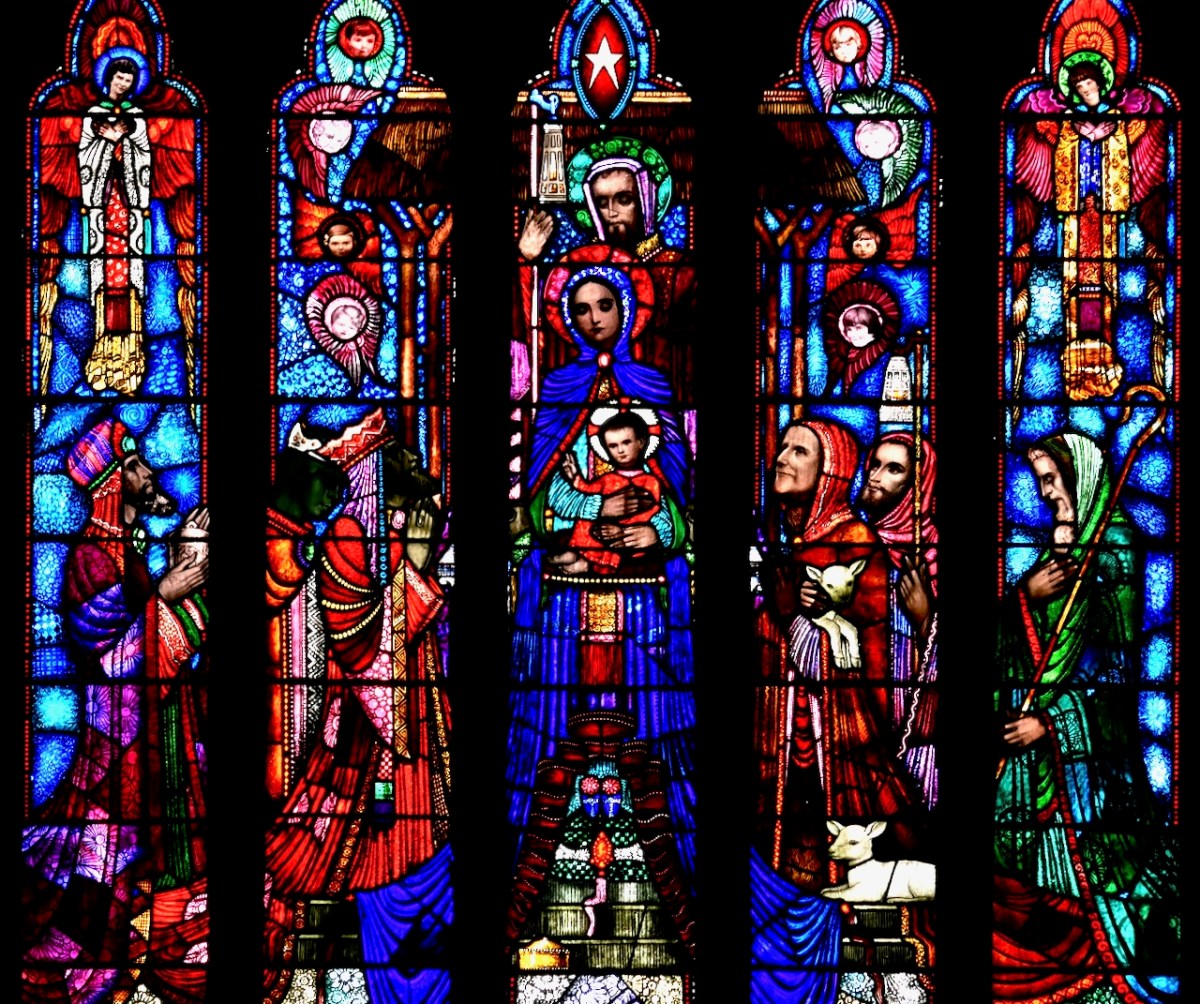
It’s become a bit of a tradition with us here at Roaringwater Journal to do a post like this in the lead up to Christmas. See this post, and this one, or maybe this one. All busy stained glass studios were requested to supply Nativity windows – a favourite of Catholic Churches throughout Ireland. Harry himself made several Nativities, but this post deals with windows made in his style, but not by him. All of them were made in his father’s business, Joshua Clarke and Sons, or in The Harry Clarke Studios, as it was renamed in 1930. Sometimes windows are just signed Clarke, or Clarke and Sons. If you’re looking at these images and saying to yourself, Surely these are Harry Clarkes! I recommend reading some of my previous posts for the difference between a Harry Clarke and a Harry Clarke Studio window. Perhaps begin with The House Style: William Dowling and the Harry Clarke Studios.
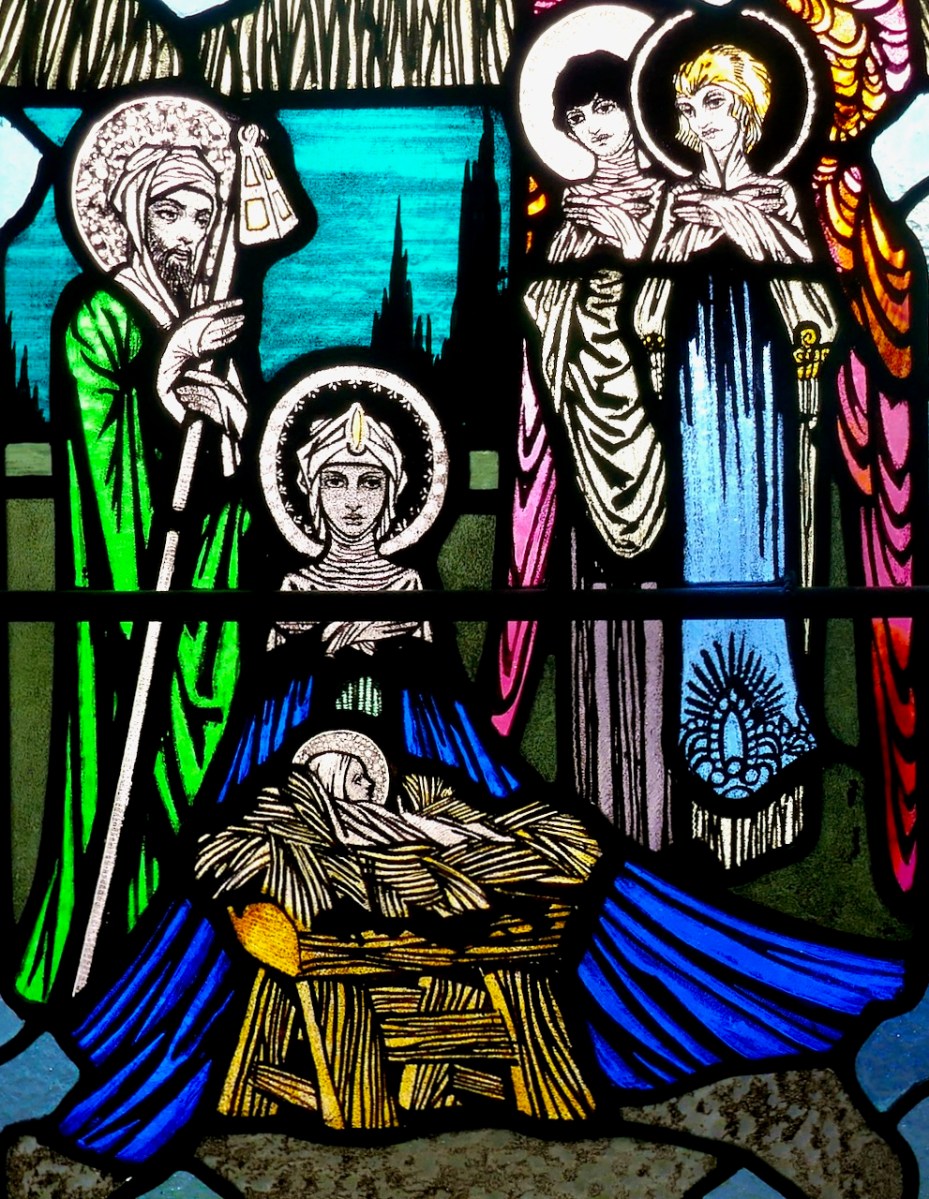
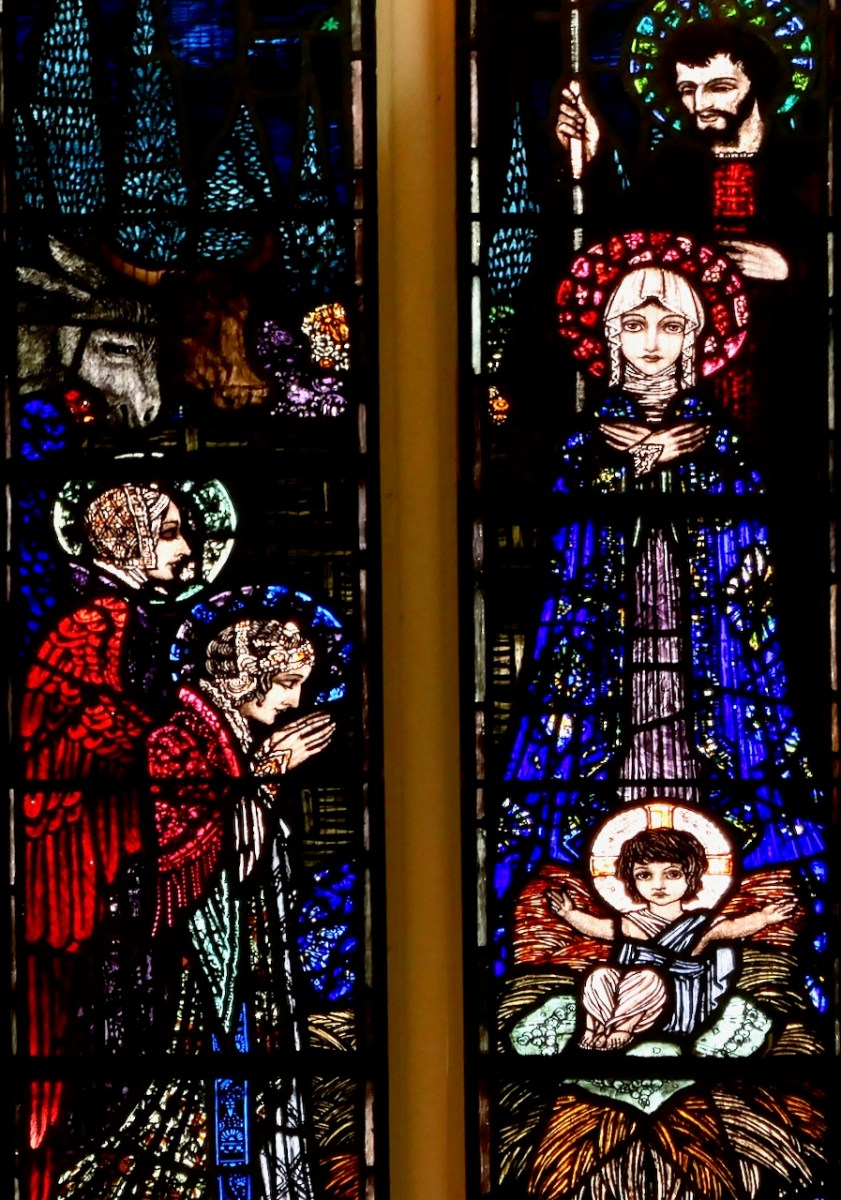
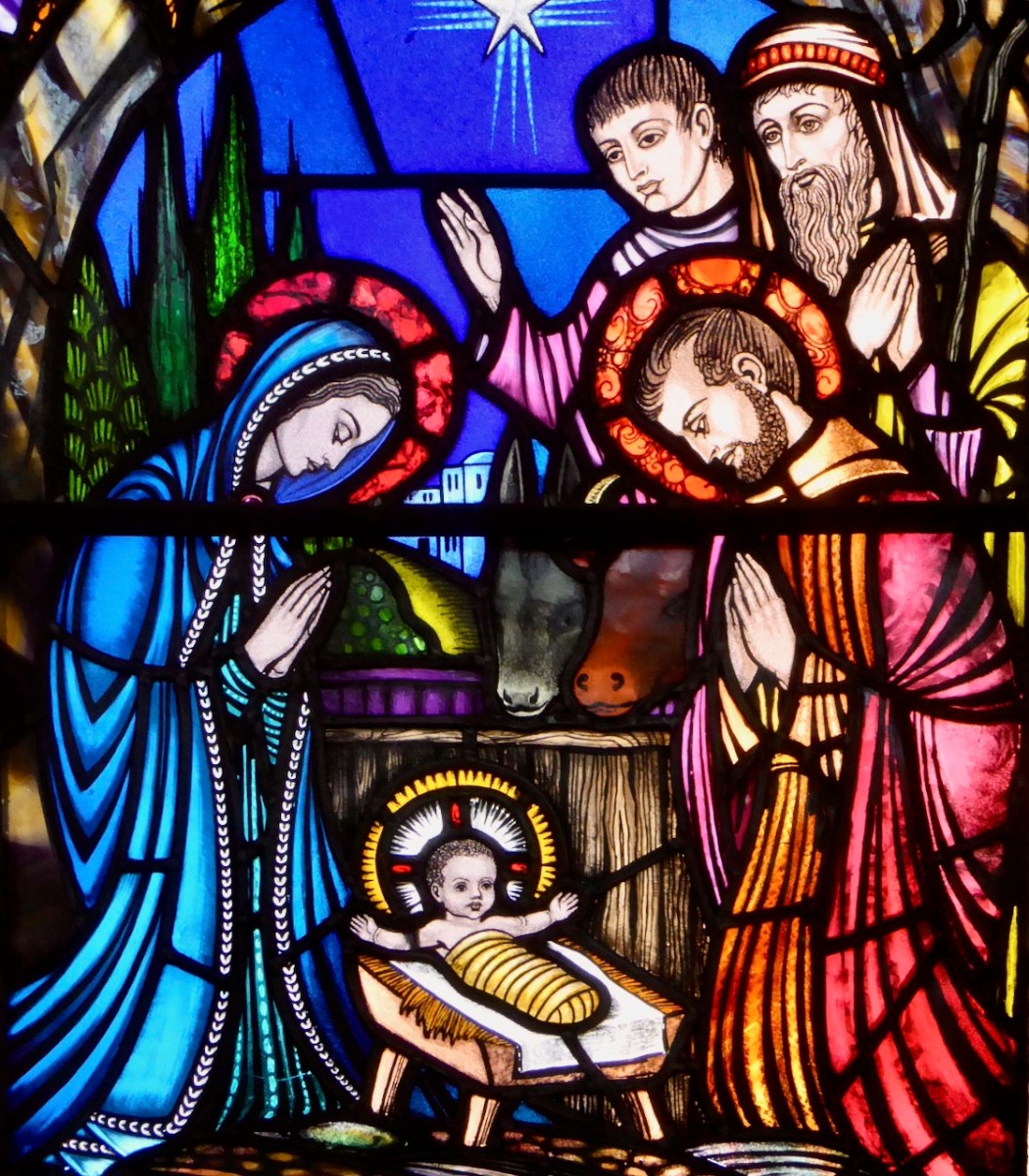
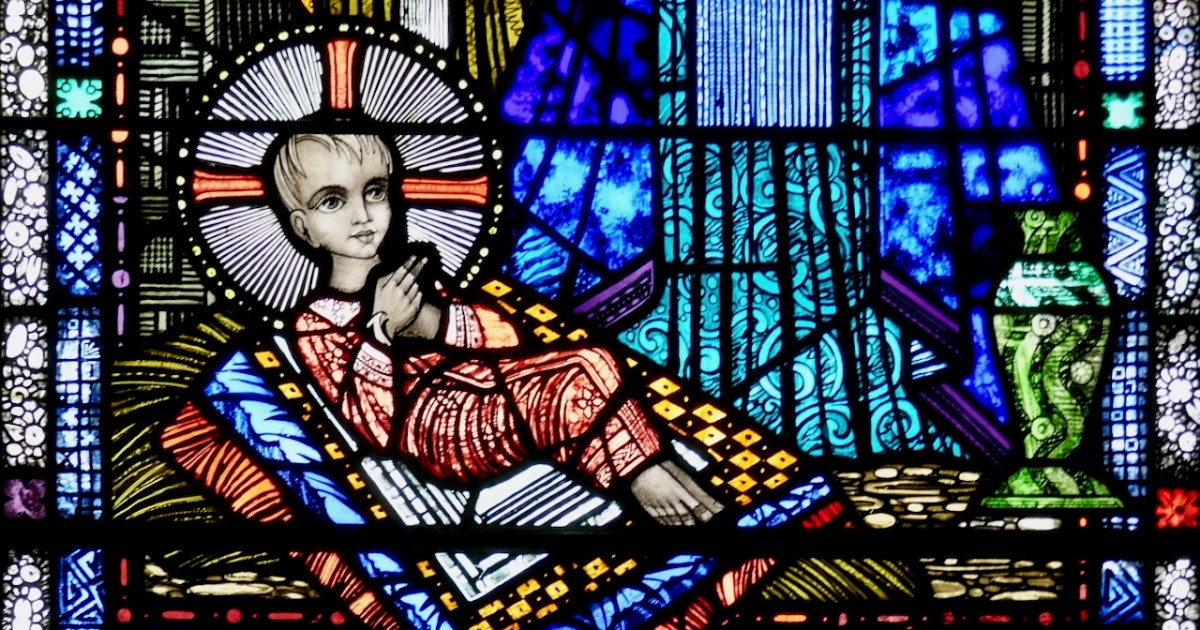
These first two images are from a remote church in Wicklow, in the townland of Killamoat, near Rathdangan. They were done in the Harry Clarke Studios, after Harry died in 1931, and are attributed to George Stephen Walsh, who had started as an apprentice with Harry several years before he died. I particularly love all the details surrounding the Baby Jesus – the blankets upon which he lies and that strange green urn.

This is from a series of small windows in Leixlip – I made a slide show of those windows, which you can watch here, in a post titled Clarke-Style Windows. They were made in 1925, in the Joshua Clarke Studios, in which Harry served his own apprenticeship and which retained its name until it became the Harry Clarke Studios in 1930, shortly before Harry died. In 1925 Harry was an established artist and had taken on several apprentices to help out in the busy studio – one of them made these windows and we don’t know which, although it could have been Philip Deegan. Deegan had taken Harry’s courses at the Dublin Metropolitan School of Art, and was accomplished at reproducing his style.

William Dowling* was one of Harry’s most accomplished artists and the one who stayed on in the studio the longest, up to the 1970s. In the years after Harry died he and Richard King produced beautiful windows in the Clarke tradition, using very good glass and carrying on the ‘house style’ of dense, jewel-like surfaces, packed with ornamental detail. Above is one of his windows from Knockainey, Co Limerick, dating from 1940 .

This is the angel from that window – I was struck by the fiery aureole that burns behind his head, instead of the usual halo.

This one is also by Dowling, but from somewhat later, in 1948, and it’s in the Catholic Church in Bandon. You can see how Dowling’s style has evolved – it’s not quite as dense. The composition is still beautiful and local lore has it that many of the young relatives of the priest who commissioned the window are immortalised in some of the faces. Can anyone in Bandon tell us more?

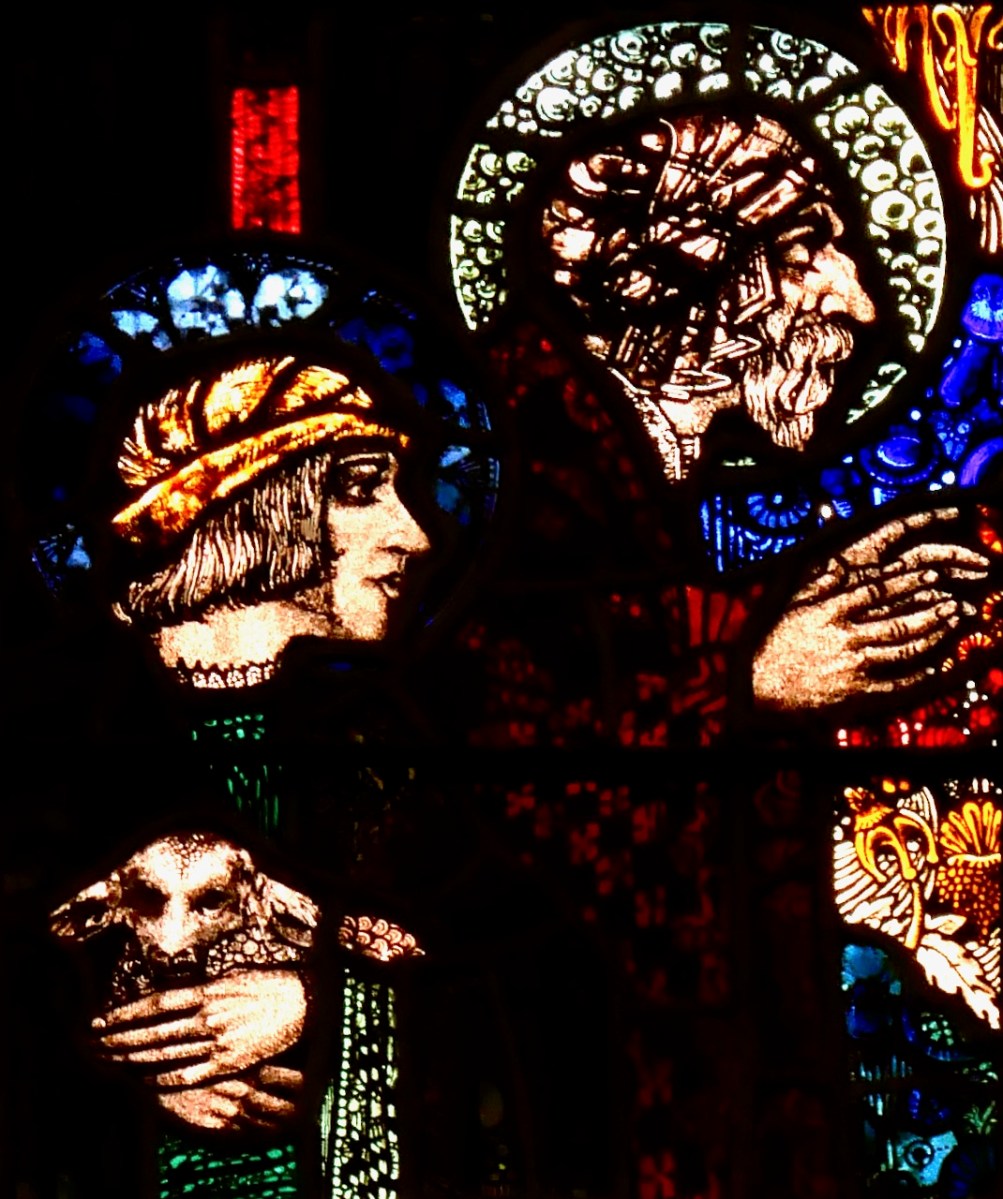
Another from the Studios after Harry Died – this one is in the Catholic Church in Wicklow town and we don’t know to whom it should be attributed.

I picked out two of the shepherds to highlight as they had such interesting faces. I also loved the fact that the lamb appears to have a little triangular lacy cap.

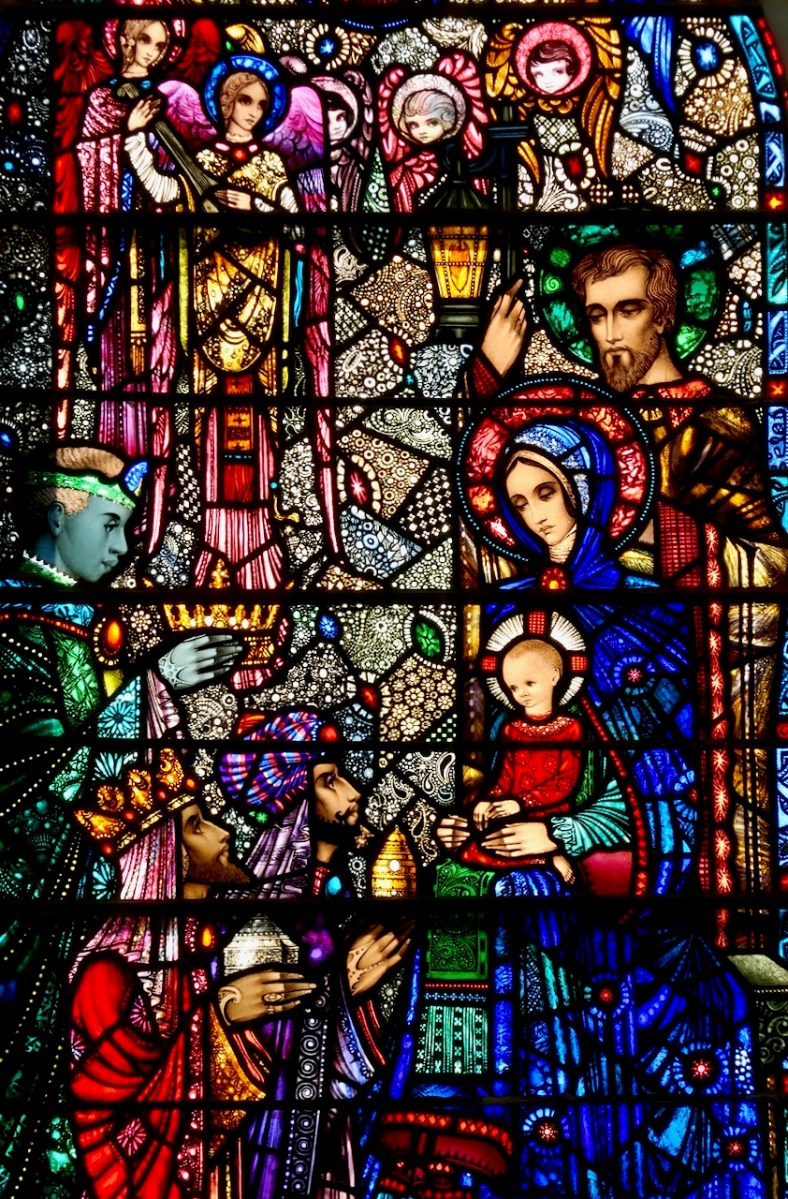
This window is from Millstreet, Co Cork and is another of Dowling’s wonderful productions, dating from 1940. Below is the predella (lowermost panel) from this window.
I suppose we’d have to say that overall there is a bit of a sameness to these Nativity windows and that’s down to the overarching influence of Harry’s very particular style. Eventually, this style fell out of fashion – a victim of its own success, or a failure to change with the times. While it lasted, though, it was superb. Eventually, due to falling demand and the price of good glass, the windows coming from the Harry Clarke Studios failed to keep up the high standards established by him and kept up by Dowling and King as long as they could. Here’s an example from around 1950 so you can see what I mean.

* For more on William Dowling, see Paul Donnelly’s excellent essay Legacy and Identity: Harry Clarke, William Dowling and the Harry Clarke Studios (in Harry Clarke and Artistic Visions of the New Irish State). Paul’s research has greatly informed all my work on William Dowling and other aspects of the Harry Clarke Studios.

Brigid 1500: Mary of the Gael

St Brigid, according to some accounts, died in 524. Therefore, we are celebrating this year the 1500th anniversary of her death. Once again, I have gone back to primary sources for incidents from her life and am illustrating them with stained glass images. This year I have added as a source the famous Canon O’Hanlon’s Life, from his Lives of the Irish Saints Series, Vol 2, a work of overwhelming erudition.

The Patrick and Brigid window in Meath Hill, by George Walsh. I love that Brigid has precedence over Patrick in this enormous cruciform window

If you haven’t already done so, now is a good time to go back and read my 2022 post, St Brigid: Dove Among Birds, Vine Among Trees, Sun Among Stars and my 2023 post, Brigid: A Bishop in All But Name. In them, I explain what the original sources for the Life of Brigid are. They all contain similar accounts and may be ultimately based on a single source – the Life of St Brigid by St Ultán – and are laid out as a series of miracles that lead us from her birth to her death.

This is a detail from a window in Ballynahown, Co Westmeath, and is probably by Watson of Youghal. I like the clever way the oak leaves are used as frame and background

Many more miracles, legends, myths and stories accreted to her cult over the centuries. A good example of such a story is the one where she makes a cross from rushes – that one is nowhere to be found in the original Lives, but is an integral part of the folklore surrounding her, and therefore almost invariably found in her iconography.

This is a photo by Frank Fullard, used with permission and thanks. It is a simple treatment of St Brigid from Kilmaine, Co Mayo

She is associated with many places and numerous holy wells – just take a look at all the St Brigid’s wells Amanda has documented in Cork and Kerry. But of course it is Kildare that rightly claims her. Kildare (Cill Dara – the Church in the Oak Wood) is where she built her church and established her city. It is the origin of three of the attributes we see in many windows – a church, oak leaves and a lamp. (For the story about the Bishop’s Crozier, see the previous posts.)

Detail from the Brigid Window in Carrickmacross – she’s consulting with her architects

The Book of Lismore has this story about building the church:

Brigit went to Bishop Mel, that he might come and mark out her city for her. When they came thereafter to the place in which Kildare stands to-day, that was the time that Ailill, son of Dunlang, chanced to be coming, with a hundred horseloads of peeled rods, over the midst of Kildare. Then maidens came from Brigit to ask for some of the rods, and refusal was given to them. The horses were (straightway) struck down under their horseloads to the ground. Then stakes and wattles were taken from them, and they arose not until Ailill had offered the hundred horseloads to Brigit. And therewith was built Saint Brigit’s great house in Kildare, and it is Ailill that fed the wrights and paid them their wages. So Brigit left (as a blessing) that the kingship of Leinster should be till doomsday from Ailill, son of Dunlang.

Detail from the Brigid window in Sneem, Co Kerry, by Watson of Youghal

It was a large establishment. O’Hanlon says:

We are informed, that her Rule was followed, for a long time, by the greatest part of those monasteries, belonging to sacred virgins in Ireland; nearly all of these acknowledging our saint as their mother and mistress, and the monastery of Kildare as the headquarters of their Order. Moreover, Cogitosus informs us, in his prologue to her life, that not only did she rule nuns, but also a large community of men, who lived in a separate monastery. This obliged the saint to call to her aid, and from out his solitude, the holy bishop, S. Conlaeth, to be the director and spiritual father of her religious; and, at the same time, to be bishop of the city. The church at Kildare, to suit the necessities of the double monastery and to accommodate the laity, was divided by partitions into three distinct parts. One of these was reserved for the monks; one for the nuns; while a third compartment was intended to suit the requirements of the laity.

Harry Clarke’s 1924 window in Cloughjordan is of the Ascension with Irish Saints – this is a young St Brigid, holding her church

And what about the lamp? This is interesting, as its first appearance was not in any of the lives but in the writings of the notorious Giraldus Cambrensis, Gerald of Wales. He will get a post of his own in due course, but for the moment, if you are not familiar with him, there’s a delightful sketch of him and his writings about Ireland in the 12th century here.

Brigid window in Kilgarvan, Co Kerry, by Earley and Co

Here is his story about the sacred fire, now usually rendered as a lamp, as faithfully related by O’Hanlon:

Speaking of Kildare city, in Leinster, which had become so renowned, owing to its connexion with our glorious abbess, Giraldus Cambrensis says, that foremost, among many miraculous things worthy of record, was St. Brigid’s inextinguishable fire. Not, that this fire itself was incapable of being extinguished, did it obtain any such name, but, because nuns and holy women had so carefully and sedulously supplied fuel to feed its flames, that from St. Brigid’s time to the twelfth century, when he wrote, it remained perpetually burning through a long lapse of years. What was still more remarkable, notwithstanding great heaps of wood, that must have been piled upon it, during such a prolonged interval, the ashes of this fire never increased.

Another detail from the Watson window in Sneem

What is furthermore remarkable, from the time of St. Brigid and after her death until the twelfth century, an even number, including twenty nuns, and the abbess, had remained in Kildare nunnery. Each of these religious, in rotation, nightly watched this inextinguishable fire. On the twentieth night, having placed wood on its embers, the last nun said:” O Brigid, guard thy fires, for this night the duty devolves on thyself.” Then the nun left that pyre, but although the wood might have been all consumed before morning, yet the coals remained alive and inextinguishable. A circular hedge of shrubs or thorns surrounded it, and no male person dare presume to enter within that sacred enclosure, lest he might provoke Divine vengeance, as had been experienced by a certain rash man, who ventured to transgress this ordinance. Women only were allowed to tend that fire. Even these attendants were not permitted to blow it with their breath; but, they used boughs of trees as fans for this purpose.

This is the predella from the Brigid window in Moone, by the Harry Clarke Studios (see blow for the main panel)

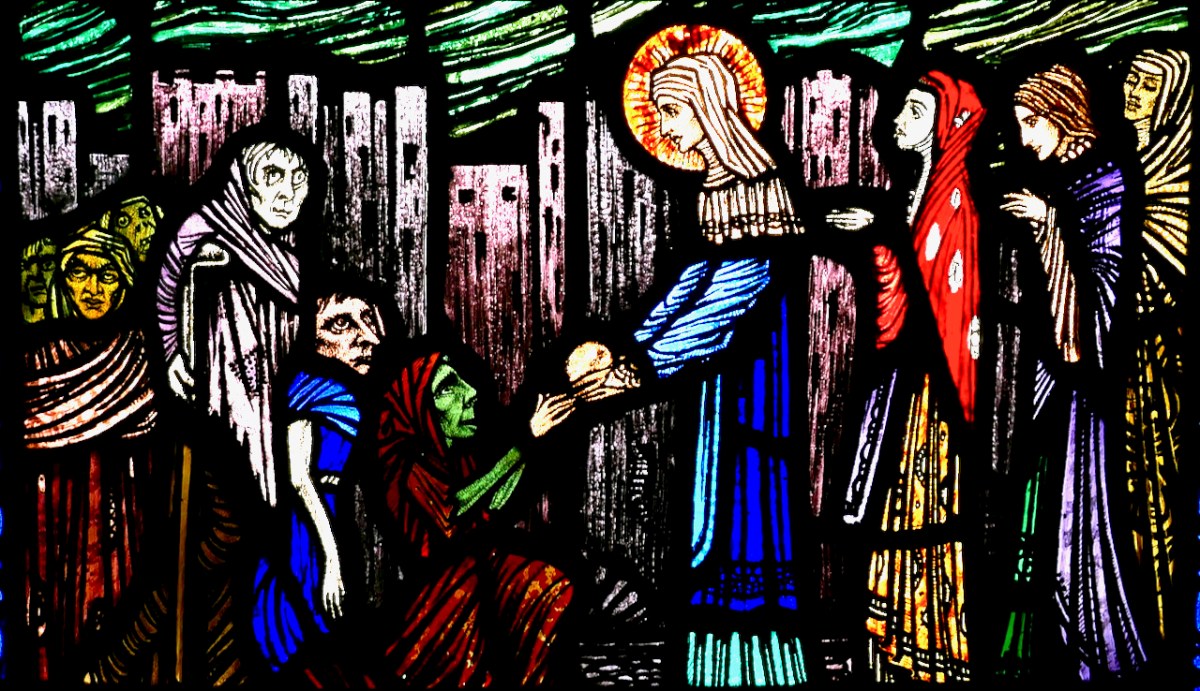
All of the Lives and O’Hanlon’s account tell of Brigid’s many miracles in providing food and clothing for the poor, in healing sicknesses, in turning the hearts of evildoers to God, in freeing slaves, and in punishing those who are selfish or cruel.

Brigid and the Beggar, by William Dowling, Gorey C of I

However, the story I like best perhaps is this one from the Vita Prima: 

In the same place also when saint Brigit was staying as a guest, a married man came with a request that saint Brigit should bless some water for him to sprinkle his wife with, for the wife actually hated the husband. So Brigit blessed some water and his house and food and drink and bed were sprinkled while his wife was away. And from that day on the wife loved her husband with a passionate love as long as she lived.

She may have been a nun, but she obviously served up a good love potion when the situation required it. This story is not only repeated in the Book of Lismore, but embellished, thus: 

When he had done thus, the wife gave exceeding great love to him, so that she could not keep apart from him, even on one side of the house ; but she was always at one of his hands. He went one day on a journey and left the wife asleep. When the woman awoke she rose up lightly and went after the husband, and saw him afar from her, with an arm of the sea between them. She cried out to her husband and said that she would go into the sea unless he came to her.

The aged St Brigid by George Stephen Walsh, in Ballintubber Abbey – another image generously loaned by Frank Fullard

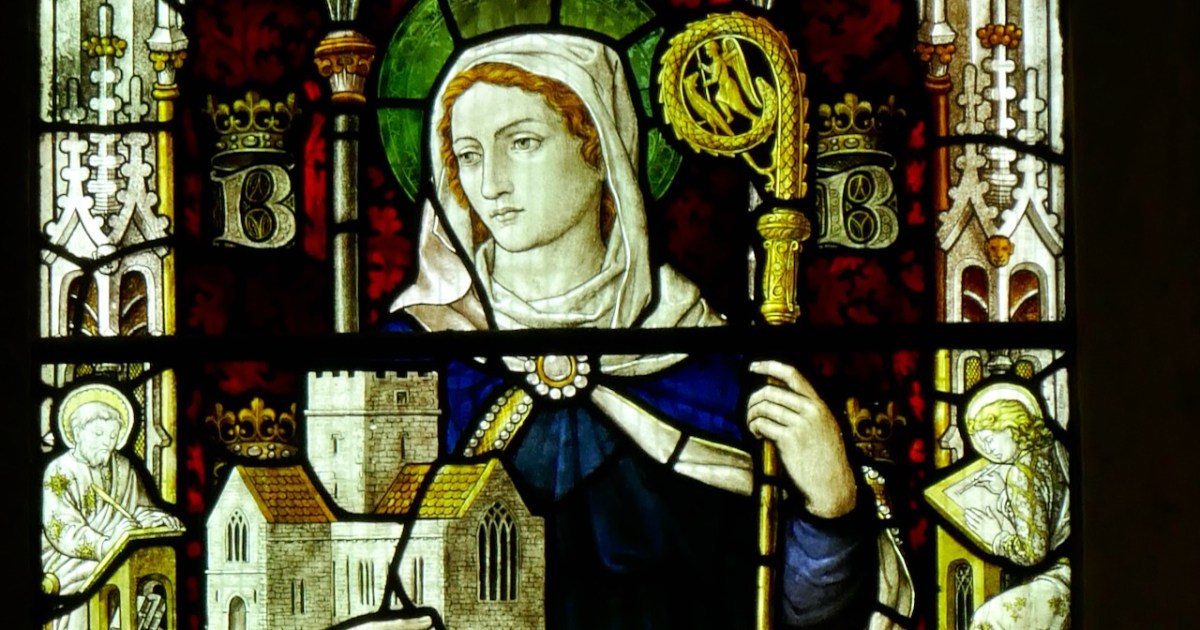
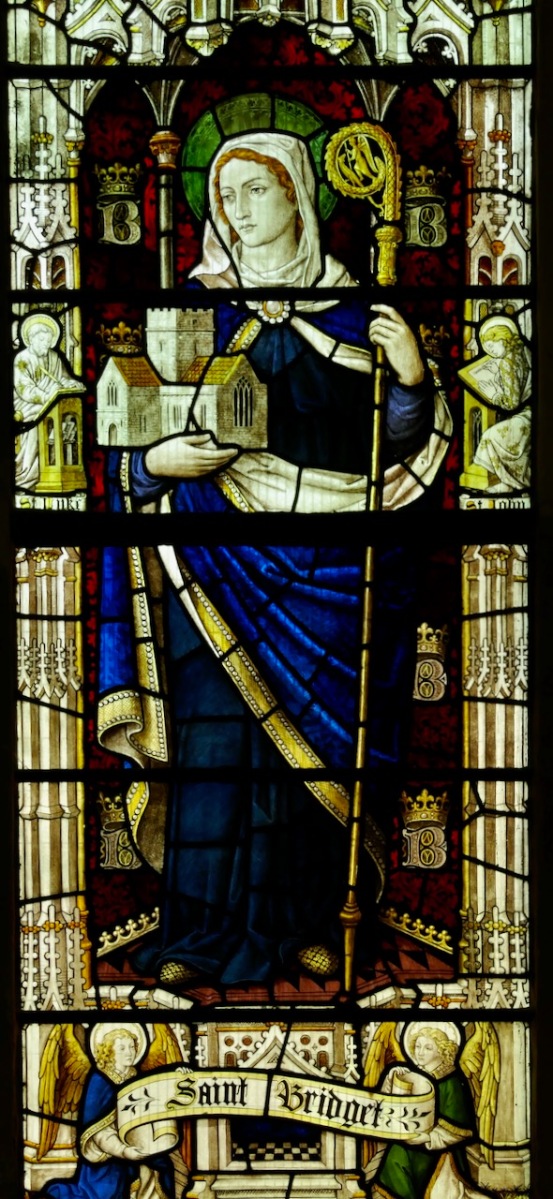
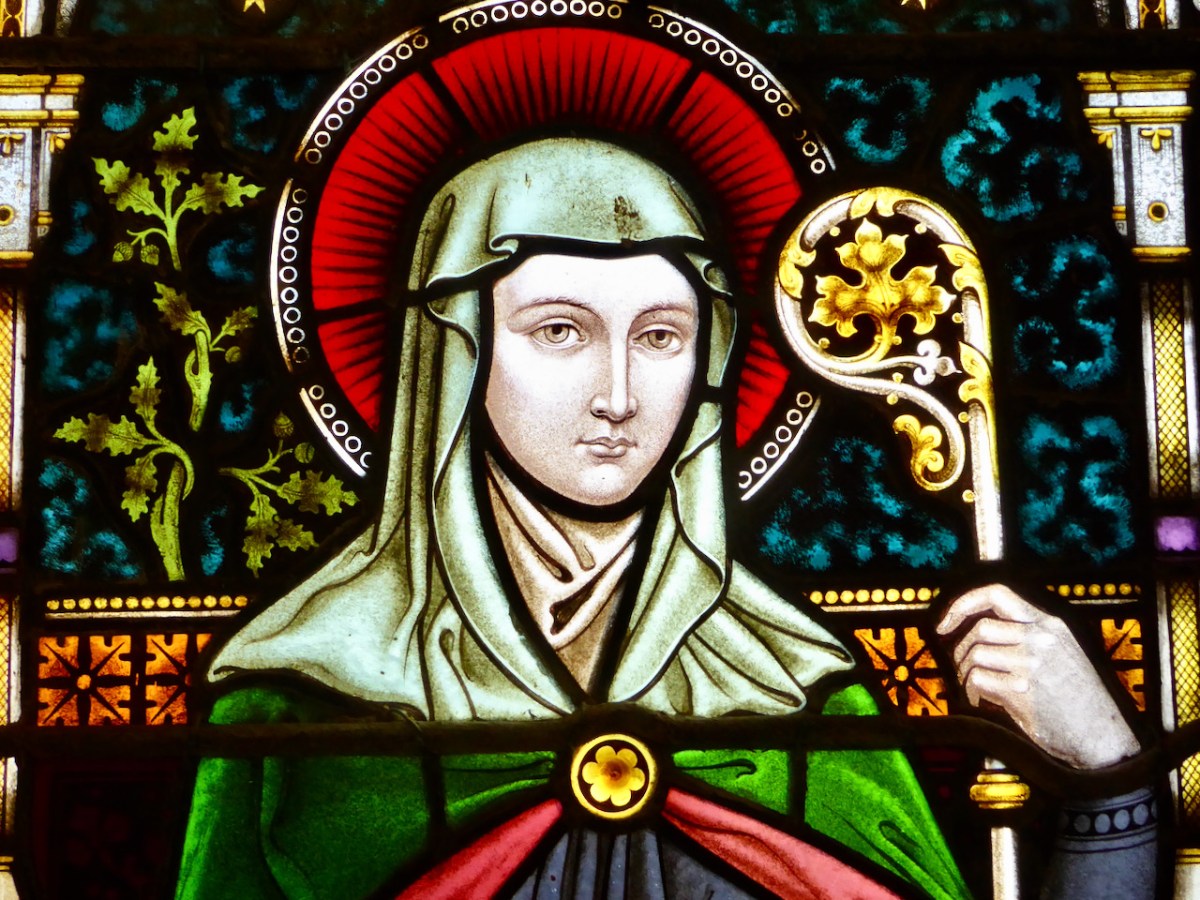
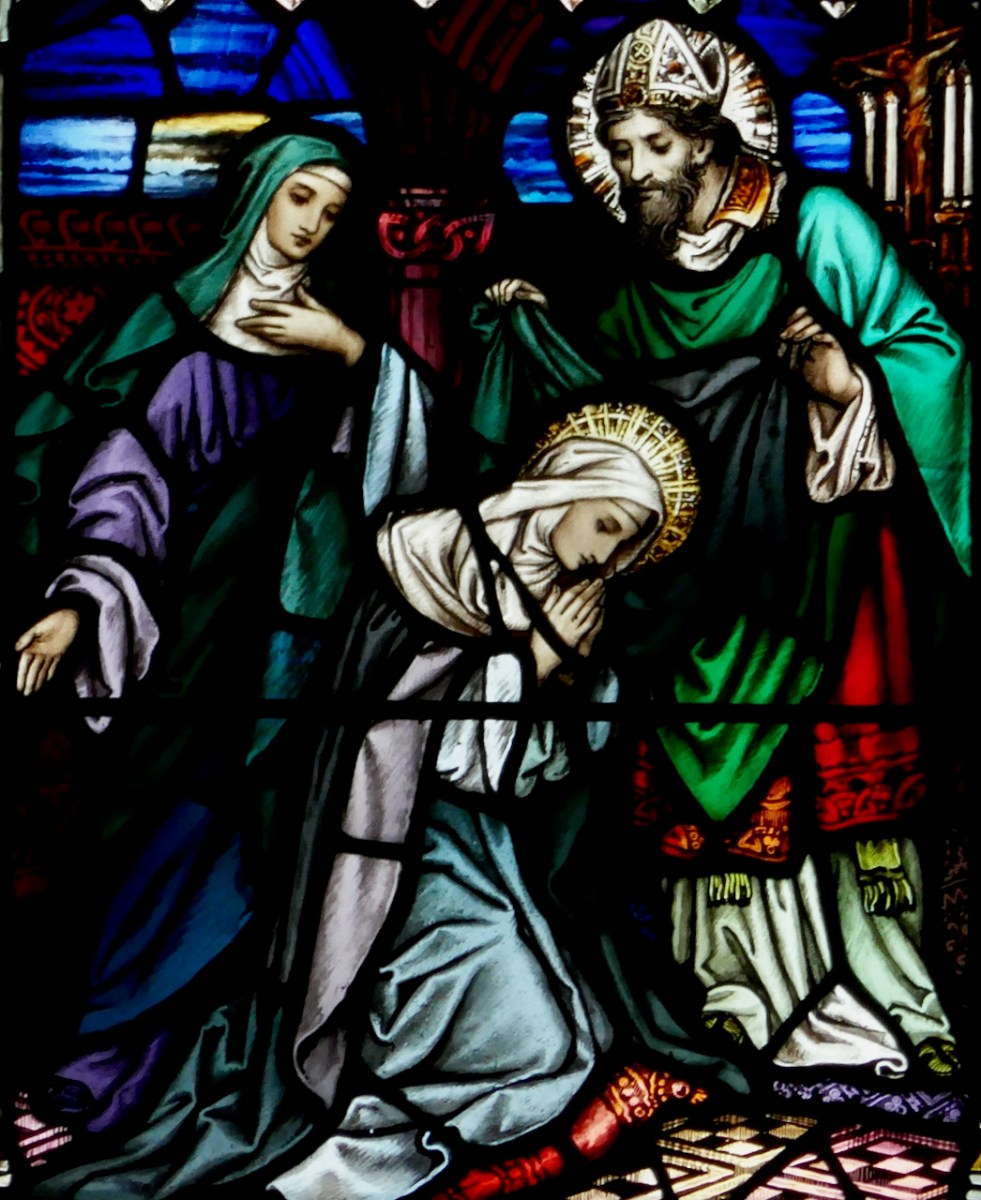
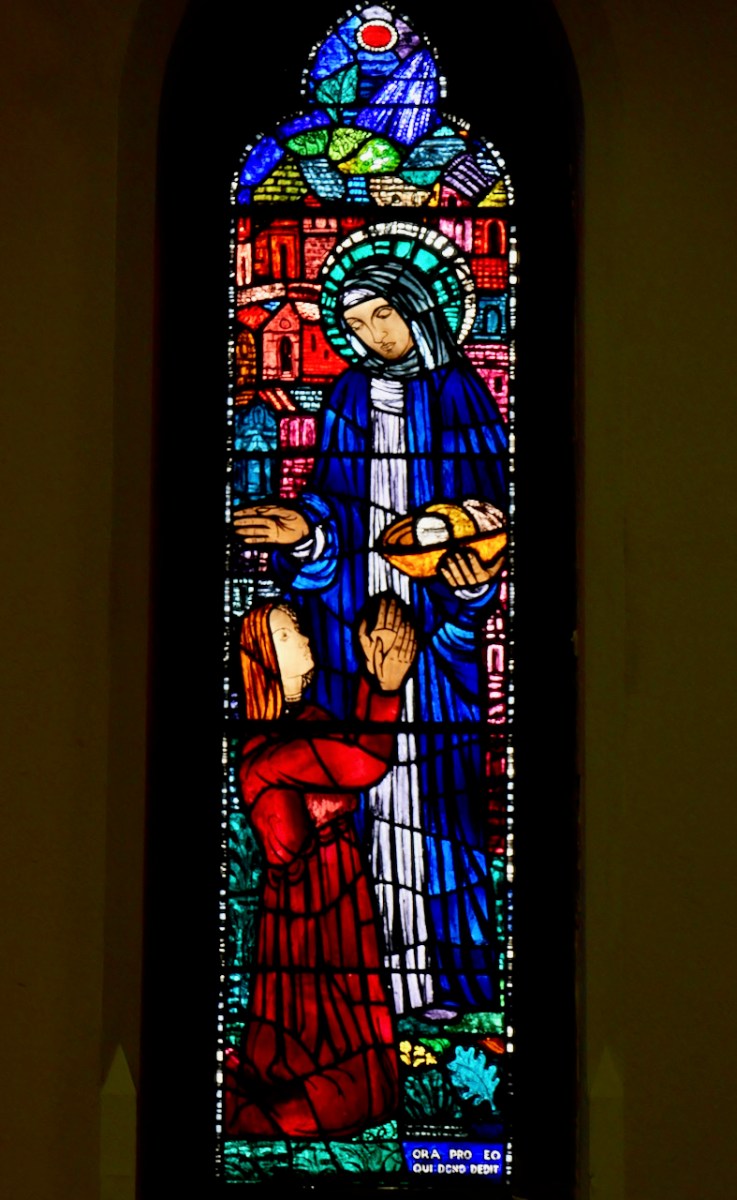
My final point for this post about St Brigid is the matter of where she is buried. Most authorities give this as Downpatrick, where she is laid to rest alongside Patrick and Columcille. However, a medieval legend grew that she went to Glastonbury in old age and died there. That is why she is venerated in Britain as well as in Ireland – the top photograph in this post is from the St Brigid window in Exeter Cathedral. Here’s the full window, in which she is flanked, for some reason, by St Luke and St John busily writing their gospels.

Here is another British window, this one designed by Nuttgens in 1952 for St Etheldreda’s Church in London. (Used with thanks under the Creative Commons License – original is here.) It’s a particularly good narrative window, showing the building of her church under the Oak Tree, her crozier, and two cows – there are many stories of milk and cows in the Lives.

But O’Hanlon is having none of the Glastonbury story.

We cannot receive as duly authenticated, or even as probable, several assertions of mediaeval and more recent writers, who have treated concerning this illustrious virgin. It has been stated, that about the year 488, Saint Brigid left Ireland, and proceeded towards Glastonbury. There, it is said, she remained, until advanced in years, on an island, and convenient to the monastery in that place. Whether she died there or returned to Ireland is doubted. But, it seems probable enough, such a tradition had its origin, owing to this circumstance, that a different St. Brigid, called of Inis-bridge, or of Bride’s Island, had been the person really meant. She lived many years on a small island, near Glastonbury, called Brigidae Insula i.e., Brigid’s Bridge. This latter St. Brigid is said to have been buried, at Glastonbury.

This Brigid window is in Moone, Co Kildare from the Harry Clarke Studios. It features, as do many Brigid windows I have seen, a deer, but I can find no mention of a deer in any of the Lives. Perhaps one of our readers knows where the deer icon comes from?

I will finish with a quote from the Book of Lismore, which gives me the title for this post, and gives Brigid one of her most frequent soubriquets.

It is she that helpeth every one who is in a strait and in danger: it is she that abateth the pestilences: it is she that quelleth the anger and the storm of the sea. She is the prophetess of Christ she is the Queen of the South: she is the Mary of the Gael

I don’t know whose window this is – it’s from Ballybunion – but I love the composition

And a final image from Glynn, Co Wexford, because I love the pared-to-the-bone simplicity of this Richard King medallion..

Posts about St Brigid

St Brigid and AI

Brigid 1500: Mary of the Gael

Brigid: A Bishop in All But Name

St Brigid: Dove Among Birds, Vine Among Trees, Sun Among Stars

Ecce Homo: Harry Clarke’s Kilbride Window

Harry Clarke’s window in St Brigid’s Church of Ireland, Kilbride, Co Wicklow, is a bit of a mystery: simultaneously one of his most beautiful and his most mis-described windows. It’s almost as if there’s some kind of spell on it – whoever shall describe this window shall be led down erroneous pathways*. I hope this post will break that spell and set the record straight.

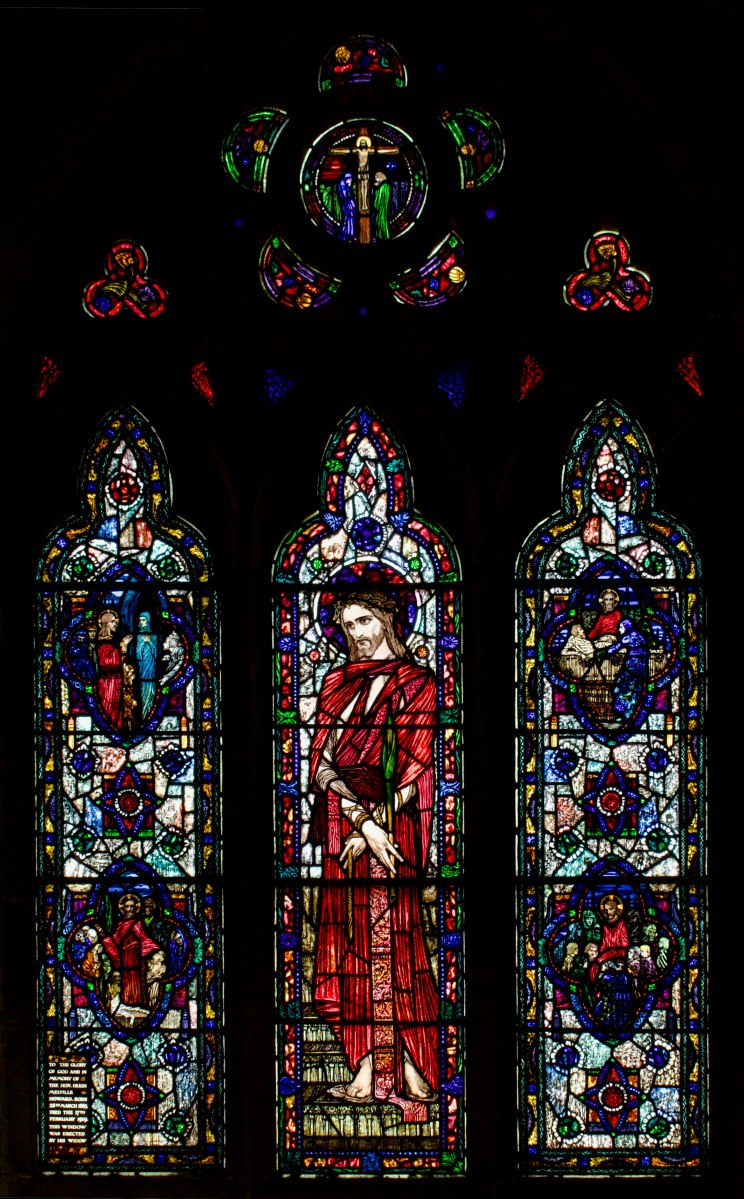
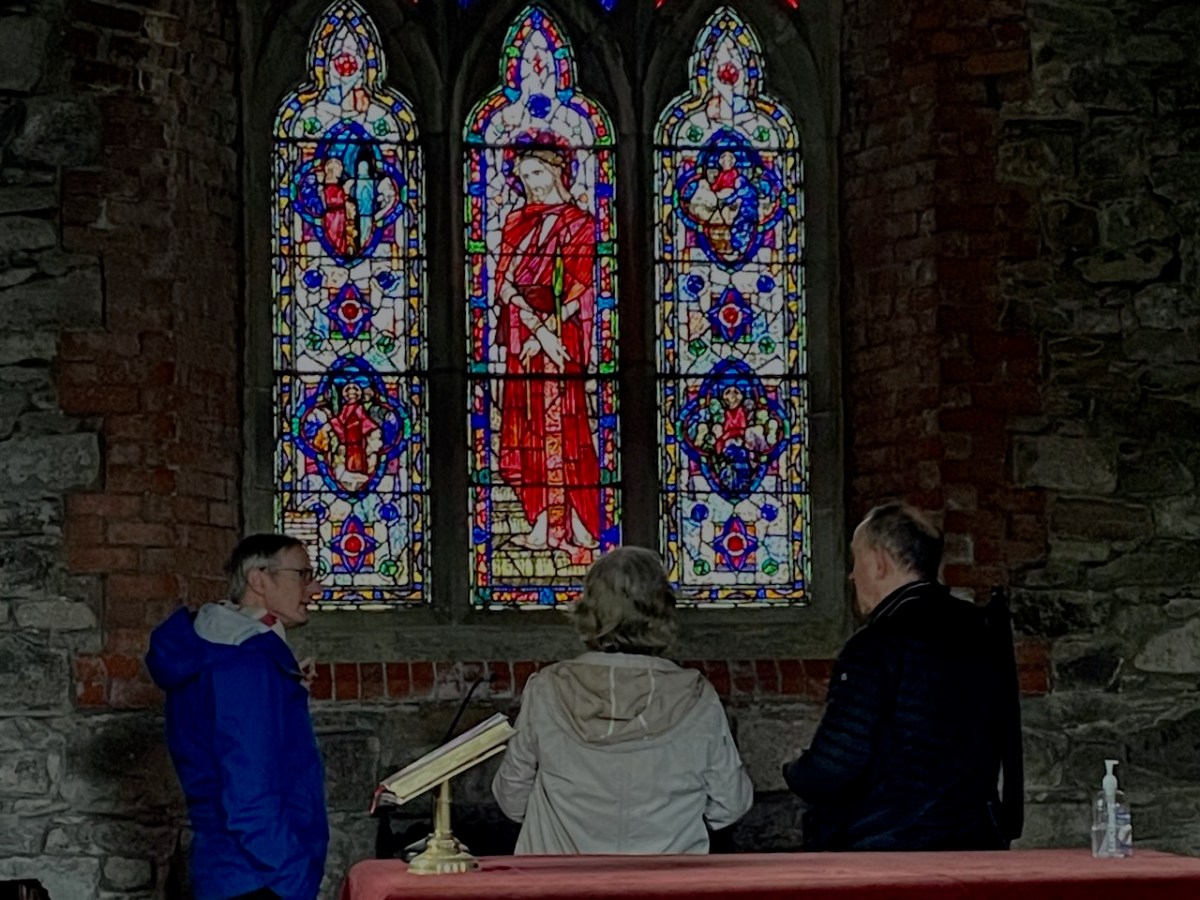
This is the whole window, which occupies the wall behind the altar. It’s a three-light window and the tracery above includes a small roundel with a crucifixion scene.

When it comes to Harry Clarke, there is no more authoritative source than Nicola Gordon Bowe. Hers are the shoulders upon which all of us stand to gain insight and understanding of the man and his work. She didn’t make many mistakes. However, inexplicably, she described this window as a ‘Resurrection’. In The Life and Work of Harry Clarke, she states that: As a result of the St Stephen Lea-Wilson Window in Gorey, Clarke was asked by the Earl of Wicklow to design a Resurrection window for the parish church of Enerily and Kilbride, Co. Wicklow near the Earl’s estate, Shelton Abbey. Several pages further on, she says Harry . . . spent 9 February with the Earl of Wicklow discussing a further window for the small church of Enerily and Kilbride near Arklow.

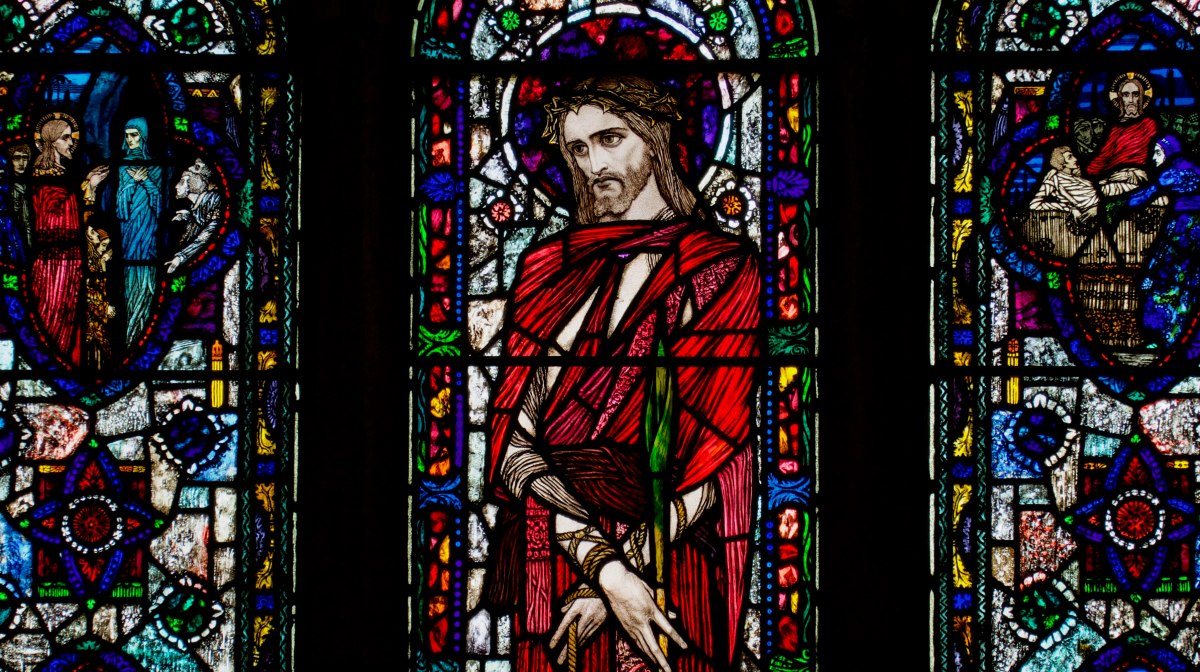
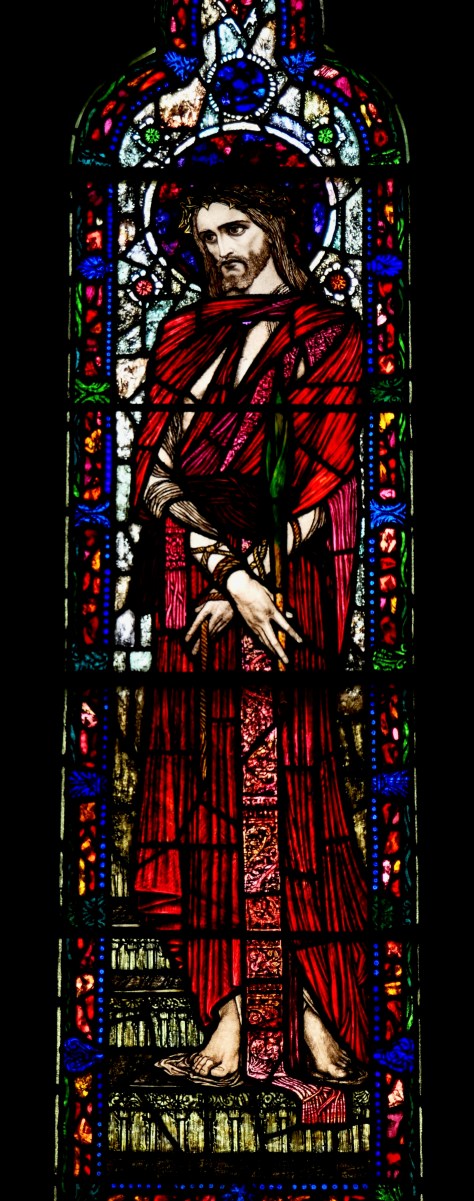
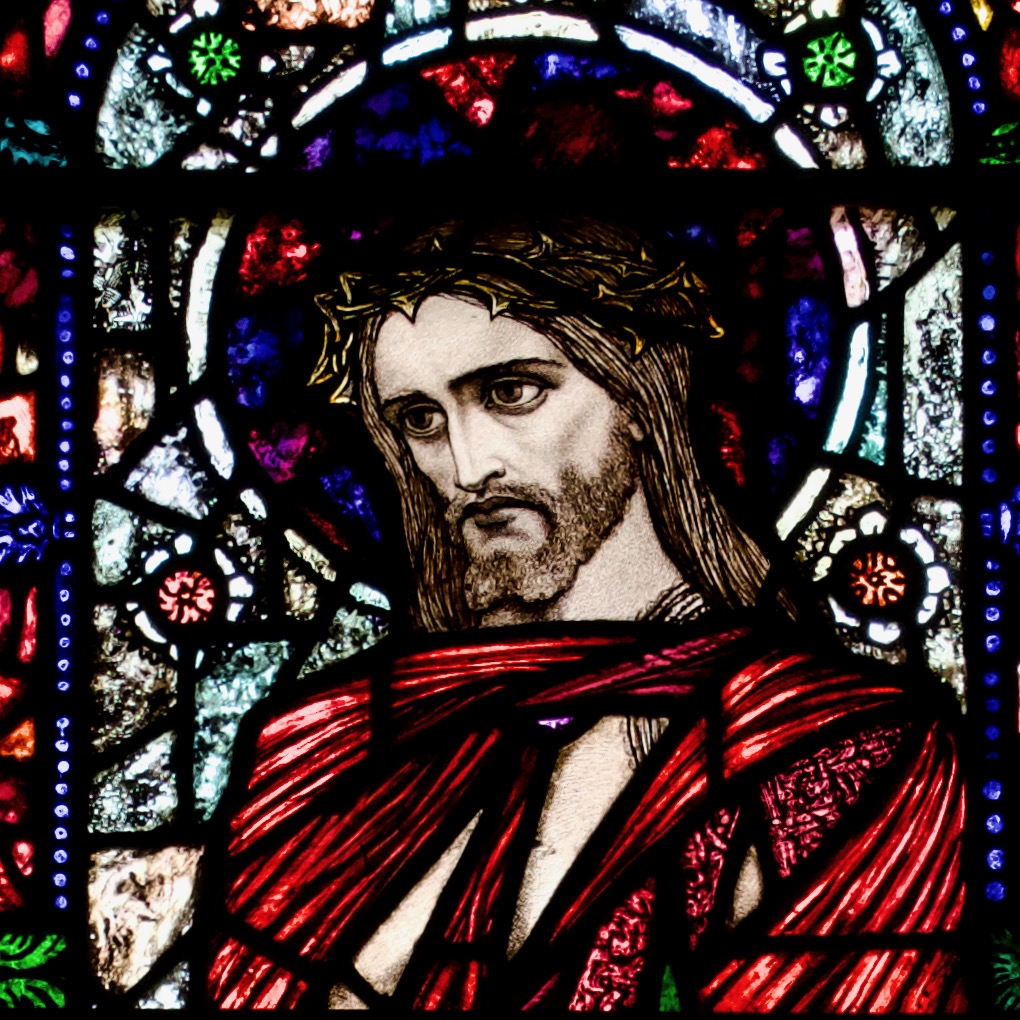
The central figure is of Christ as he was paraded before Pilate, who washed his hands of the affair and declared, as he presented him to the Jews, Ecce Home – Behold the Man. As described in John and Matthew, he is bound, crowned with thorns, holding a reed (Harry has chosen a bulrush), and clad in a scarlet robe. He is standing on steps (as frequently depicted in paintings) and under his feet the cloth may represent his own clothes, stripped from him

She describes the finished window thus: In the three-light Resurrection, the figure of Christ in the centre light stands at the foot of a staircase, robed in ruby, crowned with thorns and bearing the palm of martyrdom. The ruby glass is carried into the border, into the side traceries where it is neither painted nor acided, and is echoed in the medallion showing The Crucifixion in the centre of the rose tracery above. It is also used in the figure of Christ, which appears in each of the quatrefoil panels of the side lights which, set in rich borders of ruby, blue and green, seem inspired by medieval glass. A rich blue dominates four medallions showing miracles of the Lord. The medallion in the lower right-hand light features a self-portrait of the artist, a halo over his untidy hair, and huge eyes giving him a haunted look while above, the resurrection theme is evocatively illustrated by the miracle of Lazarus. This window is much enhanced by the rough, unplastered wall in which it is set.

Clarke’s Jesus in this window is one of his most striking depiction of suffering and compassion

However, the dedication on the window is to Hugh Melville Howard, younger half-brother to the Earl of Wicklow, and donated not by the Earl, but by Hugh’s widow.  Hugh had died in 1919. The date might make you suspect that this was a war memorial window, but in fact, Hugh died of pneumonia at the age of 36. This must have been a tragedy indeed for his wife, May Sands, the only daughter and heiress of New York lawyer and real estate mogul, Benjamin Aymar Sands. They had married in America in 1908 – a high society wedding, every detail of which was gleefully reported in the New York Times. At the time of his death they were living in Bellevue House in Delgany and had two children. The window was not installed until 1924.
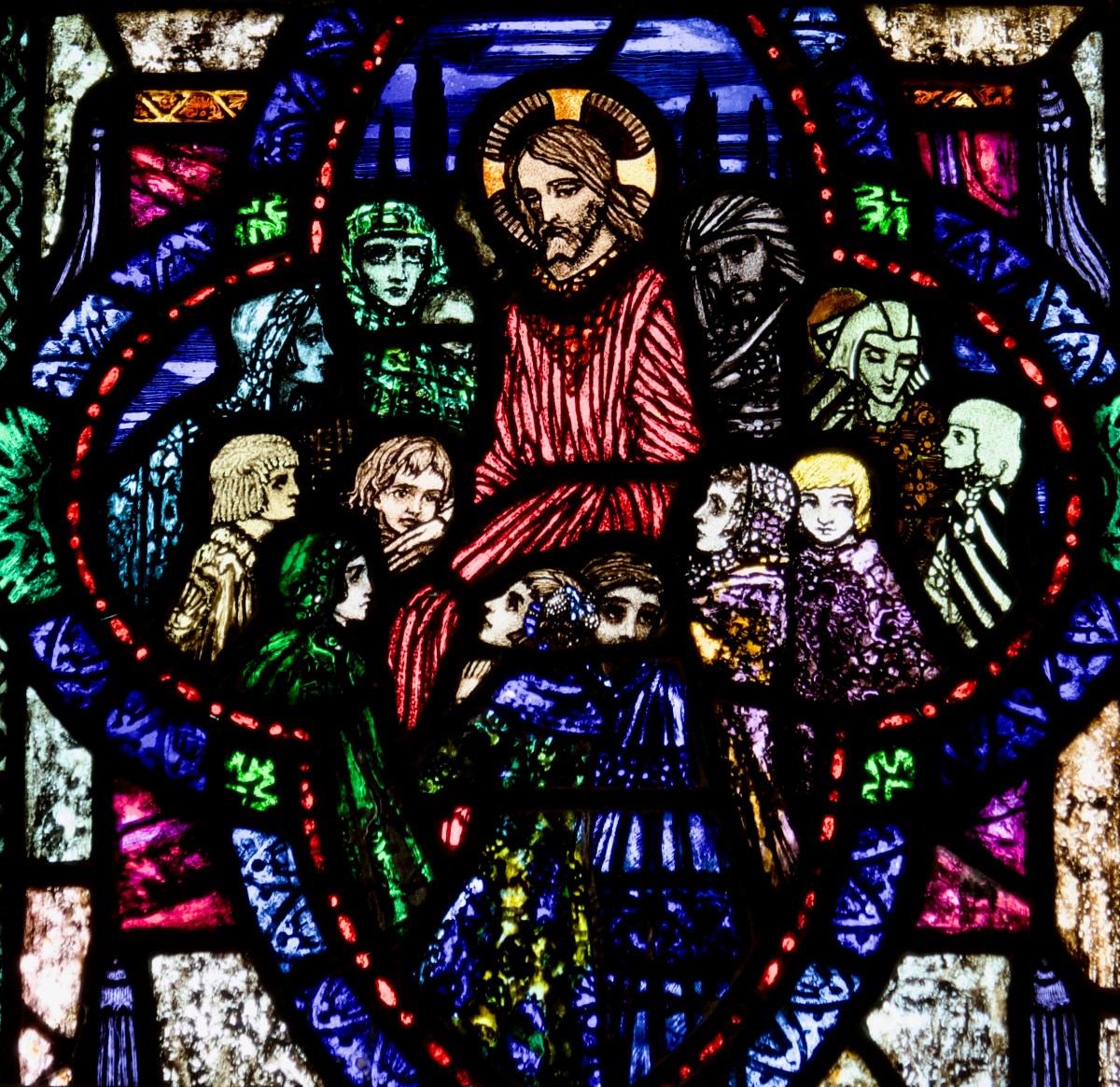
Christ and the Children

So there seems to be a disconnect between the original idea for a Resurrection Window for Kilbride, and the final product, which depicts not, indeed, a Resurrection image but that of the suffering Jesus, mocked by his tormentors, scourged, bound with ropes, crowned with thorns, carrying a reed to stand in for a sceptre. This is the image that is known as Ecce Homo – Behold the Man. 

Matthew 27: 26-31

Then released he Barabbas unto them: and when he had scourged Jesus, he delivered him to be crucified. Then the soldiers of the governor took Jesus into the common hall, and gathered unto him the whole band of soldiers. And they stripped him, and put on him a scarlet robe. And when they had platted a crown of thorns, they put it upon his head, and a reed in his right hand: and they bowed the knee before him, and mocked him, saying, Hail, King of the Jews! And they spit upon him, and took the reed, and smote him on the head. And after that they had mocked him, they took the robe off from him, and put his own raiment on him, and led him away to crucify him. 

John 19: 1-5

Then Pilate therefore took Jesus, and scourged him. And the soldiers platted a crown of thorns, and put it on his head, and they put on him a purple robe, And said, Hail, King of the Jews! and they smote him with their hands. Pilate therefore went forth again, and saith unto them, Behold, I bring him forth to you, that ye may know that I find no fault in him. Then came Jesus forth, wearing the crown of thorns, and the purple robe. And Pilate saith unto them, Behold the man!

I surmise that, whereas the original idea, as proposed to Harry by the Earl, may have been for a Resurrection-themed window, the final central image, of suffering and preparation for death, would have seemed more apt to May, the grieving widow. 
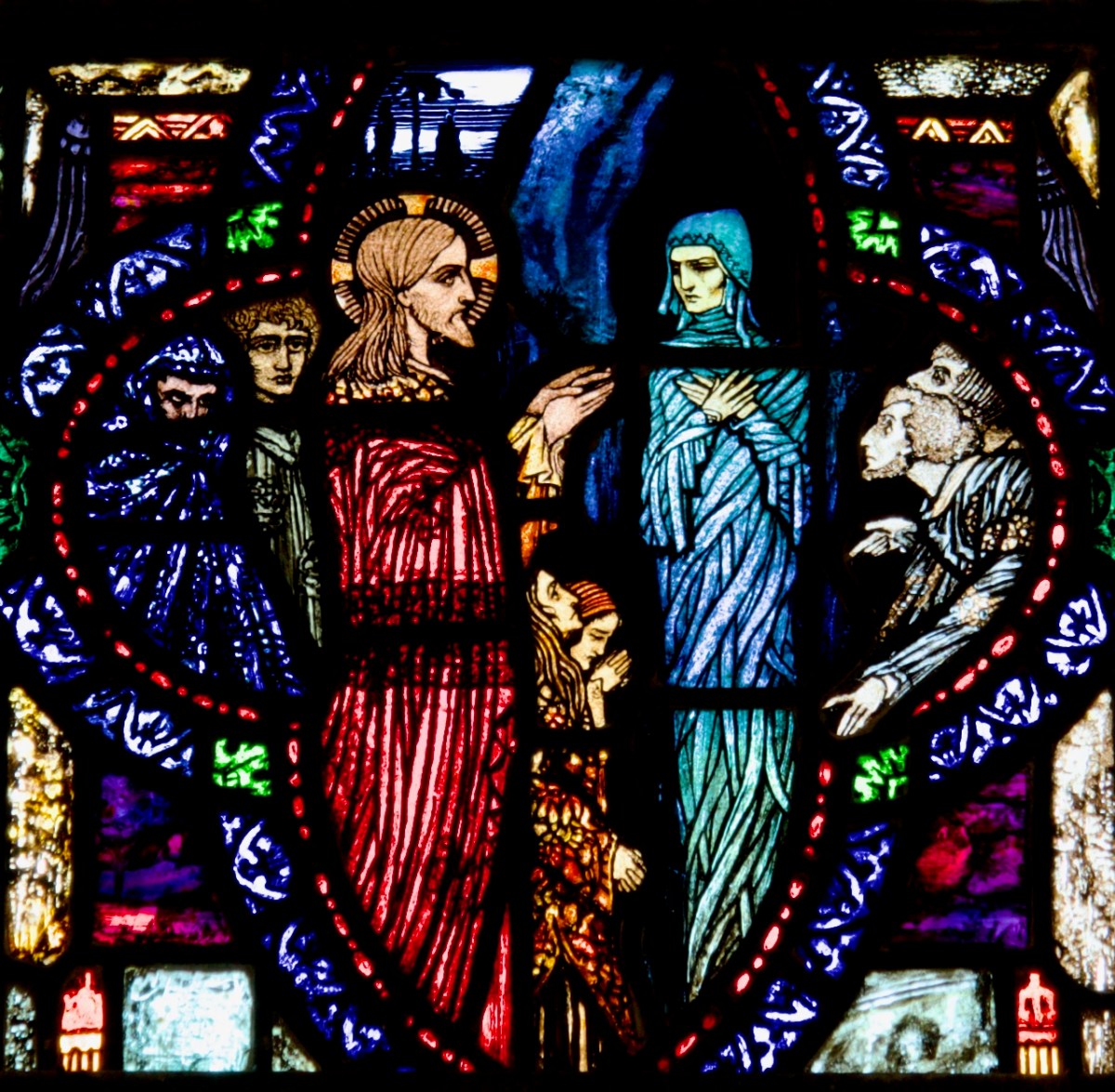
The Raising of Lazarus

May and Hugh had been married in a charming country church called St Andrews Church of the Dunes in the heart of the Hamptons on Long Island. It was an Episcopalian church patronised by wealthy New Yorkers who had country houses in the area. Episcopalian services focus on the sacraments, similar to a Catholic Mass, and the church was filled with stained glass, some by Tiffany.

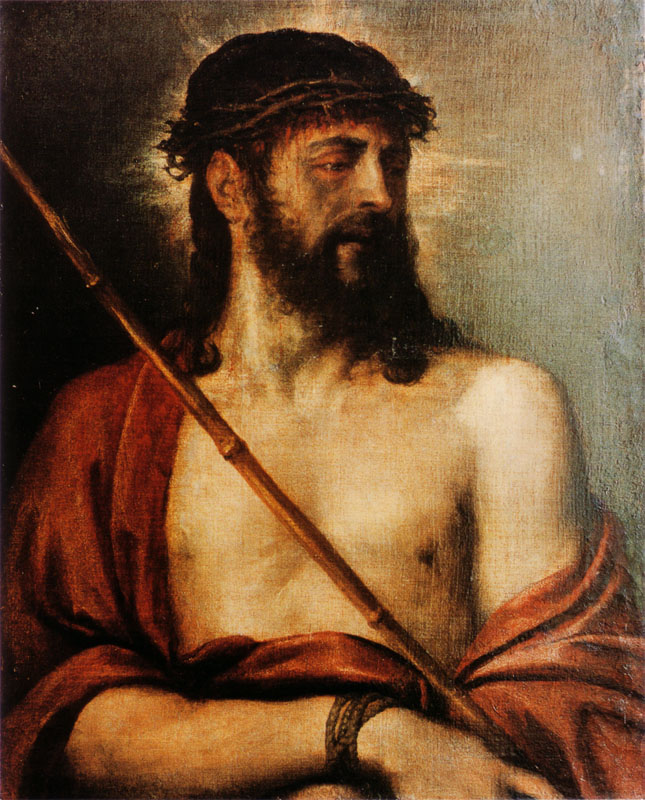
Ecce Homo by Titian (Unknown source, Public Domain, https://commons.wikimedia.org/w/index.php?curid=5557882)

This is relevant because Ecce Homo, despite being a staple of Renaissance imagery (Titian alone did several versions, including the one above), is not a frequent choice for Church of Ireland windows. I can identify only eight windows (of 3,198) which contain Christ in this state of having been scourged or mocked. (There are, on the other hand, one hundred and eleven Resurrection windows.) If it was May, rather than Lord Wicklow, who had the final say in the central imagery, I can see how her background in a more Catholic form of worship might have made her more amenable to an Ecce Homo depiction, and that therefore what started out as a Resurrection Window (with supporting Resurrection-themed medallions), ended as a window depicting suffering, healing, and children. 

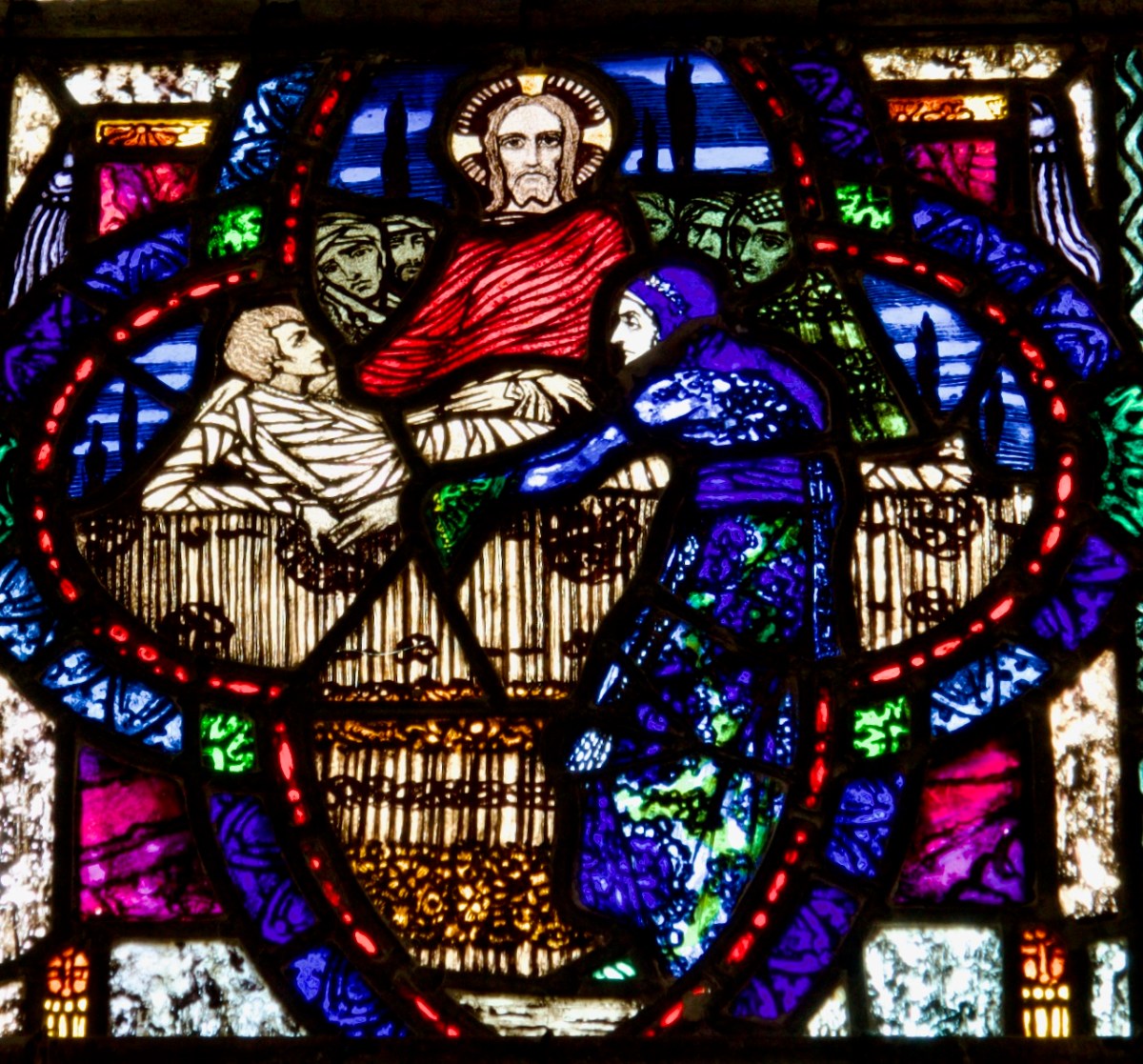
The Raising of the Widow’s Son at Nain

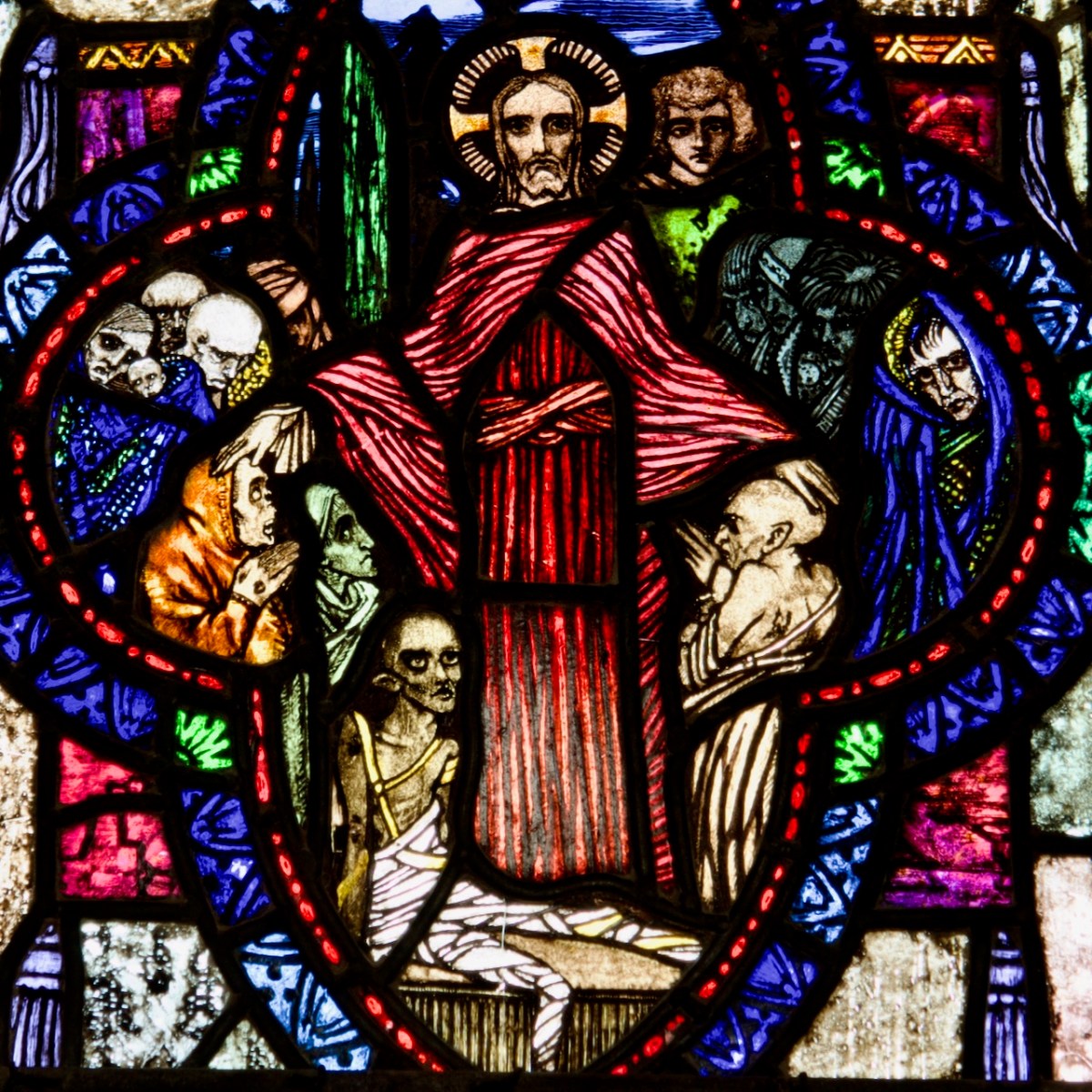
Four medallions are placed on either side of the central figure of Christ. Three relates to the theme of Resurrection and/or healing – The Raising of Lazarus (Top Left); The Raising of the Widow’s Son at Nain (top right); and Christ’s Healing Ministry (bottom left). The final medallion is Christ Blessing Children (bottom right), perhaps a reference to hope that May’s children, now fatherless, would find comfort.

Christ’s Healing Ministry

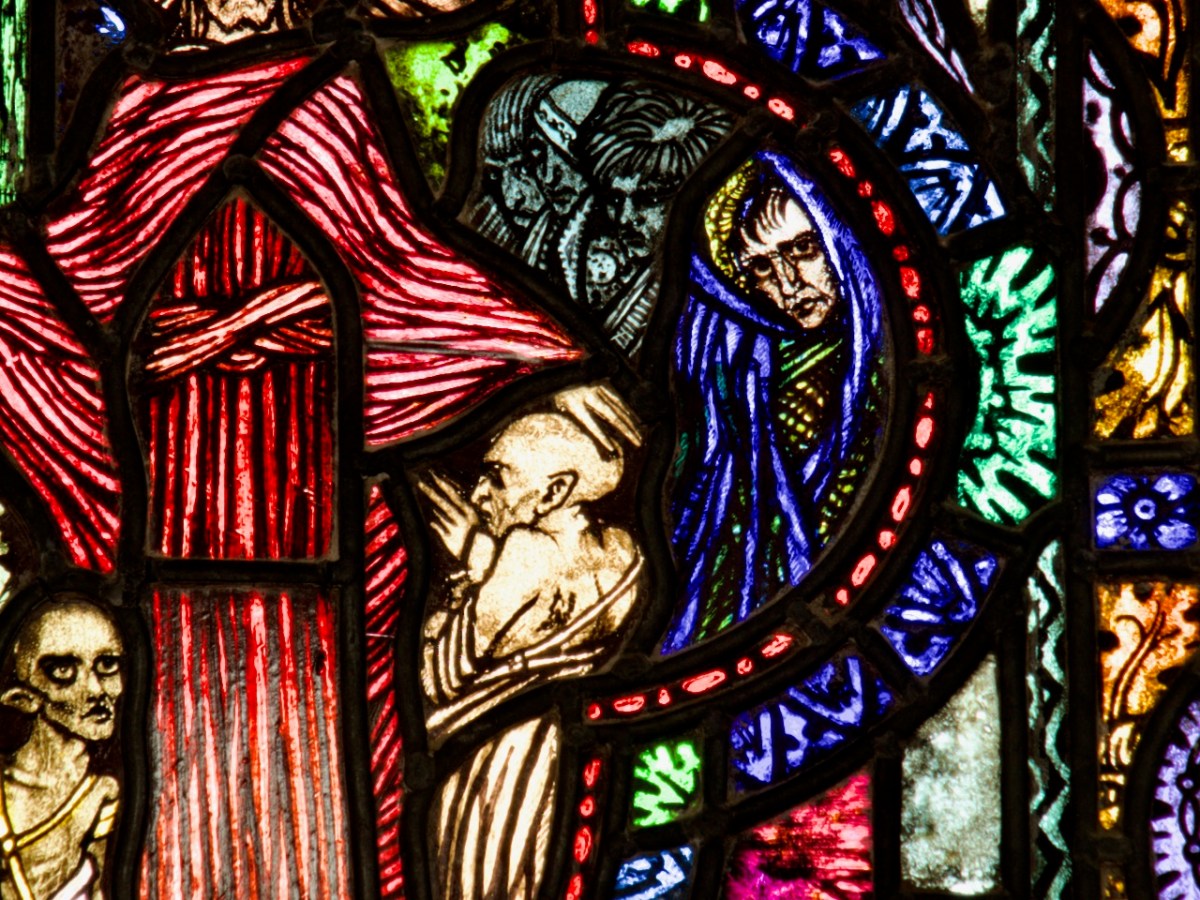
In the medallion above, Gordon Bowe identifies a self-portrait of Harry, peering in on the right-hand side (below). Harry has done this in other windows, often more immediately recognisable than here. The parade of sick, palsied, bandaged and leprous sufferers are typical of Harry’s affinity to the macabre.

In the cinquefoil tracery at the top of the window is a small roundel containing the Crucifixion. Although tiny, it is as full of detail as are the medallions.

David Lawrence, in his entry in Gloine, correctly identifies the medallions, and uses Christ as Martyr for the central figure, perhaps because he (like Gordon Bowe) interprets the ‘sceptre’ that Jesus is carrying as a palm, the icon of martyrdom. In Strangest Genius, by Lucy Costigan and Michael Cullen, the authors simply repeat the description and background as gleaned from the work of Gordon Bowe (although without credit, as seems to be their practice), along with the errors, and add one of their own, describing the reed as a ‘lily. . .denoting his virtue.’

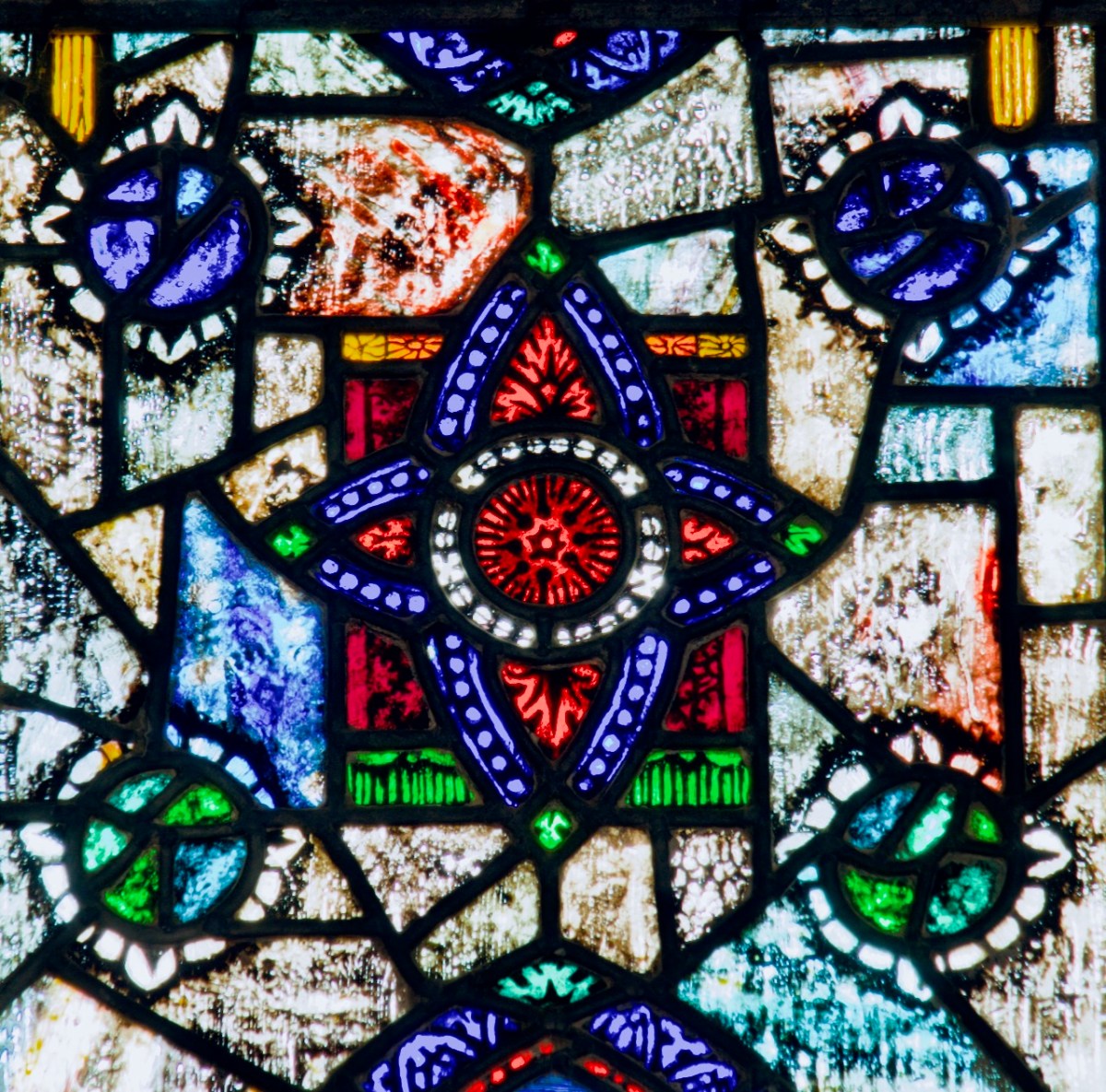
Gordon Bowe often uses the term jewel-like to describe Harry’s ability to make his windows sparkle and shimmer and to use advanced techniques (such as plating and acid-etching) to create depth and allow the sun to refract through the glass. The window in Kilbride is a master-class in how he achieves this effect, especially in the decorative areas between the scenes, as in the one above. No photograph can do justice to this effect.

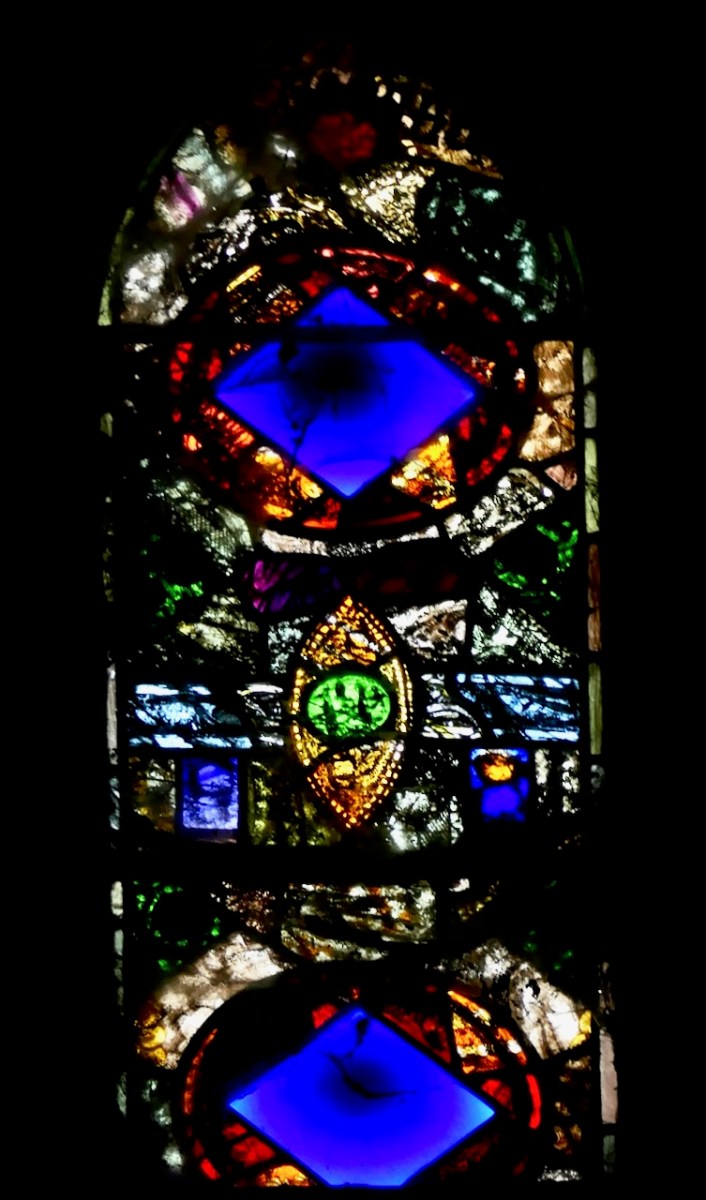
Oh, and just to add to the fact that this tiny church has an exceptional Harry Clarke window – it has a second one (above). Harry made it with left over ‘scraps’ of glass, to fill a small, high, transept window, and he described it as an ‘experiment.’ The two pieces of blue glass prefigure the mid-century practice of dalles de verre, of which we have several excellent examples in Irish Churches.

David Caron, Editor of The Gazetteer of Irish Stained Glass; Ruth Sheehy, author of The Life and Work of Richard King; and Paul Donnelly, expert researcher on the Harry Clarke Studios, in front of the Ecce Homo window on a recent visit. Together, we discussed the most appropriate title for the window. Like most Church of Ireland churches, Kilbride is closed most of the time, and therefore the window is not easily accessible. I am very grateful to the Rev Barrett for allowing us to view and photograph the windows last week. Besides the photographs in Gloine, I can find no other images of the window online, so I hope this post will clarify what this window is actually all about. 
*The most head-scratching erroneous description comes from this report in The Wicklow People

Brigid: A Bishop in All But Name

The Brigid window, detail, Kilrush, Co Clare. Photo courtesy of John Glynn

This year, I am taking the Vita Prima as my starting point. It’s the Life of Brigid that was written about the middle of the 700s. As we saw in my first post about St Brigid, a year ago, Cogitosus wrote his Life in about 650, about 125 years after the death of Brigid. So this Life, the Vita Prima, was written 225 years after her death – but there is sound evidence that it is was based on the writings of St Ultan, who died around 650. In fact, the author of the Vita Prima and Cogitosus may both have drawn from this common source. * 

The Brigid window, detail, Kilrush, Co Clare. Photo courtesy of John Glynn

My illustrations are all taken from stained glass and all the images are my own except for the wonderful Kilrush window, kindly shared with me by the photographer, John Glynn. John has undertaken extensive new research on this window and is now convinced that it was mostly designed by Harry Clarke, even though it has been up to now designated as by his Studio rather than by himself. 

St Brigid, detail from St Fachtna’s Church, Rosscarbery, Co Cork, unknown artist

St Brigid – and yes, the evidence also points overwhelmingly to the fact that she was a real person – was born around 452 and died in either 524, 26 or 28, in her 70s. That means, by the way, that next year is the 1,500th anniversary of her death.

The Brigid window, detail, Kilrush, Co Clare. Photo Courtesy of John Glynn

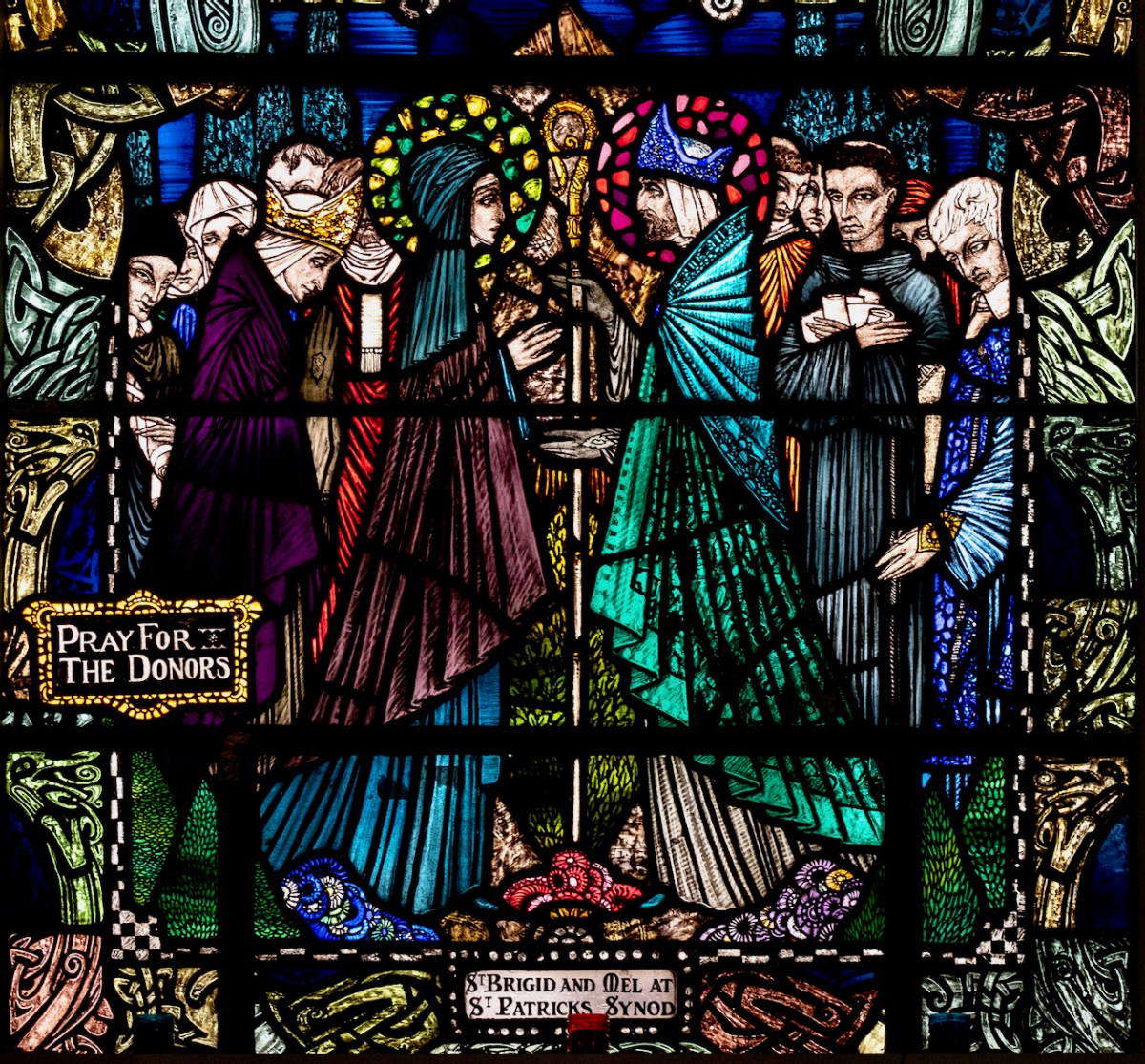
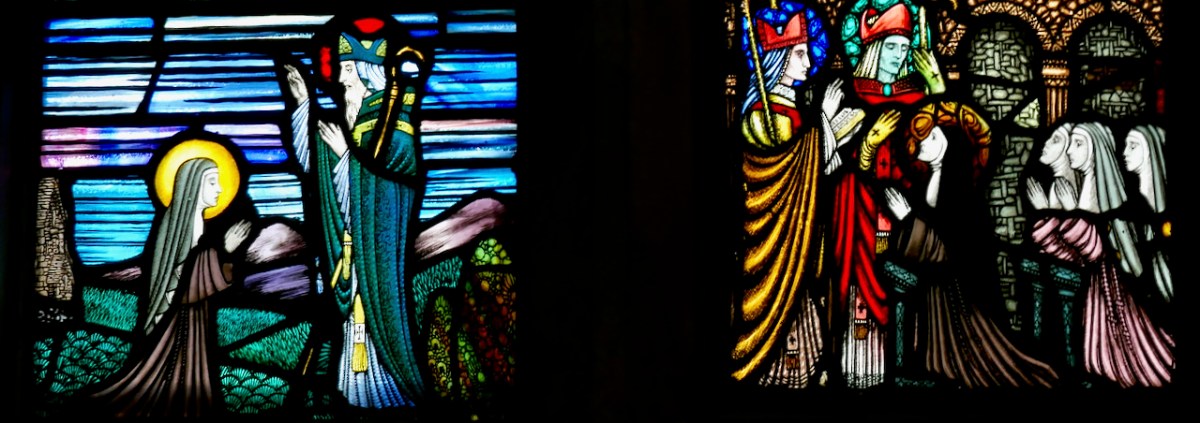
This version assigns her ‘veiling’ as a nun to Bishop Mel, but does not include the story of his accidentally making her a bishop. The image above shows him handing her a crozier, this referencing the story I included in last year’s post.

Then saint Brigit taking three nuns with her went to the territory of the Ui Neill to the two holy bishops, Mel and Melchu, who were disciples of St Patrick and lived in the towns of Mide. And they had a certain disciple called Mac Caille who said to Mel, ‘Look, there are holy virgins outside who wish to receive the veil of virginity from your hands.’ 

Then he ushered them into the bishop’s presence, and while bishop Mel was gazing intently at them, a column of fire suddenly appeared rising from Brigit’s head up to the very top of the church in which she dwelt. Then the holy bishop Mel placed the veil on saint Brigit’s head and when the prayers had been read Brigit bowed her head and seized the wooden foot of the altar in her hand and since that moment the altar foot has permanently remained fresh without any decay or blemish. And saint Brigit’s eye was healed forthwith when she received the veil. Then eight other virgins also received the veil together with saint Brigit and the virgins with their parents said, ‘Don’t leave us. Instead stay with us and make your home in these parts.’  Thereafter saint Brigit stayed with them.

Brigid’s veiling, Earley Studios, Drumcong, Co Mayo

The reference to eye healing, by the way, related to another story. When she was pressured to marry a man

Saint Brigit asked God to afflict her body with some deformity in order that men might stop paying suit to her. Thereupon one of her eyes burst and liquefied in her head. For she preferred to lose her bodily eye than the eye of her soul and loved beauty of soul more than that of the body. 

Predella of Brigid window in Carnew, Co Wicklow

You’ll be pleased to hear I don’t have an illustration of this episode. But this book (like the Life in The Book of Lismore, see last year’s post) rather than a biography, is a relating of miracle after miracle. Many deal with her ability to provide food – bread, meat and beer – to hungry people (as above). Here’s just one: 

At this time saint Brigit was a guest at the monastery of St Laisre. Now one day towards evening St Patrick came with a large crowd to put up at that monastery. Thereupon the local community was worried and said to Brigit, ‘What are we going to do. We don’t have food for such a large crowd.’ But Brigit said to them, ‘How much do you have?’ They said to her, ‘All we have is twelve loaves and a little milk and one sheep which we have cooked for you and your folk.’ But Brigit said, ‘These will be enough for the whole lot of us, for the sacred scriptures will be read to us, thanks to which will we shall forget about bodily food.’ Whereupon the two groups of people, namely, Patrick’s and Brigit’s, ate together and had their fill and the amount of scraps they had left over was greater than the supplies which St Laisre had offered them in the first place, and later St Laisre offered herself and her place to saint Brigit in perpetuity.

Knockainy, Co Limerick, window by William Dowling for the Harry Clarke Studios

She was also famed for her ability to heal – the blind, maimed, mute, paralysed, deranged, bulimic (I’m not making this up) and leprous all came to her in their afflictions and were healed. She healed the poor and the kingly equally.

The Brigid window, main panel, Kilrush, Co Clare. Photo courtesy of John Glynn

Here’s an interesting instance of her using her powers to ‘heal’ a pregnancy:

Another day saint Brigit by the very powerful strength of her faith blessed a woman who had fallen after a vow of integrity and whose womb was pregnant and swelling and the conception in the woman’s womb decreased and she restored her to health and repentance without childbirth or its pangs. The woman was healed and gave thanks to God.

From the Brigid window, Collon, Co Louth, probably by the Harry Clarke Studios

The Vita Prima has Brigid and Patrick as contemporaries who knew each other and there are several stories of them together. Here is one:

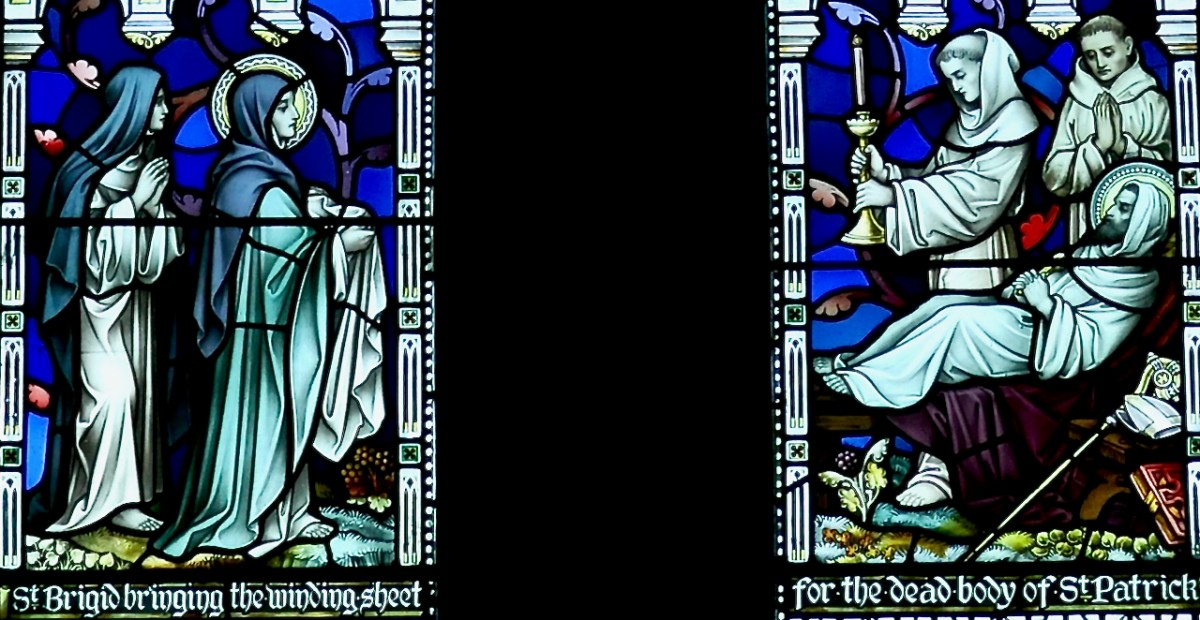
Patrick was preaching the word of God one day to the crowds and saint Brigit. Then everyone saw a very bright cloud coming down from the sky to the dark earth on a rainy day. Gleaming from an enormous flash of lightning, it paused for a little while at a spot nearby beside the crowd. Afterwards it went to Dun Lethglaisse where Patrick is buried. Lingering there a while longer the cloud then disappeared and the crowds did not dare ask what this extraordinary apparition meant but asked saint Brigit. And Brigit said, ‘Ask Patrick.’ When Patrick heard this he said, ‘You and I know equally well. Reveal this mystery to them.’ And Brigit said, ‘This cloud, in my opinion, is the spirit of our father St Patrick who has come to visit the places where his body will be buried and rest after his death. For his body will rest for a short while in a place nearby, and afterwards will be taken to be buried in Dun Lethglaisse and there his body will remain till the day of judgement.’ Then Patrick told Brigit to make with her own hands a linen shroud to cover his body with after his death, as he desired to rise to eternal life with that shroud. Brigit accordingly made the shroud and it was in it that St Patrick’s body was later wrapped and it is still in that place. 

I have used St Brigid bringing the winding sheet for St Patrick in last year’s Brigid post, but here it is again. It’s from Killarney Cathedral and by Hardman.

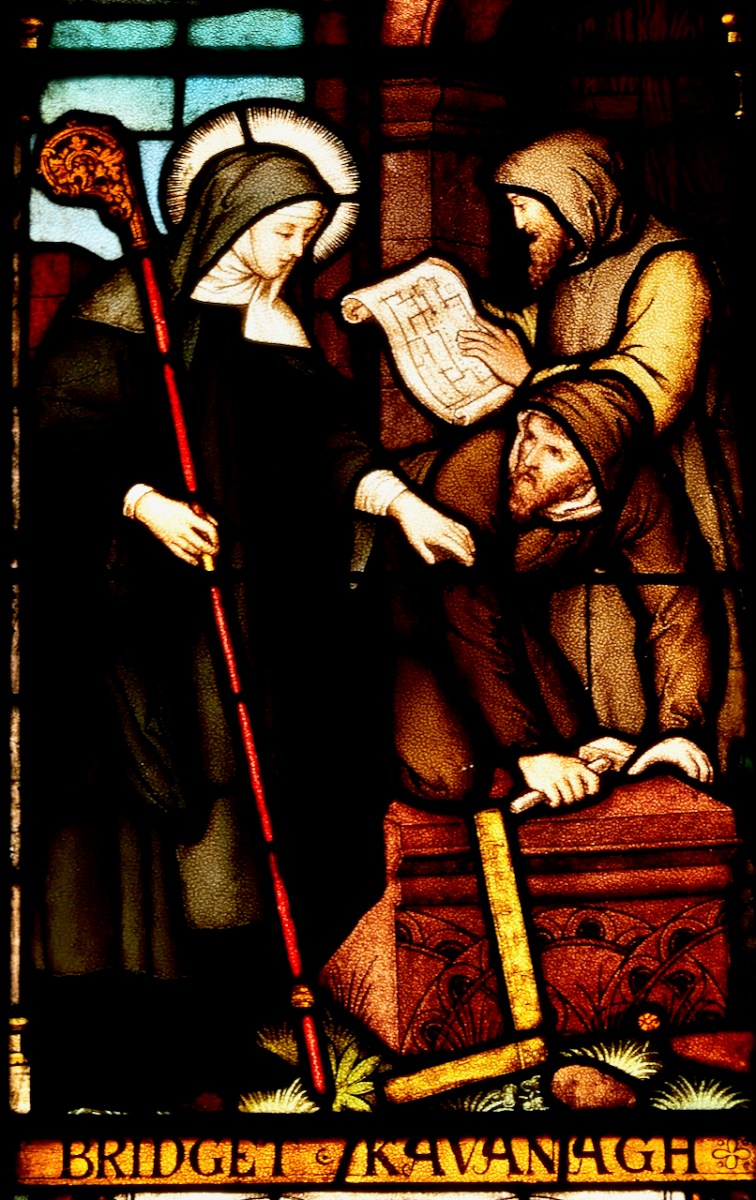
Interestingly, the Vita Prima contains only one direct reference to Kildare, where St Brigid established her foundation. Here she is instructing her masons in how she wants it built (as a 15th century church, apparently). This one is from Armagh Cathedral and I think it’s by Mayer of Munich.

The author of the Vita Prima brings us to the end of Brigid’s life in surprisingly modern language.

But after having fought the good fight and run a successful race, saint Brigit departed this life for the kingdom of heaven escorted thither by the ranks of angels and archangels and having been accorded a place amid the choirs of patriarchs and prophets and apostles and martyrs and confessors and virgins she now possesses everlasting joy with Christ to whom, with God the Father and the Holy Spirit, be praise and glory forever and ever. Amen. 

This image of Brigid is from a window by Michael Healy, in the Bishop’s Palace in Monaghan

St Brigid, I am discovering, can be all things to all people – a pagan goddess for the New Agers, a saint for devout Catholics, and an empowering symbol of female leadership. While there has been much speculation (some of it offered as assertion) about her links with a pagan goddess, Brigantia, the evidence is very slight and the goddess connection mostly lies in the realm of conjecture, leaps of imagination and wishful thinking. 

Evie Hone’s St Brigid, from Loughrea Cathedral

What the various writings about Brigid do point to is a powerful, benevolent and influential ecclesiastical woman who established a centre of devotion and learning and a city in Kildare, and whose cult spread across Europe in the centuries that followed her life.  That, in itself, is more than enough, to mark her out as momentous, and worthy of commemoration. Here’s how Padraig O’Riain, the pre-eminent scholar on Irish saints, puts it:

For all her dubious origins, therefore, Brighid’s record shows that she stood alone among the women saints of Ireland, a rival in importance to Patrick and Colum Cille, an abbess whom all other abbesses revered, a bishop in all but name, of such high status that she came to be regarded, possibly as early as the seventh century, as “Mary of the Irish”.

Brigid, Patrick and Columcille from Lusk, Co Dublin, by the Harry Clarke Studios

Therefore, tomorrow, Feb 6th, 2023, no matter which version of her you prefer, let us celebrate together our first National Holiday in her honour. She deserves it – finally!

*I am relying for this post on three main sources:

Vita Prima Sanctae Brigitae Background and Historical Value Author(s): Seán Connolly Source: The Journal of the Royal Society of Antiquaries of Ireland , 1989, Vol. 119 (1989), pp. 5-49 Stable URL: https://www.jstor.org/stable/25508969  
St Brigid of Kildare, Life, Legend and Cult by Noel Kissane. Four Courts Press 2017
A Dictionary of Irish Saints by Pádraig Ó Riain. Four Courts Press, 2011

Posts about St Brigid

St Brigid and AI

Brigid 1500: Mary of the Gael

Brigid: A Bishop in All But Name

St Brigid: Dove Among Birds, Vine Among Trees, Sun Among Stars

When Harry Met Edith: Part 3: “A Charming Little Nativity”

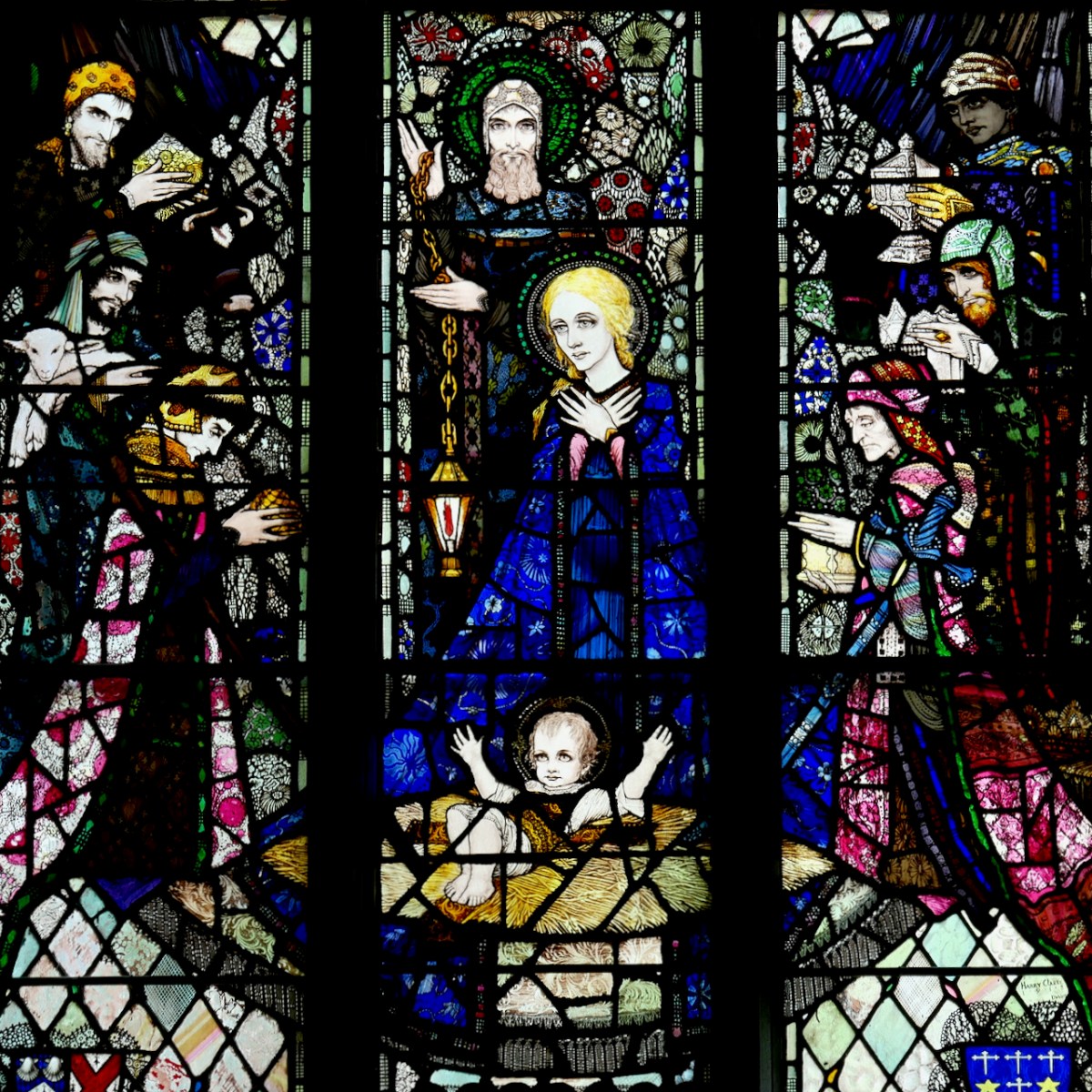
The Nativity that Harry designed for St Barrahane’s is, according to Nicola Gordon Bowe*, technically remarkable, but let’s look at the design, starting from the top. Here I am relying on Gordon Bowe’s extraordinary design vocabulary – all the quotes in italics are hers. (If you haven’t yet read them, Part 1 is here and Part 2 is here.)

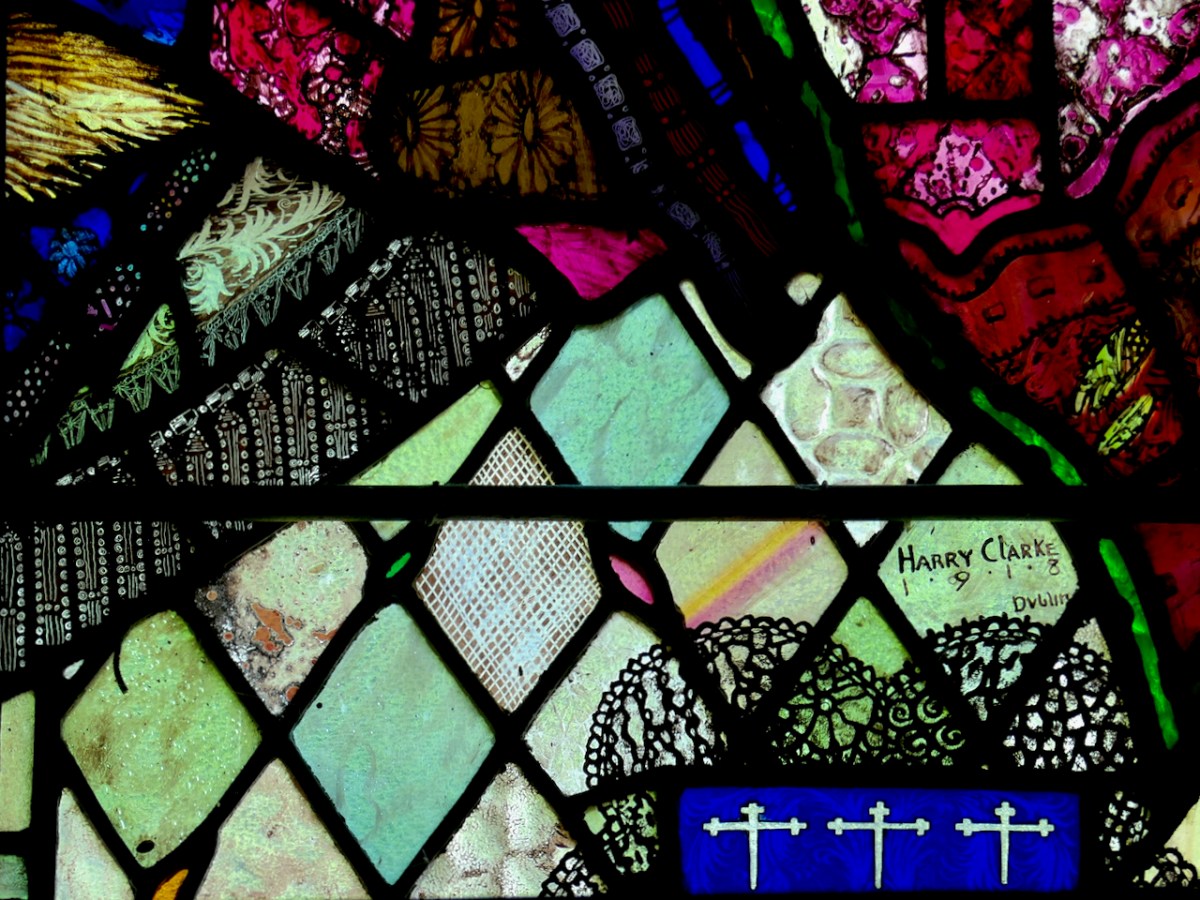
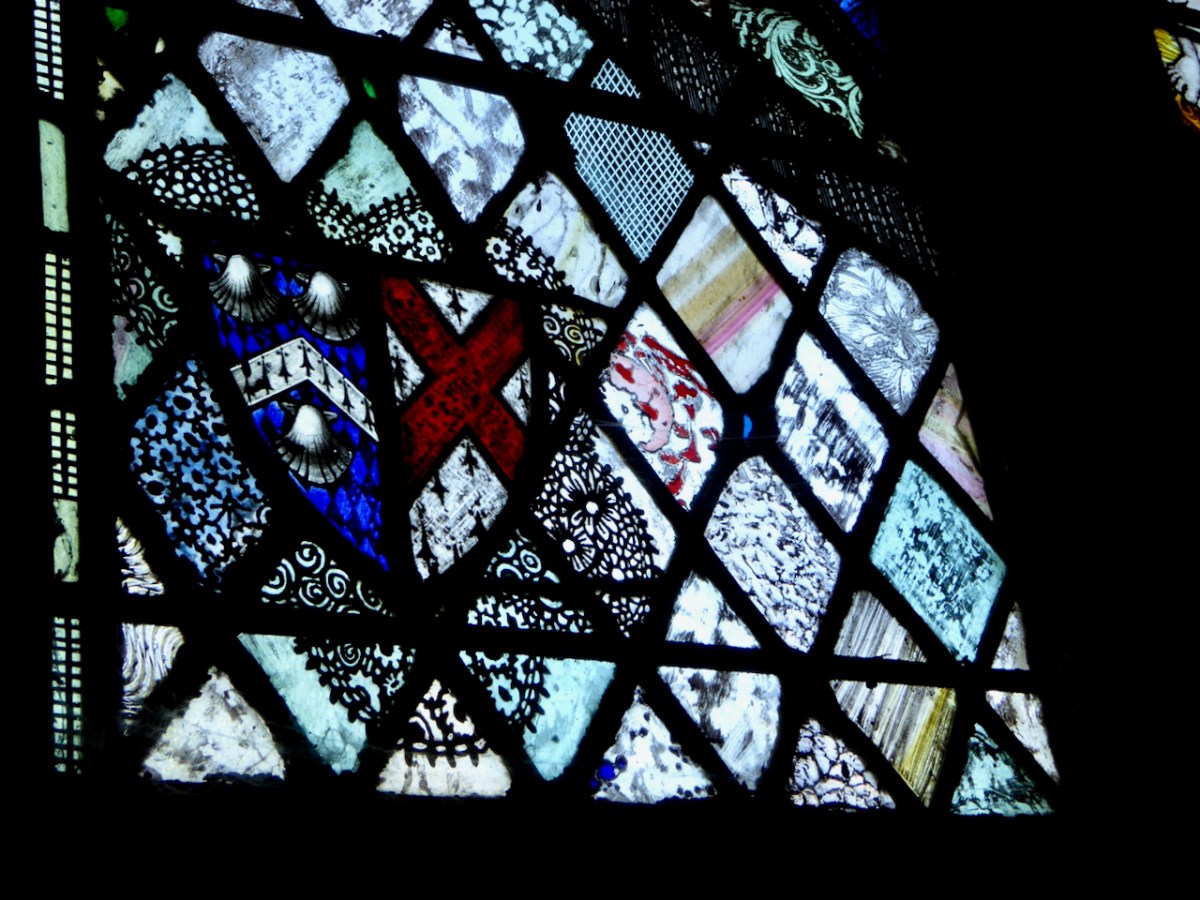
Harry’s re-designed and very Gothic tracery is filled with clear quarries – pieces of glass, leaded together in a diamond pattern, joined here and there with tiny coloured ovals. The use of clear glass was necessitated by the lack of light filtering from behind the east window, as there is a bank with tall trees immediately outside. However, this is not clear, or plain, transparent glass as we know it. Each quarry has been worked in some way. Those that started out life as clear glass have been chosen for their irregularities and have been treated with matt washes, stipples and semi-abstract lacework sequences so that each differs from its neighbour. Some of the quarries were not clear to begin with, but were flashed in pinks, blues or green, and these have been acided to the barest shimmer of colour. The result is that each individual quarry is intrinsically interesting without detracting from the overall effect of a subtly embroidered patchwork quilt in which the light lingers. These quarries occupy most areas of the window except for the main nativity scene and provide the backdrop for the top two sections – the saints and the angels. The signature panel at the bottom of the window is a good place to observe the quarries up close.

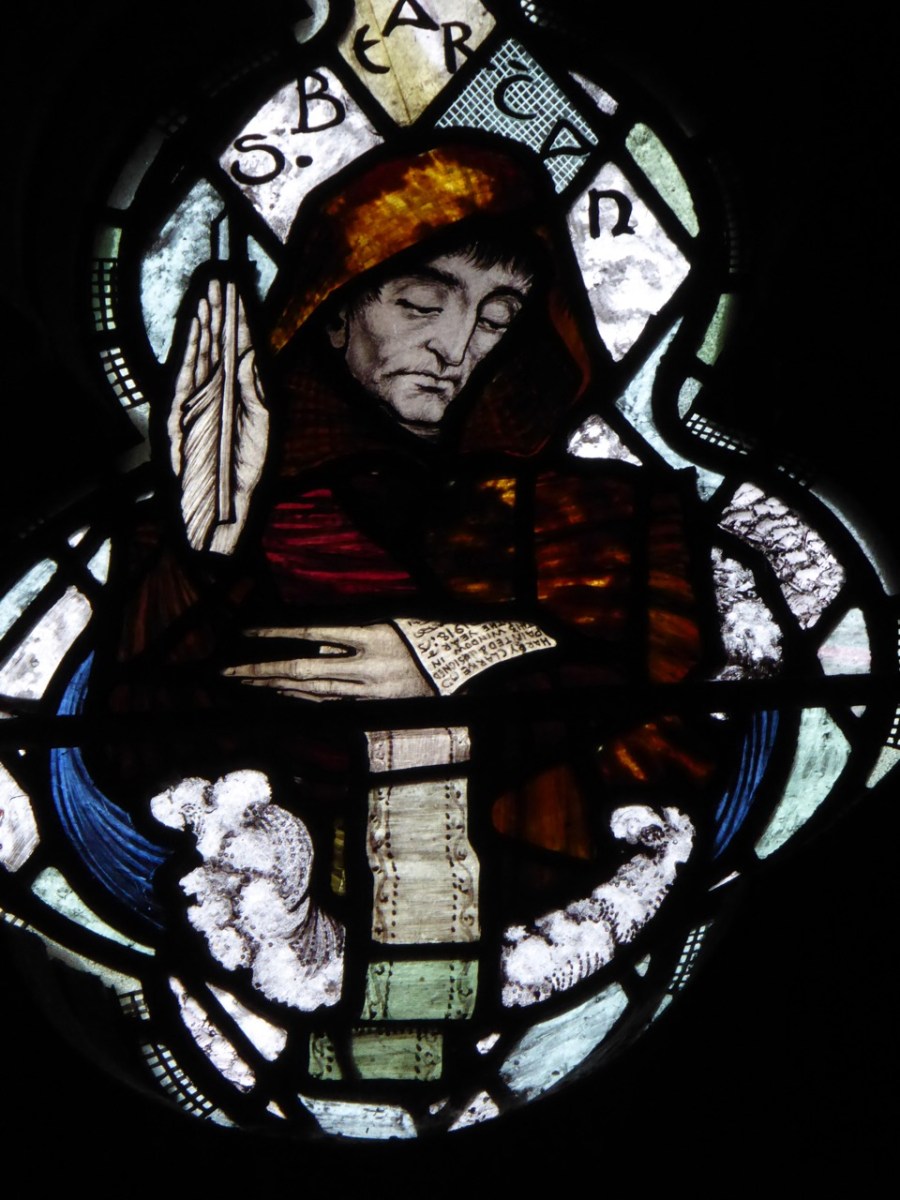
Edith was very much in tune with the Arts and Crafts Movement in Ireland but also with the Celtic Revival (see my posts on the work of Watson of Youghal for a thorough discussion on this style and the term). Within the literary tradition of the Revival there was a focus on the study of our ancient saints and a scholarly emphasis on translating various Lives and Martyrologies, many of whom were alive in the folklore and memory of the countryside. Of the three saints depicted here, Brigid is considered one of our three National or Founding Saints (see this post for more on Brigid), while Fachtna and Barrahane (or Béarchán) are local to West Cork. 

Harry used Revivalist interlacing as a supporting device for Brigid and Béarchán. Interlacing – so popular in Ireland at the time – was in fact quite rare in his work, although it had appeared in a couple of the Honan windows, such as the Joseph window, above, in a similar position. Harry was much more influenced by Continental art movements than by the conventions of Revivalist decoration, but Edith was still keen on it, as witness her later design for a mosaic floor in the chancel of the church, so this element may have been at her suggestion, or at least responding to what he saw as her preferences.

For her turn, Edith had done her homework and knew what saints she wanted, discarding Finbarr (Patron Saint of Cork) after an initial dalliance with him. Barrahane had given his name to the area around Castletownshend, Glenn Barrahane, as well as a medieval church (now ruined) and a popular Holy Well pilgrimage (in which I participated in December). Edith’s informant was James Bourke – I have laid out all that information in my post Honouring St Barrahane, so I won’t repeat it here, but do take a look at the detailed photos of the St Barrahane window in that post, including the little surprise that Harry inserted in this window. Interestingly, while Brigid and Fachtna are underpinned by revivalist interlacing, Barrahane is floating on a cloud.

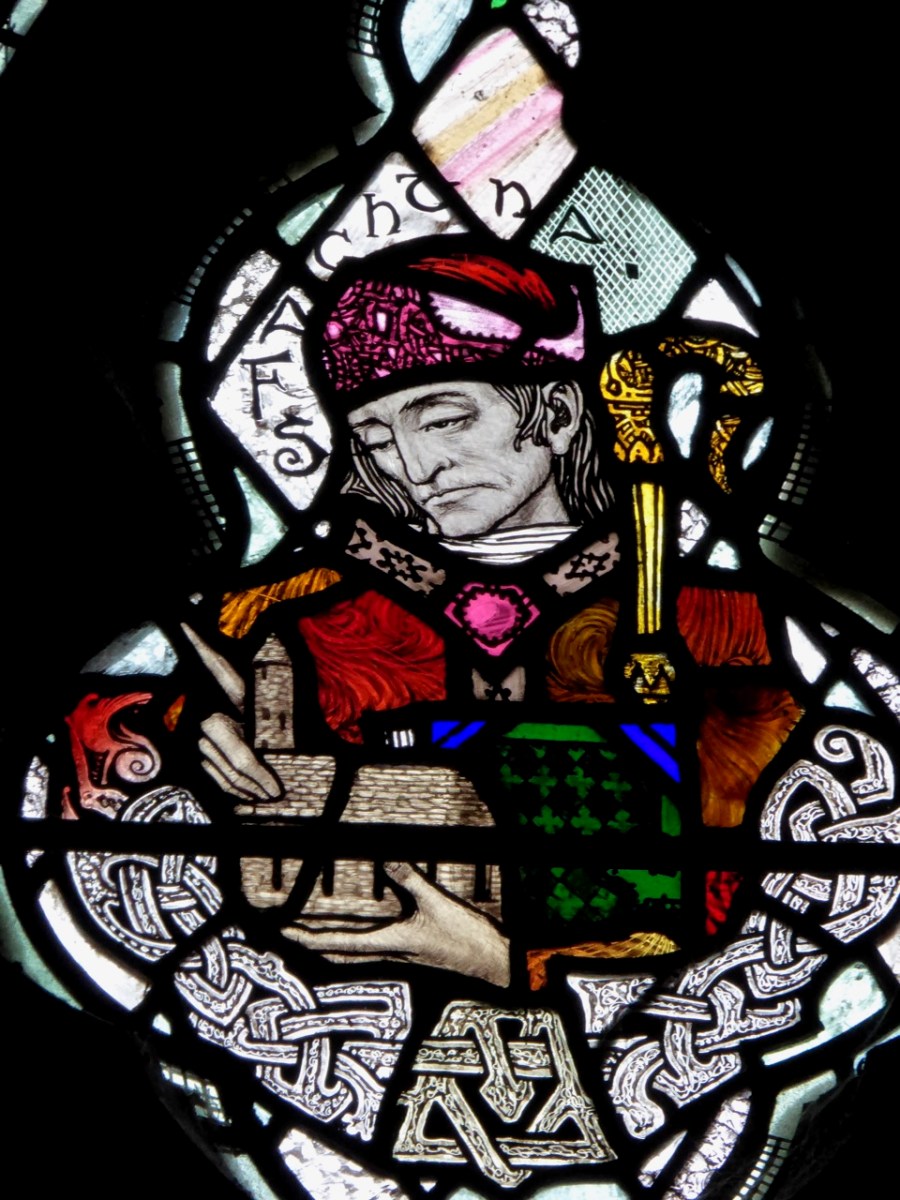
Fachtna was the saint who had founded Rosscarbery and was patron of the diocese of Ross; Harry depicts him holding a church and with his bishop’s crozier. He is gazing contemplatively downwards as if on the Nativity. Notice how the interlacing below him ends in a bird’s head finial.

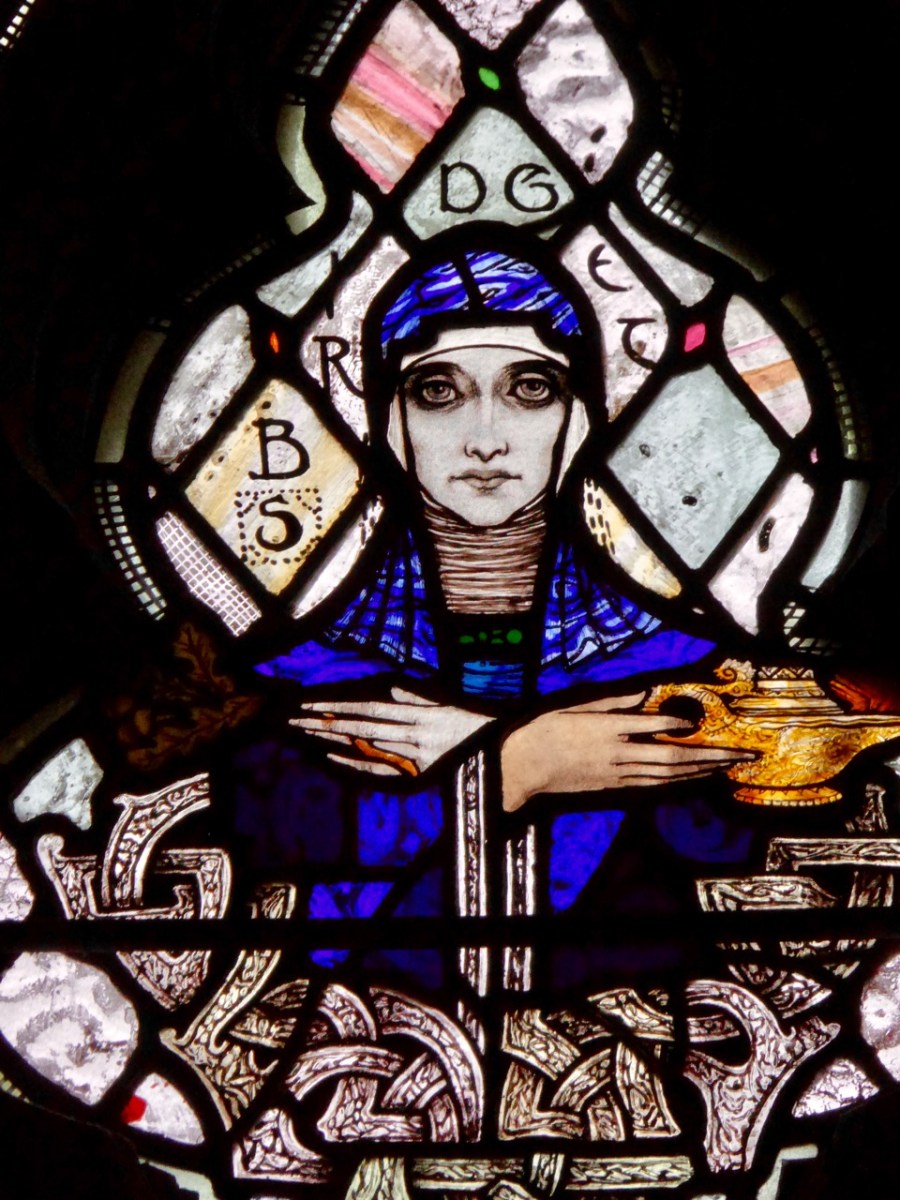
Brigid is clad in blue (perhaps that same blue that Edith had said ‘hits your eye like a living flame or a blast of wind’. She looks directly out, calm and wise. In her right hand she holds a golden lamp (looking suspiciously like an illustration from the Arabian Nights) and between the fingers of her left hand is entwined the stem of a twig of oak leaves, another of her attributes, tying her to Kildare (or Cill Dara, the Church of the Oaks).

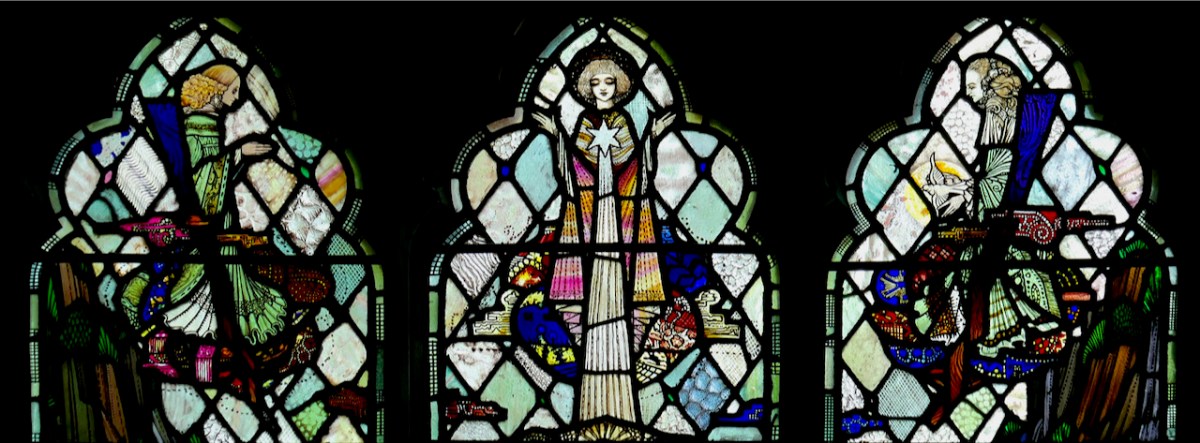
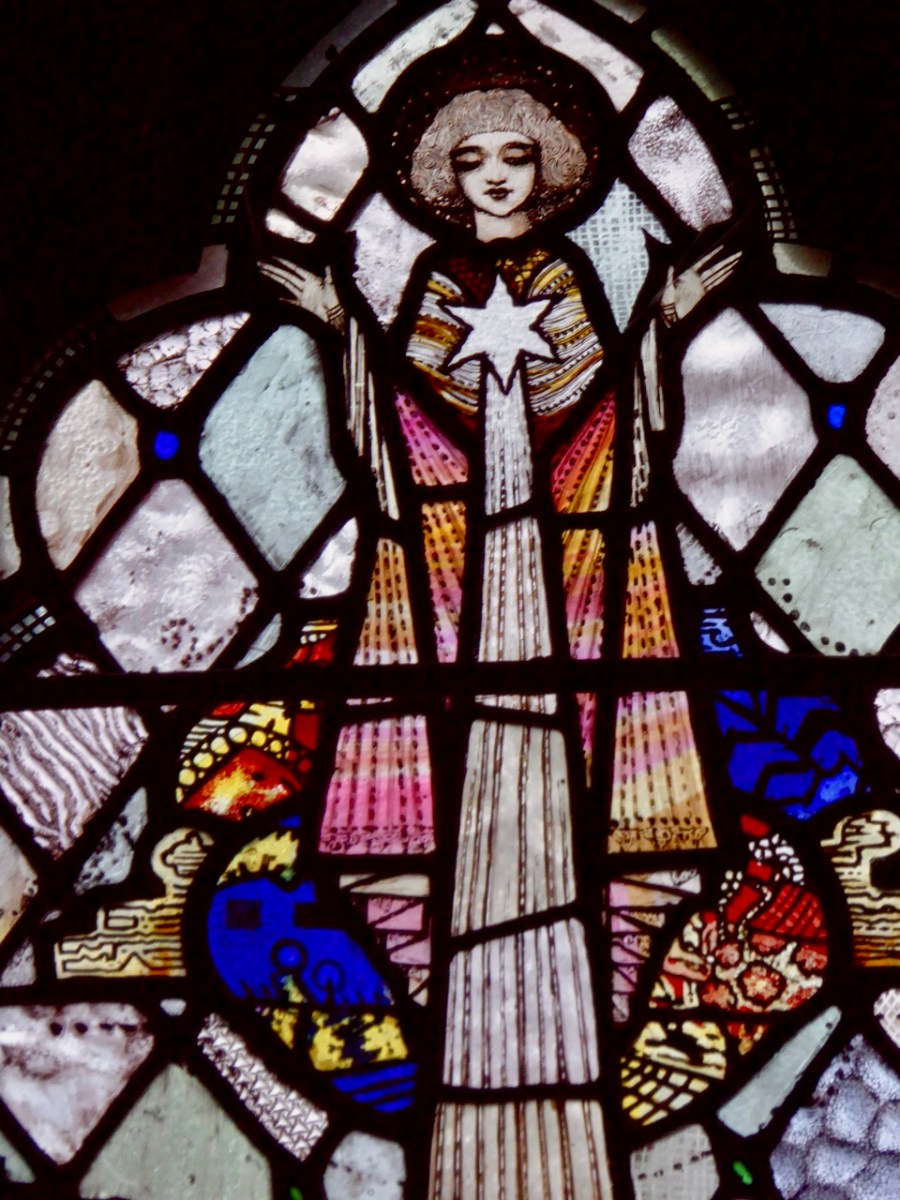
Beneath the three saints are three angels, floating above the Nativity. Although they form a wonderful trio, each is remarkably individual. The middle angel (with a fashionable bob) incorporates the star which is a traditional element in Nativity scenes. 

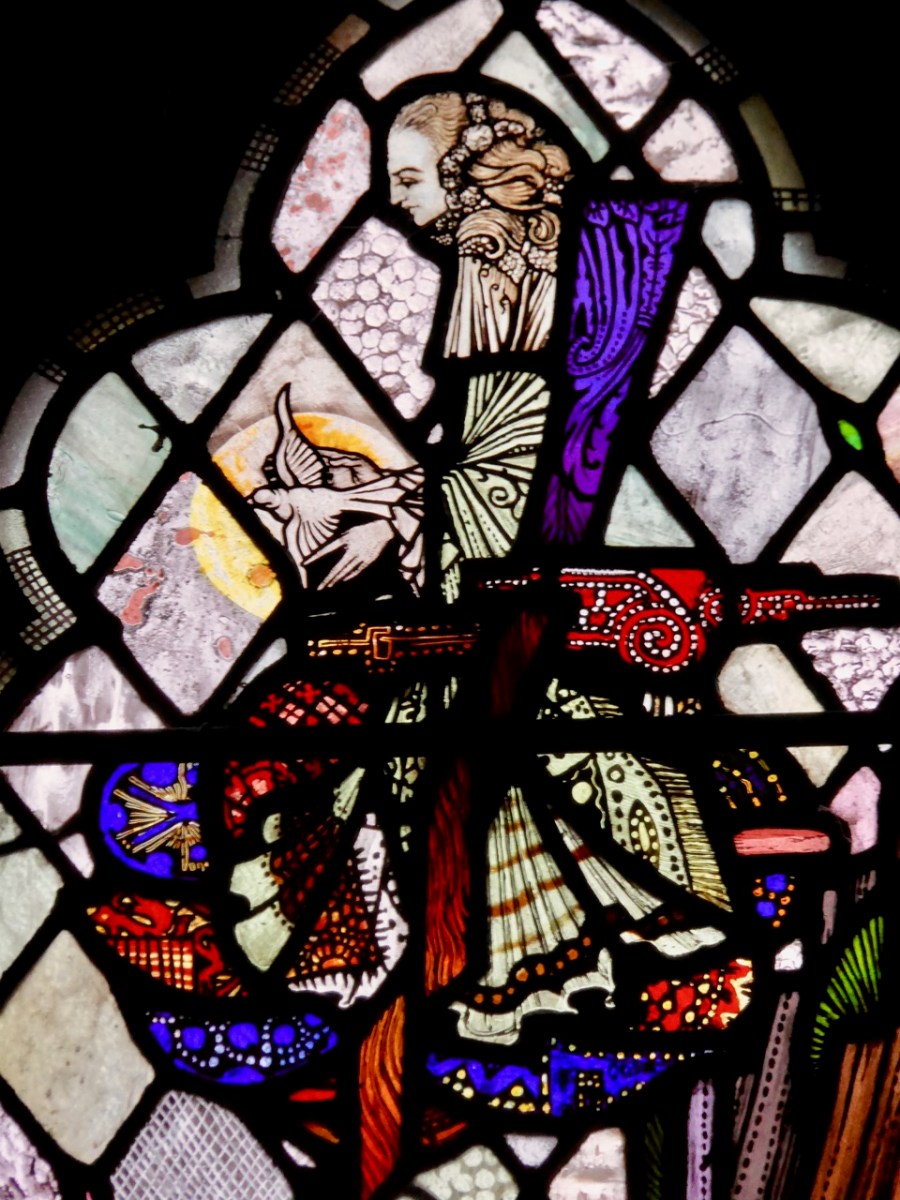
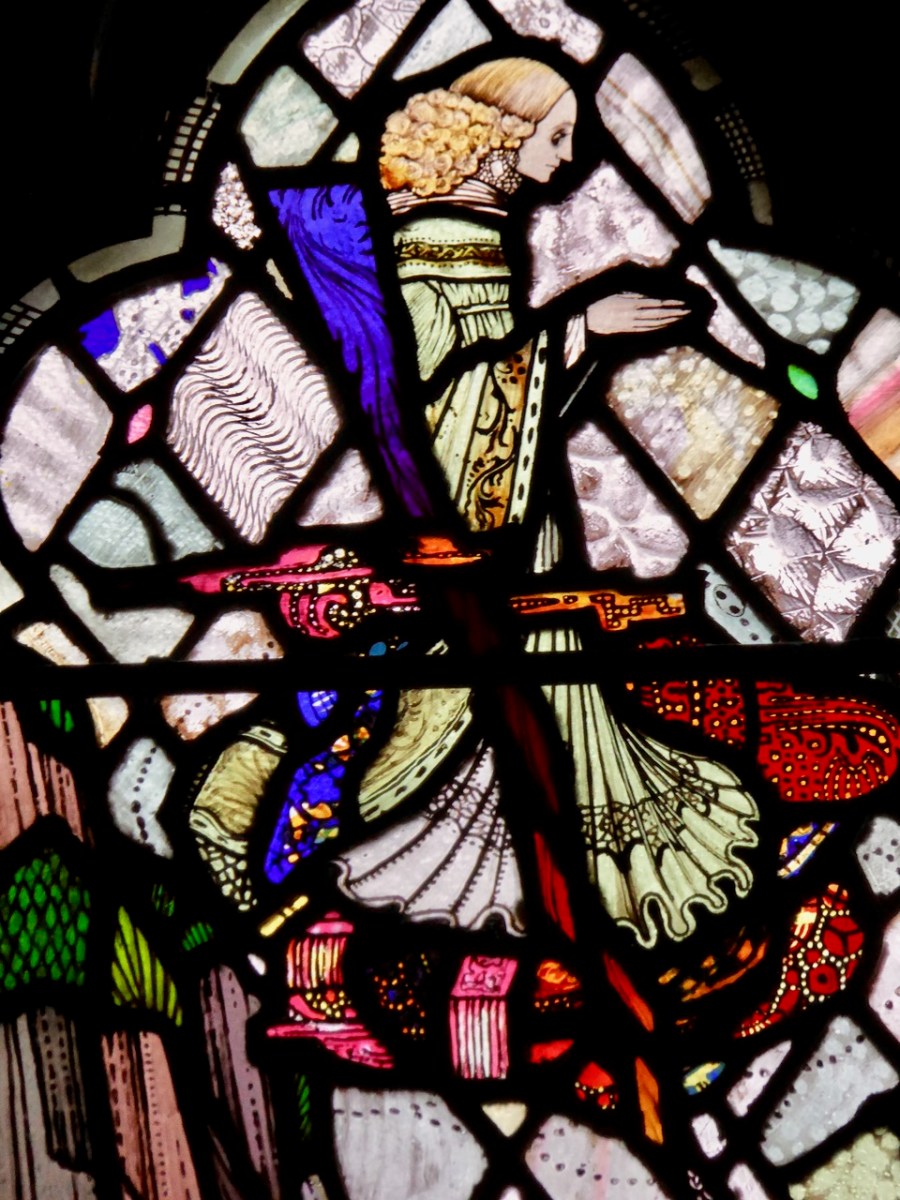
The left and right angels have elaborate, flowing or pleated robes and complicated coiffures. One holds a dove while the other has hands held in prayer. Gordon Bowe, in trying to analyse the decorative element at the centre of these angels says in her thesis Both seem to be manipulating jewelled levers, similar to the studded gun holsters favoured by cowboys.

I love this sentence but perhaps understandably it didn’t make it into her book, where she merely remarks that the saints and angels abound in intriguing decorative detail.

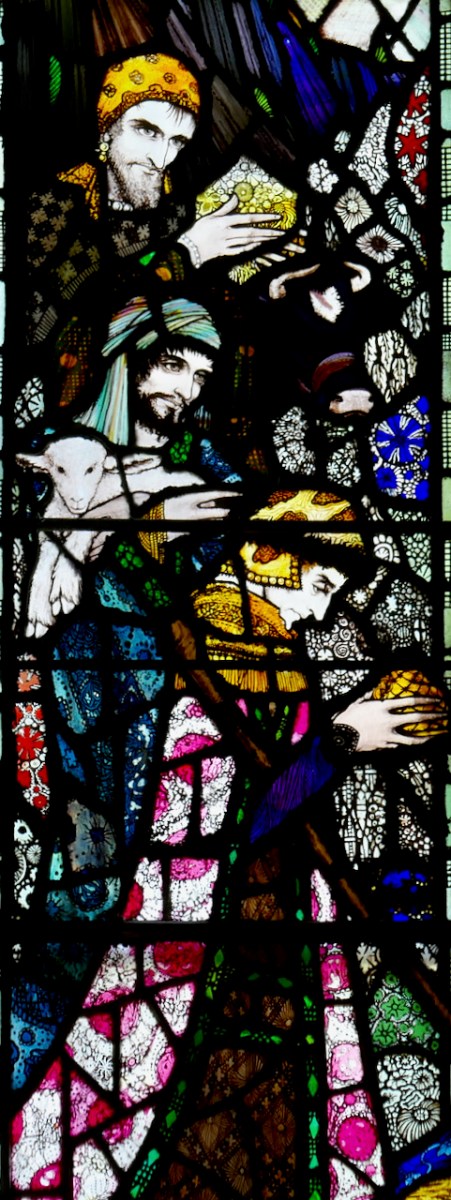
The central scene, of the Nativity, is beautifully constructed. Besides the angels above it, the framing devices consist of three elements. The first is an arc of silver chain upon which everything rests, most importantly the manger. You can see a close up of it in the signature panel above. The second is the rock face which stretches above and behind the Magi and the Shepherds. The third is one of Harry’s typical expanses of ‘floral ornamentation’ – one of his future hallmarks. Of this fantastical conglomeration of flowers, leaves, mosses, jewels, geometric shapes Gordon Bowe says always inventive and subtle in his pen and ink and watercolour illustrations, ingenious when painted or acided onto his glass by himself, but too often repetitive and lifeless . . . when imitated by his followers.

The robes of the lowest Magi and the lowest shepherd extend beyond the supporting chain-like arc, bringing a slight sense of perspective to the composition. Gordon Bowe likens the rich treatment of the fabric to the work of 

Gustav Klimt here and his flat treatment of interlocking decorative patterned, often symbolic planes, in which he would sometimes use coral, gold, mosaic, turquoise and semi-precious stones with casein paint to make up his richly mantled figures . . .Both men rely on the faces and hands of their figures to convey a human expressiveness and only here does any attempt at modelling occur. The eyes of their figures transport the spectator into a world of opulent trance. Both artists are equally unconcerned with perspective, reality or a third dimension. In the tradition of the best purely decorative work, background and foreground, figure and setting are equally important and integral. Any light is reflected from within the fabric of the design. Movement is created by how the light affects the surface of the picture and by the sinuous symbolic fluidity of the line. This is what W Hoffman has called Synaesthesia – a stylised ornamented style, where people are statues, backgrounds are wallpaper and interchangeable linear formulate are used as arrangements for figures and settings in different colour relationships, so that obstruction and symbol interrelate.

The Life and Work of Harry Clarke
Ph D Thesis by Nicola Gordon Bowe, 1981, P 249

As Gordon Bowe shows us, Harry was totally tuned in to the modern movements of his day – decorative and symbolist traditions that envisioned an idealised, stylised and imagined-medievalist form of representation that was the opposite of realistic depiction. She notes – there is no attempt whatsoever to suggest that the kneeling shepherd has ever set hands on the earth or worked as a shepherd.

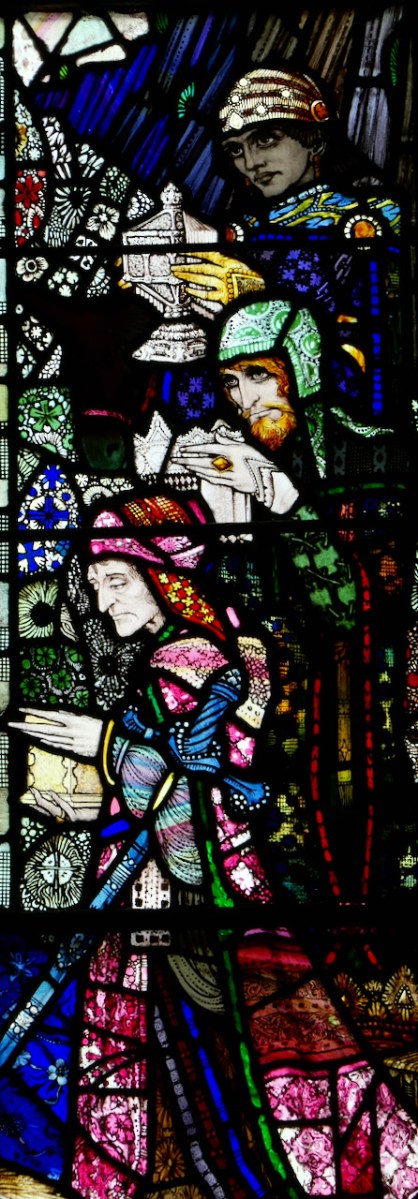
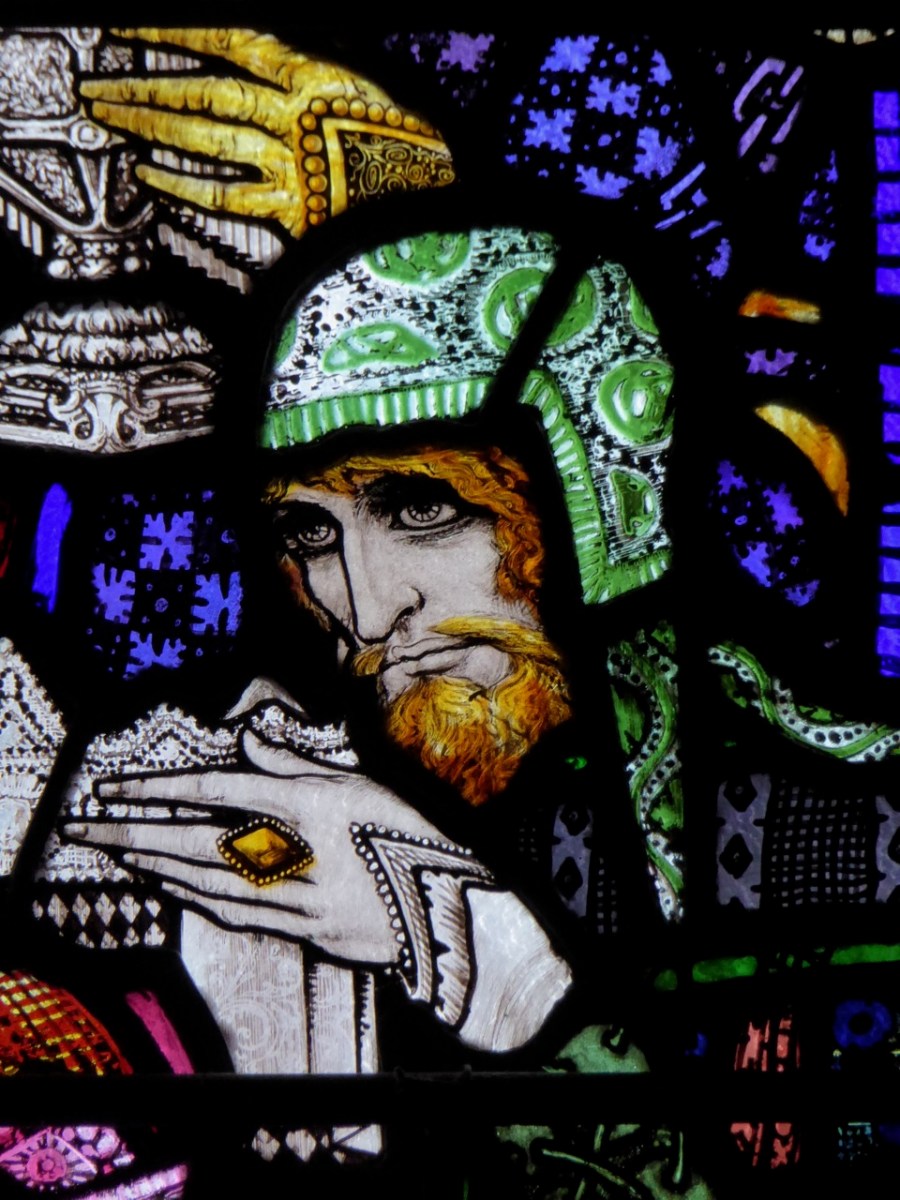
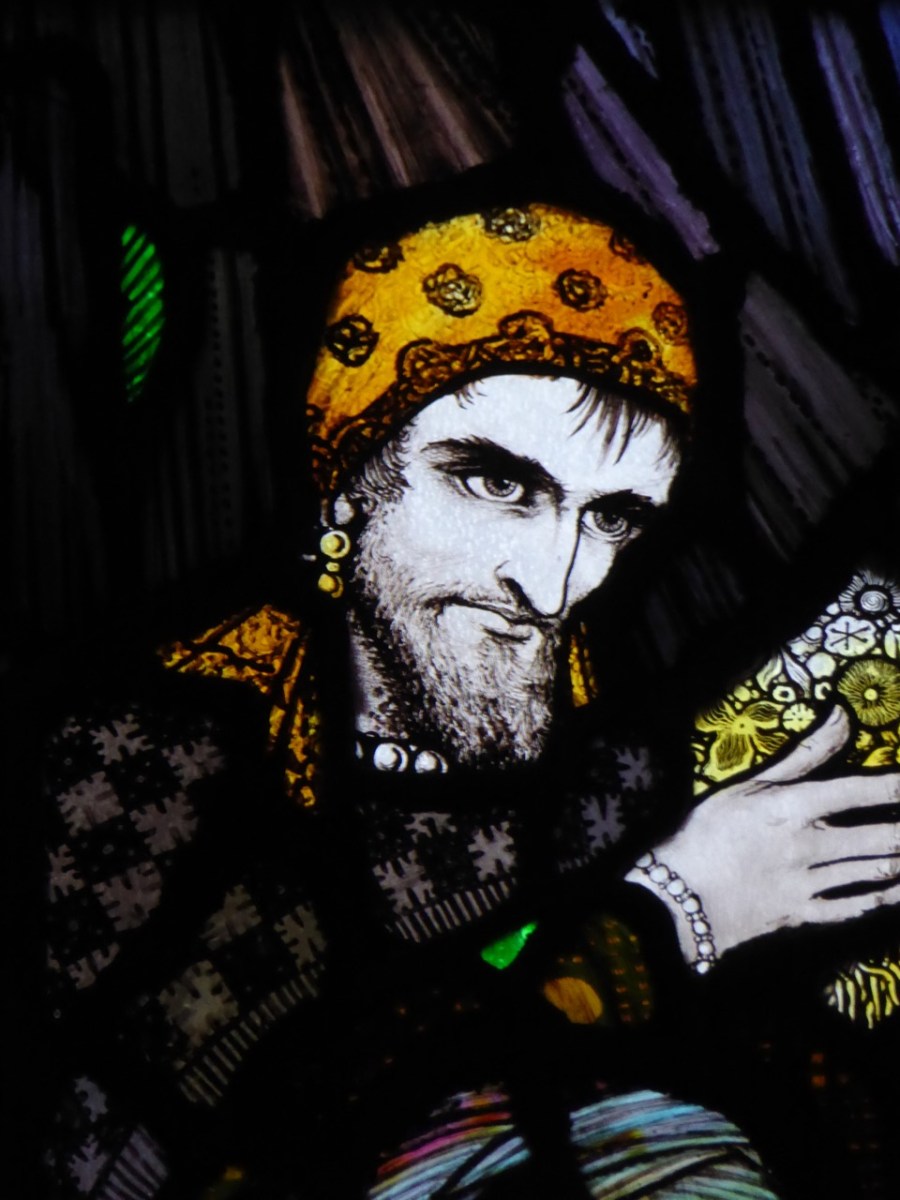
Three gorgeously apparelled Kings are balanced by equally splendorous shepherds, each holding gifts. Almost hidden to the right of the upper shepherds is the head of a cow – it is hard to see as it is done in a dark purple glass. Local lore is adamant that this is an homage to Edith who apparently pioneered the introduction of Friesian Cattle into Ireland. 

Joseph stands guard over Mary and the Baby, holding a chain with a lantern and gazing out directly at the viewer. Mary’s expression is gentle, her hair is a golden blond, surrounded by a halo of pearls, her robe, in traditional blue, studded with star-like flowers. 

The baby, looking more like a wise elder than a newborn, lies in the manger, his hands up to embrace the world, his halo a delicate filigree. The coats of arms lie at the bottom of the panel – they were done and installed after the rest of the window was finished and Harry came down to supervise their insertion. That probably explains why this window has two signatures (did you go back and check the St Barrahane post?). Unfortunately, the wooden screen that stands behind the altar obscures the base of the window and makes it impossible to photograph the Townsend coat of arms (below) except from the side, but it’s another good opportunity to view the quarries.

Let us remember that Edith had misgivings about the choice of Harry to do this window. She was concerned about the “hellish splendour” of his Honan windows, the “burning and furious brilliance” of his glass, which she found “perfectly amazing but not quite pleasant.” In a letter referred to by Rauchbauer she “insists again that something a little less intense is required than the Bertie windows.” She may well have been concerned about the effect of full-on Harry on elderly parishioners, who had to be onside for the windows to go ahead. In any event, it looks like she managed to communicate well with Harry, and that he understood the brief – to “adapt his work to the church & to realise how to get harmony into it.” 

It is, indeed, charming and harmonious. No macabre beings peer out from behind the figures (as they do in the Honan and in the St Louis window down the aisle in St Barrahane’s), there are no Aubrey Beardsley stern and “horrible” faces and no predella scenes of sacrifice or death (see St Dympna, for example). All is gentleness and serenity, compassion and contemplation. One wonders if Harry would have been so biddable a few years later.

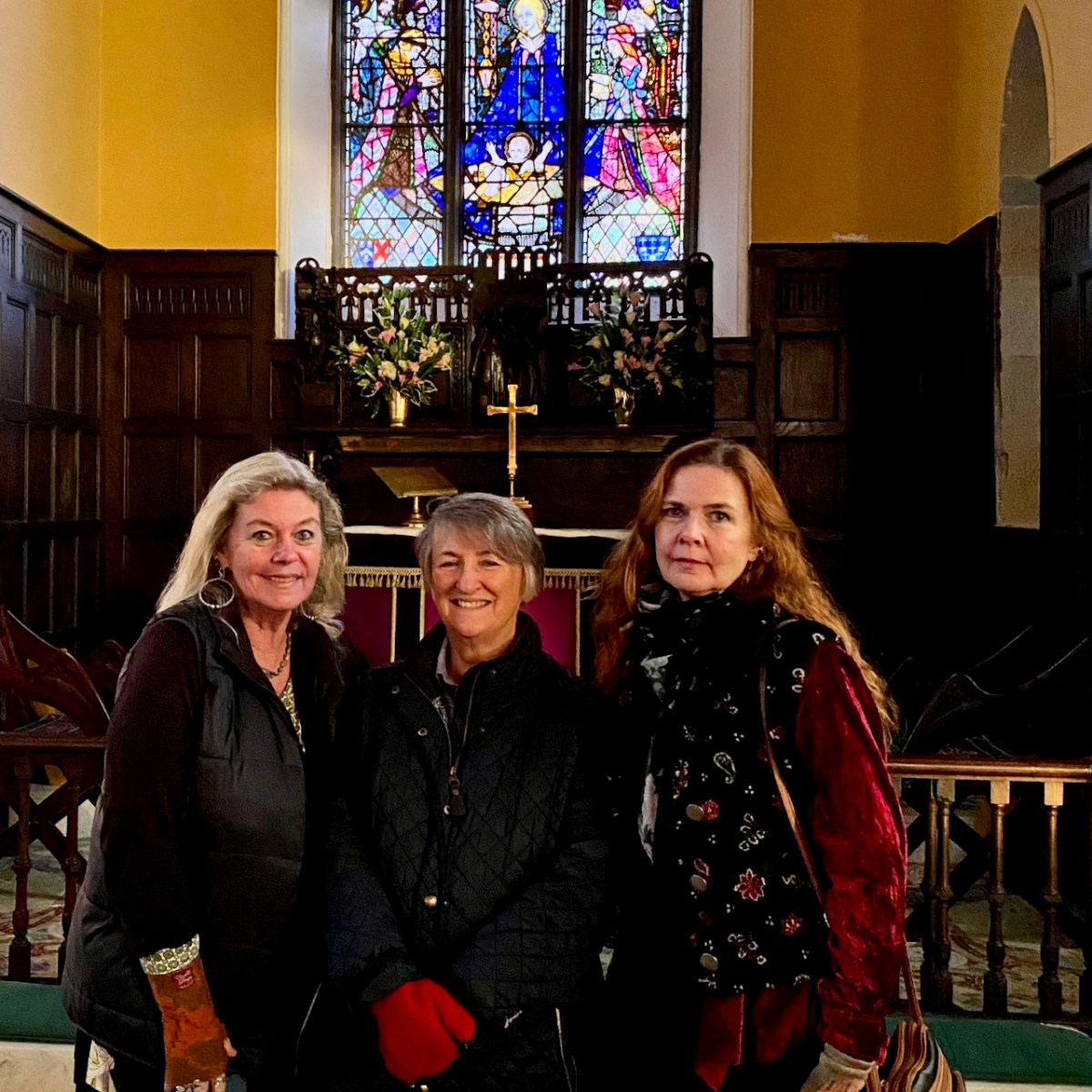
A final special photograph to finish this series. Here I am in front of the window, with Harry’s two granddaughters, Etain and Veronique, during a recent visit to Castletownshend

In this post I am relying both on Gordon Bowe’s Life and Work of Harry Clarke and on her Doctoral Thesis, lodged at NIVAL. I am deeply grateful to David Caron for facilitating my viewing of this material.