Vallancey: The Collectanea, Vol 1

Though often derided by his contemporaries and later critics for his more outlandish theories, Vallancey arguably did more than almost anyone else in the late 18th and early 19th century to stimulate interest in Irish archaeology and history. Much of this was accomplished through the essays and papers he published in his Collectanea, through which he reached an educated audience.
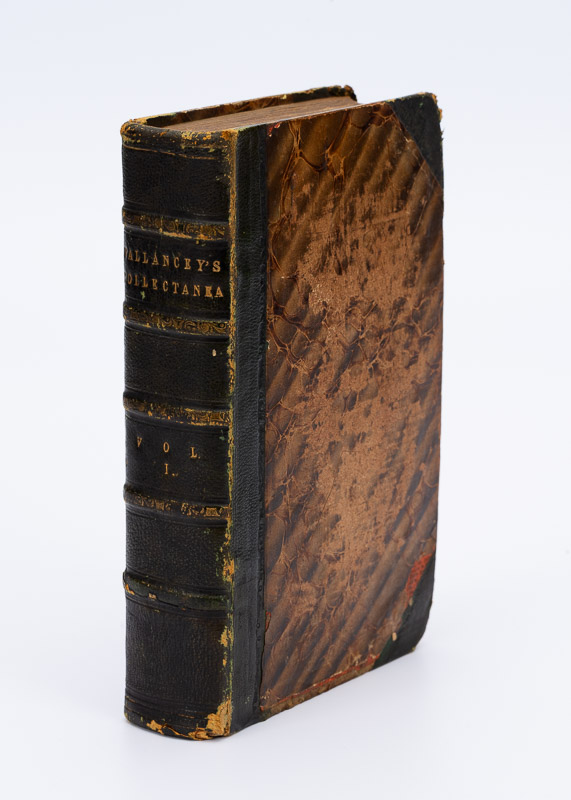
Let’s take a deeper dive into the Collectanea (pronounced, I have found, collecTAYnea) now. But be warned – these are  my own quirky interests on display here, not a scholarly analysis. I can’t always account for what catches my attention, but isn’t that the real delight of browsing a set of volumes like this – the treasures you will unearth? The other pleasure is just holding it – the feel and smell of such old books, and getting used to the typeface. 
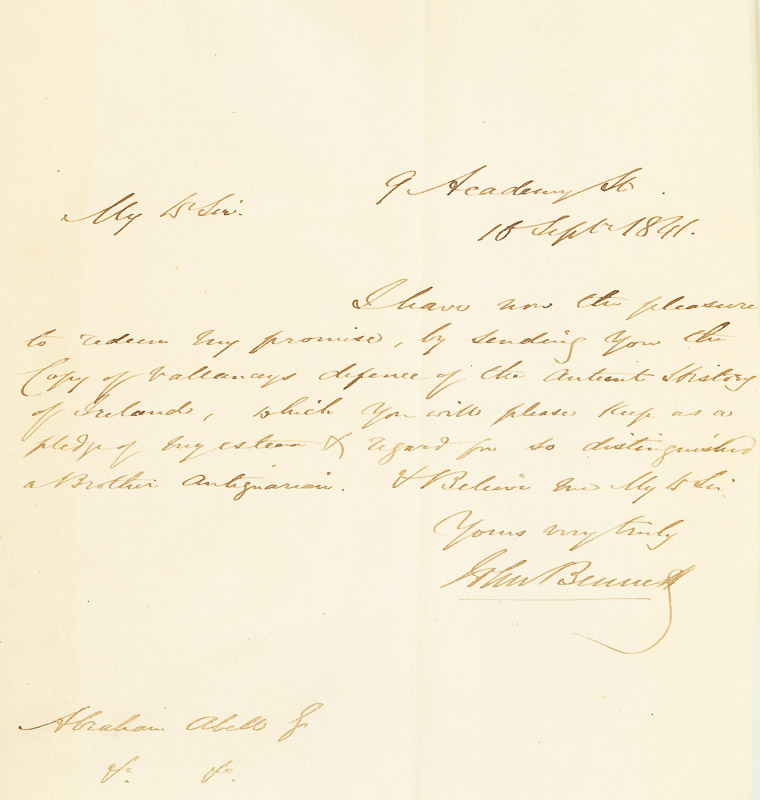
There’s another reason too – the provenance of the set. Hidden inside Volume IV is a telling letter (above) that proves that this set originally belonged to Abraham Abell (1783 – 1851). A vital figure in the antiquarian community of Cork, Abell was  a true eccentric who amassed an enormous library, burnt it all in 1848, and then started again to amass thousands more. In his retirement, he rented a room in the Cork Institute (now the Crawford Art Gallery) where he lived out the rest of his days with his thousands of books stacked from floor to ceiling.
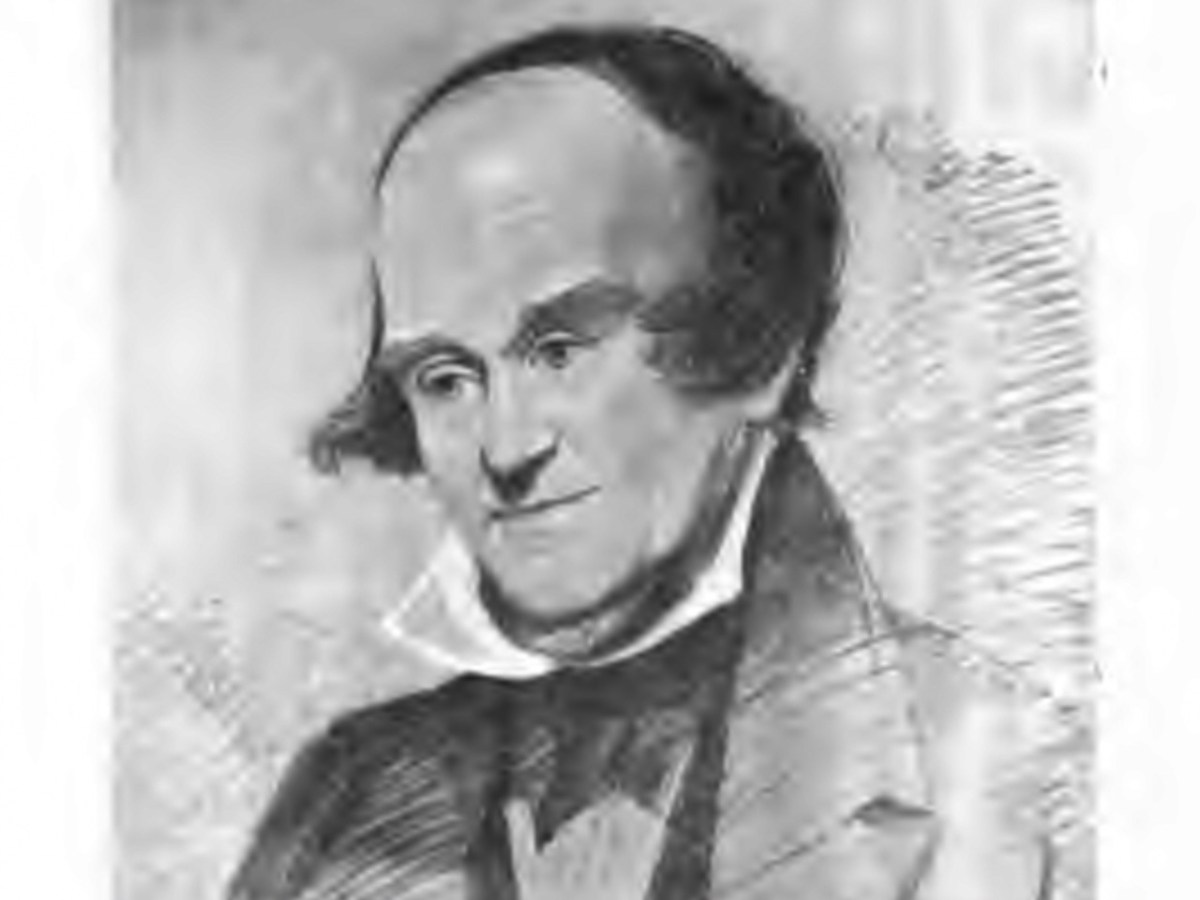
We know that this set of the Collectanea belonged to his first library since it was given to him in 1841 by John Bennett, and that somehow it was not consumed in the burning. I have read two accounts of the burning – one that he did it in a depressive episode, the other that he did it to make room so he could start afresh. However it happened, it’s a minor miracle that the set has survived that cataclysmic event.
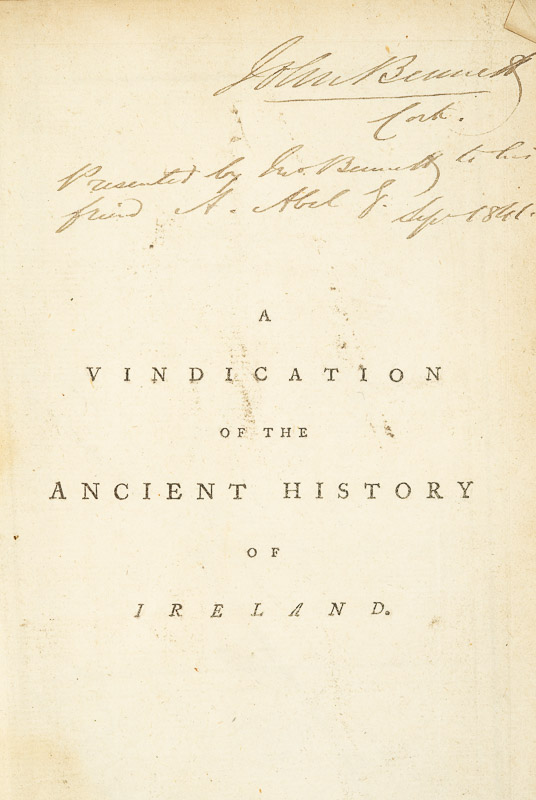
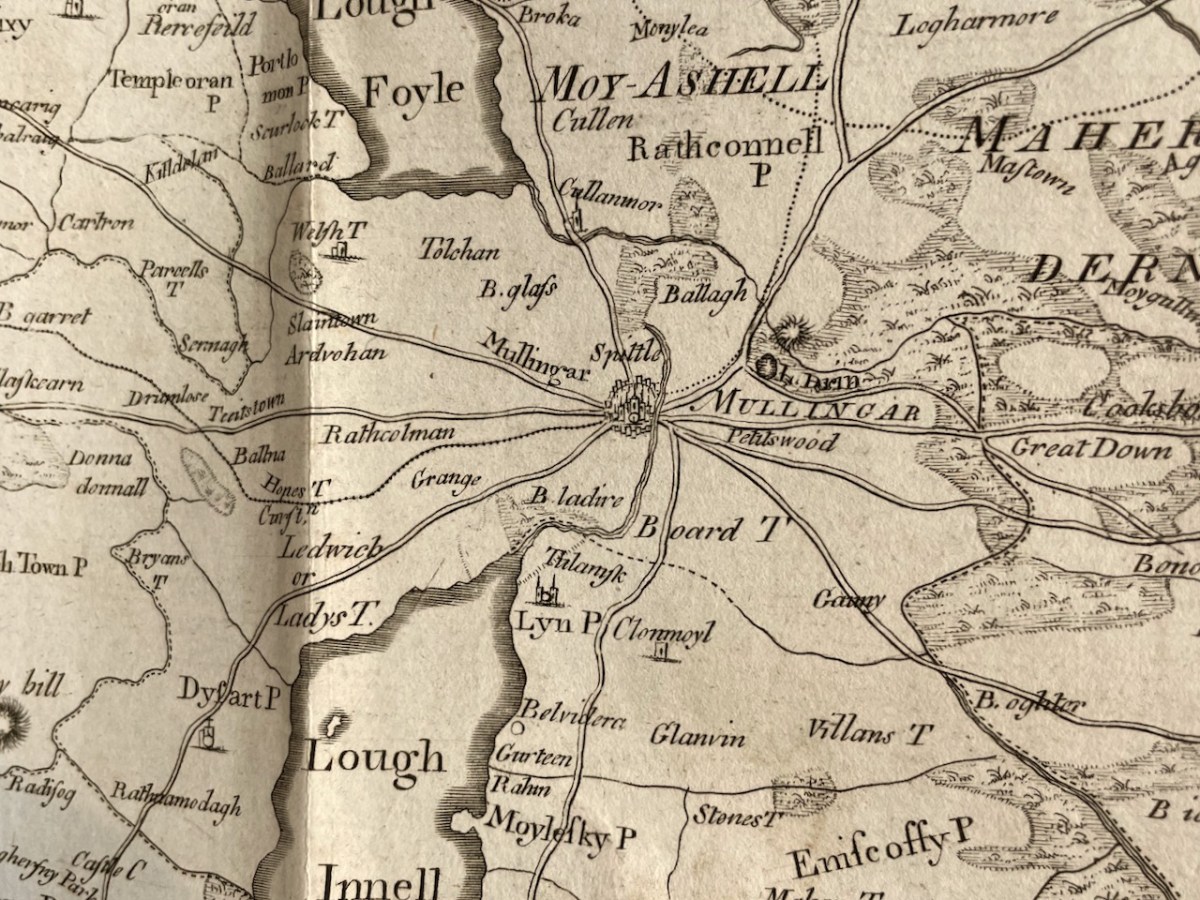
Vol 1 begins with A Chorographical Description of the County of West-Meath,1682, by Sir Henry Piers, accompanied by a map of the county. Vallancey published this in 1770 and it is likely that the map dates to then rather than the 1680s, when map-making was far more rudimentary. Chorography, a word not much in use nowadays refers, according to Wikipedia, to the art of describing or mapping a region or district.
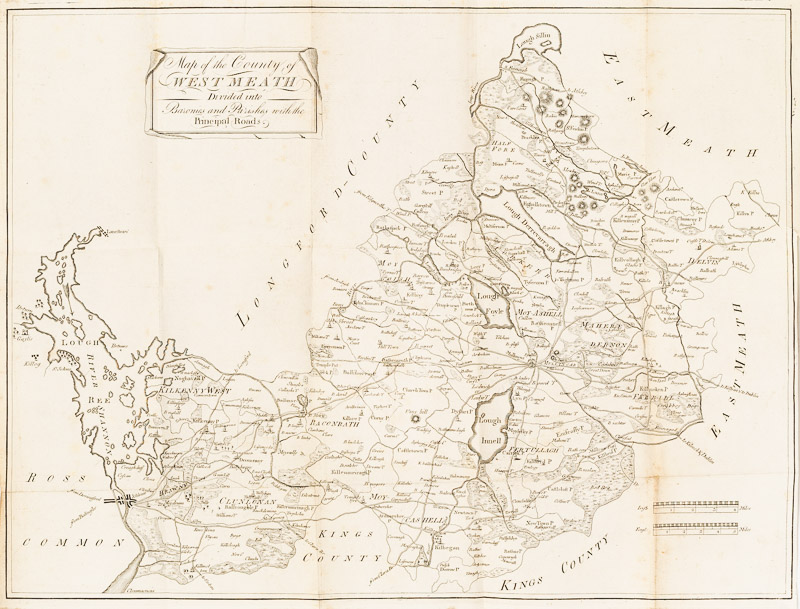
While some of the introduction especially refers to the geographical features of the country, much of it, in fact is made up of descriptions of customs, ancient battles, significant places (e.g. Cat’s Hole Cave), ruined monasteries and saints, ways of making a living, and accounts of the degenerate English and oppressive landlords.
Piers belongs in the ranks of those who believe the English civilised the Rude and Barbarous Irish, although he admits that some are not quite civilised to this day. By degenerate, Piers meant Englishmen who had ‘gone native’, married Irish women, spoke Irish and fostered their children with Irish families. From men this metamorphosed, he queries, What could be expected? He admits that English Kings neglected Ireland and that there was substantial corruption among officers of justice. The Irish, he says are given to learning and hospitality and the women are generally beautiful, and love highly to set themselves out in the most fashionable dress they can attain. However, the landlords of old, by which he presumably means the Irish clan heads, were and still are great oppressors of their tenants.
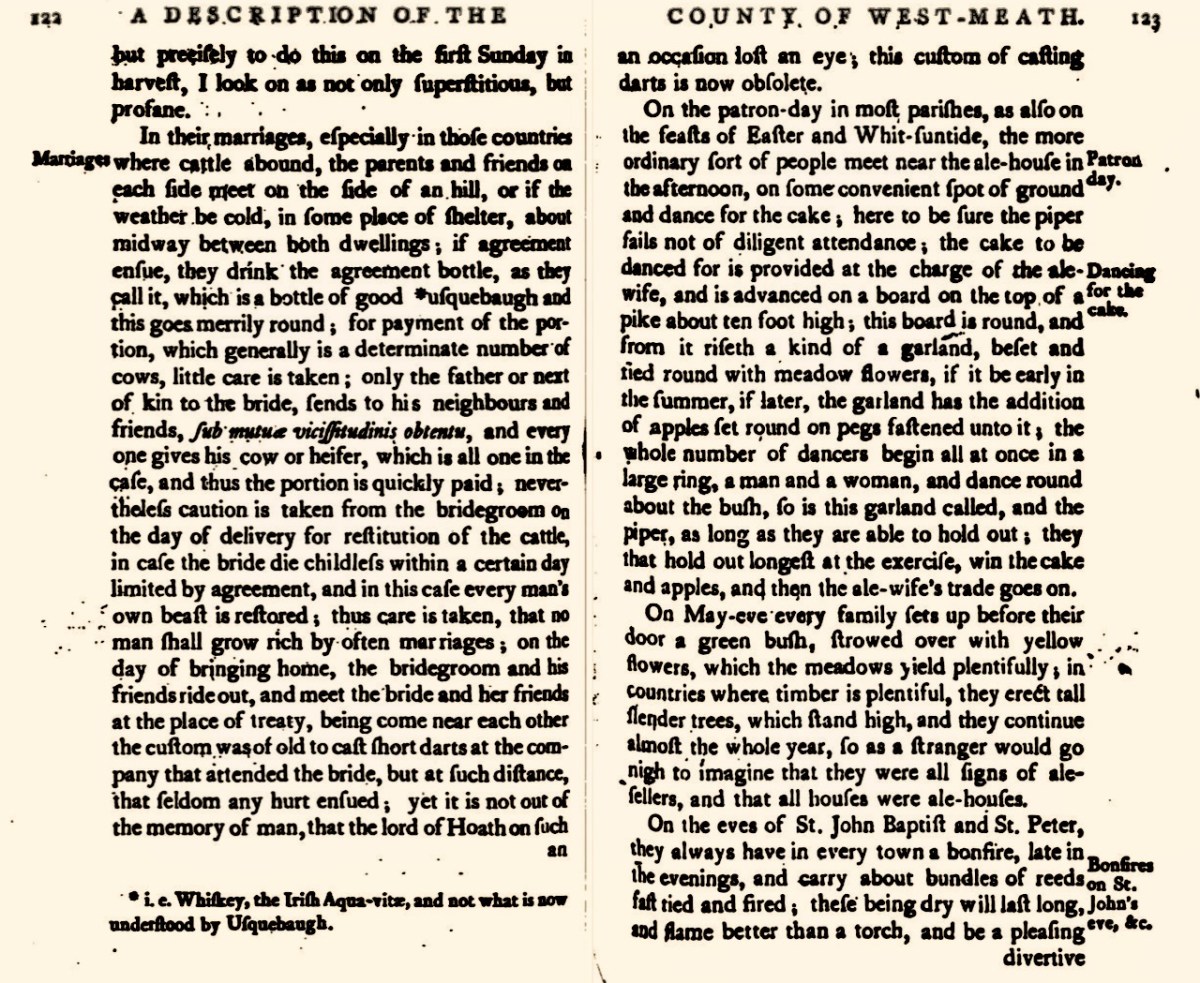
He describes agricultural practices (very dysfunctional and leading to many quarrels) and Bearded Owen’s Law, by which shares in bog-cutting are apportioned, and the practice of driving the cattle through water once a year. Marriages (above) are negotiated between parents and friends on each side. He writes about the May bush, bonfires on St John’s Eve, wakes more befitting heathens than Christians, and the practice of the Month’s Mind (below) which involved a great feast and many masses said in the house, after which every priest and friar is discharged with his largess.
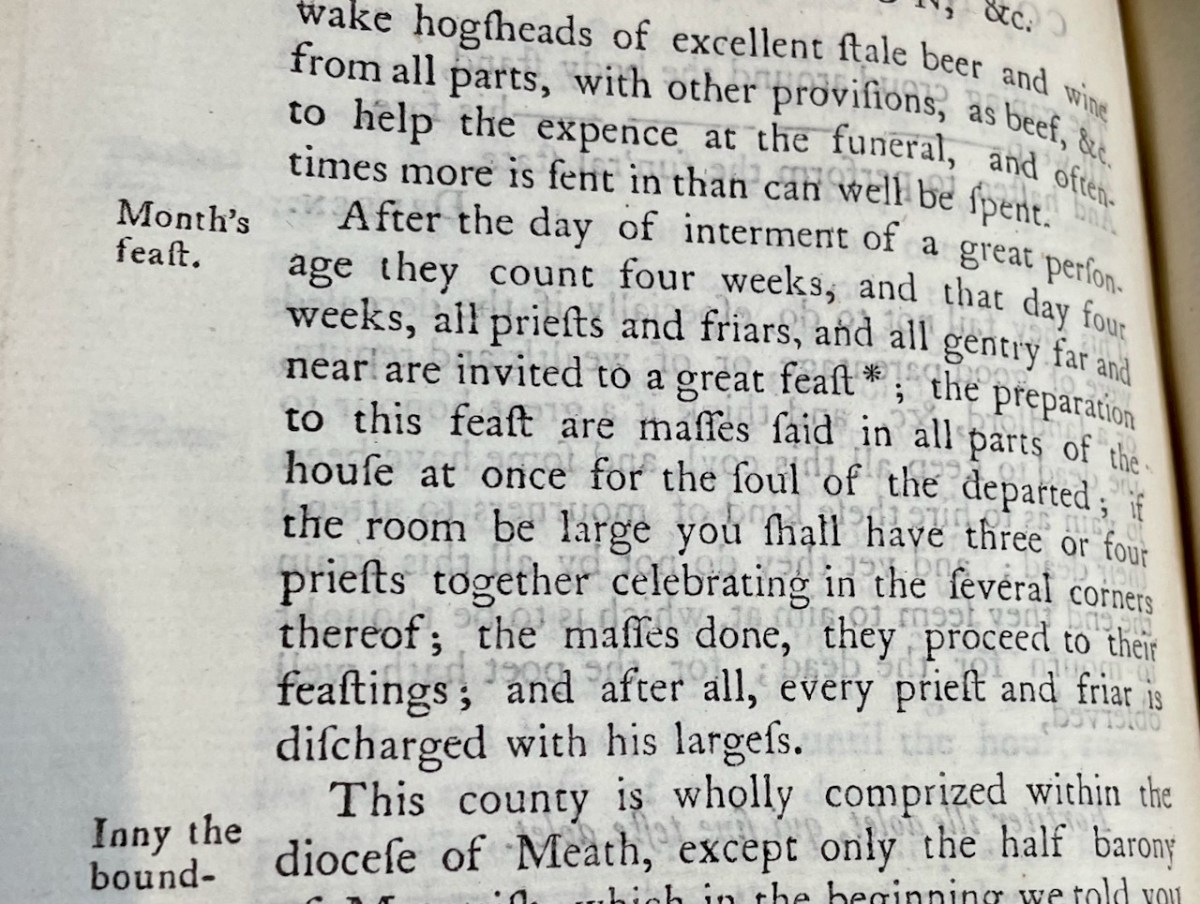
I’ve only picked out a few details from the essay on Westmeath, but you can see from these examples what an incredibly valuable this resource is. We have very few descriptions like this of what life was like in 17th century Ireland, and the fact that Vallancey recognised its importance and published it says much about his appreciation for Irish customs and lore.
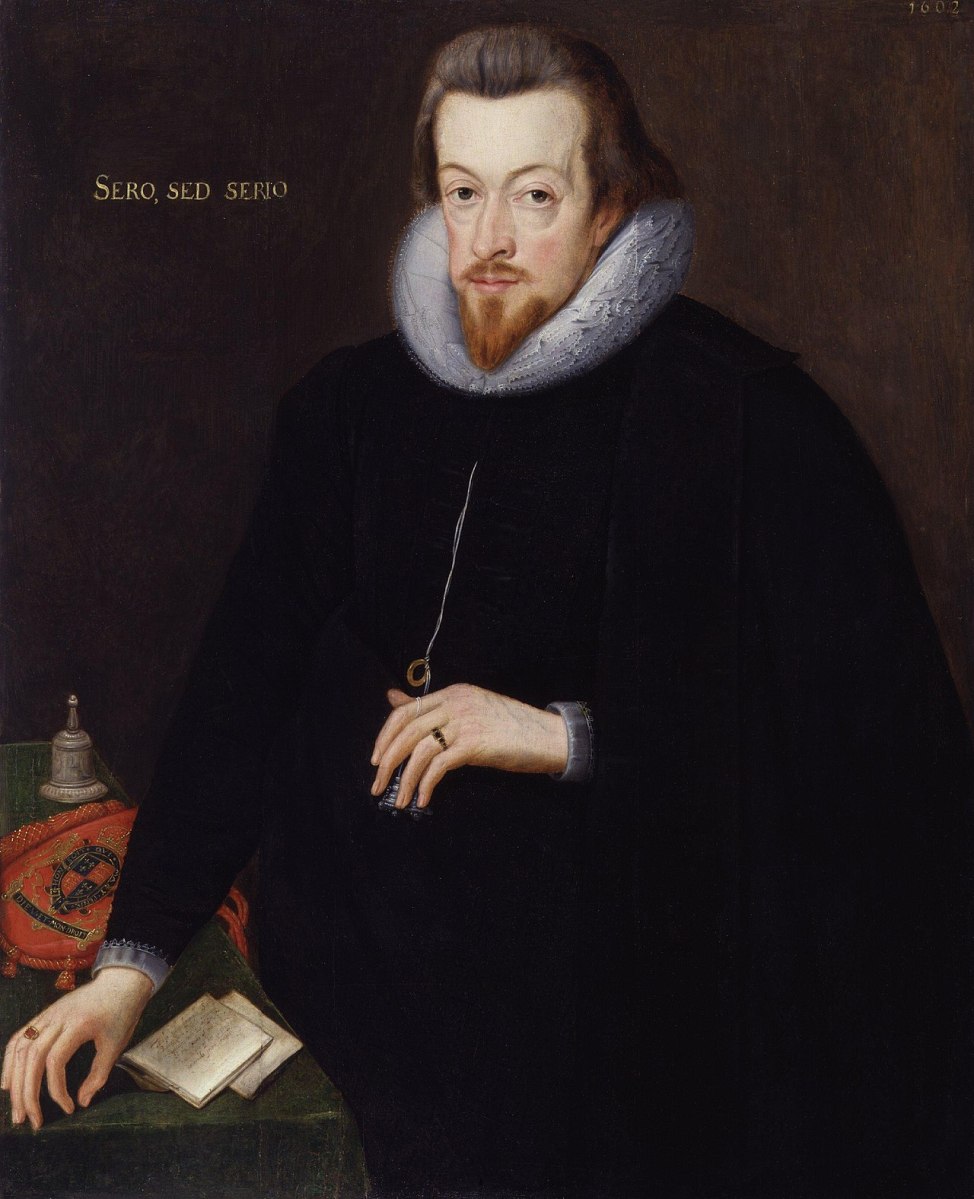
The second document is a Letter from Sir John Davis written to Robert Cecil, Earl of Salisbury (above) in 1607. This was shortly after the Battle of Kinsale (1601) which marked the end of the power of the old Gaelic families. In this letter, Davis describes the state of the counties of Monaghan, Fermanagh and Cavan, in preparation for a visit by the earl. 
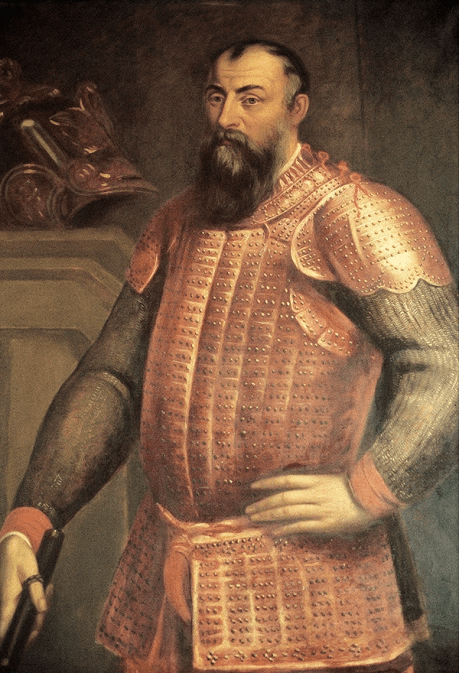
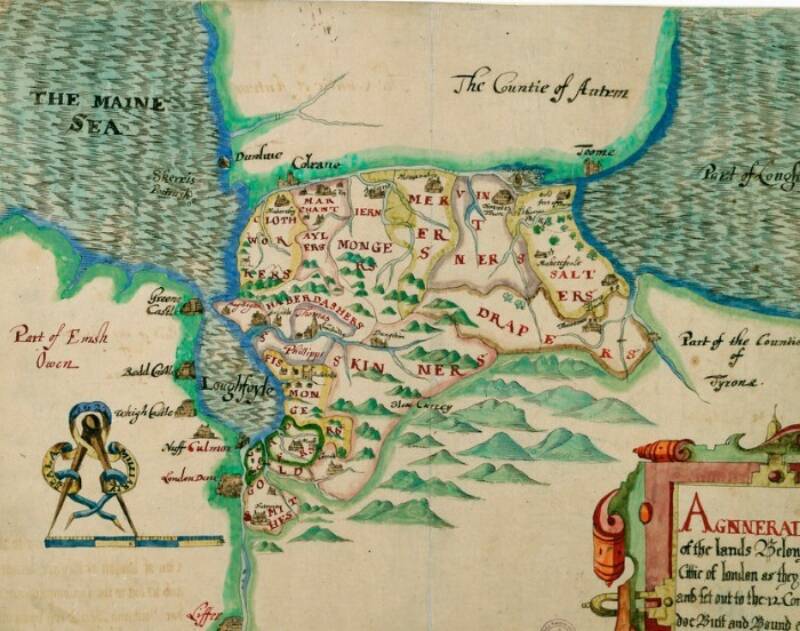
In 1607 Hugh O’Neill (above) had been restored to his estates in Tyrone following the Treaty of Mellifont, but was to lead his followers into exile in 1607, an act known as The Flight of the Earls. This cleared the way for the English to plan a plantation – the Plantation of Ulster became in effect what established the modern jurisdiction of Northern Ireland. And that’s exactly what is described in the letter – who owns what land (including clerical lands) and what should be done with it. It’s crucial to understanding the development of modern Ulster. That’s a plantation map, below, but not from this volume. It lays out what land the haberdashers could have, or the skinners or the drapers.
And next – who have we here? It’s none other than Archbishop James Ussher (1581 – 1656), later the Church of Ireland Archbishop of Armagh and Primate of All Ireland. This is the same man who established to his own satisfaction that the world was created on 6 pm on 22 October 4004 BC. Harmless speculation, you say? Alas not so – there are many people in the world today who still believe this, and it was certainly a commonplace belief up to the 20th century.
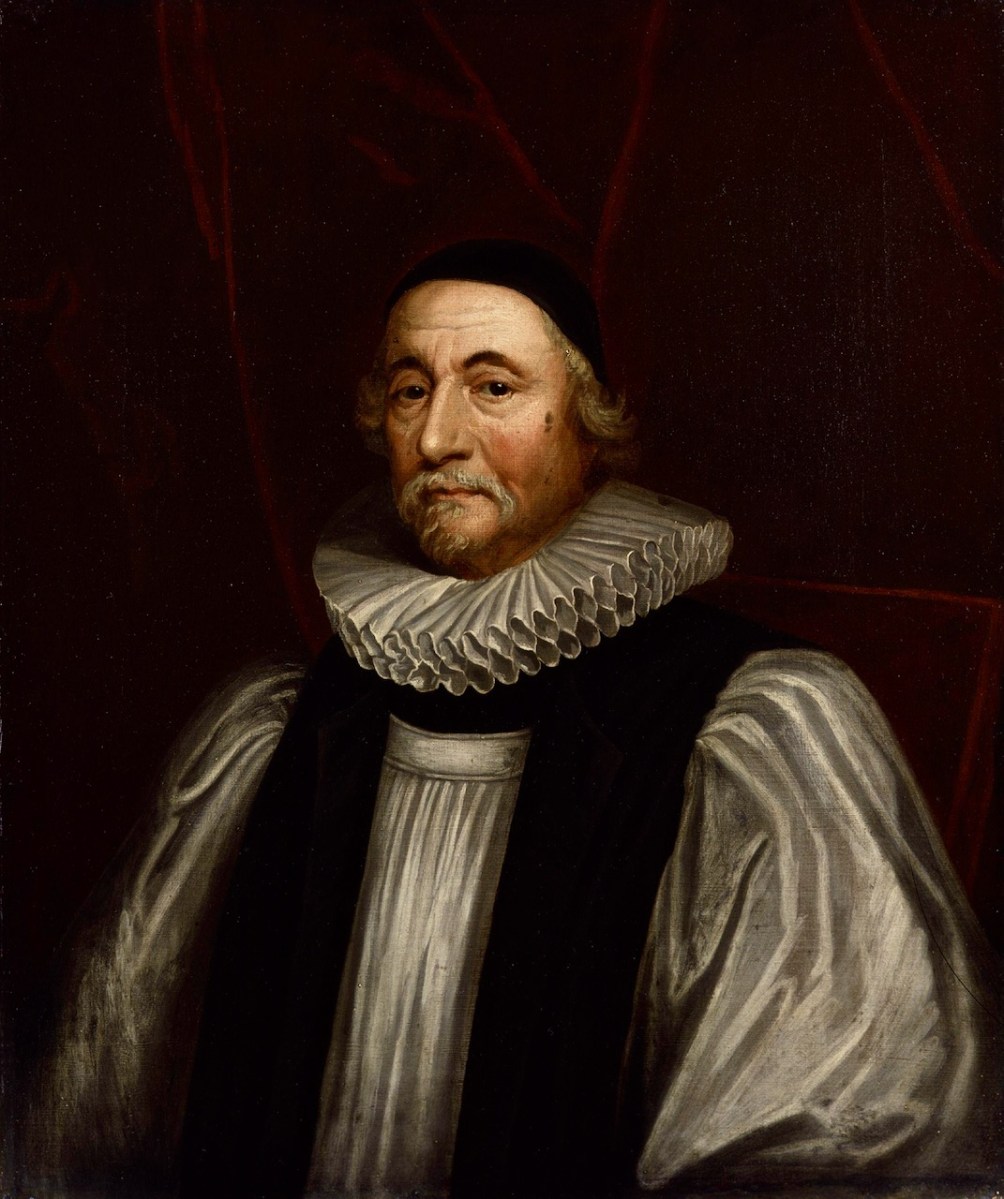
[Aside – what is extraordinary to me is that Trinity College still has his portrait proudly on display (below) in their Exam Hall. Meanwhile, George Berkeley is being erased from their history – correctly, perhaps – but for the same crime of being ‘a man of his time.’]
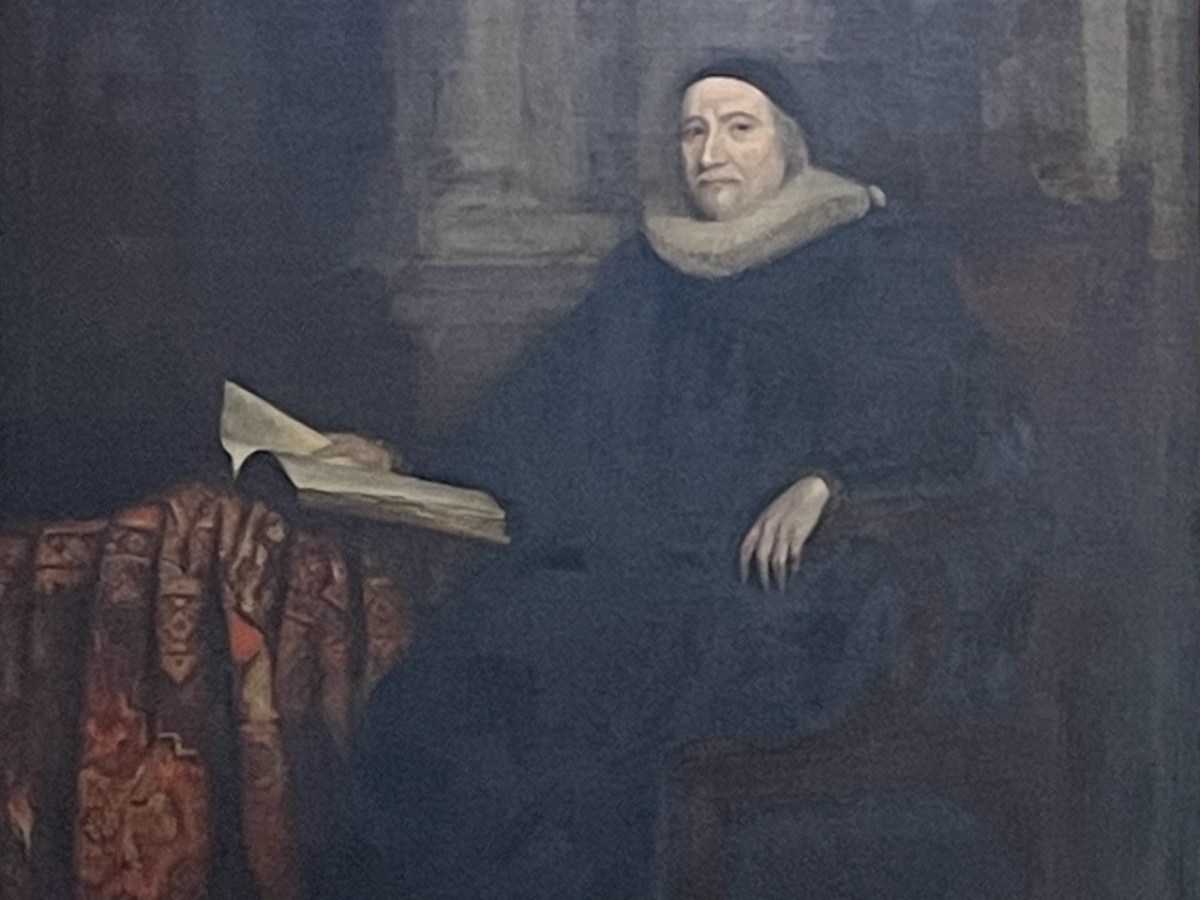
Ussher’s piece was written originally written in his own hand in 1609. It is titled Of the Origin and First Institution of Corbes, Erenachs, and Termon Lands. All these were common terms on the early Irish monastic system, to denote land holdings and those who held them. For example, a Termon was thought to be a sanctuary, hence the town of Termonfeckin was originally Tearmon Feichín, or St Feichín’s Sanctuary. Corbe was more usually given as Coarb. In the period following the dissolution of the monasteries, and the plantations that followed the Battle of Kinsale, there was a need to define these terms so that the land could be divided among English settlers. This is a very difficult treatise, written half in Latin, which lays out the meaning and origin of the terms and also the men who held the lands, to whom they paid rents or annuities, or owed labour. Ussher disingenuously disclaims any interest in this treatise besides having described without any partiality the meaning of the terms.
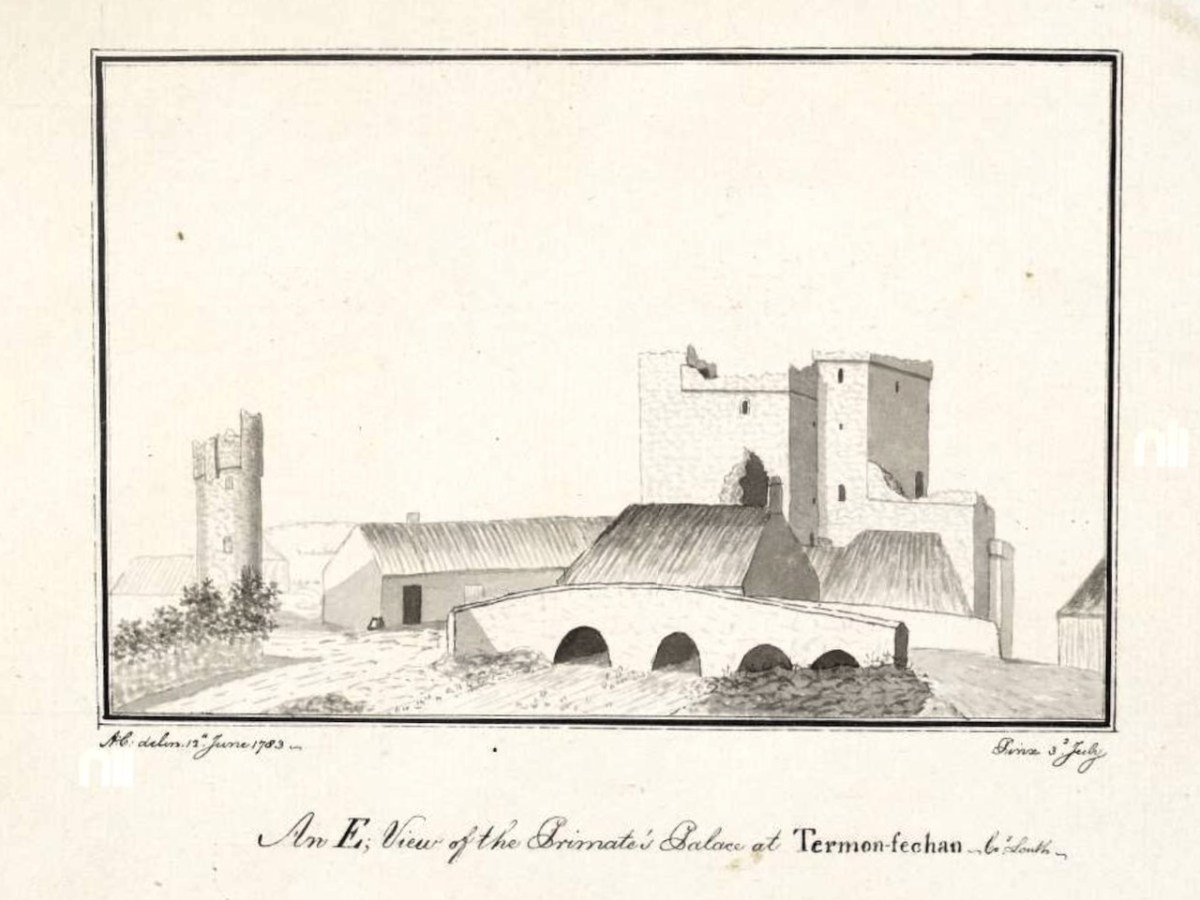
However, a little reading in the late lamented Peter Harbison’s Cooper’s Ireland yields the information that Ussher, in fact, had possession of Termonfeckin. Here’s what Harbison says: 

This ‘palace’, referred to as ‘Termonfechan’ by Austin Cooper, was named after a monastery that once stood on this site, founded by Saint Fechín of Fore in the seventh century.

But the reason why the primate – that is, the Archbishop of Armagh – should have a palace here at all was not out of homage for this early Irish saint. It had much more to do with the religious politics of the later mediaeval period, when the Archbishop – usually an Englishman by birth – was surrounded by native Irish whose language he did not understand. He felt much safer when he could get away from his See at Armagh and reside at Terminfeckin, the southernmost tip of his Archdioceses, and its nearest point to the centre of English power in Dublin some 35 miles away.

The siege mentality of those within is reflected in the small, defendable window slits inserted in the severe looking wall face, as seen in Coopers drawing…Its last inhabitant had been…Archbishop James Ussher.

A Short Account of Two Ancient Instruments, by Vallancey follows. Here we can see many references to Phoenicians and Egyptians. He had recourse to the writings of Homer to inform us that the weapons of the Trojan war were made of copper, thus, of course, implying a Classical date for them. He rambles on about Sabean priests, Arkite forms of worship and fire feasts of Baal, before finally getting to describe the instruments – neither of which appear relevant to the previous discourse. In this case, the instrument are of silver. There is no attempt to interpret their use, and they certainly don’t look like musical instruments but rather perhaps cloak fasteners. 
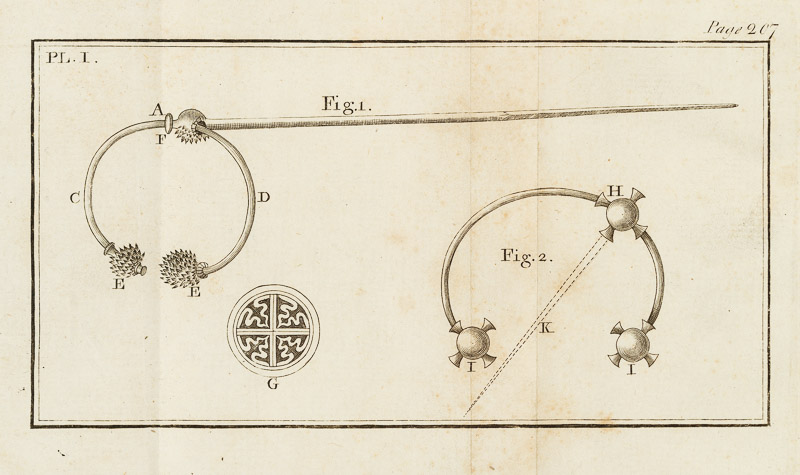
I had intended to cover all of Vol 1 in this post, but I am not even half-way through. I will have to get a lot better at skimming and summarising if I am ever to emerge from this mountain. But I am hoping that this gives you a flavour of not only the diversity but also the value of the Collectanea. In the first 250 pages alone we have had original documents, not by Vallancey (except for the ‘Instruments’) but collected and published by him, that are invaluable to the understanding of Irish history and culture. This – the collecting, preserving and publishing important documents, as well as listing where others can be found (see Part 1) – may in fact have been his greatest contribution to Irish scholarship. 
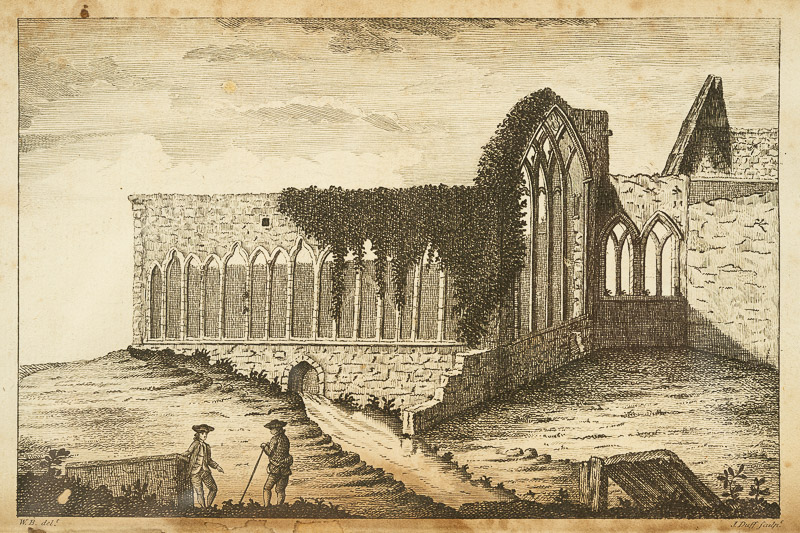
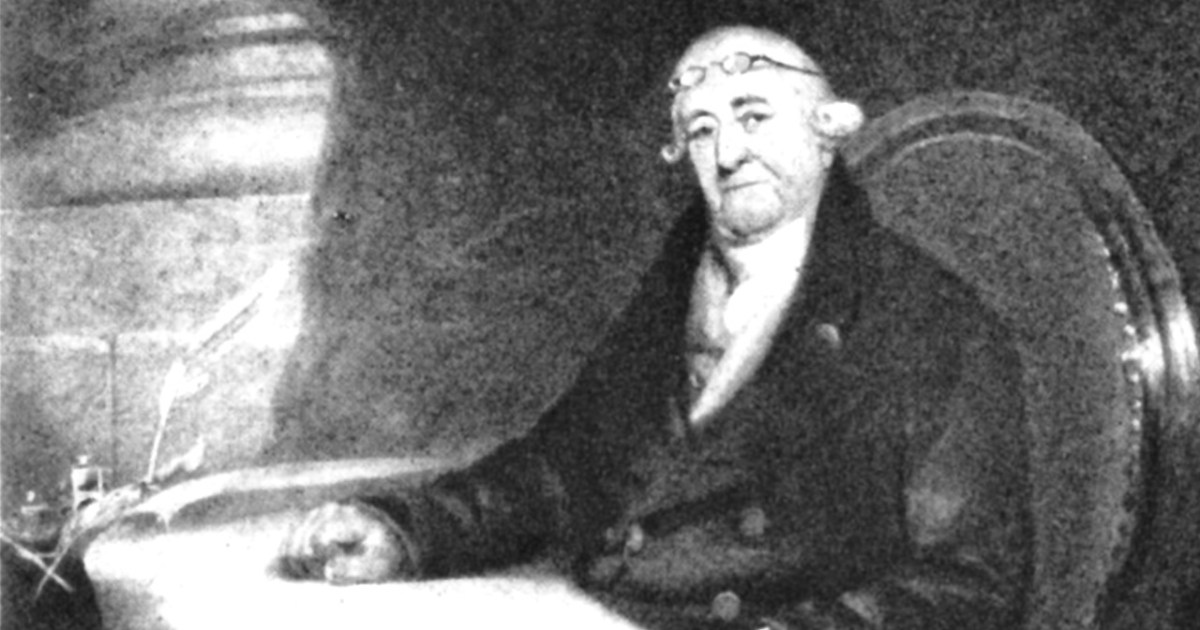
I’ll finish with an illustration from one of the Volumes – it is not identified and is certainly not by Vallancey. In fact it looks like one of Beranger’s. Perhaps one of our readers might know what ruin this is. [EDIT: identified! See comments below] The lead image, by the way – the portrait of Vallancey, is taken from VH Andrews’ essay on Charles Vallancey and the Map of Ireland (see previous post) and is described as from an oil painting by Solomon Williams.

Saints and Soupers: the Story of Teampall na mBocht (Part 3, The Protestants – Tithes and the Second Reformation)

While the Church of Ireland was the Established Church in Ireland since the time of Henry VIII, it was not the only Protestant group operating in Ireland. Methodists, in particular, had won many converts since the days when John Wesley himself had come preaching (above). However, like Catholics, breakaway and Dissenter communities were disadvantaged in comparison to the Church of Ireland.

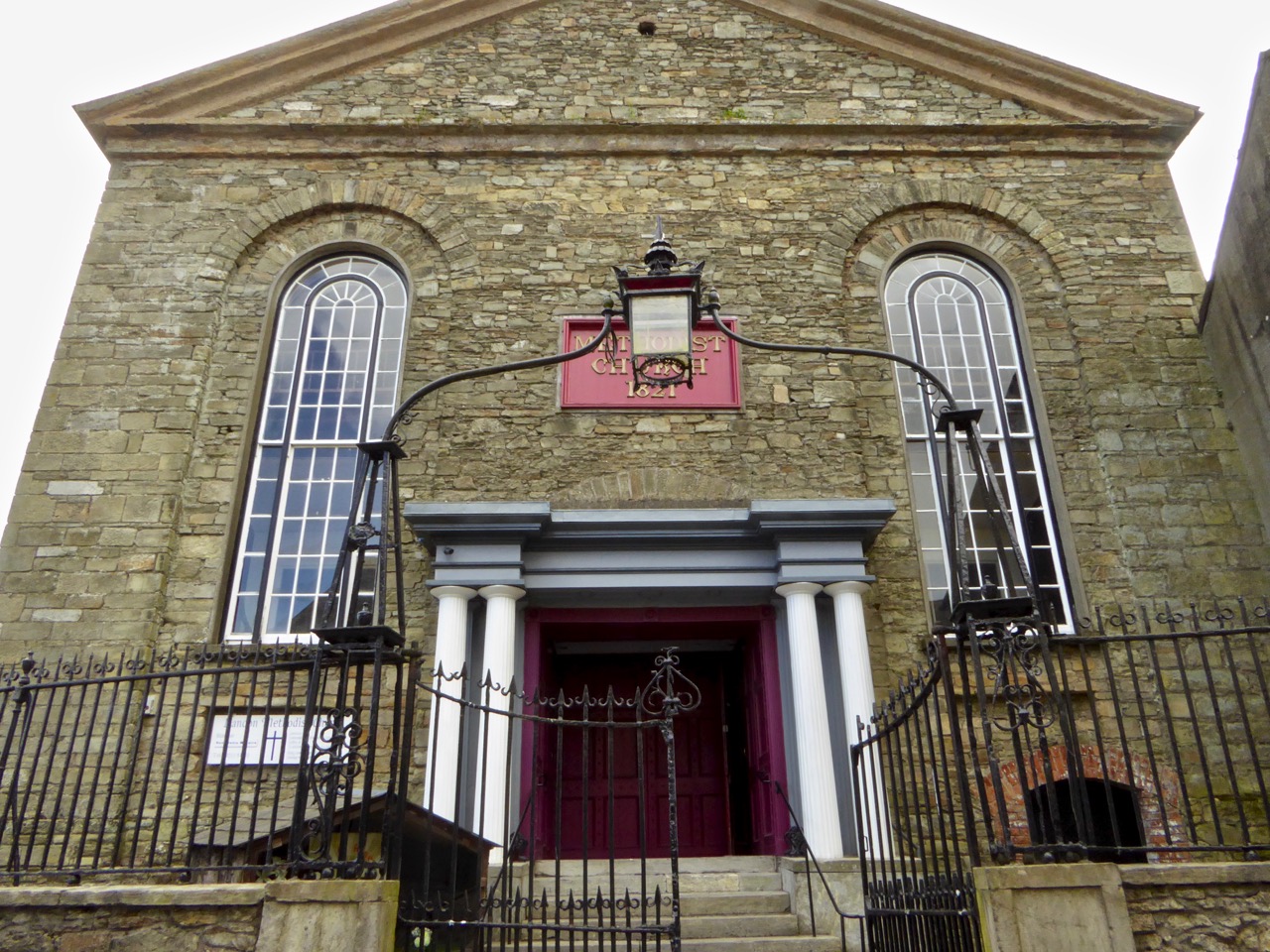
Bandon Methodist Church, established in 1821

This privileged position, while it came with all the advantages conferred by reliable revenues, political power and access to education, was also accompanied by the constant awareness of being a minority, often an unwelcome one, and by the decadence and laxity that generations of wealth can confer.

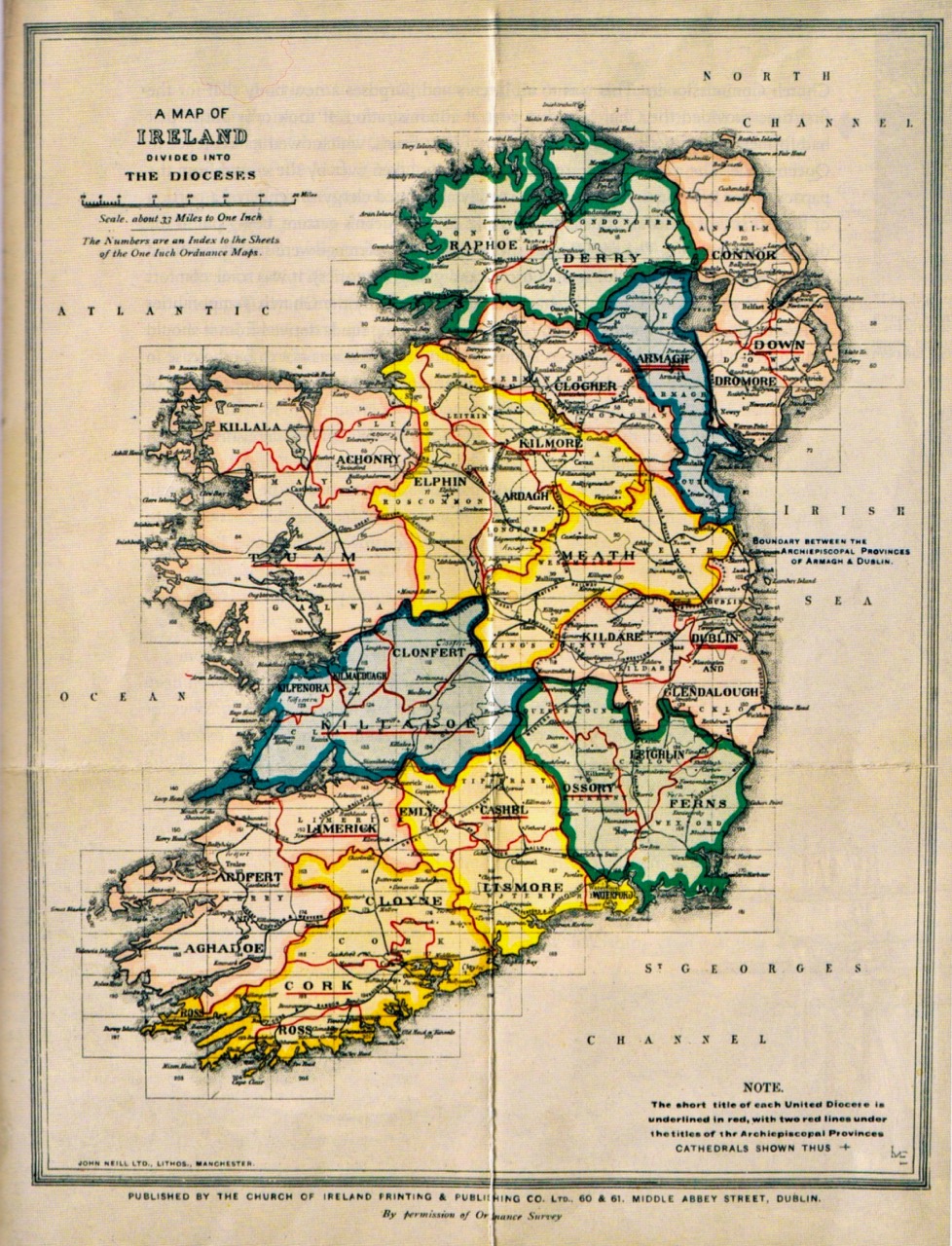
1864 Map of the Church of Ireland Dioceses

Dr Kenneth Milne, writing in The Church of Ireland: An Illustrated History (Published by Booklink, 2013) describes the situation thusly:

. . . plurality and non-residency came to be regarded as endemic. There is evidence that there were many faithful (and often impecunious) Church of Ireland clergy, but their existence has been somewhat masked by the prevalence of ambition and negligence among many others, particularly of the higher rank.

While it was to the bishops that one would have looked to remedy the situation, they themselves were frequently non-resident, at least for long periods, preferring the amenities of Dublin (or sometimes London and Bath, for most of the more remunerative sees were given by the crown to Englishmen as part of that great web of patronage that lay at the heart of government and was the norm). Such episcopal failings were by no means peculiar to the bishops and other dignitaries of the Church of Ireland, and were common throughout Europe, but what made the Irish episcopate more vulnerable to criticism was its remoteness (in more sense than one) from the great majority of the populations, and the fact that it drew it emoluments, often very considerable indeed, from lands to which its entitlement was often in dispute. In addition, it demanded tithes paid by a resentful population who, be they Roman Catholic or Dissenter, were also encumbered with contributing towards the support of the ministry of the Church to which they gave their fealty.

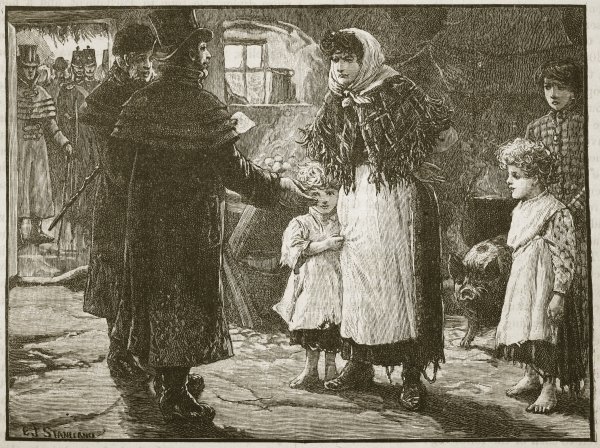
The Tithe Collector – collectors were employed on behalf of the clergy and were called Proctors. They took a cut, so there was a strong incentive to collect

Catholic Emancipation in 1829 was followed by a period of intensified conflict over tithes, known as the Tithe Wars. (Tithes had been a source of great conflict forever – see Robert’s post for La Tocnaye’s observations about tithes in the 1790s.) A large anti-tithe meeting was held in Skibbereen in July 1832 and the speech made by Father Thomas Barry of Bantry was reported in full. Here are some extracts from it, reported by Richard Butler in his paper St Finbarr’s Catholic Church, Bantry: a history for Volume Three of the Journal of the Bantry Historical and Archaeological Society:

The Rev. Thomas Barry, P. P., in seconding [an anti-Tithe] resolution, announced himself as a mountaineer from Bantry, and was received with a cead mille failthe [sic], which was sufficient to affright all the proctors in the kingdom from their propriety. . . .

But (continued the Rev. Gentleman) . . . If to assist the people in their peaceful and constitutional efforts for the removal of grievances to hear the insolence of power in defence of the poor man’s rights, invariably to inculcate on the minds of my flock the most unhesitating obedience to the laws, and at the same time, to raise my voice boldly and fearlessly against injustice and oppression. If these constitute the crime of rebellion, then do I rejoice in acknowledging the justice of the charge. [tremendous cheering.]

. . . Some time since I commenced building a chapel in Bantry, which, owing to the poverty and privation of the people, I have been unable to finish, although thousands are extorted from them for the Parson and the Proctor – the Churchwarden applied to me for Church rates – I desired him to look at the Chapel, and there he would find my answer: he begged of me not to give bad example by refusing to pay, and I told him, that I was well convinced that the example which I gave in this instance was particularly edifying. – (great laughter and much cheering.) – The proctor came next, and threatened me with distraint for the amount of tithes with which he charged me, and which I must do him the justice to say he never previously demanded. I told him to commence as soon as he pleased; and so gratified did I feel at the honour which he intended for me, that I was resolved to make a holyday day for him (laughter and cheers.)

– The Rev. Gentleman sat down amidst the most enthusiastic cheering.

This meeting was but one in a series in West Cork throughout the 1830s. Patrick Hickey, in Famine in West Cork, reports on meetings in Bantry and at the foot of Mount Gabriel – meetings attended by thousands, each parish under the leadership of their priest. In Bantry, the various tradesmen of Bantry marched in procession, each trade with its own banners. On one side of the tailors’ banner was a portrait if Bishop Doyle with the inscription, ‘May our hatred of tithes be as lasting as our love for justice’ and on the other side a portrait of Daniel O’Connell. At the Mount Gabriel meeting a procession of boats came from the islands and the men of Muinter Bheara arrived under the command of Richard O’Donovan of Tullagh and many Protestants (including Methodists and the descendant of Huguenots) attended.

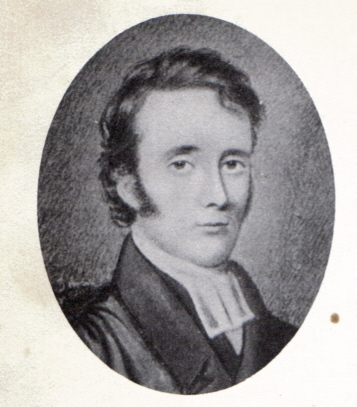
One of the most outspoken of the Church of Ireland community against the anti-tithe movement was Rev Robert Traill, Rector of Schull (above). In doing so he was following the example of his father, the Rev Anthony Traill, who had used a particularly brutal proctor, Joseph Baker, to collect his tithes, while he himself resided in Lisburn. Fearing, of course, the loss of his income, Rev Robert railed against the meetings, declaring that in doing so he waged war against Popery and its thousand forms of wickedness. When cholera broke out after one of the monster meetings he wrote that is was God’s punishment for the agitation stirred by the iniquity of these wicked priests. He had reason to be afraid – the rector of Timoleague had been murdered and throughout the country killings, assaults and riots had occurred. It was a challenging time to be a Church of Ireland rector. (Remember Rev Traill, by the way, and don’t cast him as a villain in this story – he will feature again for his heroic role during the famine – yet another twist in the complex role of the Protestant church in this part of Ireland.)

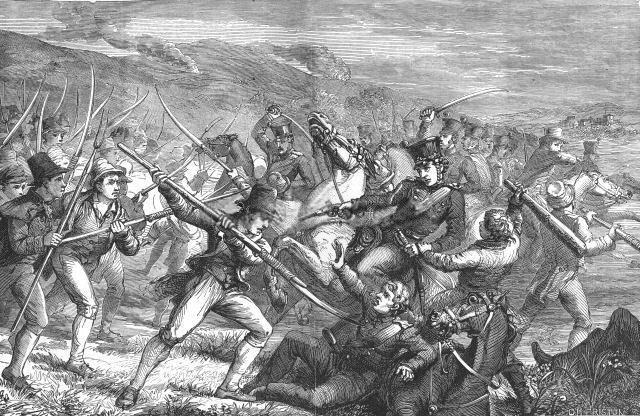
The battle at Carrickshock, Co Kilkenny (from Cassell’s Illustrated History of England). This confrontation over tithes resulted in several deaths and sent shock waves through the country

Eventually (see Part 2) the Tithe Wars eased, a compromise (if not a solution) was reached and outright protests ceased. Let us turn our attention now to what was happening within the Church of Ireland in matters of doctrine.

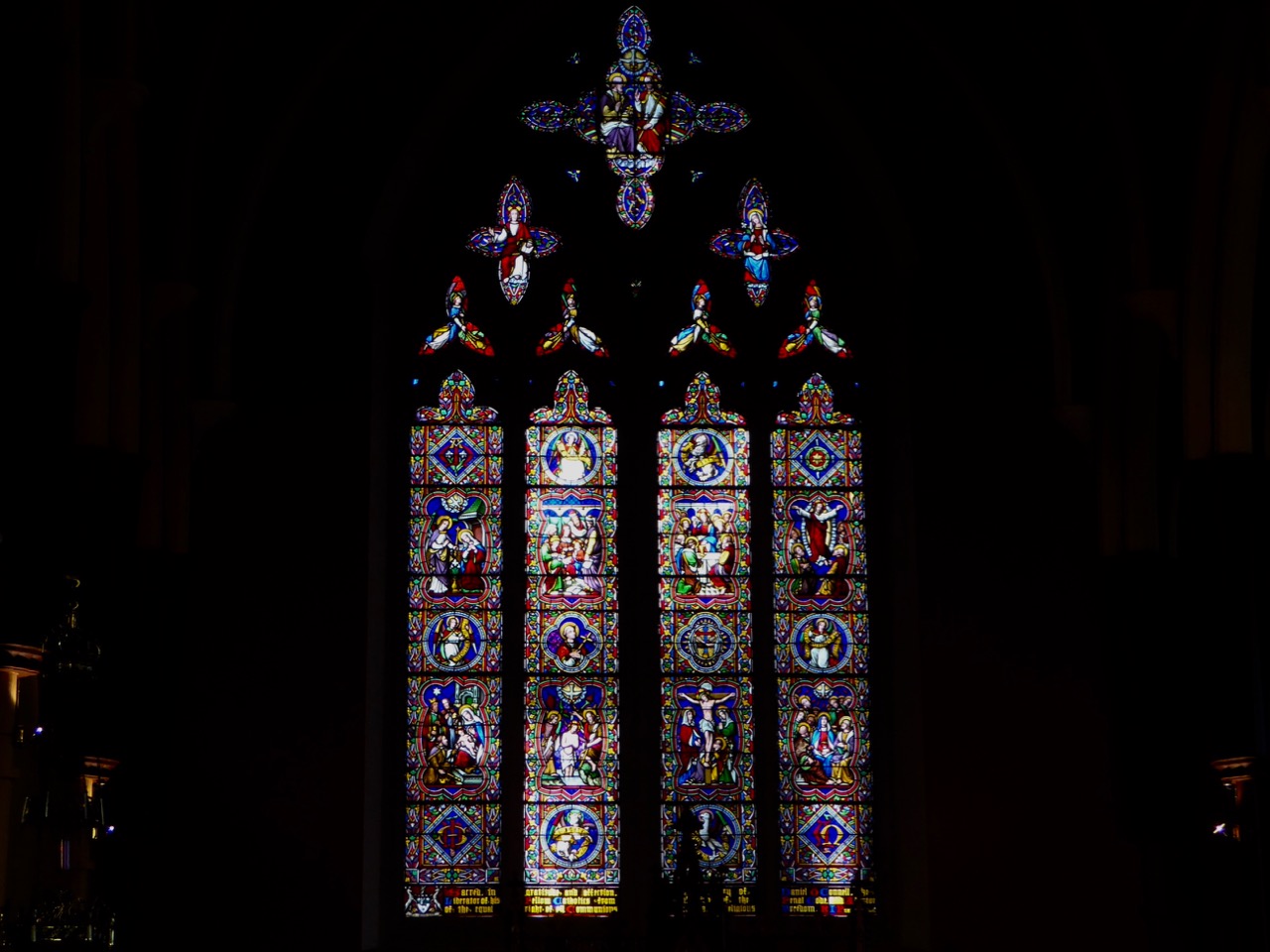
An enormous stained glass window in Holy Trinity Catholic Church in Cork is dedicated to Daniel O’Connell, The Liberator, by a grateful people

Latitudinarianism – lovely word, isn’t it? It refers to the live and let live philosophy that was generally adopted by Protestants in the 18th century. Actually a reaction against the Puritan insistence on a single form of Truth, it was sometimes called Broad Church and was a mode of thought that tolerated variations on thought and practise and sought to peacefully co-exist with other forms of worship. However, by the beginning of the nineteenth century, this emphasis on compromise and moderation was gradually being replaced with a new evangelical fervour, leading to a movement known as the Second Reformation.

This movement, it is often said, was kick-started in Ireland by William Magee, Archbishop of Dublin and fervently committed to the Second Reformation. He gave a firebrand sermon upon his inauguration in 1822 in which he accused the Catholics and the Methodists thus:

. . . the one possessing a church without which we can call a religion, and the other possessing a religion without which we can call a church: the one so blindly enslaved as to suppose infallible ecclesiastical authority, as not to seek in the word of God a reason for the faith they possess; the other so confident in the infallibility of their individual judgment as to the reasons of their faith that they deem it their duty to resist all authority in matters of religion. We, my Brethren, are to keep free of both extremes, and holding the Scriptures as our great charge, whilst we maintain the liberty with which Christ has made us free, we are to submit ourselves to the authority to which he has made us subject.

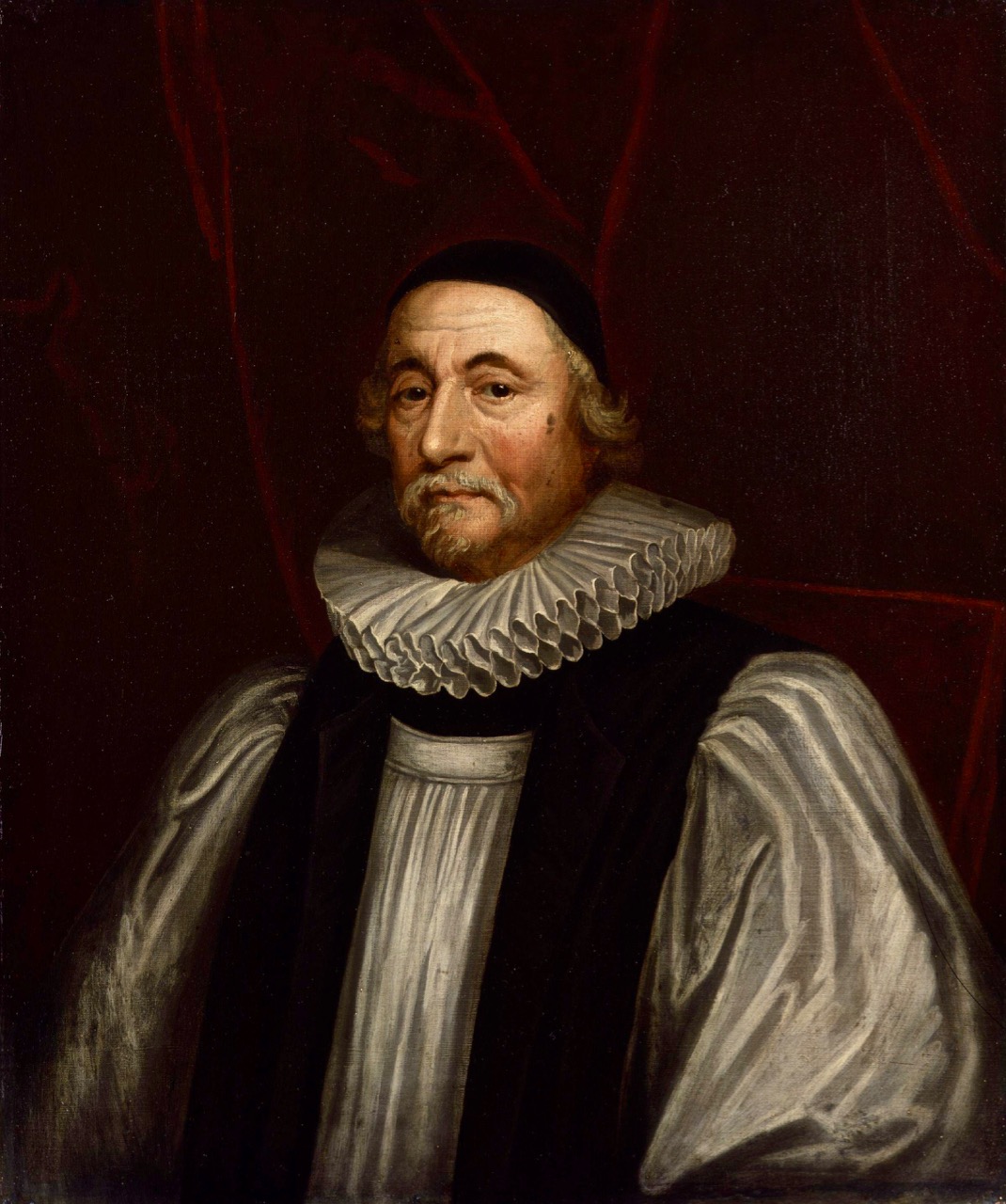
In this sermon, which created a furore at the time, he was essentially giving voice to prevailing Protestant opinion at the time regarding the other churches, and also to the claim of the Church of Ireland to be the only national church. It is important to note here that the Church of Ireland considered then, as it does to this day, that far from being an imported or imposed religion, it was, and remains the only true successor of the original faith of the Irish. This was first argued by James Ussher (portrait below by James Lely) in the seventeenth century.

The Church of Ireland, Ussher said, was not created by Henry VIII, but that St Patrick was Protestant in his theology and that the real problem was the interference of the Pope. (Ussher, by the way, is the same prelate who established that the world is only 6000 years old, another statement that continues to resonate in fundamentalist circles – but that’s another story.) In this origin story, it was important to “rescue” the true Irish church from Rome and restore it to the vision of St Patrick. The current catechism on the St Patrick’s Cathedral website continues this tradition. To the question “Did the Church of Ireland begin at the Reformation?” the answer is “No – the Church of Ireland is that part of the Irish Church which was influenced by the Reformation, and has its origins on the early Celtic Church of St Patrick.”

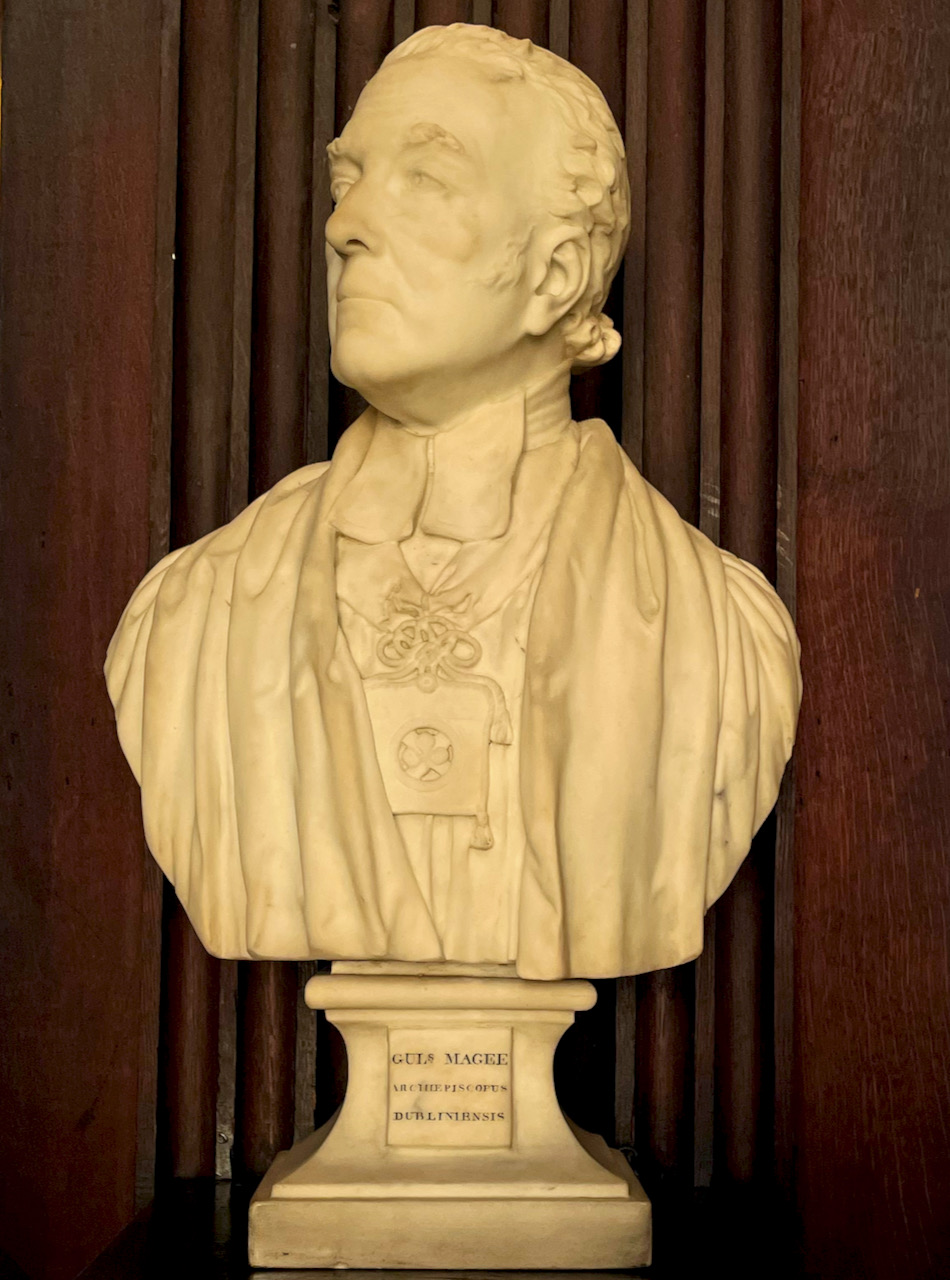
William Magee Bishop of Dublin bust at TCD
William Magee bust in Trinity College

Magee’s assertions were sincerely held positions. Although a cultured and erudite man, and tolerant in many respects, he was violently opposed to Catholic Emancipation, seeing the conversion of Romanists to Protestantism as a far better option both for them and for the country. His sermon effectively marked the end of any leftover latitudinarian attitudes in Ireland and heralded the arrival of a new era for the church of Ireland, in which educational, evangelical and proselytising activities were seen as essential. Next week we will see what effect those activities had on the already deepening divide between Ireland’s faith communities in the pre-famine period.

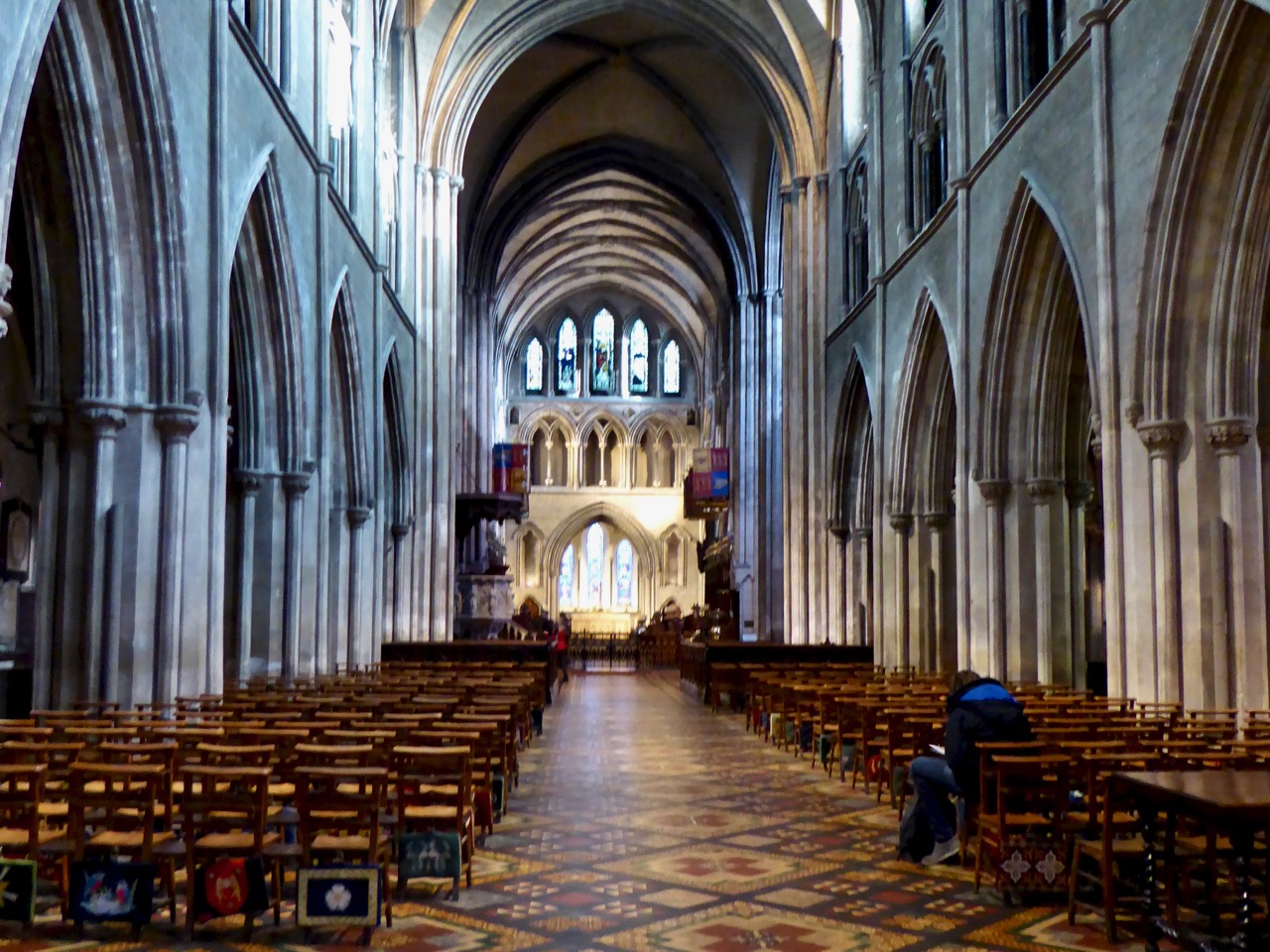
St Patrick’s Cathedral, Dublin – along with the position of being the Established Church, all the ancient churches became the property of the Church of Ireland, including this one. Magee delivered his famous sermon here

This link will take you to the complete series, Part 1 to Part 7