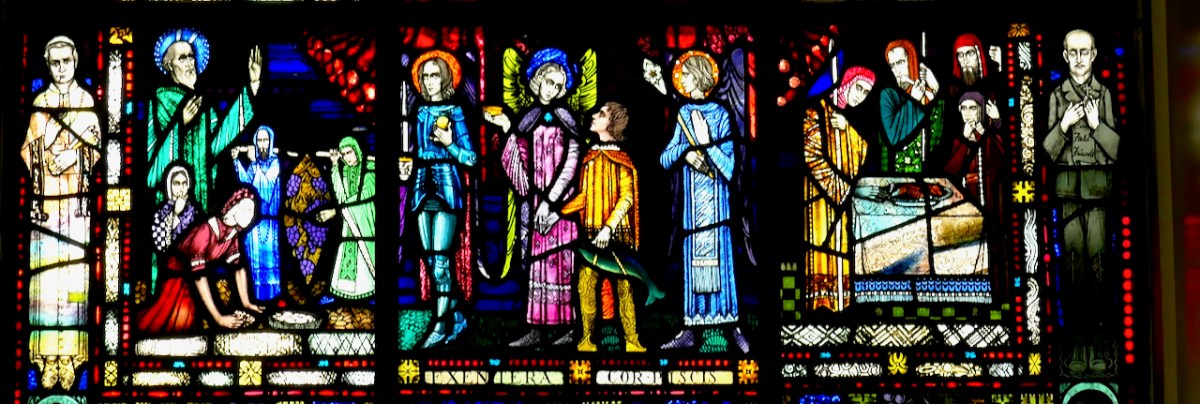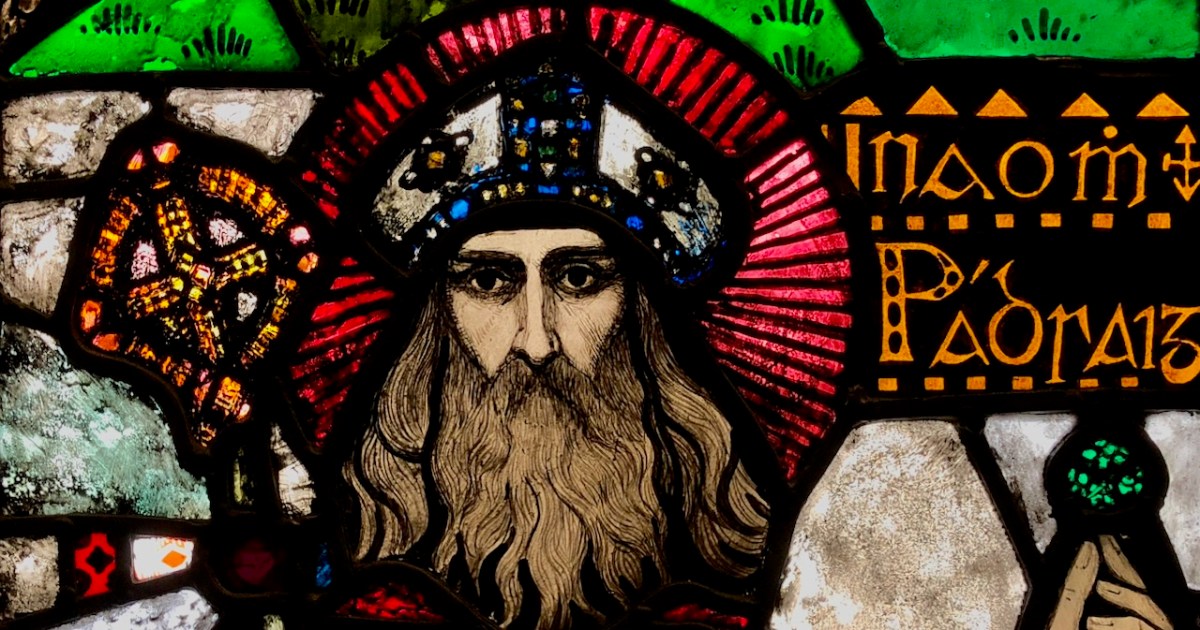
Michael Healy by David Caron: Review

This book – MIchael Healy: An Túr Gloine’s Stained Glass Pioneer – is nothing short of a miracle. It’s beautifully written by David Caron, with superb photography mainly by Jozef Vrtiel, and outstanding production values by Four Courts Press. But a miracle? Yes – because David Caron uses his scholarship and knowledge of stained glass as well as the history and art movements of the period to produce an immensely readable book about an intensely private man who left behind practically nothing about his life except his magnificent work.
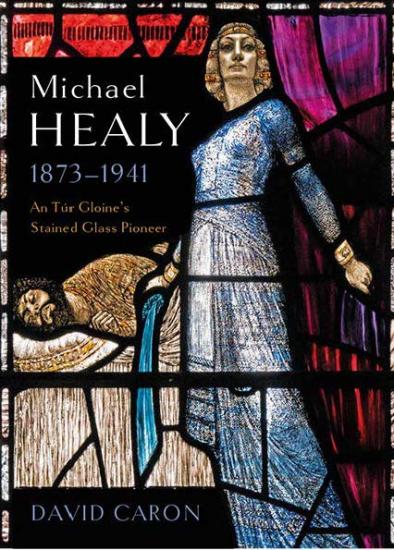
I will declare an interest right away – David Caron is a friend and mentor, editor and principal writer of the Gazetteer of Irish Stained Glass, to which I am one of the contributors. I have been looking forward to this book for a long time, as have all his friends, colleagues and collaborators. It was launched to great acclaim in Dublin on November 1 – all the available copies were snapped up at the launch, including mine (stowed behind the desk), so I had to wait until December to get my hands on it. 
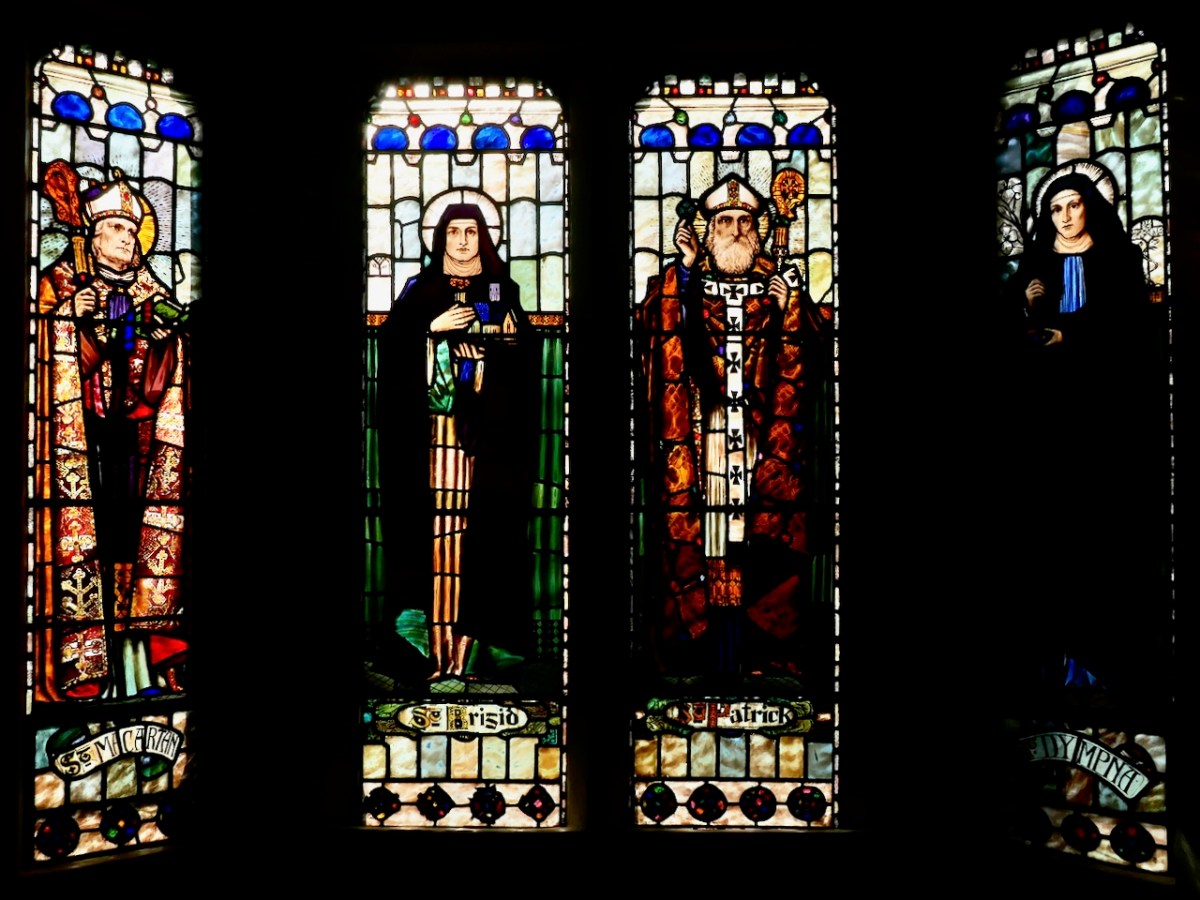
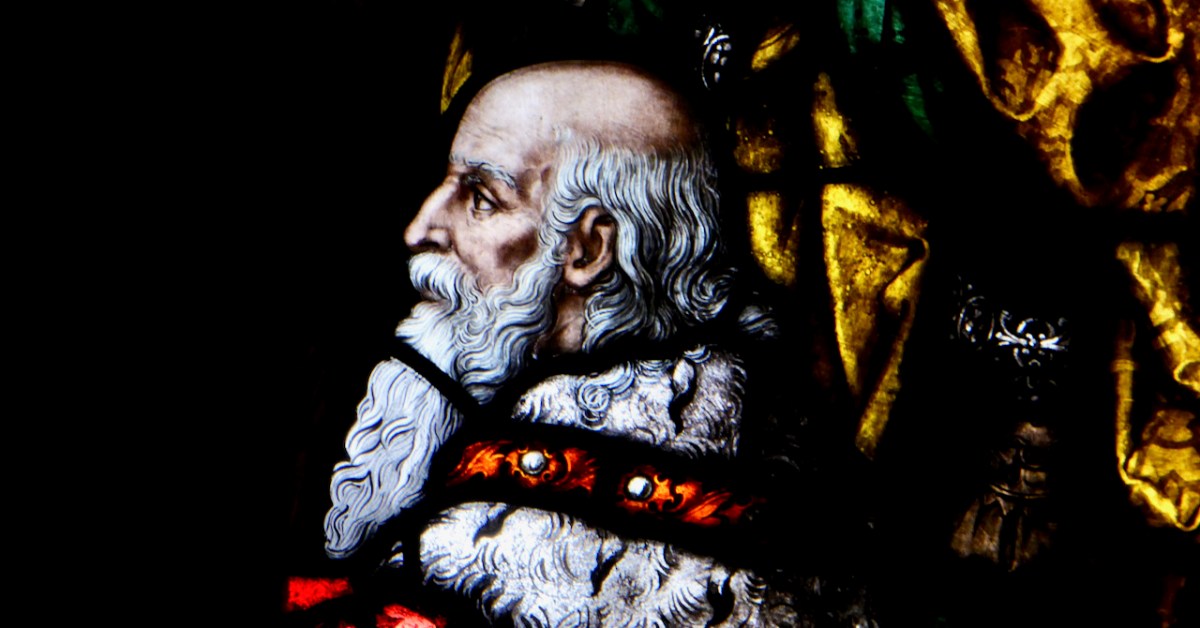
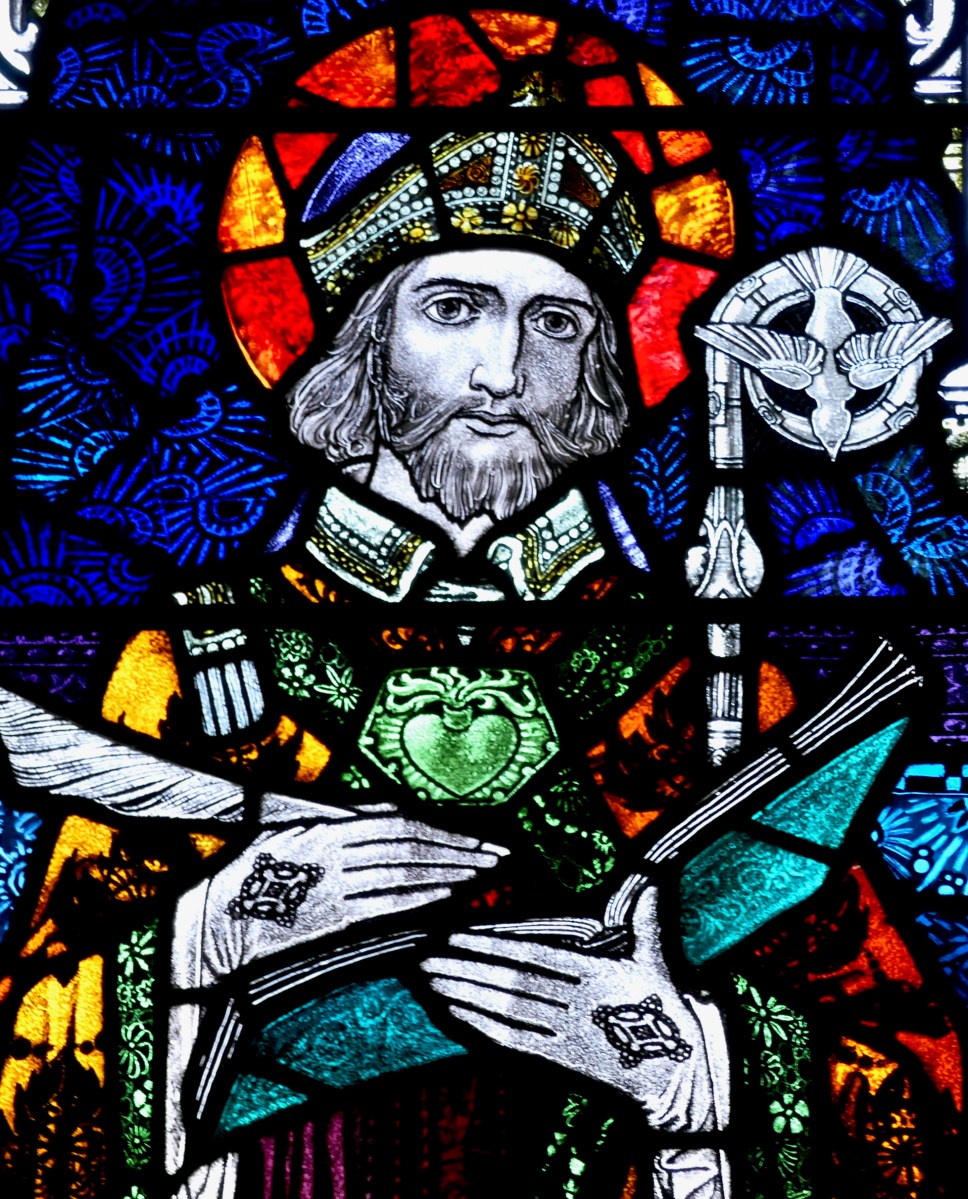
From a private bishop’s oratory, Sts Macartan, Brigid, Patrick and Dympna. Detail of Macartan, below. The rich reds and yellow shading of Macartan’s robes are the result of aciding and silver stain, described further down

All the photographs in this post are my own – but I haven’t seen that many Healy windows, and my photography does not bear comparison with Jozef’s magnificent images. The book is profusely illustrated – it’s one of its many strengths – with many photographs of the tiny details in which Healy delighted and which distinguish his windows from those of other artists. Healy spent all his working life at An Túr Gloine (The Tower of Glass) the Studio founded by Sarah Purser. If you are unfamiliar with this period in Irish stained glass, you might like to read my post Loughrea Cathedral and the Irish Arts and Crafts Movement before continuing.
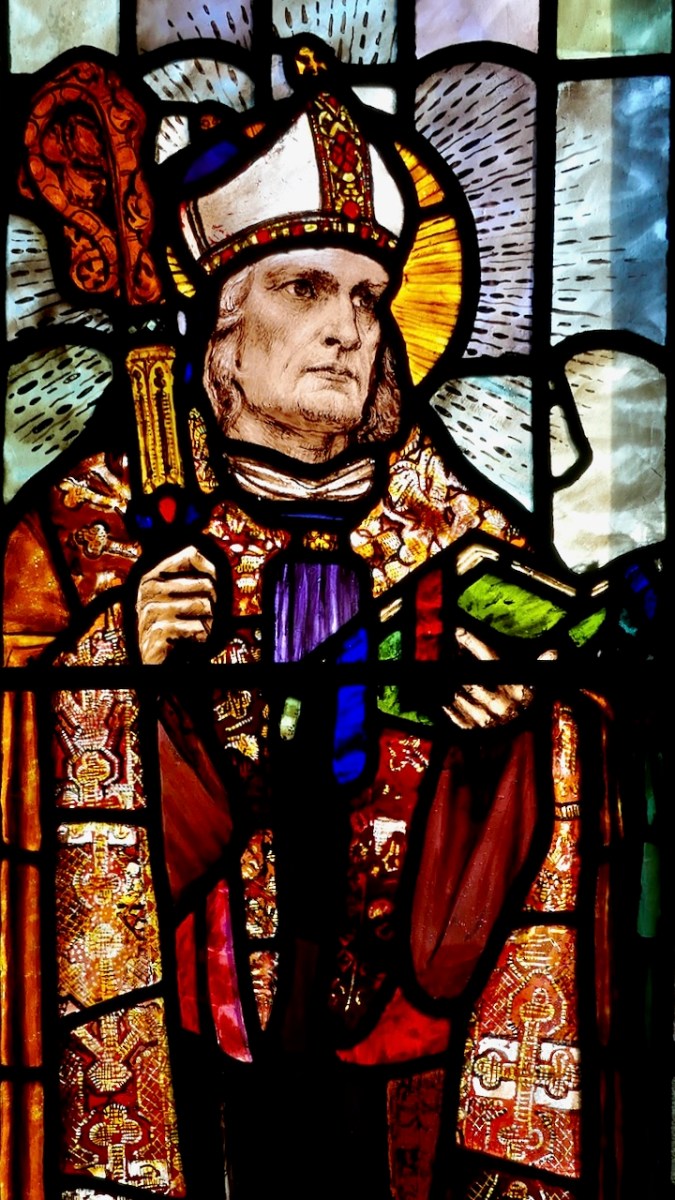
Born in 1873 into grinding poverty in a Dublin tenement, through a combination of great good luck and his own prodigious talent and hard work, Michael Healy turned himself into one of the foremost stained glass artists of his time. Reading David’s account, it is difficult not to be overwhelmed at times by the hardship endured by Healy and his family in turn-of-the-20th-century Dublin. Packed into one room with miserably inadequate sanitation, whole families succumbed to disease and early death. Consumption was rampant and the only recourse for anything approaching treatment was the dreaded workhouse. Infant mortality rates were high and so we read about several Healy babies who failed to survive into adulthood, as well as adults carried to early graves, leaving widows and widowers to try to cope. 

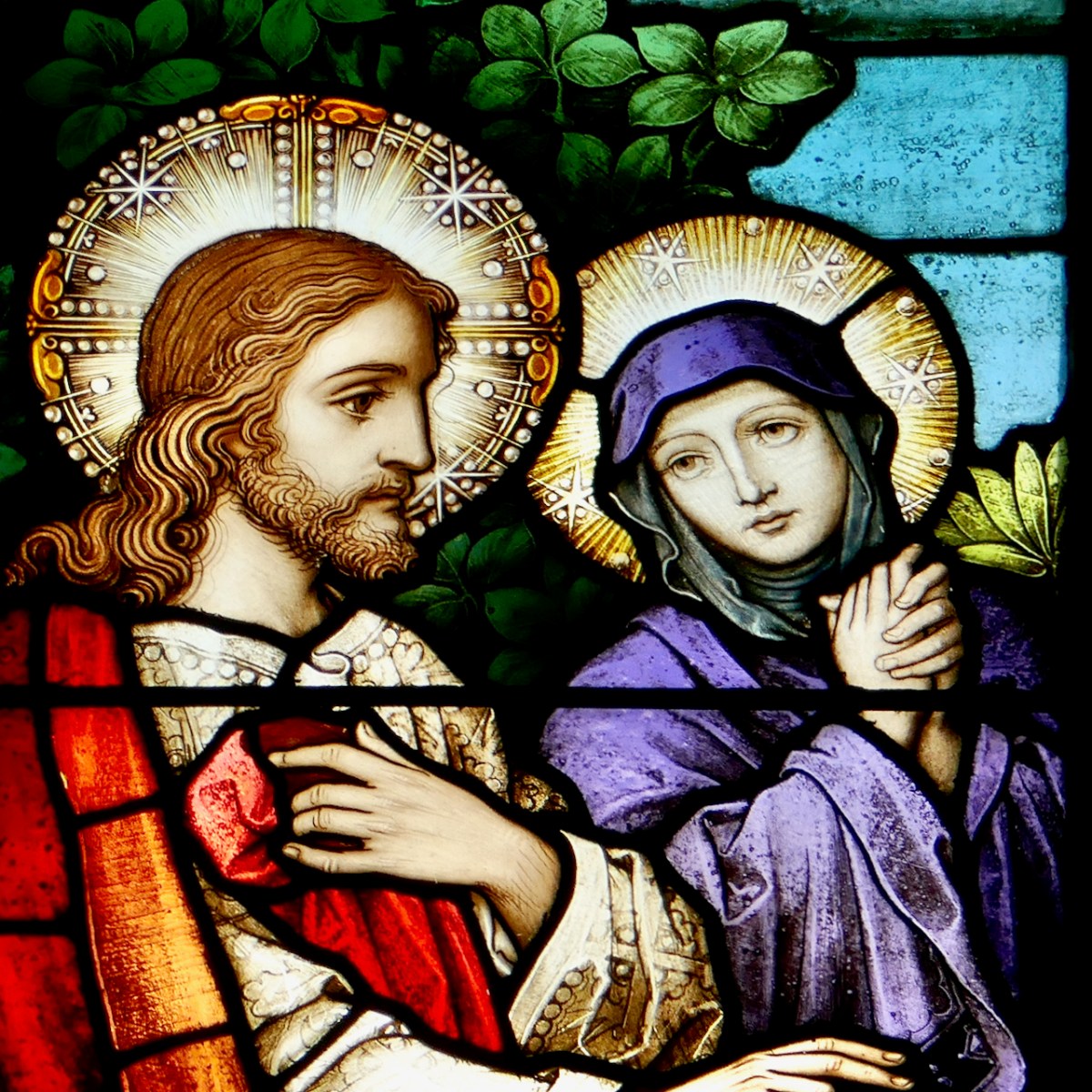
Christ with Doubting Thomas, St Joseph’s, Mayfield, Cork

In the midst of all this was the First World War, the Easter Rising, the War of Independence and the Civil War, followed by the emergence of the new Irish State. David chronicles all of this, and the effect it was having on citizens, like Healy, who were trying to go about their business, but who also had deep convictions about politics and religion.
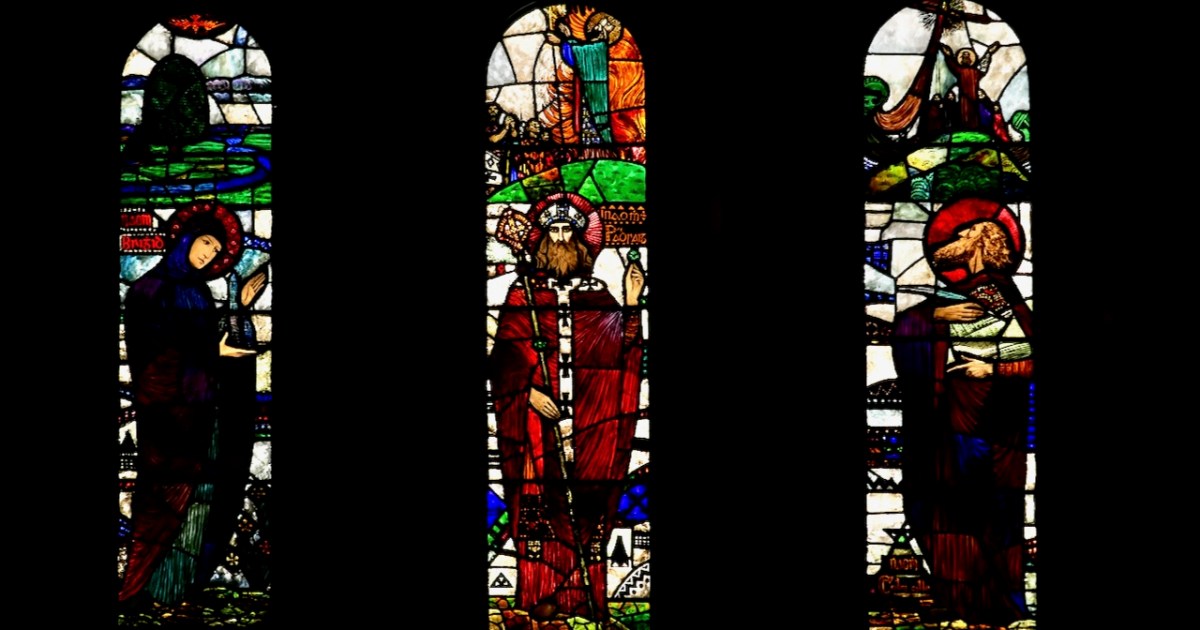
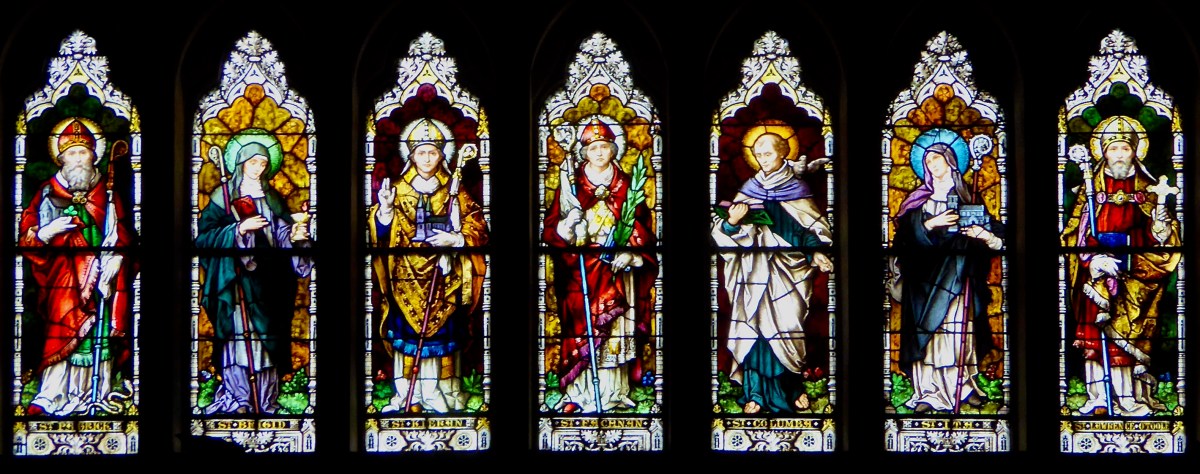
These windows, Sts Brigid, Patrick and Columcille, are in the National Gallery

In some ways, Healy was a typical young man of his time. Deeply religious, he spent some time in a seminary before deciding he was unsuited to the vocation. He belonged to a Catholic men’s lay organisation. David provides many instances where his working class Dublin accent, his republicanism, and his Catholicism must have put him at odds with his fellow artists at An Túr Gloine, mostly female, Protestant and from well-to-do backgrounds. They found him brooding and introverted, although they acknowledged his exceptional talent, and until Evie Hone arrived he did not make true friends with any of them.

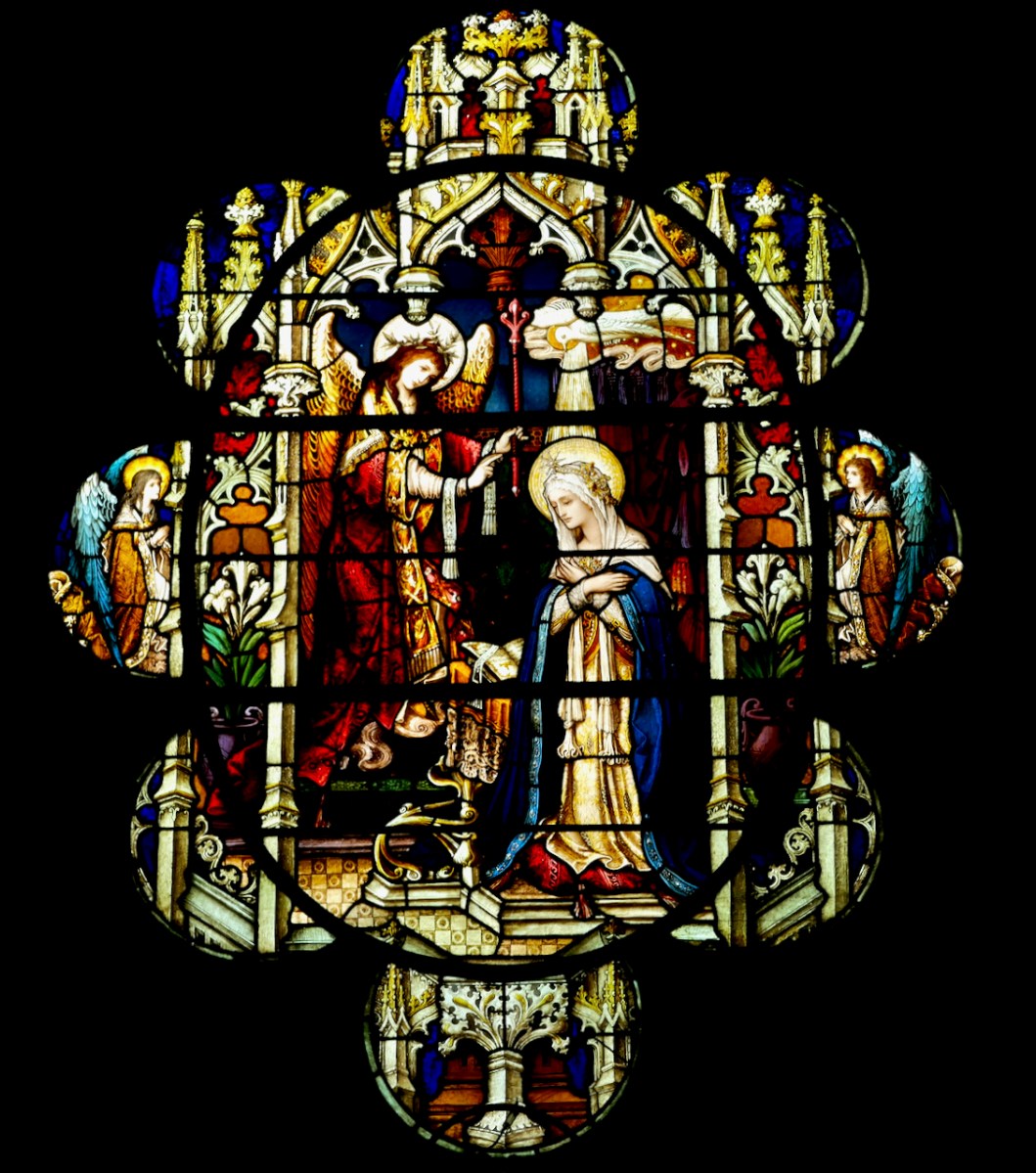
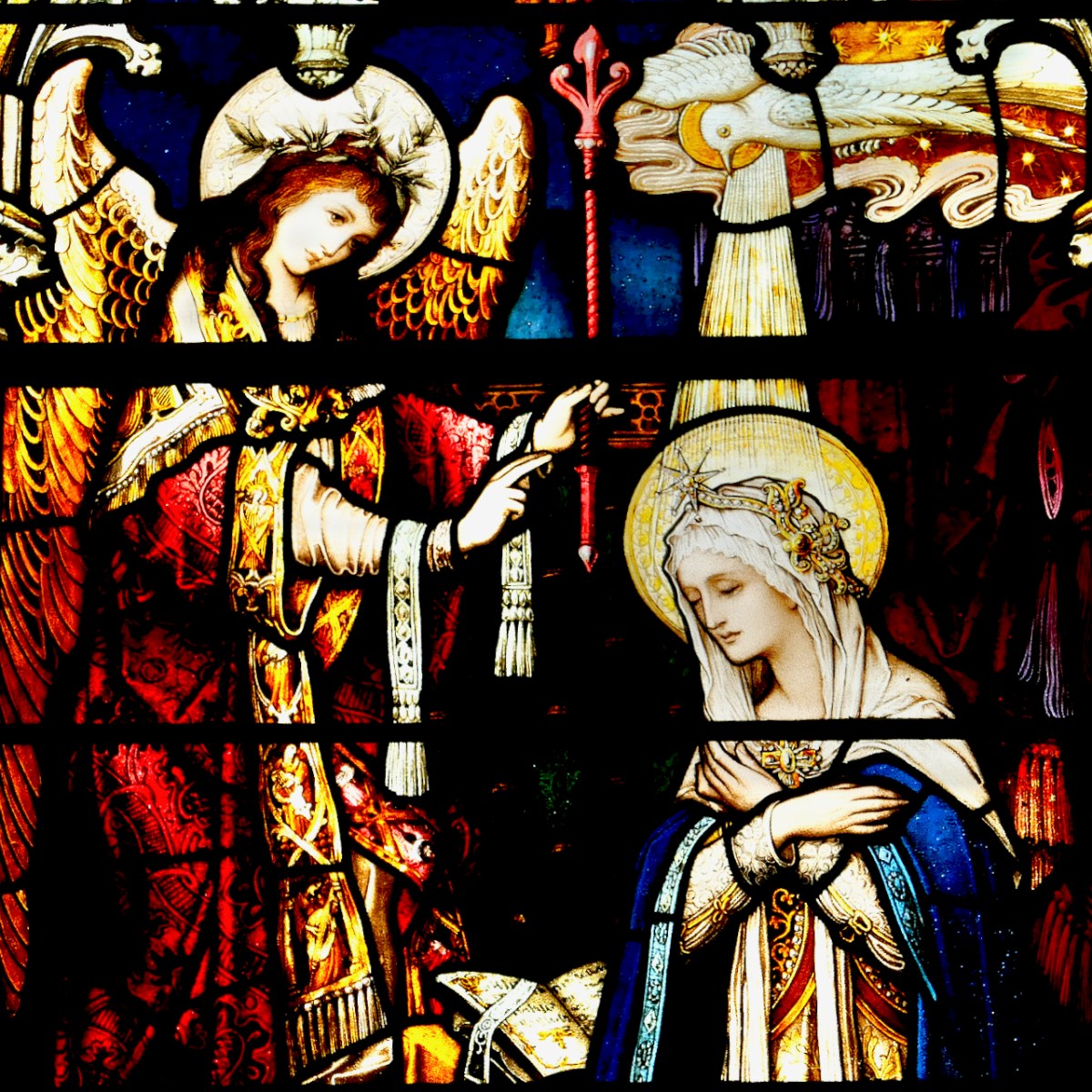
The Annunciation, Loughrea Cathedral. This window was closely based on a design by the great arts and crafts stained glass master, Christopher Whall. Whall came over from England to supervise the execution of it by the Túr Gloine artists, including Healy. Celtic revival interlacing was very popular at the time, and a way of putting a nationalistic stamp on a window – note the subtle inclusions of interlacing here and there

I mentioned that he had strokes of good luck in his life, two in particular. One was the patronage of a perceptive priest, Fr Glendon, who enabled him to study in Florence for a period of time and who procured illustration work for him in Dublin. David points out here and there in the text the influence of Italian painters discernible in Healy’s windows, gained from his sojourn in Italy.

Detail of a Patrick window in Donnybrook

The other was that he found lodgings with a landlady, Elizabeth Kelly, and over time they grew close. Eventually, they become lovers and had a son, Diarmuid, together. Although the relationship was never publicly acknowledged (she was married, although her husband left her) it provided both of them with stability and comfort, and Healy was close to his son. In the 30s Diarmuid O’Kelly (although his mother went by Kelly) bought a Ford Model T and he and Michael would go on sketching expeditions up into the Dublin Mountains and out along the canals. 
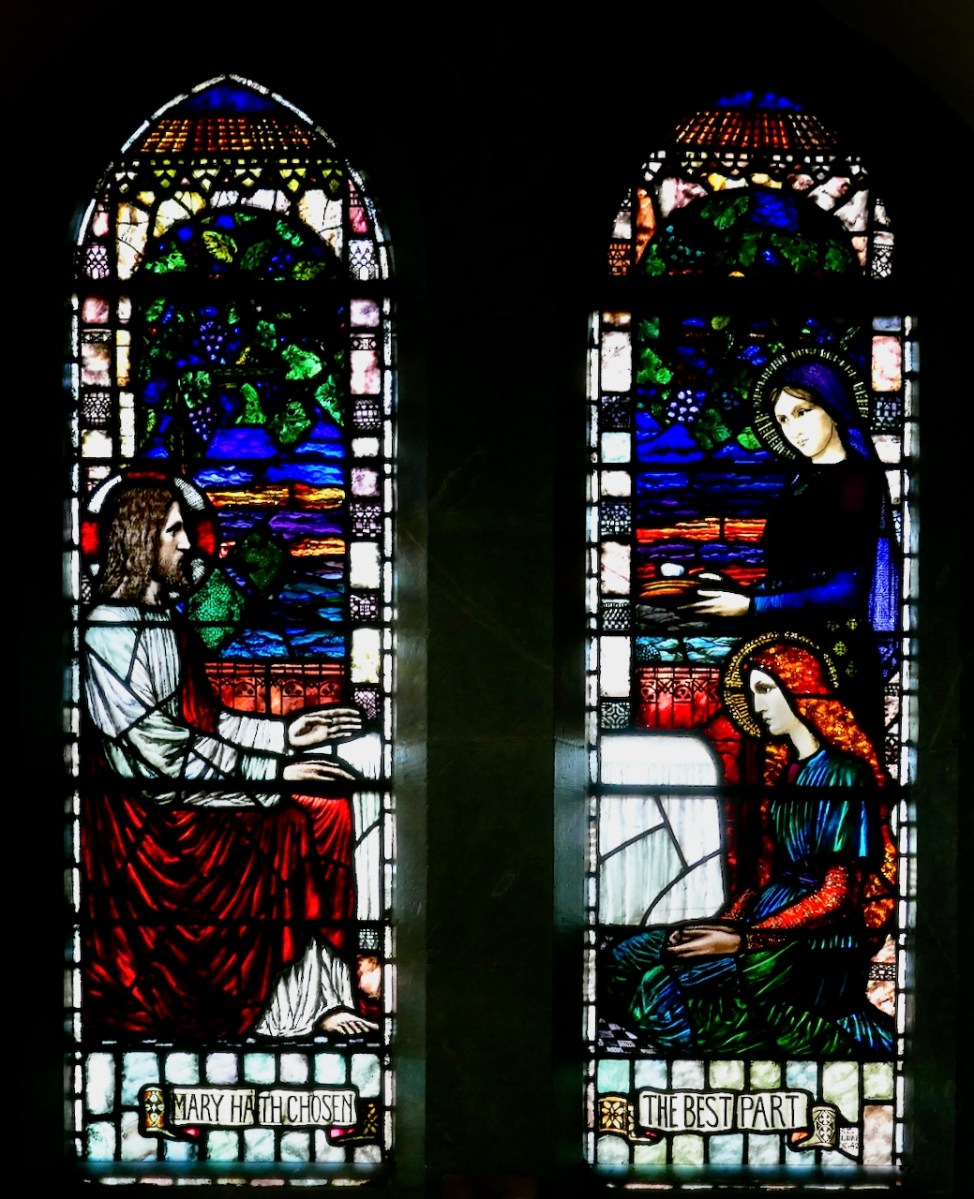
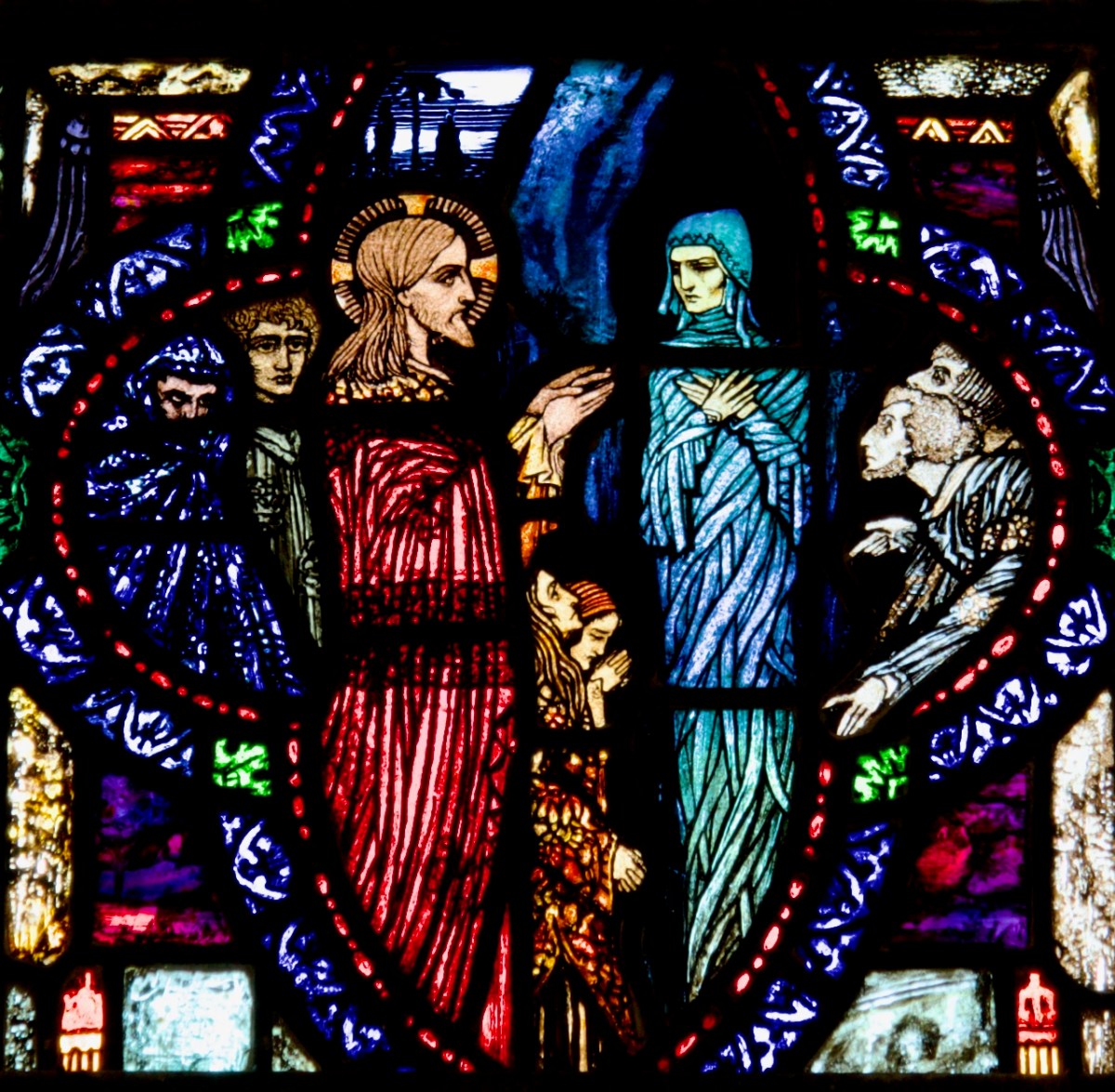
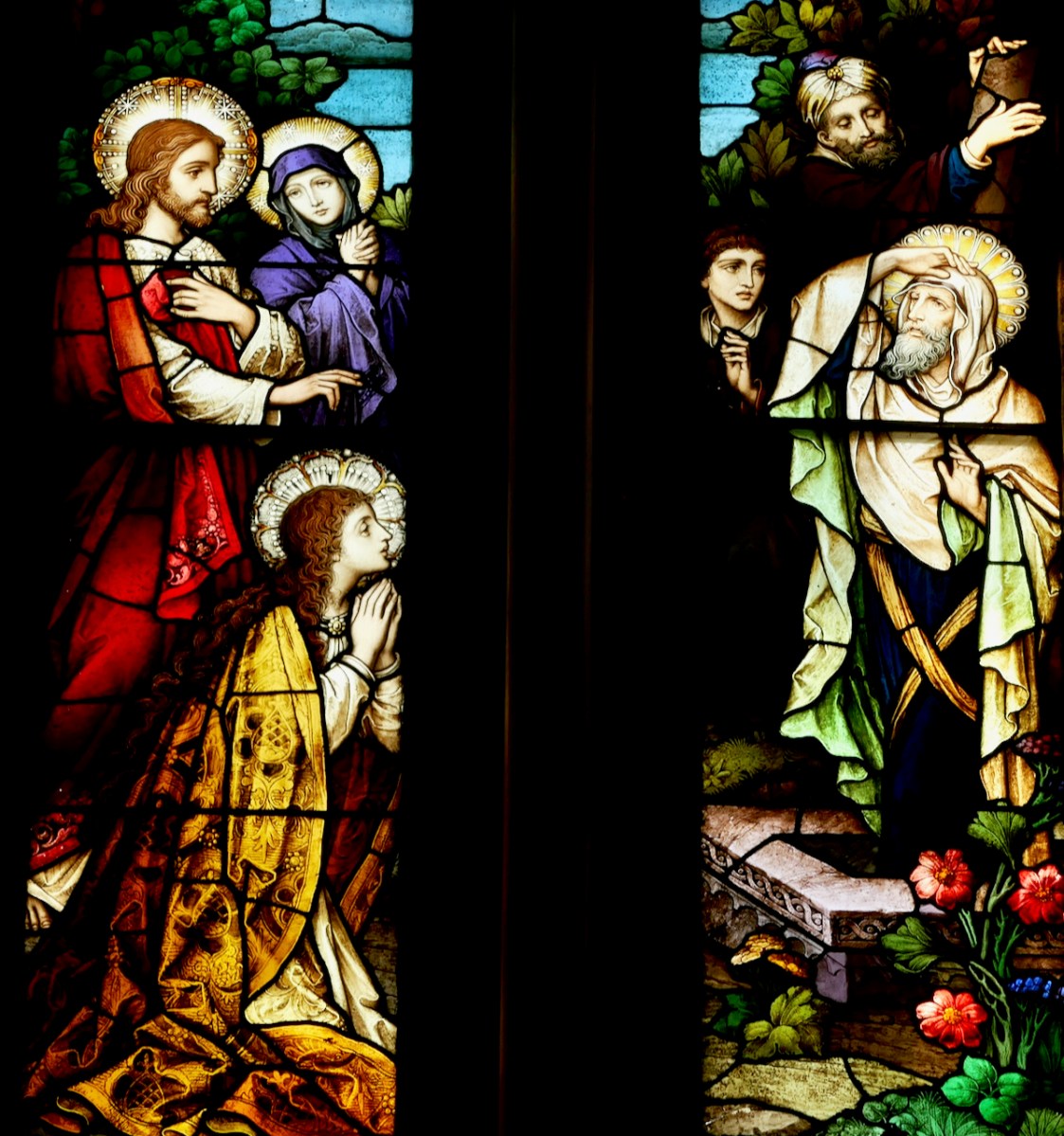
Christ with Mary and Martha, Mayfield, Cork

Because of the opprobrium that such a scandal would have visited upon both Elizabeth Kelly and Michael Healy, Diarmuid was never told that Healy was his father, but he must have suspected, and in more recent times DNA testing confirmed the relationship. Reading about the frequent tragedies that befell the Healy family and the privations under which he grew up, I find it very comforting to know that Michael enjoyed the security and love of his adopted family as he got older.

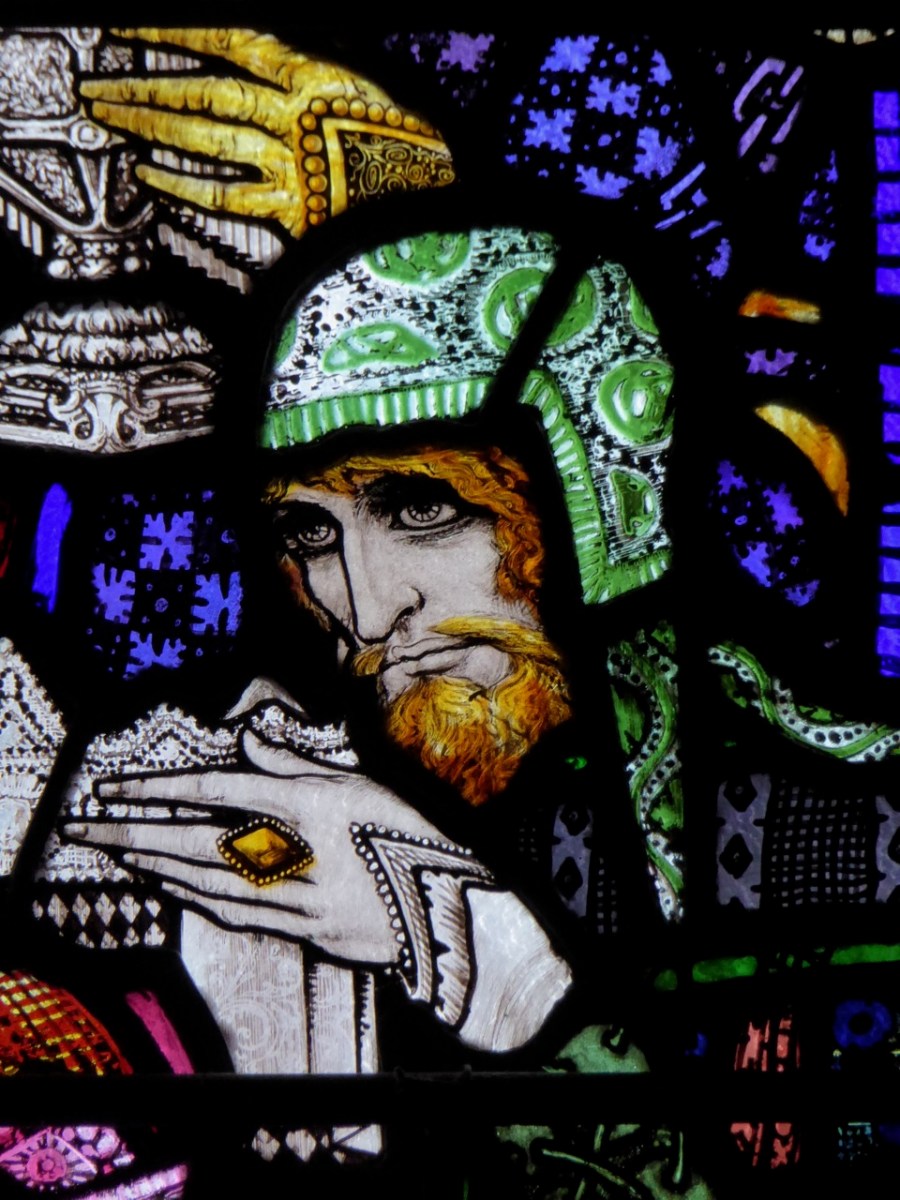
St Simeon, one of Healy’s early windows for Loughrea Cathedral

David leads us on a measured journey through Healy’s life and work. He was the first recruit to An Túr Gloine, Sarah Purser’s stained glass studio, and later co-op. There, he worked alongside AE Child (also his instructor at the Dublin Metropolitan School of Art), Catherine O’Brien, Beatrice Elvery, Ethel Rhind and Hubert McGoldrick. All of them looked up to him as the finest painter at the Studio. He, in turn, admired the work of Wilhelmina Geddes, and when her health caused problems he finished some of her windows, trying to respect her style and designs. But it wasn’t until Evie Hone arrived that he found a true colleague – Nikki Gordon Bowe described Hone as “his devoted disciple and admirer” and she finished some of his windows after he died.
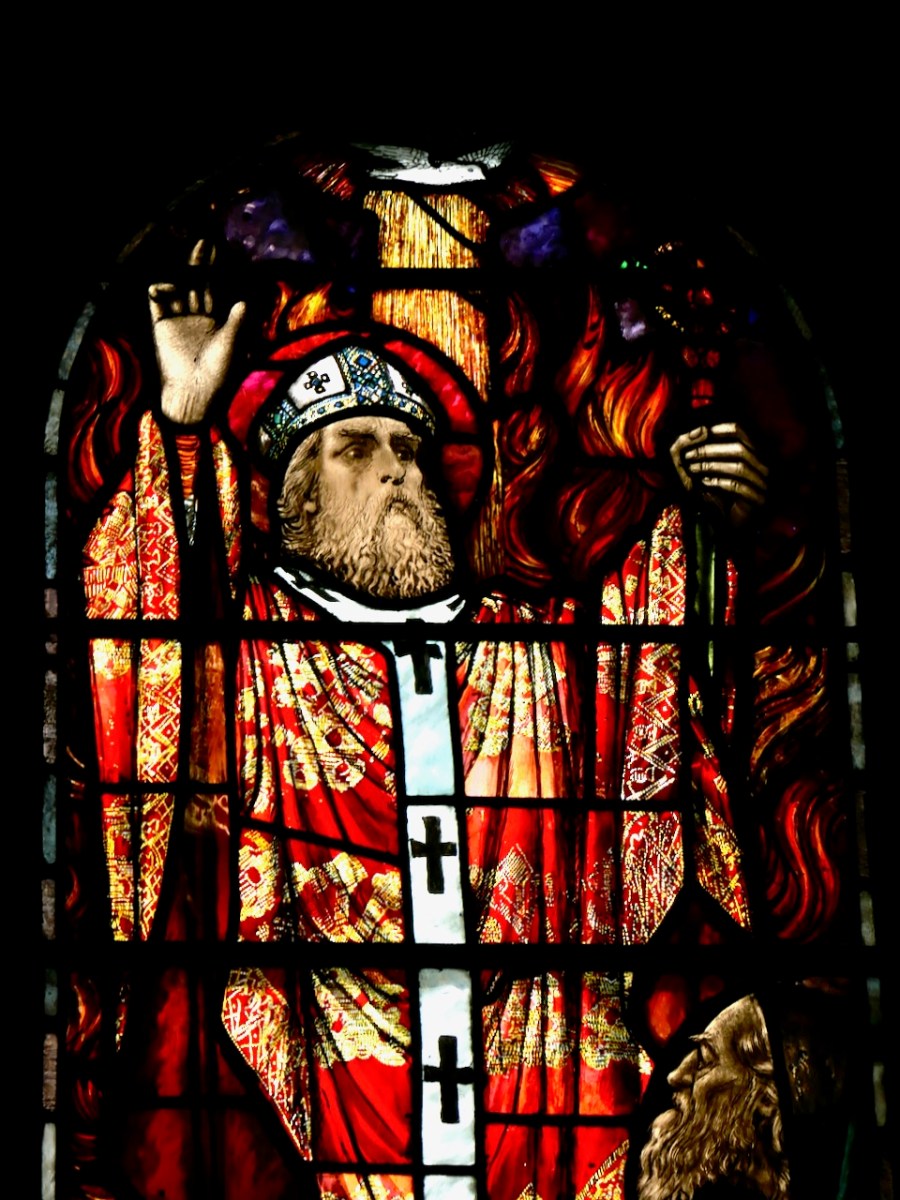
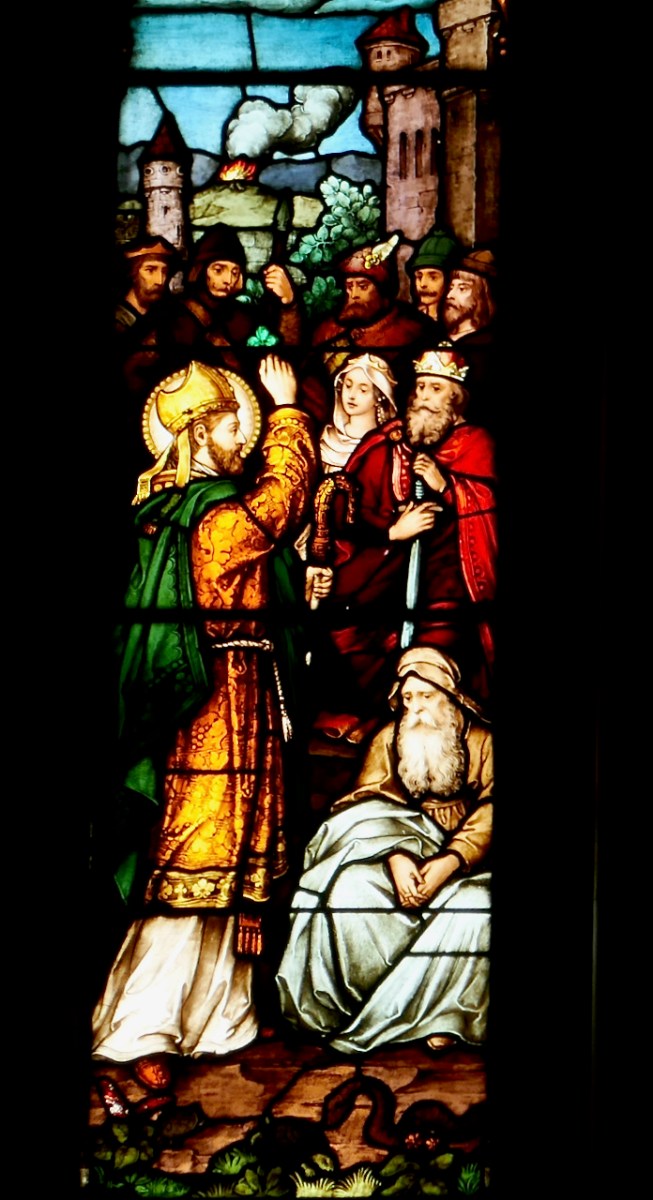
Healy designed many Patrick windows – this one is in Glenariff Co Antrim

Each commission is described and through David’s detailed accounts we come to understand Healy’s style – what iconography he was attracted to, how he decided on the myriad details with which he embellished his windows, and most of all, his decorative methods. 
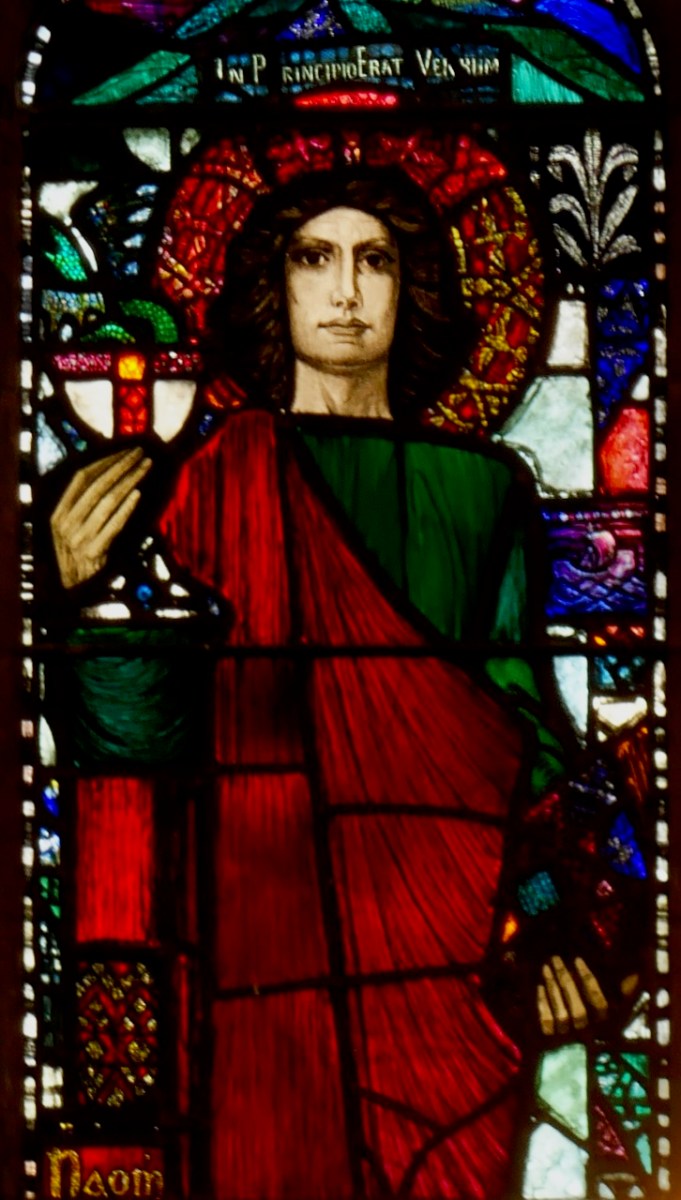
John the Evangelist, Loughrea Cathedral

Long before Harry Clarke made it is his signature, Healy was a master of aciding, a difficult (and dangerous) process used to remove colour from the surface of flashed glass. Flashed glass is clear glass which has a skim of coloured glass fired onto its surface. This top layer could be removed by scratching or etching it away, or by immersing the glass in a bath of hydrofluoric acid, having first applied beeswax to any surface where the colour should remain intact. By waxing and immersing, often several times, colour could be altered from, for example, a rich ruby red to the merest hint of pink, and all shades in between.
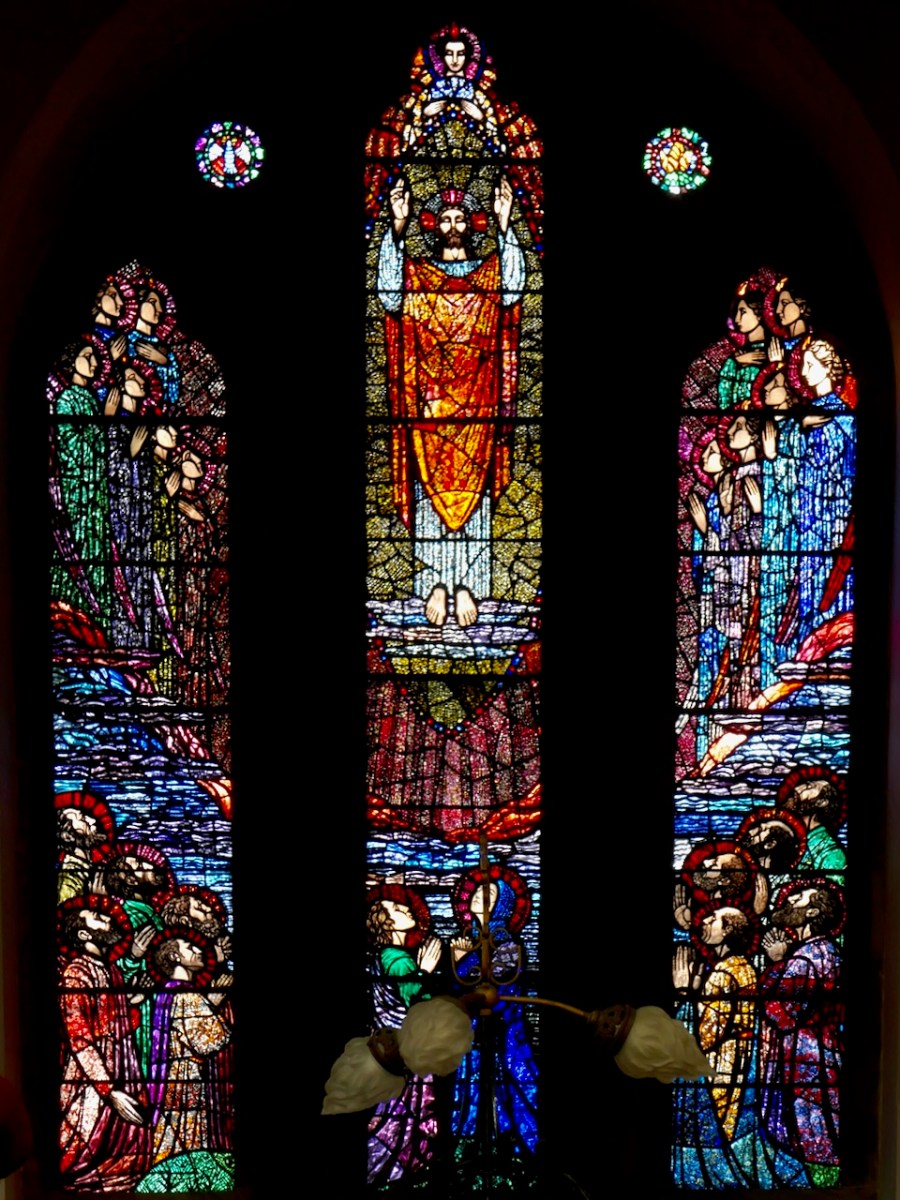
Healy’s Ascension, in Loughrea Cathedral

Healy would often plate two sheets of glass together – for example, one red and the other blue – each one carefully acided, and could by this means achieve an astonishing array of colours from the red-blue side of the spectrum. Added to this, he would often use silver stain on the back of the glass. Once heated in the kiln, the silver stain would permeate the glass, turning it yellow (repeated firings could deepen this from bright yellow to a rich amber colour). Finally, all the figuration would be painted and stippled on to the surface of the glass and the individual pieces of glass would be assembled and leaded together to produce the finished window. Healy was a perfectionist and Purser would despair of ever making enough money to keep the studio going since he spent so long on each commission.
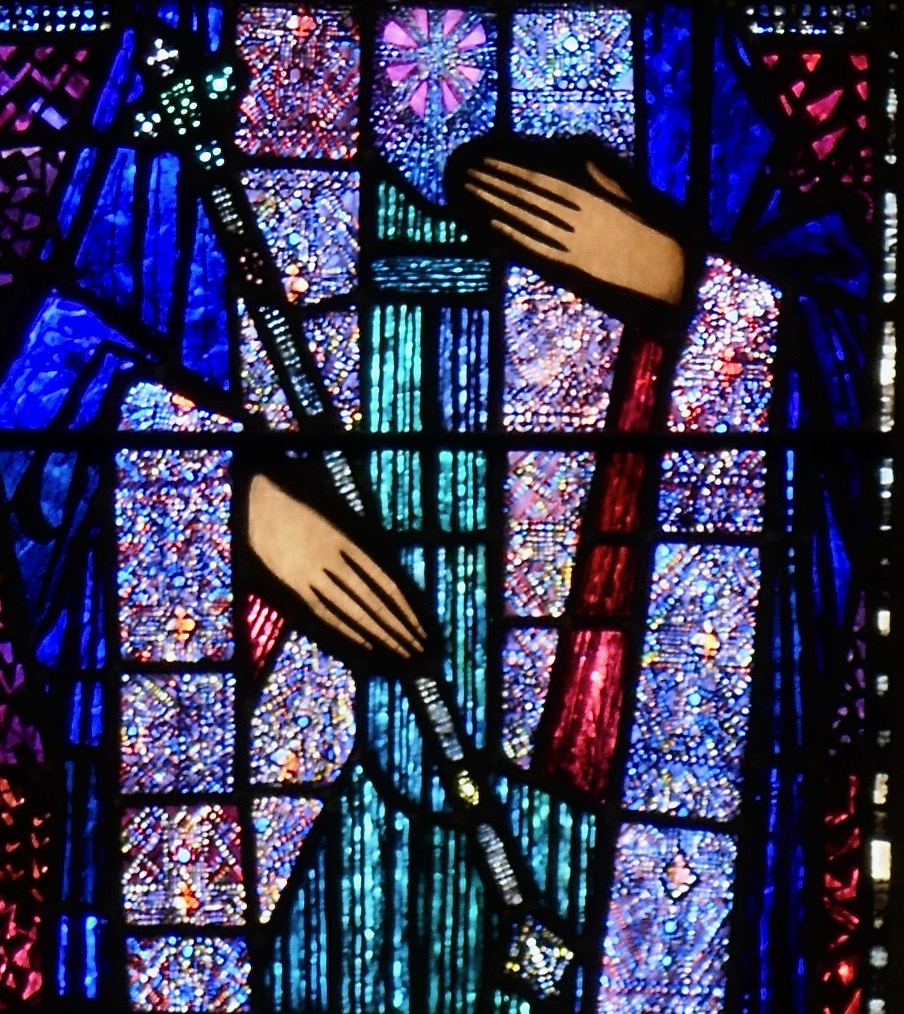
This detail from Healy’s Virgin Mary window in Loughrea illustrates well his aciding technique using red and blue flashed glass plated together to produce not only infinite shades of colour but a sparkling jewel-like effect

It is through David’s lively analysis of each window that we truly come to appreciate Healy’s genius and his evolution as an artist, his style developing according to his exposure to more modern influences.
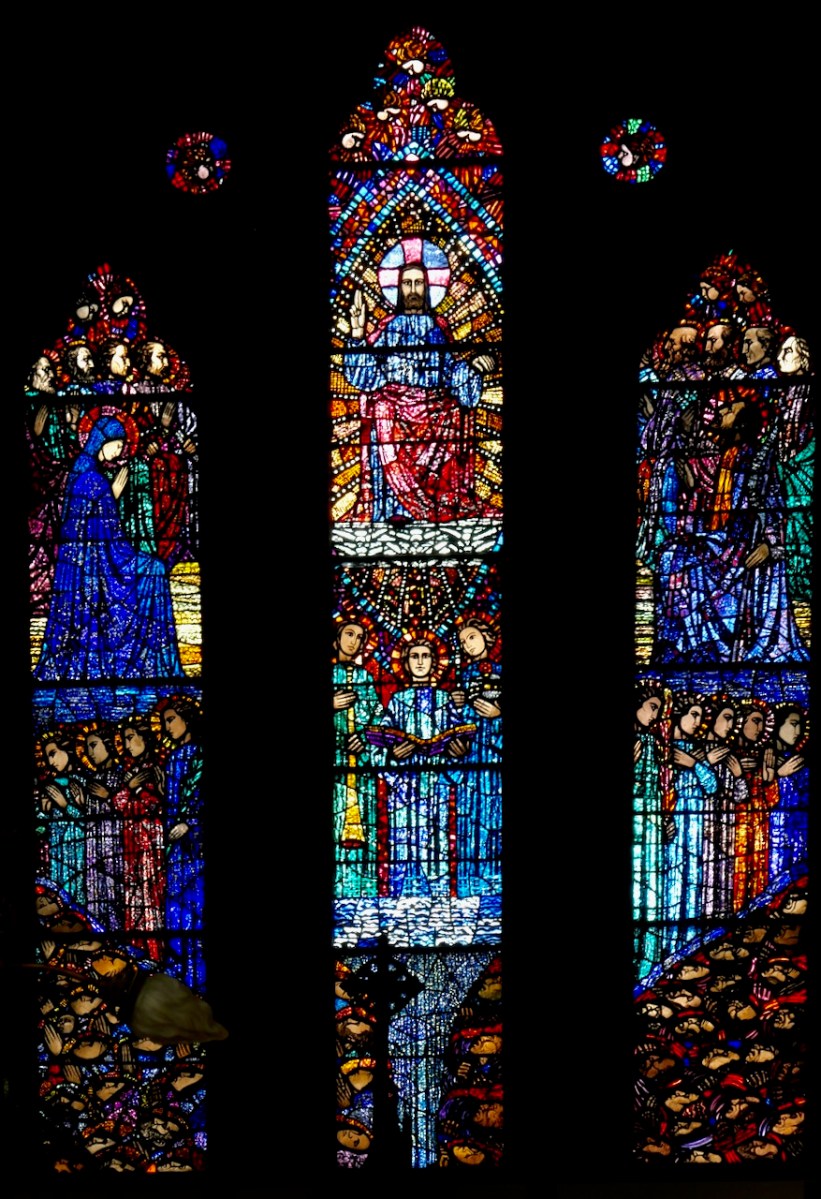
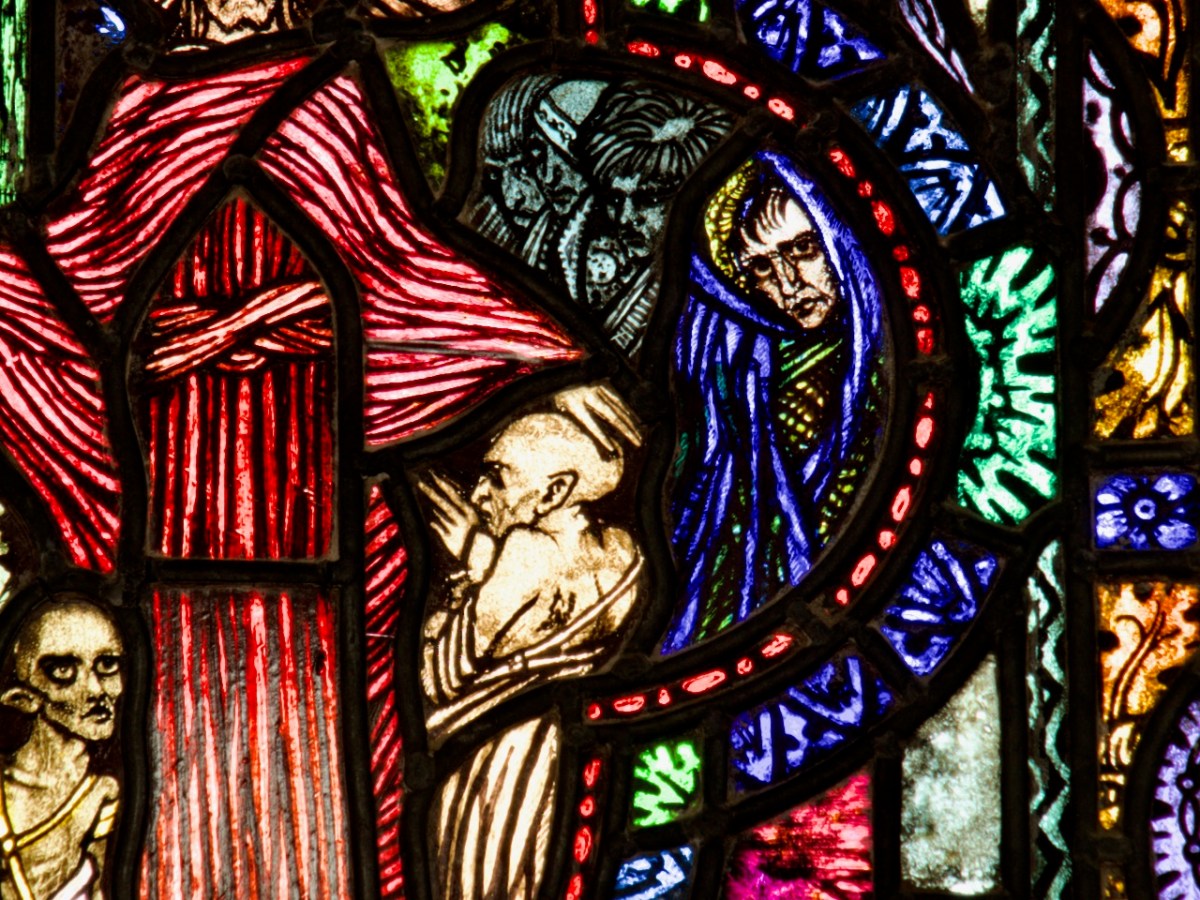
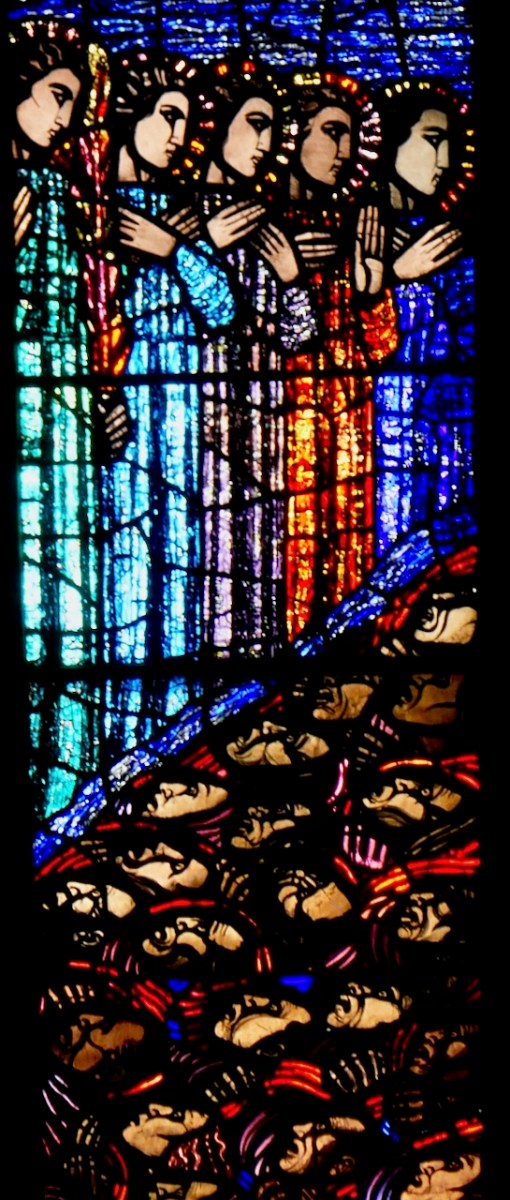
Considered one of his masterpieces, this is the Last Judgement Window in Loughrea, completed towards the end of his life. A detail from The Damned(right -hand light) is below

David wears his erudition lightly and when he dissects a window, pointing out elements that are easy to miss, and explaining what they mean and why Healy used them, I found myself pouring over Jozef’s wonderful photographs, picking out each separate item of iconography, and marvelling anew at the depths of learning that Healy brought to his designs. For example, David devotes five pages to the St Augustine and St Monica window in John’s Lane Church in Dublin and not a word is wasted.
Along the way we meet a host of characters – the redoubtable Sarah Purser and his colleagues at An Túr Gloine, enterprising priests and bishops, citizens memorialising their dead family members (CS Lewis!), art critics such as C P Curran, American heiresses, patrons of the arts, Celtic Revival influencers (OK, modern word, but you know who I mean). We get insights into the inner workings of the studio, wherein frequent bouts of unprofessional behaviour created tensions, and where Sarah Purser often had to crack the whip when productivity lagged. We come to understand the difficulties of soliciting business, agreeing on final designs and delivering orders, especially to overseas clients, in days when postal service to American and New Zealand took weeks.

A detail from the Patrick window in the National Gallery

We also come to see Healy as a rounded artist who did more than stained glass. His quick sketches of Dublin characters, drawn from life have all the attraction of immediacy and familiarity, while his watercolour landscapes are charming.  

An early Loughrea window, Virgin and Child with Irish Saints

Healy died in 1941. By the time you finish the book, you feel you have lost a friend – a difficult and complicated one to be sure, but one whom you admire and will never forget. While obviously a gruff character on the outside, David allows us access to his humanity, and points out the obvious sympathy with which he portrays some of his subjects. His Loughrea St Joseph (below), for example, shows, in the words of the art critic Thomas McGreevy, a “Joseph who knows the tragedy of the world and who has some special understanding of the destiny. . . of the child”. We are, of course tempted to see in the tenderness with which Joseph gazes down at Jesus a revelation of Healy’s suppressed feelings for his own son.

This book is not just for stained glass enthusiasts, though they will delight in it, but for anyone interested in life in Ireland at the end of the 19th and beginning of the 20th century, and indeed for anyone who enjoys good writing and a story that propels you through almost 70 years of the life of a significant artist. Available from the publisher or in all good bookstores.
Ecce Homo: Harry Clarke’s Kilbride Window

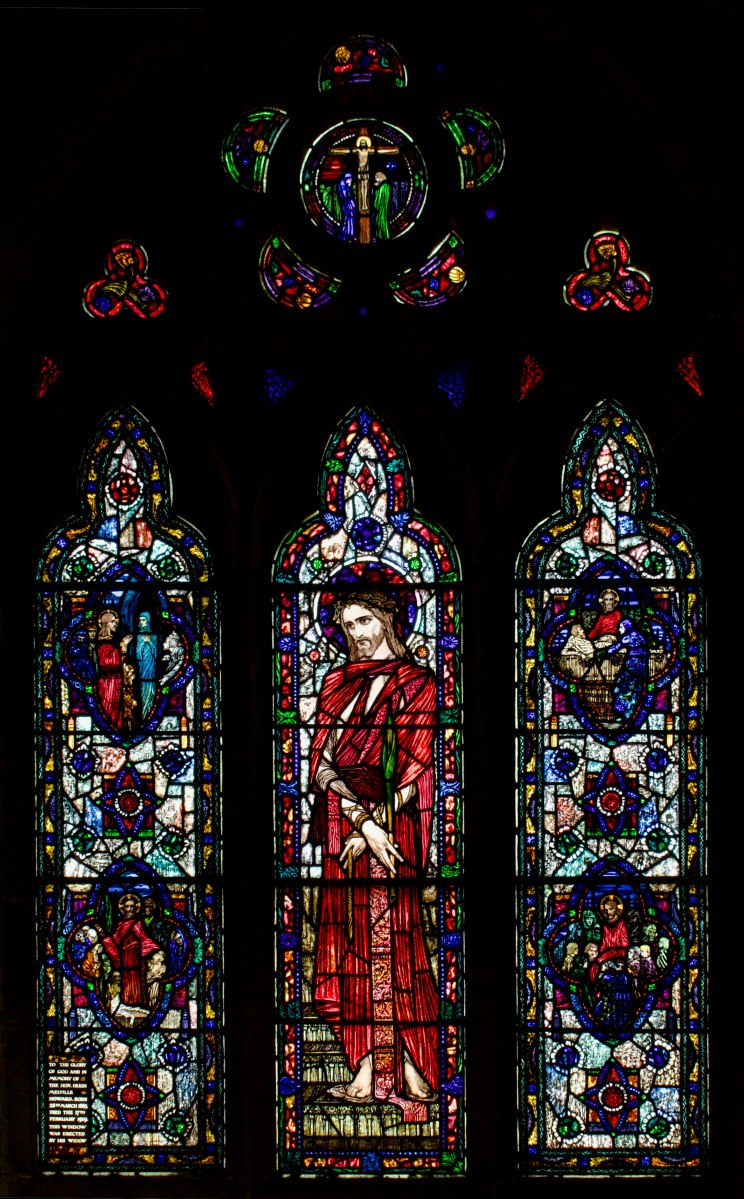
Harry Clarke’s window in St Brigid’s Church of Ireland, Kilbride, Co Wicklow, is a bit of a mystery: simultaneously one of his most beautiful and his most mis-described windows. It’s almost as if there’s some kind of spell on it – whoever shall describe this window shall be led down erroneous pathways*. I hope this post will break that spell and set the record straight.

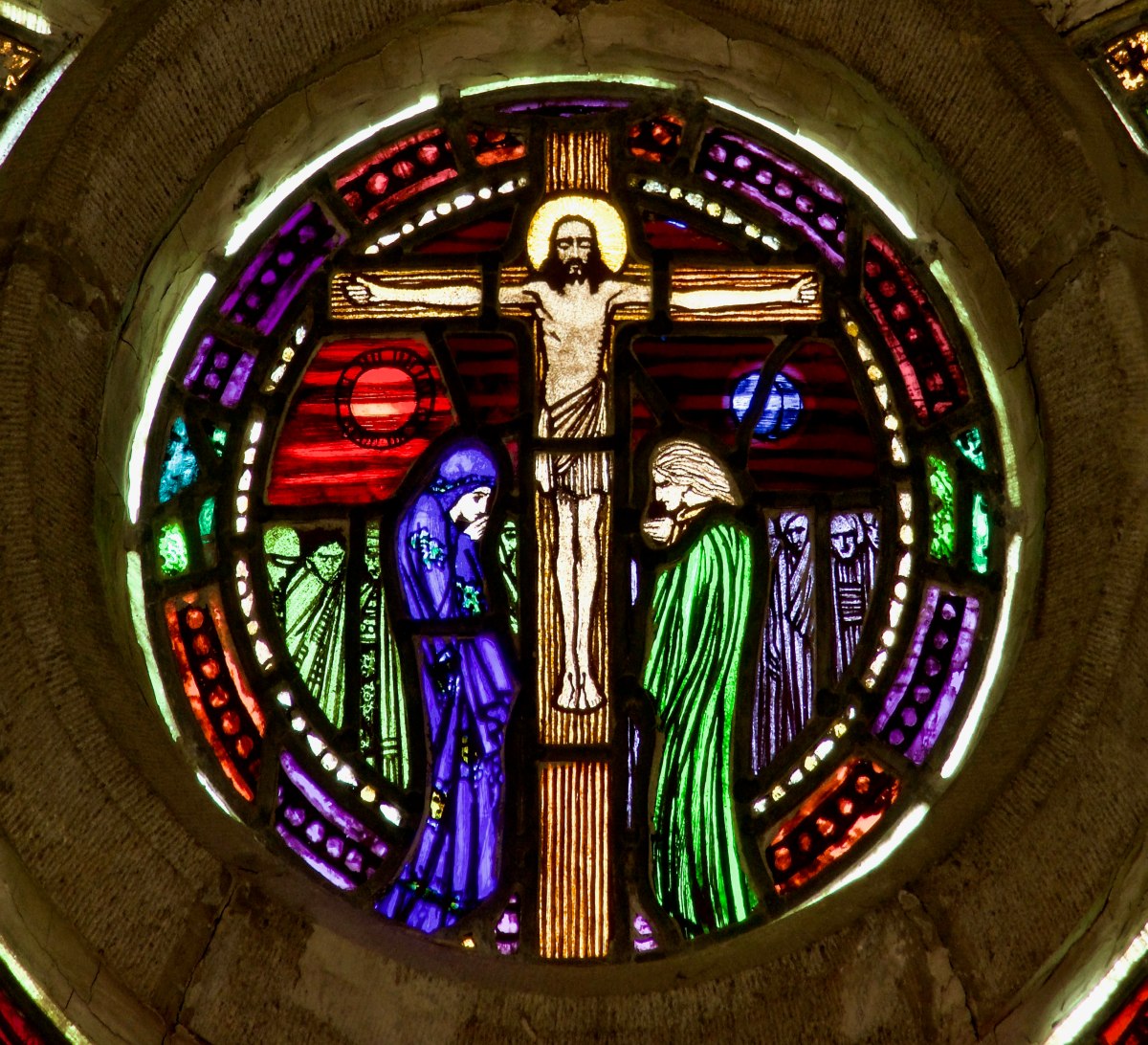
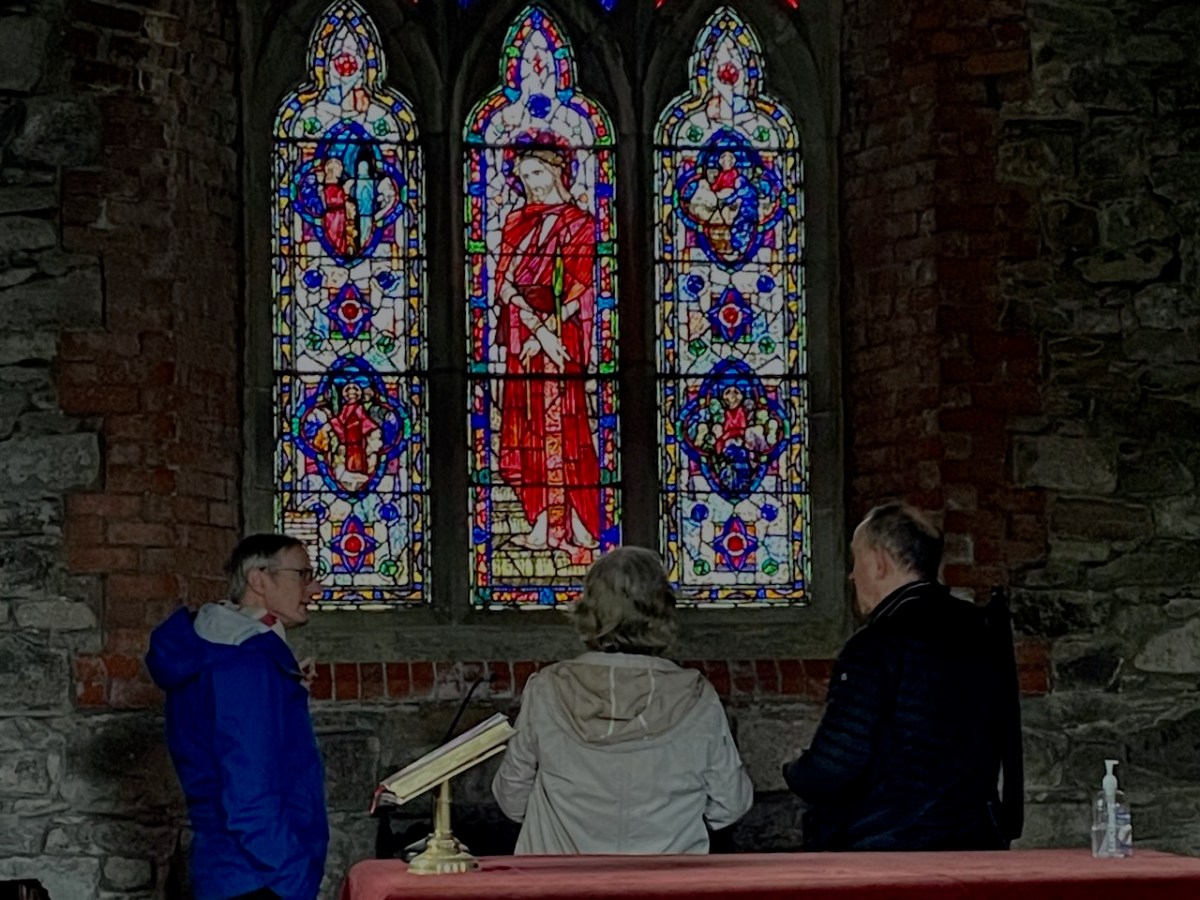
This is the whole window, which occupies the wall behind the altar. It’s a three-light window and the tracery above includes a small roundel with a crucifixion scene.

When it comes to Harry Clarke, there is no more authoritative source than Nicola Gordon Bowe. Hers are the shoulders upon which all of us stand to gain insight and understanding of the man and his work. She didn’t make many mistakes. However, inexplicably, she described this window as a ‘Resurrection’. In The Life and Work of Harry Clarke, she states that: As a result of the St Stephen Lea-Wilson Window in Gorey, Clarke was asked by the Earl of Wicklow to design a Resurrection window for the parish church of Enerily and Kilbride, Co. Wicklow near the Earl’s estate, Shelton Abbey. Several pages further on, she says Harry . . . spent 9 February with the Earl of Wicklow discussing a further window for the small church of Enerily and Kilbride near Arklow.

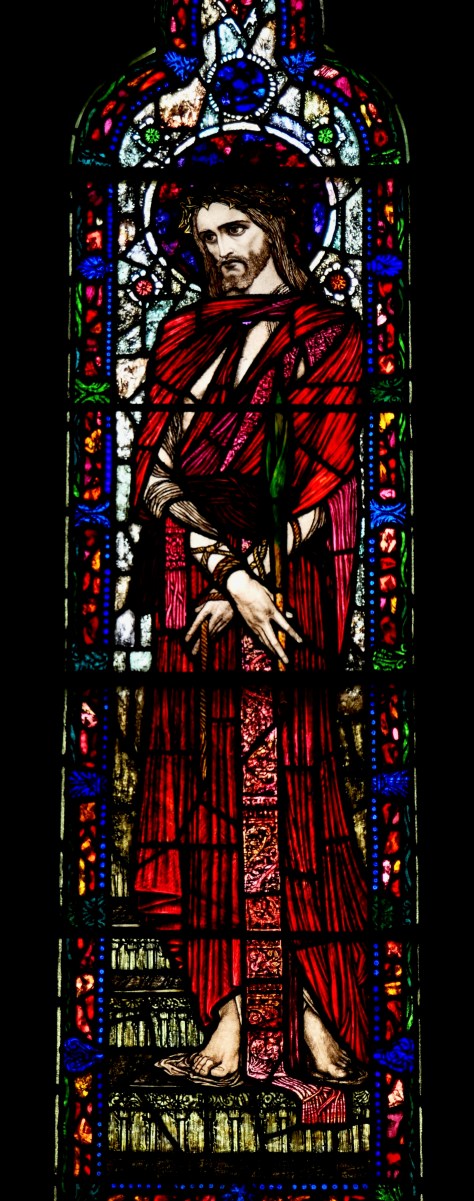
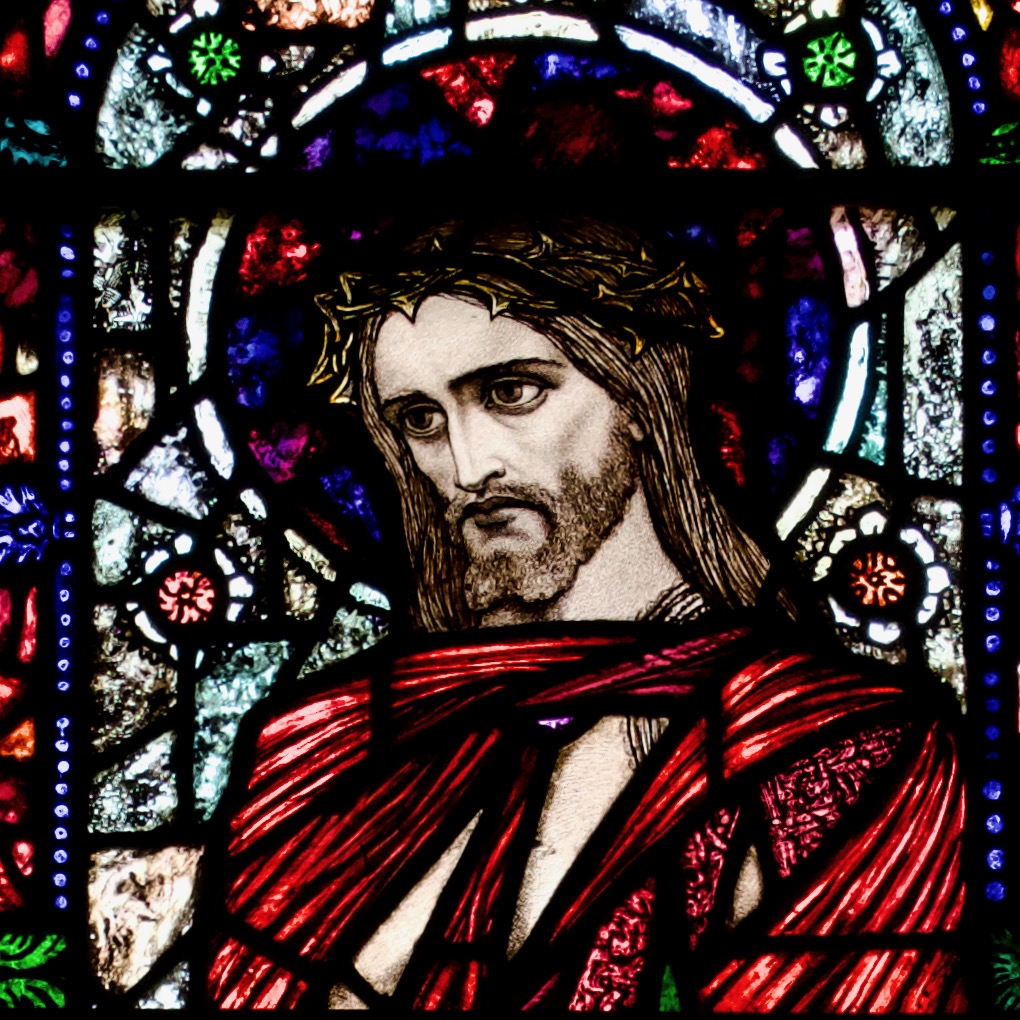
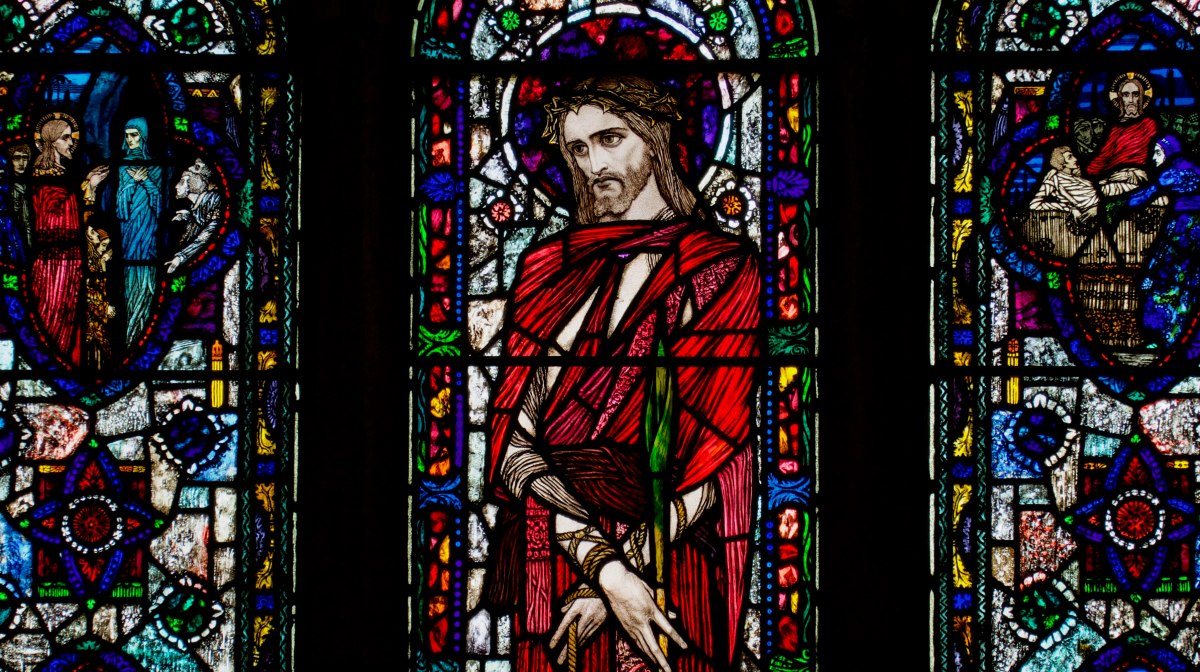
The central figure is of Christ as he was paraded before Pilate, who washed his hands of the affair and declared, as he presented him to the Jews, Ecce Home – Behold the Man. As described in John and Matthew, he is bound, crowned with thorns, holding a reed (Harry has chosen a bulrush), and clad in a scarlet robe. He is standing on steps (as frequently depicted in paintings) and under his feet the cloth may represent his own clothes, stripped from him

She describes the finished window thus: In the three-light Resurrection, the figure of Christ in the centre light stands at the foot of a staircase, robed in ruby, crowned with thorns and bearing the palm of martyrdom. The ruby glass is carried into the border, into the side traceries where it is neither painted nor acided, and is echoed in the medallion showing The Crucifixion in the centre of the rose tracery above. It is also used in the figure of Christ, which appears in each of the quatrefoil panels of the side lights which, set in rich borders of ruby, blue and green, seem inspired by medieval glass. A rich blue dominates four medallions showing miracles of the Lord. The medallion in the lower right-hand light features a self-portrait of the artist, a halo over his untidy hair, and huge eyes giving him a haunted look while above, the resurrection theme is evocatively illustrated by the miracle of Lazarus. This window is much enhanced by the rough, unplastered wall in which it is set.

Clarke’s Jesus in this window is one of his most striking depiction of suffering and compassion

However, the dedication on the window is to Hugh Melville Howard, younger half-brother to the Earl of Wicklow, and donated not by the Earl, but by Hugh’s widow.  Hugh had died in 1919. The date might make you suspect that this was a war memorial window, but in fact, Hugh died of pneumonia at the age of 36. This must have been a tragedy indeed for his wife, May Sands, the only daughter and heiress of New York lawyer and real estate mogul, Benjamin Aymar Sands. They had married in America in 1908 – a high society wedding, every detail of which was gleefully reported in the New York Times. At the time of his death they were living in Bellevue House in Delgany and had two children. The window was not installed until 1924.

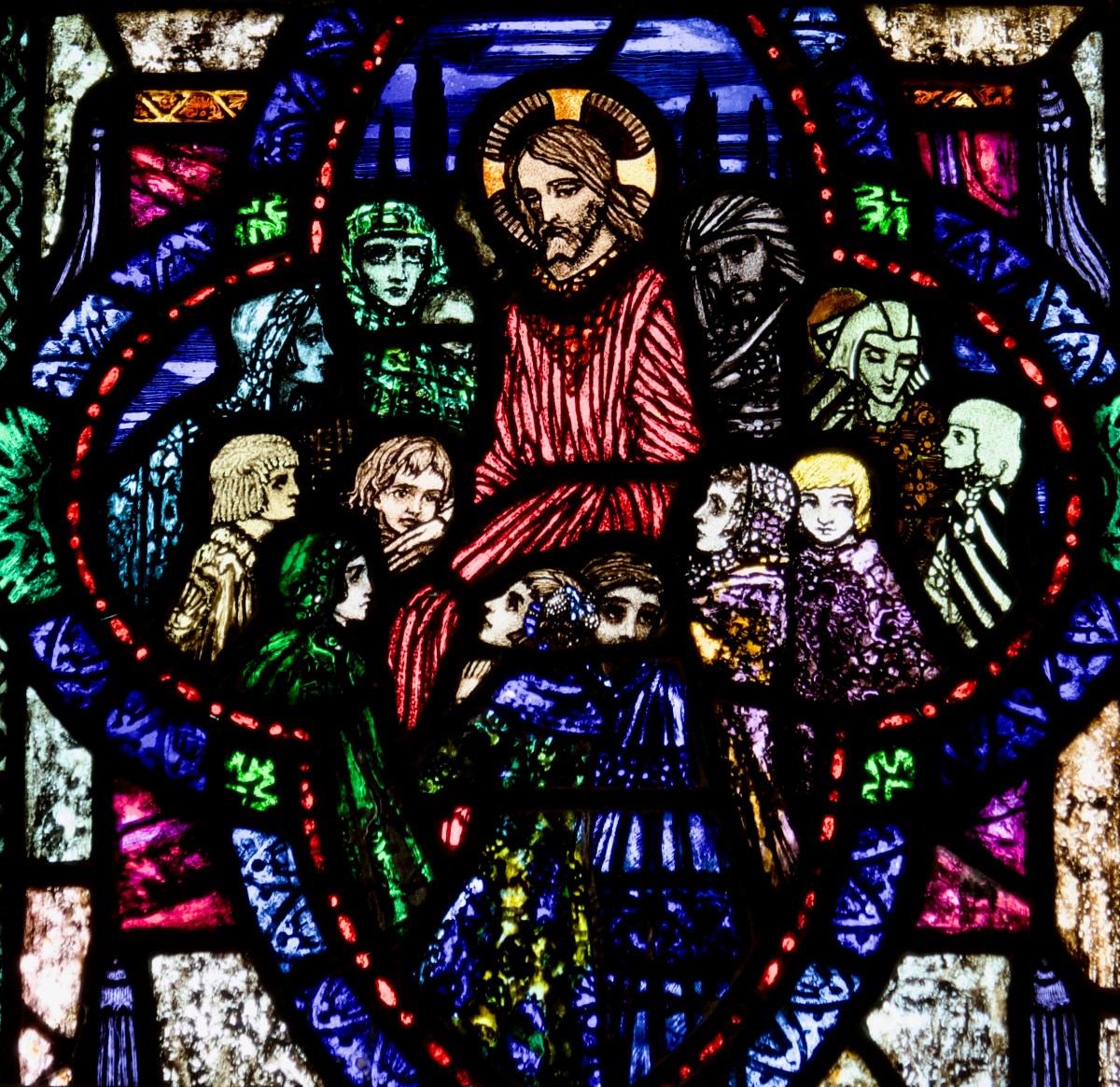
Christ and the Children

So there seems to be a disconnect between the original idea for a Resurrection Window for Kilbride, and the final product, which depicts not, indeed, a Resurrection image but that of the suffering Jesus, mocked by his tormentors, scourged, bound with ropes, crowned with thorns, carrying a reed to stand in for a sceptre. This is the image that is known as Ecce Homo – Behold the Man. 

Matthew 27: 26-31

Then released he Barabbas unto them: and when he had scourged Jesus, he delivered him to be crucified. Then the soldiers of the governor took Jesus into the common hall, and gathered unto him the whole band of soldiers. And they stripped him, and put on him a scarlet robe. And when they had platted a crown of thorns, they put it upon his head, and a reed in his right hand: and they bowed the knee before him, and mocked him, saying, Hail, King of the Jews! And they spit upon him, and took the reed, and smote him on the head. And after that they had mocked him, they took the robe off from him, and put his own raiment on him, and led him away to crucify him. 

John 19: 1-5

Then Pilate therefore took Jesus, and scourged him. And the soldiers platted a crown of thorns, and put it on his head, and they put on him a purple robe, And said, Hail, King of the Jews! and they smote him with their hands. Pilate therefore went forth again, and saith unto them, Behold, I bring him forth to you, that ye may know that I find no fault in him. Then came Jesus forth, wearing the crown of thorns, and the purple robe. And Pilate saith unto them, Behold the man!

I surmise that, whereas the original idea, as proposed to Harry by the Earl, may have been for a Resurrection-themed window, the final central image, of suffering and preparation for death, would have seemed more apt to May, the grieving widow. 

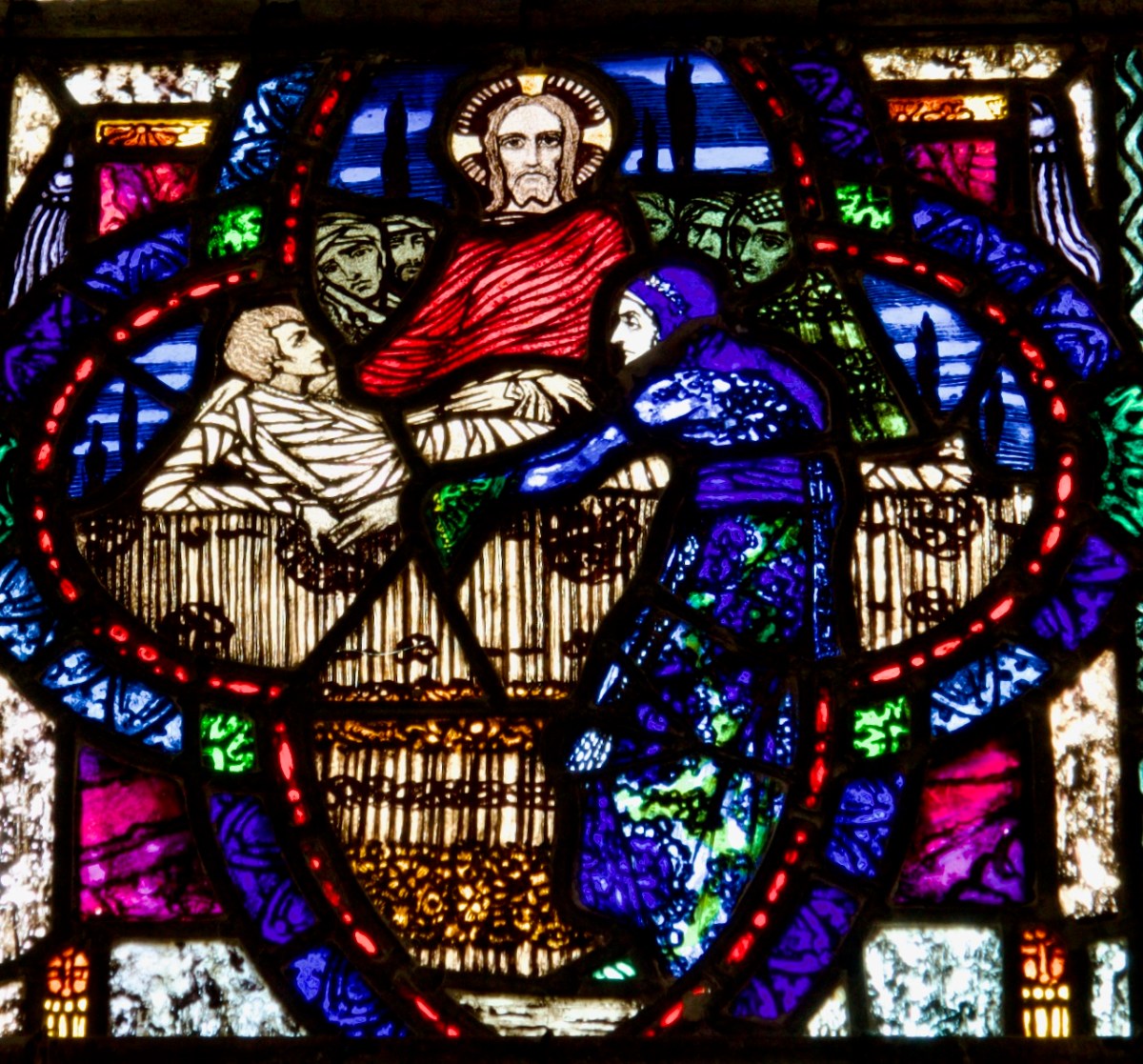
The Raising of Lazarus

May and Hugh had been married in a charming country church called St Andrews Church of the Dunes in the heart of the Hamptons on Long Island. It was an Episcopalian church patronised by wealthy New Yorkers who had country houses in the area. Episcopalian services focus on the sacraments, similar to a Catholic Mass, and the church was filled with stained glass, some by Tiffany.

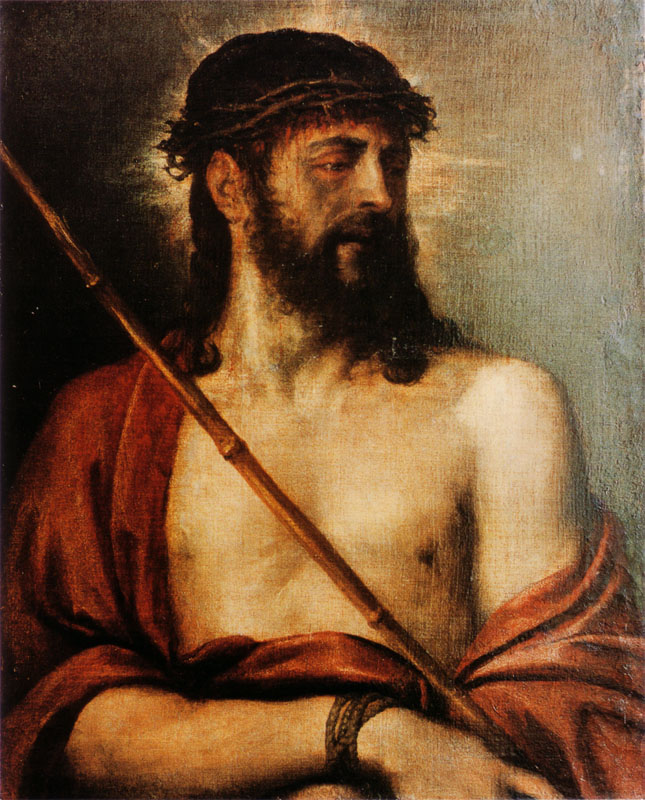
Ecce Homo by Titian (Unknown source, Public Domain, https://commons.wikimedia.org/w/index.php?curid=5557882)

This is relevant because Ecce Homo, despite being a staple of Renaissance imagery (Titian alone did several versions, including the one above), is not a frequent choice for Church of Ireland windows. I can identify only eight windows (of 3,198) which contain Christ in this state of having been scourged or mocked. (There are, on the other hand, one hundred and eleven Resurrection windows.) If it was May, rather than Lord Wicklow, who had the final say in the central imagery, I can see how her background in a more Catholic form of worship might have made her more amenable to an Ecce Homo depiction, and that therefore what started out as a Resurrection Window (with supporting Resurrection-themed medallions), ended as a window depicting suffering, healing, and children. 

The Raising of the Widow’s Son at Nain

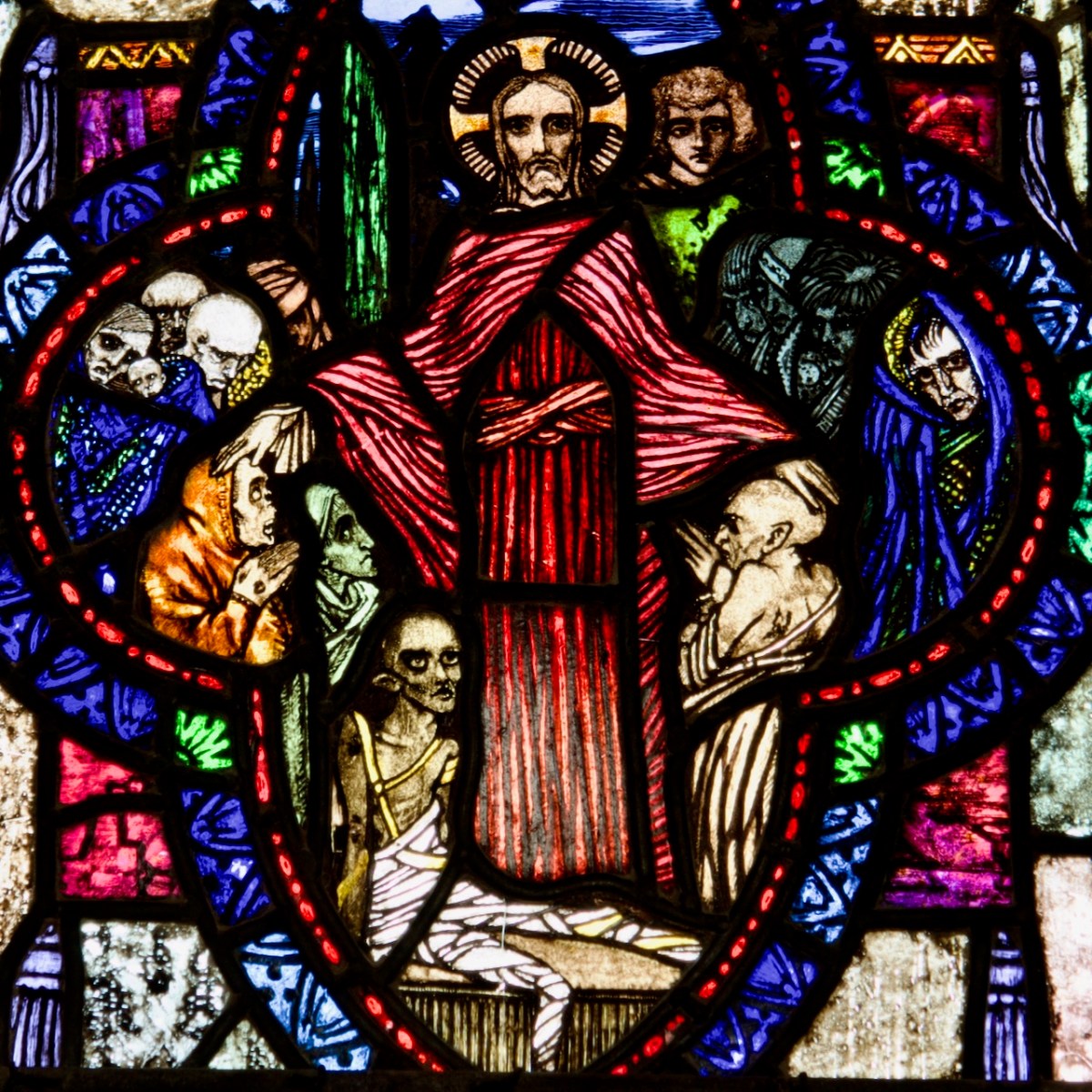
Four medallions are placed on either side of the central figure of Christ. Three relates to the theme of Resurrection and/or healing – The Raising of Lazarus (Top Left); The Raising of the Widow’s Son at Nain (top right); and Christ’s Healing Ministry (bottom left). The final medallion is Christ Blessing Children (bottom right), perhaps a reference to hope that May’s children, now fatherless, would find comfort.

Christ’s Healing Ministry

In the medallion above, Gordon Bowe identifies a self-portrait of Harry, peering in on the right-hand side (below). Harry has done this in other windows, often more immediately recognisable than here. The parade of sick, palsied, bandaged and leprous sufferers are typical of Harry’s affinity to the macabre.

In the cinquefoil tracery at the top of the window is a small roundel containing the Crucifixion. Although tiny, it is as full of detail as are the medallions.

David Lawrence, in his entry in Gloine, correctly identifies the medallions, and uses Christ as Martyr for the central figure, perhaps because he (like Gordon Bowe) interprets the ‘sceptre’ that Jesus is carrying as a palm, the icon of martyrdom. In Strangest Genius, by Lucy Costigan and Michael Cullen, the authors simply repeat the description and background as gleaned from the work of Gordon Bowe (although without credit, as seems to be their practice), along with the errors, and add one of their own, describing the reed as a ‘lily. . .denoting his virtue.’

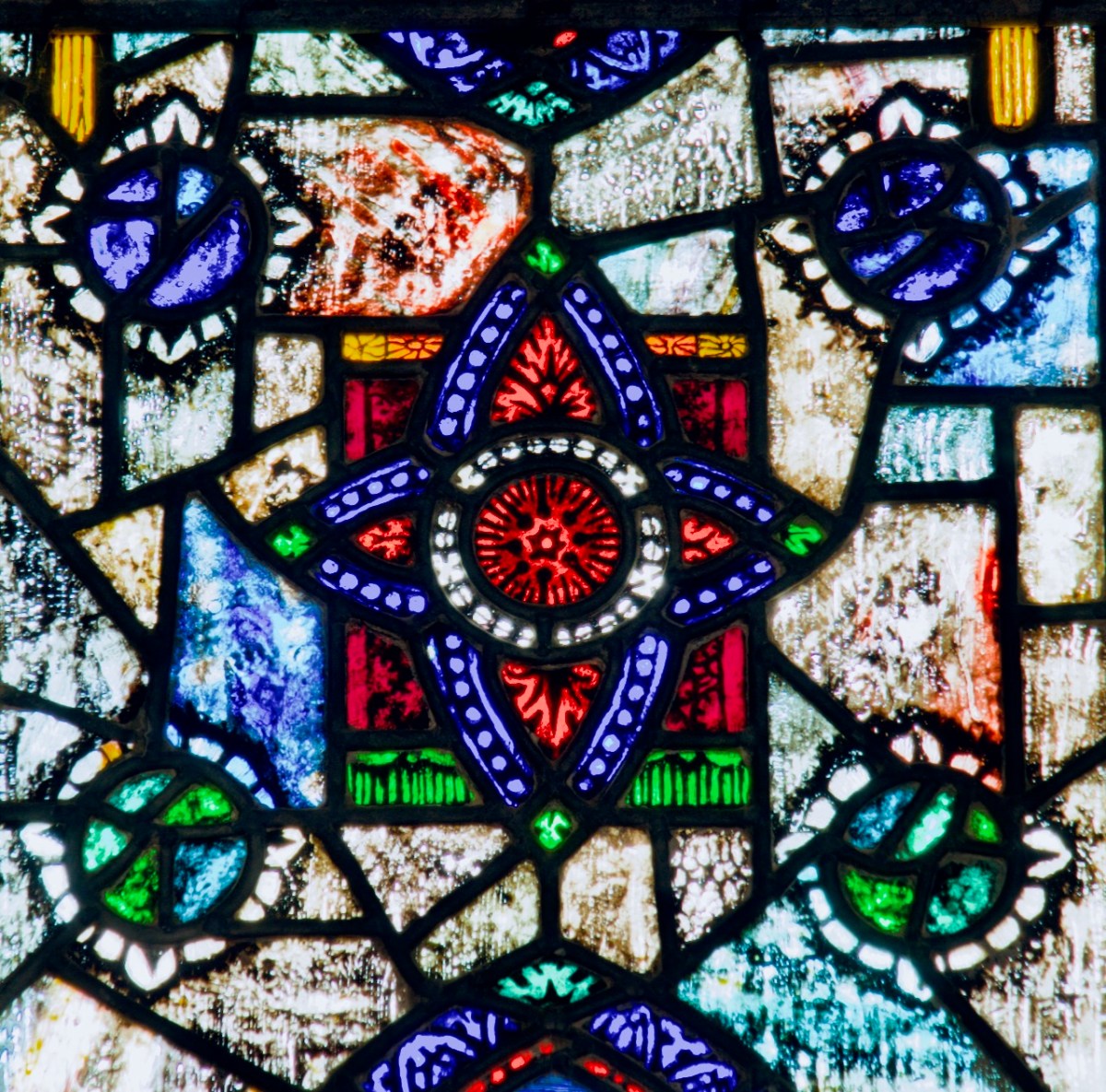
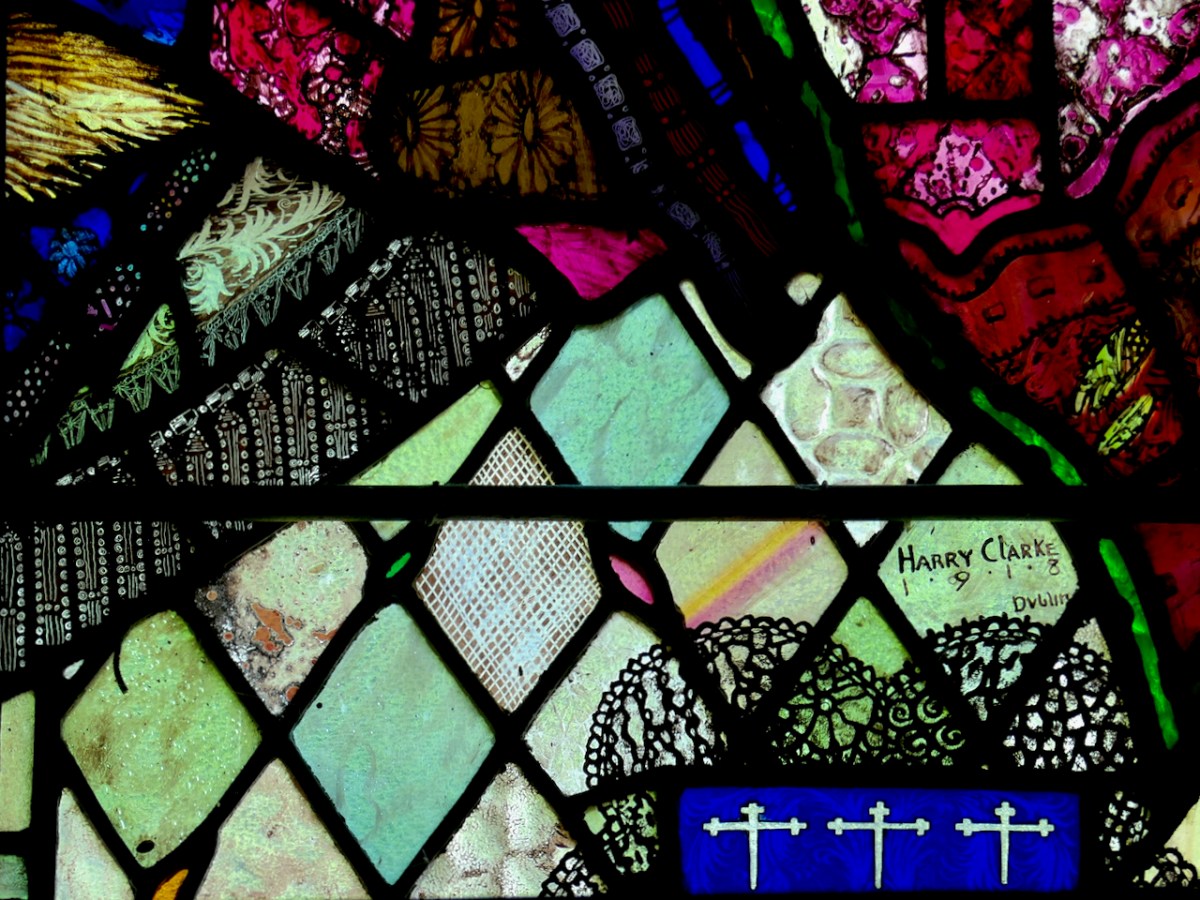
Gordon Bowe often uses the term jewel-like to describe Harry’s ability to make his windows sparkle and shimmer and to use advanced techniques (such as plating and acid-etching) to create depth and allow the sun to refract through the glass. The window in Kilbride is a master-class in how he achieves this effect, especially in the decorative areas between the scenes, as in the one above. No photograph can do justice to this effect.

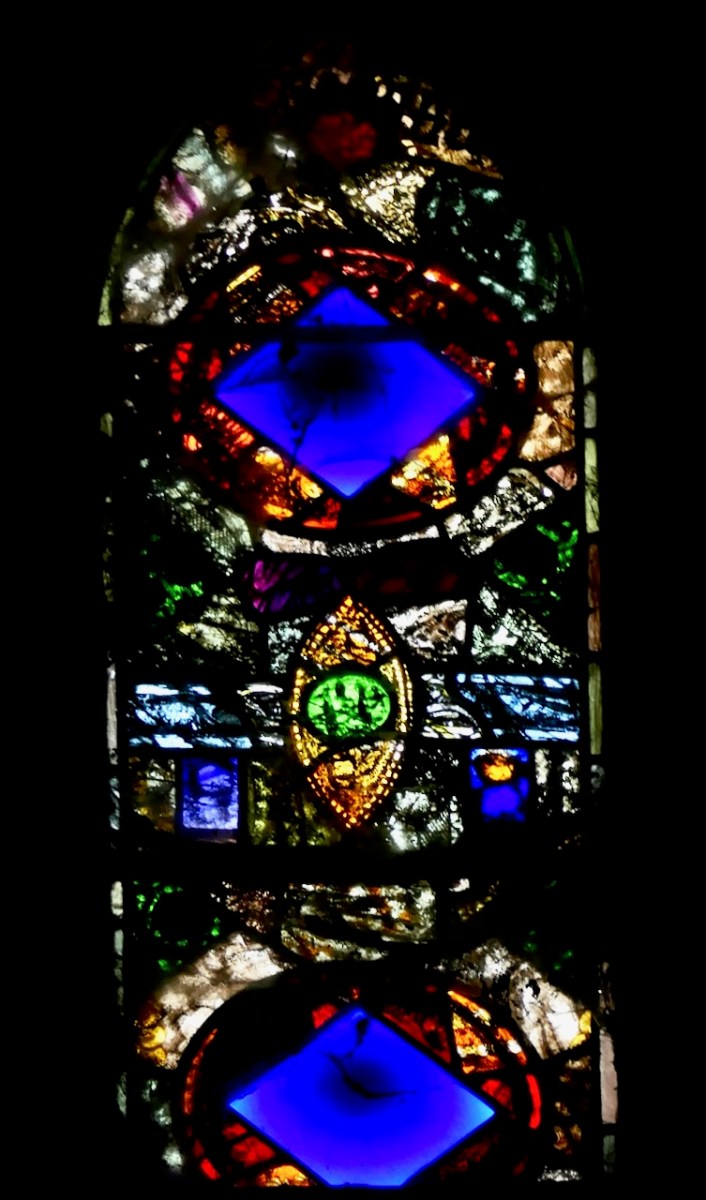
Oh, and just to add to the fact that this tiny church has an exceptional Harry Clarke window – it has a second one (above). Harry made it with left over ‘scraps’ of glass, to fill a small, high, transept window, and he described it as an ‘experiment.’ The two pieces of blue glass prefigure the mid-century practice of dalles de verre, of which we have several excellent examples in Irish Churches.

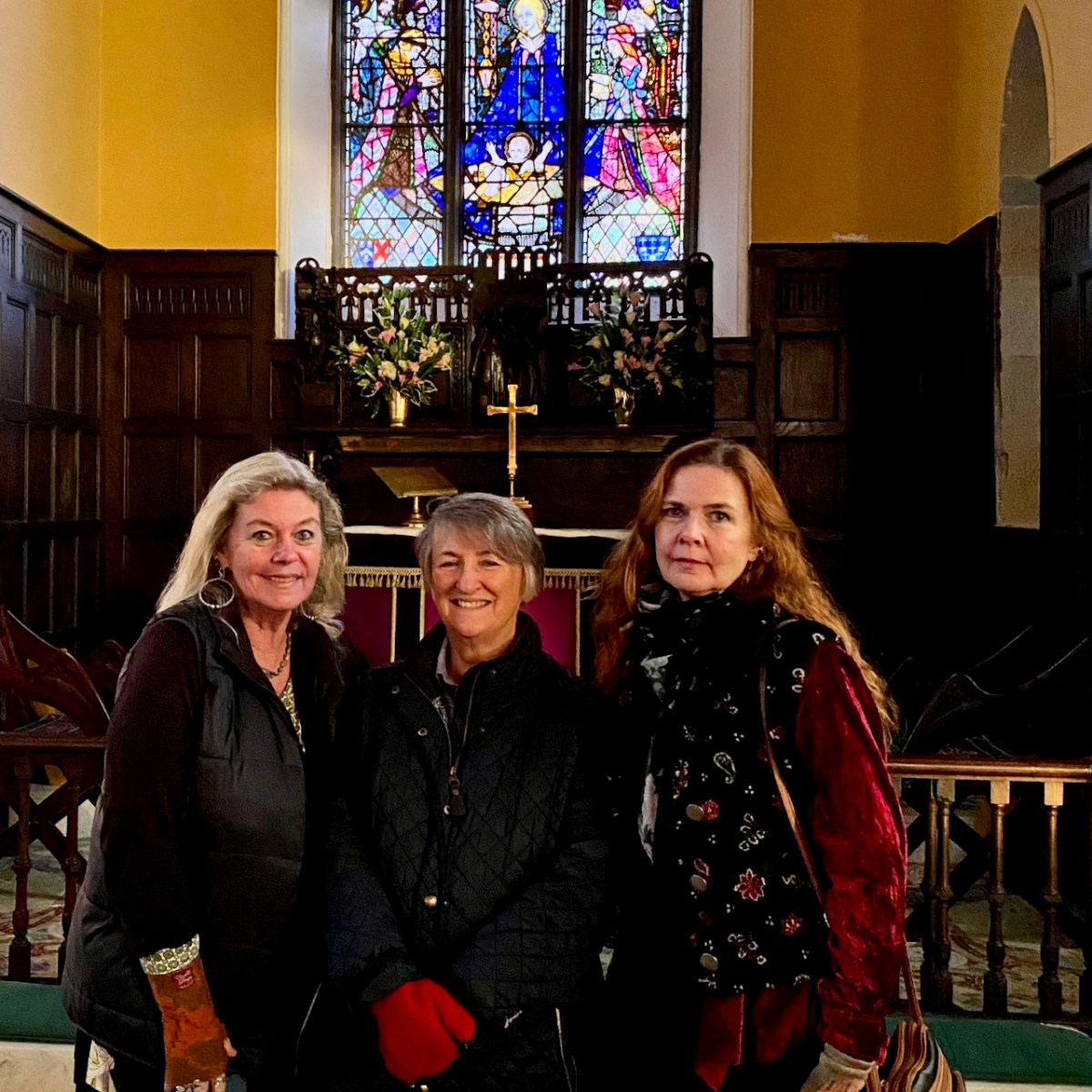
David Caron, Editor of The Gazetteer of Irish Stained Glass; Ruth Sheehy, author of The Life and Work of Richard King; and Paul Donnelly, expert researcher on the Harry Clarke Studios, in front of the Ecce Homo window on a recent visit. Together, we discussed the most appropriate title for the window. Like most Church of Ireland churches, Kilbride is closed most of the time, and therefore the window is not easily accessible. I am very grateful to the Rev Barrett for allowing us to view and photograph the windows last week. Besides the photographs in Gloine, I can find no other images of the window online, so I hope this post will clarify what this window is actually all about. 

*The most head-scratching erroneous description comes from this report in The Wicklow People

When Harry Met Edith: Part 3: “A Charming Little Nativity”

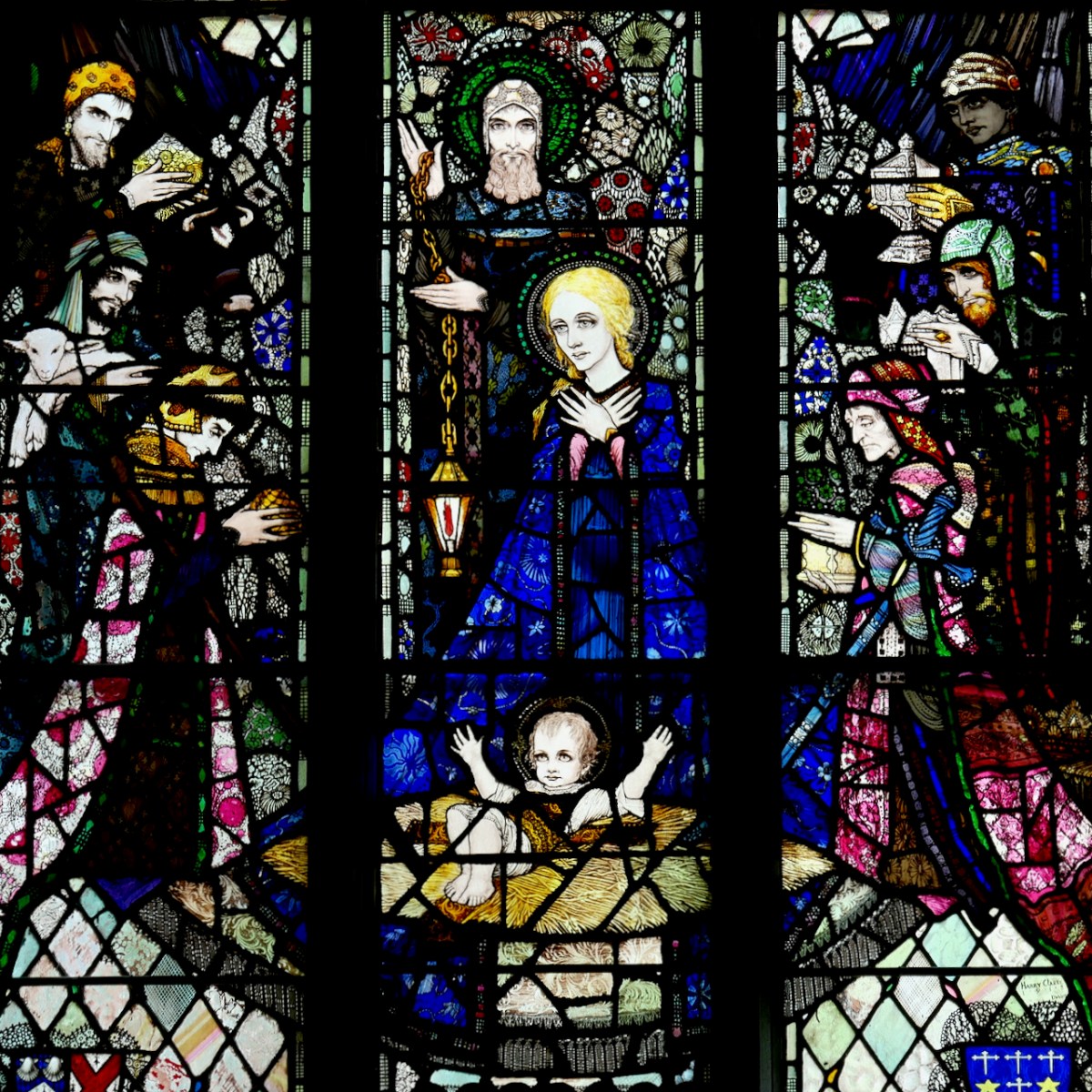
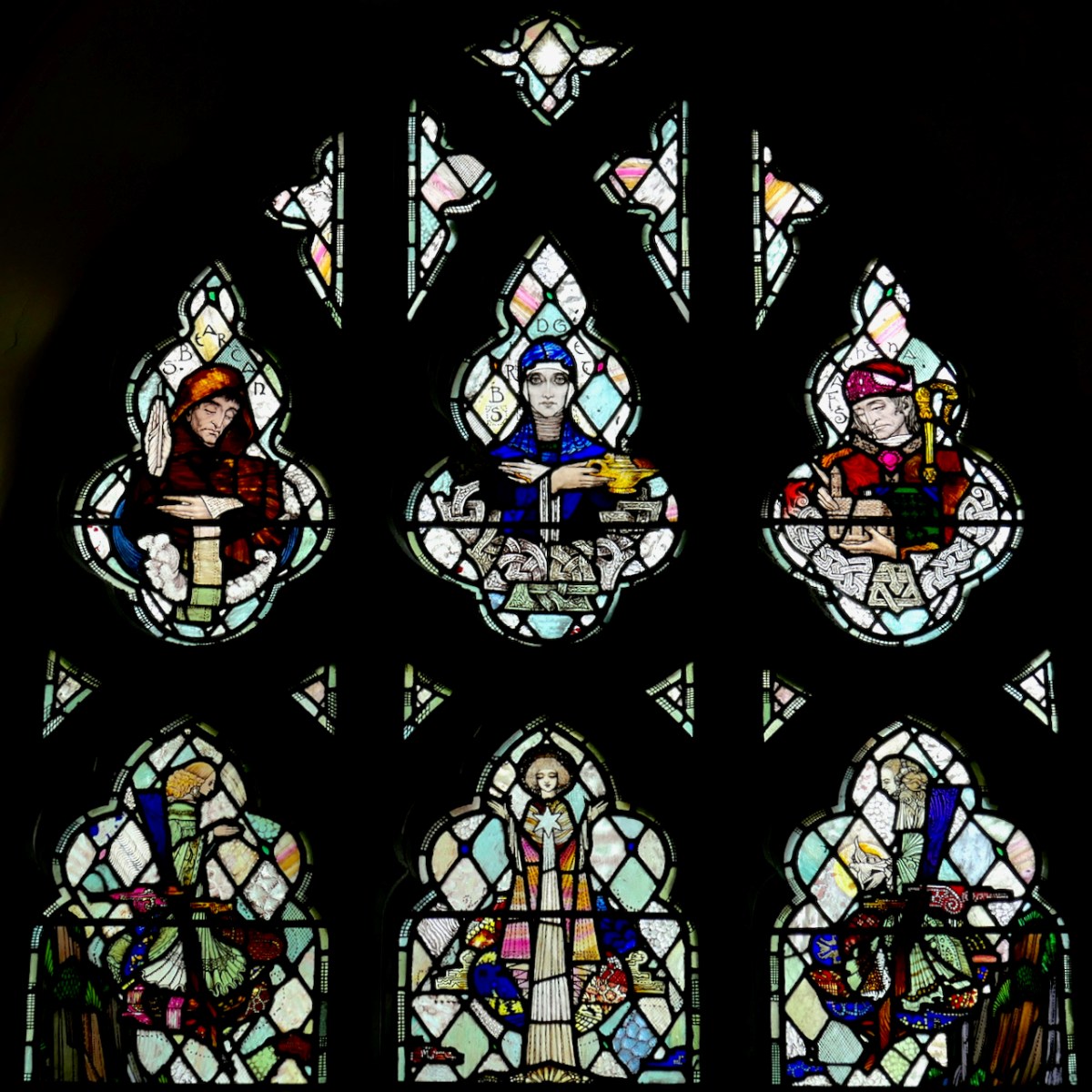
The Nativity that Harry designed for St Barrahane’s is, according to Nicola Gordon Bowe*, technically remarkable, but let’s look at the design, starting from the top. Here I am relying on Gordon Bowe’s extraordinary design vocabulary – all the quotes in italics are hers. (If you haven’t yet read them, Part 1 is here and Part 2 is here.)

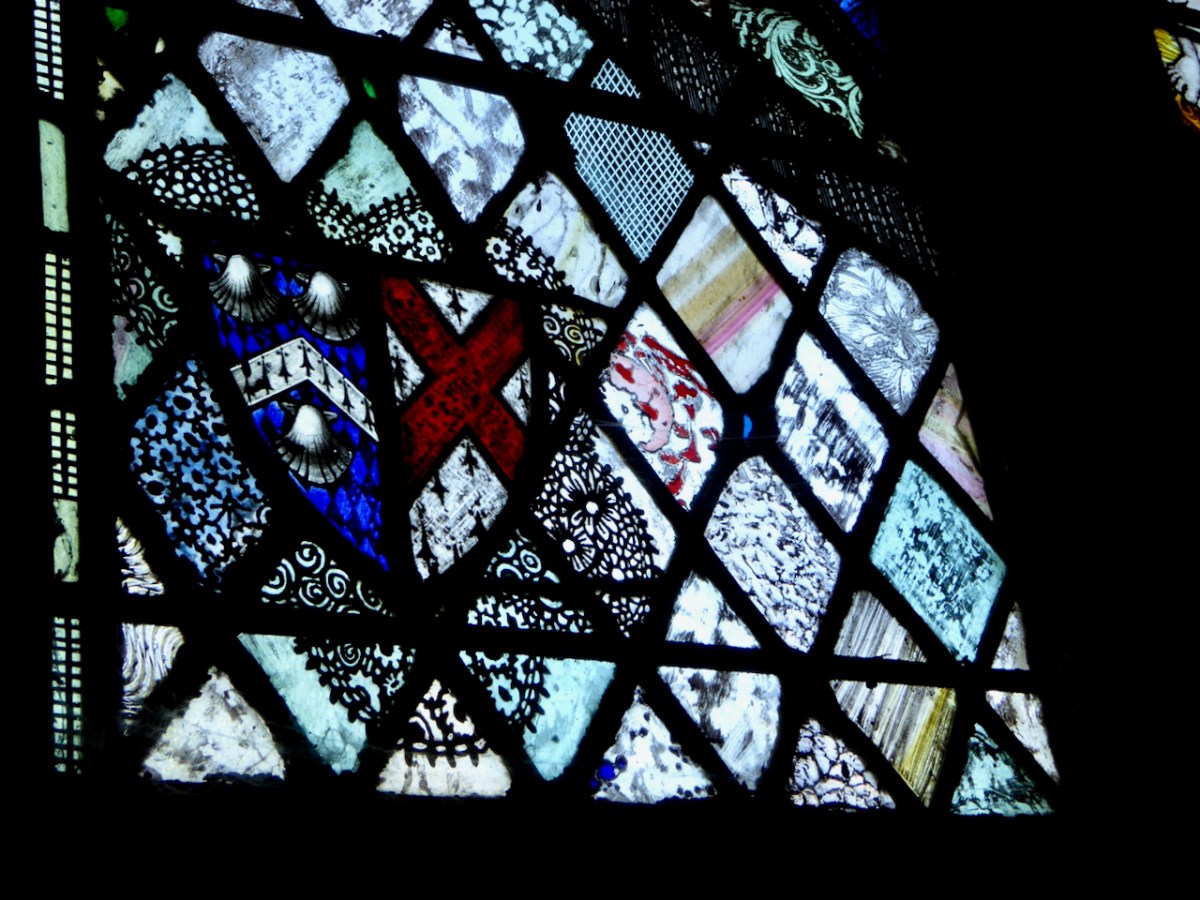
Harry’s re-designed and very Gothic tracery is filled with clear quarries – pieces of glass, leaded together in a diamond pattern, joined here and there with tiny coloured ovals. The use of clear glass was necessitated by the lack of light filtering from behind the east window, as there is a bank with tall trees immediately outside. However, this is not clear, or plain, transparent glass as we know it. Each quarry has been worked in some way. Those that started out life as clear glass have been chosen for their irregularities and have been treated with matt washes, stipples and semi-abstract lacework sequences so that each differs from its neighbour. Some of the quarries were not clear to begin with, but were flashed in pinks, blues or green, and these have been acided to the barest shimmer of colour. The result is that each individual quarry is intrinsically interesting without detracting from the overall effect of a subtly embroidered patchwork quilt in which the light lingers. These quarries occupy most areas of the window except for the main nativity scene and provide the backdrop for the top two sections – the saints and the angels. The signature panel at the bottom of the window is a good place to observe the quarries up close.

Edith was very much in tune with the Arts and Crafts Movement in Ireland but also with the Celtic Revival (see my posts on the work of Watson of Youghal for a thorough discussion on this style and the term). Within the literary tradition of the Revival there was a focus on the study of our ancient saints and a scholarly emphasis on translating various Lives and Martyrologies, many of whom were alive in the folklore and memory of the countryside. Of the three saints depicted here, Brigid is considered one of our three National or Founding Saints (see this post for more on Brigid), while Fachtna and Barrahane (or Béarchán) are local to West Cork. 

Harry used Revivalist interlacing as a supporting device for Brigid and Béarchán. Interlacing – so popular in Ireland at the time – was in fact quite rare in his work, although it had appeared in a couple of the Honan windows, such as the Joseph window, above, in a similar position. Harry was much more influenced by Continental art movements than by the conventions of Revivalist decoration, but Edith was still keen on it, as witness her later design for a mosaic floor in the chancel of the church, so this element may have been at her suggestion, or at least responding to what he saw as her preferences.

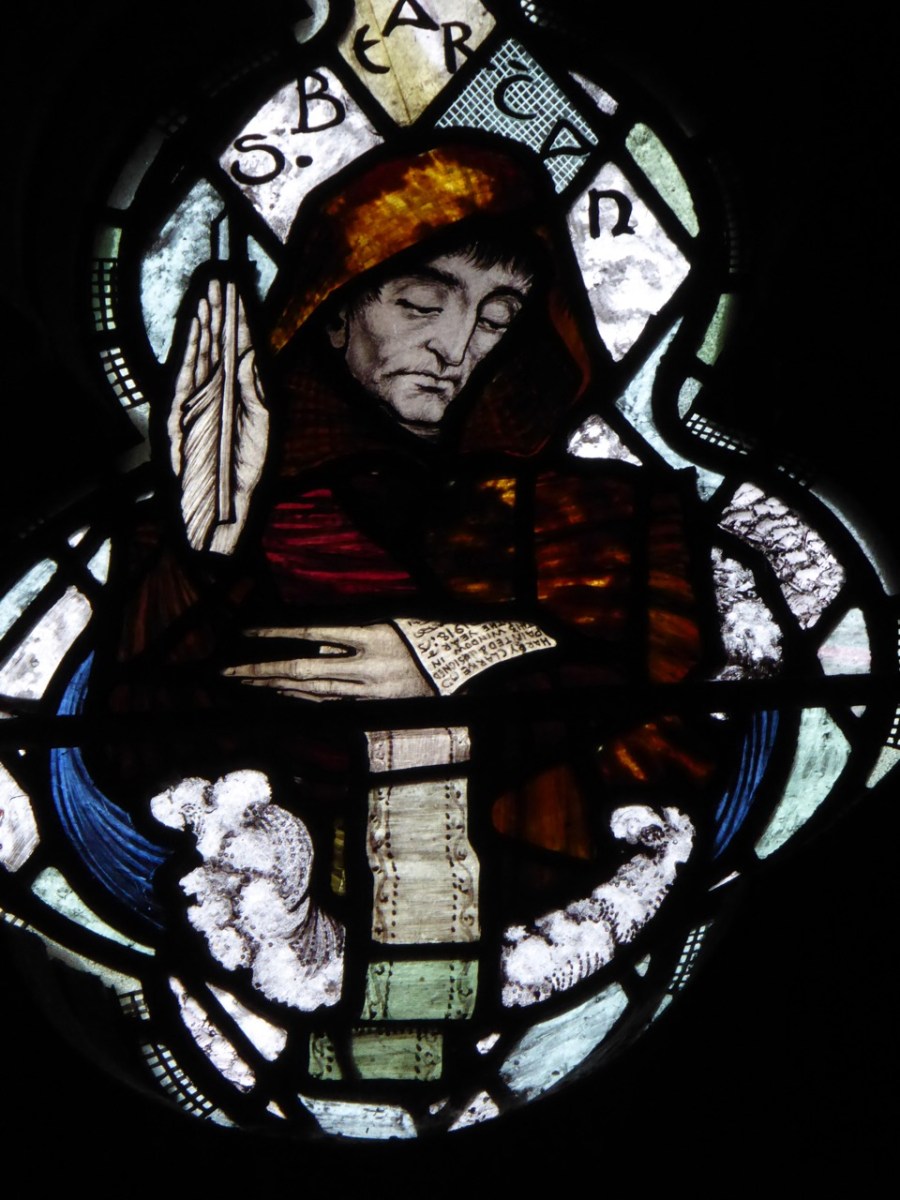
For her turn, Edith had done her homework and knew what saints she wanted, discarding Finbarr (Patron Saint of Cork) after an initial dalliance with him. Barrahane had given his name to the area around Castletownshend, Glenn Barrahane, as well as a medieval church (now ruined) and a popular Holy Well pilgrimage (in which I participated in December). Edith’s informant was James Bourke – I have laid out all that information in my post Honouring St Barrahane, so I won’t repeat it here, but do take a look at the detailed photos of the St Barrahane window in that post, including the little surprise that Harry inserted in this window. Interestingly, while Brigid and Fachtna are underpinned by revivalist interlacing, Barrahane is floating on a cloud.

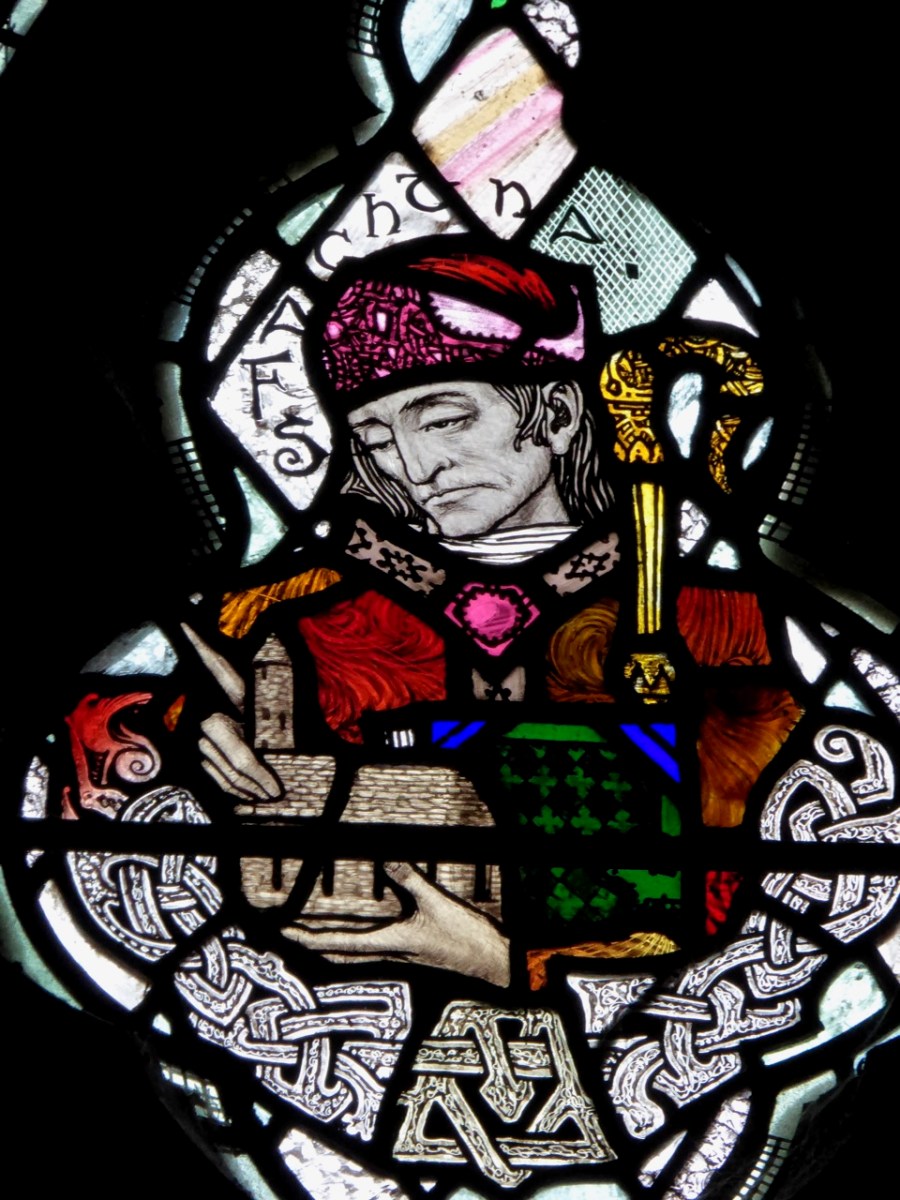
Fachtna was the saint who had founded Rosscarbery and was patron of the diocese of Ross; Harry depicts him holding a church and with his bishop’s crozier. He is gazing contemplatively downwards as if on the Nativity. Notice how the interlacing below him ends in a bird’s head finial.

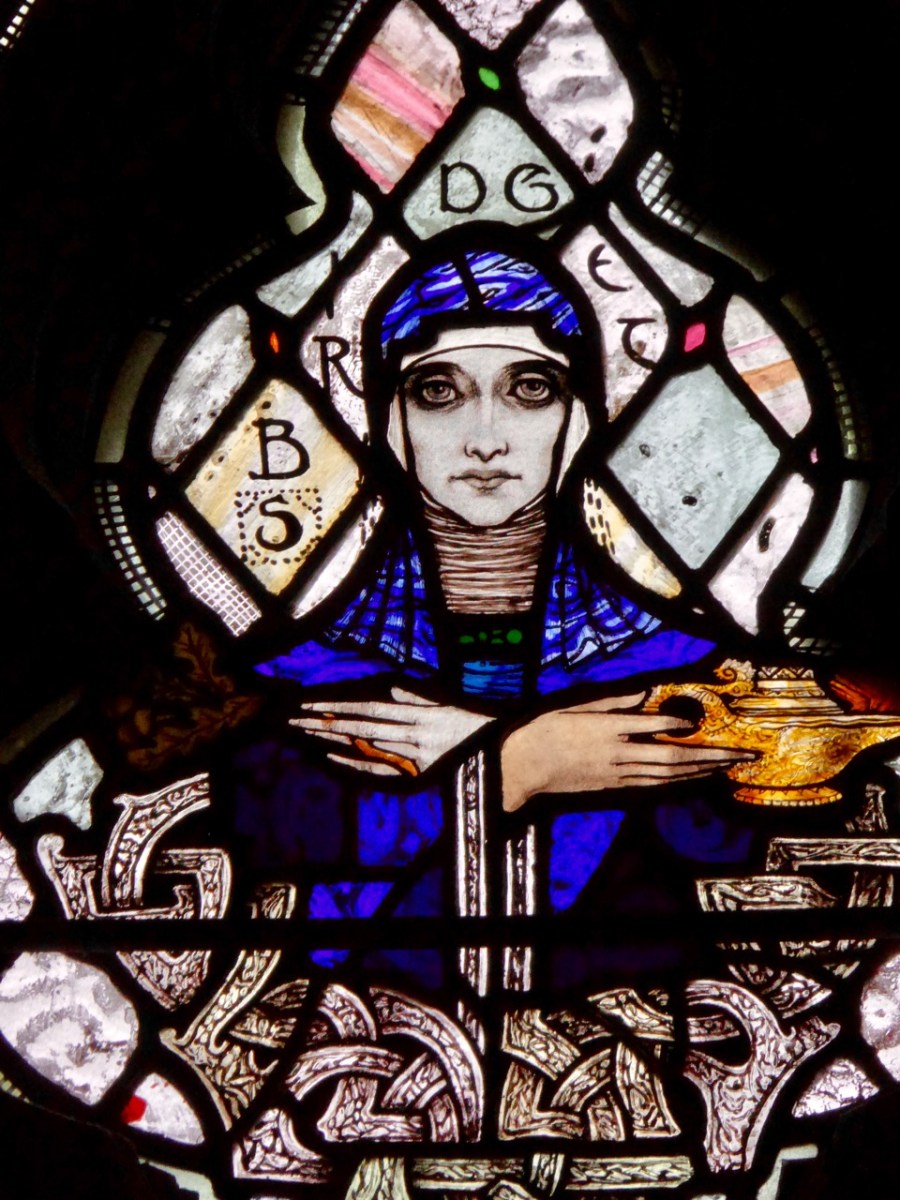
Brigid is clad in blue (perhaps that same blue that Edith had said ‘hits your eye like a living flame or a blast of wind’. She looks directly out, calm and wise. In her right hand she holds a golden lamp (looking suspiciously like an illustration from the Arabian Nights) and between the fingers of her left hand is entwined the stem of a twig of oak leaves, another of her attributes, tying her to Kildare (or Cill Dara, the Church of the Oaks).

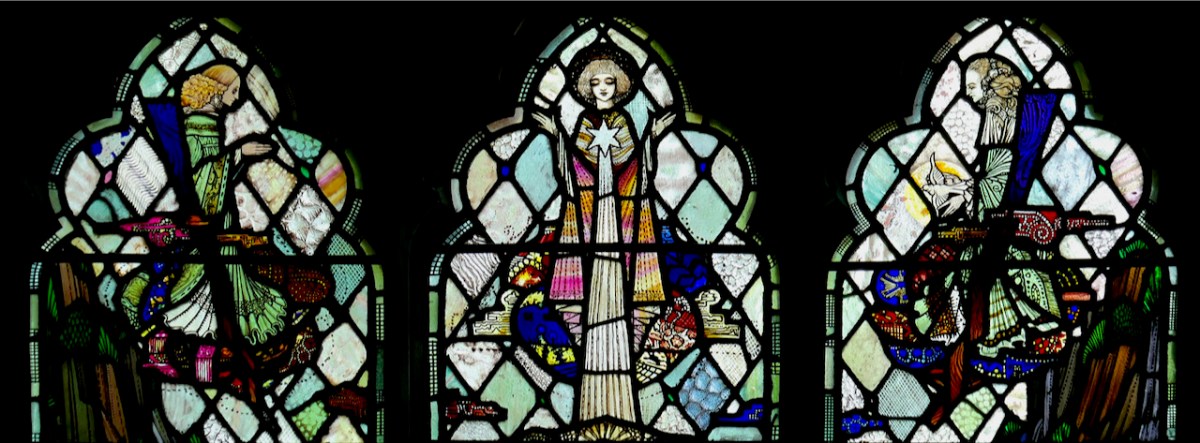
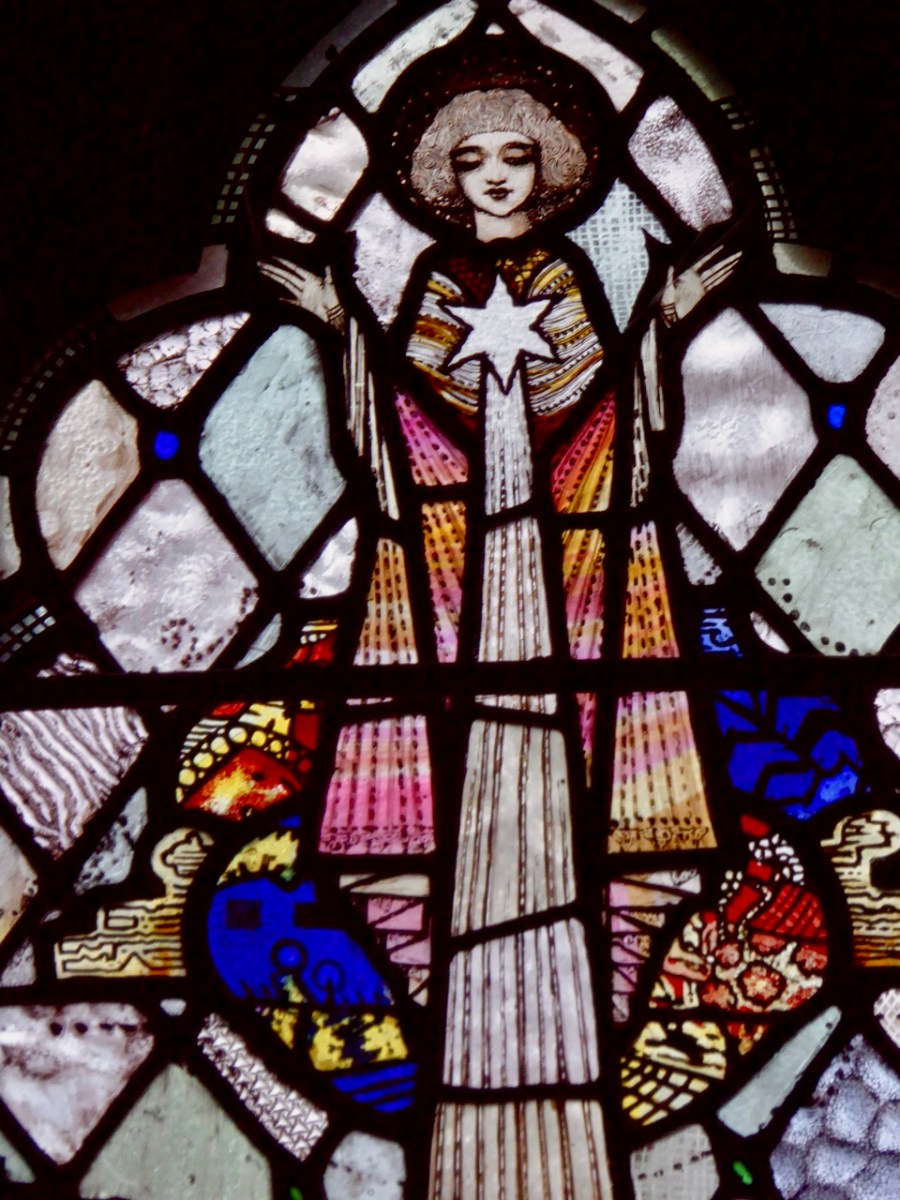
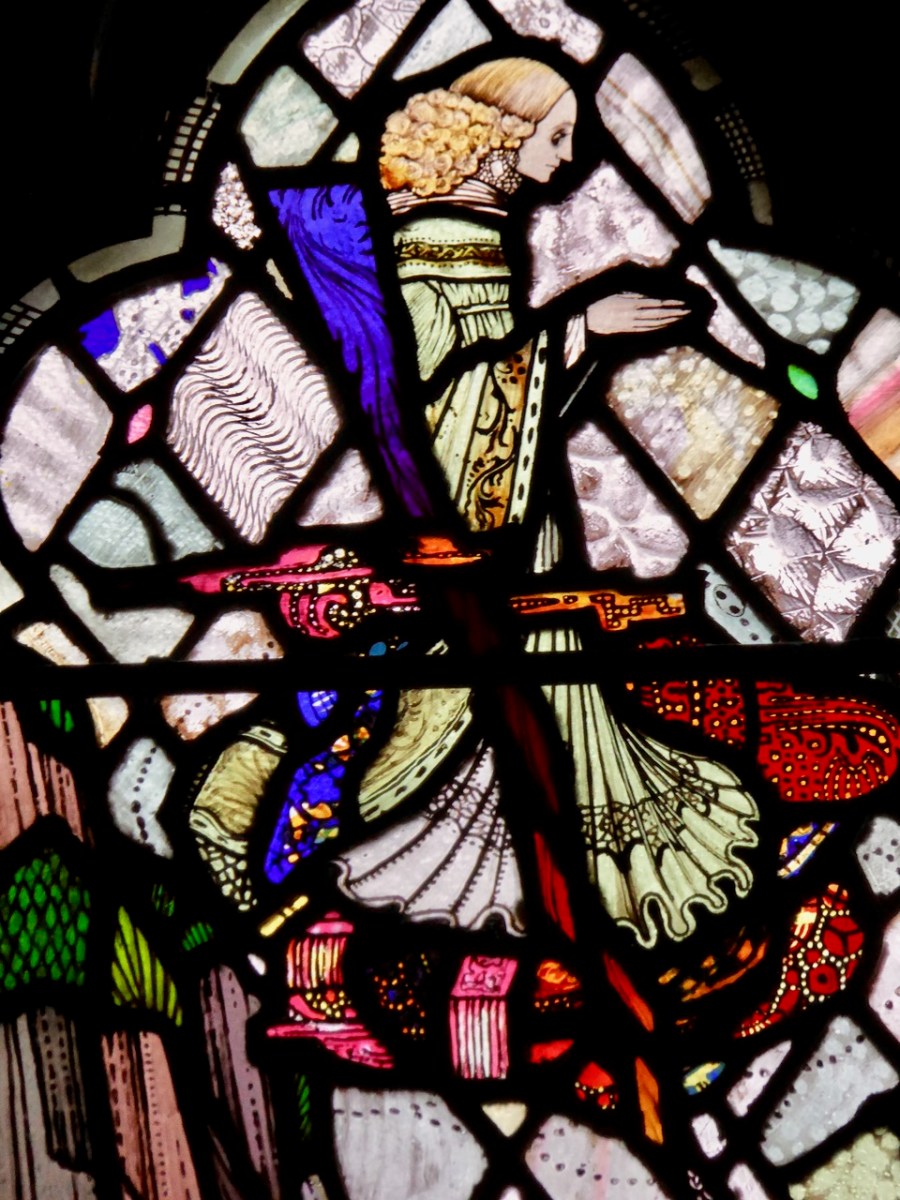
Beneath the three saints are three angels, floating above the Nativity. Although they form a wonderful trio, each is remarkably individual. The middle angel (with a fashionable bob) incorporates the star which is a traditional element in Nativity scenes. 

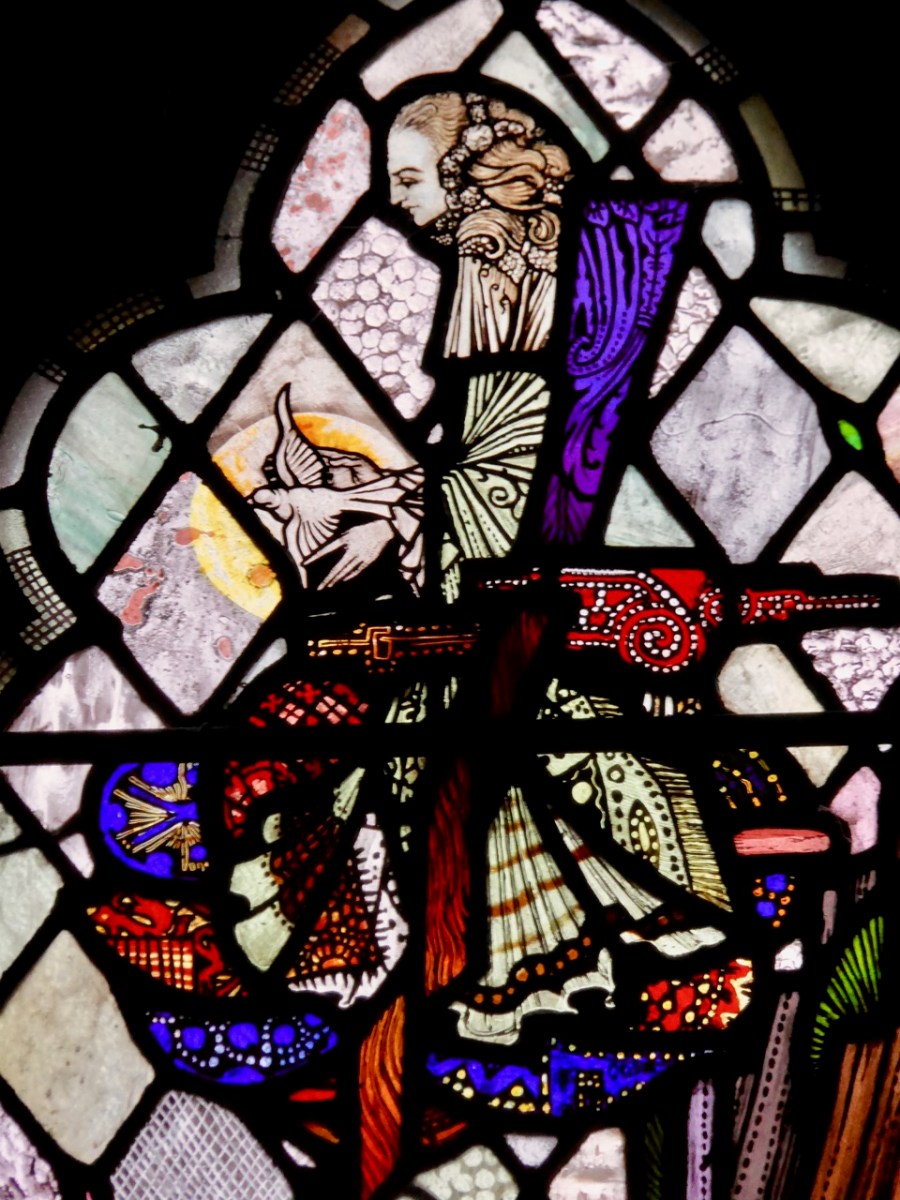
The left and right angels have elaborate, flowing or pleated robes and complicated coiffures. One holds a dove while the other has hands held in prayer. Gordon Bowe, in trying to analyse the decorative element at the centre of these angels says in her thesis Both seem to be manipulating jewelled levers, similar to the studded gun holsters favoured by cowboys.
I love this sentence but perhaps understandably it didn’t make it into her book, where she merely remarks that the saints and angels abound in intriguing decorative detail.

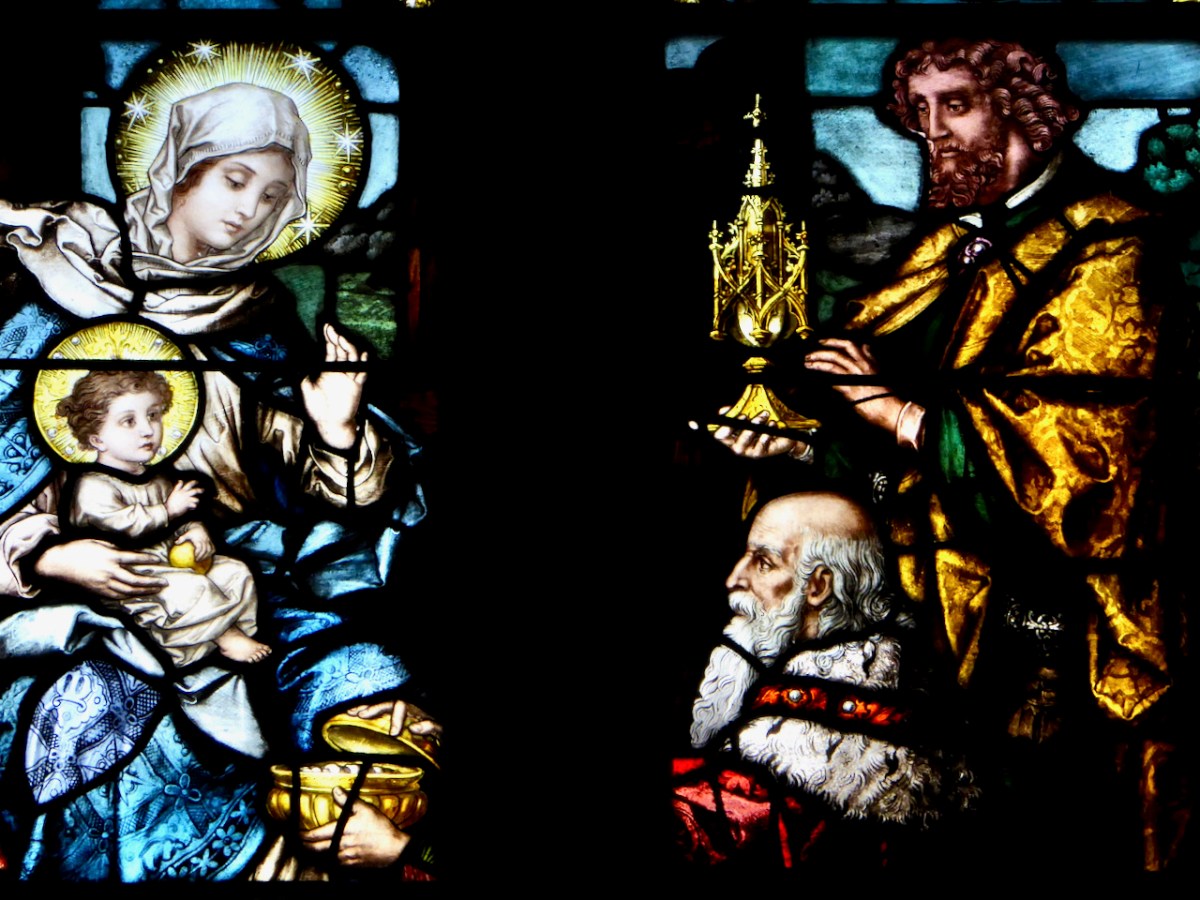
The central scene, of the Nativity, is beautifully constructed. Besides the angels above it, the framing devices consist of three elements. The first is an arc of silver chain upon which everything rests, most importantly the manger. You can see a close up of it in the signature panel above. The second is the rock face which stretches above and behind the Magi and the Shepherds. The third is one of Harry’s typical expanses of ‘floral ornamentation’ – one of his future hallmarks. Of this fantastical conglomeration of flowers, leaves, mosses, jewels, geometric shapes Gordon Bowe says always inventive and subtle in his pen and ink and watercolour illustrations, ingenious when painted or acided onto his glass by himself, but too often repetitive and lifeless . . . when imitated by his followers.

The robes of the lowest Magi and the lowest shepherd extend beyond the supporting chain-like arc, bringing a slight sense of perspective to the composition. Gordon Bowe likens the rich treatment of the fabric to the work of 

Gustav Klimt here and his flat treatment of interlocking decorative patterned, often symbolic planes, in which he would sometimes use coral, gold, mosaic, turquoise and semi-precious stones with casein paint to make up his richly mantled figures . . .Both men rely on the faces and hands of their figures to convey a human expressiveness and only here does any attempt at modelling occur. The eyes of their figures transport the spectator into a world of opulent trance. Both artists are equally unconcerned with perspective, reality or a third dimension. In the tradition of the best purely decorative work, background and foreground, figure and setting are equally important and integral. Any light is reflected from within the fabric of the design. Movement is created by how the light affects the surface of the picture and by the sinuous symbolic fluidity of the line. This is what W Hoffman has called Synaesthesia – a stylised ornamented style, where people are statues, backgrounds are wallpaper and interchangeable linear formulate are used as arrangements for figures and settings in different colour relationships, so that obstruction and symbol interrelate.

The Life and Work of Harry Clarke
Ph D Thesis by Nicola Gordon Bowe, 1981, P 249

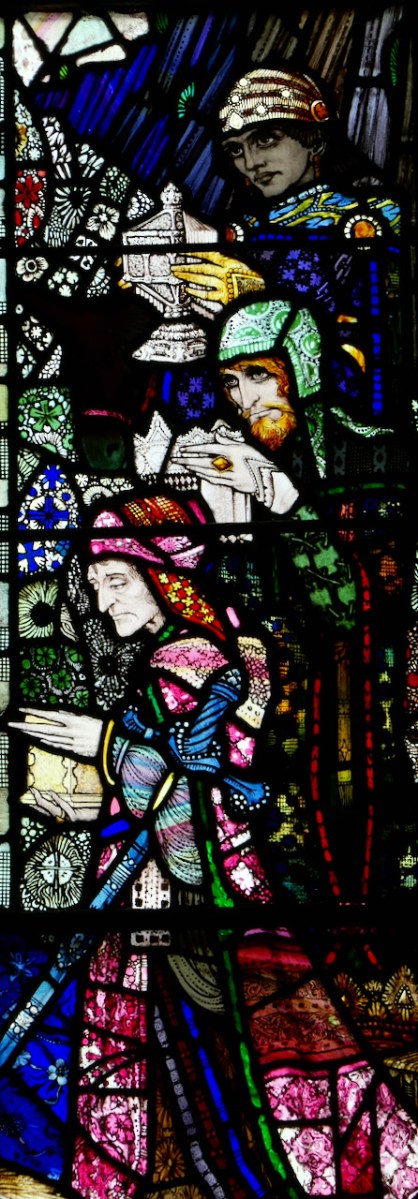
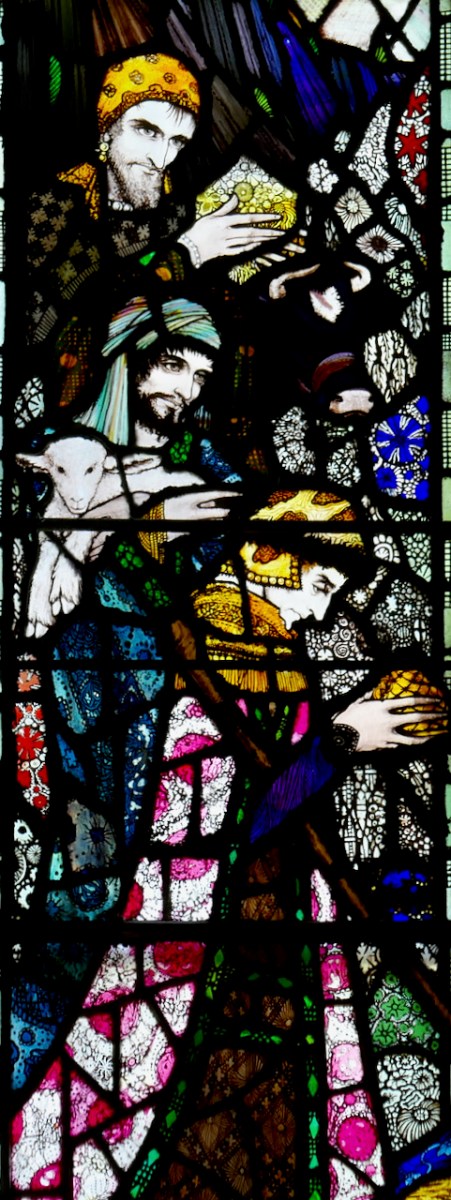
As Gordon Bowe shows us, Harry was totally tuned in to the modern movements of his day – decorative and symbolist traditions that envisioned an idealised, stylised and imagined-medievalist form of representation that was the opposite of realistic depiction. She notes – there is no attempt whatsoever to suggest that the kneeling shepherd has ever set hands on the earth or worked as a shepherd.

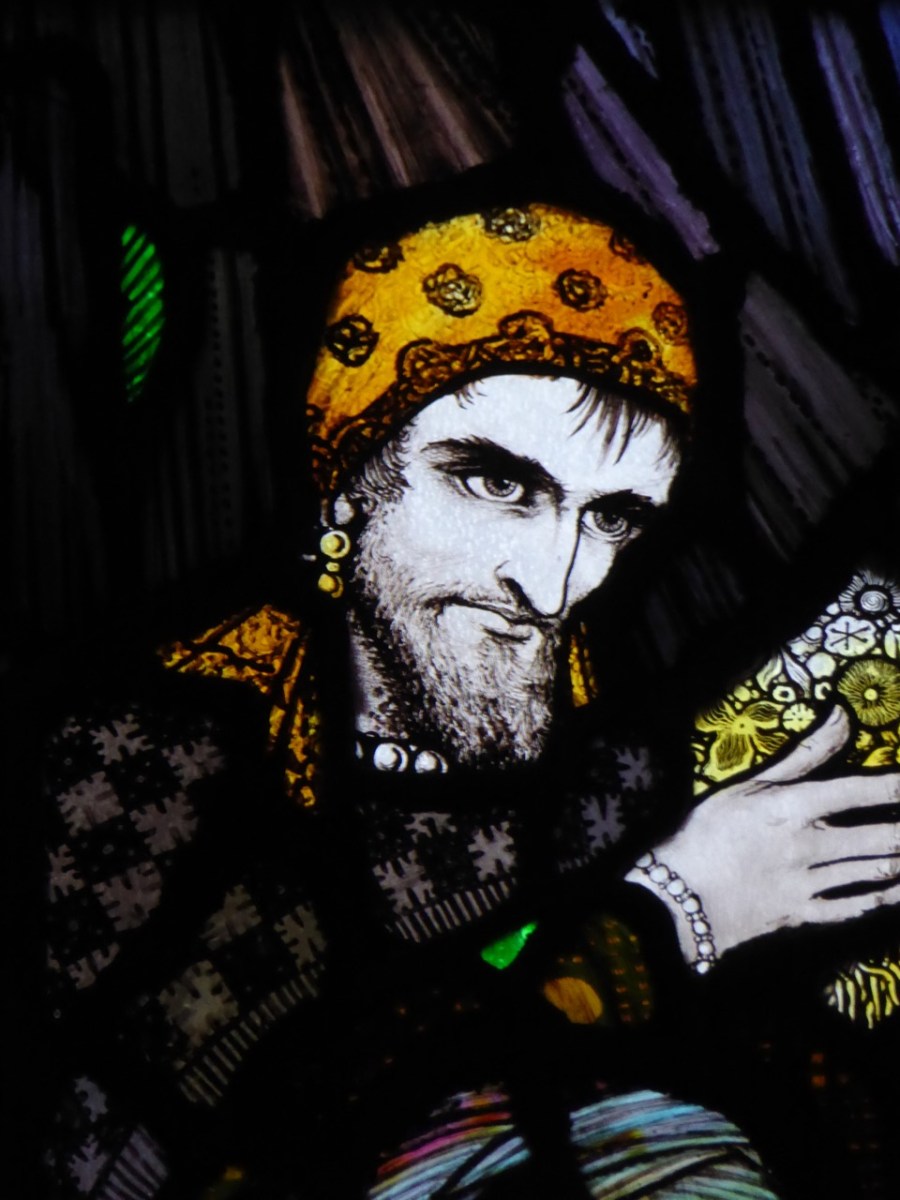
Three gorgeously apparelled Kings are balanced by equally splendorous shepherds, each holding gifts. Almost hidden to the right of the upper shepherds is the head of a cow – it is hard to see as it is done in a dark purple glass. Local lore is adamant that this is an homage to Edith who apparently pioneered the introduction of Friesian Cattle into Ireland. 

Joseph stands guard over Mary and the Baby, holding a chain with a lantern and gazing out directly at the viewer. Mary’s expression is gentle, her hair is a golden blond, surrounded by a halo of pearls, her robe, in traditional blue, studded with star-like flowers. 

The baby, looking more like a wise elder than a newborn, lies in the manger, his hands up to embrace the world, his halo a delicate filigree. The coats of arms lie at the bottom of the panel – they were done and installed after the rest of the window was finished and Harry came down to supervise their insertion. That probably explains why this window has two signatures (did you go back and check the St Barrahane post?). Unfortunately, the wooden screen that stands behind the altar obscures the base of the window and makes it impossible to photograph the Townsend coat of arms (below) except from the side, but it’s another good opportunity to view the quarries.
Let us remember that Edith had misgivings about the choice of Harry to do this window. She was concerned about the “hellish splendour” of his Honan windows, the “burning and furious brilliance” of his glass, which she found “perfectly amazing but not quite pleasant.” In a letter referred to by Rauchbauer she “insists again that something a little less intense is required than the Bertie windows.” She may well have been concerned about the effect of full-on Harry on elderly parishioners, who had to be onside for the windows to go ahead. In any event, it looks like she managed to communicate well with Harry, and that he understood the brief – to “adapt his work to the church & to realise how to get harmony into it.” 

It is, indeed, charming and harmonious. No macabre beings peer out from behind the figures (as they do in the Honan and in the St Louis window down the aisle in St Barrahane’s), there are no Aubrey Beardsley stern and “horrible” faces and no predella scenes of sacrifice or death (see St Dympna, for example). All is gentleness and serenity, compassion and contemplation. One wonders if Harry would have been so biddable a few years later.
A final special photograph to finish this series. Here I am in front of the window, with Harry’s two granddaughters, Etain and Veronique, during a recent visit to Castletownshend

In this post I am relying both on Gordon Bowe’s Life and Work of Harry Clarke and on her Doctoral Thesis, lodged at NIVAL. I am deeply grateful to David Caron for facilitating my viewing of this material.

When Harry Met Edith: Part 2 – “Getting Some Good Tracery”

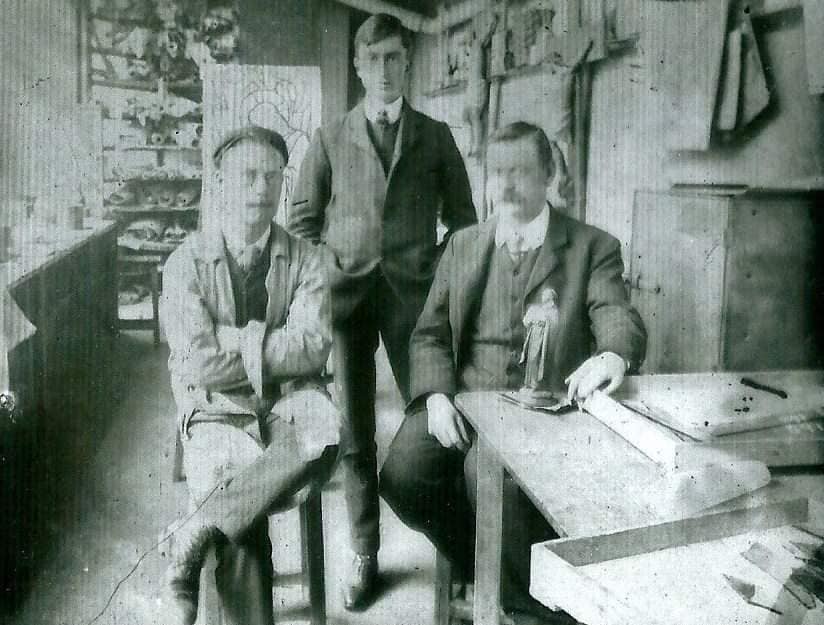
At this stage in his career, as we saw in the last letter in Part 1, Harry was making his own windows – that is, he was designing, cartooning (making the life-size drawings and laying out the cutlines) and choosing and painting the glass. He worked in his father’s studio, Joshua Clarke and Sons, where he used the assistants and glaziers to cut and lead the glass, and to fire it in the kilns. A few years later, he was so busy that many of his designs were mostly executed by talented apprentices, under his close supervision. He was also teaching in the Dublin Metropolitan School of Art – here he is with colleagues Sean Keating, James Golden and James Sinton Sleator about this time.*

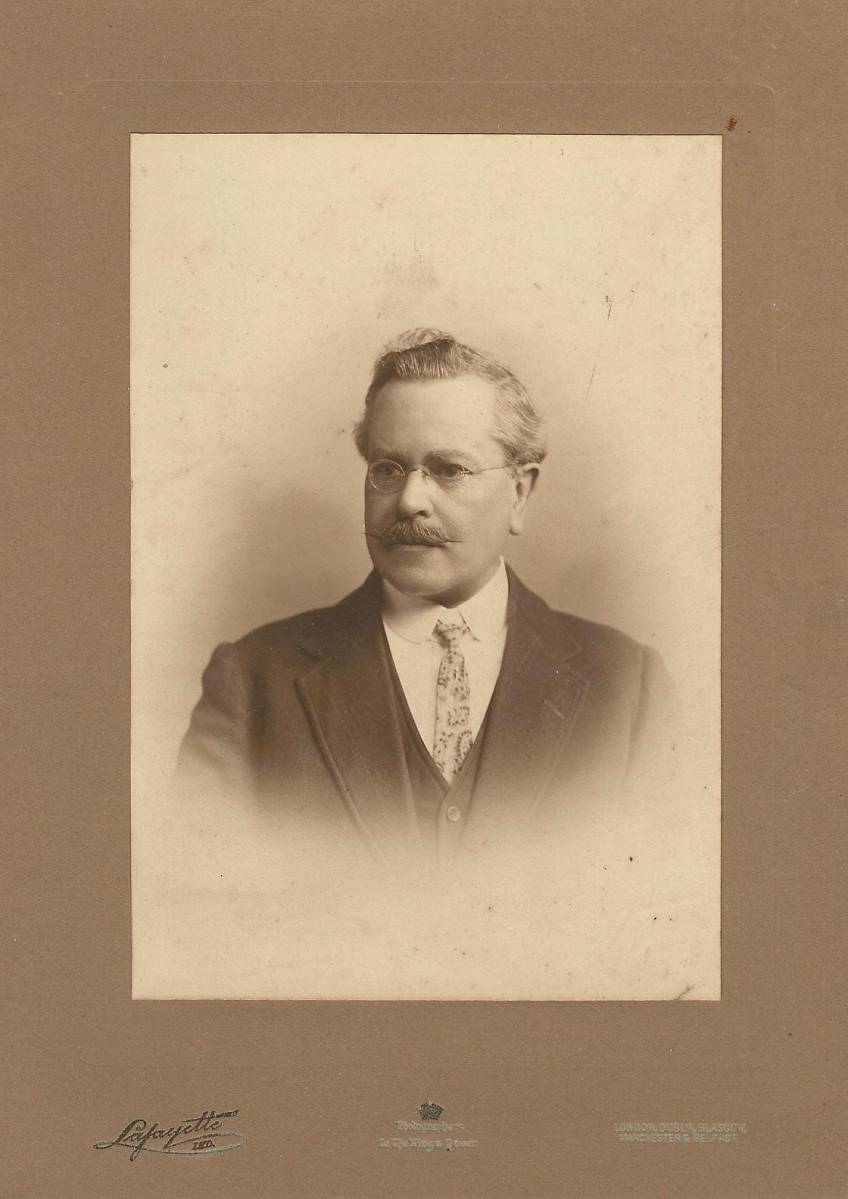
That’s one of the reasons the Castletownshend Nativity window is so special – it is Harry’s vision and Harry’s work, and only Harry’s. It’s also the reason he had to come to new terms with his father. Harry was a perfectionist who demanded only the best quality glass and worked on each tiny piece of it to make it unique and exactly how he wanted it. His father (above) was a businessman who despaired of making even a tiny profit from this laborious way of work, especially when the war had made everything scarce and expensive. Harry had quoted a price of £315 for the window as it was currently sized, or £252 if it was shortened. Gordon-Bowe** says that Joshua had worked that it would actually cost £2,300 for the time and materials involved. He was probably factoring in the cost of all the changes to the frame, discussed below, but even so, this was a huge amount for a window at that time. His father suggested that Nagle (below, with Harry and Joshua) should do some or most of the work, but as Gordon Bowe says, Harry would never have accepted [this suggestion] at this point in his career. Given the huge disparity between what it would cost and what Harry proposed charging, this window was a significant loss to the Studio, but they must have felt that it was worth it, and that it would lead to other commissions.

The arrangement Harry and Joshua came to was that Harry would pay his father for the glass, the facilities and the glazier’s time, but that he would work on his own windows, and charge his clients, independently. But it was complicated, because at the same time, Harry was, by this time, effectively running the stained glass side of his father’s business, as Joshua’s health was declining (he died in 1921). Harry’s hand and eye can be discerned occasionally in some of the other glass being produced from Joshua Clarke and Sons at this time, but mostly his role was to manage the work of others.

Here’s an example of Harry’s influence, perhaps, in a window for Charleville Catholic Church – the windows are all from Joshua Clarke and Sons, but this one in particular bears some Harry hallmarks in the sensitive drawing of the features and the elaborate decoration of every piece of glass.

15 April 1917

Dear Miss Somerville

Thank you for your letter & enclosure of cheques value 15/. – I have been knocked up with a cold since Wednesday and have not been able to work – which will I know postpone my sending you my proposals for the Castlehaven window for a few days – the Nativity would be a jolly subject for the three lights – However this is a matter you can discuss among yourselves –

 But – – you as an artist can understand that these three tall narrow windows would not suit any subject – for example an Ascension or Crucifixion would be most suitable, tho’ I think a charming little nativity might be done.

LETTER FROM HARRY CLARKE TO EDITH SOMERVILLE
Somerville Archives, Drishane House***

The design that Edith and Harry eventually settled on was an unusual one for a Church of Ireland church. The main scene is that of the Nativity, also sometimes knows as the Adoration of the Magi. While this is certainly part of the iconography of Protestant churches at this time, it is a tiny proportion, representing fewer than 3% of all Church of Ireland windows and often as a small scene within larger windows, or as part of a Life of Christ assemblage. 

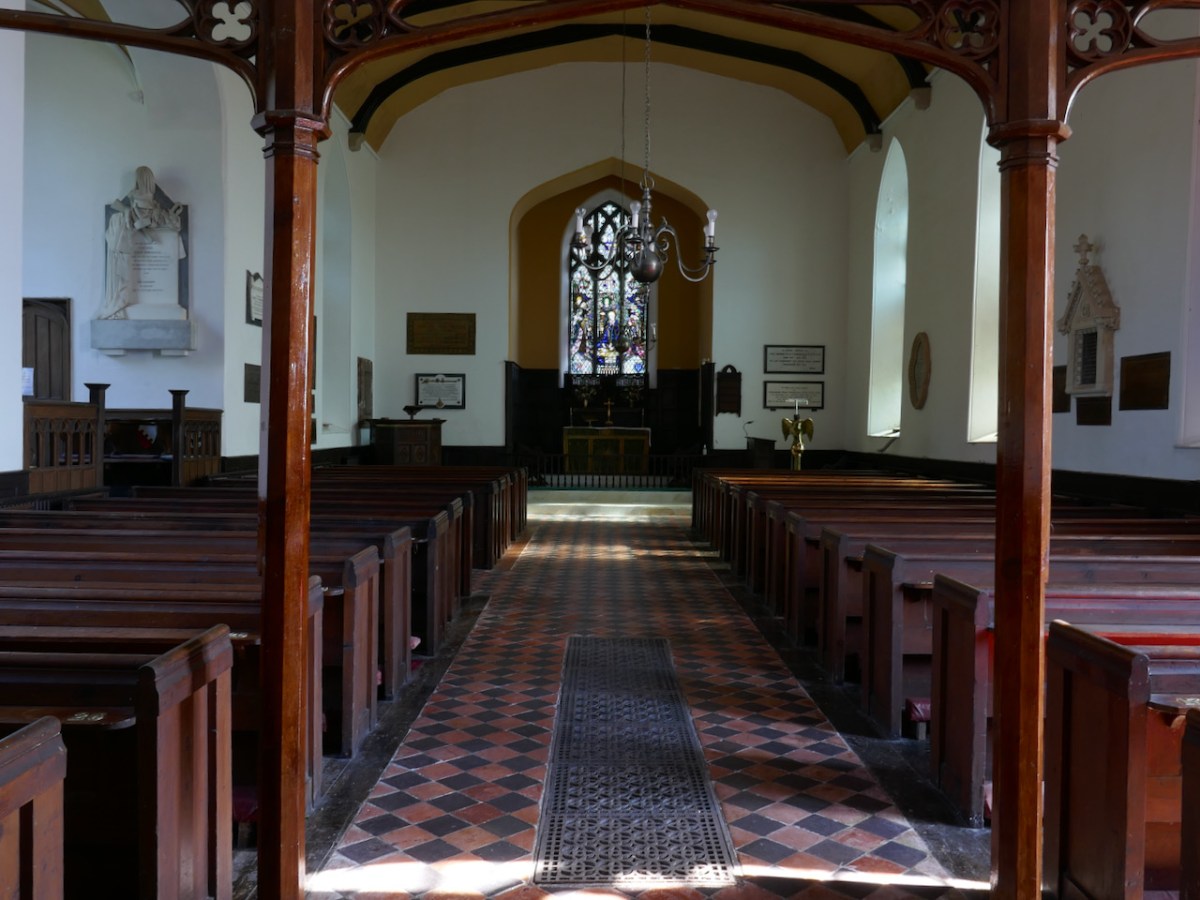
Interior of St Barrahane’s Church. In this photo you can see that the windows along the nave are longer – that is, the bottom of the windows are closer to the ground than in the east window

Edith was still determined to shorten the window, and some of the correspondence between her and Harry is taken up with details of measurements and proposals for how to get the work done – Harry will not embark on the window until he has a completely accurate set of measurements from the final shape of the changed windows. 

24 April 1917

Dear Miss Somerville

I send you herewith a drawing of the alterations I suggest in the tracery of the East window of Castlehaven church – I have worked with the idea of getting some good tracery with the very least amount of carpentry work. You will see marked in red on the drawing the parts which will have to be made in new wood and these should present no real difficulties to a carpenter of ordinary skill and intelligence. 

This tracery will need to be made and fixed in the position before I start the actual making of the glass as I will work from templates taken from the real openings

LETTER FROM HARRY CLARKE TO EDITH SOMERVILLE
Somerville Archives, Drishane House

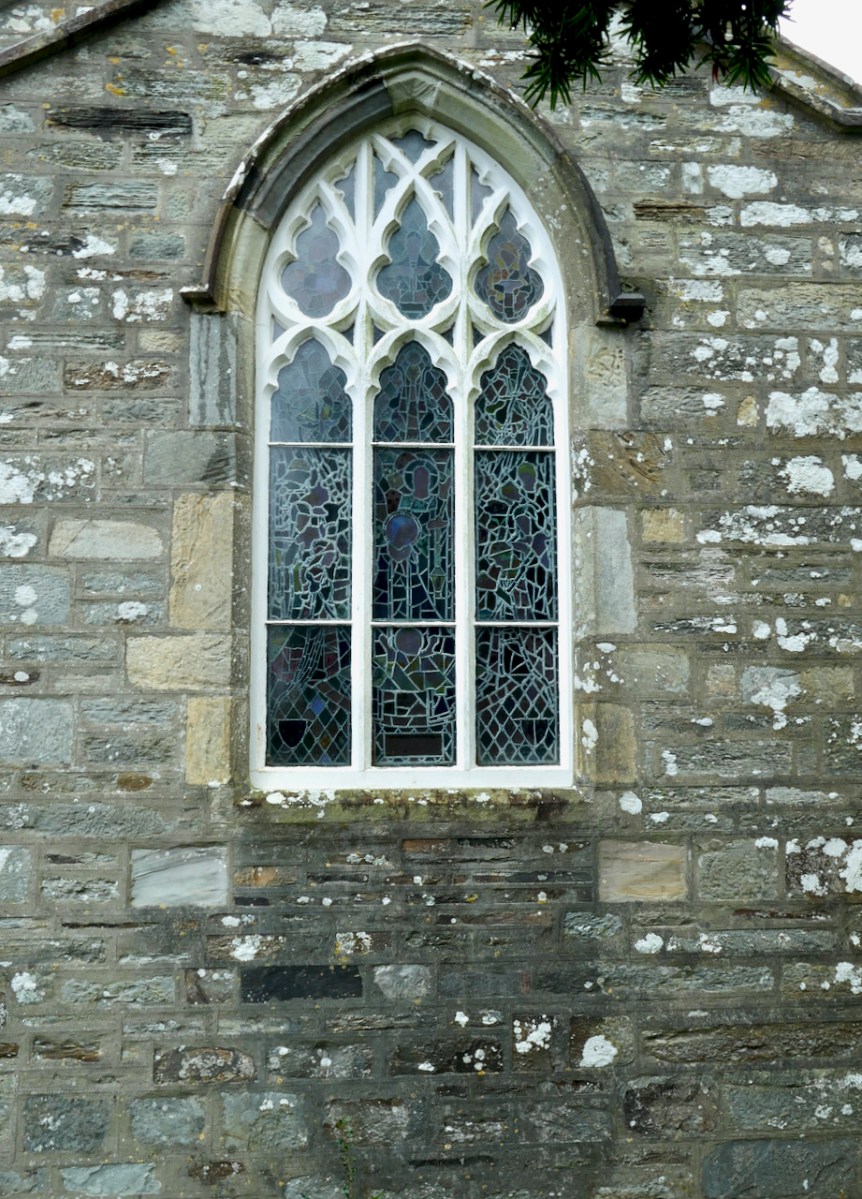
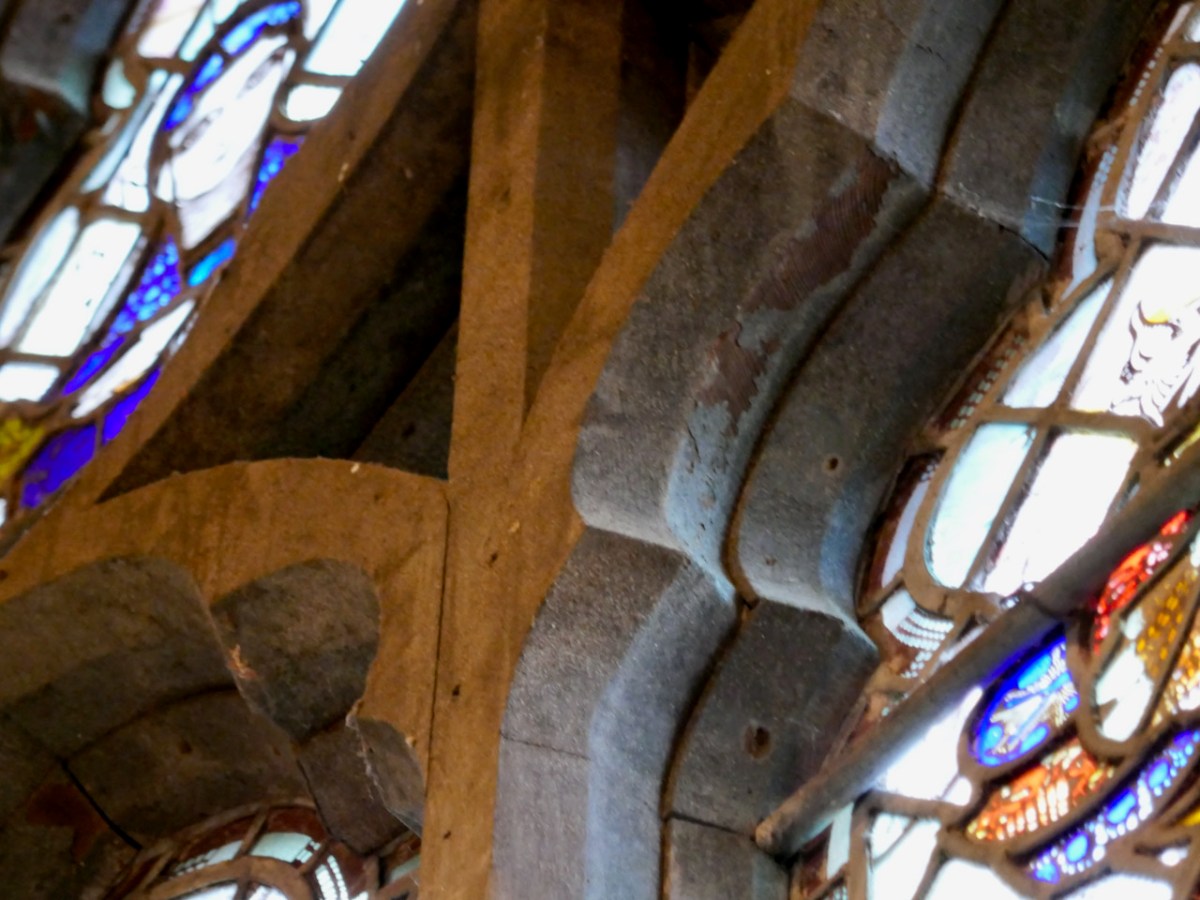
So – Harry not only designed the stained glass, but also re-designed the window itself. A casual visitor to St Barrahane’s would look at the window and assume that it was carved in stone and was entirely original. However, a closer examination reveals that the east window is different from all the other windows in the church in two important ways – it is shorter (foreshortened from the bottom up) and the tracery is more elaborate. In fact, it is made of wood, as are all the windows in the church, although this is more apparent from the outside than the inside, since the wood has been painted and sanded to look like stone.

From the outside, it can be discerned that the window has been shortened from the bottom up. The wooden window frame was re-built to include Harry’s elaborate tracery design, painted white outside, and inside (below) sanded to look like stone.

I am glad the proposed window has been sanctioned and bearing in mind your views and those of your brother expressed in your last letter, I hope to send you the design in September or early October. The coats of arms will do any time between this and then.

Re – re making of window frames; I suggest that it would be better if it were made in Cork and I understand that Messrs Sisk and Son of that city – who built the Honan Chapel are excellent builders and must employ efficient carpenters.

Sisk’s man could measure the job and could make it either in Skibbereen or Cork – I propose this as you would be sure of a good job if the man who measures the window either makes it or has opportunity of personally explaining the alterations and measurements to another – this would rule out any chance of miscalculation – Also – It could I think be made cheaper in Cork – and the cost of carriage from Dublin to Skibbereen for the finished wood would be considerable – If it suits you and would save you any bother I will write Sisk and explain matters – there is no hurry I suppose if you remember that the new tracery will have to be finalised before I start my window early in 1918.

LETTER FROM HARRY CLARKE TO EDITH SOMERVILLE, June 10, 1917
Somerville Archives, Drishane House

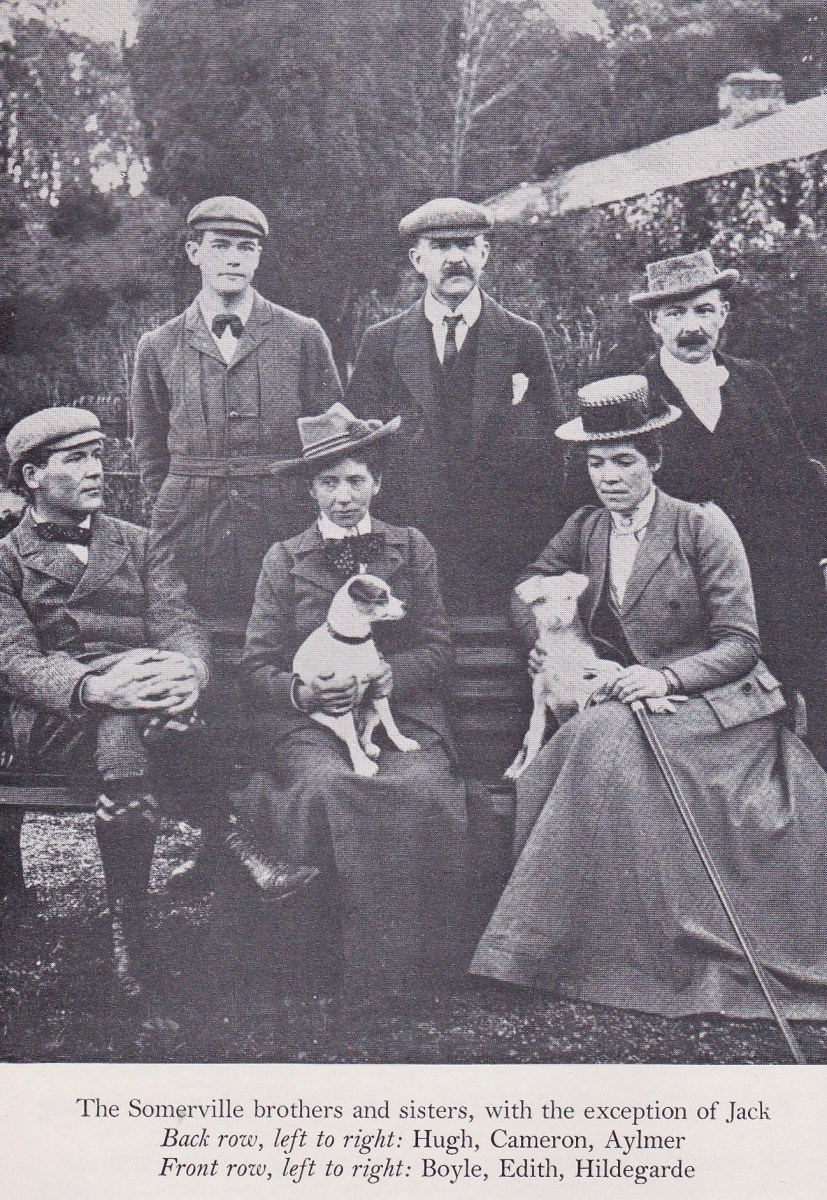
By this time (June 1917) the elements of the window have also been agreed – that is, that the main scene will be a Nativity, and that Irish saints will have a place in the window. The price has also been negotiated and even though that sum seems paltry now, it was enough to give some members of the family heartburn. Hildegard was apparently ‘scandalised at the family’s extravagance’ and Edith says she is probably right “but such fears have never yet curbed my extravagance & as I have often said, I have only regretted my economies” (Rauchbauer, p179). A woman after my own heart.

One more drama ensued before the work could start – Cameron lost the sketch design! He may have left it on a train. Desperate searches (even at Scotland Yard) turned up nothing, so Edith was in the embarrassing position of having to ask Harry to produce a new one. Harry, ever the gentleman, responded on Dec 7th.

Dear Miss Somerville

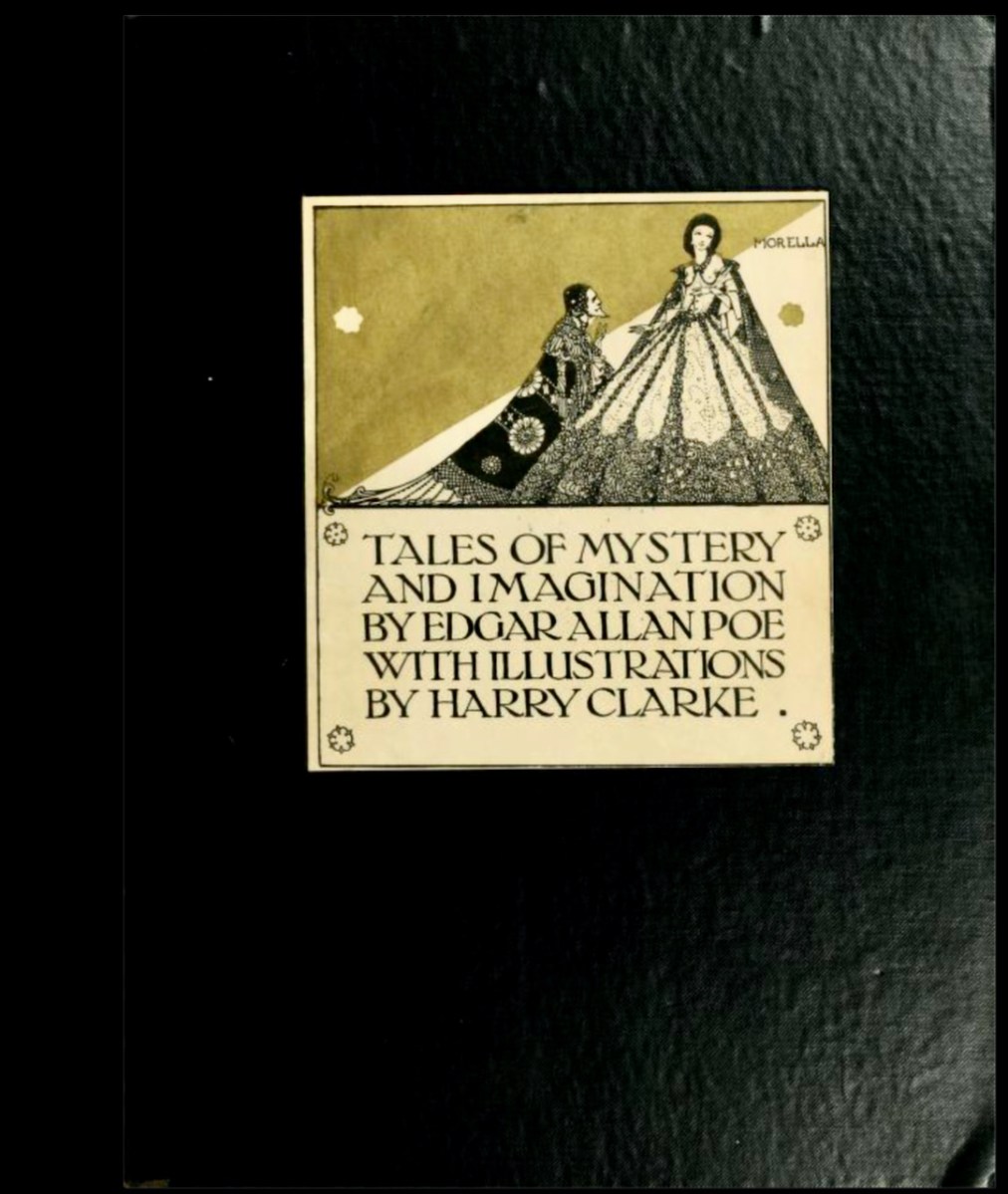
Thank you for your letter. I will do the new Nativity sketch the first time I can put my mind to it to the exclusion of my other work – I am behind time with everything now, but at any rate I will undertake to give it to you at latest on the 7 January next. – possibly I will finish sooner – I will ask you to understand the delay is not entirely my own fault – the publisher of Poe’s Tales is persecuting me for the drawings – I would have been glad long ago to have taken up your happier work but business men always nail me to a date.

LETTER FROM HARRY CLARKE TO EDITH SOMERVILLE
Somerville Archives, Drishane House
This image was captured from the book on loan at the marvellous Internet Archive

He offered further clarification on Dec 10th. 

It will be better in every way if I do the sketch for the 7 January – I hardly think I can do a replica of the missing drawing but if I work to this date at any rate I will and do remember the scheme, drawing, and general colour.

LETTER FROM HARRY CLARKE TO EDITH SOMERVILLE
Somerville Archives, Drishane House

This second drawing is, or was, extant, although I cannot now trace where it might be. However, Nicola Gordon-Bowe must have seen it, as she describes it as being done in charcoal only and drawn surprisingly loosely and sketchily . . . in comparison with those for the Honan Chapel. However, it is perhaps not so surprising that Harry, under pressure to produce a duplicate of work he had already done in detail, should produce only a charcoal drawing. He was relying on his memory for all the details and the colour.

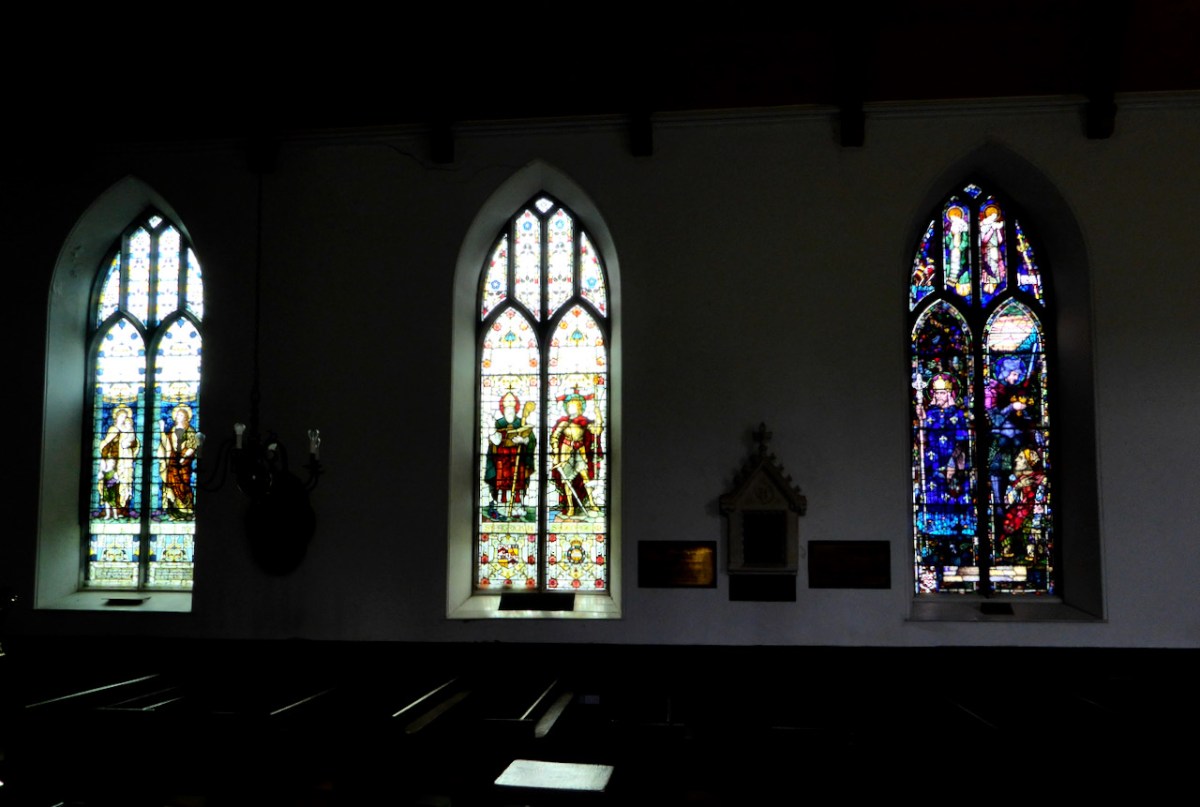
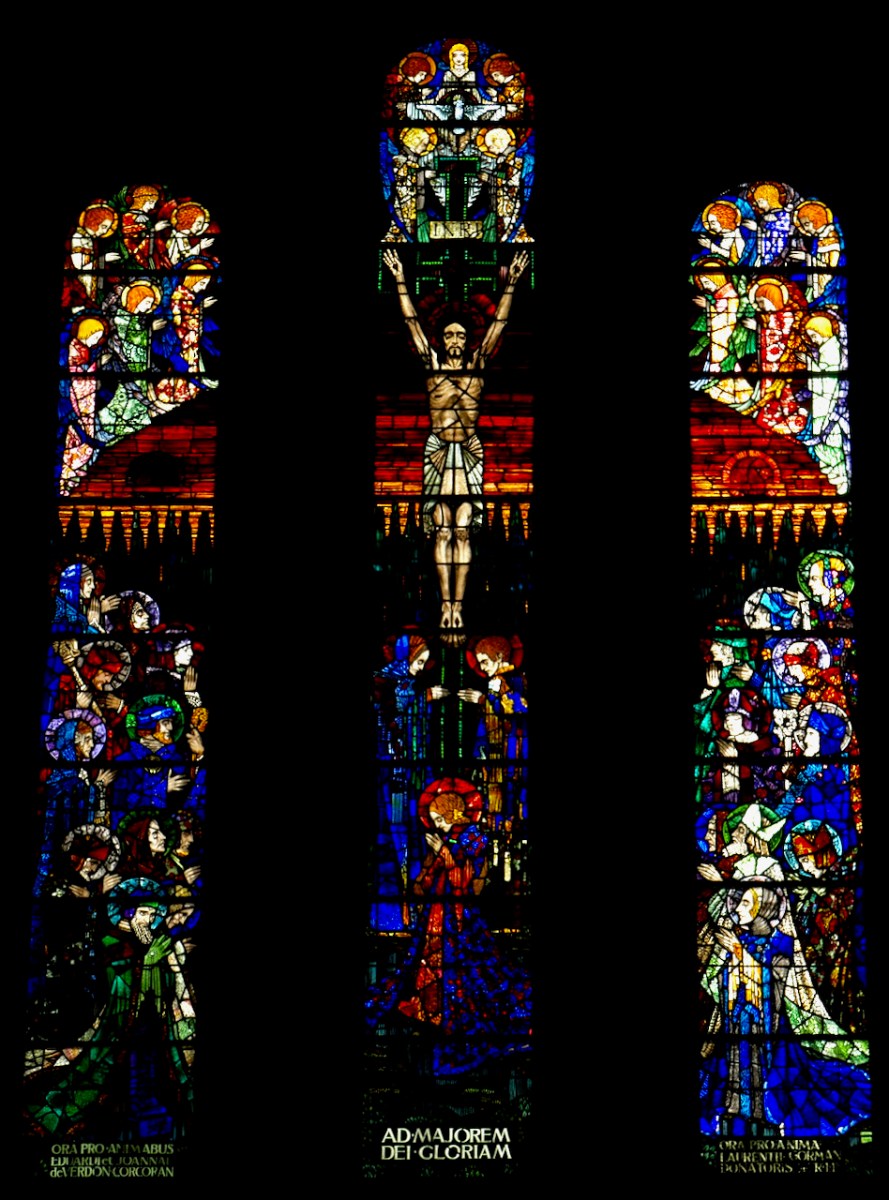
In this photo you can see the size, shape and relatively simple tracery of the other windows in St Barrahane’s Church. The two windows on the left are by Powells of London and pre-date the Harry Clarke windows in the church. The window on the right is Harry’s Kendall Coghill window, about which I have written here. My supposition is that the east window, although three-lights instead of two, had very similar tracery to these windows, before the changes I describe above and was of course the same length. Such elongated dimensions are well suited, as Harry pointed out, to a crucifixion or a resurrection, where the movement of the eye is upwards to the heavens. Below is Harry’s Crucifixion in Terenure as an example of what he meant. It was dedicated in 1920 but he had already won the commission when he was working on the St Barrahane Nativity.

The shortening of the window, the inclusion of the Irish saints, the addition of three angels above the scene and of coats of arms below it – all these design devices resulted in Harry giving Edith what she really wanted – a painterly canvas for the main scene, rather than a composition constrained by tall, narrow dimensions. 

What Edith got, in fact was a cleverly constructed division of space in the window. The main Nativity scene is located within a square, while her saints and Harry’s angels occupy the elaborate new tracery that Harry designed to be constructed by Sisk’s ‘carpenter of ordinary skill and intelligence.’

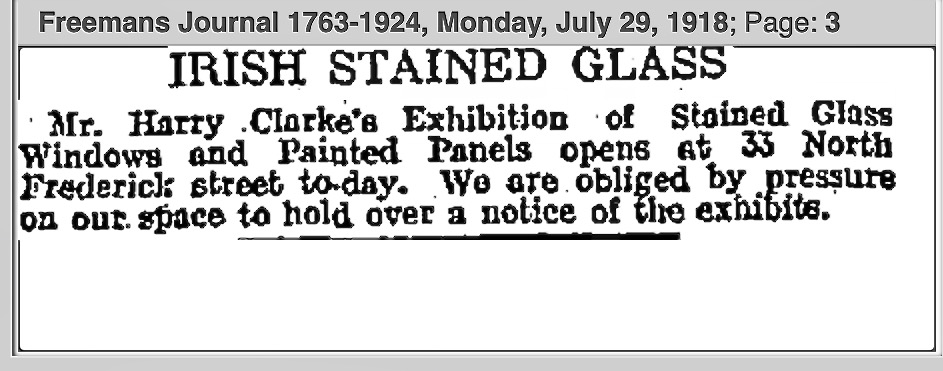
In the end the carpentry work did not get underway until the following spring, and once it was done Harry was able to start on the glass painting in April. By the end of July, the window was finished and exhibited in his studio at North Frederick Street to great acclaim.

Gordon Bowe quotes the review by Bodkin in the Dublin Evening Mail.

It has not the sumptuousness of colour which we are accustomed to associate with [Clarke], for it is especially designed to hang in the comparative dimness of an eastern light. But it has an appropriate beauty of colour second to none of this earlier works and a suavity of design and strength of drawing that shows, if that be possible, an advance in the artist’s power.

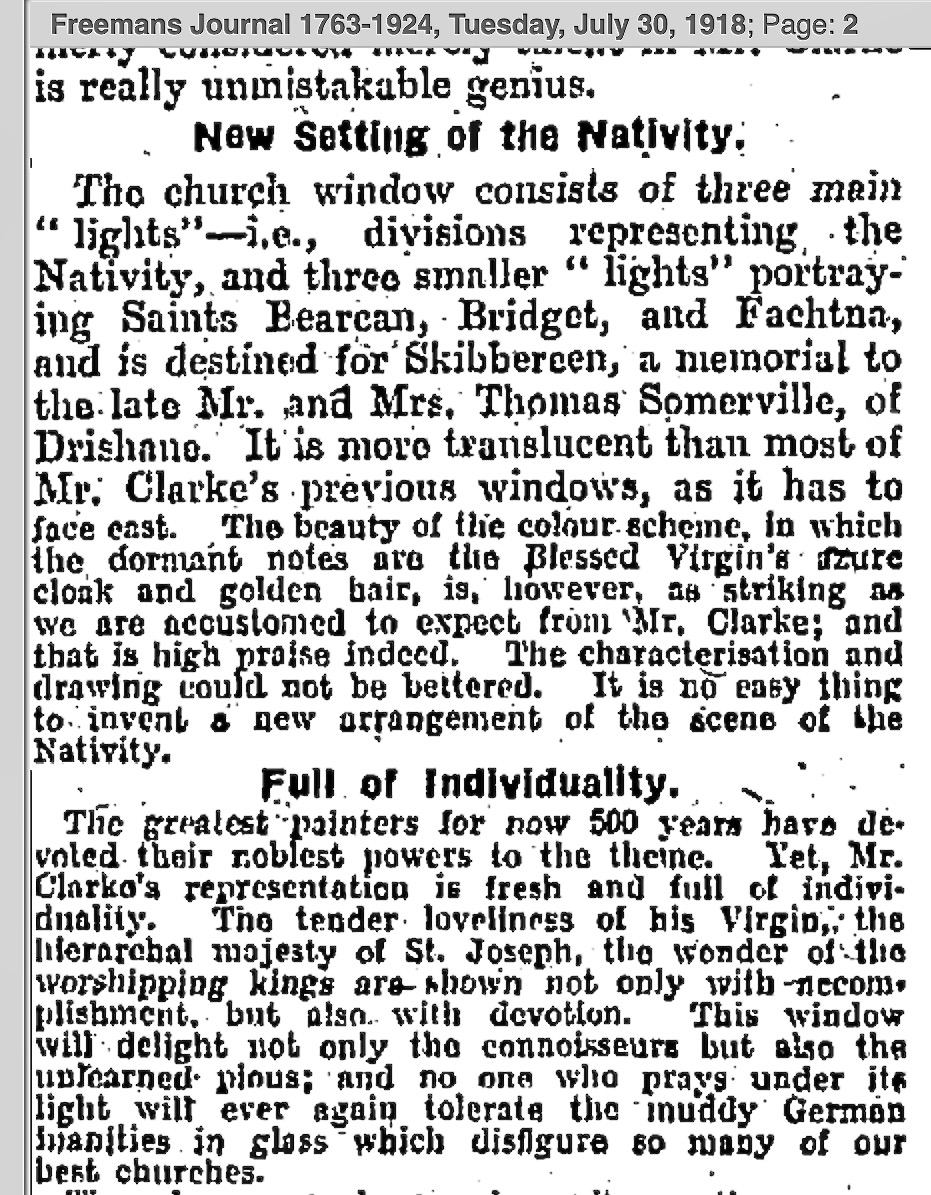
The Freemans Journal also had a review of the window by Bodkin (he signed it A.C. for “A Critic”), under the title Genius in Stained Glass

In part 3 we will look in detail at the Nativity. I’m sorry – I know this is taking forever and perhaps few will find talk of tracery and window dimensions as fascinating as I do. All I can say is that it wasn’t until I read the real-time correspondence that I realised all the changes that had been made to the windows, and the corresponding effect that this had had on Harry’s final design. But we have finally arrived at the point where we can talk about the window itself. I think it will be worth the wait.

*My thanks to Patrick Hawe and David Britton for assistance with the first three photographs.
**Anything I write about Harry Clarke is informed by Nicola Gordon Bowe’s authoritative text The Life and Work of Harry Clarke. All of us who write about Harry owe debts of gratitude to her keen insights, formidable scholarship and her command of descriptive language.
***Once again, huge thanks to Tom Somerville and the Somerville Archives for permission to read and quote from the letters.

Mayer Stained Glass in Ireland: Craft or Commerce?

Among Irish stained glass aficionados nothing divides opinion like the windows of Mayer of Munich.

From about the 1860s to the 1940s Mayer was the foremost supplier of stained glass to Irish churches, both Catholic and Protestant. The first two images above, for example, are of a Nativity scene in St Eugene’s Catholic Cathedral in Derry. Catholics were probably spurred on to order Mayer windows when Pope Leo XIII named the company a Pontifical Institute of Christian Art in 1892. However, there is no doubt that the windows appealed enormously to the priests and vicars in charge of ordering them and that Mayer was adept in providing the kind of art that was widely attractive  to parishioners. So – Mayer stained glass was ubiquitous, but it was also controversial and derided. Let’s look at why this was, and whether it was deserved.

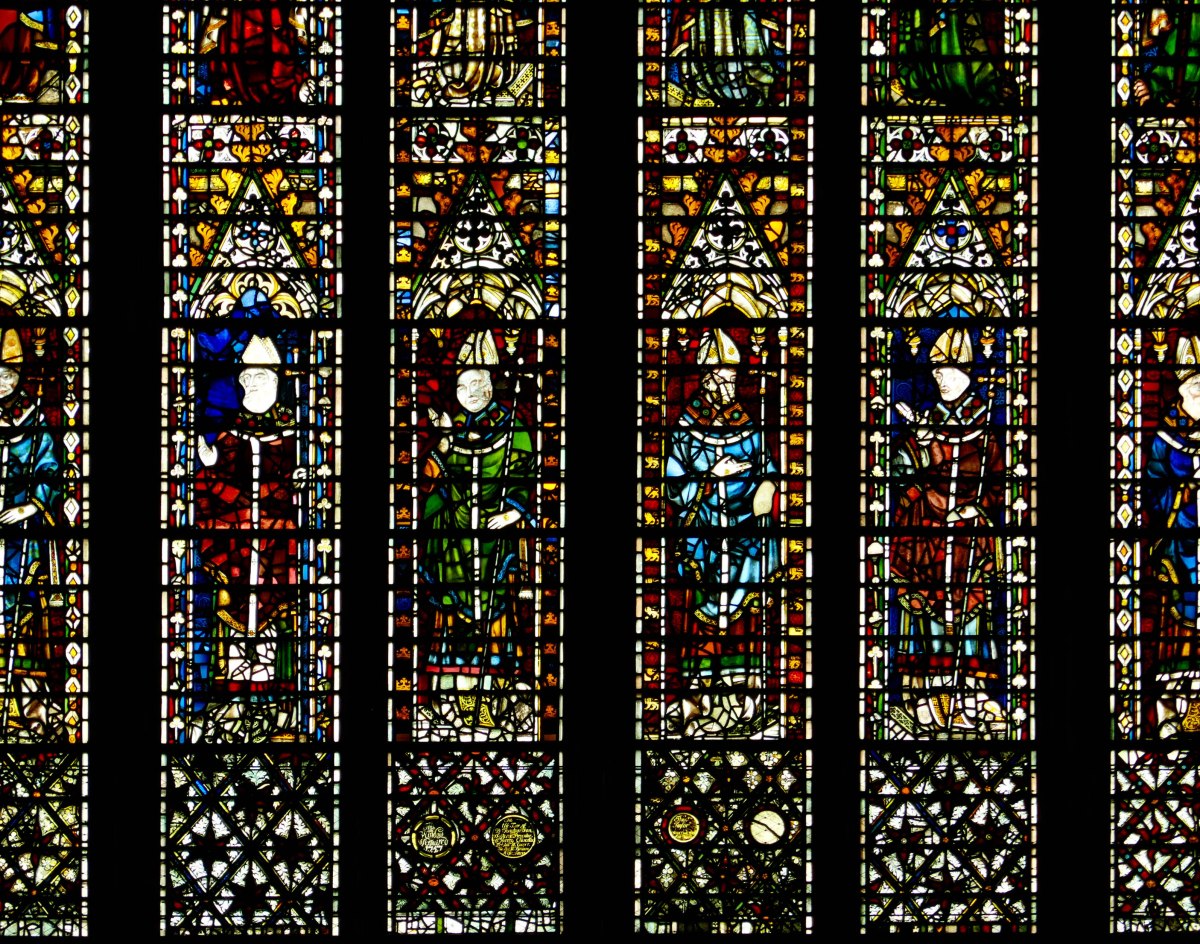
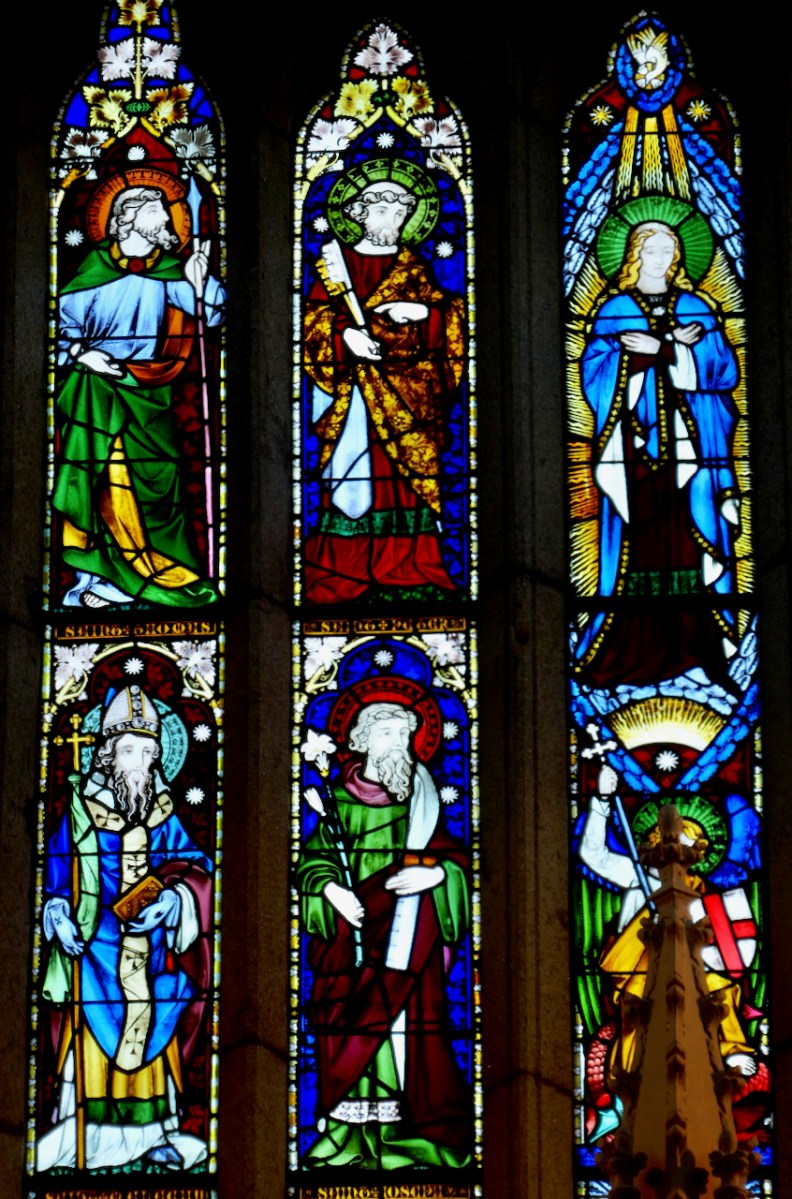
During the stained glass renaissance in nineteenth century Britain, the ideal became to replicate the style of stained glass from the High Gothic period of the 12th to 15th centuries – lots of small pieces of coloured glass leaded together, with saintly images set inside elaborate canopies. The example above is from York Minster and the windows below, clearly based on that model, are from the Pugin-designed St Aidan’s Cathedral in Enniscorthy.

Mayer moved away from this kind of glass towards what became known as the Pictorial Style. As a concession to the Gothic, they kept the canopies for the most part (it was a long time before stained glass studios dispensed with canopies) but they used larger sheets of glass (necessitating fewer cames of lead) and they took their artistic inspiration not from medieval windows but from Renaissance paintings.   The purists huffed and puffed, but the people flocked to this new style of glass.

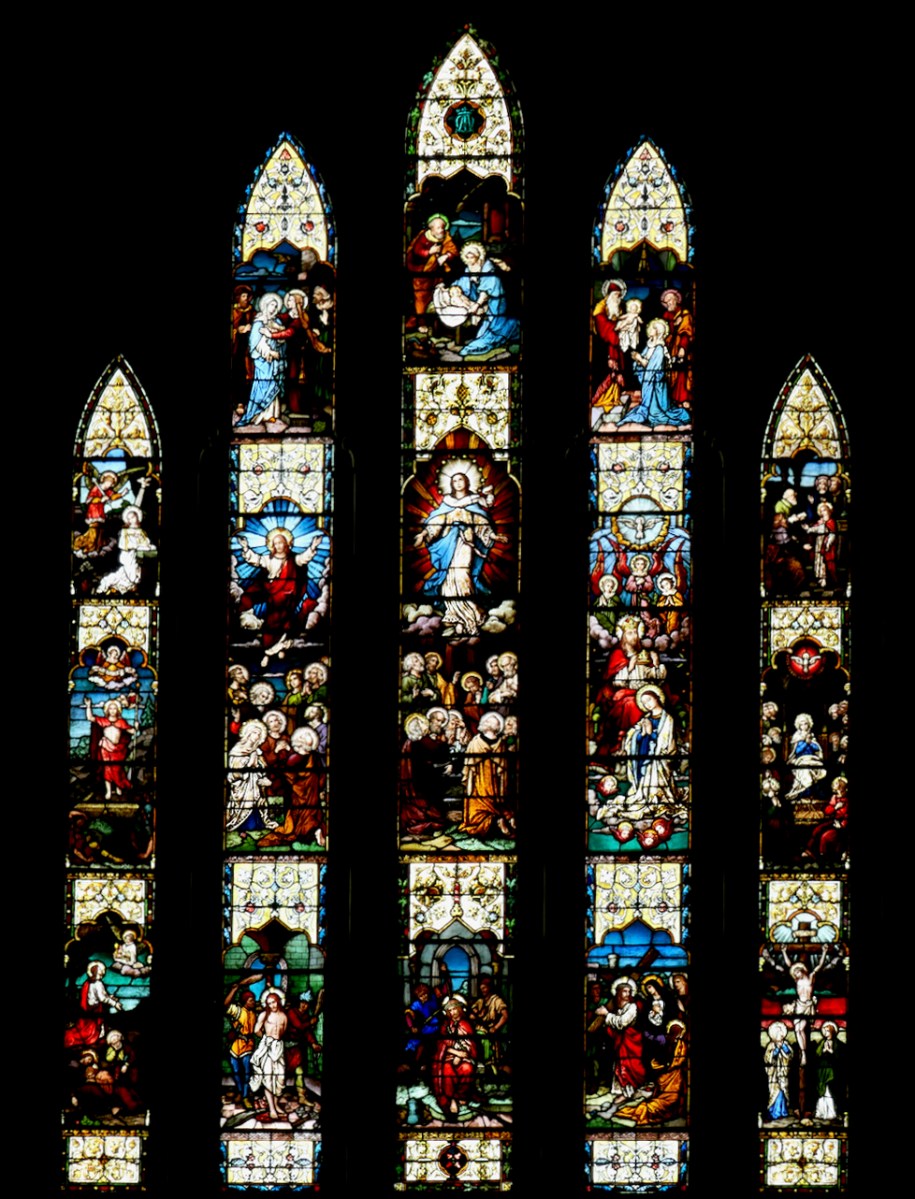
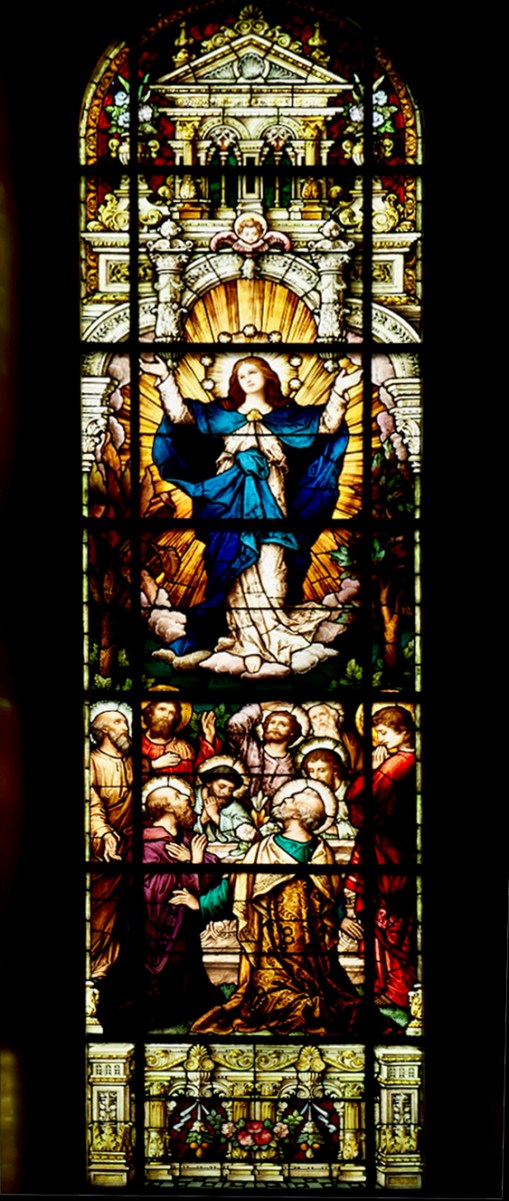
From the beginning this was a business, not an artists’ studio. The purpose was to make money and therefore a factory model was employed, with workers engaged in repetitive production of their own specialities – the apprentices did nothing but canopies, the painters might spend years decorating robes with brocade or embroidery motifs, only the most talented got to do faces. Designers produced sketches that were infinitely adaptable, with slight tweaking. In the large window above, in Baltinglass, Co Wicklow, the central image is of the Assumption of Mary into heaven. An almost identical design can be seen in the Catholic Church in Bantry, Co Cork, below (and indeed all over the place).

The results were appealing – highly competent windows full of beautiful images. 

High Renaissance figures swathed in copious draperies which amplify their forms and define their movements. Here the painter was freer to incorporate the sharp drapery folds which were inherited from the German Renaissance painting tradition. Colours are vibrant and rich, and the window glows with a deep resonance because the amount of white glass was kept to a minimum. . . It was easy for a congregation to relate to the pictorialism and to recognise the narratives, so that the windows were regarded not only as aesthetic objects but as an effective catalyst to meditation and piety. Pictorialism spoke more directly to the. . . public than did the more correct visual medievalism of the stricter British ecclesiologists. 

shirley ann brown*

Above is the Annunciation window in Charleville, Co Cork – one of my personal favourite windows by any studio. Although the firm was German and the windows made in Munich, they had offices in London, and an agent in Dublin (in fact, Joshua Clarke, Harry’s father, started out as their Irish agent). They became adept at fulfilling the request of Irish clergy for specific iconography – that is, Irish saints, and panels illustrating stories from Irish hagiographies.

St Patrick, above, is shown with his shamrock, paschal fire and snake, although the towers in the backdrop could be from a castle on the Rhine rather than resembling an Irish round tower. At their most basic, Irish saints were simply chosen from a pattern-book of saintly images and supplied with a name-caption. They all looked the same – St Aidan in one window is identical to St Columba in another, balding, bearded, dressed in a monk’s habit or a bishop’s splendid robes and mitre, but often with an attribute to distinguish them one from the other. St Patrick always has his shamrock, St Brigid her flame or her church, St Joseph carries lilies. Nicola Gordon Bowe, in the Introduction to the Gazetteer of Irish Stained Glass reported on Edward Martyn’s outrage at the lack of discernment among clergy and architects who seemed not to be able to distinguish between the work of an artist and the trade salesman with an oily tongue and an ever-ready kiln.

But you get what you pay for, and if you wanted something other than the pattern-book, Mayer could rise to the occasion, with splendid depictions of the mythology associated with Irish saints, all done in the same Italianate style and full of movement and vitality. One of my favourites is the story of St Dympna from Armagh Cathedral. (See Harry Clarke’s version of St Dympna in this post  – the story is the same but the images are vastly different.)

David Lawrence, the mastermind behind the website Gloine.ie, is a defender of Mayer, saying about the prejudice to which Mayer was subjected, Feelings against German glass were whipped up into a nationalistic frenzy at the time of the setting up, in 1903, of the Irish Arts-and-Crafts stained-glass studio An Túr Gloine and continued as that studio flourished in the early decades of the twentieth century. This prejudice has been well documented and was partly based on the factory model of glass production, since the new ethos of Arts and Crafts prioritised the artist’s vision and craft and abhorred mass production. However, Lawrence insists that, at their best, Mayer produced outstanding stained glass to equal any studio.

The year 1894 marked the start of a particularly successful new era at Mayer — this was the year that they were joined by the English artist William Francis Dixon (1848-1928). He had trained at the London studio, Clayton & Bell and then set up his own studio, Dixon & Vesey, before moving to Germany to work at Mayer. Dixon‘s arrangement with Mayer was a happy one. His skilful designing and drawing in a romantic manner influenced by the late Pre-Raphaelites and Mayer‘s attention to detail, masterly glass-painting and faultless craftsmanship formed an ideal marriage. Mayer-Dixon windows are in a romantic style, with a sweetness of drawing, softness of painting and beautiful, tapestry-like details. The heads are especially sensitively drawn. It is readily apparent that Dixon was able to dictate his own choice of colours to Mayer. 


 David Lawrence,
Stained Glass Windows, Six Roman Catholic Churches, County Offaly November 2010

One of Dixon’s windows is this fine war memorial in St Canice’s Church of Ireland Cathedral in Kilkenny. However, in the end, it can be argued that Mayer became a victim of their own success. Despite occasional triumphs of design and execution, too many of their windows lacked originality and freshness, starting to look hackneyed and same-y. Public taste for sentimentalised depictions (however gorgeous and expertly painted) gave way, under the influence of European art movements, to a search for a more authentic and modern form of religious expression. Irish artists responded by developing a vibrant, often experimental, stained glass industry dominated by small studios producing artist-led work. 

I will leave you with The Raising of Lazarus from Baltinglass Catholic Church for two reasons – firstly because it is perfectly illustrates the Mayer pictorial style at its best. I have provided three details close up, so you can see how competently the artist has rendered the subject matter.

The sentimentality critics complained of is in full flight in the image below – but also, look at the size of the eyes. Creating over-sized eyes to enhance and beautify a face didn’t start with Harry Clarke!

But secondly I use The Raising of Lazarus tongue in cheek as a nod to the fact that in fact Mayer is still around – and they have finally caught up with the century they live in. Take a look at this story in the New York Times to see how Mayer of Munich is embracing the twenty-first century.

*The Influence of German Religious Stained Glass in Canada 1880-1941 by Shirley Ann Brown, RACAR: revue d’art canadienne / Canadian Art Review, Vol. 21, No. 1/2, Représentation et identités culturelles / Representation and Cultural Identity (1994), pp. 21-31 (11 pages)

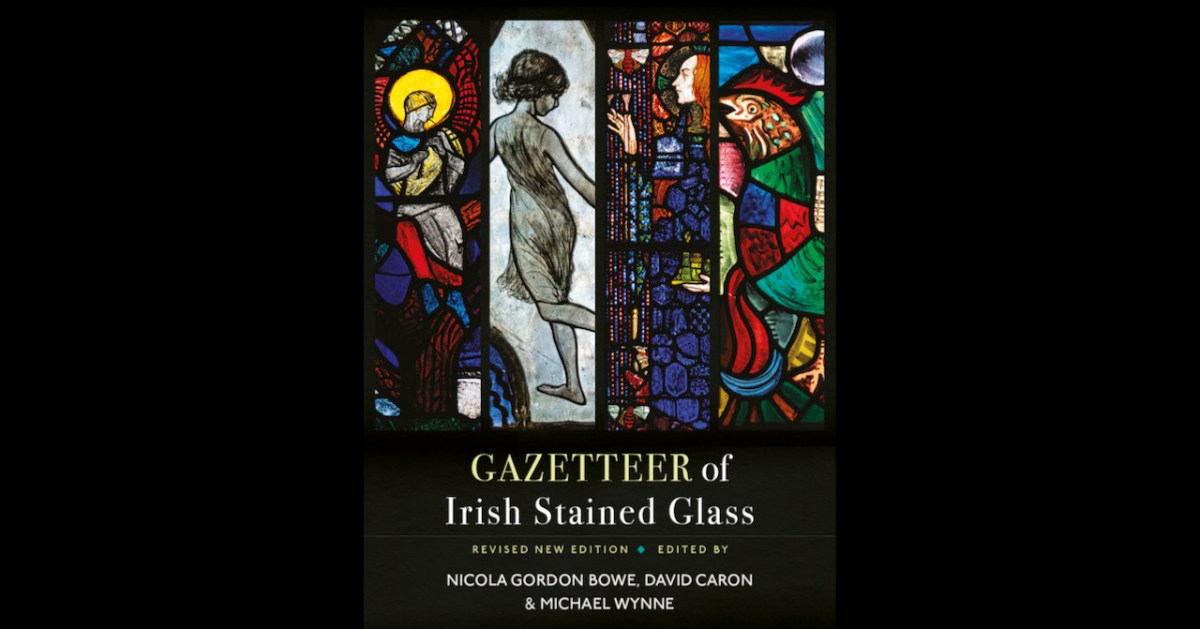
The Gazetteer of Irish Stained Glass

It’s finally here, and it’s stunning!

The Gazetteer of Irish Stained Glass was first published in 1988 and has been out of print almost since then. It was the work of Nicola Gordon Bowe, David Caron and Michael Wynne. It documented all the known windows of Harry Clarke and the artists of An Túr Gloine and was snapped up by anyone interested in looking at stained glass.

Click through to see sample pages!

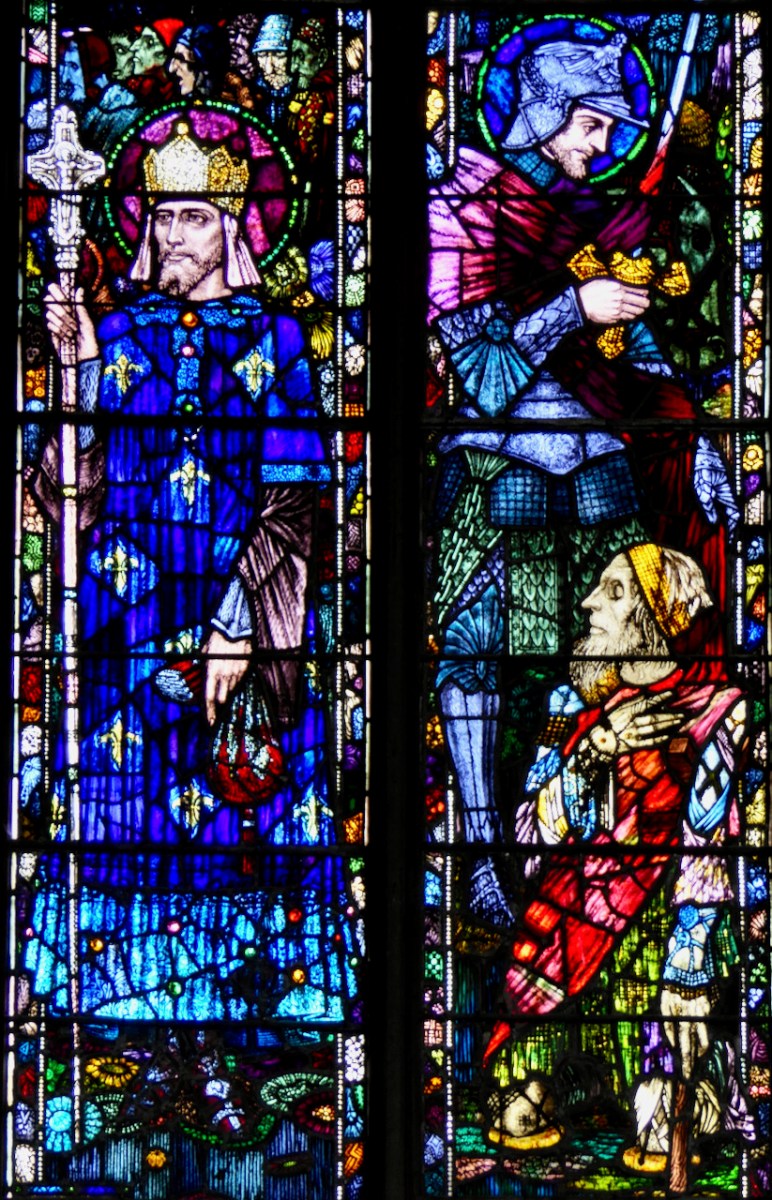
Of the three editors, David Caron, who was a newly-minted PhD at the time, lecturing at the National College of Art, is the only surviving member. He has forged a long-time collaboration with the photographer Jozef Vrtiel, a specialist in the difficult art of capturing stained glass, and together they determined that it was time for an updated edition. Not only updated, but expanded – their vision was for a book that would include all the best stained glass designed and/or made by Irish artists, or by artists working in Ireland. Harry Clarke is here, of course – that’s his St Louis and St Martin window, below, in Castletownshend. But there is so much more to Irish stained glass than Harry Clarke, even though he’s the one that most people know (or think they know).

Note I said ‘artists’ – this is not a book that records all Irish stained glass, such as the mass-produced windows that came from the large studios. The criteria for inclusion were “Artistic merit, individual voice and excellence in the craft.” There were nine artists included in the first book – there are over 90 artists represented in this one!

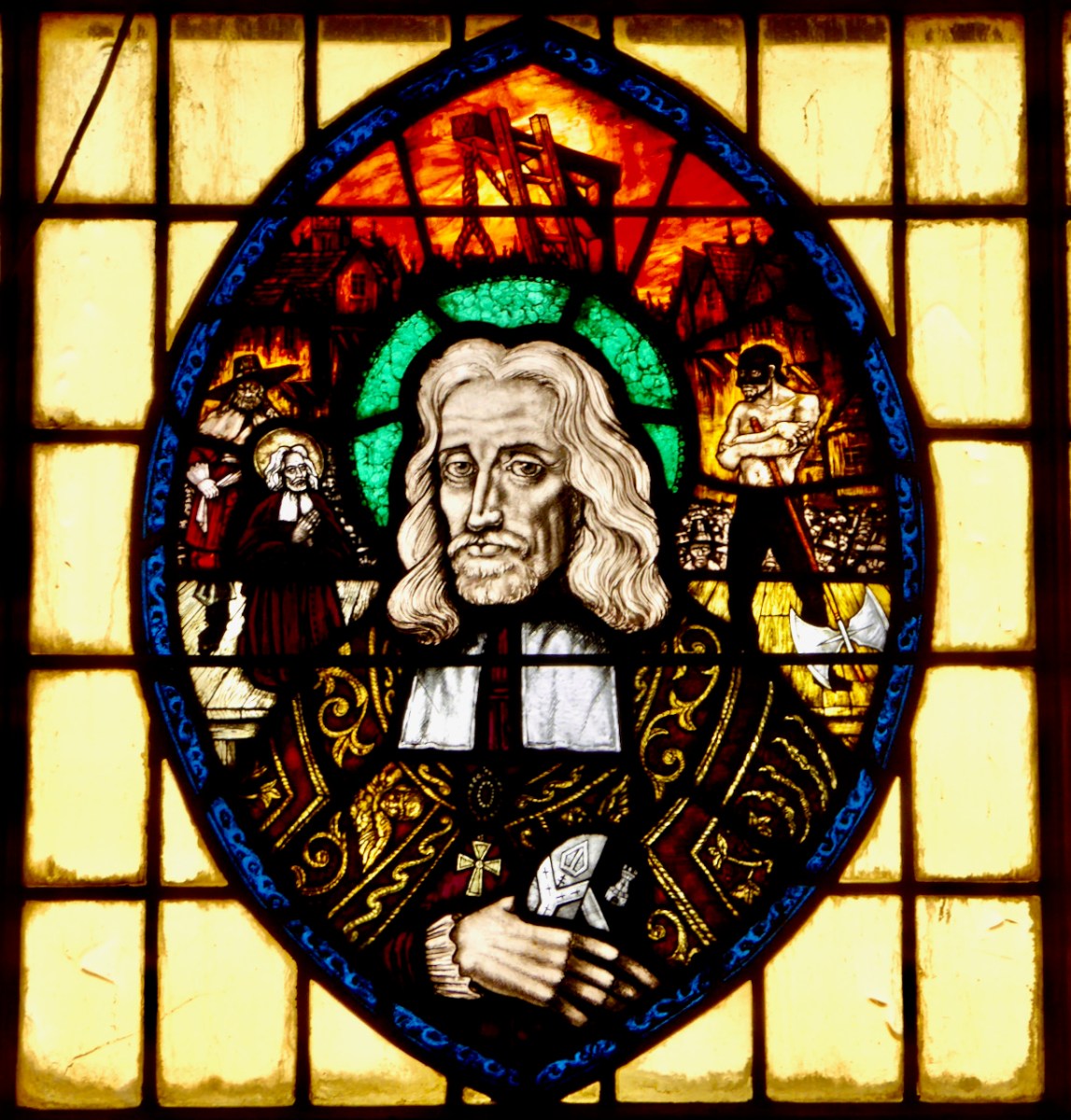
Some artists love to tell stories in their windows – this window is about the trials and tribulations of Oliver Plunkett and is by Kevin Kelly of the Abbey Stained Glass Studio

To do this, besides drawing on his own considerable store of knowledge (and indeed doing the vast majority of the work in this book), David assembled a team of fellow enthusiasts and experts each of whom concentrated on the work of a single artist or studio. For example, Réiltín Murphy has long been compiling the work of her parents, Johhny Murphy and Roisín Dowd Murphy, who together with Dessie Devitt, founded and ran the Murphy-Devitt Studios. You can take a look at my posts, Murphy Devitt in Cork, to see how brilliantly they pioneered a whole new approach to stained glass in mid-century Ireland. The image below is one of their windows from Newbridge College Chapel.

Another contributor is Ruth Sheehy, whose wonderful new book on Richard King occupies pride of place on my desk. I’ve learned so much from it, and bring this new appreciation now to my sightings of a Richard King – always a big thrill. The panel below is a detail from one of his enormous windows (The Sacred Heart) in St Peter and Paul’s Church in Athlone.

My own part revolved around my project to record all of George Walsh’s windows in Ireland. This has been a joyful journey for me, and I have written about George and his windows for the Irish Arts Review and for my own blog. There are over 100 of George’s windows in the Gazetteer, including the scheme he executed for the Holy Family Church in Belfast.

This is a book you will want to have with you in your car. And you know what? There is a lot more wonderful stained glass out there to discover – I’ve been amazed at what I have found in little country towns and in 1960s modernist churches. I have no doubt a third edition will have to be produced eventually as more of us tune in to the treasures under our noses. Look at the picture below, for example – you would swear it was a Harry Clarke! It was certainly made in his studio by a highly talented artist and bears a lot of his characteristic flourishes, just not his signature.

The best part of working on this book? The collegiality of everyone involved – we all helped each other out with queries and photographs. I feel like I have made new friends, even though I have yet to meet many of them. You can buy the book now in all good bookshops (buy local!) or order from the publisher.