Gabrielle’s Lake

I am always delighted when readers contact me with stories about some of the West Cork places I have written about, so I was very pleased indeed to get a message from Jack Cooper, relaying a story from his friend Gabrielle McCracken, nee Chavasse. Gabrielle, an Oxford graduate, lives in Scotland now and has very happy memories of her childhood in the shadow of Mount Gabriel and subsequent visits back to the area. 
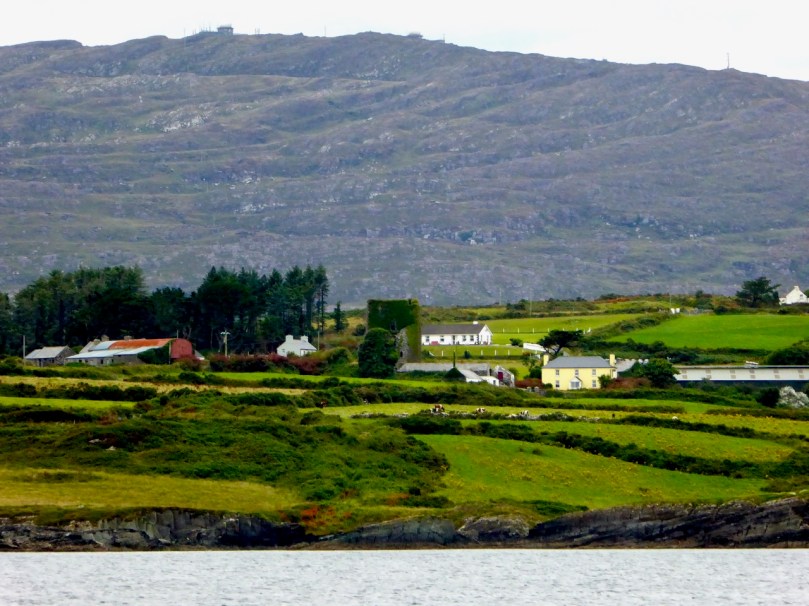
Gabrielle’s reminiscence takes shape around the small lake on the top of Mount Gabriel that I wrote about in my post Legends of Mount Gabriel: the Bottomless Lake. Here is her story, punctuated by comments and photographs from me. The Rectory (below) that Gabrielle refers to came up for sale a few years ago and this photograph is from the sales video.
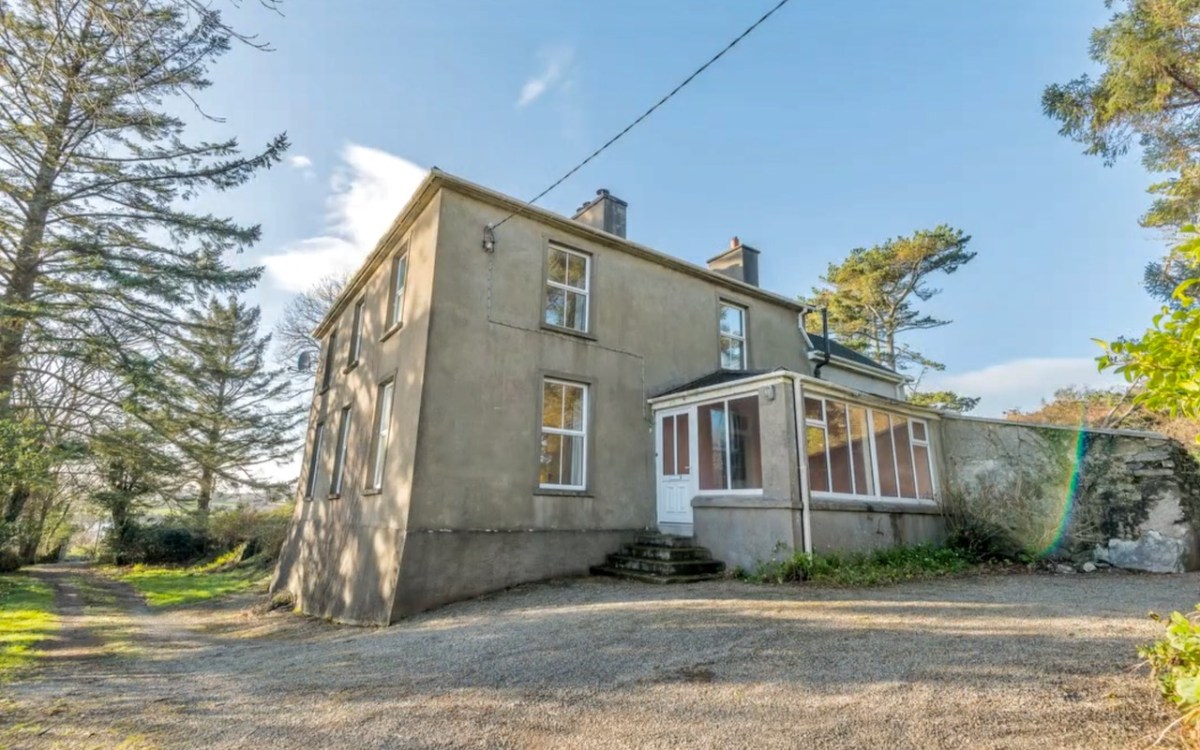
In the early 1930s, my father, Claude Chavasse, became the Rector of the ‘altar’ parish in West Cork. It was his first parish : he already had a Mediaeval History degree and the history and legends of wherever he lived were of great importance to him. I was born in 1935 and spent the first five years of my life in that lovely parish: we could see Mount Gabriel from the rectory, hence my name. 
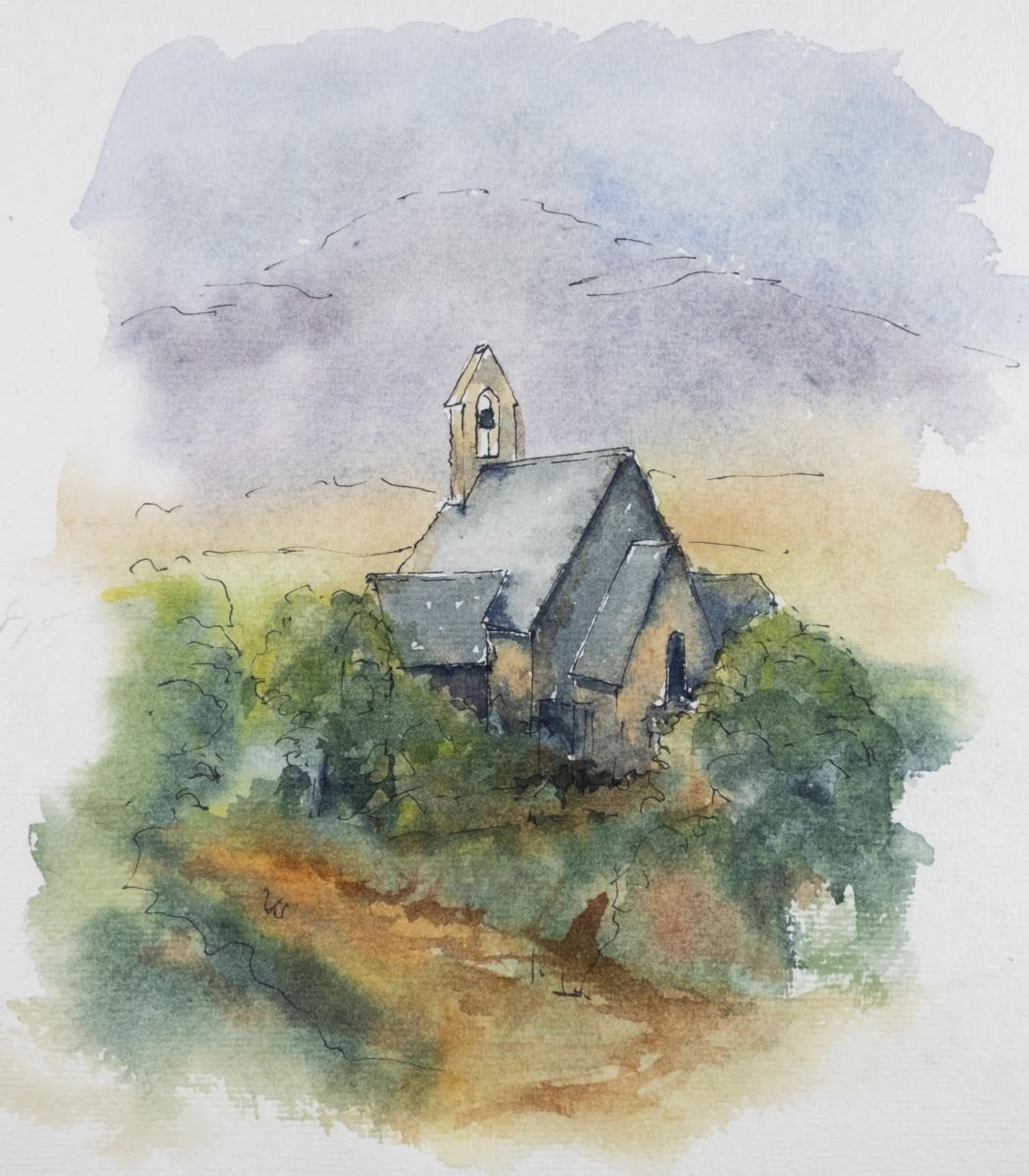
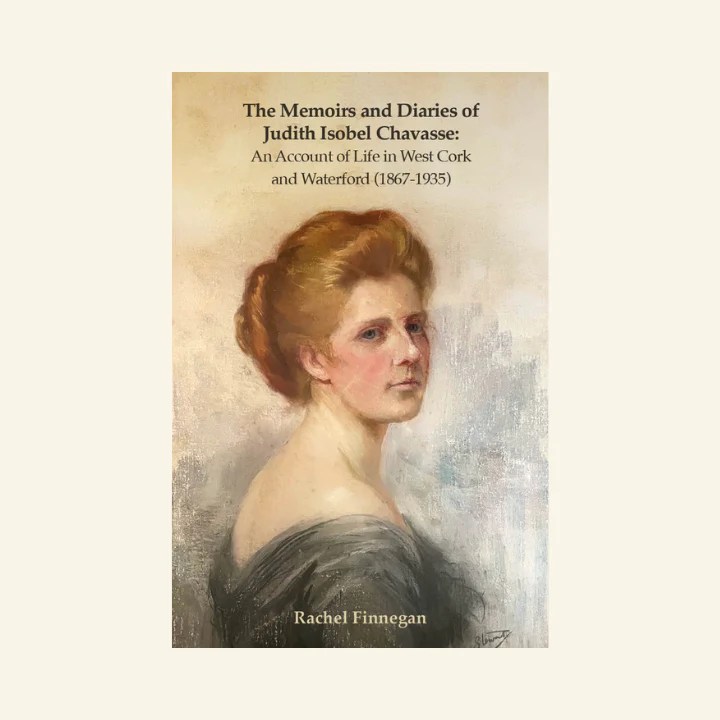
Peter Clarke’s lovely watercolour of the Altar Church is above. Claude was a member of the large Chavasse family associated with Castletownsend and New Court. Rachel Finnegan has written beautifully about the Chavasses in her book The Memoirs and Diaries of Judith Isobel Chavasse. Judith Isobel was Claude’s mother, Gabrielle’s grandmother.
I was brought up in the knowledge of the legend that the foot-shaped lake on the mountain was where the Archangel Gabriel had put his foot down on Earth on the way to Nazareth and the Annunciation. My parents often climbed the mountain and they told me that they had often swum in the lake undeterred by its reputation for being bottomless and that, if they went too deep, they might find themselves on the Fastnet Rock! In about 1948, my father took locum summer duty back in his beloved ‘altar’ parish, and so he and my mother were able to climb Mount Gabriel again but now with my sister and me. We all swam in the dark peaty water of the lake, and I remember it well. 
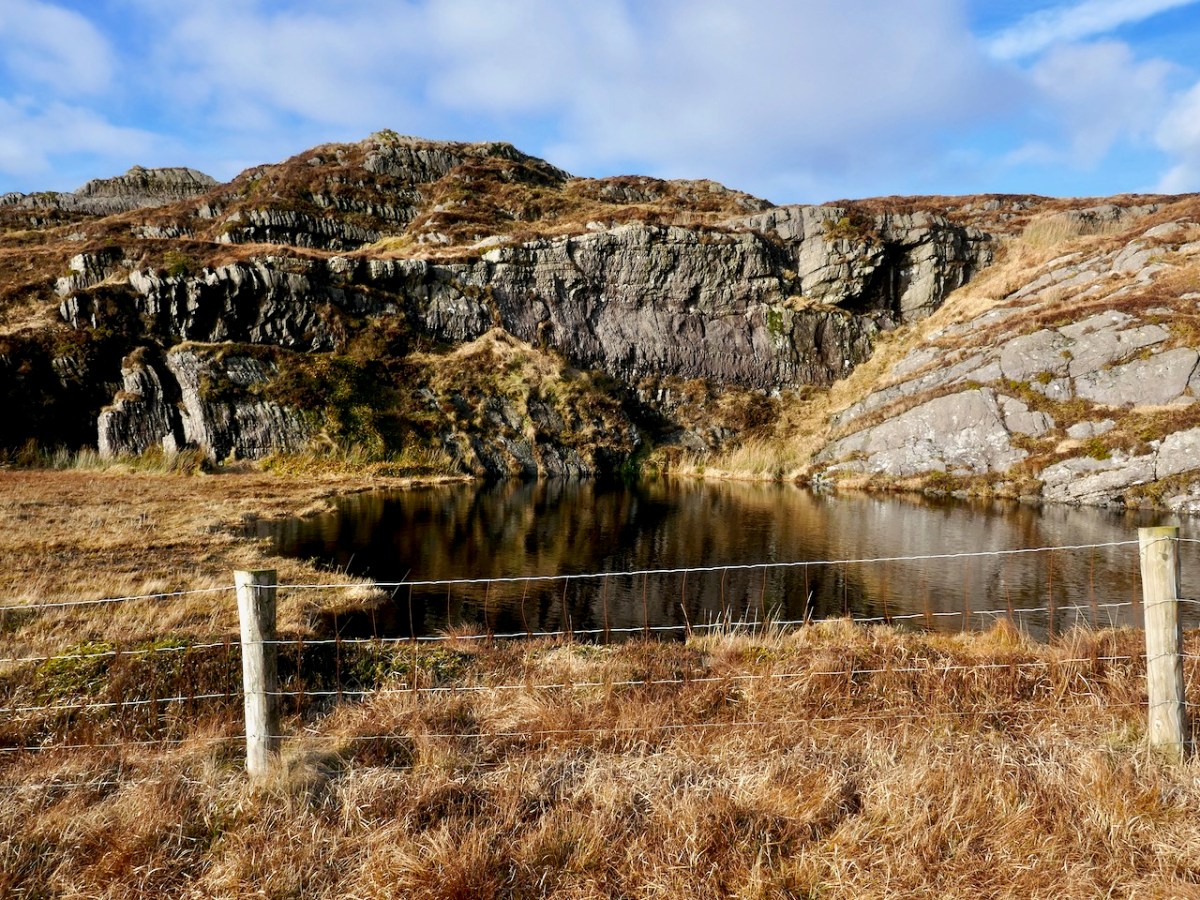
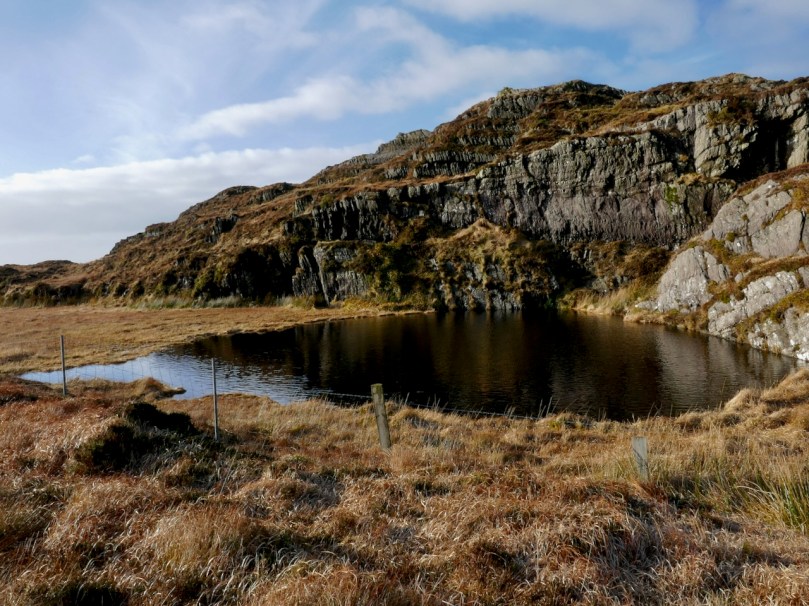
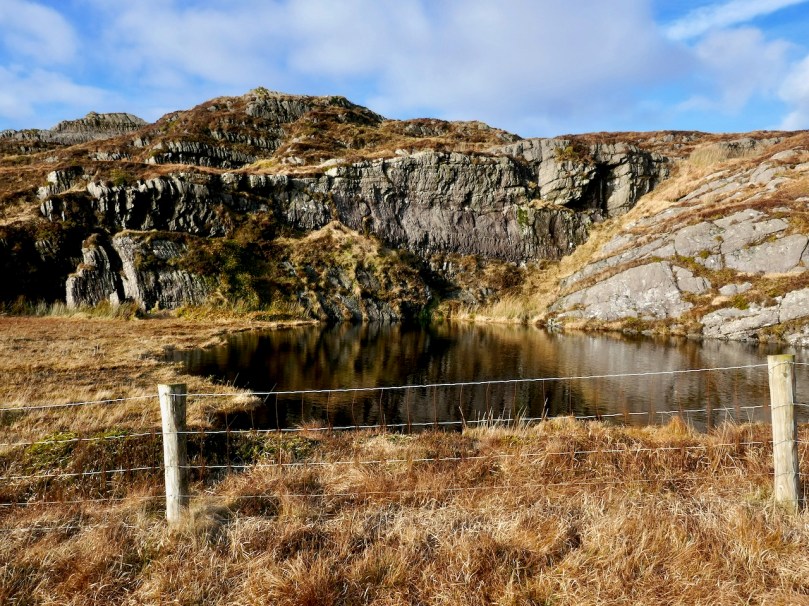
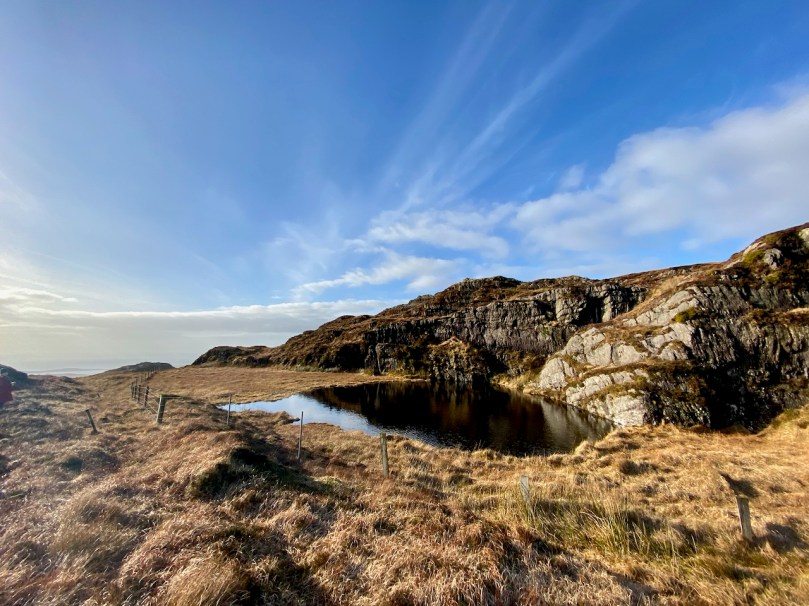
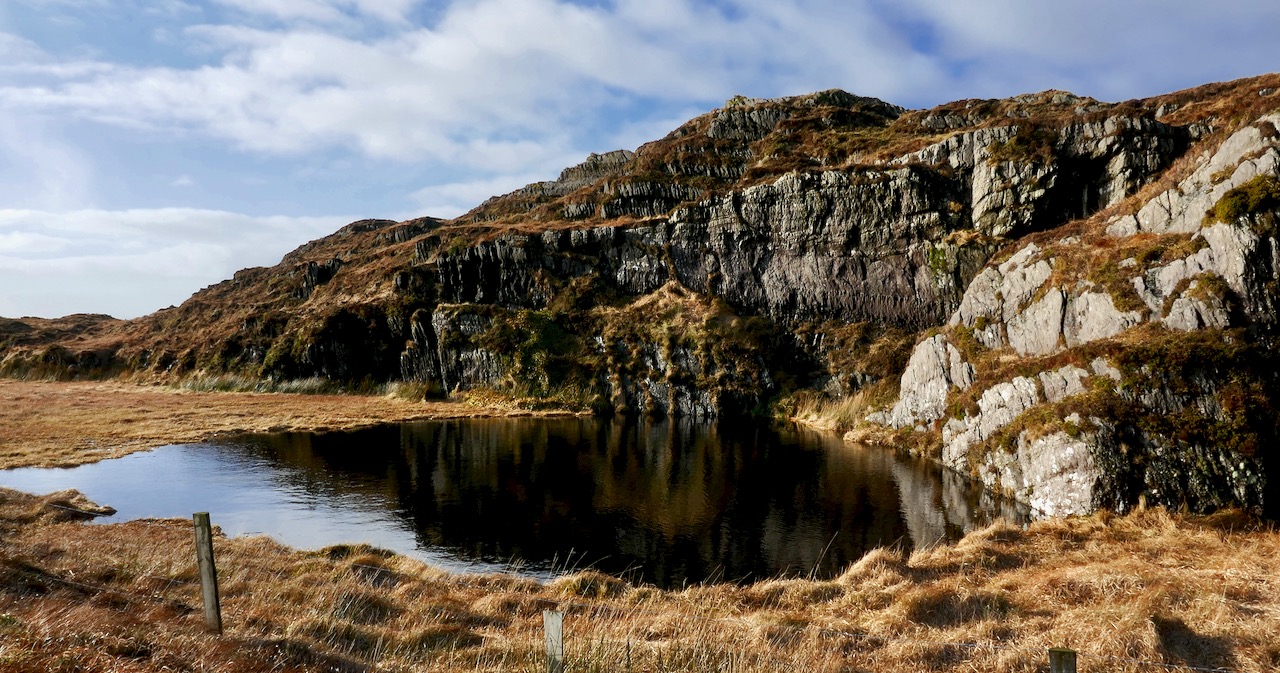
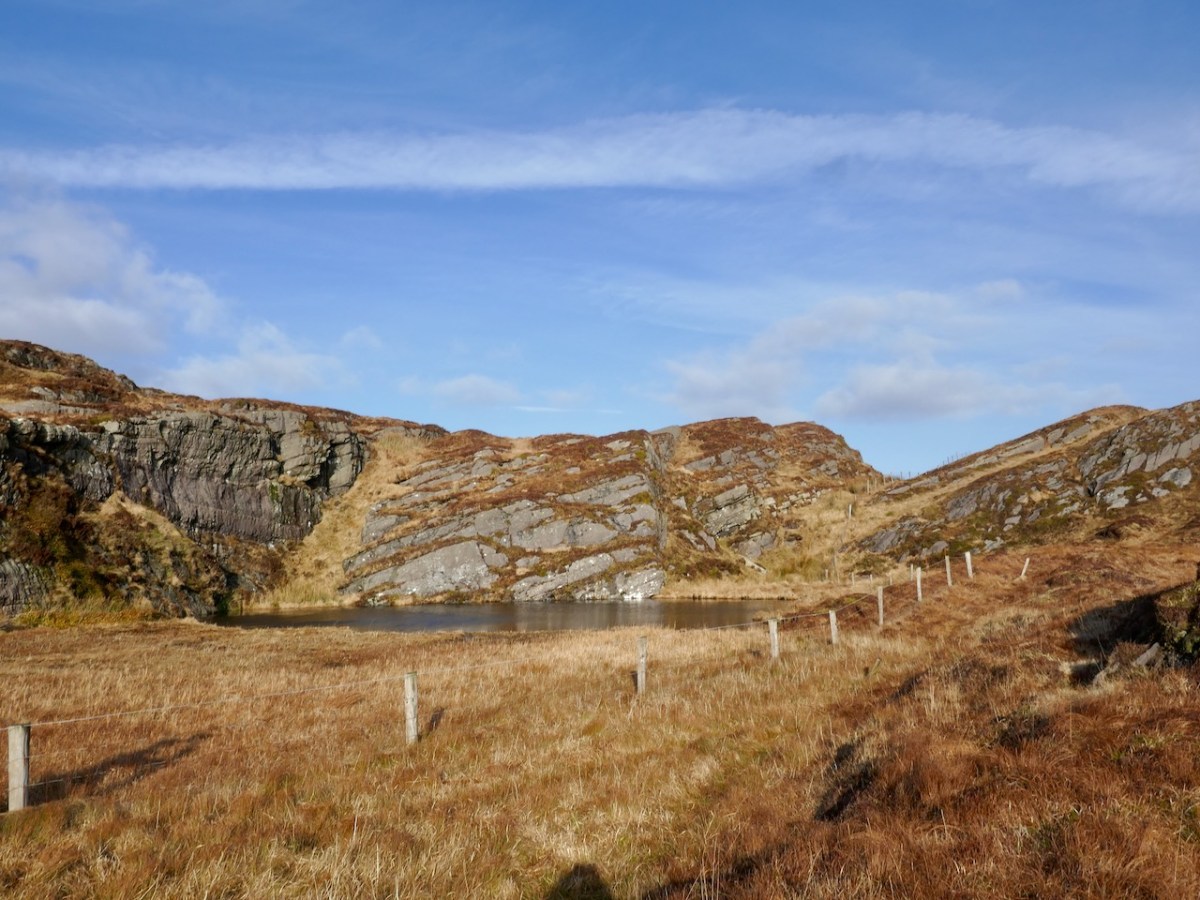
I love that they swam in the lake – it is dark and peaty as she remembers it but so alluring in its remoteness and in how it is contained within a pocket in the landscape with those cliffs in the background.

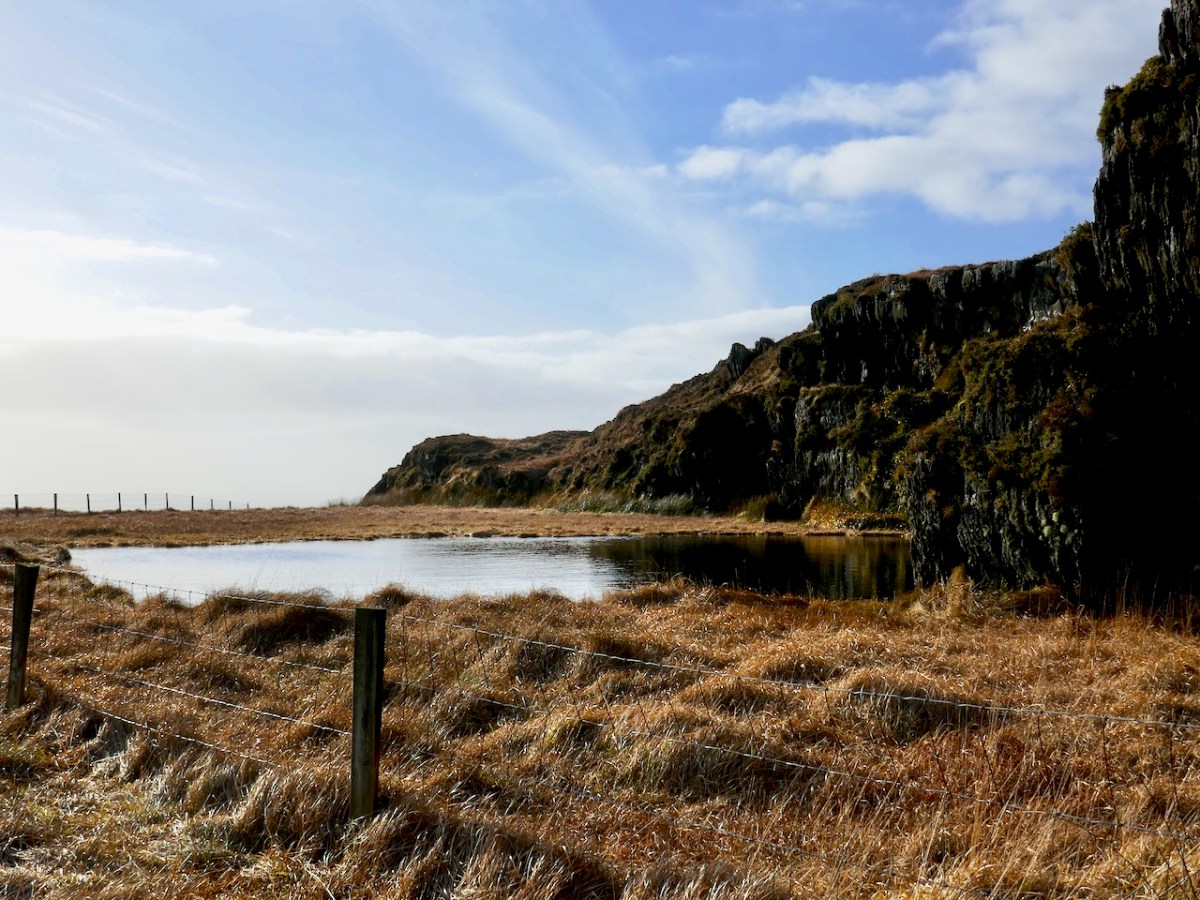
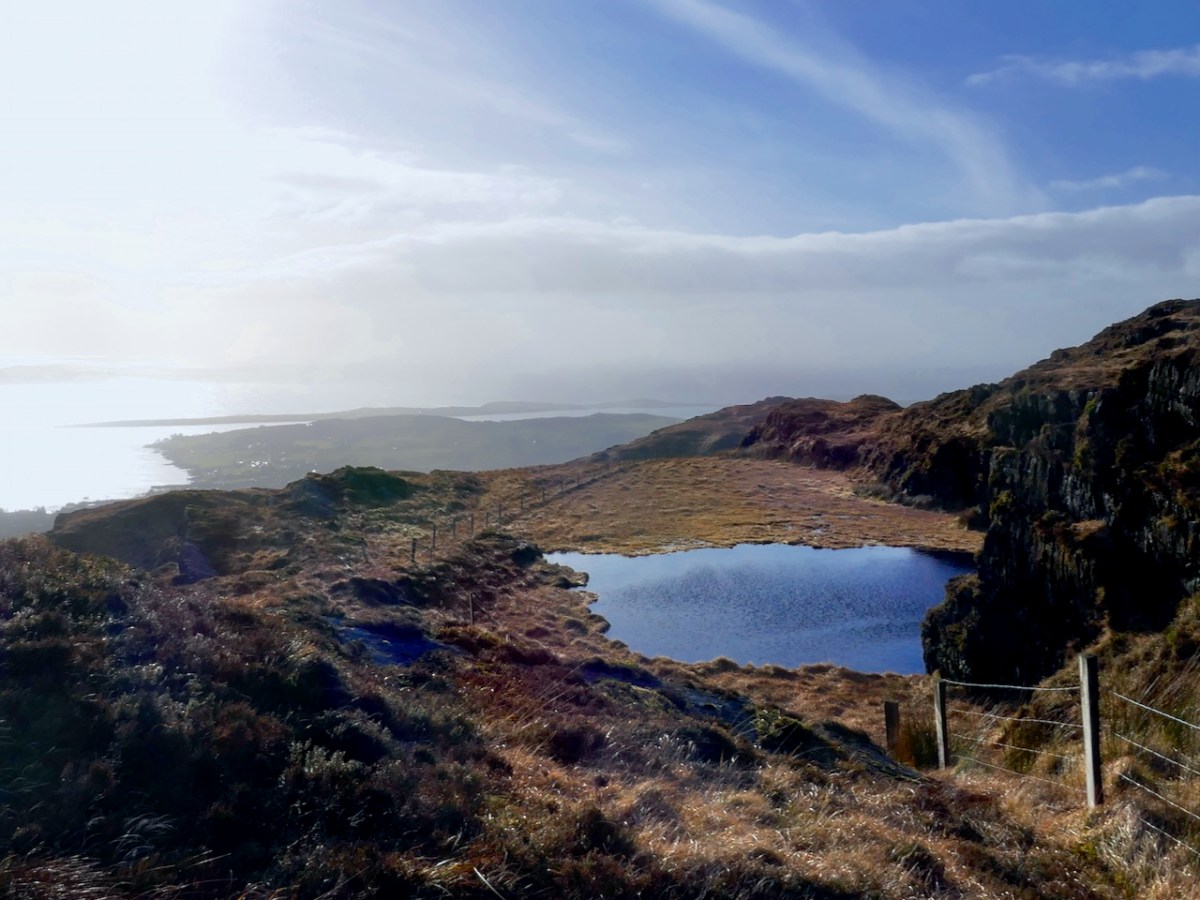
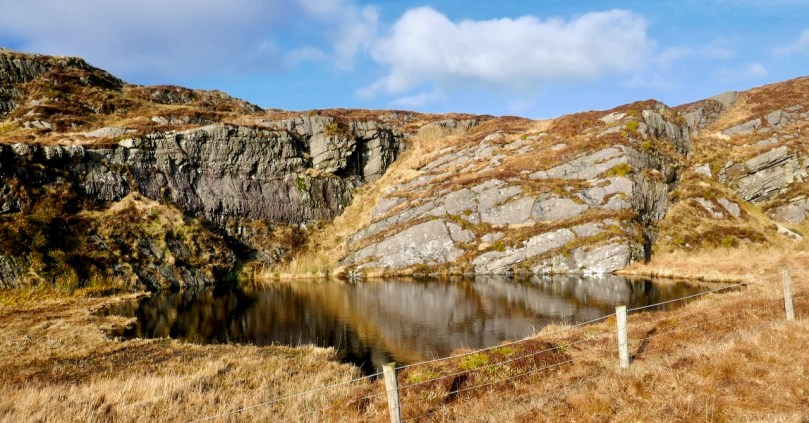
The lake may have been about 6 yards long and not very wide. It is hard to remember dimensions, but on one side, there was the curve as of an instep and on the other was a small steep rocky cliff, perhaps about 8 feet high with delightful little ferns growing in its crevices. There would have been very few tourists in those days, and there might have been a minimal footpath to the lake, but no road, no posts, no wire , all of which appear in more recent photographs. 

While Gabrielle remembers the lake as smaller than it actually is (typical of us all) her description of the character of the lake is completely accurate – the ‘instep curve’ and the cliff with its ferns are all clearly visible. The fence with its wooden posts and wire are all much more recent.

On that occasion, I took a black and white photograph of the lake (with my Brownie Box camera) and entered it in a school photographic competition, but, alas, I destroyed the negative and gave the only print to a friend a few years ago.
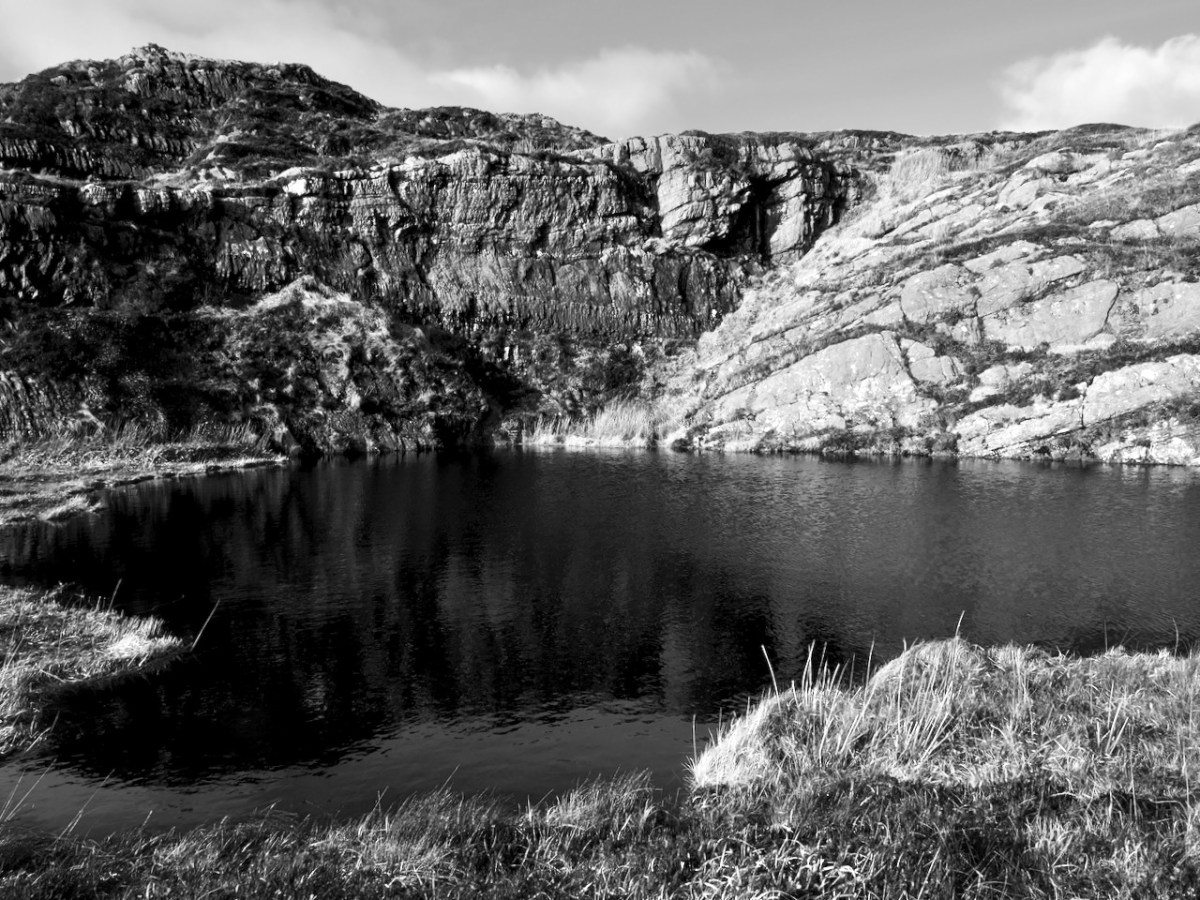
I have turned one of my photographs into a black and white image. I understand that Gabrielle’s vision is not good, so Jack will have to describe this to her.

In the early 1980s, when I and my two children were visiting relations (Dr. and Mrs Pearson, staying at Coosheen, Schull), I took my children up Mount Gabriel to visit the lake that was so important to me. We looked in vain. We clambered through thick heather, we climbed over rocks, we sought everywhere near the top of the mountain — I was devastated that we could find no sign of the lake. 
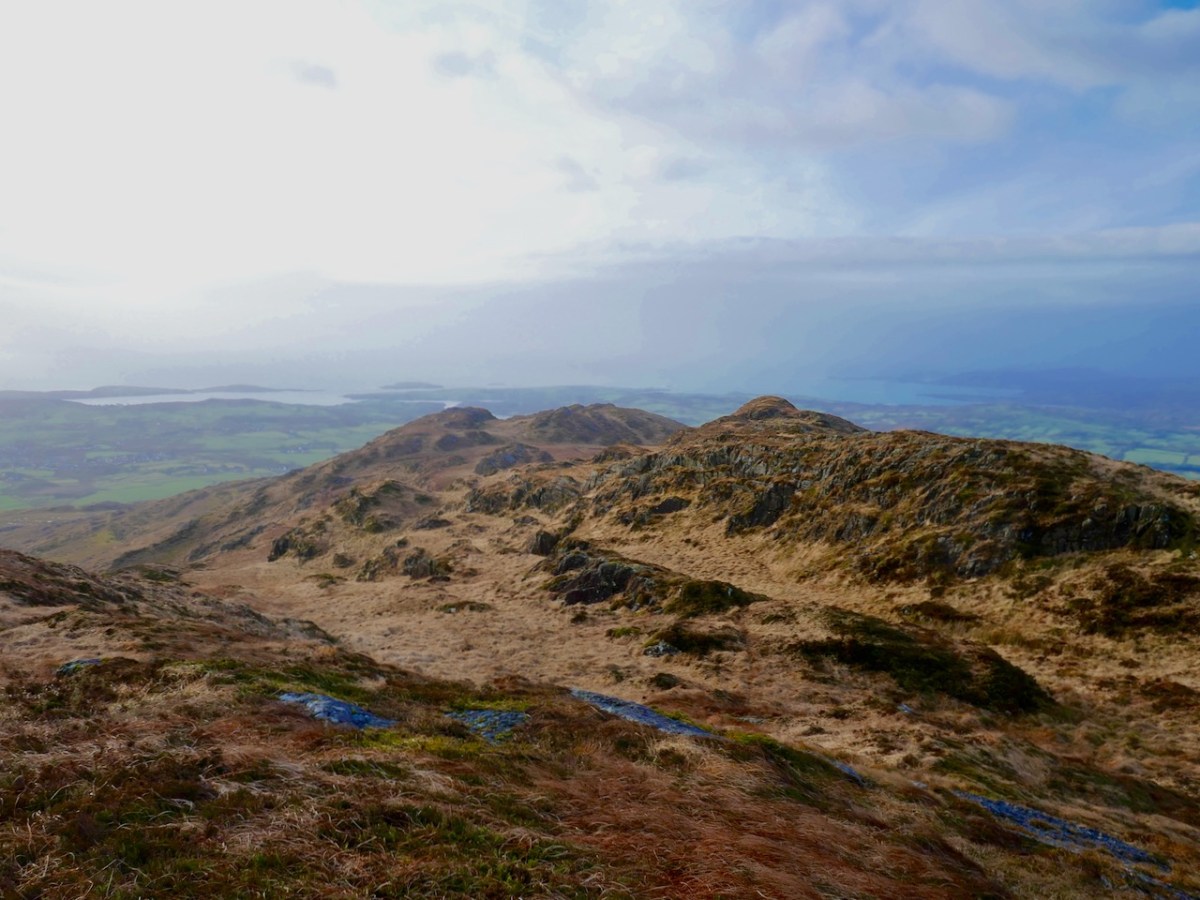
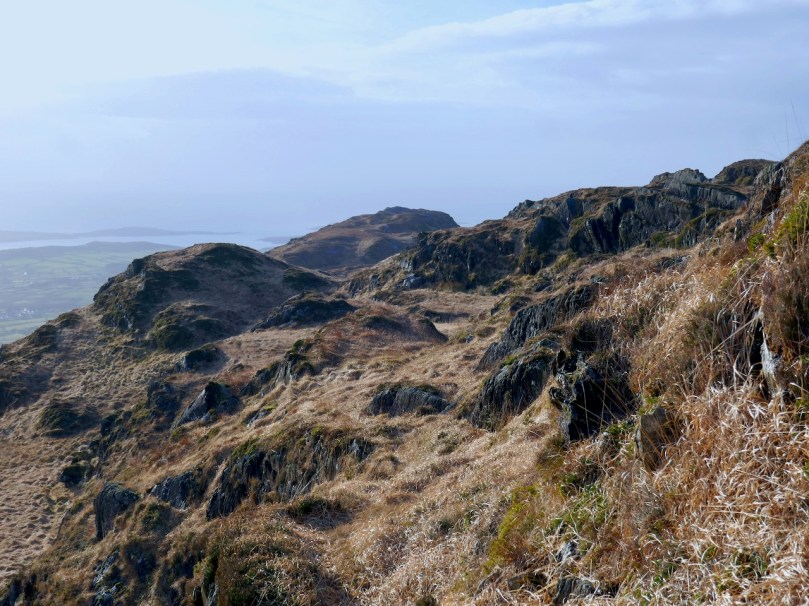
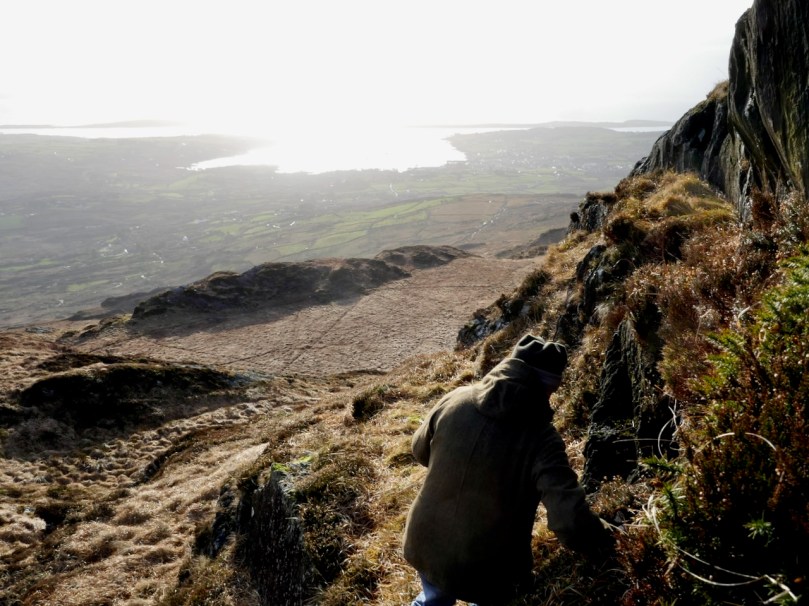
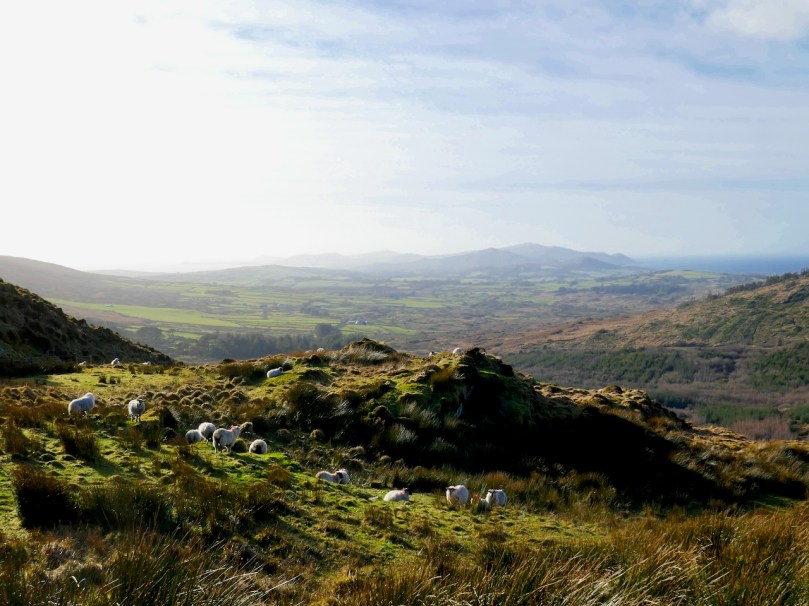
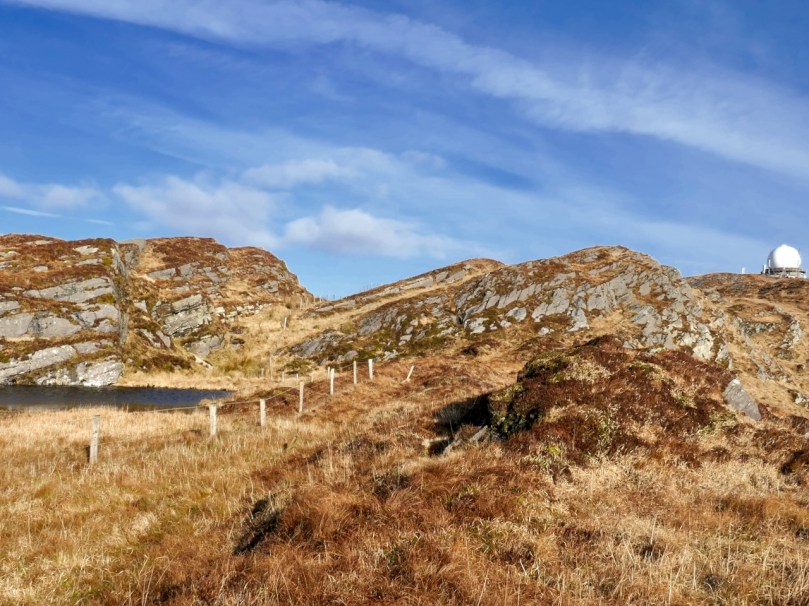
I know that feeling! Robert and I came close to missing the lake too and at one point felt like we might have to be rescued from the mountain while traversing the rough terrain (above). But I can assure Gabrielle that the lake is still there – we did find it eventually. 

Straightaway, we climbed back down to Schull and went to the tourist office and asked the official (she was probably in her forties) what had happened to the lake? She asked if we meant the reservoir at the foot of the mountain and said that there was no lake, and she had no idea why the mountain was called Mount Gabriel!

There is a reservoir at the foot of the mountain (below) but of course that is not Gabrielle’s lake. 
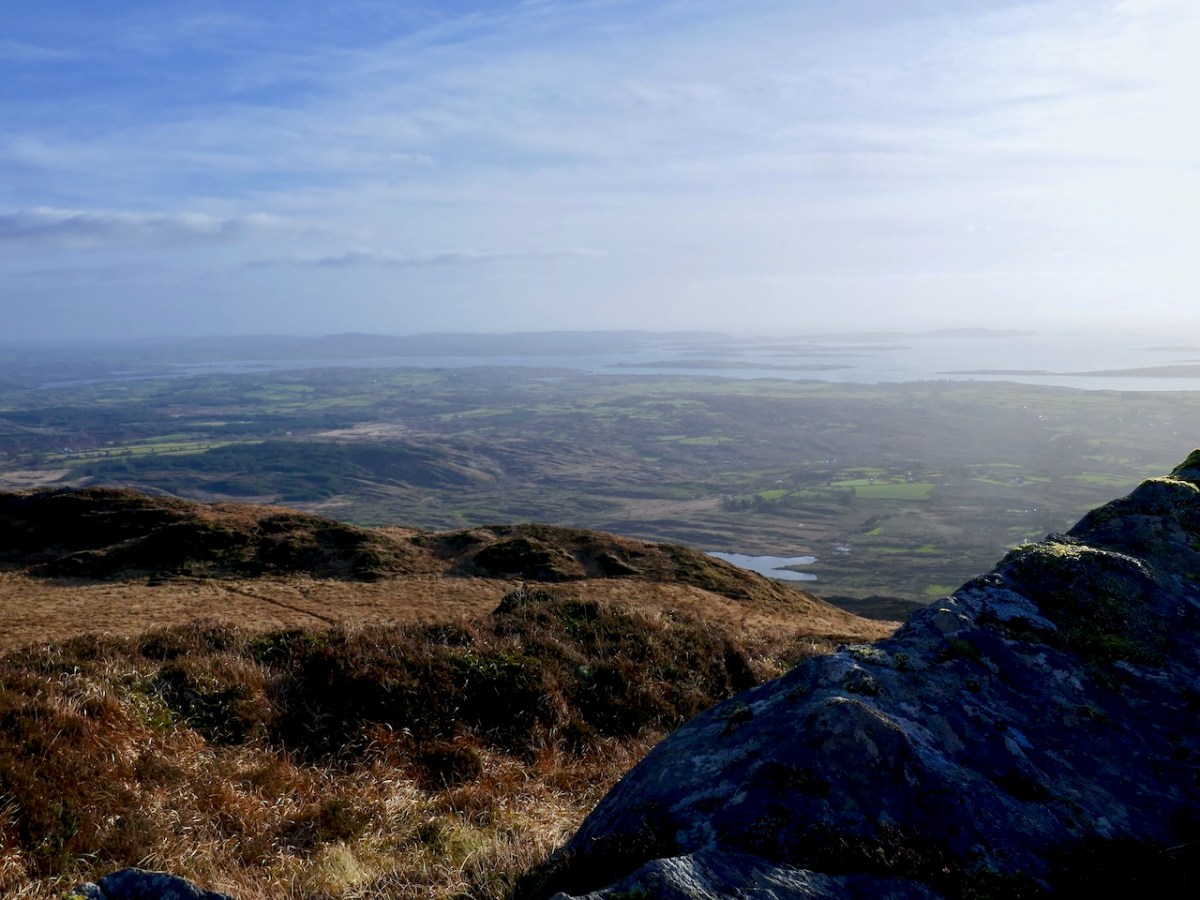
It occurred to me that the Americans, who were responsible for building a radar tracking station on the mountain summit, and knew nothing of the importance of lakes or legends, had infilled the lake with soil and rocks. It was a spring fed lake and any debris could have blocked the spring, leaving initially no trace of the lake. 

This is an important part of Gabrielle’s story for a particularly interesting reason – it is illustrative of the fact that folklore about the mountain did not stop in the 1930s. This belief, that Americans built the dome, grew in the early 1980s as a result of an unfounded newspaper article claiming the installation was part of NATO defences, leading to a group called the Irish National Liberation Army (INLA) bombing one of the domes. In fact, the installations monitor civilian aircraft in Ireland’s upper airspace and have no military function. 

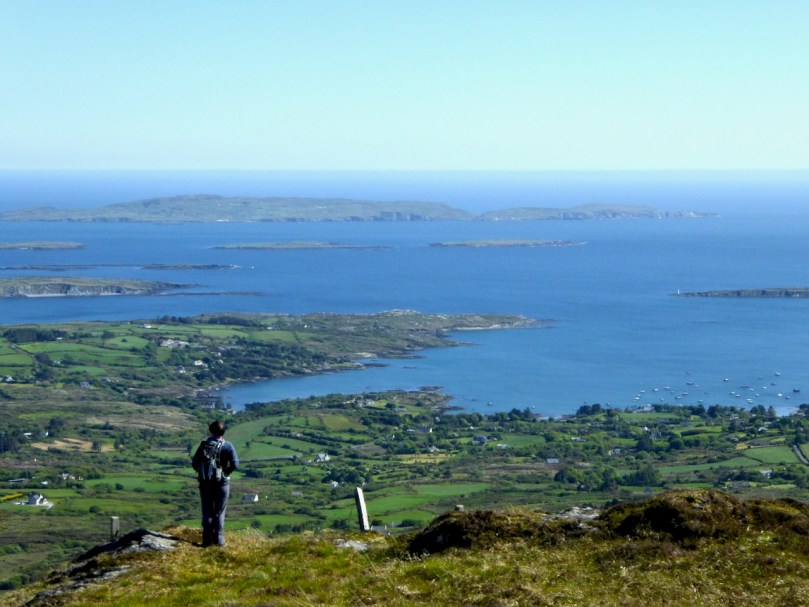
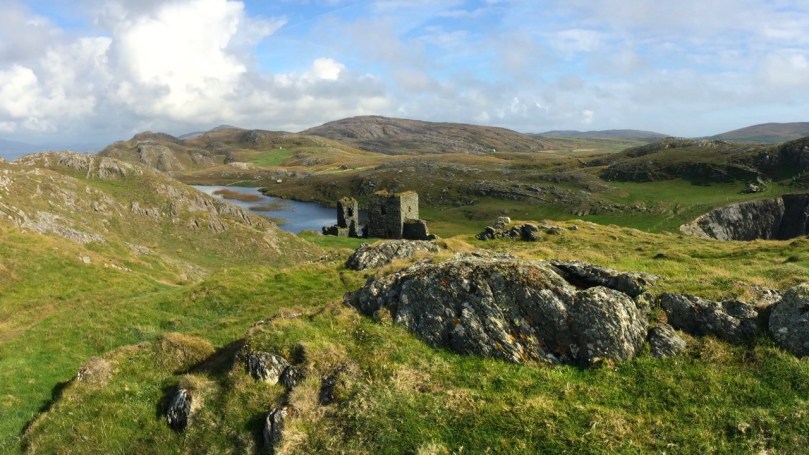
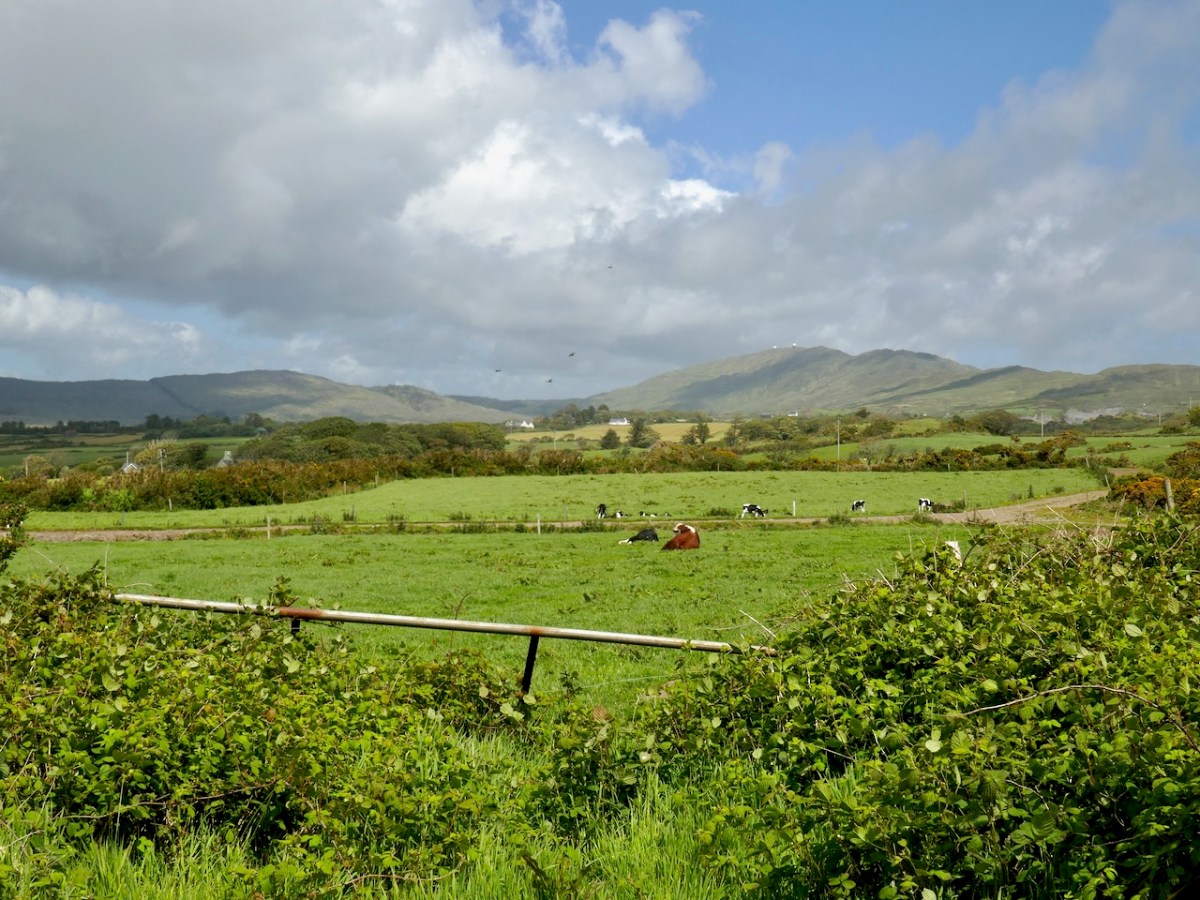
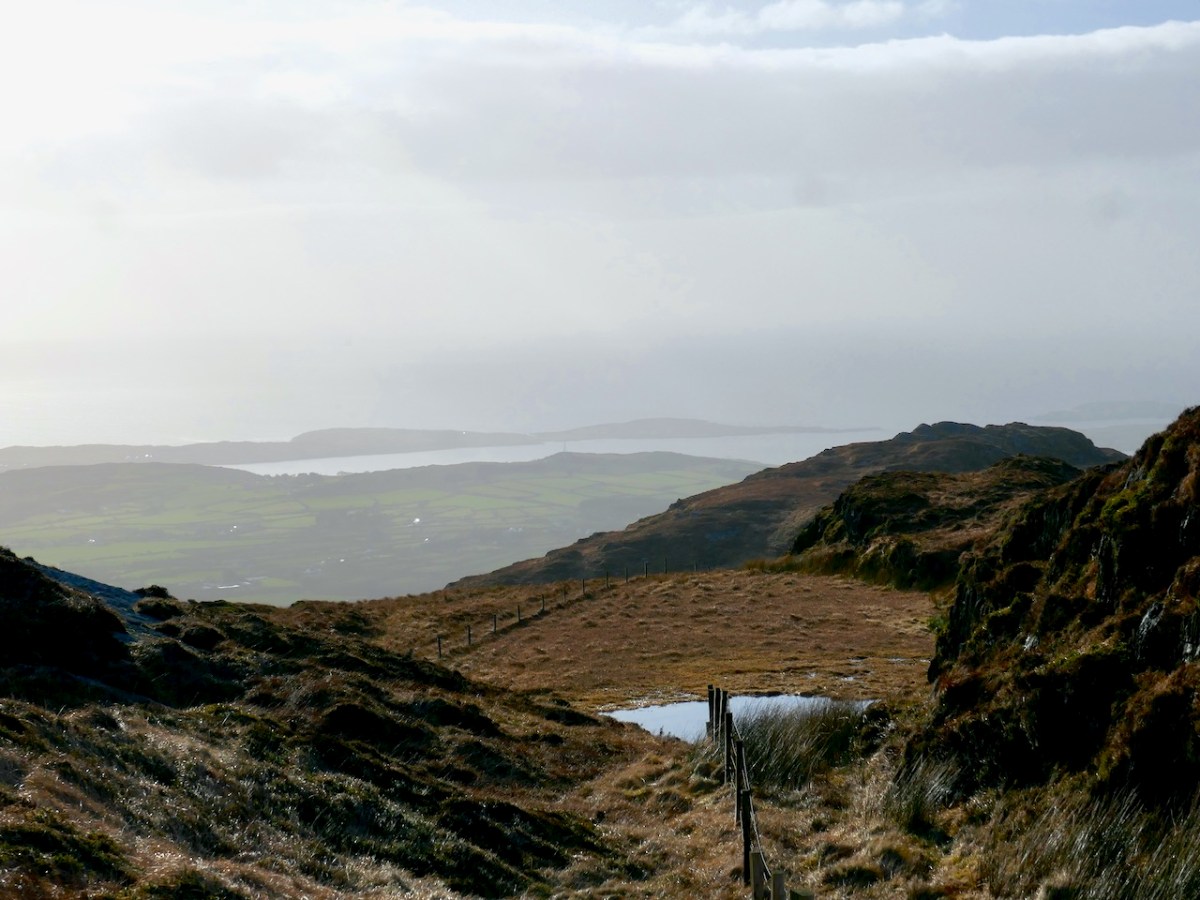
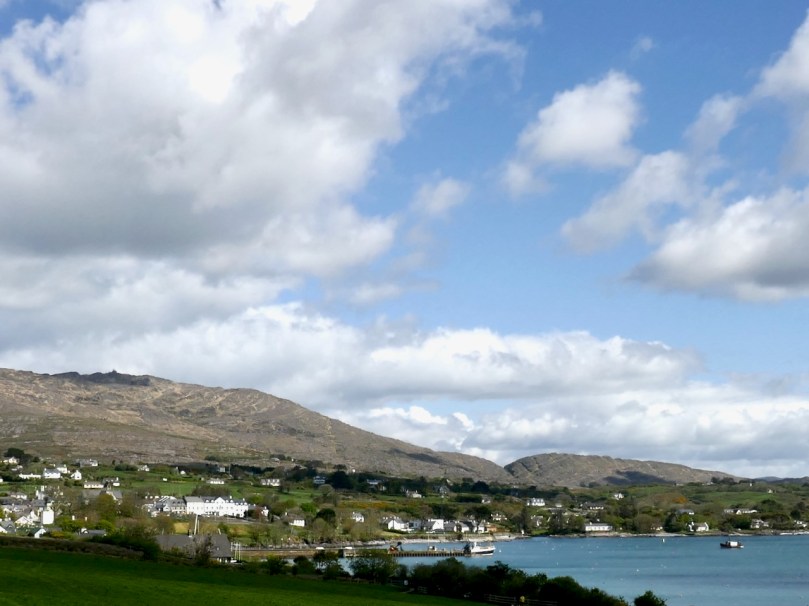
But now, in modern photographs, there appears to be a marshy area with a large puddle in its midst but hardly worthy of the foot of an archangel. Perhaps the puddle will grow larger and will, in time, become a lake again.

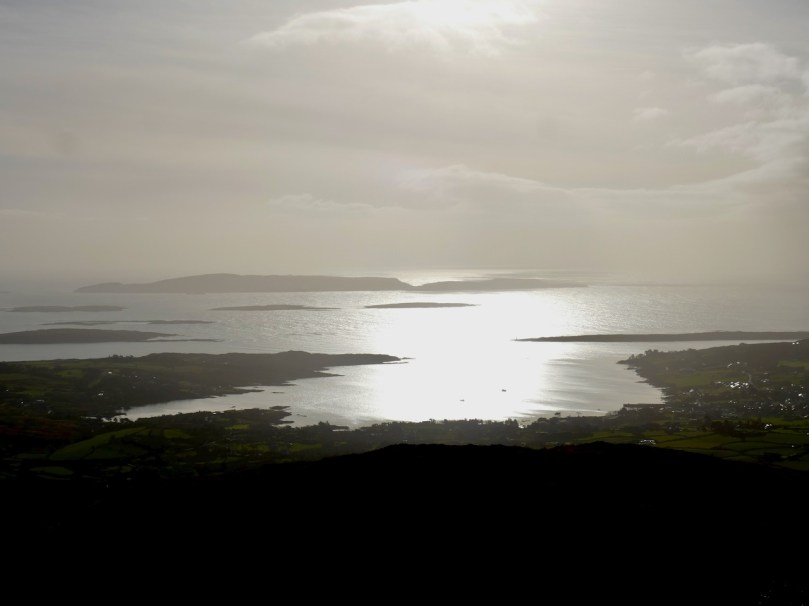
I think this impression is my fault – the photograph below does seem to emphasise a ‘marshy area’ with a puddle. In reality the lake seems to be more or less the same size in the earlier OS maps (dating to the 1840s) as it is now, and that photograph was taken in such a way as to hide most of the lake. I think I was just trying to show the location in relation to the sea and the islands in the distance.
Perhaps the photographs below help to correct that impression.
In my original Legends post, I wondered about the schoolgirl, Julia Creedon, who wrote about the lake in the 1930s and said Although she may have faithfully reproduced the essence of the story she heard from Dan O’Sullivan, her own abilities are very evident in this story, as is her immersion in reading other stories in this genre. Did she become a seanachaí (a story teller), or a teacher or a writer?. . . If she were still alive, she would be in her late 90s now. 
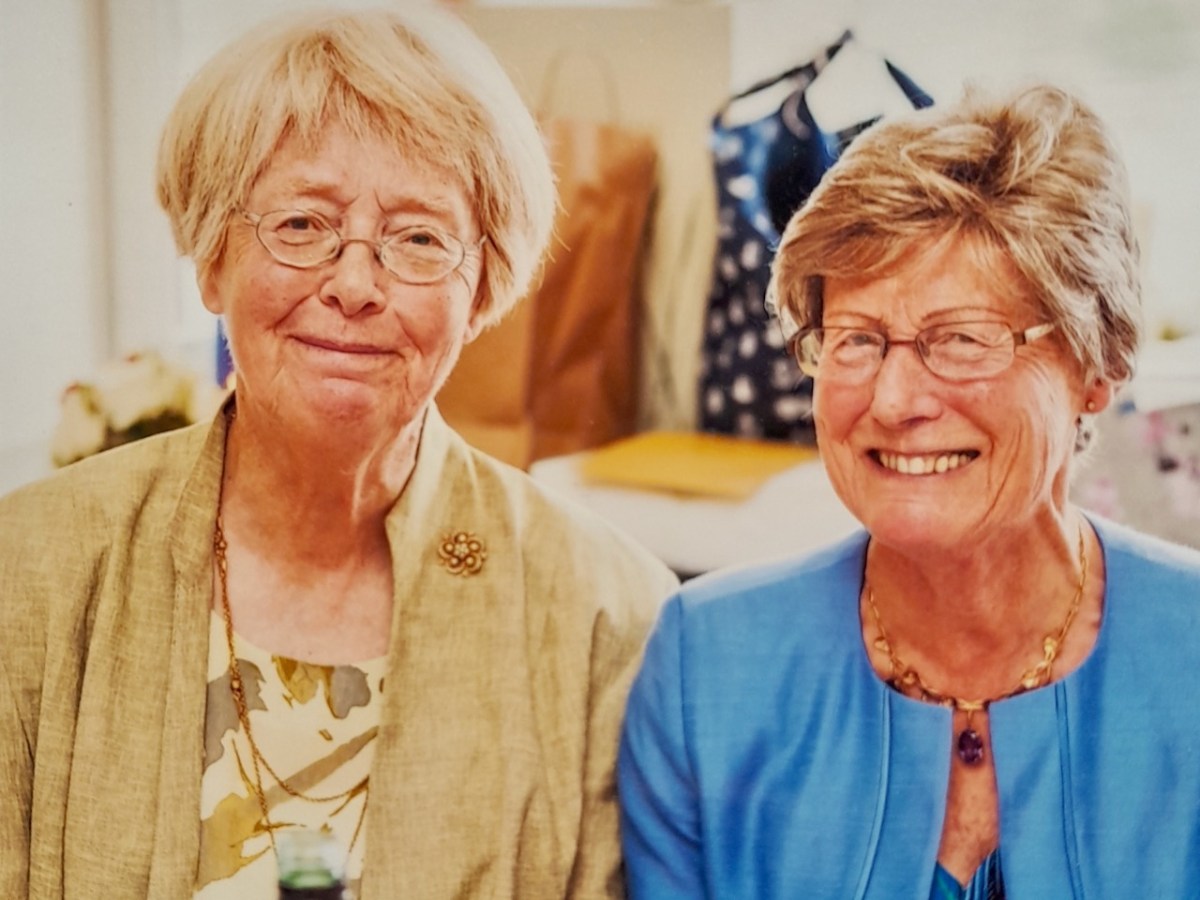
How wonderful is it, that just five years later, I have a reader in her 90s with her own living memories of the place. And here is Gabrielle, on the left, with her sister, Judith.
Legends of Mount Gabriel: The Bottomless Lake

It’s the most visible and significant feature on the West Cork landscape, so of course there are lots of legends about Mount Gabriel. A surprising number of stories revolve around a tiny pool near the top of the mountain, labelled on the historic OS maps as Poulanenine. The most likely etymology for this is Poul an Oigheann – the Pool of the Cauldron (oigheann also means oven, but cauldron seems a more likely translation).

Reading these stories in Dúchas* and finding the pool on the maps, I knew that we had to see it for ourselves. Fortunately, Mount Gabriel (looming over Schull, above) is within our 5k limit and luckily necessitates no human interaction (as a people person, that’s a phrase I never thought I would write) so we set off yesterday to find it. Yes, your intrepid bloggers stop at nothing to bring you the best of West Cork arts and culture! 

Having made a couple of wrong decisions as to the best way to get there, at one point we found ourselves edging backwards over a slippery cliff, clinging to bits of heather and wondering just how foolish we would look when the Search and Rescue Team had to be called out to save a couple of septuagenarians who claimed to be looking for a fairy tale location.

But we made it – and there it was, a tiny remnant of the Ice Age, the Cauldron Pool! It’s referred to as a lake in the stories and there are several versions of how it was made. Here’s an admirably succinct one: 

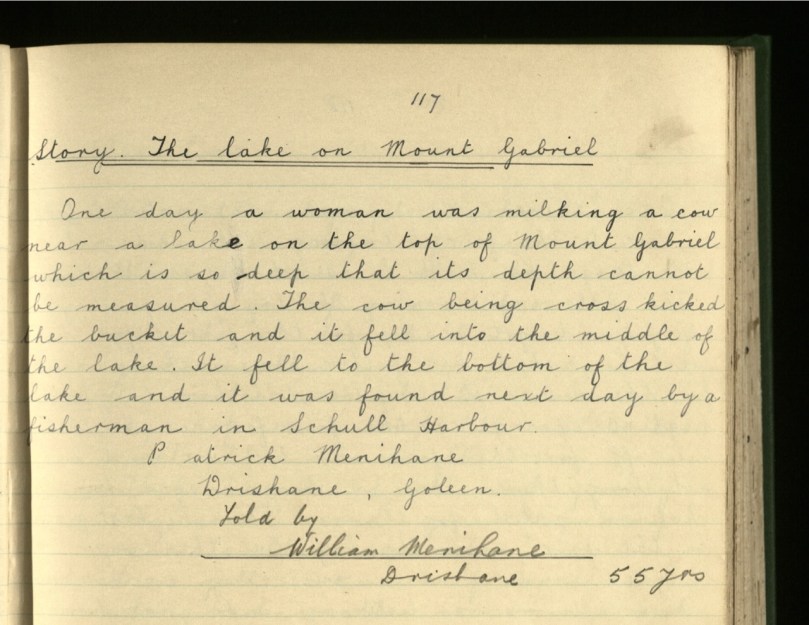
There is a little lake on the top of Mount Gabriel called Poll an Oighin. There is a saying that Fionn Mac Cumhail took a handful of rock and threw it out into the Atlantic Ocean where it is now as the Fastnet Rock or Carraig Aonair – leaving the hole of Poll an Oighin. Another saying is that if a stick was thrown into Poll an Oighin it would come out in Schull harbour.

The fact that there is an underground route from the lake to Schull Harbour is born out by this story too:

But not all versions assign the origin of the lake to Finn McCool. 

Long ago the devil was flying over Mount Gabriel and he was flying so low that he hit his wing against a rock. He got so cross that he took a bite out of the rock. When he had gone eight or nine miles from Mount Gabriel, he left the rock fall into the sea. The rock was so large that a part of it remained over the water and it is on that rock the lighthouse is built on now and it is known as the Fastnet Rock. There is a large lake where he took the bite and the water in that lake is of a black colour.

The black water

However, the most charming, and longest story belongs to an entry from Macroom, far away from Mount Gabriel. The school girl, Julia Creedon, got it from Dan O’Sullivan, also of Macroom, although undoubtedly Dan knew the story from his youth so must have been from the area around Schull. I am reproducing it in full, and readers will recognise many elements familiar to such legends everywhere. One of the most striking aspects of this story is its use of familiar names and places to fix the story in this exact locality.

Near the village of Schull, is Mount Gabriel whose peak rises 1,000 feet above sea level. The unspoiled charm of the magnificent view from its summit is unsurpassable.

The Meenvane road leads you out of the village and on to the gap road; which runs between two high cliffs on the east side of the mountain known as “The Gap of Mount Gabriel”, From here you have a view of nature’s splendour: a number of Carberys Hundred Isles scattered over the great expanse of the Atlantic which amply repays you for the stiff climb. It has been compared to a post card album, you study, as it were, one lovely post card, on turning a leaf you get an entirely different, yet, equally beautiful view to gaze upon, but here you simply turn your head.

Facing south you see on the Coosheen hill the ruins of the old white castle once the seat of the O’Mahoneys. Turning north the Hungry Hill can be seen in the distance. The beautiful country of the valley reflecting every mood of nature runs down to Dunbeacon Castle, once the home of Chieftain O’Sullivan, whose ruins now stands at the edge of Dunmanus Bay, beneath the shadow of Mount Gabriel. Sir H. De La Béche** says in his History of Cork “It was as striking of its kind as any he had seen in Switzerland.”

Chieftain’s Daughter

Following the road and keeping to the left, you find a patch on the north side of the mountain which leads you to the bottomless lake, situated almost on the top of the mountain. There are many beautiful traditions of this picturesque locality, still amongst the older peasants of the district, one of which is: –

“The Legend of the Bottomless Lake” is as follows: Chieftain O’ Sullivan, of Dunbeacon Castle, had one child, a daughter, Rosaleen. So beautiful and fair was she that the poets described her as “The Rose of the Valley”. She had a lover, one, Owen O’Mahoney, of the White Castle. When O’Sullivan heard of his daughter’s friendship with O’Mahoney he was very angry as Owen could never hope for more than a younger son’s share. Notwithstanding this, the young lovers were ideally happy.

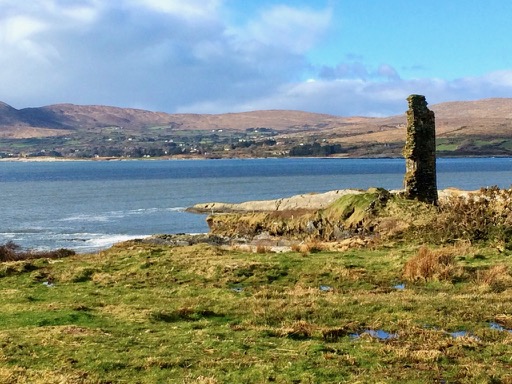
What’s left of Dunbeacon Castle

One evening as Rosaleen returned home after a walk with her lover, she was brought into the presence of her father’s guest, Chieftain O’Driscoll of the Three Head Castle. He was known to Rosaleen, who thoroughly disliked him, as an elderly bachelor, who drank a lot of rich wines, boasted a lot of his castles, of the men he had killed, and the women who loved him. When Rosaleen heard he had come that day, to ask her in marriage, and that her father gave his consent, she was horrified. Outwardly calm, she explained to her father and O’Driscoll that she loved Owen O’Mahoney, and would marry no other. Her love for Owen was far dearer to her than her life. Her father listened not to her pleading; he settled the day for her wedding to O’Driscoll giving “The Rose of the Valley” just one week to get used to the idea and to forget Owen O’Mahoney.

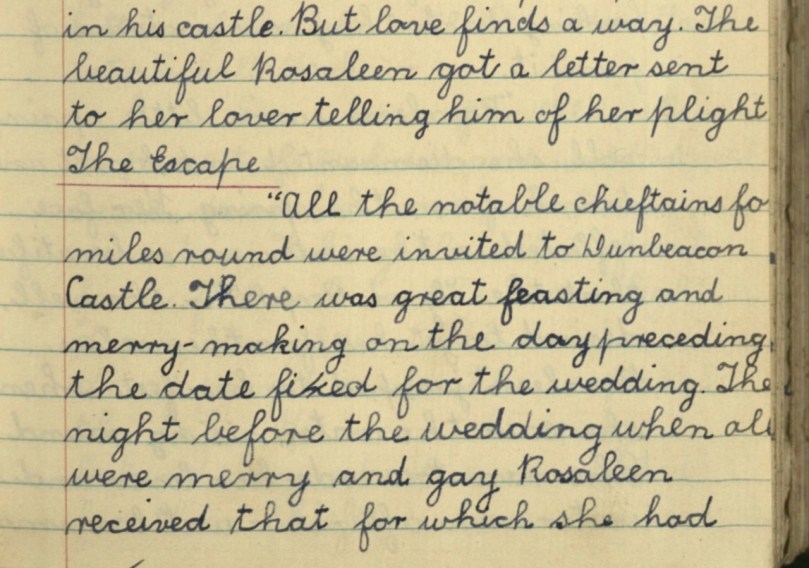
During that week her father saw to it that she was kept a prisoner in his castle. But love finds a way. The beautiful Rosaleen got a letter sent to her lover telling him of her plight.

Three Castle Head

The Escape

All the notable chieftains for miles round were invited to Dunbeacon Castle. There was great feasting and merry-making on the day preceding the date fixed for the wedding.

The night before the wedding when all were merry and gay Rosaleen received that for which she had being praying, a letter from Owen. Following his instructions she made her escape from the castle, and was met by her lover. Helping her on to his horse, he sprang up behind her, and faced for his father’s castle in Coosheen.

Fearing Rosaleen’s escape would be discovered, they left the road and took the path over the mountains. It was a bright moonlight night. Looking back they saw no trace of pursuit.

Rosaleen saw a little spring well, she dismounted and knelt and drank from the spring. Her face reflected in the water, was so beautiful that the “Good People” in the well, desired to get her for themselves. Rosaleen jumped to her feet when she saw the water, rising round her. She ran towards her lover the water ran after her until a small lake was formed.

Owen seeing her plight, lifted her on to his horse and springing behind her, once more he made his way down the other side of the mountain. The “Good People” seeing they were beaten in their attempt to capture the beautiful “Rose of the Valley” got very angry, and reversed the flow of the spring. Down, down, down went the bottom of the lake until its waters flowed into Schull Harbour.

Some hours after O’Driscoll went in pursuit of his bride and muddled with drink, drove his horse over the mountain. Taking the sheet of water for a flat rock in the moonlight, he drove straight into it and disappeared under the surface of the lake. His men following behind reigned up and waited for their chieftain to re-appear Seeing no trace of him, they rode back with all haste to acquaint O’Sullivan with news of the disaster that had overtaken O’Driscoll. Chieftain O’Sullivan, believing that his daughter had met with the same fate as O’Driscoll, was filled with remorse. He tore his hair in grief for his beautiful lost daughter.

White Castle (Ardintenant Castle) from the sea, Mount Gabriel behind

Reconciliation

Great was his joy when he heard that she was safe and well married to Owen O’Mahoney and dwelling at the White Castle.

He rode immediately to Coosheen and asked Owen’s forgiveness. He promised him Dunbeacon Castle and all his estate if only he would bring her back “The Rose of the Valley”.

I can’t help wondering about Julia Creedon. Although she may have faithfully reproduced the essence of the story she heard from Dan O’Sullivan, her own abilities are very evident in this story, as is her immersion in reading other stories in this genre. Did she become a seanachaí (a story teller), or a teacher or a writer? She has two other stories in the Schools Collection as well, including a long one about the River Lee, just as precociously written in the same lovely cursive, with headings underlined in red ink. If she were still alive, she would be in her late 90s now.

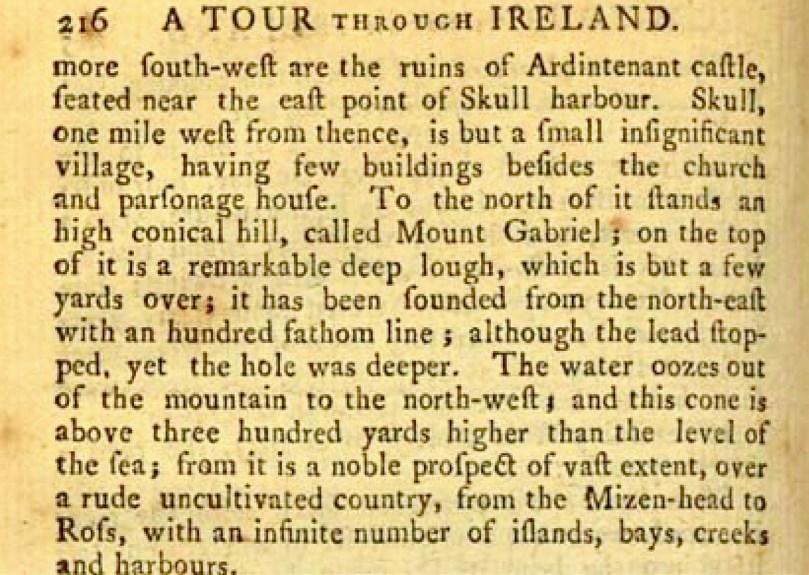
The story of this bottomless pool has an even older history than the 1930s. In 1780 Philip Luckombe published his A Tour Through Ireland and tells of the same lake when describing a journey from Bantry. Luckombe was one of our earliest plagiarists – he took his accounts almost verbatim from even earlier books and there is no evidence that he was ever even in Ireland. From our point of view this means that the story predates 1780 so it has an impressive pedigree indeed. 

Next time, more about some of the other legends that have accrued to Mount Gabriel.

It’s further than it looks

* Dúchas is the National Folklore Archive and within this is The Schools Collection: “For the duration of the project, [1937-39] more than 50,000 schoolchildren from 5,000 schools in the 26 counties of the Irish Free State were enlisted to collect folklore in their home districts. This included oral history, topographical information, folktales and legends, riddles and proverbs, games and pastimes, trades and crafts. The children recorded this material from their parents, grandparents, and neighbours.” The Collection is online and is searchable at https://www.duchas.ie/en/cbes. I have done a little minor editing to the entries above for consistency in punctuation and spelling.

**This is a reference to Sir Henry De la Beche, founder of the Geological Survey of Great Britain and Ireland.