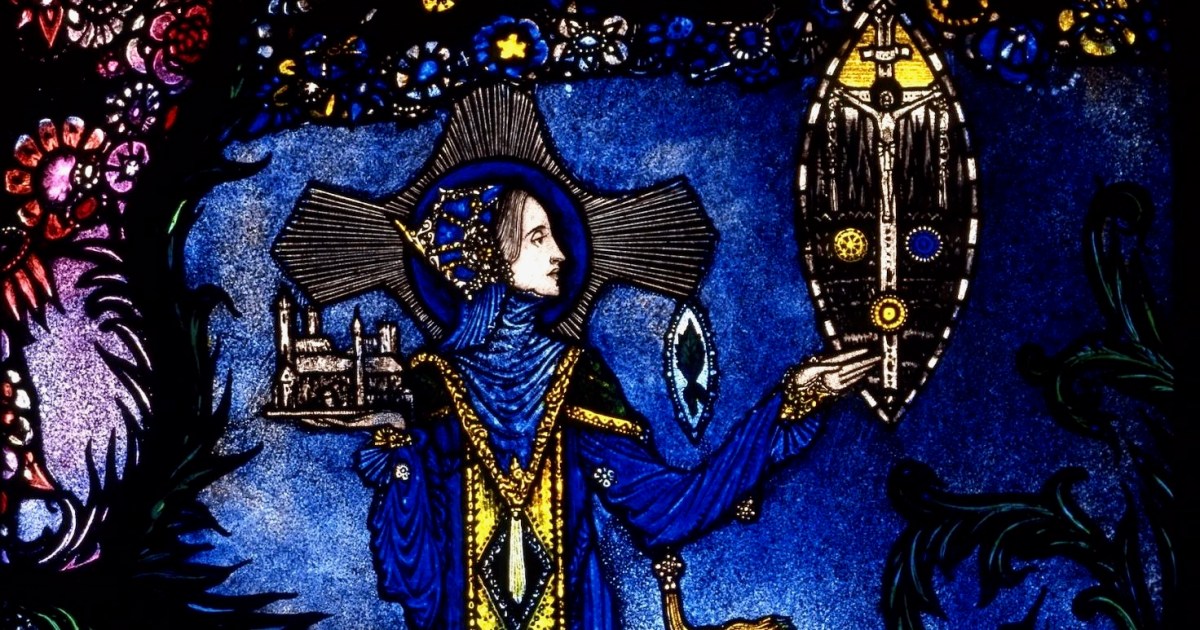
Harry Clarke’s Brigid

Harry did several wonderful St Brigid windows, and included Brigid as a saint in larger scenes. There are also Brigid windows attributed to him that he actually didn’t do, but that’s a blog for another time. Today I want to give you a flavour of his take on Brigid, because this was a saint that must have been especially meaningful to him – his mother was a Brigid!
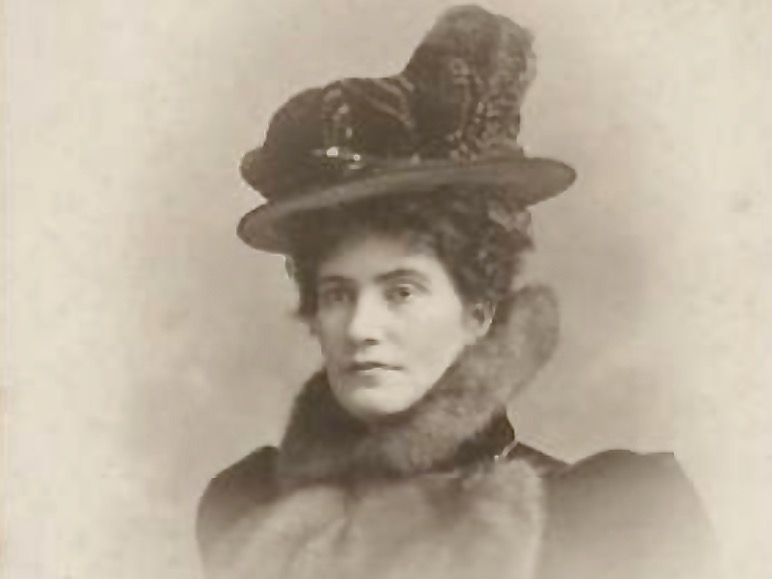
Brigid (sometimes given as Bridget) MacGonigal was born in Sligo and married Joshua Clarke, then an up-and-coming church decorator in Dublin and they had four children. Harry, their third child arrived in 1889. Brigid was never strong and died in Bray in August 1903, leaving her family bereft. Harry was 14 and that year marked the end of his schooling at Belvedere as he and his older brother Walter joined the family business to help run it. Harry was a sensitive child and it is likely that he missed and mourned his mother for many years. He also inherited her weak lungs and struggled, as she did, with his health.
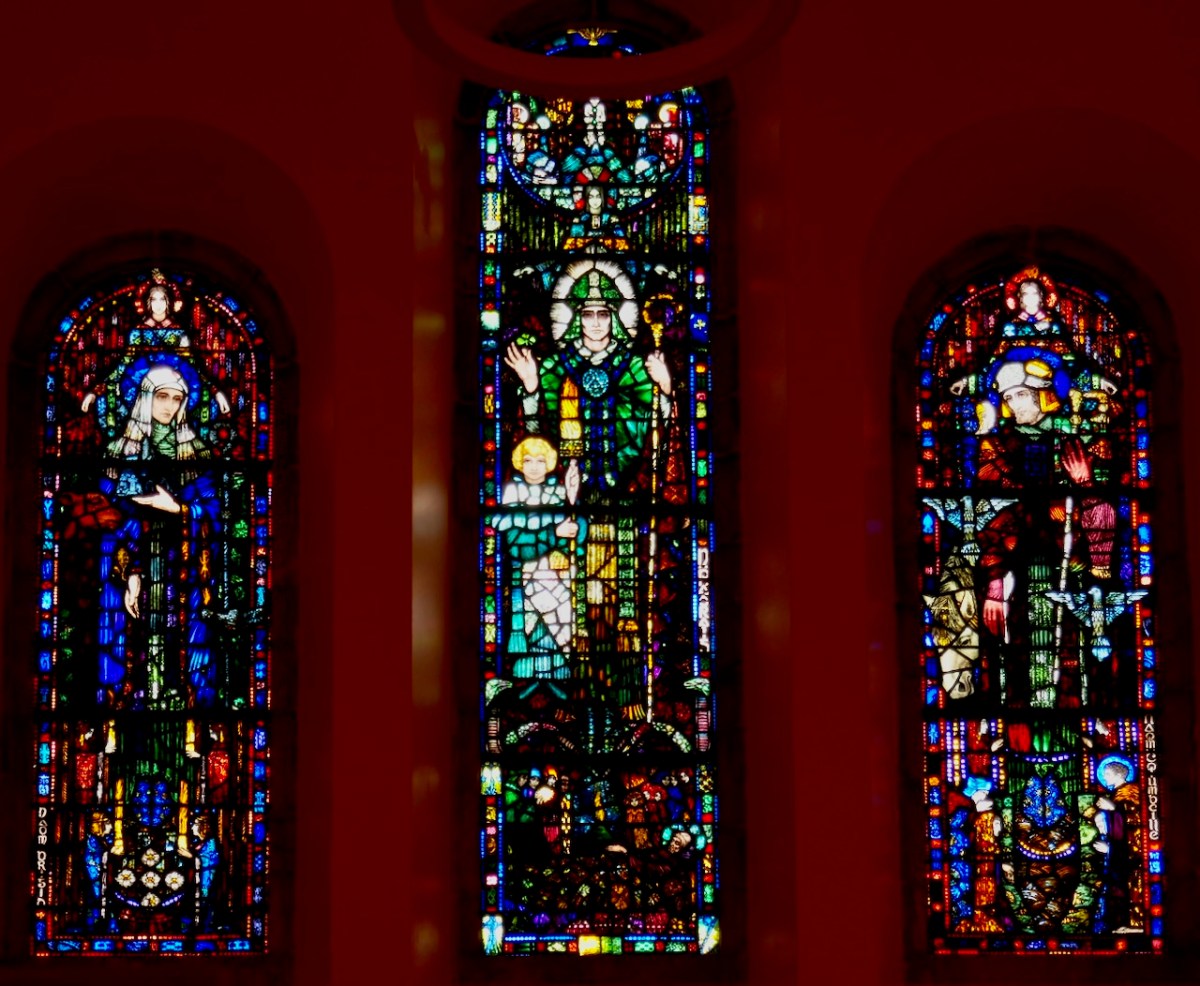
I will start with the place that launched Harry’s career, the Honan Chapel at University College Cork (I’ll finish with the one that is on my lead photo). And in fact it is his first windows for that Chapel – a three light, depicting Brigid, Patrick and Columcille, our three Patron Saints. This window is over the entrance, facing west, which, with Harry’s preference for dark colours and some internal lighting issues in the chapel, makes it hard to photograph.
Harry had completed a detailed sketch design for this window in 1914 (Nicole Gordon Bowe has an image of that design in her magnificent The Life and Work of Harry Clarke) and the window was made in 1915. There are a few differences between the sketch design and the finished window, but on the whole, the window is true to Harry’s original vision for it. His notes for the window refer to 

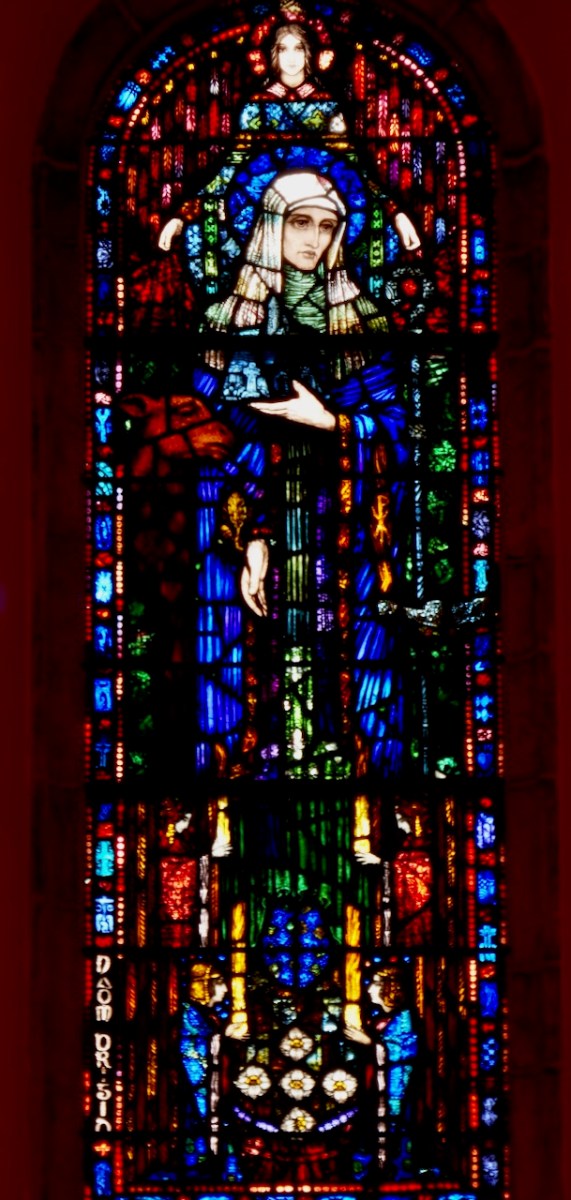
Top: The Angel with the cloth of heaven forming background

The Figure: With emblems – the church, the inextinguishable spiritual lamp – the calf and the oak.

The Base: Are four angels carrying the prayers, prophesies, miracles and charities of St Brigid, also are shown the five lilies – she has been called the Mary of Ireland and these lilies symbolise the five provinces of Ireland over which she held spiritual control.
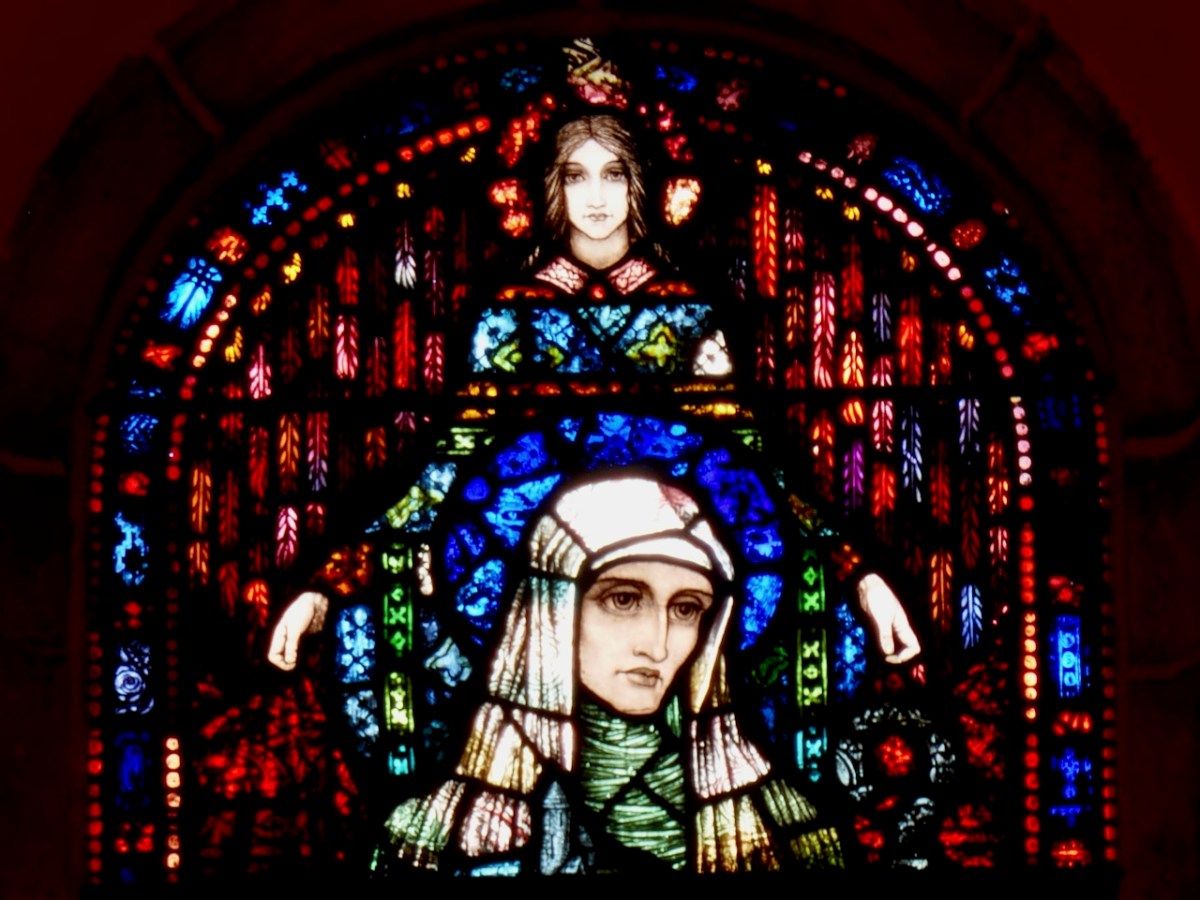
The cloth of heaven has been imagined as fronds in deeps reds, while St Brigid is shown as mature, wise and compassionate. She is holding a church which looks a lot like St Kevin’s Kitchen in Glendalough. In her other hand is a brown oak leaf, threaded through her fingers. The calf peers out from her right side. As befits a Mary of the Gael, she wears a deep blue robe. 
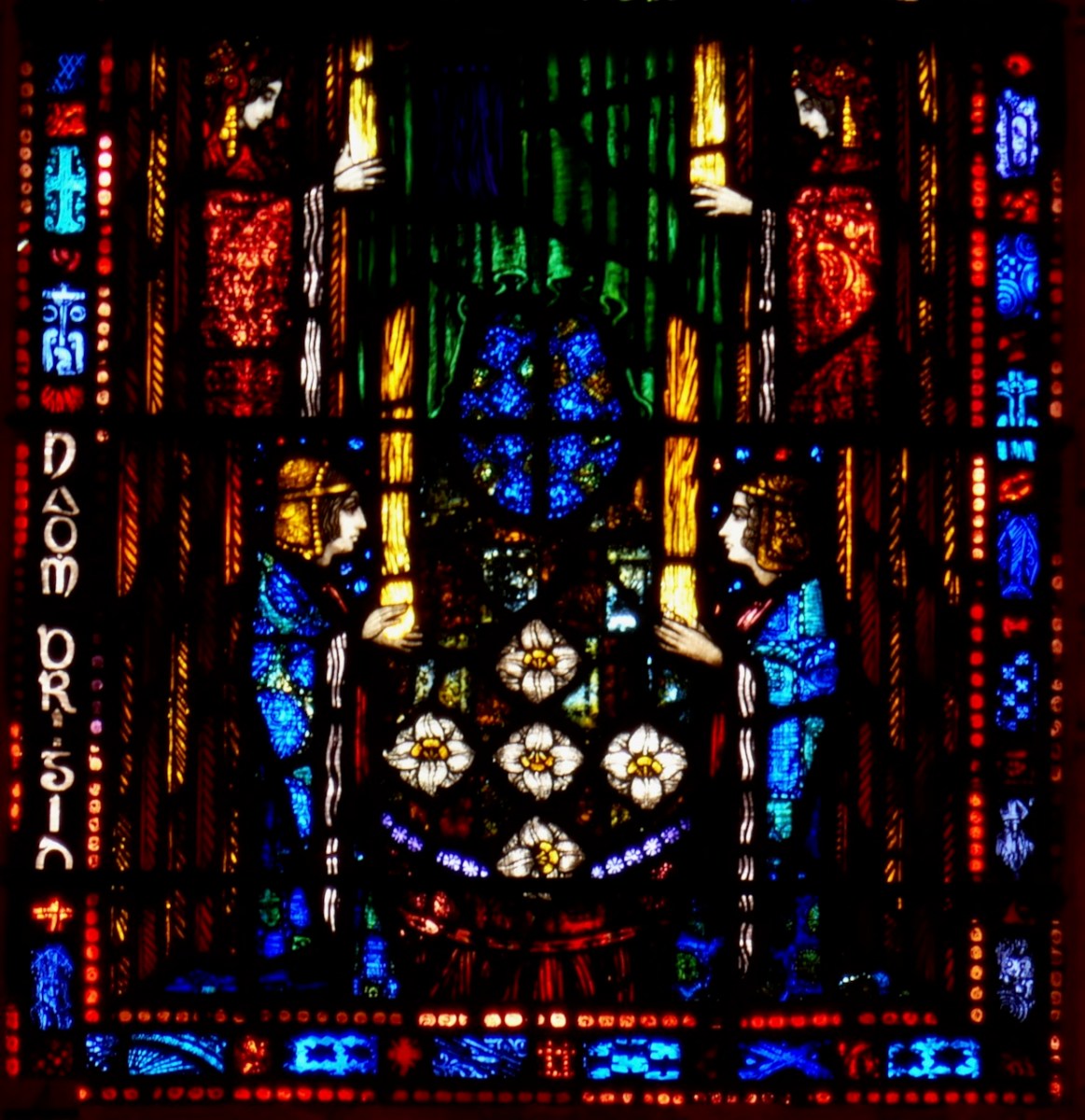
The predella (lowest section, above) shows four angels, but what they are carrying are torches – a reference to the spiritual lamp and the fire associated with Brigid. The symbols of the five provinces, recognisably lilies in the sketch design, have changed to another flower I can’t name. Note the tiny details, though – the crucifixion scene in the borders on the left and the right. The other detail to note here is that the fingers, of Brigid and the angels are ‘normal’ – Harry has not yet developed his signature long tapering fingers and pointed sleeves (among the idiosyncratic elements he called his “gadgets’).
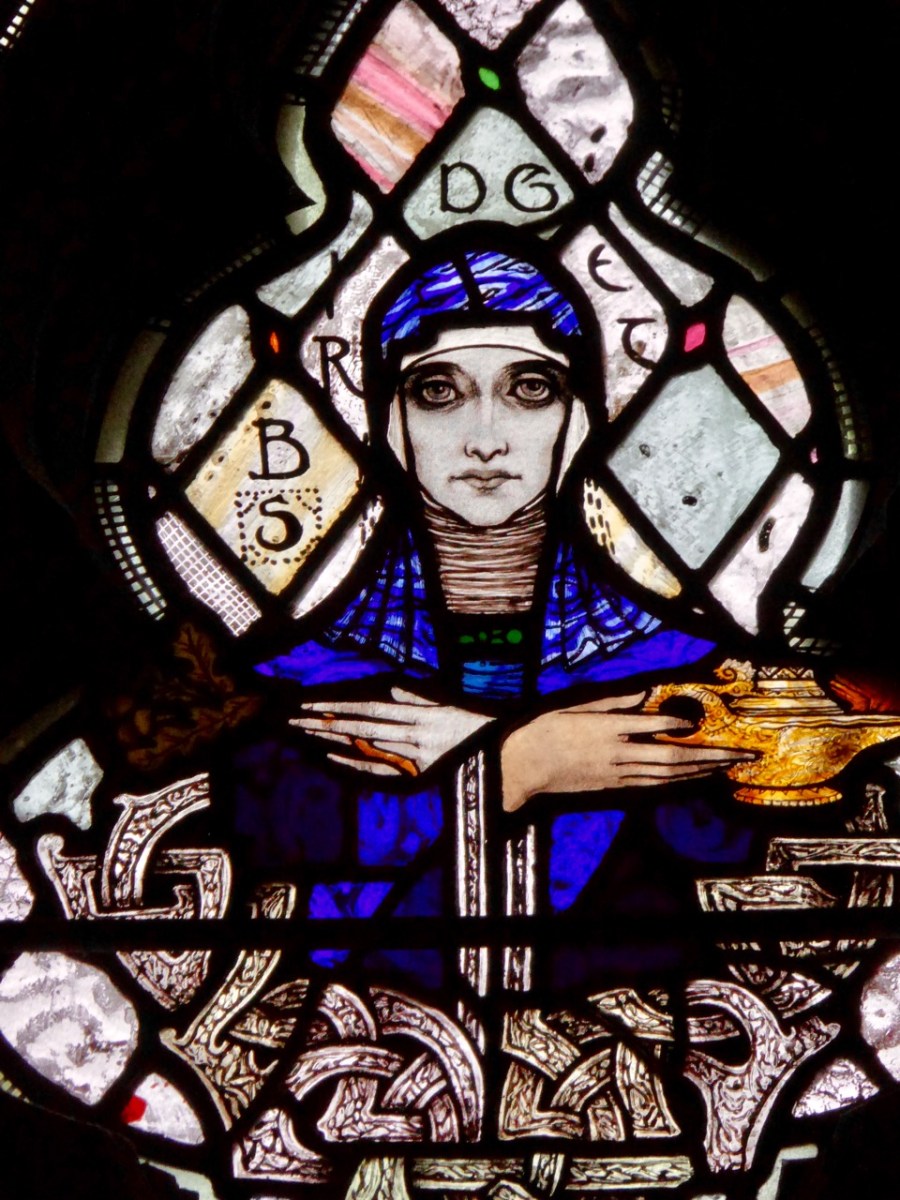
His next Brigid (above) was for the Nativity window in Castletownsend – I have written about that window extensively here so pop over and have a browse if you fancy. The Castletownsend Brigid, done in 1918, looks quite similar to the Honan Brigid and has the same oak leaf entwined in her fingers. The difference is that she is carrying the sacred lamp, has the Harry Clarke fingers, and is spelled S Bridget – the English version rather than the Irish Naomh Brighid of the Honan. [For non-Irish speaking readers – the small dot on top of consonants in Irish is now normally rendered as H – as in Briġid is now Brighid.]
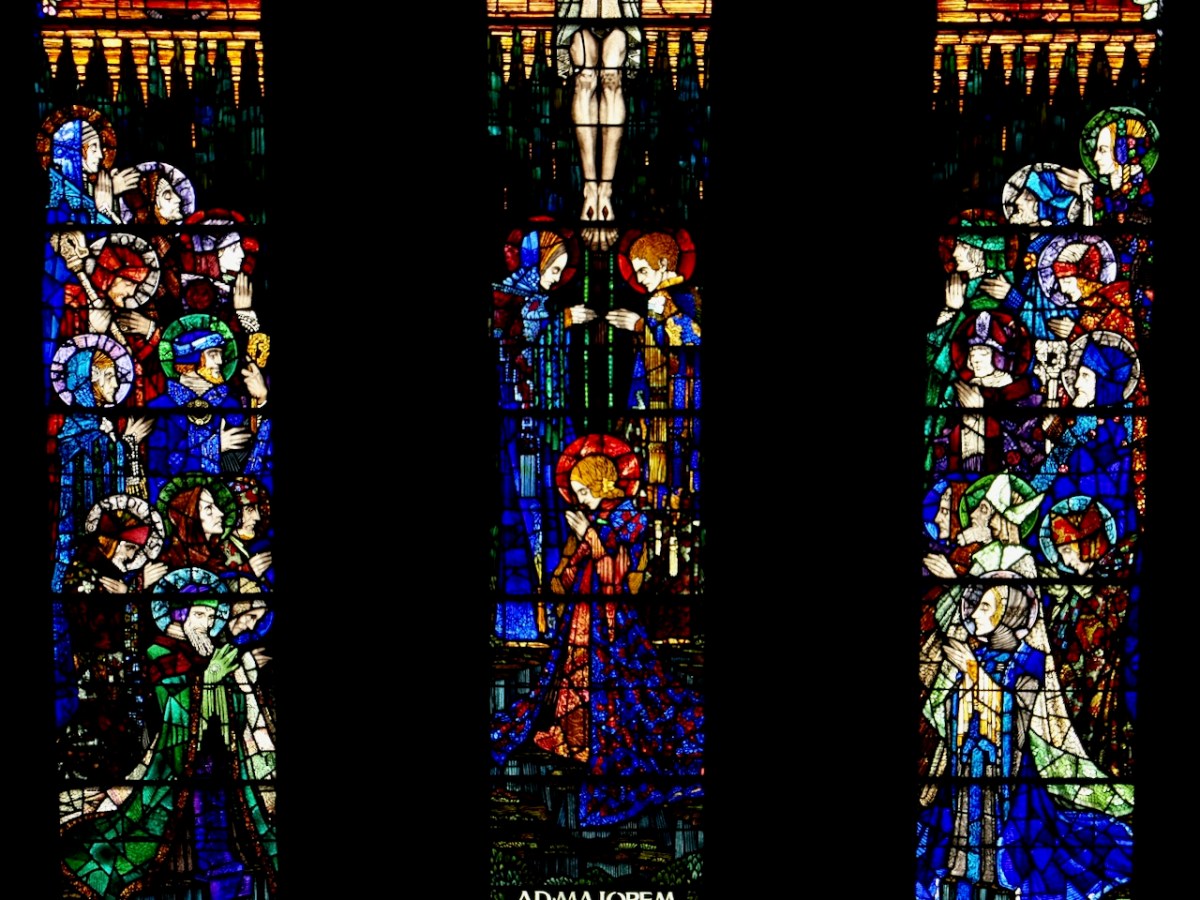
The next two windows, Terenure (above and below, details) from 1920 and Cloughjordan from 1924, show Brigid among a host of other saints. In Terenure the subject of the large window is The Crucifixion and the Adoration of the Cross by Irish Saints, and this is a large, three-light window behind the main altar. The saints are not all easy to identify, despite having their names in their haloes, but first and foremost among them are Patrick on the left and Brigid on the right.
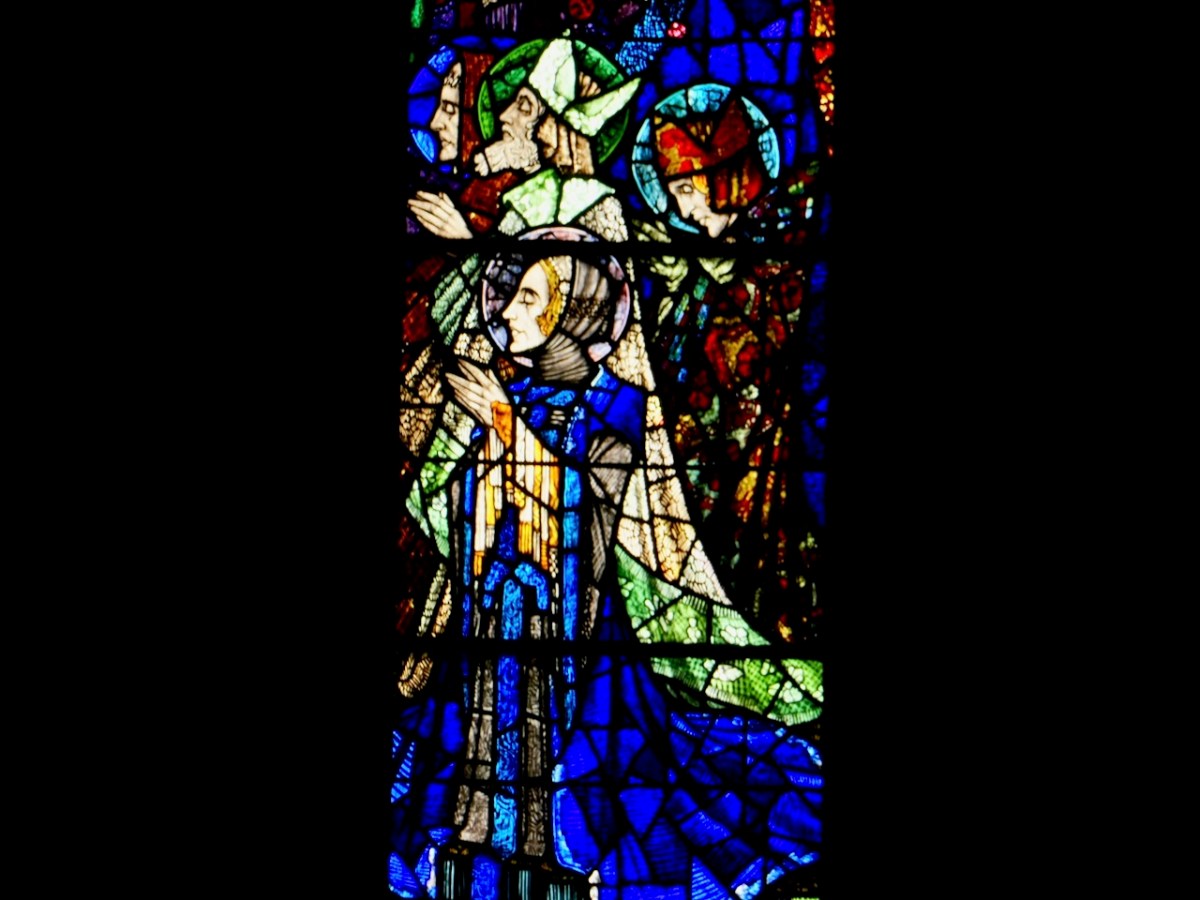
Brigid is dressed in a blue robe which drapes on the ground around her, and has a golden trim to her sleeves.
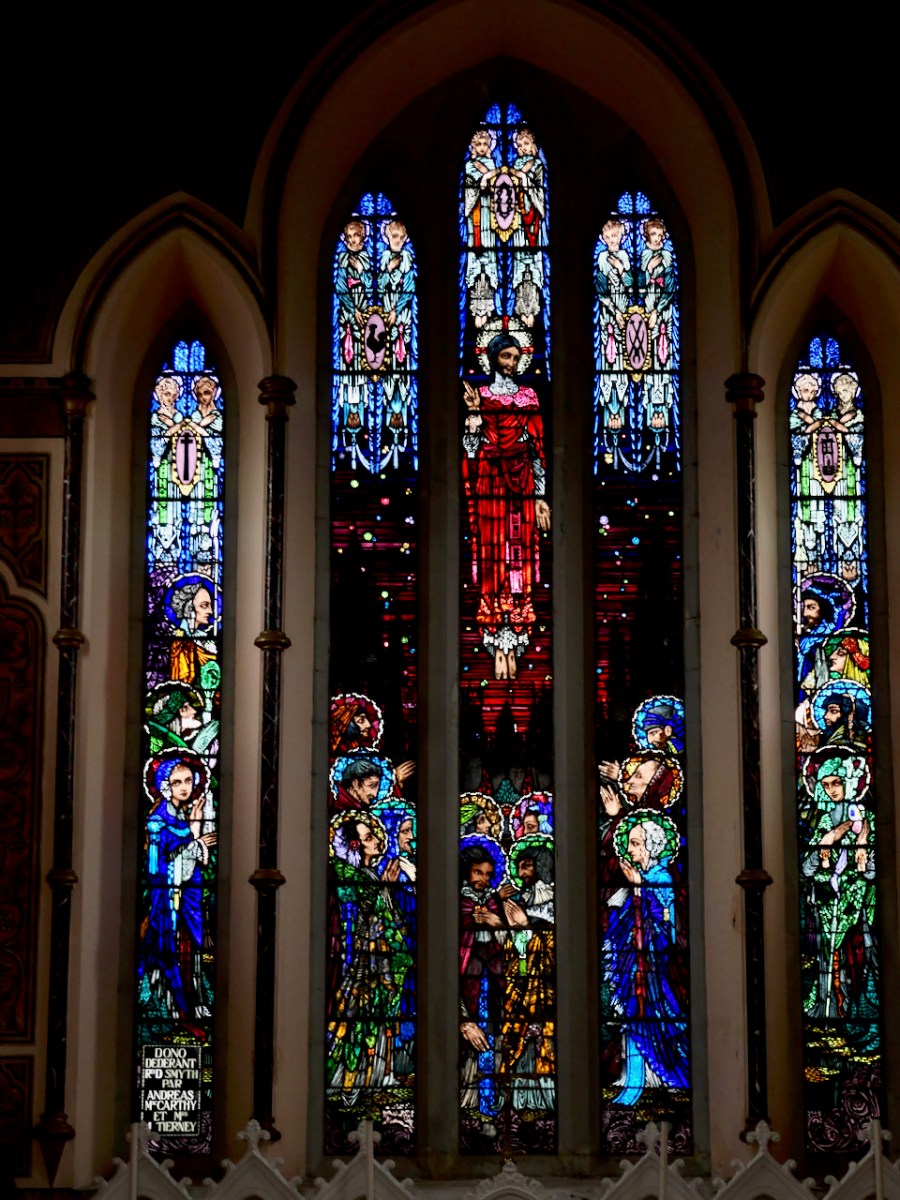
In St Michael and St John’s Church in Cloughjordan, Co Tipperary, the theme of the large, five-light, window is The Ascension with Irish Saints and St Michael and St James. Gordon Bowe designates this one a Harry Clarke (B). That means that this window was initially conceived and designed by him but executed by his studio under his close supervision. This is the first window we have come across, in this series, that is not wholly Harry’s own work, and this is a measure of how busy the Studios had become with Harry at the helm. 
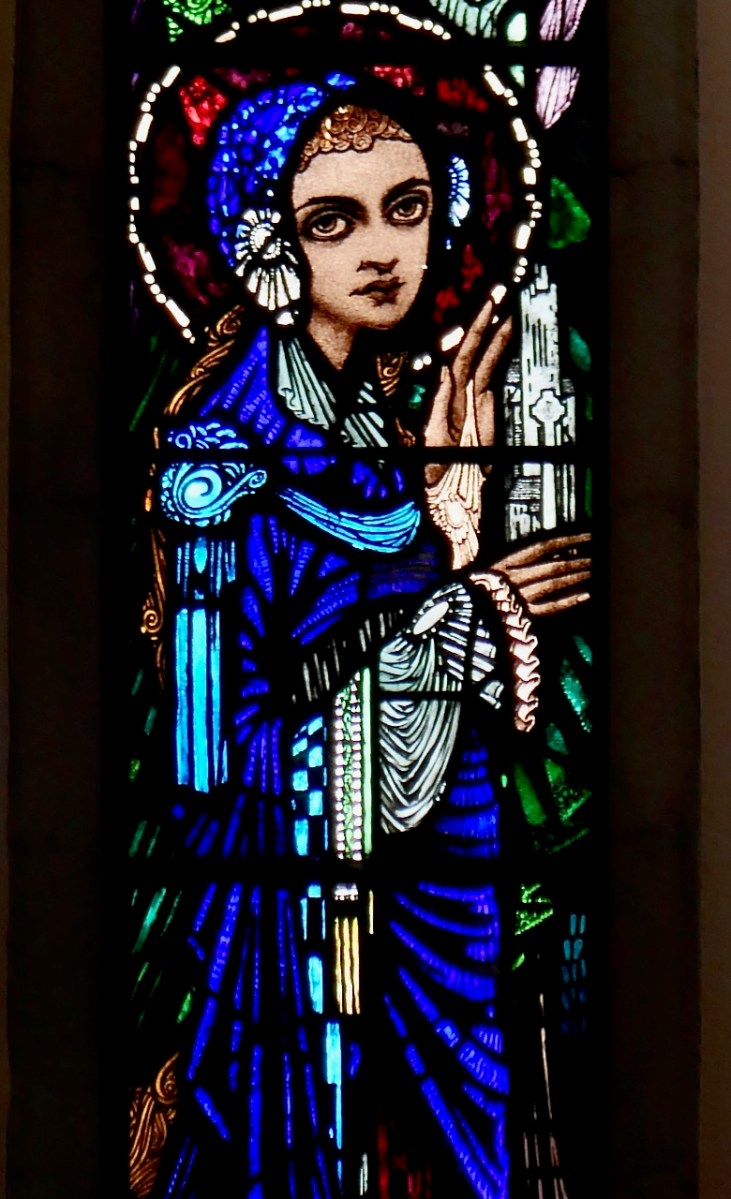
As in Terenure, Brigid is here as one of the Irish saints. She is depicted as very young, wide-eyed, and carrying a church which now looks more medieval than Romanesque (neither would have been appropriate to her era) and is probably a nod to the Cathedral in Kildare.
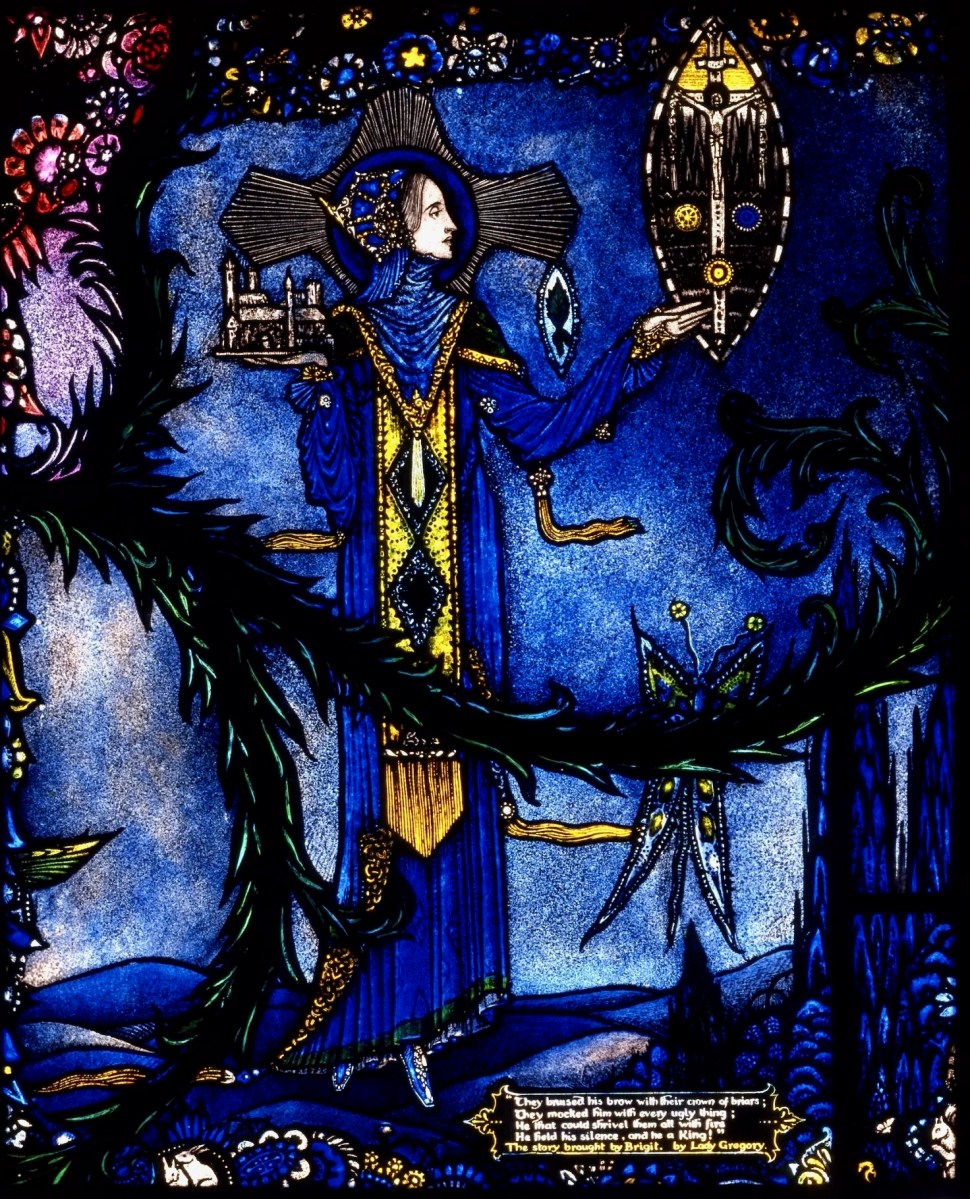
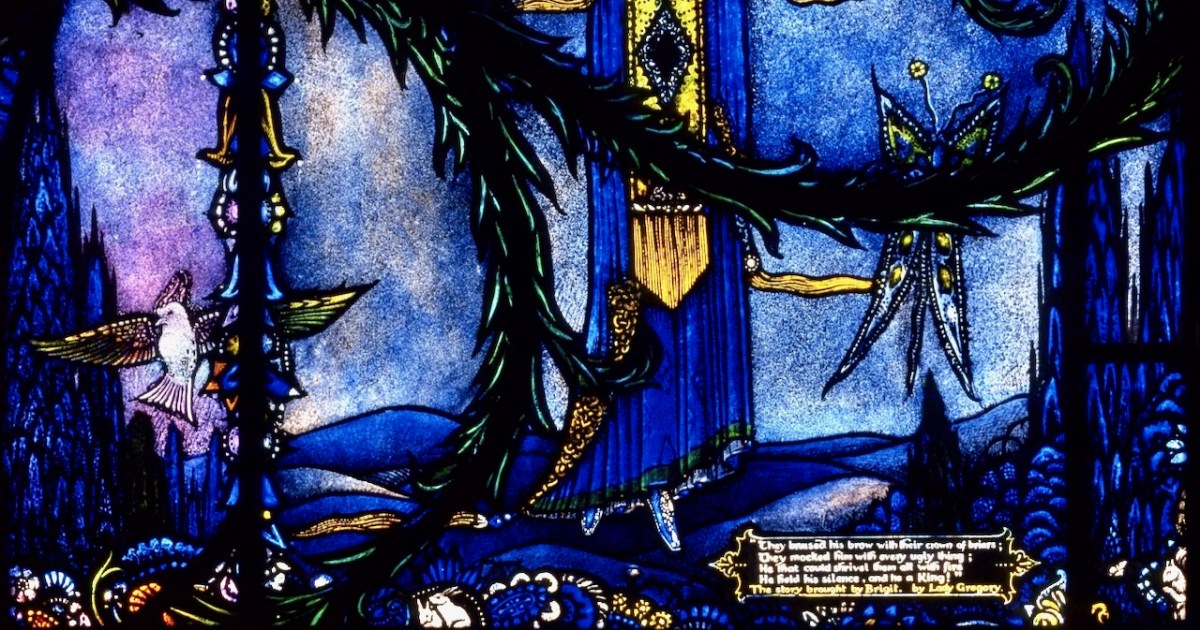
And so we come to the last Brigid that Harry ever did*. It is from the famous and controversial Geneva window, now in the Wolfsonian Museum in Miami. If you have not yet seen the marvellous documentary that Ardall O’Hanlon has made about this, I highly recommend you do. It’s available on the RTE Player as of this time of writing. The Brigid panel is among the less controversial images in the whole window. It’s based on a play by Lady Gregory called The Story Brought by Brigit. According to Marie T Mullan in her lovely book, Exiled from Ireland: Harry Clarke’s Geneva Window

The play is a passion play, but it is based on the legend, popular in Ireland and Scotland, that St Brigit was present at the birth and crucifixion of Jesus. Brigit mingles with the crowds from the time of Jesus’s triumphant entry into Jerusalem until after his death. She is a foreigner, observing and commenting. She tells people she is Jesus’s foster mother and brought Mary and Jesus to Ireland to escape Herod. . . The icon of Christ Crucified is a the vesica, a shape used often in art for a picture within a picture, and has the traditional beaded frame. Brigit is absorbed in the icon.

Note Brigid’s golden scapular and elaborate headdress. Also the stylised butterfly and the little woodland creatures in the scene.
I think that’s a good place to stop. Harry did another Brigid, for the Oblate Fathers in north Dublin’s Belcamp Hall. This is a sorry tale in which the buildings, once left by the priests were subject to appalling vandalism and the windows are in storage, and haven’t been seen for years. This is tragic. 

* Thanks to my friend Jack Zagar for the Photos of the Geneva Window.
Harry Clarke’s Terenure Masterpiece

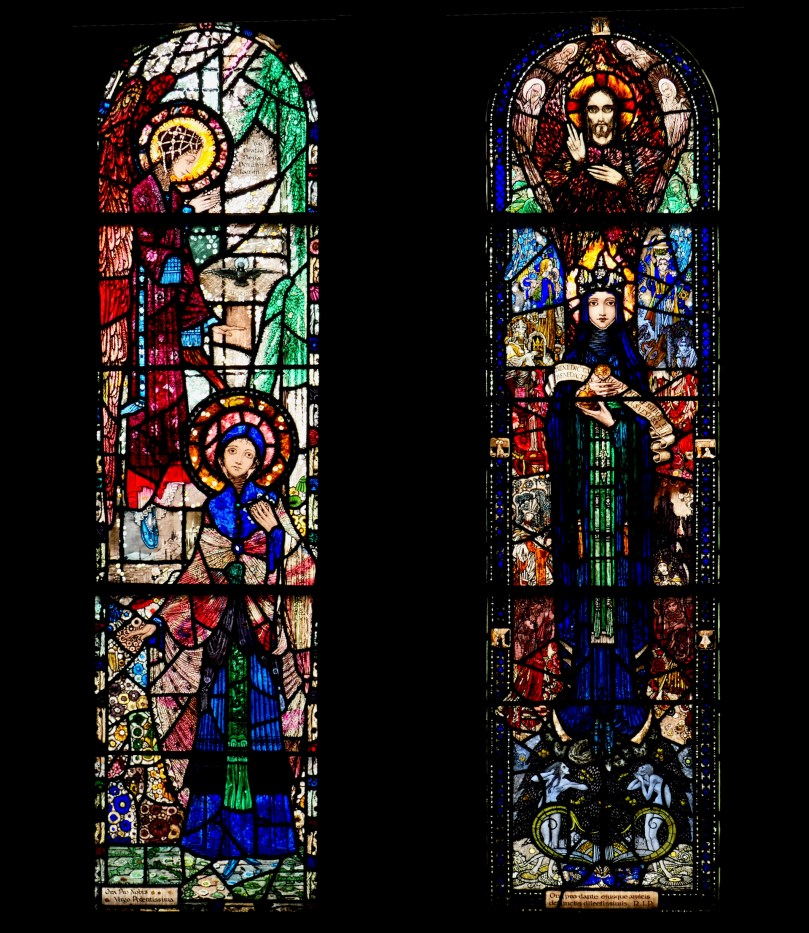
A controversial word, masterpiece, and in this case I am using it to denote that this a Harry Clarke masterpieces rather than the masterpiece. There are several contenders for that title, although the Geneva Window may take the crown. In any ranking of Harry’s windows, however, these two side-by side windows, in St Joseph’s Church in Terenure in Dublin*, must be close to the top. 

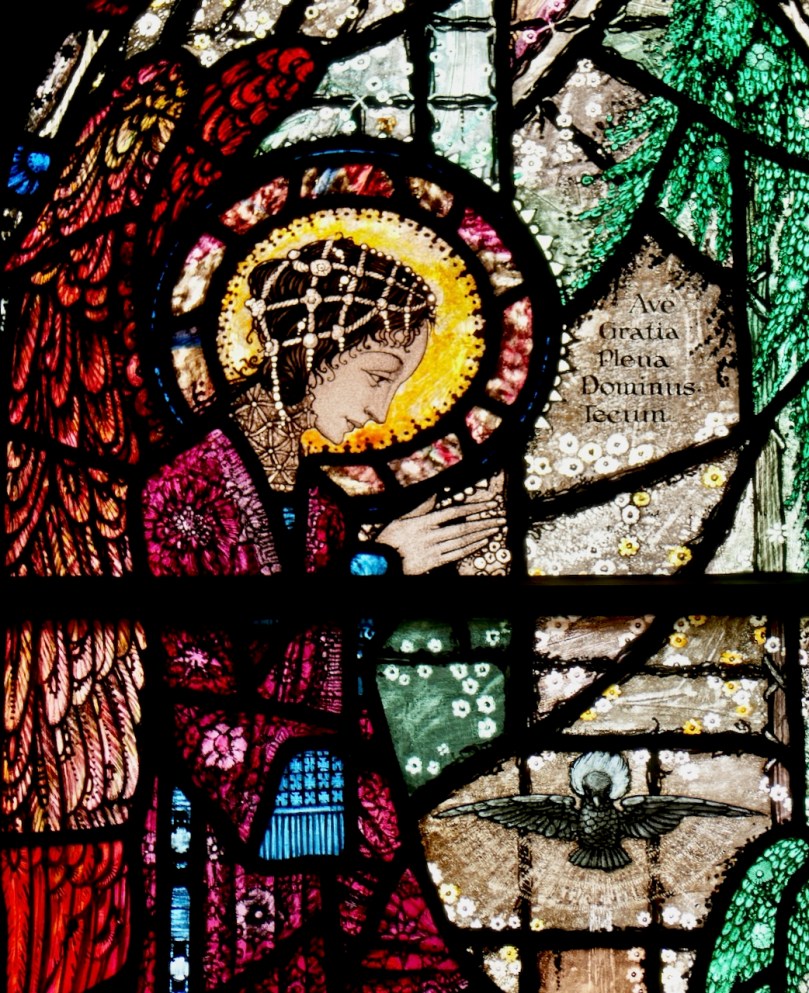
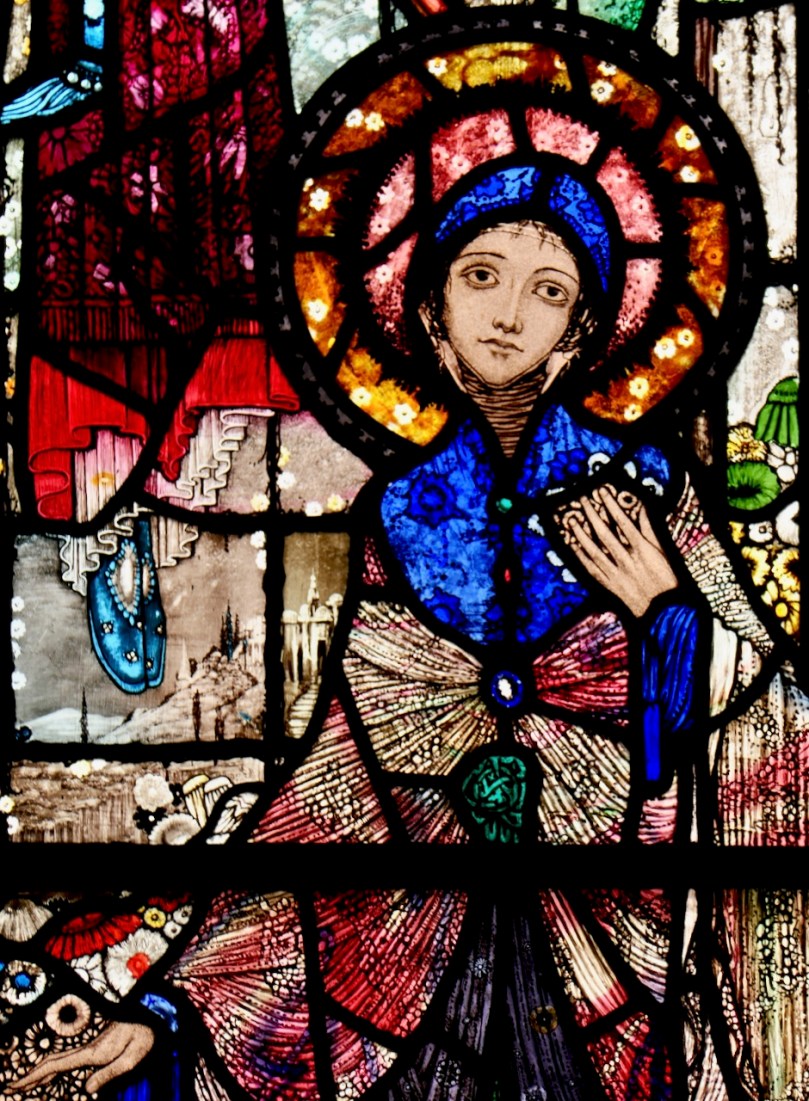
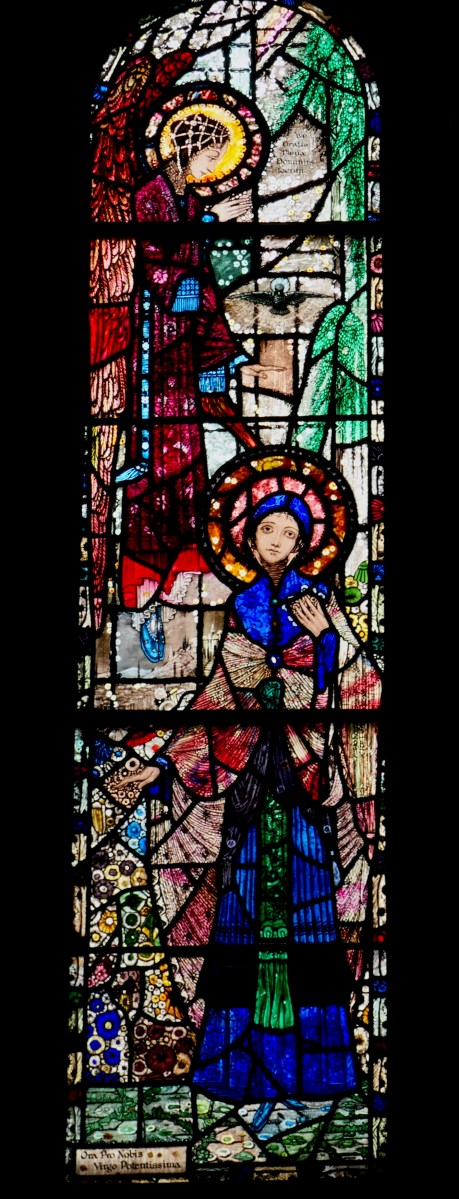
The left window, The Annunciation, was finished in 1922 and the right window, The Virgin in Glory, in 1923. What is perhaps extraordinary is that these windows were completed at a time when Ireland, and Dublin in particular, was in turmoil and the country was riven by civil war. Life in the artistic world was precarious, with the National Gallery and the School of Art closed and the destruction of many of Dublin’s finest buildings. Harry was in the midst of moving house and re-organising and staffing the studio, while also very busy with illustration commissions. But stained glass was still his main business and he was pleased to receive the order for the two-light window from Fr Healy, for whom he had previously completed the enormous three-light Crucifixion window over the main altar. Having been completed several months apart, each window in this set has a different mood and character. Let’s look at the Annunciation first. Before it was installed, Harry entered it in the art competition that was part of the Aonach Tailteann, or Tailteann Games – a Festival of all-things-Irish with a strong Celtic Revival influence. The window won the Gold Medal for stained glass. 

Gabriel hovers above Mary, held in suspense by long scarlet wings. Depicted as female, she wears a complex headdress and long multi-layered garment tied at the waist with a broad blue sash. Her feet are suspended over a scene of a hill town. The Holy Spirit in its dove form is to her right, shedding silver rays down on Mary.

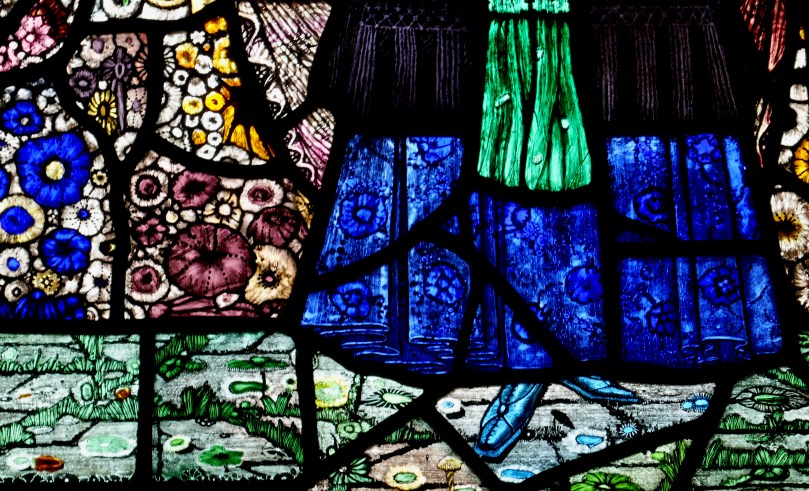
Mary is depicted as young, with huge innocent eyes and a gentle expression. Her colour has traditionally been blue and Harry uses a deep royal blue for her gown. Across her shoulders is a large shawl. Nicole Gordon Bowe in Harry Clarke: The Life and Work describes the window in terms which could be applied to this shawl “. . . a subtle work with shimmering pale colours, gossamer lines and finely laid on tones. . .” Harry’s typical ‘floral ornamentation’ (known to his assistants as F Os or even as Fried Onions) occupy much of the rest of the lower half of the window, an endlessly various and imaginative garden of blooms.

The composition is balanced and harmonious. The scarlet wings are mirrored by green fronds cascading from the right border. Mary’s outstretched hand provides a counterpoint to Gabriel’s, while both have large and complex haloes. The eye is drawn to two pairs of dainty slippers. The angel’s predominant red hues are laced and leavened with blues, while Mary’s blues are warmed by the reds and pinks of the shawl. Despite the inclusion of the floral elements and highly-figured details on the garments, the impression is of a serene and uncluttered scene.

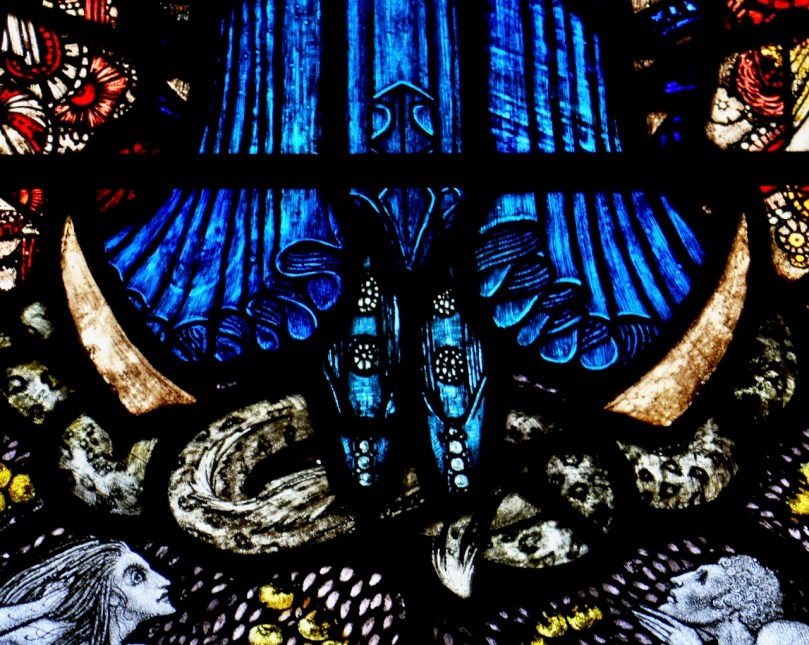
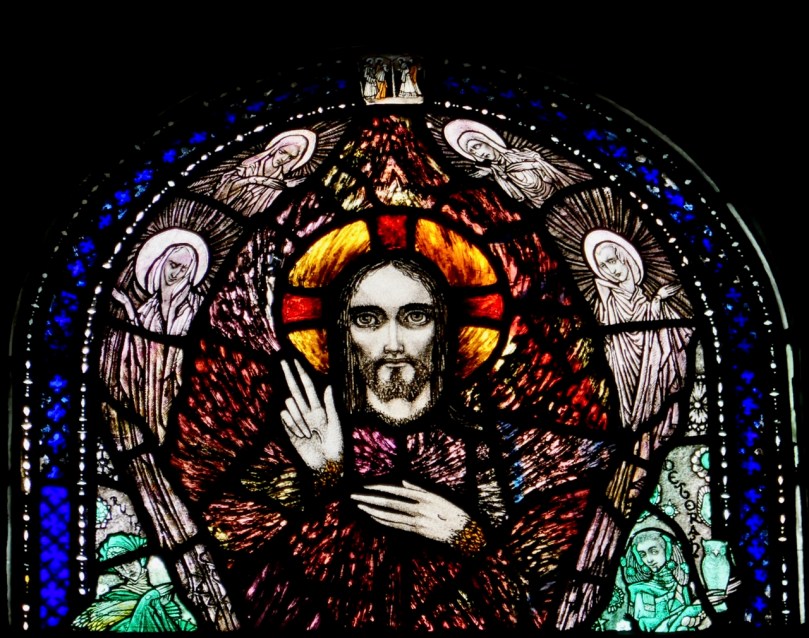
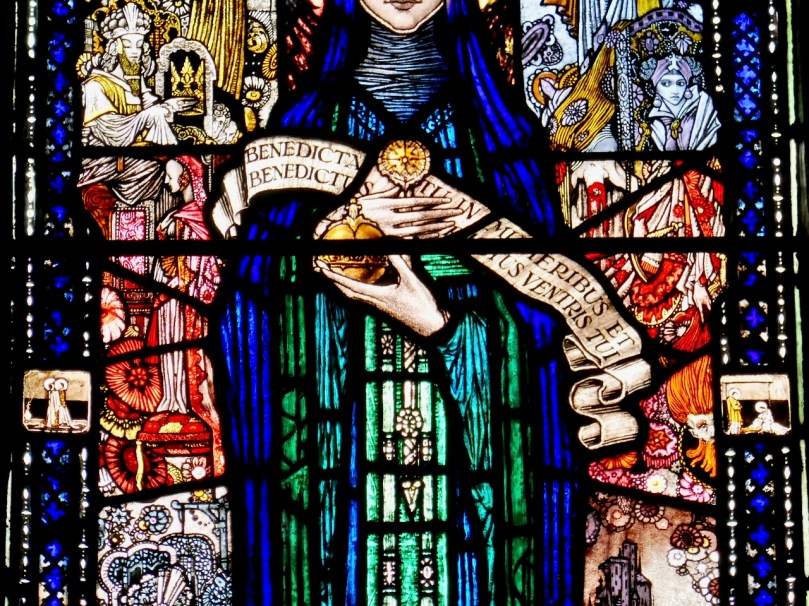
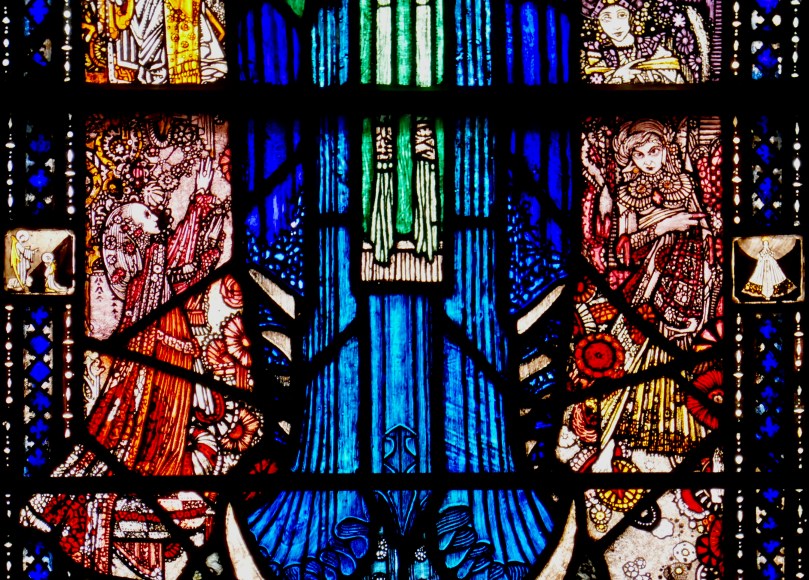
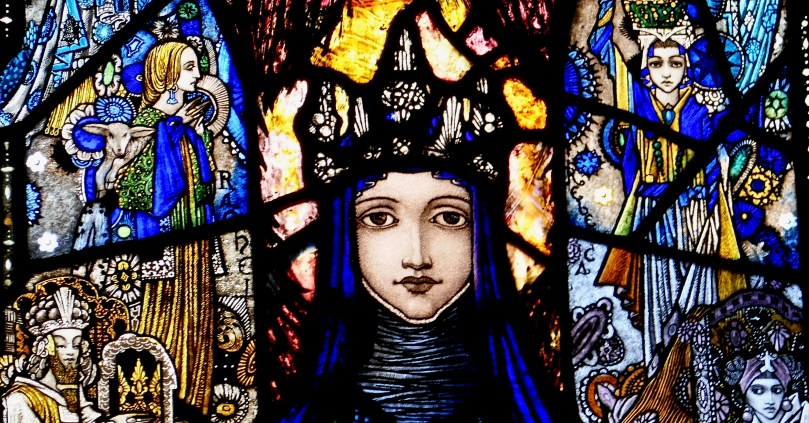
The right hand window exudes a different energy – forceful, complex, and peopled with the kind of supporting cast that Harry delighted in. The emphasis on Marian iconography, very much part of the popular emphasis of Catholicism pre-Vatican II, supported this kind of depiction of Mary, triumphant and queenly, holding sceptre and orb, with the moon and snake under her feet (a mixed metaphor inspired by the Woman clothed in the sun with the moon under her feet from Revelations 12, and the Genesis verse in which God tells the serpent that the woman shall ‘crush thy head’). God is shown above her, hands raised in the sign of blessing, and both have fiery aureoles. Mary carries a scroll with the invocation in Latin, Blessed art thou among women and blessed is the fruit of the womb.

While these are the two main figures, much of the interest in this window comes from the host of other women characters whose stories are illustrated in the side panels and the predella. Unusually for a Catholic window of the time, these are women from the Old Testament, not the Bridgets and Itas and Dympnas which populate so many of Harry’s saintly stained glass. I will start at the top and go through the stories as our eyes descend.

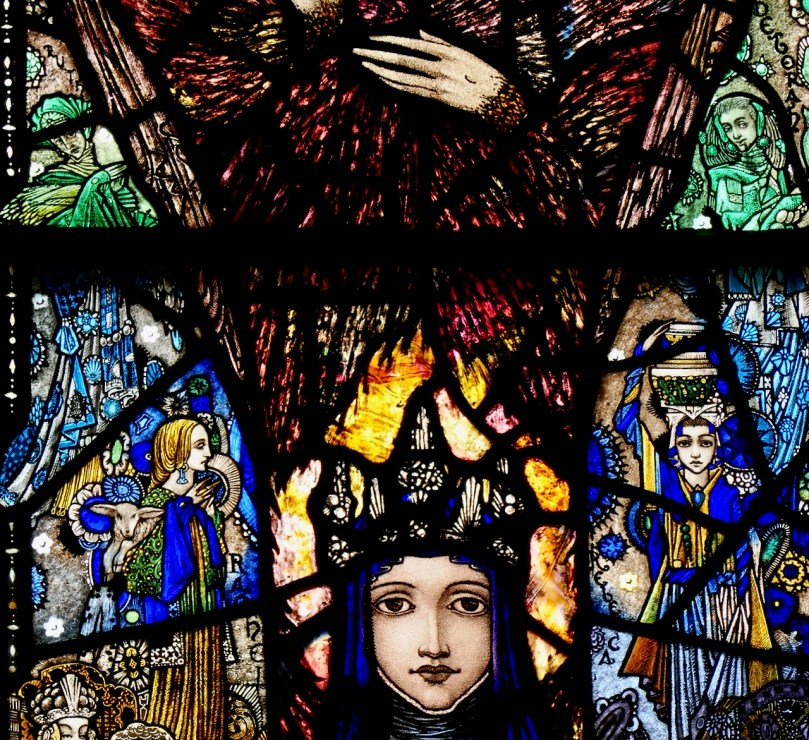
The border is patterned in deep blue, punctuated by tiny scenes from the life of Mary. God is surrounded by four female saints although the effect is of ghostly, insubstantial figures. The flowing clothing of the lower two provide a triangular link to Mary’s crown, an effective technique that divides the space and provides a frame for the first two Old Testament women, Ruth and Deborah. They are both rendered in green glass above and blue below, and both images protrude beyond the border, a technique Harry used to give depth. Ruth is known for her goodness and kindness, and Deborah for her wisdom and gift of prophecy, symbolised by the owl on her hand.

To the left of Mary’s Crown is Rachel and to the right, Rebecca. Rachel, beloved of Isaac, mother of Joseph, was watching her sheep when Isaac first sees her. Hers is a complicated story, full of trickery and disappointment. ‘Rebecca at the Well’ is a familiar motif of Renaissance painting – Rebecca comes to draw water at the well and gives it to a weary traveller and his camels, little knowing that by doing this she fulfils a prophecy and becomes the wife of Isaac (different Isaac) and mother of Jacob from whom descends the nation of Israel. 

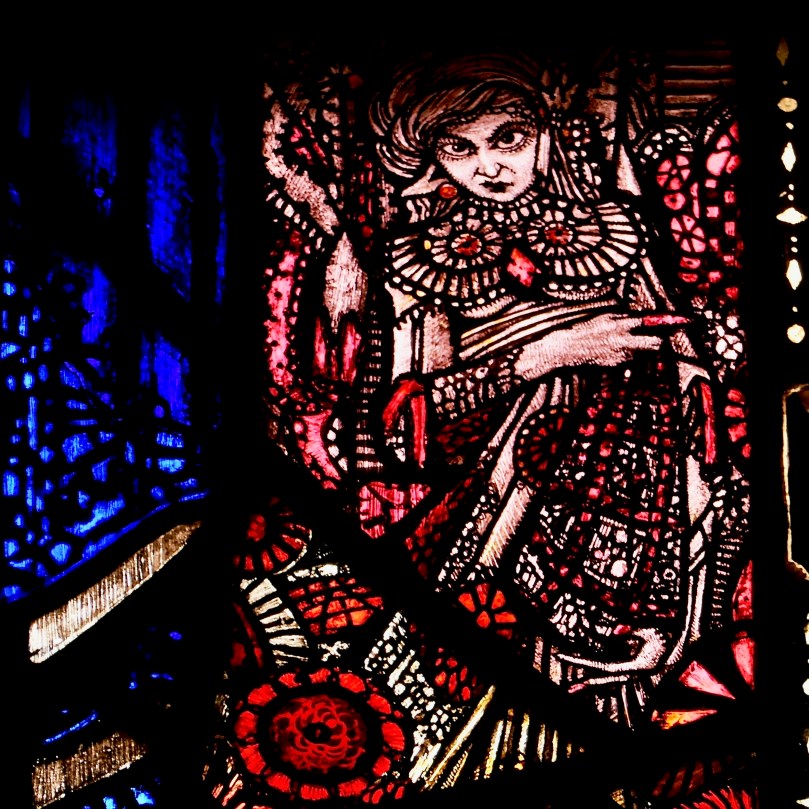
Next (above and below) are scenes from two stories. To the left is the story of Esther. King Xerxes, having banished his wife for disobedience, identifies her as his favourite (lower down the panel) from the harem and (higher image) makes her his queen. She goes on to become a saviour of her people. To the right is the story of Judith, the courageous widow who inveigles her way into Holofernes tent, lies with him, and cuts off his head when he sinks into an inebriated sleep. In the higher images she is pictured in scarlet robes, with her hand tangled in Holofernes bright red hair. In the lower, she and her maid escape carrying the head of Holofernes in a basket. The maid has a comical, grimacing expression – understandable given her burden. 

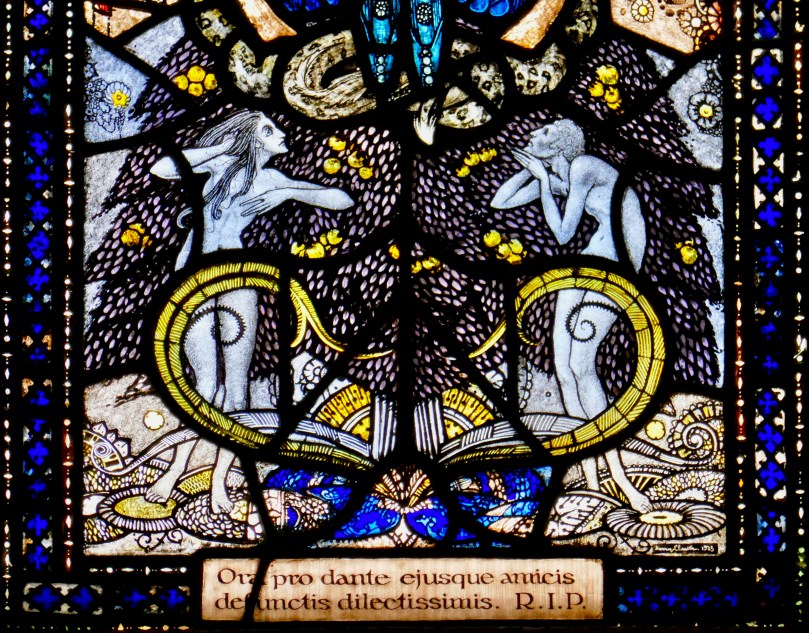
Finally, in the predella, we have Adam and Eve cowering in fear and shame in the Garden of Eden, while the golden apples hang from a purple tree. Gordon Bowe, whose knowledge of art history was prodigious, sees this as an homage to Paul Klee, whose Two Men Meeting, Each Presuming the Other to be of Higher Rank, the source she posits for this depiction, can be seen here.

By any standards these two windows belong to the highest order of artistic endeavour. They are also, especially The Blessed Virgin in Glory, an insight into Harry Clarke’s unique imagination, with its selection of tiny figures whose stories are worked out in intricate detail despite the constraints of space, and many of whom are far from the gentle virgins idealised by Catholic clergy of the day. Thomas Bodkin, the eminent art critic and later Director of the National Gallery referred to them as a multitude of little foreshadowing figures and says, They are drawn with such amazing delicacy of detail that they demand inspection at the closest quarter; and yet when seen from a distance they sink into a background swirl of lovely hues enhancing the majestic figure of their queen (Quoted in Gordon Bowe’s The Life and Work of Harry Clarke).

*If and when you can, go visit St Joseph’s in Terenure. Take with you the Marvellous book Harry Clarke and His Legacy by Patricia Curtin-Kelly. It’s a well-researched and very readable account of all the windows in this church by Harry Clarke and by those who carried on his legacy, Richard King and William Dowling and I highly recommend it.