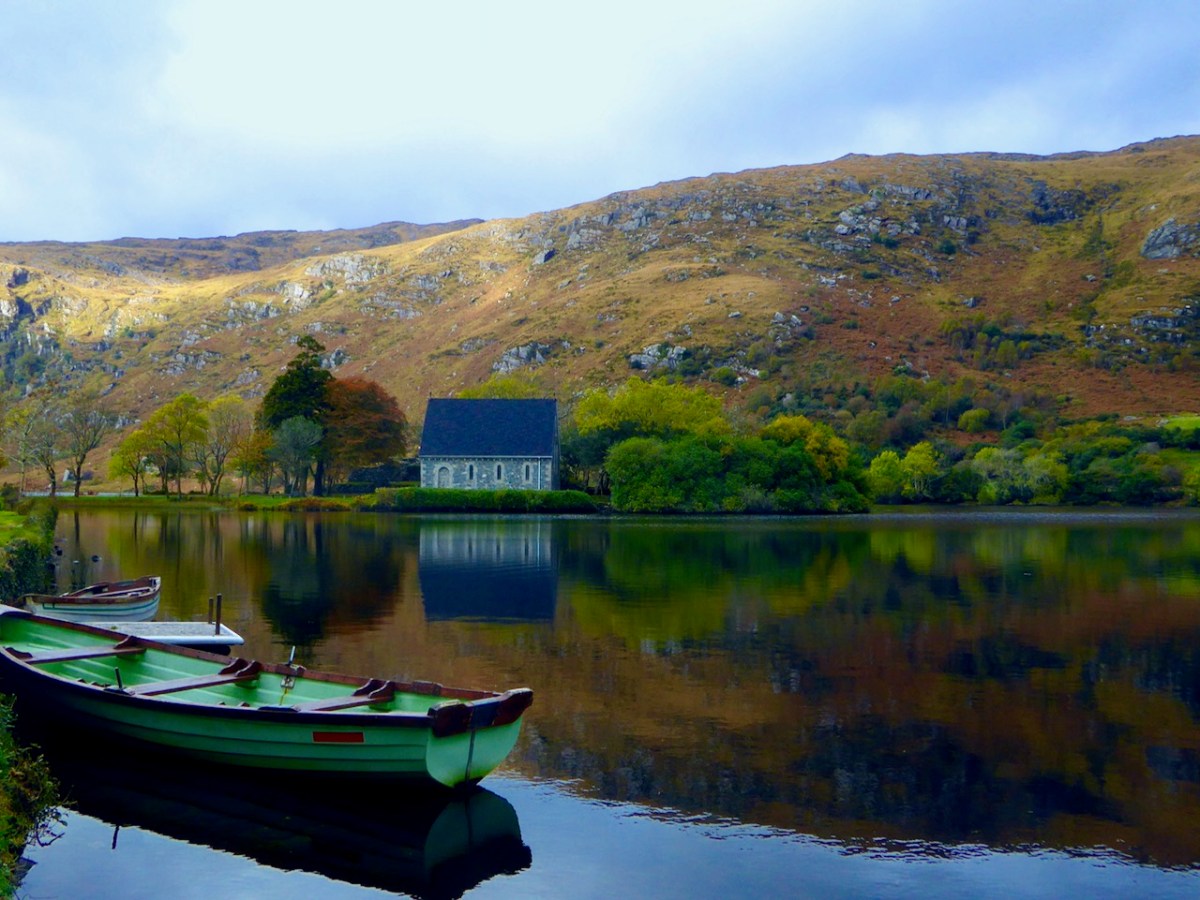
I’ve had the most marvellous Muskerry weekend! Muskerry (pronounced Muss-cree), or Múscraí as it is more properly spelled in Irish, encompasses a large area in west Cork and much of it is Irish speaking. This weekend my two destinations were Ballingeary and Inchigeelagh. We didn’t stop at Gougane Barra on the way this time, but can’t resist including this photo to remind you of the stunning scenery there.
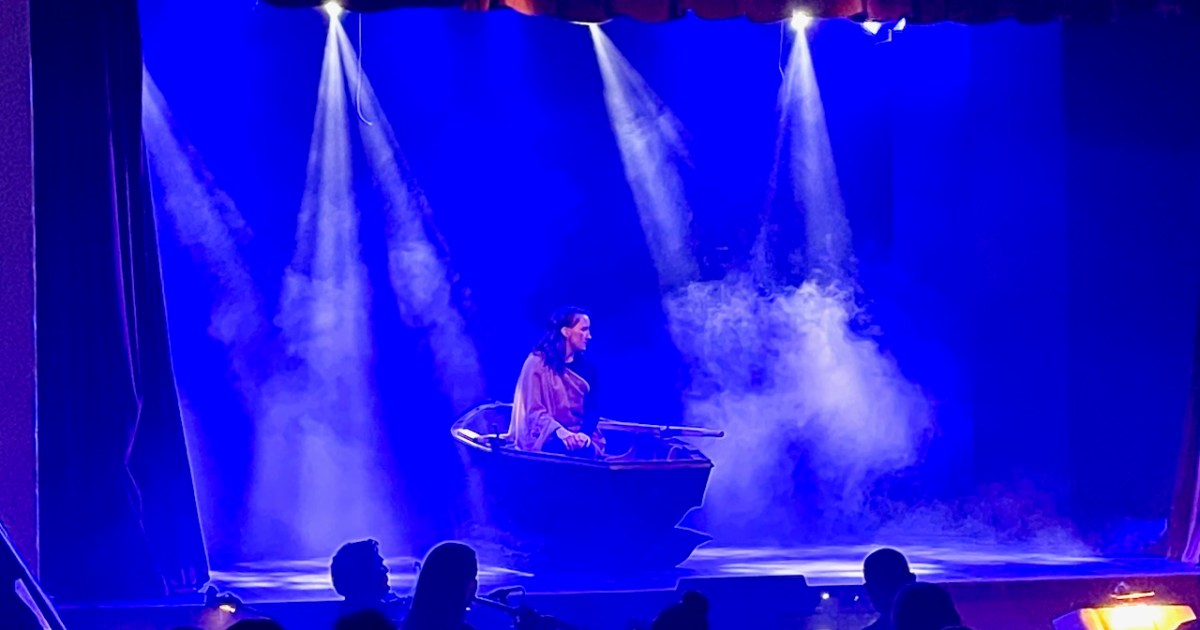
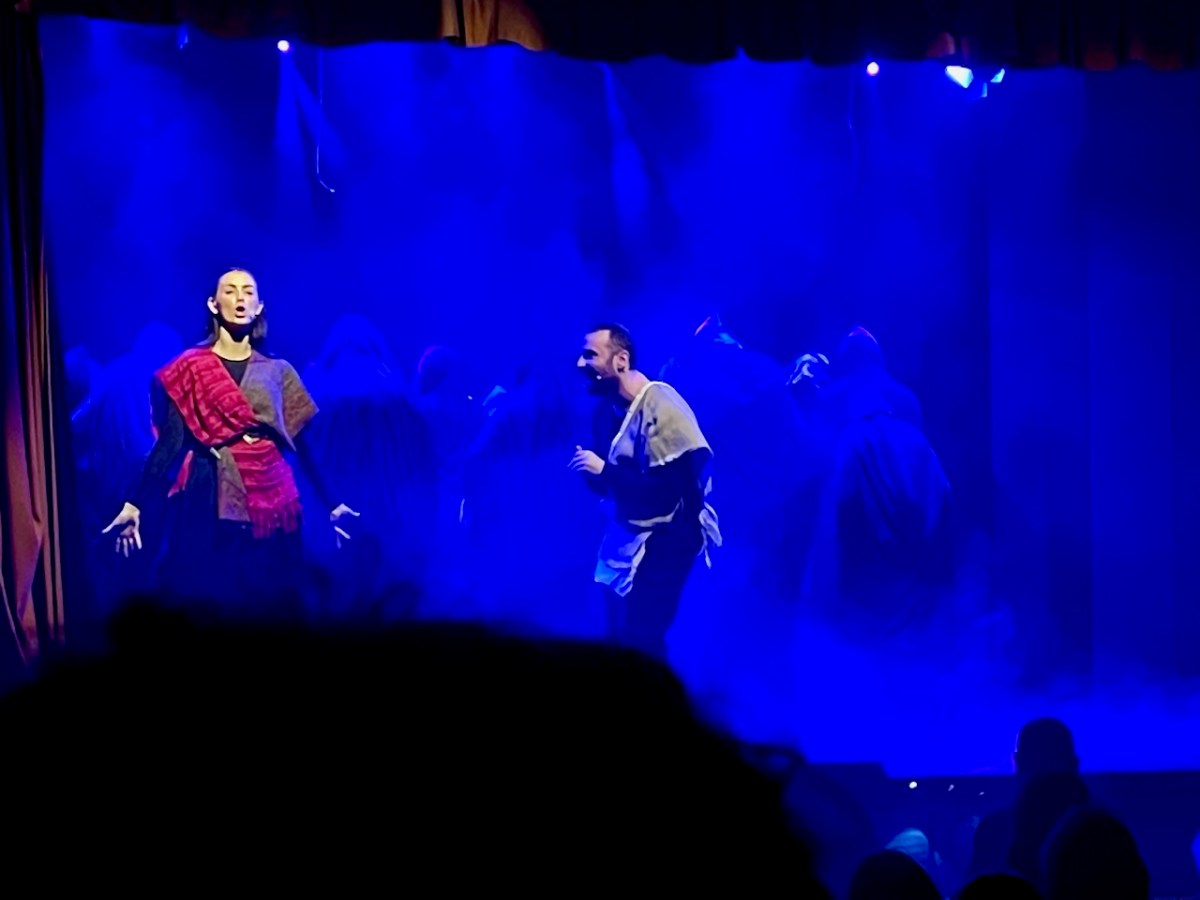
Ballingeary was Saturday and our destination was the village hall, for the last night of the original ceoldráma (musical), Gobnait! This production is by the same team who mounted An Tuairin Dubh a couple of years ago and I was dying to see their new musical. I wasn’t disappointed!
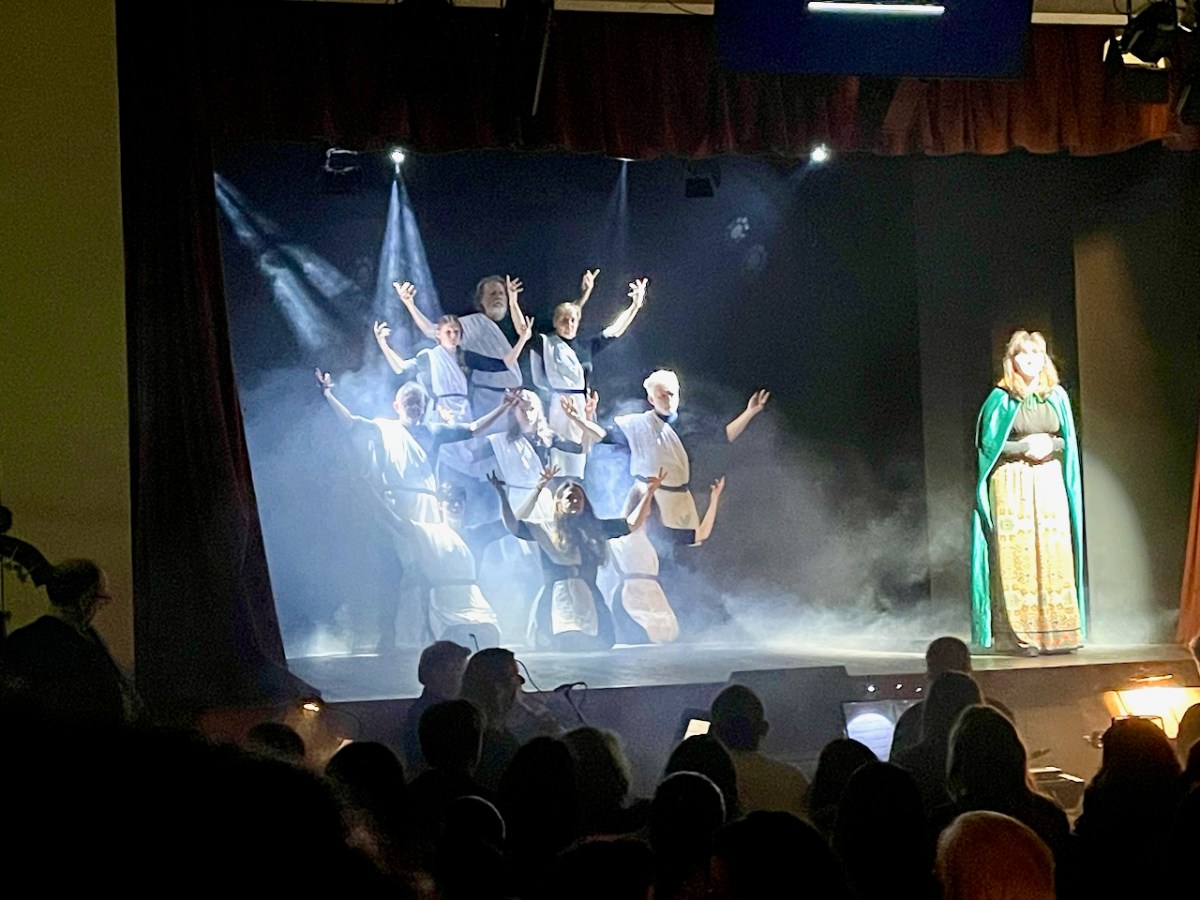
The story tells of the legend of St Gobnait, who travels from the Aran Islands to Ballyvourney – she knows she will have reached the “site of her resurrection” when she sees nine white deer (below). Patron saint of smiths and beekeepers, stories abound and are kept alive with an annual pilgrimage. We have written about Gobnait several times. Here’s a link to a post from only last year, one of the last posts that Robert wrote, in fact.
But to really understand how St Gobnait journeyed to Ballyvourney, you must read Amanda’s 3 part post (Part 1 and Part 2 and Part 3) where she traces her peregrination from the Aran Islands to Ballyvourney, stopping along the way to lend her name to churches and holy wells. This is followed by a summary of her life and work in Ballyvourney.
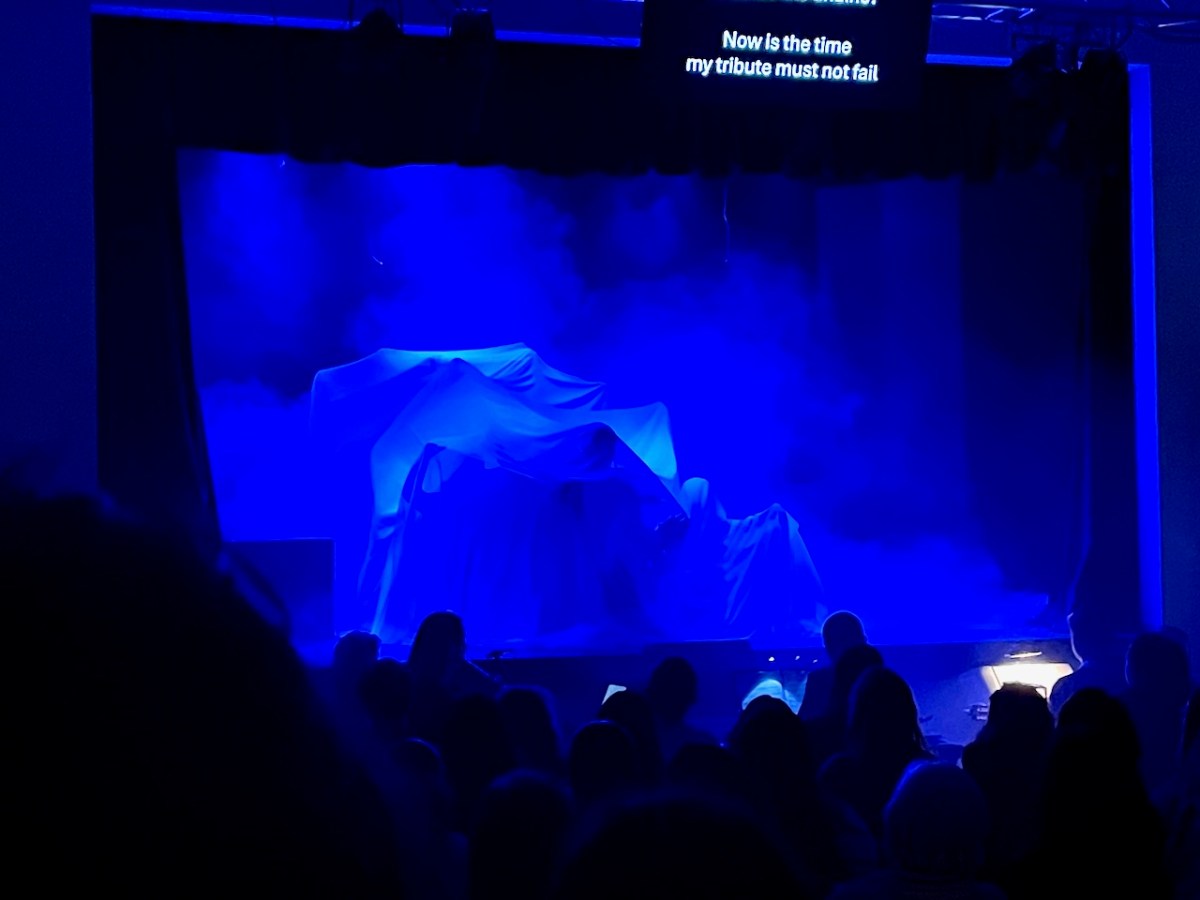
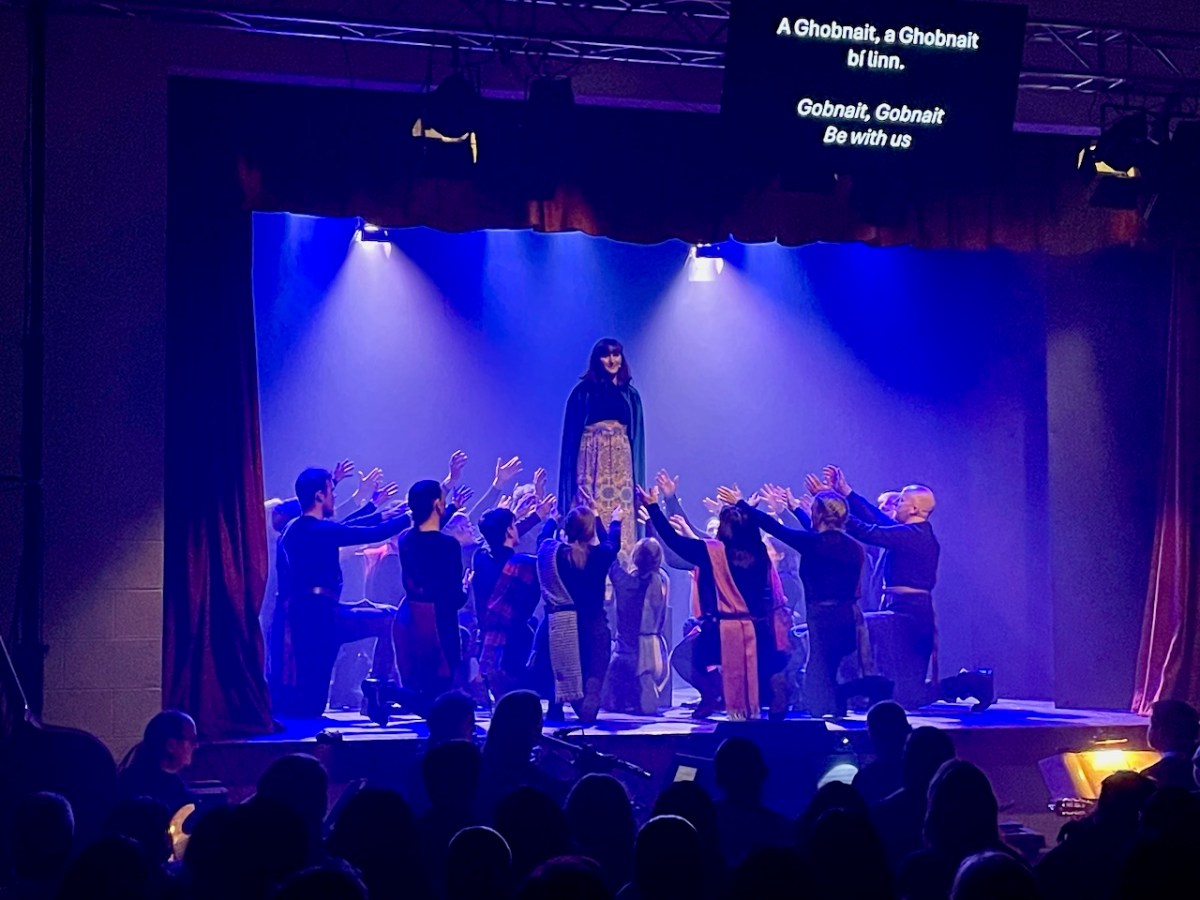
The Musical – it’s an opera, really, told the story very dramatically and with great liveliness and enthusiasm from the cast. The singing was lovely and there was lots of interesting choreography and stage settings – the Sulán River, for example, was very effectively rendered by means of moving actors and a huge gauze sheet (below). The words were projected as sur-titles, so even though my Irish is not a strong as I would wish, I could follow along with no problem.
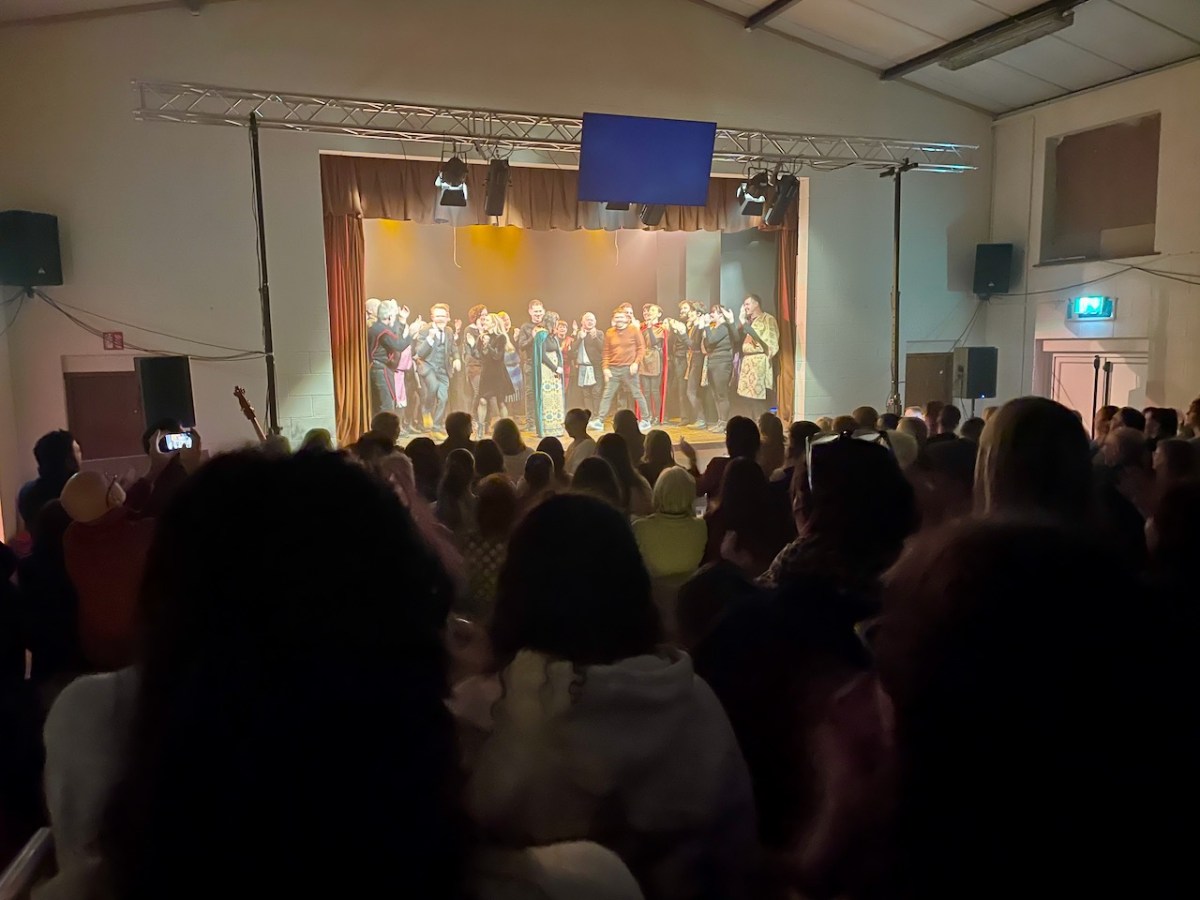
It seems like the whole village of Ballingeary was involved – from those directing us to parking to those at the desks and tea-counter, everyone from miles around was joining in the fun and the effort. The hall was packed, as it has been every night, and we delivered a standing ovation at the end of the evening – so well deserved.
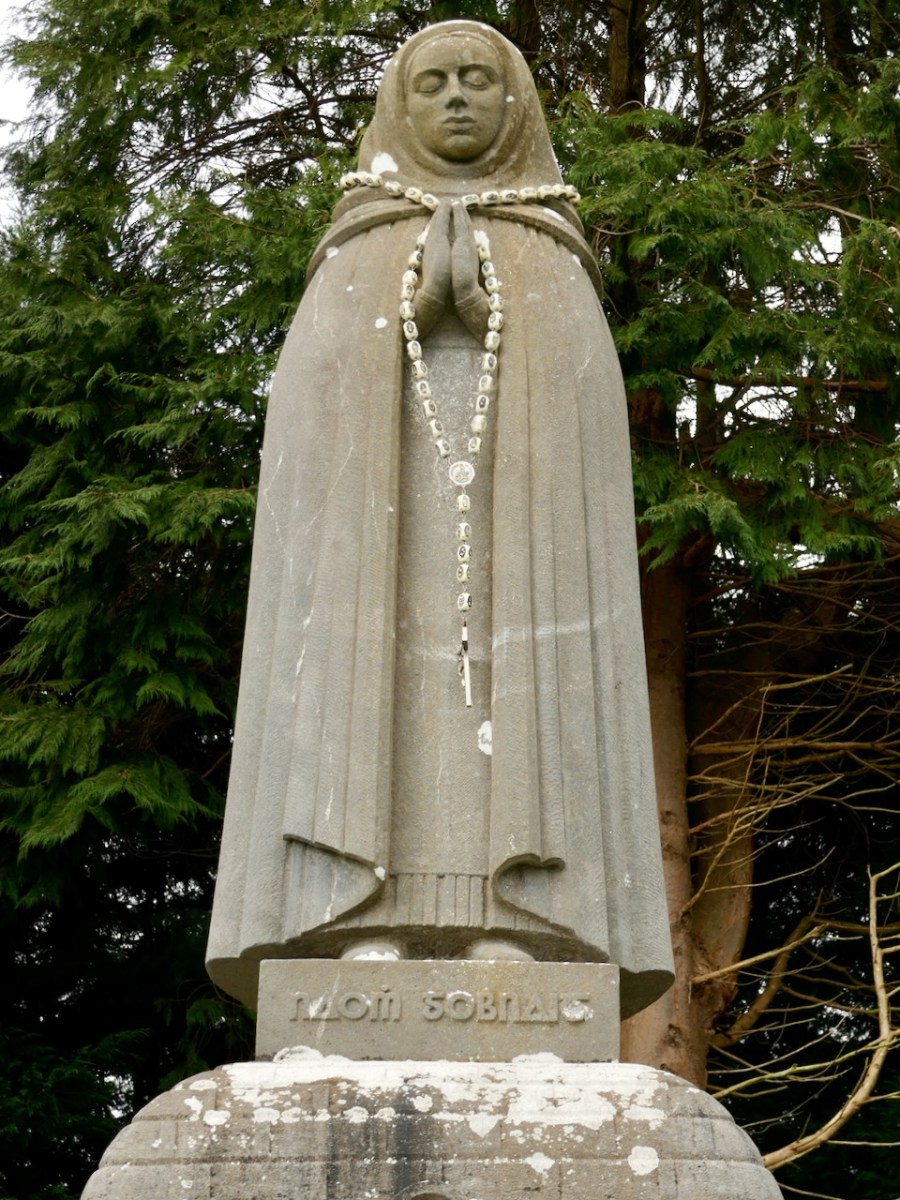
I loved how Gobnait’s costume in the second half was based on Seamus Murphy’s famlous statue of her at her holy well in Ballyvourney.
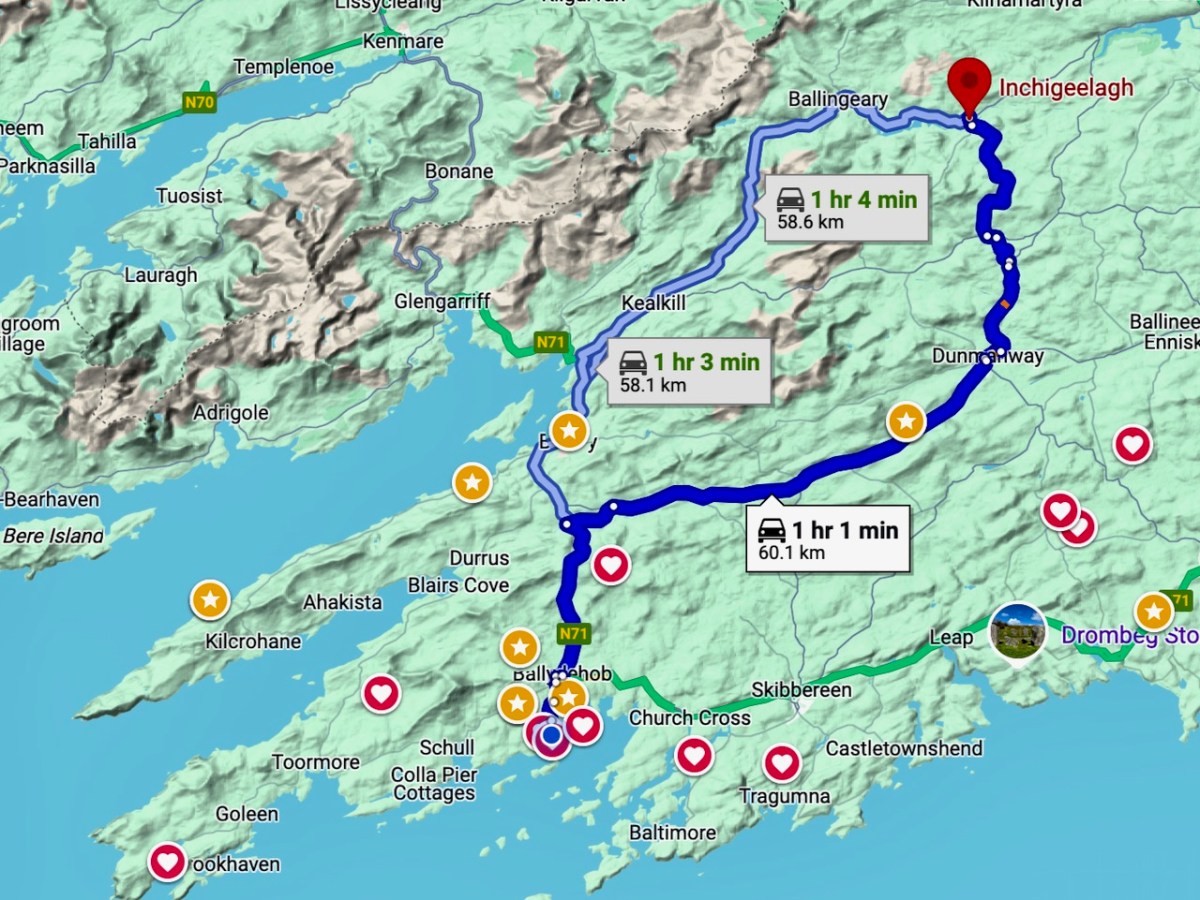
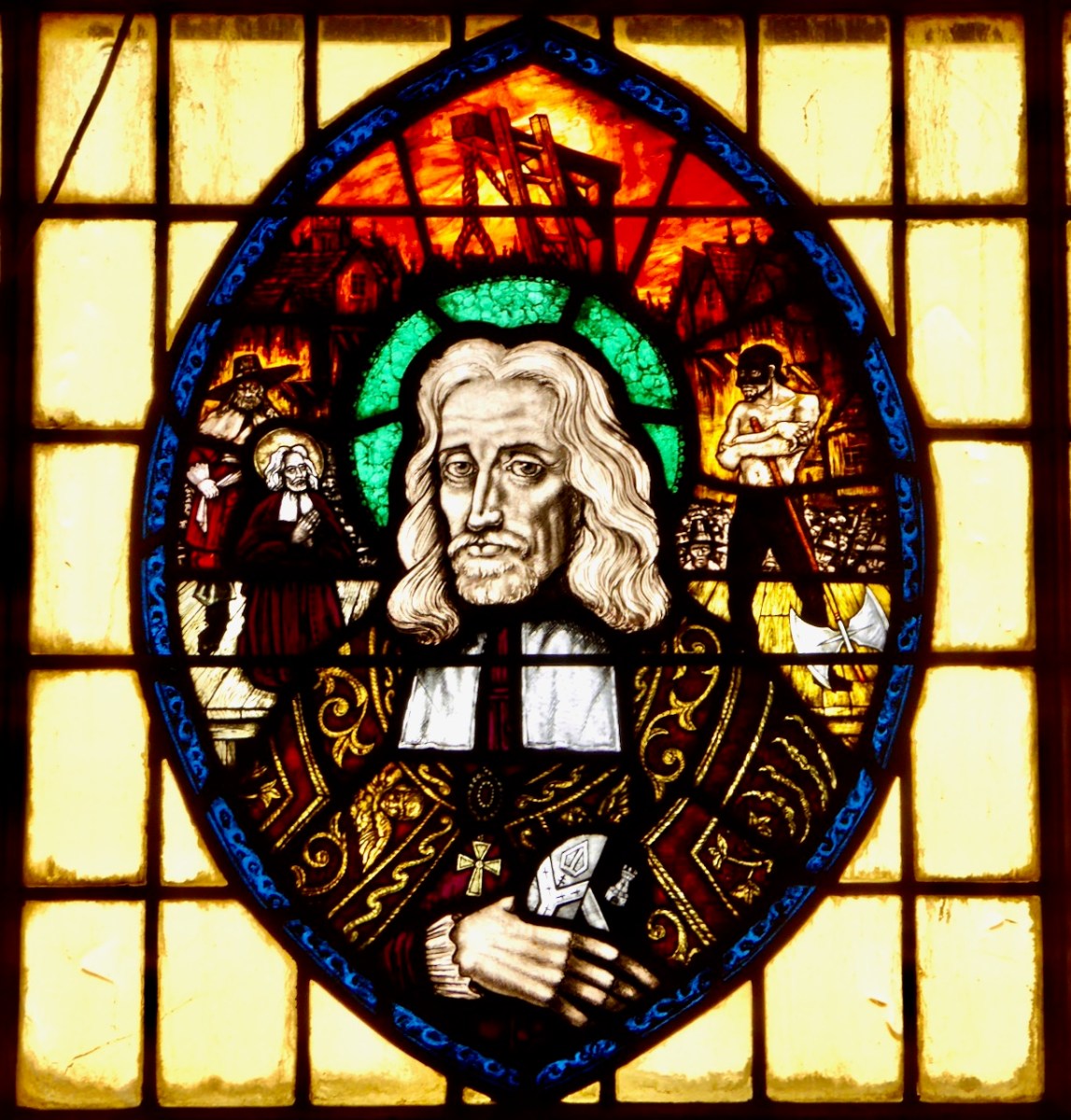
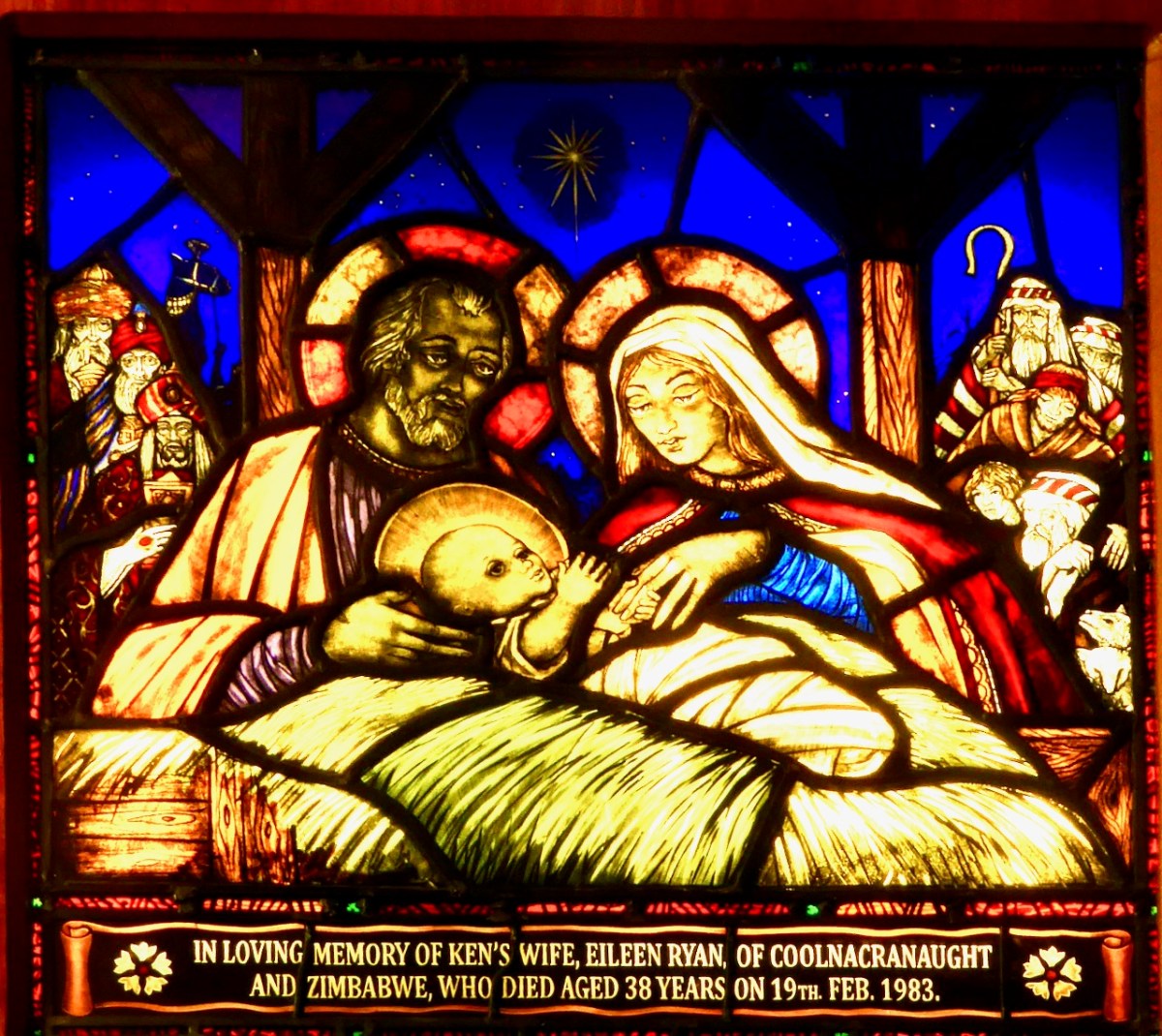
Having gone home and slept, I got in the car again this morning for another trip to Múscraí – this time to Inchigeelagh and to one of my favourite West Cork churches. Before I tell you about the trip, here are two reasons I like this church. The first is this little gem of St Oliver Plunkett. It’s the work of Kevin Kelly, of the Abbey Studios – and my photograph of it features on the front cover of a book! I haven’t got my copy of the book yet – it’s on its way.
The purpose of my trip was to attend a mass in memory of Eileen Ryan. Eileen died in Zimbabwe, aged only 38, in 1983. and each year since, her husband Ken makes the journey from Dublin to attend the mass. Ken, a friend from the stained glass world (he’s the Chairman of Abbey Stained Glass Studios), had invited me to attend, since I live ‘nearby.’ I am so glad I did.
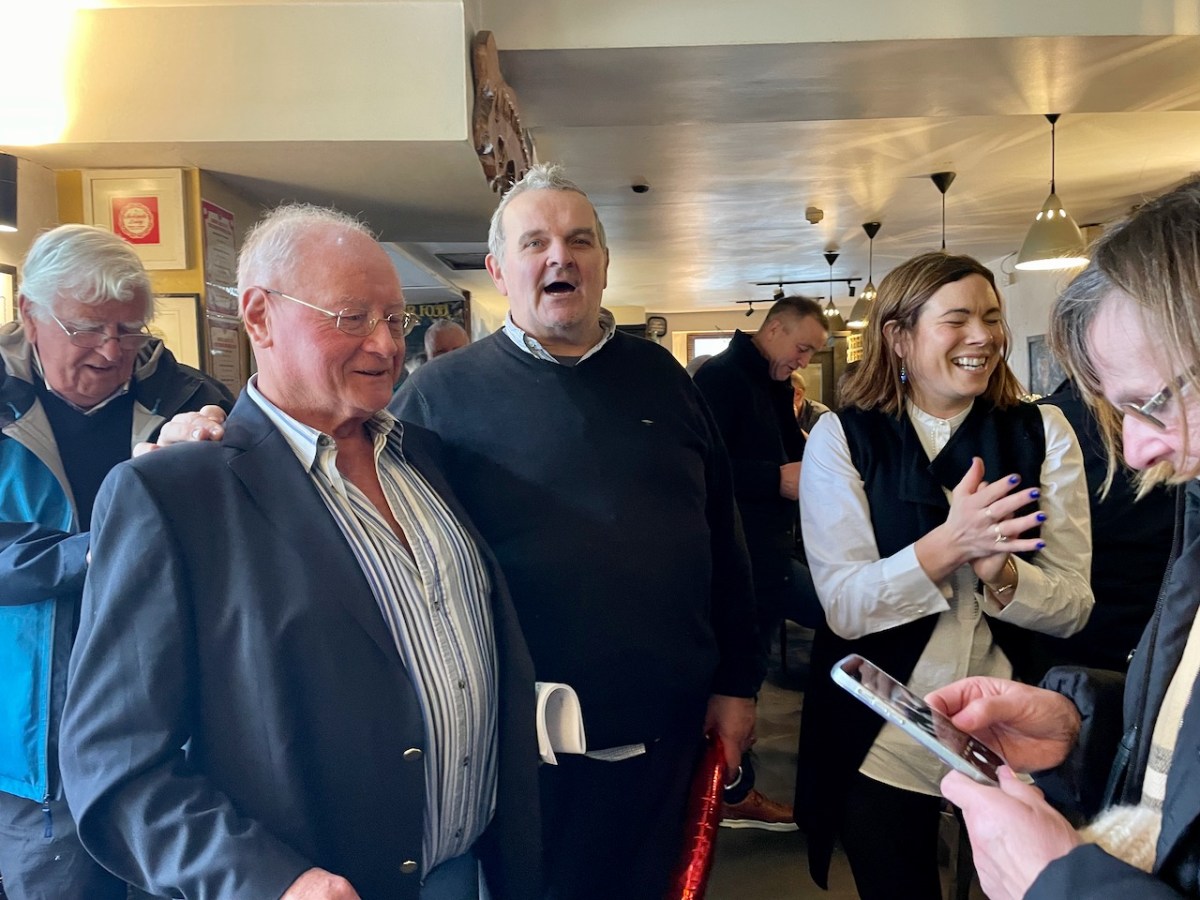
Y’know, you forget how life is lived and celebrated in rural Ireland – the ritual, followed by the release, the laughter, and food and the friendliness. As a total stranger, I was included in all of that – we were singing in a pub an hour after the mass ended, and eating delicious soup and brown bread and cake in a family member’s house an hour after that. I felt like I had made new friends – and have already promised to give a stained glass talk at their annual festival next year.
St Brigid, according to some accounts, died in 524. Therefore, we are celebrating this year the 1500th anniversary of her death. Once again, I have gone back to primary sources for incidents from her life and am illustrating them with stained glass images. This year I have added as a source the famous Canon O’Hanlon’s Life, from his Lives of the Irish Saints Series, Vol 2, a work of overwhelming erudition.
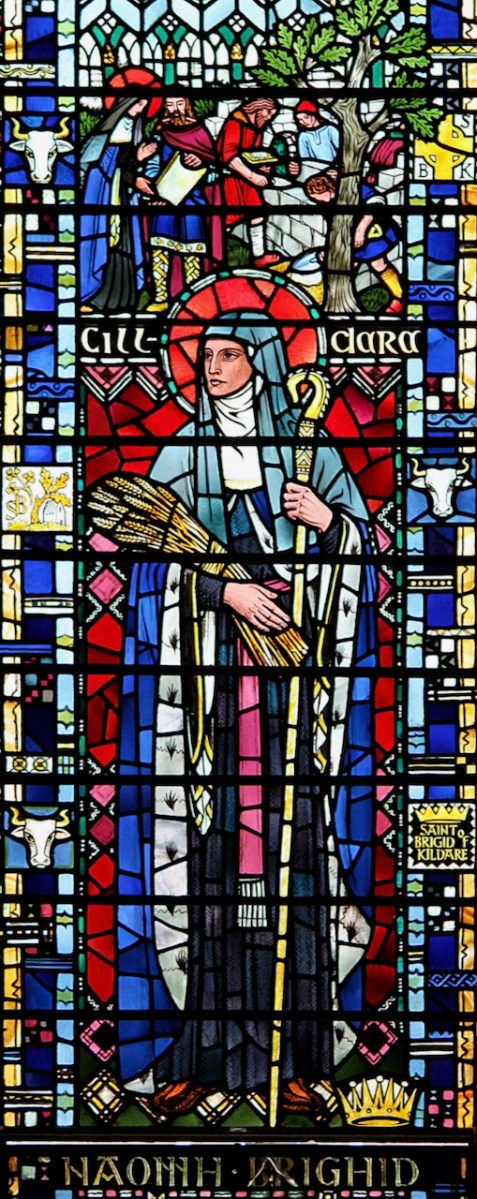
The Patrick and Brigid window in Meath Hill, by George Walsh. I love that Brigid has precedence over Patrick in this enormous cruciform window
If you haven’t already done so, now is a good time to go back and read my 2022 post, St Brigid: Dove Among Birds, Vine Among Trees, Sun Among Stars and my 2023 post, Brigid: A Bishop in All But Name. In them, I explain what the original sources for the Life of Brigid are. They all contain similar accounts and may be ultimately based on a single source – the Life of St Brigid by St Ultán – and are laid out as a series of miracles that lead us from her birth to her death.
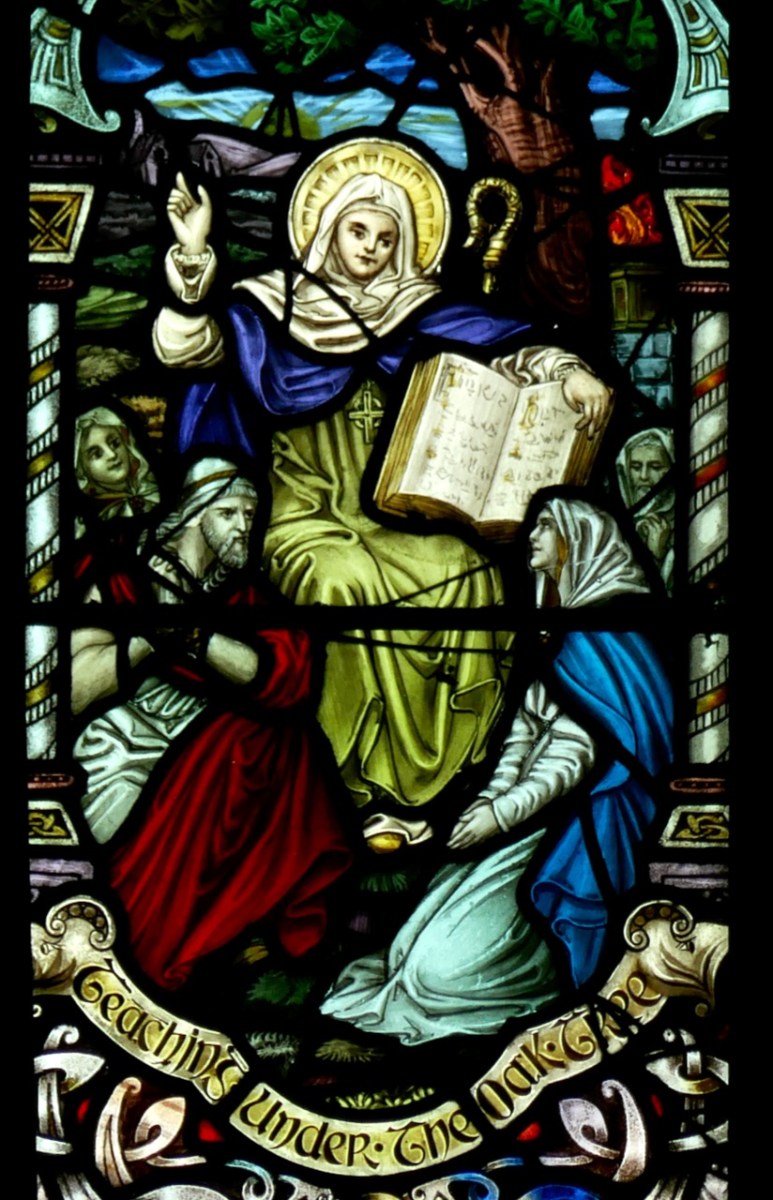
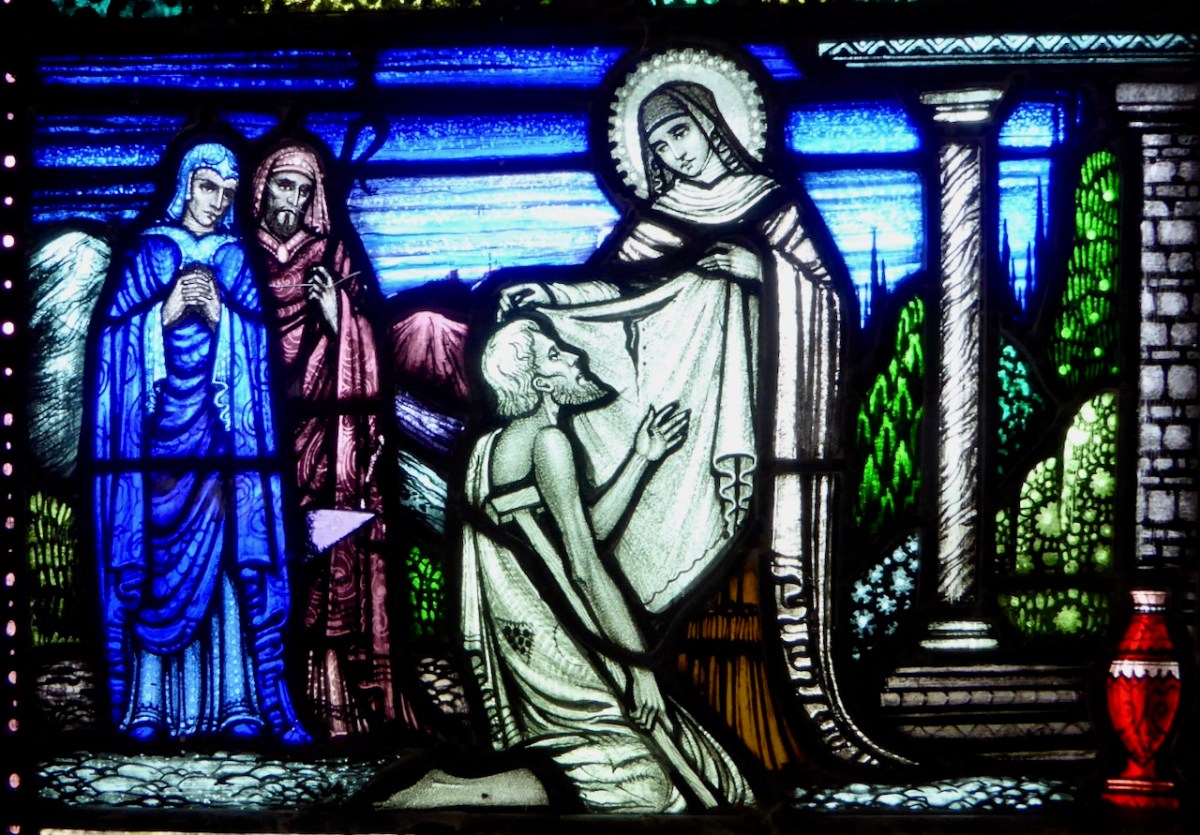
This is a detail from a window in Ballynahown, Co Westmeath, and is probably by Watson of Youghal. I like the clever way the oak leaves are used as frame and background
Many more miracles, legends, myths and stories accreted to her cult over the centuries. A good example of such a story is the one where she makes a cross from rushes – that one is nowhere to be found in the original Lives, but is an integral part of the folklore surrounding her, and therefore almost invariably found in her iconography.
This is a photo by Frank Fullard, used with permission and thanks. It is a simple treatment of St Brigid from Kilmaine, Co Mayo
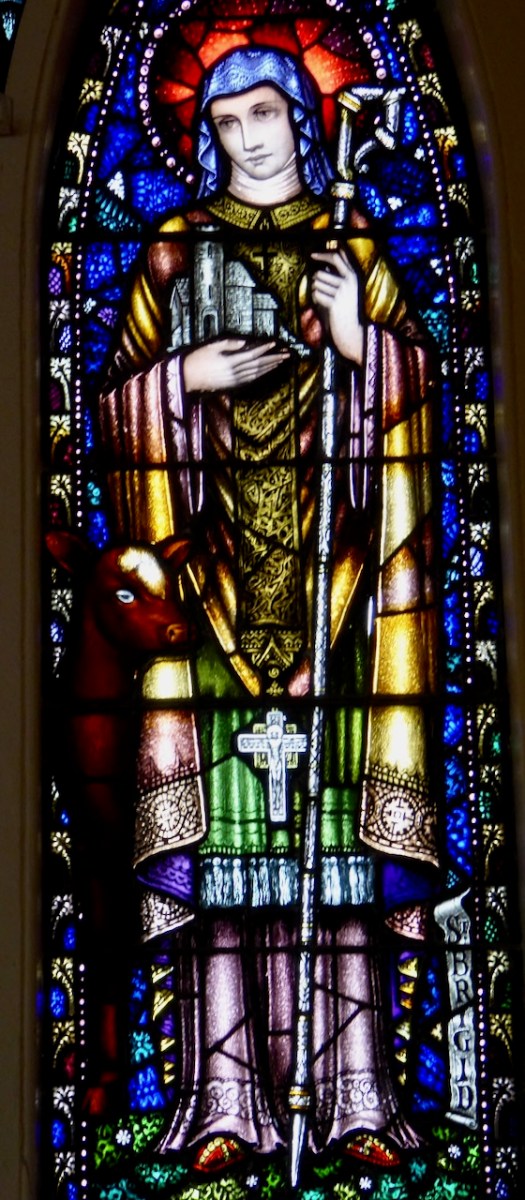
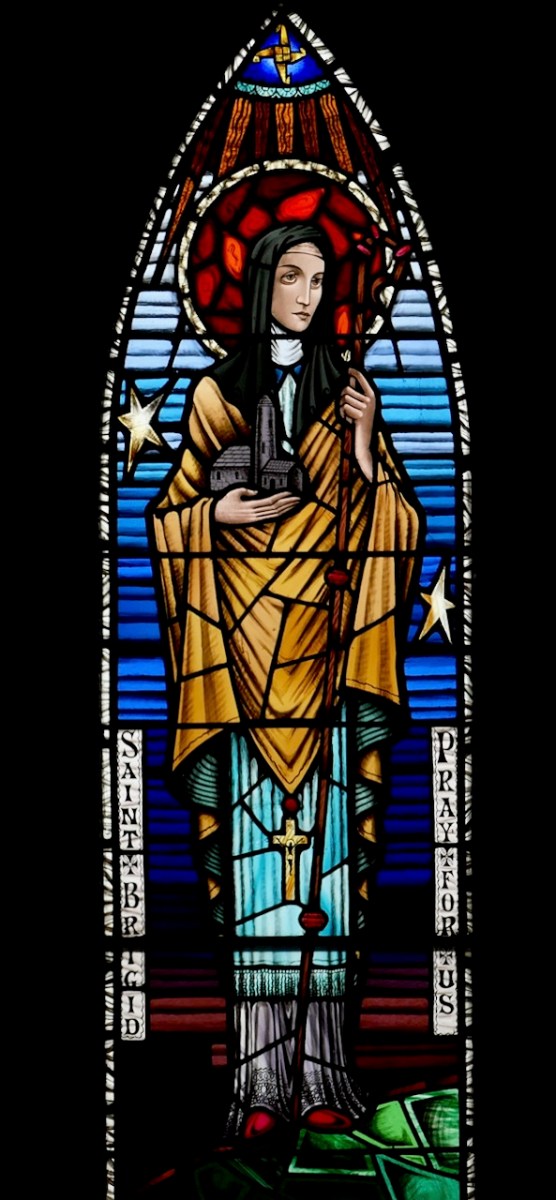
She is associated with many places and numerous holy wells – just take a look at all the St Brigid’s wells Amanda has documented in Cork and Kerry. But of course it is Kildare that rightly claims her. Kildare (Cill Dara – the Church in the Oak Wood) is where she built her church and established her city. It is the origin of three of the attributes we see in many windows – a church, oak leaves and a lamp. (For the story about the Bishop’s Crozier, see the previous posts.)
Detail from the Brigid Window in Carrickmacross – she’s consulting with her architects
The Book of Lismore has this story about building the church:
Brigit went to Bishop Mel, that he might come and mark out her cityfor her. When they came thereafter to the place in which Kildare stands to-day, that was the time that Ailill, son of Dunlang, chanced to be coming, with a hundred horseloads of peeled rods, over the midst of Kildare. Then maidens came from Brigit to ask for some of the rods, and refusal was given to them. The horses were (straightway) struck down under their horseloads to the ground. Then stakes and wattles were taken from them, and they arose not until Ailill had offered the hundred horseloads to Brigit. And therewith was built Saint Brigit’s great house in Kildare, and it is Ailill that fed the wrights and paid them their wages. So Brigit left (as a blessing) that the kingship of Leinster should be till doomsday from Ailill, son of Dunlang.
Detail from the Brigid window in Sneem, Co Kerry, by Watson of Youghal
It was a large establishment. O’Hanlon says:
We are informed, that her Rule was followed, for a long time, by the greatest part of those monasteries, belonging to sacred virgins in Ireland; nearly all of these acknowledging our saint as their mother and mistress, and the monastery of Kildare as the headquarters of their Order. Moreover, Cogitosus informs us, in his prologue to her life, that not only did she rule nuns, but also a large community of men, who lived in a separate monastery. This obliged the saint to call to her aid, and from out his solitude, the holy bishop, S. Conlaeth, to be the director and spiritual father of her religious; and, at the same time, to be bishop of the city. The church at Kildare, to suit the necessities of the double monastery and to accommodate the laity, was divided by partitions into three distinct parts. One of these was reserved for the monks; one for the nuns; while a third compartment was intended to suit the requirements of the laity.
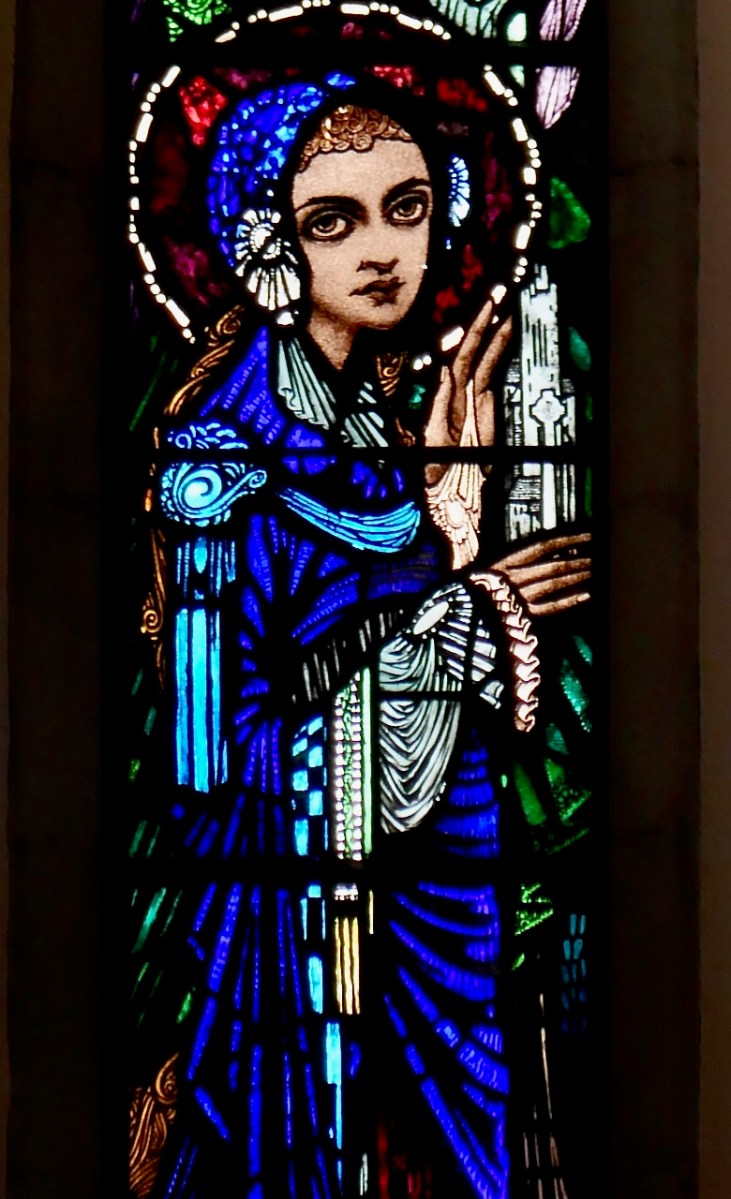
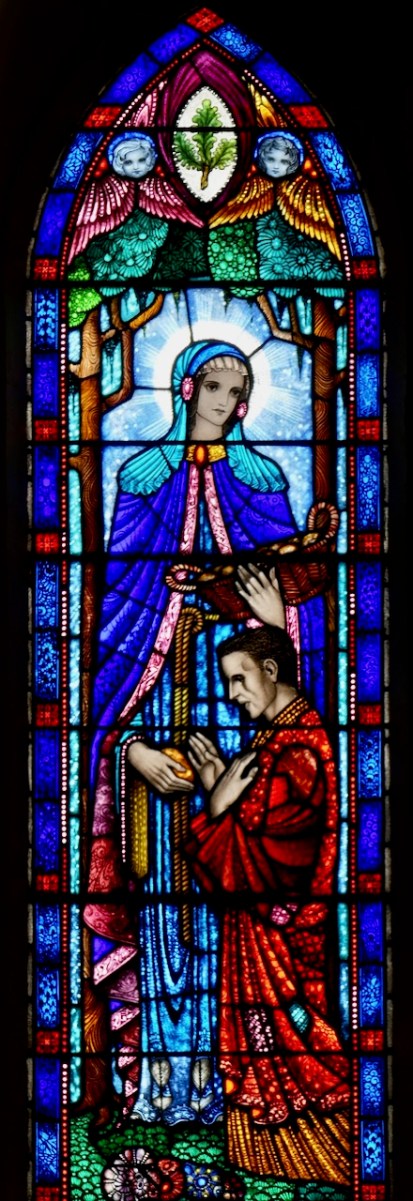
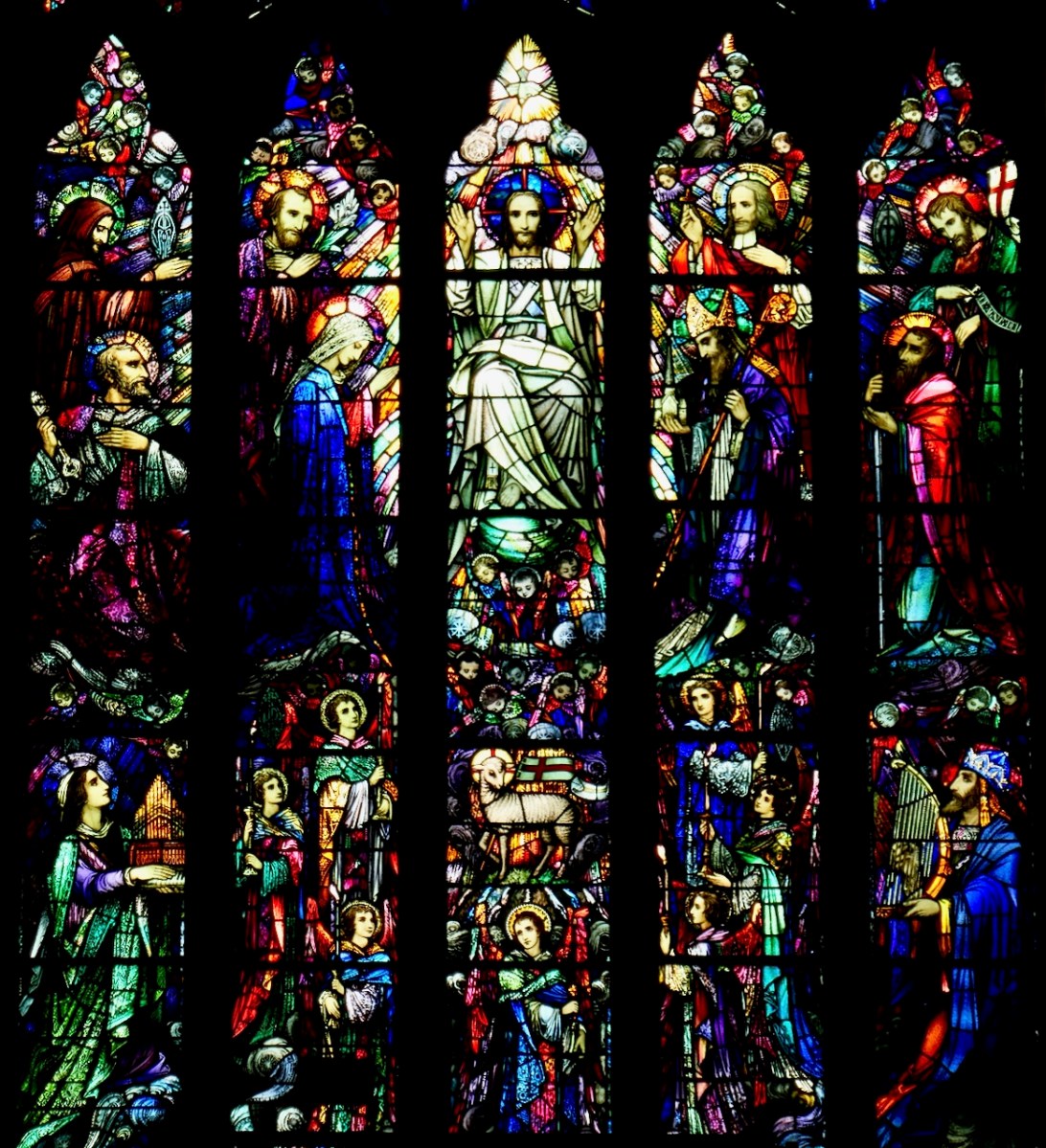
Harry Clarke’s 1924 window in Cloughjordan is of the Ascension with Irish Saints – this is a young St Brigid, holding her church
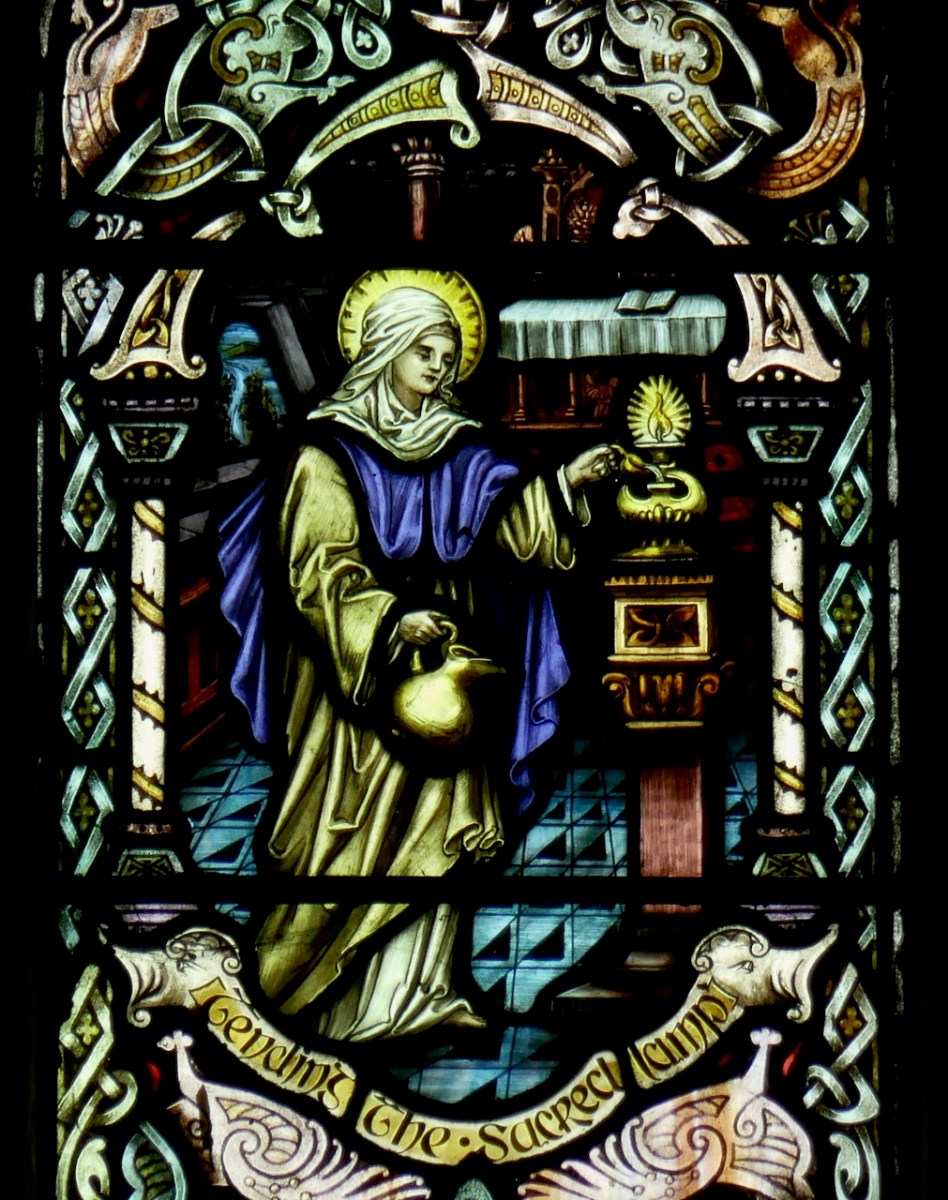
And what about the lamp? This is interesting, as its first appearance was not in any of the lives but in the writings of the notorious Giraldus Cambrensis, Gerald of Wales. He will get a post of his own in due course, but for the moment, if you are not familiar with him, there’s a delightful sketch of him and his writings about Ireland in the 12th century here.
Brigid window in Kilgarvan, Co Kerry, by Earley and Co
Here is his story about the sacred fire, now usually rendered as a lamp, as faithfully related by O’Hanlon:
Speaking of Kildare city, in Leinster, which had become so renowned, owing to its connexion with our glorious abbess, Giraldus Cambrensis says, that foremost, among many miraculous things worthy of record, was St. Brigid’s inextinguishable fire. Not, that this fire itself was incapable of being extinguished, did it obtain any such name, but, because nuns and holy women had so carefully and sedulously supplied fuel to feed its flames, that from St. Brigid’s time to the twelfth century, when he wrote, it remained perpetually burning through a long lapse of years. What was still more remarkable, notwithstanding great heaps of wood, that must have been piled upon it, during such a prolonged interval, the ashes of this fire never increased.
Another detail from the Watson window in Sneem
What is furthermore remarkable, from the time of St. Brigid and after her death until the twelfth century, an even number, including twenty nuns, and the abbess, had remained in Kildare nunnery. Each of these religious, in rotation, nightly watched this inextinguishable fire. On the twentieth night, having placed wood on its embers, the last nun said:” O Brigid, guard thy fires, for this night the duty devolves on thyself.” Then the nun left that pyre, but although the wood might have been all consumed before morning, yet the coals remained alive and inextinguishable. A circular hedge of shrubs or thorns surrounded it, and no male person dare presume to enter within that sacred enclosure, lest he might provoke Divine vengeance, as had been experienced by a certain rash man, who ventured to transgress this ordinance. Women only were allowed to tend that fire. Even these attendants were not permitted to blow it with their breath; but, they used boughs of trees as fans for this purpose.
This is the predella from the Brigid window in Moone, by the Harry Clarke Studios (see blow for the main panel)
All of the Lives and O’Hanlon’s account tell of Brigid’s many miracles in providing food and clothing for the poor, in healing sicknesses, in turning the hearts of evildoers to God, in freeing slaves, and in punishing those who are selfish or cruel.
However, the story I like best perhaps is this one from the Vita Prima:
In the same place also when saint Brigit was staying as a guest, a married man came with a request that saint Brigit should bless some water for him to sprinkle his wife with, for the wife actually hated the husband. So Brigit blessed some water and his house and food and drink and bed were sprinkled while his wife was away. And from that day on the wife loved her husband with a passionate love as long as she lived.
She may have been a nun, but she obviously served up a good love potion when the situation required it. This story is not only repeated in the Book of Lismore, but embellished, thus:
When he had done thus, the wife gave exceeding great love to him, so that she could not keep apart from him, even on one side of the house ; but she was always at one of his hands. He went one day on a journey and left the wife asleep. When the woman awoke she rose up lightly and went after the husband, and saw him afar from her, with an arm of the sea between them. She cried out to her husband and said that she would go into the sea unless he came to her.
The aged St Brigid by George Stephen Walsh, in Ballintubber Abbey – another image generously loaned by Frank Fullard
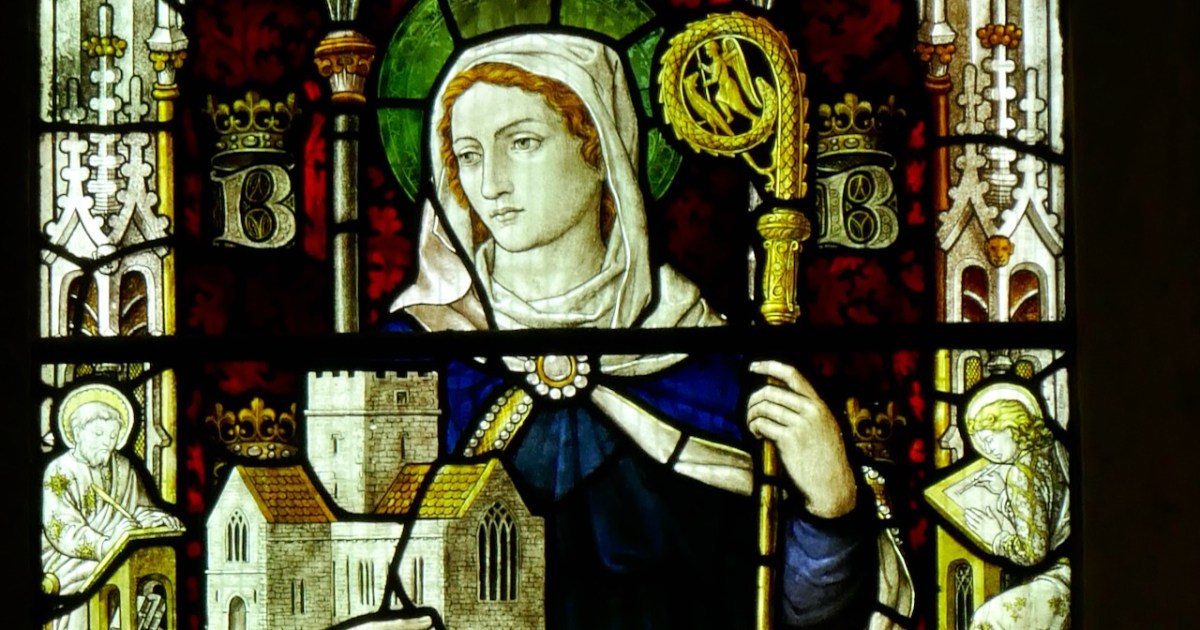
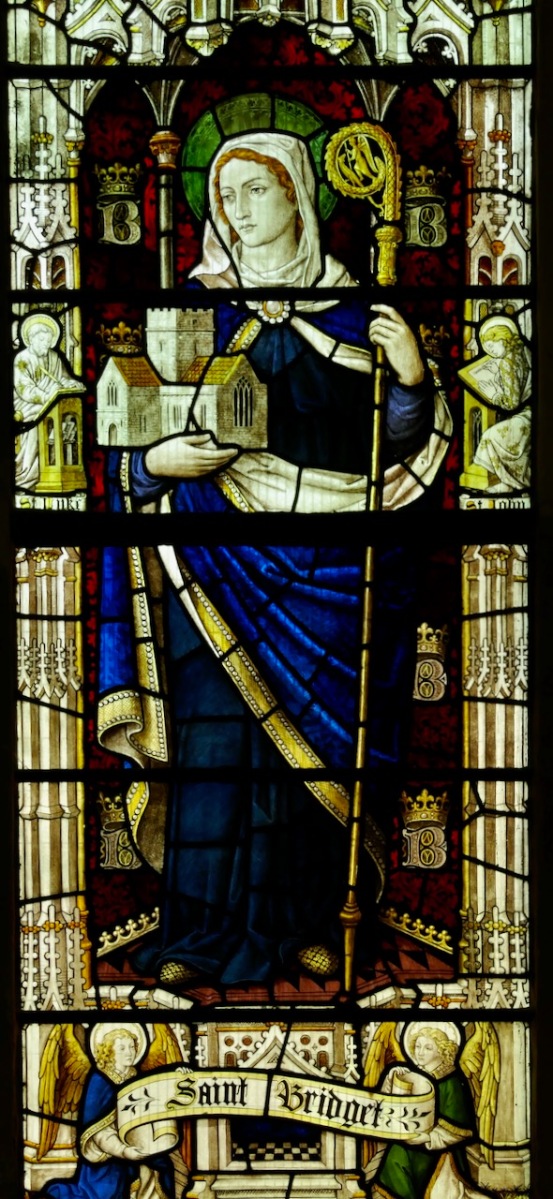
My final point for this post about St Brigid is the matter of where she is buried. Most authorities give this as Downpatrick, where she is laid to rest alongside Patrick and Columcille. However, a medieval legend grew that she went to Glastonbury in old age and died there. That is why she is venerated in Britain as well as in Ireland – the top photograph in this post is from the St Brigid window in Exeter Cathedral. Here’s the full window, in which she is flanked, for some reason, by St Luke and St John busily writing their gospels.
Here is another British window, this one designed by Nuttgens in 1952 for St Etheldreda’s Church in London. (Used with thanks under the Creative Commons License – original is here.) It’s a particularly good narrative window, showing the building of her church under the Oak Tree, her crozier, and two cows – there are many stories of milk and cows in the Lives.
But O’Hanlon is having none of the Glastonbury story.
We cannot receive as duly authenticated, or even as probable, severalassertions of mediaeval and more recent writers, who have treated concerning this illustrious virgin. It has been stated, that about the year 488, Saint Brigid left Ireland, and proceeded towards Glastonbury. There, it is said, she remained, until advanced in years, on an island, and convenient to the monastery in that place. Whether she died there or returned to Ireland is doubted. But, it seems probable enough, such a tradition had its origin, owing to this circumstance, that a different St. Brigid, called of Inis-bridge, or of Bride’s Island, had been the person really meant. She lived many years on a small island, near Glastonbury, called Brigidae Insula i.e., Brigid’s Bridge. This latter St. Brigid is said to have been buried, at Glastonbury.
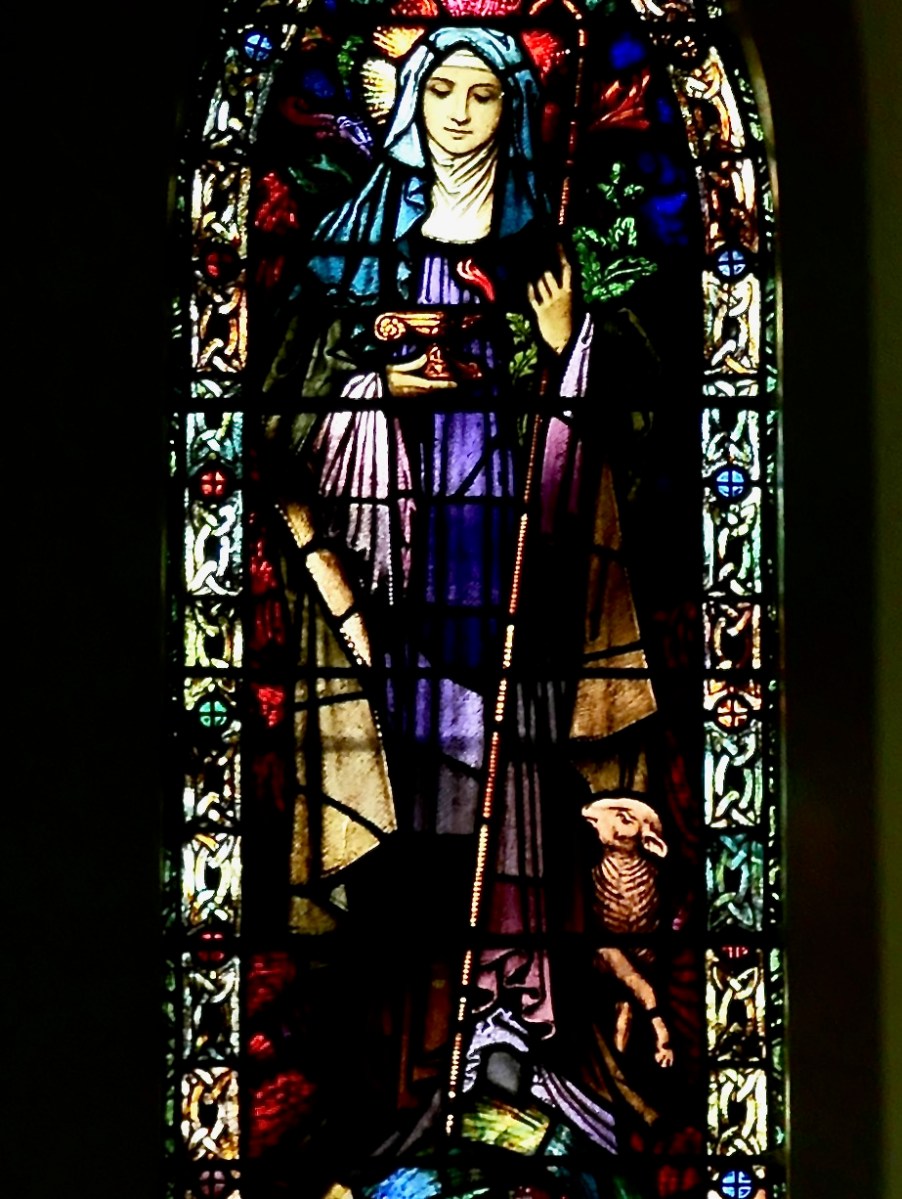
This Brigid window is in Moone, Co Kildare from the Harry Clarke Studios. It features, as do many Brigid windows I have seen, a deer, but I can find no mention of a deer in any of the Lives. Perhaps one of our readers knows where the deer icon comes from?
I will finish with a quote from the Book of Lismore, which gives me the title for this post, and gives Brigid one of her most frequent soubriquets.
It is she that helpeth every one who is in a strait and in danger: it is she that abateth the pestilences: it is she that quelleth the anger and the storm of the sea. She is the prophetess of Christ she is the Queen of the South: she is the Mary of the Gael
I don’t know whose window this is – it’s from Ballybunion – but I love the composition
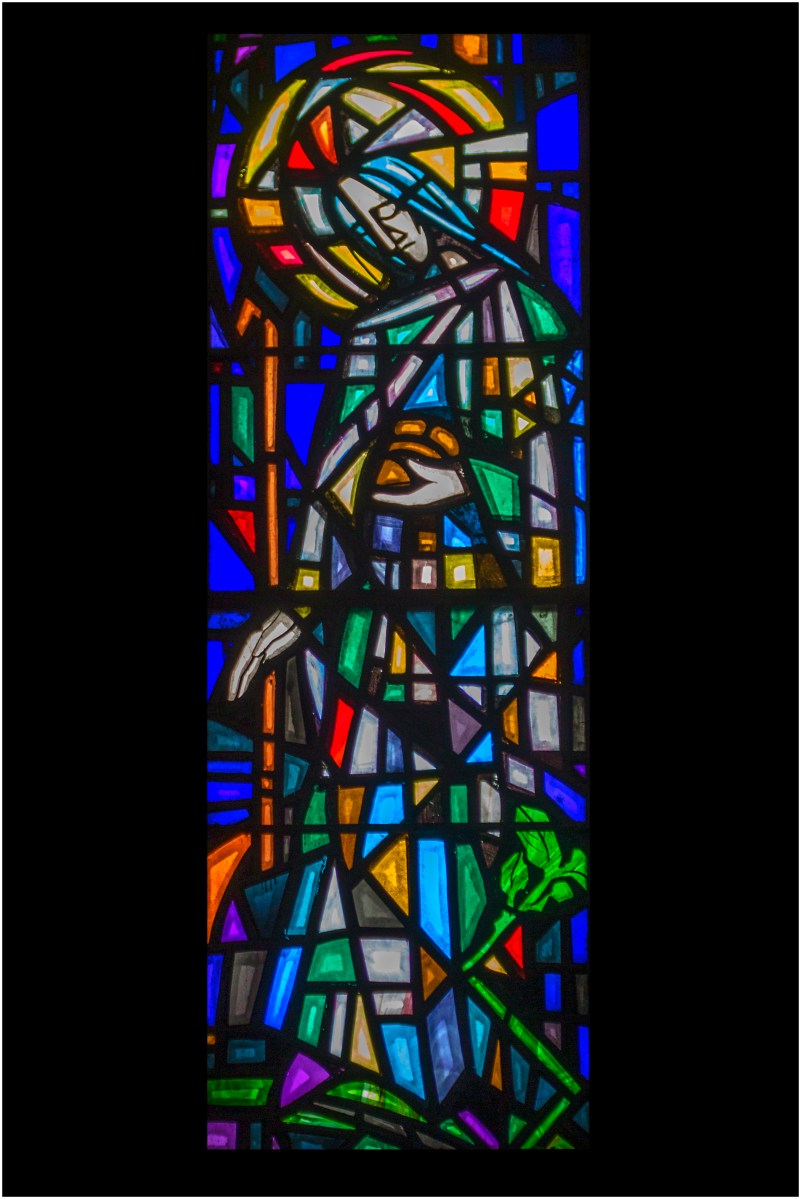
And a final image from Glynn, Co Wexford, because I love the pared-to-the-bone simplicity of this Richard King medallion..
The first story concerns Jasmine Allen – she is the charming and erudite Curator of the Stained Glass Museum in Ely, in the UK. At a recent Stained Glass Symposium in Trinity, she showed us how stained glass studios were advertising their artistry and products at exhibitions in the late nineteenth and early twentieth centuries in Britain and Ireland, starting with the Great Exhibition in 1851, but happening at regular intervals after that. The Irish International Exhibition was held in Dublin in 1907. It was inspired by the success of the Cork International Exhibition of 1902 (see Robert’s post about that here) and even copied their thrilling water slide! For a marvellous collection of images from that exhibition, see this Flikr Album from the Church of Ireland. The story of their discovery is also fascinating.
Irish international exhibition from Herbert Park, by National Library of Ireland on The Commons
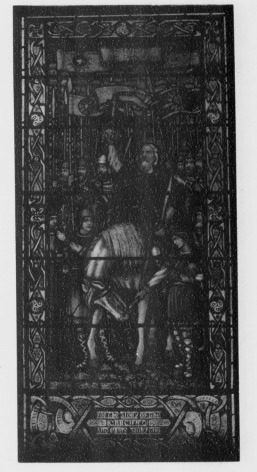
One of the exhibitors was James Watson and Co of Youghal. Jasmine subsequently sent me this image, saying: Catalogues of these exhibitions are all too brief and I would love to know what happened to it. Is it in a church or secular building in Clontarf? I only have a very bad image from the Art Journal (early b+w photography was worse than engraving for capturing stained glass!)
Story 2: Michael
I sent the photo to the group of colleagues, mostly contributors to the Gazetteer of Irish Stained Glass with whom I correspond on a regular basis and who are always helpful, asking if any of them knew the fate of the window. I got several “no idea” responses and then I heard from Michael Earley. Anyone interested in Irish stained glass will be familiar with the name of Earley, and Michael Earley, a great-grandson of the founders, has just completed doctoral studies on the Studios. I’ve featured Earley windows here and there in my blog posts, but here’s an example of their work – you will find it everywhere throughout Ireland, often distinguished by glass of unique and brilliant colour, enormous packed scenes of multiple angels and saints surrounding a central images, and beautifully rendered figures. Here’s one from St Aidan’s Cathedral in Enniscorthy.
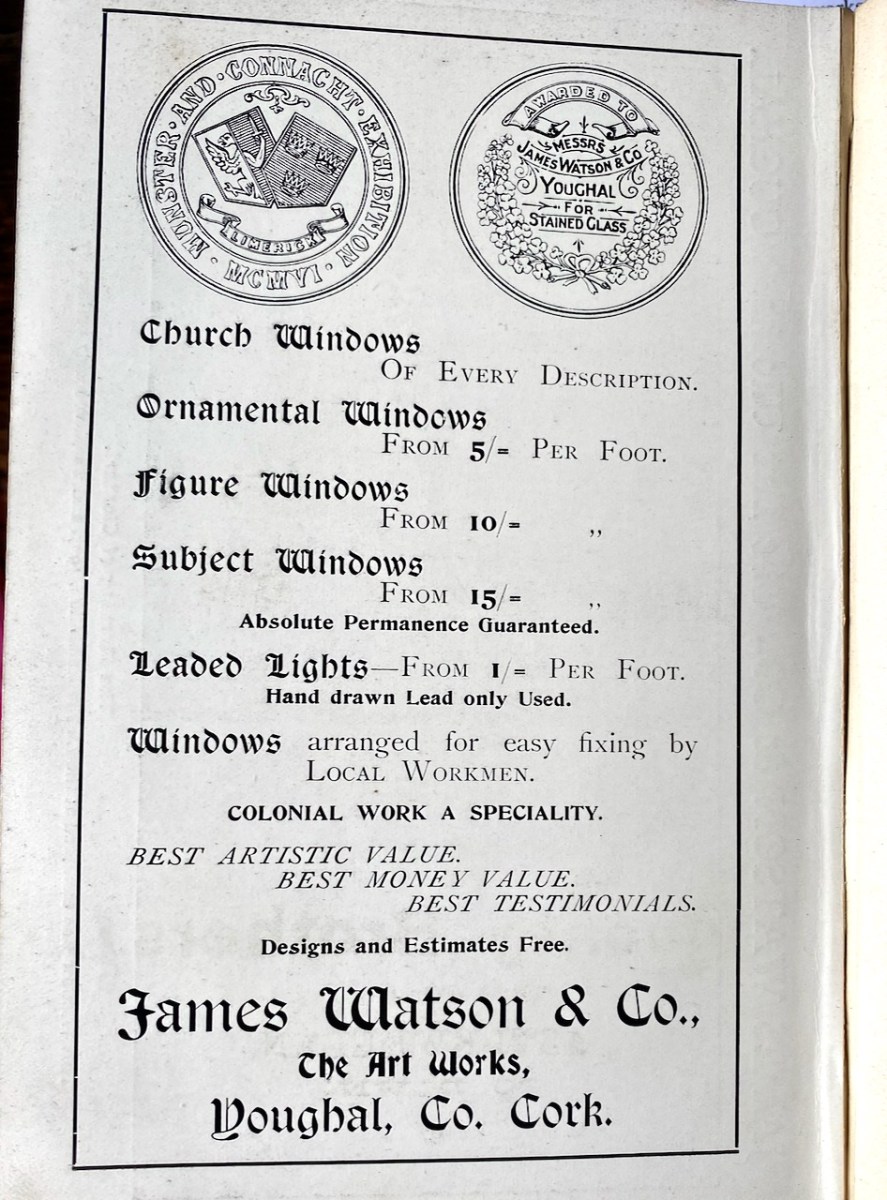
Michael didn’t know what had happened to the window, but he did send me two pages from the Irish Catholic Directory of 1908. The first page was an advertisement for James Watson and Co, The Art Work, Youghal, Co. Cork. Here it is:
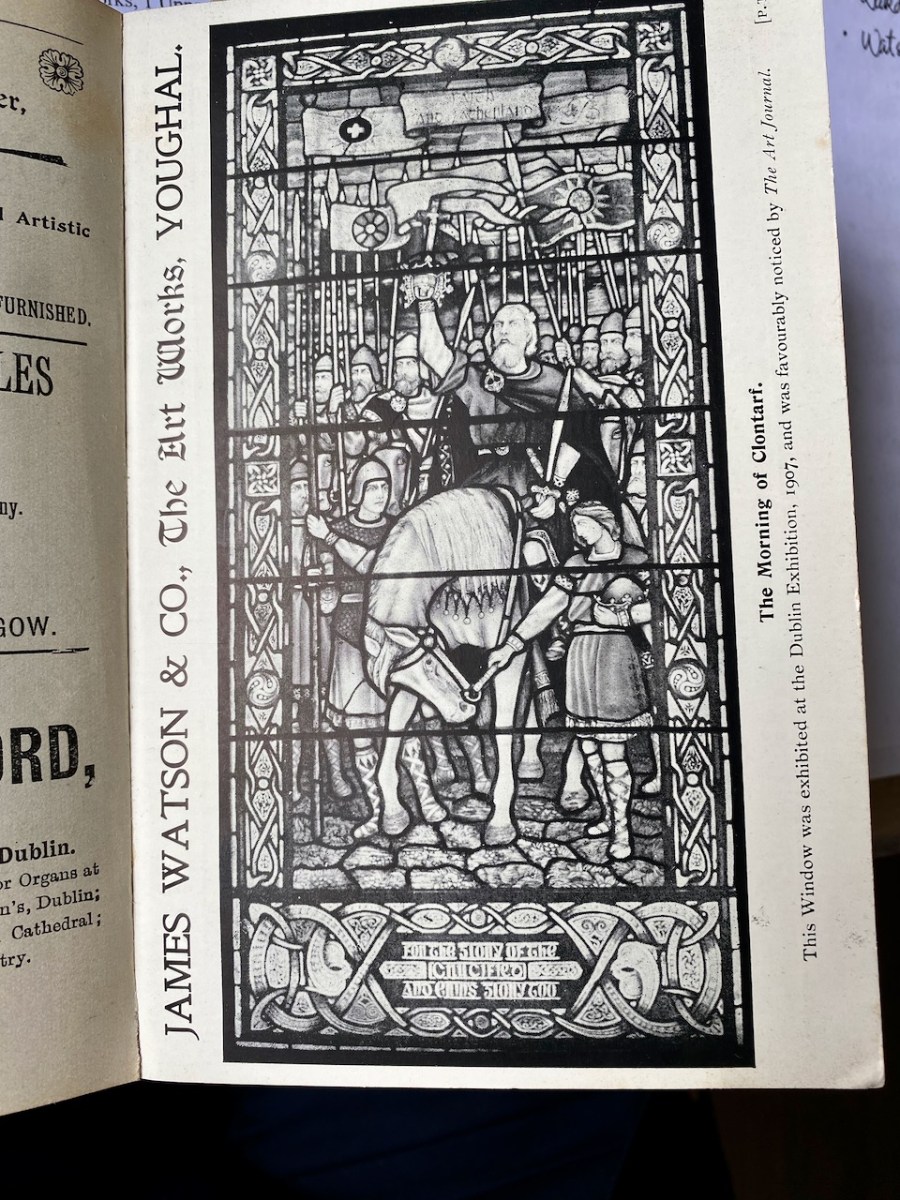
Much to savour in this ad – the prices, the variety of windows, “colonial work”. . . The second page, though, hit the jackpot. It was from the same Directory, and was a full scale black-and-white photograph of the window. Titled The Morning of Clontarf, a subtitle reads “This window was exhibited at the Dublin Exhibition, 1907, and was favourably noticed by The Art Journal”.
Now I had an excellent image with which to pursue my inquiries – and I knew exactly who to consult!
Story 3: Vera
The art historian who knows more than anyone else about Watson of Youghal is Vera Ryan. In fact, it was Vera who curated the Crawford Gallery 2015 exhibition of the Watson Archive, when the Crawford acquired the Archive. She also wrote the piece on Watsons: Divine Light: A Century of Stained Glass, in the Summer 2015 edition of the Irish Arts Review. A couple of years ago, when I was trying to find information on a Watson window which was the centrepiece of an article I was writing for the Clonakilty Historical and Archaeological Journal (now published and available here), Vera mentored me as I tried to dig my way through the archive. We have been exchanging information ever since.
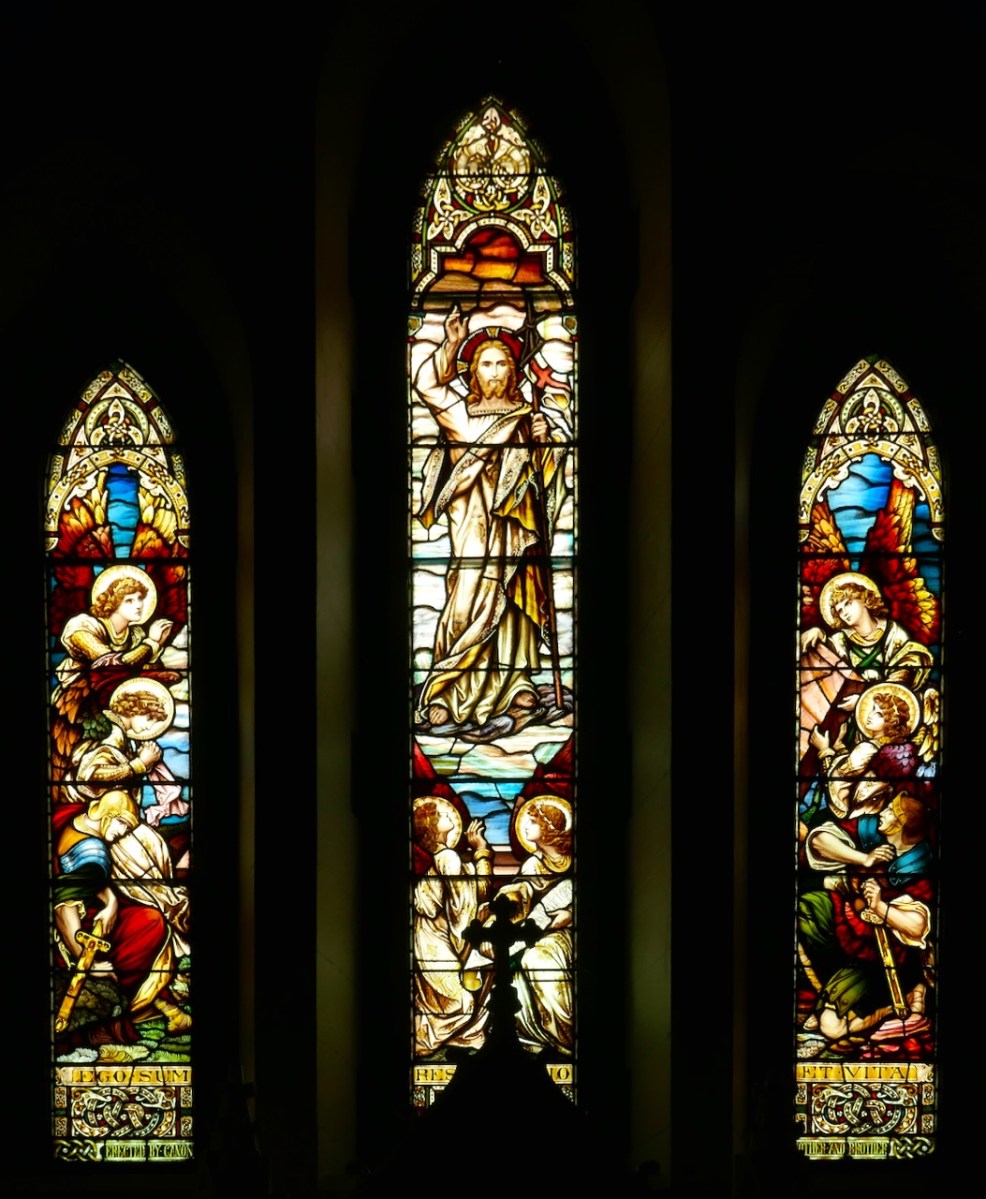
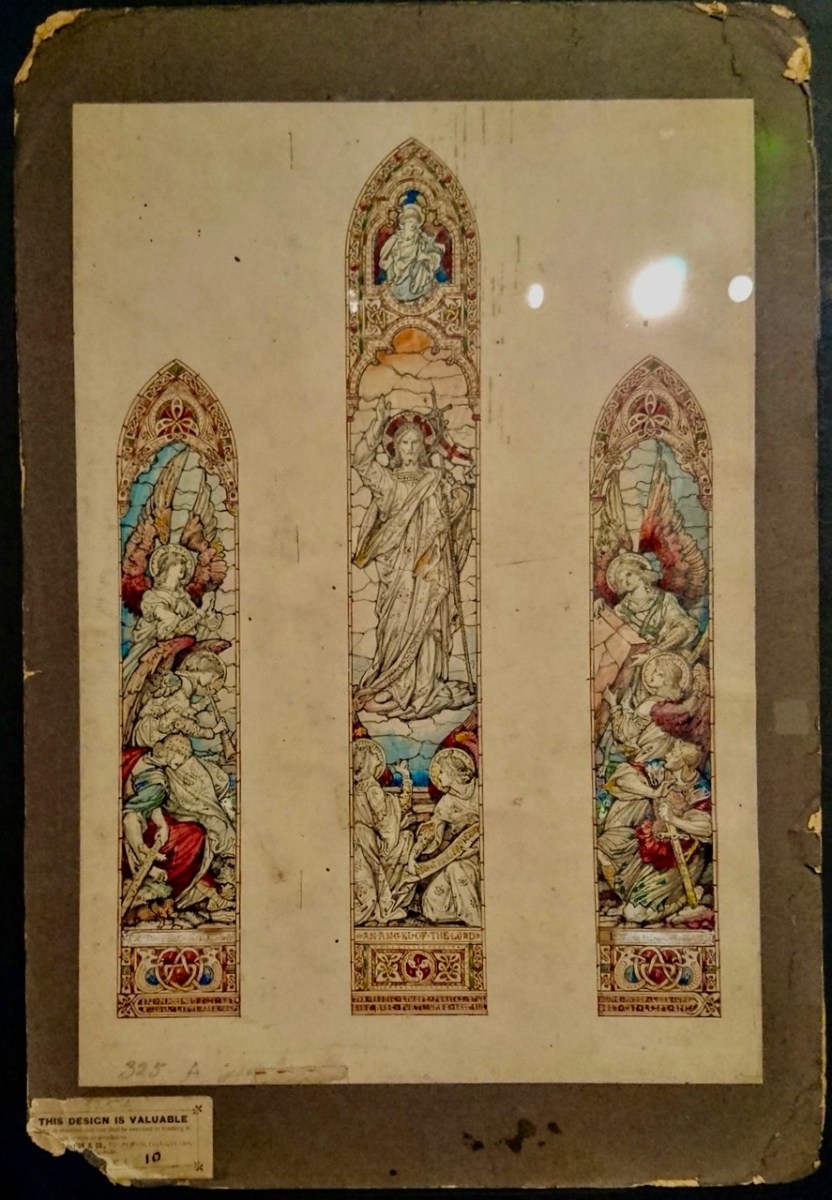
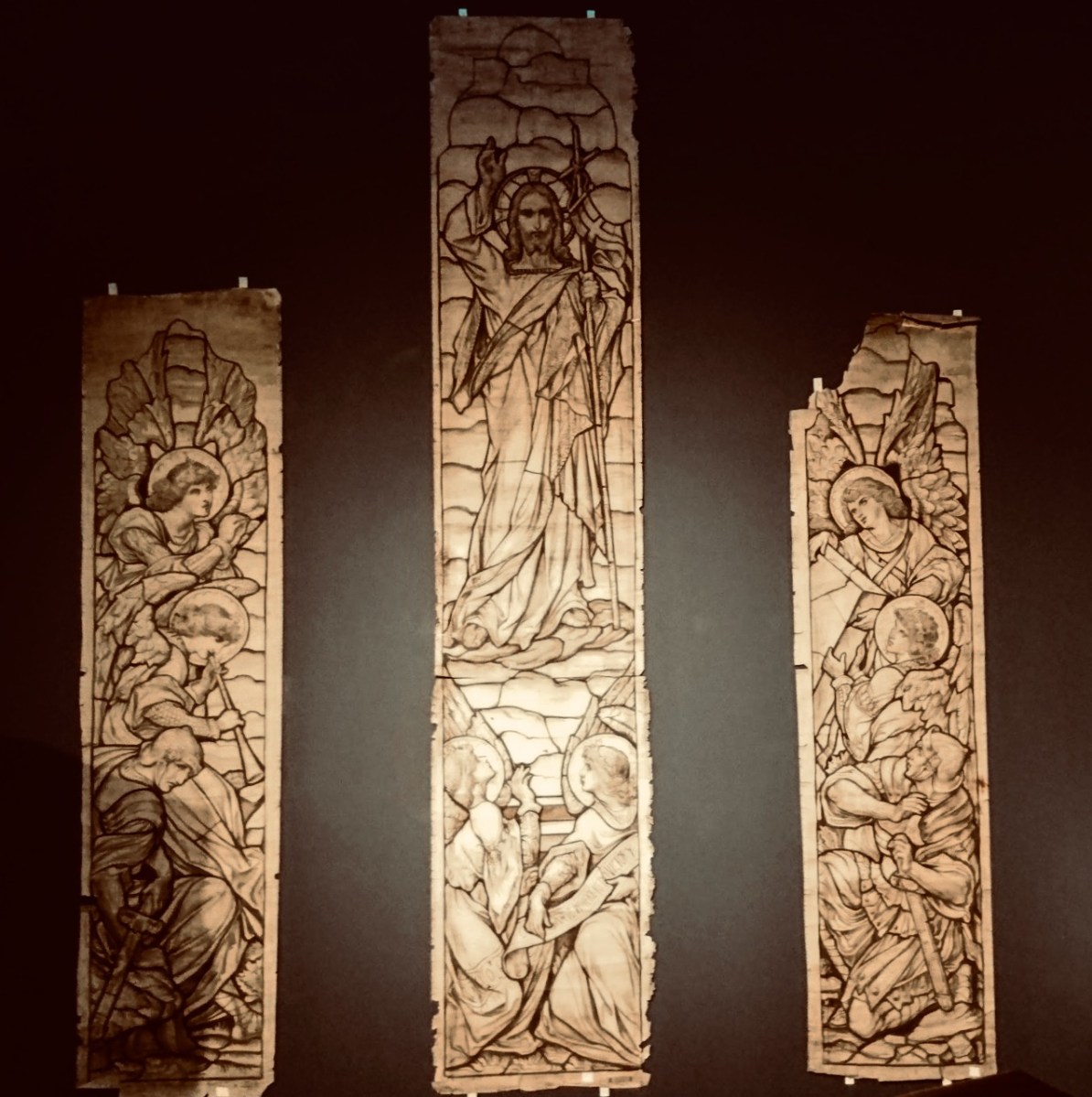
Above is a window in St Michael’s Church, Tipperary, erected in 1914. The design (below) and cartoon (below below) for this window were still in the Watson Archive and were displayed in the Crawford Exhibition. This represents a special opportunity to see the evolution of a stained glass window from concept to completion.
This opportunity is relatively rare in stained glass studies – there aren’t many collections like this, so it is wonderful that the Crawford rescued the archive, which has now been passed on for expert conservation, to the National Gallery of Ireland.
When I contacted Vera, she remembered the Brian Boru window well, and told me that the cartoon was part of what came to the archive, although in a very fragile state. The window, itself, she thought, was still extant, and possibly in Knappogue Castle. The important person to talk to, she said, was Antony Watson, great-grandson of James Watson and the executor of the Watson Estate. Before I did that, I tried some detective work of my own.
Story 4: Jody
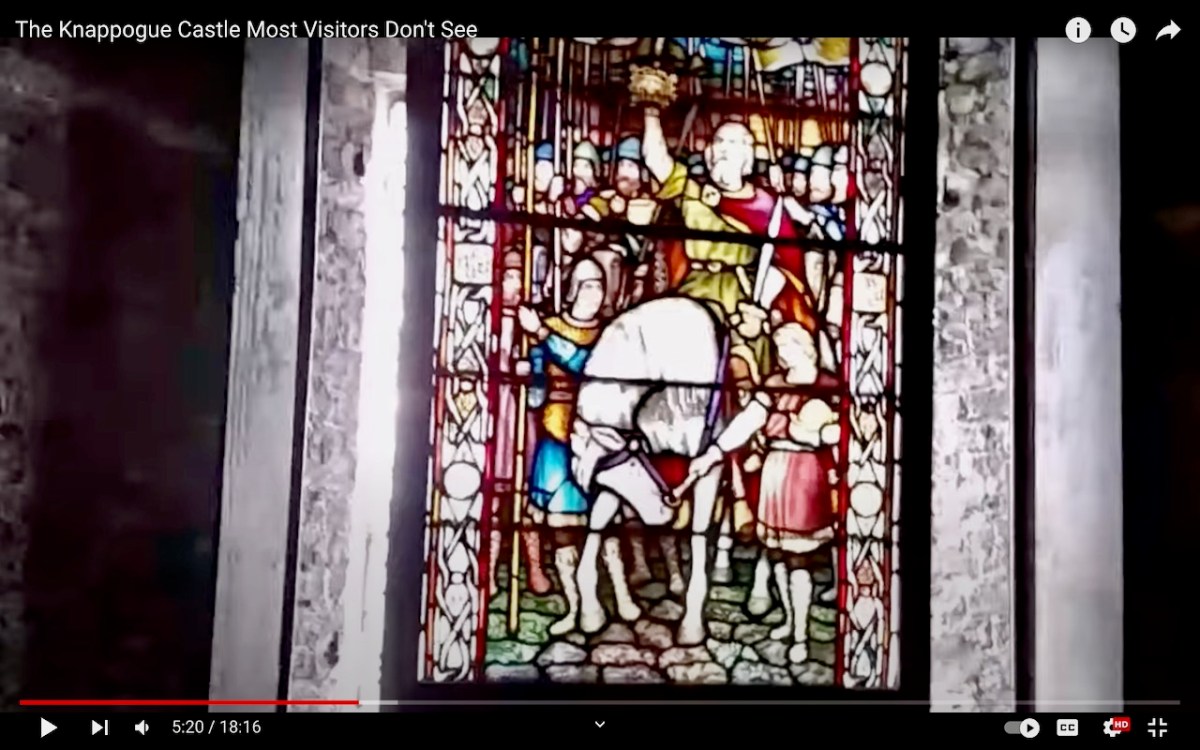
I don’t know Jody Halstead, but in 2016 she stayed at Knappogue Castle and posted a video to YouTube, titled The Knappogue Castle Most Visitors Don’t See. At about the 5 minute mark she arrives at a landing and as her camera roams around, it captures a stained glass window – and there it was! Here’s a screenshot from the video.
Because of Jody, now I had proof that the window was still in existence. The next challenge was how to get a good photograph of it. Once again, thanks to the glorious (and relatively small) world of Irish stained glass scholars and enthusiasts, I knew who to turn to.
Story 5: John
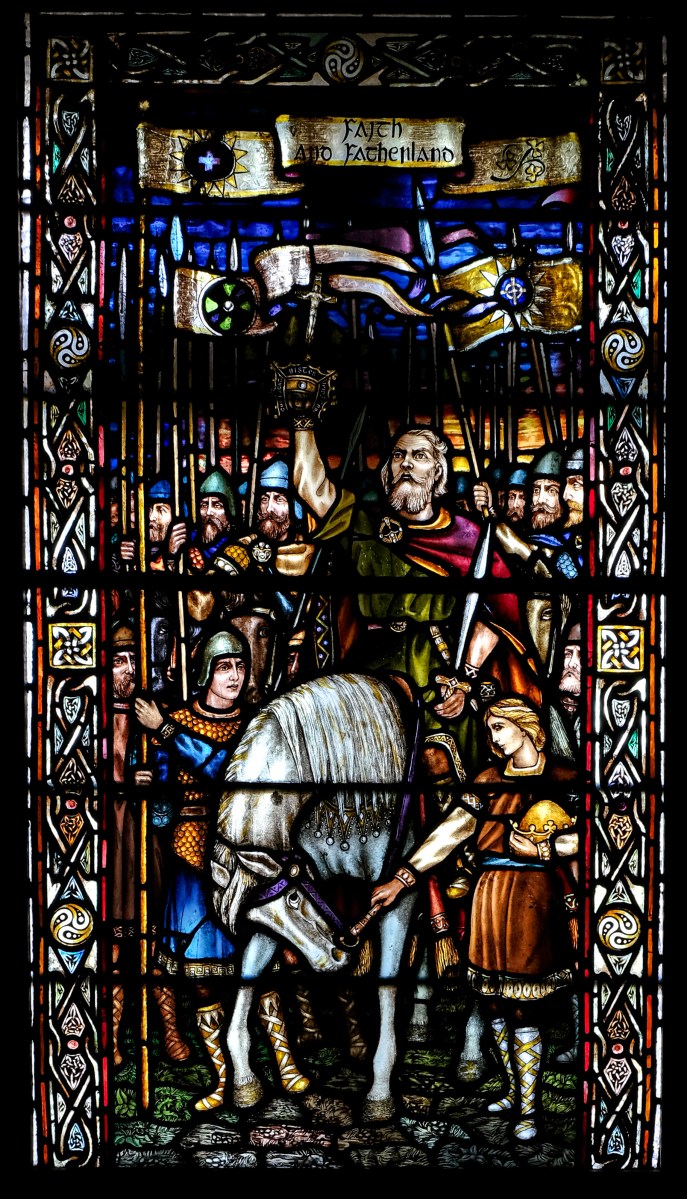
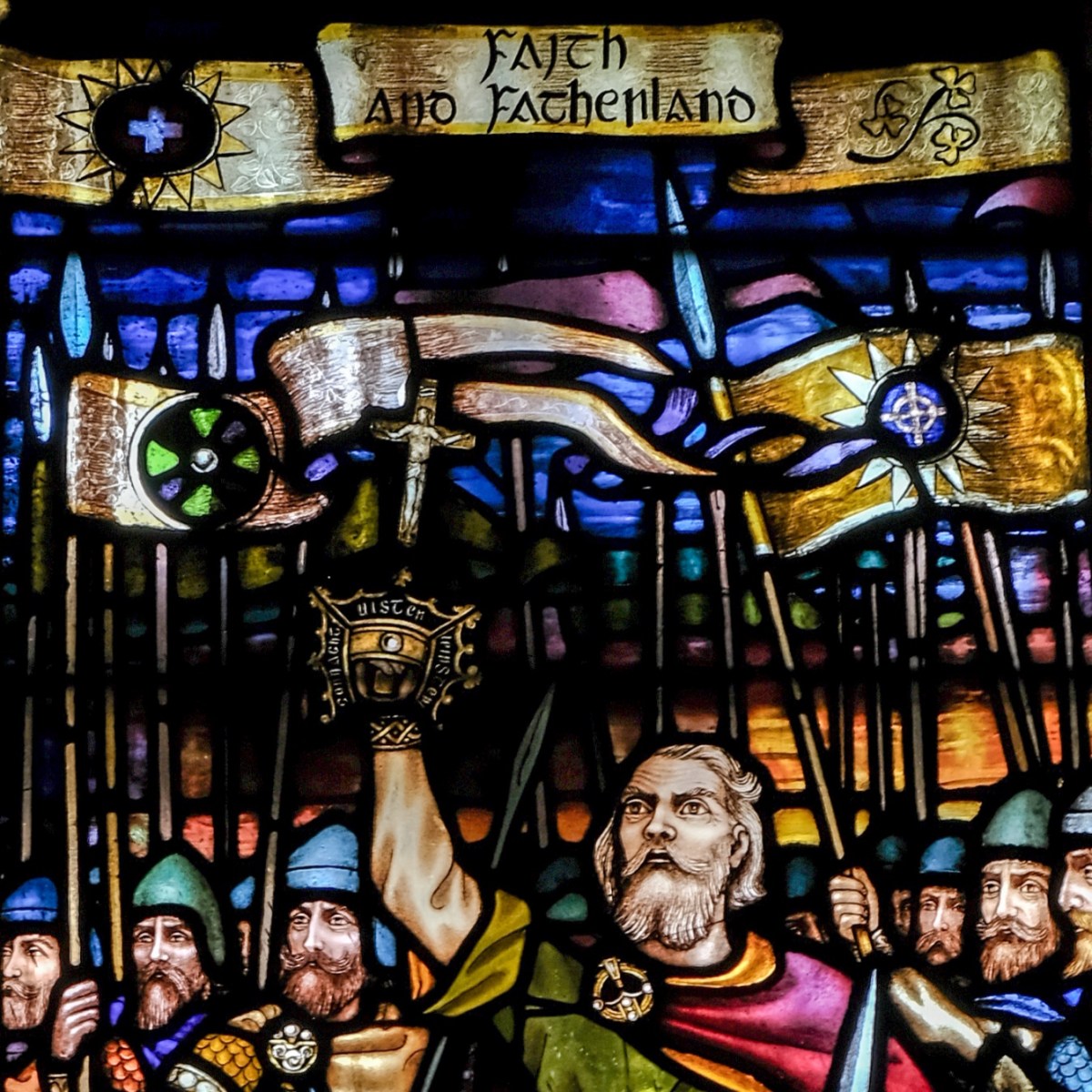
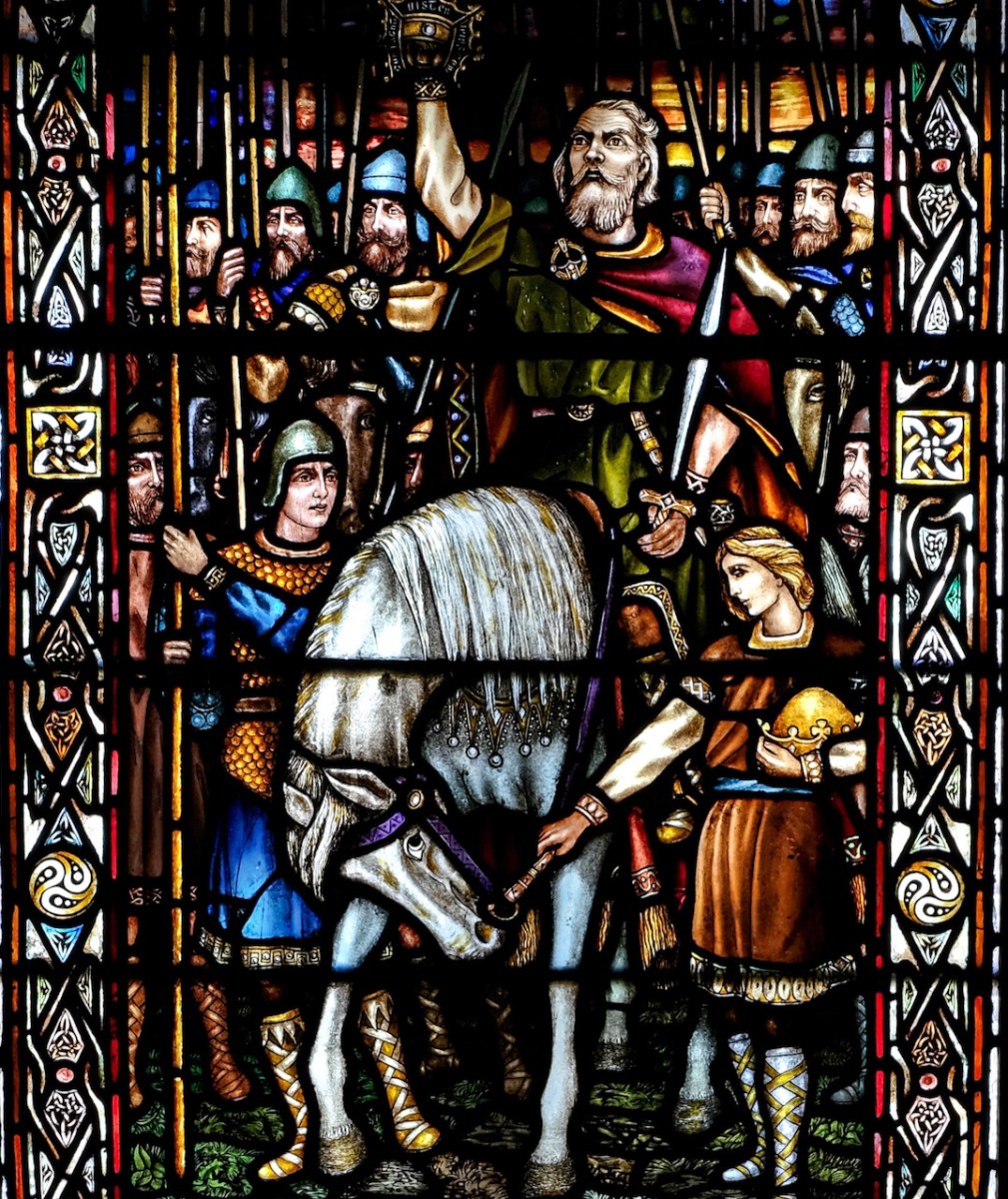
John Glynn is an outstanding photographer with an interest in stained glass. His was the excellent image from Kilrush I used in my post on Brigid: A Bishop In All But Name, and he lives in West Clare, about an hour by car from Quinn, where Knappogue Castle is located. I thought he might already have taken a photograph of the window – he hadn’t but promised to do so as soon as he could. To my great delight, he did it right away. Here is what he sent me.
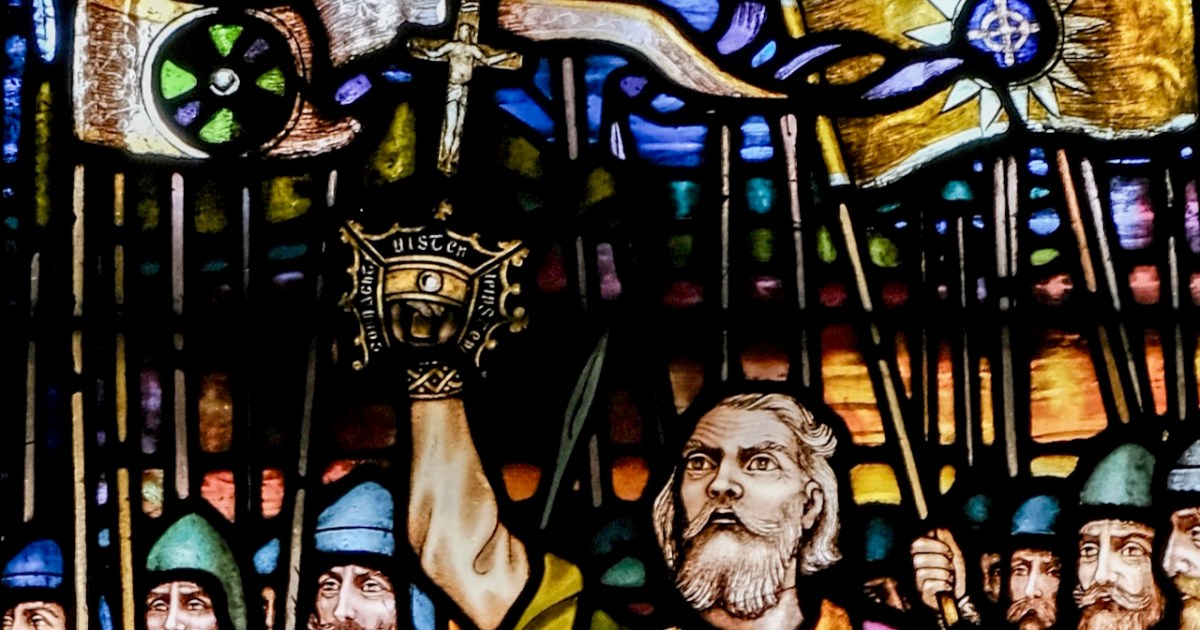
This and all detailed images of the Brian Boru window in Knappogue, are the work of John Glynn, and used with his permission
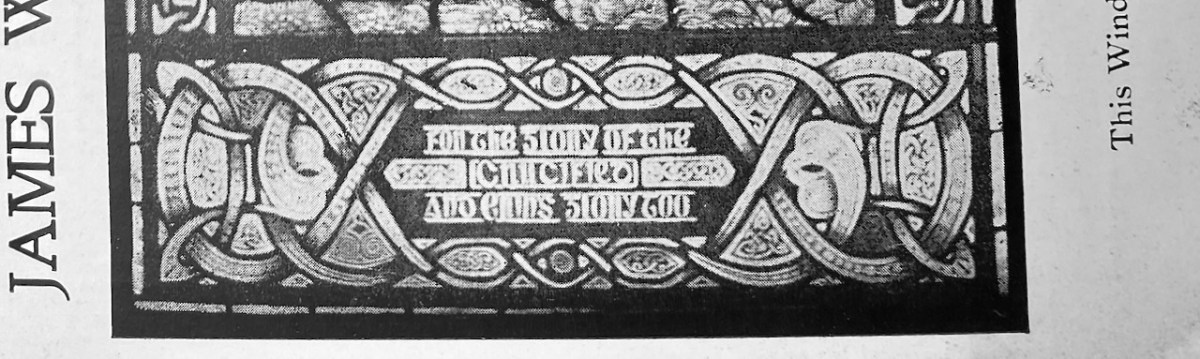
Isn’t it an amazing photograph! What’s also clear in this photograph is that the window is incomplete. To make it fit the opening, the predella, or bottom section, has been removed. Here’s what’s missing.
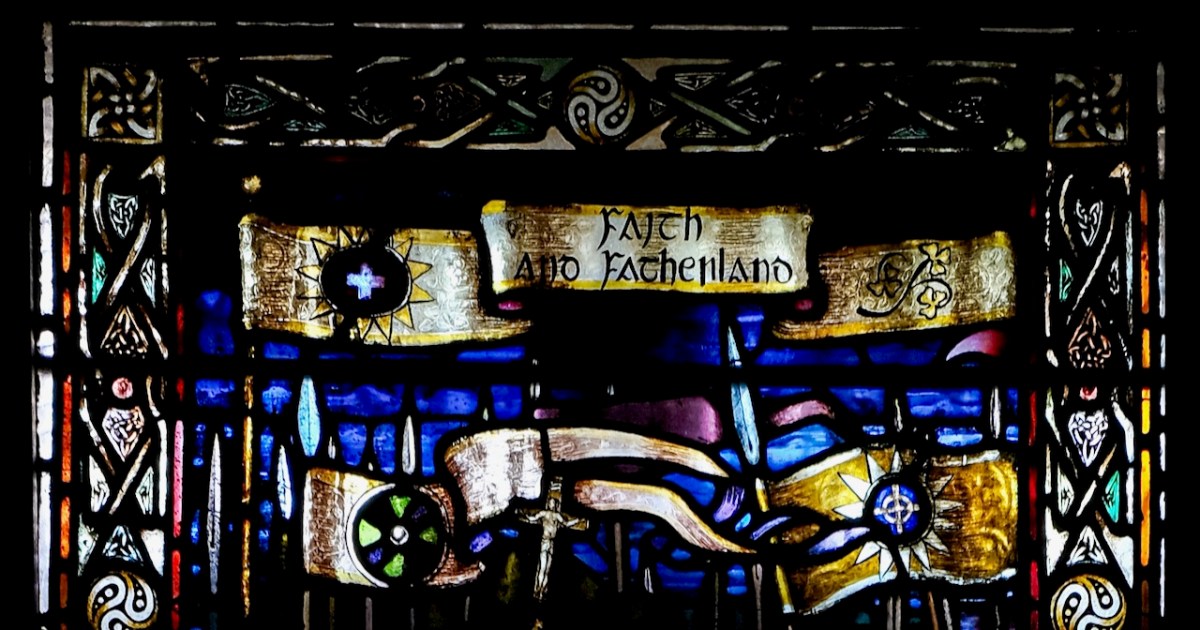
The text, in old Irish script, reads FOR THE GLORY OF THE CRUCIFIED AND ERIN’S GLORY TOO. The Celtic Revival interlacing that surrounds it is beautiful, and accomplished – it’s the thing that Watson’s were to become most famous for. So that’s a loss. Perhaps it was felt that the script was not suitable for a secular building: however it is more likely that it had to go in order to make the window fit. The rest of the window, comparing it to the original black and white images, seems to be intact. I was curious as to how the window came to be there, and this brings me to my second-to-last story.
Story 6: Antony
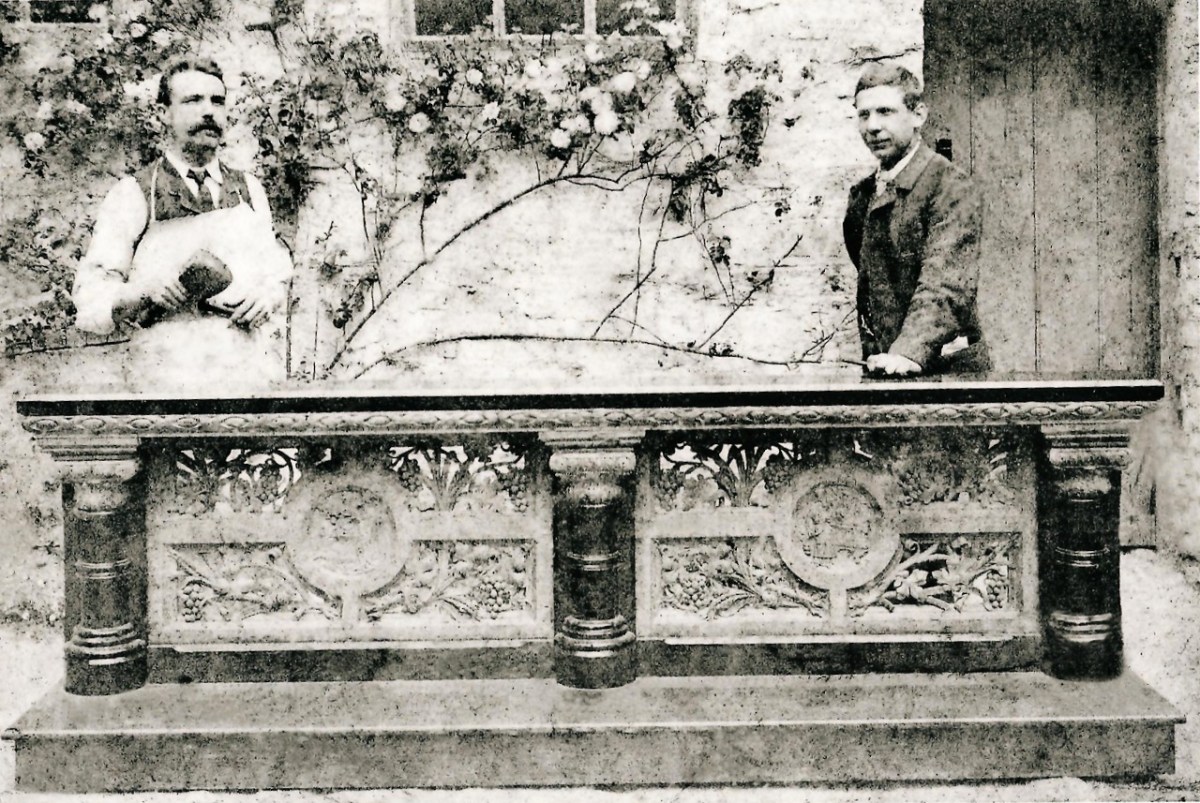
Vera kindly put me in touch with Antony Watson, and yesterday we had a long talk on the phone. Antony’s father was John Watson, Manager and Chief Designer for Watson of Youghal. John’s father was Clement, universally known as Capt Watson (he was an officer in the RFC/RAF), and Clement’s father was James Watson, seen here with a marble altar carver.
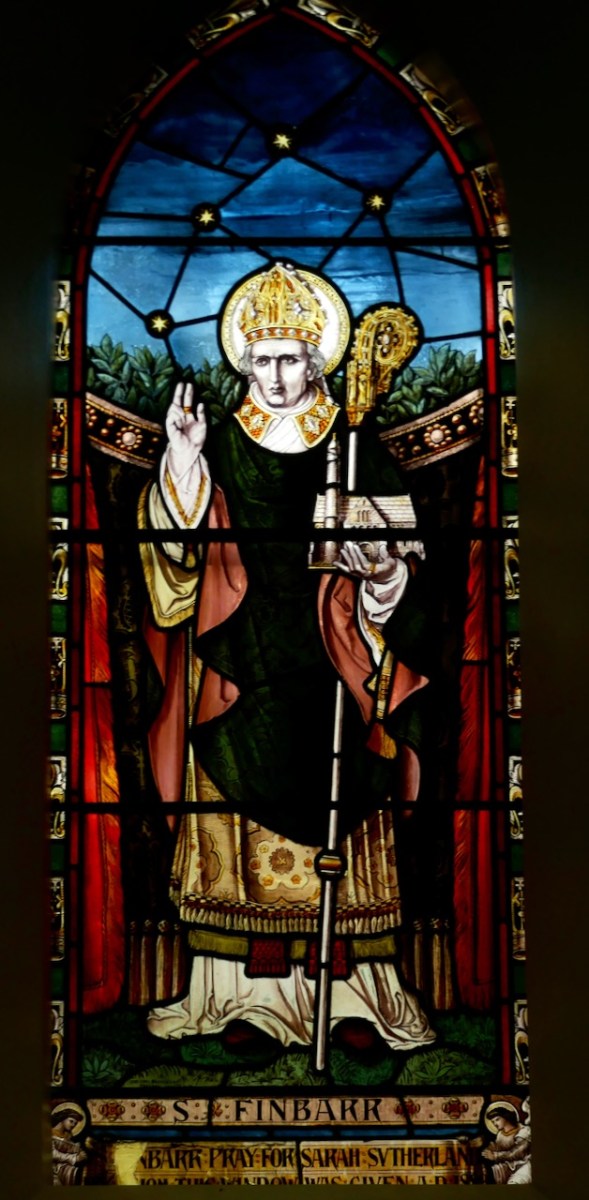
James had come from Yorkshire to run the Irish office of Cox, Sons, Buckley & Co, Church Outfitters, and eventually bought the Irish branch of the company. Here’s one of their early windows, in Ballingeary, from the 1880s, when they were still being signed as Cox, Sons, Buckley, Youghal and London.
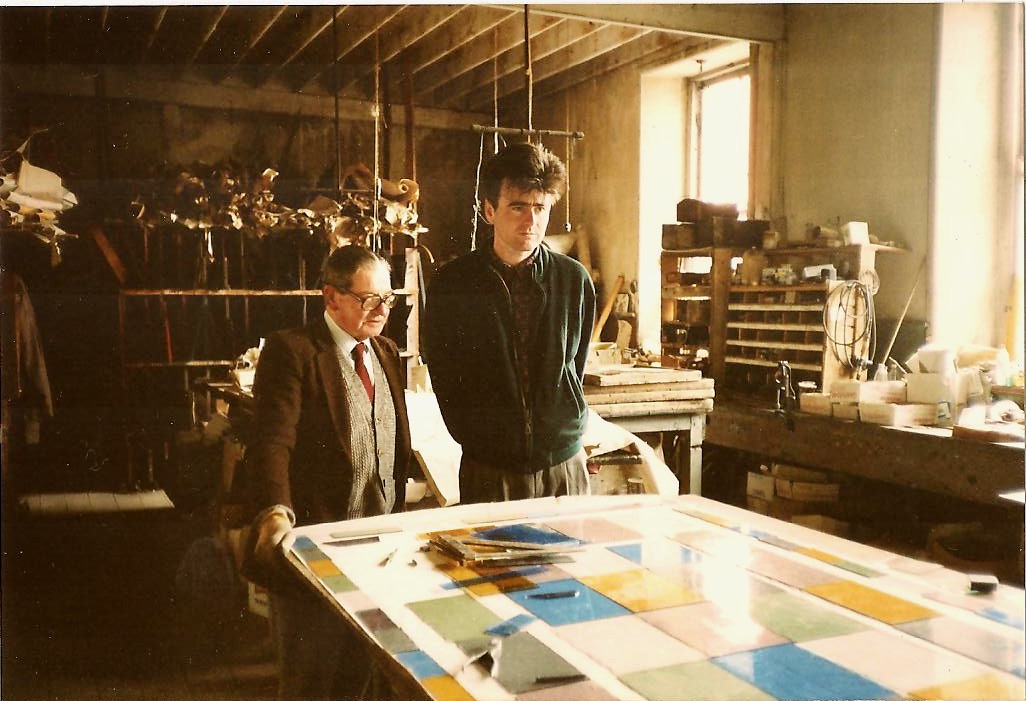
Antony told me the most enthralling stories, and I want to devote more posts to cover some of that treasure trove in the future, but I don’t want to get too distracted from Brian Boru now. Antony loved his life in and around the studios and workshops when he was young and has a very clear memory of the Brian Boru window. It stood, he said, in a rack in what was called the Great Hall (a grand name for a storage area for tall items). Here’s Jack, Antony’s father, with a client, in the early 1990s.
Watsons got the job of installing leaded windows into Knappogue Castle when it was bought by wealthy Americans – Mark and Lavonne Andrews. He remembers the day they arrived to see the Brian Boru window – there was a frantic tidy-up beforehand and the whole of Youghal turned out to witness two stretch limos arriving in state and disgorging the ‘Texas millionaires’ and their retinue.
Story 7: Mark and Lavone
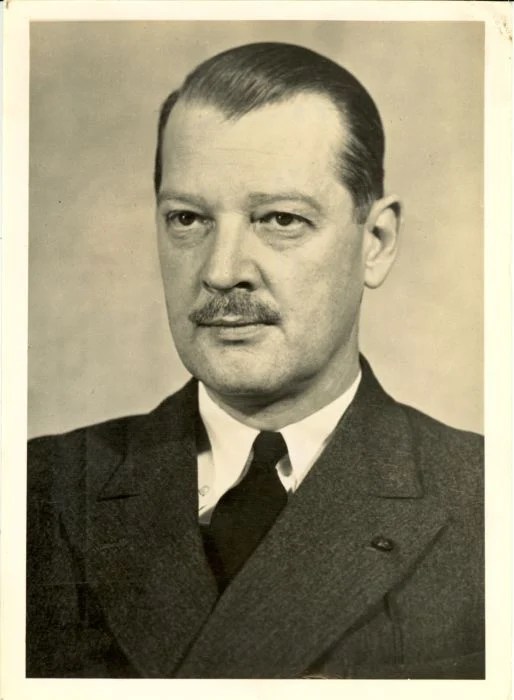
This is Mark Edwin Andrews, highly educated (Princeton) and cultured, and at one time Assistant Secretary of the Navy under Truman. He went on to become an industrialist and oil producer. His wife, Lavone Dickensheets Andrews (so sad I can’t find a photograph of Lavone) was a prominent architect. Together they purchased Knappogue Castle in 1966 and set about restoring it from a ruinous state. Knappogue is located in Quinn, Co Clare, the heart of Brian Boru country. It’s now owned and managed by Shannon Heritage.
It was Mark and Lavone who rescued the Brian Boru window and had it fitted into Knappogue Castle, some time in the 1970s. And there it still is, a testament to the enduring attraction (and durability) of stained glass windows and their power to enchant and intrigue us.
It’s a highly unusual window in so many ways, not least that it is a secular rather than a religious subject. It showed off, when it was exhibited, one of our historic heroes, Brian Boru (for more about Boru, see Robert’s post, Battling it Out), as well as the Celtic Revival decoration which Watsons mastered: both the subject matter and the treatment established them firmly in the Nationalist Camp. This of course, was a canny move designed to appeal to Irish Catholic church-builders. Antony tells me that nobody espoused Irish Nationalism more enthusiastically (or astutely) than James Watson, in the broad Yorkshire accent he kept to the end.
As an image of Faith and Fatherland, this window knew exactly who it was appealing to. It appeals to us still.
Welcome to the UCD Library Cultural Heritage Collections blog. Discover and explore the historical treasures housed within our Archives, Special Collections, National Folklore Collection and Digital Library




 Roaringwater Journal