
Here is a typical Harry Clarke piece of stained glass – note the large expressive eyes and long tapering fingers, the gorgeous raiment of the angel and that headdress, the additional tiny angelic figure hiding in the blue glass, the border filled with non-repeating decorative elements. All classic Clarke elements, right? But this is not the work of Harry Clarke. He died in 1931 and this window was designed, executed and installed in 1937, by the studio that he founded and which carried on after his death under the name Harry Clarke Studios.

The first image in this post is from the Patrick window and shows Vox Hibernicæum – the people of Ireland calling Patrick back to convert them. The image above is from the same window – Patrick preaching to the chieftains **
This window, it turns out, along with several others in the same church, was the work of Harry Clarke’s apprentice, the man who stepped into the breach caused by his death and took over as the main stained glass artist of the Studio. That man was Richard King.

The Joseph window: each frame tells a story from the life of Joseph or references other biblical Josephs.
I had never heard of Richard King until I stepped into Sts Peter and Paul’s Catholic Church in Athlone during our Midlands trip. That’s not all that surprising, because after Harry Clarke died windows from his workshop were generally signed simply by the Studio and individual artists were not identified. Mostly, it seems, this was to capitalise on the Harry Clarke brand, which by the time of his death was justly celebrated, and thereby to keep orders coming in.

Close up of the lowest frames in the Joseph windows. Clockwise from top right: the marriage of Mary and Joseph; the death of Joseph; Genesis 41:55 When all Egypt began to feel the famine, the people cried to Pharaoh for food. Then Pharaoh told all the Egyptians, “Go to Joseph and do what he tells you.”; Four rivers and two deer: the four rivers of Paradise; This is a reference to another biblical Joseph mentioned in Psalm 104, ‘constituit eum dominum domus suae et principem omnis possessionis suae’ – He made him master of his house, and ruler of all his possession **
Richard King had been trained by Harry: he had executed windows designed by Harry under Harry’s close supervision. A promising artist when he joined, he probably did more than set glass etched and drawn by Harry, but may have been responsible for background elements, borders, details. Harry was away in Davos, gravely ill, for the last year of his life and Richard may well have translated his cartoons (window designs on paper) into glass. But I am speculating here, and I hope to learn and write more about Richard King in the future. He went on to have a long and distinguished career as an illustrator.
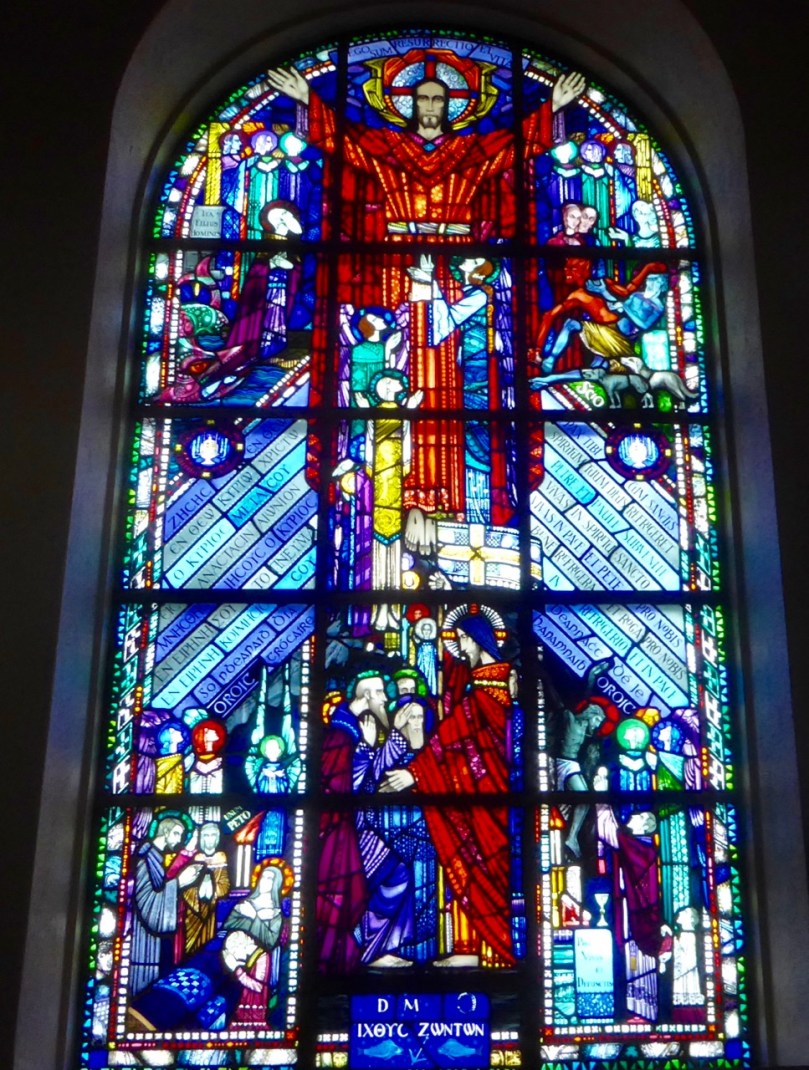
The Purgatory window: prayer fragments in Greek, Latin and Irish; the righteous ascend to heaven; Christ descends to purgatory with a banner to lead those who have done their penance up to heaven; in the lower left St Monica is on her deathbed while St Augustin looks on; lower right, the mass is celebrated; upper right, Jonah (whose purgatory was to be in a whale) and upper right Job, who was robbed of everything he held dear by the devil, thus testing his faith **
The King windows I photographed are enormous. (There are other Harry Clarke Studio windows by Richard King in the church as well as windows by other companies, but I will concentrate on these ones for the purpose of this post.) They represent St Joseph, St Patrick, Jesus, Mary and Purgatory. All follow the same convention of placing the main figure centrally, surrounded by smaller panels which tell stories or illustrate events from the life of the central character.

Close up: Christ descends to purgatory

Close up: the Job panel
The sheer size of the windows has allowed ample scope for this approach, but size alone cannot account for the myriad details that King inserts into every possible space in the window. Words abound, in several languages and scripts. References to the ancient and the modern, the mythological, the hagiographical, and the historical jostle for space with abstract designs, tiny figures both realistic and imaginative, symbols, animals, buildings – everywhere the eye lingers new elements are discovered. In its essence, this is very Harry Clarke; in the sheer exuberance of its execution, this is Richard King having fun, cramming in as much as his own fertile imagination can offer up.

This is the Mary window and these sections concentrate on images of Marian veneration. Clockwise from top left: workers pause to pray the Angelus; a family says the rosary together; St Simon Stock receives the scapular from Mary (more on this here); Mary; St Dominic receives the rosary **
The Harry Clarke Studios closed down in the 70s. For many years after Harry’s death in 1931 it carried on his tradition of highly stylised and beautiful works of art in stained glass, although over time works became more conventional and quality suffered as orders were harder to get, costs rose and corners were cut. Look, for example at the Studio windows in my post Time Warp, about the Drimoleague church, done in the 50s. But that’s in the future – what we can see, under Richard King’s assured hand, are windows that proudly carry on the Clarke preoccupations with designing windows that dazzle and inspire.
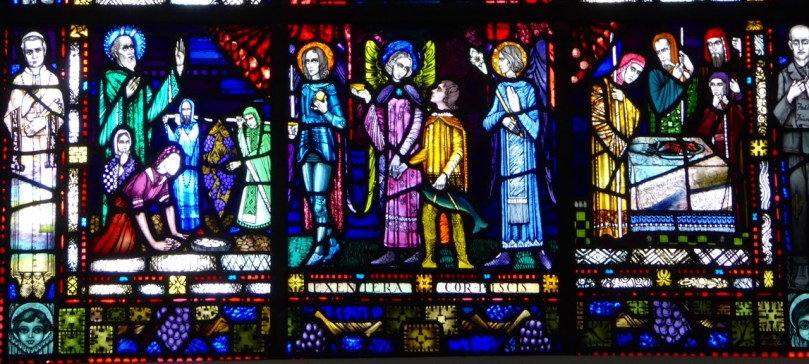
Details from the Jesus window from left to right: Pope Pius x; Manna from heaven; Tobia walking with the Angel Raphael, with Michael and Gabriel; eating the paschal lamb; Matt Talbot, a Dublin man who died in 1925 and who was considered on the path to sainthood because of his extreme practice of asceticism **
Perhaps, though, there is another element that creeps in now that Harry is gone – the religious fervour of the early years of the state is now in full swing. Government and Church Hierarchy work hand in glove to develop and promote a vision of Ireland that is devout, Catholic, monocultural, conforming and repressive. A high point in this relationship occurs in 1932 with the Eucharistic Congress in Dublin – an event explicitly referenced in the Patrick window. Richard King will never, as Harry did, fall afoul of puritanical state censorship – he will go on, in fact, to become the chief illustrator for a Catholic magazine.

The top of the Patrick window explicitly references the Eucharistic Congress of 1932 and the crossed flags of Ireland and the Vatican. Try to enlarge this image and see how many different elements you can identify. Good luck!
But in 1937 he is at the height of his powers as a stained glass artist. I hope to find and illustrate more of his work in that medium in future posts.

From the bottom of the Patrick window: Patrick lights the paschal fire on the Hill of Slane; he is flanked by images of two St Patrick Cathedrals, New York and Melbourne; Beneath, the swans represent the ancient myth of the Children of Lir (although there were four swans in the myth, not three) – the spell they are under is broken when they hear St Patrick’s bell
** The photographs in this post are my own, but for the explanations that I use in the captions, I am indebted to Niall McAuley, who has mounted a Flikr Album of all the stained glass in this church and has researched and annotated each image. I don’t know you, Niall, but I salute your wonderful images and your exhaustive notes on each of the windows. Please go to Niall’s album for more on all the King windows (especially if you are stumped by the Patrick window) and also windows by other stained glass suppliers and artists in this amazing collection.


 Roaringwater Journal