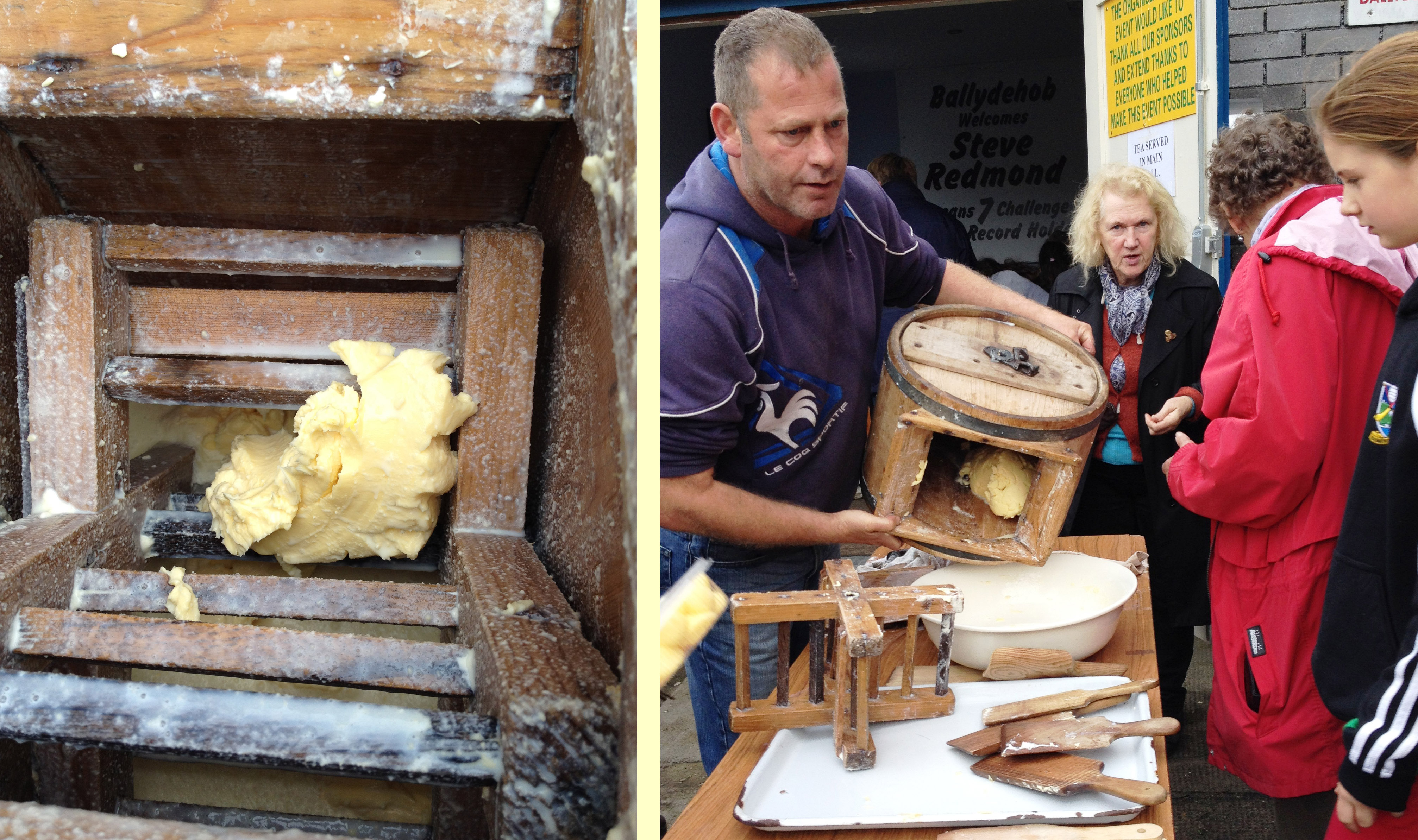
Robert takes a turn, supervised by Kevin and young butter maker
At the recent Autumn Fair (known as the Thrashing) in Ballydehob, Robert and I got a chance to take a turn at the butter churn and to watch the magical transformation of milk into butter and buttermilk.
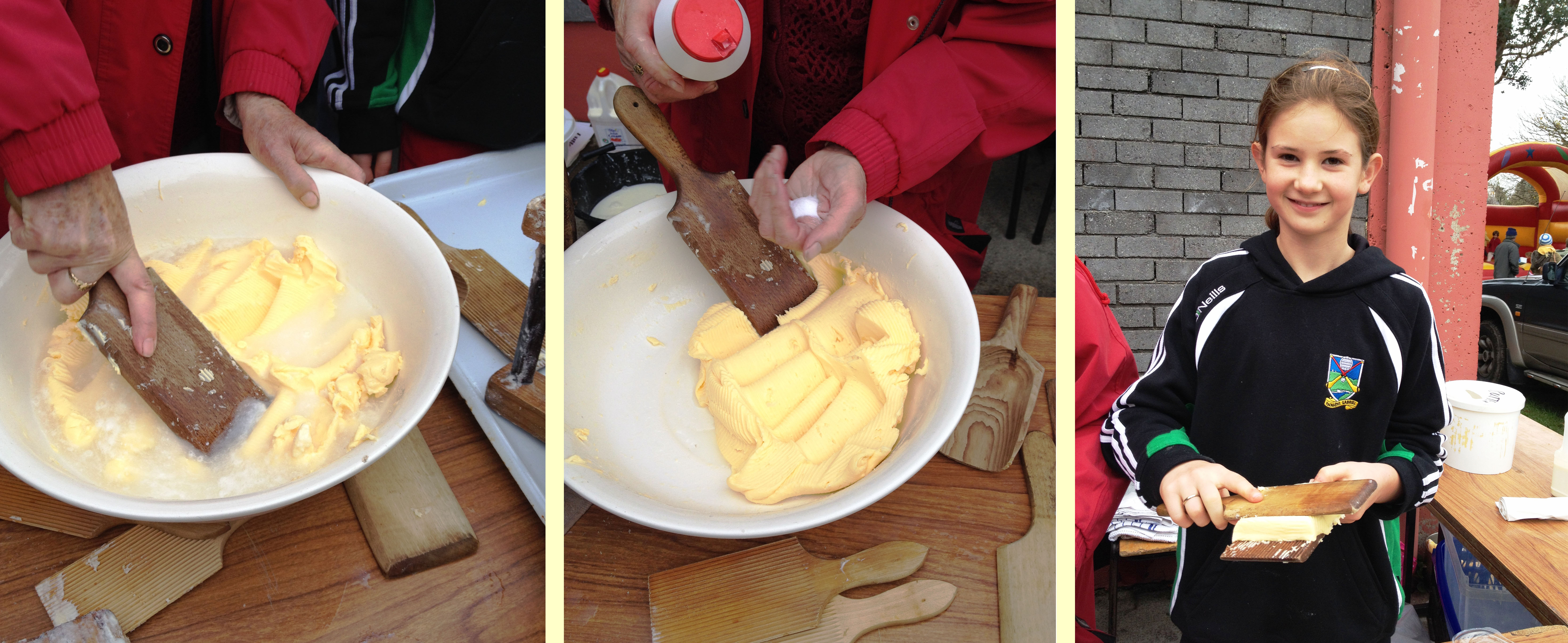
Pouring off the buttermilk
It’s ready!
Washing, salting, shaping
To reward us for all that labour (turning that handle was so hard), we had a butter feast – homemade soda bread made using the buttermilk, with homemade butter and homemade jam. There are lots of good Irish soda bread recipes on the internet: here’s the one I used. And yes, you can get buttermilk in North America – take a really good look on the milk shelves and you’ll see it lurking in a corner near the cream.
Homemade soda bread by the fire
Homemade jam – this is a fabulous five minute jam recipe I found from a link on a friend’s Facebook page and adapted slightly. Mine is blackberry (bumper crop this year!) but you could use any berry you want.
1 cup blackberries
1 tbsp honey
1 tbsp warm water
1 tbsp chia seeds
Blend (in a blender) and pour into something (yogurt container? Glass?). Put in fridge for an hour. Hey presto – delicious jam! The chia seeds jellify and that’s what binds the jam. You have to keep this jam in the fridge and eat it within a couple of weeks, since it’s not cooked. It will freeze well. I was introduced to chia years ago by my friend Christi from El Salvador. It’s available in supermarkets and health food stores.
When my mother made Christmas cake she always used Monica Sheridan’s recipe. Mum had an old cookbook stuffed with pieces of paper, cuttings and recipe cards and out of this jumble came marvellous concoctions to feed her appreciative family. As everyone did in those days she iced the Christmas cake with almond paste and royal icing and decorated the top with winter scenes and figurines.
I have searched in vain on the internet for Monica Sheridan’s famous Christmas Cake recipe and I have noticed that many readers who wander into Roaringwater Journal have googled ‘Monica Sheridan’. I suspect, therefore, that others may be looking for this recipe as well so I have decided to reproduce it below.
Monica’s measurements are all in ounces (that’s the same in Ireland, Britain and North America) but I have added the conversion to grams for modern cooks. I tried doing a conversion to cup measures for our Canadian and American readers, but the exercise defeated me. If anyone out there has the exact equivalents, I’d love to have them.
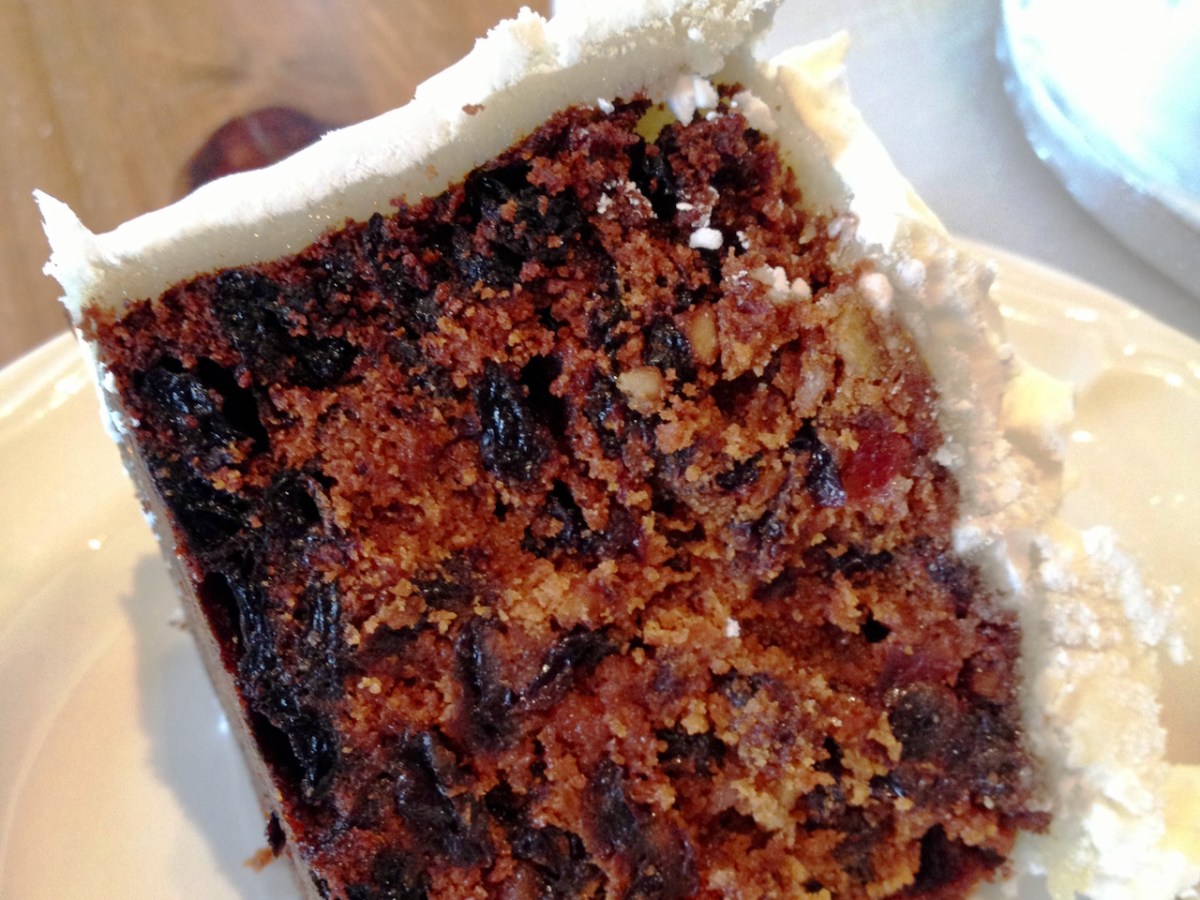
Last year was my first time ever making Christmas cake. Robert and I each made one using Delia Smith’s recipe. This time I will try Monica’s. After all, In her book she relates that when she first published this recipe (her mother’s) in the Irish Times she “…got thousands of letters from people, all over the world, who had made the cake with great success…” Not sure if I feel encouraged or intimidated by that – perhaps I will feature the results in a future post. Meanwhile, I include some images from last year’s efforts, to get you in the mood to go out and buy glacé cherries and angelica.
Have you got a favourite Christmas cake recipe, dear blog reader? Any tips and hints for the novice baker? Any Christmas cake memories to share?
MONICA SHERIDAN’S CHRISTMAS CAKE RECIPE
(from My Irish Cook Book)
Ingredients
6oz/175gm glacé cherries
12oz/350gm seedless raisins
12oz/350gm sultanas
6oz/175gm currants
4oz/110gm mixed candied peel
2oz/50gm finely chopped angelica
6oz/175gm chopped walnuts
12oz/350gm butter
12oz/350gm sugar
7 eggs
12oz/350gm flour
1tsp salt
1tsp mixed spice (optional)
Method
Prepare the Fruit (some hours before making the cake)
Turn on the oven to 240F/120C.
Halve the cherries. Put all the fruits and the nuts into a casserole dish. Mix them well together with your hands so that all the different species are well distributed. Cover loosely with baking parchment or foil and put into the warm oven. Toss once or twice until the fruit is well heated through. This heating makes the fruit sticky and prevents it from falling to the bottom of the cake. It also plumps the fruit and makes it juicier. Never roll fruit in flour and never wash it.
When the fruit is heated through and is sticky, take it out of the oven and let it get quite cold. Warm fruit added to a cake mixture would melt its way down to the bottom before the mixture had set in the oven.
Prepare the Cake Tin
Use a high-sided 10” cake tin and grease or oil it well. Now line it, sides and bottom with two thicknesses of greaseproof or parchment paper and grease the paper.
Make the Cake
Heat the oven to 300F/150C
Cream the butter and sugar together until white and fluffy. Add the eggs, one at a time, with a teaspoon of flour for each egg. This prevents the eggs from curdling the mixture. Beat well between each egg.
Sift the flour with the salt and fold into the egg mixture. Lastly, fold in the fruit and nuts which you have separated by running your fingers through them.
Pour the mixture into the lined cake tin. It shouldn’t come up to more than 2” from the top of the tin. Trim the lining paper level with the top of the tin. Rest an inverted tin plate, or a lid, over the tin.
Put the cake in the oven. After 1 hour, reduce the heat to 280F/135C and continue to bake for another 5 hours, or 6 hours in all.
If you think the cake is baking too fast, keep gradually reducing the heat. This cake should be golden rather than brown on top. Do not remove from the tin until cold.
The secret of success with this cake is the plumping of the fruit and the slow baking.
THE SUMMER sun is falling soft on Carbery’s hundred isles,
The summer sun is gleaming still through Gabriel’s rough defiles;
Old Innisherkin’s crumbled fane looks like a moulting bird,
And in a calm and sleepy swell the ocean tide is heard…*
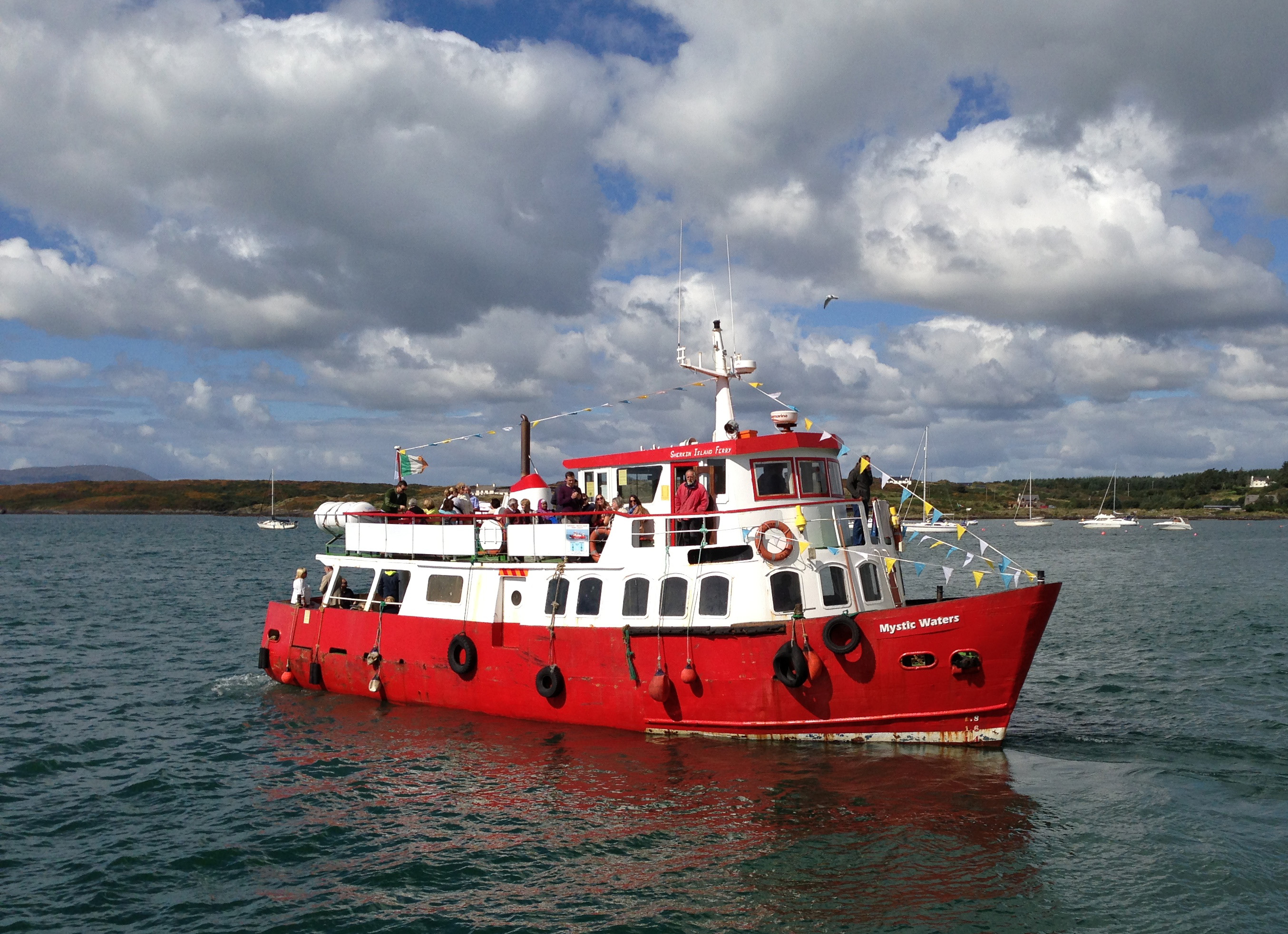
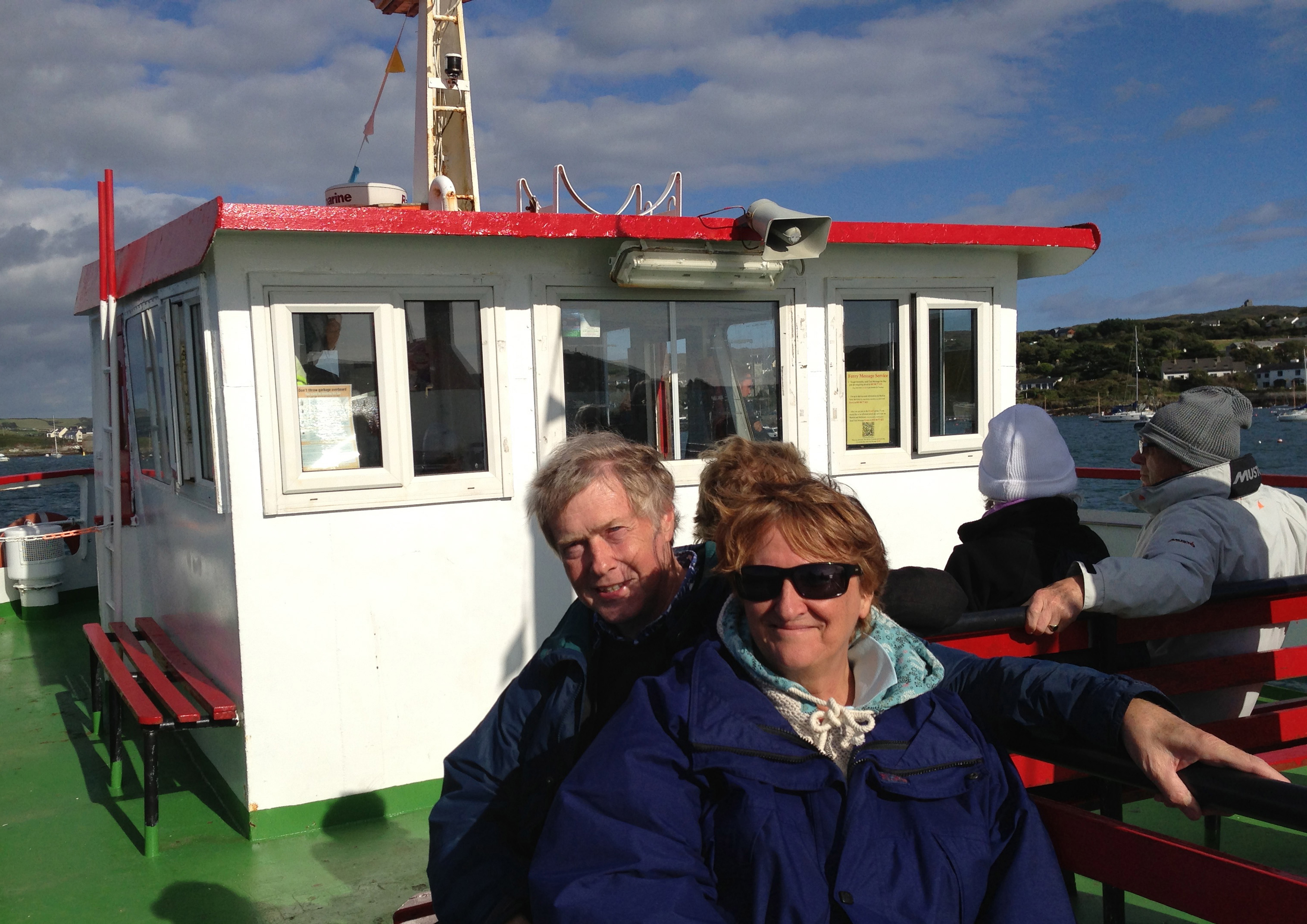
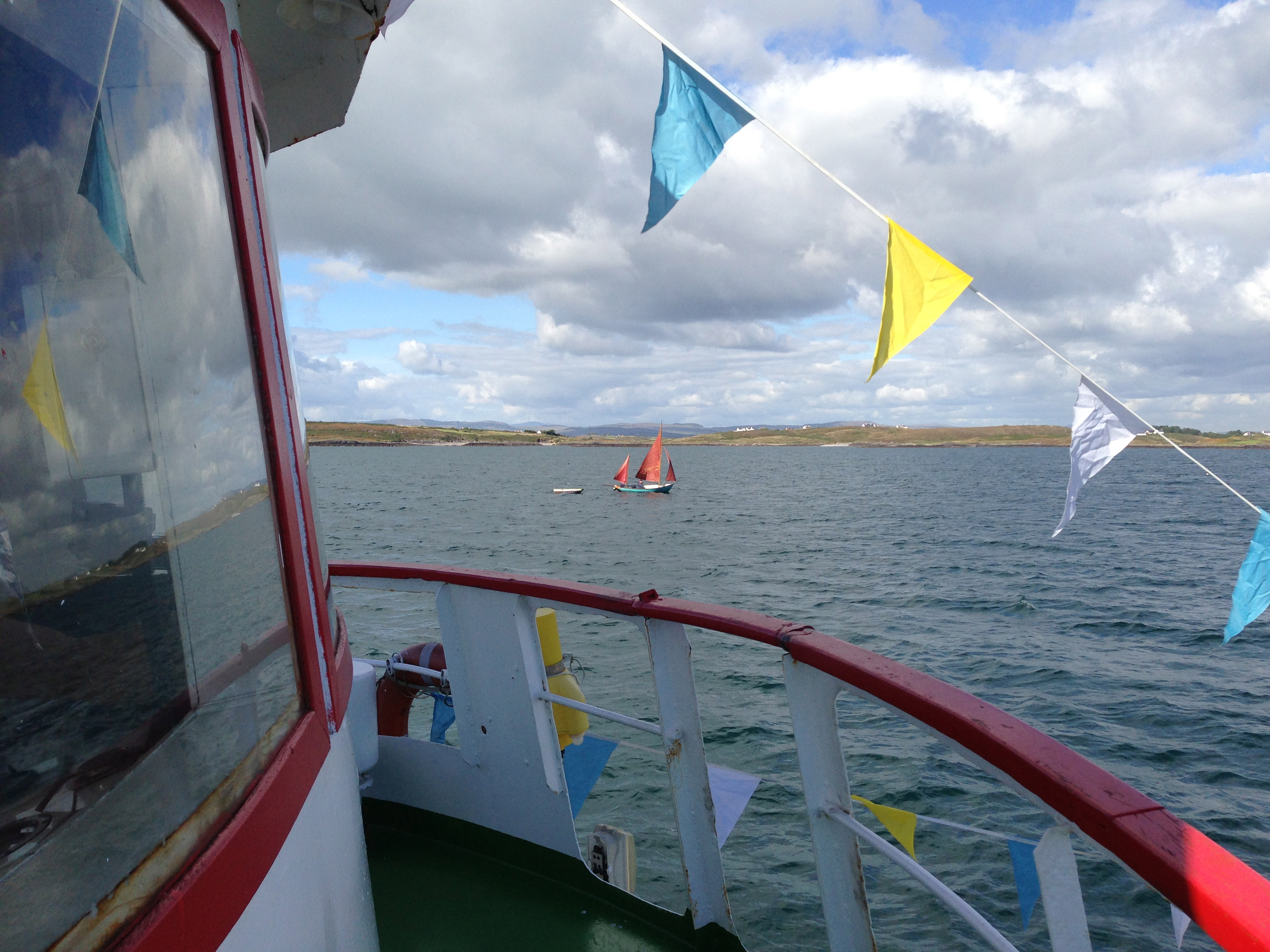
The little red boat that spends most of its days plying the ten minute crossing between the mainland and Sherkin island is occasionally let off its leash to go further afield and explore the Islands of Roaringwater Bay – ‘Carbery’s Hundred Isles’. We signed up for yesterday’s voyage: every day we look down over these waters from our nest up on the hill, and we welcomed the opportunity to explore our view from within it. This event was organised as part of the Taste of West Cork Food Festival, and we had the bonus of enjoying trays of good food and drink as we savoured the scenery.
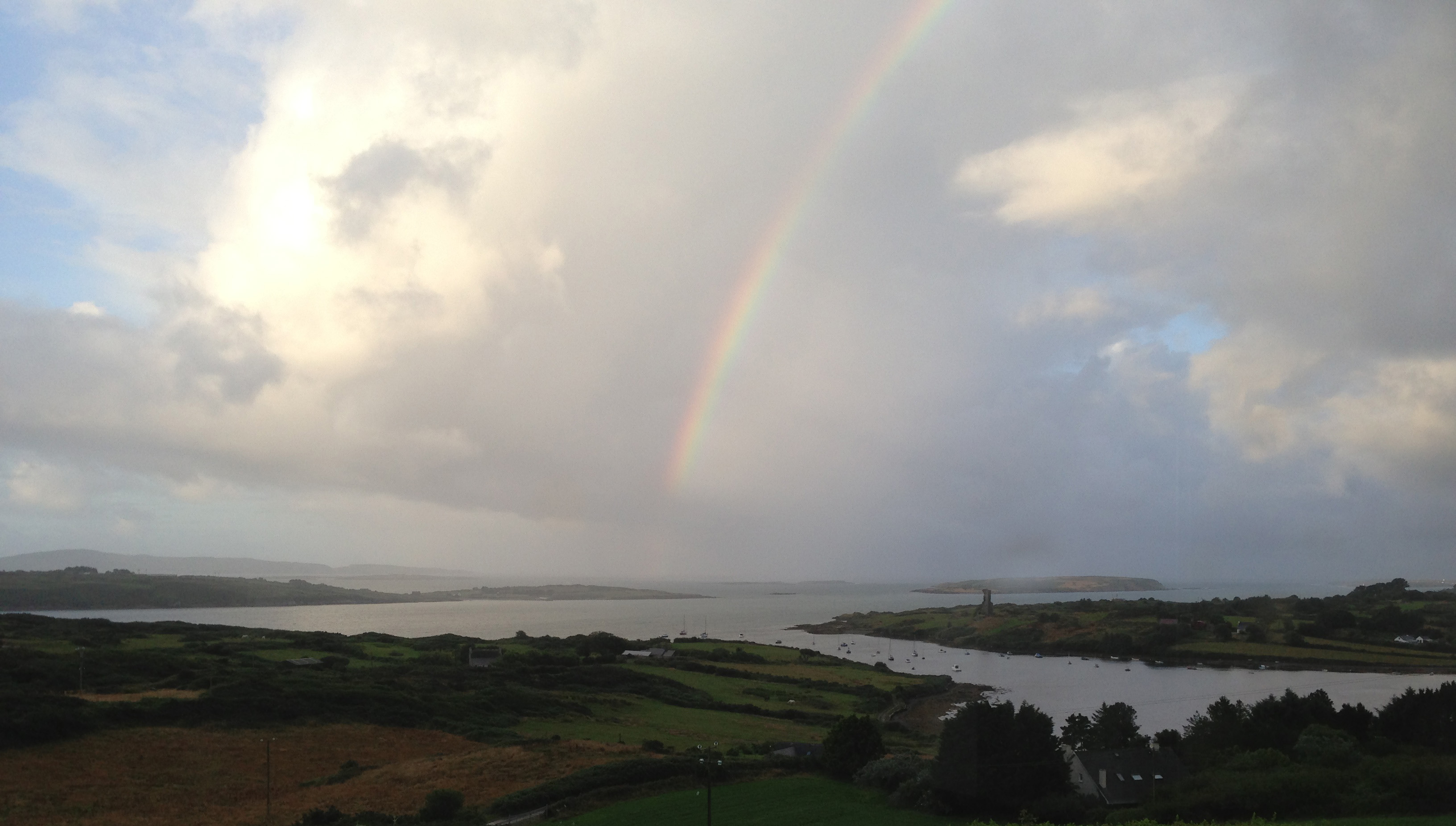
The late summer sun was certainly ‘falling soft’ as Mystic Waters pulled away from Baltimore. Perhaps it was the last of the summer sun as our view from Nead an Iolair today has gone! There’s not one island to be seen through the driving rain, and the Atlantic storm is sending our weather-vane spinning…
Some of the ‘Hundred Isles’ are little more than perches for gulls and cormorants, but a few are still inhabited – Clear, Sherkin, Hare and Long Island – while ruined evidence remains to show that many more have once supported small farmsteads – The Skeams, The Carthys, Calf Islands and Castle. Horse Island is the residence of one family – with plans to establish a distillery there.
A traditional Hare Island lobster boat – sailing past Hare Island
Middle Calf
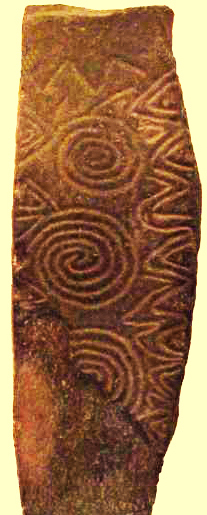
We didn’t land on any of the islands yesterday: we hope to visit some in the future. My first goal is the Middle Calf – a Hare Haven! But we do need to catch up on some Rock Art. There are marked stones on Horse Island while Clear (an Irish speaking community – part of the Gealtacht) supports a Neolithic chambered tomb which once contained a remarkable artefact: a carved stone with spirals, lines and zigzags, much more akin to the decorated boulders of the Boyne Valley Culture than the cups and rings of West Cork and Kerry. The stone (now – sadly – removed to the Cork City Museum) was part of a passage grave sited on the highest point of the island. Like the huge Newgrange monuments, the passage here is aligned on a solstice sunrise. As we look out through the mist today it’s a sobering thought that a sophisticated, scientifically aware society resided on these remote islands over 5,000 years ago.
* This poem was written by Thomas Osbourne Davis (1814 – 1845) and records the Sack of Baltimore of 1631 when Barbary pirates raided the town and took over 100 residents into slavery.
There’s yet another festival on at the moment, and this one is a yummy one: A Taste of West Cork Food Festival. It will culminate next Sunday in a giant market that will take over the main street of Skibbereen, but in the meantime every day brings something new – a farm tour, cooking and fish-smoking demonstrations, walking and boating tours, tasting menus, and special dinners.
Finola and Regina
Today we attended a lecture by Regina Sexton, a brilliant writer, broadcaster and food historian. Under the title “Teaching the Poor to Cook in 1847,” Regina led us through the contents of what might have been one of the earliest ever Irish recipe books. Published by a member of the Northern Irish gentry, it instructed the Irish ‘Peasantry’ on how to cook the foods available at the time as substitutes for the potato, then in catastrophic failure due to blight. Revealing as a document of the social and political philosophy of its time, it was eerily poignant given the death toll occurring all around at the height of the Great Famine. I was keenly aware of our surroundings at Liss Ard House, once a mansion where people enjoyed a fine standard of living, while the town of Skibbereen, down the road, had been an epicentre of starvation.
Everything locally grown!
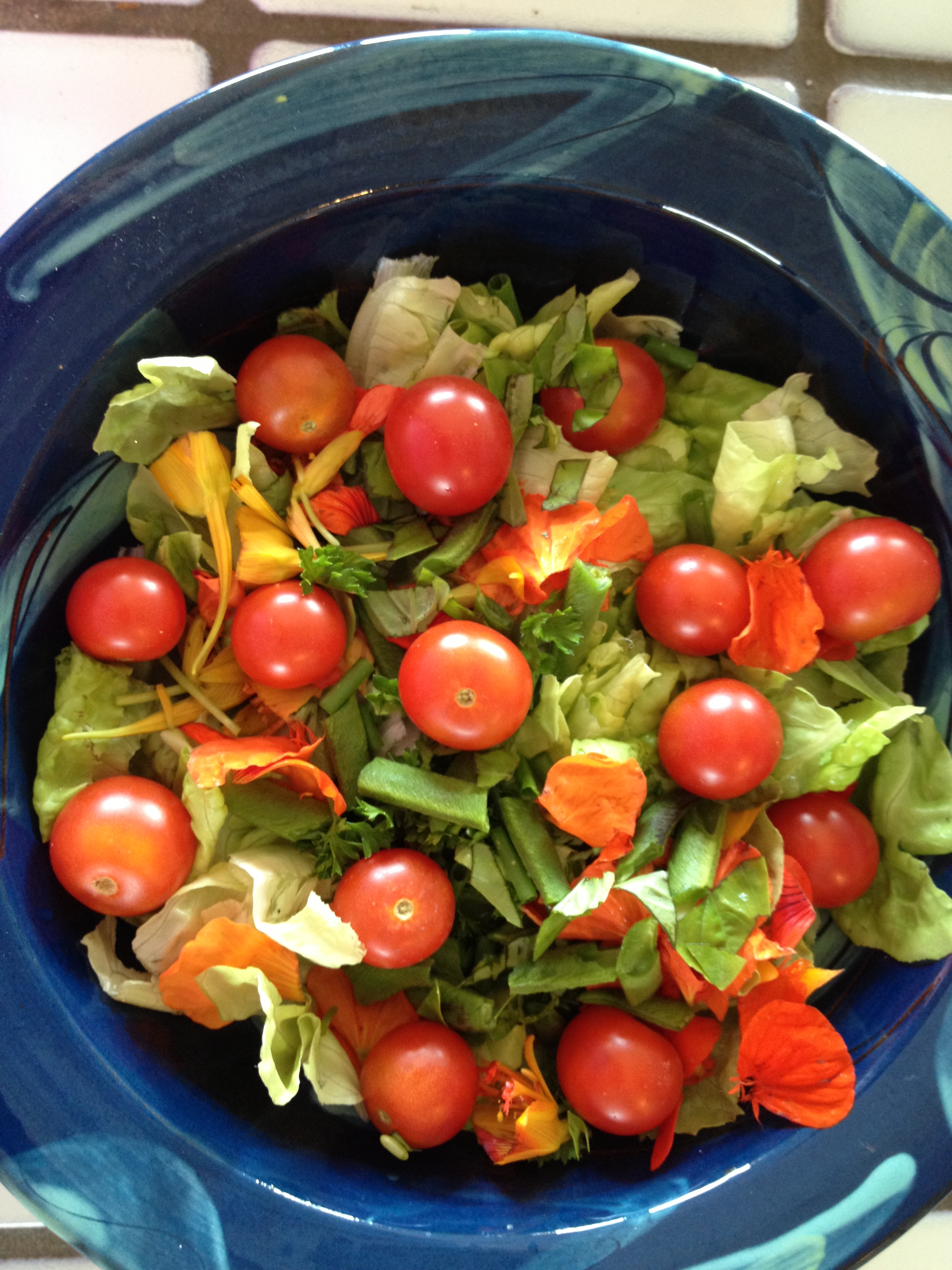
I have written before about West Cork Food (here and here): this really is Foodie Heaven, with fresh vegetables, artisan cheeses, homemade preserves and relishes, breads of every description and a wide variety of seafood and organic meats all readily available not only in the weekend markets but in local shops and supermarkets. To add to this, my friend and neighbour Hildegard has been generous with her garden and we have been enjoying fresh beans, zucchini and lettuce and flavouring dishes with her wonderful basil and savoury.
Robert and I love to eat breakfast out as a treat. On one recent foray I ordered boiled eggs and it brought me back to my childhood and time-honoured rituals. Lift the top off the egg with a spoon, drop in butter and salt and put the top back on. Cut your toast into fingers to dip into the buttery yolk. When you have finished your egg, turn it upside-down in the egg cup and present it to an unsuspecting sibling.
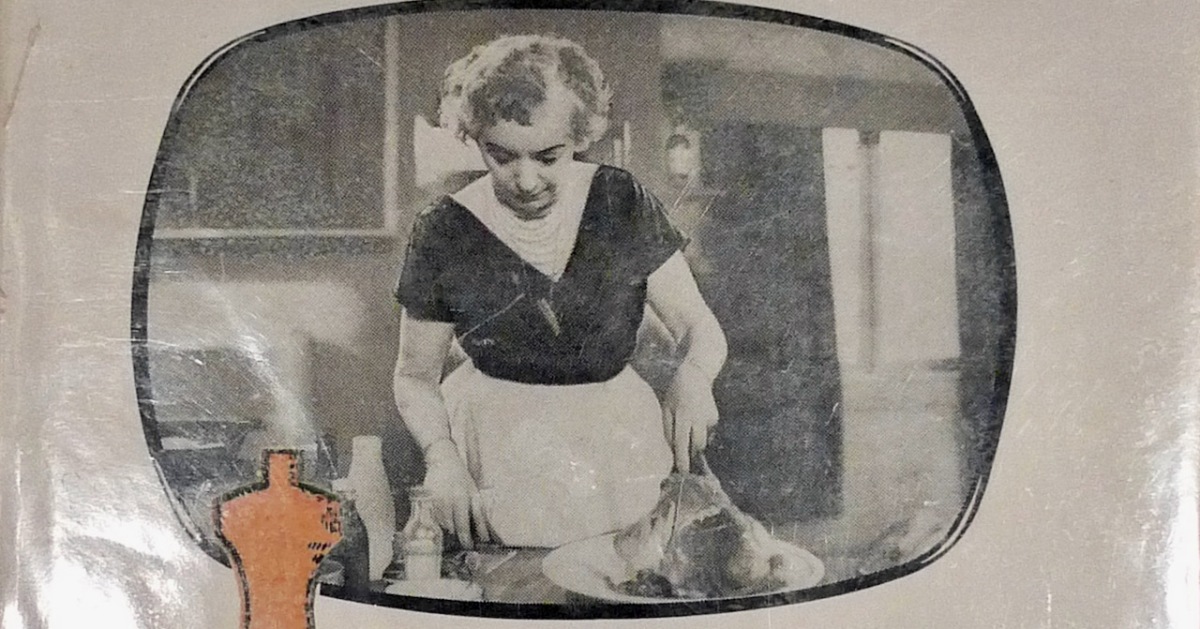
Ireland’s first celebrity cook was Monica Sheridan, who had a lively cooking show on RTE in the early 60’s that everyone watched. The show didn’t last long – it was rumoured that the Irish Home Economics Teachers’ Association wrote to RTE to protest the way she licked her fingers. But she brought out several books and when I emigrated to Canada in 1974 I had one of them, ‘My Irish Cook Book’ in my suitcase. I was delighted to be able to purchase her classic ‘Monica’s Kitchen’ (1963) recently, and have been chuckling through it. It’s not so much a recipe book as an extended essay on food, delivered with her trademark humour and trenchant opinions. This is pre-feminist sensibility: women are assumed to be the cooks – their objective is to please their husbands and make other women jealous. She knows everyone cannot be that fortunate, however:
If you are a young bride and have married a man who is finicky about his food, and won’t eat this or that because his mother didn’t do it so…six months of married life will have blunted all your enthusiasm for the kitchen stove. You will have learned to make soup without onions, salad without garlic, dressing without oil – no curry, no out-of-the-way vegetables, no sauce except something out of a bottle. Life will stretch before you as a series of bacon and eggs, cabbage and turnips, and endless varieties of sweet cake.
On soups: Add a ham bone, or a bit of salt pork, to the vegetables all diced up, and you have the minestrone that everybody comes back from Italy and raves about, as if the bones of Michelangelo himself were boiled in it.
On fish: The first essential in buying good fish is to get to know a sociable fishmonger.
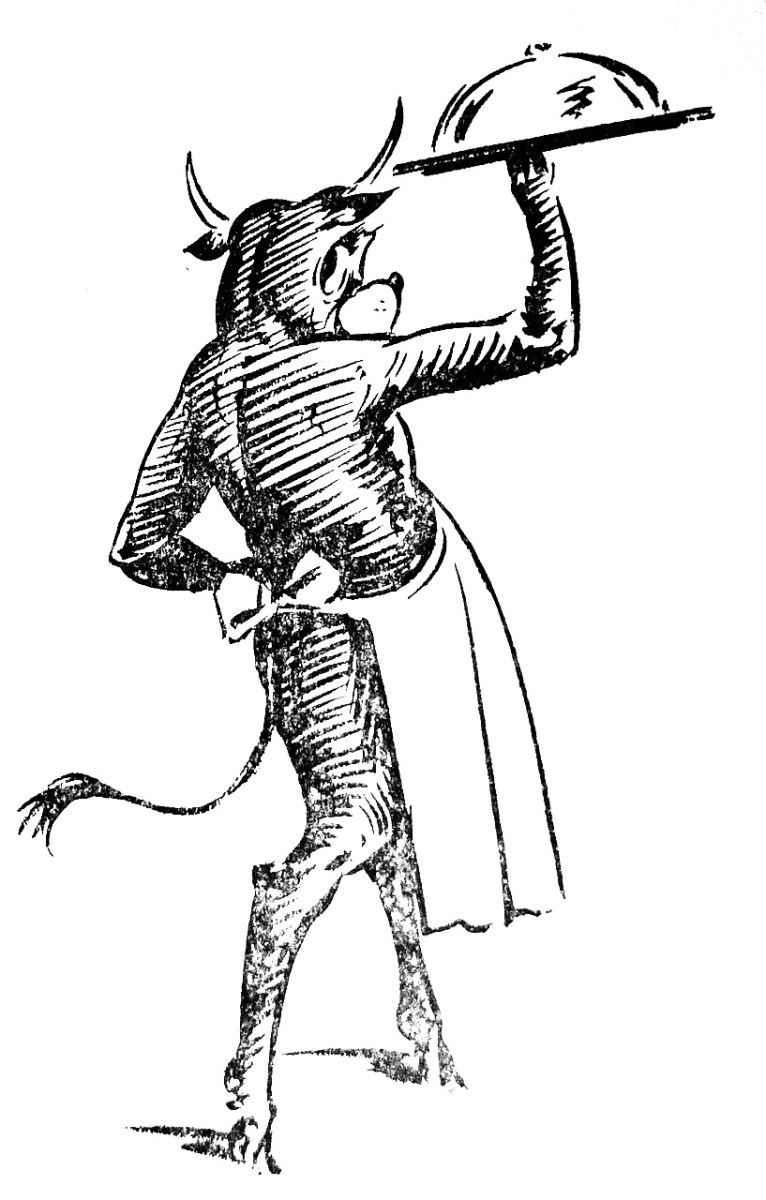
On Meat: Passing through a fair in, say, Mullingar, you will see four year old Irish bullocks in the very pink of condition. They have the roving eyes and the debonair looks of first-year medical students…Give them a few more years and they could become a danger to the parish; but now is the time to kill them and eat them, when they are in their youthful prime.
There are few examples of what we might call proper recipes in the book. Some things she dismisses out of hand as not worth bothering about:
I can’t stand sage so I never put it in anything.
You are all familiar with the acrid smell of boiled cabbage that rises from the basement of Georgian lodging houses, and permeates the entire establishment, right to the top landing. Terrible, terrible, terrible.
There is an absolute horror of a dish known as scotch eggs.
There are directions for using every part of an animal – the lamb section is replete with exhortations not to neglect the liver, the brains, the tongue and the sweetbreads and suggestions for cooking them. There’s a famous Christmas cake section that is still followed faithfully by many Irish cooks. And I was delighted to find one of her funniest pieces, ‘A Surfeit of Snails’, reproduced as a whole in the Irish Times [Edit – no longer online, alas].
Finally, no small part of the enjoyment of this book comes from the photographs, and the drawings by Wm. G. Spencer.
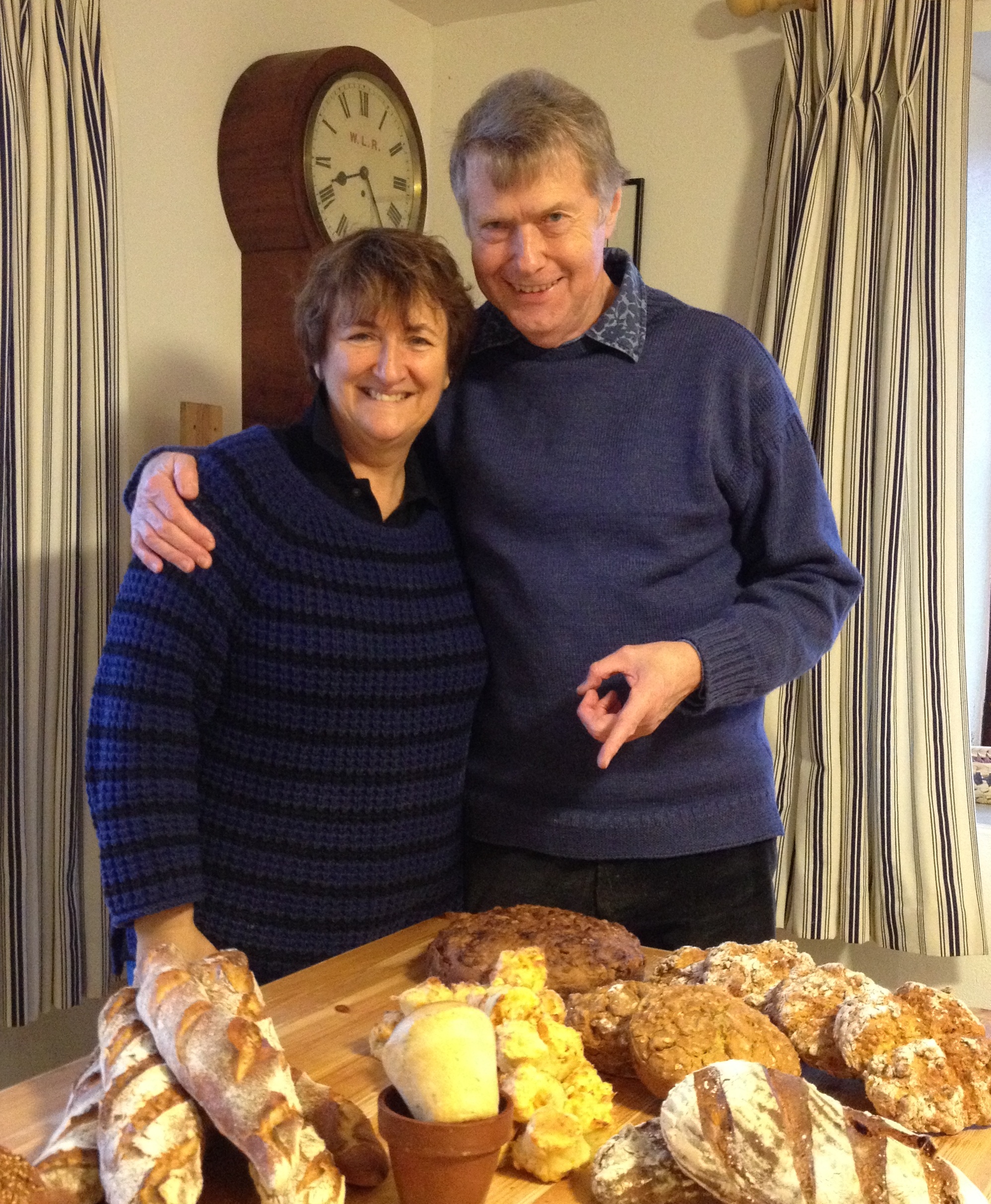
We got the most incredible Christmas present from Noah, Robert’s son! It was a day of learning to bake bread at the Firehouse Bakery on Heir (or Hare) Island, about a 20 minutes drive from Ard Glas. While Robert had some experience of baking with yeast, I had none, and considered myself yeast-phobic.
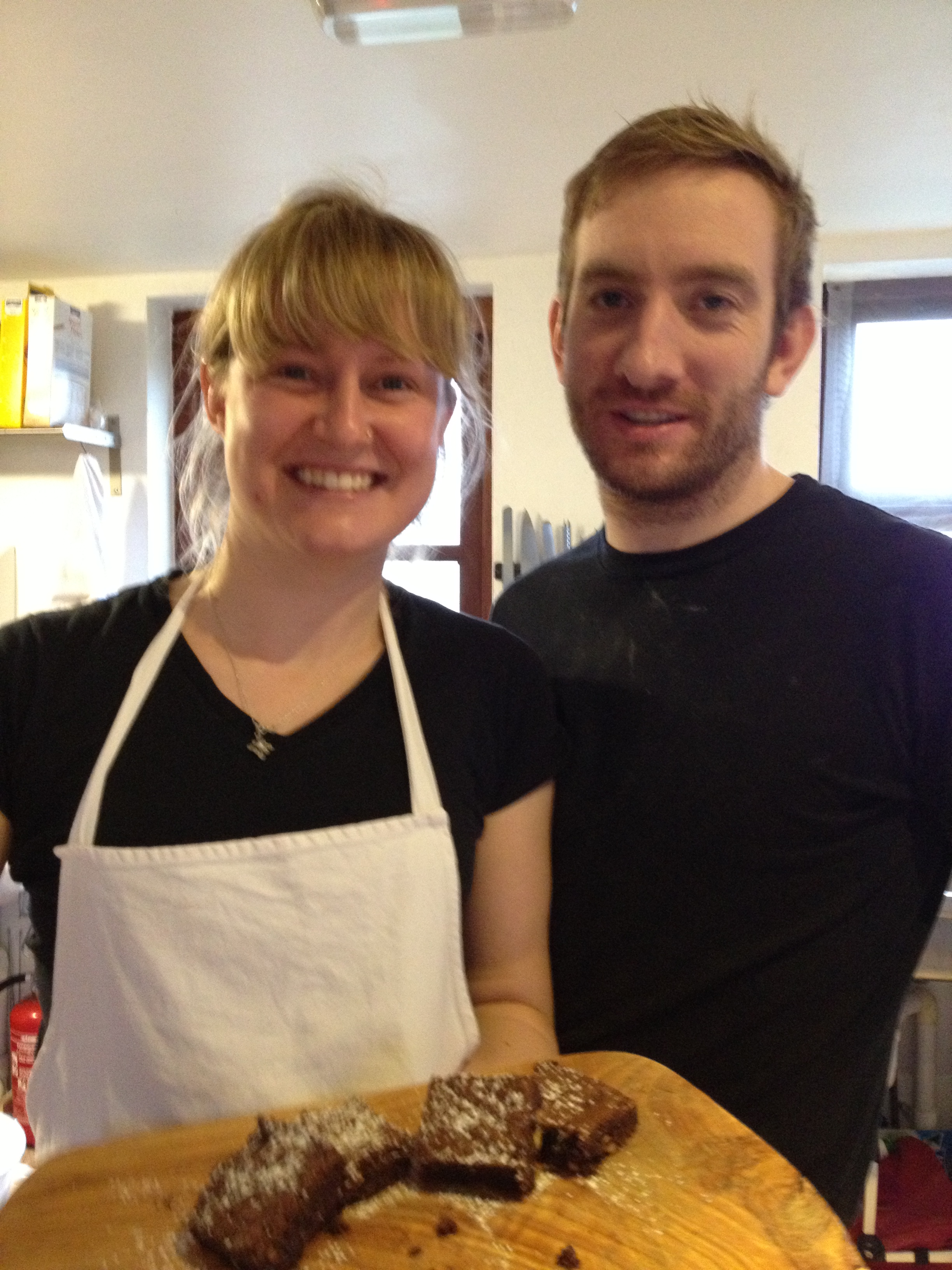
Laura and Patrick
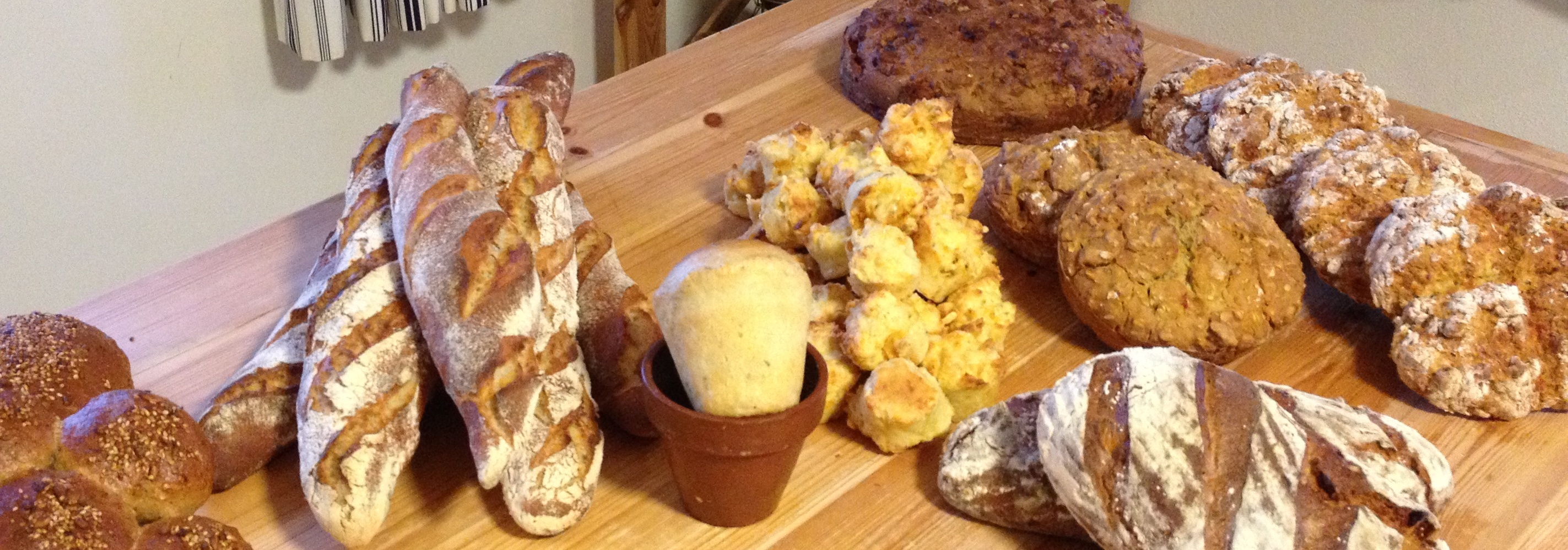
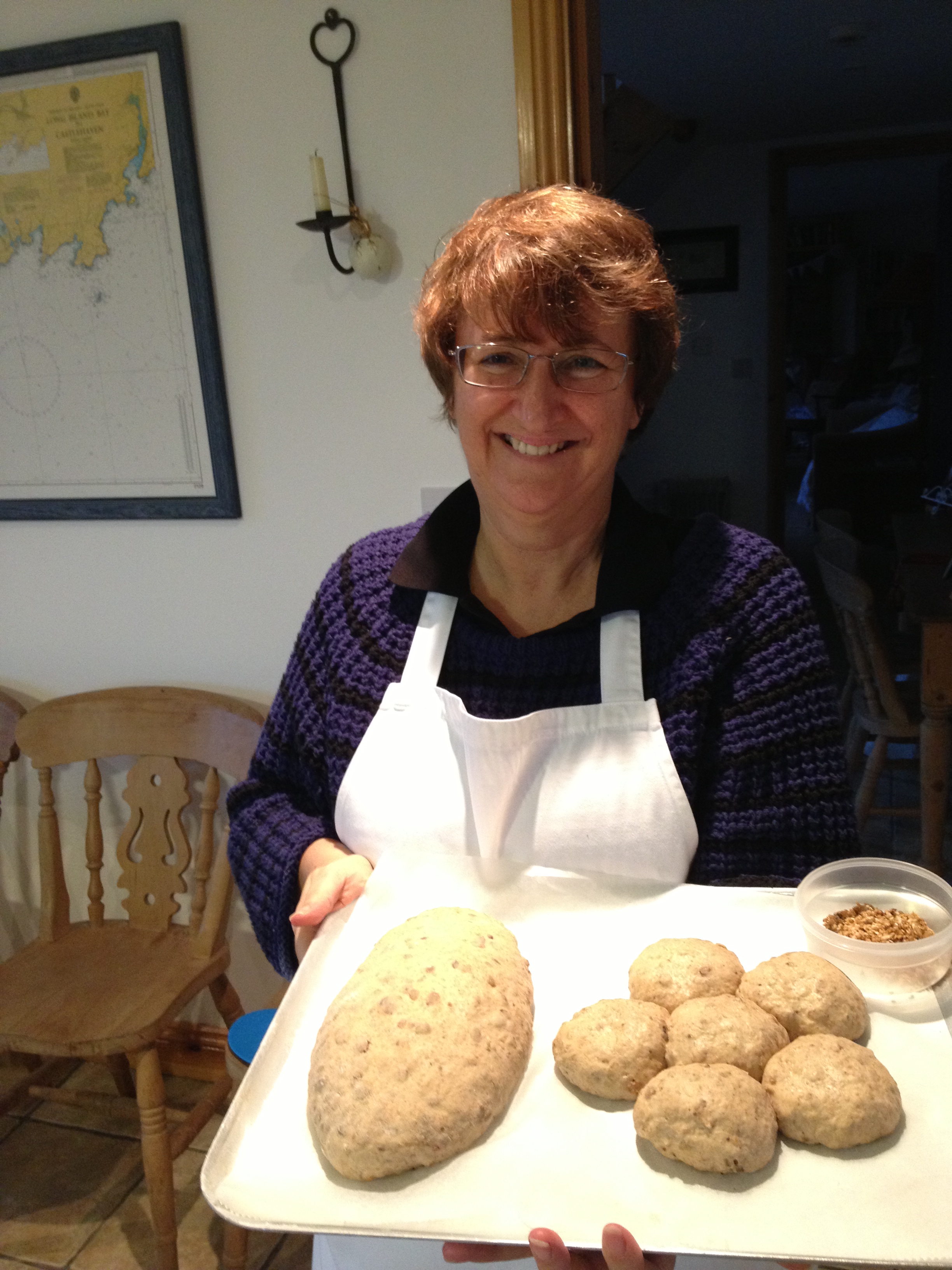
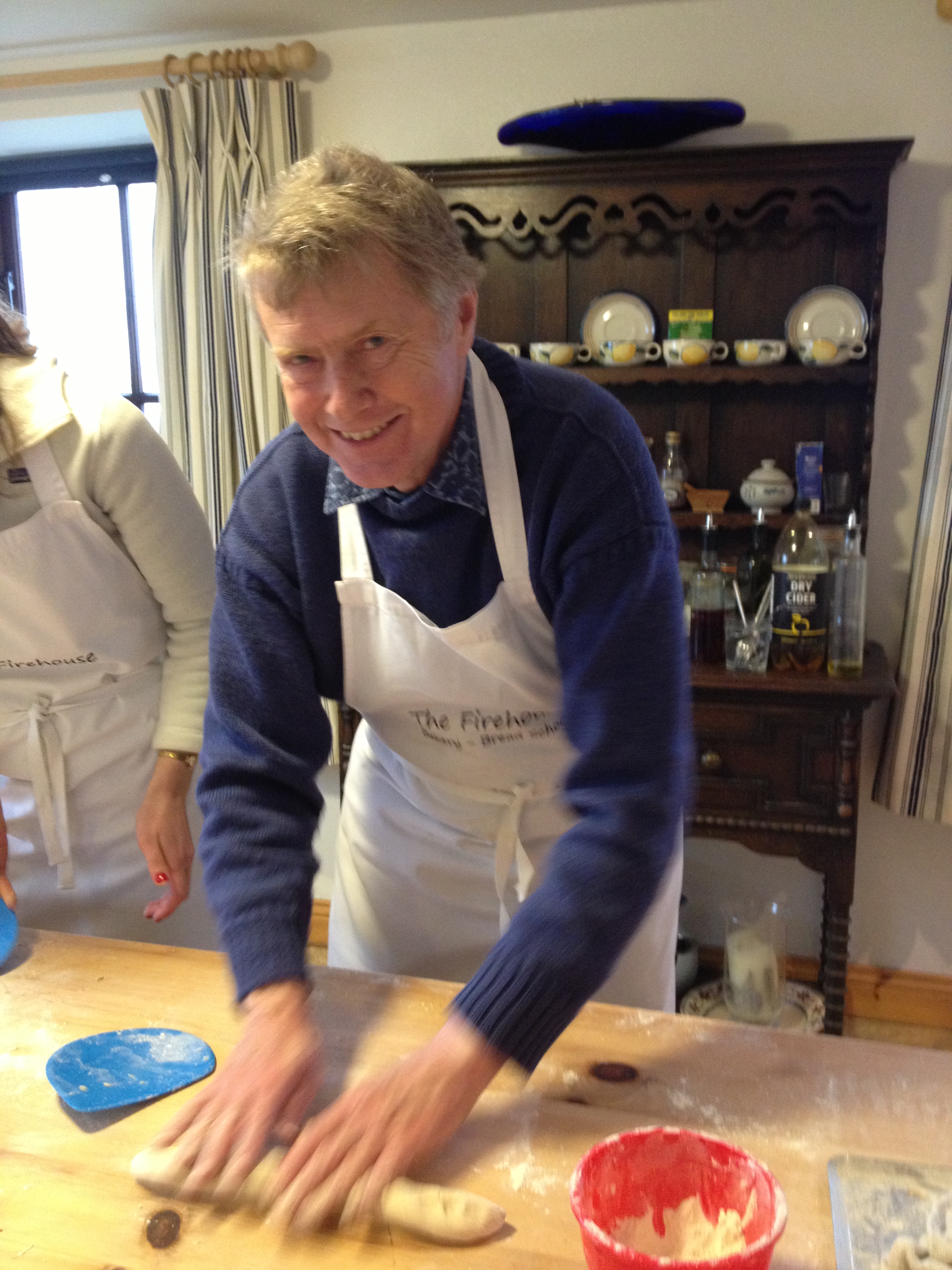
Our day started at 10:00AM with the short ferry ride to the Island. We were picked up by Laura who drove us back to the house/school/bakery and plied us with coffee and brownies to get us in the mood. The baker/instructor is Patrick, who ran his own bakery in Bath, England, and has written the inspirational “The Bread Revolution” with his bakery partner. He plunged us right into the process by introducing his four students to our bowl of sourdough, explaining what is was and how it worked. Then it was all mixing and kneading and scraping until we had a loose ball of dough which was set aside to prove while we got on with the next project – in my case a granary ‘bloomer’ and pull-apart buns and in Robert’s some baguettes.
We moved on from there to muffins, flowerpot bread, orange cake, brownies, cookies and soda bread. I thought I was on more solid ground with whole wheat soda bread but this was soda with a twist – each of us made a different version. We made thyme, mustard and cheddar; apple and cider with caraway; honey, blue cheese and walnuts; and roast butternut squash and cheddar and each version took different shapes, including mini-muffin shapes.
Ms. Bloomer
Patrick at the Fire Oven
M. Baguette
All our bread was baked in Patrick’s custom-built outdoor oven, heated by burning logs inside it. At the end of the day we sat around a table eating Laura’s excellent soup and pasta – she had been cooking away all day as we were baking – with samples of our own bread. We divided all the bread between the four of us and headed back to the ferry. We have a freezer full of bread, a sense of accomplishment, and memories of a warm and friendly learning atmosphere. What I don’t have? Yeast-phobia!
Welcome to the UCD Library Cultural Heritage Collections blog. Discover and explore the historical treasures housed within our Archives, Special Collections, National Folklore Collection and Digital Library















 Roaringwater Journal