Dublin’s Stained Glass: A Review

Friends, take note – this is an ideal Christmas present! If it has never occurred to you to take a drive, a walk or a cycle through any part of Dublin, dropping into churches along the way, this book will convince you that it’s the ideal way to spend a day, surrounded by history and beauty.

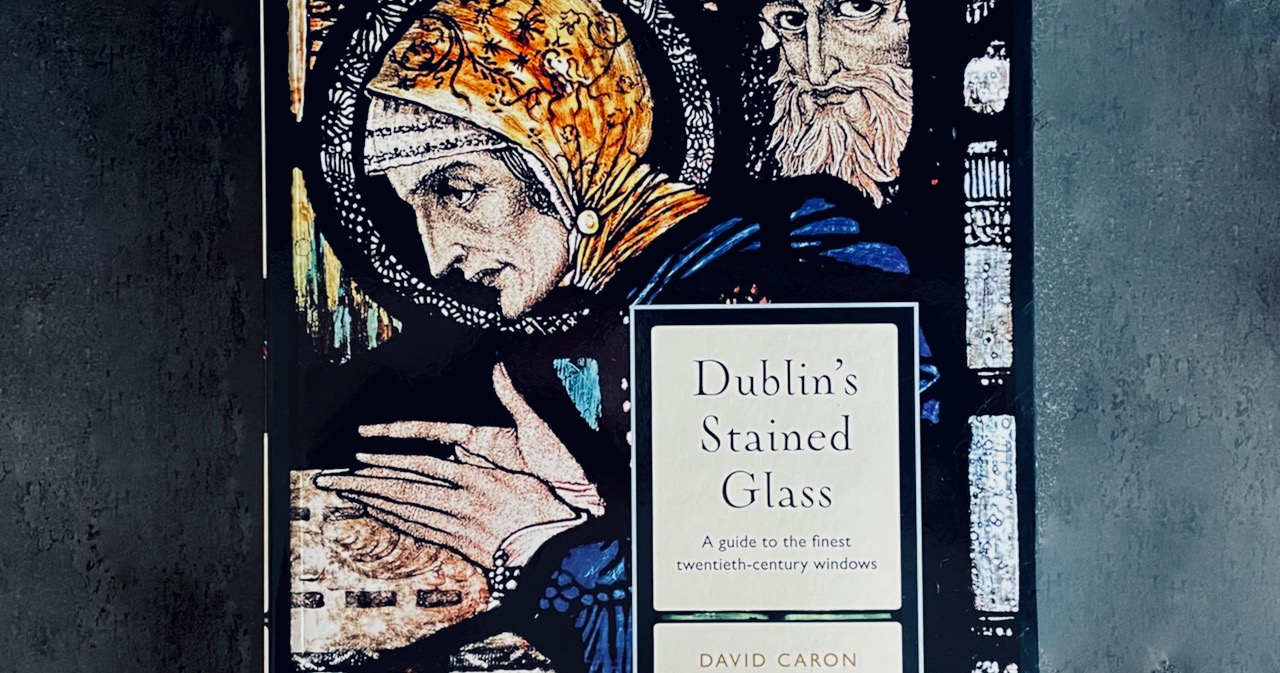
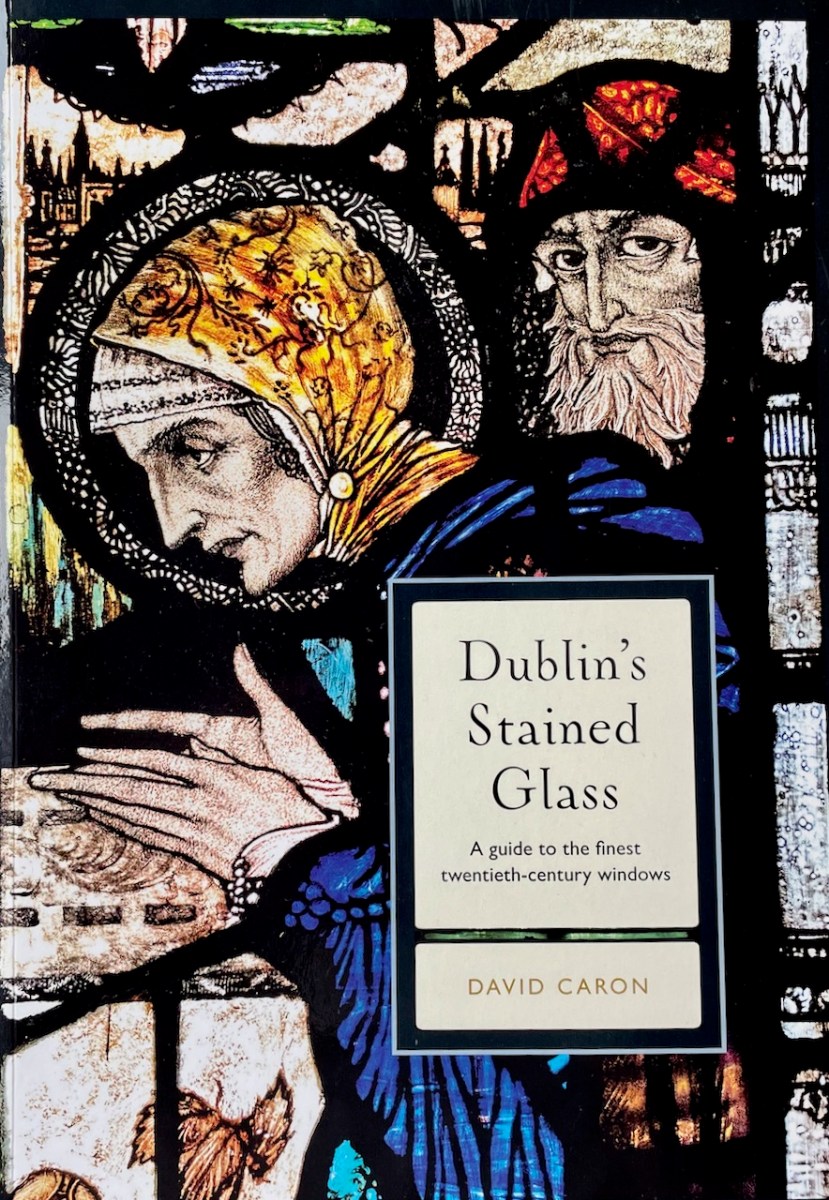
As my regular readers know, I write frequently about stained glass, and I was a contributor to The Gazetteer of Irish Stained Glass. The editor and main writer of that volume was David Caron, and I previously reviewed his marvellous book (I called it a ‘miracle’) on the life and work of Michael Healy. Now comes his latest work, Dublin’s Stained Glass, a book about the best 20th century glass in Dublin Churches, stunningly produced by Four Courts Press. This book needs to be in your library!
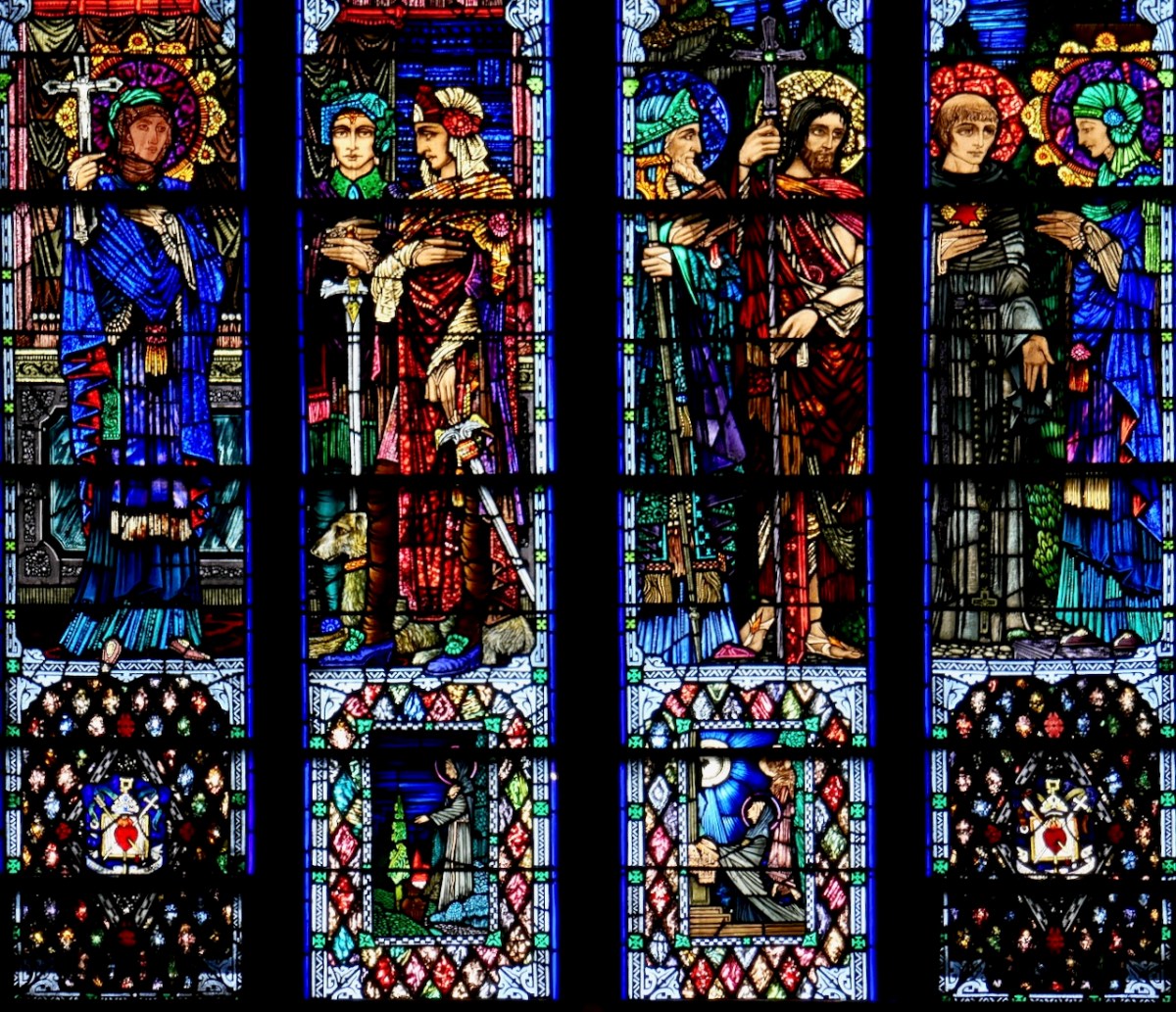
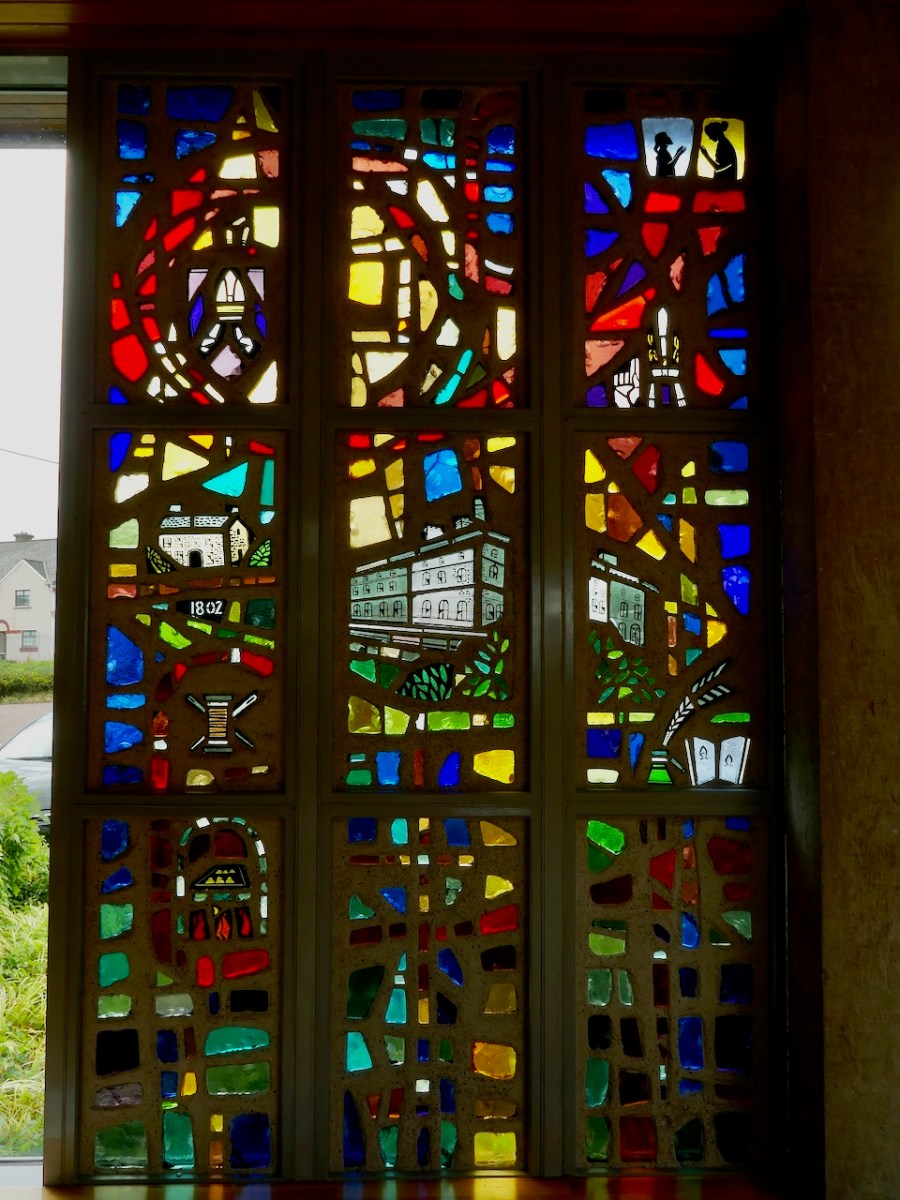
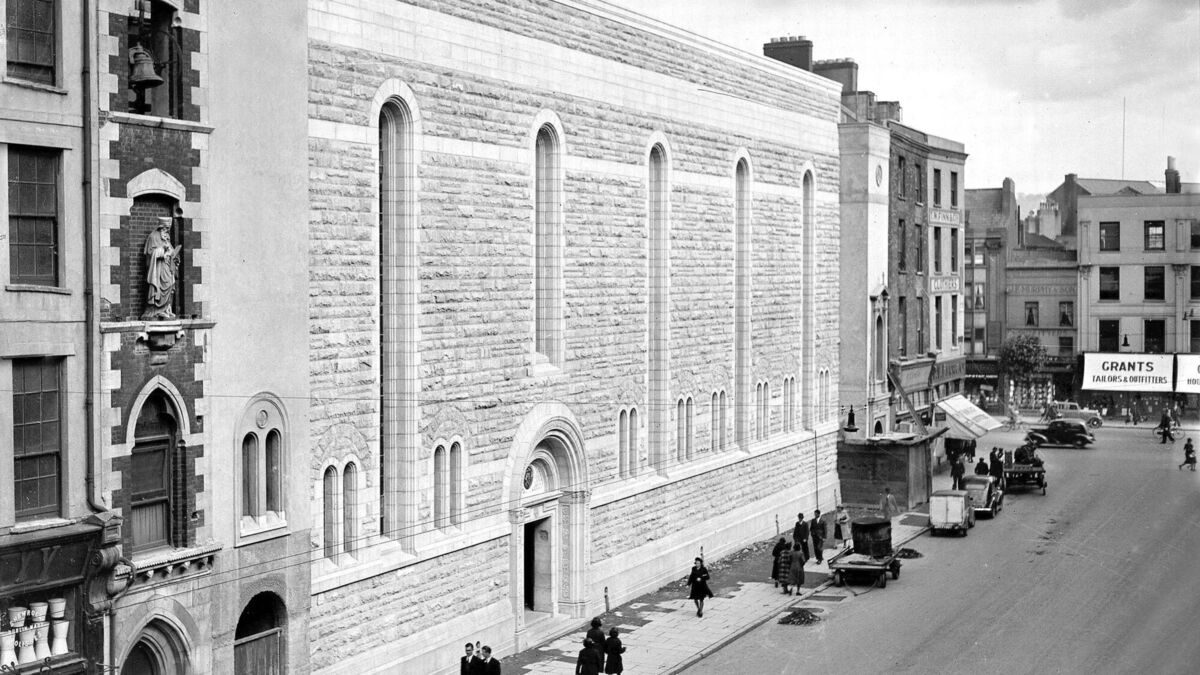
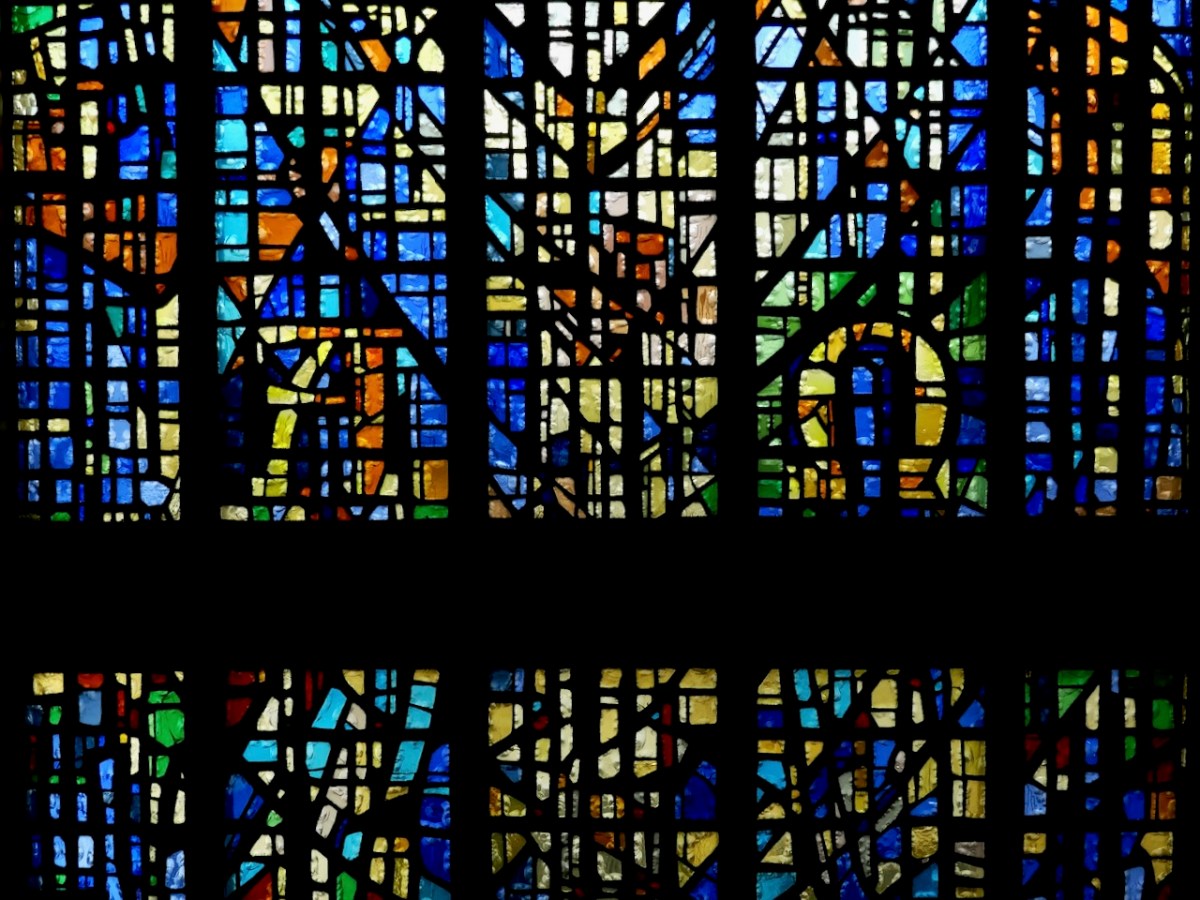
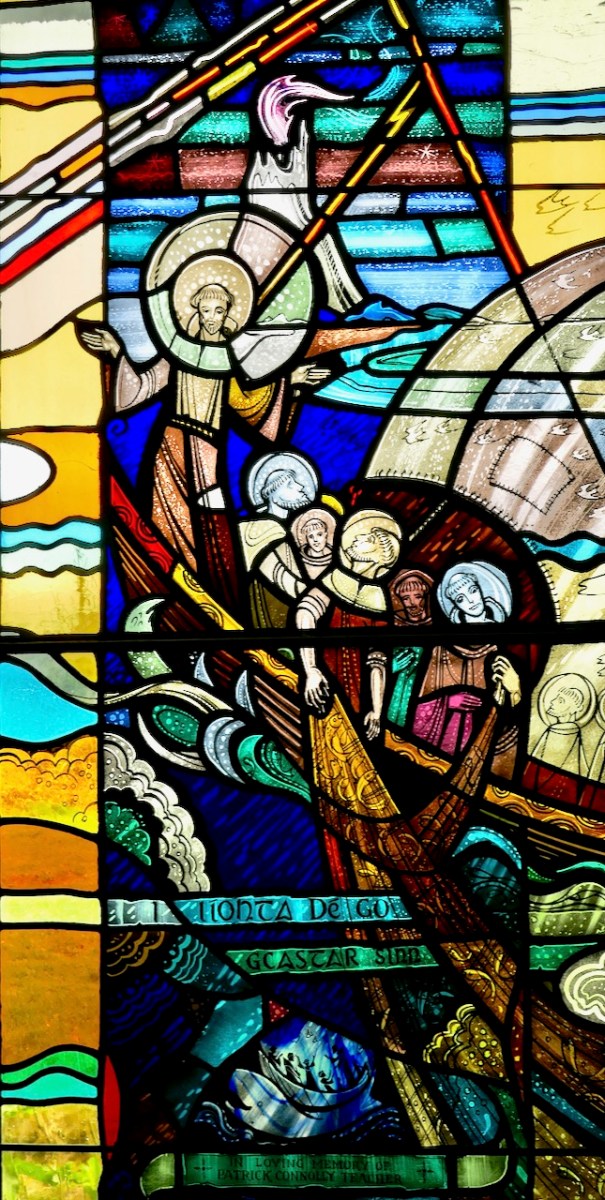
The John’s Lane church features in David’s Book, with a detail from the St Rita window. Here’s all of the narrative part of the window.

Here’s a statement you might not hear every day – the Catholic Church was the greatest patron of Irish artists in the 20th century. This is particularly true after Vatican II, 1962-65, the decrees of which included encouragement to use modern forms of architecture and art. But it is also true that the Church had the means to commandeer resources that were available to few private individuals in 20th century Ireland. The result of this is that the work of some of our best artists is public and easily accessible. While this book focusses on stained glass, David also points out where appropriate other example of fine art in churches (e.g. stations, altar furniture) as well as identifying the architects working to modernise or re-order our churches.

I have used my own photographs throughout this post, but they cannot compare with the magnificent photography by Jozef Vrtiel, David’s long-term collaborator and the single most talented photographer of stained glass in Ireland. This is truly a combined effort – David’s text and Jozef’s images complement each other superbly.

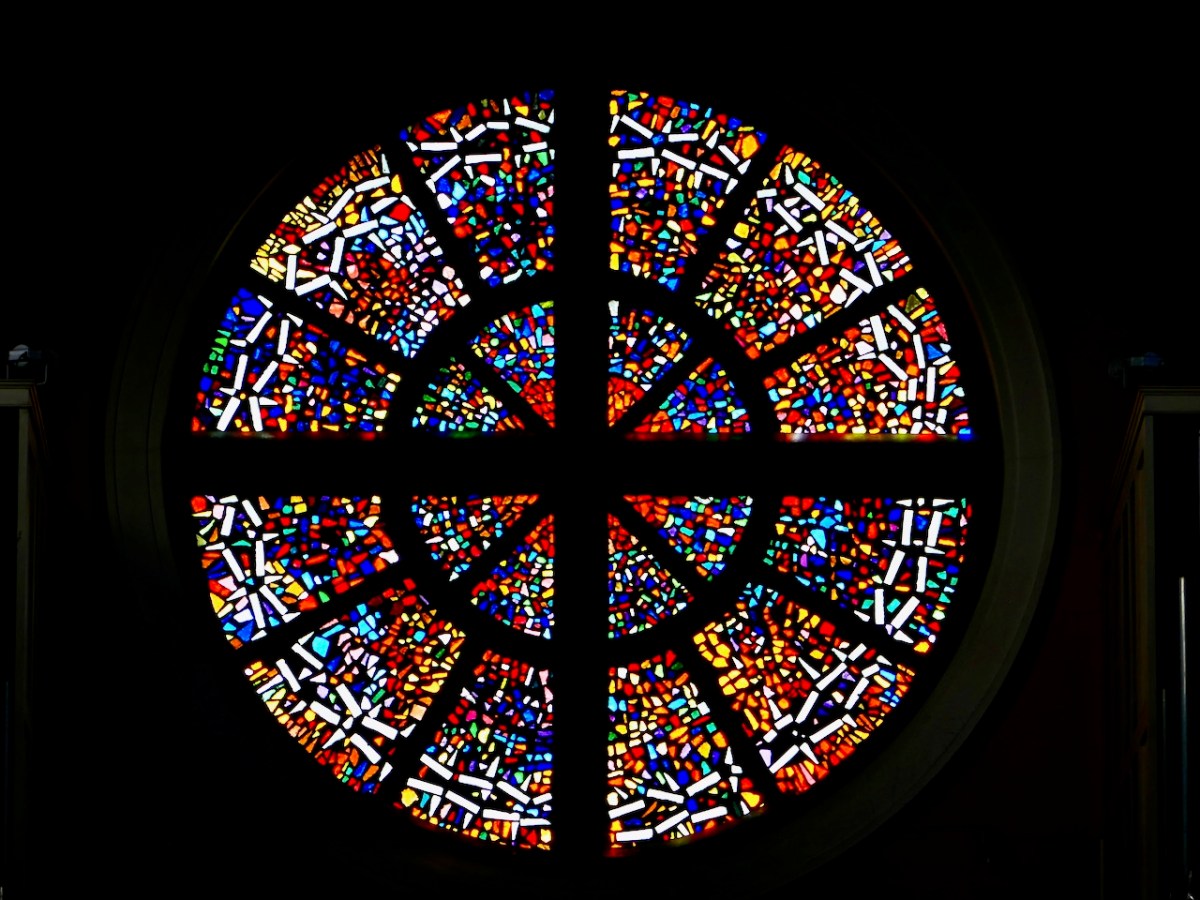
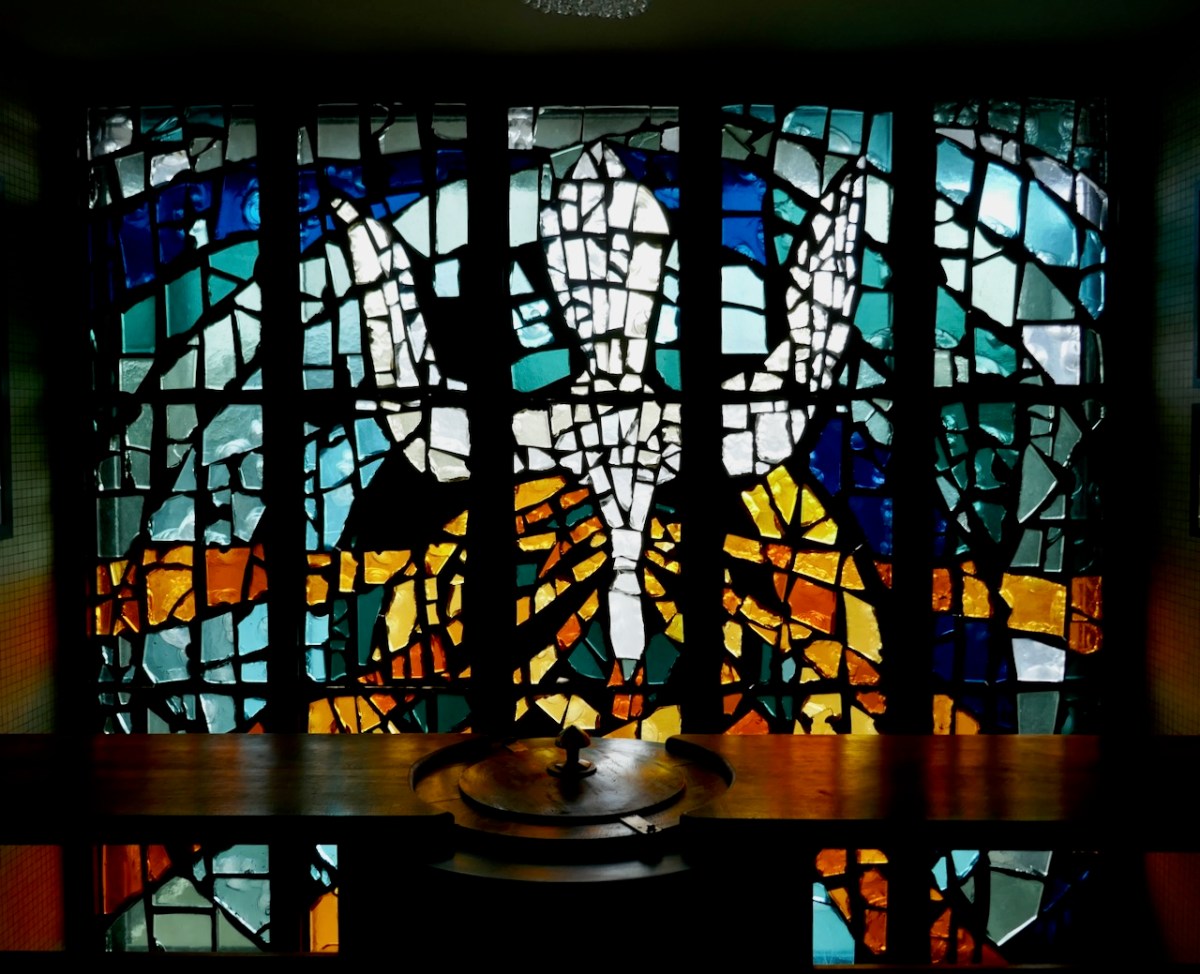
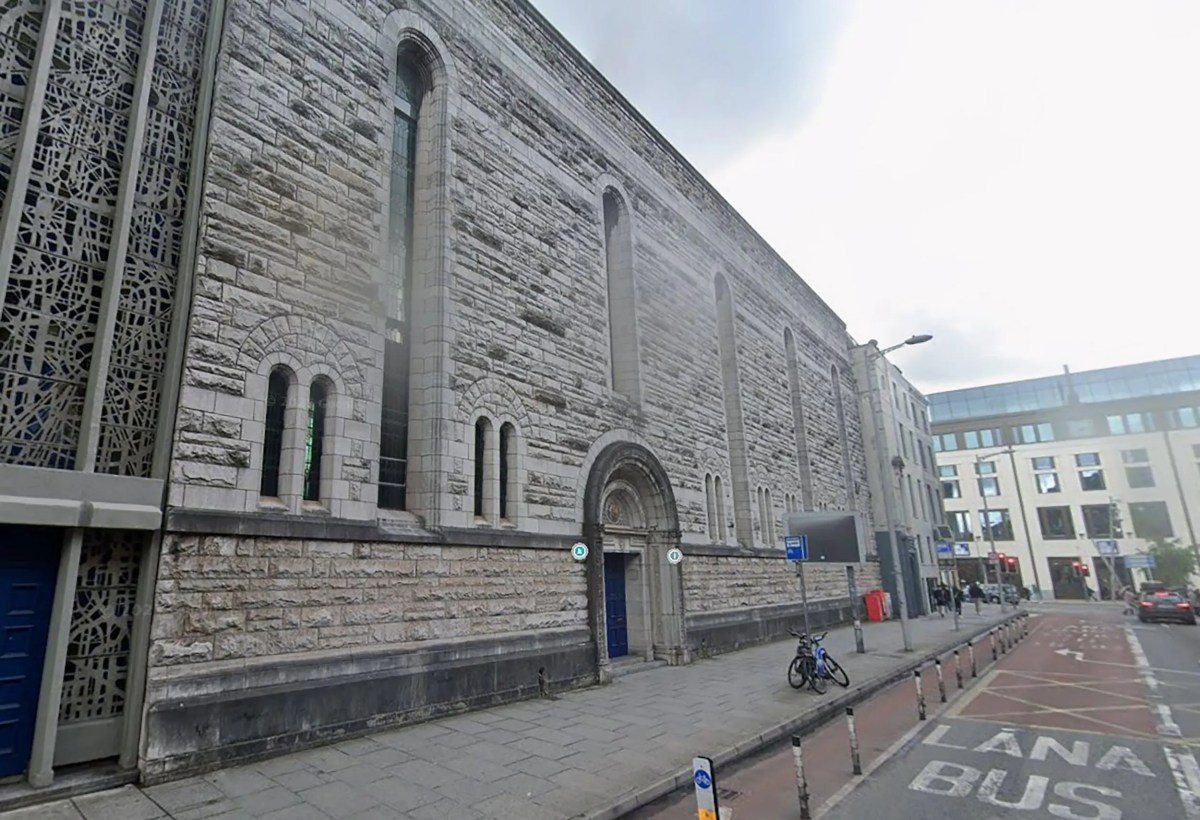
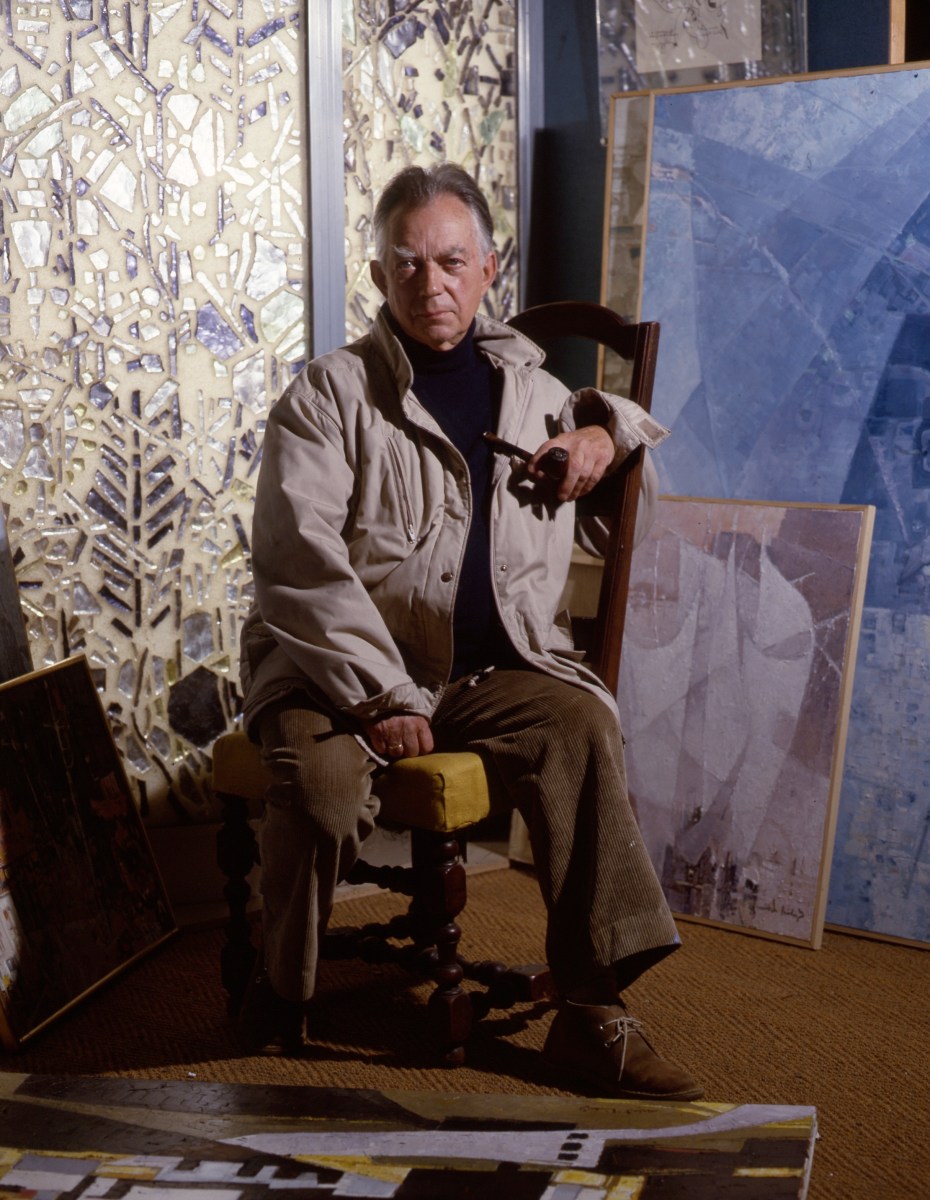
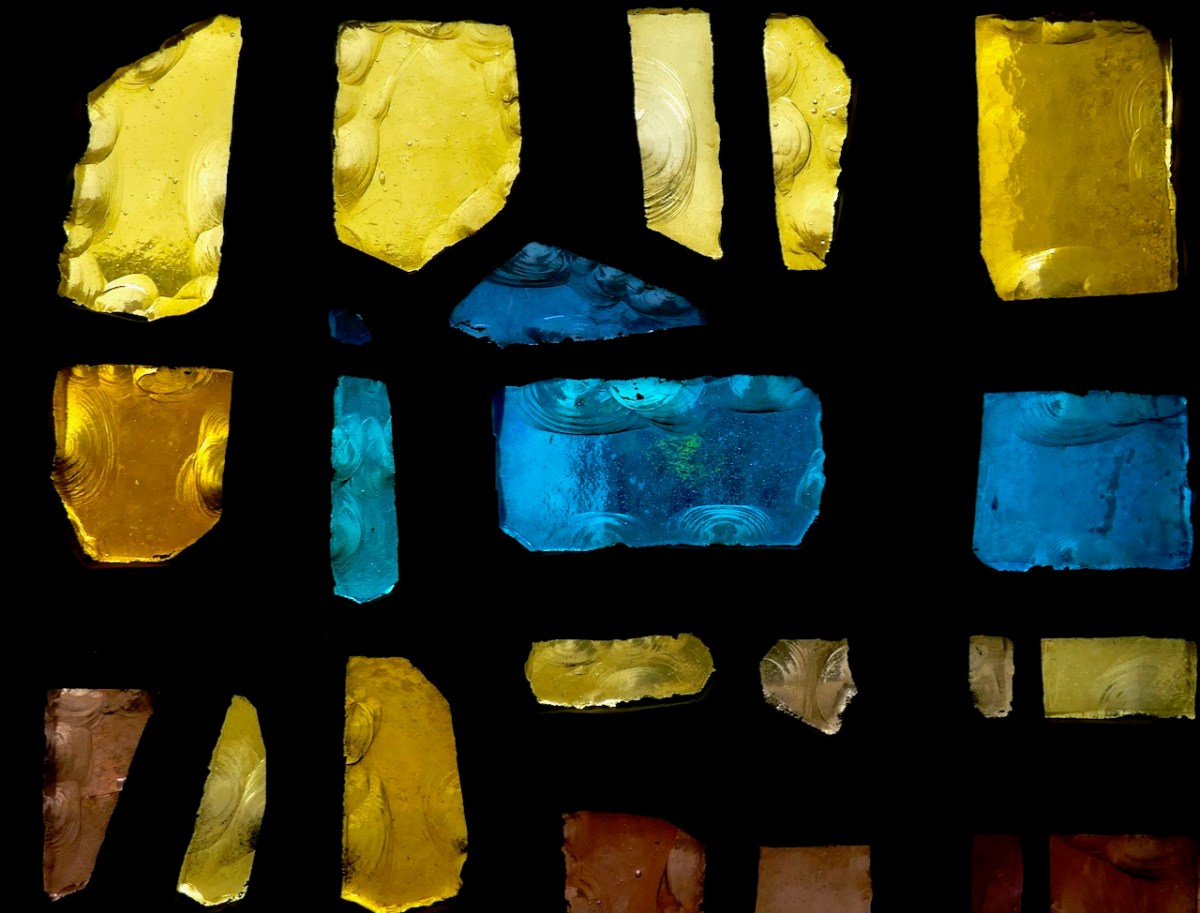
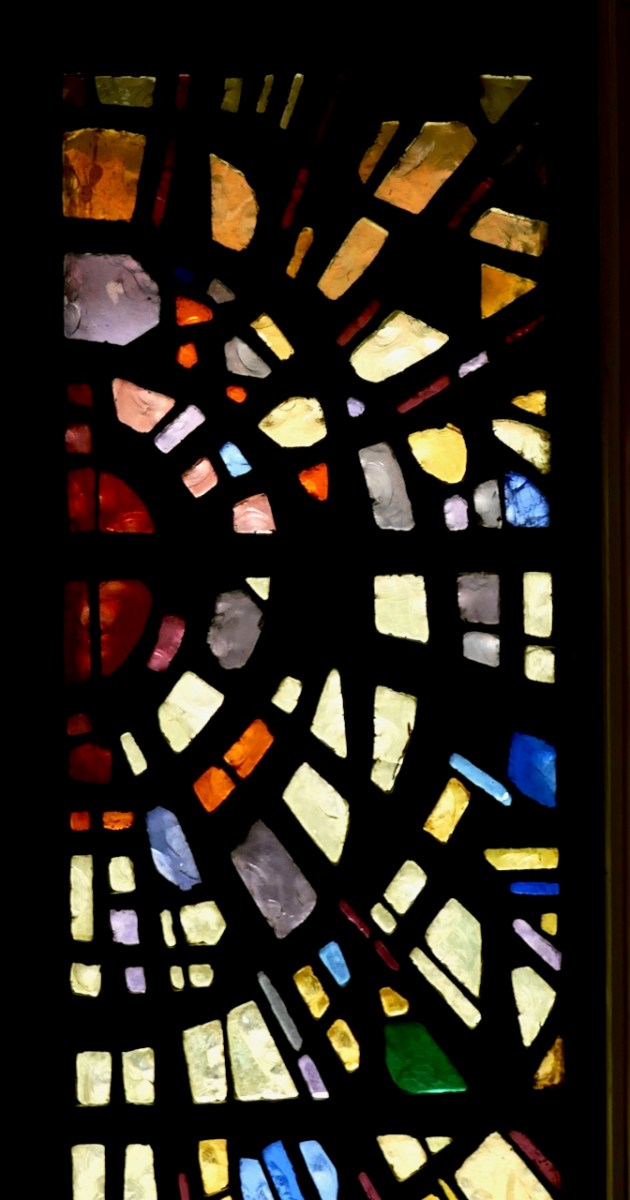
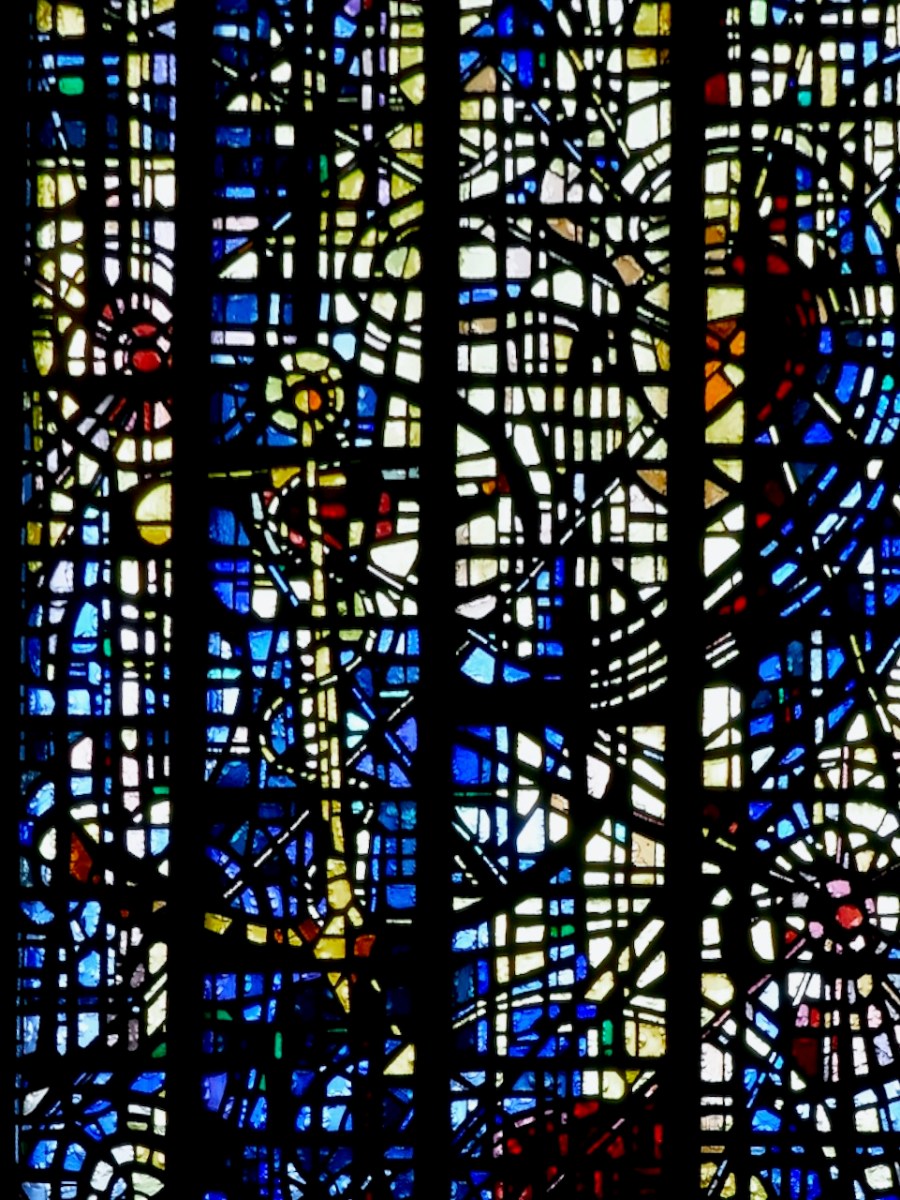
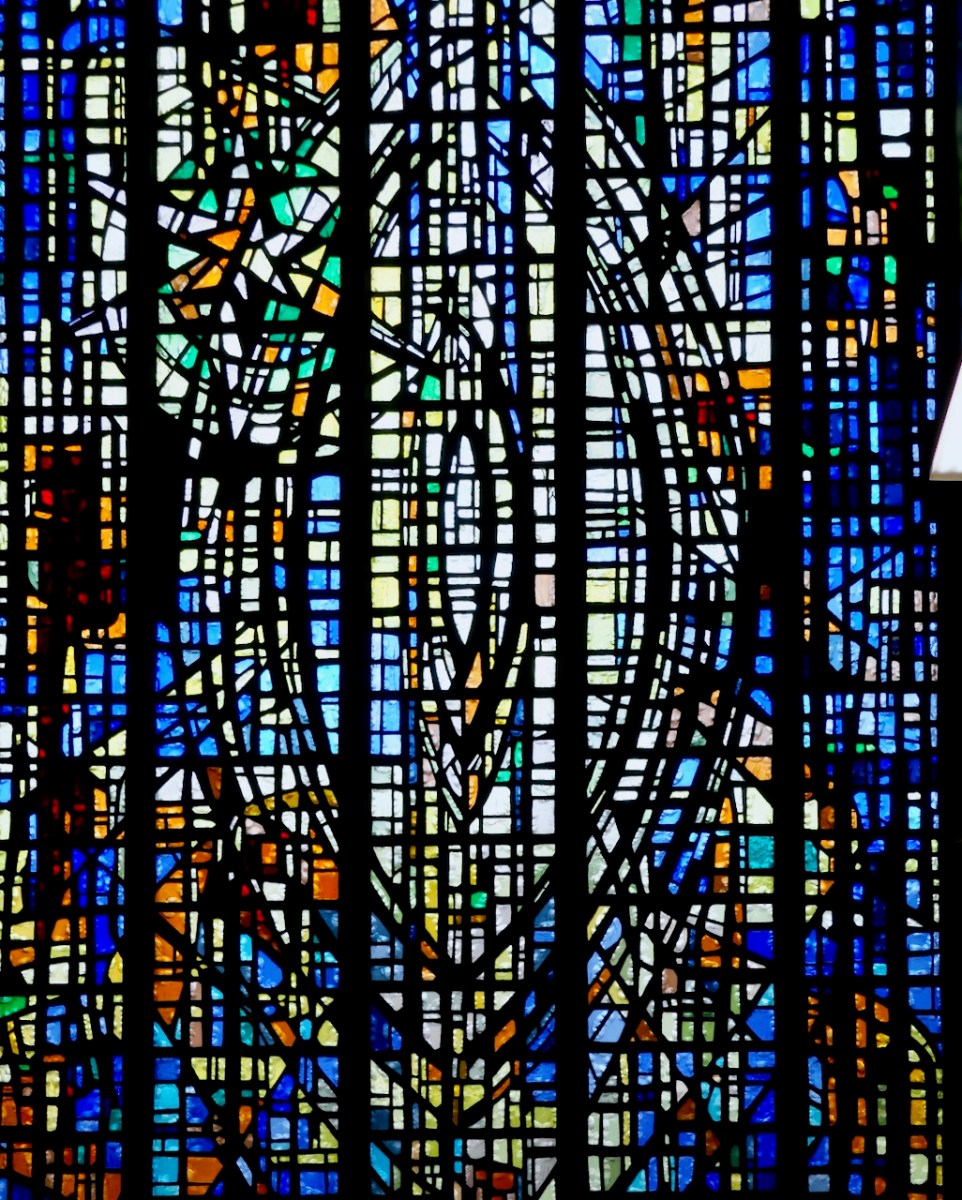
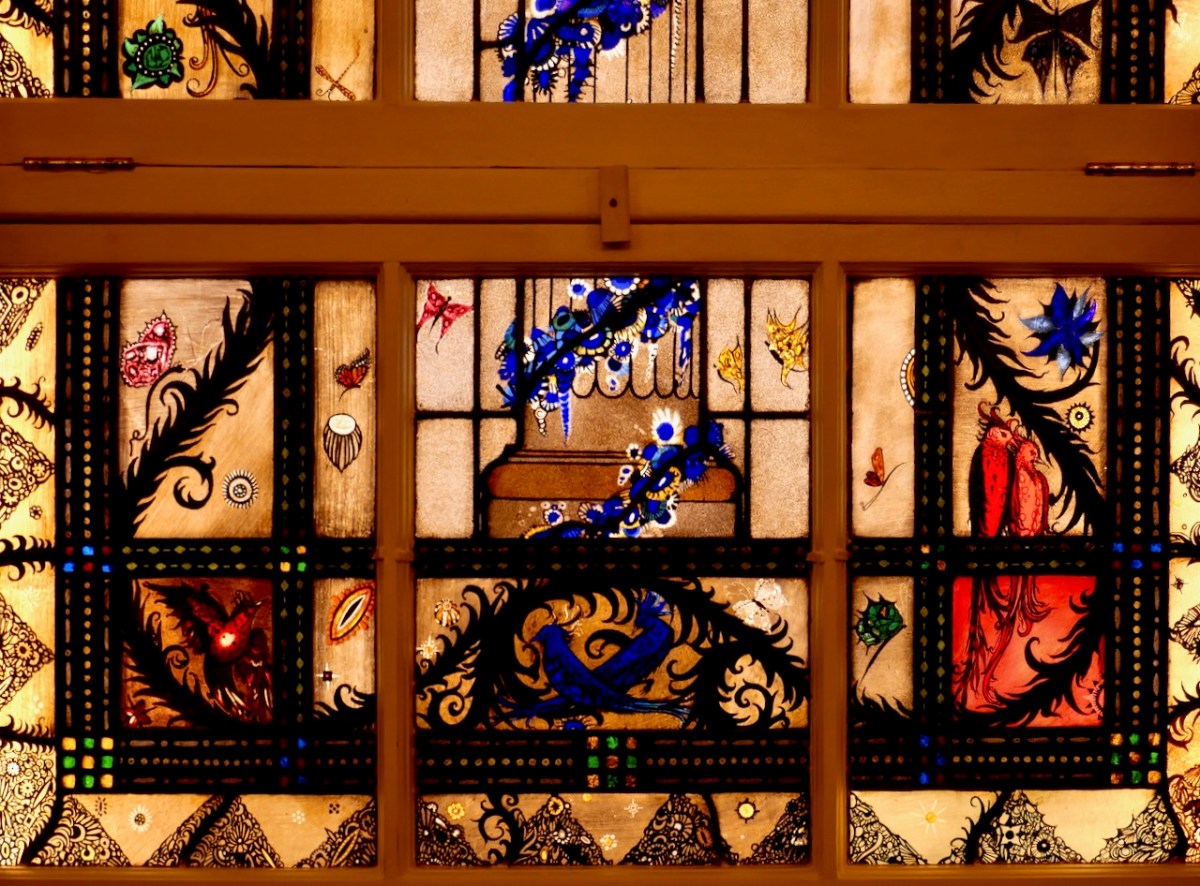
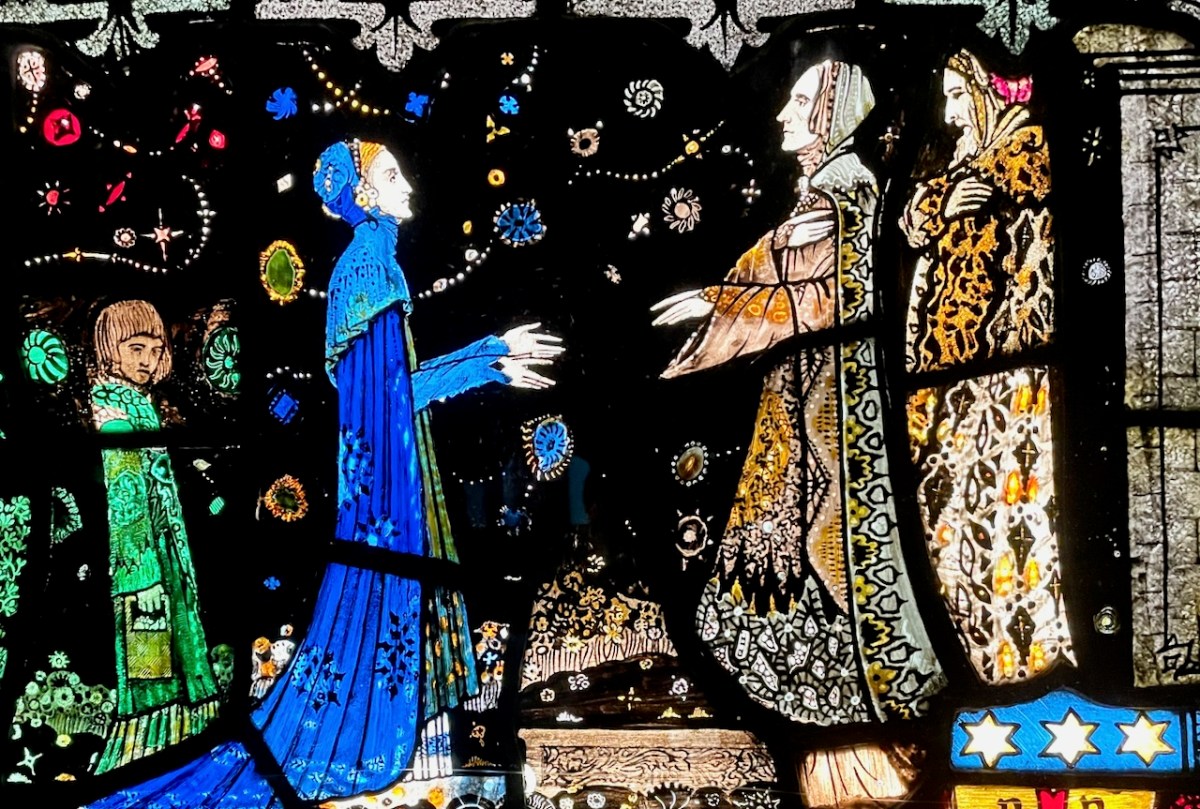
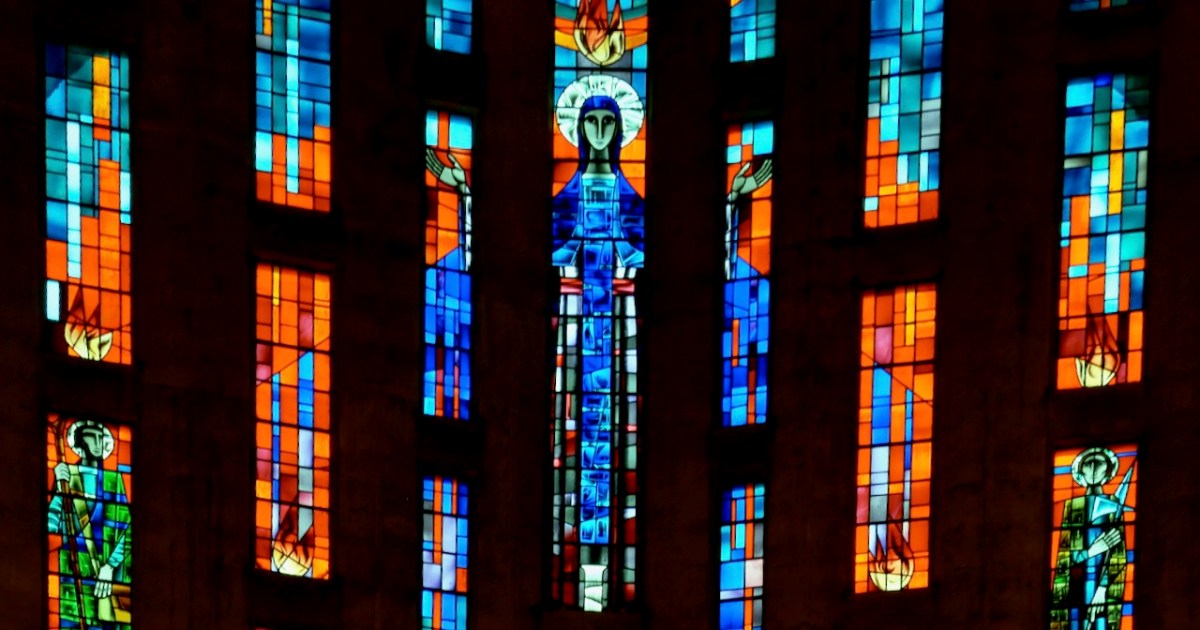
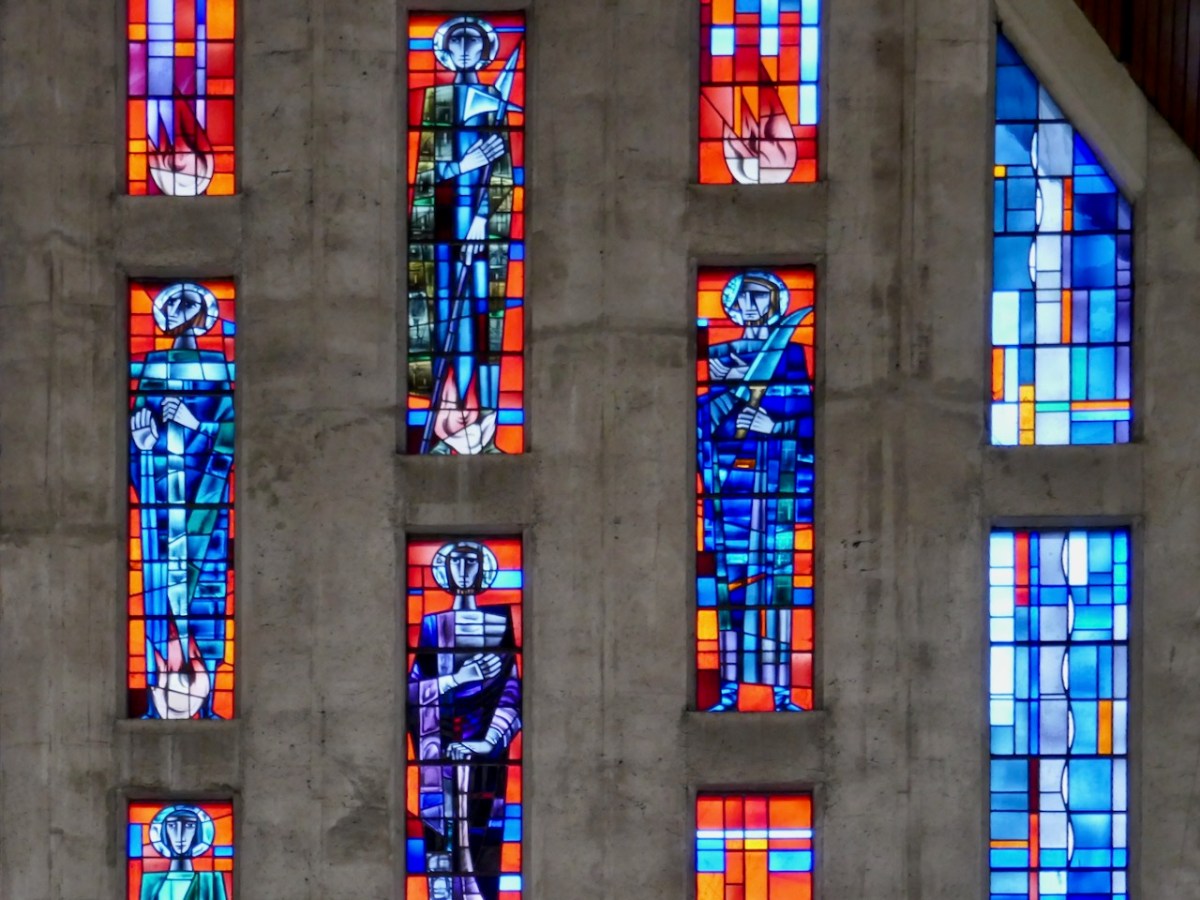
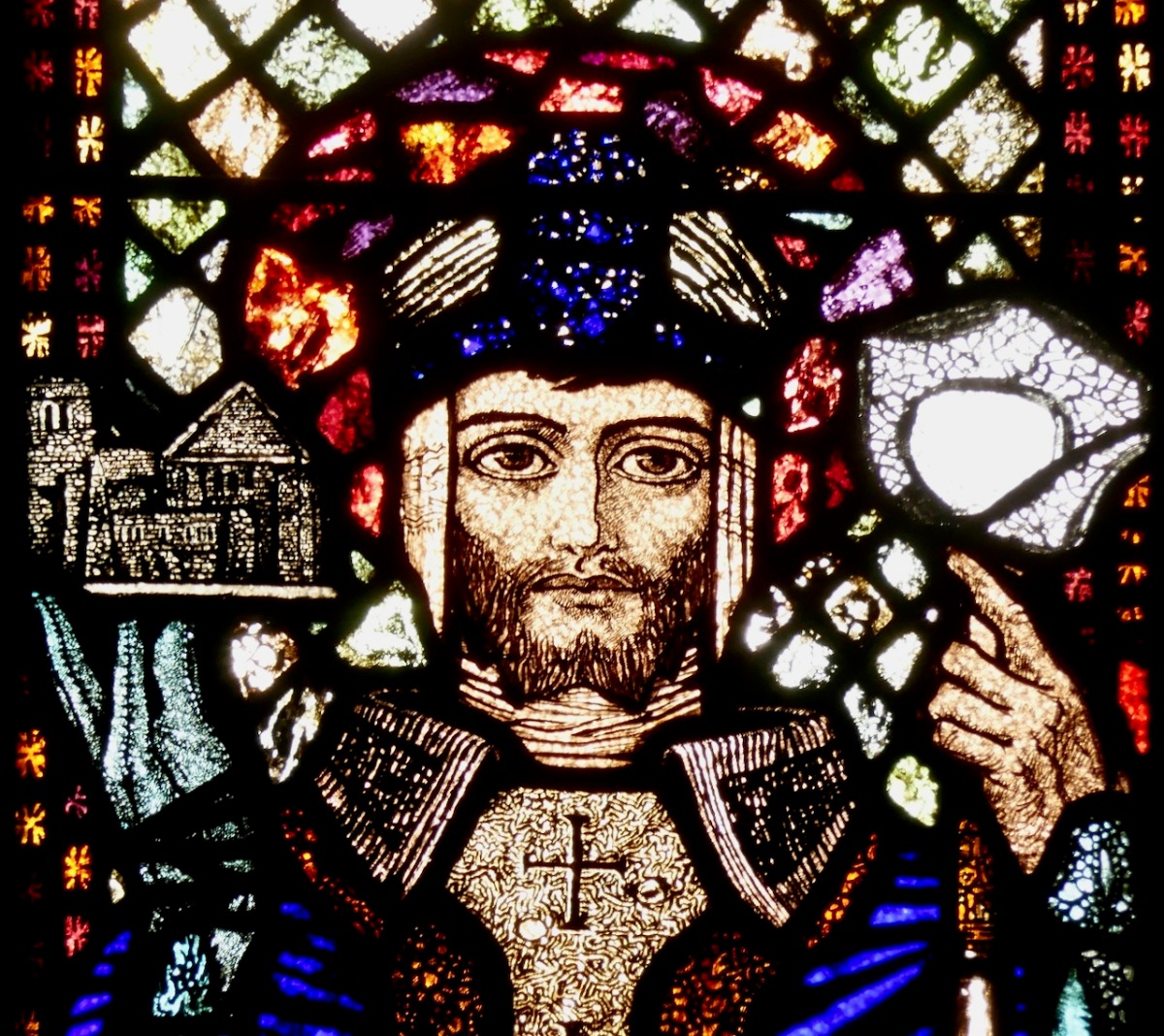
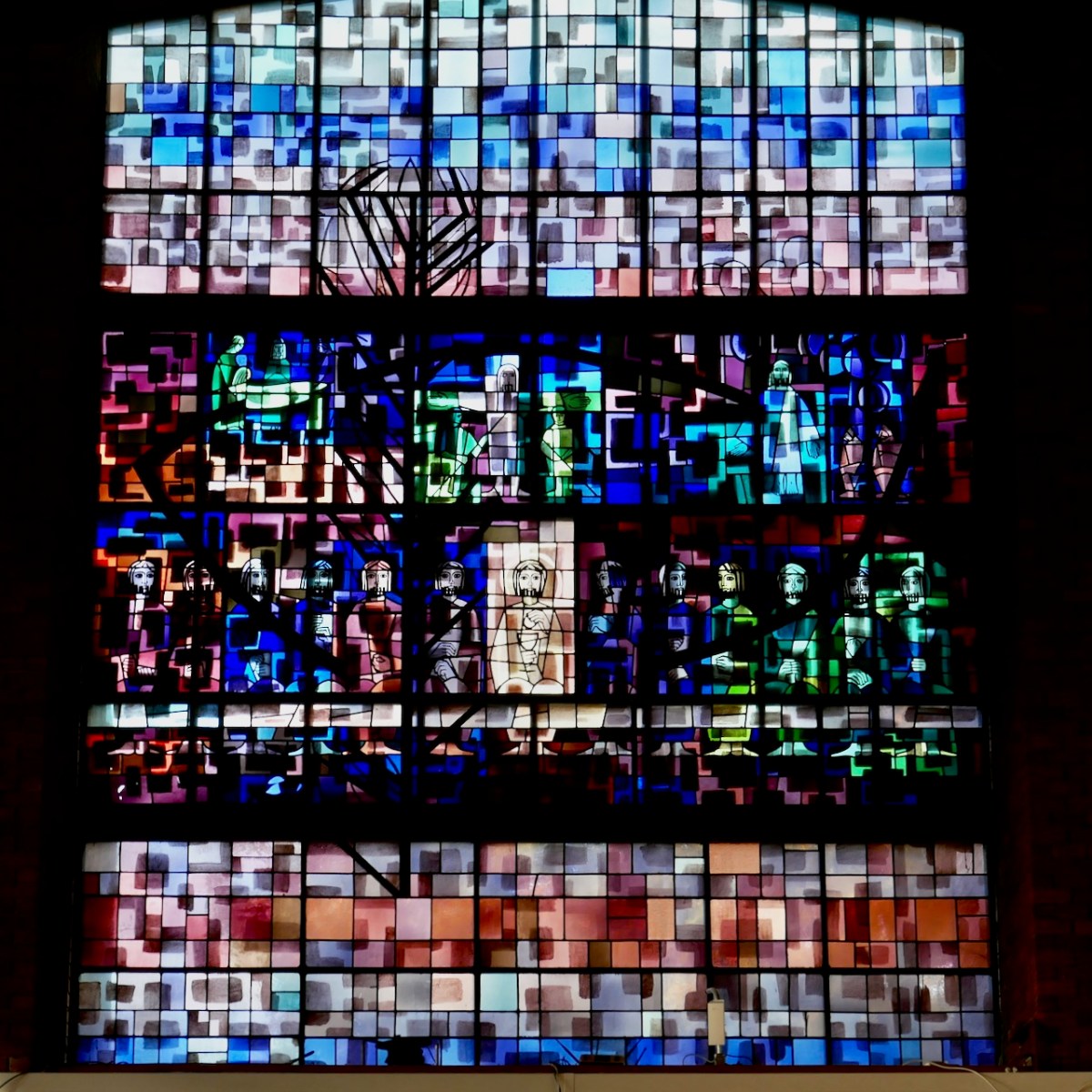
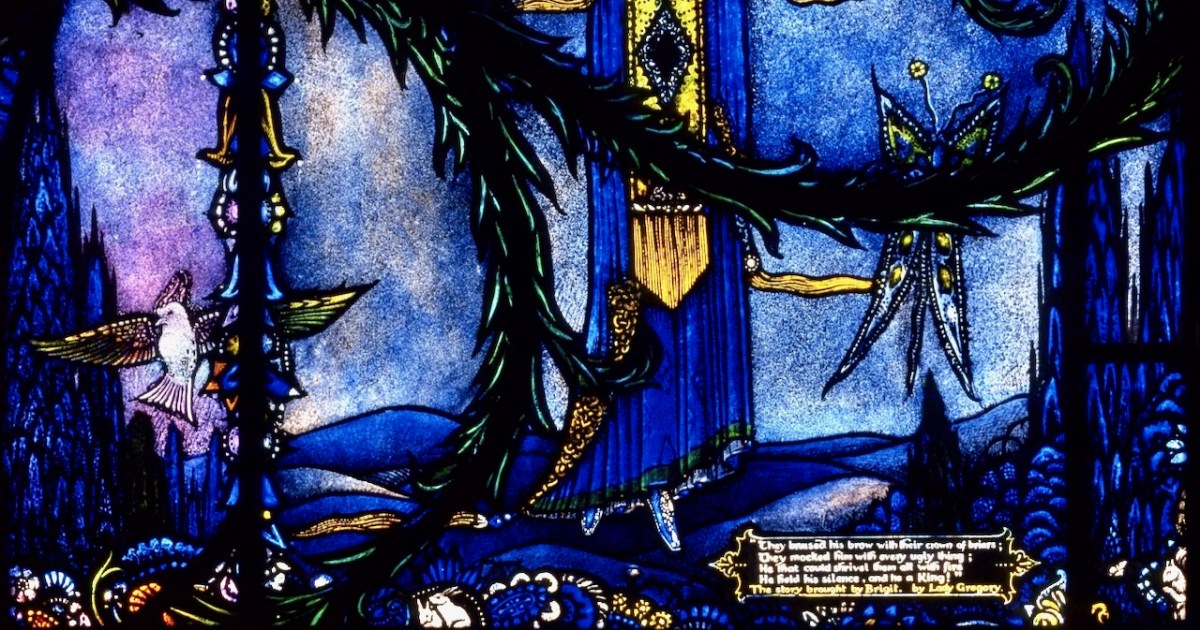
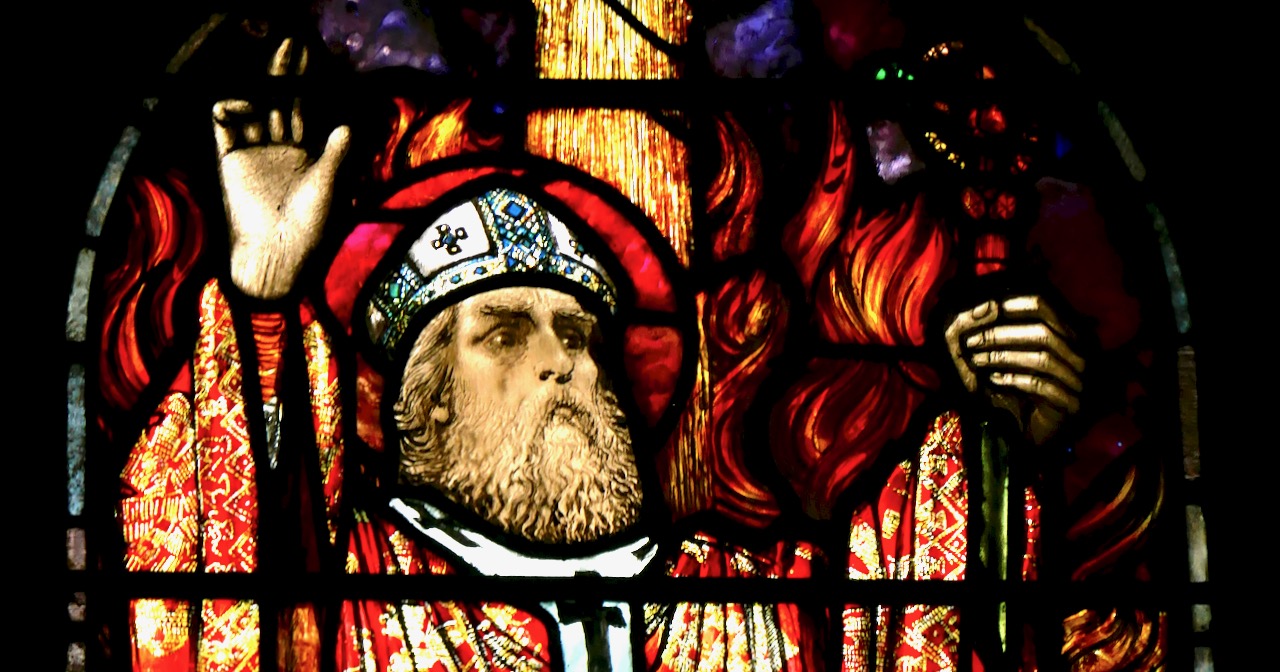
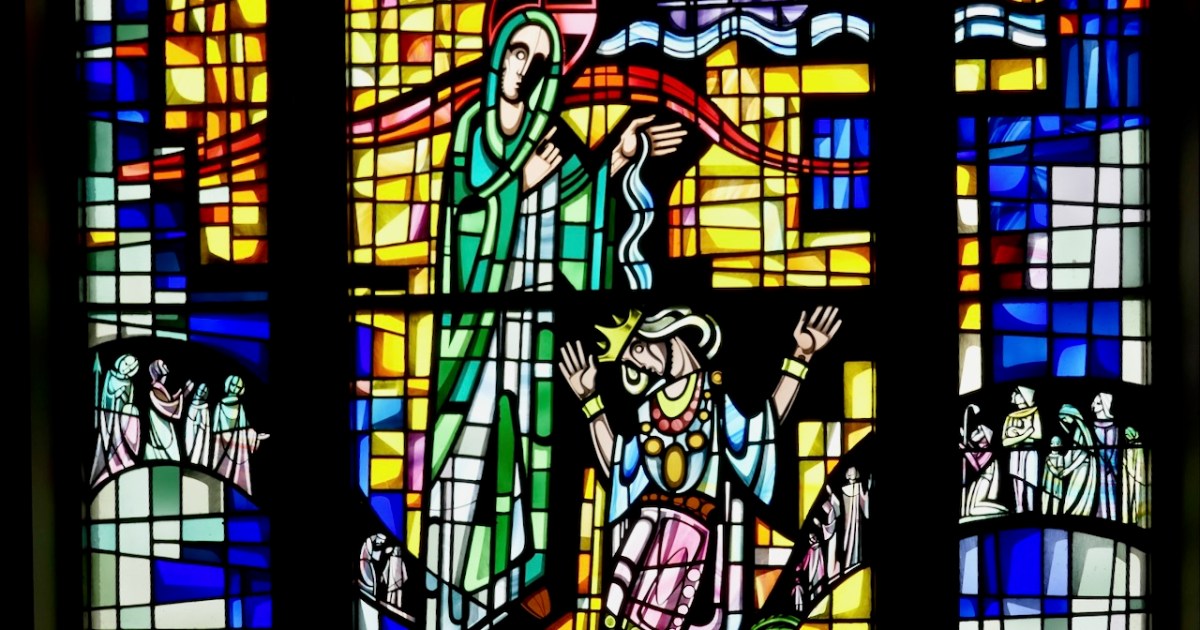
The book is laid out in sections: City, Dublin North and Dublin South (suburbs and county), encompassing thirty-nine locations. They are not all churches – Bewley’s on Grafton Street is included for its Harry Clarke windows (above, and above that), as well as the National Gallery with its excellent stained glass room, the Hugh Lane Gallery, home of Clarke’s Eve of St Agnes, and St Patrick’s Campus of Dublin City University, with its floor to ceiling expanse of dalle de verre by Gabriel Loire. This is a good example of a non-Irish artist included in the book. Gabriel Loire was French, and the internationally acknowledged master of the dalle de verre technique, in which slabs of glass, chipped round the edges to increase refraction, was embedded in concrete or resin, allowing for soaring walls of colour to be incorporated into the architectural scheme.

This little predella panel is at the base of The Blessed Julie window in Staunton’s Hotel on Stephen’s Green

But of course, mostly the stained glass is in churches. Catholic churches tend to be open much of the time, making them the easier option to visit. A little careful planning may be needed to visit non-Catholic churches. David gives the postal code for each location – very helpful as it works well with Google maps. Of necessity, schools, hospitals and other institutions had to be excluded since they are not publicly accessible most of the time.

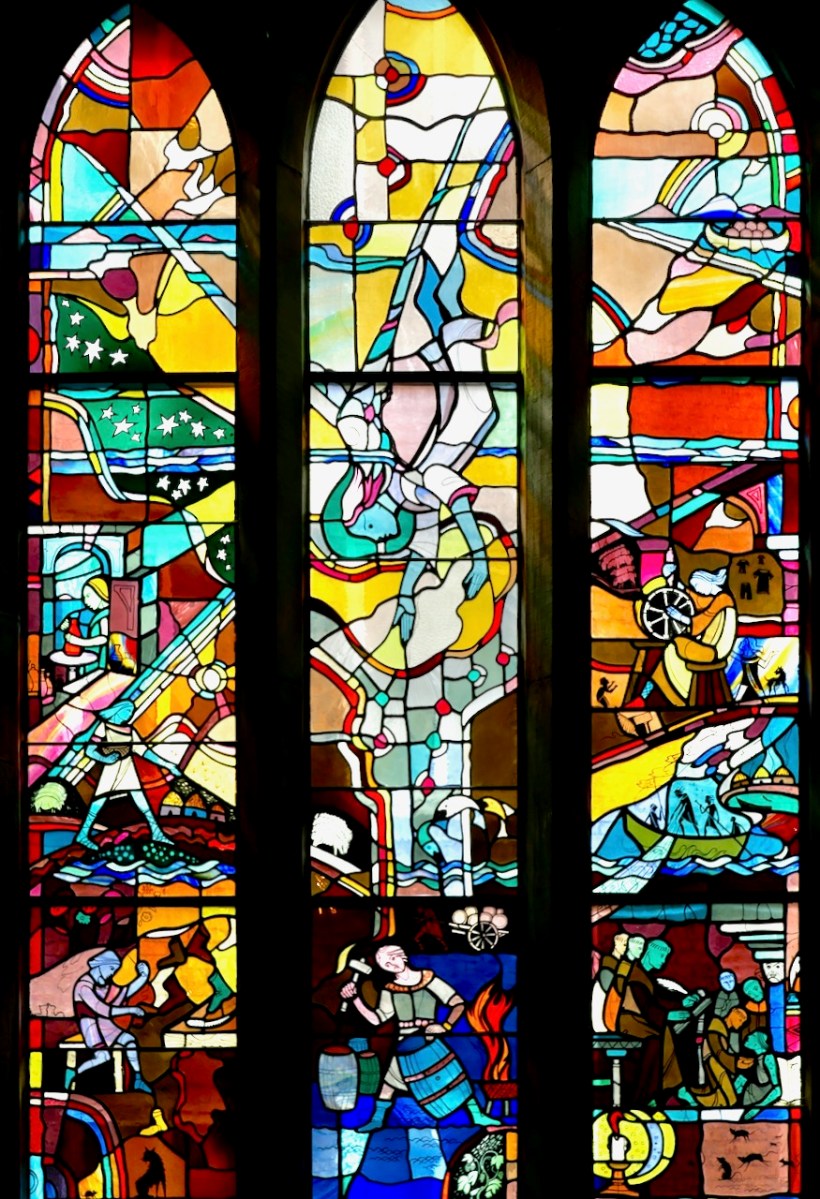
In the Dublinia exhibition this is George Walsh’s Trades window

In his introduction, David tells us:

During the 20th century Dublin’s reputation as a centre for stained glass excellence, both in terms of artistry and craftsmanship, was internationally lauded and is evidenced by the many orders placed by overseas patrons. Stained glass was the one area of the visual arts in 20th century Ireland that had an established school of the highest calibre, as distinct from singular talents such as Jack B Yeats and Eileen Gray. The highpoint for Irish 20th century stained-glass was the period from 1915 to 1980 and the leading figures were Harry Clarke, Wilhelmina Geddes, Michael Healy, Evie Hone and Richard King all of whom trained in Dublin, worked out of Dublin studios and so it is not surprising that the city has a concentration of first rate stained glass by them and many others.

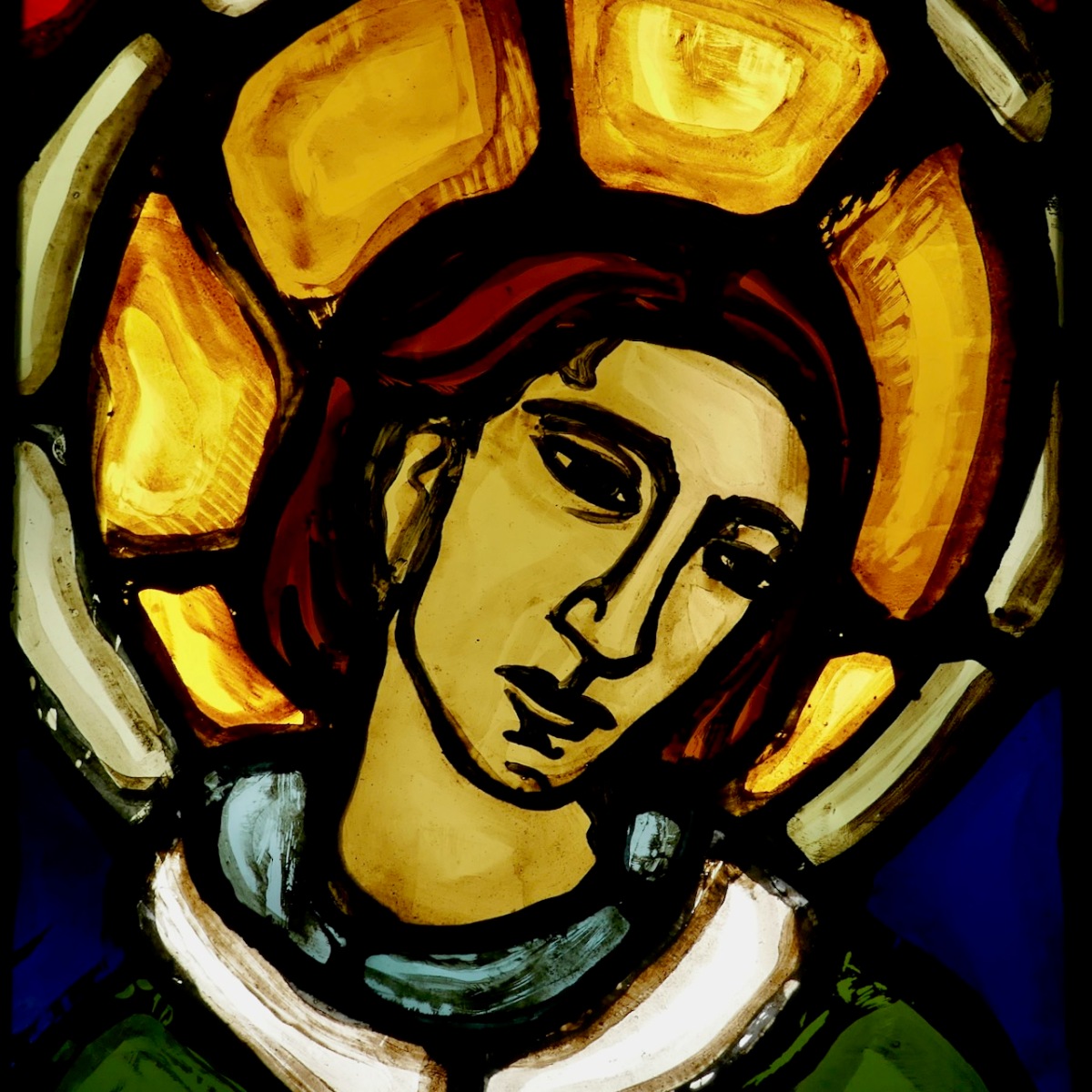
Evie Hone’s Head of St John at the National Gallery

I would add that stained glass was an area where both Irish men and Irish women could excel. Many of our finest stained glass artists were women and there has never been any tendency, as with other areas of artistic endeavour, to privilege the reputation of men over women. 

Ballyroan Church of the Holy Spirit, with Murphy-Devitt’s stations laid out in narrative progression. This church also has paintings by Sean Keating

David starts with the architecture of each church, identifying the architect or firm, and describing its main features and influences as well as dates of construction and/or modification. As he says, if one were to visit all or many of the locations in the book, one would get a comprehensive overview of the story of twentieth-century Irish stained glass. 

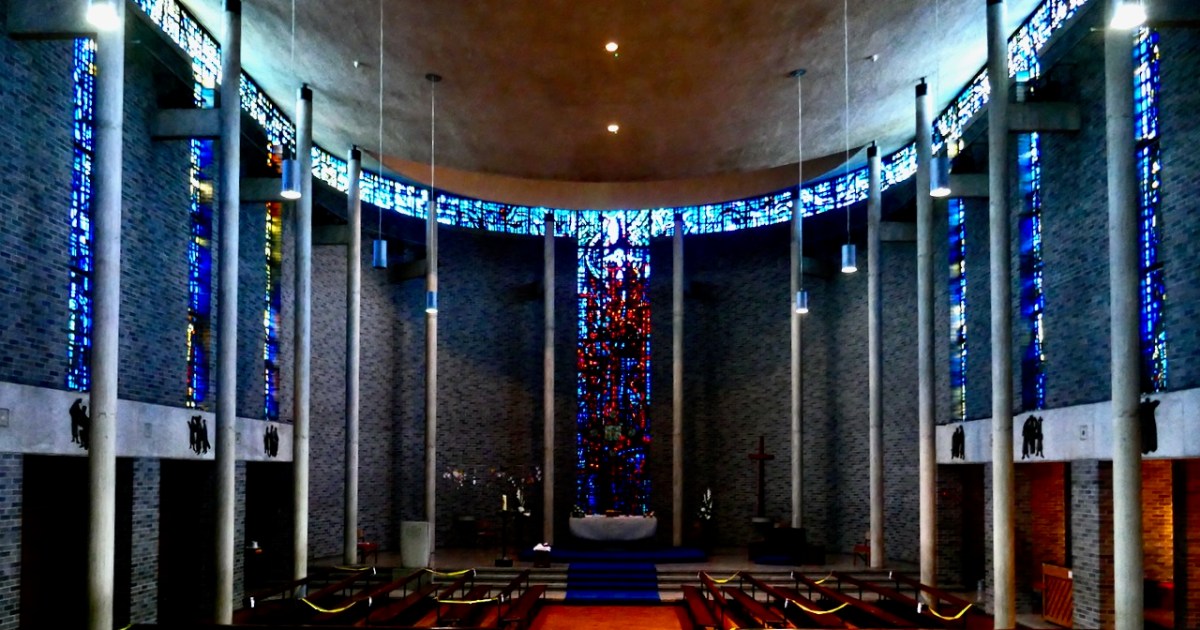
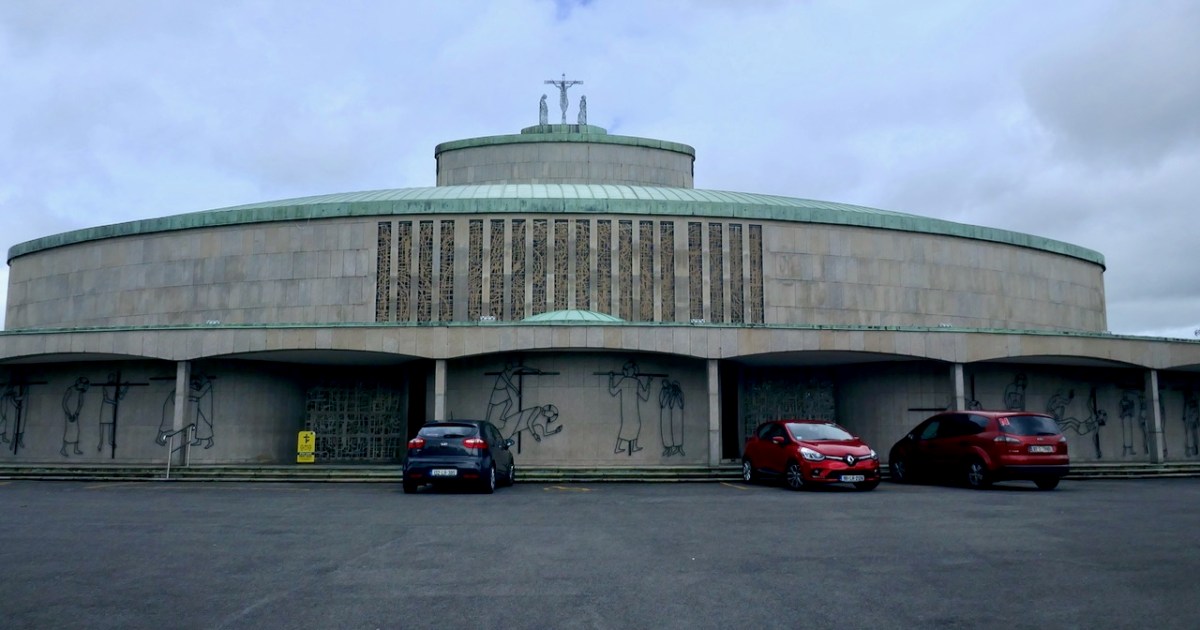
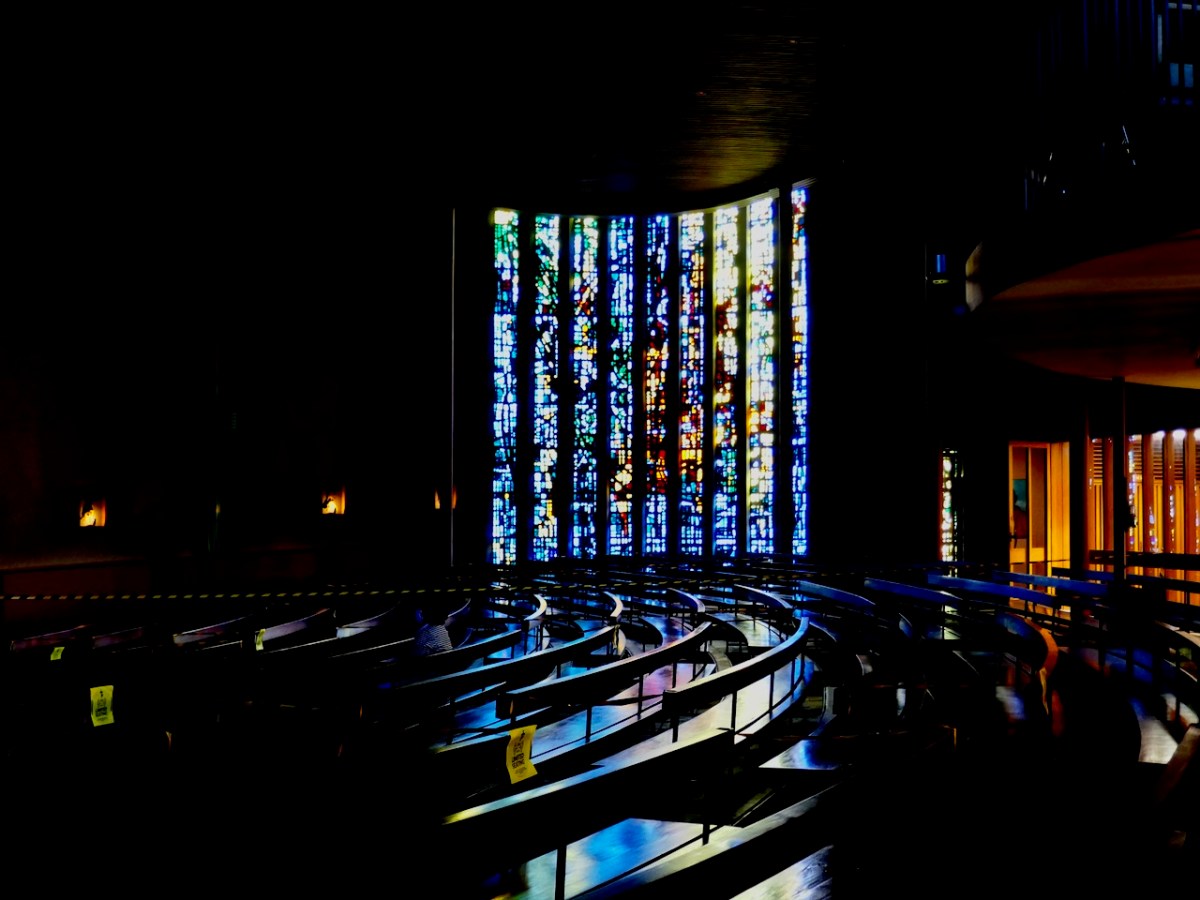
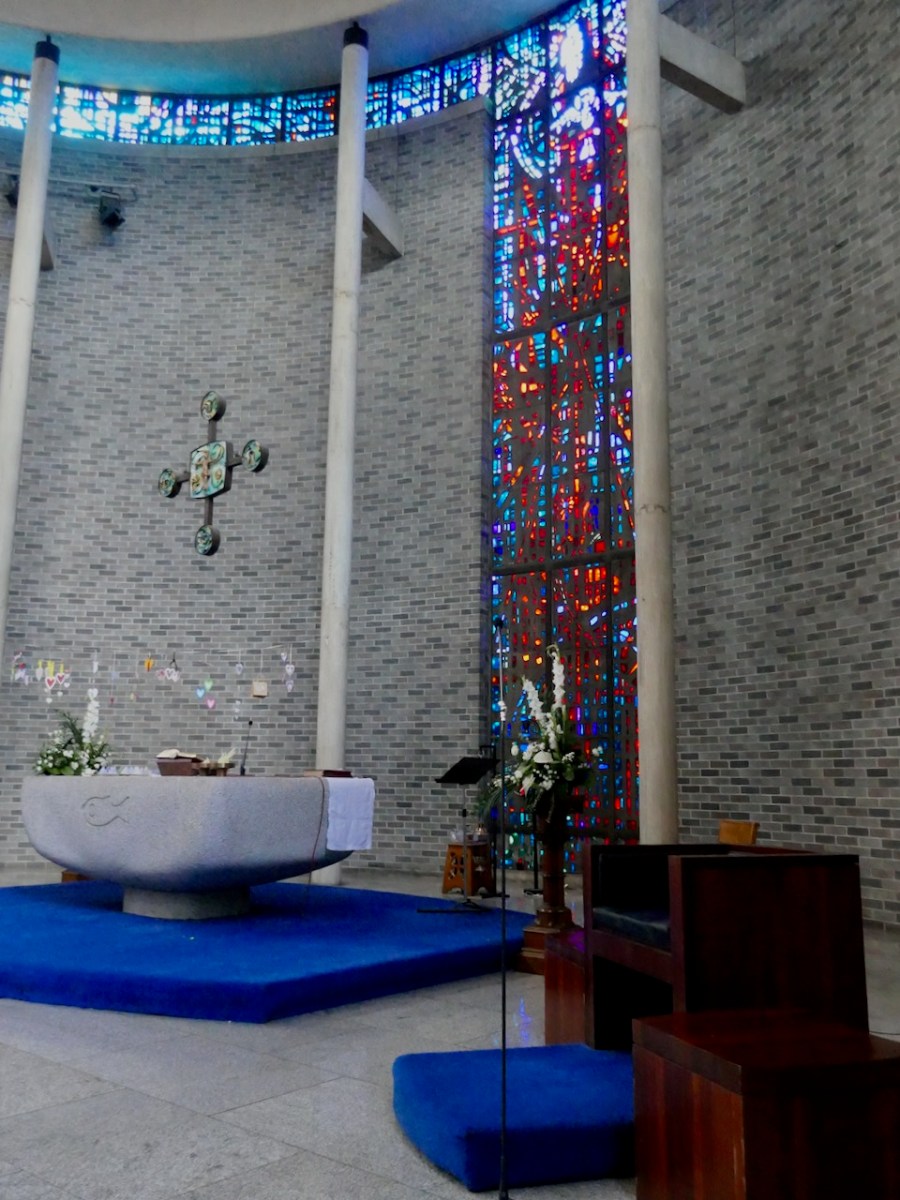
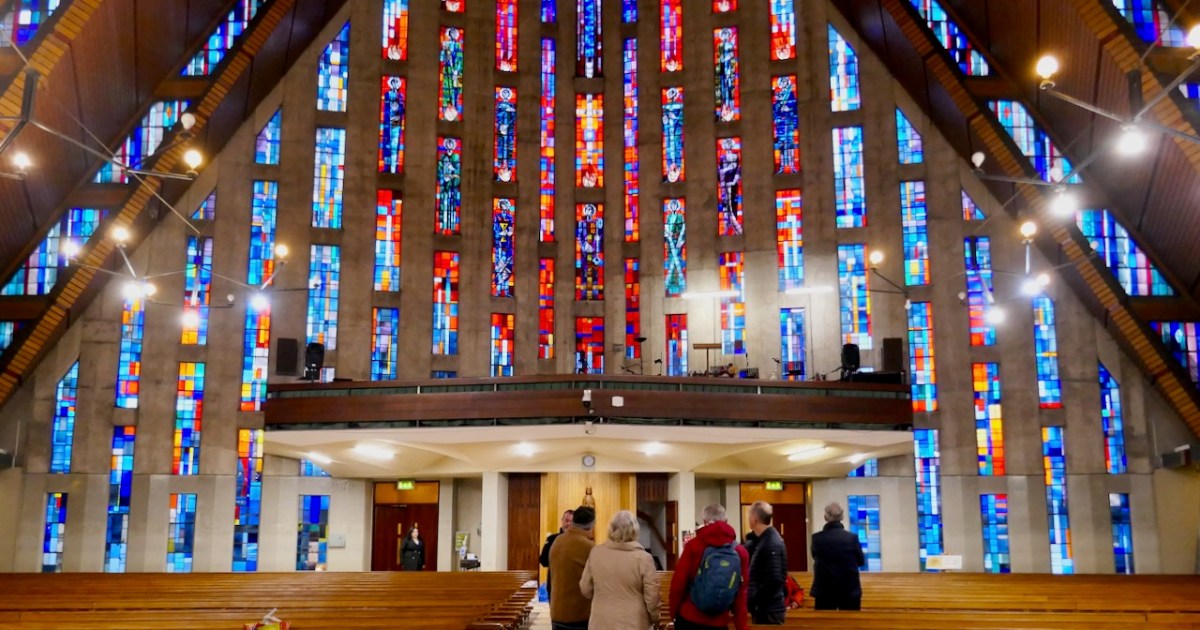
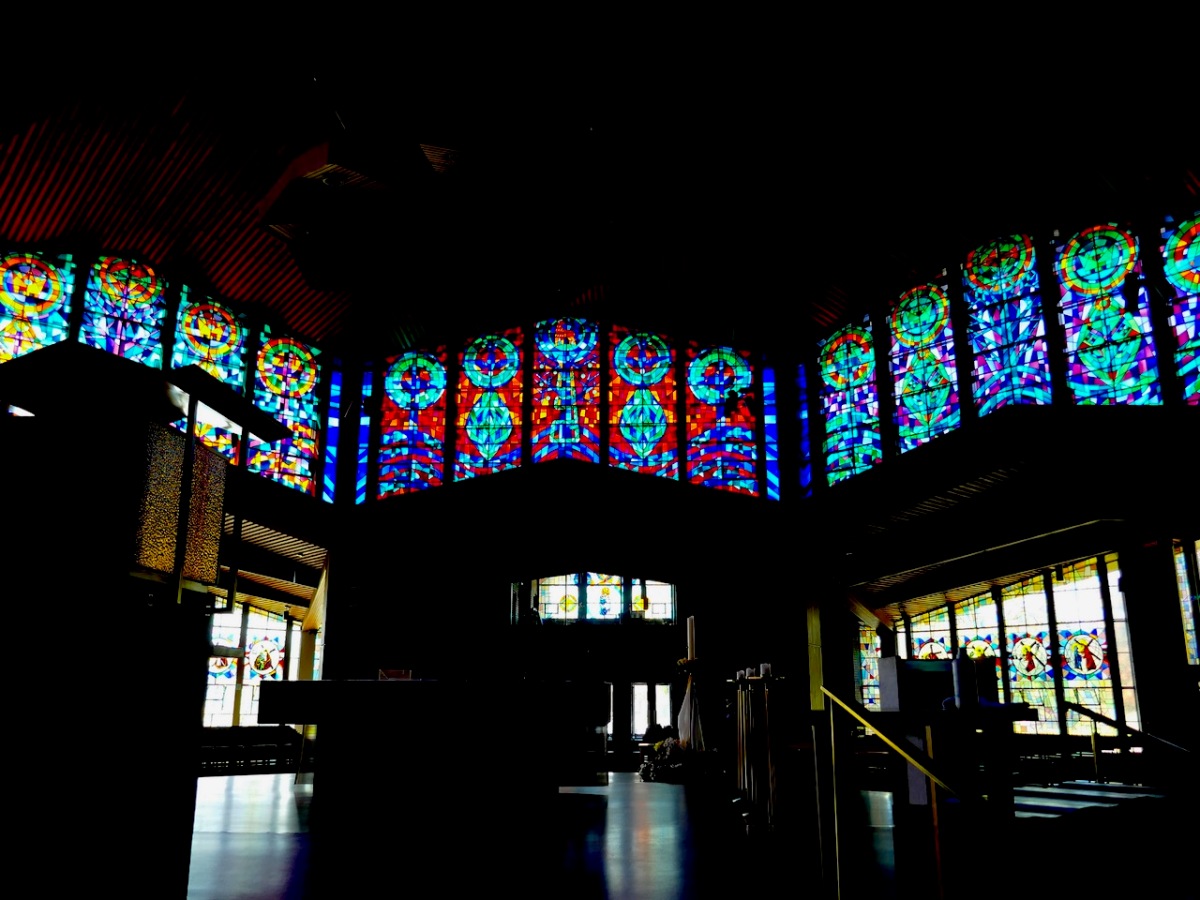
Let’s take one example – the church in Ballymun, Our Lady of Victories, one of the first batch of six churches in the Dublin Diocese that were built in the five years immediately after Vatican II, and which take into account the Guidelines of the council. Stepping into this church, as I did for the first time in May this year, is an immersive experience. First of all, it’s enormous – a reminder that in the 60s we were building Catholic churches which could accommodate thousands of congregants over the course of several masses every Sunday. 

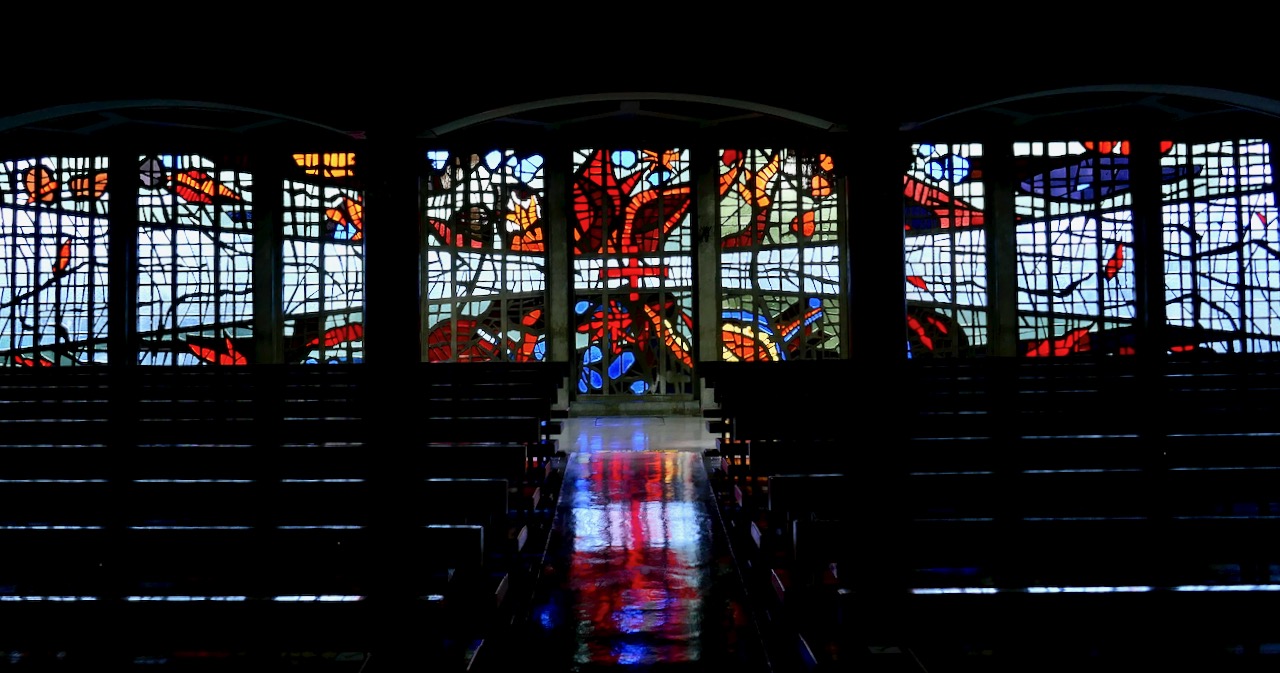
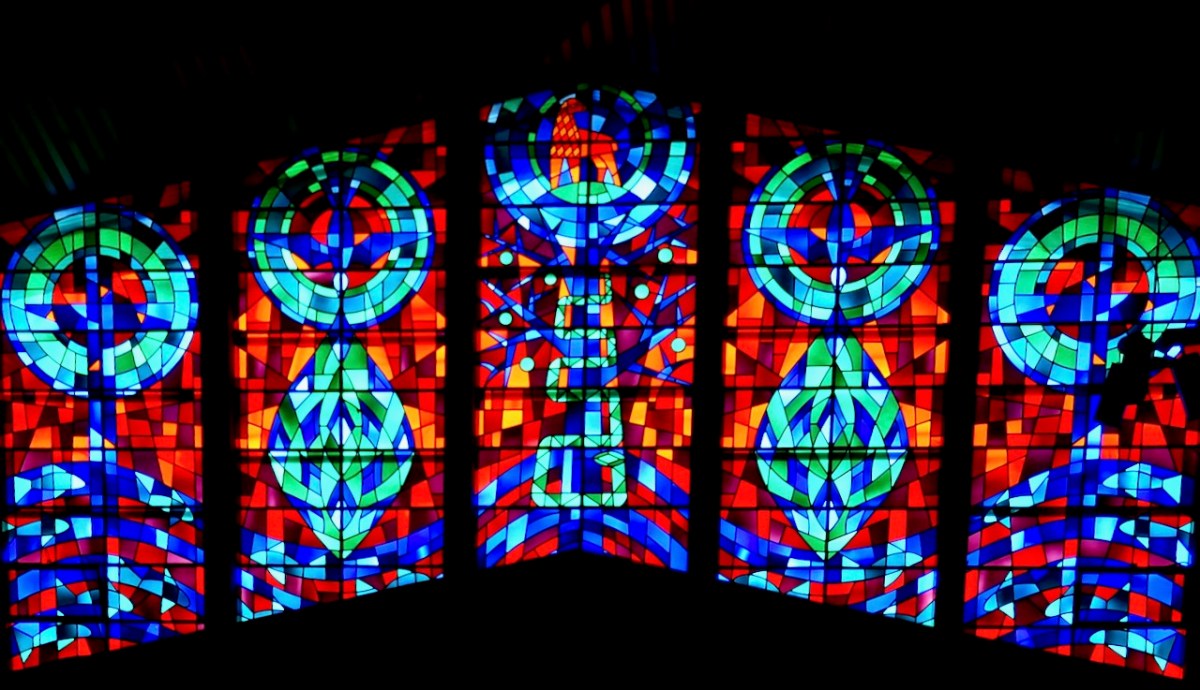
Secondly, you are immediately aware of being bathed in light and colour. There is a ‘lantern’ surrounding the central altar and this is the work of Helen Moloney. Here is David’s description:

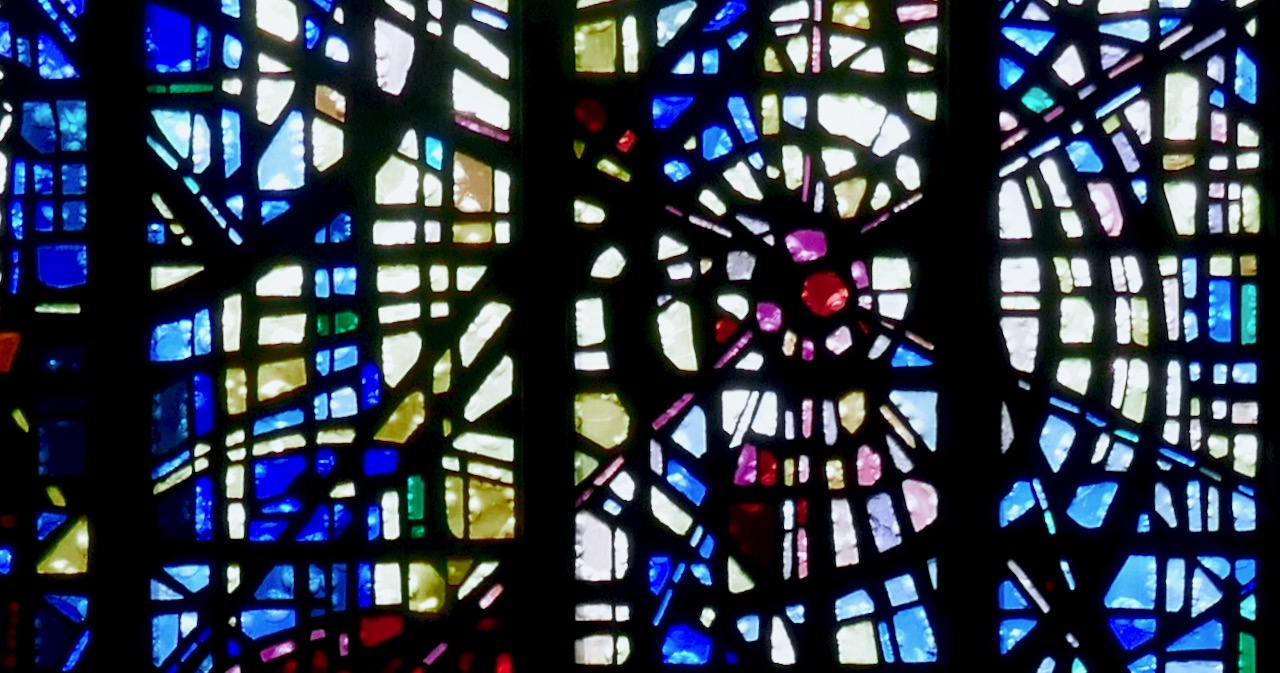
Although it comprises eight sides or ‘windows’ (each composed of five panels), Helen Moloney created just two different designs for the windows; from these she made four different colour versions and these were duplicated to create the eight different windows. Despite the fact that there are essentially just two designs and she chose a deliberately restricted colour palette, this repetition is hardly apparent and instead one experiences an almost overwhelming sense of intensely zinging complimentary colours enlivened by punchy graphic symbols. Moloney used only the best of mouth blown glass in a selection of rich colours including red, blue, yellow, purple, violet, orange, green, and aquamarine, and although she has included different shades of these, mostly they are full strength from maximum visual impact.

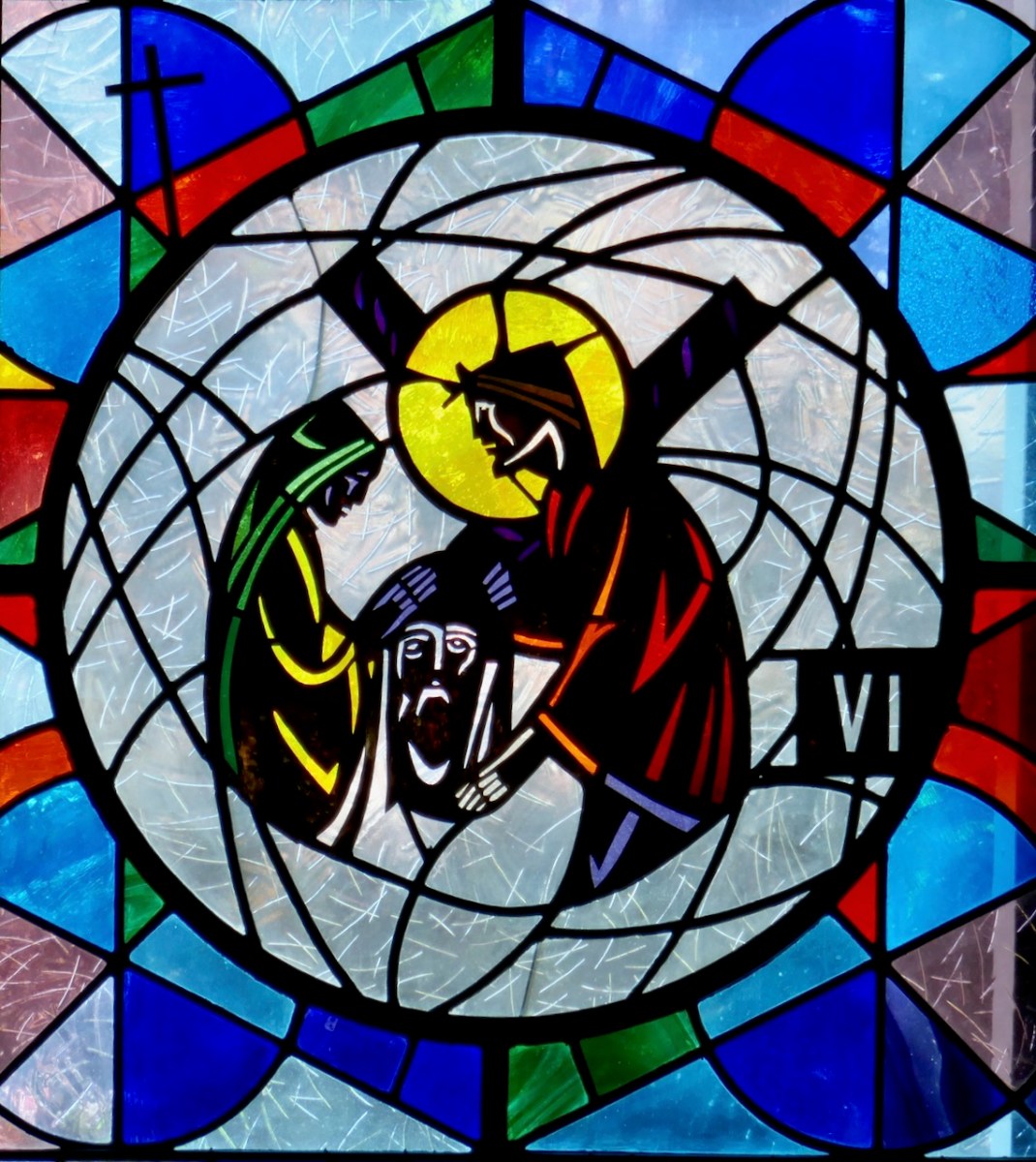
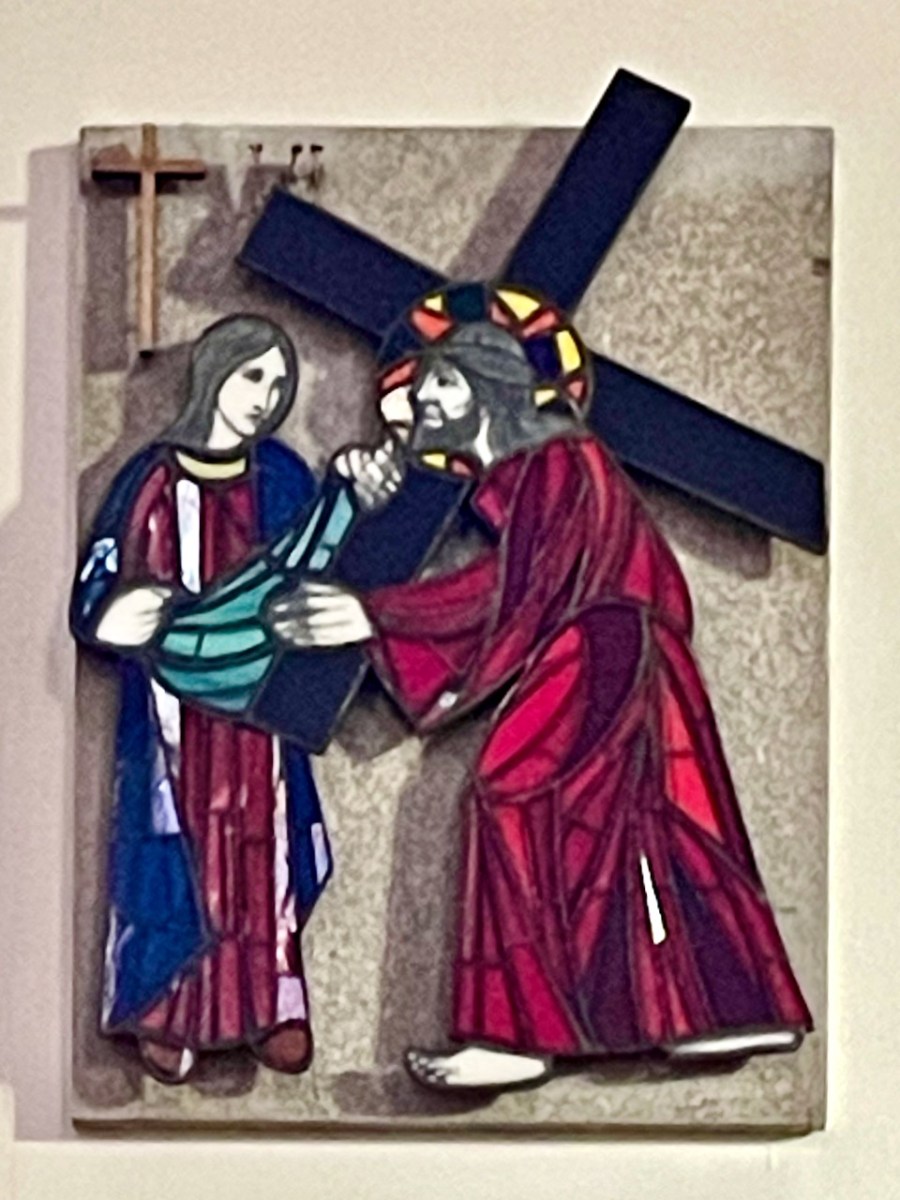
The second artist with work in Our Lady of Victories is my own favourite, George Walsh, at this time still working at Abbey Studios. The stations are by him, in an innovative technique using copper sheets, with details cut into them in the manner of a stencil (above). David comments, The effect is graphic and reduces the Stations to their essence. David points out that a rare feature of these Stations is the inclusion of a fifteenth station, the Resurrection. Walsh also has a St Joseph, a St Patrick and a Madonna and Child in the church.

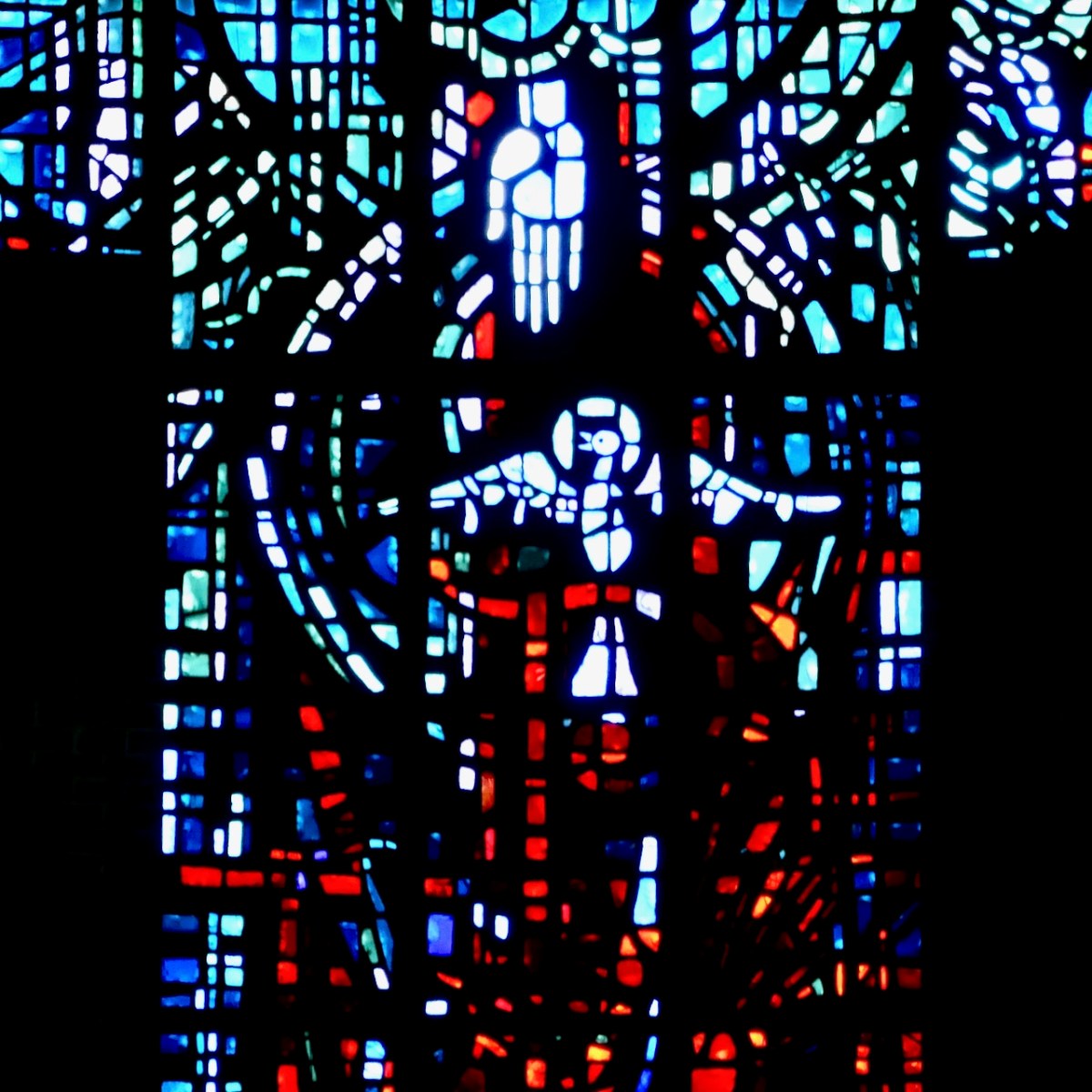
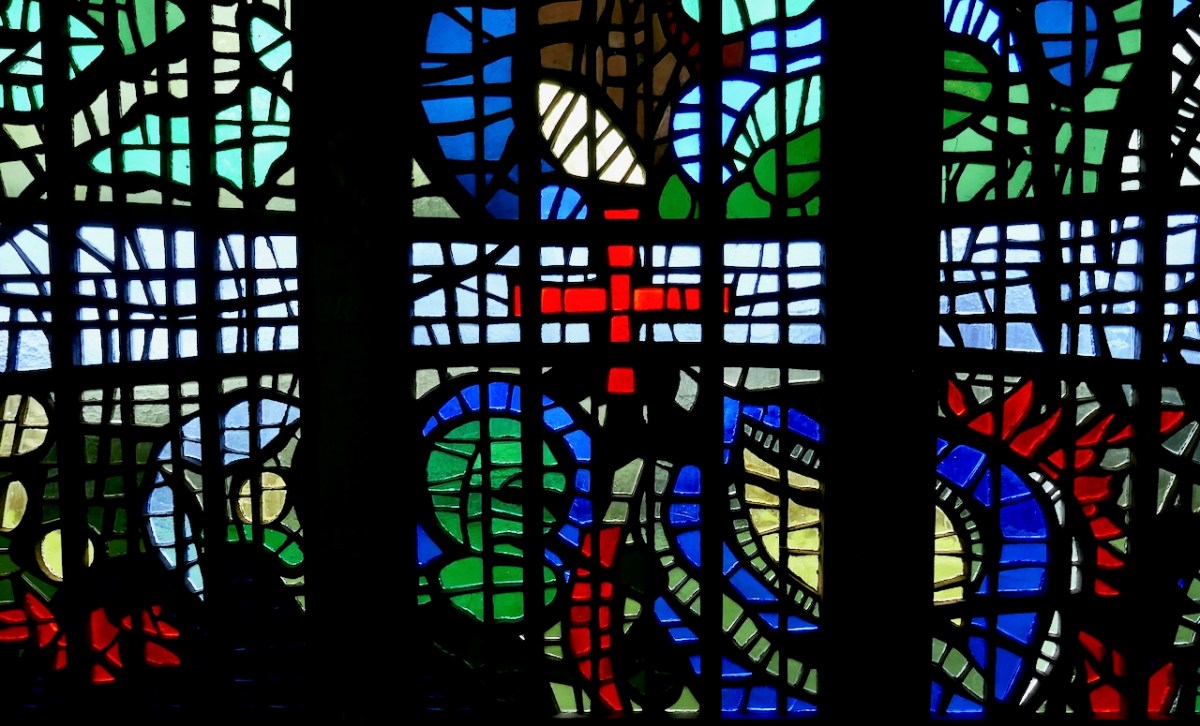
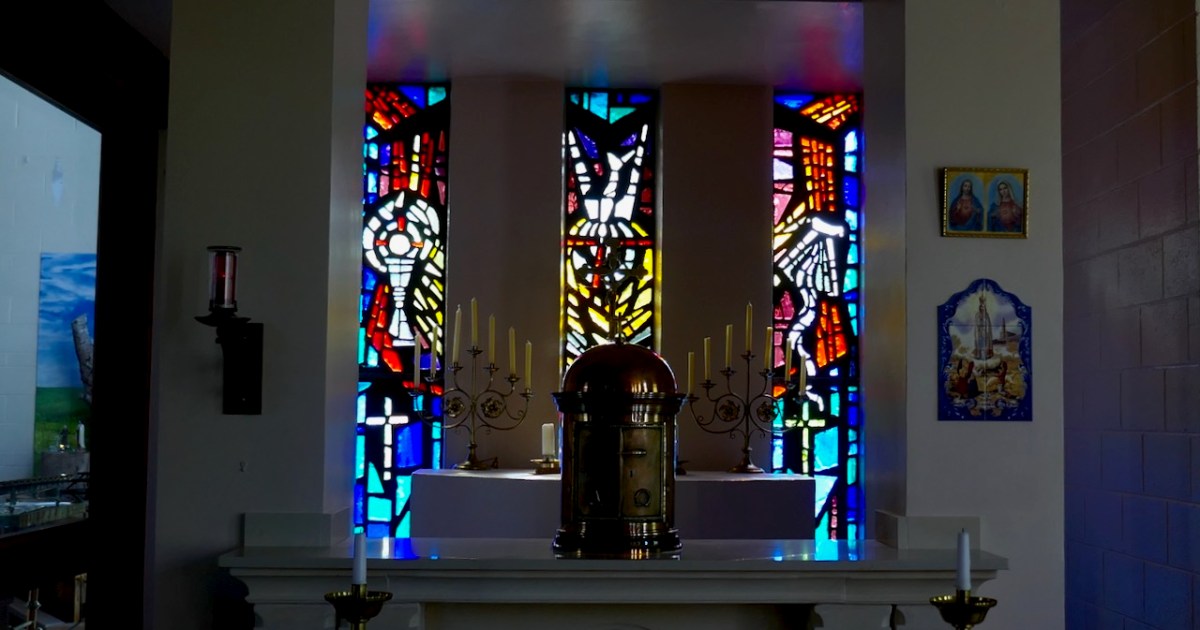
Finally, Sheila Corcoran created a series of symbolic windows at ground level (above), representing the Evangelists and other sacred subjects. Neither Moloney nor Corcoran included any painting, relying solely on glass of different colours and shapes to create their images – an unusual choice for the time and very effective in this context.

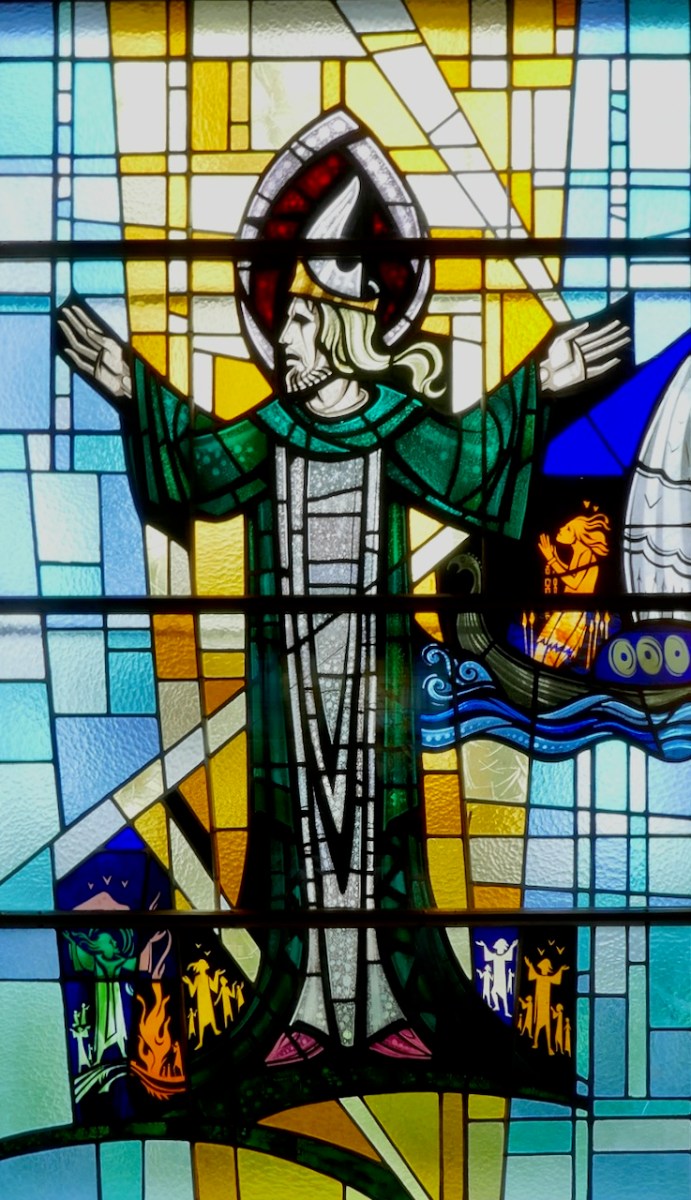
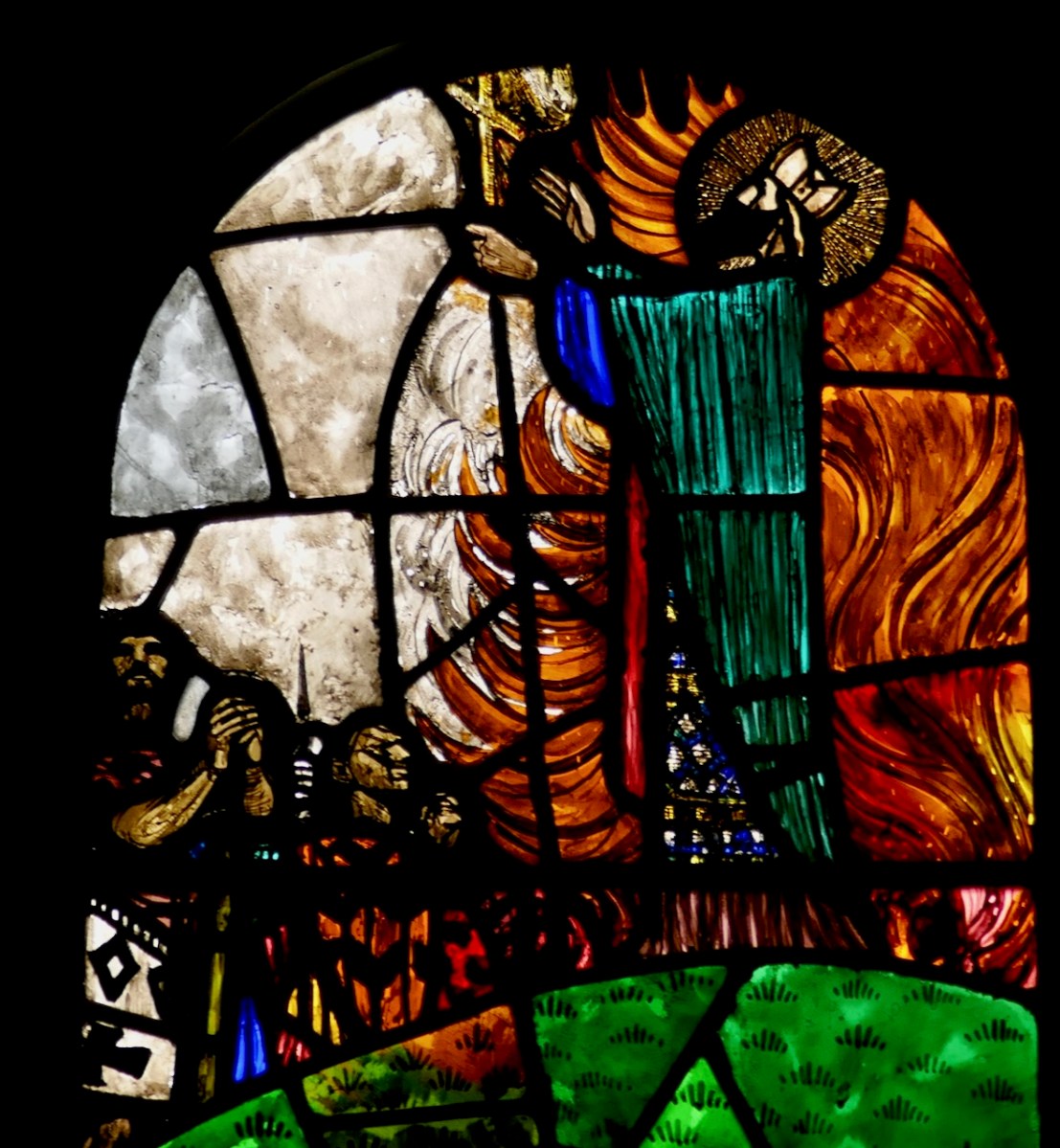
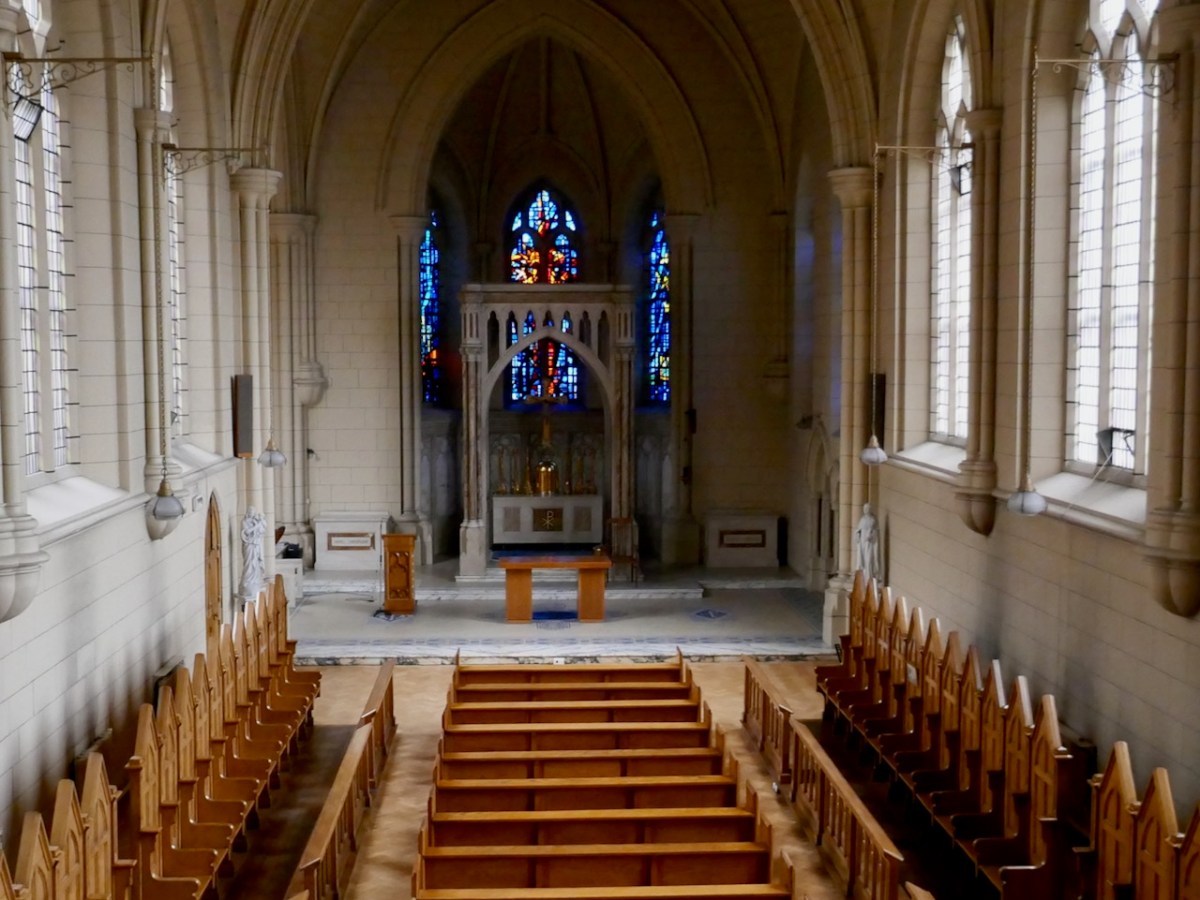
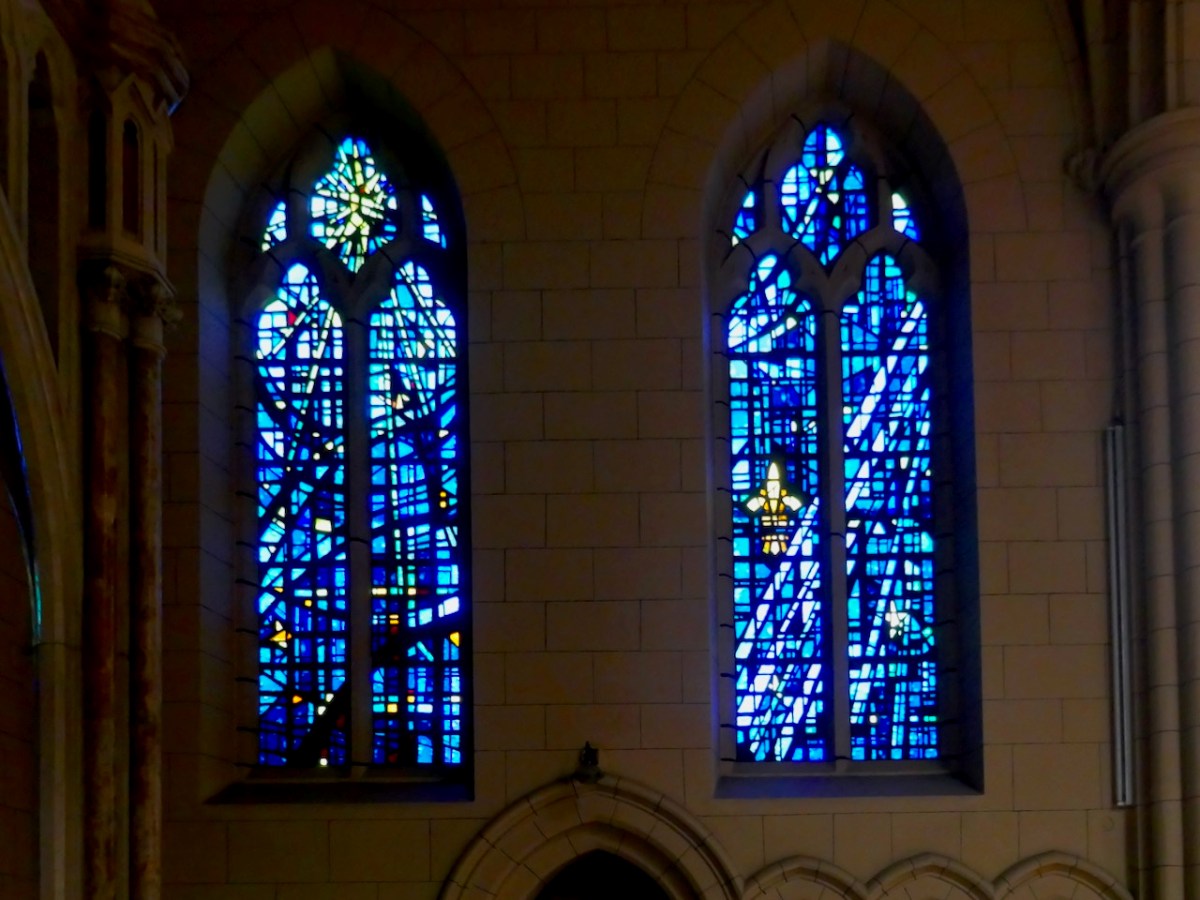
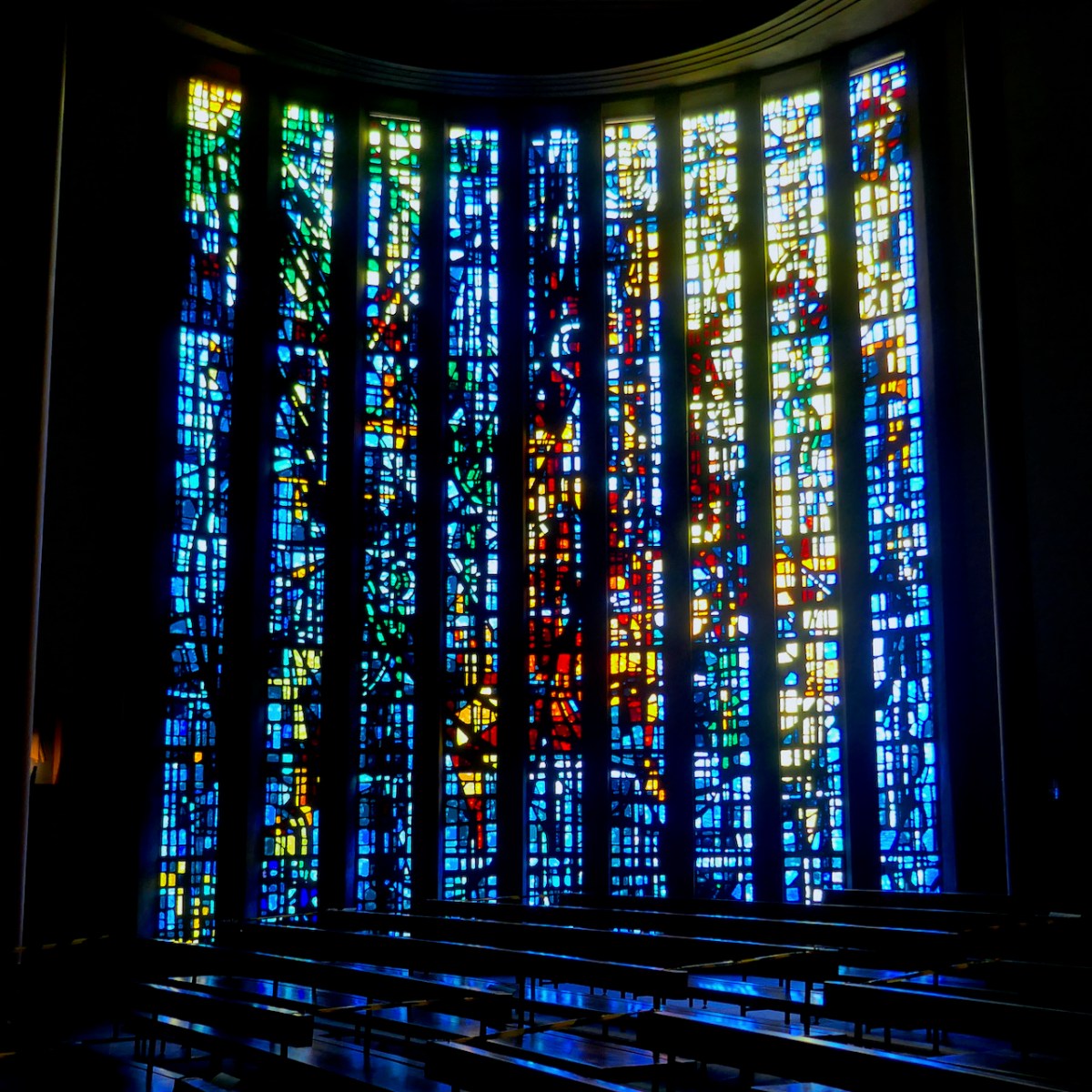
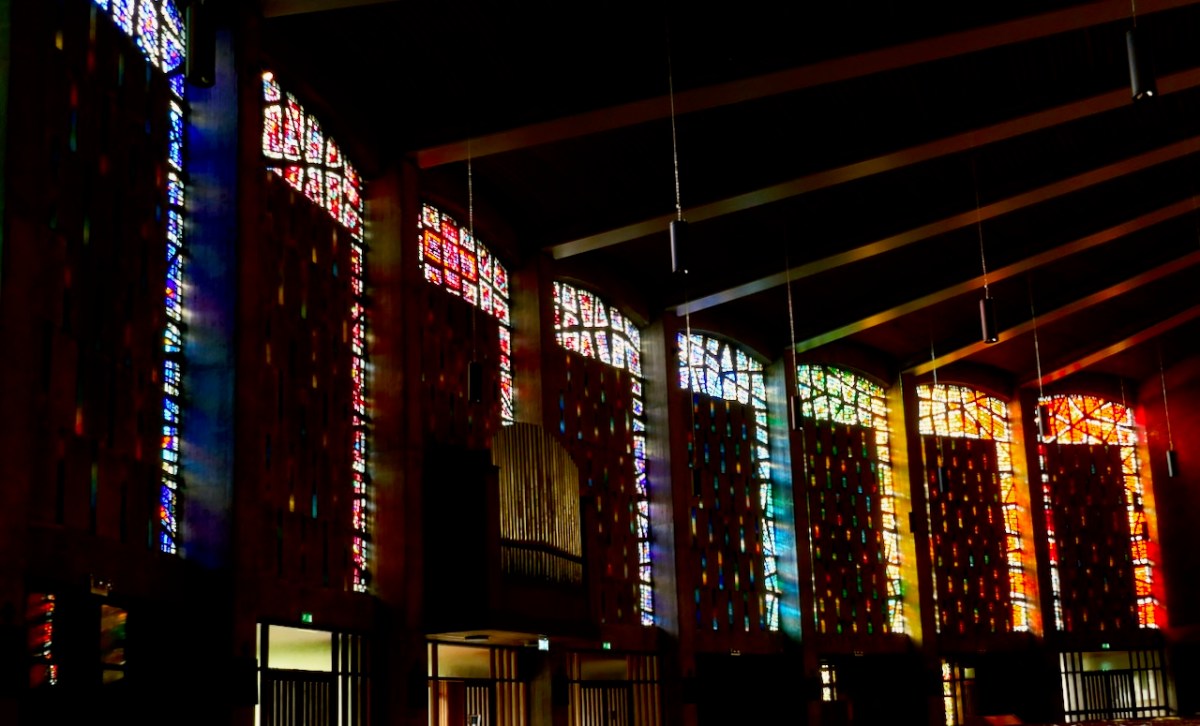
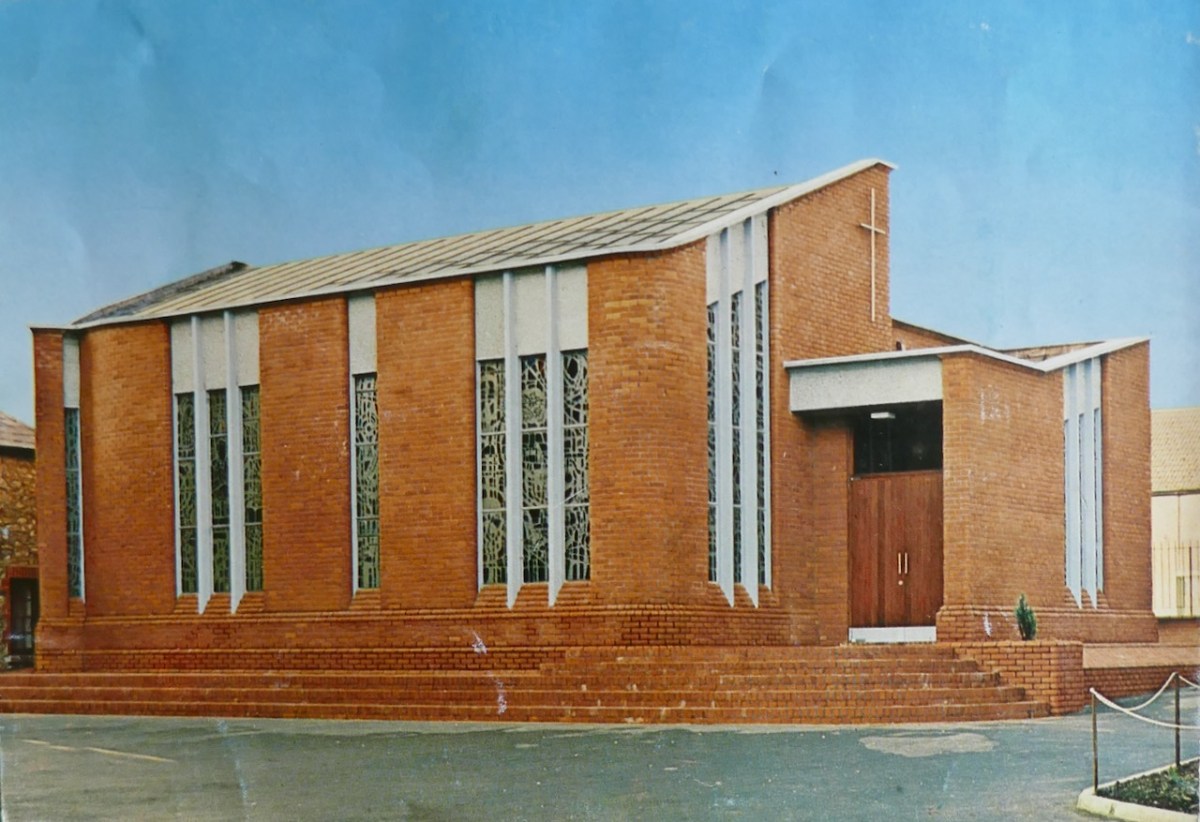
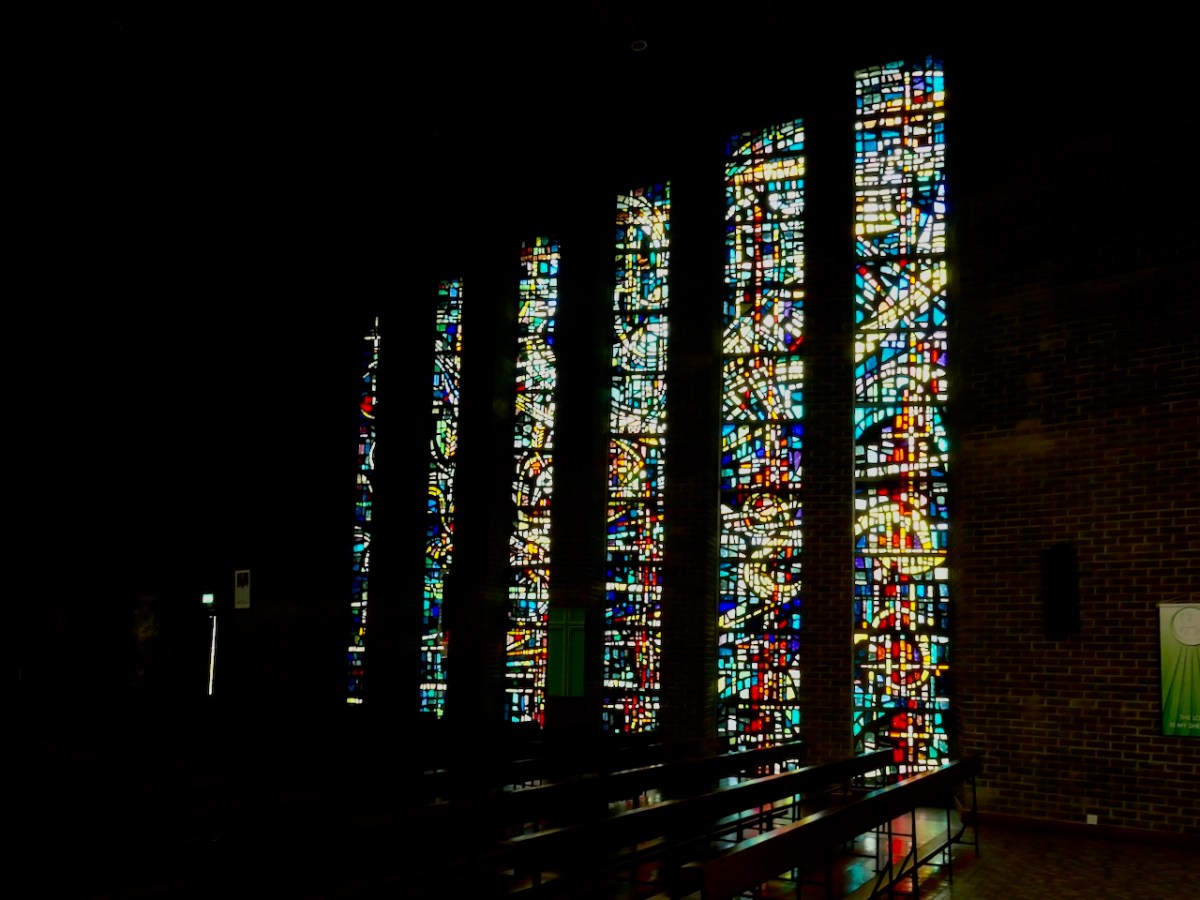
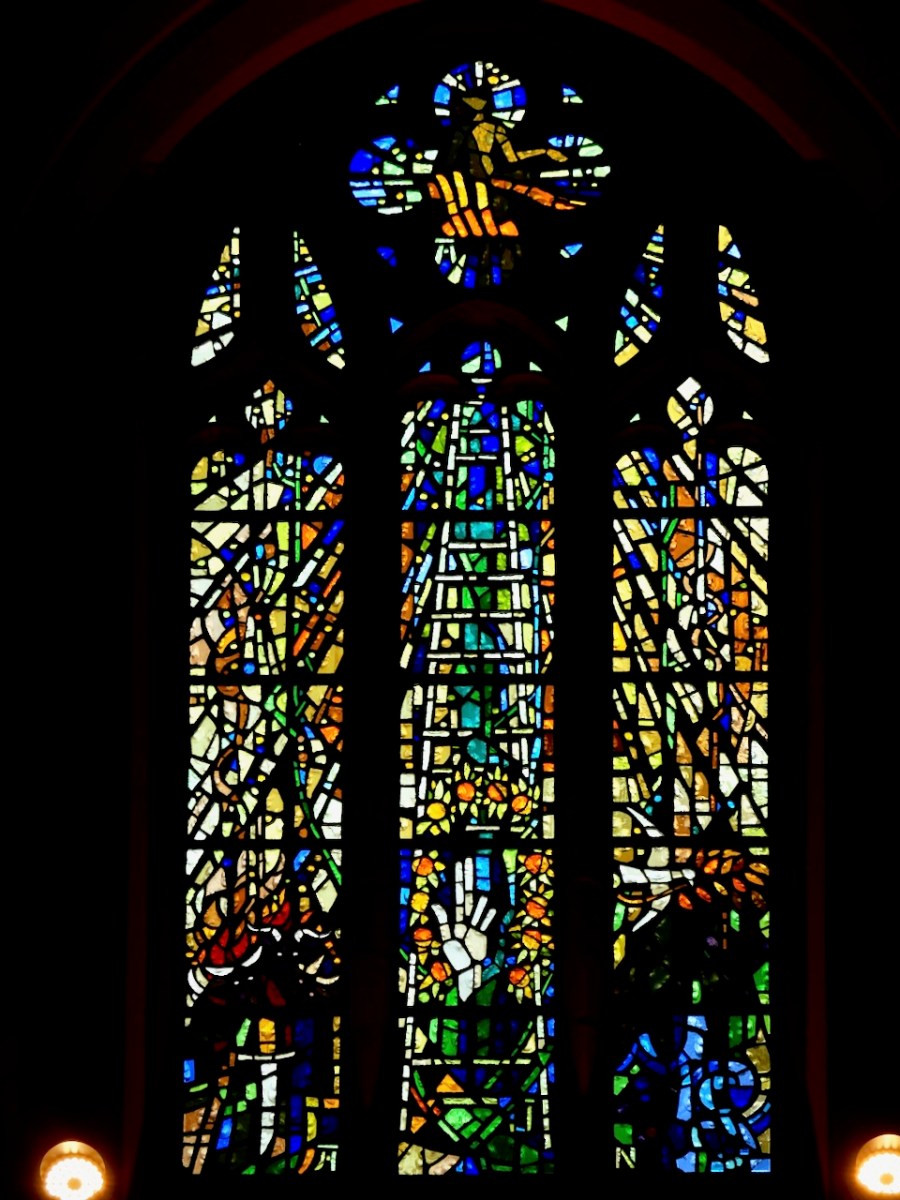
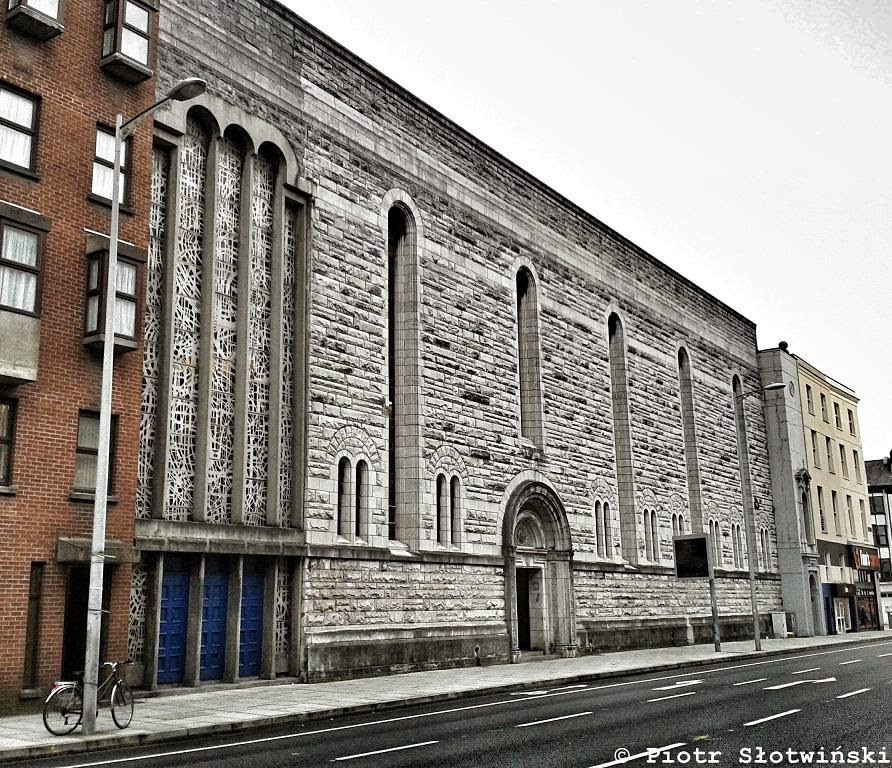
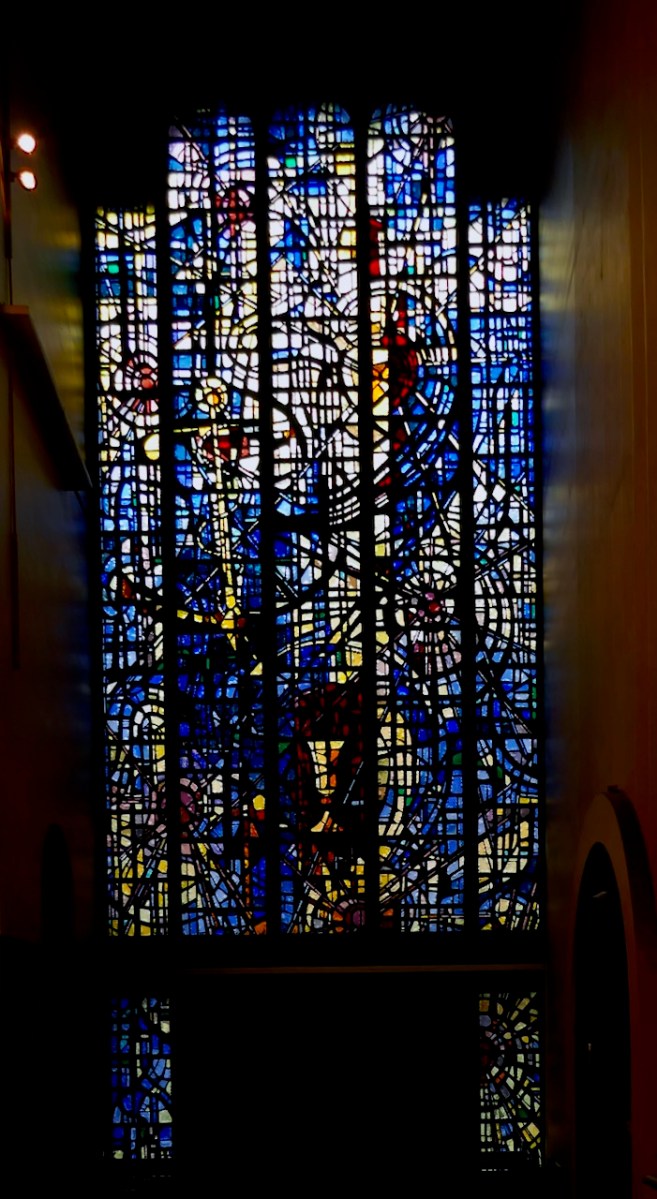
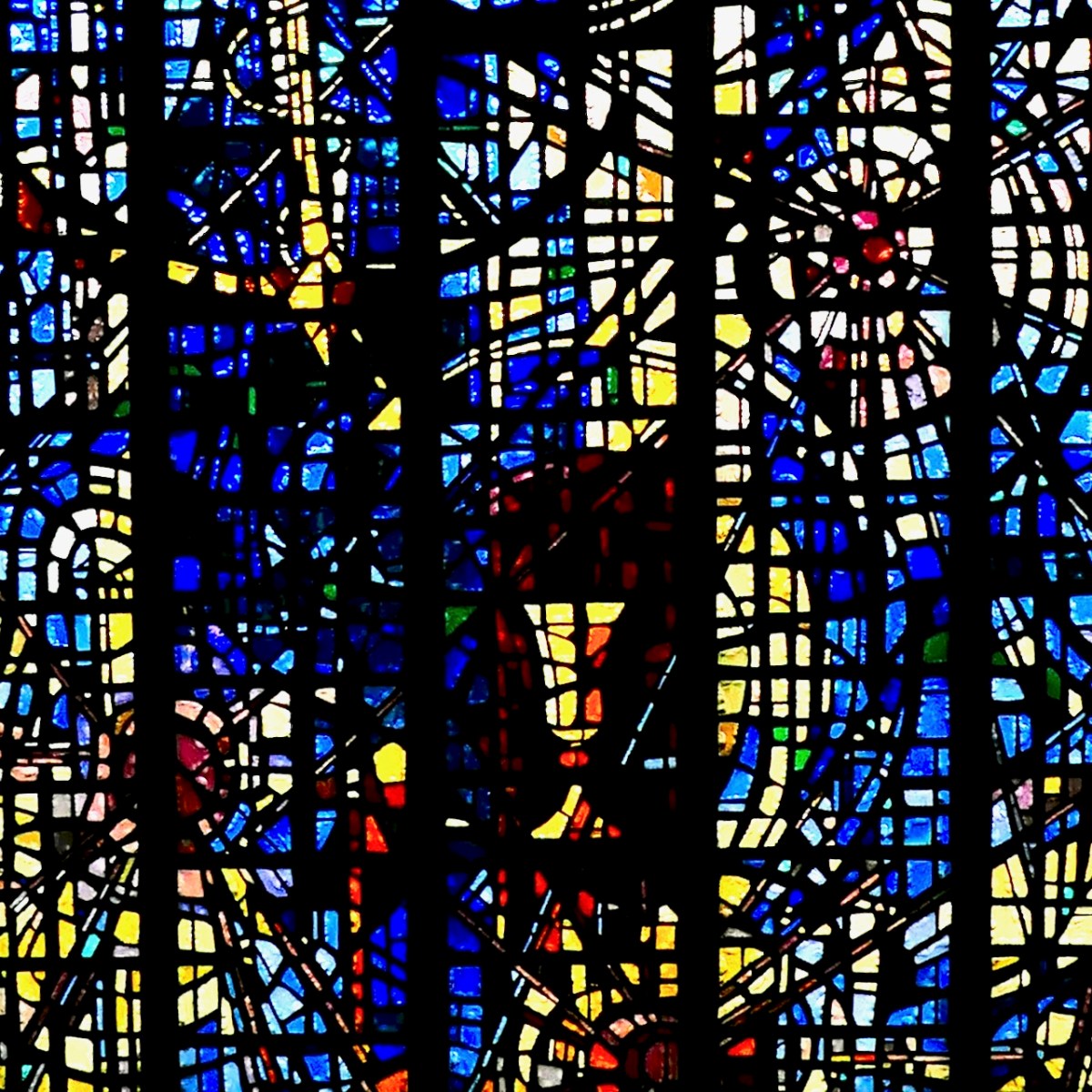
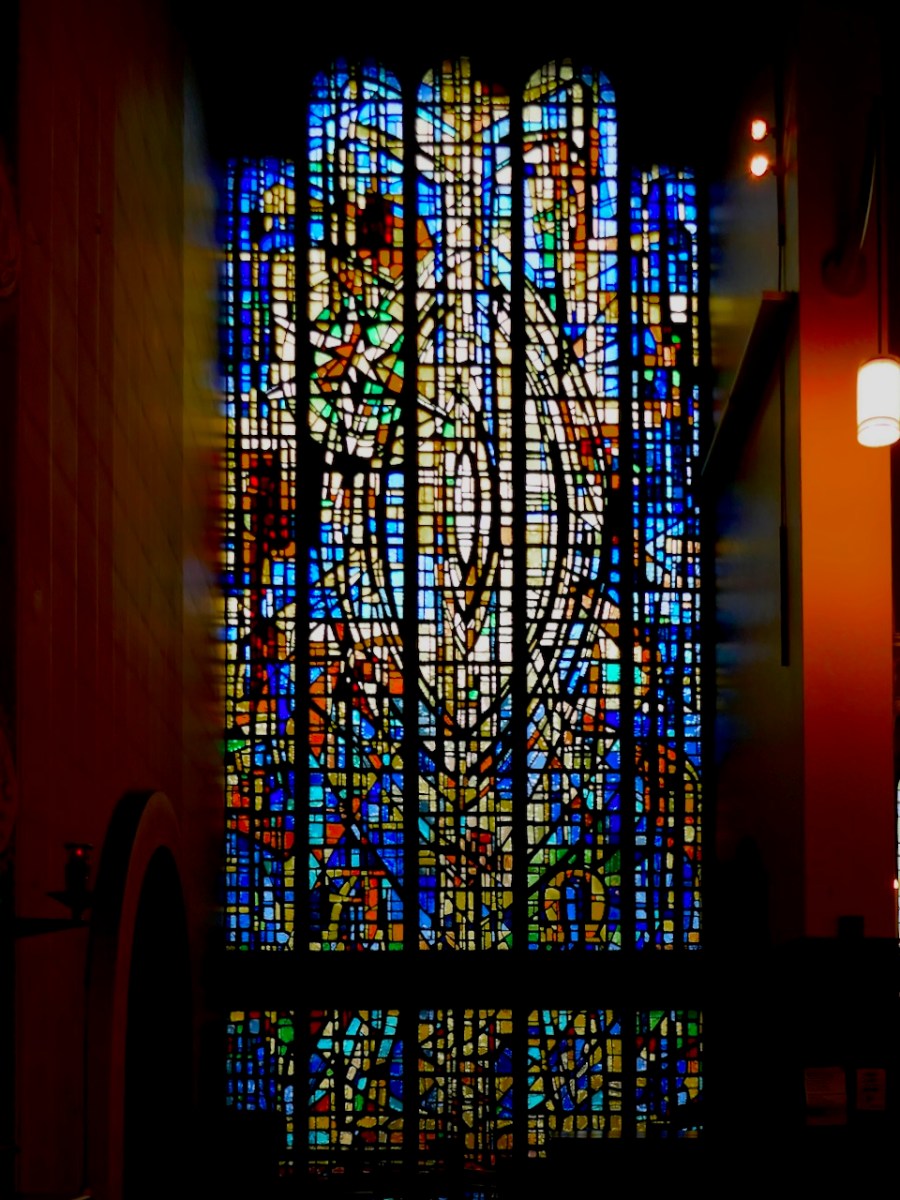
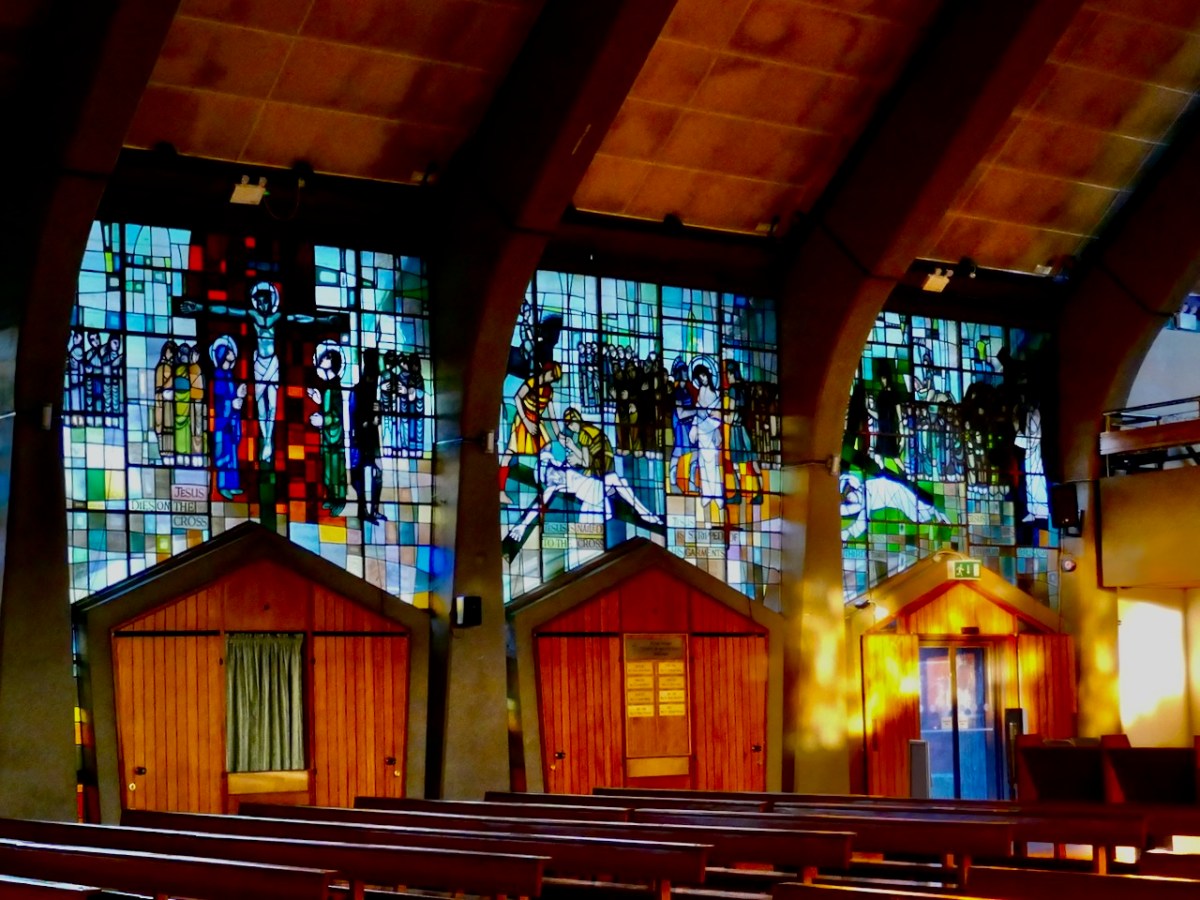
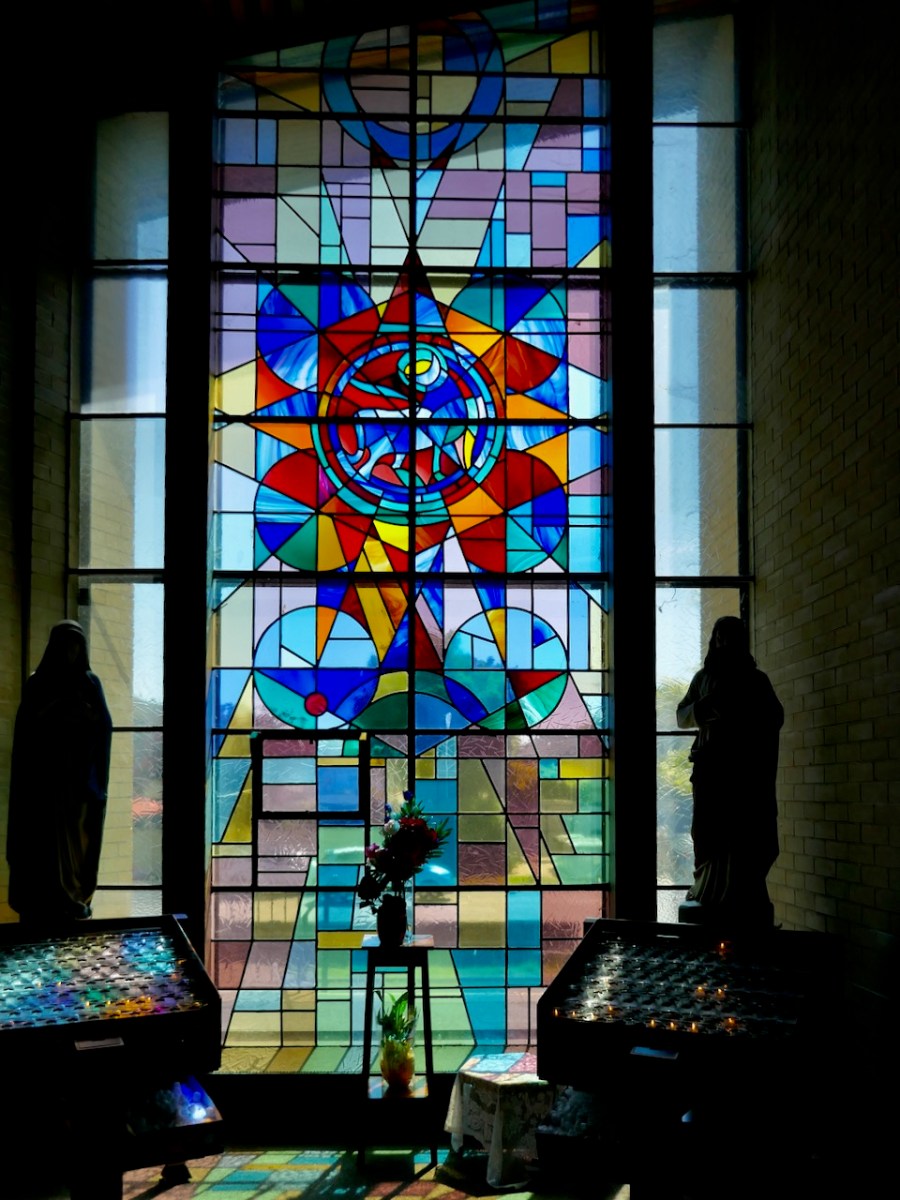
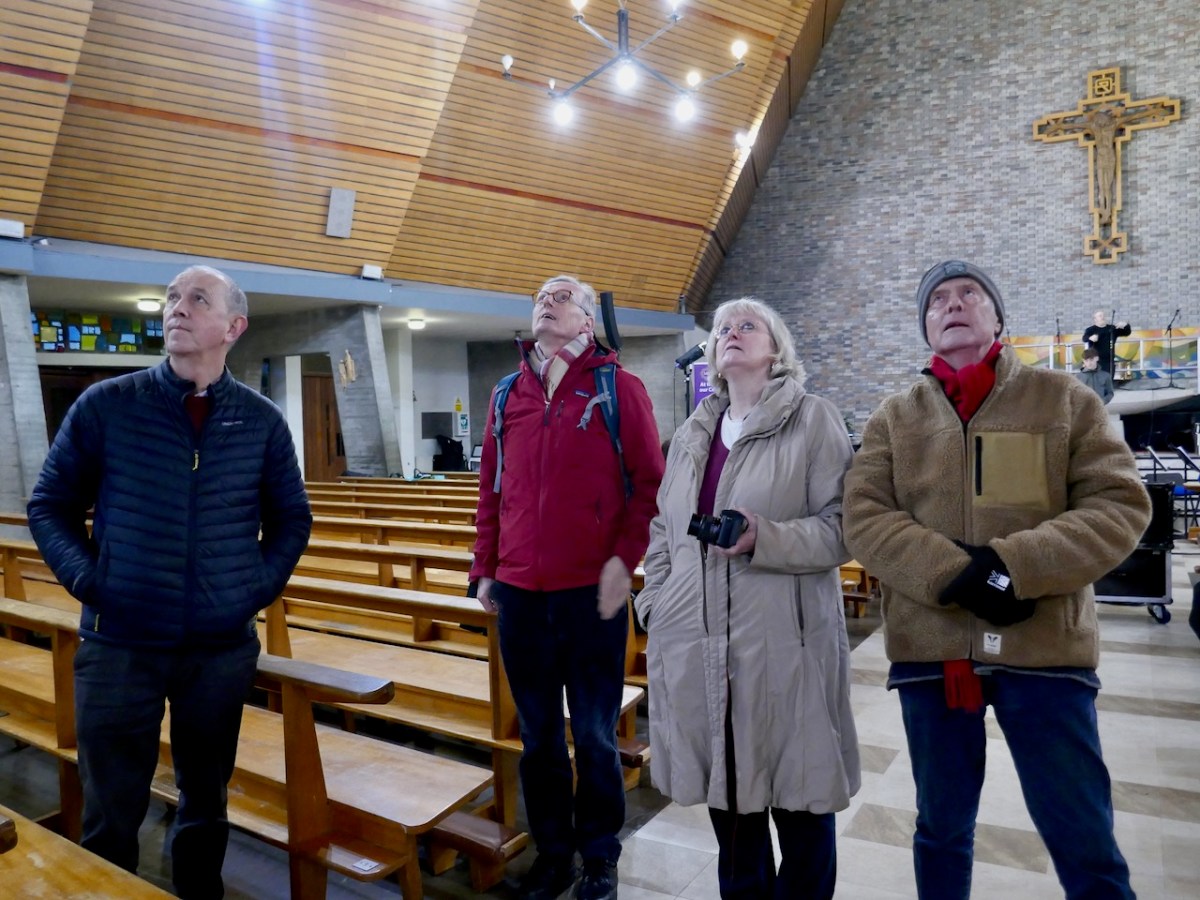
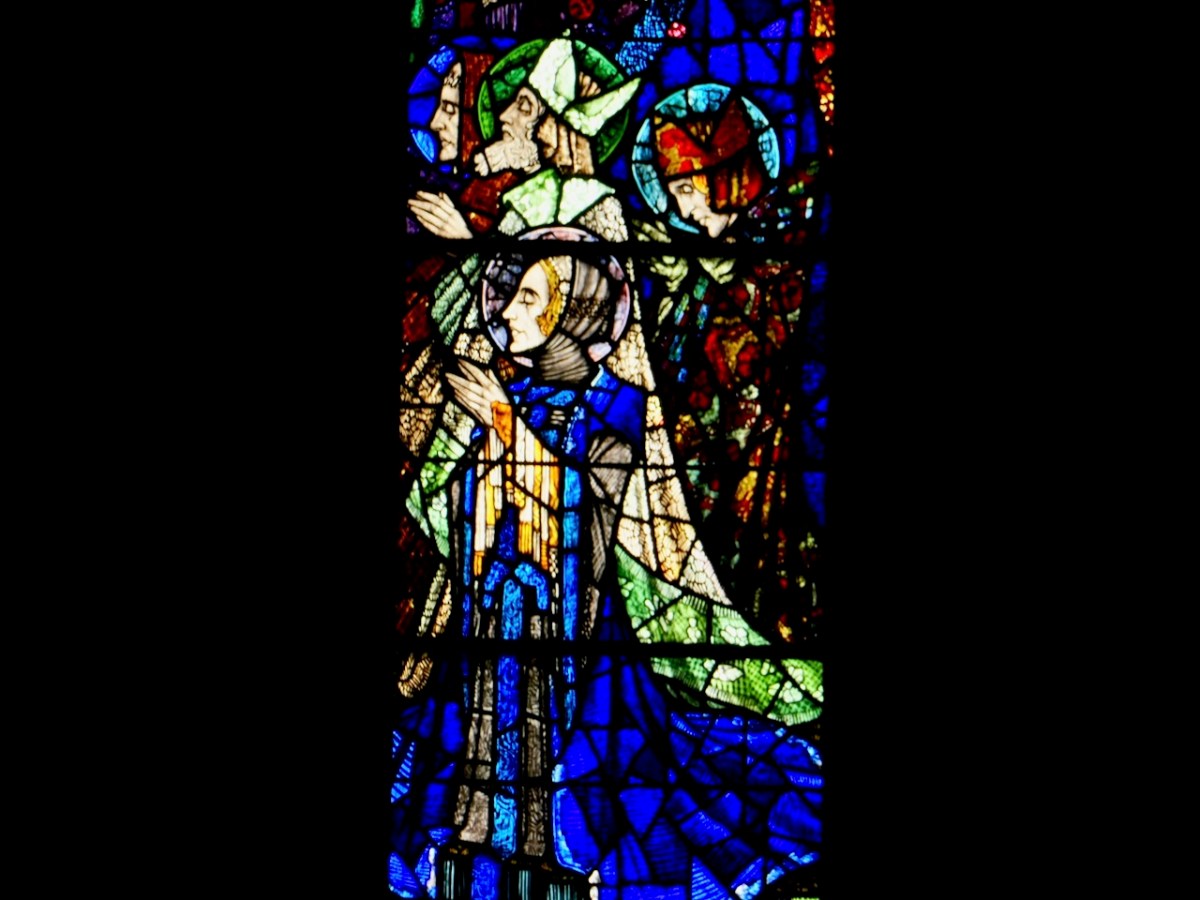
Moving to South Dublin, I cannot resist a visit to Greenhills, to the Holy Spirit Church on Limekiln Lane (above). I visited this church two years ago in the company of Robert, David Caron, Paul Donnelly (the Harry Clarke Studios expert) and Ruth Sheehy. We were thrilled that Ruth – whose work on Richard King has pride of place in my library and whose expertise I documented once before in my post Stained Glass Detectives – and a Find! – was able to talk us through the window, illuminating each part of it, and expanding on Kings’ style and colour choices. My topmost photograph in this post was taken as she led us through an erudite tour of each element.

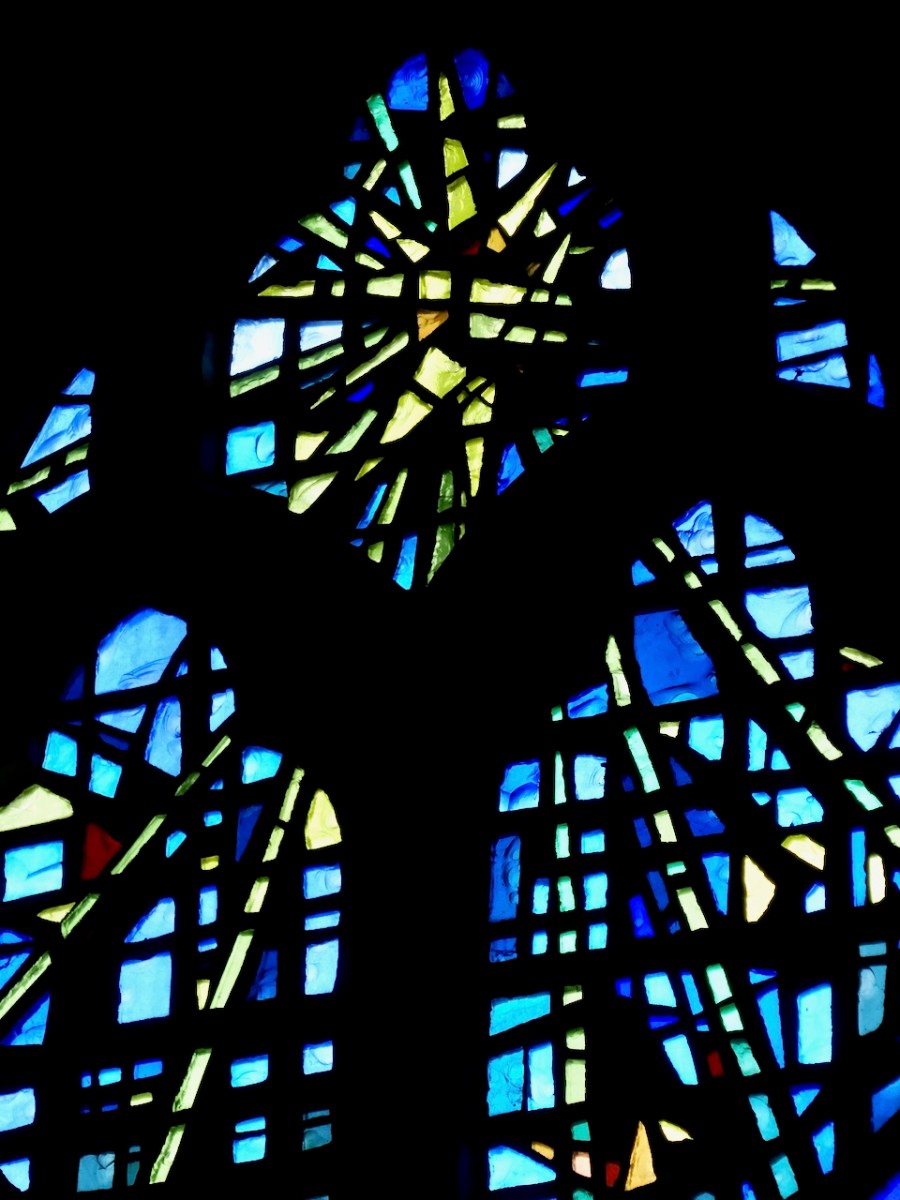
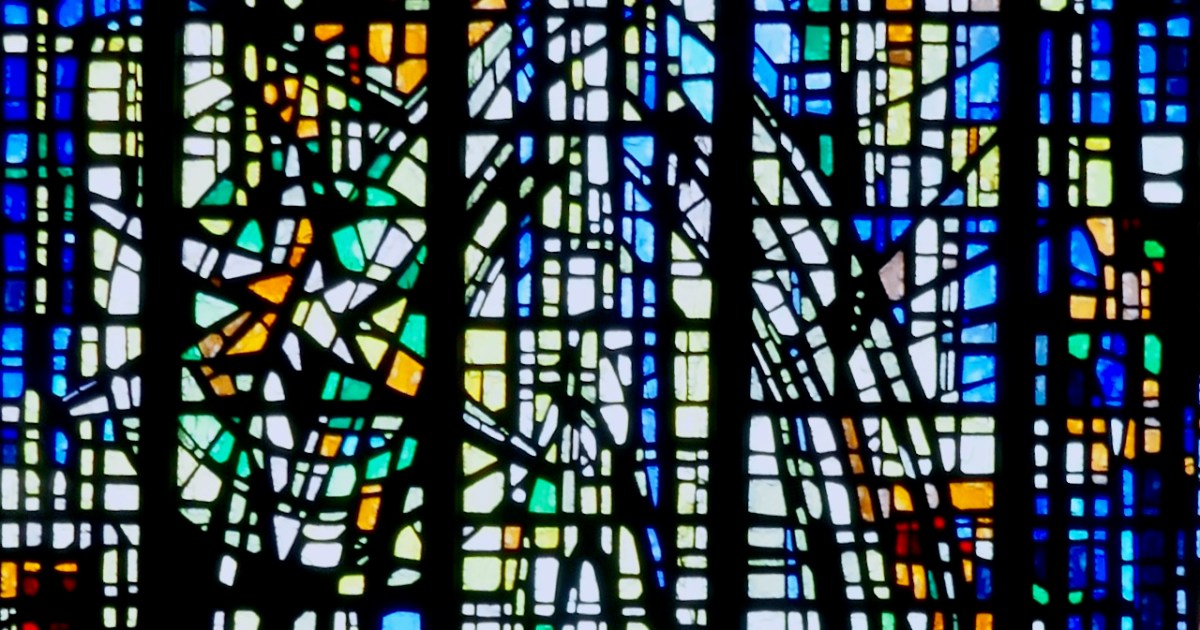
King was aided and abetted by the Murphy Devitt Studios. Johnny Murphy worked with King to provide all the surrounding glass, in harmonious shades and using the same mouth-blown glass. He also designed the dalle de verre windows at ground level, while Peter Dowd, Roisín Dowd Murphy’s brother, was responsible for the wonderful bronze doors. The day we were there a choir was practising for an upcoming concert. The sensory effect stays with me still.

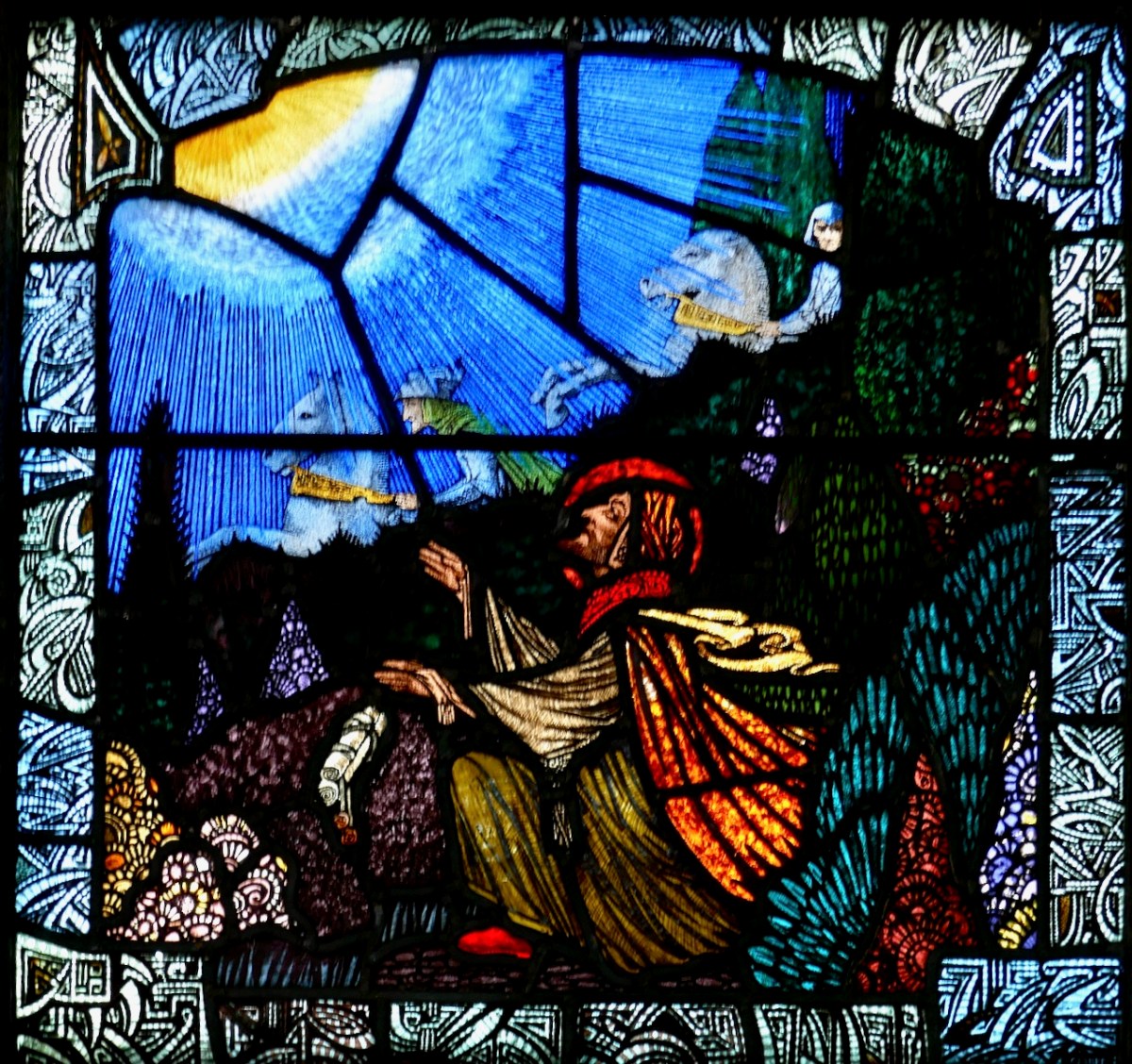
A Harry Clarke panel of St Paul on the road to Damascus, from the Sandford Road Church. This is not one of the churches included in the book, which just shows what difficult choices had to be made to stay within the page-count.

I have only highlighted two churches, both dating to the 60s – and neither of them contains a Harry Clarke! Rest assured that this book contains lots of Clarkes – at least 6 of the locations contain Clarke windows, as well as those and others containing the work of his Studios artists after his death. You will also be happy to see Evie Hone, Michael Healy, Wilhelmina Geddes, Hubert McGoldrick, Catherine O’Brien, Patrick Pollen and several others.

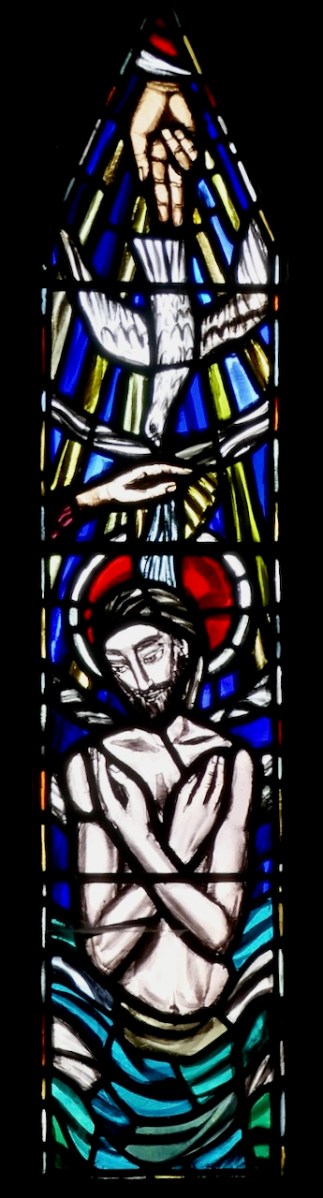
Patrick Pollen’s Baptism of Christ from Lusk

What is does not contain (with a few key exceptions) are productions by unnamed artists working in the large studios (Earley, Watsons, etc), nor windows from the mass-production houses such as Mayer of Munich. 

Harry Clarke’s St MacCullin, also from Lusk

There are, as I have said, 39 locations in the book, but David would be the first to admit that if he were not constrained by page- and word-count he would have included several more. So let me add a couple that are so well worth visiting, even though they had to be left out of this volume. While at Lusk, for example, David suggests a visit to nearby St Maur’s in Rush and I concur – George Walsh’s series for this church typical of his mature style (below). Another place to see Walsh’s work is the Church of the Guardian Angels on Newtownpark Avenue in Blackrock.

St Mary’s Church in Sandyford has early Netherlandish glass – and yes, that is NOT 20th century, but it’s one of the few places to see it up close in Ireland. St Laurence O’Toole Church in Kilmacud has a huge and very stylised panel by Phyllis Burke (below). Sandford Road Church of Ireland has a Harry Clarke St Peter and Paul (see the illustration fourth up). 

I’ve written about a few of the churches in this book, so you know I have other favourites too. St Michael’s in Dunlaoghaire, for example, and one of the several Harry Clarke windows in St Joseph’s in Terenure. I am sure you have your own favourite Dublin Churches – any additions you’d like to make to my short list, dear Readers? 

This is one of a set of stations made from antique glass and polished granite, done by George Walsh and Willy Earley for the Clarendon St church

Grand so, you have all you need now for some ecstatic wanderings around Dublin Churches. I leave you with our own ecstatic wanderings – as a bookend to this post, here we are in Greenhills, quite in awe of Richard King’s and Johnny Murphy’s enormous window. Left to right is Paul Donnelly, David Caron, Ruth Sheehy and Robert.

Light is the Canvass

This wasn’t the post I planned to write for today, but it’s the one, in the end , I felt I wanted to do more than any other. It would have been Robert’s birthday on Wednesday (March 5) and somehow a contemplative post filled with beautiful images (many of which he helped me to process), and set to sublime music, was calling out to me. Watch it on YouTube for the best experience. I hope you enjoy it.

One way to think about a piece of stained glass is that, for the artist, light serves as the canvas, while glass is the medium. Additional materials may include glass paint, acid, and other treatments used to enhance the design or respond to the context of the window or panel. Throughout the ages, stained glass has surrounded us—adorning churches and public spaces—yet we don’t often pause to look beyond its surface. We admire the light it casts without considering the artist’s hand, the vision, and the craftsmanship that bring it to life. I have tried to do that in this quirky set of photos. I wandered though my (embarrassingly) huge archive and chose the ones that spoke to me. As I look at what I have chosen I see I am drawn to abstractions and faces – a duality that Robert the sociable architect would approve of. 

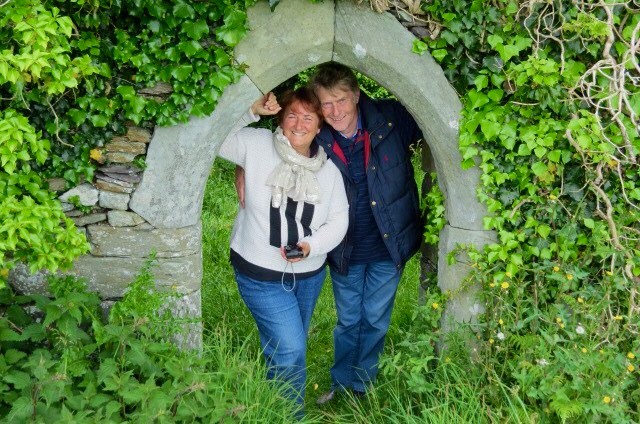
This photo of us was taken ten years ago. The music is Ave Maria Stella by the late great Mícheál Ó Súilleabháin. It’s available here, and is used with permission. 

Harry Clarke’s Brigid

Harry did several wonderful St Brigid windows, and included Brigid as a saint in larger scenes. There are also Brigid windows attributed to him that he actually didn’t do, but that’s a blog for another time. Today I want to give you a flavour of his take on Brigid, because this was a saint that must have been especially meaningful to him – his mother was a Brigid!

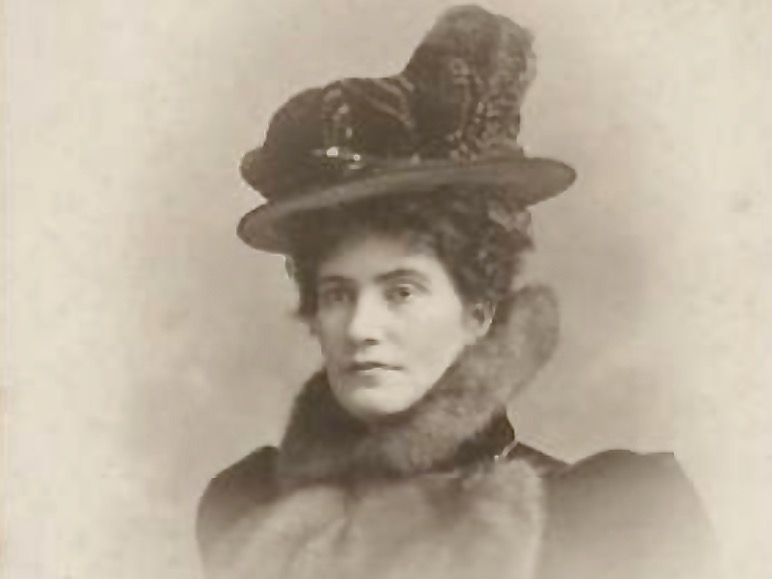
Brigid (sometimes given as Bridget) MacGonigal was born in Sligo and married Joshua Clarke, then an up-and-coming church decorator in Dublin and they had four children. Harry, their third child arrived in 1889. Brigid was never strong and died in Bray in August 1903, leaving her family bereft. Harry was 14 and that year marked the end of his schooling at Belvedere as he and his older brother Walter joined the family business to help run it. Harry was a sensitive child and it is likely that he missed and mourned his mother for many years. He also inherited her weak lungs and struggled, as she did, with his health.

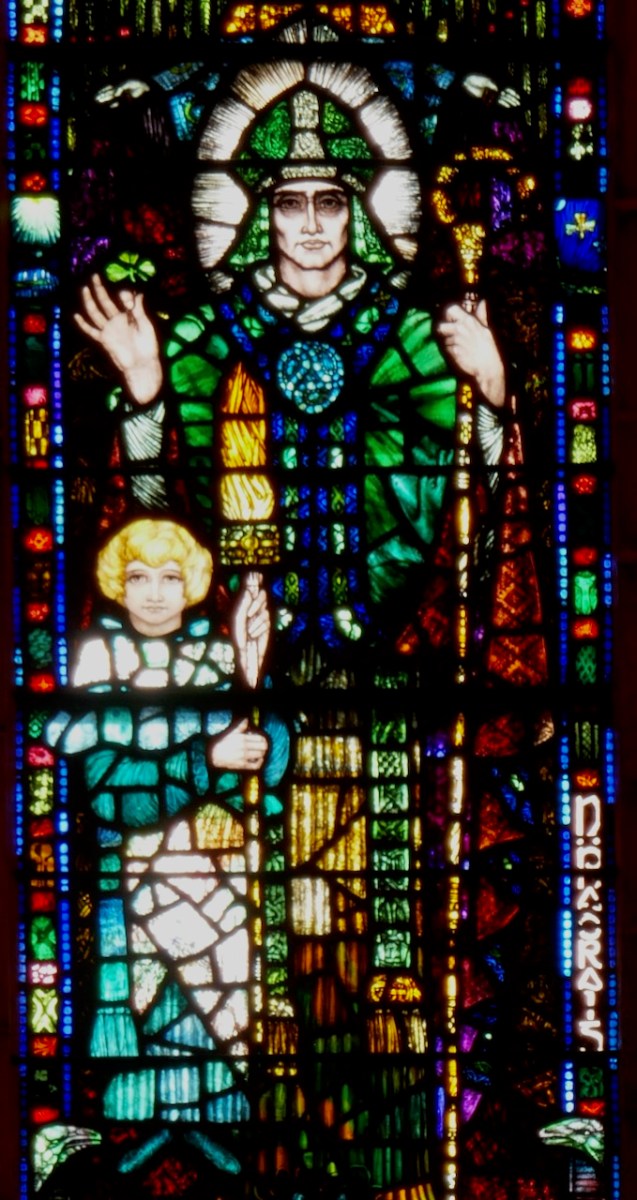
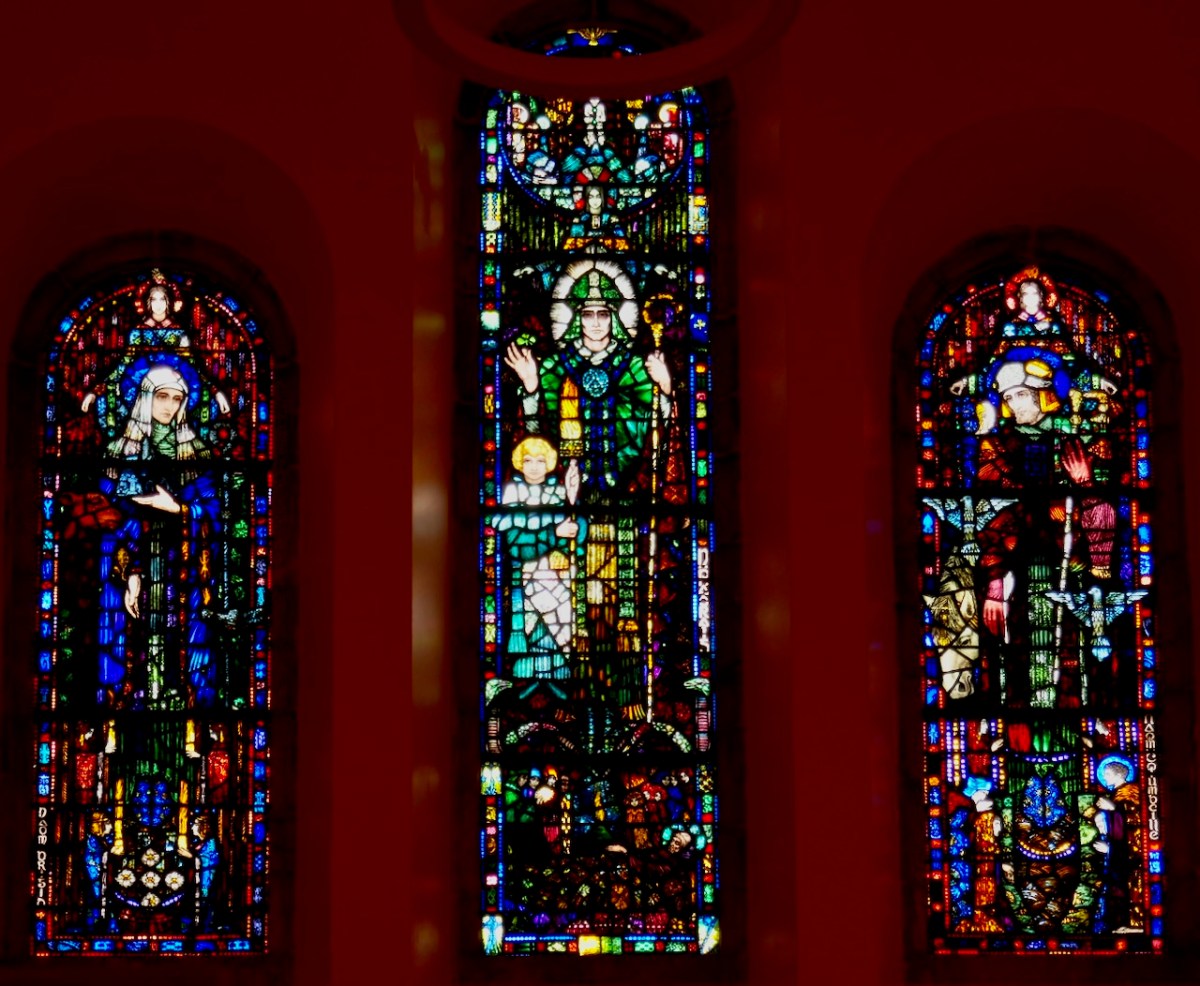
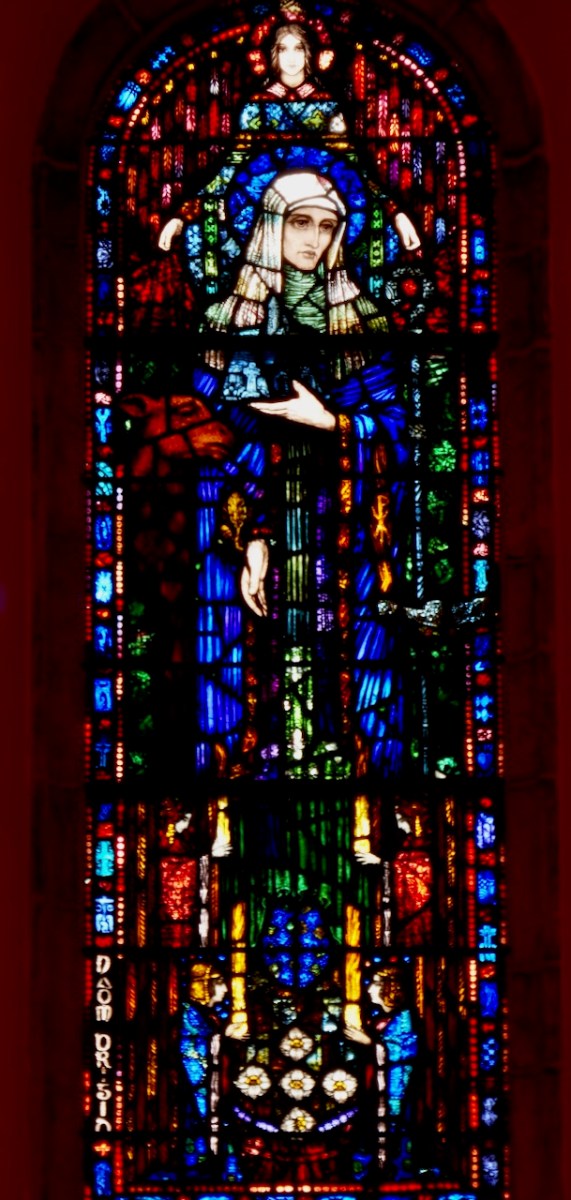
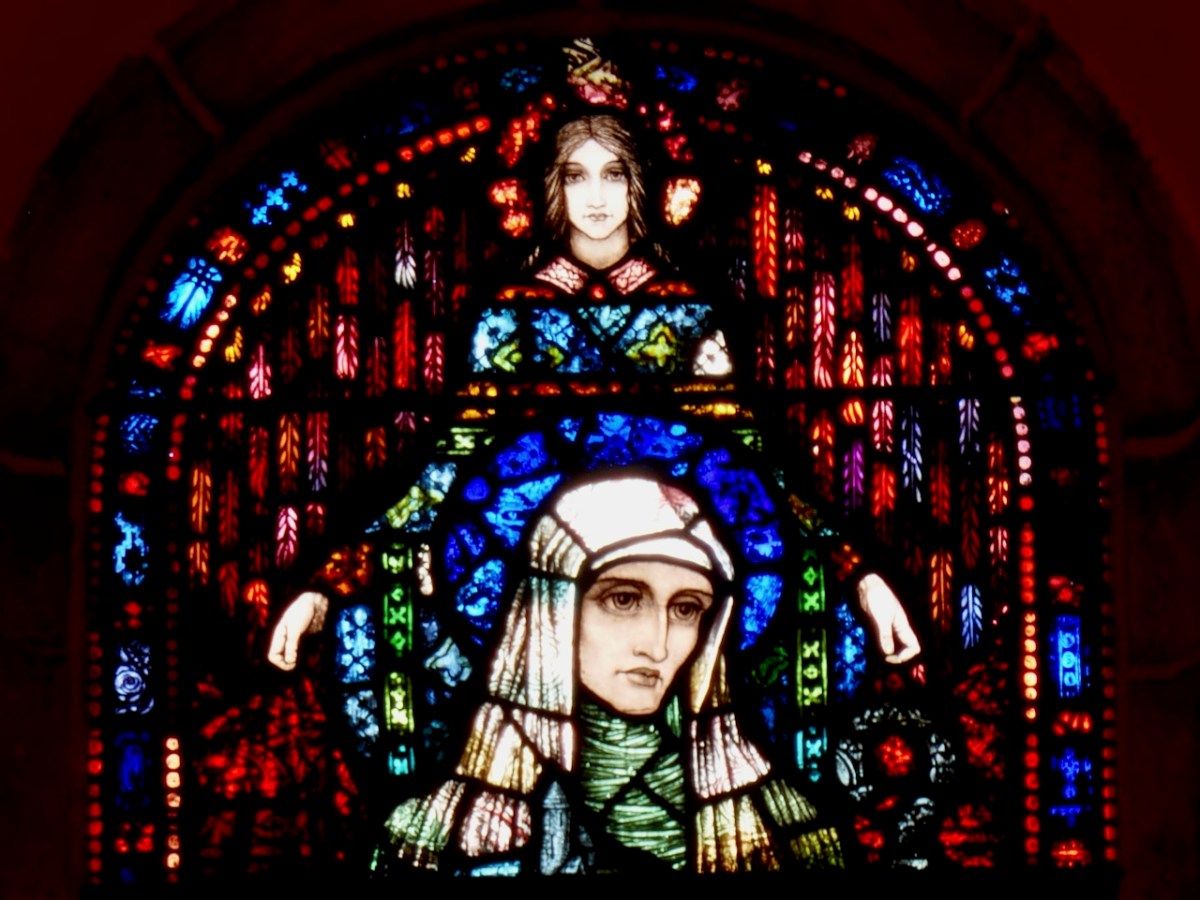
I will start with the place that launched Harry’s career, the Honan Chapel at University College Cork (I’ll finish with the one that is on my lead photo). And in fact it is his first windows for that Chapel – a three light, depicting Brigid, Patrick and Columcille, our three Patron Saints. This window is over the entrance, facing west, which, with Harry’s preference for dark colours and some internal lighting issues in the chapel, makes it hard to photograph.

Harry had completed a detailed sketch design for this window in 1914 (Nicole Gordon Bowe has an image of that design in her magnificent The Life and Work of Harry Clarke) and the window was made in 1915. There are a few differences between the sketch design and the finished window, but on the whole, the window is true to Harry’s original vision for it. His notes for the window refer to 

Top: The Angel with the cloth of heaven forming background

The Figure: With emblems – the church, the inextinguishable spiritual lamp – the calf and the oak.

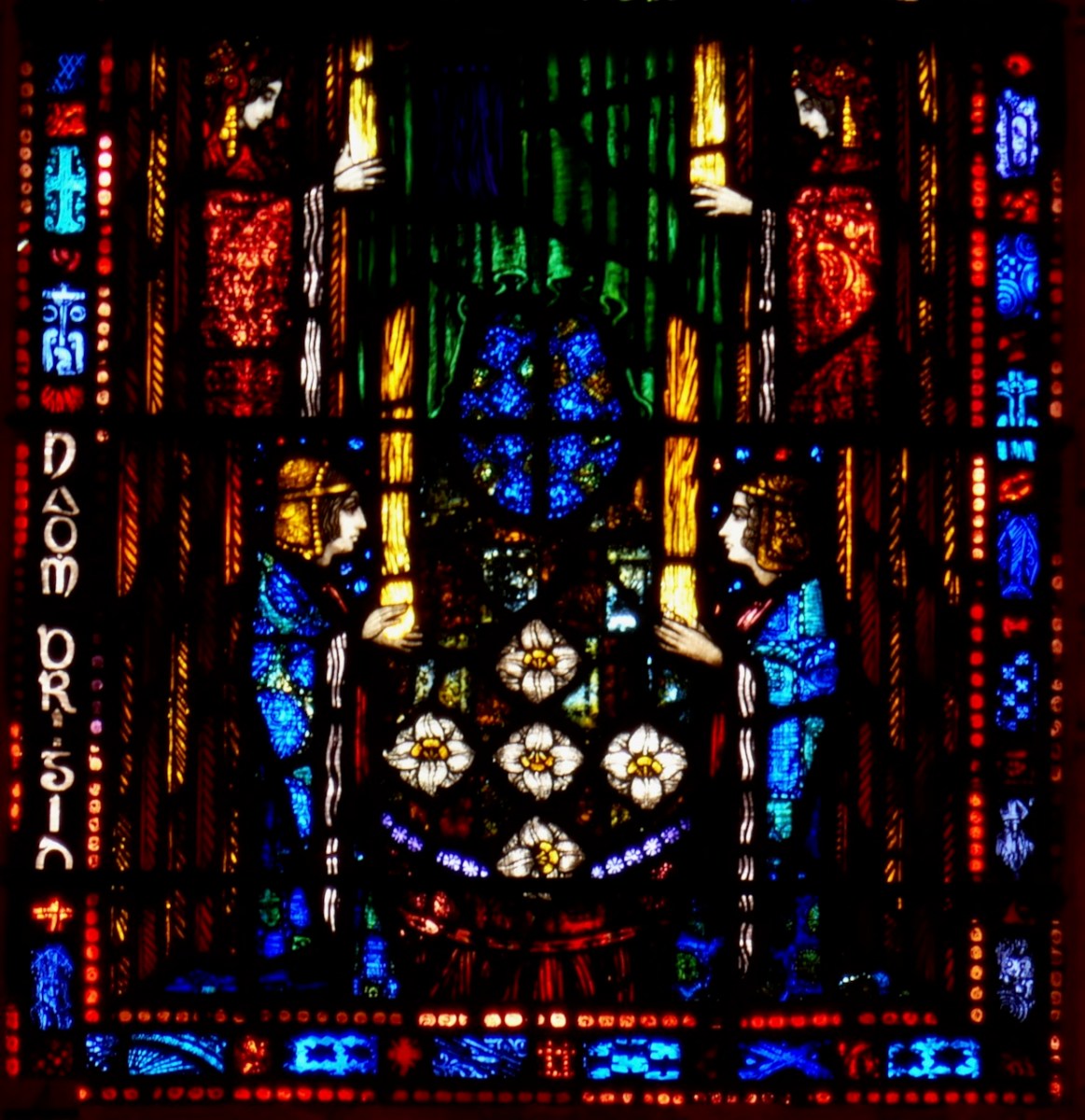
The Base: Are four angels carrying the prayers, prophesies, miracles and charities of St Brigid, also are shown the five lilies – she has been called the Mary of Ireland and these lilies symbolise the five provinces of Ireland over which she held spiritual control.

The cloth of heaven has been imagined as fronds in deeps reds, while St Brigid is shown as mature, wise and compassionate. She is holding a church which looks a lot like St Kevin’s Kitchen in Glendalough. In her other hand is a brown oak leaf, threaded through her fingers. The calf peers out from her right side. As befits a Mary of the Gael, she wears a deep blue robe. 

The predella (lowest section, above) shows four angels, but what they are carrying are torches – a reference to the spiritual lamp and the fire associated with Brigid. The symbols of the five provinces, recognisably lilies in the sketch design, have changed to another flower I can’t name. Note the tiny details, though – the crucifixion scene in the borders on the left and the right. The other detail to note here is that the fingers, of Brigid and the angels are ‘normal’ – Harry has not yet developed his signature long tapering fingers and pointed sleeves (among the idiosyncratic elements he called his “gadgets’).

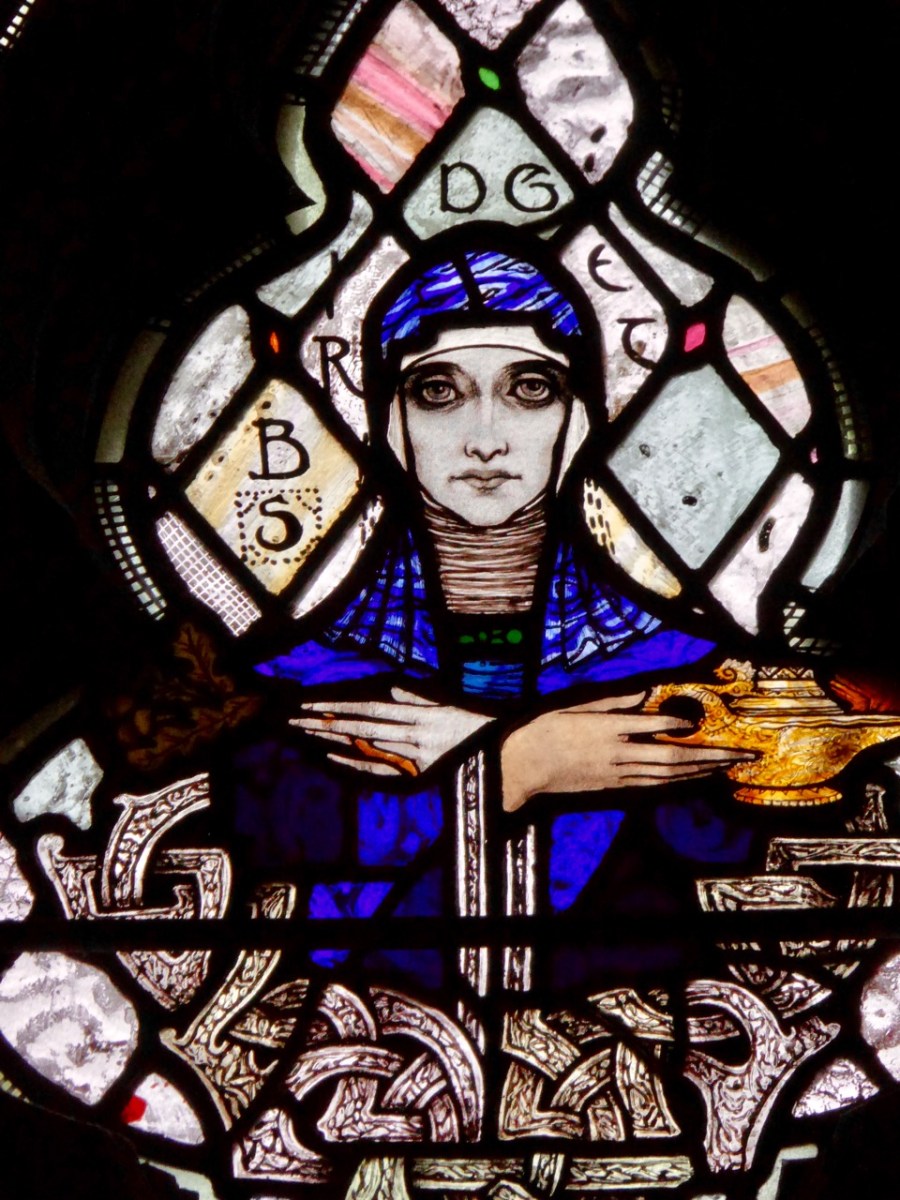
His next Brigid (above) was for the Nativity window in Castletownsend – I have written about that window extensively here so pop over and have a browse if you fancy. The Castletownsend Brigid, done in 1918, looks quite similar to the Honan Brigid and has the same oak leaf entwined in her fingers. The difference is that she is carrying the sacred lamp, has the Harry Clarke fingers, and is spelled S Bridget – the English version rather than the Irish Naomh Brighid of the Honan. [For non-Irish speaking readers – the small dot on top of consonants in Irish is now normally rendered as H – as in Briġid is now Brighid.]

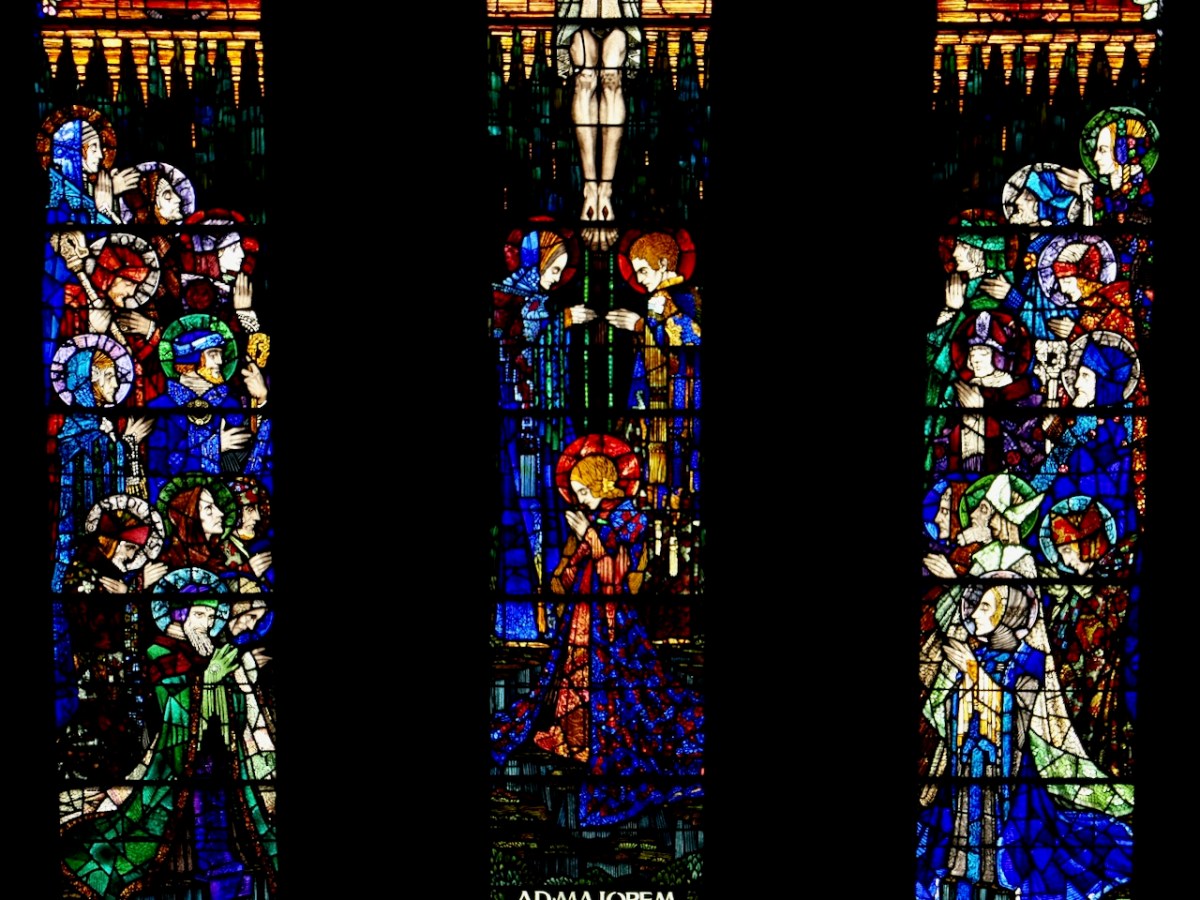
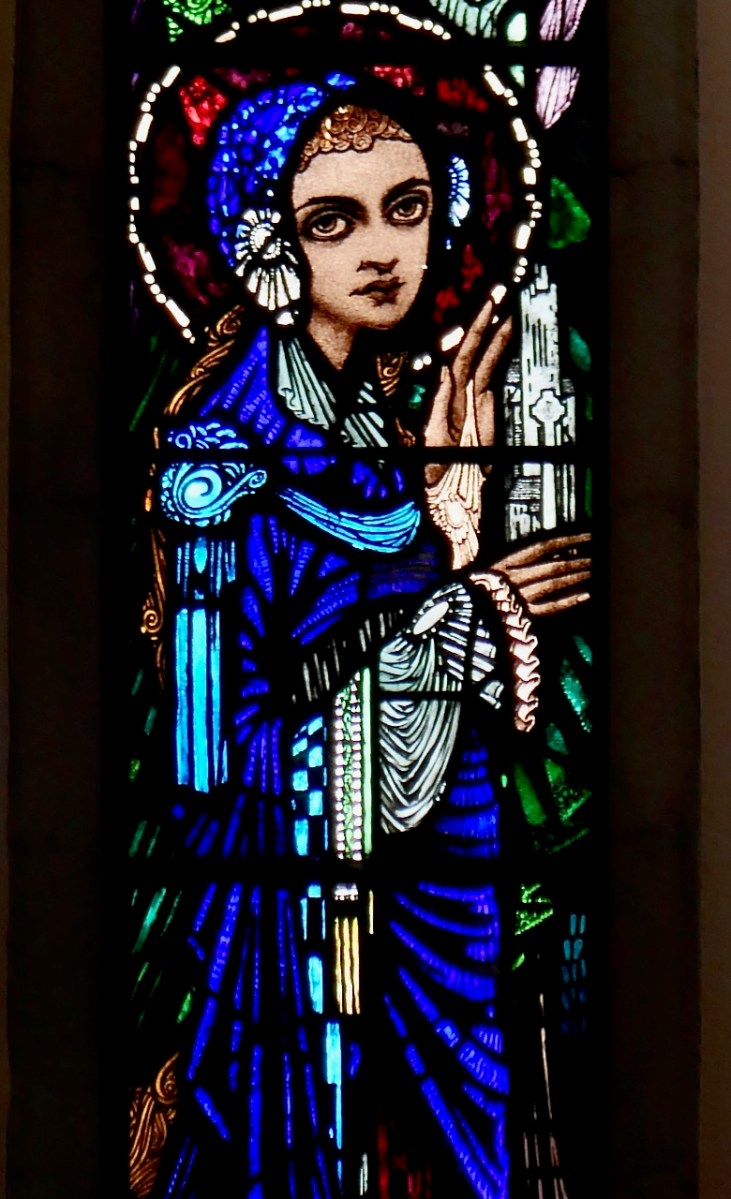
The next two windows, Terenure (above and below, details) from 1920 and Cloughjordan from 1924, show Brigid among a host of other saints. In Terenure the subject of the large window is The Crucifixion and the Adoration of the Cross by Irish Saints, and this is a large, three-light window behind the main altar. The saints are not all easy to identify, despite having their names in their haloes, but first and foremost among them are Patrick on the left and Brigid on the right.

Brigid is dressed in a blue robe which drapes on the ground around her, and has a golden trim to her sleeves.

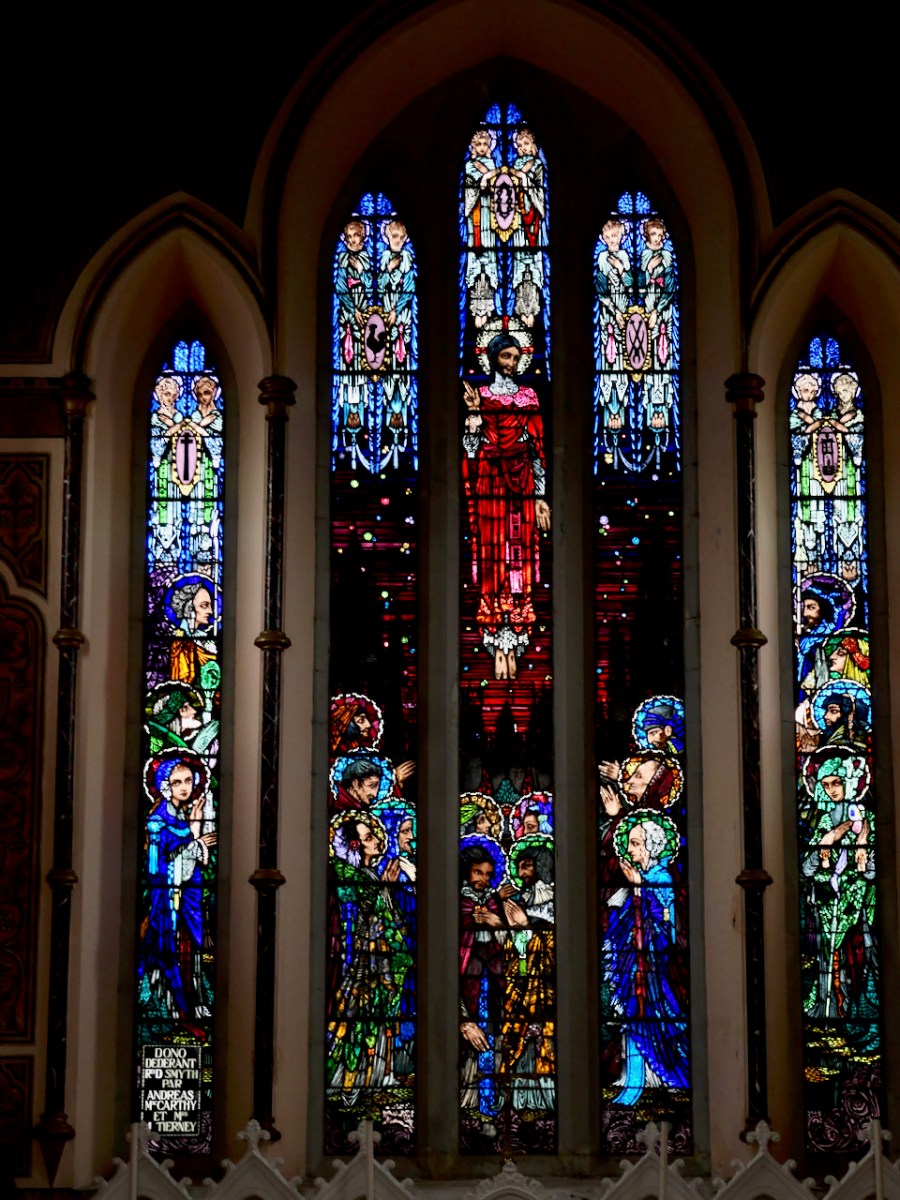
In St Michael and St John’s Church in Cloughjordan, Co Tipperary, the theme of the large, five-light, window is The Ascension with Irish Saints and St Michael and St James. Gordon Bowe designates this one a Harry Clarke (B). That means that this window was initially conceived and designed by him but executed by his studio under his close supervision. This is the first window we have come across, in this series, that is not wholly Harry’s own work, and this is a measure of how busy the Studios had become with Harry at the helm. 

As in Terenure, Brigid is here as one of the Irish saints. She is depicted as very young, wide-eyed, and carrying a church which now looks more medieval than Romanesque (neither would have been appropriate to her era) and is probably a nod to the Cathedral in Kildare.

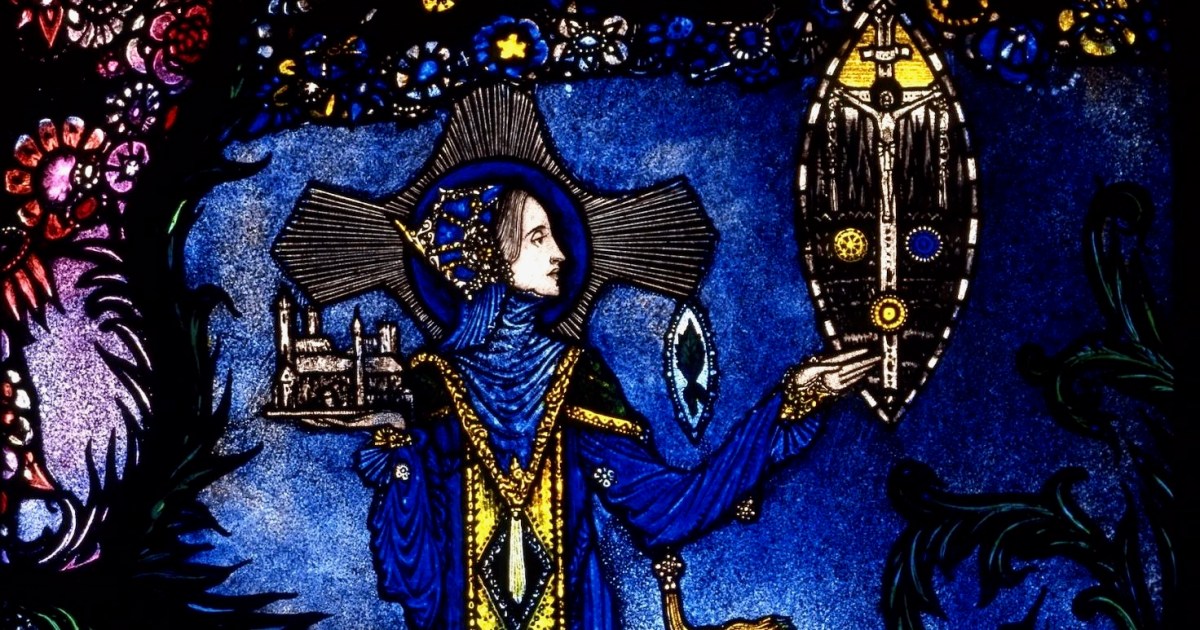
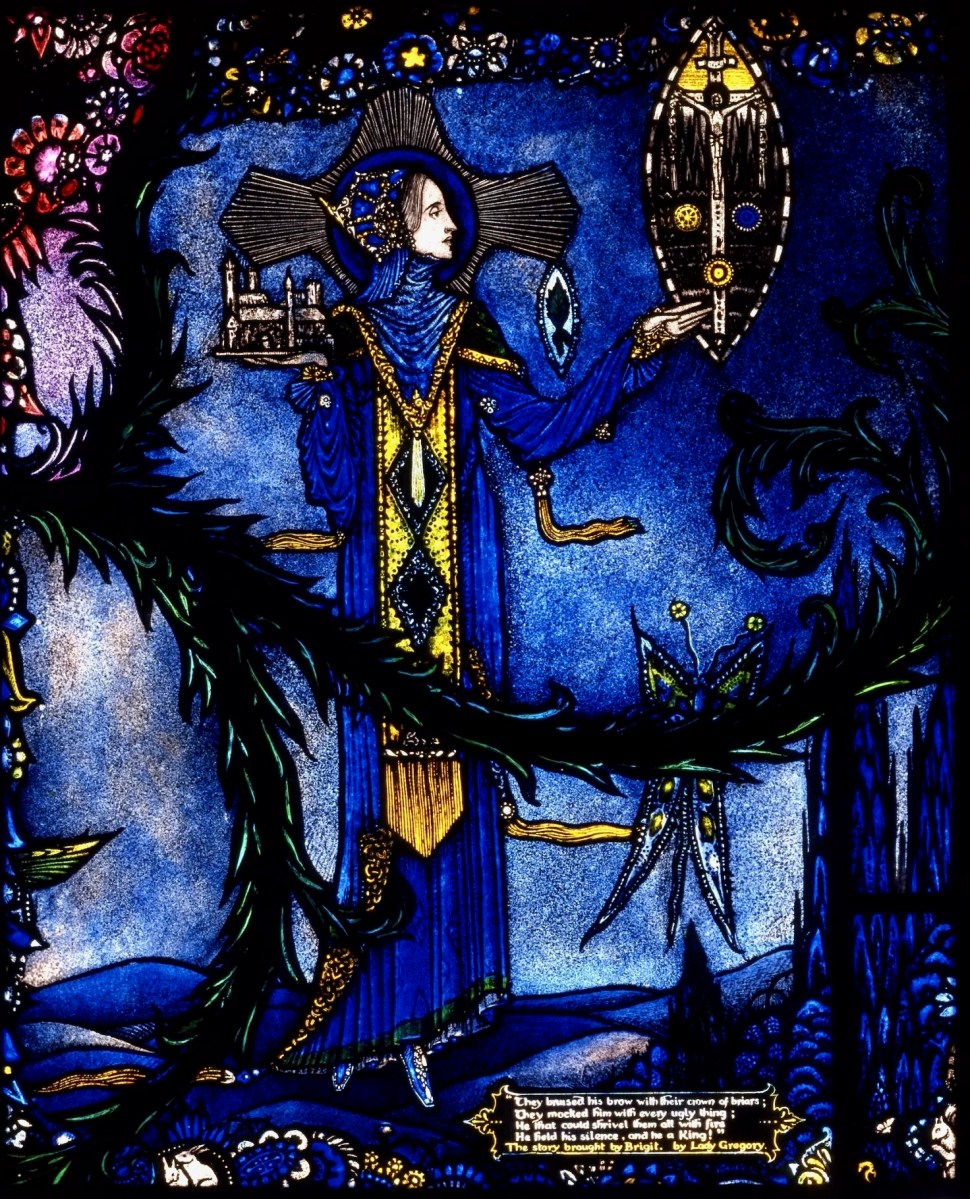
And so we come to the last Brigid that Harry ever did*. It is from the famous and controversial Geneva window, now in the Wolfsonian Museum in Miami. If you have not yet seen the marvellous documentary that Ardall O’Hanlon has made about this, I highly recommend you do. It’s available on the RTE Player as of this time of writing. The Brigid panel is among the less controversial images in the whole window. It’s based on a play by Lady Gregory called The Story Brought by Brigit. According to Marie T Mullan in her lovely book, Exiled from Ireland: Harry Clarke’s Geneva Window

The play is a passion play, but it is based on the legend, popular in Ireland and Scotland, that St Brigit was present at the birth and crucifixion of Jesus. Brigit mingles with the crowds from the time of Jesus’s triumphant entry into Jerusalem until after his death. She is a foreigner, observing and commenting. She tells people she is Jesus’s foster mother and brought Mary and Jesus to Ireland to escape Herod. . . The icon of Christ Crucified is a the vesica, a shape used often in art for a picture within a picture, and has the traditional beaded frame. Brigit is absorbed in the icon.

Note Brigid’s golden scapular and elaborate headdress. Also the stylised butterfly and the little woodland creatures in the scene.

I think that’s a good place to stop. Harry did another Brigid, for the Oblate Fathers in north Dublin’s Belcamp Hall. This is a sorry tale in which the buildings, once left by the priests were subject to appalling vandalism and the windows are in storage, and haven’t been seen for years. This is tragic. 

* Thanks to my friend Jack Zagar for the Photos of the Geneva Window.

‘Harry Clarke’ Nativities – NOT by Harry Clarke

It’s become a bit of a tradition with us here at Roaringwater Journal to do a post like this in the lead up to Christmas. See this post, and this one, or maybe this one. All busy stained glass studios were requested to supply Nativity windows – a favourite of Catholic Churches throughout Ireland. Harry himself made several Nativities, but this post deals with windows made in his style, but not by him. All of them were made in his father’s business, Joshua Clarke and Sons, or in The Harry Clarke Studios, as it was renamed in 1930. Sometimes windows are just signed Clarke, or Clarke and Sons. If you’re looking at these images and saying to yourself, Surely these are Harry Clarkes! I recommend reading some of my previous posts for the difference between a Harry Clarke and a Harry Clarke Studio window. Perhaps begin with The House Style: William Dowling and the Harry Clarke Studios.

These first two images are from a remote church in Wicklow, in the townland of Killamoat, near Rathdangan. They were done in the Harry Clarke Studios, after Harry died in 1931, and are attributed to George Stephen Walsh, who had started as an apprentice with Harry several years before he died. I particularly love all the details surrounding the Baby Jesus – the blankets upon which he lies and that strange green urn.

This is from a series of small windows in Leixlip – I made a slide show of those windows, which you can watch here, in a post titled Clarke-Style Windows. They were made in 1925, in the Joshua Clarke Studios, in which Harry served his own apprenticeship and which retained its name until it became the Harry Clarke Studios in 1930, shortly before Harry died. In 1925 Harry was an established artist and had taken on several apprentices to help out in the busy studio – one of them made these windows and we don’t know which, although it could have been Philip Deegan. Deegan had taken Harry’s courses at the Dublin Metropolitan School of Art, and was accomplished at reproducing his style.

William Dowling* was one of Harry’s most accomplished artists and the one who stayed on in the studio the longest, up to the 1970s. In the years after Harry died he and Richard King produced beautiful windows in the Clarke tradition, using very good glass and carrying on the ‘house style’ of dense, jewel-like surfaces, packed with ornamental detail. Above is one of his windows from Knockainey, Co Limerick, dating from 1940 .

This is the angel from that window – I was struck by the fiery aureole that burns behind his head, instead of the usual halo.

This one is also by Dowling, but from somewhat later, in 1948, and it’s in the Catholic Church in Bandon. You can see how Dowling’s style has evolved – it’s not quite as dense. The composition is still beautiful and local lore has it that many of the young relatives of the priest who commissioned the window are immortalised in some of the faces. Can anyone in Bandon tell us more?

Another from the Studios after Harry Died – this one is in the Catholic Church in Wicklow town and we don’t know to whom it should be attributed.

I picked out two of the shepherds to highlight as they had such interesting faces. I also loved the fact that the lamb appears to have a little triangular lacy cap.

This window is from Millstreet, Co Cork and is another of Dowling’s wonderful productions, dating from 1940. Below is the predella (lowermost panel) from this window.

I suppose we’d have to say that overall there is a bit of a sameness to these Nativity windows and that’s down to the overarching influence of Harry’s very particular style. Eventually, this style fell out of fashion – a victim of its own success, or a failure to change with the times. While it lasted, though, it was superb. Eventually, due to falling demand and the price of good glass, the windows coming from the Harry Clarke Studios failed to keep up the high standards established by him and kept up by Dowling and King as long as they could. Here’s an example from around 1950 so you can see what I mean.

* For more on William Dowling, see Paul Donnelly’s excellent essay Legacy and Identity: Harry Clarke, William Dowling and the Harry Clarke Studios (in Harry Clarke and Artistic Visions of the New Irish State). Paul’s research has greatly informed all my work on William Dowling and other aspects of the Harry Clarke Studios.

Brigid 1500: Mary of the Gael

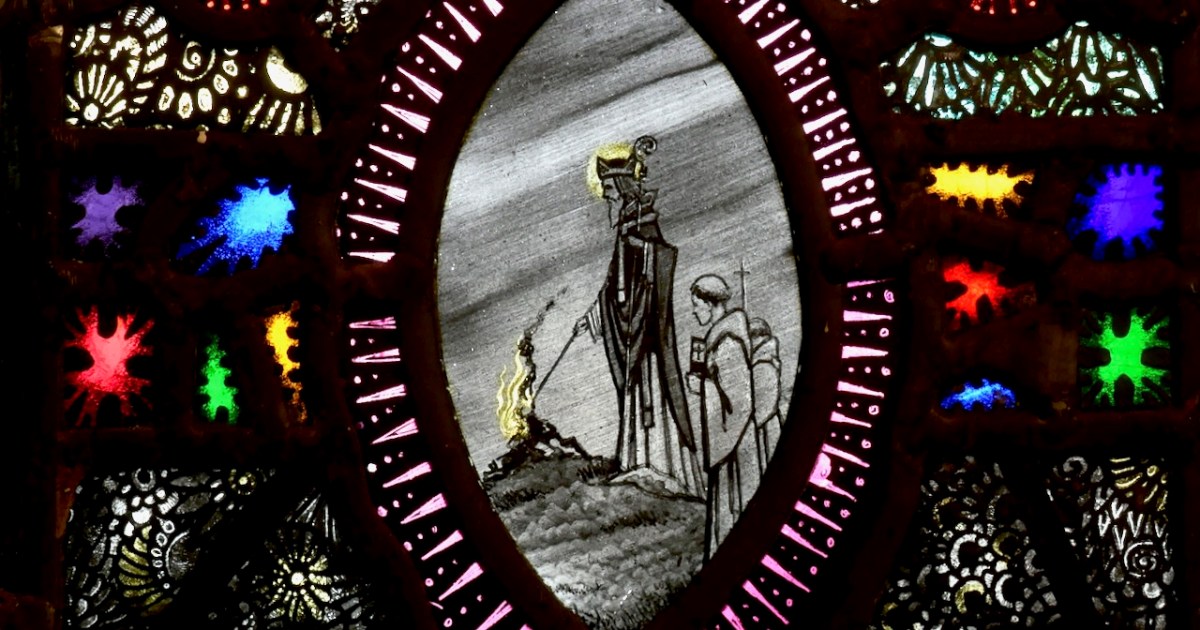
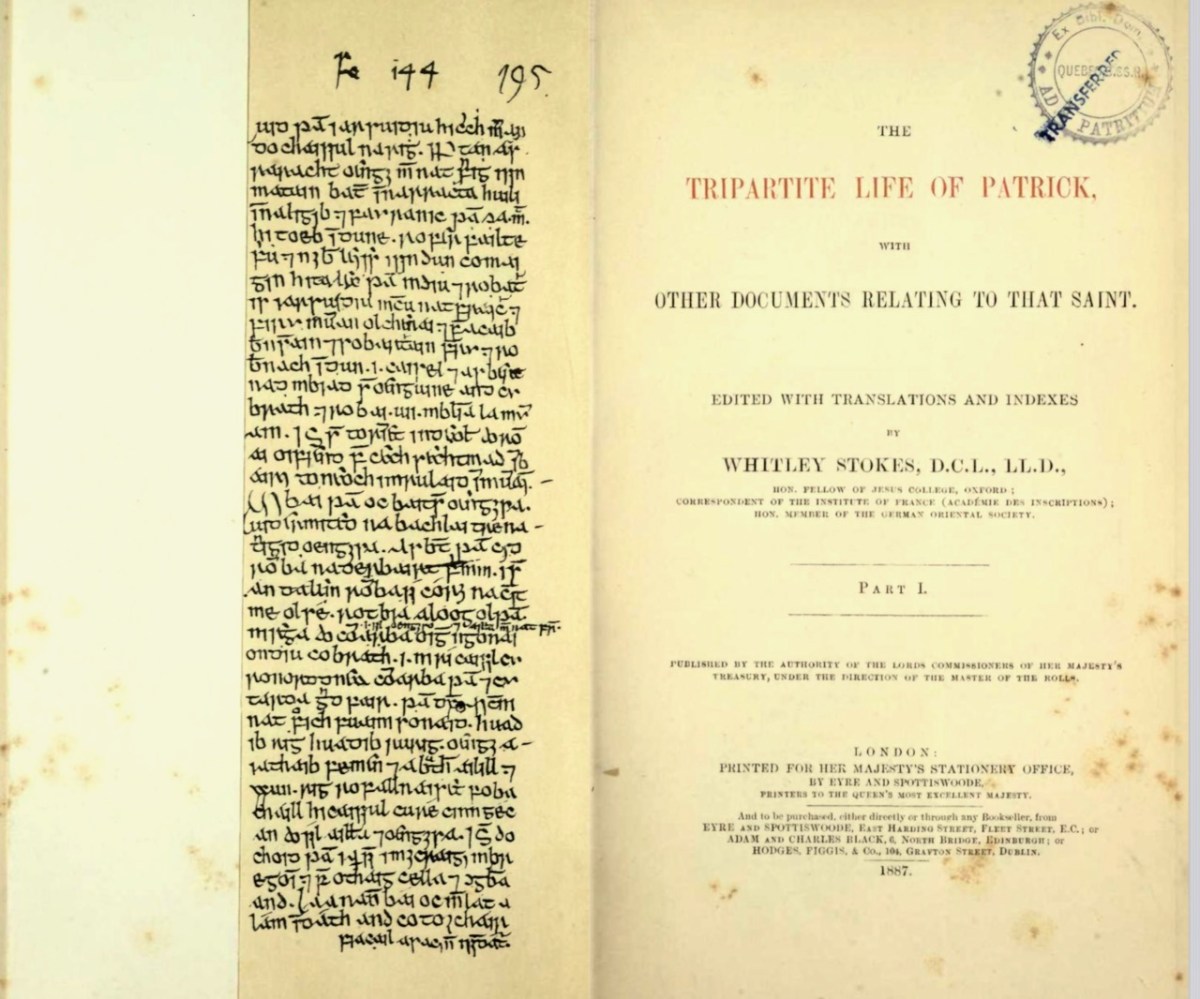
St Brigid, according to some accounts, died in 524. Therefore, we are celebrating this year the 1500th anniversary of her death. Once again, I have gone back to primary sources for incidents from her life and am illustrating them with stained glass images. This year I have added as a source the famous Canon O’Hanlon’s Life, from his Lives of the Irish Saints Series, Vol 2, a work of overwhelming erudition.

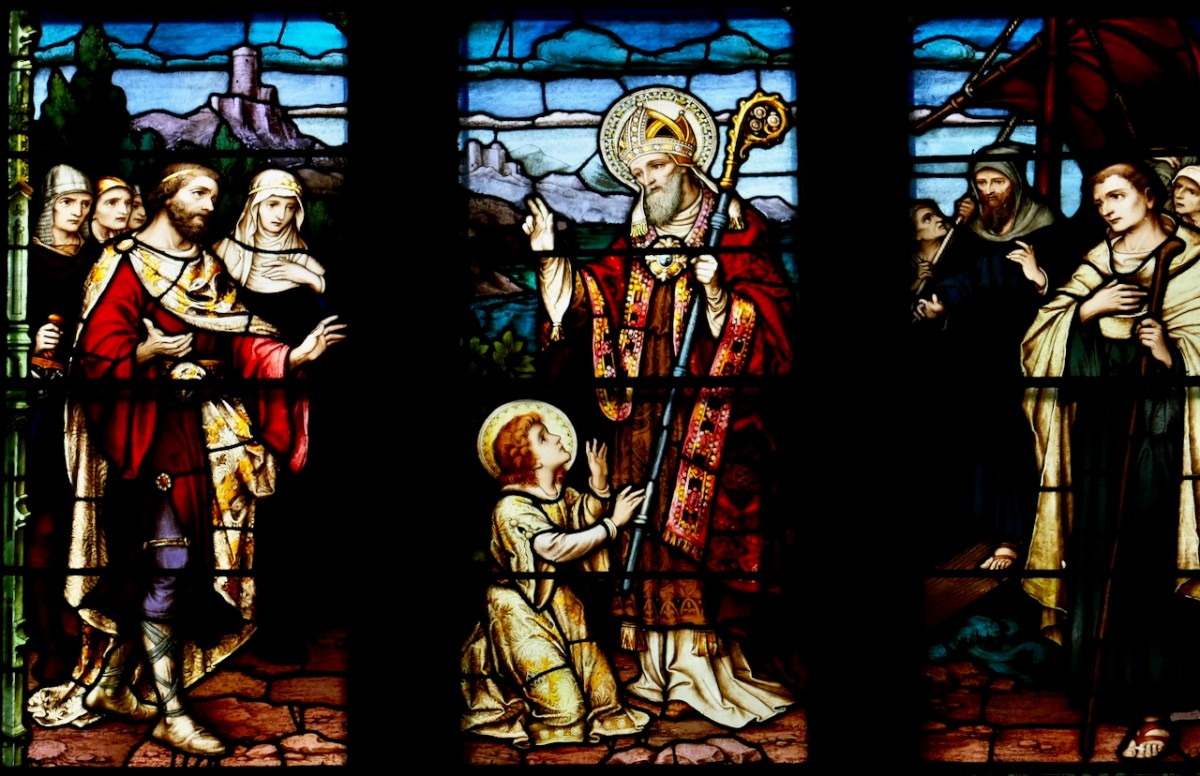
The Patrick and Brigid window in Meath Hill, by George Walsh. I love that Brigid has precedence over Patrick in this enormous cruciform window

If you haven’t already done so, now is a good time to go back and read my 2022 post, St Brigid: Dove Among Birds, Vine Among Trees, Sun Among Stars and my 2023 post, Brigid: A Bishop in All But Name. In them, I explain what the original sources for the Life of Brigid are. They all contain similar accounts and may be ultimately based on a single source – the Life of St Brigid by St Ultán – and are laid out as a series of miracles that lead us from her birth to her death.

This is a detail from a window in Ballynahown, Co Westmeath, and is probably by Watson of Youghal. I like the clever way the oak leaves are used as frame and background

Many more miracles, legends, myths and stories accreted to her cult over the centuries. A good example of such a story is the one where she makes a cross from rushes – that one is nowhere to be found in the original Lives, but is an integral part of the folklore surrounding her, and therefore almost invariably found in her iconography.

This is a photo by Frank Fullard, used with permission and thanks. It is a simple treatment of St Brigid from Kilmaine, Co Mayo

She is associated with many places and numerous holy wells – just take a look at all the St Brigid’s wells Amanda has documented in Cork and Kerry. But of course it is Kildare that rightly claims her. Kildare (Cill Dara – the Church in the Oak Wood) is where she built her church and established her city. It is the origin of three of the attributes we see in many windows – a church, oak leaves and a lamp. (For the story about the Bishop’s Crozier, see the previous posts.)

Detail from the Brigid Window in Carrickmacross – she’s consulting with her architects

The Book of Lismore has this story about building the church:

Brigit went to Bishop Mel, that he might come and mark out her city for her. When they came thereafter to the place in which Kildare stands to-day, that was the time that Ailill, son of Dunlang, chanced to be coming, with a hundred horseloads of peeled rods, over the midst of Kildare. Then maidens came from Brigit to ask for some of the rods, and refusal was given to them. The horses were (straightway) struck down under their horseloads to the ground. Then stakes and wattles were taken from them, and they arose not until Ailill had offered the hundred horseloads to Brigit. And therewith was built Saint Brigit’s great house in Kildare, and it is Ailill that fed the wrights and paid them their wages. So Brigit left (as a blessing) that the kingship of Leinster should be till doomsday from Ailill, son of Dunlang.

Detail from the Brigid window in Sneem, Co Kerry, by Watson of Youghal

It was a large establishment. O’Hanlon says:

We are informed, that her Rule was followed, for a long time, by the greatest part of those monasteries, belonging to sacred virgins in Ireland; nearly all of these acknowledging our saint as their mother and mistress, and the monastery of Kildare as the headquarters of their Order. Moreover, Cogitosus informs us, in his prologue to her life, that not only did she rule nuns, but also a large community of men, who lived in a separate monastery. This obliged the saint to call to her aid, and from out his solitude, the holy bishop, S. Conlaeth, to be the director and spiritual father of her religious; and, at the same time, to be bishop of the city. The church at Kildare, to suit the necessities of the double monastery and to accommodate the laity, was divided by partitions into three distinct parts. One of these was reserved for the monks; one for the nuns; while a third compartment was intended to suit the requirements of the laity.

Harry Clarke’s 1924 window in Cloughjordan is of the Ascension with Irish Saints – this is a young St Brigid, holding her church

And what about the lamp? This is interesting, as its first appearance was not in any of the lives but in the writings of the notorious Giraldus Cambrensis, Gerald of Wales. He will get a post of his own in due course, but for the moment, if you are not familiar with him, there’s a delightful sketch of him and his writings about Ireland in the 12th century here.

Brigid window in Kilgarvan, Co Kerry, by Earley and Co

Here is his story about the sacred fire, now usually rendered as a lamp, as faithfully related by O’Hanlon:

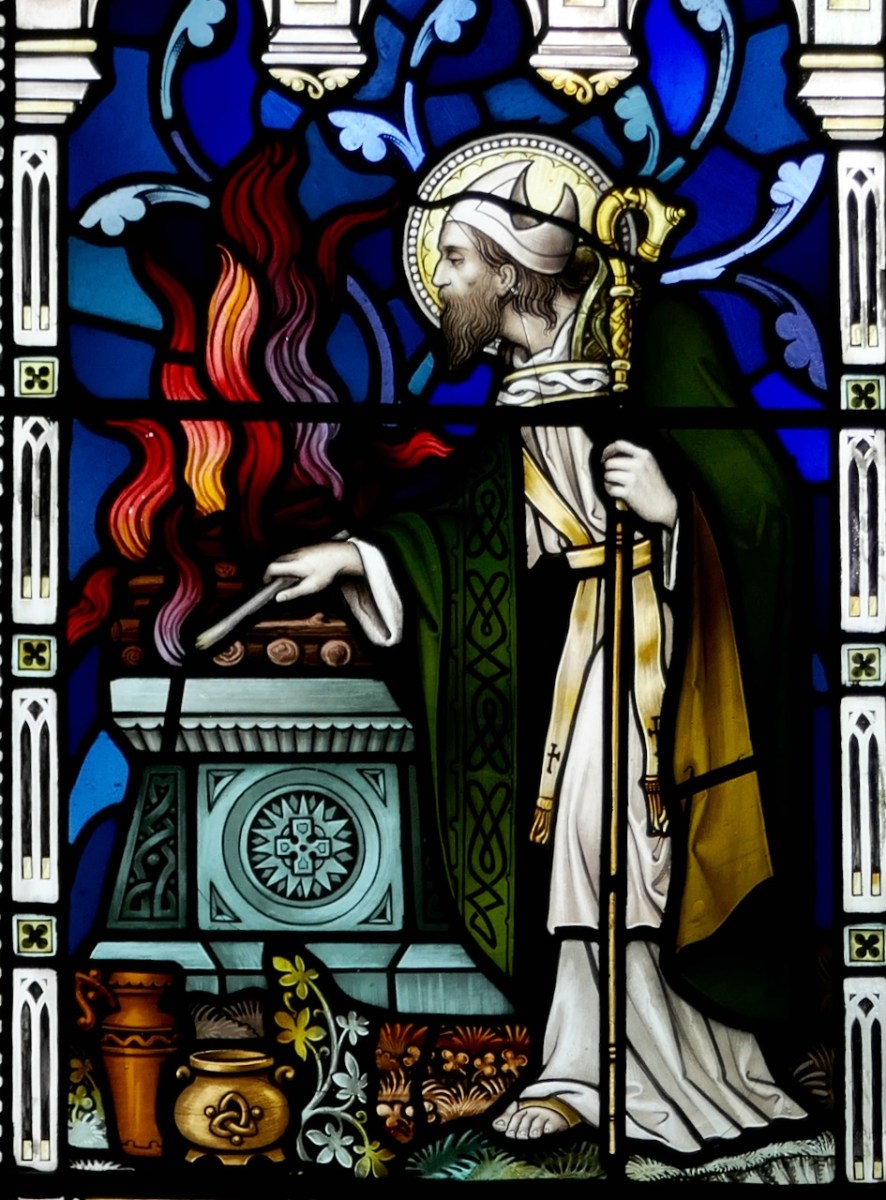
Speaking of Kildare city, in Leinster, which had become so renowned, owing to its connexion with our glorious abbess, Giraldus Cambrensis says, that foremost, among many miraculous things worthy of record, was St. Brigid’s inextinguishable fire. Not, that this fire itself was incapable of being extinguished, did it obtain any such name, but, because nuns and holy women had so carefully and sedulously supplied fuel to feed its flames, that from St. Brigid’s time to the twelfth century, when he wrote, it remained perpetually burning through a long lapse of years. What was still more remarkable, notwithstanding great heaps of wood, that must have been piled upon it, during such a prolonged interval, the ashes of this fire never increased.

Another detail from the Watson window in Sneem

What is furthermore remarkable, from the time of St. Brigid and after her death until the twelfth century, an even number, including twenty nuns, and the abbess, had remained in Kildare nunnery. Each of these religious, in rotation, nightly watched this inextinguishable fire. On the twentieth night, having placed wood on its embers, the last nun said:” O Brigid, guard thy fires, for this night the duty devolves on thyself.” Then the nun left that pyre, but although the wood might have been all consumed before morning, yet the coals remained alive and inextinguishable. A circular hedge of shrubs or thorns surrounded it, and no male person dare presume to enter within that sacred enclosure, lest he might provoke Divine vengeance, as had been experienced by a certain rash man, who ventured to transgress this ordinance. Women only were allowed to tend that fire. Even these attendants were not permitted to blow it with their breath; but, they used boughs of trees as fans for this purpose.

This is the predella from the Brigid window in Moone, by the Harry Clarke Studios (see blow for the main panel)

All of the Lives and O’Hanlon’s account tell of Brigid’s many miracles in providing food and clothing for the poor, in healing sicknesses, in turning the hearts of evildoers to God, in freeing slaves, and in punishing those who are selfish or cruel.

Brigid and the Beggar, by William Dowling, Gorey C of I

However, the story I like best perhaps is this one from the Vita Prima: 

In the same place also when saint Brigit was staying as a guest, a married man came with a request that saint Brigit should bless some water for him to sprinkle his wife with, for the wife actually hated the husband. So Brigit blessed some water and his house and food and drink and bed were sprinkled while his wife was away. And from that day on the wife loved her husband with a passionate love as long as she lived.

She may have been a nun, but she obviously served up a good love potion when the situation required it. This story is not only repeated in the Book of Lismore, but embellished, thus: 

When he had done thus, the wife gave exceeding great love to him, so that she could not keep apart from him, even on one side of the house ; but she was always at one of his hands. He went one day on a journey and left the wife asleep. When the woman awoke she rose up lightly and went after the husband, and saw him afar from her, with an arm of the sea between them. She cried out to her husband and said that she would go into the sea unless he came to her.

The aged St Brigid by George Stephen Walsh, in Ballintubber Abbey – another image generously loaned by Frank Fullard

My final point for this post about St Brigid is the matter of where she is buried. Most authorities give this as Downpatrick, where she is laid to rest alongside Patrick and Columcille. However, a medieval legend grew that she went to Glastonbury in old age and died there. That is why she is venerated in Britain as well as in Ireland – the top photograph in this post is from the St Brigid window in Exeter Cathedral. Here’s the full window, in which she is flanked, for some reason, by St Luke and St John busily writing their gospels.

Here is another British window, this one designed by Nuttgens in 1952 for St Etheldreda’s Church in London. (Used with thanks under the Creative Commons License – original is here.) It’s a particularly good narrative window, showing the building of her church under the Oak Tree, her crozier, and two cows – there are many stories of milk and cows in the Lives.

But O’Hanlon is having none of the Glastonbury story.

We cannot receive as duly authenticated, or even as probable, several assertions of mediaeval and more recent writers, who have treated concerning this illustrious virgin. It has been stated, that about the year 488, Saint Brigid left Ireland, and proceeded towards Glastonbury. There, it is said, she remained, until advanced in years, on an island, and convenient to the monastery in that place. Whether she died there or returned to Ireland is doubted. But, it seems probable enough, such a tradition had its origin, owing to this circumstance, that a different St. Brigid, called of Inis-bridge, or of Bride’s Island, had been the person really meant. She lived many years on a small island, near Glastonbury, called Brigidae Insula i.e., Brigid’s Bridge. This latter St. Brigid is said to have been buried, at Glastonbury.

This Brigid window is in Moone, Co Kildare from the Harry Clarke Studios. It features, as do many Brigid windows I have seen, a deer, but I can find no mention of a deer in any of the Lives. Perhaps one of our readers knows where the deer icon comes from?

I will finish with a quote from the Book of Lismore, which gives me the title for this post, and gives Brigid one of her most frequent soubriquets.

It is she that helpeth every one who is in a strait and in danger: it is she that abateth the pestilences: it is she that quelleth the anger and the storm of the sea. She is the prophetess of Christ she is the Queen of the South: she is the Mary of the Gael

I don’t know whose window this is – it’s from Ballybunion – but I love the composition

And a final image from Glynn, Co Wexford, because I love the pared-to-the-bone simplicity of this Richard King medallion..

Posts about St Brigid

St Brigid and AI

Brigid 1500: Mary of the Gael

Brigid: A Bishop in All But Name

St Brigid: Dove Among Birds, Vine Among Trees, Sun Among Stars

Michael Healy by David Caron: Review

This book – MIchael Healy: An Túr Gloine’s Stained Glass Pioneer – is nothing short of a miracle. It’s beautifully written by David Caron, with superb photography mainly by Jozef Vrtiel, and outstanding production values by Four Courts Press. But a miracle? Yes – because David Caron uses his scholarship and knowledge of stained glass as well as the history and art movements of the period to produce an immensely readable book about an intensely private man who left behind practically nothing about his life except his magnificent work.

I will declare an interest right away – David Caron is a friend and mentor, editor and principal writer of the Gazetteer of Irish Stained Glass, to which I am one of the contributors. I have been looking forward to this book for a long time, as have all his friends, colleagues and collaborators. It was launched to great acclaim in Dublin on November 1 – all the available copies were snapped up at the launch, including mine (stowed behind the desk), so I had to wait until December to get my hands on it. 

From a private bishop’s oratory, Sts Macartan, Brigid, Patrick and Dympna. Detail of Macartan, below. The rich reds and yellow shading of Macartan’s robes are the result of aciding and silver stain, described further down

All the photographs in this post are my own – but I haven’t seen that many Healy windows, and my photography does not bear comparison with Jozef’s magnificent images. The book is profusely illustrated – it’s one of its many strengths – with many photographs of the tiny details in which Healy delighted and which distinguish his windows from those of other artists. Healy spent all his working life at An Túr Gloine (The Tower of Glass) the Studio founded by Sarah Purser. If you are unfamiliar with this period in Irish stained glass, you might like to read my post Loughrea Cathedral and the Irish Arts and Crafts Movement before continuing.

Born in 1873 into grinding poverty in a Dublin tenement, through a combination of great good luck and his own prodigious talent and hard work, Michael Healy turned himself into one of the foremost stained glass artists of his time. Reading David’s account, it is difficult not to be overwhelmed at times by the hardship endured by Healy and his family in turn-of-the-20th-century Dublin. Packed into one room with miserably inadequate sanitation, whole families succumbed to disease and early death. Consumption was rampant and the only recourse for anything approaching treatment was the dreaded workhouse. Infant mortality rates were high and so we read about several Healy babies who failed to survive into adulthood, as well as adults carried to early graves, leaving widows and widowers to try to cope. 

Christ with Doubting Thomas, St Joseph’s, Mayfield, Cork

In the midst of all this was the First World War, the Easter Rising, the War of Independence and the Civil War, followed by the emergence of the new Irish State. David chronicles all of this, and the effect it was having on citizens, like Healy, who were trying to go about their business, but who also had deep convictions about politics and religion.

These windows, Sts Brigid, Patrick and Columcille, are in the National Gallery

In some ways, Healy was a typical young man of his time. Deeply religious, he spent some time in a seminary before deciding he was unsuited to the vocation. He belonged to a Catholic men’s lay organisation. David provides many instances where his working class Dublin accent, his republicanism, and his Catholicism must have put him at odds with his fellow artists at An Túr Gloine, mostly female, Protestant and from well-to-do backgrounds. They found him brooding and introverted, although they acknowledged his exceptional talent, and until Evie Hone arrived he did not make true friends with any of them.

The Annunciation, Loughrea Cathedral. This window was closely based on a design by the great arts and crafts stained glass master, Christopher Whall. Whall came over from England to supervise the execution of it by the Túr Gloine artists, including Healy. Celtic revival interlacing was very popular at the time, and a way of putting a nationalistic stamp on a window – note the subtle inclusions of interlacing here and there

I mentioned that he had strokes of good luck in his life, two in particular. One was the patronage of a perceptive priest, Fr Glendon, who enabled him to study in Florence for a period of time and who procured illustration work for him in Dublin. David points out here and there in the text the influence of Italian painters discernible in Healy’s windows, gained from his sojourn in Italy.

Detail of a Patrick window in Donnybrook

The other was that he found lodgings with a landlady, Elizabeth Kelly, and over time they grew close. Eventually, they become lovers and had a son, Diarmuid, together. Although the relationship was never publicly acknowledged (she was married, although her husband left her) it provided both of them with stability and comfort, and Healy was close to his son. In the 30s Diarmuid O’Kelly (although his mother went by Kelly) bought a Ford Model T and he and Michael would go on sketching expeditions up into the Dublin Mountains and out along the canals. 

Christ with Mary and Martha, Mayfield, Cork

Because of the opprobrium that such a scandal would have visited upon both Elizabeth Kelly and Michael Healy, Diarmuid was never told that Healy was his father, but he must have suspected, and in more recent times DNA testing confirmed the relationship. Reading about the frequent tragedies that befell the Healy family and the privations under which he grew up, I find it very comforting to know that Michael enjoyed the security and love of his adopted family as he got older.

St Simeon, one of Healy’s early windows for Loughrea Cathedral

David leads us on a measured journey through Healy’s life and work. He was the first recruit to An Túr Gloine, Sarah Purser’s stained glass studio, and later co-op. There, he worked alongside AE Child (also his instructor at the Dublin Metropolitan School of Art), Catherine O’Brien, Beatrice Elvery, Ethel Rhind and Hubert McGoldrick. All of them looked up to him as the finest painter at the Studio. He, in turn, admired the work of Wilhelmina Geddes, and when her health caused problems he finished some of her windows, trying to respect her style and designs. But it wasn’t until Evie Hone arrived that he found a true colleague – Nikki Gordon Bowe described Hone as “his devoted disciple and admirer” and she finished some of his windows after he died.

Healy designed many Patrick windows – this one is in Glenariff Co Antrim

Each commission is described and through David’s detailed accounts we come to understand Healy’s style – what iconography he was attracted to, how he decided on the myriad details with which he embellished his windows, and most of all, his decorative methods. 

John the Evangelist, Loughrea Cathedral

Long before Harry Clarke made it is his signature, Healy was a master of aciding, a difficult (and dangerous) process used to remove colour from the surface of flashed glass. Flashed glass is clear glass which has a skim of coloured glass fired onto its surface. This top layer could be removed by scratching or etching it away, or by immersing the glass in a bath of hydrofluoric acid, having first applied beeswax to any surface where the colour should remain intact. By waxing and immersing, often several times, colour could be altered from, for example, a rich ruby red to the merest hint of pink, and all shades in between.

Healy’s Ascension, in Loughrea Cathedral

Healy would often plate two sheets of glass together – for example, one red and the other blue – each one carefully acided, and could by this means achieve an astonishing array of colours from the red-blue side of the spectrum. Added to this, he would often use silver stain on the back of the glass. Once heated in the kiln, the silver stain would permeate the glass, turning it yellow (repeated firings could deepen this from bright yellow to a rich amber colour). Finally, all the figuration would be painted and stippled on to the surface of the glass and the individual pieces of glass would be assembled and leaded together to produce the finished window. Healy was a perfectionist and Purser would despair of ever making enough money to keep the studio going since he spent so long on each commission.

This detail from Healy’s Virgin Mary window in Loughrea illustrates well his aciding technique using red and blue flashed glass plated together to produce not only infinite shades of colour but a sparkling jewel-like effect

It is through David’s lively analysis of each window that we truly come to appreciate Healy’s genius and his evolution as an artist, his style developing according to his exposure to more modern influences.

Considered one of his masterpieces, this is the Last Judgement Window in Loughrea, completed towards the end of his life. A detail from The Damned(right -hand light) is below

David wears his erudition lightly and when he dissects a window, pointing out elements that are easy to miss, and explaining what they mean and why Healy used them, I found myself pouring over Jozef’s wonderful photographs, picking out each separate item of iconography, and marvelling anew at the depths of learning that Healy brought to his designs. For example, David devotes five pages to the St Augustine and St Monica window in John’s Lane Church in Dublin and not a word is wasted.

Along the way we meet a host of characters – the redoubtable Sarah Purser and his colleagues at An Túr Gloine, enterprising priests and bishops, citizens memorialising their dead family members (CS Lewis!), art critics such as C P Curran, American heiresses, patrons of the arts, Celtic Revival influencers (OK, modern word, but you know who I mean). We get insights into the inner workings of the studio, wherein frequent bouts of unprofessional behaviour created tensions, and where Sarah Purser often had to crack the whip when productivity lagged. We come to understand the difficulties of soliciting business, agreeing on final designs and delivering orders, especially to overseas clients, in days when postal service to American and New Zealand took weeks.

A detail from the Patrick window in the National Gallery

We also come to see Healy as a rounded artist who did more than stained glass. His quick sketches of Dublin characters, drawn from life have all the attraction of immediacy and familiarity, while his watercolour landscapes are charming.  

An early Loughrea window, Virgin and Child with Irish Saints

Healy died in 1941. By the time you finish the book, you feel you have lost a friend – a difficult and complicated one to be sure, but one whom you admire and will never forget. While obviously a gruff character on the outside, David allows us access to his humanity, and points out the obvious sympathy with which he portrays some of his subjects. His Loughrea St Joseph (below), for example, shows, in the words of the art critic Thomas McGreevy, a “Joseph who knows the tragedy of the world and who has some special understanding of the destiny. . . of the child”. We are, of course tempted to see in the tenderness with which Joseph gazes down at Jesus a revelation of Healy’s suppressed feelings for his own son.

This book is not just for stained glass enthusiasts, though they will delight in it, but for anyone interested in life in Ireland at the end of the 19th and beginning of the 20th century, and indeed for anyone who enjoys good writing and a story that propels you through almost 70 years of the life of a significant artist. Available from the publisher or in all good bookstores.