Dún na Long Castle, Sherkin Island

Last week I left you at the threshold of the Castle and Friary on Sherkin, promising to come back to them this week. As I read up about them, though, I realise that each deserves a post of its own, so we are going to look at the Castle first.

What we see now is a pale shadow of what the castle looked like in the 15th century. The Friary was built in 1460 and the castle, or tower house, around the same time, maybe a few years later.

The builder of both was Florence O’Driscoll, chief of the wealthy and warlike O’Driscoll clan, whose headquarters were in Baltimore. It was one of a series of O’Driscoll Castles, which also included Oldcourt, Rincolisky, Lough Hyne and Ardagh, as well as Dún an Óir on Cape Clear, Dún na nGall on Ringarory Island. If you have not already done so, take a look at my posts on Dún an Óir, the Fort of Gold, on Cape Clear Island – it will give you some background into the operations of the O’Driscolls and their network of Castles. And this page has a list of all my castle posts and browsing them will explain all the terminologies, such as bawn, or raised entry

Like the O’Mahonys to the west of them, the O’Driscolls derived their income from control of the waters of the eastern side of Roaringwater bay – and specifically control of the fisheries. And that income was considerable: enough to build all those castles, to mount a fleet of ships, to import the finest wines from France and Spain, and enough to endow a friary where Franciscans could pray for the souls of Florence and his descendants so they could be assured of safe passage to Heaven.

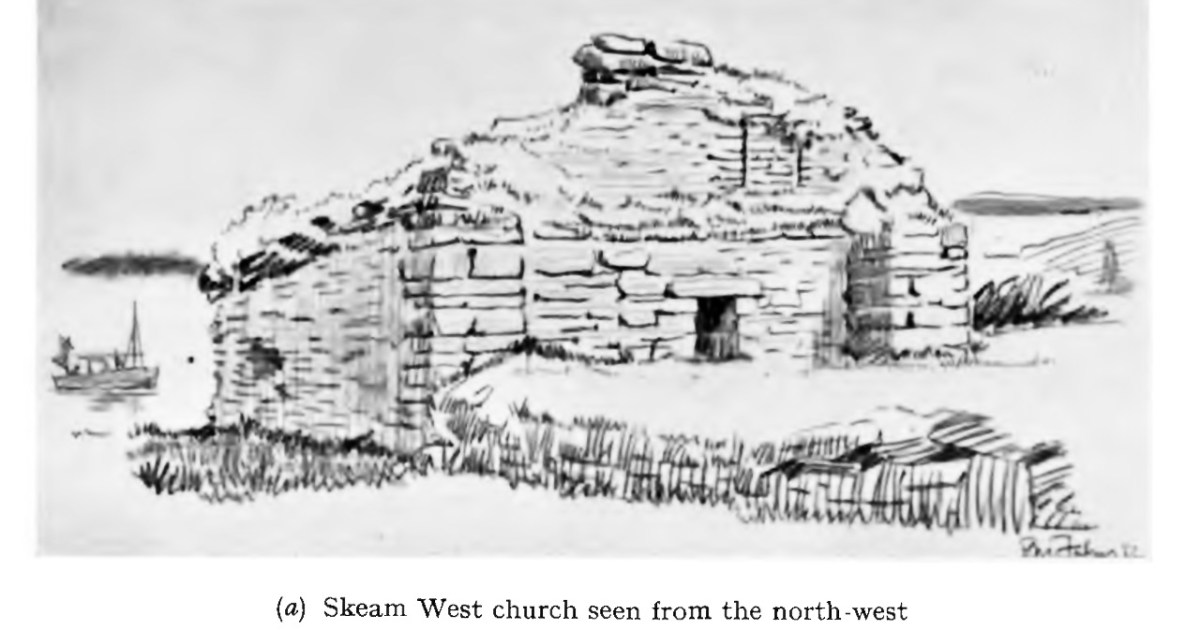
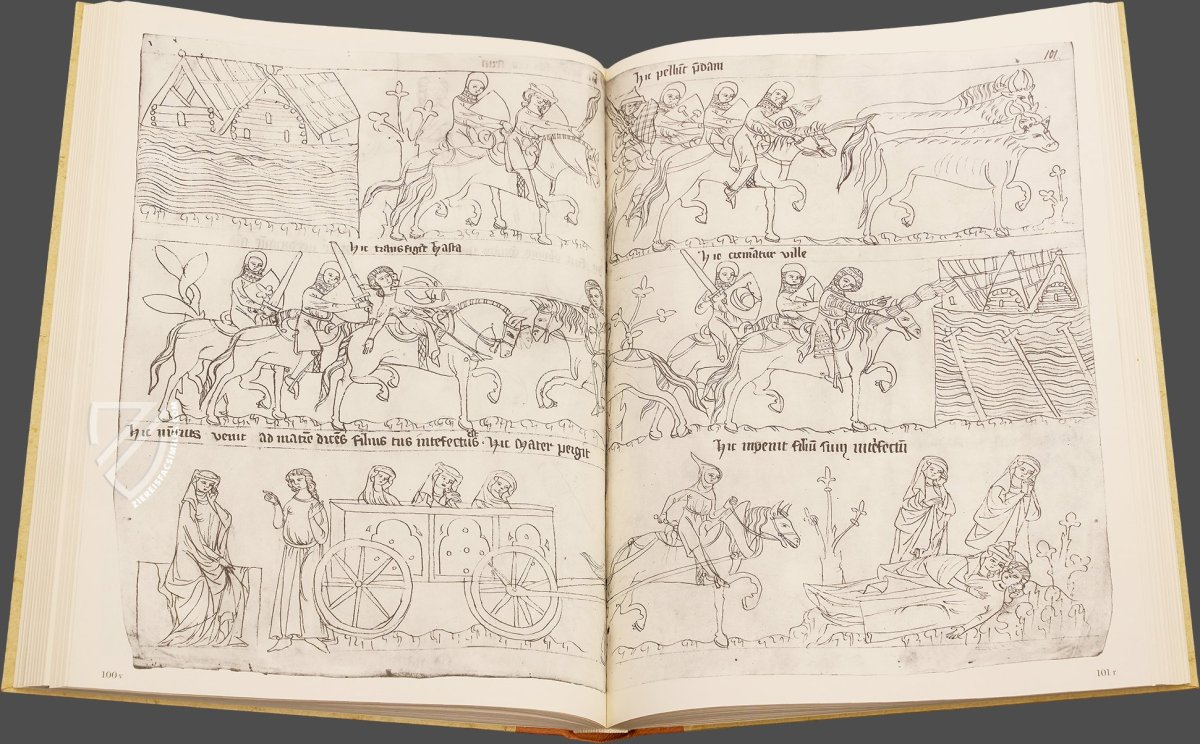
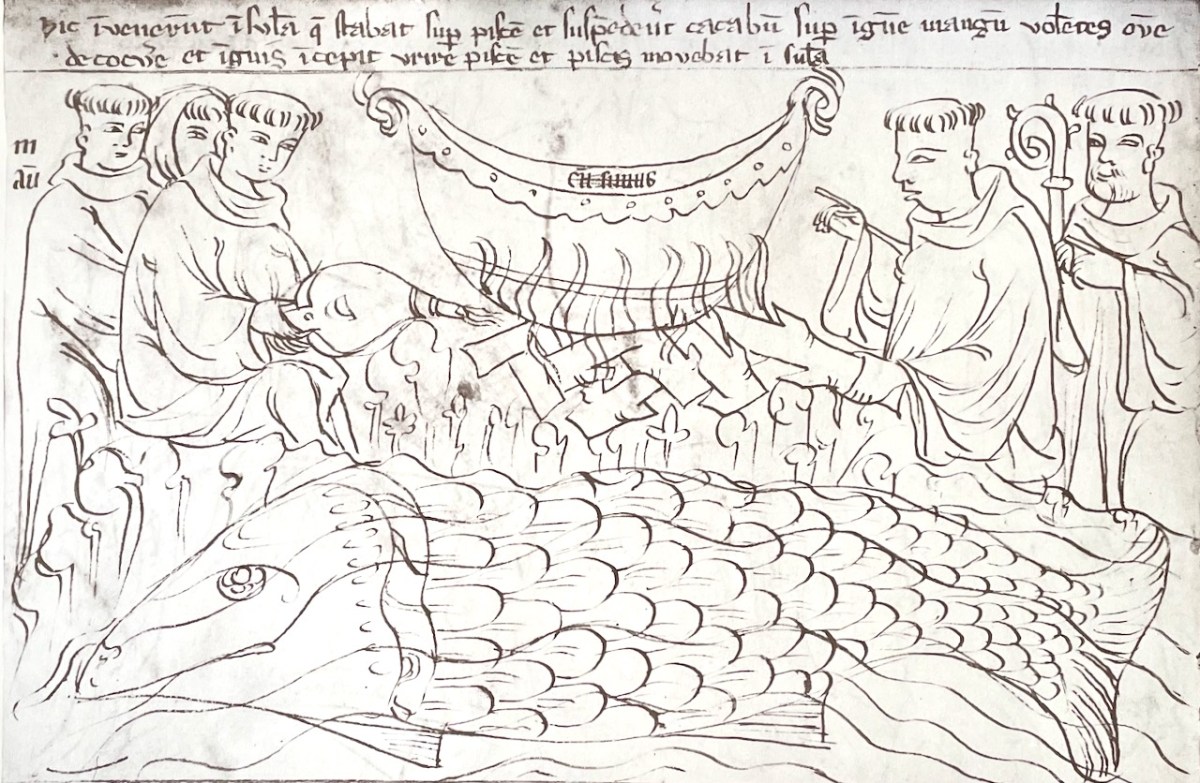
Dún na Long (Fort of the Ships) was strategically sited indeed. It had a good view across to Baltimore but more importantly of the entrance to the inner waters – anything that sailed between Sherkin and the mainland was immediately spotted. It was also very close to the Friary, and could defend it if necessary – although that didn’t quite go according to plan, as can be seen from the top photo, a picture of the Battle of the Wine Barrels that took place in 1537 between the O’Driscolls and a force from Waterford, come to take their revenge on the O’Driscolls for their constant raiding of the cargo ships.

Let’s take a closer look at that drawing to see how the artist represents what Dún na Long looked like originally. Due to the shape of the promontory it occupies a long and narrow space, rather than the square or rectangular area we have come to expect, of a tower house surrounded by a Bawn wall (see Illustrating the Tower House). So the bawn wall is there, but elongated to run the length of the promontory. The tower house itself occupies a central position and there is one corner tower on the landward end. Note that the artist shows a huge cannon on the seaward end of the castle. This would have been unusual for an Irish castle, but there is some evidence for it. In the 1895 Journal of the Cork Historical and Archaeological Society, a  Mr H T Fleming notes this:

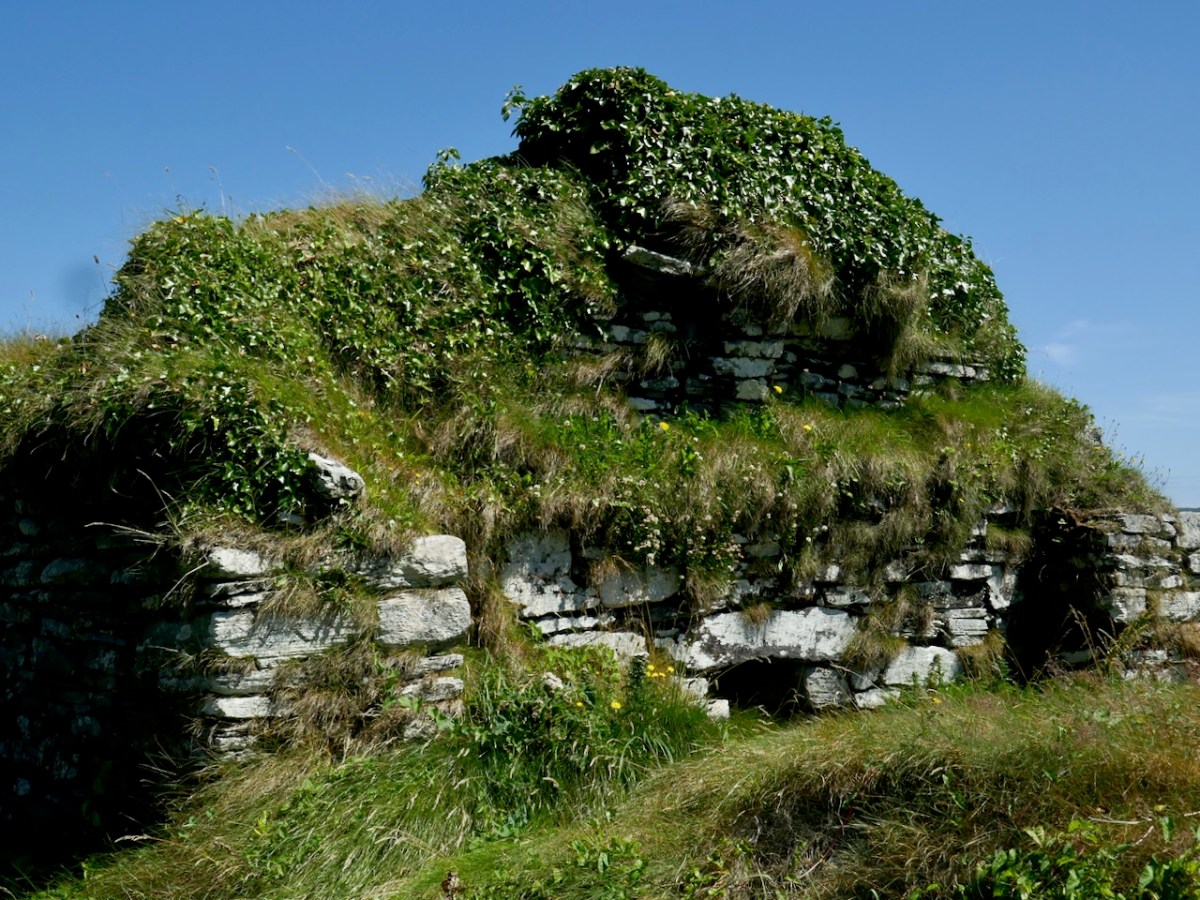
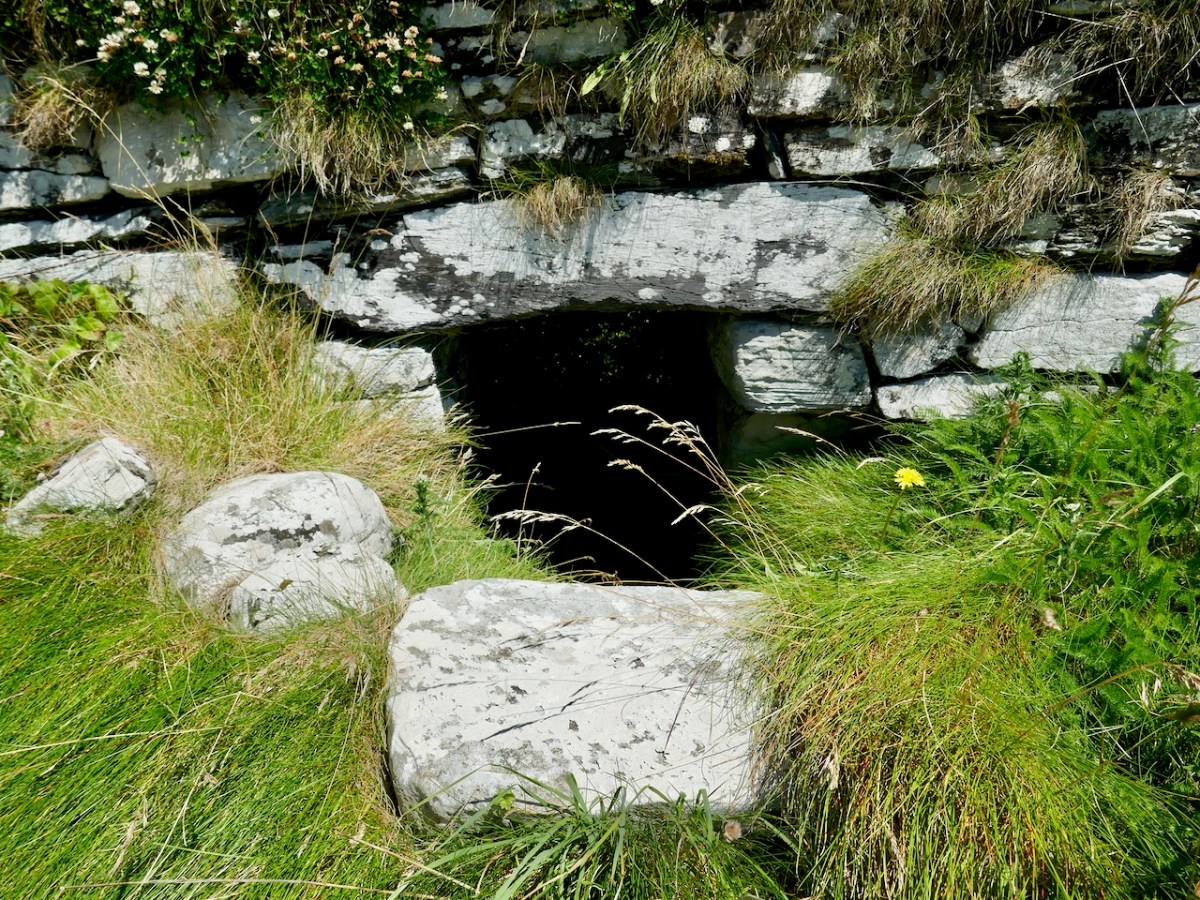
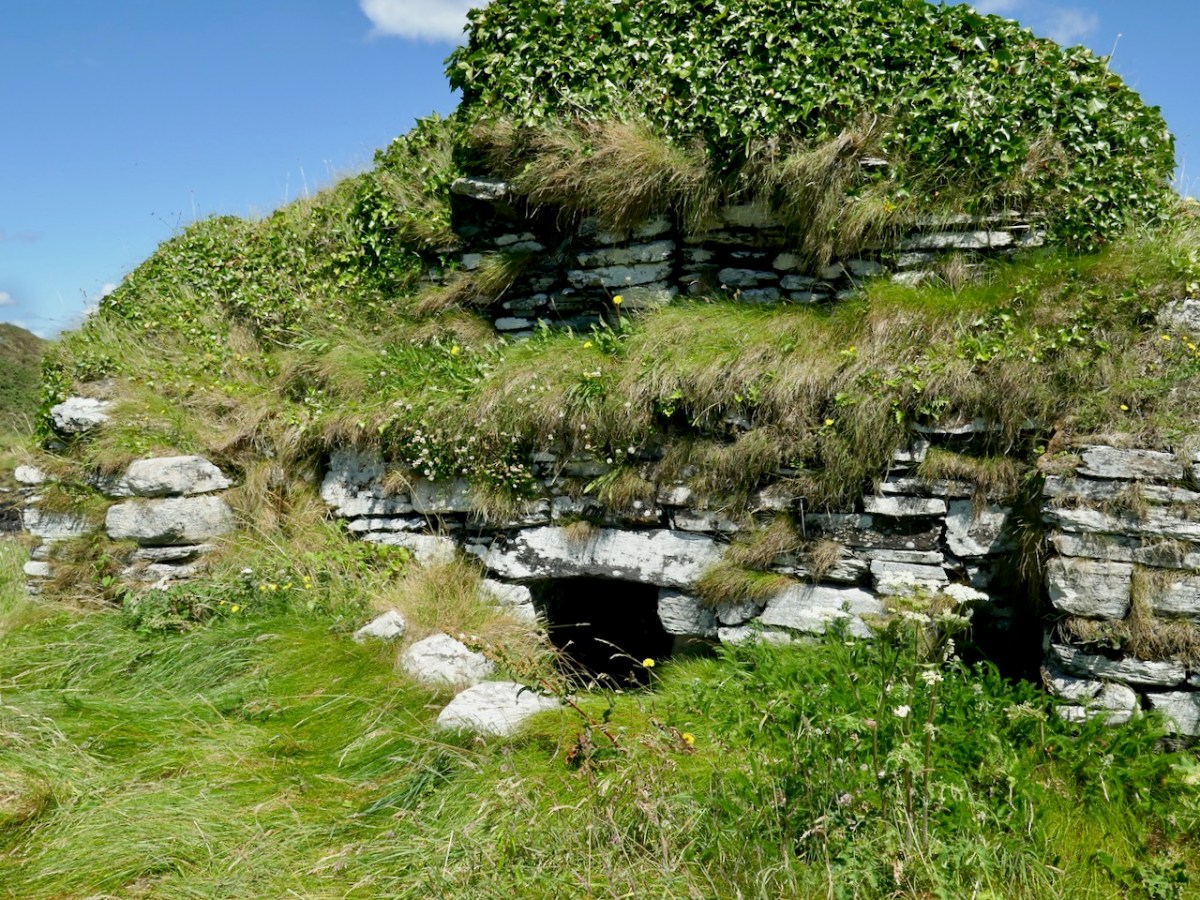
Wandering around the ruins, it is possible to see the remains of what was once there. The central tower now stands to only two stories. There is an entrance on the ground level, but this is an enlargement of what was originally a window ope. The actual raised entry was in the west wall – you can see it in the photograph below, although it has been much altered. It probably looked like the ground floor and raised entry configuration at Dunmanus Castle.

There is a pronounced base batter, Samuels, in his Tower Houses of West Cork, provides a sketch plan which shows how impressively thick the walls are. 

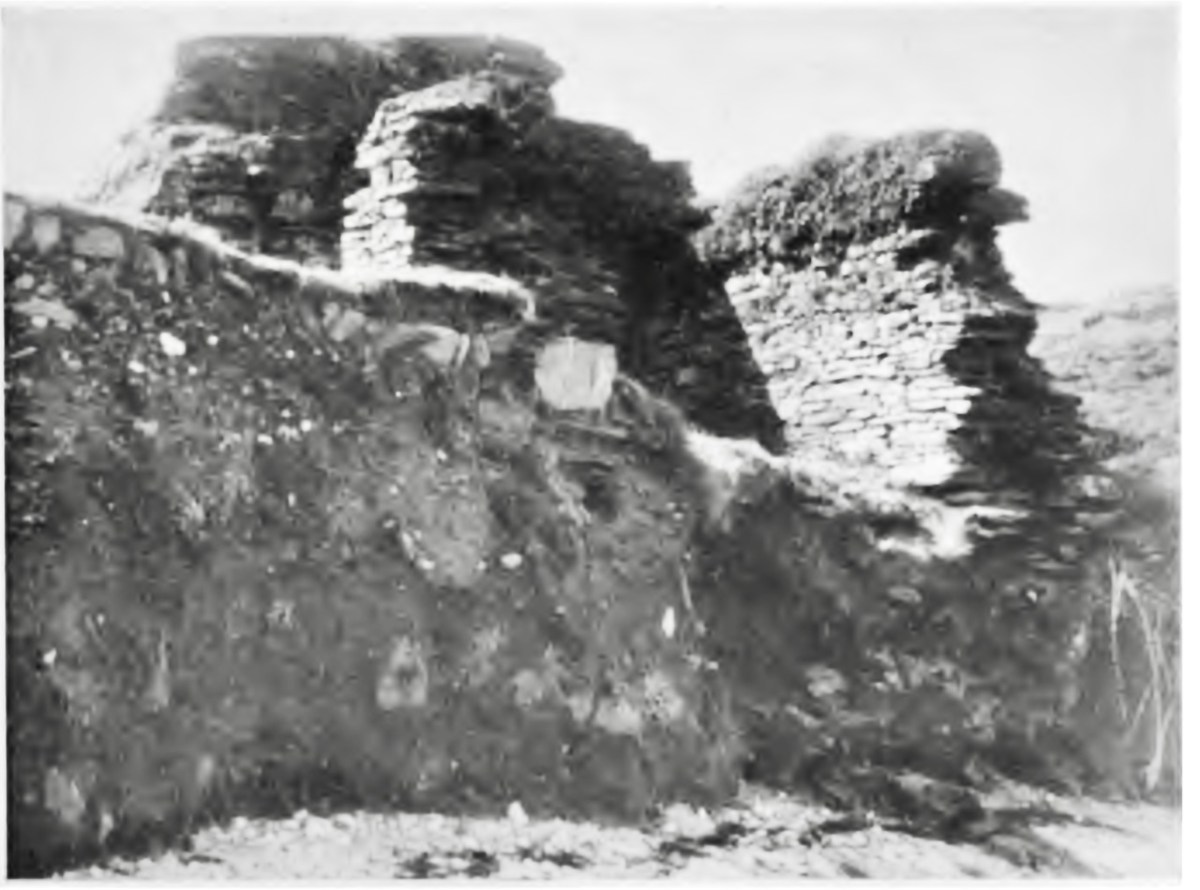
When he was doing his field work, in the 90s, there was still a roof on the pig shed built onto the west wall and he provides this photograph of how the central tower looked at that time.

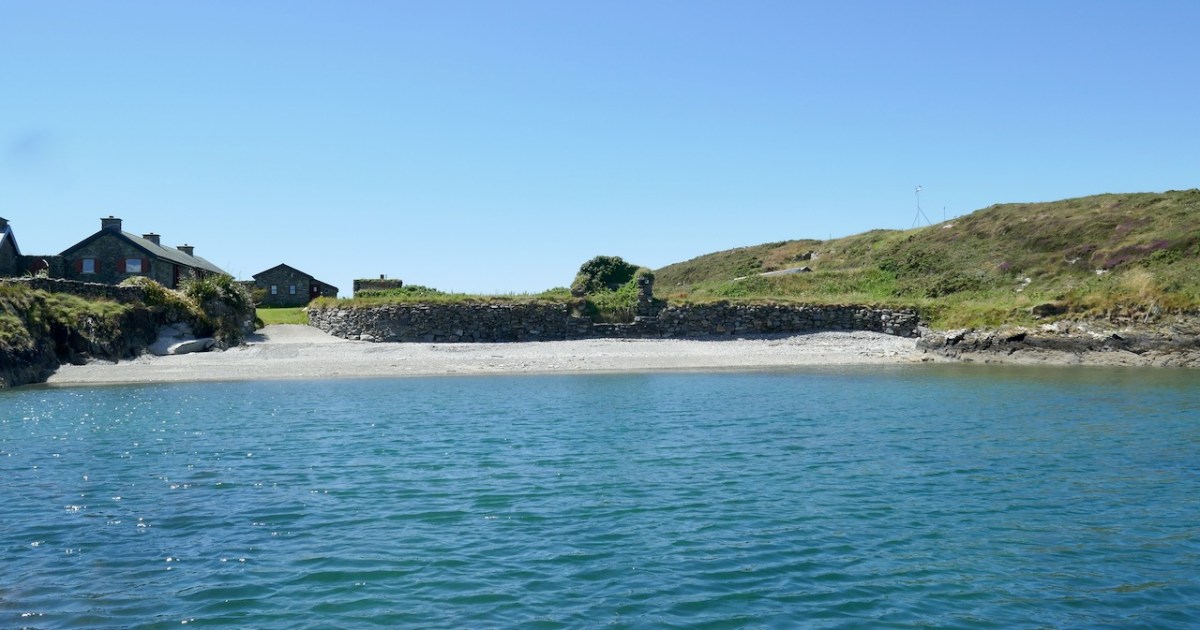
The small corner tower can be clearly seen in the photo below as Amanda is wandering down to the castle. 

That tower occupies the corner position on the bawn where the wall that runs along the landward side meets the wall that runs along the sea, closest to the Friary.

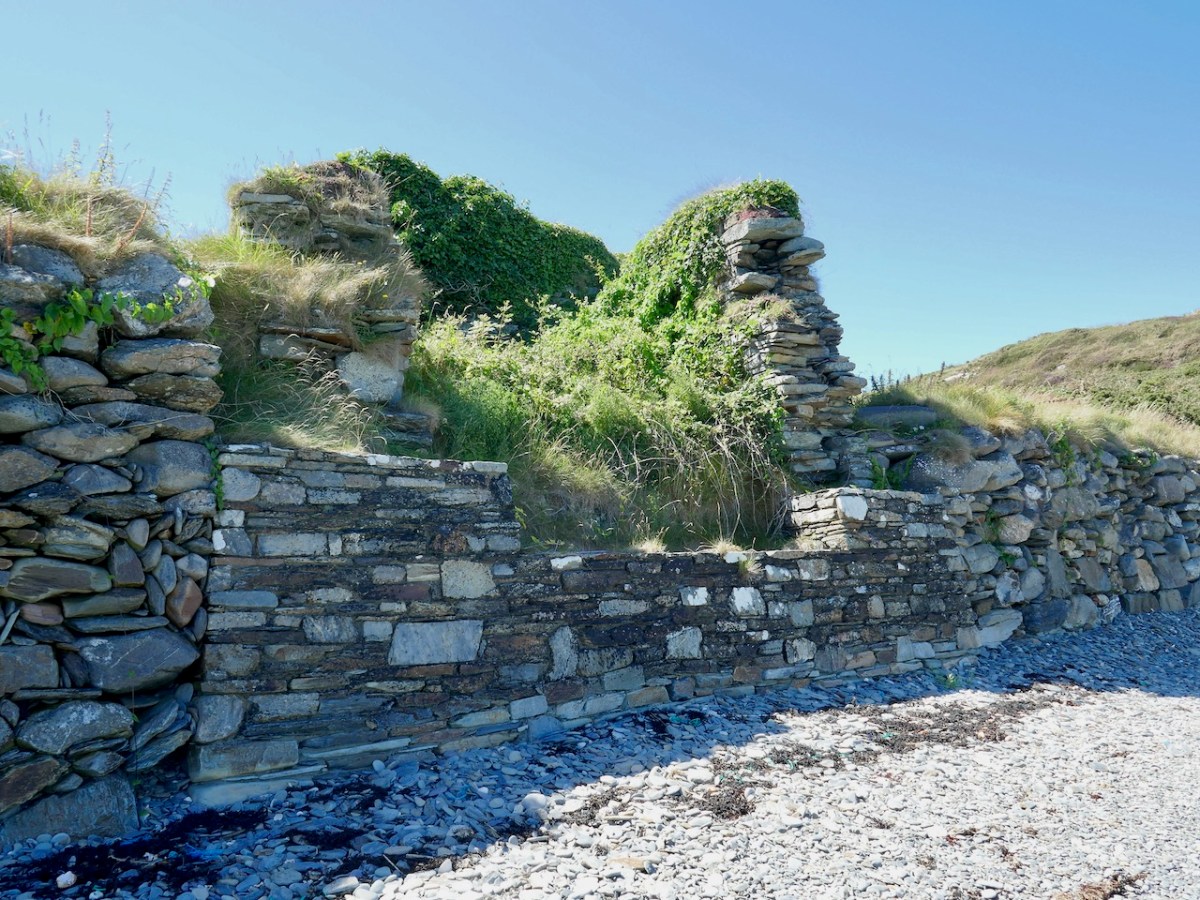
In the sketch, you can see the Waterford force has made its way onto the land and is firing at the castle from that side. What is left of this wall has been extended using modern concrete block.

After the battle of Kinsale in 1601, the current clan chief, another Finghín, handed over the castle to the Spaniards, who in turn surrendered it to the English under Captain Harvey. Since that time it has led an anonymous and ignominious existence as a cattle or pig shed.

Nowadays, the site is much tidier than when I have visited in the past. A picnic table provides a pleasant spot to look out over the sea and think about what life was like in this castle in the 15th and 16th centuries. 

Exploring Sherkin

On  a gorgeous day in May, Amanda and I set off to have a day for ourselves on Sherkin Island. No reason, just because it’s there and it’s wild and beautiful and historic.

We caught the 10:30 ferry from Baltimore. It’s a short ride, but along the way you pass the Beacon and get a great view of the Sherkin lighthouse.

We decided to take a Horseshoe Trail – I have provided a map showing our outbound walk in red and our return walk in Blue. It was all easy walking, no steep hills, and since the weather had been so clement in May we didn’t need boots (although Amanda is seldom parted from her wellies).

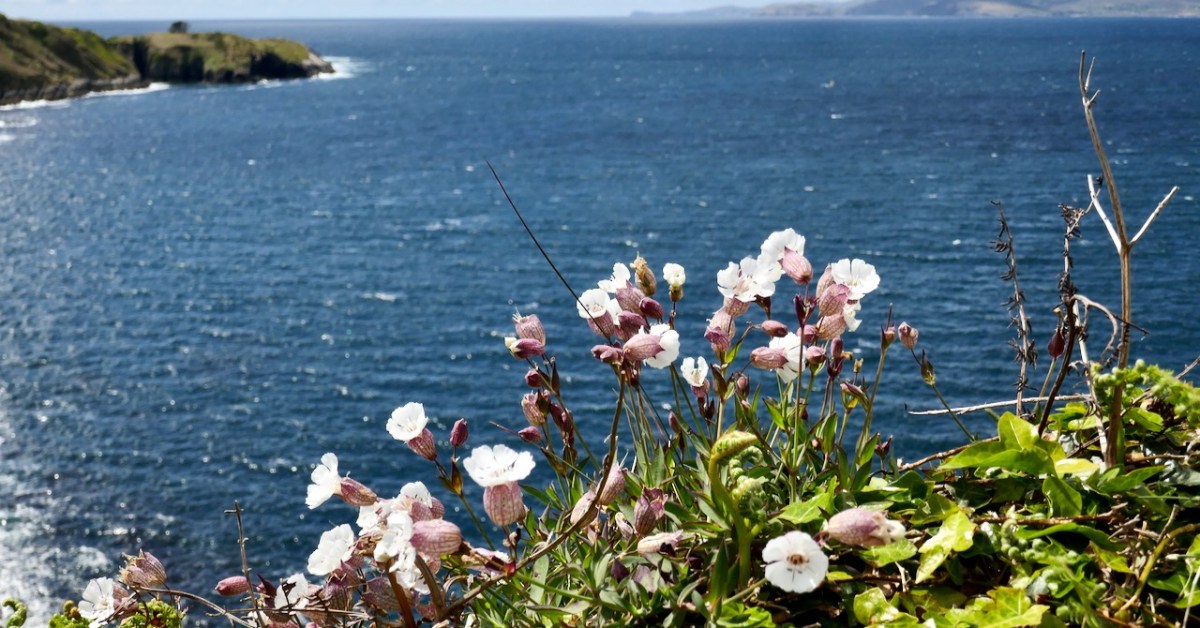
The Horseshoe Trail is well marked, but narrow, and fringed by wildflowers. I had trouble identifying this one – is it Charlock? Or some kind of Mustard? 

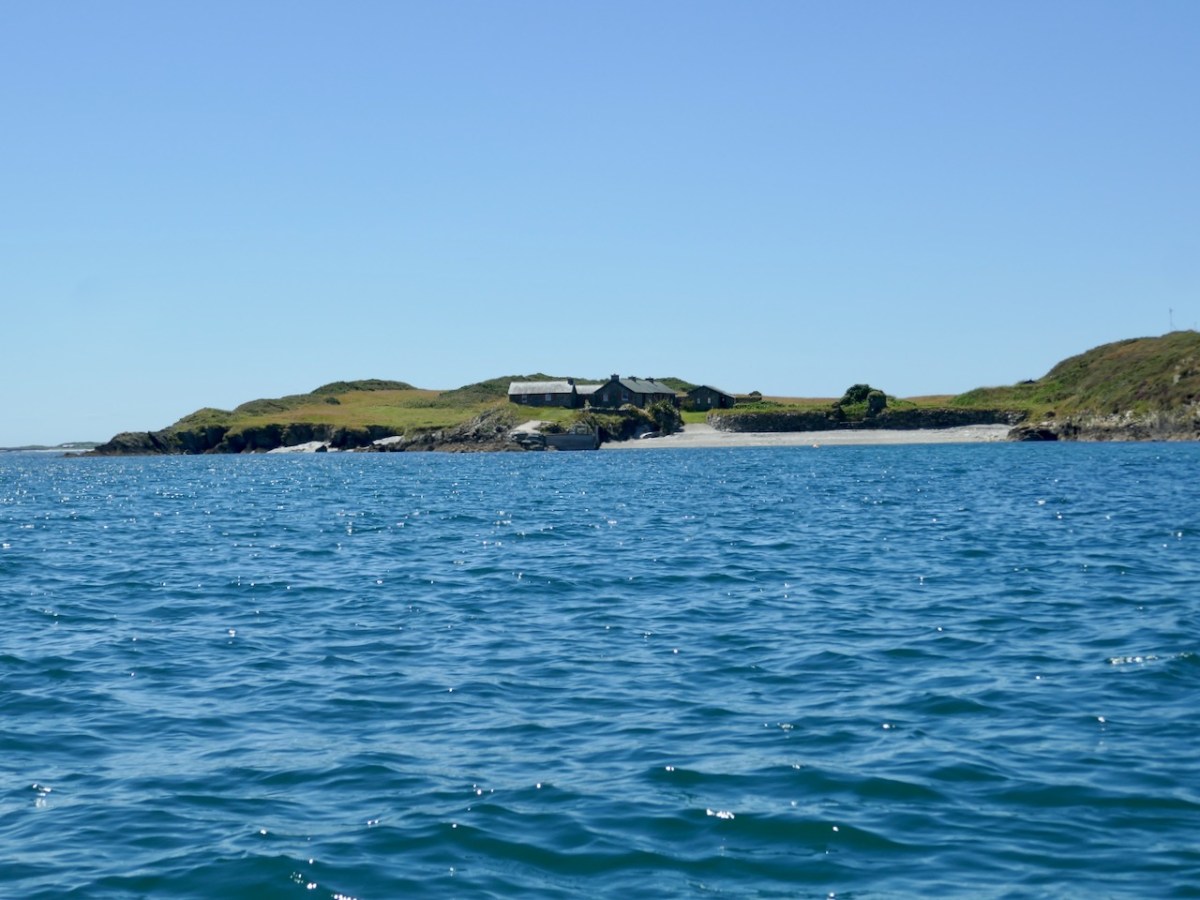
The trail leads down to vistas over Horseshoe Harbour on the south side of the island – a secluded and beautiful cove with Thrift covering the foreshore and Bluebells and Stitchwort in abundance everywhere.

I was fascinated by this little house, standing sentinel over the harbour. What a situation – and it obviously has a history. Above the door is the Papal insignia along with Anno 1932 Congressus

This, of course, is a reference to the Eucharistic Congress, held in Dublin in 1932. Here’s a wonderful account of that time by West Cork Historian, Kieran Doyle

It was the biggest thing to happen in the new state. My parents used to talk about it. Dad was in the Phoenix Park (along with a quarter of Ireland’s population) to hear John McCormack singing Panis Angelicus. Perhaps it was that experience that persuaded him to study for the priesthood. Fortunately for this blog, he discovered his error after a year, and my mother a few years later. But take a listen to what my father heard in 1932.

My mother, by the way, was found of quoting Brendan Behan who said that during the Eucharistic Congress, “Grafton Street was lousy with Bishops”.

But I digress! Let’s get back to Sherkin – although if anyone knows more about why this attractive cottage sports a 1932 Eucharistic Congress sign, do leave a comment.

Our next stop was St Mona’s Holy Well. This is a discrete little well tucked into the hillside of a fern-covered valley. Although Amanda had to battle her way to this well when she first visited, this time we discovered that a recent pilgrim had cleaned up the well and provided very welcome signage. Amanda’s blog provides lots of detail and a link to more information about St Mona, patron saint of the island, who has given her name to the townland of Kilmoon. 

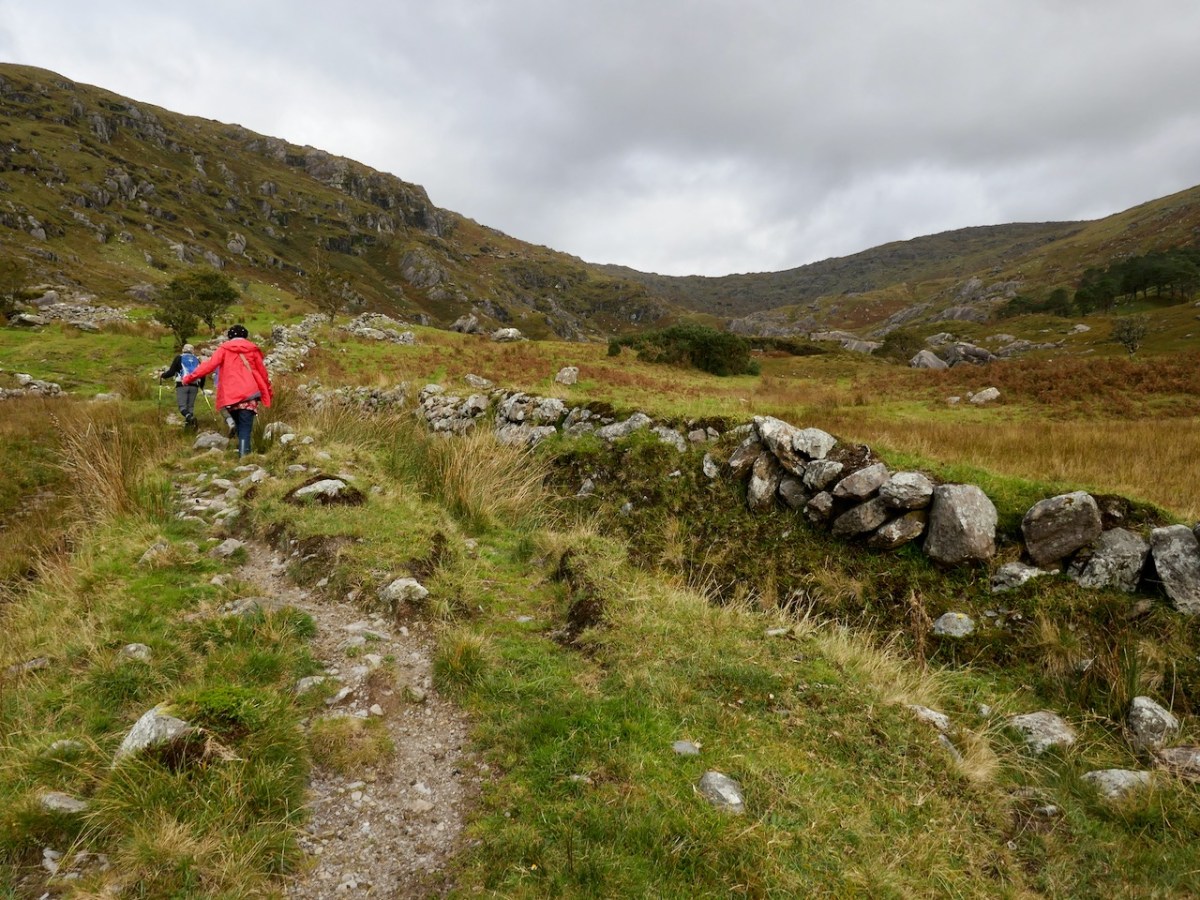
We enjoyed a coffee (I had packed a flask, fearful of a caffeine withdrawal) overlooking Horseshoe Harbour (photo by Amanda) before setting off back to join the main road through the island. My top photo shows the terrain leading to and from the well – we had the real sense of being in a hidden valley.

A detour brought us to a piece of archaeology – a cupmarked stone. Robert and I visited this several years ago and he wrote about it here, so you can take a look at the stone with its 14 cupmarks. I am not giving the location of this as it is on private land

We stopped for a sit-down along the way – the little cafe wasn’t open, but a sleepy cat presided over our rest stop and the Free Palestine sign provided the backdrop.  

On we went then, to Cow Strand where a lovely surprise awaited – good coffee and snacks and a teepee to sit under – it was pretty hot by now (photo by Amanda).

From there we walked to the magnificent Silver Strand, with a view to Cape Clear. 

Sherkin Island is home to the medieval castle, Dún na Long (Fort of the Ships) and a magnificent ruined Friary. A wander around these two monuments was our final destination and to my enormous surprise, as it had never happened before, we were able to go inside the friary. The next blog will take up the story from there. 

A Powerhouse for Nature – Sonia Caldwell and Kilcoe Studios

I have written once before about Sonia Caldwell of Kilcoe Studios. That was eight years ago. In a post titled Kilcoe Studios – Dedication and Passion, I showed you her production of beautiful botanical art calendars and notecards, and gave you a glimpse of her passion for sculpture.

Since then, Sonia has emerged in West Cork as a true champion for heritage and nature, on top of continuing to develop her business and her personal sculpting practice. After a residency at Uillinn, she held a solo show there last month, mainly featuring her sculpture.

Sonia works in limestone, clay and natural materials such as mosses and twigs. Her work has an ethereal quality, explained by her personal spirituality. Her figures, small and large, are seeking to find their path, or answers to their questions. 

They ponder an empty church, march along a pilgrim route carrying their burdens, or gaze into the distance mulling over some otherworldly mystery. 

The launch of the exhibition was haunting. Sonia and singers, directed by Susan Nares, entered singing: chanting, rather, in a slightly Gregorian way, in English and Irish. 

That’s the fine art side of Sonia. But her other passion is for the natural world and for all those heritage crafts that will die, if people like her don’t learn, nurture and revive them. She has opened a shop in Ballydehob, where she sells her own artwork, and items by others made from all natural materials. 

The shop is where she also hosts her workshops – often facilitated by herself and occasionally  by others. All the workshops are designed to get us engaging with heritage crafts and materials sourced from the fields, hedges and water around us. And they are great fun!

Just in the past year in that shop I have learned to make a basket from brambles (yes, don’t worry, de-thorned) – that’s my friend Julia splitting a long bramble above. I have made an autumn sculpture (“don’t call it a wreath!”) and a Christmas wreath, both facilitated by the wonderful Liz O’Leary and from foraged materials.

And I have gone on two foraging walks. The latest walk was last weekend, and it featured my first ever cup of nettle tea (delish!) and a picnic on the banks of a river with crackers and cake made from various gleanings and flavourings  – toasted Wood Avens seeds anyone?

Sonia has also single-handedly revived Wren Day (also known as St Stephen’s Day in Ireland and Boxing Day abroad) in Ballydehob and taught us how to make the traditional rush hats worn by the Wren Boys. See Robert’s post The Wran for more on this unique Irish tradition – he was an enthusiastic participant.

All towns and villages deserve a person like Sonia – the person who won’t let the traditions die and who encourages the rest of us to look around us and really see what the land has to offer. We are lucky she chose West Cork as the place to nurture her own unique and mighty talent and to draw the occasional spark of creativity from the rest of us.

Up the Round Tower

Republishing one of Robert’s classic posts. This one was originally published in May, ten years ago, under the title High Drama. tower in context

If you suffer from vertigo or claustrophobia – or both – then you won’t want to follow us in the adventure we had this week while returning from a visit to Dublin: climbing to the top of an Irish Round Tower! Overcoming any tendencies we might have had towards these phobias, we arrived at the roof of the 32.6 metre high Kildare tower and marvelled at being able to stand on the summit of a piece of architecture over a thousand years old. Kildare has the second highest Round Tower still extant in Ireland: the highest is at Kilmacduagh, Co Galway, at 34.9 metres; however, Kildare now lacks a conical cap, which it might once have had. If so, it would just tip in as the highest of all the towers.

Kildare Round Tower: note the battlemented top - probably added in an 18th century restoration, the romanesque doorway and the granite base. The upper stonework is limestone and sandstone

Kildare Round Tower: note the battlemented top – probably added in an 18th century restoration, the romanesque doorway and the granite base. The upper stonework is limestone and sandstone

The print above – dating from 1788 – shows the ruins of St Brigid’s Church, which was fully restored as a Church of Ireland Cathedral a hundred years later. We looked down on this from our vantage point atop the Tower – and had a good view of the (also restored) Fire Temple where a perpetual flame, lit by the Saint, was kept burning for hundreds of years, finally being extinguished by the shenanigans of Henry VIII.

Looking down on Kildare Cathedral, with St Brigid's 'Fire Temple' in the grounds

Looking down on Kildare Cathedral, with St Brigid’s ‘Fire Temple’ in the grounds

You’ll have heard me talk about St Brigid many times: she’s second only to St Patrick in the Irish Martyrology. In fact, as probably the most influential woman in Irish history, I’m going to declare her as quite the equal of St Patrick: she’s often enough described as one of the Patron Saints of Ireland. You will also know that she is surrounded by folklore and traditional customs, such as the making of her Cross on her day, the First of February.

St Brigid’s Cross – left, at her Holy Well and right, a textile in the Solas Bhride Centre, Kildare

Back to the adventure (although the whole day was adventurous!) – climbing the tower was hard going. There were a series of near-vertical ladders to be negotiated: each one took us to a higher timber platform, six floors in all. At the top of each ladder we had to squeeze ourselves through a narrow opening; this, and the confines of the tower interior – only two metres or so across – certainly challenged the claustrophobiac in me.

The restricted space also made us question some of the theories about the uses of these towers, which are always located at ecclesiastical sites. The definitive work on them is, as it happens, written by someone who also lives in West Cork – just a little distance from Nead an Iolair: Brian Lalor. Brian has led a very full life, involving architecture, archaeology, sketching and printing (his etchings are exquisite). He is also the author of a number of books, many of which are on our own shelves, including The Irish Round Tower, published by The Collins Press, 1999 and 2005.

lalor

Brian is unequivocal in his assertion that the primary purpose for round towers was to house the monastery bell. He also suggests that a secondary function would be as a safe storage place for the monastic treasures: the entrance door was always raised at a considerable height above the surrounding ground level, requiring steps or a ladder to gain access. In the times when they were constructed they would have been visually impressive – and could be seen from a great distance. They would have acted as signposts for travellers who might have been searching for the hospitality which monastic communities always offered. Brian discounts some of the more bizarre theories for the towers – for example, that they might have been places of safe refuge for the monks if under threat of attack by Vikings – or that they are simply phallic symbols! Lastly, Brian considers – and gives some credence to – the idea that the towers were monumental buildings of prestige and local aristocratic patronage: certainly, they required considerable expense and effort to construct.

centre entrance

As is often the case with our days out, one adventure led on to another. When we came down from the tower we found that St Brigid’s Cathedral had closed for lunch. But we knew that the Saint’s trail also involved a Holy Well and we had heard that there was a new building devoted to the work of Brigid just outside Kildare.

Solas Brhíde Centre

Solas Brhíde Centre

Robert with Phil, one of the Sisters who conceived the project

Robert with Phil, one of the Sisters who conceived the project

We were very impressed with the Solas Bhríde Centre: a small group of Brigidine Sisters has put together the project to build a Christian Spirituality Centre which unfolds the legacy of St Brigid and shows that it is still relevant in the present day. We were shown around the Centre by one of these Sisters, Phil, who pointed out that Brigid was attuned to the natural world and would have appreciated that the new building (designed by Solearth Ecological Architecture) is conceived on ecologically sound terms using sustainable materials and techniques which care for the wellbeing of the Earth. The plan of the building is appropriately inspired by the shape of a St Brigid’s Cross.

Architect's drawing of the newly completed building

Architect’s drawing of the newly completed building

The next stop on our itinerary was the nearby Holy Well – a popular place of pilgrimage and veneration on St Brigid’s Day:

Finally, we arrived back at the Cathedral. I’m always a little disappointed by restorations – particularly those which were carried out in Victorian times; nevertheless there are some impressive features. The possibly twelfth century font is one of them (below left), and another has to be the hidden Sheelagh-na-gig under the lip of Bishop Wellesley’s tomb (below right). I reached under to feel this little carving, and was then told by the Cathedral’s guardian that anyone who touches the effigy is ensured everlasting fertility!

The excellent Heritage Centre opposite the Cathedral entrance is informative about the town’s history and the important connections with this special Saint. There is much more to be discovered – and written – in respect of St Brigid, and other places in Ireland which are connected with her still to be visited. Do go to Kildare and, at the very least, suspend your phobias sufficiently to allow you to climb the ancient Round Tower. But make sure you go between May and September – and not during the lunch hour…

tower poster

Stitching and Storytelling Among the Rocky Fields

At the very far reaches of the Mizen, surrounded by townlands whose names all translate as variants on the theme of rocky fields, in a place with immense views, lies an oasis of creativity and charm: the home of Owen and Kate Kelly and their family.

Three of us, Artist Christina, Blogger Finola, and Writer/Actor/Director Karen, fetched up there on a blue sky day this week, to visit Owen and see his craft. Owen is a stitcher, an embroiderer, a needleworker. He’s also a professional coach (international table tennis), a gardener and a conservationist. Nowadays, he, as a fifth-generation stitcher, makes his living crafting unique garments and decorative elements for high-end clothing. 
It has all grown organically from his social media accounts on Facebook and Instagram and Bluesky. Somehow, the like-minded find each other and the army of admirers grows, and the orders start to arrive.

Owen doesn’t just decorate – he tells stories with every piece. The first thing he showed us was his memory skirt, full of his own history. That’s his trip to Glastonbury, here’s a particularly memorable table tennis tournament, the birth of a daughter, his grandmother’s favourite stitch in her favourite colour. 

He thinks it’s finished and I certainly didn’t see any place to add more, but heck, you never know.

Here’s the back of a jacket that I assumed was an owl – but Owen was referencing the need for masking that so many people feel. That is, they cope with life by concealing their mental struggles, their ADHD or Autistic tendencies, in order to fit in. It’s exhausting, and his depiction is an act of masking in itself, since I jumped to the conclusion that this was a bird.

And the mask is a good piece to take a closer look at the sheer variety of individual stitching styles. I have a vague memory from school of learning blanket stitch, daisy chain, French something-or-other, but Owen must know hundreds of different stitch types. Zoom in!

Owen walked us through the process of designing the back of a Ralph Lauren shirt for a client – sorry, that should be, for a friend. That’s what they all turn into. In this case he has already done pieces for other members of the family so he knows the children, the grandchildren, the stories, the likes, the hobbies, the icons they gravitate to.

What fascinated me most is that he doesn’t start out (as left-brained me would do) with a plan – there is no sketch design, no chalk marks on fabric, no story board or end-goal. But in his head is the story he wants to tell. He calls this process ‘flow stitching.’

In this case the story is about a proud grandpa, so there’a grandfather clock and an owl for wisdom, and the heart that he and Grandma once carved on a tree. There’s a tree too, and a rainbow. And, can you see it? The overall shape is a Buddha.

The grandson is there, with the tiger, and the cow jumping over the moon and Humpty Dumpty waving Owen’s signature red hat. The granddaughter loves mermaids. And in between there are all kinds of little symbols and references, in all kinds of different stitches and colours. As I poured over it, all I could think of was – be still my heart – how I would love to be at the unveiling of this wonderful garment. 

He learned his skills from his mother and grandmother and of course he got bullied in school but he persisted anyway. He’s heavily influenced by indigenous art, by Indian and Persian designs and by Celtic interlacing and illuminated manuscripts such as the Book of Kells. 

He cites his remote location on the edge of the Atlantic as another influence – the colours, the wildness, tuning in to the natural world and the deep tradition of story telling and mythology. 

Ongoing projects include his hoops – 6” rounds, each one telling a story, and his quilt pieces, which will (may?) eventually make up a whole quilt. He loves to play with symmetry – with half- or quarter-designs for example, that need to be matched with other halves or quarters to make a whole.  

And of course – there’s Seamus! Seamus O’Comanssy is a little stitched guy who is travelling the world. He’s currently in Australia, but before that it was Slovakia and before that France. You can follow his journey – even volunteer to host him!

I’ll leave you with images of a hat – Owen is a hat man and his signature is a red hat. In fact when I met him recently he was wearing a red jacket, a red hat, and an amazing embroidered tie. 

And I didn’t leave empty handed – I took away one of Kate’s lovely mugs. She’s been experimenting with a new green glaze and it’s gorgeous. I can report that coffee tastes really good from it too. That’s Kate’s own photograph, below. Her pottery is for sale at the Mizen Visitor’s Centre.

Thanks for such a lovely visit, Owen and Kate. 

If you’d like to hear Owen talking about his life and work, tune in to the Stitchery Stories Podcast.
Stone Mad, Re-Issued

Yesterday, in a ceremony in the Cork Public Museum, Mercier Press launched a re-issued Stone Mad, by Seamus Murphy. This year is the 50th anniversary of Seamus’s death, in 1975. The book is also the One City One Book choice of the Cork City Library, as part of the 2025 Cork World Book Fest taking place all this week in venues across Cork.

I attended the launch in the Museum, in Fitzgerald Park, home of several sculptures by Seamus, including this one of De Valera, above. Long-time readers will remember our own Rock Art Exhibition in the same building ten years ago – somehow apt that it featured the prehistoric version of the stone carving tradition we were celebrating yesterday. 

The book was officially launched by the poet Eiléan Ní Chuilleanáin, about whom I wrote here. She had known him in the old days in Cork, and her’s was a wonderful, evocative, beautifully written summary of Seamus and his book. She finished with words that resonated with everyone in the room (and it was packed!) – I paraphrase it as: Read this book again. And afterwards, go and wander around Cork. You will never look at it the same way again.

Eoghan Daltun, author of An Irish Atlantic Rain Forest, was there too. Besides a passionate conservationist, he is a skilled sculptural restorer, and was responsible from rescuing Dreamline from weather and lichen damage a couple of years ago. Standing within the display of carvings and tools and images, all carefully set up by the Museum team led by Curator Dan Breen, Eoghan talked us through what was involved in carving in stone and, many years later, restoring the artwork. 

I was also very pleased to meet Ken Thompson, the stone carver who finished off lettering on Seamus’s headstones, after his death, and who carved many monuments I have encountered in Cork and elsewhere, including the inspirational memorial to the Victims of the Air India tragedy in Ahakista, below. 

Seamus Murphy is acknowledged as one of Ireland’s best stone carvers, and an icon of the 20th century Cork cultural scene. His work can be seen all over Ireland, but especially in an around Cork. If you are not that familiar with his output, the documentary Seamus Murphy A Quiet Revolution is a great introduction to his life and work.

Stone Mad has been a favourite on our shelves as long as Robert and I have had a joint library. We own a couple of copies, including a hardback of the second edition, signed by Seamus and with illustrations by William Harrington. It’s an evocative summation of his life as a ‘stoney’, the men with whom he worked, and the craft they honed together. It has become iconic, as much for its on-the-ground and entertaining picture of life in a Cork stone yard as for its musings on stone carving as an art, from medieval times to the present day. For some extracts, see my post, Building a Stone Wall.

The illustrations by William Harrington, pen and ink sketches, capture the work, the camaraderie of pub life after a hard day’s work, but also includes a sensitively drawn portrait of Seamus. 

If you don’t have a copy of Stone Mad, do get one – it deserves a place in your library. I will leave the last word to Ken Thompson, from the documentary I link to above. Ken inherited Seamus’s tools (below) – most of them look surprisingly delicate for the work they do, don’t they?

Ken says, Now he’s been dead for 40 years, but I see his work in churches all the time. His work is shining out. It’s still a beacon. It still speaks.