Elizabethan Map of a Turbulent West Cork

The Elizabethans were map-makers, especially if they needed information for the purpose of wars and conquests. I was first alerted to this extraordinary map of West Cork by a reference in the O’Mahony Journal (subscription needed) and then to a piece written on it for the Journal of the Cork Historical and Archaeological Society in 1958 by P O’Keeffe who labelled it a Map of Beare and Bantry. Neither of these sources had a good image of the map and so, intrigued, I sent off a request for a digital copy to the British National Archives. It arrived by return email, at no charge. What a service! (Irish national repositories take note.) Here is the complete map.

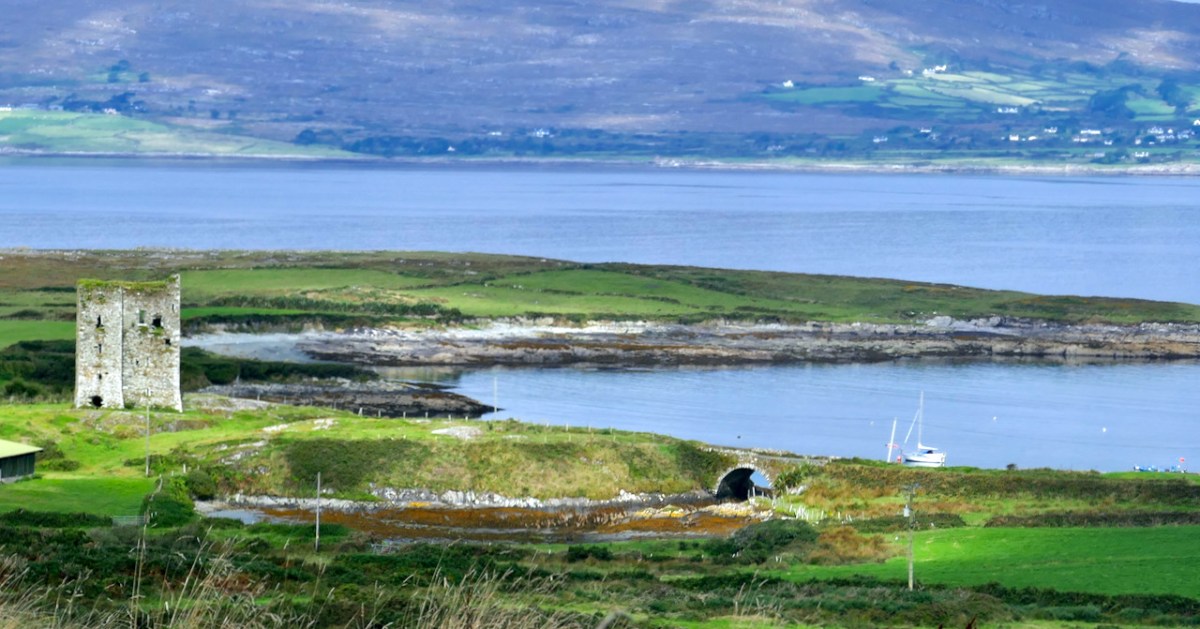
While it is clear that this map dates to the Elizabethan period, there are many questions about it: who did it, for what purpose, exactly when? For this post I want to go through elements of the map and identify, as far as possible, what it depicts. A subsequent post will deal with what is actually going on – that is, what are the actions that are being chronicled. Let’s start with the fact that the map is quite accurate. It depicts the three peninsulas of West Cork – the Mizen, the Sheep’s Head and the Beara – and the inlets in between them. It is oriented east-west rather than our modern convention of north-south, but the cardinal points are clearly identified. The map is drawn on paper, with the sea coloured in blue and the islands in brown. I have provided maps below of the same area, the first in our typical north-south orientation and the second as it is orientated in the historical map.

The sea is shown teeming with ships – warships and galleys. Taking a closer look at the two north of Bear Island we see two different ships, one light and one dark. Each is in full sail, with men on the riggings and in the look-outs. They have cannons emerging from the hull, a trumpeter aft and a bugler on the bow-spit.

As a reference, here is a painting by Andries van Aervelt showing the kinds of ships that were engaged in The Battle of the Narrow Seas (1585) – both the full-sail warships are shown as well as galleys.

Galleys were also deployed here, shown between Bear Island and the mainland (below). The lead galley has a trumpeter on the bow, while the second galley shows a man blowing a horn in the stern and what looks like a drummer on the bow (like those ramming speed scenes in Ben Hur). The rowers were often convicts and the life of a galley rower was brutal. This map shows a single row of oars. Galleys essentially provided platforms upon which armed soldiers could shoot, and had the advantage of being more stable than sailing ships and often faster, depending on wind and swell. 

Another warship (below) is rounding the tip of the Beara , heading for Dursey Sound. Dursey Island has both a church and a castle on it. There isn’t much trace of this now, but there was an O’Sullivan castle on a small grassy peninsula on Dursey, described as two rectangular buildings with a rectangular enclosure in the National Monuments records. It was destroyed in 1602 (more about that in the next post) along with what was then left of the church, known as Kilmichael, which was already in a ruinous state. At the right, in this section of the map, are two rocky islands, one with a set of steps leading up to a church. Could this be Skellig Michael? The other candidate is Scariff Island, off Lamb’s Head, which had a monastic settlement and hermit’s cell on it.

Let’s take a look now at the area around Bantry (below). The large church is of course the Franciscan Abbey that stood here, where the graveyard is located There is a church shown on the aptly-named Chapel Island between the mainland and Whiddy (no trace if it now remains), and both a church and a castle on Whiddy.

The fragmentary remans of an ecclesiastical enclosure can still be seen at the graveyard on Whiddy, while the O’Sullivan Castle has only one wall still partly standing. That’s it, below.

The hinterland of the Beara is shown with trees and animals. Either this is a hunting scene with dogs chasing a stag, or it is meant to show the wildness of the interior, with wolves and deer. Settlements are indicated by churches surrounded by a cluster of cabins (not that different from Irish villages up until recently), and there is a castle labelled Ardhey and O Sulyvans Ho. This is likely to be the ruined casted of Ardea, which actually stands on the other side of the Kenmare River – the Iveragh side rather than the Beara side.

The final depiction I want to highlight is of the Mizen. Several towers dot the  landscape as well as two substantial castles, one of which is under siege. 

Which castles are these – especially the one being attacked? Tune in next week!

The Gazetteer of Irish Stained Glass

It’s finally here, and it’s stunning!

The Gazetteer of Irish Stained Glass was first published in 1988 and has been out of print almost since then. It was the work of Nicola Gordon Bowe, David Caron and Michael Wynne. It documented all the known windows of Harry Clarke and the artists of An Túr Gloine and was snapped up by anyone interested in looking at stained glass.

Click through to see sample pages!

Of the three editors, David Caron, who was a newly-minted PhD at the time, lecturing at the National College of Art, is the only surviving member. He has forged a long-time collaboration with the photographer Jozef Vrtiel, a specialist in the difficult art of capturing stained glass, and together they determined that it was time for an updated edition. Not only updated, but expanded – their vision was for a book that would include all the best stained glass designed and/or made by Irish artists, or by artists working in Ireland. Harry Clarke is here, of course – that’s his St Louis and St Martin window, below, in Castletownshend. But there is so much more to Irish stained glass than Harry Clarke, even though he’s the one that most people know (or think they know).

Note I said ‘artists’ – this is not a book that records all Irish stained glass, such as the mass-produced windows that came from the large studios. The criteria for inclusion were “Artistic merit, individual voice and excellence in the craft.” There were nine artists included in the first book – there are over 90 artists represented in this one!

Some artists love to tell stories in their windows – this window is about the trials and tribulations of Oliver Plunkett and is by Kevin Kelly of the Abbey Stained Glass Studio

To do this, besides drawing on his own considerable store of knowledge (and indeed doing the vast majority of the work in this book), David assembled a team of fellow enthusiasts and experts each of whom concentrated on the work of a single artist or studio. For example, Réiltín Murphy has long been compiling the work of her parents, Johhny Murphy and Roisín Dowd Murphy, who together with Dessie Devitt, founded and ran the Murphy-Devitt Studios. You can take a look at my posts, Murphy Devitt in Cork, to see how brilliantly they pioneered a whole new approach to stained glass in mid-century Ireland. The image below is one of their windows from Newbridge College Chapel.

Another contributor is Ruth Sheehy, whose wonderful new book on Richard King occupies pride of place on my desk. I’ve learned so much from it, and bring this new appreciation now to my sightings of a Richard King – always a big thrill. The panel below is a detail from one of his enormous windows (The Sacred Heart) in St Peter and Paul’s Church in Athlone.

My own part revolved around my project to record all of George Walsh’s windows in Ireland. This has been a joyful journey for me, and I have written about George and his windows for the Irish Arts Review and for my own blog. There are over 100 of George’s windows in the Gazetteer, including the scheme he executed for the Holy Family Church in Belfast.

This is a book you will want to have with you in your car. And you know what? There is a lot more wonderful stained glass out there to discover – I’ve been amazed at what I have found in little country towns and in 1960s modernist churches. I have no doubt a third edition will have to be produced eventually as more of us tune in to the treasures under our noses. Look at the picture below, for example – you would swear it was a Harry Clarke! It was certainly made in his studio by a highly talented artist and bears a lot of his characteristic flourishes, just not his signature.

The best part of working on this book? The collegiality of everyone involved – we all helped each other out with queries and photographs. I feel like I have made new friends, even though I have yet to meet many of them. You can buy the book now in all good bookshops (buy local!) or order from the publisher.

Half a Kerry Day

Kerry is an Irish county rich in history and archaeology. Our day was spent in the company of the ‘Saints’ – a term given to devout men and women who set themselves apart, leading small communities in the remotest of places, dedicated to order, prayer, knowledge, and the contemplation of humanity. Traces of these medieval ecclesiastical sites abound in Ireland, (sometimes described as The Land of Saints and Scholars), and we are always eager to search them out.

The header and the picture above are from Church Island, formerly known as Inis Uasal (meaning Island of the nobles), on Lough Currane near Waterville. The Lough – also known as Loch Luioch or Leeagh – is a substantial body of water, about 1,000 hectares in area. It is fed by the Cumneragh River in the north, Isknagahiny in the east, and drains to Ballinskelligs Bay at its south-western end. This Aerial view (below) shows the Lough in context, while the 6″ OS map extract dates from the 1840s.

We were fortunate to be taken to the island by Tom O’Shea. He is the owner of the island today, and a mine of information on its history and traditions associated with it. He is also a Ghillie – anciently the attendant of a Gaelic chief, whose job it was to carry the chief across a river or lake – but in the present day an organiser of fishing or hunting expeditions: Lough Currane is one of Ireland’s premier sea trout fisheries. We hired Tom to carry us across the water to this ancient sanctuary which had been occupied by saints and monks for over a thousand years!

That’s Tom ferrying us across the lake in the upper picture – only two at a time due to Covid restrictions. Above is my picture of the rest of our group on the island, with Tom in the centre explaining the geography and history of this remarkable place. The day was organised by our good friends Amanda and Peter Clarke, and we had along with us friends from Kerry – David and Janet, all of us discovering this gem for the first time.

The monastic foundation on Church Island was set up by Saint Fionán Cam in the sixth century. Cam means ‘bent’ or ‘squint-eyed’, and it is significant that the name already gives us a picture of the man – a picture which has survived in local tradition for more than fifteen hundred years. One of the most impressive aspects of this island is that some of the historic structures date from the time of the saint – the one above is known as his oratory, or ‘cell’. This is a ‘gallurus’ type of oratory, and would have been roofed completely in corbelled stone: the upper part of the roof has fallen. Archaeologists do not agree over the dating of the structure, but local tradition is clear that it was built by the saint himself, and his community. At its eastern end is a low doorway with two roof boxes above, while opposite is a small, rectangular ‘squint’. It has been noted that the opes of this oratory align with the sunrise at midsummer. As that is almost upon us as I write, it is appropriate that we should have visited at this time of the year. The old photograph is courtesy of the National Library of Ireland Lawrence Collection, dating from the late 1800s. Below is the same view today: the ivy and creeper growth has been removed, revealing the roof box ‘slots’.

Fionán Cam was an important figure in Kerry: he is regarded as one of the three coinnle – or ‘candles’ of the Múscraighe, and descended from Conaire Cóem, High King of Munster. His birth was miraculous, his mother Beagnad – a virgin – having conceived while swimming in Killarney Lake, with a salmon. There are numerous dedications to this Fionán in the west of Ireland, but most traditions link him to Lough Currane and he is reputed to be buried beneath one of the three Leachta – or shrines – on the island, within the enclosure of the Romanesque church at its eastern end.

The OPW took over the archaeology of the island in 1880 and this illustration (above) from the Duchas information board shows pilgrims paying their devotions at the Leachta in 1000 AD. Nearly a century and a half on, the OPW has not yet completed their work on the island! There were plans to restore the west doorway of the twelfth century church (below), but this has not happened.

One of the Leachta (shrines) in the church enclosure. This probably marks the burial place of a later saint (or holy man) – Anmchad Ua Dúnchada – described as ‘anchorite of God’ in the Annals of Inisfallen, which states that he was buried here in 1058. Close by this shrine, and shown in the photograph above, is an inscribed slab on which can still be read the inscription to him:

The eleven stone slabs – mentioned on the Duchas information board – are beautiful examples of this medieval craft: some are displayed now within the church building, although still open to the elements. Nevertheless they are surviving reasonably well.

One carved stone from Church Island is very unusual, being a rare representation of a musician. Known as ‘the fiddler’ the figure is clearly playing a stringed instrument with a bow. It is thought to be a lyre, an instrument which came to Europe in the eleventh century. This is the only known early representation of a lyre found in Ireland. In fact, the stone that we saw is a replica (on the left, below), which has become very weathered: the original (right) is being conserved in museum conditions.

There are other early buildings on the island, including the base of a ‘beehive hut’, said to have been the home of the early saint.

Some quite fine examples of graffiti by visitors to the island, on the Romanesque church walls: some of it dates from the nineteenth century.

Our visit to Church Island only occupied half of our Kerry day. We had more treats from medieval times – and earlier – in our explorations later on. These will have to wait for another post, but here are some tasters:

Brunch at Liss Ard!

Just along the road from us in West Cork lies Liss Ard Estate. One of Ireland’s ‘big houses’, it was built in 1853 and was for generations the home of The O’Donovan, leader of that Gaelic clan. During the ‘cold war’ era of the 20th century it was owned by the Swiss government, who saw in West Cork a potential safe haven if the world descended into a nuclear holocaust. Just recently it has been taken over by an American company who will continue to run it as a hospitality venue. Finola’s eagle eye picked out the other day that Liss Ard were opening up for outdoor Sunday brunch! How could we resist?

Here’s the brunch group: George, Una, Finola, myself, Con and Clair. We thoroughly enjoyed the occasion – partly because it was like being let out of jail (although I doubt – but can’t say for certain – that any of us has experienced that particular phenomenon), but also because, as customers, we were able to follow the excellent breakfast and coffee with a walk around the 163-acre estate.

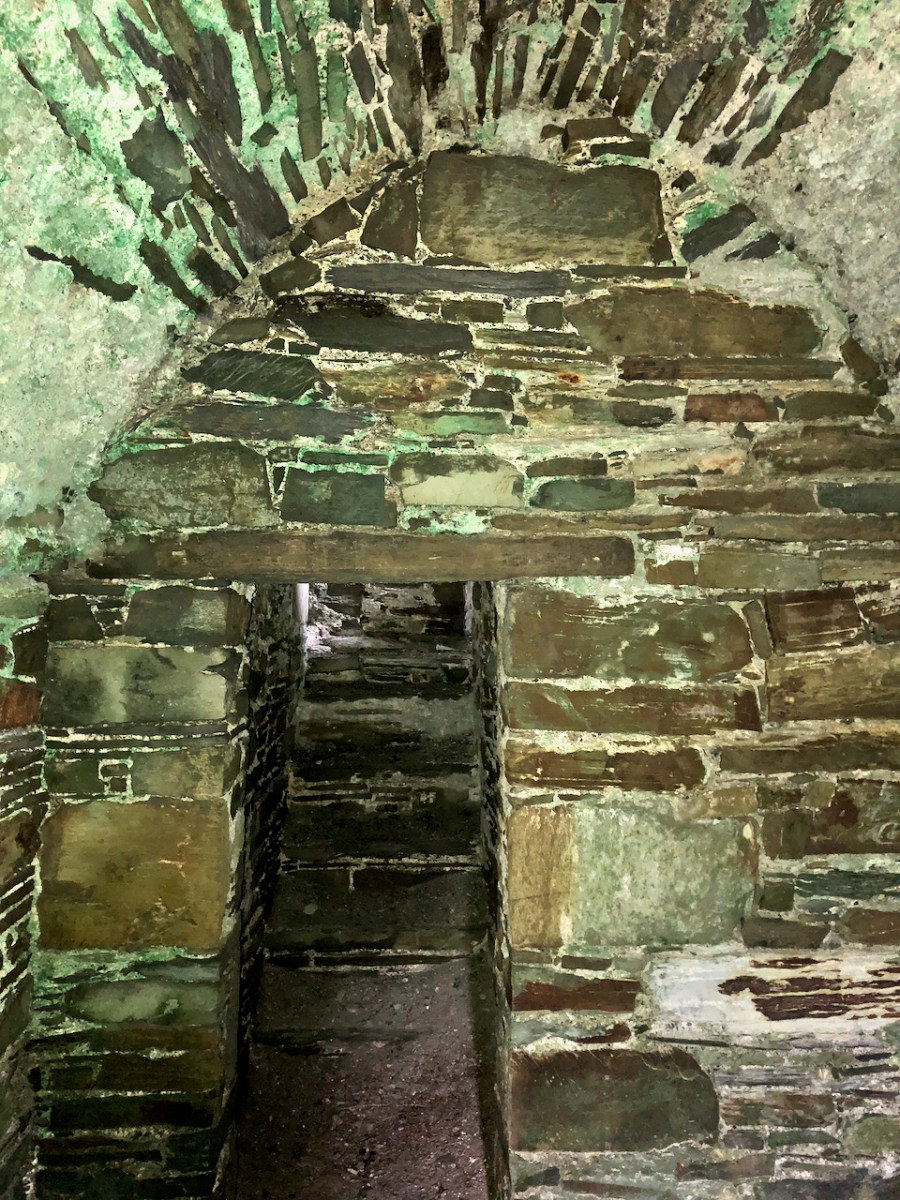
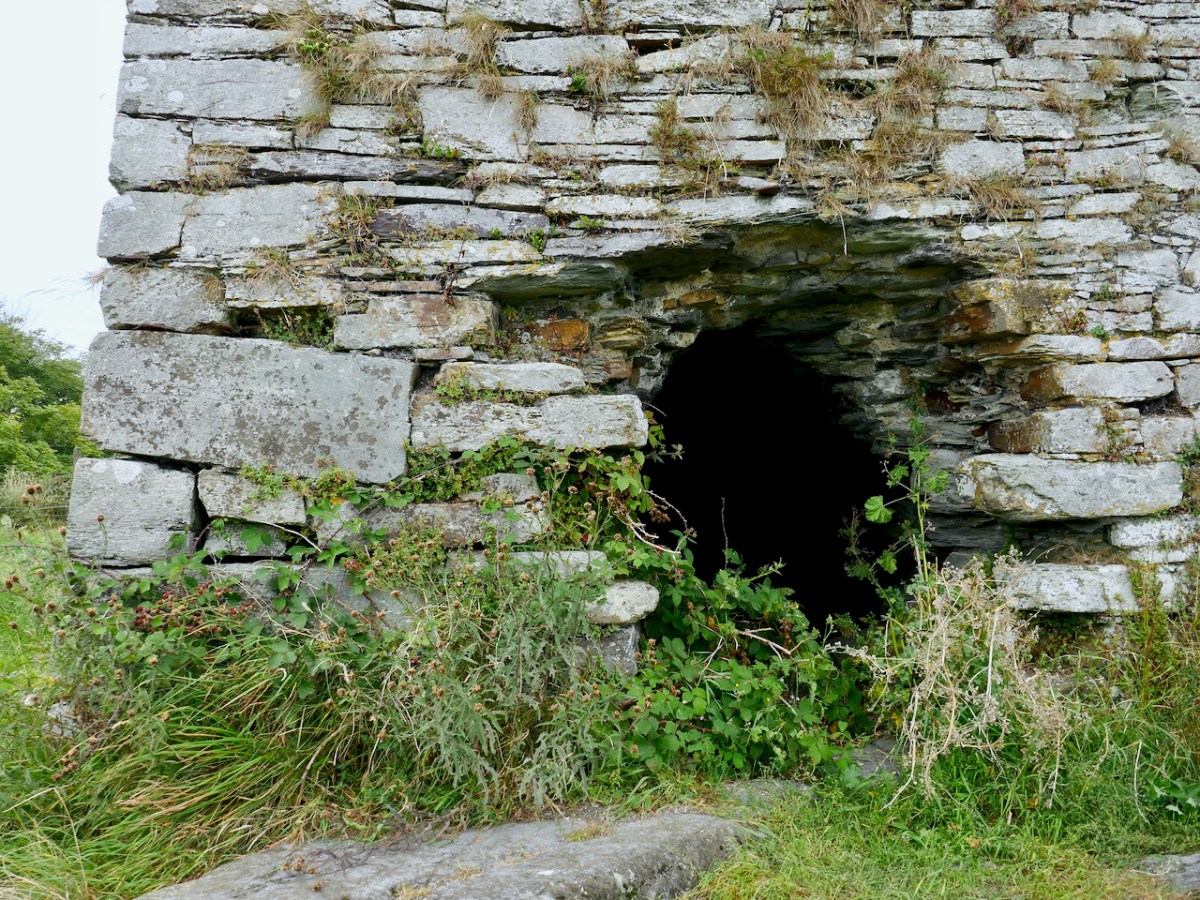
Finola and I have special feelings for Liss Ard, as we were married there in 2014 in an ancient ringfort! So, easing ourselves out of our chairs in the summer sunshine our first port of call was the feature after which the house is named: Lios Ard = High Fort. At our wedding the souterrain which was an integral part of the fort was not visible: today it can be seen, from above (at least, the entrance to it can be seen). The souterrain is a series of underground chambers, and this one – cut from rock and clay – has survived for well over a millennium. It was fully explored by a good friend of ours, Lee Snodgrass and her partner Paddy O’Leary – both archaeologists – back in the 1980s, and an information board just beside the fort tells the story in their words.

Above: Lee and Paddy’s survey drawings of the fort and souterrain, with a view of the entrance at the west side of the enclosure, and the cave-like structure which can be seen today, surrounded by ferns. Below is our group standing in the circle of the fort: such structures were probably high status homes defended by banks and timber palisades. They would also have provided protection for domestic animals who would have been predated by wolves.

Another feature in the grounds of Liss Ard may also seem like something ancient, but actually only dates from 1992:

. . . The Liss Ard Project brings together the conservation of nature and contemporary art: it will combine animal wildlife preservation, controlled ‘wild’ gardens and a contemporary art project – the Sky Garden . . .

The Irish Sky Garden is an incomplete work of art by Californian James Turrell (born in 1943): I wrote about him and his work a few years ago, here. Turrell had West Cork connections:

. . . Turrell traced his wife (Julia)’s ancestors to Castletown Bearhaven. He had his two youngest children, Sophie and Arlen, baptised in the church there . . . This (West Cork) is the countryside that inspired his Sky garden. It could not be realised anywhere else. Jim is responding to what he has found in Liss Ard, and his sensitive response will enhance the attraction of the site even more. Jim and Veith (the Zurich art dealer who bought the estate in 1989) study the site like two conspiring brothers. Both radiate assurance. Something unique and shared is being created there. The joy of it shows in their faces . . .

James Turrell
from the exhibition – Long Green, Turske & Turske, Zurich 1990

The Irish Sky Garden is an as yet incomplete work of art. The whole project was set to incorporate other ‘land works’ including a pyramid and a vault. Turrell’s most famous work, perhaps, is the Roden Crater in the Arizona desert. It is also work still in progress: construction began in 1977.

Quite apart from the ancient history and modern art, the gardens at Liss Ard have so much to offer. There is a maze of paths and steps, lush – almost tropical – growth and views across the substantial lake which forms part of the demesne: Lough Abisdealy.
As we walked beside the lake I was entranced by the sound of the wind in the reeds, and have tried to capture it with this little recording: you can imagine the combination of the swaying reeds, the crescendo of the light wind, the distant birdsong and the lapping water.

I can only give you a brief impression of our sensory experiences from the day: much is left unsaid and unseen but – all you need to do is book your Sunday brunch, and you stand a good chance of following our footsteps. I only hope that the day is as brilliant for you as it has been for us!

Long Island Wildflower Walk

Tracy and Peter Collins are the charming and enterprising couple behind Castaway Wild Island Camping on Long Island in West Cork. When they asked us if we’d like to help with a collaborative island adventure we jumped at the chance to lead a wildflower walk.

But who knew there would be such a demand? Our first date (yesterday) filled up overnight with a waiting list, so we put on a second and it filled from the waiting list! 
People are hungry, it seems, for experiences like this – and who can blame anyone for wanting to spend time on Long Island! We’ve been there several times and we know that the place, as my mother used to say, is Falling Down with Wildflowers. And so, yesterday, we met with our first group – and what a lovely and talented bunch of people it turned out to be, including an archaeologist, a fish biologist, an ecologist, a professor of Pharmaceutics, teachers, fellow-blogger Amanda from Holy Wells of Cork and Kerry, and an assortment of Long Island and wildflower lovers.

We started off at East House, home of Castaway Wild Island Camping for coffee and possibly the most delicious biscuits I’ve ever tasted, and then started our walk westward along the spine of the island, stopping as we went to talk about the habitats we were passing through, and the different flowers that had successfully adapted to those habitats. Hedgebank, field margins, stone walls and rock faces, old gardens – all carry their own assortment of plants.

From the top: Cat’s-ear and Sheep’s-bit on a hedgebank; close up of Sheep’s-bit; English Stonecrop, Navelwort and lichen on rock face

I never thought I would be blasé about orchids, but there are so  many at this time of year on Long Island that we soon ceased to stop and exclaim over each new group (below). Mark, the ecologist, was very knowledgeable about plants and pointed out the presence of Yellow Rattle, something that’s quite hard to find in the wild in West Cork but really important for creating good conditions for a wildflower meadow.

An island man, Joe Whooley, lovingly maintains the well at Cuas na Gualainne (the Little Inlet of the Shoulders – a reference, we think, to the shape of the tiny bay) and it was looking even better than the last time we were there. Amanda shared her knowledge of holy wells in general and told us about this one in particular. She’s not sure what the source of the holiness is, but is investigating. Meanwhile, the water was found to be clear and tasty. 

Reaching the Westlands pier, we concentrated on a whole new habitat, one in which marine-adapted plants flourish in what looks like unpromising conditions of shingle and bare rock..

From the top: a colourful patch of Kidney Vetch (pink), Sea Campion (white) and Bird’s-foot Trefoil (yellow); the delicate white flower of Sea Sandwort

And here was one of the prizes – the Yellow Horned-poppy. It’s rare – classed as near threatened in the Red Data List of Vascular Plants – and strikingly beautiful. It’s wonderful to see a flourishing community of this exotic-looking flower on Long Island and I was thrilled to find some blooming already as I thought we might be too early for them.

From the top: Teresa and Amanda with one of the poppies: a poppy close-up

After a while exploring the shingle beach and the sandy beach we were all ravenous and like magic Tracy and Peter appeared with a fabulous lunch box for everyone. Home-made everything, some of it from their own garden (chocolate-dipped strawberries!) and delicious lemonade.

Tracy and Peter and the superb lunch

Mark gave us an impromptu talk on the island environment, reminding us all it was an essentially man-made habitat, and on the importance of this coastal strip of south west Ireland for so much flora and fauna. A possible future national park? That’s a huge YES from us!

From the top: The Royal Fern – the spore-bearing fronds are starting to appear – this species is an indicator of a healthy environment and Mark told us it it getting to be quite rare in some parts of Europe and needs protection; Rock Sea-spurrey – a beautiful and tiny pink flower that likes to grow on rocks by the sea

Well fuelled, we made our way back to the ferry. The chat was mighty along the way, with old friends catching up and new friendships being forged. 

We’ll be doing it again next Saturday – all full up already, so sorry. But why not go on a do-it-yourself wildflower ramble on Long Island any time? Check the ferry schedule, pick up a copy of Zoe Devlin’s The Wildflowers of Ireland (she’s just brought out a new edition – the best and easiest way to teach yourself how to wildflower)  and treat yourself to a day in Paradise! Better still – book in with Castaway Wild Island Camping for a true island adventure.

Irish Romanesque 4: The Nuns’ Church at Clonmacnoise

It’s been a while since I wrote about Irish Romanesque architecture, but a recent visit to Clonmacnoise included a walk to an outlying site – the Nuns’ Church – which ranks as one of the gems of this form. 
If you’re new to this series of posts, you can bring yourself up to date with a quick read of previous posts, which will give you the background and vocabulary on this form of architecture – the dominant church building style of 12th century Ireland.

The Nuns’ Church was connected to the main monastery of Clonmacnoise by a causeway, still evident in places,  but is now reached by wandering along a boreen that, at this time of year, is delightfully fringed with Cow Parsely, Buttercups and Hawthorn.

There is no glimpse of it in advance – you arrive at a gate, and there it is – one of the wonders of medieval architecture marooned in a peaceful little field.

This is a nave-and-chancel church, typical of the time. It is associated with Devorgilla, wife of Tiarnan O’Rourke, as it is said to be the place to which she retired as a penitent, for the sin of absconding with Diarmuid McMurrough and being the unwitting cause of the Norman Invasion. However, there are many sides to this story, and I have just read a most entertaining version, Dervorgilla: scarlet woman or scapegoat?, which claims that she was entirely innocent of the misdeeds she is famous for. Whether she died there, or at Mellifont, as the article asserts, she was certainly responsible for re-building the church in 1167, which places it firmly in the date-range for the full flowering of the Hiberno-Romanesque style.

The little church was in ruins by the 1860s and one of the foremost antiquarians of the day, James Graves, of the Kilkenny Antiquarian Society, supervised the reconstruction of the chancel arch, as recorded on a plaque on the inside wall. Our old friend George Victor du Noyer was along to give advice.

By all accounts, they did a careful and informed job of it, digging out the carved stones from the rubble and debris of the collapsed arch and walls, and using a skilled mason to rebuild the arch and doorway. Du Noyer’s drawings* at the time, such as the one above, give an insight into what they found – all the pieces had to be carefully re-assembled, or replaced with ‘blanks’ to indicate what was lost.

In 1907, Thomas Westropp arrived to admire the skill of the reconstruction job and to make his own observations and drawings. (You’ve met Westropp before too, and may again.) From those drawings, it can be seen that Graves’s reconstruction has lasted intact to the present day. While not quite as accurate as du Noyer’s sketches, Westropp’s drawings are a valuable addition to the literature on this church and capture in particular the spectacular west doorway (above).**
My Romanesque Bible says of the carvings on the Nuns’ Church, The emphasis on low-relief ornament and the use of zoomorphic elements are typical of Irish Romanesque and show the adaptation of English and Continental Romanesque influences to the traditions of Insular art. That’s a fancy way of saying that there are lots of animal motifs here. Most obvious are the voussoirs of beast heads biting on roll moulding that form the arch of the second order of the four orders of the West doorway. 

But monster heads and snakes are seen here and there on capitals and jambs, as well as all the usual chevrons, roll mouldings, foliage and interlace patterns. 

The chancel arch is equally highly carved. Among the intriguing elements are the capitals on the both sides of the arch, which have both human and beast heads, together with geometric ornamentation (such as a Greek key design), rows of cats’ heads, and beading. 

Westropp’s drawing and my photographs above, of the north side of the chancel arch and below, of the south side.

Westropp’s drawing also shows the base or plinth of the jambs, which he says are quite unusual because of both the ‘strange bulbs’ and the ‘discs displaying crosses.’ My photo of what he’s referring to is below.

In one of the lozenges formed by the two rows of chevrons, carved point-to-point on the chancel arch, is an exhibitionist figure – a tiny head and legs, with the legs pulled behind the head. Can you see it in the photograph below?

How about this one, below? It’s been interpreted as a sheela-na-gig, a similar exhibitionist genitals-displaying figure, although this one is a lot smaller than a typical sheela. 

Give yourself enough time here to trace the carvings with your eyes – there is so much detail to observe and some of it is easy to miss. 

The small field is full of bumps and hollows – evidence that this was once the centre of a convent with substantial buildings around the church, separated, of course, by a ‘decent’ distance from the male monastery, but connected by those causeways.

Many people who visit Clonmacnoise don’t realise that the Nuns’ Church is only a short stroll away and never see this tiny, perfect example of Irish Romanesque architecture. Now – you’ve been let in on the secret!

* Du Noyer drawing courtesy of Europeana.eu
**A Description of the Ancient Buildings and Crosses at Clonmacnois, King’s County, Thomas Johnson Westropp, The Journal of the Royal Society of Antiquaries of Ireland, Fifth Series, Vol. 37, No. 3, 1907, pp. 277-306