AI Responses: Humanity Versus The Machine

I was so struck and overwhelmed by the wisdom and kindness of the responses to my last post, AI and the Future of Roaringwater Journal, that I decided to write a follow up. Then, I promise, I will let this matter drop and go back to my usual diet of history and archaeology  and art and flowers and West Cork.
First of all thank you to everyone who took the time to respond – it was heartening and heartwarming to see your thoughtful and encouraging comments, both on the blog and on the Facebook Page. My blog readership is down, at this point about 20% over this time last year. This seems to be about average for what many are reporting, although some have seen far steeper declines. Your comments reminded me that to look at this in terms of readership stats is missing the point – what you told me is that each time a post is read, the reader and I are making a human connection. This was brought home to me at a function last night where I met a woman who told me that although she never comments, Roaringwater Journal has been a ‘lifeline’ for her both during Covid and in times away from West Cork. It was also underscored by the fact that one of the comments was from a high school teacher in Canada that I taught in elementary school in the far north of Canada in the early 1980s! (Hello, Shannon!)
The second theme that emerged takes shape around the concept of a Voice – a real, human voice, with opinions and insight and well-researched content and occasional humour and its own quirky personality. No content generated by a chatbot, you said, can equate to reading something that a human has written with creativity, clarity, passion and curiosity. And you are right – I love what Paddy Tobin said about the essay on West Cork History written by ChatGPT

as soon as I began to read the AI generated text, you were gone, absent. I suppose had I not read your blogs over time this would not have registered. It would be a reasonably interesting if bland presentation of facts but when you write there is opinion, interpretation, reaction, feeling…style and personality

Several of you share my worry in a general sense and resent the intrusion of AI into our daily lives, although as Francis observed, the genie’s out of the bottle now and there’ll be no getting it back in again  As I have been reading a little more about what’s happening, there is a glimmer of hope – it has become obvious very quickly that the internet is an ecosystem with a delicate balancing act. If the chatbots and AI search engines cut traffic to writers and publishers, (who, in turn cease to write and publish) they are ultimately undermining what make the internet actually work – that is, without content creators there is no longer information to harvest. Way back in 2016 we already were expressing this in our post Tech is Cool and Content is King. Some are advocating a system of monetary compensation for scraping content. While that might suit some creators, those whose livelihoods depend on their writing, it does nothing for those of us who are motivated not by commercial considerations but by the sharing of stories and interests with our readers. I can’t help feeling too that it just turns writers into employees or ‘suppliers’ for the large AI companies.
Thank you for the encouragement to explore other options. I’ve looked into Substack and I don’t think it’s the answer for me for a number of reasons. That could be another post so I will leave it there. Regarding writing a book – yes, I will give this serious consideration (after I finish the one I am currently writing about George Walsh), but perhaps some of you don’t realise that the book, which seems like it has the protection of being a physical entity, is also in danger from the exact same issue. In recent years, major AI companies have admitted or been revealed to have used vast libraries of published books (usually without permission or compensation) to train their models. This includes both e-books and scanned print books. Just because something exists in a printed form does not mean it is safe from digital scraping. If you want to check out whether your favourite book has been scraped, do a search in The Atlantic database. I only have my name on the spine of one book – a now very-outdated and somewhat turgid volume of academic essays co-edited with a professor from the University of British Columbia. I found it in that database.
Finally, you reminded me that I must hang onto why I do this, week after week and so I have asked myself that question. Here’s my answer – I write this blog for a whole host of reasons. I do it for me, and I do it for Robert so that his wonderful lyrical writing and unique ruminations on all kinds of subjects will be available for as long as the blog is alive. I do it as a creative outlet and to give my life a sense of purpose. I do it to give back to the wonderful West Cork community that embraced us and supported us when we moved here in 2012. I do it to get down in writing, for the enjoyment and edification of myself and others what makes West Cork the rich and fascinating environment we have discovered here. I do it to celebrate the joy of researching the wide and varied history, archaeology, culture and environment of this special part of the world. I do it to give a shape and discipline to my week. I do it because it gets me out amuigh féin spéir, scrambling over stone walls, lying in bogs, exploring ruins, running from bulls, sometimes alone but often with Amanda and Peter of Holy Wells of Cork and Kerry. I do it because it has led me into subjects and places about which I knew nothing but which have become all-consuming interests – wildflowers and stained glass for example. I do it because it has become my life and my pastime and my passion. I do it because I have readers like you, all over the world, who let me know my words do not go into a void. I do it because.
AI and the Future of Roaringwater Journal

AI is a double-edged sword and the future for Roaringwater Journal, and blogs like it, is looking grim.

First, the not-so-bad news.

I’ve made no secret of the fact that I have been exploring various AI tools – chatbots and search engines and research tools like NotebookLM. My first foray was when I asked ChatGPT to write an 800 word essay on the history of West Cork. Although a cursory read left an impression that was persuasive, in fact it was riddled with errors. That was in 2023. Today I asked it to do the same again and I append the results below. MUCH better and in fact this time very accurate. 

I’ve also used image-generation software – I had fun with a St Brigid Post a while back – the results, although amusing, were a mixed bag – I’d say this aspect of AI has a lot of catching up to do. 

I also used Perplexity as a research assistant on my recent series (2 down, 1 to go) on the St Brendan book I purchased, which was written in German.

Finally, I used NotebookLM to keep track of all my references when I did the series on Charles Vallancey. NotebookLM is an excellent research tool which uses the sources you upload yourself. I had 15 different sources for this series, mostly lengthy academic articles, and I was able to use NotebookLM to tease out threads across the articles, each statement referenced back to its source.

Now for the other side of the coin.

When you did a Google search in the past, it came up with a list of Blue Links – clicking on a link brought you to the source website. Search engines drove a lot of traffic to our website.

If you do a search now, the first thing you are likely to see is what’s called an AI Overview. Although there are still links (for now) to Roaringwater Journal and other local sites, many people just read the AI Overview and go no further. If you use ChatGPT the information will simply be served up to you in a condensed form, with no link to sources or to further information.

Perplexity includes links in the form of tiny numbers at the end of paragraphs which you may or may not notice or click on. Claude does something similar but seems to get most of its information from Wikipedia.

The AI companies have drag-netted the internet to train their Large Language Models (LLMs). Where information is scraped from Roaringwater Journal, it has happened without my knowledge or consent. This was not a problem in the past – Google gathered the information, but drove the searcher back to Roaringwater Journal – ‘click on this blue link for more information.’ Now, all my hard work and careful research is simply fodder for huge search engines who present it as if it’s their own. This is even more of an issue for bloggers who rely on traffic to generate income (I do not). 

While traffic to the Journal (people landing on pages and actually reading what we have written) is a significant incentive to keep at it, it’s not the be-all-and-end-all for me, as I have all kind of other motivations for writing it. However, if the trend continues downwards, I can see myself and others taking stock at some point and wondering whether all our hard work is simply now providing content to enrich a bunch of tech-bro gazillionaires. 

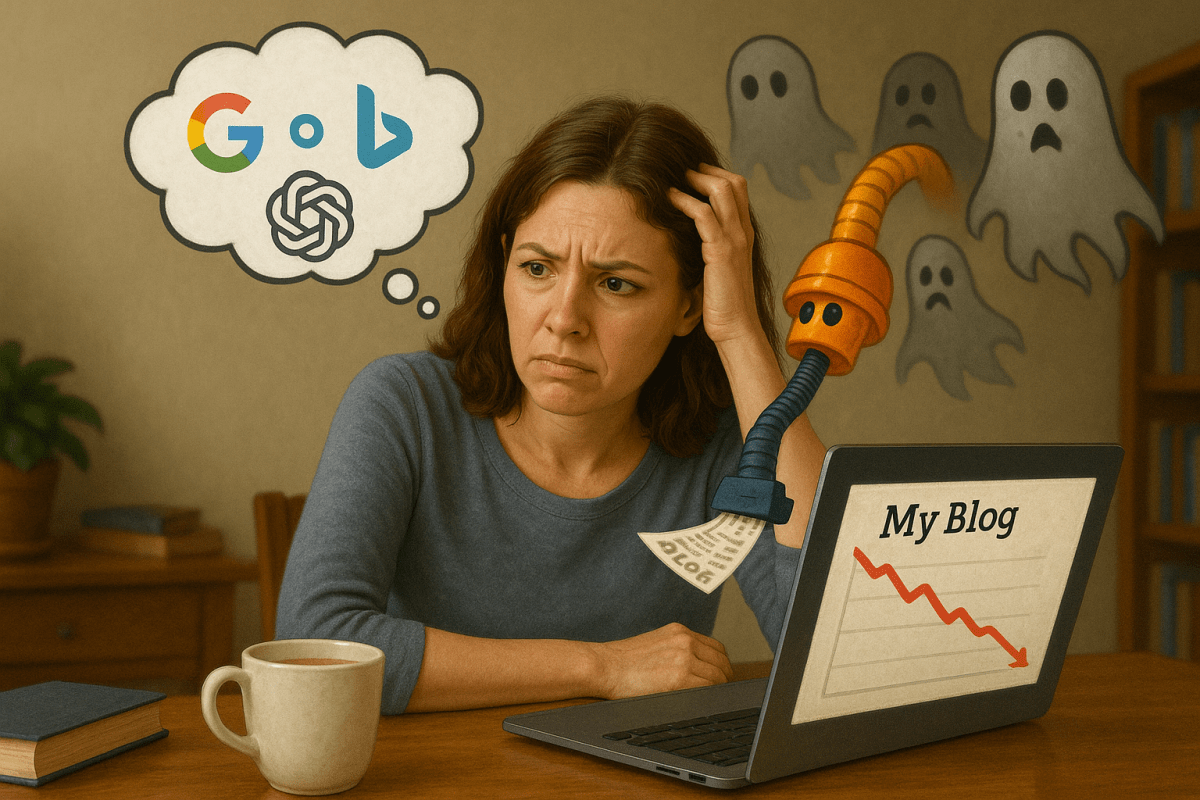
The ultimate irony? My story image was generated by ChatGPT!

I would value your comments.

______________________________________________________________________________________________________

The History of West Cork: A Story of Resilience, Rebellion, and Rich Culture

West Cork, the southwestern region of County Cork in Ireland, is a landscape of rugged coastlines, rolling hills, ancient stone forts, and vibrant villages. Though often celebrated today for its natural beauty and bohemian charm, West Cork’s history is layered with tales of prehistoric settlers, Gaelic chieftains, Norman invaders, rebellions, famines, and a profound cultural resilience that still defines the area. The history of West Cork is, in many ways, a microcosm of Ireland’s wider historical experience—marked by both hardship and heroism.

Prehistoric and Early Settlements

The earliest traces of human habitation in West Cork date back over 6,000 years, to the Neolithic period. Megalithic tombs, stone circles, and standing stones—such as those found in Drombeg near Glandore—attest to the ritual and communal life of these early settlers. The Bronze Age (c. 2500–500 BCE) and Iron Age (c. 500 BCE–400 CE) left their mark in the form of wedge tombs, fulacht fiadh (ancient cooking sites), and ring forts, which still dot the countryside.

By the early medieval period, West Cork was part of the powerful kingdom of the Eóganachta, a Gaelic dynasty that ruled much of southern Ireland. The area was divided among local chieftains, with clans such as the O’Driscolls, O’Mahonys, and O’Donovans holding sway. These families established fortified homes and controlled trade routes, especially around the coast. The influence of Christianity also spread during this period, and monastic sites such as Timoleague Abbey were founded, becoming centers of learning and religious life.

Viking and Norman Incursions

Beginning in the late 8th century, Viking raiders arrived along Ireland’s coasts, including the bays and inlets of West Cork. Though initially destructive, the Vikings eventually integrated into Irish society, intermarrying and establishing trading posts.

In the late 12th century, the Anglo-Normans began their invasion of Ireland. West Cork, with its remote and rugged terrain, resisted complete conquest for some time, but eventually Norman influence took root. Towns such as Bandon and Kinsale (just on the border of what is traditionally considered West Cork) grew under Norman control. These new settlers introduced stone castles, new agricultural practices, and English legal structures, which often clashed with traditional Gaelic customs.

The Tudor Reconquest and the Flight of the Earls

The 16th century saw the English Crown intensify its efforts to control Ireland. West Cork became embroiled in the resistance movements of local Gaelic lords. One of the most notable figures of this period was Donal Cam O’Sullivan Beare, chieftain of the O’Sullivan clan. After the defeat of Irish forces at the Battle of Kinsale in 1601—a key turning point in Irish history—O’Sullivan Beare led his people on a harrowing 500-kilometer march to Leitrim, seeking sanctuary. Only a handful survived. This event symbolized the collapse of the old Gaelic order and the increasing dominance of English rule.

Following the Nine Years’ War and the “Flight of the Earls” in 1607, many Gaelic lords fled Ireland, paving the way for the Plantation of Ulster and further colonization. In West Cork, land was confiscated from Irish families and given to English settlers loyal to the Crown. This deepened divisions and planted the seeds for centuries of unrest.

18th and 19th Century: Rebellion and Famine

By the 18th century, West Cork had developed a mixed population of Protestant landowners and Catholic tenant farmers. Tensions over land and religious discrimination simmered, culminating in episodes of violence such as the Whiteboy movements—agrarian protests against unfair rents and evictions.

The 1798 Rebellion, inspired by revolutionary ideals from America and France, saw some activity in West Cork, though it was largely suppressed by British forces. Still, the spirit of resistance remained alive.

The most devastating period in West Cork’s history came with the Great Famine (1845–1852). The failure of the potato crop, coupled with British government inaction, led to mass starvation, disease, and emigration. Skibbereen, one of the region’s principal towns, became infamous for the horror it witnessed during the Famine—its name now synonymous with suffering. Over 8,000 people died in the town alone, and many more fled aboard “coffin ships” bound for America, Canada, and Australia.

Twentieth Century: War, Revolution, and Renewal

West Cork played a significant role in the Irish War of Independence (1919–1921). The region was a hotbed of IRA activity, led by figures like Tom Barry and Michael Collins, the latter born in Clonakilty. Notable events included the Kilmichael Ambush, where IRA volunteers killed 17 members of the British Auxiliary Division. These actions helped push the British government toward negotiating the Anglo-Irish Treaty.

The subsequent Civil War (1922–1923) divided communities, including those in West Cork. Collins himself was assassinated at Béal na Bláth in 1922 by anti-Treaty forces, marking one of the most traumatic events in modern Irish history.

Modern West Cork: Culture, Community, and Creativity

In the post-independence era, West Cork remained primarily agricultural, though economic struggles persisted well into the 20th century. By the 1970s and 80s, however, the area began to attract artists, writers, and European settlers drawn to its wild beauty and affordability. This influx helped revitalize the region’s cultural life.

Today, West Cork is known for its lively arts scene, local food movement, and commitment to community sustainability. Towns like Bantry, Skibbereen, and Ballydehob host festivals, markets, and environmental initiatives, while smaller villages retain a sense of timeless rural life.

Though its history has often been marked by hardship, conflict, and change, West Cork has preserved a deep sense of identity. Its landscape holds the memory of centuries—of castles and cairns, abbeys and ambushes—and its people continue to reflect the tenacity, independence, and creativity that have long defined this corner of Ireland.

St Brigid and AI

As might be obvious by now, I am having fun playing around with DALL·E, the image-generating arm of ChatGPT. In its own words, DALL·E 2 is an AI system that can create realistic images and art from a description in natural language. I am experimenting by asking DALL·E to serve me up illustrations of St Brigid, and learning, in the process what it can do well, and where it seems to lack, well, a brain. On the whole it’s very impressive indeed, but also quite unreliable. Here are my requests and what I got in response – and notice how polite we are! Note also that DALL·E often responds with two images, but I usually only choose one of them to reproduce here.

ME: Can you design a Saint Brigid image for me, in the style of Harry Clarke, please?
DALL·E I can create an image inspired by the style of Harry Clarke, which would incorporate detailed, intricate patterns, rich colors, and a unique, stylized approach. Since Harry Clarke’s most recent work was after 1912, I’ll focus on aspects of his style like detailed stained glass art, with a gothic and Art Nouveau influence. For Saint Brigid, would you like her depicted in a specific setting or with certain attributes? Also, would you prefer a full-body portrait or a more focused image?
ME: Full body, with a lamp, oak leaves and a fox
DALL·E: Here are two images of Saint Brigid created in a style inspired by Harry Clarke. They feature her with a lamp, oak leaves, and a fox, all depicted in a detailed and vibrant manner characteristic of Clarke’s influence. Feel free to select the one that best suits your needs.

AI is trained by scanning all the images that it can consume on the internet, and obviously Harry Clarke has not yet been studied in detail by DALL·E – this image is nowhere close to his style. I award some marks for getting the attributes in there, and the early 20th century period art nouveau styling. What on earth is that caption, though, and what’s going on in her gown? On the whole, despite the halo, this illustration leans more to the Celtic Goddess end of the spectrum, and as you know I am not sympathetic to that version of her. Let me explain what I mean by that – there may well have been a Pagan or Pre-Christian Goddess figure with a name similar (we have Brigantia from Roman writings and the daughter of the Dagda from Irish mythology) but there is good evidence that the Saint Brigid we are talking about here was a real woman. A recent paper by Elva Johnston of UCD lays out the argument very well. Johnston says:

Brigit of Kildare is the first Irish saint to be celebrated in detail by Irish writers. Her cult enjoyed great depth and popularity. Nevertheless, Brigit’s very existence has been doubted; she has been recast as a pre-Christian goddess despite an overwhelming disparity in evidence . . . Brigit has been treated differently to Irish male saints, becoming a secondary character in her own biographies, reductively overshadowed by a barely attested goddess. It is time for a revitalised appreciation of Brigit as an actual woman, depicted by her first hagiographers as pushing against the grain of an elitist and patriarchal society.


Making St Brigit real in the early middle ages
Elva Johnston
Proceedings of the Royal Irish Academy: Advance Access,

I highly recommend this paper for anyone interested in learning more about the actual historicity. I also asked for a version of St Brigid in the style of a Rosetti Pre-Raphaelite painting and here’s what I got. Once again, although a beautiful depiction, it would be easier to see a Pagan Goddess reflection in this illustration than a devout saint. I decided to be more directive.

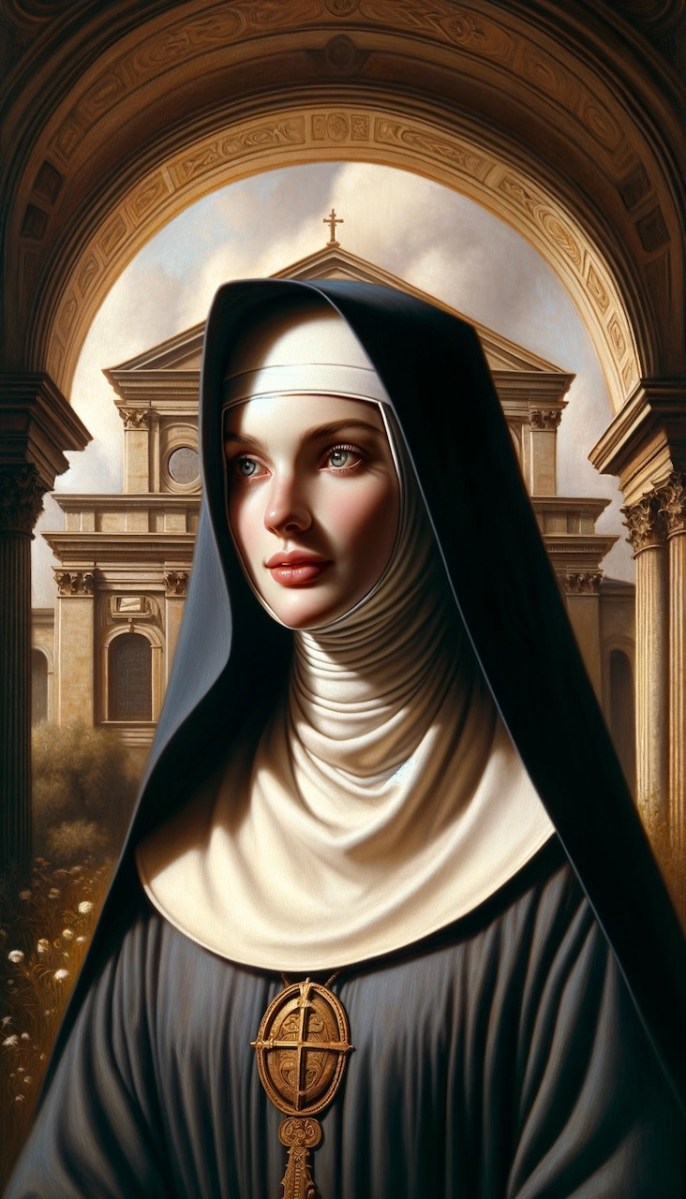
ME: can you create one that looks more like renaissance painting, depicting Brigid as a nun, with a church in the background
DALL·E: Certainly! For a Renaissance-style painting of Saint Brigid, I’ll focus on the distinct characteristics of that era: realistic proportions, a harmonious composition, and a depth of emotion and spirituality often found in Renaissance art. Saint Brigid will be depicted as a nun, with her habit and serene expression. The background will feature a church, possibly with architectural details reflective of the period, adding to the authenticity of the Renaissance style.
Here are two images of Saint Brigid depicted in the style of a Renaissance painting. In each image, she is portrayed as a nun, with a church in the background, capturing the essence of Renaissance artistry. Feel free to select the one that resonates most with your vision.
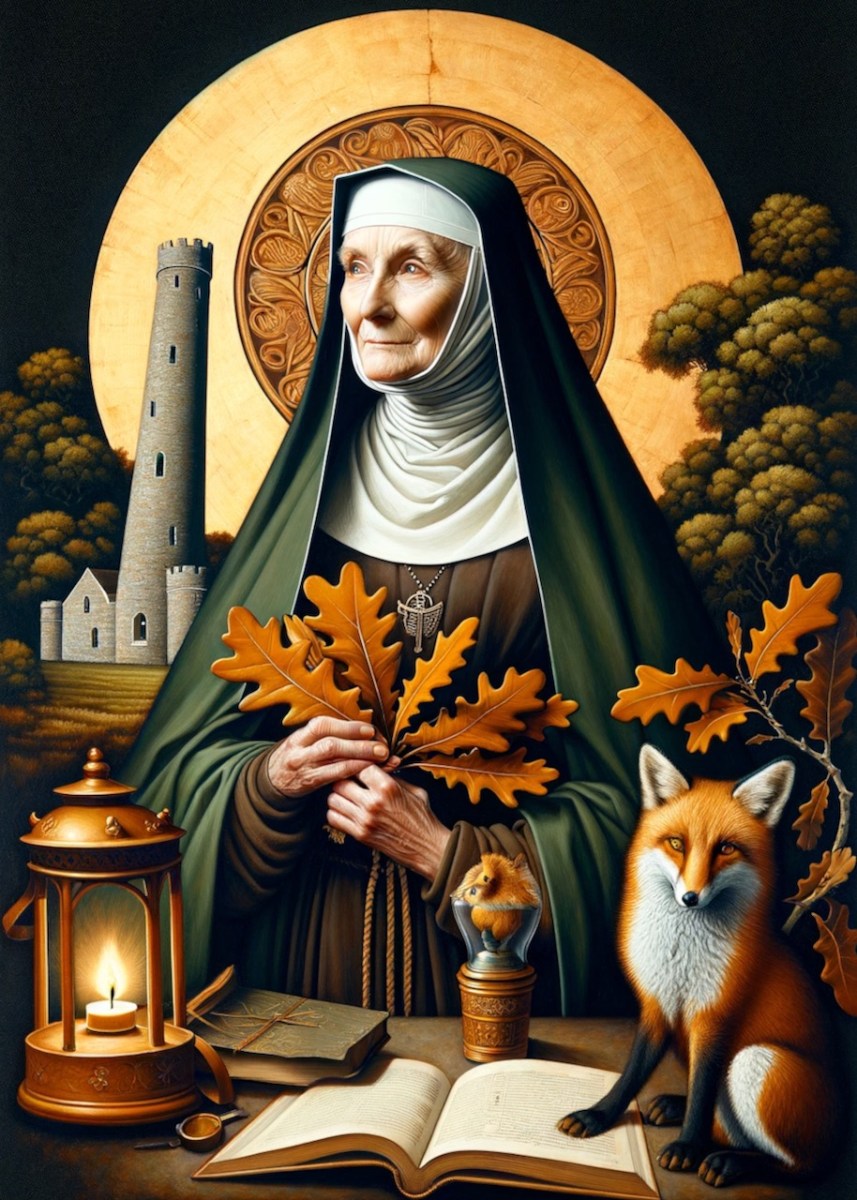
ME: The first one is a good start. Perhaps she could be older, and with her attributes, oak leaves, a lamp and a fox. Instead of the church, can you reproduce this St Brigid with only an Irish round tower in the background?
DALL·E: I’m glad to hear the first image is a good starting point. To modify it according to your suggestions, I’ll create a new image where Saint Brigid appears older, reflecting more maturity and wisdom. This change can be subtly conveyed through her facial features and expression, akin to the way a seasoned tree shows its age through deeper grooves in its bark.
Additionally, I’ll ensure her attributes are prominently featured. The oak leaves, symbolizing strength and endurance, can be woven into her attire or held in her hands, like leaves carried by a gentle breeze. The lamp, a beacon of light and guidance, could be in her other hand, casting a soft, illuminating glow. Lastly, the fox, a symbol of cleverness and adaptability, will be included, perhaps sitting loyally by her side or in a protective stance, akin to a faithful companion.

Hmmm – that round tower looks like something Rapunzel might be hiding out in. And – what on earth is that thing in the glass object? Love the fox and the lamp, though – and that little crucifix she’s wearing. She really does look like a wise old nun. In fact, I think she taught me.

ME: The last one is perfect – just one more modification, please, can you incorporate some Celtic interlacing or knotwork into the design
DALL·E: Absolutely! Adding Celtic interlacing or knotwork will infuse the image with a rich layer of cultural depth, typical of Irish art. This intricate detailing can be woven into Saint Brigid’s attire, the border of the image, or even subtly integrated into the background, including the structure of the Irish round tower. This will not only enhance the visual appeal but also pay homage to the rich heritage associated with Saint Brigid.

As with Harry Clarke, AI has not been trained on Irish round towers. Another issue with this image is that the fox’s head has been weirdly disconnected from his body. The interlacing looks more like basketweaving than anything else, but the richness of some of the details is impressive. I spent a lot of time asking DALL-E to refine this image to get a better round tower but I gave up after numerous failures and asked this instead.

ME: Please design an new image of St Brigid as an elderly nun with the following elements – a lamp, oak leaves, Celtic knotwork, and a romanesque-style church in the background
DALL·E: For this new image, I will design Saint Brigid as an elderly nun incorporating the elements you’ve requested: a lamp, oak leaves, Celtic knotwork, and a Romanesque-style church in the background. The image will capture the essence of an aged Saint Brigid, reflecting wisdom and serenity. The lamp will symbolize guidance, the oak leaves strength, and the Celtic knotwork will add a touch of cultural depth. The background will feature a Romanesque-style church, known for its semi-circular arches and sturdy appearance, providing a historical and architectural context to the scene.
ME: I like the left one – can you put in some colour and insert a small fox
DALL·E: I can create a new version of the image you prefer, incorporating color and adding a small fox to the composition. The addition of color will bring vitality and depth to the scene, and the fox, a symbol of cleverness and adaptability, will enhance the storytelling aspect of the image. Let’s see how this updated, colorful version with the fox turns out.

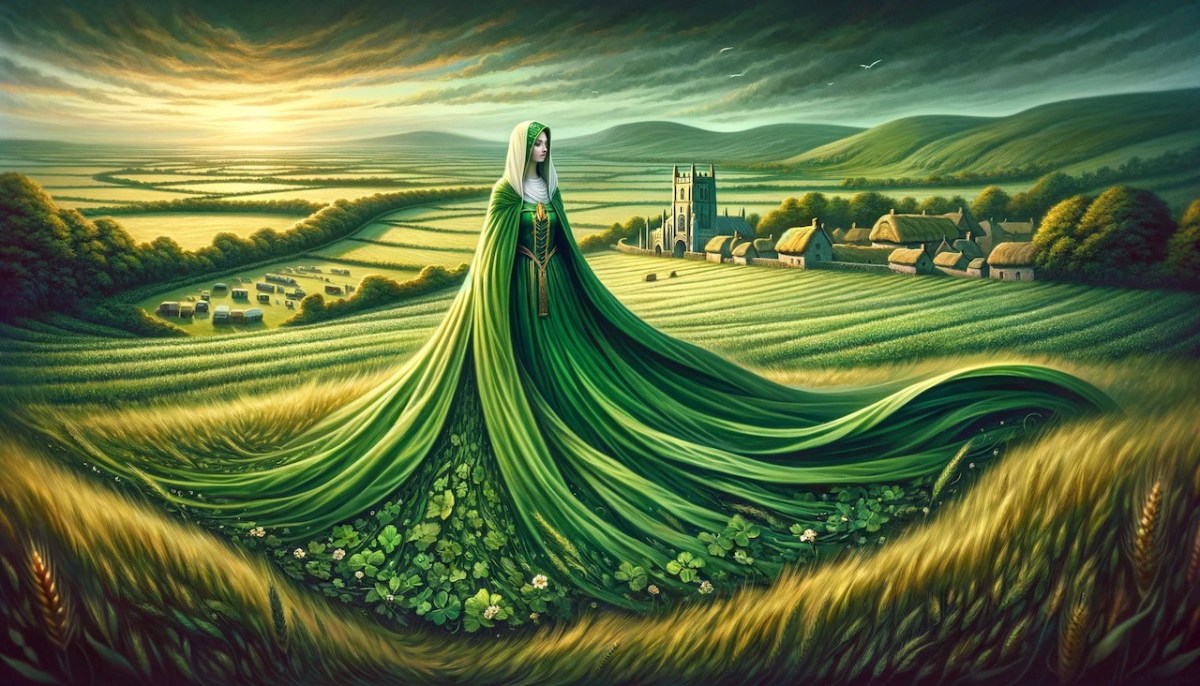
Jeepers – she’s aging before my eyes! I took a rest after that, but came back to it again later. The image at the top of my post came from this second session and is one of two (the second is below) that resulted from this request:

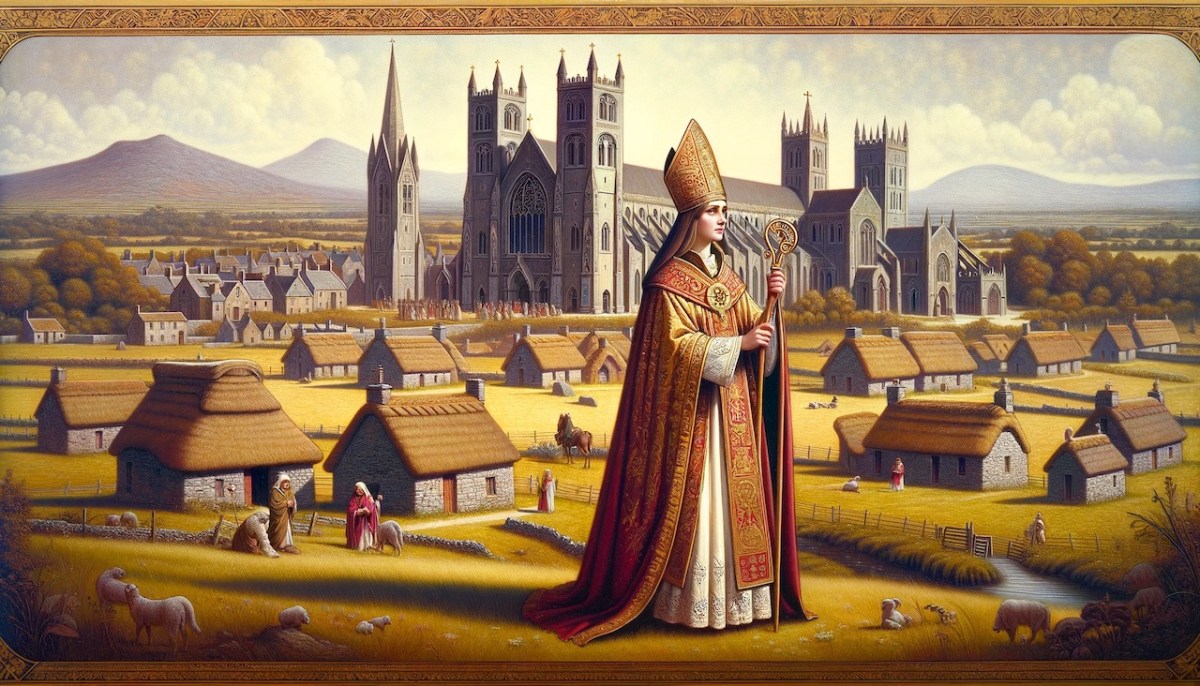
Please illustrate St Brigid in a flowing green cloak which spreads out behind her to create fields, with a medieval village in the distance.

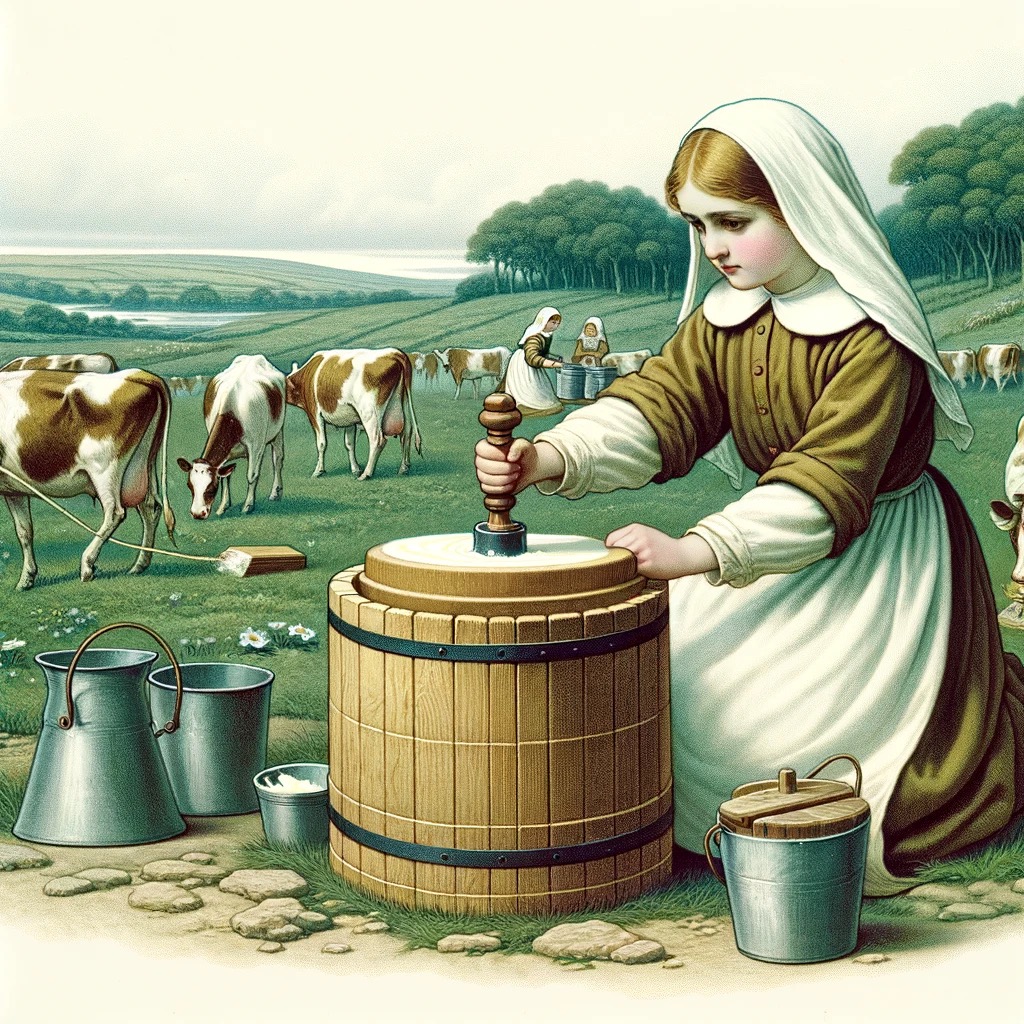
I decided to try to illustrate some scenes from her life – stories taken from my previous blog posts about Brigid (you can read them by clicking this link). The first is a story from her childhood, concerning butter.

ME: St Brigid as a young girl churning butter, with other maids milking cows.
DALL·E: Here are two illustrations of St. Brigid as a young girl churning butter, set in a pastoral Irish setting. Around her, other maids are engaged in milking cows, all within the beautiful, green Irish countryside. This scene captures the simplicity and beauty of rural Irish life and St. Brigid’s early connection to service and the land.
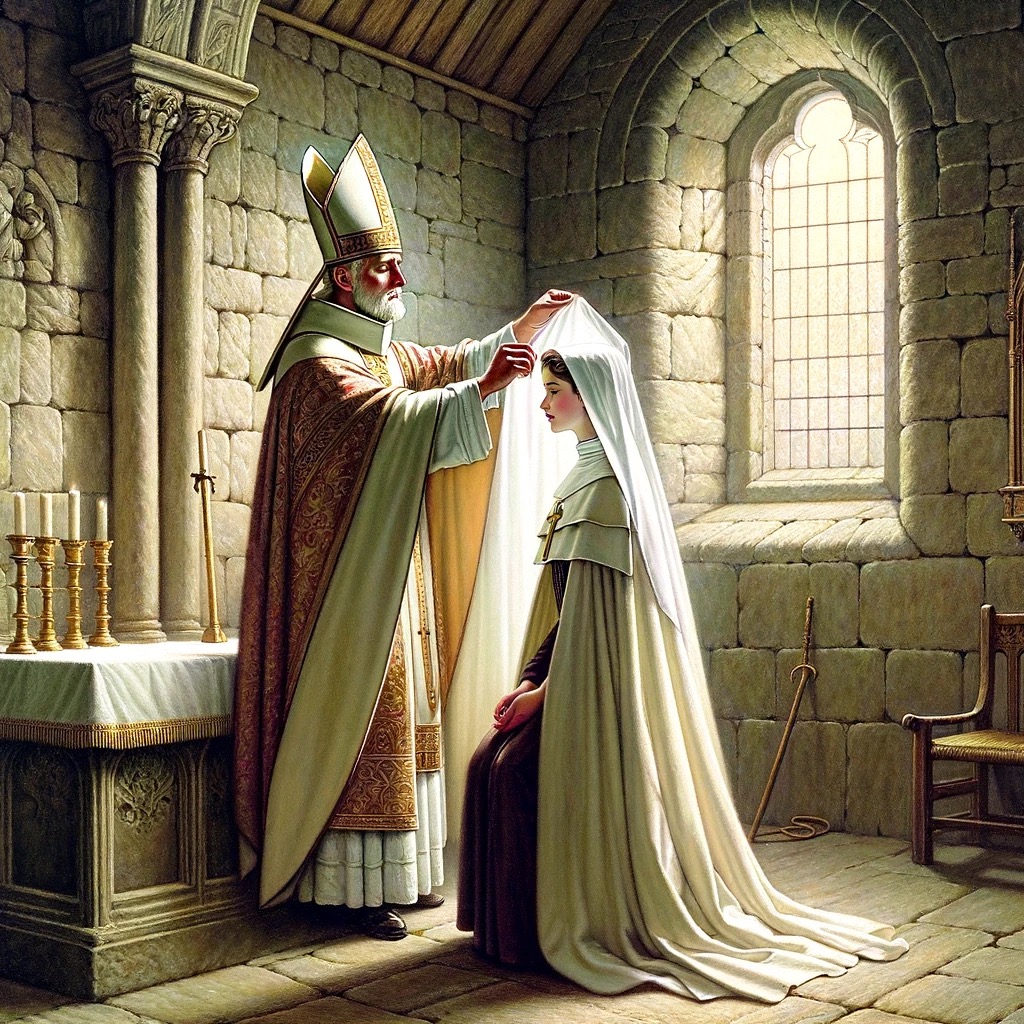
Me: Thank you! Now, I would like an illustration of St Patrick anointing St Brigid as a nun, by putting the veil on her head. [I know it wasn’t St Patrick, but St Mel, but I wanted to keep it simple.]
DALL·E: Here are two illustrations depicting the moment St. Patrick anoints St. Brigid as a nun by placing a veil on her head, set inside an ancient stone chapel. This sacred and timeless scene captures the solemnity and grace of the ceremony, with St. Brigid kneeling in humility and determination.

But of course St Brigid was a bishop herself so I thought I would like to see what DALL·E made of that.

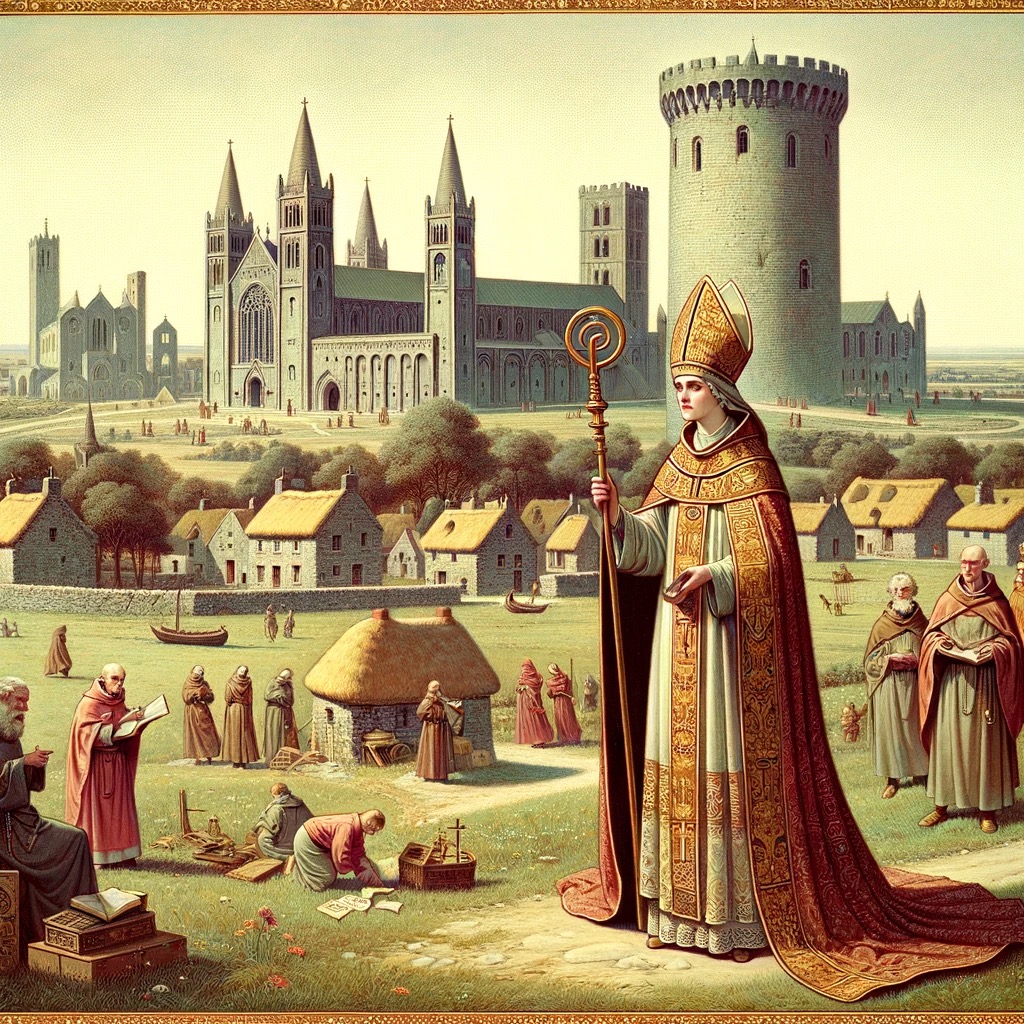
ME: St Brigid was recognised as a bishop and ruled over the ecclesiastical city of Kildare in the 6th century. Can you illustrate that?
DALL·E: Here are two illustrations depicting St. Brigid recognized as a bishop and ruling over the ecclesiastical city of Kildare in the 6th century. The scenes capture her majestic presence in bishop’s robes, holding a crozier, with the ancient city of Kildare and its community bustling with activity in the background. These images reflect the historical significance of St. Brigid’s role and the thriving spiritual community she led.

I tried several times to get DALL·E to remove the cathedral, but it was unable to do so, producing in all 8 different versions, all slightly different but all with an enormous church in the background – asserting each time that there was no church in the image. Here’s one version, in which the church gets even more enormous.

And here’s perhaps the strangest one – a cross between the Infant of Prague and a twee ye olde English village scene – and still with the enormous gothic cathedral!

I will finish with a final image, one of two generated when I said:

Me: I’m working on a piece about St Brigid of Ireland – her national holiday this year is Feb 5. Can you produce an image for me that celebrates that?
DALL·E: Here are two illustrations celebrating St. Brigid of Ireland for her national holiday on February 5th, set in an idyllic Irish landscape. Each image captures the essence of peace, heritage, and Irish culture, featuring St. Brigid in her iconic green robe, holding a lantern and staff, with a Celtic cross around her neck, amidst a beautiful backdrop of the Irish countryside.

I’ll leave it at that. I’d be really keen to hear what you, dear readers, think of DALL·E and its potential as a blogging tool.

Posts about St Brigid

Looking Back on 2023: Finola

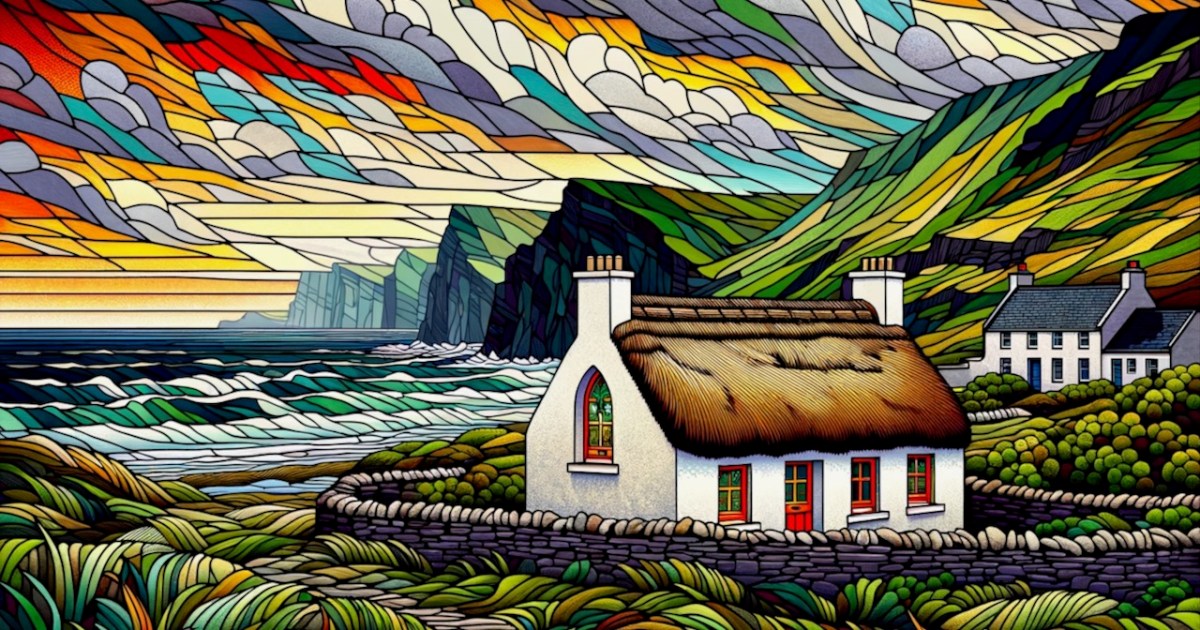
Roaringwater Journal had our best year ever, thanks to all our readers – we are truly privileged that you invite us on to your phones and desktops year after year. You are what keeps us going – you, and our own abiding fascination with the world around us, in West Cork and further afield. And what’s with the cheesy image above? Well, I’ve been playing around with AI-generated images and it turns out that this is what you get when you ask DALL-E for a picture that looks like an Irish landscape with a thatched cottage, in the style of stained glass. I don’t think we’ll be substituting AI for our own photographs any time soon.

We had over 333,000 views this year – that’s an average of over 900 a day. Many people read more than one post when they drop by, so those views were generated by over 200,000 visitors. We’ve had visitors from 180 countries, although the vast majority come from the English-speaking world of Ireland, the UK, the USA, Canada and Australia, followed by several European countries.

How do you find us? That’s changed over the years. We have about 6500 followers between WordPress and Facebook, so those folks see our posts aa soon as they’ve been published, or put up on Facebook. But after that most people seem to come to us from a search engine query. 

Robert is doing his own post about his personal picks for 2023, so here goes with mine. There are all kinds of reasons for my choices – the ones I have had most fun researching, the ones that resonated most with our readers, the ones that scored highest on views, or just ones that I loved for undefinable reasons. And my top pick is…..!

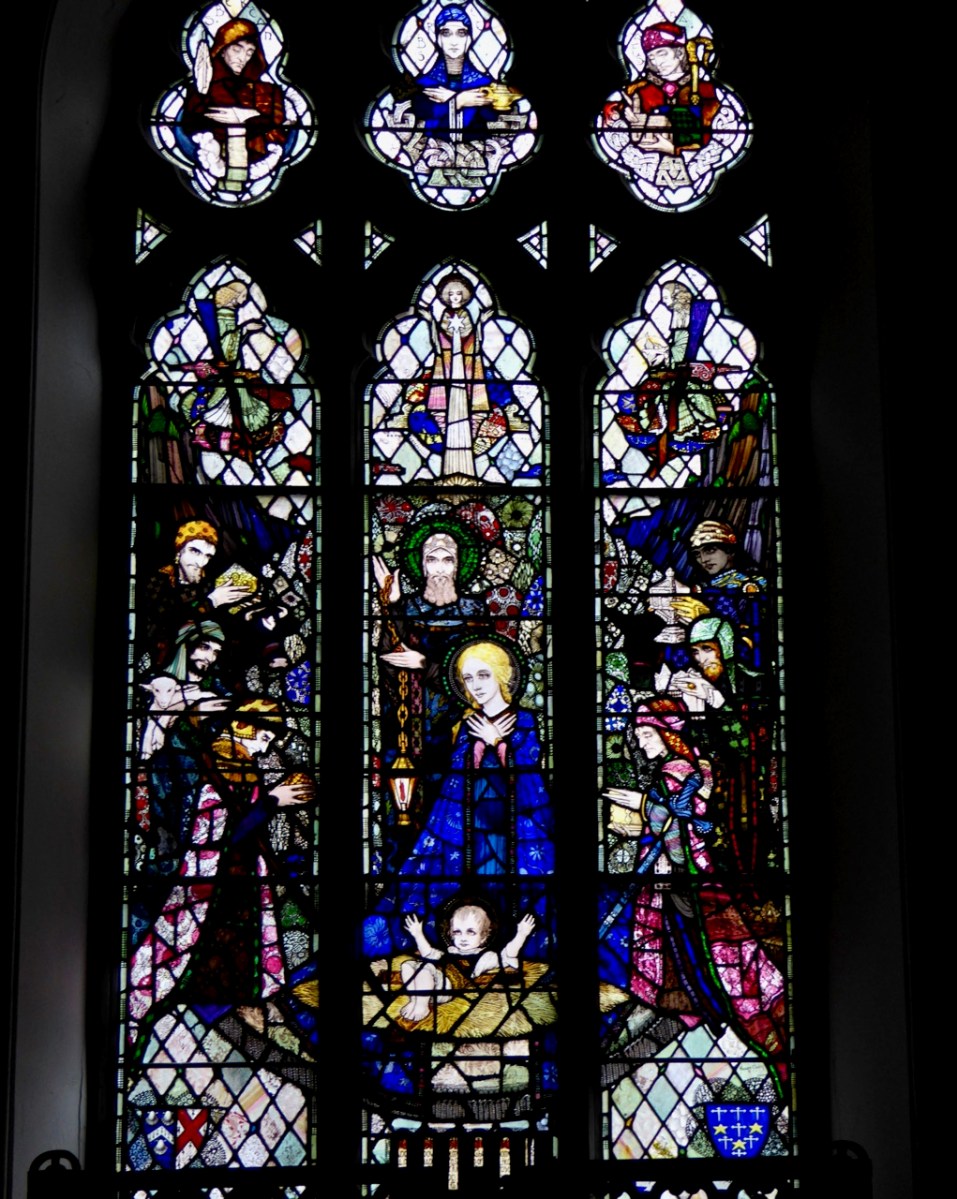
When Harry Met Edith. This was a three part post involving a deep dive into one window – the Nativity window in Castletownshend, designed and executed entirely by Harry Clarke, and managed for the family by Edith Somerville. Two of the giants of early 20th century Irish culture, and things did not always go smoothly, which makes for a better story. 

I had two other stained glass posts this year that I loved – the one about the Kilbride window, the most mis-described and least known of Harry’s Irish windows (above), and a quest to track down a window from a grainy black and white photo in an ad for Watsons of Youghal in a 1907 catalogue. I got lots of help from my stained glass colleagues on that one. The image below is by photographer John Glynn

Although it wasn’t technically a stained glass post, I illustrated my Brigid: A Bishop in All But Name with stained glass images, some kindly supplied by John Glynn. There are ancient sources for Brigid’s life and conclusive evidence that she was a real, powerful and revered woman, deserving of her place alongside Patrick and Columcille as one of our three patron saints.

Archaeology is one of our passions and anything to do with Castles always draws a big audience. So it’s no surprise that a post about our new Menu Page on castles was popular, but also a two-parter on Dún an Óir, a castle built on an earlier promontory fort. Since it’s hard to get to, I was grateful for a cache of photos, including the one below, from Tash, one of our readers.

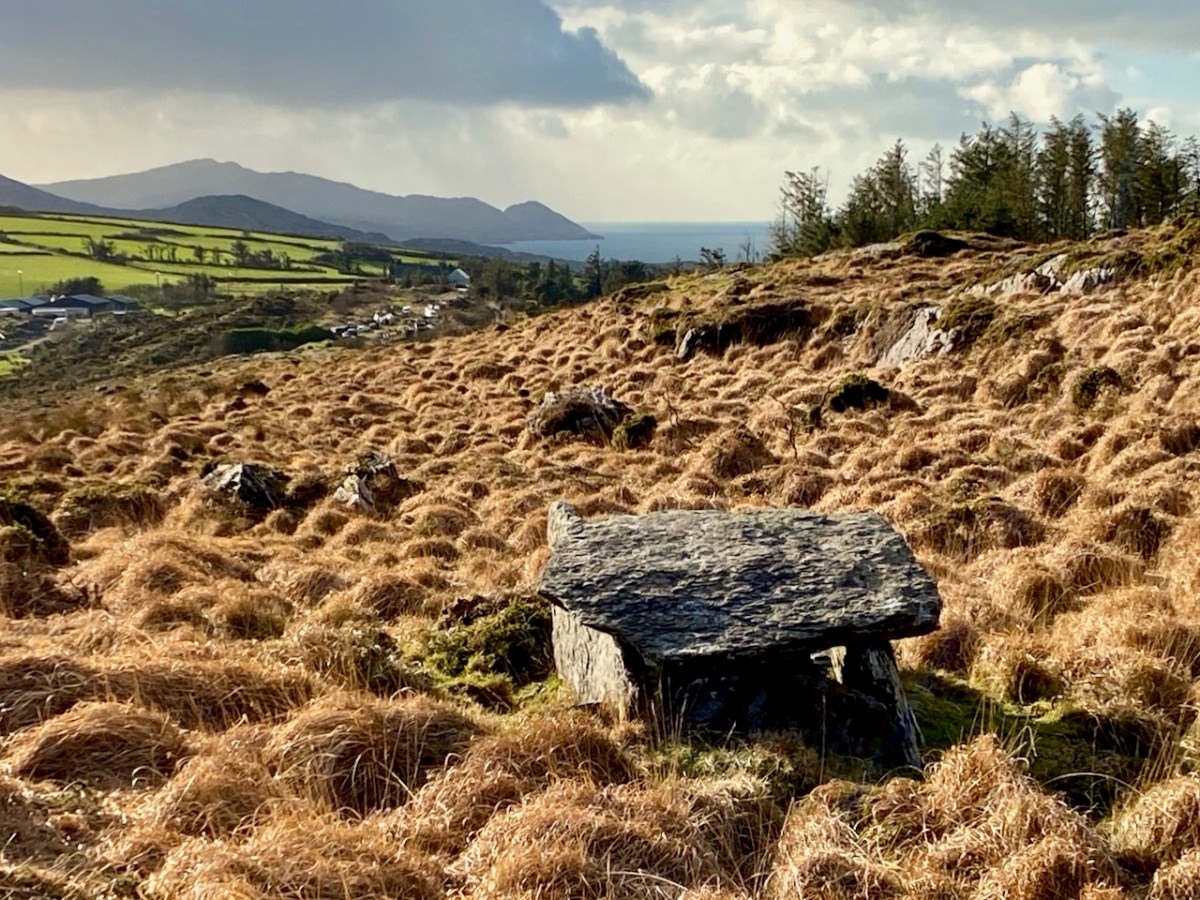
I also continued my Mizen Megaliths series, with three wedge tombs and a tribute to Stevie Lynch, one of our Heritage Heroes. Our other hero this year was Leita Camier, who spent so many years delighting us all with her Gortnagrough Folk Museum, now sadly closed.

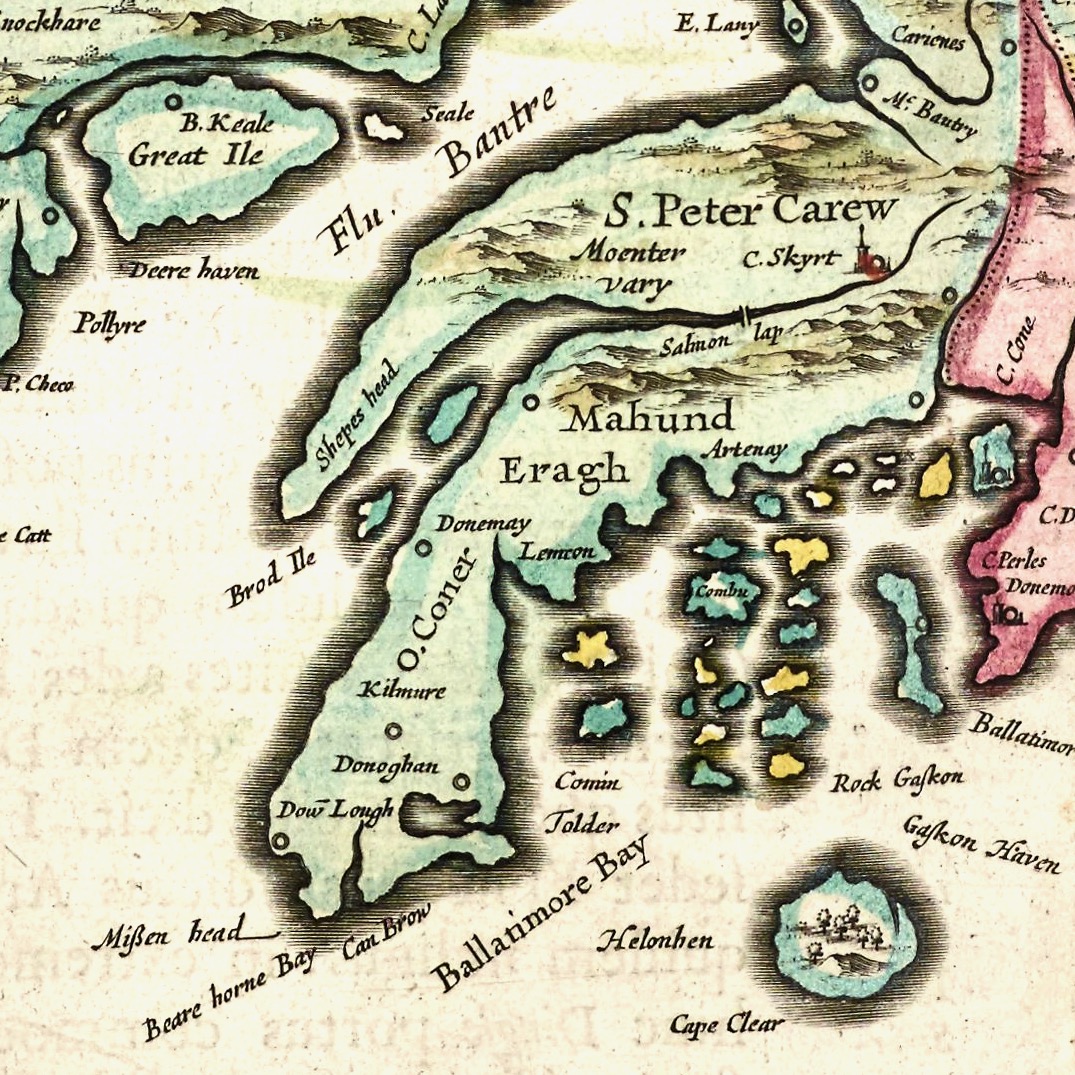
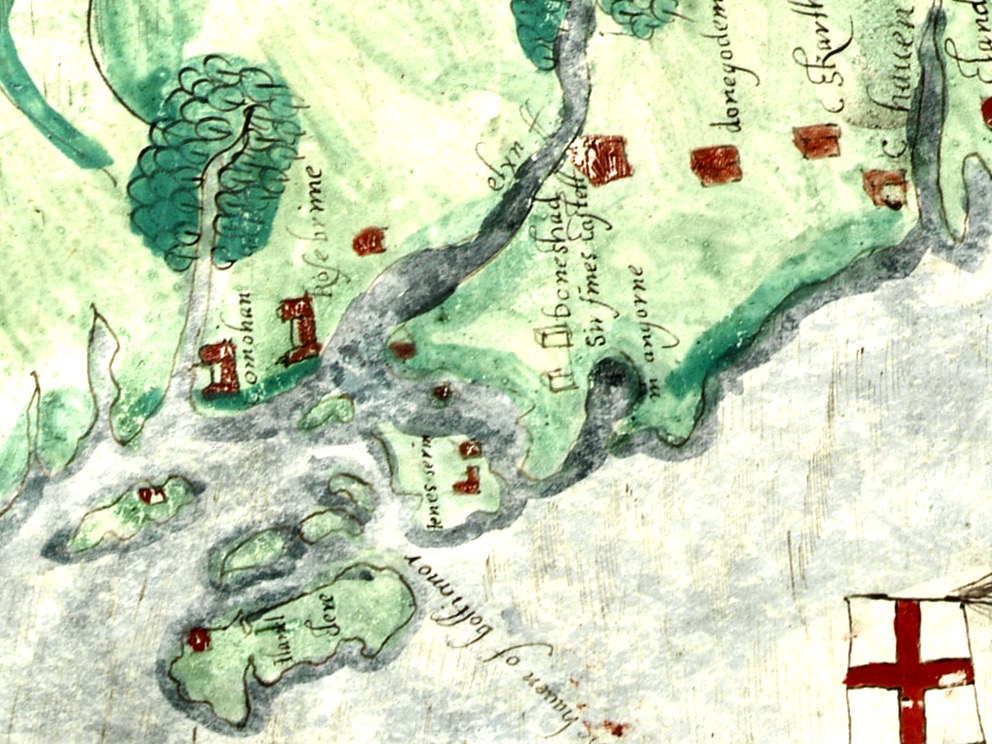
I love maps – and apparently so do you! A three-part post, A Map of the County of Cork, explored what we could recognise still in a map that was drawn over 400 years ago. In fact, I established to my own satisfaction that the map was the work of Francis Jobson, and probably dates to around 1589.

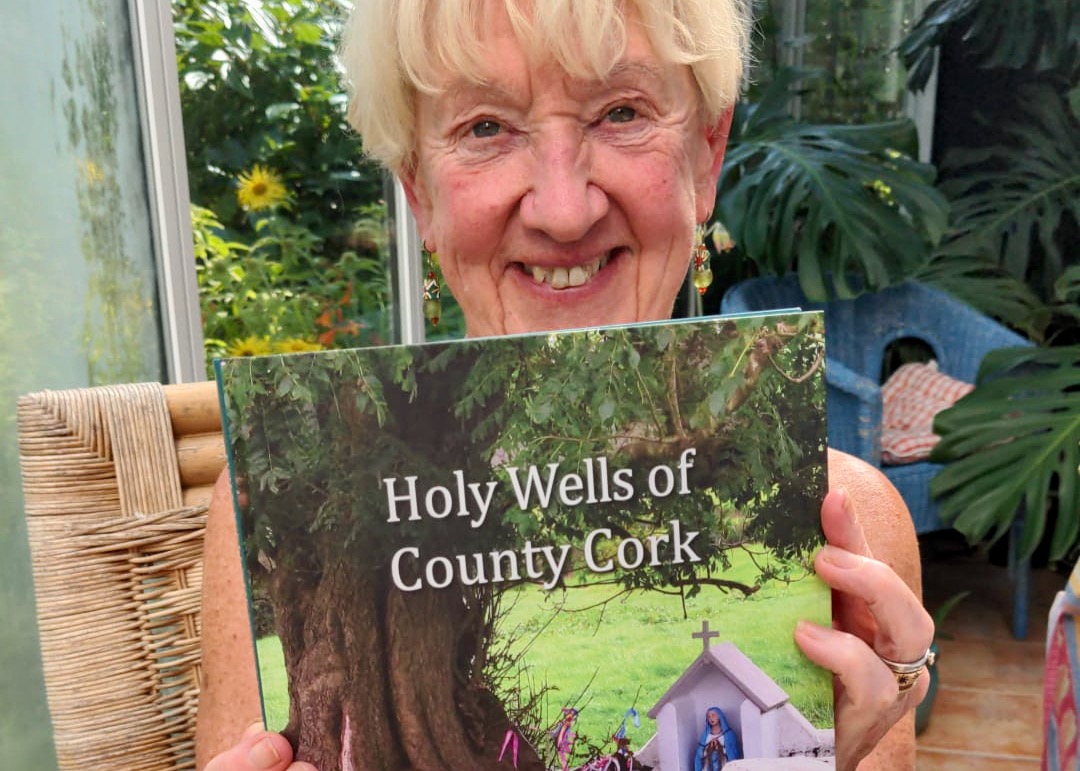
Two new books were launched this year to great acclaim. Our friends Amanda Clarke, the writer, and Peter Clarke, designer and publisher, brought out the marvellous Holy Wells of Cork in July. Comprehensive, beautifully illustrated, thoroughly researched and engagingly written (there’s a whole section on Saints Behaving Badly!), it’s already into the second printing. 

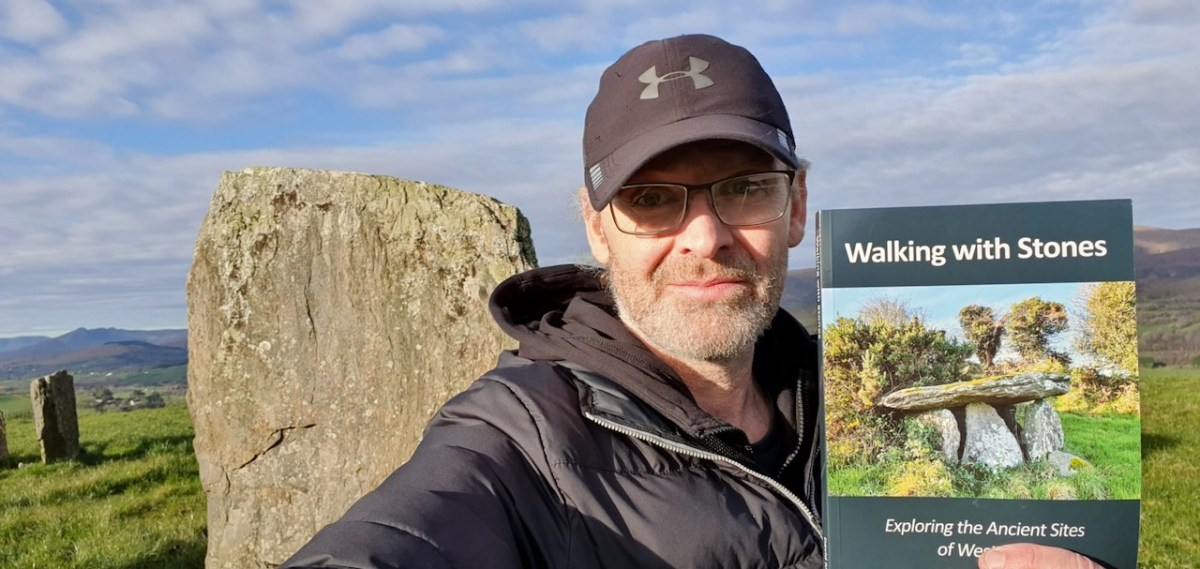
Then, just in time for Christmas, David Myler published his Walking with Stones. An outgrowth of his popular facebook page of the same name, it’s the first non-academic book on West Cork archaeology since Jack Robert’s classics of the 1980s. 

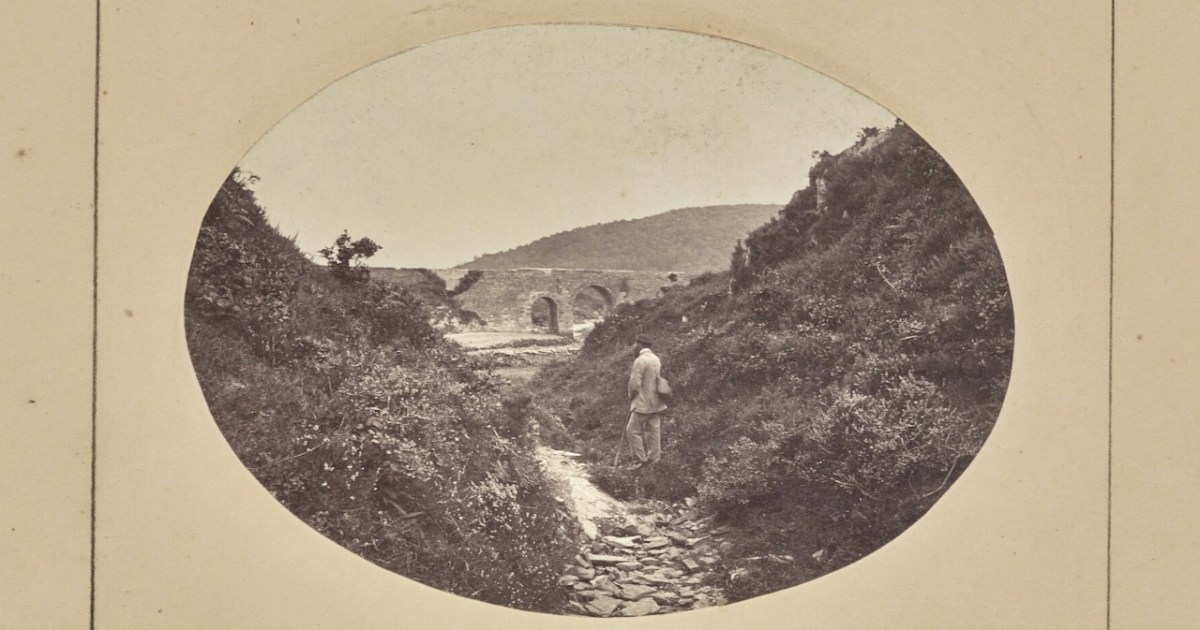
My discovery of albums of photos by one of Ireland’s earliest photographers, Sir John Joscelyn Coghill, was a big thrill, especially since many of his photos were of West Cork subjects.

And finally, although they aren’t in Cork, I really enjoyed writing the four-part series on Cashels in Kerry. In essence they are an examination of what we can know, and not know, about life in early medieval Ireland.

On this last day of 2023, we wish you all a Happy New Year and thank you for joining us on our ongoing journey.

(We’re heading out to Toe Head, above, in the company of Gormú – if you haven’t already experienced one of his walks, sign up now!)

Blogging With ChatGPT

We’ve been reading a lot about this new method of generating text using Artificial Intelligence. Apparently, American universities are all of a twitter because students now have a new avenue for not doing the work themselves. An essay generated by ChatGPT is either indistinguishable from good work, or is readily identifiable, according to which account you are reading. We wondered how it would do at generating a blog post for us, so that instead of devoting our time to research, photography, and writing, we can lounge about drinking coffee and playing Wordle.

So – we set ChatGPT this task:

Write an 800 word blog post, illustrated, about the history of West Cork, in Ireland

Here’s what it came up with. What do you think? How accurate is it? Could we pass it off as one of our blog posts? What grade would you give us if it was an assignment for a history course?

West Cork is a region located in the southwestern part of Ireland, known for its rugged coastal landscapes, picturesque villages, and rich cultural heritage. The history of West Cork is a story of resilience, tradition, and change.
The earliest human settlements in West Cork date back to the Mesolithic period, around 8,000 BC. These early inhabitants were hunter-gatherers who left behind evidence of their presence in the form of flint tools and other artifacts. The Neolithic period, around 4,000 BC, saw the arrival of farmers who cleared the land for agriculture and built megalithic tombs and standing stones, such as the famous Drombeg stone circle.
The Bronze Age, around 2,000 BC, saw the arrival of metalworking and the construction of ring forts, such as the one at Cahergal, near Skibbereen. The Iron Age, around 600 BC, saw the arrival of the Celts, who brought with them their own language, culture, and traditions. The Celts established settlements and farms throughout West Cork, and their descendants continue to live in the region to this day.
The arrival of the Vikings in the 9th century AD brought about significant changes to the region. The Vikings established settlements along the coast, such as the one at Baltimore, and they also established trading routes that brought goods and ideas from Europe and beyond. The Vikings were eventually driven out by the Irish, but their legacy can still be seen in the place names and architecture of West Cork.
The Norman invasion of Ireland in the 12th century brought further changes to the region. The Normans established castles and towns, such as the one at Skibbereen, and they also established feudal systems of land ownership and governance. The Normans also brought with them new technologies, such as the water mill, which greatly improved agricultural productivity.
The 16th and 17th centuries saw the arrival of the English, who established plantations and brought with them new forms of religion, law, and governance. The English also brought with them new forms of industry, such as the linen and woolen mills, which brought prosperity to the region. However, the English also imposed harsh laws and taxes on the Irish, leading to widespread poverty and suffering.
The 18th and 19th centuries saw the rise of the Irish nationalist movement, which sought to end English rule and establish an independent Irish nation. The people of West Cork played a key role in this movement, and the region was the site of many important events in Irish history, such as the 1798 rebellion and the 1803 rising.
The 20th century saw the establishment of the Irish Free State in 1922, and the region of West Cork continued to play an important role in Irish politics and culture. The region also saw significant changes in its economy and society, as new technologies and industries, such as tourism and fishing, brought new forms of prosperity and opportunity.
Today, West Cork is a vibrant and diverse region, known for its natural beauty, rich cultural heritage, and friendly people. Visitors to the region can explore its many historical sites, such as the Drombeg stone circle and the Baltimore castle, and enjoy its many outdoor activities, such as hiking, fishing, and sailing. They can also sample the local cuisine, which is renowned for its seafood, dairy products, and traditional Irish dishes.
In conclusion, West Cork’s history is a story of resilience, tradition, and change. From the earliest human settlements to the present day, the people of West Cork have faced and overcome many challenges, and have always remained true to their culture and traditions. Today, West Cork is a vibrant and diverse region, rich in natural beauty, history and culture

Note- no illustrations. OpenAI can give you illustrations, but it’s a whole other process and I got too bogged down in the directions to go far with it. Instead, I asked ChatGPT the following question:

Q: where can I get good photographs of West Cork?

It responded by pointing me to stock photo sites, Instagram and other social media sites, travel sites and blogs. It added, helpfully,

You can also consider visiting West Cork yourself and taking your own photographs of the region. This can be a great way to capture unique, personal images that reflect your own experience of the area.

EDIT

Thanks so much to those who commented. If you don’t know much about the history of West Cork then it might appear that ChatGPT provided some ‘better than expected’ content. But a careful reading will show you that it provided information at a very generic and superficial level.

It was in fact full of errors. A few examples – Drombeg is not Neolithic; ringforts do not date to the Bronze Age; Cahergal is in Kerry, nowhere near Skibbereen; modern historians and archaeologists no longer believe a race called the Celts arrived in Ireland; there is no evidence of a Viking settlement in West Cork, let alone in Baltimore; the Normans did not establish Skibbereen, and we had water mills before they arrived; the idea that the English brought prosperity to the region would be disputed by many historians; the 1798 rebellion was not centred in West Cork; Nothing happened in Cork to support the 1803 rebellion.

Glaring omissions: The Famine does not merit a mention yet was the defining feature of West Cork history in the nineteenth century; Ditto the War of Independence and the Civil War for the 20th century, and the Munster Plantations and the Battle of Kinsale for the 17th.

All in all – a miserable failure. I would give this an F if it was handed in to me by a student. Some of you also commented on the stilted and formulaic language – this would tip off any teacher/professor, surely.

So – I don’t think we’ll be turning to ChatGPT to generate our content any time soon!