Dublin’s Stained Glass: A Review

Friends, take note – this is an ideal Christmas present! If it has never occurred to you to take a drive, a walk or a cycle through any part of Dublin, dropping into churches along the way, this book will convince you that it’s the ideal way to spend a day, surrounded by history and beauty.
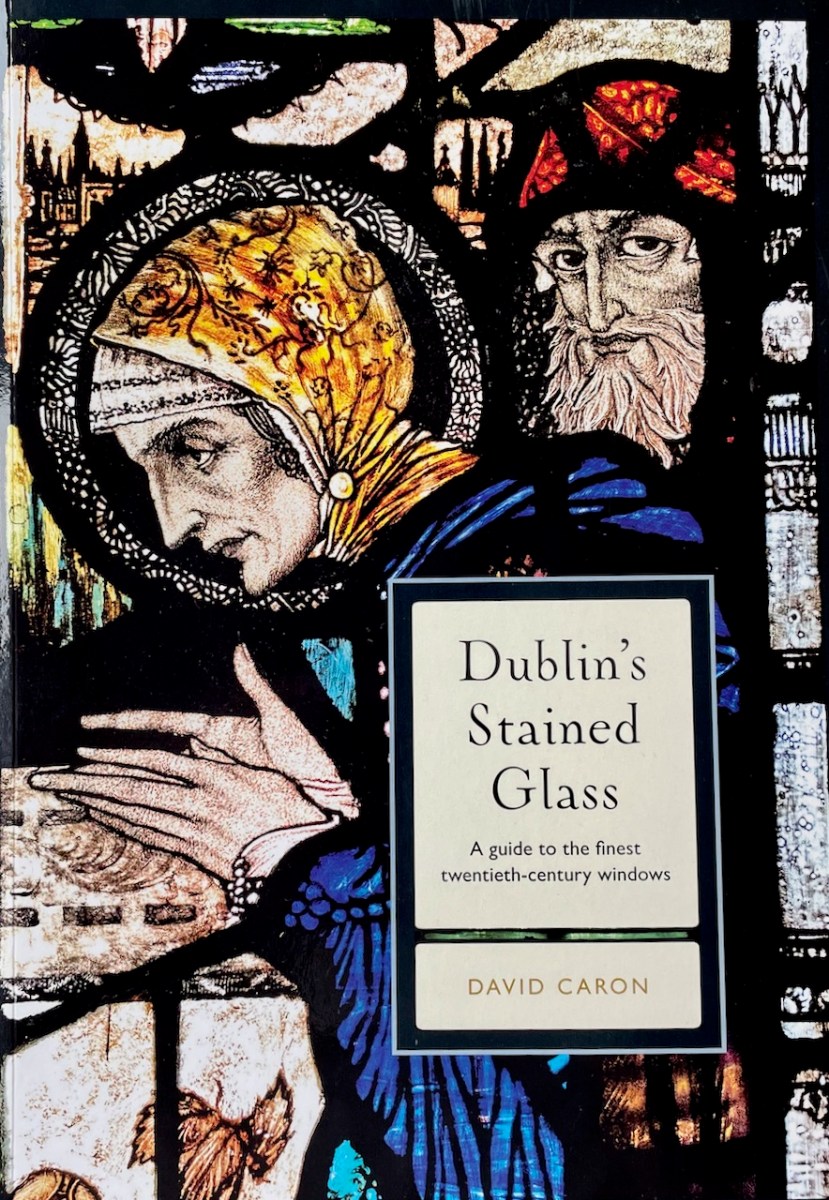
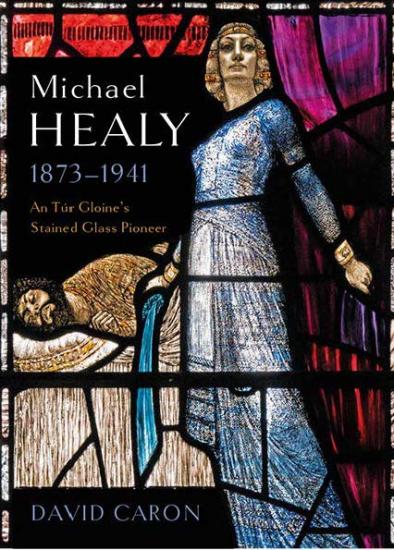
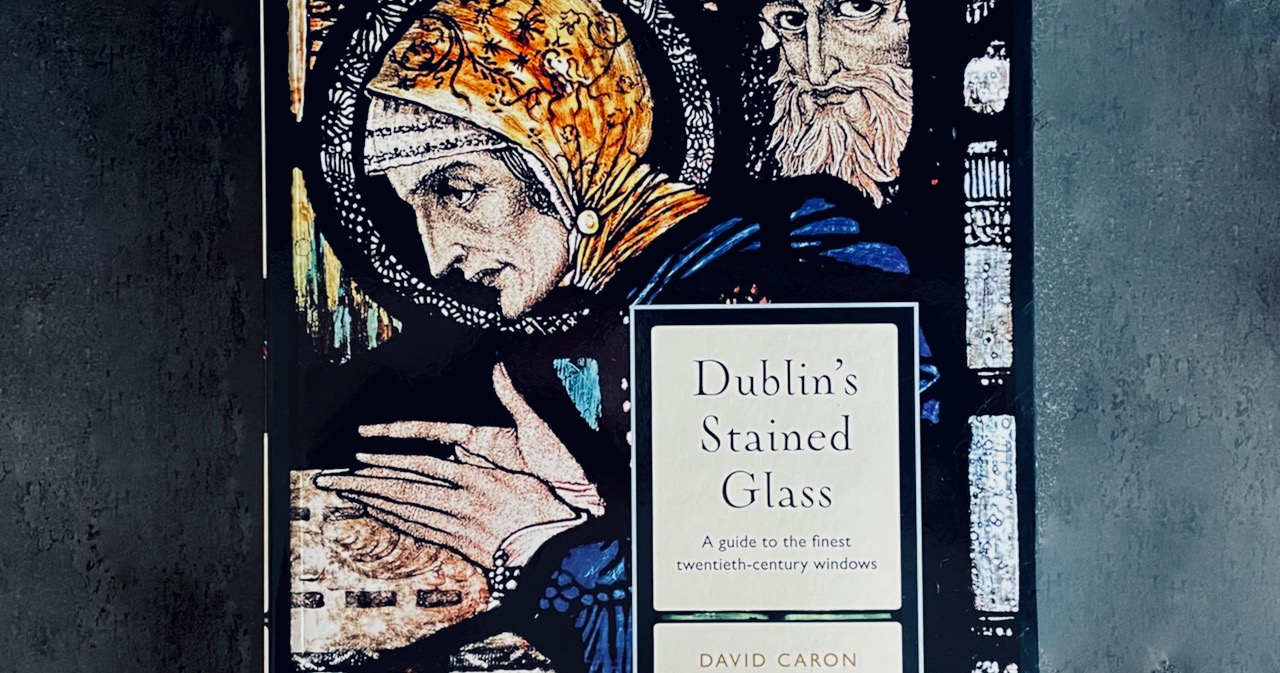
As my regular readers know, I write frequently about stained glass, and I was a contributor to The Gazetteer of Irish Stained Glass. The editor and main writer of that volume was David Caron, and I previously reviewed his marvellous book (I called it a ‘miracle’) on the life and work of Michael Healy. Now comes his latest work, Dublin’s Stained Glass, a book about the best 20th century glass in Dublin Churches, stunningly produced by Four Courts Press. This book needs to be in your library!
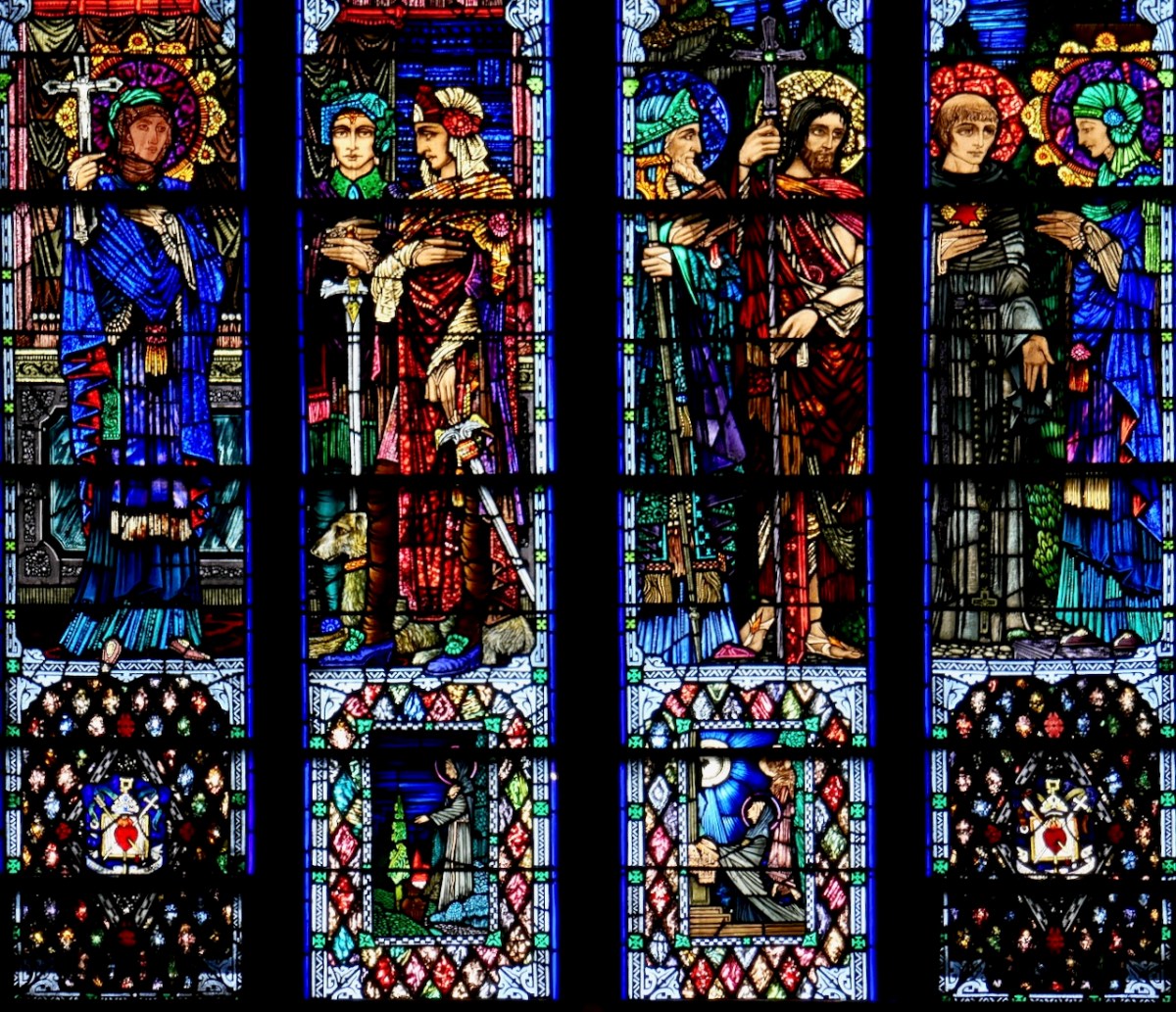
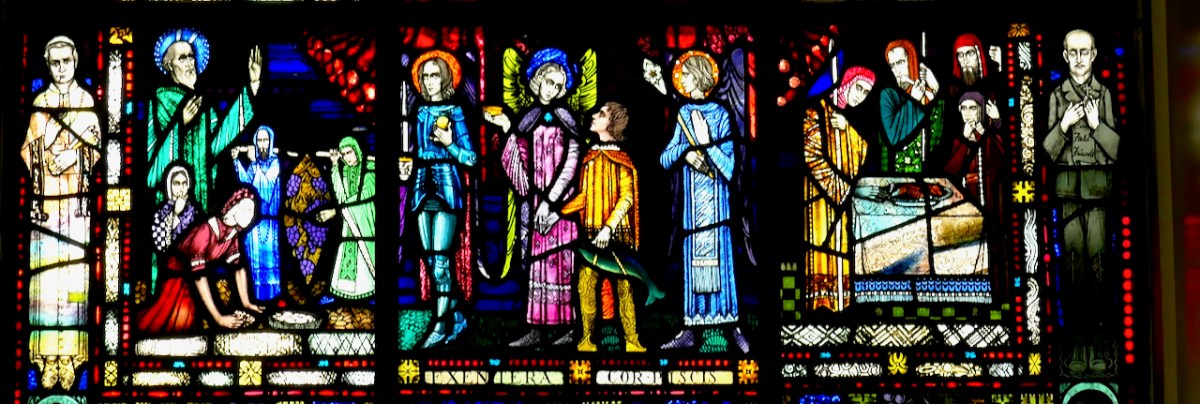
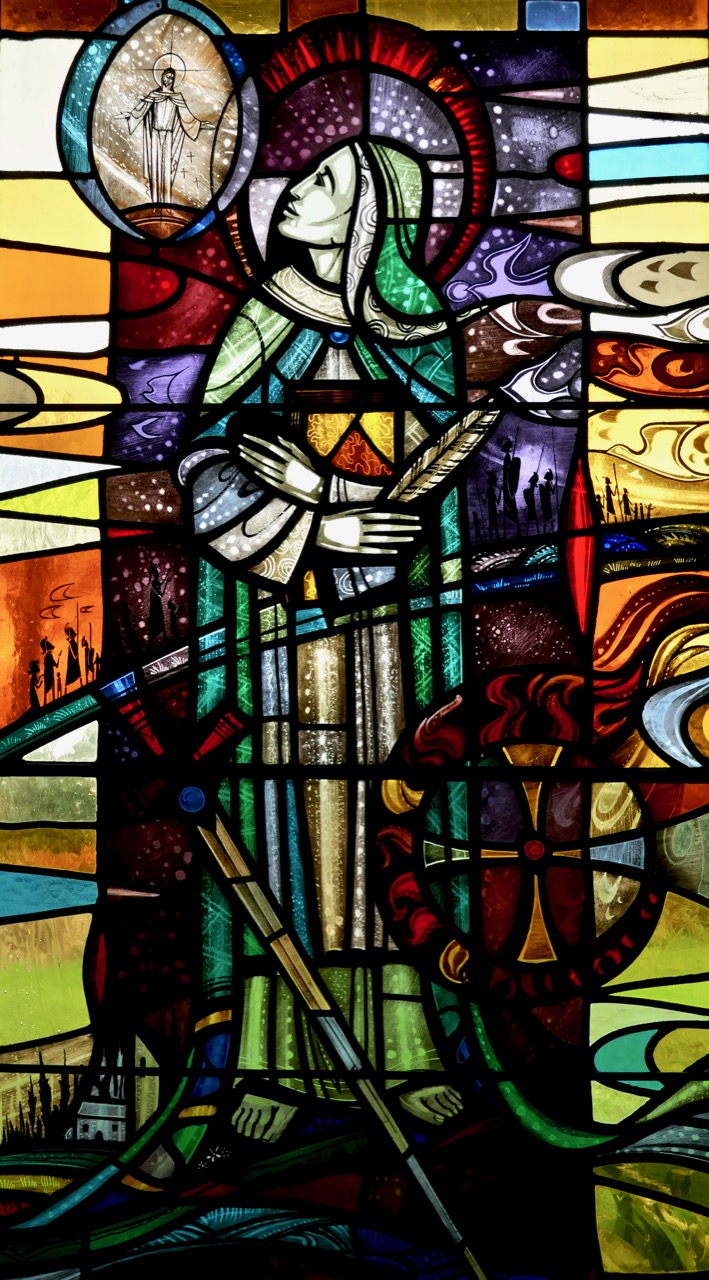
The John’s Lane church features in David’s Book, with a detail from the St Rita window. Here’s all of the narrative part of the window.

Here’s a statement you might not hear every day – the Catholic Church was the greatest patron of Irish artists in the 20th century. This is particularly true after Vatican II, 1962-65, the decrees of which included encouragement to use modern forms of architecture and art. But it is also true that the Church had the means to commandeer resources that were available to few private individuals in 20th century Ireland. The result of this is that the work of some of our best artists is public and easily accessible. While this book focusses on stained glass, David also points out where appropriate other example of fine art in churches (e.g. stations, altar furniture) as well as identifying the architects working to modernise or re-order our churches.
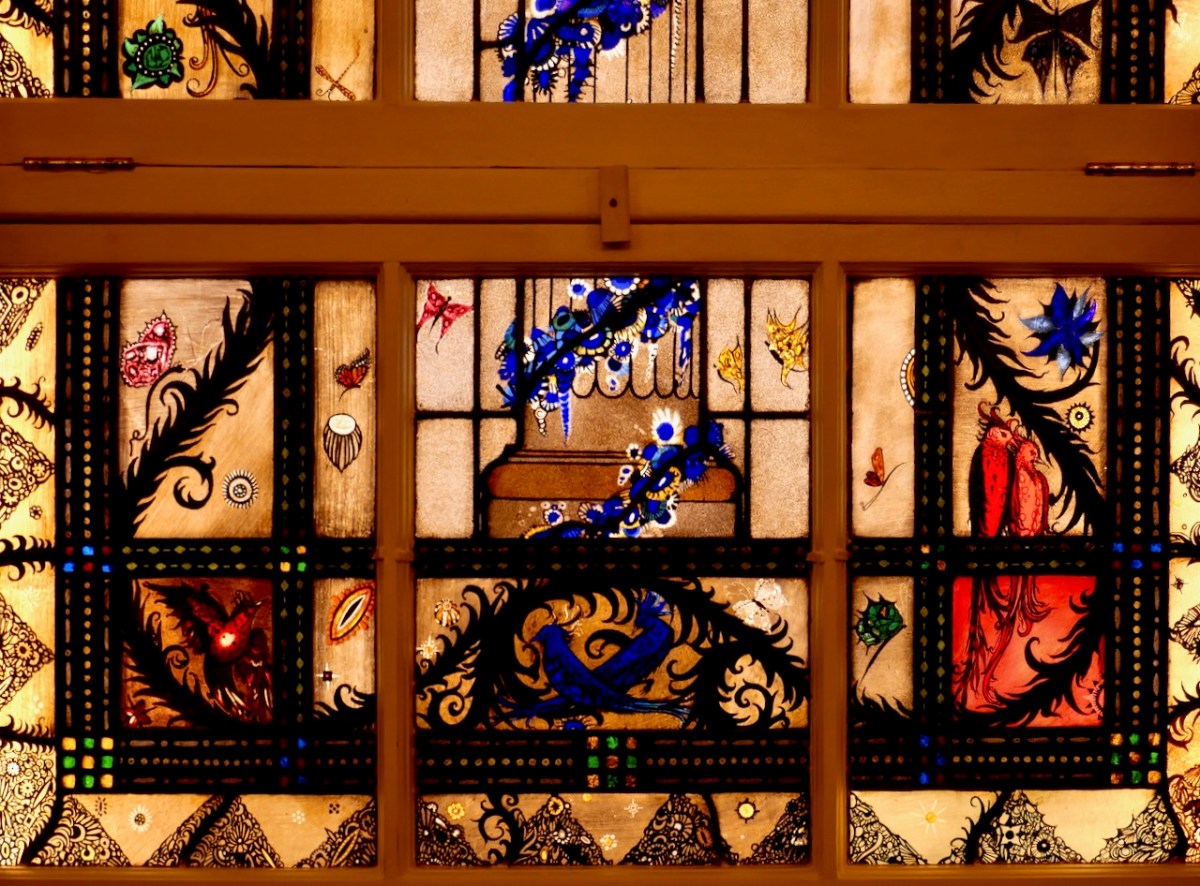
I have used my own photographs throughout this post, but they cannot compare with the magnificent photography by Jozef Vrtiel, David’s long-term collaborator and the single most talented photographer of stained glass in Ireland. This is truly a combined effort – David’s text and Jozef’s images complement each other superbly.
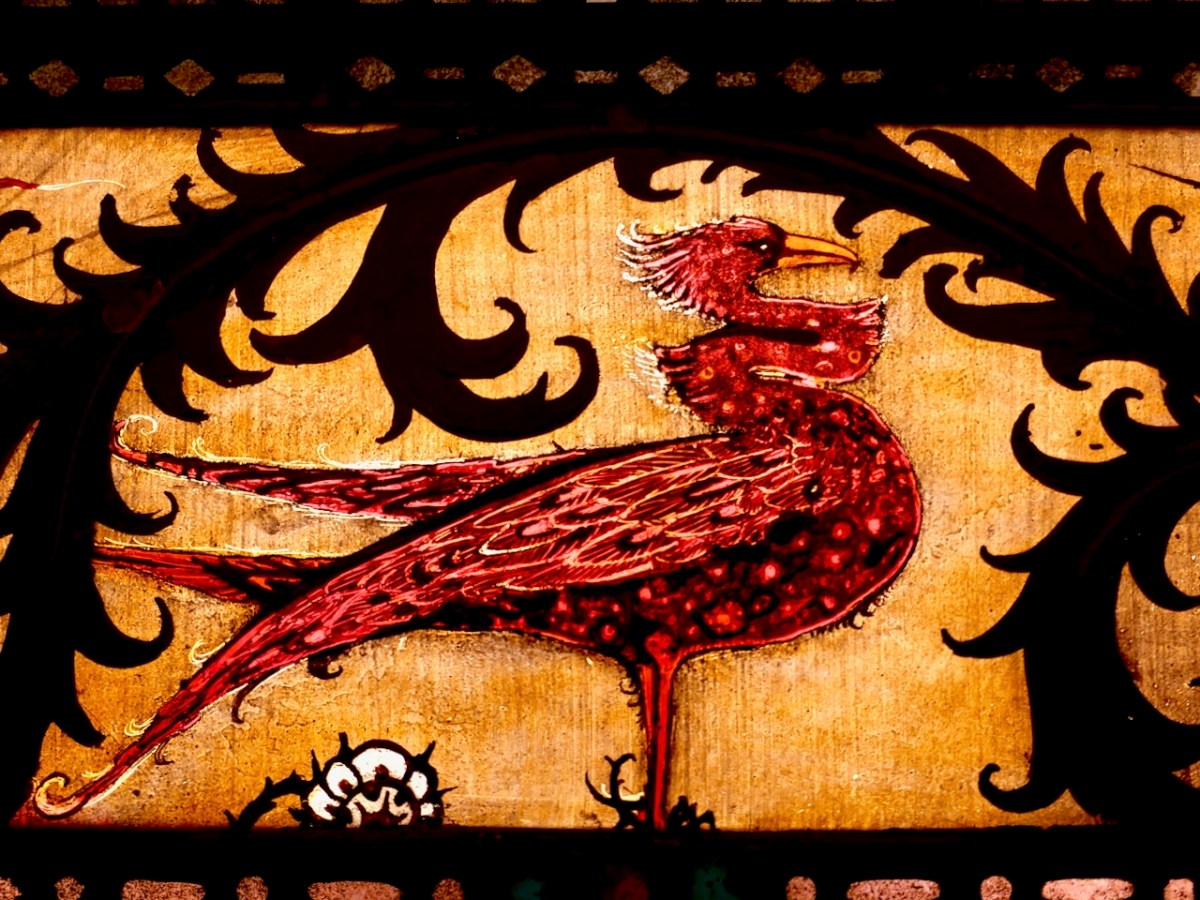
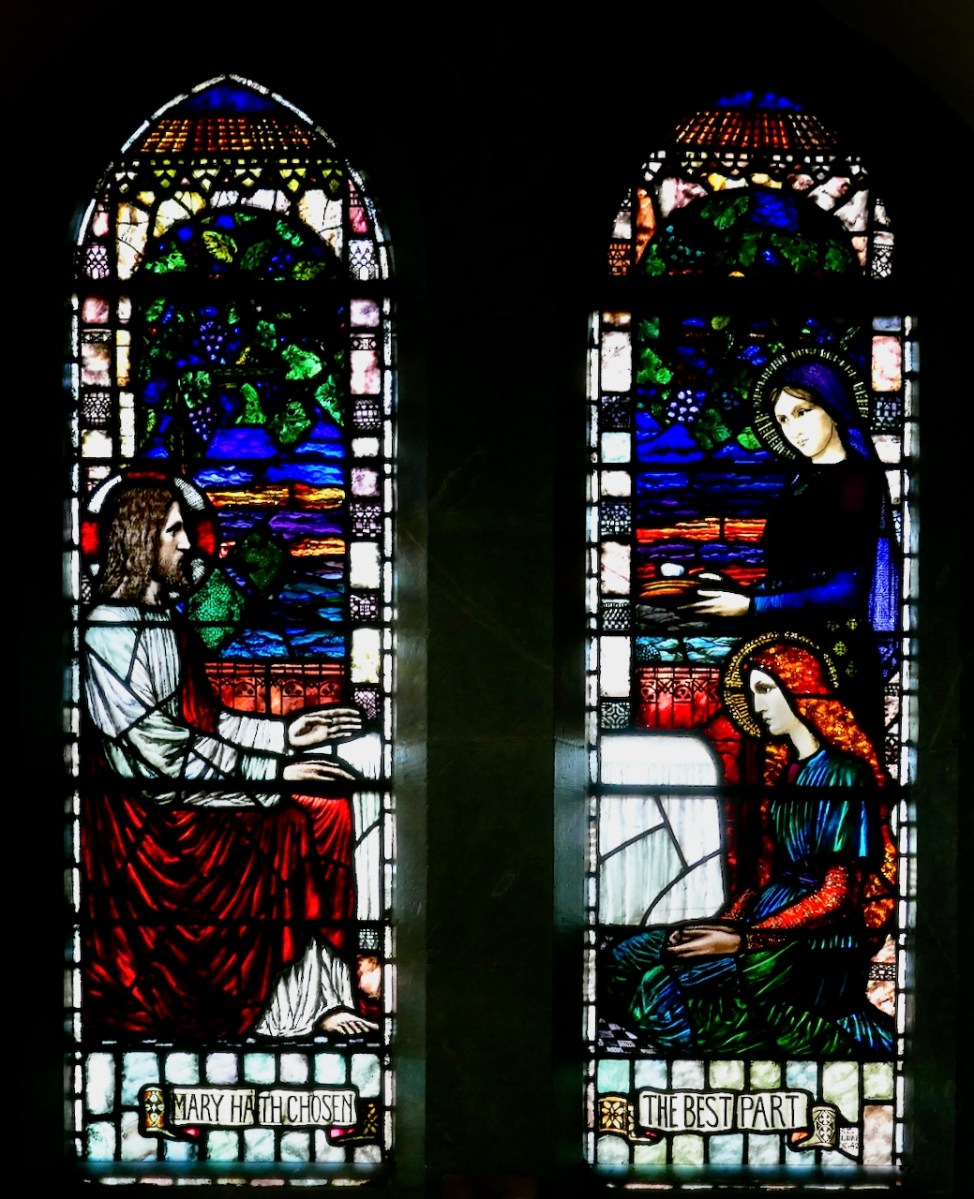
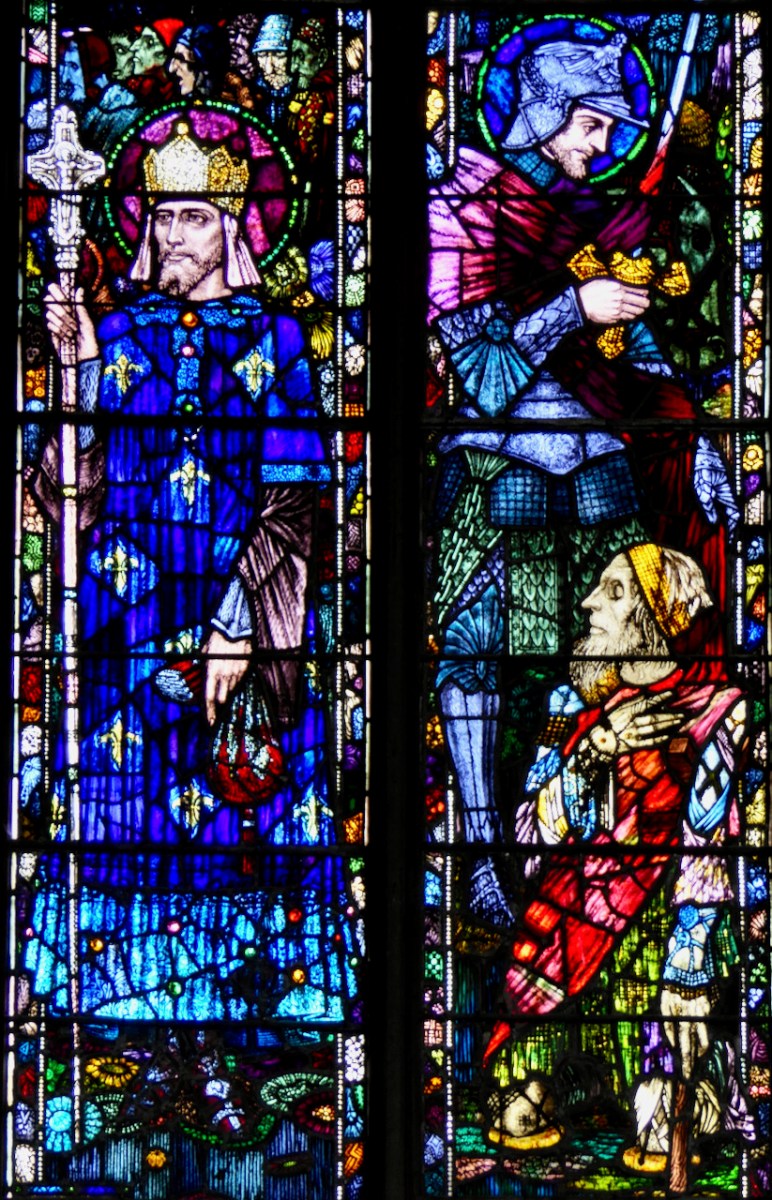
The book is laid out in sections: City, Dublin North and Dublin South (suburbs and county), encompassing thirty-nine locations. They are not all churches – Bewley’s on Grafton Street is included for its Harry Clarke windows (above, and above that), as well as the National Gallery with its excellent stained glass room, the Hugh Lane Gallery, home of Clarke’s Eve of St Agnes, and St Patrick’s Campus of Dublin City University, with its floor to ceiling expanse of dalle de verre by Gabriel Loire. This is a good example of a non-Irish artist included in the book. Gabriel Loire was French, and the internationally acknowledged master of the dalle de verre technique, in which slabs of glass, chipped round the edges to increase refraction, was embedded in concrete or resin, allowing for soaring walls of colour to be incorporated into the architectural scheme.
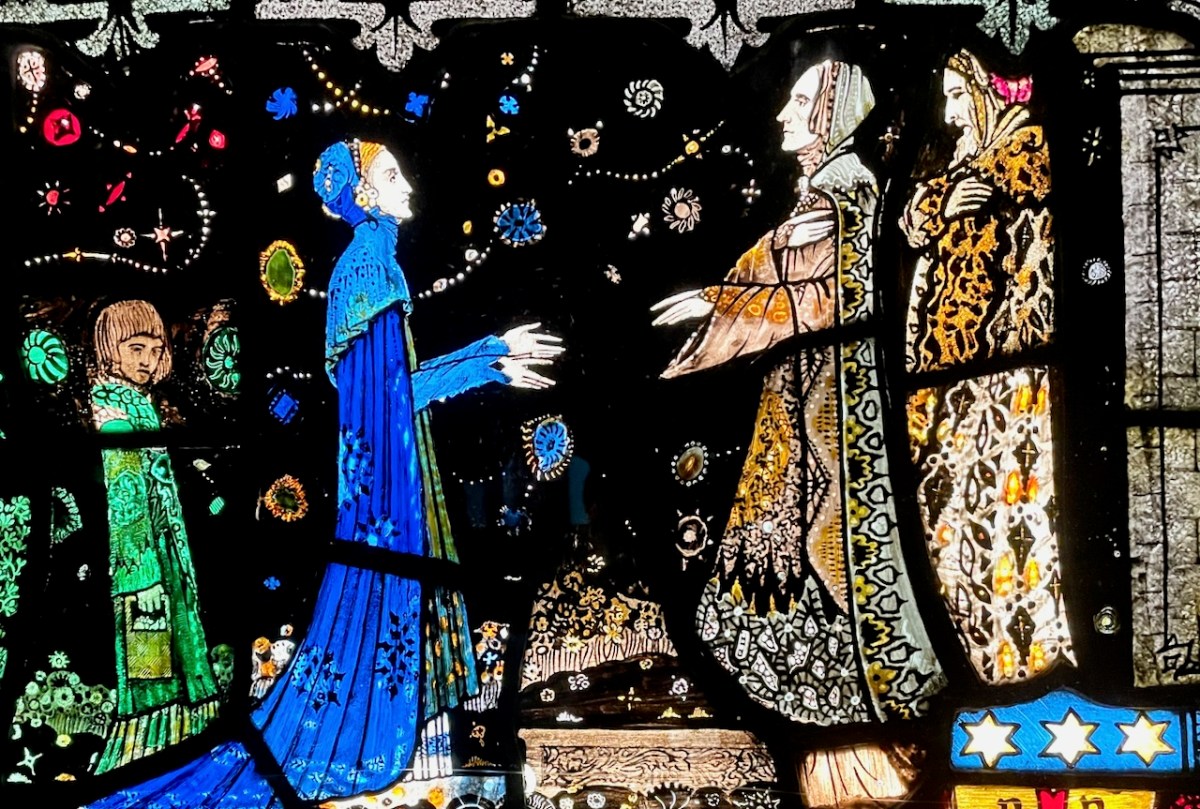
This little predella panel is at the base of The Blessed Julie window in Staunton’s Hotel on Stephen’s Green

But of course, mostly the stained glass is in churches. Catholic churches tend to be open much of the time, making them the easier option to visit. A little careful planning may be needed to visit non-Catholic churches. David gives the postal code for each location – very helpful as it works well with Google maps. Of necessity, schools, hospitals and other institutions had to be excluded since they are not publicly accessible most of the time.
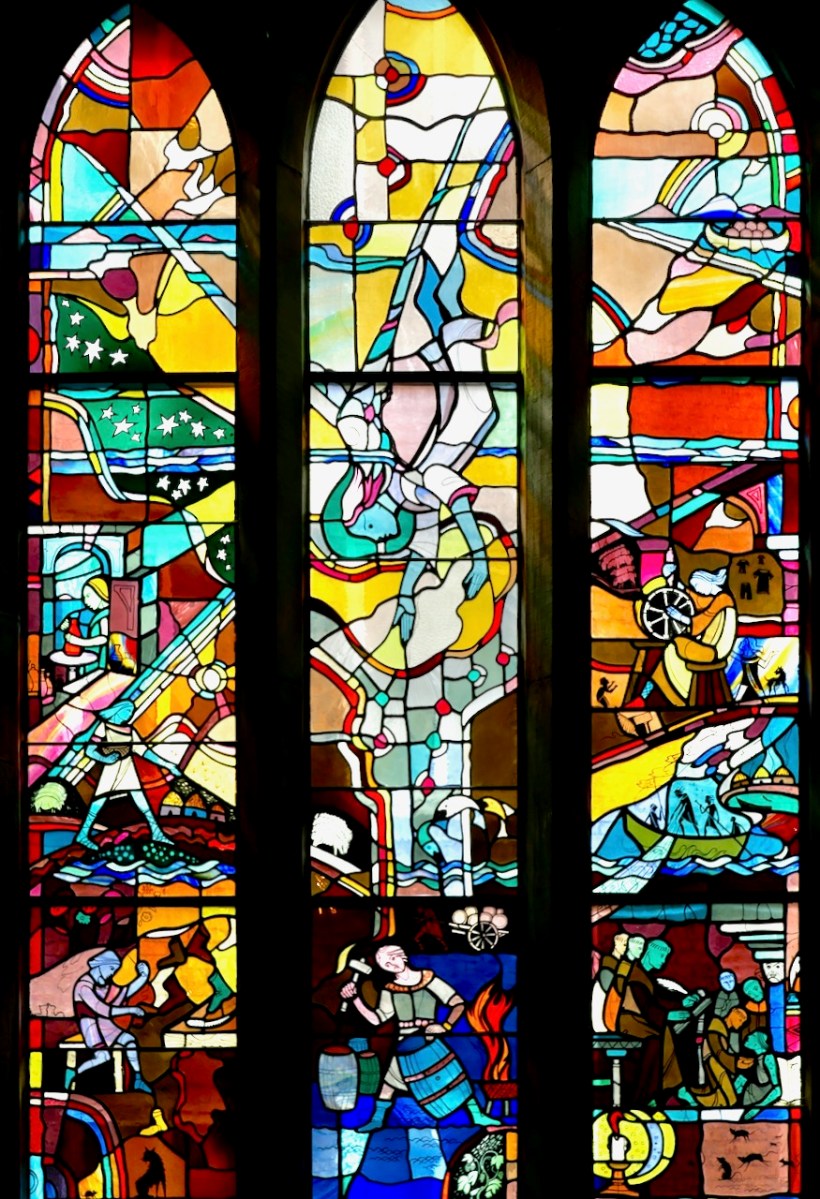
In the Dublinia exhibition this is George Walsh’s Trades window

In his introduction, David tells us:

During the 20th century Dublin’s reputation as a centre for stained glass excellence, both in terms of artistry and craftsmanship, was internationally lauded and is evidenced by the many orders placed by overseas patrons. Stained glass was the one area of the visual arts in 20th century Ireland that had an established school of the highest calibre, as distinct from singular talents such as Jack B Yeats and Eileen Gray. The highpoint for Irish 20th century stained-glass was the period from 1915 to 1980 and the leading figures were Harry Clarke, Wilhelmina Geddes, Michael Healy, Evie Hone and Richard King all of whom trained in Dublin, worked out of Dublin studios and so it is not surprising that the city has a concentration of first rate stained glass by them and many others.
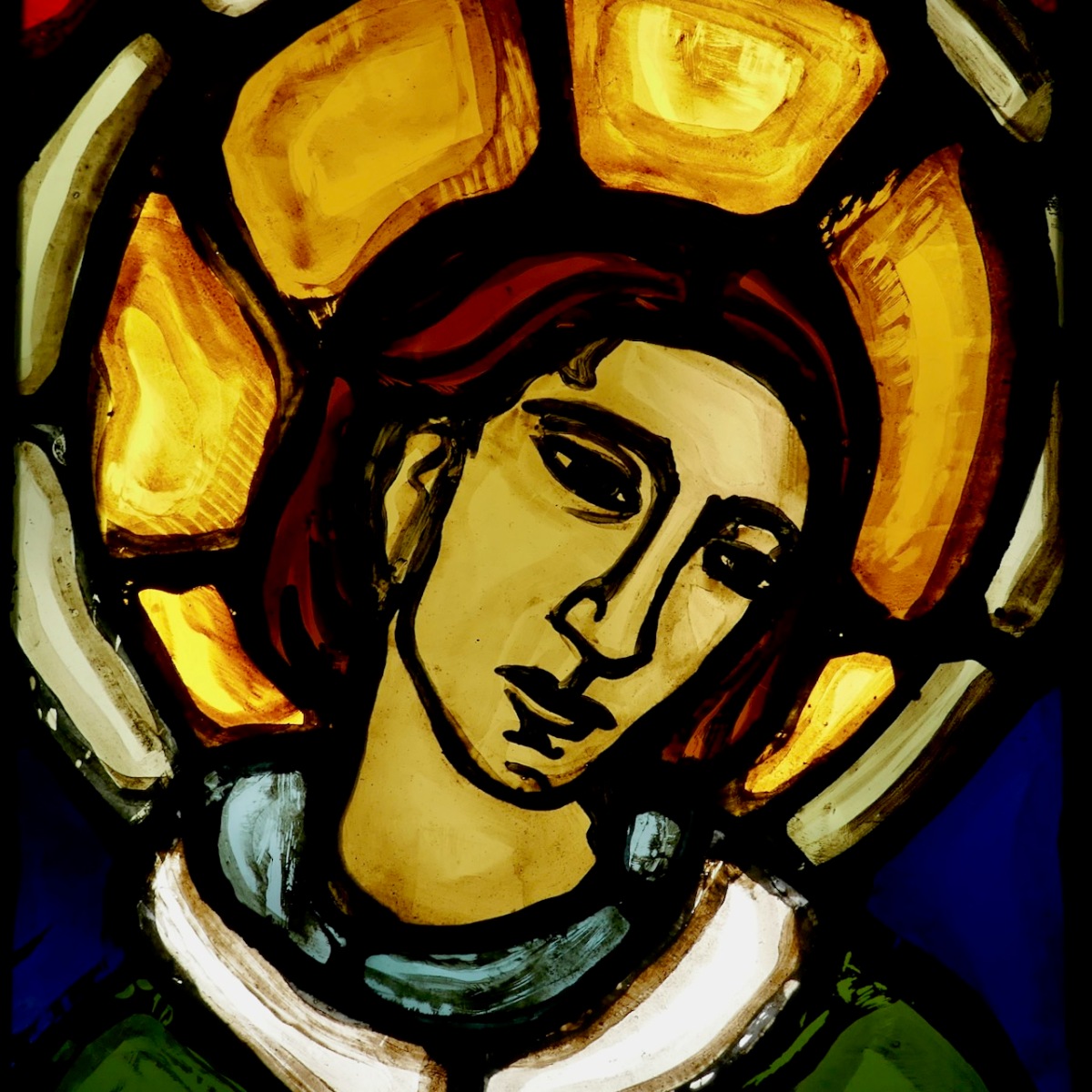
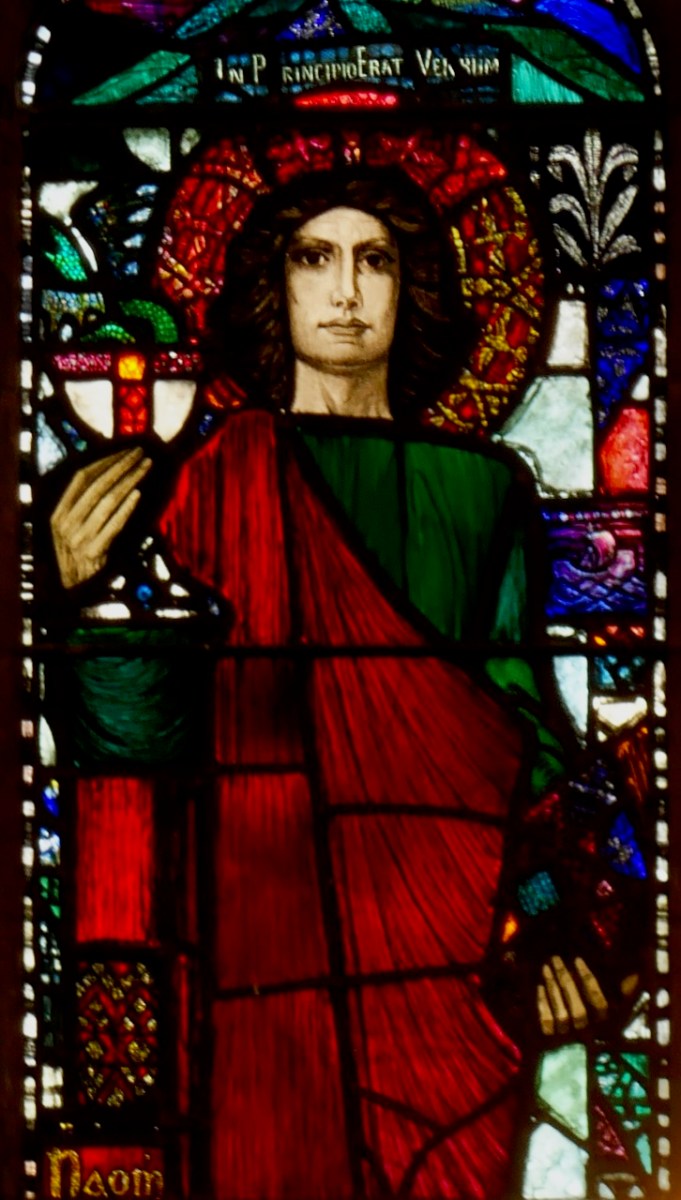
Evie Hone’s Head of St John at the National Gallery

I would add that stained glass was an area where both Irish men and Irish women could excel. Many of our finest stained glass artists were women and there has never been any tendency, as with other areas of artistic endeavour, to privilege the reputation of men over women. 
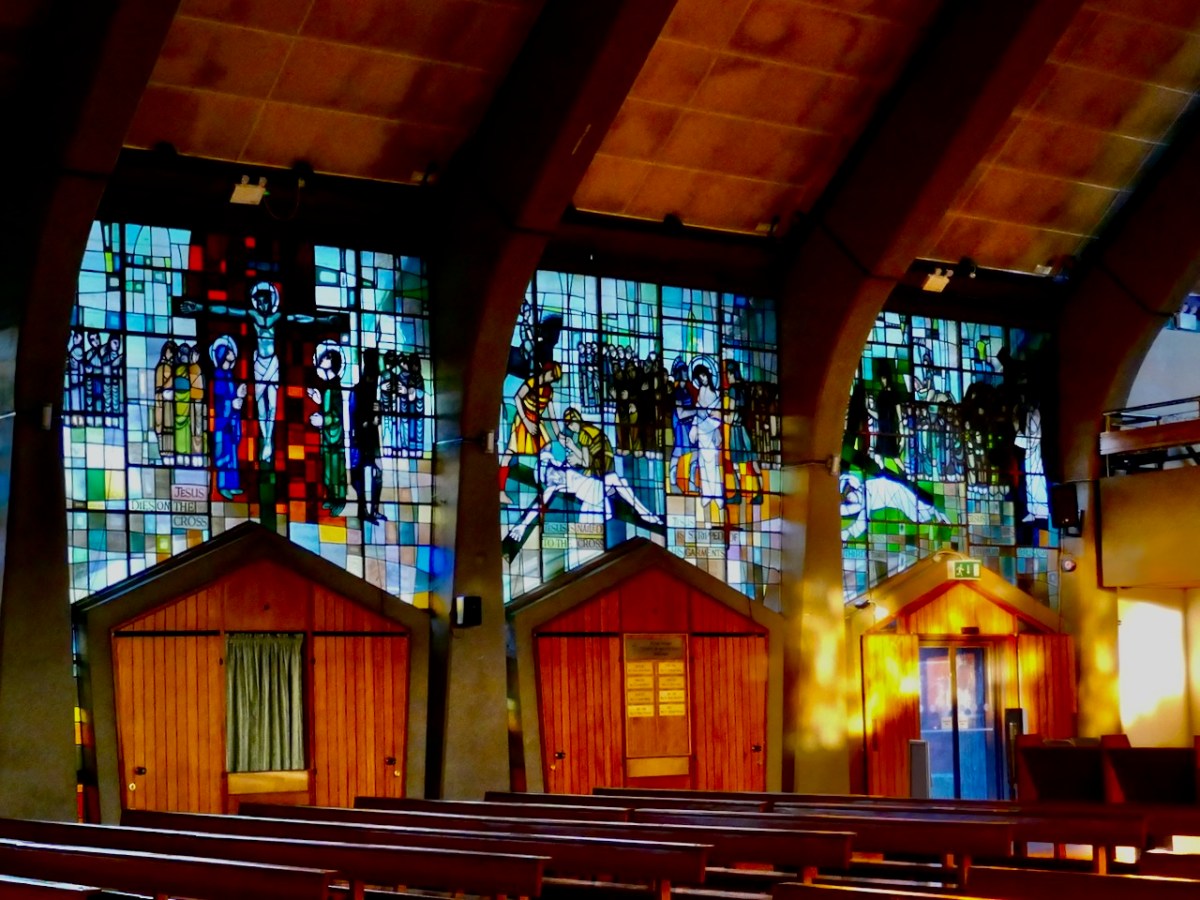
Ballyroan Church of the Holy Spirit, with Murphy-Devitt’s stations laid out in narrative progression. This church also has paintings by Sean Keating

David starts with the architecture of each church, identifying the architect or firm, and describing its main features and influences as well as dates of construction and/or modification. As he says, if one were to visit all or many of the locations in the book, one would get a comprehensive overview of the story of twentieth-century Irish stained glass. 
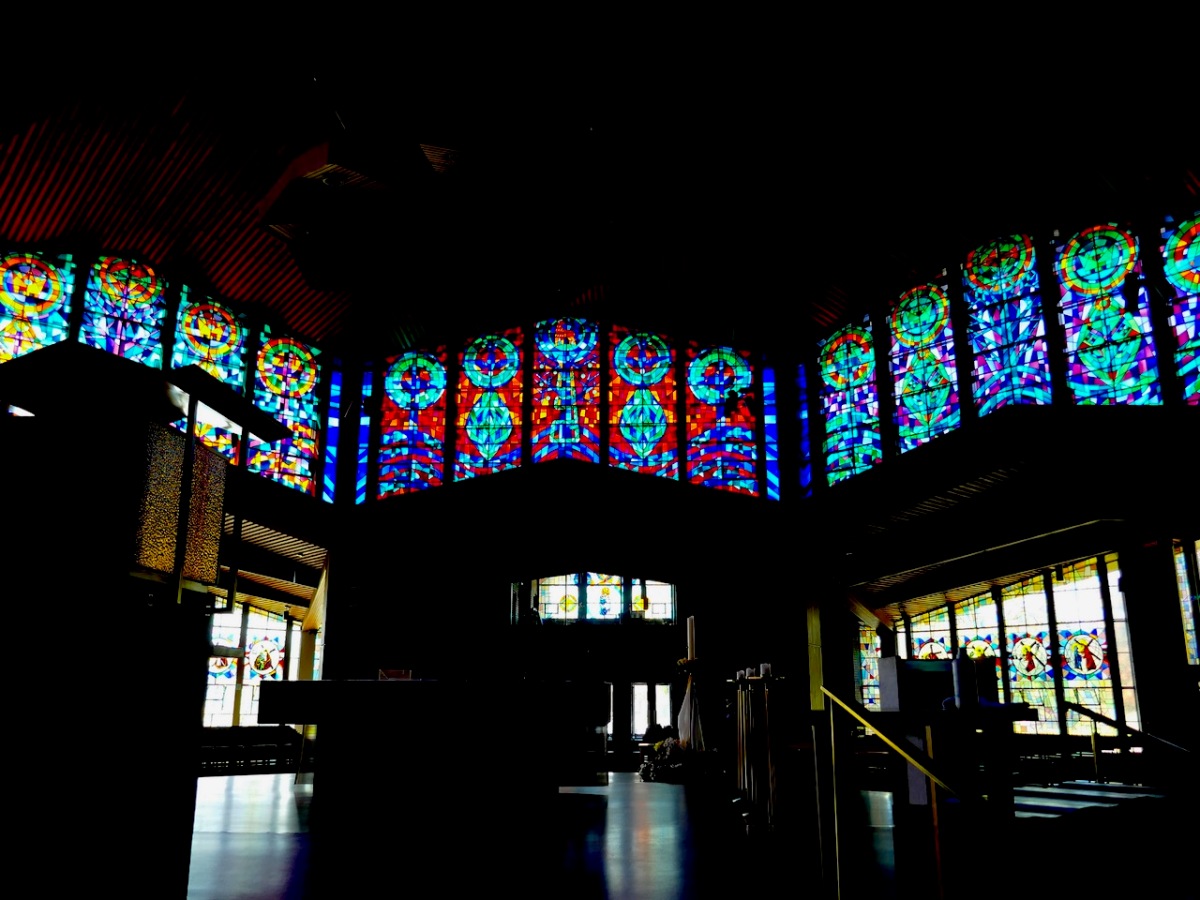
Let’s take one example – the church in Ballymun, Our Lady of Victories, one of the first batch of six churches in the Dublin Diocese that were built in the five years immediately after Vatican II, and which take into account the Guidelines of the council. Stepping into this church, as I did for the first time in May this year, is an immersive experience. First of all, it’s enormous – a reminder that in the 60s we were building Catholic churches which could accommodate thousands of congregants over the course of several masses every Sunday. 
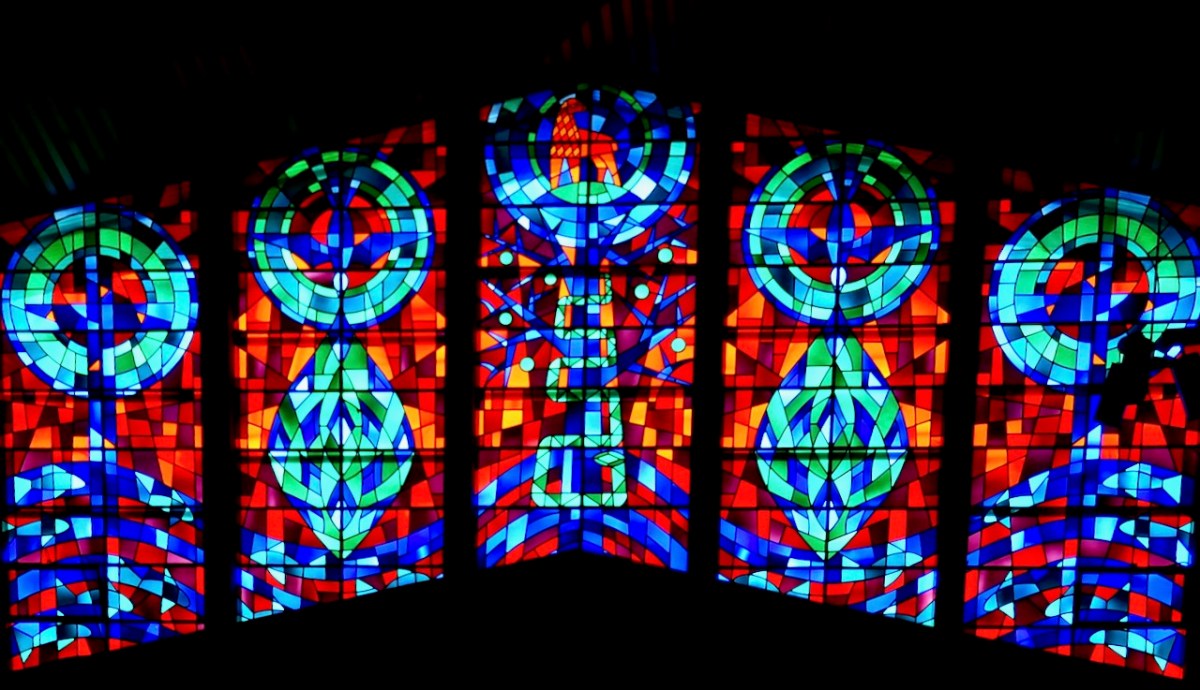
Secondly, you are immediately aware of being bathed in light and colour. There is a ‘lantern’ surrounding the central altar and this is the work of Helen Moloney. Here is David’s description:

Although it comprises eight sides or ‘windows’ (each composed of five panels), Helen Moloney created just two different designs for the windows; from these she made four different colour versions and these were duplicated to create the eight different windows. Despite the fact that there are essentially just two designs and she chose a deliberately restricted colour palette, this repetition is hardly apparent and instead one experiences an almost overwhelming sense of intensely zinging complimentary colours enlivened by punchy graphic symbols. Moloney used only the best of mouth blown glass in a selection of rich colours including red, blue, yellow, purple, violet, orange, green, and aquamarine, and although she has included different shades of these, mostly they are full strength from maximum visual impact.
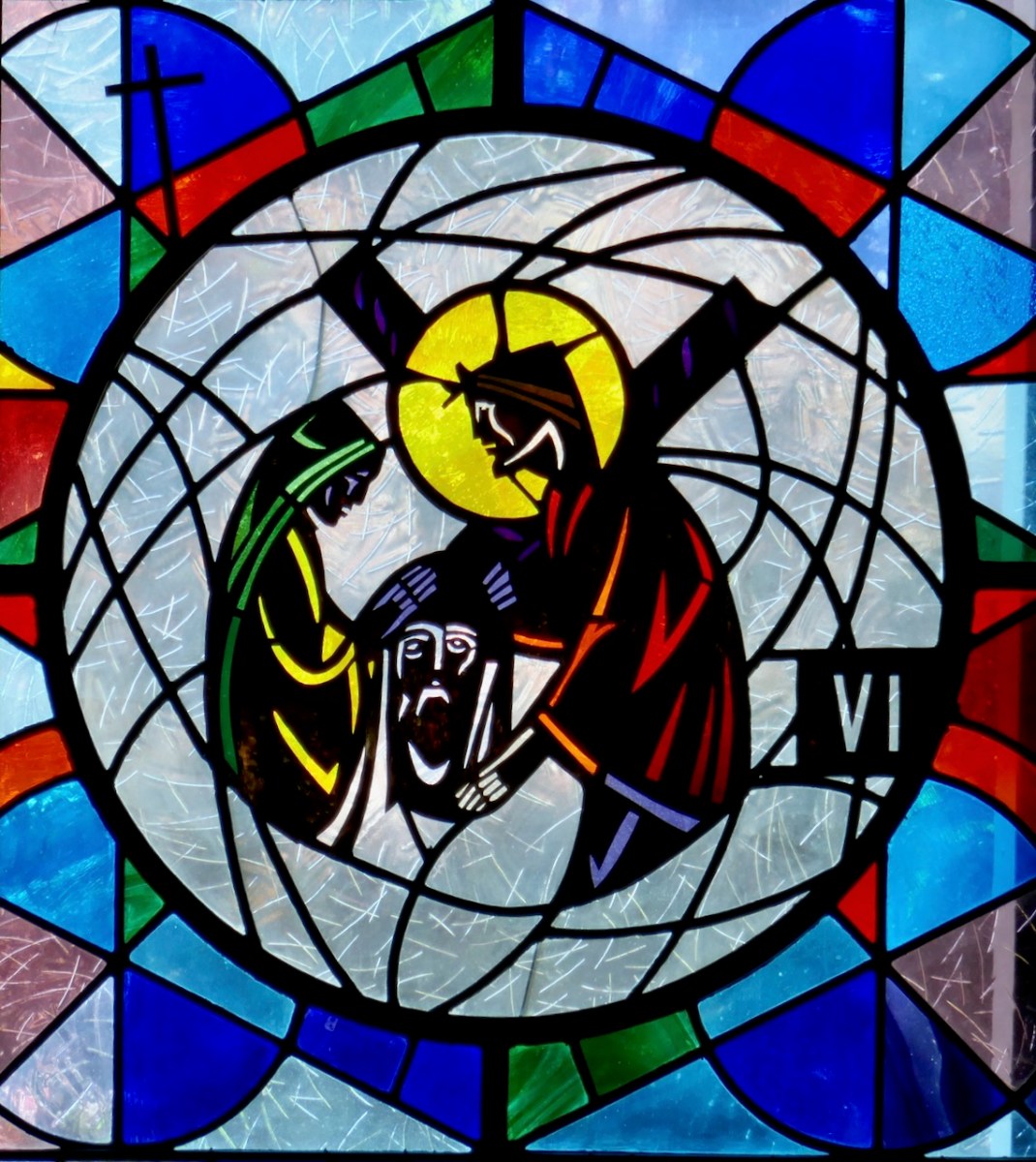
The second artist with work in Our Lady of Victories is my own favourite, George Walsh, at this time still working at Abbey Studios. The stations are by him, in an innovative technique using copper sheets, with details cut into them in the manner of a stencil (above). David comments, The effect is graphic and reduces the Stations to their essence. David points out that a rare feature of these Stations is the inclusion of a fifteenth station, the Resurrection. Walsh also has a St Joseph, a St Patrick and a Madonna and Child in the church.
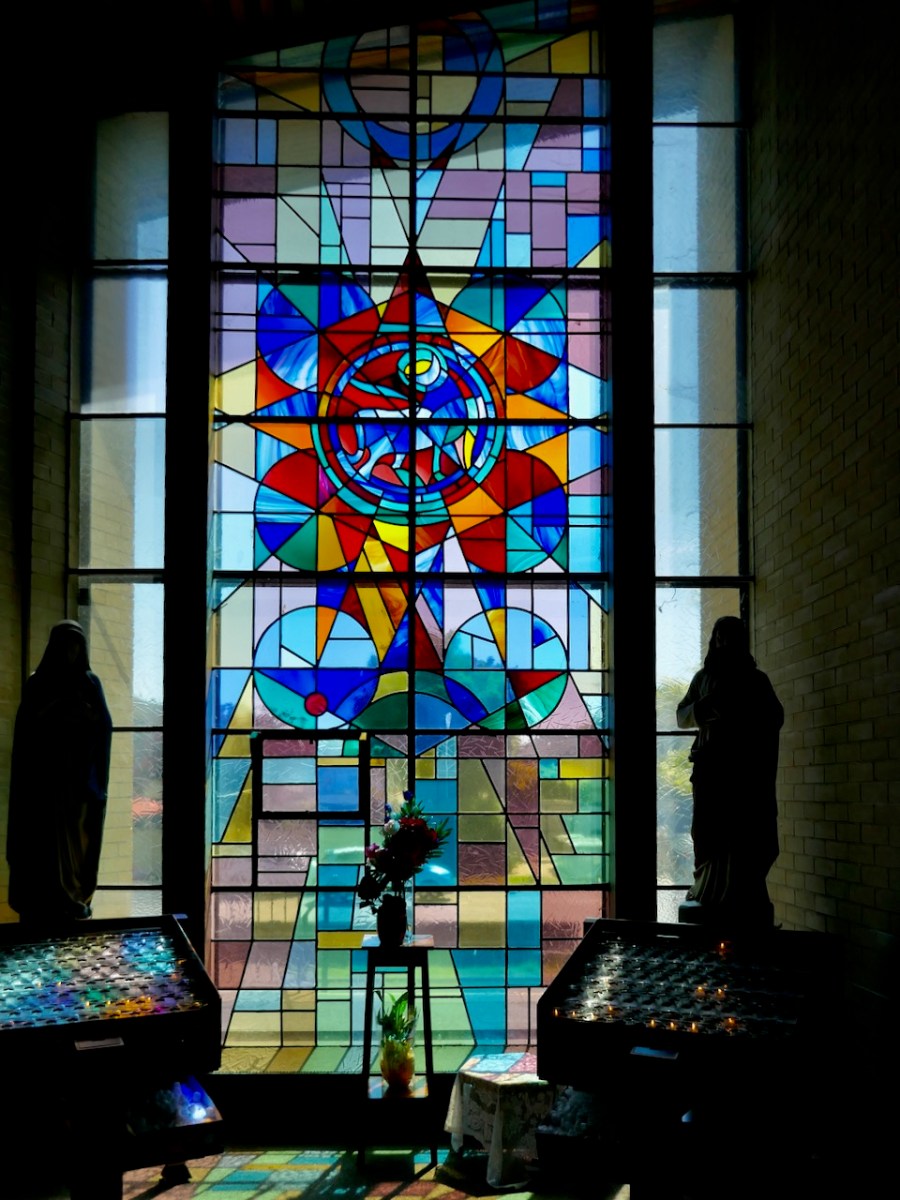
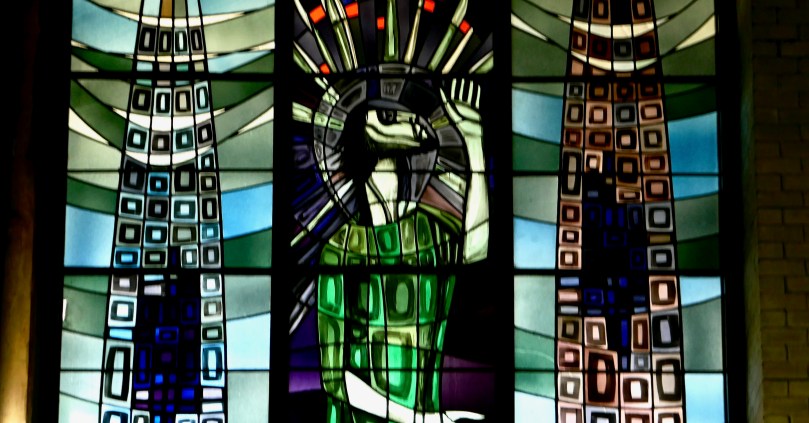
Finally, Sheila Corcoran created a series of symbolic windows at ground level (above), representing the Evangelists and other sacred subjects. Neither Moloney nor Corcoran included any painting, relying solely on glass of different colours and shapes to create their images – an unusual choice for the time and very effective in this context.
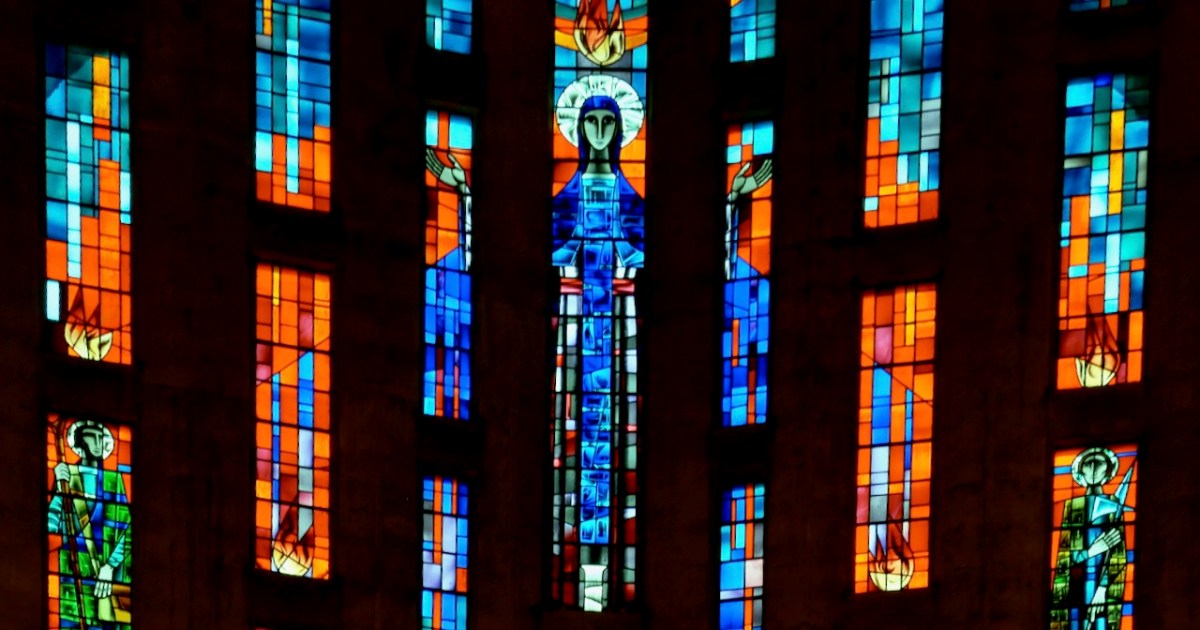
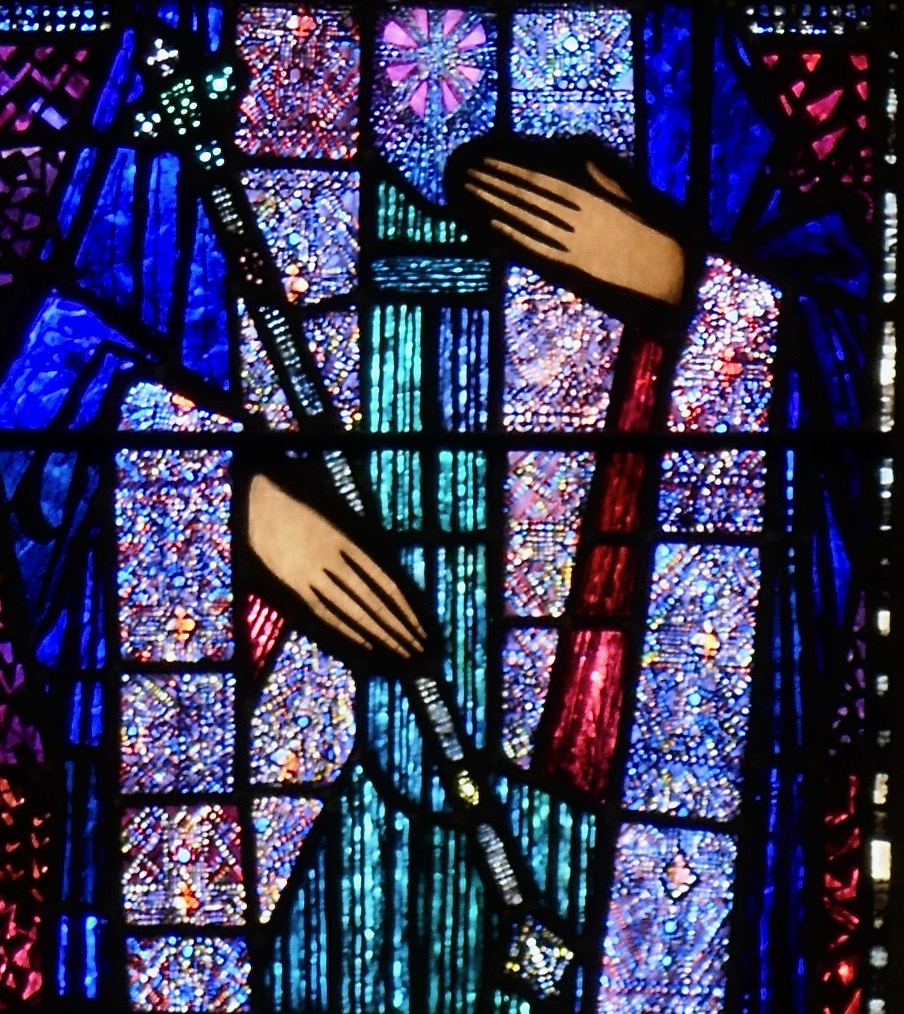
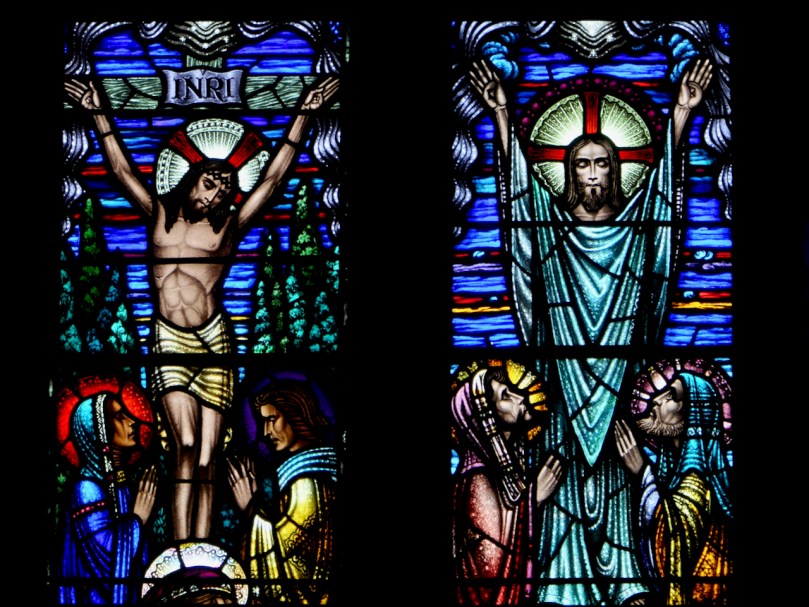
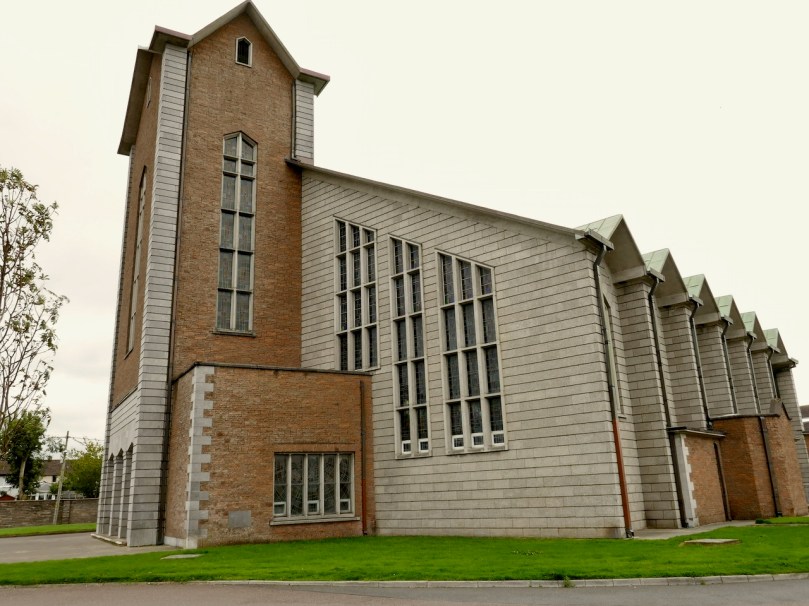
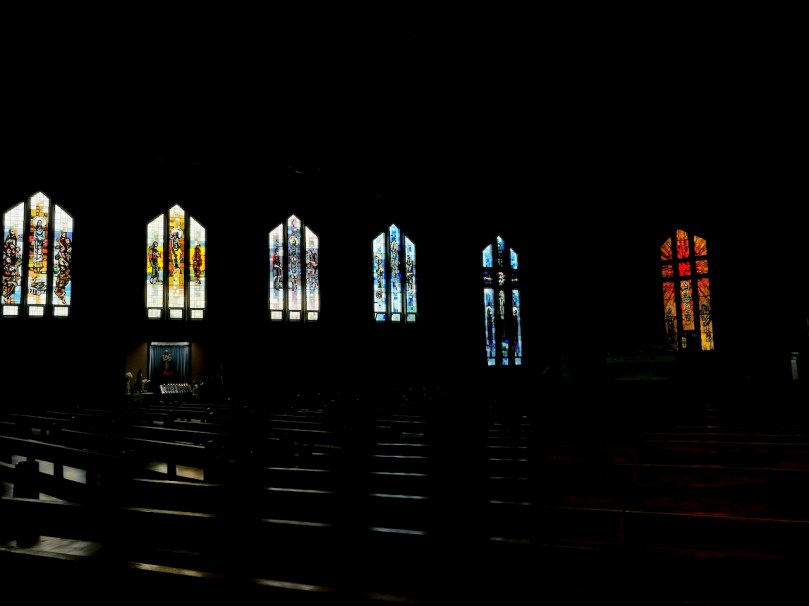
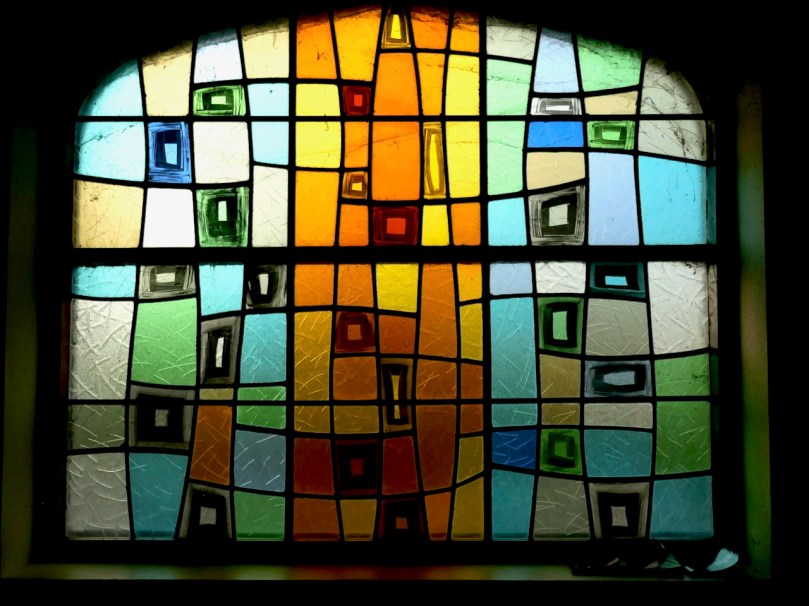
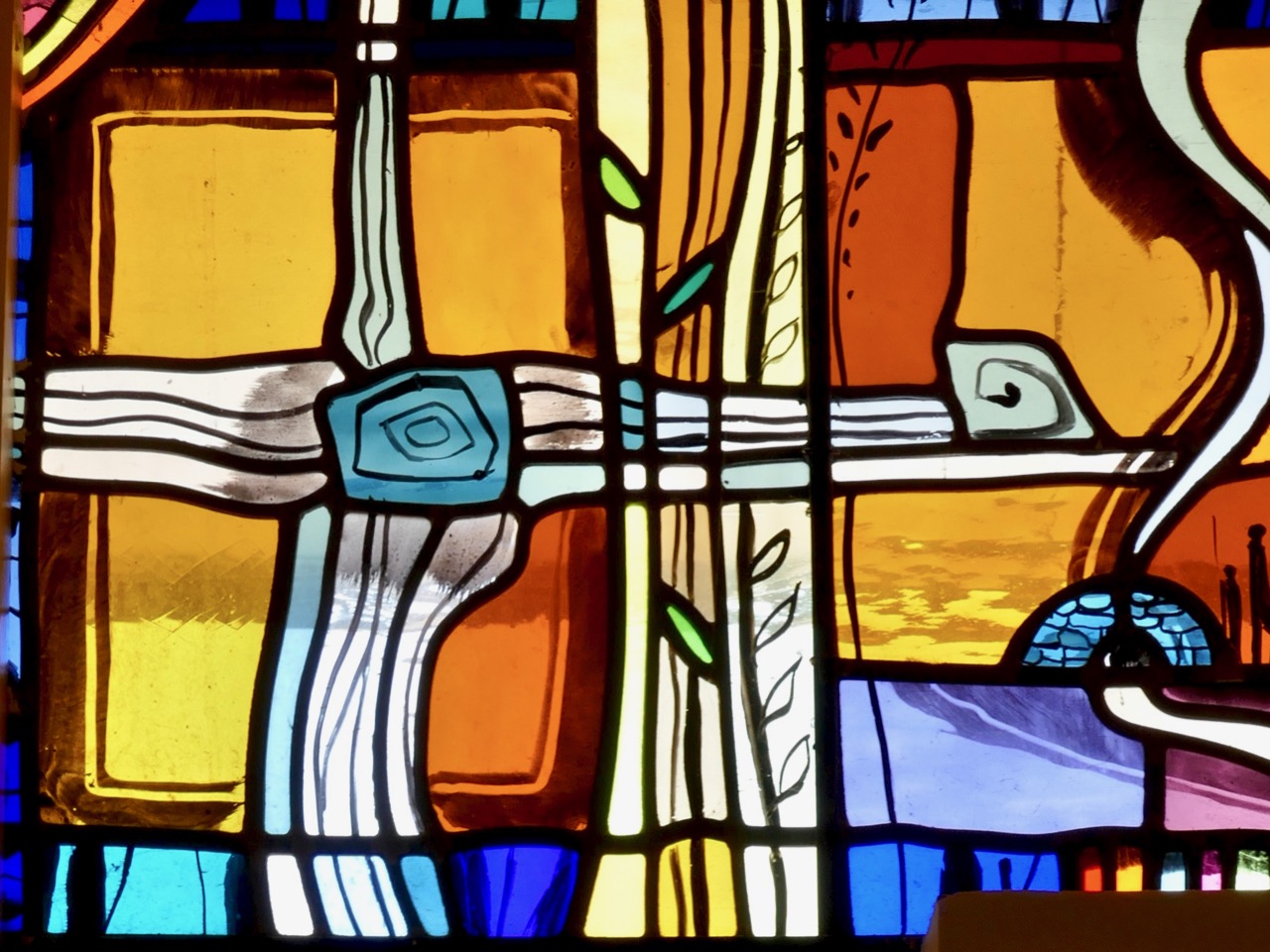
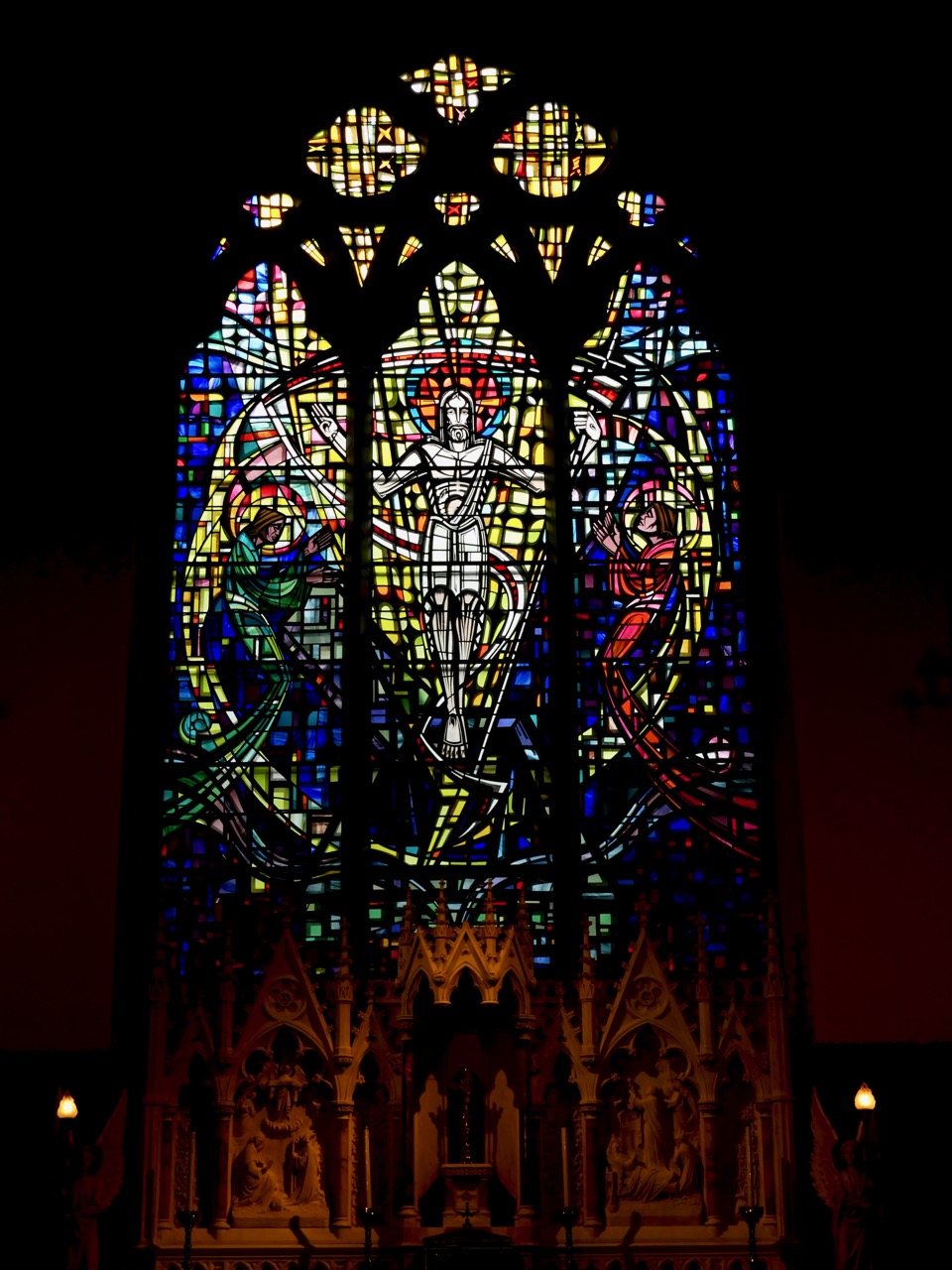
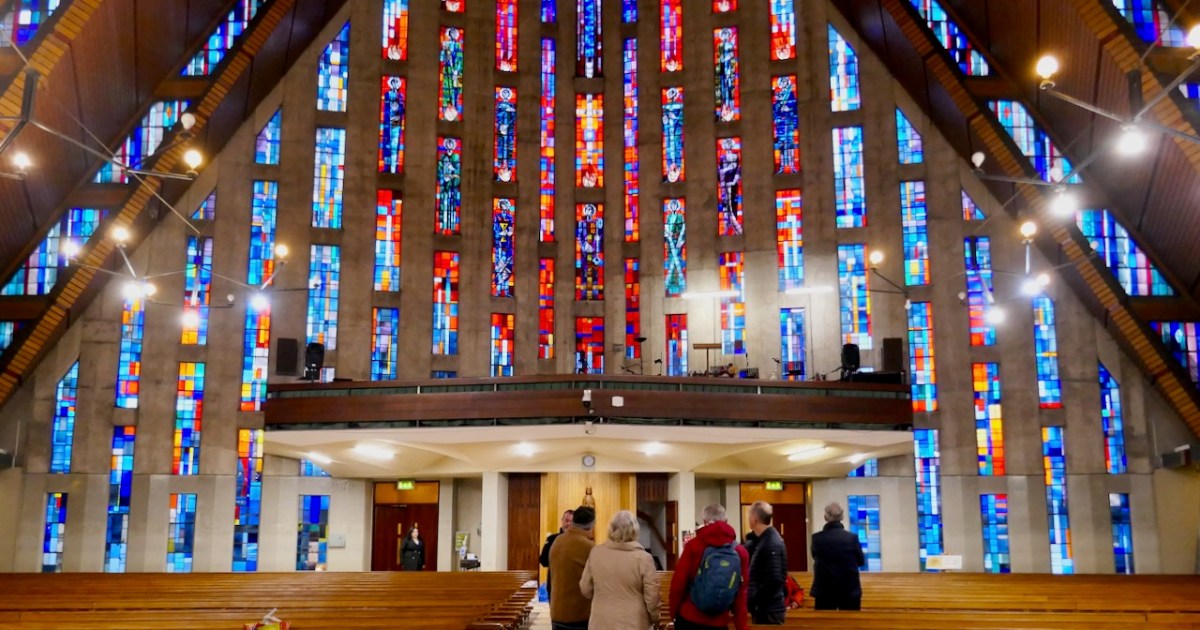
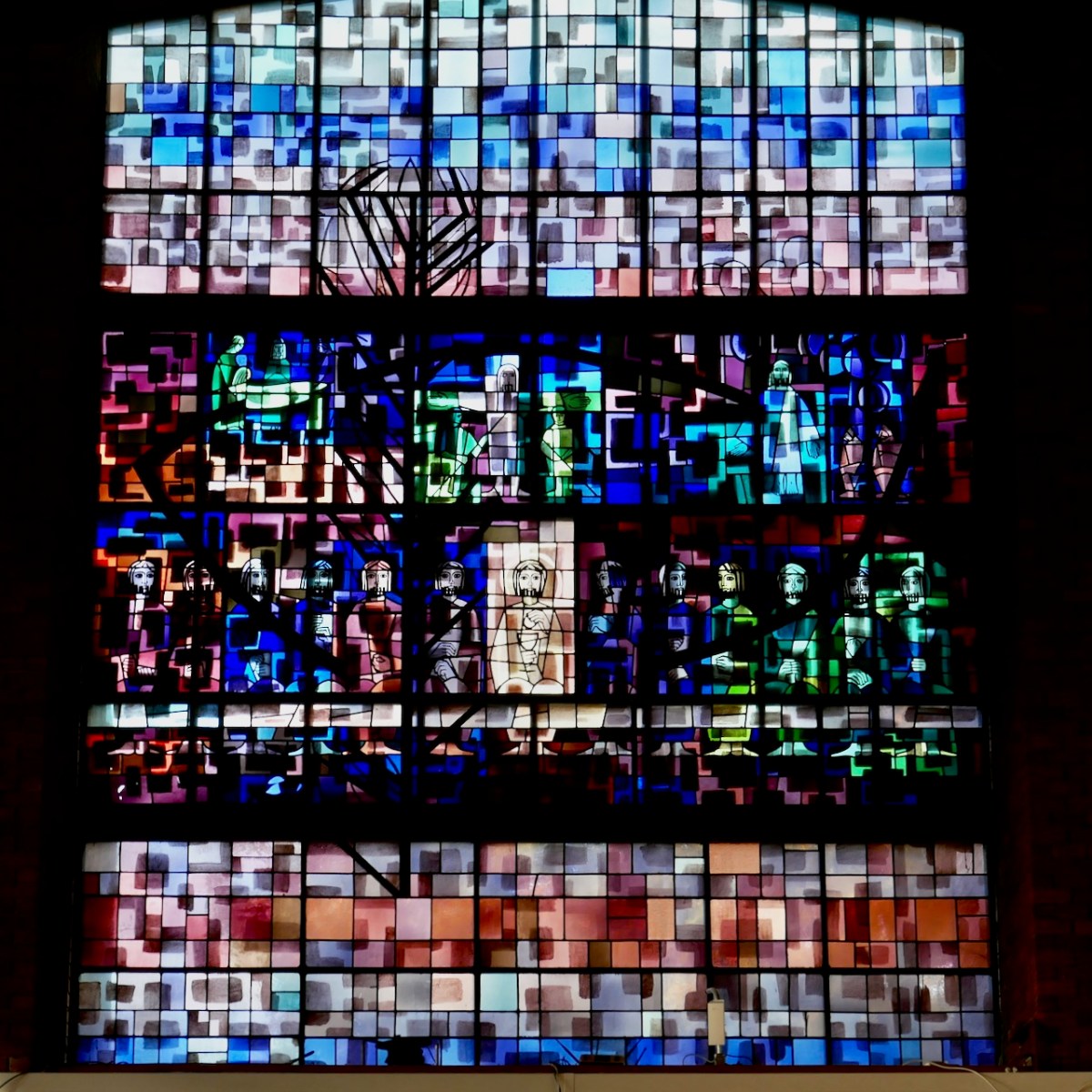
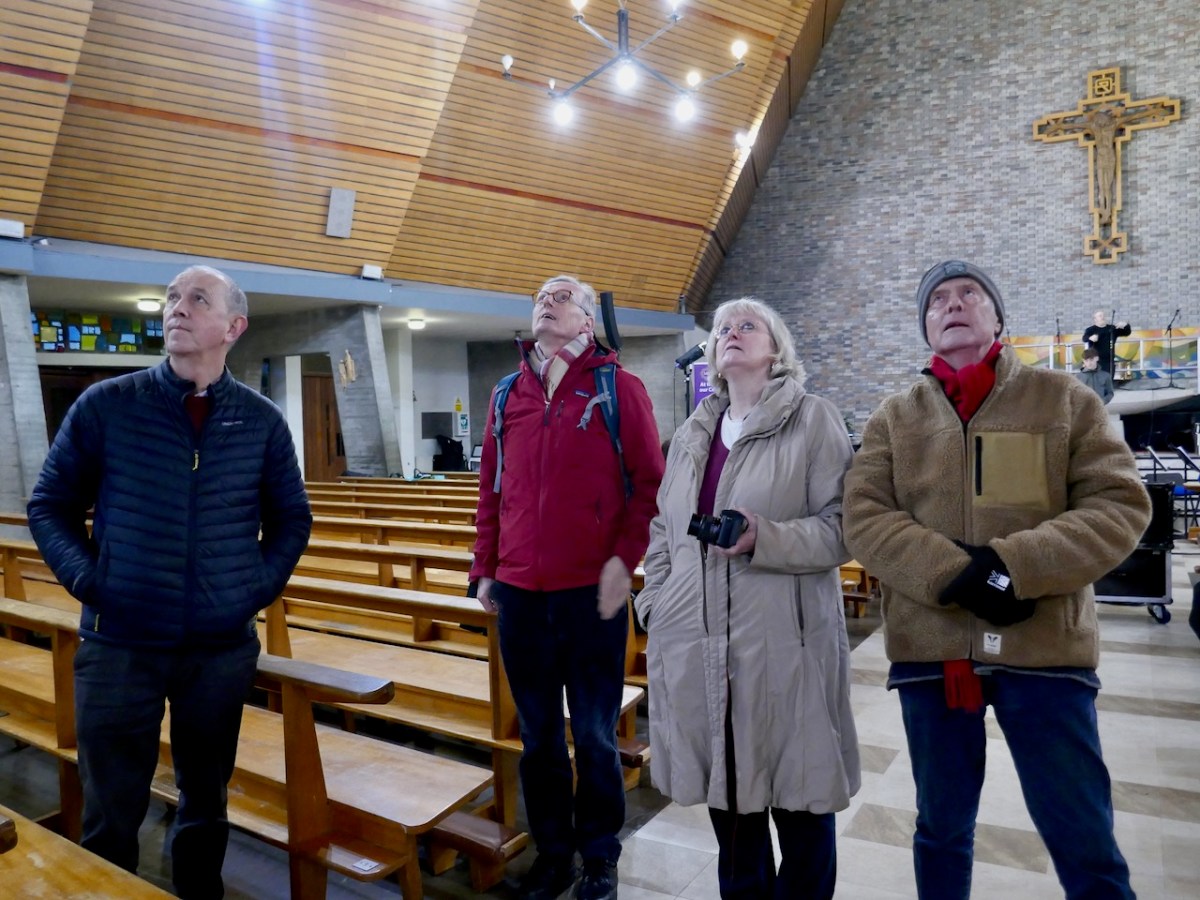
Moving to South Dublin, I cannot resist a visit to Greenhills, to the Holy Spirit Church on Limekiln Lane (above). I visited this church two years ago in the company of Robert, David Caron, Paul Donnelly (the Harry Clarke Studios expert) and Ruth Sheehy. We were thrilled that Ruth – whose work on Richard King has pride of place in my library and whose expertise I documented once before in my post Stained Glass Detectives – and a Find! – was able to talk us through the window, illuminating each part of it, and expanding on Kings’ style and colour choices. My topmost photograph in this post was taken as she led us through an erudite tour of each element.
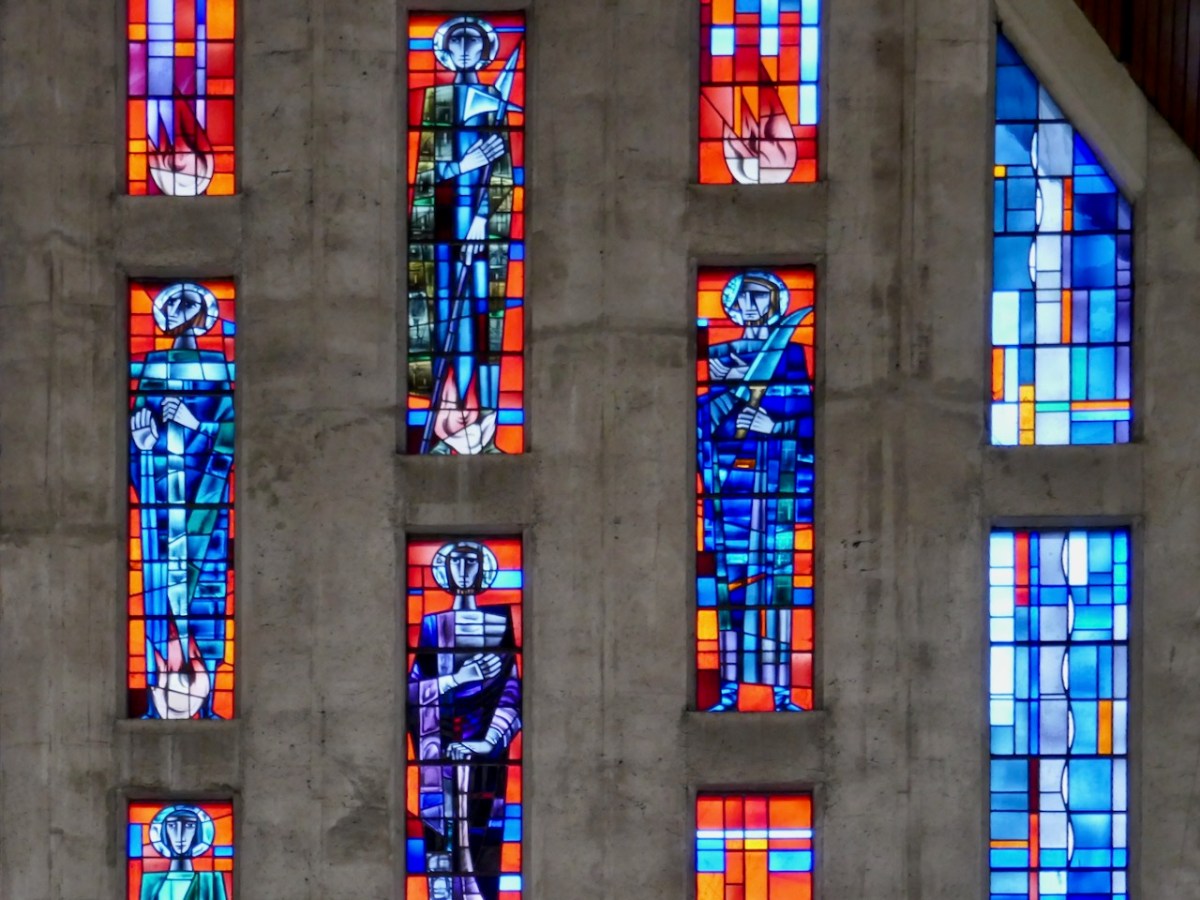
King was aided and abetted by the Murphy Devitt Studios. Johnny Murphy worked with King to provide all the surrounding glass, in harmonious shades and using the same mouth-blown glass. He also designed the dalle de verre windows at ground level, while Peter Dowd, Roisín Dowd Murphy’s brother, was responsible for the wonderful bronze doors. The day we were there a choir was practising for an upcoming concert. The sensory effect stays with me still.
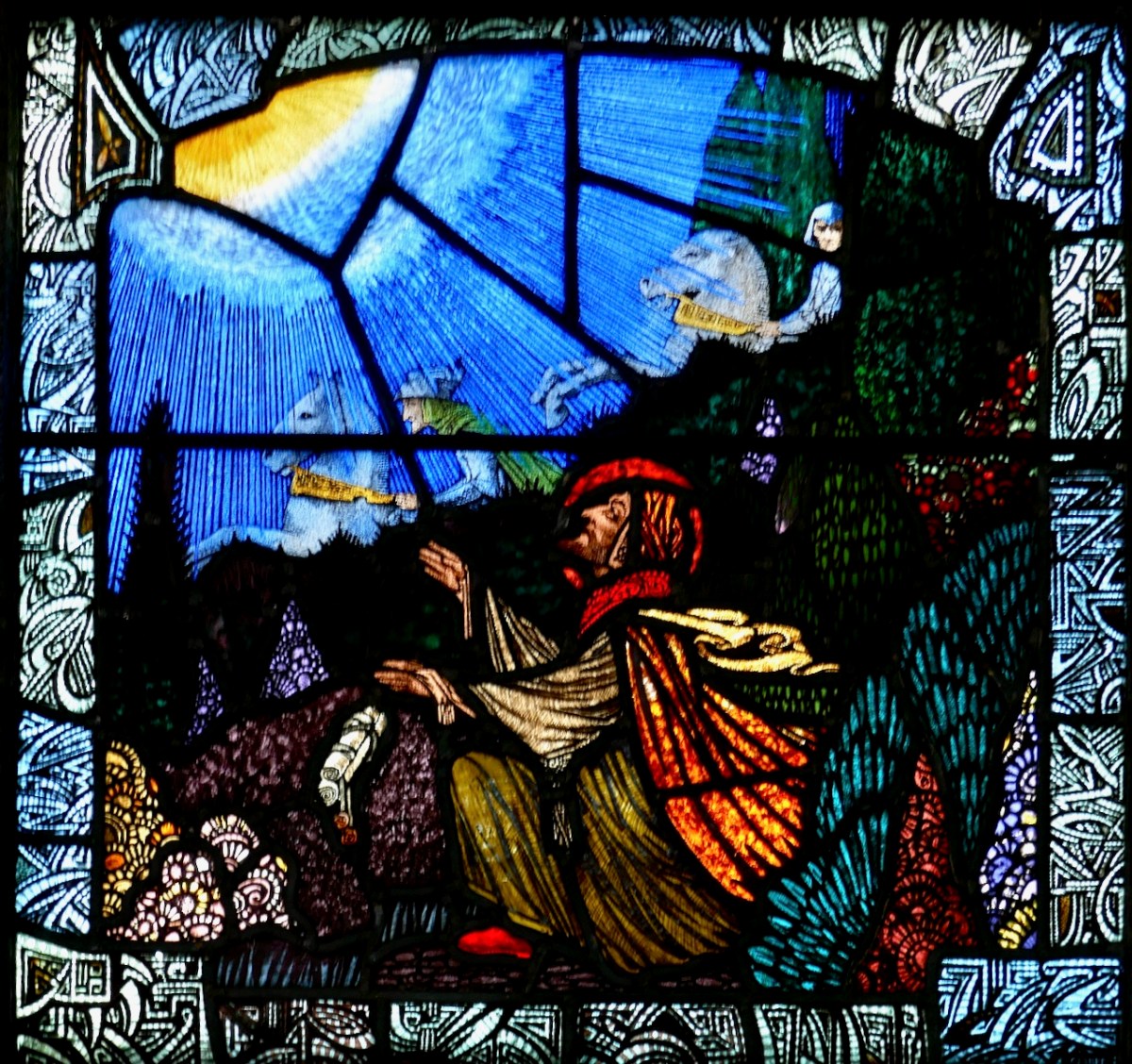
A Harry Clarke panel of St Paul on the road to Damascus, from the Sandford Road Church. This is not one of the churches included in the book, which just shows what difficult choices had to be made to stay within the page-count.

I have only highlighted two churches, both dating to the 60s – and neither of them contains a Harry Clarke! Rest assured that this book contains lots of Clarkes – at least 6 of the locations contain Clarke windows, as well as those and others containing the work of his Studios artists after his death. You will also be happy to see Evie Hone, Michael Healy, Wilhelmina Geddes, Hubert McGoldrick, Catherine O’Brien, Patrick Pollen and several others.
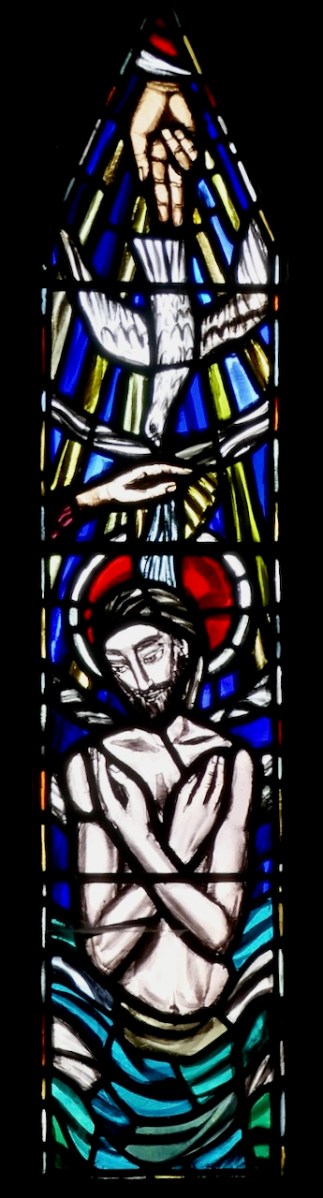
Patrick Pollen’s Baptism of Christ from Lusk

What is does not contain (with a few key exceptions) are productions by unnamed artists working in the large studios (Earley, Watsons, etc), nor windows from the mass-production houses such as Mayer of Munich. 
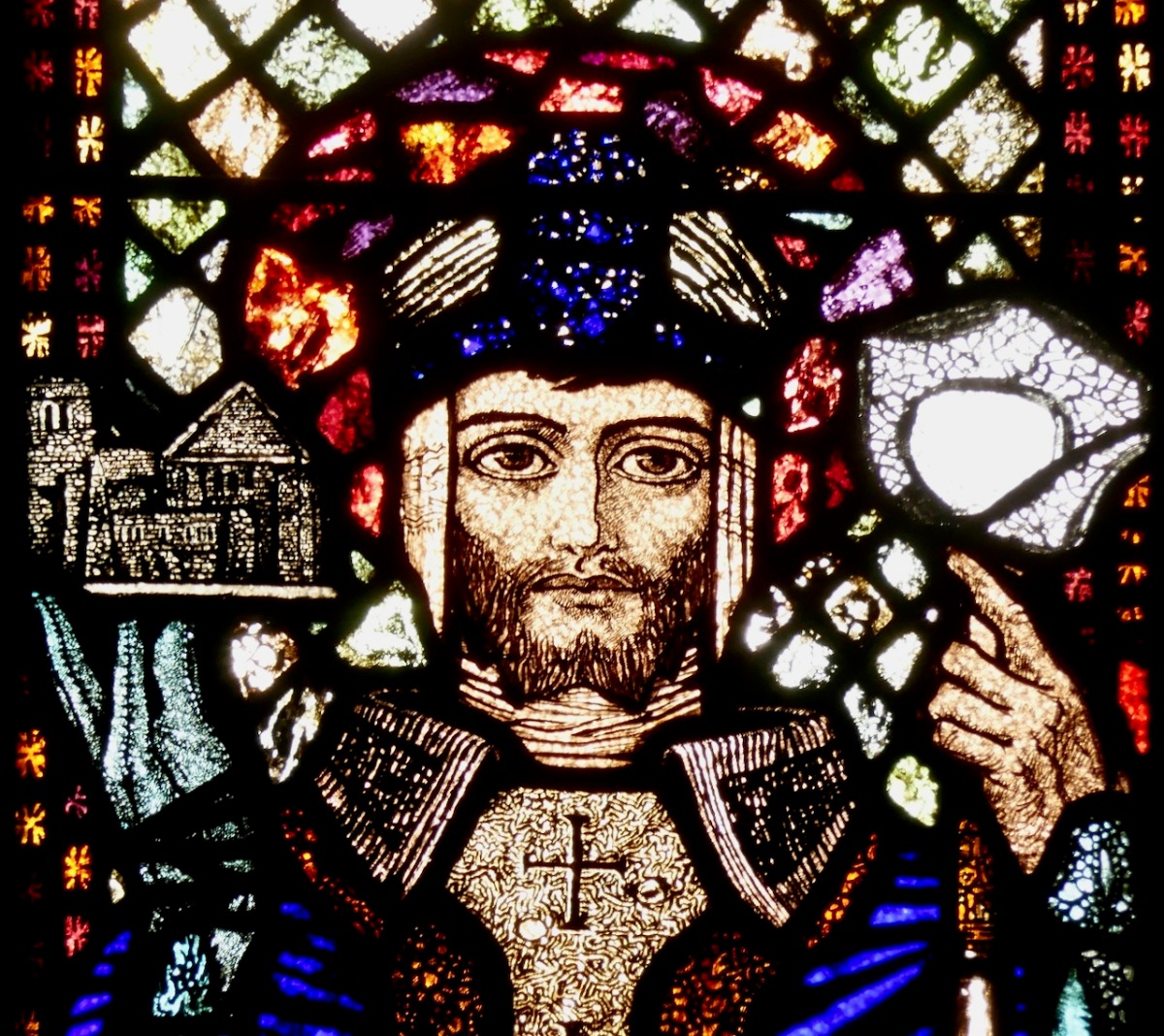
Harry Clarke’s St MacCullin, also from Lusk

There are, as I have said, 39 locations in the book, but David would be the first to admit that if he were not constrained by page- and word-count he would have included several more. So let me add a couple that are so well worth visiting, even though they had to be left out of this volume. While at Lusk, for example, David suggests a visit to nearby St Maur’s in Rush and I concur – George Walsh’s series for this church typical of his mature style (below). Another place to see Walsh’s work is the Church of the Guardian Angels on Newtownpark Avenue in Blackrock.
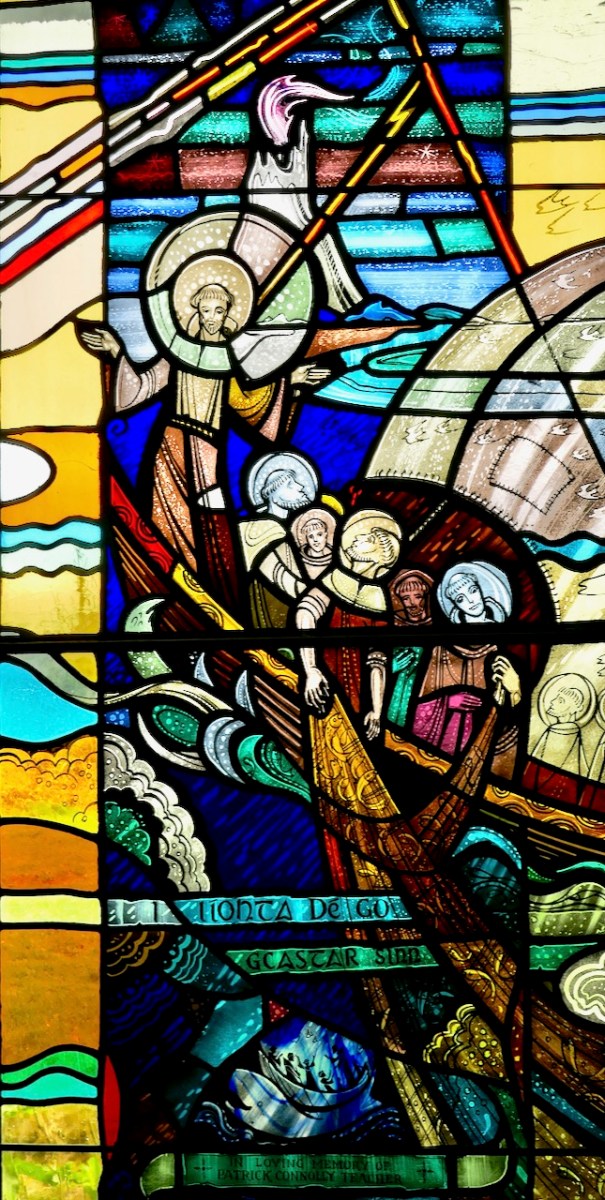
St Mary’s Church in Sandyford has early Netherlandish glass – and yes, that is NOT 20th century, but it’s one of the few places to see it up close in Ireland. St Laurence O’Toole Church in Kilmacud has a huge and very stylised panel by Phyllis Burke (below). Sandford Road Church of Ireland has a Harry Clarke St Peter and Paul (see the illustration fourth up). 
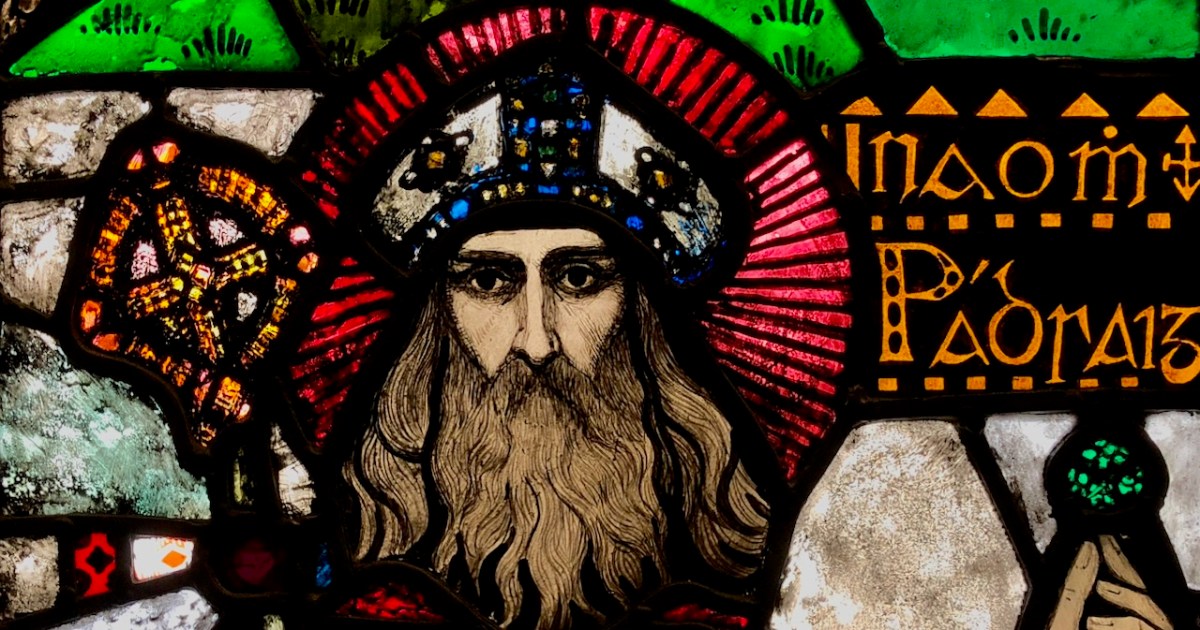
I’ve written about a few of the churches in this book, so you know I have other favourites too. St Michael’s in Dunlaoghaire, for example, and one of the several Harry Clarke windows in St Joseph’s in Terenure. I am sure you have your own favourite Dublin Churches – any additions you’d like to make to my short list, dear Readers? 
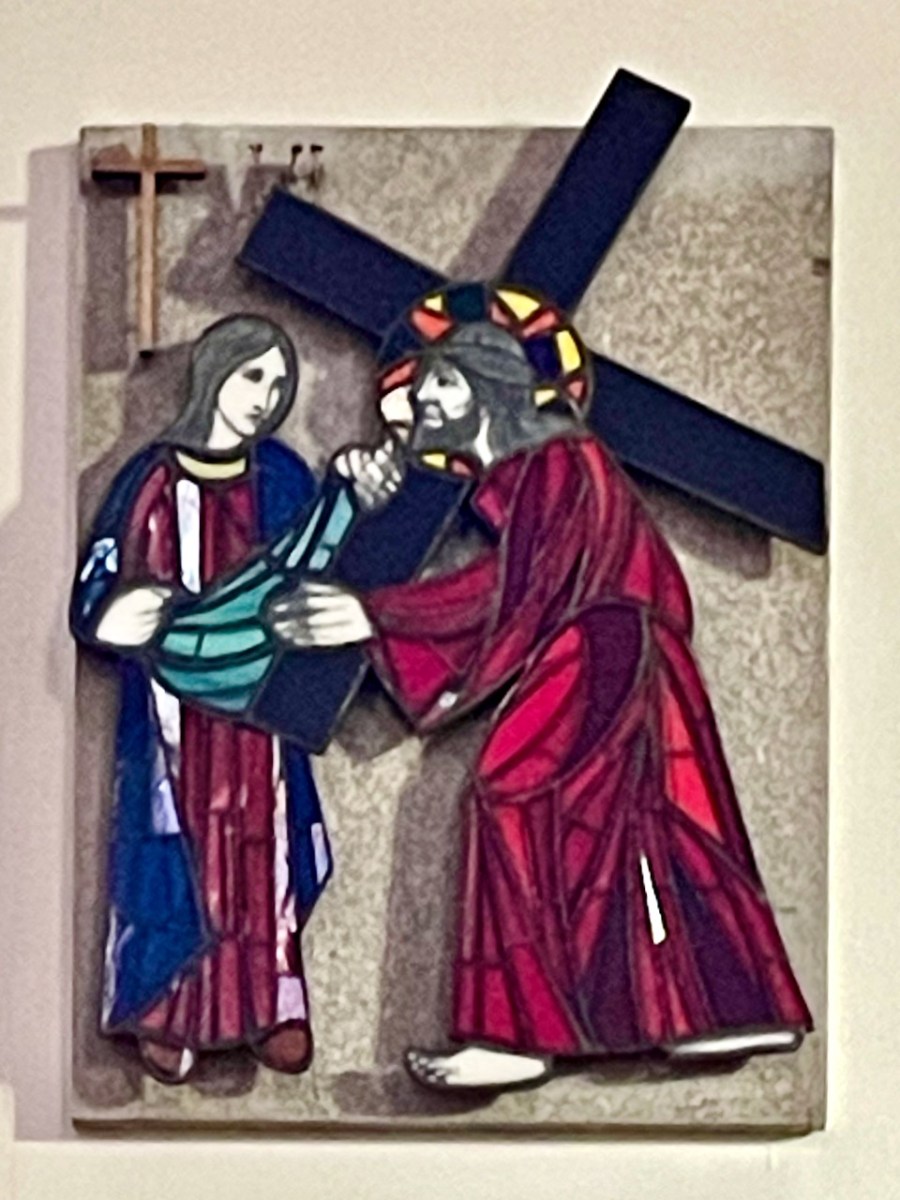
This is one of a set of stations made from antique glass and polished granite, done by George Walsh and Willy Earley for the Clarendon St church

Grand so, you have all you need now for some ecstatic wanderings around Dublin Churches. I leave you with our own ecstatic wanderings – as a bookend to this post, here we are in Greenhills, quite in awe of Richard King’s and Johnny Murphy’s enormous window. Left to right is Paul Donnelly, David Caron, Ruth Sheehy and Robert.
Michael Healy by David Caron: Review

This book – MIchael Healy: An Túr Gloine’s Stained Glass Pioneer – is nothing short of a miracle. It’s beautifully written by David Caron, with superb photography mainly by Jozef Vrtiel, and outstanding production values by Four Courts Press. But a miracle? Yes – because David Caron uses his scholarship and knowledge of stained glass as well as the history and art movements of the period to produce an immensely readable book about an intensely private man who left behind practically nothing about his life except his magnificent work.

I will declare an interest right away – David Caron is a friend and mentor, editor and principal writer of the Gazetteer of Irish Stained Glass, to which I am one of the contributors. I have been looking forward to this book for a long time, as have all his friends, colleagues and collaborators. It was launched to great acclaim in Dublin on November 1 – all the available copies were snapped up at the launch, including mine (stowed behind the desk), so I had to wait until December to get my hands on it. 

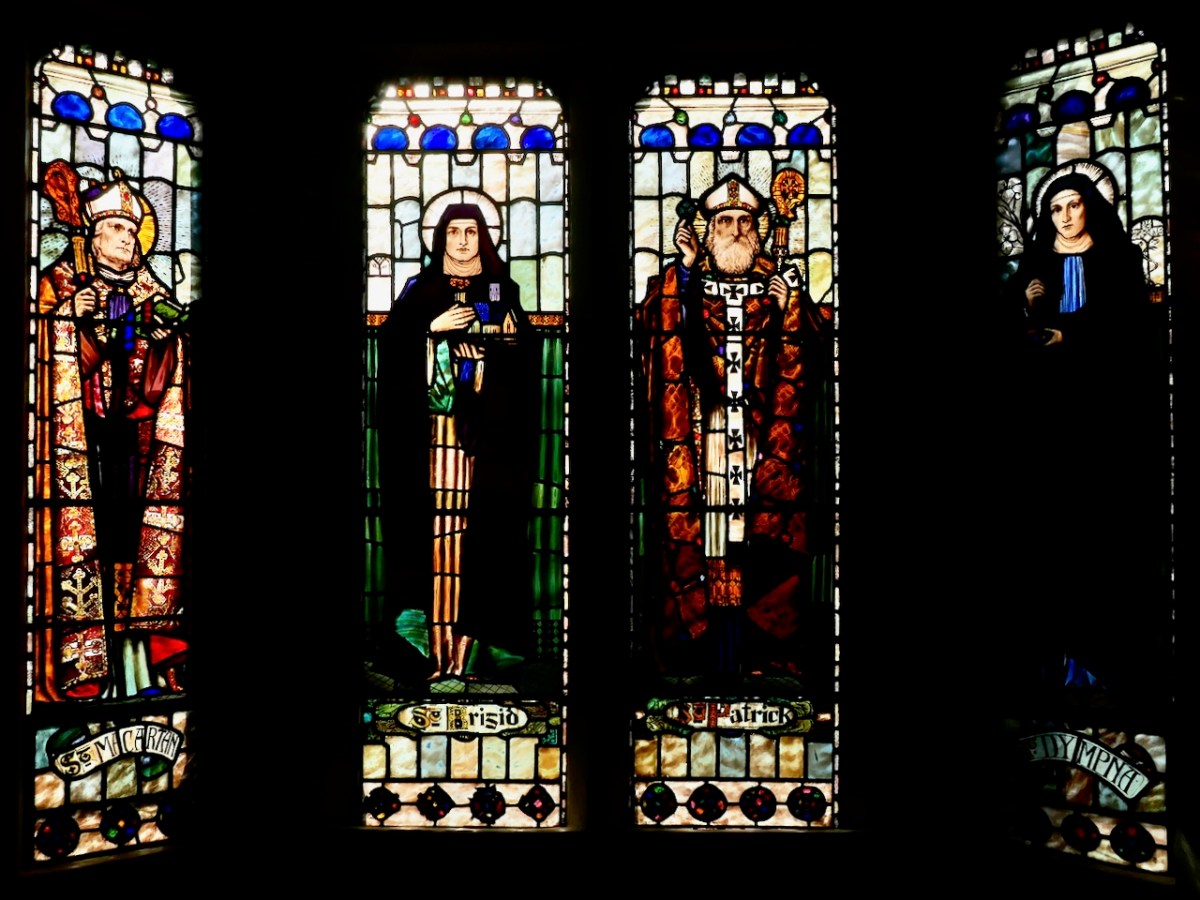
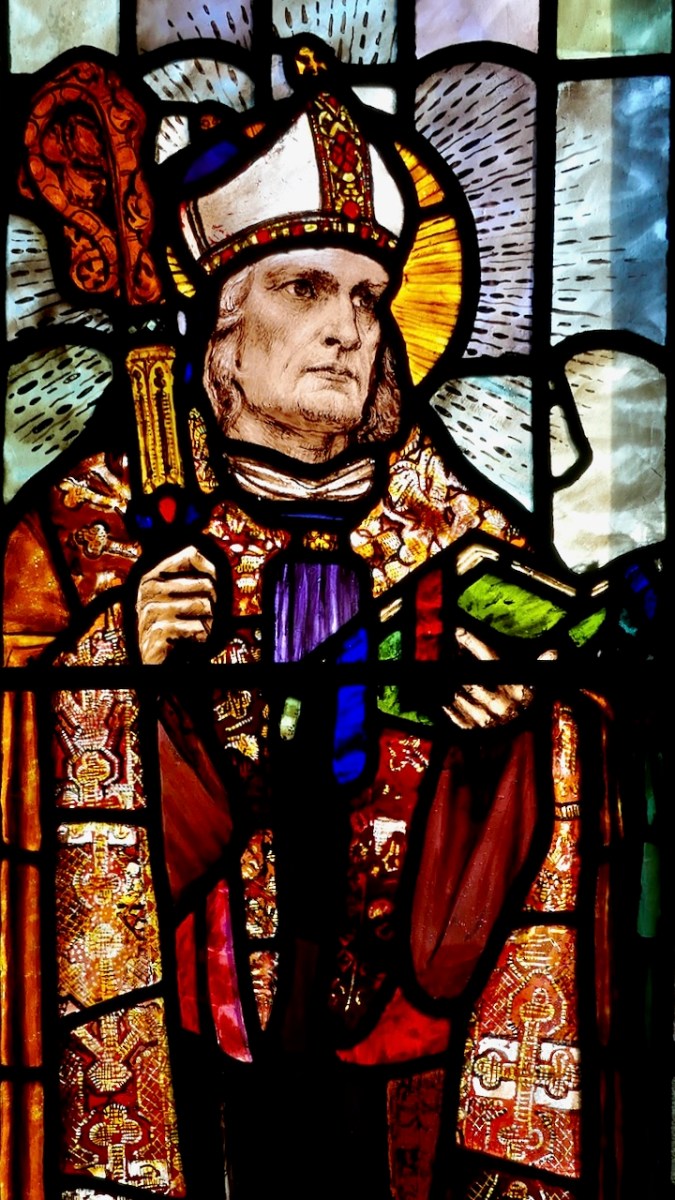
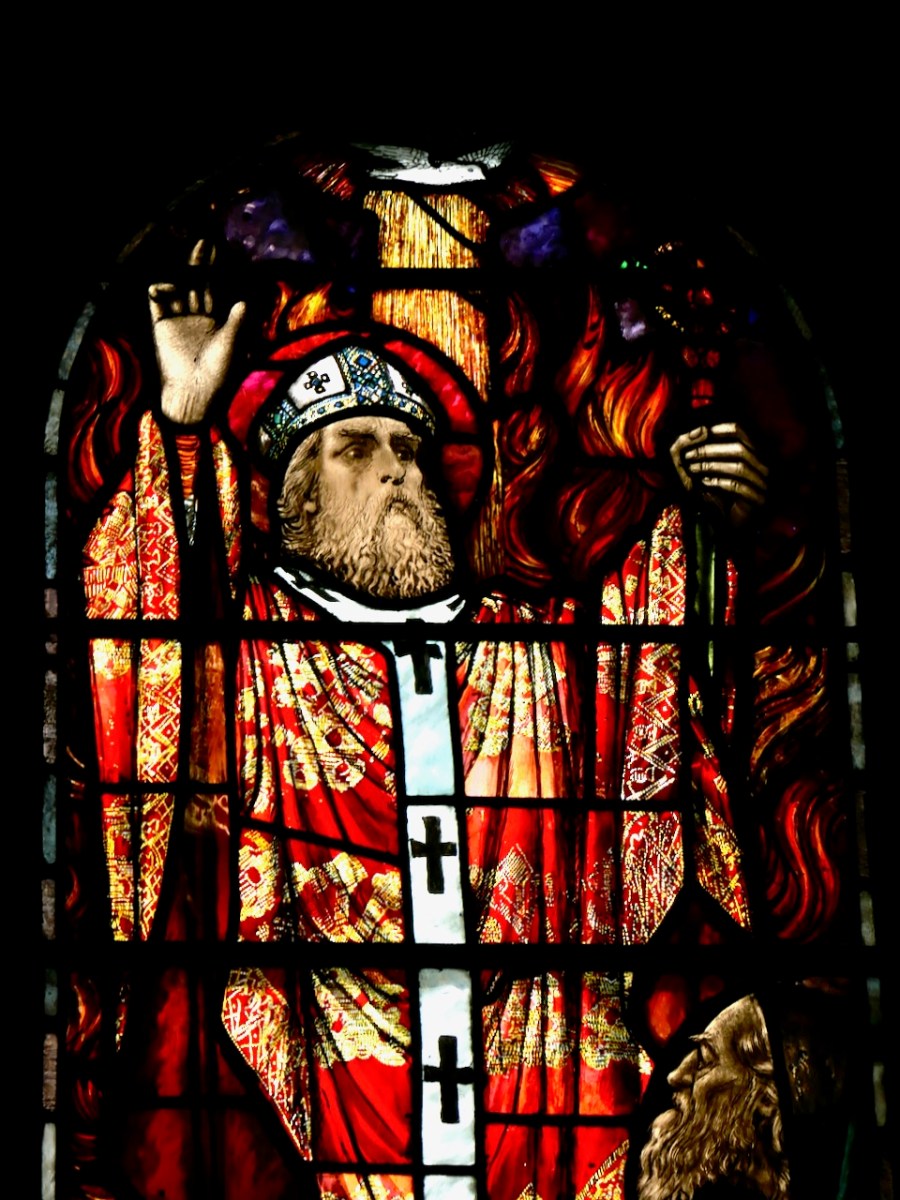
From a private bishop’s oratory, Sts Macartan, Brigid, Patrick and Dympna. Detail of Macartan, below. The rich reds and yellow shading of Macartan’s robes are the result of aciding and silver stain, described further down

All the photographs in this post are my own – but I haven’t seen that many Healy windows, and my photography does not bear comparison with Jozef’s magnificent images. The book is profusely illustrated – it’s one of its many strengths – with many photographs of the tiny details in which Healy delighted and which distinguish his windows from those of other artists. Healy spent all his working life at An Túr Gloine (The Tower of Glass) the Studio founded by Sarah Purser. If you are unfamiliar with this period in Irish stained glass, you might like to read my post Loughrea Cathedral and the Irish Arts and Crafts Movement before continuing.

Born in 1873 into grinding poverty in a Dublin tenement, through a combination of great good luck and his own prodigious talent and hard work, Michael Healy turned himself into one of the foremost stained glass artists of his time. Reading David’s account, it is difficult not to be overwhelmed at times by the hardship endured by Healy and his family in turn-of-the-20th-century Dublin. Packed into one room with miserably inadequate sanitation, whole families succumbed to disease and early death. Consumption was rampant and the only recourse for anything approaching treatment was the dreaded workhouse. Infant mortality rates were high and so we read about several Healy babies who failed to survive into adulthood, as well as adults carried to early graves, leaving widows and widowers to try to cope. 

Christ with Doubting Thomas, St Joseph’s, Mayfield, Cork

In the midst of all this was the First World War, the Easter Rising, the War of Independence and the Civil War, followed by the emergence of the new Irish State. David chronicles all of this, and the effect it was having on citizens, like Healy, who were trying to go about their business, but who also had deep convictions about politics and religion.

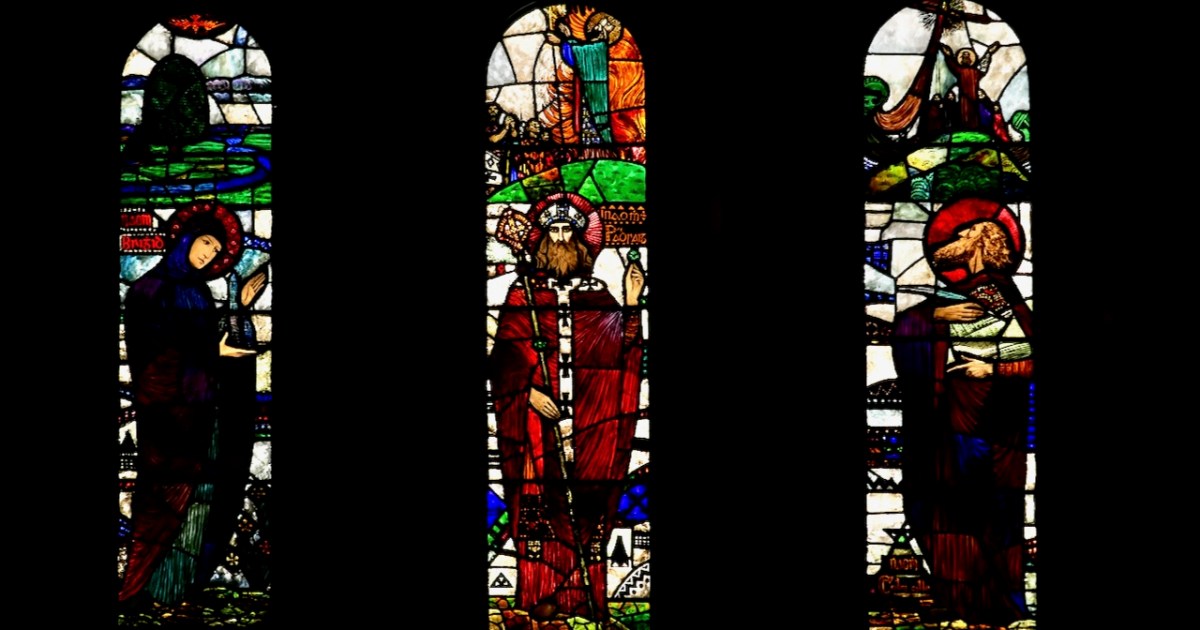
These windows, Sts Brigid, Patrick and Columcille, are in the National Gallery

In some ways, Healy was a typical young man of his time. Deeply religious, he spent some time in a seminary before deciding he was unsuited to the vocation. He belonged to a Catholic men’s lay organisation. David provides many instances where his working class Dublin accent, his republicanism, and his Catholicism must have put him at odds with his fellow artists at An Túr Gloine, mostly female, Protestant and from well-to-do backgrounds. They found him brooding and introverted, although they acknowledged his exceptional talent, and until Evie Hone arrived he did not make true friends with any of them.

The Annunciation, Loughrea Cathedral. This window was closely based on a design by the great arts and crafts stained glass master, Christopher Whall. Whall came over from England to supervise the execution of it by the Túr Gloine artists, including Healy. Celtic revival interlacing was very popular at the time, and a way of putting a nationalistic stamp on a window – note the subtle inclusions of interlacing here and there

I mentioned that he had strokes of good luck in his life, two in particular. One was the patronage of a perceptive priest, Fr Glendon, who enabled him to study in Florence for a period of time and who procured illustration work for him in Dublin. David points out here and there in the text the influence of Italian painters discernible in Healy’s windows, gained from his sojourn in Italy.

Detail of a Patrick window in Donnybrook

The other was that he found lodgings with a landlady, Elizabeth Kelly, and over time they grew close. Eventually, they become lovers and had a son, Diarmuid, together. Although the relationship was never publicly acknowledged (she was married, although her husband left her) it provided both of them with stability and comfort, and Healy was close to his son. In the 30s Diarmuid O’Kelly (although his mother went by Kelly) bought a Ford Model T and he and Michael would go on sketching expeditions up into the Dublin Mountains and out along the canals. 

Christ with Mary and Martha, Mayfield, Cork

Because of the opprobrium that such a scandal would have visited upon both Elizabeth Kelly and Michael Healy, Diarmuid was never told that Healy was his father, but he must have suspected, and in more recent times DNA testing confirmed the relationship. Reading about the frequent tragedies that befell the Healy family and the privations under which he grew up, I find it very comforting to know that Michael enjoyed the security and love of his adopted family as he got older.

St Simeon, one of Healy’s early windows for Loughrea Cathedral

David leads us on a measured journey through Healy’s life and work. He was the first recruit to An Túr Gloine, Sarah Purser’s stained glass studio, and later co-op. There, he worked alongside AE Child (also his instructor at the Dublin Metropolitan School of Art), Catherine O’Brien, Beatrice Elvery, Ethel Rhind and Hubert McGoldrick. All of them looked up to him as the finest painter at the Studio. He, in turn, admired the work of Wilhelmina Geddes, and when her health caused problems he finished some of her windows, trying to respect her style and designs. But it wasn’t until Evie Hone arrived that he found a true colleague – Nikki Gordon Bowe described Hone as “his devoted disciple and admirer” and she finished some of his windows after he died.

Healy designed many Patrick windows – this one is in Glenariff Co Antrim

Each commission is described and through David’s detailed accounts we come to understand Healy’s style – what iconography he was attracted to, how he decided on the myriad details with which he embellished his windows, and most of all, his decorative methods. 

John the Evangelist, Loughrea Cathedral

Long before Harry Clarke made it is his signature, Healy was a master of aciding, a difficult (and dangerous) process used to remove colour from the surface of flashed glass. Flashed glass is clear glass which has a skim of coloured glass fired onto its surface. This top layer could be removed by scratching or etching it away, or by immersing the glass in a bath of hydrofluoric acid, having first applied beeswax to any surface where the colour should remain intact. By waxing and immersing, often several times, colour could be altered from, for example, a rich ruby red to the merest hint of pink, and all shades in between.

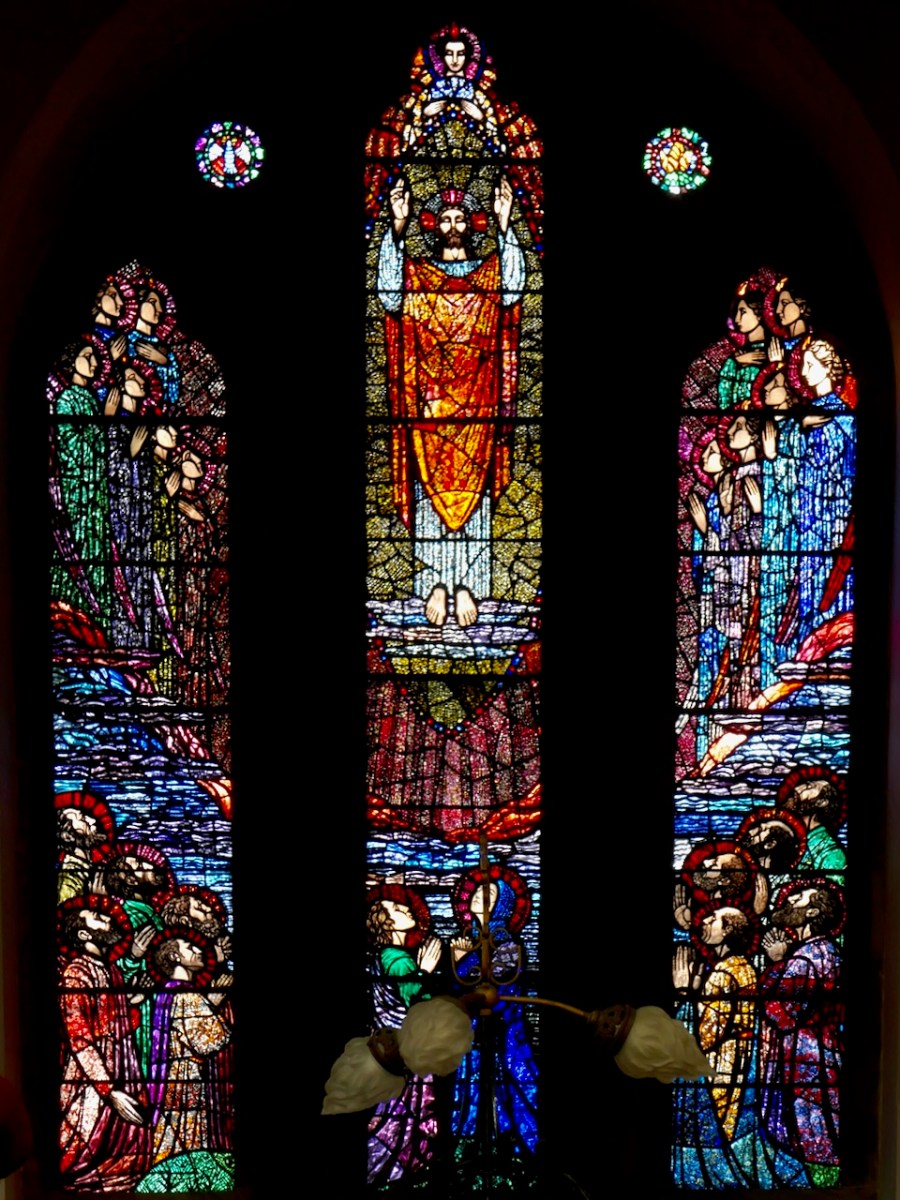
Healy’s Ascension, in Loughrea Cathedral

Healy would often plate two sheets of glass together – for example, one red and the other blue – each one carefully acided, and could by this means achieve an astonishing array of colours from the red-blue side of the spectrum. Added to this, he would often use silver stain on the back of the glass. Once heated in the kiln, the silver stain would permeate the glass, turning it yellow (repeated firings could deepen this from bright yellow to a rich amber colour). Finally, all the figuration would be painted and stippled on to the surface of the glass and the individual pieces of glass would be assembled and leaded together to produce the finished window. Healy was a perfectionist and Purser would despair of ever making enough money to keep the studio going since he spent so long on each commission.

This detail from Healy’s Virgin Mary window in Loughrea illustrates well his aciding technique using red and blue flashed glass plated together to produce not only infinite shades of colour but a sparkling jewel-like effect

It is through David’s lively analysis of each window that we truly come to appreciate Healy’s genius and his evolution as an artist, his style developing according to his exposure to more modern influences.

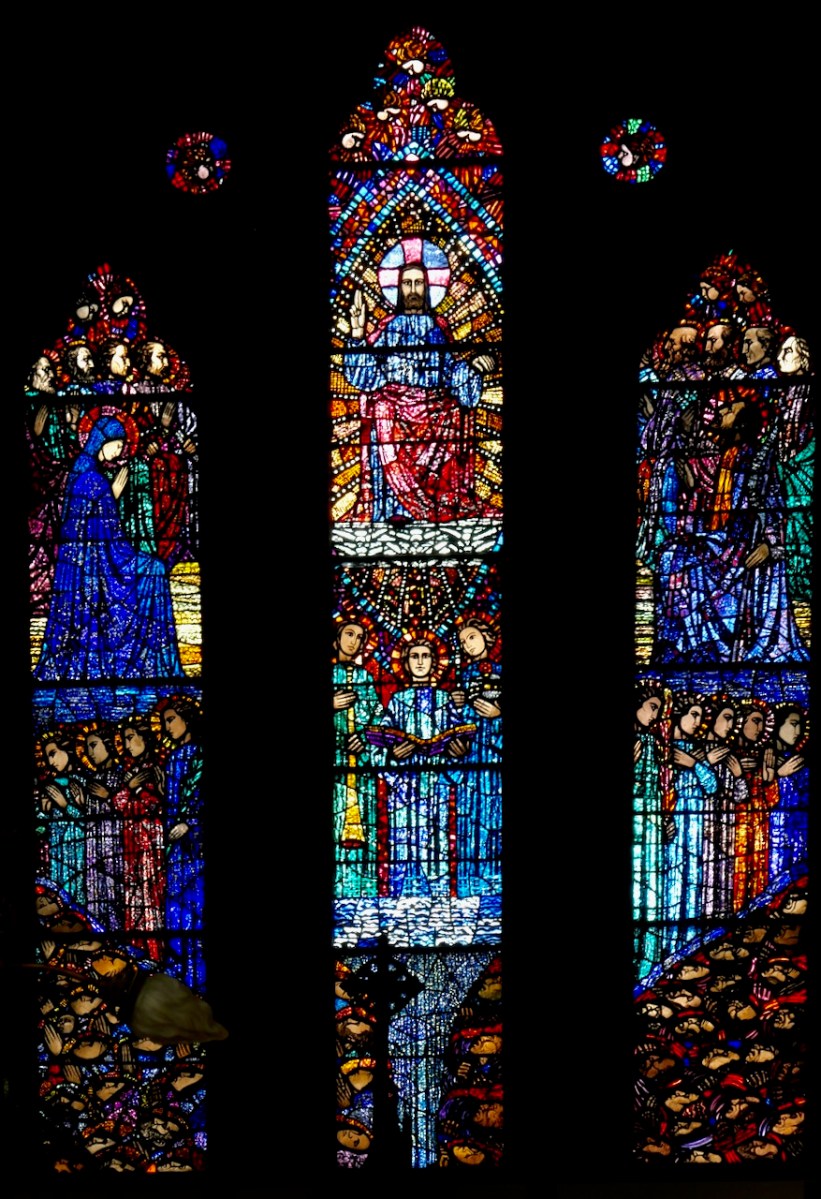
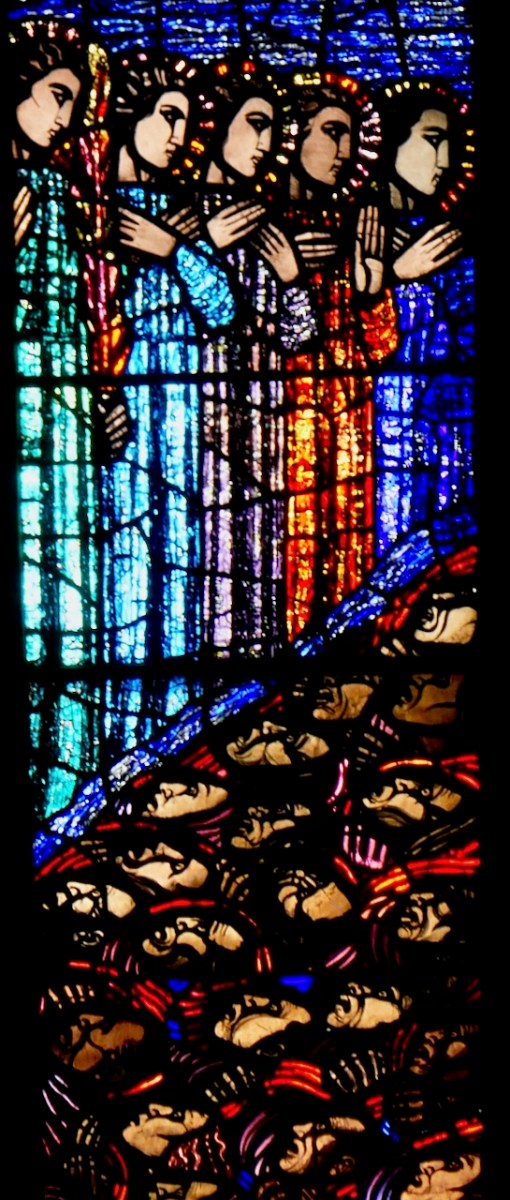
Considered one of his masterpieces, this is the Last Judgement Window in Loughrea, completed towards the end of his life. A detail from The Damned(right -hand light) is below

David wears his erudition lightly and when he dissects a window, pointing out elements that are easy to miss, and explaining what they mean and why Healy used them, I found myself pouring over Jozef’s wonderful photographs, picking out each separate item of iconography, and marvelling anew at the depths of learning that Healy brought to his designs. For example, David devotes five pages to the St Augustine and St Monica window in John’s Lane Church in Dublin and not a word is wasted.

Along the way we meet a host of characters – the redoubtable Sarah Purser and his colleagues at An Túr Gloine, enterprising priests and bishops, citizens memorialising their dead family members (CS Lewis!), art critics such as C P Curran, American heiresses, patrons of the arts, Celtic Revival influencers (OK, modern word, but you know who I mean). We get insights into the inner workings of the studio, wherein frequent bouts of unprofessional behaviour created tensions, and where Sarah Purser often had to crack the whip when productivity lagged. We come to understand the difficulties of soliciting business, agreeing on final designs and delivering orders, especially to overseas clients, in days when postal service to American and New Zealand took weeks.

A detail from the Patrick window in the National Gallery

We also come to see Healy as a rounded artist who did more than stained glass. His quick sketches of Dublin characters, drawn from life have all the attraction of immediacy and familiarity, while his watercolour landscapes are charming.  

An early Loughrea window, Virgin and Child with Irish Saints

Healy died in 1941. By the time you finish the book, you feel you have lost a friend – a difficult and complicated one to be sure, but one whom you admire and will never forget. While obviously a gruff character on the outside, David allows us access to his humanity, and points out the obvious sympathy with which he portrays some of his subjects. His Loughrea St Joseph (below), for example, shows, in the words of the art critic Thomas McGreevy, a “Joseph who knows the tragedy of the world and who has some special understanding of the destiny. . . of the child”. We are, of course tempted to see in the tenderness with which Joseph gazes down at Jesus a revelation of Healy’s suppressed feelings for his own son.

This book is not just for stained glass enthusiasts, though they will delight in it, but for anyone interested in life in Ireland at the end of the 19th and beginning of the 20th century, and indeed for anyone who enjoys good writing and a story that propels you through almost 70 years of the life of a significant artist. Available from the publisher or in all good bookstores.

The Gazetteer of Irish Stained Glass

It’s finally here, and it’s stunning!

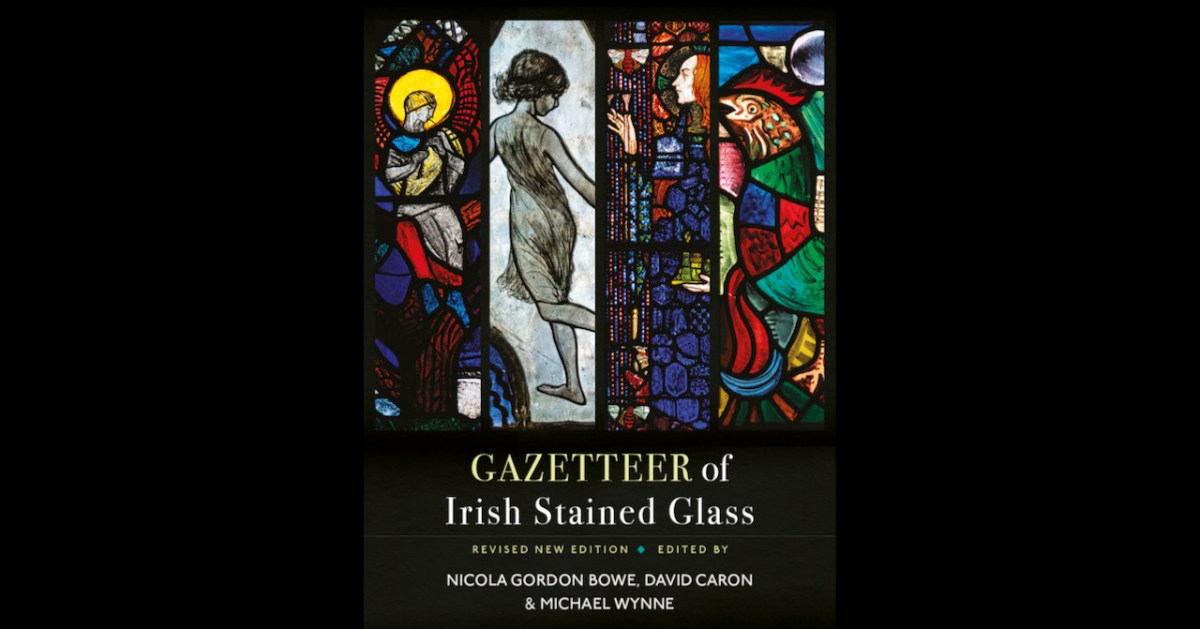
The Gazetteer of Irish Stained Glass was first published in 1988 and has been out of print almost since then. It was the work of Nicola Gordon Bowe, David Caron and Michael Wynne. It documented all the known windows of Harry Clarke and the artists of An Túr Gloine and was snapped up by anyone interested in looking at stained glass.

Click through to see sample pages!

Of the three editors, David Caron, who was a newly-minted PhD at the time, lecturing at the National College of Art, is the only surviving member. He has forged a long-time collaboration with the photographer Jozef Vrtiel, a specialist in the difficult art of capturing stained glass, and together they determined that it was time for an updated edition. Not only updated, but expanded – their vision was for a book that would include all the best stained glass designed and/or made by Irish artists, or by artists working in Ireland. Harry Clarke is here, of course – that’s his St Louis and St Martin window, below, in Castletownshend. But there is so much more to Irish stained glass than Harry Clarke, even though he’s the one that most people know (or think they know).

Note I said ‘artists’ – this is not a book that records all Irish stained glass, such as the mass-produced windows that came from the large studios. The criteria for inclusion were “Artistic merit, individual voice and excellence in the craft.” There were nine artists included in the first book – there are over 90 artists represented in this one!

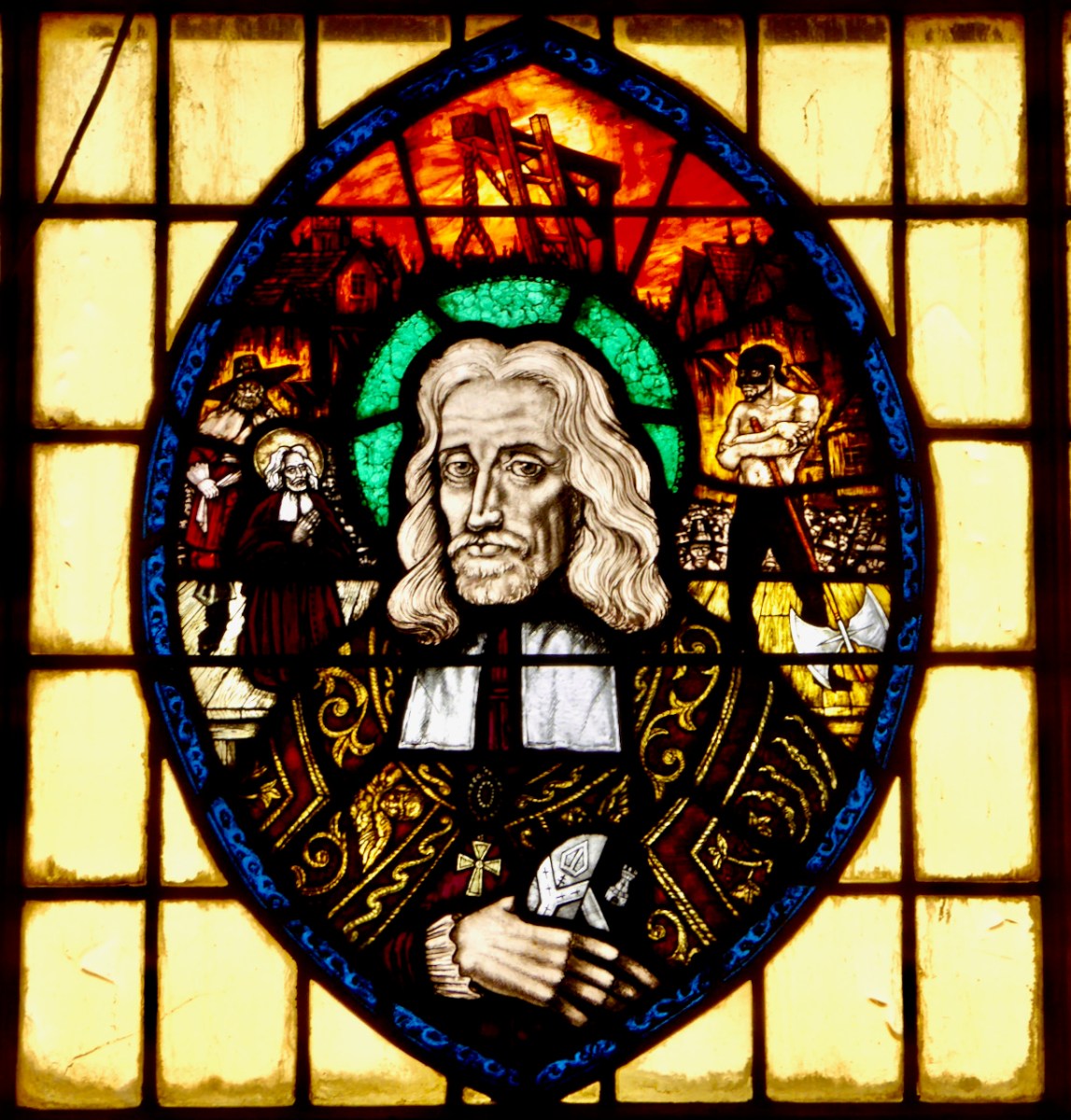
Some artists love to tell stories in their windows – this window is about the trials and tribulations of Oliver Plunkett and is by Kevin Kelly of the Abbey Stained Glass Studio

To do this, besides drawing on his own considerable store of knowledge (and indeed doing the vast majority of the work in this book), David assembled a team of fellow enthusiasts and experts each of whom concentrated on the work of a single artist or studio. For example, Réiltín Murphy has long been compiling the work of her parents, Johhny Murphy and Roisín Dowd Murphy, who together with Dessie Devitt, founded and ran the Murphy-Devitt Studios. You can take a look at my posts, Murphy Devitt in Cork, to see how brilliantly they pioneered a whole new approach to stained glass in mid-century Ireland. The image below is one of their windows from Newbridge College Chapel.

Another contributor is Ruth Sheehy, whose wonderful new book on Richard King occupies pride of place on my desk. I’ve learned so much from it, and bring this new appreciation now to my sightings of a Richard King – always a big thrill. The panel below is a detail from one of his enormous windows (The Sacred Heart) in St Peter and Paul’s Church in Athlone.

My own part revolved around my project to record all of George Walsh’s windows in Ireland. This has been a joyful journey for me, and I have written about George and his windows for the Irish Arts Review and for my own blog. There are over 100 of George’s windows in the Gazetteer, including the scheme he executed for the Holy Family Church in Belfast.

This is a book you will want to have with you in your car. And you know what? There is a lot more wonderful stained glass out there to discover – I’ve been amazed at what I have found in little country towns and in 1960s modernist churches. I have no doubt a third edition will have to be produced eventually as more of us tune in to the treasures under our noses. Look at the picture below, for example – you would swear it was a Harry Clarke! It was certainly made in his studio by a highly talented artist and bears a lot of his characteristic flourishes, just not his signature.

The best part of working on this book? The collegiality of everyone involved – we all helped each other out with queries and photographs. I feel like I have made new friends, even though I have yet to meet many of them. You can buy the book now in all good bookshops (buy local!) or order from the publisher.

Stained Glass Detectives – and a Find!

This is the story of what it takes sometimes to ferret out information about stained glass windows – often unsigned and undated and installed too far back for community memory to help. In this case, the window turned out to be a significant addition to the list of important Irish windows. Although it was I who first saw and photographed the windows in 2017, the detective work was largely done by my friend and colleague David Caron. David is the editor of the soon-to-be-published second edition of The Gazetteer of Irish Stained Glass and the most knowledgeable stained glass scholar on this island. My own contribution to the Gazetteer focusses on the work of George Walsh, but I am in the habit of photographing stained glass wherever I go, and I often send interesting windows to David or to other colleagues. In 2019, going though my photos, I came across two images that piqued my curiosity and decided to send them to David.

St Colman’s Catholic Church in Macroom (above, photo courtesy of the Buildings of Ireland) is a fine example of Gothic Revival architecture. The original church was built in 1826 – a significant achievement in the period before Catholic Emancipation and especially considering the poverty of the majority of the Catholic population at the time – and remodelled and extended in the 1890s. It has several stained glass windows inside – an Earley, some Harry Clarke Studios from the period after Harry died (such as the one below), and others that are unsigned and possibly imported. A fairly standard assemblage for a church of this period.

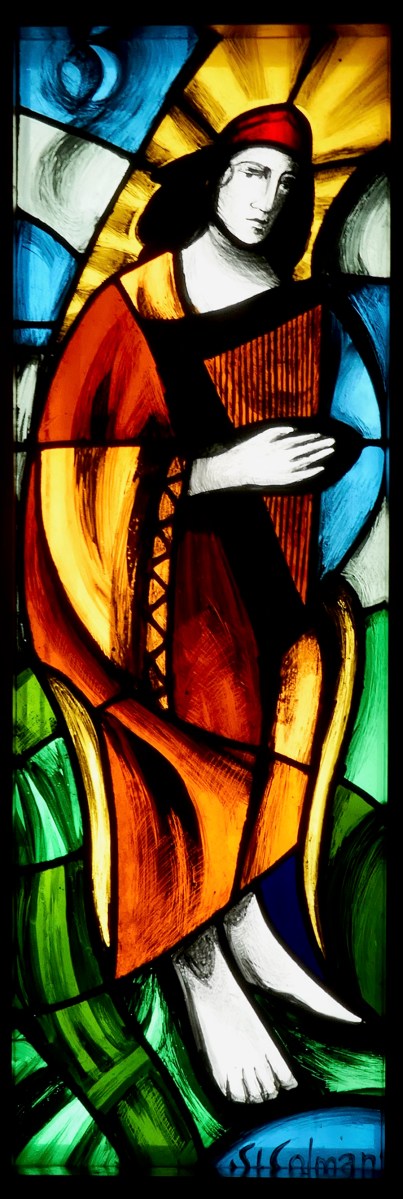
What caught my attention, however, were two panels in the entry porch. Rather than being fitted into true windows, the two pieces are installed in back-lit cabinets. The backlighting wasn’t quite bright enough so the windows did not show to full advantage and it was hard to make out any detail. Nevertheless, they were arresting in their modernity and in how different they were to the other windows inside the church. The first, to the left of the door, is an image of St Colman of Cloyne, patron saint of the diocese and of the church itself. He is depicted with a harp, dressed in long robes and with large bare feet. The harp is a reference to his status as a noted bard or poet – medieval bards recited their compositions to the accompaniment of the harp. The figure is surrounded by glass panes of varying shapes mostly in shades of green, and an aura radiates around his head.

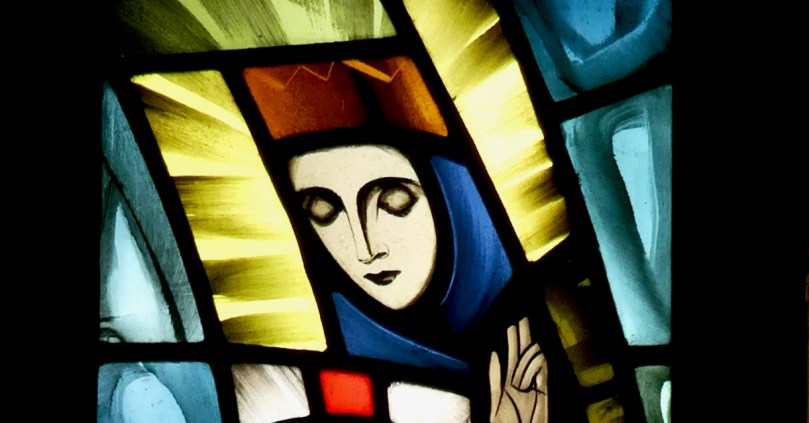
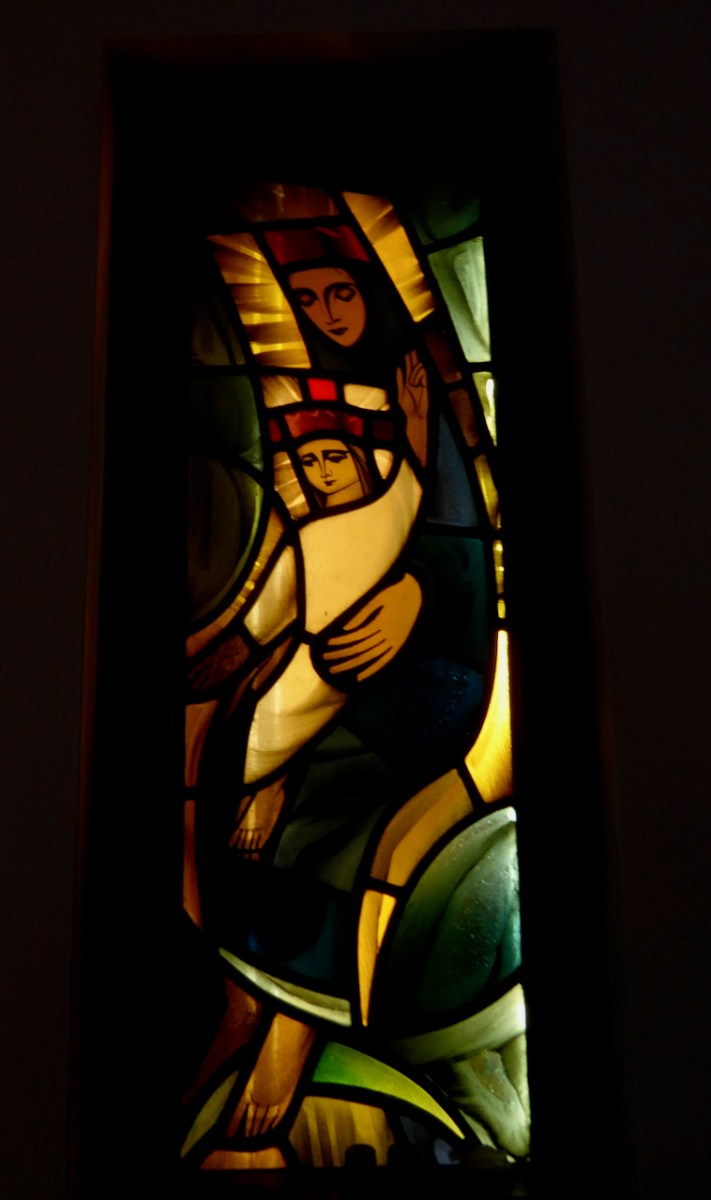
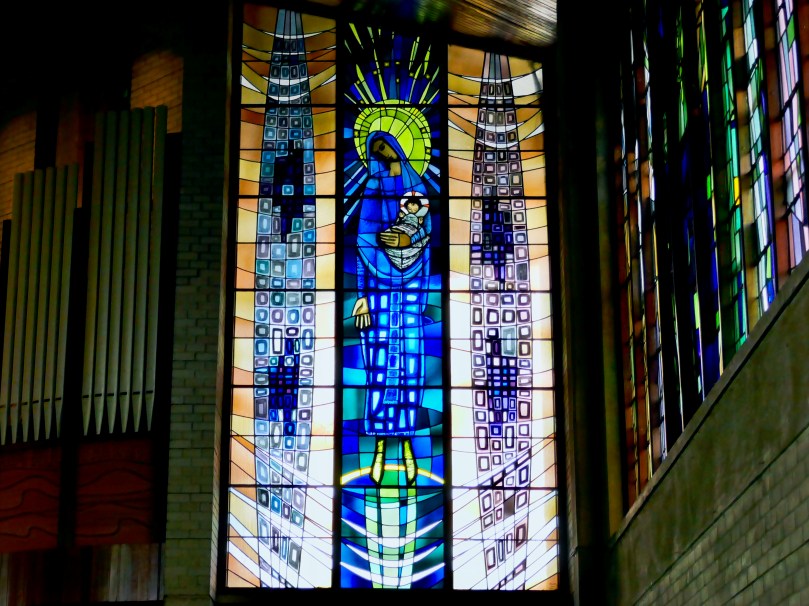
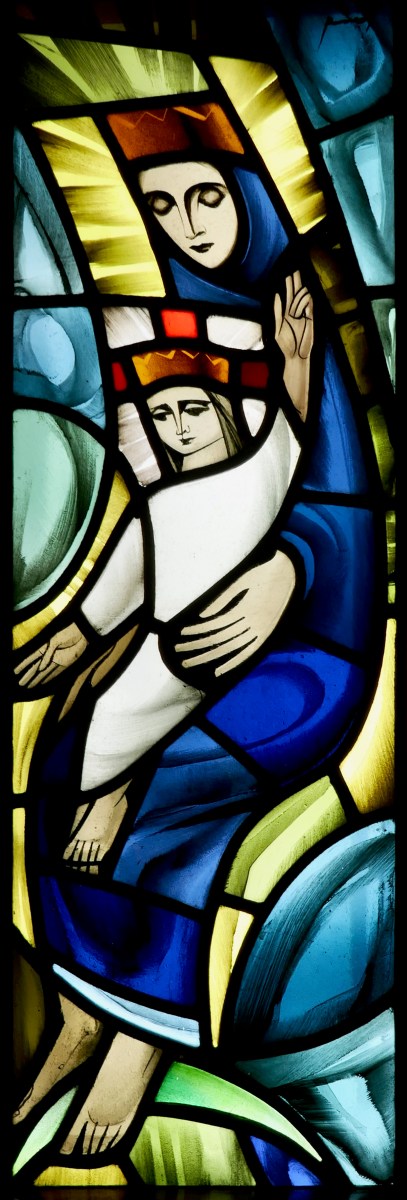
The glass to the right of the door is a depiction of the madonna and child. Mary wears a wimple with a fez-like top and a long robe in olive green. She is seated and in her lap is the Christ child with one hand raised in blessing. He wears a crown and a white robe. Their faces are similar with a small mouth, long noise and heavy eyebrows (see lead image). Mary’s large foot rests on a crescent moon and her head and Jesus’ are surrounded  by an aura. Like Colman, the figures are set within irregularly shaped pieces of coloured glass in shades of green.

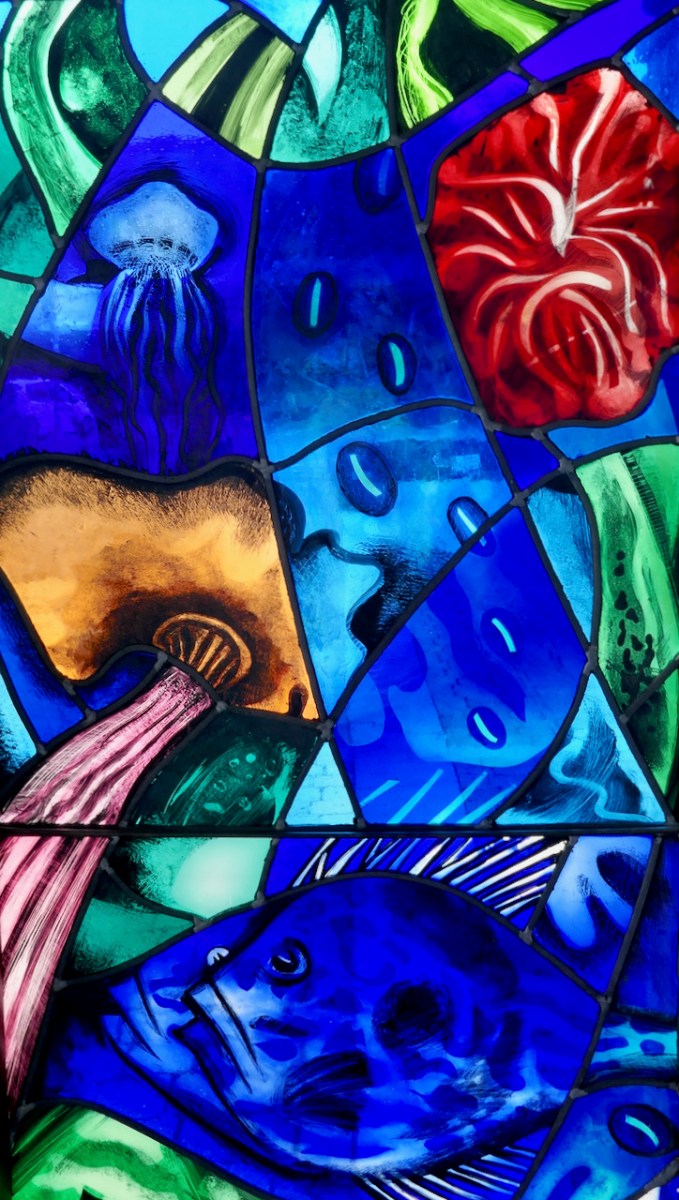
David decided to track down the mystery of who had made these windows and finally managed to get in touch with Fr O’Donnell, a retired Parish Priest who was very helpful indeed. He remembered that the windows had been made by a “Swedish woman from Skibbereen”. I got on the case and through a series of inquiries found Carin MacCana, who no longer does stained glass but still lives in West Cork. Below is an example of her previous stained glass work from the Skibbereen Heritage Centre, based around the sea creatures of Lough Hyne.

Carin confirmed that she had indeed done one of the windows. Wait, what? One of the windows? Yes, in fact she had been asked to match her window, St Colman, as closely as possible to the existing Madonna and Child window but she did not know who had done that one. Meanwhile, the enterprising Fr O’Donnell (now 90) was making good on his resolve to improve the backlighting. In the course of this, the signature ‘K’ was noticed on the back of the Marian panel. Fr O’Donnell recalled that the Madonna and Child had been presented by the artist Thomas Ryan, PRHA, in memory of a friend of his, a local doctor. Armed with this information, David went back to Carin who then remembered that she had been told the name of the artist was Richard King.

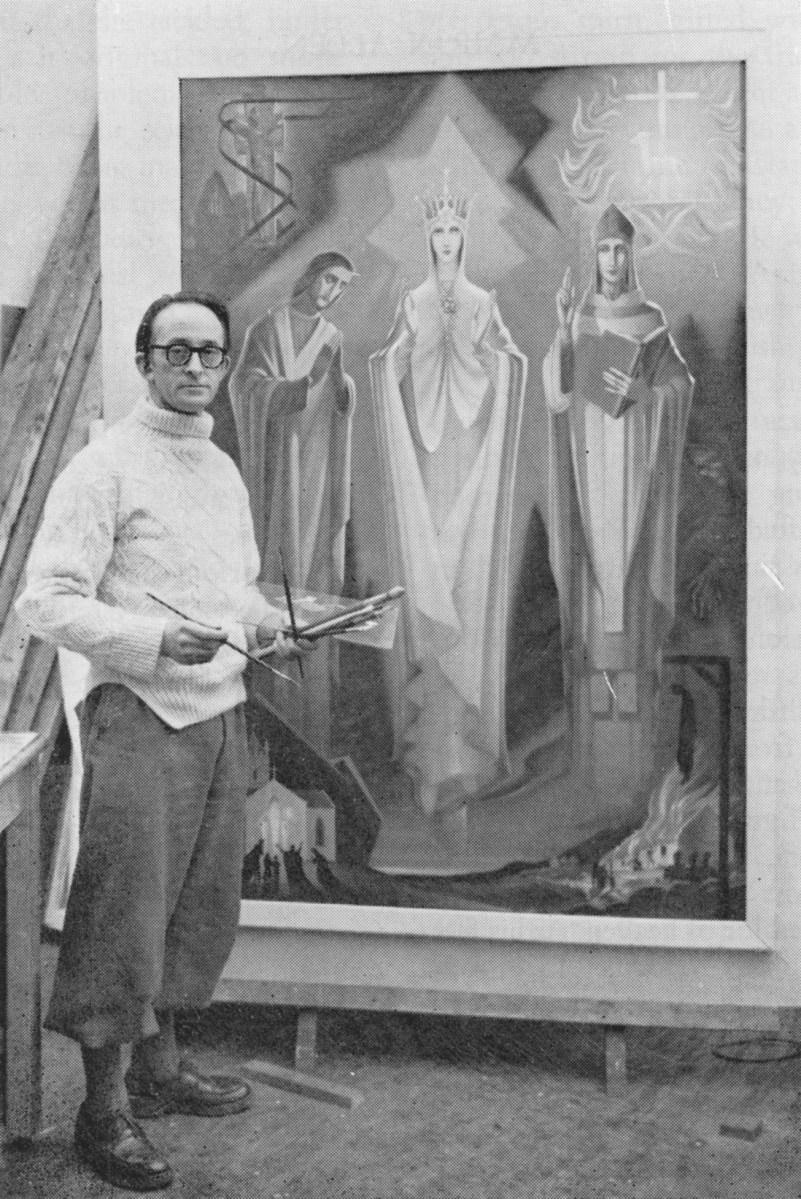
 Richard King in his studio, courtesy of the Capuchin Archives. The 1975 volume has extensive images and moving obituaries for King, beginning on page 169: he was the magazine’s chief artist.

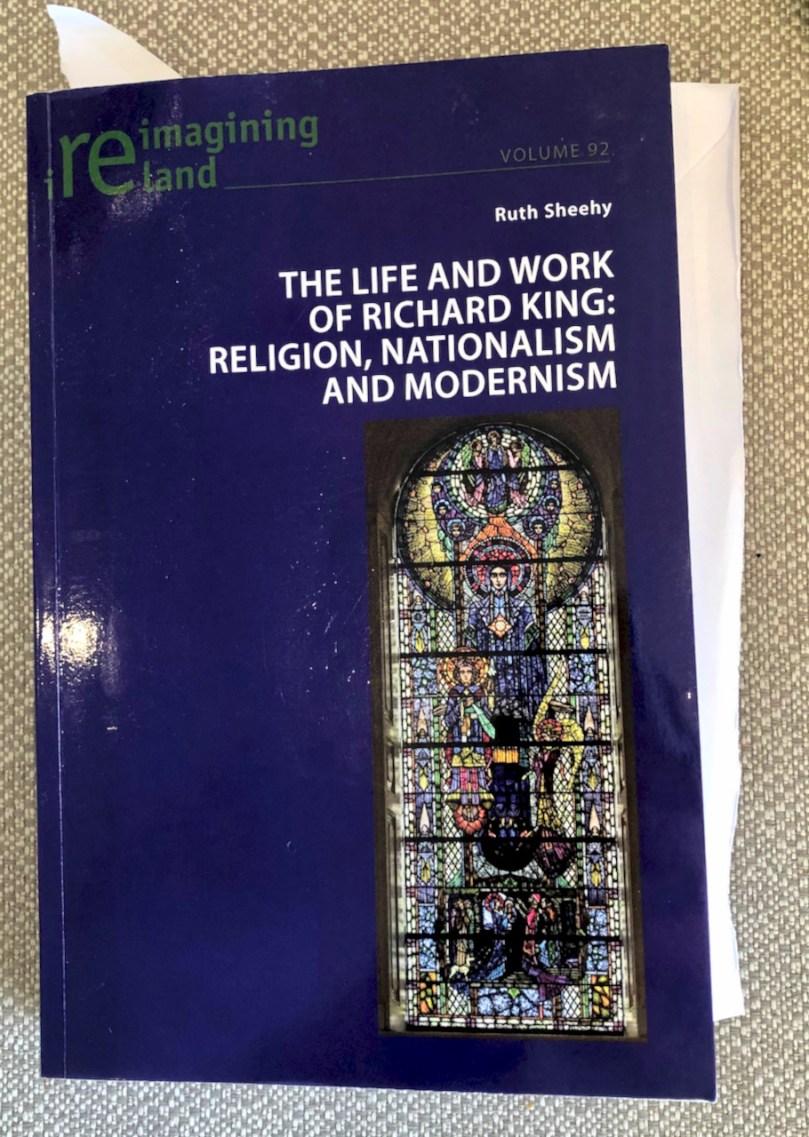
Although I have written about Richard King before (see Richard King in Mayo and Discovering Richard King), I am no expert – but we know who is! David immediately consulted Ruth Sheehy. Ruth has recently published her magisterial study The Life and Work of Richard King: Religion, Nationalism and Modernism – an engaging, erudite and exhaustive study of King’s artistic output, including his stained glass. This is my well-thumbed copy.

She was delighted to confirm that this was indeed the work of Richard King, and that it was a panel she knew existed, but had never managed to find. She pointed us to a similar panel – a ‘twin’ – that King made for the Church of the Holy Cross in Aberaeron in Wales. That panel has been well documented by Martin Crampin, artist and academic, who is the acknowledged expert on Welsh stained glass. He has kindly given me permission to reproduce his photo of that window, “Our Lady of Ireland”, below. For more on that window, see his listing here: http://stainedglass.llgc.org.uk/object/970 and also his blog post about this and another Richard King window in Wales: https://stainedglasswales.wordpress.com/2020/12/17/richard-king/

Of the Welsh window, dating to 1958, in her book, Ruth says:

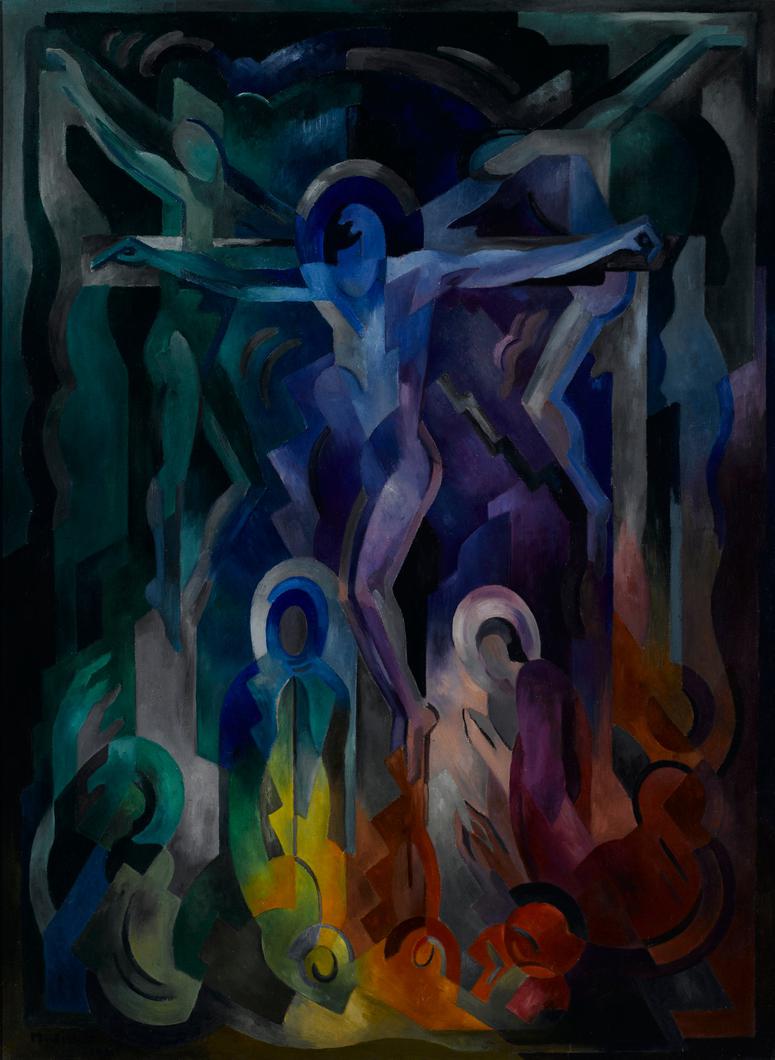
The Virgin Mary seated with the Christ-child shown in red, is depicted as an Irish woman with a blue shawl around her head and shoulders. The two figures are seen in the centre against a background of large areas of vibrant colour and cubist-abstract shapes. As King knew and admired Mainie Jellett’s art, he would have been aware of her meditative and indirect approach to religious themes as shown by The Ninth Hour. . . Although King’s interpretation of figuration and non-figuration was somewhat different from that of Jellett, the stained glass window of Our Lady of Ireland shows him experimenting with a cubist-abstract approach to form, light and colour which suggests an adaptation of her style.

Mainie Jellett’s The Ninth Hour, 1941, oil on canvas, Collection Dublin City Gallery The Hugh Lane

Regarding the Macroom window, which dates to 1963, Ruth wrote to us in an email:

The Virgin and Child are depicted here as King and Queen of Heaven and this image has similarities with another work by King entitled ‘Our Lady of Ireland’ c. 1958 which is reproduced in the book. The half moon at the Virgin’s feet refers to her immaculate conception. The red and white halo behind the Christ child wearing a crown indicates that his kingship is based on his ultimate Cross and resurrection and is not of this world.. . . . The large hands and feet of the figures and their expressive quality would suggest the influences of Evie Hone and modern German stained glass on King’s stylistic development at this period.

Fr O’Donnell has now had the windows cleaned and installed much improved back-lighting. The results are wonderful and allow us to see the windows properly, as both Carin MacCana and Richard King intended. Carin has done an outstanding job of matching King’s style, which is why we all assumed in the beginning of the hunt for answers, that this was a pair of windows done by the same artist. The colours of the St Colman window, instead of being muddy and autumnal now glow in golds, blues and greens.

As for King’s Madonna and Child window, the colours are quite different from how they appeared before. The background is dominated by light yellows and pale blues and greens, while Mary’s robe is not olive green but a brilliant azure – and it is now obvious that the ‘fez’ is a crown. The red and white halo (a favourite symbol of King’s) is also clearer now. Both of these windows beautifully illustrate the importance of proper back-lighting.

It isn’t every day that you can be part of rediscovering a ‘lost’ work of art – what a privilege it has been to be part of this journey.

Murphy Devitt in Cork, Part 3

Our final two Cork churches are a small private chapel and a large public church. Then I will provide some suggestions for where else to go to see Murphy Devitt windows. If you haven’t read them already, Part 1 is here and Part 2 is here.

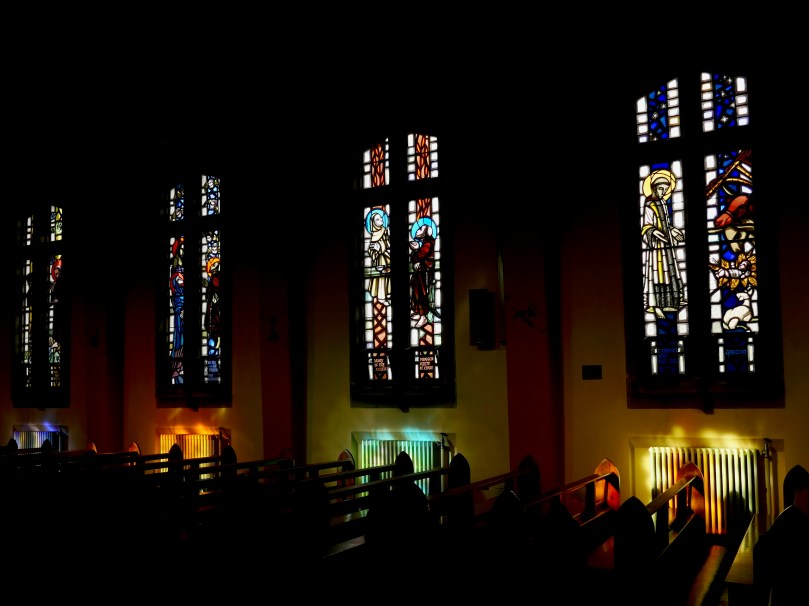
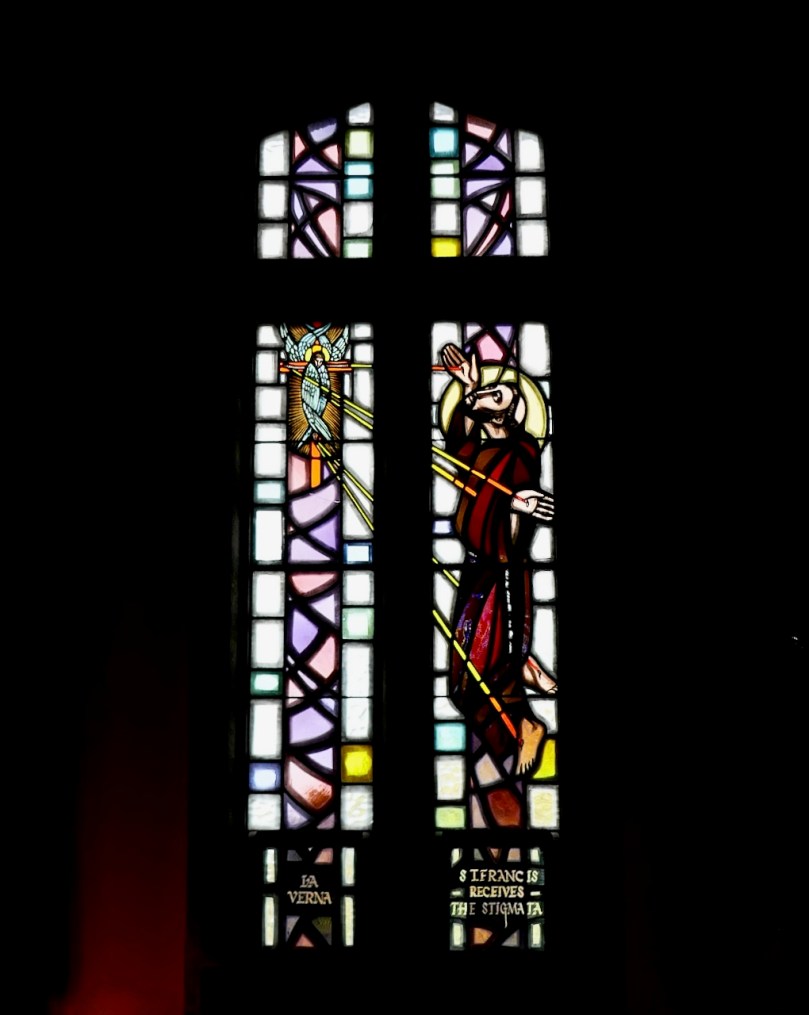
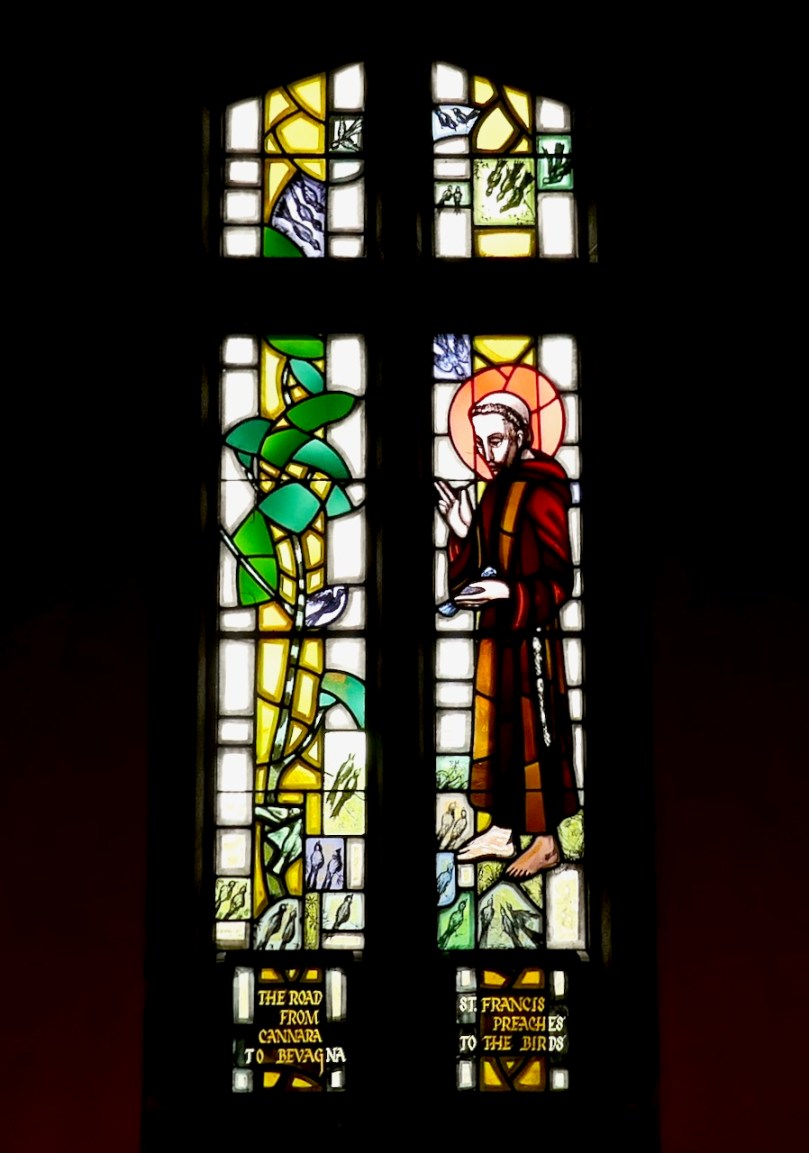
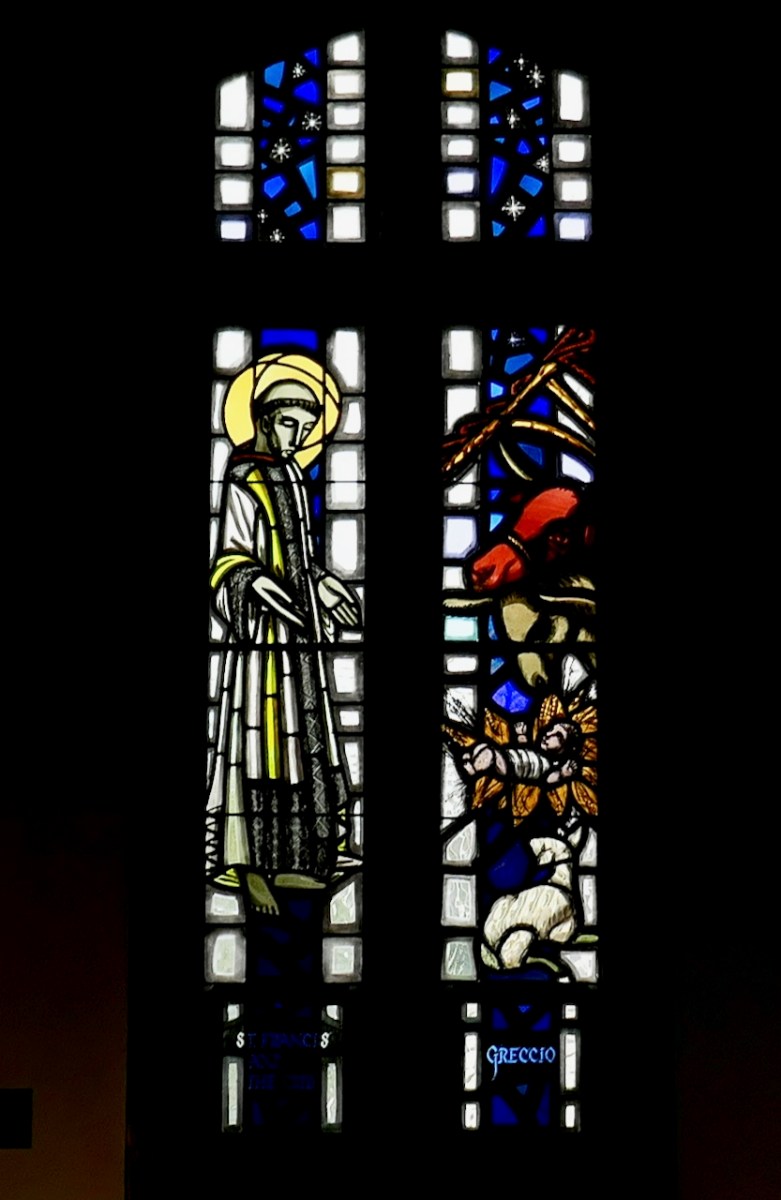
The private chapel first. It’s in Rochestown, attached to a Cappuchin Franciscan school and Friary* and it dates from 1961. It’s all about St Francis – his life and his famous Canticle. Scenes from St Francis’s life make up the large windows on the right side of the aisle. We see him receiving his stigmata, preaching to the birds, setting up the first Christmas crib scene in Greccia.

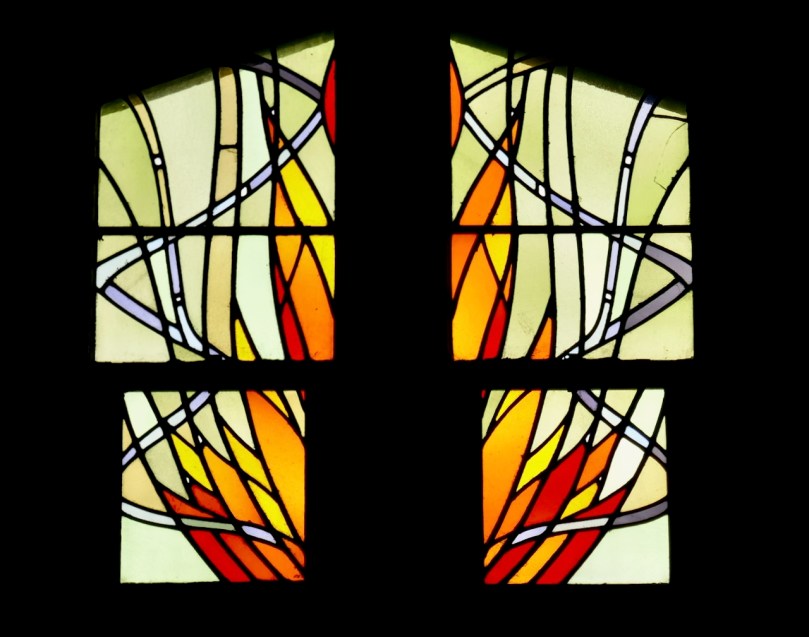
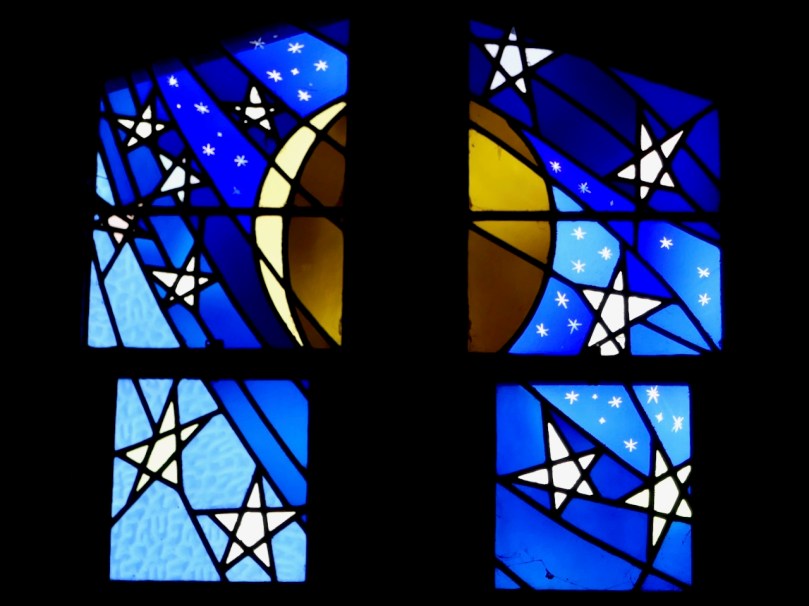
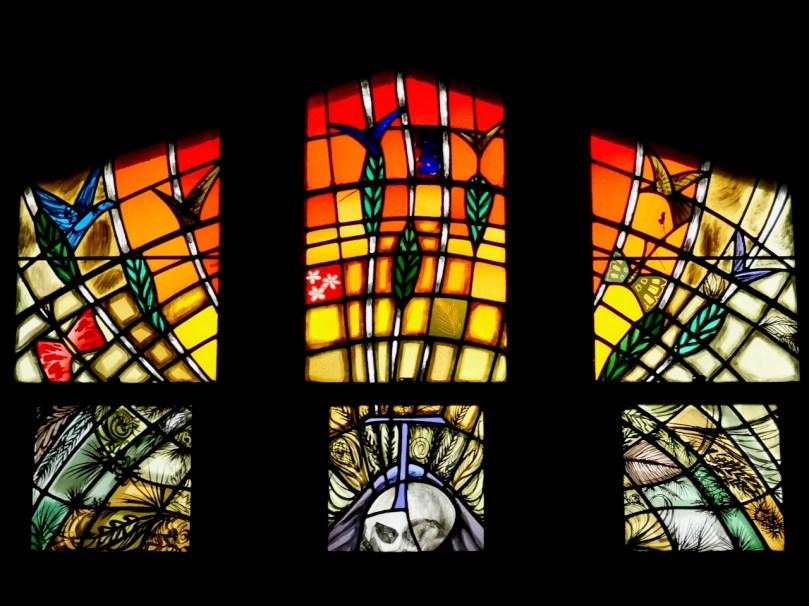
The Canticle references occupy smaller clerestory windows. They are a sensitive response to the well-known lines:

Praised be You my Lord through Brother Fire,

Through whom You light the night

and he is beautiful and playful and robust and strong.

Praised be You, my Lord, through Sister Moon and the stars,

In the heavens you have made them bright, precious and fair.

Praised be You my Lord through our Sister, Mother Earth

Who sustains and governs us, producing varied fruits with coloured flowers and herbs.

The Church at Mallow is a large and impressive modern edifice opened in 1967. The windows occupy both side walls, with many abstract panes filling in other spaces.

By 1967 Johnny was teaching full time at the National College of Art and  routinely invited his best students to work for the Studios in the summer. In this case, the student was Terry Corcoran, who, while he did some more stained glass windows on his own subsequently, went on to a career mainly as a painter. His website is here

The design was all Johnny’s, and both Johnny and Róisín provided direction to Terry. As a result, it is hard to distinguish a different hand in these windows – as with all MD windows they are a collaboration, but with the powerful and distinctive look and feel we’ve come to expect from their style.

Compare with this window in Mayfield – the figures have become slightly more stylised

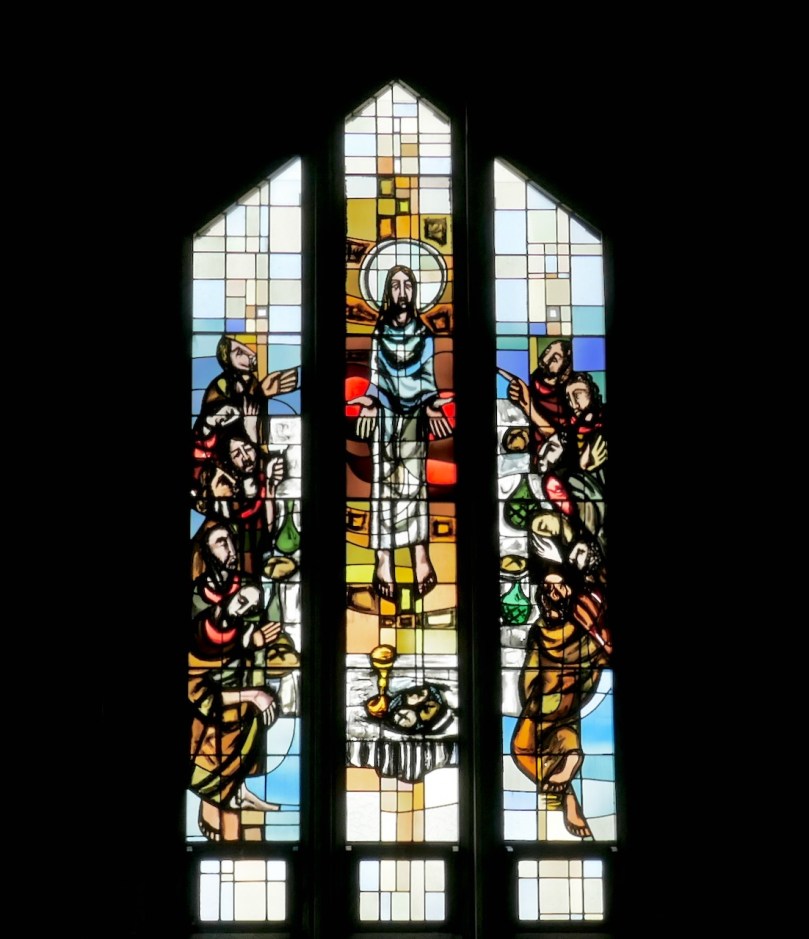
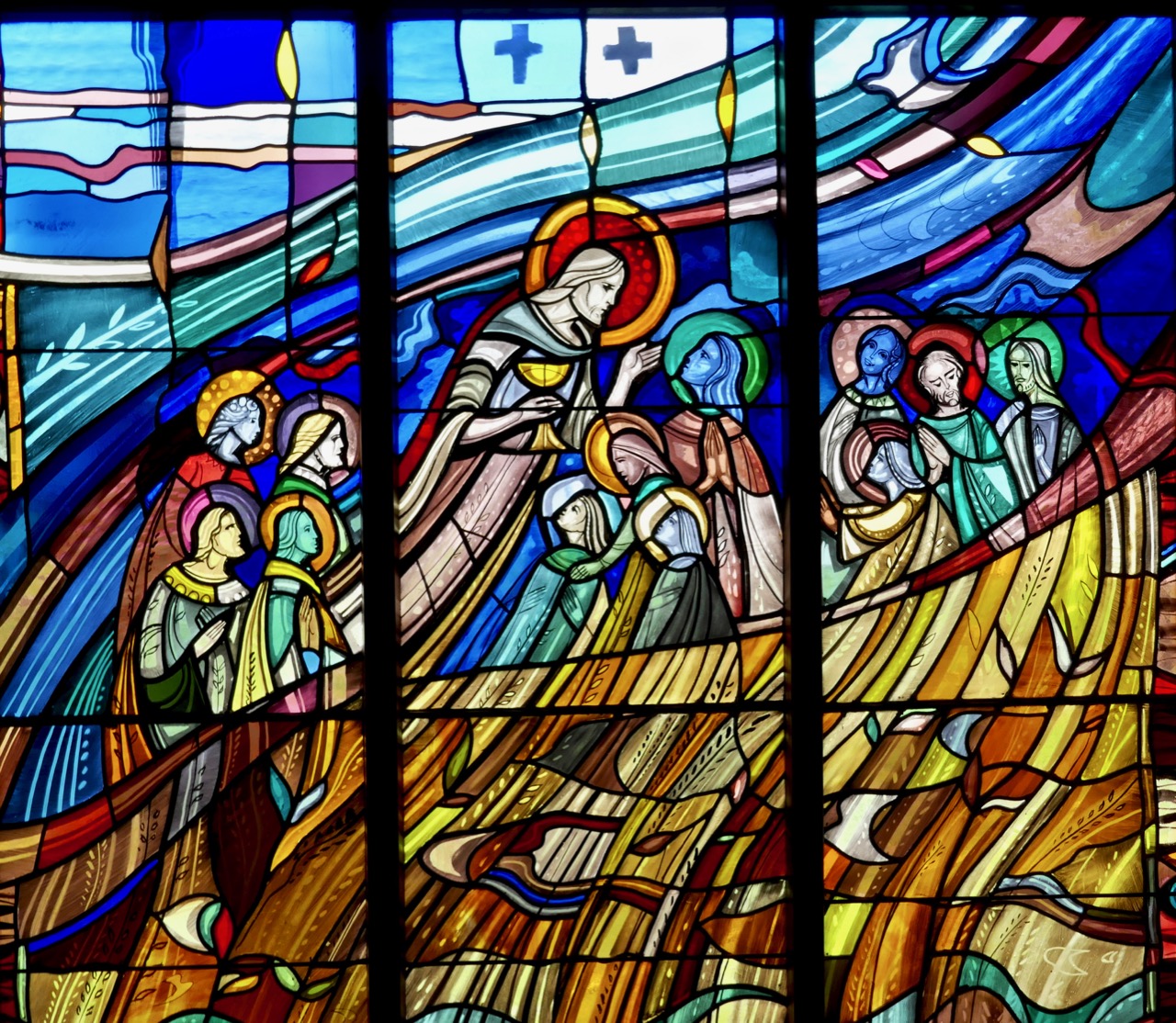
The Last supper – a masterpiece of window design

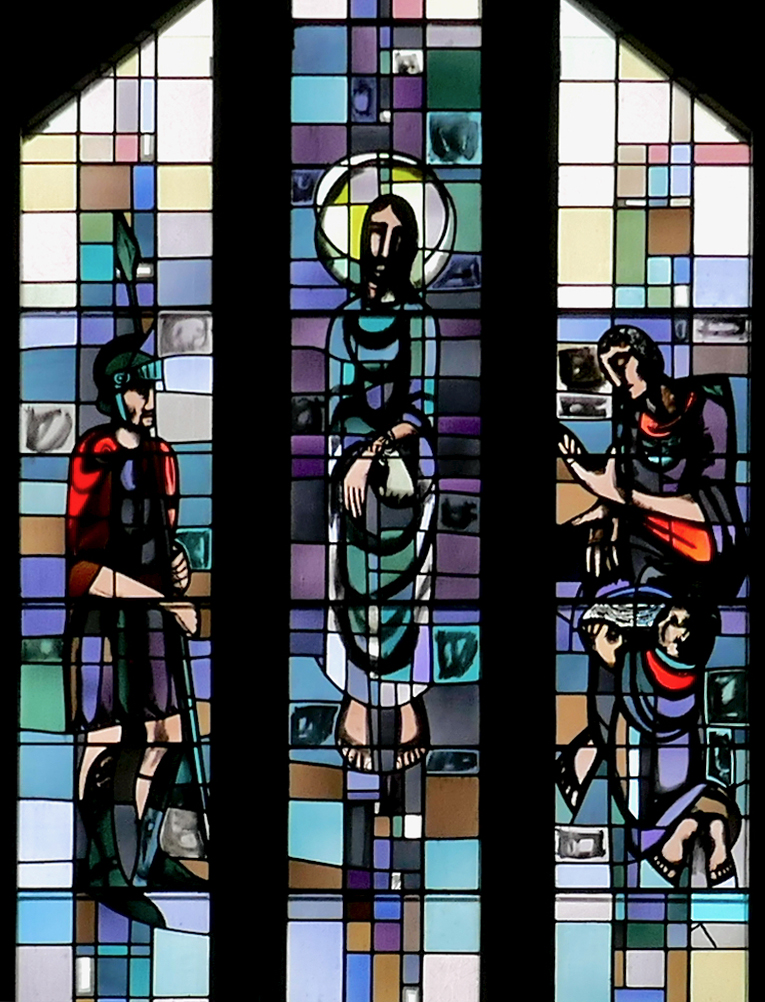
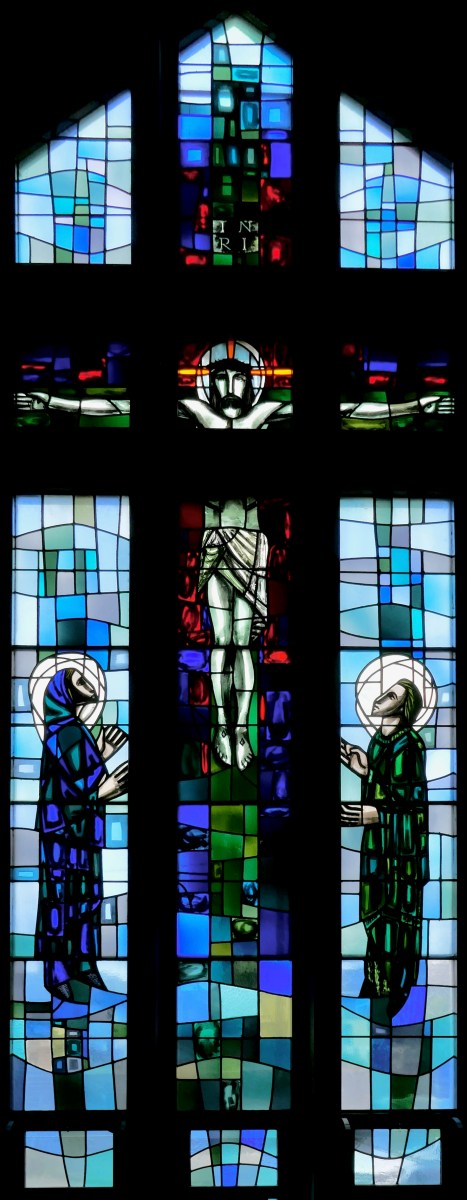
The Crucifixion window with its sombre blues and greens

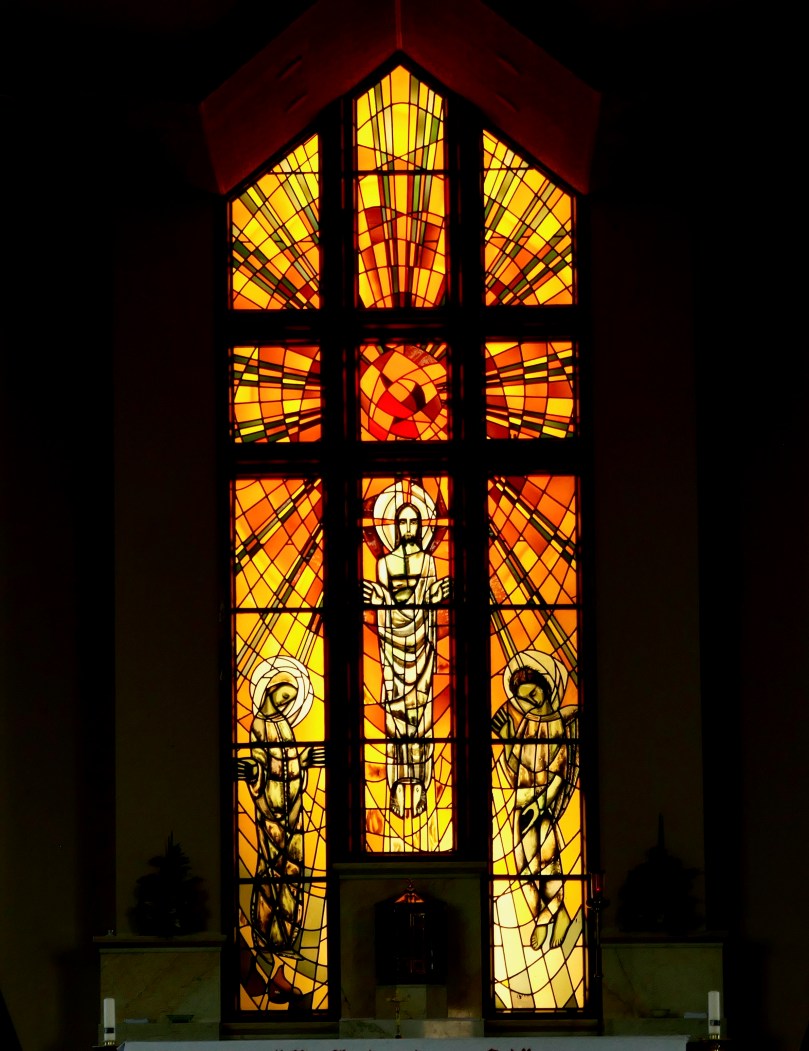
The Resurrection window (above in glorious hues of red and orange) was originally immediately to the right of the altar, but in the late 1980s the Parish Priest had it moved to behind the altar, where it had to be back-lit. This left an opening with no stained glass and the priest turned to Murphy Devitt once more. By then, the Studios had been dissolved, but Johnny and Róisín continued to work with Des under a loose arrangement covered by ‘Des Devitt and Associates.’

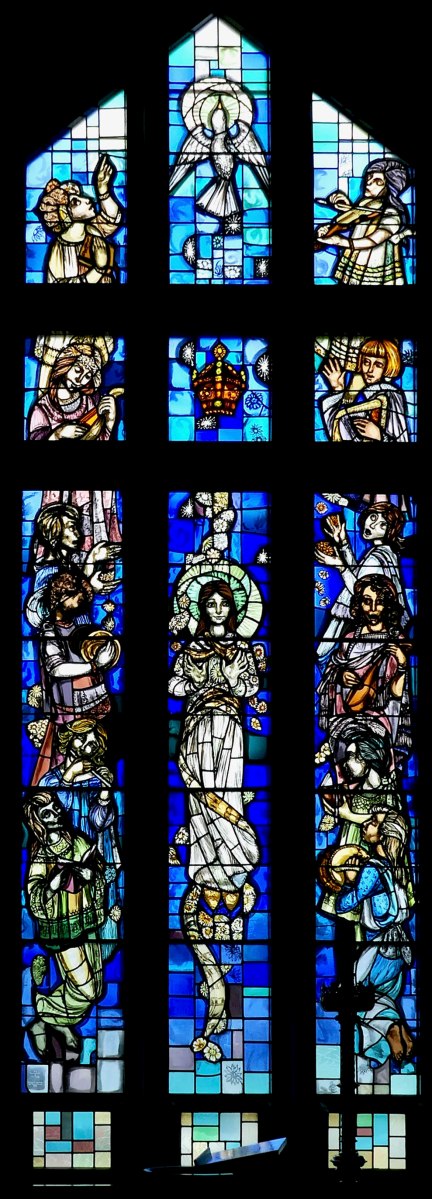
Róisín Dowd-Murphy’s Assumptions window in full

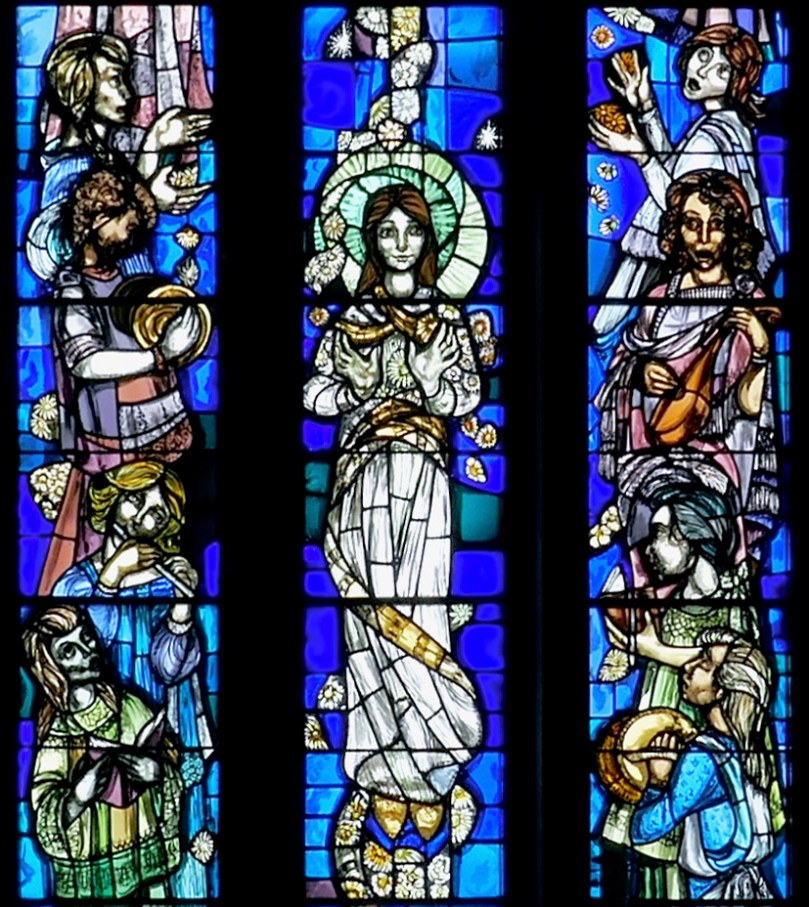
This window is pure Róisín and is quite at odds with all the other windows in the church. To me, it is a delight, as it showcases Róisín’s style in all its Boticelli-inspired emphasis on costume, hair, flowers and musical instruments. Contrast it with the Assumption window in Mayfield (click here for the image). Although she drew the cartoon for both windows, the Mayfield Assumption had to fit with the overall design for that church, whereas in Mallow she simply followed her own inclinations and what we get is unfiltered Róisín.

Assumption, a closer look

Not everyone is lucky enough to live in Cork, so I want to include a few non-Cork Murphy Devitt windows before I end this series – windows that are open to visit and which are every bit as spectacular as the best of the Cork examples.

Cahir Catholic Church has MD abstract/symbolic windows, including this little window where Johhny’s love of the wobbly and wavy line is clear – also note the unusual glass

The Church of Our Lady and St Brendan in Tralee has two huge representations of its patrons, as well as extensive and beautiful abstract windows.

All the glass in St Michael’s, Dunlaoghaire, is Murphy Devitt, done in the early 70s. Soaring panels of abstract colour punctuate the severe interior and bathe the interior in a warm glow. No photograph – you’ll have to see this one for yourselves. In Limerick, the Dominican Church has a floor to ceiling wall of glass (below) that, among other things, depicts the history of Limerick.

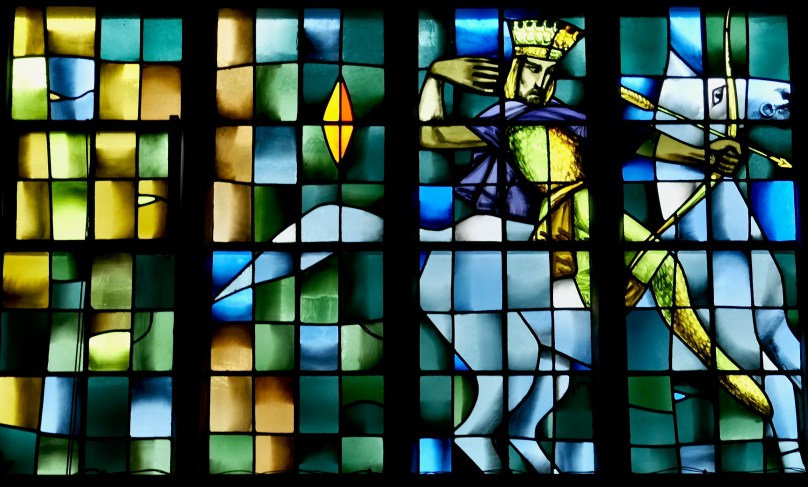
The chapel attached to Newbridge College contains a set of windows based on the Book Of Revelations, an unusual theme for a Catholic Church. My friend and colleague, David Caron, has written a piece on these windows for the Summer 2019 edition of The Irish Arts Review, with brilliant photographs  by Jozef Vrtiel. I recommend that article to you, not least for the erudite and highly readable commentary on the iconography, including the Four Horsemen of the Apocalypse, one of whom is below.

That concludes our exploration of this extraordinary Studio, its artists and craftspeople. It’s been a rare pleasure for me to discover them all, and their brilliant windows. Please take a look at the Murphy Devitt website – it’s a work in progress, but it will give you a list of churches and you may find one near you. Let me know!

Brendan, in the Church of Our Lady and St Brendan, Tralee

*Thank you to Fr Sylvester of the Rochestown Cappuchin Franciscan Friary for facilitating my photographing the windows. The chapel is private so these windows are not normally available to view.

Celebrating George Walsh

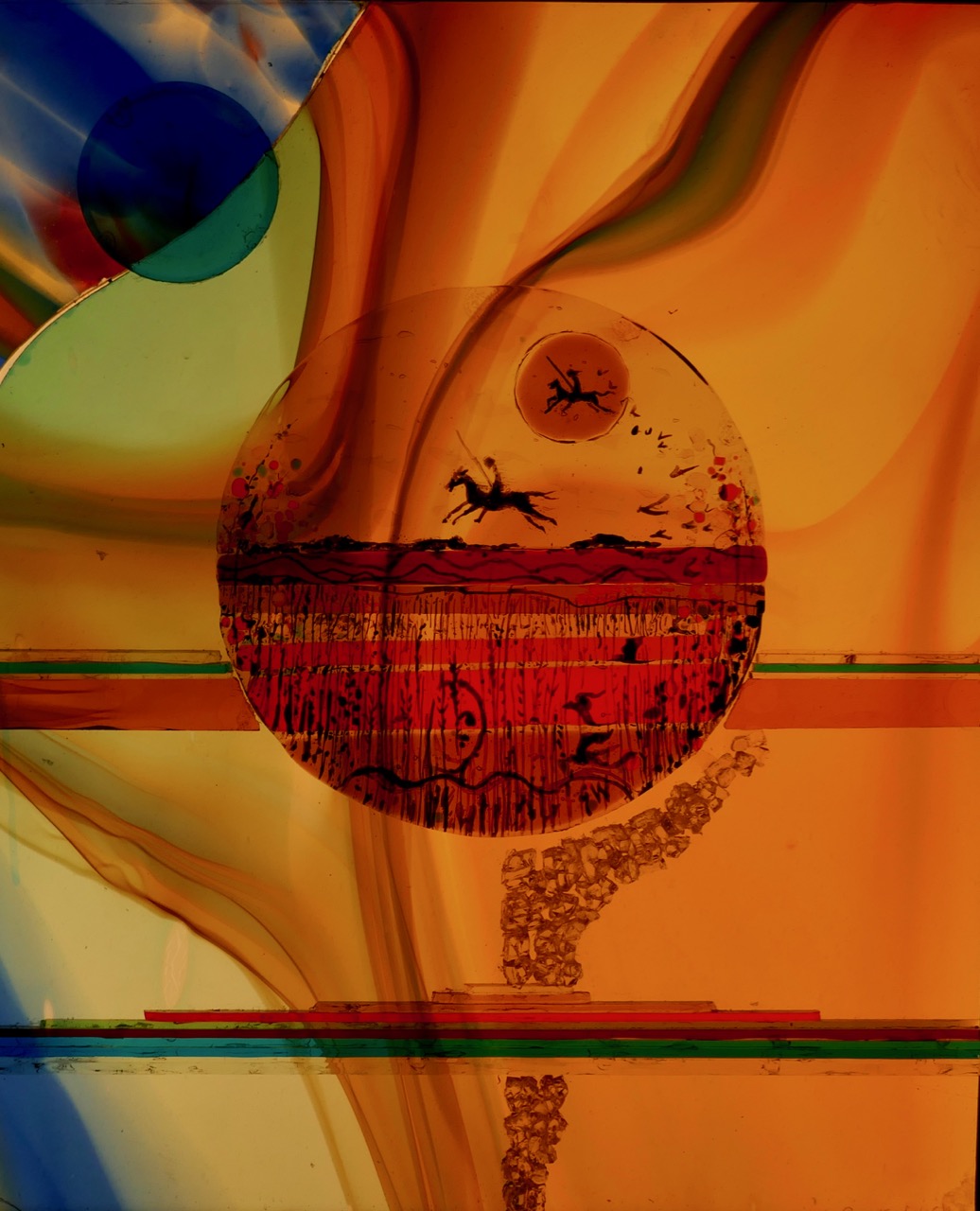
Robert and I are just back from a magical celebration in Dublin – the launch of a solo show by the stained glass artist George Walsh, at the Trinity Gallery. It was a joyful occasion and a huge success. As one of the organisers said afterwards, “It’s a long time since there was a queue outside a Dublin gallery for an exhibition.” The piece above, Ancestral Fields, is a good example of the vibrant and glowing glass – stained, fused, painted – on display.

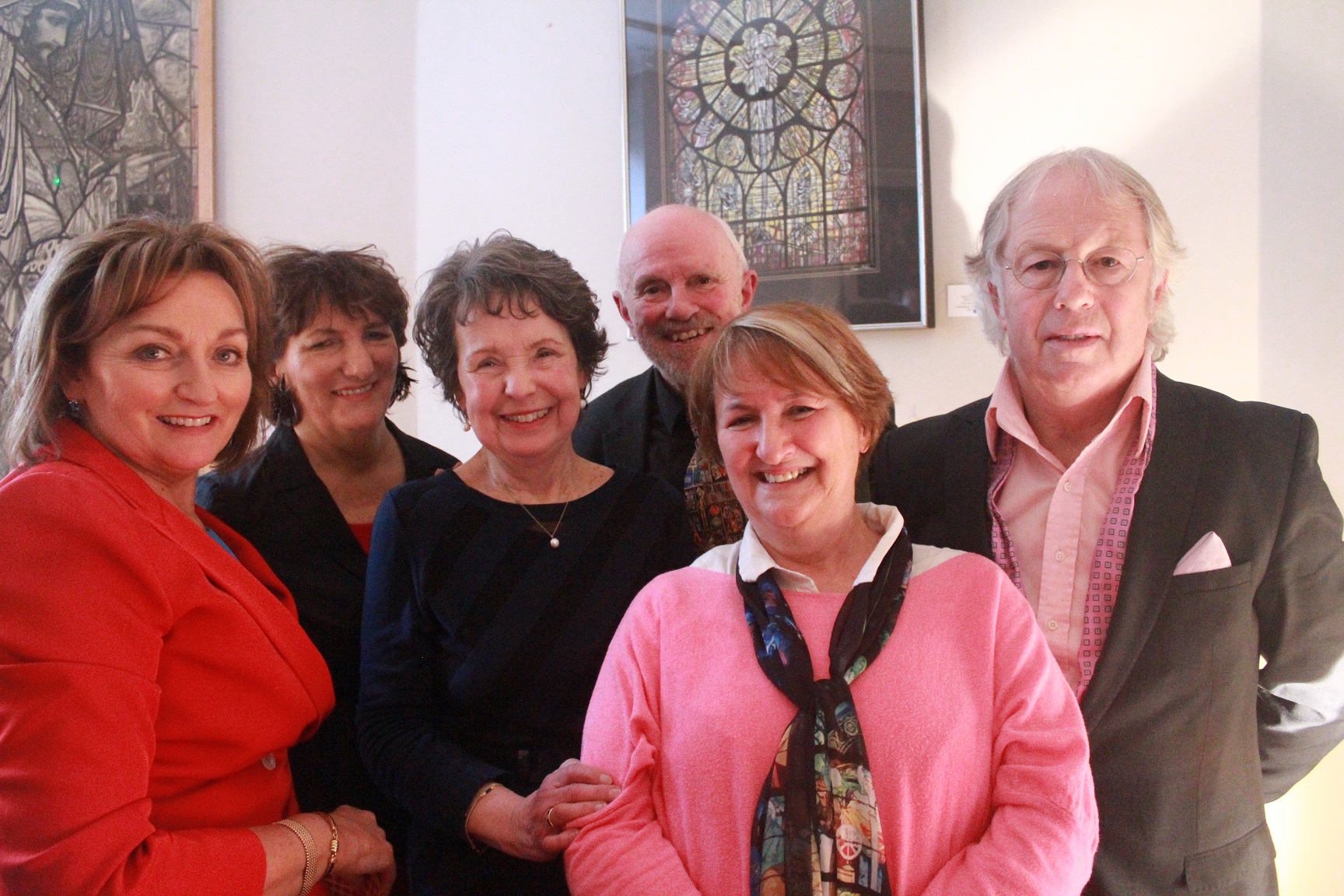
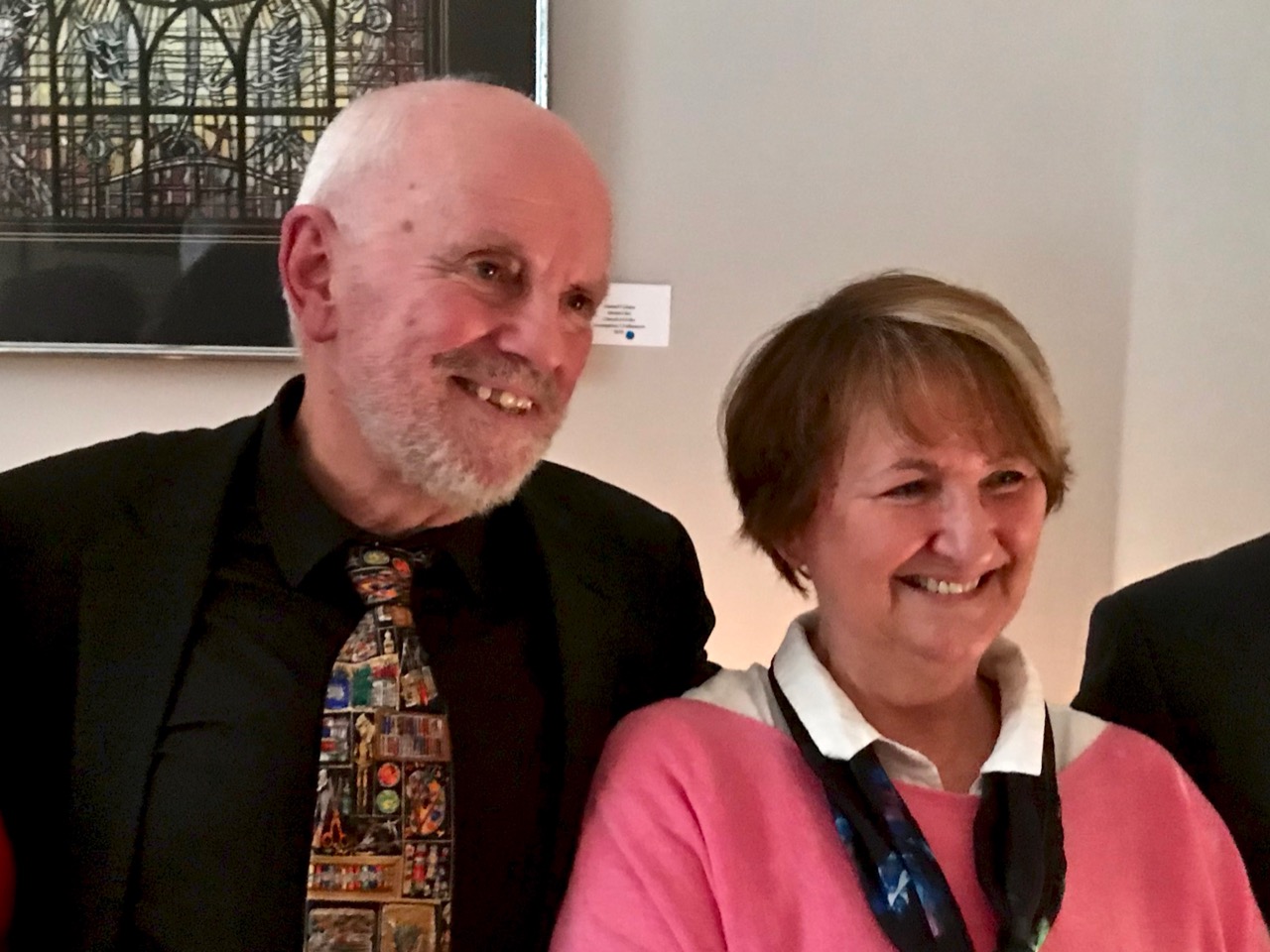
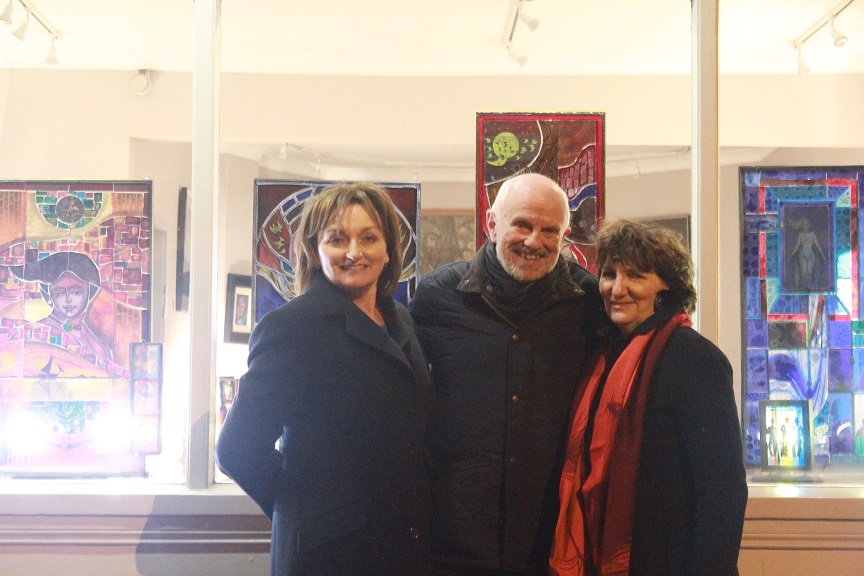
At the exhibition opening at the Trinity Gallery: Imelda Collins and Loretto Meagher, Gallery Owners, Janet and George Walsh, Yours Truly and Eamonn Mallie (Photo by Stephen Walsh)

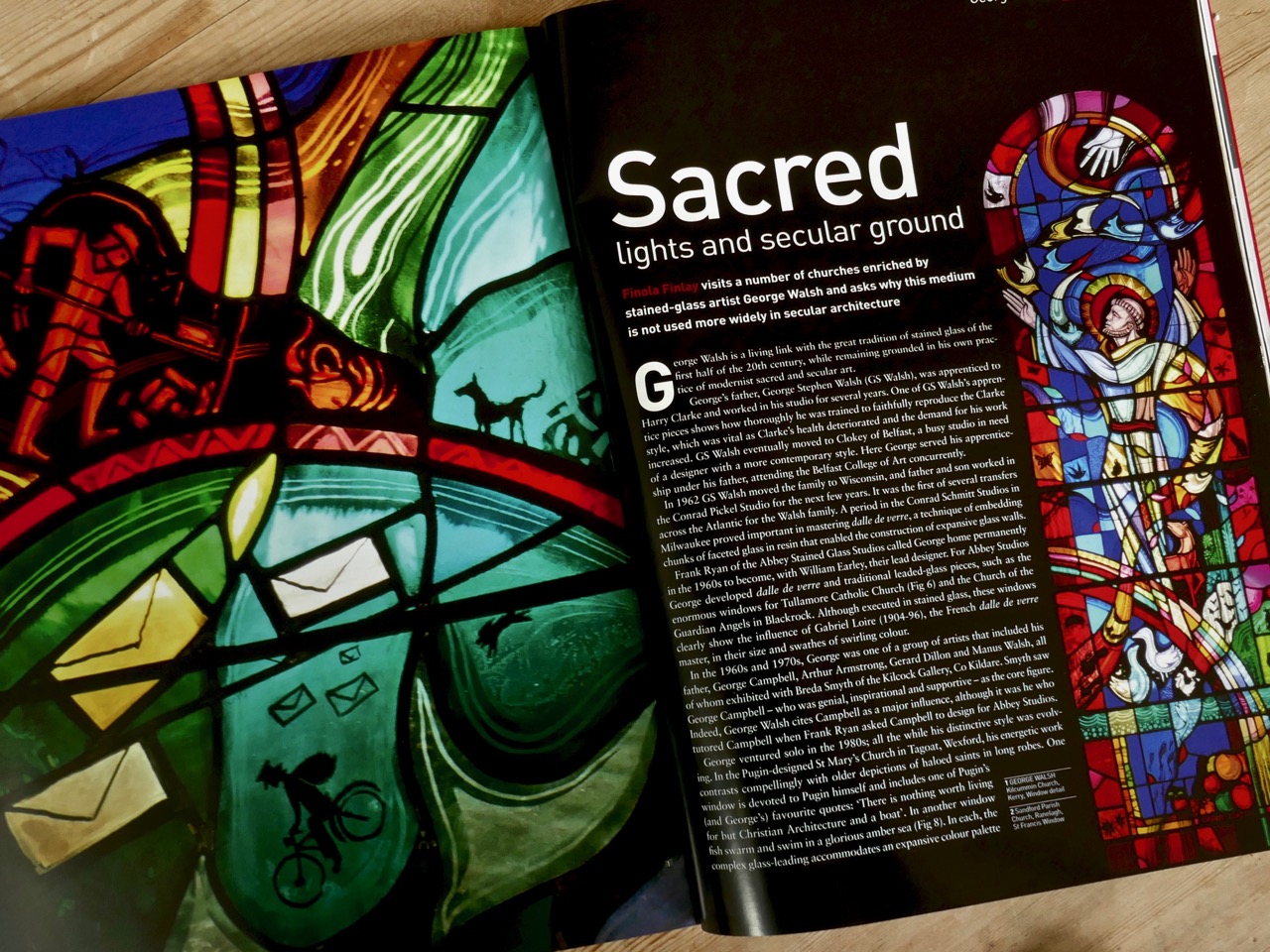
This month, my piece on George was published by the Irish Arts Review – I have been waiting for that to come out, and for this exhibition to open, before I write too much about him in the blog. It’s been difficult to sit on it all, because I’ve been studying his work seriously now for a couple of years, growing more and more entranced with every window.

The March 2019 Irish Arts Review, featuring my 6 page article about the art of George Walsh

Regular readers of the blog, or our Facebook Page followers, will recognise George’s work right away from the occasional image we share on either platform. We ‘discovered’ him on a trip to the Beara five years ago, and have been encountering his work all over the place ever since, initially by chance and more recently as part of a concerted effort to document his body of work for a specific project – more on that project later.

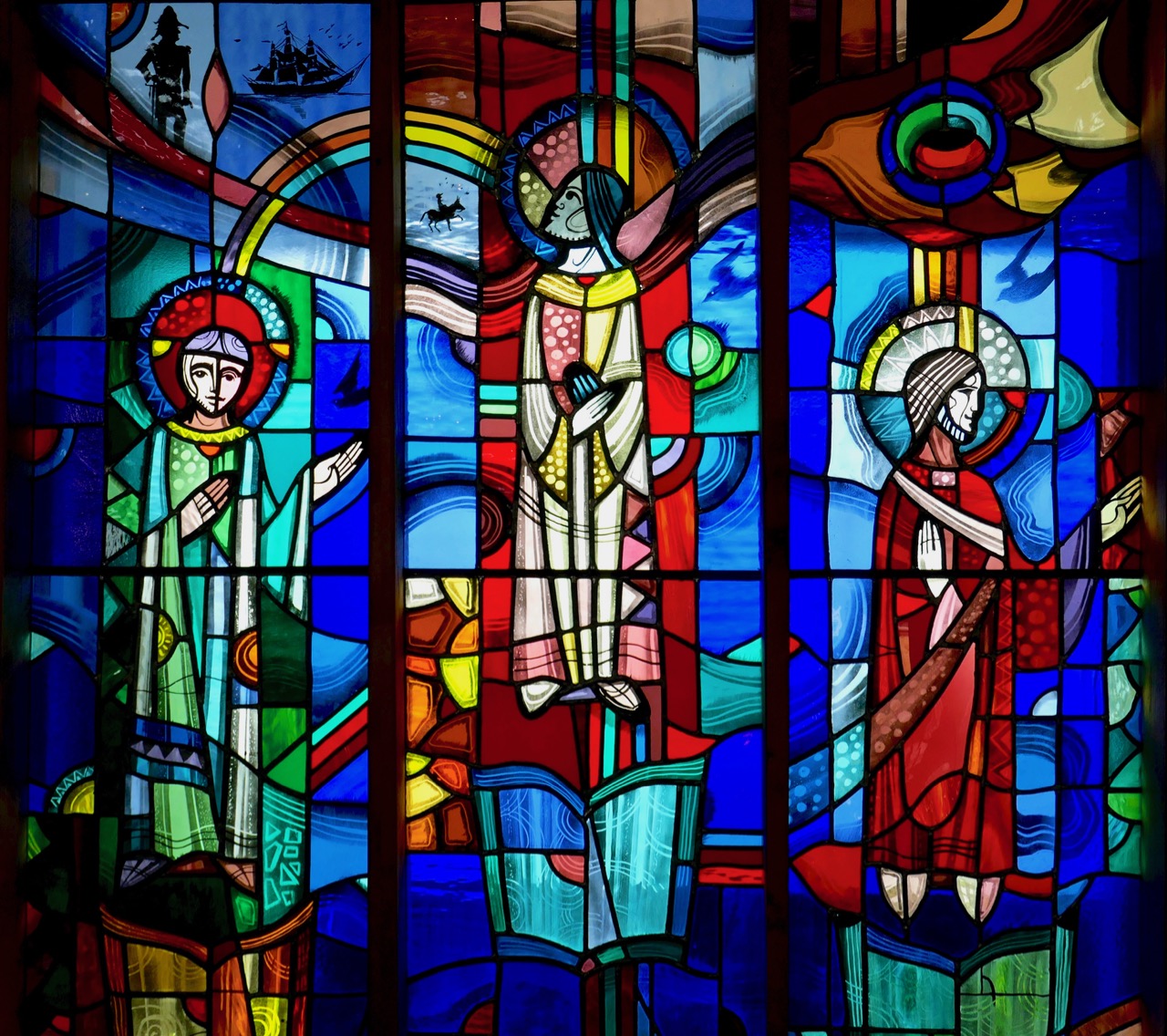
Saints, from a window in Kilcummin, near Killarney

Researching and writing the Irish Arts Review article has been a fascinating journey, as it involved capturing images of George’s work, interviewing colleagues and gallery owners, and most of all getting to know George and Janet as I peppered them with questions and as Robert and I spent time in their company.

George apprenticed with his father who, in turn, had apprenticed under Harry Clarke. They (father and son) worked together and separately both in the United States and in Ireland, producing wonderful windows for several studios and finally, in George’s case, settling down in Ireland and going out on his own. George’s son, Stephen, also an artist and currently living in London, is developing a website to showcase George’s work – visit it here as a work-in-progress – and also runs an Instagram feed full of gorgeous images.

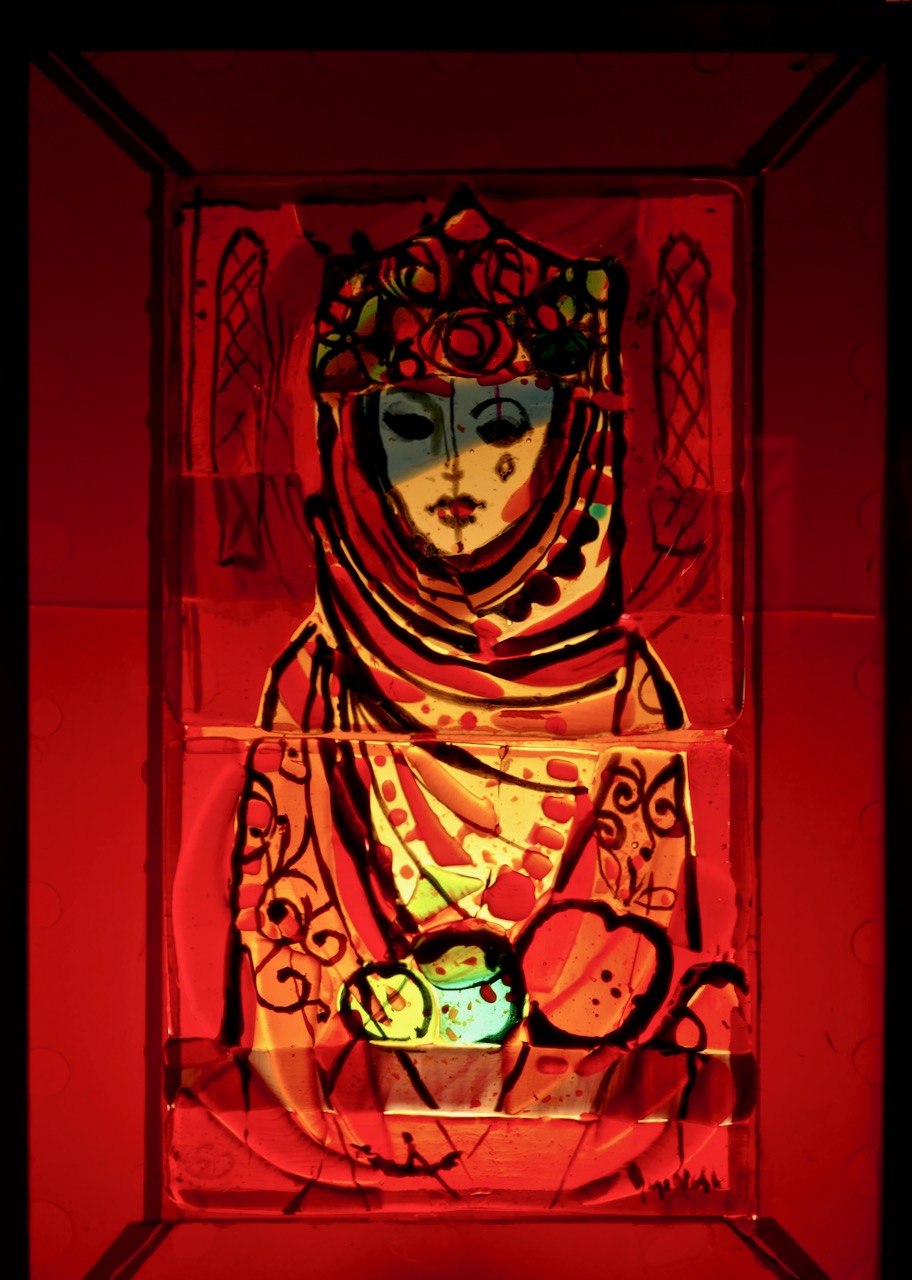
George is inspired by Venice – another exhibition piece

George has collaborated with several architects to design and decorate new churches. His work with Holly Park Studios is breathtaking, demonstrating as it does what can be achieved when a project is conceived with stained glass as an integral part of the design from the start.
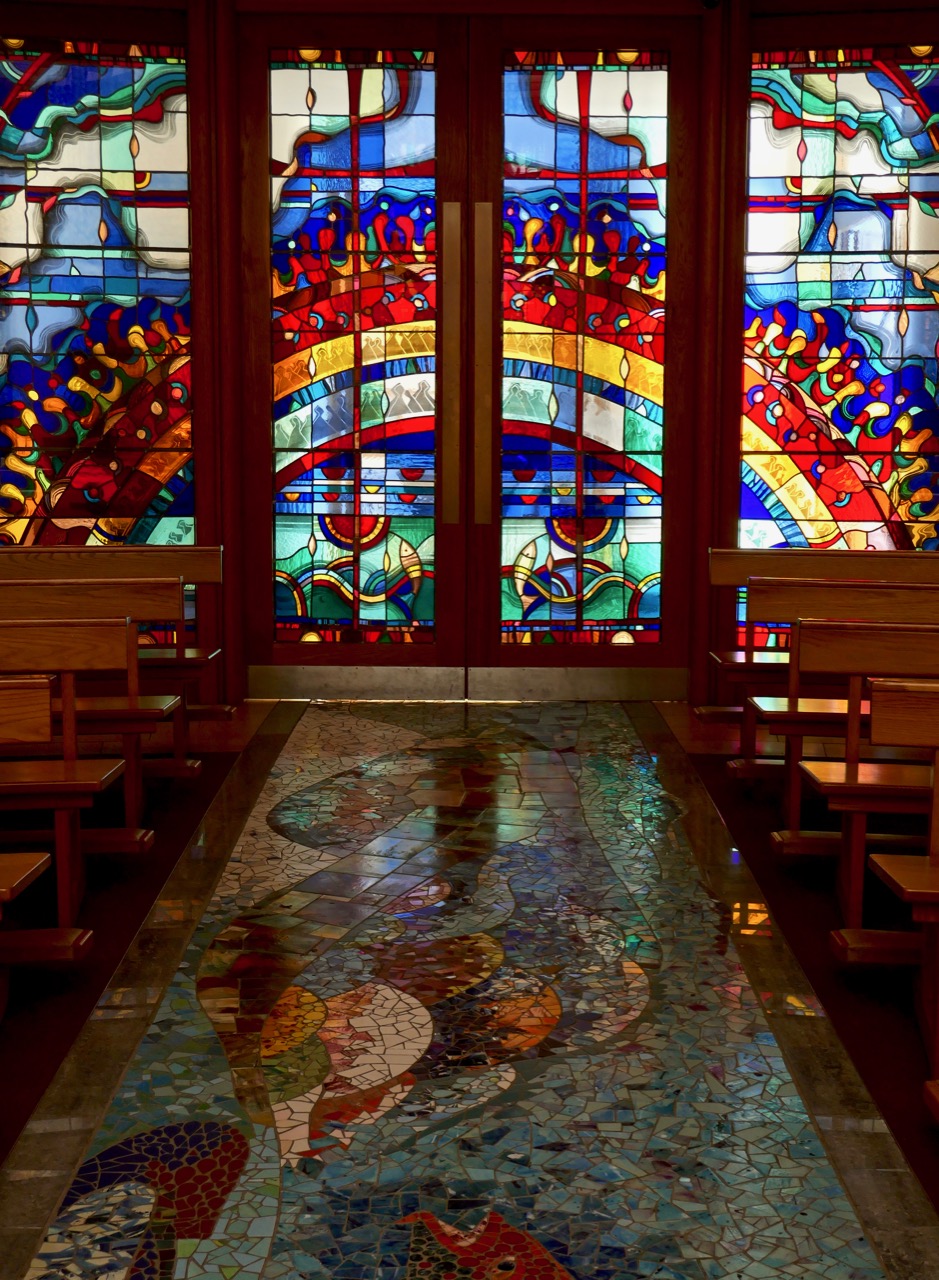
This screen door is but one of the stained glass pieces in the award-winning Church of the Holy Family in Belfast designed by Holly Park Studio. The mosaic flooring is by ceramic artist Laura O’Hagan, whom I was delighted to meet at the opening

But even where windows have been added over time (as is more normal in church architecture) George’s work shines and is instantly recognisable. First of all, his windows blaze with colour. What I have discovered by spending time with them is that he has this amazing ability to convince you that he is using primarily bold and primary colours but in fact any section taken at random in any of his windows reveal a host of colours, many of them subtle and gentle – it’s the way his choices of colour combine that result in the vibrancy and energy that are so typical of his windows.

The second thing is his complete mastery of his chosen artistic medium – glass. Perhaps this is best revealed in the complexity of the leading. Only an artist that has been classically trained in stained glass techniques could produce such incredibly complex images.

Larger expanses of a single colour (always painted and textured in subtle and not-so-subtle ways) are balanced by areas of the window is which each colour is a tiny sliver of glass, all cut and shaped in different ways and all leaded together to produce a final exciting effect. Just this week I stood in front of a Last Supper (below), which George had decided to depict in a field of wheat. The wheat occupied more than a third of the window and I estimate that it contained hundreds of different pieces of glass, all separated by twisted and swirling lead lines. it spoke to a level of skill and experience, a practice of perfectionism, and an acceptance of nothing less than the full realisation of the vision that only dedicated artists attain.
Finally, he is as comfortable with the transcendent as he is with the everyday. While most parishes want specific sacred images, he also makes himself familiar with the area so he can convey that sense of place that is so characteristic of his windows.

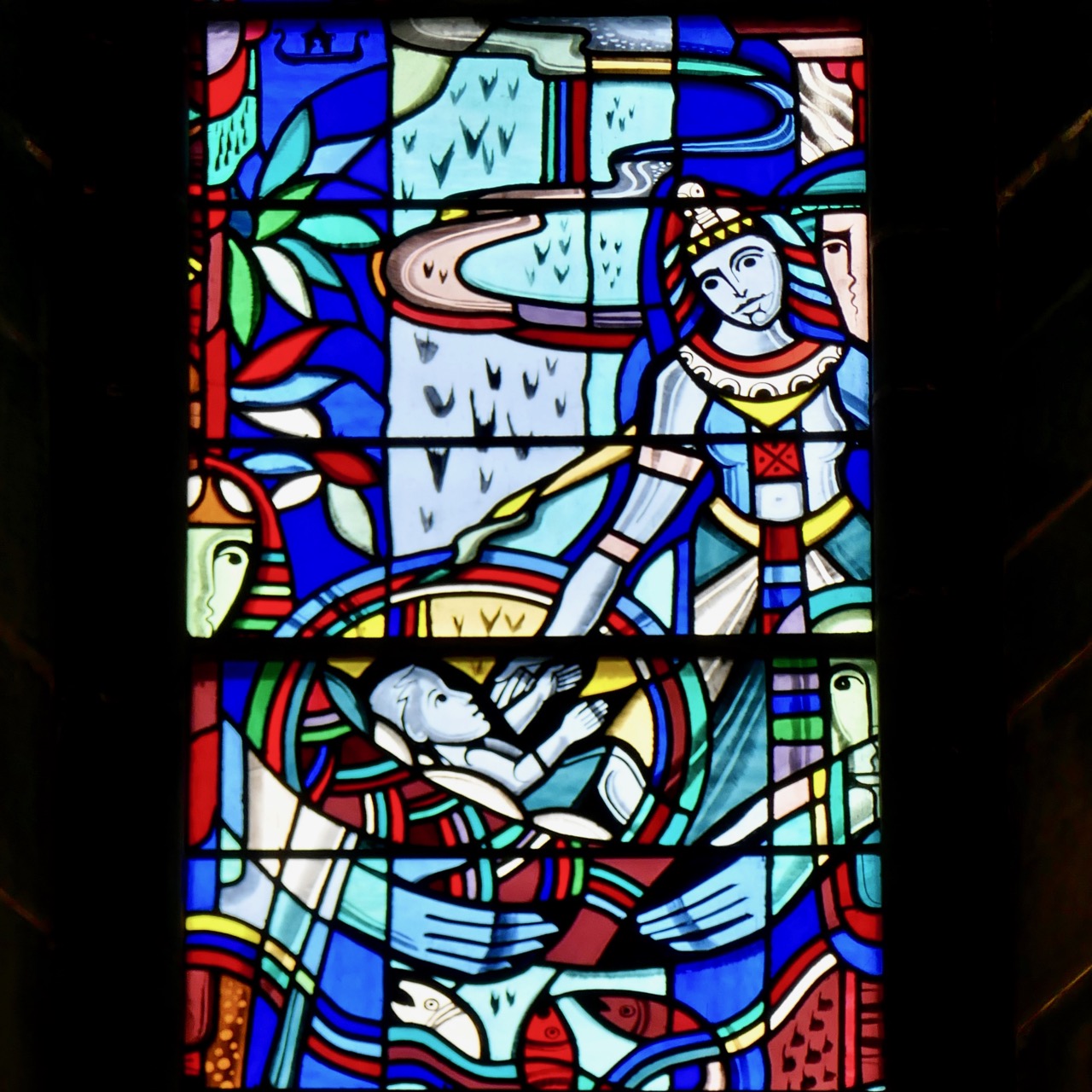
Above: Moses in the basket, Galway Cathedral. Below: St Catherine of Alexandria, from St Maur’s Church in Rush, Co Dublin. Catherine is shown with her usual attributes – the martyr’s palm, the sword which was the instrument of her death and the wheel which was used to torture her. But the Catherine Wheel is also a firework – called after St Catherine’s torture wheel, and George has introduced a subtle reference to that in his depiction of the wheel 

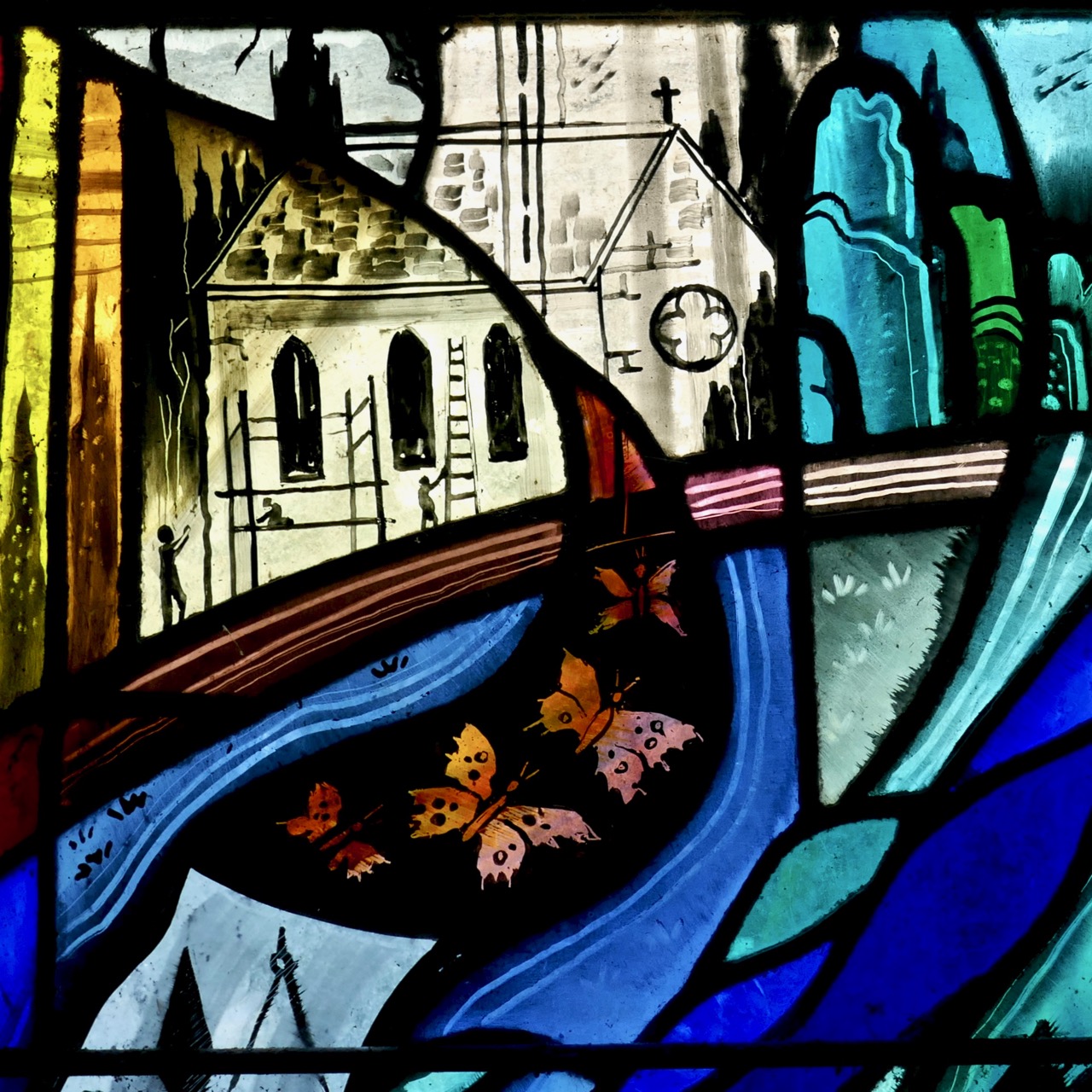
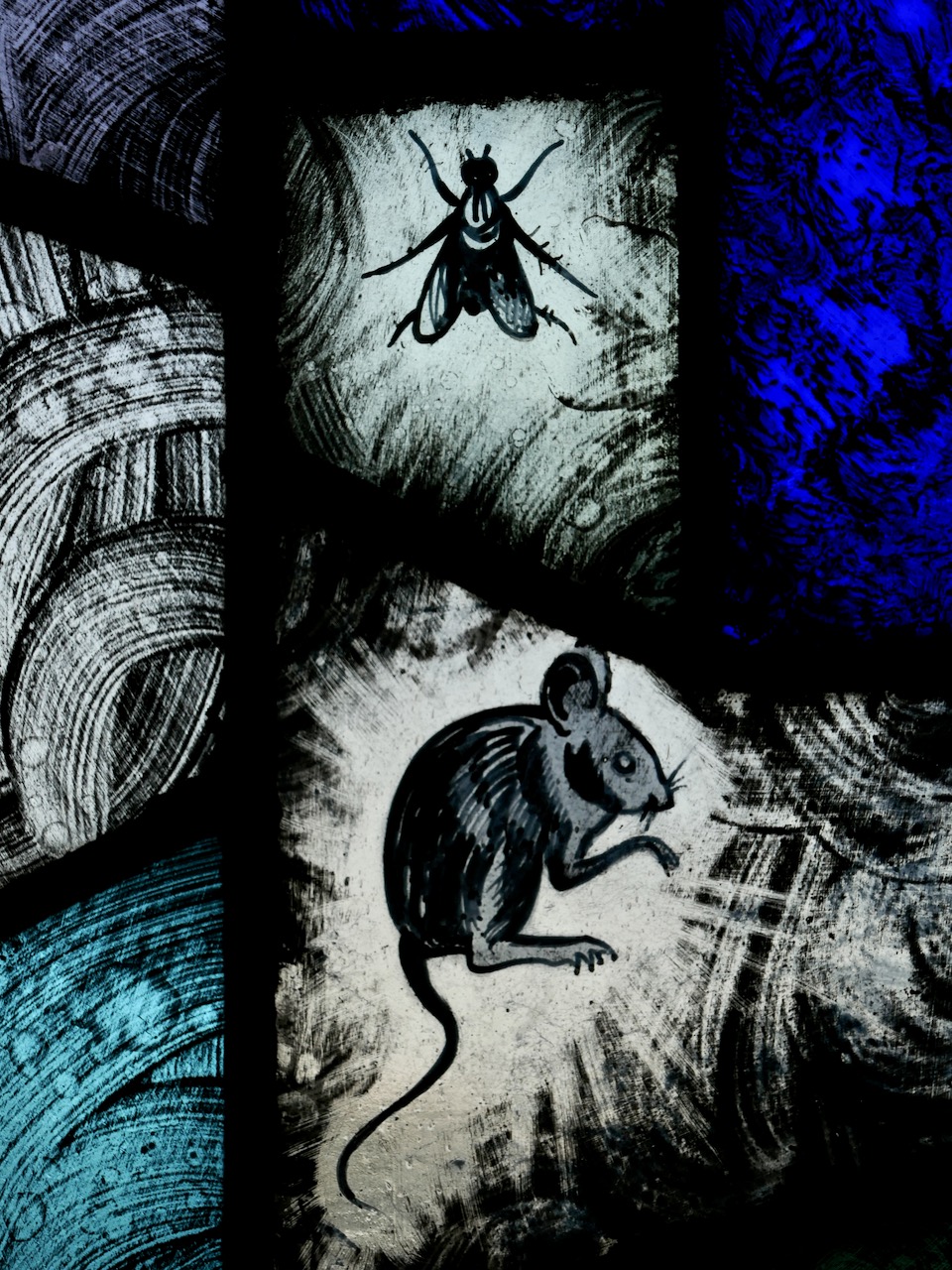
He loves to add in quirky little items that keep you searching through the windows for things that make us smile – pterodactyls and construction cranes, butterflies and elephants, rats and hares, flowers and insects, beehive huts and Brendan with his whale, a postman on a bicycle, water that flows from window to window around the church.

Above: A reference to church renovations. Below: A mouse and a fly are both characters in the story of St Colman Mac Duagh, and these little critters are from his Kilmacduagh window in Tirneevin, Co Galway

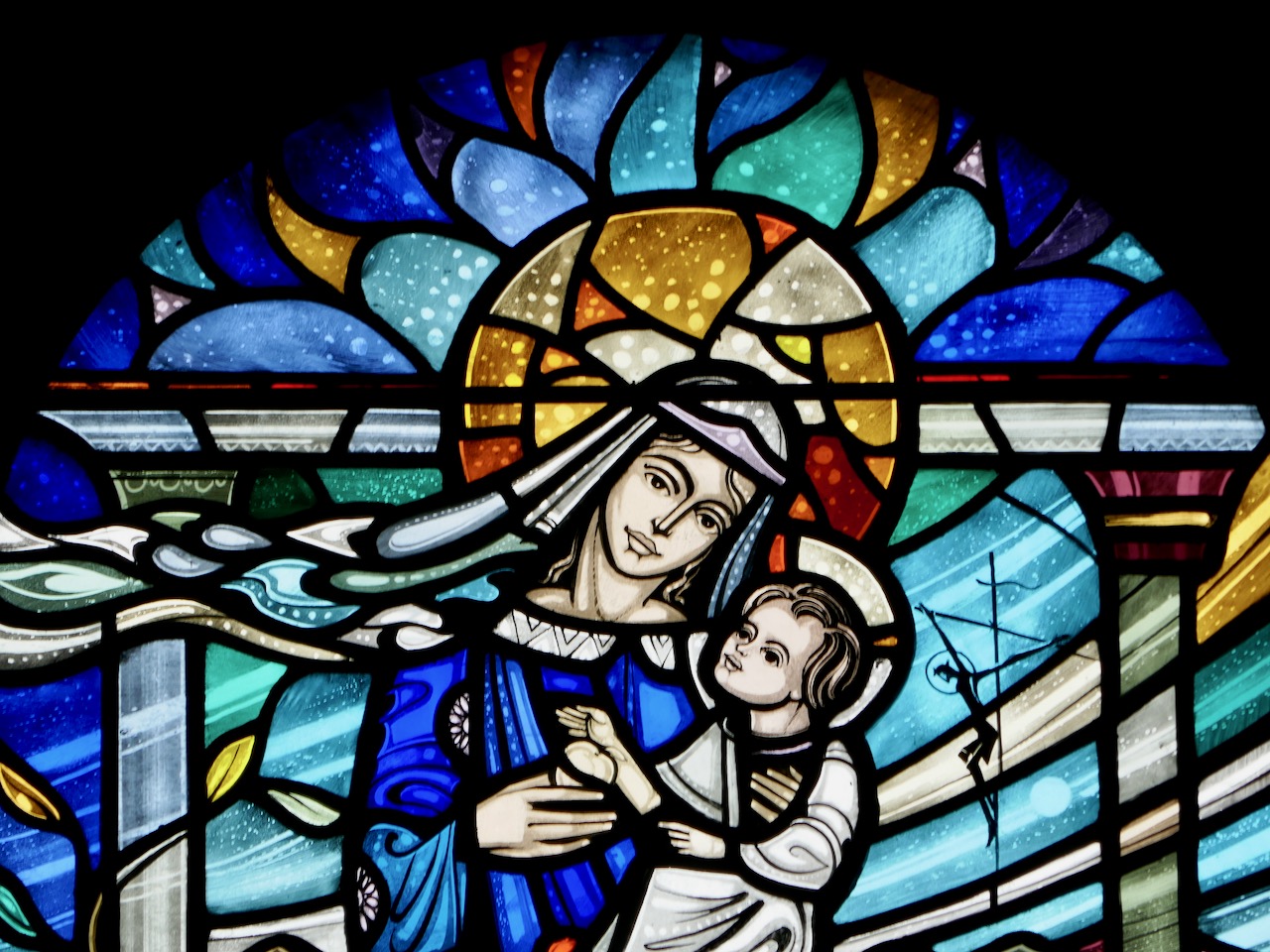
Lately I have come to recognise his model for his Madonna and Child images – in one of his explanations of his windows he refers to the “tender figure of motherhood” and that is exactly what he captures – and the Marian figures always manage to look remarkably like Janet.

And the ultimate project? My friend and relation-by-marriage, David Caron, is bringing out a second edition of the Gazetteer of Irish Stained Glass, and George is to be included. The first edition, long out of print, was written by David, and by Nicola Gordon Bowe and Michael Wynne, both of whom have passed away. The original Gazetteer listed the works of Harry Clarke and the artists associated with An Túr Gloine (The Tower of Glass). David will update this with a listing of artists of the mid- and late-twentieth century who chose to work in stained glass (many of them worked in other media as well) and who made a significant contribution to the art form.

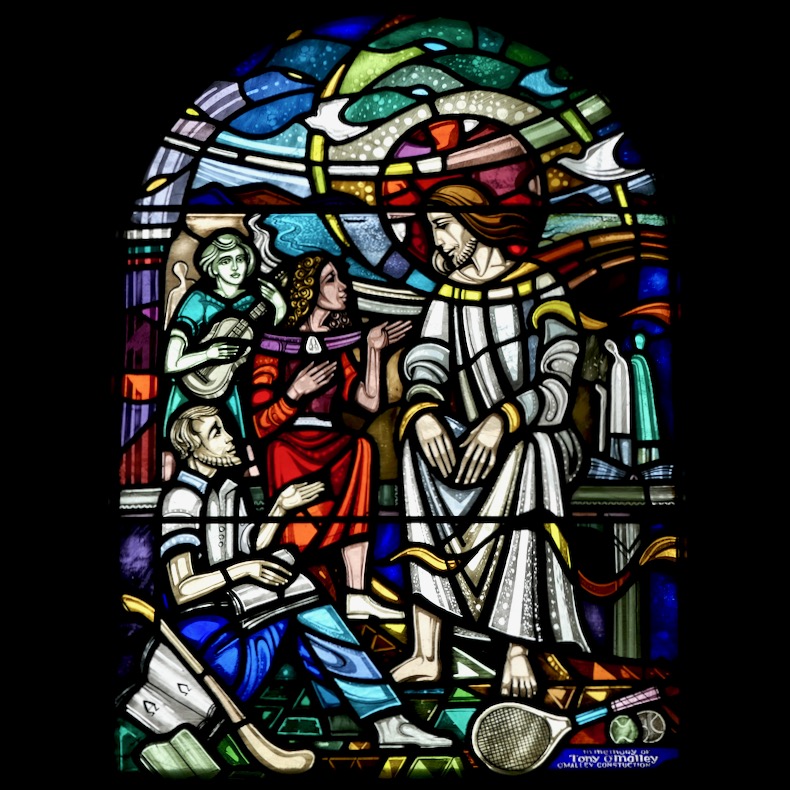
This window is in the National University of Ireland, Galway, Chapel of St Columbanus. It depicts a conversation or debate between students and God

If you’d like to follow David’s progress, he maintains a great Instagram feed as he tracks down stained glass windows all over the place. It’s at Irish Stained Glass and it’s always got something new!

Some of George’s windows are simply enormous. This one is in the Augustinian Church in Galway City

I have taken on the task of documenting George’s windows for this new edition. I’m only part way through my quest – I have several more on my list and keep discovering new ones all the time. George has been amazingly prolific, so much so that he hasn’t kept track of all his windows, so if any of you out there know of any, let me know. I don’t think you will have any difficulty recognising a ‘George Walsh’ if you find one!

George, Imelda and Loretto outside the Gallery (Photo by Stephen Walsh)

Drop into the Trinity Gallery on Clare Street in Dublin if you are in the area – the exhibition runs until the 19th of March. But if you can’t make it to that, there are at least two examples of his work in West Cork – the famous Eyeries windows that turned us on to all this in the first place, and a more recently discovered set in the little country church of Darrara, near Clonakilty.

St Michael window from Darrara, near Clonakilty

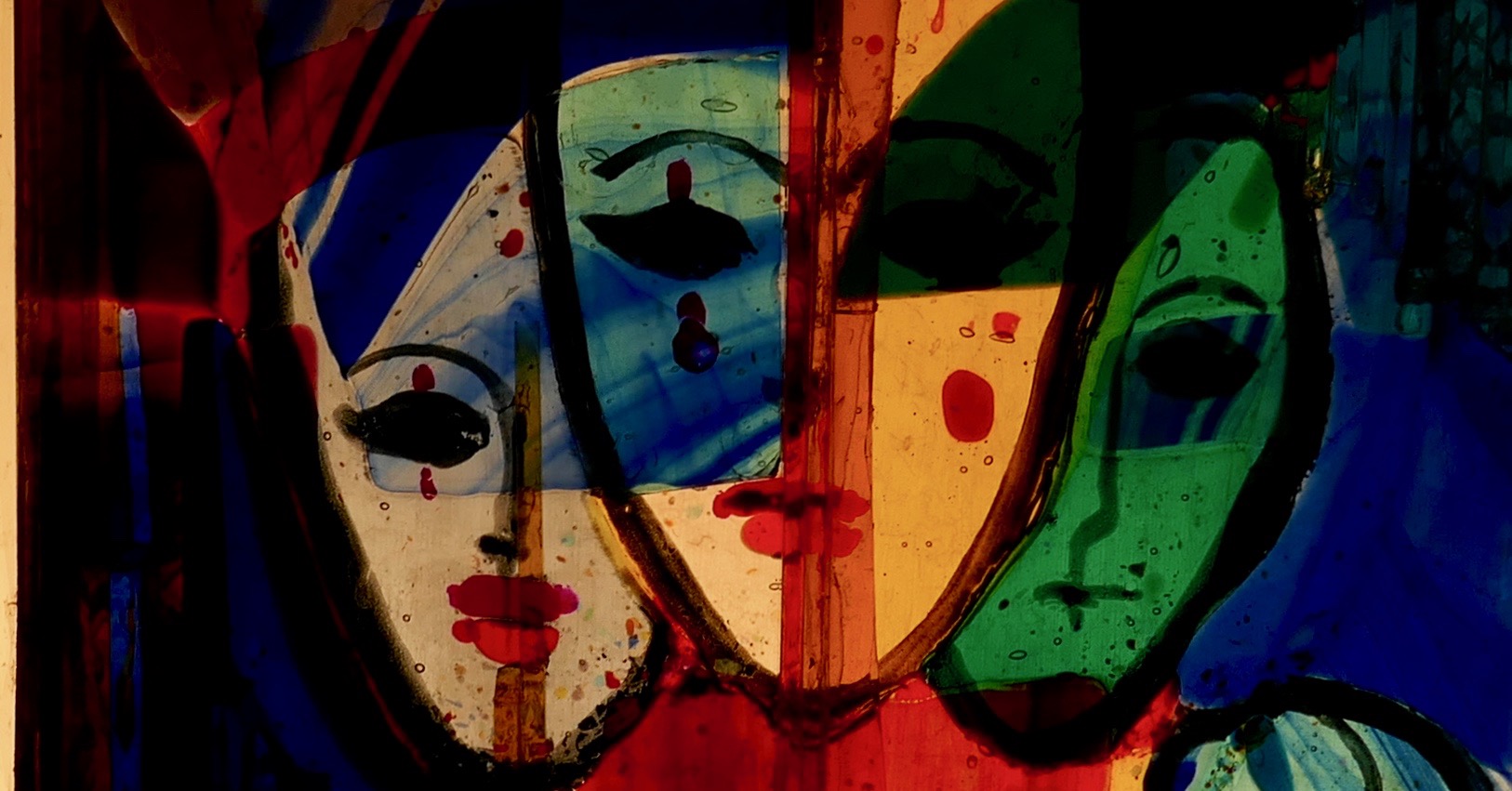
I will leave you with one of George’s exhibition pieces, below, just to remind you that there is more, much more, to stained glass that what we see in churches. It is a complex medium, difficult to master, but so rewarding in the hands of a true artist/craftsman. This one was titled Masks and reflects his love of all things Venetian.