Harry Clarke’s Brigid

Harry did several wonderful St Brigid windows, and included Brigid as a saint in larger scenes. There are also Brigid windows attributed to him that he actually didn’t do, but that’s a blog for another time. Today I want to give you a flavour of his take on Brigid, because this was a saint that must have been especially meaningful to him – his mother was a Brigid!
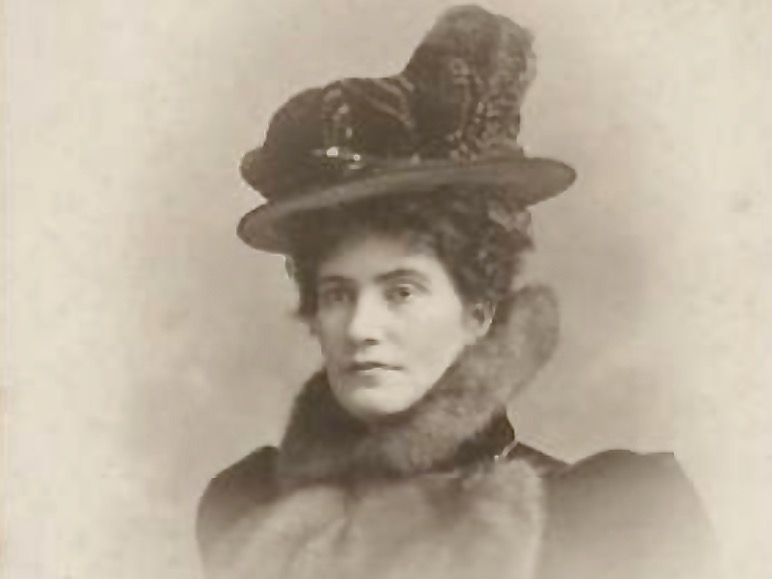
Brigid (sometimes given as Bridget) MacGonigal was born in Sligo and married Joshua Clarke, then an up-and-coming church decorator in Dublin and they had four children. Harry, their third child arrived in 1889. Brigid was never strong and died in Bray in August 1903, leaving her family bereft. Harry was 14 and that year marked the end of his schooling at Belvedere as he and his older brother Walter joined the family business to help run it. Harry was a sensitive child and it is likely that he missed and mourned his mother for many years. He also inherited her weak lungs and struggled, as she did, with his health.
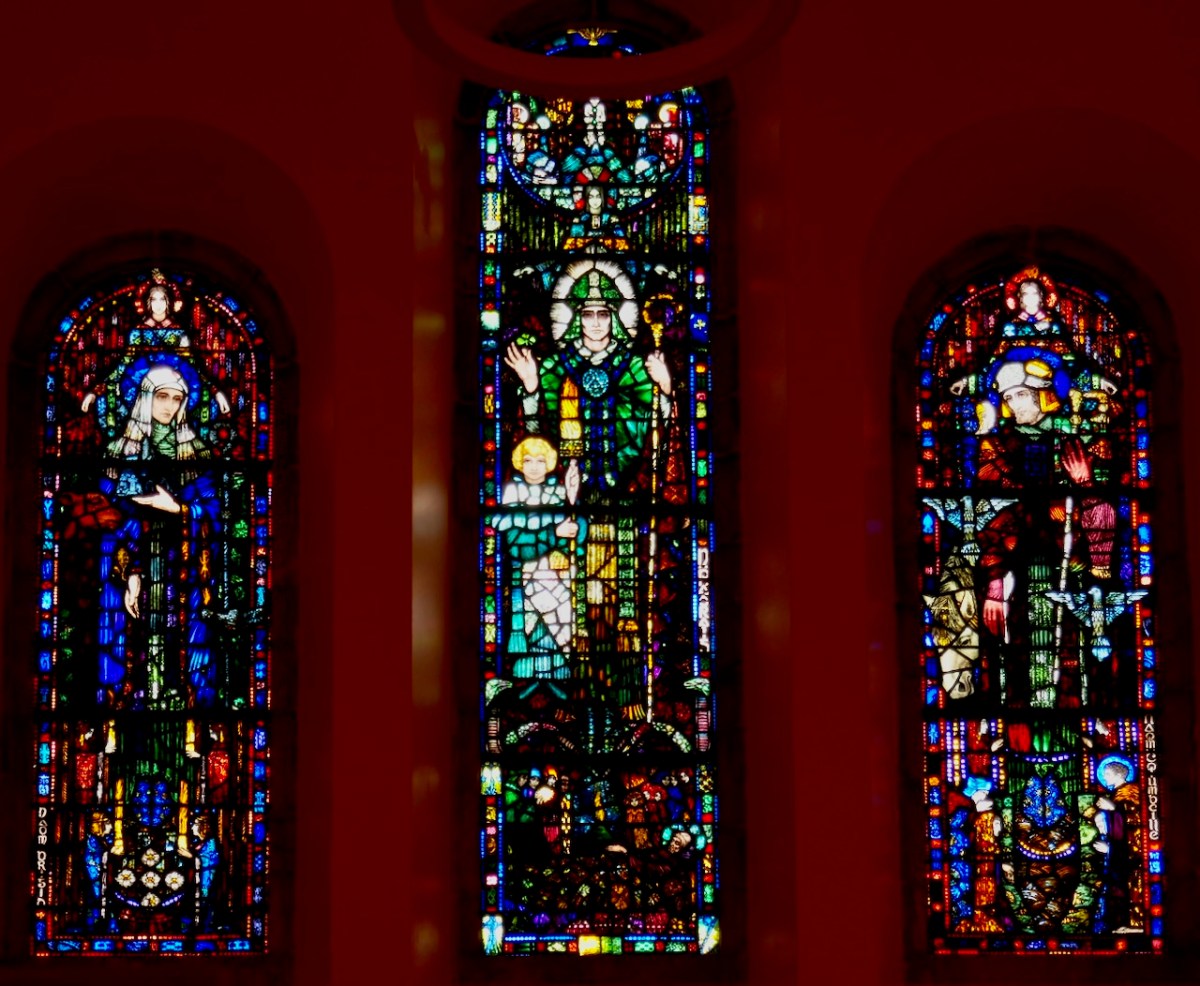
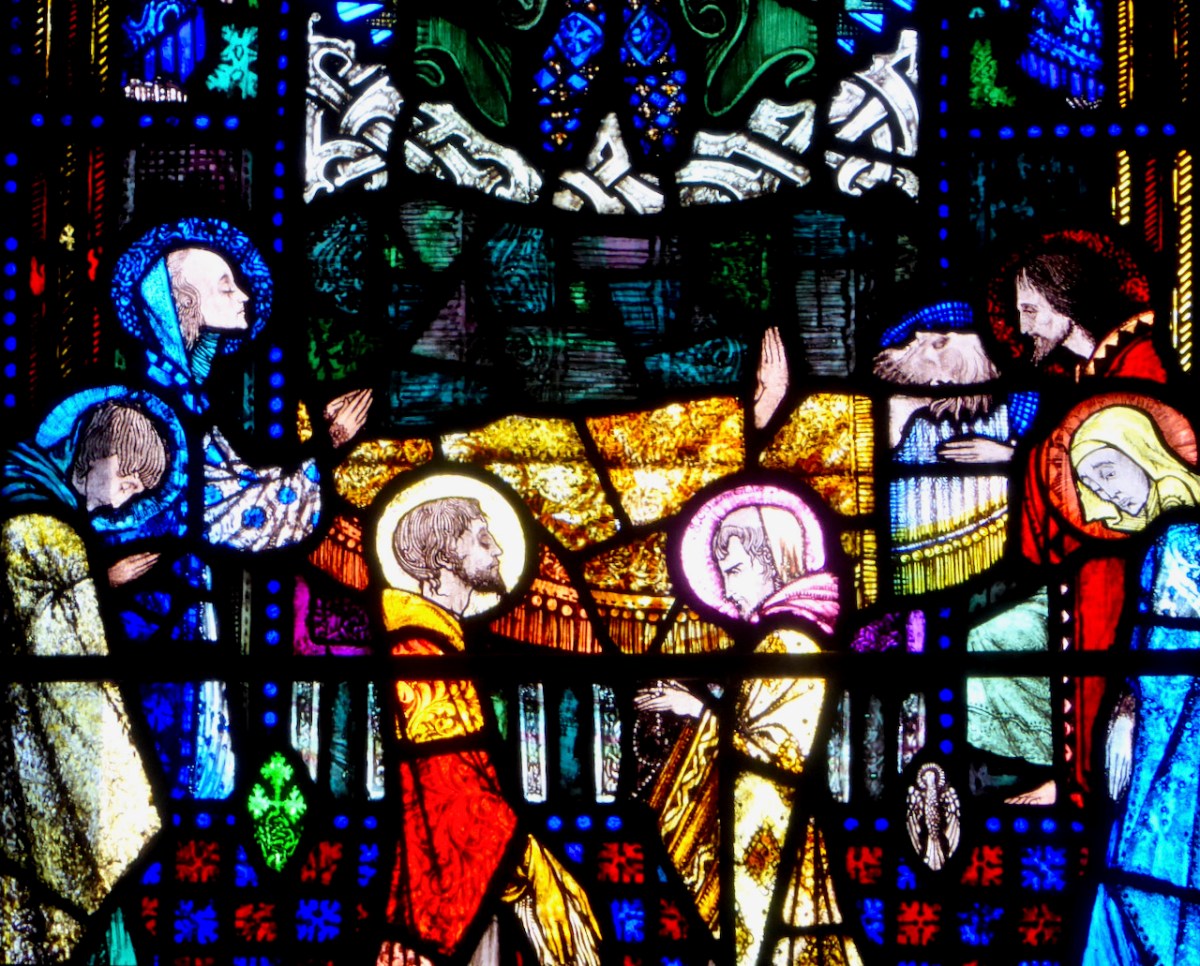
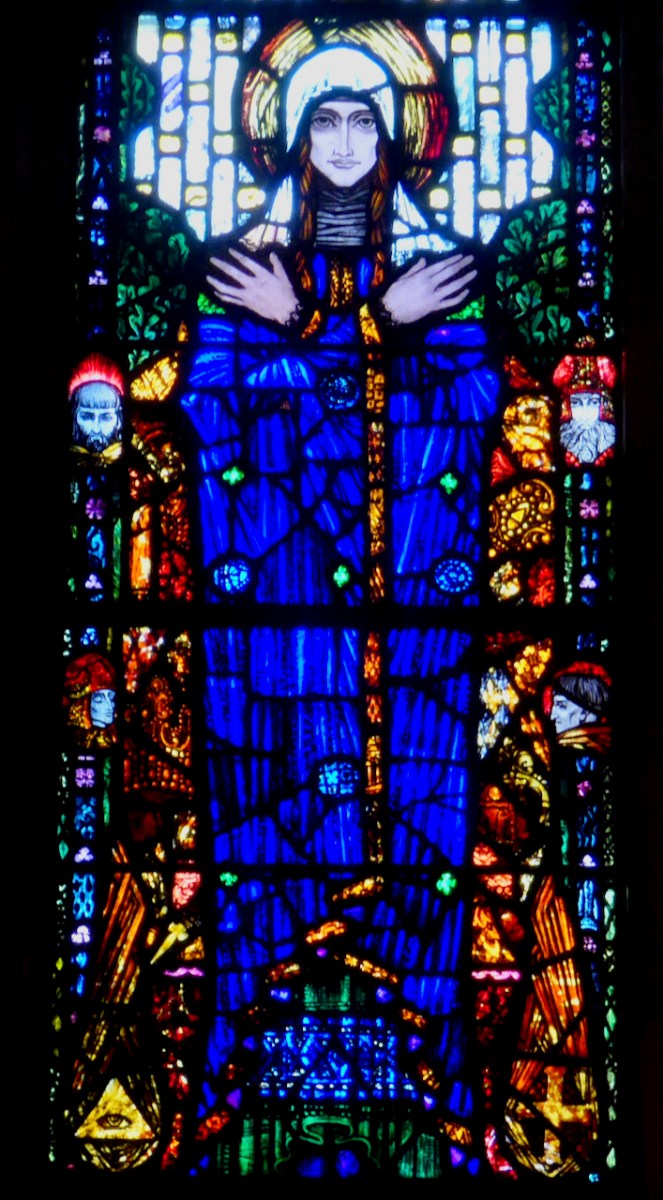
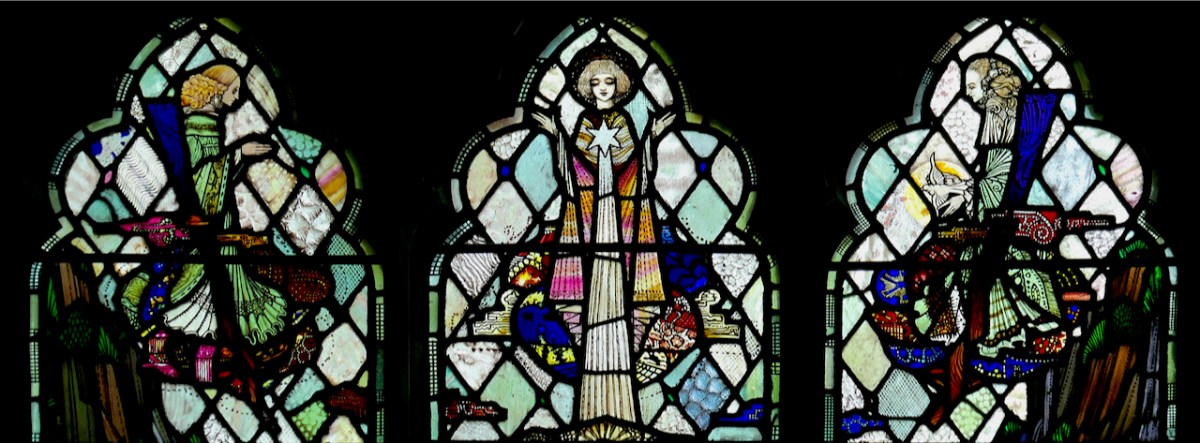
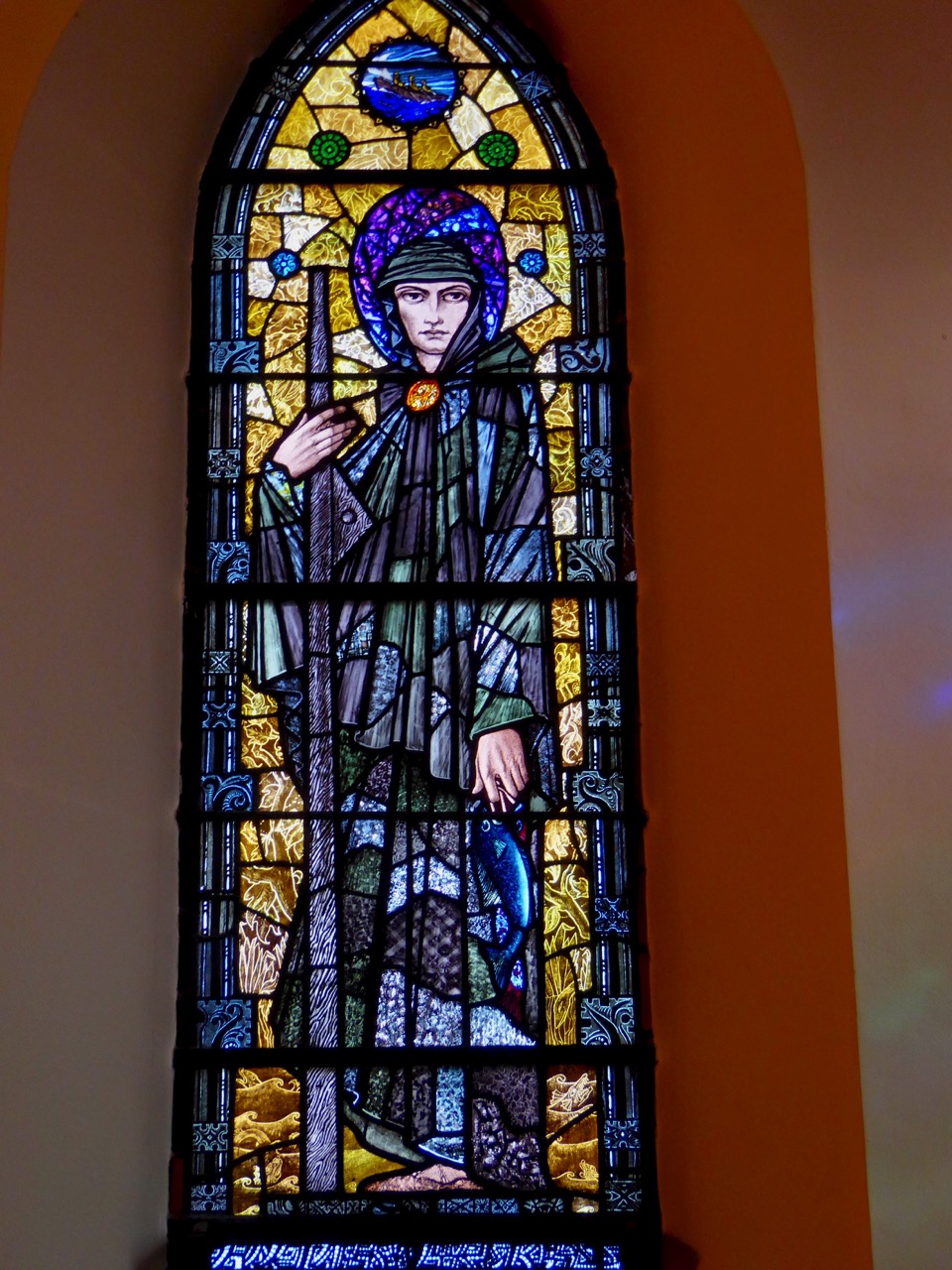
I will start with the place that launched Harry’s career, the Honan Chapel at University College Cork (I’ll finish with the one that is on my lead photo). And in fact it is his first windows for that Chapel – a three light, depicting Brigid, Patrick and Columcille, our three Patron Saints. This window is over the entrance, facing west, which, with Harry’s preference for dark colours and some internal lighting issues in the chapel, makes it hard to photograph.
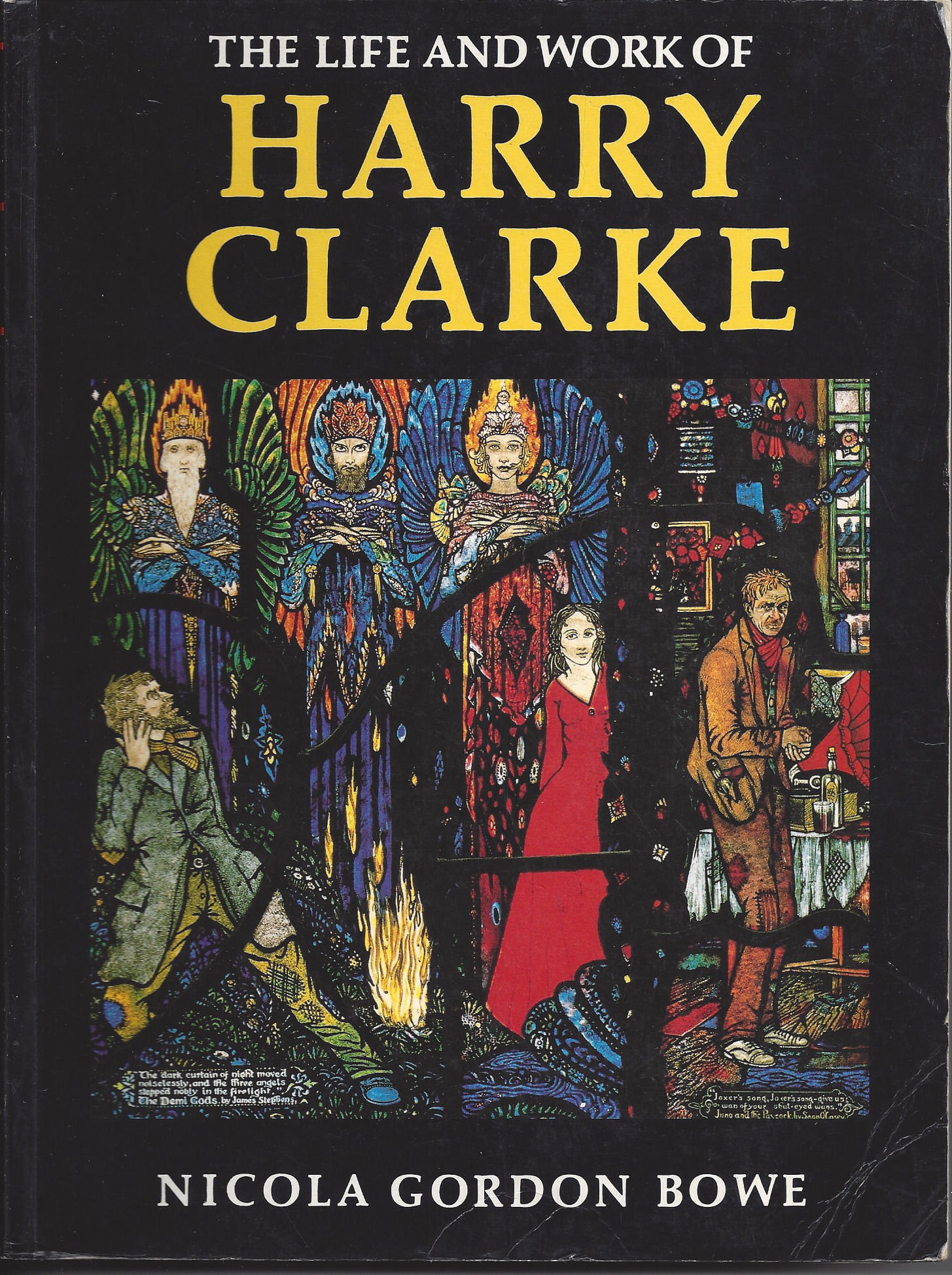
Harry had completed a detailed sketch design for this window in 1914 (Nicole Gordon Bowe has an image of that design in her magnificent The Life and Work of Harry Clarke) and the window was made in 1915. There are a few differences between the sketch design and the finished window, but on the whole, the window is true to Harry’s original vision for it. His notes for the window refer to 

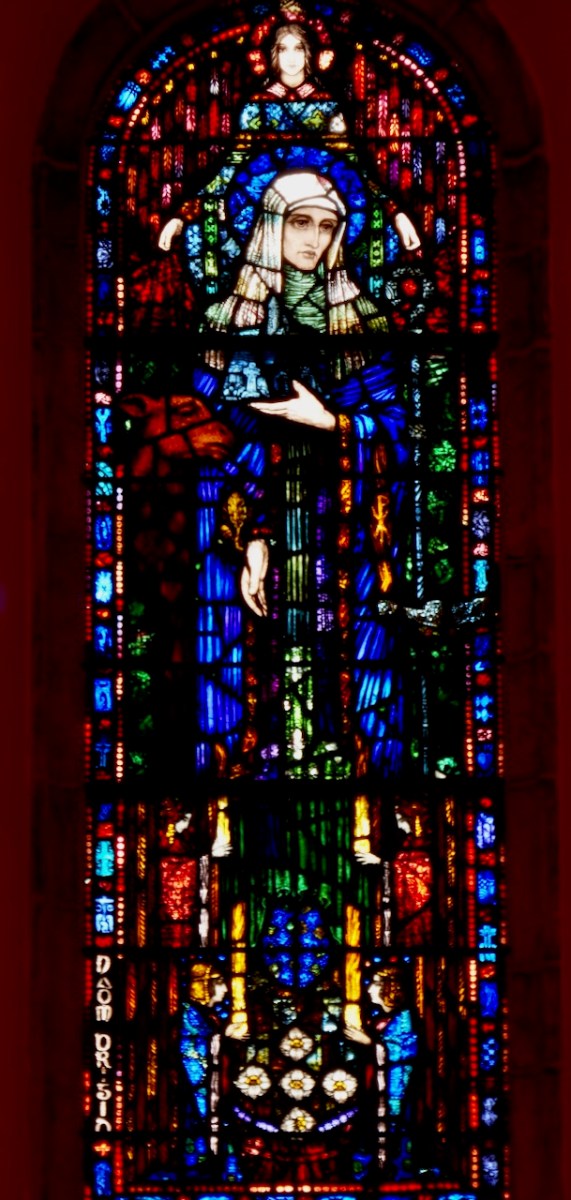
Top: The Angel with the cloth of heaven forming background

The Figure: With emblems – the church, the inextinguishable spiritual lamp – the calf and the oak.

The Base: Are four angels carrying the prayers, prophesies, miracles and charities of St Brigid, also are shown the five lilies – she has been called the Mary of Ireland and these lilies symbolise the five provinces of Ireland over which she held spiritual control.
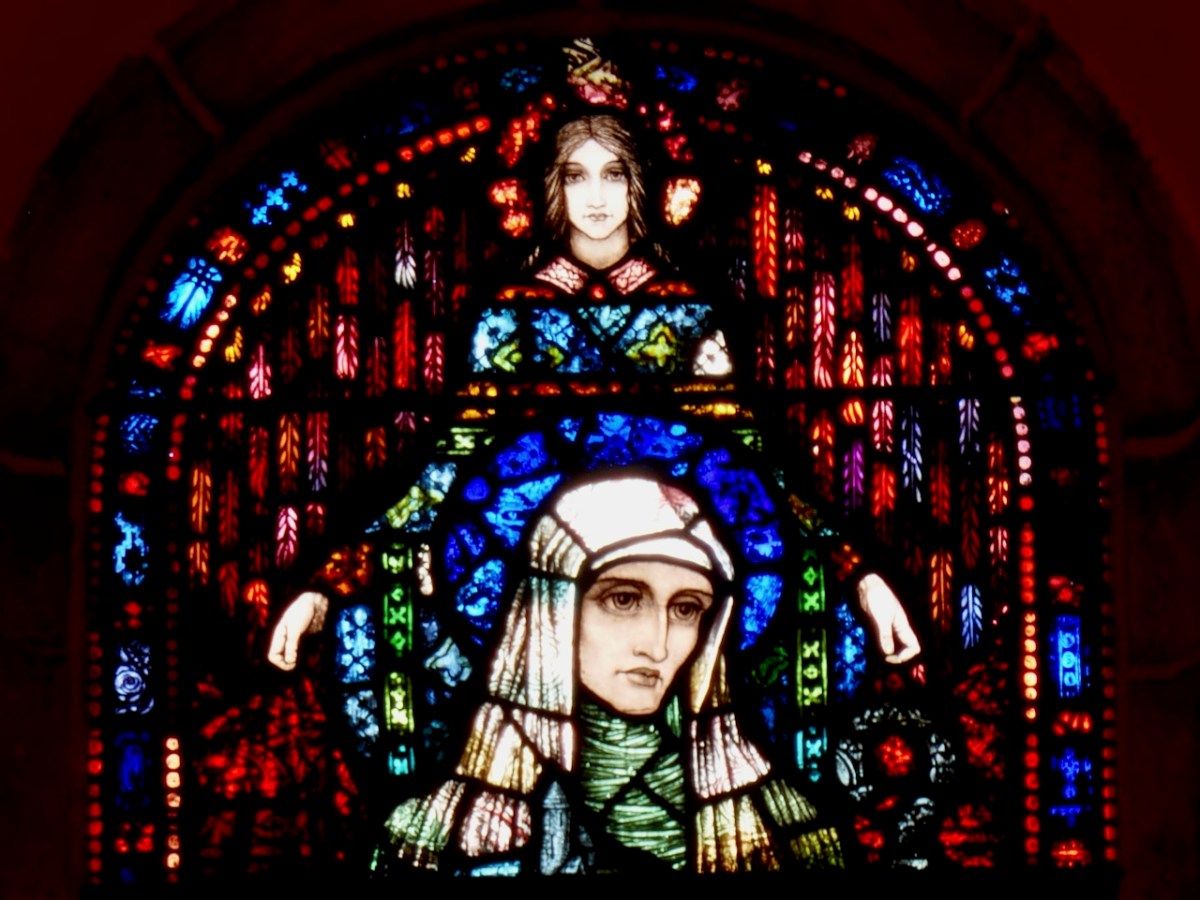
The cloth of heaven has been imagined as fronds in deeps reds, while St Brigid is shown as mature, wise and compassionate. She is holding a church which looks a lot like St Kevin’s Kitchen in Glendalough. In her other hand is a brown oak leaf, threaded through her fingers. The calf peers out from her right side. As befits a Mary of the Gael, she wears a deep blue robe. 
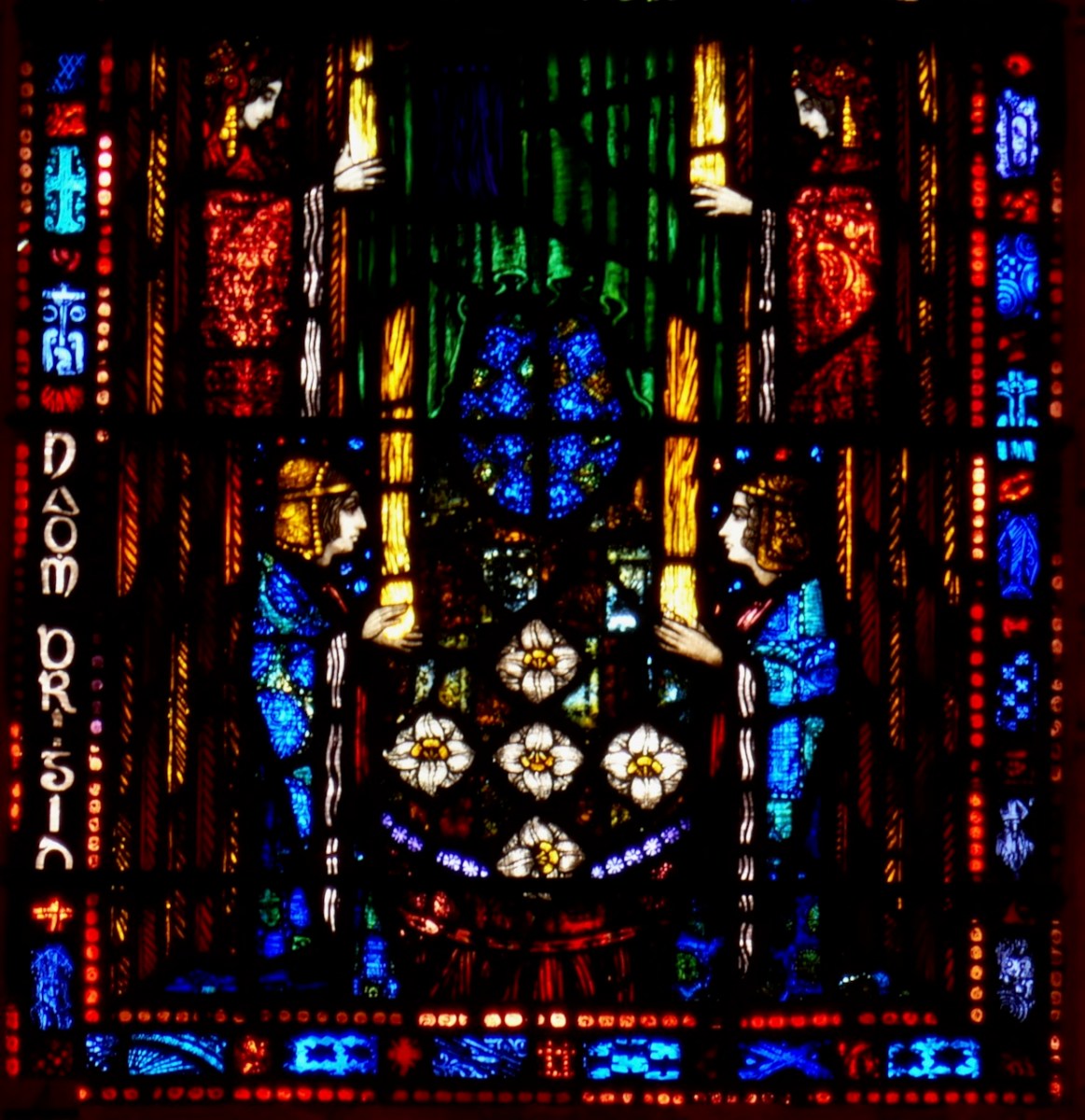
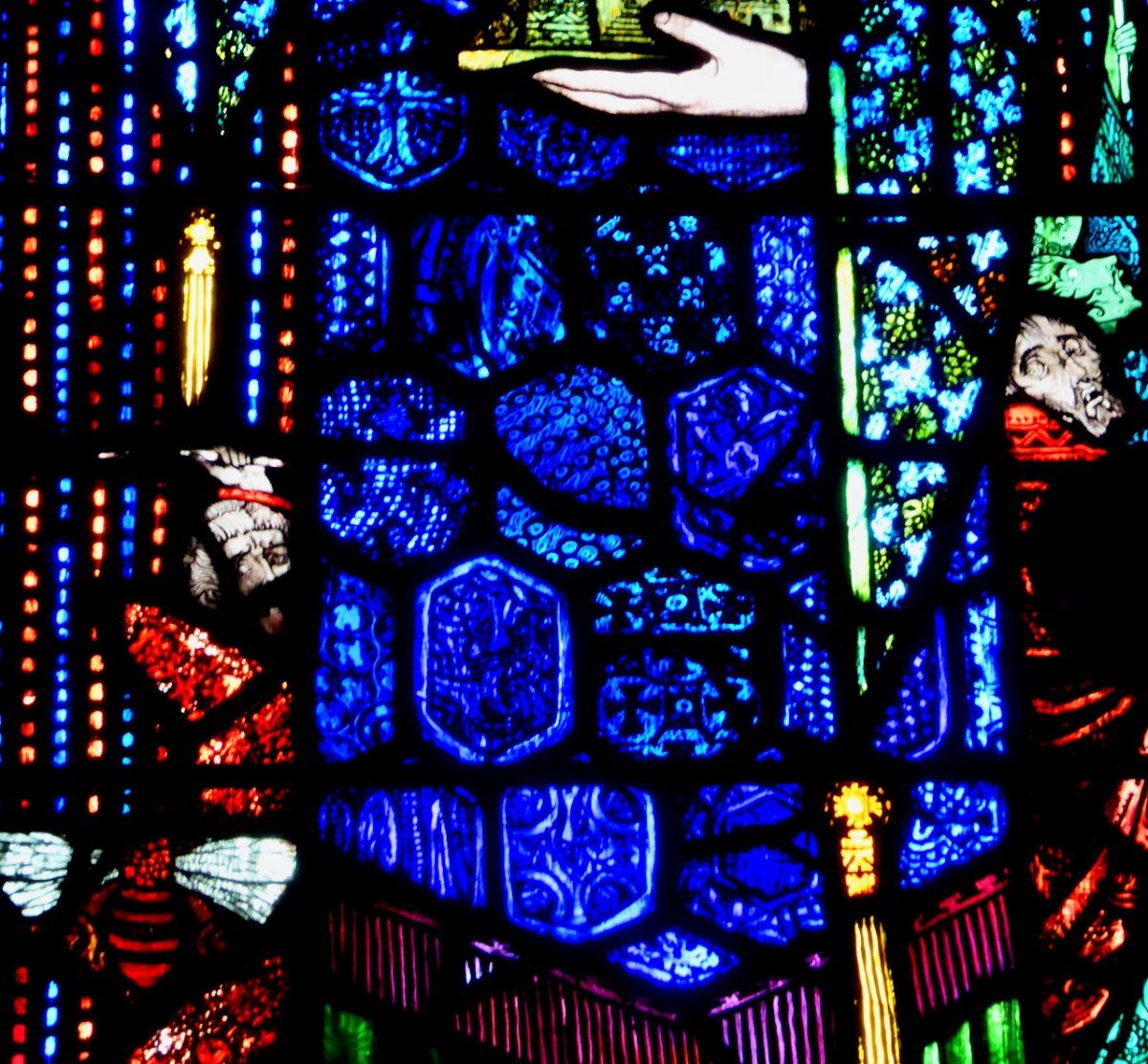
The predella (lowest section, above) shows four angels, but what they are carrying are torches – a reference to the spiritual lamp and the fire associated with Brigid. The symbols of the five provinces, recognisably lilies in the sketch design, have changed to another flower I can’t name. Note the tiny details, though – the crucifixion scene in the borders on the left and the right. The other detail to note here is that the fingers, of Brigid and the angels are ‘normal’ – Harry has not yet developed his signature long tapering fingers and pointed sleeves (among the idiosyncratic elements he called his “gadgets’).
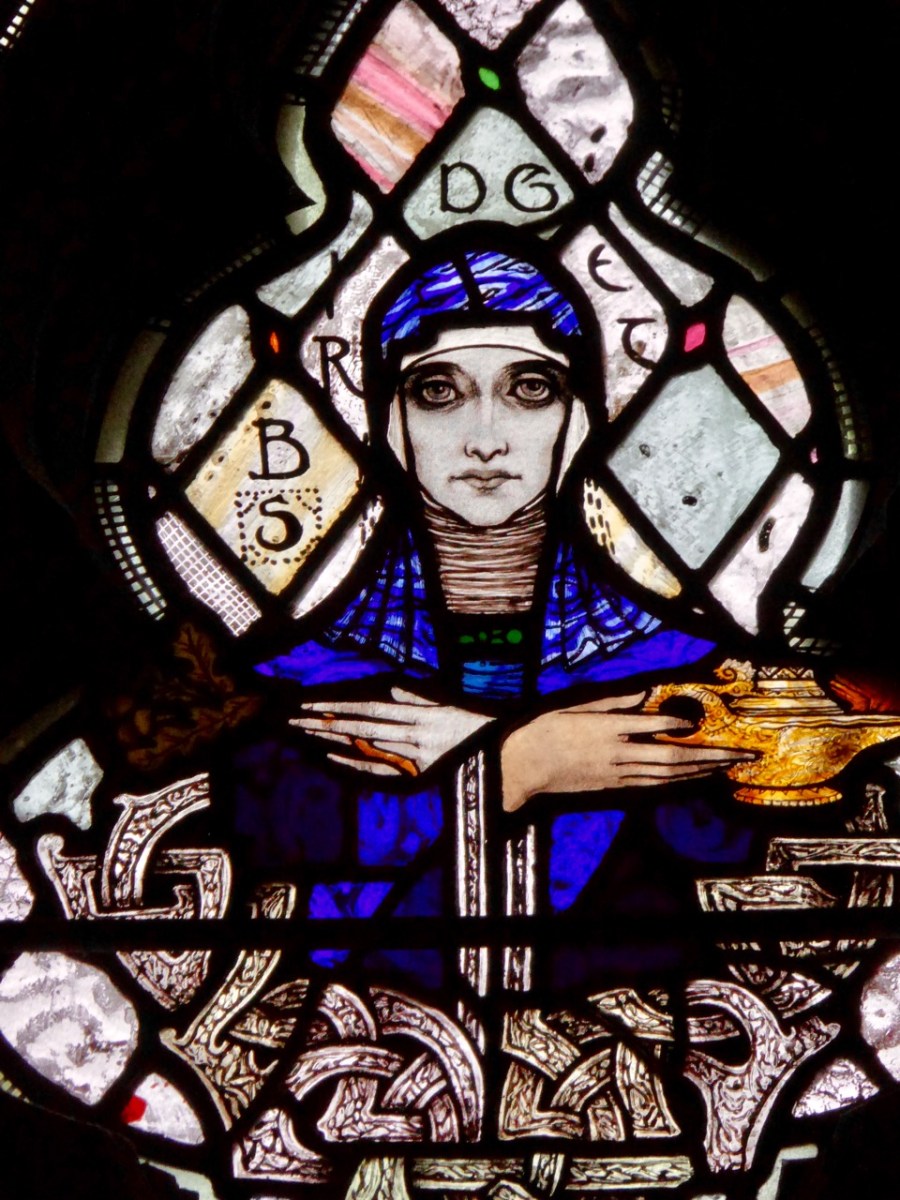
His next Brigid (above) was for the Nativity window in Castletownsend – I have written about that window extensively here so pop over and have a browse if you fancy. The Castletownsend Brigid, done in 1918, looks quite similar to the Honan Brigid and has the same oak leaf entwined in her fingers. The difference is that she is carrying the sacred lamp, has the Harry Clarke fingers, and is spelled S Bridget – the English version rather than the Irish Naomh Brighid of the Honan. [For non-Irish speaking readers – the small dot on top of consonants in Irish is now normally rendered as H – as in Briġid is now Brighid.]
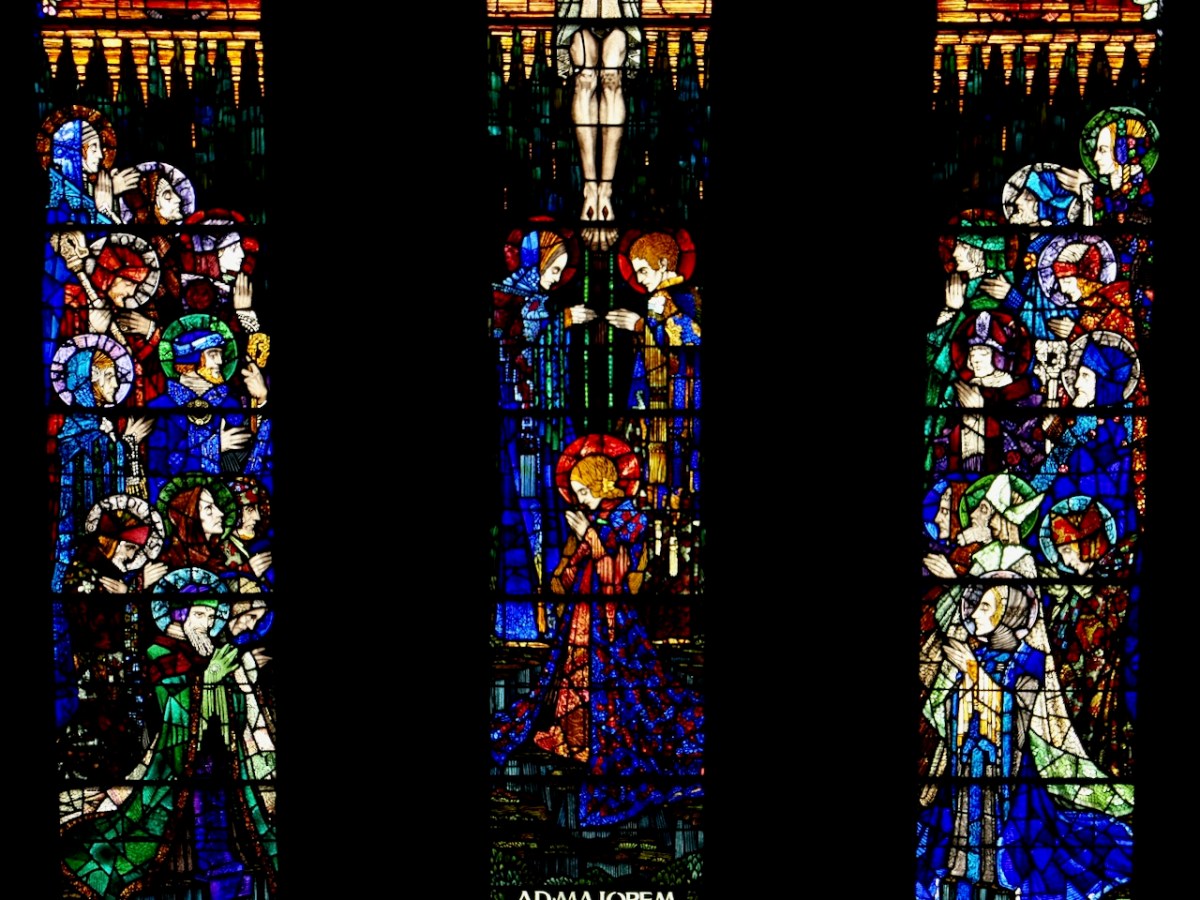
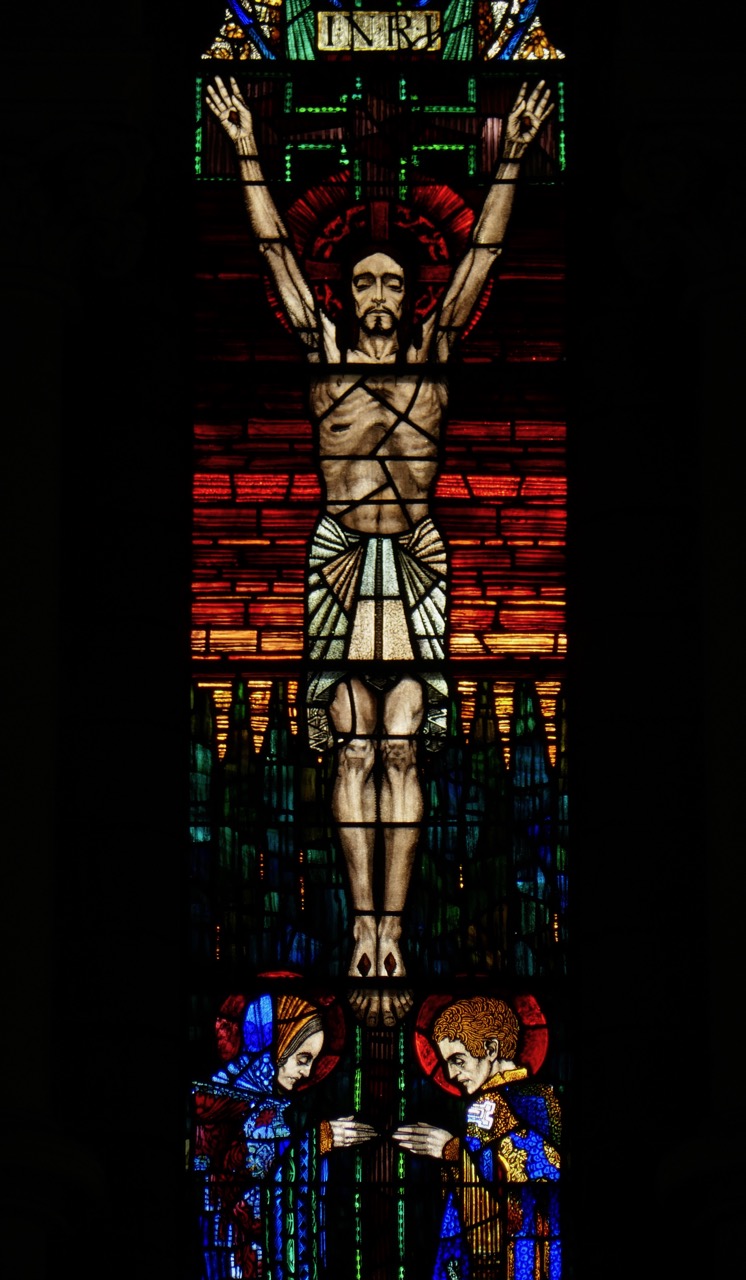
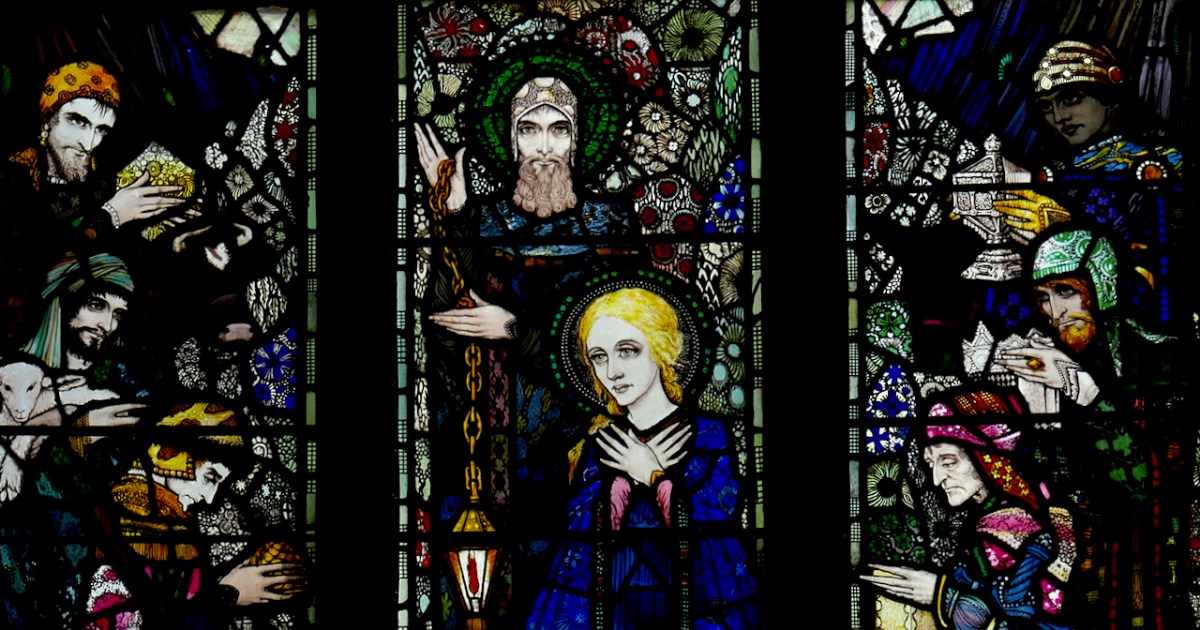
The next two windows, Terenure (above and below, details) from 1920 and Cloughjordan from 1924, show Brigid among a host of other saints. In Terenure the subject of the large window is The Crucifixion and the Adoration of the Cross by Irish Saints, and this is a large, three-light window behind the main altar. The saints are not all easy to identify, despite having their names in their haloes, but first and foremost among them are Patrick on the left and Brigid on the right.
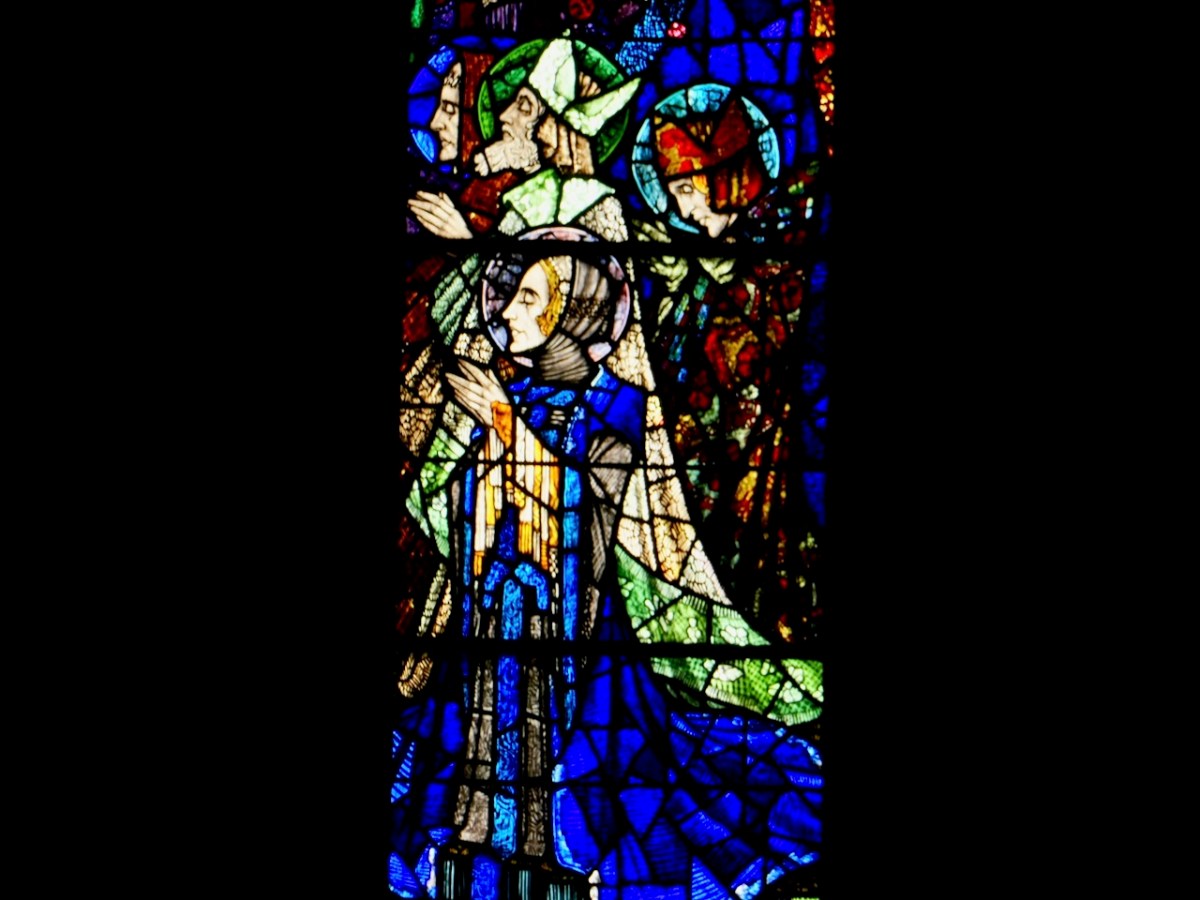
Brigid is dressed in a blue robe which drapes on the ground around her, and has a golden trim to her sleeves.
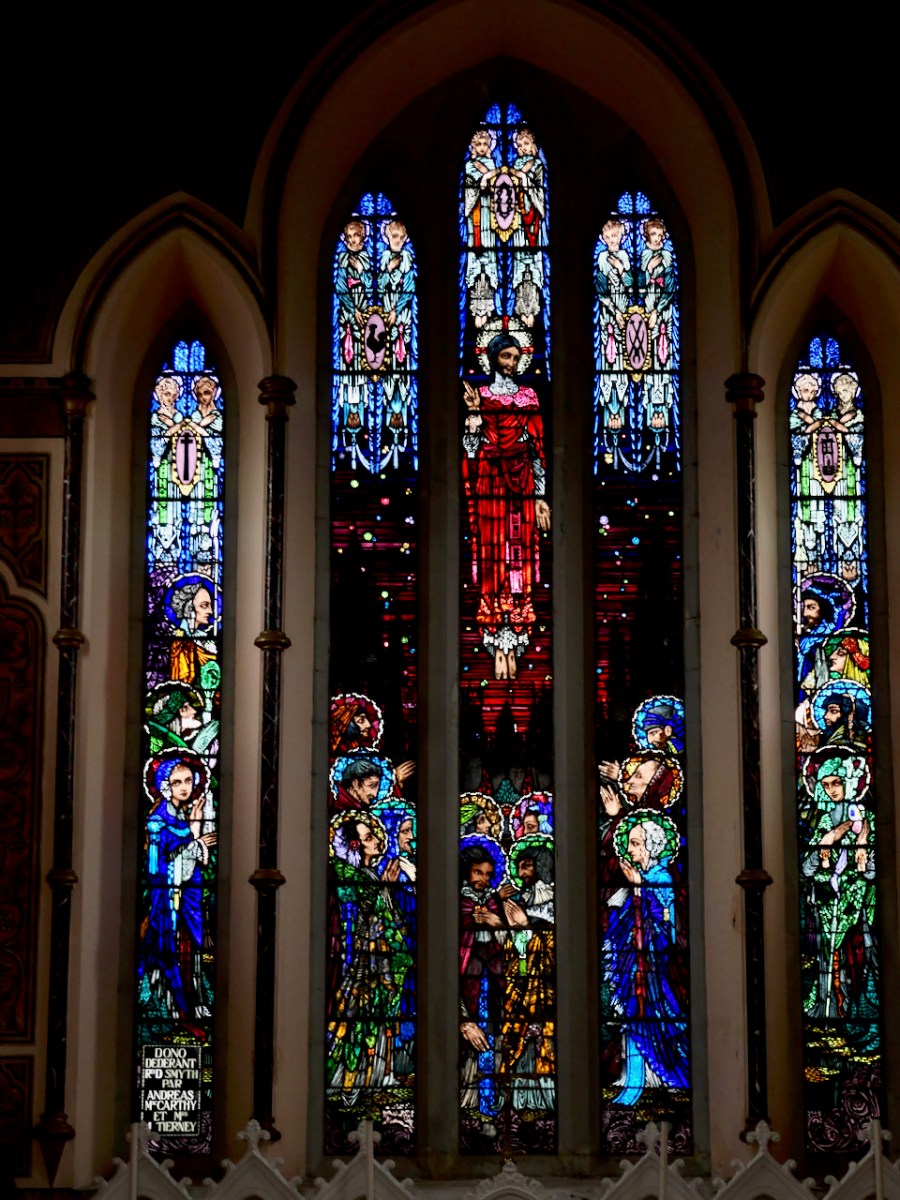
In St Michael and St John’s Church in Cloughjordan, Co Tipperary, the theme of the large, five-light, window is The Ascension with Irish Saints and St Michael and St James. Gordon Bowe designates this one a Harry Clarke (B). That means that this window was initially conceived and designed by him but executed by his studio under his close supervision. This is the first window we have come across, in this series, that is not wholly Harry’s own work, and this is a measure of how busy the Studios had become with Harry at the helm. 
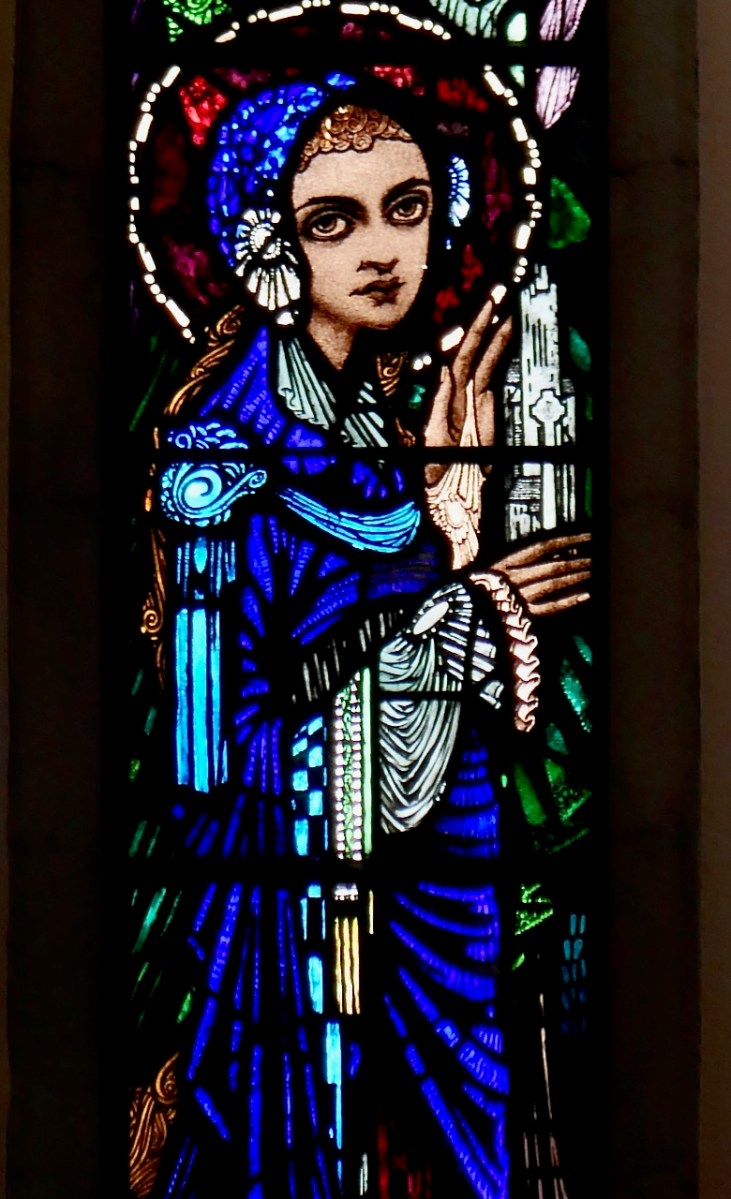
As in Terenure, Brigid is here as one of the Irish saints. She is depicted as very young, wide-eyed, and carrying a church which now looks more medieval than Romanesque (neither would have been appropriate to her era) and is probably a nod to the Cathedral in Kildare.
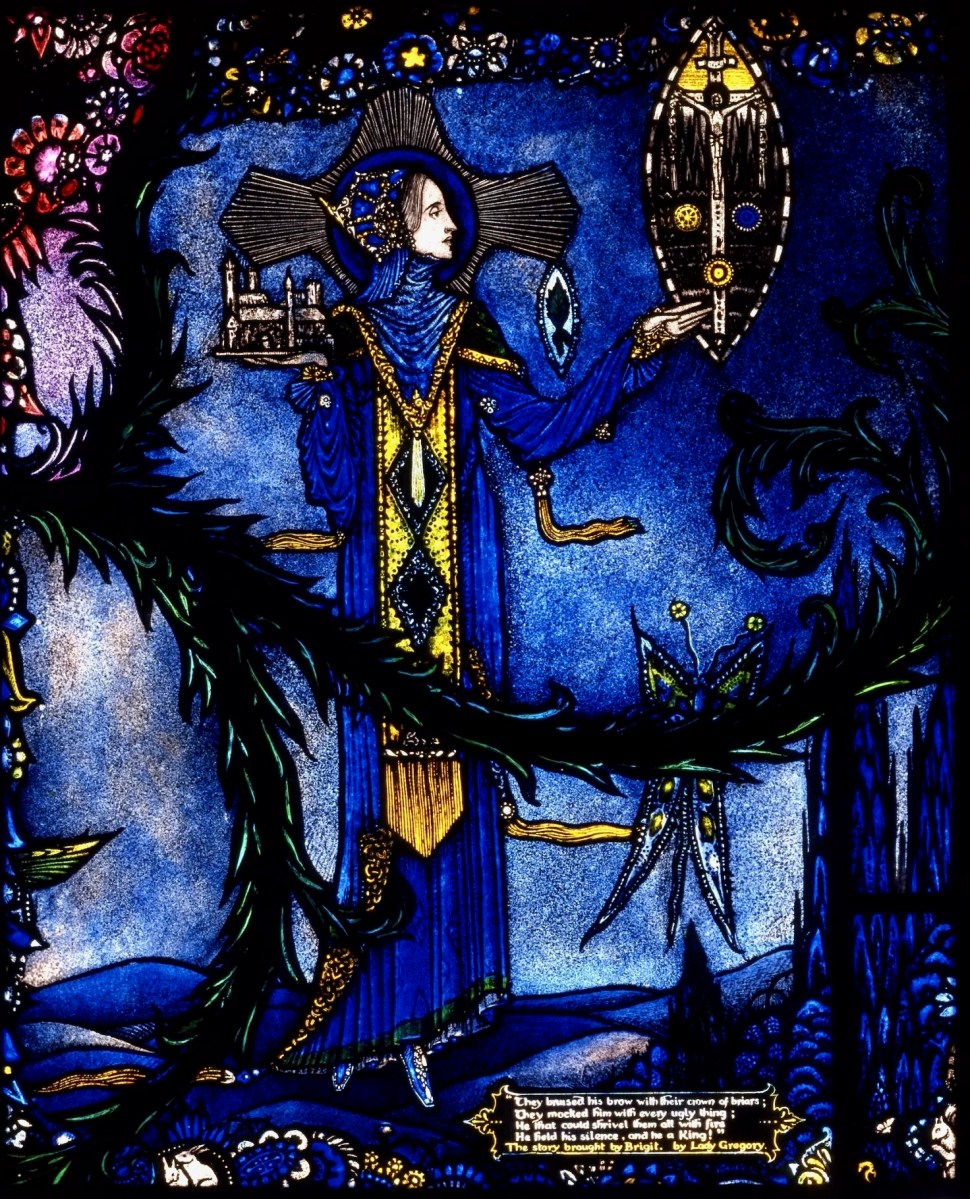
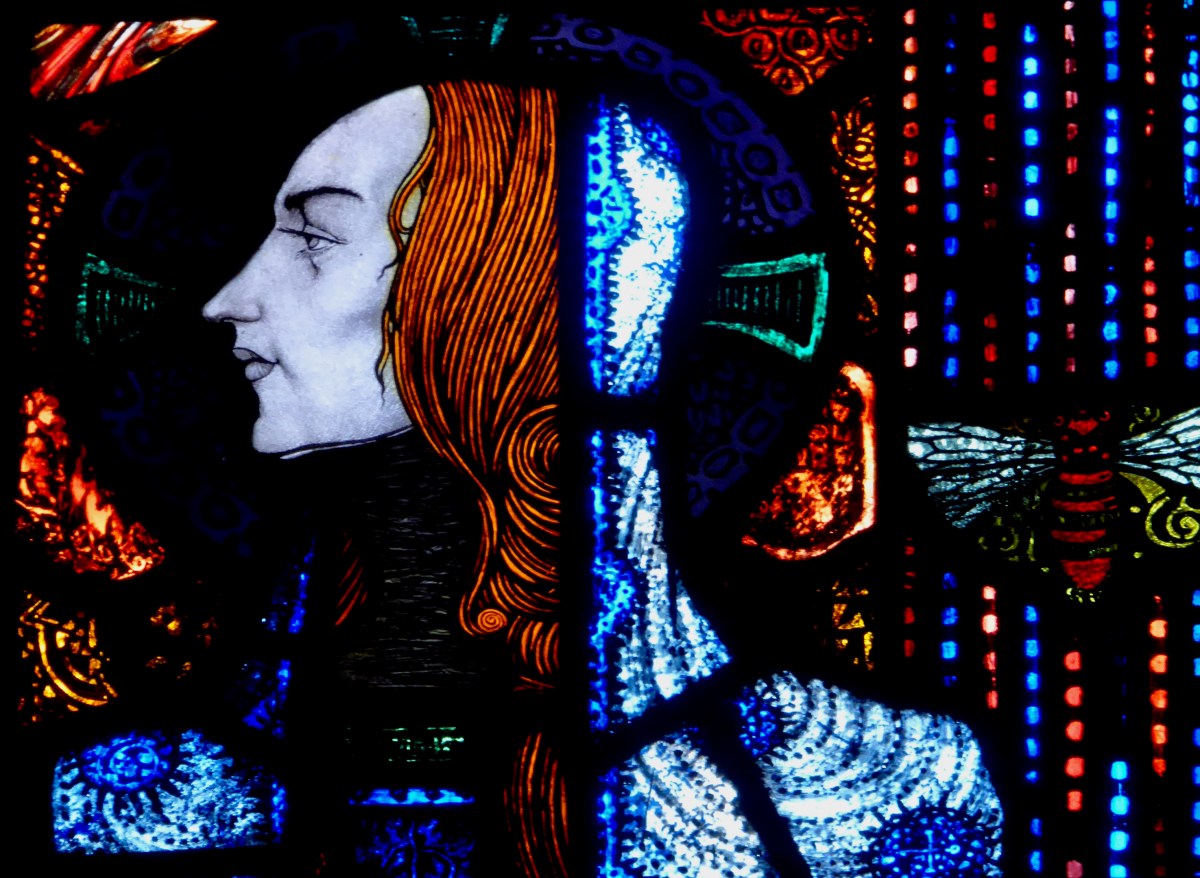
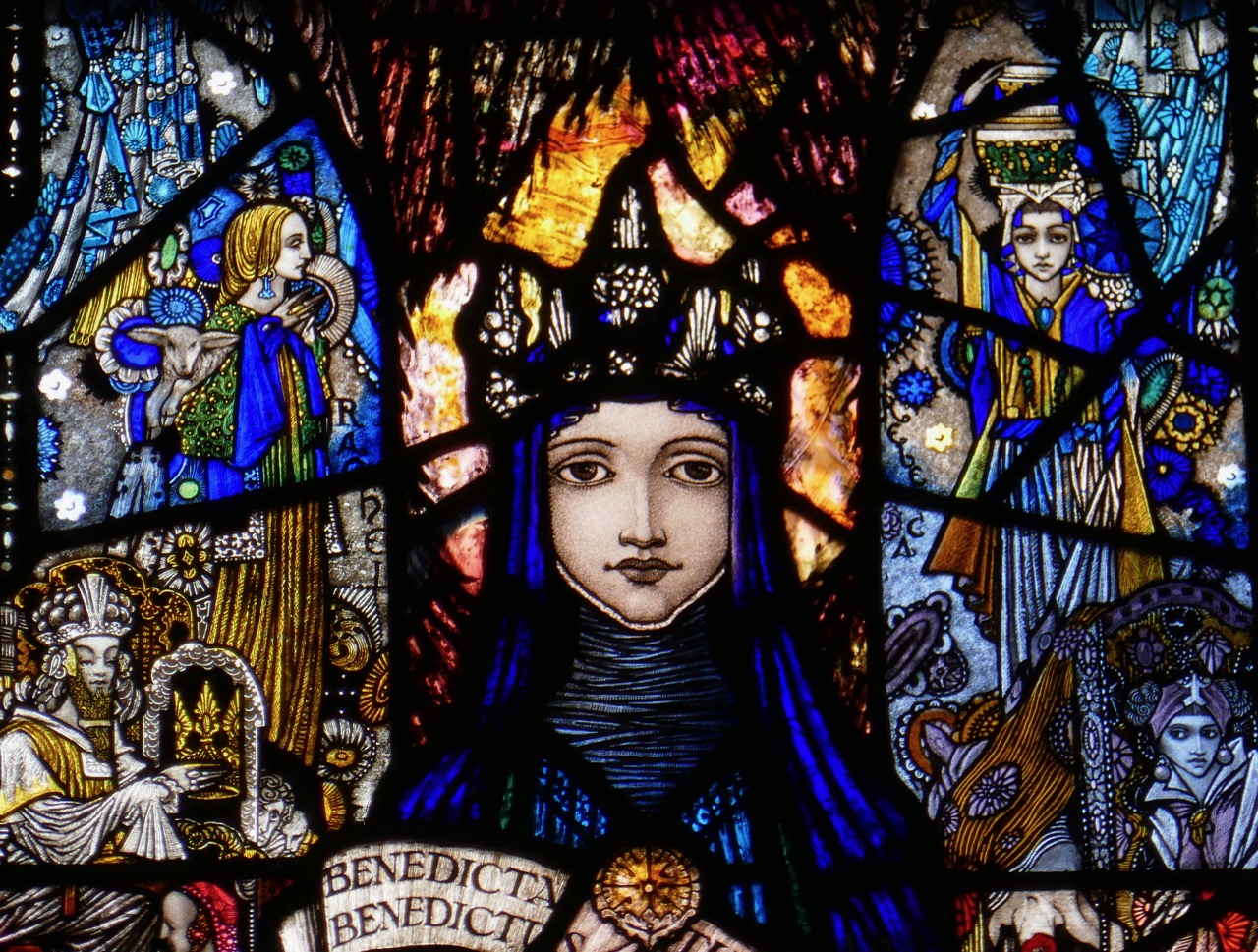
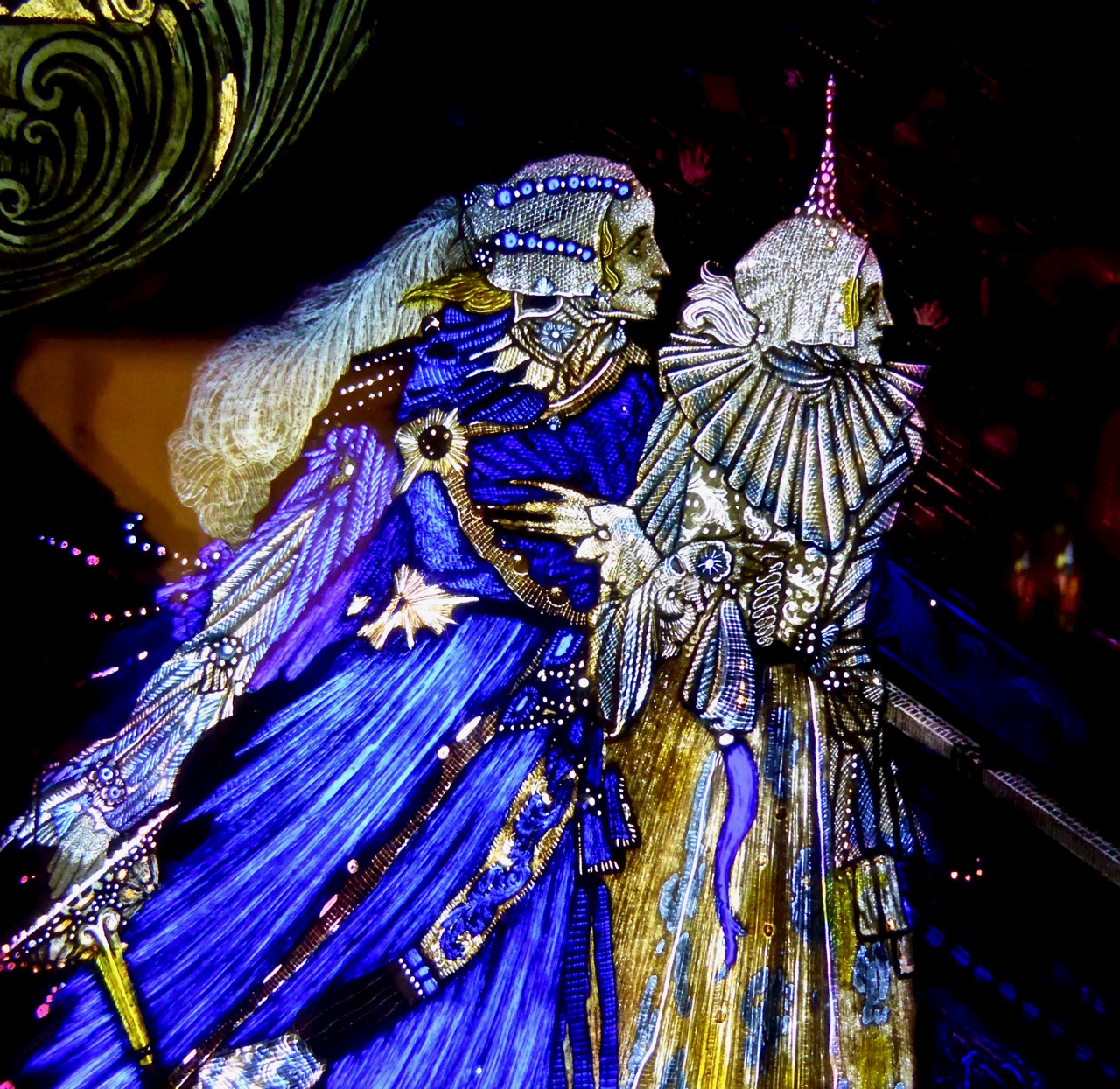
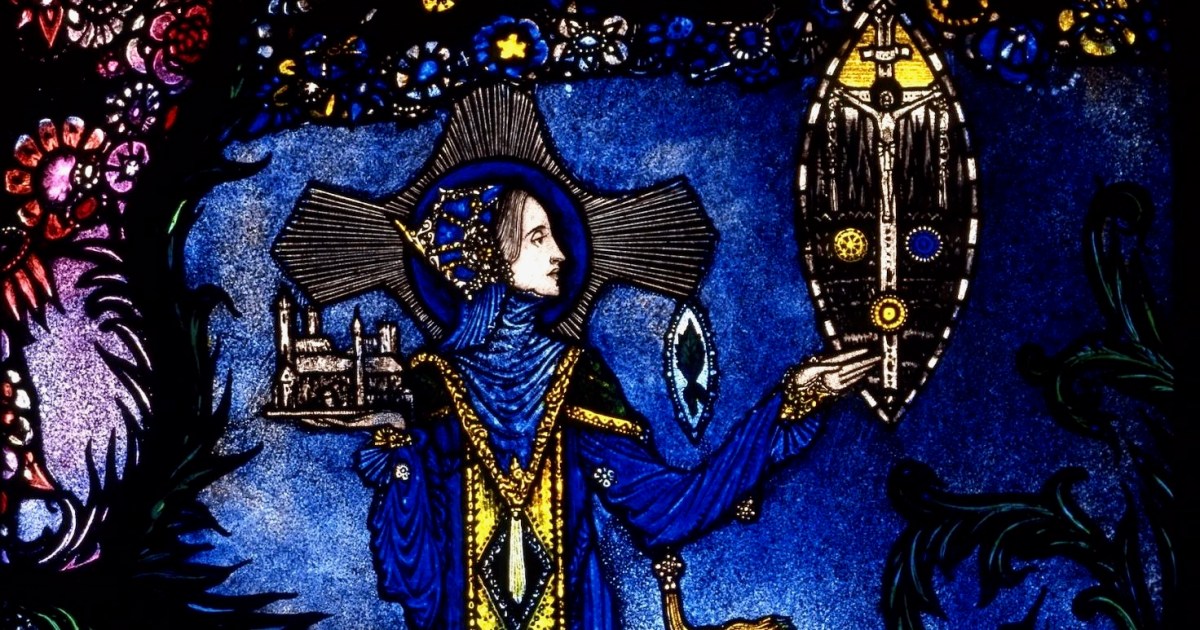
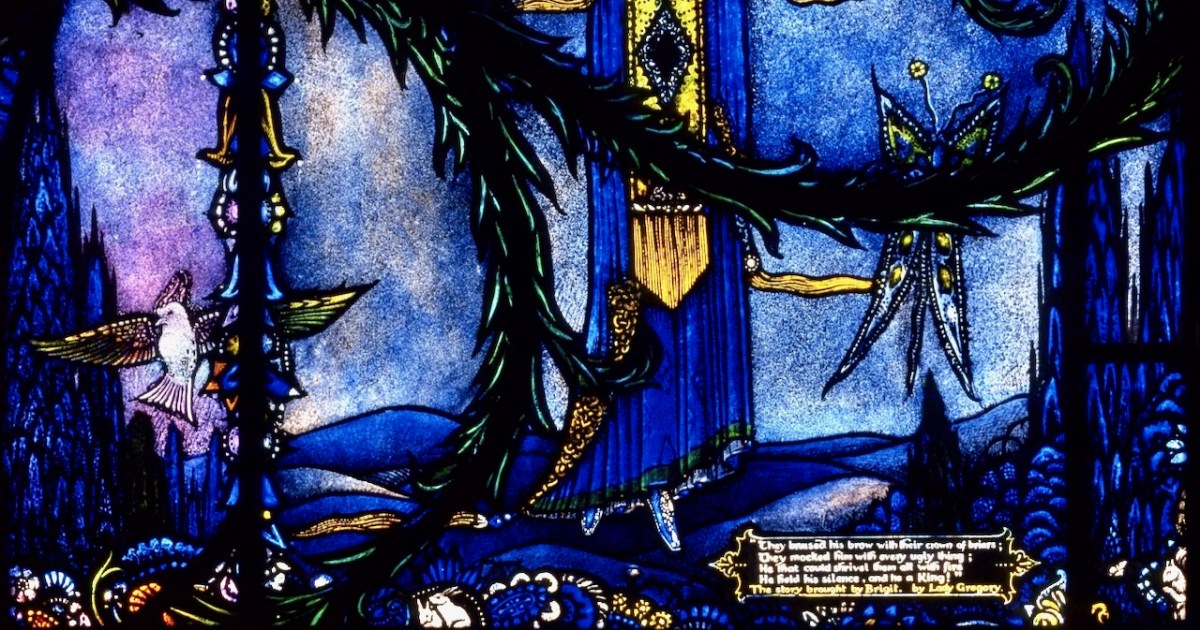
And so we come to the last Brigid that Harry ever did*. It is from the famous and controversial Geneva window, now in the Wolfsonian Museum in Miami. If you have not yet seen the marvellous documentary that Ardall O’Hanlon has made about this, I highly recommend you do. It’s available on the RTE Player as of this time of writing. The Brigid panel is among the less controversial images in the whole window. It’s based on a play by Lady Gregory called The Story Brought by Brigit. According to Marie T Mullan in her lovely book, Exiled from Ireland: Harry Clarke’s Geneva Window

The play is a passion play, but it is based on the legend, popular in Ireland and Scotland, that St Brigit was present at the birth and crucifixion of Jesus. Brigit mingles with the crowds from the time of Jesus’s triumphant entry into Jerusalem until after his death. She is a foreigner, observing and commenting. She tells people she is Jesus’s foster mother and brought Mary and Jesus to Ireland to escape Herod. . . The icon of Christ Crucified is a the vesica, a shape used often in art for a picture within a picture, and has the traditional beaded frame. Brigit is absorbed in the icon.

Note Brigid’s golden scapular and elaborate headdress. Also the stylised butterfly and the little woodland creatures in the scene.
I think that’s a good place to stop. Harry did another Brigid, for the Oblate Fathers in north Dublin’s Belcamp Hall. This is a sorry tale in which the buildings, once left by the priests were subject to appalling vandalism and the windows are in storage, and haven’t been seen for years. This is tragic. 

* Thanks to my friend Jack Zagar for the Photos of the Geneva Window.
When Harry Met Edith: Part 1 – “Like a Living Flame”

St Barrahane’s Church of Ireland in Castletownshend, West Cork, is unique in many ways and a national treasure, not least because of its three Harry Clarke stained glass windows. I have written about the St Luke window and also about the St Louis/St Martin window. Both are gems. But for some reason I have not yet properly written about the East Window and it seems fitting to start that post now, since Harry Clarke died 92 years ago this week at the all-too-young age of 41.

The East Window, the largest part of which comprises a nativity scene, was one of the first commissions Harry received after he burst on the scene in 1916 with his series of saints for the newly opened Hiberno-Romanesque Arts and Crafts masterpiece that was the Honan Chapel at University College Cork. That’s a small detail from his Joseph window for the Honan, below.

The Somerville siblings had been planning for a long time to commission a new window to honour their grandparents, the existing one being hideous and gloomy. In 1907 they had requested a new design from the Manchester firm of Walter J Pearce, but had not followed up with a commission. Besides her intense dislike of the ‘Berlin Woolwork’ (as the family called the despised stained glass) Edith Somerville thought the window openings themselves too long and narrow and felt they should be shortened to produce a more pleasing proportion for a stained glass scene. However, none of the schemes progressed beyond the Somerville siblings procuring permission from the church committee to remove and sell the offending window and replace it with a more suitable memorial to their grandparents.

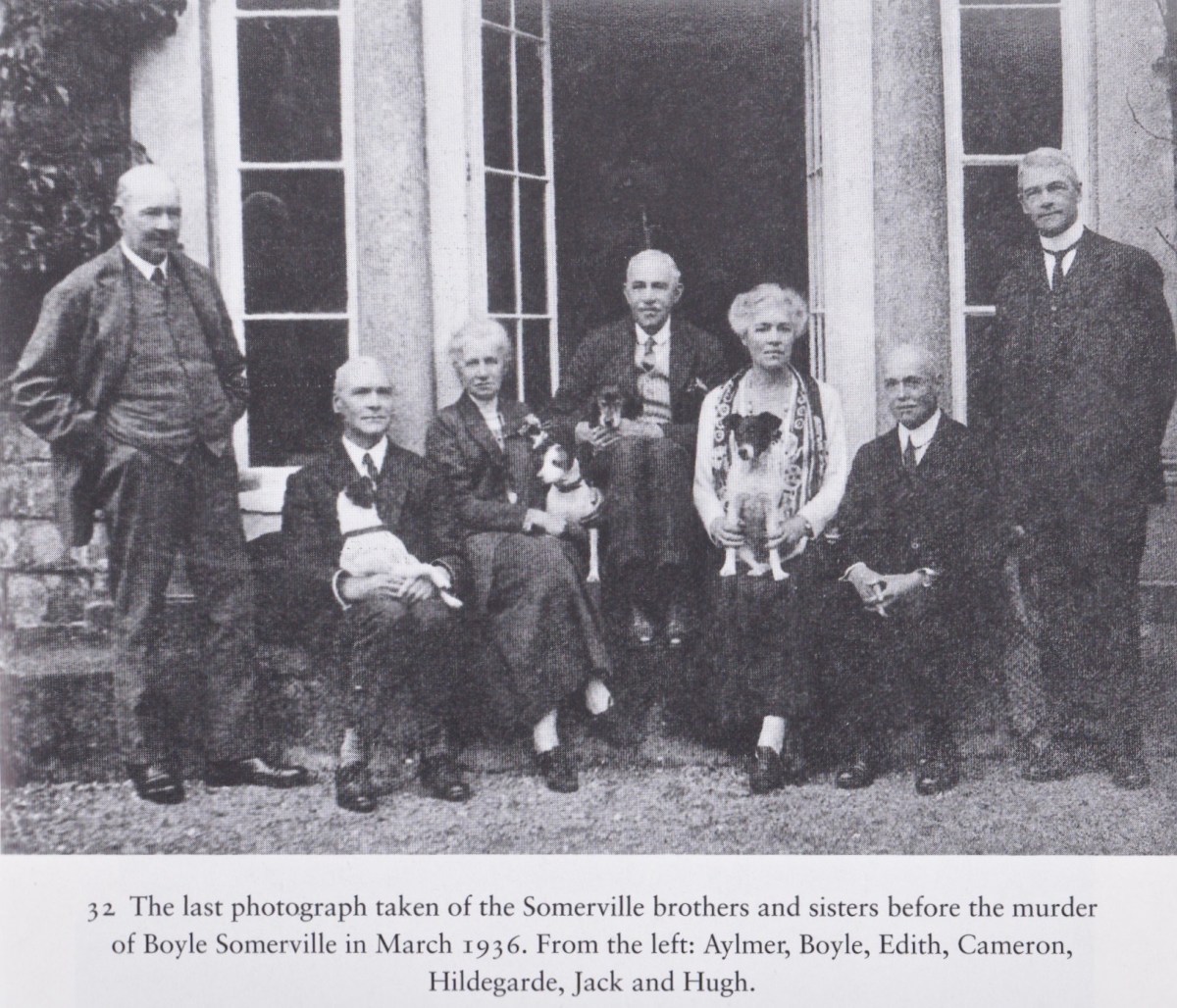
This illustration is from Somerville and Ross: A Biography by Maurice Collis.

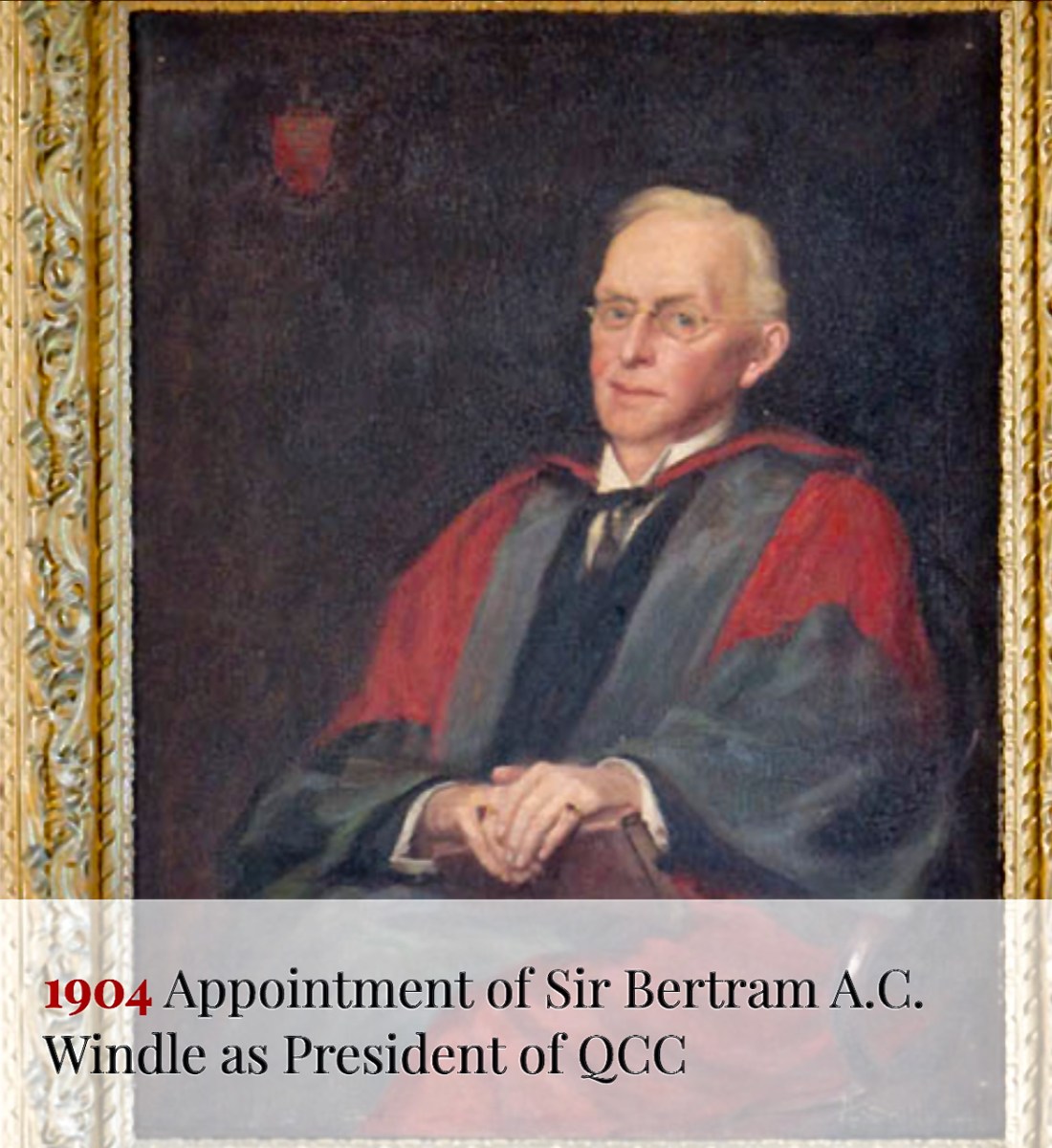
On January 14th 1917 Cameron, the oldest of the family and hence the one who had to have final approval over expenditures like this, went to see “Bertie’s windows”. Sir Bertram Windle was the President of University College Cork and a first cousin to the Somervilles (below, captured from the UCC website). He had worked with Sir John O’Connell to actualise the Honan Bequest which resulted in the building of the Honan Chapel with the inclusion of stained glass windows by An Túr Gloine and by Harry Clarke.

Cameron records in his diary:

Bertie took me to see his jewel of a chapel – quite the best modern building I have seen – & the windows – all but one – very good & some – the Clarke windows- supremely lovely. I have never seen such glass except in 14th century windows – the whole chapel simple & lovely nothing mean or tawdry […] After luncheon went again to the Chapel for another look at the windows.

The Edith OEnone Somerville archive in Drishane :
a catalogue and an evaluative essay /
by Otto Rauchbauer

Edith Somerville got up to see the windows for herself in March. Edith was already an established writer and artist, who had studied in France and was familiar with modern art movements. At that point in her life she was slowly coming to herself again, after a period of intense mourning on the death in 1915 of her beloved cousin and collaborator, Violet Martin with whom she had written a series of highly successful novels and stories under the name Somerville and Ross.

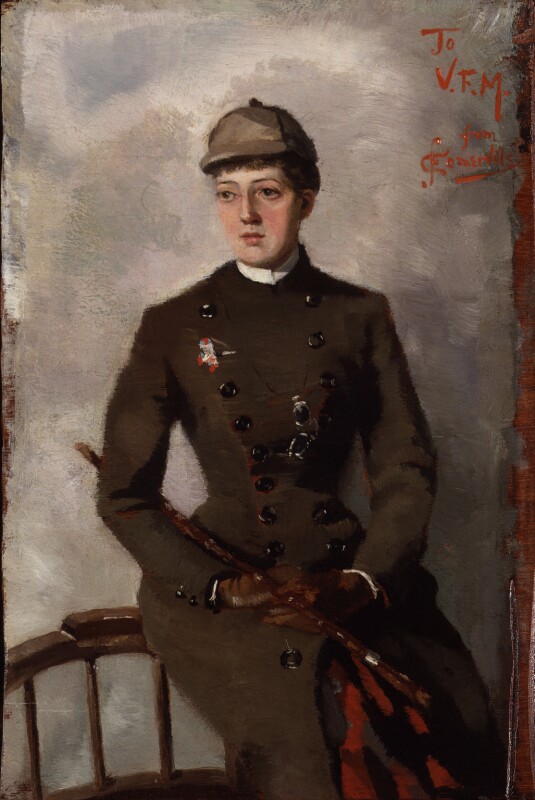
Violet Florence Martin, in an 1886 portrait by Edith Somerville, from the National Portrait Gallery, used under license

Her own artistic knowledge and sensibilities are evident in her reaction to the windows. She wrote to Cameron: 

They certainly are very wonderful in colour, & some of them beautiful in all respects. I preferred the Western three-light window [Brigid, Patrick and Columcille] & I almost disliked the blue one, & the Aubrey Beardsley female face [Gobnait] thought horrible; so modern and conventionally unconventional. The green western light was lovely and a nice design, I like 2 of the left side ones (Brigid and Patrick]. I thought the eastern Purser window just moderate (i.e. not among high class tho’ much better than average). There is to me a slight faint of coarseness in Clerke’s [sic] work. Not much finesse, though the actual glass has a quality of burning and furious brilliance that I have never seen anywhere else. The blue robe, for instance, hits your eye like a living flame or a blast of wind. Perfectly amazing, but not quite pleasant. I can rave about some of his qualities with anyone, but I am not quite a whole-hogger. However, I expect he will be artist enough to adapt his work to the church & to realise how to get harmony into it. His windows have a kind of hellish splendour – in a chapel dedicated to the Infernal Deities they would be exactly right, gorgeous and sinful. . . If that young man. . . went mad it would not surprise me, but I hope he won’t before he does our window for us.

The Edith OEnone Somerville archive in Drishane :
a catalogue and an evaluative essay /
by Otto Rauchbauer

Was it St Ita’s blue robe (above) that struck Edith so forcefully – like a living flame or a blast of wind – ? Or was it perhaps, the one worn by Gobnait, patron saint of beekeepers, cleverly worked out as a series of honeycomb shapes (below). In either case, this deep blue was one of Harry’s hallmarks – he went to great lengths to procure good blue glass.

We can unpack a lot in Edith’s letter to Cameron. For a start, it seems that Cameron had already decided, no doubt influenced by Bertie, that Harry Clarke was the artist who should do the East Window. Edith’s reaction, while often credited with being the deciding factor in choosing Clarke, was after the fact, and both more moderate and more judicious than Cameron’s. Her comments are enough to make me wonder, if the decisions had been hers to make, whether Harry would have been engaged. She was insistent, in a further letter to Cameron, that something more of ‘harmony’ and less of intensity than the Honan windows (as exemplified by his Gobnait portrait, below) would be appropriate for Castletownshend. In fact, shortly after seeing Harry’s work at the Honan, it seems that Cameron had deputed their cousin Egerton Coghill (see my post about Egerton and the St Luke window) to approach Harry, whom he appears to have known personally, but after that initial meeting, it was Edith who took charge of the process. This made sense since Cameron was not living in Castletownshend at that time, but in London. Things moved quickly – even before she had seen his work for herself, she had sent him a tracing of the East window (perhaps one that had been prepared for the proposed Pearce commission) and thereafter it was she who communicated with Harry. 
He responded to getting the tracing in a letter of Feb 1, 1917.*

Thank you for your letter and tracing of the East window of Castlehaven Church. I clearly understand your ideas about shortening the existing window but I hesitate to support your doing so until I see the church – I like long openings and the window may only look out of scale by being filled with inferior glass – I do think you would be unwise to make the three openings into two if you are going to have single figures and not subjects or a subject. Were the existing window or openings left I would have room to put small subjects from the lives of the selected saints at the top and bottom of each opening – were the windows shortened I would have room for the figure only. I am judging from the tracing and cannot tell until I saw the actual window with the light etc – the trees may present difficulties.

The approximate cost of filling the existing window with single figures and small subjects – figures to be of S Brigid S Finbarr and Barrahane will be £315 and if it were shortened by 3‘6“ the cost will be – £252.

I will be in Cork in the early spring and if it were convenient to you, could meet you at Castlehaven Church –

If you are anxious to place the commission at once I will go down any day next week (after Tuesday) that you suggest.

I do my work from start to finish myself and so take longer then is generally expected over a window – Your window would take about six months and could be started on a date mutually agreed-upon should I have the pleasure of doing it –

I greatly appreciate your asking me about the work

Letter from Harry Clarke to Edith Somerville,
Somerville Archives, Drishane House

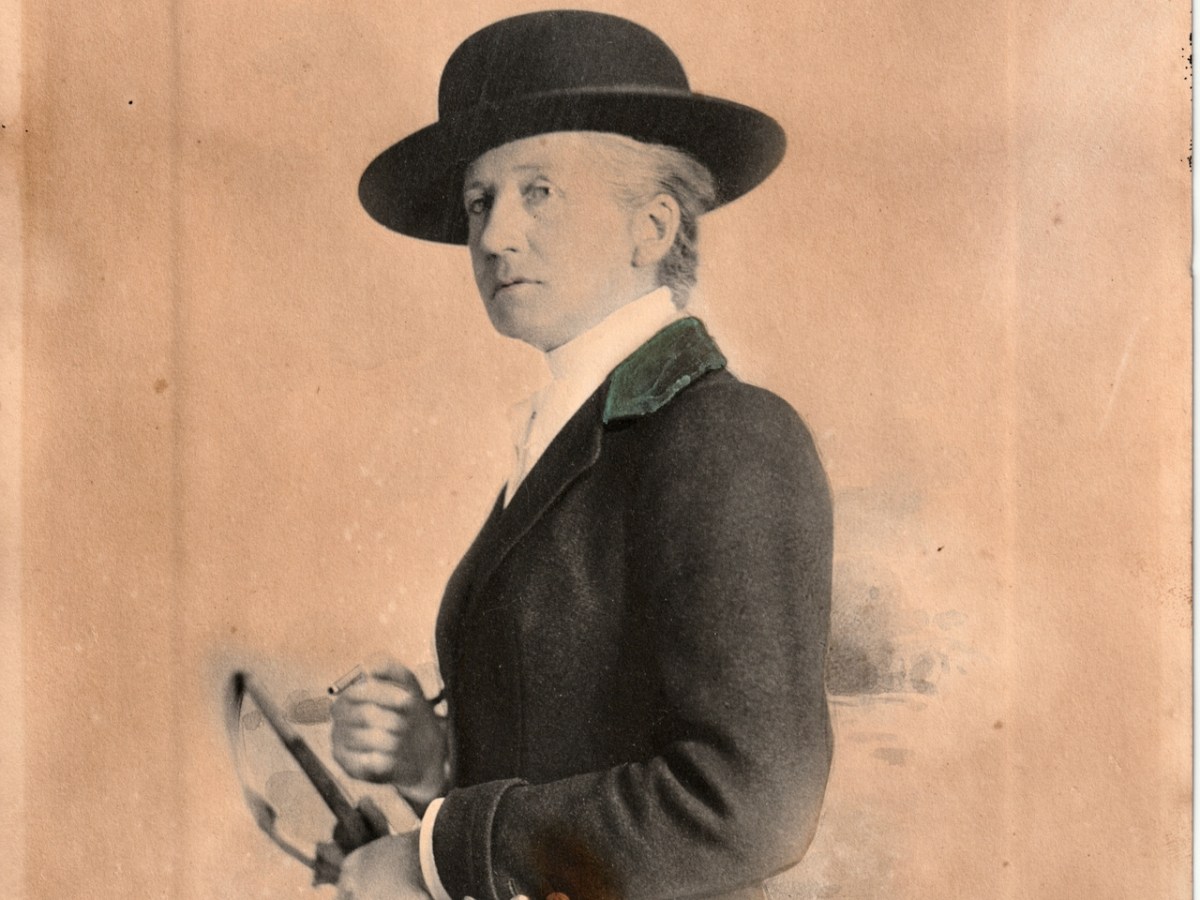
Harry did indeed come to Castletownshend  – a diary entry records it was April 4 and he stayed to lunch, although another source says that he stayed overnight and that Edith found him shy but liked him enormously. At this time, Edith was nearing 60, (dressed as Master of the Fox Hounds, below) whereas Harry was 27. She referred to him as ‘our window boy’ in a subsequent letter to Cameron.

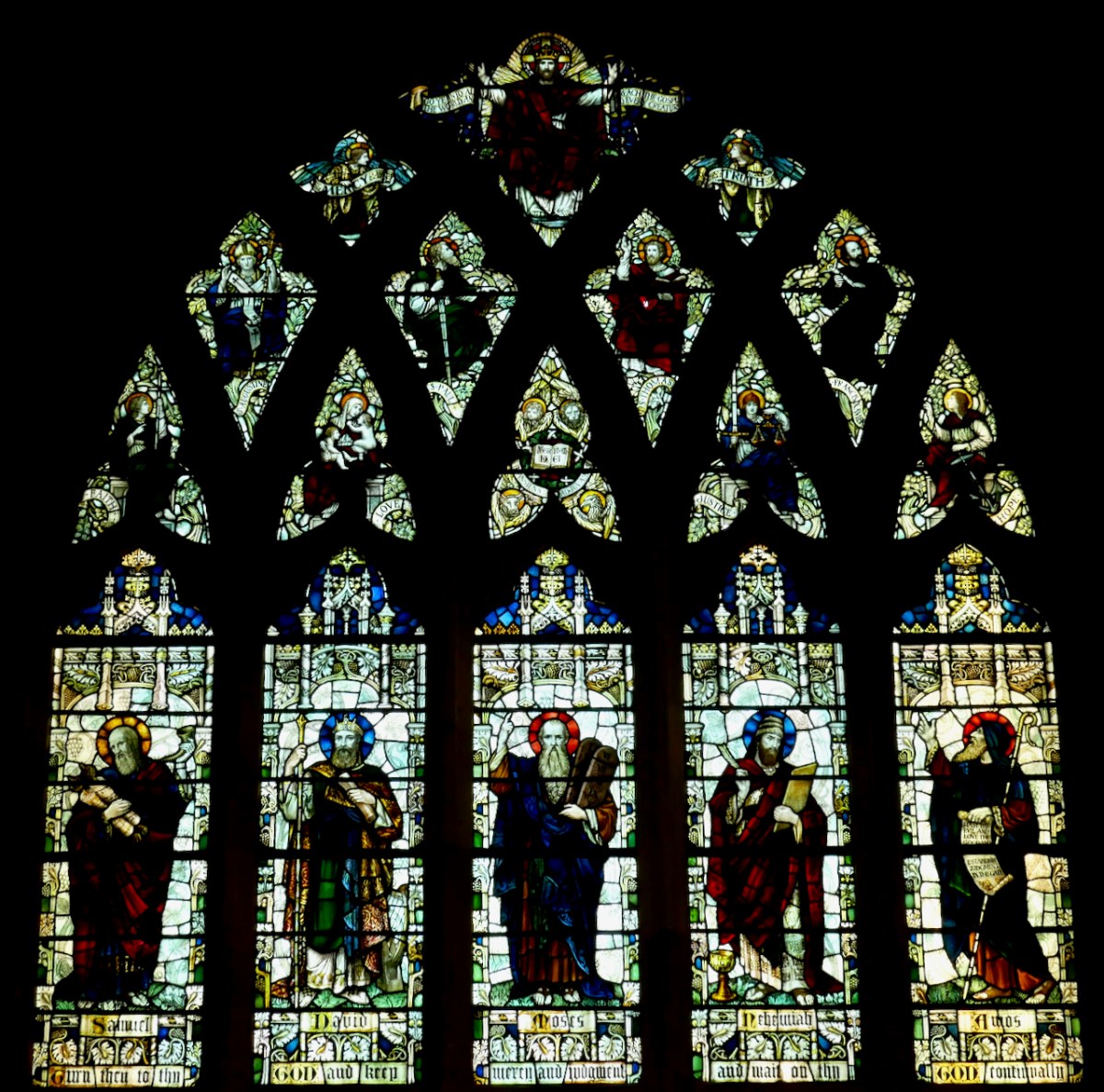
The letter refers to the dimensions of the window – Harry didn’t mind  the shape at all – “I like long openings.” But Edith, very much the painter, had been taken by the more horizontal orientation of windows she had seen in Exeter Cathedral, such as the Old Testament window below) and really wanted to change the windows by making them shorter and perhaps even cutting them down to two-lights. As we will see, she realised part of this ambition, but not all.

Although the decision that Harry was to do the window was now made, that’s not to say that all went smoothly from this point on. Edith had a hard time being decisive about the iconography she wanted (St Finbarr didn’t make the final cut), and at one point Cameron managed to lose Harry’s design for the window and she had to ask him to do it again. Also, there was the matter of cost, and how the rest of the family felt about it all. We’ll get into all that in the next post, as well as the elements of the window that Harry designed. Here’s a sneak preview.

*I have to record here my debt of gratitude to Thomas Somerville and the Somerville Archives, for permission to view and quote from letters from Harry Clarke to Edith Somerville and from Edith to Cameron. It is an enormous privilege (and quite a thrill) to have original material to work from.

Nicola Gordon Bowe, 1948 – 2018

Harry Clarke’s The Coronation of the Virgin, from his Terenure windows. Nicole Gordon Bowe revealed him to the world.

The Irish art world sustained a terrible loss earlier this year with the death of Nicola Gordon Bowe, or Nikki, as she was universally known to her friends. In a very small way, I feel immensely grateful to have been counted among those friends. Although we only met once, we carried on a happy correspondence and were to have seen each other again this summer. But there are probably a thousand people like me, who have lovely memories of this wonderful woman, because Nikki had that rare gift of making each individual feel seen and heard and encouraged.

Nikki at the day-long symposium on the Honan Chapel, in Cork. Obviously in pain, she nevertheless gave a brilliant summary of Harry Clarke’s famous windows

Reading comments on various obit pages, from a generation of students, colleagues and friends, clear themes emerge of formidable scholarship, wide-ranging erudition, and passion for her subject. She was, as Alistair Rowan who spoke at her memorial service emphasised, the world expert on the Irish Arts and Crafts movement and on Irish stained glass.

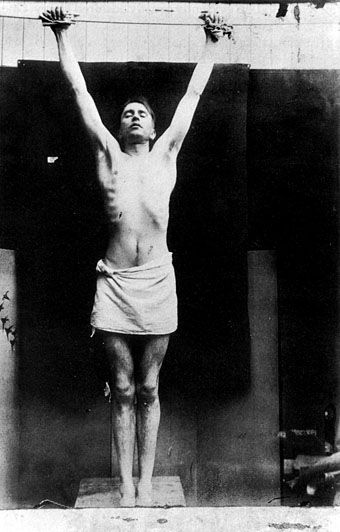
In her book, The Life and Work of Harry Clarke, Nikki traced Clarke’s influences and training. He often used himself as a model – in this instance for the crucified Christ in the Terenure windows

But the other theme was that of friendship, of a wonderful sense of humour and a ready smile, of her encouragement to junior researchers, her collaboration, nationally and internationally with other scholars in her field, and the boundless generosity with which she shared her knowledge.

St Brendan, Nikki pointed out (as true for this window in Tullamore as for the Honan windows she was discussing) does not look like the kind of muscular saint that could navigate the Atlantic. ‘Effete’ was the word she used.

Nikki’s book on Harry Clarke has been my bible for all the posts I have written about this genius of Irish stained glass. Last year her second magnum opus was published, on the life and work of Wilhelmina Geddes. I haven’t read it yet – a future pleasure – but it was widely considered the finest Irish art book of the year, perhaps the finest book of the year.

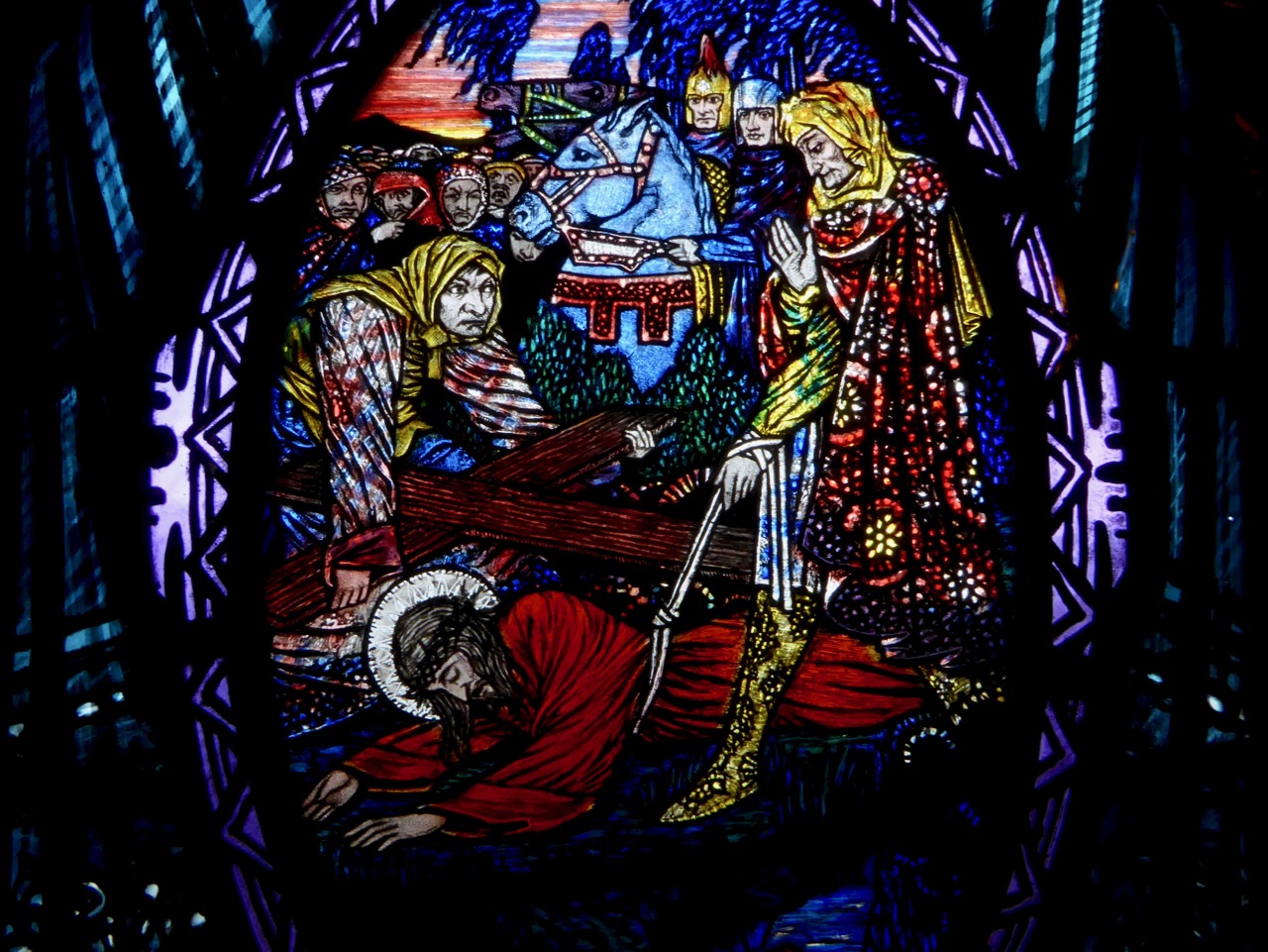
Jesus Falls for the Third Time: one of the medallions that form the Stations of the Cross in Lough Derg. Nikki’s research indicated that these were mostly executed by his apprentices during a period of illness, although  they were designed by him.

She also wrote for the Irish Arts Review, the Dublin Review of Books and contributed essays to edited collections – the busy life of an established and disciplined scholar. At the time of her death she was working on what was to be a definitive study of the Irish Arts and Crafts Movement.

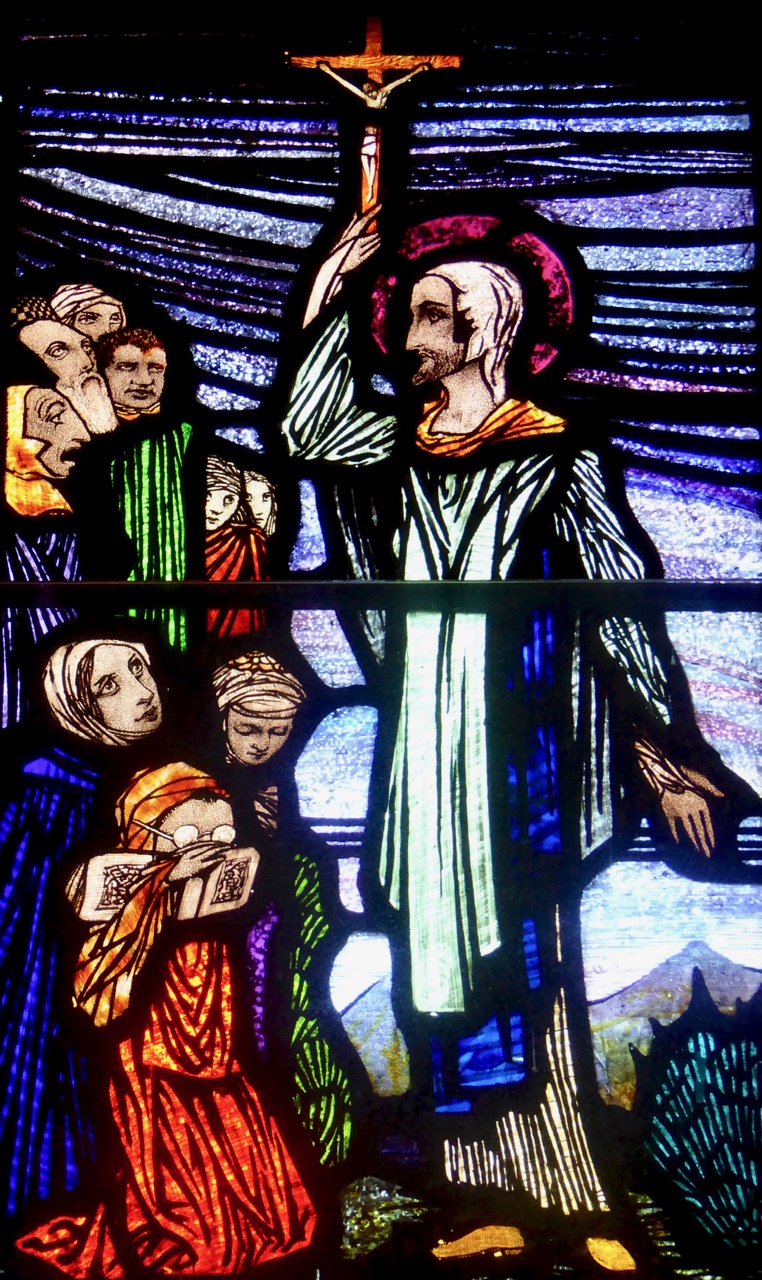
St Fechin, from the Ballinrobe windows: Harry Clarke loved to populate his scenes with a host of figures – now who is that small one with the glasses?

Nicola Gordon Bowe, more than any other person, was responsible for rescuing Irish Arts and Crafts from obscurity and establishing the reputation as artists of its major practitioners, none more so than Harry Clarke. She was impatient of those who dismissed stained glass as mere craft and who failed to see how the medium of glass both compounded the difficulty and enhanced the impact of the work of Harry Clarke and others. In the newly refurbished and finally open National Gallery of Ireland there is now a Stained Glass Room full of breathtaking pieces – it is no stretch to say that we can thank Nikki for that.

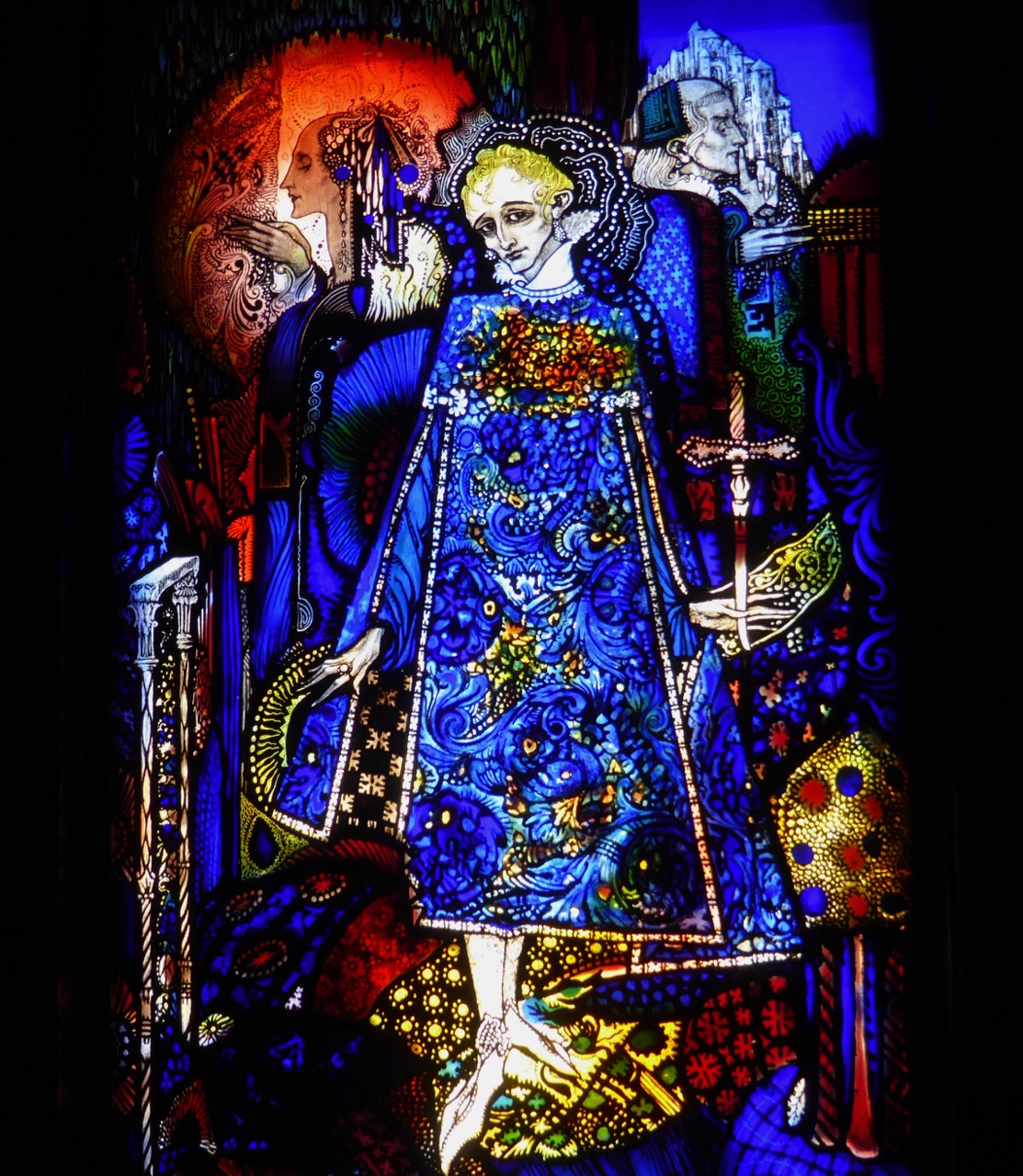
The Song of the Mad Prince, an exquisite small panel in the new National Gallery Stained Glass Room

I have chosen to illustrate this post with photographs of Harry Clarke windows and details, as a tribute to Nikki. She was his great and ardent champion and now the world knows what a true legacy of masterpieces we have been left by him. Nikki’s legacy is also secure – her works will be consulted for generations to come, and her memory kept warm by all who were privileged to know her.

From the Eve of St Agnes, in the Dublin City (Hugh Lane) Gallery

For obituaries, see here and here and here. Rest in peace, Nikki.

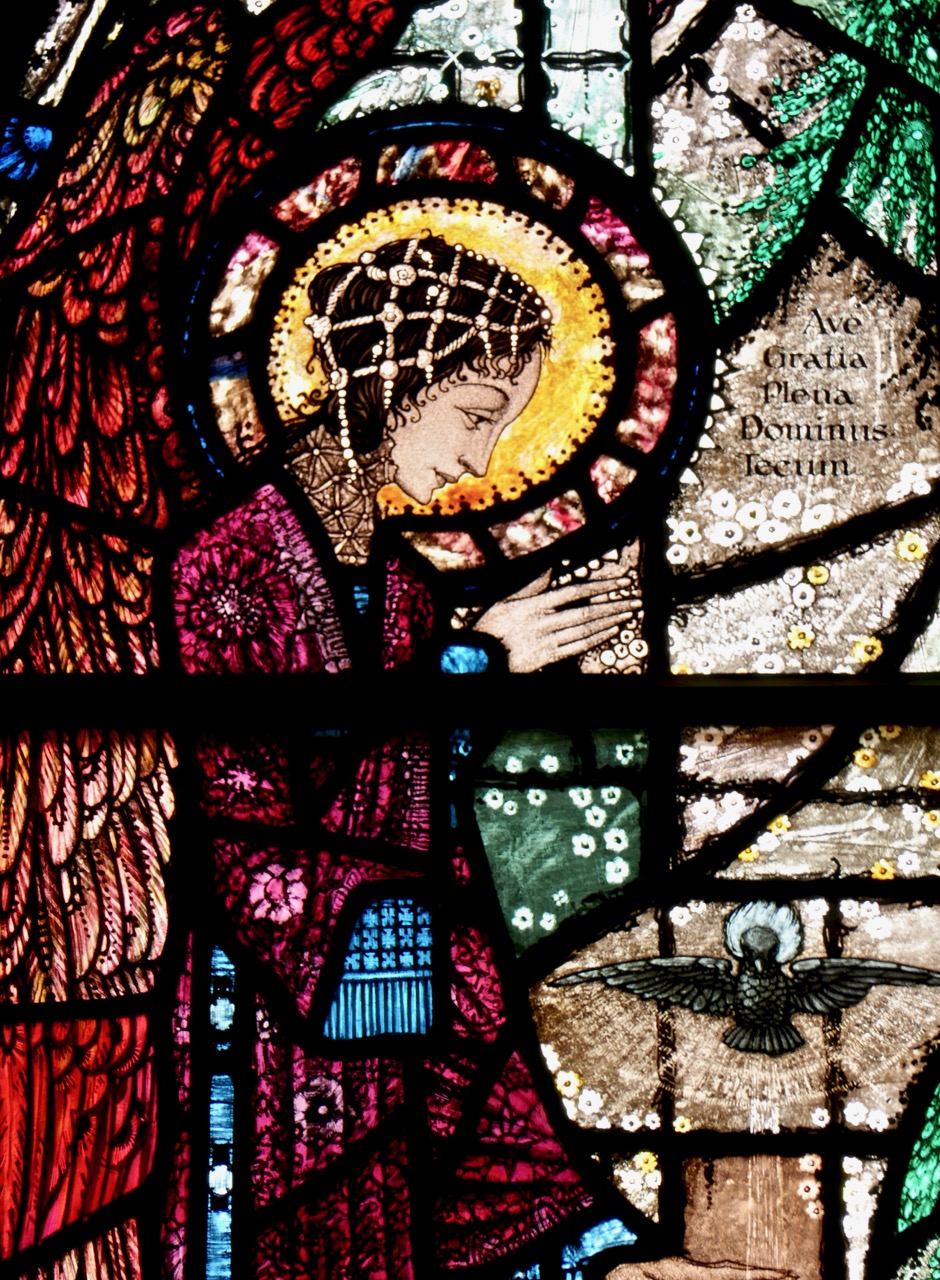
The Annunciation Angel from the Terenure Annunciation window

Good Well Hunting: Duhallow

St John's Well 1

Amanda started her blog, Holy Wells of Cork, in February and oh my goodness she already has over 100 wells documented. Not just documented – recorded, photographed, mapped, described, researched and written up in a charming cheerful style that’s a hoot and a pleasure to read.

AB 1 Laitiaran

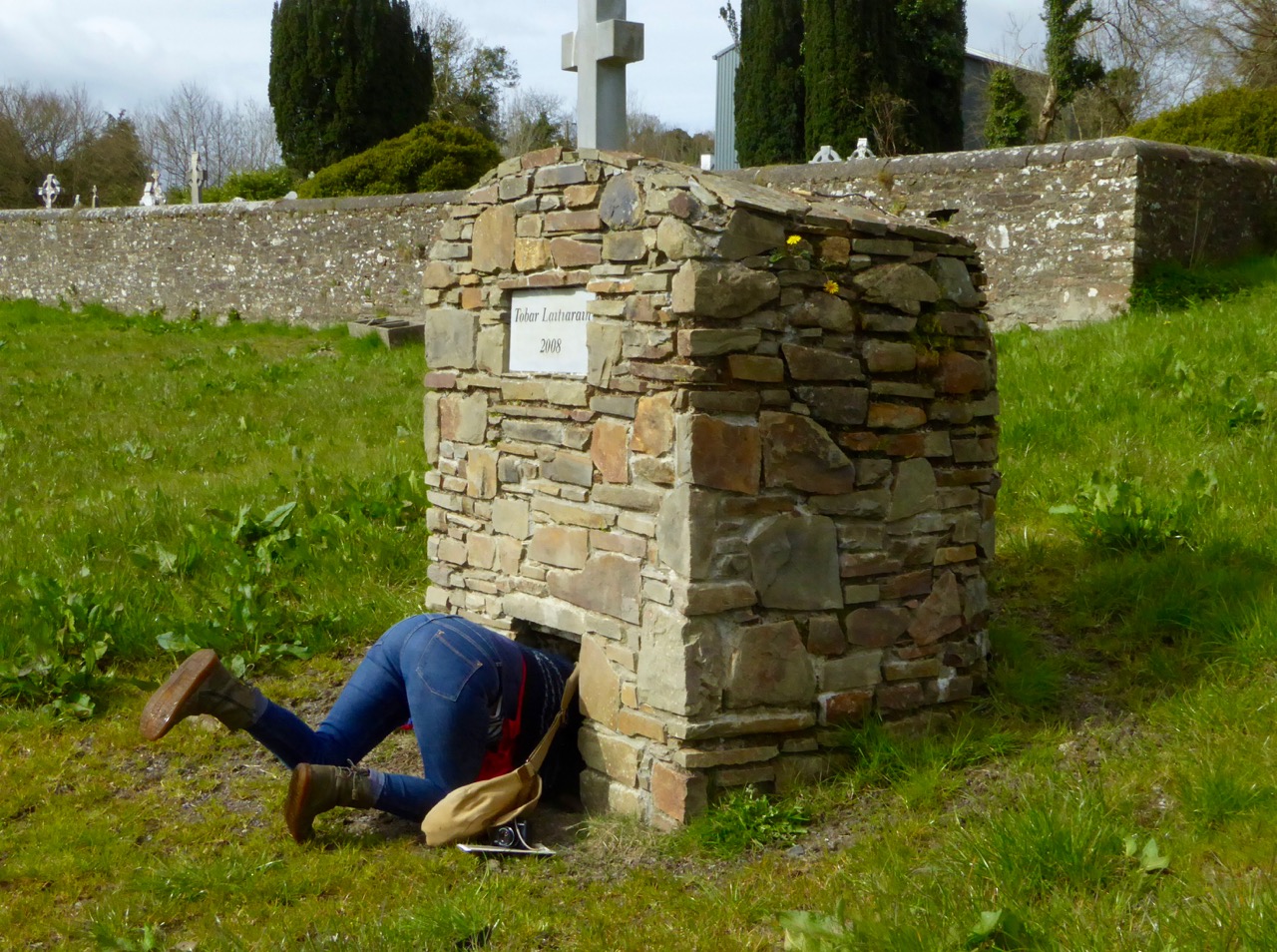
Standard Amanda shot as she checks out St Laitiaran’s Well  

Robert and I go along on her well-finding trips every now and then. Between accompanying Amanda, and wells we’ve gone to ourselves, we’ve visited about half the wells in her gazetteer. The sheer variety is astonishing, as also is the varying state of preservation. From muddy holes in the ground to gleaming and designed surrounds – holy wells come in all shapes, all sizes, and all conditions.

duhalloworiginal

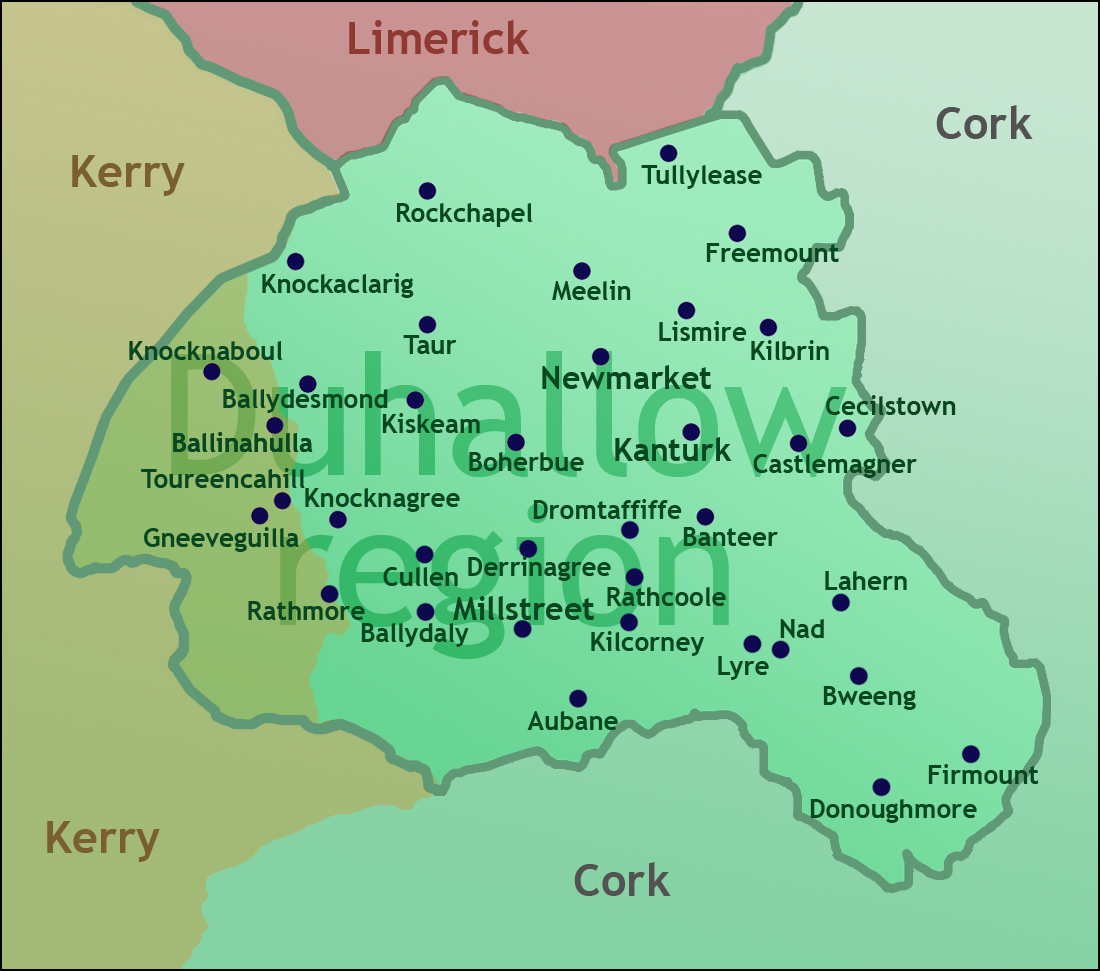
Duhallow – isn’t that a lovely word? It’s a lovely place too – a barony (part of Ireland’s old land division system) that occupies the northwest corner of the county of Cork. It’s mostly rolling hills and farmland, drained by the headwaters of the Blackwater River, with the Derrynasaggart and Boggeragh mountains to the south and the rich agricultural lands of Limerick to the north, while the Kingdom of Kerry lies just over the county border to the west.

Duhallow Sign

Duhallow has its act together when it comes to holy wells – the local development committee has developed a Holy Well Trail. A brochure leads you around the trail and at each well is a detailed history of the well, the saints associated with it, the cures attributed to it, and the rounds and prayers to be undertaken.

Tubrid Well Millstreet

Robert makes his markTubrid Well, Millstreet. Robert adds his mark to the cross inscribed by hundreds of pilgrims

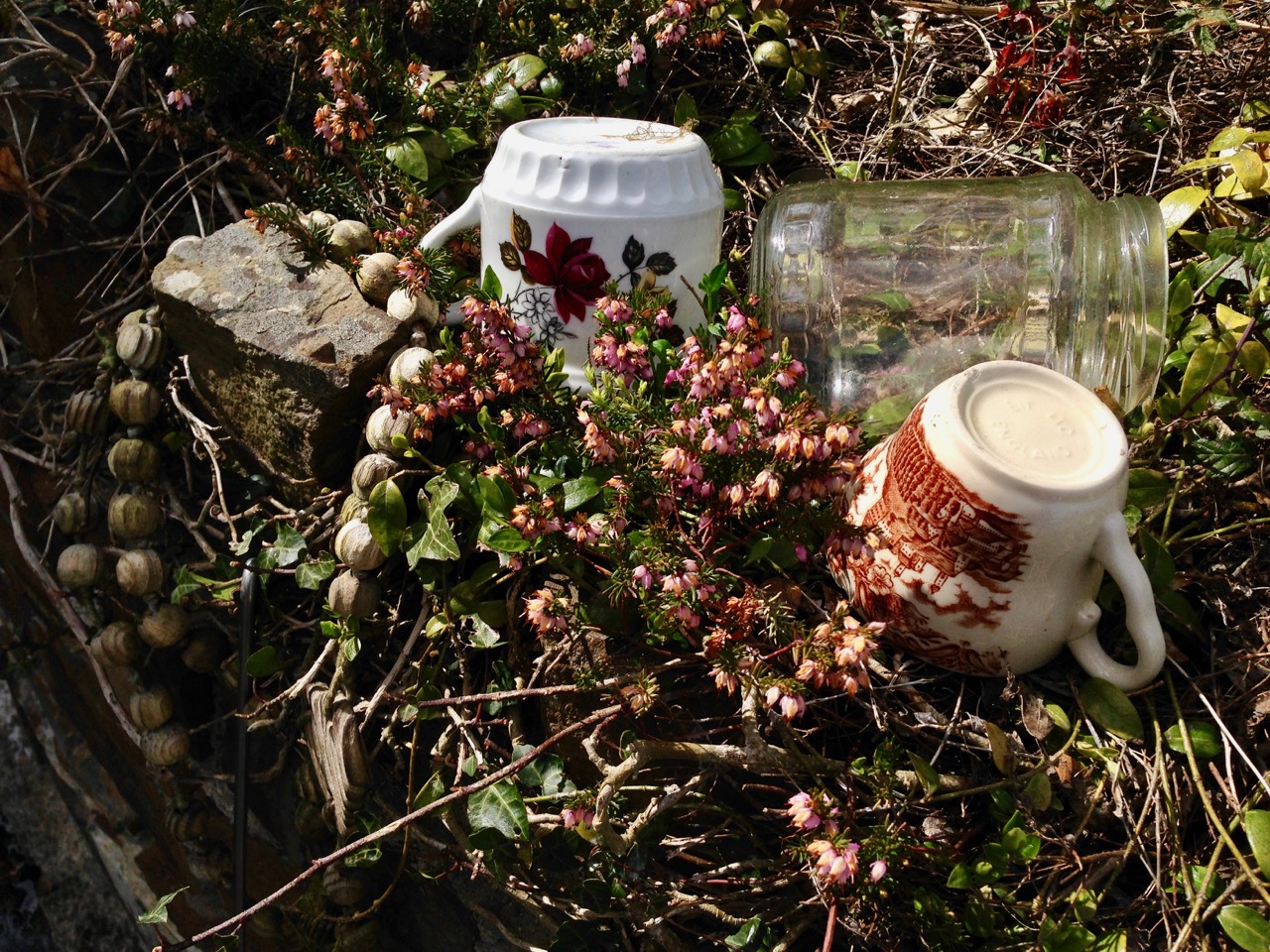
At  many of these sites mass is still said once a year and cups and bottles are provided so that you can drink, or take away, some of the water. The Tubrid Well outside Millstreeet is the largest and most active. While we were there people came and went and fresh flowers and candles were in evidence. This is a well that even has its own Facebook page!

Inghne Buidhe rag tree

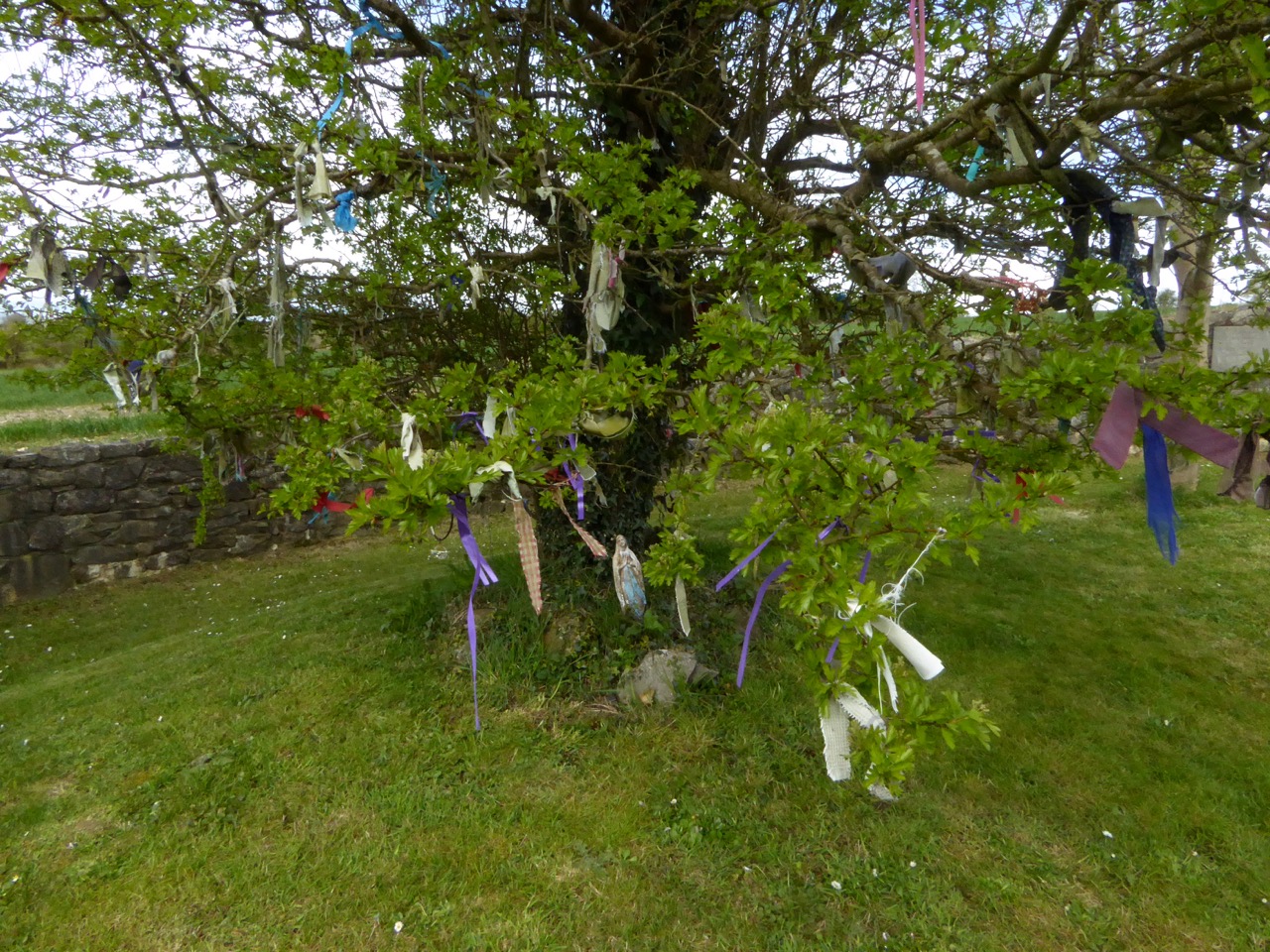
A rag tree at the well of Inghne Bhuidhe

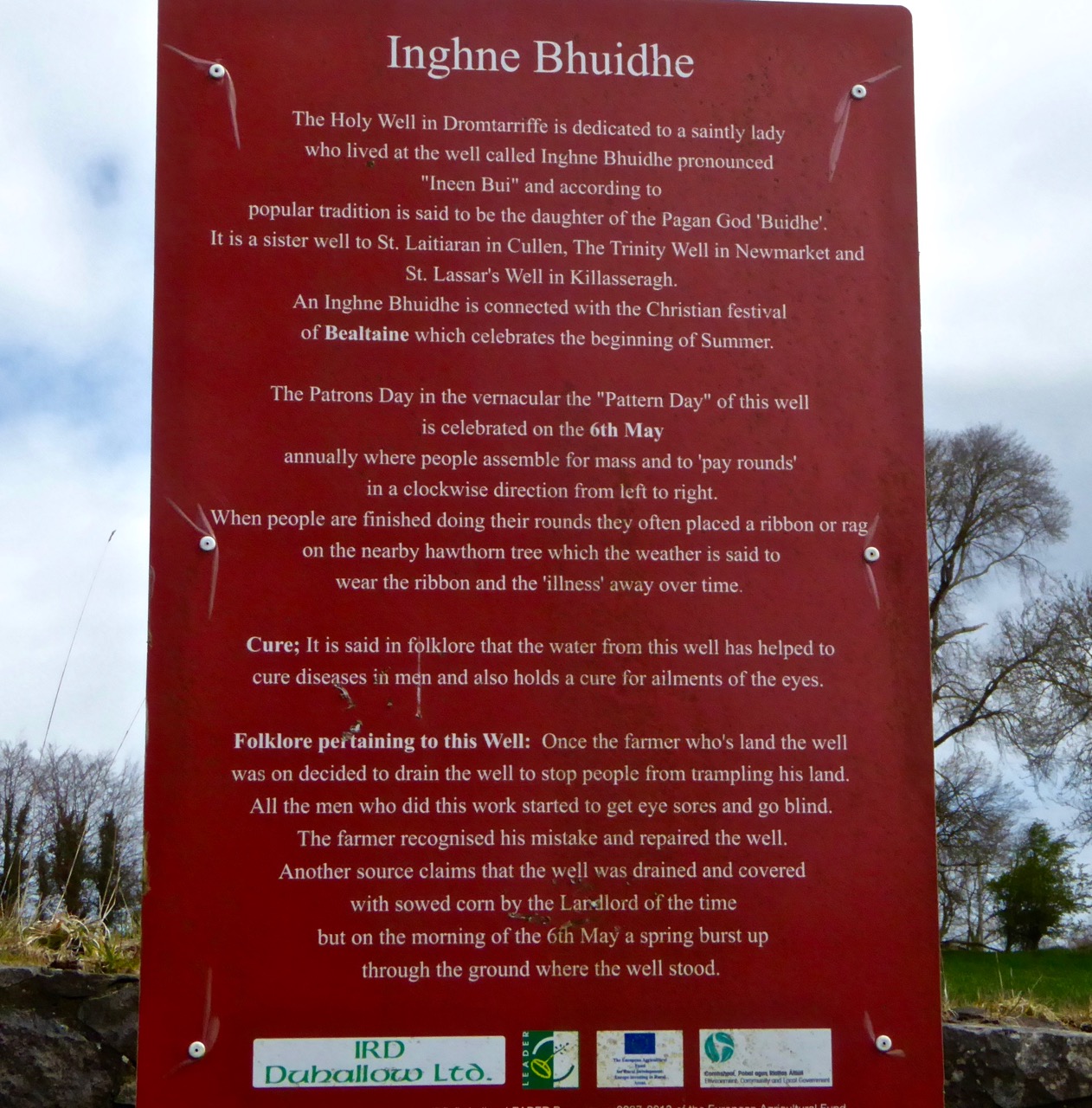
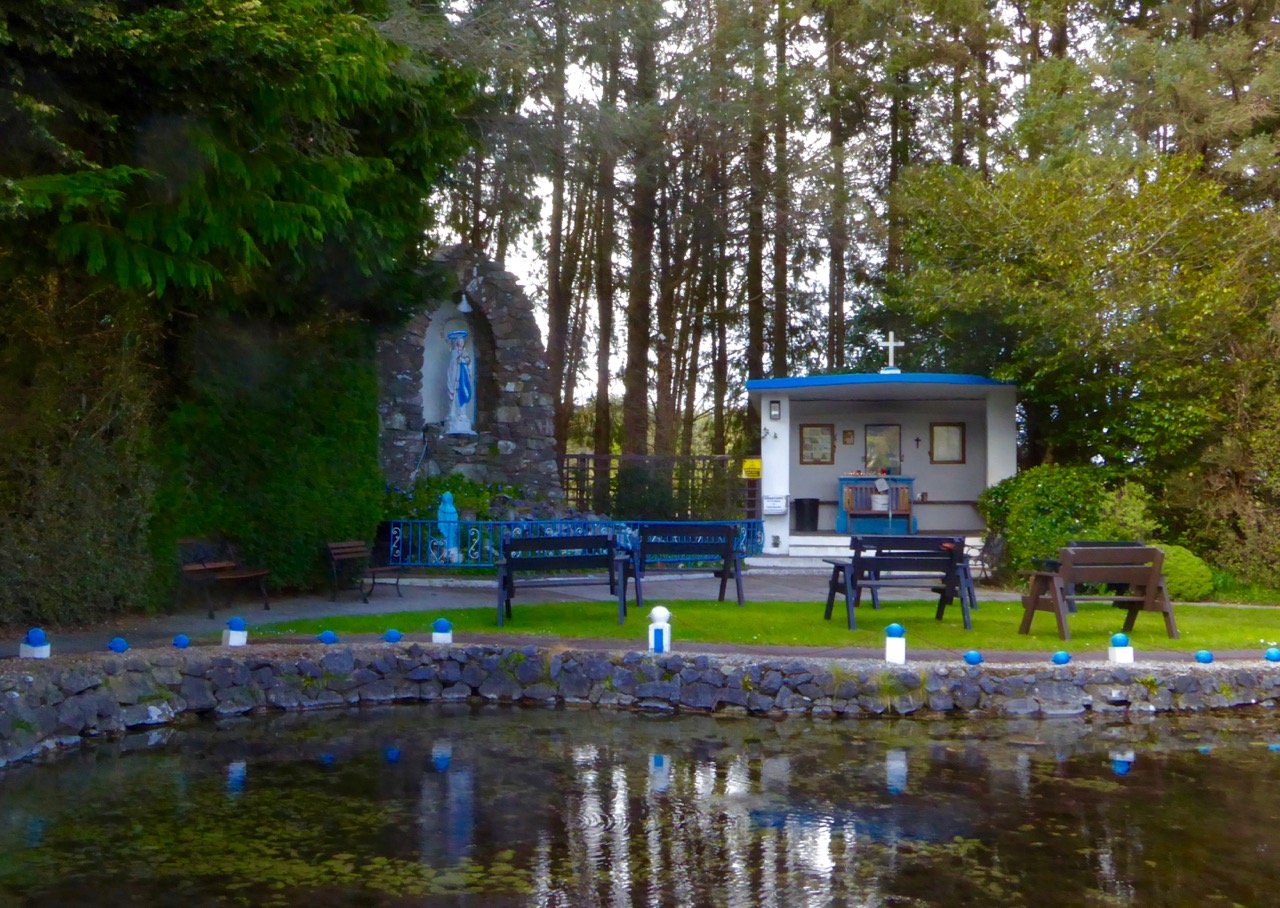
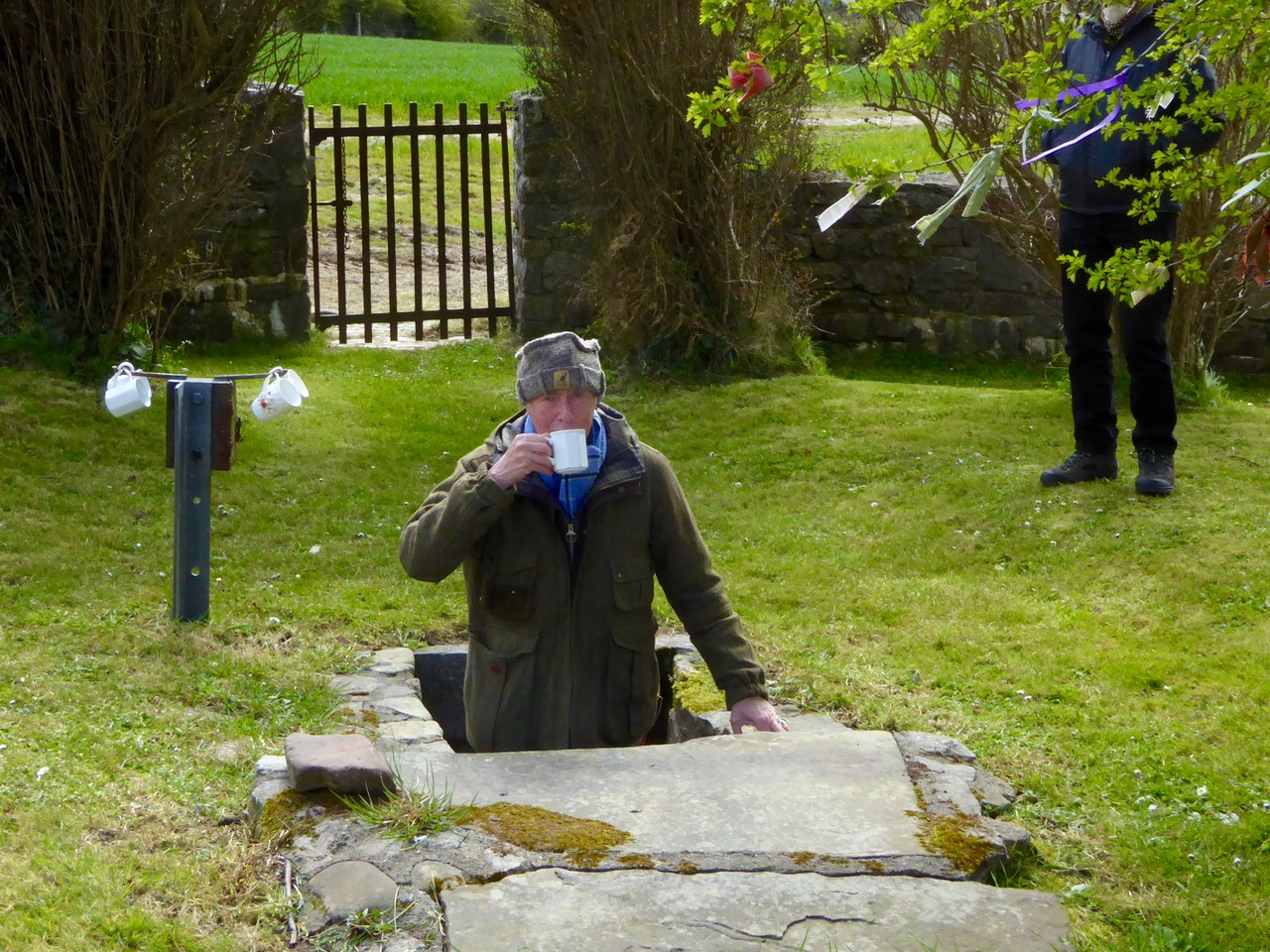
The well devoted to Inghne Bhuidhe (Inyeh Bwee, daughter of Buidhe, the Yellow-Haired) provided a complete contrast – out in the middle of corn fields, surrounded by a low wall and with a rag-festooned thorn tree looming over it. This one had a remote and tranquil vibe, suitable for contemplation.

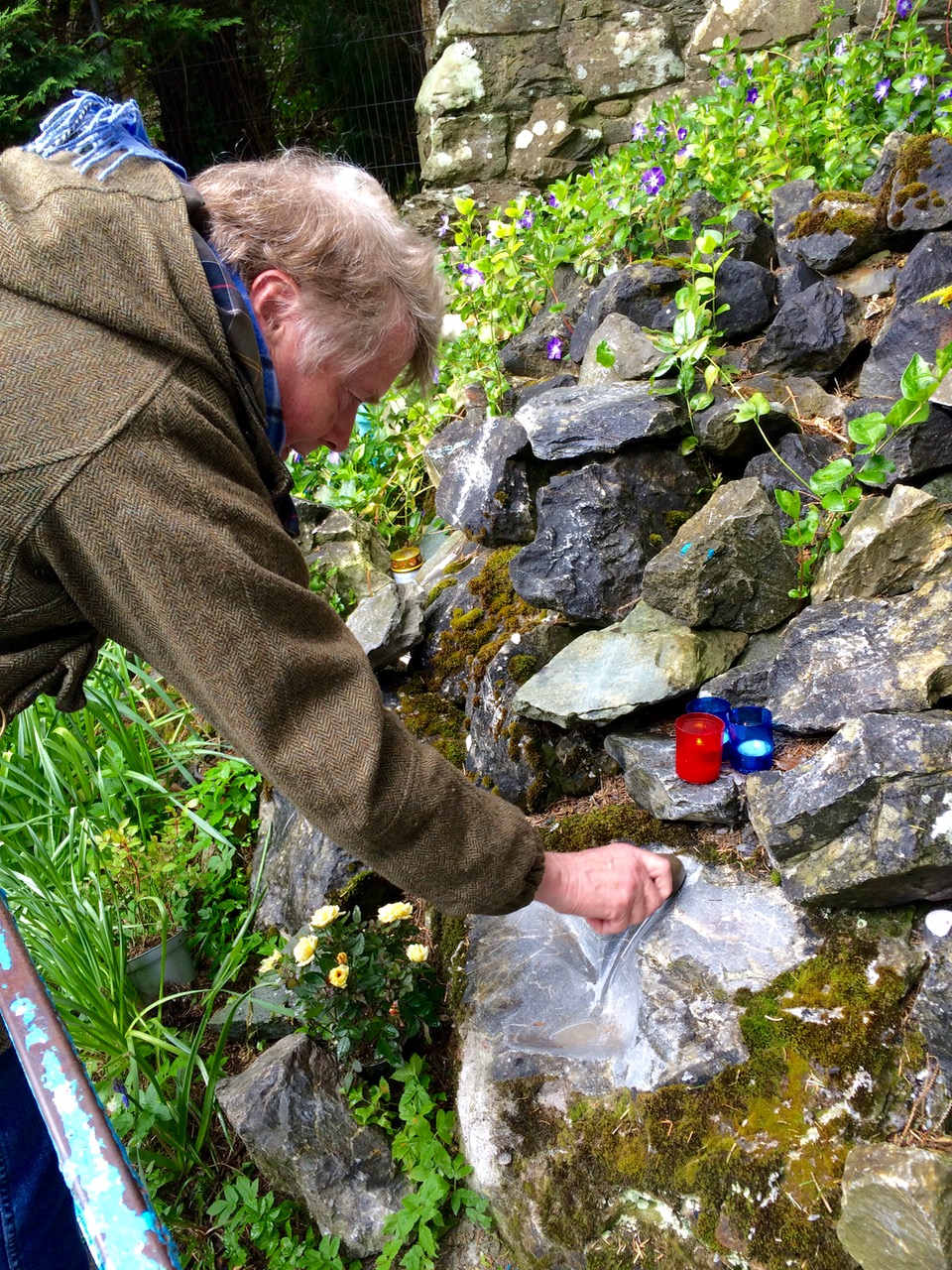
Tasting the water, Inghne Bhuidhe

My  personal favourite was the Trinity Well near Newmarket, mainly because it was built inside a fulacht fiadh (pronounced full okt feeah) – that’s an ancient (possibly as far back as the Late Bronze Age) cooking place where stones were heated and then rolled into a trough of water. Over time, the used stones built up into a horseshoe-shaped mound that surround the trough – now re-purposed as a holy well. It was a marvellous testament to the timeless character of special places in the deep countryside. 

Trinity Well in Fulacht Fiadh

Trinity Well, formed from an ancient fulacht fiadh

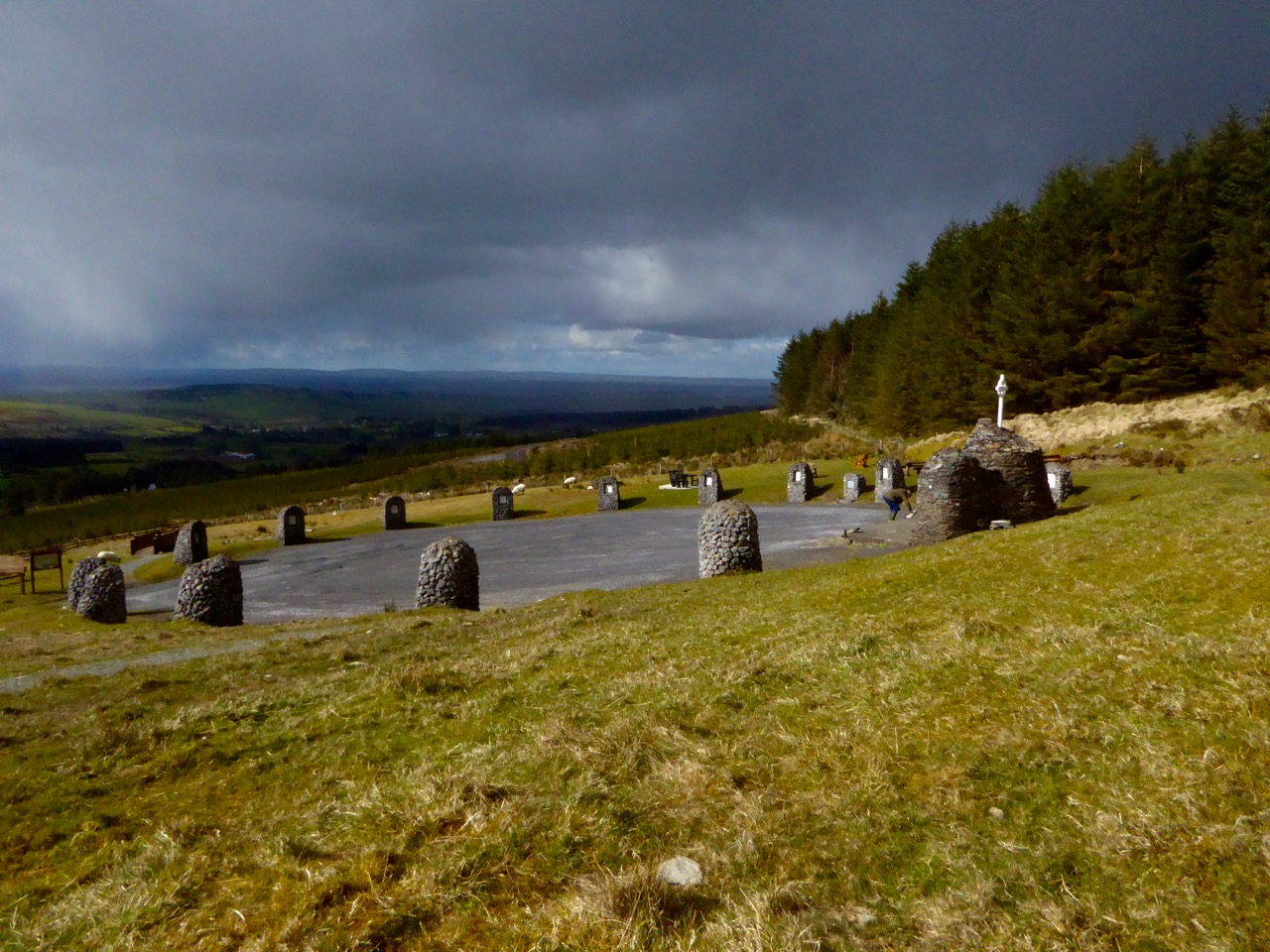
One of Duhallow’s wells is high in the Mushera Hills and dedicated to St John. The first photo in this post shows the location and extent of it. Back when the veneration of holy wells was at its peak, this one was the site of an enormous pilgrimage on St John’s Eve, June 23rd, every year. As with many such events the prayers and devotions of the daytime gave way to the partying of the night time and eventually the church acted to curb what they saw as the excessive debauchery of the occasion. Read Amanda’s account of the goings-on at Gougane Barra for an insight into the aprés-penance hooleys.

St John's Well 2

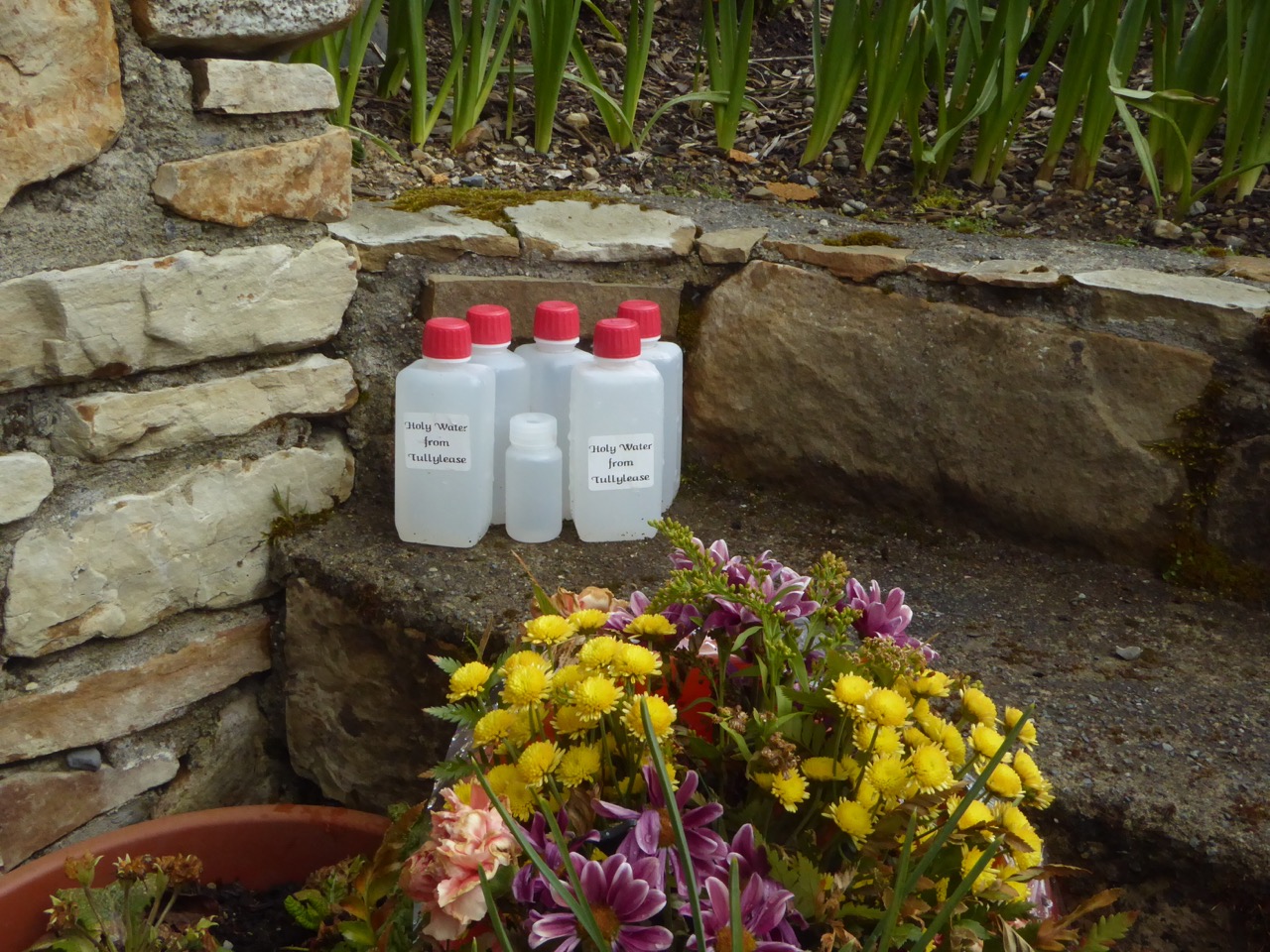
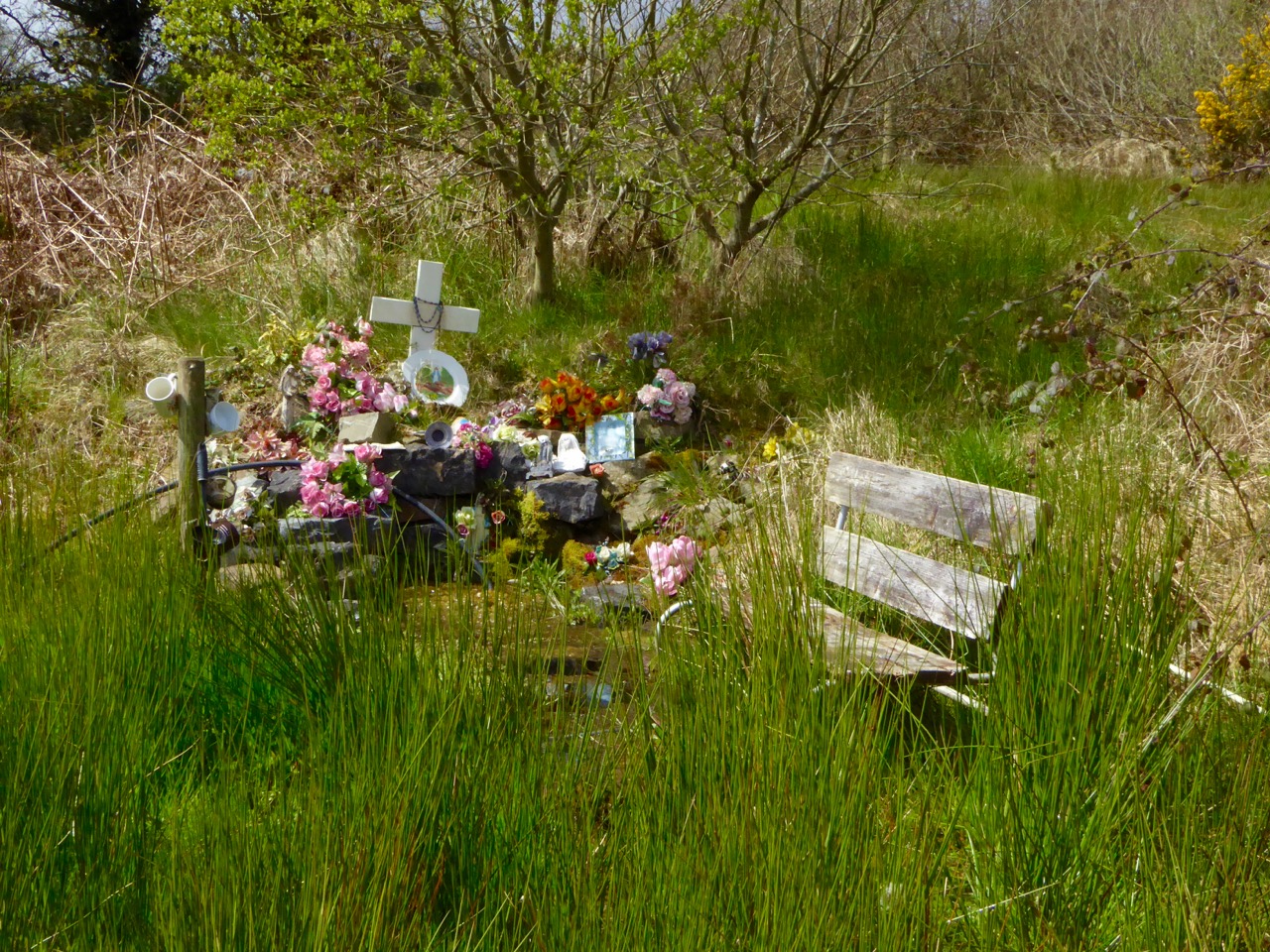
Tullylease had three wells, one devoted to Mary and another to St Beirechert (a saint whose name is spelled in a bewildering number of ways). The third well turned out to be something different – see below. The Marian well is thoughtfully stocked with holy water. Some of it is now in our bathroom to see if a few drops added to the bathwater will fend off the rheumatiz. So far, so good.
Holy Water

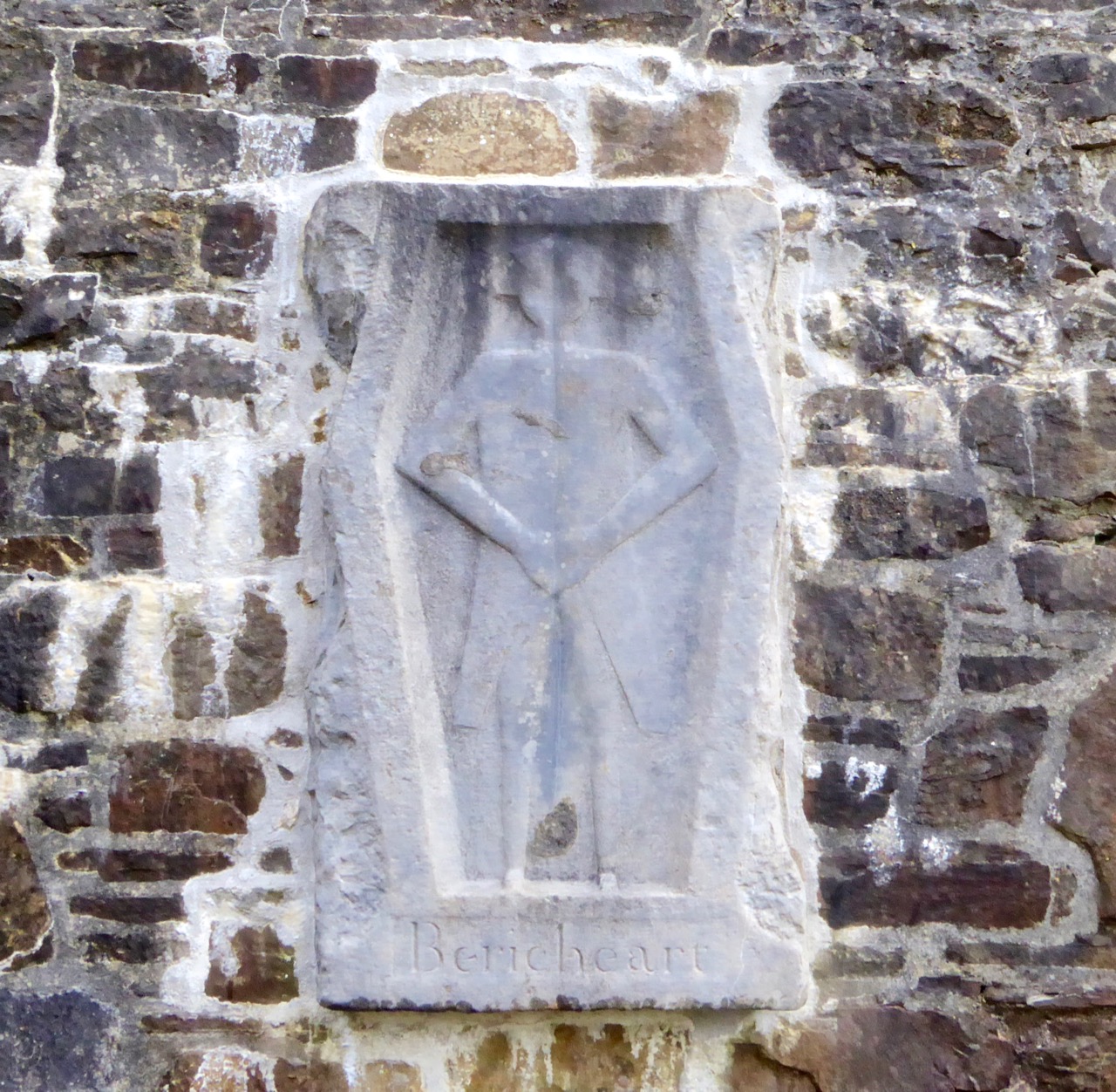
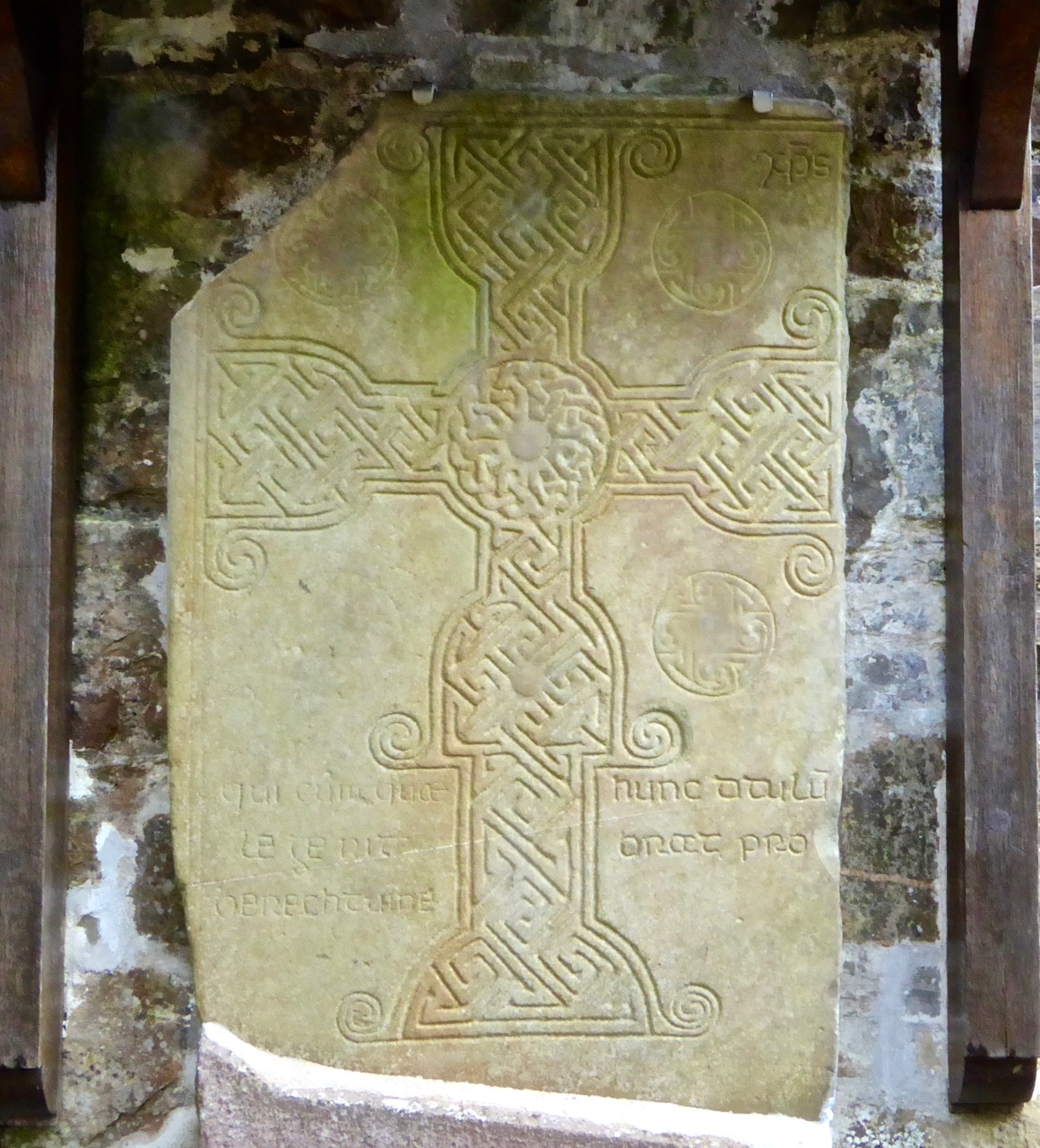
St  Beirechert’s church has several interesting carvings: St Beirechert himself in an unlikely swallow-tailed coat and tricorn hat, several fragments and a wonderfully worked cross slab with interlace design.

Bericheart in swallowtail coat

We  were intrigued to learn recently that this very cross was used as a model for the design of leather and fabric pieces for UCC’s Honan Chapel, an Arts and Crafts masterpiece, when it was being built a hundred years ago. I can’t show you a picture of that, as it’s undergoing painstaking conservation, but click here to see a modern use of the design!

Tullylease cross slab

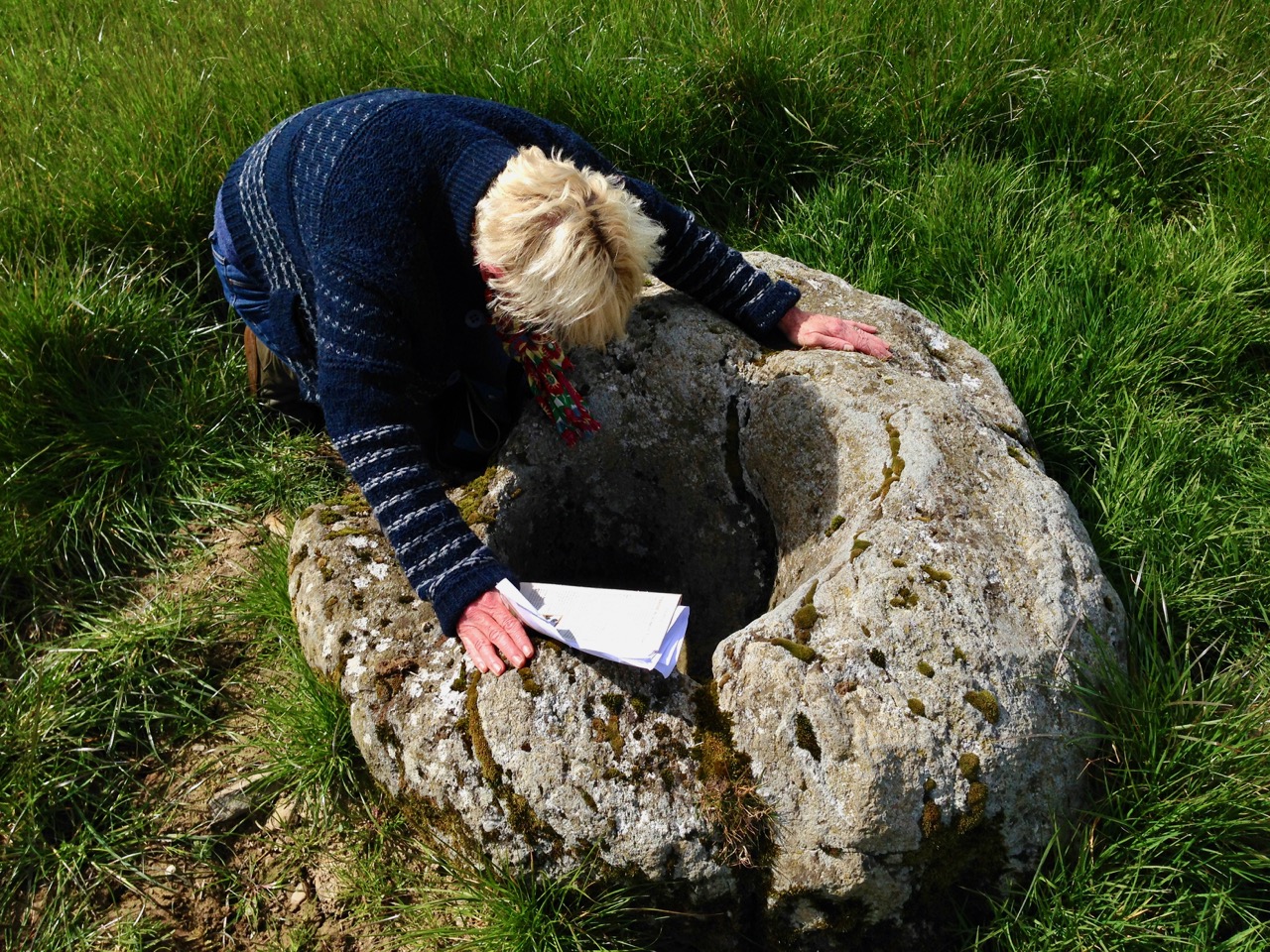
The final well we saw at Tullylease  wasn’t really a well at all but a bullaun stone – a big one. It’s supposed to cure headaches if you rub your forehead all around the rim, so here is Amanda, about to give it a try.

Amanda headache well

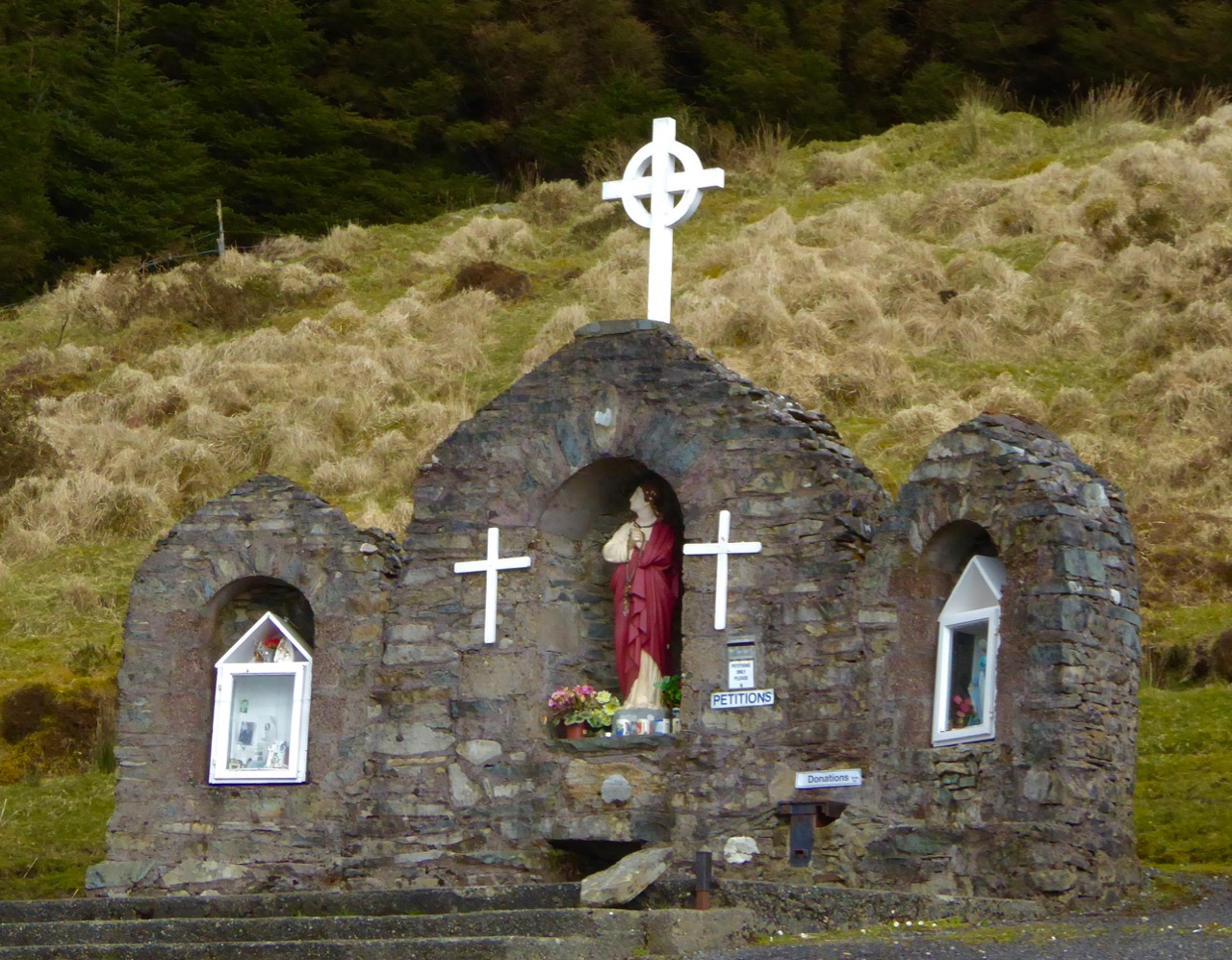
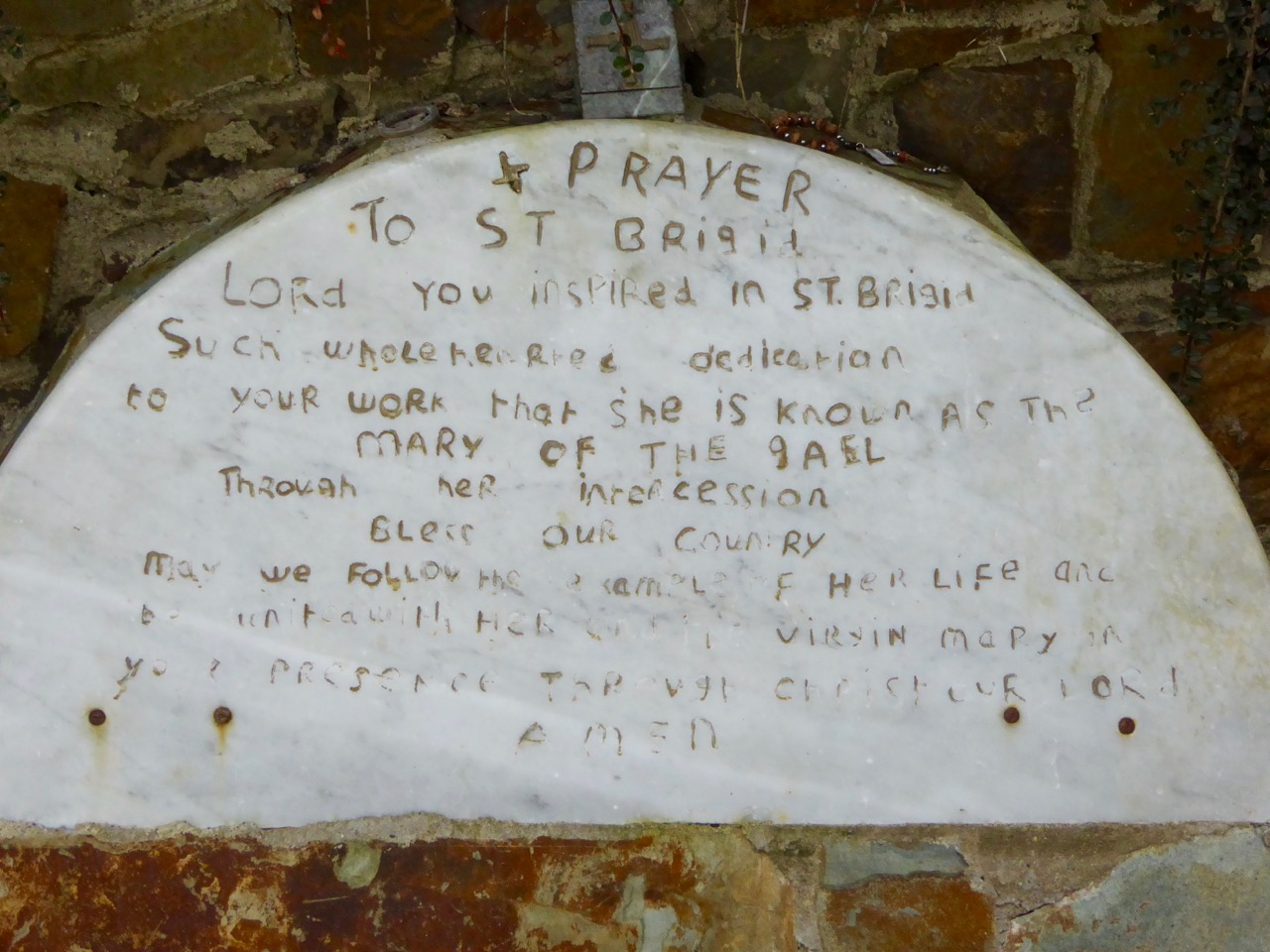
Our last stop was at a well for St Brigid. This one had a kind of cupboard containing a book in which visitors can write their prayers and ‘intentions’. It was fairly up to date, indicating recent visits.

Brigid's Well, prayer

St Brigid Pray for usIn  this post I have concentrated on the Duhallow wells, as examples of how one community has embraced this aspect of its heritage and created a wonderful experience for its residence and for visitors. For a detailed description of each of the ones I’ve mentioned here, browse through the North Cork section of Amanda’s Gazetteer.

Brigids well cups

But following a brochure and a map to wells that are tidy and well signed is not a fair representation of how you find holy wells in the field! In my next Good Well Hunting post I will invite you to come with us as we fight brambles, mud and neglect, as well as discover little gems still intact and visited in the deep countryside.