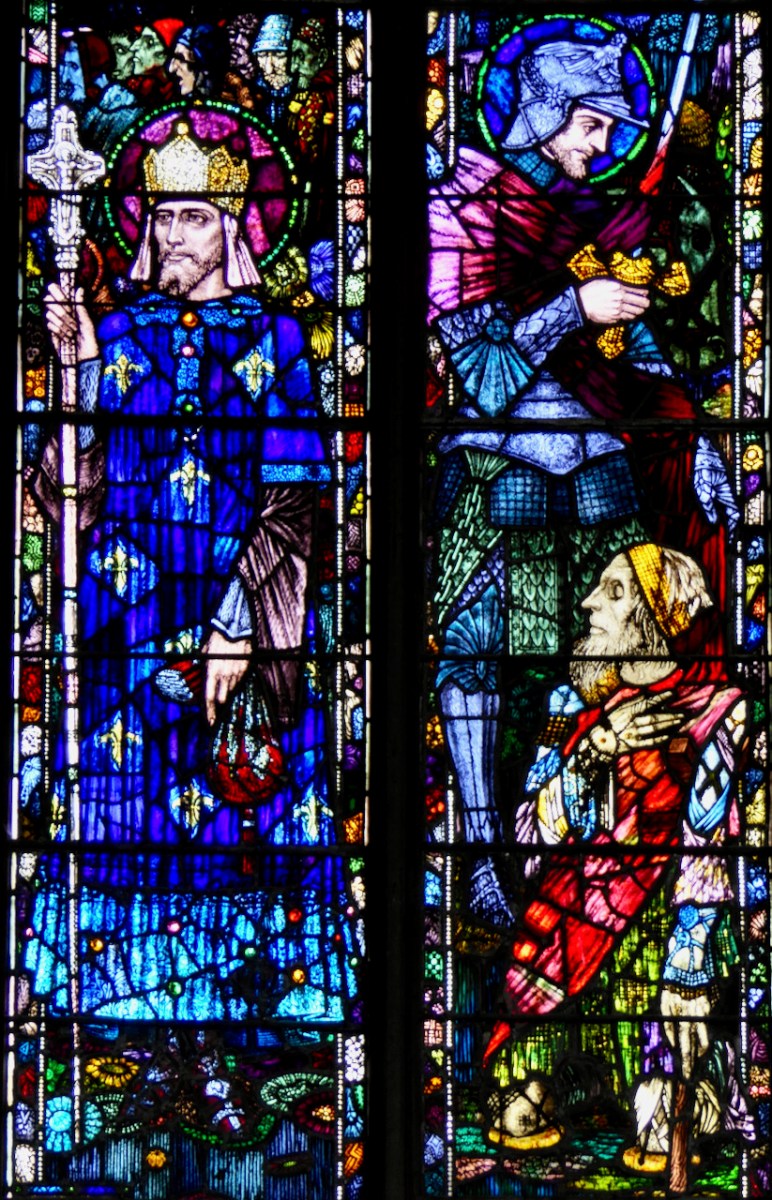
Michael Healy by David Caron: Review

This book – MIchael Healy: An Túr Gloine’s Stained Glass Pioneer – is nothing short of a miracle. It’s beautifully written by David Caron, with superb photography mainly by Jozef Vrtiel, and outstanding production values by Four Courts Press. But a miracle? Yes – because David Caron uses his scholarship and knowledge of stained glass as well as the history and art movements of the period to produce an immensely readable book about an intensely private man who left behind practically nothing about his life except his magnificent work.
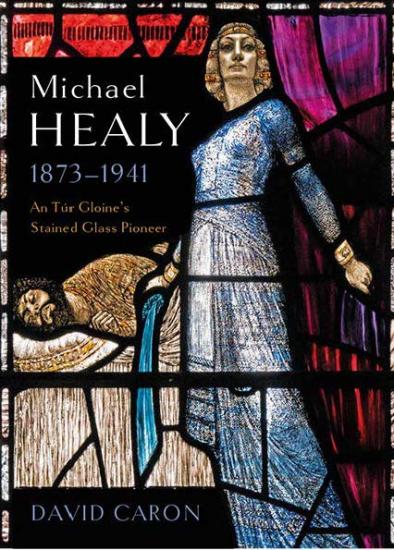
I will declare an interest right away – David Caron is a friend and mentor, editor and principal writer of the Gazetteer of Irish Stained Glass, to which I am one of the contributors. I have been looking forward to this book for a long time, as have all his friends, colleagues and collaborators. It was launched to great acclaim in Dublin on November 1 – all the available copies were snapped up at the launch, including mine (stowed behind the desk), so I had to wait until December to get my hands on it. 
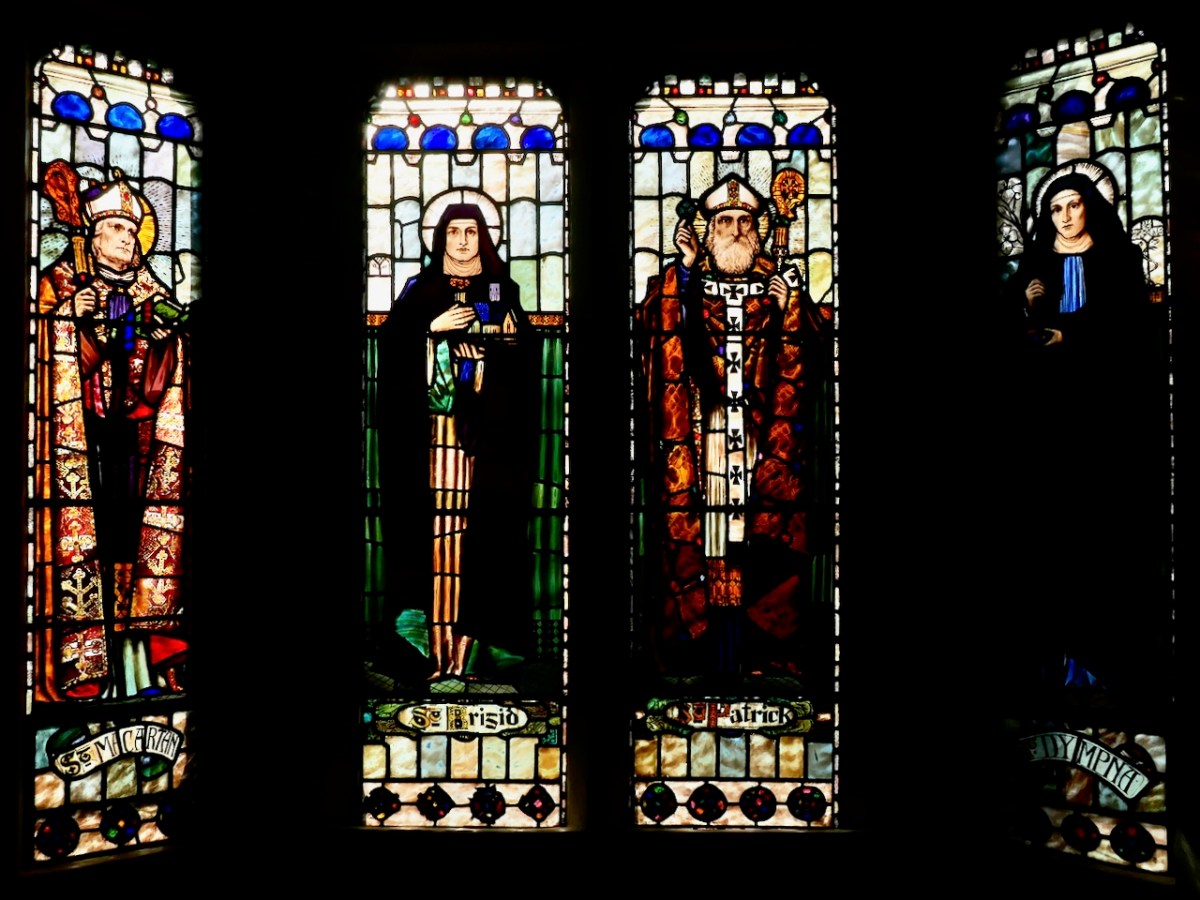
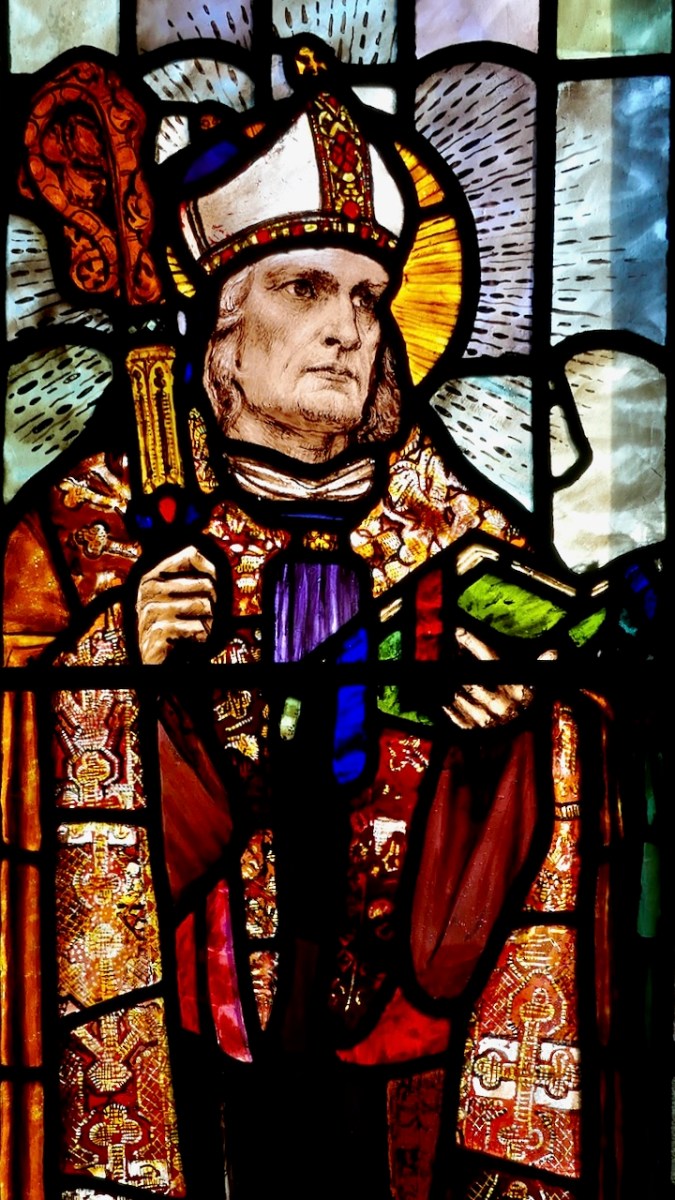
From a private bishop’s oratory, Sts Macartan, Brigid, Patrick and Dympna. Detail of Macartan, below. The rich reds and yellow shading of Macartan’s robes are the result of aciding and silver stain, described further down

All the photographs in this post are my own – but I haven’t seen that many Healy windows, and my photography does not bear comparison with Jozef’s magnificent images. The book is profusely illustrated – it’s one of its many strengths – with many photographs of the tiny details in which Healy delighted and which distinguish his windows from those of other artists. Healy spent all his working life at An Túr Gloine (The Tower of Glass) the Studio founded by Sarah Purser. If you are unfamiliar with this period in Irish stained glass, you might like to read my post Loughrea Cathedral and the Irish Arts and Crafts Movement before continuing.
Born in 1873 into grinding poverty in a Dublin tenement, through a combination of great good luck and his own prodigious talent and hard work, Michael Healy turned himself into one of the foremost stained glass artists of his time. Reading David’s account, it is difficult not to be overwhelmed at times by the hardship endured by Healy and his family in turn-of-the-20th-century Dublin. Packed into one room with miserably inadequate sanitation, whole families succumbed to disease and early death. Consumption was rampant and the only recourse for anything approaching treatment was the dreaded workhouse. Infant mortality rates were high and so we read about several Healy babies who failed to survive into adulthood, as well as adults carried to early graves, leaving widows and widowers to try to cope. 

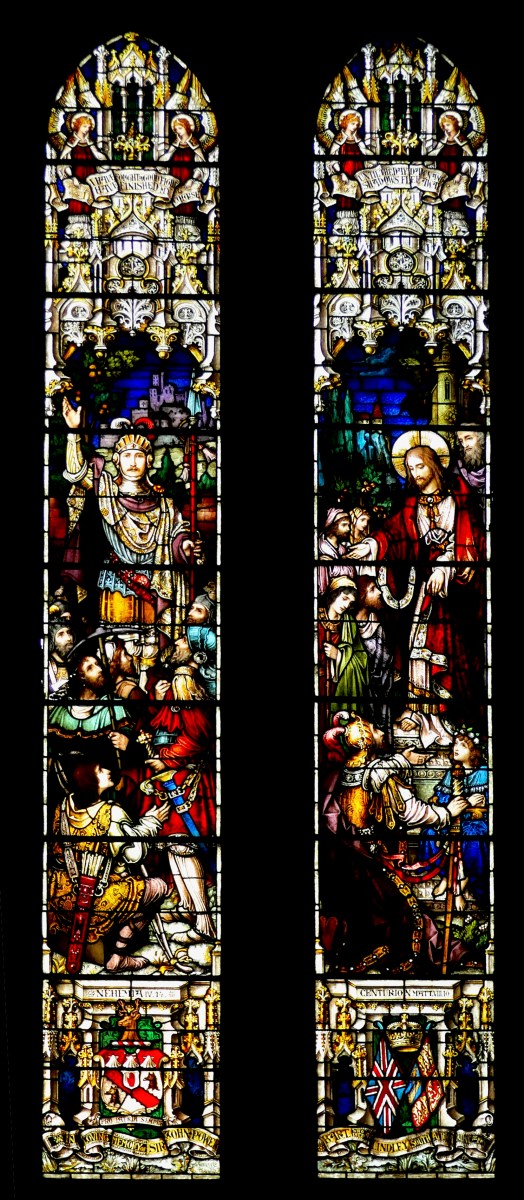
Christ with Doubting Thomas, St Joseph’s, Mayfield, Cork

In the midst of all this was the First World War, the Easter Rising, the War of Independence and the Civil War, followed by the emergence of the new Irish State. David chronicles all of this, and the effect it was having on citizens, like Healy, who were trying to go about their business, but who also had deep convictions about politics and religion.
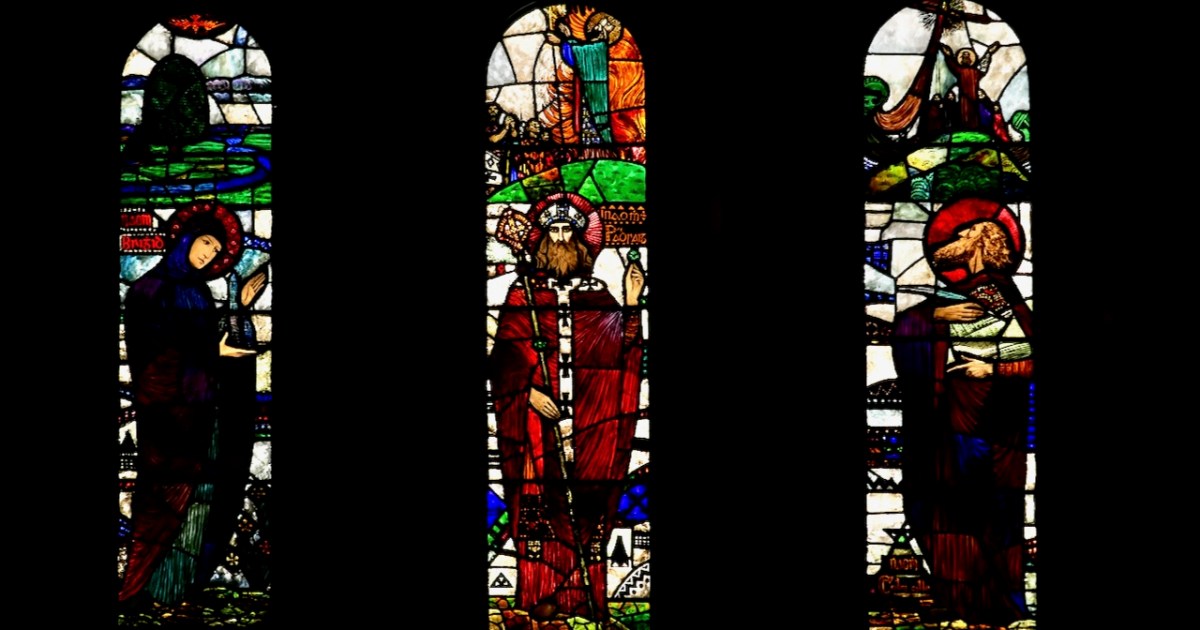
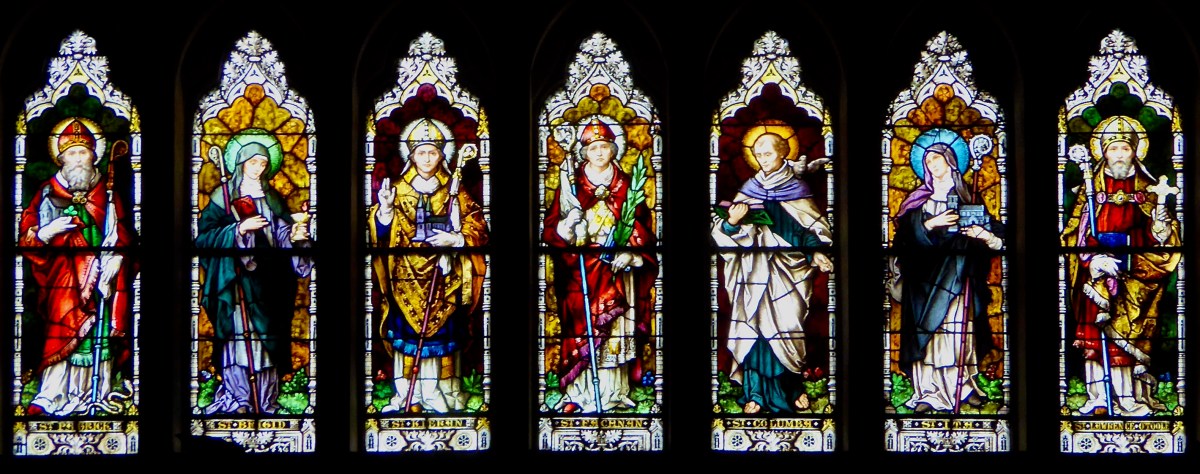
These windows, Sts Brigid, Patrick and Columcille, are in the National Gallery

In some ways, Healy was a typical young man of his time. Deeply religious, he spent some time in a seminary before deciding he was unsuited to the vocation. He belonged to a Catholic men’s lay organisation. David provides many instances where his working class Dublin accent, his republicanism, and his Catholicism must have put him at odds with his fellow artists at An Túr Gloine, mostly female, Protestant and from well-to-do backgrounds. They found him brooding and introverted, although they acknowledged his exceptional talent, and until Evie Hone arrived he did not make true friends with any of them.

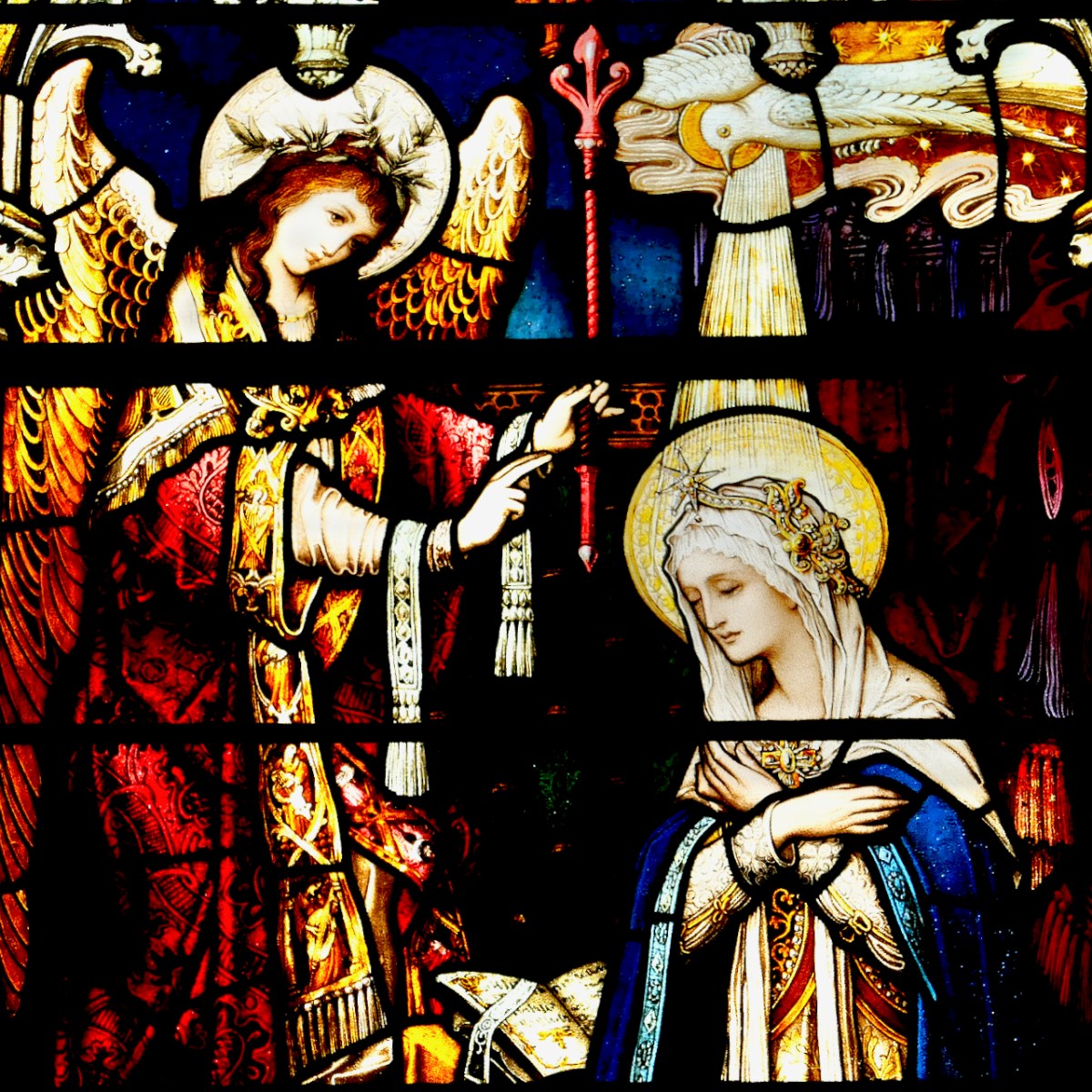
The Annunciation, Loughrea Cathedral. This window was closely based on a design by the great arts and crafts stained glass master, Christopher Whall. Whall came over from England to supervise the execution of it by the Túr Gloine artists, including Healy. Celtic revival interlacing was very popular at the time, and a way of putting a nationalistic stamp on a window – note the subtle inclusions of interlacing here and there

I mentioned that he had strokes of good luck in his life, two in particular. One was the patronage of a perceptive priest, Fr Glendon, who enabled him to study in Florence for a period of time and who procured illustration work for him in Dublin. David points out here and there in the text the influence of Italian painters discernible in Healy’s windows, gained from his sojourn in Italy.

Detail of a Patrick window in Donnybrook

The other was that he found lodgings with a landlady, Elizabeth Kelly, and over time they grew close. Eventually, they become lovers and had a son, Diarmuid, together. Although the relationship was never publicly acknowledged (she was married, although her husband left her) it provided both of them with stability and comfort, and Healy was close to his son. In the 30s Diarmuid O’Kelly (although his mother went by Kelly) bought a Ford Model T and he and Michael would go on sketching expeditions up into the Dublin Mountains and out along the canals. 
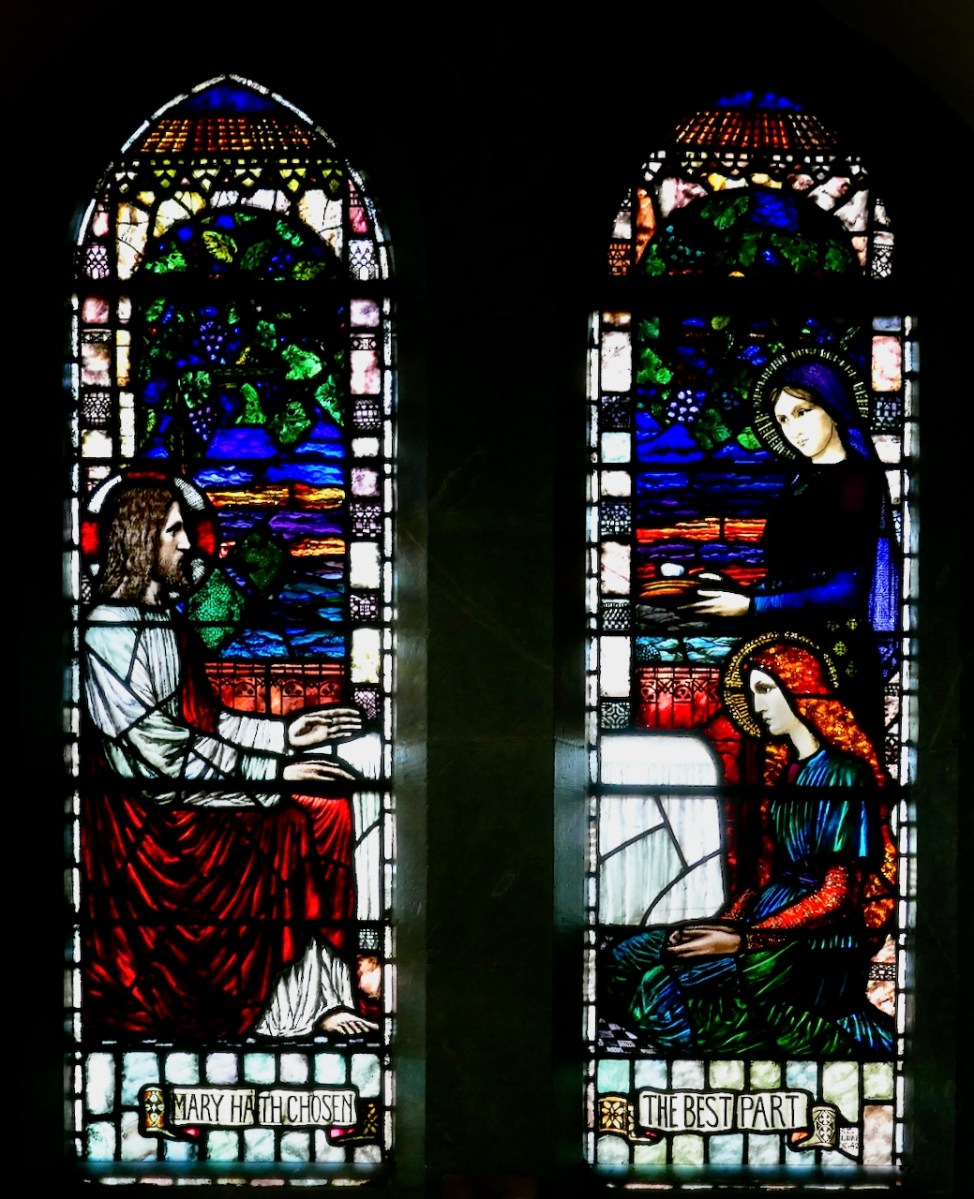
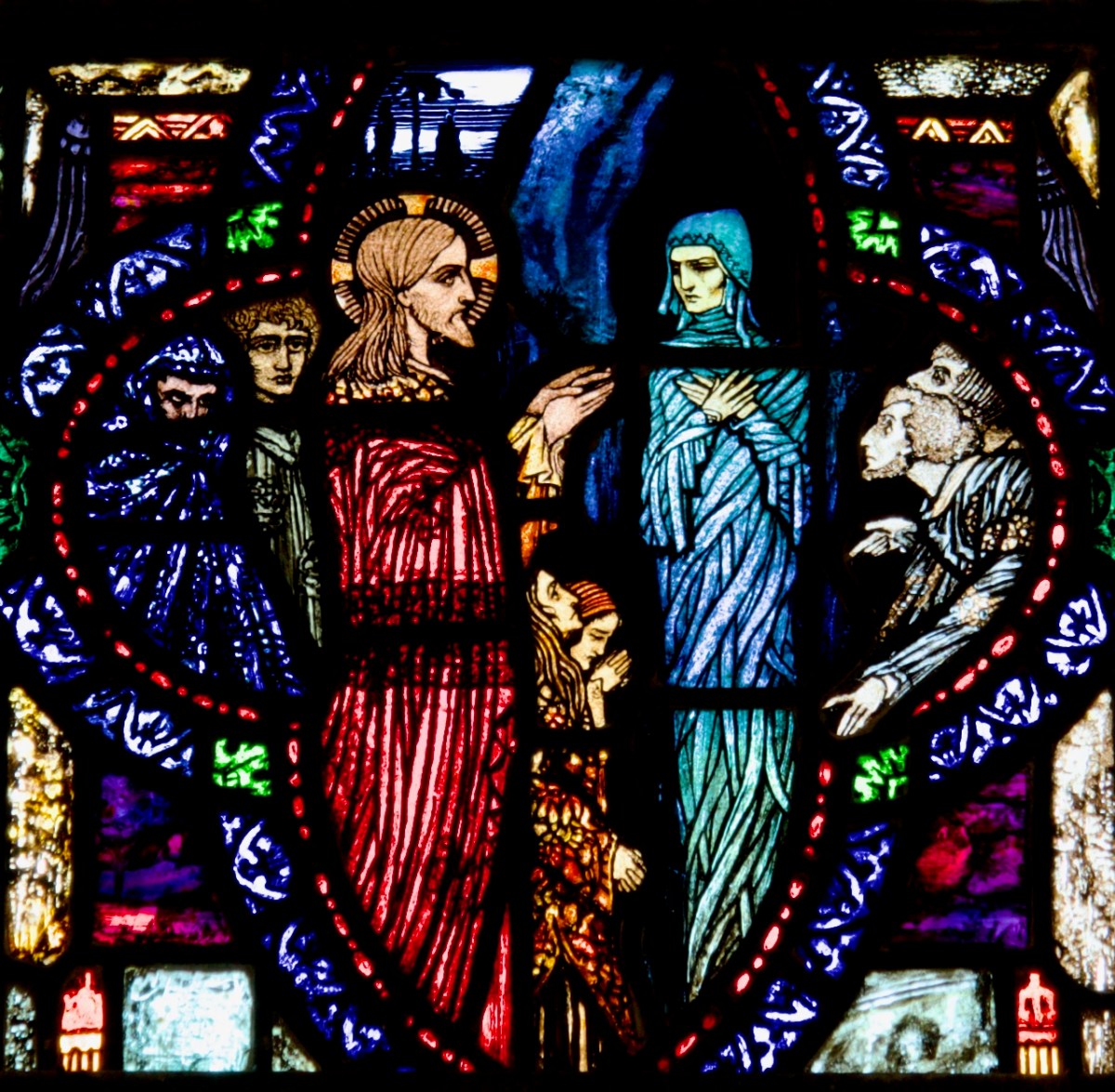
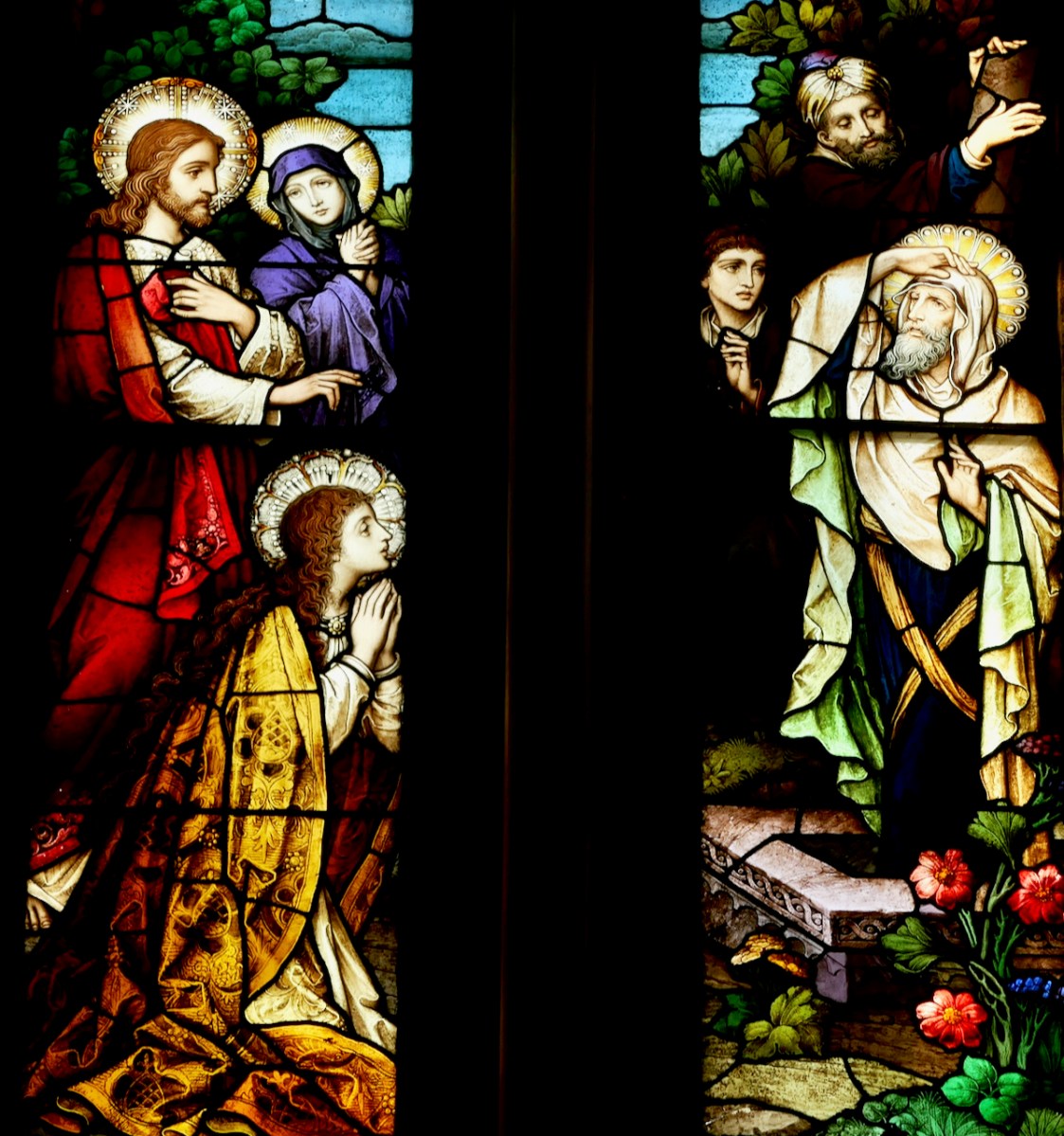
Christ with Mary and Martha, Mayfield, Cork

Because of the opprobrium that such a scandal would have visited upon both Elizabeth Kelly and Michael Healy, Diarmuid was never told that Healy was his father, but he must have suspected, and in more recent times DNA testing confirmed the relationship. Reading about the frequent tragedies that befell the Healy family and the privations under which he grew up, I find it very comforting to know that Michael enjoyed the security and love of his adopted family as he got older.

St Simeon, one of Healy’s early windows for Loughrea Cathedral

David leads us on a measured journey through Healy’s life and work. He was the first recruit to An Túr Gloine, Sarah Purser’s stained glass studio, and later co-op. There, he worked alongside AE Child (also his instructor at the Dublin Metropolitan School of Art), Catherine O’Brien, Beatrice Elvery, Ethel Rhind and Hubert McGoldrick. All of them looked up to him as the finest painter at the Studio. He, in turn, admired the work of Wilhelmina Geddes, and when her health caused problems he finished some of her windows, trying to respect her style and designs. But it wasn’t until Evie Hone arrived that he found a true colleague – Nikki Gordon Bowe described Hone as “his devoted disciple and admirer” and she finished some of his windows after he died.
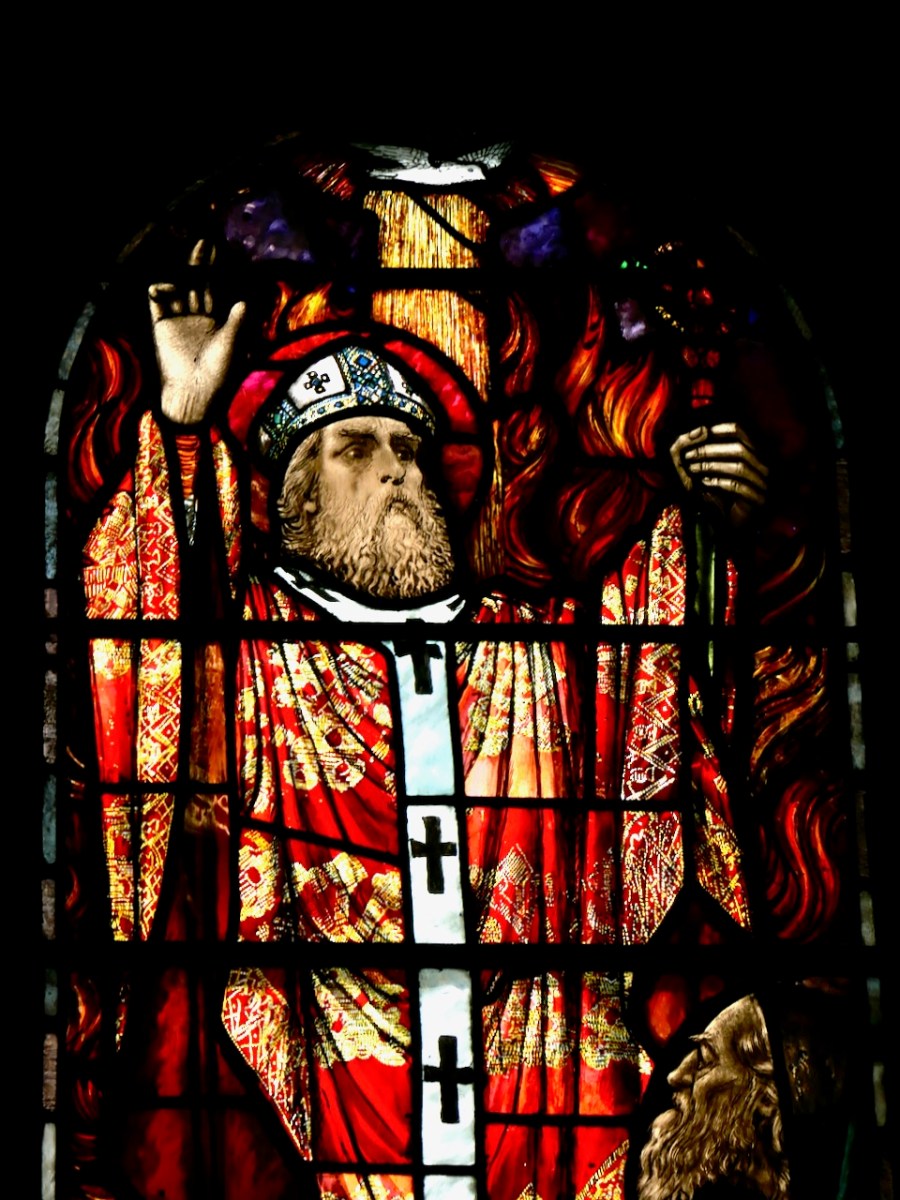
Healy designed many Patrick windows – this one is in Glenariff Co Antrim

Each commission is described and through David’s detailed accounts we come to understand Healy’s style – what iconography he was attracted to, how he decided on the myriad details with which he embellished his windows, and most of all, his decorative methods. 
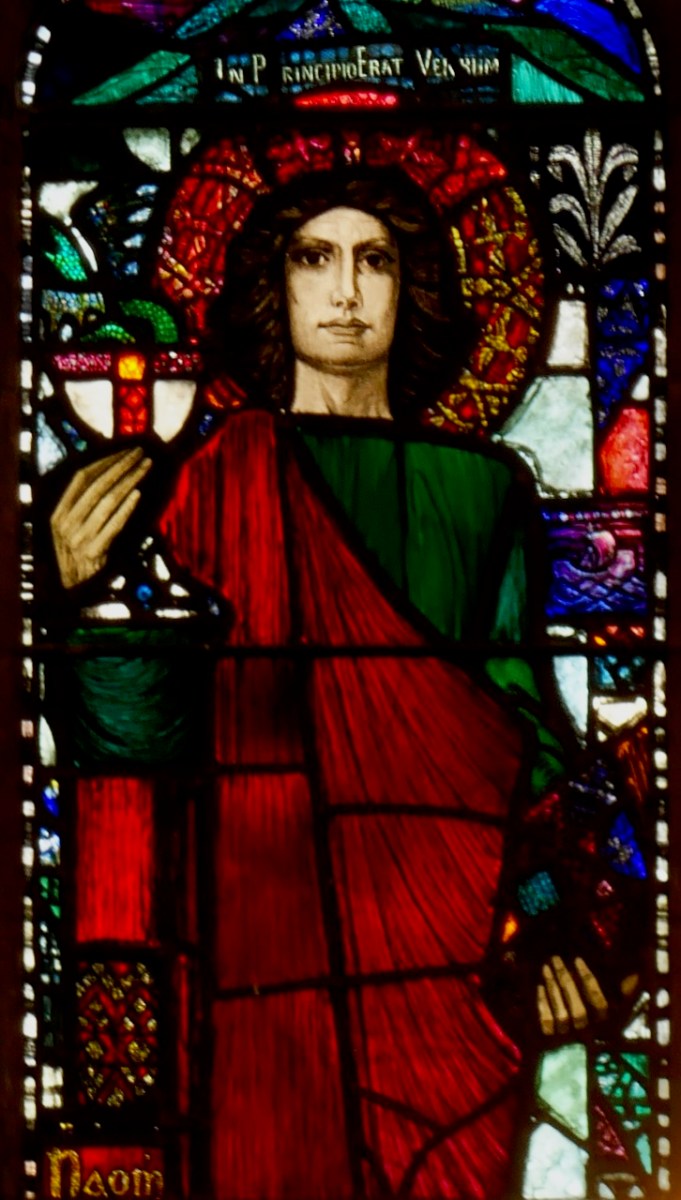
John the Evangelist, Loughrea Cathedral

Long before Harry Clarke made it is his signature, Healy was a master of aciding, a difficult (and dangerous) process used to remove colour from the surface of flashed glass. Flashed glass is clear glass which has a skim of coloured glass fired onto its surface. This top layer could be removed by scratching or etching it away, or by immersing the glass in a bath of hydrofluoric acid, having first applied beeswax to any surface where the colour should remain intact. By waxing and immersing, often several times, colour could be altered from, for example, a rich ruby red to the merest hint of pink, and all shades in between.
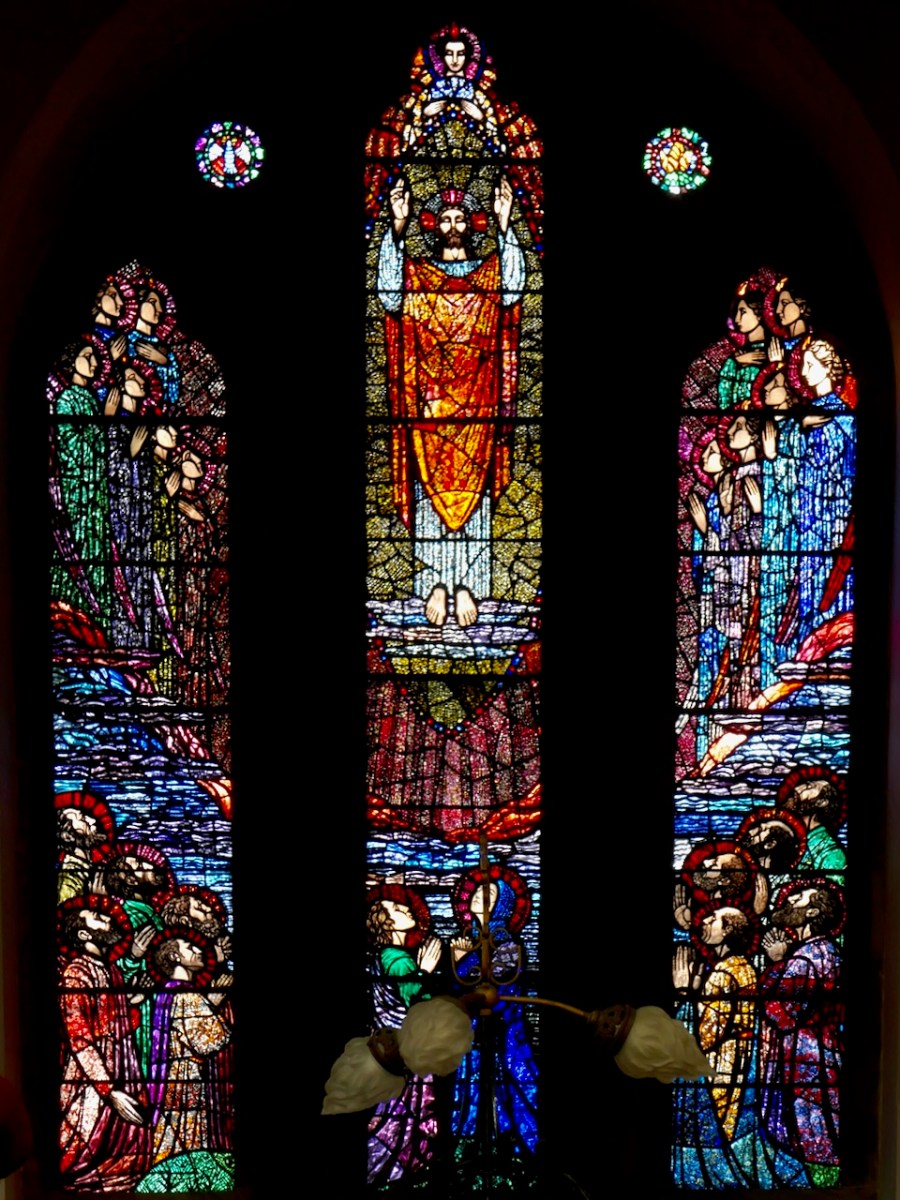
Healy’s Ascension, in Loughrea Cathedral

Healy would often plate two sheets of glass together – for example, one red and the other blue – each one carefully acided, and could by this means achieve an astonishing array of colours from the red-blue side of the spectrum. Added to this, he would often use silver stain on the back of the glass. Once heated in the kiln, the silver stain would permeate the glass, turning it yellow (repeated firings could deepen this from bright yellow to a rich amber colour). Finally, all the figuration would be painted and stippled on to the surface of the glass and the individual pieces of glass would be assembled and leaded together to produce the finished window. Healy was a perfectionist and Purser would despair of ever making enough money to keep the studio going since he spent so long on each commission.
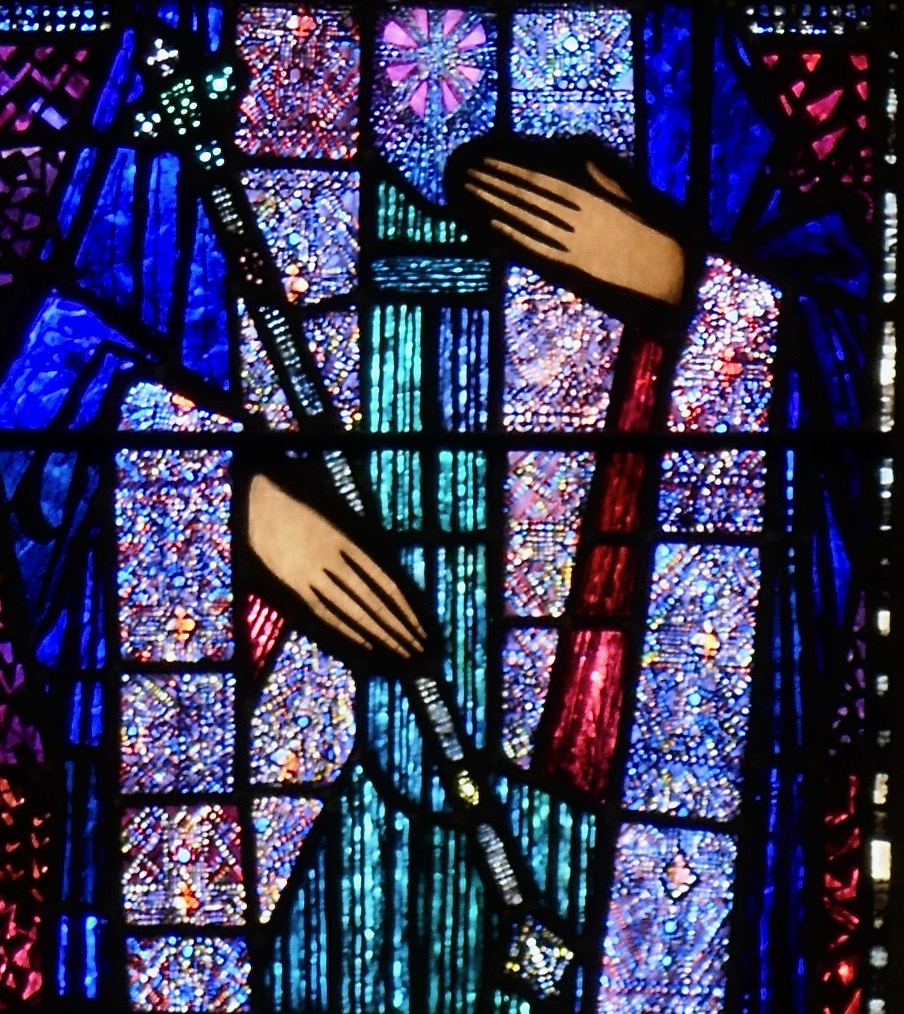
This detail from Healy’s Virgin Mary window in Loughrea illustrates well his aciding technique using red and blue flashed glass plated together to produce not only infinite shades of colour but a sparkling jewel-like effect

It is through David’s lively analysis of each window that we truly come to appreciate Healy’s genius and his evolution as an artist, his style developing according to his exposure to more modern influences.
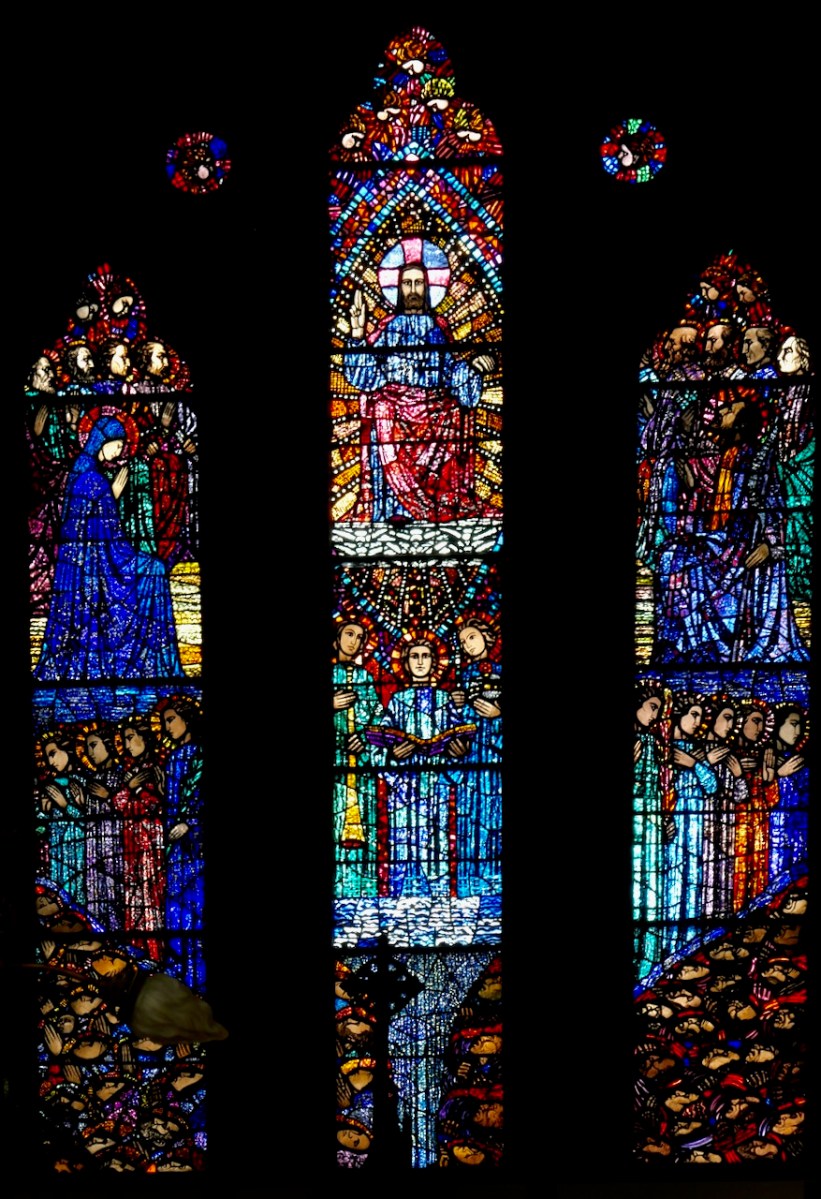
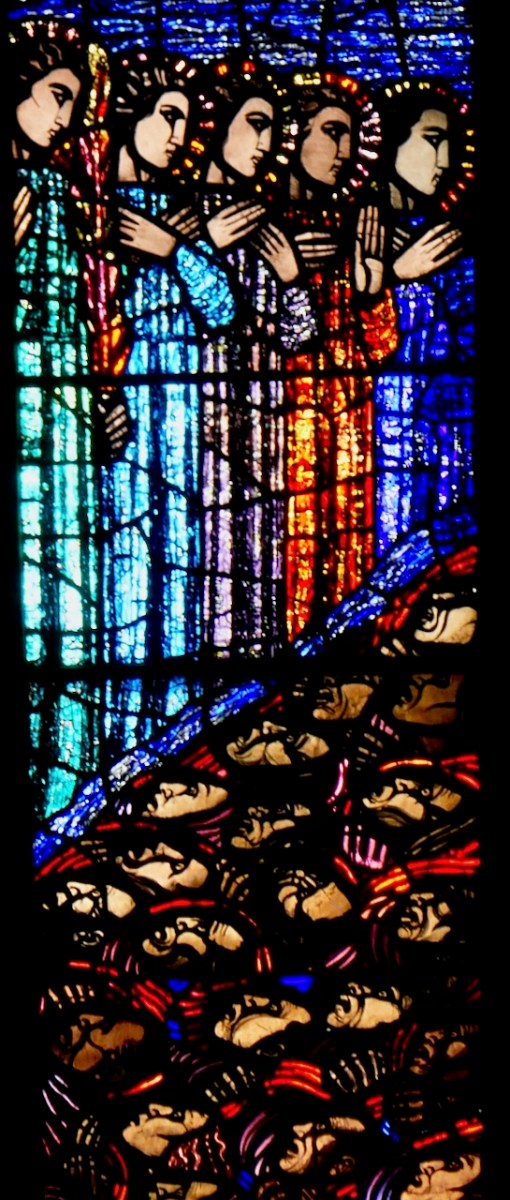
Considered one of his masterpieces, this is the Last Judgement Window in Loughrea, completed towards the end of his life. A detail from The Damned(right -hand light) is below

David wears his erudition lightly and when he dissects a window, pointing out elements that are easy to miss, and explaining what they mean and why Healy used them, I found myself pouring over Jozef’s wonderful photographs, picking out each separate item of iconography, and marvelling anew at the depths of learning that Healy brought to his designs. For example, David devotes five pages to the St Augustine and St Monica window in John’s Lane Church in Dublin and not a word is wasted.
Along the way we meet a host of characters – the redoubtable Sarah Purser and his colleagues at An Túr Gloine, enterprising priests and bishops, citizens memorialising their dead family members (CS Lewis!), art critics such as C P Curran, American heiresses, patrons of the arts, Celtic Revival influencers (OK, modern word, but you know who I mean). We get insights into the inner workings of the studio, wherein frequent bouts of unprofessional behaviour created tensions, and where Sarah Purser often had to crack the whip when productivity lagged. We come to understand the difficulties of soliciting business, agreeing on final designs and delivering orders, especially to overseas clients, in days when postal service to American and New Zealand took weeks.

A detail from the Patrick window in the National Gallery

We also come to see Healy as a rounded artist who did more than stained glass. His quick sketches of Dublin characters, drawn from life have all the attraction of immediacy and familiarity, while his watercolour landscapes are charming.  

An early Loughrea window, Virgin and Child with Irish Saints

Healy died in 1941. By the time you finish the book, you feel you have lost a friend – a difficult and complicated one to be sure, but one whom you admire and will never forget. While obviously a gruff character on the outside, David allows us access to his humanity, and points out the obvious sympathy with which he portrays some of his subjects. His Loughrea St Joseph (below), for example, shows, in the words of the art critic Thomas McGreevy, a “Joseph who knows the tragedy of the world and who has some special understanding of the destiny. . . of the child”. We are, of course tempted to see in the tenderness with which Joseph gazes down at Jesus a revelation of Healy’s suppressed feelings for his own son.

This book is not just for stained glass enthusiasts, though they will delight in it, but for anyone interested in life in Ireland at the end of the 19th and beginning of the 20th century, and indeed for anyone who enjoys good writing and a story that propels you through almost 70 years of the life of a significant artist. Available from the publisher or in all good bookstores.
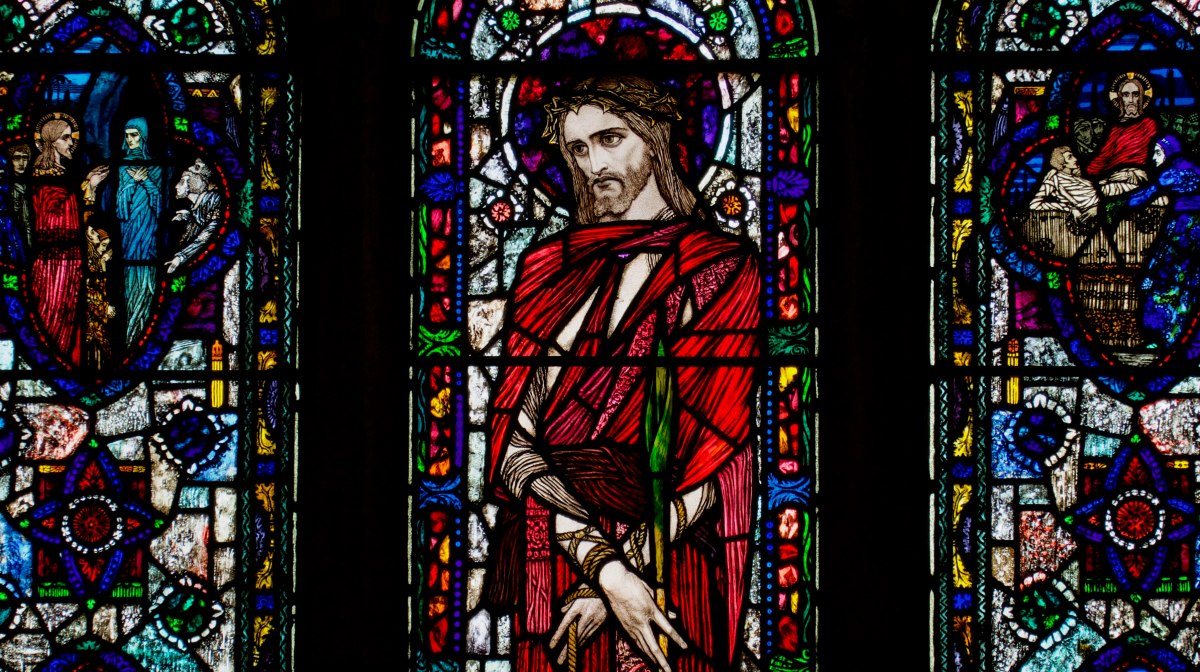
Ecce Homo: Harry Clarke’s Kilbride Window

Harry Clarke’s window in St Brigid’s Church of Ireland, Kilbride, Co Wicklow, is a bit of a mystery: simultaneously one of his most beautiful and his most mis-described windows. It’s almost as if there’s some kind of spell on it – whoever shall describe this window shall be led down erroneous pathways*. I hope this post will break that spell and set the record straight.

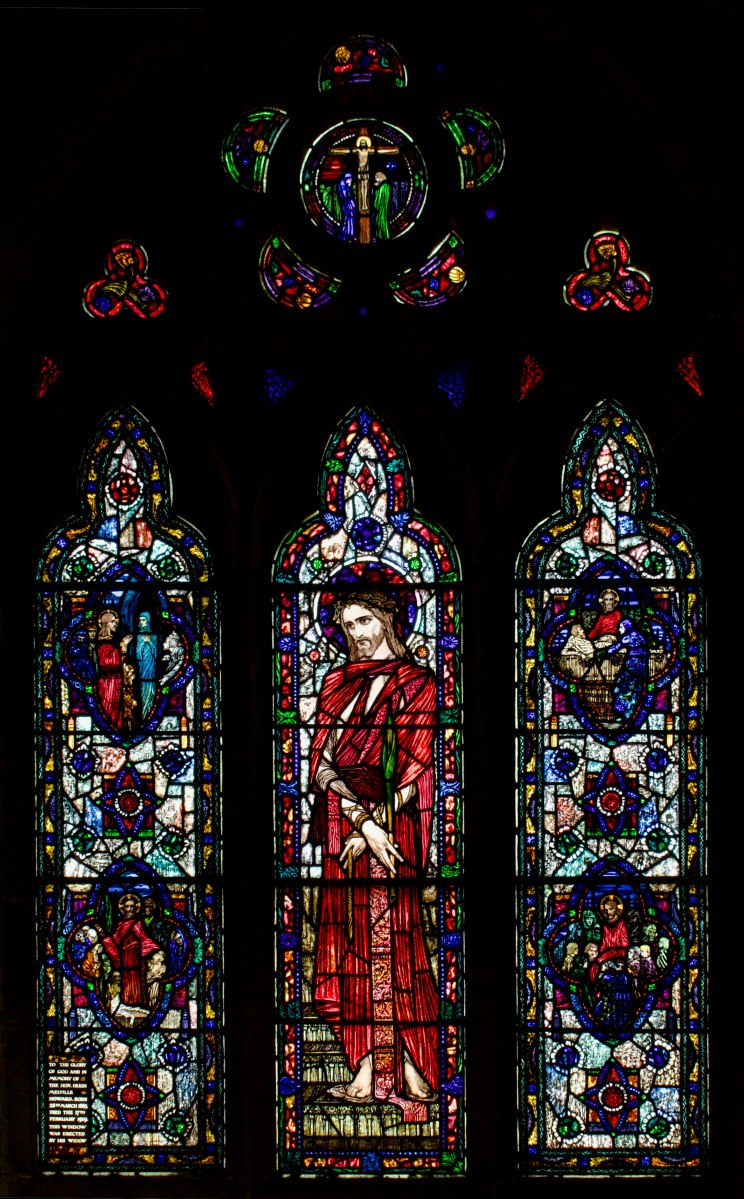
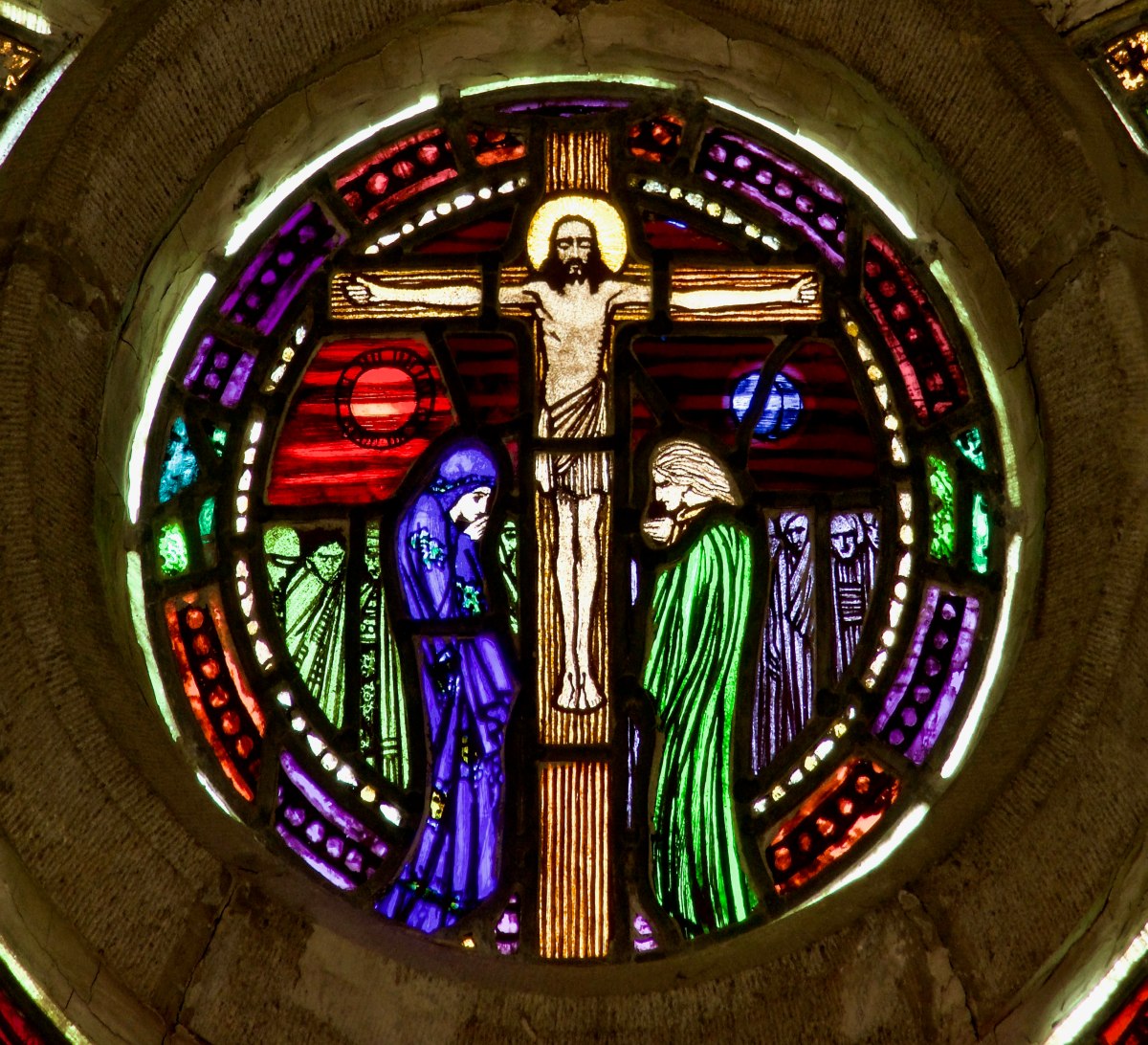
This is the whole window, which occupies the wall behind the altar. It’s a three-light window and the tracery above includes a small roundel with a crucifixion scene.

When it comes to Harry Clarke, there is no more authoritative source than Nicola Gordon Bowe. Hers are the shoulders upon which all of us stand to gain insight and understanding of the man and his work. She didn’t make many mistakes. However, inexplicably, she described this window as a ‘Resurrection’. In The Life and Work of Harry Clarke, she states that: As a result of the St Stephen Lea-Wilson Window in Gorey, Clarke was asked by the Earl of Wicklow to design a Resurrection window for the parish church of Enerily and Kilbride, Co. Wicklow near the Earl’s estate, Shelton Abbey. Several pages further on, she says Harry . . . spent 9 February with the Earl of Wicklow discussing a further window for the small church of Enerily and Kilbride near Arklow.
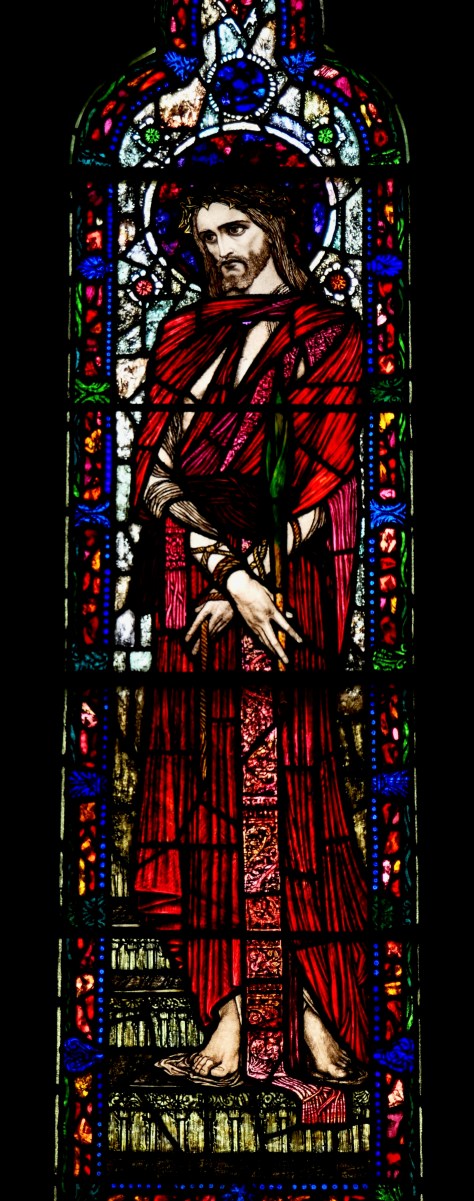
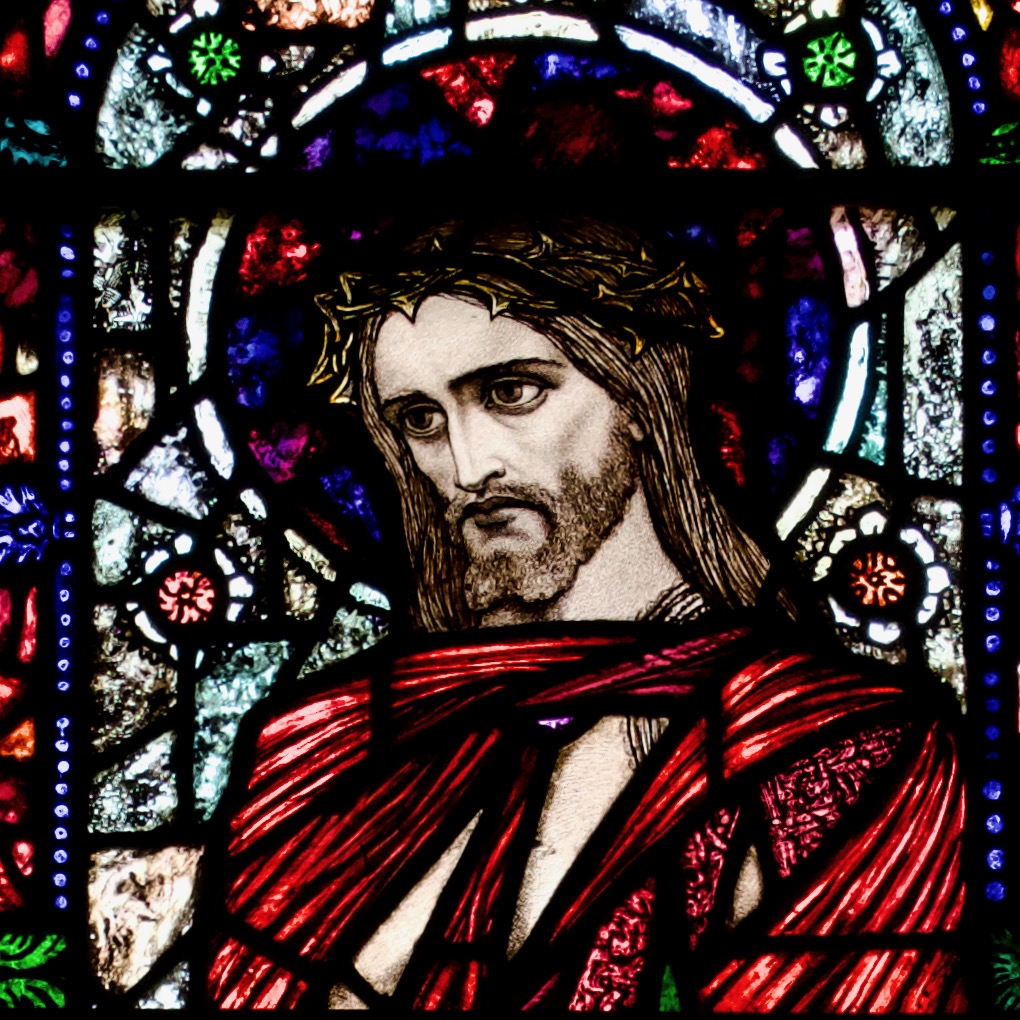
The central figure is of Christ as he was paraded before Pilate, who washed his hands of the affair and declared, as he presented him to the Jews, Ecce Home – Behold the Man. As described in John and Matthew, he is bound, crowned with thorns, holding a reed (Harry has chosen a bulrush), and clad in a scarlet robe. He is standing on steps (as frequently depicted in paintings) and under his feet the cloth may represent his own clothes, stripped from him

She describes the finished window thus: In the three-light Resurrection, the figure of Christ in the centre light stands at the foot of a staircase, robed in ruby, crowned with thorns and bearing the palm of martyrdom. The ruby glass is carried into the border, into the side traceries where it is neither painted nor acided, and is echoed in the medallion showing The Crucifixion in the centre of the rose tracery above. It is also used in the figure of Christ, which appears in each of the quatrefoil panels of the side lights which, set in rich borders of ruby, blue and green, seem inspired by medieval glass. A rich blue dominates four medallions showing miracles of the Lord. The medallion in the lower right-hand light features a self-portrait of the artist, a halo over his untidy hair, and huge eyes giving him a haunted look while above, the resurrection theme is evocatively illustrated by the miracle of Lazarus. This window is much enhanced by the rough, unplastered wall in which it is set.
Clarke’s Jesus in this window is one of his most striking depiction of suffering and compassion

However, the dedication on the window is to Hugh Melville Howard, younger half-brother to the Earl of Wicklow, and donated not by the Earl, but by Hugh’s widow.  Hugh had died in 1919. The date might make you suspect that this was a war memorial window, but in fact, Hugh died of pneumonia at the age of 36. This must have been a tragedy indeed for his wife, May Sands, the only daughter and heiress of New York lawyer and real estate mogul, Benjamin Aymar Sands. They had married in America in 1908 – a high society wedding, every detail of which was gleefully reported in the New York Times. At the time of his death they were living in Bellevue House in Delgany and had two children. The window was not installed until 1924.

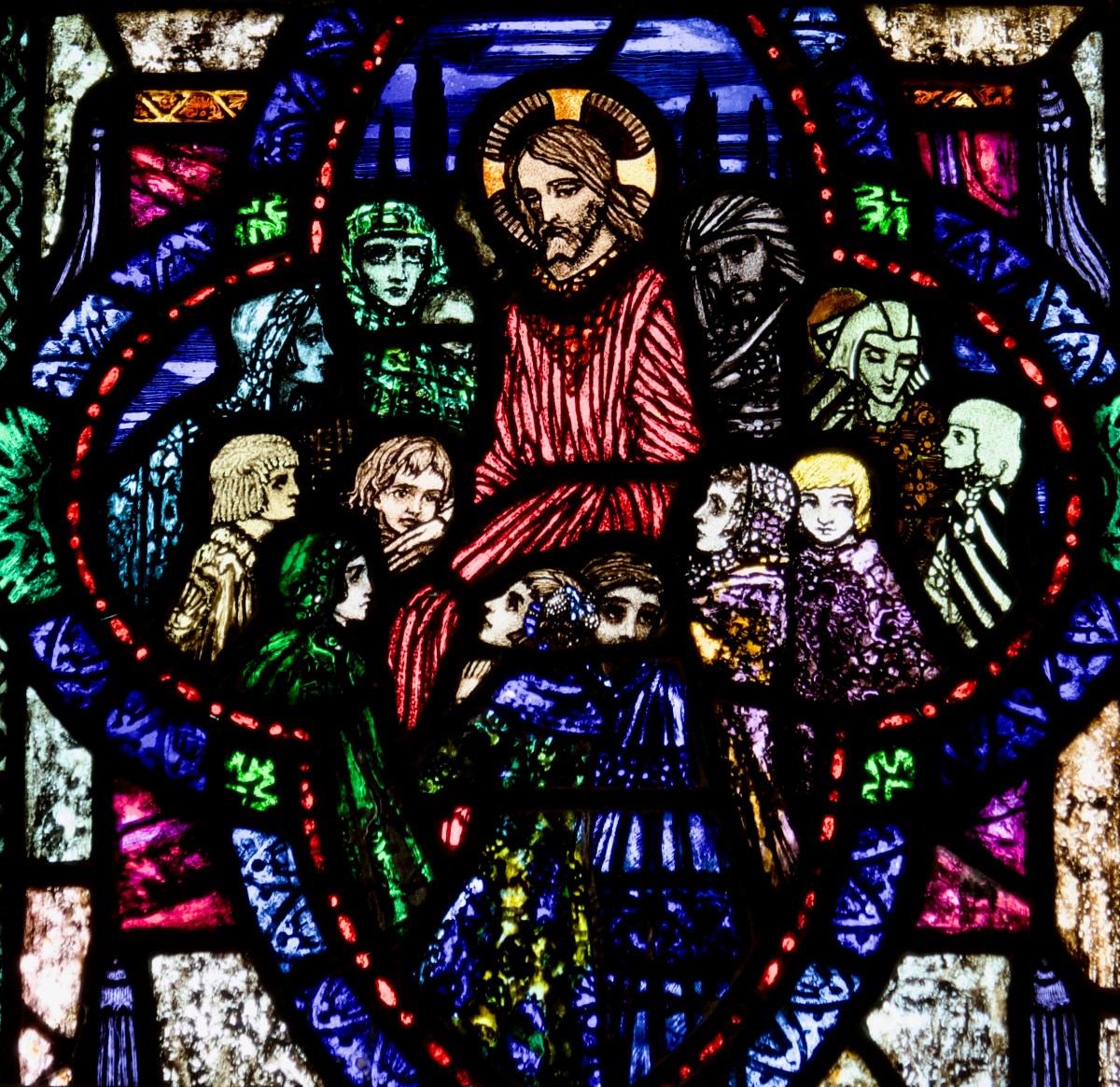
Christ and the Children

So there seems to be a disconnect between the original idea for a Resurrection Window for Kilbride, and the final product, which depicts not, indeed, a Resurrection image but that of the suffering Jesus, mocked by his tormentors, scourged, bound with ropes, crowned with thorns, carrying a reed to stand in for a sceptre. This is the image that is known as Ecce Homo – Behold the Man. 

Matthew 27: 26-31

Then released he Barabbas unto them: and when he had scourged Jesus, he delivered him to be crucified. Then the soldiers of the governor took Jesus into the common hall, and gathered unto him the whole band of soldiers. And they stripped him, and put on him a scarlet robe. And when they had platted a crown of thorns, they put it upon his head, and a reed in his right hand: and they bowed the knee before him, and mocked him, saying, Hail, King of the Jews! And they spit upon him, and took the reed, and smote him on the head. And after that they had mocked him, they took the robe off from him, and put his own raiment on him, and led him away to crucify him. 

John 19: 1-5

Then Pilate therefore took Jesus, and scourged him. And the soldiers platted a crown of thorns, and put it on his head, and they put on him a purple robe, And said, Hail, King of the Jews! and they smote him with their hands. Pilate therefore went forth again, and saith unto them, Behold, I bring him forth to you, that ye may know that I find no fault in him. Then came Jesus forth, wearing the crown of thorns, and the purple robe. And Pilate saith unto them, Behold the man!

I surmise that, whereas the original idea, as proposed to Harry by the Earl, may have been for a Resurrection-themed window, the final central image, of suffering and preparation for death, would have seemed more apt to May, the grieving widow. 

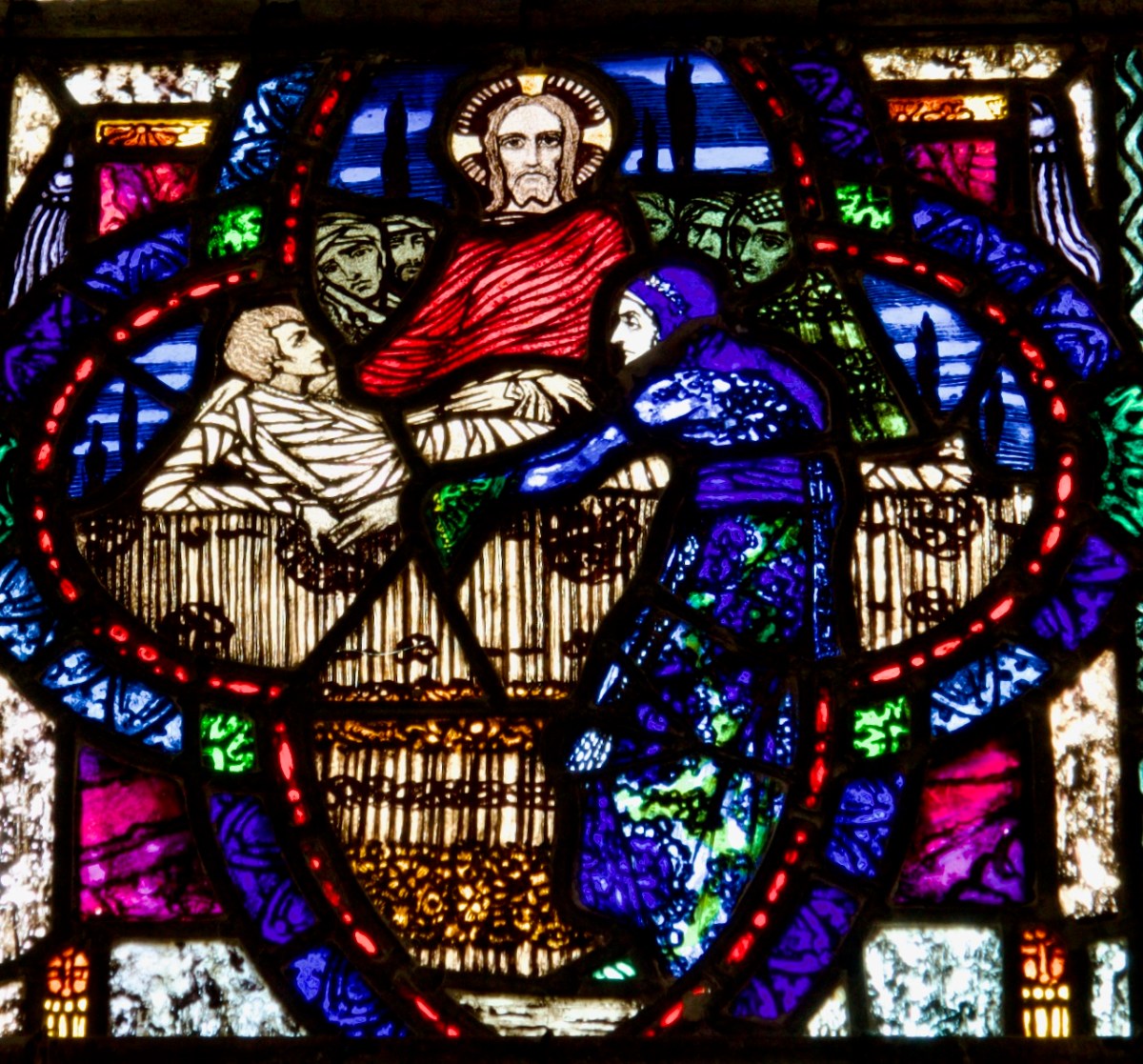
The Raising of Lazarus

May and Hugh had been married in a charming country church called St Andrews Church of the Dunes in the heart of the Hamptons on Long Island. It was an Episcopalian church patronised by wealthy New Yorkers who had country houses in the area. Episcopalian services focus on the sacraments, similar to a Catholic Mass, and the church was filled with stained glass, some by Tiffany.

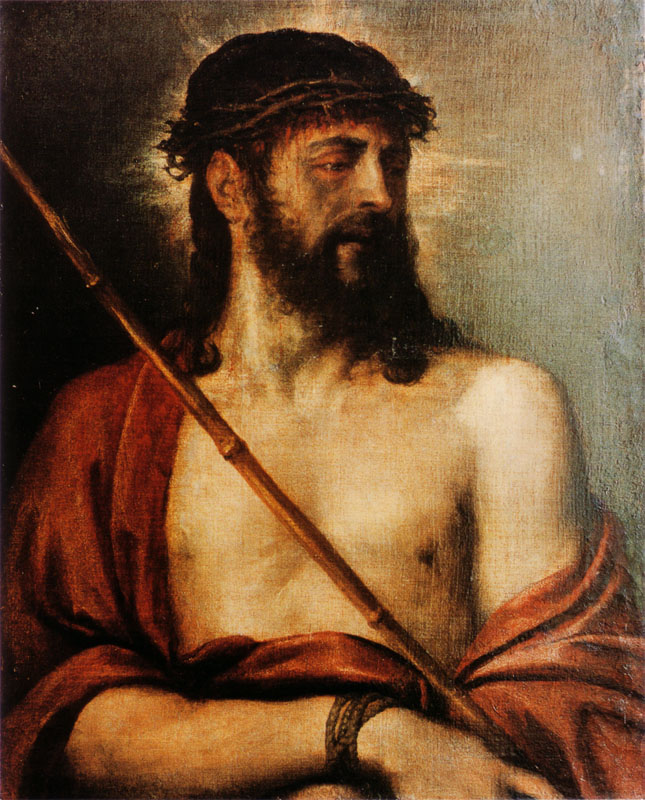
Ecce Homo by Titian (Unknown source, Public Domain, https://commons.wikimedia.org/w/index.php?curid=5557882)

This is relevant because Ecce Homo, despite being a staple of Renaissance imagery (Titian alone did several versions, including the one above), is not a frequent choice for Church of Ireland windows. I can identify only eight windows (of 3,198) which contain Christ in this state of having been scourged or mocked. (There are, on the other hand, one hundred and eleven Resurrection windows.) If it was May, rather than Lord Wicklow, who had the final say in the central imagery, I can see how her background in a more Catholic form of worship might have made her more amenable to an Ecce Homo depiction, and that therefore what started out as a Resurrection Window (with supporting Resurrection-themed medallions), ended as a window depicting suffering, healing, and children. 

The Raising of the Widow’s Son at Nain

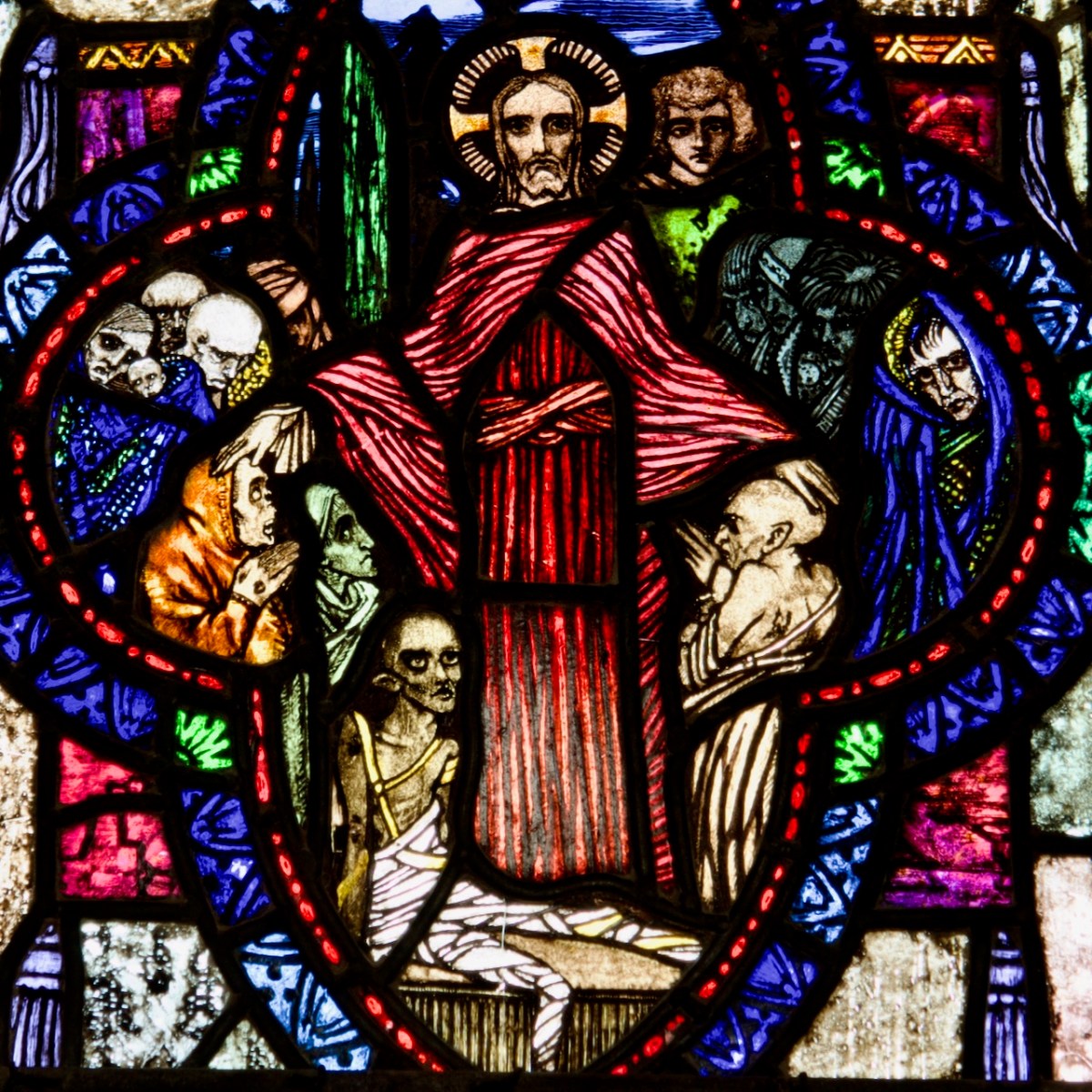
Four medallions are placed on either side of the central figure of Christ. Three relates to the theme of Resurrection and/or healing – The Raising of Lazarus (Top Left); The Raising of the Widow’s Son at Nain (top right); and Christ’s Healing Ministry (bottom left). The final medallion is Christ Blessing Children (bottom right), perhaps a reference to hope that May’s children, now fatherless, would find comfort.

Christ’s Healing Ministry

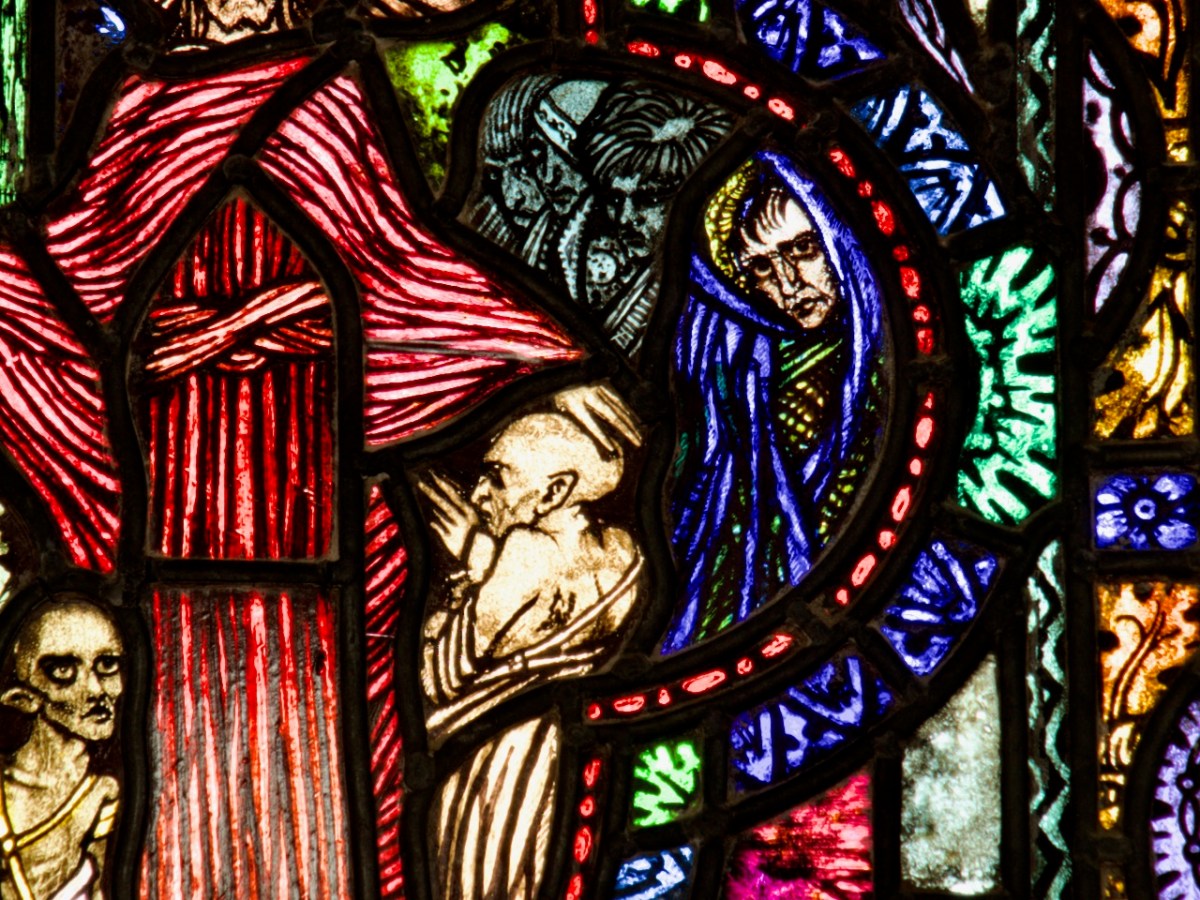
In the medallion above, Gordon Bowe identifies a self-portrait of Harry, peering in on the right-hand side (below). Harry has done this in other windows, often more immediately recognisable than here. The parade of sick, palsied, bandaged and leprous sufferers are typical of Harry’s affinity to the macabre.

In the cinquefoil tracery at the top of the window is a small roundel containing the Crucifixion. Although tiny, it is as full of detail as are the medallions.

David Lawrence, in his entry in Gloine, correctly identifies the medallions, and uses Christ as Martyr for the central figure, perhaps because he (like Gordon Bowe) interprets the ‘sceptre’ that Jesus is carrying as a palm, the icon of martyrdom. In Strangest Genius, by Lucy Costigan and Michael Cullen, the authors simply repeat the description and background as gleaned from the work of Gordon Bowe (although without credit, as seems to be their practice), along with the errors, and add one of their own, describing the reed as a ‘lily. . .denoting his virtue.’

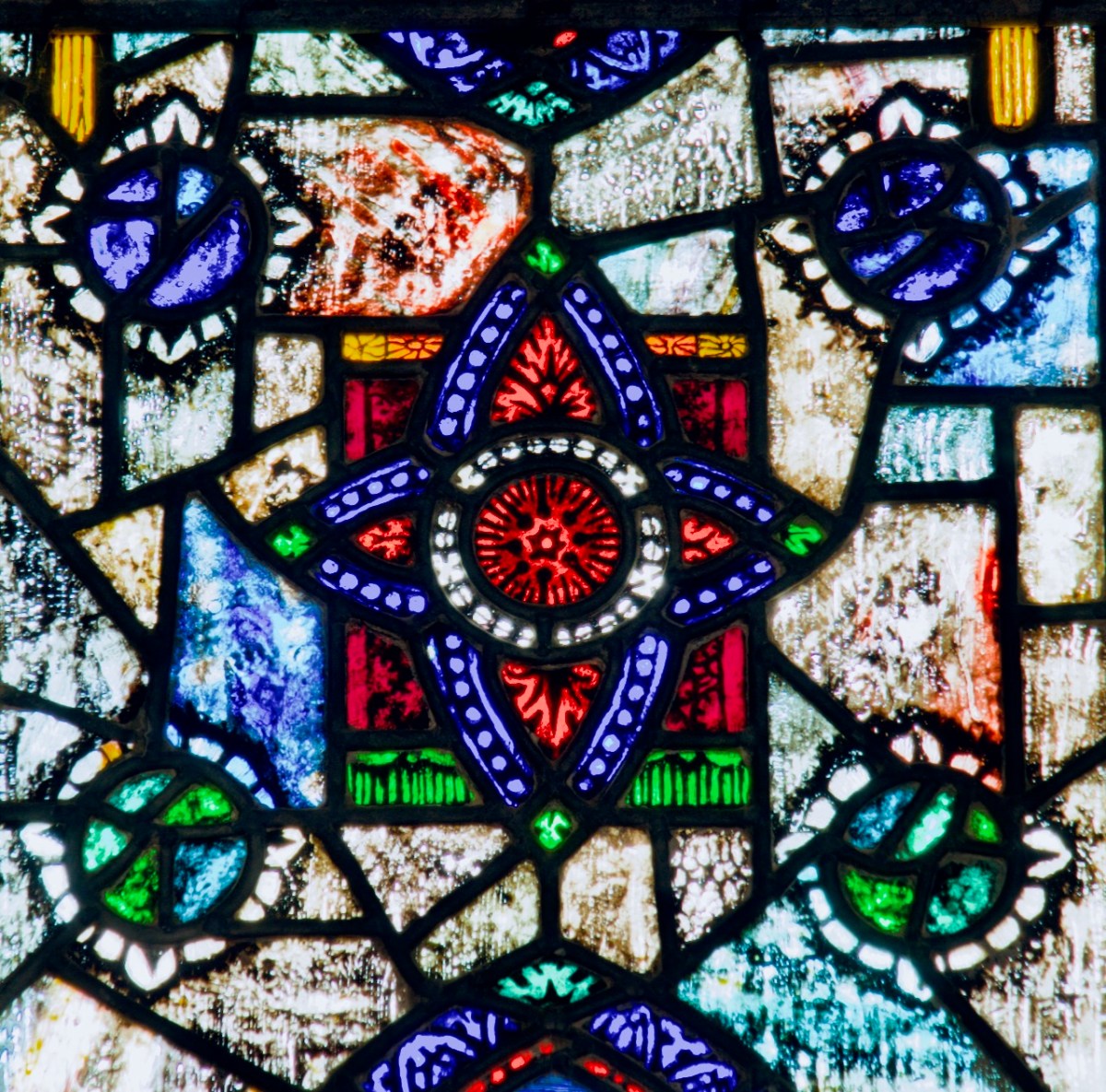
Gordon Bowe often uses the term jewel-like to describe Harry’s ability to make his windows sparkle and shimmer and to use advanced techniques (such as plating and acid-etching) to create depth and allow the sun to refract through the glass. The window in Kilbride is a master-class in how he achieves this effect, especially in the decorative areas between the scenes, as in the one above. No photograph can do justice to this effect.

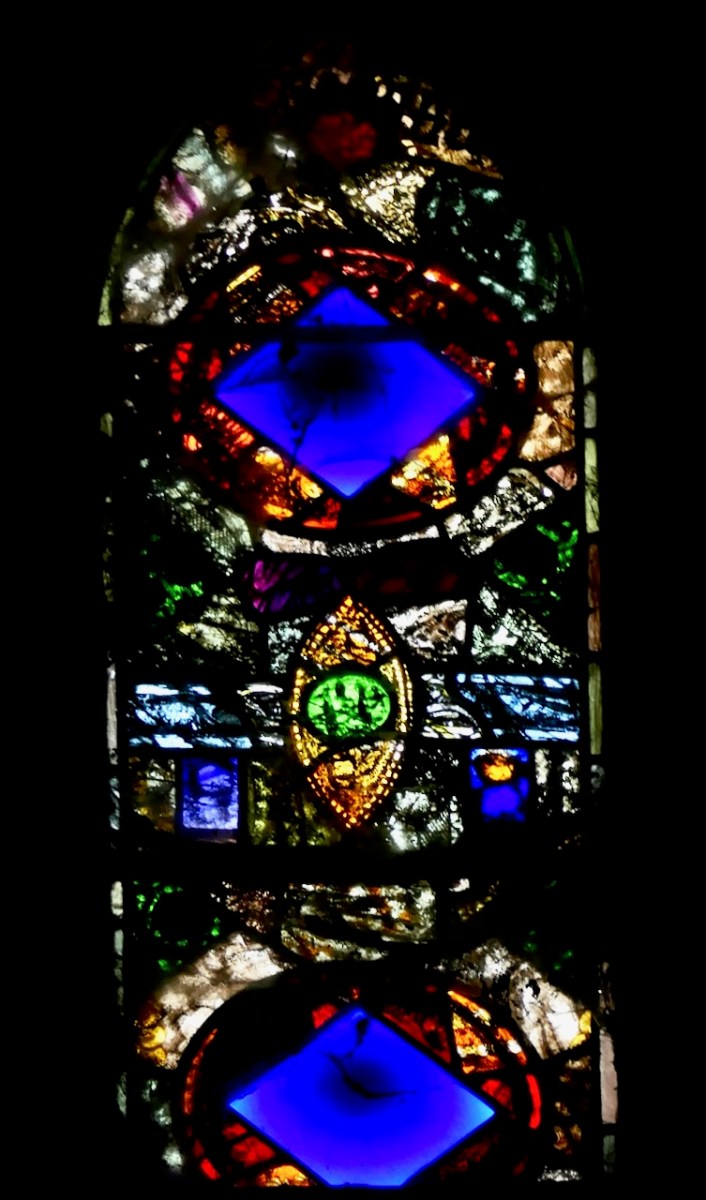
Oh, and just to add to the fact that this tiny church has an exceptional Harry Clarke window – it has a second one (above). Harry made it with left over ‘scraps’ of glass, to fill a small, high, transept window, and he described it as an ‘experiment.’ The two pieces of blue glass prefigure the mid-century practice of dalles de verre, of which we have several excellent examples in Irish Churches.

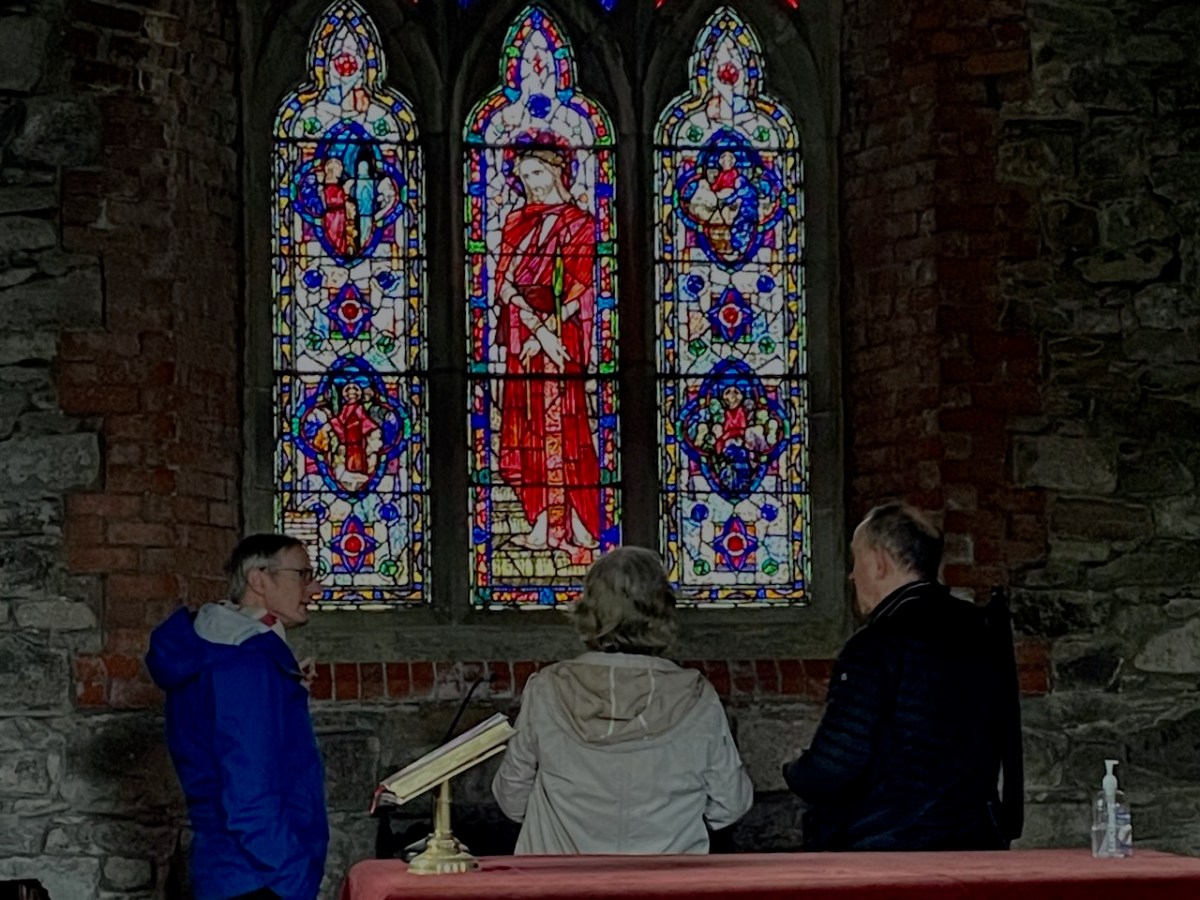
David Caron, Editor of The Gazetteer of Irish Stained Glass; Ruth Sheehy, author of The Life and Work of Richard King; and Paul Donnelly, expert researcher on the Harry Clarke Studios, in front of the Ecce Homo window on a recent visit. Together, we discussed the most appropriate title for the window. Like most Church of Ireland churches, Kilbride is closed most of the time, and therefore the window is not easily accessible. I am very grateful to the Rev Barrett for allowing us to view and photograph the windows last week. Besides the photographs in Gloine, I can find no other images of the window online, so I hope this post will clarify what this window is actually all about. 

*The most head-scratching erroneous description comes from this report in The Wicklow People

One Window, Eight Stories

Story 1. Bobbie

The first story is about a boy, Bobbie Bole, a student at Drogheda Grammar School in the 1940s. He’s the part of this account we don’t know much about, but he must have been a special boy. When he died, in 1942, many people donated money to create a memorial in his memory. It was decided that a stained glass window would be a good way to remember him,

Story 2: The Competition

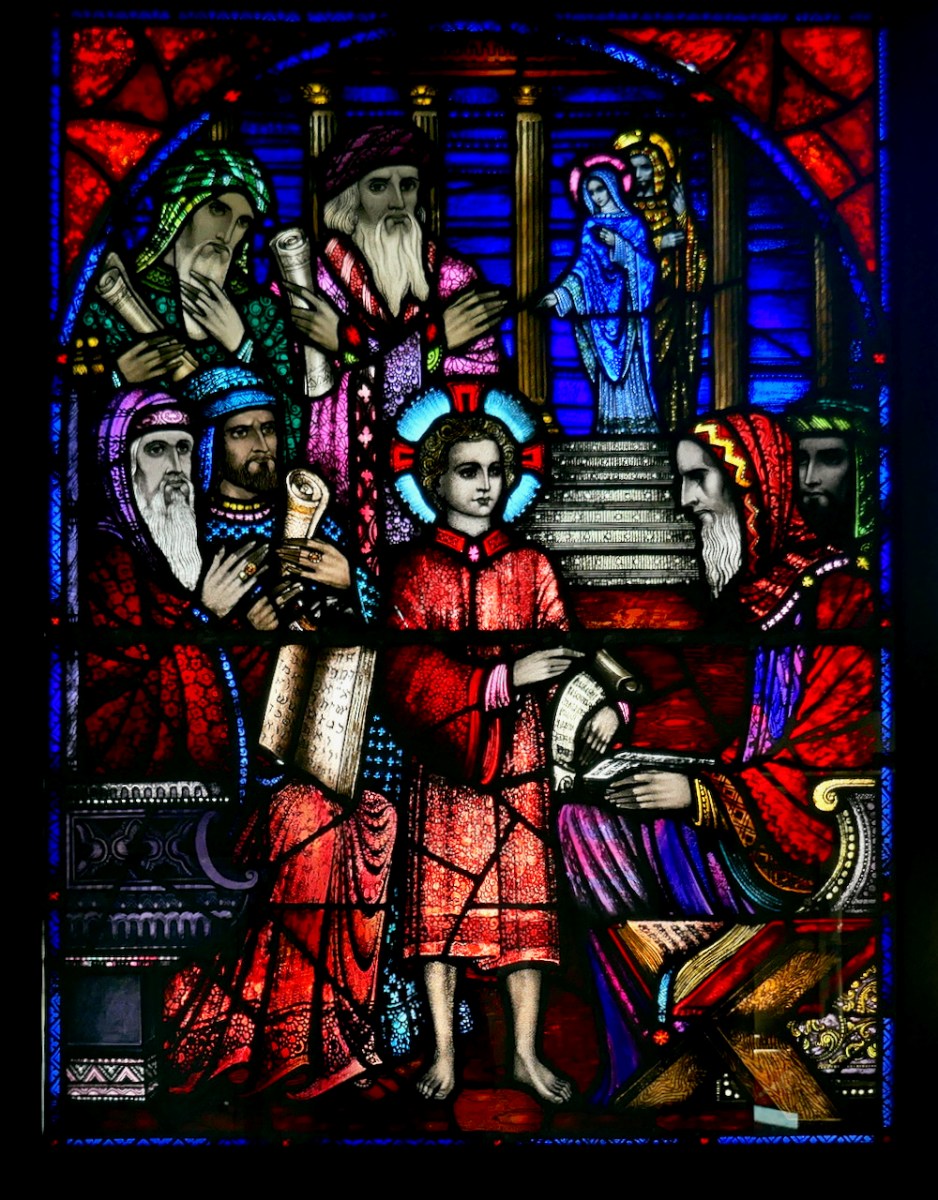
The school established a competition for the window, and invited stained glass artists to submit designs. The subject was to be Christ Among the Doctors, also known as The Finding in the Temple. Here’s the story, from the King James Version (just because I love the language of it):

Now his parents went to Jerusalem every year at the feast of the passover. And when he was twelve years old, they went up to Jerusalem after the custom of the feast. And when they had fulfilled the days, as they returned, the child Jesus tarried behind in Jerusalem; and Joseph and his mother knew not of it. But they, supposing him to have been in the company, went a day’s journey; and they sought him among their kinsfolk and acquaintance. And when they found him not, they turned back again to Jerusalem, seeking him. And it came to pass, that after three days they found him in the temple, sitting in the midst of the doctors, both hearing them, and asking them questions. And all that heard him were astonished at his understanding and answers. And when they saw him, they were amazed: and his mother said unto him, Son, why hast thou thus dealt with us? behold, thy father and I have sought thee sorrowing. And he said unto them, How is it that ye sought me? wist ye not that I must be about my Father’s business? And they understood not the saying which he spake unto them. And he went down with them, and came to Nazareth, and was subject unto them: but his mother kept all these sayings in her heart. And Jesus increased in wisdom and stature, and in favour with God and man.

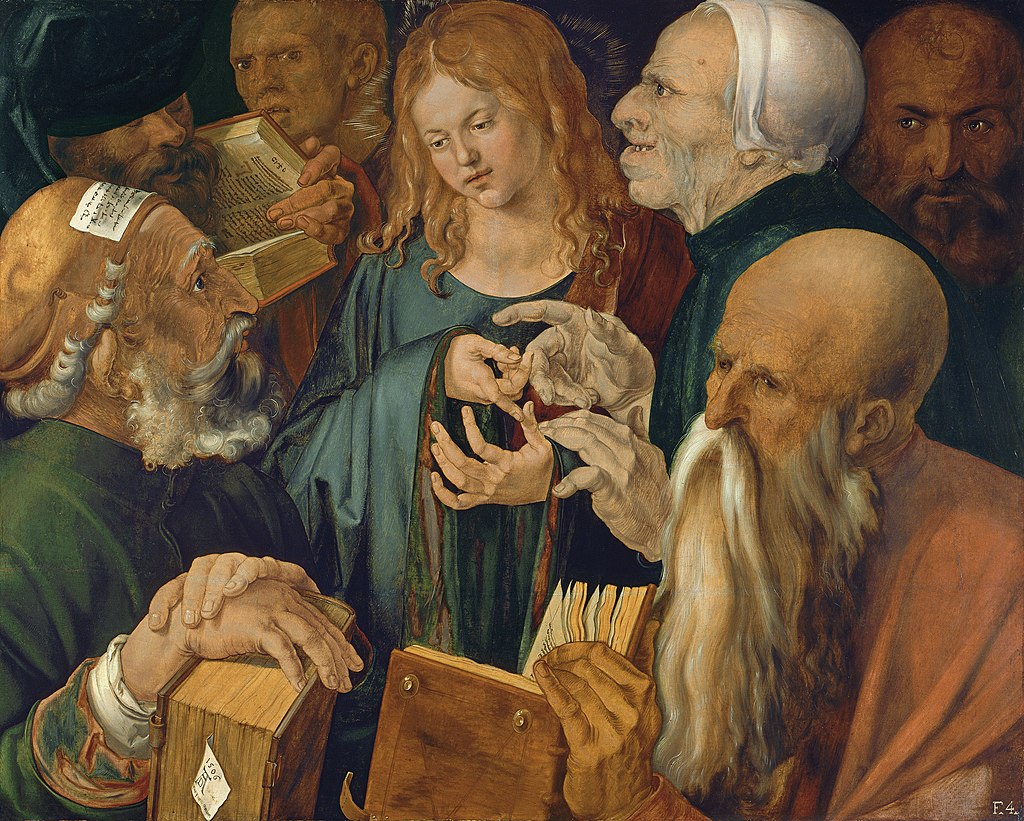
It’s a Biblical Verse that is, for obvious reasons, associated with students and scholarship, making it an appropriate subject for this occasion. It’s been the subject of many famous paintings, including this one by Albrecht Dürer.

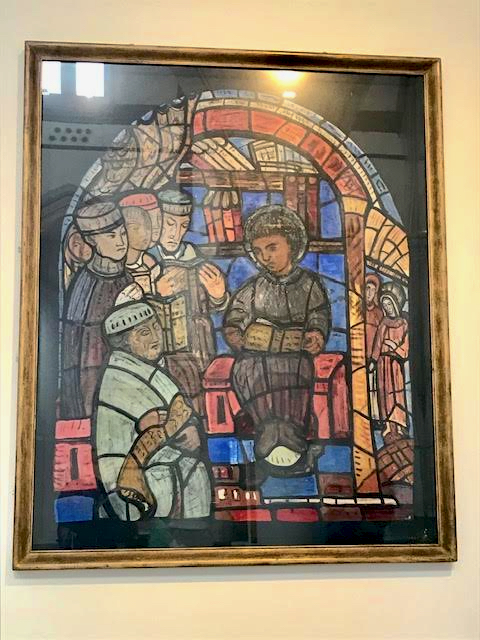
There were two submissions that we know of, and the first was by none other than Evie Hone. We know this because her full-size sketch for the window is displayed on the wall of the Holy Cross Church in Dundrum, having been acquired for the church by Fr Kieran McDermott. I am grateful to David Caron, General Editor of the Gazetteer of Irish Stained Glass, and administrator of Irish Stained Glass on Instagram, for the photograph and information. The accompanying text refers to the drawing as a cartoon and states that it was done for the Drogheda Grammar School, but ‘never realised.’ It does indeed look like a cartoon, in that glass cutlines have been included, and is very recognisably in her 1940s style. 

The second submission was by the Harry Clarke Studios. The Studio won the commission on the merits of the sketch they submitted, but that bit comes later.

Story 3: Erasmus

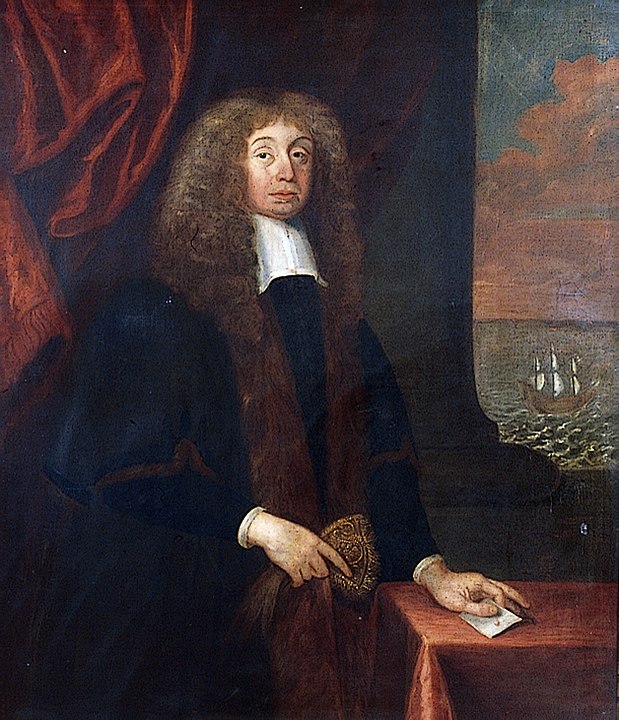
The window was duly installed in the chapel in the Drogheda Grammar School, an academic institution originally part of the Erasmus Smith Charter Schools. Erasmus Smith made his money supplying Cromwell’s army. In part payment he was given land in Ireland. After the Restoration, this put him in an awkward position with the Crown and so he

 manoeuvred to protect his position and to further his essentially Puritan religious stance, which he modified to suit the religious sensibilities of the new Royalist regime. He achieved this in part by creating an eponymous trust whereby some of his Irish property was used for the purpose of financing the education of children and provided scholarships for the most promising of those to continue their studies at Trinity College, Dublin


https://en.wikipedia.org/wiki/Erasmus_Smith
Erasmus Smith By Circle of John Michael Wright Public Domain

One of the schools that was established under the Trust was the Drogheda Grammar School – which is both ironic and fitting, given that Drogheda was one of the towns notoriously devastated by Cromwell.

Story 4: The School

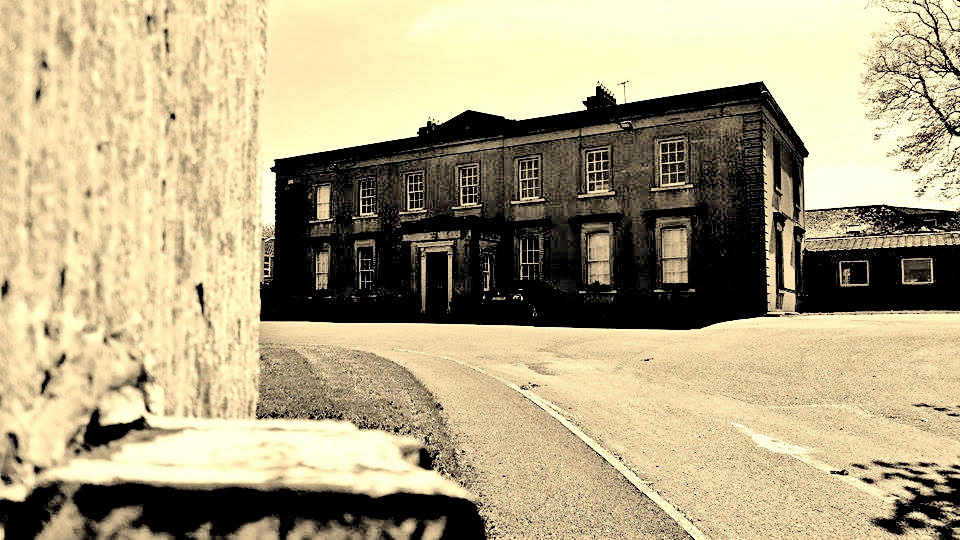
Today, Drogheda Grammar School is a respected non-denominational, co-educational secondary school. It is operated under a management committee and subscribes to a Quaker ethos. Originally a boys’s boarding school, up to 1976 it occupied a prominent place in the town centre, right beside St Lawrence’s Gate, but even by the 1950s was becoming in need of refurbishment.

When it moved out to the present site, the window was put into storage, where it remained until 2012 – out of sight, but not forgotten. A brand new school was completed in 2012 and the window was installed into a Reflection Room.

Story 5: Brittas Bay Antiques

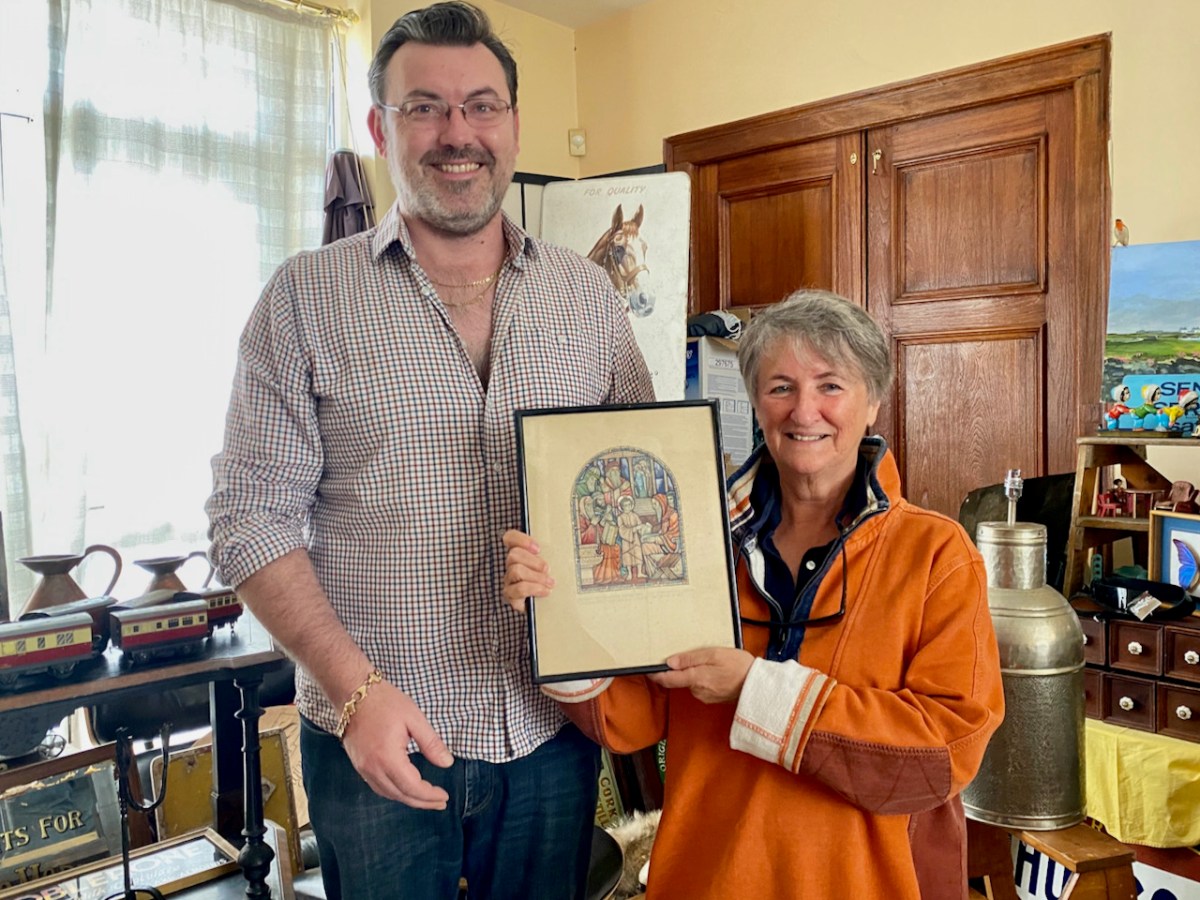
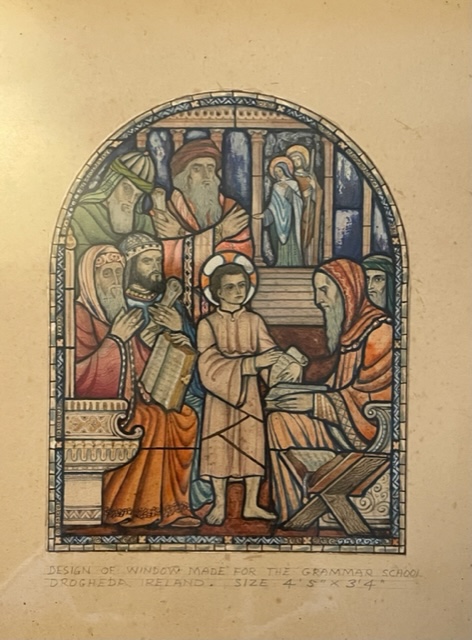
Wait – how did this story manage to wind its way to a quirky antique store by the beach in Wicklow? Well, at some point in the last couple of years Niall (below and yes, he really is that tall) and Chrissie, the proprietors, picked up a box of curios from someone, and discovered a Harry Clarke Studio sketch inside it. They advertised it online and someone stumbled across it, paid for it, and asked me to pick it up for her. I was happy to do so. (The shop is an Aladdin’s Cave, by the way – most enjoyable browsing I have done in years!)

Story 6: Etain

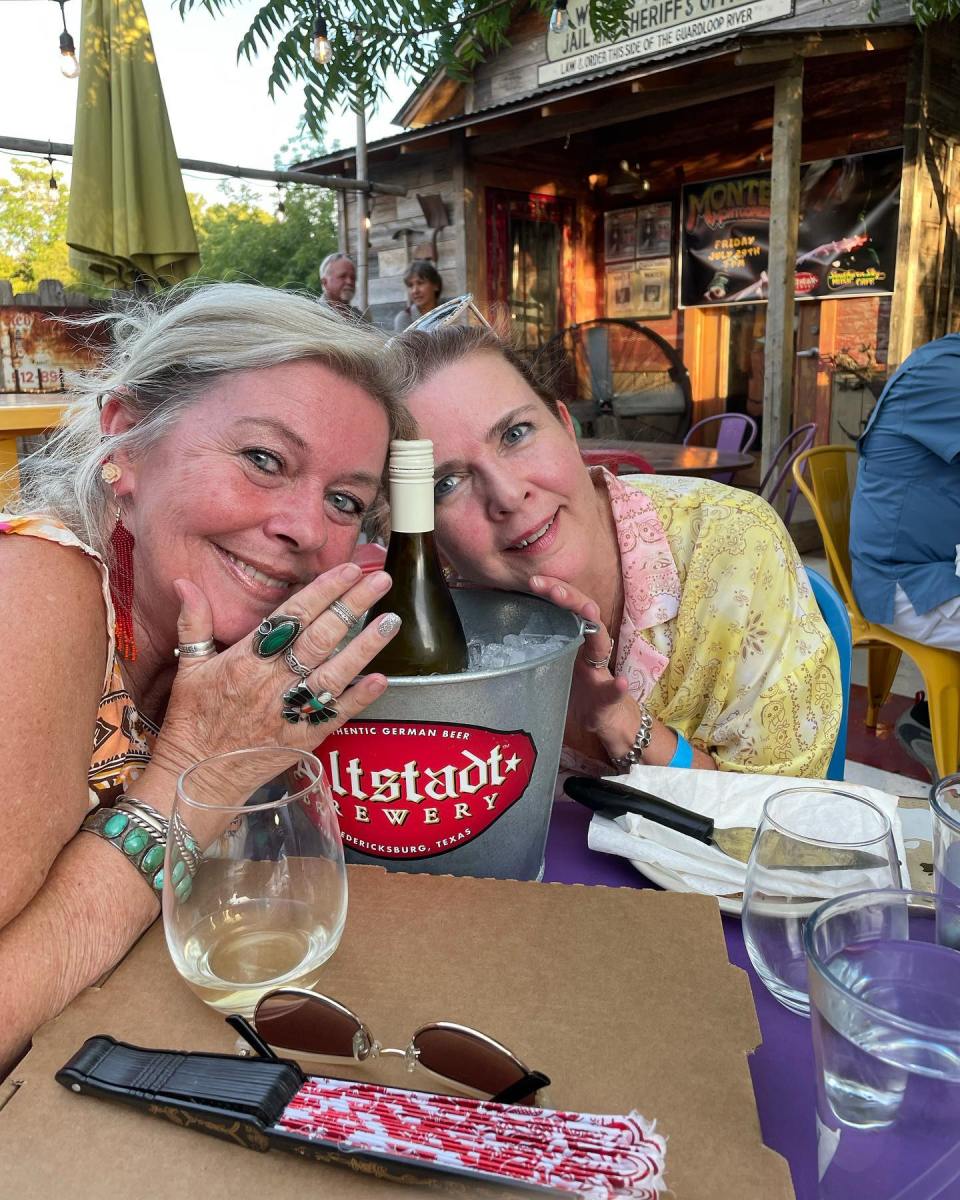
So c’mon Finola – ‘someone’ asked you to pick it up? Who exactly? It was my friend, Etain Clarke Scott, daughter of David Clarke and grand-daughter of Harry Clarke and Margaret Clarke. She and her siblings live in Texas, although they grew up in Dublin and make frequent visits over here. It was on her last visit, with her sister Veronique, that she asked me to pick up the sketch.

This is Etain (left) and Veronique (right) – as you can see they are both beautiful, and lots of fun! (And she will probably kill me from stealing this photo from her Facebook page.)

Story 7: The Research

At this point, we knew that the sketch was a window design produced by the Harry Clarke Studios for the Drogheda Grammar School – it said so right under the sketch, but we didn’t know whether the window had ever been made or whose work it was. The first question was easy – a quick Google led us to the school website and to the story of the window. I suspected that the artist was the Studio’s manager and chief designer, William Dowling, who took over the role from Richard King upon King’s departure in 1940. Regular readers will know by now that long after the death of Harry (in 1931) the Studios had continued with what I have called The House Style since what people wanted was ‘A Harry Clarke’. 

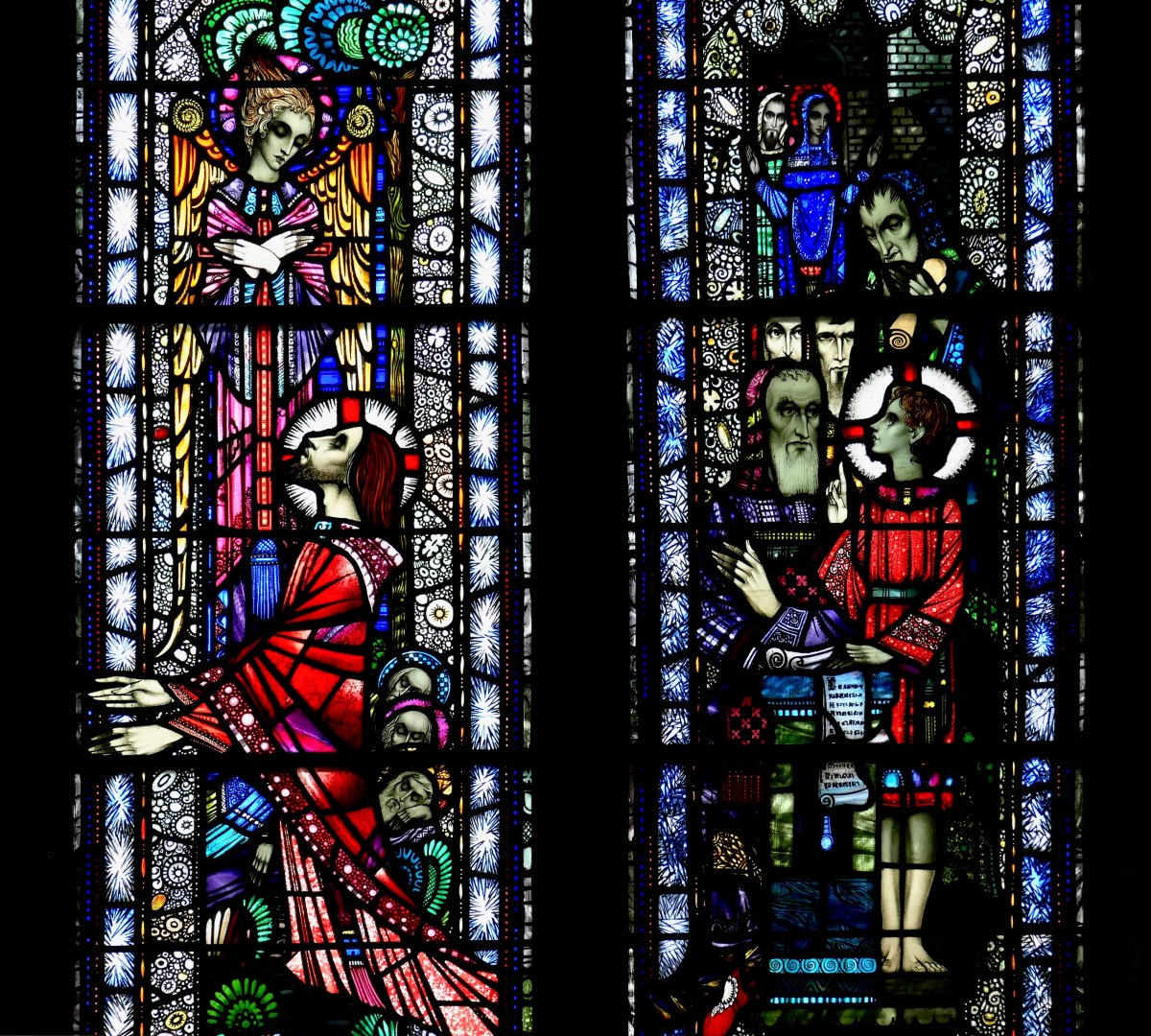
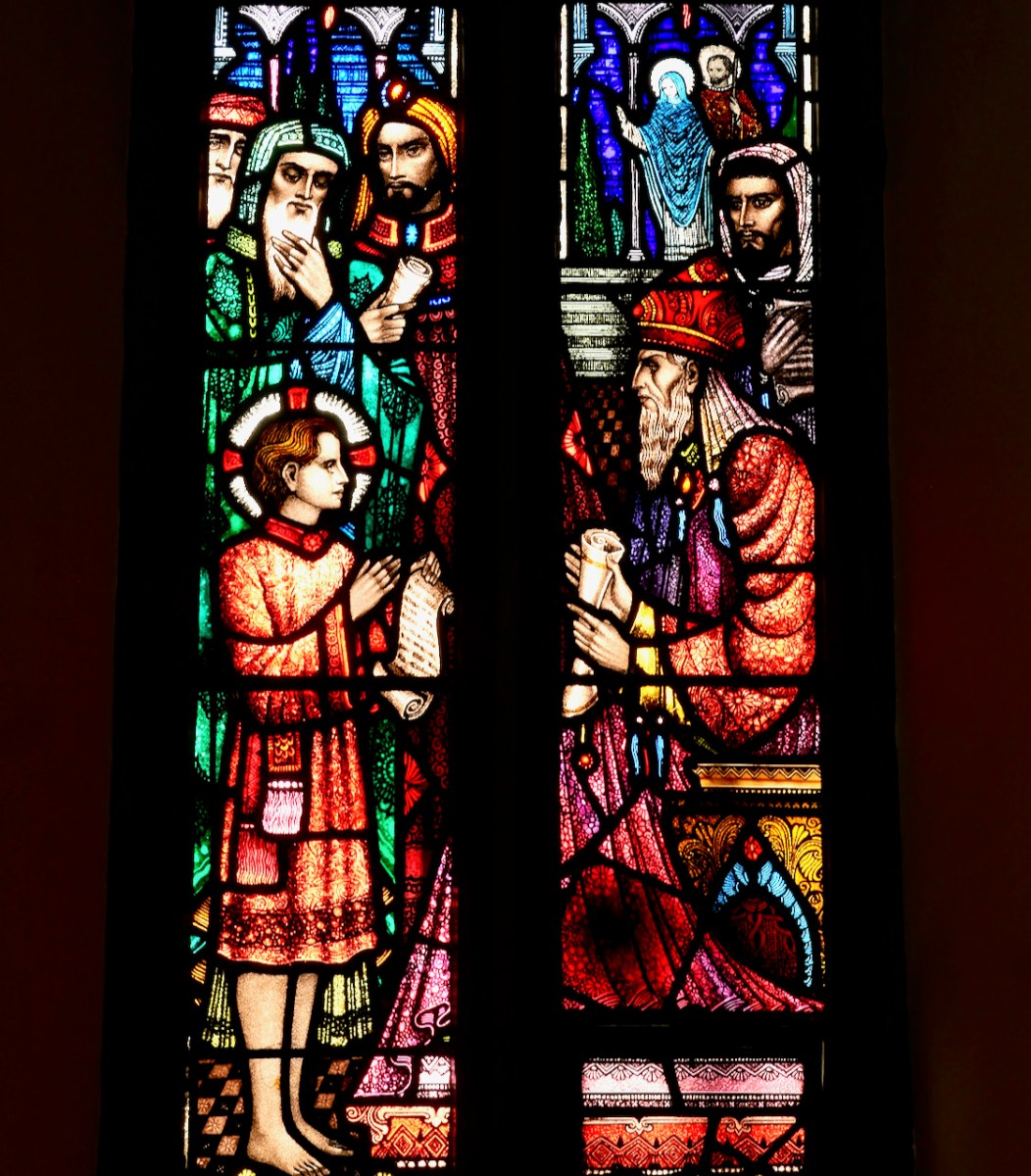
I consulted with my stained glass colleagues – David Caron, Paul Donnelly, Jozef Voda and Ruth Sheehy, all contributors to the Gazetteer of Irish Stained Glass and all very knowledgeable indeed on the work of the Studios during this period. I offered in evidence a couple of examples of Dowling windows of the same subject – Christ Among The Doctors or The Finding in The Temple. The one above is in Wicklow and the one below in Balbriggan.

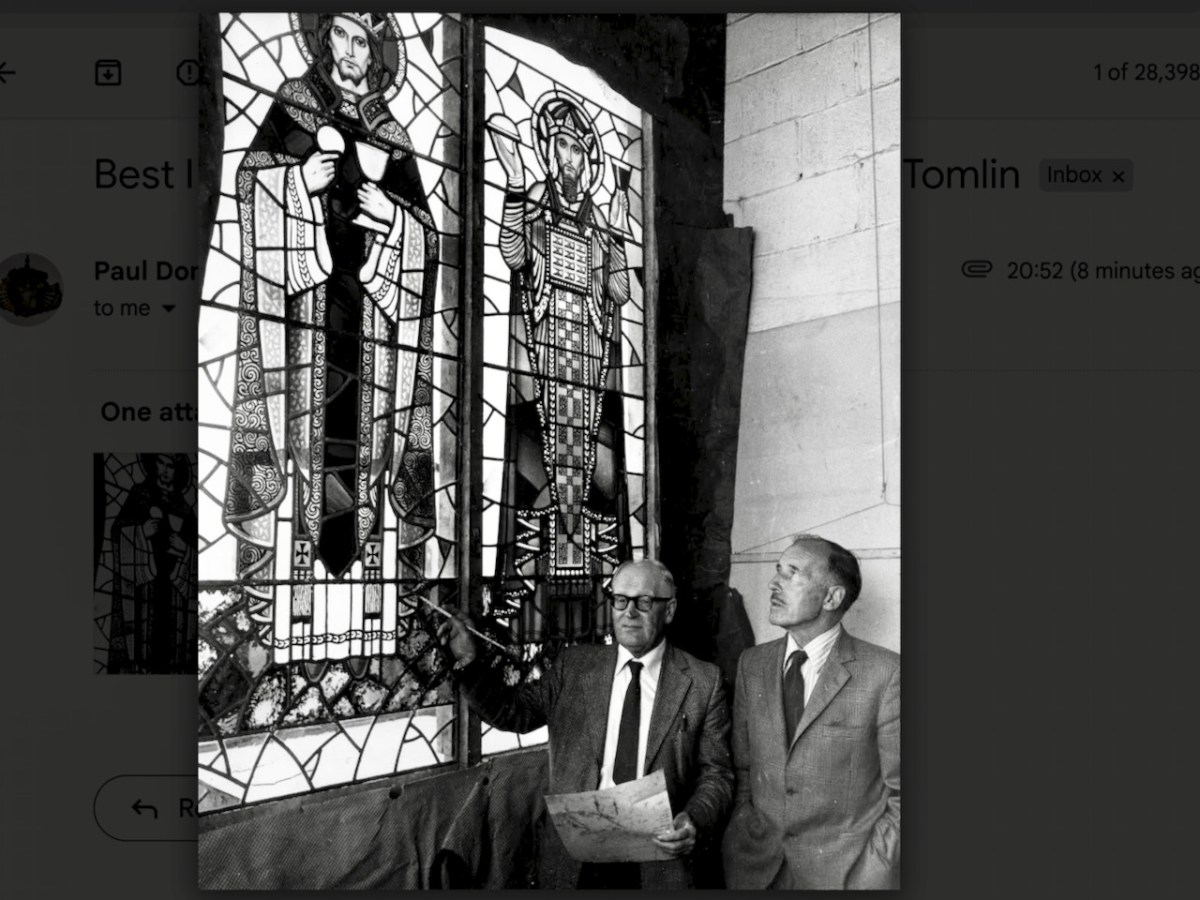
There was much helpful discussion  by email: it was at this point David contributed the information and photograph about the Evie Hone cartoon, and both Paul and Ruth identified the handwriting as Dowling’s and agreed that the style was his. Etain remembers Willie Dowling well as a kind and avuncular presence in the studio, always impeccably dressed, and she was pleased at this attribution. That’s Dowling below (left), with Stanley Tomlin, at the Studios at a later date.

Story 8: Taking the Photographs

We had the sketch and now we knew whose work it was and also that it was in situ in the school. What we didn’t know was what the window actually looked like. Was it exactly as the sketch has intended? Had changes been made to the shape or dimensions of the window? This often happens when older windows are inserted into newer openings. I contacted the school and asked for permission to come and photograph the window, which was graciously given. 

What I found was that the stained glass had been carefully inserted into a larger window, protected front and back with toughened glass, and the story of the Bole Memorial Window was provided in a framed script on the wall. Although Etain’s sketch shows a window with a rounded top, this opening was square. If the window had been changed to fit more recently, it had been done so skilfully that it was not obvious or indeed detectable.

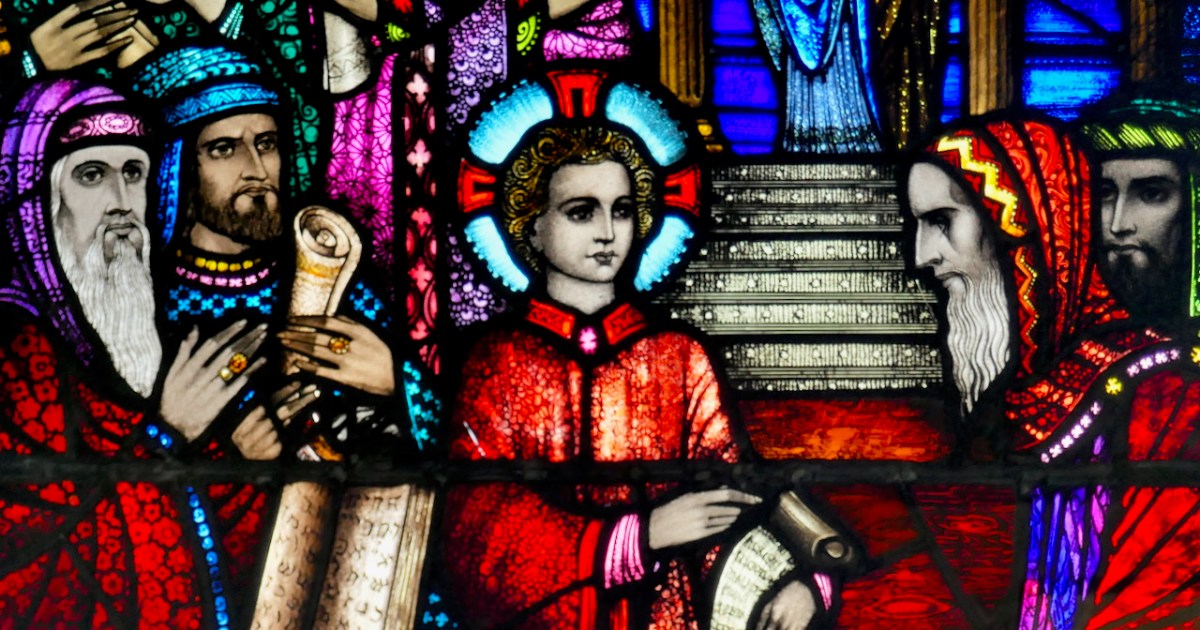
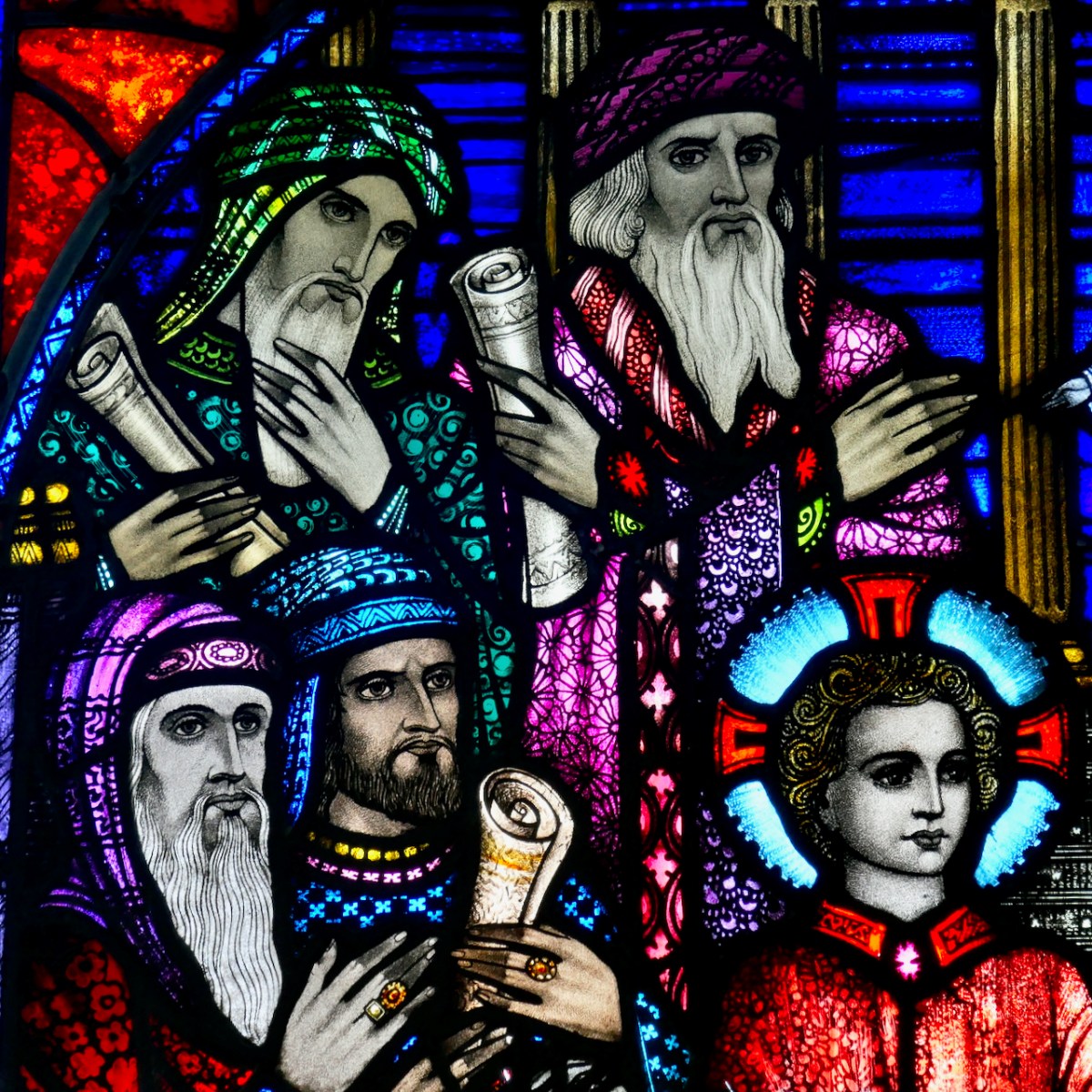
In fact, the window far exceeded my expectations. It is beautiful. Dowling had used good glass and the effect is jewel-like and vibrant. He has gone to town on every panel, painting, aciding, scratching, and filling even the smallest piece with decorative detail. 

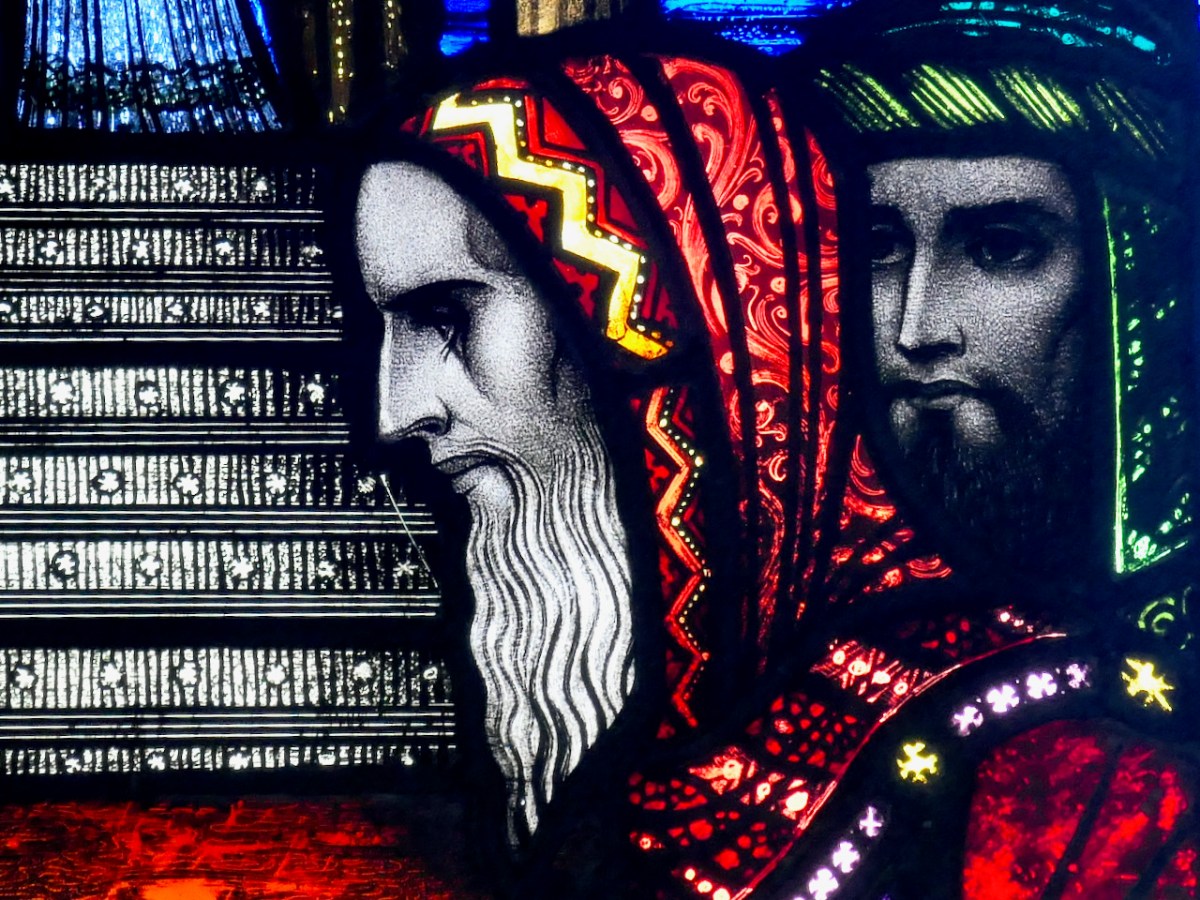
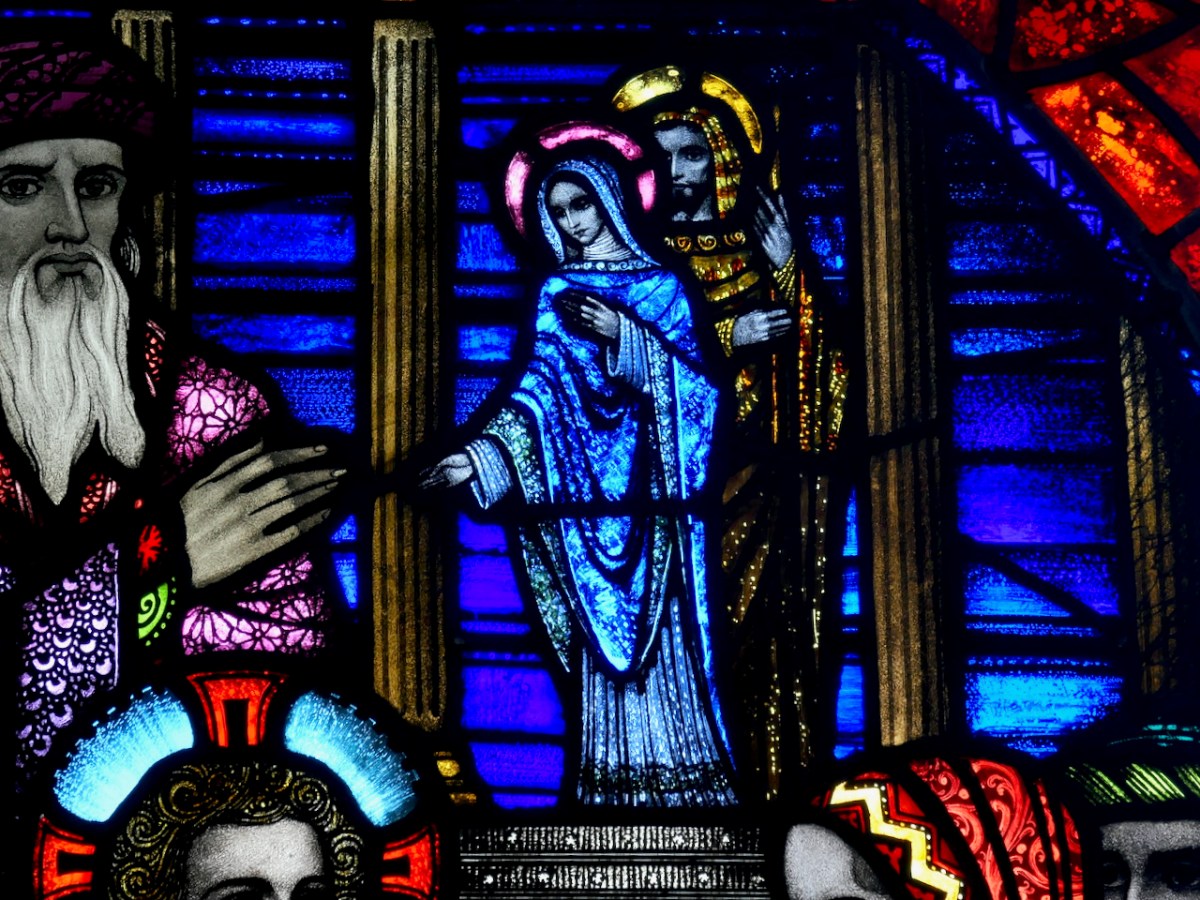
The figures of the Doctors are expertly rendered, while the small Joseph and Mary are similar to his Balbriggan and Wicklow panels. Jesus looks suitably solemn and earnest, as befits the good model that was intended for the students.

Afterword

Thank you to the Drogheda Grammar School for facilitating the photographic session. It was wonderful to hear, from the school Principal, Hugh Baker, that the window is treasured. Thanks to my collegial group of stained glass scholars for their advice and additional photographs. Most of all, thank you to Etain for entrusting me with the sketch and sending me down this story lane.

Mayer Stained Glass in Ireland: Craft or Commerce?

Among Irish stained glass aficionados nothing divides opinion like the windows of Mayer of Munich.

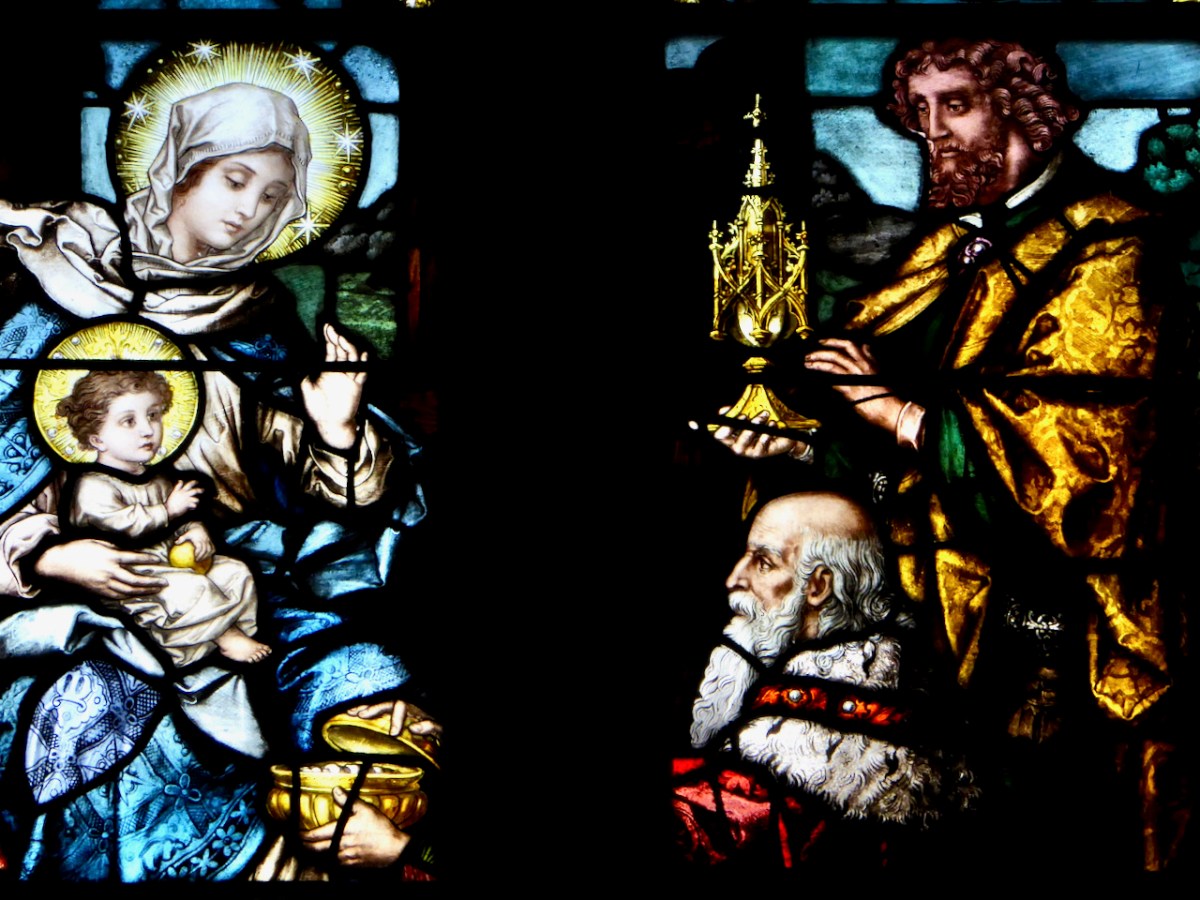
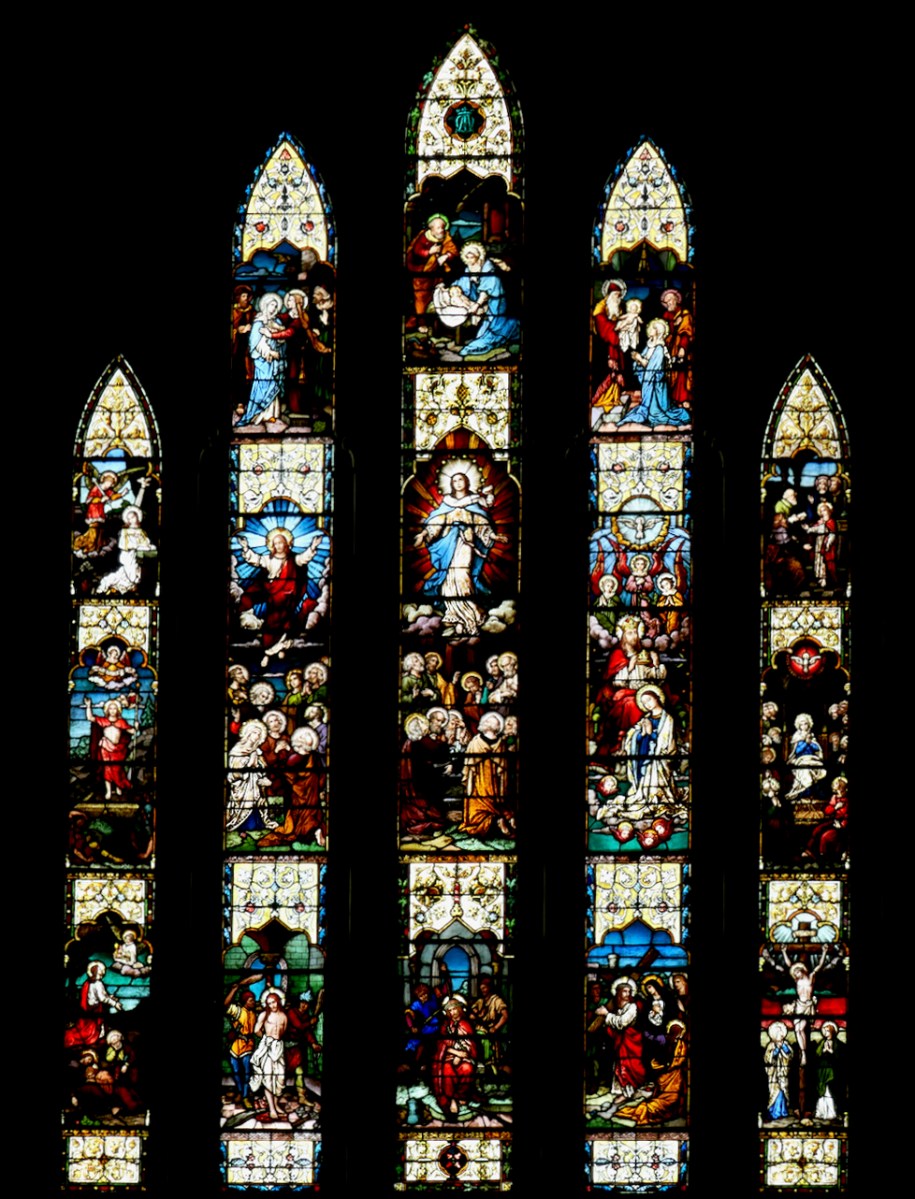
From about the 1860s to the 1940s Mayer was the foremost supplier of stained glass to Irish churches, both Catholic and Protestant. The first two images above, for example, are of a Nativity scene in St Eugene’s Catholic Cathedral in Derry. Catholics were probably spurred on to order Mayer windows when Pope Leo XIII named the company a Pontifical Institute of Christian Art in 1892. However, there is no doubt that the windows appealed enormously to the priests and vicars in charge of ordering them and that Mayer was adept in providing the kind of art that was widely attractive  to parishioners. So – Mayer stained glass was ubiquitous, but it was also controversial and derided. Let’s look at why this was, and whether it was deserved.

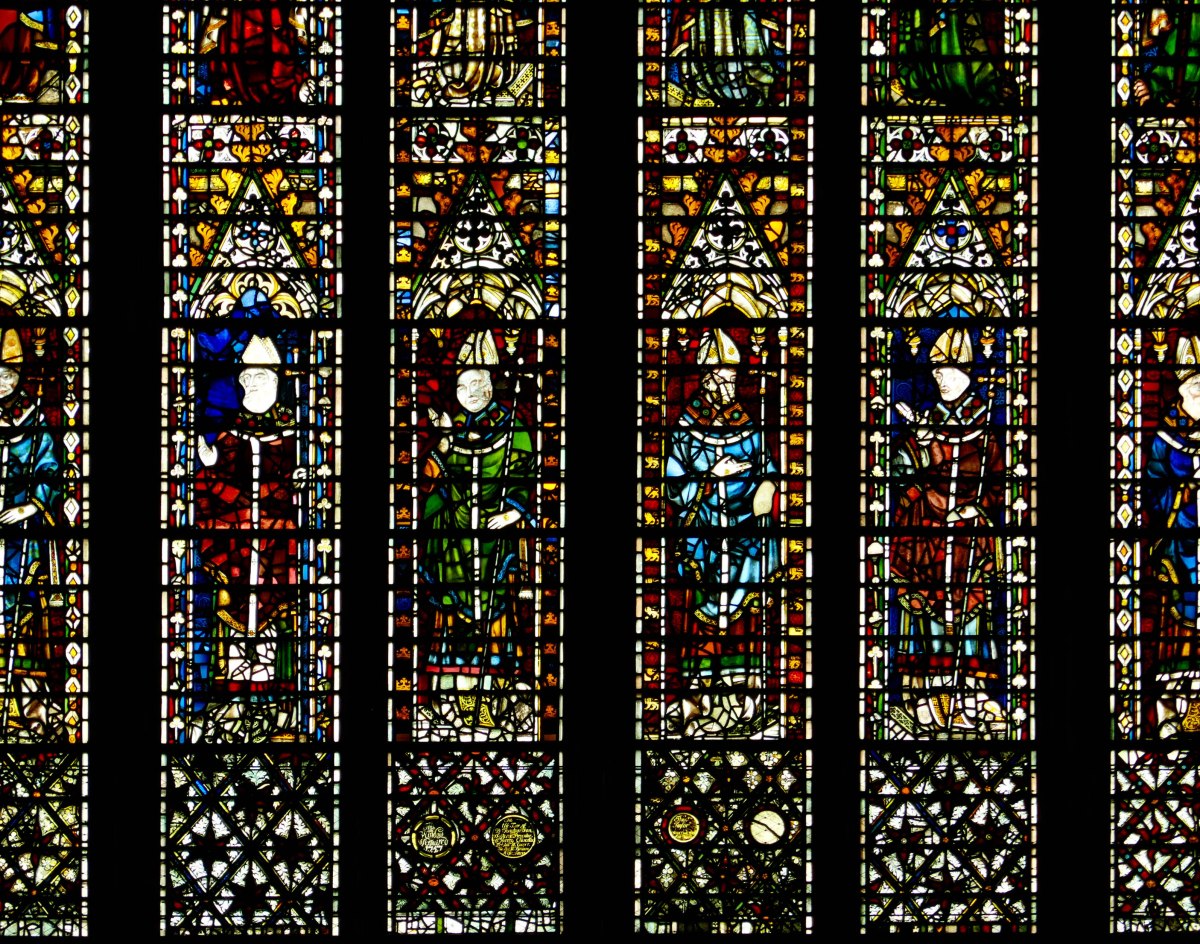
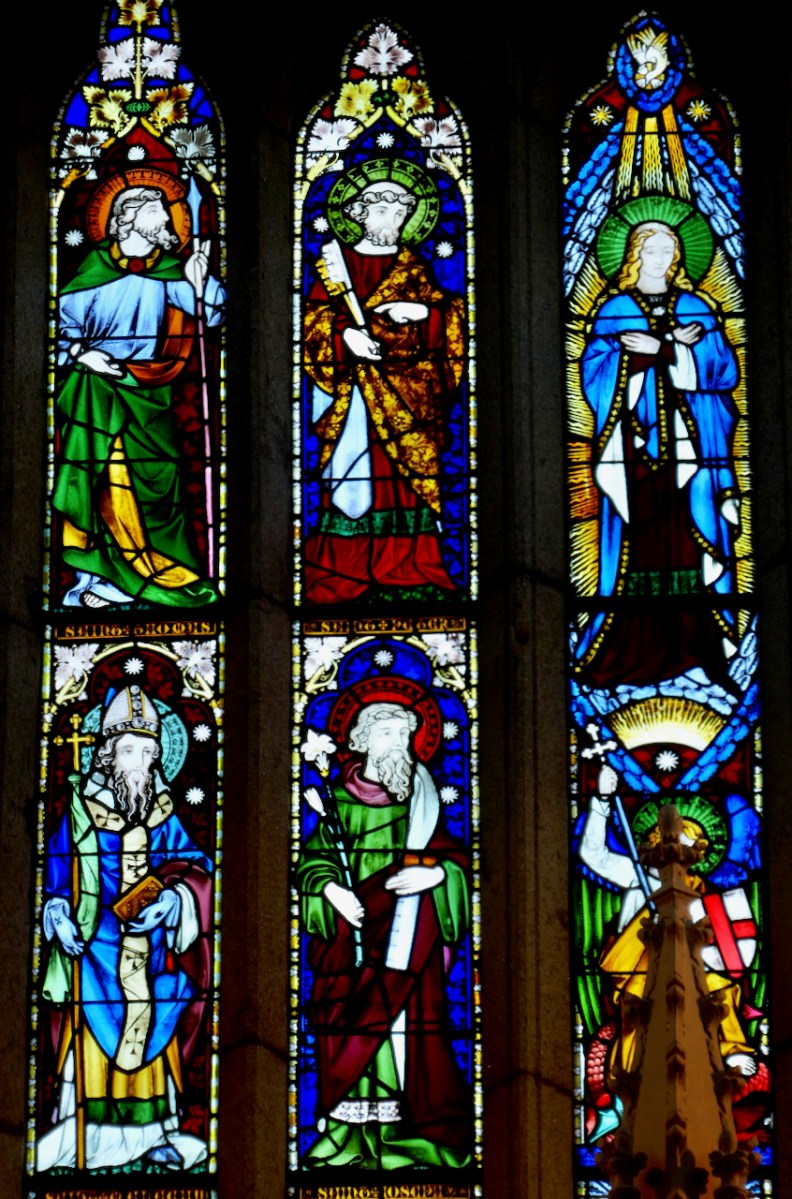
During the stained glass renaissance in nineteenth century Britain, the ideal became to replicate the style of stained glass from the High Gothic period of the 12th to 15th centuries – lots of small pieces of coloured glass leaded together, with saintly images set inside elaborate canopies. The example above is from York Minster and the windows below, clearly based on that model, are from the Pugin-designed St Aidan’s Cathedral in Enniscorthy.

Mayer moved away from this kind of glass towards what became known as the Pictorial Style. As a concession to the Gothic, they kept the canopies for the most part (it was a long time before stained glass studios dispensed with canopies) but they used larger sheets of glass (necessitating fewer cames of lead) and they took their artistic inspiration not from medieval windows but from Renaissance paintings.   The purists huffed and puffed, but the people flocked to this new style of glass.

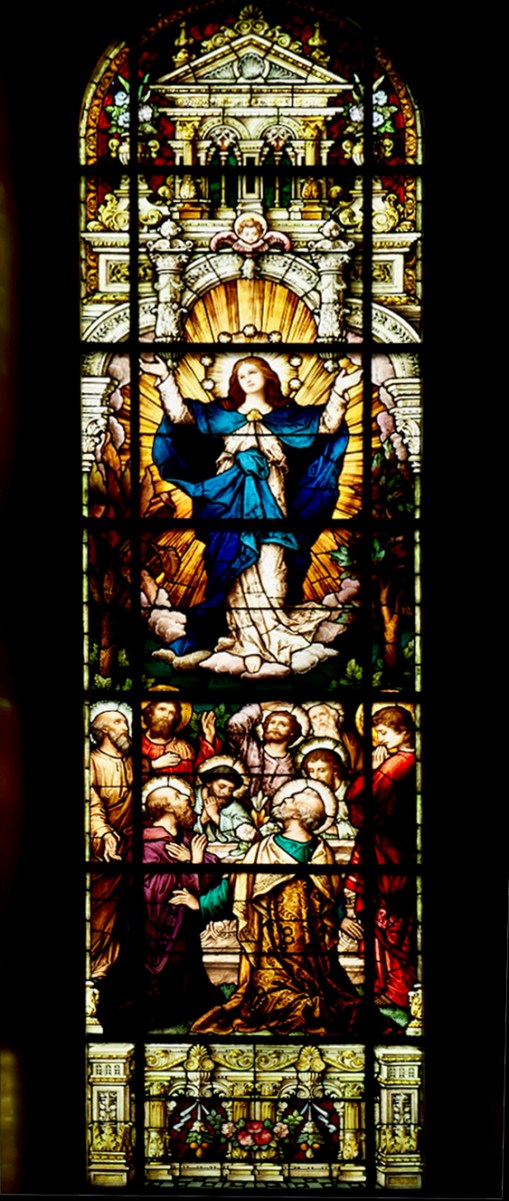
From the beginning this was a business, not an artists’ studio. The purpose was to make money and therefore a factory model was employed, with workers engaged in repetitive production of their own specialities – the apprentices did nothing but canopies, the painters might spend years decorating robes with brocade or embroidery motifs, only the most talented got to do faces. Designers produced sketches that were infinitely adaptable, with slight tweaking. In the large window above, in Baltinglass, Co Wicklow, the central image is of the Assumption of Mary into heaven. An almost identical design can be seen in the Catholic Church in Bantry, Co Cork, below (and indeed all over the place).

The results were appealing – highly competent windows full of beautiful images. 

High Renaissance figures swathed in copious draperies which amplify their forms and define their movements. Here the painter was freer to incorporate the sharp drapery folds which were inherited from the German Renaissance painting tradition. Colours are vibrant and rich, and the window glows with a deep resonance because the amount of white glass was kept to a minimum. . . It was easy for a congregation to relate to the pictorialism and to recognise the narratives, so that the windows were regarded not only as aesthetic objects but as an effective catalyst to meditation and piety. Pictorialism spoke more directly to the. . . public than did the more correct visual medievalism of the stricter British ecclesiologists. 

shirley ann brown*

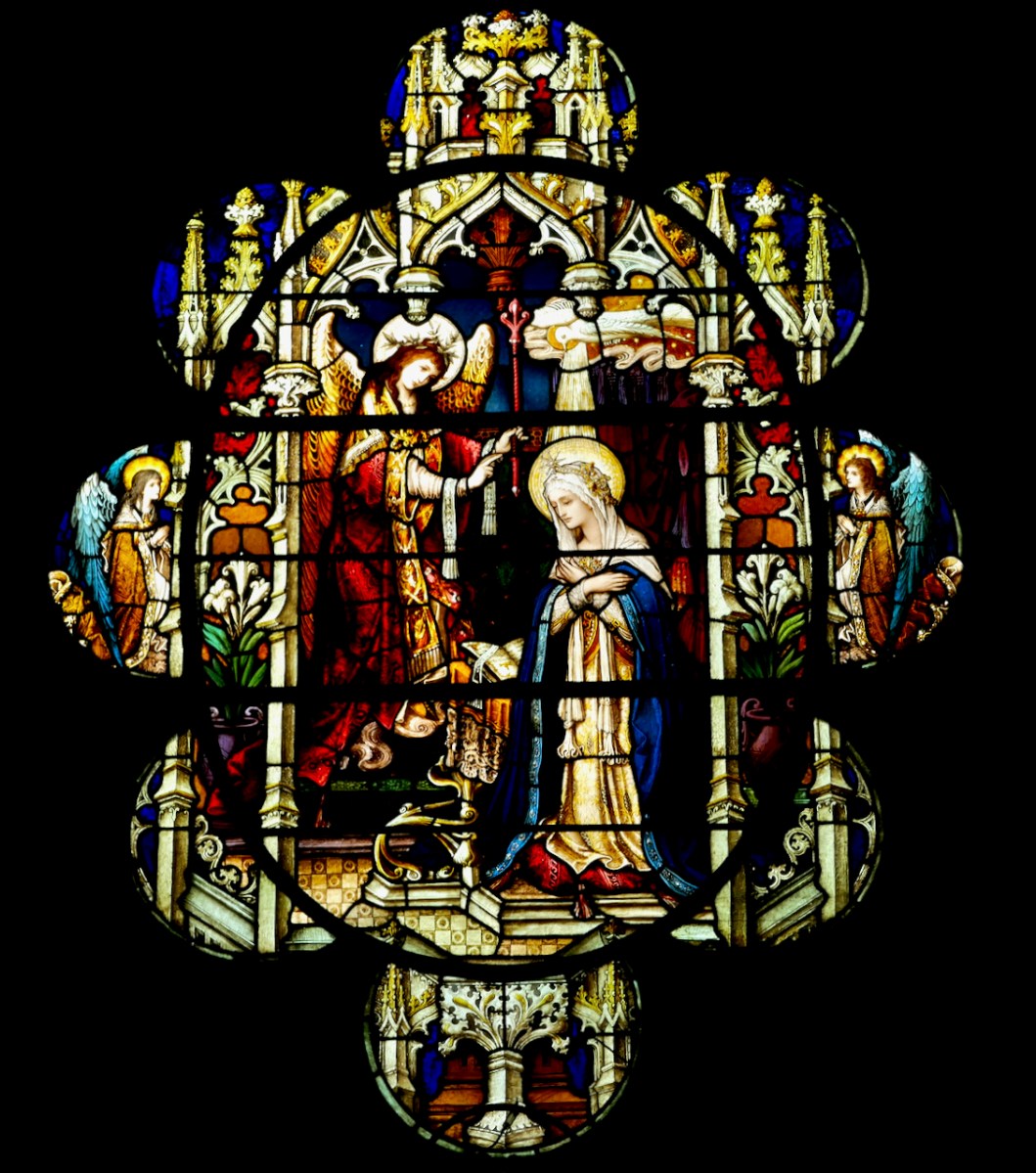
Above is the Annunciation window in Charleville, Co Cork – one of my personal favourite windows by any studio. Although the firm was German and the windows made in Munich, they had offices in London, and an agent in Dublin (in fact, Joshua Clarke, Harry’s father, started out as their Irish agent). They became adept at fulfilling the request of Irish clergy for specific iconography – that is, Irish saints, and panels illustrating stories from Irish hagiographies.

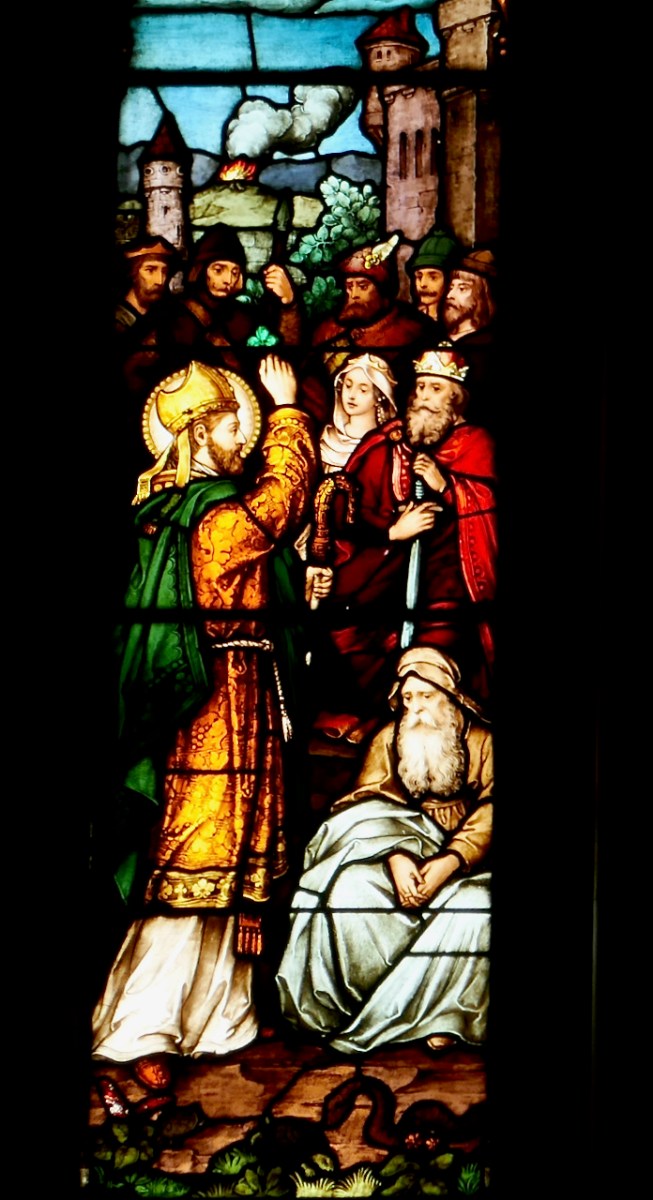
St Patrick, above, is shown with his shamrock, paschal fire and snake, although the towers in the backdrop could be from a castle on the Rhine rather than resembling an Irish round tower. At their most basic, Irish saints were simply chosen from a pattern-book of saintly images and supplied with a name-caption. They all looked the same – St Aidan in one window is identical to St Columba in another, balding, bearded, dressed in a monk’s habit or a bishop’s splendid robes and mitre, but often with an attribute to distinguish them one from the other. St Patrick always has his shamrock, St Brigid her flame or her church, St Joseph carries lilies. Nicola Gordon Bowe, in the Introduction to the Gazetteer of Irish Stained Glass reported on Edward Martyn’s outrage at the lack of discernment among clergy and architects who seemed not to be able to distinguish between the work of an artist and the trade salesman with an oily tongue and an ever-ready kiln.

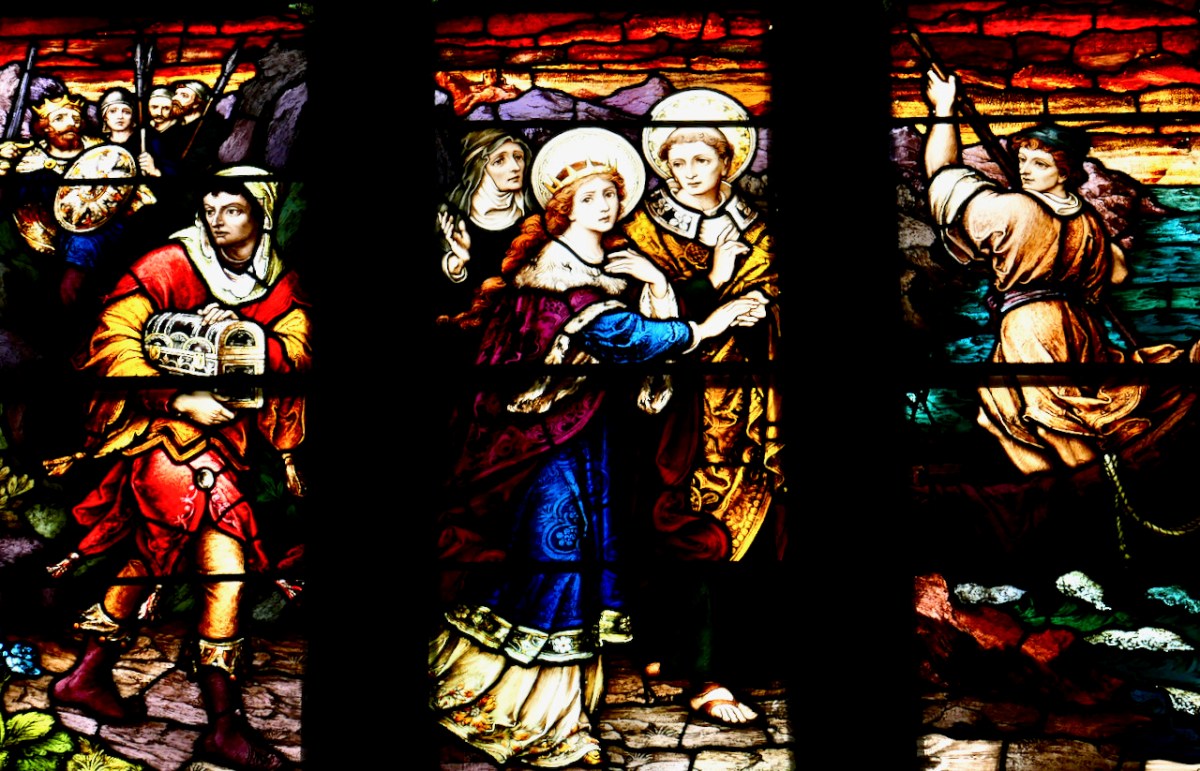
But you get what you pay for, and if you wanted something other than the pattern-book, Mayer could rise to the occasion, with splendid depictions of the mythology associated with Irish saints, all done in the same Italianate style and full of movement and vitality. One of my favourites is the story of St Dympna from Armagh Cathedral. (See Harry Clarke’s version of St Dympna in this post  – the story is the same but the images are vastly different.)

David Lawrence, the mastermind behind the website Gloine.ie, is a defender of Mayer, saying about the prejudice to which Mayer was subjected, Feelings against German glass were whipped up into a nationalistic frenzy at the time of the setting up, in 1903, of the Irish Arts-and-Crafts stained-glass studio An Túr Gloine and continued as that studio flourished in the early decades of the twentieth century. This prejudice has been well documented and was partly based on the factory model of glass production, since the new ethos of Arts and Crafts prioritised the artist’s vision and craft and abhorred mass production. However, Lawrence insists that, at their best, Mayer produced outstanding stained glass to equal any studio.

The year 1894 marked the start of a particularly successful new era at Mayer — this was the year that they were joined by the English artist William Francis Dixon (1848-1928). He had trained at the London studio, Clayton & Bell and then set up his own studio, Dixon & Vesey, before moving to Germany to work at Mayer. Dixon‘s arrangement with Mayer was a happy one. His skilful designing and drawing in a romantic manner influenced by the late Pre-Raphaelites and Mayer‘s attention to detail, masterly glass-painting and faultless craftsmanship formed an ideal marriage. Mayer-Dixon windows are in a romantic style, with a sweetness of drawing, softness of painting and beautiful, tapestry-like details. The heads are especially sensitively drawn. It is readily apparent that Dixon was able to dictate his own choice of colours to Mayer. 


 David Lawrence,
Stained Glass Windows, Six Roman Catholic Churches, County Offaly November 2010

One of Dixon’s windows is this fine war memorial in St Canice’s Church of Ireland Cathedral in Kilkenny. However, in the end, it can be argued that Mayer became a victim of their own success. Despite occasional triumphs of design and execution, too many of their windows lacked originality and freshness, starting to look hackneyed and same-y. Public taste for sentimentalised depictions (however gorgeous and expertly painted) gave way, under the influence of European art movements, to a search for a more authentic and modern form of religious expression. Irish artists responded by developing a vibrant, often experimental, stained glass industry dominated by small studios producing artist-led work. 

I will leave you with The Raising of Lazarus from Baltinglass Catholic Church for two reasons – firstly because it is perfectly illustrates the Mayer pictorial style at its best. I have provided three details close up, so you can see how competently the artist has rendered the subject matter.

The sentimentality critics complained of is in full flight in the image below – but also, look at the size of the eyes. Creating over-sized eyes to enhance and beautify a face didn’t start with Harry Clarke!

But secondly I use The Raising of Lazarus tongue in cheek as a nod to the fact that in fact Mayer is still around – and they have finally caught up with the century they live in. Take a look at this story in the New York Times to see how Mayer of Munich is embracing the twenty-first century.

*The Influence of German Religious Stained Glass in Canada 1880-1941 by Shirley Ann Brown, RACAR: revue d’art canadienne / Canadian Art Review, Vol. 21, No. 1/2, Représentation et identités culturelles / Representation and Cultural Identity (1994), pp. 21-31 (11 pages)

Mad Hatter’s Tea Party

Haven’t you always wanted to have one?

When the occasion arose for a celebration – the publication of The Gazetteer of Irish Stained Glass – we knew exactly what we wanted. We don’t know yet when we can have a launch of the book in Dublin, but it might be the autumn before it can happen, so Robert and I decided that a little local jollification was in order.

We know what Tracy and Peter could do. They’re the Long Island Wild Camping couple who organised the Wildflower Walk and who will do picnics or catering for you on Long Island. Tracy’s eyes lit up when we were talking about her idea of doing ‘proper’ high teas on the island and my need for a celebration, and the plan was conceived.

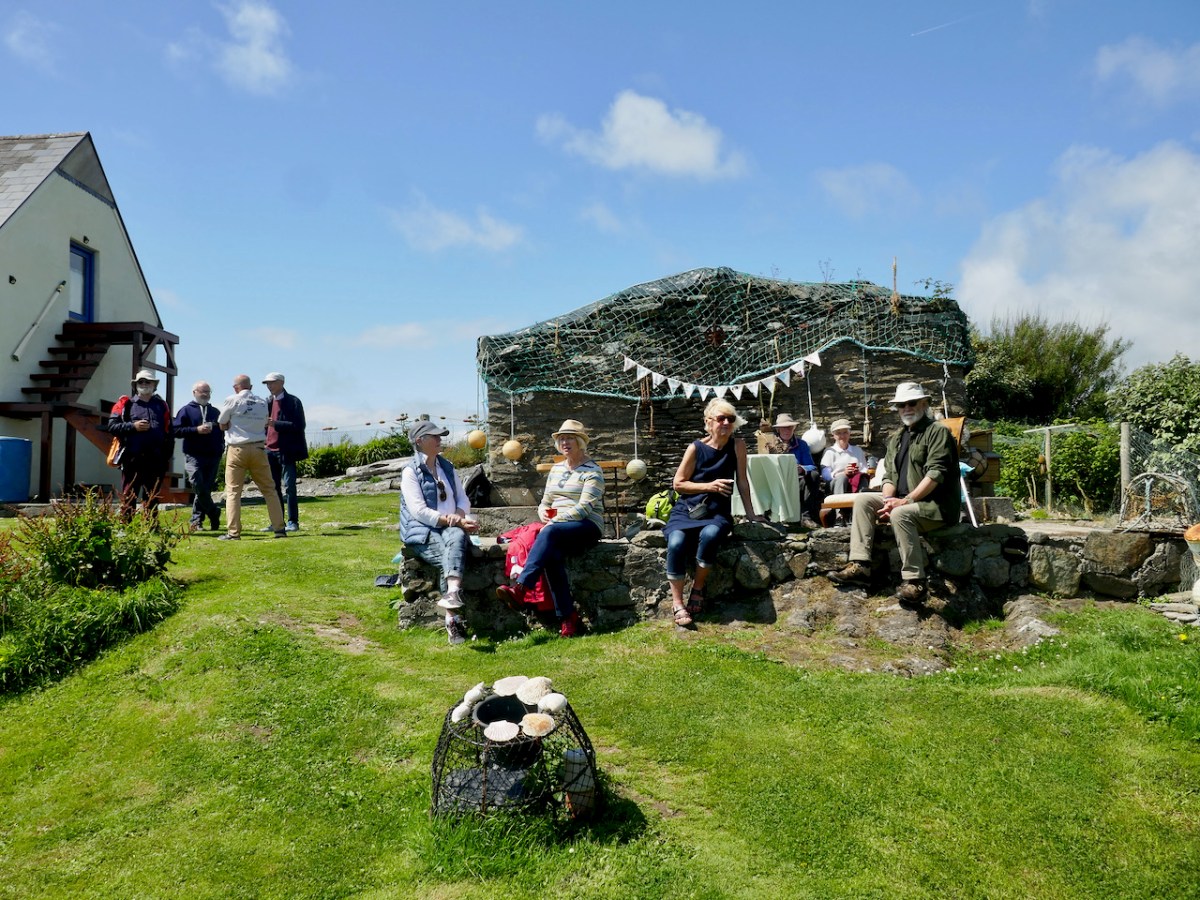
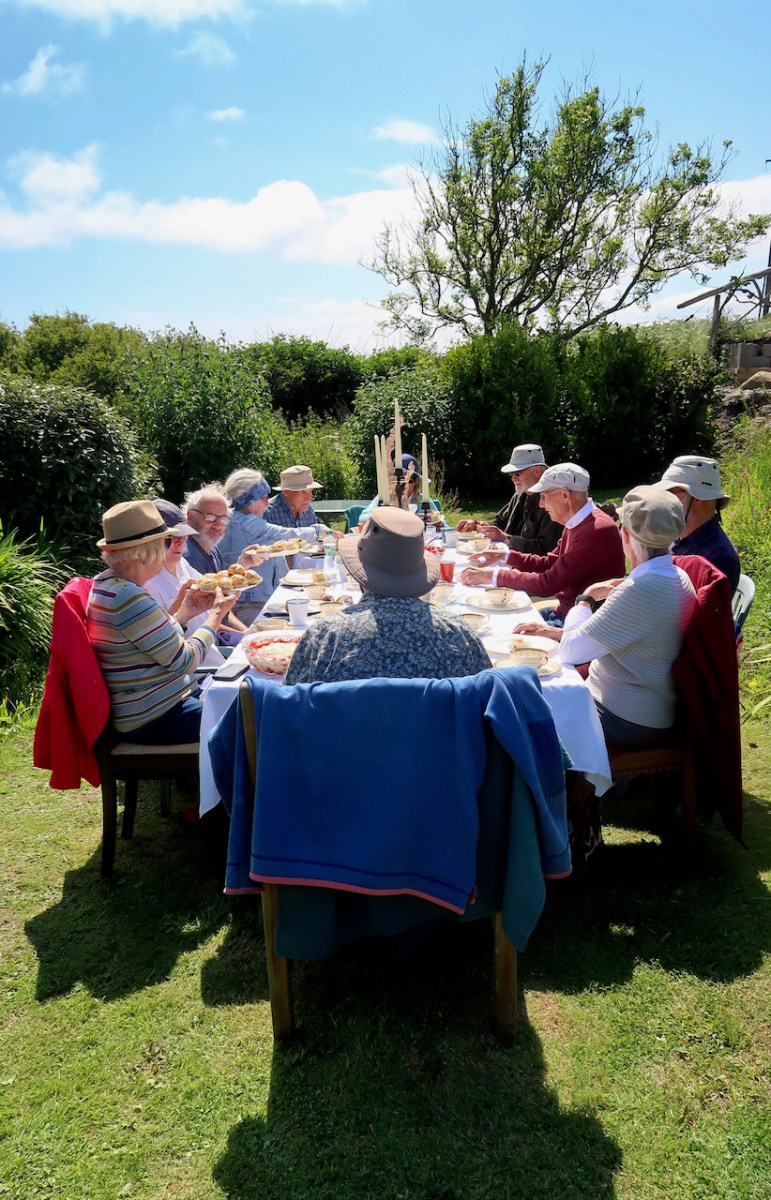
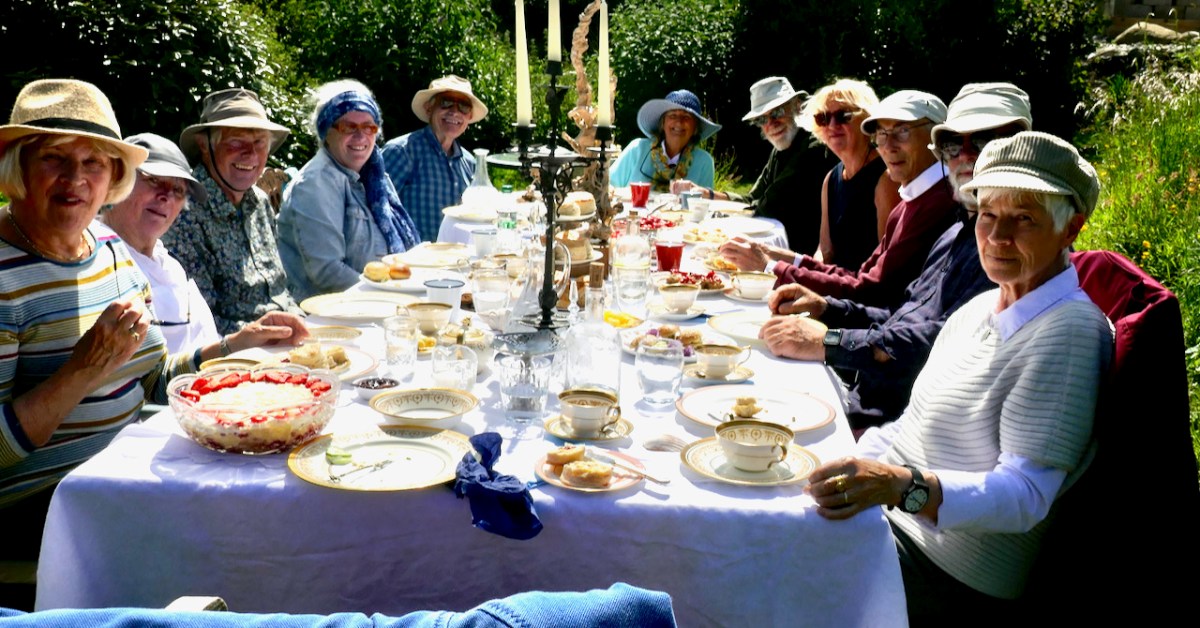
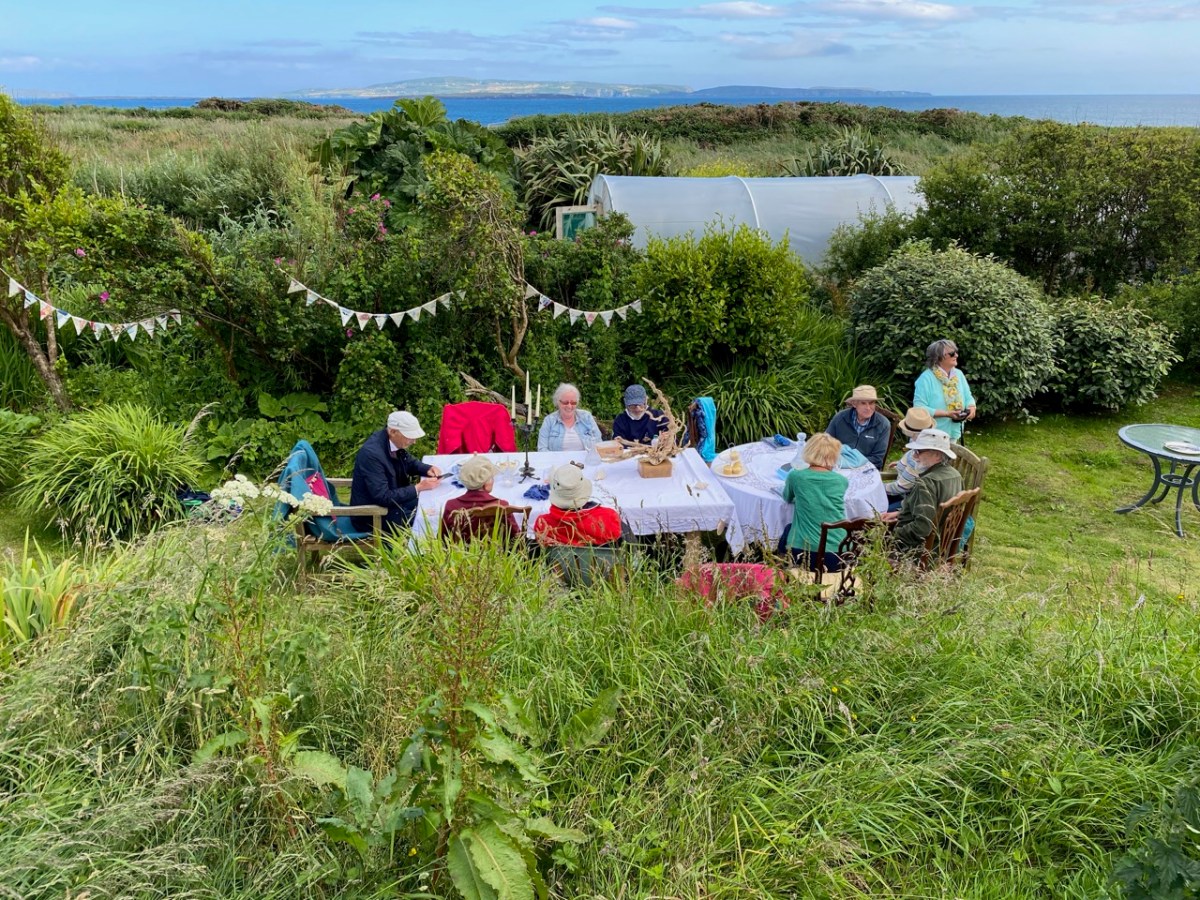
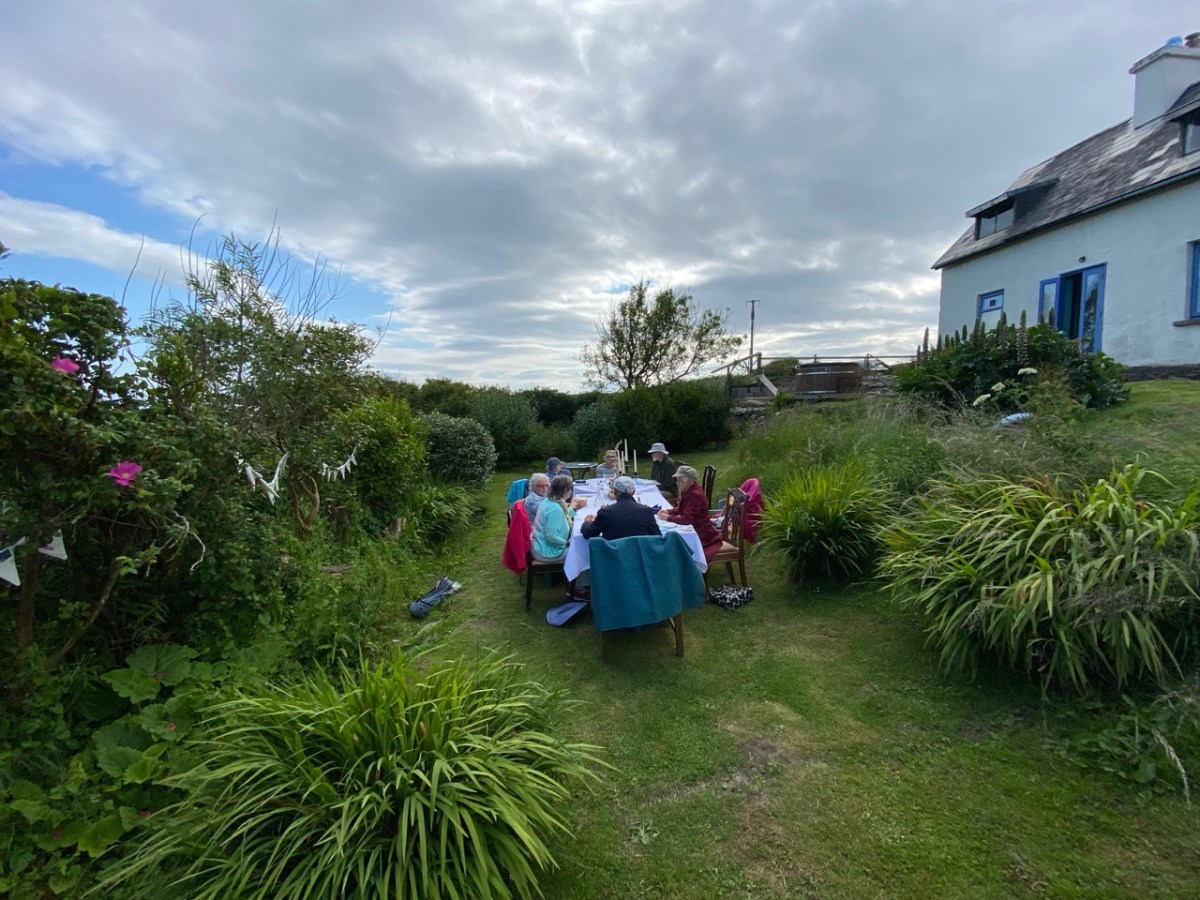
Twelve of us were conveyed to the Island by Maurice and Helen of the Long Island Ferry, and Glory Be! – the sun shone all day for us. It’s a short walk along boreens fringed with blooming hedgebanks to the East House, and what a sight awaited us there*!

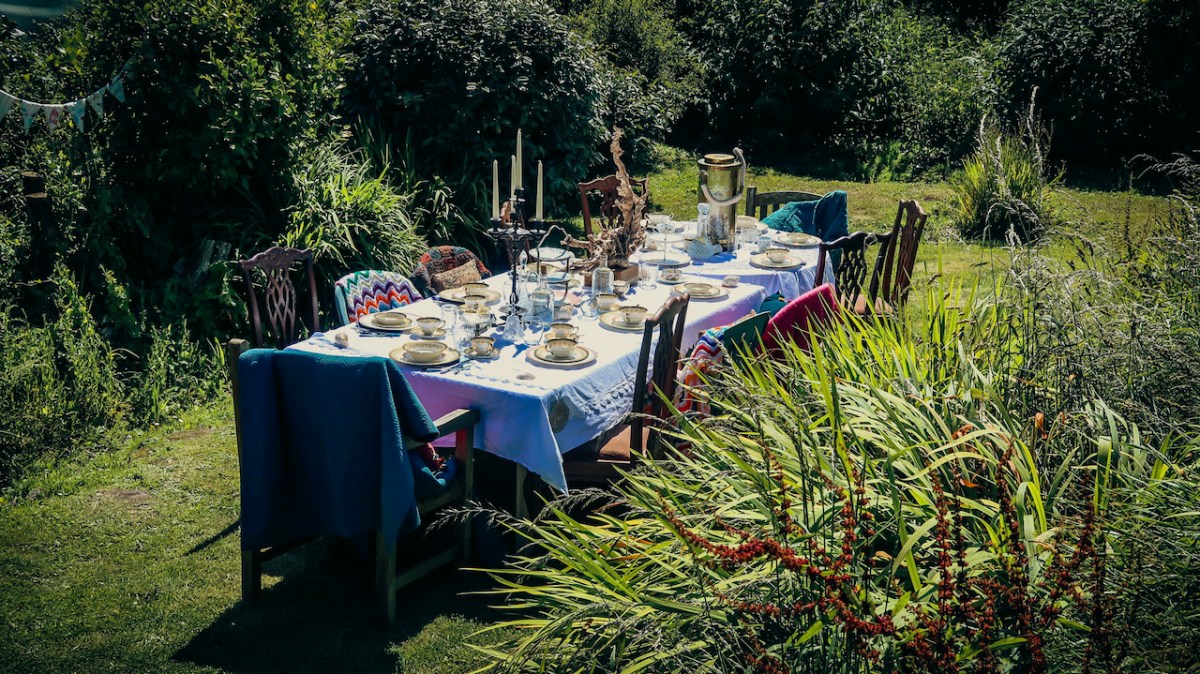
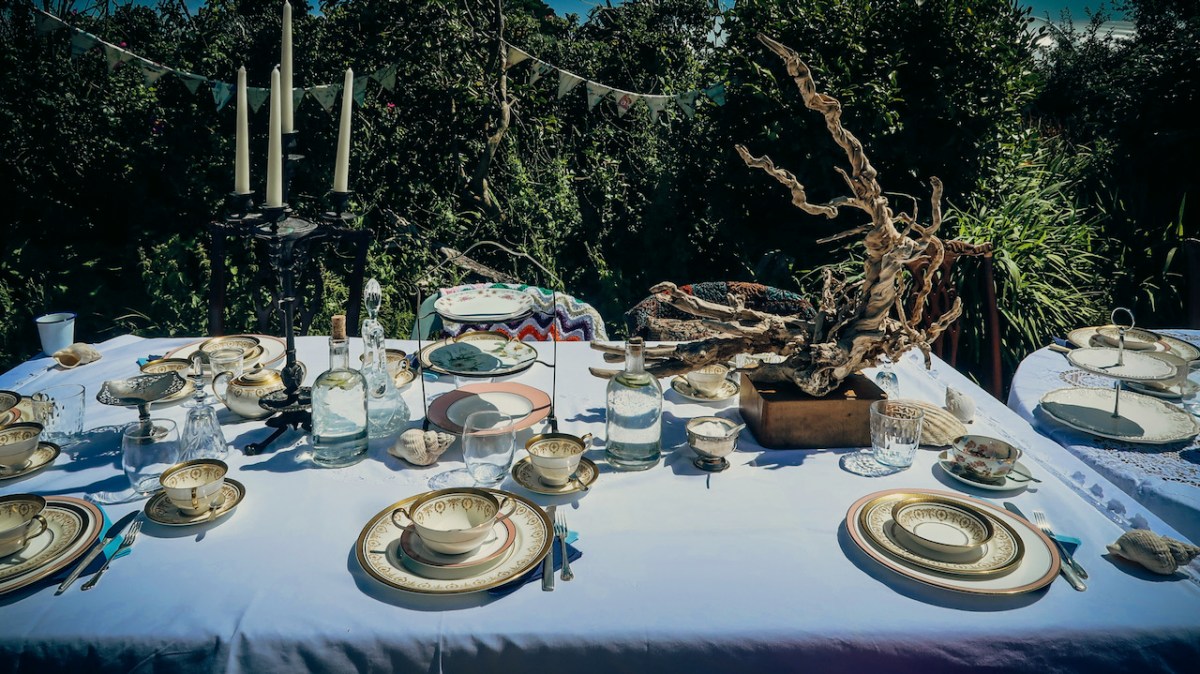
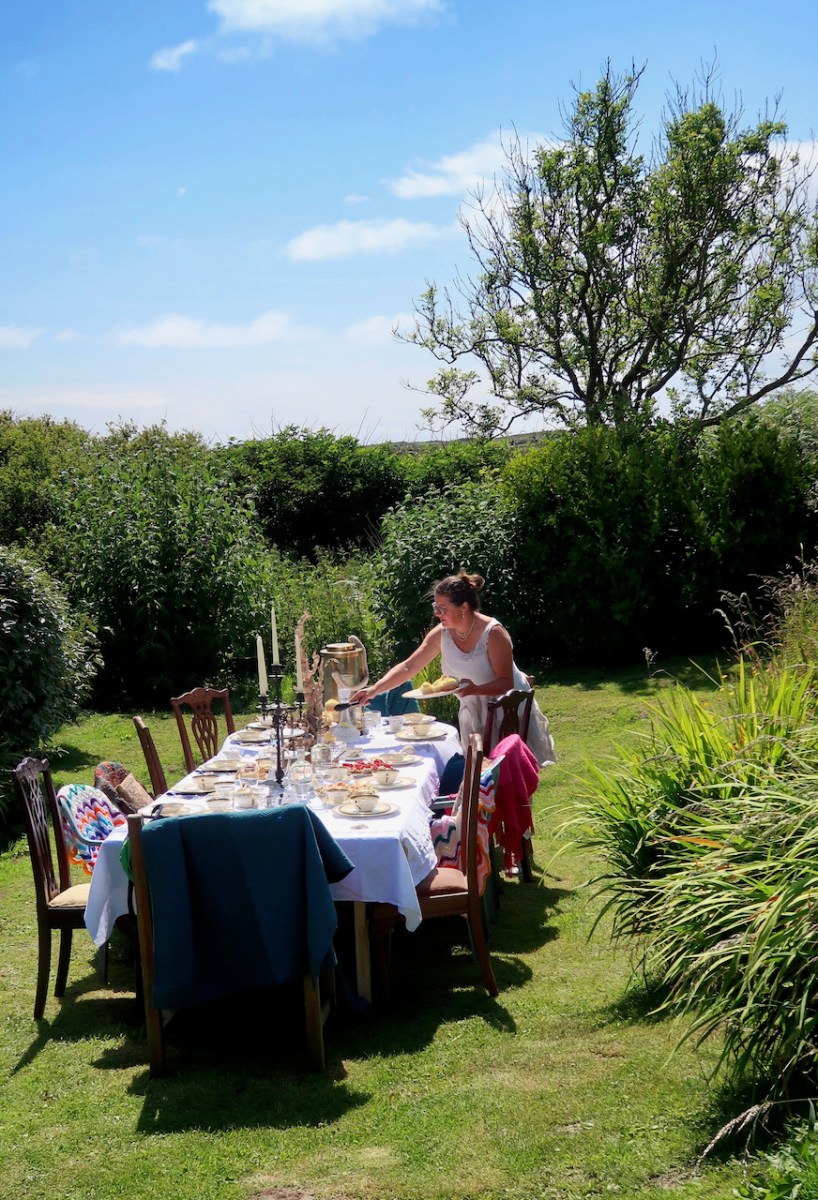
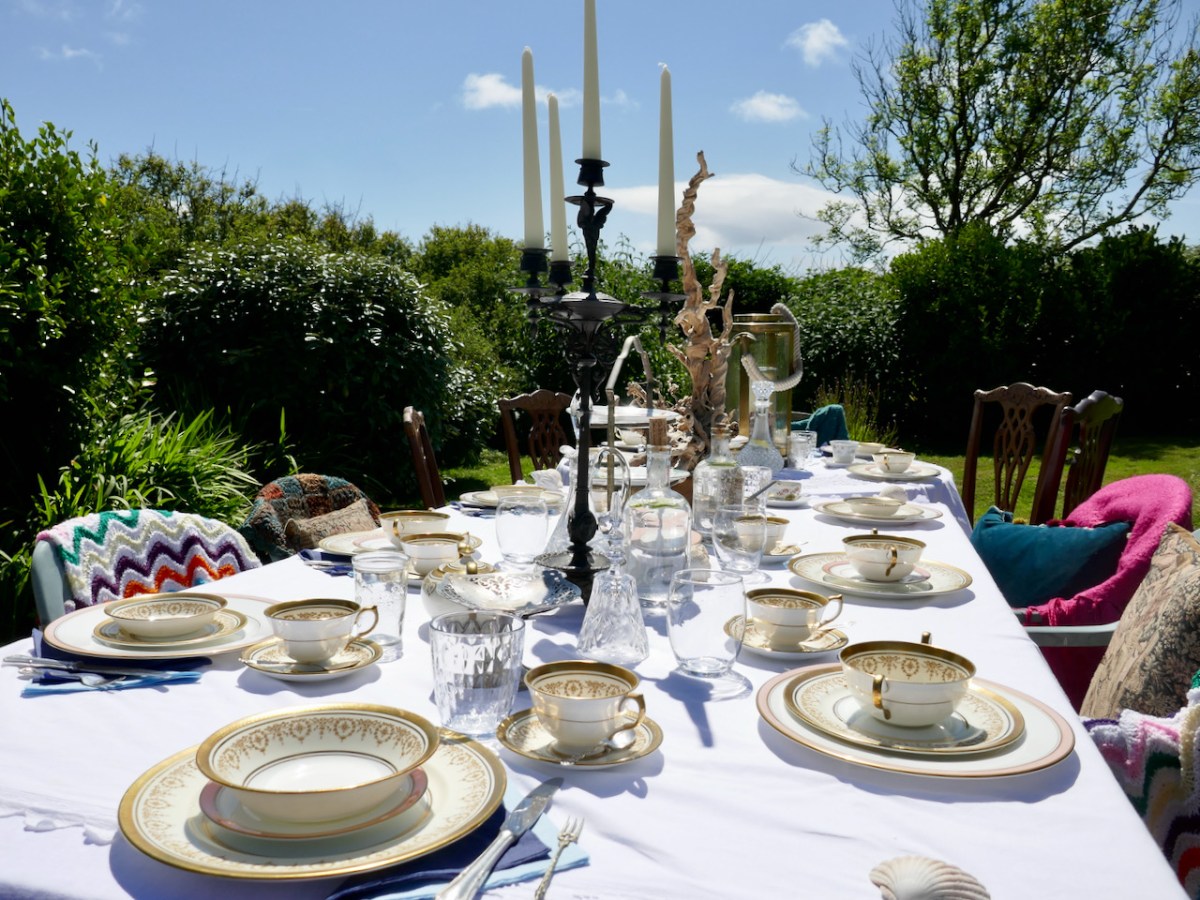
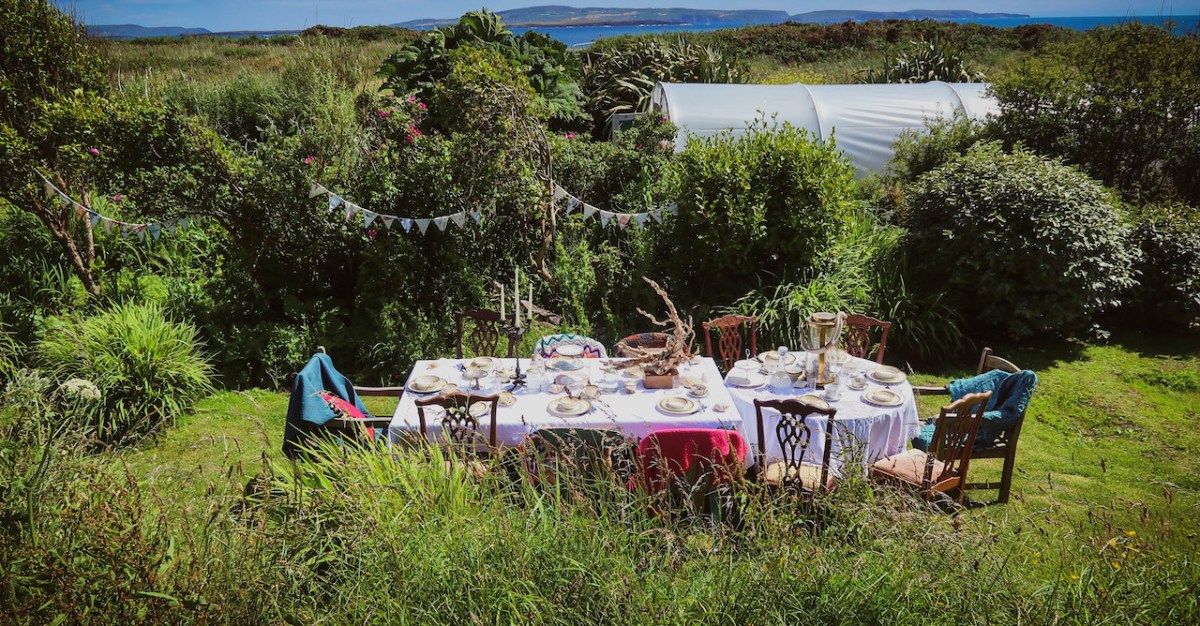
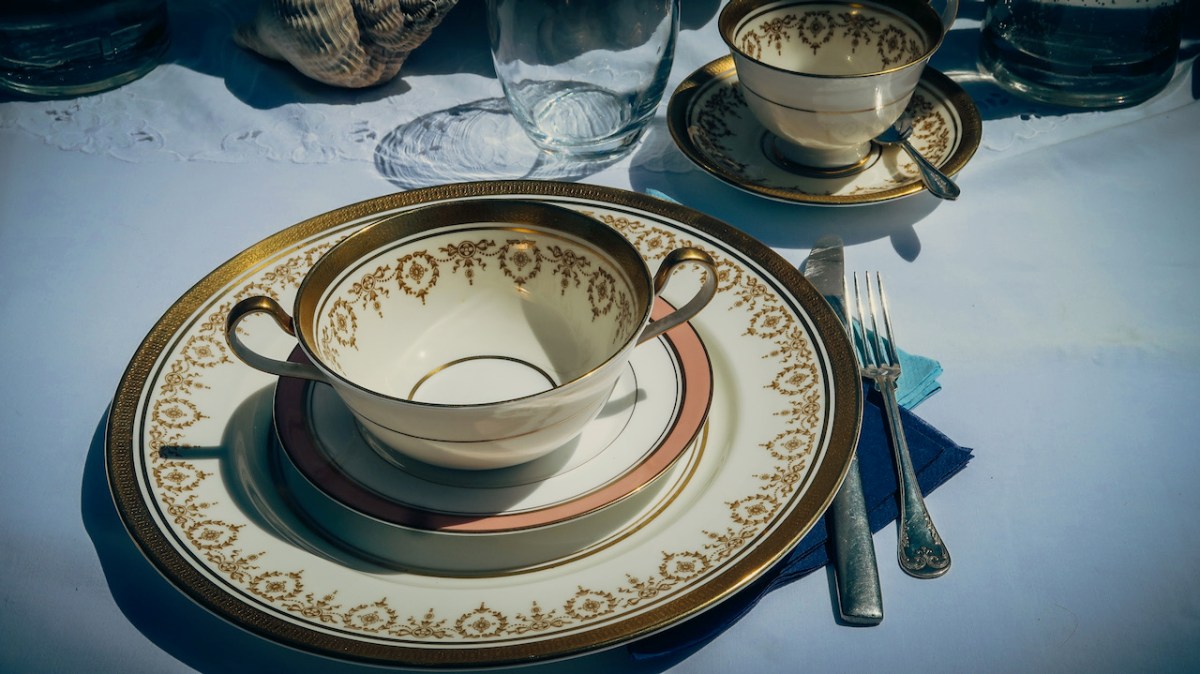
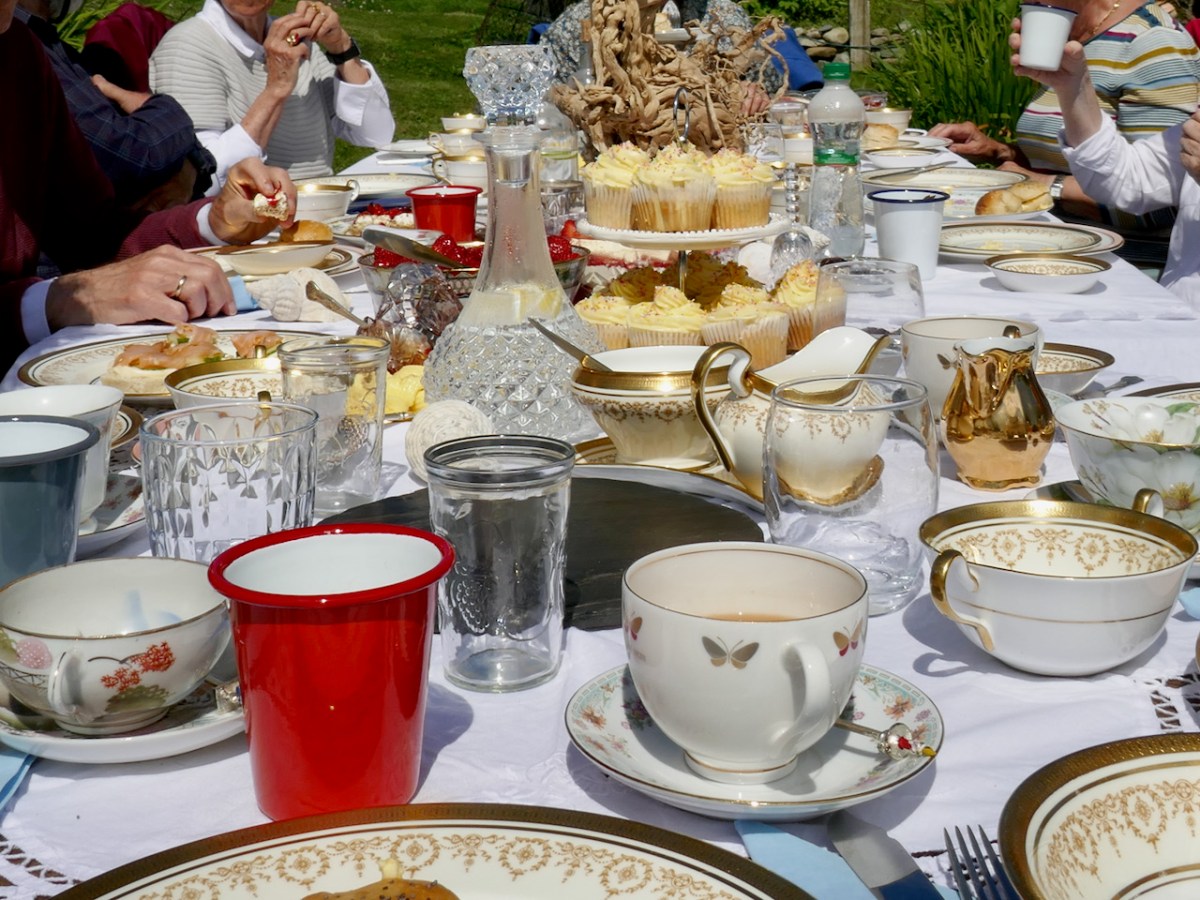
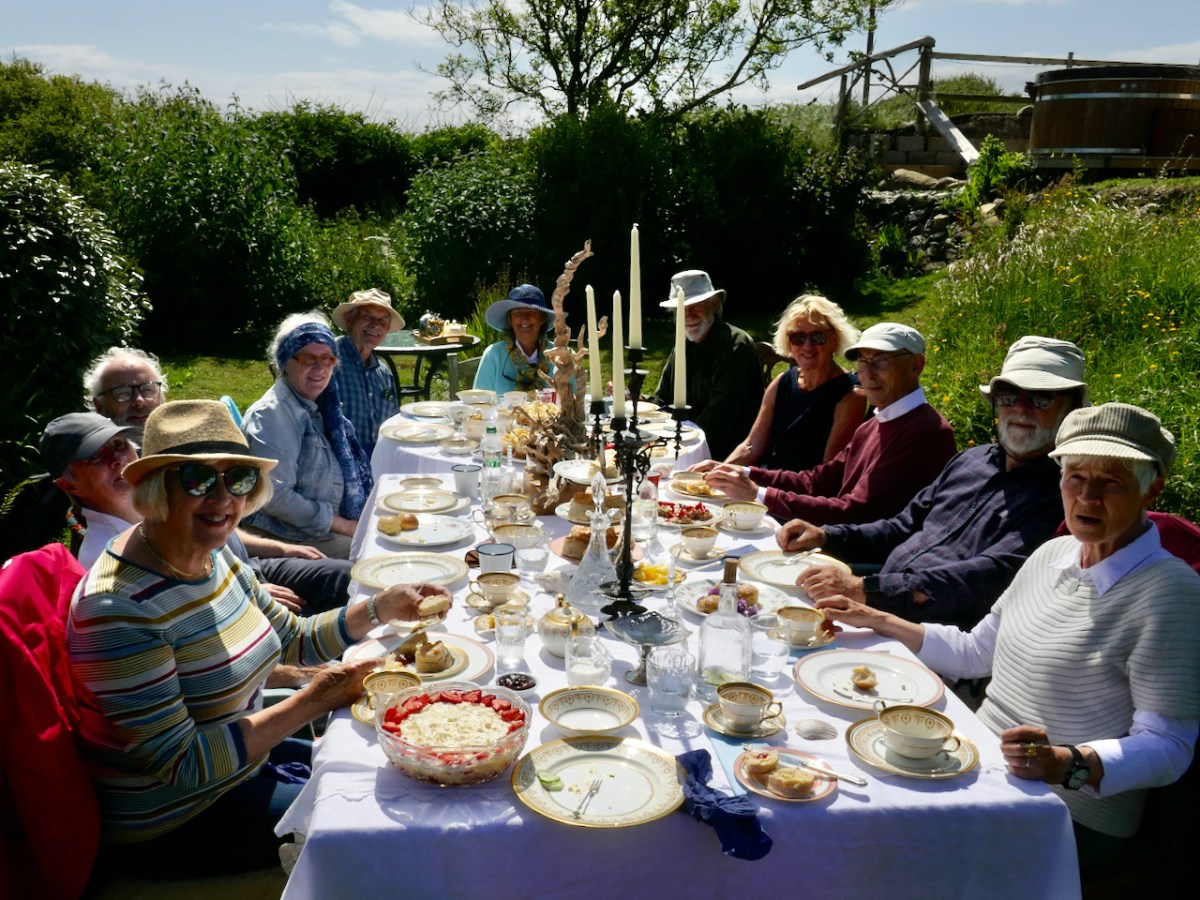
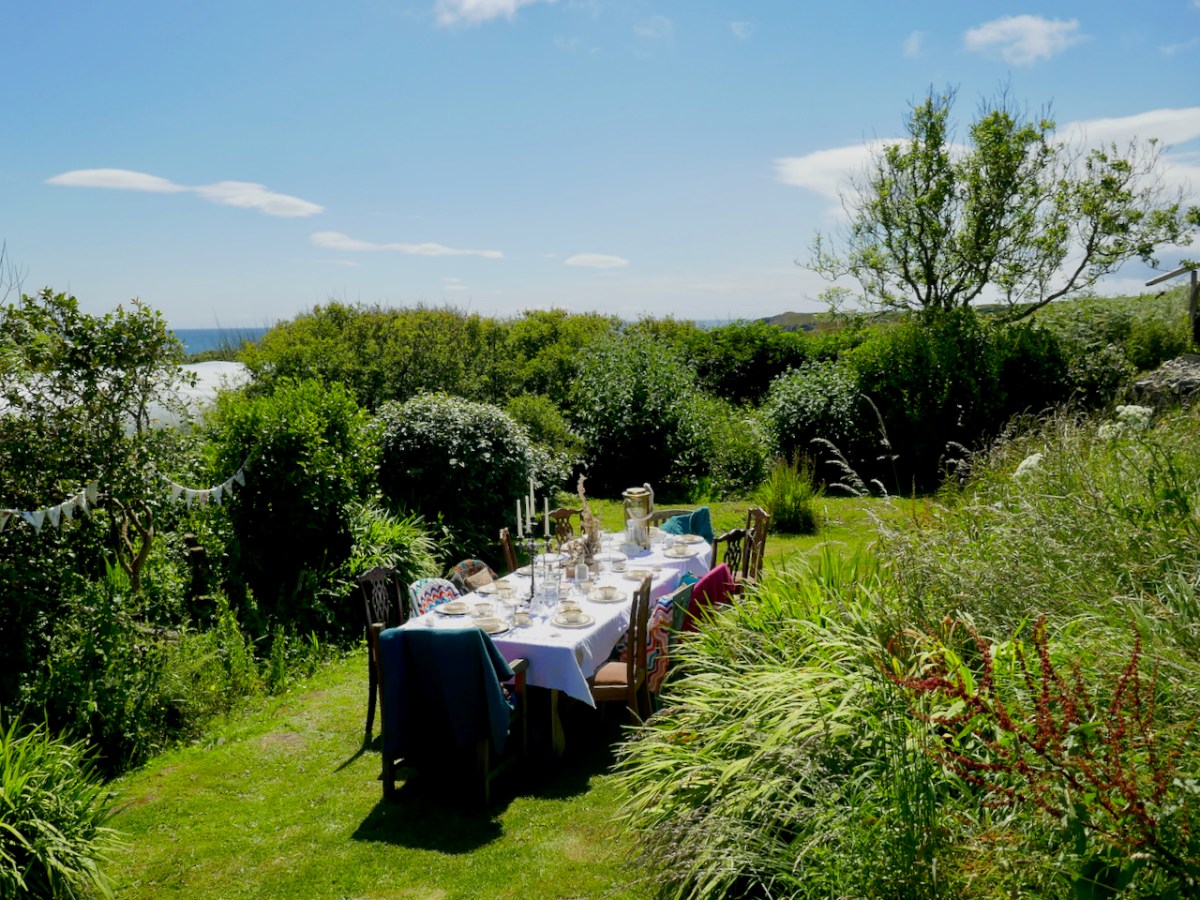
Tracy had created a Long Island version of a Mad Hatter’s Tea Party! It looked magnificent, quirky, fantastical, sumptuous. Real china – her grandmother’s – lots of glass, a chandelier, old-fashioned cutlery (remember those bone handles?), lanterns, decanters, tiered cake stands – all ranged along a long table covered in vintage tablecloths. The table was set out in a hollow in their amazing garden and it looked like something out of Wonderland.

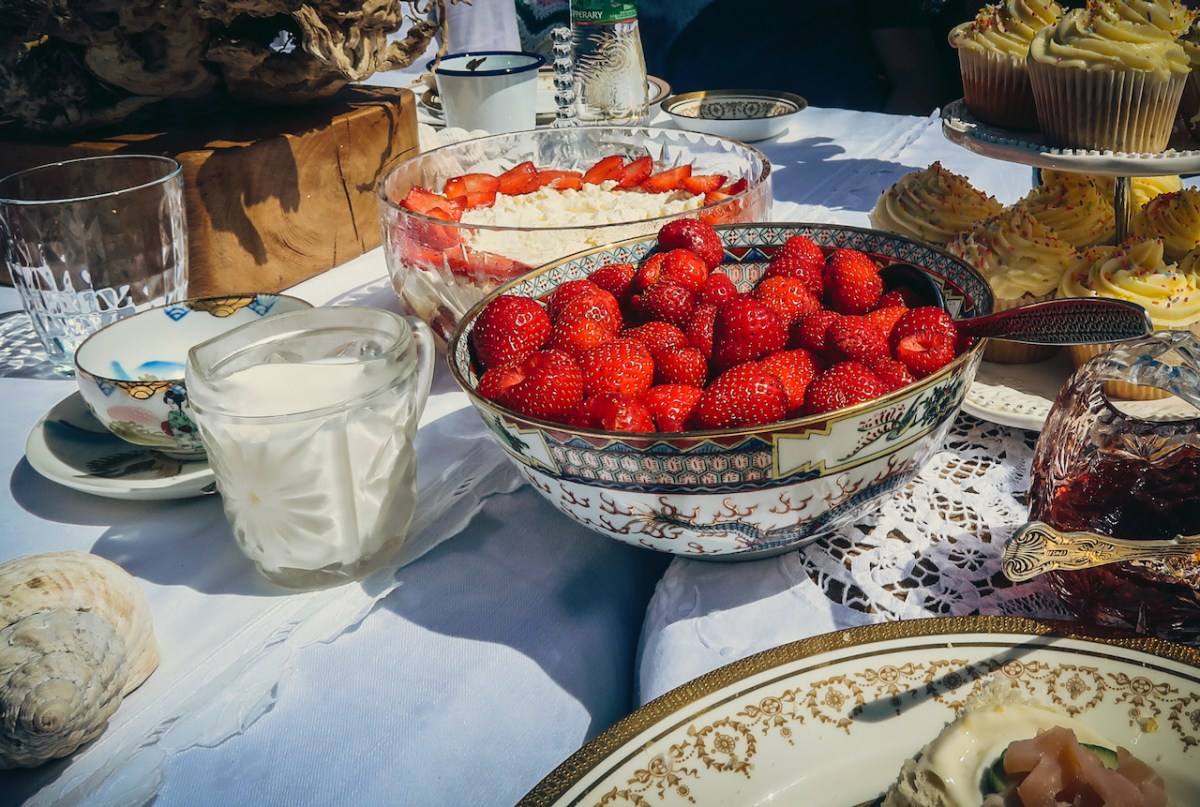
There were mojito mocktails to start with (yum!) and then it was down to the serious business of eating. Pretty well everything was homemade, including all the scones and buns, or from their garden (cucumbers, strawberries, jam) or locally sourced (smoked salmon).

And just when you thought you couldn’t fit in any more, out came two enormous bowls of trifle accompanied by their own strawberries.

I couldn’t have asked for a better, tastier, more unique or memorable way to celebrate. And here’s the thing – you can do this too! Tracy and Peter can organise this kind of tea party for you, or meet you with a picnic after your day of exploring Long Island, or feed you a cream tea in their garden. Just give them a shout.

A few final photos to convey the fun and fabulousness of it all.

*Thanks to Amanda Clarke and Robert for most of these photographs

The Gazetteer of Irish Stained Glass

It’s finally here, and it’s stunning!

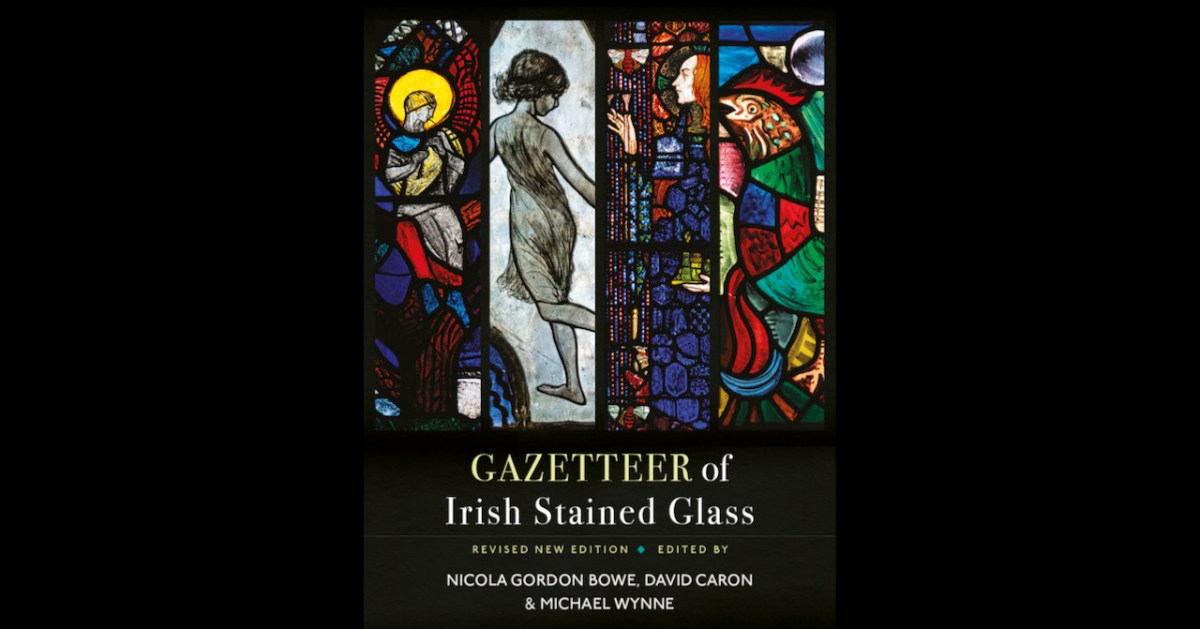
The Gazetteer of Irish Stained Glass was first published in 1988 and has been out of print almost since then. It was the work of Nicola Gordon Bowe, David Caron and Michael Wynne. It documented all the known windows of Harry Clarke and the artists of An Túr Gloine and was snapped up by anyone interested in looking at stained glass.

Click through to see sample pages!

Of the three editors, David Caron, who was a newly-minted PhD at the time, lecturing at the National College of Art, is the only surviving member. He has forged a long-time collaboration with the photographer Jozef Vrtiel, a specialist in the difficult art of capturing stained glass, and together they determined that it was time for an updated edition. Not only updated, but expanded – their vision was for a book that would include all the best stained glass designed and/or made by Irish artists, or by artists working in Ireland. Harry Clarke is here, of course – that’s his St Louis and St Martin window, below, in Castletownshend. But there is so much more to Irish stained glass than Harry Clarke, even though he’s the one that most people know (or think they know).

Note I said ‘artists’ – this is not a book that records all Irish stained glass, such as the mass-produced windows that came from the large studios. The criteria for inclusion were “Artistic merit, individual voice and excellence in the craft.” There were nine artists included in the first book – there are over 90 artists represented in this one!

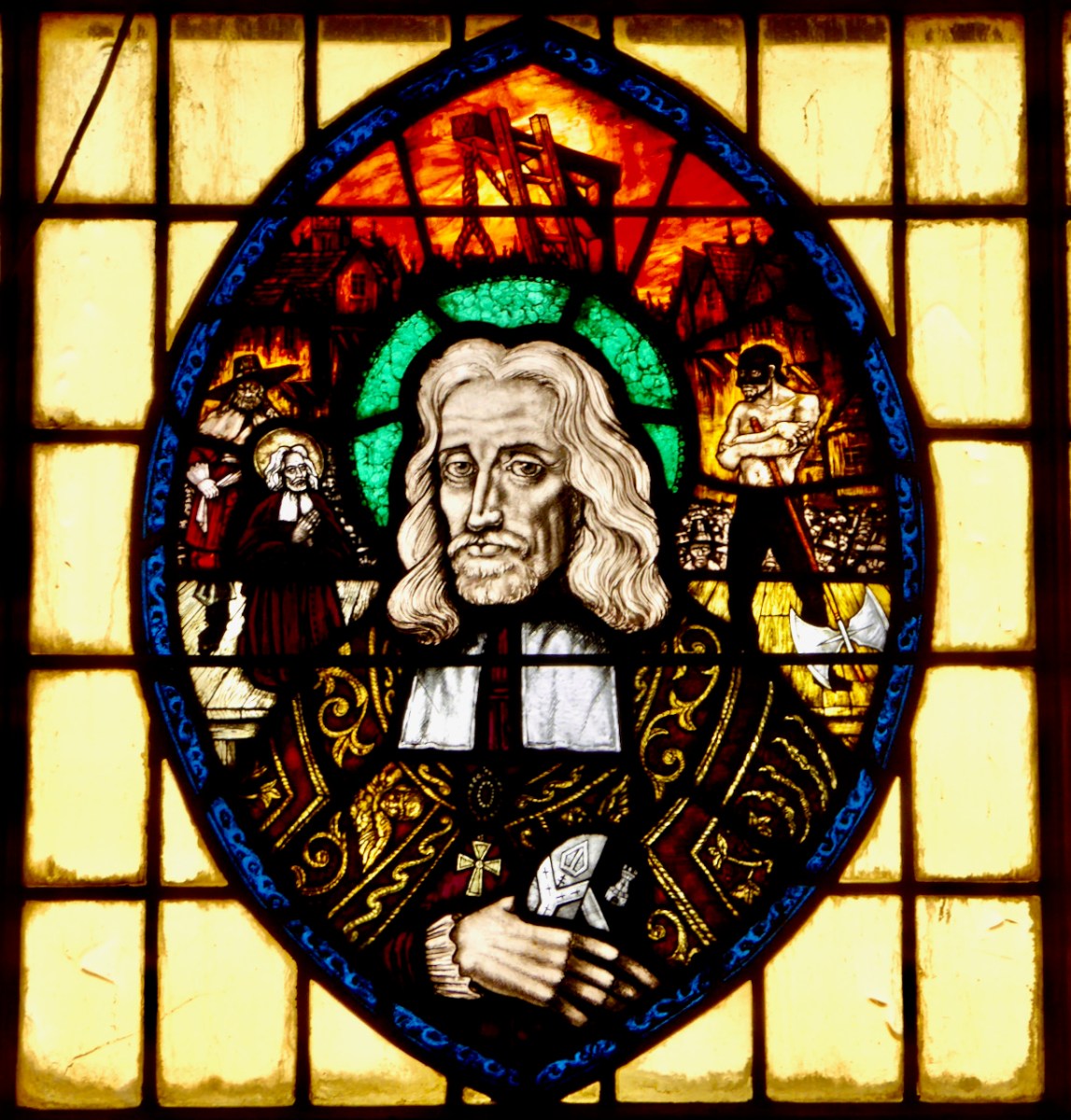
Some artists love to tell stories in their windows – this window is about the trials and tribulations of Oliver Plunkett and is by Kevin Kelly of the Abbey Stained Glass Studio

To do this, besides drawing on his own considerable store of knowledge (and indeed doing the vast majority of the work in this book), David assembled a team of fellow enthusiasts and experts each of whom concentrated on the work of a single artist or studio. For example, Réiltín Murphy has long been compiling the work of her parents, Johhny Murphy and Roisín Dowd Murphy, who together with Dessie Devitt, founded and ran the Murphy-Devitt Studios. You can take a look at my posts, Murphy Devitt in Cork, to see how brilliantly they pioneered a whole new approach to stained glass in mid-century Ireland. The image below is one of their windows from Newbridge College Chapel.

Another contributor is Ruth Sheehy, whose wonderful new book on Richard King occupies pride of place on my desk. I’ve learned so much from it, and bring this new appreciation now to my sightings of a Richard King – always a big thrill. The panel below is a detail from one of his enormous windows (The Sacred Heart) in St Peter and Paul’s Church in Athlone.

My own part revolved around my project to record all of George Walsh’s windows in Ireland. This has been a joyful journey for me, and I have written about George and his windows for the Irish Arts Review and for my own blog. There are over 100 of George’s windows in the Gazetteer, including the scheme he executed for the Holy Family Church in Belfast.

This is a book you will want to have with you in your car. And you know what? There is a lot more wonderful stained glass out there to discover – I’ve been amazed at what I have found in little country towns and in 1960s modernist churches. I have no doubt a third edition will have to be produced eventually as more of us tune in to the treasures under our noses. Look at the picture below, for example – you would swear it was a Harry Clarke! It was certainly made in his studio by a highly talented artist and bears a lot of his characteristic flourishes, just not his signature.

The best part of working on this book? The collegiality of everyone involved – we all helped each other out with queries and photographs. I feel like I have made new friends, even though I have yet to meet many of them. You can buy the book now in all good bookshops (buy local!) or order from the publisher.