It’s become a bit of a tradition with us here at Roaringwater Journal to do a post like this in the lead up to Christmas. See this post, and this one, or maybe this one. All busy stained glass studios were requested to supply Nativity windows – a favourite of Catholic Churches throughout Ireland. Harry himself made several Nativities, but this post deals with windows made in his style, but not by him. All of them were made in his father’s business, Joshua Clarke and Sons, or in The Harry Clarke Studios, as it was renamed in 1930. Sometimes windows are just signed Clarke, or Clarke and Sons. If you’re looking at these images and saying to yourself, Surely these are Harry Clarkes! I recommend reading some of my previous posts for the difference between a Harry Clarke and a Harry Clarke Studio window. Perhaps begin with The House Style: William Dowling and the Harry Clarke Studios.
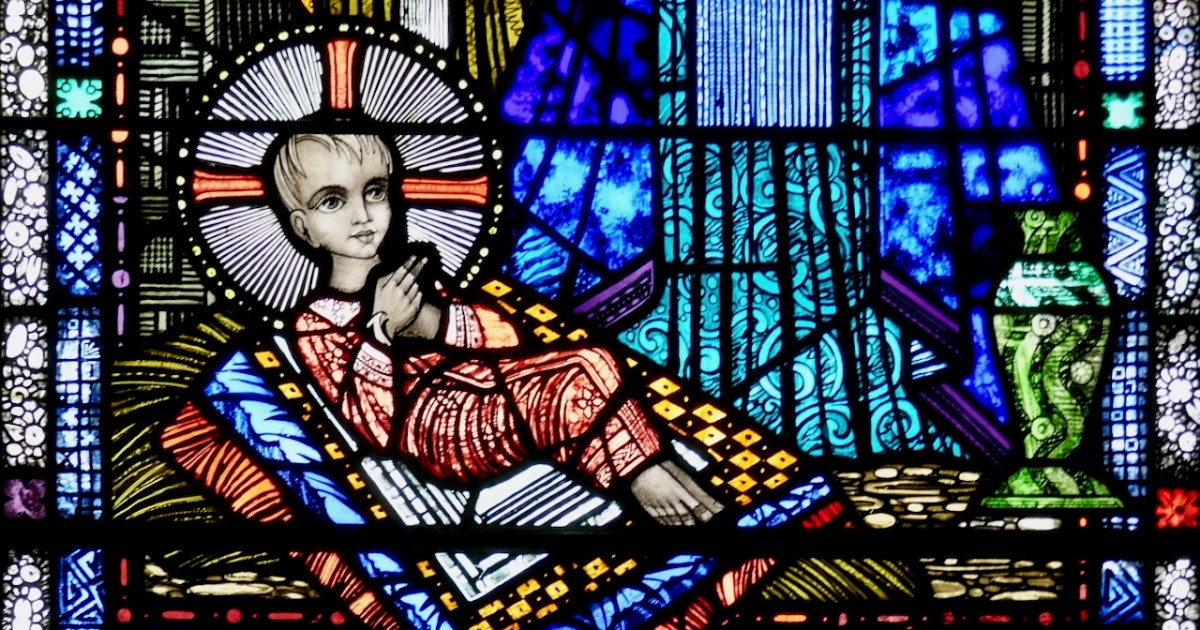
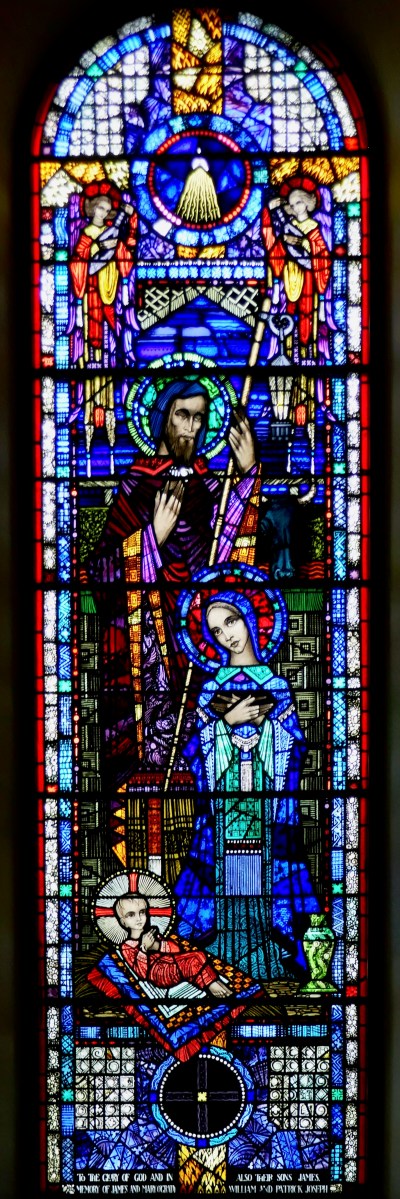
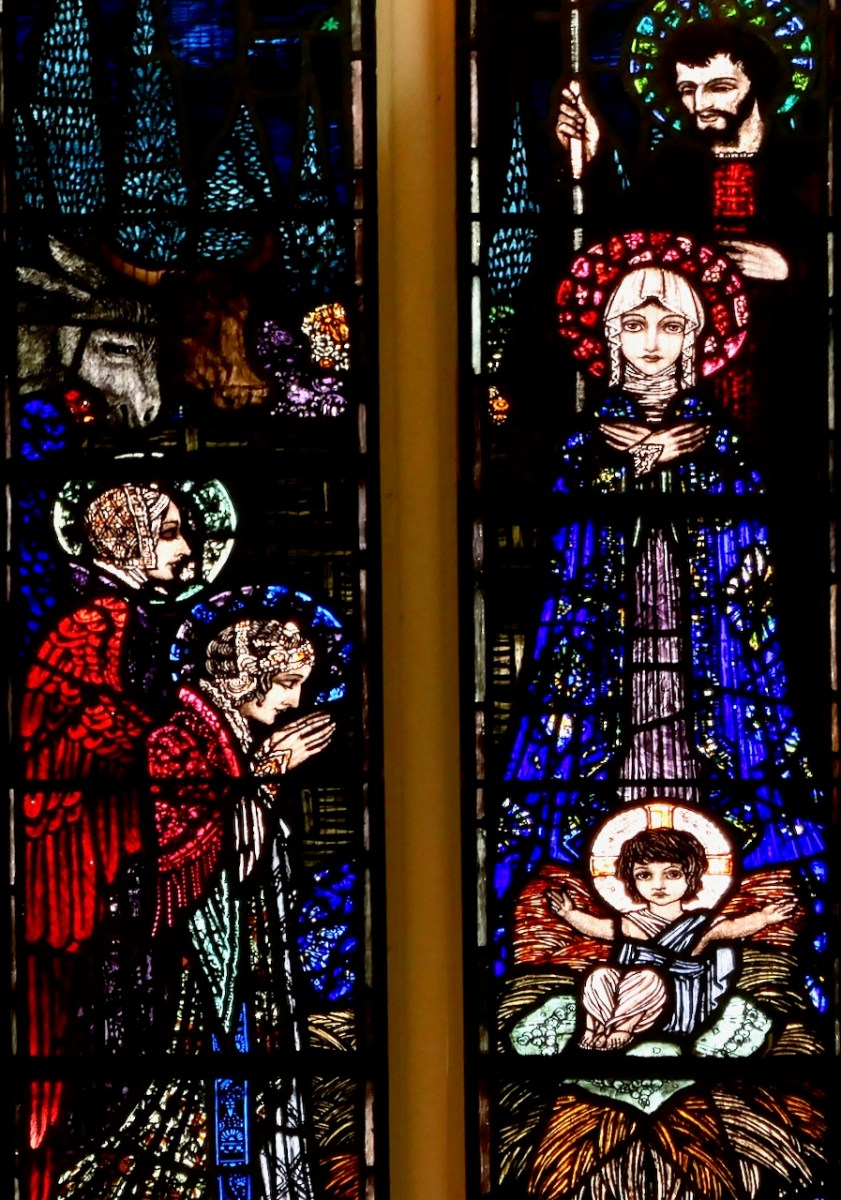
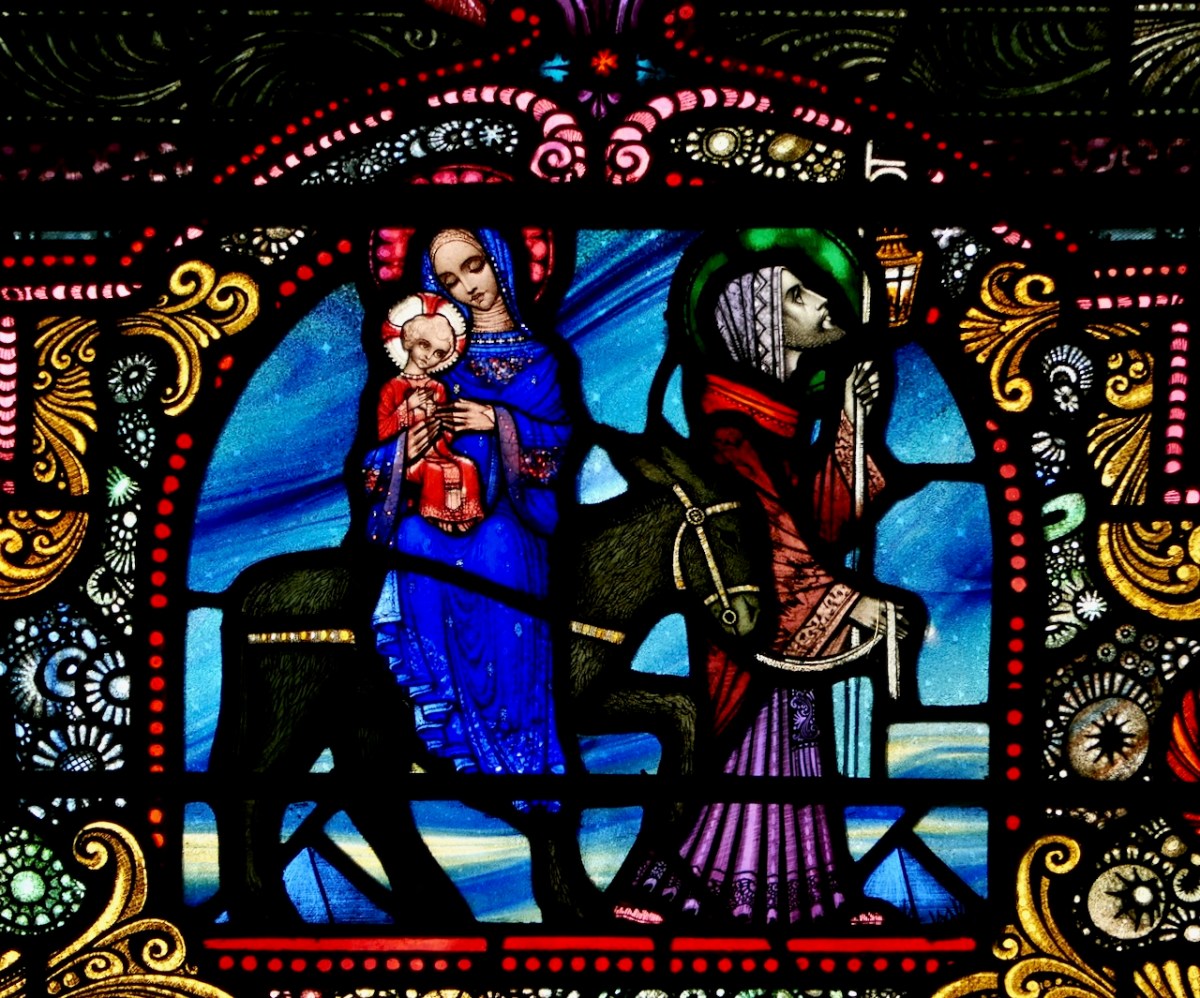
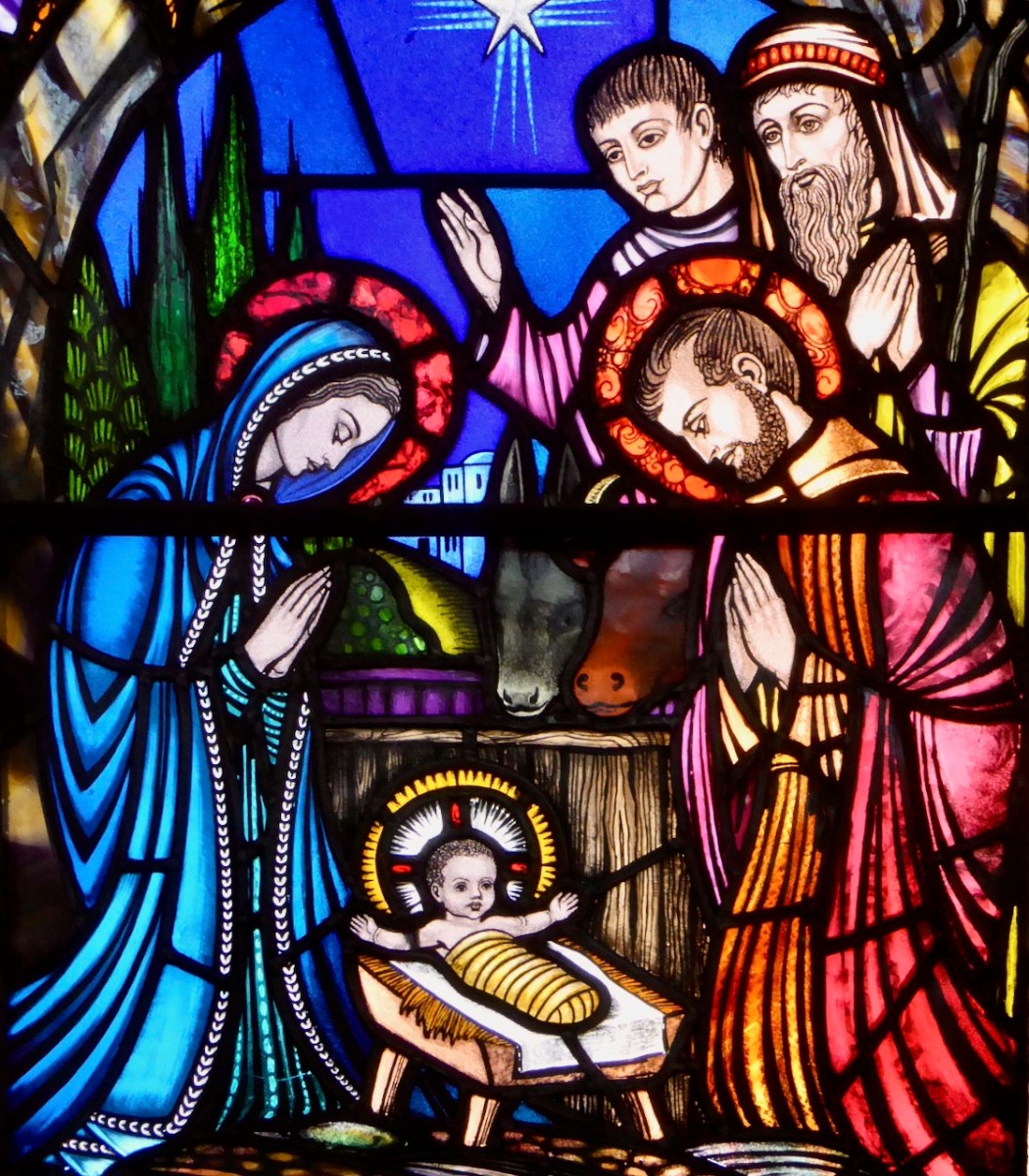
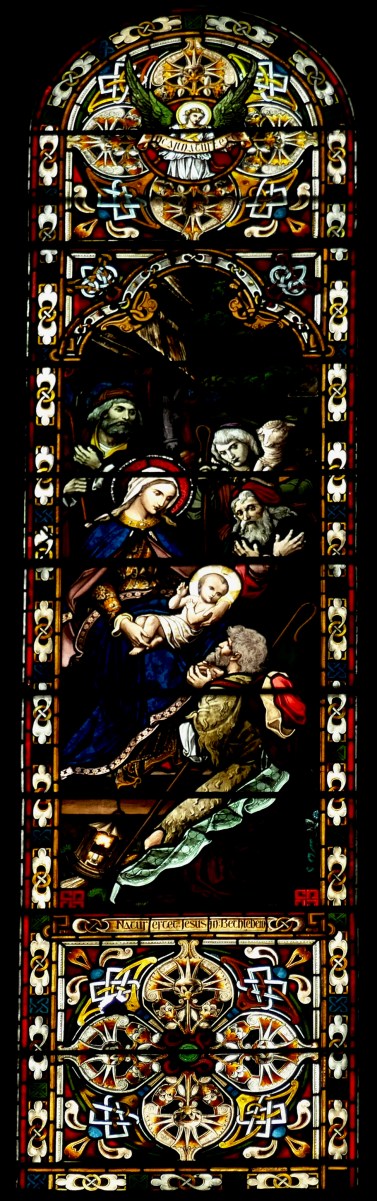
These first two images are from a remote church in Wicklow, in the townland of Killamoat, near Rathdangan. They were done in the Harry Clarke Studios, after Harry died in 1931, and are attributed to George Stephen Walsh, who had started as an apprentice with Harry several years before he died. I particularly love all the details surrounding the Baby Jesus – the blankets upon which he lies and that strange green urn.
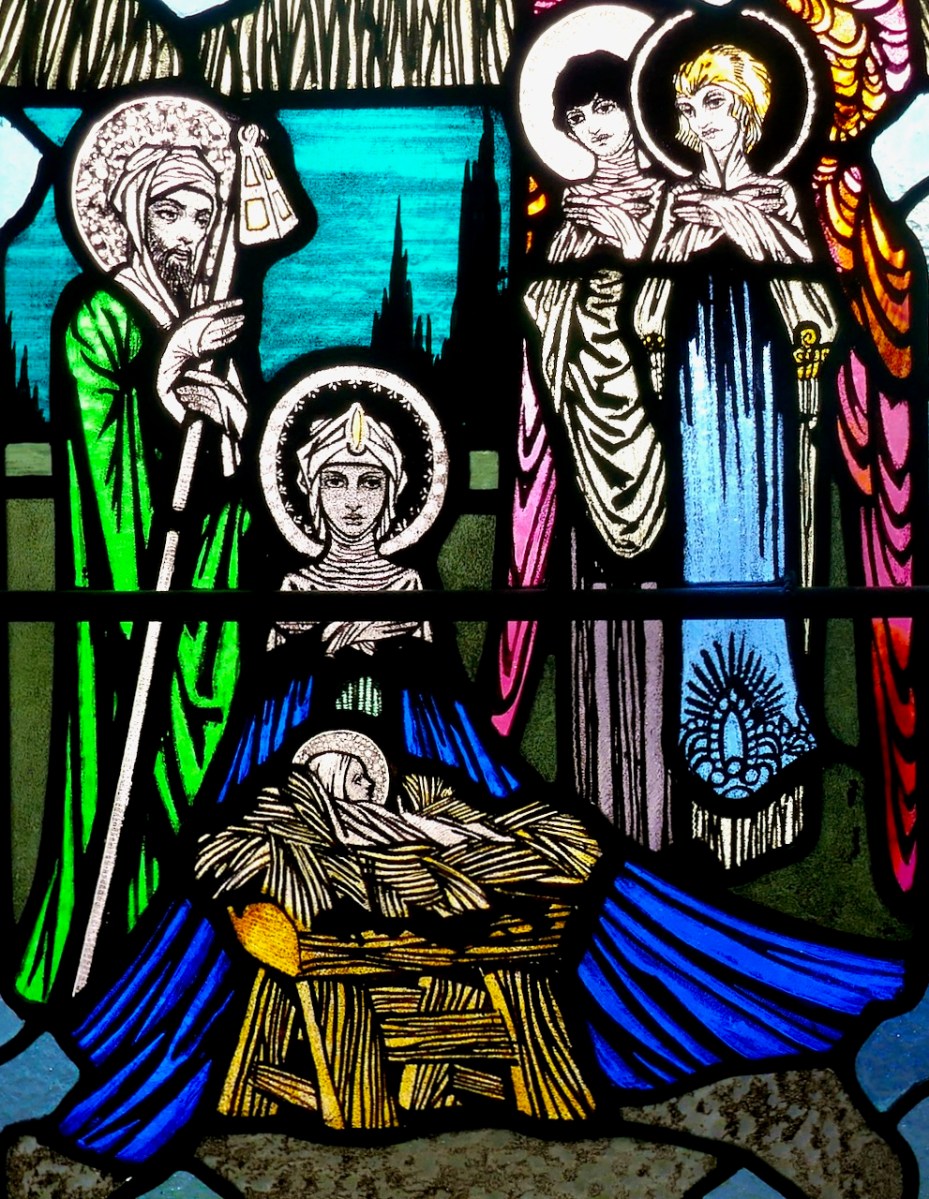
This is from a series of small windows in Leixlip – I made a slide show of those windows, which you can watch here, in a post titledClarke-Style Windows. They were made in 1925, in the Joshua Clarke Studios, in which Harry served his own apprenticeship and which retained its name until it became the Harry Clarke Studios in 1930, shortly before Harry died. In 1925 Harry was an established artist and had taken on several apprentices to help out in the busy studio – one of them made these windows and we don’t know which, although it could have been Philip Deegan. Deegan had taken Harry’s courses at the Dublin Metropolitan School of Art, and was accomplished at reproducing his style.
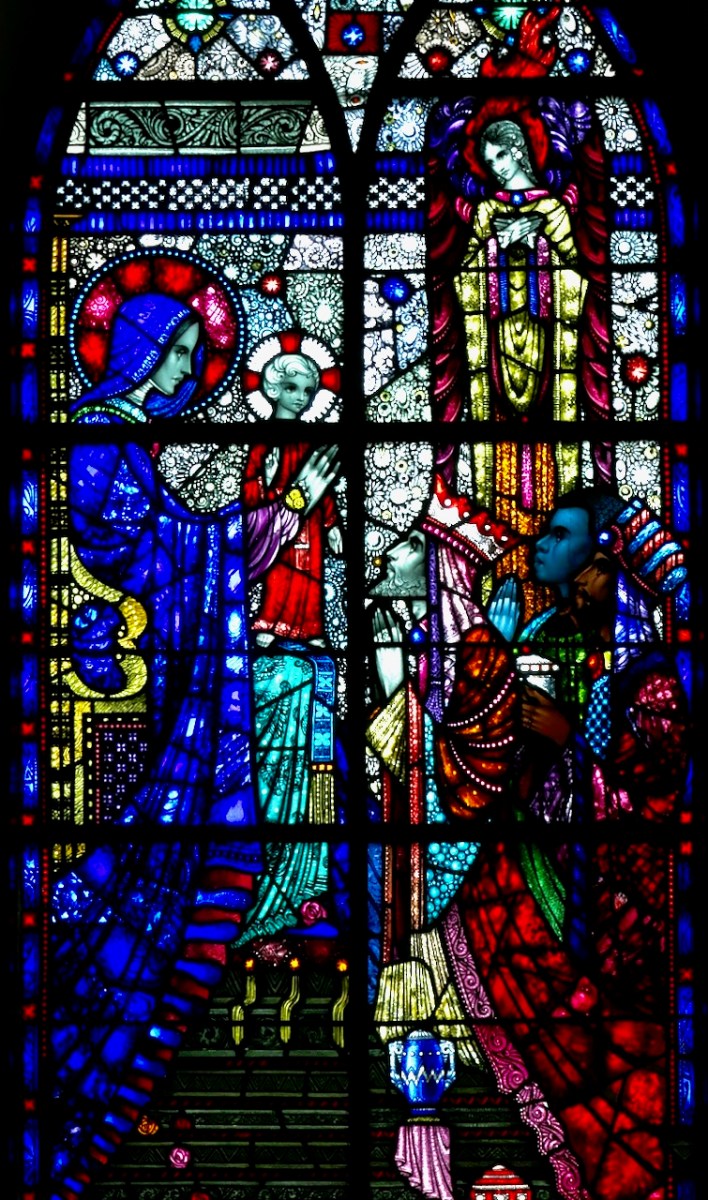
William Dowling* was one of Harry’s most accomplished artists and the one who stayed on in the studio the longest, up to the 1970s. In the years after Harry died he and Richard King produced beautiful windows in the Clarke tradition, using very good glass and carrying on the ‘house style’ of dense, jewel-like surfaces, packed with ornamental detail. Above is one of his windows from Knockainey, Co Limerick, dating from 1940 .
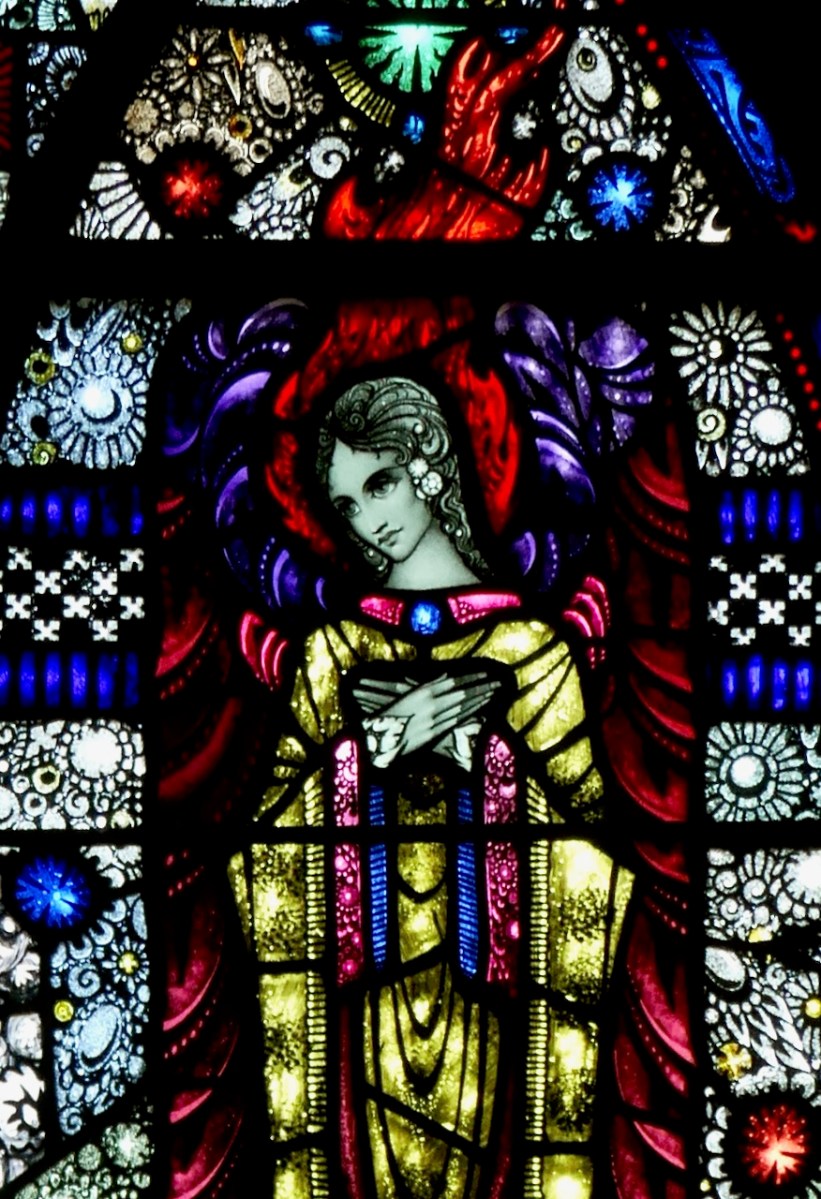
This is the angel from that window – I was struck by the fiery aureole that burns behind his head, instead of the usual halo.
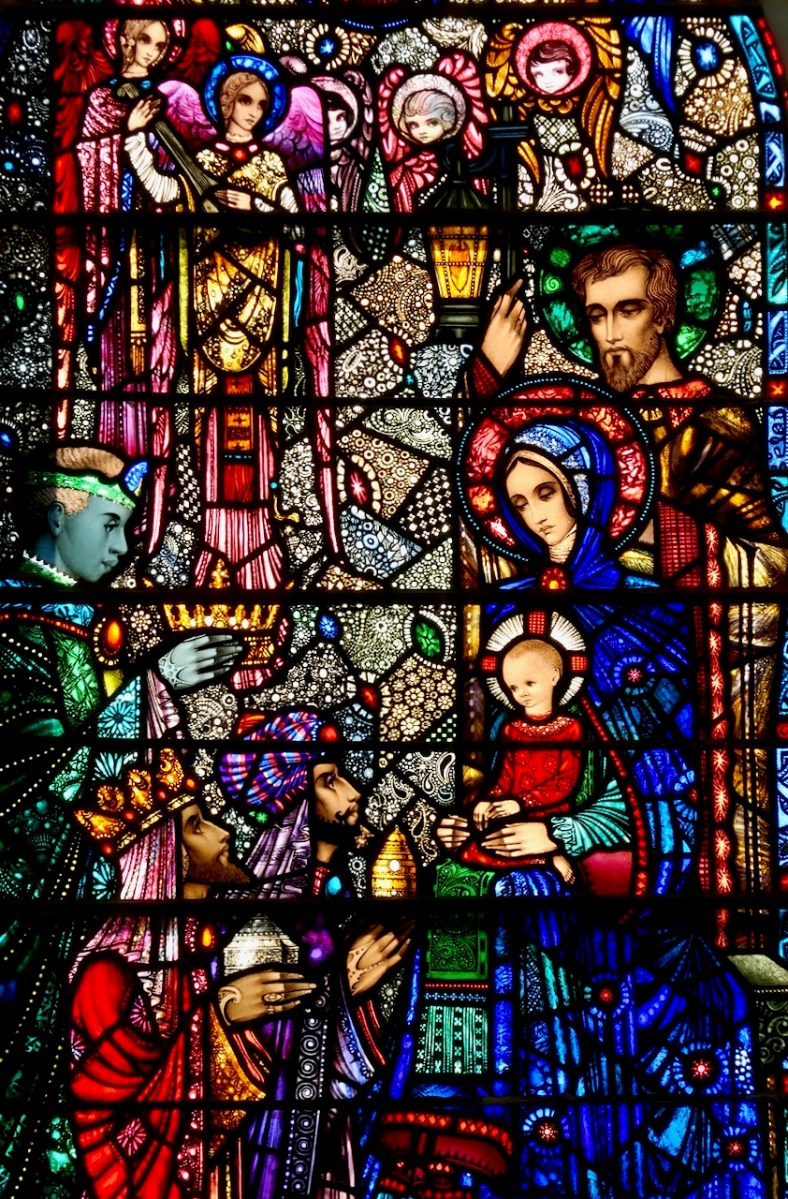
This one is also by Dowling, but from somewhat later, in 1948, and it’s in the Catholic Church in Bandon. You can see how Dowling’s style has evolved – it’s not quite as dense. The composition is still beautiful and local lore has it that many of the young relatives of the priest who commissioned the window are immortalised in some of the faces. Can anyone in Bandon tell us more?
Another from the Studios after Harry Died – this one is in the Catholic Church in Wicklow town and we don’t know to whom it should be attributed.
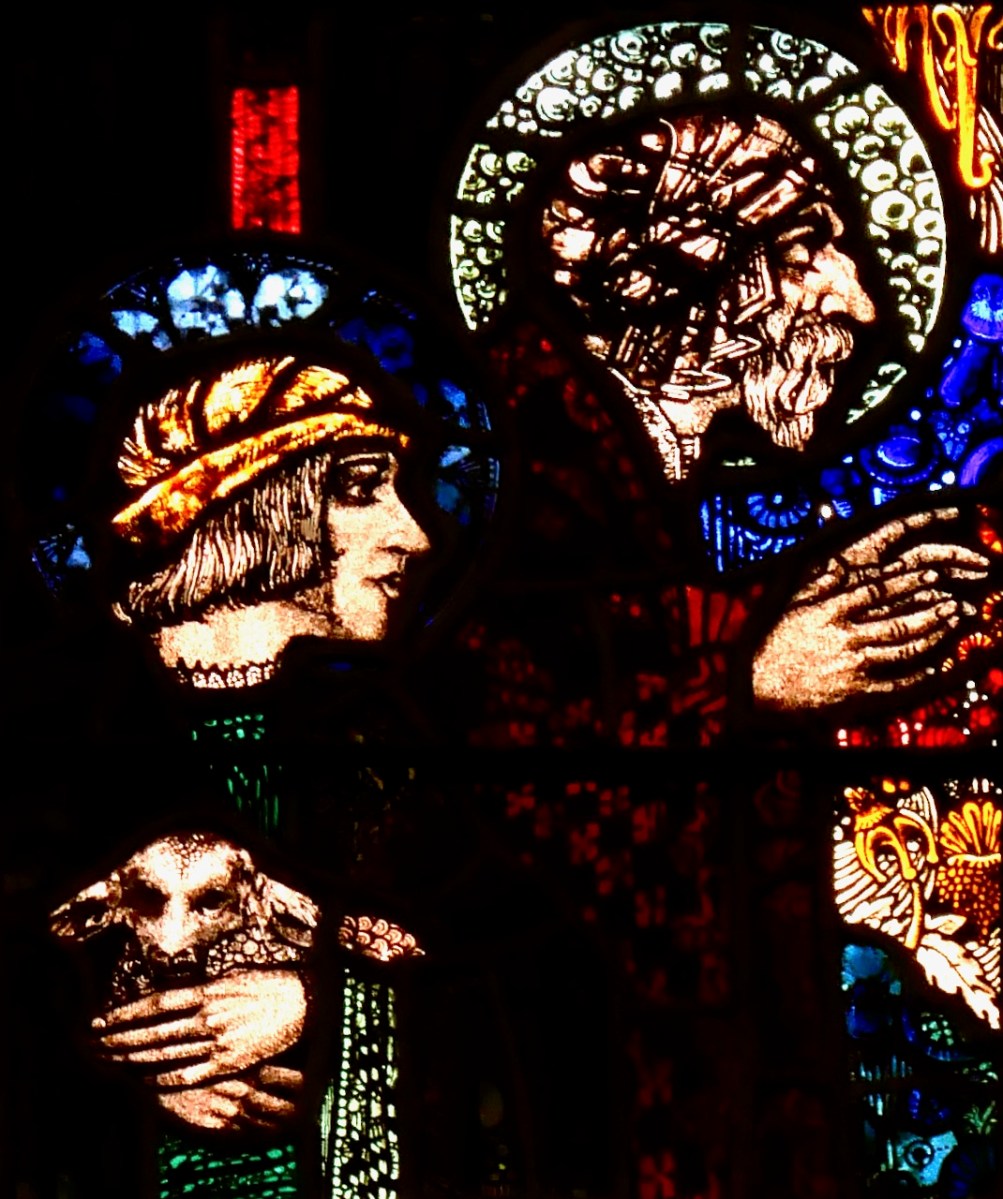
I picked out two of the shepherds to highlight as they had such interesting faces. I also loved the fact that the lamb appears to have a little triangular lacy cap.
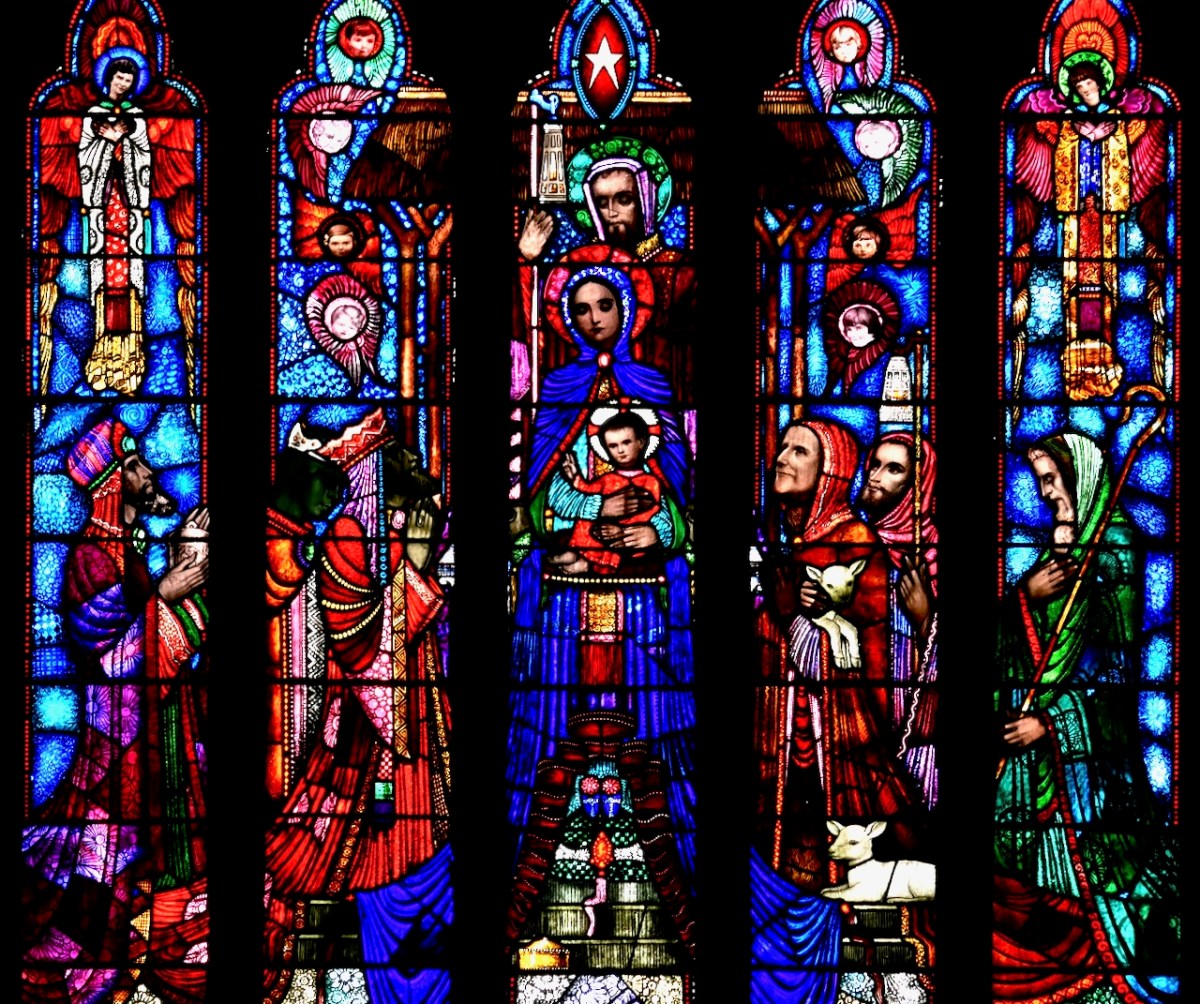
This window is from Millstreet, Co Cork and is another of Dowling’s wonderful productions, dating from 1940. Below is the predella (lowermost panel) from this window.
I suppose we’d have to say that overall there is a bit of a sameness to these Nativity windows and that’s down to the overarching influence of Harry’s very particular style. Eventually, this style fell out of fashion – a victim of its own success, or a failure to change with the times. While it lasted, though, it was superb. Eventually, due to falling demand and the price of good glass, the windows coming from the Harry Clarke Studios failed to keep up the high standards established by him and kept up by Dowling and King as long as they could. Here’s an example from around 1950 so you can see what I mean.
* For more on William Dowling, see Paul Donnelly’s excellent essay Legacy and Identity: Harry Clarke, William Dowling and the Harry Clarke Studios (in Harry Clarke and Artistic Visions of the New Irish State). Paul’s research has greatly informed all my work on William Dowling and other aspects of the Harry Clarke Studios.
St Brigid, according to some accounts, died in 524. Therefore, we are celebrating this year the 1500th anniversary of her death. Once again, I have gone back to primary sources for incidents from her life and am illustrating them with stained glass images. This year I have added as a source the famous Canon O’Hanlon’s Life, from his Lives of the Irish Saints Series, Vol 2, a work of overwhelming erudition.
The Patrick and Brigid window in Meath Hill, by George Walsh. I love that Brigid has precedence over Patrick in this enormous cruciform window
If you haven’t already done so, now is a good time to go back and read my 2022 post, St Brigid: Dove Among Birds, Vine Among Trees, Sun Among Stars and my 2023 post, Brigid: A Bishop in All But Name. In them, I explain what the original sources for the Life of Brigid are. They all contain similar accounts and may be ultimately based on a single source – the Life of St Brigid by St Ultán – and are laid out as a series of miracles that lead us from her birth to her death.
This is a detail from a window in Ballynahown, Co Westmeath, and is probably by Watson of Youghal. I like the clever way the oak leaves are used as frame and background
Many more miracles, legends, myths and stories accreted to her cult over the centuries. A good example of such a story is the one where she makes a cross from rushes – that one is nowhere to be found in the original Lives, but is an integral part of the folklore surrounding her, and therefore almost invariably found in her iconography.
This is a photo by Frank Fullard, used with permission and thanks. It is a simple treatment of St Brigid from Kilmaine, Co Mayo
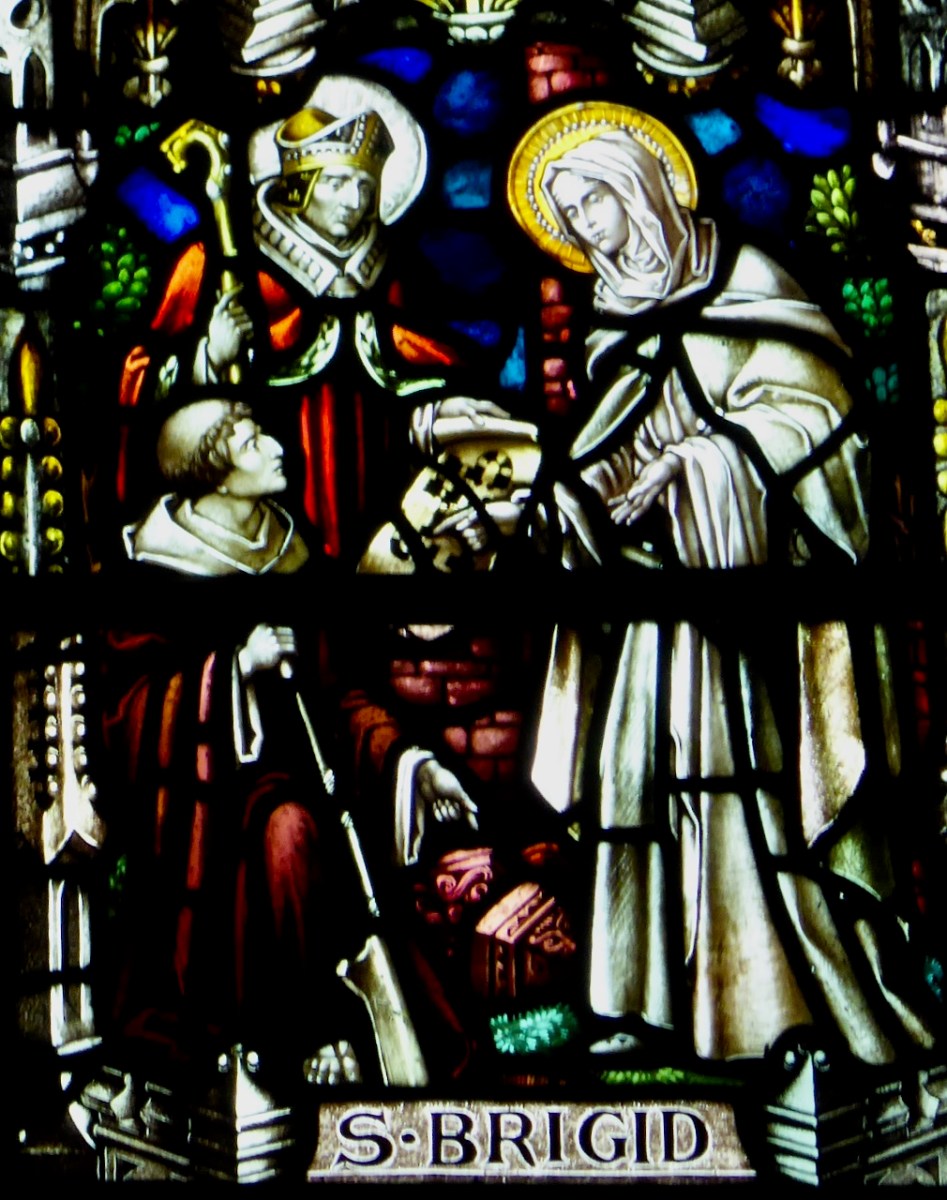
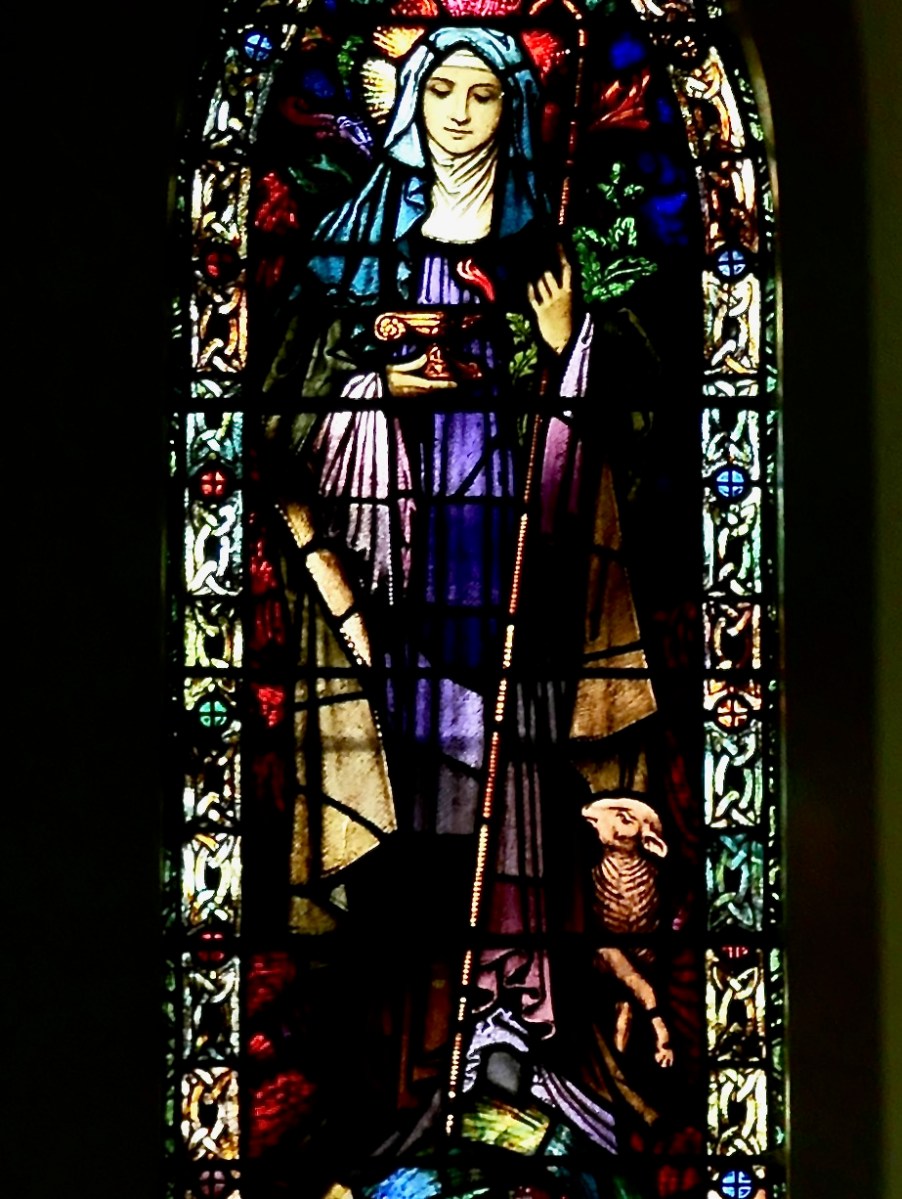
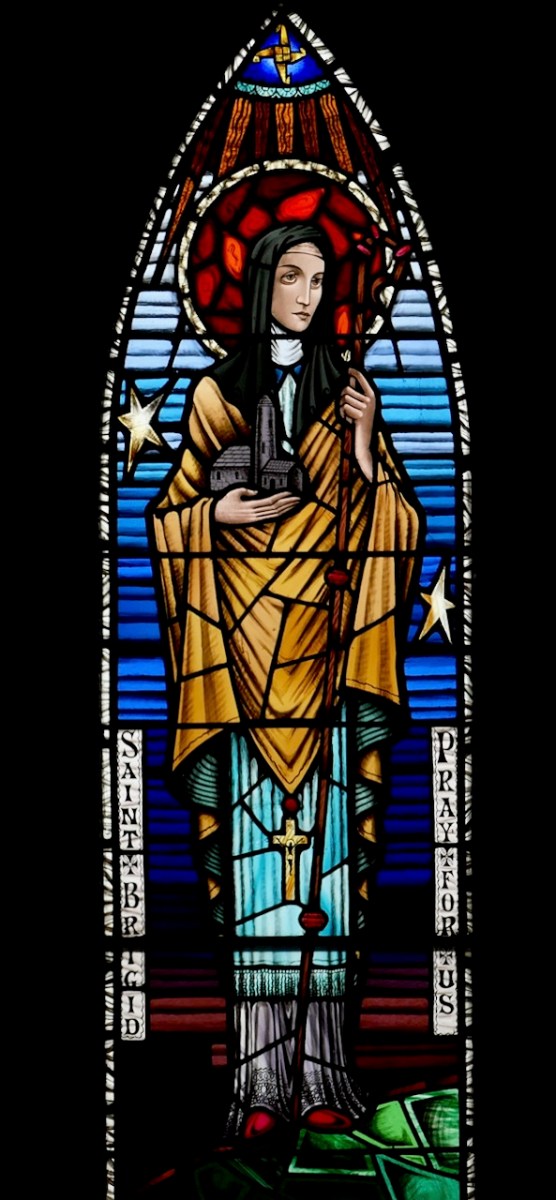
She is associated with many places and numerous holy wells – just take a look at all the St Brigid’s wells Amanda has documented in Cork and Kerry. But of course it is Kildare that rightly claims her. Kildare (Cill Dara – the Church in the Oak Wood) is where she built her church and established her city. It is the origin of three of the attributes we see in many windows – a church, oak leaves and a lamp. (For the story about the Bishop’s Crozier, see the previous posts.)
Detail from the Brigid Window in Carrickmacross – she’s consulting with her architects
The Book of Lismore has this story about building the church:
Brigit went to Bishop Mel, that he might come and mark out her cityfor her. When they came thereafter to the place in which Kildare stands to-day, that was the time that Ailill, son of Dunlang, chanced to be coming, with a hundred horseloads of peeled rods, over the midst of Kildare. Then maidens came from Brigit to ask for some of the rods, and refusal was given to them. The horses were (straightway) struck down under their horseloads to the ground. Then stakes and wattles were taken from them, and they arose not until Ailill had offered the hundred horseloads to Brigit. And therewith was built Saint Brigit’s great house in Kildare, and it is Ailill that fed the wrights and paid them their wages. So Brigit left (as a blessing) that the kingship of Leinster should be till doomsday from Ailill, son of Dunlang.
Detail from the Brigid window in Sneem, Co Kerry, by Watson of Youghal
It was a large establishment. O’Hanlon says:
We are informed, that her Rule was followed, for a long time, by the greatest part of those monasteries, belonging to sacred virgins in Ireland; nearly all of these acknowledging our saint as their mother and mistress, and the monastery of Kildare as the headquarters of their Order. Moreover, Cogitosus informs us, in his prologue to her life, that not only did she rule nuns, but also a large community of men, who lived in a separate monastery. This obliged the saint to call to her aid, and from out his solitude, the holy bishop, S. Conlaeth, to be the director and spiritual father of her religious; and, at the same time, to be bishop of the city. The church at Kildare, to suit the necessities of the double monastery and to accommodate the laity, was divided by partitions into three distinct parts. One of these was reserved for the monks; one for the nuns; while a third compartment was intended to suit the requirements of the laity.
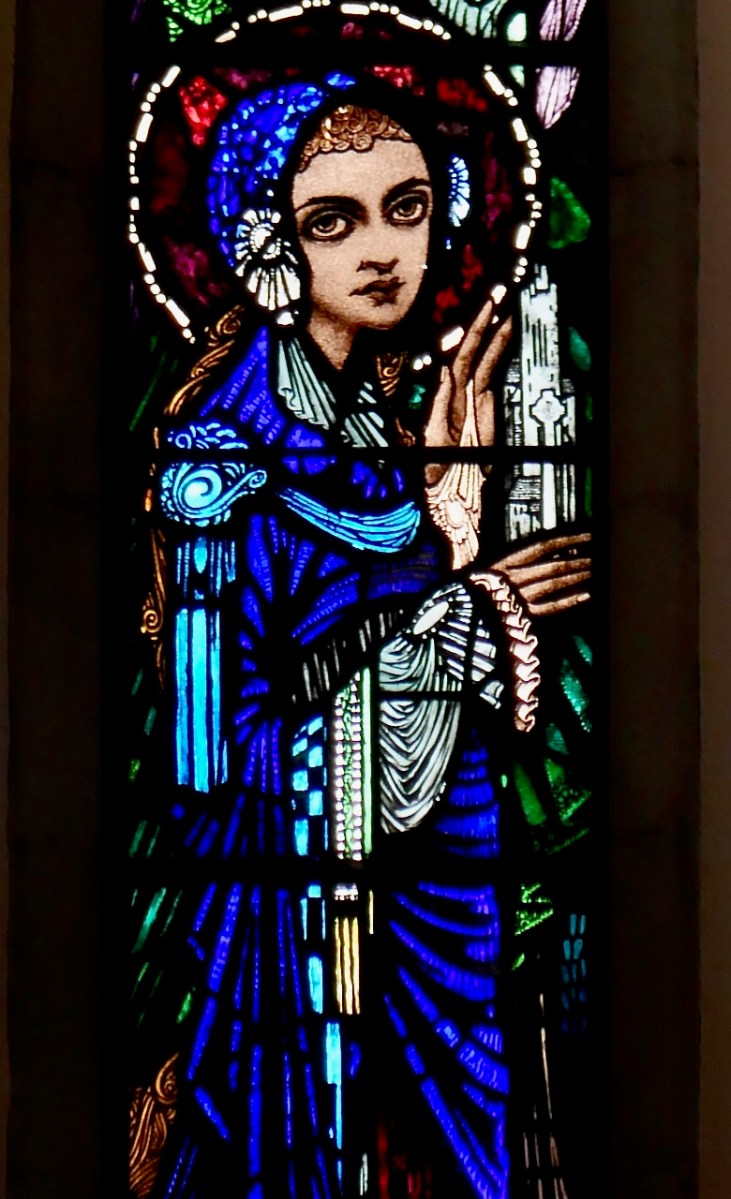
Harry Clarke’s 1924 window in Cloughjordan is of the Ascension with Irish Saints – this is a young St Brigid, holding her church
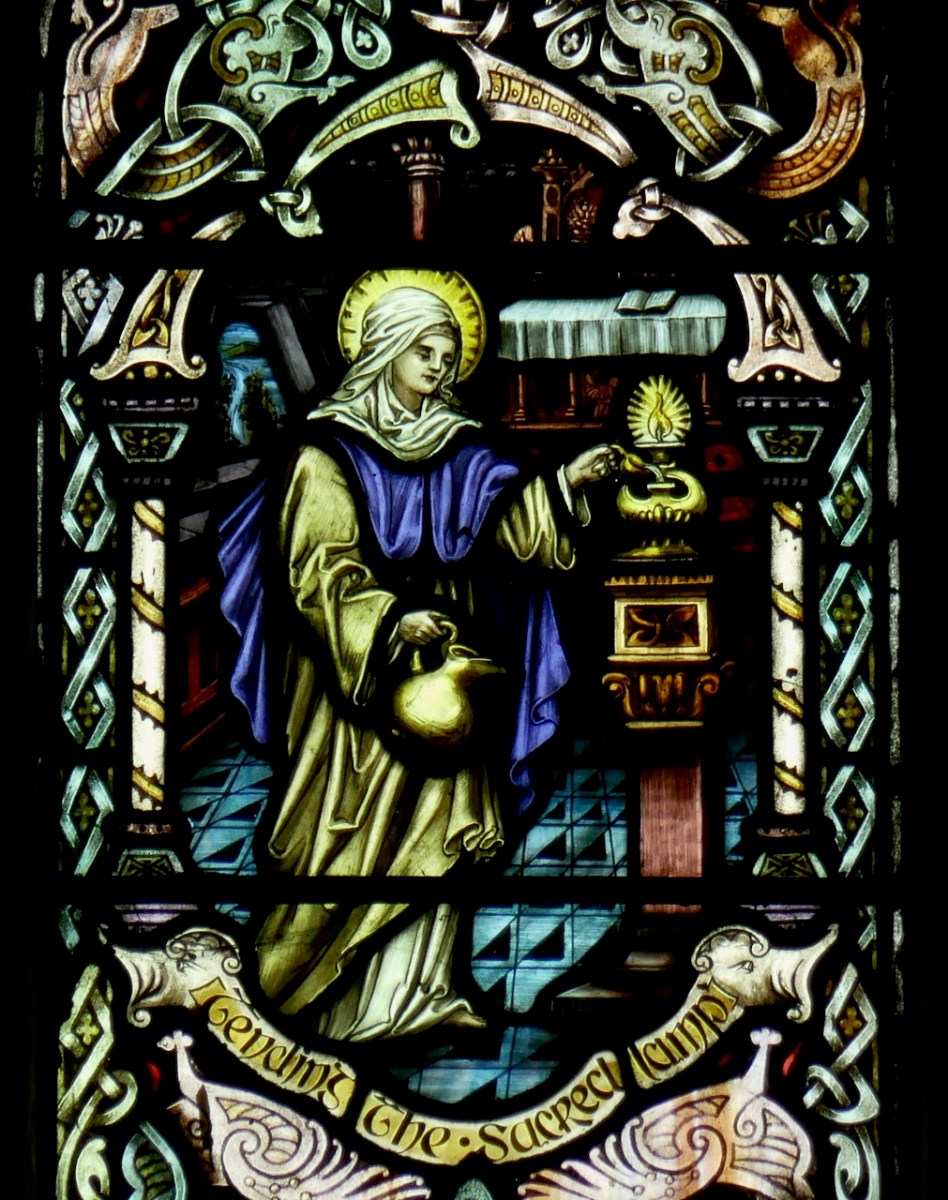
And what about the lamp? This is interesting, as its first appearance was not in any of the lives but in the writings of the notorious Giraldus Cambrensis, Gerald of Wales. He will get a post of his own in due course, but for the moment, if you are not familiar with him, there’s a delightful sketch of him and his writings about Ireland in the 12th century here.
Brigid window in Kilgarvan, Co Kerry, by Earley and Co
Here is his story about the sacred fire, now usually rendered as a lamp, as faithfully related by O’Hanlon:
Speaking of Kildare city, in Leinster, which had become so renowned, owing to its connexion with our glorious abbess, Giraldus Cambrensis says, that foremost, among many miraculous things worthy of record, was St. Brigid’s inextinguishable fire. Not, that this fire itself was incapable of being extinguished, did it obtain any such name, but, because nuns and holy women had so carefully and sedulously supplied fuel to feed its flames, that from St. Brigid’s time to the twelfth century, when he wrote, it remained perpetually burning through a long lapse of years. What was still more remarkable, notwithstanding great heaps of wood, that must have been piled upon it, during such a prolonged interval, the ashes of this fire never increased.
Another detail from the Watson window in Sneem
What is furthermore remarkable, from the time of St. Brigid and after her death until the twelfth century, an even number, including twenty nuns, and the abbess, had remained in Kildare nunnery. Each of these religious, in rotation, nightly watched this inextinguishable fire. On the twentieth night, having placed wood on its embers, the last nun said:” O Brigid, guard thy fires, for this night the duty devolves on thyself.” Then the nun left that pyre, but although the wood might have been all consumed before morning, yet the coals remained alive and inextinguishable. A circular hedge of shrubs or thorns surrounded it, and no male person dare presume to enter within that sacred enclosure, lest he might provoke Divine vengeance, as had been experienced by a certain rash man, who ventured to transgress this ordinance. Women only were allowed to tend that fire. Even these attendants were not permitted to blow it with their breath; but, they used boughs of trees as fans for this purpose.
This is the predella from the Brigid window in Moone, by the Harry Clarke Studios (see blow for the main panel)
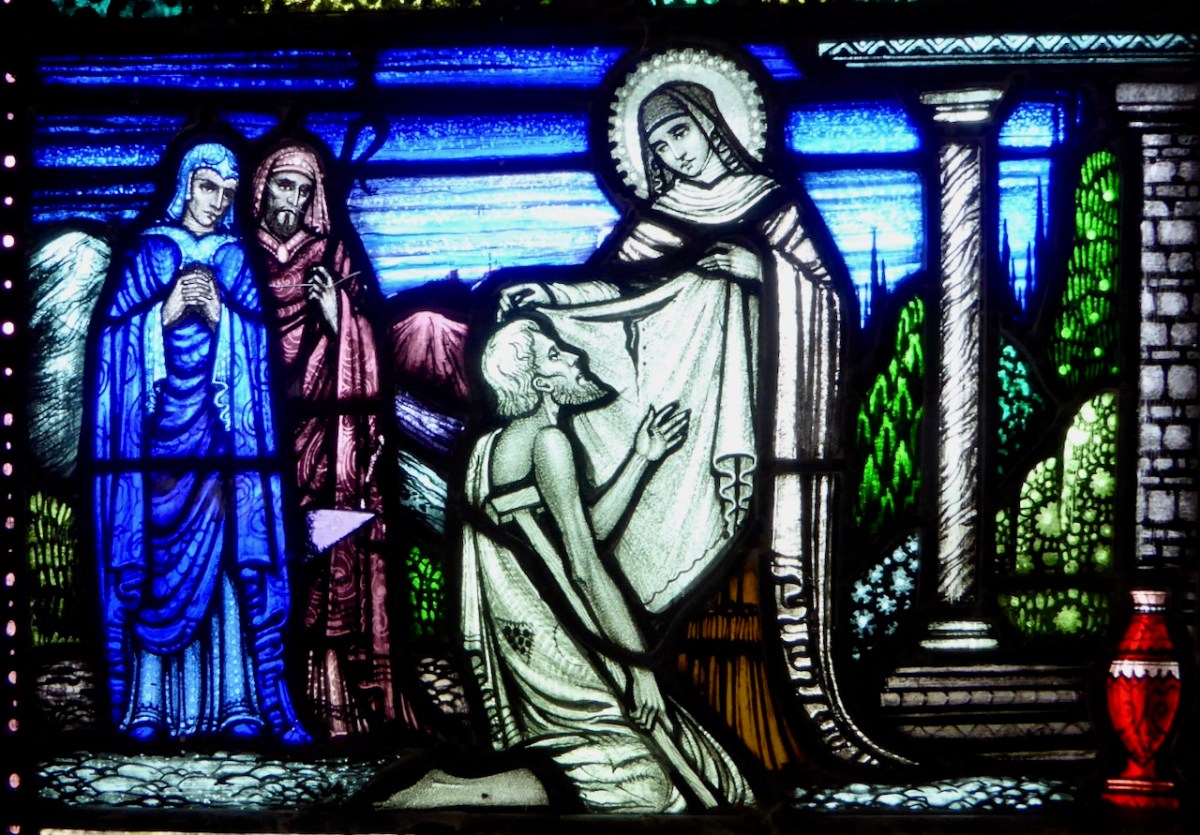
All of the Lives and O’Hanlon’s account tell of Brigid’s many miracles in providing food and clothing for the poor, in healing sicknesses, in turning the hearts of evildoers to God, in freeing slaves, and in punishing those who are selfish or cruel.
However, the story I like best perhaps is this one from the Vita Prima:
In the same place also when saint Brigit was staying as a guest, a married man came with a request that saint Brigit should bless some water for him to sprinkle his wife with, for the wife actually hated the husband. So Brigit blessed some water and his house and food and drink and bed were sprinkled while his wife was away. And from that day on the wife loved her husband with a passionate love as long as she lived.
She may have been a nun, but she obviously served up a good love potion when the situation required it. This story is not only repeated in the Book of Lismore, but embellished, thus:
When he had done thus, the wife gave exceeding great love to him, so that she could not keep apart from him, even on one side of the house ; but she was always at one of his hands. He went one day on a journey and left the wife asleep. When the woman awoke she rose up lightly and went after the husband, and saw him afar from her, with an arm of the sea between them. She cried out to her husband and said that she would go into the sea unless he came to her.
The aged St Brigid by George Stephen Walsh, in Ballintubber Abbey – another image generously loaned by Frank Fullard
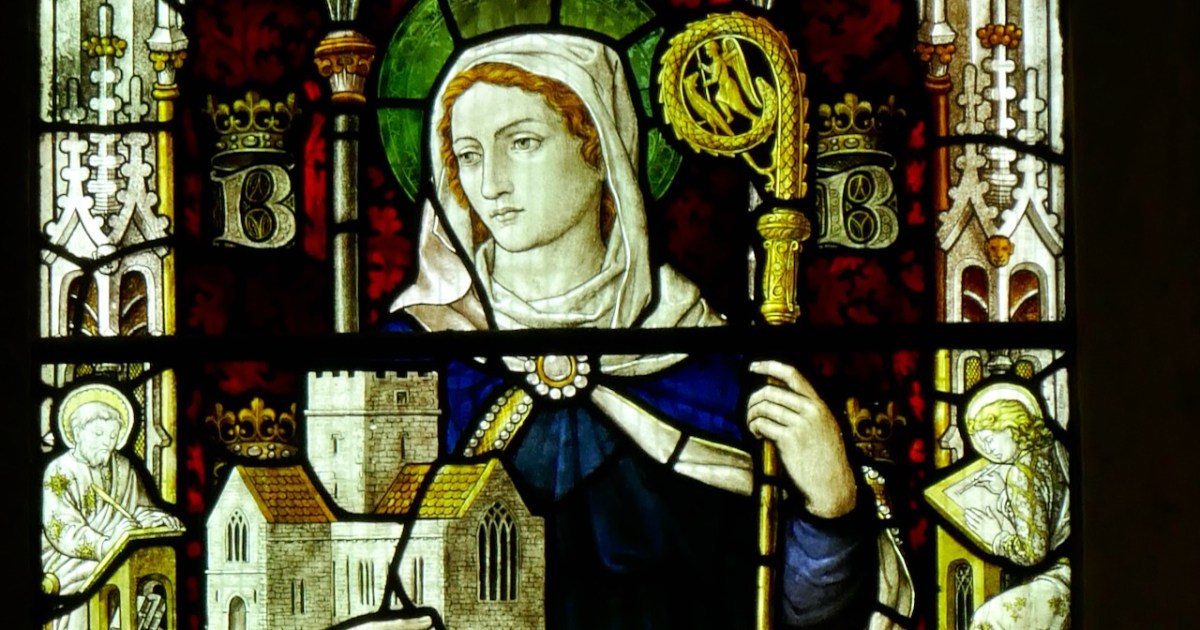
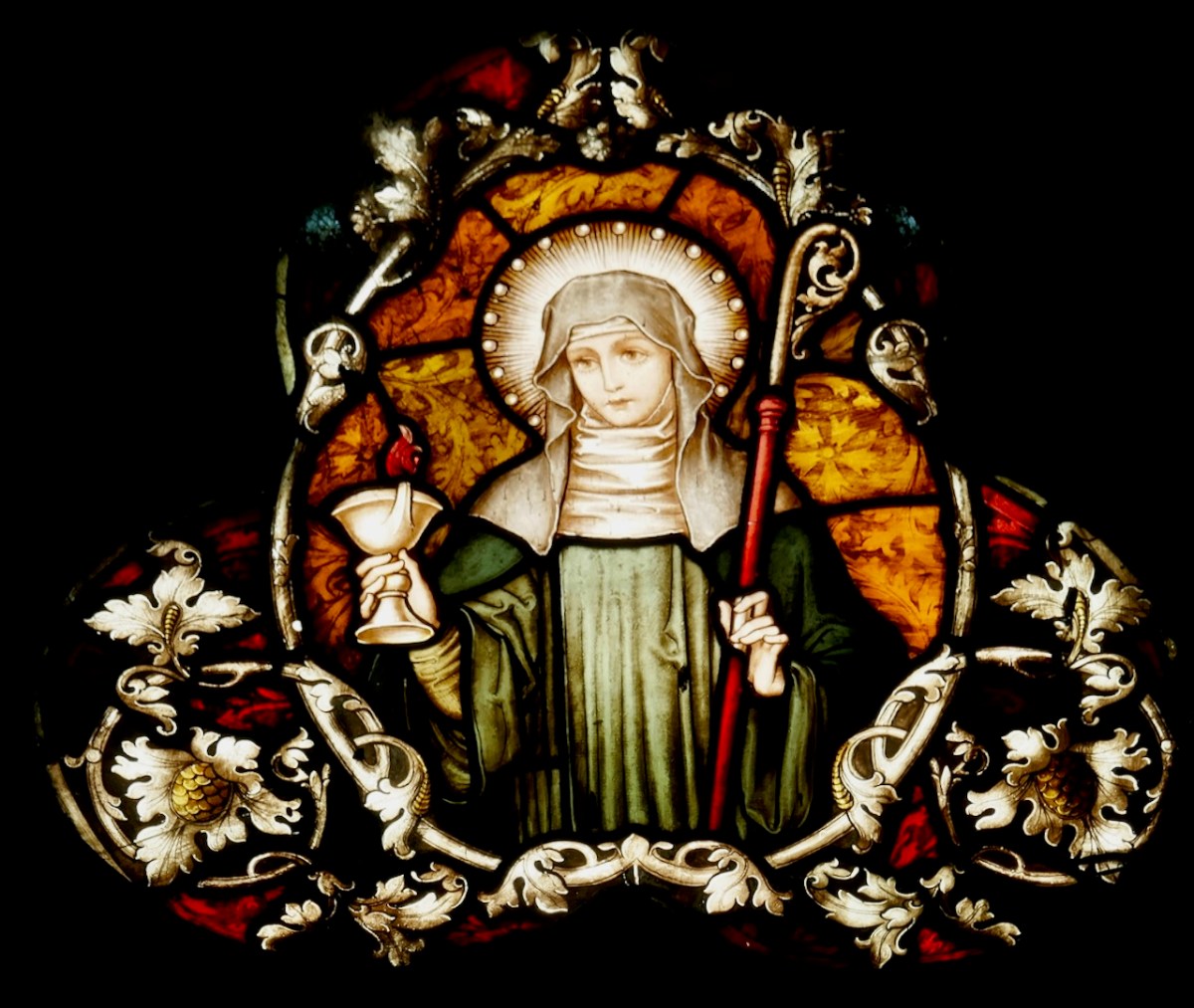
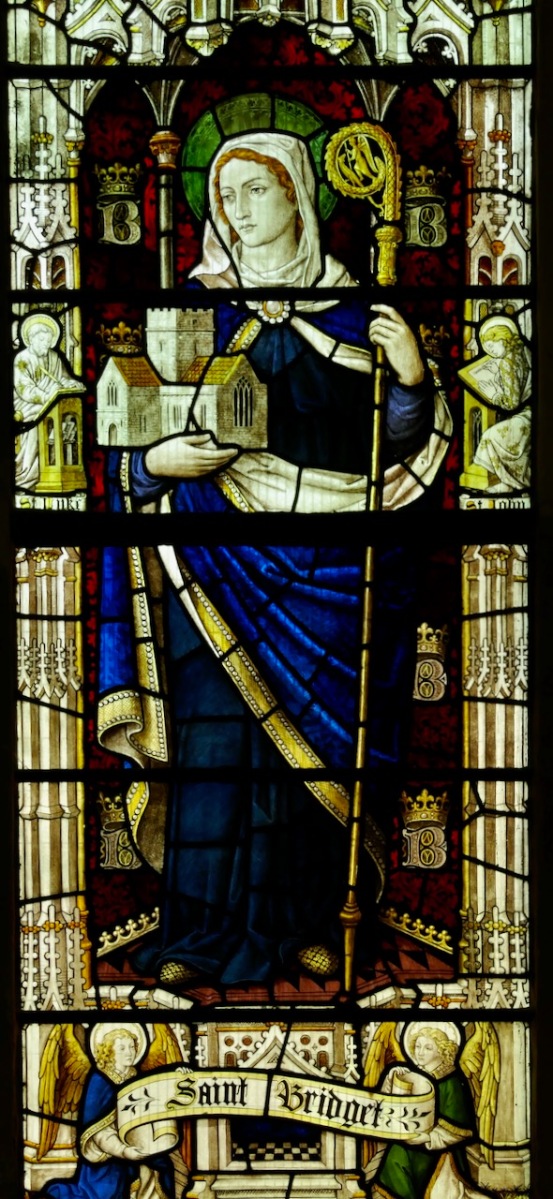
My final point for this post about St Brigid is the matter of where she is buried. Most authorities give this as Downpatrick, where she is laid to rest alongside Patrick and Columcille. However, a medieval legend grew that she went to Glastonbury in old age and died there. That is why she is venerated in Britain as well as in Ireland – the top photograph in this post is from the St Brigid window in Exeter Cathedral. Here’s the full window, in which she is flanked, for some reason, by St Luke and St John busily writing their gospels.
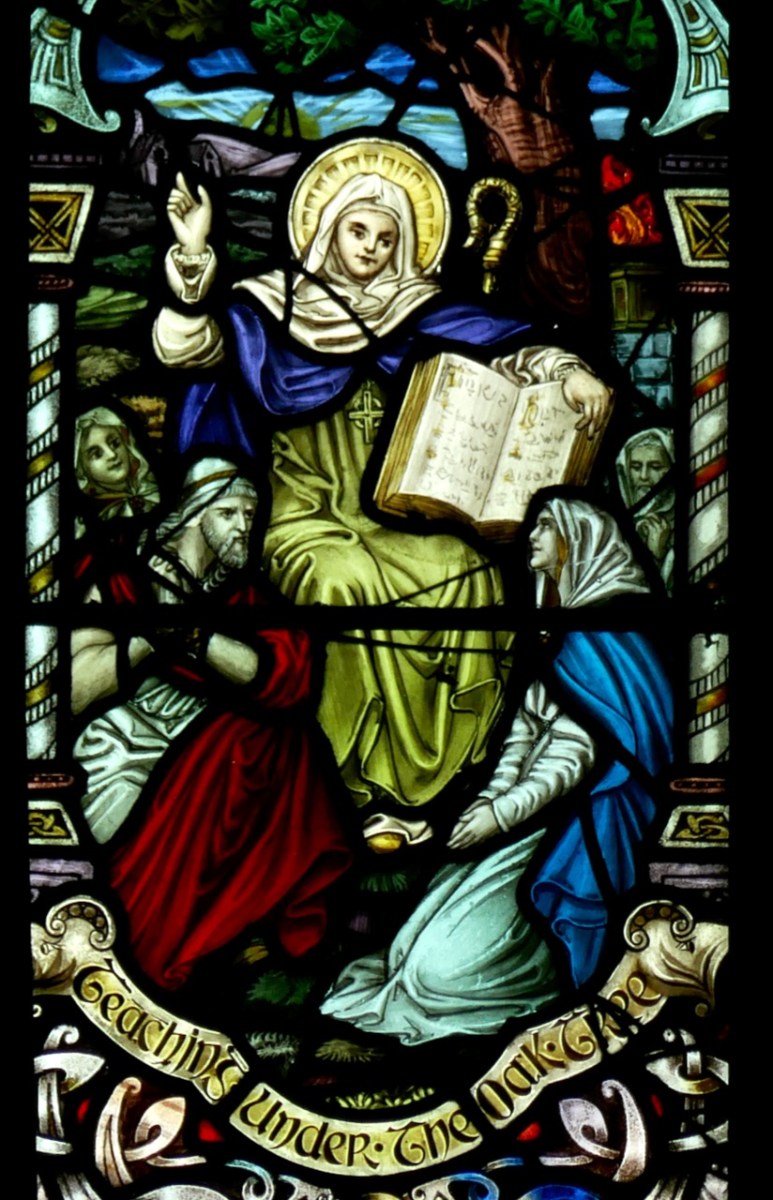
Here is another British window, this one designed by Nuttgens in 1952 for St Etheldreda’s Church in London. (Used with thanks under the Creative Commons License – original is here.) It’s a particularly good narrative window, showing the building of her church under the Oak Tree, her crozier, and two cows – there are many stories of milk and cows in the Lives.
But O’Hanlon is having none of the Glastonbury story.
We cannot receive as duly authenticated, or even as probable, severalassertions of mediaeval and more recent writers, who have treated concerning this illustrious virgin. It has been stated, that about the year 488, Saint Brigid left Ireland, and proceeded towards Glastonbury. There, it is said, she remained, until advanced in years, on an island, and convenient to the monastery in that place. Whether she died there or returned to Ireland is doubted. But, it seems probable enough, such a tradition had its origin, owing to this circumstance, that a different St. Brigid, called of Inis-bridge, or of Bride’s Island, had been the person really meant. She lived many years on a small island, near Glastonbury, called Brigidae Insula i.e., Brigid’s Bridge. This latter St. Brigid is said to have been buried, at Glastonbury.
This Brigid window is in Moone, Co Kildare from the Harry Clarke Studios. It features, as do many Brigid windows I have seen, a deer, but I can find no mention of a deer in any of the Lives. Perhaps one of our readers knows where the deer icon comes from?
I will finish with a quote from the Book of Lismore, which gives me the title for this post, and gives Brigid one of her most frequent soubriquets.
It is she that helpeth every one who is in a strait and in danger: it is she that abateth the pestilences: it is she that quelleth the anger and the storm of the sea. She is the prophetess of Christ she is the Queen of the South: she is the Mary of the Gael
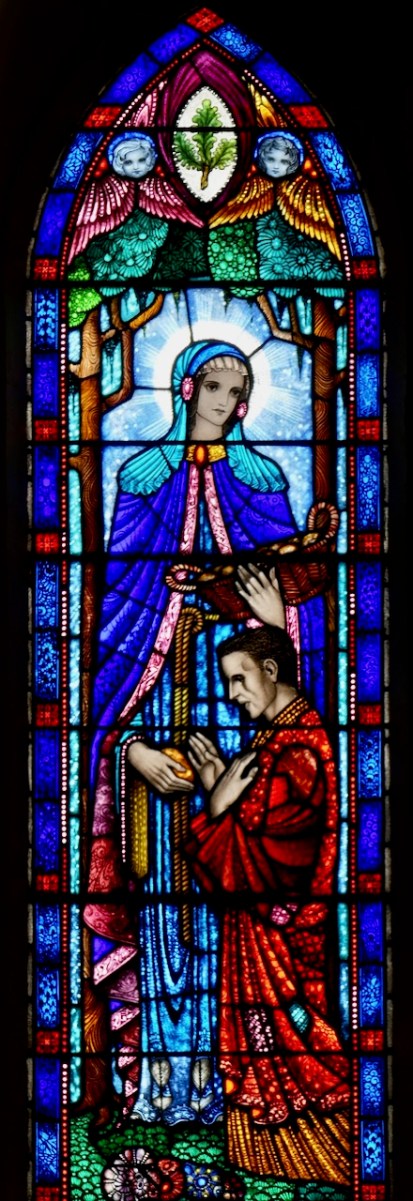
I don’t know whose window this is – it’s from Ballybunion – but I love the composition
And a final image from Glynn, Co Wexford, because I love the pared-to-the-bone simplicity of this Richard King medallion..
The first story is about a boy, Bobbie Bole, a student at Drogheda Grammar School in the 1940s. He’s the part of this account we don’t know much about, but he must have been a special boy. When he died, in 1942, many people donated money to create a memorial in his memory. It was decided that a stained glass window would be a good way to remember him,
Story 2: The Competition
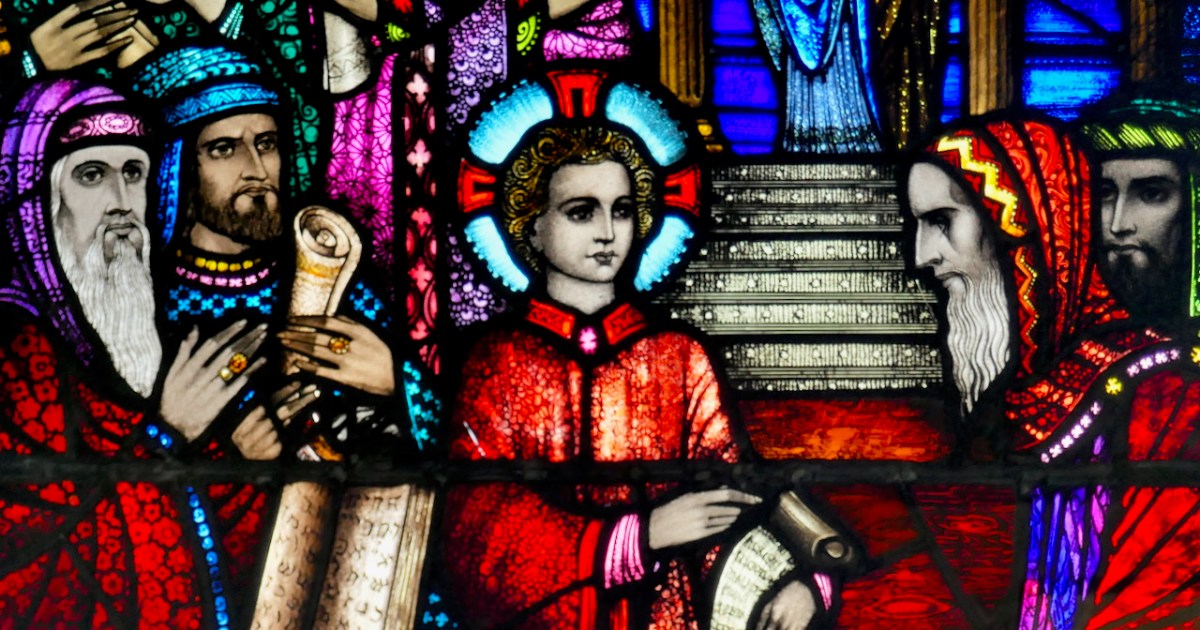
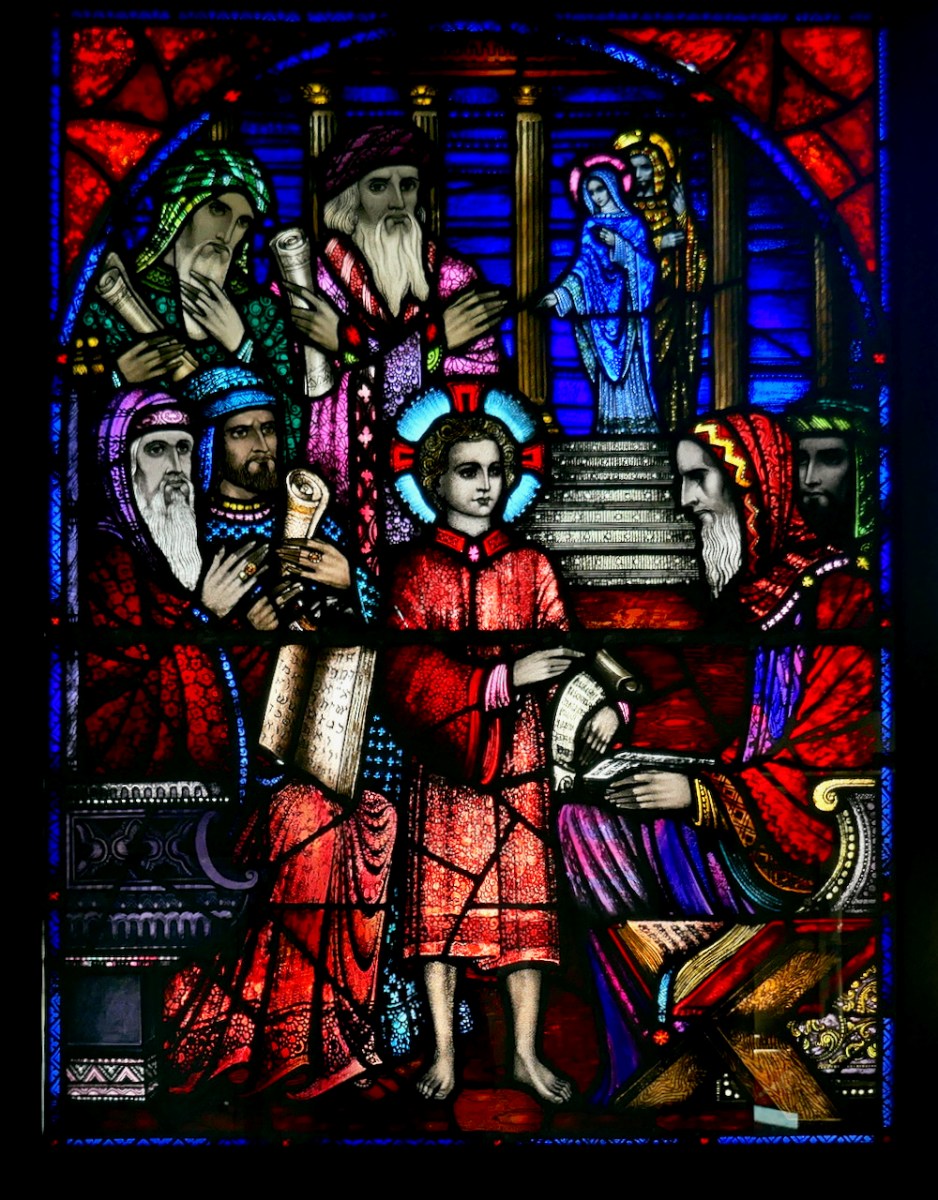
The school established a competition for the window, and invited stained glass artists to submit designs. The subject was to be Christ Among the Doctors, also known as The Finding in the Temple. Here’s the story, from the King James Version (just because I love the language of it):
Now his parents went to Jerusalem every year at the feast of the passover. And when he was twelve years old, they went up to Jerusalem after the custom of the feast. And when they had fulfilled the days, as they returned, the child Jesus tarried behind in Jerusalem; and Joseph and his mother knew not of it. But they, supposing him to have been in the company, went a day’s journey; and they sought him among their kinsfolk and acquaintance. And when they found him not, they turned back again to Jerusalem, seeking him. And it came to pass, that after three days they found him in the temple, sitting in the midst of the doctors, both hearing them, and asking them questions. And all that heard him were astonished at his understanding and answers. And when they saw him, they were amazed: and his mother said unto him, Son, why hast thou thus dealt with us? behold, thy father and I have sought thee sorrowing. And he said unto them, How is it that ye sought me? wist ye not that I must be about my Father’s business? And they understood not the saying which he spake unto them. And he went down with them, and came to Nazareth, and was subject unto them: but his mother kept all these sayings in her heart. And Jesus increased in wisdom and stature, and in favour with God and man.
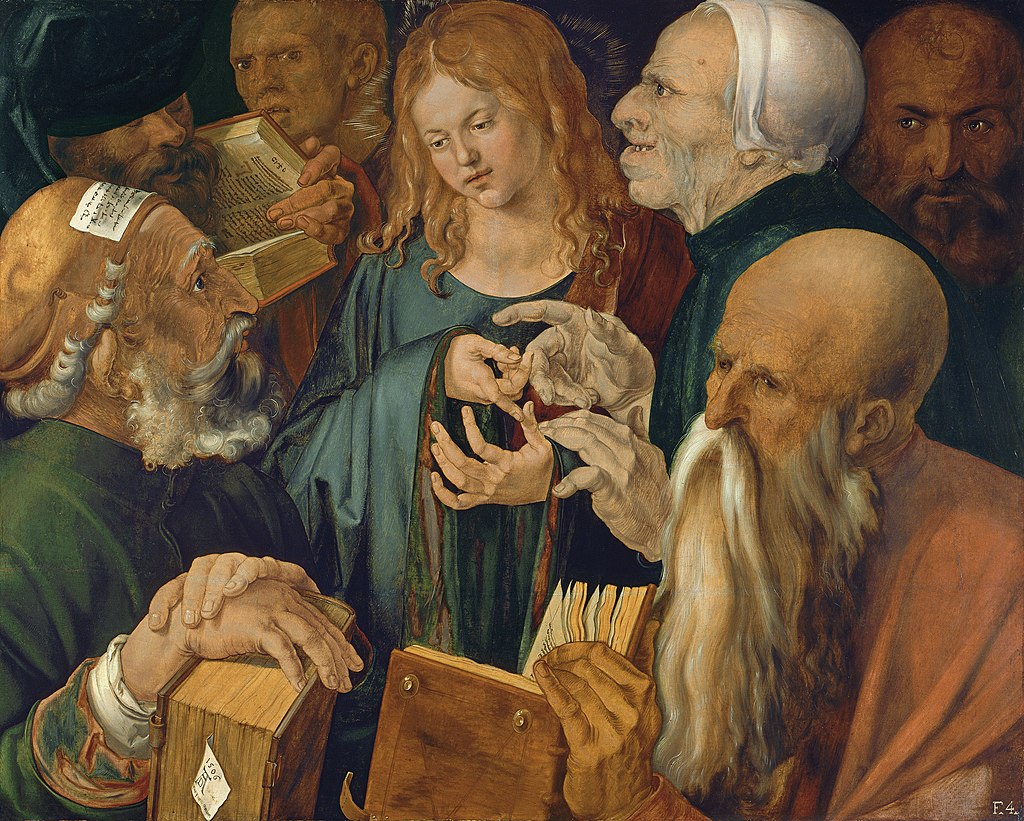
It’s a Biblical Verse that is, for obvious reasons, associated with students and scholarship, making it an appropriate subject for this occasion. It’s been the subject of many famous paintings, including this one by Albrecht Dürer.
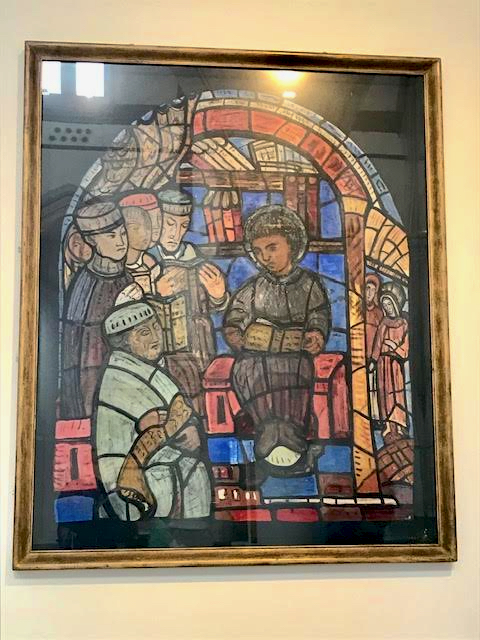
There were two submissions that we know of, and the first was by none other than Evie Hone. We know this because her full-size sketch for the window is displayed on the wall of the Holy Cross Church in Dundrum, having been acquired for the church by Fr Kieran McDermott. I am grateful to David Caron, General Editor of the Gazetteer of Irish Stained Glass, and administrator of Irish Stained Glass on Instagram, for the photograph and information. The accompanying text refers to the drawing as a cartoon and states that it was done for the Drogheda Grammar School, but ‘never realised.’ It does indeed look like a cartoon, in that glass cutlines have been included, and is very recognisably in her 1940s style.
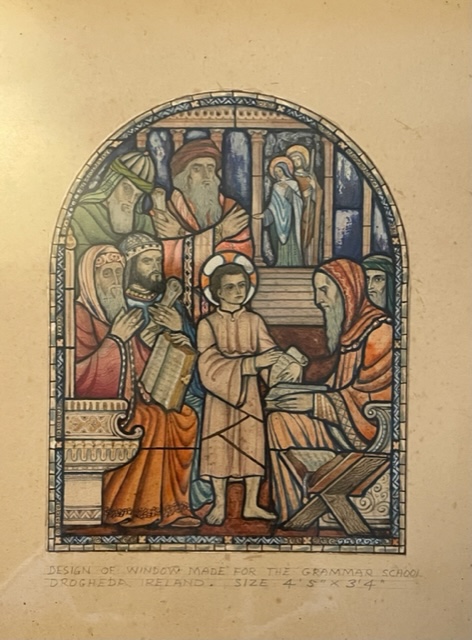
The second submission was by the Harry Clarke Studios. The Studio won the commission on the merits of the sketch they submitted, but that bit comes later.
Story 3: Erasmus
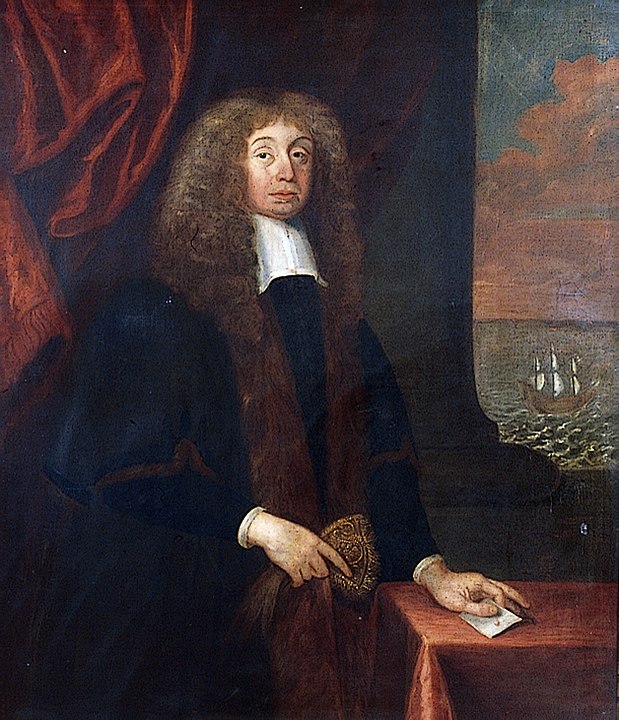
The window was duly installed in the chapel in the Drogheda Grammar School, an academic institution originally part of the Erasmus Smith Charter Schools. Erasmus Smith made his money supplying Cromwell’s army. In part payment he was given land in Ireland. After the Restoration, this put him in an awkward position with the Crown and so he
manoeuvred to protect his position and to further his essentially Puritan religious stance, which he modified to suit the religious sensibilities of the new Royalist regime. He achieved this in part by creating an eponymous trust whereby some of his Irish property was used for the purpose of financing the education of children and provided scholarships for the most promising of those to continue their studies at Trinity College, Dublin
Erasmus Smith By Circle of John Michael Wright Public Domain
One of the schools that was established under the Trust was the Drogheda Grammar School – which is both ironic and fitting, given that Drogheda was one of the towns notoriously devastated by Cromwell.
Story 4: The School
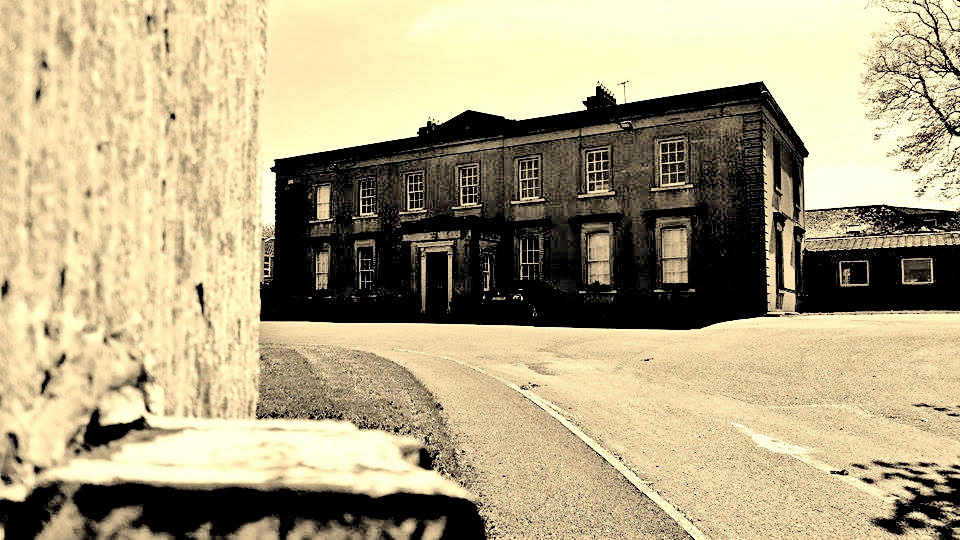
Today, Drogheda Grammar School is a respected non-denominational, co-educational secondary school. It is operated under a management committee and subscribes to a Quaker ethos. Originally a boys’s boarding school, up to 1976 it occupied a prominent place in the town centre, right beside St Lawrence’s Gate, but even by the 1950s was becoming in need of refurbishment.
When it moved out to the present site, the window was put into storage, where it remained until 2012 – out of sight, but not forgotten. A brand new school was completed in 2012 and the window was installed into a Reflection Room.
Story 5: Brittas Bay Antiques
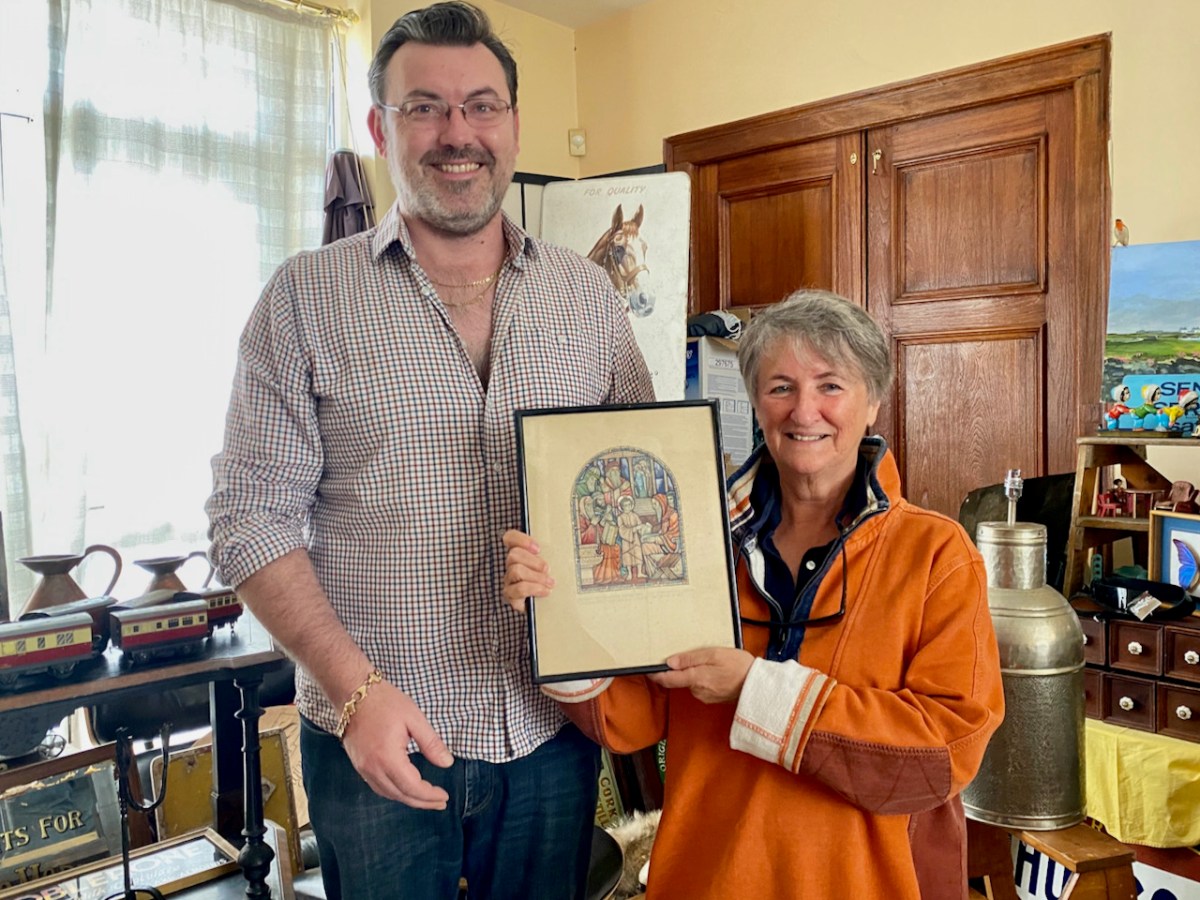
Wait – how did this story manage to wind its way to a quirky antique store by the beach in Wicklow? Well, at some point in the last couple of years Niall (below and yes, he really is that tall) and Chrissie, the proprietors, picked up a box of curios from someone, and discovered a Harry Clarke Studio sketch inside it. They advertised it online and someone stumbled across it, paid for it, and asked me to pick it up for her. I was happy to do so. (The shop is an Aladdin’s Cave, by the way – most enjoyable browsing I have done in years!)
Story 6: Etain
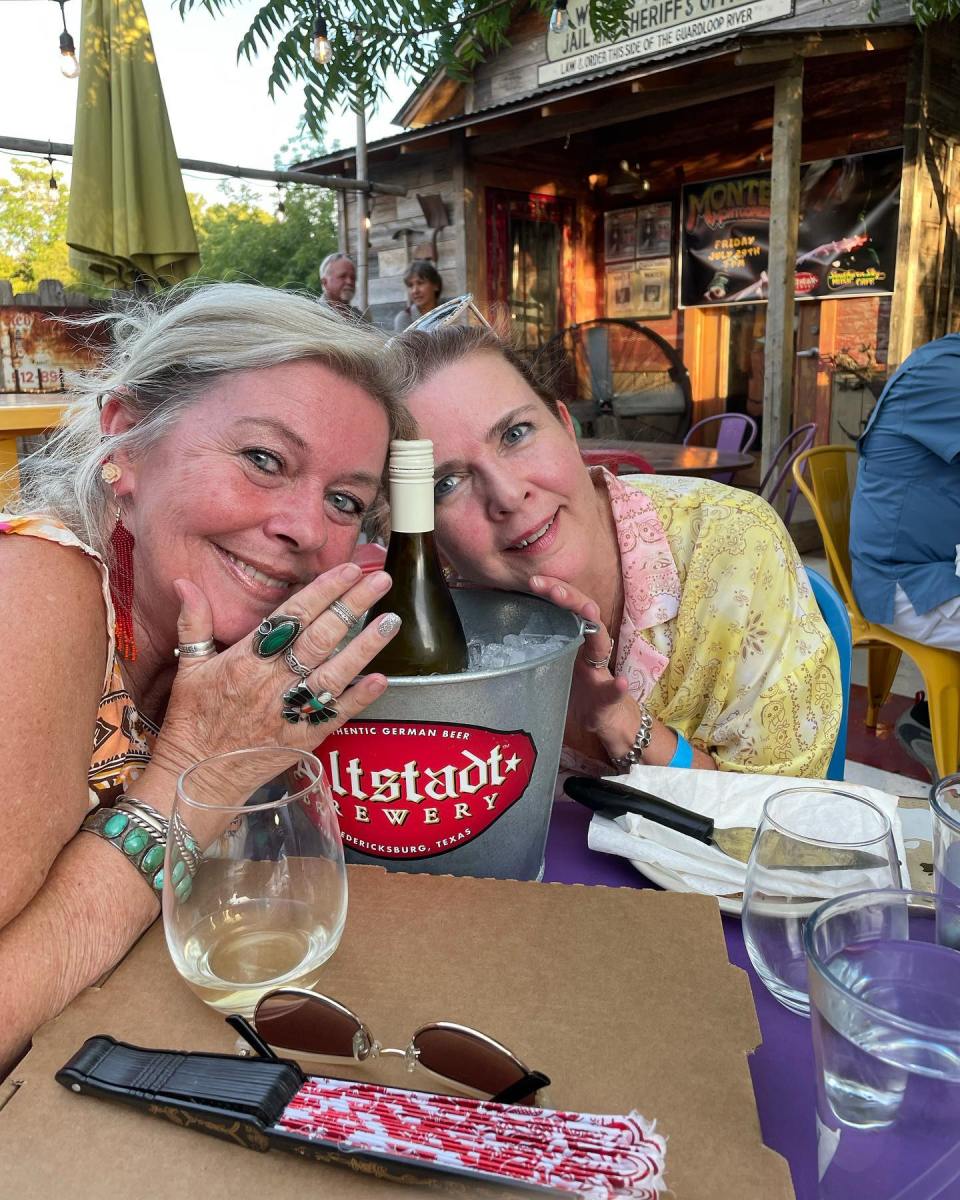
So c’mon Finola – ‘someone’ asked you to pick it up? Who exactly? It was my friend, Etain Clarke Scott, daughter of David Clarke and grand-daughter of Harry Clarke and Margaret Clarke. She and her siblings live in Texas, although they grew up in Dublin and make frequent visits over here. It was on her last visit, with her sister Veronique, that she asked me to pick up the sketch.
This is Etain (left) and Veronique (right) – as you can see they are both beautiful, and lots of fun! (And she will probably kill me from stealing this photo from her Facebook page.)
Story 7: The Research
At this point, we knew that the sketch was a window design produced by the Harry Clarke Studios for the Drogheda Grammar School – it said so right under the sketch, but we didn’t know whether the window had ever been made or whose work it was. The first question was easy – a quick Google led us to the school website and to the story of the window. I suspected that the artist was the Studio’s manager and chief designer, William Dowling, who took over the role from Richard King upon King’s departure in 1940. Regular readers will know by now that long after the death of Harry (in 1931) the Studios had continued with what I have called The House Style since what people wanted was ‘A Harry Clarke’.
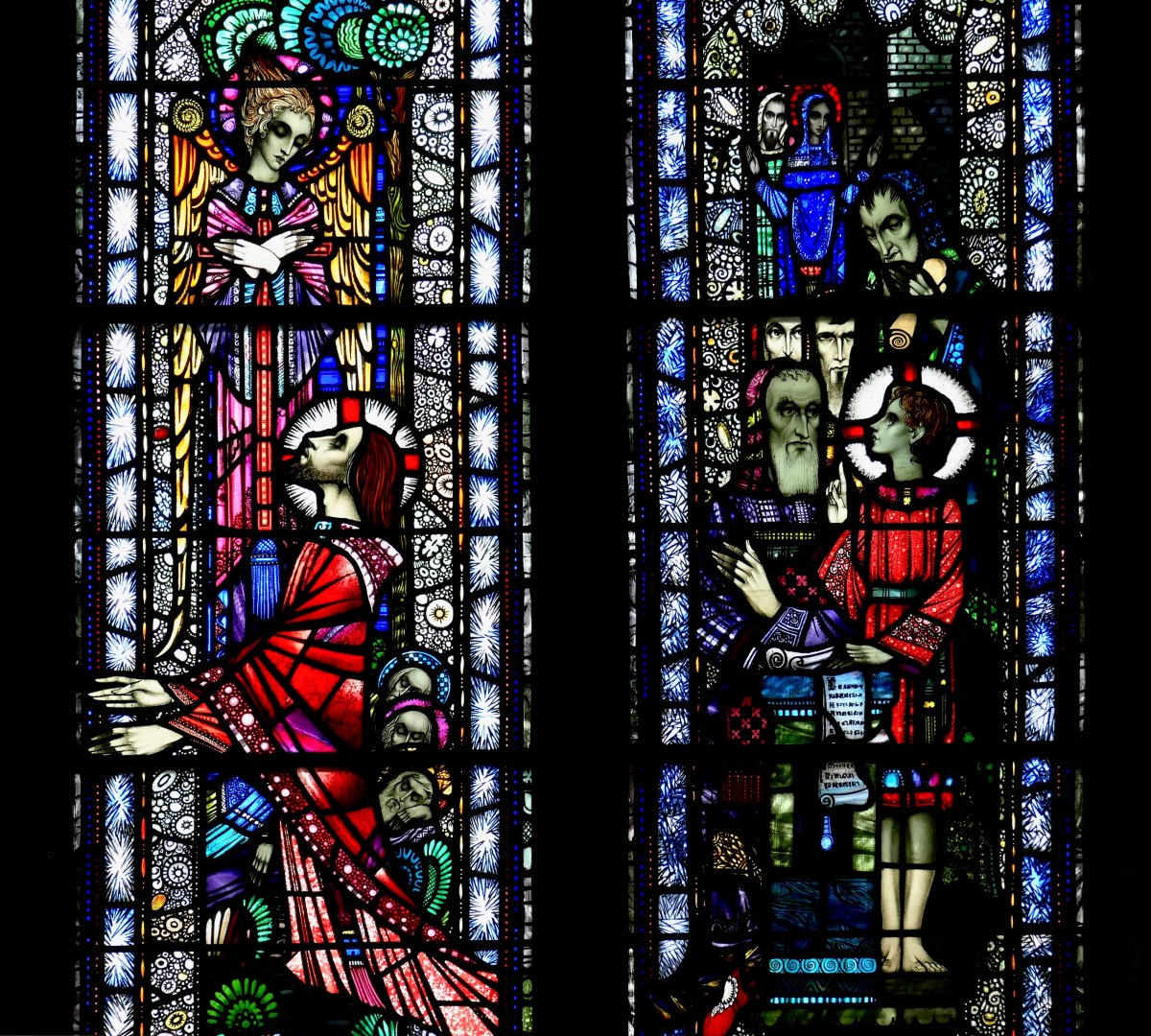
I consulted with my stained glass colleagues – David Caron, Paul Donnelly, Jozef Voda and Ruth Sheehy, all contributors to the Gazetteer of Irish Stained Glass and all very knowledgeable indeed on the work of the Studios during this period. I offered in evidence a couple of examples of Dowling windows of the same subject – Christ Among The Doctors or The Finding in The Temple. The one above is in Wicklow and the one below in Balbriggan.
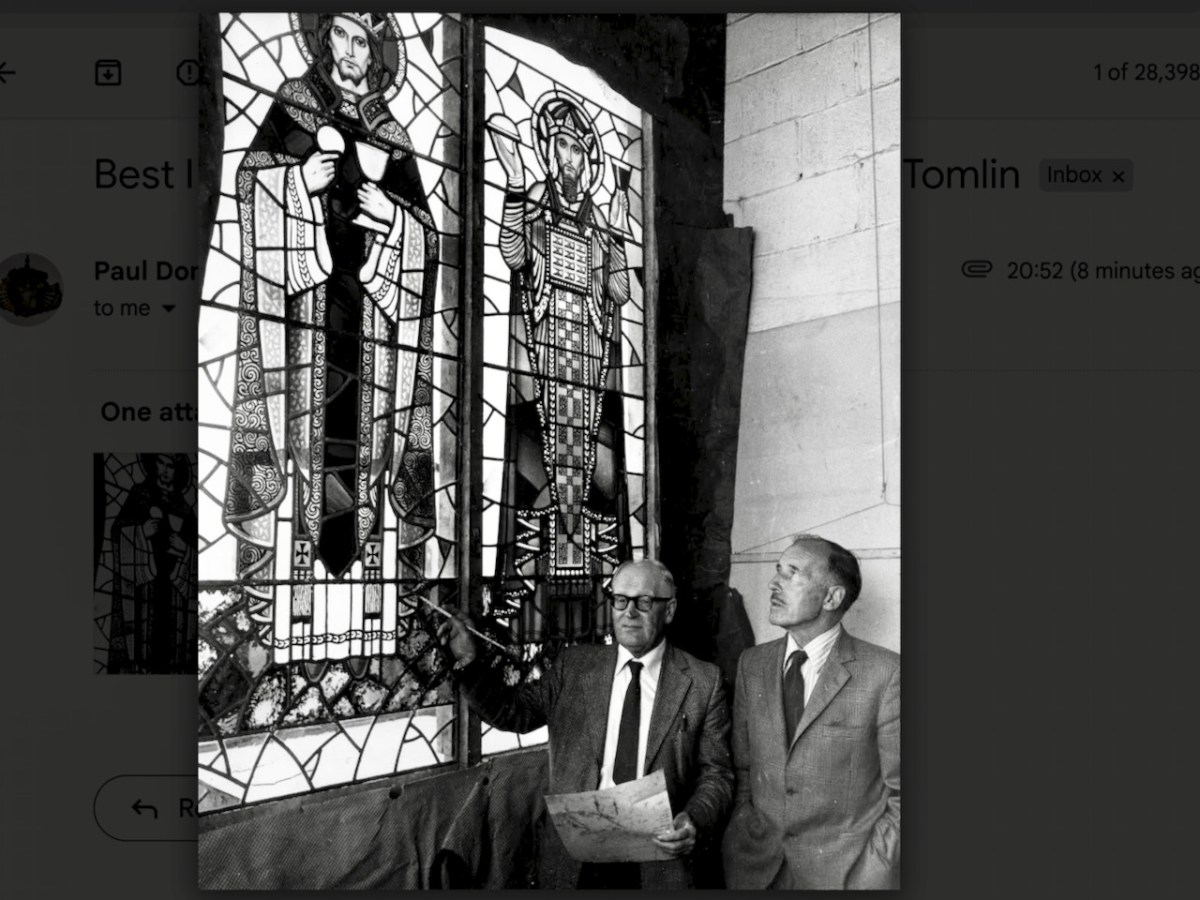
There was much helpful discussion by email: it was at this point David contributed the information and photograph about the Evie Hone cartoon, and both Paul and Ruth identified the handwriting as Dowling’s and agreed that the style was his. Etain remembers Willie Dowling well as a kind and avuncular presence in the studio, always impeccably dressed, and she was pleased at this attribution. That’s Dowling below (left), with Stanley Tomlin, at the Studios at a later date.
Story 8: Taking the Photographs
We had the sketch and now we knew whose work it was and also that it was in situ in the school. What we didn’t know was what the window actually looked like. Was it exactly as the sketch has intended? Had changes been made to the shape or dimensions of the window? This often happens when older windows are inserted into newer openings. I contacted the school and asked for permission to come and photograph the window, which was graciously given.
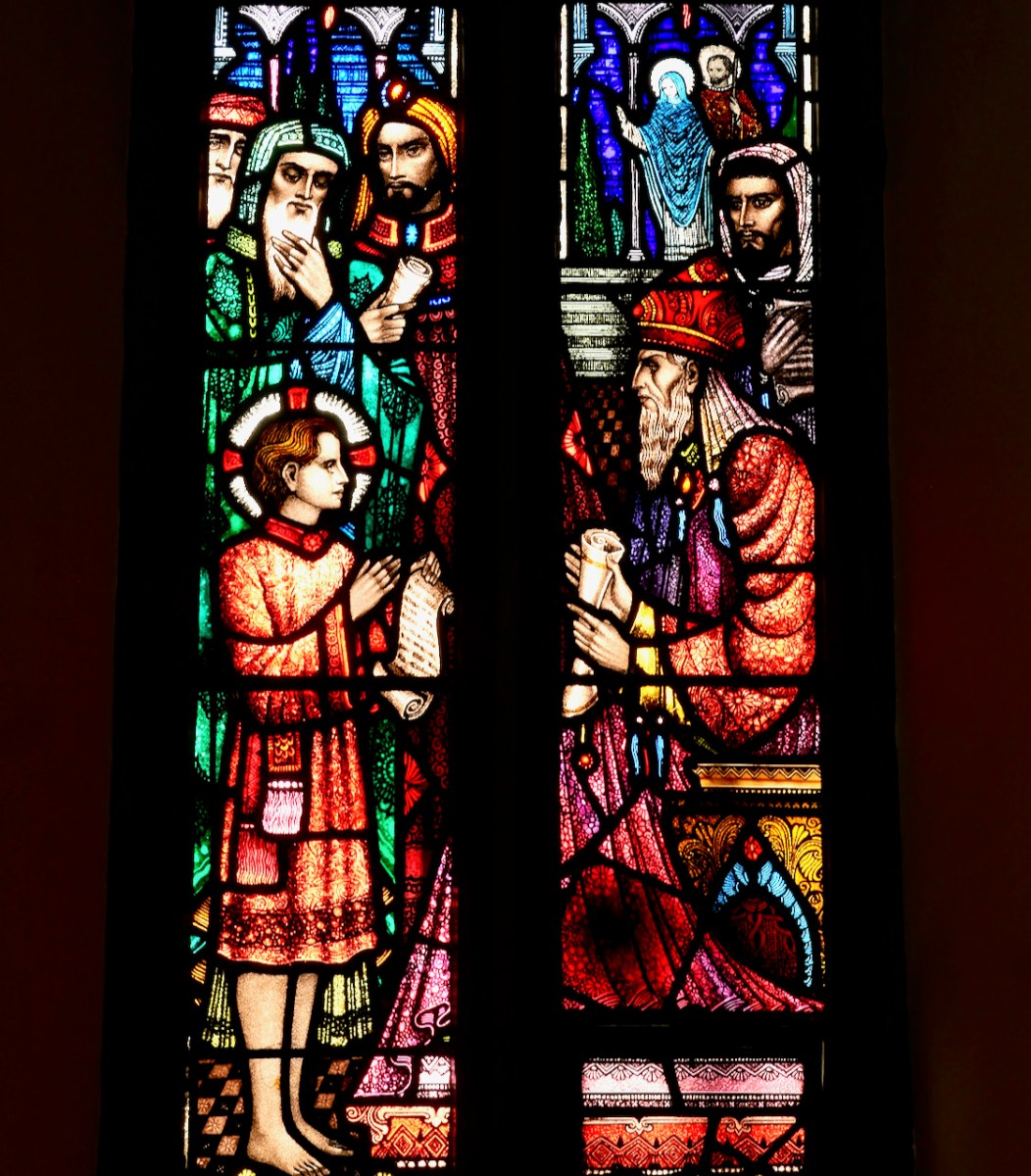
What I found was that the stained glass had been carefully inserted into a larger window, protected front and back with toughened glass, and the story of the Bole Memorial Window was provided in a framed script on the wall. Although Etain’s sketch shows a window with a rounded top, this opening was square. If the window had been changed to fit more recently, it had been done so skilfully that it was not obvious or indeed detectable.
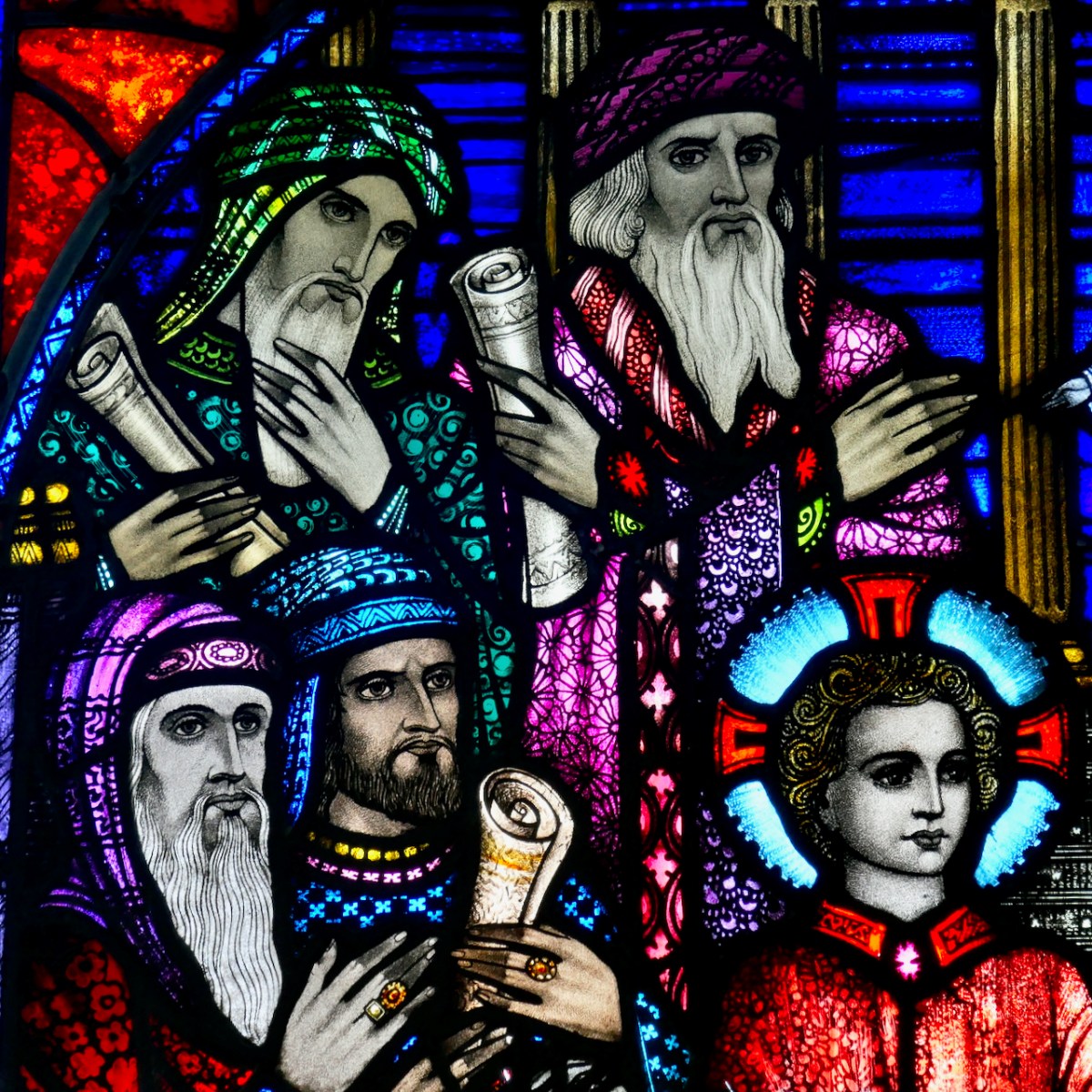
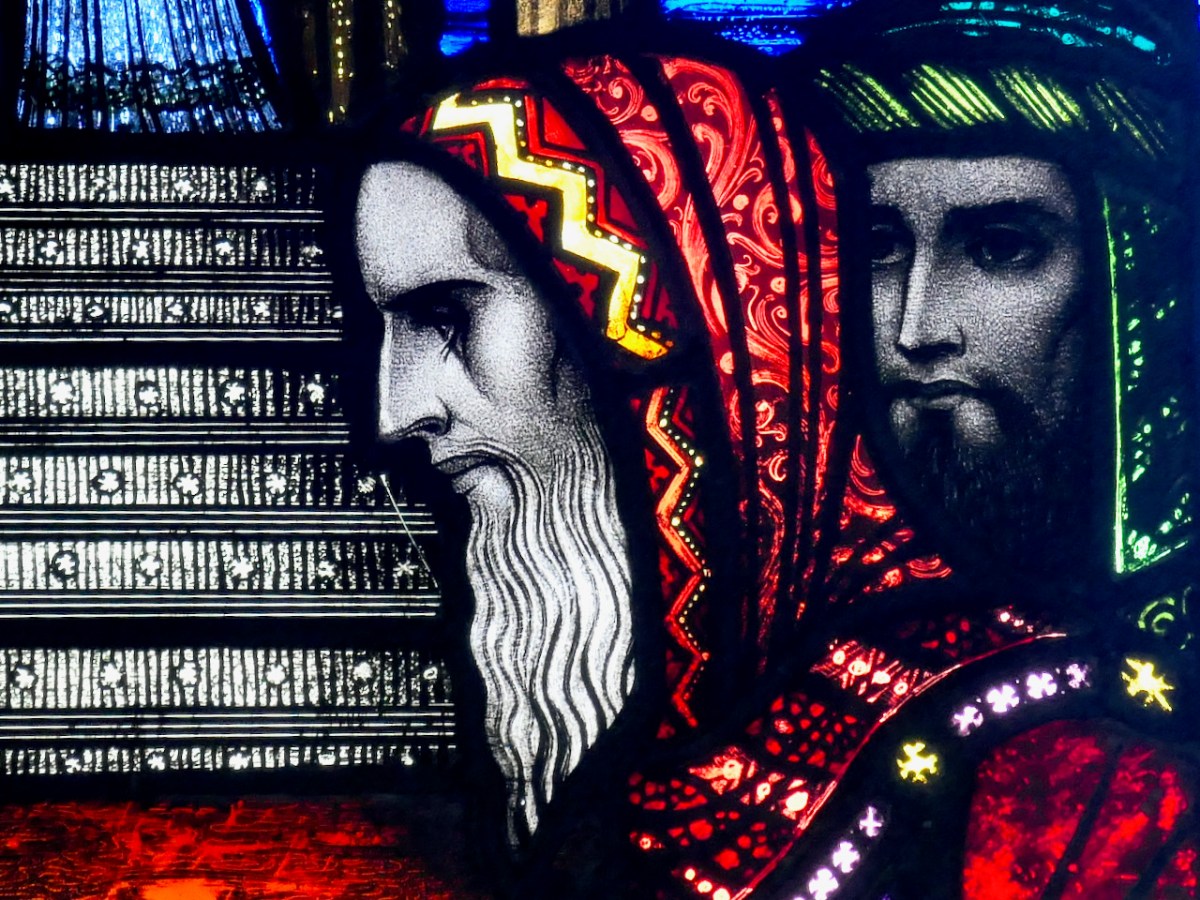
In fact, the window far exceeded my expectations. It is beautiful. Dowling had used good glass and the effect is jewel-like and vibrant. He has gone to town on every panel, painting, aciding, scratching, and filling even the smallest piece with decorative detail.
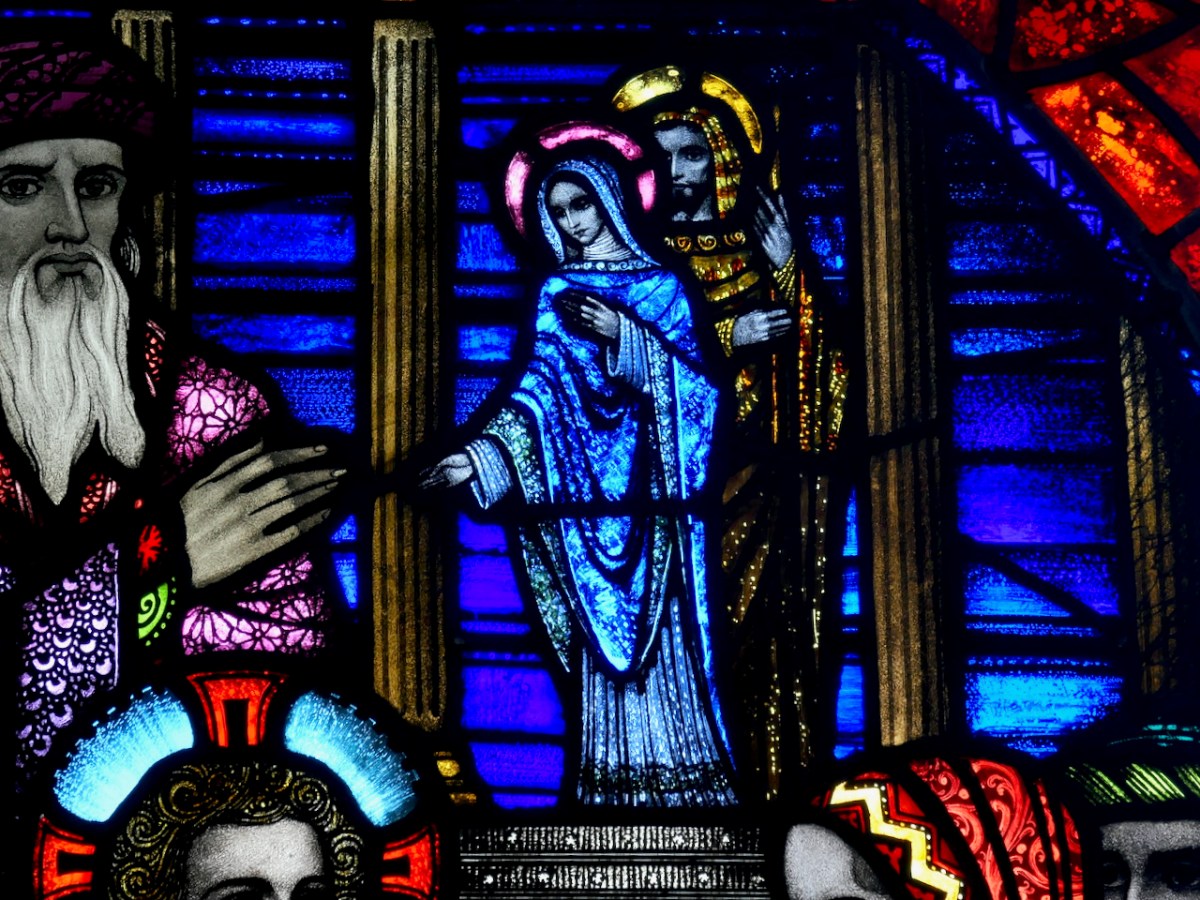
The figures of the Doctors are expertly rendered, while the small Joseph and Mary are similar to his Balbriggan and Wicklow panels. Jesus looks suitably solemn and earnest, as befits the good model that was intended for the students.
Afterword
Thank you to the Drogheda Grammar School for facilitating the photographic session. It was wonderful to hear, from the school Principal, Hugh Baker, that the window is treasured. Thanks to my collegial group of stained glass scholars for their advice and additional photographs. Most of all, thank you to Etain for entrusting me with the sketch and sending me down this story lane.
In the years before he died (in 1931), as he was ill and overburdened with commissions, Harry Clarke came to rely on a stable of brilliant young assistants in his studios. Austin Molloy, Kathleen Quigly, Millicent Girling, George Stephen Walsh, Philip Deegan, Richard King, William Dowling and others were all trained by Harry to execute his designs according to his exacting standards. This post is about the work of one of those artists, William Dowling.
As I explained in my Harry Clarke Quiz post, according to Nicola Gordon Bowe’s classification scheme, a stained glass window can be labelled a Harry Clarke if it was designed and executed entirely by him, if it was designed and partially executed by him (A), or if it was designed by him and the execution was done under his close supervision (B). An excellent example of this is the Tullamore St Brendan window (above and below). This is one of Harry’s (B) windows: he designed it but it was executed by William Dowling in 1928 under Harry’s close supervision. Compare it to the St Brendan in my lead image, which was done by Dowling for Knockainey Church in Limerick in 1939.
This is the predella (lowest panel) of the Tullamore Brendan window. When the window was relocated from Rathfarnham, the predella was separated from the main window and is now backlit, in a dark corner.
Harry researched his subjects extensively and ensured that anyone working on his windows did too. Paul Donnelly*, in his fascinating essay Legacy and Identity: Harry Clarke, William Dowling and the Harry Clarke Studios (in Harry Clarke and Artistic Visions of the New Irish State) tells how he sent his apprentice, William Dowling, off to the National Library to read all that was available on his subject when he was working on the Rathfarnham windows. He would come by every day to deliver encouragement – his assistants all adored him and although he was demanding he was also supportive and kind.
While the three Tullamore windows (originally in Rathfarnham) are credited to Harry Clarke, all the other windows in this post are credited to William Dowling
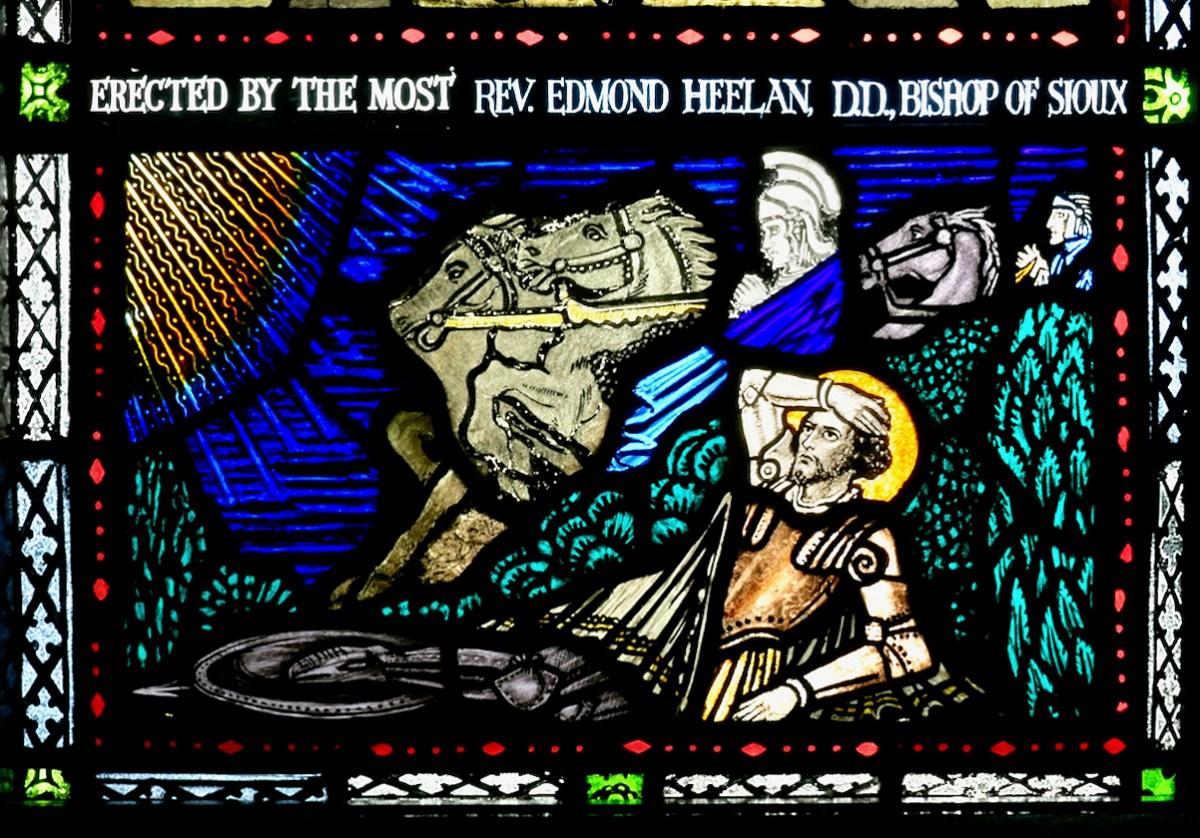
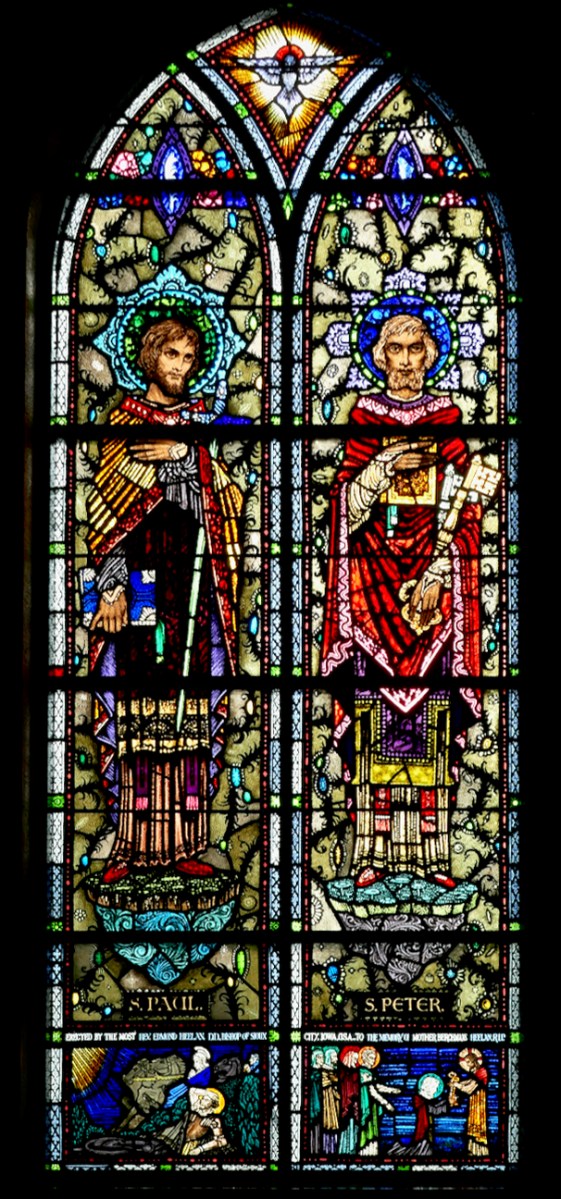
William (everyone called him Willie) Dowling was recommended to Harry by Austin Molloy, who was his teacher at the Dublin Metropolitan School of Art. Having himself worked with Harry, Molloy recognised the special talent that Willie brought to his painting, a talent that he felt would be well used at Harry’s studio. Willie probably worked on this one (above) too – it’s the predella of the St Paul window now in Tullamore. You can see that it is the inspiration for the predella of a St Paul window from Knockainey in Co Limerick (below), done in 1930 while Harry was in Davos. The full Peter and Paul window is below that one.
How right Molloy was! Not only did Harry come to rely on him greatly while still alive, but Willie was one of the group of artists (along with Richard King) who stayed on after Harry’s death in 1931, filling the many outstanding commissions still on the books and the new ones that continued to pour in. He eventually took over as manager when Richard King left in 1940, while continuing also as chief designer, and stayed until the Studio closed in the 1970s.
Peter and Paul from Knockainey Church in Limerick, dating to 1930
From the moment he arrived at the Studio in 1927 Dowling was committed to Harry’s style. As Paul Donnelly puts it,
Dowling worked with Clarke, learning the craft of making stained glass according to his standards and design aesthetic. He had the benefit of Harry Clarke’s direct instruction for more than a year before ill-health force Clarke to seek medical treatment in Switzerland.
. . .In his role as principal designer, Dowling was charged with delivering work which was derived from the distinctive artistic legacy left by Harry Clarke. Dowling wrote that the aim of Clarke Studios was to ‘avoid the mundane and commonplace. That was the ideal of Harry Clarke and one which we have done our very best to follow.’
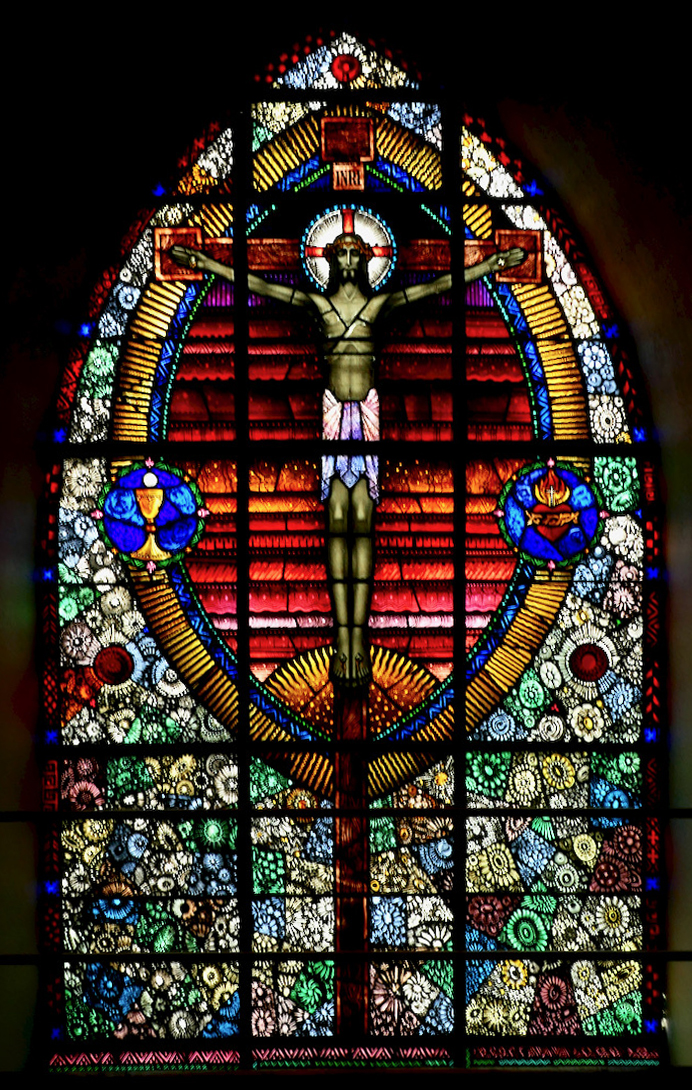
Christ Crucified, Patrickswell, Co Limerick, by William Dowling, 1943. This window is above the balcony and is a brilliant example of the mixture of figurative and non-figurative elements, specially designed for the space it occupies
After Harry’s death the demand for Clarke-style windows was relentless and the studios delivered. Well into the 40s they were still producing windows that, to the untrained eye, looked very like ‘a Harry Clarke.’ During that time, the quality of the glass, the art and the workmanship was superb and the busy studios were exporting their windows world-wide.
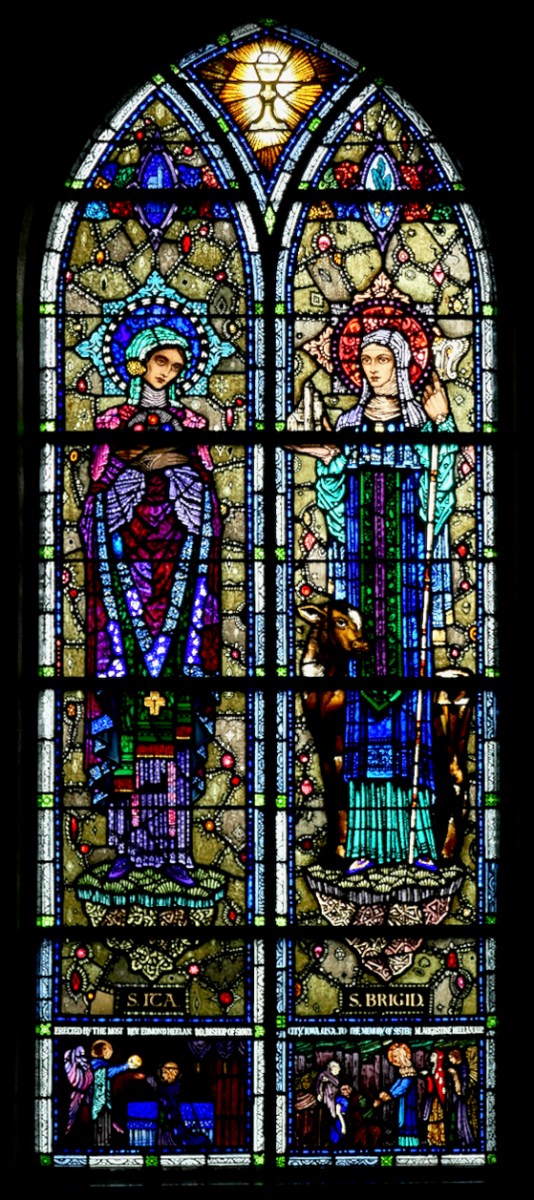
Ita and Brigid, Knockainey, 1930. The predella panels are below.
Then, and for many years to come, the Harry Clarke Studios did not allow individual artists to sign their work – all windows were signed Clarke or Clarke Studios. Strict adherence to the House Style and refusal to allow signatures, while understandable as marketing decisions, had several unfortunate consequences.
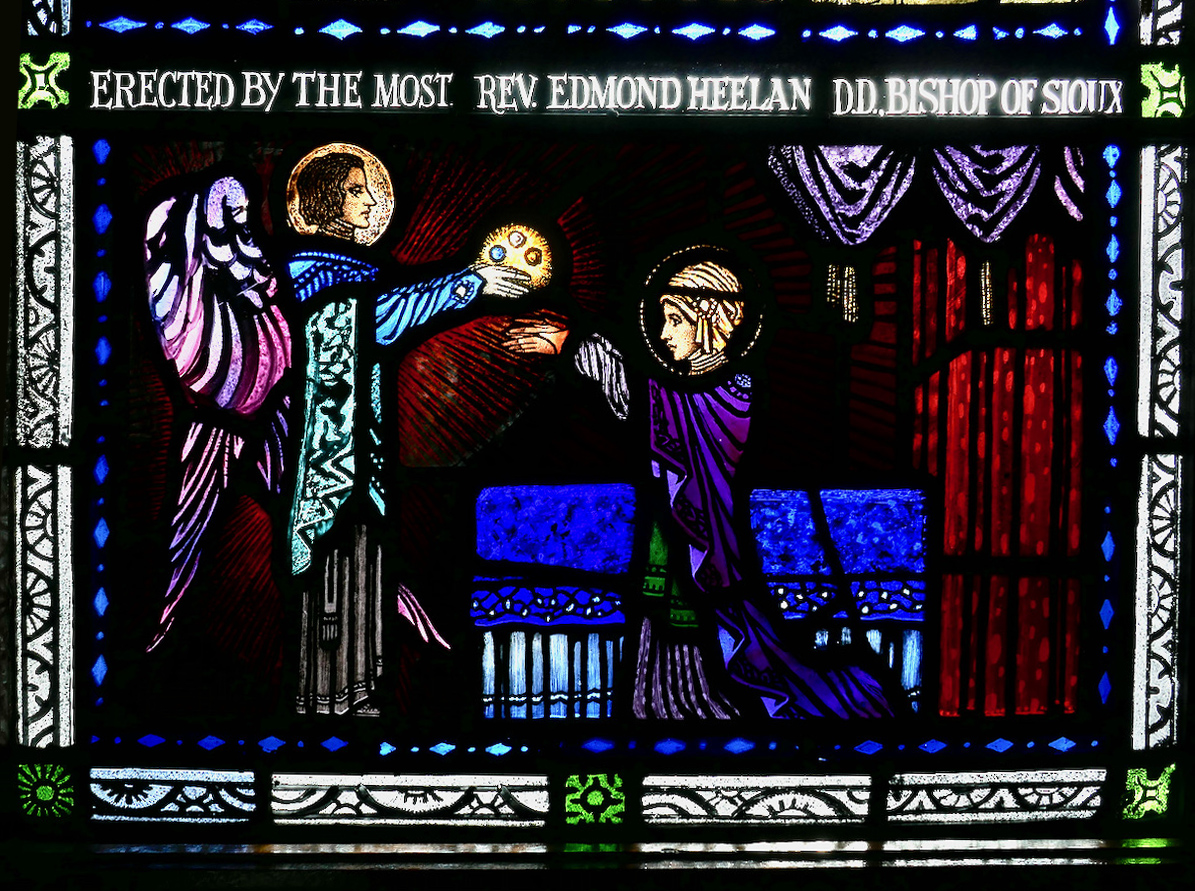
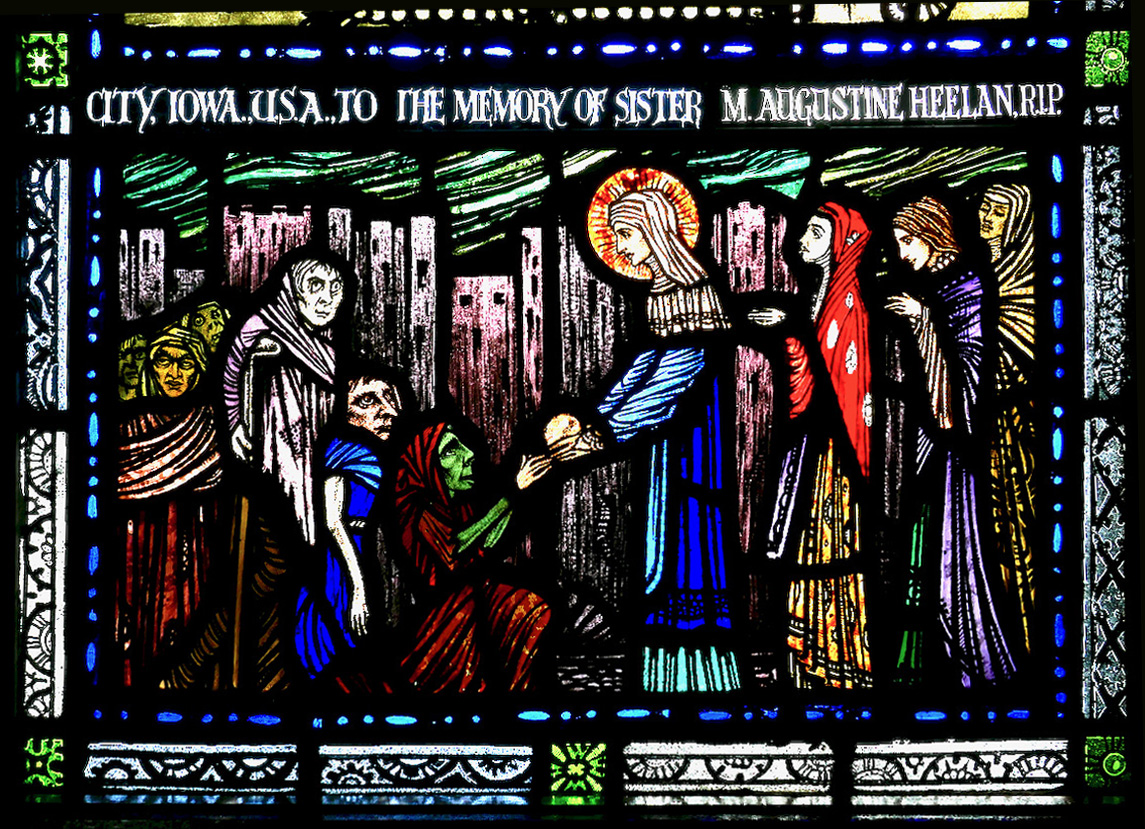
The predella panels from the Ita and Brigid windows. Upper: The vision of St Ita, in which an angel appeared to her in a dream, offering her three glowing gens, representing the Father, Son and Holy Spirit. Lower: St Brigid looking after the people of Kildare- the figures on the left are clearly inspired by, as Nicola Gordon Bowe puts it “Harry’s unique ability to depict the gruesome, macabre and palsied in an exquisite manner.”
First of all, it is difficult to identify individual artists with their work, and this includes Dowling himself. Herculean efforts, though, by Ruth Sheehy and Paul Donnelly have allowed us to acknowledge in some cases the work of Richard King, William Dowling, and occasionally others (such as Charles Simmonds and Terry Clarke, Harry’s nephew).
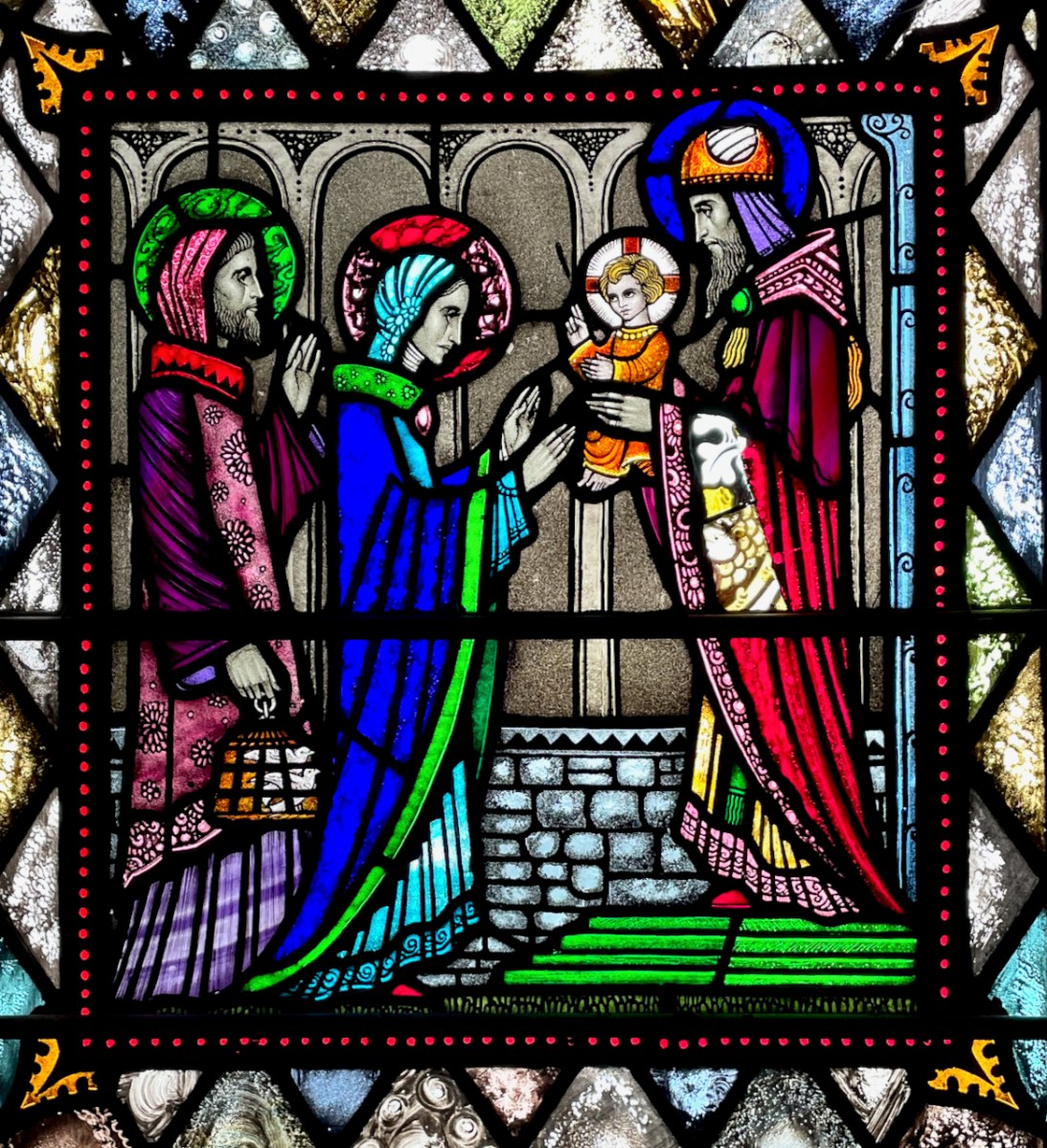
The Presentation, Patrickswell, 1943. By this time the style was becoming less ornate. This window might remind you of the Dowling windows Robert showed in his post about the Seamus Murphy church in Cork, which dated to 1945
Secondly, the lack of clarity caused by all windows being labelled simply Clarke Studios causes enormous confusion about what is a true Harry Clarke, versus a Harry Clarke Studio. See my Quiz posts (the Quiz and The Answers) for more on this. If I had a euro for every time I have seen a window falsely claiming to be a Harry Clarke, I would be wealthy by now. Conversely, those who buy stained glass panels labelled “Harry Clarke” when they are manifestly not by the master himself, might be poorer.
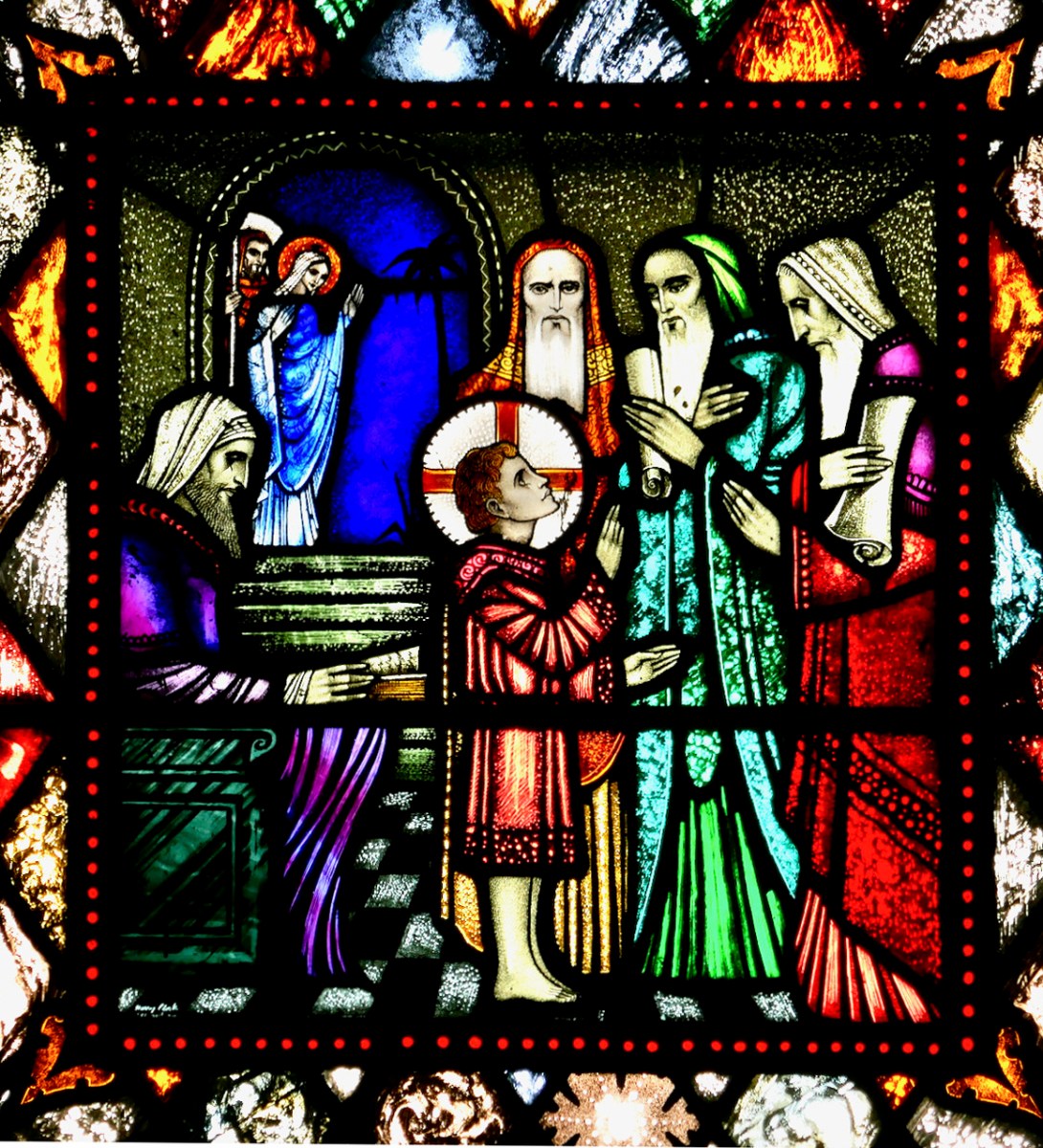
Jesus Found in the Temple (or Christ Among the Doctors), Patrickswell, 1943
Thirdly, the policy caused some artists, in frustration, to leave. While it is possible that they had other motivations as well, both Richard King and George Stephen Walsh left to go out on their own, eventually shaking off the constrictions of the house style to follow their own artistic visions under their own names.
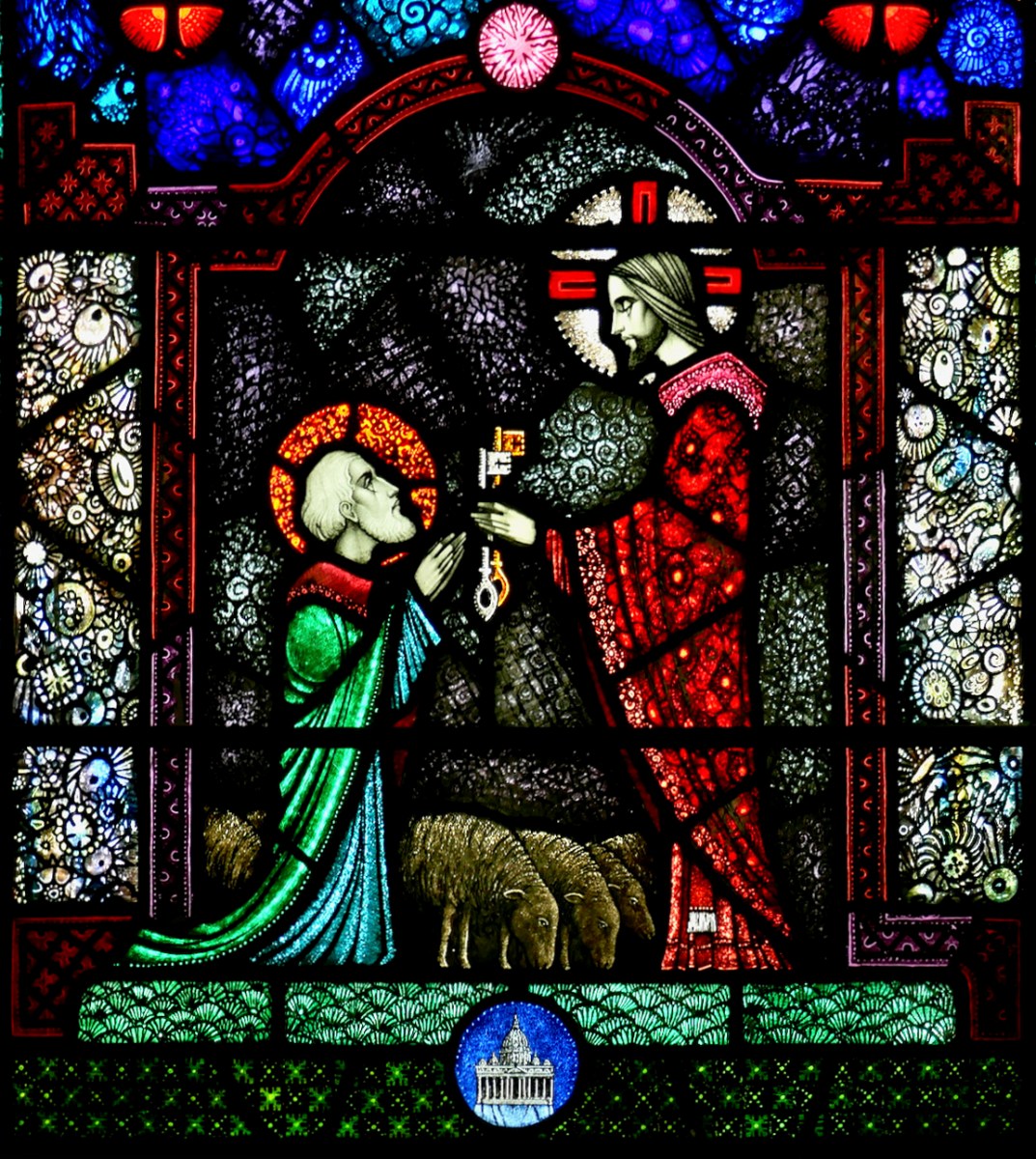
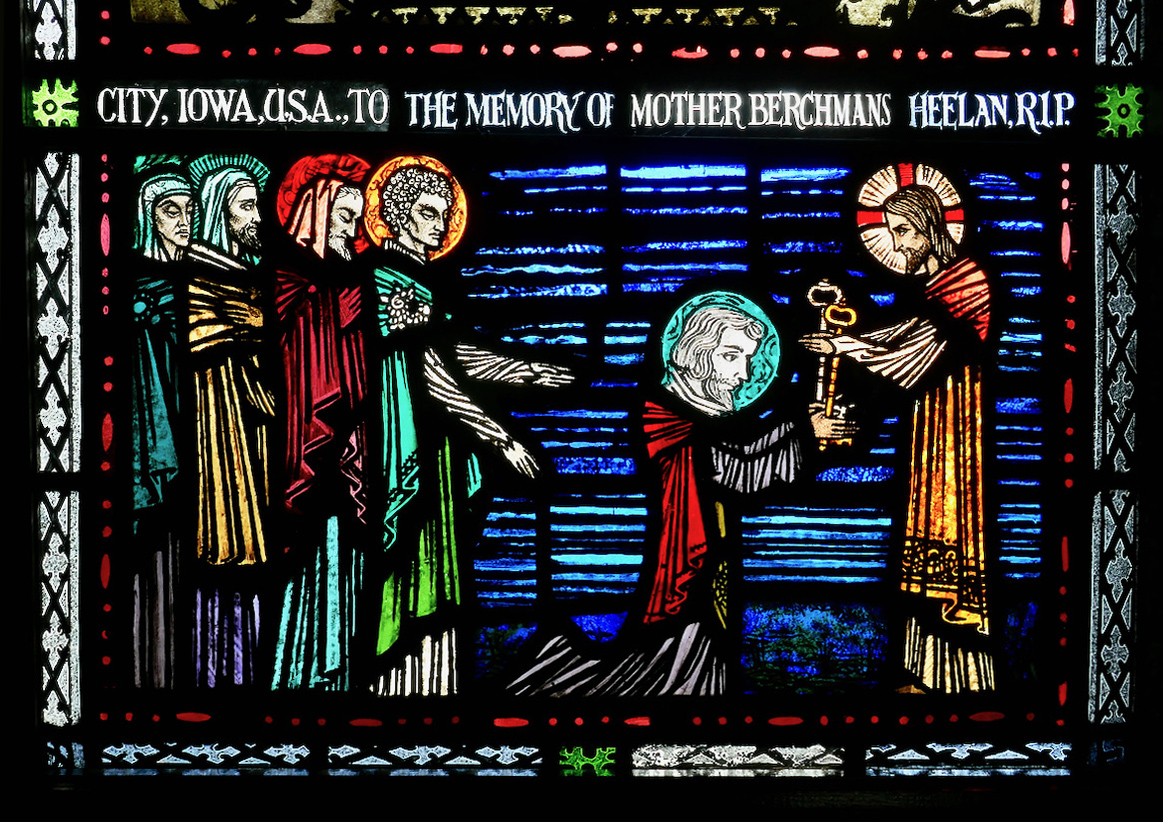
Two version of Peter receiving his keys. Upper from Patrickswell, 1940 and lower from Knockainey, 1930
Finally, all artists deserve credit for their work. William Dowling is a case in point – while he spent many years producing windows in the House Style, they were not simply imitations, copies or reproductions of Harry’s designs. Willie brought his own genius to each window and when you’ve seen several you begin to recognise his stamp – the way he does faces, for example, or how he loves cascading folds of drapery, or his clever juxtaposition of Harry’s dark ‘floral ornamentation’ device (known as FO’s by assistants, or even as Fried Onions) with bright figurative scenes, such as in the Patrickswell Crucifixion, further up.
Above is a detail from one of Dowling’s Mysteries of the Rosary windows in the Dominican Convent in Wicklow, done in 1938. This is a mocking soldier from a Christ Condemned window and it comes from Dowling’s own artistic imagination, not from a Harry Clarke design
I recently visited two William Dowling Churches in Limerick, Patrickswell and Knockainey, and I have mainly used images from these two churches to illustrate this post, along with a few from the wonderful Mysteries of the Rosary windows by him in the Dominican Convent in Wicklow which date from 1938/39. The windows in Knockainey were done for an older church in the 30s and 40s and then relocated to the new church in 1973. While relocating windows is not always successful (Tullamore is a case in point), in this case the relocated windows (with two minor exceptions) create a startlingly beautiful interior, and an interesting counterpoint to their modern surrounds. The Patrickswell windows are original to the building, dating from 1940 to 1943, although an awkward balcony obscures some of them to the detriment of the overall effect. I, and my companions, were bowled over by these two churches – it felt like we were stepping inside a glowing gallery full of stunning artworks.
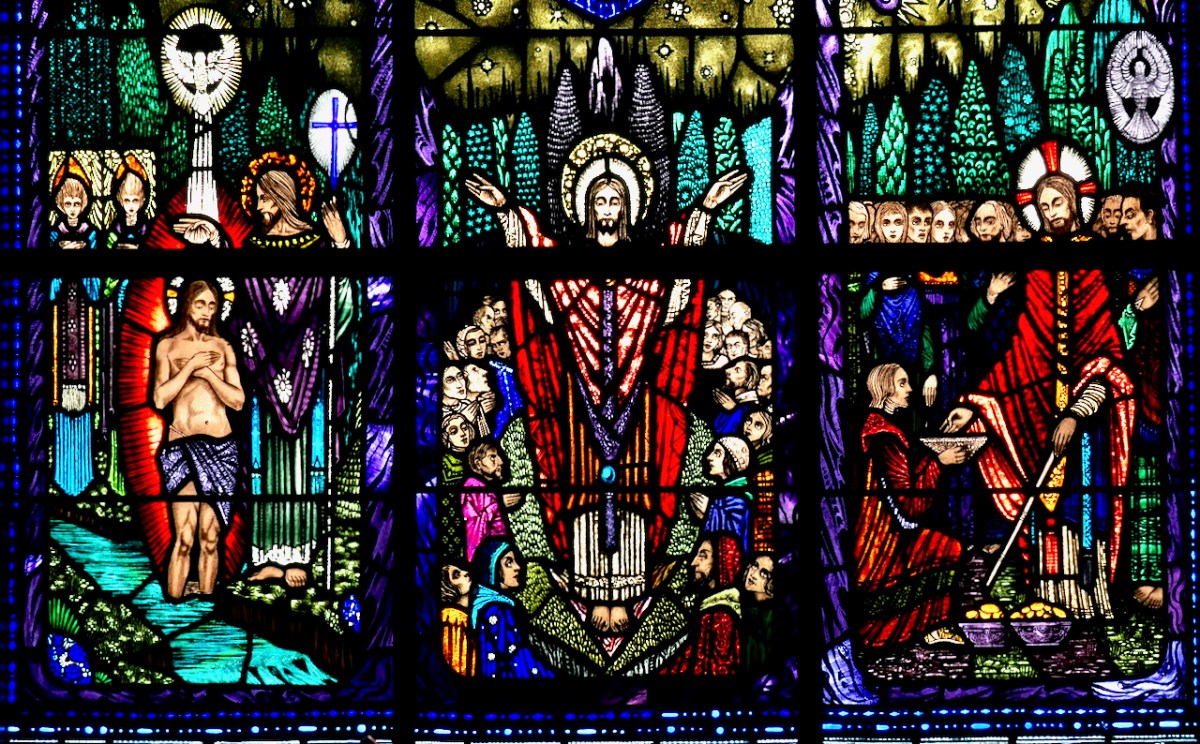
The predella from the large Christ the King window in Knockainey (1931) showing three scenes from the Life of Christ
Willie continued to manage the studios right until it closed in 1973. In the end, the Studio’s adherence to the House Style meant that its stained glass, once so in-demand, was seen as not really evolving with the times. Other artists with more modern aesthetics started to win commissions from architects looking to build contemporary churches that fitted post-Vatican II liturgical changes. Ironically, by the 60s and 70s Willie had started to design (and sign!) windows with a very different look to the House Style. His later output could form another post, but for now I wanted to concentrate on the early House Style period.
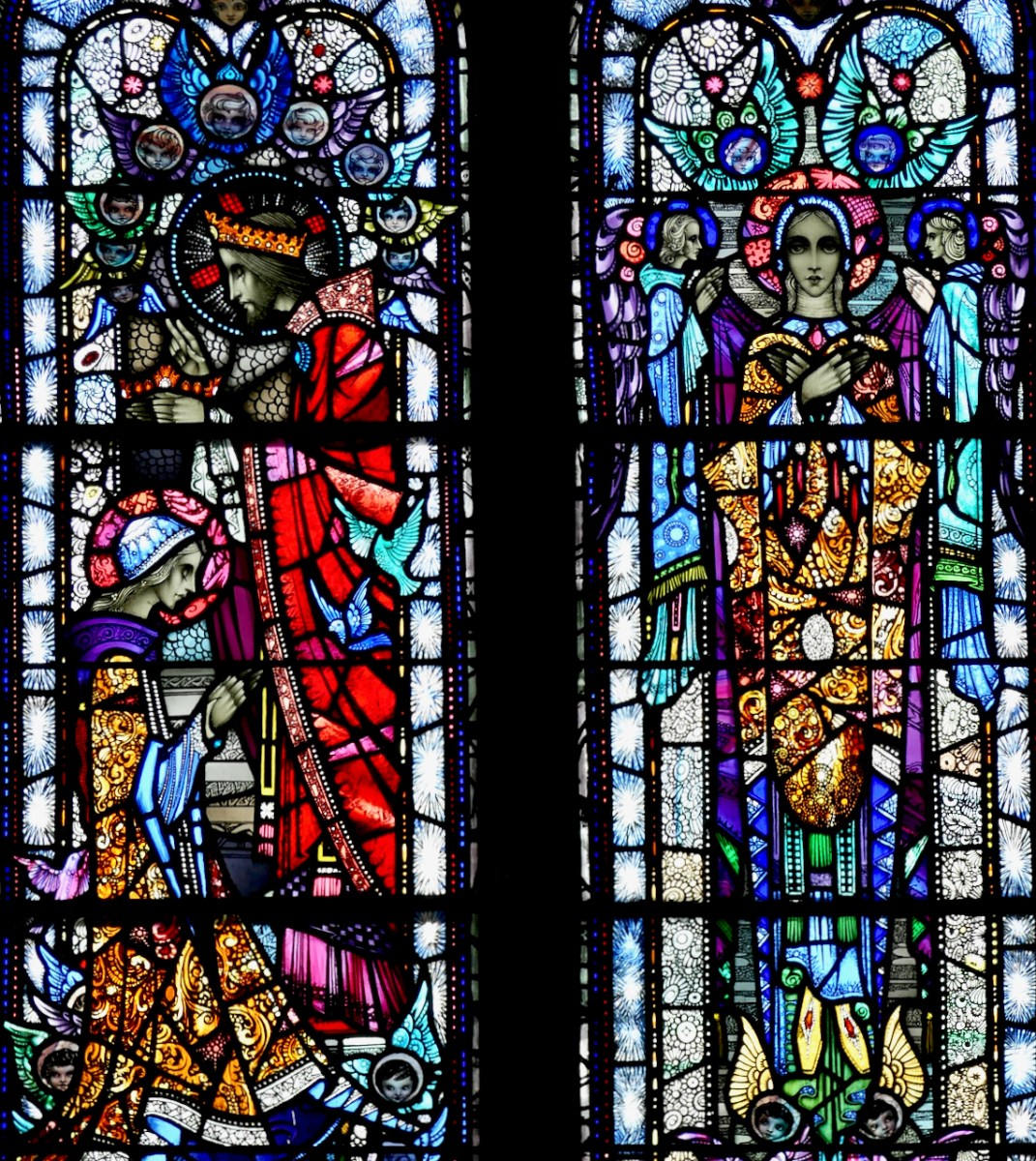
The 4th and 5th Glorious Mysteries from the Dominican Convent in Wicklow, The Crowning of Our Lady as Queen of Heaven and the Assumption. 1938/39
I want to finish with some personal memories of Willie Dowling. He lived until 1980 and he is remembered fondly by Etain and Veronique Clarke, Harry’s granddaughters. “He was a very lovely man,” Veronique told me, “Soft spoken and shy. Always dressed in his suit with a dressy wool coat and scarf. I believe he wore a fedora as well.” He was patient and kind (a bit like Harry) and he never minded them around the studio. Etain says “I remember going into the glass room with him – It was right by his office at the studios. He was pointing out to me how much antique glass was in there. French and German I remember particularly. Incredible colour, and textures. Handmade glass, so beautiful!” It was his dedication they both remembered, and how he helped their father, David, to keep the Studios running as long as possible.
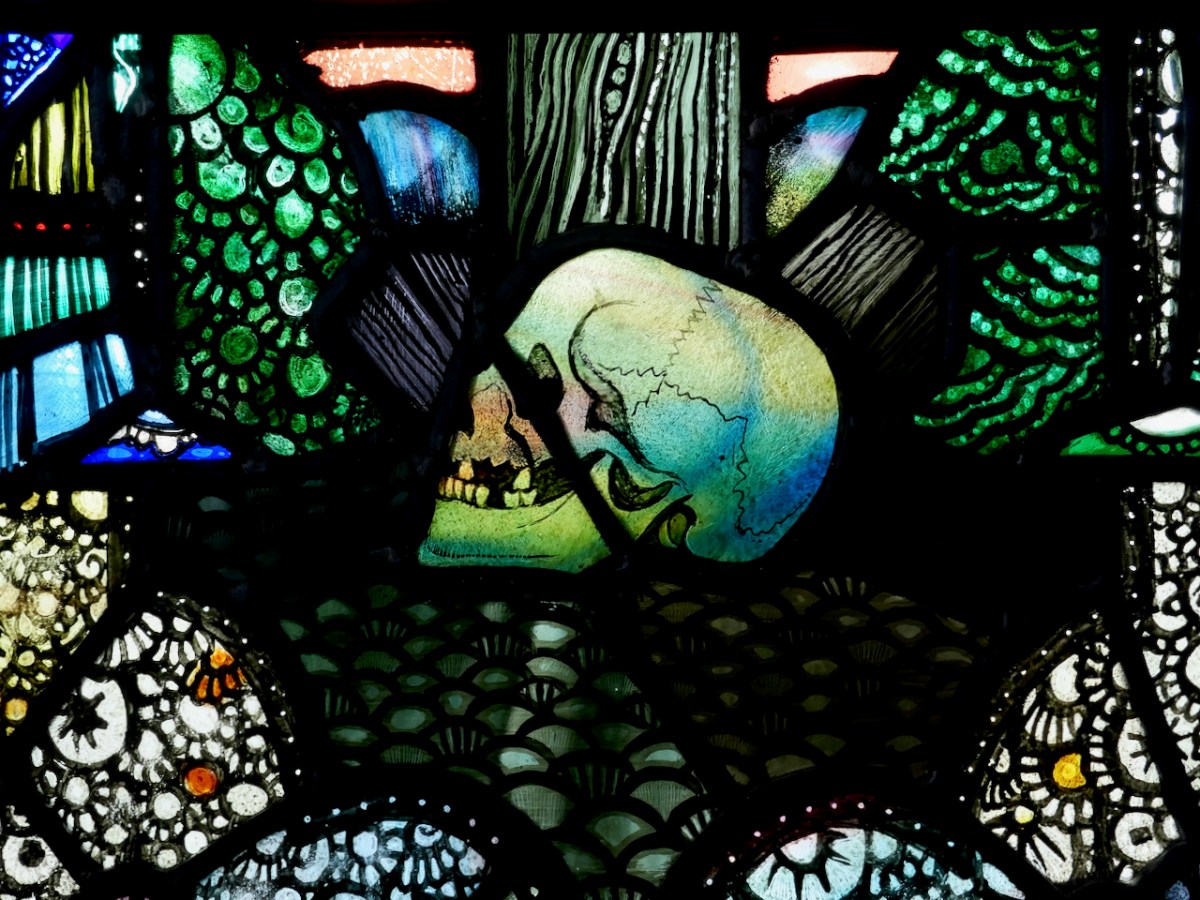
This is a tiny detail from a crucifixion window in Wicklow, showing Willie’s mastery of technique: achieving the multiple colours in the skull calls for extraordinary skill
* I am indebted to the scholarship of Paul Donnelly for this post. Paul has conducted in-depth investigation into the work of the Harry Clarke Studios and has identified many windows in the Gazetteer of Irish Stained Glass based on his research. Thank you, Paul for your erudition and generosity.
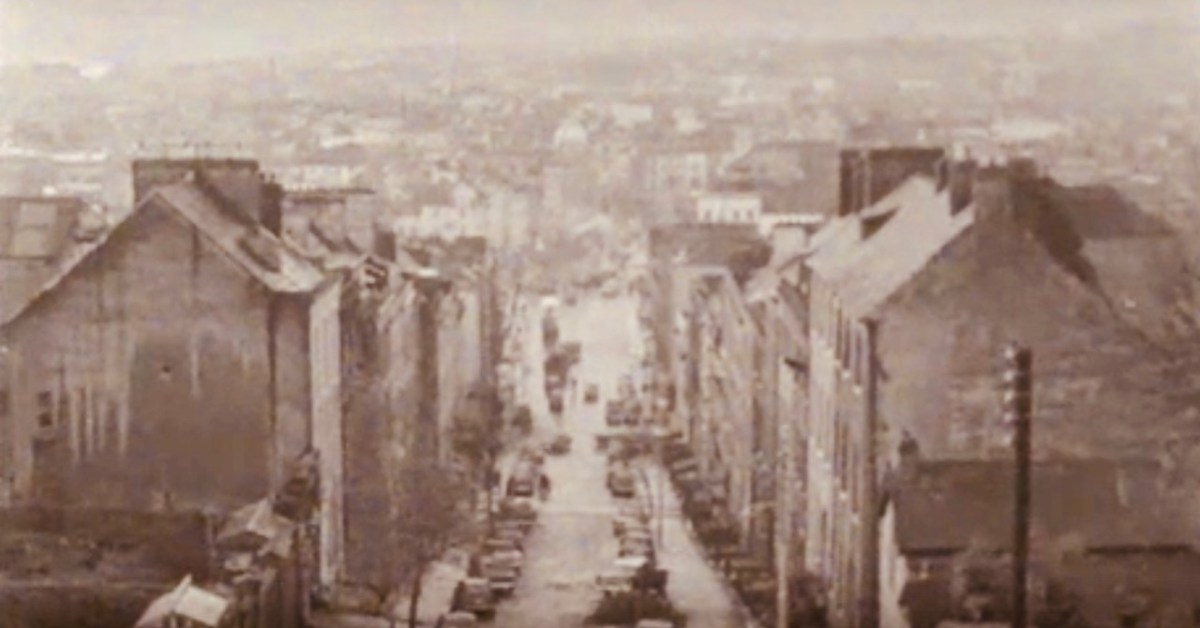
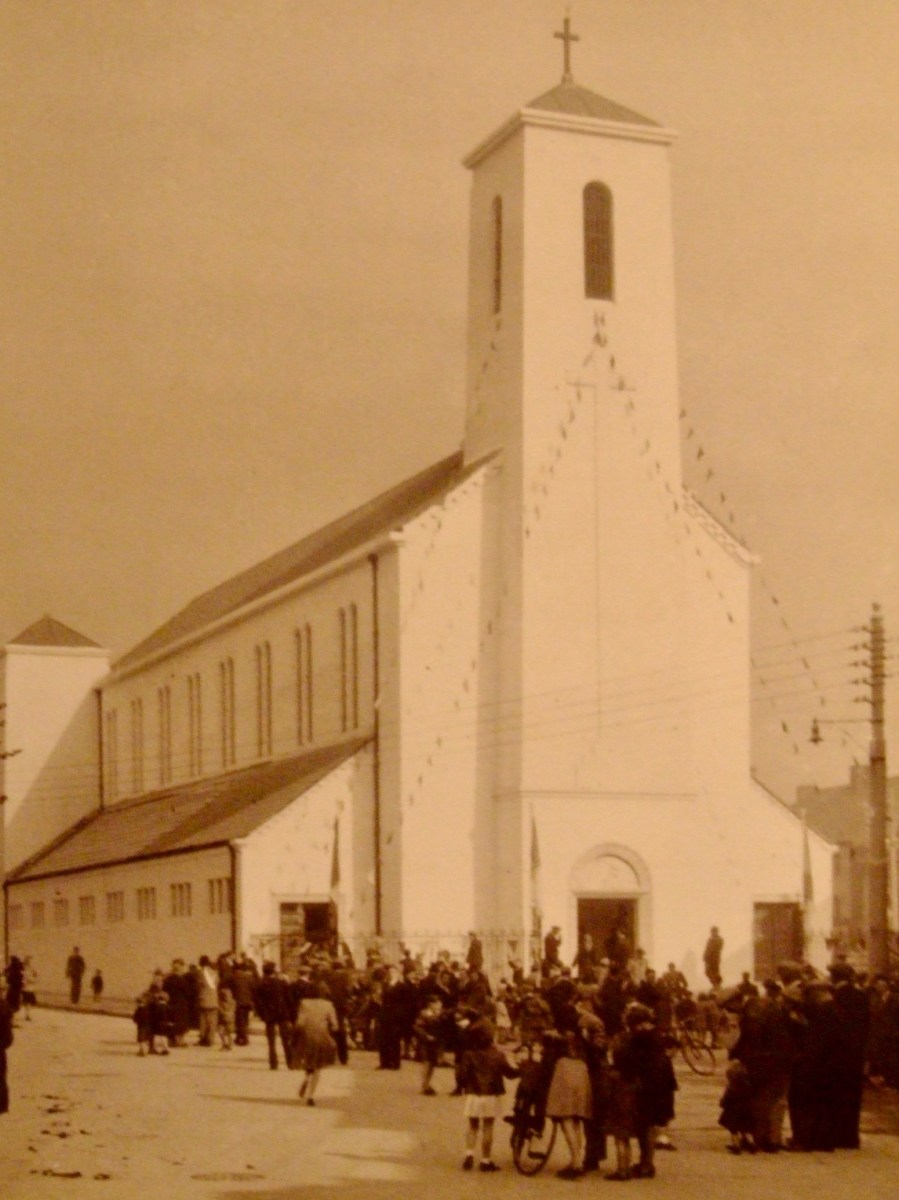
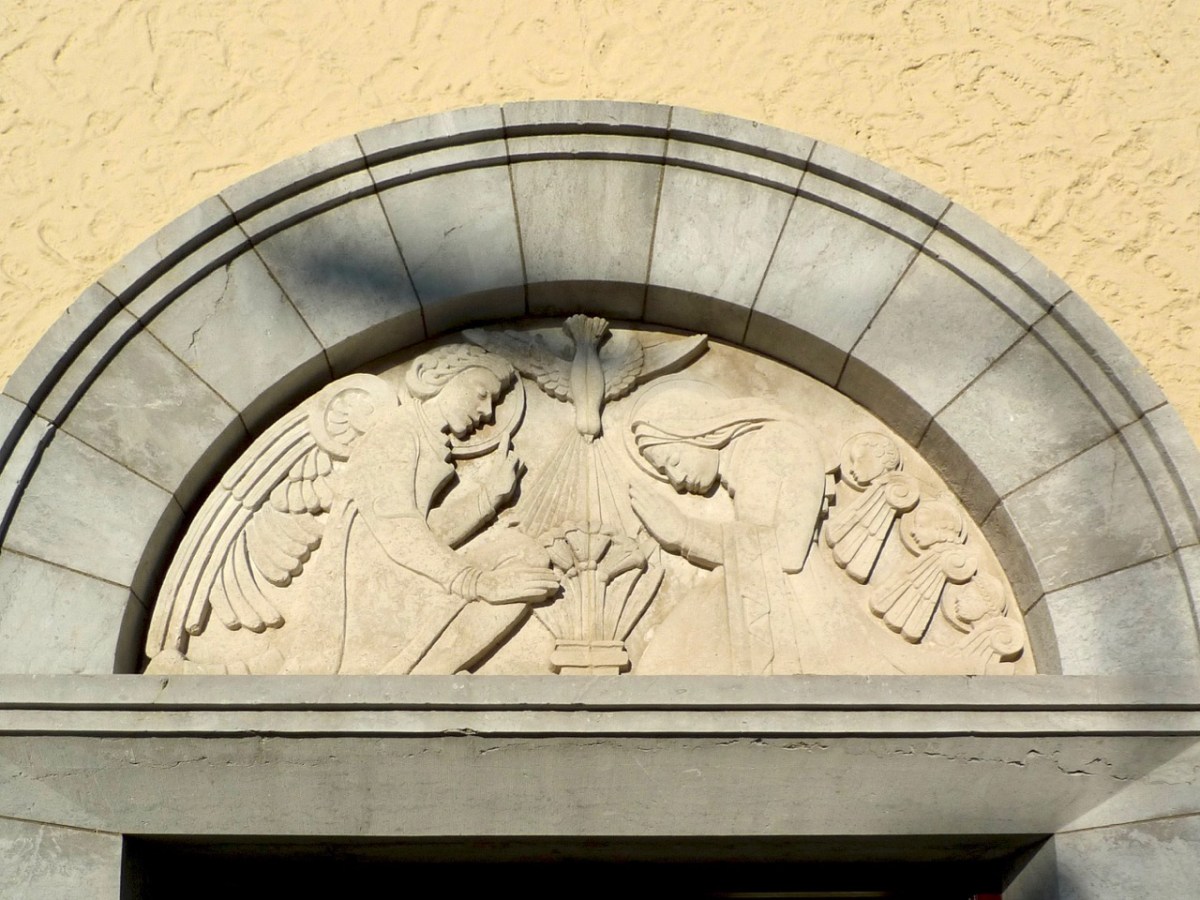
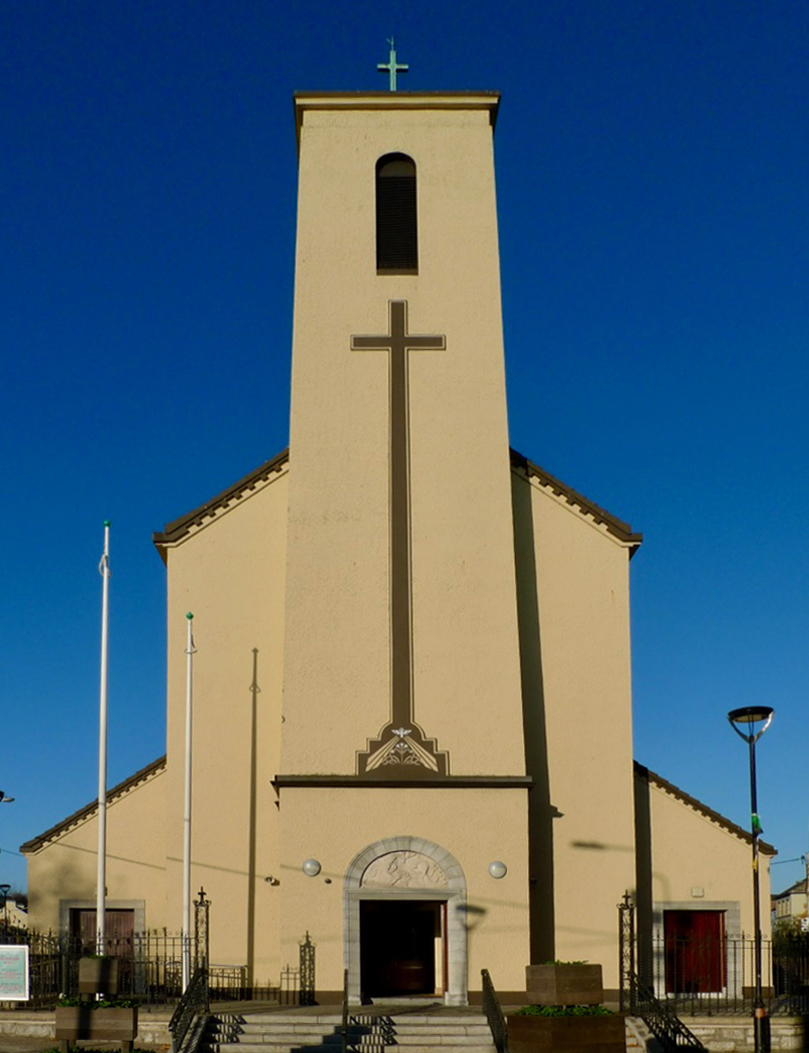
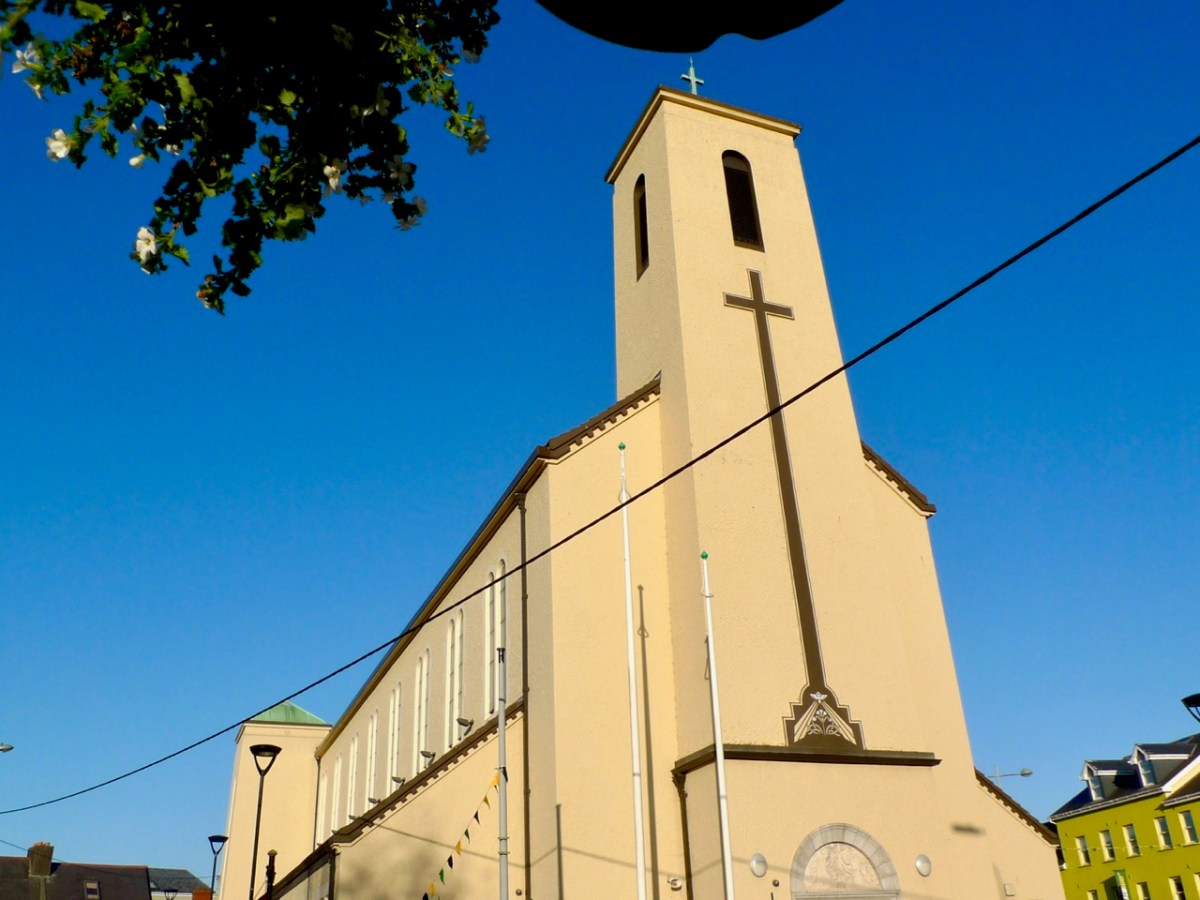
This is Cork city in the 1940s. The subject of today’s post is a Cork man – the sculptor Séamus Murphy. Born in 1907 near Mallow, Murphy took classes at the Crawford School of Art before apprenticing as a stone carver at O’Connell’s Stone Yard in Blackpool, a parish in the city, for seven years. Murphy and his work could occupy several posts, but today we concentrate on his only architectural building project, the Church of the Annunciation in Blackpool. Séamus Murphy can fairly claim to be the ‘sculptural designer’ of this building – as he conceived the way it would appear – while the architect Edmond Patrick O’Flynn most likely carried out the technical drawings and specifications.
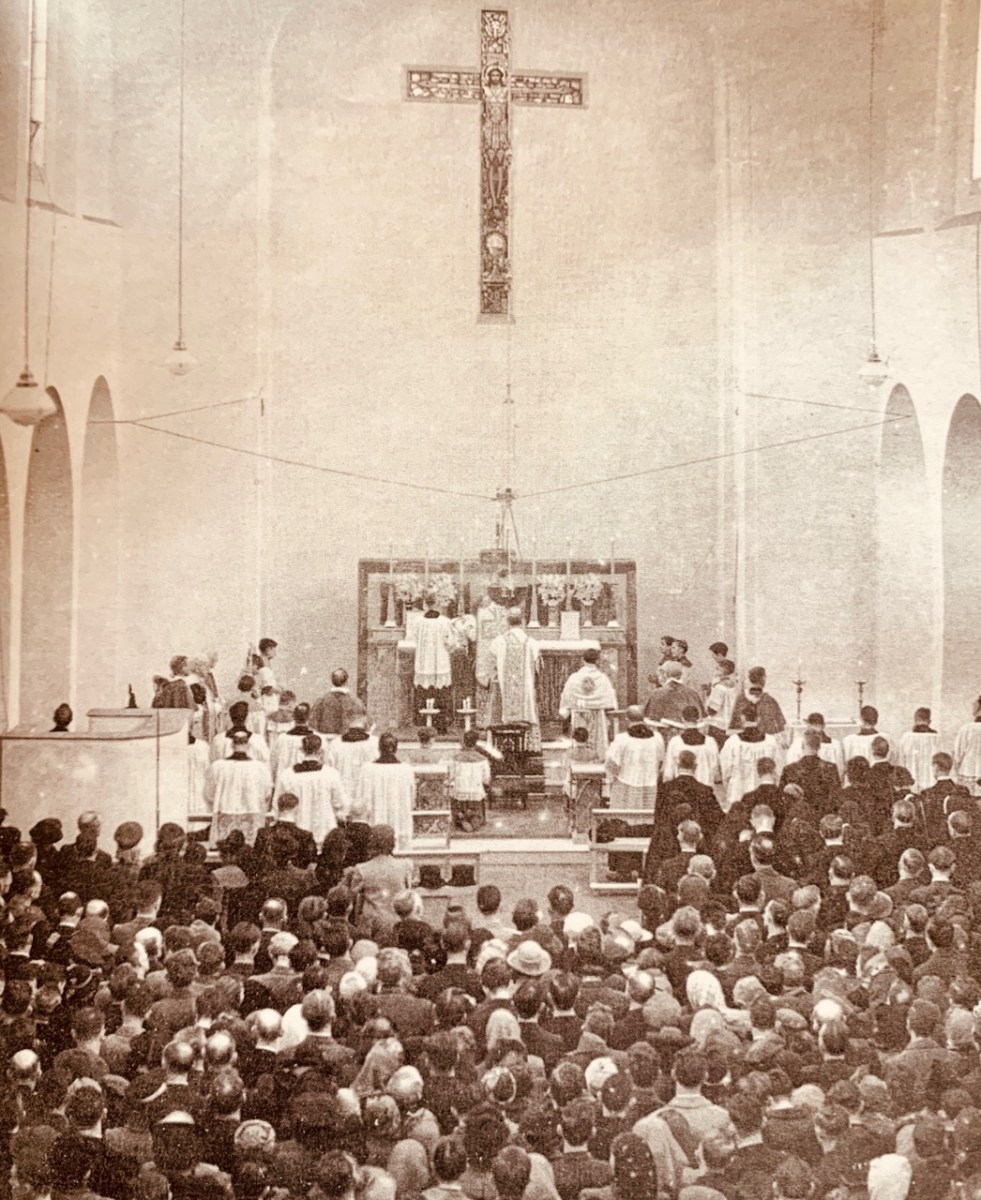
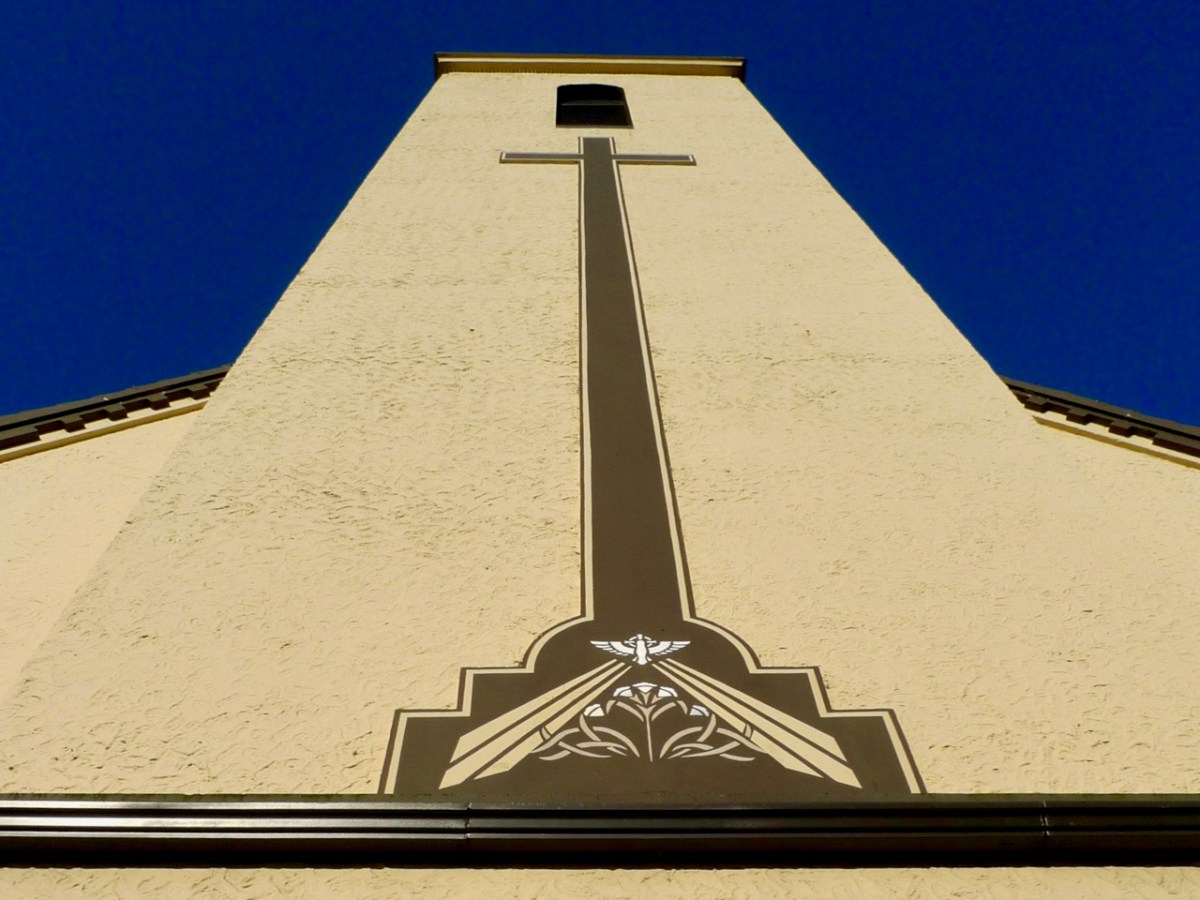
According to the Murphy family, Séamus found inspiration for Blackpool from pictures of churches in South America. In particular, the roughly textured render on the external walls is said to have derived from the adobe finish common in Spanish missionary churches there. The Cork church was commenced in January 1945, and the picture above (courtesy of Cork City Library) dates from around that time. The picture below – also courtesy Cork City Library – shows the dedication ceremony in the church on 7 October 1945.
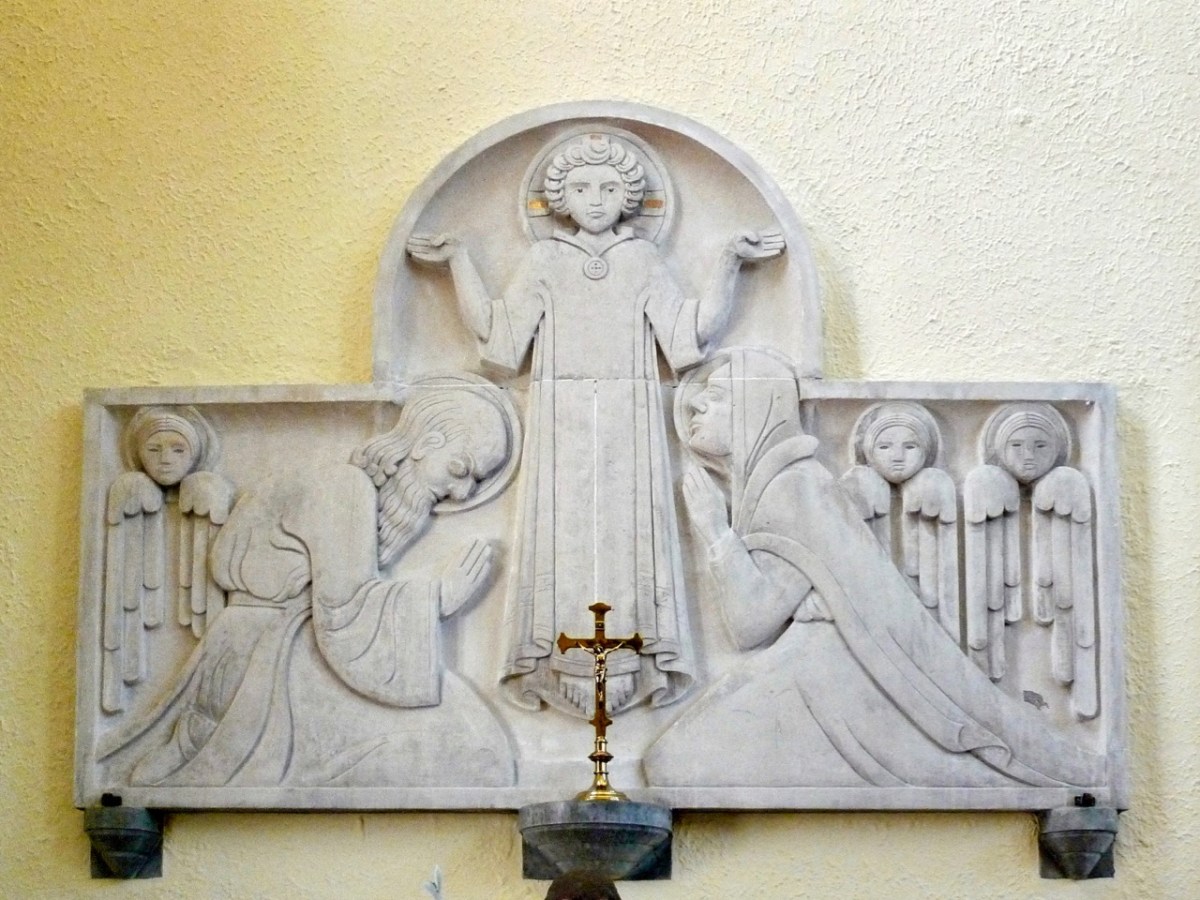
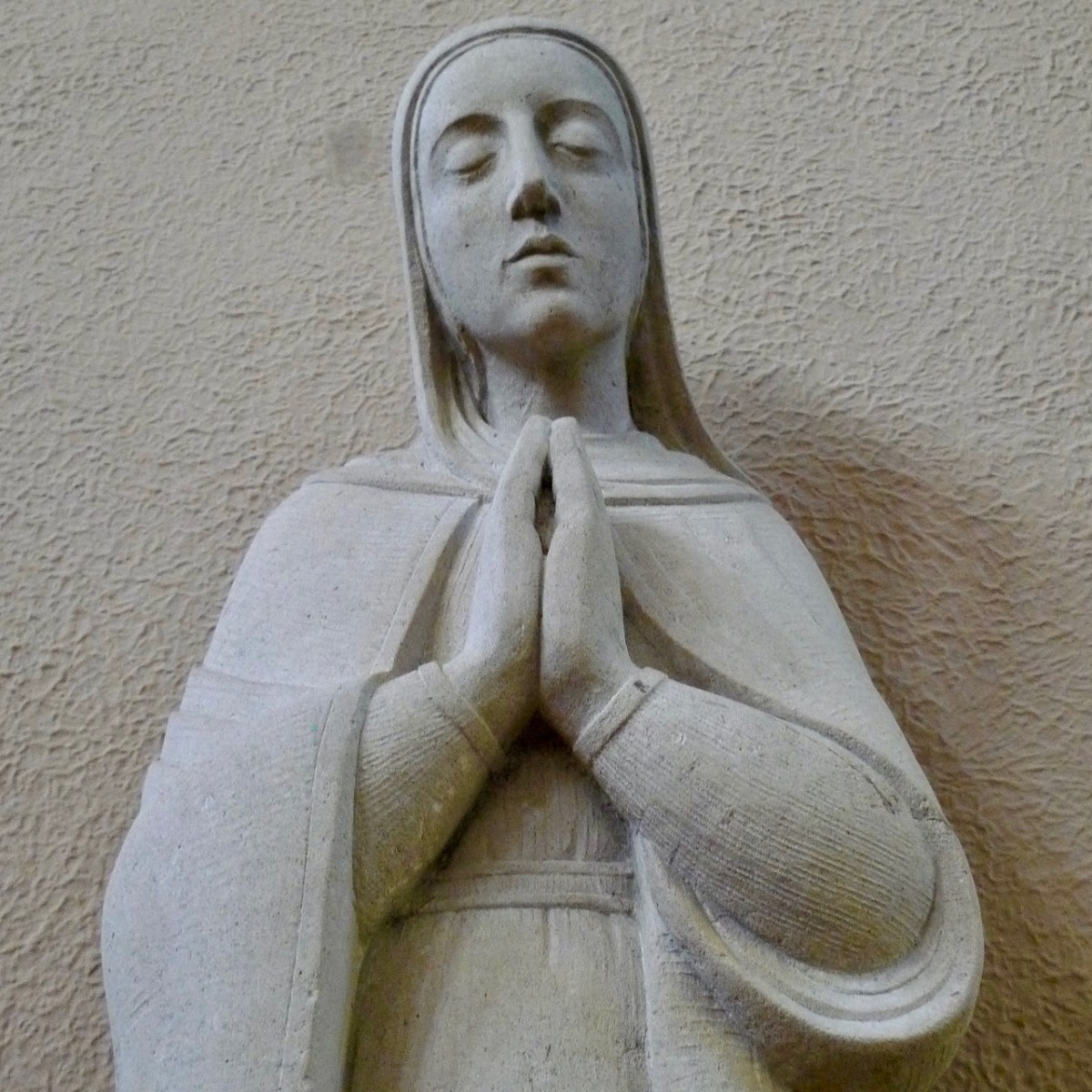
This picture of Séamus, above, is from the RTE archives. The Blackpool project is a good area of study, as the church shows the sculptor’s ability to conceive large, three-dimensional spaces as well as his skills in producing his own figurative and relief works, a number of which are used in the church furnishings: they are of polished Portland stone.
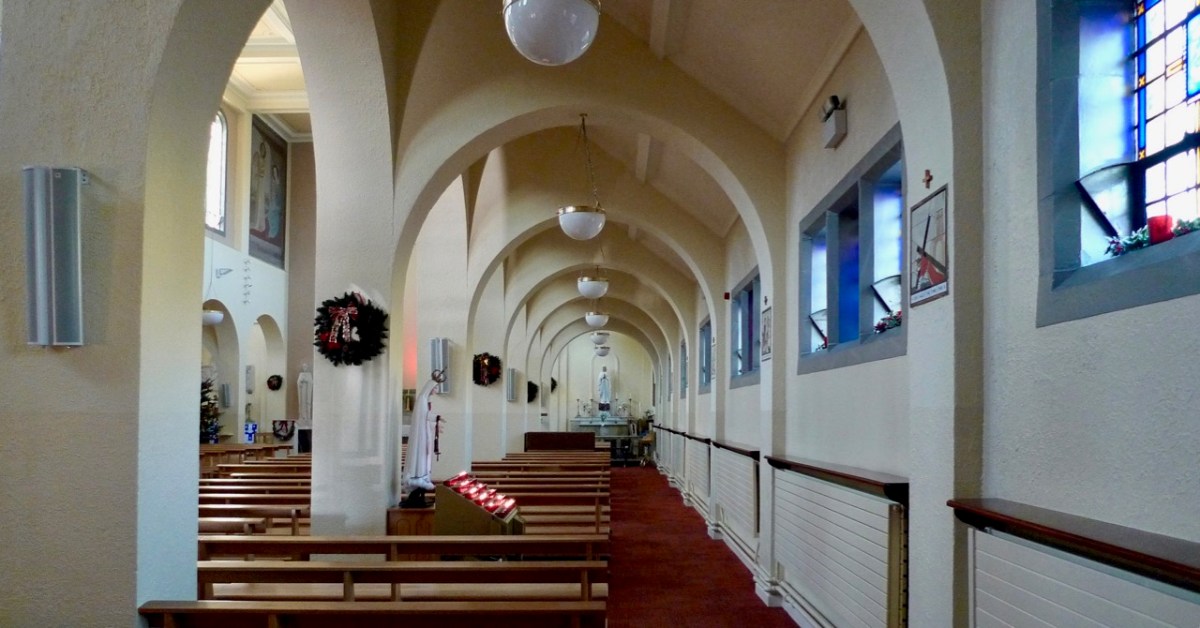
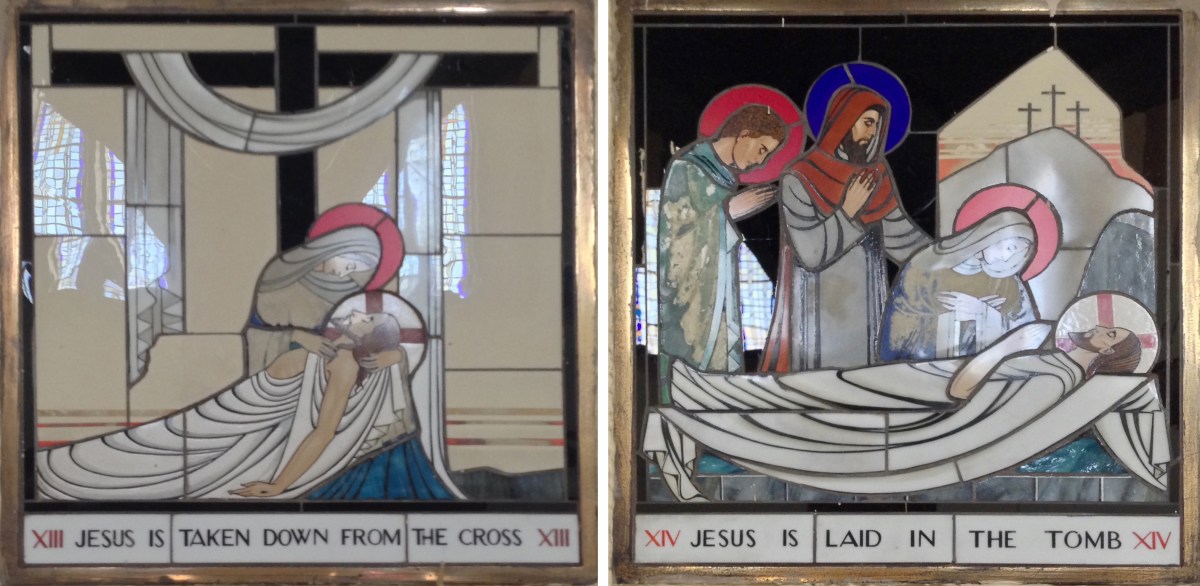
While the church is a valuable repository of Séamus Murphy’s design and carving skills, the work of many other contemporary artists can also be found in the building. The stained glass windows are from the Harry Clarke Studios, designed by William Dowling.
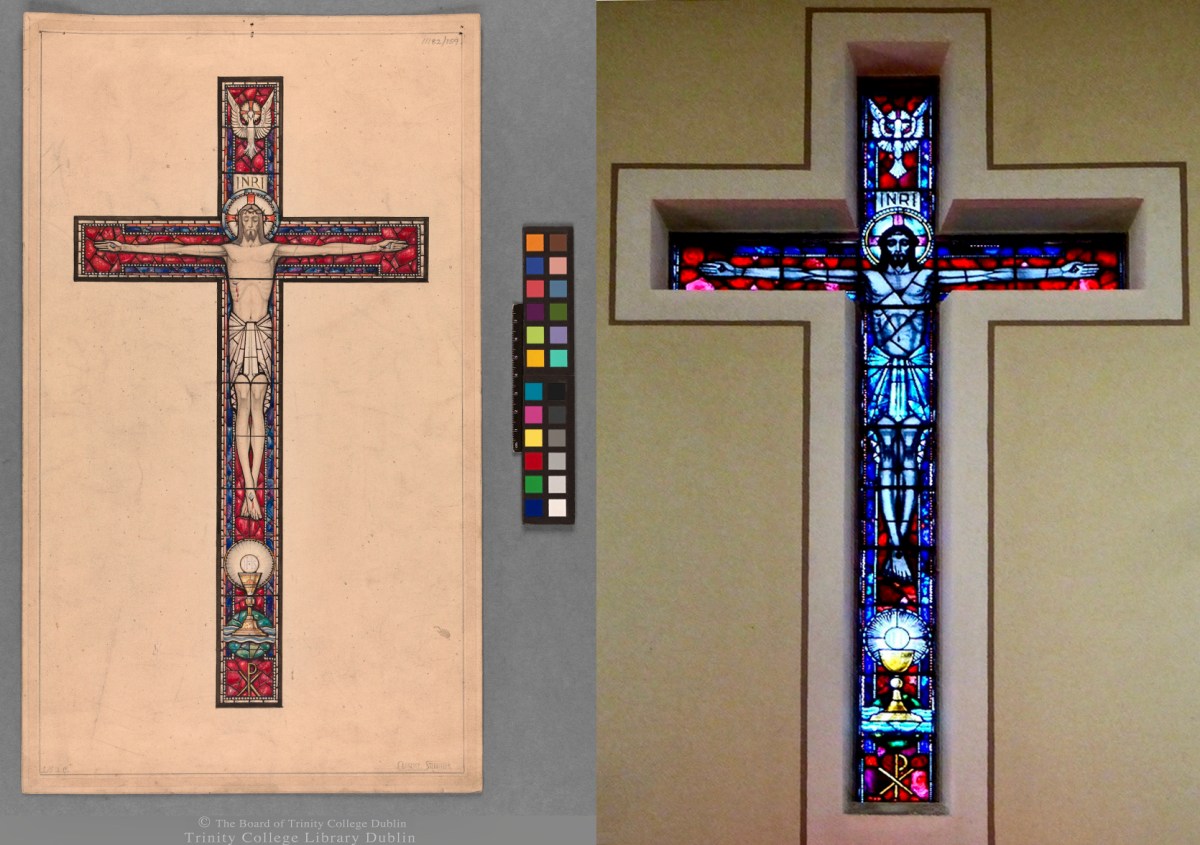
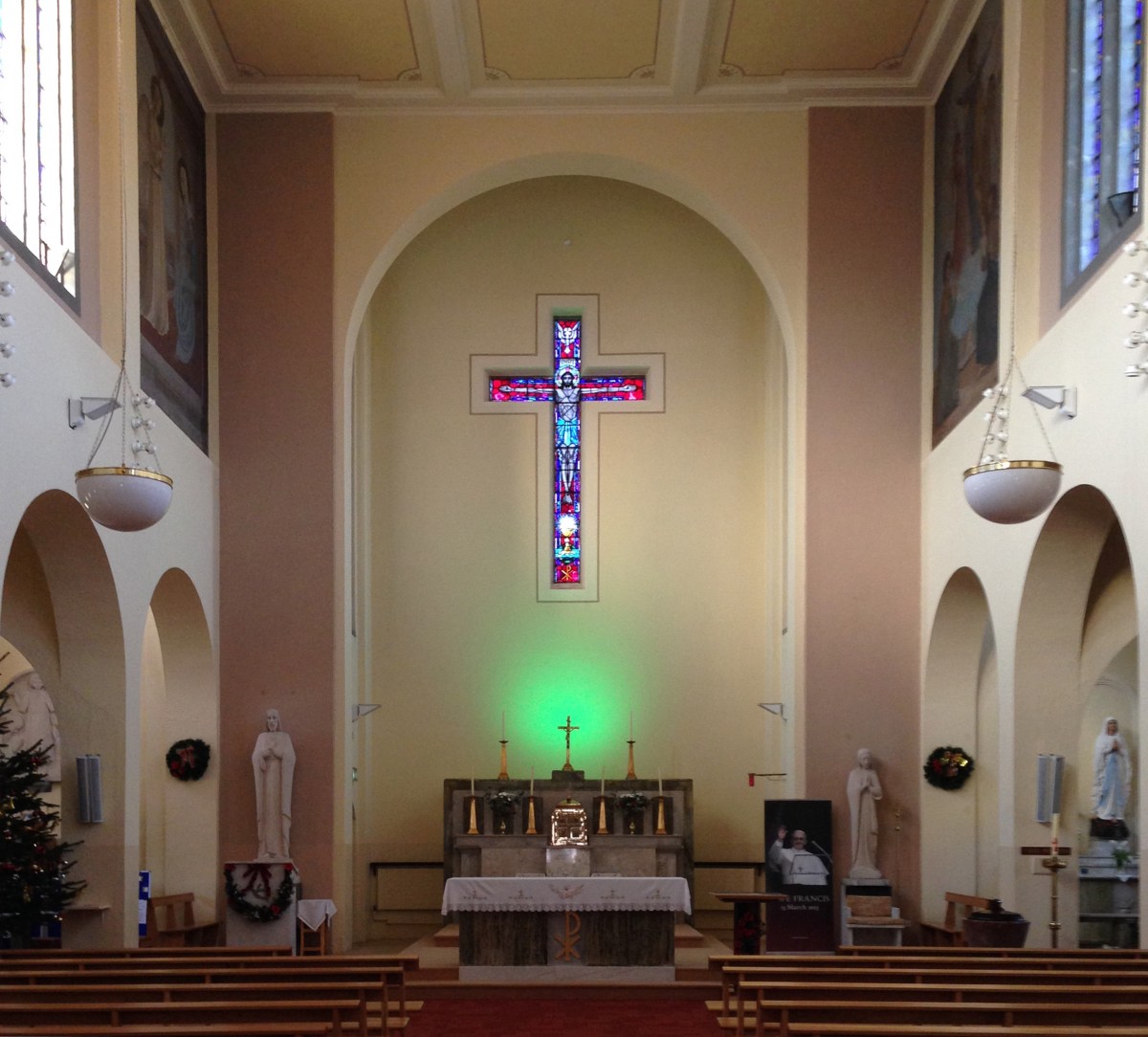
Particularly striking is the crucifix window at the east end. Above is the original cartoon (courtesy of Trinity College Library Dublin) by Dowling, side-by-side with an image of the window today. All the windows are of fine quality.
A full view of the east end of the church. The interior has changed very little over 77 years and is, therefore, a great tribute to Séamus Murphy and the the commissioning family of William Dwyer, then head of the nearby Sunbeam Wolsey factory. Dwyer funded the whole project as a memorial to his daughter Maeve who had sadly passed away in 1943.
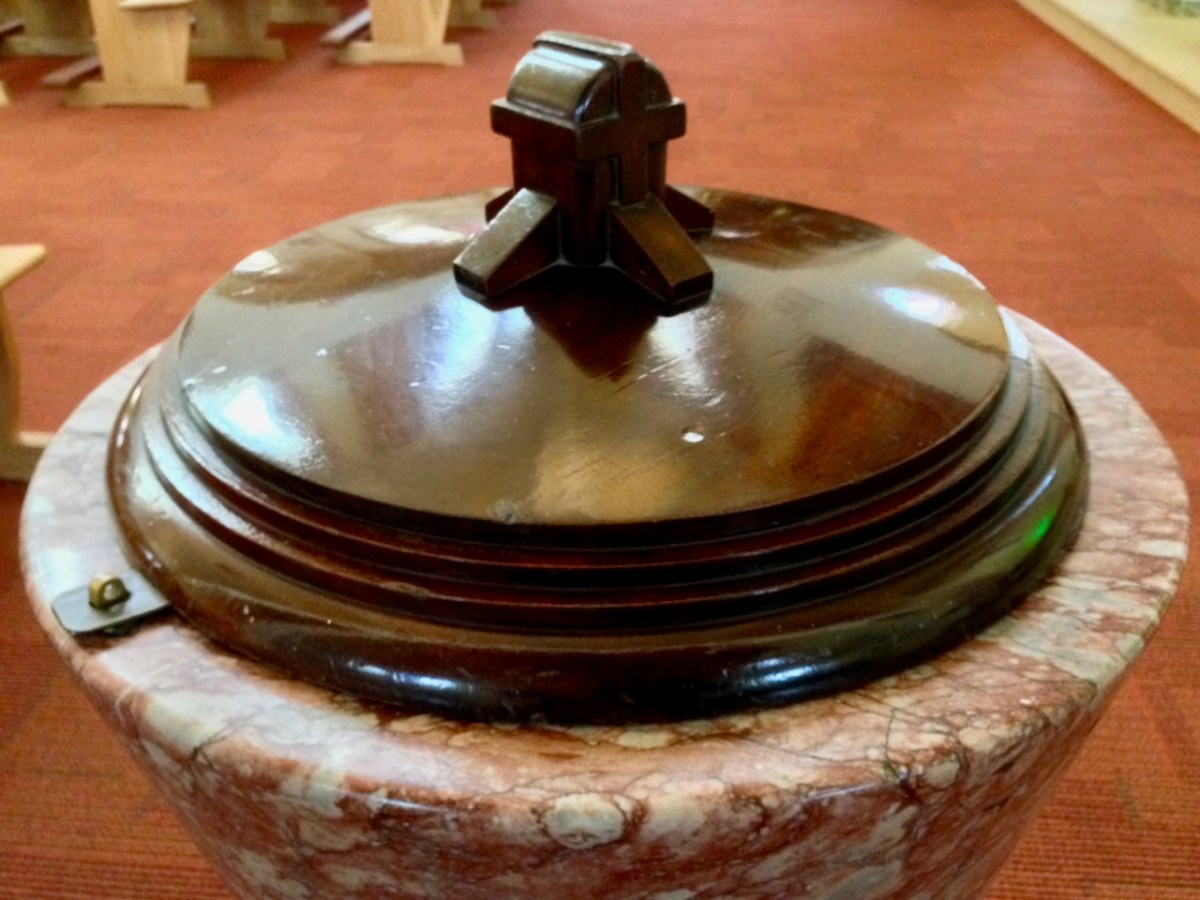
This fine font cover was carved by hand by Bart, a younger brother of Séamus.
Murphy’s Church of the Annunciation is certainly a landmark building – not just for Cork, but for the whole of Ireland. And Séamus himself must rank as one of the outstanding artists of the Free State. You will come across his distinctive work in many locations; I will be directing you to some of them in future posts.
Many thanks to Orla Murphy for giving me valuable insights on her father’s works
Dear Readers – we know you aren’t all on Facebook, so this is for those of you who follow us on WordPress or other platforms. On our Facebook page, we’ve been running a series on The Nativity in Stained Glass in the lead up to Christmas, so here, in one post, are those photographs and text. All the windows are Irish and 20th century. Merry Christmas to you all!
This one is by George Walsh and it’s in Frankfield Grange Catholic Church in Cork. This scene is part of a larger window, the main scene depicting the Annunciation. More about George Walsh here.
Kevin Kelly was a long-time stained glass artist for Abbey Studios. He loved doing Nativity windows. This one is in Inchigeelagh, Co Cork and featured on a UNICEF Christmas Card. It’s worth taking a look at the detail – amazing for what’s quite a small window.
This beautiful Nativity window is in Mayfield, Cork, in the Church of Our Lady Crowned. The Murphy-Devitt Studios were a group of young, dedicated artist and designers, determined to bring something new to traditional stained glass. We think they succeeded magnificently.
The Dominican Convent in Wicklow town has a gorgeous series of windows – the Mysteries of the Rosary. They were done in the Harry Clarke Studios in 1938, several years after Harry’s death, but his influence is very evident. They were mostly designed and painted by William Dowling, but with much input from Richard King. To see if you know the difference between Harry Clarke and Harry Clarke Studios windows, take the quiz, or just cheat and go straight to the answers.
Patrick Pollen, although he grew up in England, made his stained glass career in Ireland. Having been bowled over by Evie Hone’s Eton windows he came to Dublin to work with her. Hone’s influence is readily apparent in these two panels, which form the predella (lowest section) of a window in St Michael’s church in Ballinasloe, Co Galway, dating to 1957. I haven’t written about Pollan (yet) but you can read about Evie Hone here.
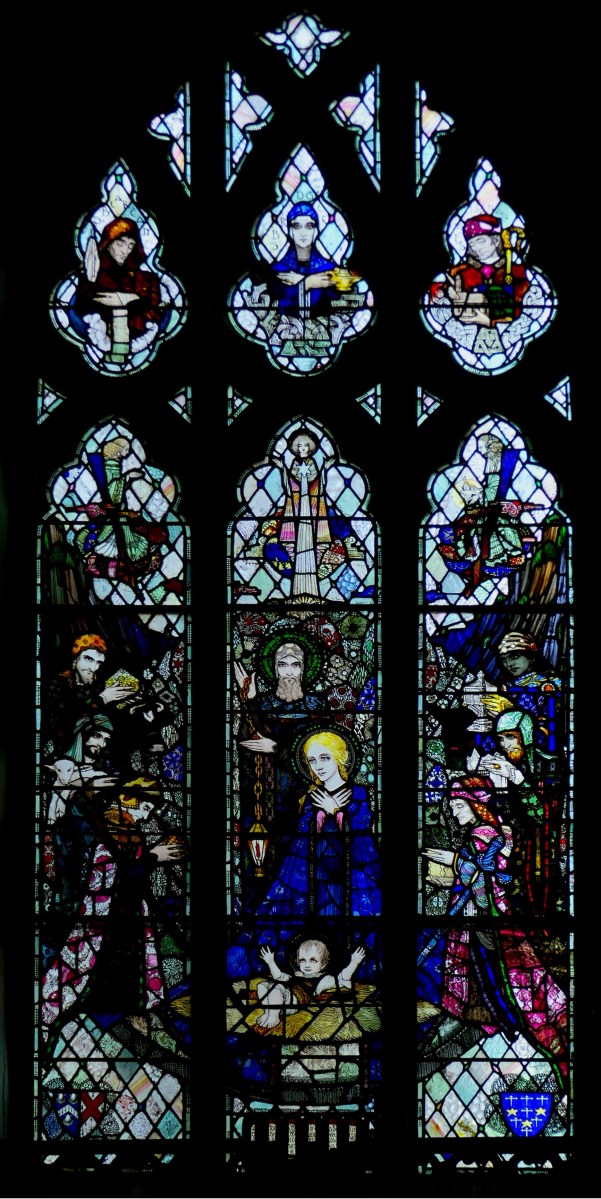
We’ve kept the best for last – the genius that is Harry Clarke. This is his Nativity Window, done in 1919 for Edith Somerville and her family, for the C of I Church of St Barrahane in Castletownshend, Co Cork. Lots more about Harry Clarke, Ireland’s greatest stained glass artist.
Welcome to the UCD Library Cultural Heritage Collections blog. Discover and explore the historical treasures housed within our Archives, Special Collections, National Folklore Collection and Digital Library












 Roaringwater Journal