Place Names – and PRIZES!

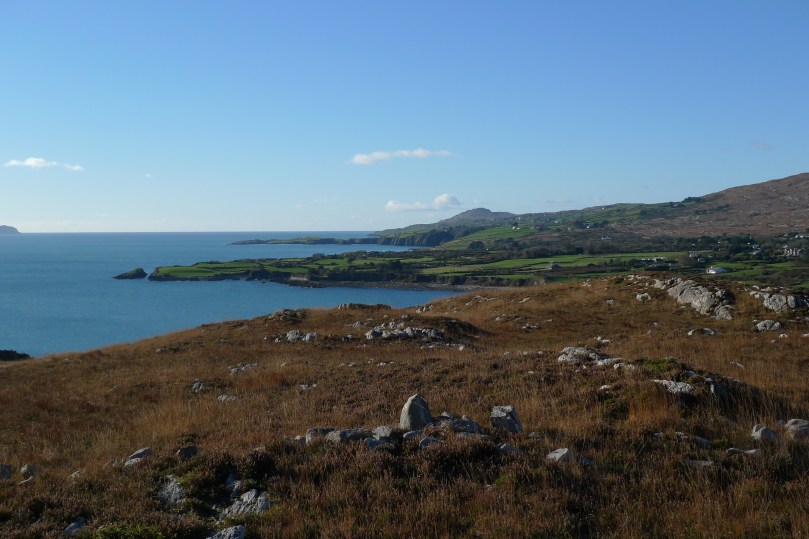
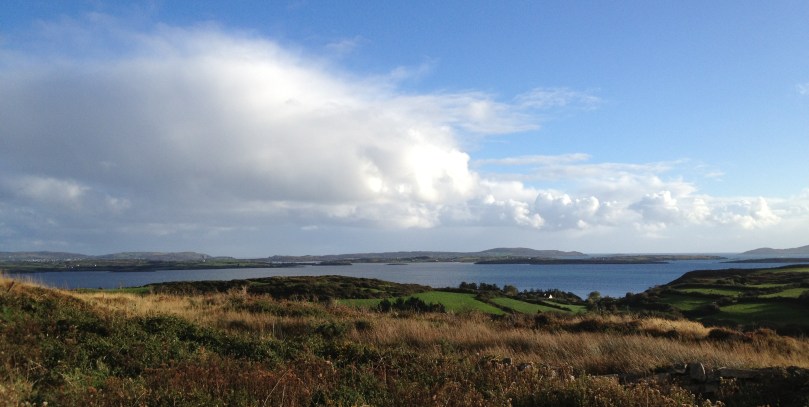
View from Cappaghglass

Several of my Canadian readers have asked me to do a piece on place names. As a Canadian, it’s hard to fathom that the address ‘Finola Finlay, Ard Glas, Greenmount, Ballydehob, Co. Cork, Ireland’ could actually get to me – “What?” you say, “No street address? No postal code? And how on earth do you pronounce Ballydehob?” (Actually, just Ballydehob, Ireland, would probably make it to me.)

When Ireland was mapped by the Ordnance Survey in the 1820’s to 1840’s, place names were Anglicised mostly by trying to reproduce the Irish names phonetically. With some basic knowledge of Irish it is possible to winkle out the meaning of many place names. The smallest unit of land recorded on the maps is the ‘townland’. This being Ireland, the term ‘townland’ has nothing to do with a town but is a defined geographical area, probably based on very ancients divisions. Townlands vary in size, but 300 acres would be typical. In rural areas, the address often includes the name of the house (Ard Glas), the townland (Greenmount), the nearest town with a post office (Ballydehob) and the County (Cork).

ANNOUNCING OUR FIRST COMPETITION!

Below is a basic Irish-English dictionary of common place name words. Use it to translate the names of some West Cork place names – submit your responses by clicking on ‘Leave a Comment’ at the end of this post. Use your imagination, your poetic sense, your personal lexicographic preferences and your sense of humour. There will be LOVELY PRIZES for the best entries!!!

Words for Irish word (translation) Pronounced
Field Gort (small field) Gurt
Ban (meadow) Bawn
Cappagh (tilled field) CAppa
Settlement Liss or lios (round earthen enclosure) Liss
Dun (fortified enclosure) Doon
Rath (round earthen enclosure) Rath
Baile or Bally (settlement or town) BOLL-yeh
Cill (small church) Kill
Hill/Mountain Ard (high place) Ord
Drom (rounded hill) Drum
Cnoc (hill, rocky) K-Nuck
Letter (hillside) LETTer
Croagh (mountain) Croke
Sliabh (mountain) Sleeve
Mullach (summit) MULLock
Terrain Doire (oak wood) Derry
Mona (bog) MOAN-Ah
Carraig (rock) KArrig
Poul (hole, hollow) Powl
Descriptive Mor (large, big) More
Beag (small) Byug
Glas (green) Gloss
Rua (red) RU-ah
Dubh (dark, black) Duv
Ban (white) Bawn
-Een (as a suffix – diminutive: little, small) Een

Place Names around Roaringwater Bay

Cappaghglas
Gortnamona
Gorteenakilla
Ballybane
Derreenard
Lisheen
Letterscanlan
Mullaghmore
Ardraha
Cnocnacarriga

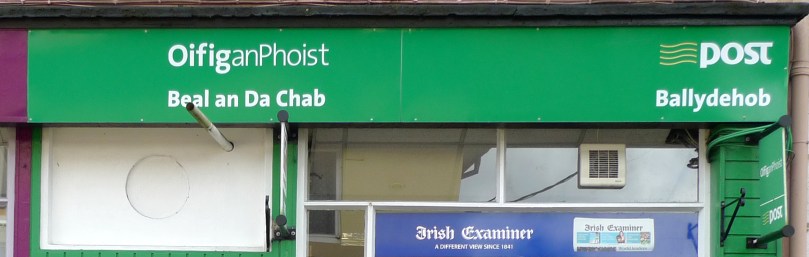
Oh and Ballydehob? It’s pronounced BAlly-dee-HOB. From the Irish Béal an Dá Chab, meaning ‘mouth of the two river fords’. Just to confuse things.
beal an da chab

Getting in the Christmas Spirit

2012-12-05 15.08.44

This week revolved around two trips, to Baltimore and Cork City, and observing the Irish spirit of Christmas.

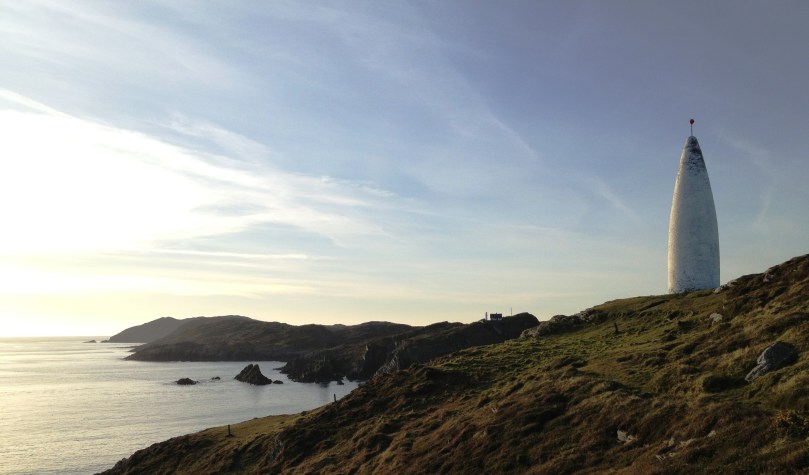
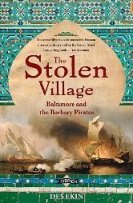
Stolen VillageBaltimore – wha..? No – we didn’t take a quick trip to the States: Baltimore, the original one, is a small town in West Cork. It’s where you catch the ferries to Sherkin and Cape Clear Islands, and right now it’s hosting whale-watching tours because the humpbacks are in town. We walked out to the Beacon, an iconic landmark that in earlier times provided guidance into the harbour, hoping to catch a glimpse of the humpbacks. Although there were no whales to be seen, it was another ‘pet day’ and we were more than adequately compensated by the views over Sherkin and the Harbour, glowing in the low afternoon sun. A friend has loaned us her copy of The Stolen Village by Des Ekin – a riveting account of the Sack of Baltimore, in 1631, when Barbary Pirates laid waste to the town and bore away almost all the villagers into a life of slavery.

I lived in Cork City for seven years in the late 60’s and early 70, finishing secondary school and completing two degrees. Then, it was an undistinguished provincial town, with its own culture, sense of place and humour, and an uninspiring Victorian architecture. Nowadays it’s a lively city with a huge variety of stores and a European vibe. Many of the narrow streets have been pedestrianised, leading to a downtown core made for strolling and gawking, and on every street corner were carol singers, brass bands, or entertainers. We stayed in a wonderful place, the River Lee Hotel, with floor-to-ceiling windows overlooking the river, great food and friendly and accommodating staff. While the main purpose of our trip was to attend a rock art meeting at UCC, we whiled away several happy hours on Christmas shopping.

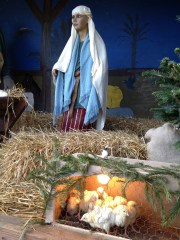
2012-12-08 12.18.072012-12-08 12.15.19Back in West Cork, we took in one of the local Christmas events in Skibbereen – a Live Crib. Our entry ticket came with a carrot for the donkey. The animals were live, but Mary, Joseph and the baby were mannequins. It was explained to us that “t’would be nice, like, to have them played by real people, but sure ‘twas freezing for them, and the last girl who played Mary was most of the time on her mobile.”

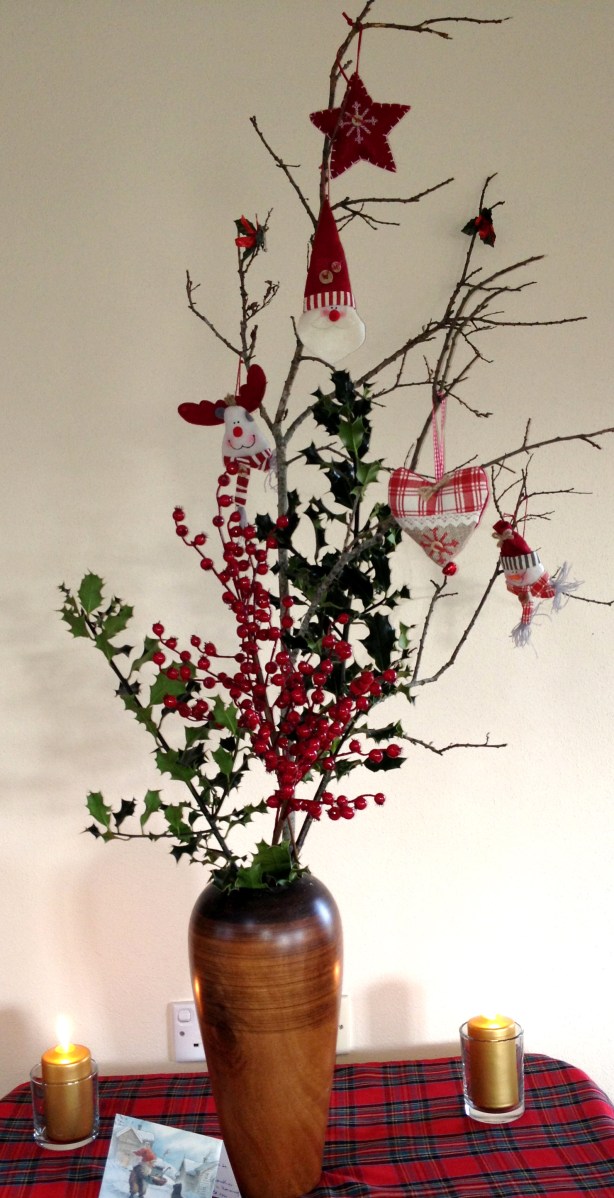
We rounded off the week by erecting our Christmas tree. It’s surprising what you can do with  a tree branch, some holly and berries, and five ornaments.

2012-12-08 14.11.54

Of Kings and Poets

We are standing in one of the most beautiful places in the world… Or so it seems to us on this late November day as a cloudless sky casts an azure sheen over the whole sea stretched out between the Sheep’s Head and the Mizen, while the folds of the mountains behind are painted an indescribable autumnal gold by the low sun.

view west

We decided today that our Sheep’s Head walk would be by the water, and chose to start at Dromnea – where we were intrigued by mention of an old Bardic School. This is listed in the guide book, together with the nearby castle of the O’Mahony’s: both are picturesque ruins. In Feudal times, when they flourished, students of the school would serve a seven year apprenticeship which consisted of spending hours in a darkened cell composing poetry which was later read out to and critiqued by the whole company. They carried the traditions and history of families and communities, to be recited on their travels around the countryside, where hospitality for bards and minstrels was obligatory. The Dromnea School was owned and run by the O’Daly family, traditionally bards to the O’Mahony’s. The most famed of the poets was Aenghus O’Daly – also know as the Red Bard – who died in 1617. He is best remembered for his work – Tribes of Ireland: A Satire. As ‘research’ for our walk I read this – an 1852 edition available online: in a hundred or so verses Aenghus tells of his travels around the four provinces seeking hospitality from the ancient families of Ireland, as was the right of his profession. The whole work is a list of complaints as to how lacking the hospitality actually was. For example:

The tribe of O’Kelly—the screws whom I hate

Will give you goats’ milk, mixed with meal, on a plate

This hotch-potch they’ll heat with burnt stones, and how droll some,

Among them will tell you ’tis pleasant and wholesome.

and:

Three reasons there were why I lately withdrew

In a hurry from Bantry: its want of a pantry

Was one; and the dirt of its people was two;

Good Heavens! how they daub and bespatter

Their duds! I forget the third reason. No matter…

or:

Poor little Red Robin, the snow hides the ground.

And a worm, or a grub, is scarce to be found

Still don’t visit the O’Keeffe; rather brave the hard weather –

He’d soon bring your breast and your back-bone together.

Such was the reputation of the Dromnea Bards that the King of Spain sent two of his sons to the School to receive their education. They were both drowned while swimming in the lake by the castle: the story tells that they were turned into swans. We leave the ghosts of the school behind us and reach Lough Farranamanagh – a tranquil stretch of fresh water which flows out to the sea. We look across to the few stones that define the O’Mahony stronghold: sure enough, floating serenely in front of it are two stately swans.

After passing the time of day on the beach with a periwinkle collector (she exports great tubfuls of them to France) we walk for three hours, leaving the coast behind and going up into the the hills where we come across further ruins: this was once a village, and lazy-beds and ancient field systems are visible in the rocky moorland terrain. Finally we descend back to the now defunct old Ahakista – Kilcrohane road: a remote green trackway that has been given a new lease of life as one of the Sheep’s Head Way walking routes. This brings us back foot-weary but satisfied to our starting point after our tour through an intellectual and historical landscape in stunning West Cork.

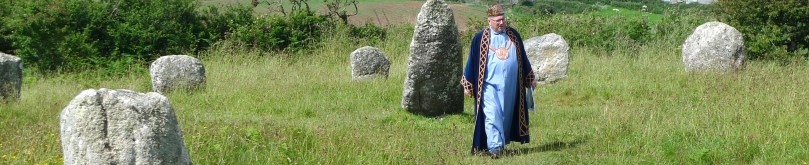
A Bard of the Cornish Gorsedd

A Bard of the Cornish Gorsedd

To Market, To Market

2012-11-02 11.36.59

This…

2012-11-25 17.55.05

…becomes this

2012-11-24 14.38.49

Lunch at Ard Glas

2012-11-10 10.49.58

West Cork Pies

We are fortunate to have two excellent farmers’ markets on our doorstep: the Bantry Market on Fridays and the Skibbereen Market on Saturdays. We go, just to wander, not really needing anything – but we always emerge with a bag full. We love to buy carrots and parsnips covered in this morning’s earth, and scrub them up under the outside tap back at Ard Glas. The fish stall ladies will fillet a whole fish for you in a trice, and give you hints on the best way to cook it. The numerous homemade bread and cake stalls have started to load up their tables with mince pies and Christmas puddings. A new stall, West Cork Pies, sells the world’s yummiest Steak in Murphy’s Pie (Murphy’s is the Cork Guinness), Chicken and Leek Pie, and a variety of pasties. I am putting in an order for Christmas, to take up to Dublin. Our lunch often consists of cheese from the Bantry cheese stall, with Courgette and Ginger Chutney picked up in Skibb, and (I know I shouldn’t) a slice of chocolate biscuit cake from one of the baking stalls.

2012-10-20 11.06.45I love to chat to the stall owners and ask about their produce. Trouble is, it’s hard to walk away without buying something, so now I have two packets of nutritious seaweed from the charming seaweed man, and I’m not quite sure what to do with them. Fortunately, Robert rescued me after a long conversation with the wood carver before I felt I had to buy a headboard.

At Bantry there’s even a Fight for Irish Freedom stall, selling books and images and with rebel music blaring out from speakers. I stop here to wonder what all the English people who call West Cork home make of it all. We move on to the chickens, the colourful kilims, oh…and there’s the guy with the lovely French soap!

kilimsFreedom Stall