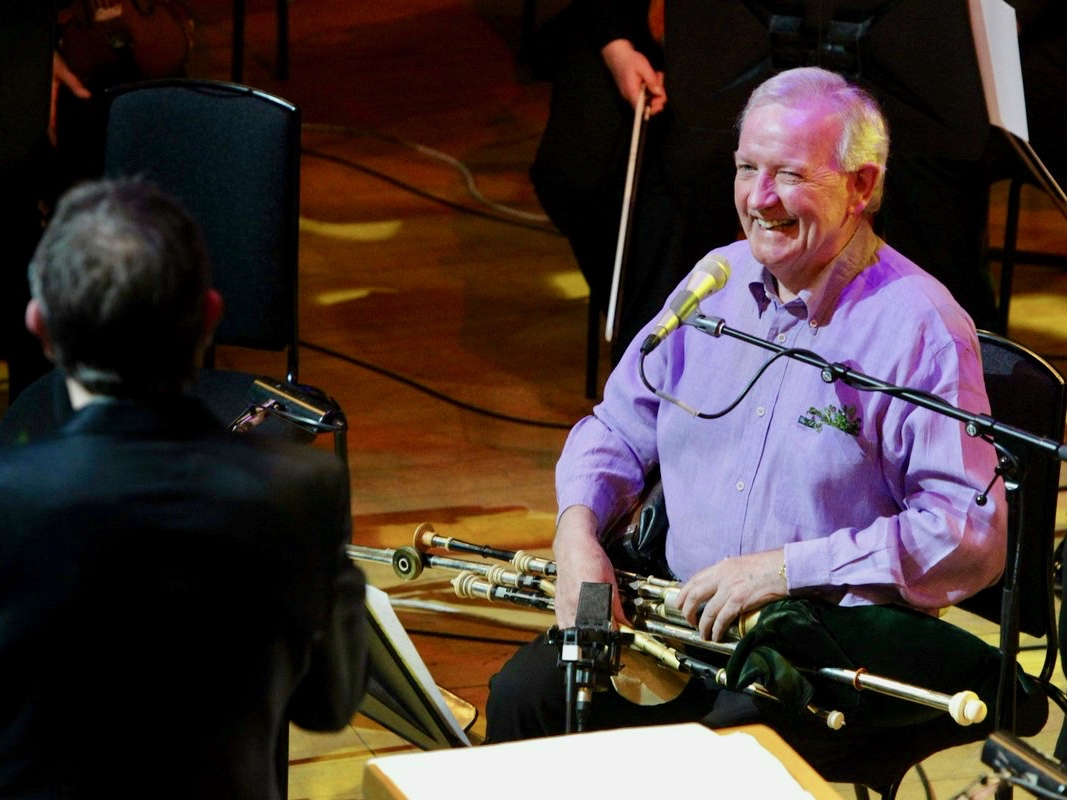
In March this year (2018) Liam O’Flynn passed away. He was a giant in Irish traditional music: a master of the Uilleann pipes – probably the most difficult instrument in the world to play – but also, surely, the most beautiful. We were fortunate to secure tickets for the Memorial Concert to Liam, held in Dublin’s National Concert Hall last Sunday. I would give anything to re-live that experience, as often as possible. We were overwhelmed by the insights which were presented by musicians who had worked with him – and dumbstruck by the astonishing and inspiring performance which took up the second half of the concert: The Brendan Voyage, composed in 1980 by Shaun Davey for the pipes and full orchestra, and written for – and with the collaboration of – Liam O’Flynn. In all, a most fitting tribute to a Maestro – pictured above in 2015 with the RTE Symphony Orchestra (courtesy RTE).
For anyone unfamiliar with this piece of music, here is the second movement – The Brendan Theme – from a live performance in Cork City Hall. It’s a good introduction to the (then) novel concept of combining the sounds of pipes and orchestra: the full suite (42 minutes) is available to stream, download, or as a CD. It’s a work with memorable tunes and expansive orchestration: it could only have been written in the twentieth century, yet it is thoroughly approachable and is sure to bring any audience to its feet at the end. As a former tuned percussionist, I envied the rousing finales given to the timpani and cymbal section!
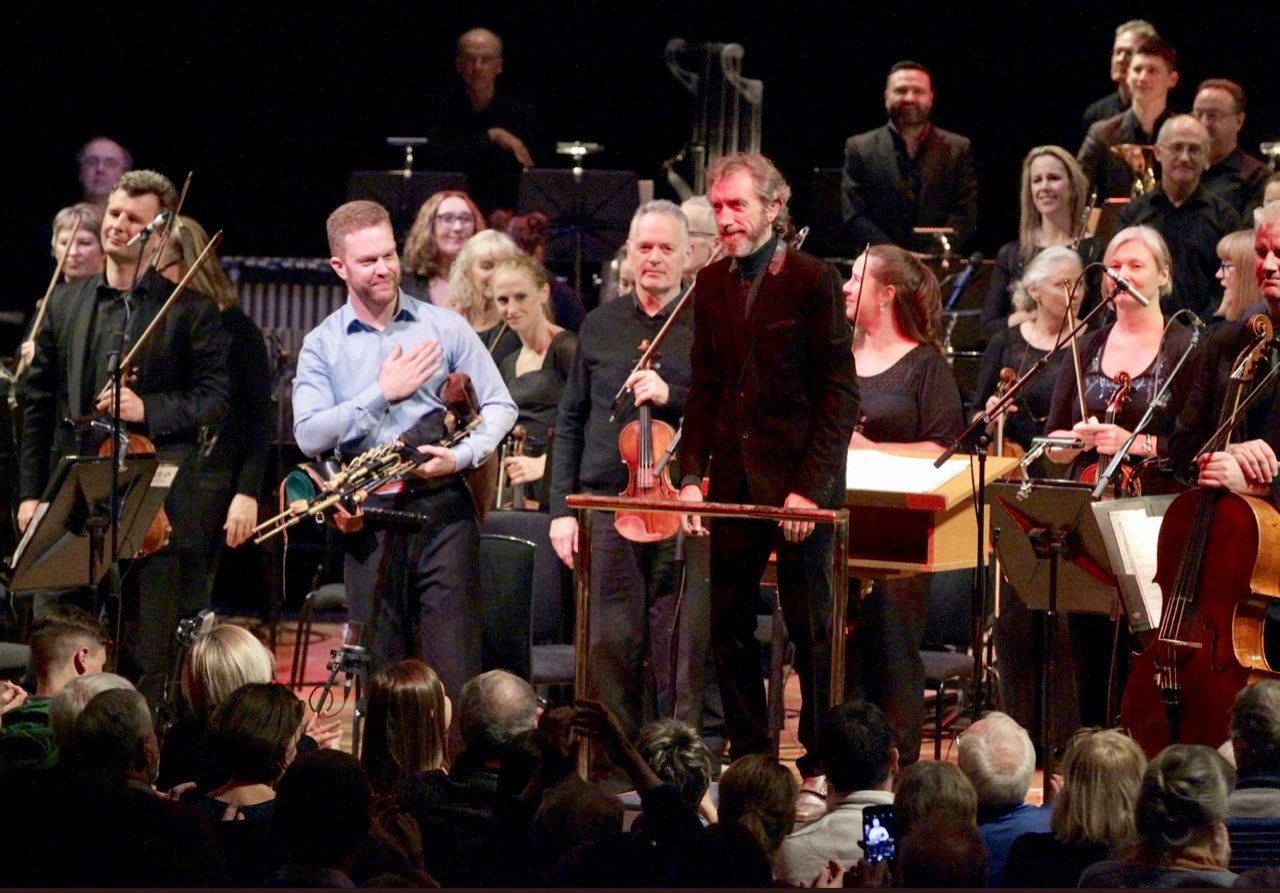
You can’t beat the atmosphere of a sold-out live performance in a full-sized concert hall such as this one in Dublin. We were fortunate in being seated only a couple of metres back from – and with a full view of – the soloist who, for this occasion, was Mark Redmond, a young piper from Gorey who has already established his reputation as a top-class musician. It would be hard for anyone to have to follow in the footsteps of Liam O’Flynn, but the rapturous ovations given to Mark – and the fabulous RTE National Symphony Orchestra conducted with such panache by David Brophy – proved that the ancient tradition of Uilleann piping is being ably advanced by our upcoming generations. (Photo above of Mark, David and the Orchestra taking a bow last Sunday courtesy Mark Redmond via Twitter).
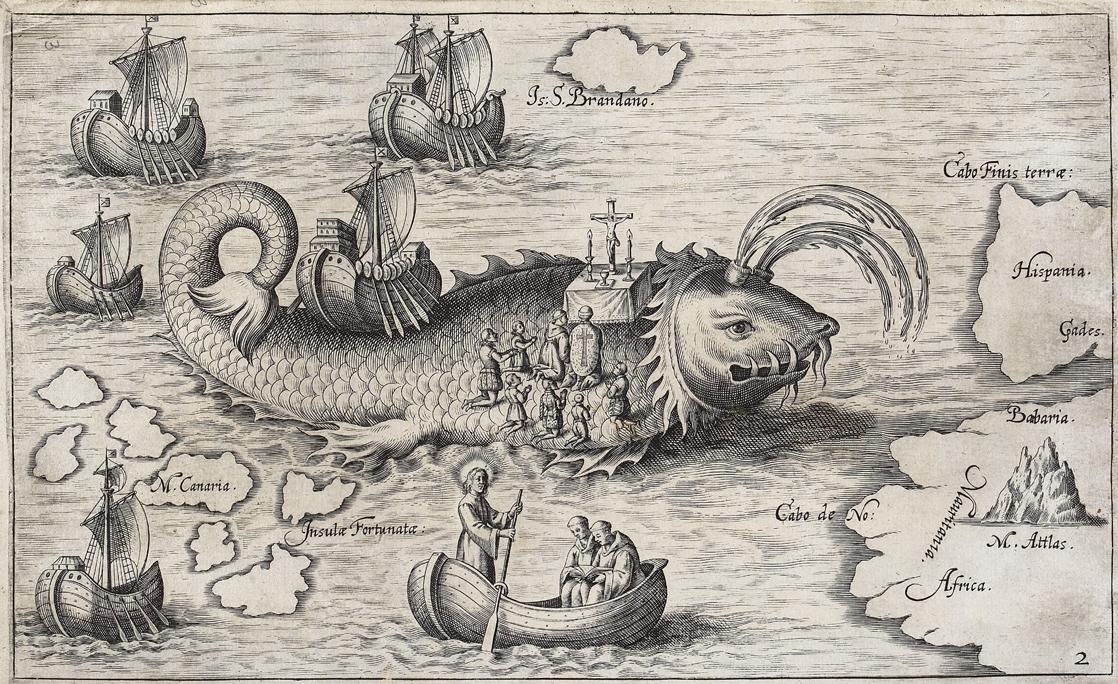
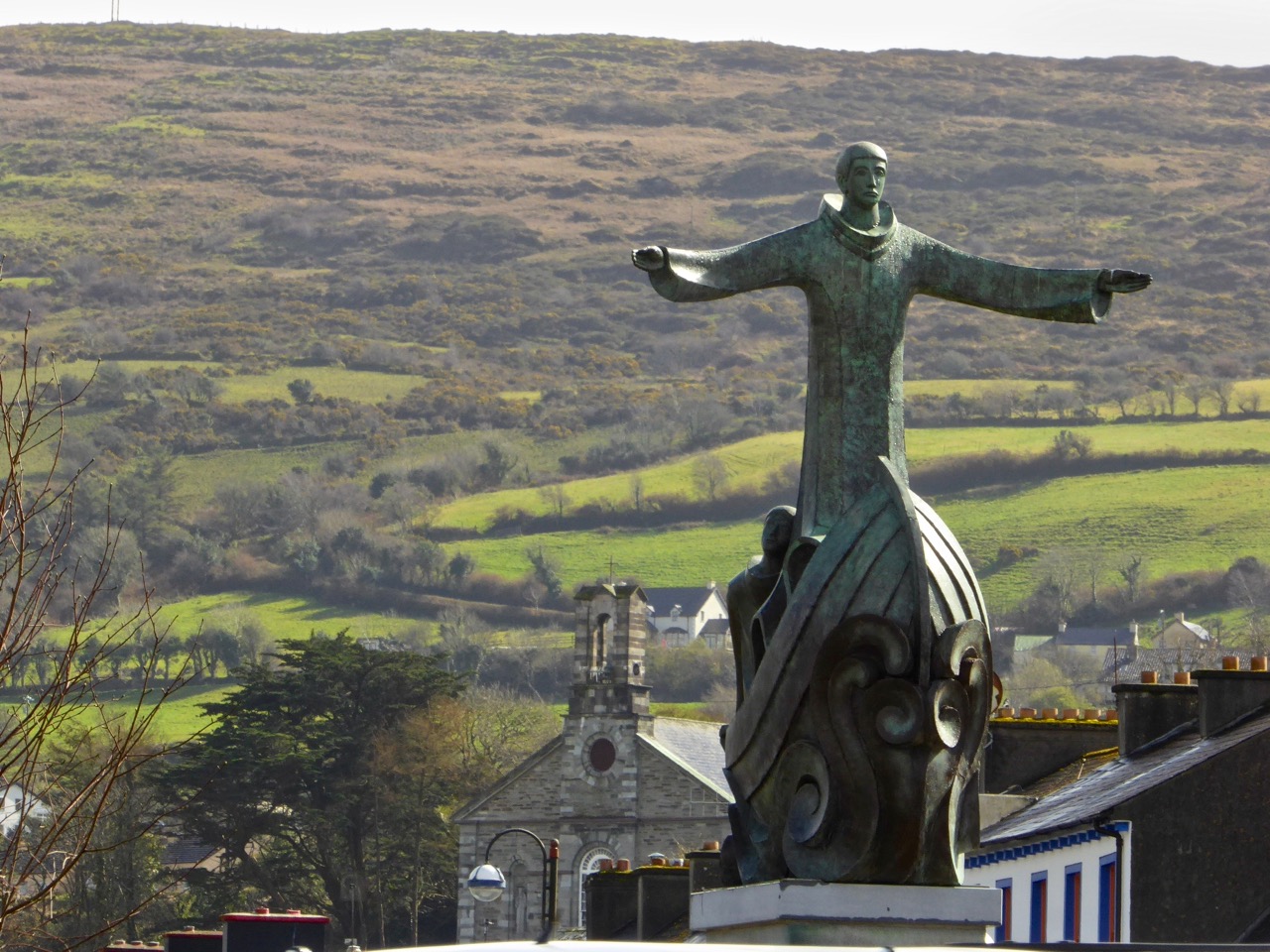
The piece of music is ‘a story within a story’ – it is inspired by Saint Brendan, born in Fenit, Kerry in AD 484 who, with a group of monks set off in the sixth century in search of The Blessed Isles (Paradise). Stories of their many adventures have been recorded and illustrated down the centuries – including the one above which shows the monks landing on an ‘island’ to celebrate mass: the island is actually a giant sea-monster named Jascon! Brendan and his companions crossed the Atlantic, arriving in what we today call Newfoundland – long before the exploits of Columbus. What’s more, they returned safely seven years later to tell the tale. Brendan The Navigator is buried outside the Cathedral of Clonfert, Co Galway, as we have noted in one of our previous posts. And here’s another post about him. But we must not forget that Brendan has West Cork connections too: an elegant modern statue of him is situated in Bantry, looking out over the Bay.
Shaun Davey’s composition, however, is more a response to a modern reconstruction of Saint Brendan’s travels, rather than the original stories. In 1976, explorer, historian and writer Tim Severin set out to test the historical truth behind the stories of Brendan, and built a replica of Brendan’s currach. According to Wikipedia . . . using traditional tools and methods, the 11m, two-masted boat was constructed from Irish ash and oak, hand-lashed together with nearly 3km of leather thong, wrapped with 49 traditionally tanned ox hides, and sealed with wool grease . . . Severin and his crew set sail from Fenit, Co Kerry, and reached the coast of Labrador a year later. Severin’s book describing the expedition, The Brendan Voyage, became an international best seller. Shaun Davey based his music on Severin’s accounts of the journey, and the Uilleann pipes are given the part of the boat itself – both boat and instrument rely heavily on leather. The Irish word Uilleann means ‘elbow’ and the driving force of the instrument is a leather bag which is kept under pressure using one elbow, and is fed from a bellows on the other; the hands and wrists are kept fully occupied playing chanter, drones and regulators. When I listen to this music, my ears hear the water flowing under the leather hull of Severin’s (and Brendan’s) fragile craft. Here’s a good example: the movement titled Water Under the Keel – describing the journey through the Minch channel between the Outer Hebrides and the west coast of Scotland:
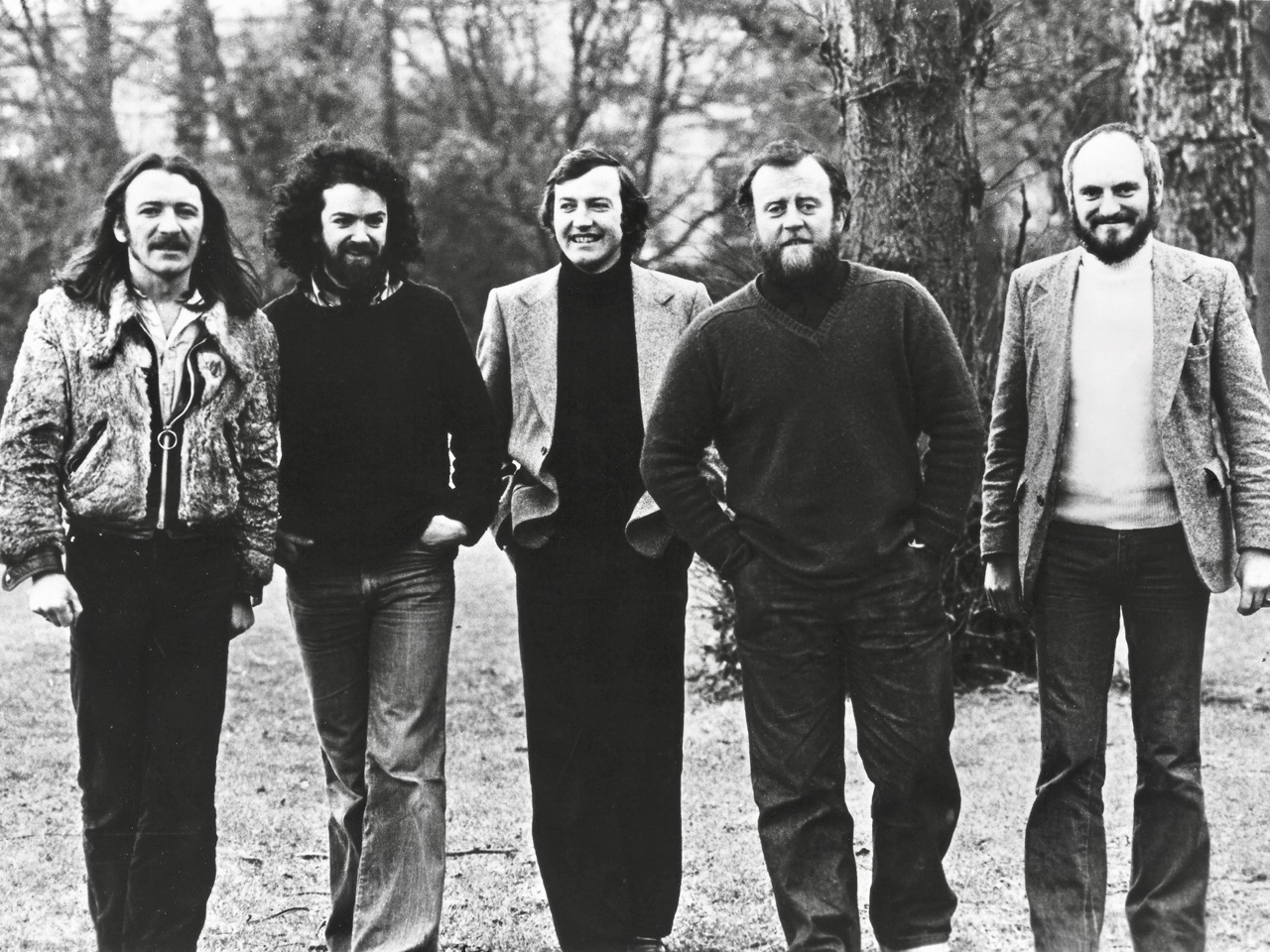
In 1972, Liam O’Flynn joined with Christy Moore, Dónal Lunny and Andy Irvine to found a seminal Irish traditional group – Planxty. Incarnations of that group – with additional players – have travelled the well-worn roads over the years, and on Sunday the remaining three original members, together with Matt Molloy, played for us – and brought on waves of nostalgia. The photo from the 70s, below (courtesy of Tara Music), shows them together: Liam O’Flynn is in the centre. Underneath is some footage from Planxty in their prime.
We were treated to other reminders of Liam’s achievements, including a performance of music he was commissioned to write for the inauguration of the Republic of Ireland’s 8th President, Mary McAleese on 11 November 1997. Here’s An Droichead (The Bridge) with Liam and guitarist Mark Knopfler: McAleese stated that the theme of her Presidency was ‘Building Bridges’.
It’s impossible to put into words the level of exhilaration we felt throughout the memorial concert last weekend. I hope that, at the very least, I may today have sparked some interest in the music of the Maestro, Liam O’Flynn (for those not already in the know) – and in the thrill of Shaun Davey’s mighty concert piece The Brendan Voyage. Here’s a last extract from that work, with Mark Redmond playing. It’s part of the climactic movement ‘Labrador’ – the pipes bring in a variation of the main theme to celebrate the boat’s arrival in the New World and the end of the voyage.
When I leave this world behind me
To another I will go
If there are no pipes in heaven
I’ll be going down below
If friends in time be severed
Someday we will meet again
I’ll return to leave you never
Be a piper to the end
This has been a day to die for
Now the day has almost gone
Up above a choir of seabirds
Turns to face the setting sun
Now the evening dawn is calling
And all the hills are burning red
And before the night comes falling
Clouds are lined with golden thread
We watched the fires together
Shared our quarters for a while
Walked the dusty roads together
Came so many miles
This has been a day to die on
Now the day is almost done
Here the pipes will lay beside me
Silent will the battle drum
If friends in time be severed
Someday here we will meet again
I return to leave you never
Be a piper to the end
(Piper to the End – a song by Mark Knopfler)
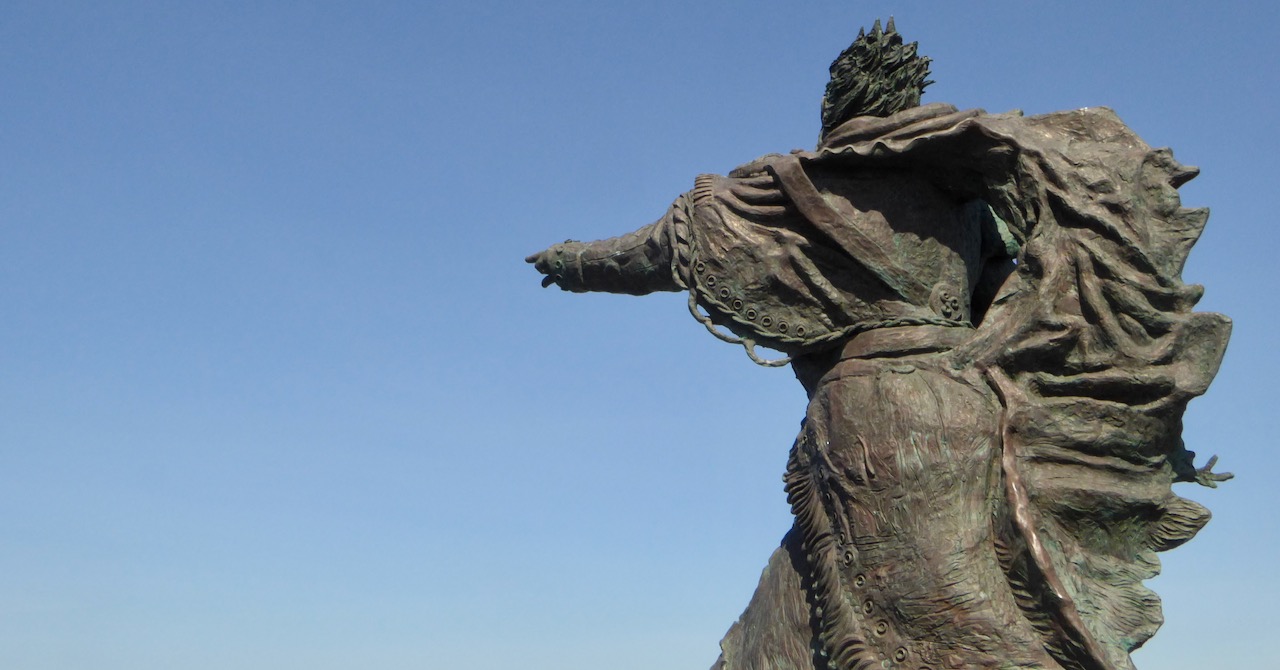
Lastly, Saint Brendan the Navigator is celebrated in his birthplace of Fenit, Co Kerry where he looks out eternally over the ocean which he and his companions conquered in their small, hide covered curragh.



 Roaringwater Journal