Back in May I put up a post celebrating our discovery of documentary artist Simon Coleman. There is plenty of material from Coleman that I didn’t use. Today, I’m showcasing more of his work: it’s invaluable to Irish folklore and folklife researchers. We have to be forever grateful to The Dúchas Collections, and their field-workers who spent so much time scouring the rural landscapes of Ireland and its inhabitants, and recording their findings in detail, preserving the rich memories of those times for our benefit.
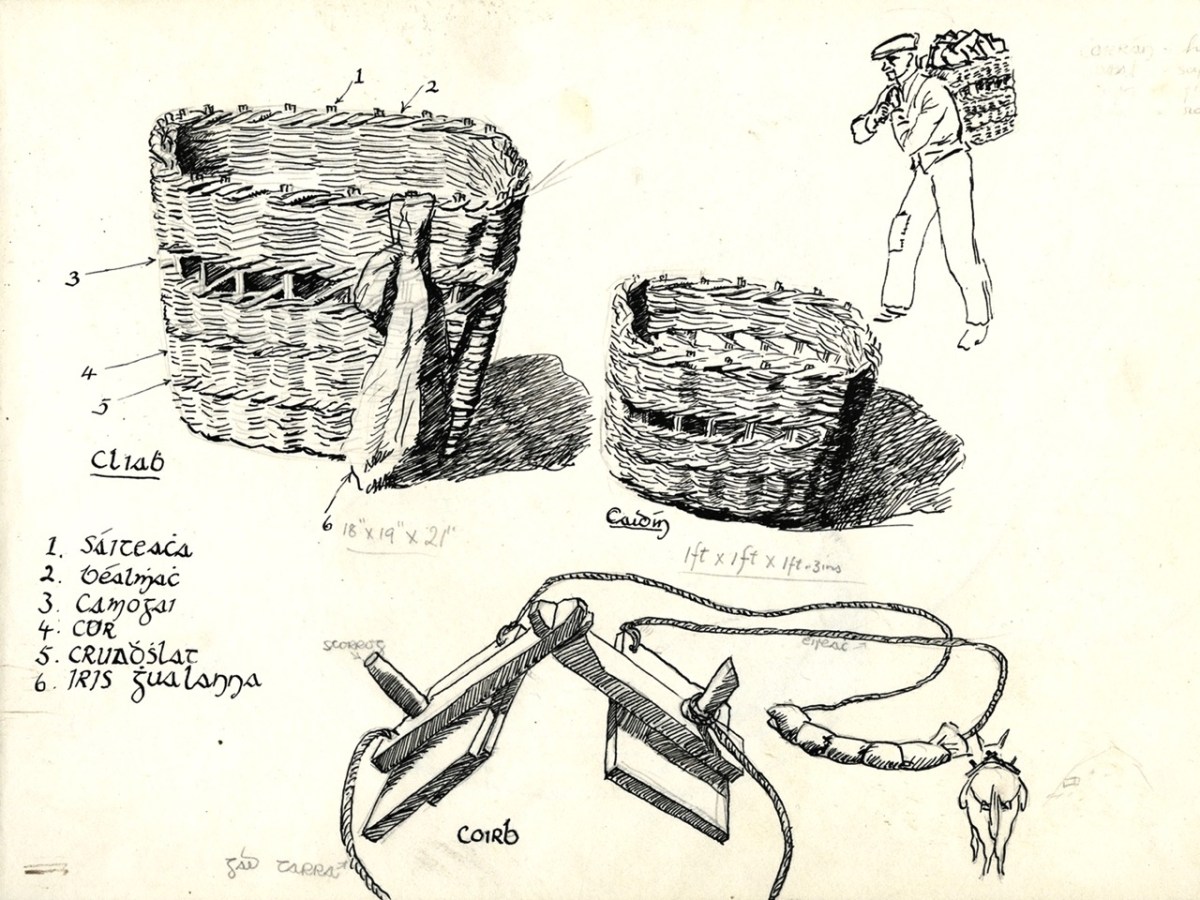
The header shows one of Coleman’s attractive watercolours which record the landscapes he traversed during his folklife researches. His sketch-pads, however, are filled with drawn details showing the basics of rural life, such as this one (above) recording baskets which were carried on the back or which were made as panniers for donkeys, mules and horses. Such methodical records are invaluable to our understanding of the paraphernalia of ordinary life, now virtually vanished. More technology for lifting and carrying loads is shown below.
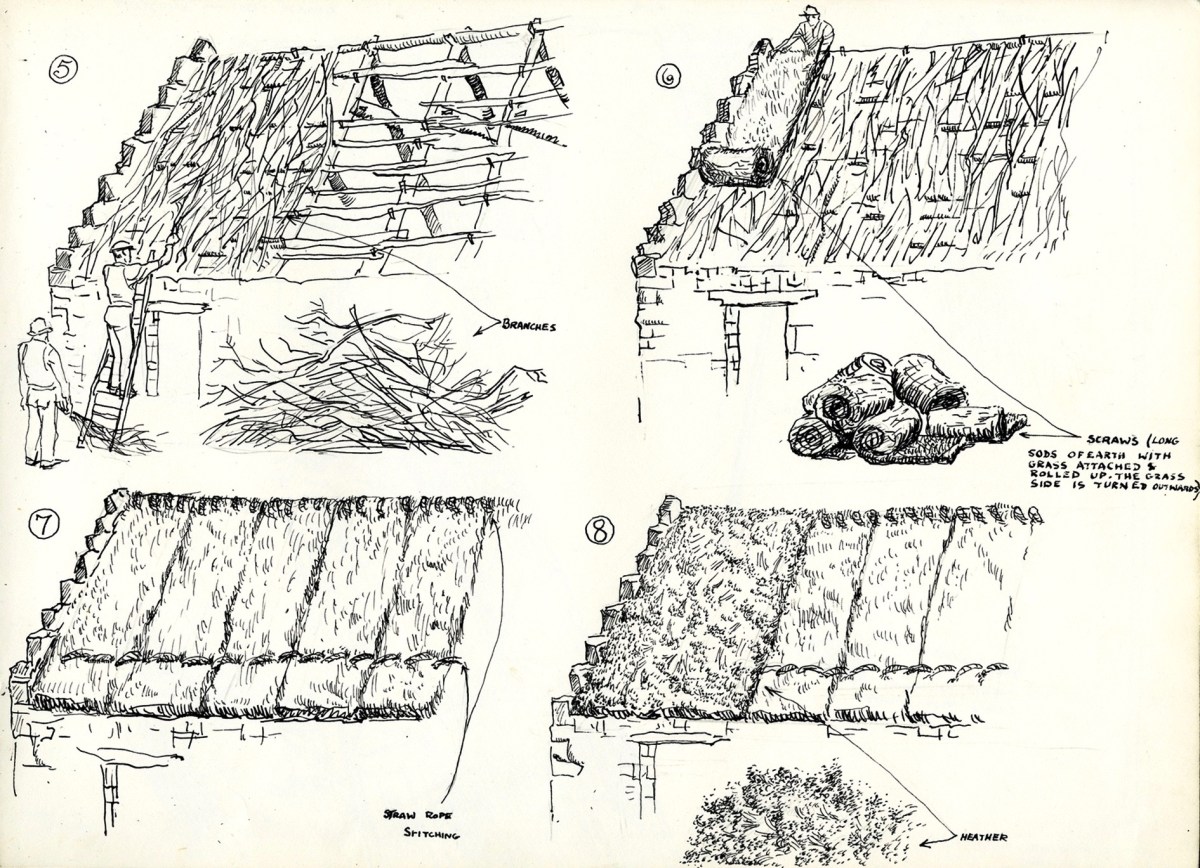
The drawing above shows in typically fine detail the process of ‘turfing’ a roof using clods of earth with grass attached. the grass is on the outer surface. Also shown is the use of ‘ling’ – or heather – as a roof covering.
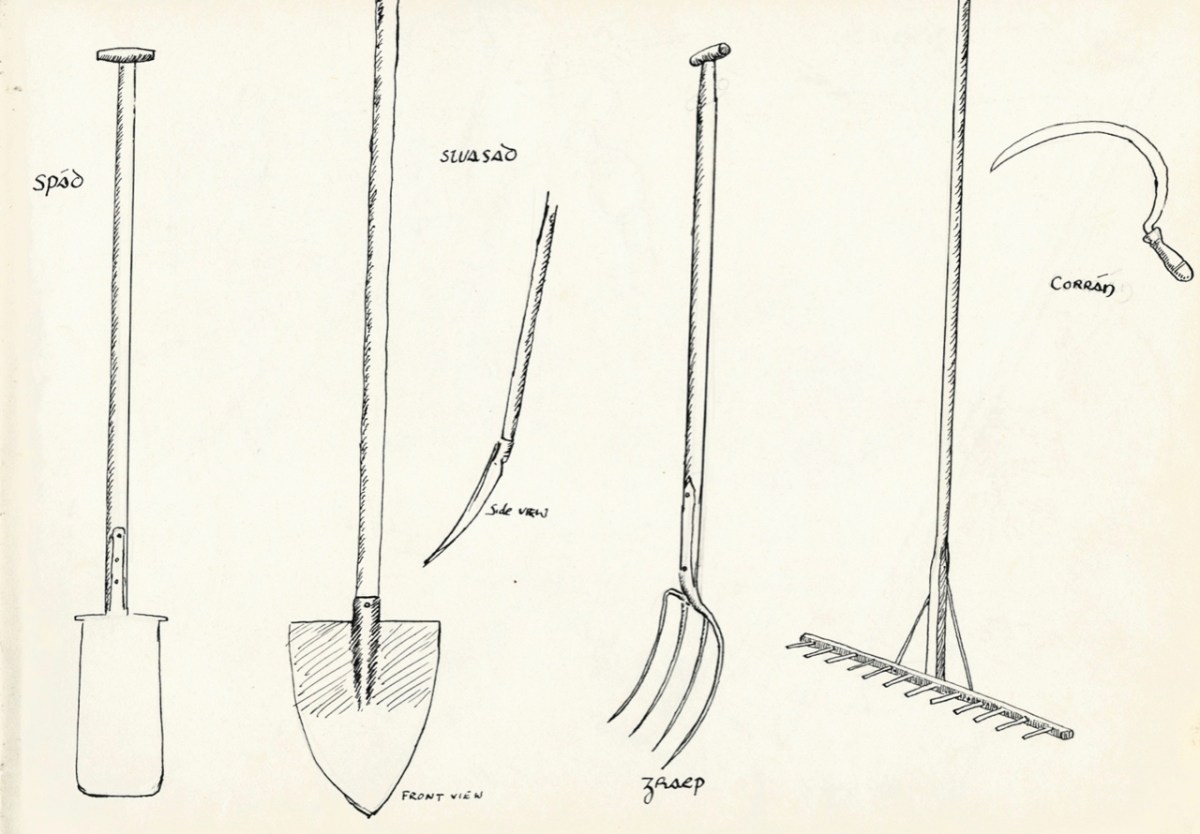
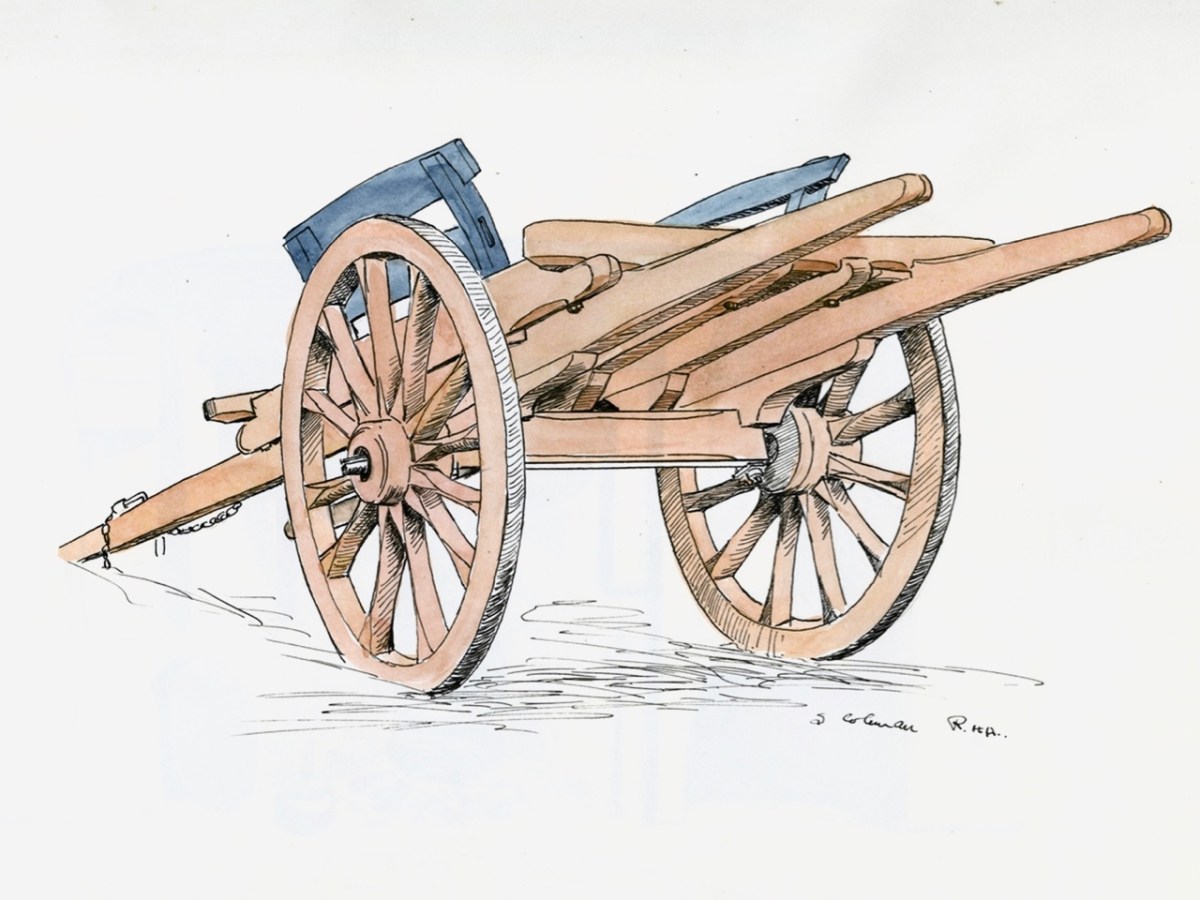
Straightforward hand implements used on farms (upper) are complemented by very fine watercolour sketches, such as the one above, recording the wagon – an essential element of life in the country.
Coleman was also an accomplished painter, as is evidenced by this portrait in oils of Anna Nic A’Luain, one of the most gifted storytellers encountered by the renowned Donegal folklore collector, Seán Ó Heochaidh. Anna was from Croaghubbrid, in the Blue Stack Mountains, Co Donegal, and lived from 1884 to 1953. The painting dates to 1949.
Cois Fharraige, above, another work in oils by Coleman.
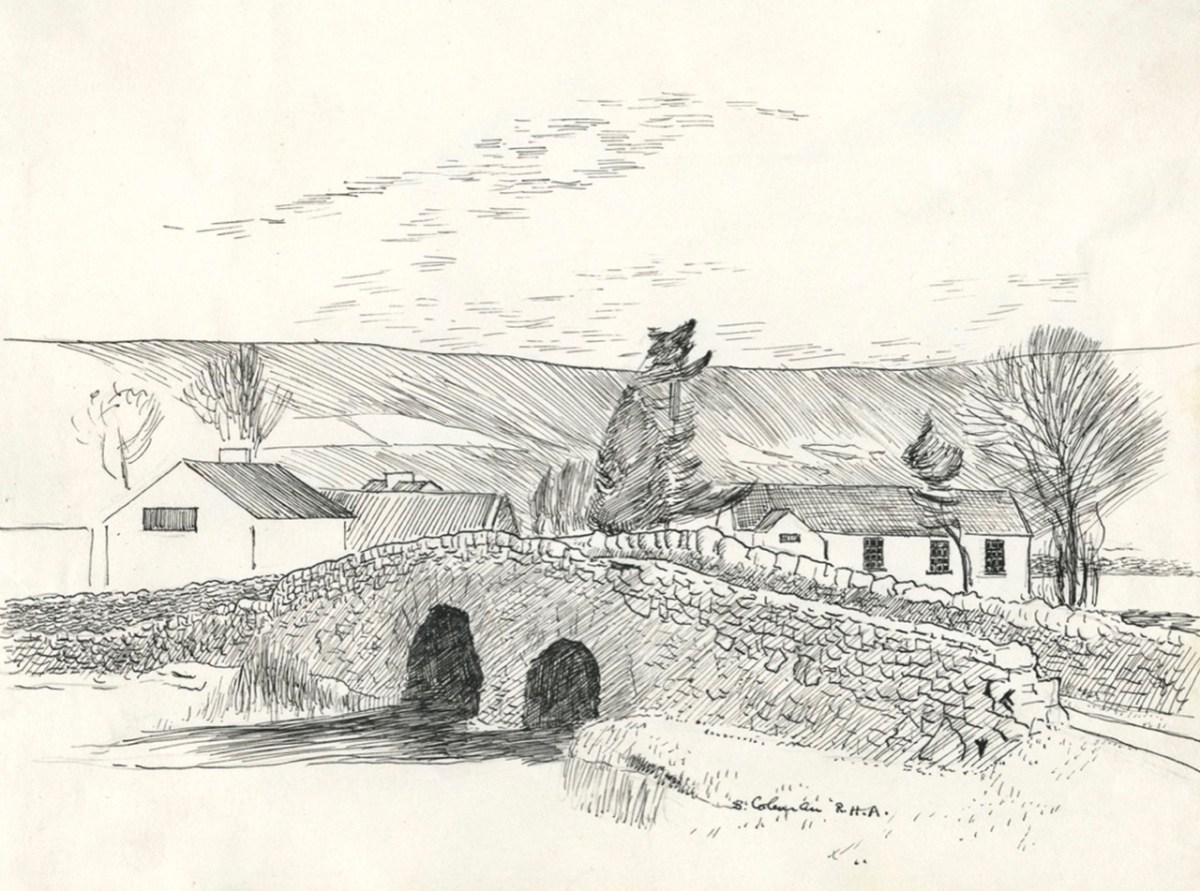
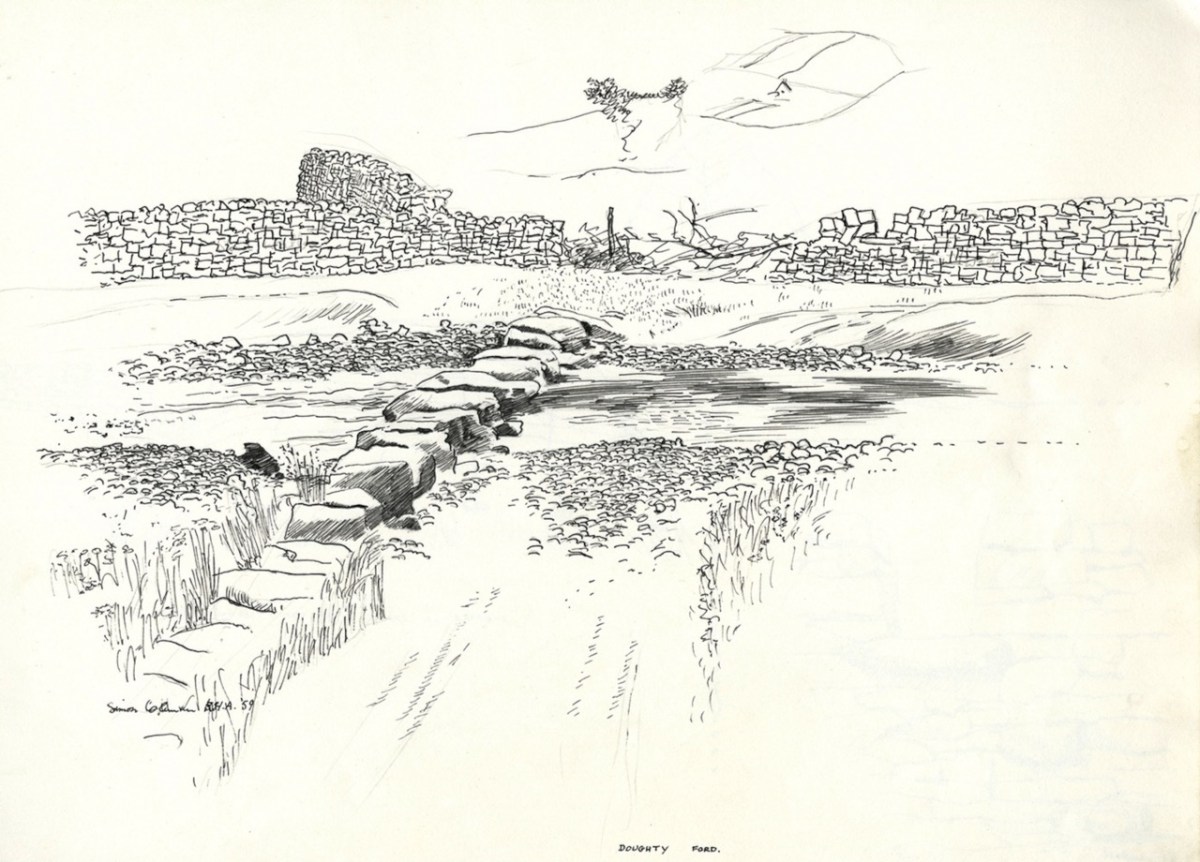
Doolin, Co Clare – Old stone bridge, Lough Agraffard, 1959 – Doughty Ford: all from Coleman’s sketch books. A valuable record stored in the Folklore Commission Archives. Slightly unusual, perhaps, is this house (below) which Coleman sketched in Galway city.
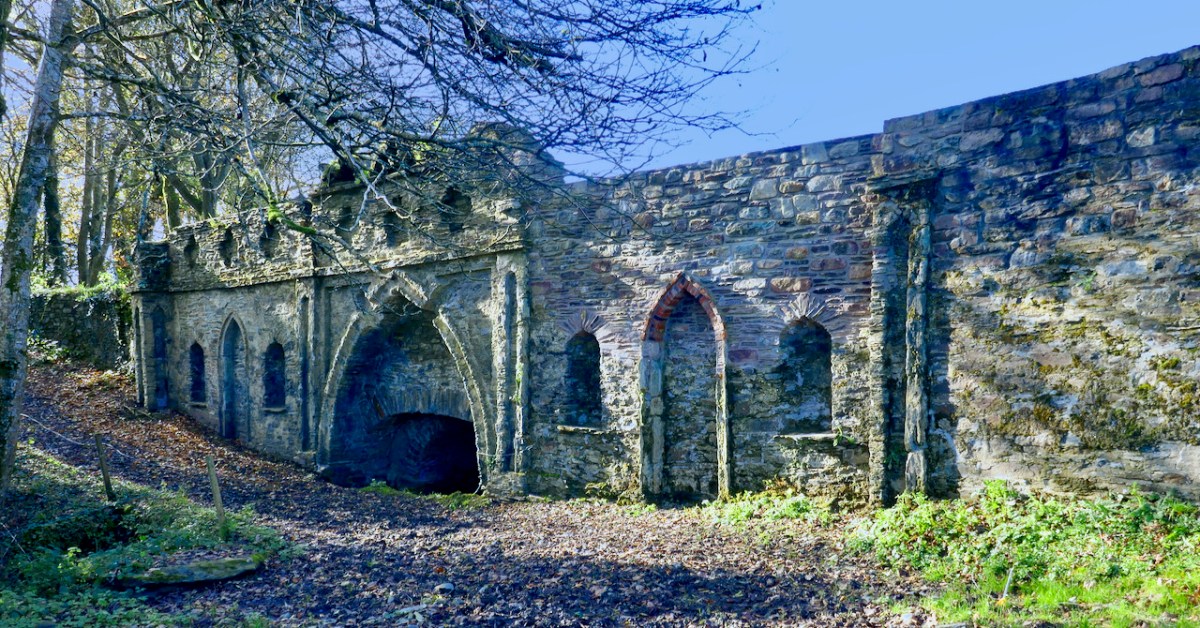
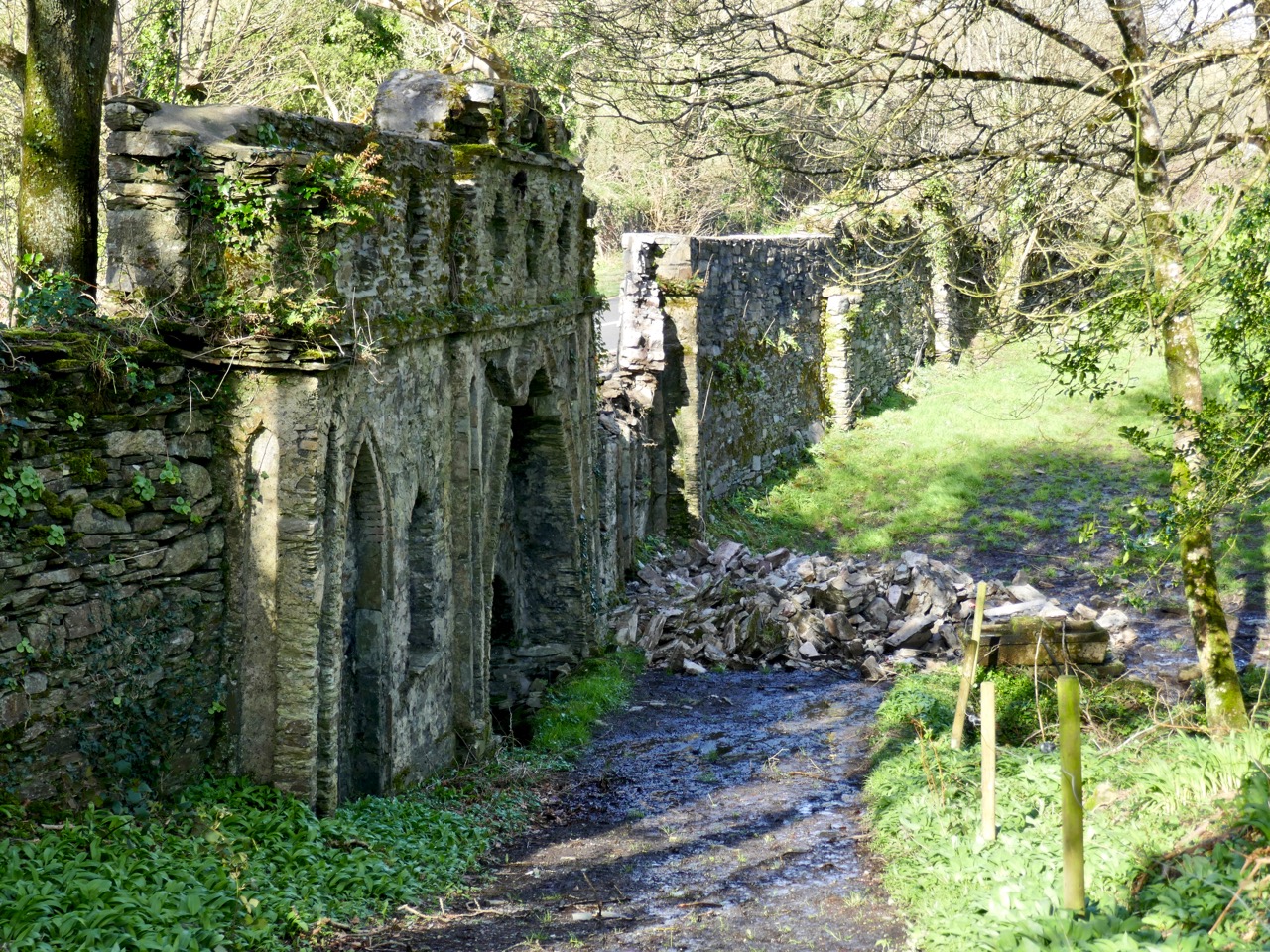
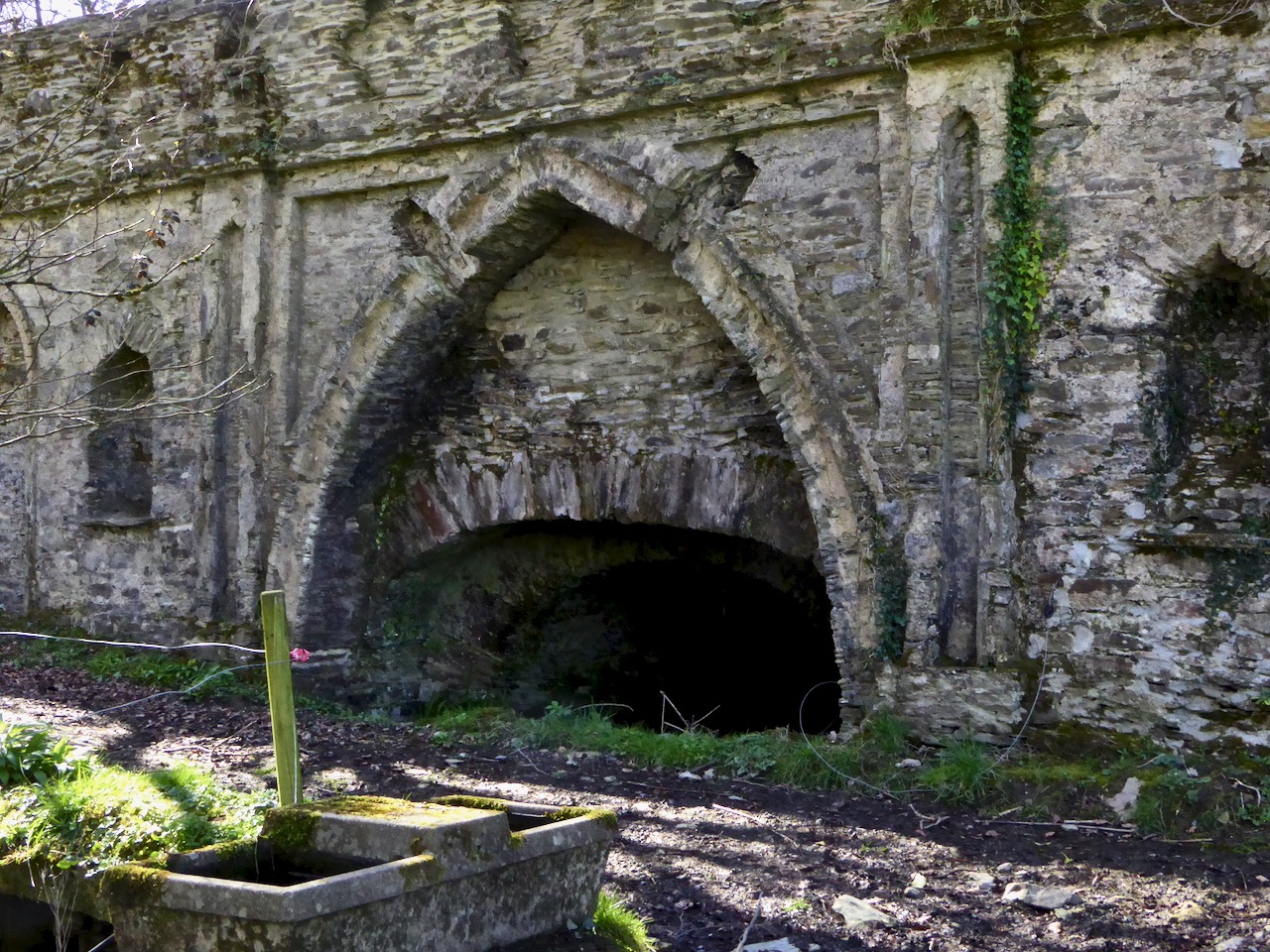
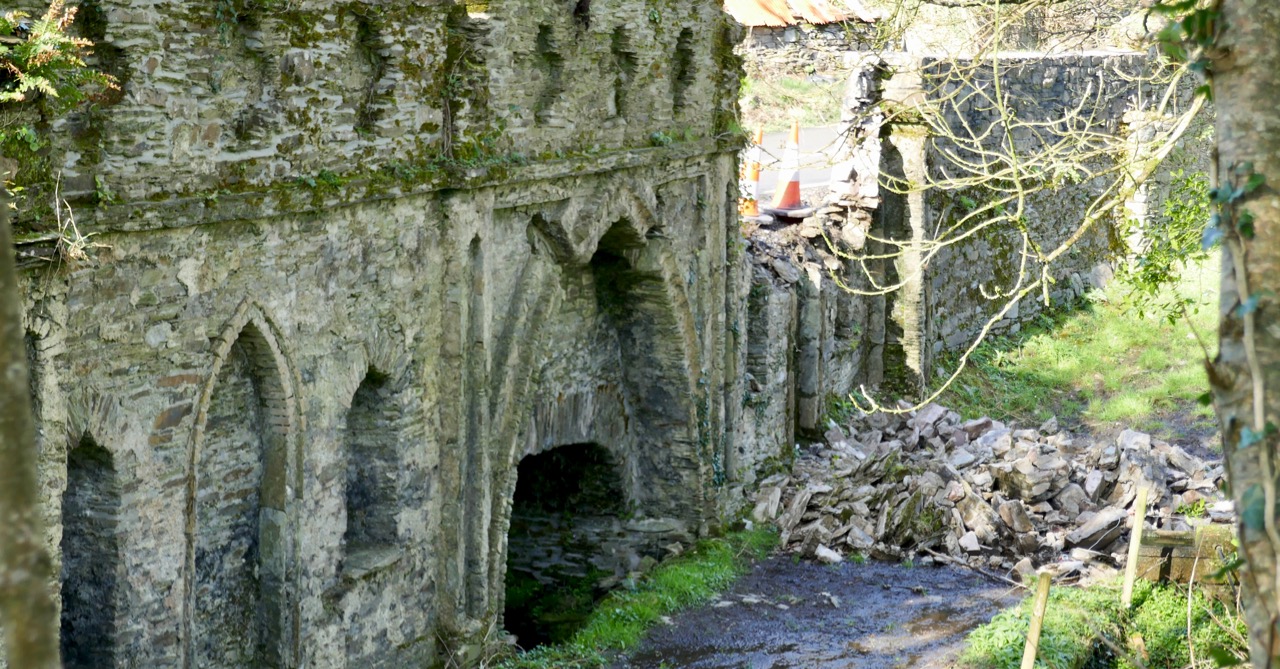
In 2019 I reported on the damage to the New Court Bridge and discussed why that was serious – the curious wall that we pass so often turned out to be a unique and important remnant of an eighteenth century designed landscape. The Good News is that the damage has been repaired, excellently, by Cork Co Council – this is what it looks like now (above).
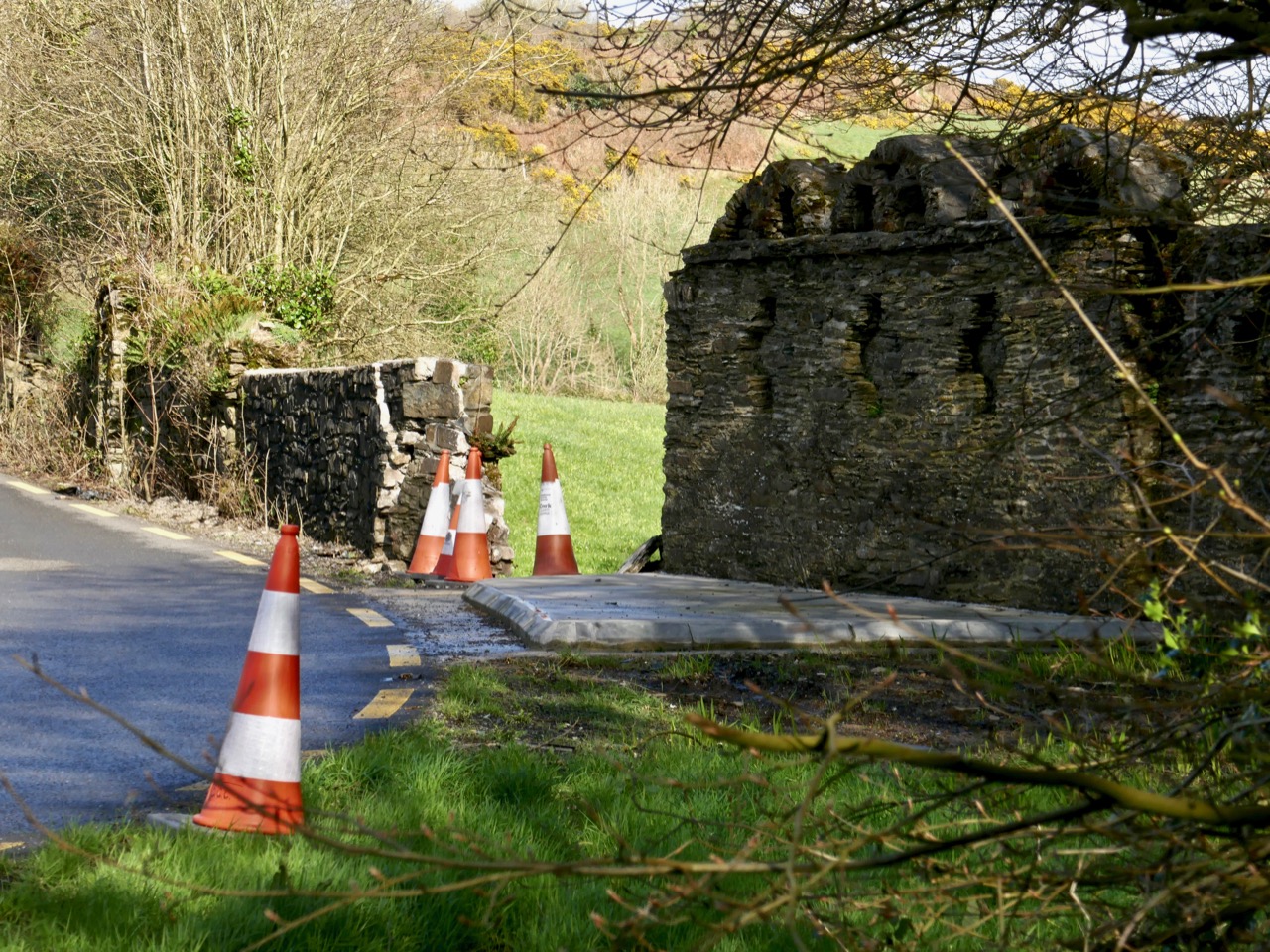
This (below) is what it looked like in 2019. What follows is what I wrote then. T(he repair work was done in 2020 and I have been meaning to update the post since.)
New Court Bridge has been badly damaged recently. Why does that matter?
The damage from behind the wall. Now you can see that this is a bridge – but a most unusual one!
Most people driving by this dangerous bend, where the Ilen River meets the N71 just west of Skibbereen, notice the funny arches on top of the wall, but don’t think twice about them. It’s too risky to stop and take a close look, after all. Most people, in fact, probably don’t realise that they are driving over a bridge, although that’s a bit more obvious now as the County Council have put in one of those concrete pads that are going in front of all bridge walls at the moment (see lead photograph).
Water under the bridge
Does anyone know how the damage happened? Did a car take the bend too fast and hit the wall? Did the concrete work loosen the structure of the wall? Let us know if you have information. I hope nobody was hurt. All I know is that one morning I was driving into Skibbereen and there was a chunk of the wall – gone! [EDIT: Apparently a young and inexperienced driver took the bend too fast and hit the wall. He was not badly hurt, thank goodness.]
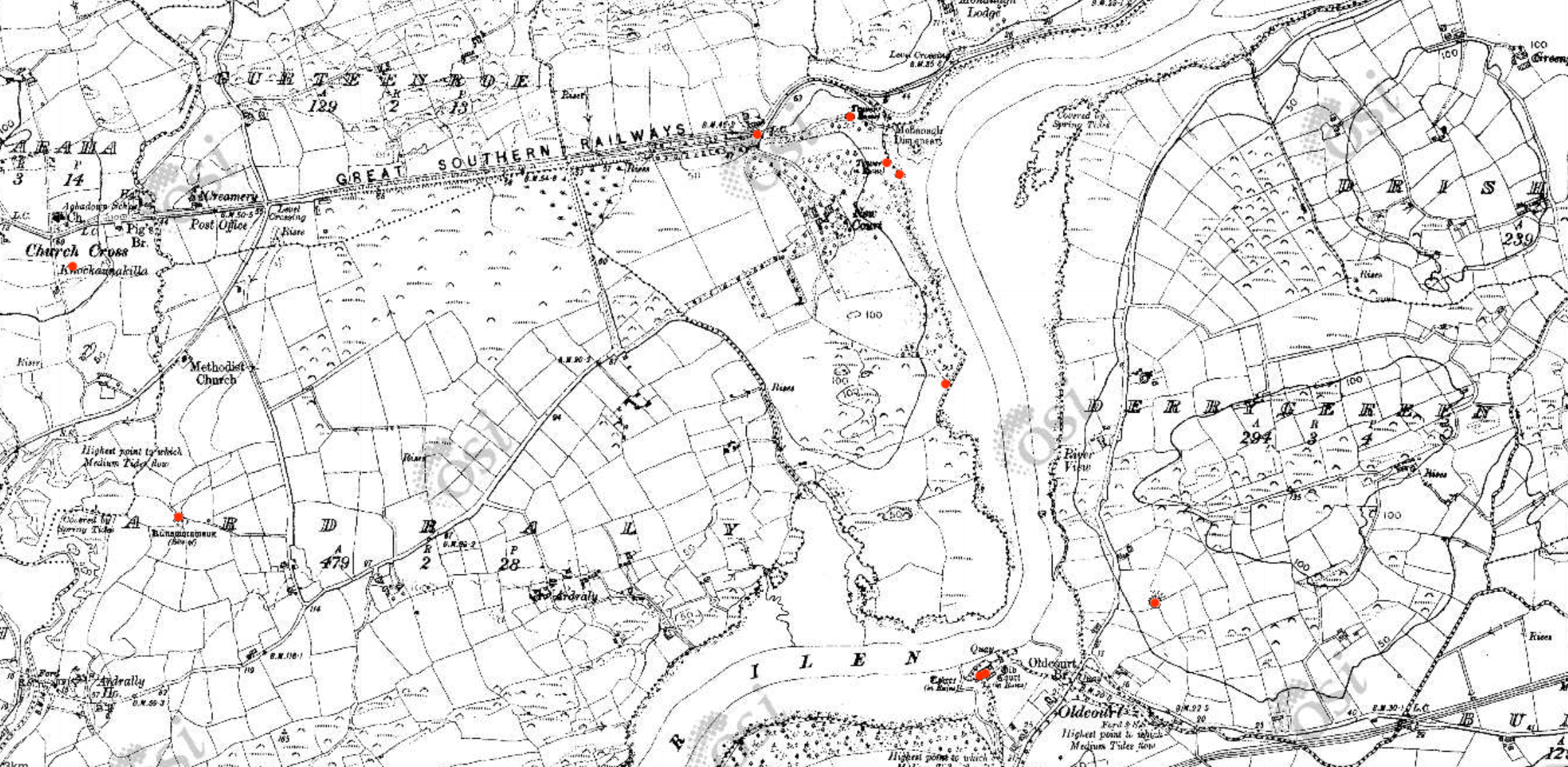
Early Ordnance Survey map of the New Court Estate, bounded by the Ilen River on the east and south. The red dots indicate the locations of the belvederes (marked as towers) and the bridge
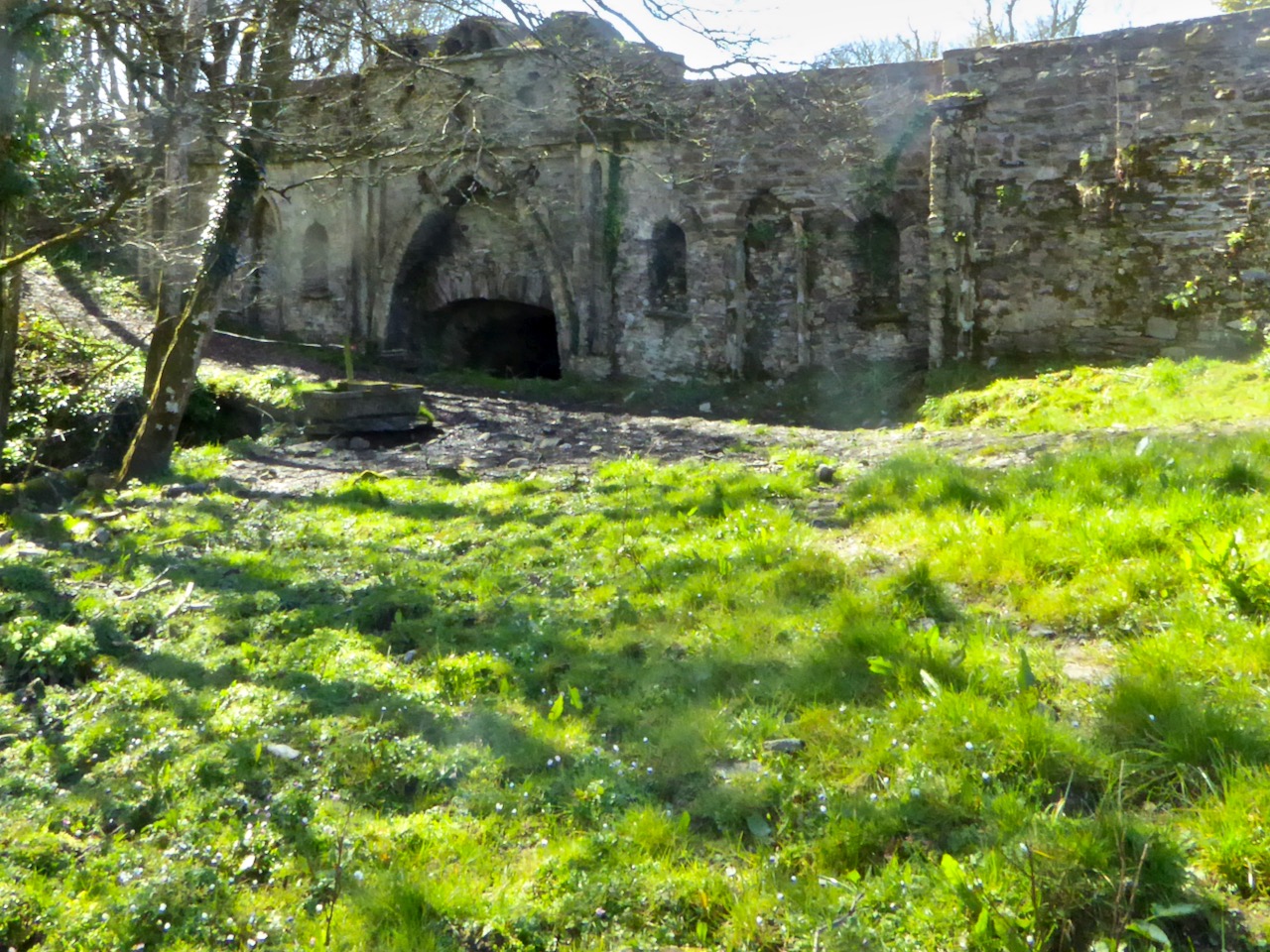
We tend in Ireland to think of old estate walls like this one as ‘Famine Walls’, erected during the mid nineteenth century as work projects. But this wall was far older than that, and it hid a secret – an elaborate facade on the back with decorative arches and niches. It was part of the plan for a pleasure garden undertaken by Henry Tonson at his newly acquired ‘seat’ which he called New Court, to distinguish it from Old Court, across the river. Originally, there was a matching wall across the road, but it was demolished in a truck accident many years ago. EDIT: I misinterpreted this – rather than a matching wall across the road, in fact there were matching arches on either side of the road, west of the entry to New Court. Both are now gone, one at least due to the aforementioned truck accident. Thanks to Sean Norris for this information.
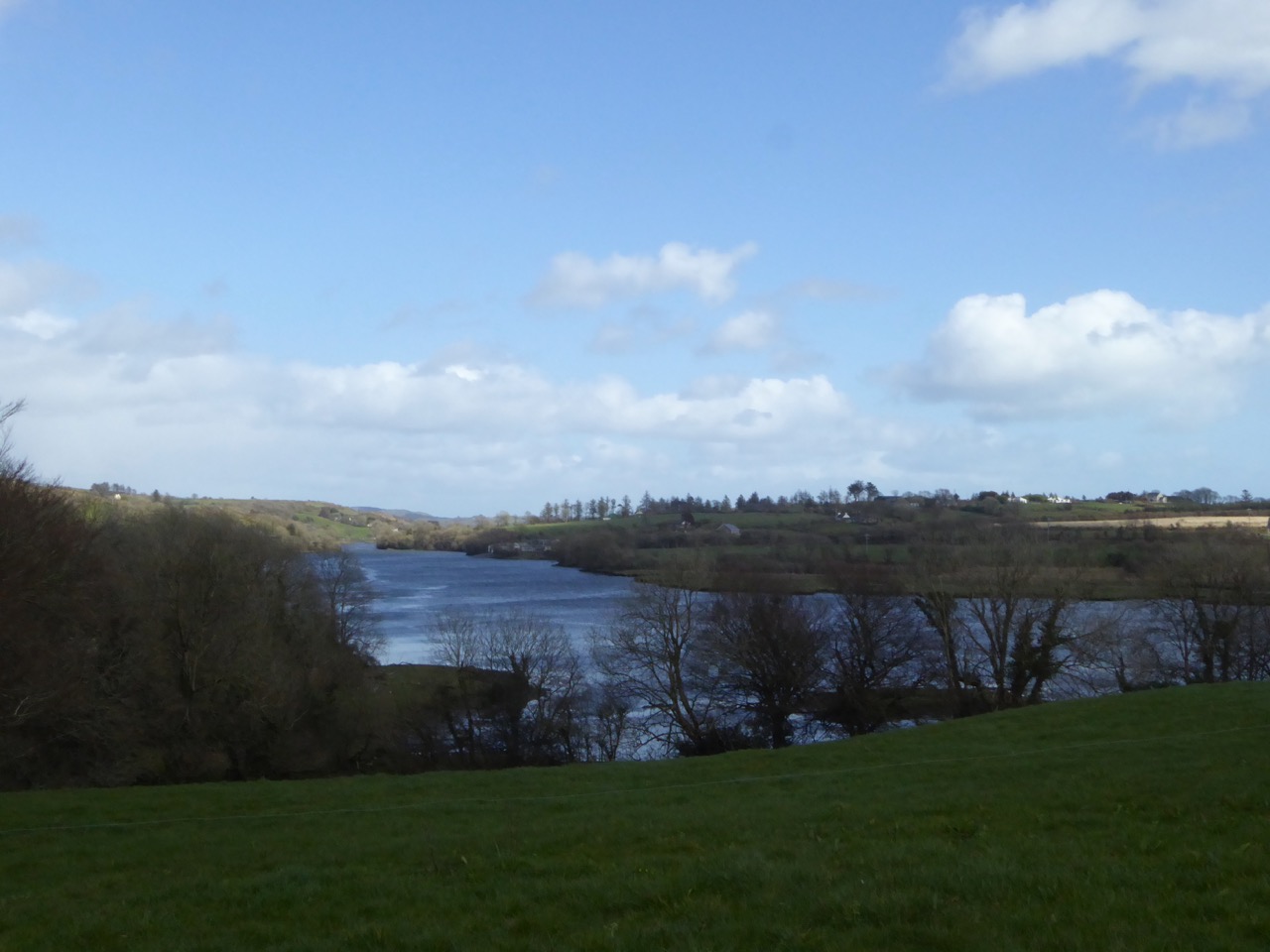
The Ilen floats by – a navigable river was a must for transporation to and from these early estates
The Tonsons had arrived in the 1660s. According to Burke’s Peerage, Major Richard Tonson received a grant of land in the county of Cork from Charles II for his distinguished exertions in favour of royalty during the Civil Wars and purchased the castle and lands of Spanish Island, in the same county. If he built anything on Spanish Island, just off Baltimore, no traces remain, and indeed, although strategic in marine terms at that time, it is hard to imagine how the island, mostly bare rock, would have made for comfortable accommodation.
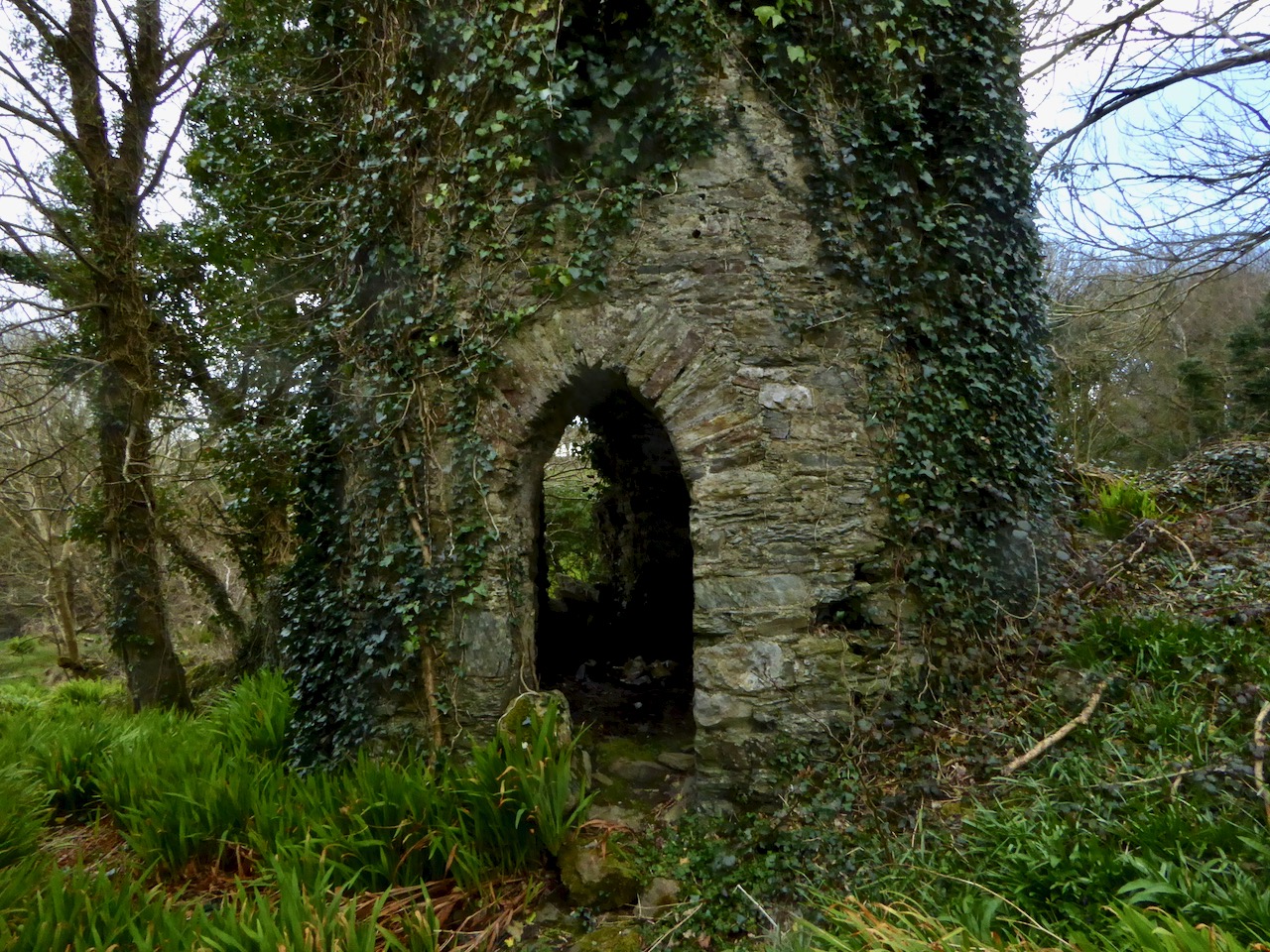
The stump of one of the belvederes, overlooking the river
It appears he, or his son, Henry, bought the land on the west bank of the Ilen and Henry set about establishing his dwelling there. This included building the wall around the estate. Eventually, and we are not sure when, one of the Tonsons (over time they acquired a title, Lord Riversdale) developed the area around the house as a vast pleasure garden.
The most complete belvedere. This one also functioned as a dovecote
. . . a different style of landscaping. . . dominated garden design in Britain, pioneered by William Kent and Charles Bridgeman and reaching its peak in the work of Lancelot ‘Capability’ Brown. The effect they strove for was naturalistic (as opposed to natural) – a planned layout that mirrored but enhanced their idea of a ‘wild’ and romantic landscape. Large expanses of grass, strategically placed lakes and ponds, plantings of carefully chosen tree and shrub species, and clever little structures such as temples, summer houses and belvederes all combined to delight the eye, create a romantic mood and, of course, attest to the taste and wealth of the owner.
A closer look at the construction of the bridge. It would be fascinating to attempt a reconstruction drawing. The niches may well have held statuary or decorative urns
Although the grand houses at the centre of the estate have now gone (see this photograph in the National Library for a glimpse of the last one), there is lots of evidence still of such a designed landscape. Originally lawns sloped to the river – no need to build artificial ponds as the Ilen provided the perfect watery scene. Little round towers were built to be used as gazebos or belvederes (and in one case a dovecote): three in all, of which the stump of one and a fairly complete second are still to be seen. The bridge with its elaborate facing was the crowning glory of the estate wall.
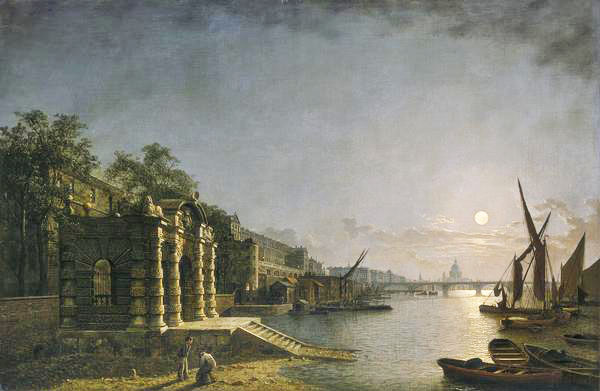
The York House Water Gate as it would have looked originally on the Thames (Wiki Commons)
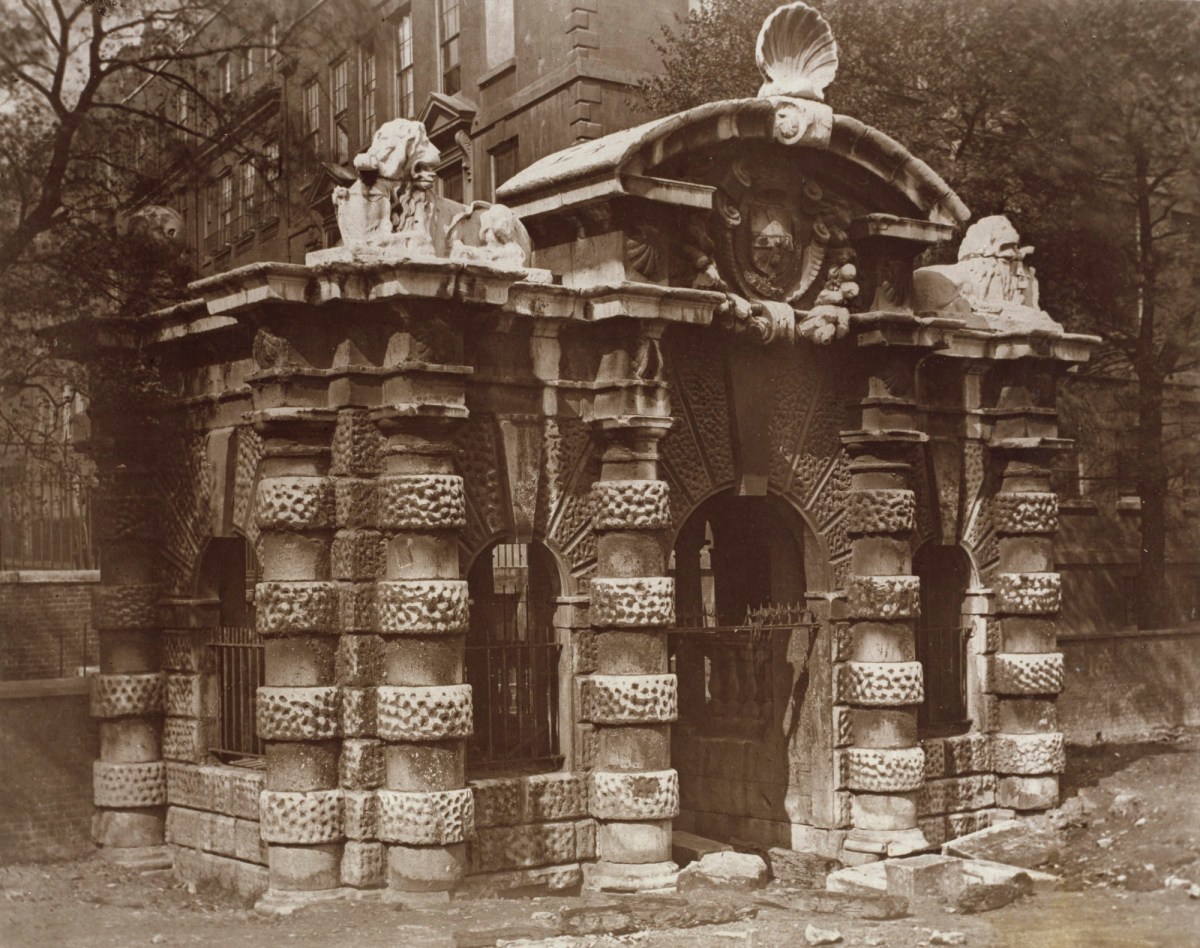
What did the bridge wall look like originally? We don’t know, but Peter Somerville-Large in his Coast of West Cork says it was modelled on the ‘water gates at Hampton Court’. I can’t find any images of this online, but I have found the water gate at York House, which is still there. It was built as a ceremonial landing place on the Thames (above) although it is now a long way from the river.
The York House Water Gate in an early photograph (www.royalacademy.org.uk/art-artists/work-of-art/O18442 Credit, Royal Academy of Arts / Photographer William Strudwick )
Of course, it is larger and more elaborate, but you can still see the basic shape, with its curved arch on top and the arched niches in the wall. The arches at New Court may have been plastered, perhaps, or faced with some material. The York House Water Gate dates to 1626 and it’s all that left of the York House estate – the Tonsons may well have been familiar with it or with similar water gates along the Thames. Building such an edifice would have been aspirational, indicating a desire to impress.
This was what it looked like in 2016 – taken by a camera with spots on the lens
The likelihood, therefore, is that the bridge at New Court is most probably eighteenth century, and early eighteenth century at that – about three hundred years old. We don’t have a lot of structures in West Cork dating to then. Surely it’s worth preserving those that still exist? I am hopeful that the National Monuments Service (they’ve been alerted and have notified their Monument Protection Unit) will come riding to the rescue. I’ll be keeping an eye on it all – you do too. But note that this is private property, so no walking or driving through the gates without permission.
UPDATE, MARCH 20, 2019. This notice was received from the National Monuments Protection Unit: “Cork County Council (Bridge Management) have indicated it is prepared to repair the wall as a Reactive Maintenance Incident and will ensure repairs meet any necessary heritage requirements.”
I had the great pleasure recently of spending a day in a bog – and because the bog had dried out completely it was indeed a rattlin’ bog, complete with the twig on the branch and the branch on the log…
It was an amazing place – there were several different habitats – waste ground, heath, meadow, woodland, marsh and finally a bog – except there had been so little rain that the whole bog had dried up and we were able to walk all over it. I had volunteered to help out our friends Robin and Sue Lewando with a small plant study of a defined area, while Robin collected samples from the lake for his own research. Afterwards, we spent a happy hour wandering through the dried-up bog, exclaiming over plants you can’t normally get close to and taking photos. Several were new to me – I had never seen Bur-reed or Yellow-cress before, or Star Sedge.
The slideshow is an amalgam of shots from the whole day. Here is the complete plant list, in the order in which you see them in the slideshow:
First three sides - waste ground with Foxglove, Sheep’s Bit, Cat’s-ear, Clover
The Lake
Slides 6 to 10 Marsh Cinquefoil (10 is Sue photgraphing the Marsh Cinquefoil
11 Compact Rush (?)
12 Soft Rush
13 to 15 Common Valerian (with Grypocoris stysi/Mirid Bug - thanks to Margaret Manning for the ID)
16 and 17 Heath Spotted-orchid
18 and 19 Marsh Bedstraw
20 - 22 Marsh Yellow-cress
23-25 Water-plantain
26 Water Forget-me-not
27 and 28 Water Forget-me-not and Spike-rush
29 and 30 Branched Bur-reed
31 and 32 Beaked Sedge
33 and 34 Marsh Speedwell
35 Bogbean
36 Robin
37 Star Sedge
38 Labyrinth Spider
39 Marsh Thistle, 7-Spot Ladybird and Bumble Bee
Morton’s book – dating from December 1930 – deserves a further look as a view of Ireland from an English perspective back in the early part of the last century (here’s the first part of this review). What was going on, historically, in the young Free State at that time? Firstly, I was surprised to learn that there was a Governor-General (Seanascal Shaorstát Éireann) whose role was to be ‘the British monarch’s representative in Ireland’. While this was largely a ceremonial role (and was paralleled in Canada and Australia at the time), this continuing official link with a King was understandably unpopular. The first holder of the post was former Irish Parliamentary Party MP Timothy Healy, a Bantry man. Healy held the role between 1922 and 1928, and it was taken over by James McNeill, who retained it until 1932 – there’s a British Pathé newsreel on McNeill’s inauguration (below). The last holder of the office was Domhnall Ua Buachalla: In December 1936, when King Edward VIII abdicated, the Irish cabinet took the decision to abolish the governorship-general and emphasise the separation of the country from any sense of British heritage.
Through the 1930s, Ireland projected its image as a newly created modern state, but also consciously presented itself romantically as a pastorally idyllic country with a rich history and esoteric folk culture. This, of course, cast an eye on the potential for attracting tourism, and Morton’s book concentrates on this heritage, particularly in the choice of photographs. He writes on this relationship:
. . . It is one of Ireland’s many misfortunes that the common people of England have never been taught anything about her, have never shown any interest in her and, apart from a small section of well-to-do people, have never travelled in this beautiful island. I would like to hope that this book of mine may help, in no matter how small a way, to encourage English people to spend their holidays in Ireland and make friends with its irresistible inhabitants. Friendship and sympathy between two such warm-hearted and kindly people would be a fitting end to centuries of political misunderstanding . . .
H V Morton – In search of Ireland 1930
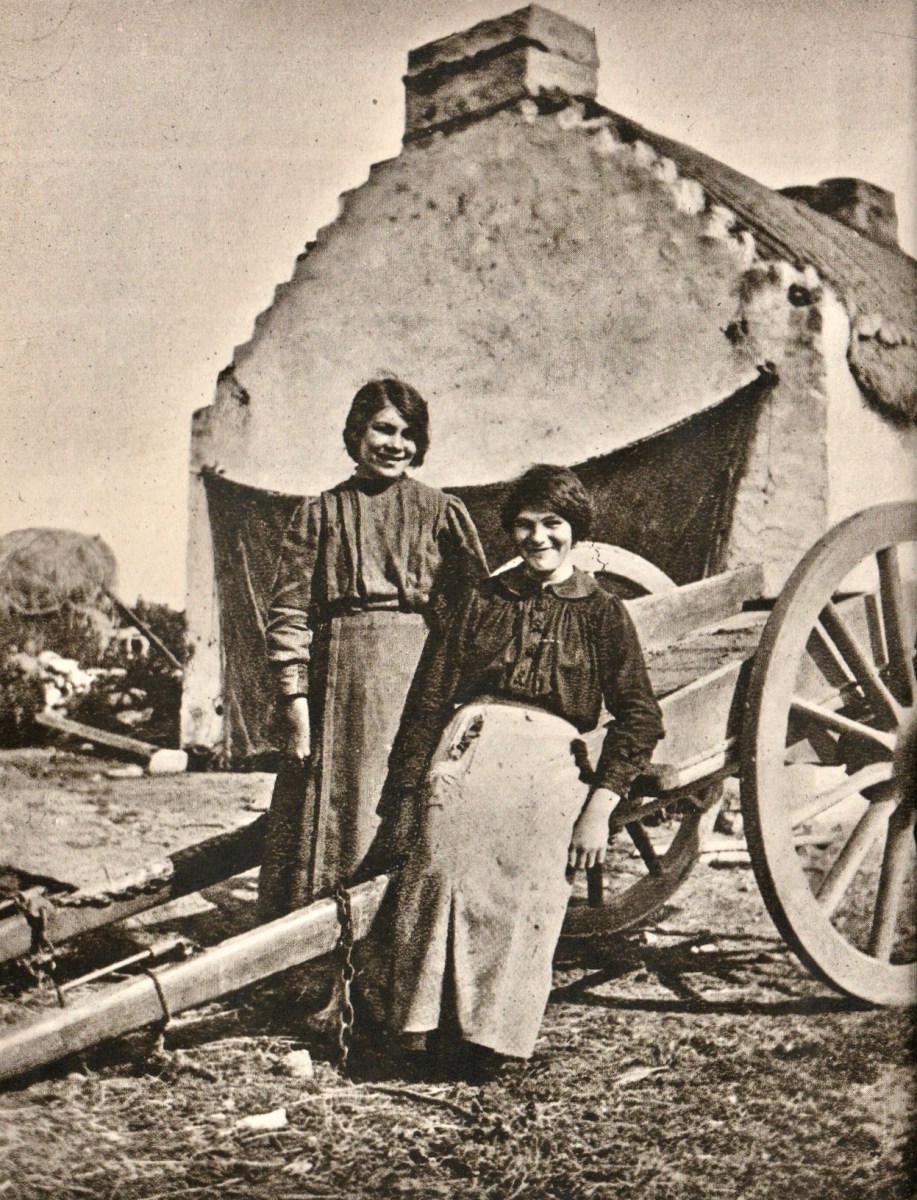
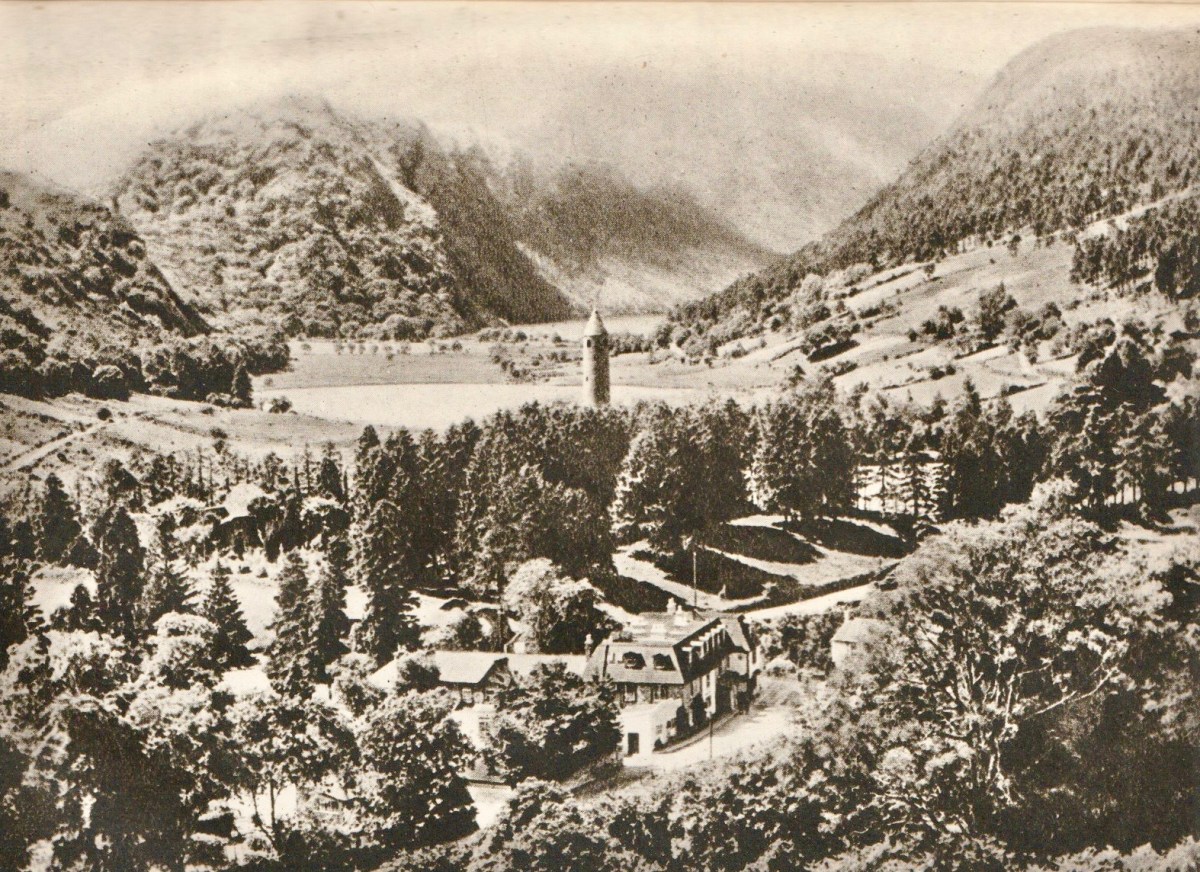
From ‘In Search of Ireland’ – above: Two Connemara Girls. Below: Glendalough.
Today, the British obsession with its nationalist roots – which we are calling ‘Brexit’ – threatens all the compromise and hard work which has been expended on positively and peacefully resolving the ‘Irish Question’ over the past few decades. Interestingly, in 1930, H V Morton had something to say about Northern Ireland, which has some uncanny resonances with today’s imminent problems:
. . . It happens that when you are in Donegal you can look south into Northern Ireland, and when you are in either Londonderry, Tyrone or Fermanagh you can look north into Southern Ireland! This is no doubt an excellent joke except to those who have to live in it! It must be exasperating to find yourself barred by a customs barrier from the country town in which you have always enjoyed free trading. But as long as it profits the Free State to build up her enterprise behind a tariff wall, or as long as Northern Ireland remains outside the Free State (which, I am told, will be for ever), this inconvenient and costly boundary with its double line of officials will remain, the only frontier in the British Isles . . .
H V Morton – In search of Ireland 1930
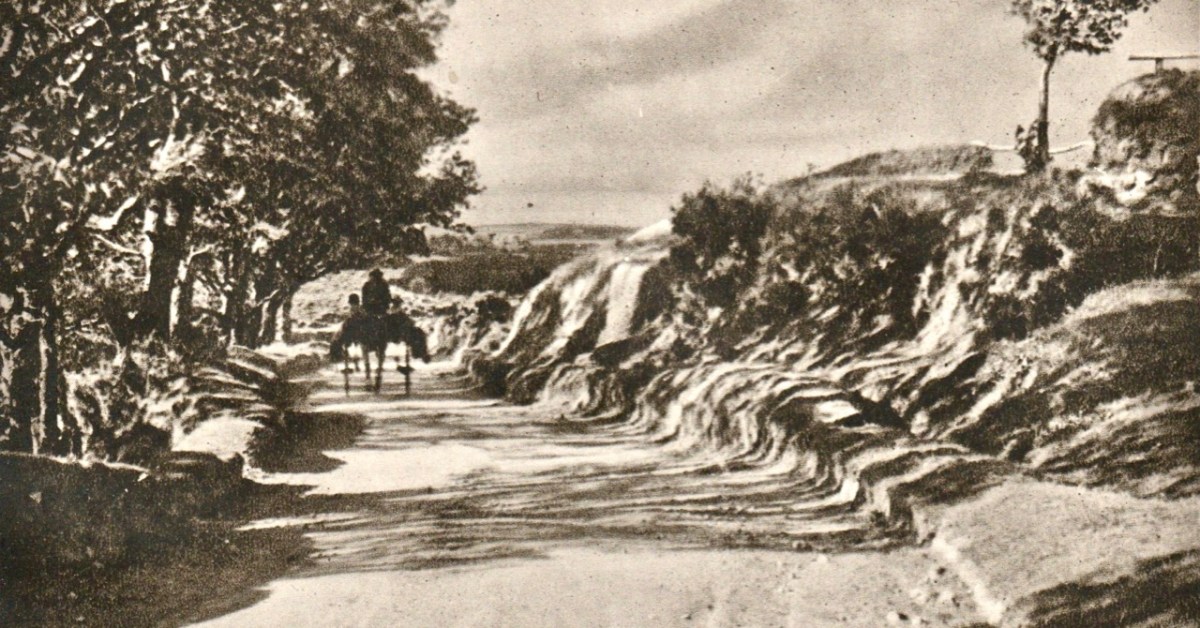
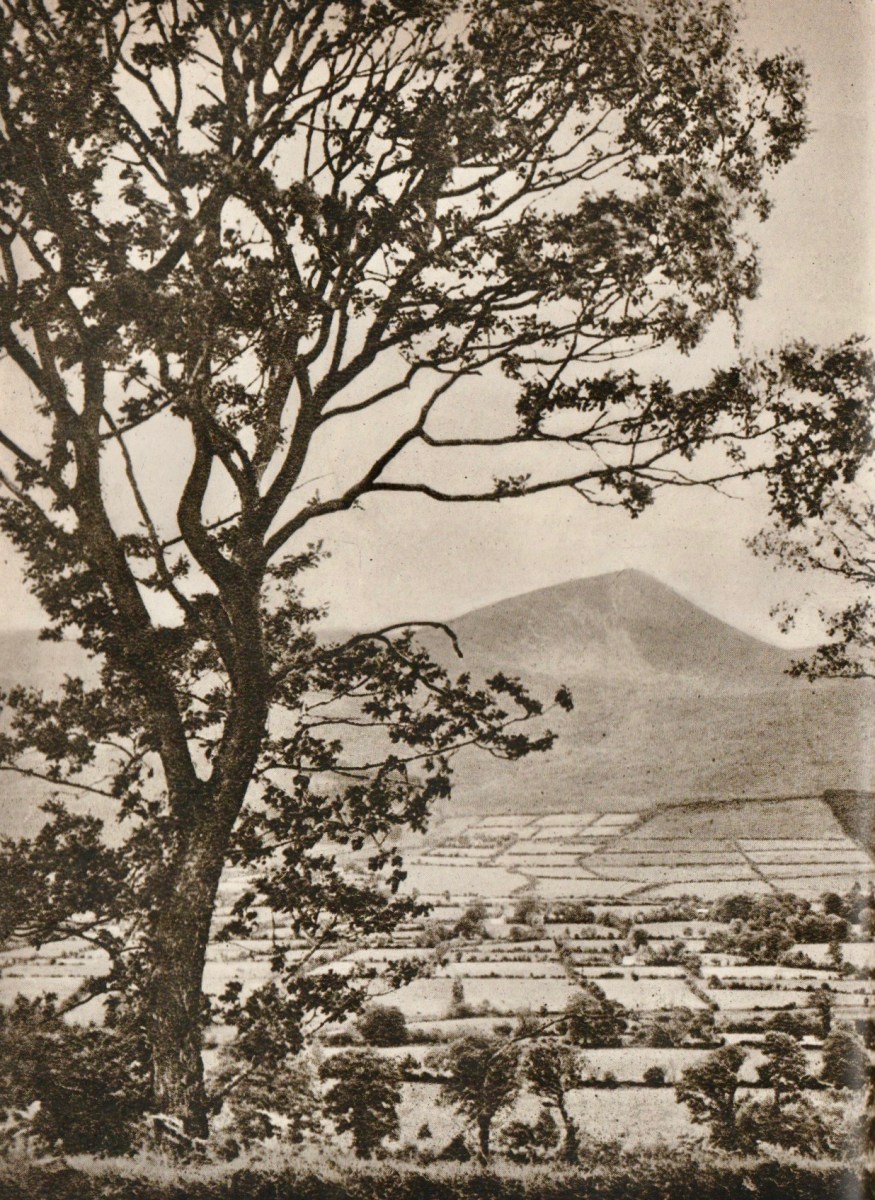
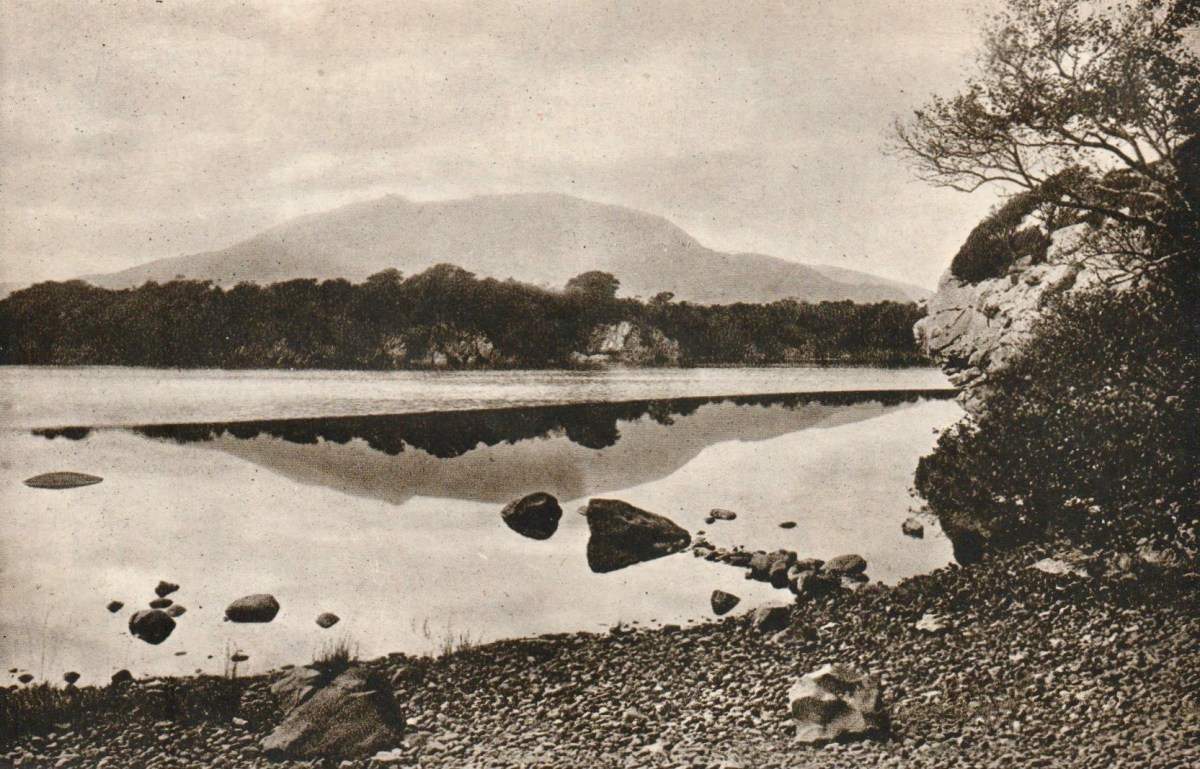
From ‘In Search of Ireland’ – above: Plain of Tipperary. Below: Middle Lake, Killarney.
Having read my way through Morton’s book on Ireland (which I picked up on a stall in Skibbereen market), I am left with very mixed feelings about its author. I am partly influenced, I think, by what I have noted elsewhere about the man and his life. In particular, picking up on his apparent sympathy with the Nazis during the Hitler years, but also becoming aware that he and his second wife, Violet Mary (they married in 1934) emigrated to South Africa after the Second World War, became citizens, and apparently endorsed Apartheid.
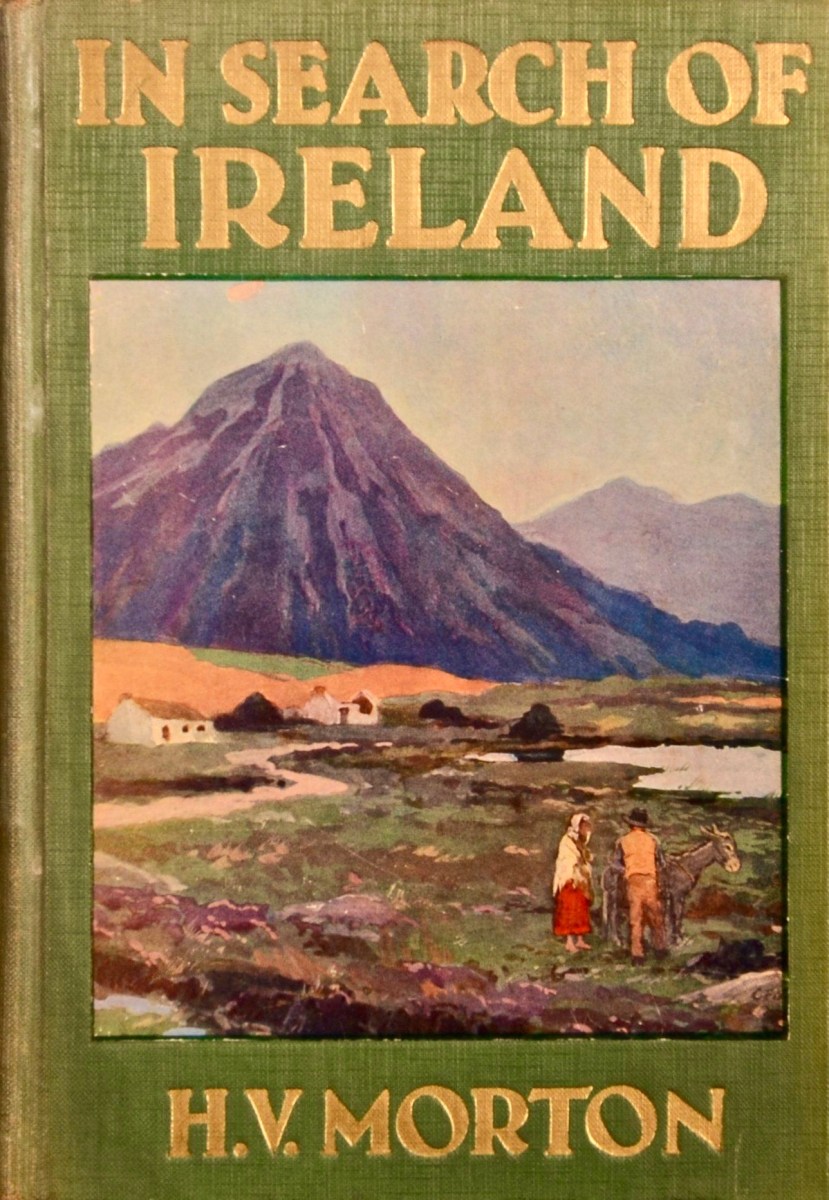
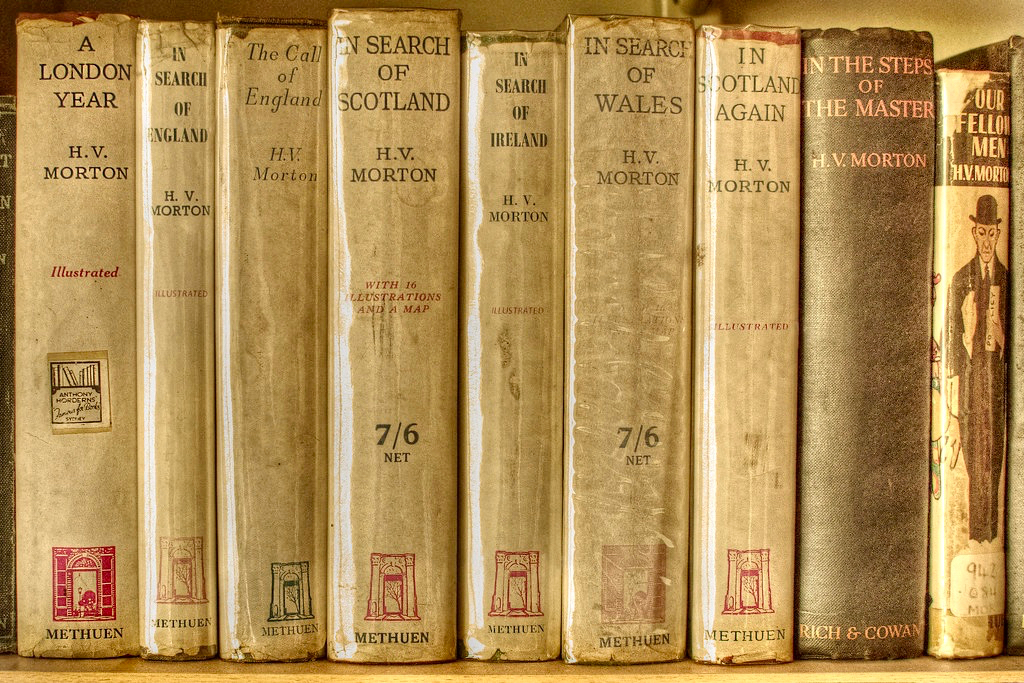
Above: the cloth cover of the sixth edition of Morton’s Ireland book, dating to 1934. Below: H V Morton is still a much collected writer.
Ultimately, I feel that Morton doesn’t have the depth I’m looking for in any respected scribe on Irish matters. He is, foremost, a journalist – and crafts his words for maximum effect. Perhaps this is unkind, but his views seem to me almost theatrical: taking a romantic stance that will appeal to tourists, he sets a tone that is slightly imbued with a sense of superiority, although he does not hesitate to be critical of the British position as he saw it at the time of writing. I am quoting his last paragraph – ‘saying good-bye to Ireland’ to try to defend my stance, which I fully accept is just a personal viewpoint.
. . . When my feet first trod Irish soil I felt that I had come to a magic country and now, as I said good-bye, I knew it truly as an enchanted island. That minor note which is like a vibration in the air, something that lives in the light and in the water and in the soil, runs through every Irish thing, but, like the cry of a bat, it is too high to be heard. But a man is conscious of it everywhere. Ireland of the Sorrows is no more. The sun sets, and the hill grows dark. I know that in the West at this moment men are raking the ashes of the turf fires. In thousands of little white cabins they are kneeling before the wide hearth, piling up the ashes around the red glow, and in the morning there will be new light. The shadows have fallen over the fields of Meath. The air is grey with night. St Patrick rises up over the mounds of Tara, his hands uplifted. And in the silence and the darkness I listen again for that hidden music. It is not for my ears. I hear nothing but the night wind in the grass; and I say good-bye to Ireland . . .
H V Morton – In search of Ireland 1930
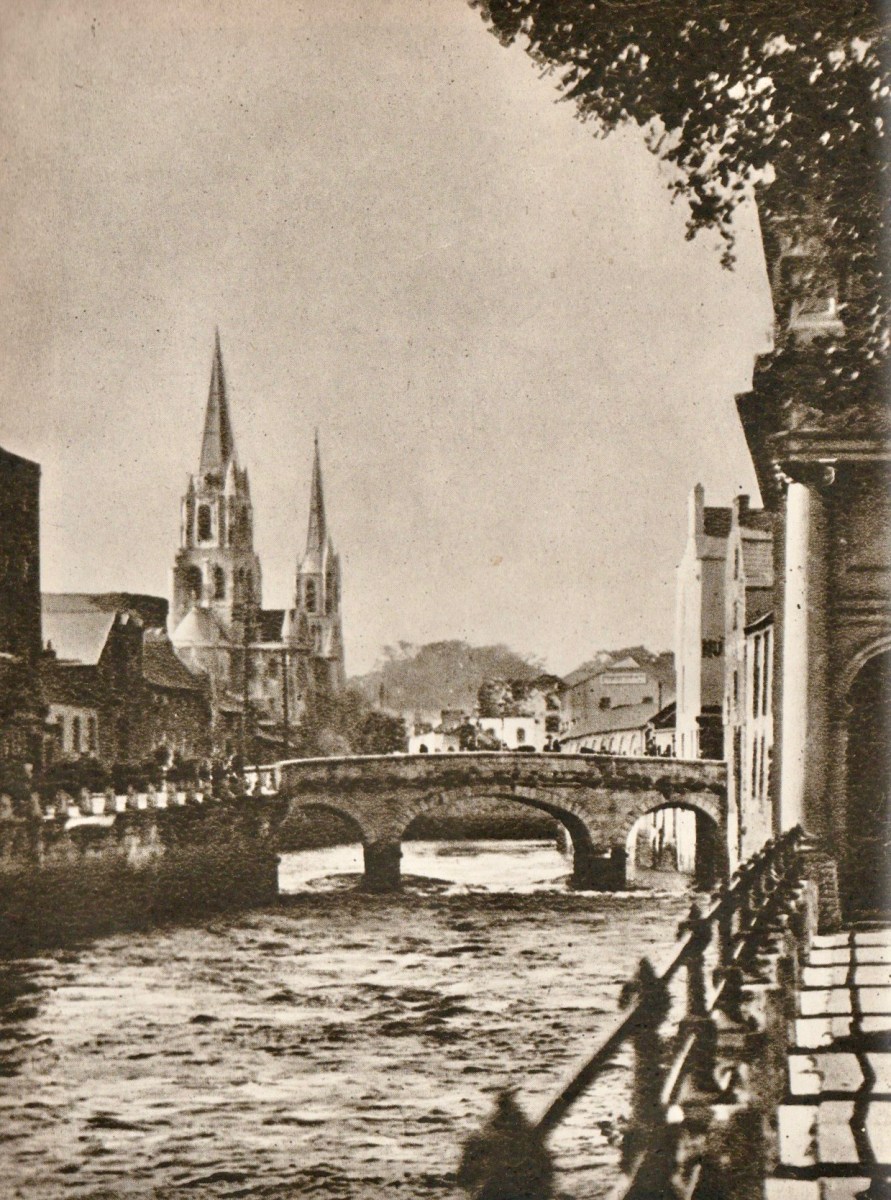
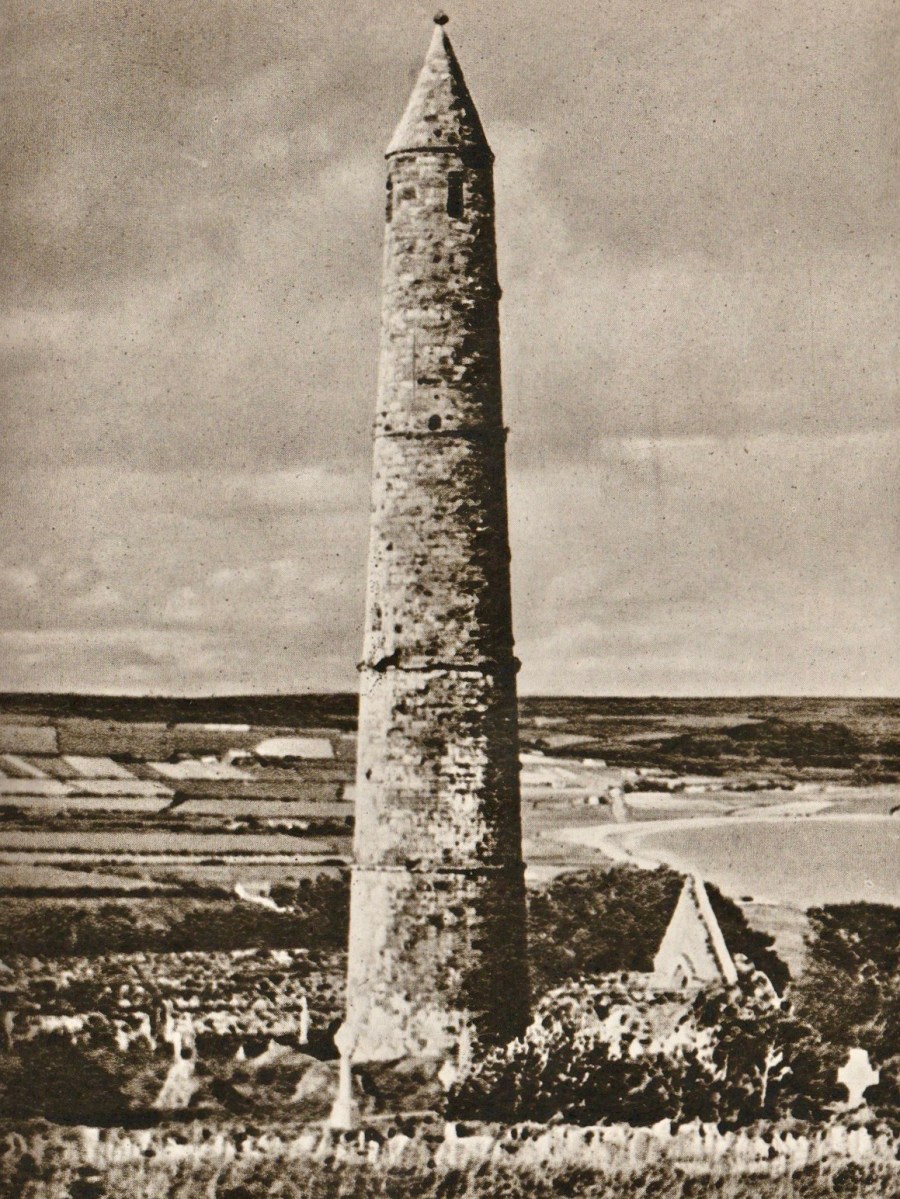
From ‘In Search of Ireland’ – above: Cork South Bridge. Endpiece: Ardmore Round Tower, County Waterford – 12th century.
Don’t be put off by my own standpoint. This book is an important Irish travelogue and sets a scene of a particular time in Irish history (ninety years ago) viewed from a close neighbour’s perspective.
Welcome to the UCD Library Cultural Heritage Collections blog. Discover and explore the historical treasures housed within our Archives, Special Collections, National Folklore Collection and Digital Library







 Roaringwater Journal