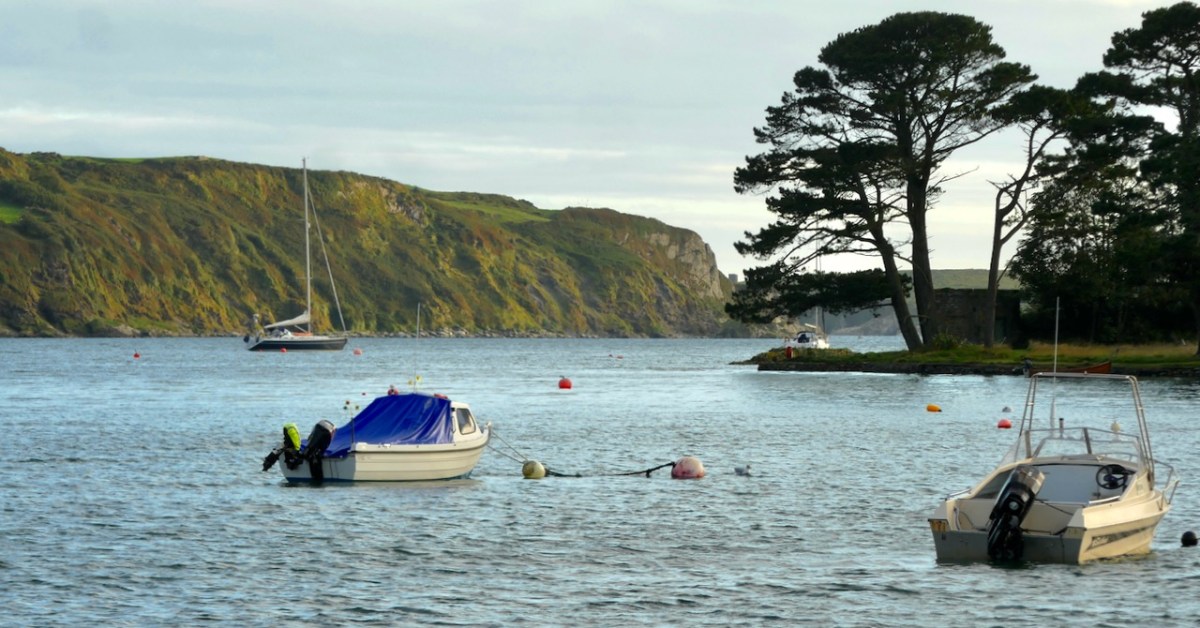
This is the inlet at Castlehaven, looking towards Castletownshend. It’s a peaceful scene. Finola and I were in the village at the weekend, showing groups around the church and the graveyard: it was a West Cork History Festival event. Very recently, I came across a reference to a structure that used to stand looking over this inlet: it was known as Nelson’s Arch. Here’s a watercolour print dating from the early nineteenth century . . .
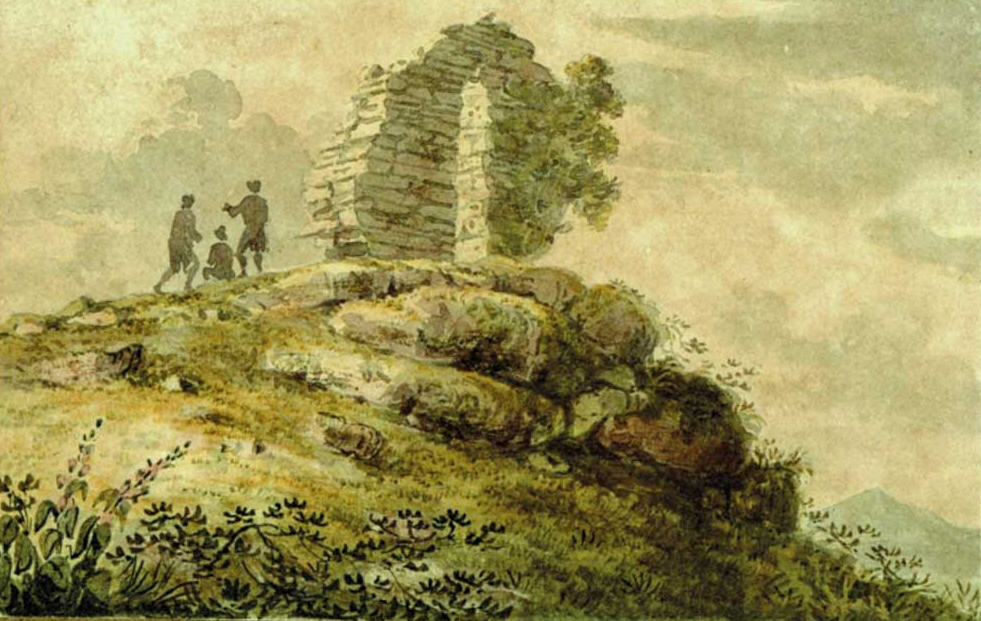
It looks like part of a ruined building. In fact, this is how it appeared when built! It’s a folly, but with a purpose. It commemorated the death of Britain’s Admiral Nelson, and the defeat of the French fleet at the Battle of trafalgar in 1805. Dennis Kennedy researched the arch and wrote an article about it for History Ireland, in January 2016. here’s a brief extract:
This arch . . . was the first monument erected anywhere in the world to the victor of Trafalgar, Admiral Lord Nelson. It was completed twenty days after the battle, and less than a week after the first news of it reached these islands. The artist, and the builder, was Captain Joshua Rowley Watson RN, then stationed in Castletownshend as the naval officer in command of a large force of Irish Sea Fencibles defending that section of the west Cork coastline against possible French invasion. On hearing of the victory at Trafalgar and the death of Nelson, Captain Watson designed and built, in one day, the rough stone arch . . .
Dennis kennedy, History Ireland Issue 1, Volume 24
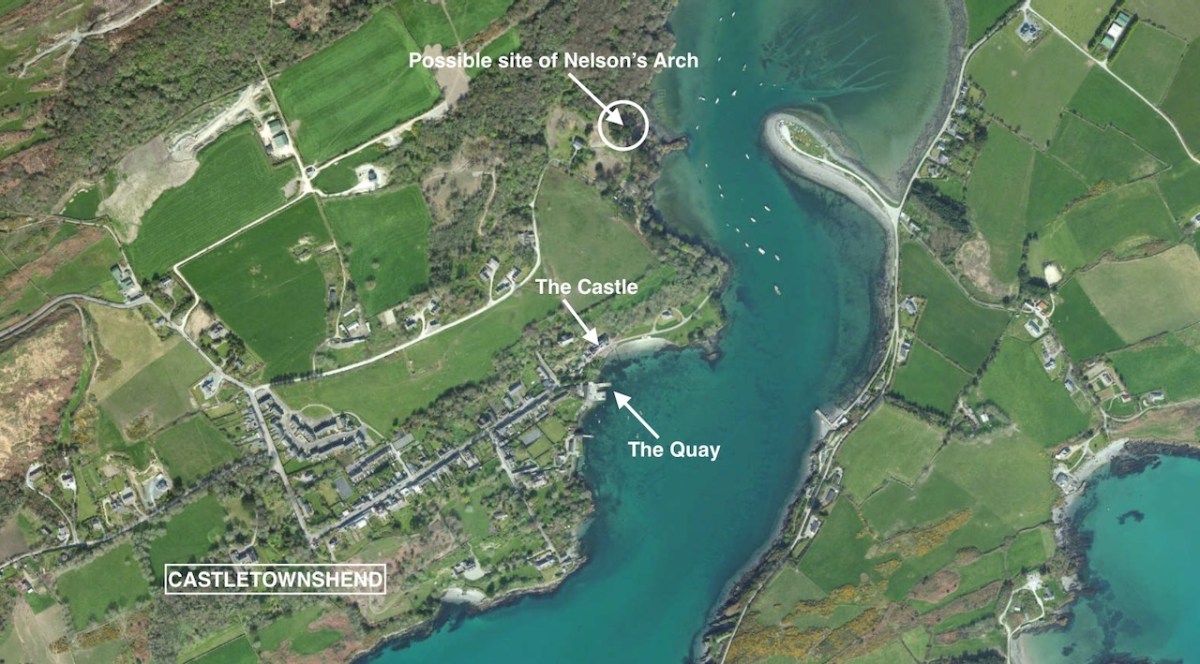
I can’t tell you for sure where this arch was constructed, only that it ‘looked out over the harbour at Castletownshend’. I am speculating that the site was where I have indicated in the above aerial view. My reason for suggesting this is that is an old archaeological record shown on the earliest Ordnance Survey maps states that ‘a structure’ existed at this spot. Evidently a plaque (now lost) was placed on the ‘structure’ setting out its origin:
. . . This arch, the first monument erected to the memory of Nelson after the battle of Trafalgar, was sketched and planned by Captain Joshua Rowley Watson RN, and built by him and twelve hundred of the Sea Fencibles then under his command (assisted by eight masons). It was erected in five hours on the 10th of November 1805 . . .
Dennis kennedy, History Ireland Issue 1, Volume 24
The idea of twelve hundred men – and eight masons – building this structure is hard to ponder. The Battle of Trafalgar took place on 21 October 1805. Subsequently, of course, two further notable monuments to Nelson were erected: the column in Trafalgar Square, London, was completed in 1843 to a design by the architect William Railton at a cost of £47,000. It’s still standing, guarded by its four bronze lions, which were added by Sir Edward Landseer in 1867. Its height (to the tip of Nelson’s hat!) is 51.59 metres. But Dublin City Centre also had a Nelson’s ‘column’:
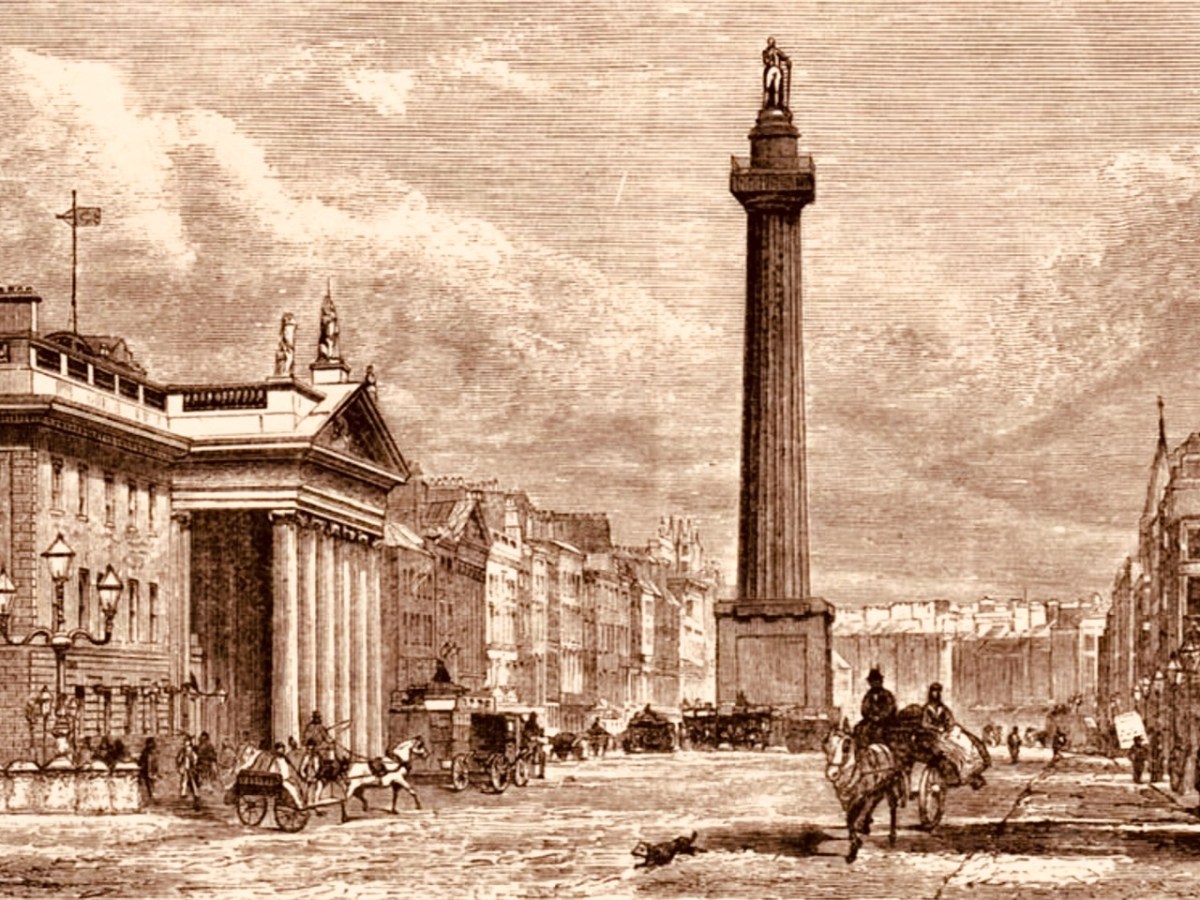
This structure in today’s O’Connell Street was made by Cork sculptor Thomas Kirk. From its opening on 29 October 1809 the 40.9 metre high Pillar was a popular visitor attraction, as it contained a staircase which could be climbed by the public, and which provided a wide view over the city centre. The London column – built from Dartmoor granite – was never provided with a staircase, but it’s a ‘must-see’ tourist destination. It’s actually the only extant monument to Nelson: having survived the rising on Easter Monday, 24 April 1916 – when the nearby General Post Office was reduced to a burnt-out shell, (below) – Dublin’s Pillar succumbed to an attack – probably by dissident volunteers – on 8 March 1966 . . .
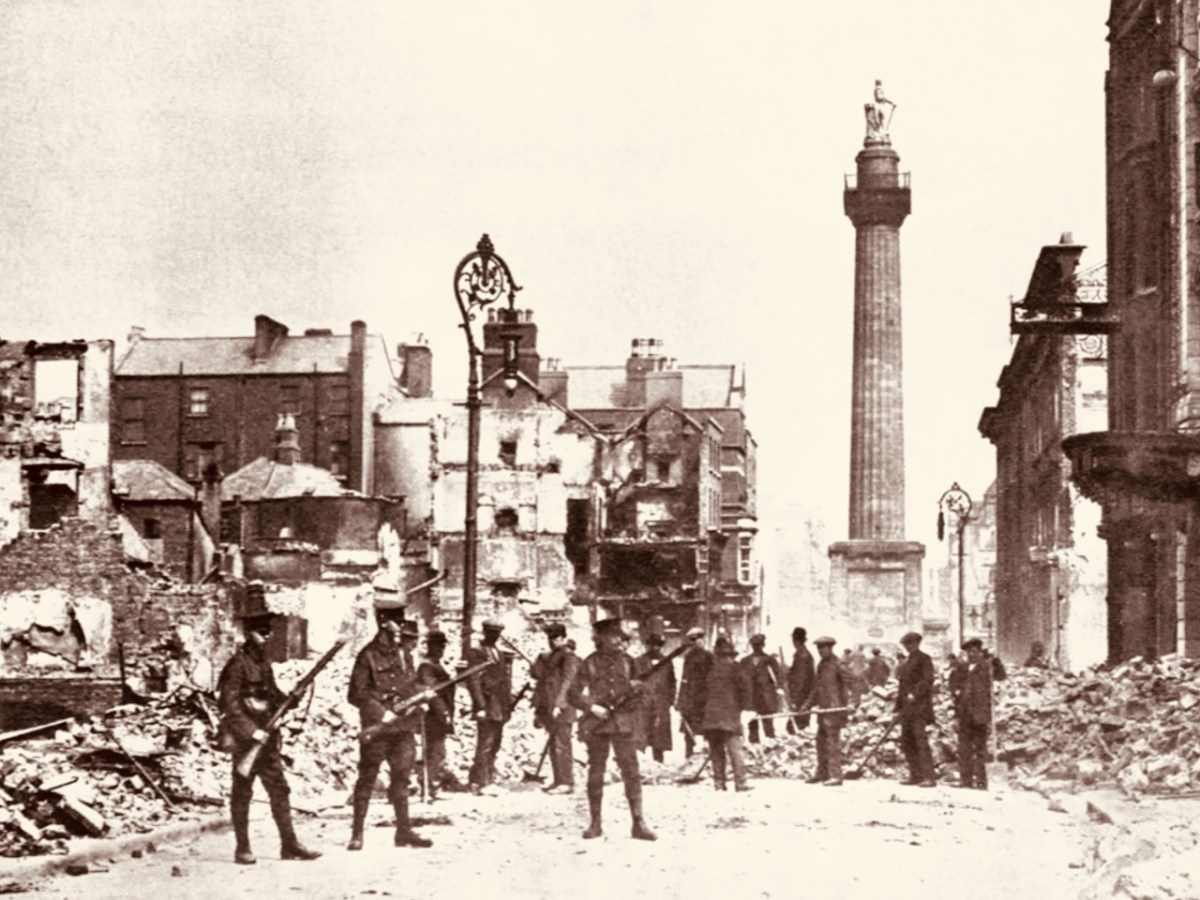
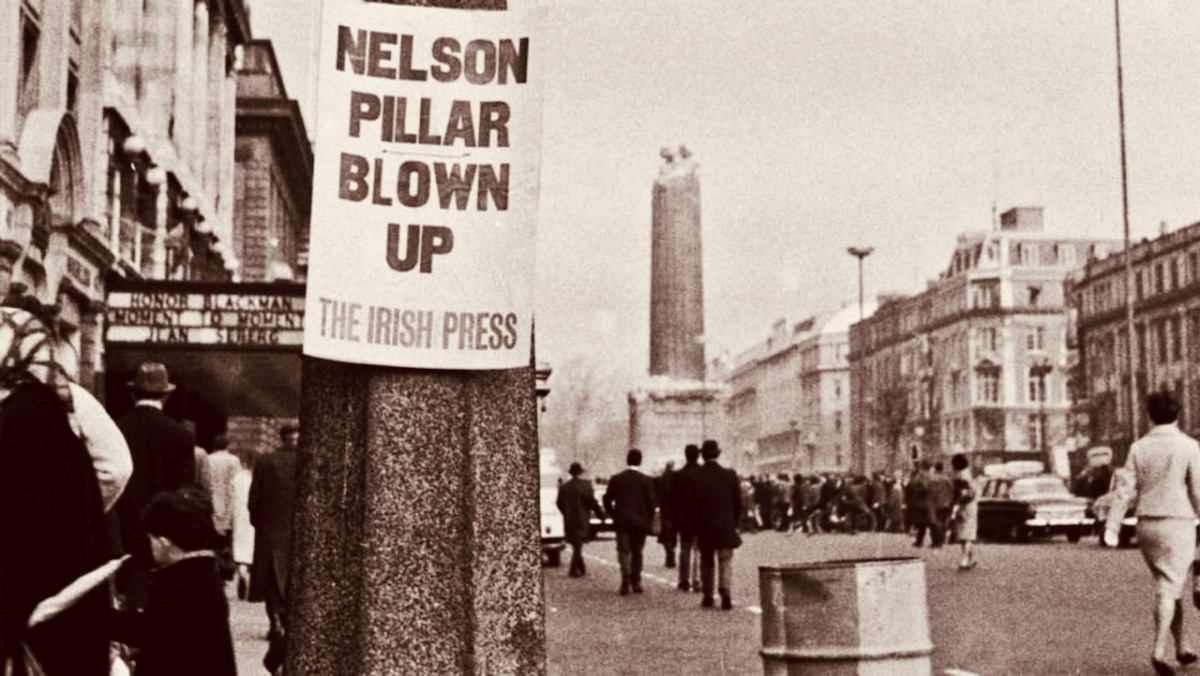
In the early hours of a Tuesday morning, a powerful explosion destroyed the upper portion of the Pillar and brought Nelson’s statue crashing to the ground amid hundreds of tons of rubble. An IRA spokesman denied involvement, stating that they had no interest in demolishing mere symbols of foreign domination: “We are interested in the destruction of the domination itself” (quote from the Irish Independent newspaper). According to Kennedy’s History Ireland article, our Nelson’s Arch at Castletownshend suffered a similar fate only a few days later, in March 1966. There must be many West Cork residents who remember the arch when it stood (and when it fell). I have only managed to find the photograph that Kennedy used in his piece:
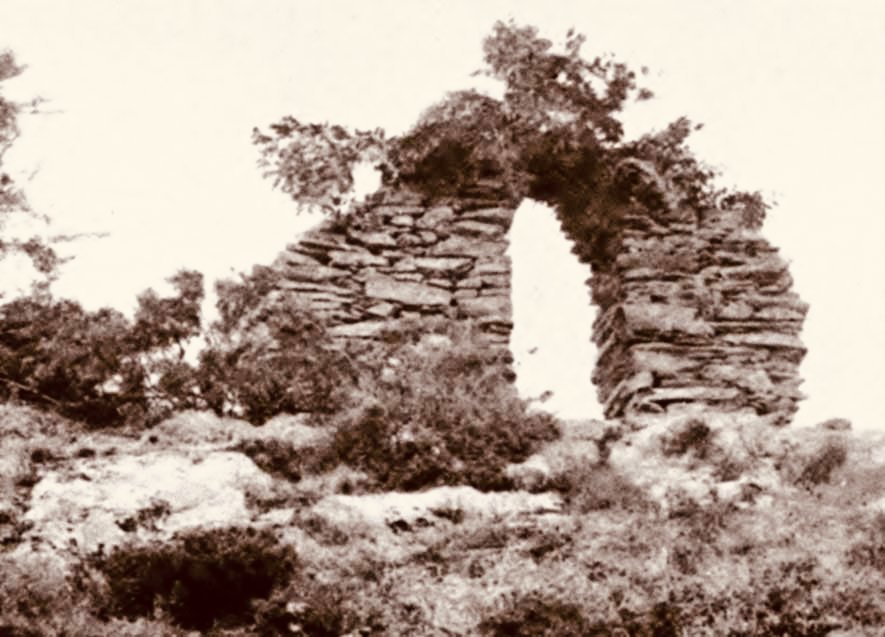
Compare this with the watercolour sketch: it obviously survived virtually unchanged during its lifetime of 161 years. To my knowledge no-one has laid claim to destroying the structure. But the motivation – disgruntlement at a brazen symbol of British imperialism – was undoubtedly the same as the Dublin Pillar destruction. If anyone is able to provide further information on the life and death of Nelson’s Arch, Castletownshend, we would be delighted to add it here.
Discover more from Roaringwater Journal
Subscribe to get the latest posts sent to your email.
 Roaringwater Journal
I have been to the site of Nelson’s Arch thanks to a chance encounter with George Salter-Townshend of Castletownshend who led my wife, daughter, and me up a road, across a tract of clear-cut forest, and then through a dense thicket. We emerged on a high promontory above Castlehaven, further up the estuary from the site you identified. There, overgrown, were some large stones, apparently all that remain of Nelson’s Arch. The reward was the view south toward the mouth of the estuary. A memorable afternoon.
LikeLike
Below is the text from two articles in the Cork Examiner in March 1966.
Cork Examiner 9 March 1966
NELSON ARCHWAY RAZED
The Nelson archway on Mount Eagle, in Castletownsend Wood, near Skibbereen, Co. Cork, was demolished during Thursday night. The discovery of its demolition was not made until late yesterday afternoon. Gardai under Superintendent R. T. O’Shea, Skibbereen, are investigating the matter.
The archway was built by British sailors in November, 1805, to celebrate the victory of Trafalgar.
They had taken part in 1he battle and after their ship had been blown off course, they put into Castletownsend, climbed the hill behind the local castle, and erected a crude archway with loose stones. It was levelled in 1920, when the War of Independence was being waged, but two years later it was re-erected by the villagers.
Cork Examiner 14 March 1966
West Cork Link With Trafalgar
Nelson’s victory at Trafalgar was first commemorated in Ireland at Castletownshend on November 16, 1805. On that day, 1,200 British sailors under Capt. Watson put into Castletownshend Harbour. Their ship had gone off course after the battle and had made for Castletownshend, which was then a British spa base.
The seamen scrambled ashore, climbed to the top of Mount Eagle in Castletownshend wood, and built a rough archway from local stone to celebrate their victory over the French fleet.
Several sailors from Castletownshend district died in the battle.
In 1920, when the War of Independence was being waged, the archway was destroyed, but two years later it was re-erected by the villagers. The monument is almost inaccessible now because of overgrowth, but it can be seen from a long distance away. There is no inscription on it.
LikeLiked by 1 person
Many thanks, Brian, for that valuable additional information. I will expand on this article in due course: I think there’s a fair bit still to be found to add to the picture!
LikeLike
I did one of Conor’s walk which featured this extraordinary tale – such an unlikely place to have a monumental arch and hard to imagine all those people working like mad to build it.
LikeLiked by 1 person
Conor has replied, below. I don’t think we located the site correctly. I’m hoping for further local input, after which I’ll publish an add-on.
LikeLiked by 1 person
Hi Finola/Robert,
Not sure if my comment went through
THE 1st arch was destroy but then rebuilt in the 20’s in an effort organised by Boyle Sommerville. This then was destroyed on Holy Thursday night 1966 while services were underway in Castlehaven.
The site is a couple km further up Castlehaven Harbour, the spot was know locally as Péicín or Péicín Nelson (James Burke mentions Péicín na Mara which is more than likely the same peak). It is the high point above The Narrows just below An Rinnín / Rineen.
There is some good local lore about the second boom but not all can be published yet. We will have to wait for the sesquicentennial of 1916!
Yours in adventure,
Conor
Conor Ó Buachalla co-founder Gormú http://www.gormu.com
+353 83 015 3545 conor.obuachalla@icloud.com
Gormú, Faiche Úrach, Baile an Chaisleáin, An Sciobairín, Co Chorcaí P81 CP21 Daily eco-adventures with a touch of dúchas
>
LikeLike
It is a couple km further up Castlehaven Harbour, the spot was know locally as Péicín or Péicín Nelson (James Burke mentions Péicín na Mara which is more than likely the same peak).
It is the high point above The Narrows just below An Rinnín / Rineen.
There is some good local lore about the second boom but not all can be published yet. We will have to wait for the sesquicentennial of 1916!
LikeLike
I’ll be out searching, Conor! And looking forward to some stories in the future…
LikeLike