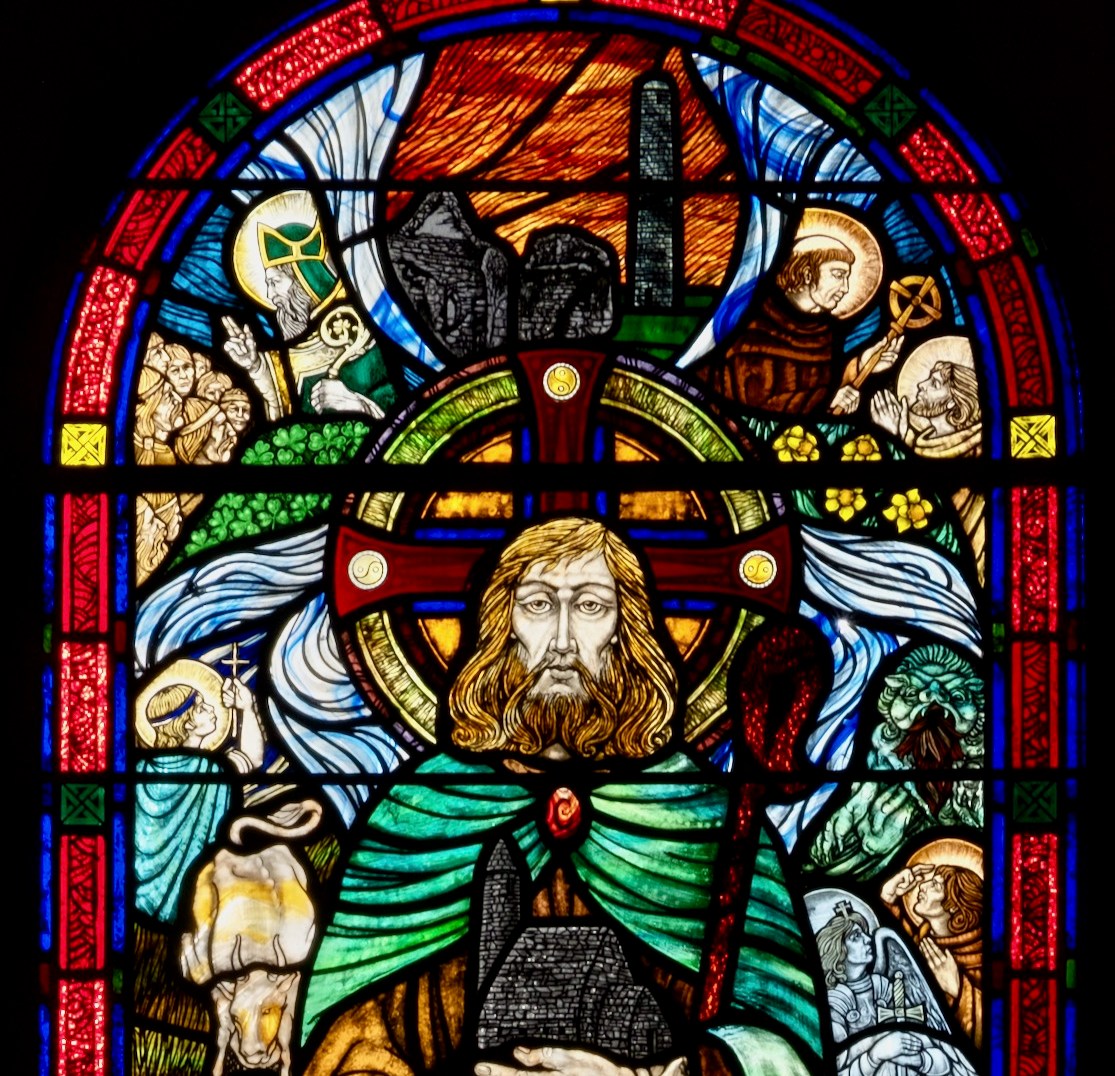
I’ve been to Clare, on a three day trip with Amanda, both of us in search of St Senan. Our destination was Scattery Island, in the mouth of the Shannon, a boat trip from Kilrush. My intention with this post was to describe this marvellous trip to Scattery – HIGHLY recommended! But alas, I made the mistake of turning to Whitley Stokes translation of The Life of Senan, from the Book of Lismore.
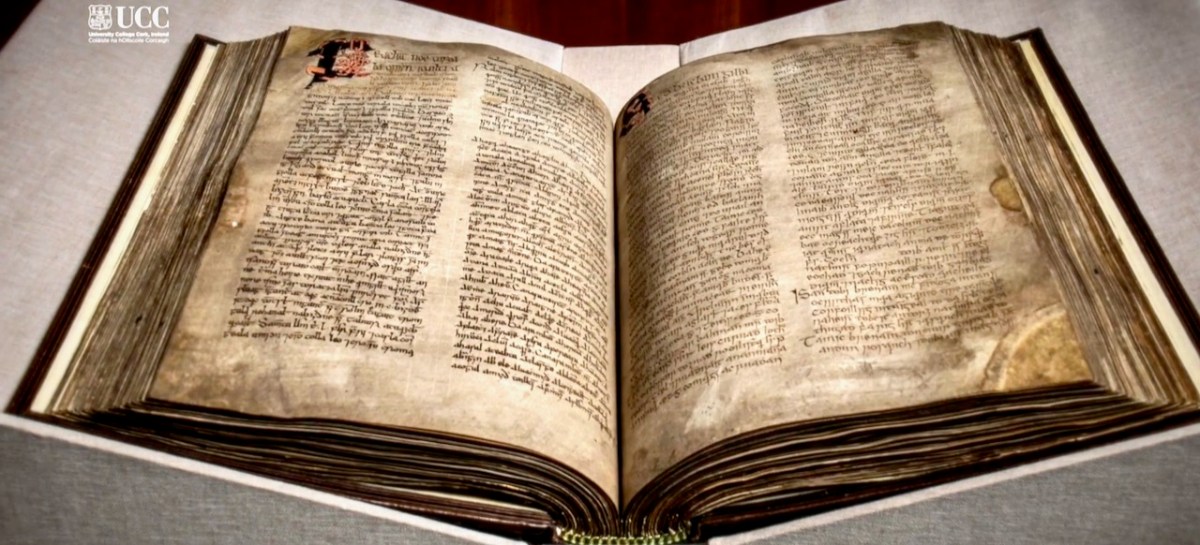
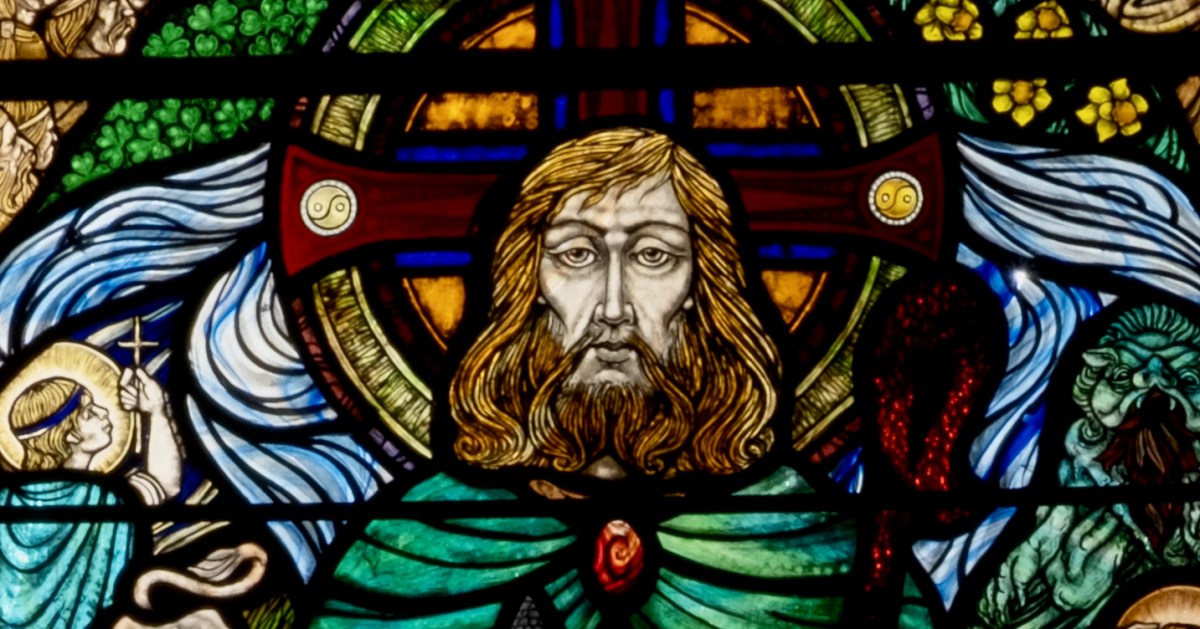
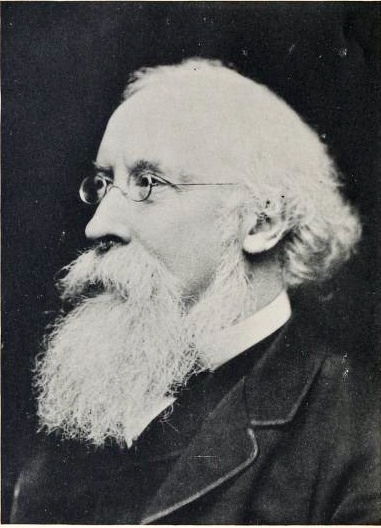
As regular readers know I have turned to the Book of Lismore on other occasions (see The White Hound of Brigown and this piece on St Brigid) and I am entranced by the language of Whitley Stokes’ (below) imaginative and magisterial translation, so this post will be devoted to the Life of Senan, illustrated by the many stained glass depictions of him we found in South Clare. My main source for photographs, however, is the large depiction of Senan in the Robertstown (Co Limerick) Church, and the photography is by John Glynn. John has very generously shared his magnificent photograph of the window with me, for which I am very grateful. John is also the mastermind behind Clare’s Stained Glass – a work of great interest, beauty and erudition. Check it out!
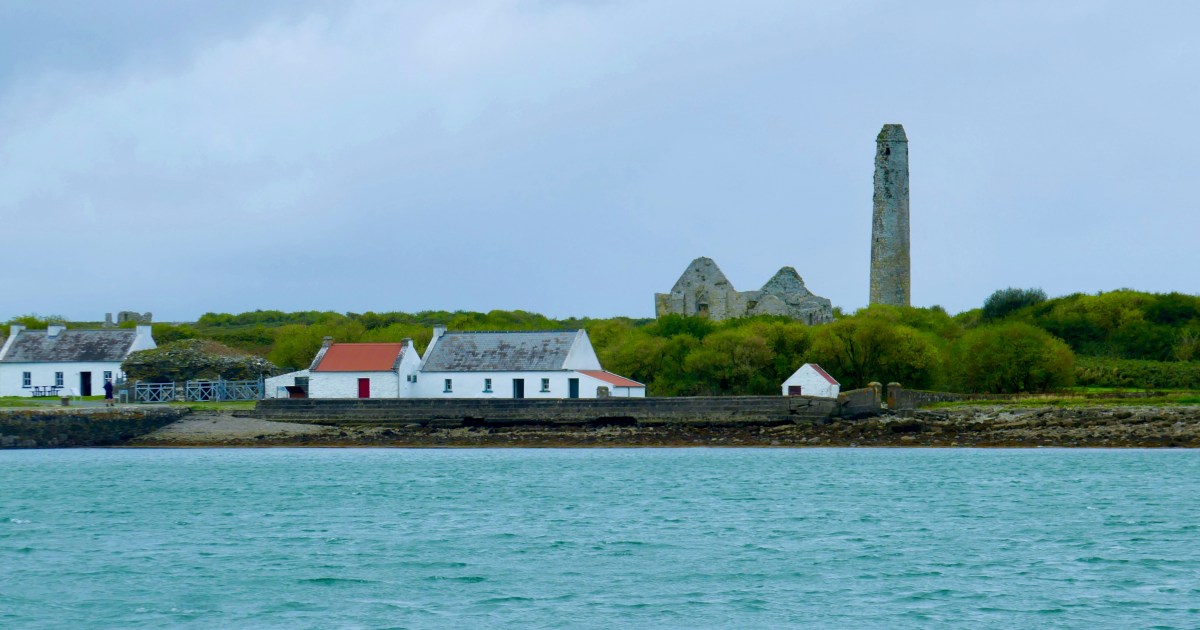
Scattery Island is the spiritual home of St Senan. With the ruins of six churches (and hints of a seventh), a holy well, and echoes of gruelling pilgrimages, it is a fascinating island – but more of that next time.
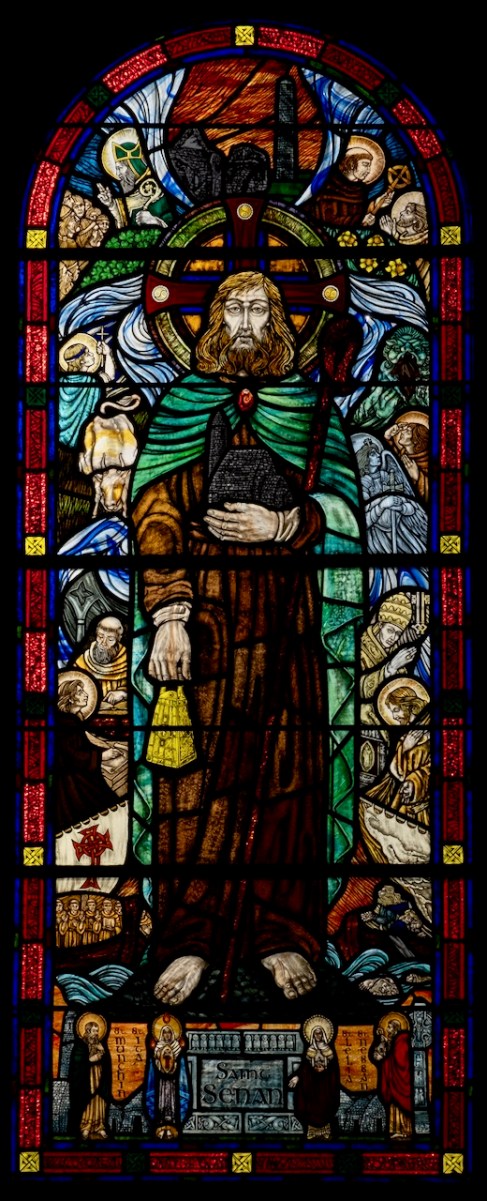
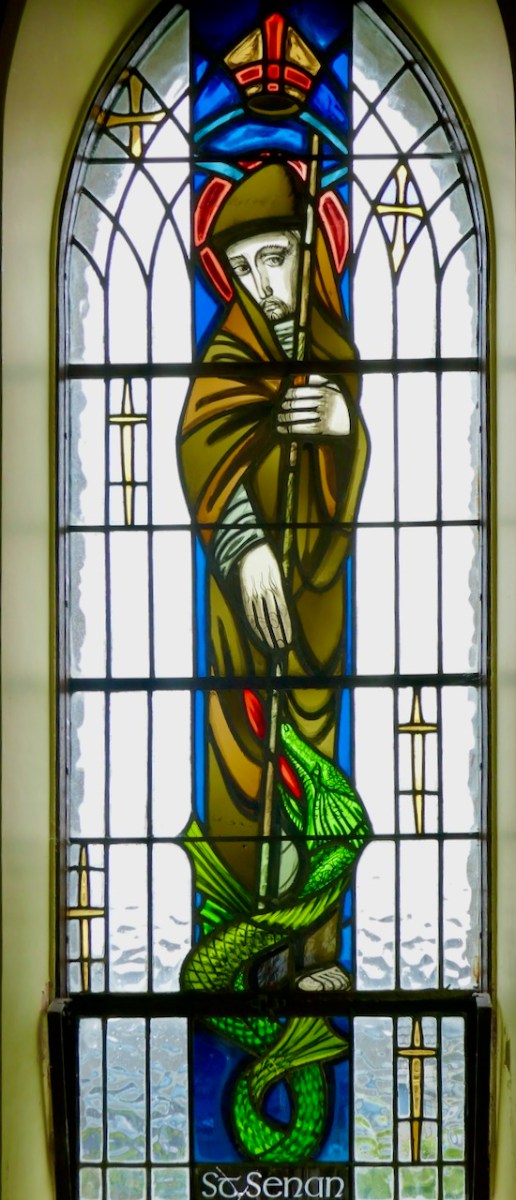
For now, let’s talk about Saint Senan, one of the ‘apostles’ of Ireland. His name may have been originally pronounced Shennon: yes, quite like the river at whose mouth the island sits. Stokes uses the form Senán throughout (pronounced Shenawn), but I have kept Senan (Pronounced Senn-an) since that is the common pronunciation. Before I begin, here is the complete Robertstown window. It is the work of Kevin Kelly of Abbey Studios, done in 2003. Thank you, John, for these outstanding images.
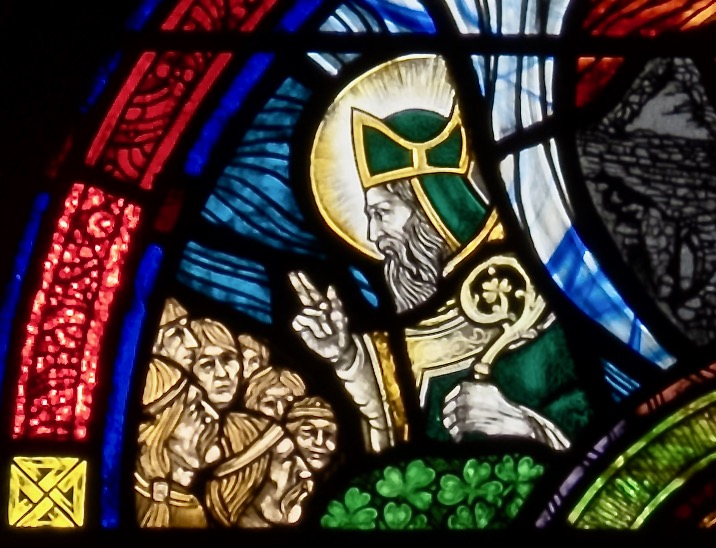
The story starts with St Patrick, foretelling the birth of Senan (image below the quote).
‘And the island there in the west, in front of the sea, that is Inis Cathaigh, is there any dwelling in it?’ saith Patrick. ‘There is none,’ say they, ‘for there is a terrible monster therein named Cathach, who doth not allow it to be inhabited. ‘Marvellous,’ saith Patrick, ‘is the diadem of dignity, and the precious stone, and the venerable servant specially lovable to God and to men, even the child that will be born with you. For it is for his sake that the soil of yon island is preserved in virginity, for it is there that his resurrection will be, and the resurrection of a great host of saints along with him.’ Then said Patrick, prophesying Senán’s birth:
A manchild will be born in the west,
In the island over the ocean.
The Corco-Baiscinn will be under his hand,
Men and children and women.
He will be splendid, noble, dignified,
With God, and with men.
Happy the folk and the church
That will be under that child’s protection.
‘Renowned and revered will that child be,’ saith Patrick; ‘for he will bring to them peace with abundance of every good thing, and banishment of every unlawful disease, if they do the will of that child, even Saint Senán, with tithes, and first-fruits and alms to God and to Senán. But woe to his monks who shall not do that child’s will, for God will then inflict heavy vengeances upon them, so that there shall be ruin on their men and on their cattle. And corn and milk and every produce shall then be taken away from them, so that they shall abide in famine and ruin, and every one will sell his son and his daughter in far-off territories that they may be fed, unless they are obedient to Senán. Wise and dignified will their children be in the present world if they are obedient to him.’ The stake of rowan that was in her hand when she was bringing forth her son took the earth, and burst at once into flower and leaf; and still that tree remains.
Senan performs lots of miracles as a child: like transporting his family’s whole farm through the air to a new location (I could have done with Senan when I moved house in January!); emerging unharmed in a barn conflagration; blessing spoiled food so “their proper flavour went to them;” reading while the corn grinds itself; bringing a dead boy to life. However, in a story that reminds us that old Irish saints were full-blooded creatures capable of behaving badly, he does not hesitate to use his powers in vengeful and destructive ways.
On another day Senan went with his father’s oxen out of Irrus in the west to bring them eastward to Magh Lacha ; and he saw the sea full in before him. Now night was then near, so he went to Dun Mechair (Mechar s fortress), which was at hand, to ask for a guest-house. Now Mechar was not in his fort on that night, and in his absence his household refused Senan. So Senan went back to the sea to await the ebb, and there was no other house near him to which he might then go. As his oxen went before him, on the shore of the sea, he saw the sea-strand before him. Then he drives his oxen over the strand. Then as Senan lifted his feet up over high-water-mark on the land, he heard the wave behind him striking against his heels. His mind changes then, and this he said, Sufficient for me is the length of time that I have been at this layman’s work. Then he breaks the spear that was in his hand, and makes a cross thereof, and sets it into the ground, and thrice he prostrates himself by it to God. Then a troop came, and that night destroyed Mechar s fortress, and they slew his son, and his wife was carried off in the plunder. And the fortress has not been inhabited from that to this, and this will never be done.
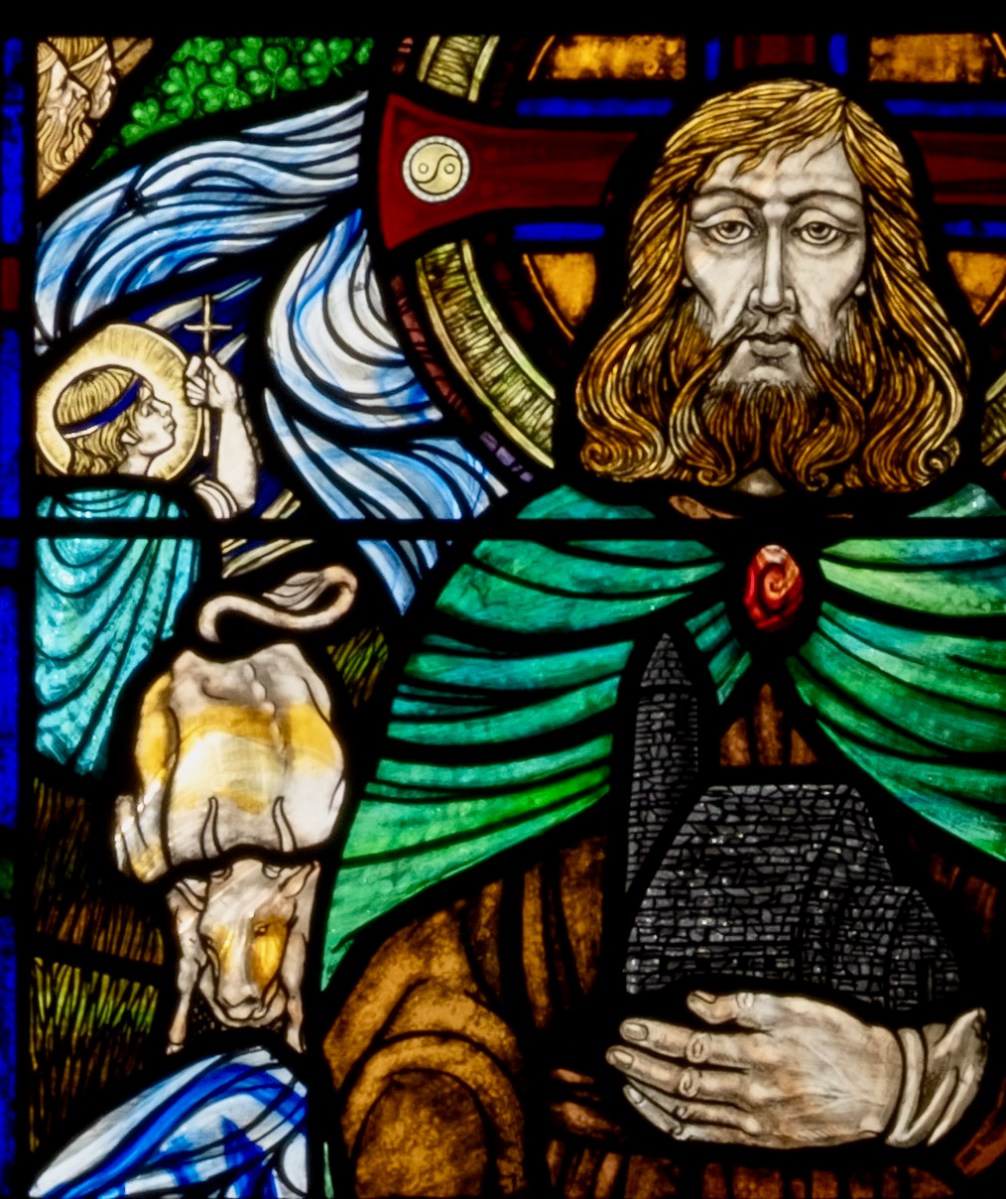
Another version of this story has it that the staff in the shape of the crucifix parts the sea so the cattle can get through. (Hmmm, what does that remind you of?). By now he is a novice in the Monastery of the learned Notal, and as Senan’s fame spreads Notal’s monastery is overrun with supplicants so he tells Senan it is time to set up his own house. The first of these is at Enniscorthy, near Ferns, where Maedhoc of Ferns turns the Abbey over to him.
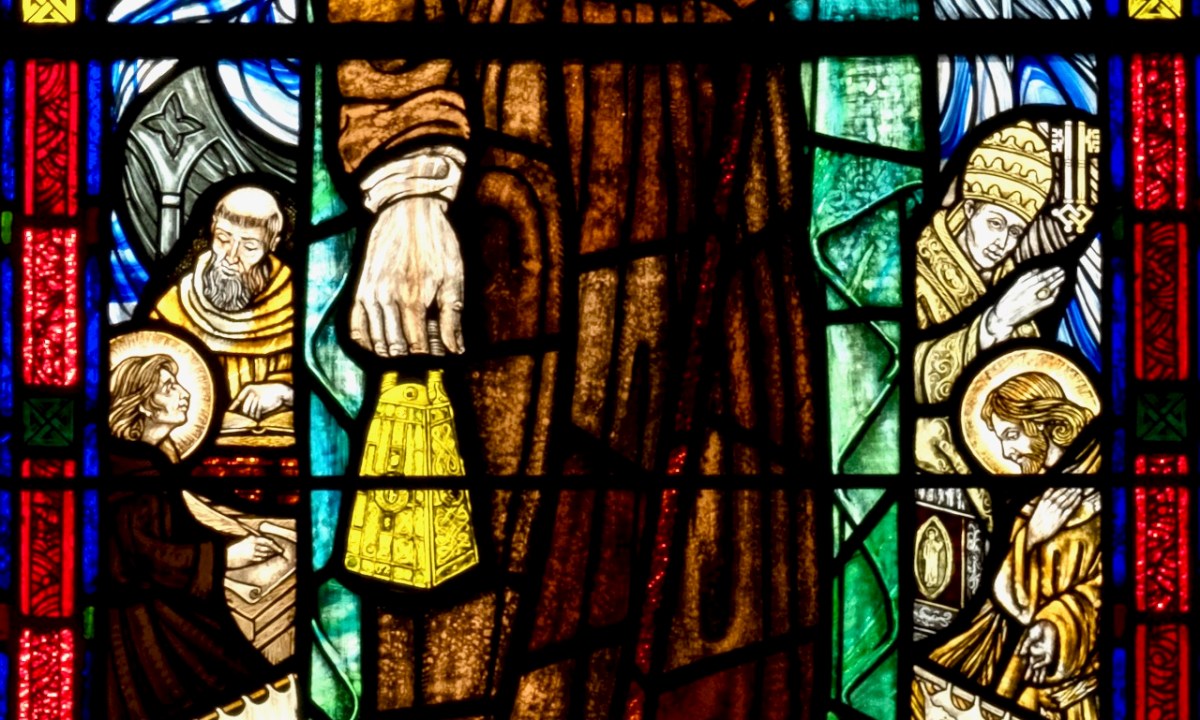
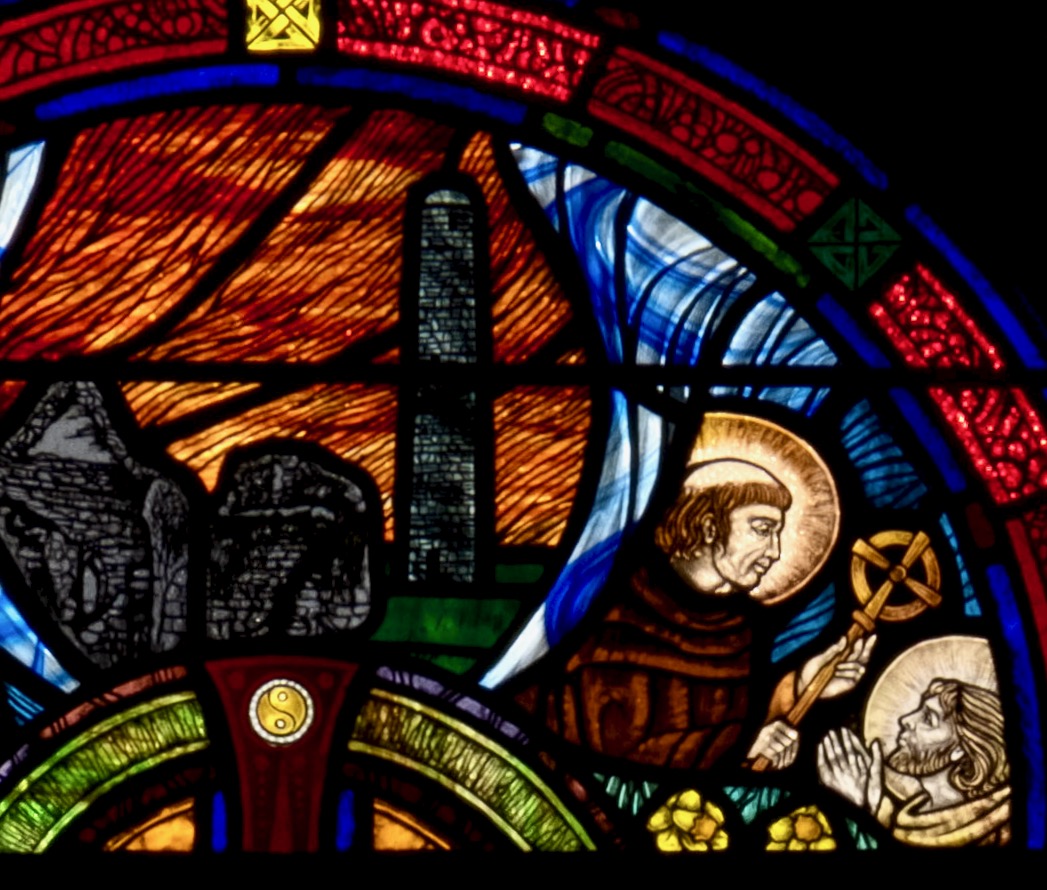
From there he goes to Rome (above right, meeting the Pope. On the left is the young Senan with his mentor, Cassidus), and onward to Tours, to learn from St Martin of Tours, who gives him a book, “today called Senan’s Gospel.” St David of Wales, on his way home, gives Senan his crozier. That’s what’s being depicted below, along with a lovely impression of the Scattery Island ruins.
Once he gets back to Ireland there are many more adventures and miracles. There’s a long poem about Inis Cara, and several more houses to establish, and monks and holy virgins to gather, and wells to spring forth, and miracles to perform. But still he has not found the place of his resurrection. I am giving the story of how he came to Scattery in full, as it so central to the legend of Senan. Inish Cathaigh (pronounce inish cohig) is derived from Island of the Battle, and Scattery is likely derived from a local pronunciation of that name.
Then came Raphael the Archangel to commune with Senan, and he said: ‘Come with me, and I will shew thee the place in which thy resurrection will take place; for unto God it seems time for thee to reach it.’ Then Senan and the angel went till they were on Mullach Feis. Then said the angel to him: ‘Behold the island there. Thy resurrection shall be therein, and the resurrection of a great host of saints along with thee. In the west of the world there is no more sacred island. No outrage to God hath ever been committed there. God sent an awful monster to keep it, so that neither sinners nor sons of cursing should dwell therein, but that it should remain in holiness awaiting thee. Yonder monster shall be put forth from the island before thee, so that dwelling along with it may not annoy thy community. For unto God it seemeth time for thee to go and build a church in that island. Noble and venerable will that church be. It will be a head of devotion and a well of wisdom of the west of the world. It will be a protection of prayer to foreigners and to Gael.’
Said Senan to the angel: ‘What seems timely to God seems timely to me; for this is what I seek continually, that which is the will of God.’ With that the angels lift him up along with the flagstone on which he was sitting, from Mullach Fessi, and set him down on a high hill in the middle of the island; and thence is Ard na n-Aingel ( the Angels Height ), and Lee na n-Aingel (the Angels Flagstone ) in Inis Cathaigh. They sing praise to God in that spot, even Senan and the angels, and then they went to seek the monster, to the place in which it abode.
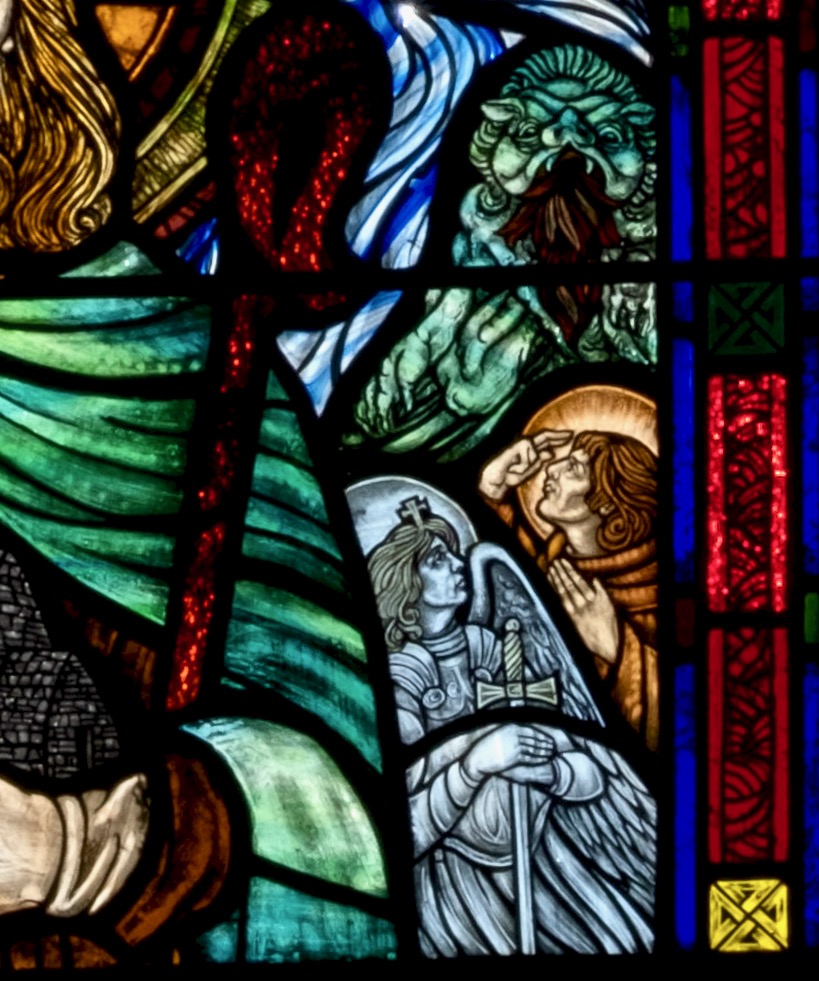
When the monster heard them, it shook its head, and its hair stood up upon it, and its rough bristles; and it looked at them, hatingly and wrathfully. Not gentle, friendly, mild, was the look that it bestowed upon them, for it marvelled that any one else should come to visit it in its island. So it went to them strongly and swiftly, insomuch that the earth trembled under its feet. Hideous, uncouth, ruthless, awful, was the beast that arose there. Longer was its body than Inis na h-Urclaide. A horse’s mane had it; an eye gleaming flaming in its head, and it keen, savage, froward, angry, edged, crimson, bloody, cruel, bounding. Any one would think that its eye would go through him when it looked upon him. Two very hideous, very thick feet under it; behind it a mane. Nails of iron on it which used to strike showers of fire out of the rocks of stone wherever it went across them. A fiery breath it had which burnt like embers. A belly it had like the bellows of a furnace. A whale’s tail upon it behind. Iron, rending claws upon it, which used to lay bare the surface of the ground on the path they came behind the monster. Equally did it traverse sea and land when it so desired. Then the sea boiled from the greatness of its heat and from its virulence when it entered it. No boats could catch it: neither from that day to this has any one escaped from it who could tell tidings of it.
Above, an image of Senan and the Monster from Monmore Church in Clare, by the Murphy-Devitt Studios
Now, when the monster came savagely to the place where Senan was biding, it opened its maw so that, as it drew nigh the cleric, its entrails were clearly seen over the maw. Thereat Senan lifted up his hand and made the sign of Christ’s Cross in its face. Then the monster was silent, and this is what Senan spake to it: I say unto thee,’ saith he, ‘in the name of the Father, and of the Son, and of the Holy Ghost, leave this island and hurt no one in the district over which thou wilt go, nor in the district unto which thou wilt come. The monster went at once at Senan’s word out of the island till it reached Dubloch of Sliab Collain. And it did no hurt to any one, till it came there, nor after arriving; for it durst not oppose Senan’s word.
Now after that Senan and the angels went righthandwise round the island till they came again to the Height of the Angels, after they had consecrated the island. Senan said to the angel: Savage is the sea that there is around the island: there seemeth a troubled people therein.’ ‘Though it be savage,’ saith the angel, ‘whatever monk with humbleness of heart shall go from thee, he will not be drowned until he shall come back to thee again. God hath granted to thee,’ saith the angel, ‘that he over whom the mould of this island shall go, shall not be after Judgment an inhabitant of hell.’
Once Senan was safely in charge of the Island there were, of course, many more miraculous happenings: men sent to haul him away left empty-handed and died soon afterwards; a wizard is drowned by what sounds like a tidal wave; horses are swallowed up by the land (in the place known ever after as Fan na n-Ech); an evil king is killed (by a hornless swarthy sheep) and his land then belongs to Senan; two small boys die but come back to let their parents know they are happy in heaven and will stay there; food is provided for a feast by a King who then converts; a drought is cured by means of a holly tree. (In the section below, monks travel safely on the left and sailors are saved from drowning on the right.)
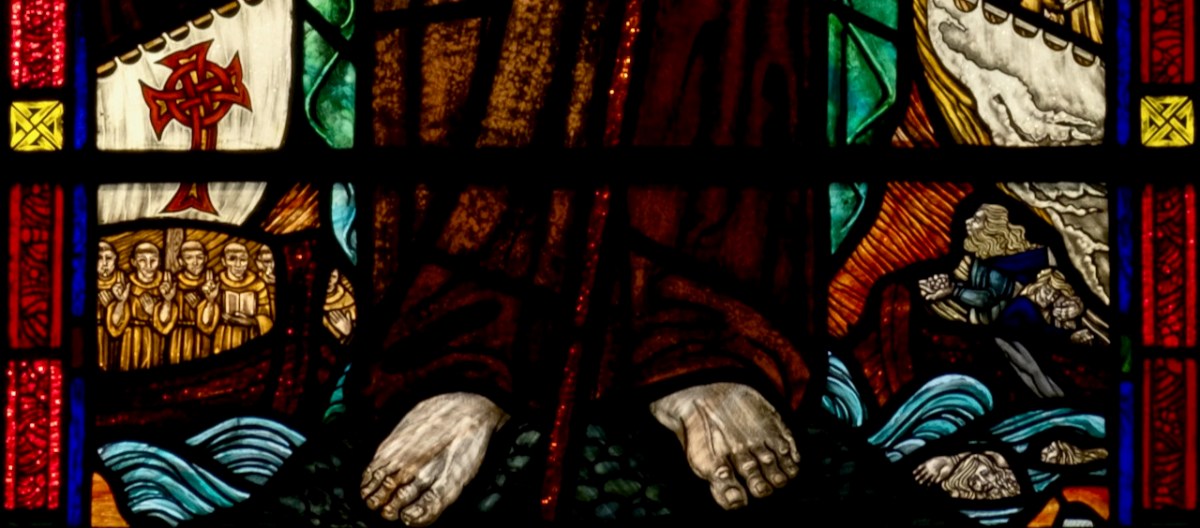
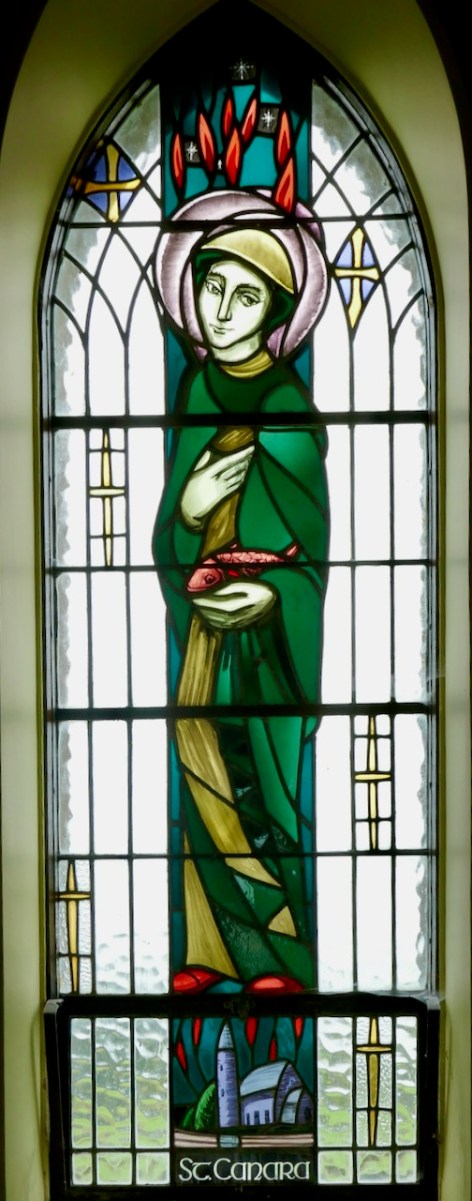
The visit of St Canair (Pronounced Canner, and also often given as Canaire, pronounced Canner-ah), a holy woman who is also associated with Bantry on West Cork, is almost the last story in the Life of Senan. She comes to Scattery but Senan refuses to allow her to land and they have this exchange
‘Women enter not this island’, saith Senan.
‘How canst thou say that?’ saith Canair. ‘Christ is no worse than thou. Christ came to redeem women no less than to redeem men. No less did He suffer for the sake of women than for the sake of men. Women have given service and tendance unto Christ and His Apostles. No less than men do women enter the heavenly kingdom. Why, then, shouldst thou not take women to thee in thine island?’
For thus had she been while they were in converse, standing up on the wave, with her staff under her bosom, as if she were on land. Then Canair came on shore, and the Sacrament was administered to her, and she straightway went to heaven.
God granted unto Canair that whoso visits her church before going on the sea shall not be drowned between going and returning.
I think that’s enough. Or rather, as Stokes translates it: Overmany, now, to reckon and set forth are the miracles and marvels which God wrought for Senan.
But let us not neglect the wonderful summation of his life and worth that Stokes renders in this gorgeous language. I will just give you a taste of it.
He is the glassy well whereby all the folks which God entrusted to him are washed by the purity of his teaching. He moreover is the heavenly cloud whereby the earth of the Church and the souls of the righteous are illumined by the rain of his teaching with the holding fast of virtues.
He is the mayor and steward and spencer, whom the Heavenly Overking sent to exact tribute of virtues and good deeds from Goedel’s many clans.
He is the precious stone whereof the heavenly palace is built for the hosts of the earth. He is the pure vessel by which the wine of God’s word is dealt out to the people. He is the great and happy hospitaller of goodly teaching, who used to satisfy the poor and naked. He is the branch of the true Vine which prepareth life and satisfaction for the world.
He is the true leech that healeth the ailments and diseases of the soul of every faithful man in the Christian Church.
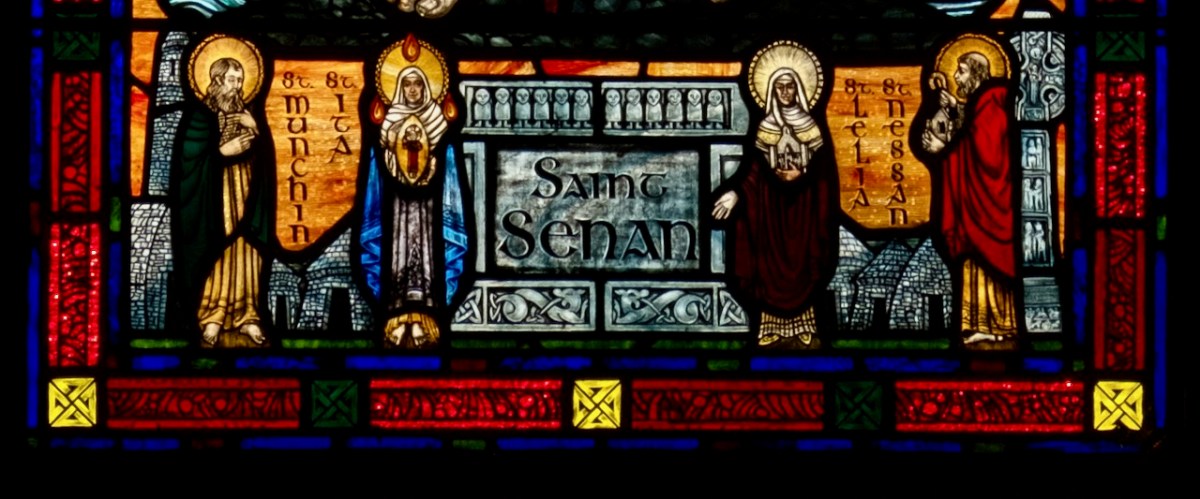
There is a final story about Senan’s death involving the relics of his tutor, Cassidan; holy virgins who ask for the body of one of his monks (for relics); Martin of Tours uplifted on a cloud for a final meeting with Senan; and various saints and clerics coming to bury him before ‘angels carried his soul to the eternal rest in the union of the holy Trinity and heaven’s household.’
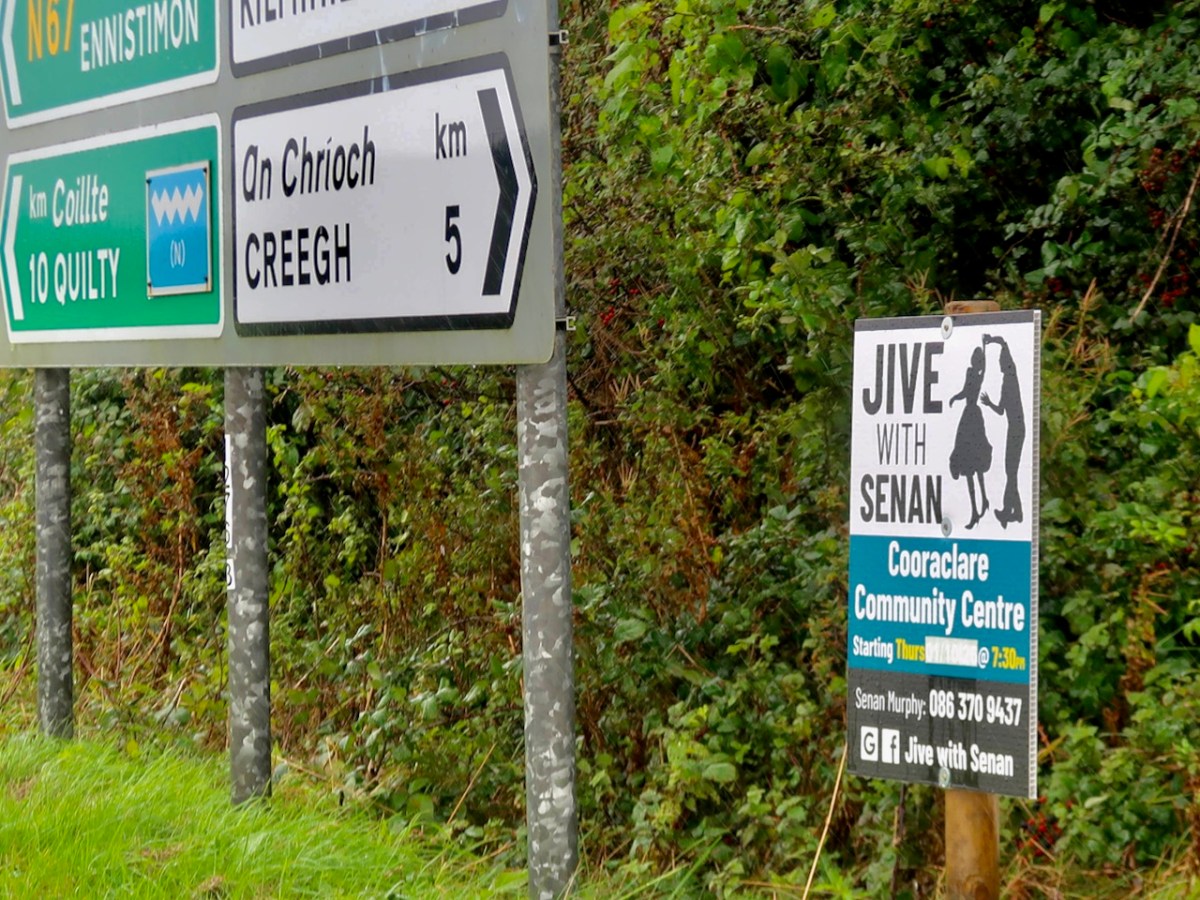
A final note, just in case you though Senan was all work and no play . . .
Discover more from Roaringwater Journal
Subscribe to get the latest posts sent to your email.
 Roaringwater Journal
Good Heavens!! What a man – fantastic write up and research and isn’t that window glorious. What a great trip we had 🙂
LikeLike
many thanks. A great article. Was told once that the Hedderman family were boatmen to St Senan.
Michael.
LikeLike
Dear Finola What a wonderful story of St Senan I must do a wall hanging perhaps a winter project  as I havent started on my Jesus of Prague yet  !! just finished my Dog one for Sherkin  not quite sweetness of Lassie !!  Must meet soon xx  soniaÂ
LikeLike