Adare Manor

When studying architecture (fifty years ago!) I had little time for what was then generally termed the Victorian Gothic style. It seemed to me derivative, dark and fussy. Now, half a century on, I am suddenly a convert – and all because of a visit we made to Adare Manor: surely one of Ireland’s leading five star hotels, but also the finest embodiment of Neo Gothic attributes that I have come across in any building to date.

The settlement of Adare, in County Limerick, is a bit of a traffic bottleneck waiting to be sorted out – by a much yearned-for bypass which is likely to take a few years to complete. Once in the village, however, you will find a magical and slightly surreal place with its clusters of picturesque thatched cottages, pubs and restaurants, art galleries, antiques vendors and the greatest concentration of fashion shops and boutiques outside of any city in Ireland (probably). But when it comes to hospitality and architecture, then Adare Manor itself beats all contenders.

From the superbly landscaped gardens (top – there are 840 sweeping acres on the estate), through to elegant interiors (the drawing-room, centre, is a prime example), the mansion is on a grand scale and very much reflects, today, the spirit in which it was reincarnated in the 1830s (lower – the Great Hall) by the splendidly monikered incumbents of that time: Windham Wyndham-Quin, 2nd Earl of Dunraven and Mount-Earl and his wife Lady Caroline Wyndham, heiress of Dunraven Castle, Glamorgan, Gloucestershire.

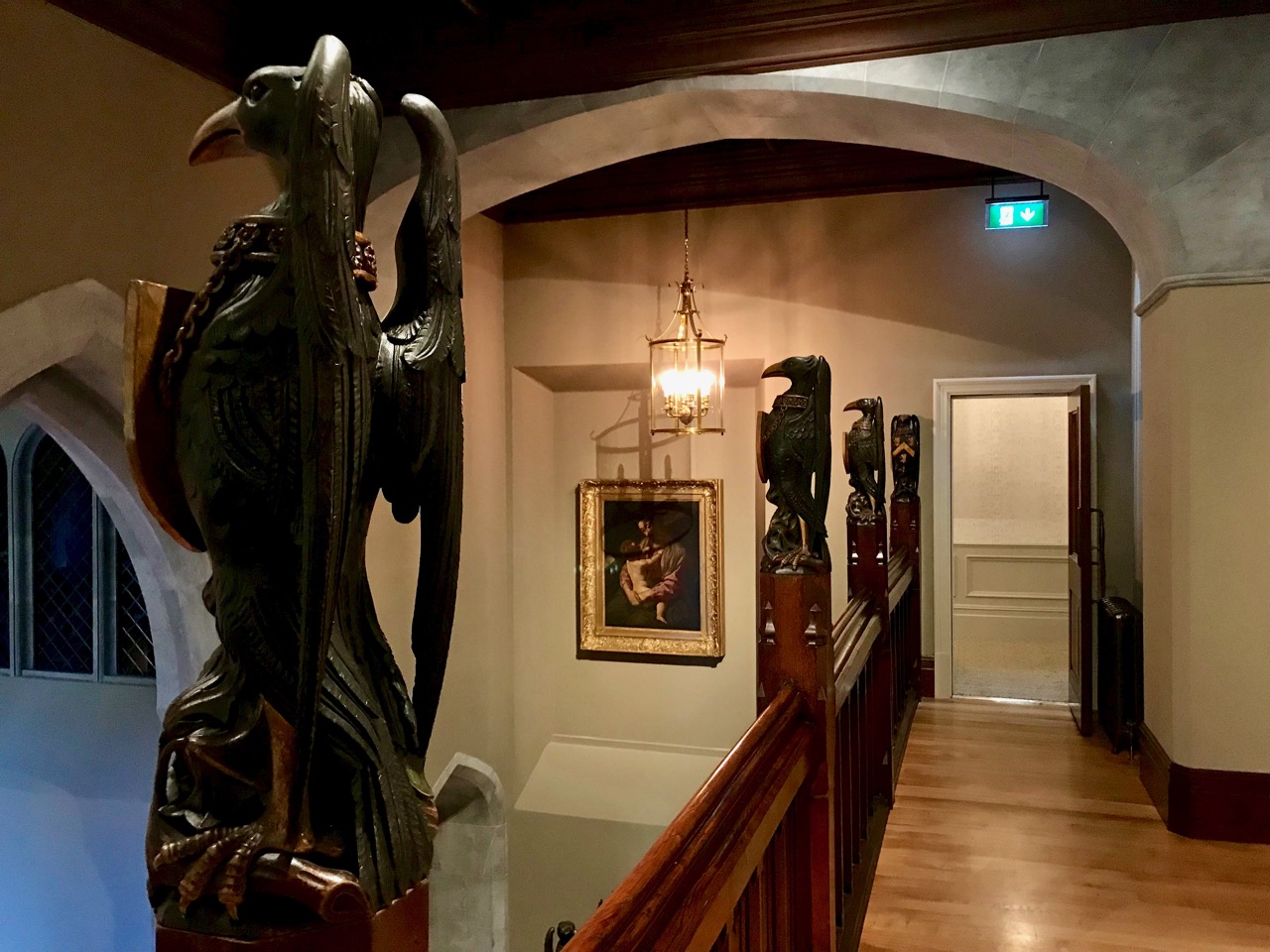
The Manor House as remodelled by the Second Earl is a riot (Dunraven ravens, above). Known to have always actively pursued outdoor life, riding, hunting and sports, it is said that Windham was laid low by an acute attack of gout. Lady Caroline encouraged him to channel his frustrated energies into a building project: to modernise and enlarge their modest Georgian residence. The Earl rose to the challenge and embraced the exuberance of the fashionable Gothic Revival style of architecture.

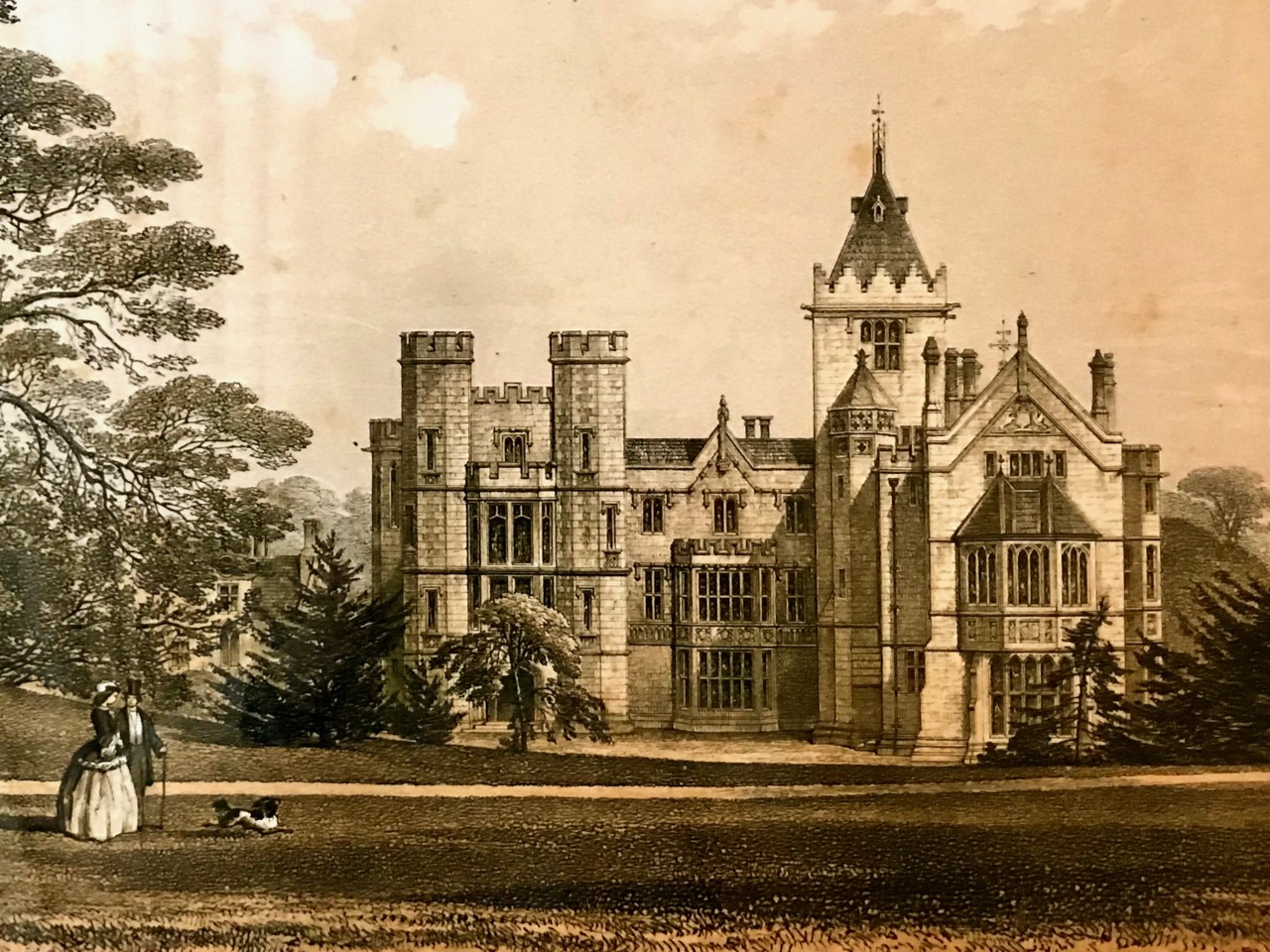
Adare House in the 18th century (top) and its transformation by the 2nd Earl (lower – a 19th century engraving). Clearly funds were not a problem, as a stone plaque on the south elevation attests (one of many texts embedded in the refurbishment of the fabric):

…This goodly house was erected by Windham Henry Earl of Dunraven and Caroline his Countess without borrowing selling or leaving a debt AD MDCCCL…

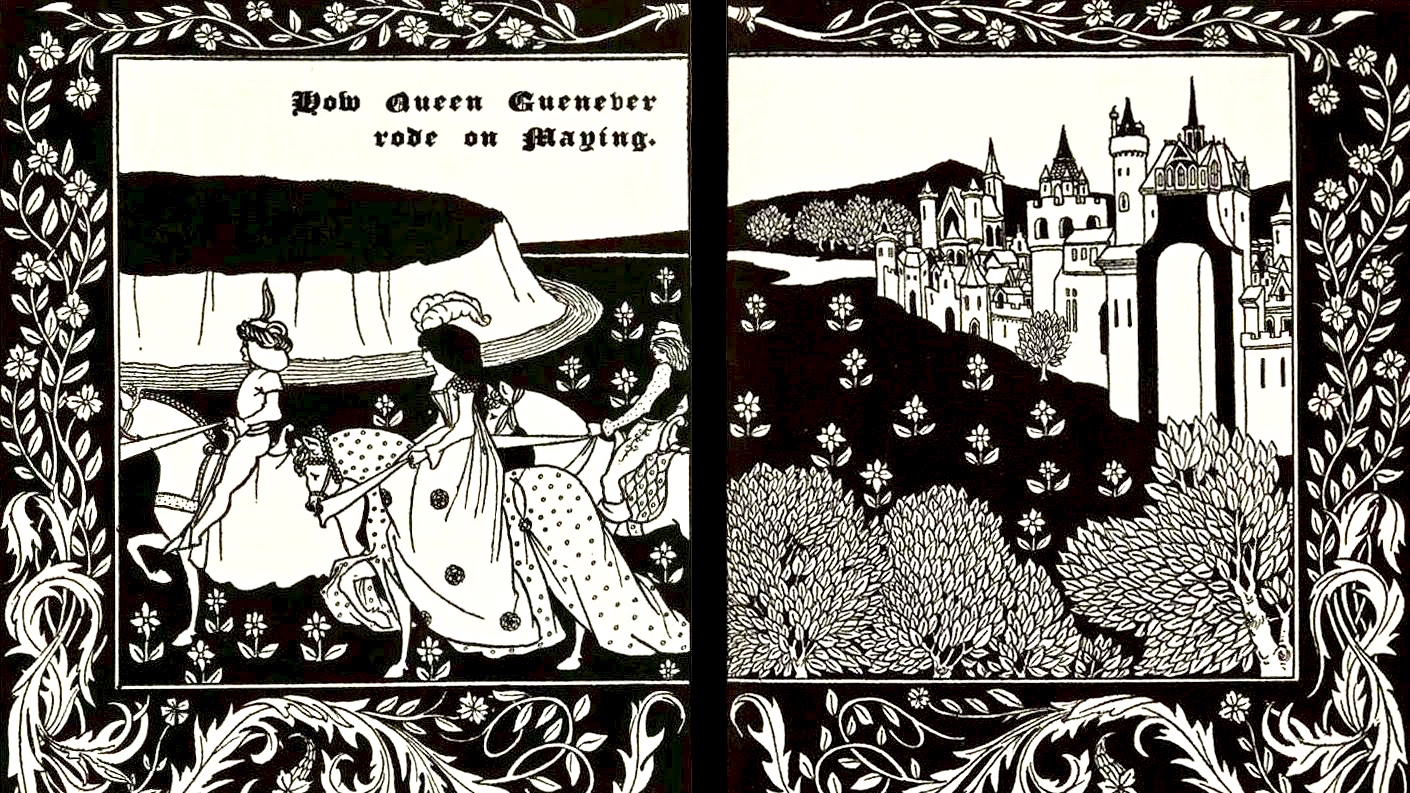
Inspiration for the architectural elements came from an early 19th century romantic revival of interest in all things medieval: particular a perception of the trappings of chivalry: knights in armour, courtly love, stately homes, heraldry, jousting and country pursuits (you’ll see in Finola’s post that we indulged in some of those!). As the Victorian era progressed in the British Islands, these ideals evolved through art – the high point being the Pre-Raphaelite movement – and literature, as espoused in Malory’s Morte D’Arthur, for example, with its interpretation and embellishments by Tennyson and Beardsely:

In respect of architecture, the 2nd Earl was ahead of his time in pursuing medieval themes and must, surely, have been endowed with a good sense of humour. Lady Caroline always loyally stated that all the ideas in the remodelled house were Windham’s; however, we know that the ‘Gothic architects’ James and George Pain were involved, as were Philip Charles Hardwick and Augustus Pugin, in a project that spanned three decades.

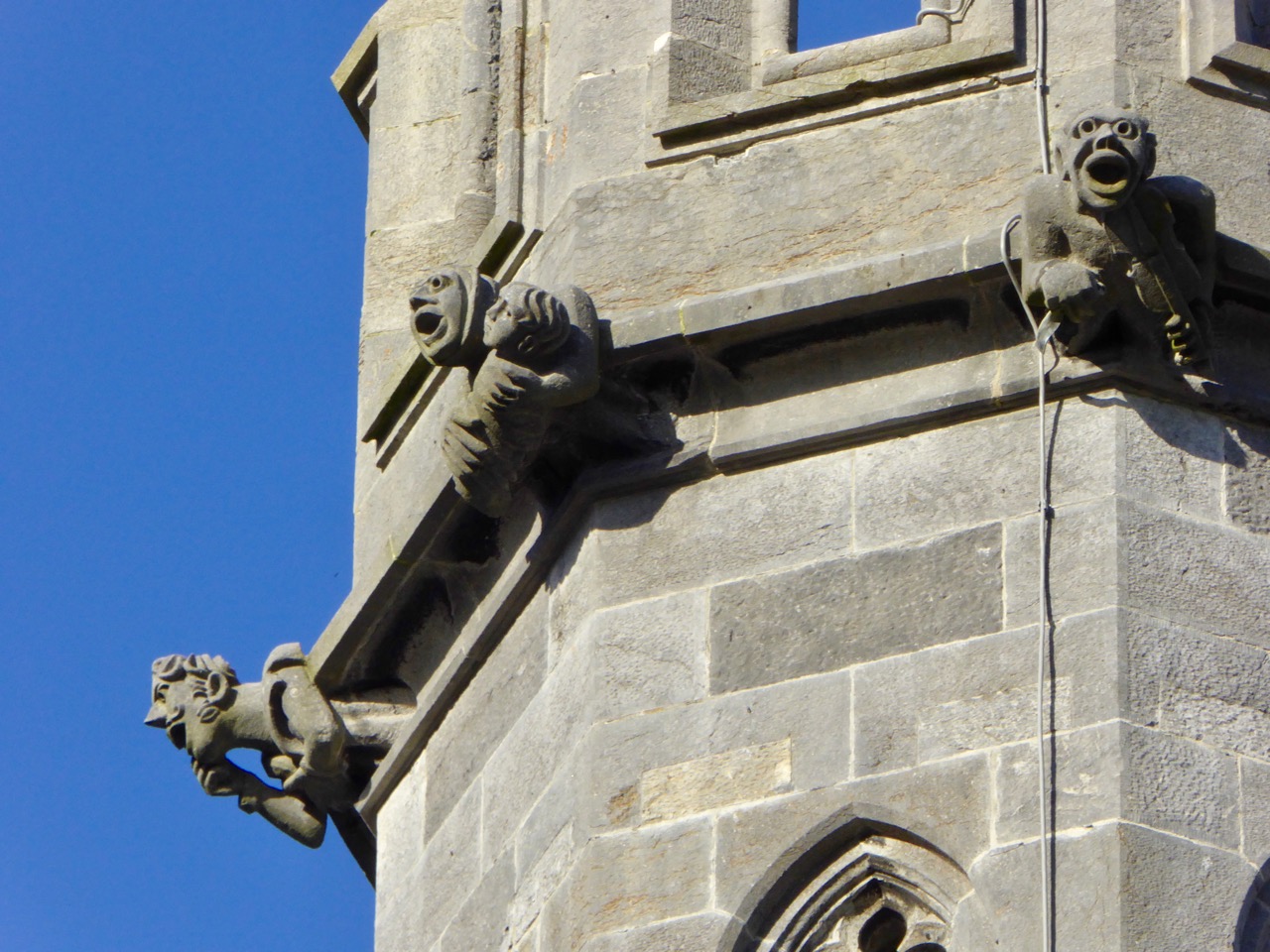
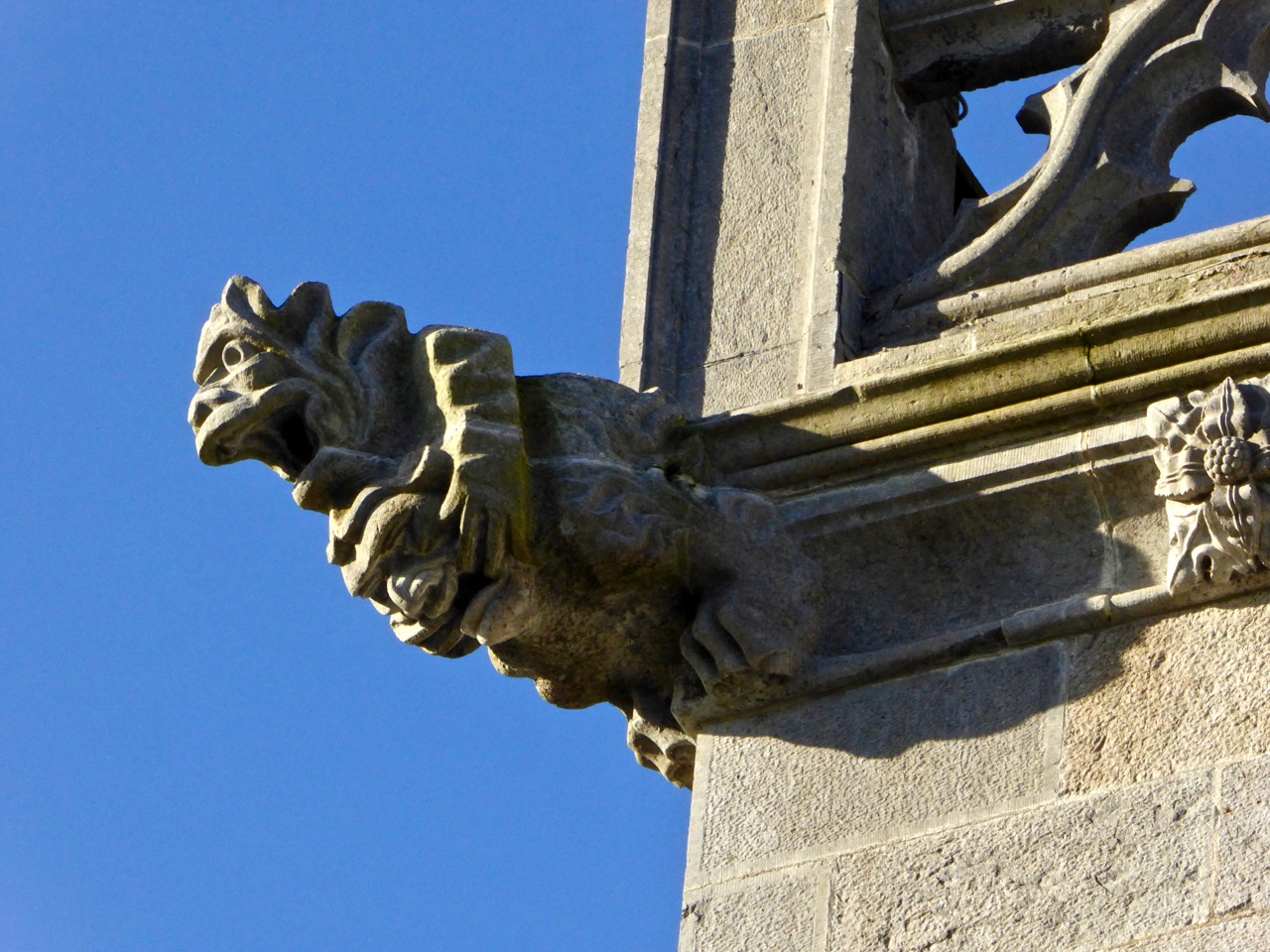
You can see from this one small corner of the Manor the richness and quantity of detailing that was incorporated into the architecture, both inside and out. The 2nd Earl must have dreamed up or approved of all the themes which are well worth studying at length. Here are only a few of the gargoyles which attracted our eyes:

The 1897 photograph, above, shows the carriages of the Duke and Duchess of York at the entrance to Adare Manor. The Duke became George V in 1910. Everyone who comes to the Manor has to enter through a magnificent ‘Romanesque’ doorway (eat your heart out, Finola!) – whether royalty, like the party above, or mere mortals like us, who treated ourselves to a stay to celebrate our wedding anniversary. Have a look at the detailing on the architraves:

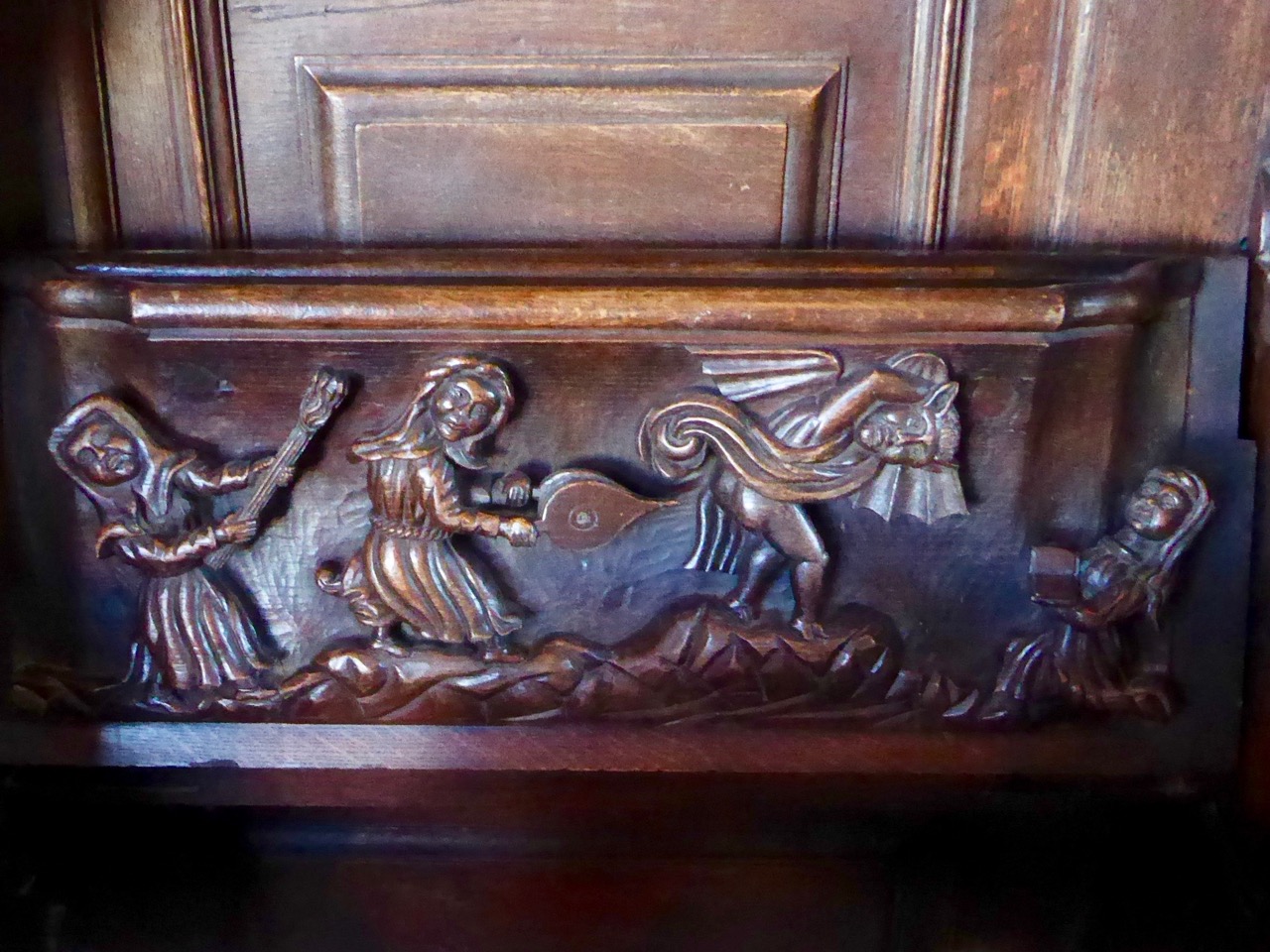
The craftsmen stonemasons of Adare were kept very busy – and fully employed – throughout the building period, which encompassed the worst years of the Great Famine. As were the woodcarvers. One room in the Manor – the Long Gallery – spans the whole width of the house: 40m long and 8m high. It’s now the ‘informal’ dining room. It has a magnificent array of carving, some – the choir seats – brought in from Flanders and dating from the 17th century (see the enigmatic example in the first photograph below), but most purpose-made locally for the new Manor. Each one tells a story. We need to go back again and spend more time there (please) just to even get a glimpse of all of them. By the way, if you want to see real medieval carving, have a look at this post of mine, from the West meets West series.
Lady Caroline was just as industrious as the Earl in contributing to the project and in creating employment through the famine. She established a School of Needlework to develop marketable skills and opportunities for local women: some of the work of the School graces the walls of the Manor. In fact, the work of local craftspeople is prominent throughout the interior of the building. Below left is the Long Gallery, showing off decorative work on the ceiling, tapestries and stained glass. On the right is a carved stone figure that looks down on guests in the Great Hall.

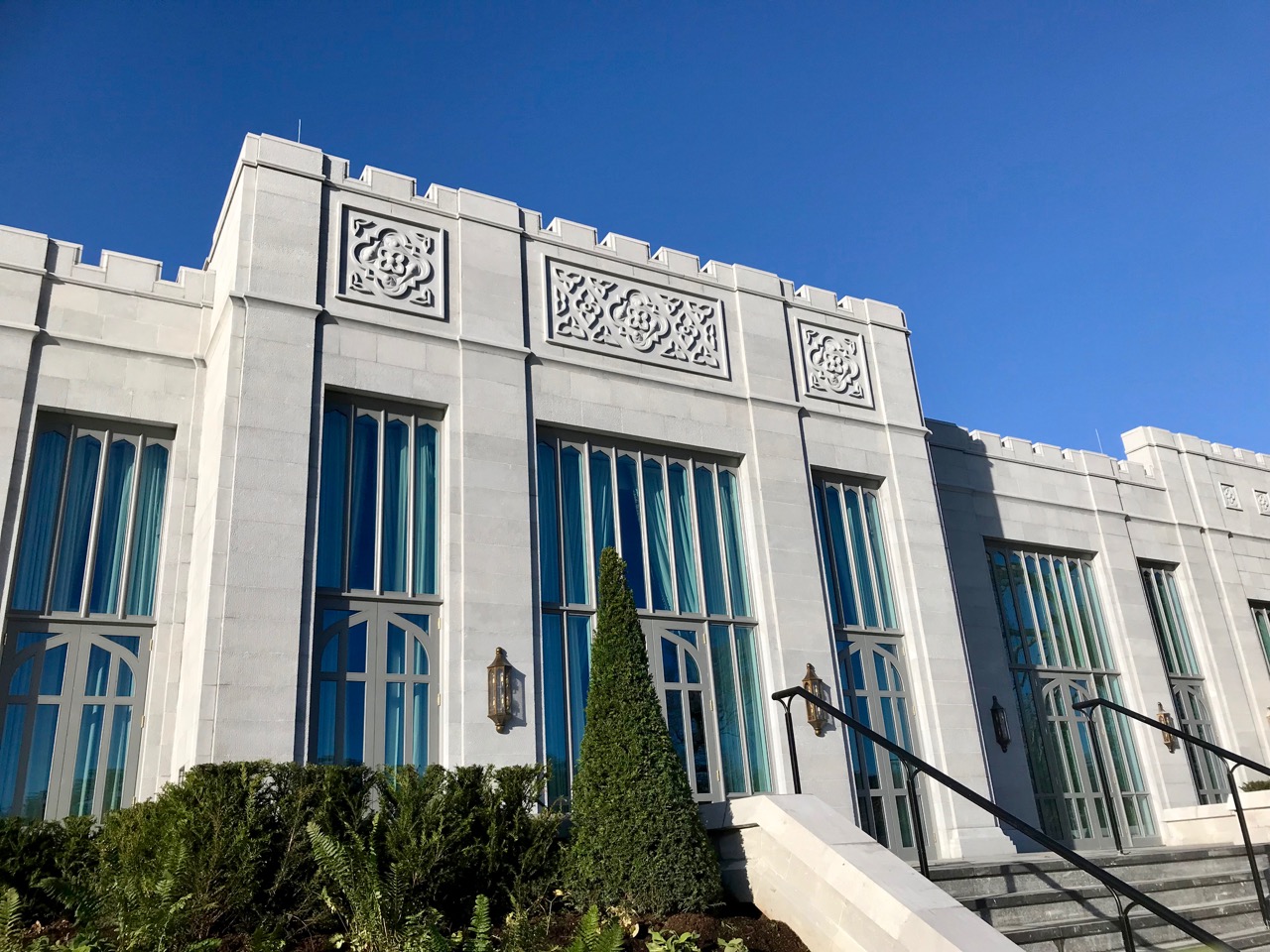
All of the above is just a taster for the wealth of architectural delights that awaits future visitors to this hotel. We were among the first: the Manor re-opened after a full two-year refurbishment and extension the week before we took our stay there. We can confirm that the standard of this establishment is among the highest that we have come across in all our travels in Ireland. Every detail has been thought out: rooms are spacious and warm; beds are large and comfortable; all mod cons are incorporated – right down to a switch beside the bed which opens or closes the curtains! The food excels – and we have yet to sample the full restaurant facilities. Above all, the service is faultless, welcoming, attentive and personal. Amongst the new features is a ballroom, which would make the ultimate wedding venue, built in a style which fully compliments the character of the original architecture:
Flamboyant, exuberant, playful, grand… I will run out of epithets, and superlatives. I was just – delighted – by Adare Manor, and we feel privileged that we can still appreciate the aesthetic  wit which the Earl and Lady Caroline brought to the house, and which has been extended by subsequent generations: the last Wyndham-Quin to inhabit the property – the 7th Earl of Dunraven and Mount-Earl – moved out in 1982. Lady Caroline should have the last word: she wrote this in her 1856 book Memorials of Adare Manor

This charming spot was my home of unclouded happiness for forty years: may Heaven’s choicest blessings be poured with equal abundance on its present and future possessors!
Cormac’s Chapel: The Jewel in the Crown (Part 1)

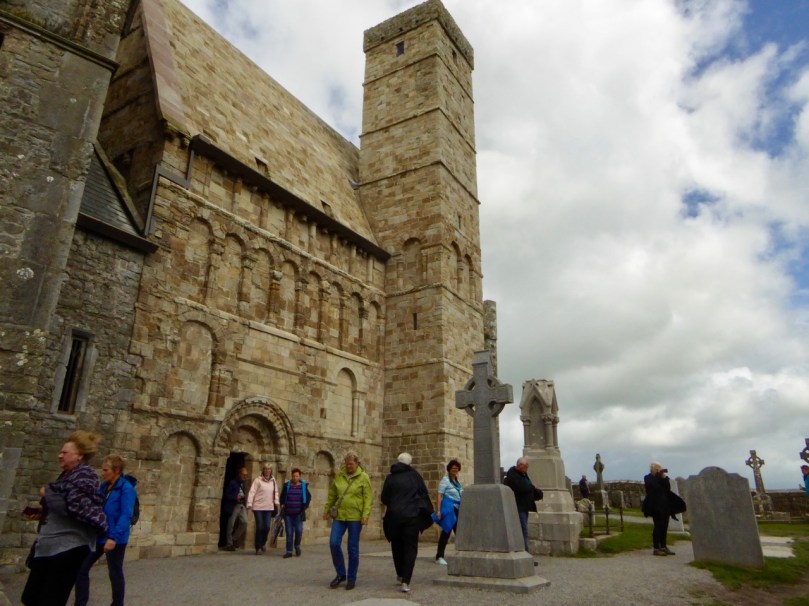
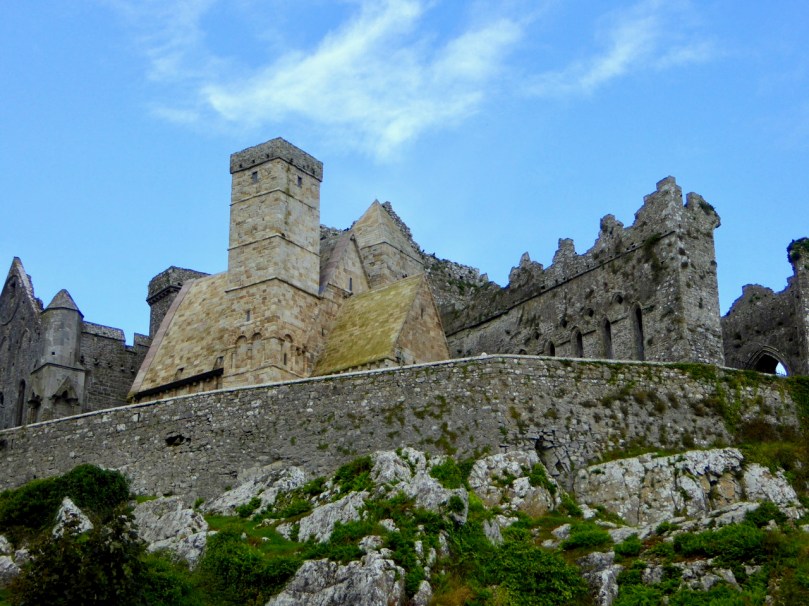
Cormac’s Chapel on the hill of Cashel is the jewel in the crown of Irish Romanesque architecture. It also allows us to trace the influences and development of the Irish Romanesque style both to other examples inside Ireland and to models outside of Ireland. Now that the church has been cured of its chronic leakage problems and the scaffolding has been taken down, we can finally look at this wonderful building in its entirety. In doing so I rely heavily on the work of Prof Tadhg O’Keefe.*

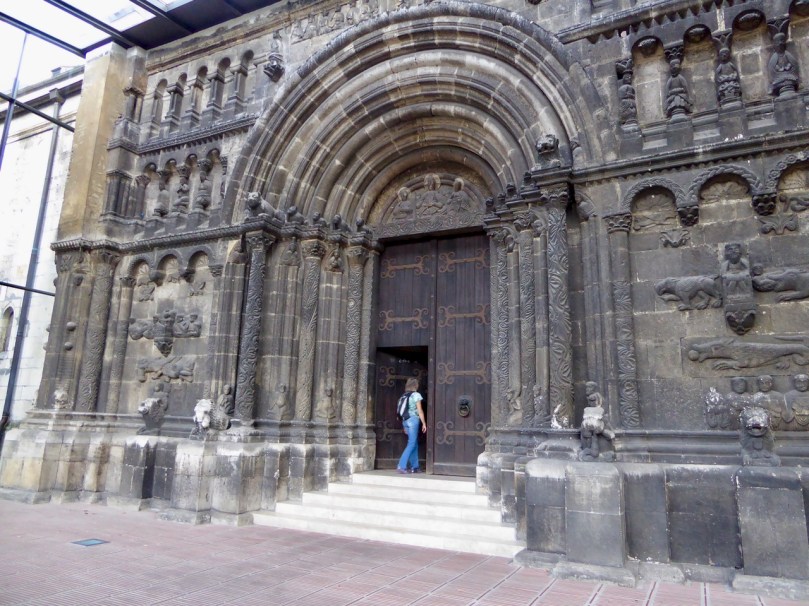
On a walking tour of Bavaria a couple of years ago we visited this church, which turns out to have been connected with Cormac’s Chapel in a surprising way. This incredible portal is completely enclosed by a glass frame to protect it from the weather

We know from historical records exactly when Cormac’s Chapel was started (1127) and when it was consecrated (1134). This means that it was not the high point (that is, the latest and most elaborate development) of Irish Romanesque, but in fact quite early in the sequence of buildings that constitute the corpus of Irish Romanesque architecture. We can look back to the early churches we examined in Irish Romanesque – an Introduction for antecedents, but in many ways this is not a ‘typical’ Irish Romanesque structure. It is, in fact, more reliant for its influences on Anglo-Norman churches in England and Wales, and on the important ecclesiastical links between Cashel and modern-day Germany. O’Keefe puts it this way:

This is the one building of that era in Ireland which must surely belong in the European canon of great Romanesque architectural essays; with a floor area less than the size of a tennis court it is also one of the smallest.

With the scaffolding finally removed, we can see the full extent of the chapel

Who was Cormac? Cormac Mac Cárrthaig (McCarthy) was King of Munster from 1123 to 1127, when he was deposed and retired to be a monk in Lismore with St Malachy (the man credited with reforming Irish monasticism and inviting in the Cistercians). His throne was restored to him within a few months and in gratitude he commissioned a new chapel to be built on the Rock. While the Rock of Cashel had been gifted to the church previously, the chapel was probably intended to serve the purpose of a royal inauguration site, thus enhancing and securing Cormac’s power. It took some time to build – it was consecrated seven years later.

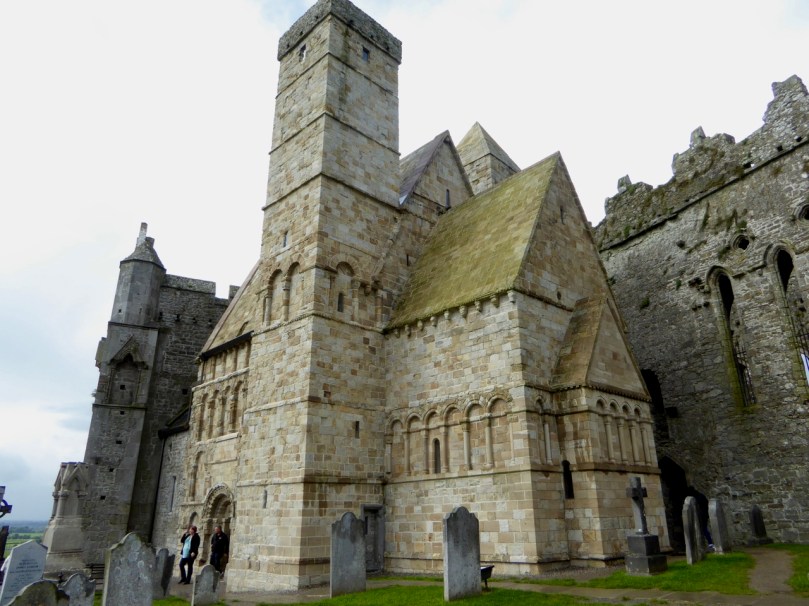
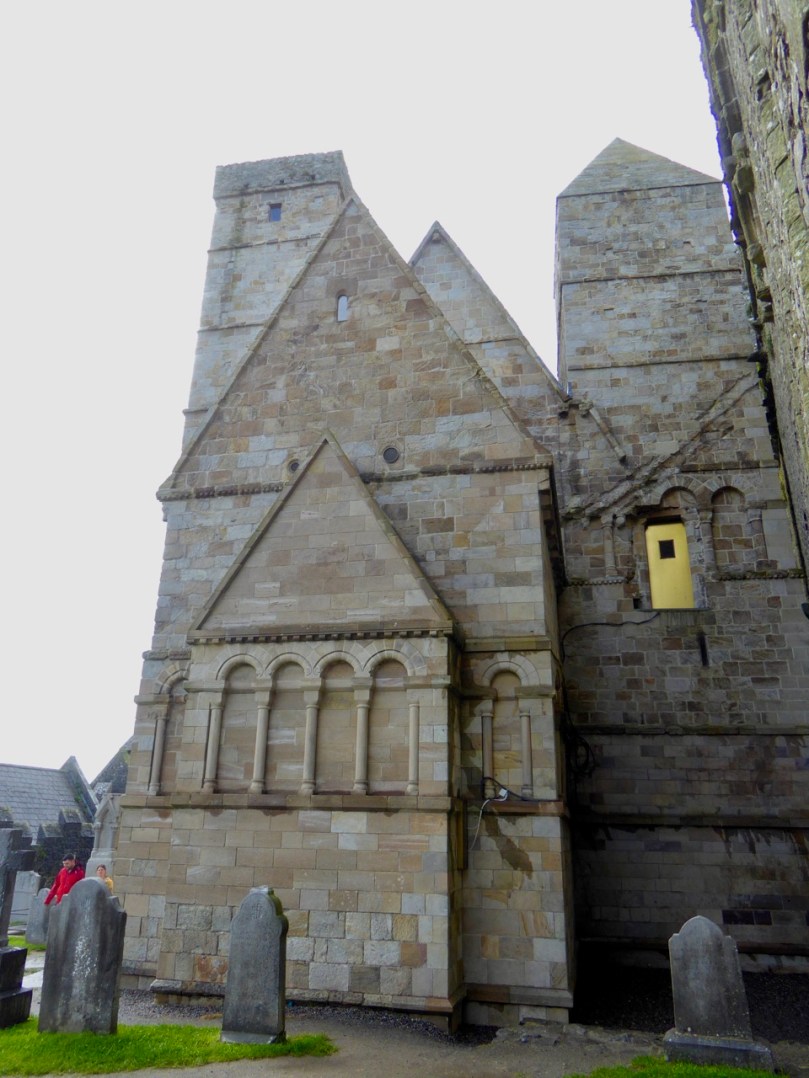
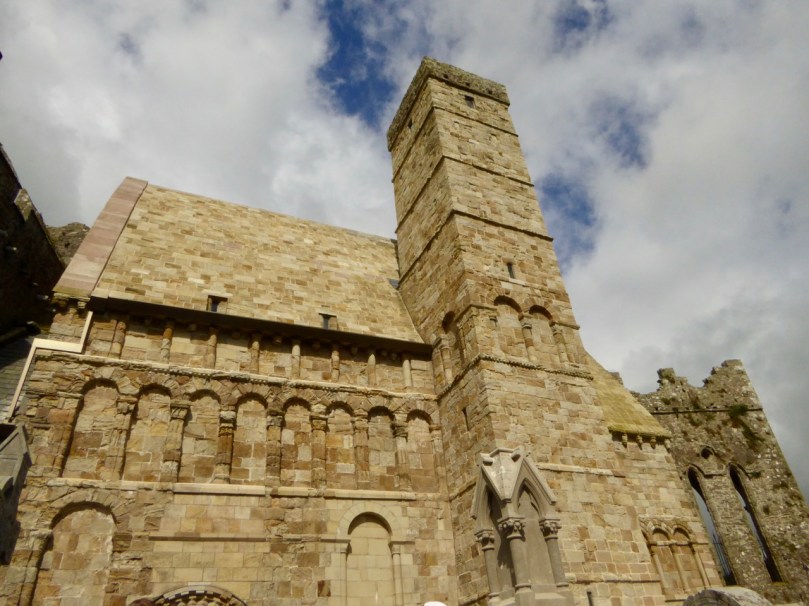
In this photograph, note particularly the high pitched roof and the tiny windows that are the only means of letting light in to the rooms above the chancel and above the nave. Note also how the later gothic cathedral impinges on the much smaller chapel

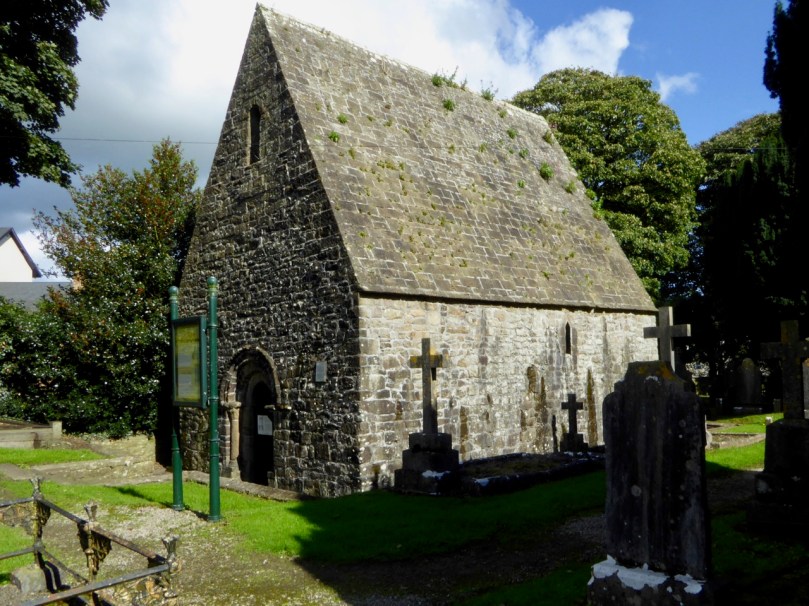
Let’s start on the outside. This is a nave and chancel church, with opposing doors on the north and south sides, twin square towers, steeply pitched stone roof, projecting altar bay, and extensive string coursing and blind arcading on the exterior walls. The pitched stone roof appears to be a typically Irish feature – similar examples have survived intact in St Kevin’s Kitchen in Glendalough, St Flannan’s Oratory in Killaloe, and in St Colmcille’s House in Kells (see Robert’s post A Medieval Feast), while we saw vestiges in Kilmalkedar a few months ago. In fact, the roof accommodates a second story, accessed via a stairway within the church. You can see the tiny round-headed windows that give light to this space on the wall above the chancel, and there are also rectangular windows right at the bottom on the roof where it meets the wall of the nave. It must have been an uncomfortable room, dark and damp, and it is hard to imagine it being used for daily activities (such as a Scriptorium, as the Kells room was traditionally thought to have been) so it has been suggested that it was a sacristy.

St Flannan’s Oratory in Killaloe, Co Clare. As in Cormac’s Chapel, the steeply pitched gable accommodated a room above the chancel, in this case lit by a single window in the end wall

But that pitched roof is where the older Irish influences stop – for the rest of the building we must look elsewhere.

Intriguing carvings on the portal of the Regensburg church

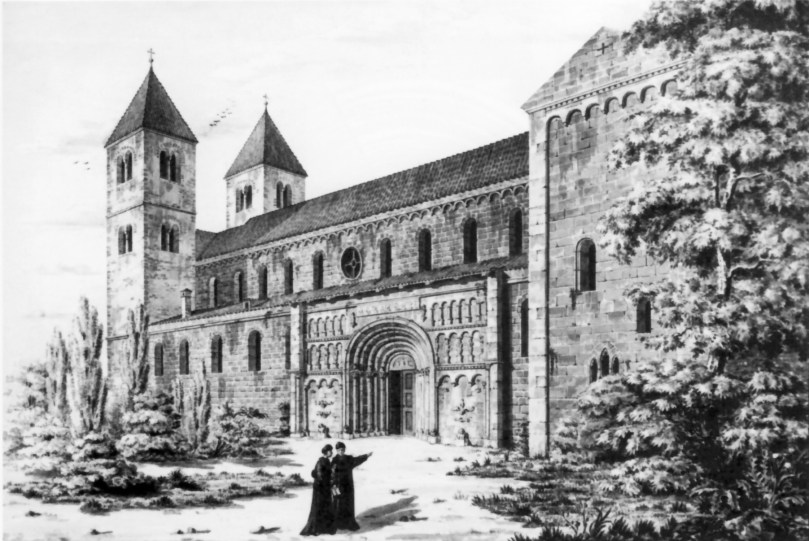
The two square towers are particularly interesting and have few parallels in Ireland. In fact, they are based on a church we happen to have visited two years ago in Regensburg (previously called Ratisbon) in Bavaria. Upon his restoration as King of Munster, Cormac received a visit from two Ratisbon monks, Isaac and Gervasius, accompanied by a carpenter (Conrad) and one other man.

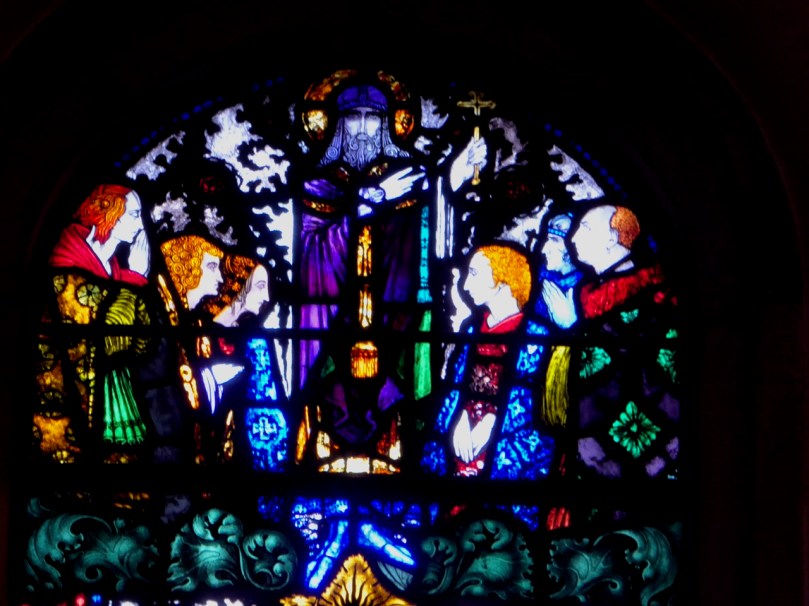
Detail from the St Albert of Cashel window by Harry Clarke in the Honan Chapel, at University College, Cork: Albert preaching to the (red-haired) people of Ratisbon

The first evangelising monk from Cashel to establish links with Ratisbon had been St Albert, way back in the 700s and there had been strong connections ever since. The church, St James, in Regensburg, is called the Scots Church or Schottenkirche (Schotte was the term used for Irish) and while it has been altered over the centuries, the Romanesque core remains, along with the two flanking towers and a magnificent doorway in the north wall.

Conrad the Carpenter and his sidekick may well have put to use the knowledge they acquired building the Schottenkirche St Jakob in designing the two square towers at Cormac’s Chapel.

This photograph illustrates the altar projection on the east end of the chancel, as well as the two towers. Note the conical cap on the north tower, as in the Regensburg example

Opposing doors in the north and south walls are almost  unknown from older Irish contexts, as it  was customary to enter through the west end (opposite end to the altar). We saw opposing doors in Liathmore but O’Keefe feels they may be a bi-product of later reconstruction. There are reports of a  two-door church of St Brigid in Kildare, and such designs…

were presumably designed to accommodate different types of procession, sometimes simultaneously: royal and episcopal parties certainly entered through the large portal on the north side, while clerical concelebrants and choristers presumably entered through the smaller portal in the south wall.

And wonderful doors they are! (Look back at Irish Romanesque 2 – Doorways for more about doors in general.) The south door is now the main entrance for visitors but in fact is relatively modest with only two orders and a timpanum depicting a animal, probably a lion. The archivolts are chevroned but weathering has damaged much of the other carvings.

The cathedral wall cuts off part of this doorway, damaging the door and making photography difficult. This is a small open triangular space between the cathedral wall and the north door

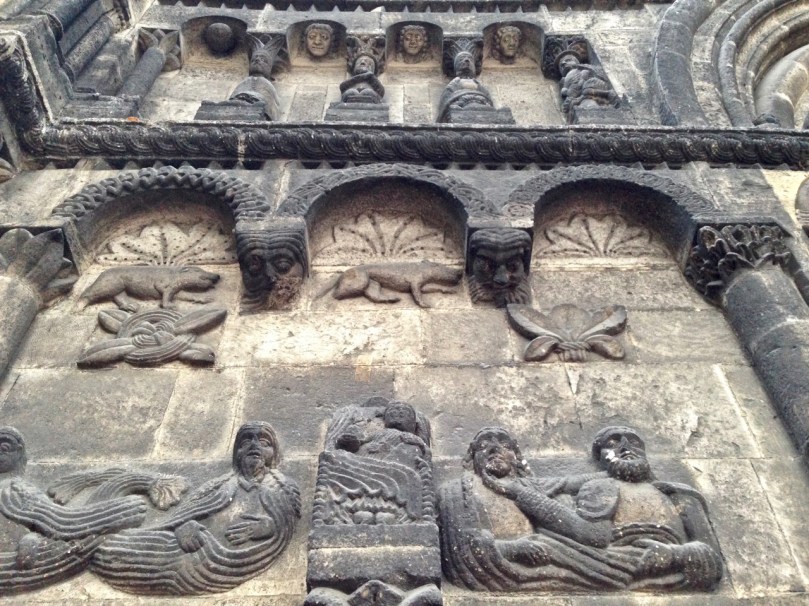
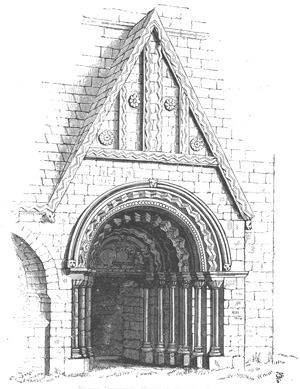
The north door is larger and more elaborate, although it is incomplete, as the later gothic cathedral was built up against this section of the chapel. Above the door is a triangular pediment, decorated with vertical and horizontal chevroned lines and with rosettes.

From Irish Pictures Drawn with Pen and Pencil, Richard Lovett 1888

The tympanum has a curious decoration – it’s a centaur, of all things, shown hunting a large lion with a bow and arrow. This is not unknown in Romanesque carvings, which often feature animals from the medieval bestiary, but unusual enough.

As for the rest of the chapel, Prof O’Keefe points to the most likely influence being the Anglo-Norman churches of England and Wales, which provide exact parallels for many of the features, external and internal, that can be observed at Cormac’s Chapel. One feature he points to, for example, is the shallow projection, lit by lateral windows, at the far east end of the church – functioning as an extension of the chancel to contain the altar. Indeed, muses O’Keefe, as he ponders the particular mixture of Irish and non-Irish features visible in this building;

Walking around Cormac’s Chapel, outside and inside, one instantly recognizes that it has affinities in Britain. The blind arcading and the chevrons can be paralleled effortlessly in literally hundreds of English Romanesque contexts, from south Wales to East Anglia, and from Exeter to Dundee (Fig. 78). Moreover, their execution speaks not of Gaelic-Irish craftsmen who have learned these forms and how to carve them but of actual English Romanesque craftsmen in Cashel in the late 1120s and early 1130s. We cannot prove this, of course, but later Romanesque work in Ireland looks sufficiently different for us to be very confident that Anglo-Norman hands recreating an English Romanesque repertoire shaped large parts of Cormac’s Chapel.

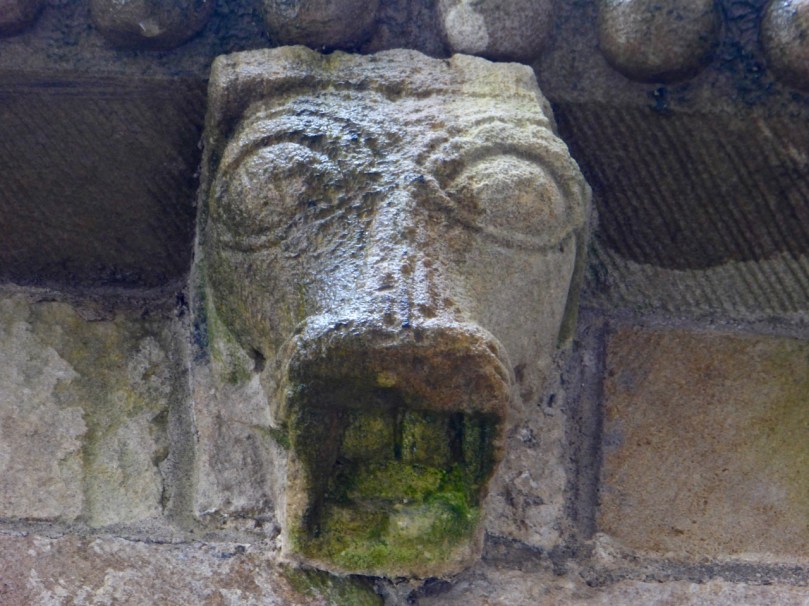
Blind arcading, string courses, and carved roof corbels (see below) enliven the outside of the chapel. The two small windows in the roof allow light to the room above the nave

Next week we will go inside Cormac’s Chapel and discover yet more treasures from the 12th century. See you back here then.

*Prof O’Keefe’s book  is now out of print although second-hand copies can be found. I relied heavily on his manuscript, Romanesque Ireland: Architecture and Ideology in the Twelfth Century, which he has generously uploaded to Academia.

Irish Romanesque 2 – Doorways

In April I introduced you to the form of architecture known as Irish Romanesque – the dominant form of church architecture in Ireland in the 12th century. If you haven’t read that post already a quick glance over it will get you ready for this one. To continue the series, I’m going to look at one of the glories of the form – the elaborate doorways, often highly decorated, such as the one at Clonfert, above.

Our friends Brendan and Kathie are visiting at the moment and I pressed Brendan, an artist, into service, drawing the Killeshin doorway for me, so I could use his drawing to illustrate the main features of these doorways, and cover some basic vocabulary. (Thank you, Brendan!) Take a look at our joint effort – it will help as I talk about the doorways.*

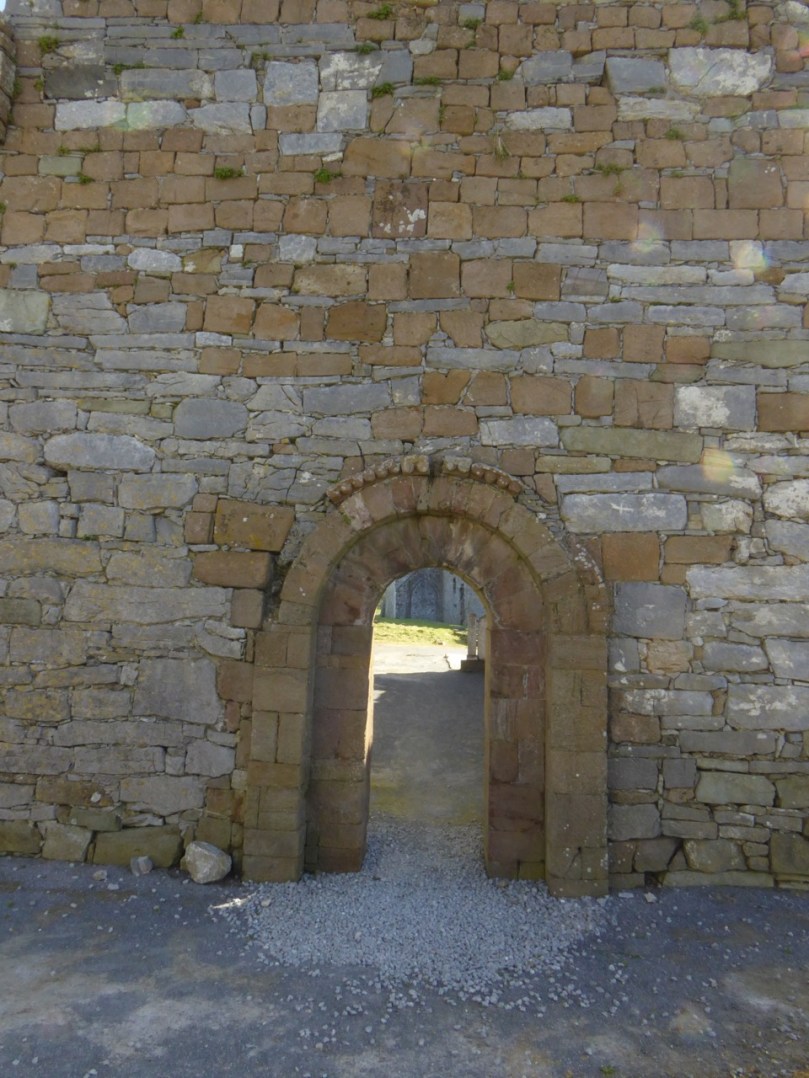
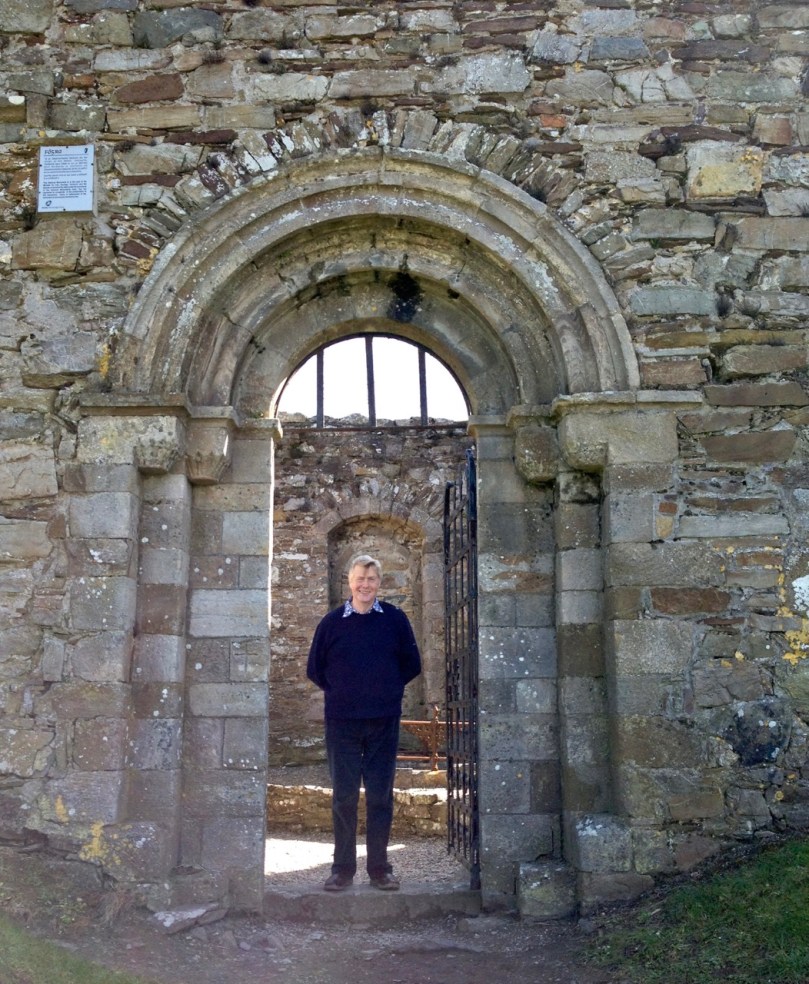
This simple door is at Ardfert in Co Kerry. It only has one order and no decoration apart from a string of bosses above the arch. The romanesque elements at Ardfert are mixed with later gothic elements – fragments only of the 12th century buildings that once occupied the site. The doorway below is yet another example, built into the wall of the later cathedral building. The stone is soft and much weathered but the columns were once carved, and the door is flanked by blind arcading.

This doorway (below) at Ardmore in Waterford is no longer complete – while the jambs are there, the columns have disappeared, leaving only their capitals behind.

Killeshin in Co Laois, our model for the drawing, is a beautiful site. The early church retains antae on one side, and there are windows and vestiges of a stone roof reminiscent of the early medieval site we described at Kilmalkedar in Kerry.

The doorways has three orders and a pediment above. Many of the voussoirs are carved with intricate designs and the keystone features a carved head.

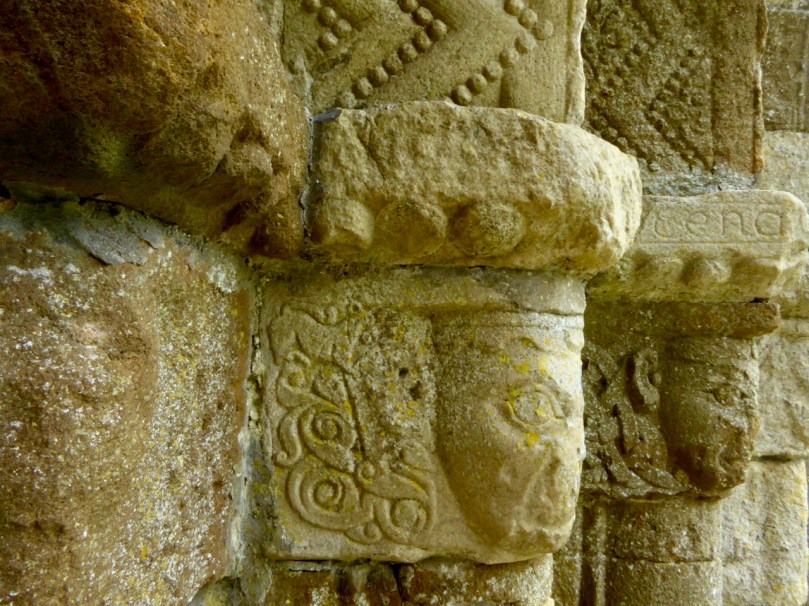
Not only do the Killeshin carvings include intricate geometric patterns and heads on the capitals, but there is writing memorialising the builder and the donor.

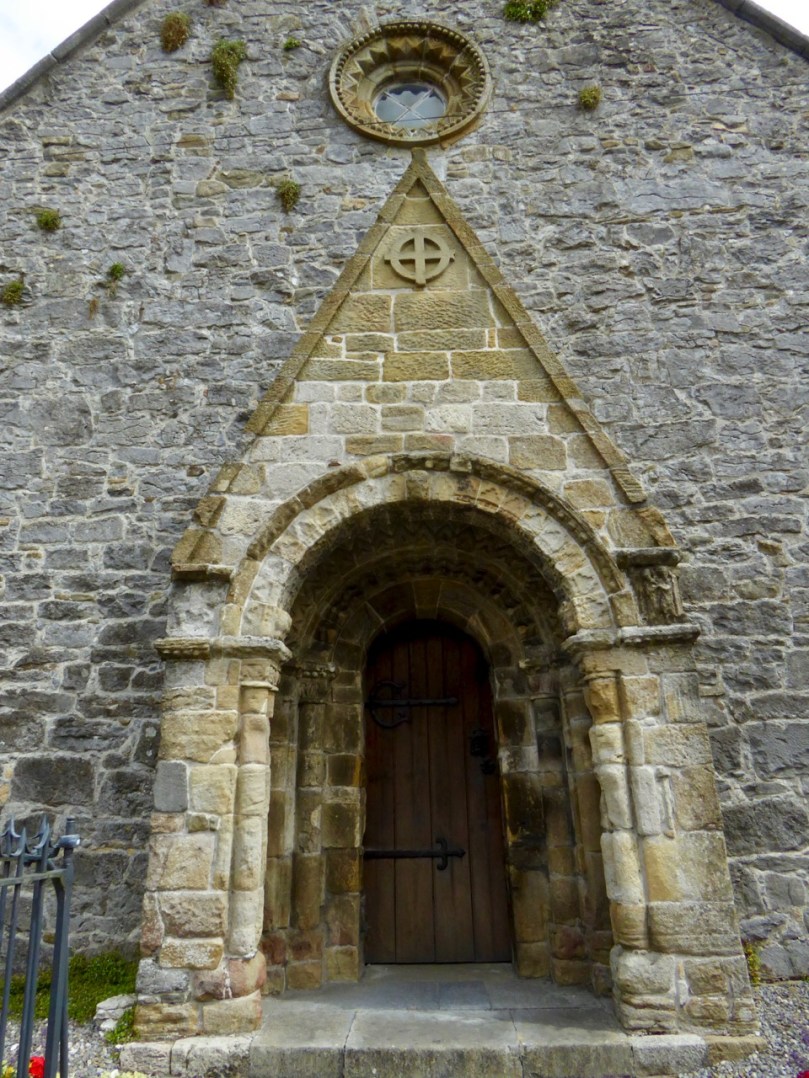
Not far from Killeshin is Freshford (Co Kilkenny) where a church still in use has incorporated a romanesque doorway from a 12th century church into a later building. Much modification has taken place – the round widow in the neo-romanesque style is an 18th century addition and the cross at the top of the pediment is also recent.

Note the inclined jambs – meaning the doorway tapers towards the top. The stone is soft and badly weathered, but some carvings are still discernible on the capitals. Interestingly, the jambs originally had niches for statuary, one example of which, two figures, remains,

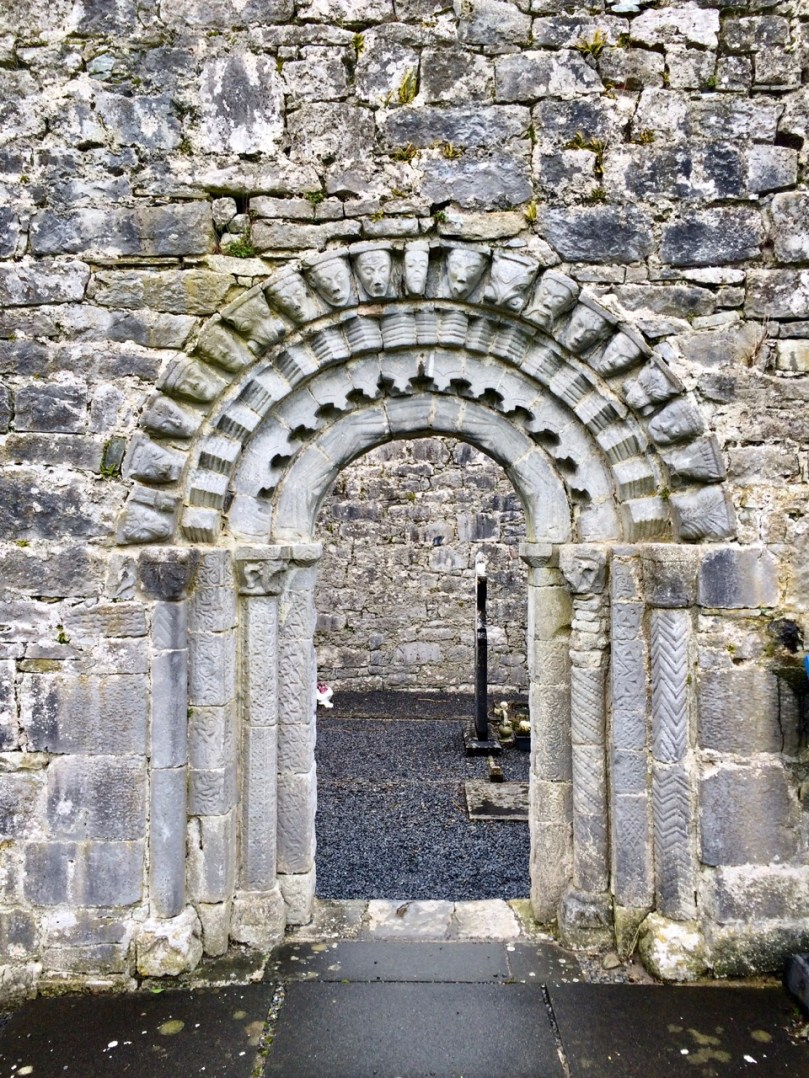
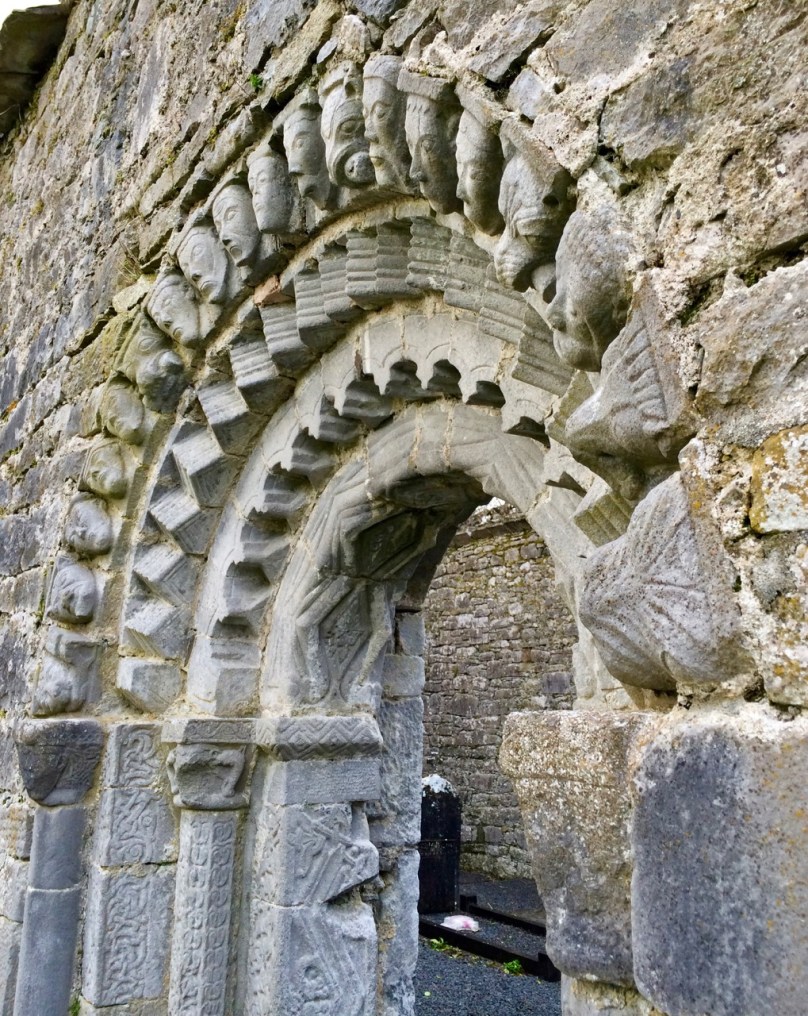
Two of my personal favourites come now. The first in in Clare, at Dysert O’Dea, a fascinating multi-period site. The romanesque doorway is distinguished by its multiple carved heads on the voussoirs of the outermost archivolt of the arch.

The columns, capitals and inner archivolts are also highly decorated, but it’s those carved heads that never fail to capture the imagination. Not all are human, but of the ones that are I can’t help wondering who the models were – bishops? warriors? saints? kings? Or perhaps the carvers themselves?

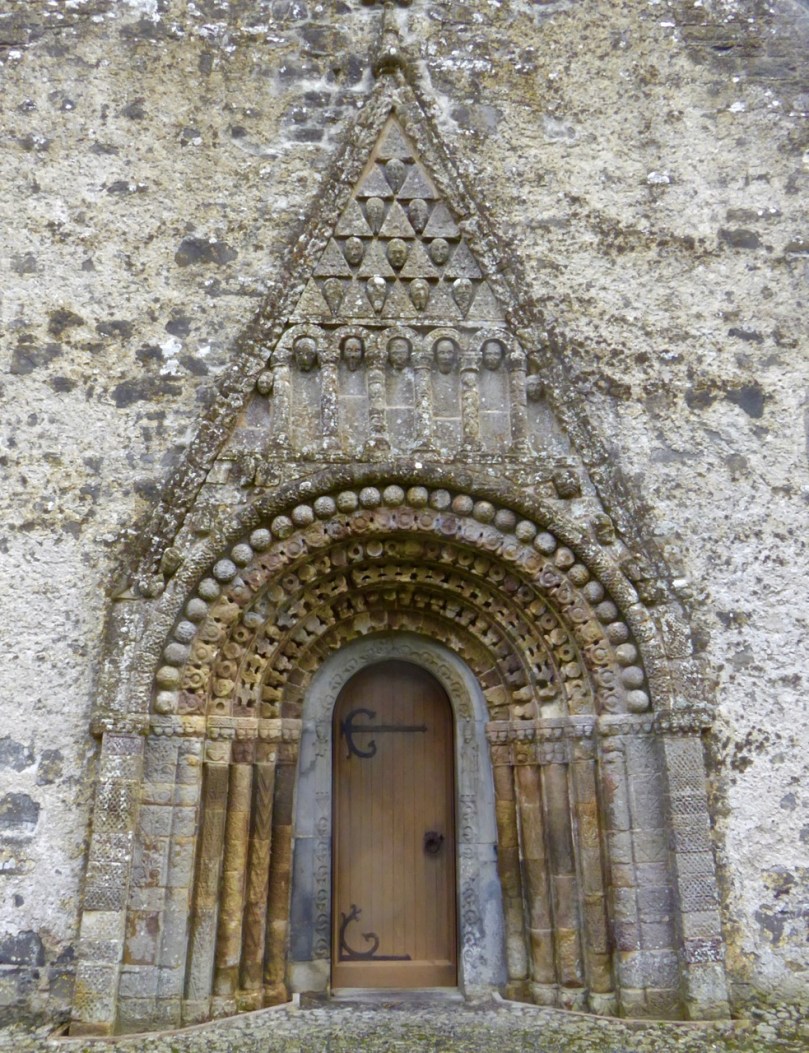
Finally, the greatest doorway of all, widely considerered to be the masterpiece of romanesque architecture on Ireland – the great door of Clonfert cathedral in Co Galway. It’s the photograph I led off with, showing the whole doorway. Let’s take a look at some of the details.

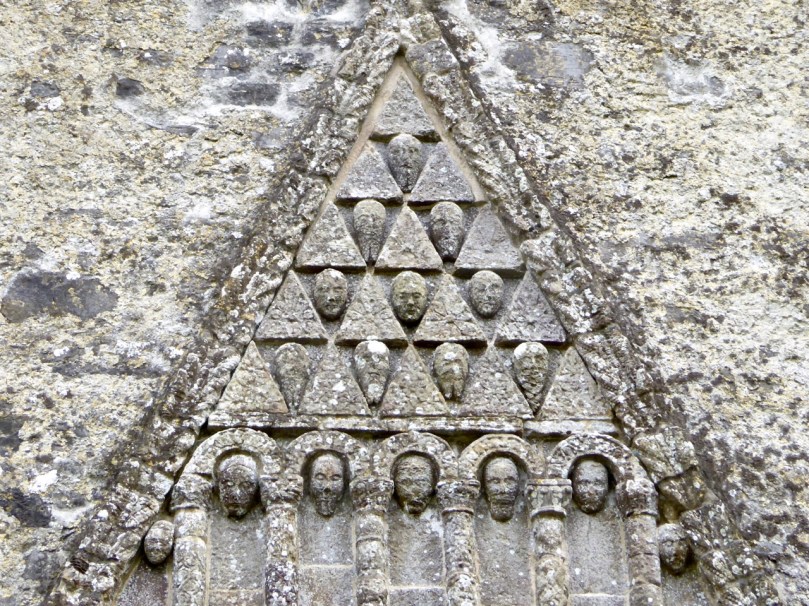
The pediment is unusual in that it is filled with triangular reliefs, each having a carved head. Below that are blind arcades with yet more heads. Although weathered, each head has its own distinct character.

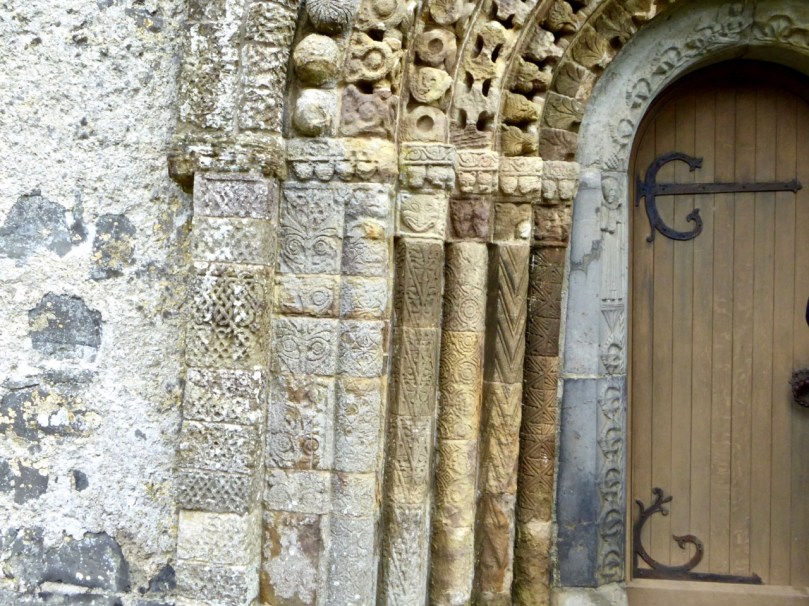
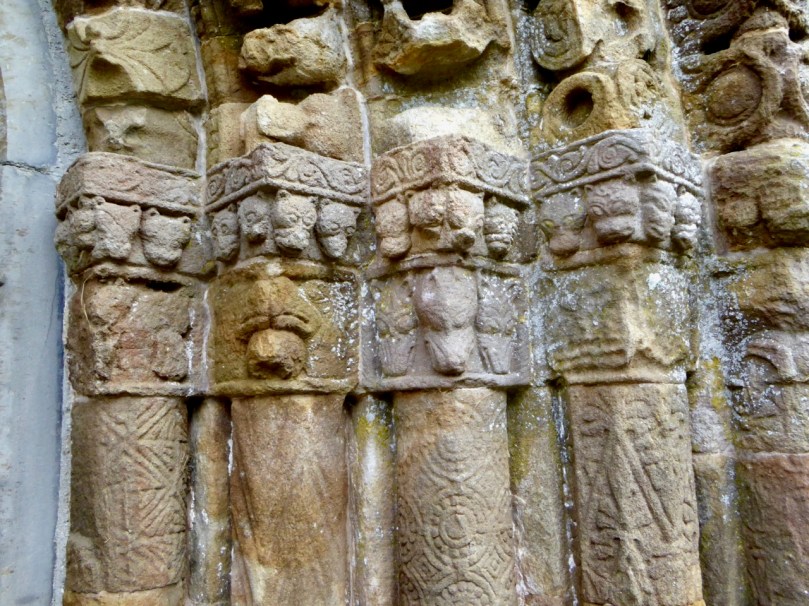
All seven orders of columns and capitals are decorated, as are the archivolts. In fact, it’s hard to find an inch on this doorway that isn’t intricately carved. There are fantastical creatures, animals, geometric and interlaced designs, and on the innermost jamb, two carved figures that are mostly likely 15th century additions, but no less compelling for that.

Romanesque carvings deserve a post to themselves one of these days, as does the iconic building of the period – and this time not just doorways but a complete building – Cormac’s Chapel at the Rock of Cashel. Look out for those posts in the future. Meanwhile, one last glimpse of some of columns and capitals from Clonfert…

*For a truly erudite treatment of Irish Romanesque, see the Corpus of Romanesque Sculpture in Britain and Ireland – its the Romanesque Encyclopaedia!

The Treasures of Castledermot

Last week we explored the medieval wonders at Moone, in County Kildare. We couldn’t leave the area without going on to Castledermot to visit the monastic site of Díseart Diarmada, (the hermitage of Dermot) – a few minutes’ drive down the road. Stone carving artists were active here, too, as we can see from the many artefacts mainly centred today around St James’ Church, built on the site of the former monastery. These include a decorated Romanesque doorway: Finola is writing about Romanesque architecture today.

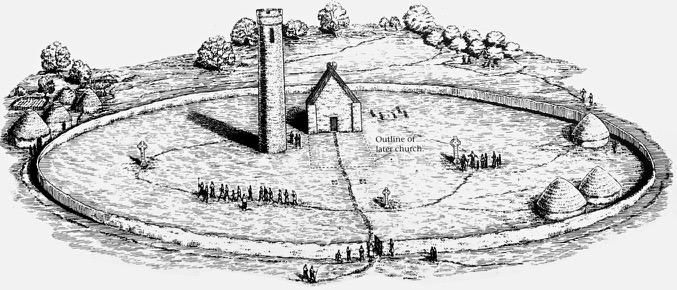
Díseart Diarmada as it might have appeared in the 800s. This reconstructed view is taken from the excellent Dúchas interpretation panels on the site, and shows the earliest church, the 20m high round tower (which still stands today) and the two ornate high crosses, which also remain intact

The settlement itself was highly important. There were Viking raids during the 9th century, probably indicating that there was wealth to be plundered there. A royal grant was given for a fair in 1199, and the very first Irish parliament was convened in the town on 18th June 1264. In 1393 Castledermot was granted permission to mint its own coins.

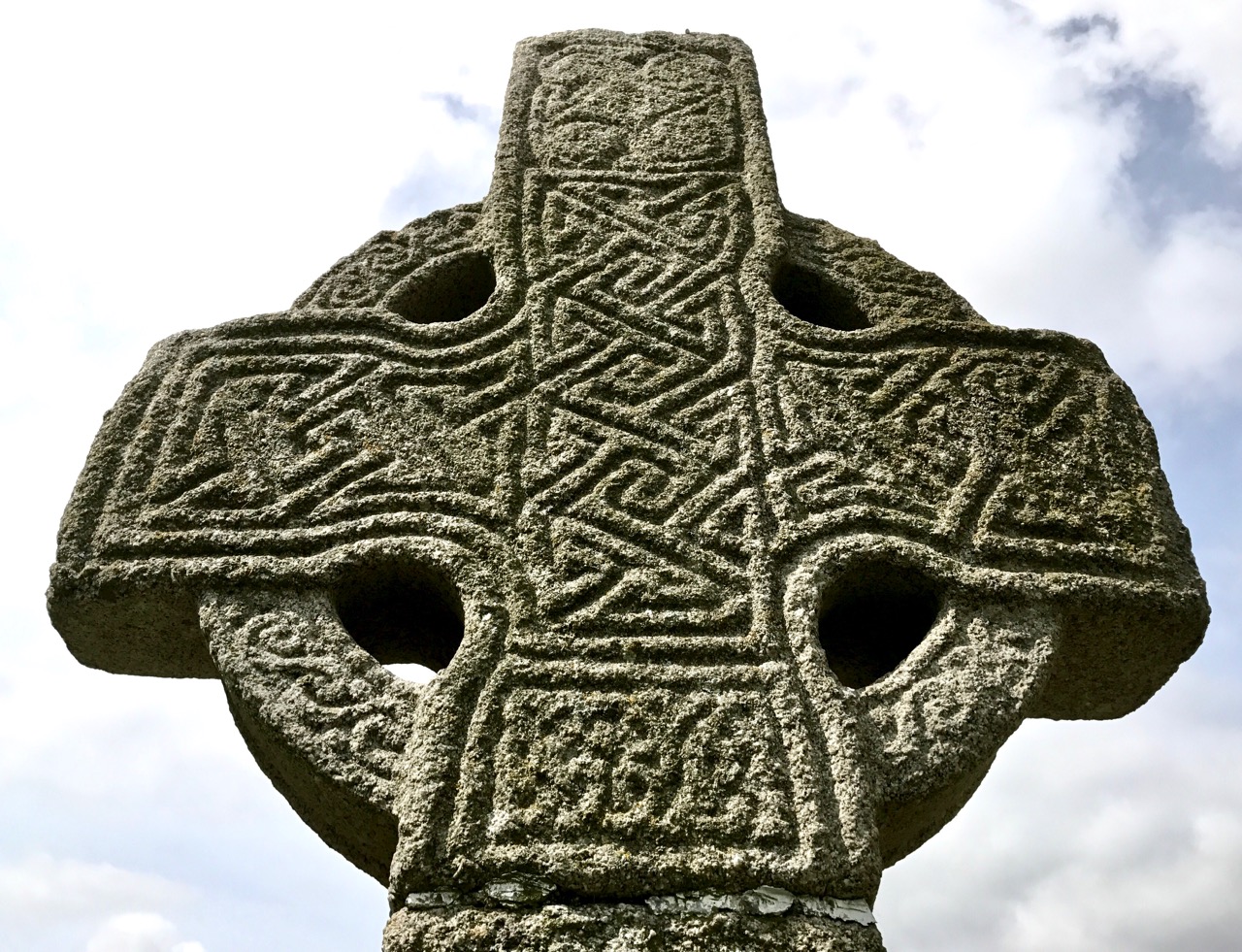
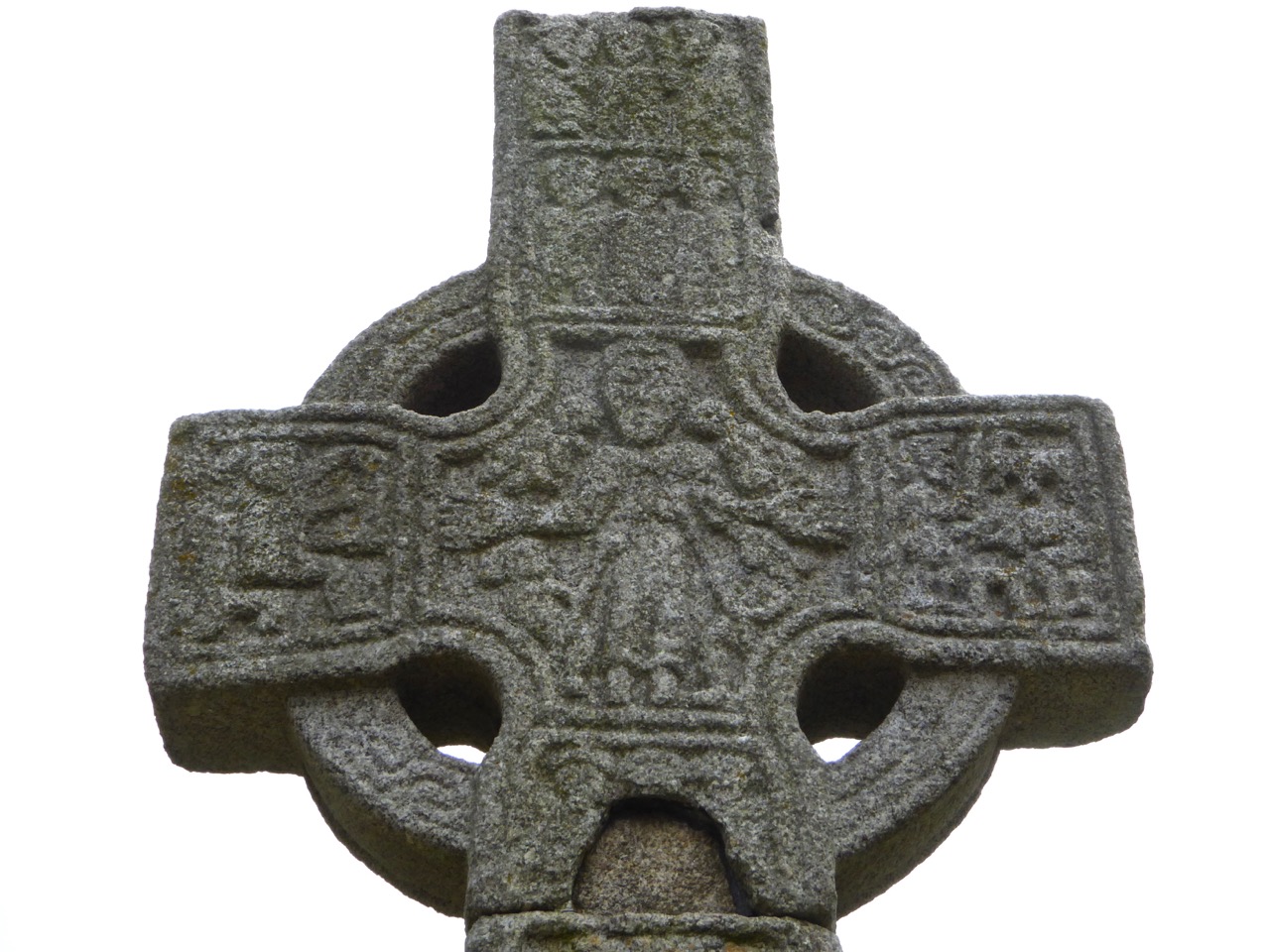
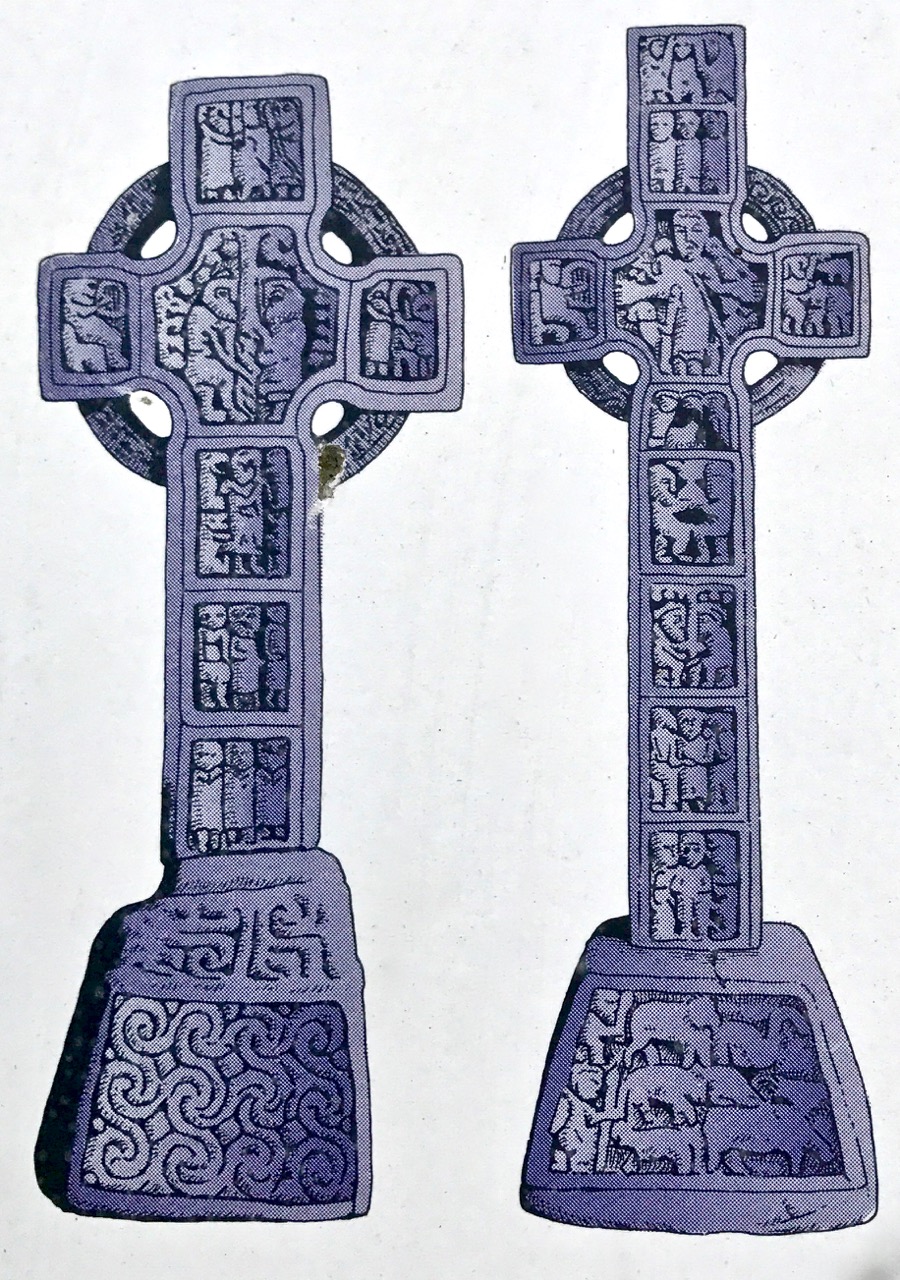
The two high crosses at Castledermot: south cross (left) and north cross (right – round tower beyond). The header picture shows the geometric work on the east face of the south cross

There are certainly figurative carvings on the two crosses to almost rival those found at Moone. I was particularly interested to see other versions of the stories of the loaves and fishes and Daniel in the lions’ den. But the real glory of Castledermot lies in the panels of knotwork. If these were coloured (as suggested at Moone) they must have been spectacular.

Note the loaves and fishes, bottom left

It’s interesting to speculate who might have been responsible for this ancient carving. Could it have been the monks themselves, who considered that part of their dedicated life was to build and decorate the great monastic buildings? Or were they constructed by travelling masons, much as the later cathedrals were? And who directed and designed the work? These are such important monuments – a legacy which we must be sure to look after: they have been here for more than a thousand years and – in spite of being in the open and subject to constant weathering – are still clear to see. At Moone the great cross there has been placed under a modern protective canopy, which is not intrusive. Perhaps such actions should be considered for all these Irish medieval works of art.

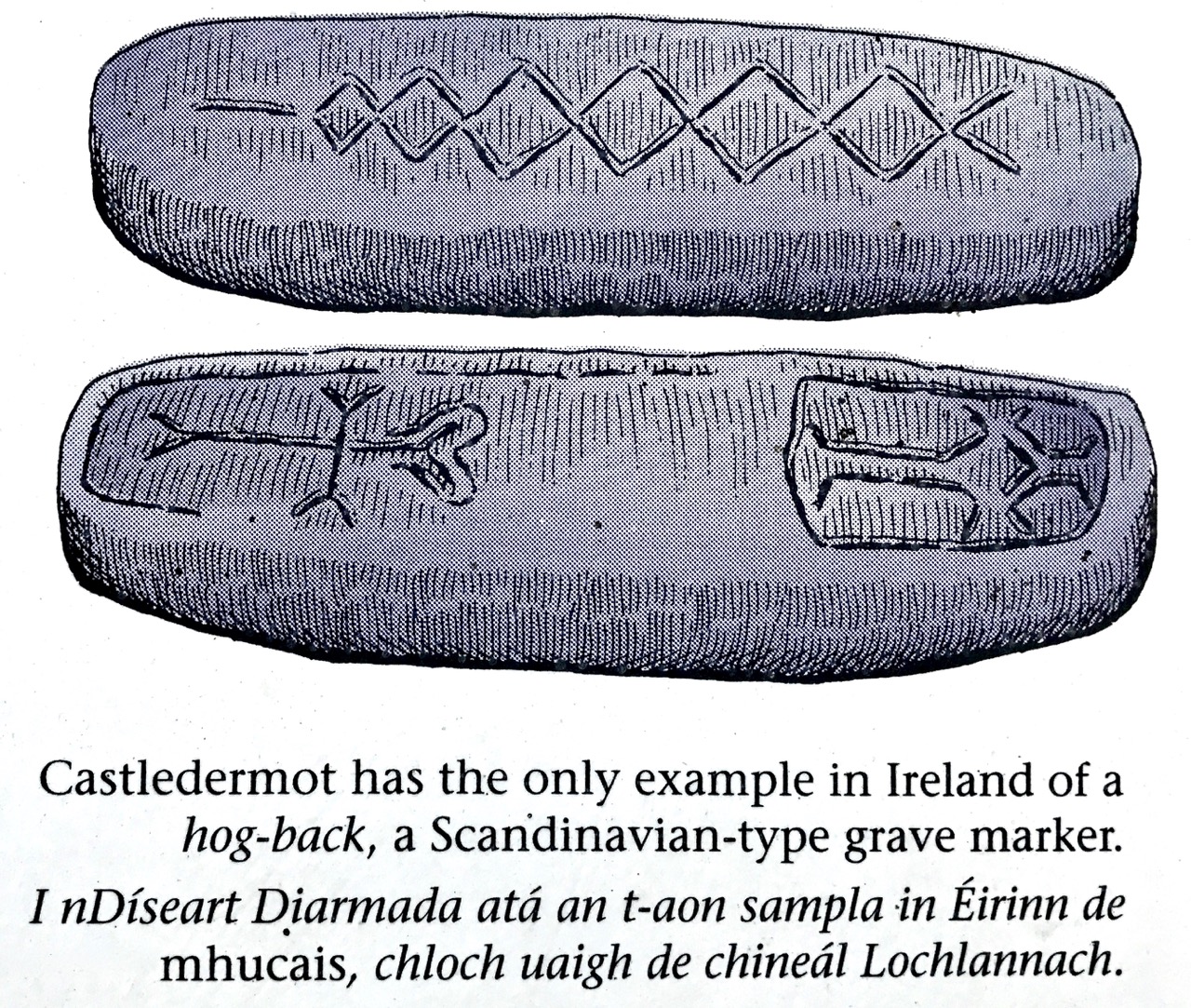
The site at Castledermot reveals many other remains which appear to be weathering quite badly. These include the Hogback Stone, which has been linked to Viking activity in the area: it was discovered just below the ground in its present location in 1967. It is said to represent a House for the Dead, and other examples have been found in Scotland and England: this is the only one found so far in Ireland.

The Hogback Stone (top – Dúchas – and bottom left) and an unusual type of cross-slab close by (right). This is known as the Swearing Stone, and it is said that it may have been used during wedding ceremonies or for swearing oaths or allegiances in early times

Although residents in Castledermot are keen that their historic artefacts are well looked after and are seen by an interested public, the site remains rather obscure and perhaps deserves to be better known. There is a wealth of heritage in Ireland – do we take it too much for granted? The Office of Public Works (formally Dúchas) do their best to maintain and advertise the monuments under their care but it’s an uphill job with a budget which is far too small.

We have by no means exhausted the treasures of this remarkable Irish town. There are other intriguing carved stones and crosses on the monastic site, and, at the southern end of the town are impressive remains of a Franciscan Friary, founded around 1247. This site has a guardian and a key holder, but we didn’t have time to visit. Inside it is a rare cadaver grave stone dating to about 1520. In 1275, the town was given a royal murage grant. This allowed the collection of tolls from people entering Castledermot to pay for the construction and maintenance of town walls. The wall, with three gates, was completed around 1300.

Headstones or Folk Carvings?

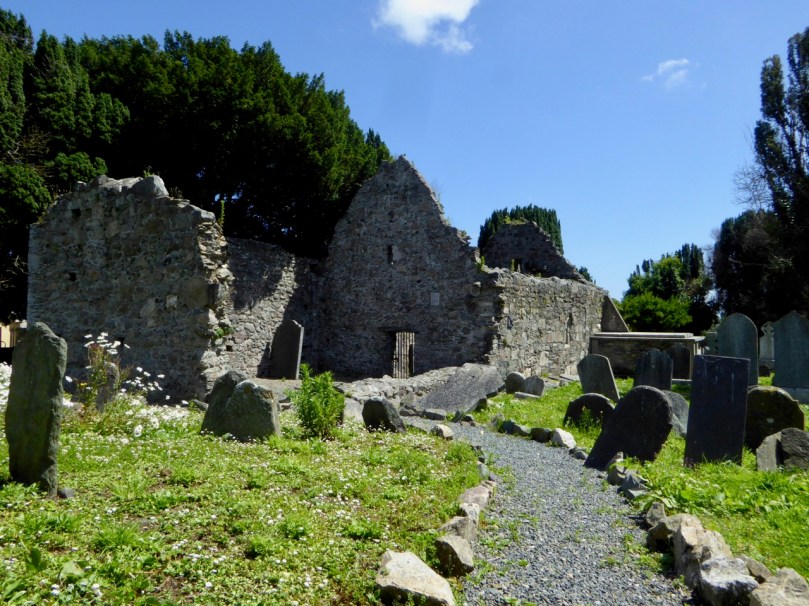
This week we stumbled upon one of the finest collections of 18th century gravestones we have ever seen, in the ancient Kilcoole Church yard. We’ve been visiting friends in Wicklow and enjoying ourselves very much.

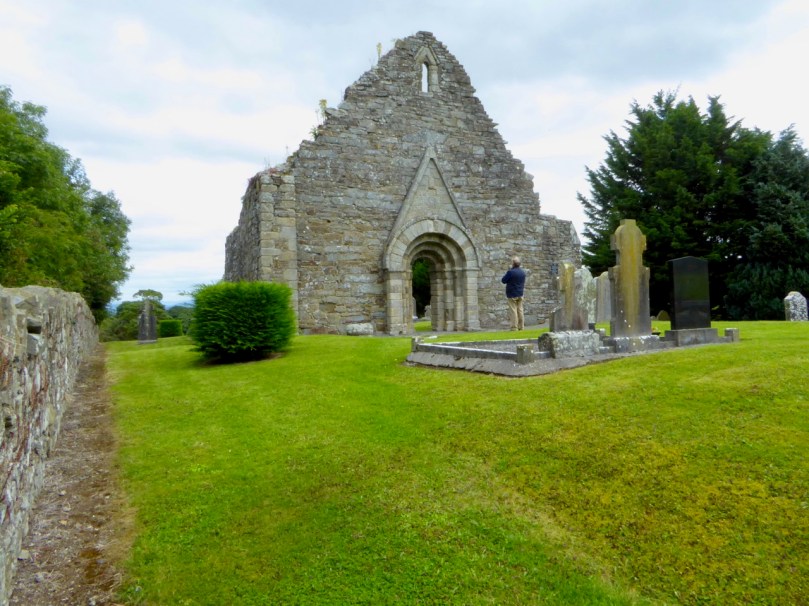
The church itself is very old, mostly 12th century. Although un-ornamented, the arches and windows are Romanesque in design, and the church originally had a stone roof, like the one we wrote about in Kilmalkedar. It’s kept locked but the key is easy to obtain, although it only opened the outer gate, so we were unable to see inside the church.

The graveyard, however, turned out to be a treasure trove! In West Cork we do see the occasional eighteenth century gravestone, but they are often heavily weather and lichened and impossible to read. However they manage it, these gravestones were as fresh and readable as the day they were carved.

This 1792 headstone for Felix Kavanagh has the IHS symbol surmounted by a cross and surrounded by a sunburst. On either side is a six-pointed star and a barred circle – we are unsure of the meaning of this motif

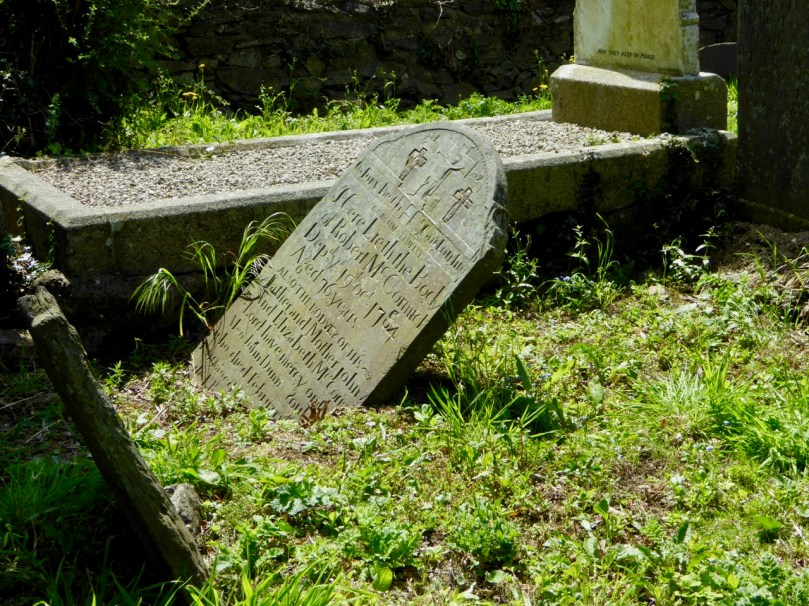
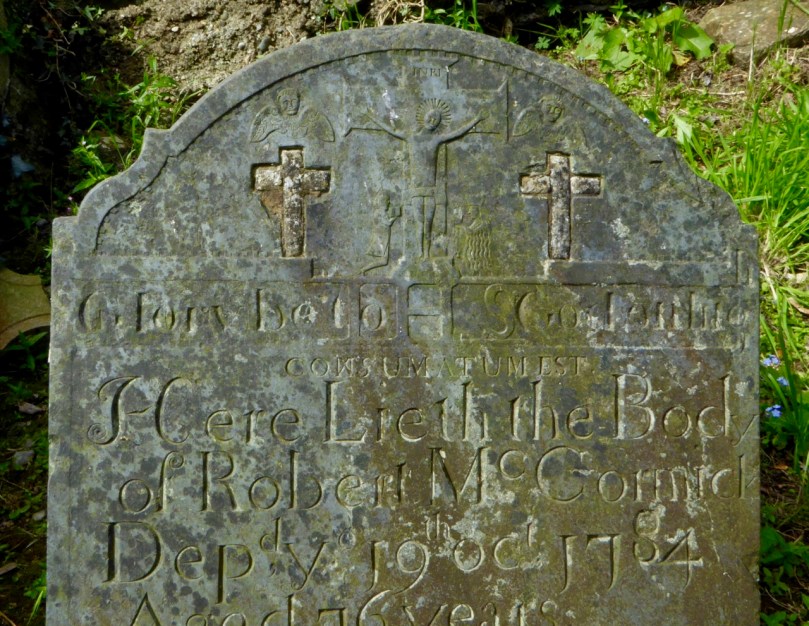
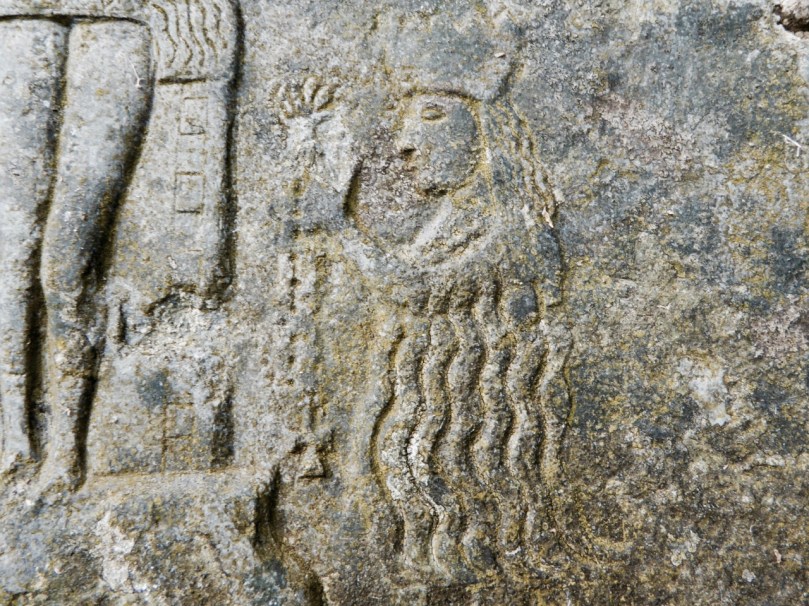
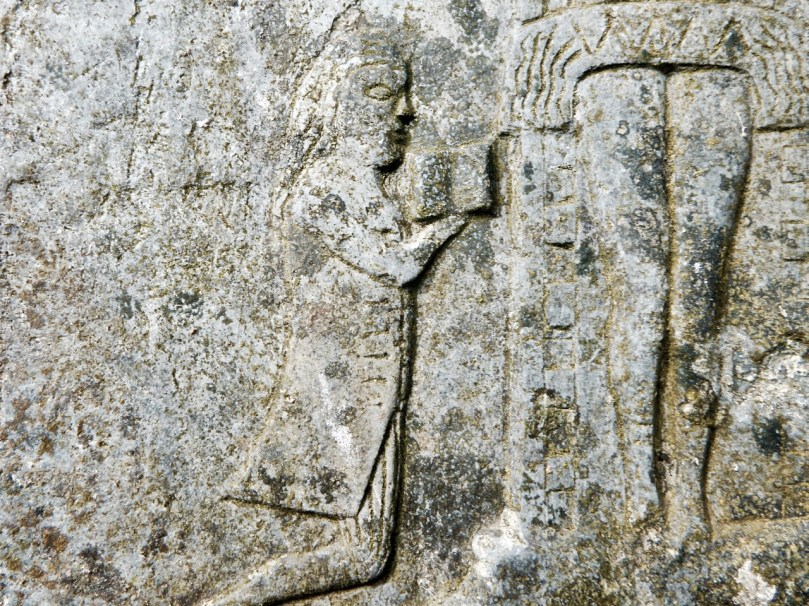
In our post Memento Mori we introduced you to the joys of graveyard headstones, and explained what symbols were common and what they represented. The crucifixion is a favourite, of course, and that was beautifully represented in Kilcoole by a gravestone for Robert McCormick by Dennis Cullen, dating from 1784.

Dennis Cullen is recognised as one of Ireland’s finest folk sculptors. There are 105 known Cullen headstones, most dating from 1765 to 1785, many in Glendalough, and most depicting passion scenes. He was born in Monaseed and his carving technique was accomplished. He often signed his work, unusual for the day. This is a good example of a Cullen crucifixion scene, except that it was altered later by the addition of two marble crosses.

Cullen executed his work in delicate and accurate detail. Christ on the cross is flanked by the Virgin with a crown and beads and St John with a bible. Cullen’s habit was to carve figures in the costume of the 18th century. The Virgin’s flowing hair is, in fact, a long lace veil – common mourning dress of the time. John is wearing a dress coat.

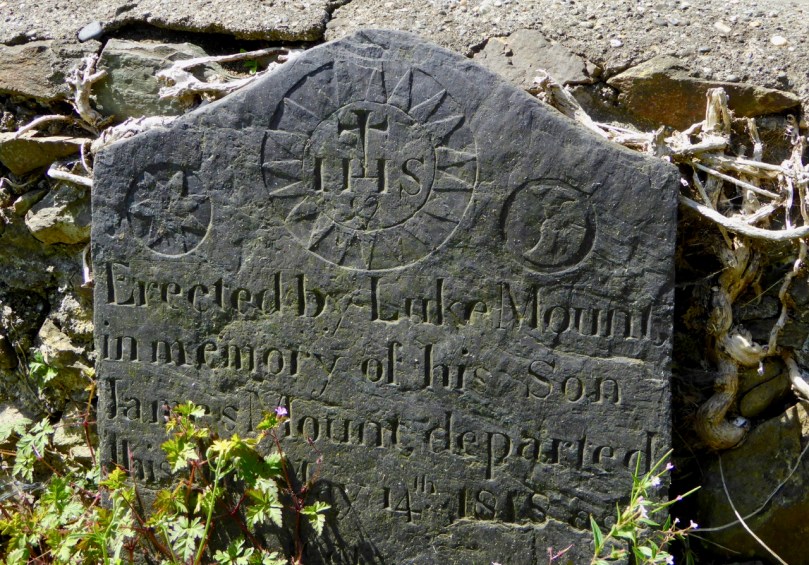
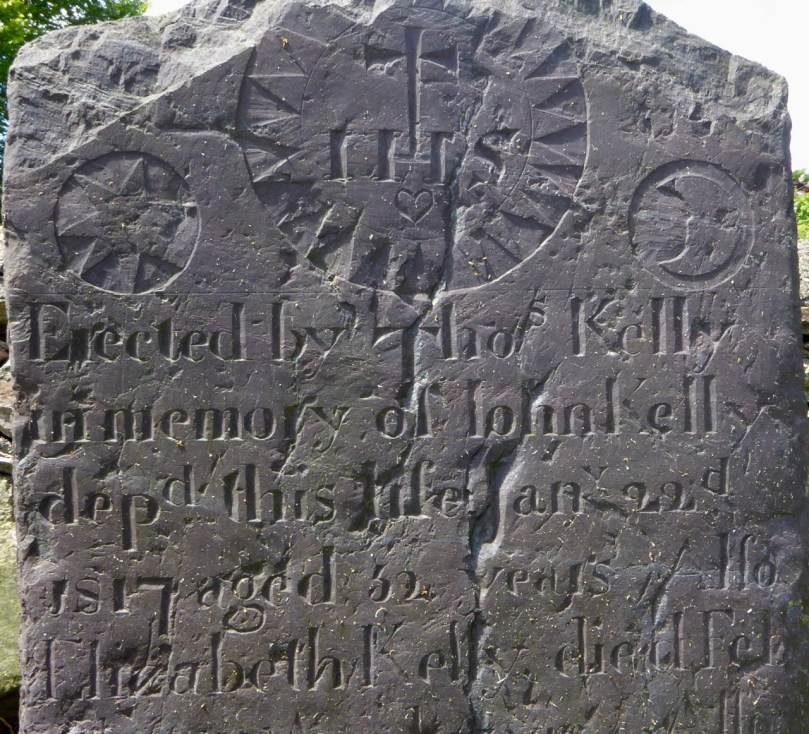
Several of the headstones feature a sunburst as well as sun, star and moon motifs. Powerful symbols of the soul and of immortality, as well as rebirth, these motifs were very popular in the eighteenth century. The IHS symbol (explained in Memento Mori) usually adorned the top of the headstone.

Angels – the soul’s guide to heaven – are found on several of the Kilcoole headstones and we were  delighted at the the variety of ways in which they were depicted.

Because the carvings are so visible and well-preserved in Kilcoole, it’s possible to see not only the detail of the lettering, but also the guidelines used to keep them straight.

Most of the lettering is deeply carved and exhibits, here and there, that idiosyncratic and random placement of letters where the carver may have run out of room, or perhaps was anxious to balance a line.

The lettering styles are fairly plain, although some fancier initial words crop up.

The graveyard has suffered damage both from vandals and from the ravages of time. We were intrigued by the number of fragmentary inscriptions and broken headstones dotting the place.

A local style seemed to be the use of a floral or vine pattern across the top of the stone. There were several examples of this – perhaps the hallmark of a particular carver.

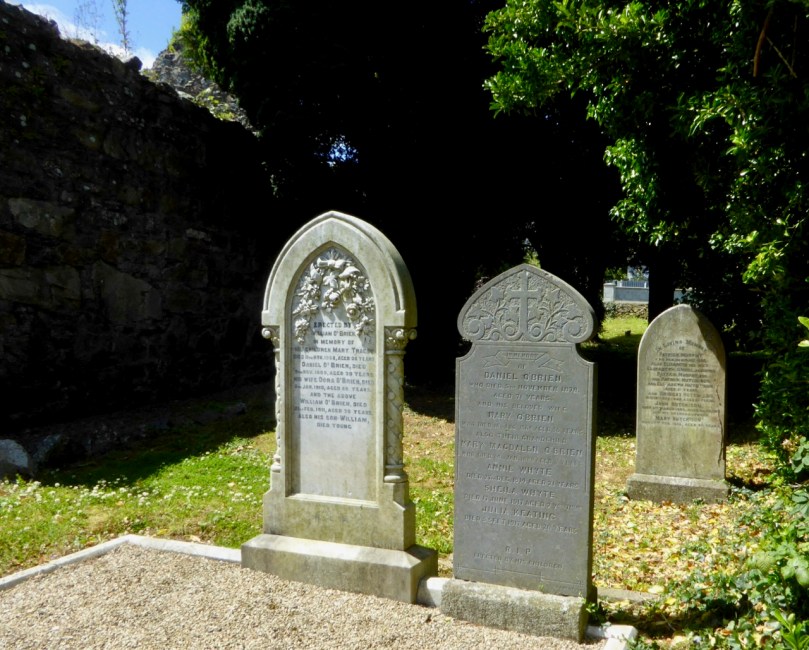
There were some fine later nineteenth century headstone in the graveyard too. Although we recognised that they were beautifully executed, it’s harder to get excited by them: they lack the naive exuberance of the eighteenth century examples and the symbols used are more restrained and limited.

There are several graveyards in Wicklow with similar collections of headstones and we hope to visit more in the future. Meanwhile, to learn more, order a copy of Chistiaan Corlett’s excellent book Here Lyeth about the eighteenth century gravestone of Wicklow

Irish Romanesque – an Introduction

This post will introduce you to one of the most exciting aspects of our architectural heritage – the building style known as Romanesque, which in Ireland became the dominant form in the 12th Century. Characterised by flamboyant doorways and elaborate carvings, it replaced an earlier and much plainer indigenous Irish church-building form of which few unmodified traces remain.

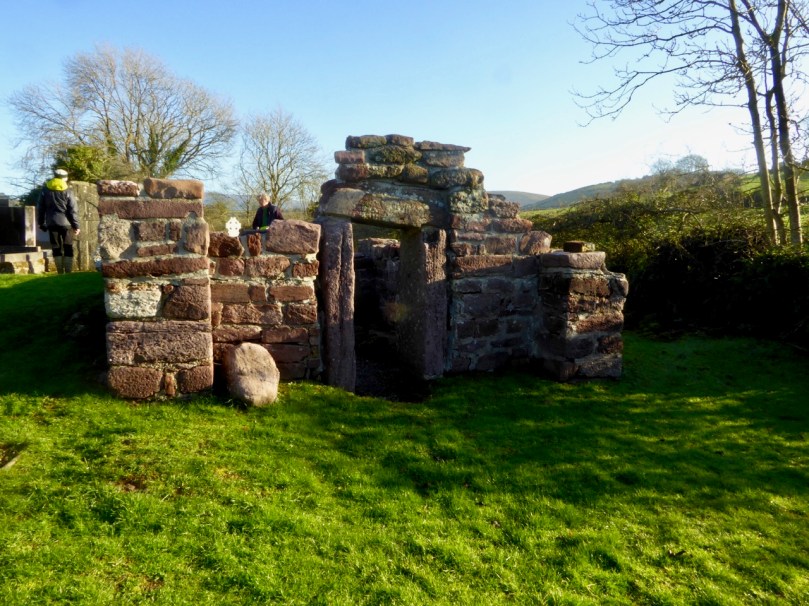
An early church at Liathmore, Co Tipperary. Note the square doorway with a simple linteled top. The projections of the sidewalls beyond the gables, known as antae, are a feature common to many early churches

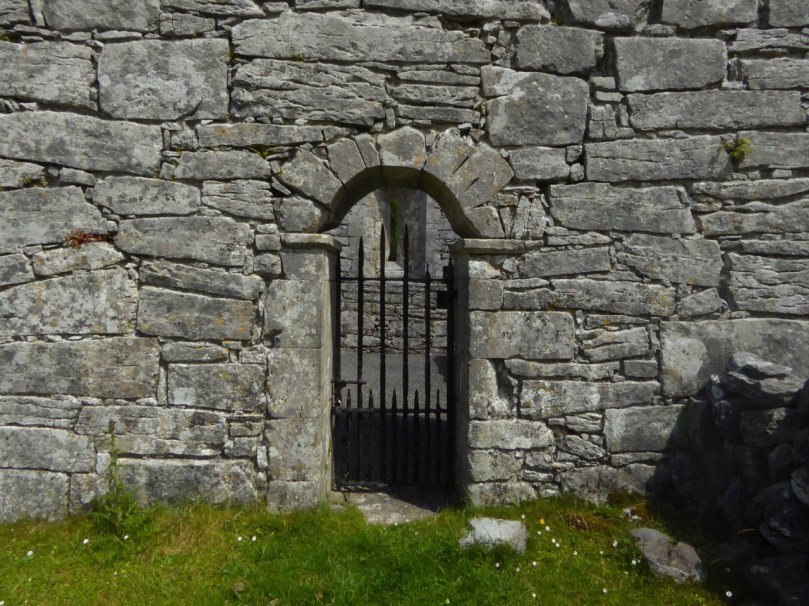
Most churches in the Early Christian (or Early Medieval) era in Ireland were probably built of wood, although some early stone examples survive, such as the one Robert wrote about in his post Molaga of the Bees. Defining characteristics of these churches were their relative plainness – one rectangular space, often quite small, with a linteled portal, one or two small windows, projecting antae, and finials atop the gables.

Leaba Molaga, or Molaga’s Bed – note the antae and small linteled doorway. The reconstruction drawing in the leading photograph above is based on this building

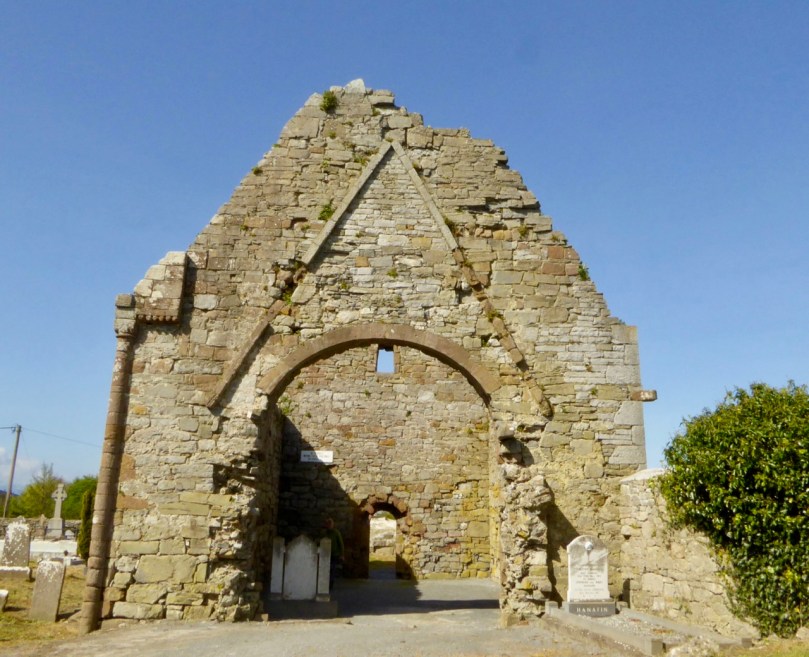
Besides Molaga’s Bed, we have seen several of these early churches on our travels – last year at Oughtmama when we spent a day with Susan Byron (see Susan’s Burren) in Clare, and earlier this year when we stopped off the M8 to visit the churches at Liathmore. This week we saw two more, one at Ardfert and another at Kilmalkedar, both in Kerry. (Robert also writes about Kilmalkedar this week, although concentrating on other aspects). However, in each case, the native form has been modified by the influence of the Romanesque style.

Both photographs were taken at Oughtmama in Co Clare. In the first, a simple linteled doorway leads into a large nave, which was later modified with the addition of a chancel, accessed through a Romanesque arch. In the second, the small doorway, although no bigger than the first example, is in the Romanesque, arched, style

Romanesque was the pan-European architectural style of the 11th century. More than just a construction method, it was an ideological movement. After a period known generally as the Dark Ages in Europe, the renaissance of scholarship and art in the 11th century harkened back to the idea of the antique Christian culture, with all the construction and engineering skills of the Romans. As in every era, the elite wished to associate themselves with this and Romanesque architecture gained popularity for great buildings such as cathedrals and castles.

A great Romanesque Church, Sant’ Ambrogio, in Milan. The Romanesque period of its construction dates to the 12th century – about the same time as Cormac’s Chapel in Cashel, generally reckoned to be the high point of Irish Romanesque architecture, was being built. More on Cormac’s Chapel in the next post

This was a period when people, especially clergy, from all over Europe travelled to great pilgrimage sites such as Compostela or Rome and this helped to spread ideas within the Christian world. In Europe the Romanesque style was well established by the mid 1000s and flourished until it was gradually replace by Gothic beginning in the mid-12th century. It took longer to reach Ireland, and didn’t really become the dominant church-building style until the 12th century.

This is one of two Romanesque sites at Ardfert. We are looking through the chancel arch into the nave. Note the roll-mouldings where antae would once have been, and also the small arched west doorway

In Ireland the simple rectangular stone-built early medieval churches with their antae, linteled entrances and finialed gables were gradually replaced or modified starting in the mid 1000’s. Romanesque churches become nave-and-chancel buildings rather than one rectangular room. The chancel is separated from the nave by a rounded arch, and windows have similar arched tops and are deeply splayed on the inside, often asymmetrically.

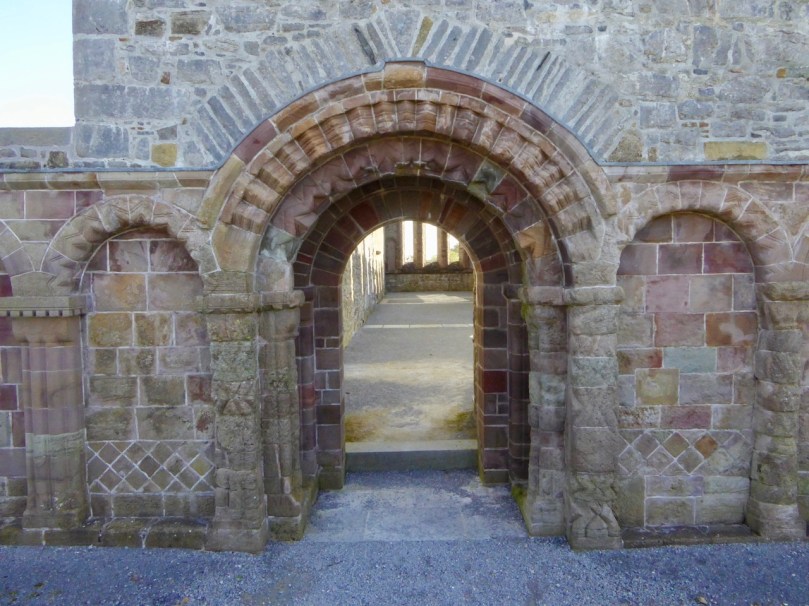
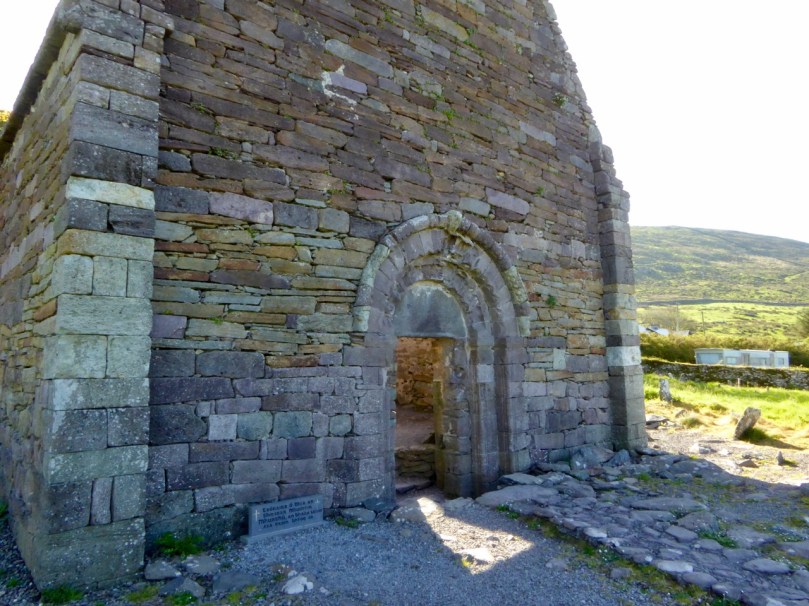
Kilmalkedar church in Kerry. While antae remain, the portal is now in the full Romanesque style  with an arch, a couple of receding ‘orders’, chevron carvings and a carved head

The doorway is in the west wall (on the opposite side to the chancel and the altar) and is now arched rather than linteled. The walls of the nave may have blind arcading. There is clear evidence that they were painted – a few vestigial examples survive in Ireland.

At Kilmalkedar, the finials still top the gables. The stone roof can be clearly seen, or at least what remains of it

The roof are sometimes stone, and may contain attic-type spaces.

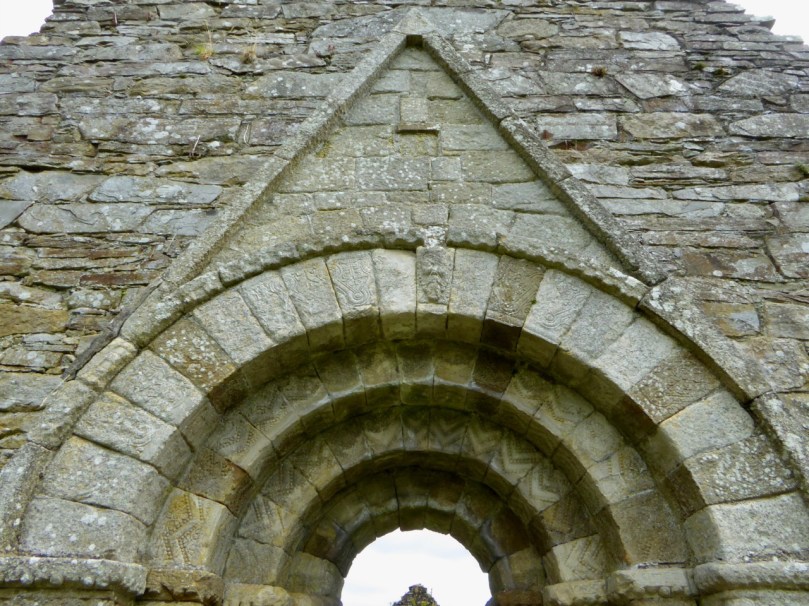
Two examples of Romanesque arched windows. The first (from Kilmalkedar) is topped by a simple arch hewn from one stone. In the second example the arch is more sophisticated. It is constructed using voussoirs – precisely cut wedge-shaped stones – which are beautifully carved with geometric and foliate shapes

But the real glory of the Romanesque building style, and what makes it so attractive for visitors are the carvings – a feature that is curiously absent from the Early Medieval church forms that preceded the Romanesque. (I say ‘curiously’ because other forms of stone carving, such as our wonderful high crosses, are well known from pre-Romanesque contexts in Ireland, as well as decorative metalwork and manuscripts.) Doorways, chancel arches and window surrounds are often carved with a variety of floral and geometric motifs (especially chevrons), while heads of humans and animals are found around doorways and arches, and occasionally outside. 

The chancel arch and blind arcading at Kilmalkedar

This post is just an introduction to Irish Romanesque, intended to cover the basics of the form and get you comfortable with the terminology. I have deliberately avoided talking about the carvings and the more spectacular of the sites. But in my next post on this topic I will concentrate on the doorways. There are many fine examples, from the simple to the elaborate – they are truly one of the wonders of our Irish architectural heritage. Here’s a sneak peek…

And by the way – this post is a celebration of sorts: it’s the 400th post in Roaringwater Journal! Our first post ever was in October 2012. With a five month hiatus (in order to move countries) we’ve been blogging faithfully week after week ever since. Our practice is that we, Robert and Finola, publish one post each every Sunday (and update the Table of Contents on the Navigation Page as we go along). We love the way this lends a shape to our week; we love the research and the photography; we love your feedback, both here and on our Facebook Page. Thank you, our wonderful readers, for sticking with us. Long may it continue!