Murphy Devitt in Cork, Part 2

In Murphy Devitt in Cork Part 1 I introduced you to the main players in the Studio – Johnny Murphy, Róisín Dowd-Murphy and Des Devitt. Together they set about doing something entirely new and different in stained glass in Ireland, bringing with them their art training, their modern aesthetic sensibilities, and their deep knowledge of and commitment to their craft.
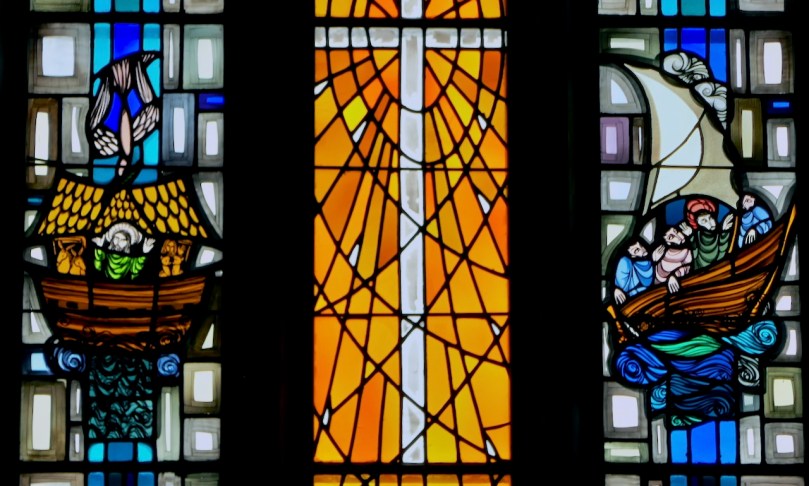
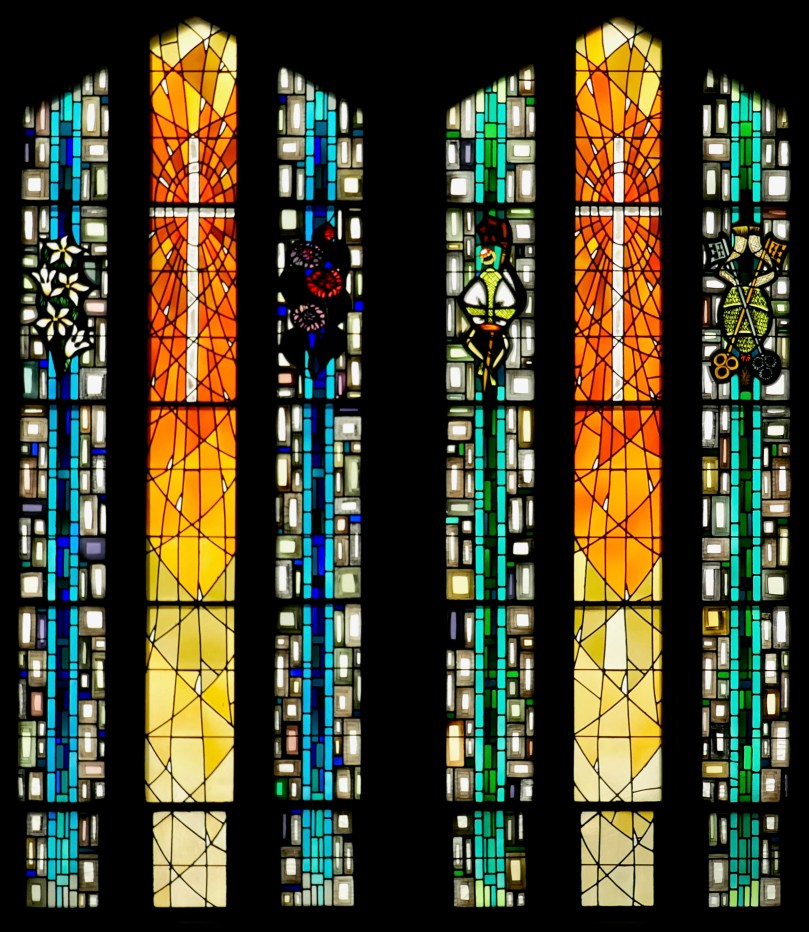
Both photographs above are from the Church of St Michael, Blackrock, Cork. The windows comprise large areas of breakouts with small images placed in the top half. A close up of the pictures chosen for this window reveal Noah’s Ark and Christ Calming the Waters (Contrast this with our final photograph in this post, which is in Caheragh)

Although the Studio was dissolved as a business in 1985, the three continued to work together in a loose arrangement, often under the heading of Des Devitt and Associates. This creative partnership went on for over 50 years: it was so finely attuned that Johnny could describe his vision over the phone and Des knew how to actualise it.
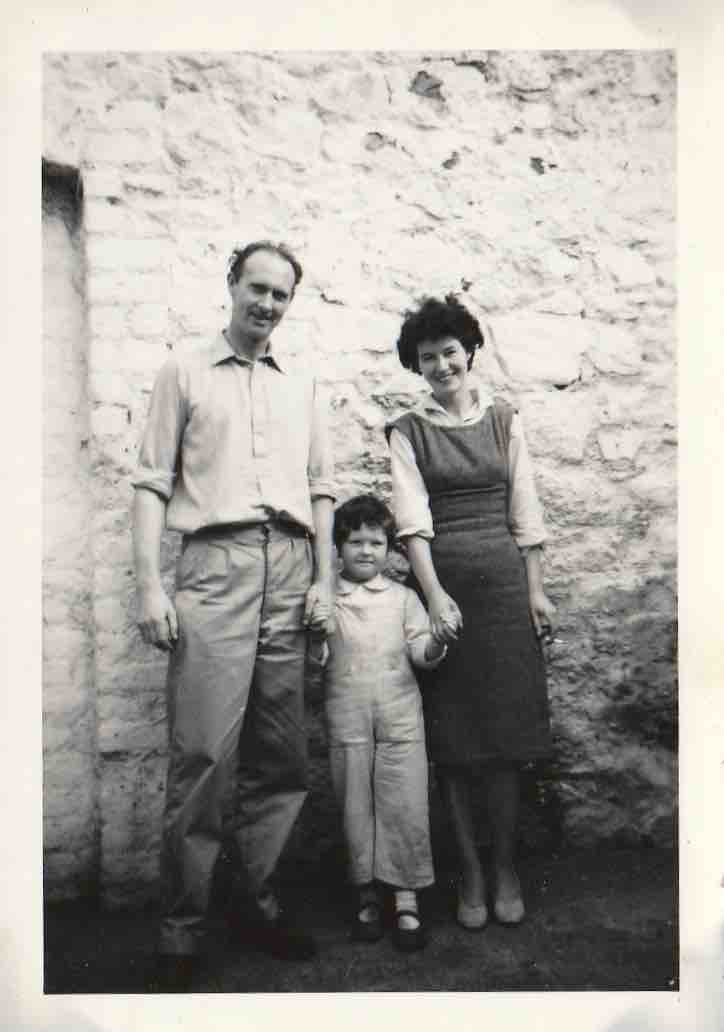
Johnny, Réiltín and Róisín – Réiltín was already a fixture in the Studio at this age

Everyone was pulled into the slipstream – Réiltín Murphy had to stand on a box to reach the drawing table when she started out first. Anthony Devitt* was just a kid when Des warned him not to fall off the scaffolding or his mother would kill him. They all loved it, as did the endless stream of students from the National College of Art, where Johnny was now teaching, who came to help in the summer or to learn how to paint on glass or assemble windows. Other artists came to help when the pressure of work got too much – Terry Corcoran, Rosaline Murphy (not related) Celia Harriss, Paul Britton, Ann Fitzgibbon, Michael Biggs, Michael Timlin to name some.
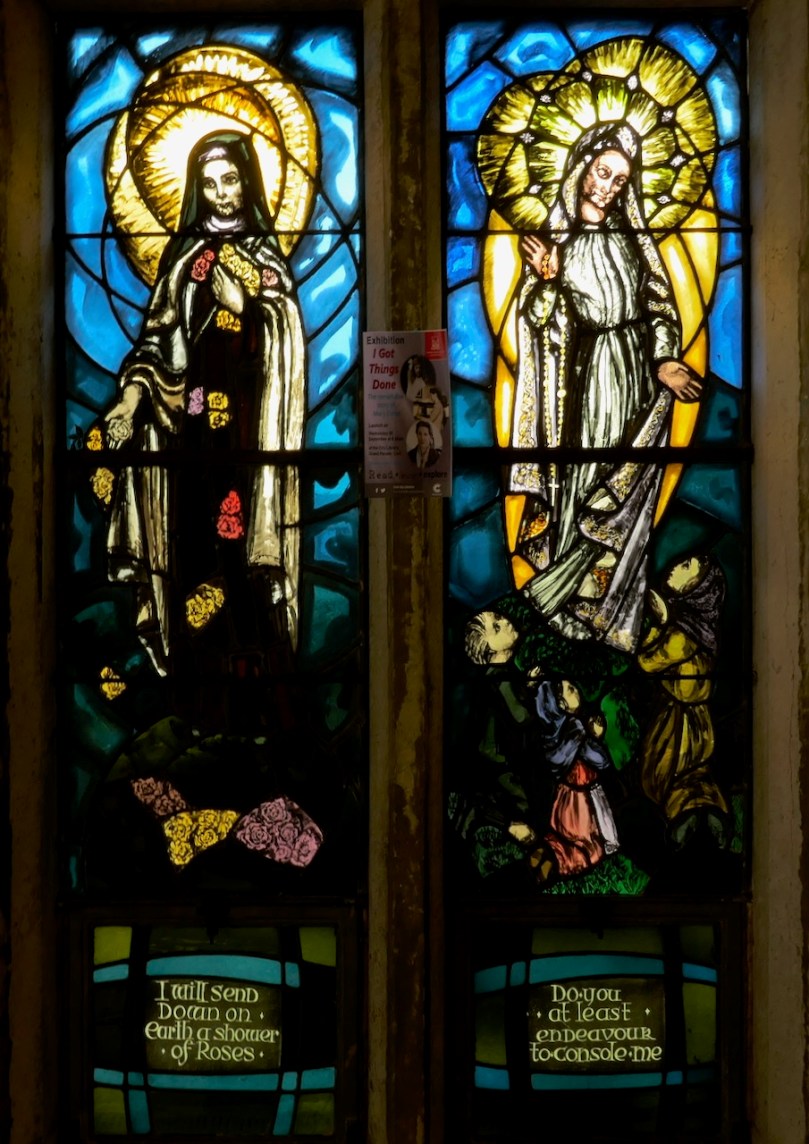
The only different window at Blackrock is this one, and it’s pure Roisín. There was a fire in the church and this window was rescued and re-installed in a side room once all the new windows were installed by Murphy Devitt Studios. We don’t know what the original ones were like, apart from this one

Johnny was the main designer, hugely respected by Róisín, Des and everyone in his orbit. His was the overall vision for a whole scheme for a church or for a one-off window. Róisín was happiest left to paint, either from Johnny’s designs or from her own – she was a painter at heart and exhibited into her 70s.
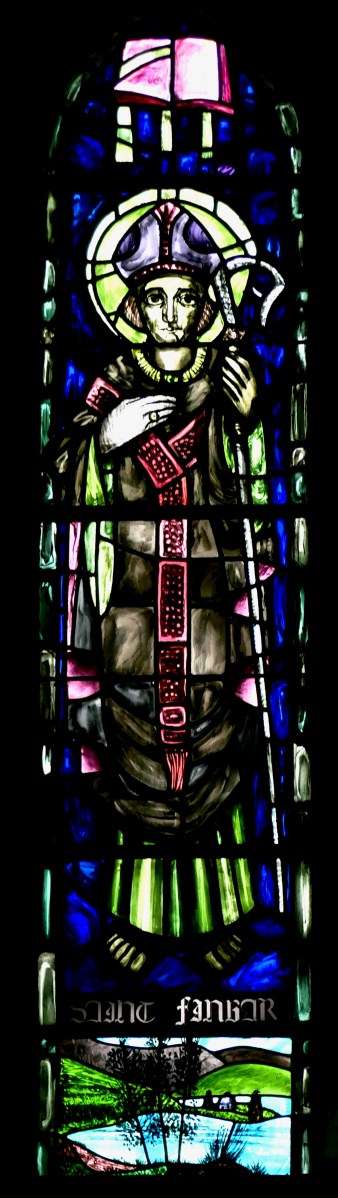
This window is a whole family project. It dates from 1974: Róisín painted the figure, Johnny did the little scene of Gougane Barra and Réiltín did the lettering. It’s in a convent chapel in Crosshaven, now closed and inaccessible. The photograph is published with the permission of the Presentation Order. 

Des had a couple of years of art college under his belt too but his genius lay in management and in translating Johnny’s designs (or sometimes just thoughts) into finished windows. He pitched for business, kept the budget under control, delivered work on time and ran the Studio in a completely non-hierarchical way that would be the envy of many a modern management guru. All of them read voraciously, educated themselves in progressive art theories and in how the spiritual could be expressed in glass. Perhaps this isn’t so difficult when the subject is the Passion, or the Life of Christ, or a particular saint like Francis. But many churches requested non-figurative windows, whether for budgetary reason or out of preference. Here the challenge became creating a space that suggested the transcendent, without the aid of obvious imagery.
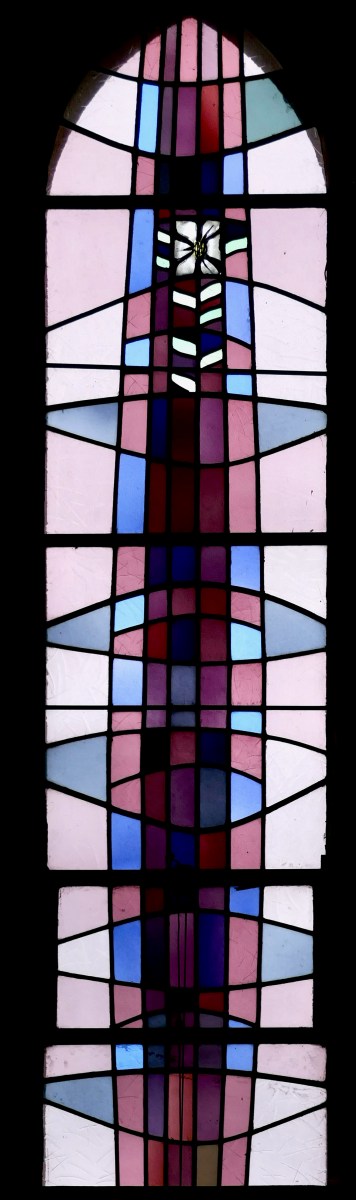
In the same chapel are many windows that are either entirely non-figurative or with small hints of symbolism. This one looks like the lilies often carried by St Joseph

These mostly or entirely non-figurative windows became one of the hallmarks of Murphy Devitt Studios, instantly recognisable, and capable all by themselves of creating an atmosphere of drama or tranquility. An oval becomes the window to the soul, a series of them leads the eye upwards, thus capturing the notion of the elevation of thoughts and prayers. A sunburst denotes the glory of creation, light falling from heaven.
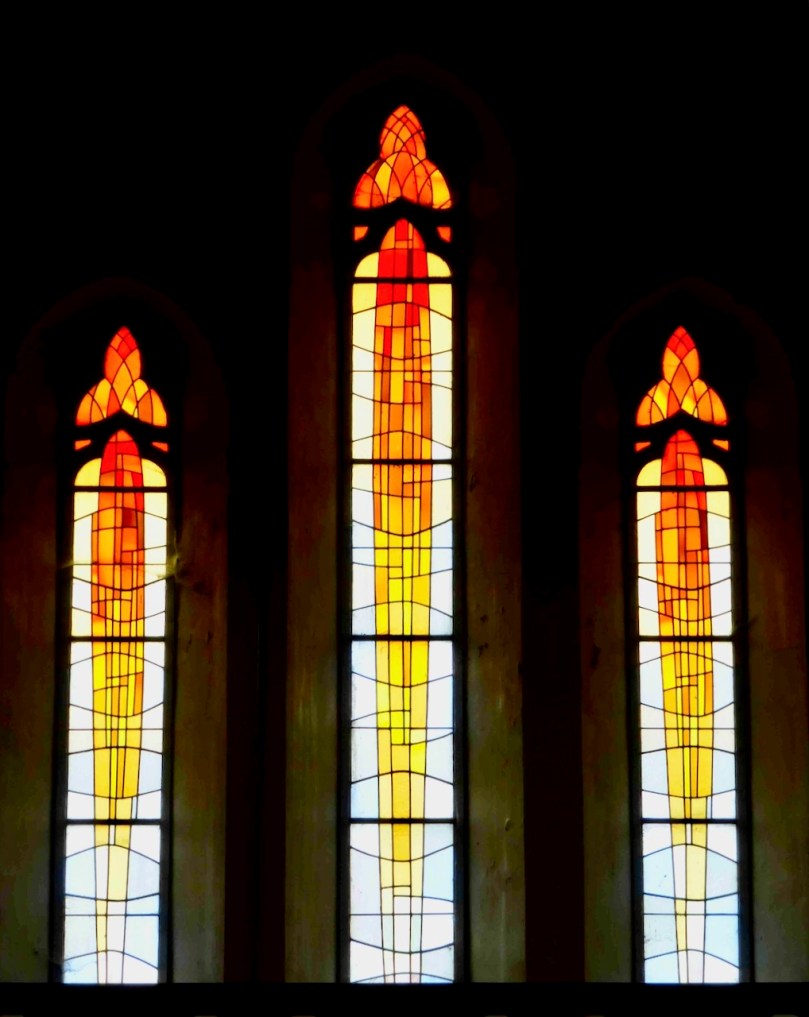
Ballyhooly Church has all non-figurative windows. This photograph is courtesy C Cashman and R Gem

Some have small elements within them that are complete pictures, mostly Christian symbols, sometimes mere hints. There were favourites – I’ve seen similar ones crop up here and there, although their context leads to fresh treatments. Some churches are a mixture of figurative and non-figurative. Although it’s not in my remit for these posts, if you are near Dun Laoghaire visit St Michael’s church and marvel that expanses of ‘coloured glass’ can create such a calm and devotional atmosphere.
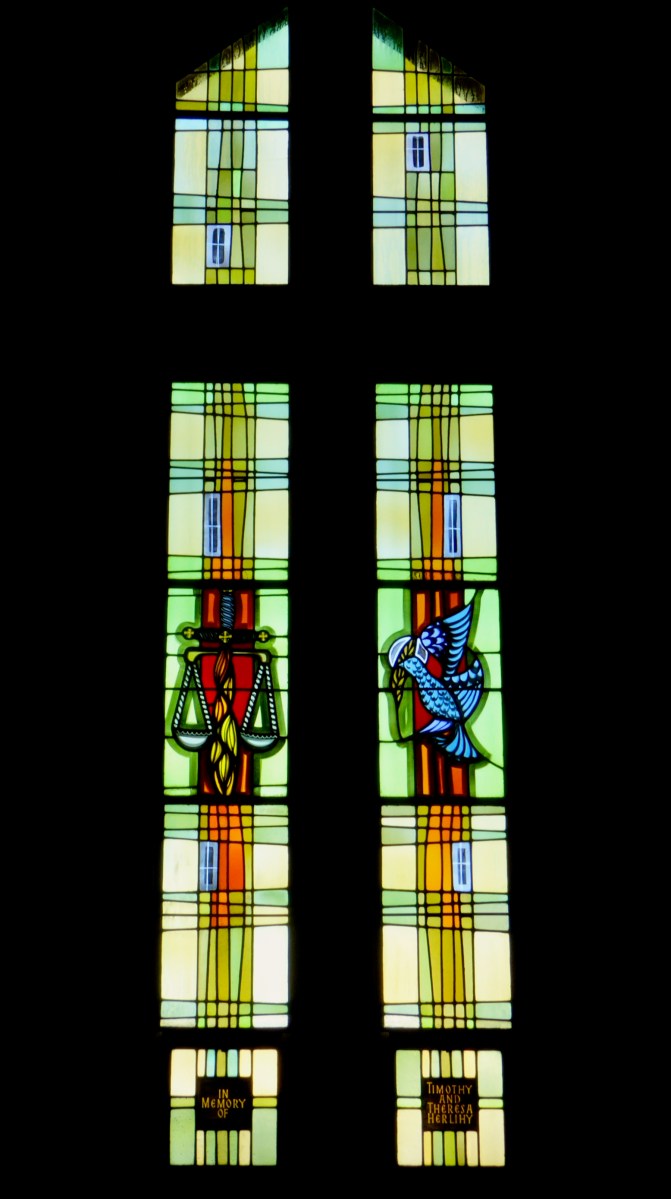
Caheragh Church has a mixture of figurative, non-figurative and non-figurative-with-symbols. This window is one of the latter

Anyone who visits Irish churches knows that what we want in them are our own saints – Patrick and Brigid certainly, but after that they must be local. So along with every other stained glass artist who ever worked in Ireland, Johnny had to study the hagiographies of our obscure legendary saints and satisfy a demanding congregation familiar with the stories.
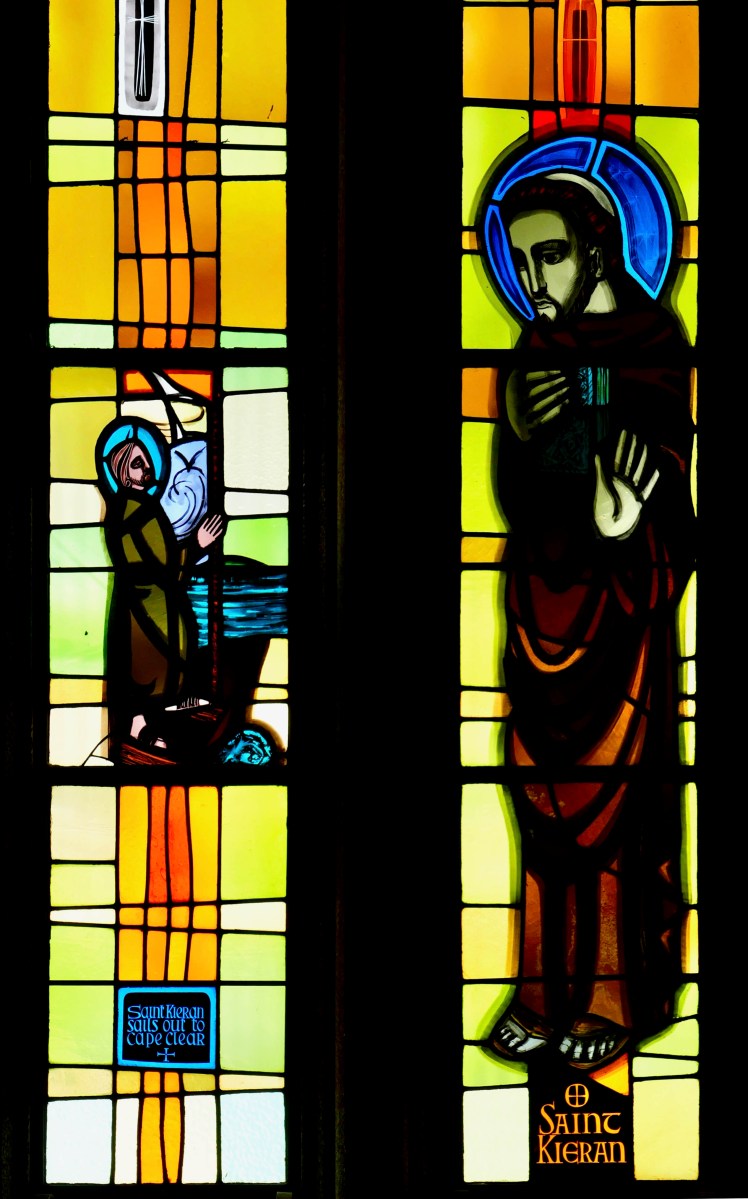
St Kieran of Cape Clear is one of our treasured West Cork saints

At Caheragh (north of Skibbereen) and Rath (just outside Baltimore) in West Cork two small rural churches demonstrate how well he succeeded. The windows in each are quite different, although both were completed in 1963. In Caheragh the figures are situated in the lovely wavy-lined breakouts that we saw Murphy Devitt use to such effect in Mayfield, in tones of red and yellow.
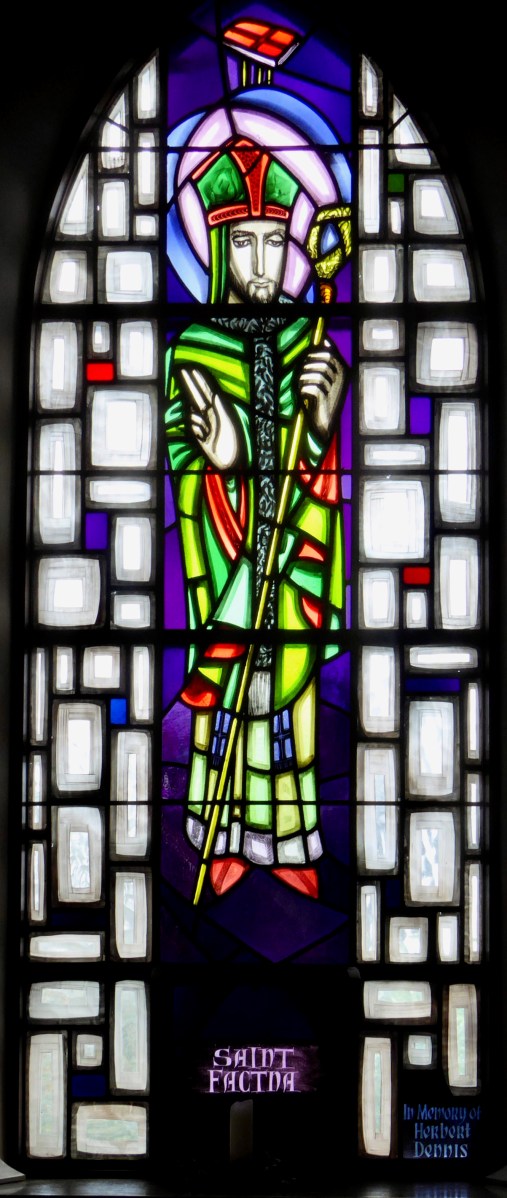
And here is St Facthna of Rosscarbery

In Rath we see the introduction of a new breakout design, the square or rectangle with grey shadow around the edge, seeming like a solid glass brick. It’s another Murphy Devitt innovation, used to great effect in many of their windows. They used it again the following year in Blackrock (see above).
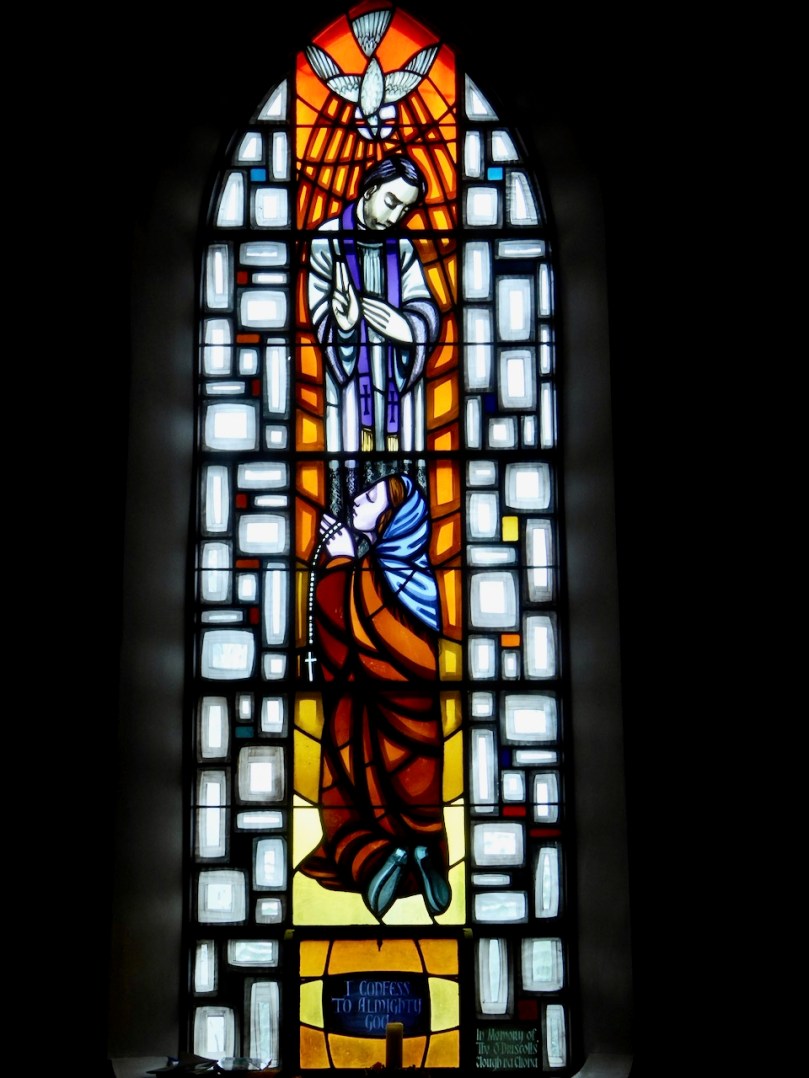
The Sacrament of Confession gets the Murphy Devitt treatment in Rath

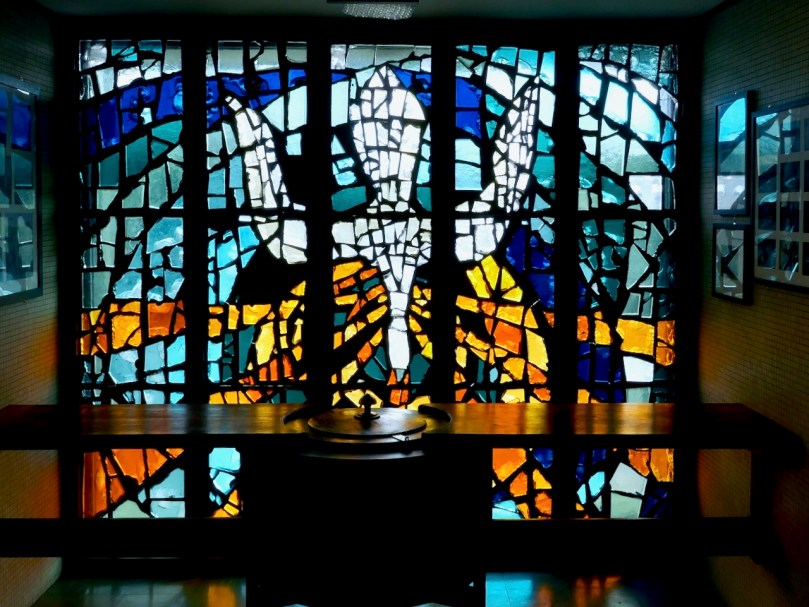
A stained glass technique that was introduced to Ireland in the 60s was that of Dal de Verre. Blocks of coloured glass were faceted to increase their reflectivity (this was done by knocking spalls of glass from the edges and surface of the blocks) and then cemented together with resin, and sometimes concrete. Dal de Verre enabled actual walls of glass to take the place of masonry and to create dramatic expanses of colour as an integral part of construction, rather than as windows.
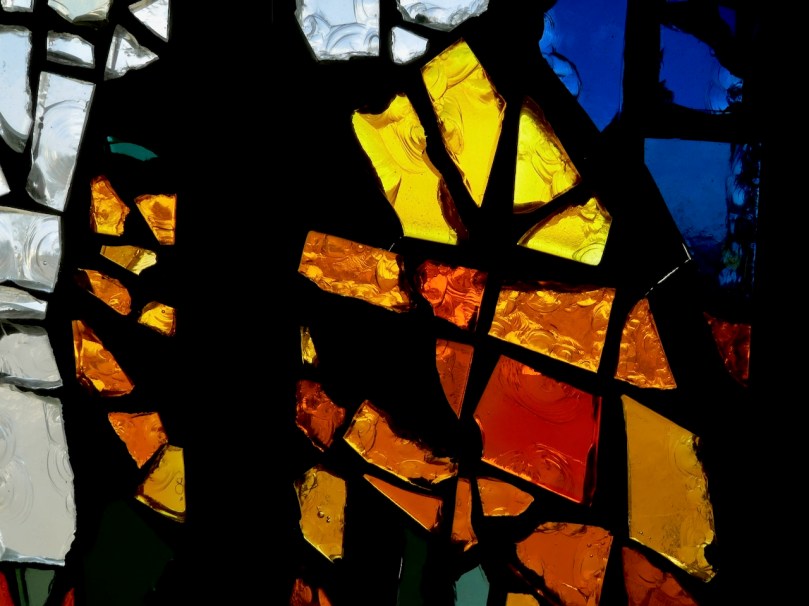
Chunks of coloured glass, faceted for additional refraction, float in a bed of resin. This is a detail from the Lowertown window below

Murphy Devitt were early adopters and we have one of their examples in Cork, at Lowertown, just outside Schull. It’s a dove of peace/Holy Spirit creating a glowing corner in the baptistry.
I still have two churches to tell you about, in Rochestown and in Mallow. They deserve their own post, and that will conclude this series. See you next week.
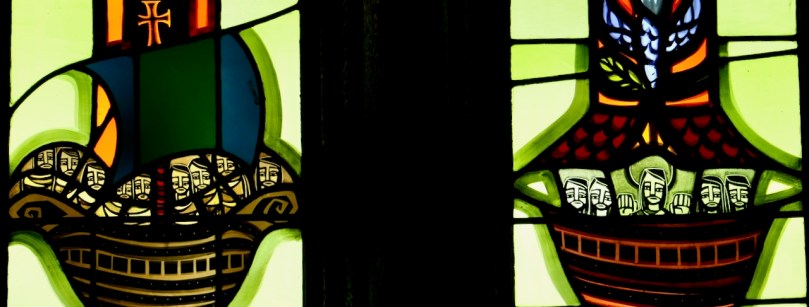
From Caheragh, across a two-light window, an image of Christ calming the storm. Traditionally, Christ is shown in one boat with the 12 apostles. However, Rembrandt famously included himself in his depiction of this scene, so I am tempted to think that Johnny is in there somewhere, since there are thirteen apostles in the boats

Part 3 is here.

*This post benefitted greatly from information generously shared by Anthony Devitt.
Murphy Devitt in Cork, Part 1

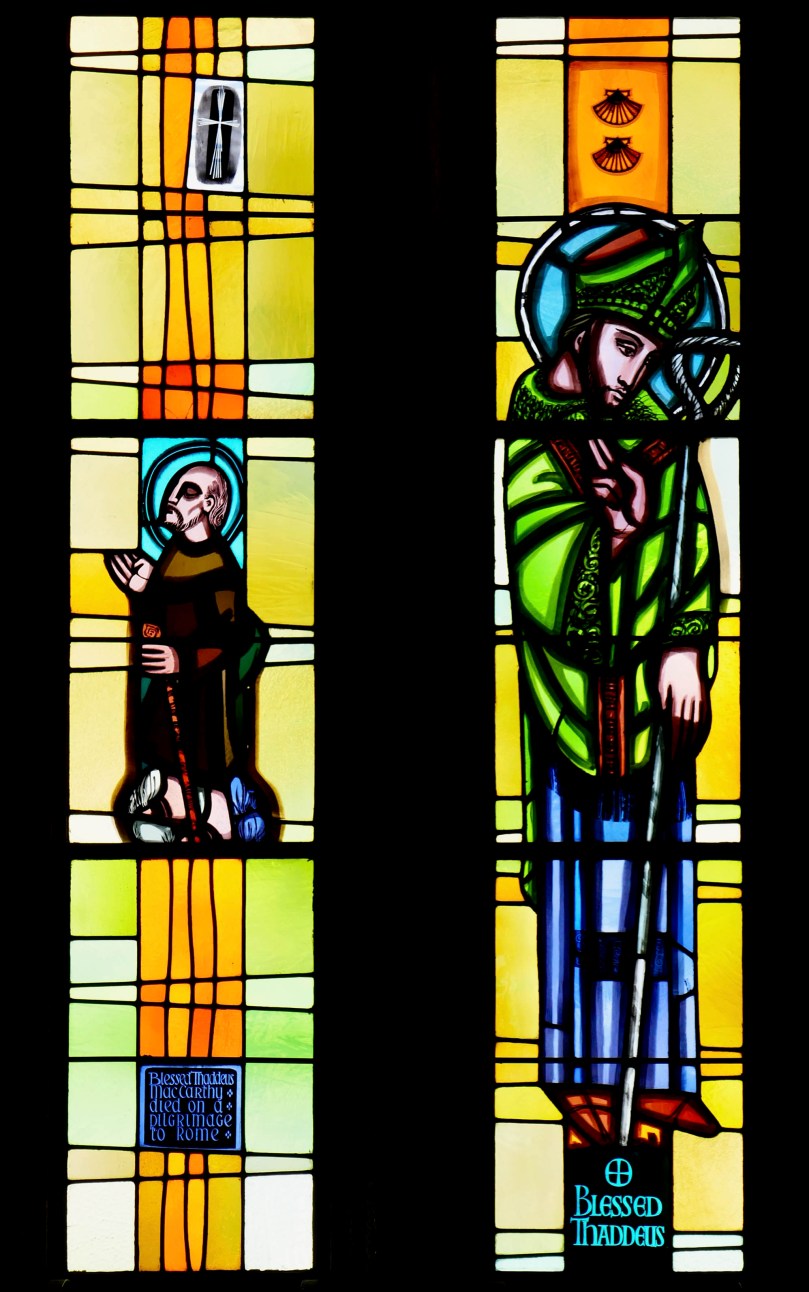
A couple of years ago I visited the Catholic church in Caheragh, just north of Skibbereen, specifically to look for an image of Thaddeus McCarthy about whom I was researching at the time (see my post Thaddeus McCarthy, the Bishop Who Never Was). As I stepped into the church it was immediately obvious that the stained glass was not the usual traditional images based on renaissance paintings that I had been seeing in most of the churches I had been in. No, what greeted me (above is the Thaddeus window) was something entirely new and different – modernist, colourful, idiosyncratic, painterly, beautifully designed and expertly executed windows, each one identified as the work of Murphy Devitt of Dublin and installed in 1963. I fell in love.

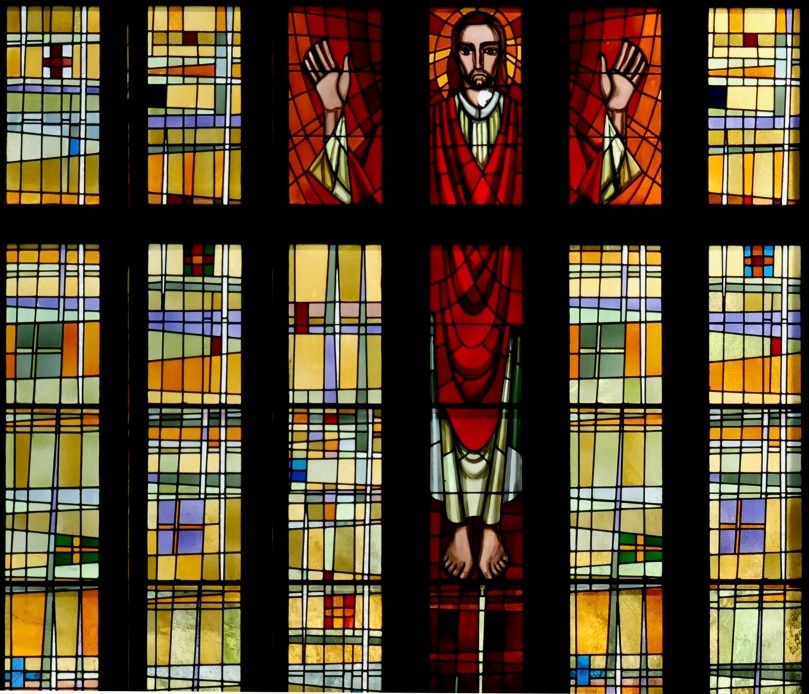
The stained glass windows in the rest of this post (except for one) are all from the Church of Our Lady Crowned, in Mayfield, Cork. This one represents the Risen Christ

There are Murphy Devitt windows in ten Cork churches, and why not? Johnny Murphy, after all, was a Cork boy, brought up in the city and starting his art education at the Crawford School of Art in the 1940s when the life-drawing classes still revolved around the Canova casts. He was a standout student, winning a scholarship to the National College of Art in Dublin. There he met a fellow student, the beautiful Róisín Dowd, whose parents had fled the Belfast blitz to settle in Dublin. Together and separately, they travelled to Paris and Rome, doing what art students do – visiting galleries and studios, studying centuries of European painting, absorbing and responding to those influences (think Botticelli for Róisín, Klimt for Johnny), finding their artistic voices and refining their own styles.

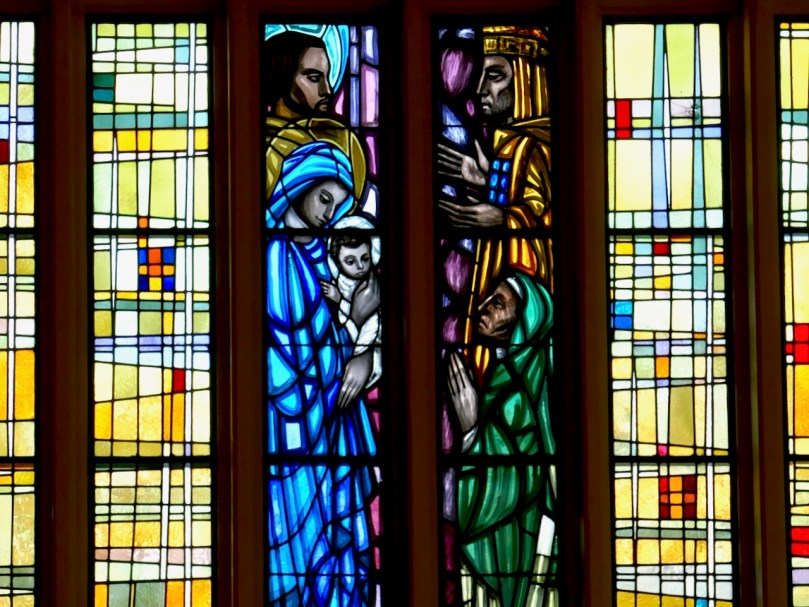
The Presentation in the Temple (detail)

Returning home, they had to wait for several years to marry. Their daughter Réiltín suspects that Grandfather Dowd insisted on Johnny having gainful employment and that may have been why he joined the Harry Clarke Studios in 1952 and began to seriously study the craft of glass painting. Harry Clarke died in 1931 but his studios carried on making stained glass until the 1970s. There was plenty of work for anyone in the ecclesiastical provisioning business as new churches were going up all over the country to serve the burgeoning, and pious, population.

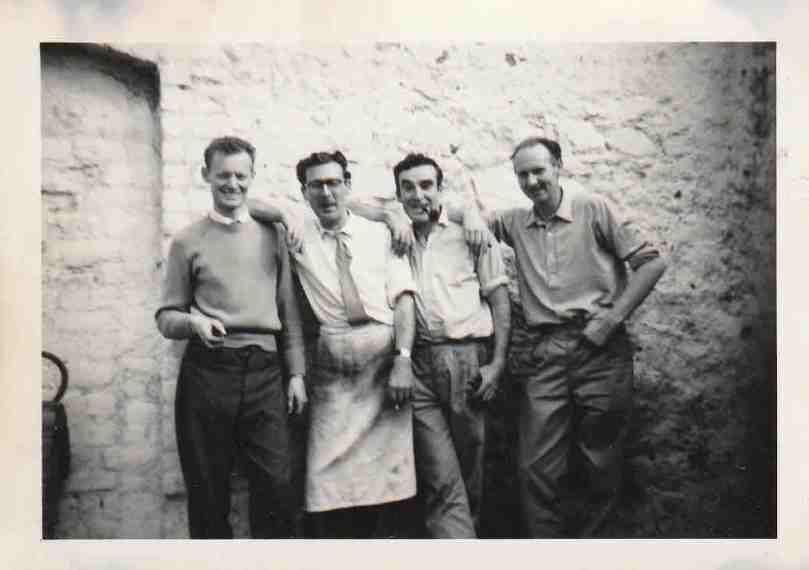
Dessie Devitt, Paddy McLoughlin, Mickey Watson and Johnny Murphy in their busy studio in the 60s

One of the glaziers Johnny worked with at the Harry Clarke Studios was John Devitt, universally known as Des or Dessie. Becoming fast and lifelong friends, they decided to strike out on their own, taking some of the men from the HC Studios with them. It was the late 50s and they couldn’t have picked a better time. Working from a mews in Monkstown and later a custom-built studio in Blackrock, they started to tender successfully for new commissions. This also allowed Johnny and Róisín, who now joined them as well when she could escape motherly duties, to develop their own unique approach to designing and painting stained glass, very different from what had become a somewhat hidebound atmosphere at the Harry Clarke Studios. For an example of what I mean by that, and to illustrate the contrast with MD, take a look at my post Time Warp, featuring a set of Harry Clarke Studio windows from the late 1950s. Below is a detail from one of them – far, indeed from the genius of Harry Clarke himself.

Detail from a Harry Clarke Studio window in Drimoleague. Although this window is interesting for lots of other reasons, the quality of the glasswork and the artistry of the painting had declined over the decades since Harry’s death. 

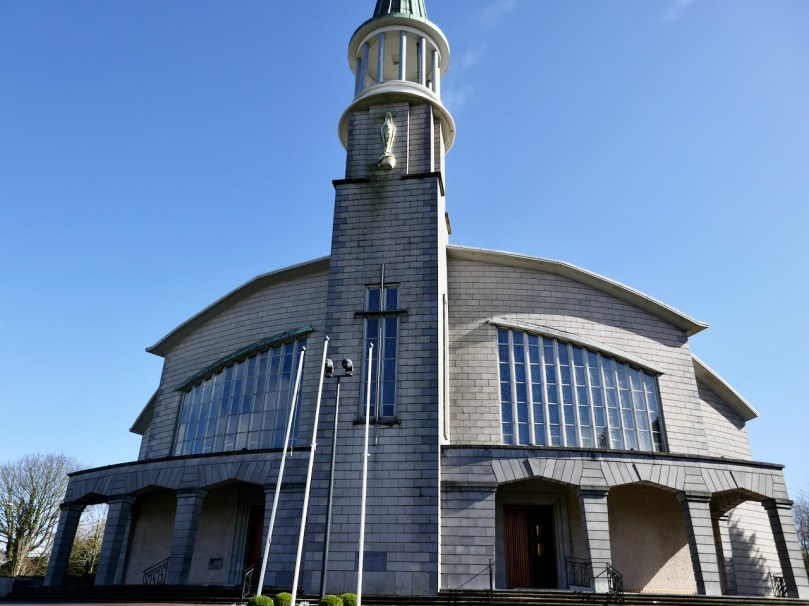
What Johnny always called their ‘first big break’ came with the Church of Our Lady Crowned, in Mayfield, Cork, completed in 1962. According to The National Inventory of Architectural Heritage:

Our Lady Crowned Roman Catholic Church was built to the design of J.R. Boyd Barrett’s firm and when completed in 1962 comprised the final of five new churches constructed to the north side of Cork city and named after the five Glorious Mysteries of the Rosary. The design and construction of the roof is of technical importance while the extensive stained glass windows, from the workshops of Murphy & Devitt in Dublin, are of particular artistic merit.
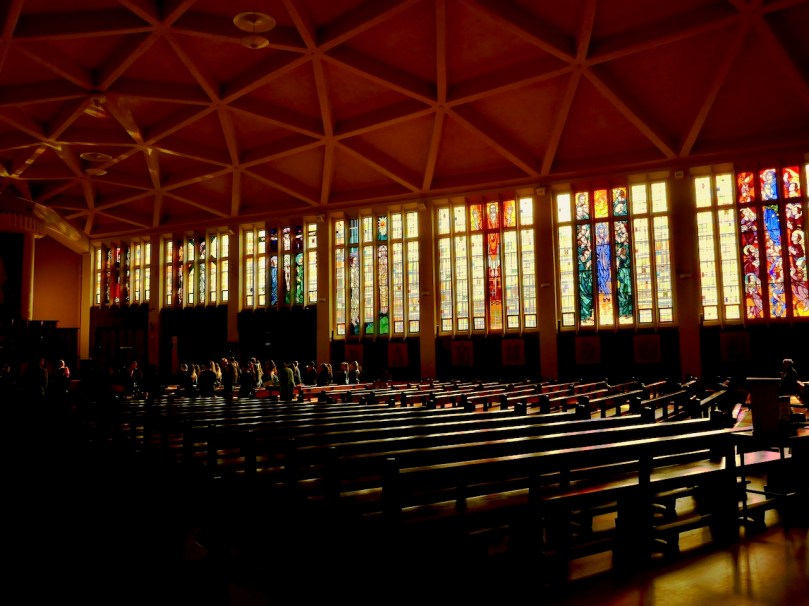
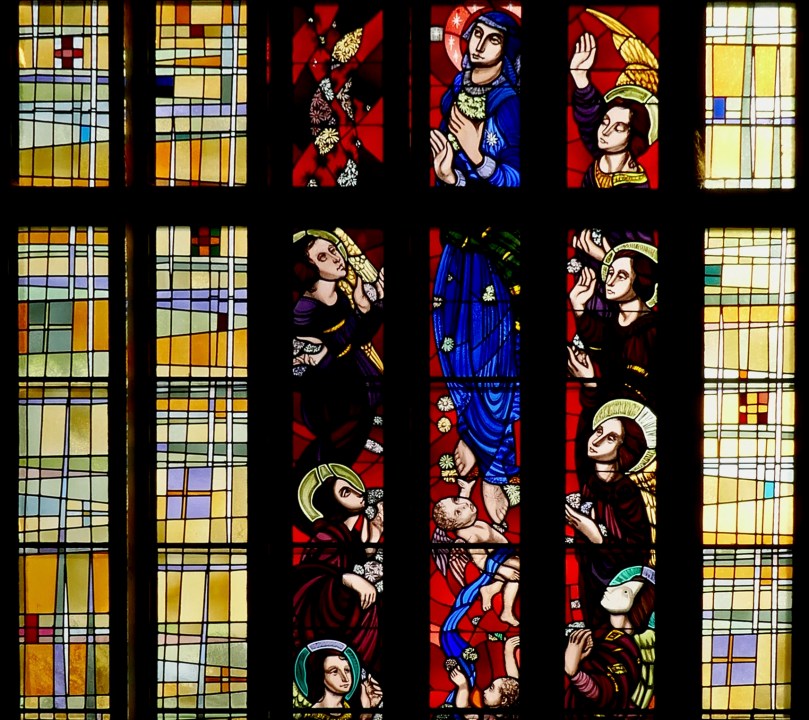
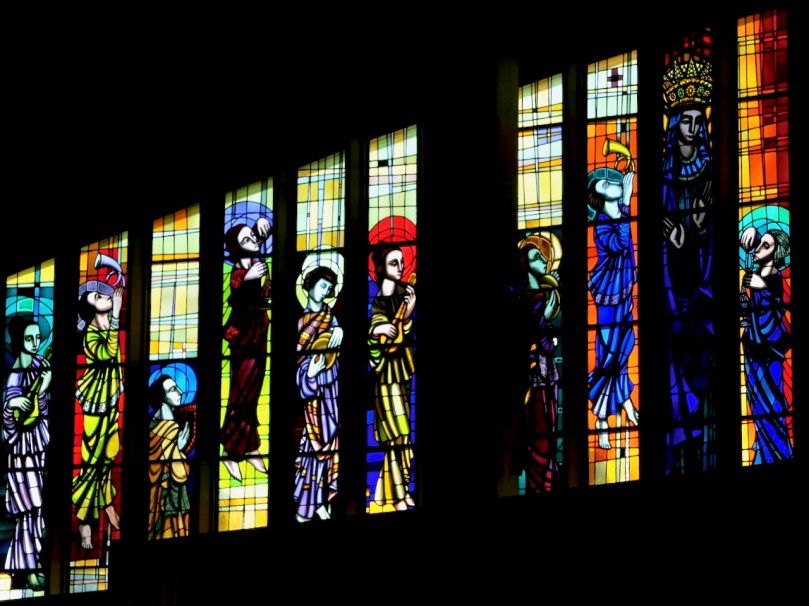
Too often, stained glass windows are one-off commemorative objects, mounted in an available opening. But when you see a whole scheme of windows in one church, designed to fit and complement the architecture throughout the building, the effect can be breathtaking. And so it is with Our Lady Crowned. The church is wedged-shaped, with enormous glass panels occupying at least half the space. Scenes from the Life of Christ range around the walls, from the Annunciation to the Crucifixion and Epiphany, with the huge area over the main door taken up with a choir of angels heralding the crowning of Mary on one side and Christ on the other.   
The day we visited the church was full of children preparing for their Confirmation

When I told Réiltín Murphy*, Johnny and Róisín’s daughter, that Our Lady Crowned was my favourite of the Cork MD churches, she responded that it was her parents’ favourite too. It’s not hard to see why – it’s a triumph of imagination, artistic vision, craftsmanship and above all collaboration. As I get more familiar with MD windows the distinction between a Johnny Murphy window and a Róisín Dowd Murphy window is sometimes quite clear: Johnny’s style is more angular, with loose dark brushstrokes, strongly marked facial features, heads tilted at an angle, while Róisín’s figures are more curvy and flowing, with greater attention to fabric and to musical instruments. Réiltín characterises the difference thus: Róisín’s figures, I always think, are too busy to pose for their photo while Johnny’s are usually quietly aware of just who they are and what they symbolise.

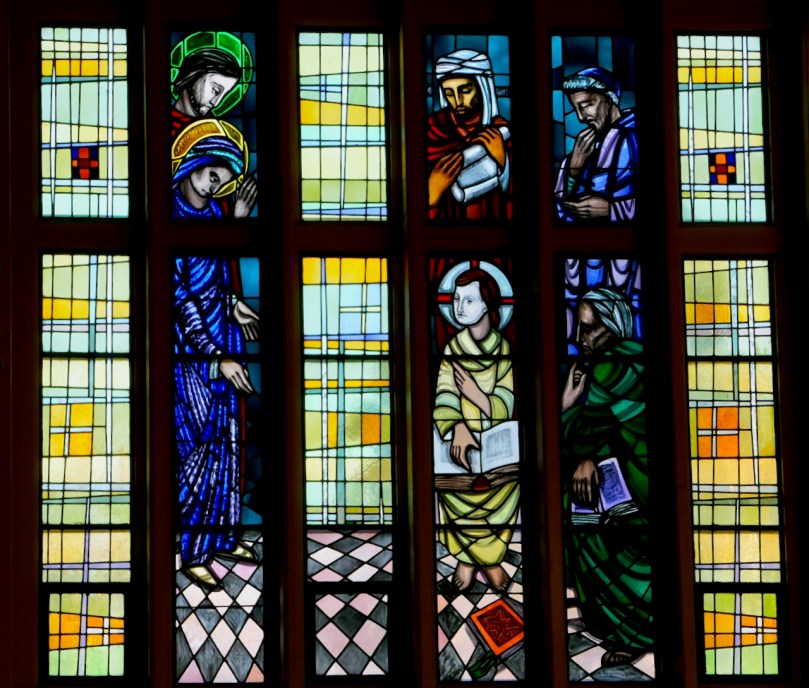
Nativity, Presentation and Jesus in the Temple windows

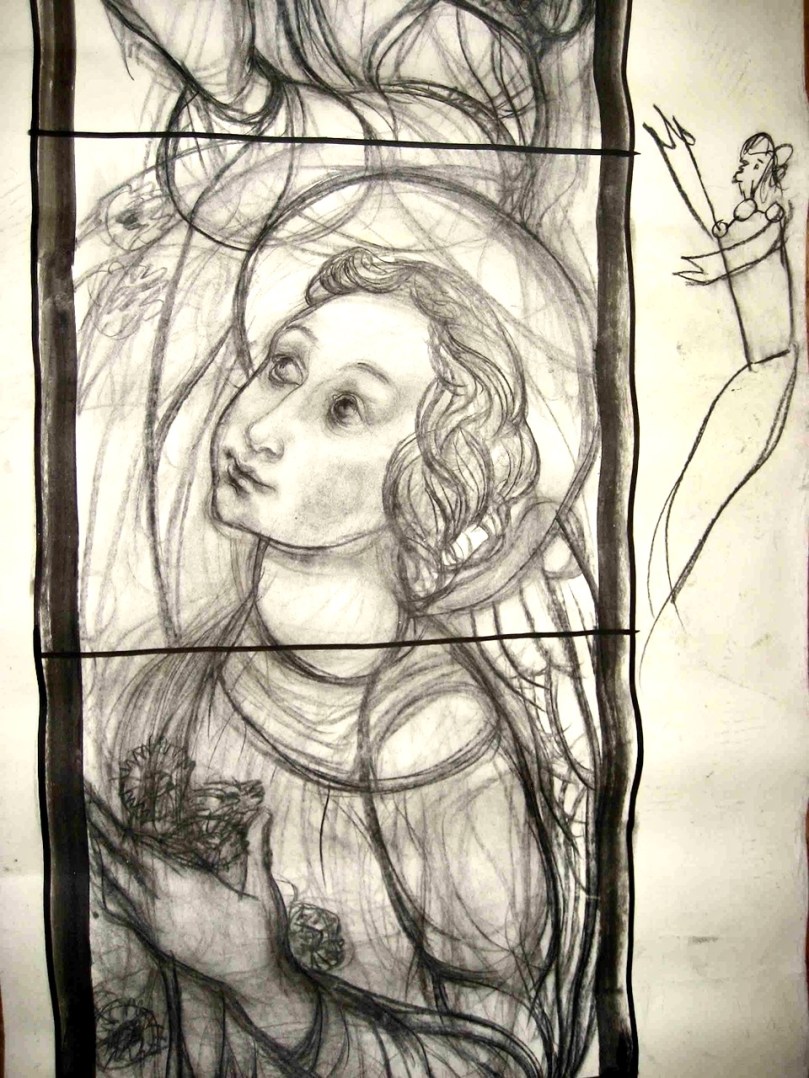
In Mayfield, all those elements are present: at first glance it’s impossible to tell where Johnny leaves off and Róisín begins. But we do have evidence, in the form of an original cartoon, that links Róisín directly to the Assumption window and once you see that, you see her hand in other places too – the heavenly choir, for example, has many of her hallmarks.

Róisín’s cartoon for the second angel from the bottom on the right, and the finished window

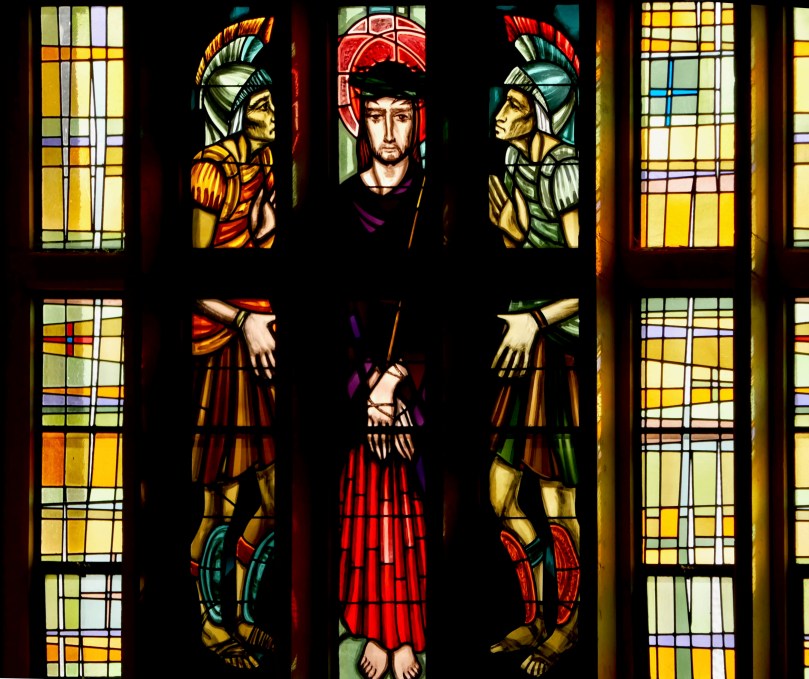
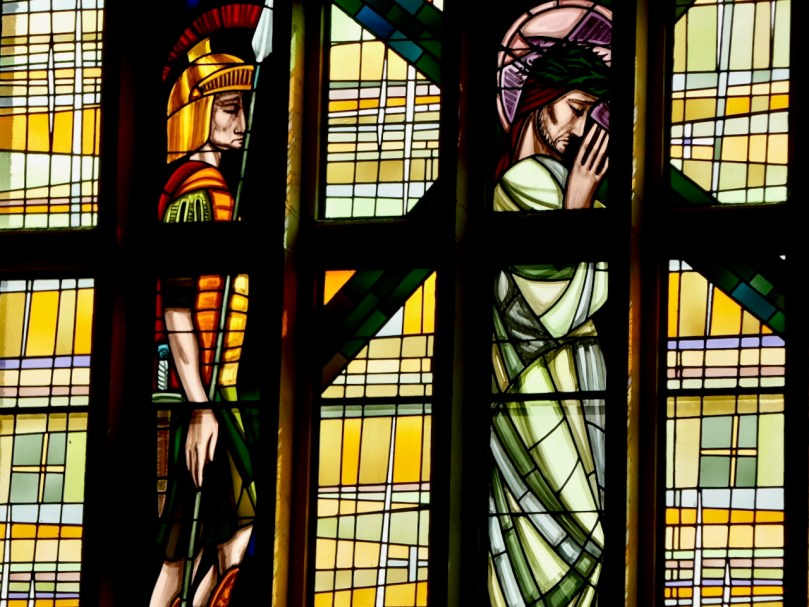
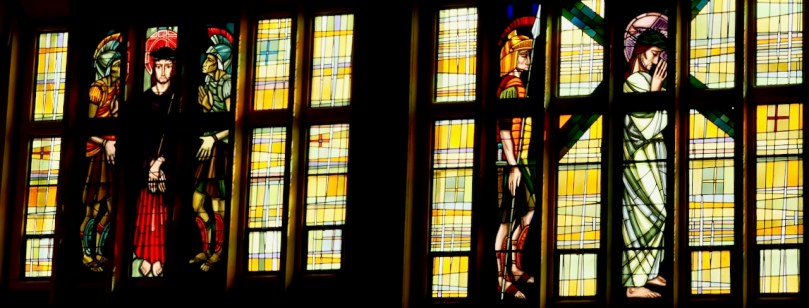
I am tempted to see Johnny in the passion images – the sombre figure of the suffering Jesus (below) exudes a quiet power alongside the mocking soldiers.

But many of the windows defy easy analysis. Look at the Nativity window (below), for example, and see if you can figure out whose hand is where. Complicating all this in Murphy Devitt windows is that when times got busy they took in extra artists to help with the workload.

In this window note how the ‘break-outs’ (the areas of coloured glass) are used to separate two long panels, which are then unified at the top. The composition, which manages to include all the major figures in two tall narrow panels, is impressive, as is the integration of those panels with the break-outs.

As with most of their commissions, Johnny was the one who sketched out the overall design and decided on the ratio of figurative panels to ‘break ups’, those areas of coloured glass that allow the eye to rest between scenes, to register the passage of time between events. Non-figurative schemes became important elements in the Murphy Devitt style – more about  them later, but for the moment note the highly original way in which the expanse of coloured glass are treated. Nobody else was doing anything like this at the time – it was a unique and beautiful Murphy Devitt innovation.

In this window, the Finding of Jesus in the Temple, the separating device is the break-out panel and the unifying device is the floor

Not for Murphy Devitt the regular quarry glass with its dependable lozenge shapes, or static grids of straight lines. Johnny loved the wobbly, the wavy and and the irregular. Réiltín says, He was interested in music: the fugue, he said, whereby the same melody/image is played in different keys – his abstracts are often flipped, turned, twisted to be similar but not identical. He loved glass as a painting medium. He loved its kinetic effect in its flaws, its trees moving outside, its changing light/colours from passing clouds, its seeming to be alive.

A window where the break-outs serve as background, with the two main figures occupying panels and the cross stretching across the space

It’s a lot easier to cut regular shapes and fit them together, of course, but you don’t need an expert for that. This is where Dessie Devitt came into his own as a master glazier. Choosing the glass to match the colour scheme, assembling it all harmoniously, cutting and leading the thousands of pieces that went into a scheme like this – none of it would have been possible without Dessie Devitt and the men who worked alongside him.

The heavenly choir, above  one side of the main door, with Our Lady Crowned on the right. Below is a detail from the other side

By all accounts it was a charmed workplace, a happy environment where everyone worked hard but where laughter and The Chat abounded. Des in particular was gifted with the ability to recognise the absurd and could hardly leave the studio without coming back with an entertaining story.

About the same time as Mayfield, Murphy Devitt won the commission to design a set of windows based on the Canticle of St Francis for another Cork church, this one attached to a Cappuchin Friary. We’ll take a look at that one and some others next week. For the moment, the Mayfield church will serve as an introduction to Johnny, Róisín and Des, their modern aesthetic and their collaborative approach.

*Many thank to Réiltín Murphy for much of the background information, for answering all my questions and for additional photographs, including the people pictures and Róisín’s cartoon.

Copper Craft

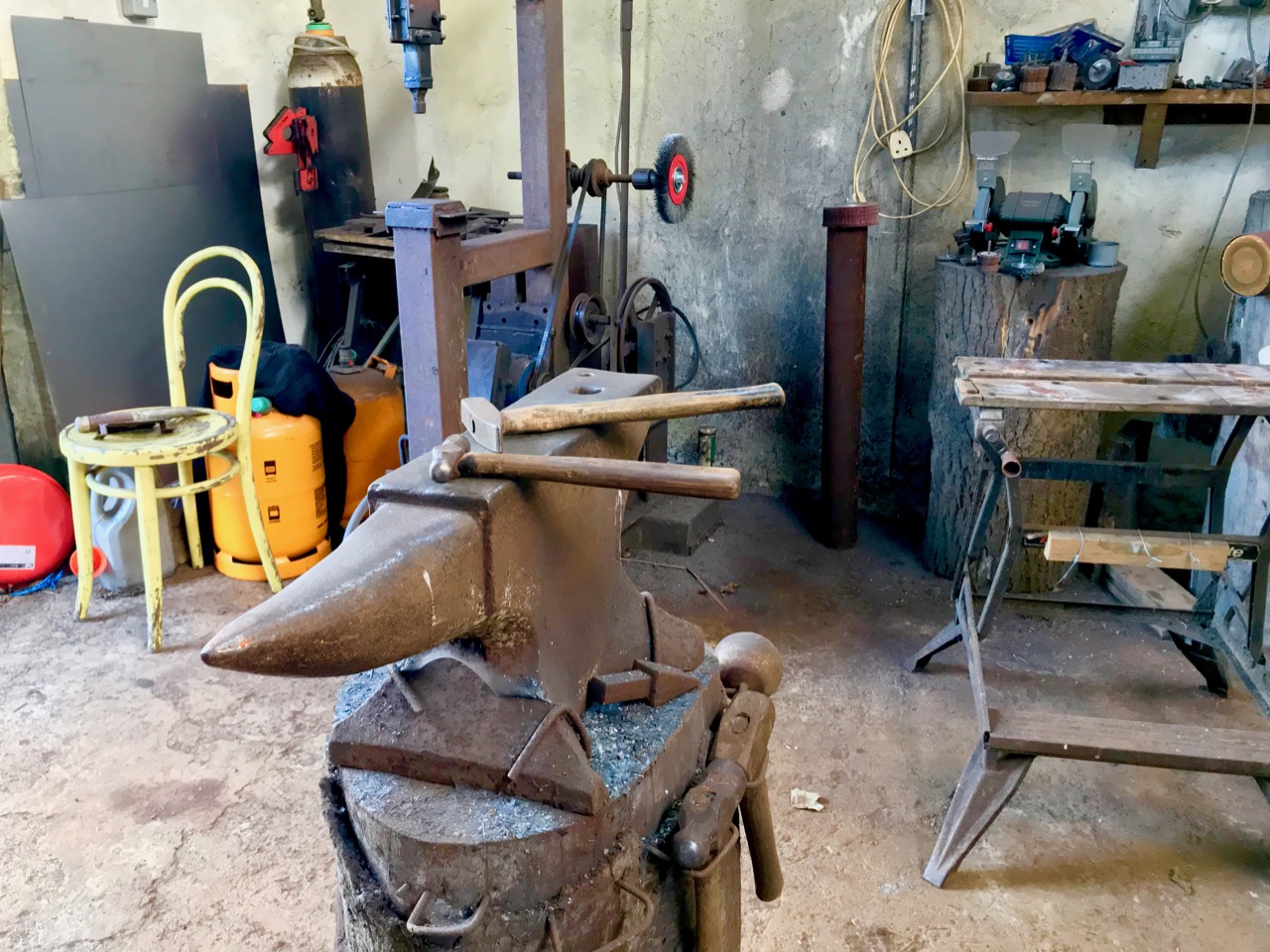
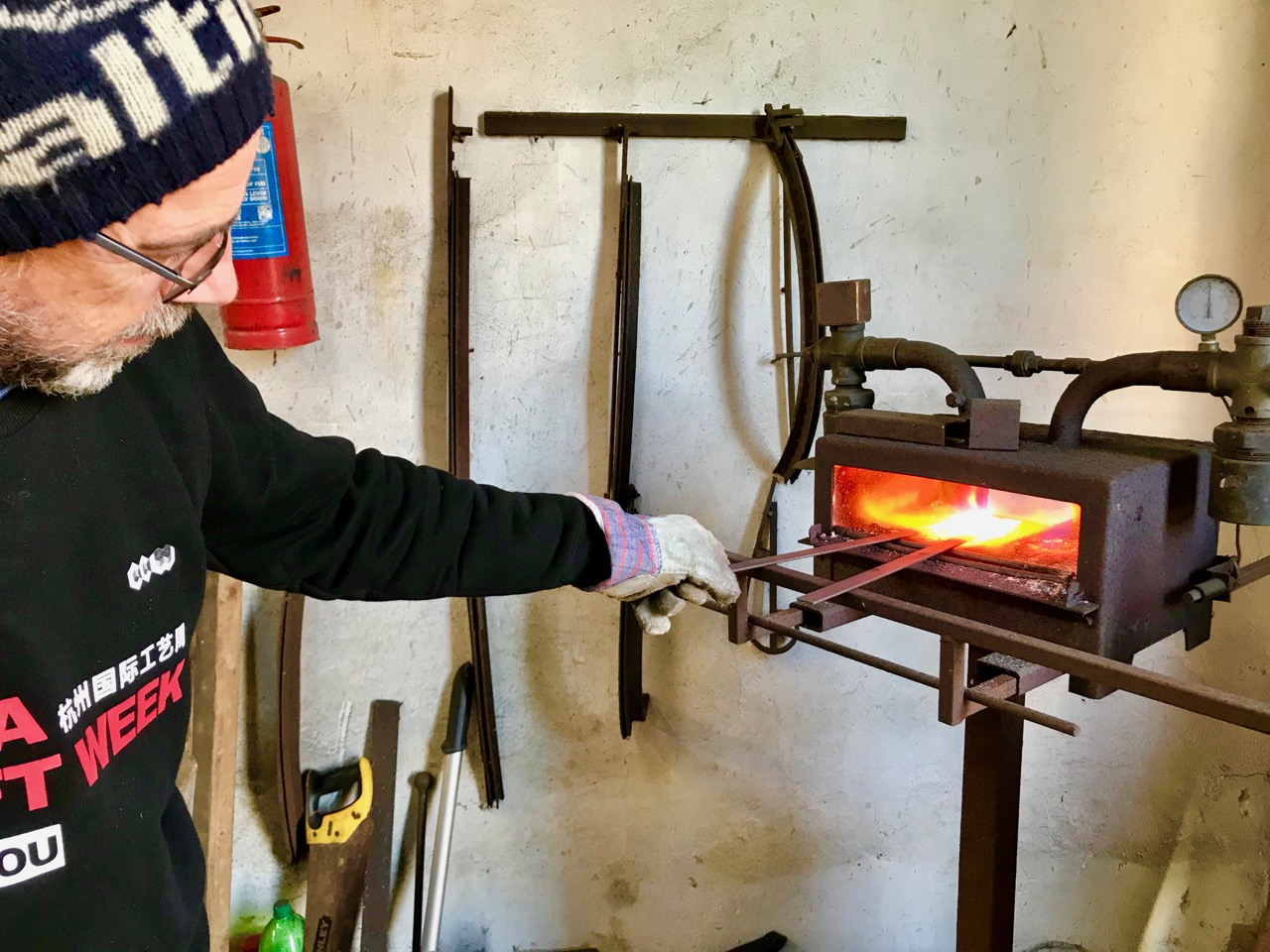
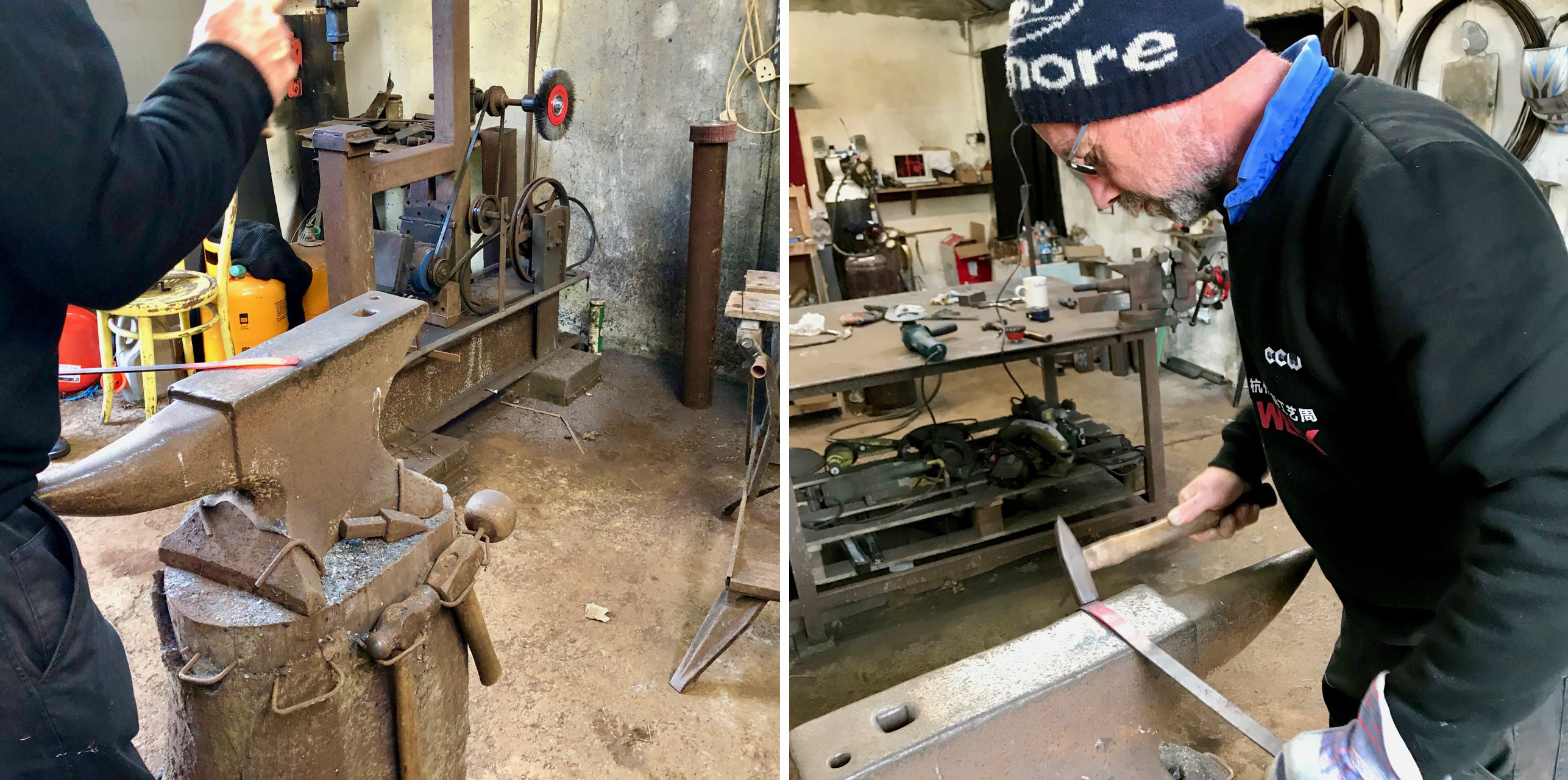
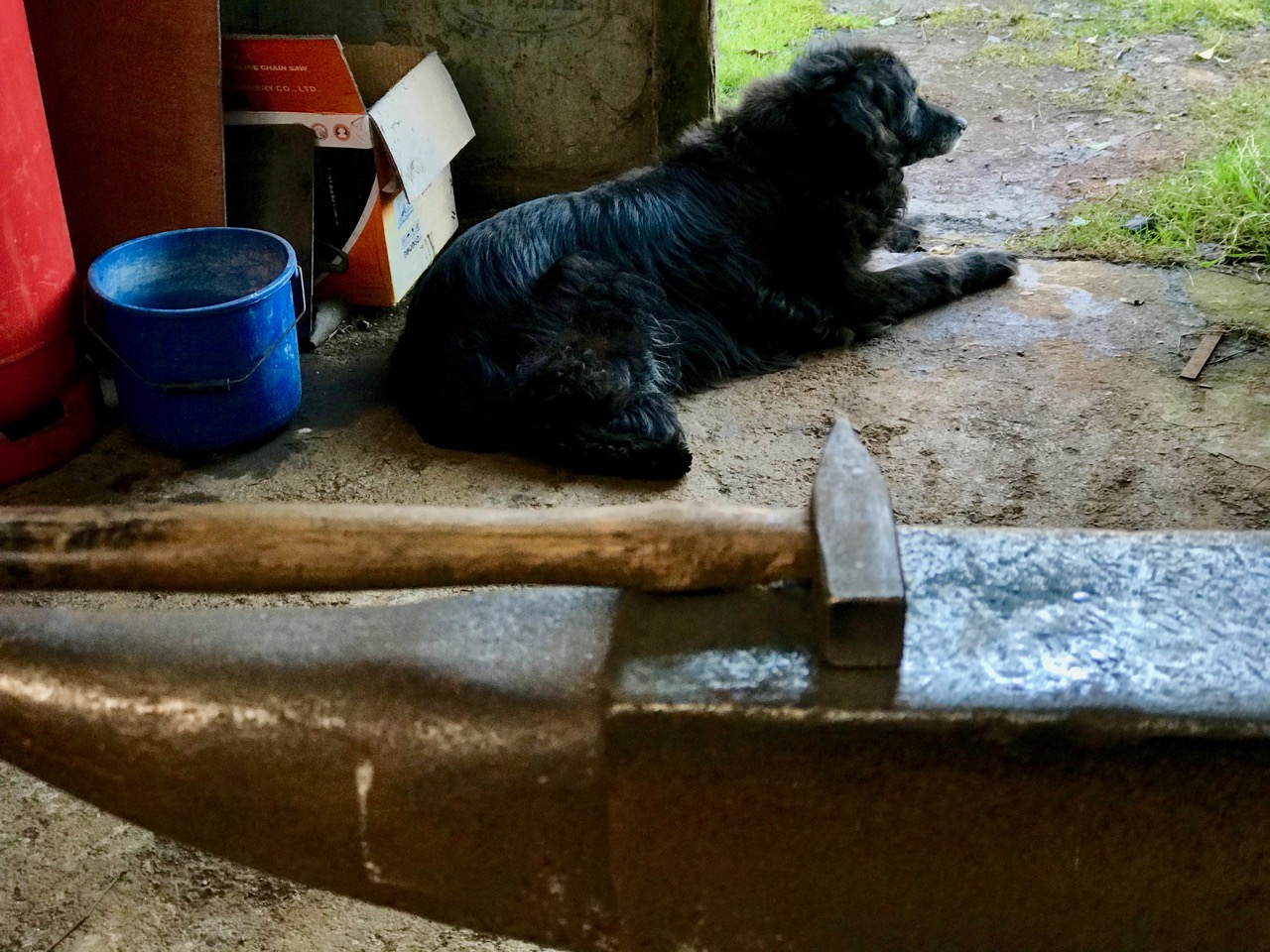
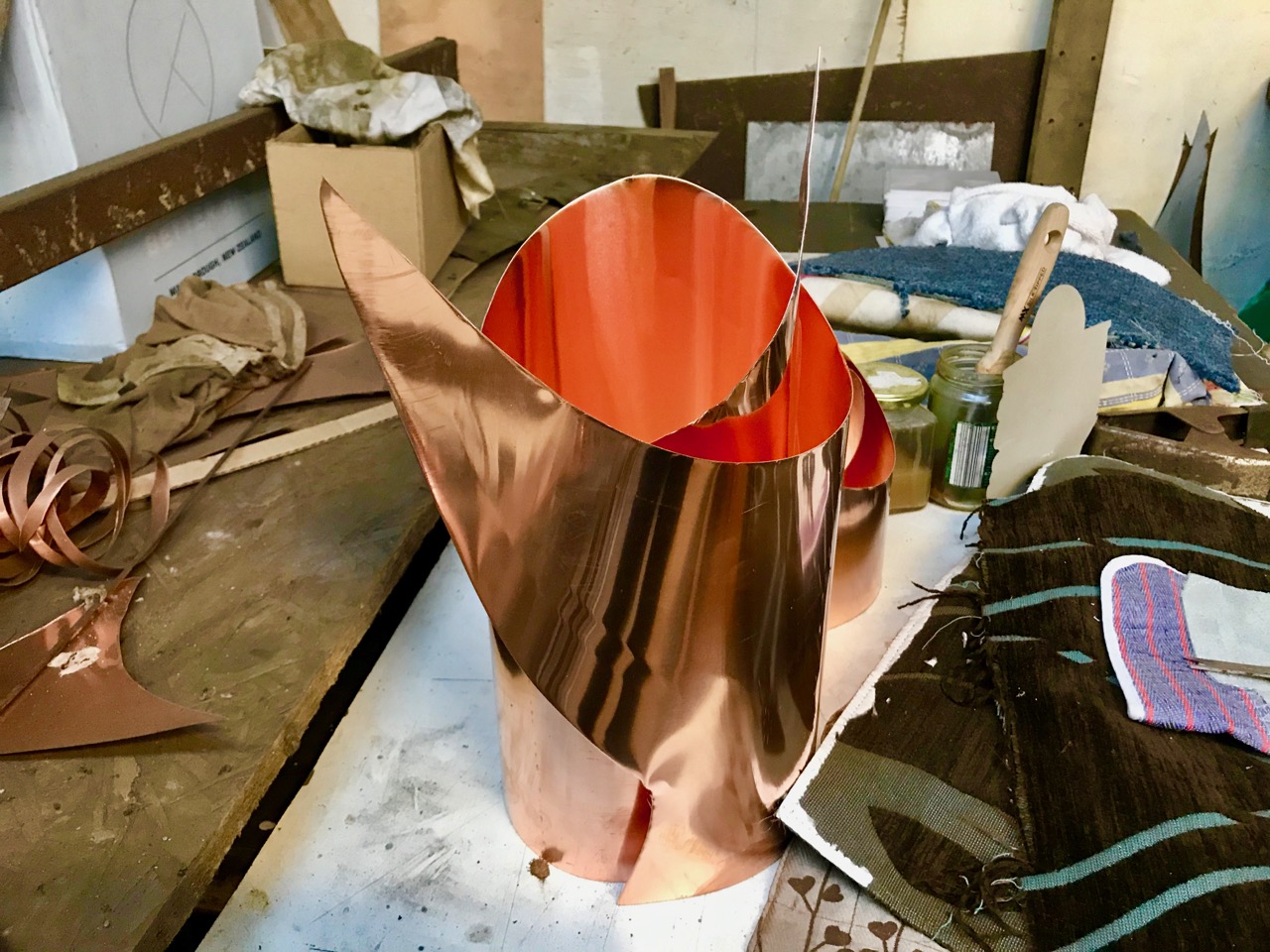
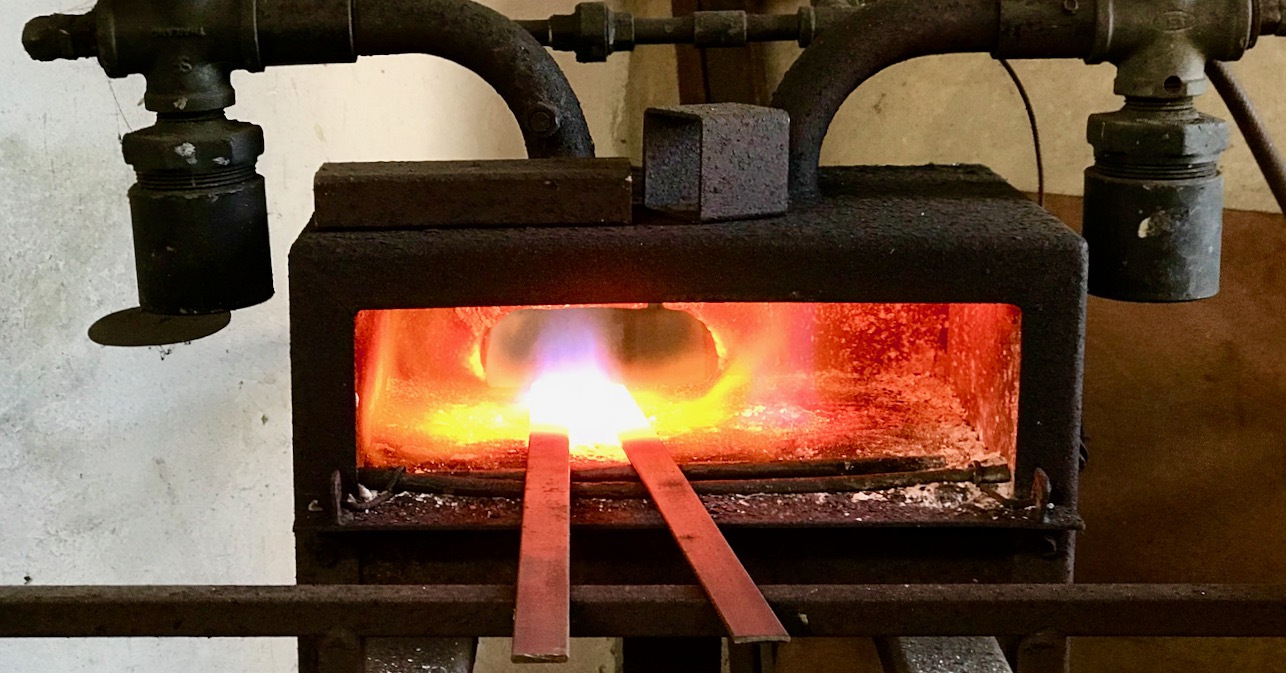
I admire workshops. And I admire the creativity that goes on in them. Here’s one that’s not too far away from us in West Cork: it’s just outside Skibbereen, on the road to Lough Hyne. It belongs to Paddy McCormack, who is a metalworker producing functional and decorative items. His preferred material is copper, and that comes with a historical connection that puts him right back with some of the earliest craftspeople who dwelled in this western part of the land thousands of years ago!

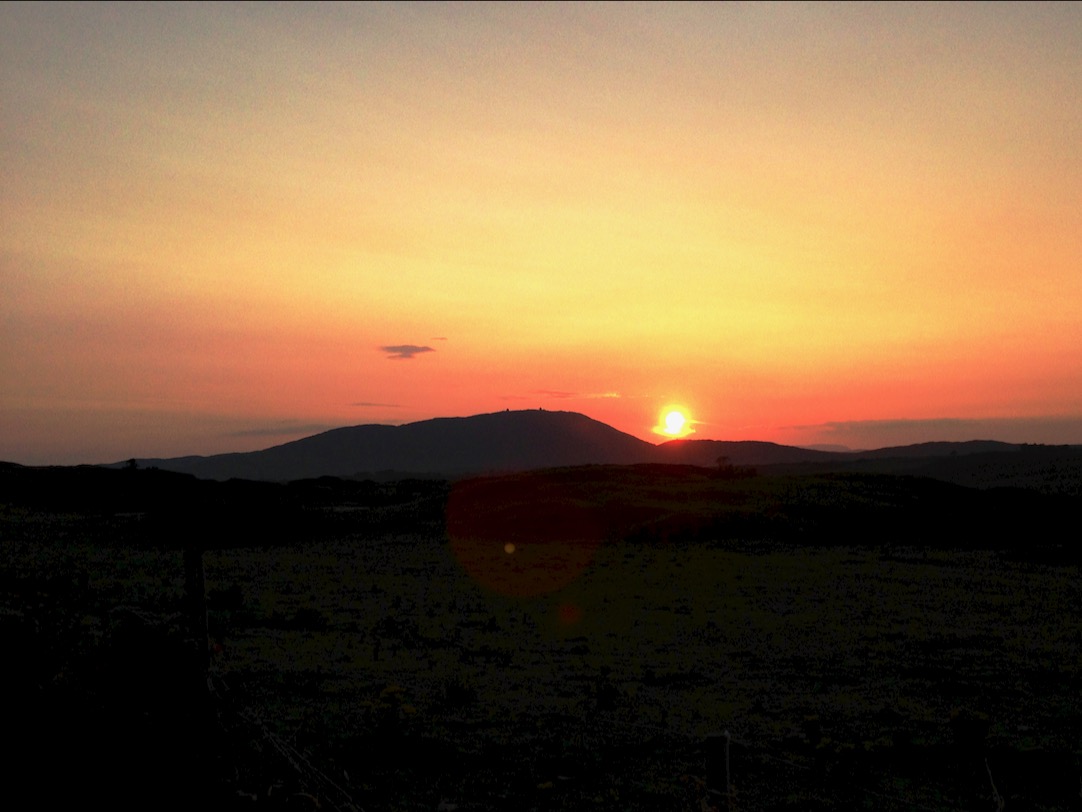
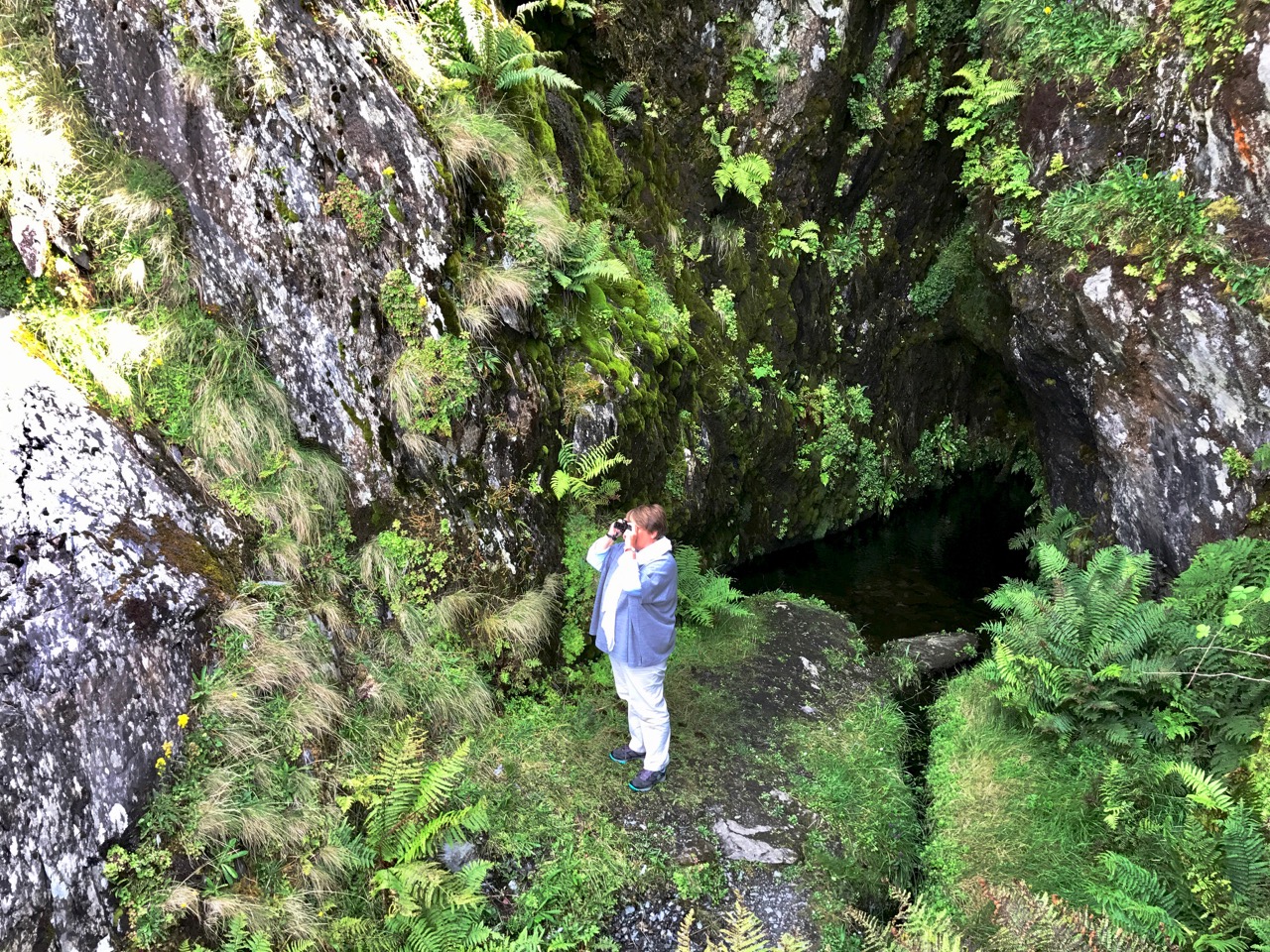
Mount Gabriel, the Mizen’s highest outcrop of land, silhouetted against a copper-coloured winter sky (upper picture) is the site of ancient copper mines dating from the Bronze Age. In the lower pic, Finola is standing at the entrance to an old mine adit driven into the side of this mountain. If you want to see the techniques used by the early metalworkers, have a look at this post which I wrote back in 2015. You’ll find that the methods dating from three and a half millennia ago are recognisable today. Here’s Paddy continuing the tradition:

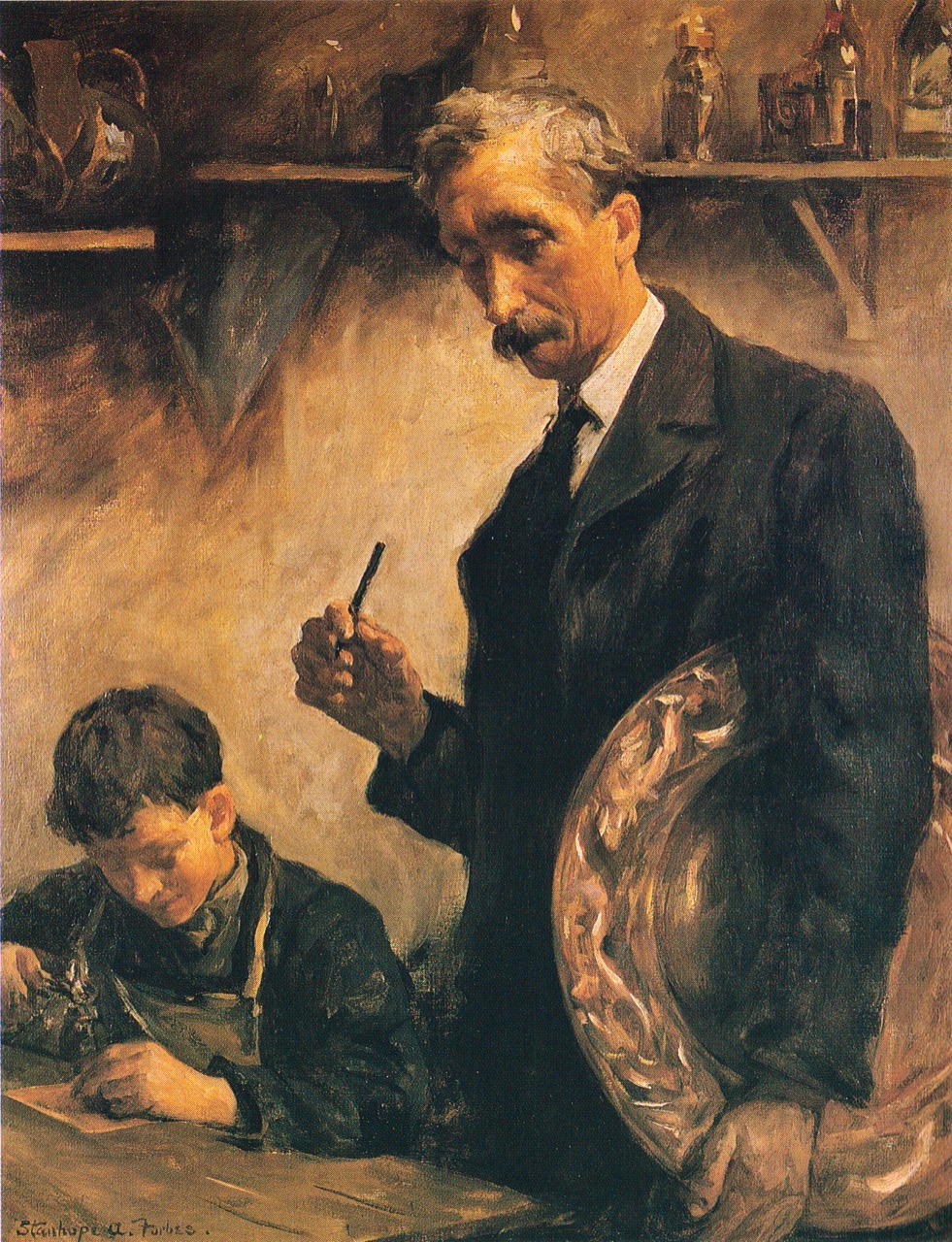
We first came across Paddy at the 7 Hands Exhibition held in London, Dublin, Cork and Ballydehob. In this post written by Finola at the time you’ll see him with one of his unique pieces, a chess set, but it was at another exhibition this year that we became aware of his beautiful, hand-beaten copper bowls. Once seen , never forgotten: we asked Paddy if it would be possible to produce a large bowl for us, more the size of the now much sought-after copper ‘chargers’ produced by the Newlyn artists colony in West Cornwall during the late 19th and early 20th century. I lived in Newlyn before coming here to the west of Ireland and much admired the copper work from that time.

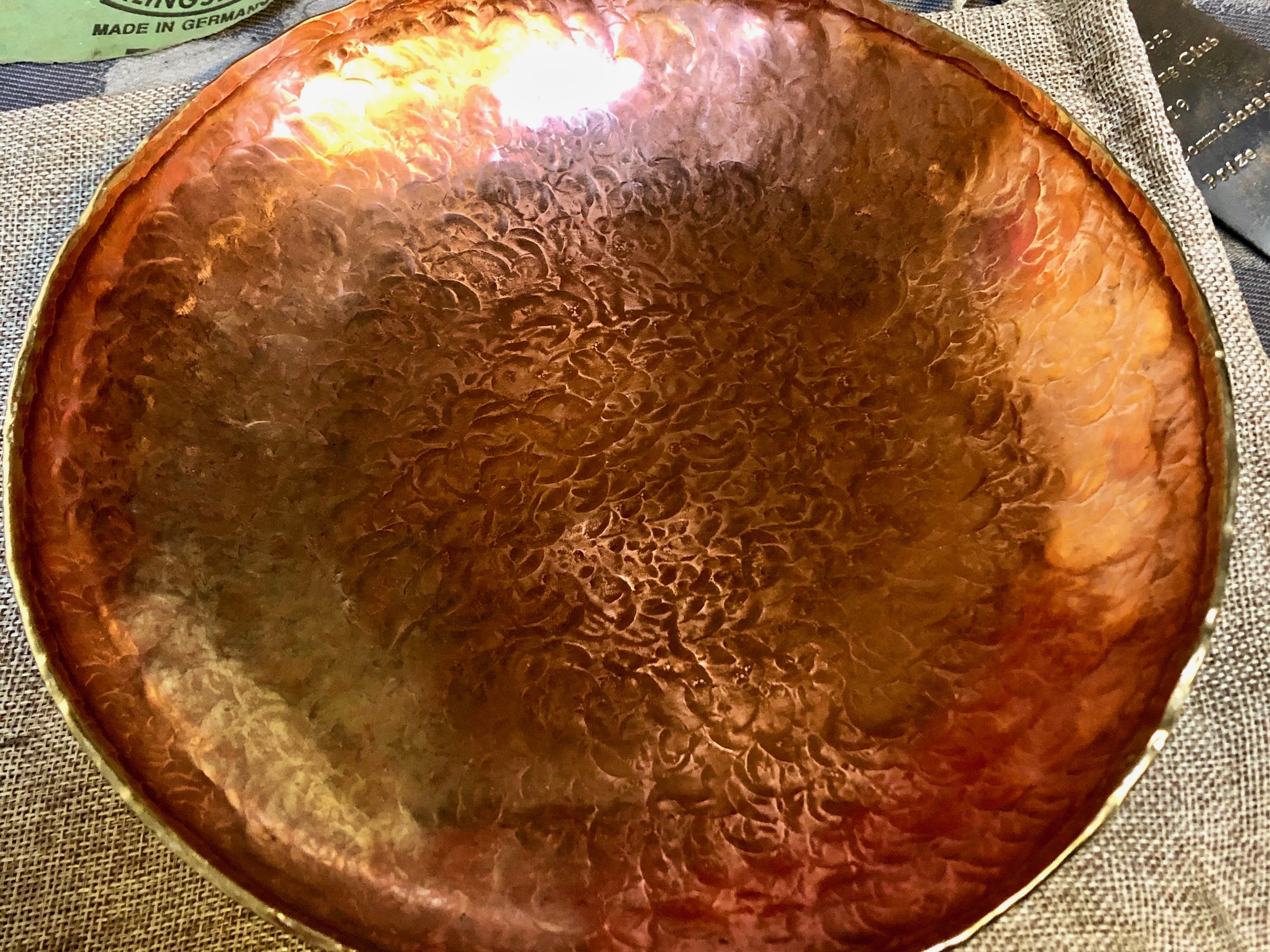
The Young Apprentice a painting by the Irish-born founder of the Newlyn School, Stanhope Alexander Forbes (above). The painting dates from 1908. There is still a copper works in Newlyn today. First established in the fishing village in 1890, copperware production gave us some of the most outstanding work created in the Arts and Crafts tradition of its day. One of the things that impresses us about Paddy’s work is his own way of working the metal surface, creating organic textures and colours which are exquisite.

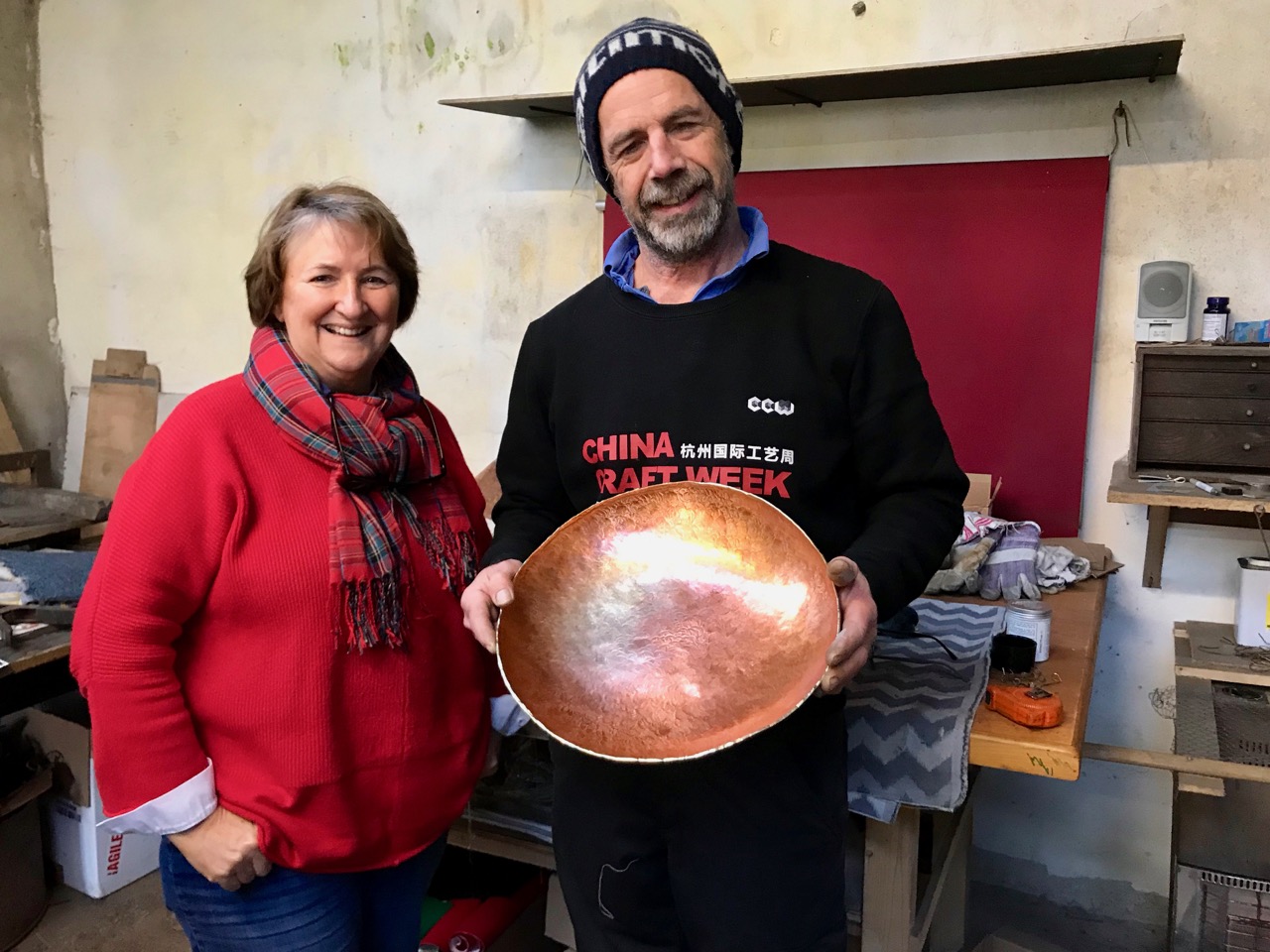
Paddy presenting us with the large bowl which we commissioned. It is elegant and unique, and we are delighted! The richly textured surface shows the marks of the copper being worked and provides an organic finish which will evolve and change colour over time. Paddy has developed his own design for his bowls, with a double skin and welted rim.

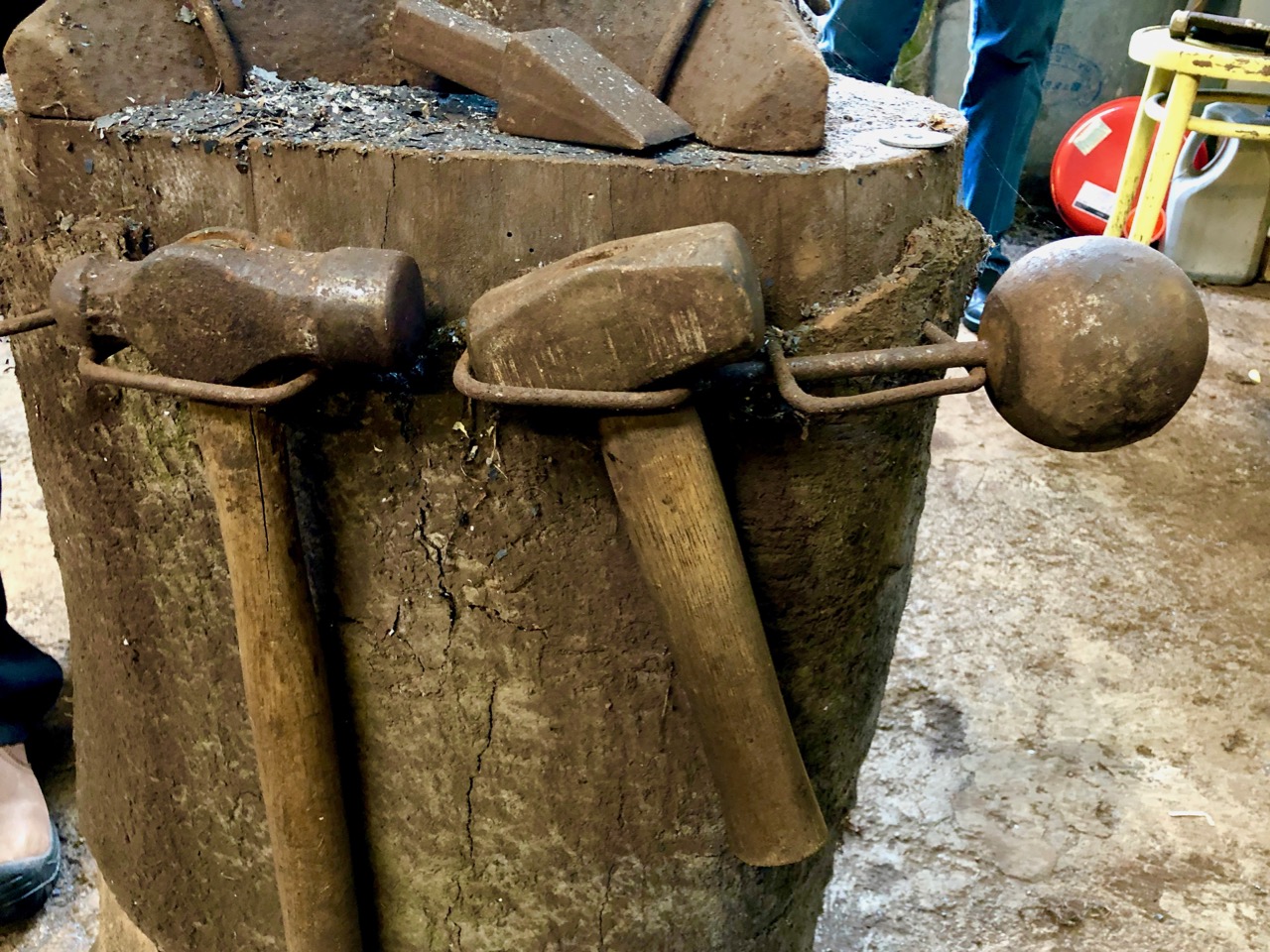
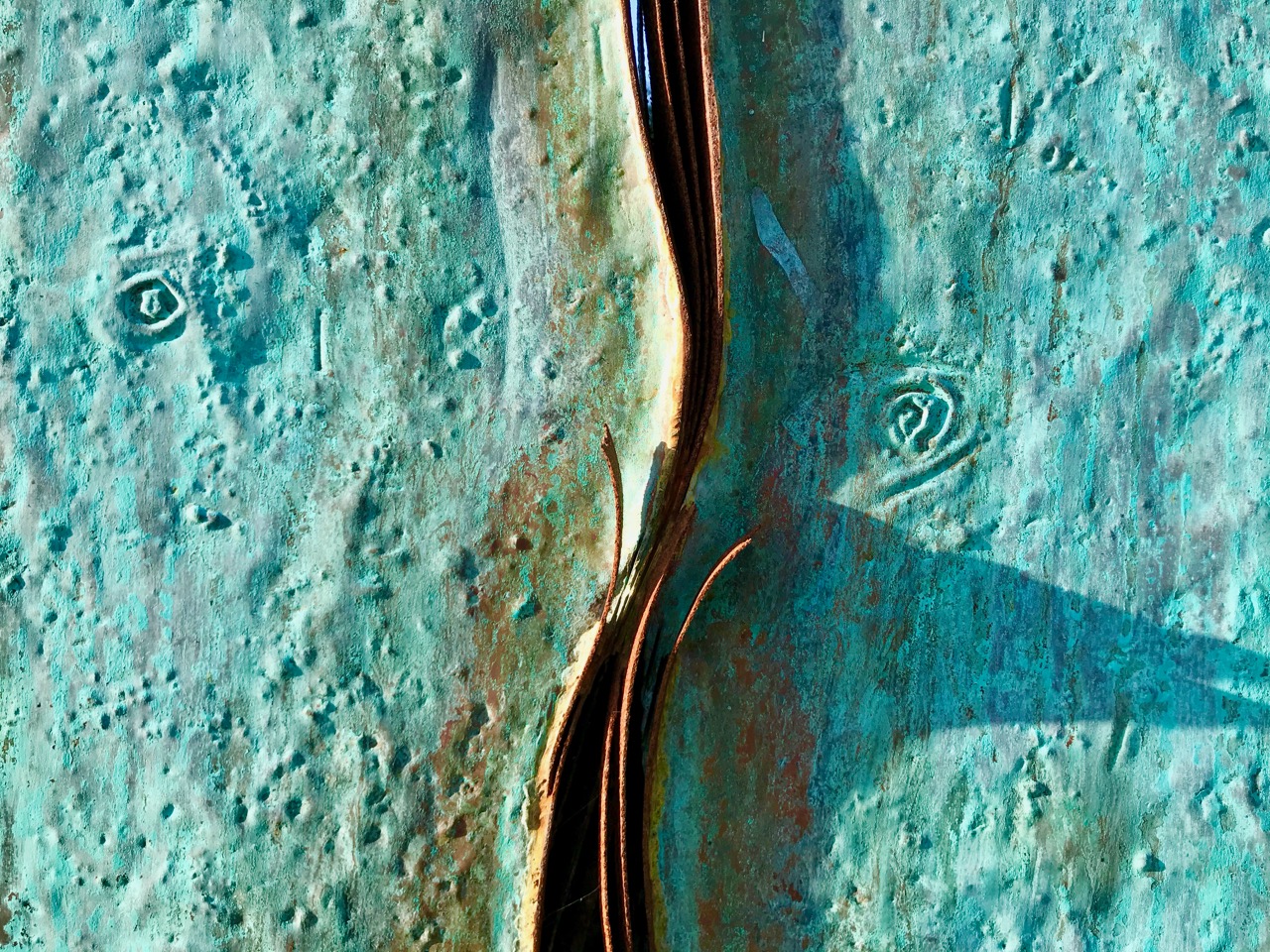
Raw materials and the tools of his trade form Paddy’s working environment. He is comfortable within these surroundings. We felt privileged to meet him in this environment, and could sense his ability to transform his visions into reality through complete mastery of his chosen medium. Examples of his work in the open air show the distinctive patina that develops on copper when exposed to the elements.

Paddy markets his bowls and decorative copper work through craft outlets and fairs. He recently travelled to China with a group of locally based fellow artists and craftspersons. It’s a small world when a master artist / craftsman from rural West Cork is in demand on the other side of the planet!

No Wrens Were Harmed in the Making of this Post!

Wran Hunting has featured before in Roaringwater Journal: that’s the way that St Stephen’s Day – 26 December – has been celebrated for generations in ‘Celtic’ parts of western Europe, specifically Ireland and The Isle of Man, but also in Cornwall – where it’s now only a memory – Brittany, Wales and Scotland. ‘The Wran’ is a very strong surviving tradition here, especially on the west side of the country. The Dingle Gaeltacht is the place to go if you want to see all the action (click on the bottom right of the window to turn on the sound):

In our own Ballyedhob community ‘The Wran’ is not forgotten. In fact you can even find a poem written about it in the Duchas folklore records. This was recorded in the 1930s by John Levis, aged 32, who took it down from Jeremiah Driscoll, aged 64 years. Jeremiah had been a Wren Boy in Ballydehob. Here’s the poem:

Come all you ladies and gentlemen,

For tis here we come with our famous wran

With a heart full of cheering for every man

To rise up a booze before the year is gone.


Mr O’Leary we came to see,

With our wran so weak and feeble,

The wran is poor and we can’t feed him,

So we hope your honour will relieve him.


We’ve hunted our wran three miles and more

We’ve hunted this wran all around Glandore

Through hedges and ditches and fields so green,

And such fine sport was never seen.


As we copied our wran again

Which caused our wran-boys for to sing,
She stood erect and wagged her tail,
And swore she’d send our boys to jail.


As we went up through Leaca Bhuidhe

We met our wran upon a tree,

Up with a cubit and gave him a fall,

And we’ve brought him here to visit you all.


This the wran you may plainly see,

She is well mounted on a holly tree,

With a bunch of ribbons by his side

And the Ballydehob boys to be his guide.


The wran, the wran, the king of all birds,

St Stephen’s day he was caught in the furze,

Although he is little, his family is great,

So rise up landlady and fill us a treat.


And if you fill it of the best,

We hope in Heaven your soul will rest,

But if you fill it of the small,

It won’t agree with our boys at all.


To Mr O’Leary and his wife

We wish them both a happy life,

With their pockets full of money, and their cellars full of beer,
We now wish a merry Christmas and a happy New Year.


And now, our song is ended, we have no more to say,

We hope you’re not offended for coming here today,

For coming here this morning we think it is not wrong,

So give us our answer and let us all be gone.

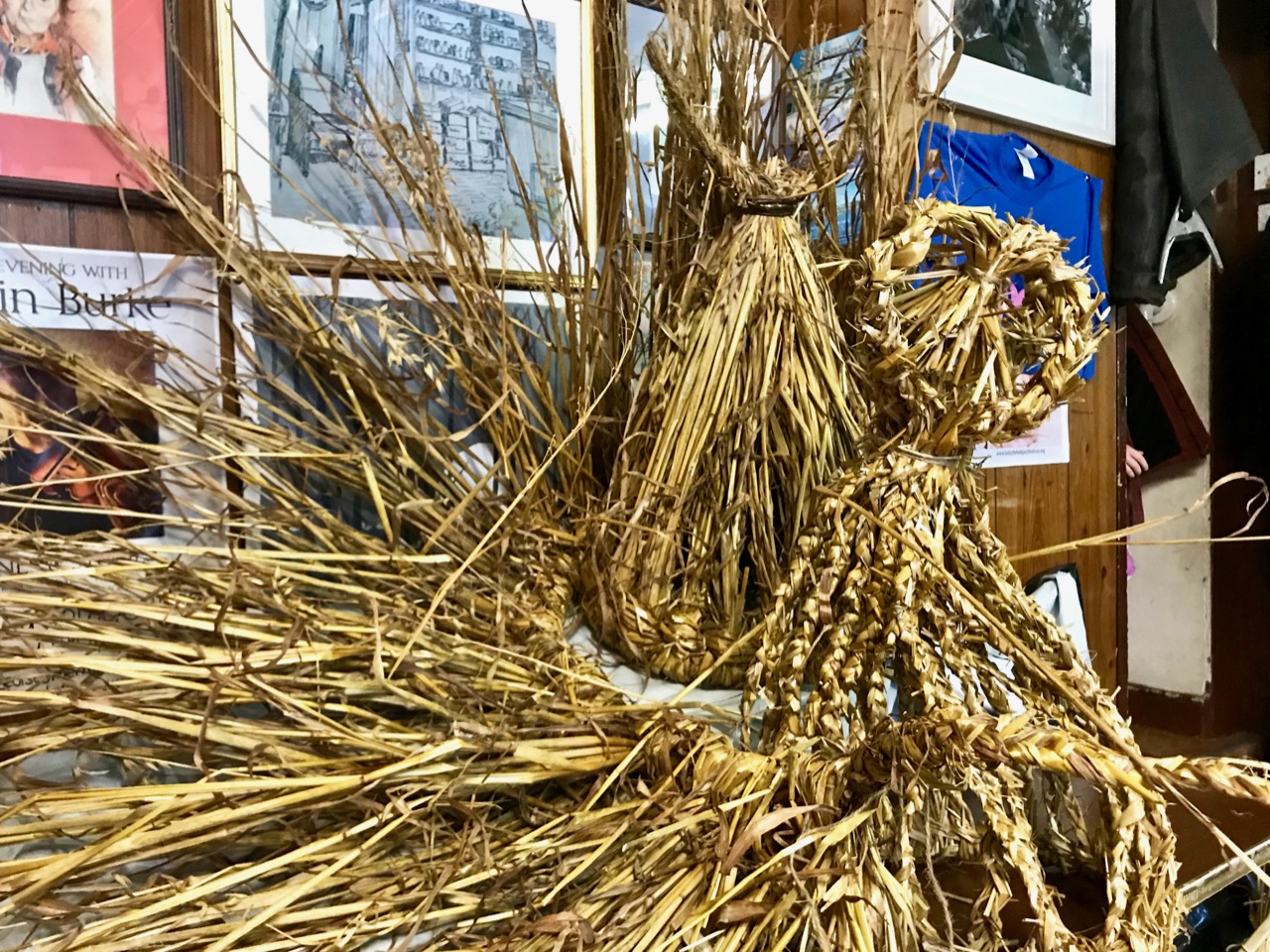
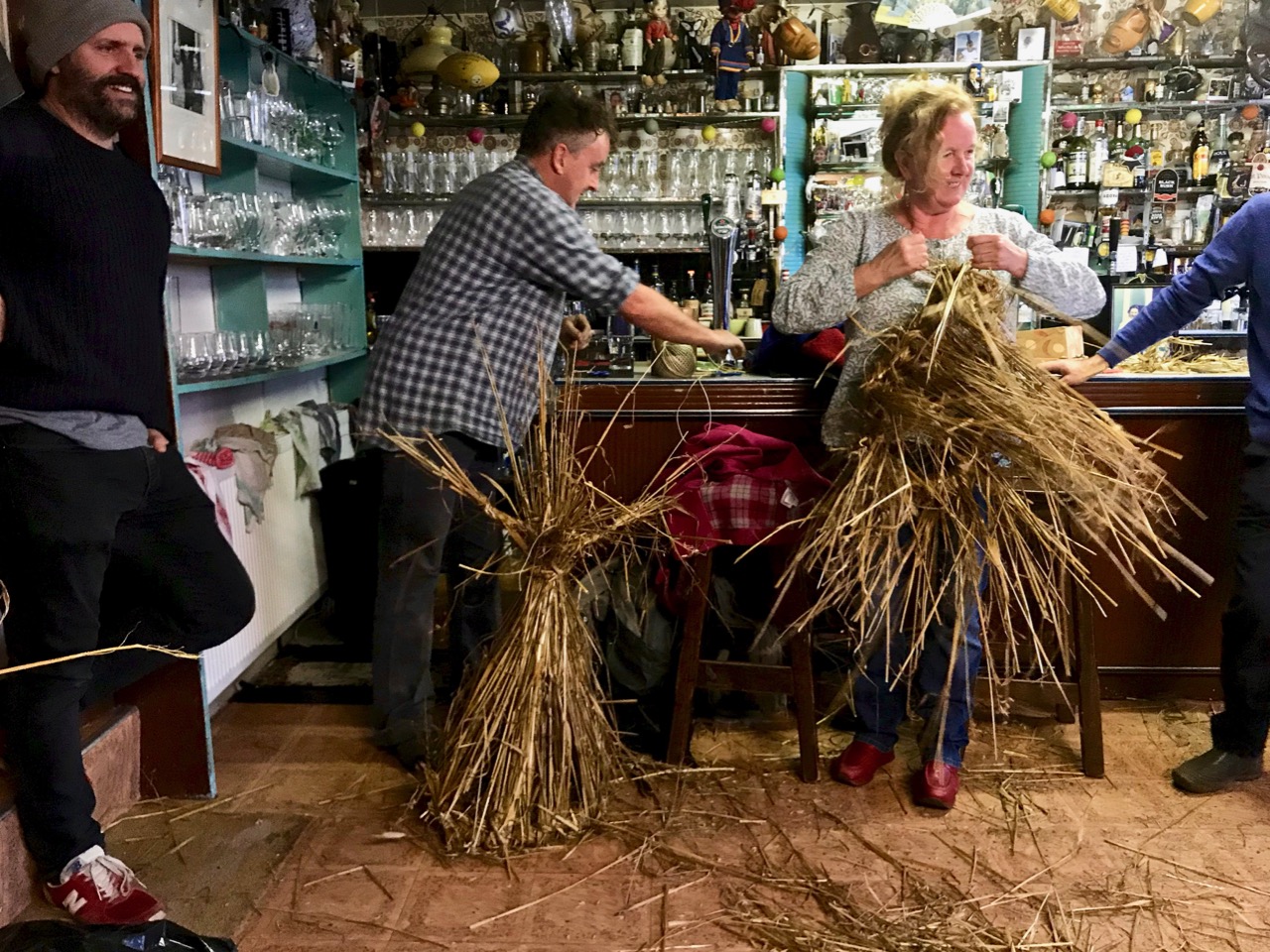
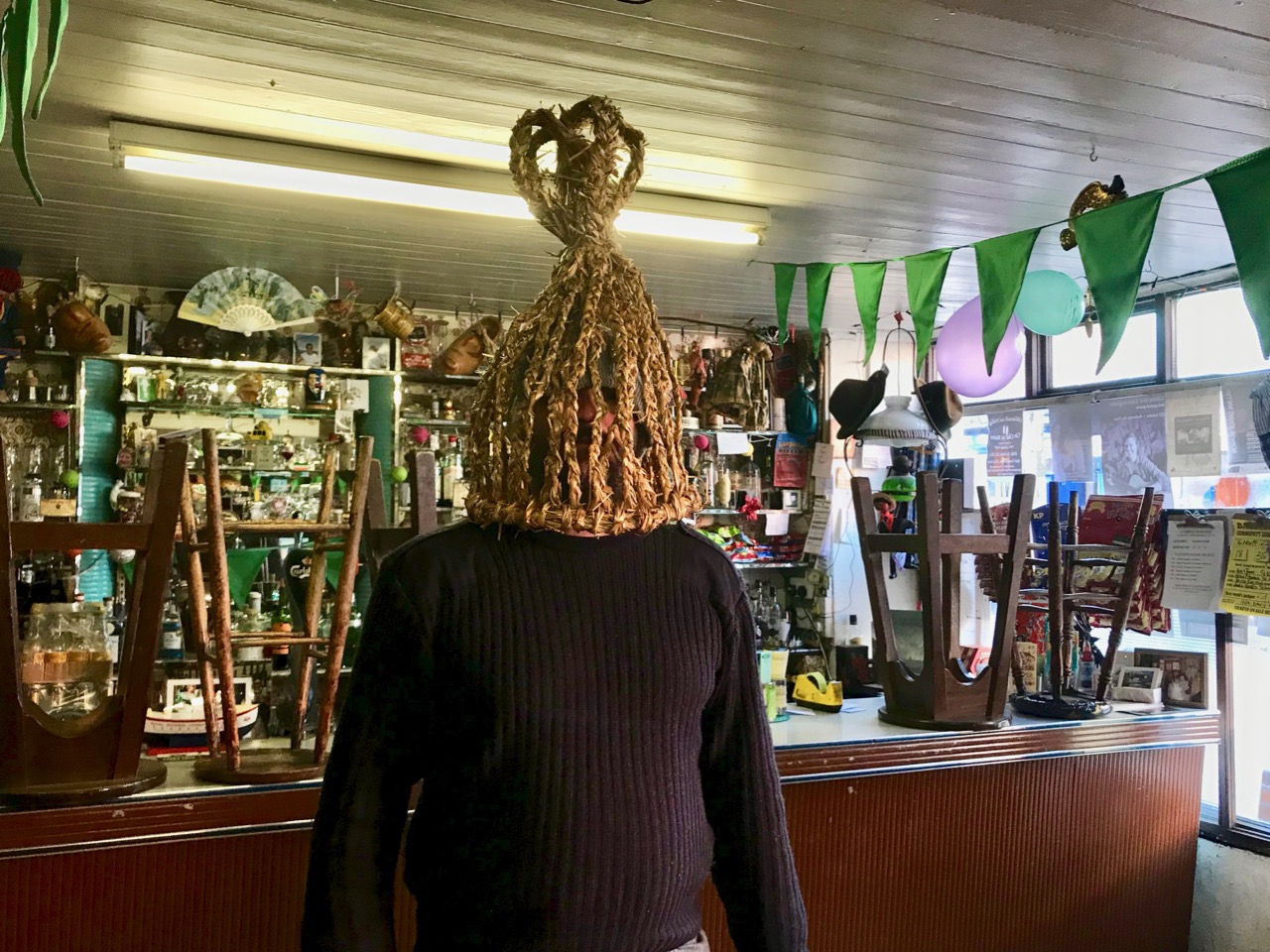
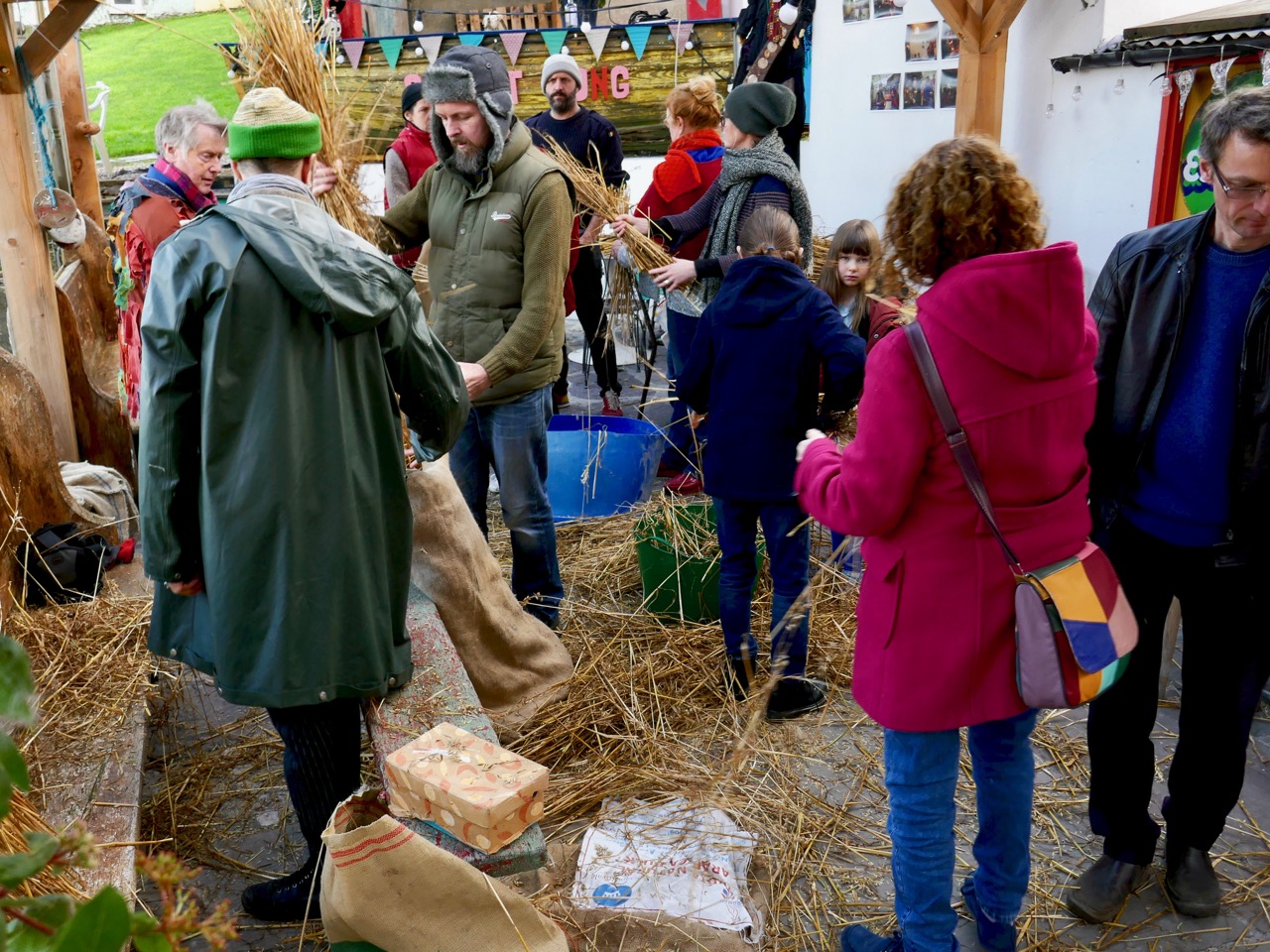
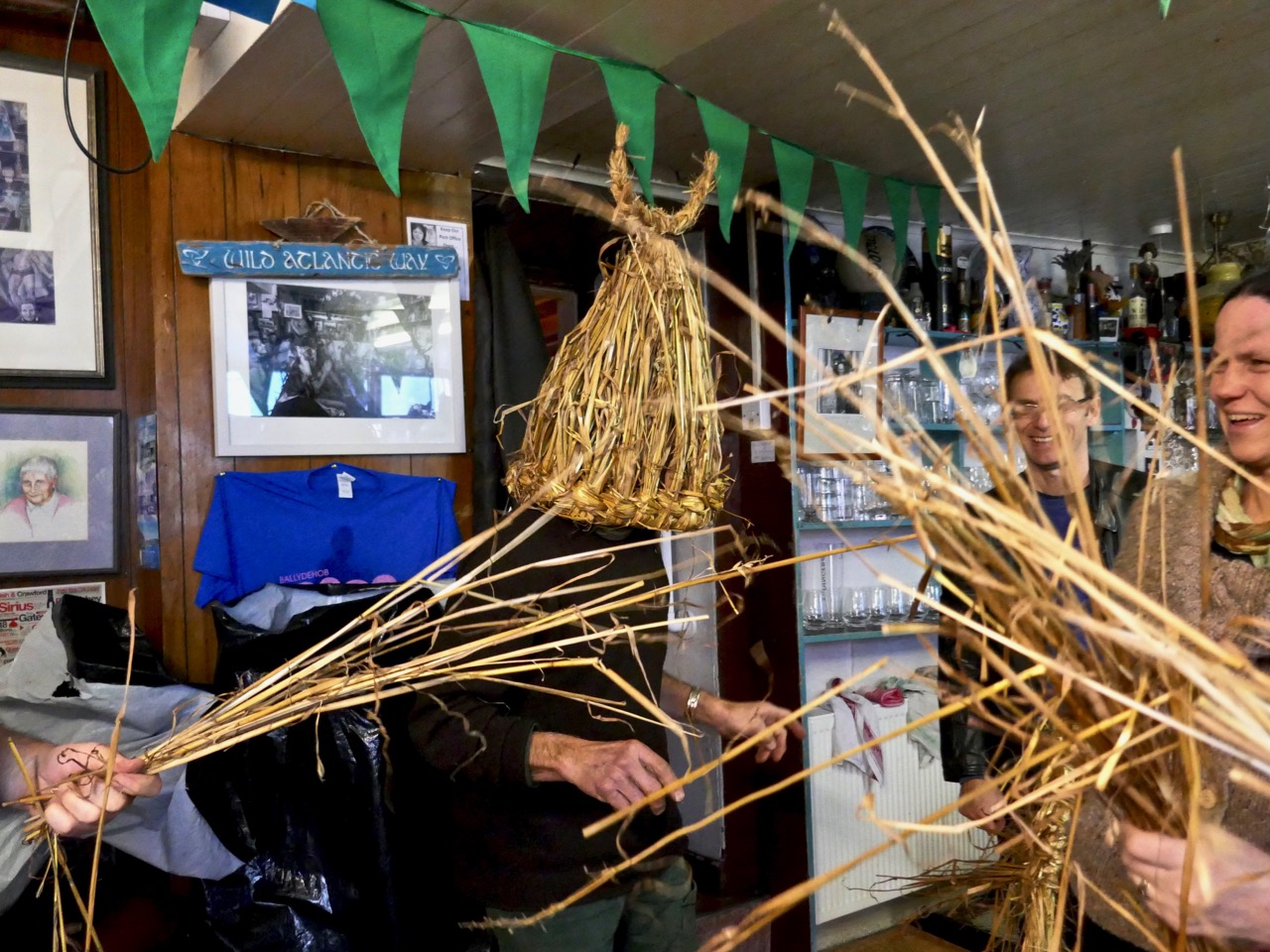
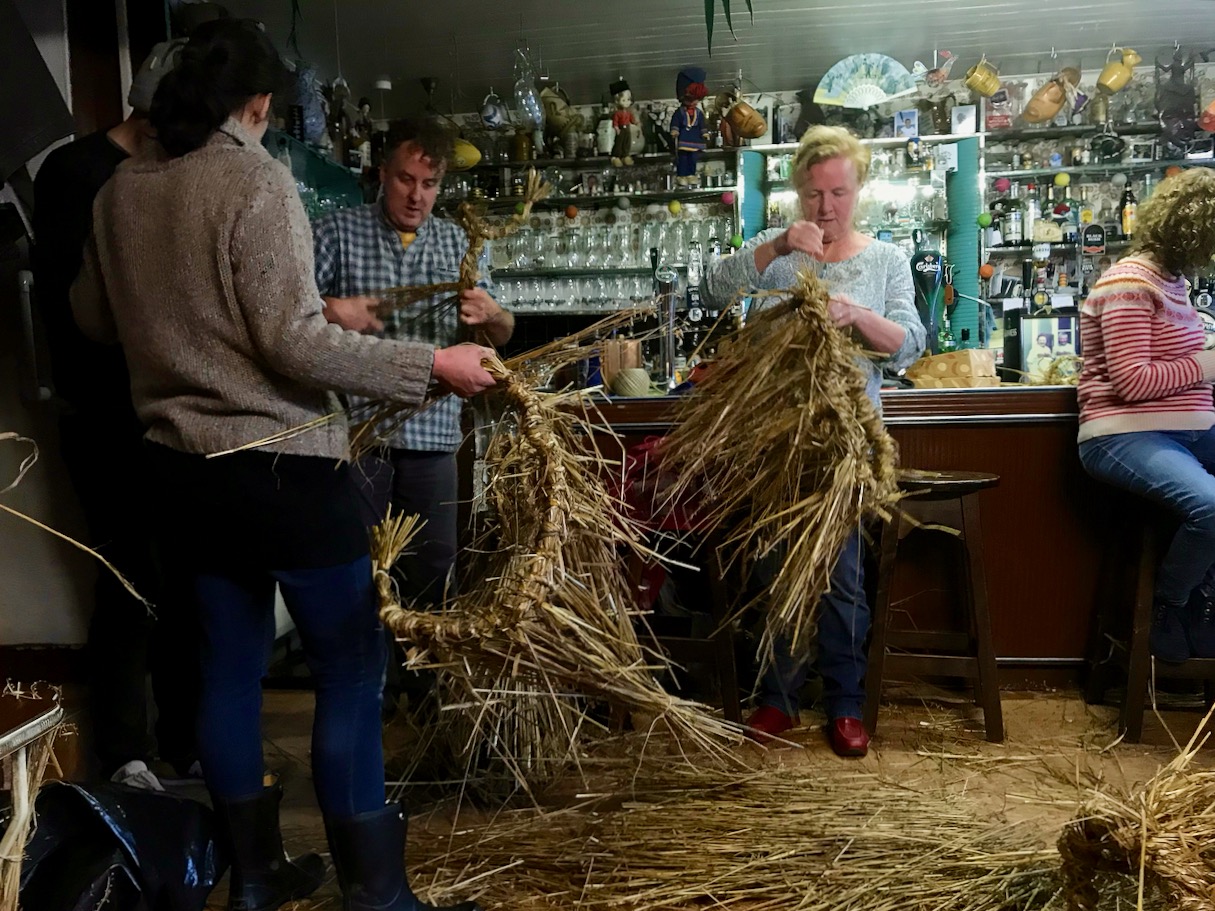
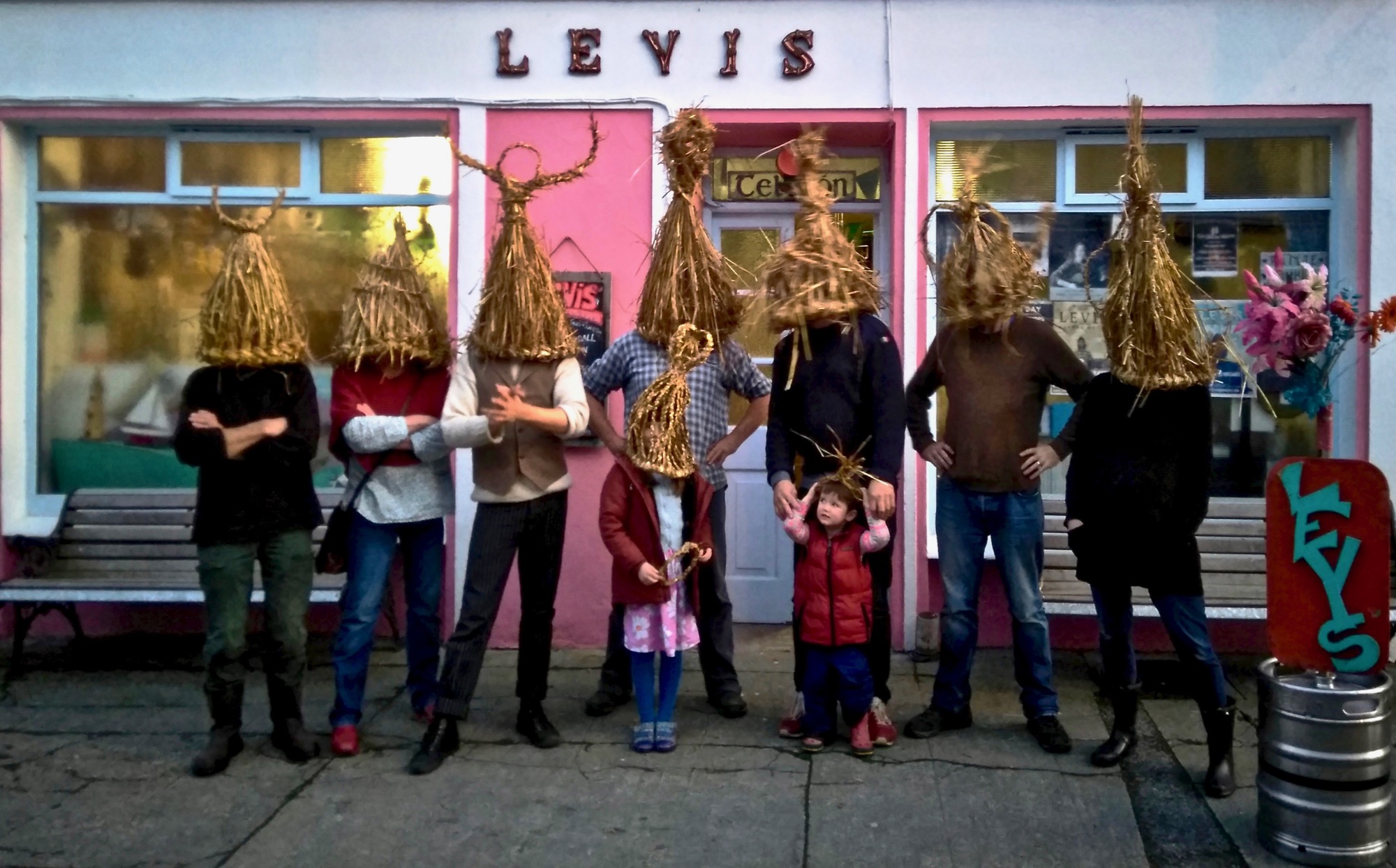
By good fortune there’s ‘Mr O’Leary’ above! He’s the landlord of Levis’ Corner House Bar in Ballydehob – which is the subject of Finola’s post today. He’s on the left in the upper picture, looking on at the Wran Workshop which he allowed to take over his pub yesterday. Basically that involved covering the whole place in straw out of which, magically, appeared a whole lot of wonderfully crafted Wran masks. Joe is wearing a fine example in the lower picture.

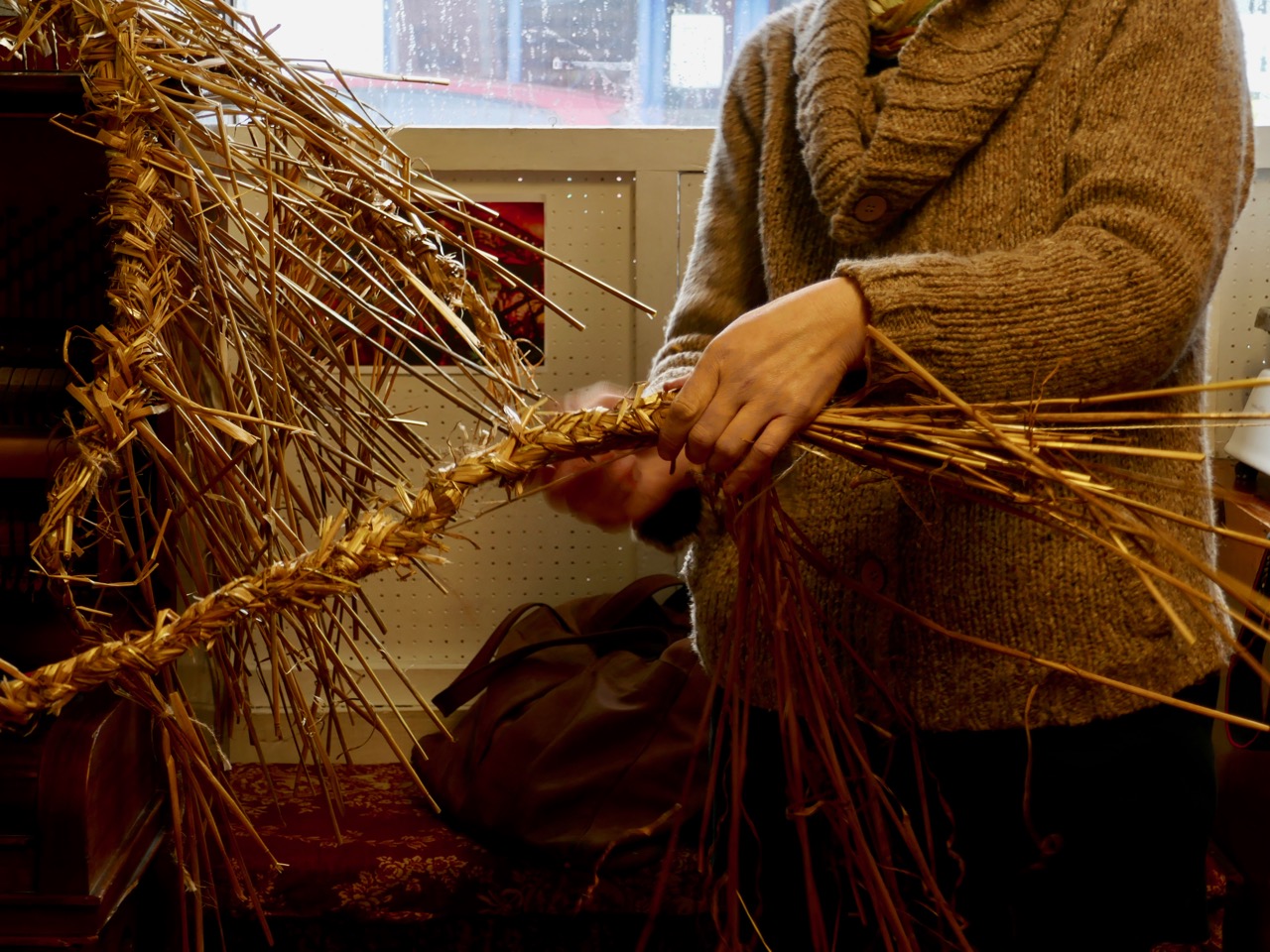
The afternoon started outside, in Levis’ garden, where we were all given guidance on preparing the straw. We had to strip away the leaves and any heads which had been left behind, and produce bunches suitable to be plaited and then turned into ropes which would form the basis of the  hats or ‘masks’ traditionally worn to disguise the wren hunters.

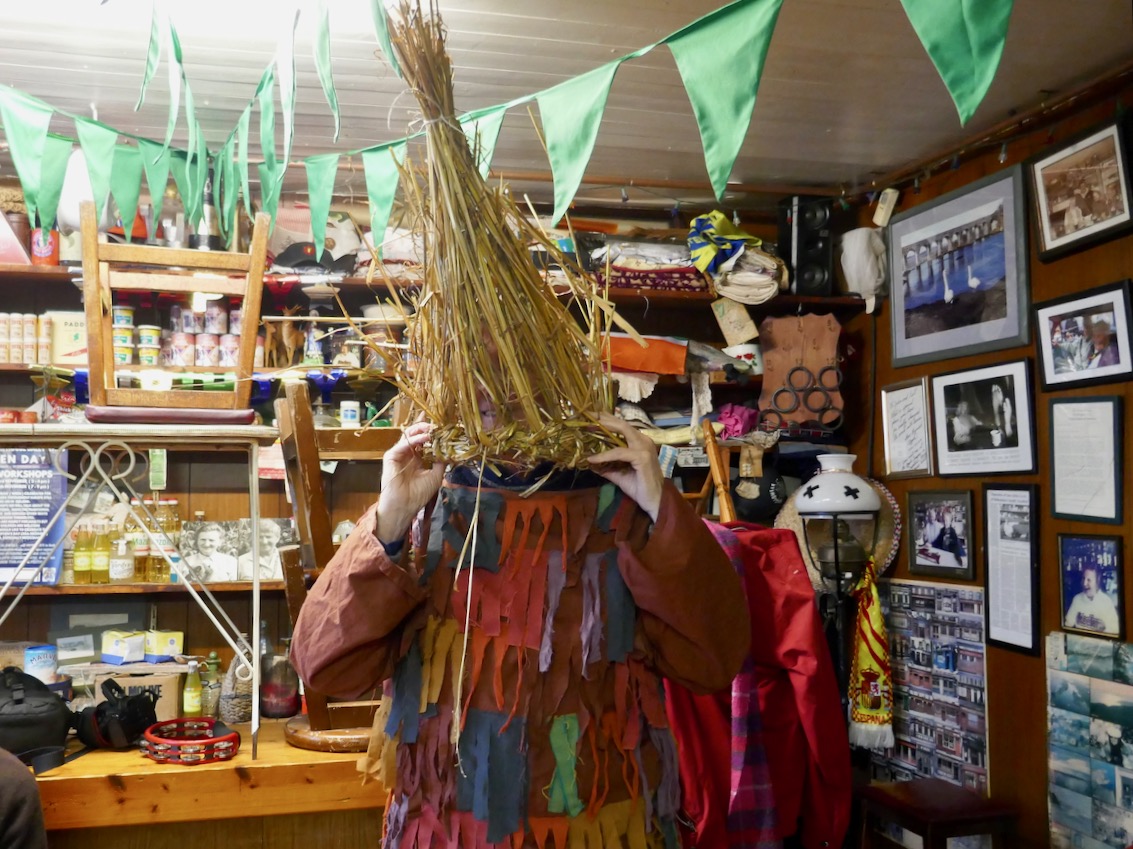
On the right here you can just catch a glimpse of workshop maestro Sonia Caldwell, inspecting another fine mask. Sonia is determined that Ballydehob will embrace the Wran tradition (vestiges of which have appeared on the streets over the years) and re-energise it in the way that only this West Cork village’s vibrant community knows how. I can just imagine that in a couple of years’ time people will be flocking to see ‘The Wran’ in the same way that they flock to the Jazz Festival and all the other festivals and events that happen annually here.

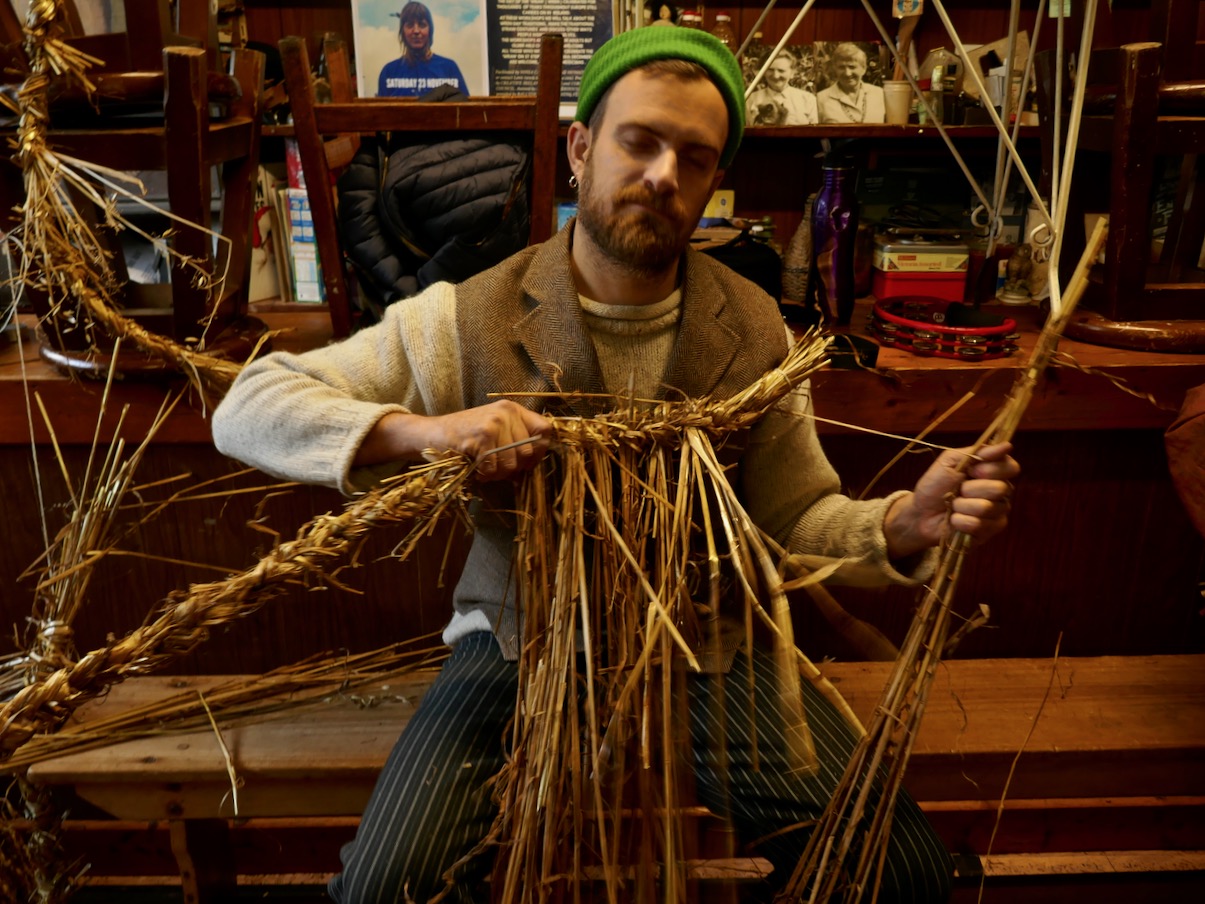
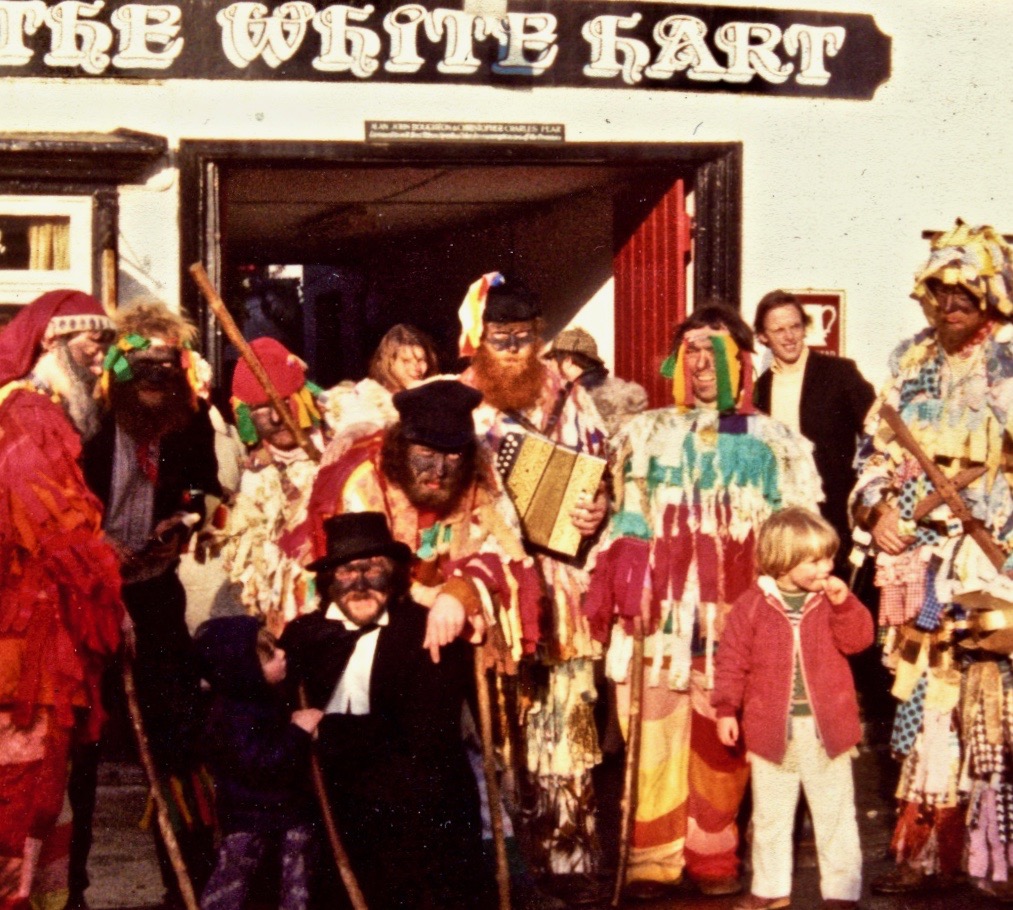
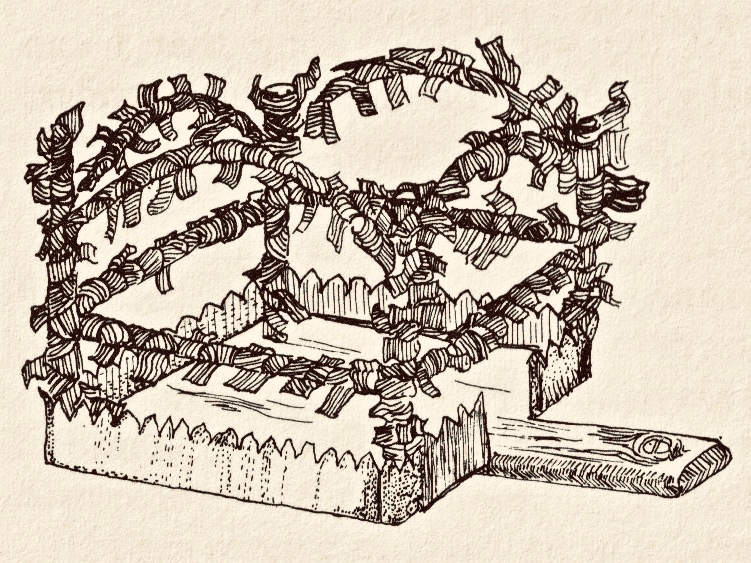
Finola and I were at the workshop, and there I am with work in progress on the straw mask which we made (upper picture). You’ll notice that I’m wearing ‘tatters’: I’ve had these for years, and I used to don them for our own mumming tradition in Devon which also happened on 26 December (that’s me with the squeezebox mumming in the 1970s! – lower picture). Over there we called St Stephen’s ‘Boxing Day’ because that was when ‘Christmas boxes’ were given to the postman, the milkman and anyone else who provided their services through the year. Interestingly, Kevin Danaher mentions the ‘Wran box’ which was taken around the houses by the wrenners (or Wran Boys) and used to collect money ‘for the Wran’. This illustration of a Wren box from County Galway is from Danaher’s book The Year in Ireland:

The workshop in Levis’ was very well attended, and there is clearly great enthusiasm for reviving this custom. Sonia collected the straw at the annual Thrashing in Ballydehob – which is a traditional harvest celebration. It’s not easy to find the right straw for making the masks nowadays: anything that has been through a combine harvester has been flattened and will not survive the plaiting.

It’s a complex process, but the group coped well in acquiring the new skills under Sonia’s tutelage. You can see for yourself how successful the day had been in the last picture below. The making – every year – has always been part of the tradition where it’s still practised today. Sometimes the straw masks (which are only one part of the ‘disguise’) are destroyed after Stephen’s. In some of the Dingle traditions they are ritually burned on the following St Patrick’s Day.

Sonia is holding a further workshop – also at Levis’ Corner Bar – next Thursday 28 November at 7pm. It’s free to attend: please come and join in: you’ll learn more about the history of The Wran, and there’s likely to be some music too! And then on Stephen’s Day itself it’s out into the boreens and byways of Ballydehob to look for a wren . . . Don’t worry – the days are long gone when our (almost) smallest bird would lose its life: it’s a token hunt, the point of which is the disguising, the visiting around the streets, and the celebrations afterwards, which will extend late into the night!

Many thanks to Pól Ó Colmáin for providing this wonderful photograph of the results of the workshop!

Making a Willow Basket

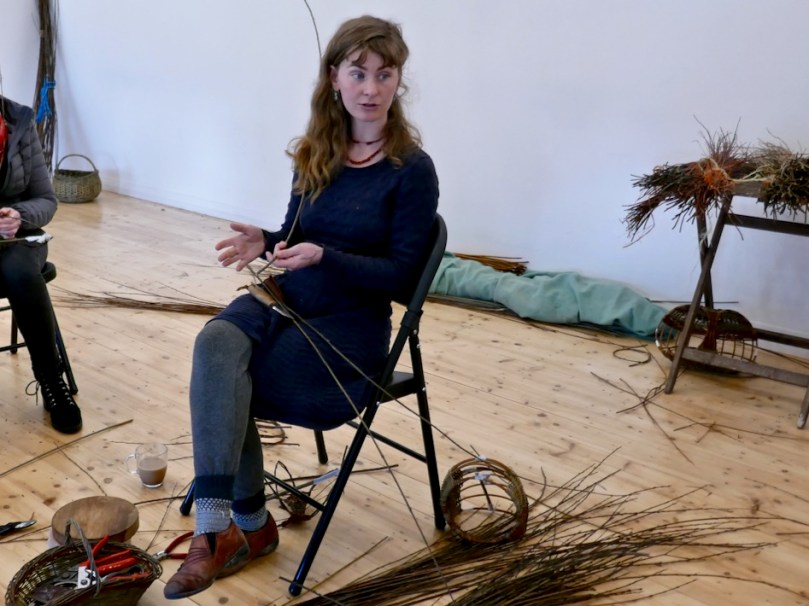
I first met Rosemary Kavanagh at our Irish immersion course last summer in Ballyferriter. We enjoyed a long chat on one of our outings and she told me she was a basket weaver. Her knowledge of the natural world around us was impressive and I responded to her ready laugh and her gentle, slightly ethereal presence.

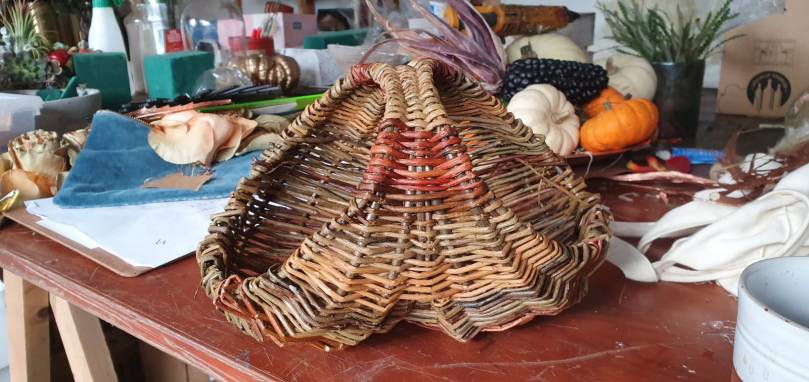
We had lots of colours to choose from and soon found out that some were bendier than others

More recently I was invited by my oldest friend in the world to take part with her and two of her daughters in a basket workshop, and I realised that Rosemary was the teacher. I signed up, and last Sunday spent the day in Clonakilty making (well, almost making) my first willow basket. It wasn’t my first try at using willow – years ago in Northern Canada I had made a bockety chair under the guidance of my talented friend Sandy. It lasted for years in my garden, slowly disintegrating in the harsh winters and eventually returning gracefully to the soil from whence it came. But those were tough cut-from-the-woods willows, suitable for furniture.

Rosemary is a gifted natural teacher. I know what I am talking about – I spent several years training teachers in pedagogical techniques and I recognise good teaching when I see it. And good instruction is essential for something like this, as you guide novices through an intricate process, building their skill and their confidence bit by bit.

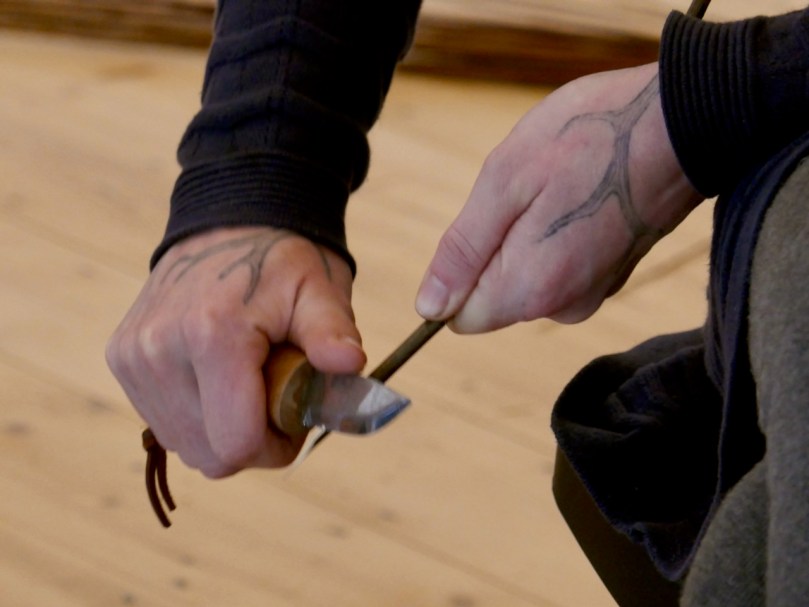
How to sit, how to hold the willow as you worked it, safely using a sharp knife (above), knowing when to discard something that wasn’t working – we were led through it all. As the right brain (creativity) took over from the left brain (process, logic) we descended into near-silence, each of us deeply concentrating on the shape that was emerging under our hands.

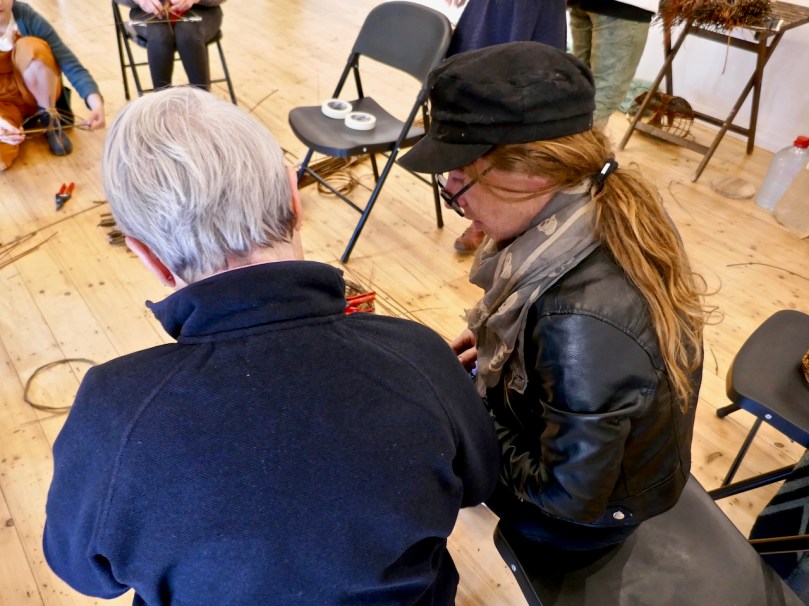
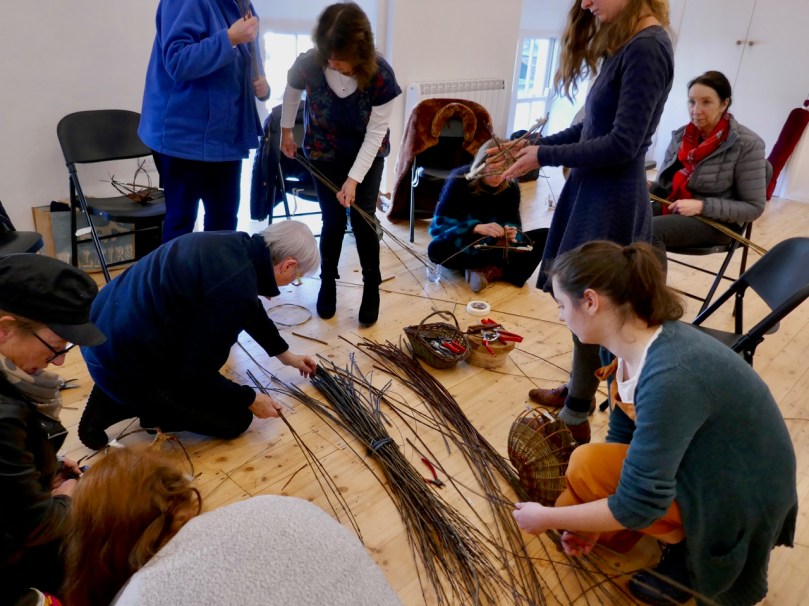
Although there were chairs for everyone it wasn’t long before many of us gravitated to the floor to work

Choosing what willow to work with was part of the process and I was humbled by Rosemary’s knowledge of her materials. She grows her own willow, coppicing and cutting it herself. I never knew there were so many kinds – four native species and several non-native that adapt well to Irish habitats. She knows intimately the characteristics of each kind – colour, strength, straightness – and therefore its suitability for different tasks.

Once harvested, Rosemary allows the willow to dry completely and then re-hydrates it to retain a fraction of its original moisture. This is what gives it its pliability for weaving. But it’s still strong: to see Rosemary flicking a weaver through the frame – in-out, in-out effortlessly – is a wondrous thing and an insight into what years of practice and trained hands can accomplish. Alas, for us neophytes it’s an altogether sweatier business of poking and pushing and hoping to God that the weaver doesn’t develop a kink and have to be discarded AFTER ALL THAT EFFORT.

Anne – my friend from the cradle. Doing something like this with old friends makes it extra-special

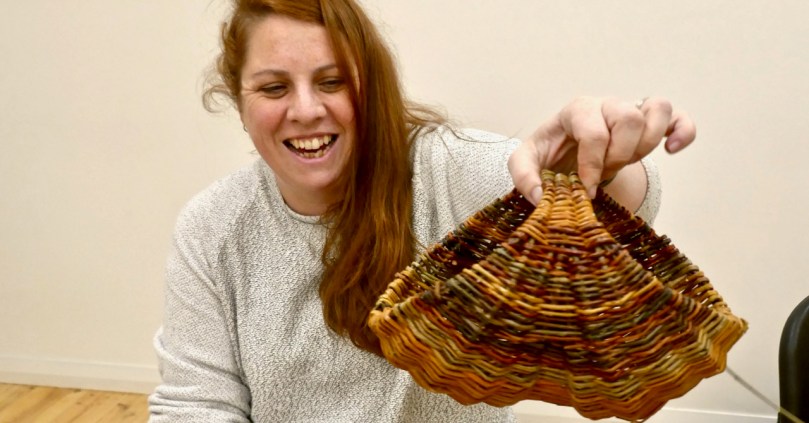
But some of got there and even finished our hen baskets, to the cheers of all. Others nearly finished and took away some willows to do it at home. 

Jill finished hers the next day – looks great! You can see the ‘bum’ shape that gives this basket its alternate name of a Bum Basket

Me? I almost finished, and decided to leave it as is, as a reminder of what I had learned and a memento of an amazingly enjoyable day. I have, however, positioned it on a high shelf so that anyone looking at it would think it was indeed finished. Cheating? Never!  Er, tromp l’oeil?

Rosemary teaches courses across Ireland and in North America too. If you’d like to make your own basket, get in touch with her at her gmail.com address that starts belongingtothewillows. You can also follow her Instagram page, full of lovely basket images.

Well done Kiara!

Casino Marino

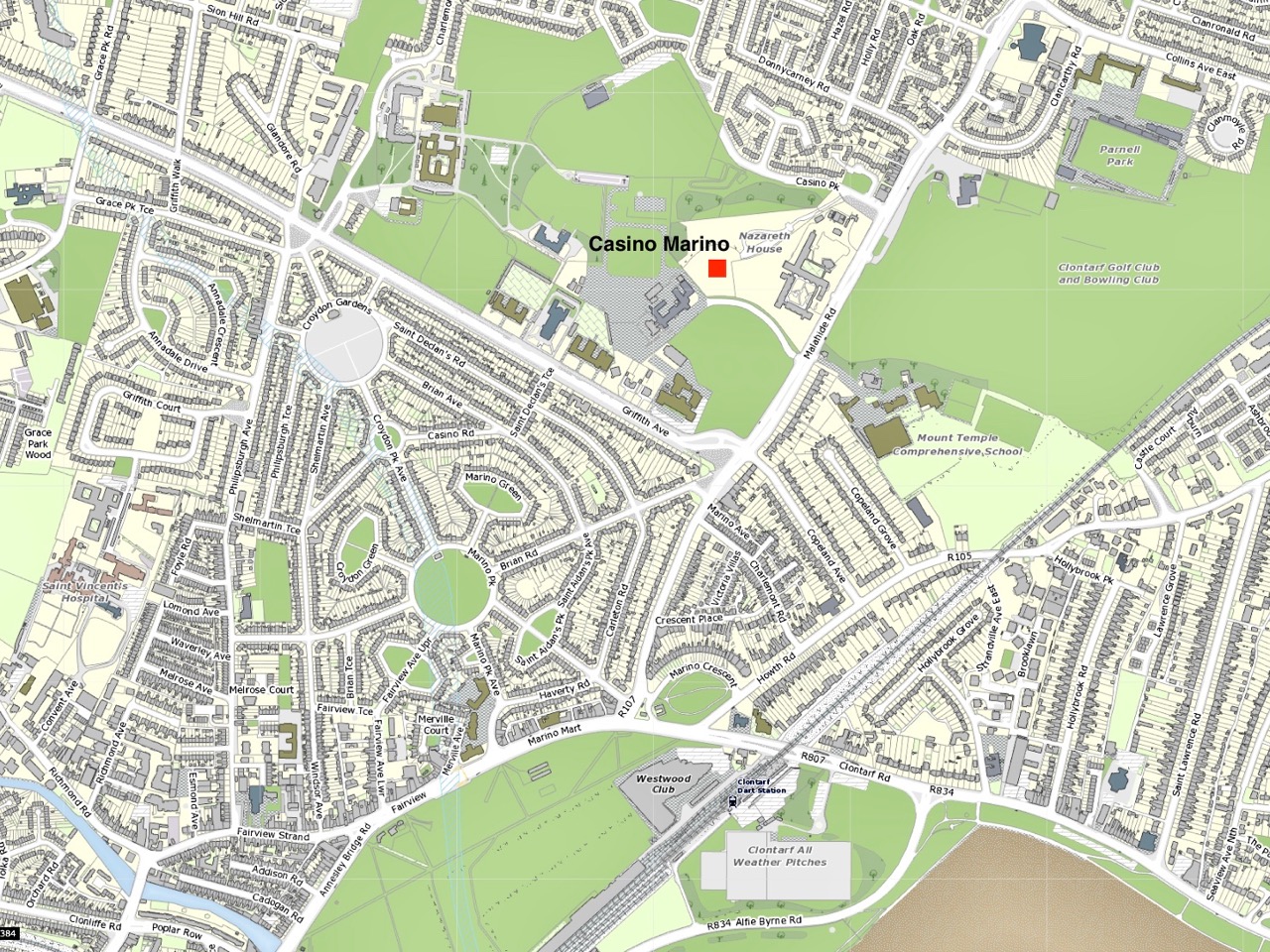
It’s a perfect little building: a gem of Irish architecture. It lies in an oasis of parkland on the outskirts of Dublin city – all that’s left of an expansive eighteenth century country house demesne, now all but engulfed by housing estates. But – perhaps in homage to the eccentric conceiver of this environmental idyll – the housing estates which have stood below it since the 1920s are quite out of the ordinary. Have a look at the layout on this contemporary plan of Merino townland, carved out of the larger Donnycarney which was granted to the Corporation of Dublin following the dissolution of The Priory of All Hallows in the reign of King Henry VIII. 

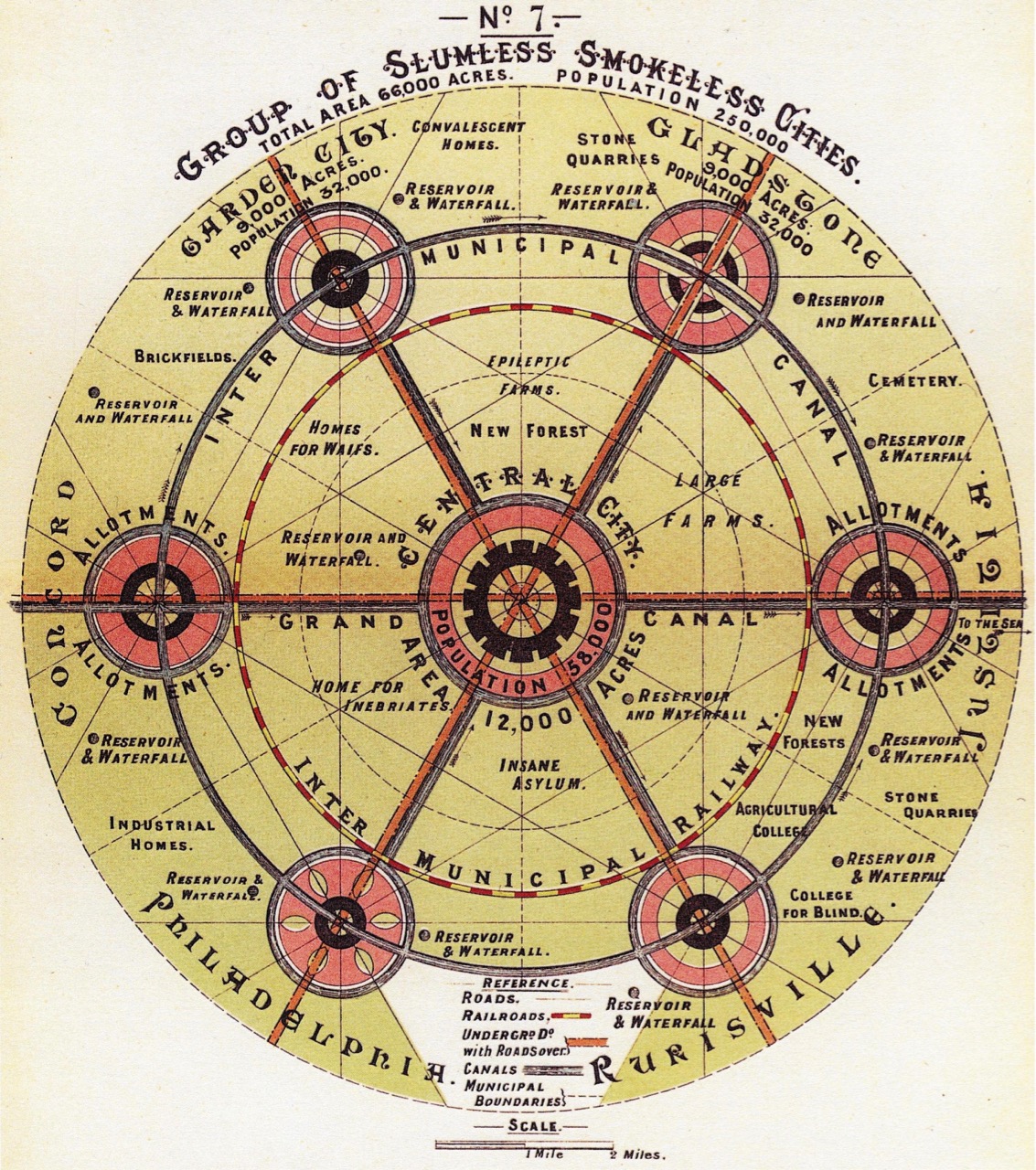
This plan is showing the location of Casino Marino, with the green areas around it being the remnants of a 238 acre demesne. The housing below the surviving Casino was Ireland’s first example, in the newly formed Irish state, of an affordable housing project and was the first local authority housing estate in the country. It was heavily influenced by Ebenezer Howard’s Garden City movement, originating in the UK with the two revolutionary developments at Letchworth Garden City and Welwyn Garden City. This Dublin estate of about 1300 houses was built on the site of a planned formal garden for Marino House and the original design was followed when the streets were laid out. This gives the Marino estate its symmetrical layout. When it was first built, purchasers of houses were restricted to large families, while alcohol and dogs without leads were banned from the parks, as were children after dark.

Ebenezer Howard, To-morrow: A Peaceful Path to Real Reform – diagram of the ideal city, dated 1898

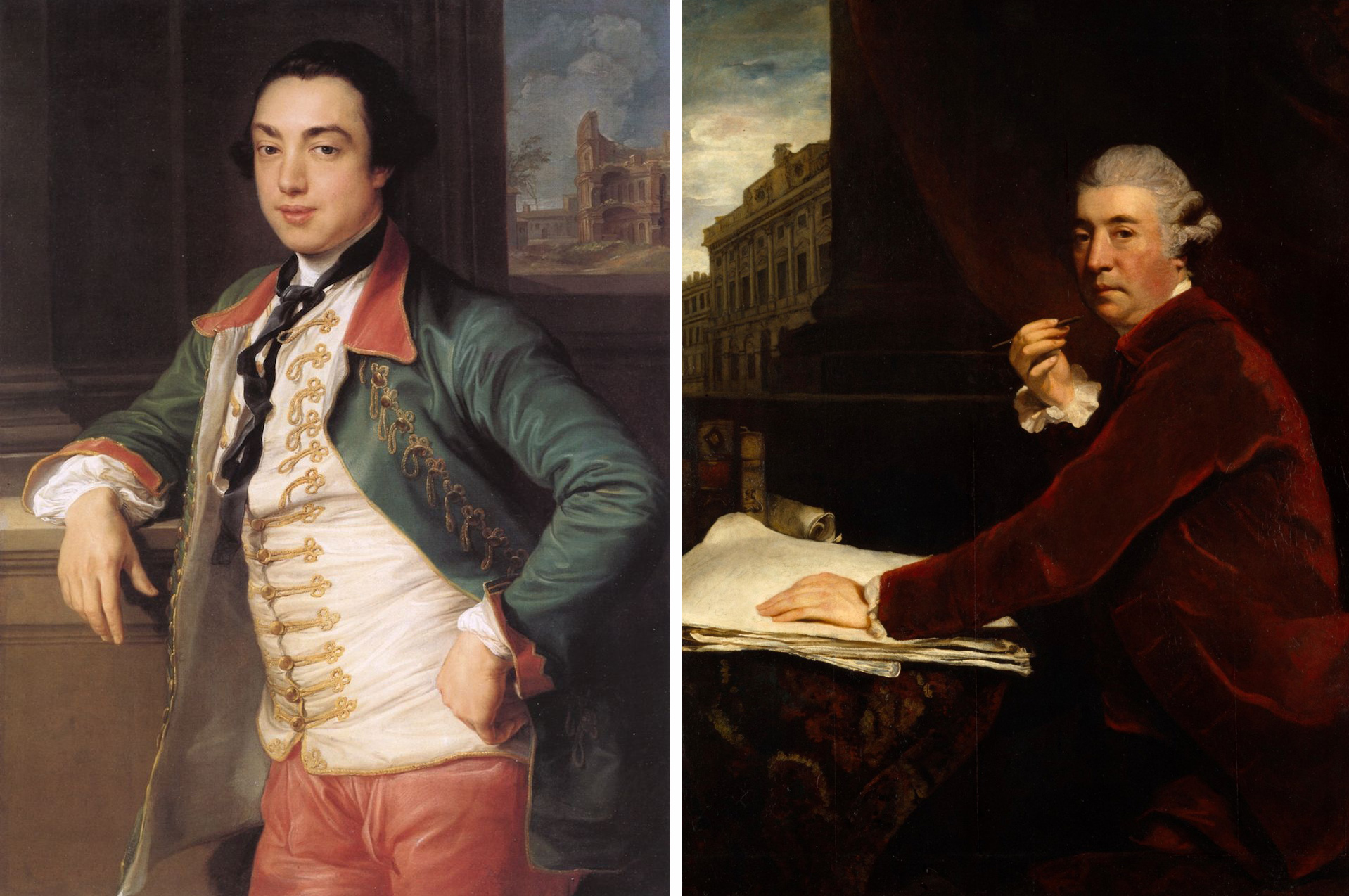
Back to the eighteenth century, and the heroes of our piece today: James Caulfeild, 1st Earl of Charlemont (1728 – 1799), and his friend, the architect Sir William Chambers (1723-1796). James (left, below – a portrait by Pompeo Batoni) was a cultivated man who disregarded the conventions of court and openly pursued Irish nationalism, having taken a leading part in the formation of the Irish Volunteers. He was the first President of the Royal Irish Academy and was a member of the Royal Dublin Society. In 1783 he was made a founding Knight of the Order of St Patrick. Like most of the wealthy young gentry of his time he went to Italy on The Grand Tour: he fell in love with that country and classical Roman culture and stayed away for nine years. When he returned he determined to bring the spirit of Italy to Dublin. Acquiring tracts of land by the coast that afforded unrivalled views over the entire bay and city, he poured his energies into creating an ideal landscape: he named his demesne ‘Marino’.

William Chambers (on the right, above – this portrait by Joshua Reynolds is in the Royal Academy) was also a great traveller: he was born in Gothenburg to a Scottish father and visited and studied architecture in China, Paris and Italy – where he met Charlemont. He established a practice in London, where he was appointed architectural tutor to the Prince of Wales, later George III. As the leading classicist of his day, it was unsurprising that Charlemont should turn to him to realise his dream of an Italian arcadia in Dublin. It was a commission that took many years to come to fruition, partly because of the Earl’s seemingly limitless ambitions and his attention to fine detail.

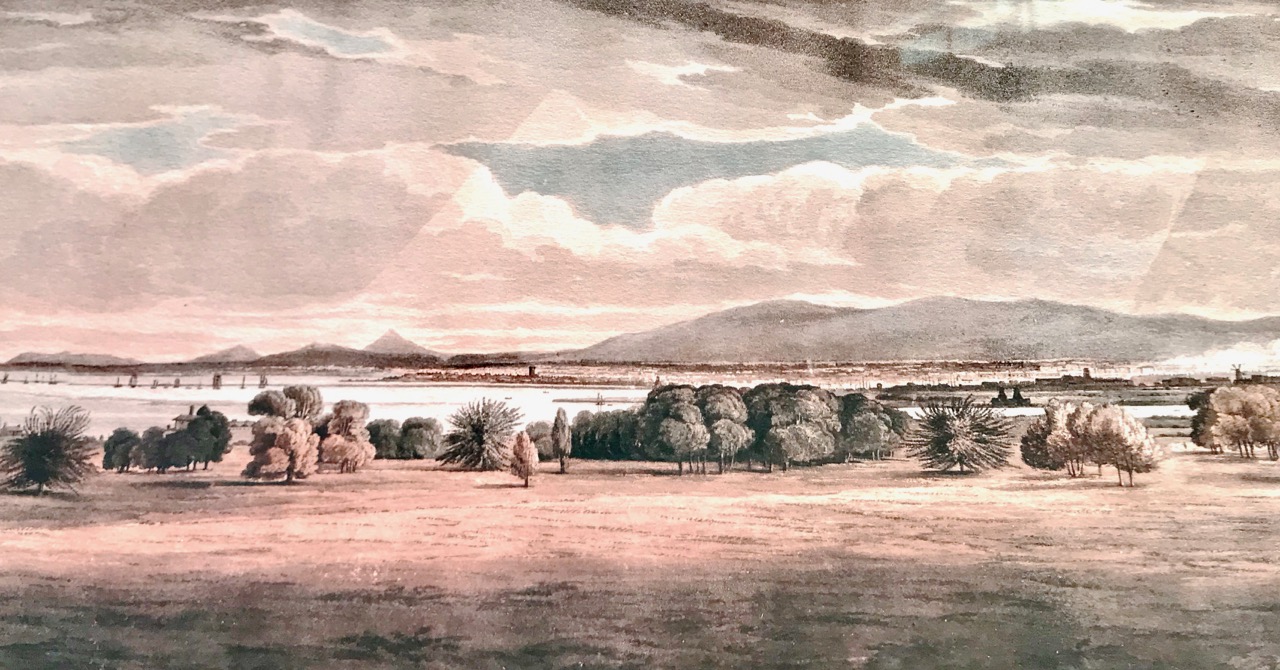
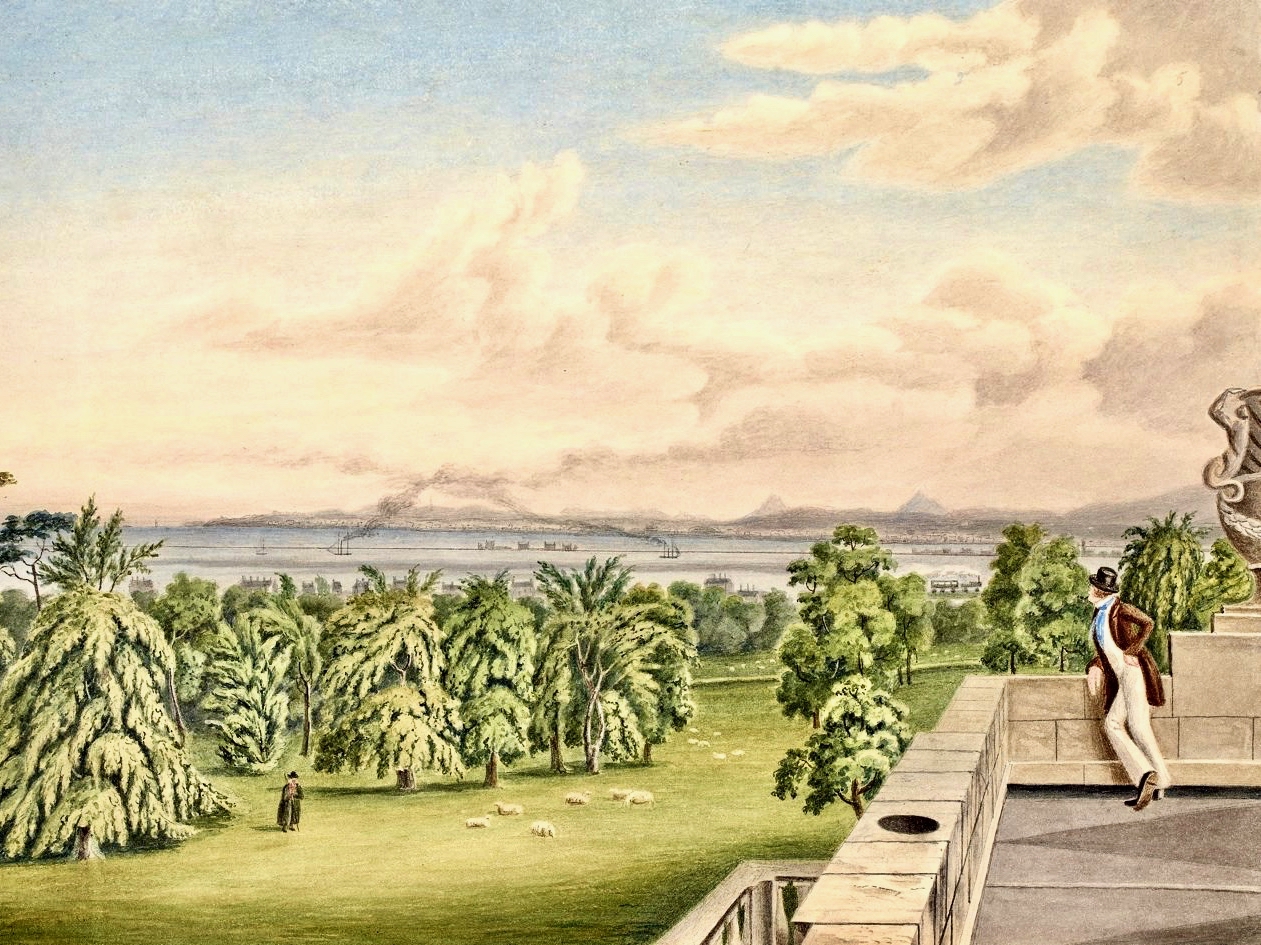
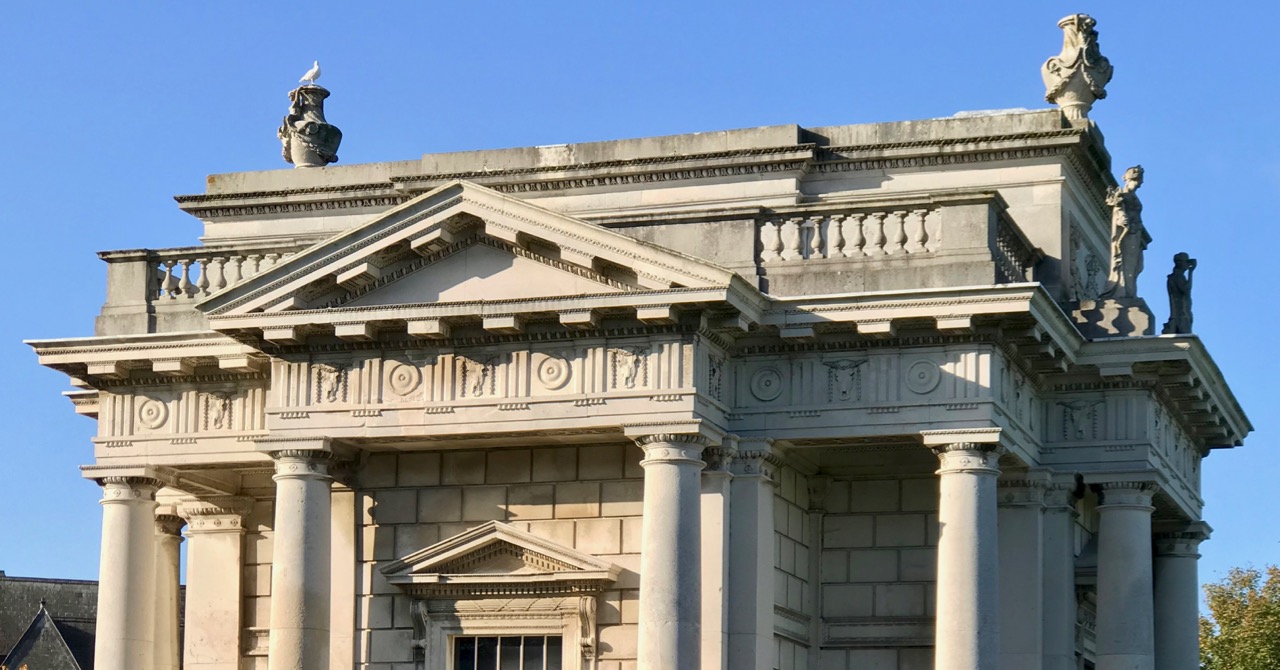
Charlemont’s Marino estate enjoyed fine unrestricted views across Dublin Bay. The culmination of the Earl’s work on his estate (and now the only surviving element) is the Casino, and this is sited on the highest point on the land: the painting above shows the view from the roof of the Casino, which was fully accessible from the building interior. So – what is a casino? It’s simply the Italian for small house, and in this case has been built as a garden room or, perhaps, a gazebo. Ornamental, but eminently functional. From the outside it appears small, but exquisitely detailed on all its elevations. In fact, the simple building houses 16 rooms over three storeys – plus the roof terrace.

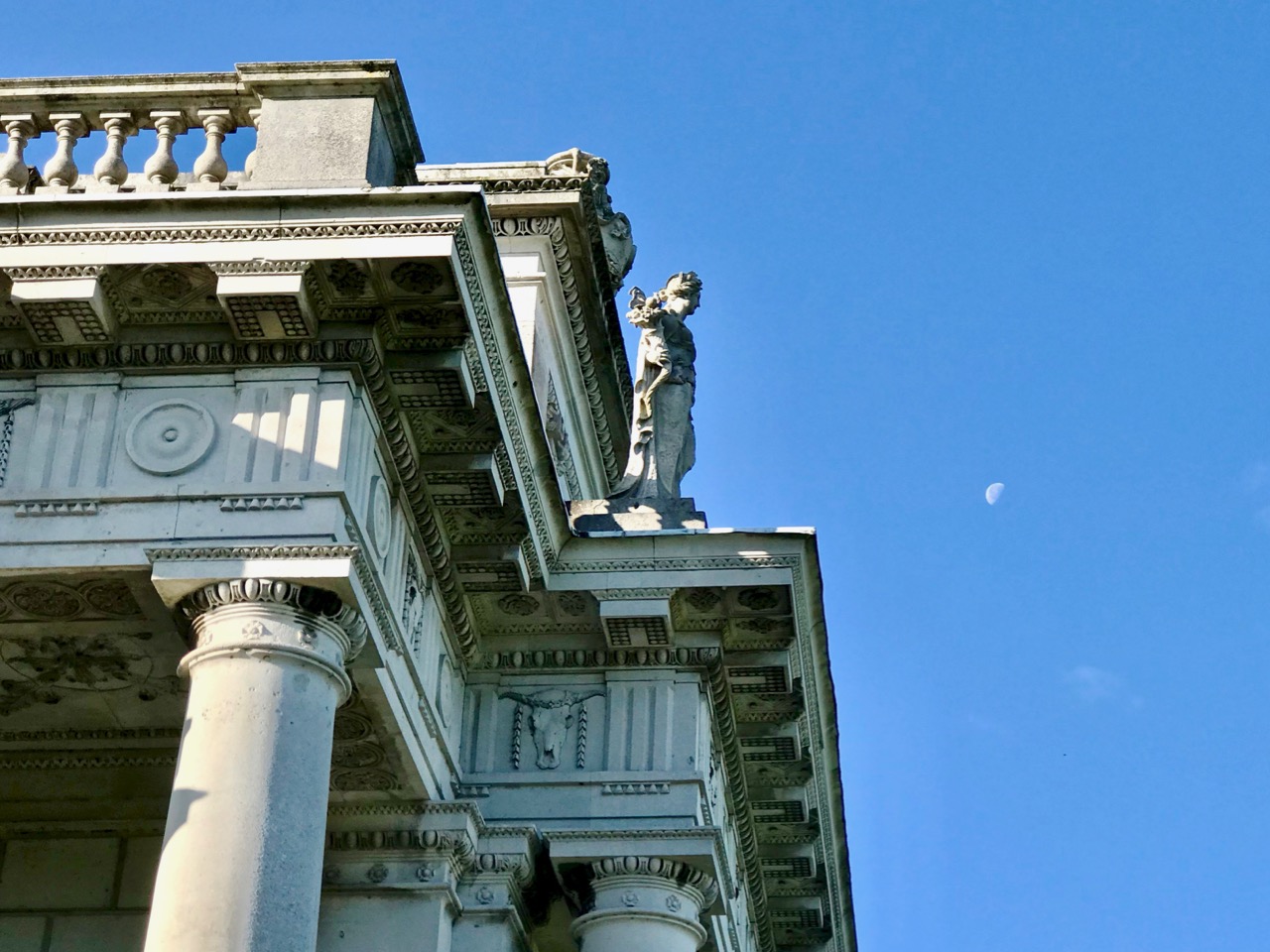
Exercises in architectural scale. Upper – an almost contemporary view of the Casino painted by William Ashford (1746-1824), National gallery of Ireland: here the building seen in its landscape context looks like a miniature folly. Centre – a close-up of the roof detailing includes life-size statuary. Lower – Ava and Hugo, willing participants in our expedition to the Casino, help to give an impression of its true size.

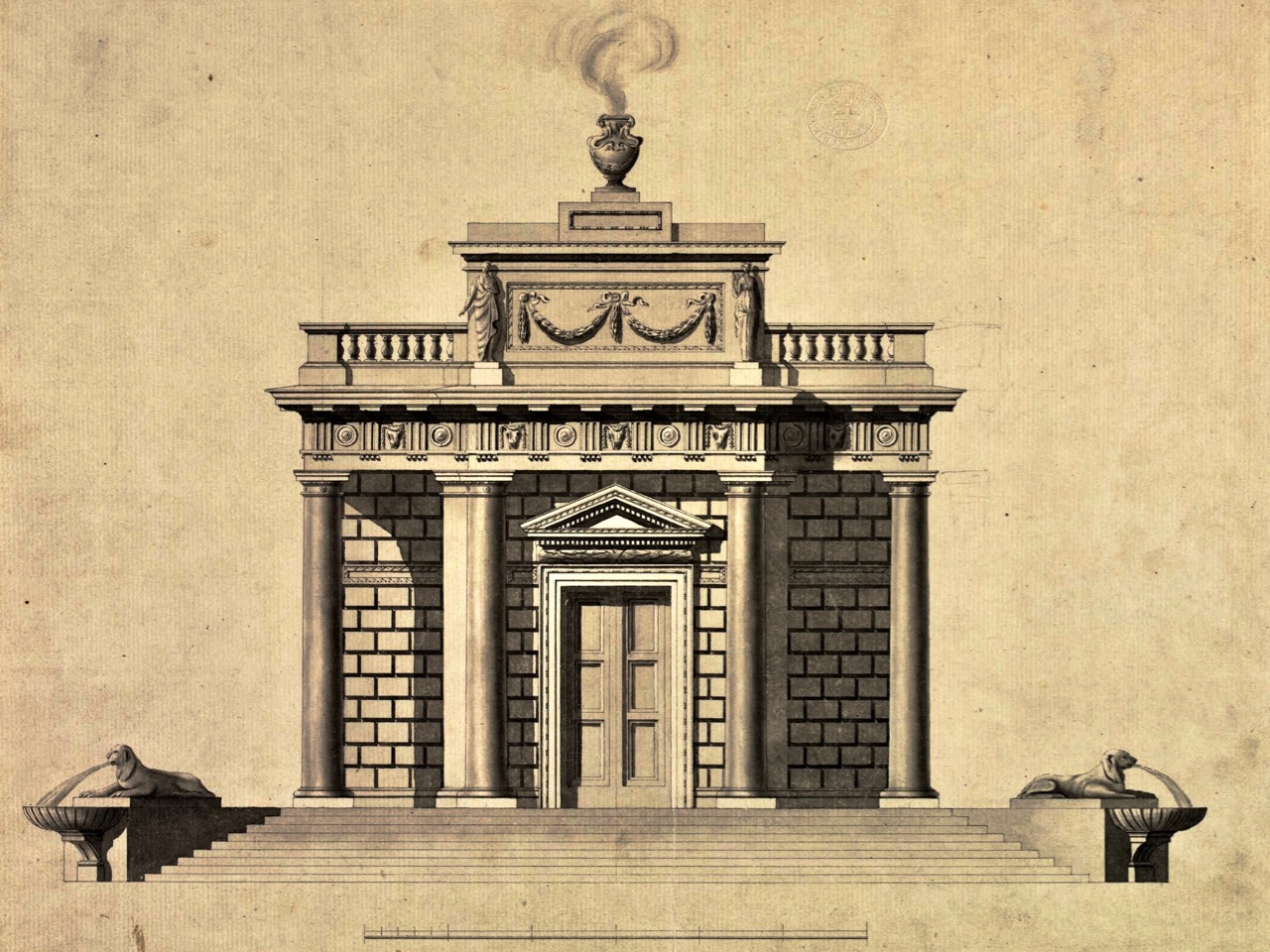
The Casino is guarded by four large lions. Originally they were intended to be fountains – as you can see from the original architect’s drawing, above. In this drawing you can also get a good sense of how the designer plays tricks with scale: the doorway is perhaps three times the height of a normal door, and only a small section at the bottom is, in fact, an opening.

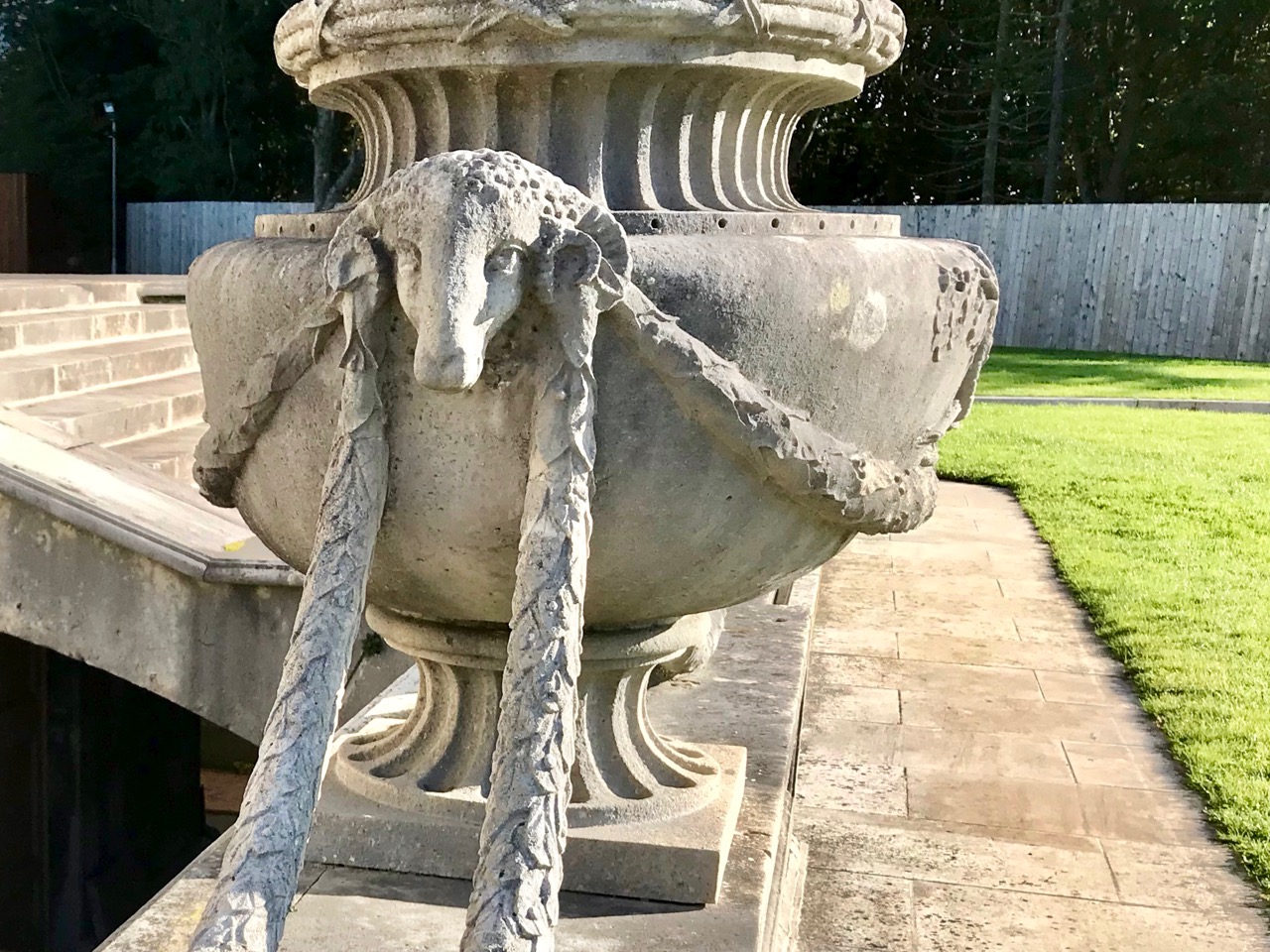
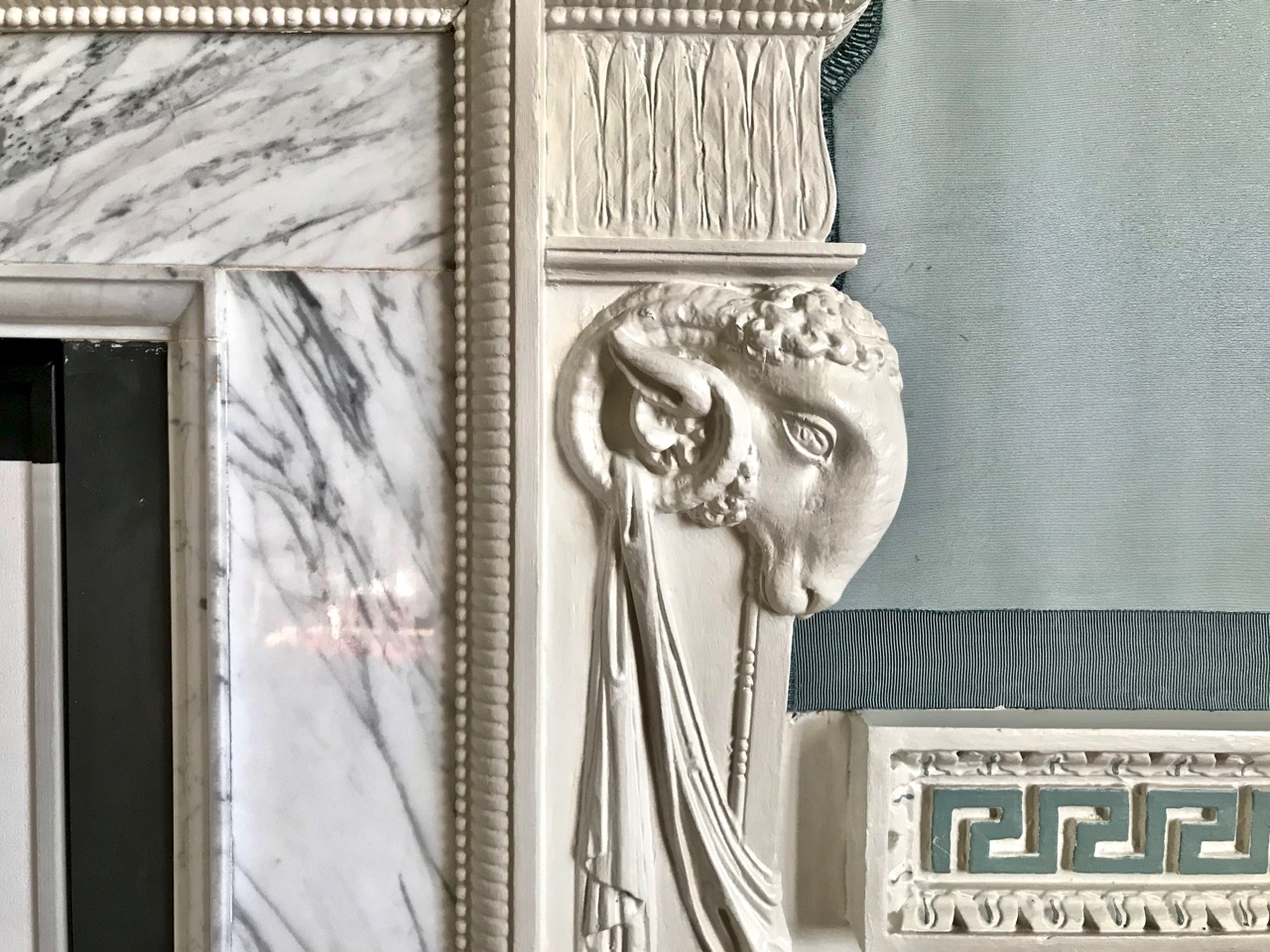
Symbolism and hidden messages abound: the architect, Sir William Chambers, left his signature – in the form of a ram – in many parts of the house. Every moulding, coving, frame detail has a meaning in terms of architecture and freemasonry – and also pays homage to the Greek and Roman classical orders – at the behest of the client. The parquet flooring is magnificent – and is at present kept covered by a vinyl replica to protect the original exotic woods.

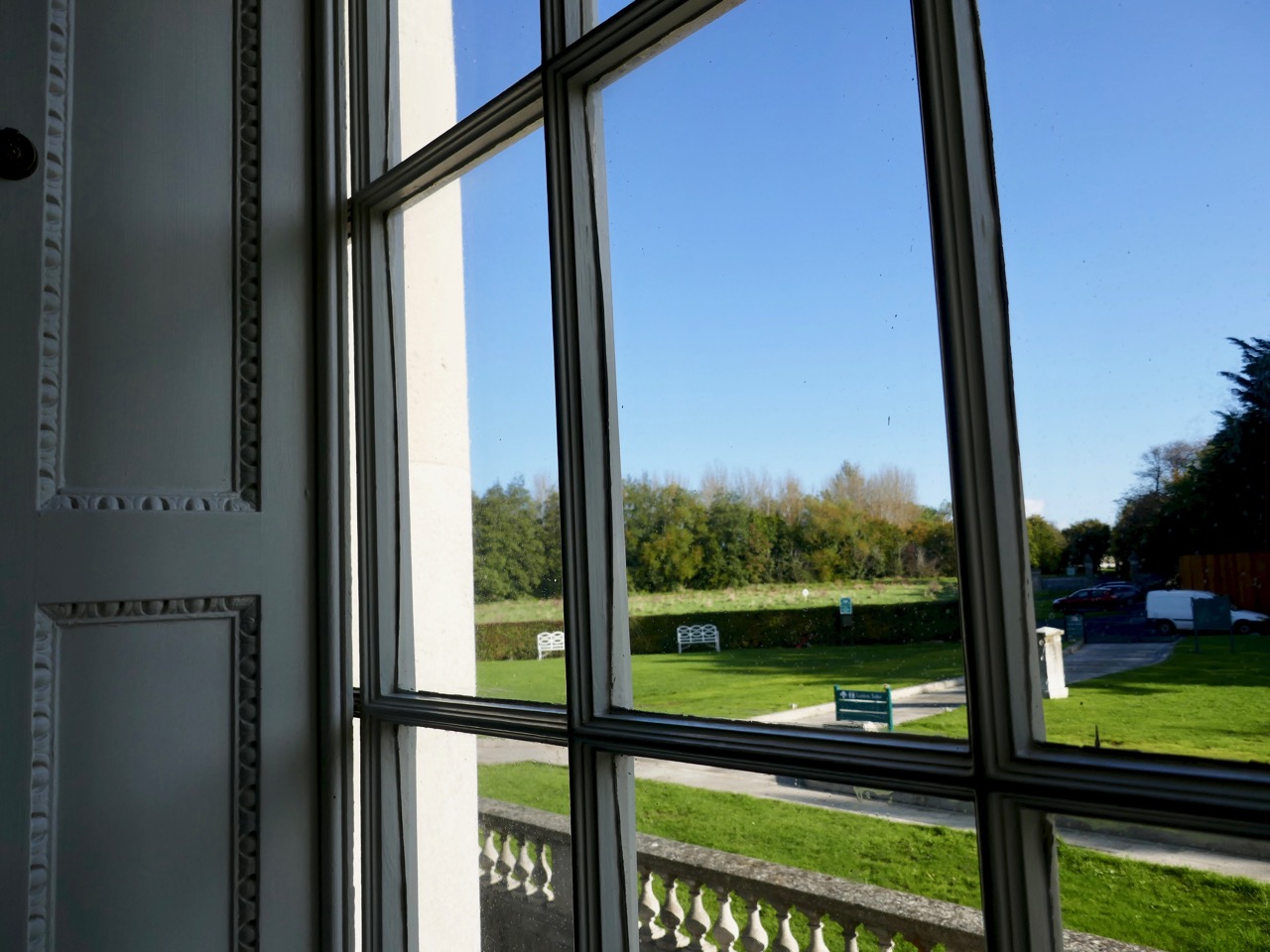
The detailing of every element has been fully considered. I was impressed with the curved timber doors, which follow the line of circular wall partitions inside. And, particularly unusual, is the use of vertically curved glazing which causes reflections when seen from the outside, meaning that no shutters or blinds are needed at the windows.

Look carefully at these windows: they are crafted with vertically curved glass which make them reflective externally!

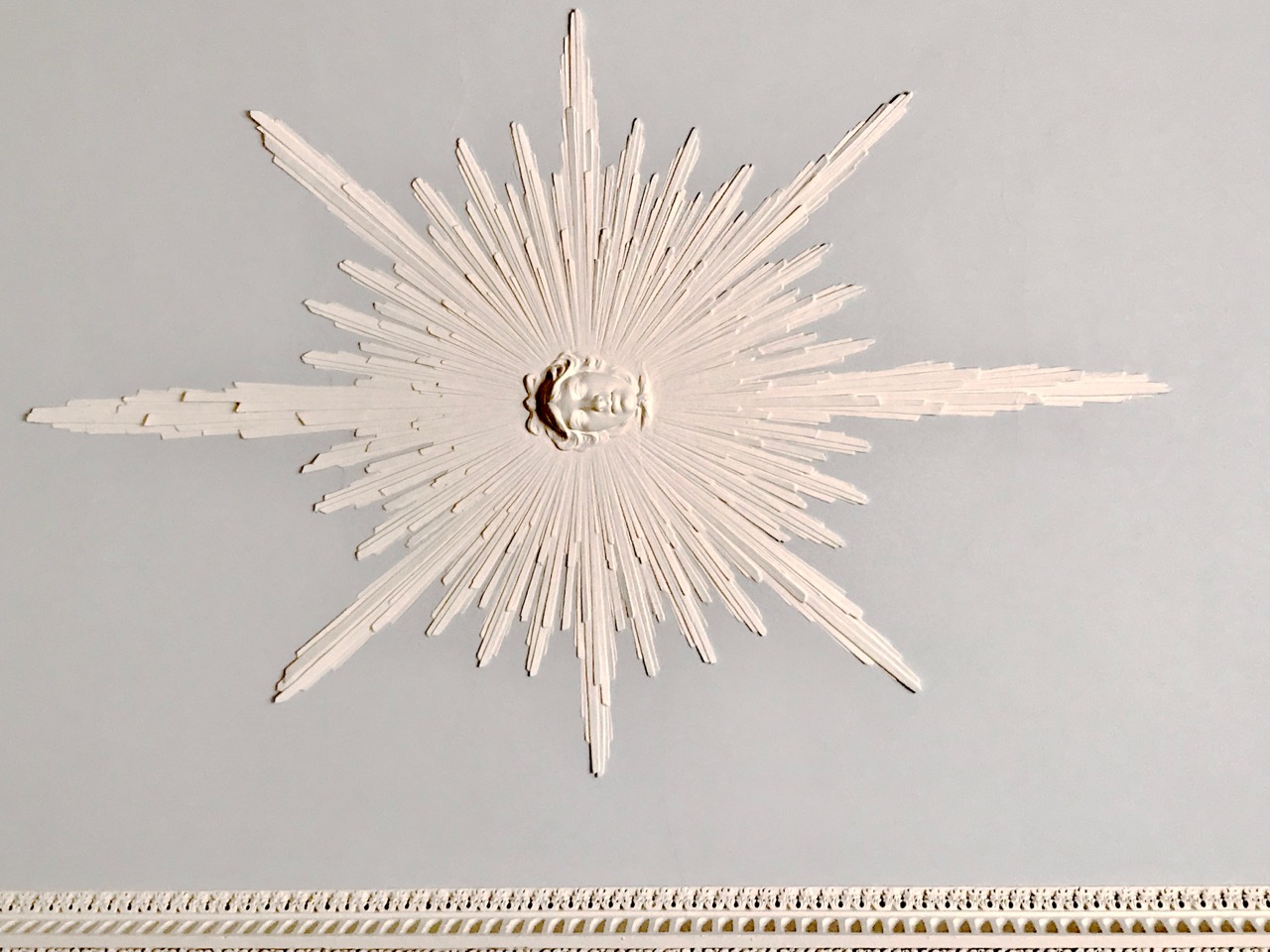
Examples of the plasterwork within the Casino include agricultural harvest symbols, every classical moulding motif and Apollo the sun-god. It would take several visits to absorb and catalogue the complete variety of images: every room has a different visual character.

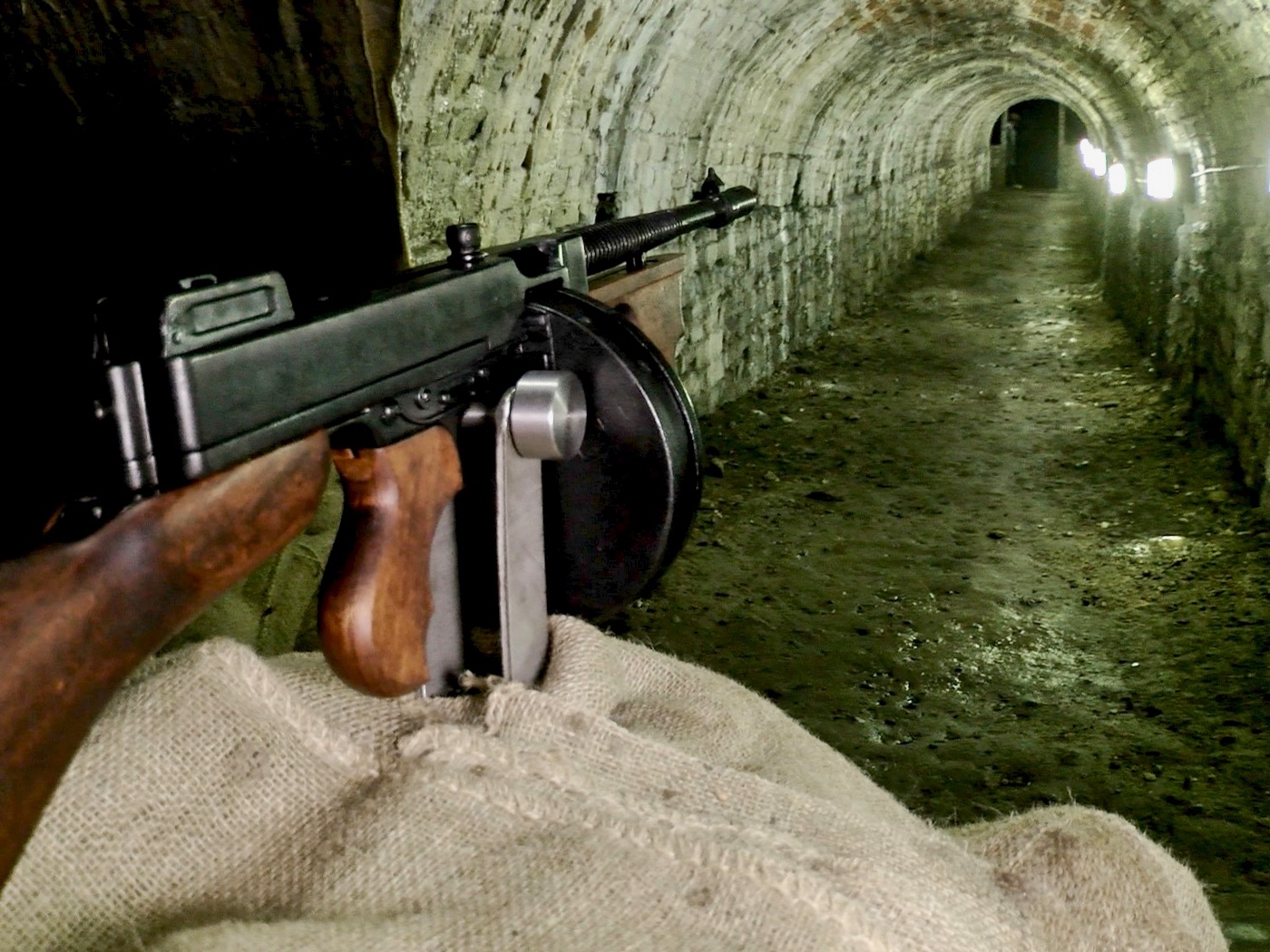
There are hidden elements – and enigmas – to the building. These include ‘secret’ tunnels in the basement: one was used by Michael Collins to test-fire submachine guns during the War of Independence. The picture above shows a reconstruction. The basement of the Casino, including the tunnels, is currently undergoing further restoration and refurbishment and was not accessible during our visit. It is said that there are many other tunnels, including one that linked the Casino to the big demesne house (now demolished) – and some that, according to legend, run to the coast – miles away!

Charlemont was a liberal and believed that everyone should have access to his parklands: there were no gates. He was so protective of his project, however, that he married in middle age, having been a confirmed bachelor. He had overheard his then presumed heir (his brother) talking about how he was going to exploit and commercialise the demesne once he got his hands on it: this prompted Charlemont to ensure he produced an heir that he could have some direct influence over! Evidently, the marriage was a happy one. The image above shows the Casino in a sad state of disrepair around 1900: the estate was broken up by the third Earl in 1876.

The Casino was adopted as a National Monument in the 1930s, and a full restoration was begun in the 1970s. A further phase of this restoration is currently under way, and the property is only open on limited occasions when suitable areas are accessible: we were fortunate to get there on one of those times. If you plan to visit, contact the Office of Public Works to make sure that you will get in. Charles Topham Bowden made the journey in 1791, and recorded it in his journal A Tour Through Ireland: here is an extract:

. . . This is one of the most beautiful and elegant seats in the world, happily situated, and in a demesne improved in the highest taste, comprehending 238 acres, laid out in plantations, lawns, and a delightful park . . . The temple is situated in the park – a monument of his Lordship’s refined taste. The Gothic room is a very curious and beautiful structure. The hermitage is nature itself. Art and nature unite in rendering this a most desirable residence. What obligation are not the citizens of Dublin under to his Lordship for having the gates of this terrestrial paradise opened to them whenever they chuse [sic] to walk through it . . .