Quest for the Lone Whitethorn

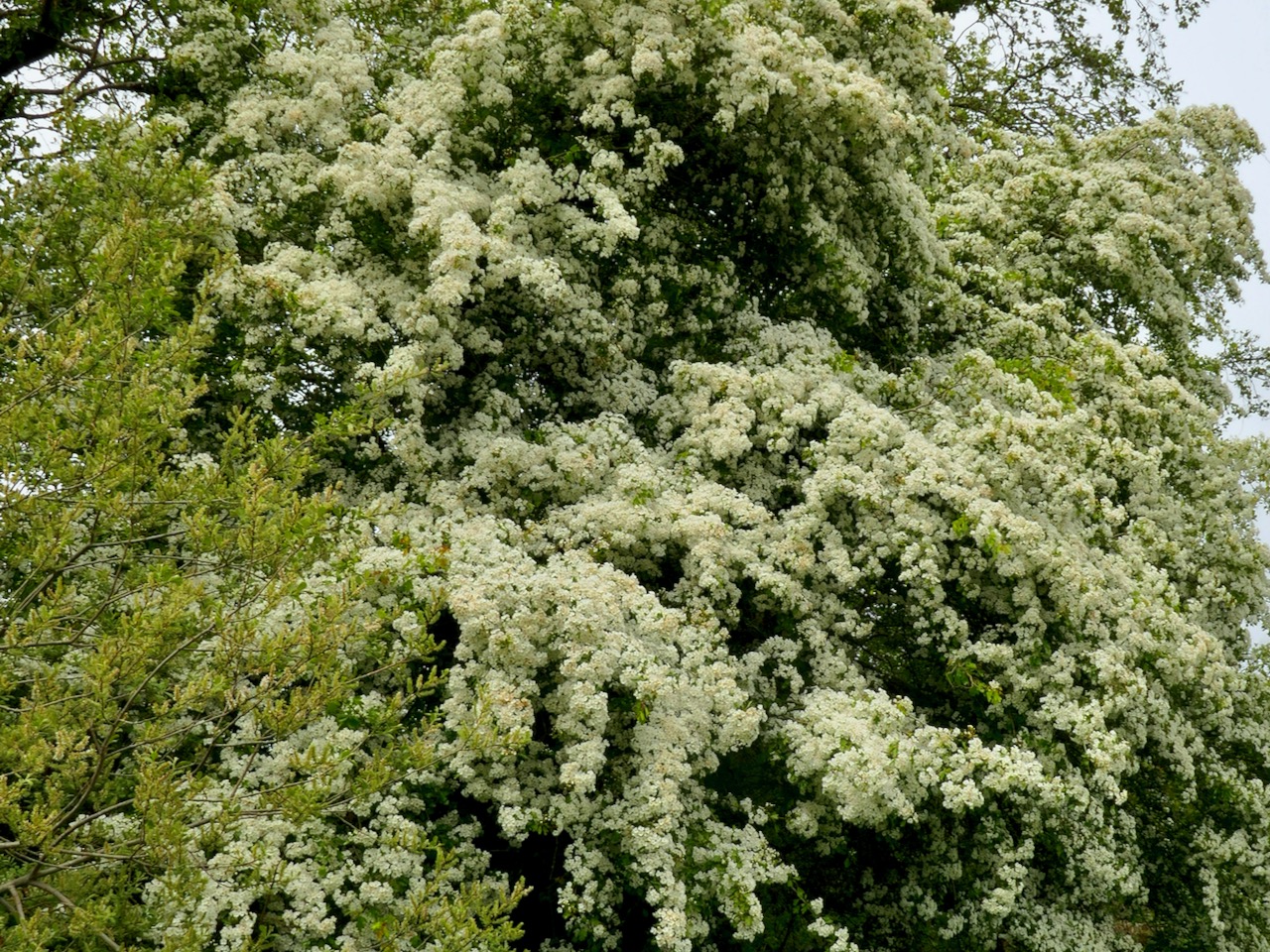
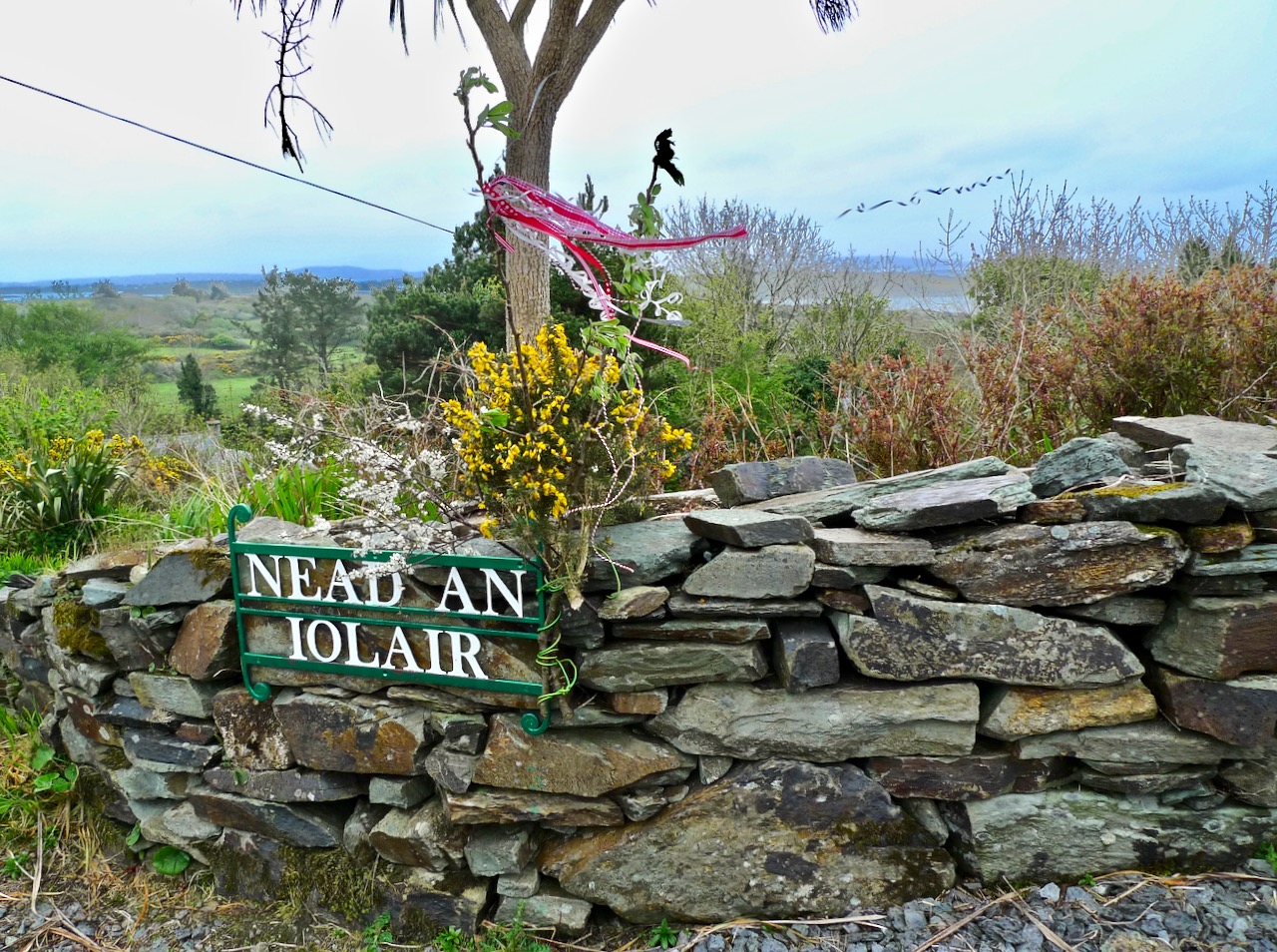
The crowning glory of our West Cork hedgerows, highways and boreens at this time of the year is the May bush – Sceach Gheal – Hawthorn or Whitethorn. The example above is on the way down to Ballydehob, just a few minutes’ walk from Nead an Iolair: we can’t resist stopping every time we pass to admire its brilliance – a shining presence among the abundant greenery of the early summer that’s all around us in these quiet days.

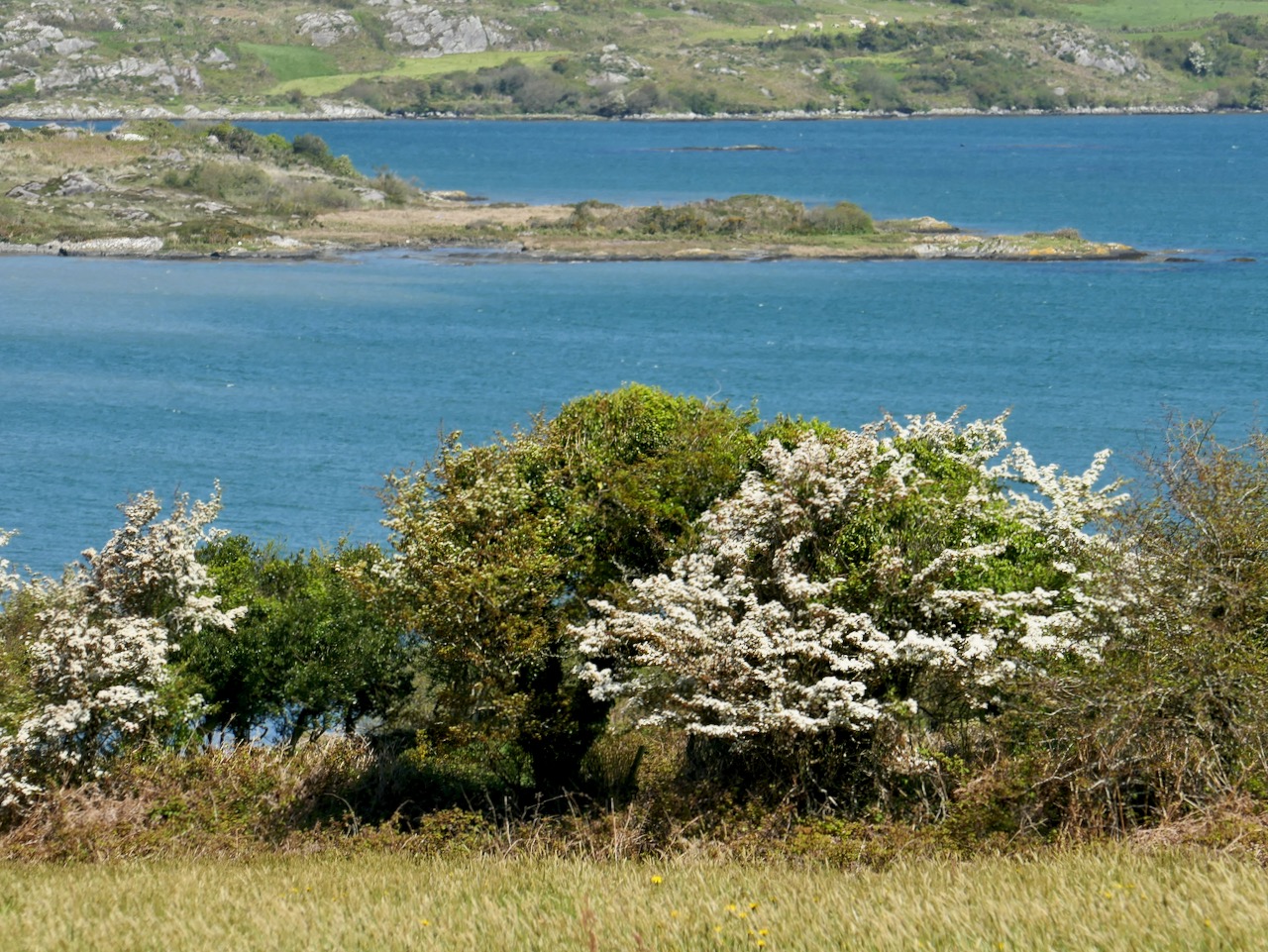
You have to get up close to fully appreciate the wonder of the tiny individual blooms that contribute to the billowing white cloud effects we see wherever there is a May bush in the hedges. We have one right outside of our bedroom window (see Rossbrin Castle in the distant view):

Such a visually striking tree has attracted many traditions and superstitions over the generations – and pisogues like these never really go away. A good account of many surviving beliefs in the British Isles is given in The Hazel Tree Blog.

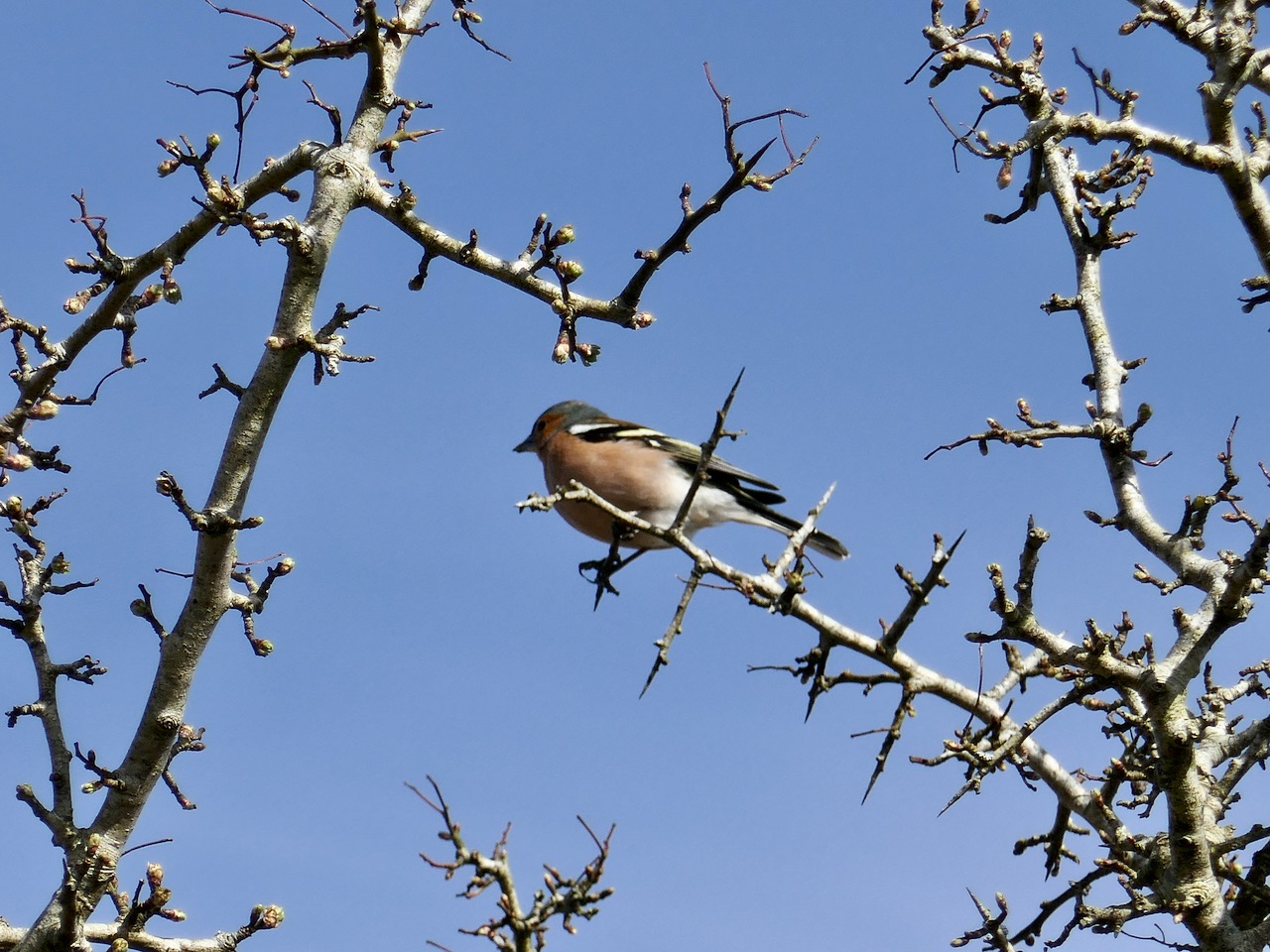
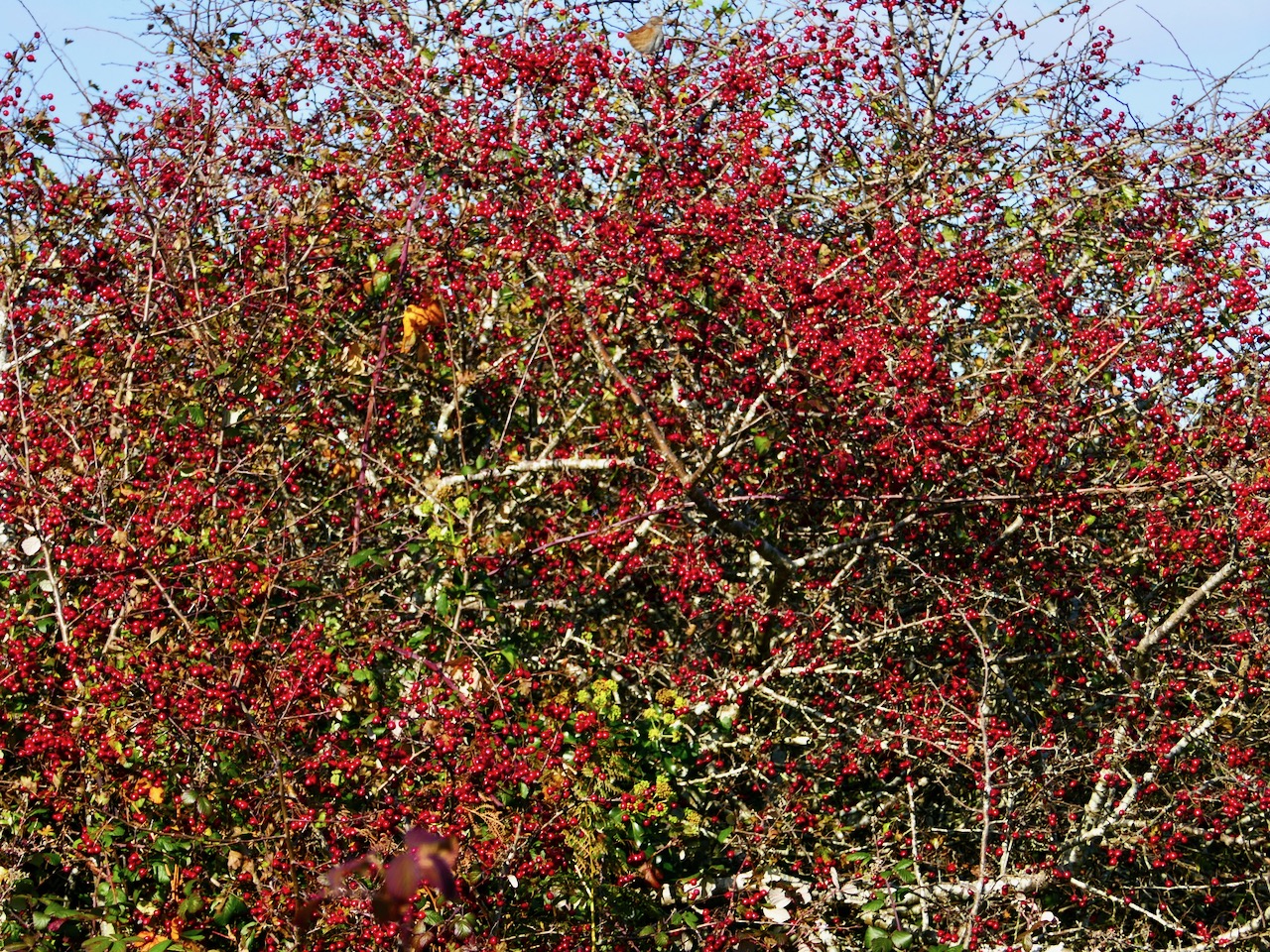
Of course, the May Bush is a thorn – a spiky tree, seen here before the blossoms come out. Even if those pisogues about it being unlucky to bring it into the house didn’t protect it from being cut, then those thorns would certainly be a goodly deterrent. This great picture, with chaffinch, was taken by Finola, who also provided many of the other photos here. Thank you, Finola! We admire the work of Michael Fortune, who lives in Wexford where, with Aileen Lambert, they have succeeded in re-establishing a May Bush tradition.

It’s been a quest of ours, when on our ‘lockdown’ walks – limited to 5km – to find the iconic ‘lone thorn tree’, out in a field, moor or open country, as this is the one imbued with the legends. So far we have been unsuccessful – the whitethorns around us all seem to be part of a hedgerow. In my English west country days – when I lived in the Celtic regions of Cornwall and Devon – I was aware of many solitary thorn trees, particularly out on the moors. Being in exposed locations they were usually distinctively shaped, bending away from the prevailing winds.

I had to search my archives for this photo of a lone thorn tree ‘bent’ by the wind: it was taken on the Sheep’s Head in June 2015 – after the blooms have faded. Always be careful of the solitary thorn for it guards the entrance to the realm of the Other Crowd. If you fall asleep under that thorn tree you will find yourselves transported into the kingdom of the old ones. It will not be an unpleasant experience – they will offer to satisfy all your thirst and hunger… But, if you accept, you will remain in that kingdom and grow old. One day they will release you, and it will seem as if just a few moments had passed since you left, but your aged body will very soon crumble to dust. This belief was as prevalent in Devon and Cornwall as it still is today in Ireland. Beware!

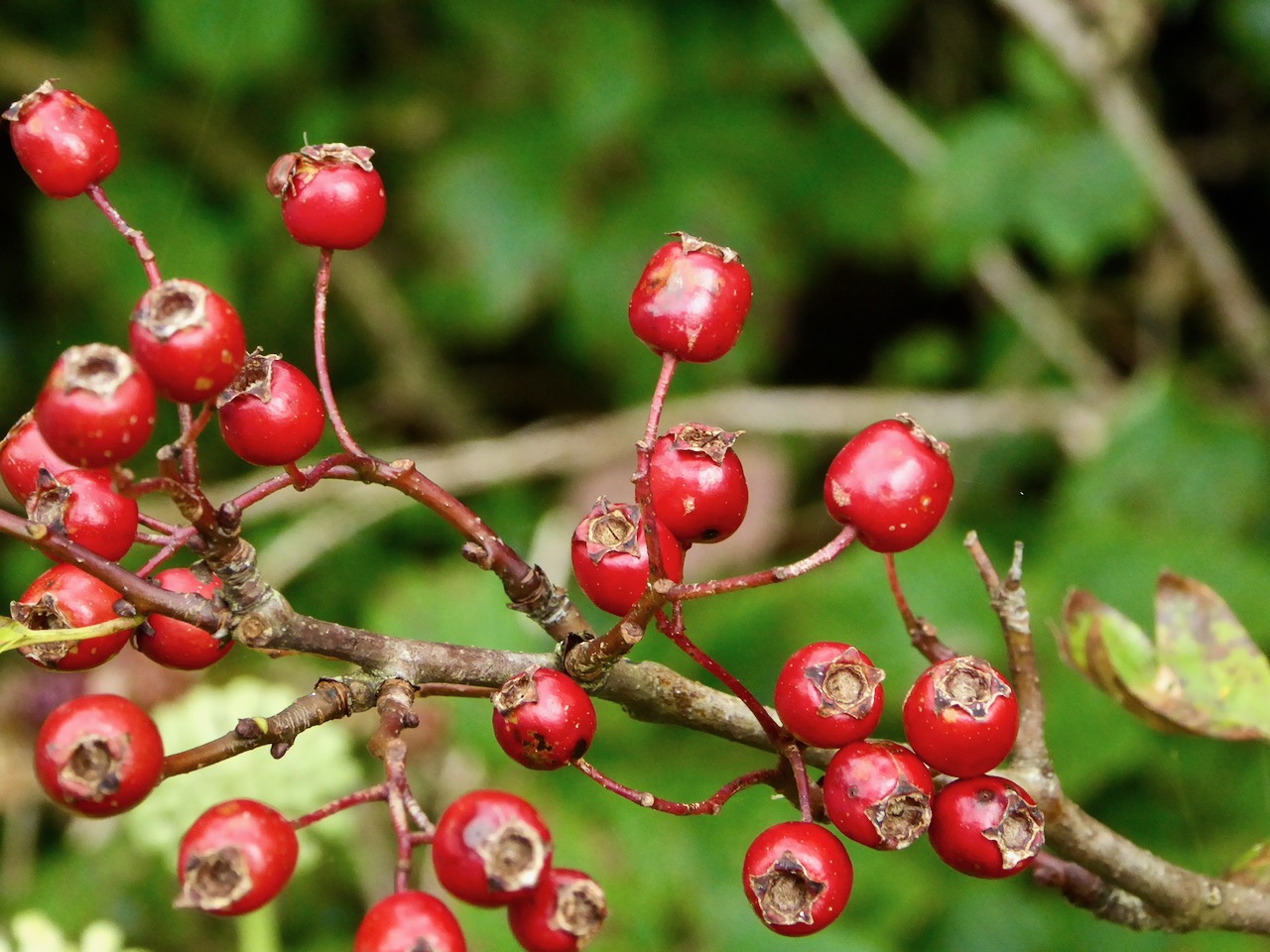
Close to home again – whitethorns in Ballydehob Bay. Once the blooms have gone, of course, we look forward to the haws, which are said to be edible but bland. They are traditionally used to make jelly and wine.

We could not be without the hawthorn trees which are all around us: they are lighting up our days in these times of anxiety and restriction – and they are reminding us of the continuity of nature and the constant cycle of the seasons. Life will prevail.

Our own May Bush a few years ago – blackthorn and gorse. We keep up the ancient traditions out of respect for the lore of our ancestors. If we don’t, the sun may never rise again!

Biodiversity Ballydehob

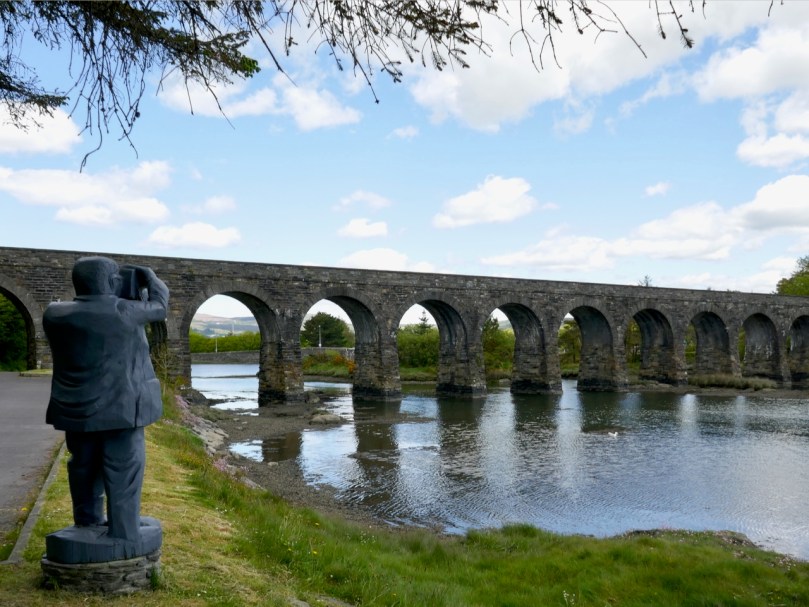
In the same way that strangers are friends you haven’t met yet, weeds are wildflowers you haven’t yet come to know and love. So come with me to the Ballydehob estuary and meet the dazzling array of wildflowers that call it home. That’s me, by the way, with my trusty camera, at the always-scenic Twelve-Arch Bridge. All the photos in this post were taken within 100 metres of the bridge, on the west side of the estuary.
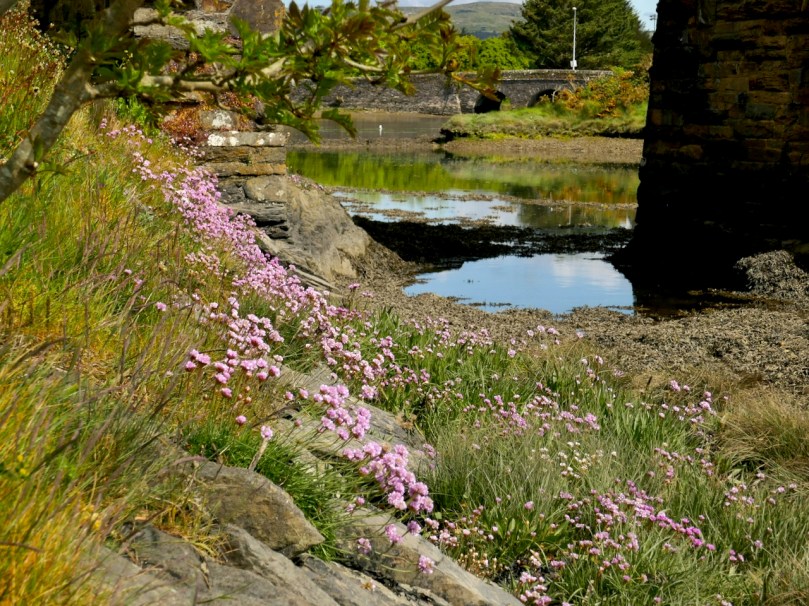
Thrift, or Sea-pinks, is the most visible flower at the moment, in pink drifts along the shore. There’s a lot more than Thrift in this photograph, but before we move on, let’s take a closer look at them.

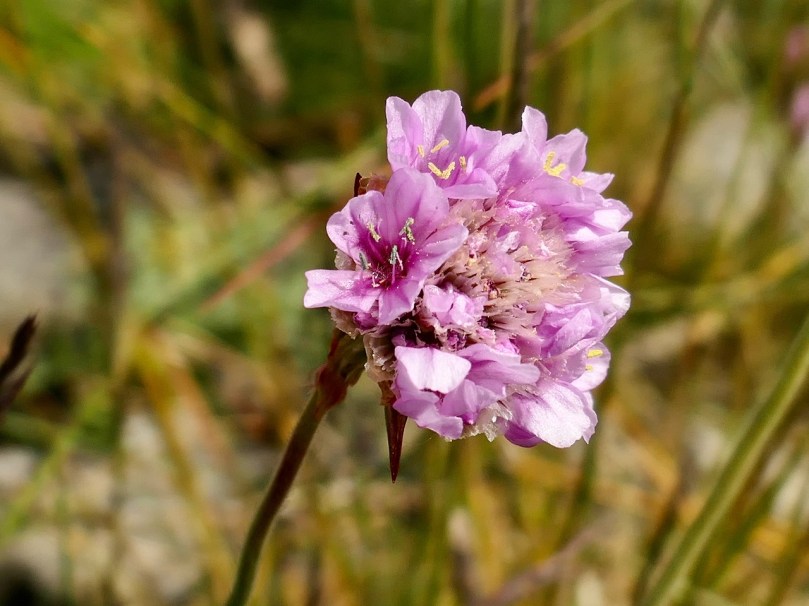
In Irish Thrift is called Rabhán (pronounced ravawn) and this word means an outburst, as in rabhán gáire, a sudden fit of laughing. Pretty apt, isn’t it, for a flower that is suddenly everywhere at this time of year. By ‘everywhere’ I mean all along the coast, although in Great Britain it is also found in a few mountainy places too.
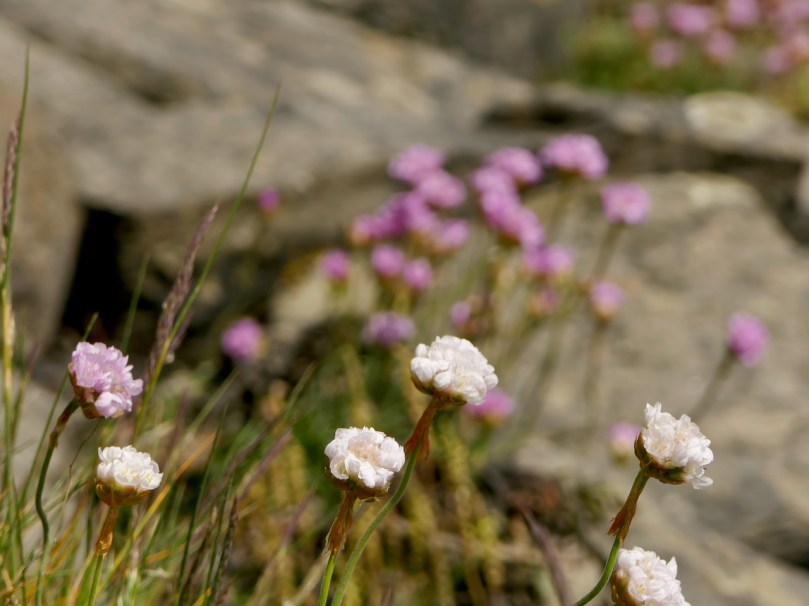
Ballydehob has some white Thrift too, fairly unusual. According to Niall MacCoitir in his wonderful Ireland’s Wild Plants, Thrift has many alternative folk-names, such as Lady’s Cushion, Sea Daisy, and Sea-July Flower.

As there is everywhere at this time of year, there’s lots of Ribwort Plantain (did you use it to play Soldiers as a kid?) but there’s also Buck’s-horn Plantain (above). The stalk and flower look very Plantain-like, but the leaves of the basal rosette are what give the plant its name – look at all those tines. In Irish the plantains are called Slánlús, which means health plant as they are used liberally in folk medicine. But be careful – in regards to Ribwort Plantain (below, with Oxeye Daisy and Cat’s-ear), Mac Coitir warns us, . . .while it could be used to cure many ailments, there was also a danger that if the wind changed wile you were collecting it, you would lose your mind.

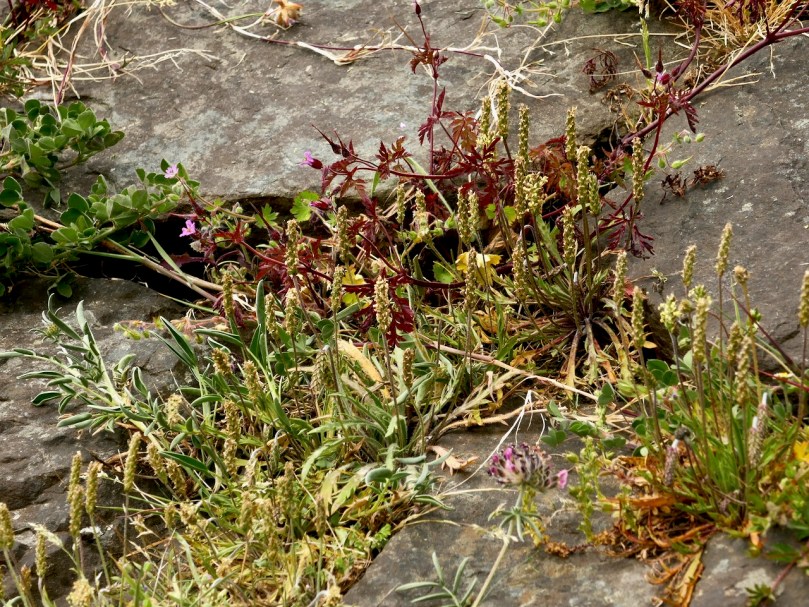
Here’s Buck’s-horn Plantain again (above), along with three different pink flowers – can you make them all out? I’ll talk about each one and then you can go back and look at his photo again and see if you can see them this time.

Here’s the first one, Dove’s-foot Crane’s-bill. The dove’s-foot comes from the shape of the leaf, and the crane’s-bill from the shape of the seed-pod – you can see both in this picture.
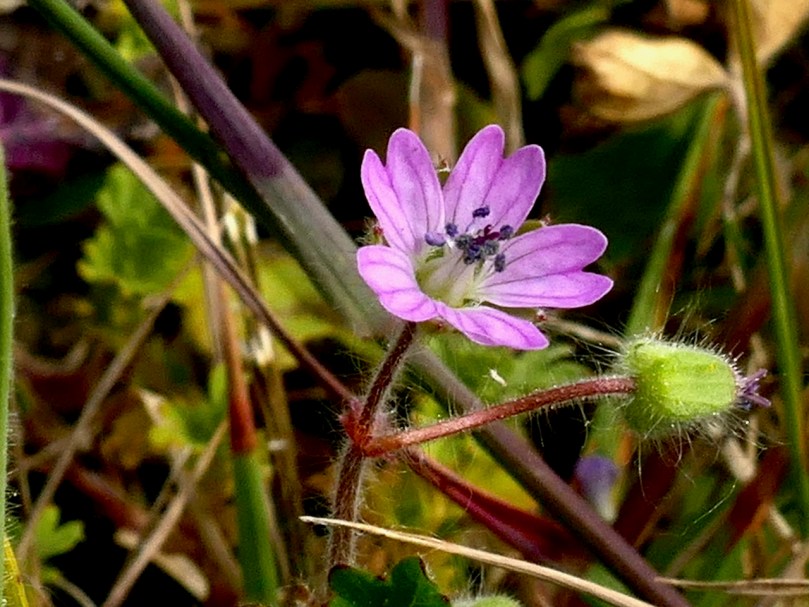
The flower is tiny and very sweet, deep pink with purple anthers. It’s a member of the Geranium family, and that makes it first-cousin to the next little pink flower, Herb Robert, below.
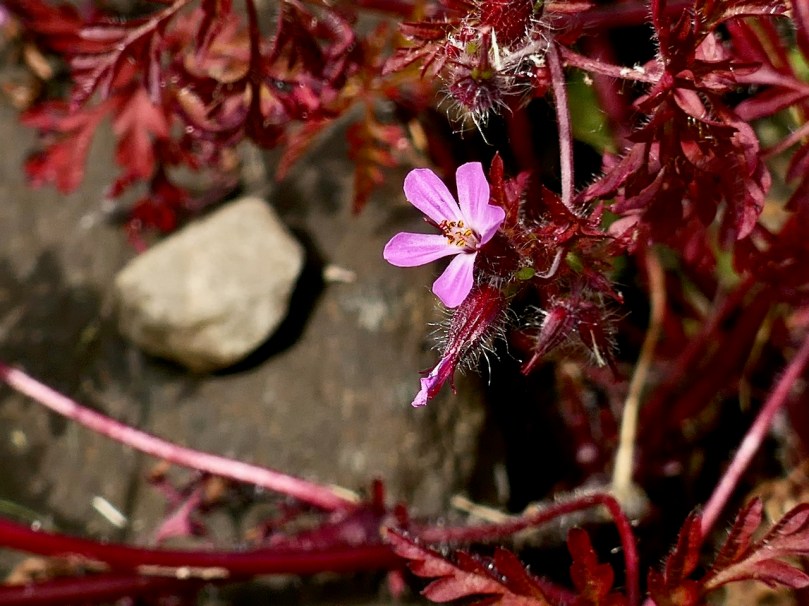
It’s one of my favourites, not just for its attractive flower, but for the leaves that turn a deep red as the plant matures. Himself, of course, is very pleased to have a plant named after him, although a more boring explanation could be that the Robert comes from the latin ruber, meaning red. It’s got lots of alternate names but my favourite Irish one is Eireaball Rí, means the King’s Tail. It’s another powerful herb, used traditionally to stop bleeding.
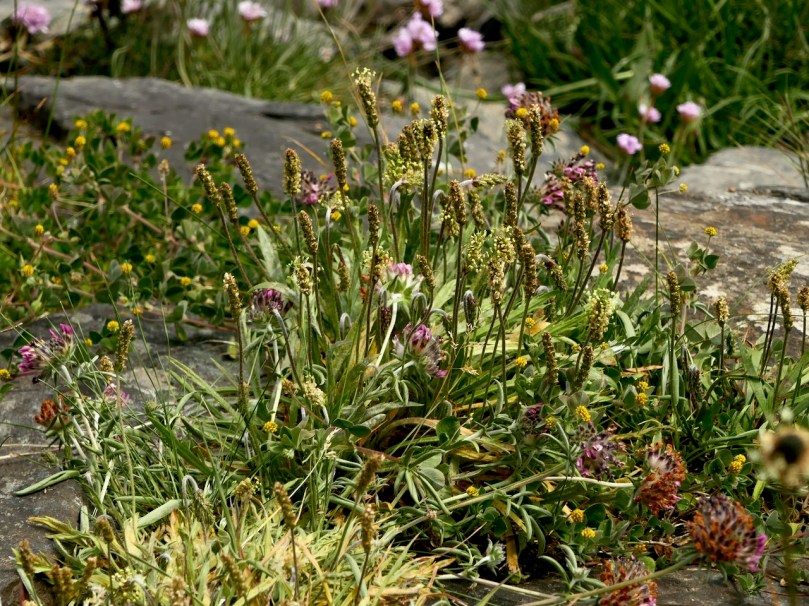
The last of the pink flowers is Kidney Vetch, although it also comes in other colours. It’s actually more common in yellow around here, but I have read that it can be orange, purple, or even pure white. In the photograph above it’s mixed in with the Buck’s-horn Plantain, but here it is on its own, below.

Kidney Vetch is a member of the Pea family but the funny thing about it is that each little pink petal is embedded in a tuft of what looks like cotton wool. It’s a bit otherworldly, but it makes it easy to identify. It’s also known as Lady’s-finger (or in Irish as Méara Muire, which translates as The Virgin’s Finger) and as Stanch, which comes from its reputation as being able to staunch blood flow.
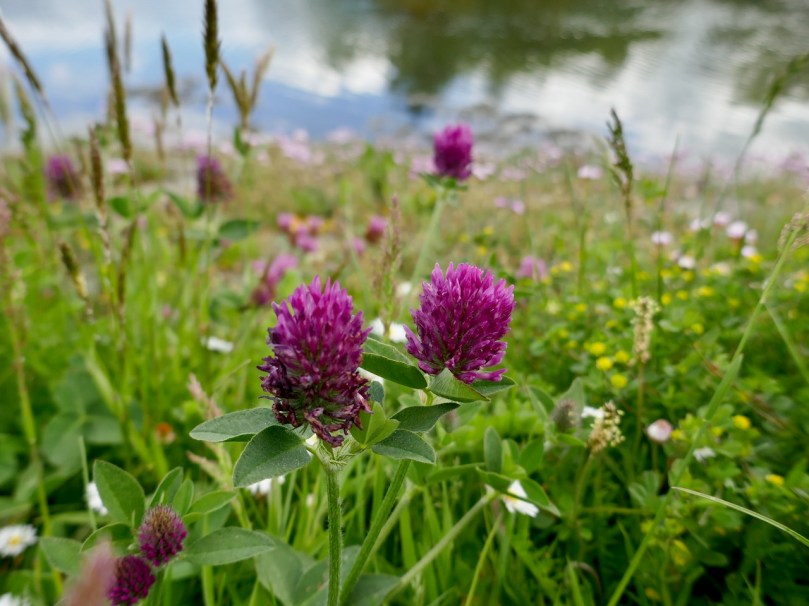
Another member of the Pea family is Red Clover, beloved for its nectar by bumble bees, which have longer tongues than honey bees and can get at the goodness.

This is one of those flowers that are so familiar we hardly notice them, but a really close look reveals a beautiful flower indeed. The leaves are the familiar shamrock shape, but much larger and often with pale patches, and another reason to look closely is to see if you can find a four-leaved clover, considered lucky all over the world. In Irish myth and legend the clover is a symbol of prosperity and the fertility of the land. Among Mac Coitir’s many examples is the story of St Brigid who decided to make her home in the Curragh of Kildare because when ‘she saw before her the delightful plain covered in clover blossom, she determined to offer it to the lord’.

Above is Trailing Tormentil. Although this is a widely-distributed plant in Ireland I haven’t seen a lot of it around here. In fact it’s much more common to see its first cousin, simply called Tormentil, especially on heath, among the heathers and gorse. Tormentil has only four petals on its yellow flowers, whereas Trailing Tormentil can have five, as in the patches I found along the estuary. The name seems to relate to its potency as a cure for stomach torments – the root was boiled in milk as a cure for colic. Add in a little wine and it was good for what ailed you. Add in some St John’s wort and it was a sleeping draught. This is reflected in the Irish name Néalfartach: néal has several meanings which can related to depression and to sleep.

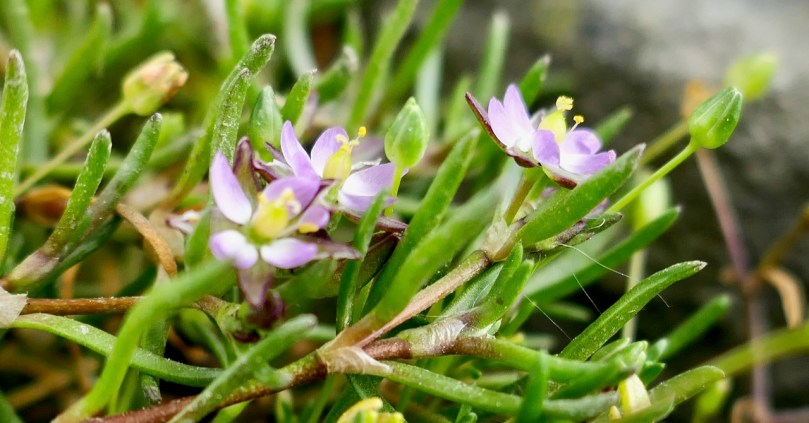
A very exciting find for me now (above) as it’s the first time I have seen it. Look how tiny it is – it’s very possible I’ve walked over it many times without noticing, especially as the old eyes aren’t what they used to be. It’s one of the Sea-spurreys (the others are Rock Sea-spurrey, Greater Sea-spurrey and Sand Spurrey, all of which are found in West Cork) but this one is Lesser Sea-spurrey.
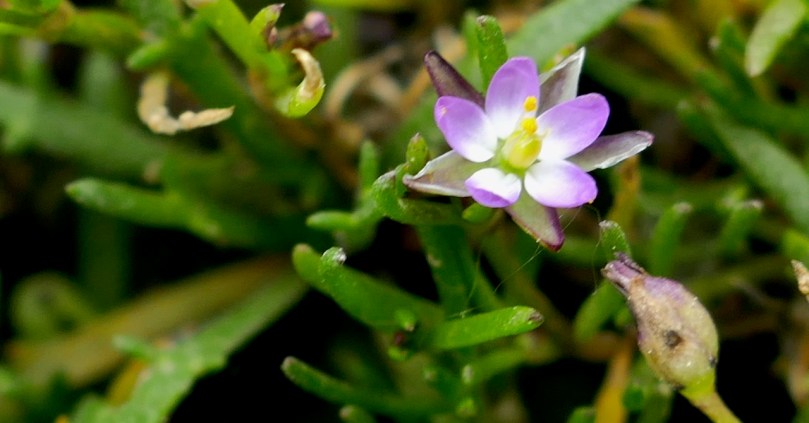
It’s very like Greater Sea-spurrey but several factors distinguish it – it’s tiny, the sepals are longer than the petals (see above) and it has far fewer stamens. The distribution of all the Sea-spurreys is coastal, as you would imagine, but strangely Lesser Sea-spurrey is also found all over Britain, inland as well as by the sea. In Ireland, it is only coastal. Is it weird to get this excited over a tiny plant? (Okay, don’t answer that.)

Moving right along, this is Cuckoo-flower – so called because it appears about the same time as the Cuckoo does. It’s also called Lady’s Smock and it can vary from pure white to a mauvey pink and if you look closely at the stems you might see tiny eggs – they are white when laid but turn orange with time. They are laid by the Orange-tip Butterfly and the larva feeds on the stem of the flower.
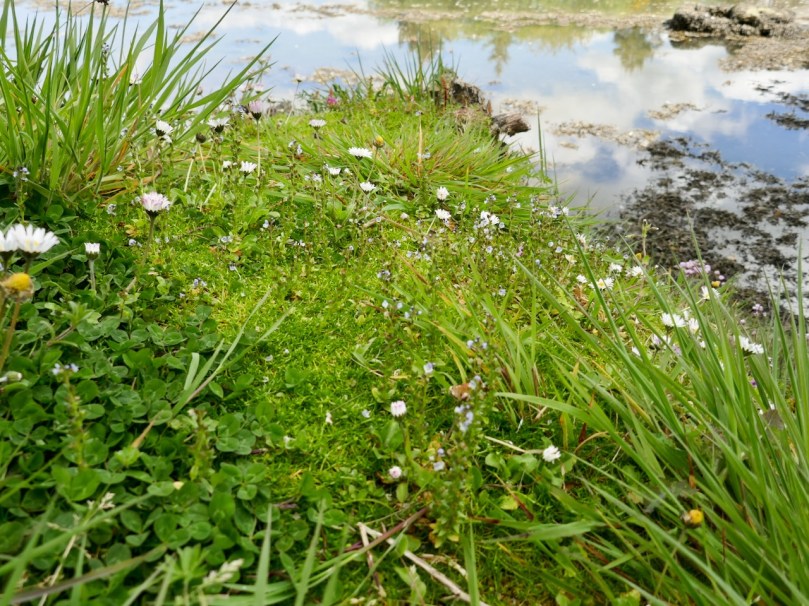
There’s a little patch of grass jutting out into the estuary and at first I thought it was just covered in daisies. Daisies are important little flowers for our pollinators too, but what caught my eye was smaller so I had to lie down to get close enough to see the little blue ones.
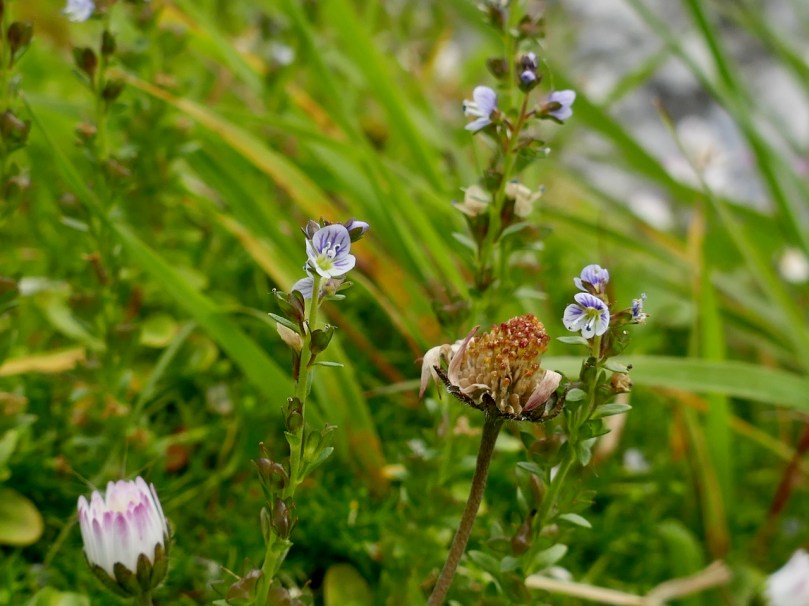
This is Thyme-leaved Speedwell, one of the many Speedwells you can find in West Cork, and one of the smallest ones. Right across the road is another one – much more visible. In fact, if your eye is caught by a flash of blue in the grass in West Cork, this is likely to be what’s causing it.
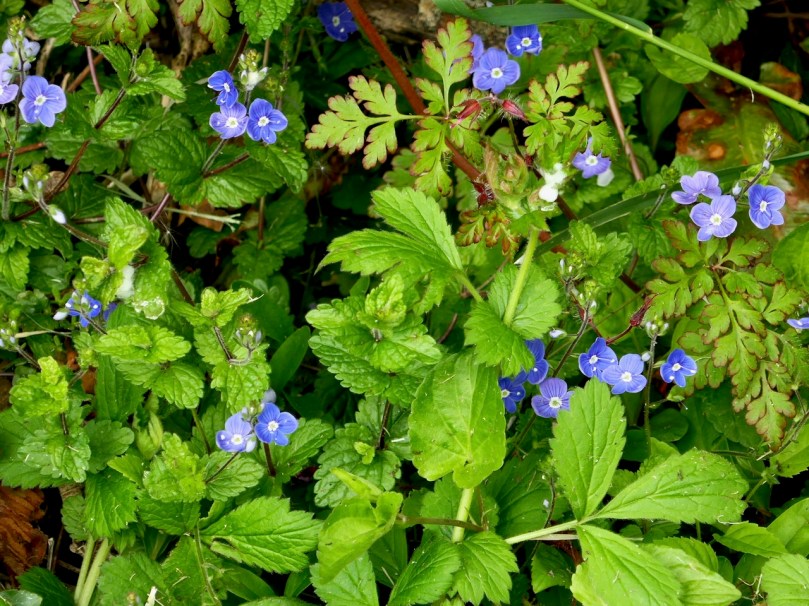
It’s Germander Speedwell – a closer look below. Speedwell looks a bit like a Forget-me-not but it doesn’t have the yellow centre and only has four petals to a Forget-me-not’s five.

It belongs to a different family too – the Veronica family, which includes the next flower, Ivy-leaved Toadflax, which I found growing all over the bridge pillar.

This is one opportunistic little plant – it will find a crack in a wall and dig right in. In fact, walls are its favourite habitat. Here’s what Zoë Devlin’s Wildflowers of Ireland (my go-to resource) has to say about this adaptable genius: The seed-planting mechanism of this plant is very clever indeed.  The flowers turn their heads to the sun until they have been fertilised at which stage they turn about towards the wall on which they are growing and in this way they plant or push the seeds into any little crevice possible on the wall. They also have very long roots which help them to hang on, like the Ivy for which they are named, and thereby ensure their survival.  This plant was introduced in the seventeenth century from the Mediterranean countries.

As Zoë says, it arrived here from the Mediterranean – but how? During the craze for importing marble from Italy, including marble statues, the plant hitched a ride, jumped ship once it got to Britain, and flourished from then on. Even though it’s not a native plant it’s adapted well to the Irish climate and has proven to be a good neighbour, unlike many other alien species.

Just glancing along the bank, it’s hard to take in how many plants are here, and what a variety there is. I will finish with a couple from across the road. First, the Hawthorn is now in full bloom.

It’s also known here as the Whitethorn and it comes into flower after its leaves have arrived and after the Blackthorn has faded. Beautiful – but considered to be very unlucky. Woe betide anyone cutting a Whitethorn or bringing its flowers or branches into the house – except in the month of May when it was customary on some counties to bring the flowers to the house, or even into it, to honour Mary (it’s the May Tree) or to ward off evil. That’s a bit confusing – it’s May now so should you gather some blossoms? Better to take no chances, I say, and leave it to bloom outside for all our enjoyment.
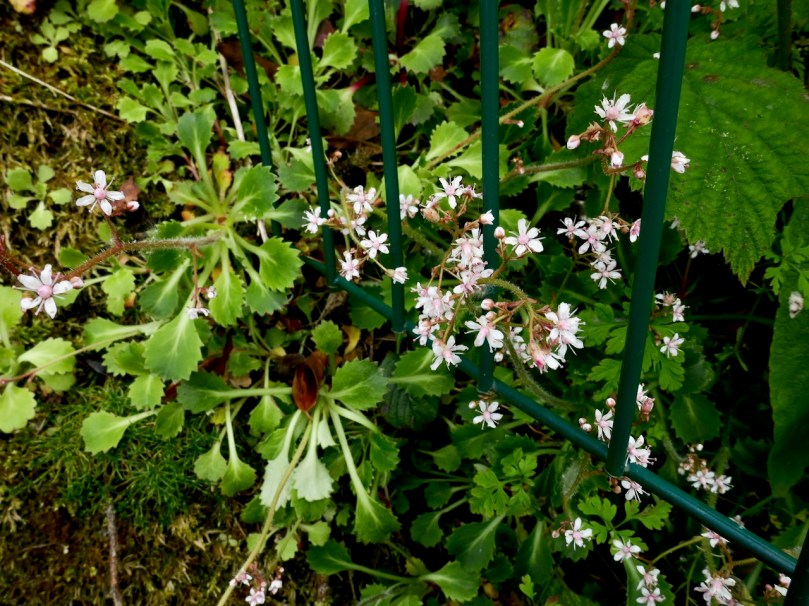
And what’s this I spy? It’s St Patrick’s Cabbage and you will only find this plant in southern or Western Ireland and in Spain and Portugal. Called the Lusitanian Flora, there is a group of plants who seem to have flown, as if by magic, across the Bay of Biscay, France and Britain, to land in West Cork, and this is one of them.

If you’re a gardener it might look familiar – the popular garden plant, London Pride, is a hybrid of this and another member of the Saxifrage family.

There’s more – lot’s more – but I’d better leave it at that (except I couldn’t resist that image of the Scarlet Pimpernel, above, with the Dove’s-foot Crane’s-bill). Here’s what I want you to take away from this post – with the exception of the Ivy-leaved Toadflax, which has been here for hundreds of years, every single one of the plants I have written about here is native. Every. Single. One. Why is that important? Because this is what a wildflower patch looks like and should look like. These are the flowers to which our native insects and pollinators have adapted over millennia and therefore these are the ones which are critical to our ecology here in Ireland.
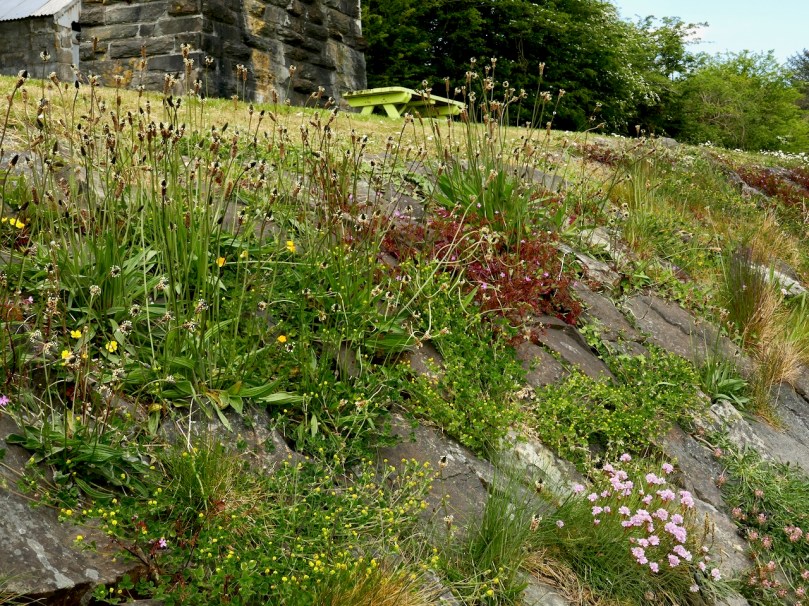
We’ve been fed images of colourful meadows full of poppies and cornflowers and told that’s what a wildflower meadow looks like – it’s not. THIS is what our pollinators need – a wide variety of native plants left undisturbed. It’s wonderful to see this in Ballydehob, but every village and town in Ireland has areas like this. Let’s make sure they flourish!
 

Mixed Magic Messages

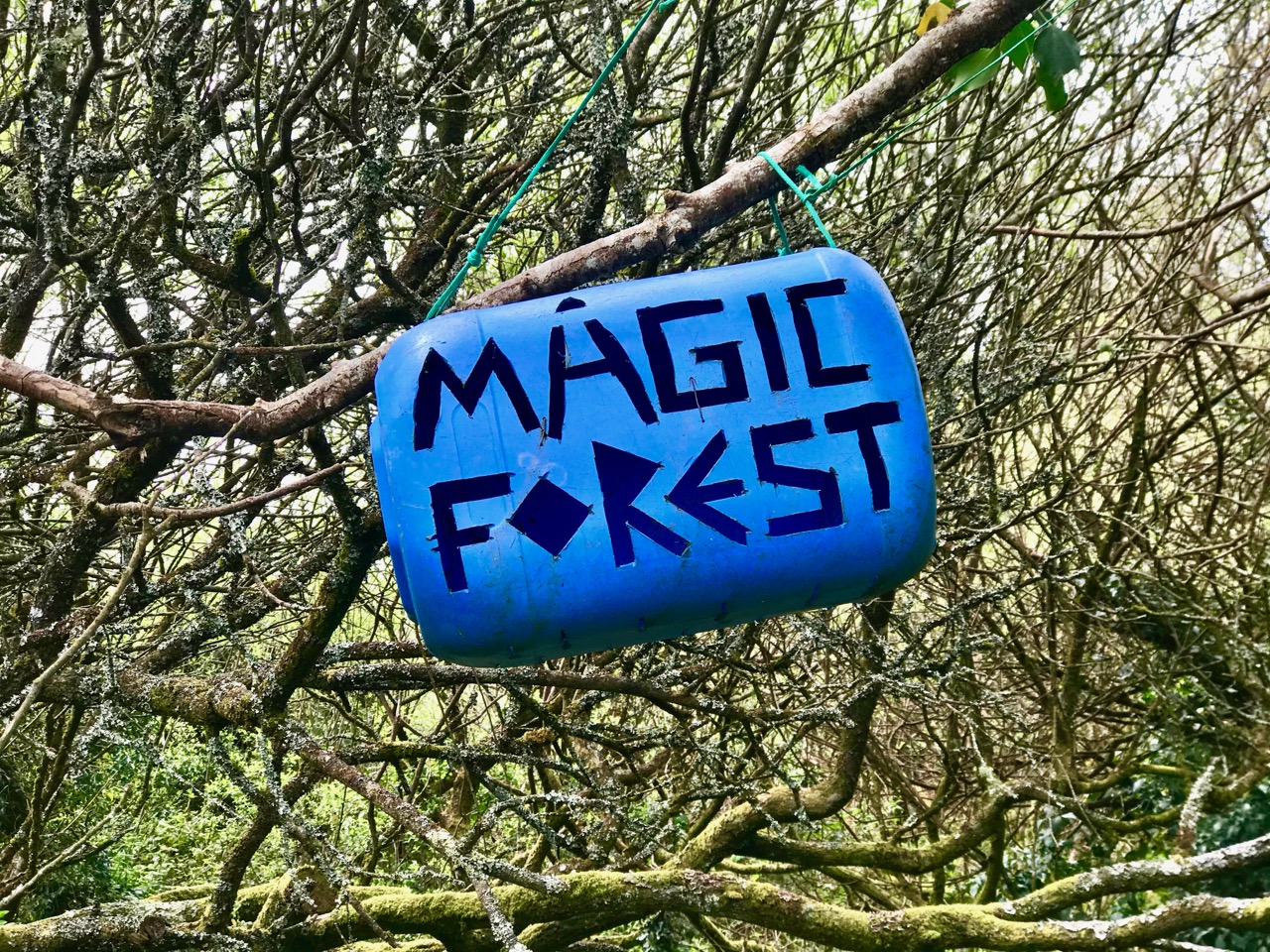
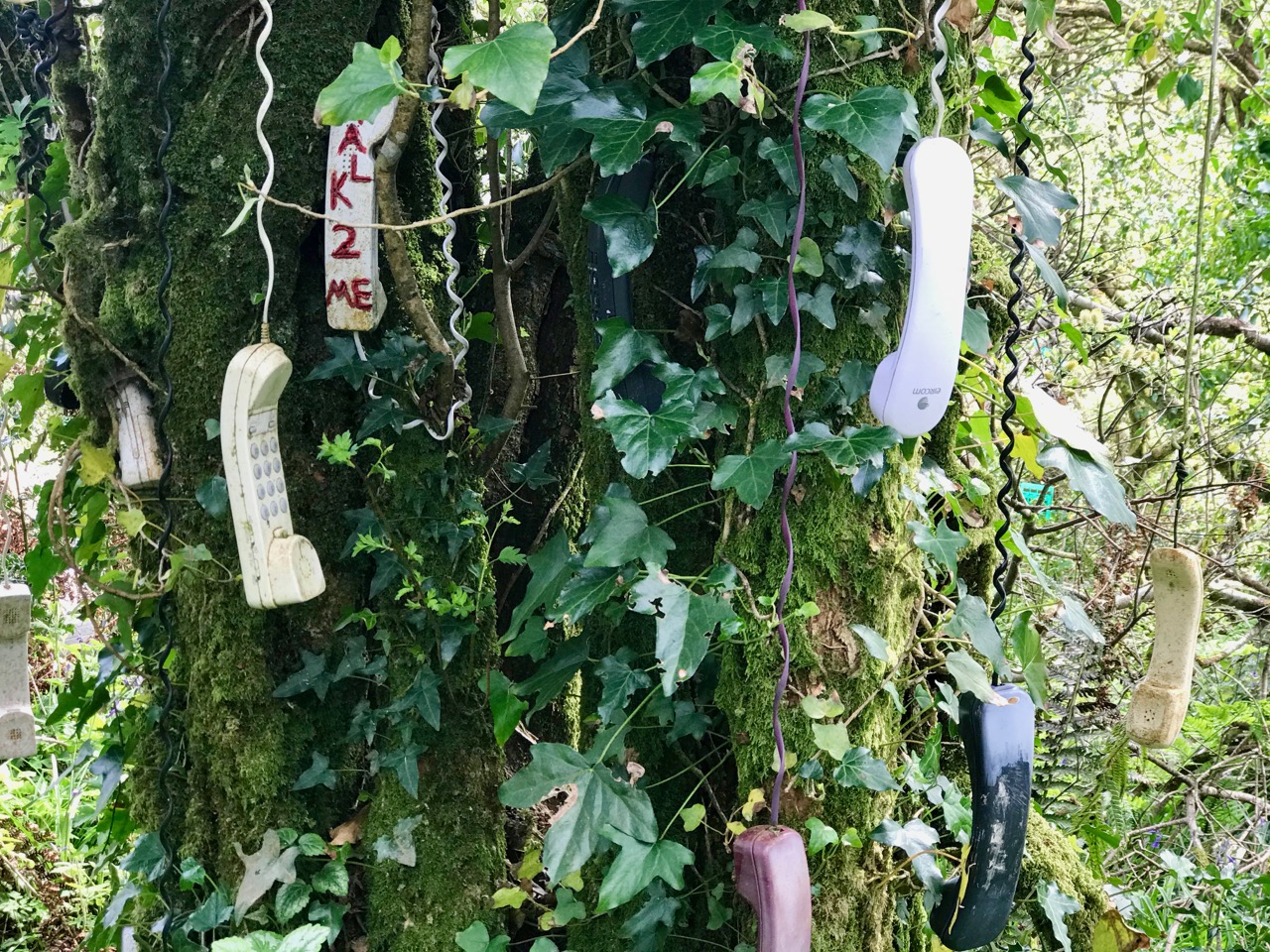
We first visited Thomas Wiegandt’s Magic Forest exactly five years ago. It’s just round the corner and over the hill from Ballydehob. As time has passed the walk has matured and mellowed: it’s the most picturesque and atmospheric place now – true magic! Thank you, Thomas, for creating this and for allowing anyone to access it (subject to lockdown limitations, of course)…

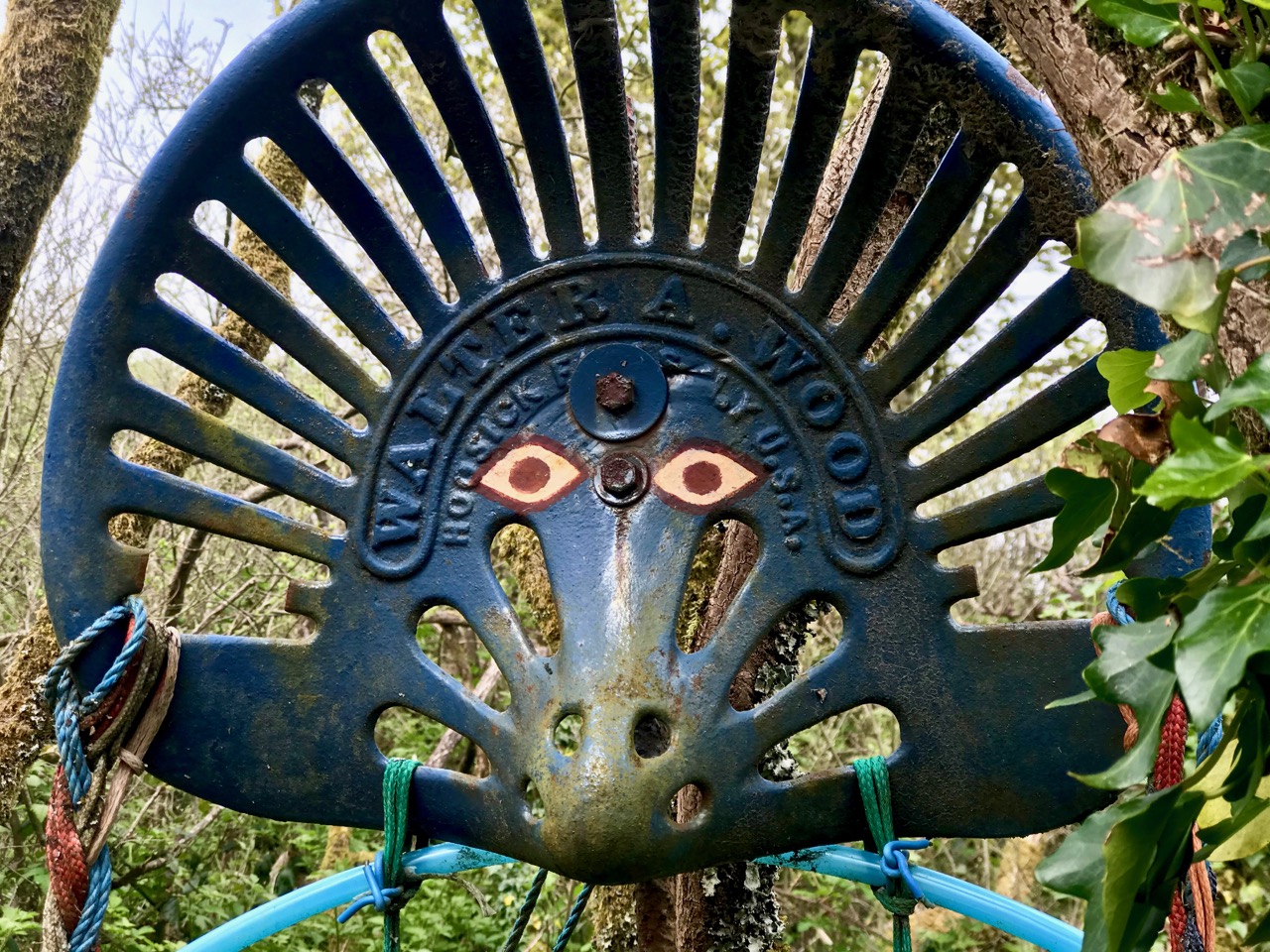
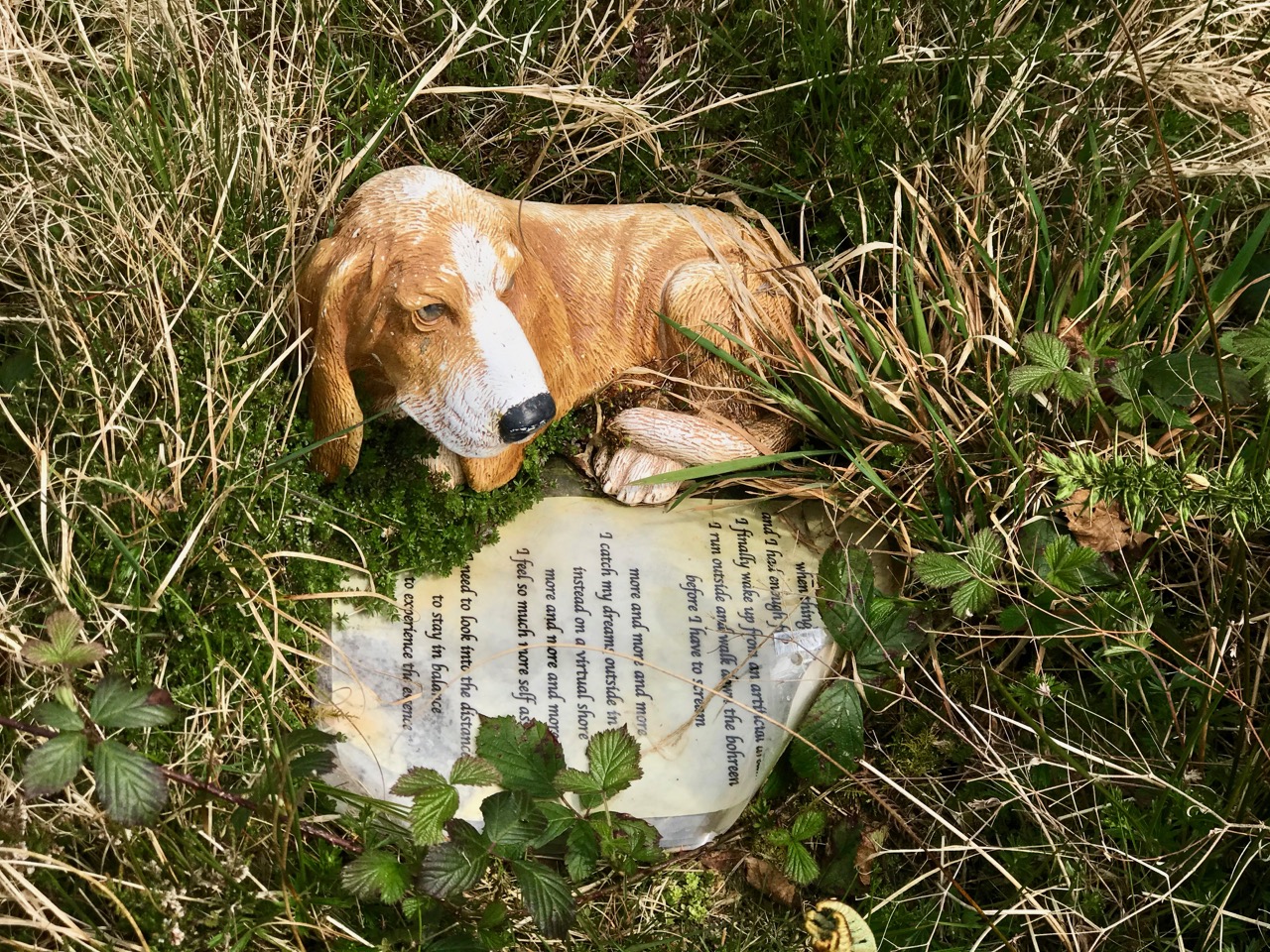
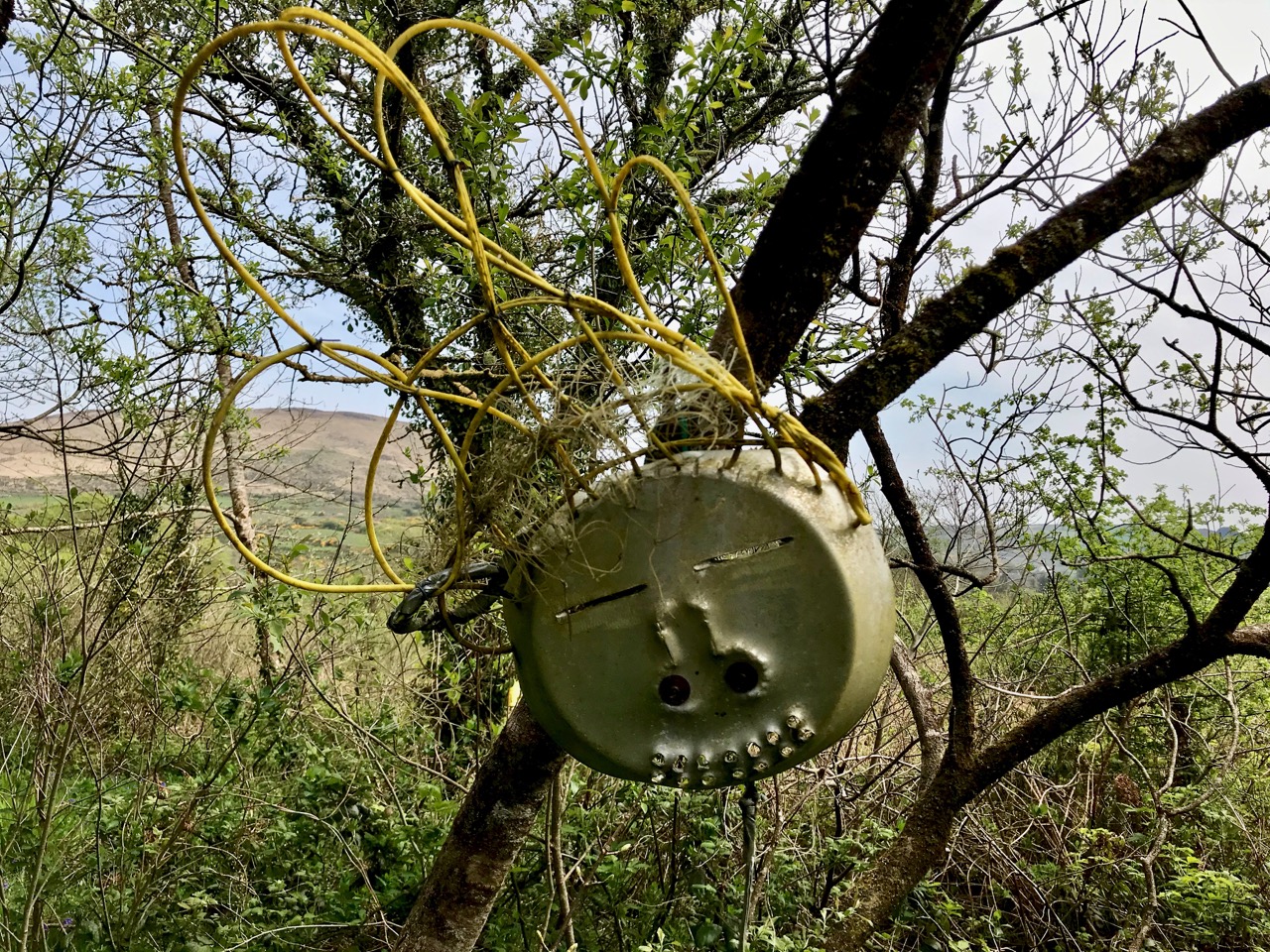
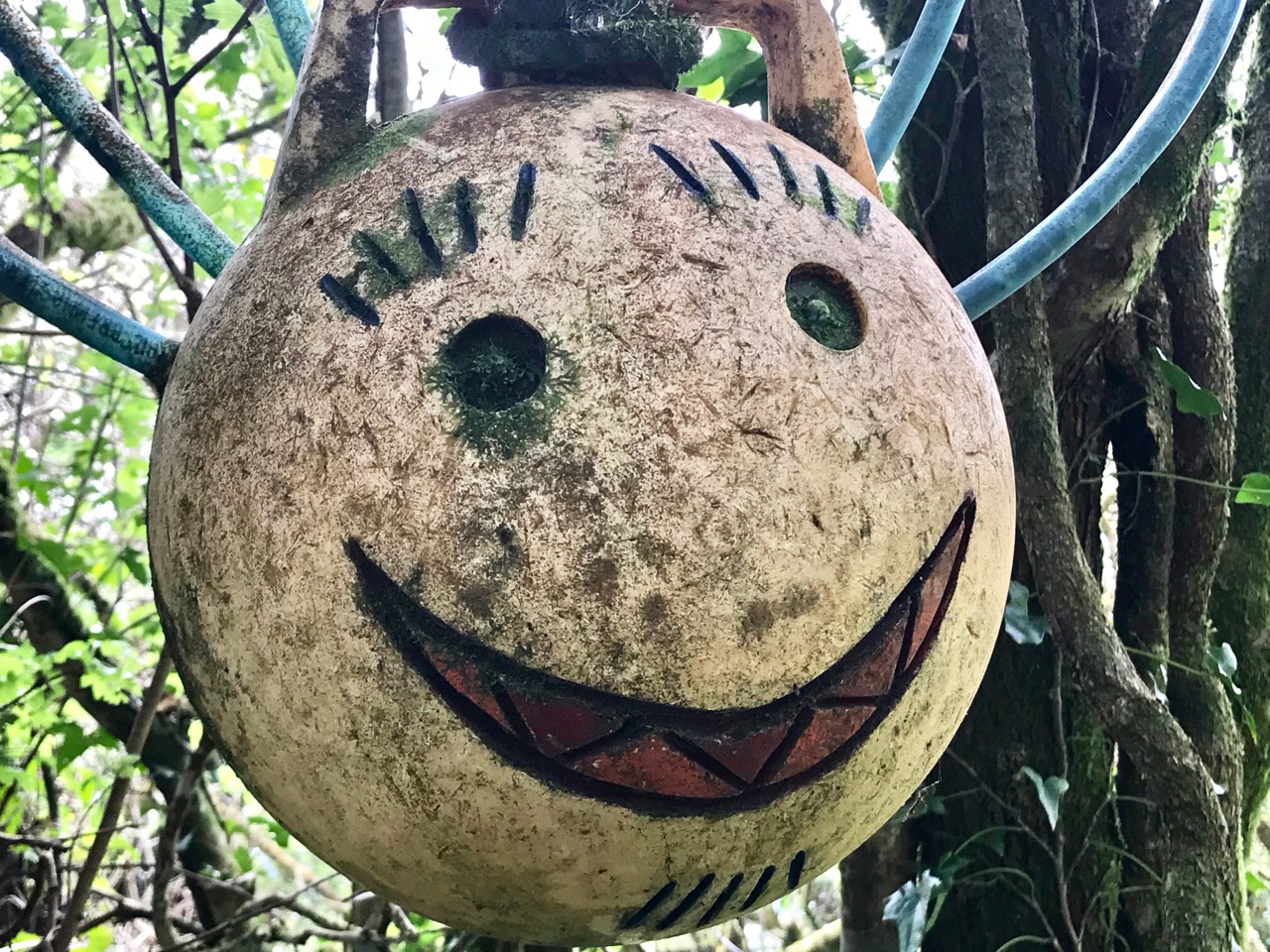
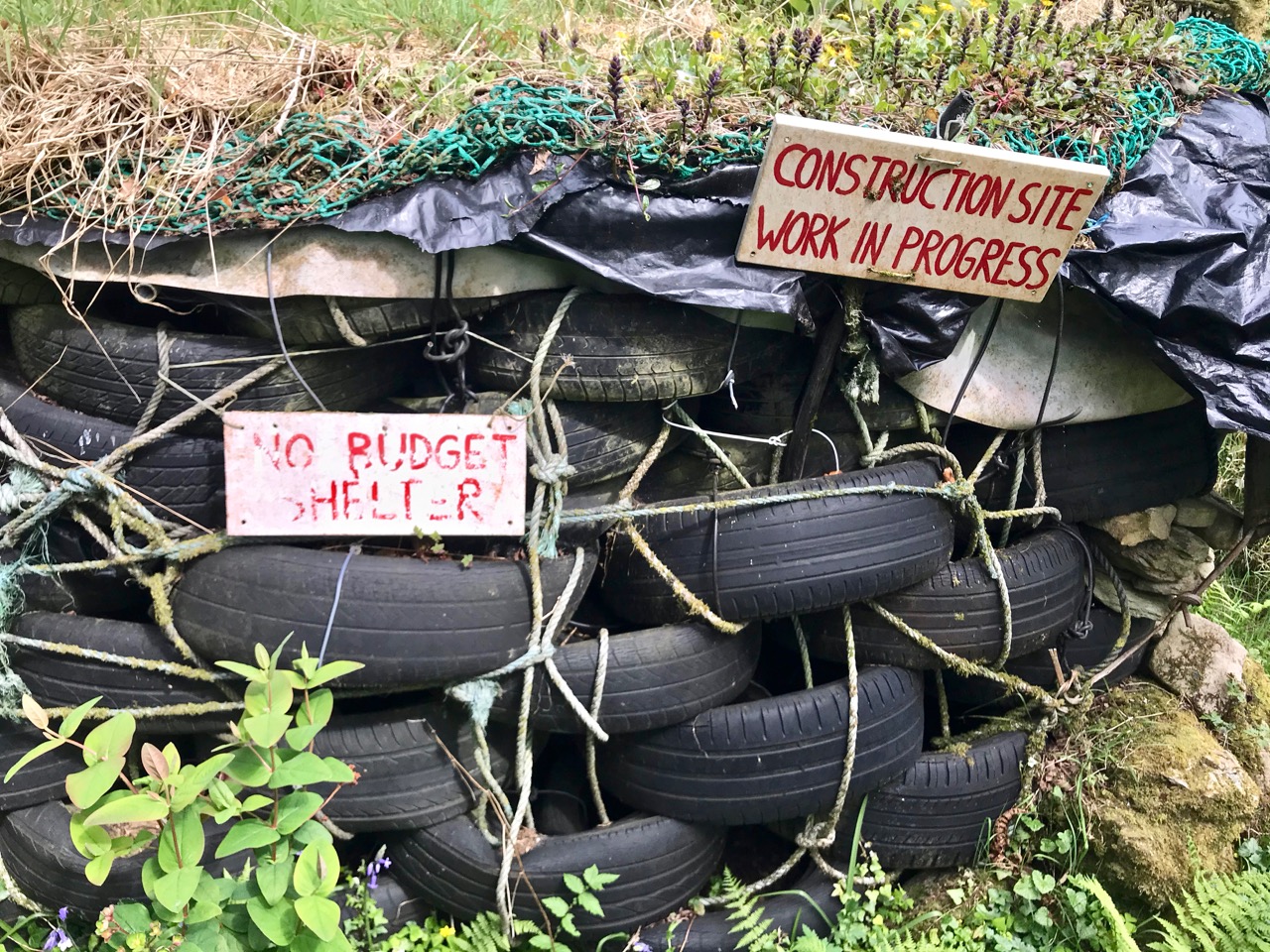
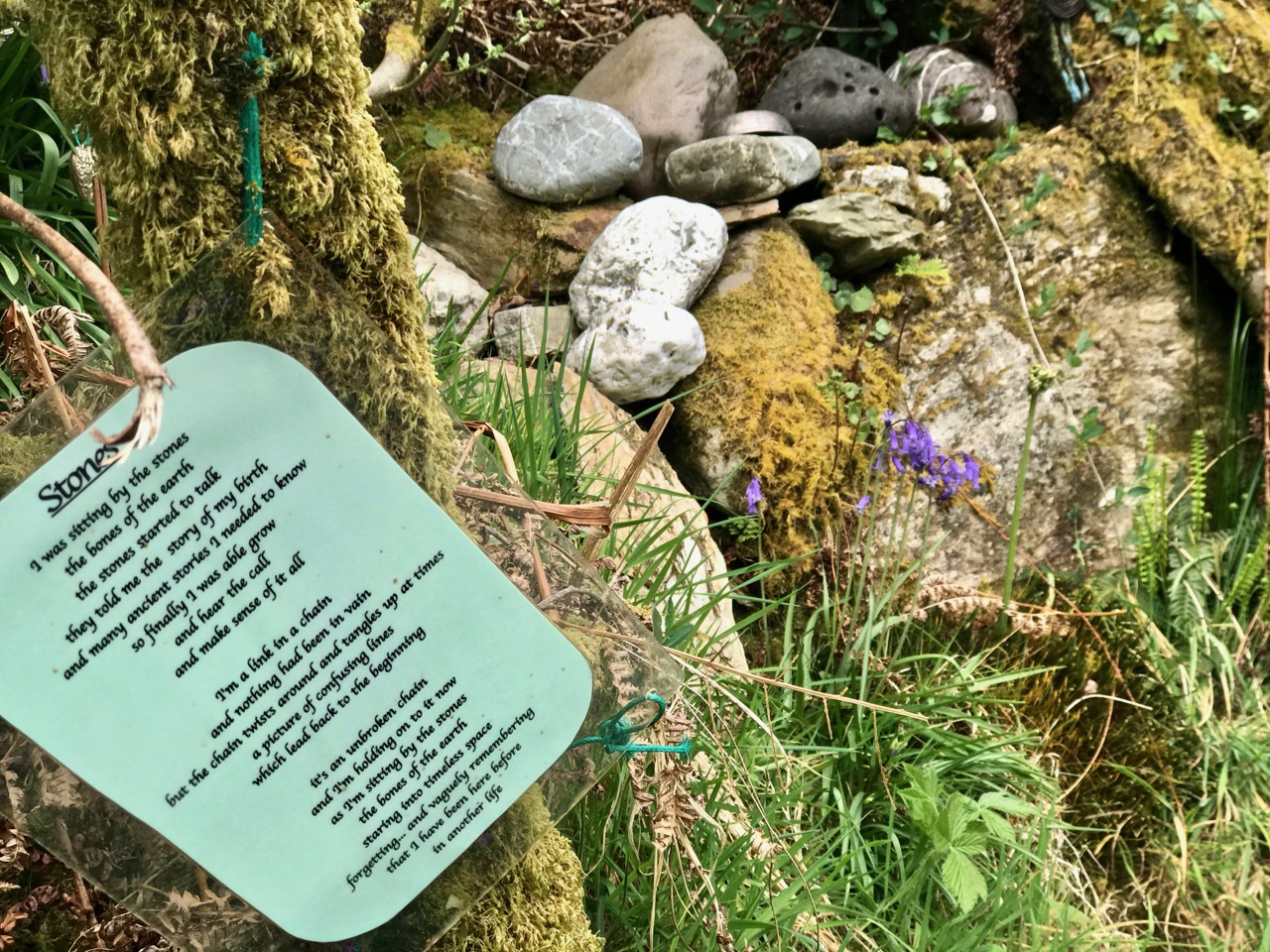
As a connoisseur of Irish signs and signage (have a look at my previous posts over the years), this walk is for me a delight and an abundant source of tangible examples from the world of human communication. There are explicit and comprehensible signs, enigmatic ones, symbolic messages, and allegories. It doesn’t matter whether we understand them, or even relate to them personally: it’s just all part of the magic of the forest.

Who are the messengers? That’s really up to you to decide. here are some that I can relate to:

Each time we visit the Magic Forest, we come back with a different set of images. It’s just that there is so much here, you take in what appeals to you at a particular time.

A pantheist might find Gods and Goddesses in this forest… Others might see relics of a fading industrial age. It all depends on your point of view.

The forest itself will take over in the end. It’s certainly the case that, through the years, nature is absorbing everything. But, surely, it’s not a battle – just a mutual enhancement. Finola is definitely on the side of the natural world.

A place to think, meditate – or make music!

The whole place is a collaboration between the arts and nature. Enjoy the journey!

Behold, Their Bright Shining Future Rising Before Them

This is the first in a series of posts being published simultaneously by Roaringwater Journal and the Ballydehob Arts Museum, celebrating 33 years of an aspect of art history in West Cork. The Living Landscape series of art exhibitions ran from 1987 to 1996, masterminded and driven by the energies of Cóilín Murray. Cóilín has recently donated an invaluable file of photographs to the Museum, connected to a sculpture trail which was set up between Skibbereen and Schull in the early 1990s as part of this project. We are indebted to Cóilín for these items, and I will be using many of them in these posts.

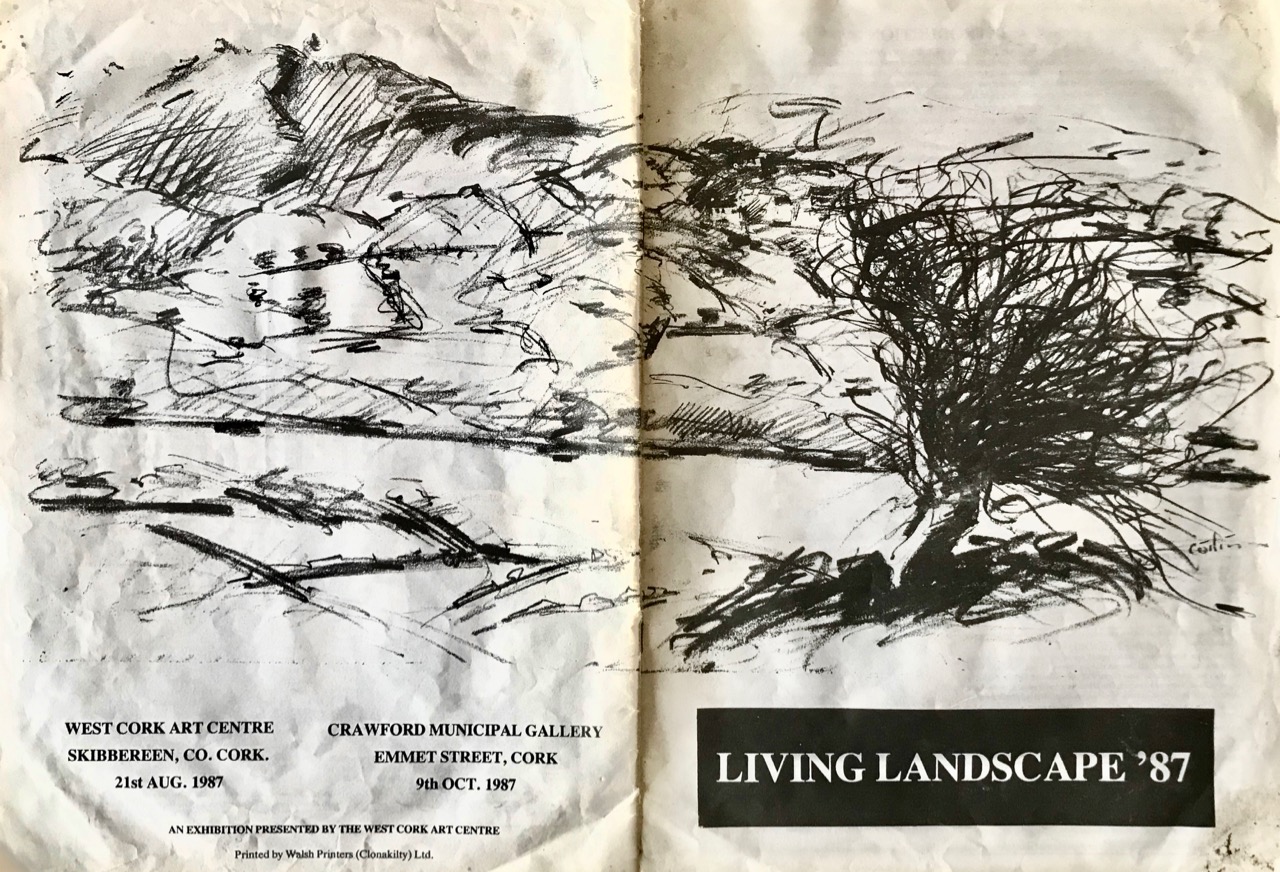
Catalogue from the first Living Landscape exhibition, launched by the West Cork Arts centre and the Crawford Gallery, Cork, in 1987. The cover illustration is by Cóilín Murray

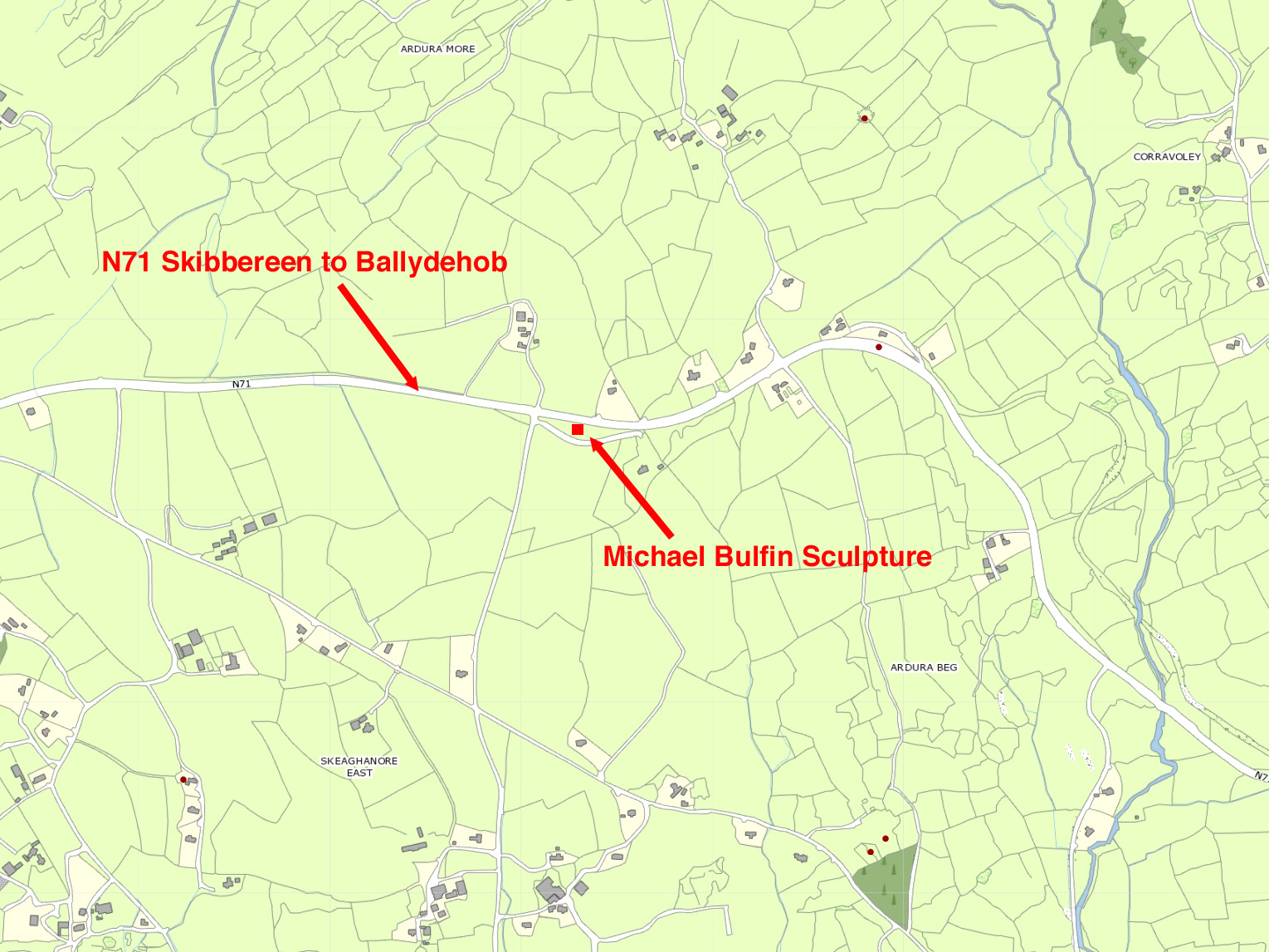
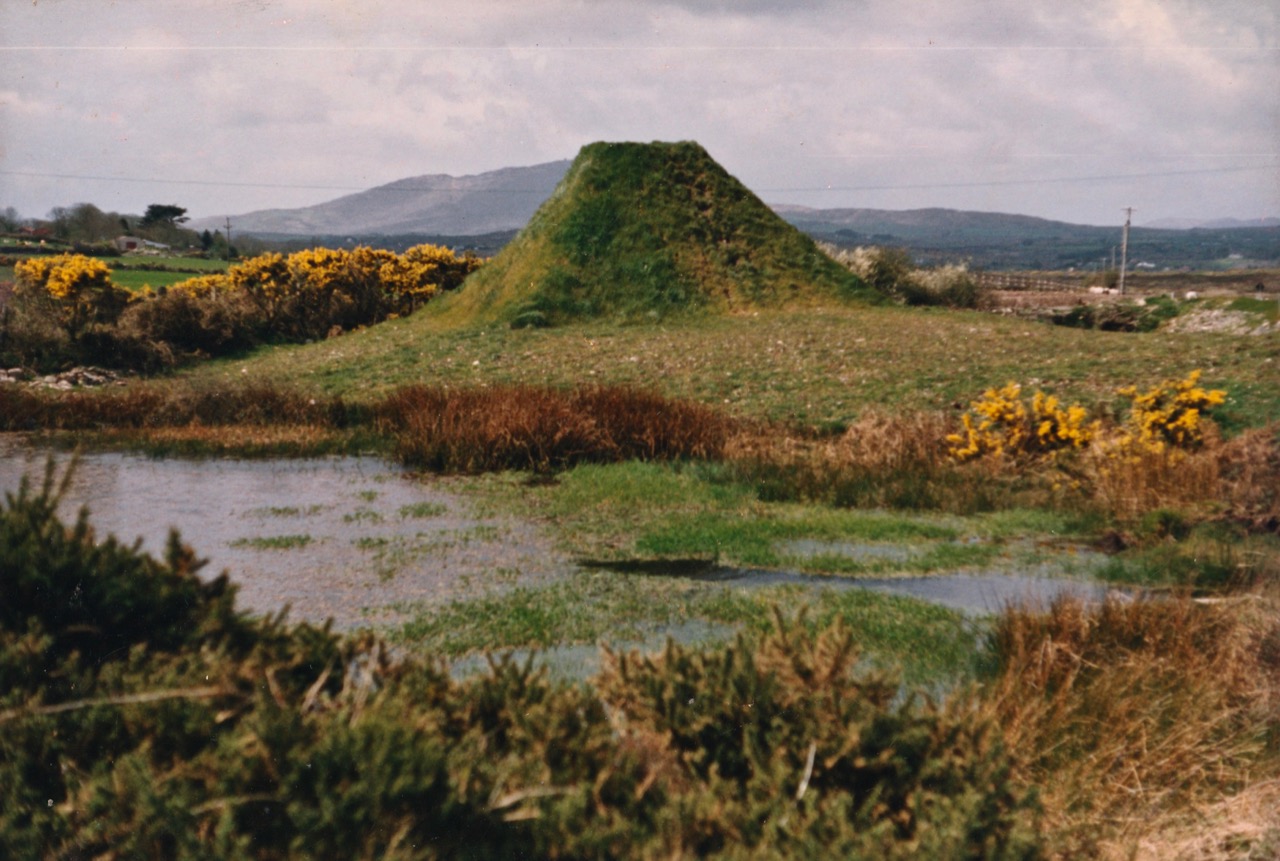
It’s fascinating to trace the sculptures which were set up more than 25 years ago along the N71 and R592 roads connecting Skibbereen with Schull. Most have vanished – some back to nature, some through destruction. But those which remain are now ‘enigmatic’ and must often excite comment and questions. This is particularly the case with the one in our header picture (taken recently), which is the central subject of today’s post. It’s a work by Michael Bulfin, born in 1939, one of Ireland’s most respected artists and a member of Aosdána (an association of artists whose work is deemed to have made an outstanding contribution to the creative arts in Ireland). The title of the sculpture is the title of this piece: Behold, Their Bright Shining Future Rising Before Them

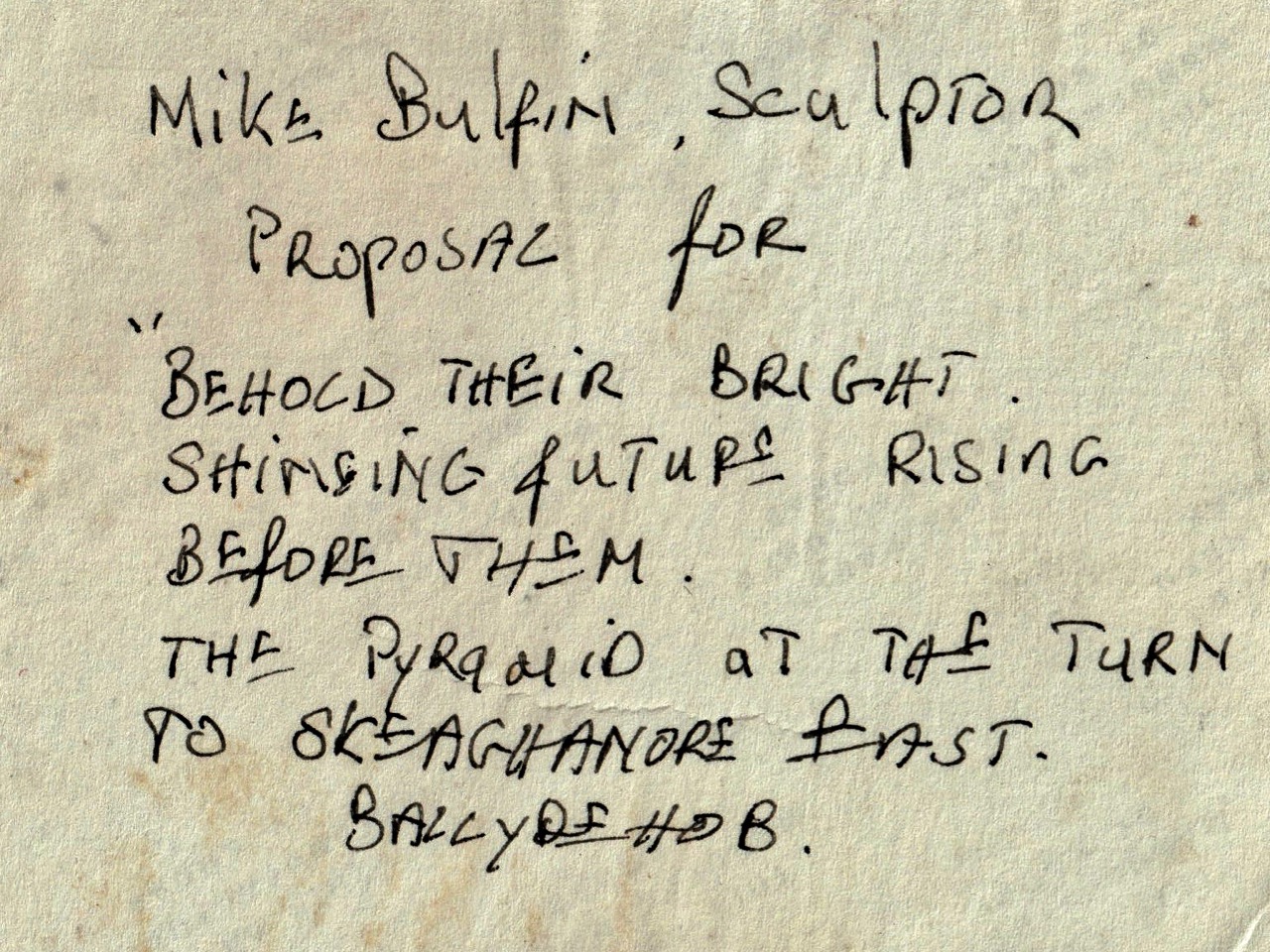
Michael Bulfin’s exhibition proposal was a piece of land art: a giant grass-covered earth pyramid crowned by a stainless steel pinnacle, with a cascade of boulders flowing down the surface – facing on to the main road running through the townland of Skeaghanore East. Upper, the design for the piece was submitted as a model. Lower – the inscription from the back of the original photograph.

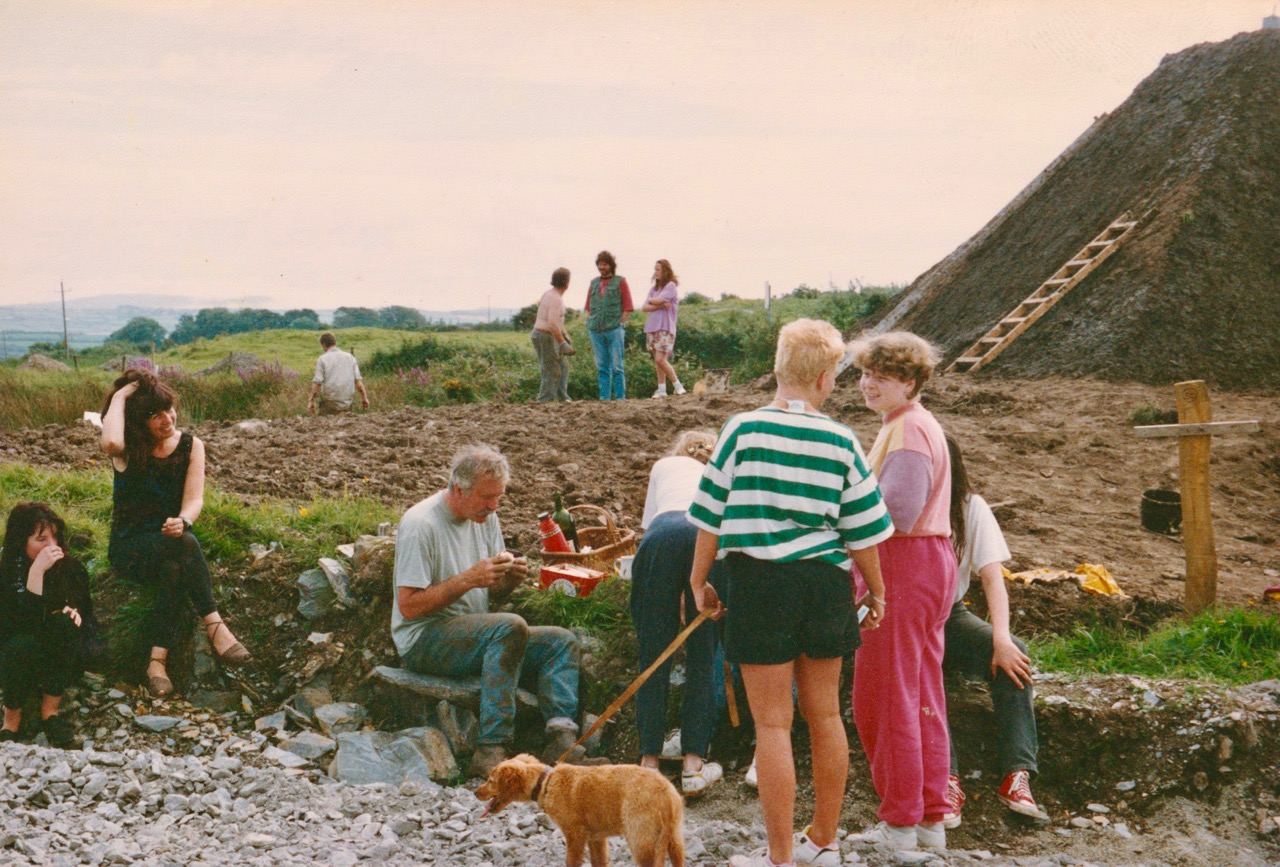
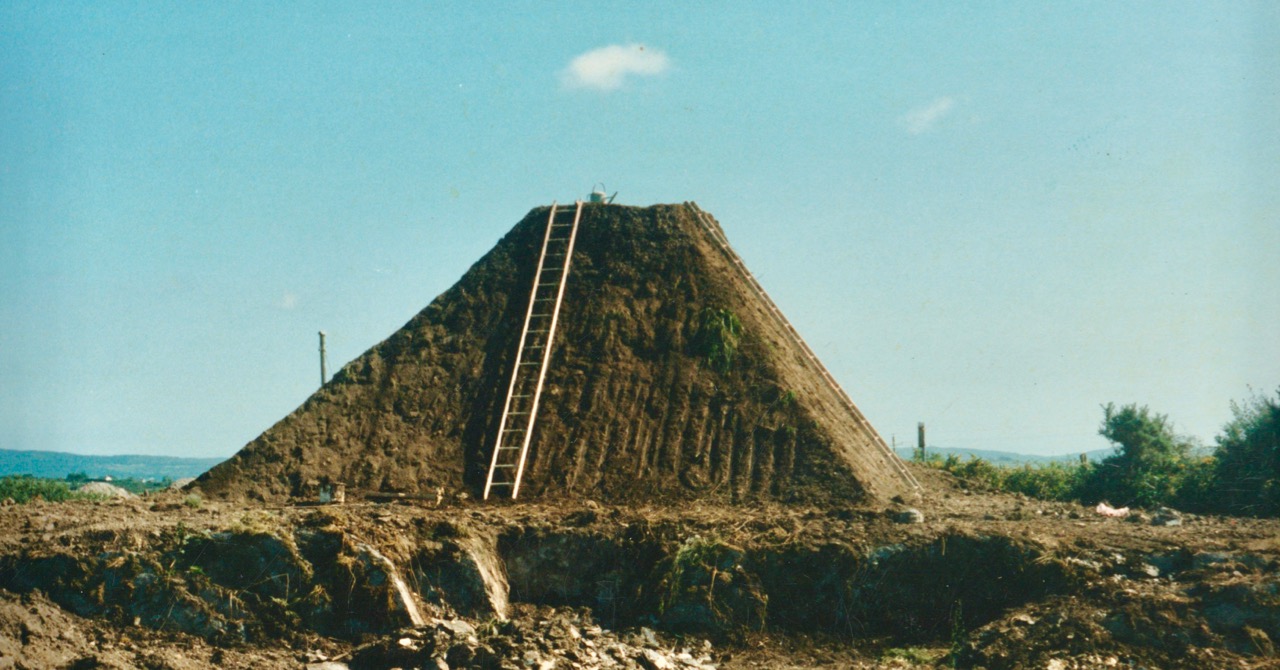
The task of physically realising this monumental piece was the product of many hands, including a number of volunteers from West Cork’s artistic community. The following ‘work in progress’ shots document some captured moments in time.

In this shot, Michael Bulfin is on the ladder, and painter Maurice Desmond watches the process

‘Lunch break on the day the mound was seeded’ – identified in this picture are (foreground left to right): Aoife Desmond, Deirdre Heaney, Mike Bulfin, Rosemary Murray (serving lunch), Ailne Murray and Niamh Murray. (Background): Simon Holler, Cóilín Murray, Gerry Walker and daughter

The project was well publicised; here Mike Bulfin is being interviewed by Anita Whooley for RTE, with Cóilín Murray looking on

The mound ‘greening up’: the stainless steel pinnacle was added at a later date. The ‘cascade of boulders’ is not evident today: I am assured it is still there, shrouded by gorse and brambles

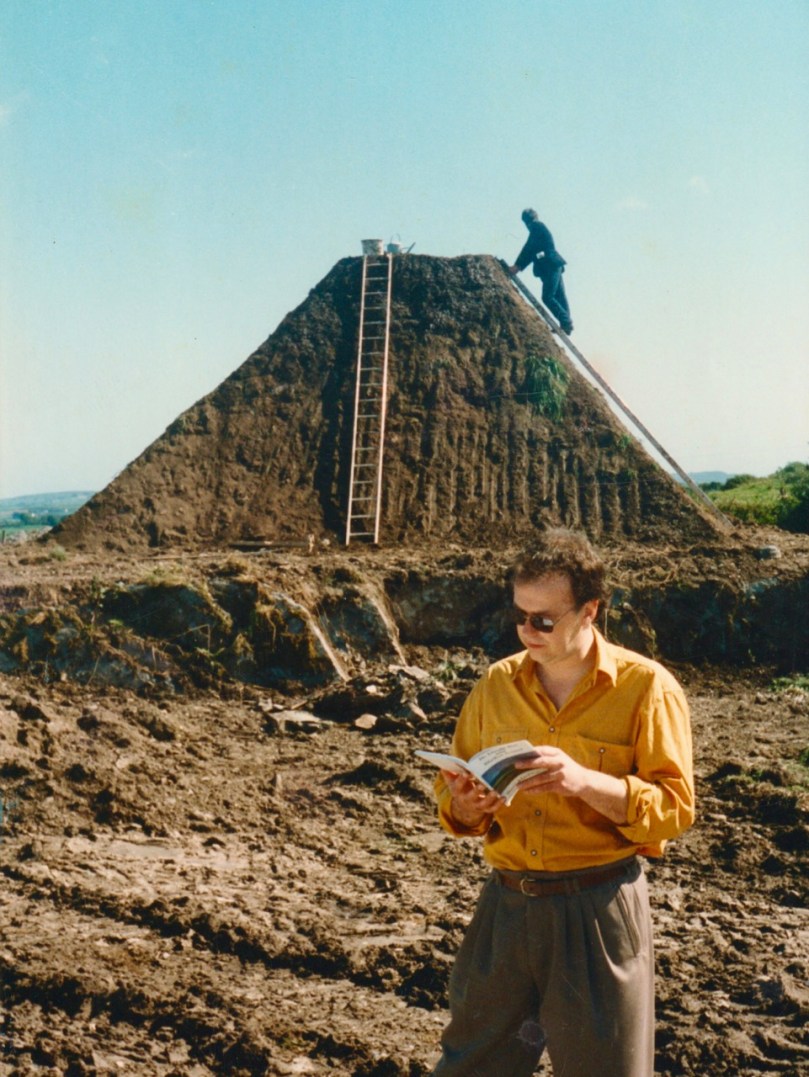
At the official opening of the Living Landscape Sculpture Trail the poet Steve McDonagh, founder of Brandon Books based in Dingle, Co Kerry, read from his work at each location. Steve McDonagh died in November 2010. As can be seen, the pyramid was unfinished on opening day!

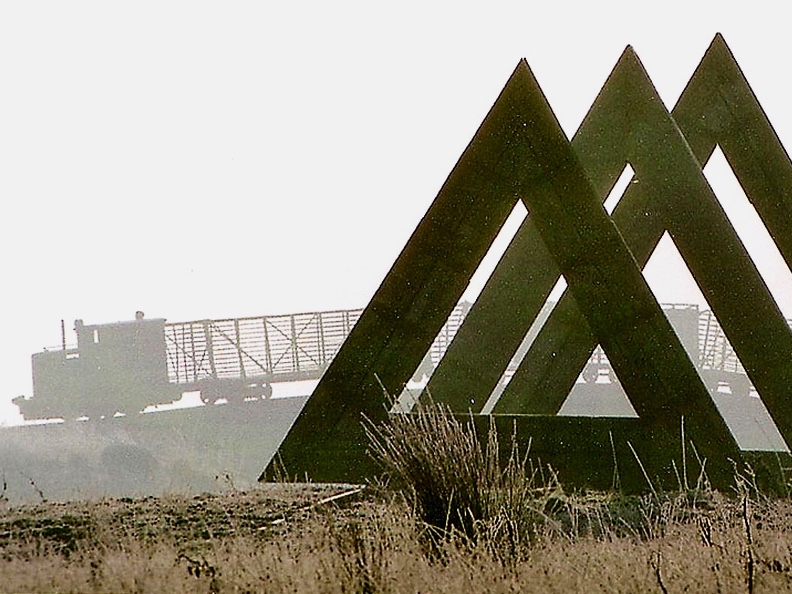
Michael Bulfin remains active in Ireland to this day. He lives in Co Offaly, and there is impressive work from him at the Lough Boora Parklands, including the eye-catching ‘Skytrain’ sculpture:

Something that could be considered in the future is a creative project based on the West Cork Sculpture Trail. This might restore or resurrect some of the pieces from the 1990s, and provide an opportunity for new work to take the place of those sculptures which are now lost.

Wooly Jumper

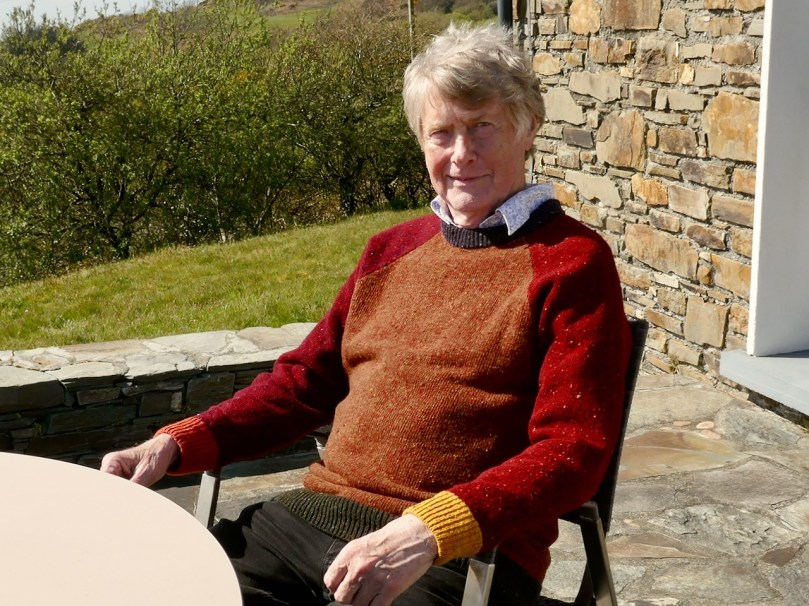
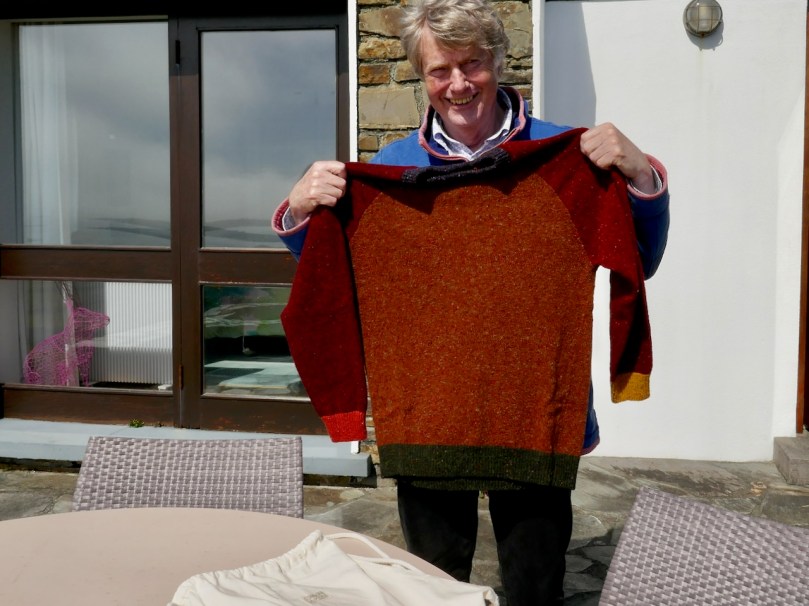
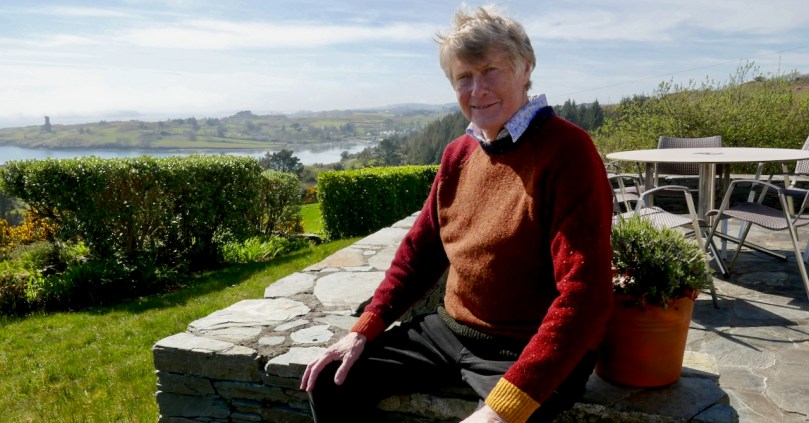
No, that’s not the answer to the old chestnut about what you get when you cross a sheep and a kangaroo – it’s what I got Robert for his birthday this year. But this was no ordinary, off-the-peg, item of clothing but a piece of ethical, made to order, cherish for life, knitwear, hand-crafted in Ireland. That’s a quote from the maker.

First of all, for our non-Irish or non-British readers, a jumper is what you see on Robert in the header photo. It might, over here, also be called a jersey, a pullover, or even (in the depths of the country) a gansey. It’s hardly ever called a sweater.

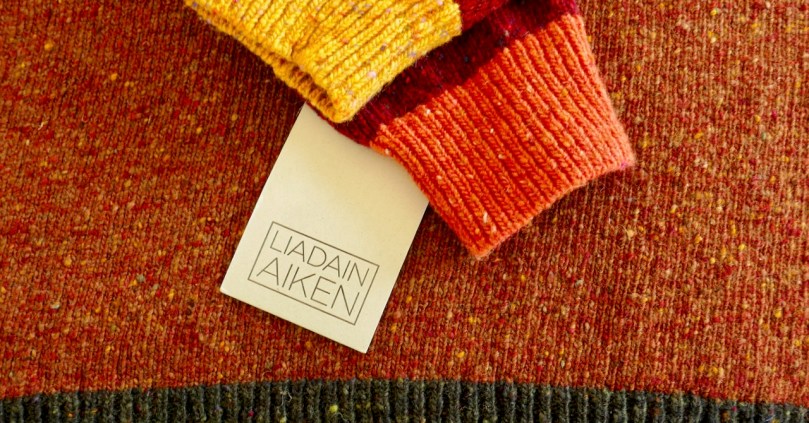
Secondly, this is a Liadain Aiken design. Liadain isn’t a common name even in Ireland. She was believed to be a 7th century poet (see this article) and the name may mean ‘Grey Lady’. For the correct pronunciation click here.

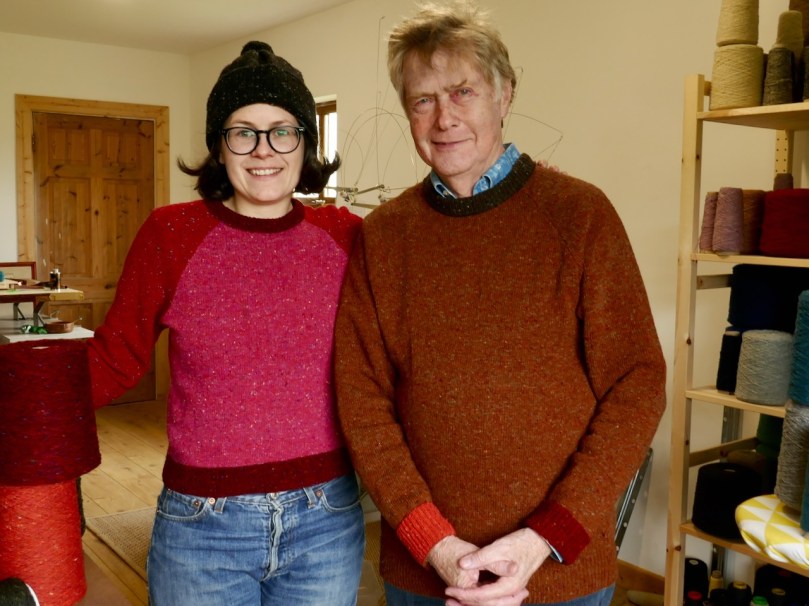
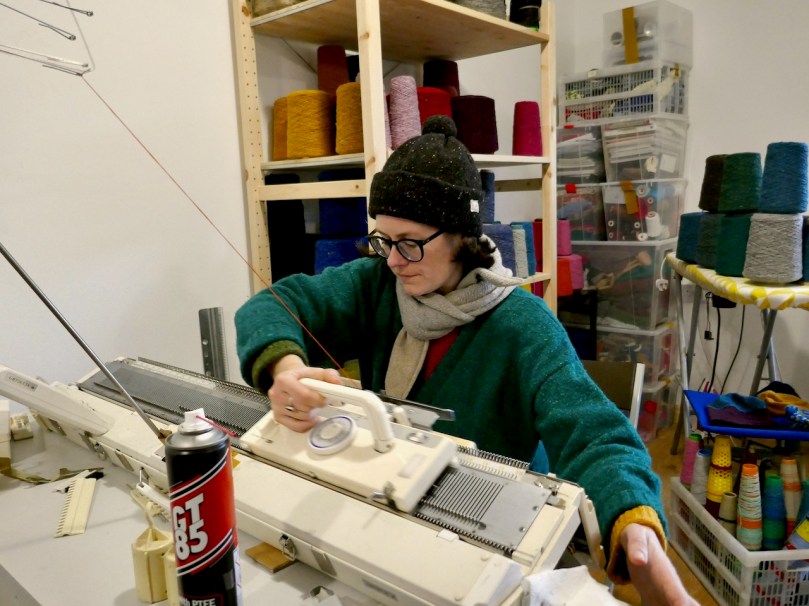
Liadain and Robert in the nerve-centre of her operations – just outside Ballydehob

I discovered Liadain Aiken through a piece about her knitwear in the Irish Times. I was entranced by the images of colourful scarves, hats and jumpers and noted that the piece said she was in the process of moving to Ballydehob. I got in touch and asked if we could come and choose something for Robert.

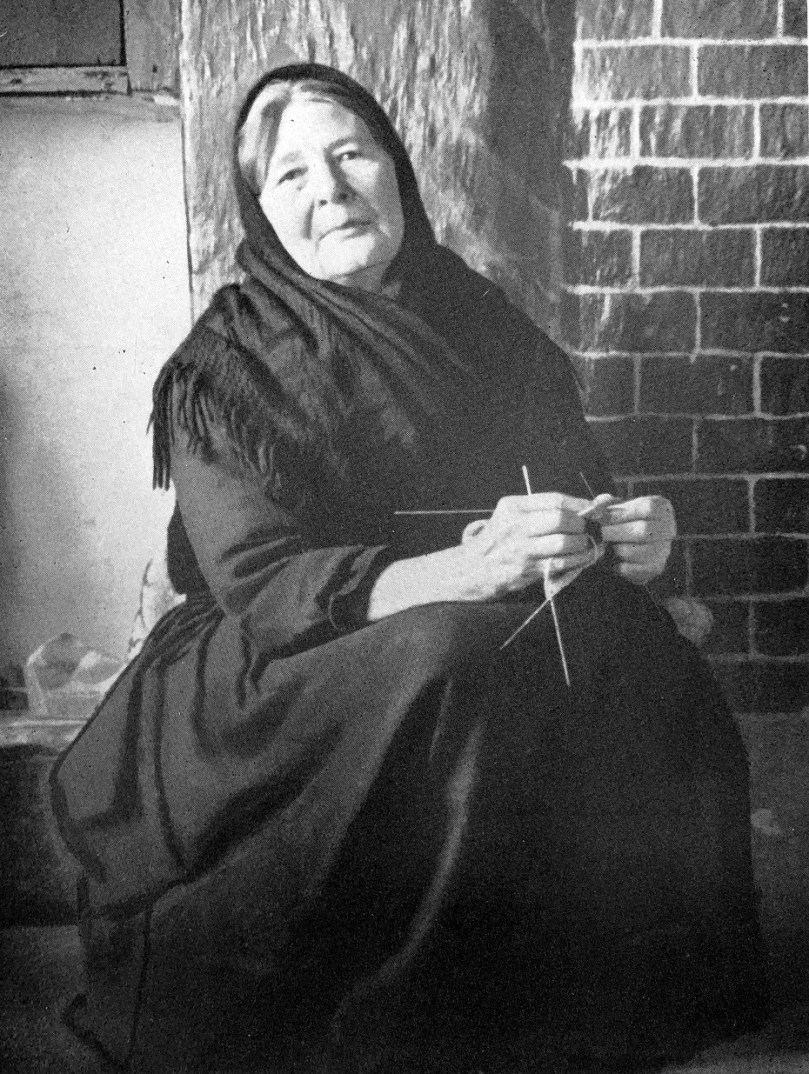
That’s how Robert and I found ourselves driving up into the hills behind Ballybane last month, on his birthday, not quite sure what we were going to find. We knew Liadain Aiken Knitwear by some standards fitted the definition of ‘cottage industry’ so perhaps at the back of our minds we couldn’t get rid of that famous image of Peig Sayers knitting by her fireside.

An Muircheartach’s iconic photograph of Peig Sayers, one of the many Blasket Island story-tellers

But what we found was far from Peig – this is modern cottage industry, one that harnesses the power of the internet for distributed manufacturing and online marketing and sales. Liadain is charming, and strikingly attired in her own knitwear, but she is no amateur. With a degree in interior design and further qualifications from the Grafton Academy in Dublin and Knit-1 Studio in Brighton, she is the director and designer for her own team of knitters, many of whom work from home. On her website she says, ‘I strive to create lively and joyful garments that will be cherished for years.’ This kind of statement is music to Robert’s ears.

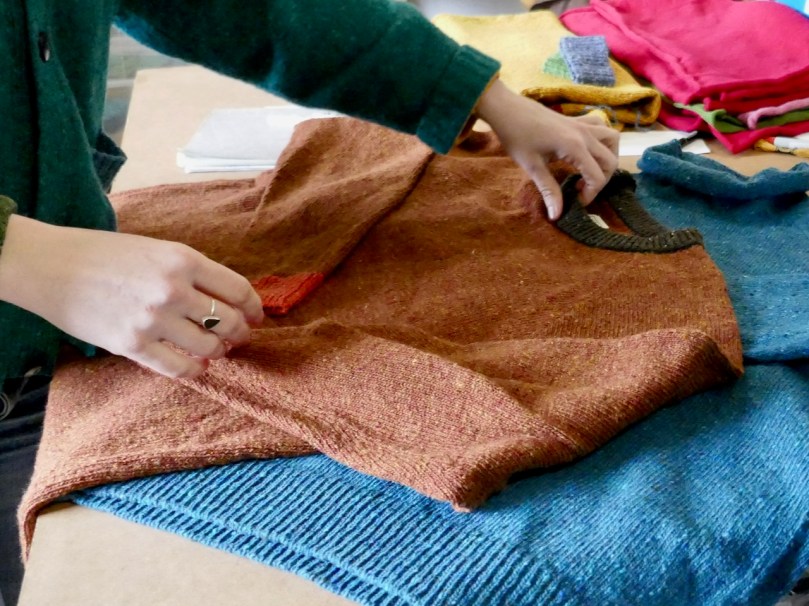
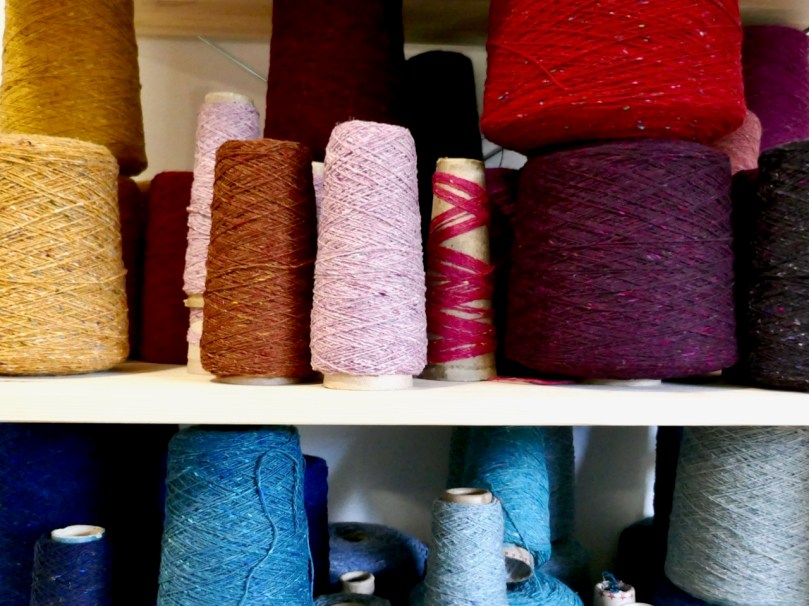
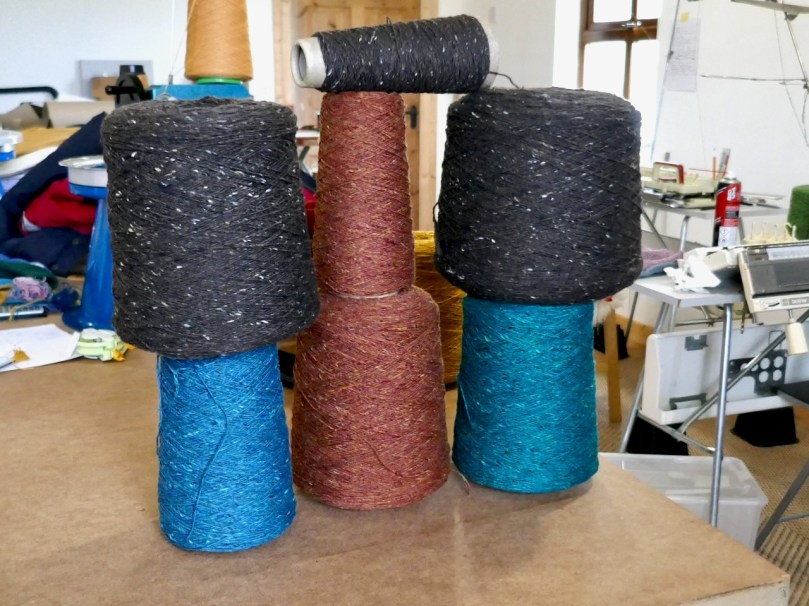
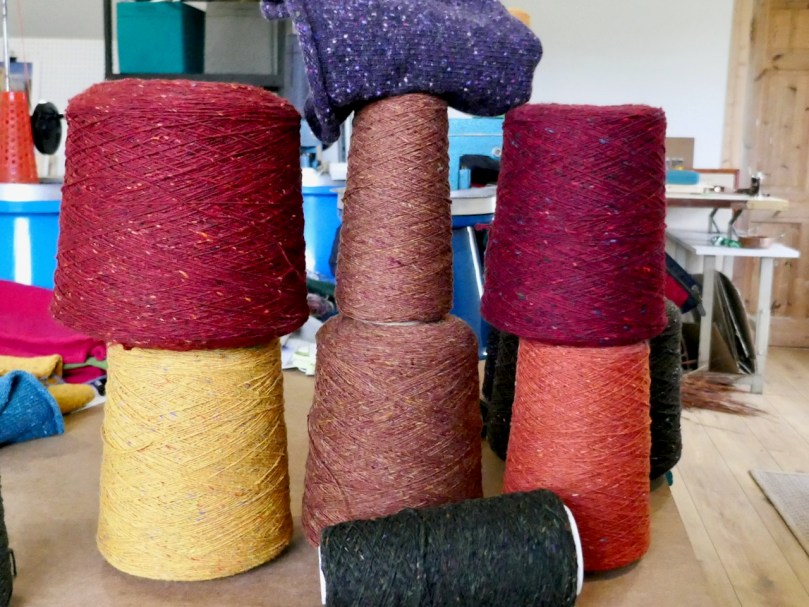
Although the jumper was a gift from me, Robert got to choose the colours and what followed was a fitting and selection session as it turned out that what really appealed to him was to incorporate as many different colours as possible into the one jumper. (I think he might have a Pied Piper complex but don’t tell him I told you that.) He started off with the selection above and ended up with the one below.

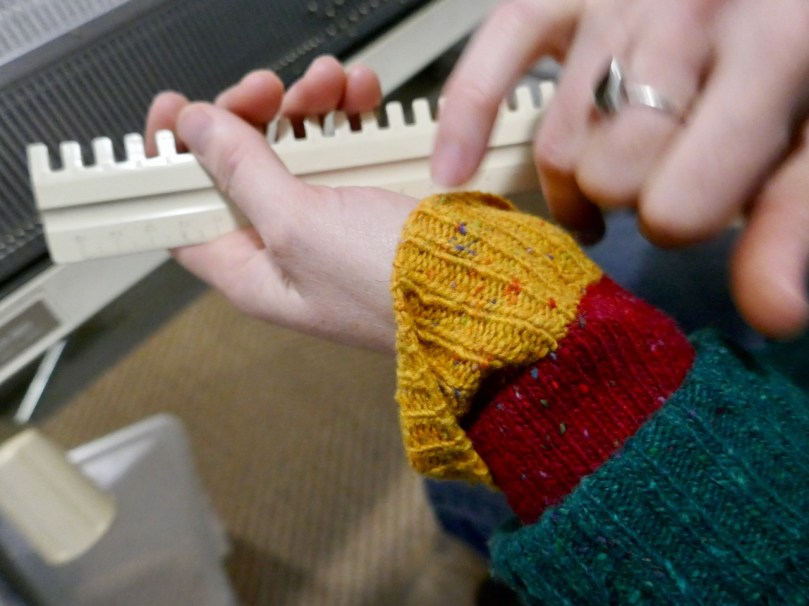
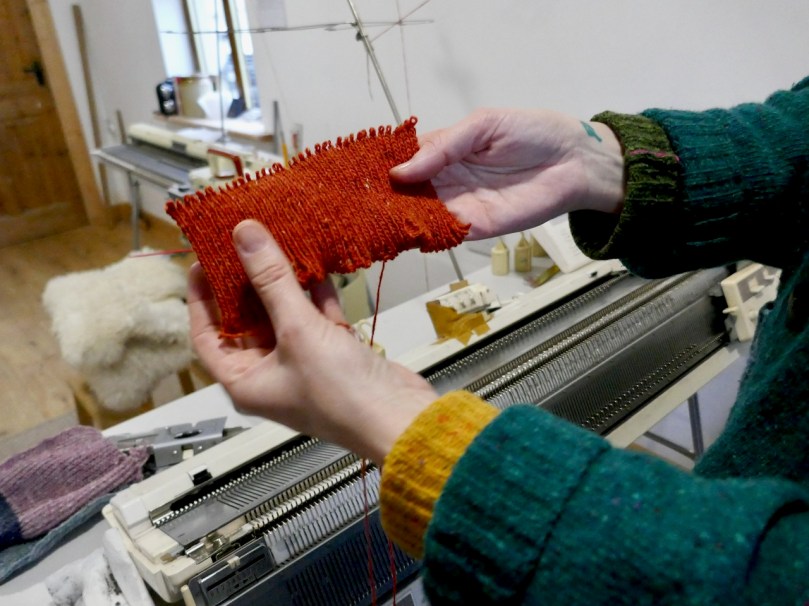
In the process Liadain explained her working methods to us and showed us how a jumper such as this, in multiple colours, is knitted and assembled. She made it look easy but it was obvious that this is a highly-skilled and complex process.

The jumper arrived this week, in the midst of our Coronavirus lockdown, and Robert loves it! I strongly suspect he would sleep in it if he could. You will see it, I predict, in many future posts.

It’s made from pure merino wool from Donegal Yarnstake a look at their website to see the pride they take in producing these beautiful flecked yarns. Of course, a made-to-order product like this is more expensive than an off-the-rack purchase, but both of us loved the process of buying it and see it as a long-term investment piece. As they say here in Ireland, it will ‘see him out.’ 

Liadain is currently catching up on back-orders and designing new products so it’s not possible to order in her shop at the moment. But if you’d like more information, sign up for her newsletter or get in touch with her. If you’re on Instagram or Facebook, follow her there.

Thank you, Liadain – this is a great jumper and a very happy customer! 

Living in Lockdown!

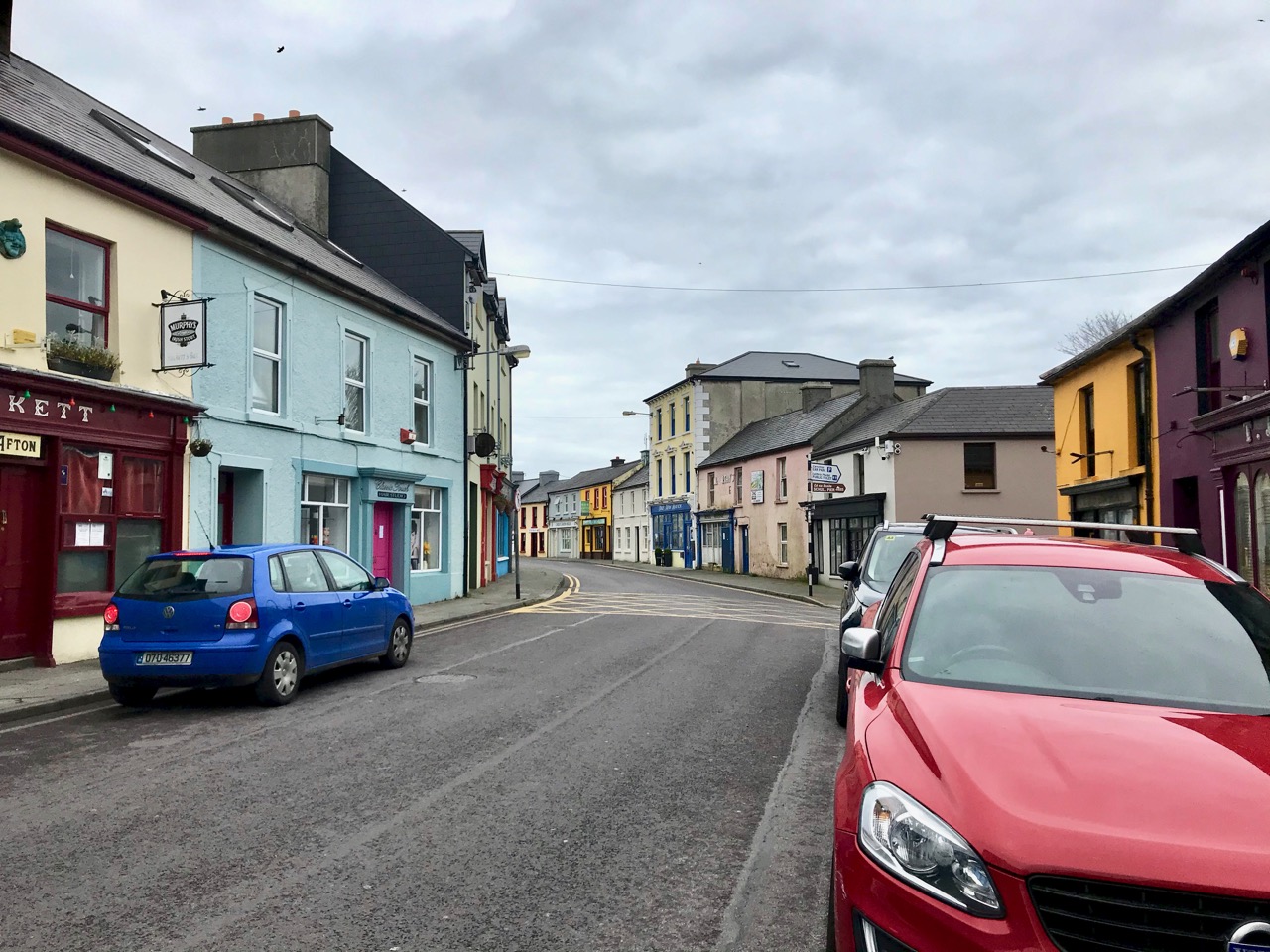
Main Street, Ballydehob: 4 April 2020. You’ve never seen it like this before on a Saturday morning. We are only out because we have urgent shopping to do. We are permitted to go to the shops, the dispensary and the dump (we live too far out of town to have any waste collections). Oh, and we can exercise within a two kilometre radius of home (here’s Finola’s account of that). It’s a strange life – but we are gratefully alive…

We completed our last ‘long’ walk on Friday 27 March – to the summit of Mount Corrin, for my Mizen Mountains post. On that evening the government announced the ‘lockdown’ and we are now isolated in Cappaghglass for the foreseeable future, although the 2km restriction will allow us to trespass into our adjacent townlands of Stouke, Cappanacallee, Foilnamuck, Rossbrin, Ballycummisk and Kilbronogue, provided we keep our distance from other walkers. We see very few.

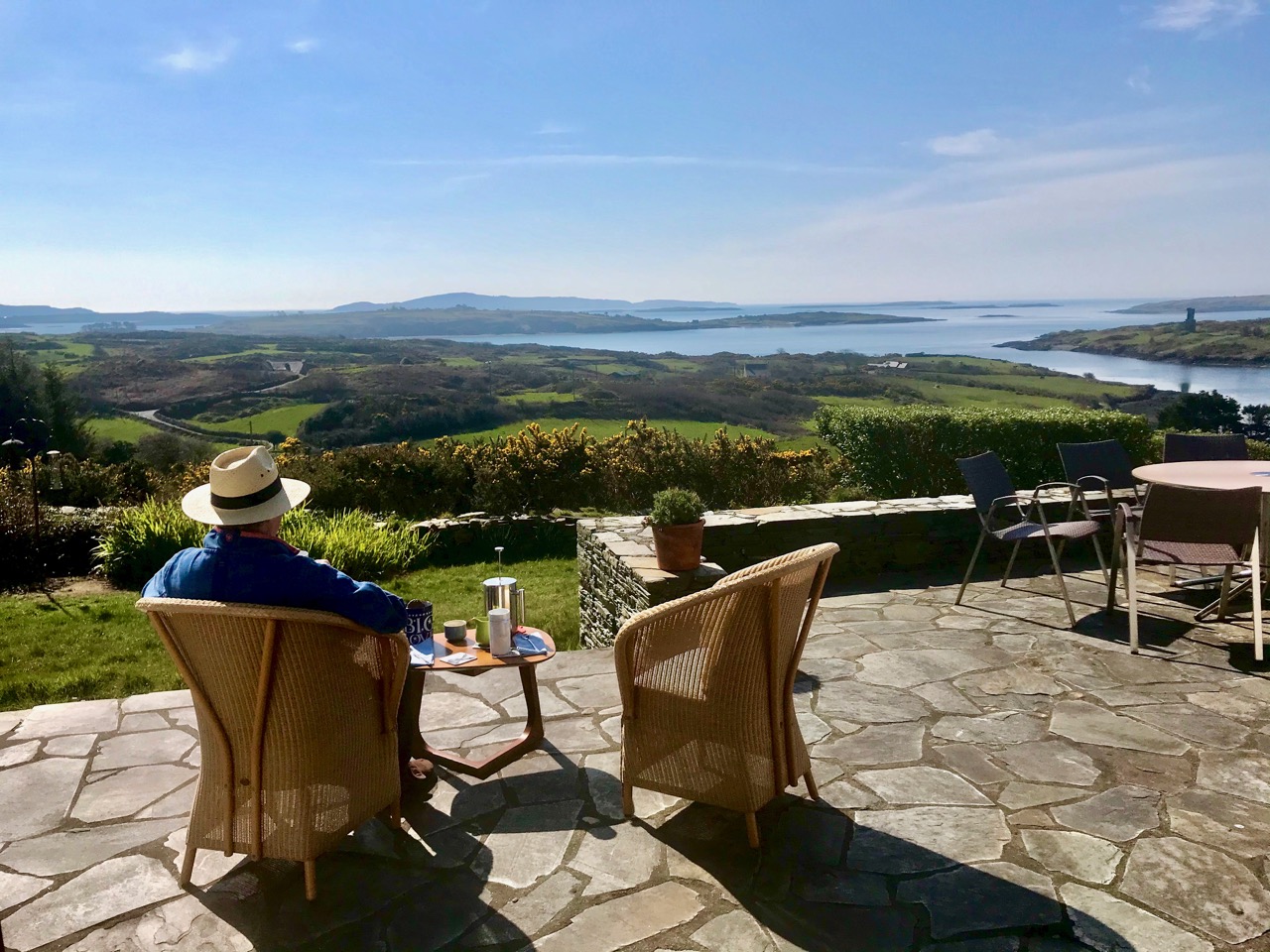
When the sun is shining, there’s no better place to be than home – looking out over Roaringwater Bay! We have plenty to occupy us. Not least, keeping up with this journal and my new venture Swantonstown Sessions – compensation for the enforced adjournment of the weekly traditional music meetings in Ballydehob. It’s an online forum for sharing tunes, songs and related ‘chat’. Please join in!

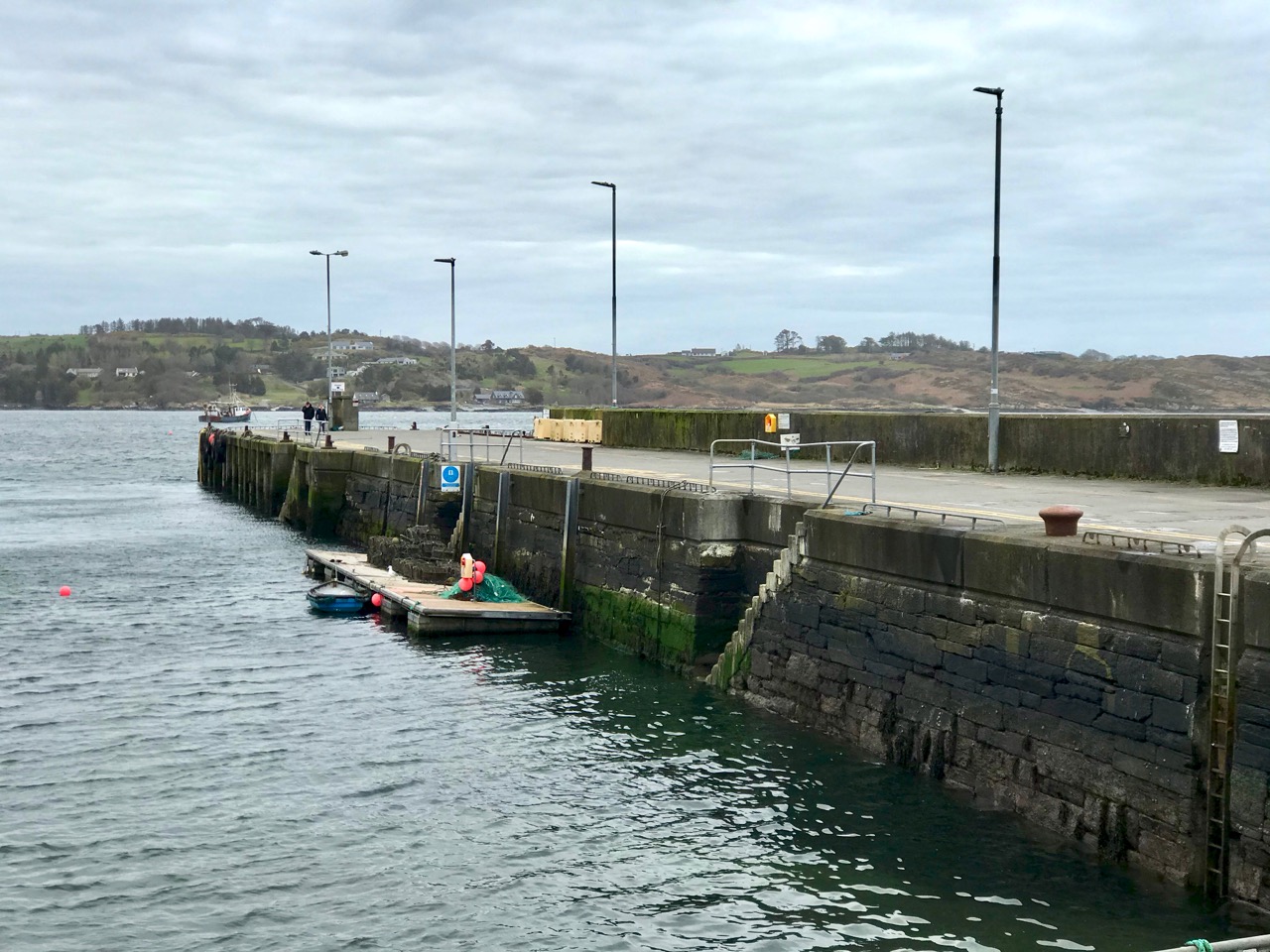
There’s not much activity in Schull, our other centre for essential supplies, either. The main street (upper) and pier (above) are deserted on Saturday morning, when it’s normally buzzing. All the businesses in our villages and towns rely on customers: we hope for their sakes (and ours) that the situation doesn’t last too long, although we do all understand how necessary the restrictions are.

Join us for one of our walks – along to Rossbrin – to look at the water and the always changing scenery as spring gets under way. That’s the boreen leading down to it, above.

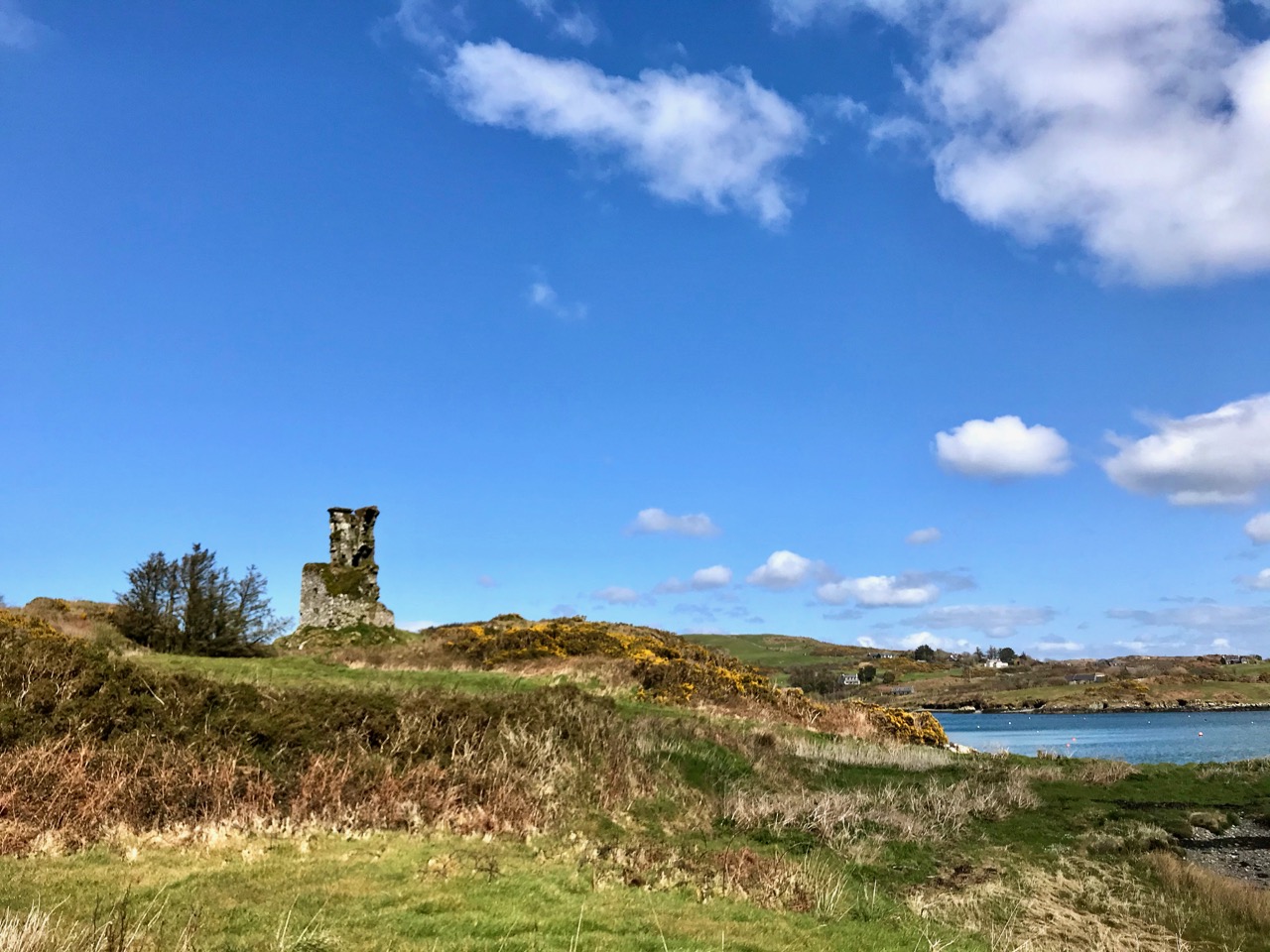
Rossbrin Castle, the home of the ‘Scholar Prince’ Finghinn O’Mahony in medieval times, is the local landmark which always draws us towards the Cove. It has stood for centuries, although very gradually returning to nature: parts of it will remain for generations to come, and will intrigue those who chance upon it, as I first did some thirty years ago. It is on private land, remember, but it can be seen from many accessible vantage points.

It’s no hardship to be ‘marooned’ out here in rural Ireland. The one thing we miss above all else is meeting and chatting with friends and neighbours: that’s unnatural. But we will survive it. After our walks there’s always the road home to look forward to (do you see the celandines lining the way?):

Roaringwater Journal wishes to heartily thank all those in our communities who are supporting the rural population through these abnormal times: medical teams, pharmacies, shopkeepers, producers and suppliers . . . All who keep our facilities and utilities going . . . They are helping us to stay healthy and upbeat in times of disquiet. We appreciate all of you.