Baby Jumping

eurospar

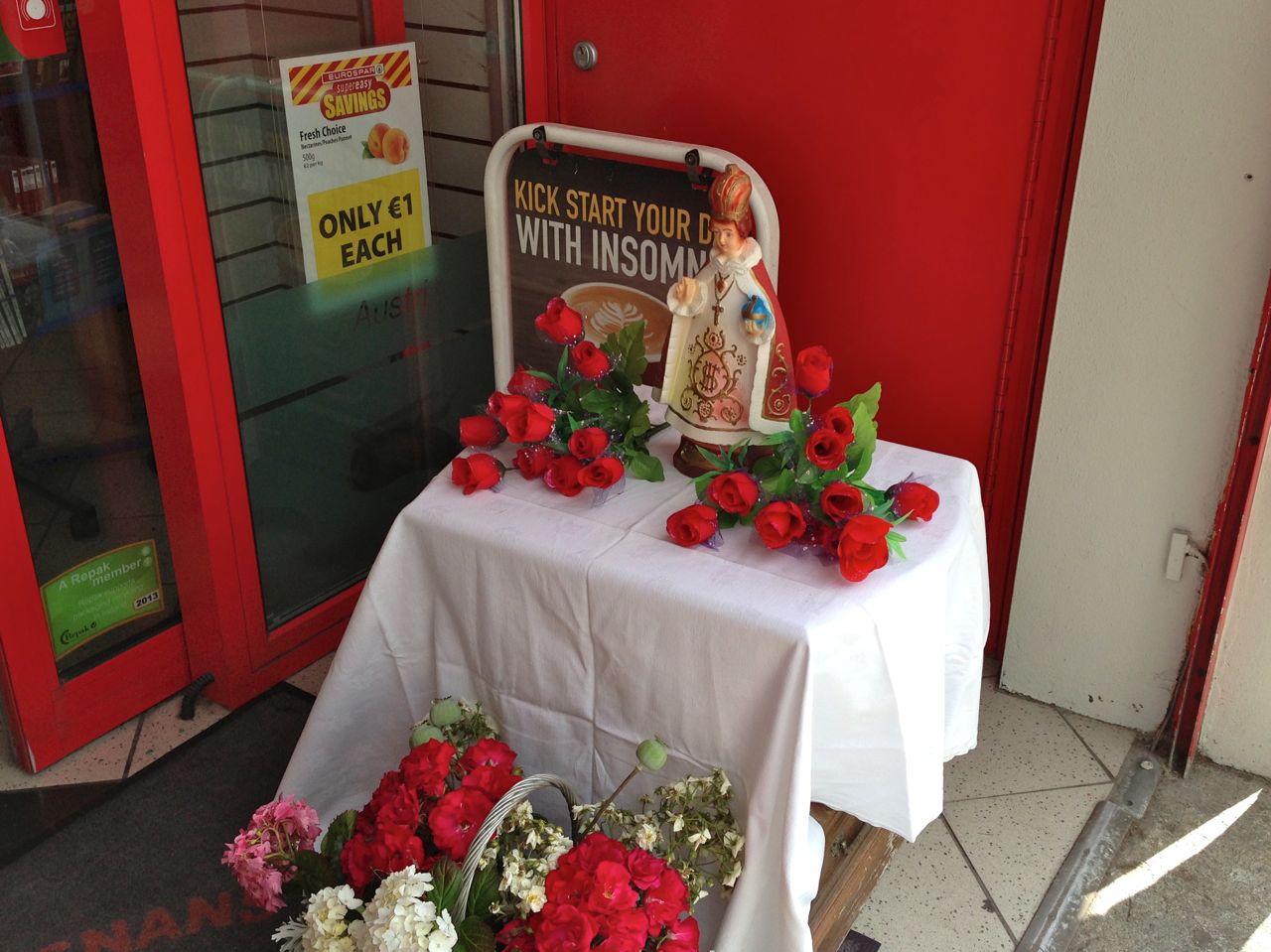
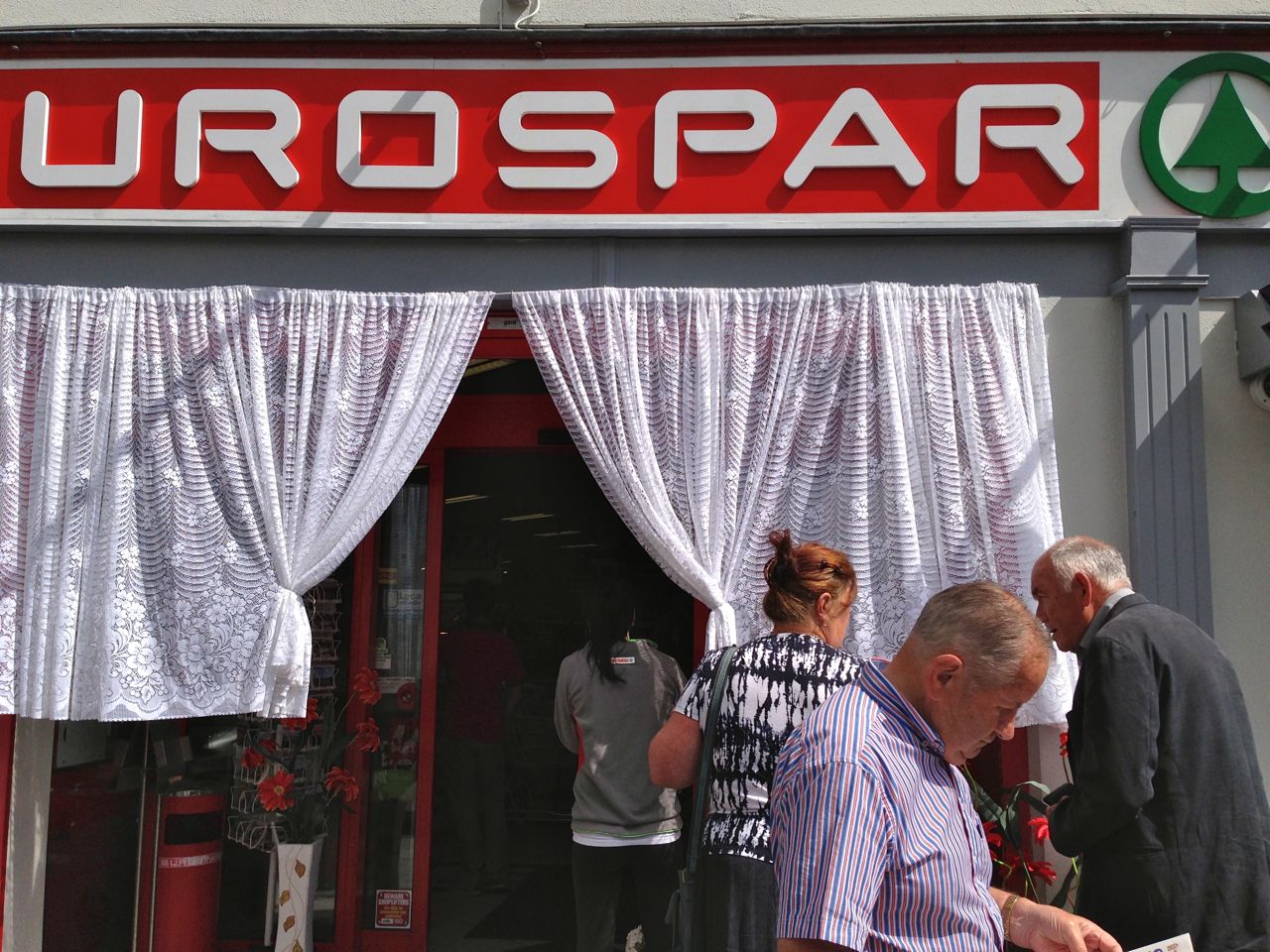
There was something odd about the Eurospar in Schull when we went to get our paper this morning…

Tell me.

There were lace curtains across the doors – on the outside!

A new decorating fashion for Schull? It’s a trendy place you know.

table

street

spar

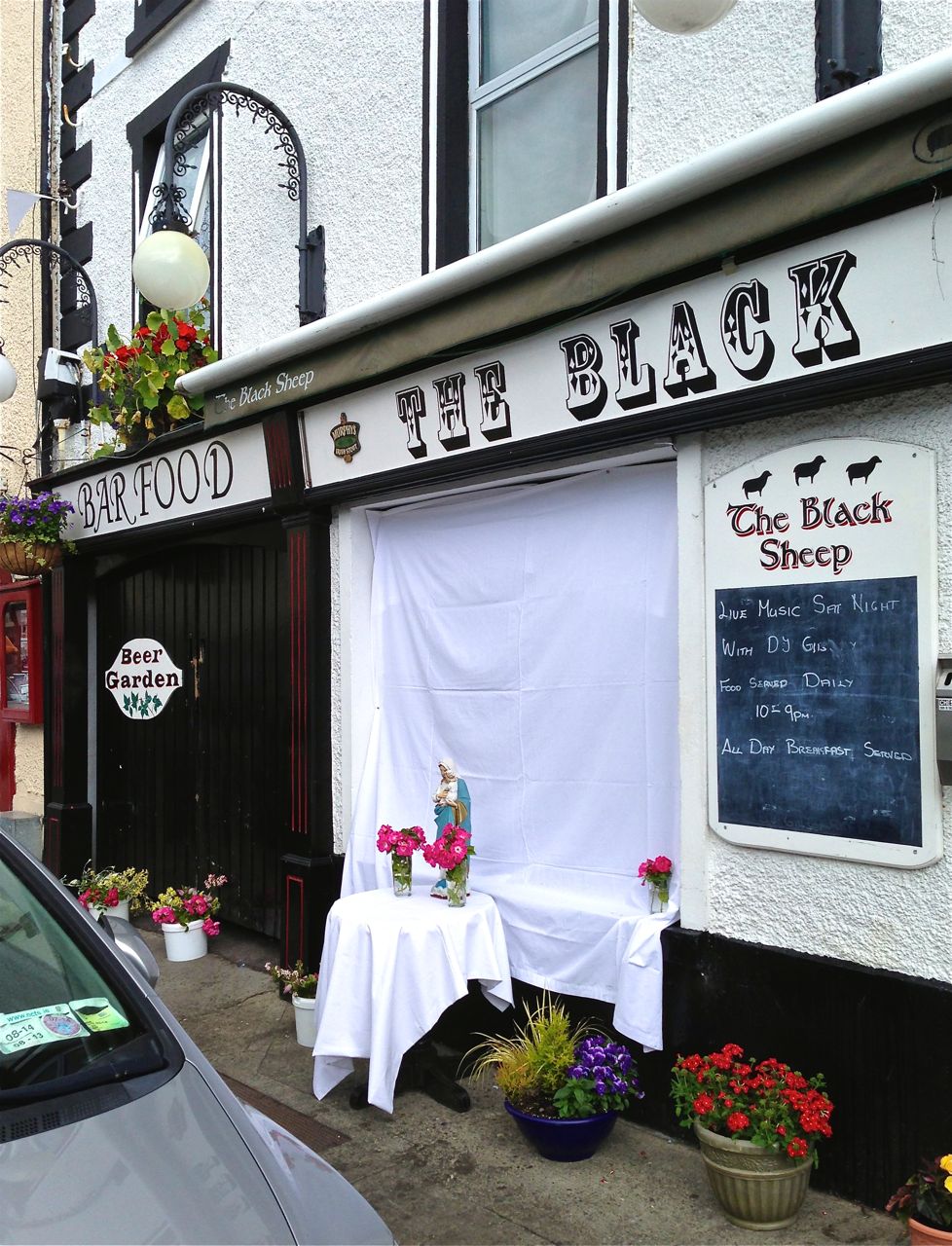
But also a table outside with flowers and an Infant Jesus of Prague statue on it… And similar treatments to shops and pubs all down the street.

Aha! – Religious connections: is it a Saints Day?

Well it is – by chance – St Peter’s Day, 29 June. But that’s not what this was all about.

How did you know?

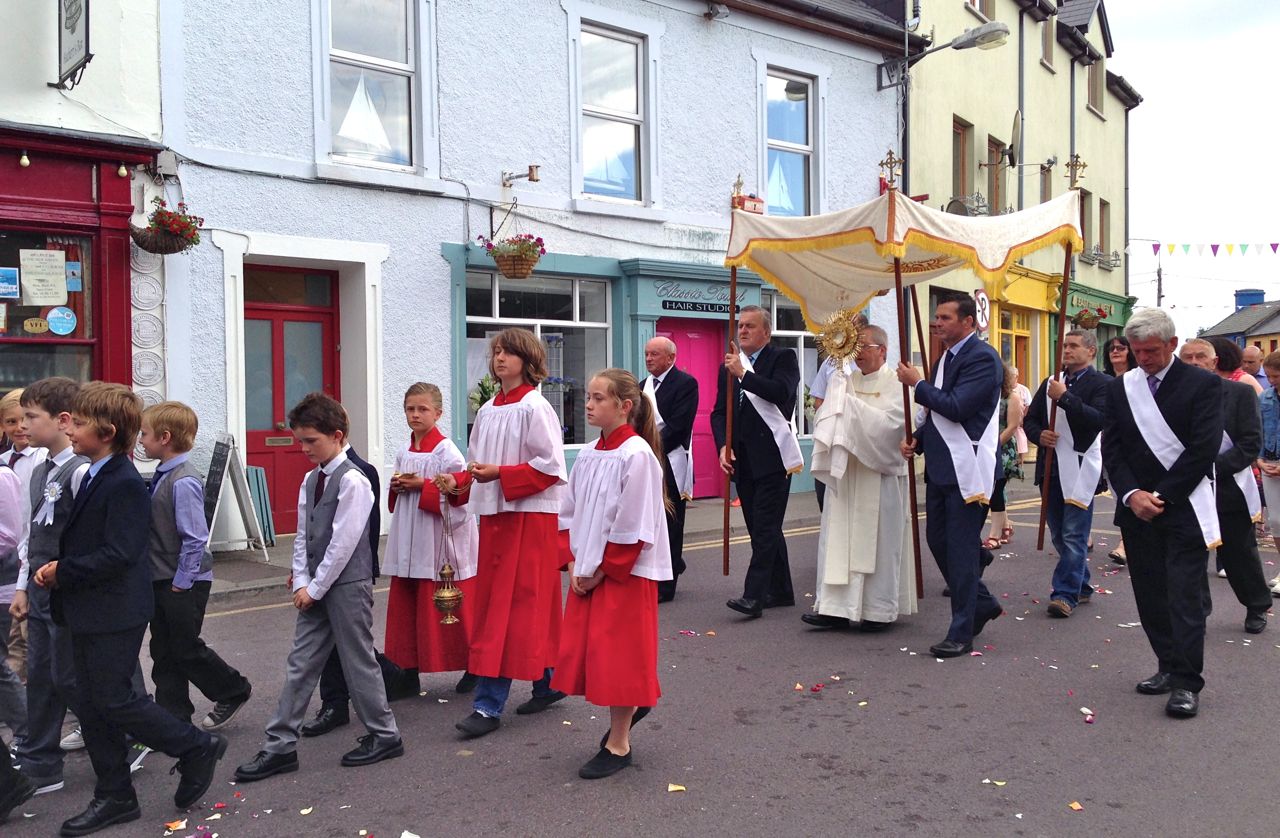
Simple: we asked someone on the street, and they told us that there was going to be the annual Corpus Christi procession.

procession

leadingcanopy

petals

Oh! Isn’t that a big thing in other countries?

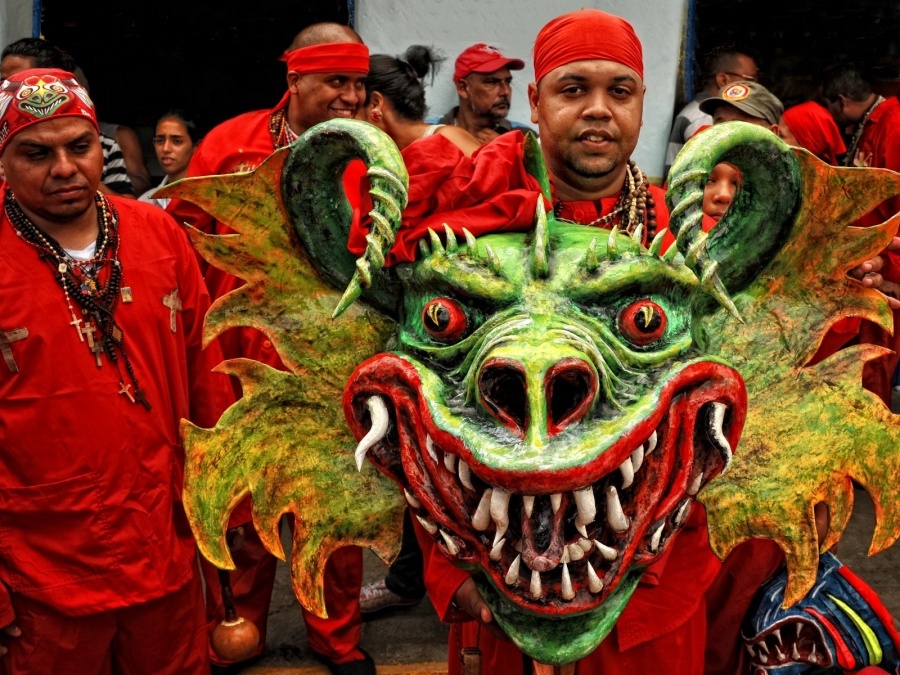
There are certainly some exotic examples – take a look at the Dancing Devils of Yare in Venuzuala… It is a custom originally frowned upon by the church as it seems to hark back to African pre-Christian roots. Now it’s brought into the church calendar and on Corpus Christi men dress up as devils, wage battle with each other, and then ‘surrender’ to the Eucharist and are blessed by the priest.
davil

black sheep

Anything like that in Schull?

Not exactly, but the procession is quite singular, going through a busy Irish street on a sunny Sunday morning. I counted about 200 people, with mainly men at the front, then women, then children, many of whom were dressed in their First Communion finery, and were scattering flower petals all across the road. At the back was the priest, walking under a decorated canopy which was carried by men in suits and white sashes; the priest was holding up the Monstrance…

You’ll have to explain that to me.

monstrance

Monstrance – from the Latin monstrare – to show: it’s ‘…the vessel used in Roman Catholic, Old Catholic and Anglican churches to display the consecrated Eucharistic host during Eucharistic adoration or Benediction of the Blessed Sacrament…’ The symbolism is a sunburst, the source of all life, which in the Christian tradition is represented by the Body of Christ – Corpus Christi.

sun

Is all this rooted in something more ancient than Christianity?

Well – apart from the sun symbolism – probably not. The feast was promulgated by Juliana of Liège, Belgium, who was born in the 13th century and became an Augustinian nun and, eventually, Prioress of her convent. She experienced a recurring vision of the bright full moon which was flawed by a dark spot or stripe. She believed that the moon symbolised the Church, which was flawed by the absence of a liturgical feast for the adoration of the Eucharist. She spent much of her life petitioning for such a festival but did not see her hopes realised: she died in 1258. Her work was not in vain, however, as in 1264 Pope Urban IV instituted the feast of Corpus Christi.

So this year sees the 750th anniversary of Corpus Christi?

Yes it does. But it’s a movable feast, relating to the date of Easter – theoretically it should have occurred this year on 22 June but Schull obviously has other ideas.

So it seems. Now, I see you’ve called this post Baby Jumping….

jumping

You are very observant! Well, I can’t resist mentioning this traditional Spanish holiday dating back to 1620 that takes place annually to celebrate Corpus Christi in the village of Castrillo de Murcia. The custom is known as El Colacho, and men dressed up as devils jump over babies born during the previous year who are lying on mattresses in the street.

El_colacho_saltando

Why?

The Brotherhood of Santísimo Sacramento de Minerva organises the festivities which culminate when the ‘devils’ jump over the babies on the mattresses placed on the procession route traversing the town. It is said that this cleanses the babies of original sin, ensuring them safe passage through life and guarding against illness and evil spirits. Pope Benedict evidently wasn’t impressed by the custom and asked Spanish priests to distance themselves from El Colacho. As he put it, ‘…the Church teaches that it is baptism by water, not a giant leap by an airborne devil, which cleanses the soul…’

How did that go down?

According to a report this year ‘…The festival is still a vibrant tradition replete with musical processions through the village with El Colacho chasing the young and old, and teenagers in lederhosen dancing an Irish jig…’

Something Schull could consider perhaps?

spectators

Perhaps. But in the meantime have a look at this curious but highly entertaining Pathe News clip from 1941 showing a Corpus Christi procession in Bandon, not very far from here.

http://www.britishpathe.com/video/corpus-christi-procession-1
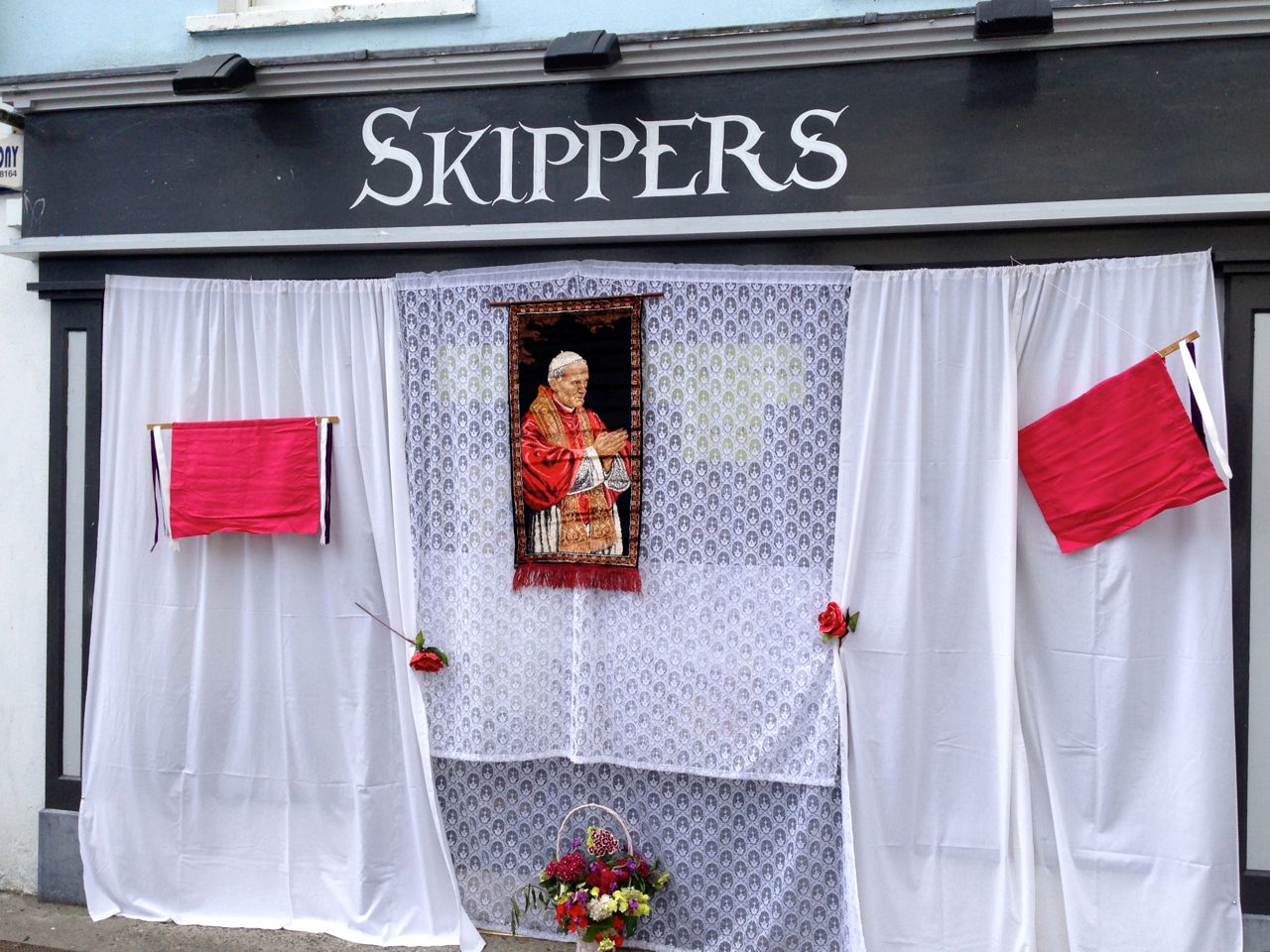
skippers

After the Procession

After the Procession
 

Mount Gabriel

Trails over Mount Gabriel

Trails over Mount Gabriel

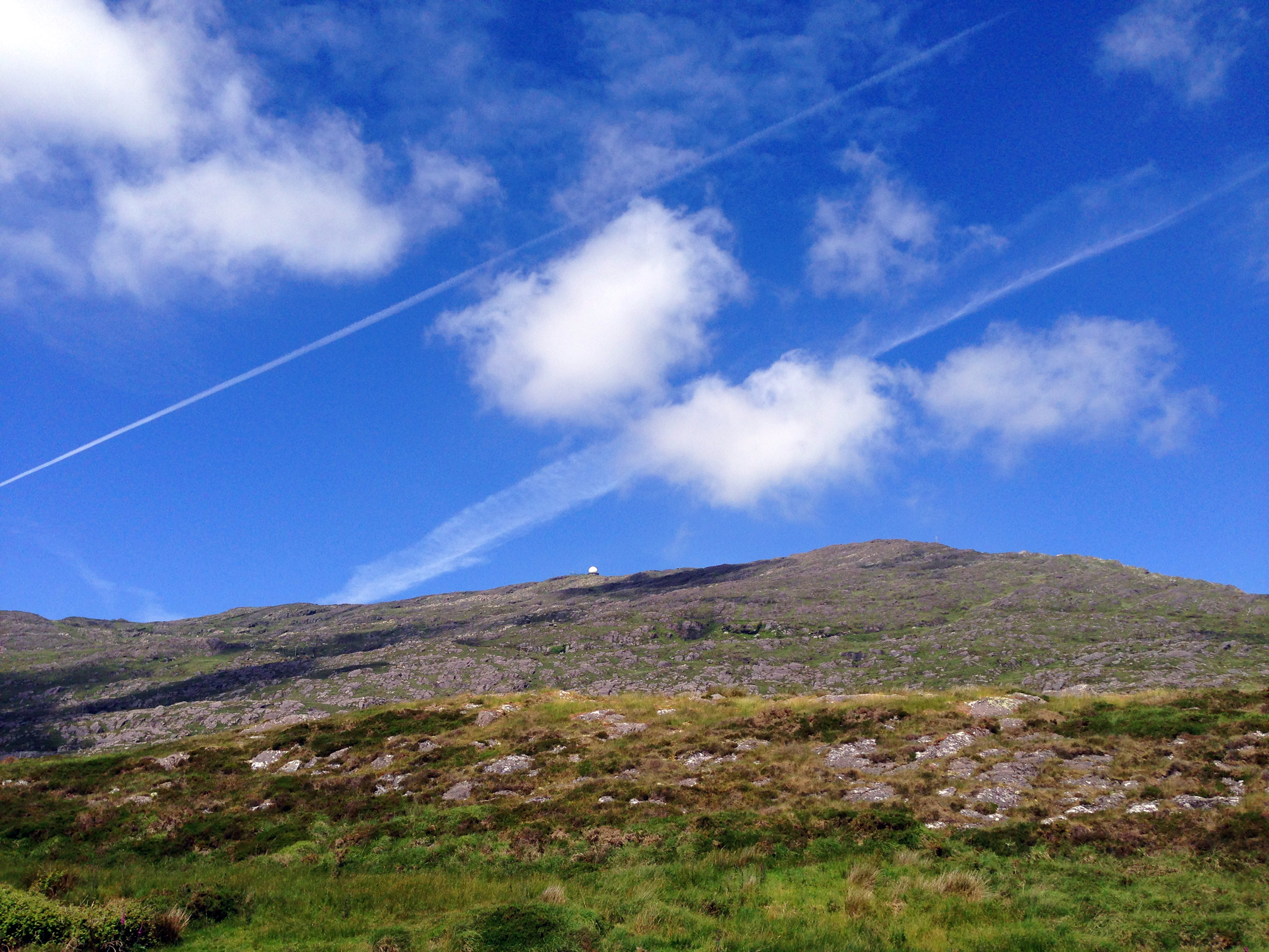
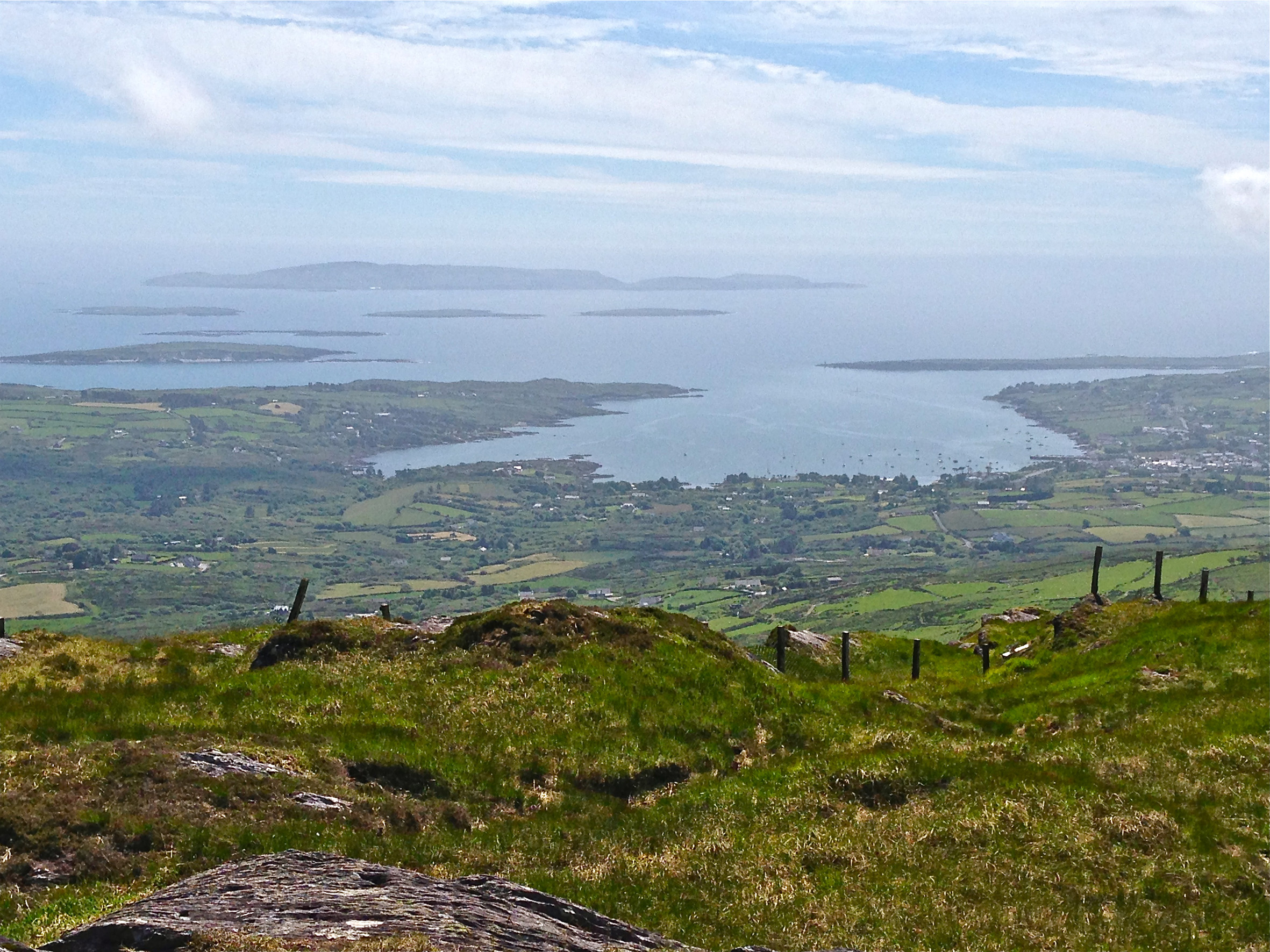
Only a few kilometres from Nead an Iolair – as the Crow flies – sits Mount Gabriel: at 407m elevation it’s the highest piece of land in West Cork. Cork mountains are dwarfed by those from Kerry: McGillycuddy’s Reeks has the highest peaks in Ireland, at over 1,000 metres. However, our own local mountain is nevertheless impressive and on a good, clear day provides a view not to be missed – to all points of the compass.

Looking west to the Mizen

Looking west to the Mizen

I spent a while researching why a mountain in the west of Ireland should be called Gabriel. There is no received opinion about this. I suppose there’s no reason why it shouldn’t be named after the Archangel himself: after all, we have Croagh Patrick (after St P) and Mount Brandon (after St Brendan) and many others: Ireland’s landscape is alive with place-names having religious connections, although such associations are likely to be fairly young. In Irish the mountain is Cnoc Osta – possibly ‘hill of the encampment’ – so there’s no clue there.

Roaringwater Bay

Roaringwater Bay

I did find this fascinating piece from the Church of Ireland Magazine, dated 1826 – written by John Abraham Jagoe, Vicar of Cape Clear …where I have no protestant parishioners… and Curate of Schull …where interspersed amongst moor and mountain, I have fifteen hundred Protestants, to visit and oversee… It’s well worth a verbatim extract:

‘…amidst these everlasting hills arose, in peculiar prominence, Mount Gabriel. Why, my lads, said I, is yonder mountain called such an outlandish name; one would think it was brought here by Oliver Cromwell, it has such an un-Irish – such a saxon name. O! says Pat, it is a pity that the blockhead is not here to tell the gentleman the story about this, for sure and certain such poor garcoons as the likes of us know little, and care not the tail of a herring for such old stories. And who, said I, is the blockhead? O, says my friend, the blockhead is an old man living up on the mountain, who, from his great memory, his knowledge of cures for cattle, charms against fairy-struck people, experience in bleeding, acquaintance with legends about the good people, the Milesians, and Fin McCoul, is called far and near, the blockhead.

My dear fellow, will you tomorrow bring me to that man; I would pilgrimage over all the hills in Cork and Kerry to get into chat with him: says I to myself, this is just the man that I want. Ah my good friend, do bring me to the blockhead to-morrow. Why yes to be sure, – but stay, can you speak Irish? Not a word, to my sorrow be it spoken. Well then go home first and learn Irish, for Thady Mahony can speak no other language. – Well boys, can none of you (as I cannot get it out of the blockhead) tell me about Mount Gabriel; O! yes, Sir, says Pat Hayes, my Godmother used to tell me it was called after the Angel Gabriel, who came, you know, from Heaven to deliver the happy message of mercy to the Virgin – ever blessed be her name. And so on his return, as he was flying back, he looked down upon Ireland, and as he knew that in time to come, this honest island would never part with the worship and duty it owes to the Mother of God, he resolved to take a peep at the happy land, that St Patrick was to bestow for ever on the Virgin. So down he came, and perched on the western peak of that mountain; the mark, they say, of his standing is there to this day, and his five toes are branded on the rock, as plain as if I clasped my four fingers and thumb upon a sod of drying turf; and just under the blessed mark, is a jewel of a lake, round as a turner’s bowl, alive with trout; and there are islands on it that float about up and down, east and north and south; but every Lady-day they come floating to the western point, and there they lie fixed under the crag that holds the track of the Angel’s foot…’

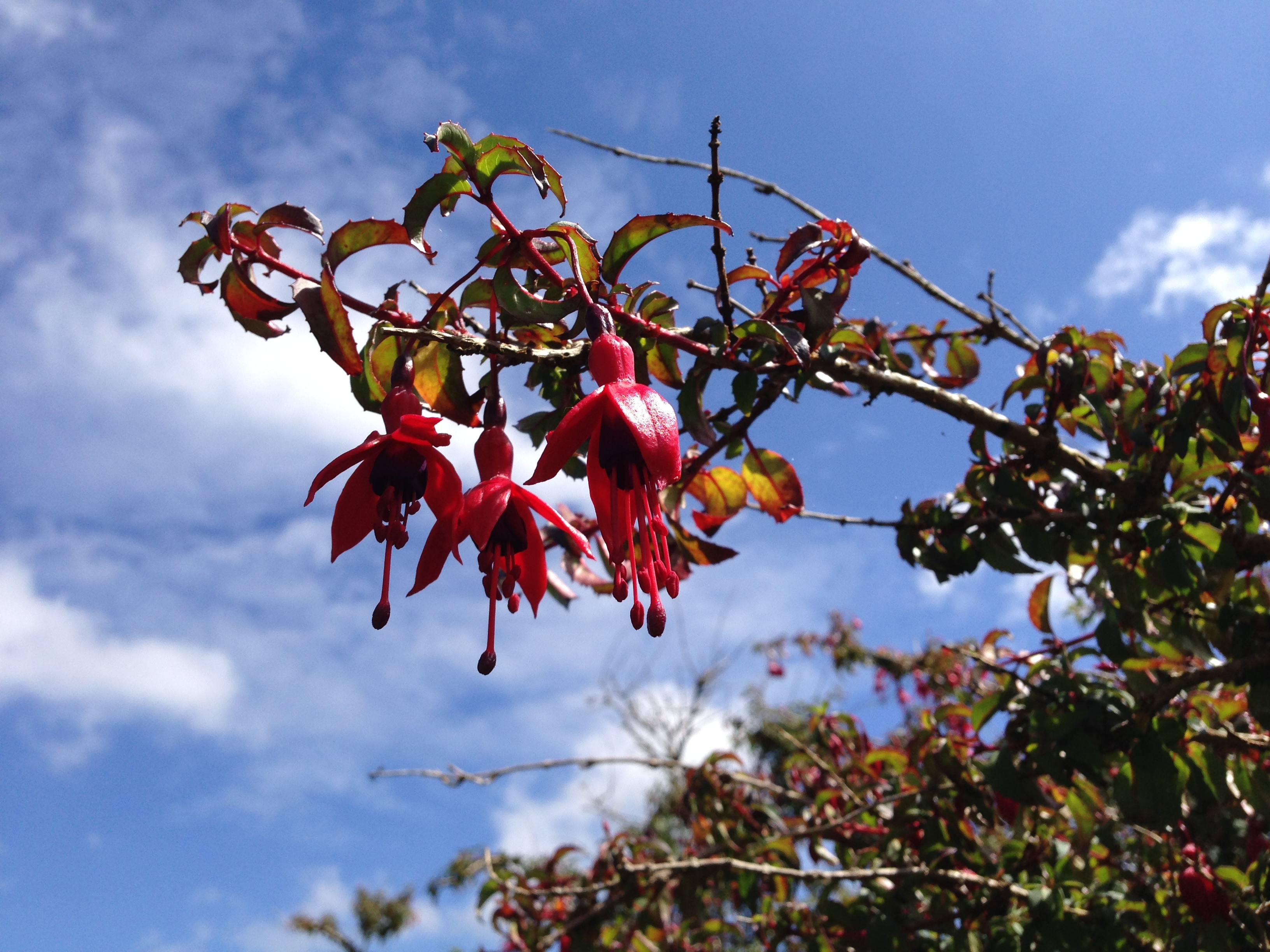
Hidden Glen Fuschia

Hidden Glen Fuschia

Well, there’s enough in those few lines to keep us going on field trips for some time to come! We did find, on the western slopes, a beautiful hidden valley holding the ruins of a one roomed cottage. I have convinced myself that this must have been the dwelling place of the blockhead Thady Mahony, who may once have been the keeper of all the secrets of the mountain. But we have yet to find the jewel of the lake with its trout and its miraculous floating islands, notwithstanding the Archangel’s footprint…

View from the summit

View from the summit

One other possibility for the name is a corruption of the Old Irish Gobhann – which means smith, as in a metal smith. Remember Saint Gobnaitt? She was the patron saint of ironworkers (blacksmiths) and her name is supposed to be rooted in Gobhann. There is also a Goibhniu in Irish mythology: he was the smith of the Tuatha De Danaan and forged their weapons for battle with the Formorians. So – Gobhann, Goibhniu, Gabriel…? Too much of a leap of faith? But it is known that Mount Gabriel was the site of extensive copper mining a few thousand years ago – remains of pits, shafts and spoil heaps can be seen:  so perhaps there just could be something more ancient inherent in the name.

golf ball

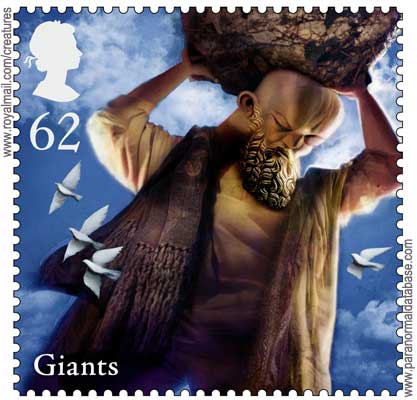
There is mythology attached to the Mountain: the Fastnet Rock was torn from the slopes and thrown into the sea by a giant; once we were searching for a piece of Rock Art within sight of the mountain and the landowner assured us that the carved stone had been thrown there by Finn MacCool (we didn’t find it).

giant stamp

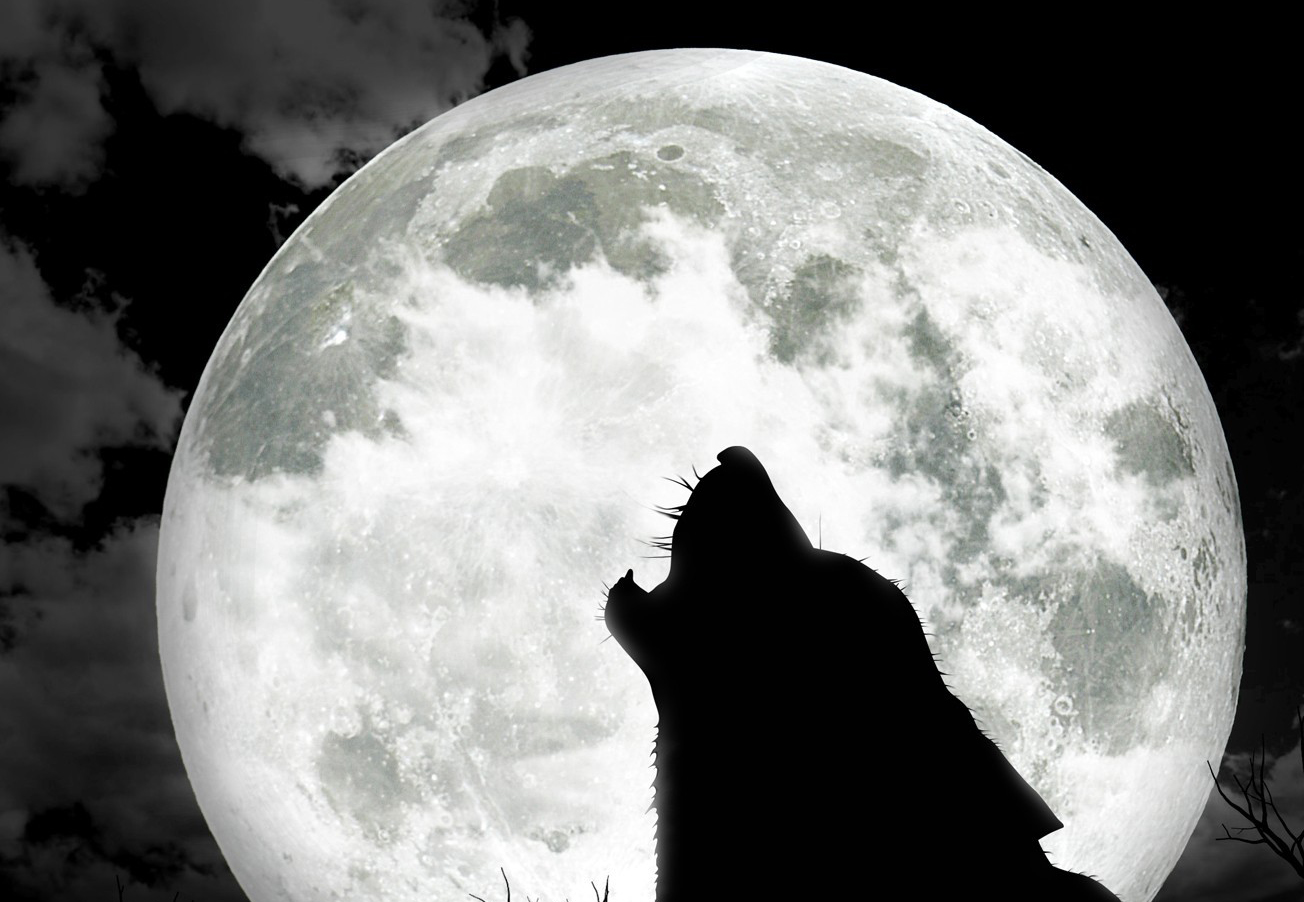
The story about Mount Gabriel that most captures my imagination is the suggestion that the last Wolves in Ireland inhabited the rocky landscape there back in the eighteenth century (although it’s true that several other places make the same claim). Until that time Wolves were commonly seen in the wilder parts of the land and feature in local stories and folklore. Interestingly they were often portrayed in a positive way and were sometimes companions of the saints. There are very few records of Wolves having maimed or killed humans, yet in 1653 the Cromwellian government placed a bounty on them – 5 pounds for a male Wolf, and 6 pounds for a female: worthwhile prize money in those days. This encouraged professional hunters and, coupled with the dwindling forest habitats, the fate of the animal was sealed.

grey wolf

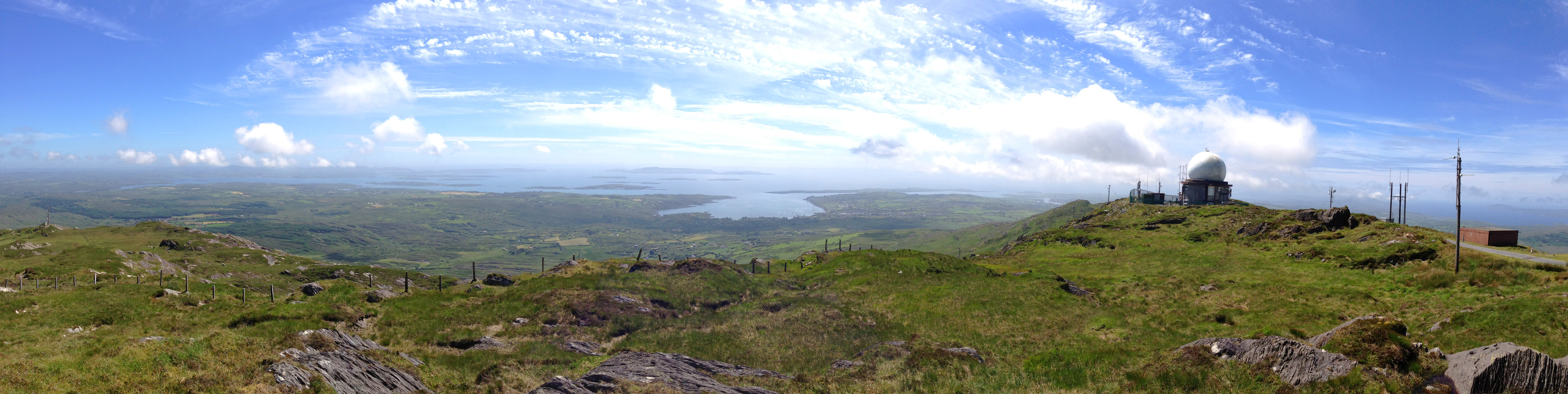
Mount Gabriel today is relatively benign, although it still has its remoter parts. The Irish Aviation Authority has kindly provided a road up to the summit, where sit the distinctive ‘golf ball’ radar domes and aerials of an Air Traffic Control installation. From these heights we can see Rossbrin Cove, Ballydehob, Schull and all the islands of Roaringwater Bay set out in a magnificent panorama – on a clear day.

iaa

Aerials and view to the north

Aerials and view to the north

Modern events have affected the mountain: a German plane crashed here in 1942, and in 1982 the Irish National Liberation Army bombed the radar station, believing that it was providing assistance to the North Atlantic Treaty Organisation, allegedly in violation of Irish neutrality.

IMG_3573

For us the mountain is a landmark and, like most of our view, its profile changes with the weather on a daily – perhaps hourly basis. As a repository of archaeology, human history, lore and nature Gabriel provides a rich resource.

Gabriel

Gabriel

The Fastnet Short Film Festival

Our Village is Our Screen Schull has been getting ready for this Festival for months. Everyone we know seemed to be volunteering or involved or just, like us, planning to cram in as many films and events as they could. The town was freshly painted (yes – the whole town! Well, it seemed that way), banners and streamers flapped gaily along the main street, and cinemas popped up everywhere. The church hall became The Adelphi, Hackett’s Bar became The Carleton and Grove House turned into The Palace. You see – Schull doesn’t have an actual cinema!

But lack of facilities has never stopped a West Cork town intent on hosting a world-class festival. They have come up with the most ingenious method of screening and watching that you can imagine. For the duration of the Festival, the films are hosted on a server and the whole village becomes an intranet. While the main programme runs at the Adelphi, all the pubs, cafes, shops and premises on the intranet have large screens where you can watch the movies. Some are playing the ones on the programme, and others are hosting re-runs so you can catch up on what you’ve missed. You can sit with a coffee and a scone, or a pint and a sandwich and watch whatever’s on screen. You can drop in and out, all for free. But there’s more: you can bring your own device – computer, tablet, phone – and log into the intranet and watch on a park bench, or sitting in your car, or while shopping, if you want. The marvellous Whyte Books hosted a story telling session, and The Blue House Gallery got in a load of bean bags so you could lie on your back and watch movies on the ceiling.

Robert, Chris O'Dell (Festival Artistic Director) and young Austrailian filmmaker Jake Zappia

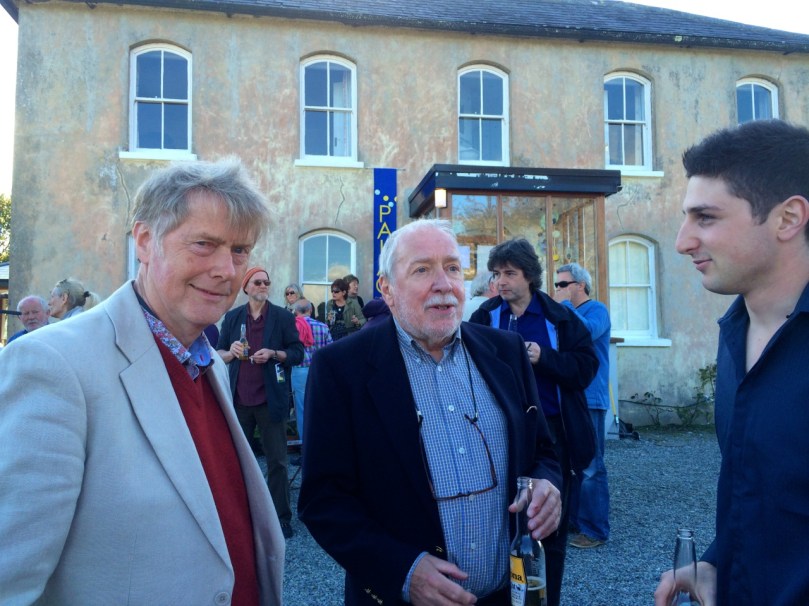
At the Opening Reception: Robert, Chris O’Dell (Festival Artistic Director) and young Austrailian film maker Jake Zappia

The opening party was at Grove House – the sun shone, much Corona was downed (the generous Festival sponsor), and then it was off to The Adelphi for The Lord’s Burning Rain, filmed in West Cork and based on the Aeneid – a coming of age story with echoes of Ireland’s War of Independence, the effects of which still resonate in this area. This was followed by a Q and A with the filmmaker, Maurice O’Callaghan, hosted by the excellent John Kelleher. With our Canadian visitors in tow (Alex and Mavis, enjoying it all hugely) we took in some shorts the next day in Newman’s restaurant and that night attended the second featured film, Living in a Coded Land. The Q and A session afterwards was enjoyable and stimulating – the director, Pat Collins, expounded on his vision and his influences, and the host, Aidan Stanley, drew him out with thoughtful questions and directed traffic as audience members got into the conversation.
Our most unusual experience of the festival came on Saturday. We took the ferry to Long Island and watched movies in the bedroom of a beautiful island house courtesy of the owners, Maurice and Helen. Long Island has a year round population of under ten people. A local film maker, Helen Selka, has made it her focus. Although we didn’t get to see her longer piece, Bleak Paradise, we watched a shorter one called The Polling Station. In the film, nothing much happens beyond a handful of people coming to a cottage to cast their ballots in a referendum – and yet it was funny, charming and poignant. We also watched one of the eventual Festival winners – a closely observed tragicomedy called Breakfast Wine. The set finished with a gut-wrenching, wonderfully conceived and acted piece called Stolen. I was glad I brought along kleenex for this one. 

There were celebrities to meet (David Puttnam, Steve Coogan and the team from Philomena, Stephen Frears), events for children, lots of technical sessions for the hoards of young filmmakers invading Schull for the festival, and forums and clinics on all kinds of topics. But mostly there were the films – in turn quiet, ambitious, animated, provocative, amusing, youthful-but-showing-potential, soulful, well-written, cleverly directed, beautifully shot. They left us marvelling that powerful stories with fully realised characters can be told in a few precious minutes.

Superlatives fail me – especially when I think that this was all accomplished by a dedicated group of volunteers! Well done indeed Schull and the Fastnet Short Film Festival Team!

A Little Adventure

Arderrawiddy a Portal Tomb

Aderrawinny – a Portal Tomb

The landscape of West Cork is so densely populated with archaeology and historical sites that it will be a lifetime’s work to visit every one. Whenever the sun shines – and often when it doesn’t – we are out exploring. A great resource for us is the Archaeological Survey Database, set up by the National Monuments Service of Ireland. This lists and describes every site in the Republic which has been recorded to date – and it is expanding all the time. I have to say that the way it works in practice is slightly clumsy: you have to know which County and which Townland you are searching in, but once you have got your head around it it is fairly straightforward to locate a record. One of the really good things about it is that you can see the position of each record laid over the modern Ordnance Survey mapping of Ireland, or historic 6″ and 25″ maps – and even over satellite views of the terrain: all this makes locating the sites relatively easy, although it doesn’t help overcome bogs, barbed wire fences and seemingly impenetrable undergrowth.

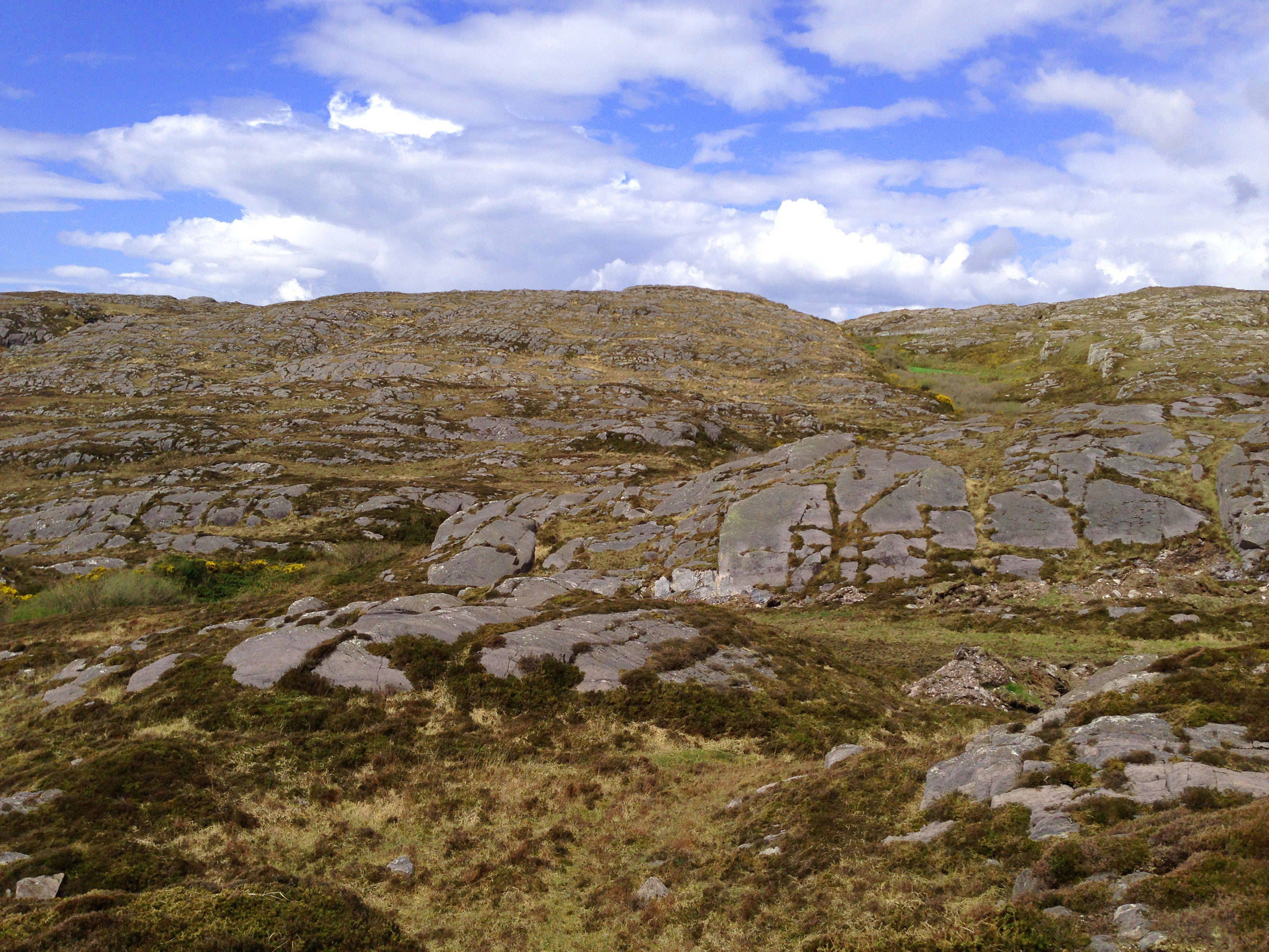
Prehistoric Landscape West of Schull

Prehistoric Landscape West of Schull

We have been researching Megalithic tombs, and there are many of these on the Mizen Peninsula. On Sunday last we compiled a list from the Survey Database, donned our boots, filled up our flasks and went out to tackle the wild unknown…

View from Arderrawiddy

View from Aderrawinny

Our first stop was in the townland of Aderrawinny – a Portal Tomb. The site is shown north of the Schull to Goleen road, up in a rocky hillside. In spite of having looked carefully at the maps it wasn’t easy to locate precisely, but I find you begin to get an instinct about these things and we headed off expectantly across boggy land and through painful patches of gorse and bramble, pausing frequently to examine every outcrop for undiscovered Rock Art. Eventually our travails were rewarded when we crested a low ridge and found ourselves looking down on a lonely construction created perhaps 5,000 years ago. It’s a humbling experience to think of the history which has befallen our ancestors during those millennia: through it all this little monument to humanity has survived with little change, eternally pointing its entrance to the movements of the sun and having always in its sight the distant blue waters of Toormore Bay. The landscape, also, has changed so little, apart from the minor interventions of agriculture. This is what makes the west of Ireland such a special place – for me, at least.

5,000 year old Monument

5,000 year old Monument

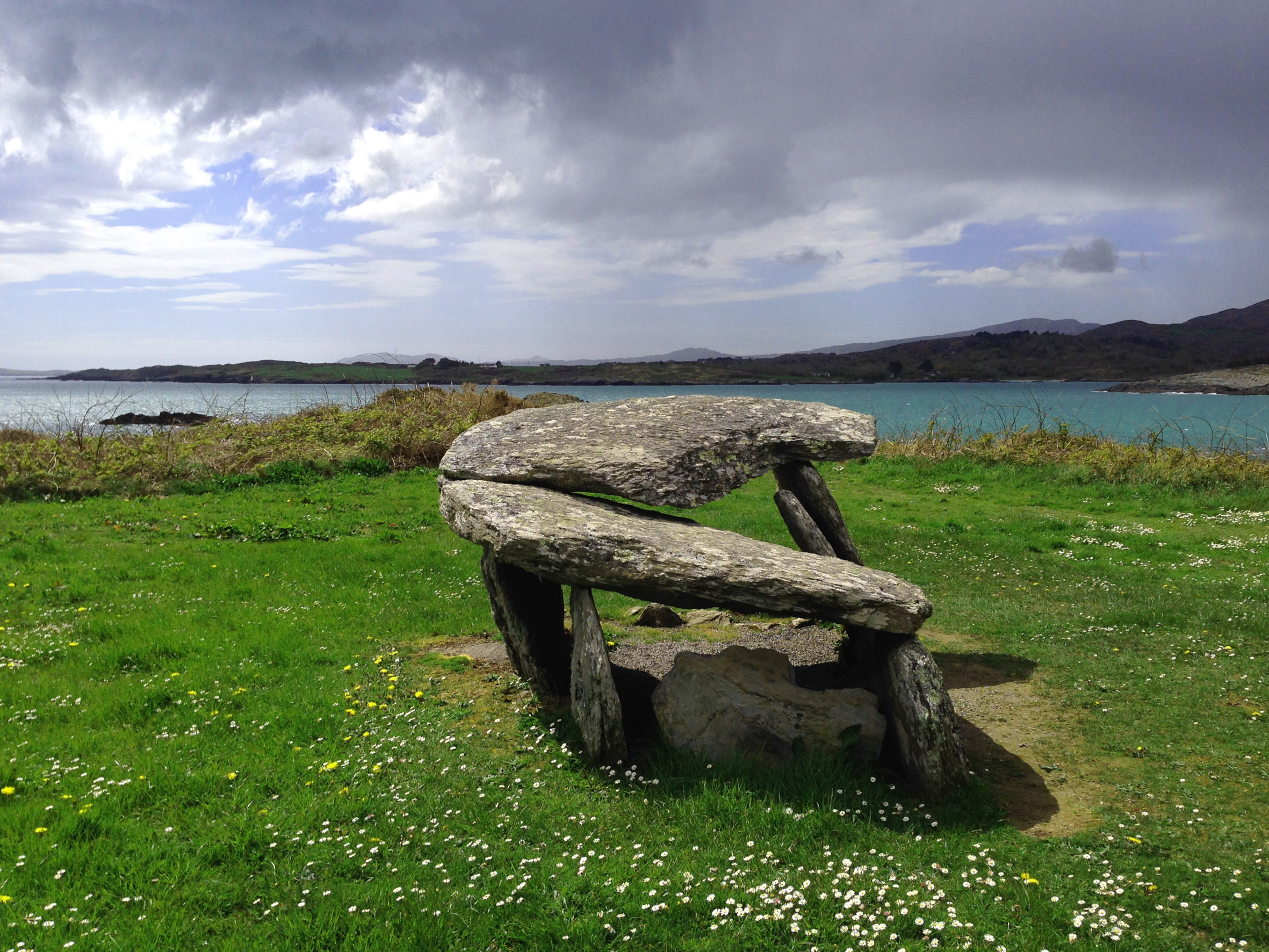
We travelled on, passing by the well known and well signposted Altar Tomb, a Wedge Tomb which is constructed so that the setting sun around Samhain (November) is aligned with a holy peak at the far end of the Mizen.

Altar Wedge Tomb: Sacred Orientation

Altar Wedge Tomb: Sacred Orientation

We found another Wedge Tomb near Goleen: this has been ‘domesticated’ because somebody’s garden is built around it: it has to share its presence with chicken runs and a wheelbarrow.

Back Yard Wedge Tomb

Back Yard Wedge Tomb

Lastly, we searched out another type of tomb: a Boulder Burial. This lies almost drowned in a salt marsh near Dunmanus. Since the time of its construction water levels are reckoned to have risen by up to two metres. It reposes like some great amphibian reptile on a watery bed, as dramatic in its own way as any of the other Megaliths.

Drowning Monument: Boulder Burial at Dunmanus

Drowning Monument: Boulder Burial at Dunmanus

These hillsides, mountains and monuments will outlive humankind. Interesting to ponder whether something we have created in our own lifetime could still be around and – for all we know – still performing its original function in 5,000 years’ time…


The Southern Star

Banner

There’s so much going on here in West Cork. You could be out every night if you wanted to be, and  participating in as many community events as there are hours in the day. How do we keep up with it all? Easy – The Southern Star. It comes out every Thursday, and features a pull out Community section that details all the news from the towns and villages around West Cork. Births, baptisms, deaths, marriages and engagements are announced, and be-gowned university graduates are pictured with smiling parents.

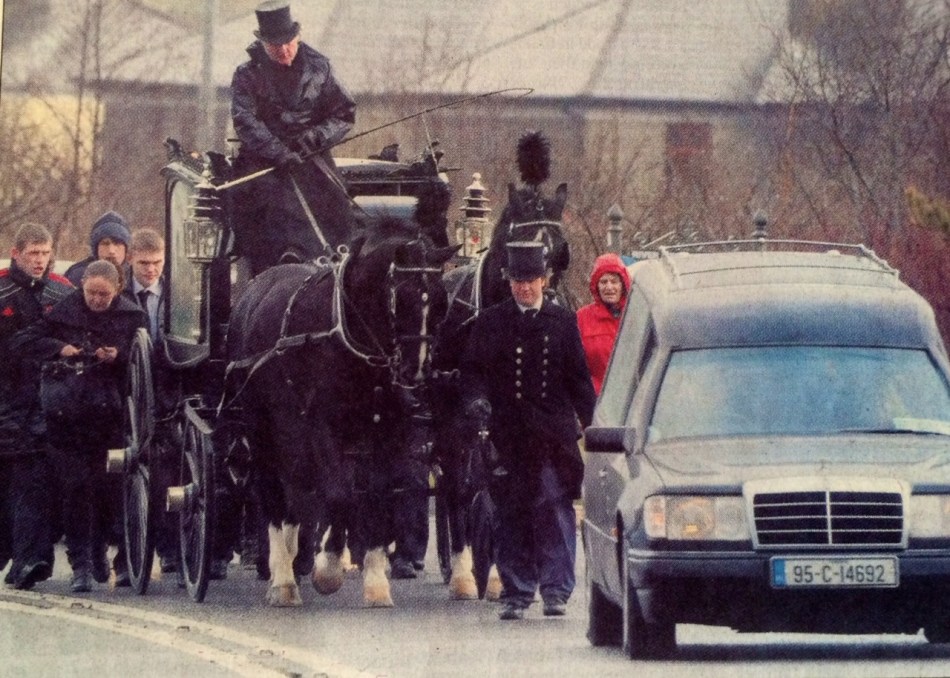
Recent funeral in Skibbereen

Competitions are legion – sometimes talent-based, and sometimes sporting, such as the Clonakilty Blackpudding Car Rally. But rural and farming pursuits such as ploughing competitions or agricultural conferences remind us that we are living in a part of the world that makes it living off the land. Recently a tillage seminar attracted large crowds in Bandon, while another one on calf-rearing had over 300 attendees in Timoleague. Cheval rides are often pictured – horse treks for charity from town to town or across golden beaches. A farmer recently put out an appeal for a missing cow:

The animal made good its escape from a farm in Jagoe’s Mills, Belgooly, on Friday, January 17th. The animal may be suffering from memory loss as it was last seen at the racecourse in Farrangalway, before evading capture and taking to the countryside in the Dunderrow area. This is an extremely prized animal.

The farming community has been up in arms recently over changes to the system of government grants known as “Single Farm Payments” and there have been huge turnouts at meetings, protests and rallies.

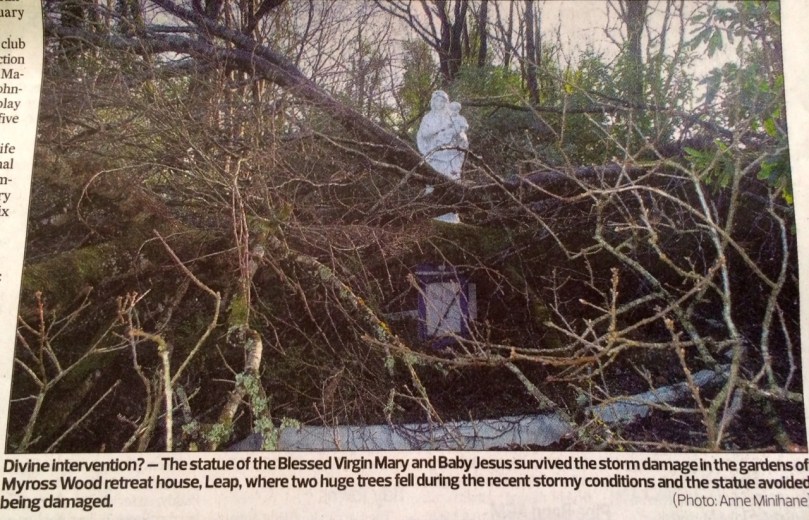
Divine Intervention at Myross

Divine Intervention at Myross

The ebb and flow of village life is chronicled in the Star’s Community pages. ICA (Irish Countrywomen’s Association) meetings are announced and later described. Local businesses close and the village say farewell to a pair of much-loved publicans. Community members gather to clean up a graveyard (…stone walls emerged and tombs reappeared after years of being buried in undergrowth. The little Huguenot chapel was cleared of saplings and briars…) or celebrate the opening of a new playground, to help neighbours affected by the recent awful storms or to hold a St Brigid’s Cross making session in the senior’s housing complex. West Cork people are upset about fluoride in their water and enthusiastic about the Men’s Shed Movement.
Getting news of cultural events

Getting news of cultural events

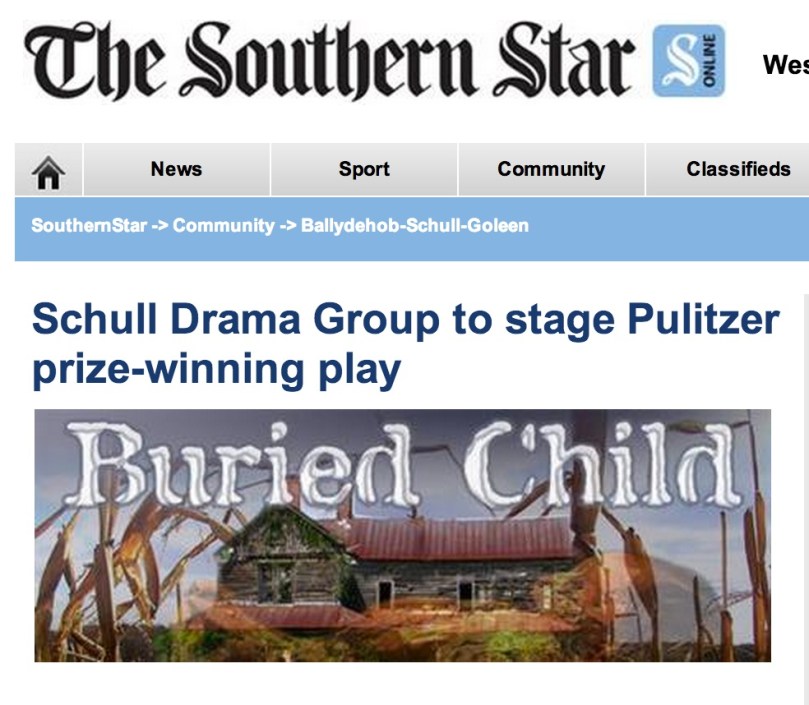
Reading the Southern Star is the only way to find out where Road Bowling events are taking place, or horse races. We comb through it looking for the upcoming meetings of the various Historical Societies, the concerts (from orchestral to traditional), the plays by the local drama groups (this weekend, Sam Shepard’s Buried Child in Schull), and the upcoming festivals. Ballydehob will hold its annual St. Patrick’s Day parade on March 17 (a national holiday here) and the theme this year is to recreate the 1914 Postal Directory of the village. We are witnessing the establishment here of an new national tourism initiative, the Wild Atlantic Way, and local communities are being asked to brainstorm how to get involved.

Daisy contemplates her strategy

Daisy contemplates her strategy

I will finish with one of my favourite recent items:

A Cowpat Challenge takes place at Kilmurry National School on Sunday, February 23rd. at 11am. Daisy the cow is coming to the grassy area in the playground which will be marked out into numbered squares. Whoever owns the square that Daisy decided to deposit the first cow pat into, wins a whopping €1,000.

We are posting early this week as we leave for a trip to Ireland’s west coast tomorrow. We still have no telephone or internet so this is coming to you through the kindness of neighbours who have given us access to their WiFi. Next post in two weeks – spring will have arrived by then. Right?

The Workhouse

The ruins of the Schull Worhouse

The ruins of the Schull Workhouse

Of all the old ruined or abandoned buildings that dot the countryside of Ireland, one type has the distinction of being the most hated – the workhouse. Many have disappeared: most of the West Cork workhouses have been pulled down or completely rebuilt as community hospitals. A few hints remain – a wall here, a shed there. The workhouse in Schull, although in a ruinous state, has managed to maintain enough of a presence to remind us of its former role in the community. Surrounded by a high stone wall, you can still see parts of the administration building where inmates were admitted, remains of the dormitories and the hospital.
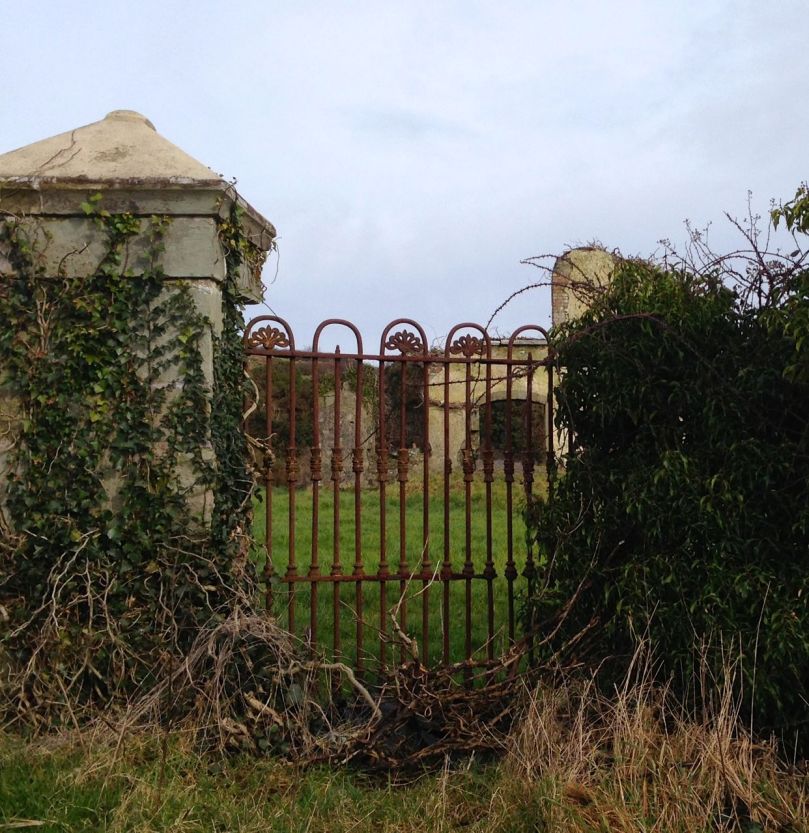
Administration Building and Entrance to the Workhouse
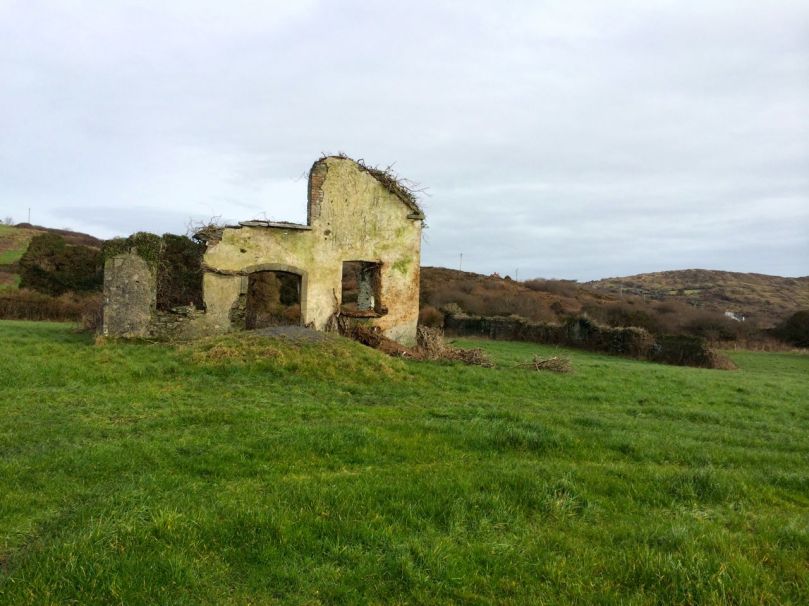
Administration Building and Entrance to the Workhouse

We wander around a lot of ruins here in West Cork, but this one is different. No good feelings emanate from these walls. Instead, an aura of decay and sadness lies thick upon the site. We found ourselves exploring in silence, contemplating the misery that was the inevitable condition of those who entered.

Schull Workhouse Plan

Schull Workhouse Plan

Workhouses were built throughout the nineteenth century in Ireland. The philosophy of charity prevailing at the time dictated that the workhouse must represent the absolute last resort of the desperate – those who could no longer feed, clothe or house their families or themselves. Once admitted, families were separated and might never see each other again. All inmates were assigned hard labour, although some rudimentary schooling was provided for children. There was no comfort, little sanitation, crowded conditions and meagre allowances of food.

One of the most intact spaces

One of the most intact spaces

The Irish Workhouse Centre in Portumna has an excellent website if you want to learn more about the Irish context, but the site that dwarfs all others in the sheer amount of information is The Workhouse: The Story of an Institution, created and maintained by Peter Higginbotham. He makes the point that not all was bad about workhouses, that many workhouses in Britain provided inmates with sanctuary, life-saving treatment and skills. This is not their reputation in Ireland, however, where their memory evokes dread and abhorrence.  Part of this is rooted in their response to the Great Famine of 1845-49. Established to provide Inside Relief many of them initially turned away those who came to the gates asking not to be admitted but to be fed. For those inside, conditions at this time were appalling. As an example, the Durrus History Blog records the report of a Dr Stephens on a visit to the Bantry Workhouse in 1847.

A kitchen, perhaps?

A kitchen, perhaps?

The workhouse in Schull was not built until 1851, in the aftermath of the Famine. It was burned down in 1921 during the War of Independence (there’s an account here), as were many workhouses, to prevent it being used as a barracks by the British army. When the Irish Free State was established, one of the first acts of the new government was to abolish the despised workhouse system and transfer its responsibilities to a new Ministry of Health.

The hospital wing?

The hospital wing?

All Irish workhouses were designed by the same man, to one plan, you can get a better idea of how the Schull workhouse might have looked on the Irish Workhouse Centre website. An exception to this sameness was the Durrus Grainstore, pressed into service as an auxiliary workhouse at the height of the hunger for a couple of years.

Durrus Grainstore. Photo by Amanda Clarke of Sheep's Head Places.

Durrus Grainstore. Photo provided by Amanda Clarke of Holy Wells of Cork