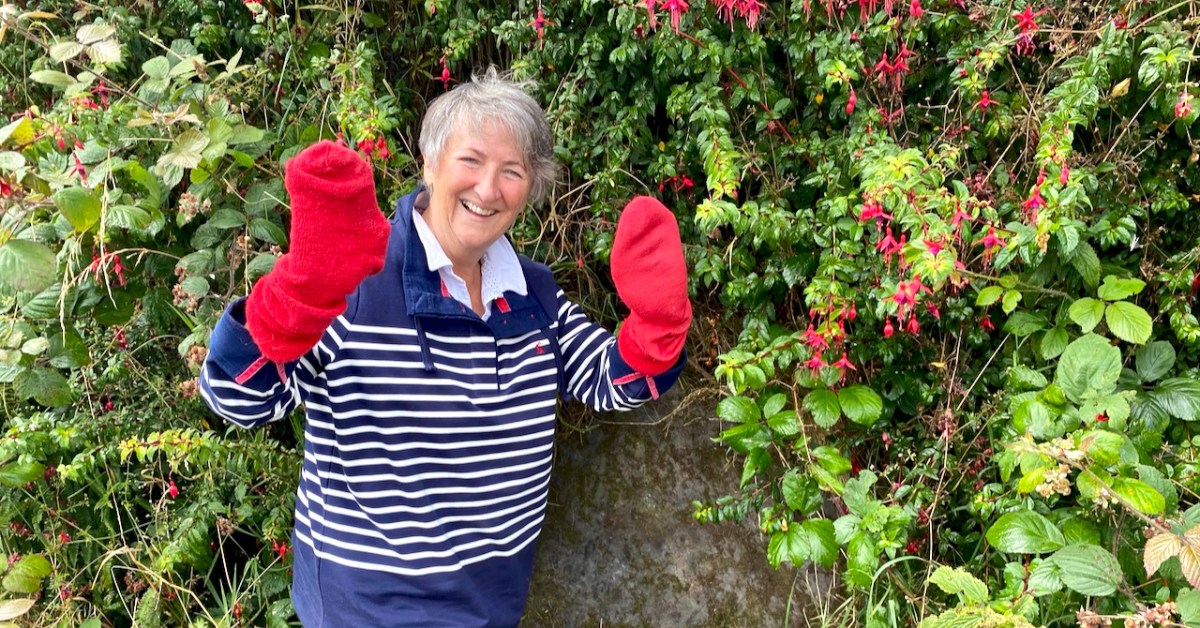
What do red socks have to do with rock art? Well, nothing really, but they turned out to be surprisingly useful this week.
It’s been ages since we talked about rock art, hasn’t it? Thinking about that, I decided to do some tidying up in our blog and I have created a special page for Rock Art, and another one for Mizen Magic, since this post also fits into the Mizen Magic series.
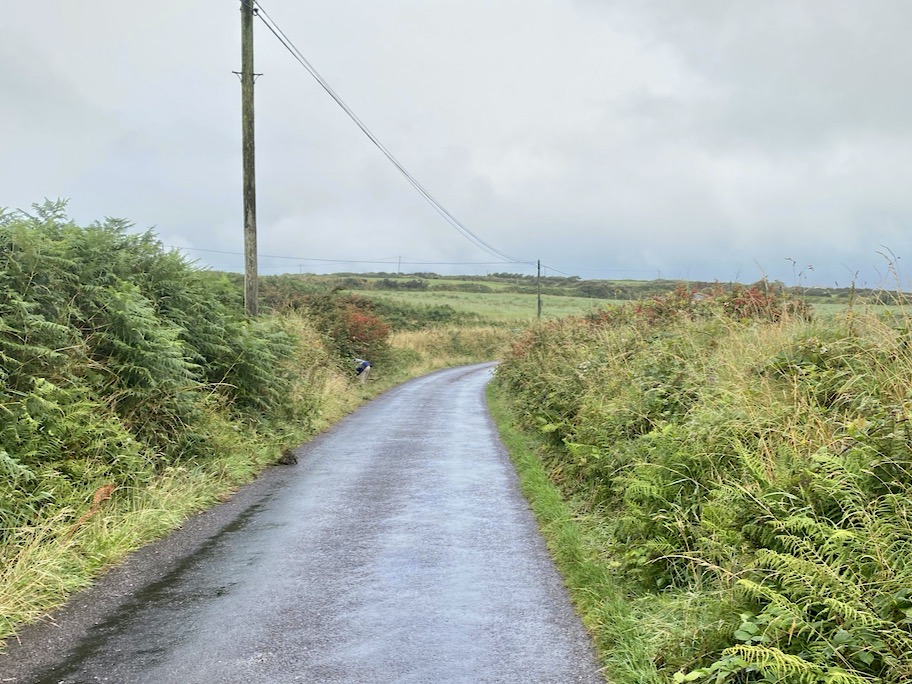
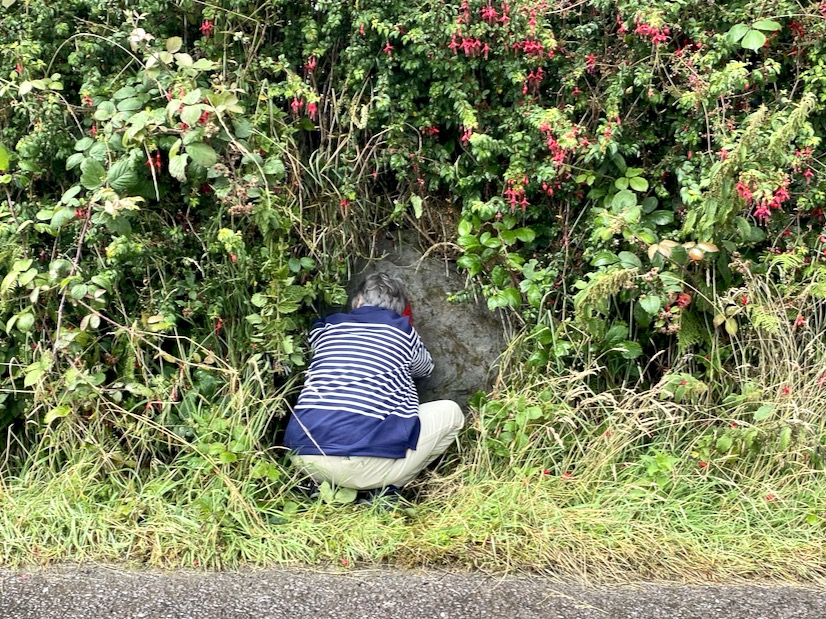
Robert and I set off to hunt down rock art we haven’t yet seen on the Mizen. The National Monuments site contains two records for Cupmarked Stones in the townland of Balteen, and both proved easy to find. (If you can’t remember what a Cupmarked Stone is, take a look at this post before reading on.) The first is along the road that leads from Barley Cove to the North Side. That’s my butt marking the location of the rock, above.
It’s built into the bank and we might not have been as quick to spot it as we were unless somebody else had already found it and cleared away some of the overgrowth – I suspect Rock Art Kerry, AKA Aoibheann Lambe had been there before us, perhaps a couple of years ago. We usually remember to bring a soft brush with us for a gentle cleaning of the rock surface (lots of moss on this one) but we had forgotten this time. The red socks came to the rescue.
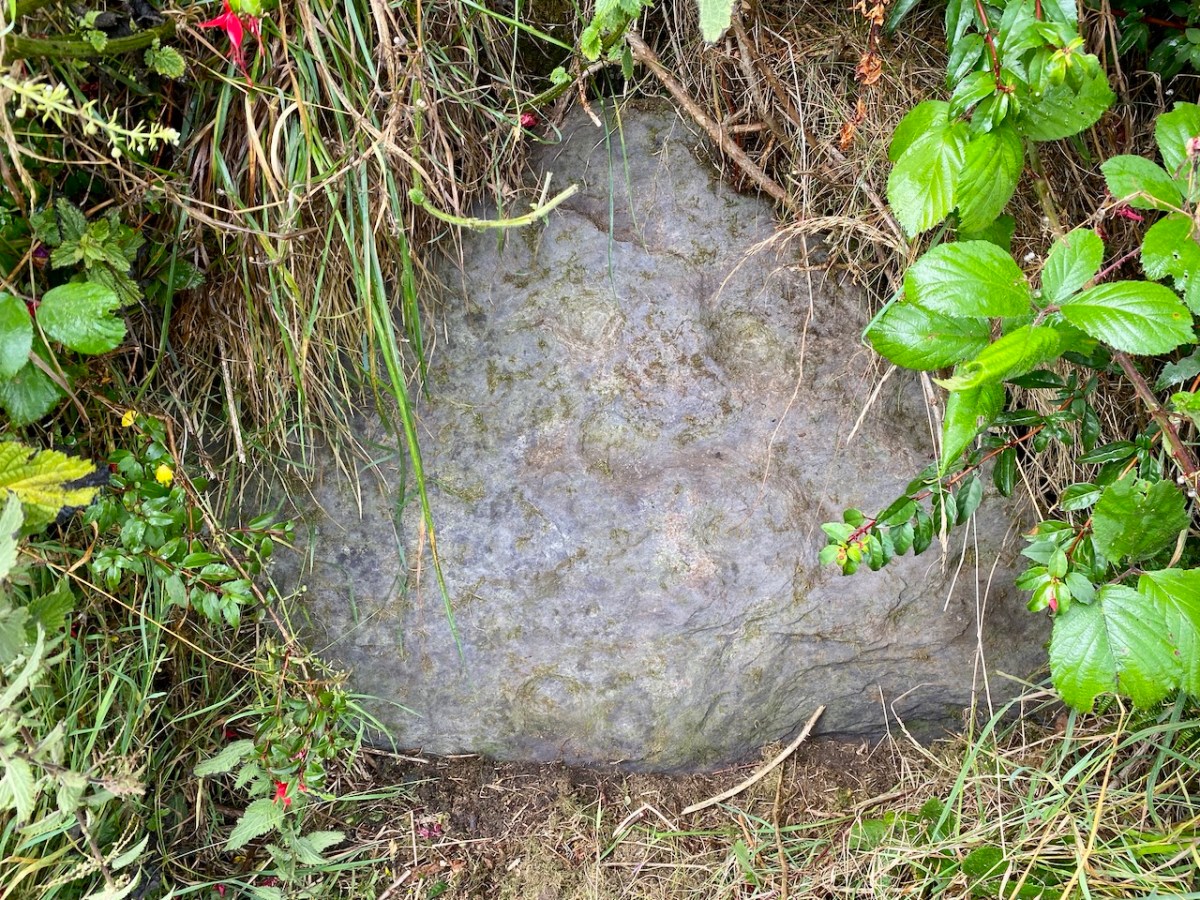
This is a lovely example of a cupmarked stone – although it’s possible there is more on it than cupmarks only. The central cupmark appears to have some carving around it that helps to mark it out and elevate it – not a complete circle but an arc that may end in an expanded finial. We have sent the photos off to UCC for a 3D rendering and this may clarify this aspect of the carving. Here’s a short video – see what you think about that arc.
Meanwhile, since it’s hard to make out what’s in the surface of a grey rock on a grey day, clever Robert has made a scaled drawing of it. We know that cupmarked stones like this can date anywhere from the Neolithic (about 5,000 years ago) up to the Bronze Age (ended about 2,500 years ago), and that the cupmarks were probably made by picking or bashing them out with a stone cobble, but we don’t know why they were done, or what meaning the cupmark itself may carry.
We also don’t know if this one is in its original position, but it’s likely that it is not. It is currently incorporated into the bank at the side of the road, leading us to suspect that it was found in the vicinity and built into the wall to give it a place where it would be visible to all passers-by.
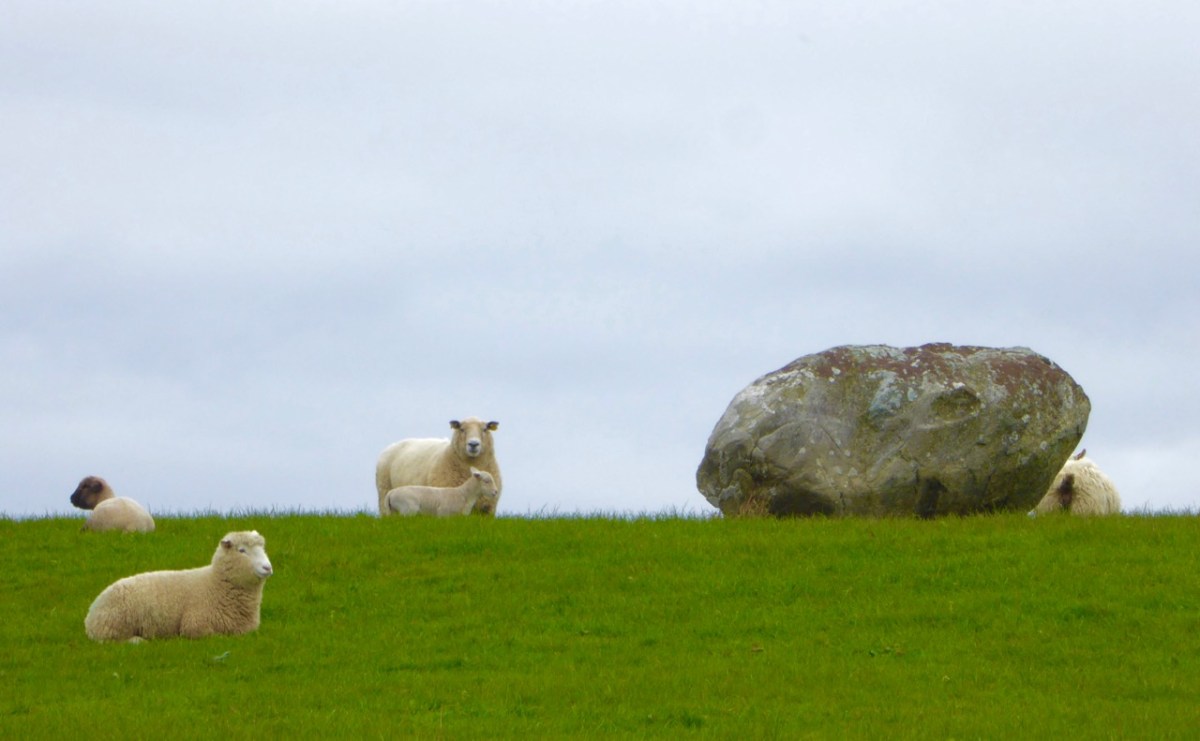
The second one (above) was a surprise! First of all, it’s enormous! It looks like it may have been a capstone for a large structure, or perhaps a boulder burial. However, it’s difficult to determine if there is anything underneath and it may well be a glacial erratic that simply ended up here. This one is in the same townland but it’s on private property, so we are not pinpointing it on a map, at the request of the owners – but they are happy to give permission to see the stone and they welcomed us to take photos and tell them a little about rock art in general. There are nine cupmarks, from large to small and some appear to be arranged in a rough semi-circle – something we have observed on other cupmarked stones.
I am trying something a little new with this post – doing short videos to see if this helps to convey more than a photograph might. I’d be interested in your feedback on this. Note: You may have to play the videos on YouTube – sorry if this aspect isn’t working right for everyone!
Just when you think you have seen all the Mizen has to offer, it reveals yet more of its secrets!
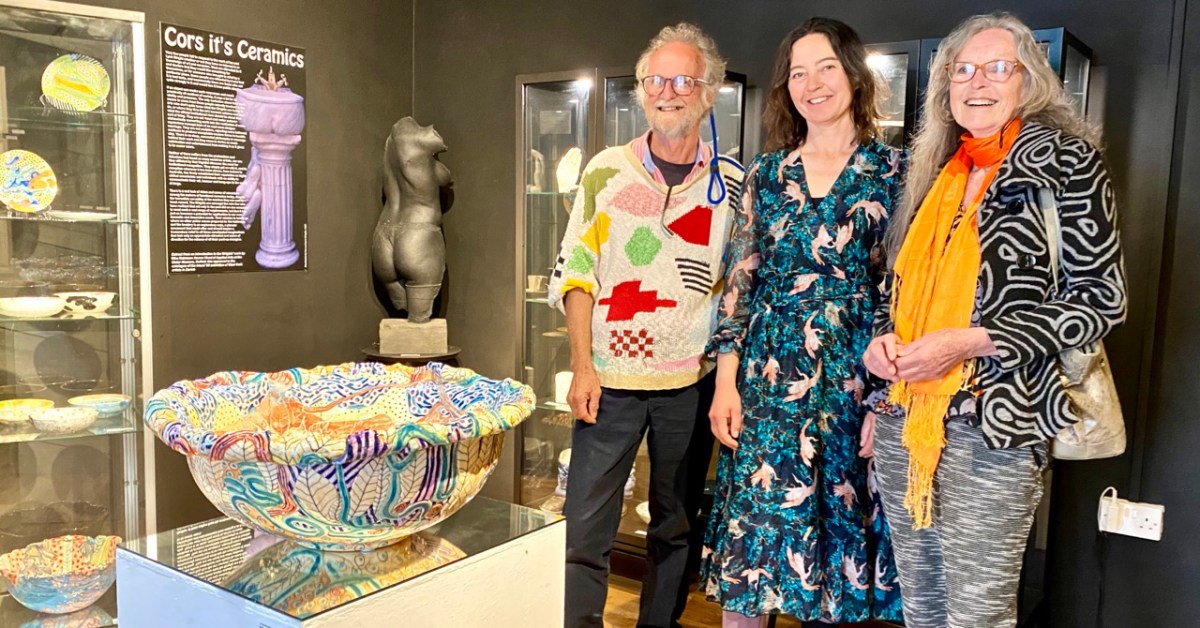
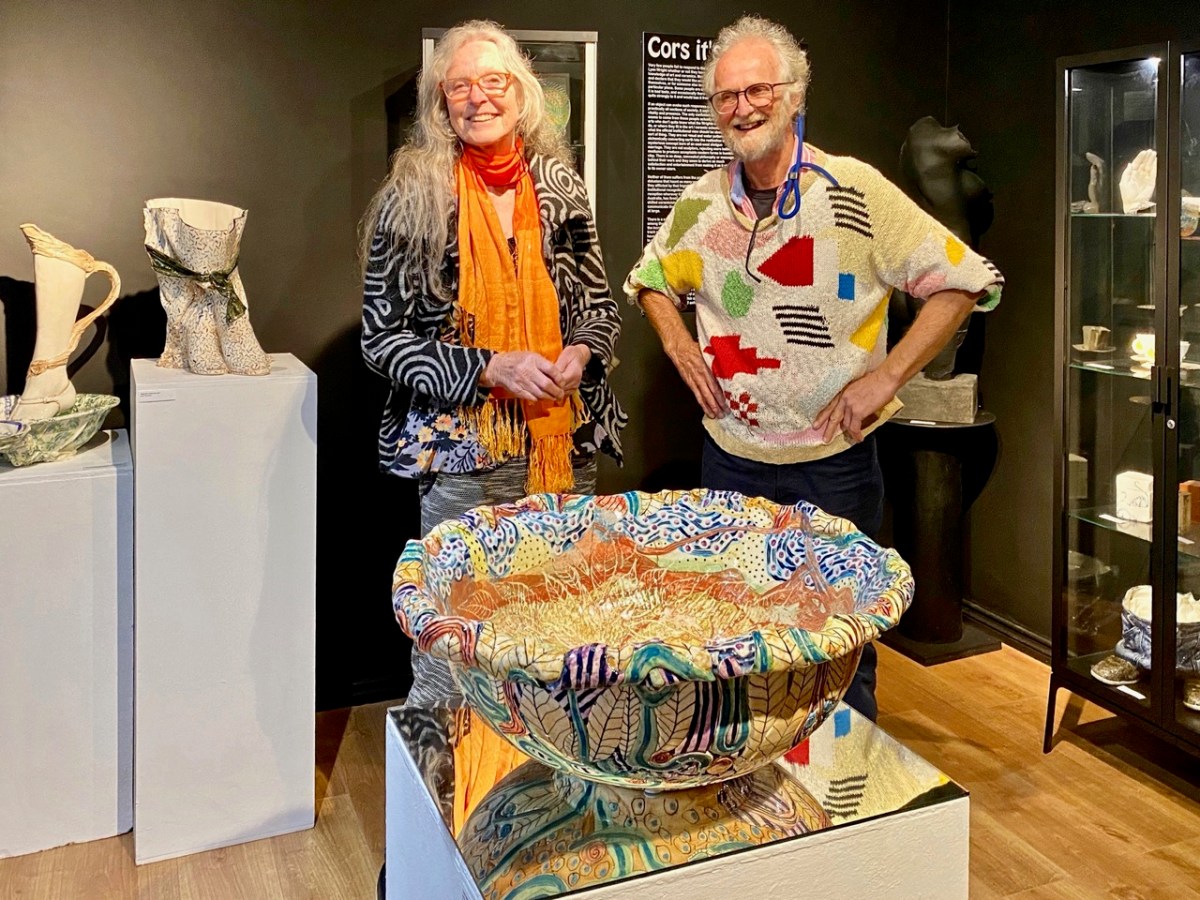
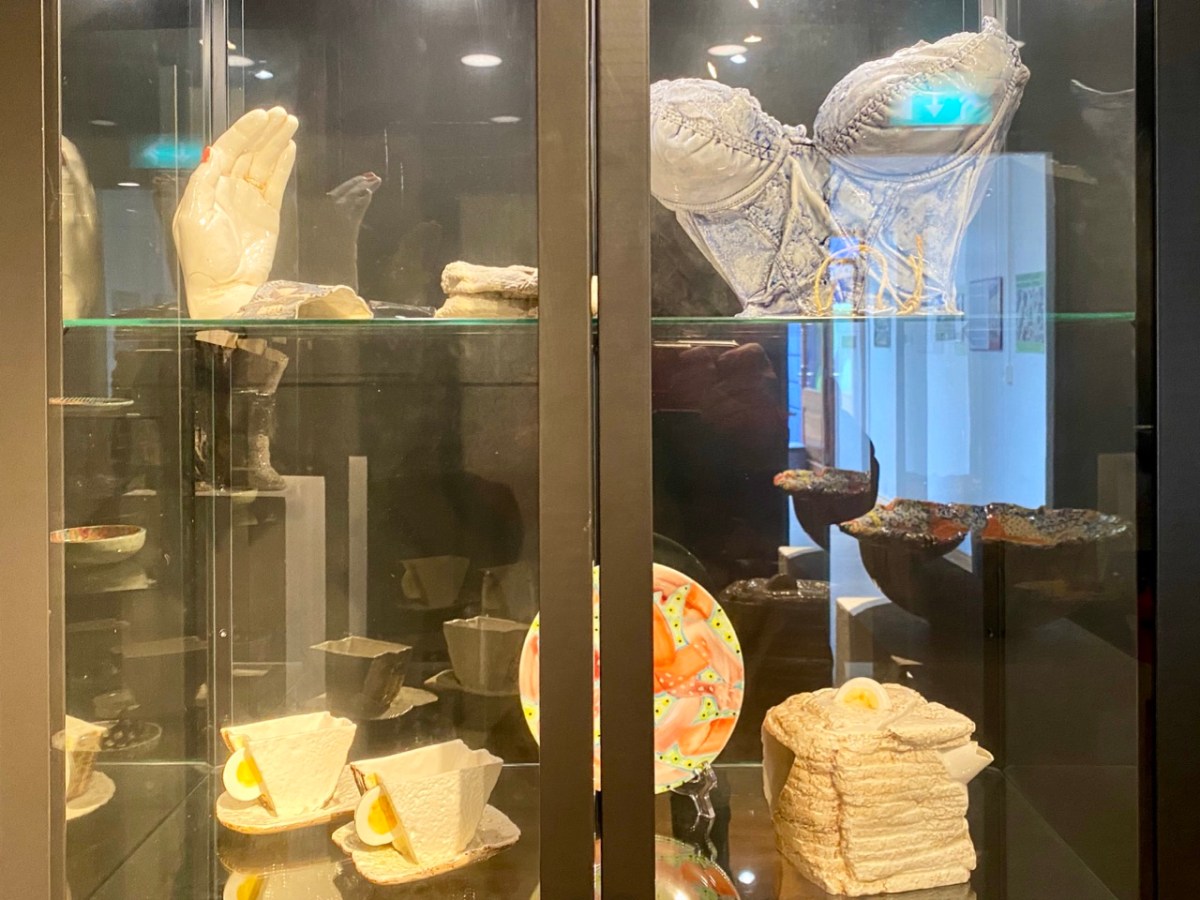
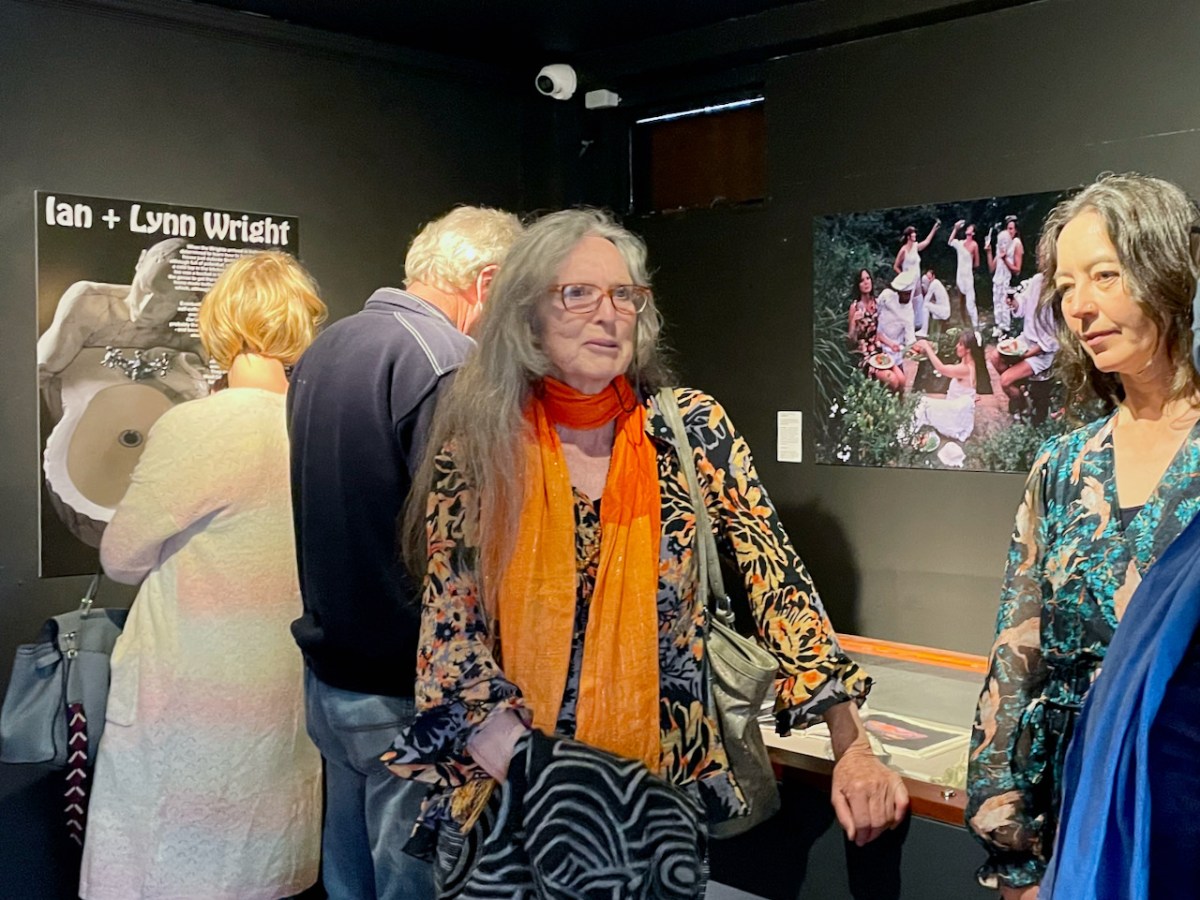
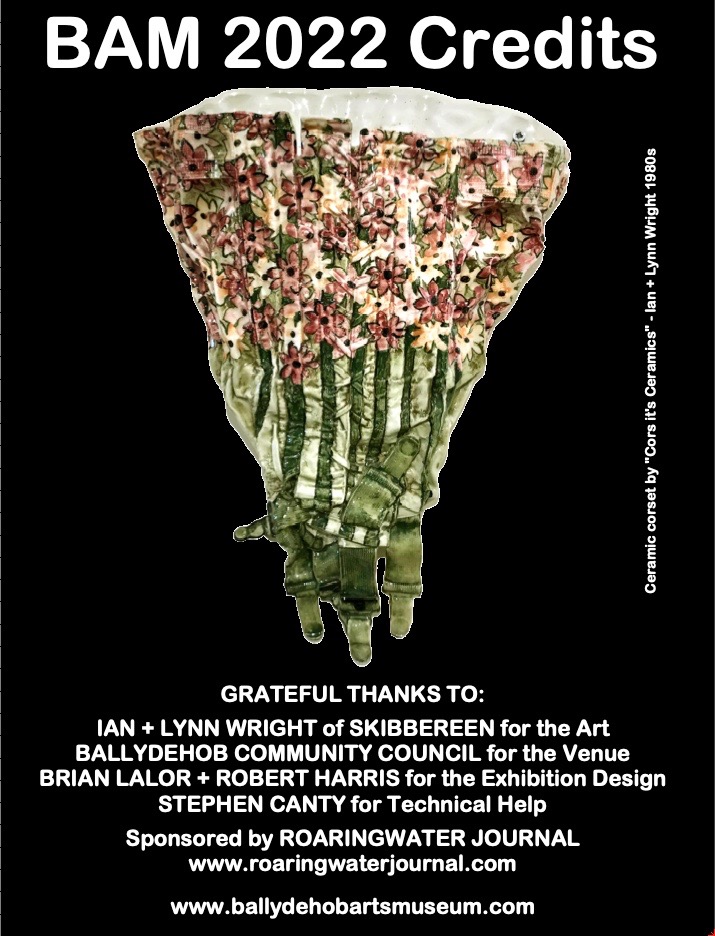
BAM – the Ballydehob Arts Museum – is open through the summer. Make sure you don’t miss the impressive exhibition that’s on at the moment. It shows the work of West Cork art creators Ian and Lynn Wright (shown above with Eleanor Flegg). They were part of the ‘invasion’ of artists who came to the Ballydehob area from the 1960s onwards, and who are now featured in what is perhaps Ireland’s smallest art gallery, situated in Bank House, the headquarters of the Ballydehob Community Council.
You will find out all about the Museum here and here. Curator Brian Lalor (who featured in last week’s post) and Director Robert Harris (that’s me!) have put together a new exhibition this summer, following two years of absence due to Covid.
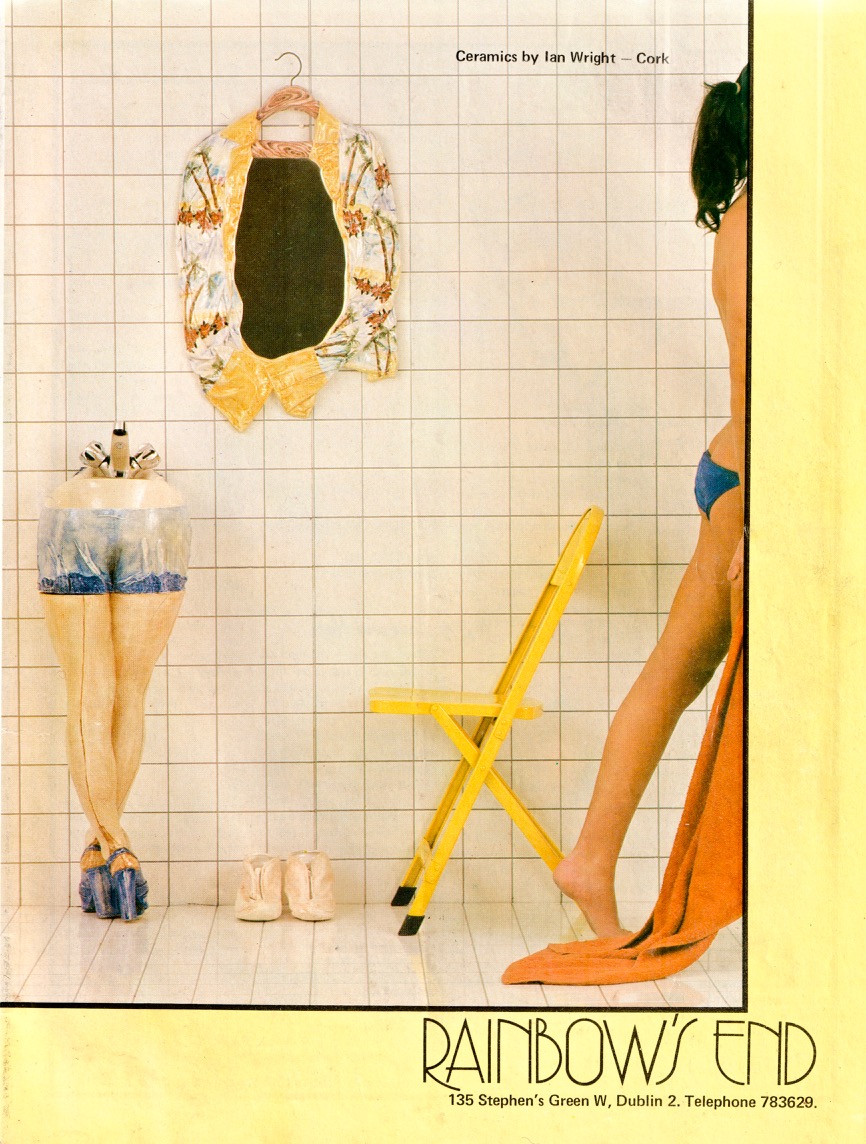
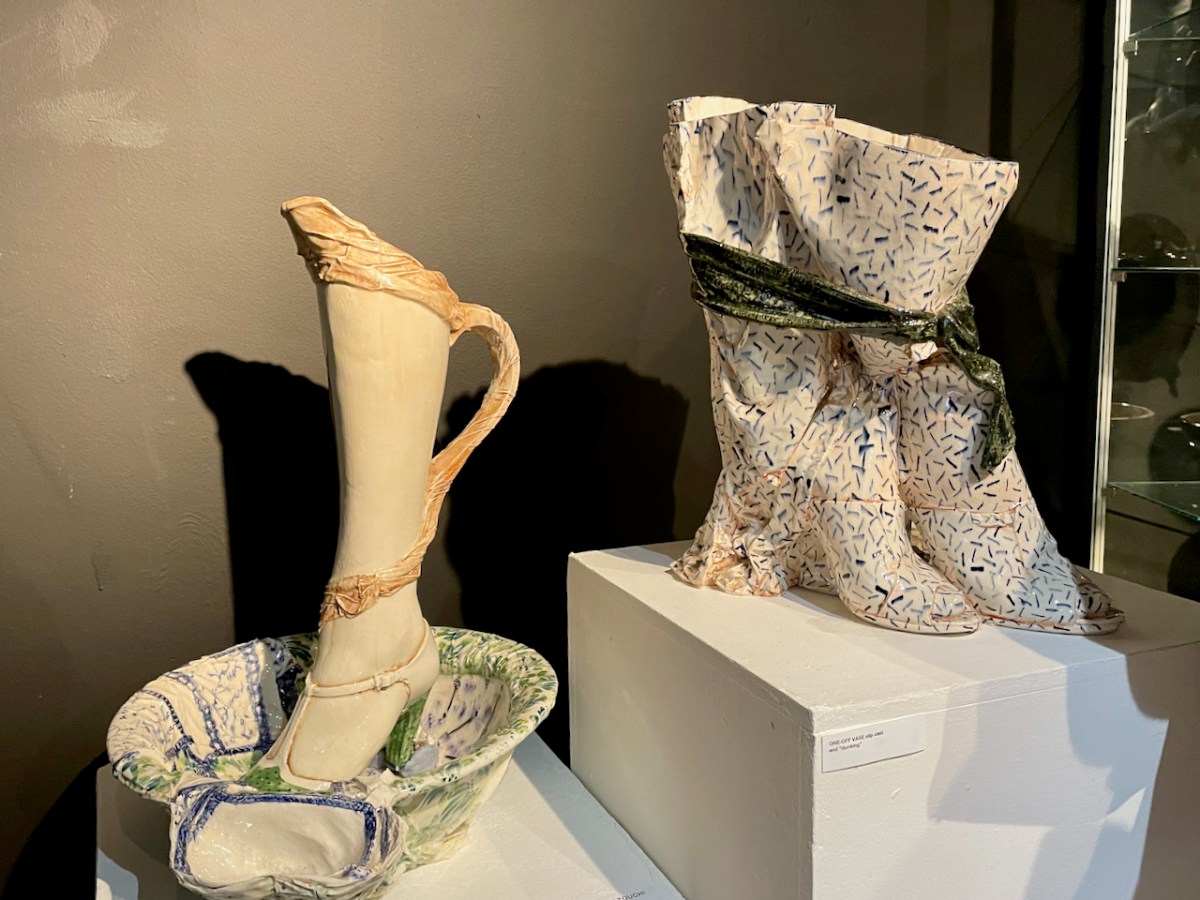
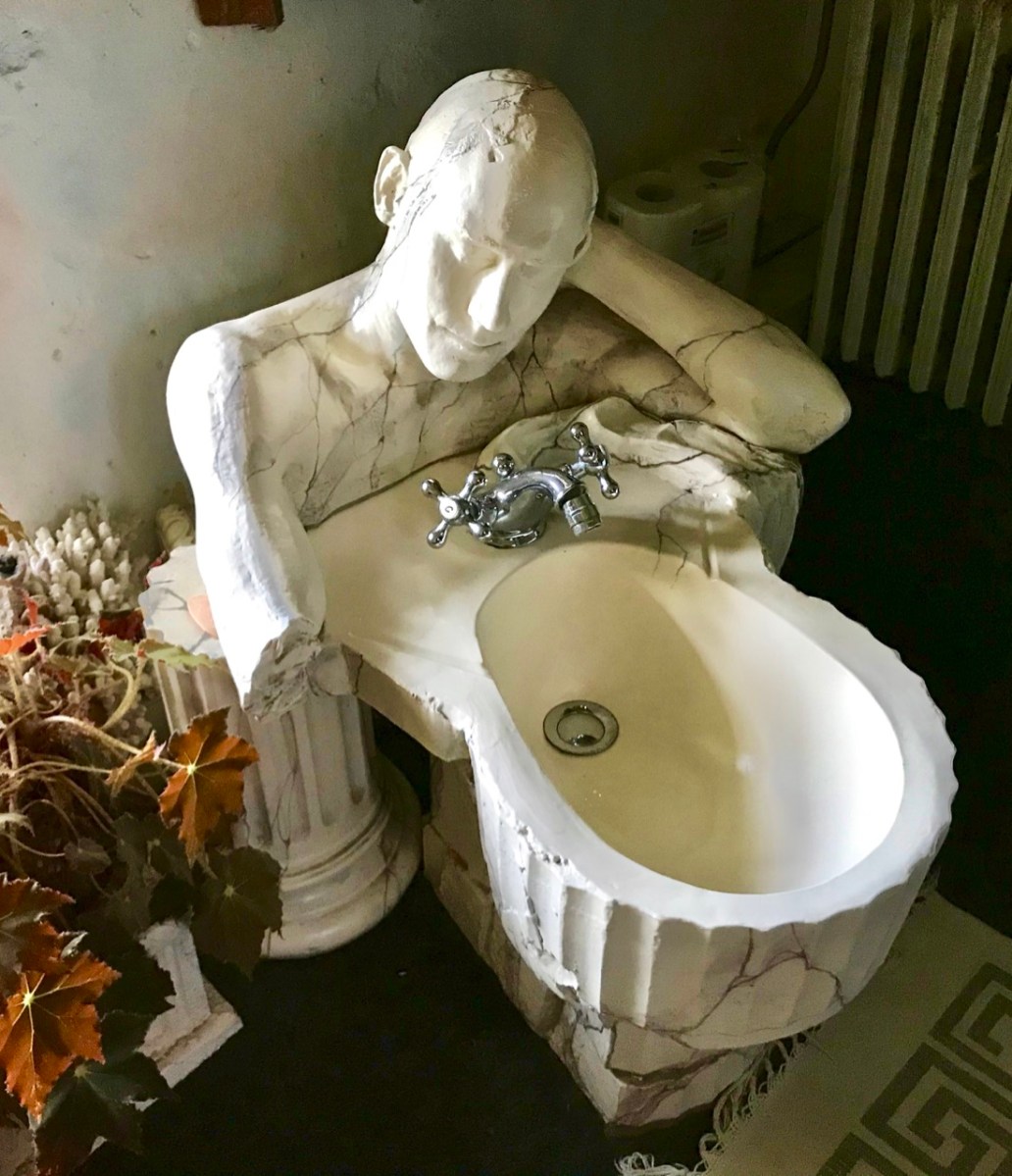
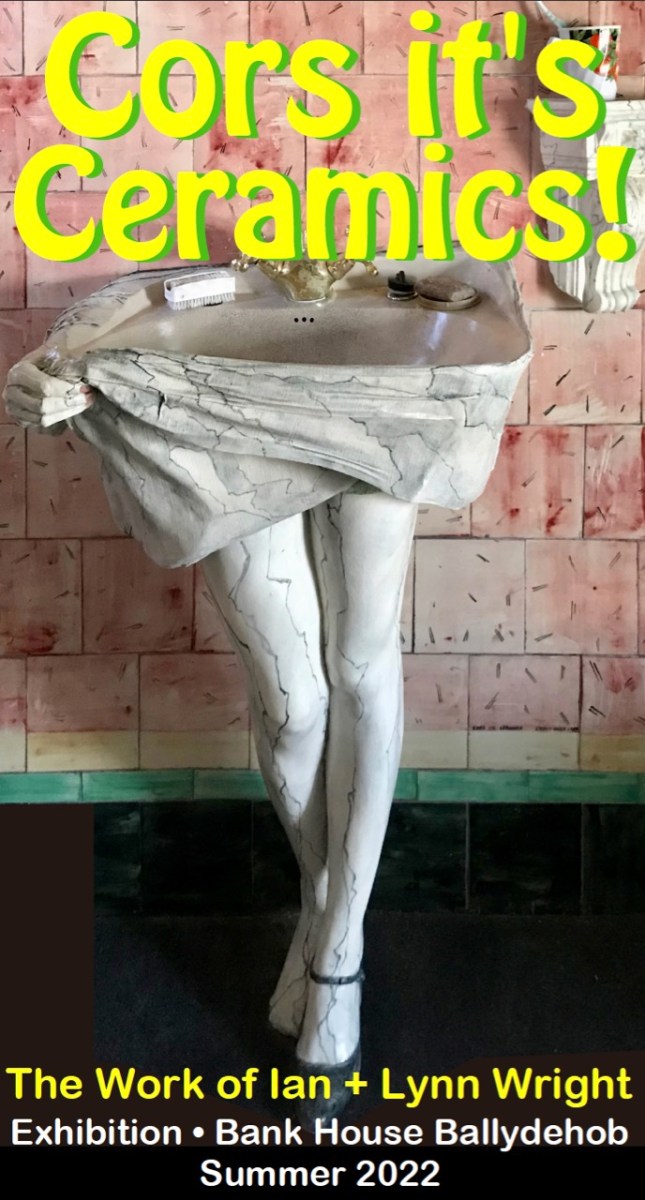
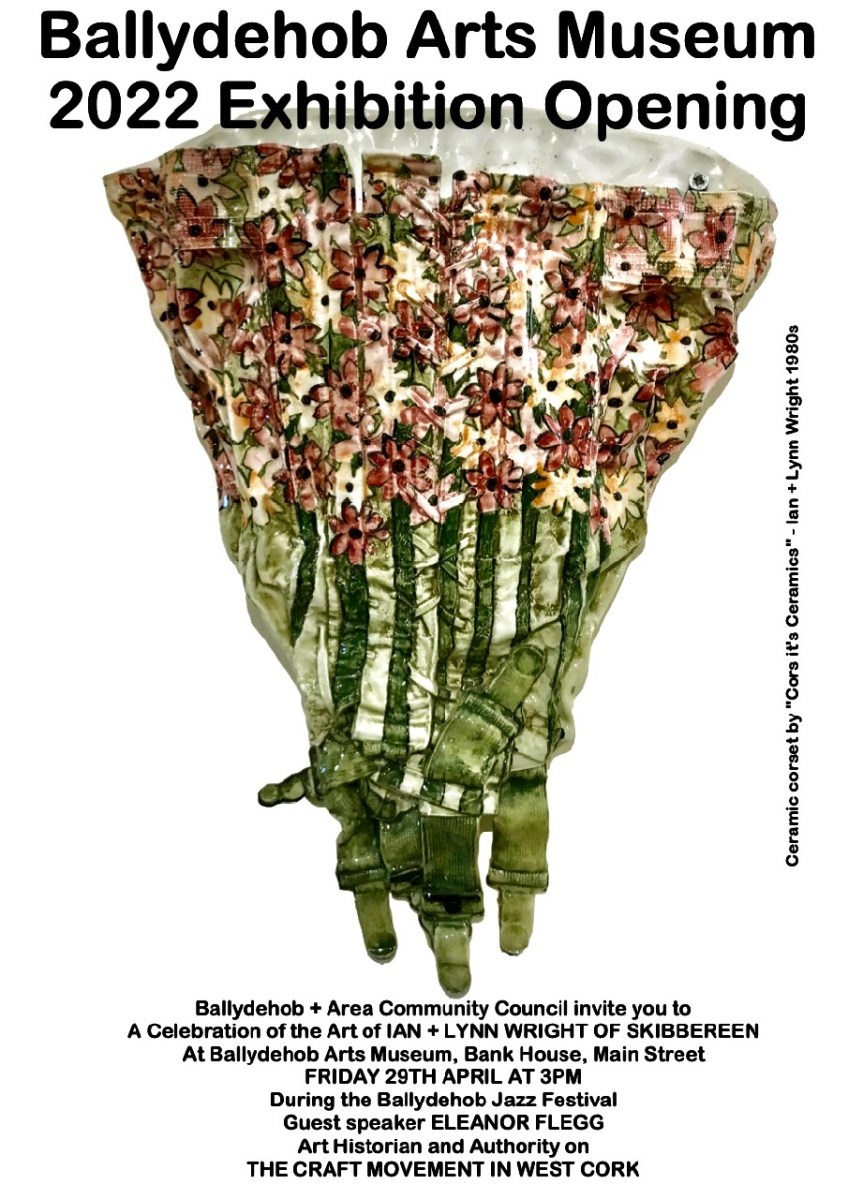
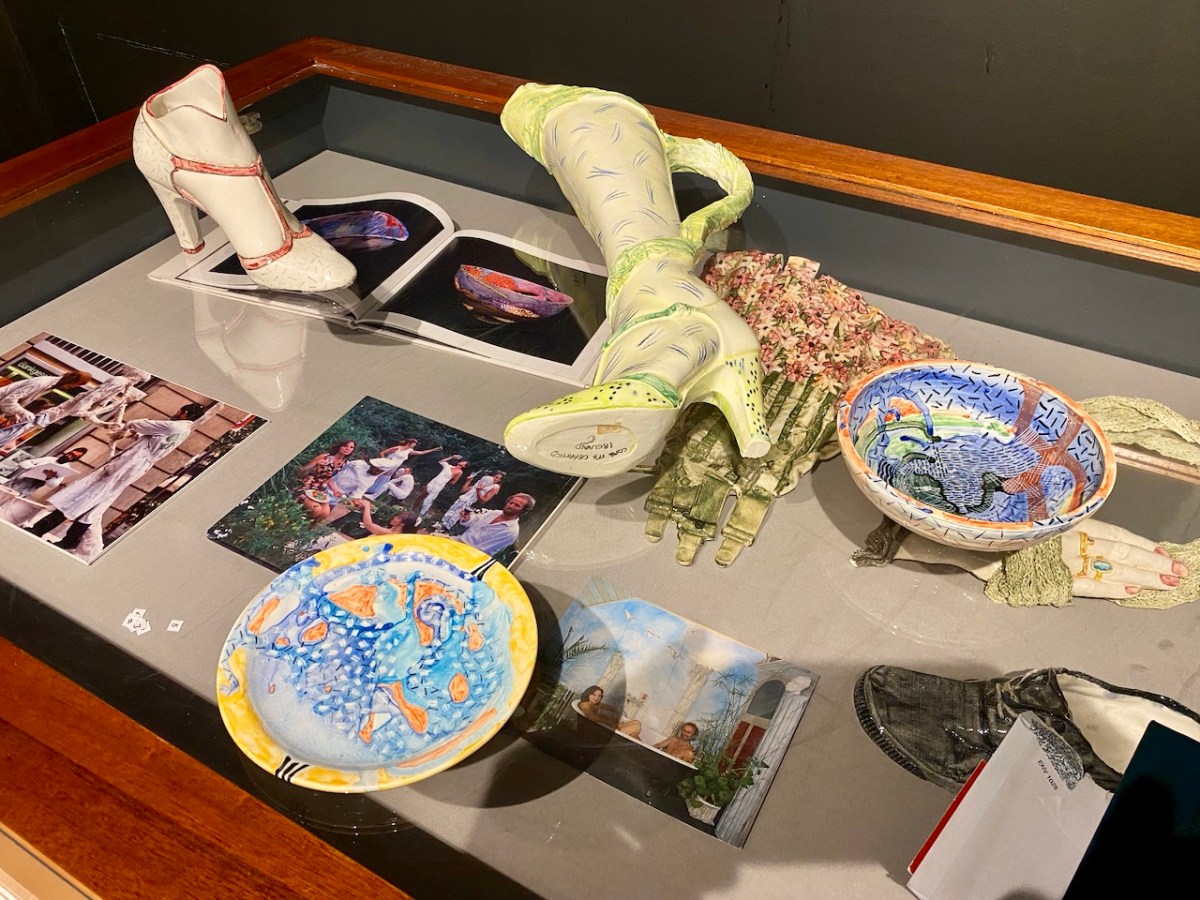
The ad above (from the early 1980s, I think) shows how Ian and Lynn’s work was being marketed at that time. They called themselves Cors it’s Ceramics, and they definitely projected a cheeky identity, making one-off ceramics – basins, bidets, loos and bathroom accessories: unique, appealing and often erotic. Their work was popular, and their production processes couldn’t keep up with demand! Today, the Wrights are producing more measured ceramics: Lynn produces beautiful large bowls, while Ian uses human body moulds to make impressive torso casts. Examples of all their working styles can be seen in the present Museum exhibition.
The Museum display is stunning. It brings together – probably for the first time ever – an eclectic extravaganza of the Wright’s output over half a century: examples of work small and large. There are no complete bathroom settings here: those that survive are still installed in the domestic settings for which they were commissioned. But we are fortunate that we have had access to the Wrights’ own collection of their work, which they have freely lent to the Museum. We do, of course, also have photographic records of other examples.
The Exhibition was formally opened earlier this year by Eleanor Flegg, and it can now be viewed for free whenever the Ballydehob Tourism Office is open. Through the summer this is usually from Monday to Saturday – 11am to 1pm, and from 2pm to 5pm. However, please check before visiting, as the office is staffed only by volunteers, and we can’t guarantee those hours at all times. It’s best to ring this number to confirm that it will be open: 028 25922.
A lot of effort has gone into making this exhibition. It’s on for the rest of this season, so please don’t miss it. It is the aim of the Ballydehob Arts Museum to celebrate the very special projects that have been carried out over decades to give the village its reputation as an artistic centre of excellence. Nowhere else can you find the full flavour of what has made this community so special.
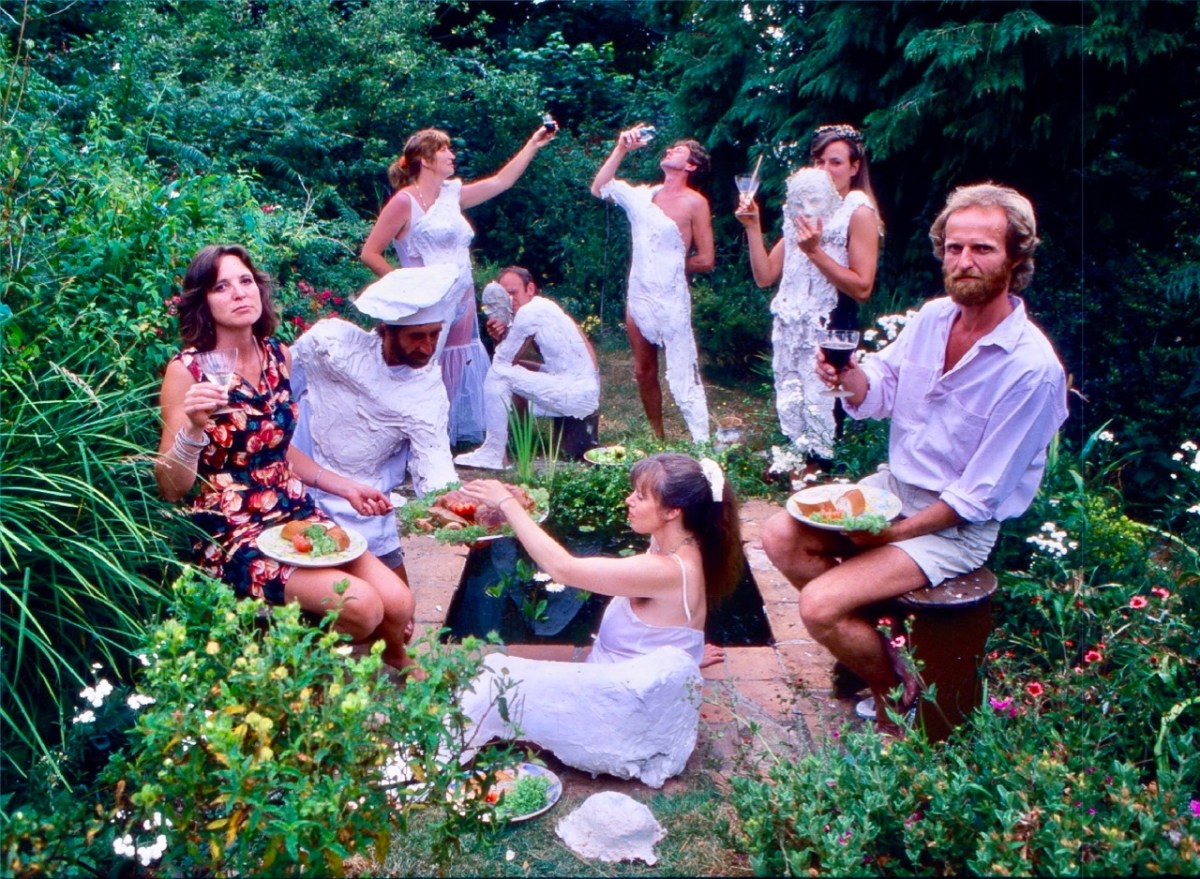
This photo (above) appeared in the Mail on Sunday newspaper in 1983. Lynn and Ian are on the left and right respectively. The occasion is a ‘body casting party’ in the Wright’s garden.
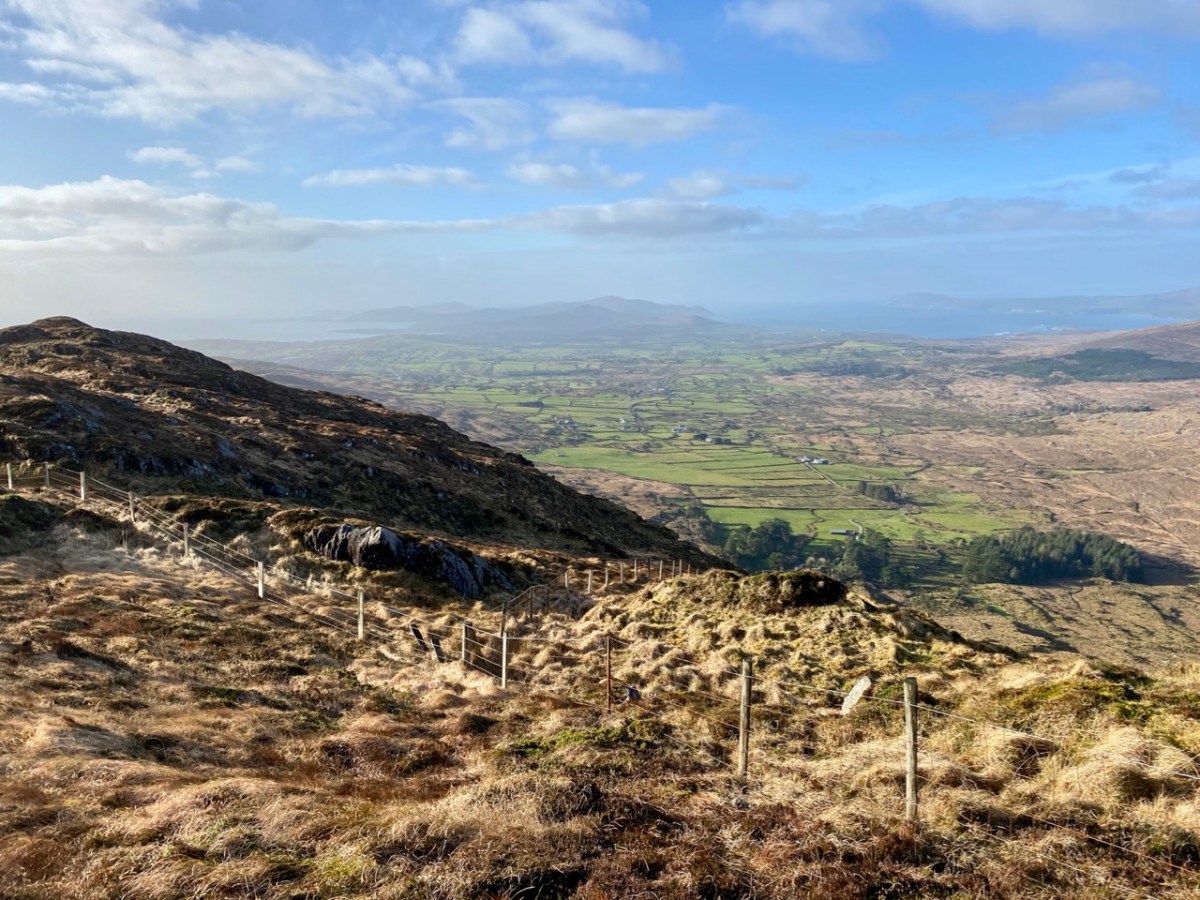
Mount Gabriel is, I believe, a rarely regarded topographical prominence on the Mizen. Yet it is impossible to ignore: the summit can be seen from most parts of this western peninsula. And, for those visitors who do notice it – and make the effort to scale its heights, it presents the most spectacular of views over rugged landscapes to the oceans beyond.
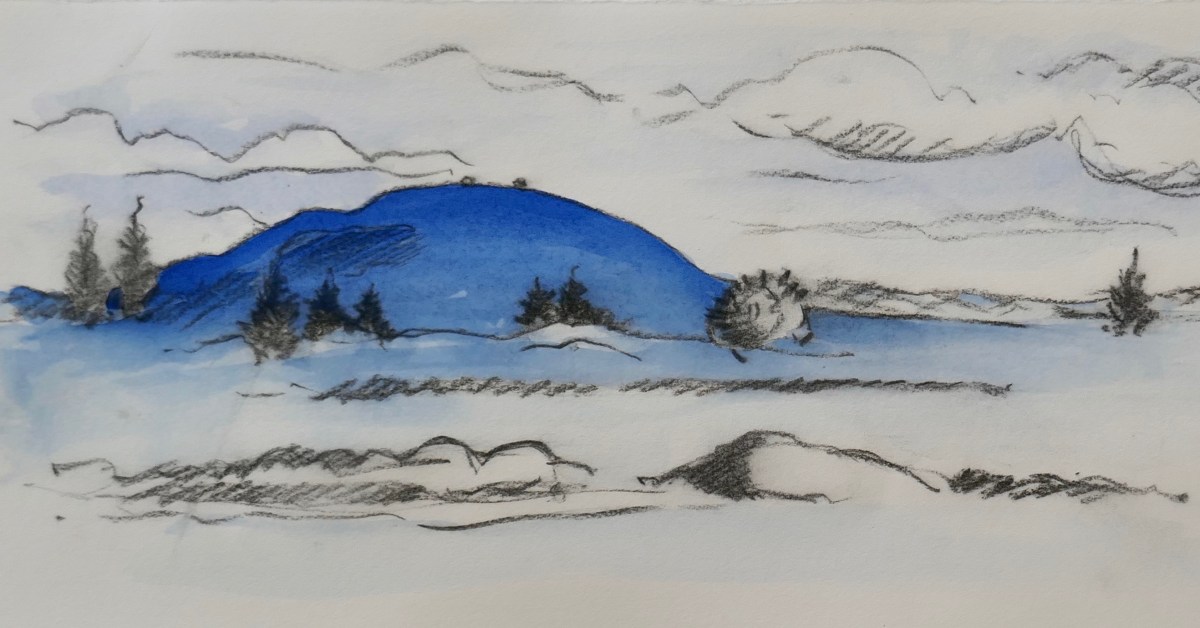
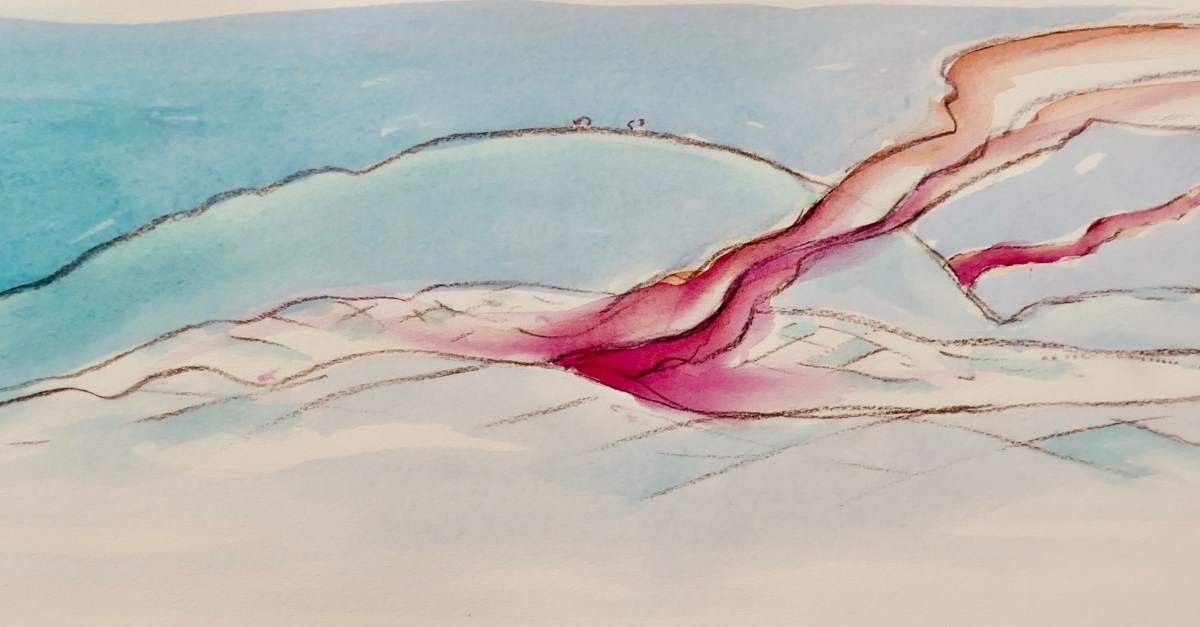
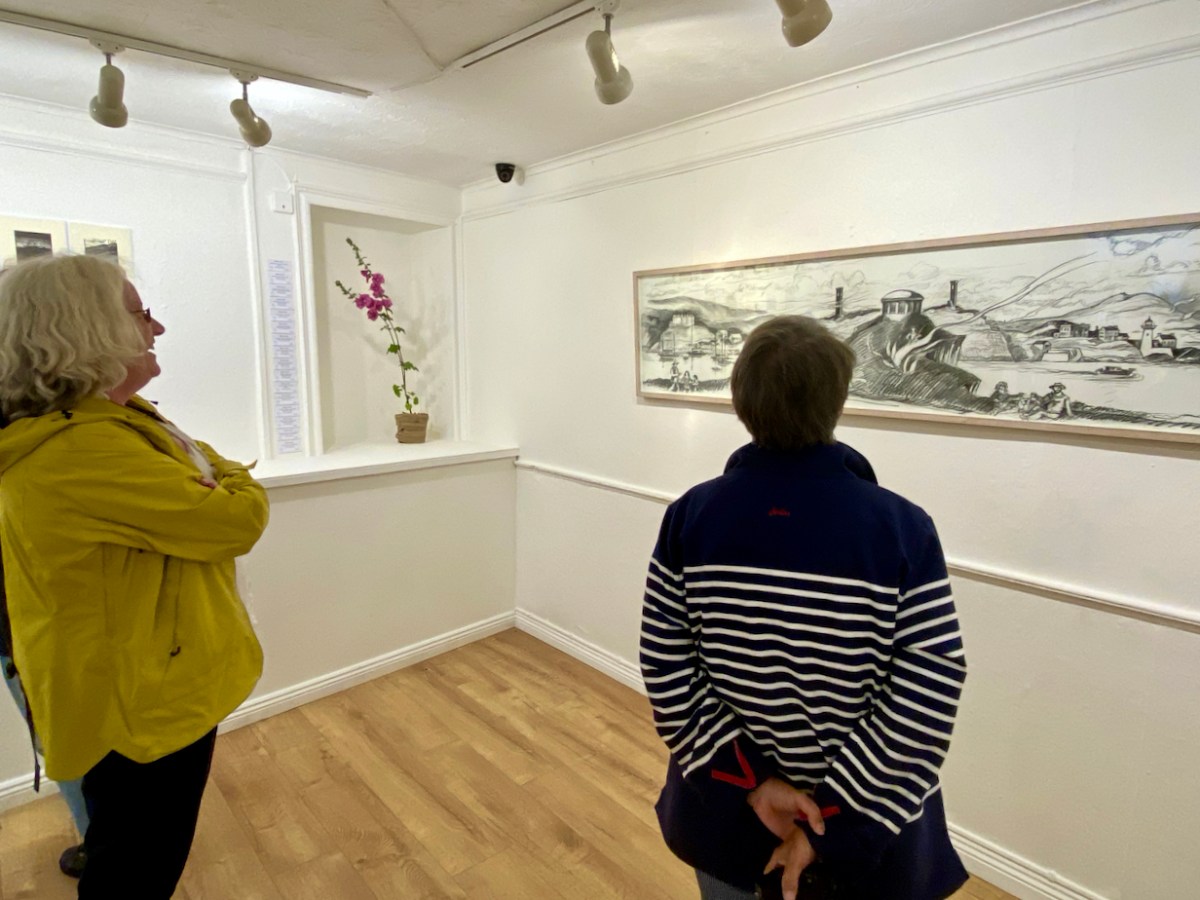
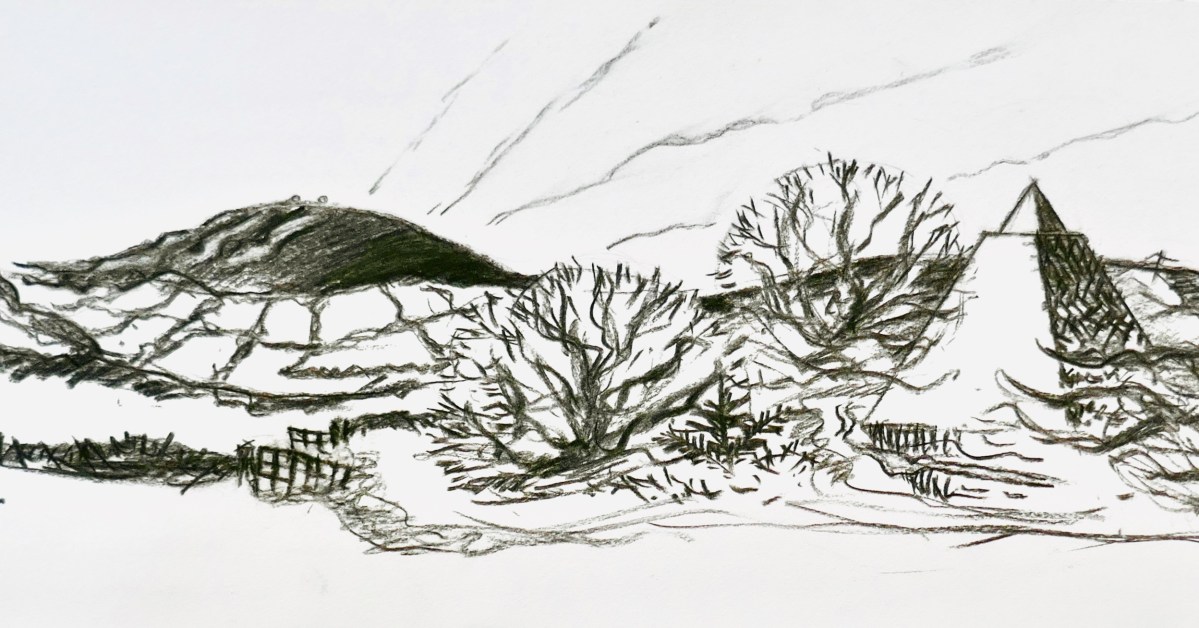
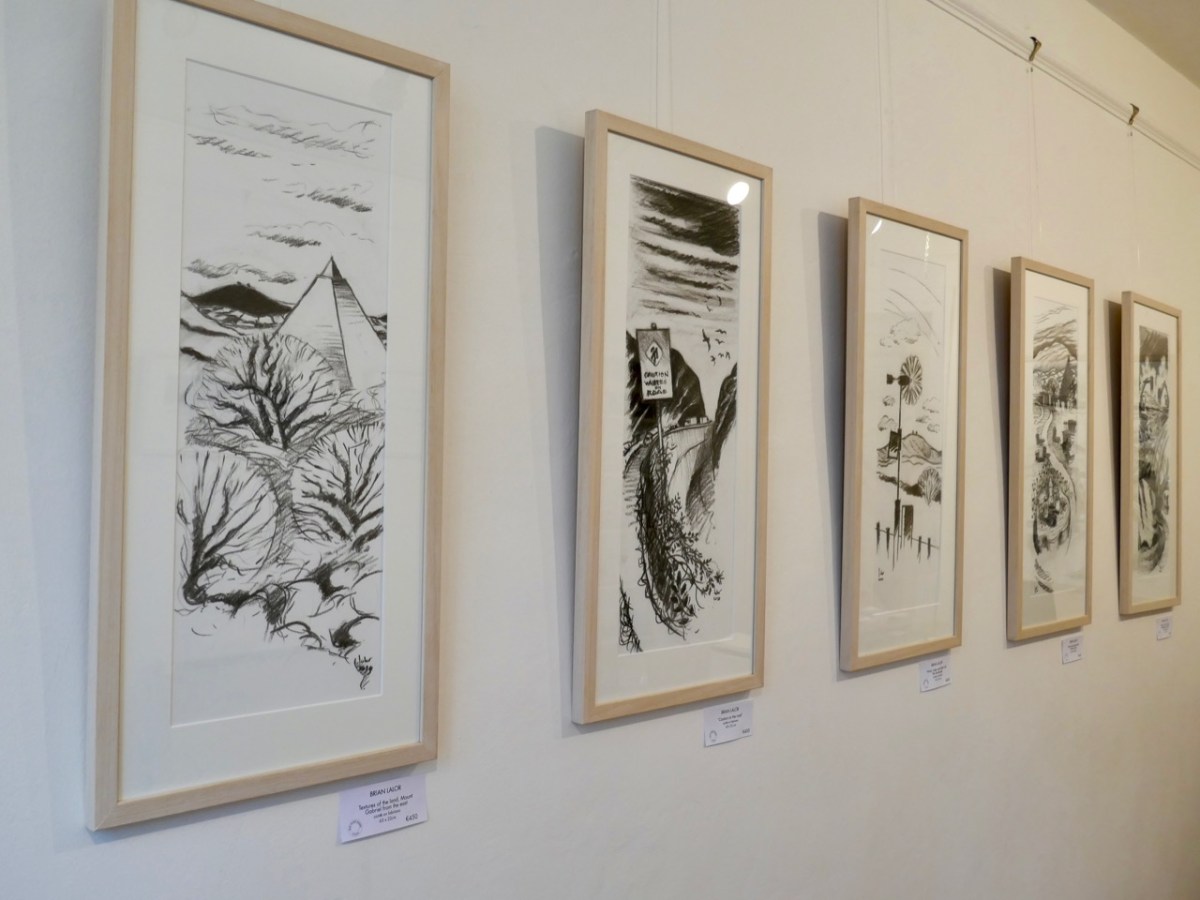
Brian Lalor has chosen to make this peak the centrepiece of his new exhibition, which opened in Schull’s Blue House Gallery at the weekend: Thirty-Six Views of Mount Gabriel. You have to see it. The works are for sale, so it will be impossible, probably, to assemble them as one entity ever again. (Unless, perhaps, in a hundred years time – if there is still an intellectual world in existence – Brian’s genius will be fully recognised and appreciated, and an astute curator will raid collections from all over the world in order to put this canon back together as a centenary project).
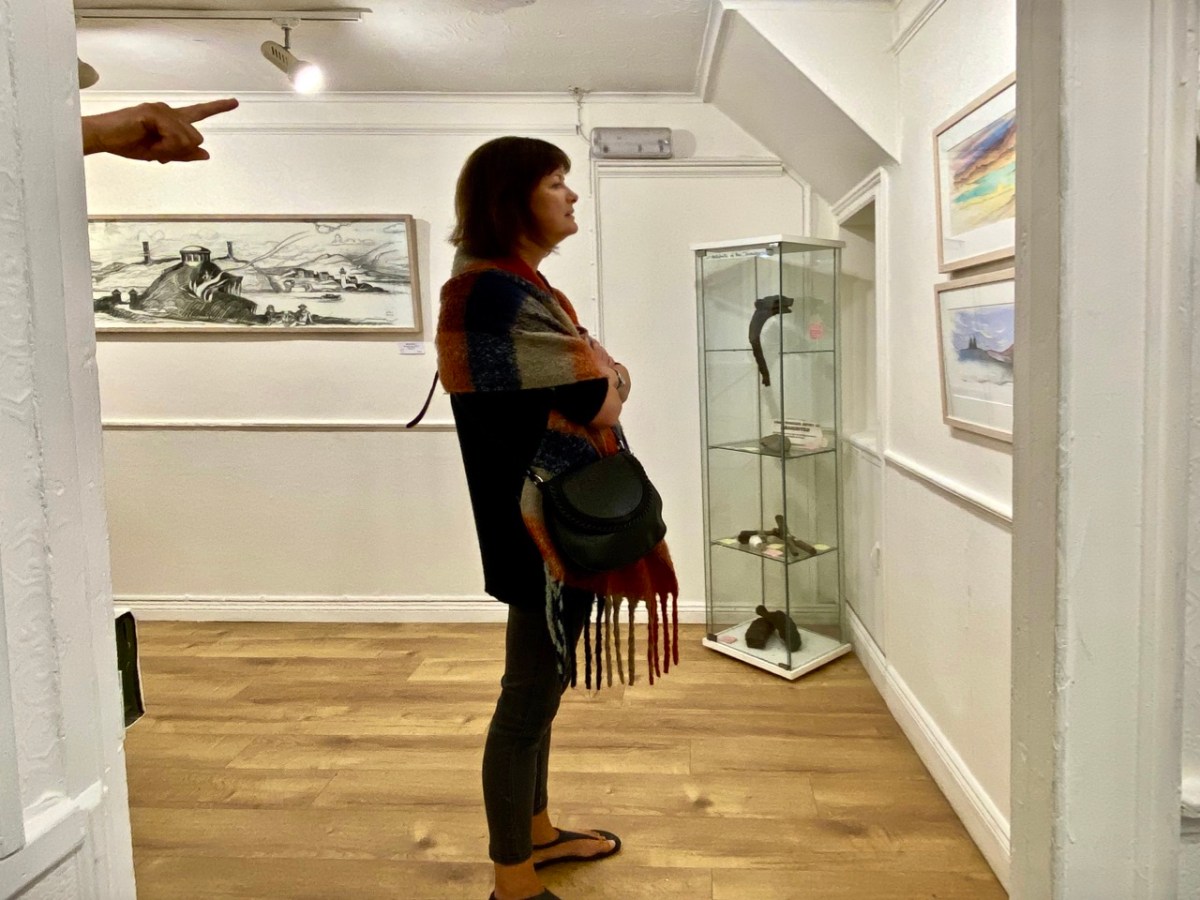
The works themselves draw attention to some of Brian’s many artistic talents: conté crayon drawings, exquisite watercolour sketches and linocut prints. They make an impressive whole on the walls of Schull’s eccentric gallery, which is a jumble of smallish rooms, a staircase and landing, with a minimalist shop-window frontage. Circumnavigating the spaces is a revealing and stimulating experience.
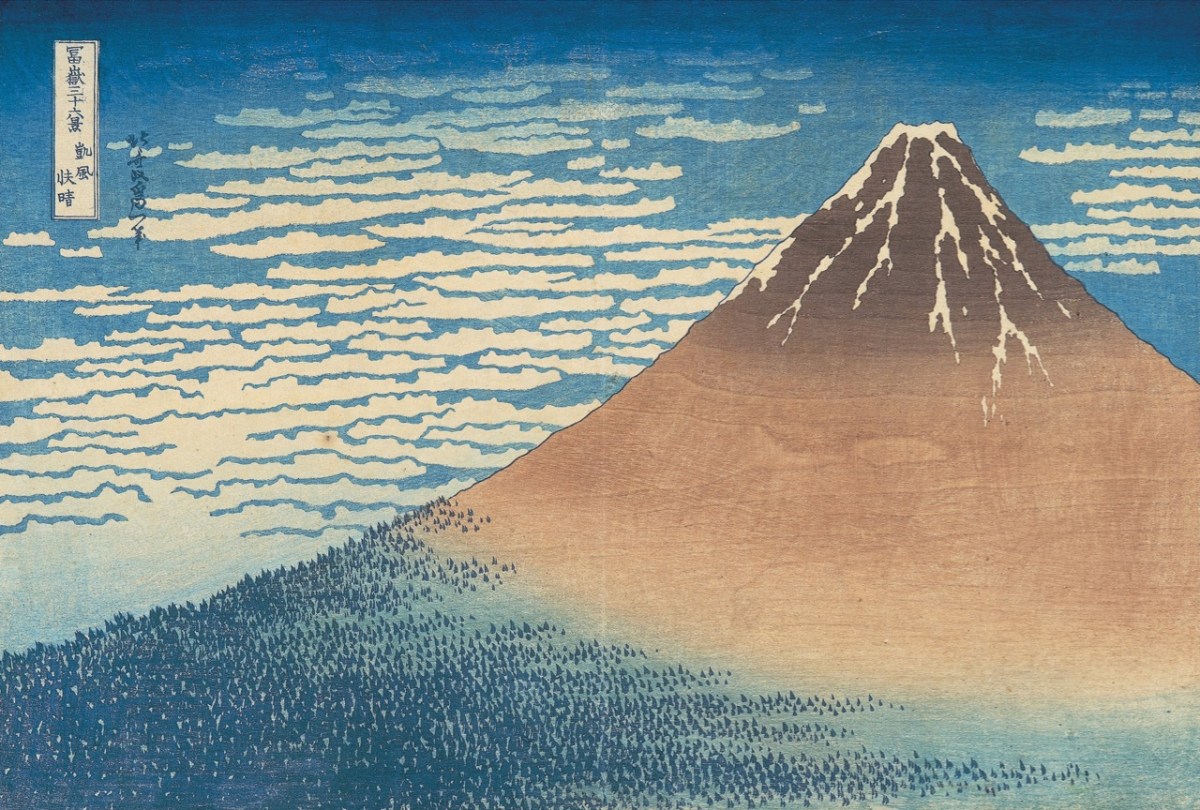
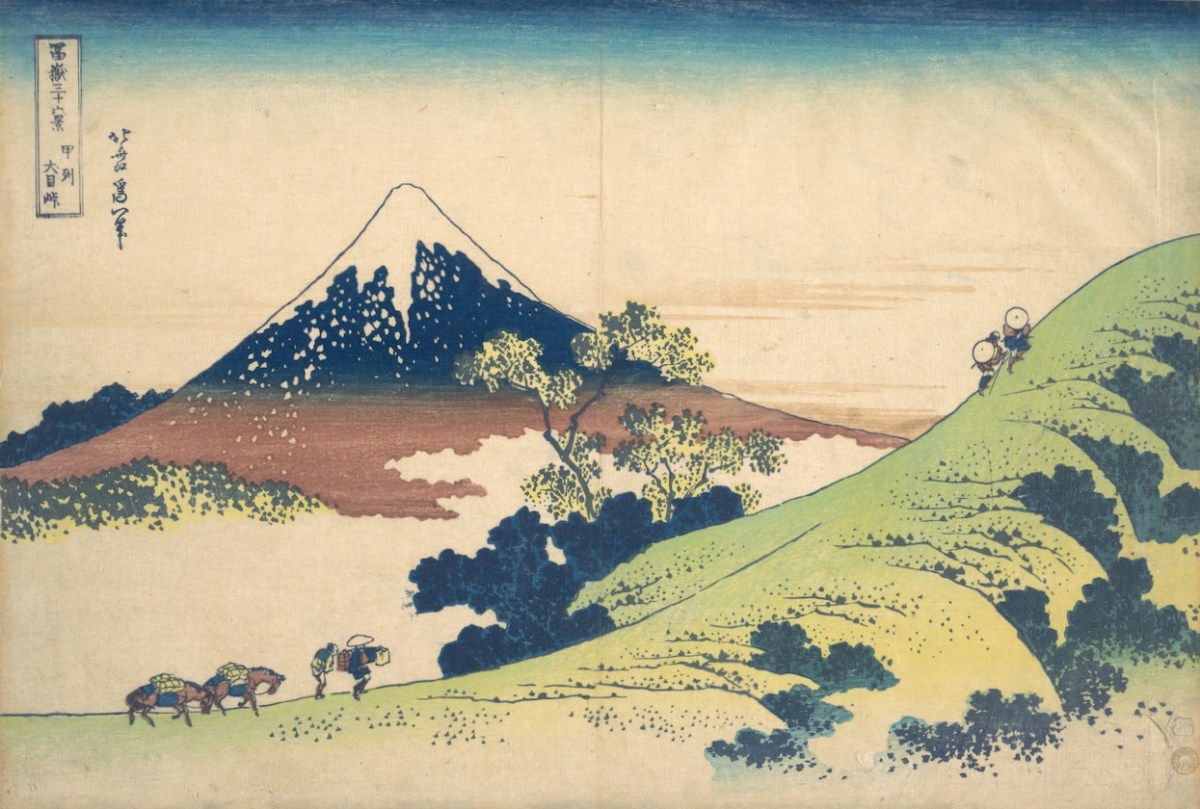
Returning to the subject matter of the work, Brian – General Editor of Gill & Macmillan’s mammoth 2003 volume The Encyclopaedia of Ireland – and considered a prime authority on Ireland’s art heritage and its place in world culture, is familiar with artists’ legacies from many other domains. He grew up in a household which contained significant pieces of Japanese art and was au fait from a young age with the concept of ukiyo-e – the floating world. His early awareness of the arts of Japan provided the source of inspiration for this exhibition: Katsushika Hokusai’s Thirty-Six Views of Mount Fuji, woodblock prints which date from the early 1830s. Here are Fine Wind, Clear Morning (upper) and Inume Pass (lower) from the series:
Fuji is one of Japan’s Holy Mountains. Brian’s juxtaposition is brilliant: our Mount Gabriel has to be a holy place. It is named after an Archangel, who is said to have descended to the mountain top to view the unsurpassed beauty of West Cork’s landscapes, the reputation of which had reached to Heaven even back in those days. In so doing he left behind his footprint, which is still to be seen on the summit.
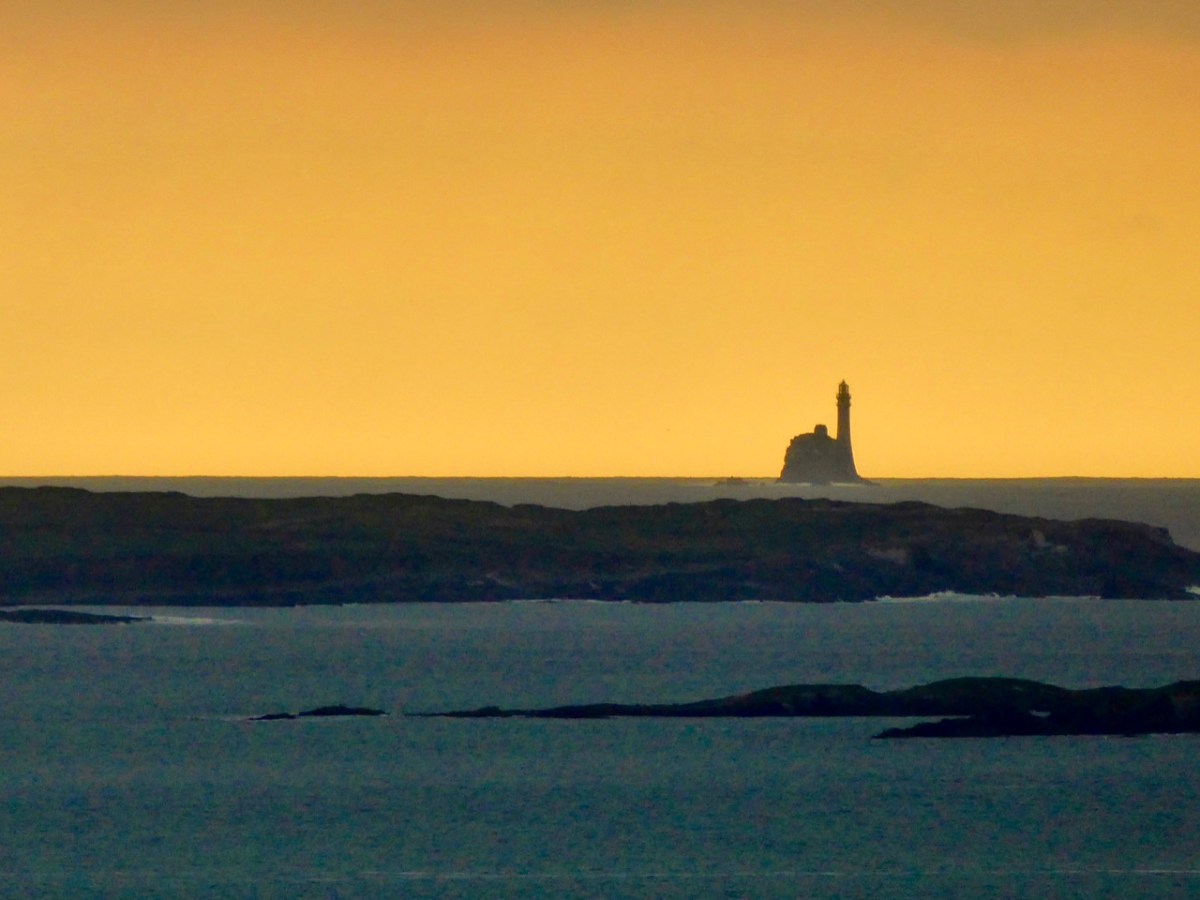
The Archangel was not the only biblical character to visit Gabriel: Satan himself touched down, but stumbled on a large rock. In a fit of temper he picked up the rock and threw it far off into the sea beyond. This caused such a hazard to shipping that we have had to erect a lighthouse on it. Here is Finola’s photographic view of The Fastnet, taken at sunset. For me, it has a suitably print-like quality . . .
Legends attached to Gabriel include many that attribute Irish heroes to activities on the summit. Finn MacCool, for example, is also credited with throwing large rocks from the mountain, including this fine boulder burial at Rathruane:
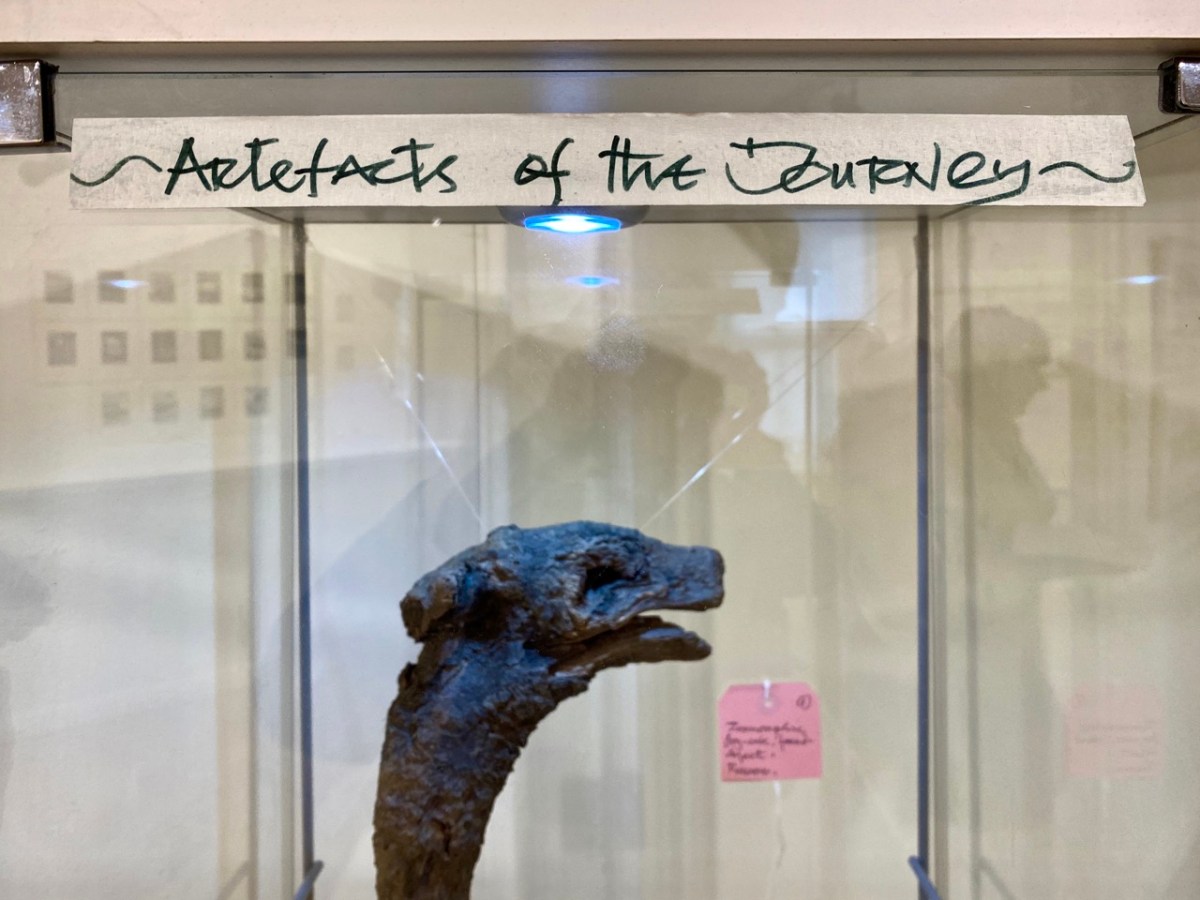
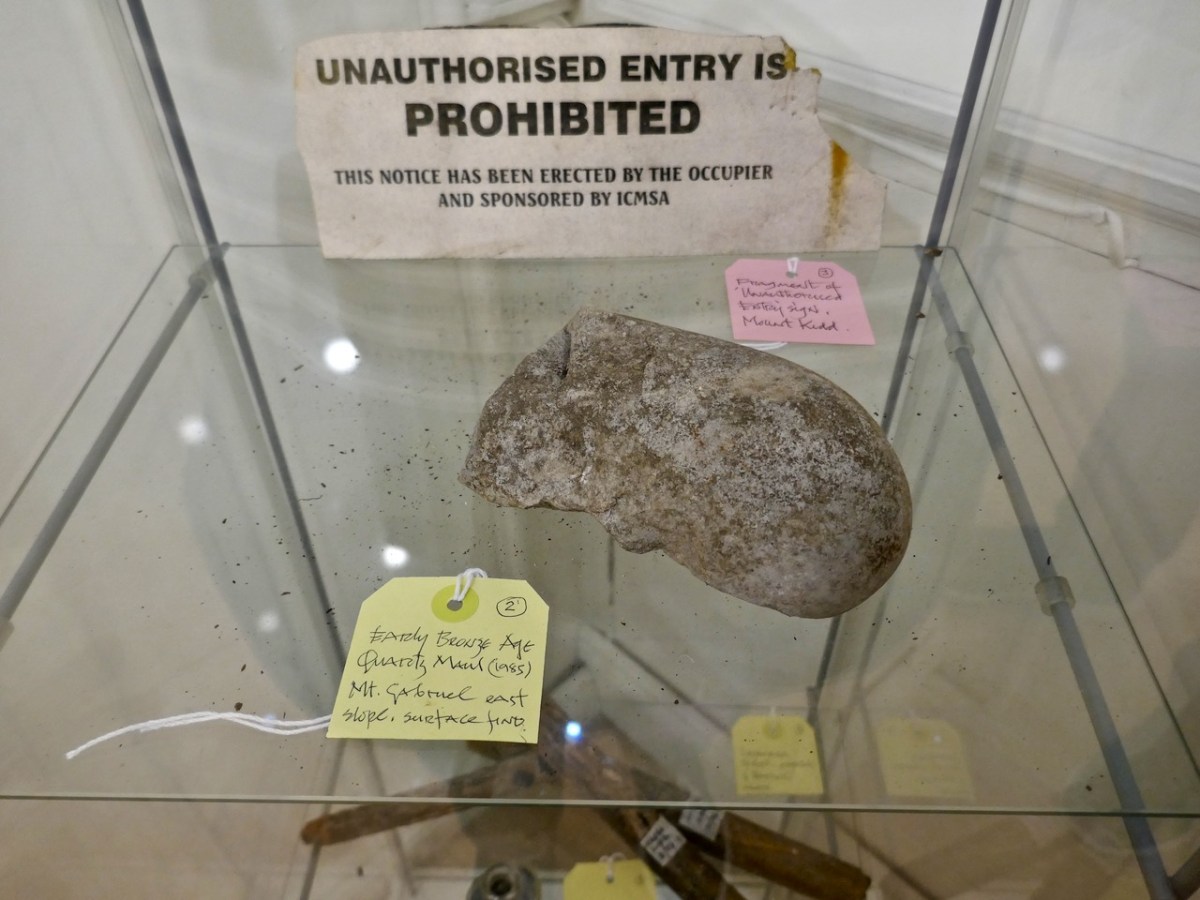
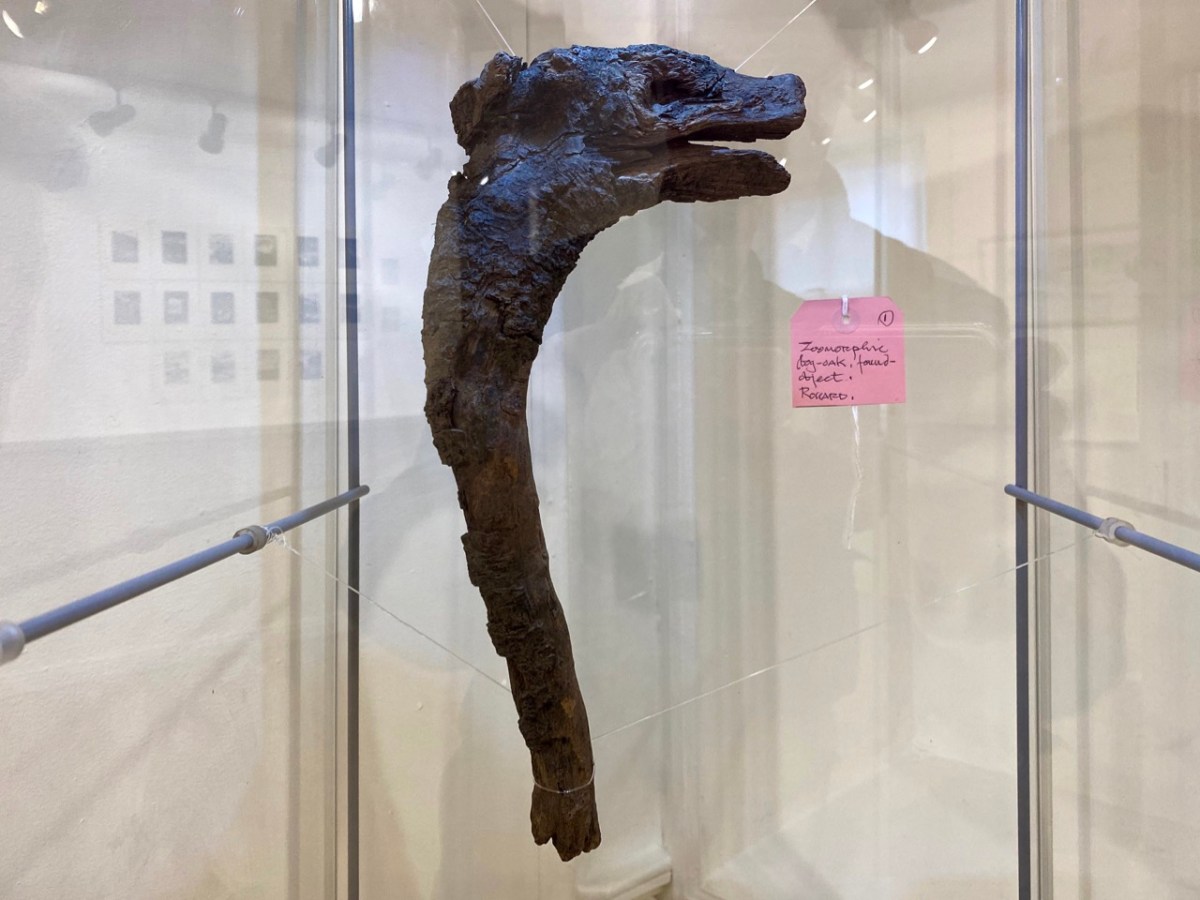
Brian’s observation and humour are not missing from this exhibition. He has included a cabinet of ‘artefacts’ distilled from his own explorations on the mountain. These make reference to the ancient history of the site and its connection with copper extraction in the Bronze Age and in medieval times, and also the twentieth century manifestations of air traffic control technology (known as ‘Gabriel’s Balls’) . . .
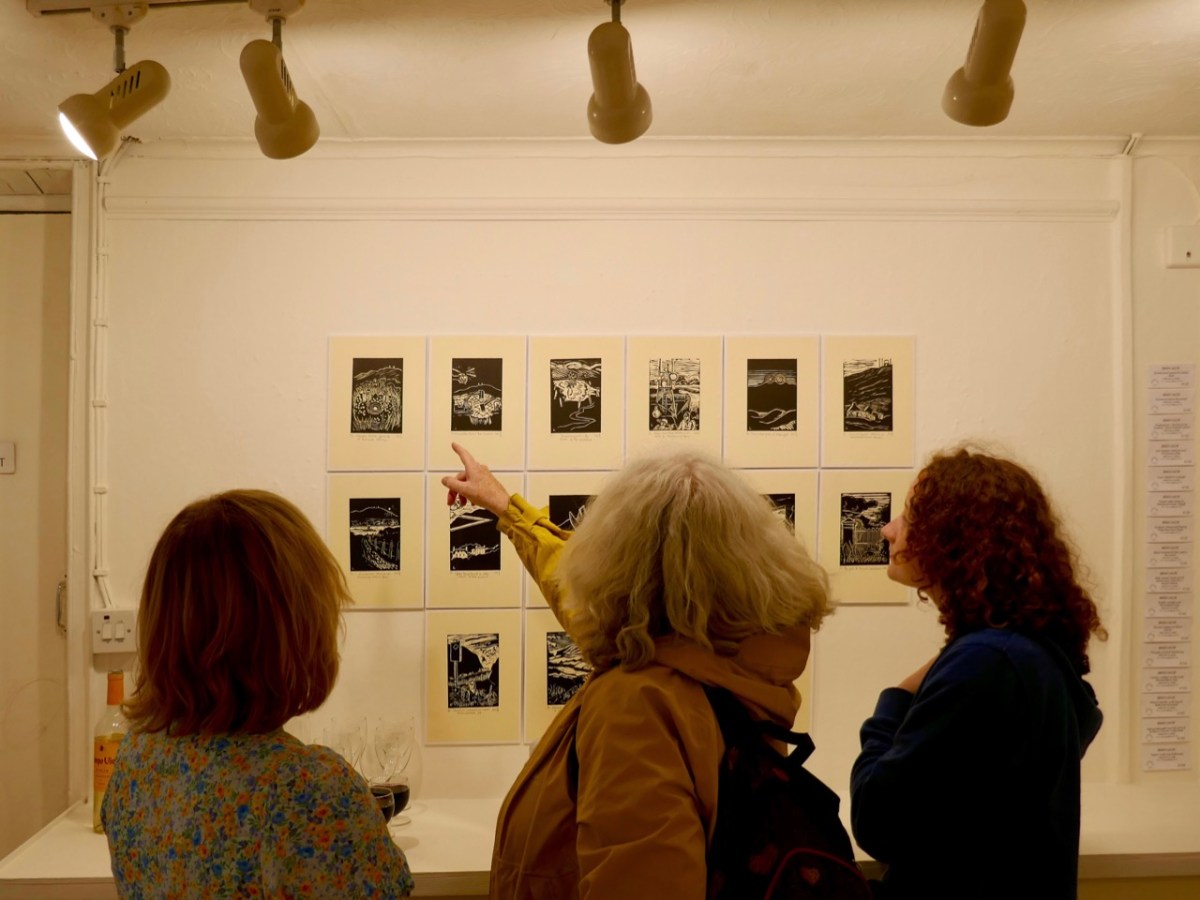
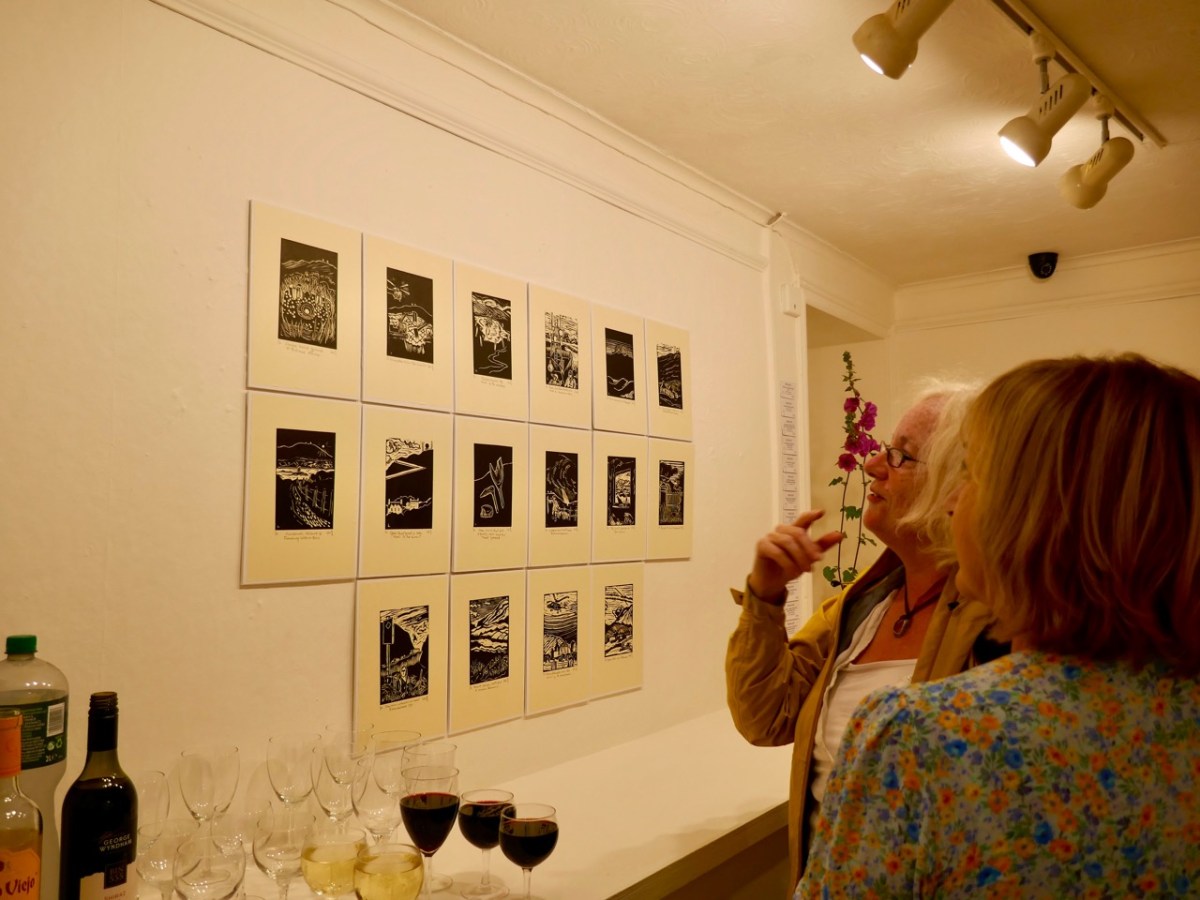
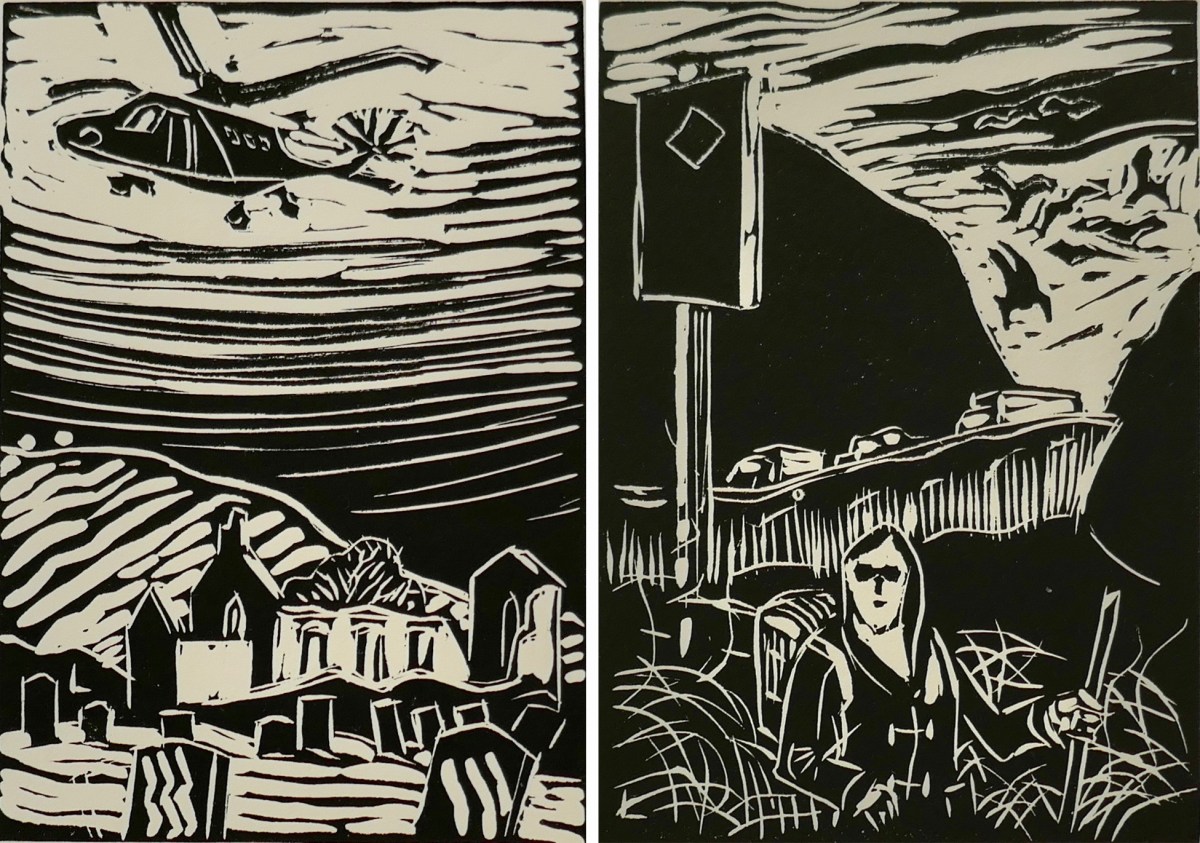
I am particularly taken with Brian’s linocut series – a limited edition of only ten of each print. They provide the ‘fine detail’ in the overall assemblage, and work so well together on the back wall of the largest room.
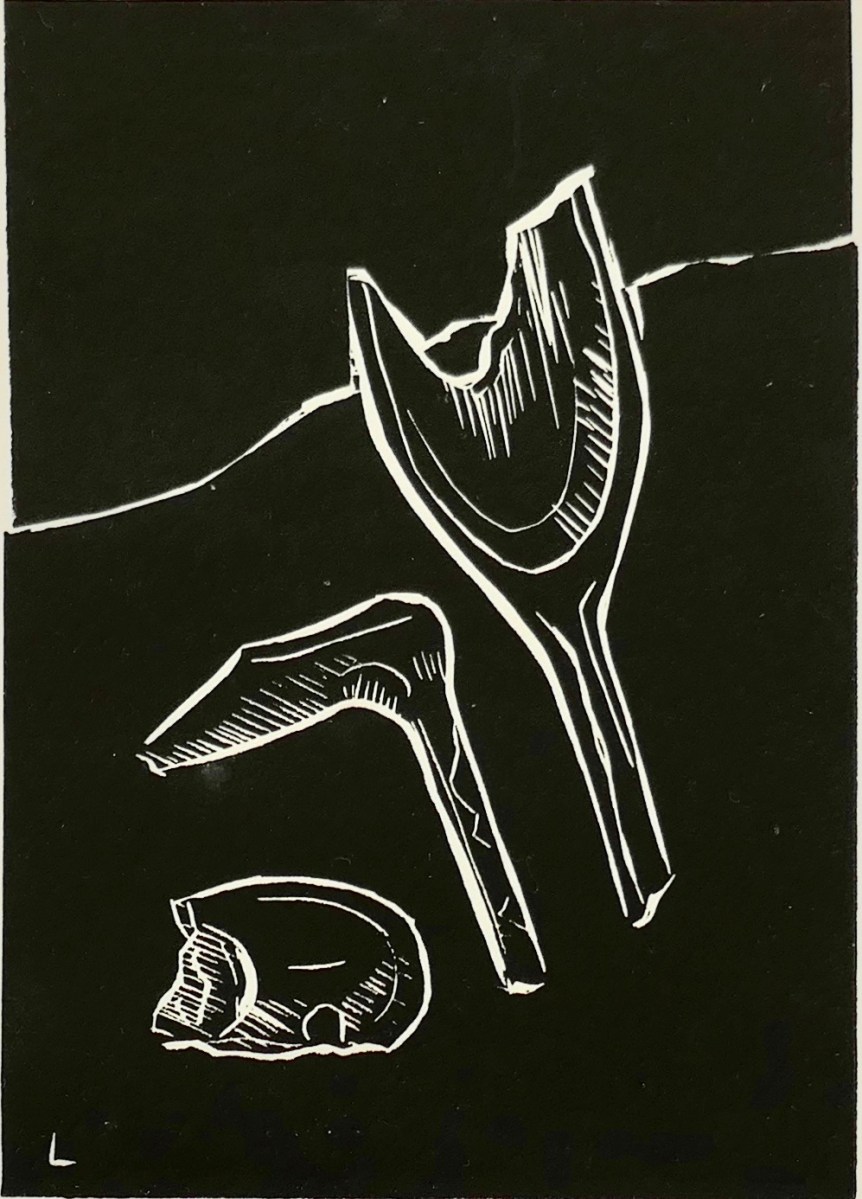
The detail print, above, shows Brian’s representation of archaeological finds connected with ancient copper mining which have been found during excavations on the mountain.
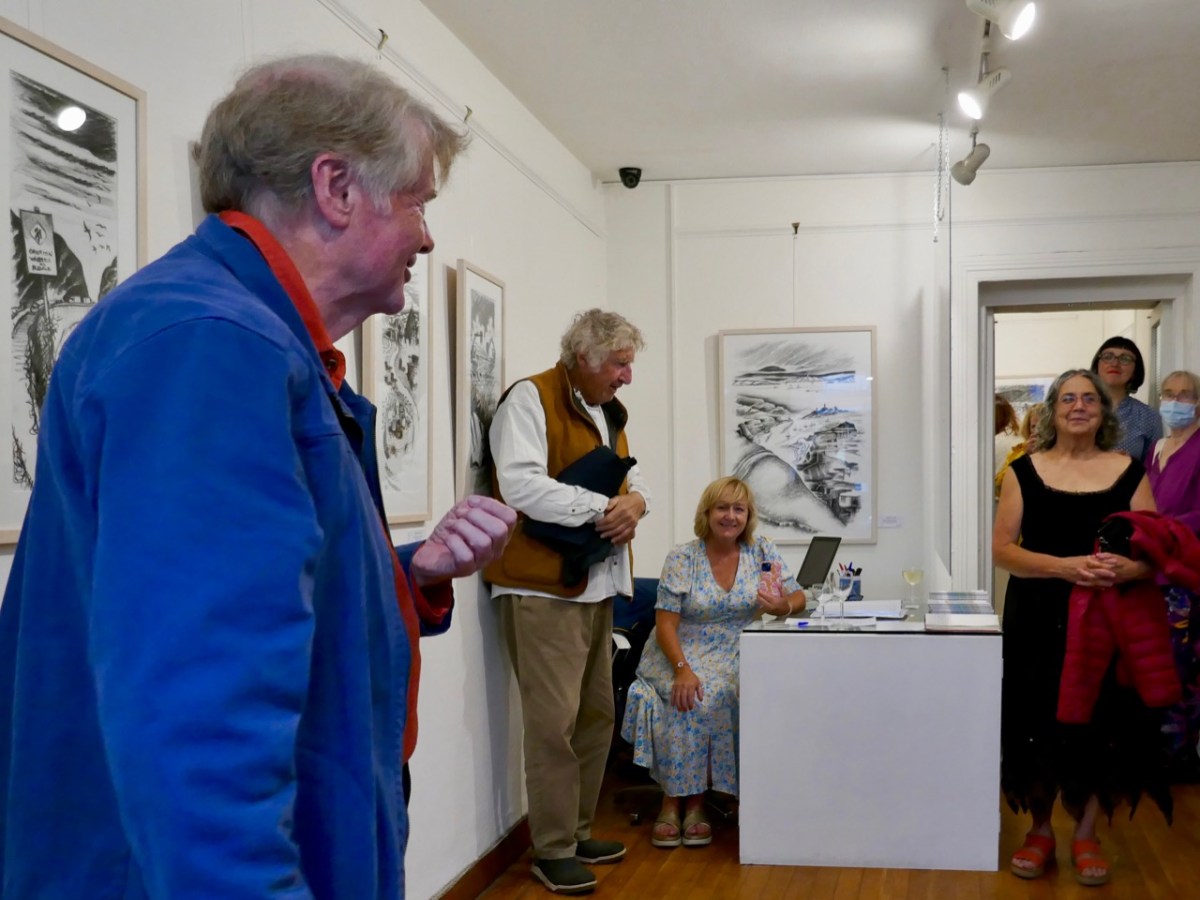
As ‘Guest Curator’ of this exhibition I was delighted to introduce it to an eager audience on the opening night in Schull (above). The show only runs until the 3rd of August, so please rush over in order not to miss it. It is (for me) the highlight of West Cork’s summer offerings!
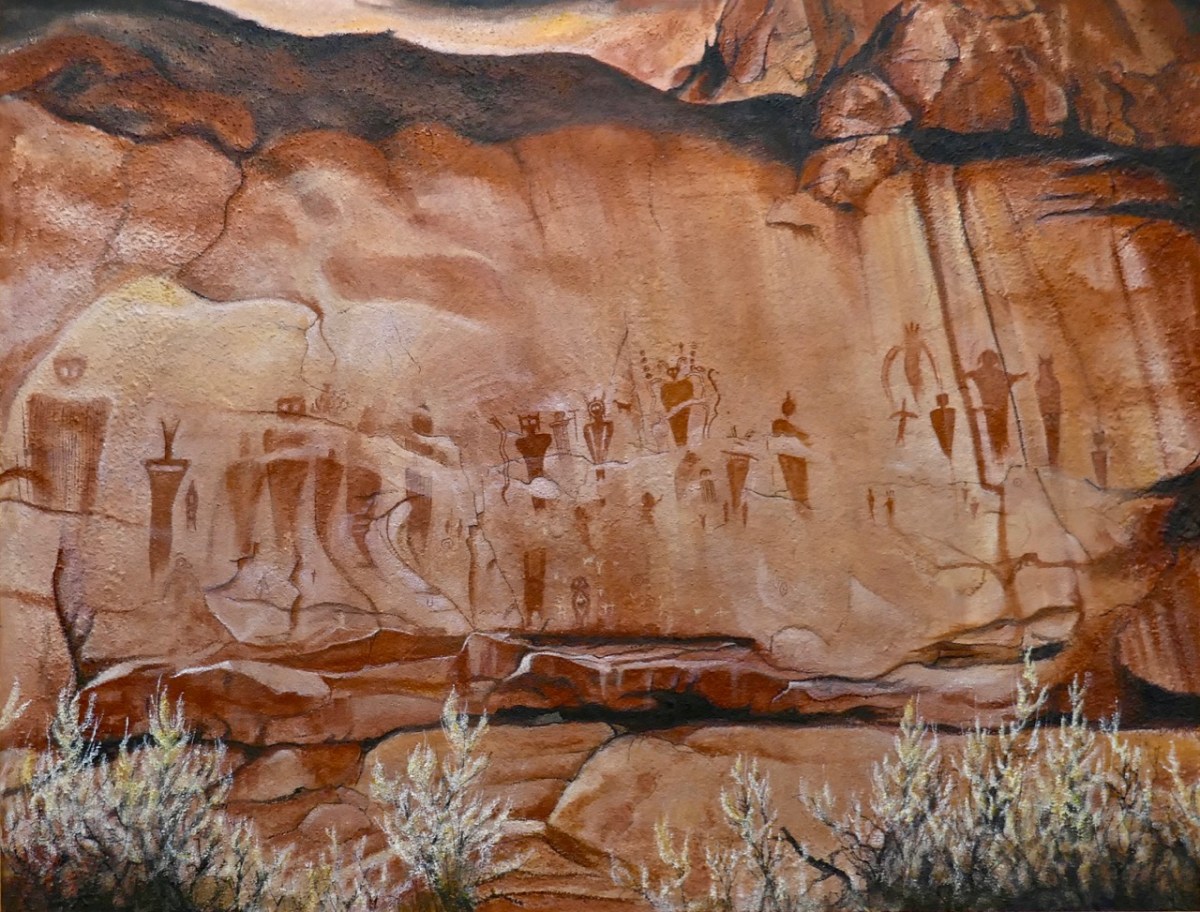
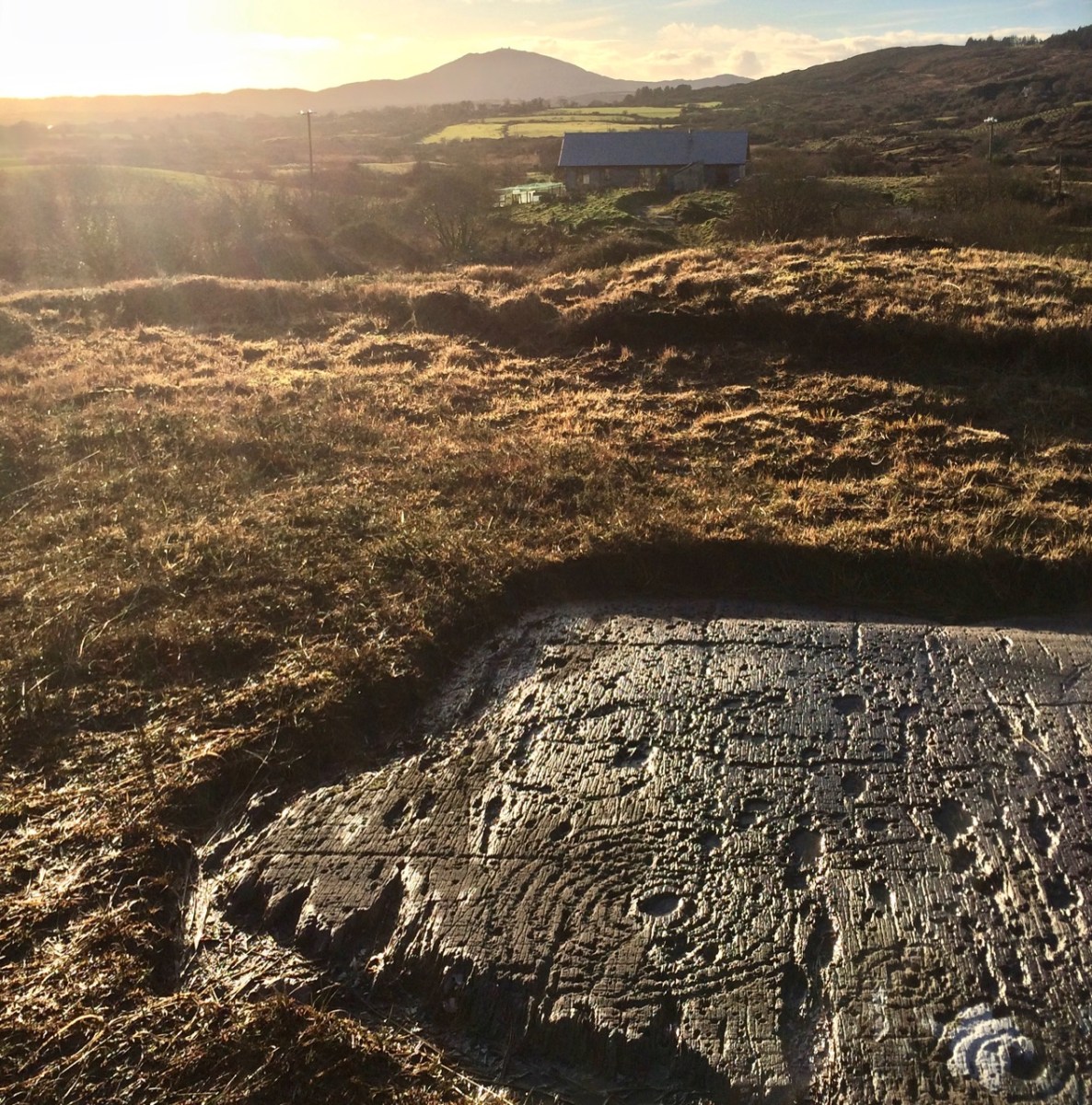
The gallery also has on show some work by other West Cork artists, well worth exploration, so don’t miss them when you go. I can’t resist finishing with one of them: this work (below) by Keith Payne – Sego Canyon. Keith has always been fascinated by ‘Rock Art’ in all parts of the world, and painted this based on his visit to a collection of petroglyphs on a cliff-face in Utah. It’s very apt, I think, to see this work in the context of the Brian Lalor exhibition. Below it is our own photograph of 5,000 year old Rock Art at Derreenaclough, West Cork – discovered only a few years ago. I am personally of the opinion that the siting of this rock in full view of ‘sacred’ Mount Gabriel is purely intentional!
A fully illustrated catalogue is available to purchase in the gallery
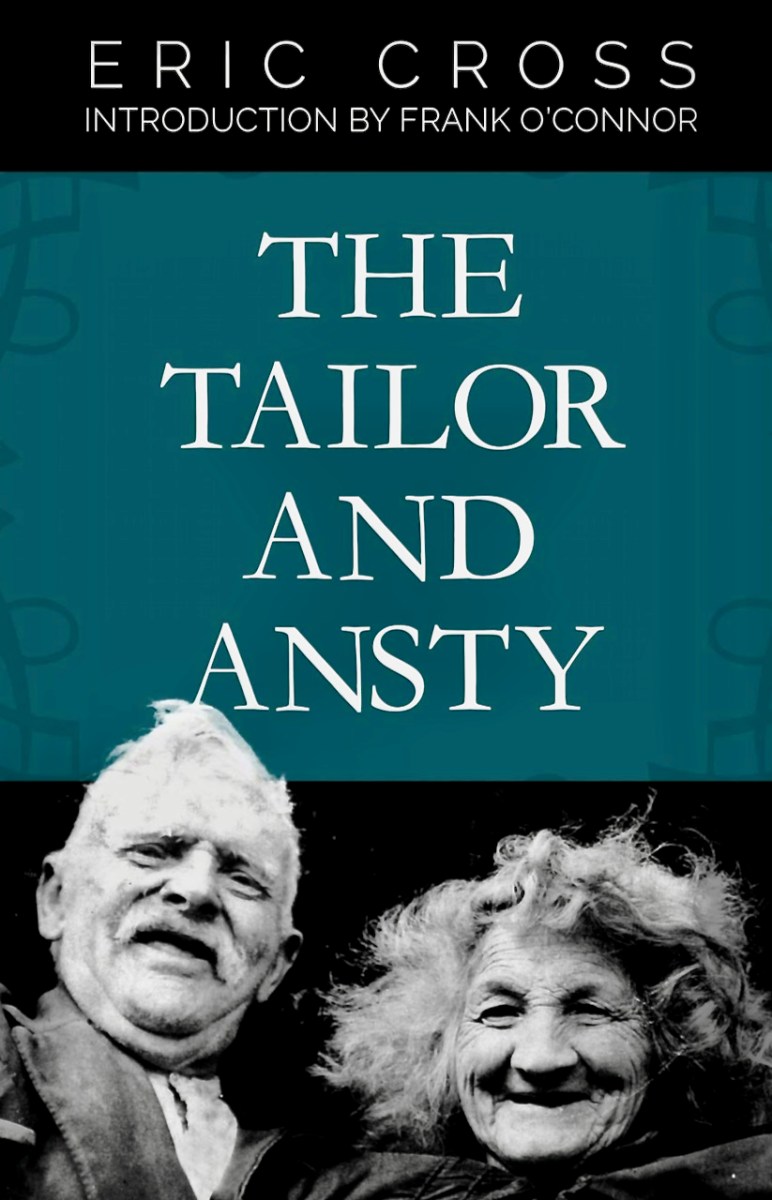
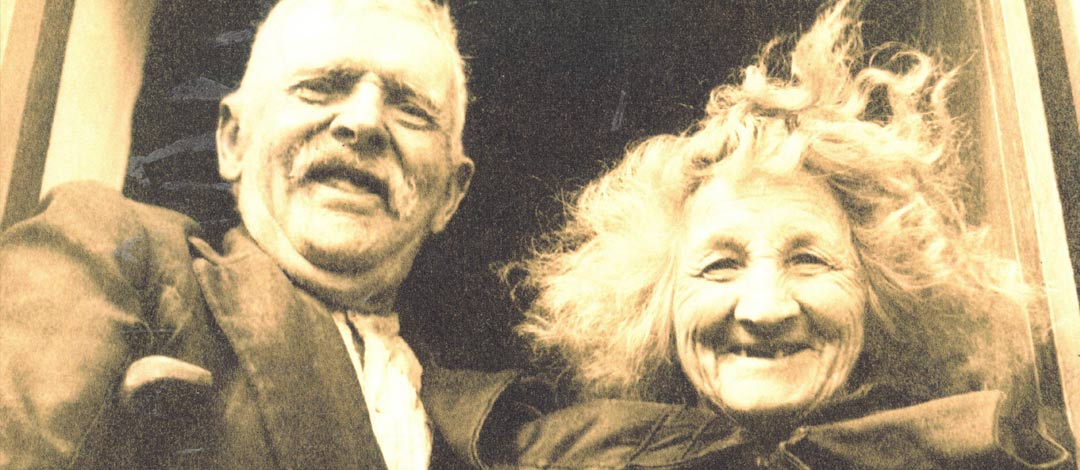
The Tailor and Ansty is a classic book by Eric Cross (below) – beautifully written, hilarious, and capturing the couple in all their humorous (Tailor), crotchety (Ansty) and big-hearted glory. The story didn’t have a happy ending (see Robert’s post) and Ireland will forever be ashamed of that episode in our priest-ridden history, but this post will concentrate on happier times.
People flocked to visit the Tailor and no matter who you were – neighbour, stranger or famous person – you were sure of a welcome, a cup of tea, and a taste of the Tailor’s way with stories and earthy humour. Among those who came were prominent artists of the day, including Nano Reid and Seamus Murphy. Nano, it is thought, would cycle all the way from Ardnagashel, where she was staying with her lifelong friend Patricia Hutchins (yes – the same family as our beloved Ellen Hutchins). This is her painting, only recently identified as depicting the Tailor – my sincere appreciation to David Britton for the image and all the information. David runs one of those pages that convince you that Facebook still has the power to be a force for good in the world.
As David pointed out to me, if there are any doubt as to who this is, Eric Cross’s description of the Tailor in his usual place by the fire should clinch it (look closely).
At one side of the fire is an upturned butter-box. This is the Tailor’s fireside seat. It is placed so that its opening is between his legs, and here he sits, never upon a chair.
Like everything else in the house it has a name. The Tailor refers to it always as ‘Cornucopia’ and explains that a long time ago a Greek king gave such a box to a ‘jolly cupper’, who gave him a drink when he was thirsty, telling her that whenever she was in the want of anything she had but to look inside and she would find it there. . . .
Whatever Amalthea’s horn held, the Tailor’s ‘Cornucopia’ almost rivals it for contents. Beneath the axe with the insecure head, with which he chops wood upon the hearthstone, and the goose-wing with which he sweeps up the ashes, there is a collection of bits of cloth, cords, tins, bits of tools and such like things, out of which he can always find a makeshift for almost anything. . .
Behind ‘Cornucopia’, against the wall, is the settle. In the corner of this, directly behind the Tailor, is the office. This is his accumulation of correspondence over the years. There are letters, photos, postcards from all over the world, stacked up into a pile. Here, too, is his box of cuttings from papers. There are paragraphs cut from newspapers relating to people he knows mixed up with accounts of freak calves and suchlike wonders. Between the arms of the settle and the wall are his pipes. Each pipe, each letter and each photo recalls a friend.
Seamus Murphy was counted as a special friend and came often to visit. At this time (1936) Seamus was making a name for himself as one of Ireland’s foremost sculptors. Here he is in 1934, courtesy of his family who maintain the site https://seamusmurphysculptor.com/wp/
Seamus proposed to do a bust (or busht, as Ansty called it) of the Tailor’s head and the Tailor was immediately agreeable. Chapter fourteen of The Tailor and Ansty relates what fun he had with this project.
‘Dammit, man, it was ever said that two heads are better than one, and the one I have now I have had for 75 years and it is getting the worse for wear. Of course I’ll have a new one’.
All the apparatus and materials were assembled, and the Tailor inspected them with the interest of a fellow craftsman. Ansty ignored the business in the beginning. Her only interest in it was her resentment of the invasion of the Room – ‘with all the old clay and mortar to make a new devil’ – and making fresh disorder of her disorder.
The Room at last justified the Tailor’s name for it, and did become for a while ‘The Studio.’ For an hour or so each day he posed and talked and commented. The measurements interested him and he linked this part of the business with his own craft.
‘Many’s the time that I have measured a man’s body for a new suit of clothes, but I never thought that the day would come when I would be measured myself for a new head.’
‘I think that we will have a rest for a while,’ suggested Seamus during one session.
‘The devil a rest do I need. Do you know that I feel it less than I did the time the whole of my body was making before I was born. There is a considerable improvement in this method. A man can smoke and take it easy and chat away for himself.’
The Tailor is visited by his friend the Sheep, a man given to worry, who wonders if it is an unlucky thing for a man to have his image made and asks how it is to be done. The Tailor explains the process:
‘Yerra, manalive. It’s easy enough. You stick your head into a pot of stirabout, and when it is cold you pull out your head and melt the metal and pour it into the hold your head made. Then you eat up the stirabout and you find your new head inside the pot.’
The exchange with his friend, Dan Bedam, captures all the wit and divilment of the Tailor. Having assured Dan Bedam that there’s a new method of making people because the young people are failing at the job, and the population of the country is going down he responds to Dan’s wonderment.
‘Dam, I was thinking, Tailor, will you be able to use it? Will you be able to talk and smoke and see with it?’
‘Thon amon dieul! What the hell do you think that I am having it made for? Do you think that I want to become a dummy? I tell you that when I have this head I will be a different man. You have often heard tell that you cannot put a young head on old shoulders. Well, this is what it is. I was thinking of having it done the other way at first. Of having a new body fitted to my old head, but the expense for the bronze was too much, so I am starting with the head first. Then I thought that the new brains would not be so good as the old ones. Then I thought that the old ones had done a power of thinking in their time and it would be better after all to make a start with the head.’
Dan was lost in wonderment for awhile.
‘Bedam, but Seamus Murphy must be a clever man.’
‘Clever! I should think he is. He is as good as Daniel O’Connell and Owen Roe put together. They were good enough in the old-fashioned way, but before he’s finished he’ll have the whole of Ireland populated again. It’s a much quicker way than the way you had of going about the business, Dan.’
Eric Cross gives an account of the unveiling, with the whole valley there to see it and The Saint (Fr Traynor) giving a speech. The image, of the busht, above, is from the marvellous Catalogue of Seamus’s work published by the Crawford Gallery.
It was a great night. The drink flowed and the tongues were loosened. The Tailor sang and everyone sang and soon the busht was forgotten. But the Tailor keeps in touch with it still. He has cuttings from the papers relating to it, and he follows it round from exhibition to exhibition in the newspapers.
Nor has Ansty forgotten. Now and again she contemplates the Tailor for a moment or two and wonders, and then expresses her thoughts, ‘and to think that Seamus made a busht of that old devil as though he was a saint in a church. The man must be half cracked. As cracked as himself. Glory be! and to think that he wouldn’t settle the leak in the chimney for me, and he with the good mortar and plaster, making a busht’.
Seamus was a friend to the end – he made the marvellous tombstone that can be seen in the graveyard at Gougane Barra. On it he carved the words A Star Danced and Under That Was I Born.
By the way, if you want to see how one of the casts looks in situ, here is a marvellous post by Don Ross, a Guide at Farmleigh House in the Phoenix Park. Thank you Don – you were one of the inspirations for this post, along with a recent conversations with Seamus’s daughter Orla and her husband, Ted.
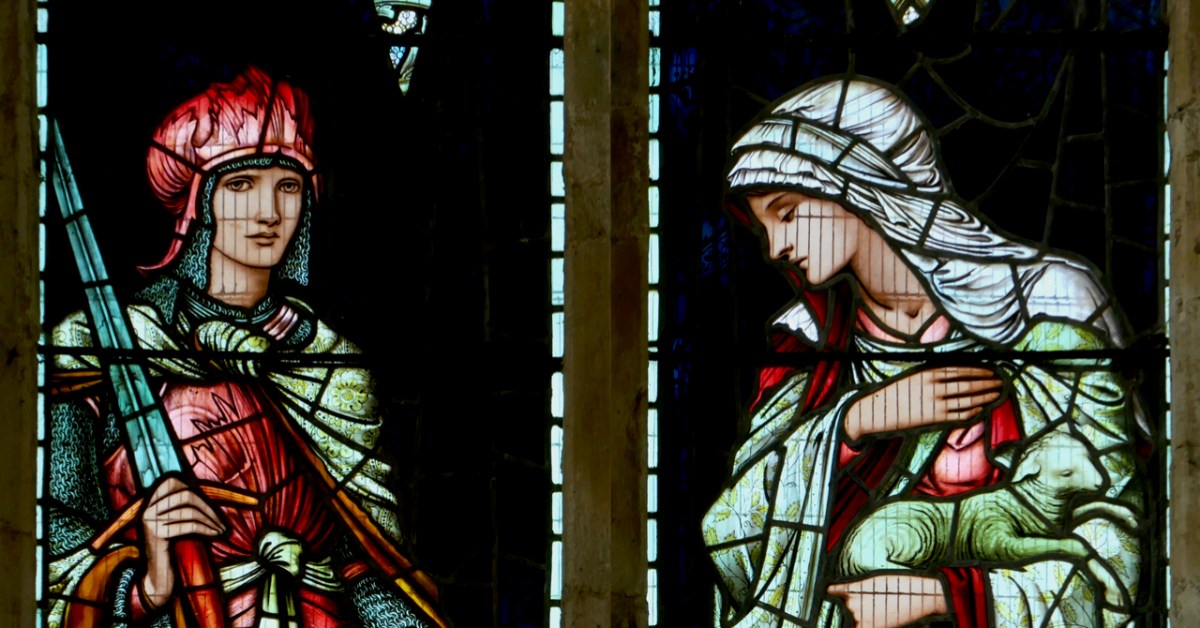
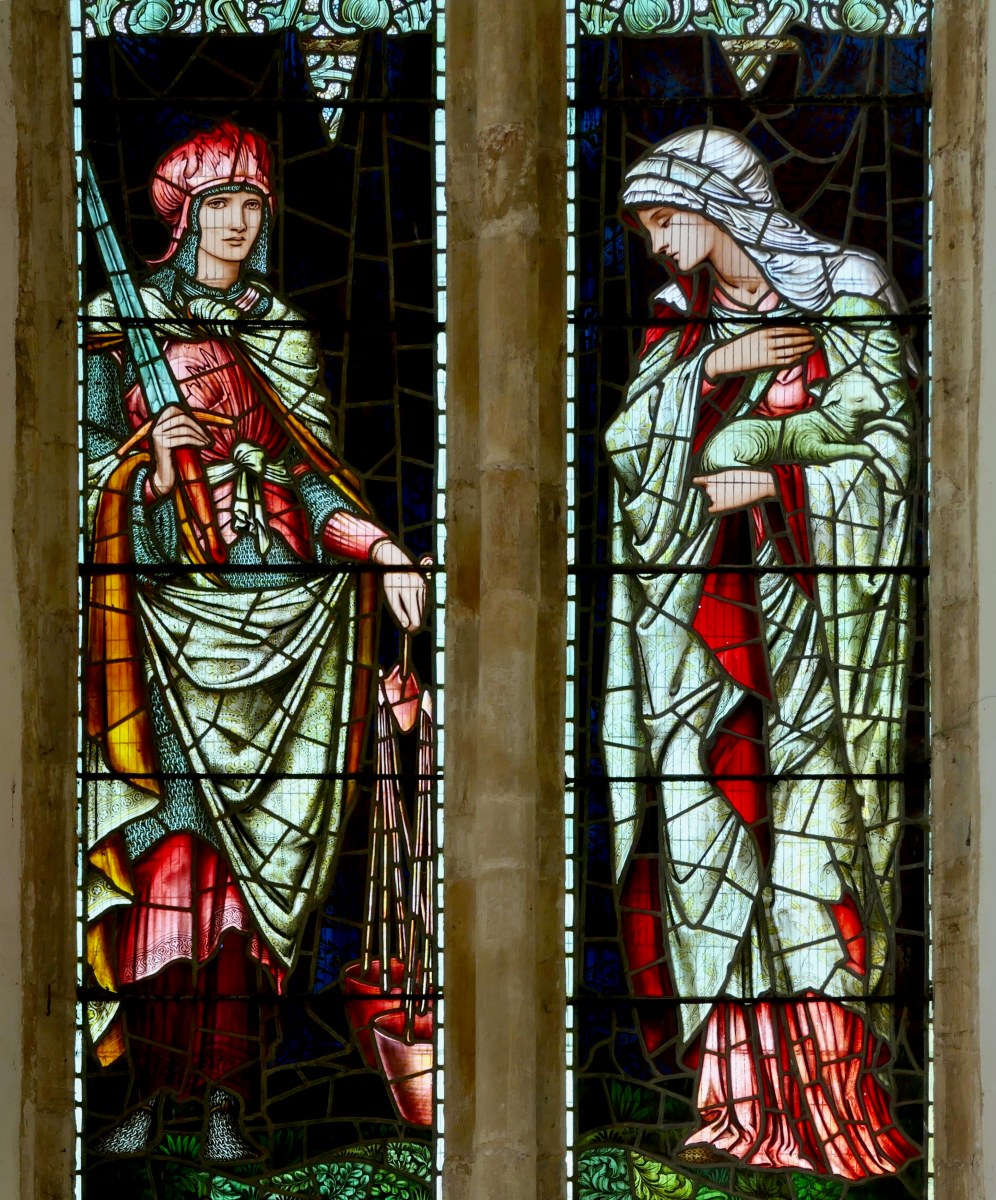
Edward Coley Burne-Jones is perhaps best known as a painter, but he also designed stained glass. While he was a prolific designer, not many of his windows found their way to Ireland. Hence, it is a joy to see and appreciate his beautiful two-light window in Lismore Cathedral.
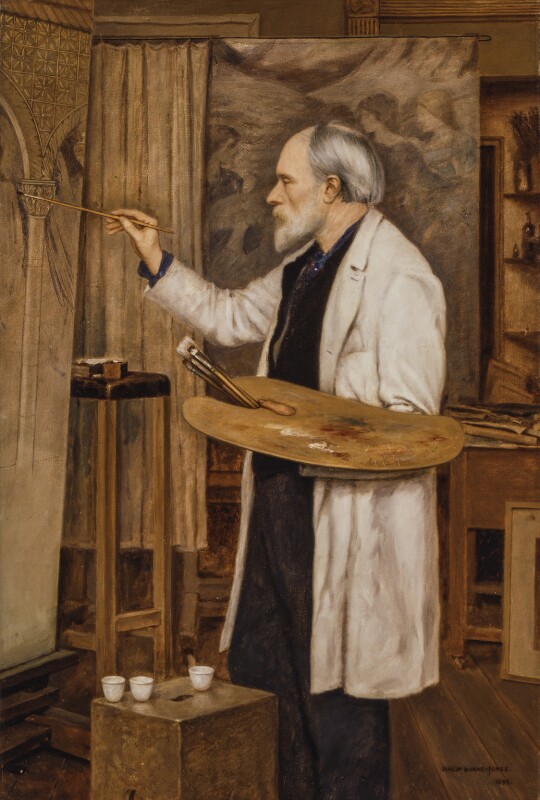
Burne-Jones was one of the Pre-Raphaelite Brotherhood whose aim was to recreate a style of painting that they saw as most representative of the period before the Renaissance (which spoiled everything, apparently). Their paintings are distinguished by being highly romantic and emphasising beauty (male and female), the natural world (or at least the most benign aspects of it) and attention to detail. The portrait of him below is used with gratitude and under license from the National Portrait Gallery.
Burne-Jones met William Morris when he left university to study art and they began a life-long partnership. Known as one of the founders of the Arts and Crafts Movement, Morris united a genius for business with a commitment to honouring both art and craft. One of the ‘crafts’ he recognised as needing a genuine artistic approach was stained glass. While Burne-Jones did some designing for the stained glass firm of Powell of Whitefriars, from 1861 on he designed exclusively for Morris. The two friends are shown below, once again, under license from the National Portrait Gallery. It’s not the wildly romantic and handsome image I had of them – perhaps it’s true that you should never meet your heroes.
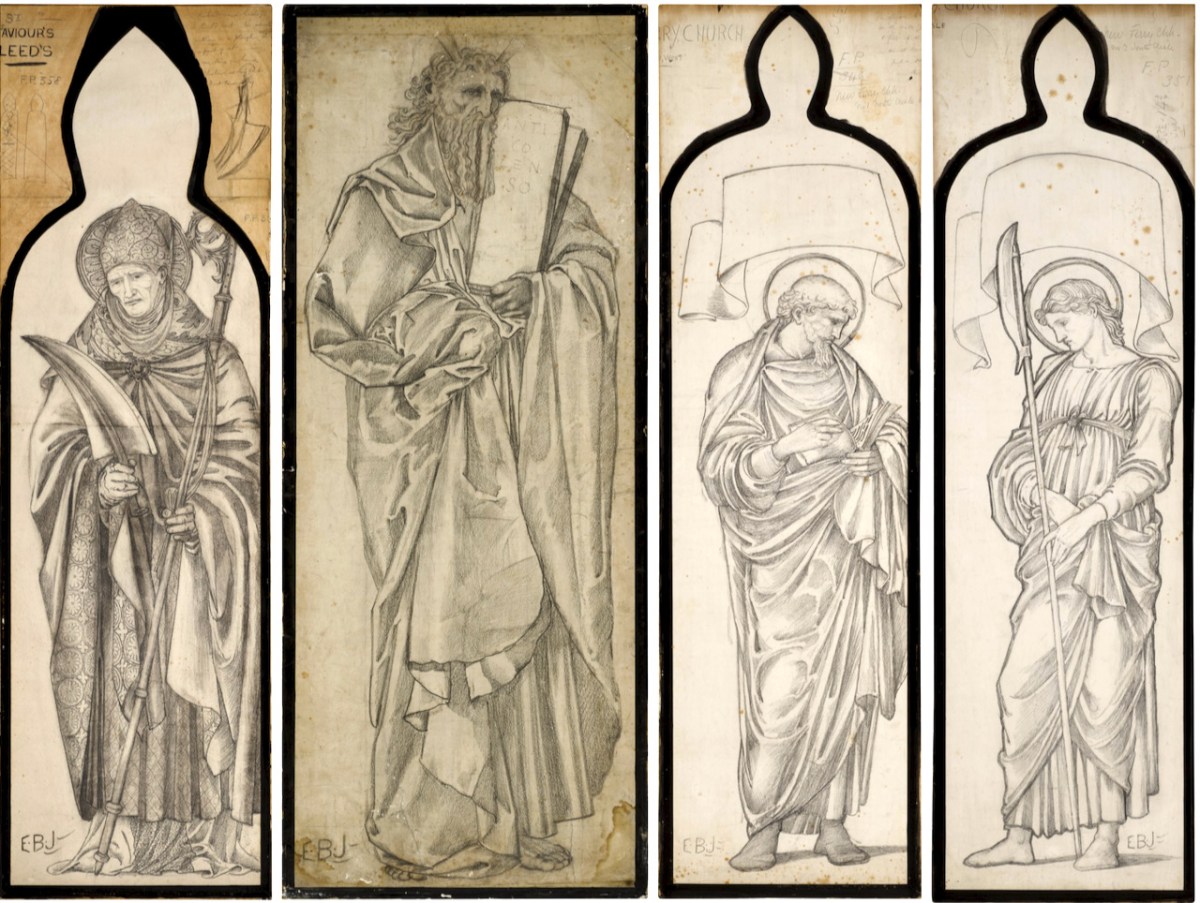
It’s important to emphasise here that Burne-Jones was an artist and designer: he did not execute the windows he designed, although he often included notes about colour preference or the form of a figure or detail on his cartoons – the full-size drawings upon which the glass was laid to guide the artists who painted and cut the glass. The cartoons below were recently offered for sale at Sothebys for 40,000 – 60,000USD!
Ironically, this was a contradiction of the true philosophy of the arts and crafts movement, which held that a single artist/craftsperson should execute all aspects of the final artwork. This was the rule inculcated by AE Child when he inducted all his eager students into the processes of designing and making stained glass in the Dublin Metropolitan School of Art. It was the underlying ideology of An Túr Gloine and it was how Harry Clarke started out – both designing and actually painting his own windows. (That’s Lismore Cathedral below, where the window is located – you can read more about this historic and fascinating church in Robert’s post Off the M8 – Lismore Quest.)
But once you start a company, that company has to make money to survive, and Morris was canny enough to see that the artist-maker was not the business model he needed. Morris specialised in wonderful pattern-making, especially foliage of all kinds (his name is synonymous with certain kinds of wallpaper and fabric). Burne-Jones’ figures, along with Morris’s highly-patterned backgrounds, were handed over to the craftsmen (yes, all men, I think, although I stand to be corrected here) to take them from a cartoon to a finished window. Like Harry Clarke’s windows, Burne-Jones’ were instantly recognisable and popular and the demand for them was enormous. You can see why. The figures are languorous and romantic. The faces are intensely beautiful; the details of the robes, armour, helmets, musical instruments etc are exquisite; the colours are soft and harmonious.
By the time Burne-Jones died in 1898 and Morris in 1896, there was a huge catalogue of gorgeous designs. Morris and Co continued under the leadership of John Dearle (himself a talented designer) and the firm continued to produce Burn-Jones windows, adapted as necessary to fit the size and position of windows. In fact, there is an almost-identical window in another C of I church, in Coolock.
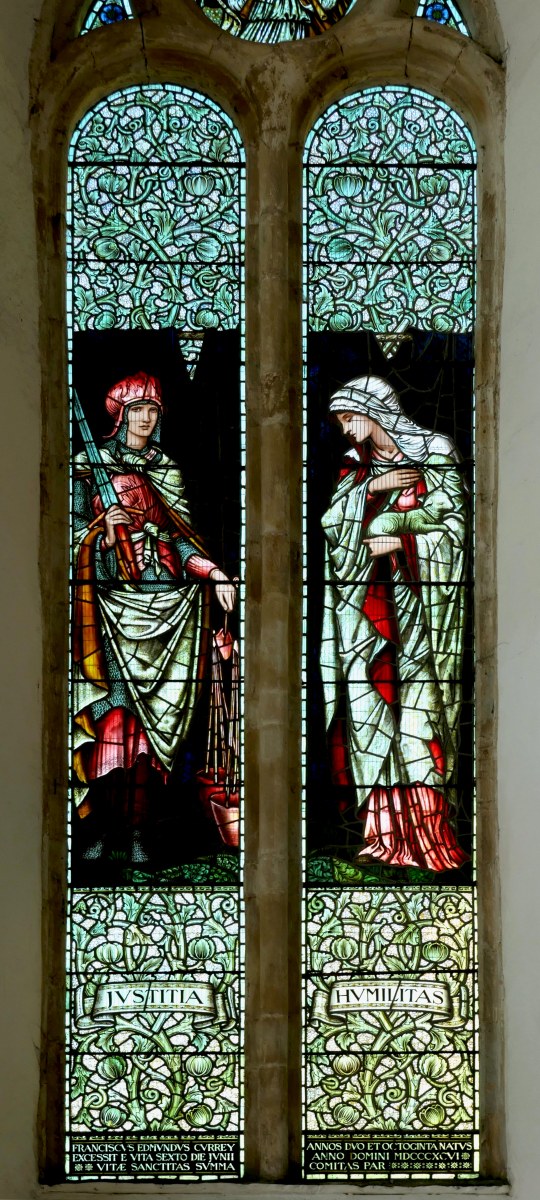
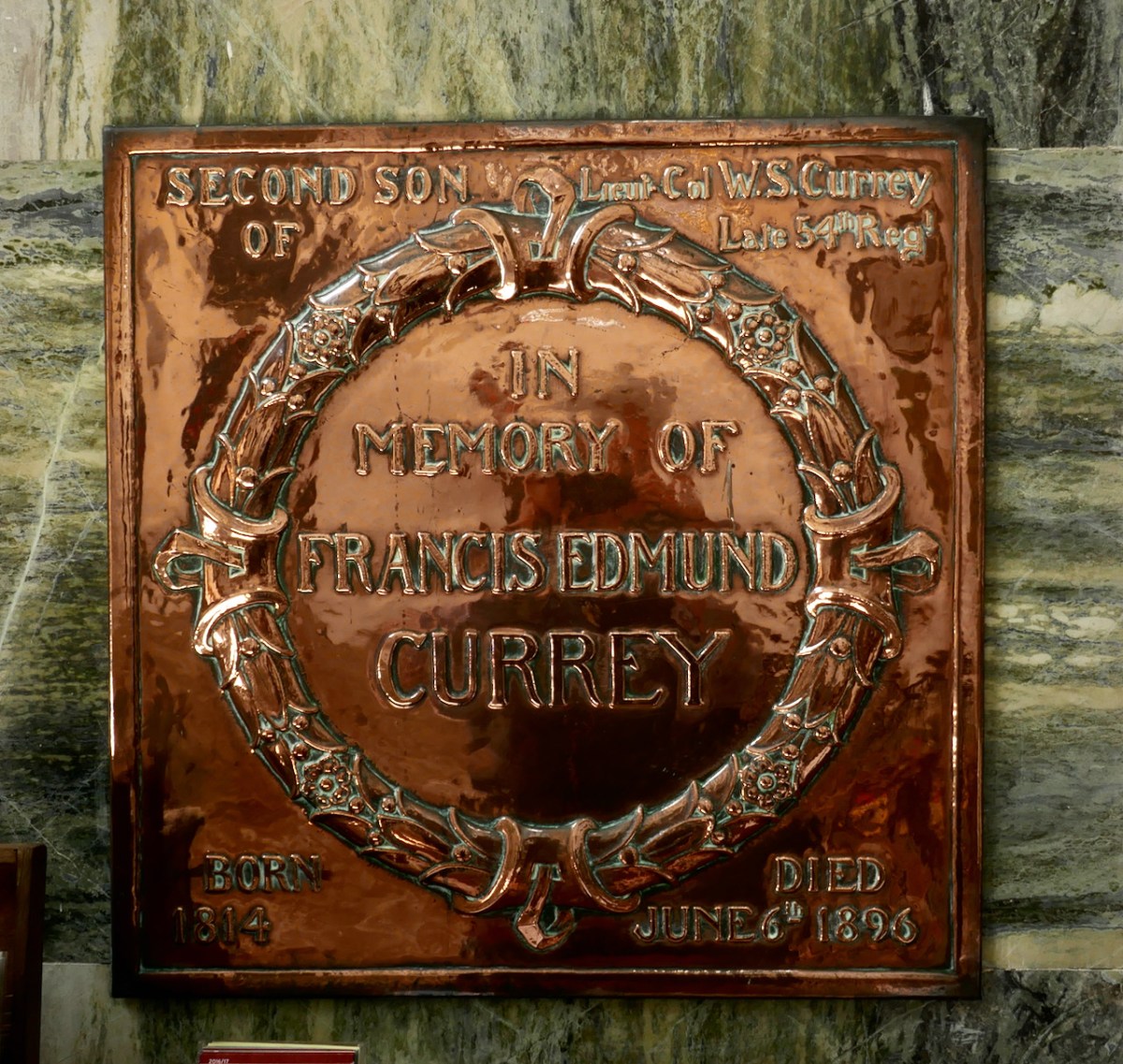
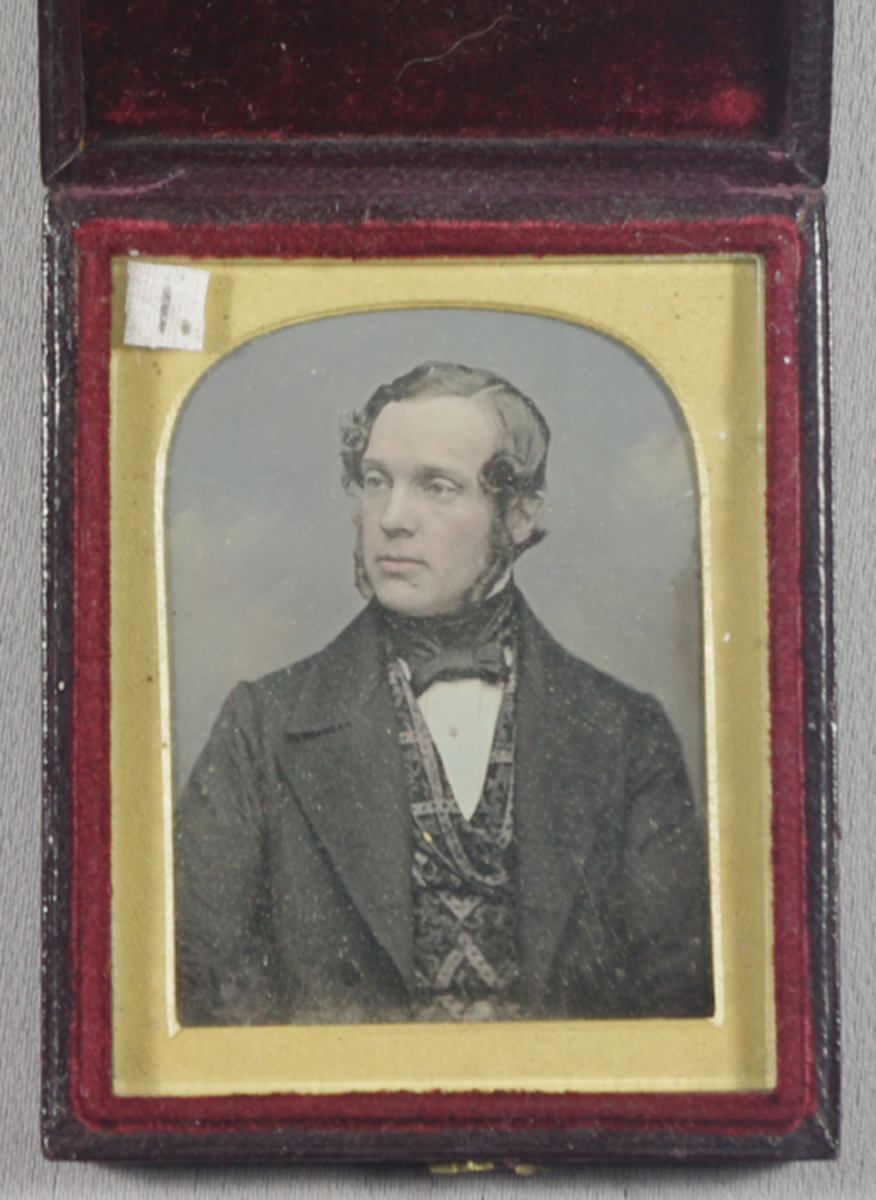
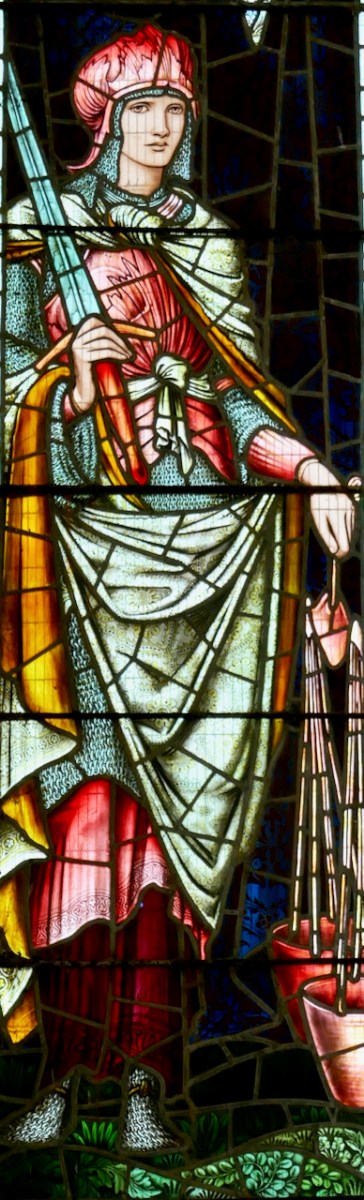
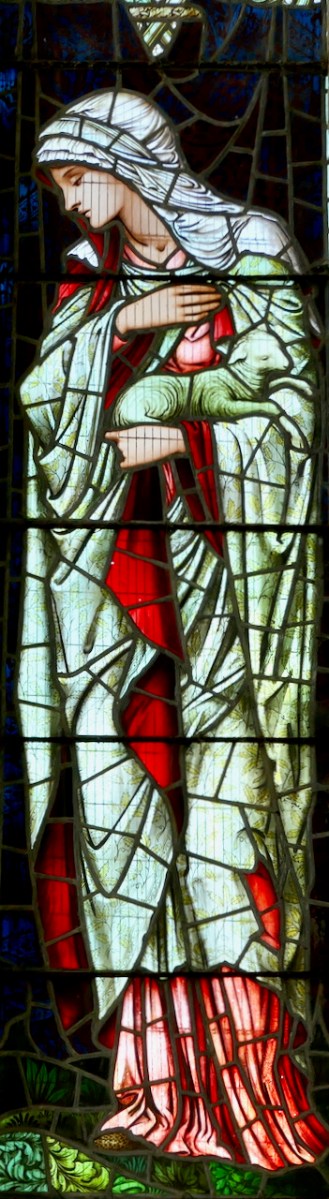
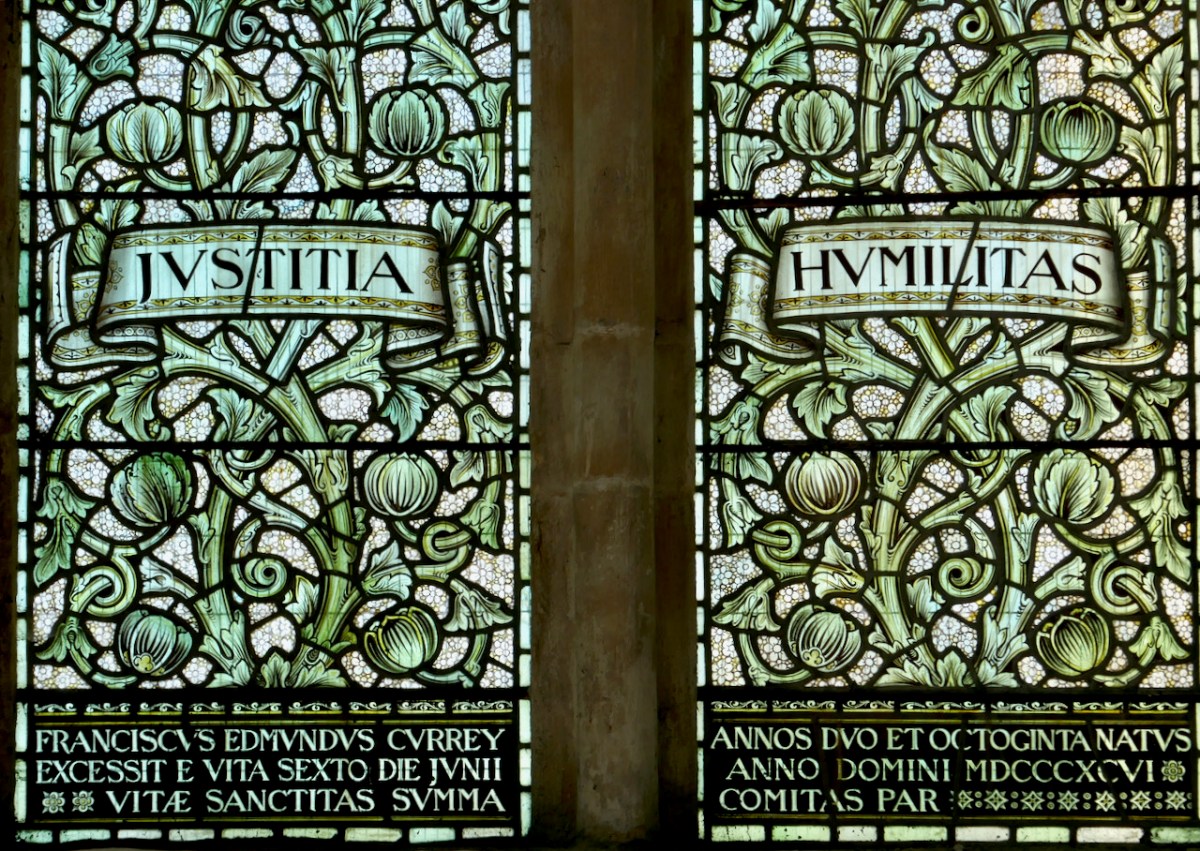
This brings us to the Lismore window – Justice and Humility – installed in honour of Francis Edmund Currey upon Currey’s death in 1896. Who was Francis Edmund Currey? He was the Duke of Devonshire’s agent and a keen, and early, photographer. He, or his wife, was related to the Somervilles of Castletownshend, although I am not sure how. His photographs are in several archives (just Google).
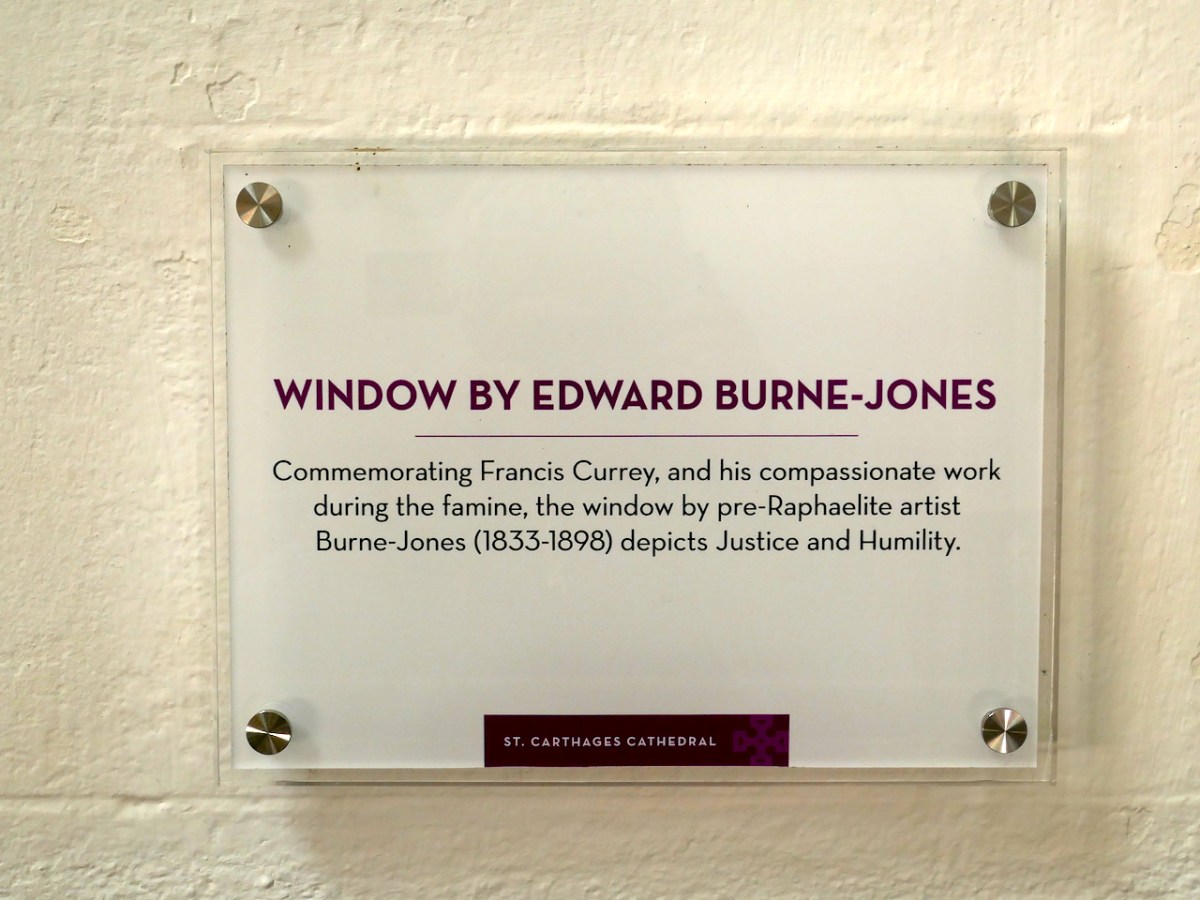
That’s him, above*. A plaque refers to his ‘compassionate work during the famine.’ I have been unable to find much corroboration of this (and remember, as the largely-absent Duke’s agent, he got to write his own version of events for ‘his’ cathedral) – but I have found some accounts that say his emphasis was on keeping the tenantry contented and he was certainly not one of the cruel agents that proliferated at this time. If anyone out there knows more, please comment below!
The windows are beautifully and expertly done – Morris and Co had many very talented and able craftsmen, although we don’t know which of them was responsible for executing this one. Justice is represented by the figure of St Michael, although curiously there are no wings, despite the fact that Michael is an Archangel. He carries a sword in his right hand – he vanquished Satan with a sword – and in his left had he holds the scales he uses to weigh souls on Judgement Day. He wears chain mail and complicated robes and his steady gaze seems to size up the viewer with a mix of compassion and insight.
The figure of Humility is suitably, well, humble, with a downcast gaze and carrying a lamb. Like Michael, she has much drapery, all finely-worked (take a close look).
The predella (bottom panel) is the familiar Morris wallpaper, a complex intertwining of leaves and flowers, pleasingly repeated.
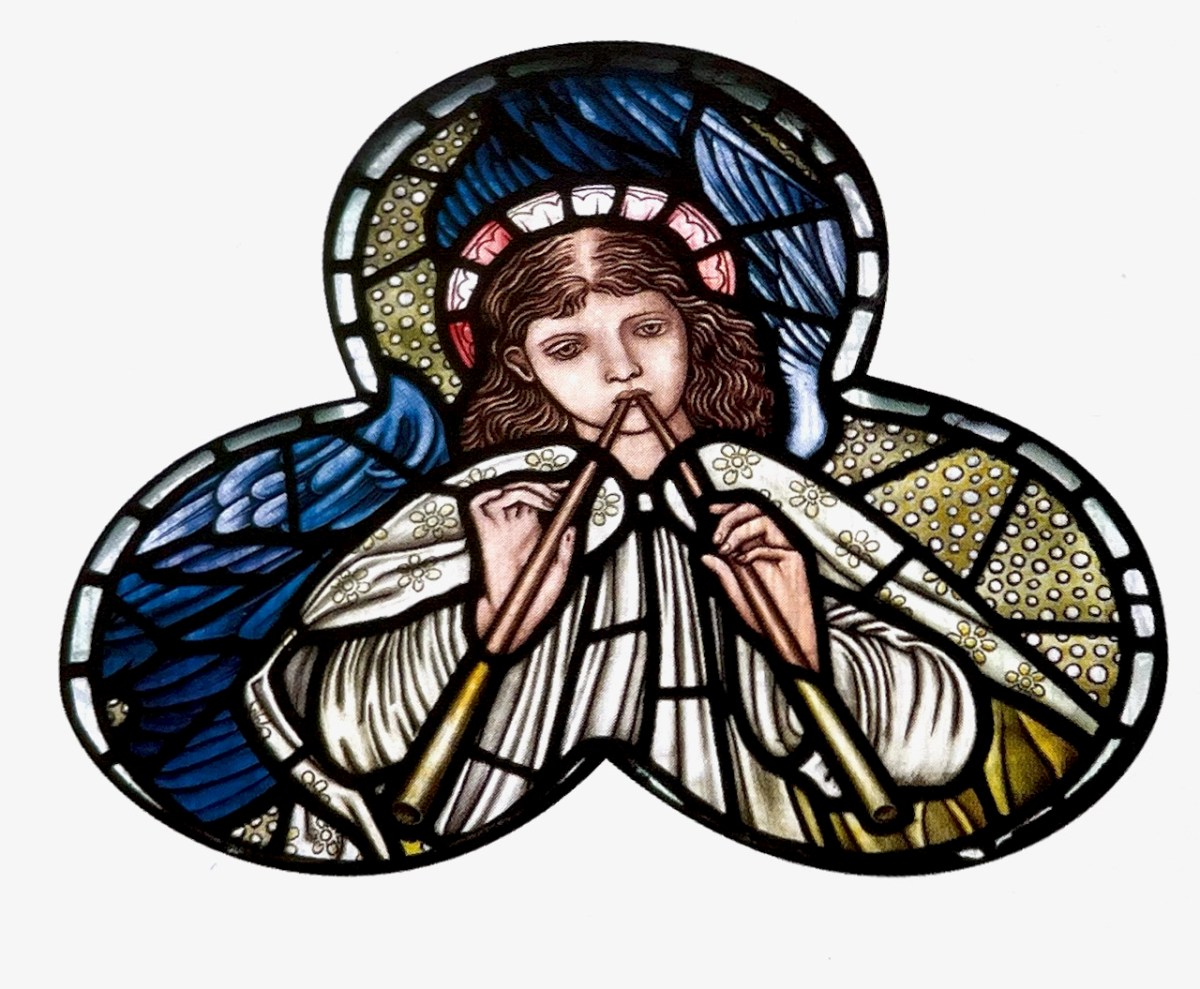
The very top section of the tracery (which I didn’t capture in my photographs) is a sweet angel blowing two pipes – below is the exact same design from an English window.
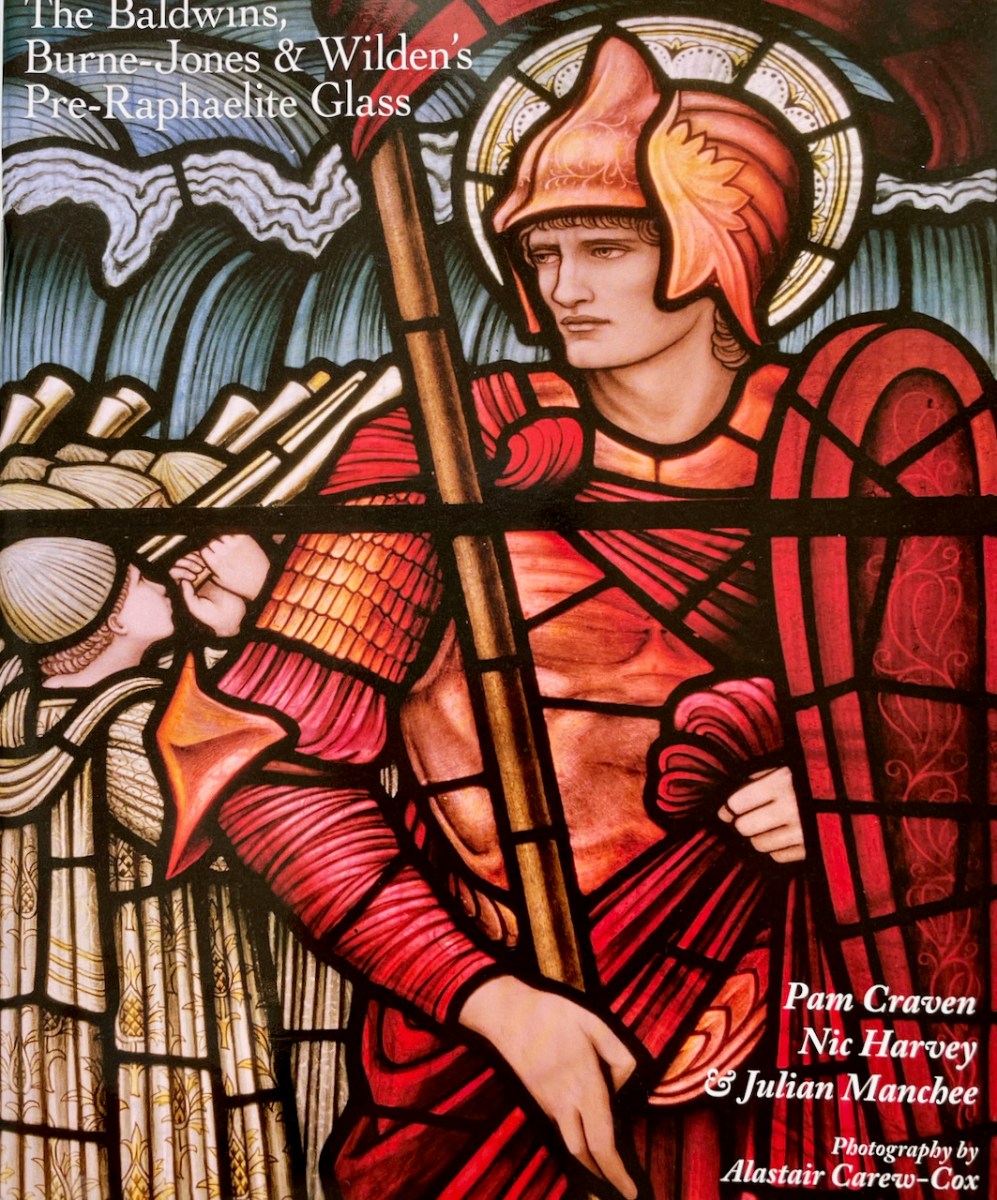
This post was inspired by a book loaned from a friend – thank you, Richard, for all the information on Wilden church, and the stories that went along with the book.
It’s not West Cork, but – if you are looking for an impressive archaeological site – take a little trip over the border into the North, as we did very recently. Just outside Belfast City we found The Giant’s Ring. The size of it is astonishing – 180 metres in internal diameter, and covering an area of 2.8 hectares. And what we see today is only part of a cluster of monuments here.
This marked up location plan, produced by archaeologist Barrie Hartwell in 1998, shows the Giant’s Ring, and other sites nearby which have been discovered by aerial survey and crop marks. We can’t really know what the focus of the whole complex is. Guesses are made as to what its function might have been, based on similarities to other finds, but the size of this ‘Ring’ sets it apart from most other equivalent discoveries. If you want West of Ireland comparisons, then Drombeg Circle has a diameter of 9.3 metres; The Giant’s Ring, at 180m, is twenty times greater! Also, the Grange Stone Circle in Co Limerick – which appears very large to us (it’s the Republic’s largest) – has a diameter of ‘only’ 60 metres.
It’s hard to judge the scale from a photograph, but looking at the figure just visible at the right-hand edge of this view, above, helps to set the scene. The ‘small’ pile of stone that you can also see within the enclosure is, in fact, a monument in its own right, generally thought today to be the remains of a passage grave. Here’s a nearer view, followed by close-ups. The structure – a type which used to be called a ‘dolmen’ (and still is in some of the accounts of The Giant’s Ring) is quite substantial.
This passage grave is far less impressive than – say – Newgrange, but why would it be sited in this enormous ring – which resembles a ‘henge’? It is dwarfed by the huge circular bank. It is likely that the grave or tomb structure was covered by a mound. Here is an artist’s impression of the enclosure being used for a ritual purpose:
In 1995 archaeologist Barrie Hartwell provided the following commentary to this sketch:
. . . This conjectural reconstruction of the Giant’s Ring brings together a number of ideas. Here the Giant’s Ring stands on the southern edge of a plateau overlooking the fertile land of the Lagan Valley. The internal slope of the bank is lined with stones and the bank has a flat top on which people crowd to view the spectacle unfolding within. The passage grave, embedded in an earthen mound provides the focus of activity. The quarry ditch can be seen between the two. In the right foreground is a circular bank, first seen as a crop mark in an aerial photograph. This was excavated in 1991, when the remains of a stoney bank were found on the eastern side. The central area had been removed by quarrying to a depth of 3m and backfilled within the last two hundred years . . .
Prehistory of The Giant’s Ring & Ballynahatty Townland Barrie Hartwell LISBURN.COM
Above is an image from Google Earth showing the context of the circular monument in its immediate surroundings. There is no sign in this image of the many nearby sites which have been identified close to the Ring (look again at Barrie Hartwell’s location plan), but archaeologists have been busy at this location in comparatively modern times. Hartwell summarised some of the excavations in an article for Archaeology Ireland Volume 5, No 4, Winter 1991. He reports a description of a ‘chamber’ that was described in 1855 by Robert MacAdam, editor of the Ulster Journal of Archaeology:
. . . On November 21st 1855, Robert MacAdam picked up the Belfast Newsletter in his office in the Soho Foundry in Belfast . . . His attention was caught by a paragraph in the paper announcing the ‘discovery of an ancient tomb on the farm of Mr David Bodel of Ballynehatty’. He immediately visited the spot, just six miles south of Belfast, with his friend Mr Getty, and found that the tomb was still largely intact and that most of the contents had been rescued by the farmer. Equally interesting was its position close to the great enigmatic banked enclosure of the Giant’s Ring on an isolated, undulating, upland block of land overlooking the River Lagan. They were impressed enough to return at the weekend with other members of the Belfast Natural History and Philosophical Society to record it properly . . .
Archaeology Ireland Volume 5 No 4 – Winter 1991
The above illustration accompanies the article. Note that this find appears to have been sited outside of the Giant’s Ring itself. Hartwell’s account continues:
. . . Their plan and description shows that this curious structure had been built in a paved, 1.5m deep, flat-bottomed pit and with a corbelled roof supported by a stone perimeter wall, five internal stone dividers and a central prop. The top of the roof was 0.5m below the ground surface and may have been covered with small stones to form a cairn. In two of the radial compartments so formed were found the remains of four ‘…urns, about twelve inches high by ten broad…’ each containing burnt bones. One of the urns had disintegrated, and two of them were later described as being large and rudely formed. One of these survives today as a Bronze Age Collared Urn. The fourth was a typical globular-shaped Carrowkeel Ware pot usually found in Neolithic passage tombs . . .
Archaeology Ireland Volume 5 No 4 – Winter 1991
I found a further reference to the discovery of this ‘chamber’ in the archives of the Belfast News, 1855:
Hartwell’s fascinating account describes other finds in the area, and reports how Bodel – the farmer who owned the land – could remember stories of previous finds going back through generations of his family: a number of sites had been destroyed through agricultural clearance or ‘treasure hunting’. According to his memories these included a standing stone, another megalithic tomb, a multiple cist cairn, a number of single cist burials and two ‘cemeteries’ which produced many cart-loads of human bones. He also noted that similar sites had been found in his neighbours’ fields.
We can distil from these various stories that what we see today at this site was central to a very significant cultural hub, much of which is now lost. Hartwell suggests that some of the more recent excavations provide evidence that human activity here dates from 3039 to 2503 BC. His conclusion is significant:
. . . It is placed firmly in the late Neolithic rather than the Bronze Age. The closest parallel in Ireland is surely Newgrange. Indeed, the Bend in the Boyne and the ‘Loop in the Lagan’ invite close comparison. The scale of the monuments may vary but all the elements of a ceremonial landscape are there – passage tombs, henges, pit circles, flat cemeteries, and, of course, the river. Just as the river at its extremities defines a natural region, it mat also have defined a human territory with the ceremonial centre at its hub . . . Ancestral rights to territory were anchored by a thousand years of burial rites and the sanctity of the land shown by the continuum of ritual from the Neolithic to the Bronze Age . . .
Archaeology Ireland Volume 5 No 4 – Winter 1991
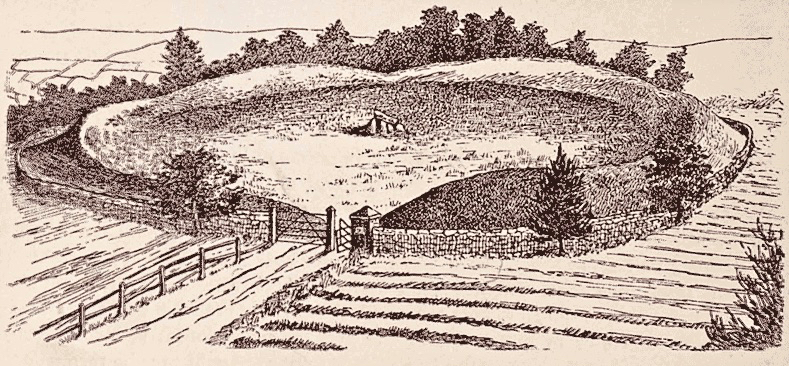
Former landowners of the estate on which this monument stands were the Dungannons of Belvoir House. In the mid nineteenth century Lord Dungannon built a protective wall around the Giant’s Ring (shown in the top sketch which reportedly dates from 1897). The plaque on the entrance gate (above) marks a visit to the site by Countess Dungannon, presumably to commemorate the completion of this wall.
The site has understandably attracted artists and photographers. The upper photo by R Welch dates from 1902 and the centre photo by S Kirker dates from 1905. The old postcard, above, is undated, but is remarkably similar in its viewpoint to the 1897 sketch – which one came first?
So there we have it: a very significant ceremonial site which has been compared in importance to Newgrange. What was it for? A burial place imbued with connections to an afterlife? We cannot know. But my own thoughts when looking at this vast circle is that in the present day we would call it an ‘arena’, and we might use it for sports, drama or processions. In fact I noted a report that stated it was used for horse-racing in the eighteenth century. A significant disappointment for me is that I have been unable to find any folklore or ‘stories’ about The Giant’s Ring. Northern Ireland does not share the equivalent of the Dúchas Folklore Collections which we have in Ireland, dating from the 1930s. There must have been tales told about it through the generations: I would be most interested to hear from anyone who can fill in this omission, please.
Welcome to the UCD Library Cultural Heritage Collections blog. Discover and explore the historical treasures housed within our Archives, Special Collections, National Folklore Collection and Digital Library














 Roaringwater Journal