Ceannlínte ó Baile Bhuirne! (Headlines from Ballyvourney!)

It was a big day in Ballvourney yesterday: the public unveiling of two replicas of the 800 year old wooden figure that has been central to observances of St Gobnait on her day for as long as anyone can remember – we must be talking centuries! If you are not familiar with St Gobnait – or her celebrations – read my post here.

It’s actually St Gobnait’s Day today: the eleventh of February. As I write this, the congregation in the saint’s church will be venerating the 13th century wooden figure by ‘measuring’ her with ribbons. But also, for the first time, they will be able to view the two copies of that figure which have been made over the last few months. That exercise has been undertaken so that the figure itself could be fully studied because it is of great historical interest. There are other medieval carved wooden figures of saints surviving elsewhere in Ireland, but this is the only one that is still in regular active use.

. . . A medieval wooden image of Gobnait, kept traditionally in a drawer in the church during the year, is venerated in the parish church on this day. The devotion is known as the tomhas Gobnatan . People bring a ribbon with them and ‘measure’ the statue from top to bottom and around its circumference. This ribbon is then brought home and is used when people get sick or for some special blessing. The statue is thought to belong to the 13th c. A second pattern in honour of Gobnait was traditionally celebrated in Baile Bhúirne at Whit . . .

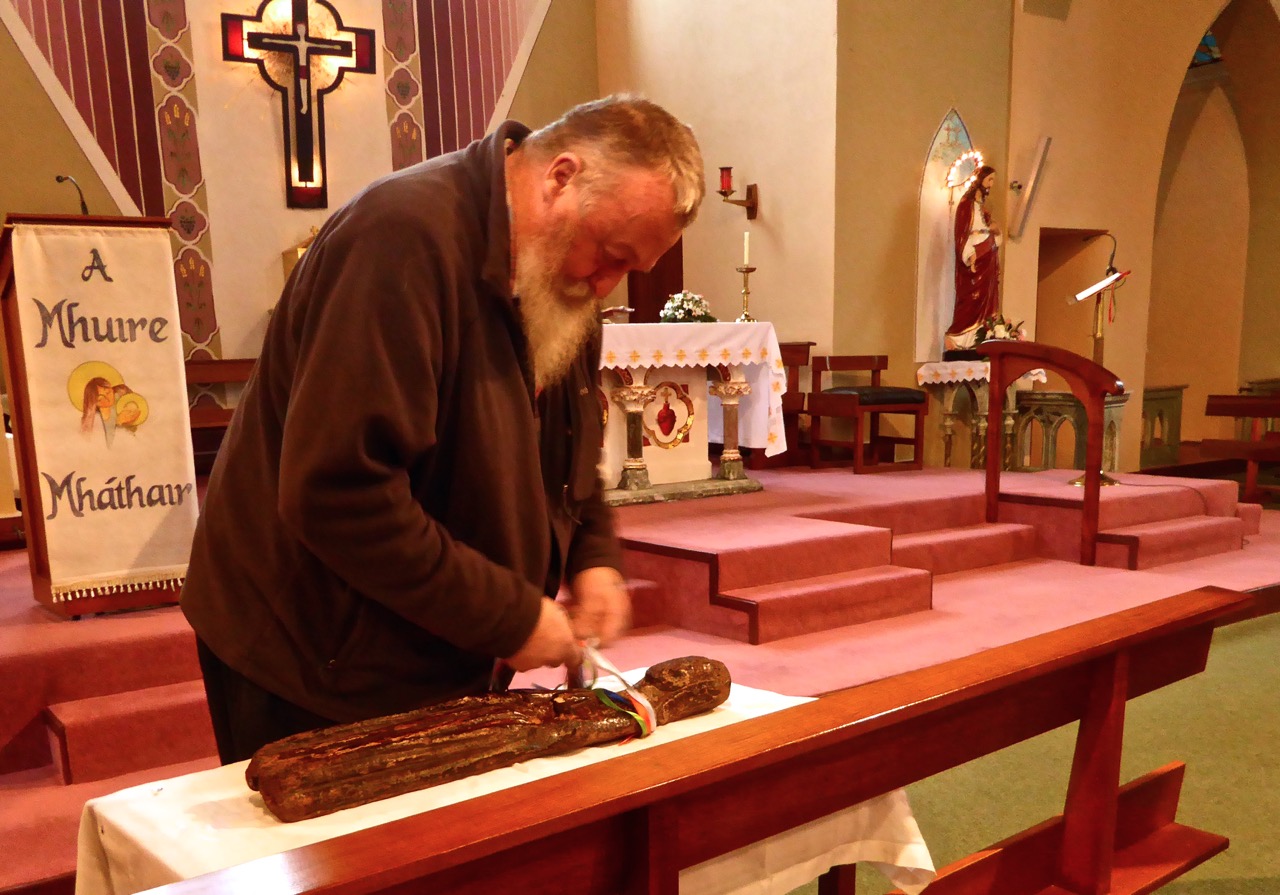
The above citation is taken from The Diocese of Kerry website, which sets out a comprehensive review of the saint and the activities which honour her. Here’s the measuring taking place a few years ago:

National Heritage Week 2023 explains the purpose of the project to replicate the carving:

. . . As patron saint of the parish, the statue provides a tangible link to the saint but importantly represents the long-standing living devotion to Gobnait. The wooden figure carved out of oak clearly depicts a female monastic. It was guarded over the centuries by the O’Herlihy clan, who were the ruling Gaelic lords of the Ballyvourney area during the medieval and late-medieval periods. It remained in the safe-keeping of members of the O’Herlihy family until they handed it over to the local parish priest in the late-19th century and it has been protected and kept secure by the Ballyvourney Church Committee ever since. The 3D project will comprise the digital scanning of the statue which in turn will enable a 3D generated wooden print out. A second replica will be hand carved as an integrative representation of how the statue would have looked originally before the centuries aged and tarnished it. The replicas will then be placed permanently on display in the Parish Church with information signage . . .

St Gobnait in 3D
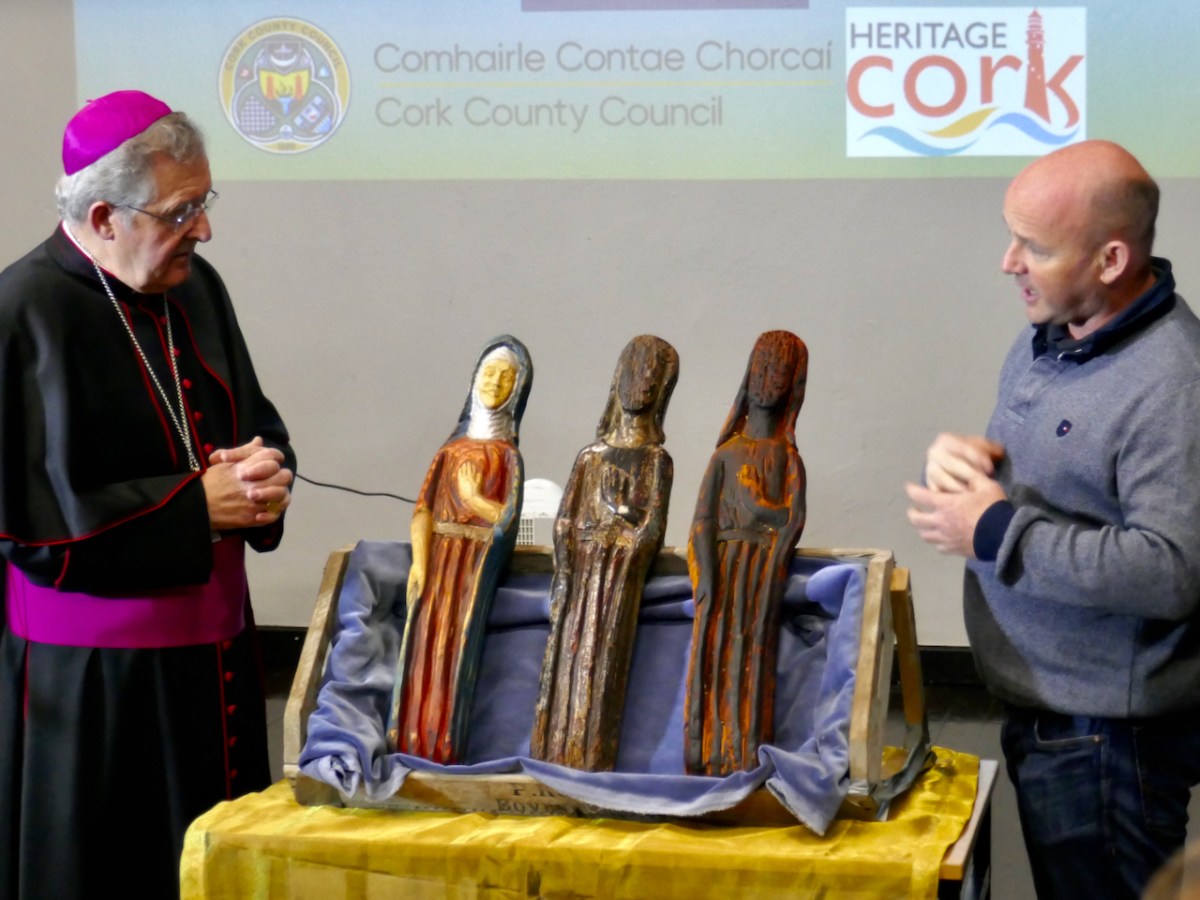
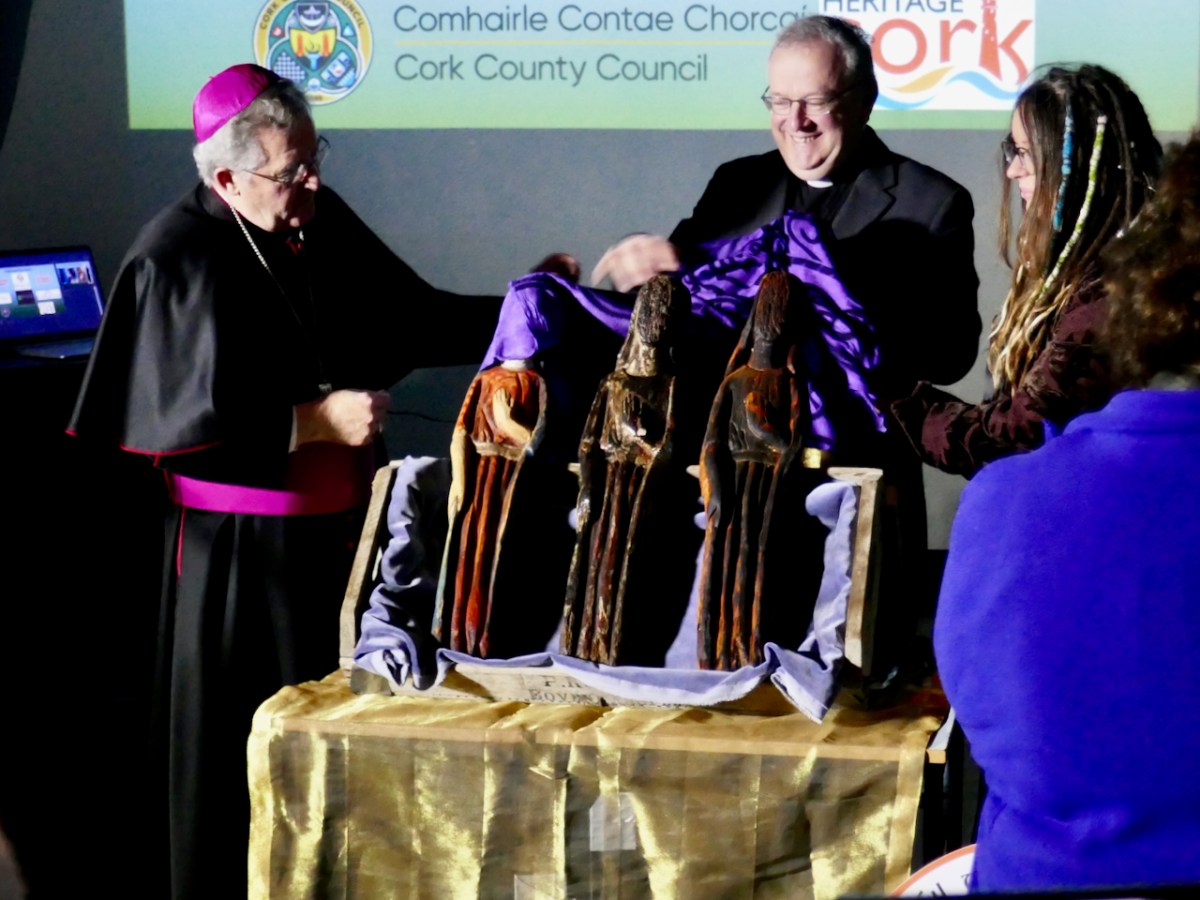
Above is a view of the original carving (in the centre) with the replica of that on the right. On the left is the ‘integrative representation’ – that is the carver’s interpretation of what the figure might have looked like when she first saw the light of day in the 1300s. On the left is Bishop William Crean – Bishop of Cloyne since 2013: he presided over the unveiling of the two replicas yesterday. On the right is John Hayes, of Special Branch Carvers in Fenor, Co Waterford. He was responsible for the carving project and has made an excellent job!

John gave us a presentation yesterday, after the unveiling ceremony, and we learned how he closely examined the original statue, taking detailed measurements and a full photographic survey. This enabled a Sketchfab 3D rendering to be produced: this became the basis for his work. During the examination he was able to find traces of paint, which enabled him to render the interpretative version with – very likely – a high degree of fidelity to the original.

I got the chance to talk to John and ask him about the timbers used for the original and the replicas. The original is of oak, and we don’t have a way of knowing where this came from. The replicas are of ash: this is a good material for stability and longevity. John had access to a good source of seasoned wood.
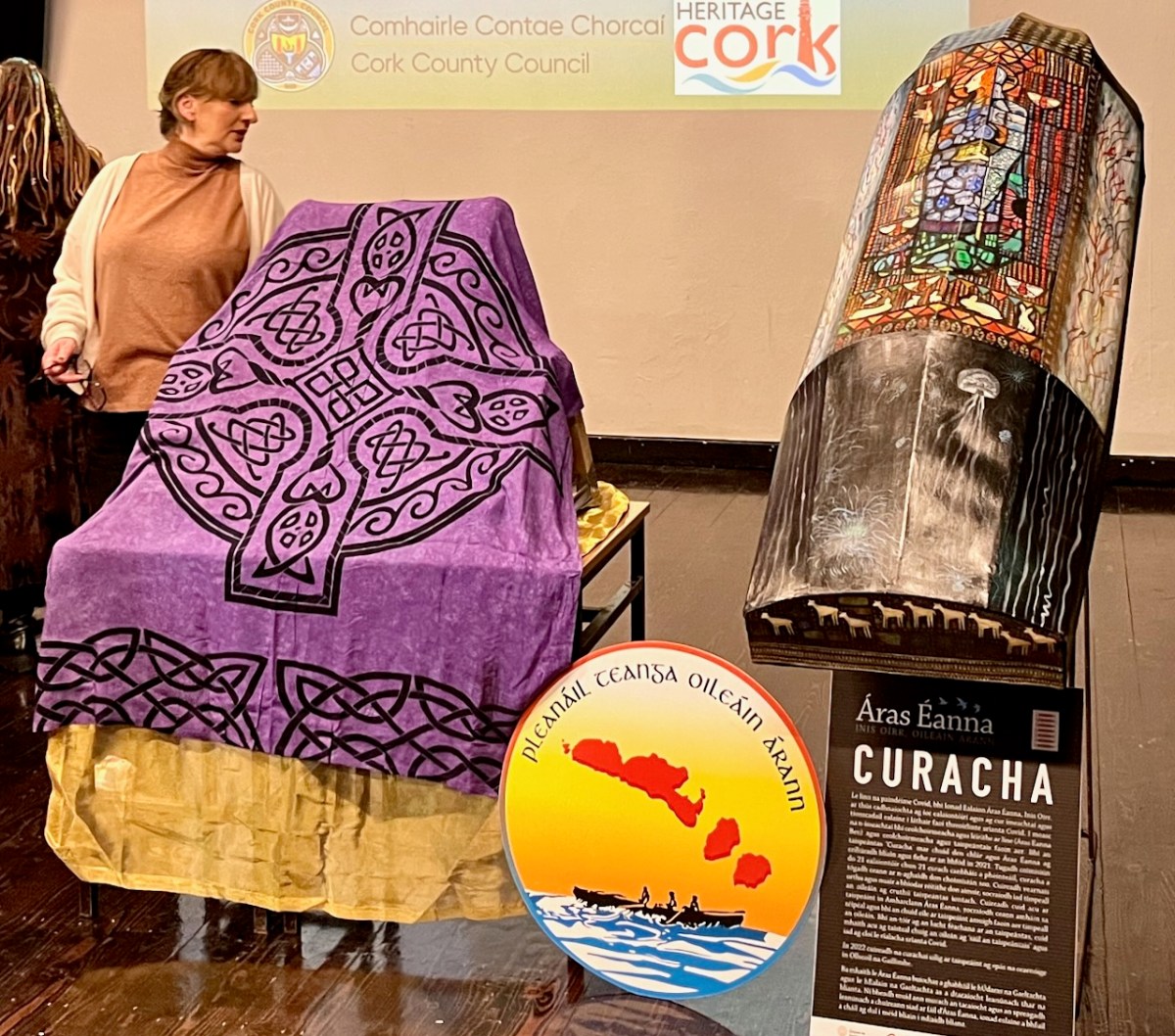
The day was a study day for St Gobnait, and encompassed a whole lot more than the unveiling of the replicas (they are waiting under the cloth- above – to be revealed)! Note the currach in the pic also: that’s another project – to establish a Camino tracing the route which Gobnait took as she travelled around Ireland from the Co Galway Aran Island of Inisheer, having been told by an angel that her life would be fulfilled when she saw nine white deer. She spent time in Dun Chaoin and Kilgobinet in Kerry, Ballyagran in Limerick, Kilgobinet in Waterford, and Abbeyswell and Clondrohid in Cork, before finally finding the deer in Ballyvourney. You can see those deer on the stern of the currach, above. There are at least eight holy wells in Ireland dedicated to the saint. Amanda has written extensively about Gobnait’s travels and – of course – about her wells.

There was also an excellent series of talks about Gobnait. Events took place in Ionad Cultúrtha an Dochtúir Ó Loinsigh, which is a great facility in the community. Here we are – together with our good friends Peter and Amanda (you have met them frequently on the pages of this Journal), - waiting for proceedings to begin:

This is the moment of unveiling: the Bishop is accompanied by the Parish Priest – Very Reverend John McCarthy SP – and archaeologist Dr Connie Kelleher, National Monuments Service: she has played a significant role in this Ballyvourney project.

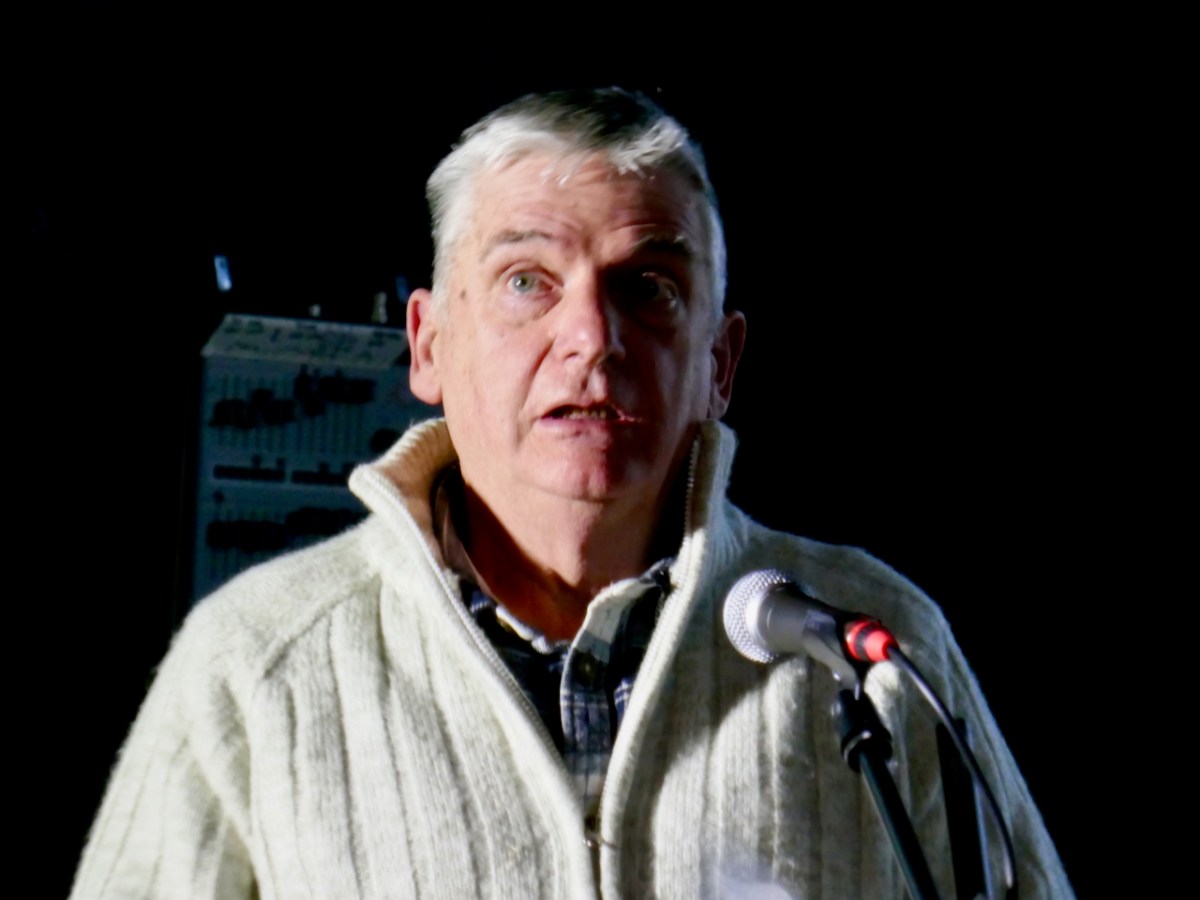
The decoration on the hull of the Camino Currach is based on the depiction of Saint Gobnait in the Harry Clarke window from the Honan Chapel, UCC. The bee image on the right reminds us that Gobnait is the patron saint of bees and beekepers. We enjoyed a comprehensive talk on bees by Peadar Ó Riada – who has first hand experience of the subject:
There were many more dimensions to the day. One of my favourites was when the audience was requested to produce anyone named Gobnait to be photographed with the carved figures. That included the variations of the name: Library Ireland (1923) (Rev Patrick Woulfe) gives these as Gobinet, Gobnet, Gubby, Abigail, Abbey, Abbie, Abina, Deborah, Debbie, and Webbie. Ten candidates stood up to be counted:
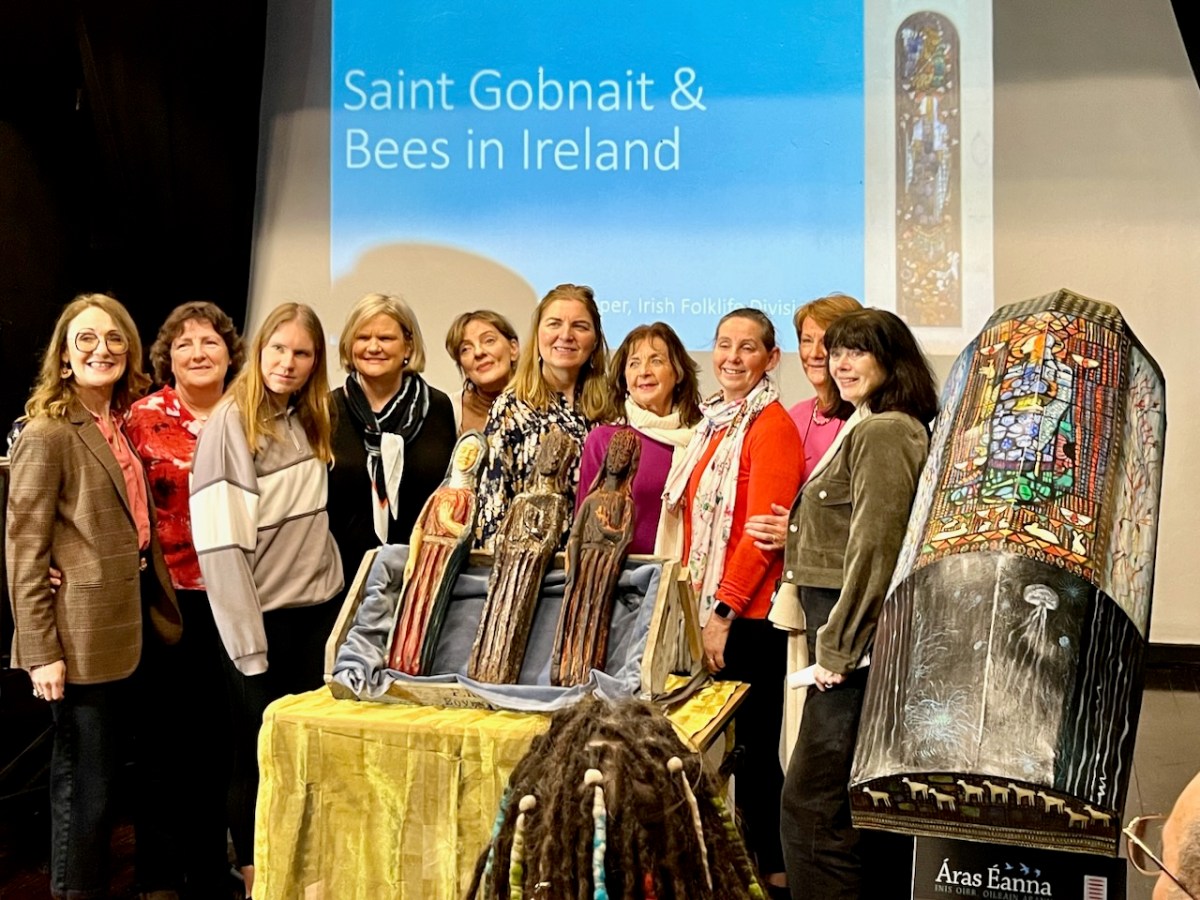
Thank you to Finola for providing many of these photos

Gobnait’s Day

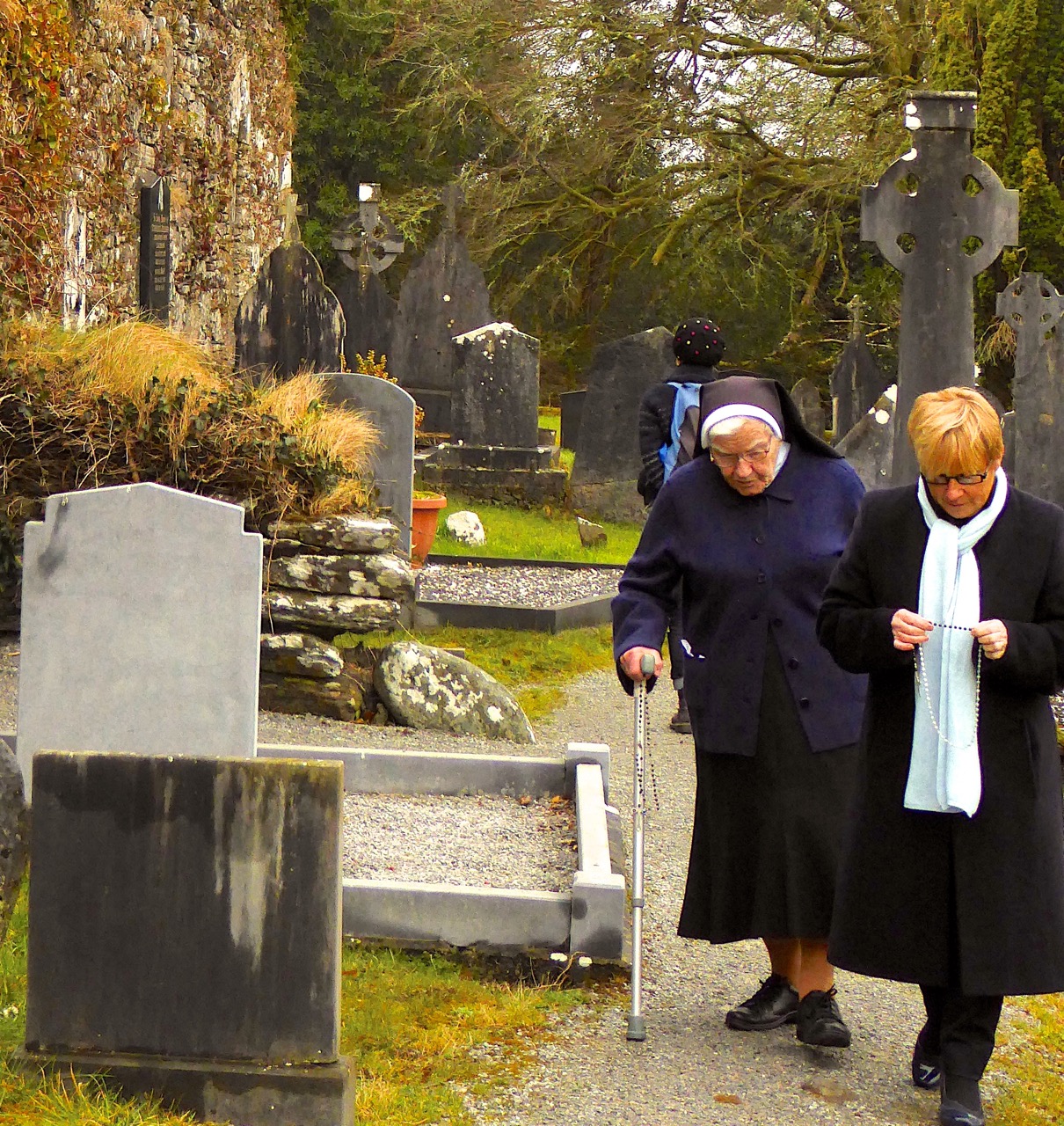
We stood still and listened: the air was filled with humming – Bees swarming in February? But no… it was the murmuring of the pilgrims saying the decades of the Rosary by the grave of St Gobnait…*

Making the Rounds at Saint Gobnait's Shrine on the Feast Day
Making the Rounds at Saint Gobnait’s Shrine on the Feast Day

We travelled up into the Muskerry Gaeltacht on Wednesday – 11 February: the Feast Day of Saint Gobnait. It’s a fair journey, and we felt that we had really gone into another world: we crossed over the Mountain of the Fairy – that’s my interpretation of the Shehy Mountains (Shee is Fairy) – others say the Irish Cnoic na Síofra means ‘hills of the animal hides’. For the first time in my life somebody – a passer by – addressed me in Irish… “An bhfuil hata agat le spáráil?” they said – “Have you got a hat to spare?” (I think it was a wry comment about the headgear I was wearing on the day).

Wrapping the ribbons

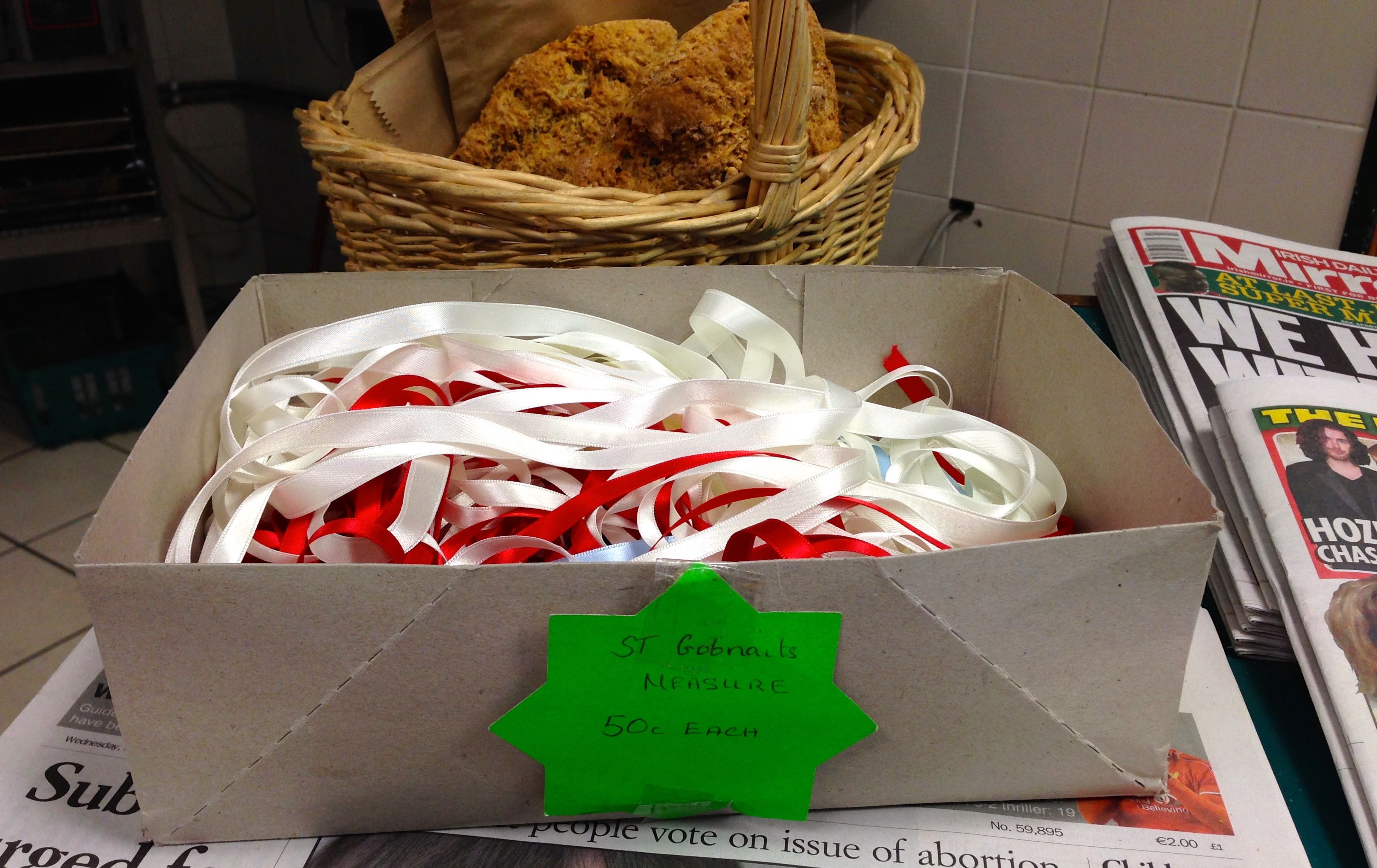
Our goal was Saint Gobnait’s Church in Ballyvourney, where the Mass was to be heard celebrated in Irish. Also, we wanted to see the 13th century wooden statue which is brought in to the church on this day. When we arrived there was already a queue to buy ribbons and ‘measure’ them against the statue. In fact, it was quite an intricate ritual: first you wrapped your ribbons around the neck of the statue, then around the feet. Some did the same around the stomach – others passed the ribbons under the body of the statue and rubbed them along the surface. Many people kissed the statue and some picked it up and made the sign of the cross with it. We joined in and came away with a clutch of ribbons, now blessed by Saint Gobnait and imbued with health-giving and good-fortune-bringing properties.

Making the 'Measures'
Making the ‘Measures’

The church was completely full for the Mass (it was also broadcast outside), which was celebrated by two Priests and a very robust men’s choir – beautiful singing in Irish. It was an uplifting experience, even though I hardly understood a word. A friendly atmosphere imbued all who were there, and excitement was in the air. Afterwards, we visited the statue again and then headed for Saint Gobnait’s Holy Well, her grave and the ruins of her ancient church, where the ‘Rounds’ were being performed all day. That’s when we heard the humming – it should have been Bees: this Saint has always been associated with them, and her statue which overlooks the pilgrimage site (and which was carved by Seamus Murphy in 1950) is decorated with Bees and with a Deer. This is also part of her story: when she was travelling through Ireland looking for a site to establish her community she was told she must continue on her way until she met with nine white Deer. She found them in Ballyvourney and that’s why in our time the little settlement flourishes on this February day.

We heard that there is another Holy Well, hidden in the woods just outside the town and seldom visited. This is known as Tobar Abán – Saint Abban’s Well. That saint seems to be closely associated with Saint Gobnait although not much is known about the lives of either of them – they lived back in the sixth century.

In the local shop
In the local shop

A visit to the Post Office provided us with the information we needed to get to this intriguing sacred site: walk over the bridge, go into the fields and look for a lone oak tree on the distant boundary – this marks the point where a trackway leads up through the woods. We made our way across a muddy pasture; the oak tree was prominent enough, and the track – but once inside the wood everything was quite densely overgrown. We would never have found it without the instructions, but we also had the help of red and white ribbons tied to trees and posts in strategic places – they had been there for some time: we wondered who set them up?

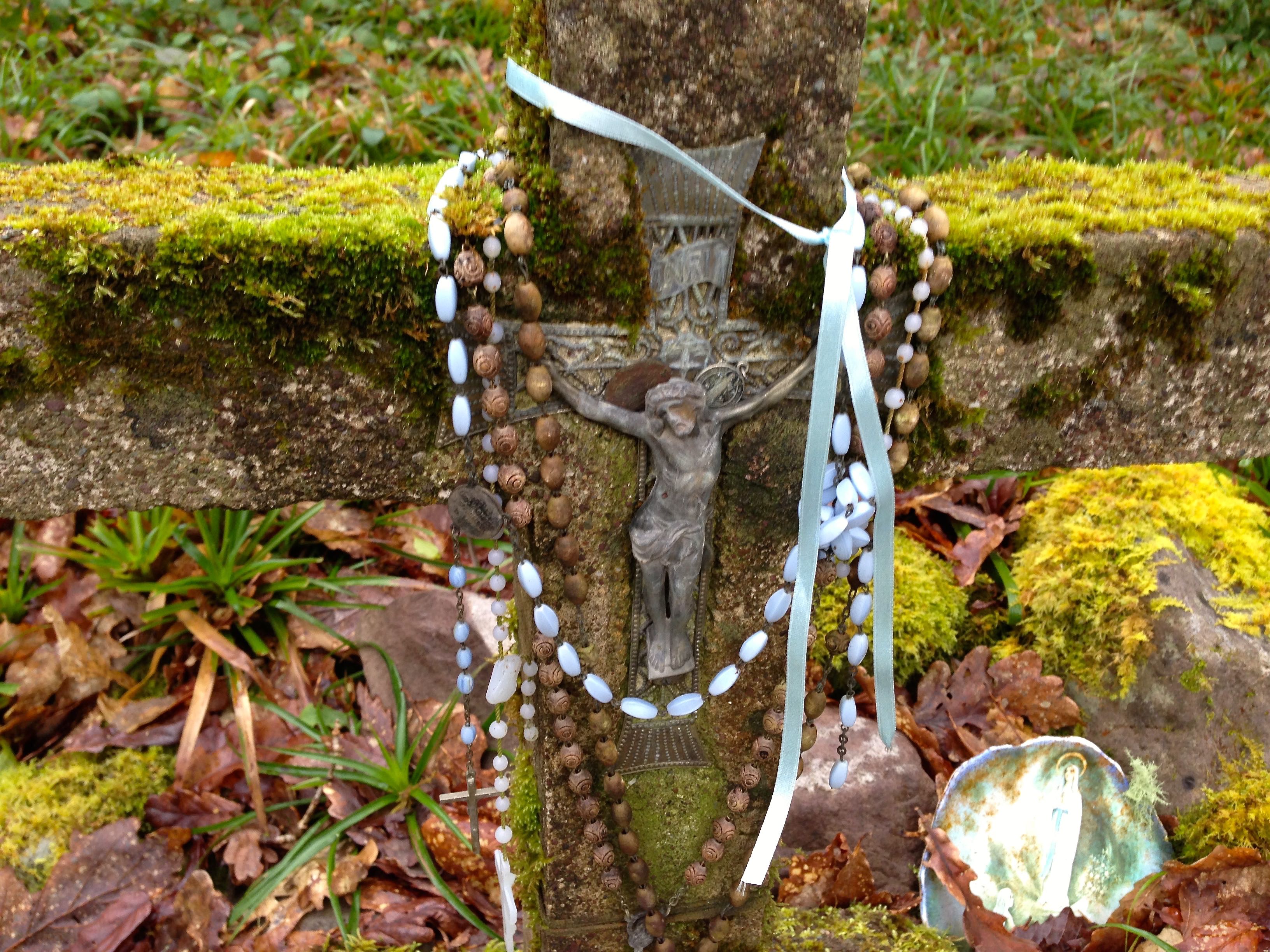
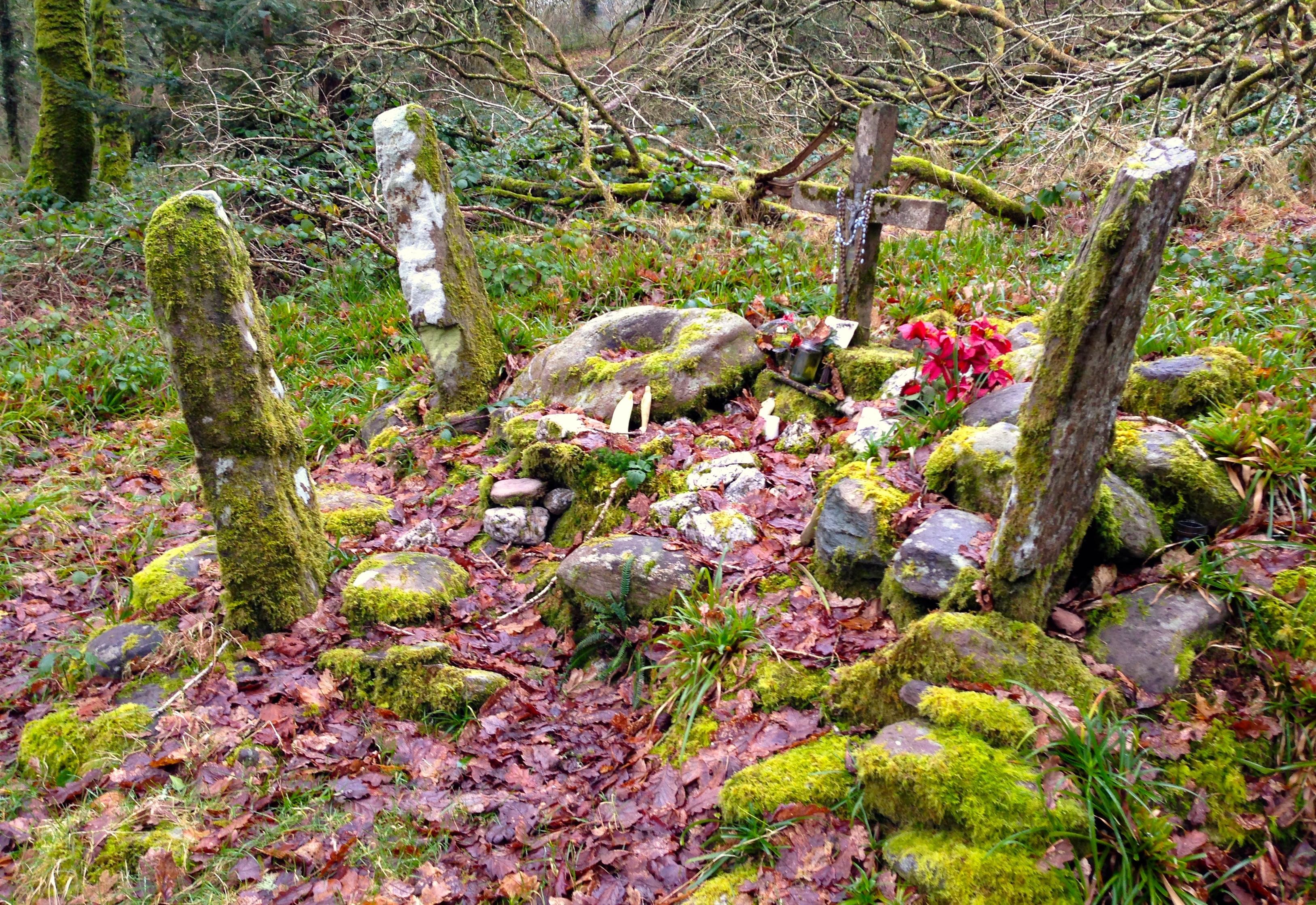
Tobar Abán is a wonderful site – a lonely outpost of religious sanctity but, for me, probably the most beautiful of all the holy places I have visited in Ireland so far. It’s an unexpected find: set away from everything, deep in an ancient oak wood, silent, still – one could imagine that it has always been like this, passing through generations of turbulent history and yet untroubled by it. Archaeologically it appears to be a cist with a cairn of stones built around it: this would imply pre-Christian origins. The lid of the cist (a burial chamber or repository for bones) is not visible – possibly it is under the large ballaun stone which rests on top. Above this is a small, relatively modern concrete cross embellished with offerings, beads and ribbons: other icons and objects are scattered around the site. The whole mound has a boundary defined by three standing stones, one of which is inscribed with ogham. Everything is covered in a layer of moss which seemed to exude a luminescence in the moist shade of the wood.

crucifix

Saint Abban (or Abbán moccu Corbmaic) seems to have been active in many parts of Ireland, and tradition has it that he lived for three hundred years. The stories that are important here are the ones that link him with Saint Gobnait. It has been said that he founded a monastery in Ballyvourney before she arrived, and that he was her mentor and gave the foundation to her. Some say that Abban and Gobnait were brother and sister. Most important, perhaps, is the tradition that Abban had a cell or church just outside Ballyvourney and that he was buried in that cell when he died in 520. Could it be his grave that we found?

Saint Abban's Shrine - cell - or grave?
Saint Abban’s Shrine – cell – or grave?

Saint Abban’s Well is a little distance from the cist, and is quite unassuming, especially compared to the elaborate wells around Saint Gobnait’s old church. It is merely an opening in a rock set in the ground: an old tray covers it and keeps the leaves out, and a wooden box beside it contains some cups and plastic bottles for collecting the water.

Tobar Aban - Saint Abban's Well
Tobar Abán – Saint Abban’s Well

As we were making our way back across the fields we were surprised to see a lady in a red coat walking with a stick towards us. “Did you find it?” she asked. We assured her we had found the well and the shrine. “And did you see his bones?” she continued, “Last time I was there I lifted up the lid and saw the Saint’s bones inside…” We watched her go off towards the woods; when I looked back again she had disappeared.

Cist, Bullaun and standing stones

There’s so much about the day: the journey across the Mountain of the Fairy; the Irish Mass and the ritual of the ribbons involving a 13th century wooden figure; the Rounds and the humming of the Saint’s Bees; the magical shrine in the woods – and I really do wonder about that lady in the red coat…

Offering at the Shrine of Saint Abban

* Originally titled A Murmuration, this post has been re-edited. Although published under Finola’s name this time around, the post and the re-editing are by Robert..

Molaga of the Bees

bees!

I know I’ve said this before – but, wherever you find yourself in Ireland there’s history on the ground, and a story to be found! Recently we ventured into North Cork: so large is this county that it is a good half a day’s journey from Nead an Iolair, here in the far west, to Mitchelstown, beyond which lie the wild frontiers of Tipperary and Waterford. The purpose of our journey was exploration – archaeology, history, folklore – and we found ourselves drawn back into the time of the Saints.

1400 AD

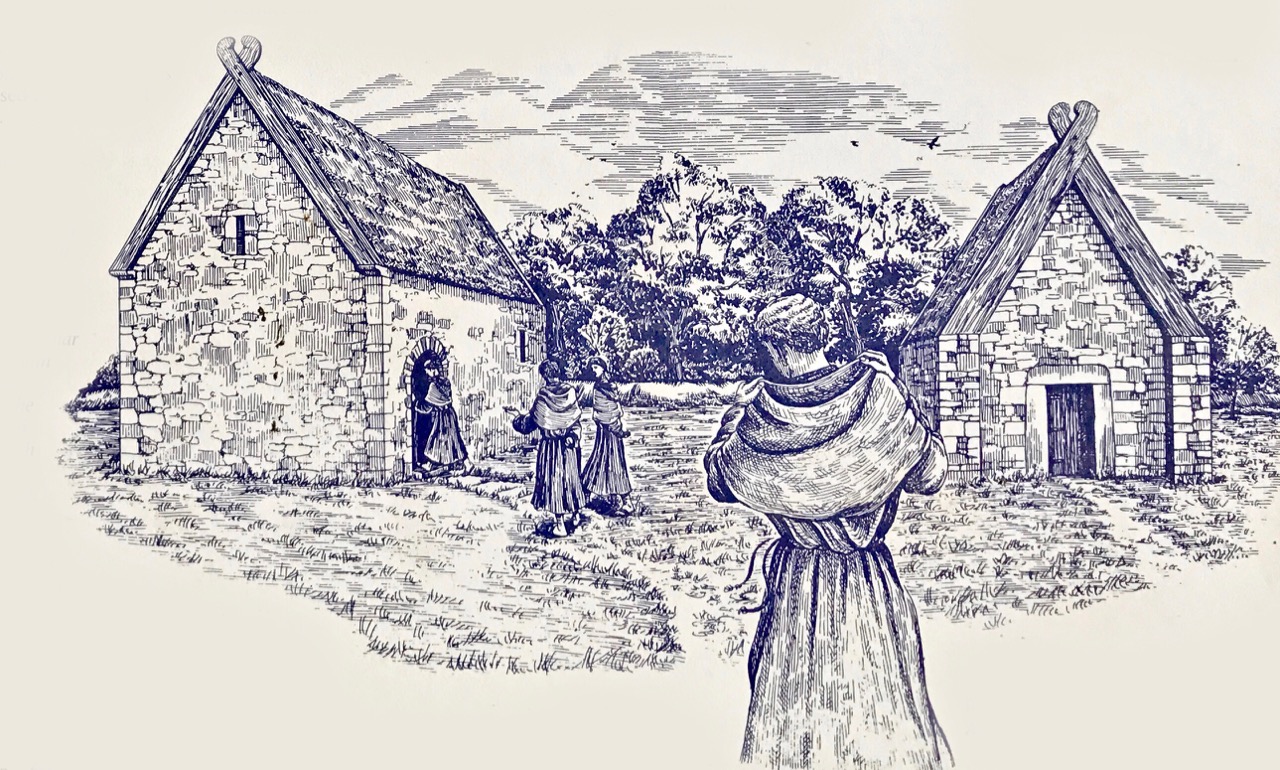
Artist’s reconstruction of the site at Labbamolaga as it might have looked in 1400 AD: the smaller building on the right is the saint’s original oratory, dating from the seventh century. Note the antae – the projecting stone walls on either side of the entrance, supporting the huge verges. These features represent the builders’ wish to recreate in stone the very earliest timber churches: in every age of Christian church building the aspiration was to hearken back to ‘the time of the Saints’, whatever era that might have been . The building on the left is a later medieval Parish Church known as Templemolaga (image from Dúchas – The Heritage Service)

Well off the beaten track we found ourselves at an ancient site known as Labbamolaga, in the townland of Labbamolaga Middle. Labba Mollaga: it means ‘the bed of Molaga’, who was a saint living in the 7th century. He is said to have founded a monastery on this site and the earlier building here could have been his original church.

7th c entrance detail

through the portal

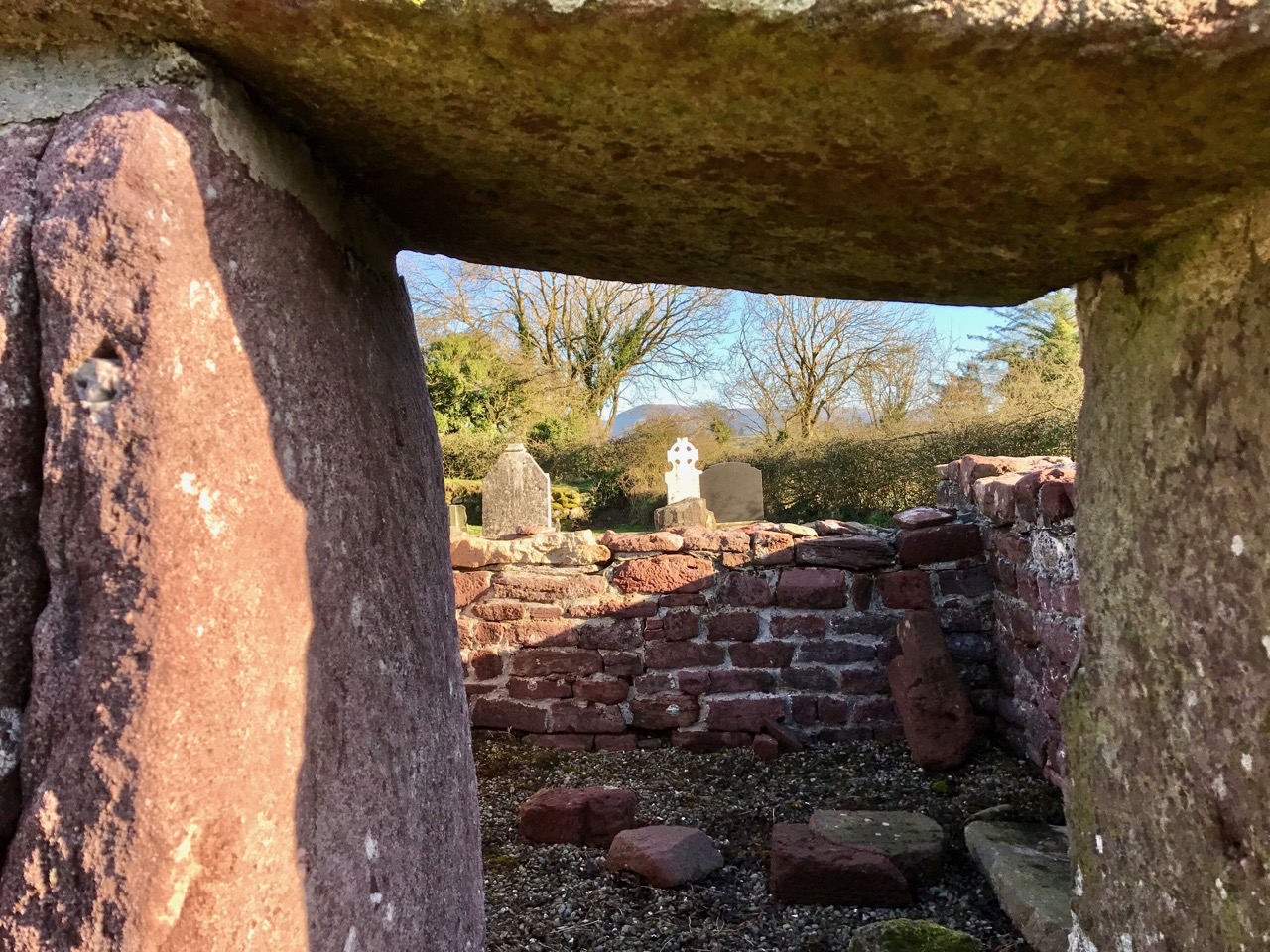
A seventh century oratory? Upper picture shows the entrance elevation with its pronounced antae, and the doorway which seems to be constructed from monoliths. It has been suggested that these stones could have been robbed from the megalithic monument which lies in a field to the south of the site. The middle picture looks through the entrance to the prostrate stone against the south wall: this is known as Molaga’s Bed: tradition states that the saint would lie on this stone at the end of each day’s work. It is also said to be his burial place and has curative powers, particularly for rheumatism. The lower pictures show the saint’s bed in 1905 (left) and in the present day (right) with its strange carving, which has been described as a volute

The architecture is fascinating: here we have one of the few examples remaining in Ireland of this most ancient church form, albeit in a ruinous state. In 1975 a similar ruin in Connemara was reconstructed to its likely original form at St MacDara’s Island, Carna. This gives us some idea of what St Molaga’s oratory could have looked like.

The oratory on St MacDara’s Island – early photograph (left) and 1975 reconstruction (right)

The site at Labbamolaga has much more more to attract the curious. There are the nearby megaliths: we would assume they considerably predate everything else, yet local lore tells us that they are four villains who stole the chalice and holy relics from the saint’s oratory but were caught in mid-flight and were turned into four pillars of stone by him! A further legend noted by John Windele, the Cork antiquarian and historian, in the 19th century relates to a holy well which once existed – some say under the saint’s bed:

…There was formerly a beautiful well of clear spring water here, but one day an old woman profanely washed her clothes in it; that night the well disappeared and was seen never more…

stone alignments

stones in graveyard

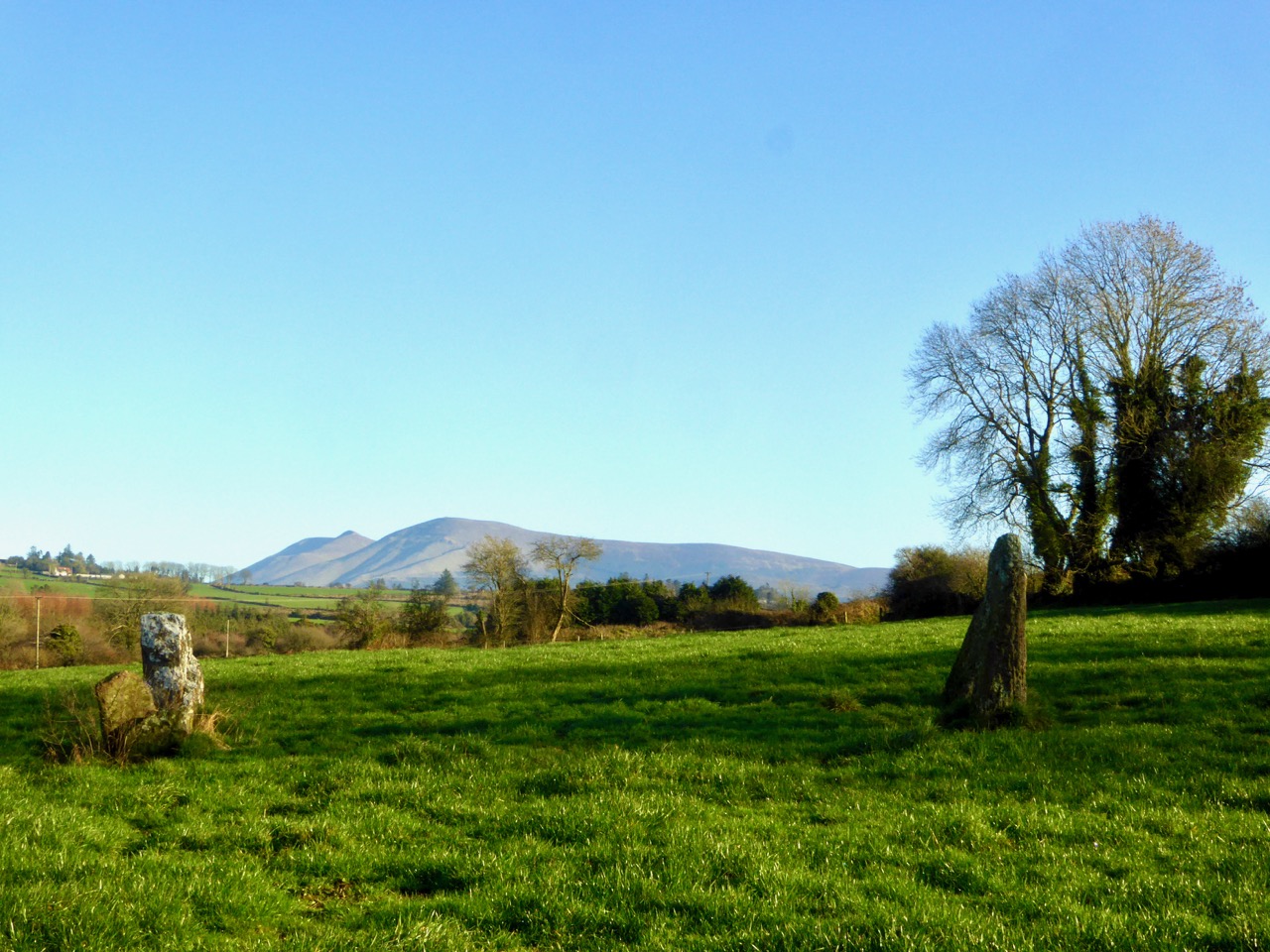
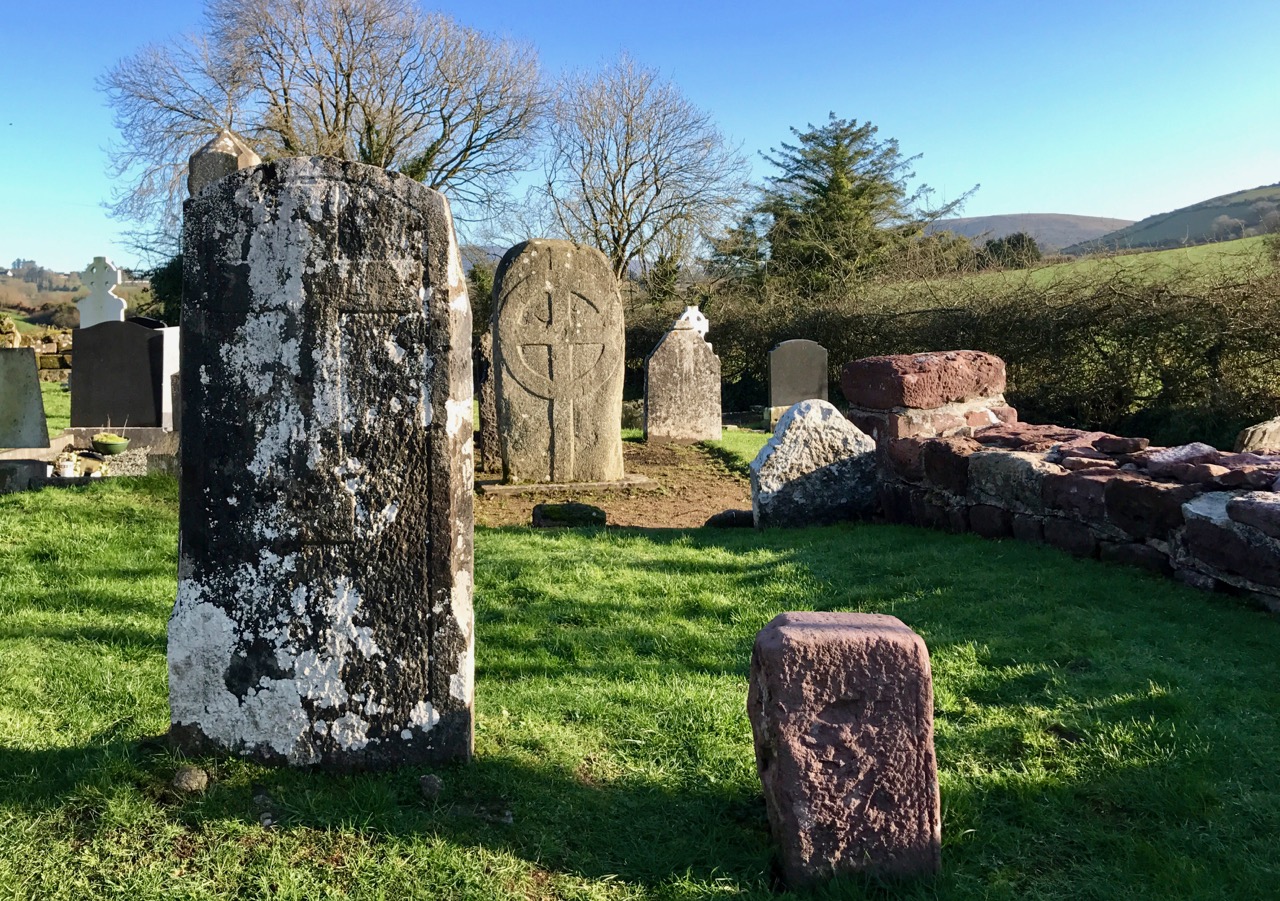
Upper picture: four standing stones in a field (known as Parc a Liagain, ‘Swardy Field of the Pillar Stones’ to the south of the ecclesiastical site – supposedly petrified villains who robbed the monastery. Lower pictures: the monastery site has become a burial ground – strange and fascinating stones abound. The centre stone is an ancient looking Celtic cross; the circular pile is an enigma – burial vault or old well house? The site also once contained Cursing Stones, but these are said to have been removed

What of the saint himself? He has a recorded history: born in Fermoy of parents who were well past child bearing age (a miraculous sign), he travelled to Scotland and then to Wales, where he became a follower of St David. Returning to Ireland he founded monasteries at Timoleague, West Cork (the name means House of Molaga), and at this site in North Cork. Sources say that in Wales he learned the craft of bee-keeping, and a colony of bees attached itself to him on his journey back to Ireland: the same sources credit him with introducing bees to Ireland, but the earlier Saint Gobnait – patron saint of bees – also has this reputation. Some mixing of hagiographies here, perhaps. Also confusing is the information given in catholicireland.net which gives the name St Modhomhnóg as ‘Irish Saint of the Bees’ and tells a similar story, although this saint returned to Ireland from Wales (with bees) and set up a community in Bremore, near Balbriggan, County Dublin – today known as the Church of the Beekeeper but also connected with St Molaga, who is there said to have procured his bees from St Modhomhnóg. To add to the confusion, the feast day of Saint Gobnait is on 11 February, while that of Modhomhnóg is on 13 February.

molaga

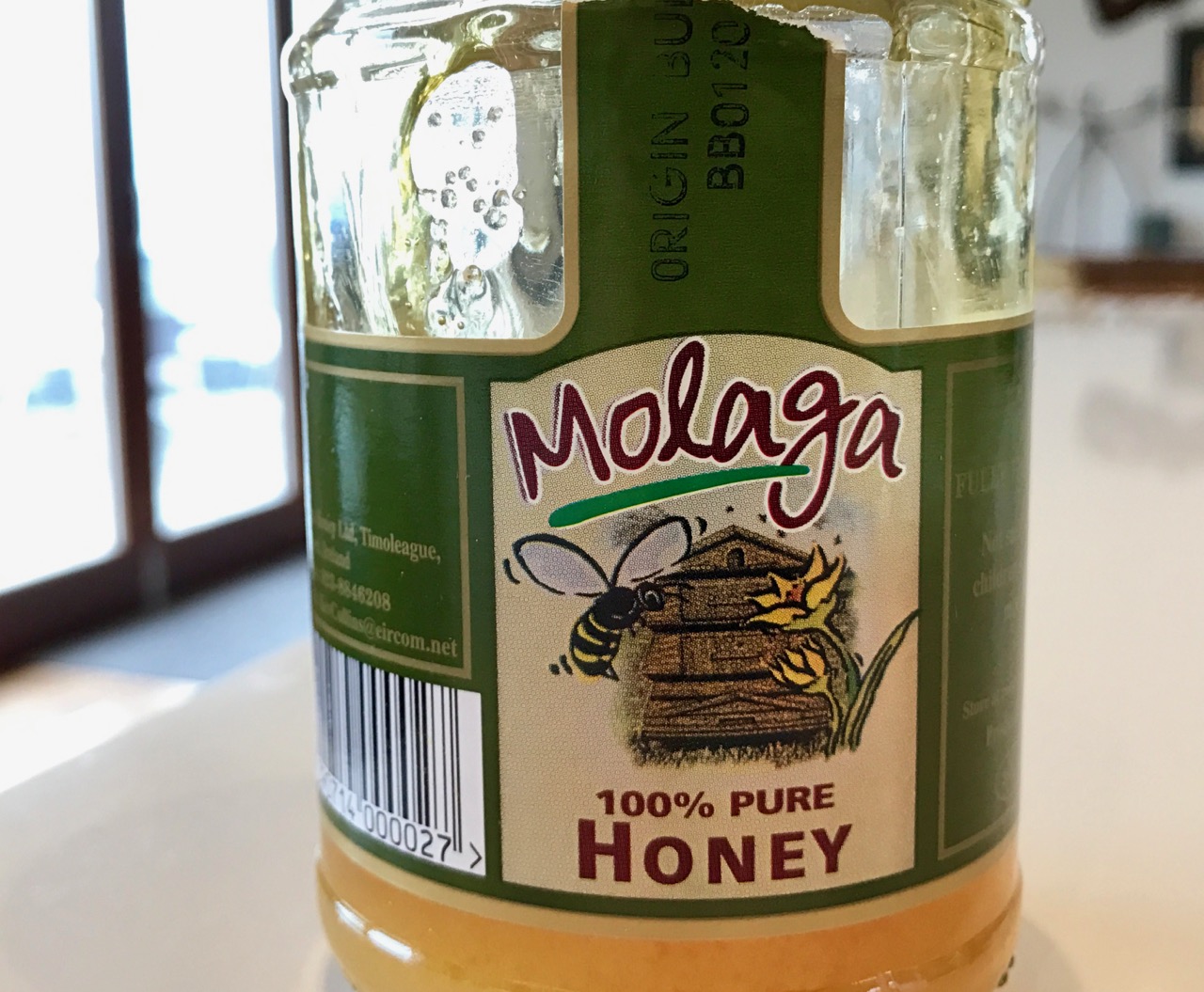
We hadn’t realised until we unearthed these stories that we have the saint’s name in our larder! Our favourite honey is known as Molaga – we get it from our local supermarket. There is nothing on the jar to explain the name (this is one of various spellings), but the honey is distributed from Timoleague (the house of Molaga) in West Cork. There is much more to the story of this slightly elusive saint, perhaps to be told another day.

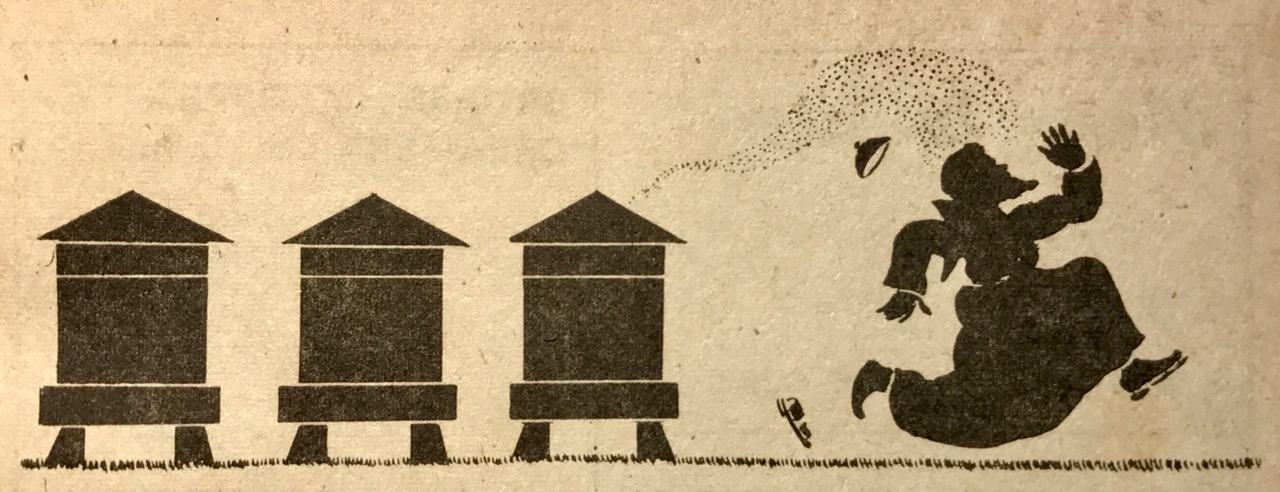
Many thanks to Brian Lalor for gifting us his copy of The Capuchin Annual 1944. It is wonderfully illustrated with cameos of monastic life drawn by ‘Father Gerald’: the header is one of these. The 1983 postage stamp illustration below is by Michael Craig

postage stamp