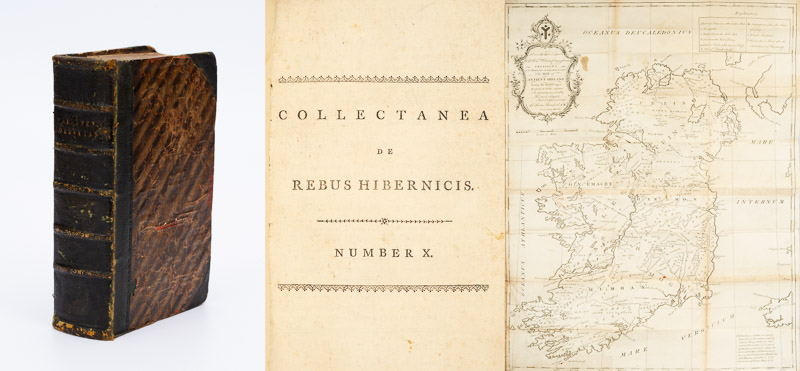
Vallancey: The Collectanea 4 and 5 and Conclusion

As promised this will be a skip and a hop over Vols 4 and 5, as this is my last post and I want to leave time for a final evaluation of Vallancey and his work. I’m just going to pick out items that caught my attention or appealed to me for my own quirky reasons. For everything I write about, there will be a dozen that might appeal to you more. But then, as a friend of mine said recently about an interminable novel – we’ll be reading it at your funeral.

After his usual lengthy preface (this one is only 60 pages and yet another opportunity to talk about Phoenicians) we come to a series of short articles about archaeological objects.  Below is what archaeologists call a gorget – its a gold collar, beautifully worked. There are fewer than a dozen of them known from Irish contexts and they have some parallels with others found on the continent. 
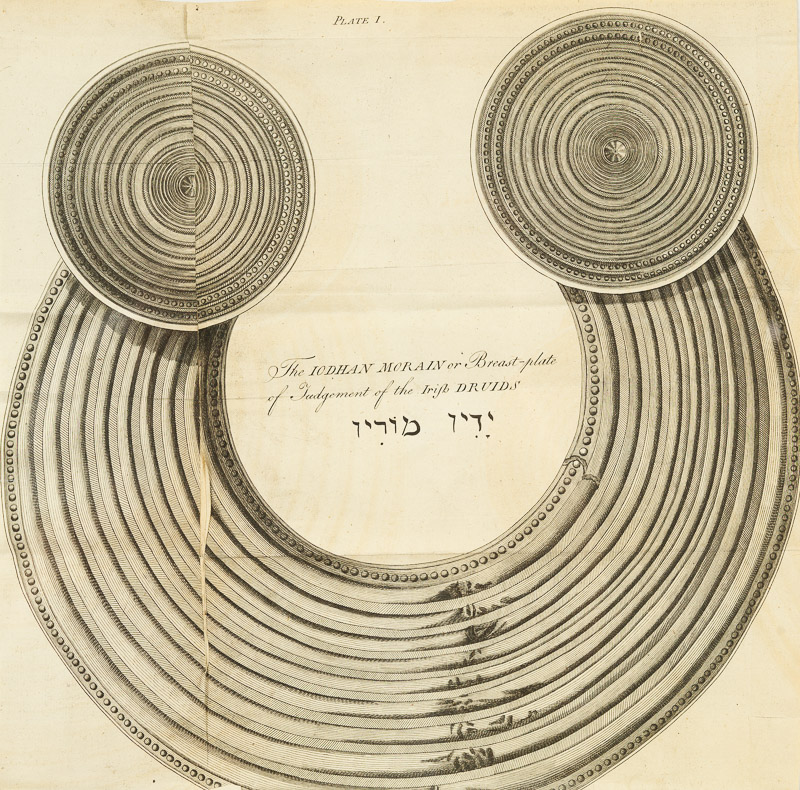
Of solid gold, they were heavy and obviously made to be worn by a high-status individual, perhaps a king. Vallancey concludes it is a Druid’s (what else?) breast plate and christens it the Iodhan Morain. He comes to this conclusion by examining the Bible and accounts from ‘the Chaldees’. It is to be worn, he asserts, as the Druids are making their most solemn pronouncements. And while he’s on the subject of druids, here’s another one of his evidence-free assignment of purpose. This is what he calls the Liath Meisicith.

It is a box, the size of the drawing, and two inches deep, it is made of brass cased with silver : it contains a number of loose sheets of vellum, on which are written extracts of the gospel and prayers for the sick, in the Latin language, and in the Irish character. There are also, some drawings in water colours of the apostles, not ill executed : these are supposed to be the work of Saint Moling, the patron of that part of the country.
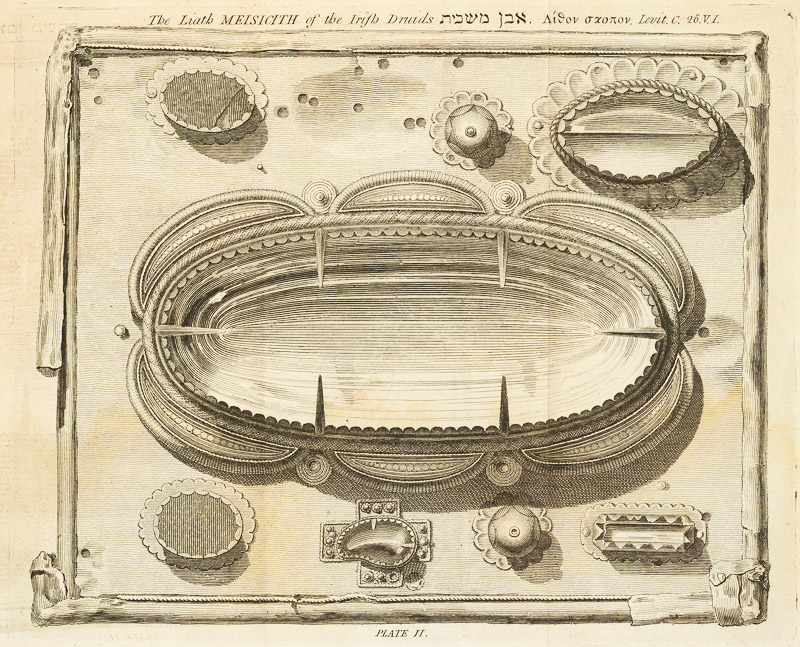
So – a fairly straightforward conclusion might be reached that this box dates from the medieval period and was some kind of Christian votive object, right? Alas no – for Vallancey sees only the absence of a cross or any other Christian symbol, and concludes that this is for containing incense or oil to be used as part of a druidic fire ceremony.

How this fire was communicated, I cannot pretend to say, but, as it is well known, that Cobalt ground up with oil, will lye an hour or more in that unctious state and then burst into an amazing blaze :  it is probable that the Druids, who were skilled chimysts, (for their days) could not be ignorant of so simple an experiment. A fire lying so long concealed, would afford them ample time for prayers and incantations.

I think this one example gives you, as a microcosm of the whole Collectanea,  how eagerness to embrace an exotic and far-fetched explanation, and shoehorn it into your overall theory, can get the better of a man. And it was this exact kind of thing that led to him being derided by his contemporaries and those who followed.

A final example, as it is meaningful to me – a little reliquary figure comes next. This figure bears a striking resemblance to one of the figures on St Manchan’s Shrine. One of the missing figures was located and returned to it – it’s known as the 11th figure and it’s on the far left, below.
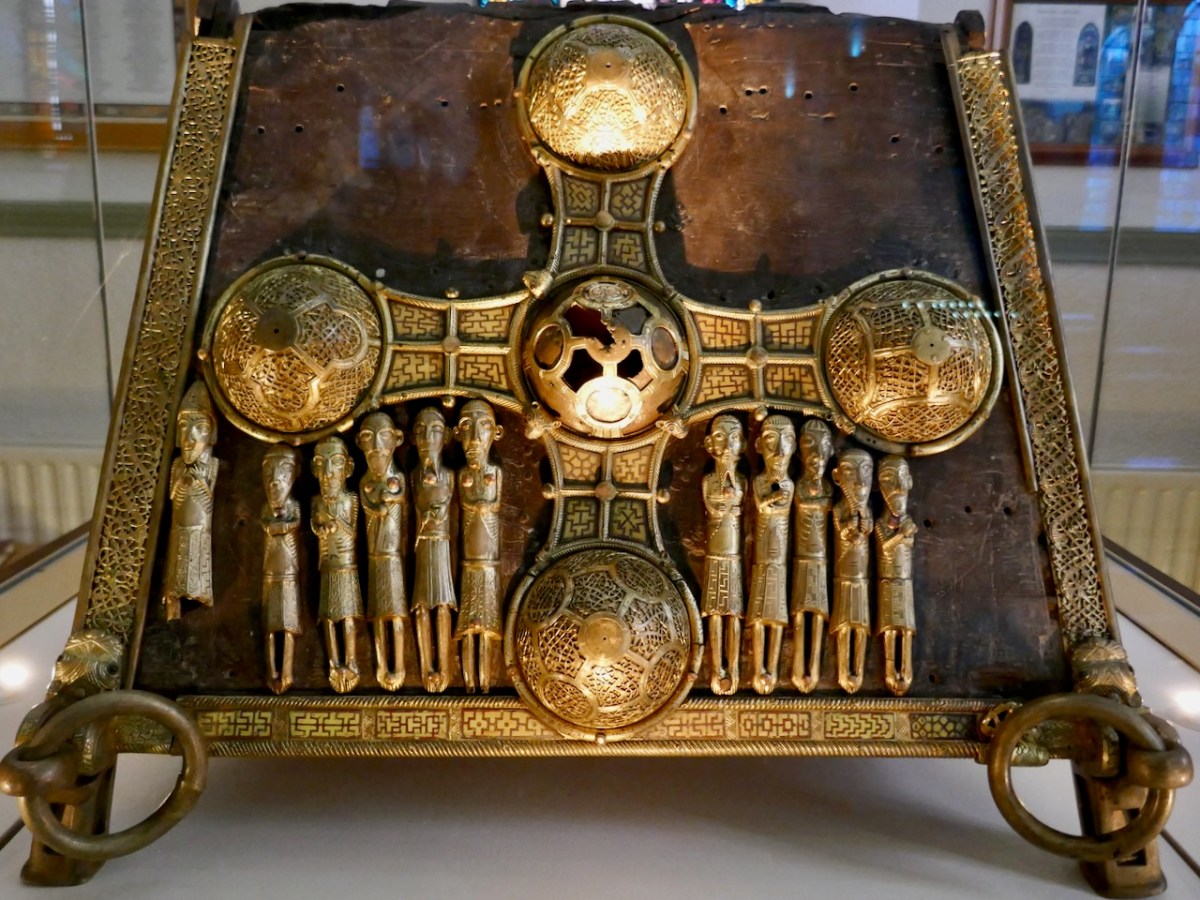
Could this be a 12th – and what has happened to it? We know it was still extant when our old friend George Victor du Noyer was recording archaeological items – here is his sketch of the same one as in Vallancey’s volume, done in 1837.
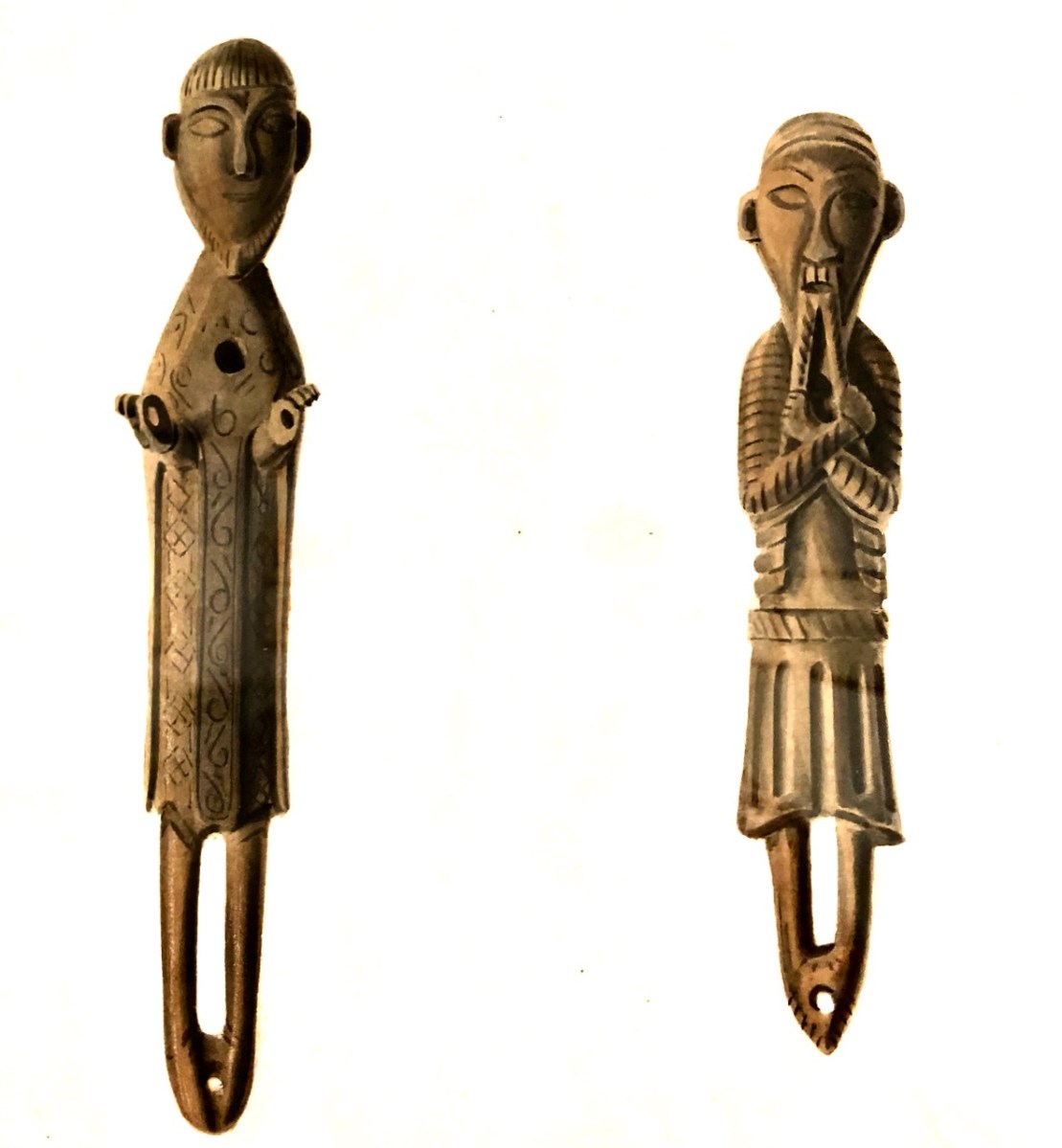
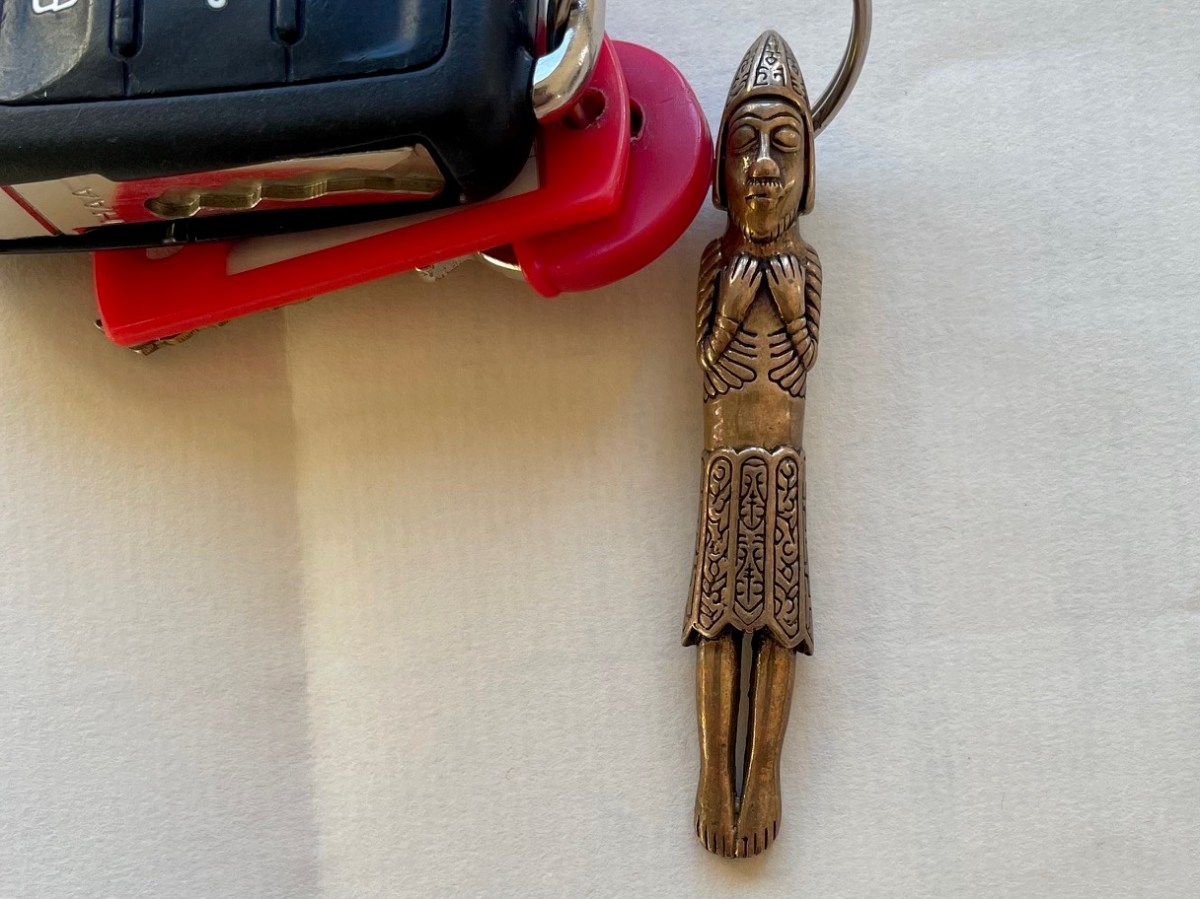
I put the question to Dr Griffin Murray, author of the superb book on St Manchan’s Shrine and he told me that this one was known as the Beard Puller, that is was from Co Roscommon and was in the Trinity College Museum, but is now lost. It could definitely be from St Manchan’s the shrine, he says, although equally it could be from another one. Why is this little guy meaningful to me? Well, I subscribed to the publication of the book, and a reproduction of the 11th figure was my reward!
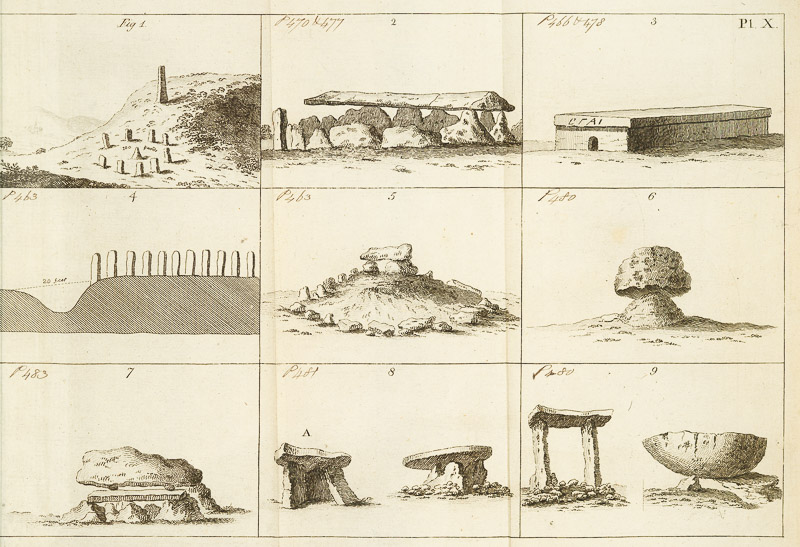
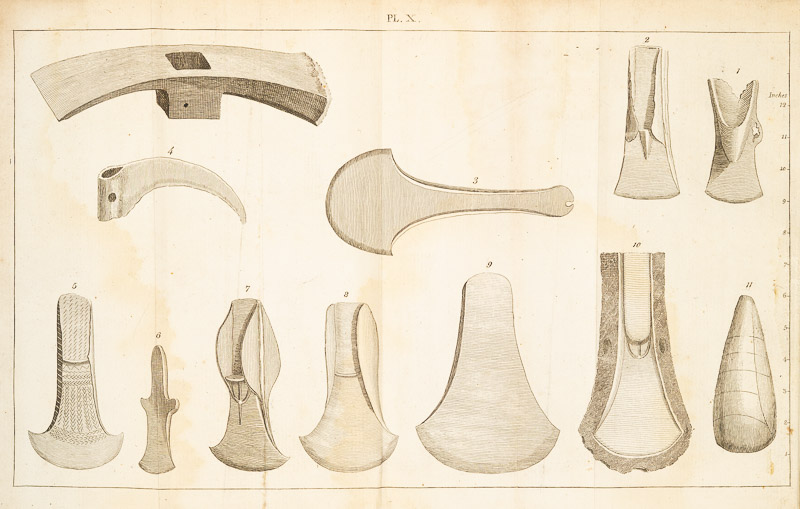
This section contains important illustrations of prehistoric objects – important because this was the first publication to bring them to the notice of the general public. I will use some of these to illustrate the rest of this post, so look out – they will not all relate to the text around them..
However, I am going to skip down now to a section called Proposals for collecting materials for publishing the ancient and present state of the several counties of Ireland. This is an significant section in that it lays out the need for actual knowledge of the country of Ireland, including its natural assets – air, water, geology, animals – and man-made such as buildings, charities, manufactures, and antiquities.
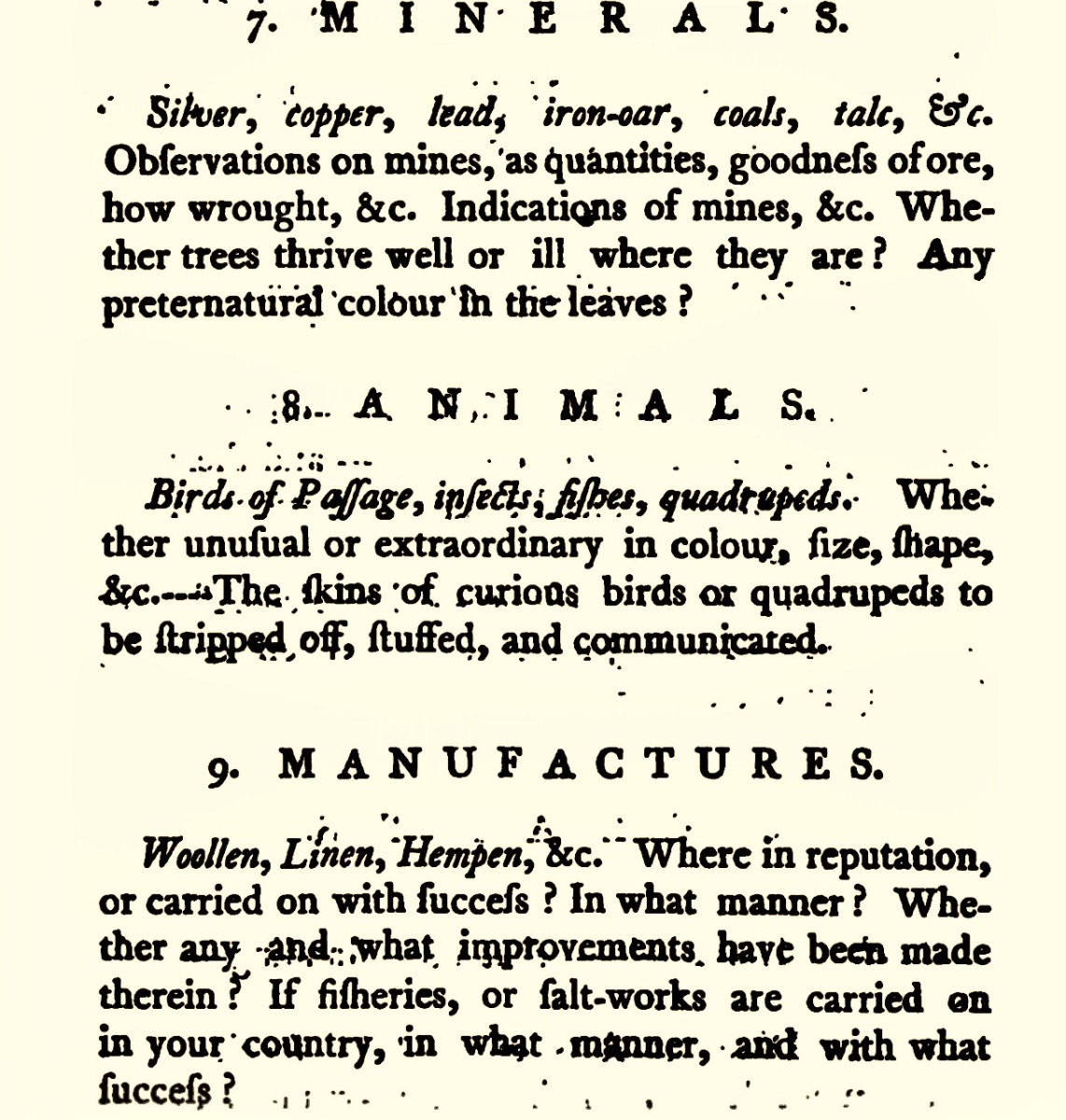
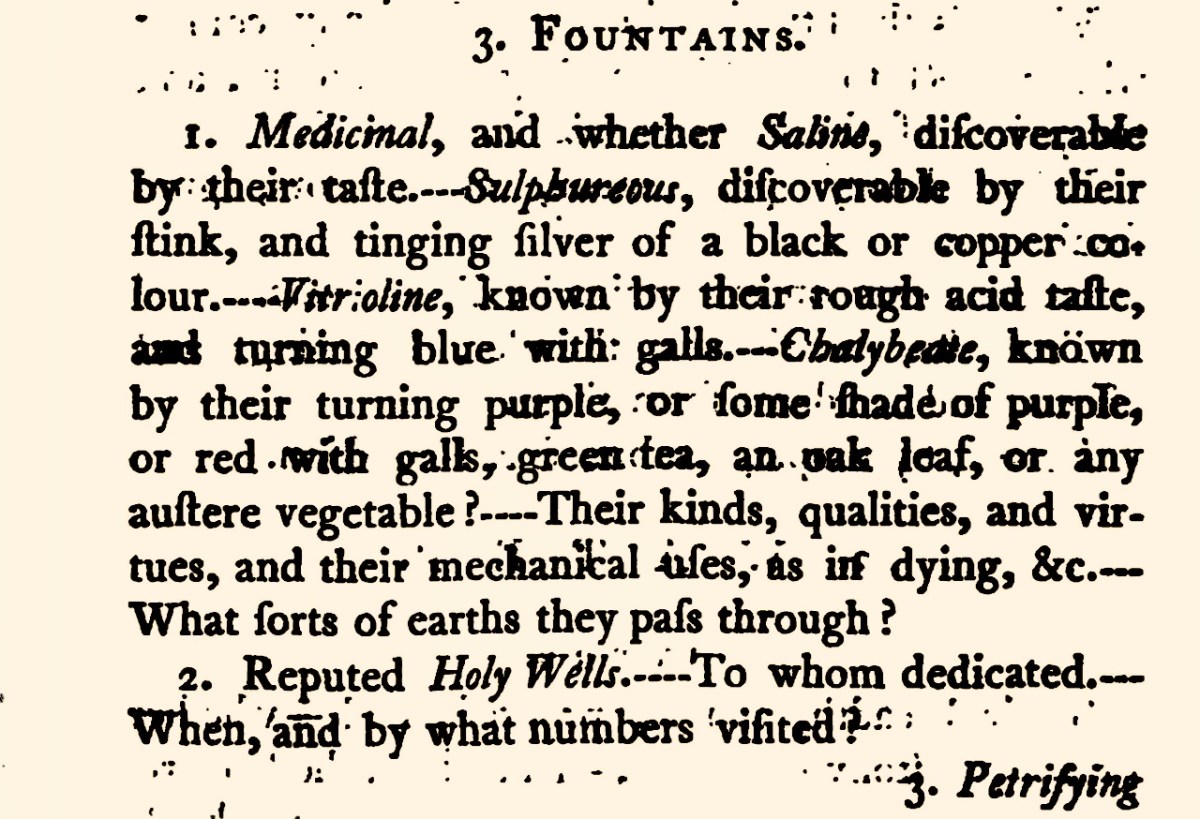
Vallancey lays out the questions to be answered. It all seems so elementary, doesn’t it – and that’s what is so staggering, that there could have been so little in-depth knowledge of the actual country at that time.  You might remember that we read about one of these county surveys for Westmeath in Vol 1. What a wealth of detail we might now have of life in 18th century Ireland if only this had been accomplished as Vallancey described it. My friend Amanda, of Holy Wells fame, would be particularly grateful!
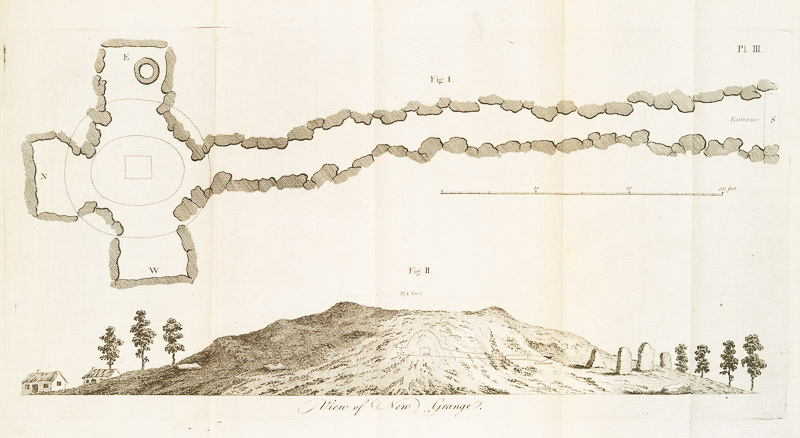
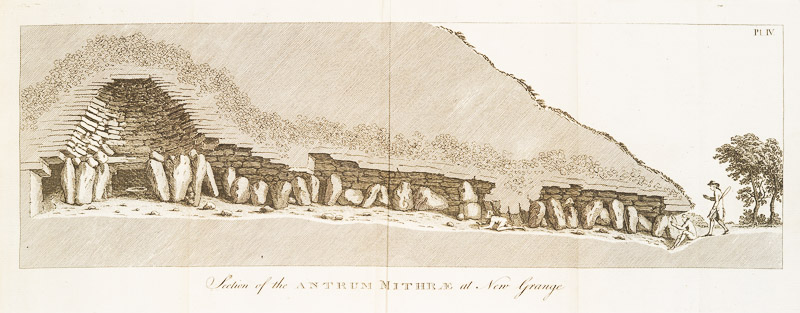
The rest of this volume is taken up with A Vindication of the Antient History of Ireland, with lots of Vallancey’s pet theories on display. It contains a really excellent plan and section of Newgrange – a truly outstanding piece of mapping, given the fanciful nature of most drawing of prehistoric monuments of the time. His conclusion about Newgrange, that it was a Mithratic Fire Cave, turned out be in fact not so far-fetched as some of his other notions, given what we now know about the winter solstice at Newgrange. 
There is also some fascinating stuff about Irish paganism and Irish saints. The sequence is based on the mythological original story for Irish history called the Leabhar Gabhala. It’s a pity to give it such short shrift, but I am determined to press on and so I now pass to Volume 5, which is the last volume in the set. There is a Volume 6, and I can access that online only, so have decided to finish with the last volume I have been able to examine in person.
As you can see from the Table of Contents (which, by the way, never seems to be quite the same as the frontispiece that lays out What This Volume Contains), there is a certain amount of repetition here from previous sections on The Scythians, Ogham, the Chaldeans, and the Brehon Laws. So, I am going to confine myself to the part about the Irish Feudal System of Government, as it so well represents what it’s like to read Vallancey. 
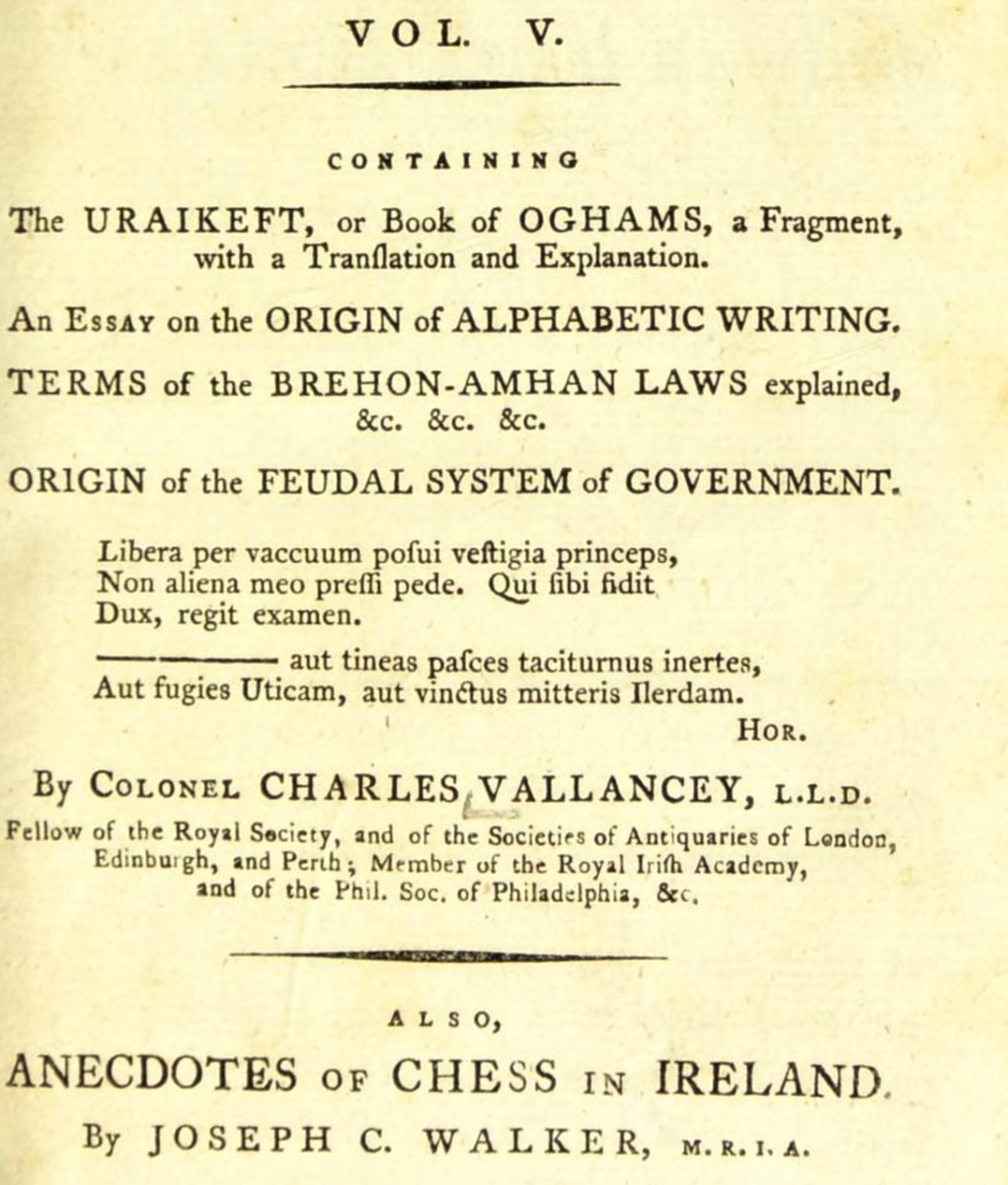
After a preamble of many, many pages in which are mentioned the Phoenicians, the Egyptians, Aristotle, the Belgae, gold from Wicklow, Alexander the Great, Mr Wilkins (I’m not making this up), Aboul-Hassan-Aly, Armenians, the Empress of Russia (honestly), Father Georgius (who resided long with the Tibetans but who wrote in Latin, quoted at length here), the Huns (we might actually be Indo-Scythian-Huns, apparently), the Japanese, the Peruvians, the Great Mogul, Vallancey, perhaps not surprisingly informs us that the feudal system in Ireland was based on all of the above, except for two things.

The Tuarasdal, wages or subsidies paid annually by the sovereign to his feudatory chiefs, for which he received from them a certain supply of military forces, or some other state contributions tending to the common interest.

The Tribute for Protection. It is called in the Irish laws. . .  eneclann, (i. e. protection of the clann). . . It does not appear that these vassals were originally obliged to furnish troops for their chiefs, but to pay a certain impost or tax for their protection.

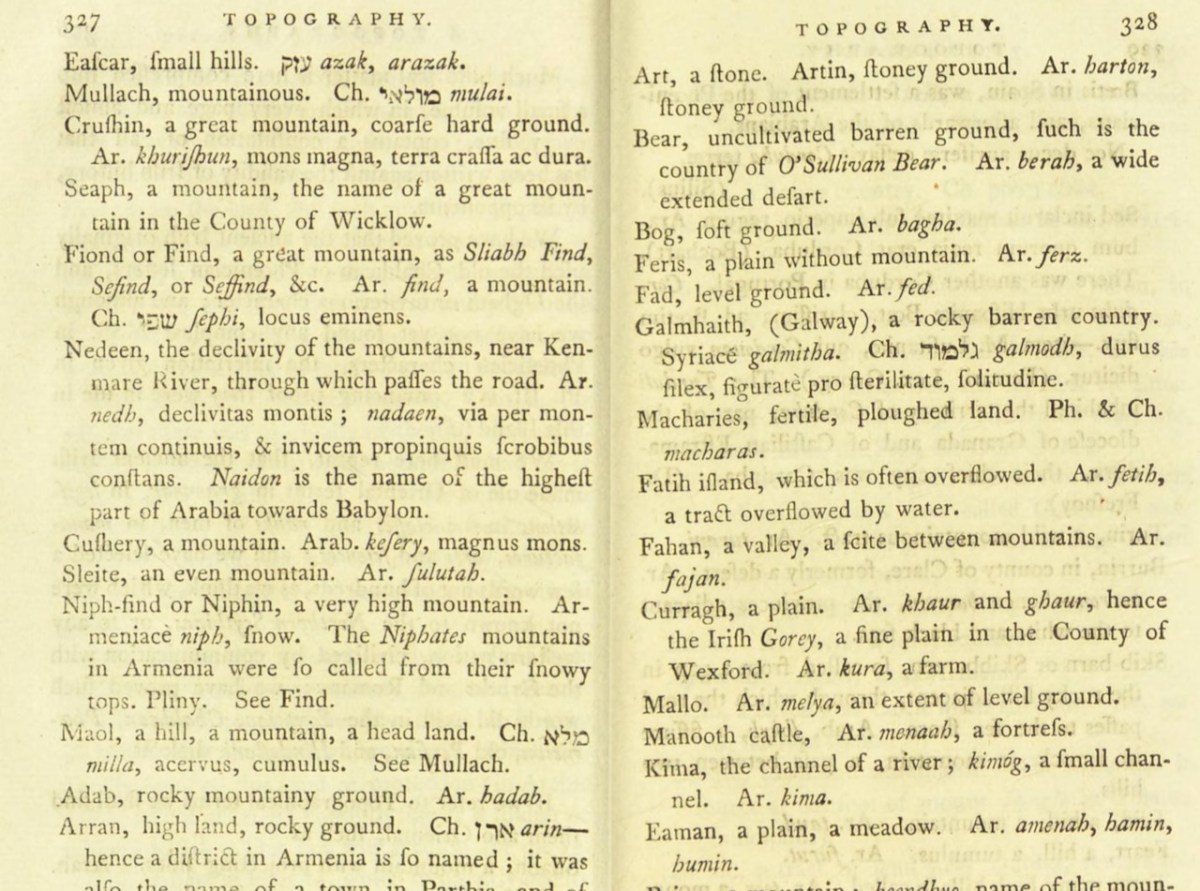
He’s particularly fond of the oriental influences here and to hammer home his point he provided a dictionary of topographical terms all of which he assures us come from Oriental Languages. Some examples, including their Arabian, Hebrew, Chinese, origins, etc:
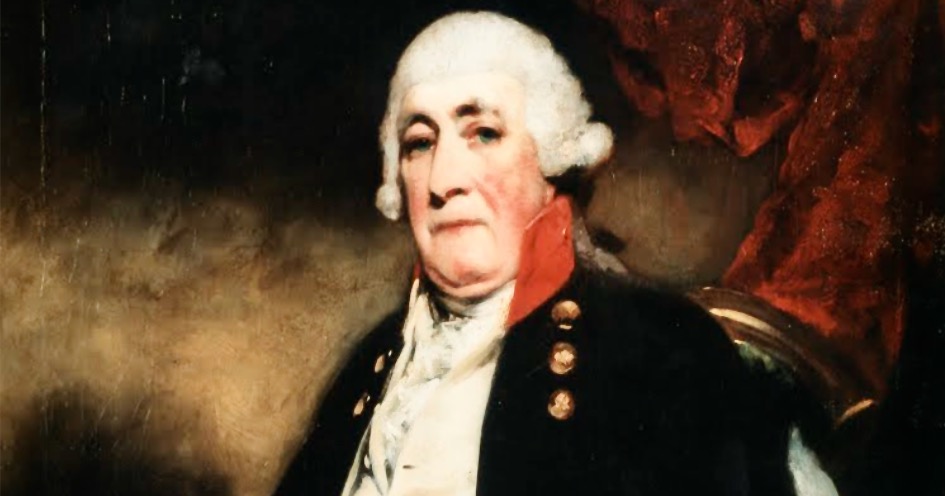
My head hurts, so this is a good place to stop. How do I sum up this amazing man and his colossal and controversial achievements? The marvellous site Ricorso has a whole section on him which brilliantly sums up the person (although by one authority in here he has acquired 27 children!) and is worth reading in its entirety. The following quotes all come from there. It gives me the new information that Vallancey, despite all claims to the contrary, never actually learned Irish, although he owned a grammatical dictionary compiled by a school-teacher named Crab. One commentator, James Hardiman, confirms this, stating

 
It is well known, that the late General Vallancey obtained much literary celebrity, both at home and abroad, and, in fact, first acquired the reputation of an Irish scholar, by the collation of Hanno, the Carthaginian’s speech in Plautus. . . but it is not so well known that that speech had been collated many years before, by Teige O’Neachtain, an excellent Irish poet, and author of the extempore epigram, Vol. ii. p. 120, of this collection. Vallancey had this collation in O’Neachtan’s hand-writing, in his possession; and I am obliged (with regret) to add, that he never acknowledged the fact, but assumed the entire credit of the discovery to himself.

Thomas Davis says:

His “Collectanea”, and his discourses in the Royal Irish Academy, of which he was an original member, spread far and wide his oriental theories. He was an amiable and plausible man, but of little learning, little industry [not fair, I think], great boldness, and no scruples [nor this]; and while he certainly stimulated men’s feelings towards Irish antiquities, he has left us a reproducing swarm of falsehood, of which Mr. Petrie has happily begun the destruction. Perhaps nothing gave Vallancey’s follies more popularity than the opposition of the Rev. Edward Ledwich, whose Antiquities of Ireland is a mass of falsehoods, disparaging to the people and the country.

Here’s a good summation, from Joseph Leerssen


The successor of the Select Committee was the Hibernian Antiquarian Society, 1779-83, which in turn set in motion the creation of RIA in 1782, with Vallancey as one of its founding members. Vallancey was the son of a Huguenot émigré, Army officer; derided by many as a charlatan or at best a naive nitwit, Vallancey contributed few ideas of any value to the study of Gaelic antiquity, but much badly-needed enthusiasm, energy and social/religious respectability. He had founded his periodical Collectanea de rebus Hibernicis as a forum for antiquarianism. Further, it was the additional merit of Vallancey to open this world [of Ascendancy] enthusiasm for Irish antiquity] to his friend and mentor Charles O’Conor, in whose wake younger Gaelic, Catholic scholars like O’Halloran and Theophilus Flanagan could begin to function in close collaboration with Ascendancy Protestants.


So what have I concluded after lo these many weeks of sitting with Vallancey? The first is that it was a wonderful experience to be able to read the five volumes ‘in the flesh.’ The second was the whole things gave me a unique insight into the origins of my own discipline of Irish archaeology – how it was born out of a cauldron of claim and counter-claim, hubris and argument, ideology and fieldwork, nationalism and orientalism. None of that can be understood and appreciated without the towering, if ultimately misguided, figure of Charles Vallancey. Thank you, Holger of Inanna Rare Books, for this opportunity. 
Vallancey: the Collectanea, Vols 2 and 3

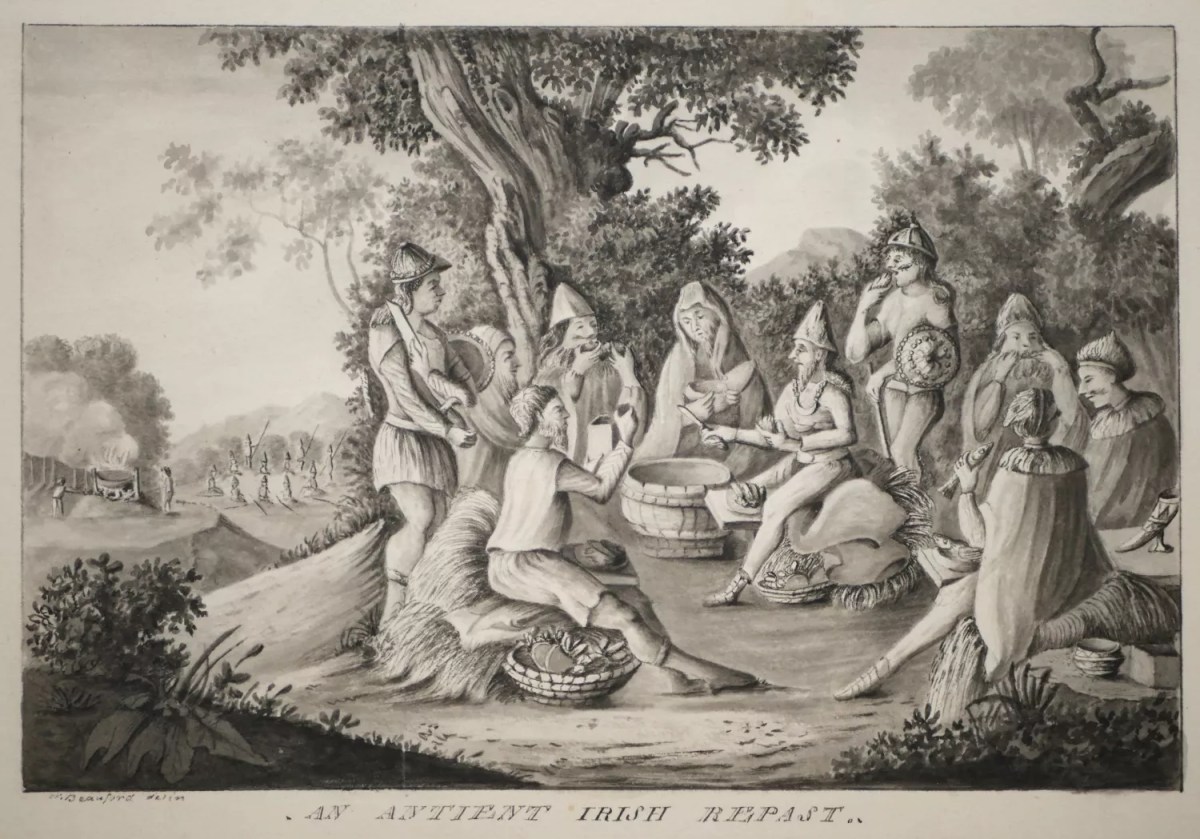
I took a breather last week, but I’m back with more Vallancey. I’ll dispatch Vol 2 as quickly as possible now by telling you that it contains a section on Druidism by William Beauford, an ardent student of Irish antiquities and ancient music and an accomplished draughtsman. He, along with Vallencey, Wm. Burton Conyngham, Ledwich and others, founded the Hibernian Society of Antiquarians – the ill-fated organisation that broke apart under the strain of the quarrels between Vallancey and Ledwich. He was also an artist, contributing drawings to several publications. Below is a piece of his I found online. I think it’s an evidence-free depiction of how these antiquarians saw the antient Irish. And – is the man on the right about to bite the head off a fish?

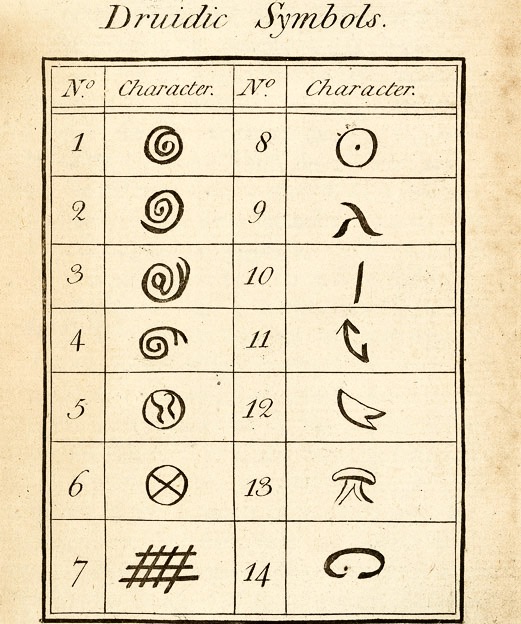
In this piece, his thesis was that the druids had writing long before Christianity and we can see their symbols in Newgrange and other places and figure out their meanings. Since the cup and circle is the central motif of Irish rock art (on which I wrote a theses) I was particularly interested in his interpretation of the dot-and-circle:

Number eight is a circle found on several Irish coins. The circle among the Egyptians, Phoenicians, Carthaginians etc generally represented the Sun and sometimes the World. With the Celtic Druids it also represented the Sun, and with a dot in the centre, the whole universe. The ancient Irish retained it during the Middle Ages as the symbol of a country, and with a point in the centre, for the whole kingdom, or Ireland in general.

The spiral, by  the way, was a serpent, ‘symbols of the Divine Being,’ the cross hatch or trellis is the symbol of ‘fate, providence, chance or fortune.” So now!

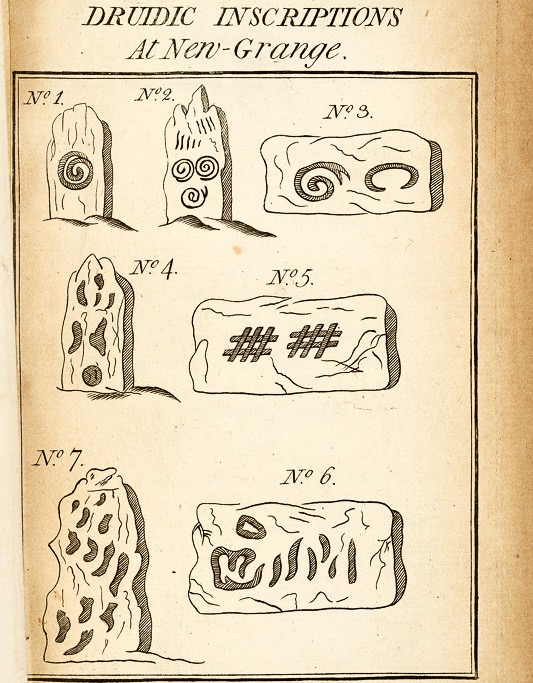
One of the many problems with this, of course is that while Beauford asserts this all flows from Egypt, we know that Newgrange predates the pyramids and hieroglyphic writing. Another problem is that the above illustration bears no resembance ot the carvings at Newgrange. Volume 2 continues with more on Druids, including a spirited defence of the ancient beauty of the Irish language, which “should be taught in our university”, and a grammar of Iberno-Celtic. As might be expected, there is much discussion here about Phoenicians and Carthaginians. 

There’s more, but I’m going to move on now to Vol 3. At last – I hear you cry! This one is full of more arguments about the origins of the Irish and our language, including a lengthy section on ‘Japonese’ and Chinese ‘collated with the Irish’. And, as is his wont Vallancey provides his usual lengthy preface (70 pages!), full of interesting titbits. One that caught my eye was his claim that the Irish word Pósadh, meaning marriage, was based on the word Bósadh (Bó is a cow in Irish), and the sense of it was a dowry ‘endowed with cows’. Asserts Vallancey:  

The men of quality amongst the old Irish never required a marriage portion with their wives, but rather settled such a dowry upon them, as was sufficient maintenance for life, in case of widowhood. 

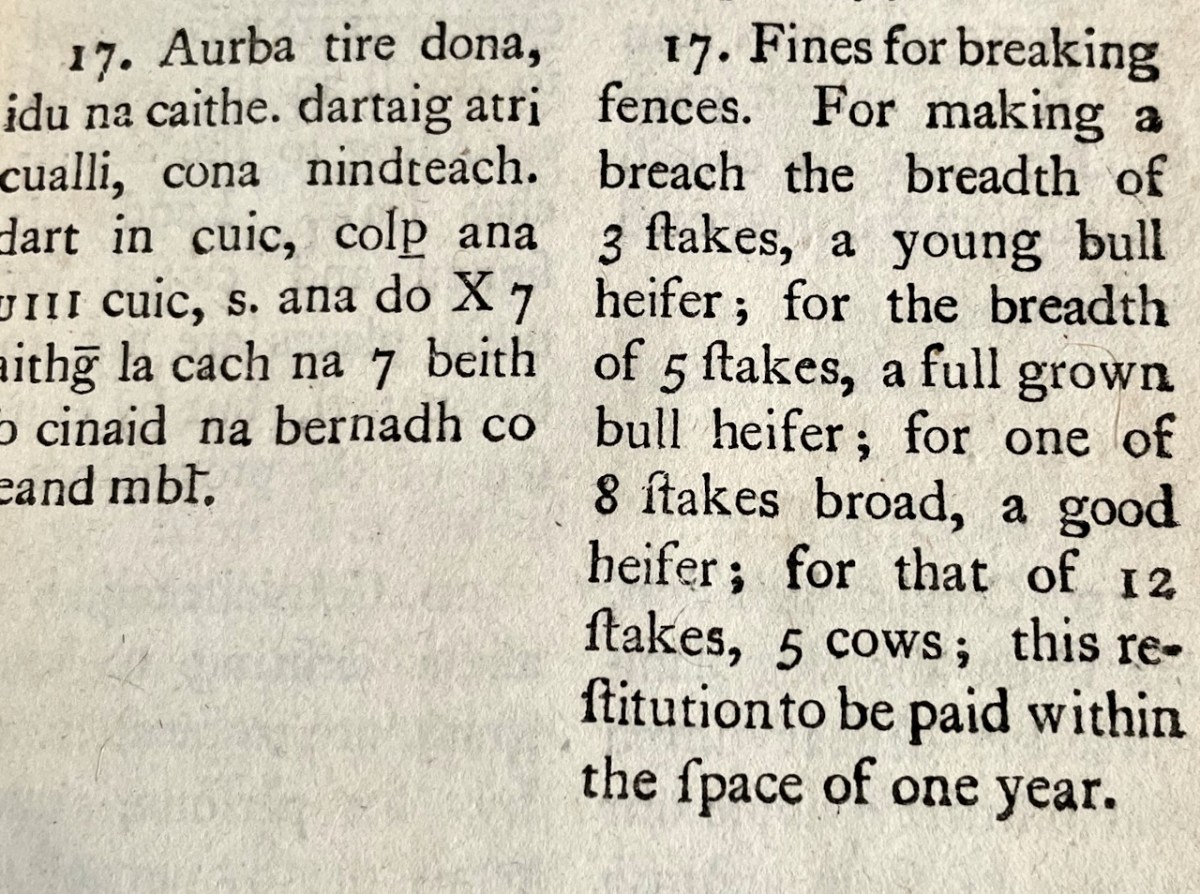
He can’t resist adding and this was the custom of the German nobles and of the Franks. This is followed by another interesting section on the Brehon Laws. These laws of medieval Ireland (a Brehon was a judge) were concerned mostly with fines and compensations for wrongdoing, and this section deals for example with trespass.

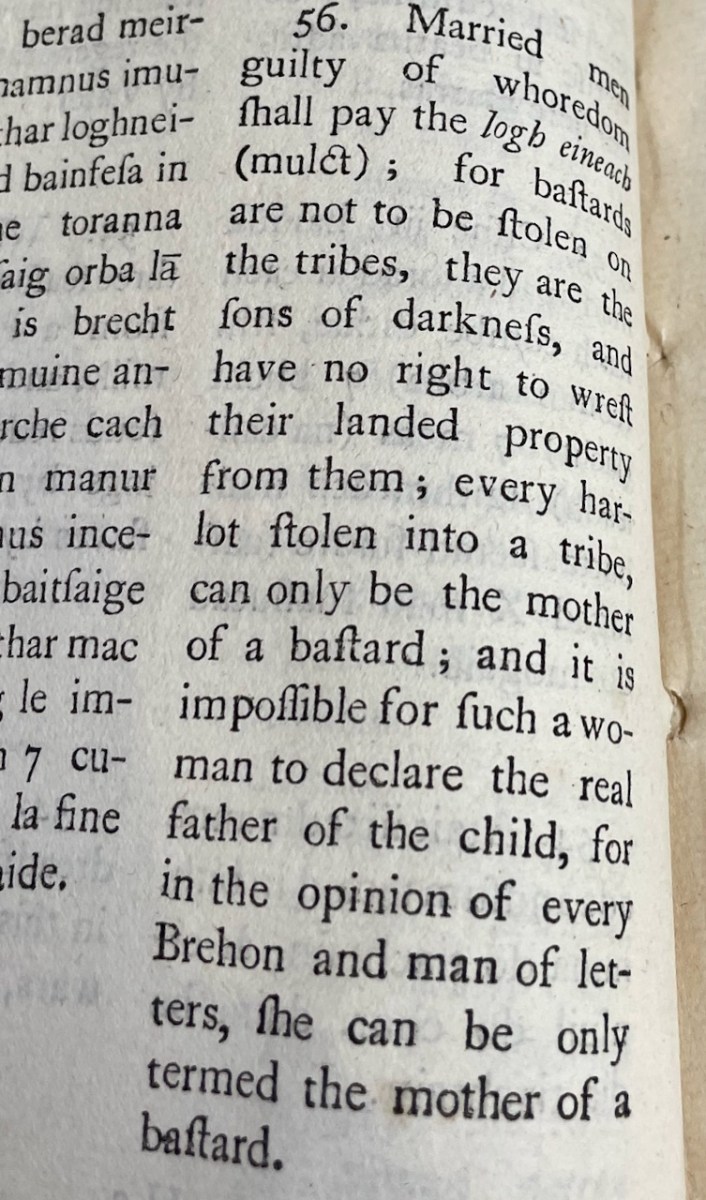
It also talks about children born to unmarried women. Although it refers to men guilty of ‘whoredom’ and the logh eineach (honour price) they must pay, it goes on to say that such bastards are sons of darkness and must not be foisted upon the tribe by the harlot. Here we see how important it is to preserve inheritance within the ruling sept of the tribe, and how women were expendable in that process.

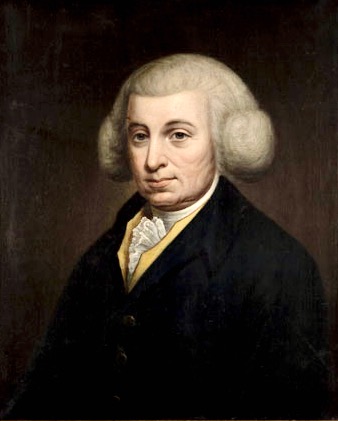
And now we come to yet another of the cohort of antiquarian scholars that were contemporaries of Vallancey – Charles O’Connor of Belanagare. Perhaps the most learned of them all, O’Connor came from old Irish nobility. See the fascinating biography of him in the always-superb resource from the Royal Irish Academy – the Dictionary of Irish Biography. Fluent in Irish and a collector of manuscripts, he was connected to many gifted and interesting scholars and scribes in Irish. and eventually acquired or obtained sight of practically every important Irish manuscript in the country. He was, with Vallancey, one of the founders of the ill-fated Hibernian Antiquarian Society, and later the Royal Irish Academy. The portrait below is from Wikimedia Commons.

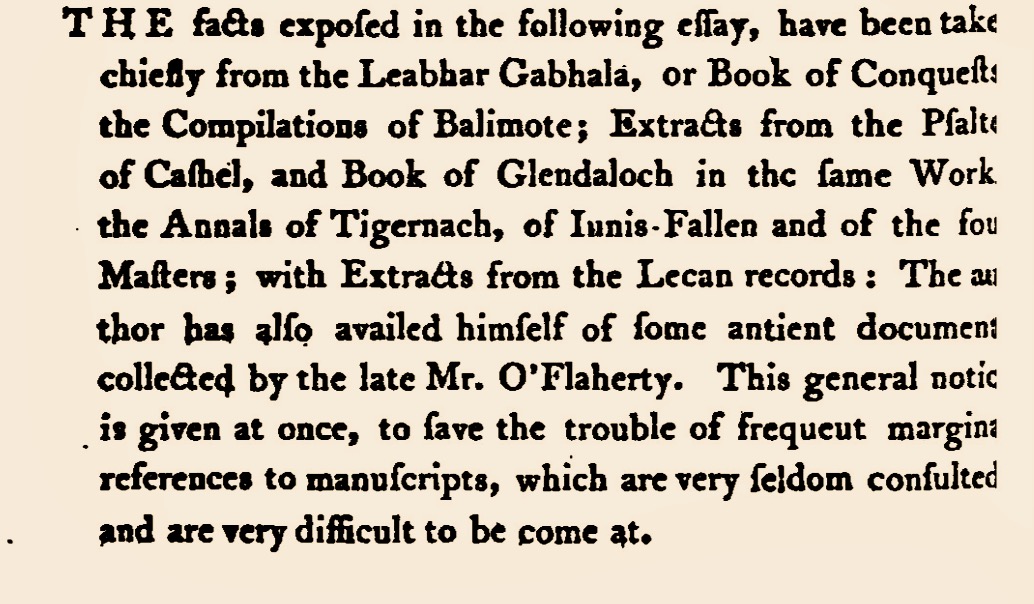
He had previously written a manuscript titled Dissertations on the antient history of Ireland in 1753, but for this volume of the Collectanea he produced a further essay, a letter really, addressed to his friend Vallancey, titled Reflections on the History of Ireland During the Times of Heathenism. In it, he coined the term “Fenian” for Fionn MacCumhaill’s band of warriors, a term that certainly had sticking power in Irish History. In this letter he appears to support Vallancey’s daft ideas about Phoenicians. However, he was a better scholar than Vallancey and pioneered the use of primary sources including manuscripts from his personal collection, to research and write about Irish history, and his familiarity with these sources is obvious in this piece. Here’s his list.

William Beauford makes another appearance now, with his Antient Topography of Ireland. Unlike what it sounds, this is actually a dictionary of place names, with an explanation of the meaning of the name and some historical associations. 

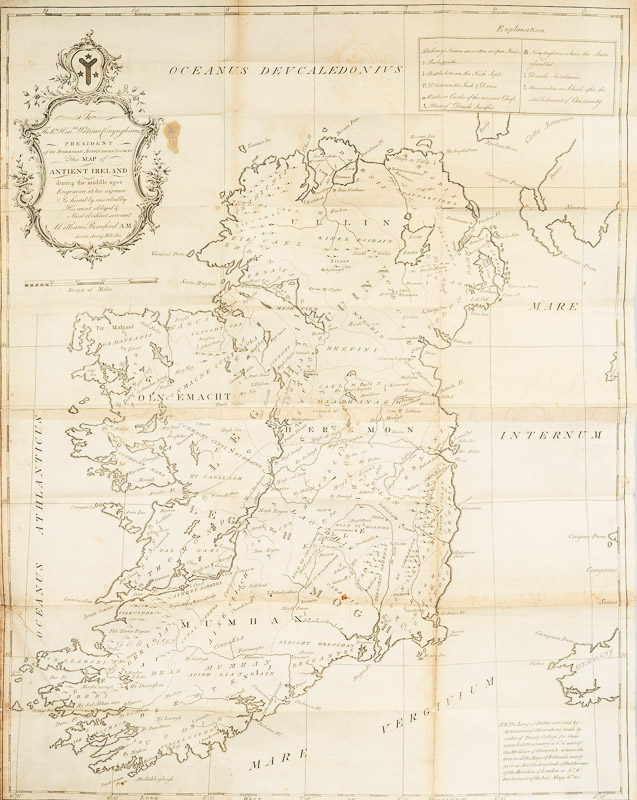
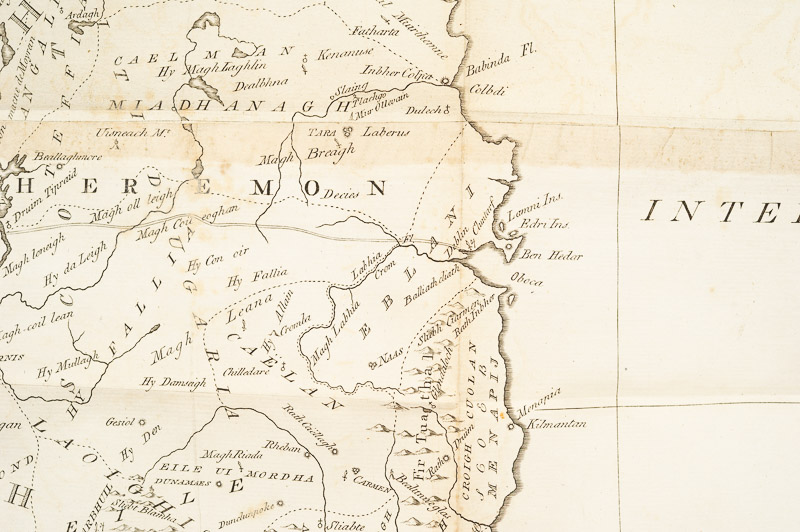
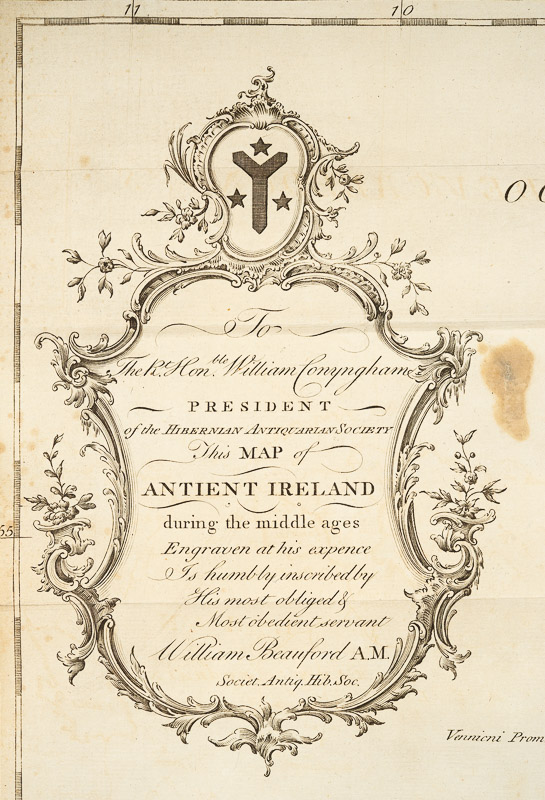
However, there is also a wonderful map! It’s a fold out, and dedicated to yet another of the Hibernian Antiquarians, Willian Conyngham. Regular readers know how I love a good map!

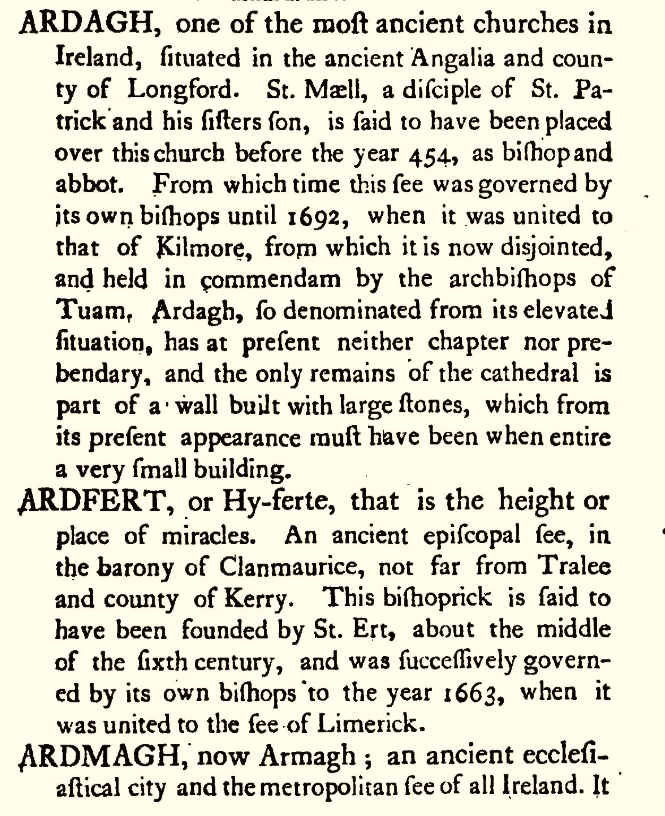
And now all the dictionary entries become clear, as Beauford matches the placenames with the map.

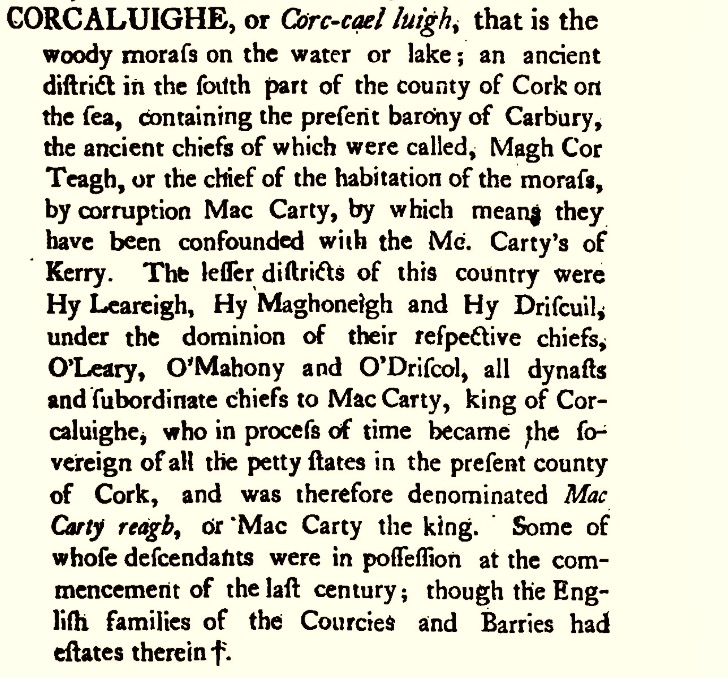
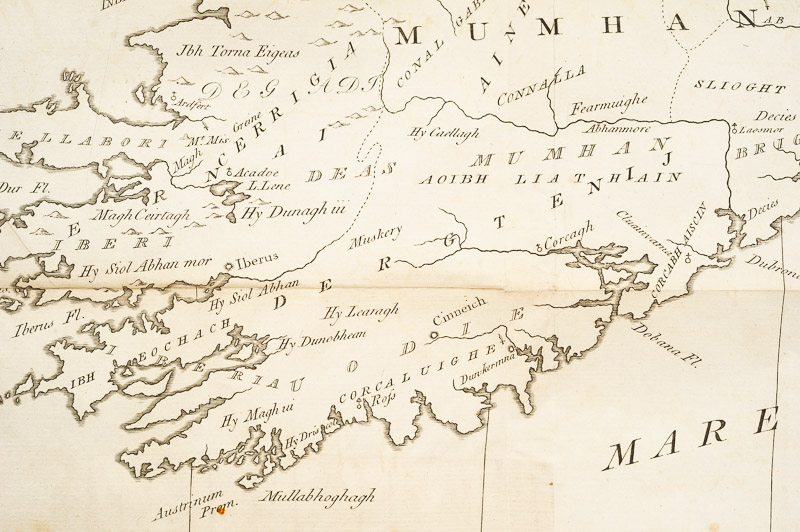
Above is his section on Corcaluighe (Pronounced Kurka Lee) while below is the section of the map showing the location of Corcaluighe.

Of course, I had to choose West Cork. But just to show you how broadminded I am, here is the area around Dublin. How many names can you make out?

I’ll leave it at that now for Volume 3. I’m actually still only half way through it, but I’m going to skip over the rest of it now, in favour of covering 4 and 5  next time – at least that’s the plan! Wish me luck.

Imbolc – How Our Ancestors Welcomed Spring

February 1 – we celebrate it as St Brigid’s day now, and support the call for making it a national holiday. But we have celebrated it in Ireland forever as Imbolc, the calendar marker that heralds the arrival of spring.

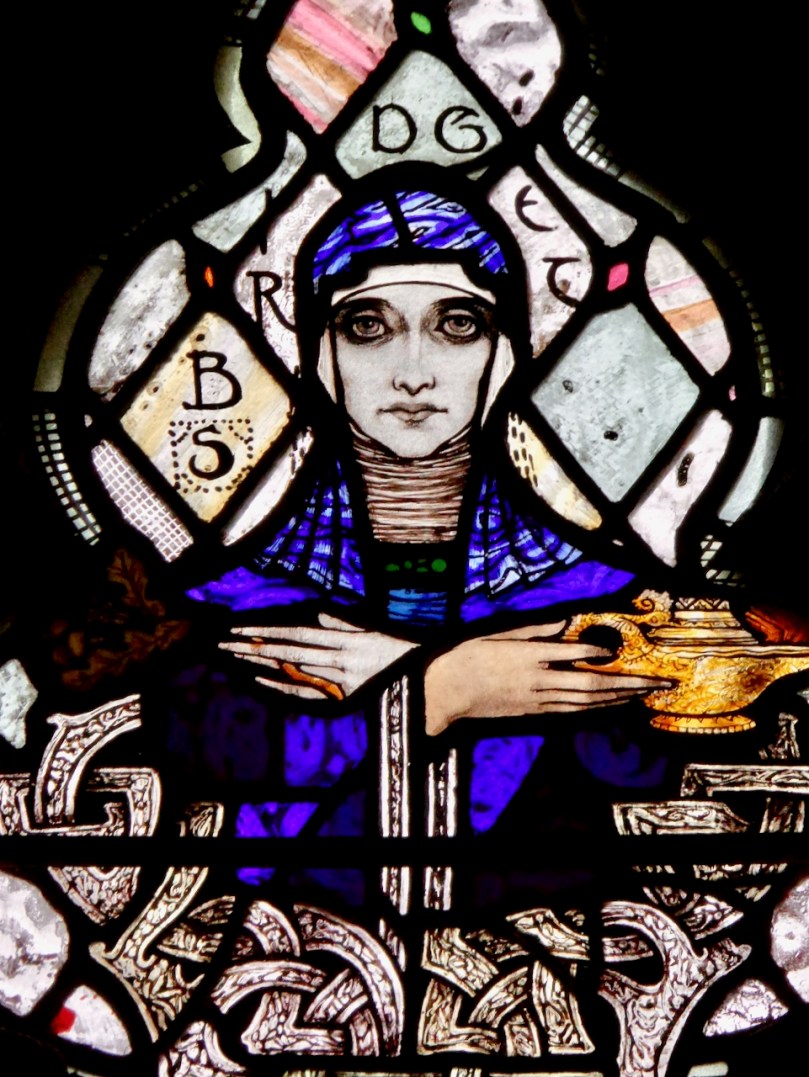
St Brigid by Harry Clarke in St Barrahane’s Church, Castletownshend

What follows was originally a Joint Post by Finola and Robert, written way back in 2013. We have edited it to update the links and added some new photographs and are republishing it now.

Archaeologists have long been aware of the astronomical siting of some Irish megalithic sites, such as at Newgrange, and Loughcrew Passage Graves in Co Meath and Drombeg Stone Circle in West Cork.

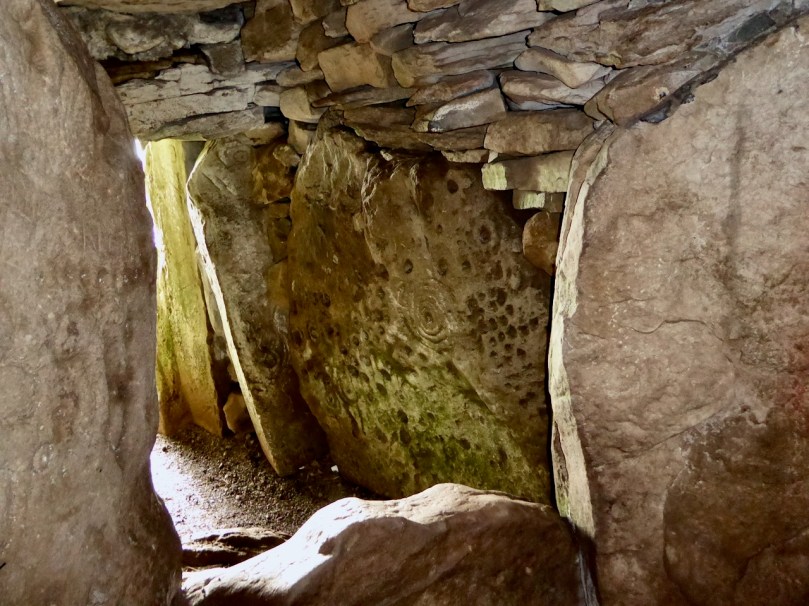
Inside Cairn T at Loughcrew

We have become intrigued by the work of Michael Wilson, a talented amateur astronomer who is singlehandedly documenting the astronomical siting of many monuments in this area. Recently he has turned his attention to prehistoric rock art. Mike’s website contains an astonishing body of work, meticulously researched and rigorously recorded, along with explanatory notes.

Michael Wilson and his Whole Horizon Analytical Technique (WHAT)

Michael Wilson carries out his Whole Horizon Analytical Technique (WHAT)

His thesis, in a nutshell, is that the builders and carvers of Neolithic and Bronze Age times were keen observers of the day and night skies and were intimately familiar with their surroundings. They situated their megaliths and rock art in places where the contours of the horizon allowed them to mark significant solar and lunar events, such as solstices, equinoxes, lunar settings and risings, and intermediate points. Thus, the sun at the winter solstice might rise at the highest point on a nearby mountain, or set in a deep notch in the hills at the spring equinox.

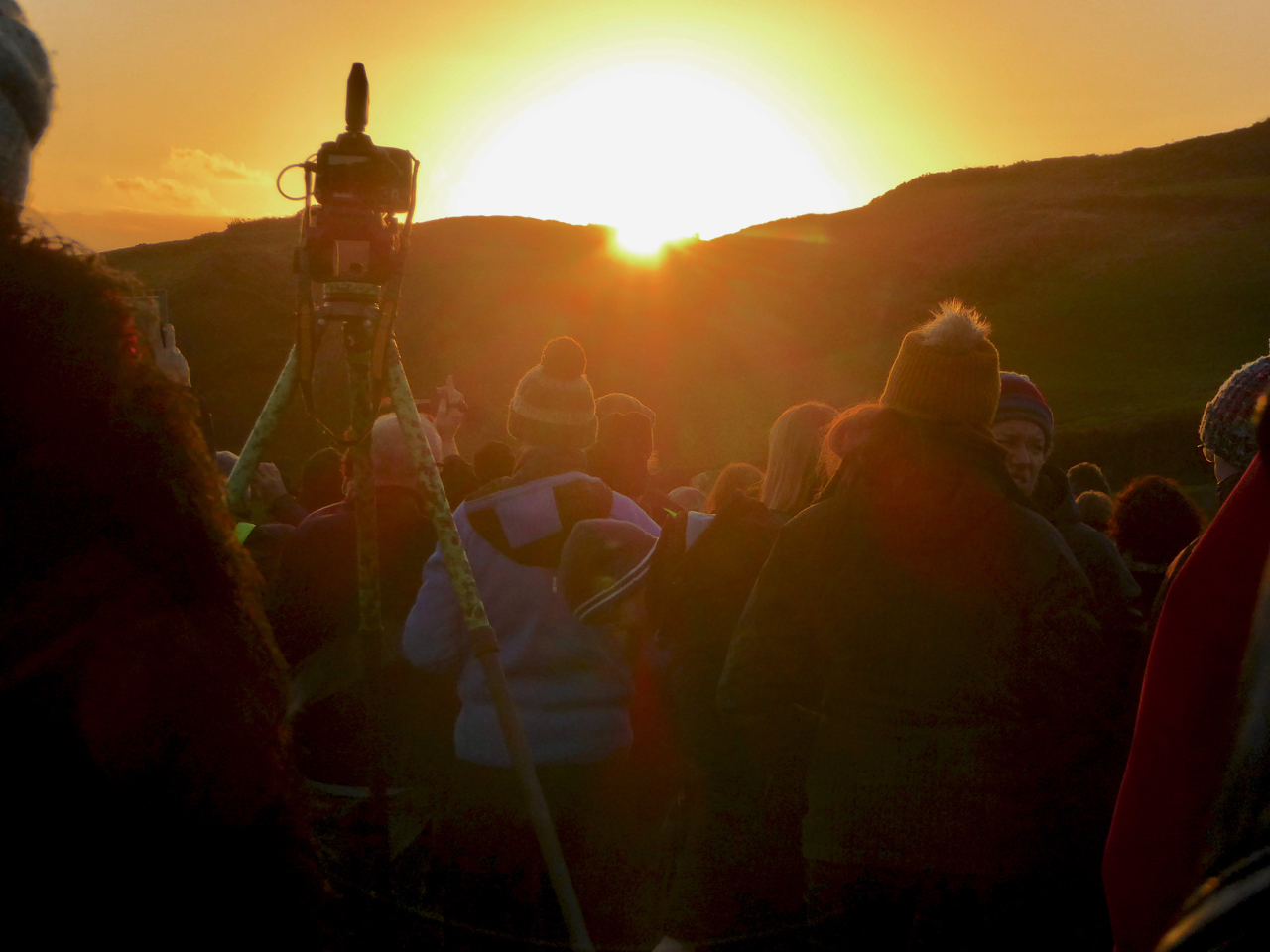
At Drombeg Stone Circle people gather on the winter solstice to watch the sun set over the recumbent stone

The solar calendar has four quarter days (the solstices and the equinoxes), four cross-quarter days (the half way points between the solstices and the equinoxes) and a further finer division into points half-way between the quarters and cross-quarters: an ancient 16 month calendar.

A few days ago [in 2013], Michael posted this:

Imbolc, the spring cross-quarter, is almost upon us. It will be on Feb 1st by the Gregorian calendar, where it is commonly known as St Bridget’s Day or Candlemas, but this is not the correct day. By day-count, the times to celebrate will be sunset on the 3rd and sunrise on the 4th. Astronomically, the sun will be exactly half-way between the winter solstice and the spring equinox at about 16:13 GMT on Feb 3rd, while Feb 2nd is the day to see the sun rise and set at the prehistoric positions for marking this festival.

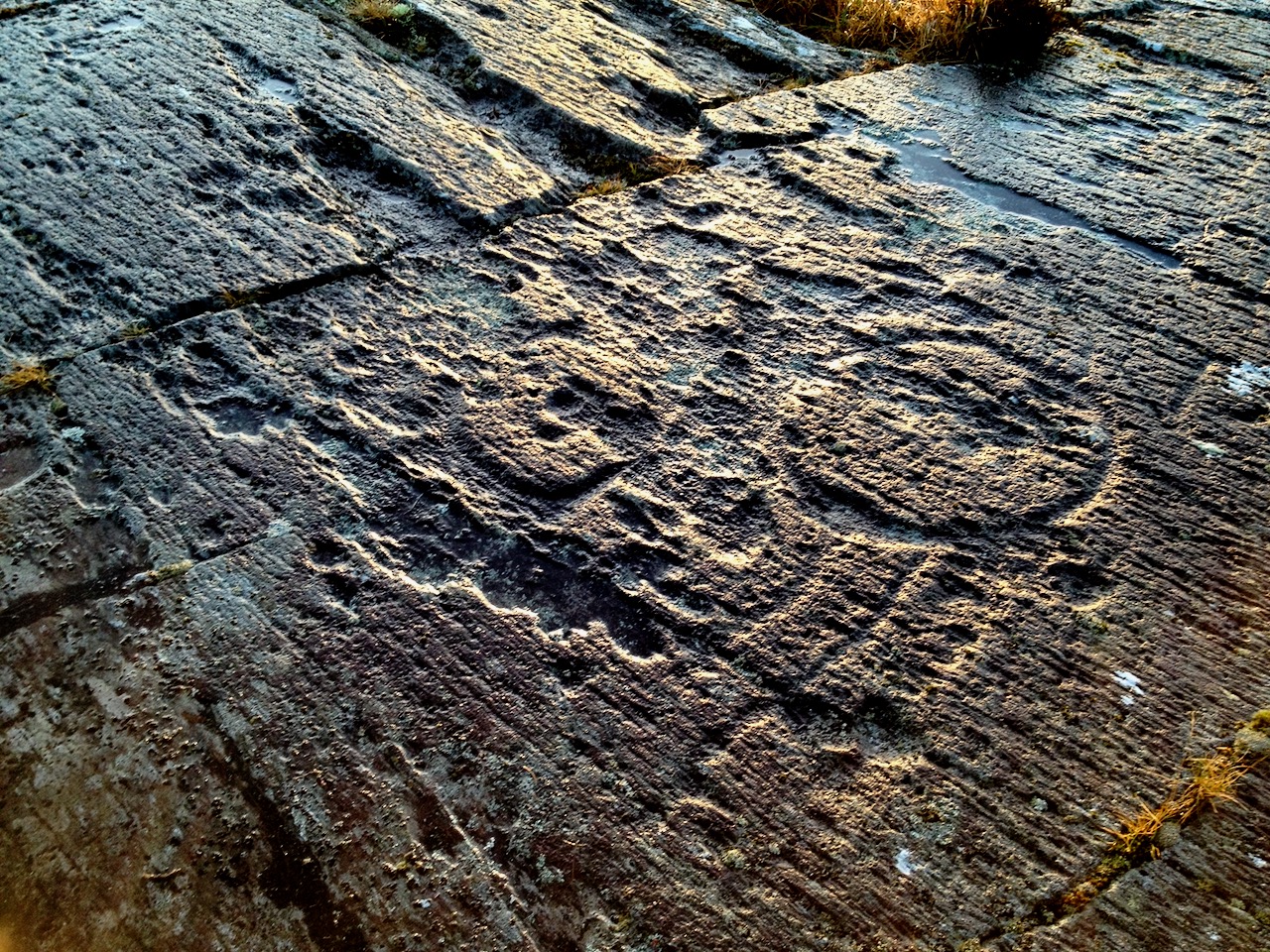
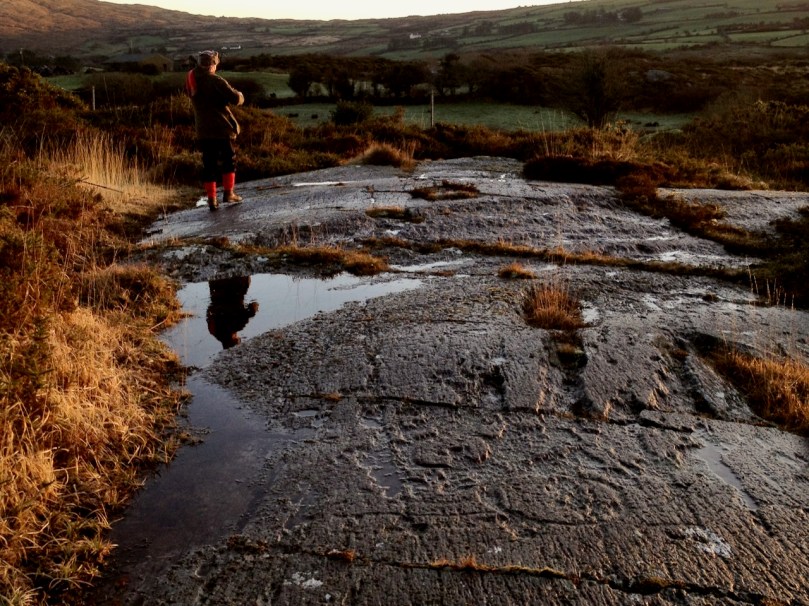
We set out for our favourite rock art site, Ballybane West, before dawn on Feb 2nd, feeling incredibly lucky to have a clear sky. As the sky brightened, and the nearby hills started to receive the sun’s rays, the carvings on the rock surface became clearly visible.

The sun is already hitting the high ground across the valley

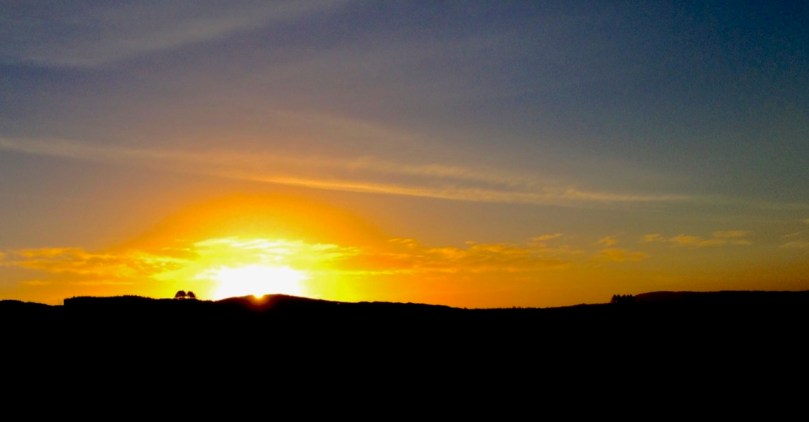
Then, the sun rose, exactly where Michael’s predictions said it would, at the highest point of a rounded hill on the horizon. As people had been doing 4000 years ago in this exact spot, we marked the cross-quarter day of Imbolc – a time when the land starts to warm up, the first spring flowers appear, and the ewes are visibly pregnant.

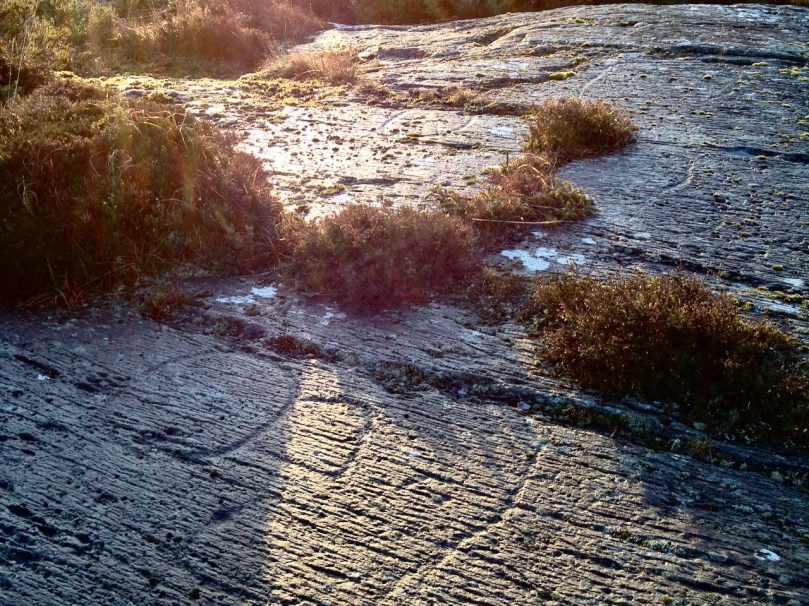
The carvings light up in the dawn rays

The slanting rays of the rising sun provide perfect lighting for seeing rock art, which is often difficult to observe at other times

If Michael is correct, we have to incorporate a new possibility into our thinking about rock art. There have been indications before that the location of the carved rocks was significant. For example, there is often a view of water or of a significant mountain, some theorists have posited that they are ancient boundary markers, and some rock art sites are inter-visible with each other.

But this way of looking at rock art elevates the actual siting of the rock as most important, and allows us to view the carvings themselves as a way to indicate the purpose of the site – a means to an end rather than an end in itself. The motifs, though, will probably remain as enigmatic as ever.


Drombeg Solstice Celebration

Setting

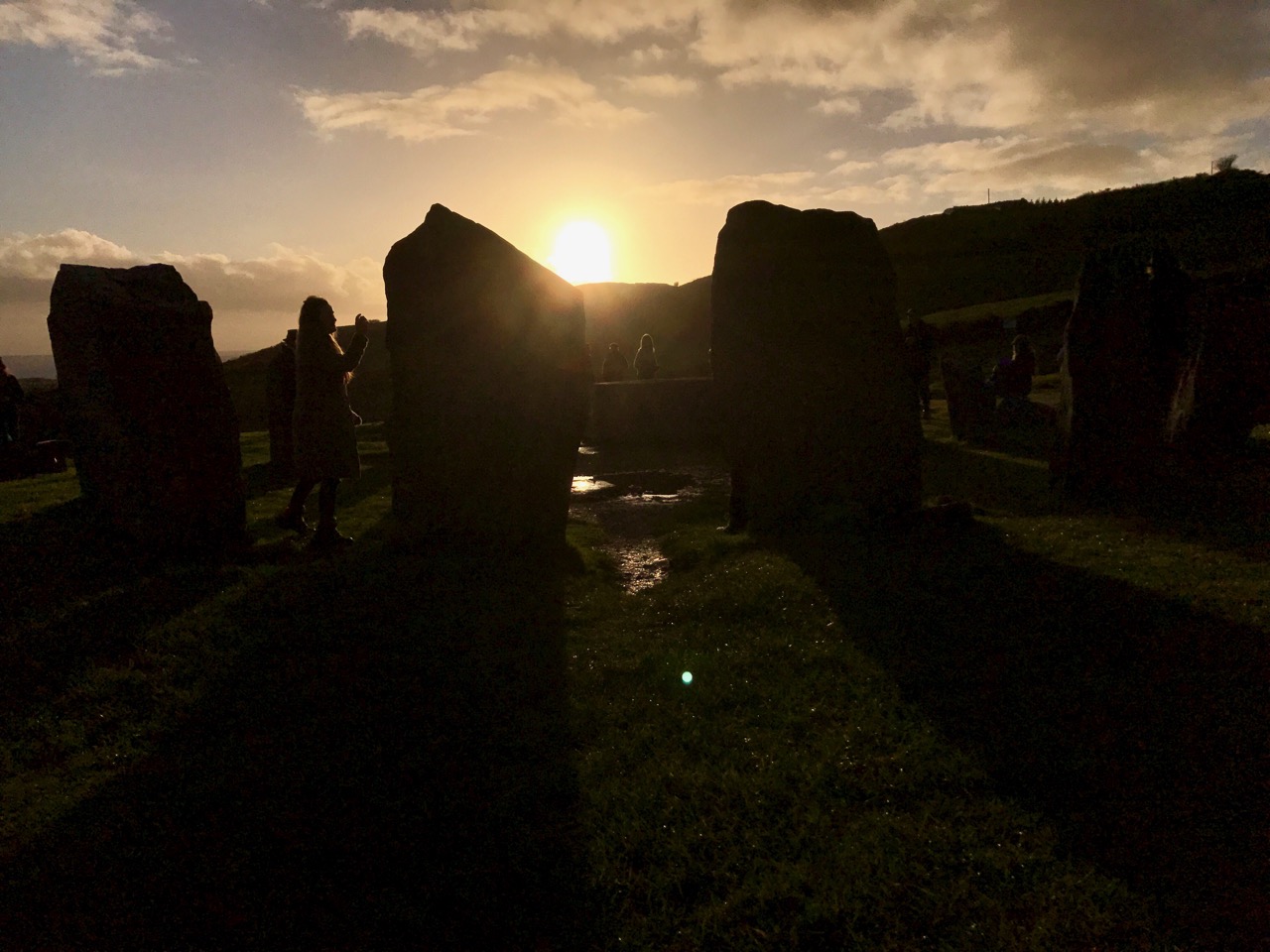
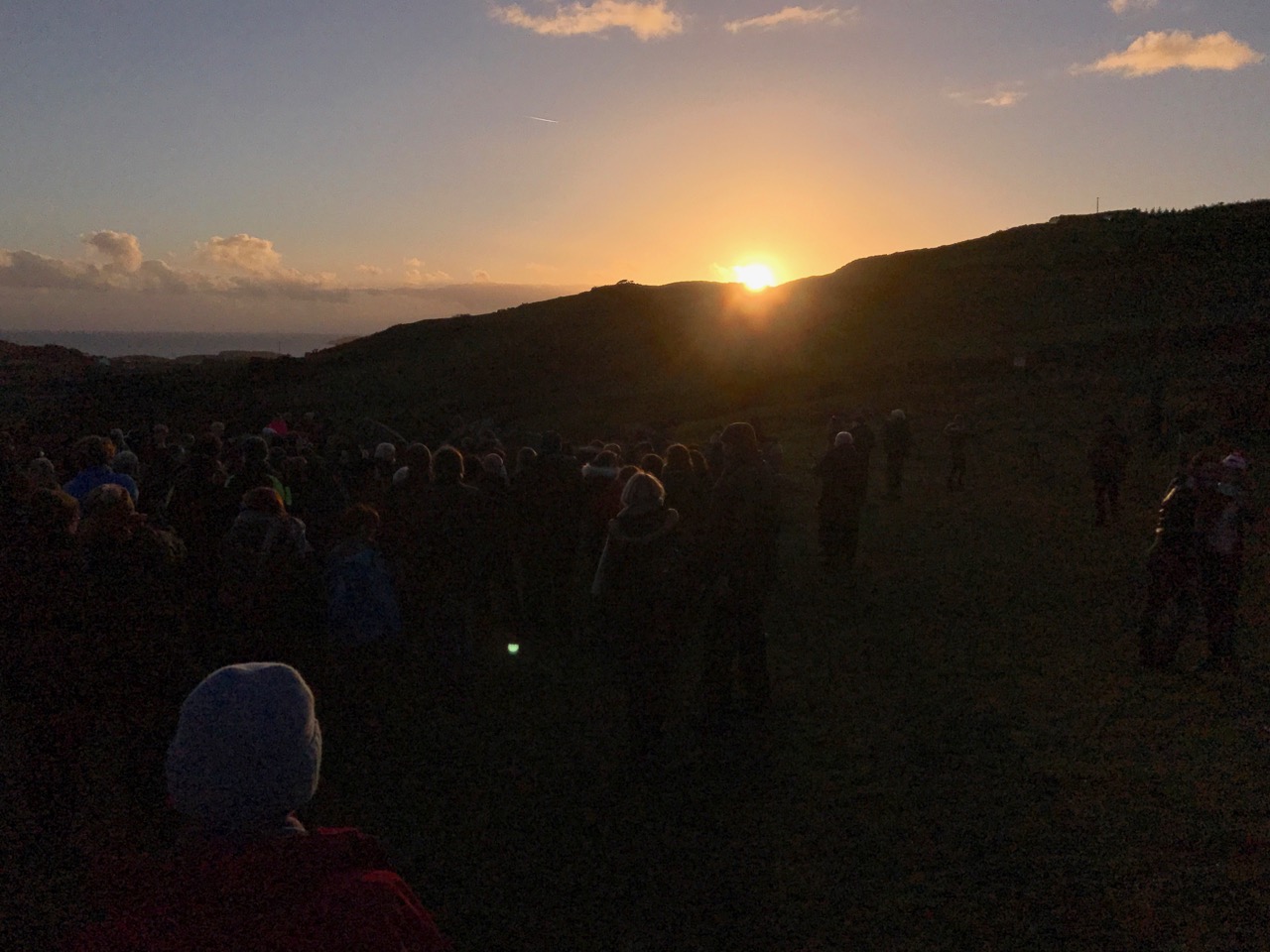
At sunset on the winter solstice the sun sets over the recumbent stone at Drombeg Stone Circle, near Glandore in West Cork. That is – if you stand looking between the two portal stones, you will see the sun set in a notch in the opposite hill and over the recumbent stone which is diametrically across from the two portal stones.

approaching 2 RH

For a full explanation of what I’m talking about here and for more about how and why stone circles were constructed, see our post Ancient Calendars. And take a look at Shadows and Stone in Action for our record of the same phenomenon, except at the autumn equinox, down the road at Bohonagh Stone Circle.

Watching

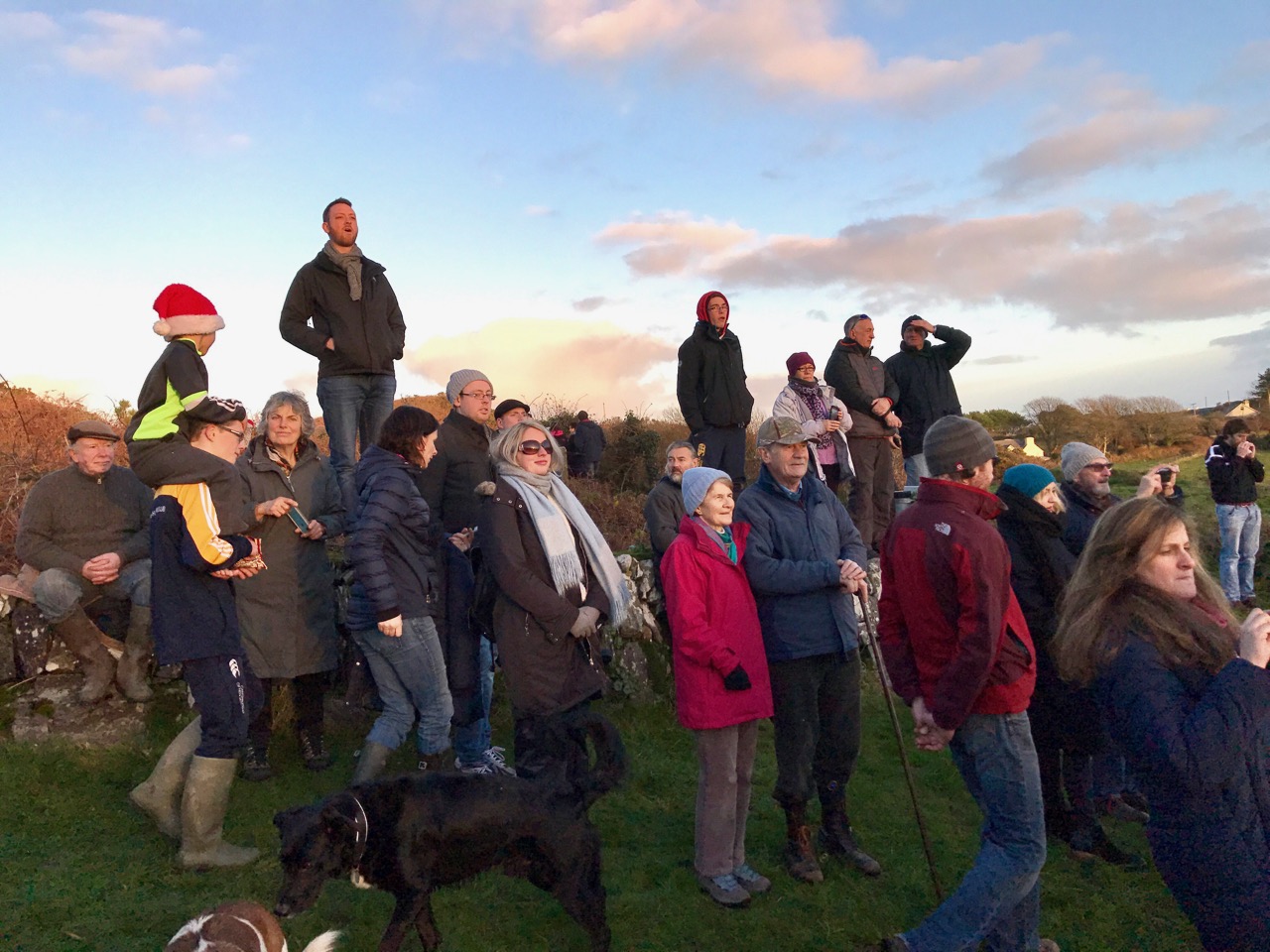
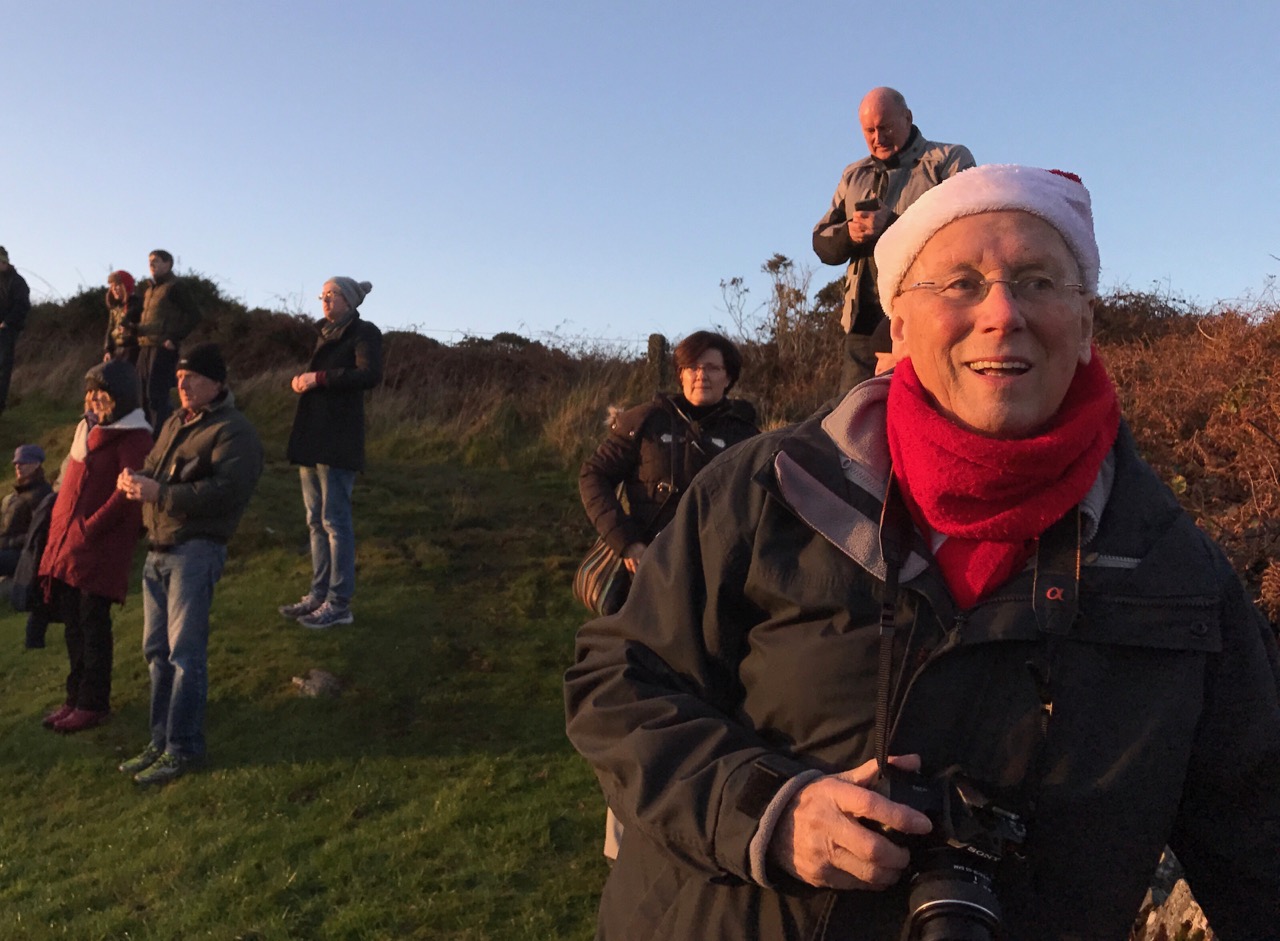
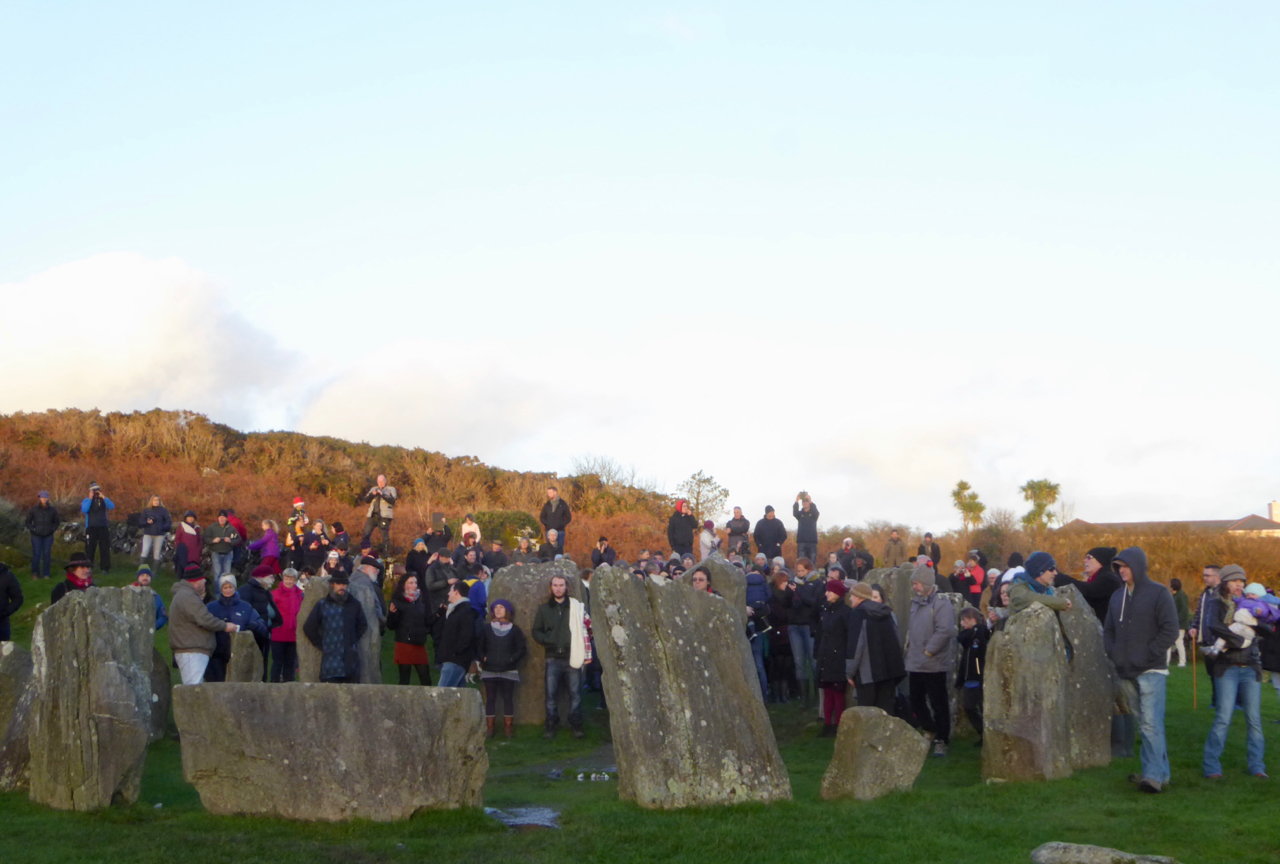
This solstice was the first opportunity Robert and I had to see the Drombeg phenomenon and what an evening we had for it – clear skies and a glowing sun. What’s lovely about this every year is that local people turn out to witness the solstice sunset at a stone circle designed by Bronze Age people perhaps three or four thousand years ago and still functioning the same way millennia later. It’s our West Cork Newgrange.

Meaden 2

Terrence Meaden (above) was there – a physicist and archaeologist, he’s been researching and writing about the calendrical aspects of Drombeg for several years now. Tirelessly visiting at all times of the year, his research compellingly illustrates how the builders planned the placement of the stones to maximise shadow-casting at the eight cardinal points of the calendar – solstices, equinoxes and cross-quarter days. While I don’t agree with a couple of his conclusions, he has done us all a service by encouraging us to look afresh at a monument we thought we knew.

Drummers

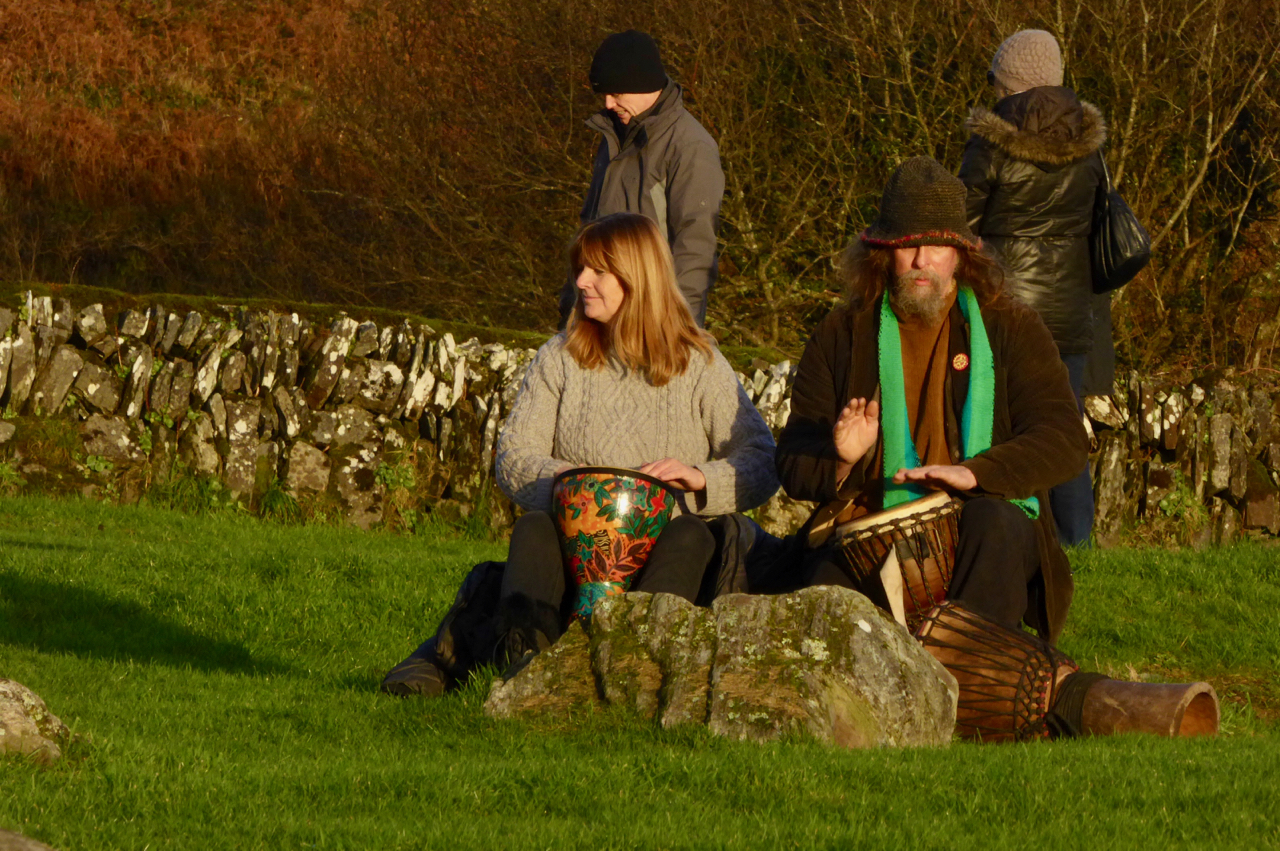
There was a lovely, community feeling to the hour we spent at Drombeg. People kept arriving and greeting one another in a sociable way. Kids ran around, a couple of drummers kept up a steady beat, and a group was holding a meditative circle that including some harmonious humming.

Final Moment

Anticipation mounted as the sun sank lower, there was a final good natured jockeying for position to get the best shots, and a collective sigh as the sun finally disappeared into the cleft.

Last Rays

It felt good to be part of something that West Cork people have been coming together to celebrate for thousands of years.

Fourknocks – the Little Giant

Interior

For our own Easter Monday celebration – while staying in Dublin – we took a trip out to Fourknocks. This is a decorated chambered cairn within the Boyne Valley complex, but very much a ‘little brother’ to the better known attractions of Newgrange, Knowth and Dowth.

key

Only in Ireland would you be instructed to travel a mile down the road to pick up the key to a 5,000 year old monument (leaving a 20 Euro deposit for its safe return) and let yourself in by unlocking a heavy steel door that guards the way into the passage… But don’t be put off: it’s so well worth the effort. With luck you will be the only visitors and you will have the place to yourself – apart from the sheep families who share the field with Fourknocks. The name probably means ‘The Cold Hills’ – that’s the translation of the Irish Fuair Cnoc

sheep

Fourknocks was unknown to archaeologists until a chance conversation in 1949, when a woman making a visit to Newgrange mentioned, “there are mounds like this on my uncle’s farm…” The site was then explored and excavated by Archaeologist P J (Paddy) Hartnett in the early 1950s. You can read the full excavation report* online, by signing on to JSTOR. Like all the Boyne Valley Neolithic monuments, the mound had collapsed inwards and the dig involved removing layers of earth and fallen stone, analysing the spoil material and working out how the original structure had been put together. It’s methodical, scientific – and pretty dry reading! However, I couldn’t help being completely entranced as I imagined spectacular carved stones gradually being revealed, unexpected artefacts being turned up, and the unusual dimensions of the central chamber being realised.

excavationdiagram

P J Hartnett’s excavation diagram – from his report published in 1957

This ‘pear shaped’ central chamber measures 41.92 sq metres in area, considerably bigger than those at Newgrange (16.50), Knowth (20.21) and Dowth (15.21). However, the mound itself is relatively small – a ‘pimple’ on the hillside with a diameter of only 19 metres (Newgrange has a diameter of 85 metres). Yet, when you stand on top of Fourknocks, you understand its significance – there are panoramic views in every direction over countryside, ocean and mountains. You might expect to see the other Boyne Valley monuments but in fact they are hidden by a ridge, so this one enjoys splendid isolation in every respect.

Pan 2

Pan 4

Pan 5

P1210637

Cardinal Points: panoramic views in all directions from the mound of Fourknocks

Something else that’s unusual about Fourknocks is the way it has been reconstructed. Restoration of Archaeological structures has often been controversial. In Ireland the most notable example is Newgrange itself: Professor Michael J O’Kelly, who was in charge of the works there from 1962 to 1975, imagined that large numbers of white quartz stones which were found in and around the collapsed mound could have been used to face the entrance wall and duly designed the reconstructed passage tomb around this premise. He was (and still is) criticised for this ‘leap of faith’ – but, for me, the result is entirely justified: whether or not the original structure did look like this is perhaps irrelevant, as it has bequeathed to us such a visually iconic and powerful symbol of Neolithic Ireland…

Above and left: the great passage grave of Newgrange before excavation, Right: the iconic face of the restored monument today (image courtesy of Our Irish Heritage)

At Fourknocks the excavations did not prove that the chamber was ever roofed over. Certainly there was stone corbelling to suggest that this might have been attempted, but it is unlikely that the large span of the central court could have been enclosed in this way with the available technology, and the weight of the number of stones. However, complete enclosure is likely to have been a necessity, and a central post hole – which would have accommodated a large timber pillar – was found: Hartnett suggests that the roof covering was completed using light timber rafters and thatch. Rather than simulate this, a solution has been employed which is entirely modern – but, in fact, as imaginative as O’Kelly’s ideas at Newgrange: a reinforced concrete shell roof has been cast completley around and above the excavated structure. So what we see today as the ‘mound’ is a concrete dome which has been turfed over.

Open Door: the entrance to Fourknocks chamber outside and inside

But this 1950s innovation is far cleverer than it might seem. Cast into the new shell are holes and slits which project limited shafts of daylight into the otherwise unlit chamber. Each shaft has been carefully orientated to cast natural light on to one of the spectacular examples of megalithic art which are the showstoppers of this monument.

zaggy

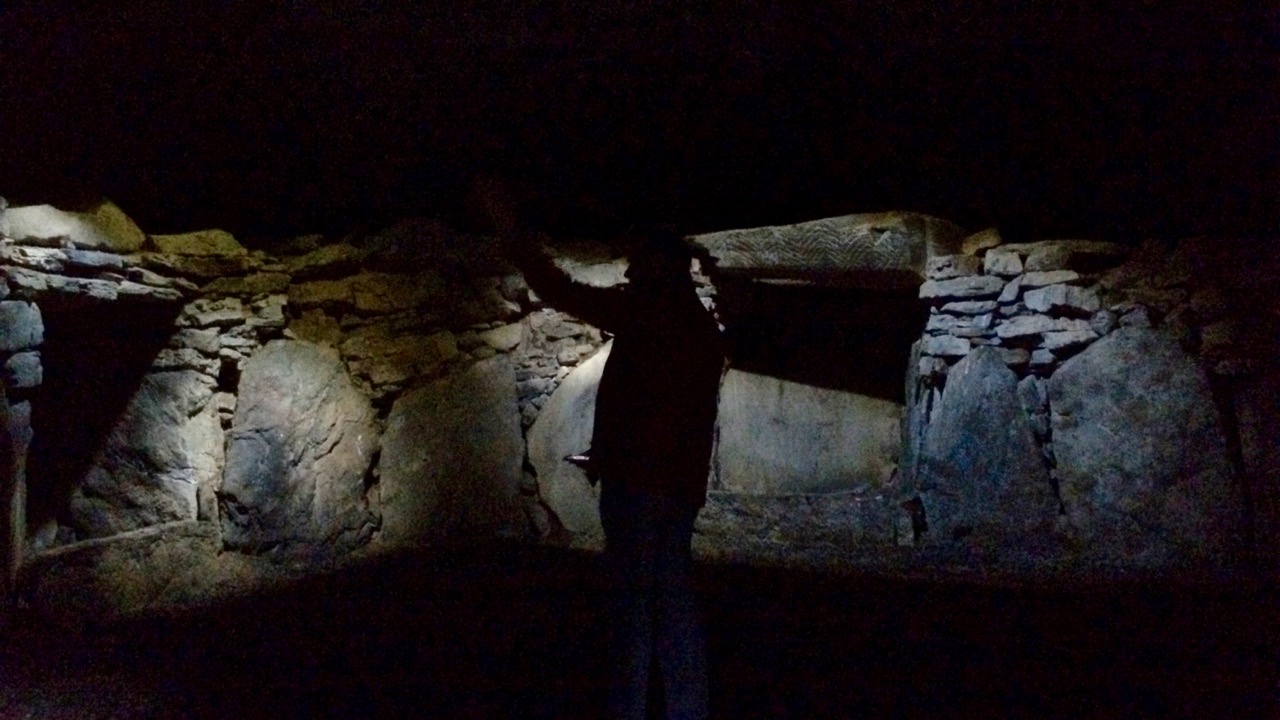
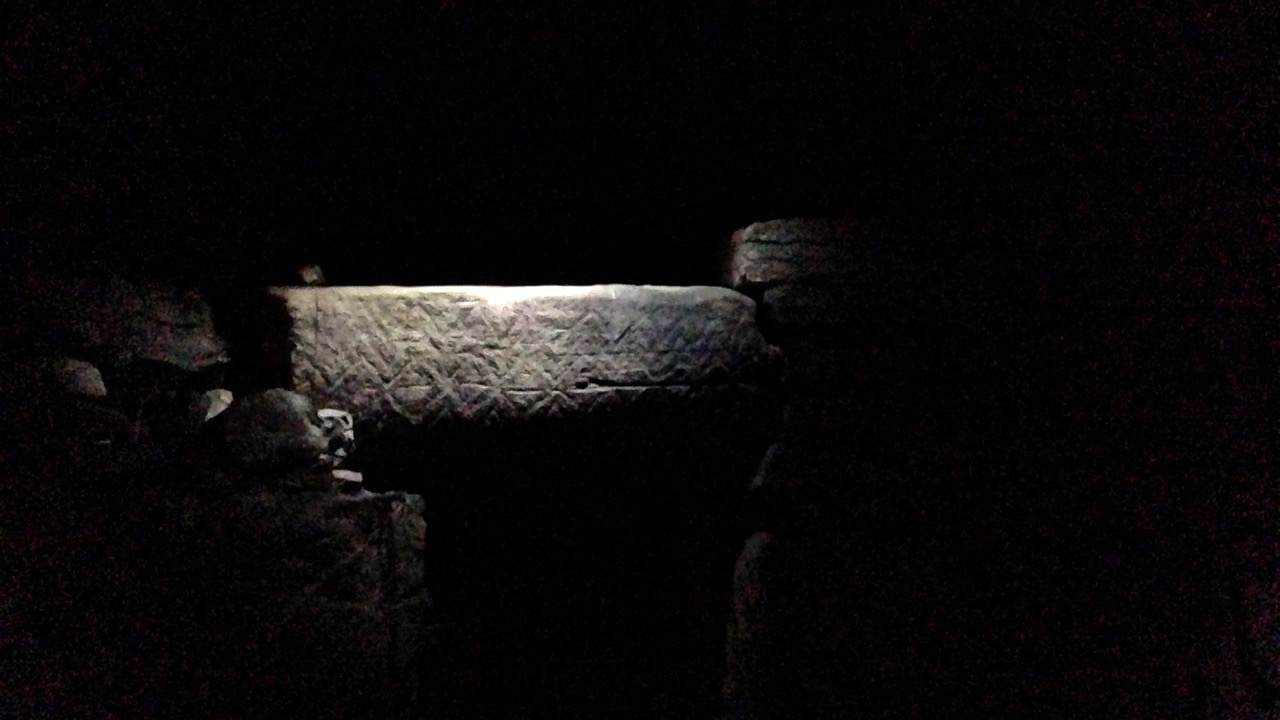
To properly experience the unique adventure of Fourknocks, go inside and – be brave – shut the heavy door behind you. Immediately you are in darkness, and disoriented. But wait: as your eyes adjust, the chamber comes alive.

zigs

The subtle shafts of daylight filtering through the roof perforations focus on their targets and, gradually, you realise that you have entered a gallery of startling images – images made by our ancestors thousands of years ago…

concentric

As Rock Art enthusiasts, our particular interests lie in the cupmarks, concentric circles and other carvings found on outcrops and boulders dispersed over the Irish (and British) landscape: it’s fascinating and intriguing – but should we call it Art? Perhaps those marks have been made as signposts, to define territory, or to provide information to passing visitors – we just don’t know. But, with the carvings at the Boyne Valley monuments there can be no doubt: their purpose is to startle, impress and delight – Art, with a capital A! Fourknocks is such a good example of megalithic or passage grave art, not because of its quantity or complexity (you’ll find far more elsewhere) – but because of the context: the fact that you can stand there on your own and be startled, impressed and delighted – without the intervention of artificial lights, interpretation centres or display boards. It’s just you and the Neolithic mind in there.

Chambers 3

Fourknocks, the Newgrange complex, Loughcrew, Carrowkeel: there is even a passage tomb in our view from Nead an Iolair – over on Cape Clear Island and it produced a fine example of megalithic art, now in the Cork Public Museum. What were they for? In spite of being sometimes called passage graves or passage tombs we can’t assume necessarily that interment was their primary purpose, although significant human remains were found at Fourknocks, including cremations, skulls and bone fragments. Many of these are dated much later than the main structure – Bronze Age rather than Neolithic – suggesting a continuing use of and respect for the monuments over long periods of time. I hope we always retain that respect: the risk of the unsupervised access that we can enjoy at Fourknocks is a vulnerability of the site. Sadly, there is graffiti apparent on some of the stones, although this may be historic.

two sided

I could find no trace of folklore, legends or stories relating to Fourknocks. This is unusual for an ancient site in Ireland. Perhaps it’s because the place was lost to all but very local human memory for so long. Apart from the restored mound there appears to be either two or three other disturbed earthworks close by but not accessible – could this be the origin of ‘four’ cnocs (hills)?

effect 1

not a face

For more excellent photographs of this monument have a look at Ken William’s work in Shadows and Stones. If you are passing this way – as we were – perhaps on your journey to see the marvels of Brú na Bóinne, don’t hesitate to look out this wonder of the megalithic world- it’s a little giant!

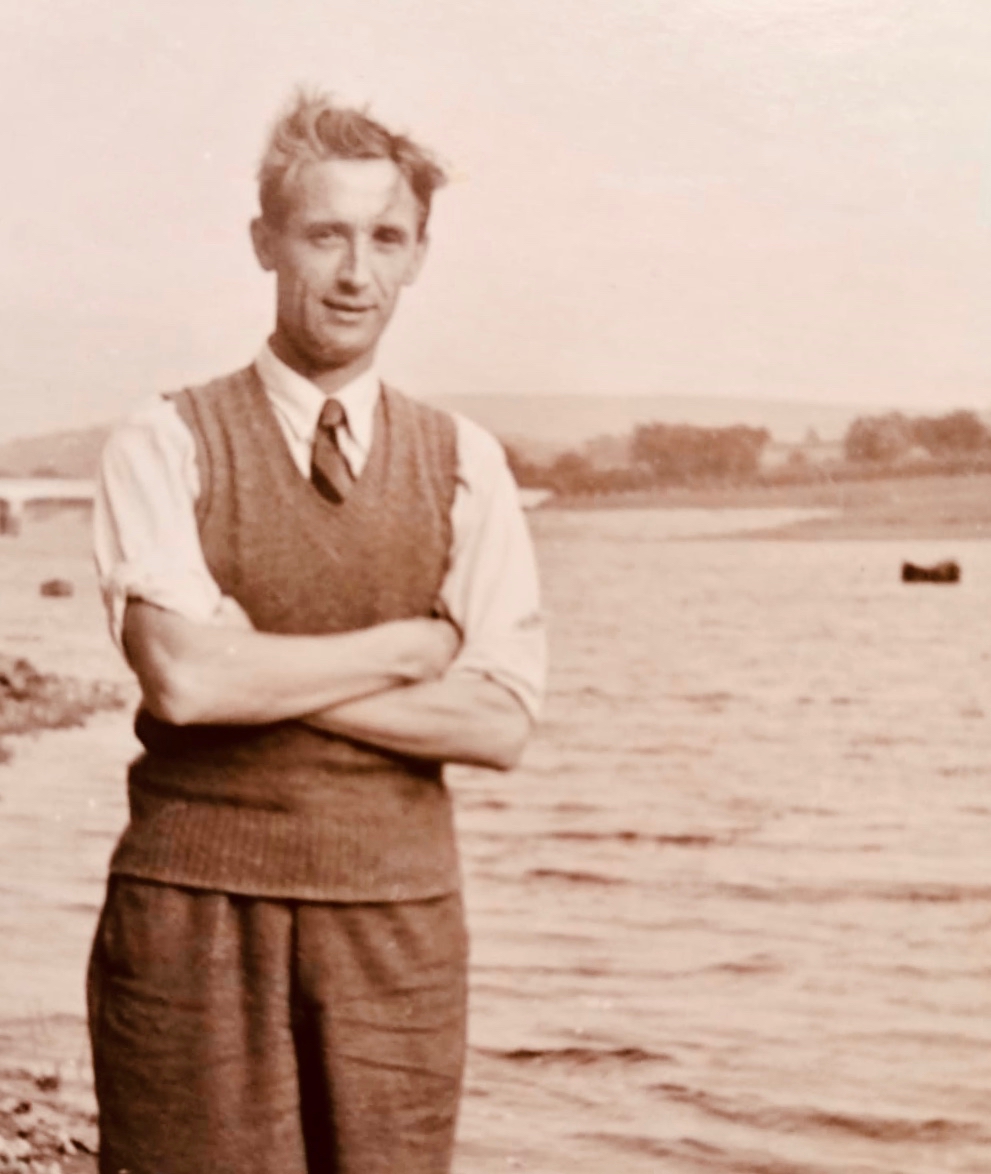
Below: P J Hartnett, a photograph taken at around the time of  the excavation of Fourknocks, 1950s. Many thanks to his grand-daughter, Dee McMahon, for providing this and further historical information

Excavation of a Passage Grave at Fourknocks, Co Meath: P J Hartnett – Proceedings of the Royal Irish Academy. Section C: Archaeology, Celtic Studies, History, Linguistics, Literature Vol 58 (1956/1957), pp 197-277

Launched!

A joint post by Finola and Robert

Mingling

Hallowe’en (All Hallows – Samhain) was the perfect day to launch our Prehistoric Rock Art Exhibition at the Cork Public Museum. As Finola said in her remarks at the opening, it’s a time when the veil between two worlds is at its thinnest: in this case, it’s the veil between an ancient time and the present day. We hope the exhibition emphasises the work of our distant ancestors who have inscribed the landscape and given us the enigma that is Rock Art.

Blank Canvass

Almost there
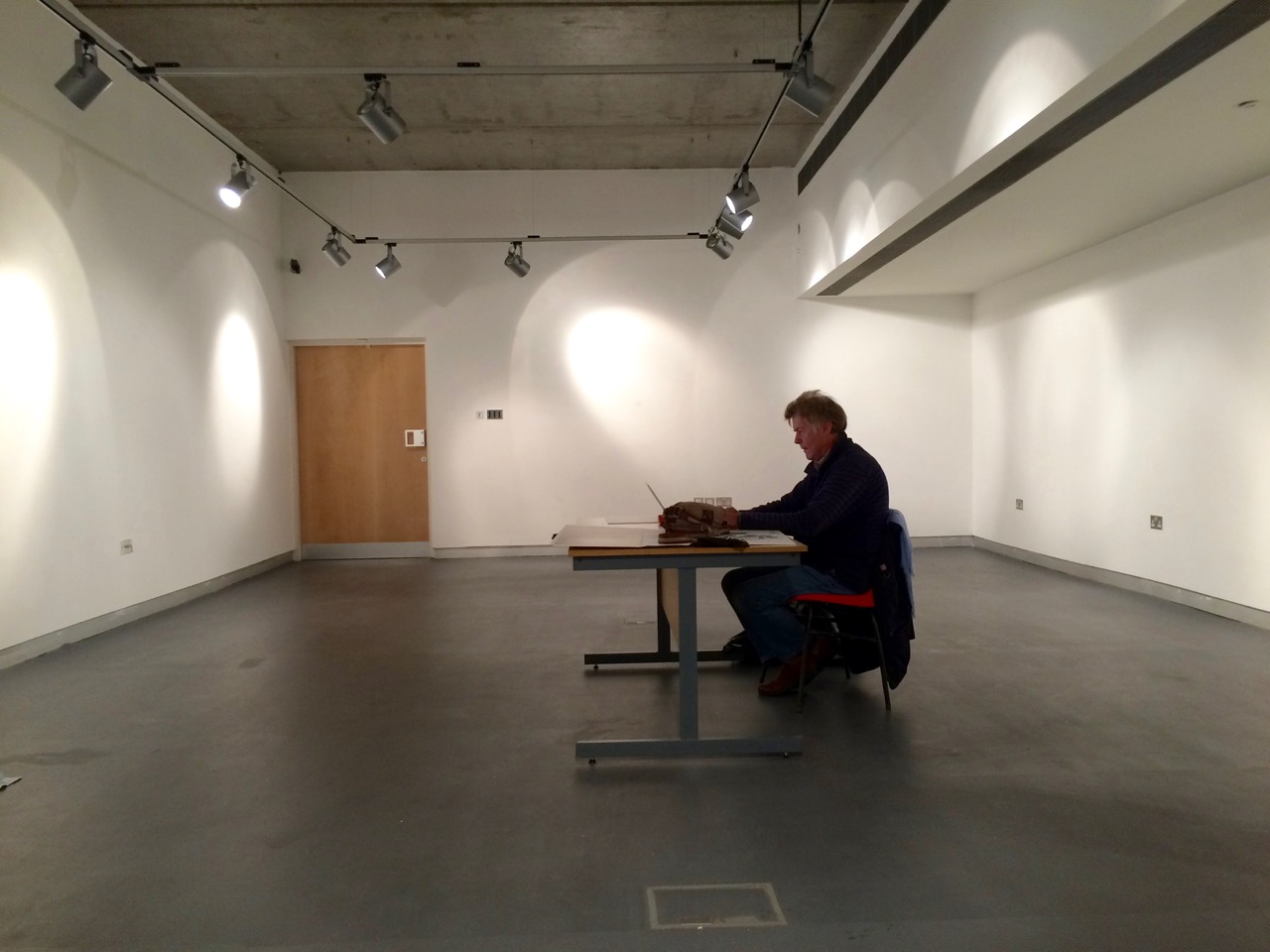
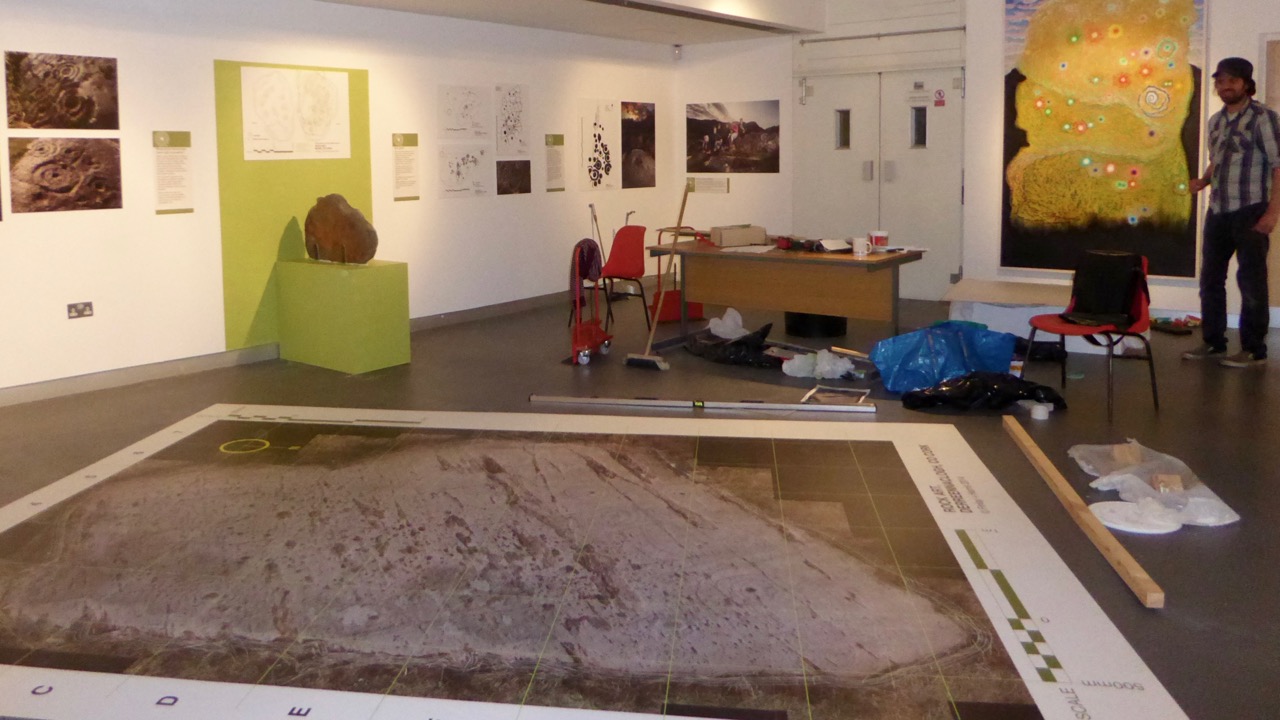
Before the Exhibition – Robert contemplates the blank canvas (top) and installation work in progress (below)

As our regular readers will know, the exhibition has been a very successful collaborative effort: Finola and Robert (providing drawings, explanations and the overall design); Keith Payne, a West Cork painter whose work is inspired by ancient art; Ken Williams, the excellent photographer of megaliths and monuments; the staff of Cork Public Museum, including intern Clare Busher O’Sullivan who came up with the idea and Dan Breen, Assistant Curator and his team, who made sure it all happened.

The Team

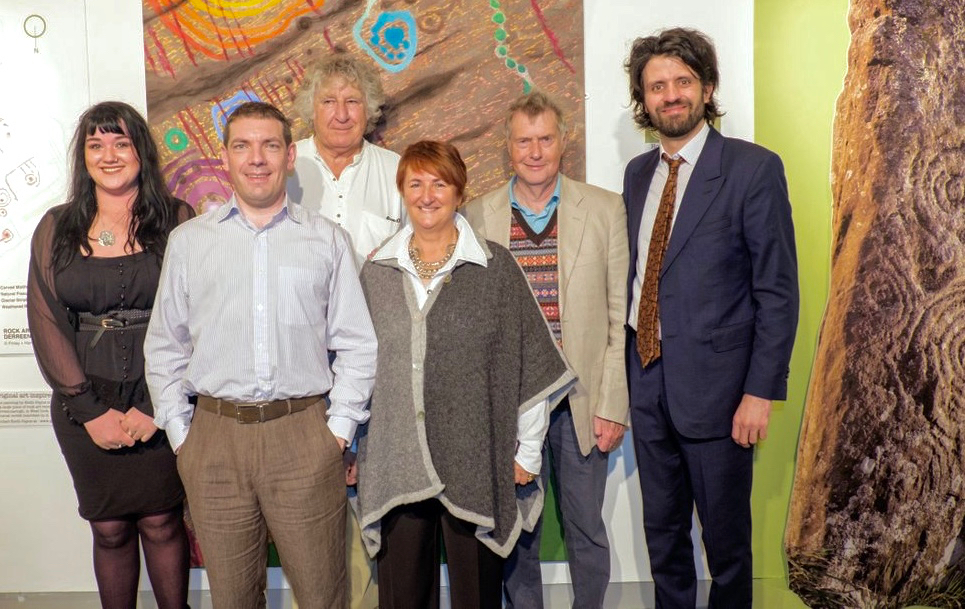
The Core Team: Clare Busher O’Sullivan, Ken Williams, Keith Payne, Finola Finlay, Robert Harris and Dan Breen

After some intensive days, on site and off, it has all come together and was launched yesterday. It was a grand launch: Firstly, William O’Brien – Professor of Archaeology at UCC – outlined a history of rock art studies and research which started back in the nineteenth century. He mentioned a predecessor in the department – Professor Michael J O’Kelly – who was born exactly 100 years ago and is best known for his excavations and restoration work at Newgrange, the Boyne Valley passage tomb: Finola worked on those excavations and it was Professor O’Kelly who suggested that she should carry out the research on rock art in Cork and Kerry which led to her Master’s thesis on the subject in 1973 – and, 42 years later, to the undertaking of this exhibition.

Professor Michael J O’Kelly (left) was renowned for his work at Newgrange (right)

Next up was Finola, who told us more about her expeditions back in the early 1970s. In those days when the boreens of rural Ireland were mostly populated by donkey carts her own travel was by means of her brother’s Honda 50 motorcycle, and we pictured her loaded down with compass, tapes, chains, chalk and tracing paper – a recording methodology now completely out of favour. But the result was a set of beautiful monochrome illustrations that form the core of the exhibition.

Coomasaharn

Rock Art: a detail of the picking technique (top left), and Finola’s drawings from 1973

In our modern days non-invasive recording methods have to be used: Ken Williams has developed a very effective method of photography using slave flash units to provide low angle lighting over the carved rocks, which brings the maximum level of detail out of the panels. The exhibition contains many fine examples of Ken’s work in this field.

Ken Williams in action: at the Bohonagh stone circle (left) and in the Derrynablaha townland, Kerry (right)

Finola also talked about Keith Payne’s work. He produces large and visually striking paintings based on particular rock art motifs. Two of these artworks are in the exhibition and will inevitably draw the eye, providing a good and colourful counterpart to Finola’s drawings.

Keith Payne at the hanging (left) and at the launch, in front of the remarkable Derreennaclogh stone (right)

The official launch was in the capable hands of Ann Lynch, now Chief Archaeologist at the Irish National Monuments Office. Ann and Finola were fellow students at UCC. Ann outlined the work of her department in recording Ireland’s monuments – and the difficulties involved in pursuing the preservation and protection of these monuments, including Rock Art – before formally declaring the exhibition open.

Ann declares it open

Ann Lynch, Chief Archaeologist at the National Monuments Office, declares the Exhibition open

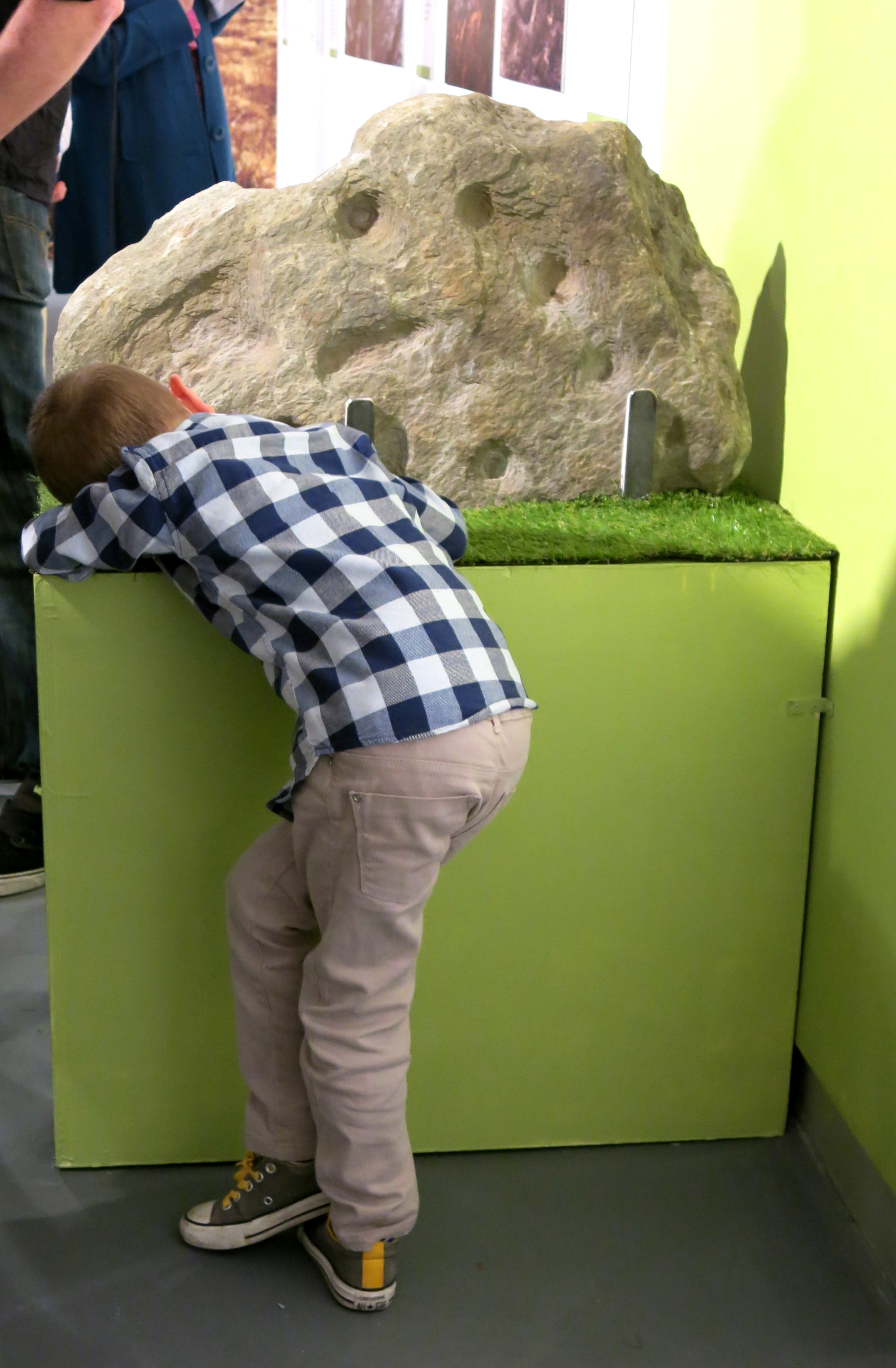
Noteworthy exhibits include one piece of Rock Art – the Bluid Stone from County Cork – which is in the safe keeping of the Museum, and will remain on permanent display after the exhibition closes at the end of February next year. The Museum also houses an example of passage grave art from Cape Clear island (prominent in our own view from Nead an Iolair).

Tired

Fine Detail: the Bluid Stone under close inspection

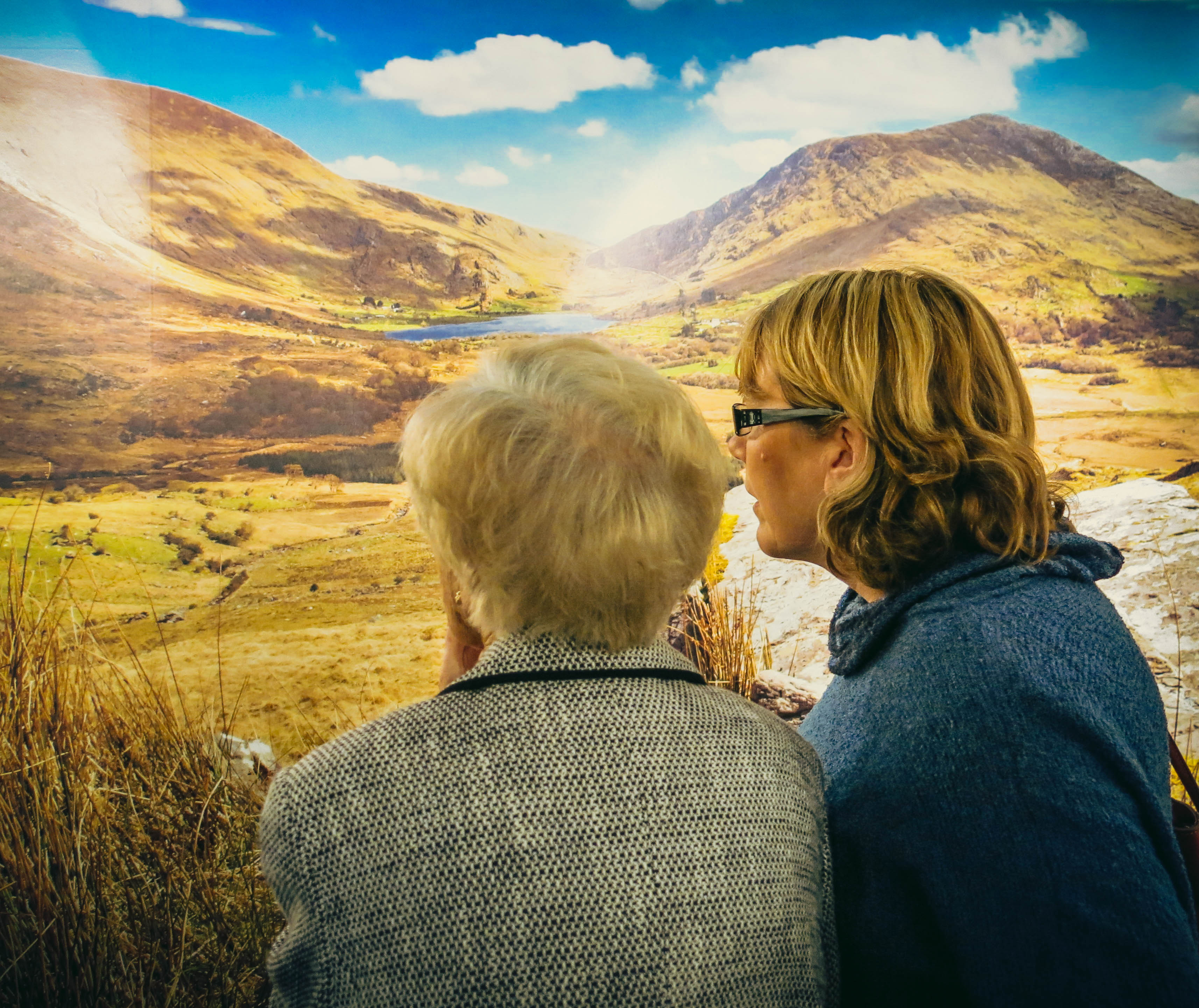
Other exhibits include Ken’s superb photo of the iconic stone at Derrynablaha, Co Kerry, in its panoramic setting of a Neolithic landscape. This occupies the whole of the end wall – and is simply beautiful.

Gazing

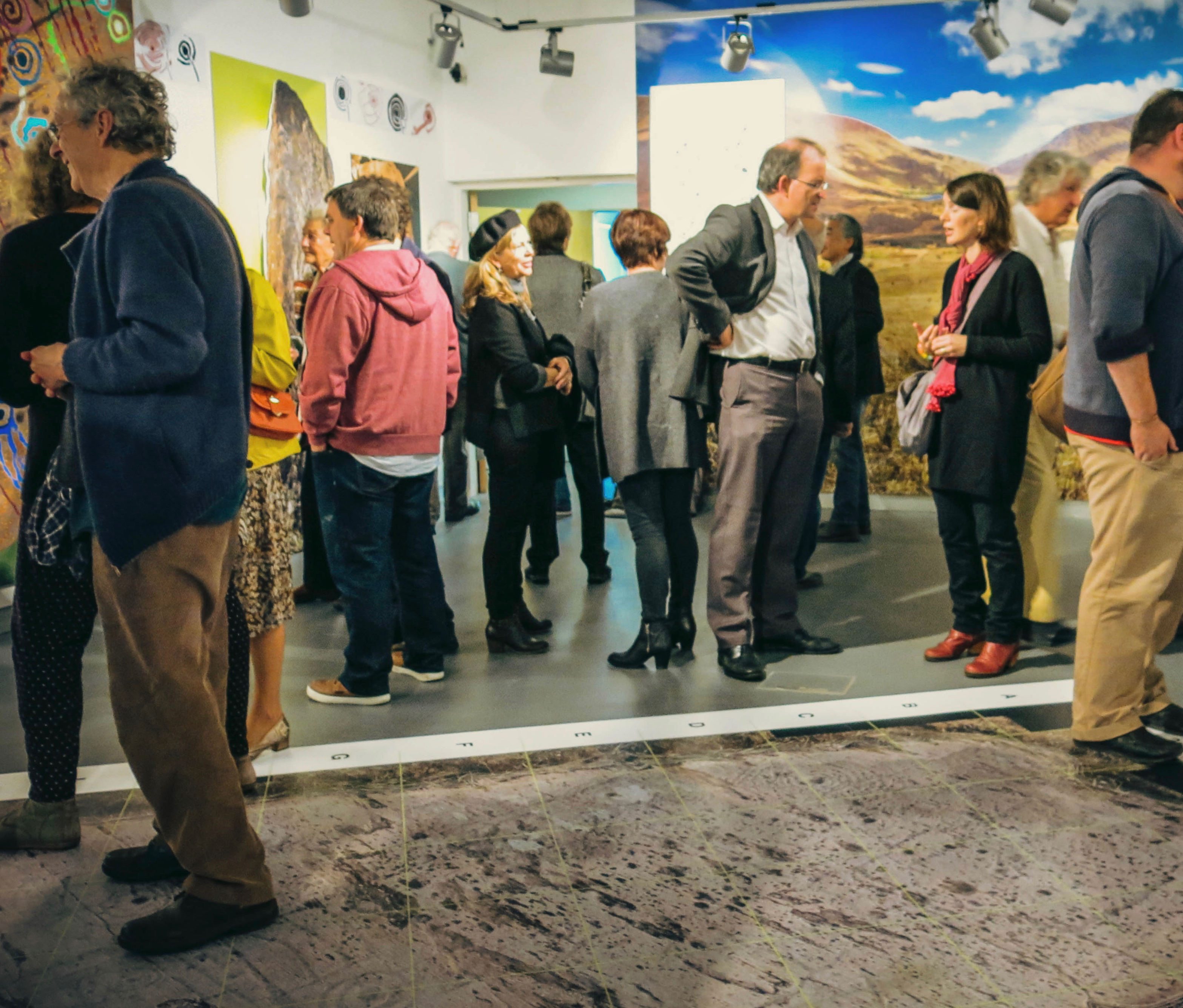
Visitors are surprised to see much of the floorspace taken up with a 70% life-sized image of the stone at Derreennaclogh: some hesitate to walk over it, but the printing is on hard-wearing vinyl, so feel free. The idea is to give you the feel of what it’s like to discover and explore the Rock Art out in the field. We have to mention how impressed we have been with the printing work carried out by Hacketts of Cork in the preparation of the exhibition – in particular, we were fascinated to watch the professionalism of their installation of the large items.

Yes – that floor can be walked on!

The timescale is set admirably by Alex Lee’s ‘Neolithic Settlement’ on the approach to the exhibition room. It’s well worth studying closely all the artefacts set out in this, and imagining what life must have been like for our artist ancestors in Ireland four or five thousand years ago.

Alex

Alex Lee at work on the Neolithic Settlement

We were delighted by how many of our friends from West Cork and beyond attended the opening, and gave us positive feedback. If you go during the next four months, please sign the visitors’ book. We are so grateful to our friends Amanda and Peter Clarke for being so supportive throughout – and for taking most of these photographs of the event: very many thanks.

Earnest discussions (left) and one of Ken’s superb photographs (right)

Our own day was rounded off by a visit to the Shandon Dragon festival, which processed through the centre of Cork in the evening – another unmissable event which reminds us of ancient times and long-held beliefs…

Shandon Dragon

Hallowe’en: The Shandon Dragon Procession makes its way through Cork City