A Saint’s Day – Ciarán and Piran

Horse and Cape Clear

I was born in the first half of the last century. Early memories of the 1950s include the regular journeys my brother and I made as small boys on the mighty Atlantic Coast Express via Okehampton to visit, first, our sets of cousins on Dartmoor, and then beyond – via the even mightier Great Western Railway – to our cousins in the depths of Cornwall. The latter visits were particularly idyllic: the cousins (generations older than us) had a small farm and a herd of cows which they milked twice a day – by hand. Following this they cooled the milk in a big steel drum by stirring it with a propellor (we were allowed to do this) before pouring the precious liquid into bottles which were then sealed with silver caps using a rubber device which impressed on them the name ‘Cove Farm’. Then, together, we set out  on bicycles to deliver the bottles to the doorsteps of every dwelling in the small village of Perran-ar-worthal.
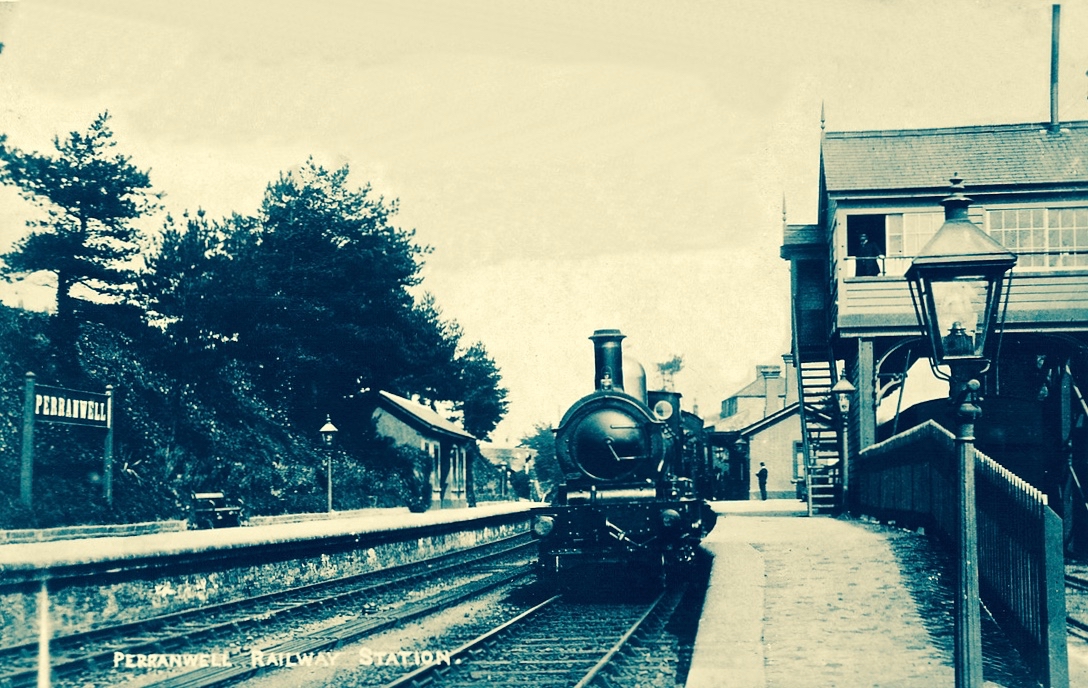
Perranwell Station 1950s
Perranwell Station 1950s – disemabark here for Perran-ar-Worthal and Cove Farm! The header picture is a view of Cape Clear seen beyond Horse Island, taken from our own Rossbrin Cove

Perran-ar-Worthal (in Cornish Peran ar Wodhel) means ‘St Piran’s village by the creek’. Who is St Piran? He is the Patron Saint of Cornwall and we’ve met him before, briefly, in my account of St Ciarán, who was born on Cape Clear, and was known as ‘The First Saint of Ireland’. Even before St Patrick arrived to start his missionary work in 432 AD, St Ciarán (according to some records born in 352 AD) had been at work converting the ‘heathen Irish’. Unfortunately, his efforts were not always appreciated and Ciarán was despatched from the top of a tall cliff with a millstone tied around his neck! The story is elaborated by Robert Hunt FRS in his Popular Romances of the West of England first published in 1908. I have the third, 1923 edition on my bookshelves.

Robert Hunt Popular Romances 1923

On a boisterous day, a crowd of the lawless Irish assembled on the brow of a beetling cliff, with Ciarán in chains. By great labour they had rolled a huge millstone to the top of the hill, and Ciarán was chained to it. At a signal from one of the kings, the stone and the saint were rolled, to the edge of and suddenly over, the cliff into the Atlantic. The winds were blowing tempestuously, the heavens were dark with clouds, and the waves white with crested foam. No sooner was Ciarán and the millstone launched into space, than the sun shone out brightly, casting the full lustre of its beams on the holy man, who sat tranquilly on the descending stone. The winds died away, and the waves became smooth as a mirror. The moment the millstone touched the water, hundreds were converted to Christianity who saw this miracle. St Ciarán floated on safely to Cornwall; he landed on the 5th of March on the sands which bear his name. He lived amongst the Cornish men until he attained the age of 206 years…

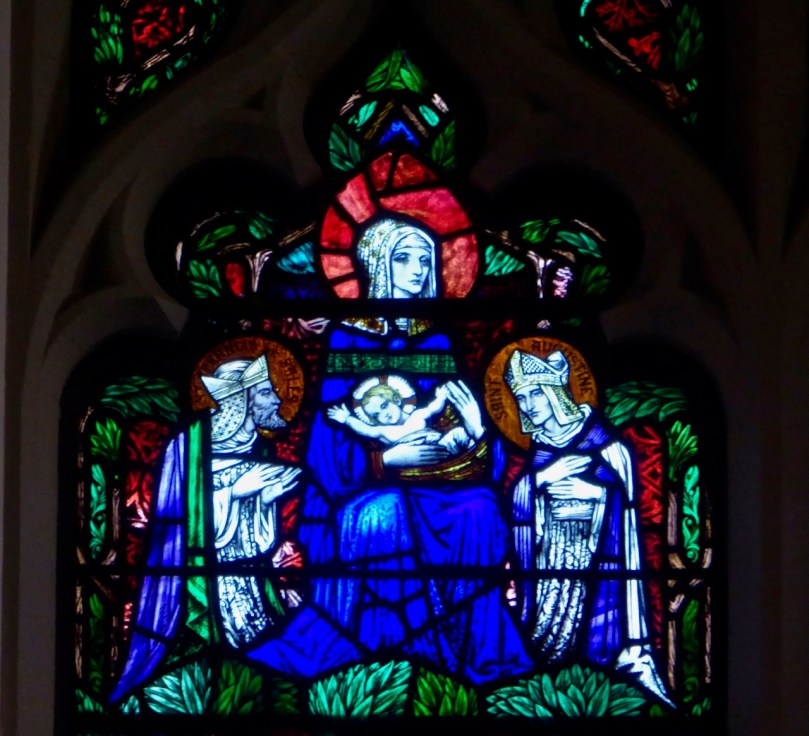
Left – St Ciarán celebrated in modern stained glass, in the church at Caheragh, West Cork; centre – Ciarán at Rath church, near Baltimore, and right – St Piran is the top figure (with church and bell) in this window panel from Truro Cathedral, Cornwall

So, what is the connection between Saints Ciarán and Piran? Apparently, they are the same person! Charles Lethbridge Kingsford reporting in the Dictionary of National Biography 1885 – 1900 (a 63 volume work!) states:

…PIRAN or PIRANUS, Saint, is commonly identified with Saint Ciaran of Saigir. The names Piran and Ciaran or Kieran are identical—p in Britain being the equivalent of the Irish k. The history of the two saints is in the main features the same, though the Irish lives of St Ciaran do not record his migration to Cornwall…

Many writers make the same assertion about the orthophony of the name but – to be fair – others, including some saintly hagiographers, do not agree, suggesting we are talking about two different saints. As someone who has a birthday on 5th March (today) – the Saint’s Day for both Ciarán and Piran – I have no doubts about the matter. Here’s another source that concurs with the view that they are one and the same saint – The Irish Ecclesiastical Record, Volume X (1874):

The labours of St Kieran were not confined to Ireland. He passed several years on the western coast of Britain, and, as we learn from Blight’s “Churches in West Cornwall,” his memory is still cherished there. Four ancient Cornish parochial churches bear his name : these are Perran-zabuloe, or St Piran-in-the-sand; Perran-arworthal; Perran-uthnoe, situated near the coast opposite St Michael’s Mount, and St Kevern, or Pieran, which in Domesday-book is called Lanachebran. St Kieran’s holy well is also pointed out on the northern coast of Perran-zabuloe. The parish church of St Keverne stands in the district called Meneage, which terminates at the Lizard Point, the southernmost land of England. The name Meneage is supposed to mean, in the old Cornish dialect, “the deaf stone”, and the reason given for it is that, though there are several mineral veins or lodes in the district, on trial they have been found to be of no value, and hence are called deaf or useless. Tradition tells that St Kieran inflicted on the inhabitants, as a punishment for their irreligion, that the mineral veins of the district would be un-productive, and the old proverb is still handed down, “No metal will run within the sound of St Kieran’s bell”…
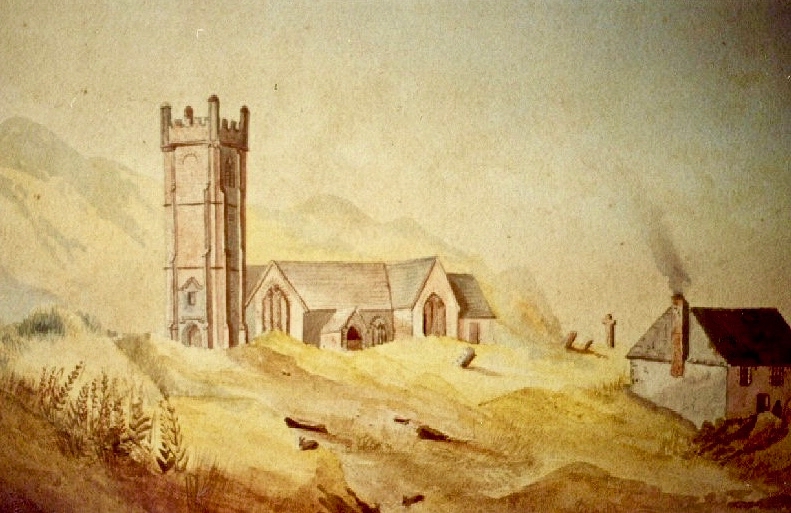
St Piran's Church, Perran SandsAn image of St Piran’s Church which was built in the 12th century on the dunes at Penhale Sands, Perranzabuloe Parish, to replace the Saint’s original oratory which was buried by the shifting sands. The sands encroached on this church, too (the sands can be seen in the picture), and it was dismantled around 1800 and stone from the site was then used to build another new church two miles inland which was dedicated to St Piran in July 1805
To complement that little story of the saint in Cornwall, we have to visit Ossory, an Irish diocese which encompasses parts of Kilkenny, Laois and Offaly. There they also celebrate St Ciarán of Saigir on March the fifth: he is said to have returned from Rome after years of study, firstly visiting his native Cape Clear, then commencing his travels through Ireland until his bell rang of its own accord – this happened at a small hamlet in County Offaly, now known as Seir Kieran. There he set up a foundation, the remains of which are still visible – as is a holy well, a holy bush (bedecked with clouties) the base of a round tower, the base of an ancient high cross (now holding water which has curative powers) and a holy rock which was once said to have displayed the hand print and knee prints of the saint, now completely obscured.
barry-cotrell-st-piran

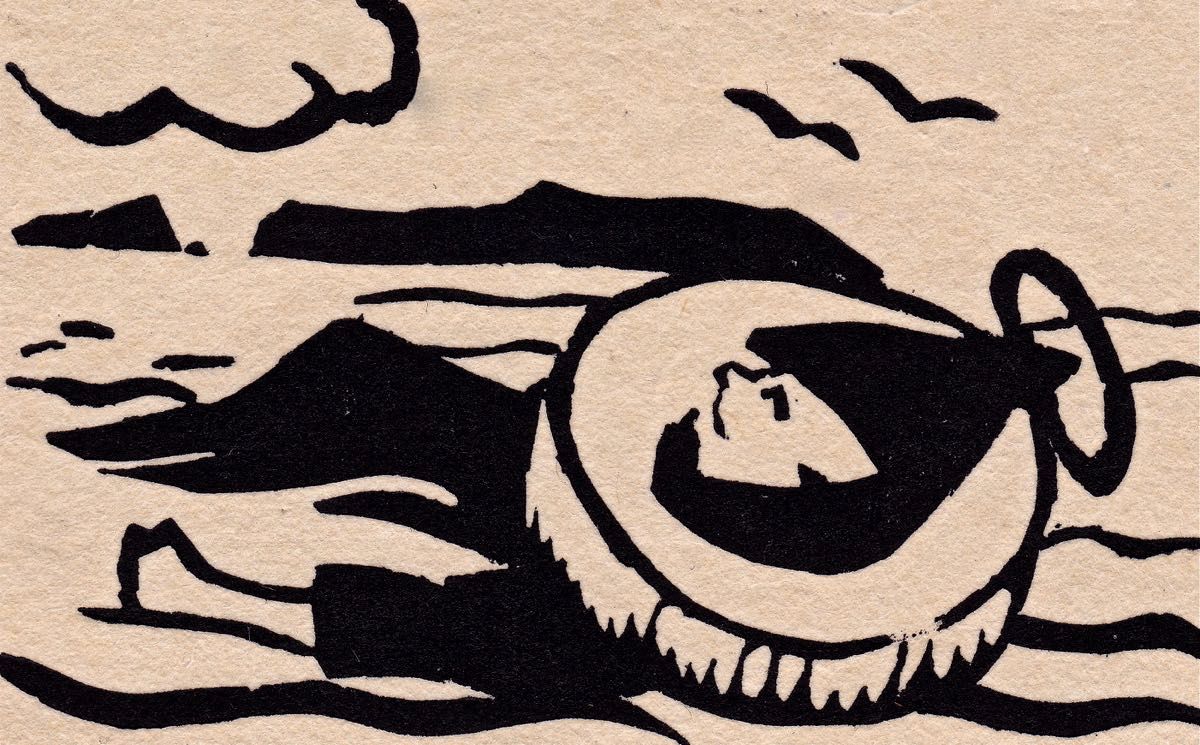
St Piran’s journey to Cornwall: “The millstone kept our man afloat” from The Discovery of Tin – a collection illustrated by Barry Cottrell

One of my favourite stories about St Piran tells of how he discovered tin smelting. He used as his hearth a piece of local stone; when he lit a fire on the hearth the veins of tin ore in the stone melted and a stream of silver ran out across the black rock, in the form of a cross. From that day to this the flag of Cornwall is a white cross on a black background, and Piran is the patron saint of tin and tinners.

marching-and-flags

Just about now in Cornwall a great celebration is going on in honour of the saint. There will be a procession to the original oratory buried in the sands, led by the Grand Bard of the Cornish Gorsedd. Cornish flags – and the Cornish tartan – will be very much in evidence. The Cornish people have a great nationalistic spirit and have called for the 5th March to be an official public holiday. In a recent debate on Cornwall some interesting views were expressed on the place of Cornwall in a post-Brexit world, and the attributes of St Piran were symbolic of this – his inventiveness, his love of nature, and his belief in the inclusivity of all peoples in an international community.

Left – Geevor Mine, in West Penwith, one of Cornwall’s last working tin mines, now a museum of mining; right – an incarnation of the saint: Cornish author Colin Retallick stands in front of St Piran’s ancient cross on the saint’s day

St Piran lived to a great age. They say in Cornwall that he was ‘fond of the drink’ and met his end by falling into a well when walking home from a party. I hope it was a holy well! Today, seventeen centuries after St Ciarán / Piran was thrown from the cliffs of Cape Clear I am looking out to that island: …the winds are blowing tempestuously, the heavens are dark with clouds, and the waves are white with crested foam… There have been so many links between Cornwall and West Cork, ever since the Bronze Age, when Cornish tin traders brought their metal to mix with copper mined above us here on Mount Gabriel. Watch out for more posts about these links, and mark your diaries for an exhibition coming up in June in Uillinn, West Cork’s fine new gallery, of the work of artists from Cornwall. This will be followed next year by an exhibition in a Cornish gallery of the work of artists from West Cork. West meets West will forge new and lasting links between the two communities: links which would have warmed the heart of our shared saint!

Below – St Ciarán by Richard King, painted for the Capuchin Annual in the 1950s
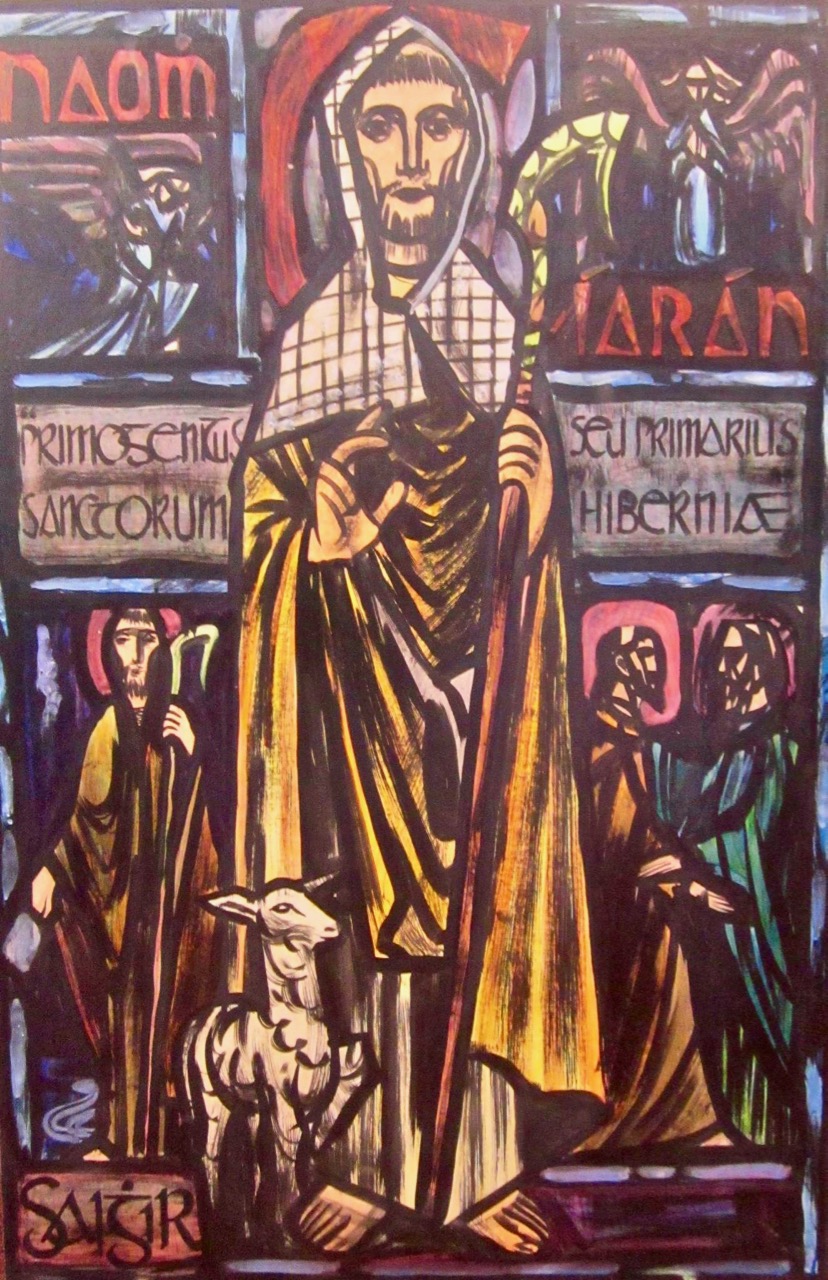
Richard King Ciaran

The Christmas Story, One Window at a Time

Bandon Catholic Church

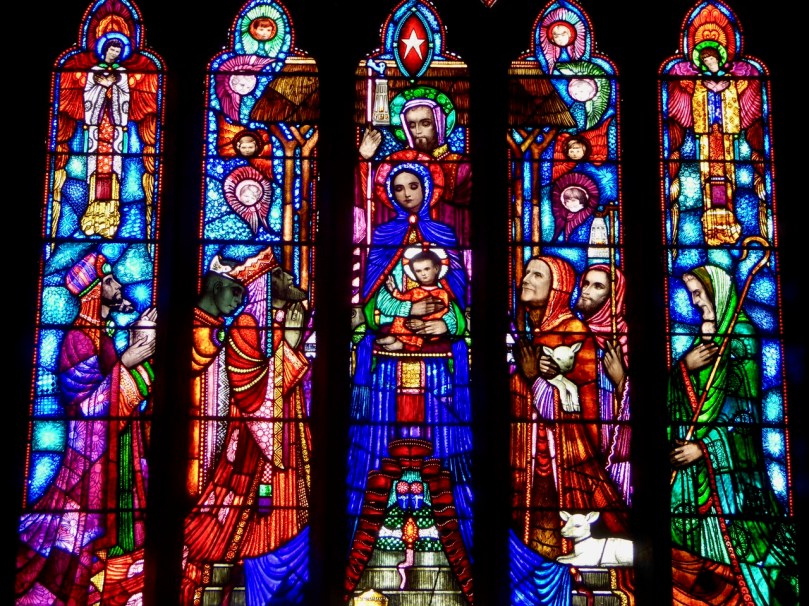
The Christmas story, as told in stained glass in Irish churches, is the biblical story. There are no Christmas trees or Santa Clauses, no references to anything other than the story of the birth of the Christ child. Not surprising, since stained glass is to be found mainly in churches after all. The one above is from the Catholic Church in Bandon. Pop in next time you’re passing – it will surprise you with its size and striking colour.

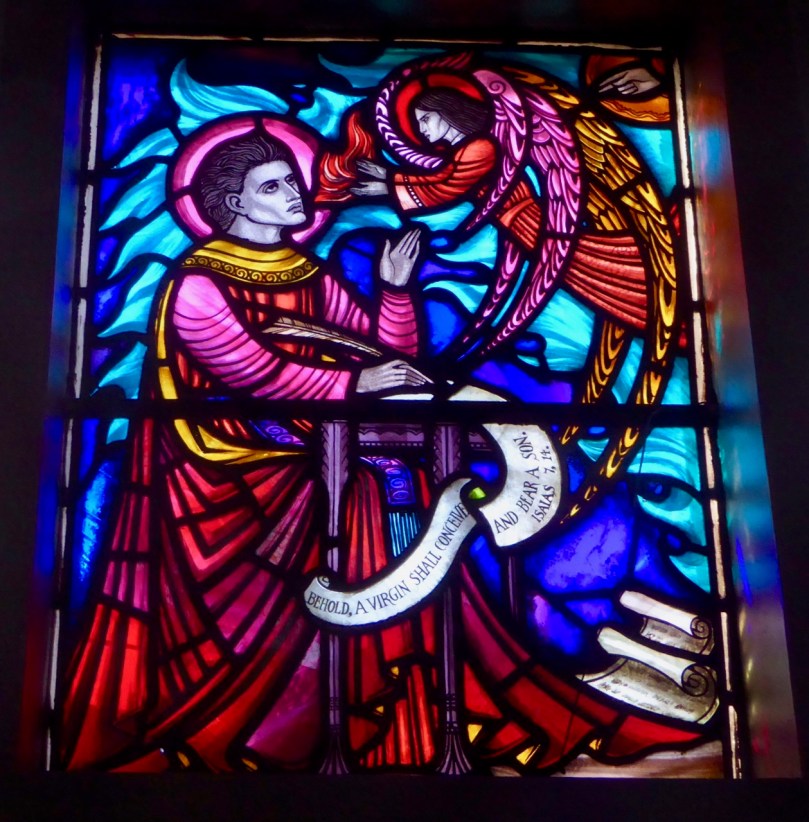
Church of the Annunciation, Cork. AnnunciationFive windows in a Cork church tell the story, beginning with the Annunciation

Two years ago I wrote a post about depictions of the Nativity by Harry Clarke. This year I’m branching out, to show you some of the stained glass Nativity images I have found in churches all over Ireland. Some are by artists I can identify, some are by the Harry Clarke Studios (after Harry’s death in 1931), and some are by anonymous artists. Some are traditional and some are avant garde. 

The next two windows show Mary visiting her cousin Elizabeth (mother of John the Baptist), followed by the betrothal of Mary and Joseph

In Cork, in the Church of the Annunciation – a church designed by the stone carver Seamus Murphy – a series of windows illustrate the complete Nativity story, from the Annunciation to the Visit by the Magi. These windows are by the Harry Clarke Studios and were installed in the 40s.

The birth in the manger with shepherds visiting, and the arrival of the Magi round out the story

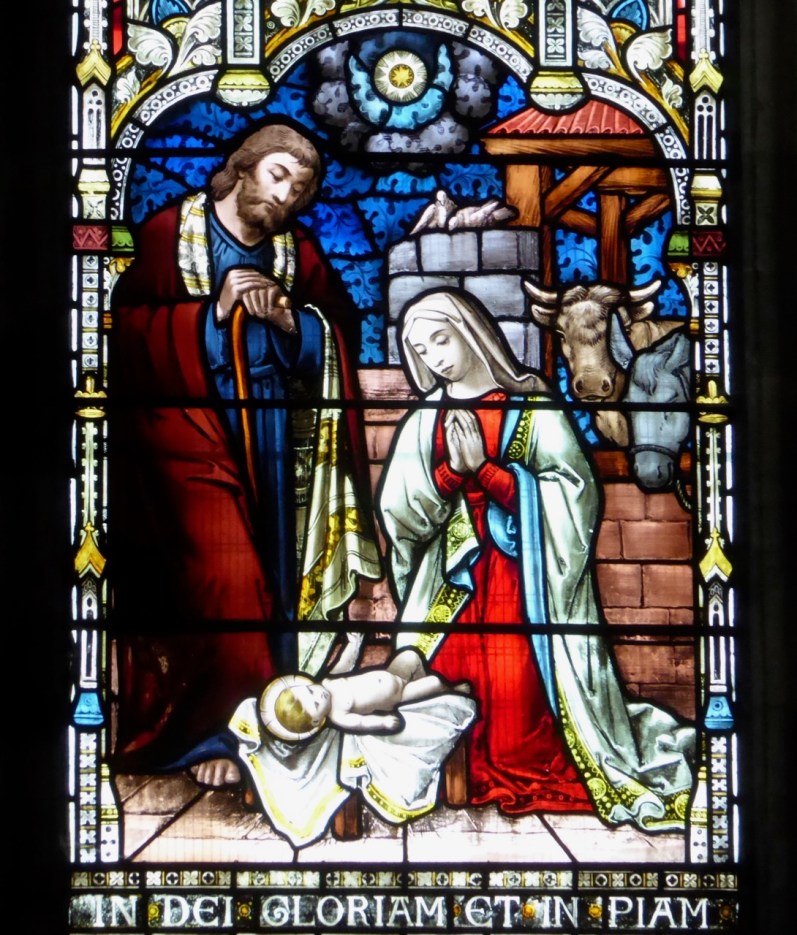
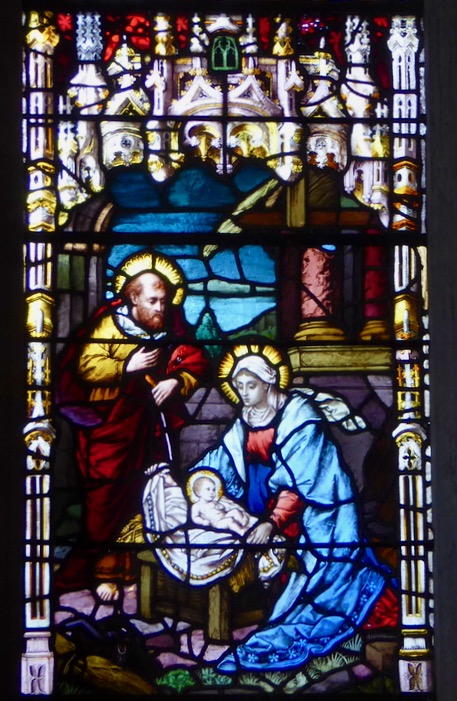
When we visited Kilkenny we saw two examples in St Canice’s Cathedral. The first, a traditional crib scene, looks like it belongs on a Christmas card.

St Canices

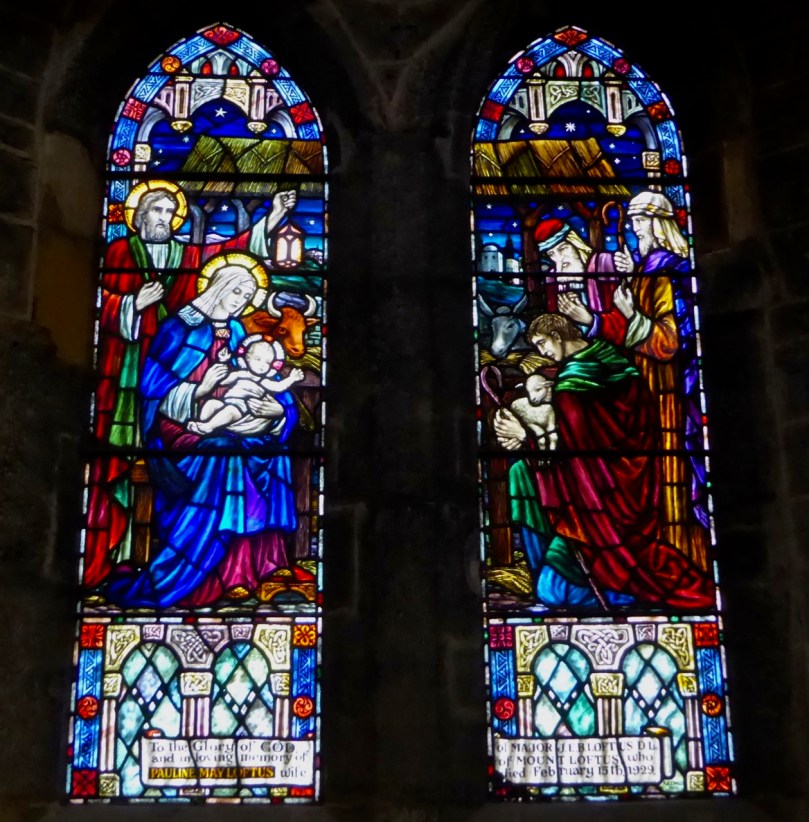
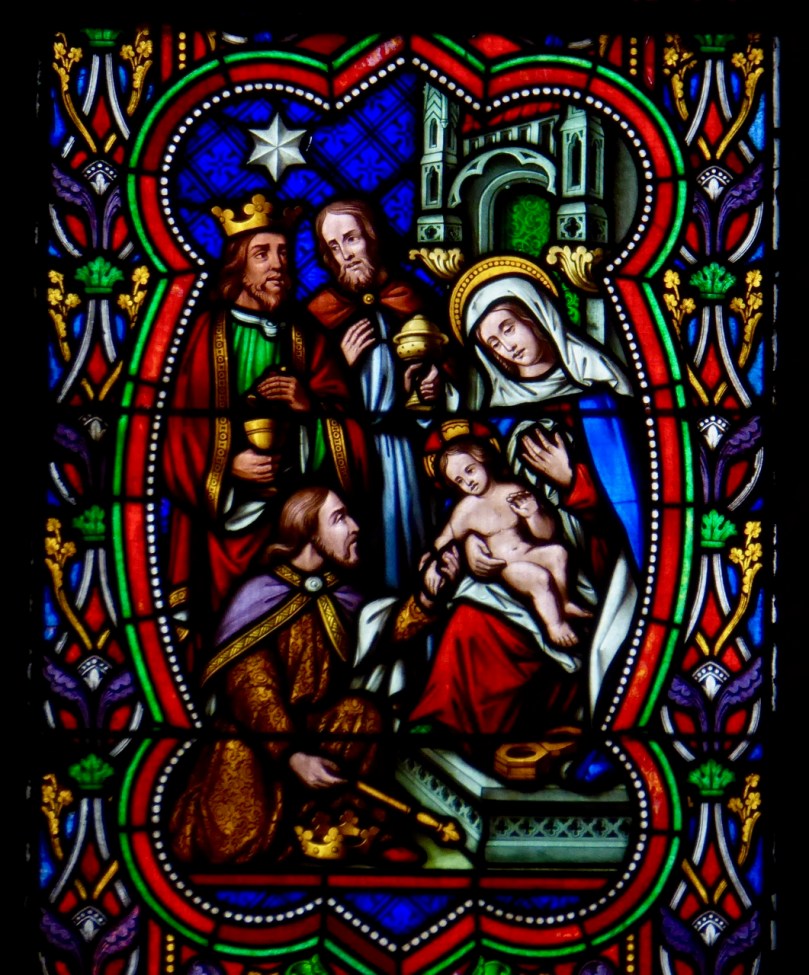
On  another wall in the same church is a two-light window by A E Child, depicting the visit of the Magi. A E Child was a highly influential teacher, and member of Sarah Purser’s Tower of Glass (An Túr Gloine) – a contemporary of Harry Clarke and a highly skilled stained glass artist, but with a more orthodox style than Clarke’s.

Canice's AE Childe

Still in Kilkenny, the Black Abbey has reputedly the largest stained glass window in Ireland. It’s divided into numerous smaller scenes and this one depicts the Nativity. It bears a striking resemblance to the Christmas card window from St Canice’s – perhaps it was from the same studio.

Black Abbey Kilkenny

In  Tullamore, the enormous Church of the Assumption has wonderful stained glass by different artists. Several large windows are by the Dublin firm of Earley. This one of the madonna and child shows a small shepherd on her right and three crowns on her left – a clear indication, I think, that this is intended as a Nativity image. The swirling colours and modern lines create a dramatic effect.

Church of the Assumption, Tullamore

The St Joseph window in the Richard King collection in Athlone contains a detail in one of the side panels that depicts the Flight into Egypt, and another of the marriage of Joseph and Mary.

Back to Cork and to the Holy Trinity Church on Father Matthew Quay, just behind the South Mall. Three windows on the west wall are by the Harry Clarke Studios. Research in the Studio archives (held in Trinity College) has revealed the the middle window was designed by Harry Clarke, but executed in fact by his father. It has many of the hallmarks of Harry but lacks the rich detail for which he became justly famous.

Holy Trinity Church, Cork, Designed by HC and executed by his father

Behind the altar, on the north wall of the same church is an enormous window dedicated to Daniel O’Connell and containing scenes from the life of Christ. It is conventional, but finely painted and the colours are rich.

Holy Trinity Cork, East Window

I will leave you with two of our favourites. Close to home I love the the Sarah Purser/Tower of Glass round window in the Holy Rosary Church in Kilcoe. Here’s a detail.

Tower of Glass Magi closeup. Kilcoe

And finally, from the village church of Eyeries on the Beara Peninsula, Robert wrote about  a stunning set of windows by George Walsh. His nativity scene is touching and beautiful.

george walsh nativity

Discovering Richard King

Patrick Vox Hib

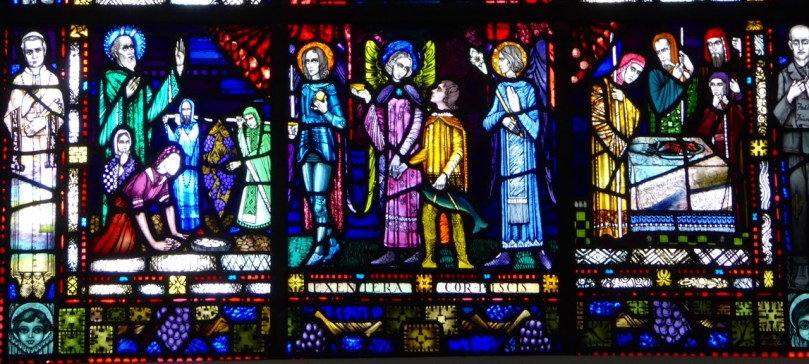
Here is a typical Harry Clarke piece of stained glass – note the large expressive eyes and long tapering fingers, the gorgeous raiment of the angel and that headdress, the additional tiny angelic figure hiding in the blue glass, the border filled with non-repeating decorative elements. All classic Clarke elements, right? But this is not the work of Harry Clarke. He died in 1931 and this window was designed, executed and installed in 1937, by the studio that he founded and which carried on after his death under the name Harry Clarke Studios.

Patrick Preaching

The first image in this post is from the Patrick window and shows Vox Hibernicæum – the people of Ireland calling Patrick back to convert them. The image above is from the same window – Patrick preaching to the chieftains **

This window, it turns out, along with several others in the same church, was the work of Harry Clarke’s apprentice, the man who stepped into the breach caused by his death and took over as the main stained glass artist of the Studio. That man was Richard King.

Joseph all

The Joseph window: each frame tells a story from the life of Joseph or references other biblical Josephs.

I had never heard of Richard King until I stepped into Sts Peter and Paul’s Catholic Church in Athlone during our Midlands trip. That’s not all that surprising, because after Harry Clarke died windows from his workshop were generally signed simply by the Studio and individual artists were not identified. Mostly, it seems, this was to capitalise on the Harry Clarke brand, which by the time of his death was justly celebrated, and thereby to keep orders coming in.

Joseph scenes

Close up of the lowest frames in the Joseph windows. Clockwise from top right: the marriage of Mary and Joseph; the death of Joseph; Genesis 41:55 When all Egypt began to feel the famine, the people cried to Pharaoh for food. Then Pharaoh told all the Egyptians, “Go to Joseph and do what he tells you.”; Four rivers and two deer: the four rivers of Paradise; This is a reference to another biblical Joseph mentioned in Psalm 104, ‘constituit eum dominum domus suae et principem omnis possessionis suae’ – He made him master of his house, and ruler of all his possession **

Richard King had been trained by Harry: he had executed windows designed by Harry under Harry’s close supervision. A promising artist when he joined, he probably did more than set glass etched and drawn by Harry, but may have been responsible for background elements, borders, details. Harry was away in Davos, gravely ill, for the last year of his life and Richard may well have translated his cartoons (window designs on paper) into glass. But I am speculating here, and I hope to learn and write more about Richard King in the future. He went on to have a long and distinguished career as an illustrator.

Purgatory all

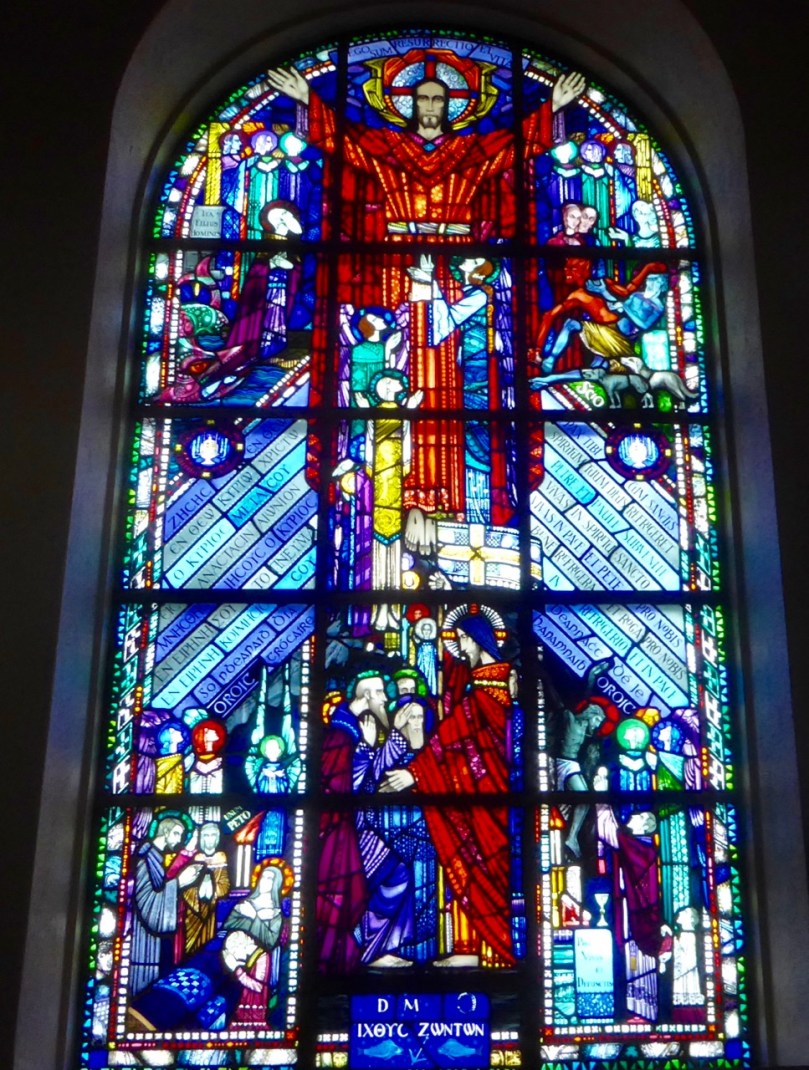
The Purgatory window: prayer fragments in Greek, Latin and Irish; the righteous ascend to heaven; Christ descends to purgatory with a banner to lead those who have done their penance up to heaven; in the lower left St Monica is on her deathbed while St Augustin looks on; lower right, the mass is celebrated; upper right, Jonah (whose purgatory was to be in a whale) and upper right Job, who was robbed of everything he held dear by the devil, thus testing his faith **

The King windows I photographed are enormous. (There are other Harry Clarke Studio windows by Richard King in the church as well as windows by other companies, but I will concentrate on these ones for the purpose of this post.) They represent St Joseph, St Patrick, Jesus, Mary and Purgatory. All follow the same convention of placing the main figure centrally, surrounded by smaller panels which tell stories or illustrate events from the life of the central character.

Purgatory Jesus and the Saints

Close up: Christ descends to purgatory

HC Studio, Athlone

Close up: the Job panel

The sheer size of the windows has allowed ample scope for this approach, but size alone cannot account for the myriad details that King inserts into every possible space in the window. Words abound, in several languages and scripts. References to the ancient and the modern, the mythological, the hagiographical, and the historical jostle for space with abstract designs, tiny figures both realistic and imaginative, symbols, animals, buildings – everywhere the eye lingers new elements are discovered. In its essence, this is very Harry Clarke; in the sheer exuberance of its execution, this is Richard King having fun, cramming in as much as his own fertile imagination can offer up.

Mary Rosary Angelus and Scapular

This is the Mary window and these sections concentrate on images of Marian veneration. Clockwise from top left: workers pause to pray the Angelus; a family says the rosary together; St Simon Stock receives the scapular from Mary (more on this here);  Mary; St Dominic receives the rosary **

The Harry Clarke Studios closed down in the 70s. For many years after Harry’s death in 1931 it carried on his tradition of highly stylised and beautiful works of art in stained glass, although over time works became more conventional and quality suffered as orders were harder to get, costs rose and corners were cut. Look, for example at the Studio windows in my post Time Warp, about the Drimoleague church, done in the 50s. But that’s in the future – what we can see, under Richard King’s assured hand, are windows that proudly carry on the Clarke preoccupations with designing windows that dazzle and inspire.

Juses details bottom

Details from the Jesus window from left to right: Pope Pius x; Manna from heaven; Tobia walking with the Angel Raphael, with Michael and Gabriel; eating the paschal lamb; Matt Talbot, a Dublin man who died in 1925 and who was considered on the path to sainthood because of his extreme practice of asceticism **

Perhaps, though, there is another element that creeps in now that Harry is gone – the religious fervour of the early years of the state is now in full swing. Government and Church Hierarchy work hand in glove to develop and promote a vision of Ireland that is devout, Catholic, monocultural, conforming and repressive. A high point in this relationship occurs in 1932 with the Eucharistic Congress in Dublin – an event explicitly referenced in the Patrick window. Richard King will never, as Harry did, fall afoul of puritanical state censorship – he will go on, in fact, to become the chief illustrator for a Catholic magazine.

Patrick top

The top of the Patrick window explicitly references the Eucharistic Congress of 1932 and the crossed flags of Ireland and the Vatican. Try to enlarge this image and see how many different elements you can identify. Good luck!

But in 1937 he is at the height of his powers as a stained glass artist. I hope to find and illustrate more of his work in that medium in future posts.

Patrick details and cathedrals

From the bottom of the Patrick window: Patrick lights the paschal fire on the Hill of Slane; he is flanked by images of two St Patrick Cathedrals, New York and Melbourne; Beneath, the swans represent the ancient myth of the Children of Lir (although there were four swans in the myth, not three) – the spell they are under is broken when they hear St Patrick’s bell

** The photographs in this post are my own, but for the explanations that I use in the captions, I am indebted to Niall McAuley, who has mounted a Flikr Album of all the stained glass in this church and has researched and annotated each image. I don’t know you, Niall, but I salute your wonderful images and your exhaustive notes on each of the windows. Please go to Niall’s album for more on all the King windows (especially if you are stumped by the Patrick window) and also windows by other stained glass suppliers and artists in this amazing collection.