Cape Clear

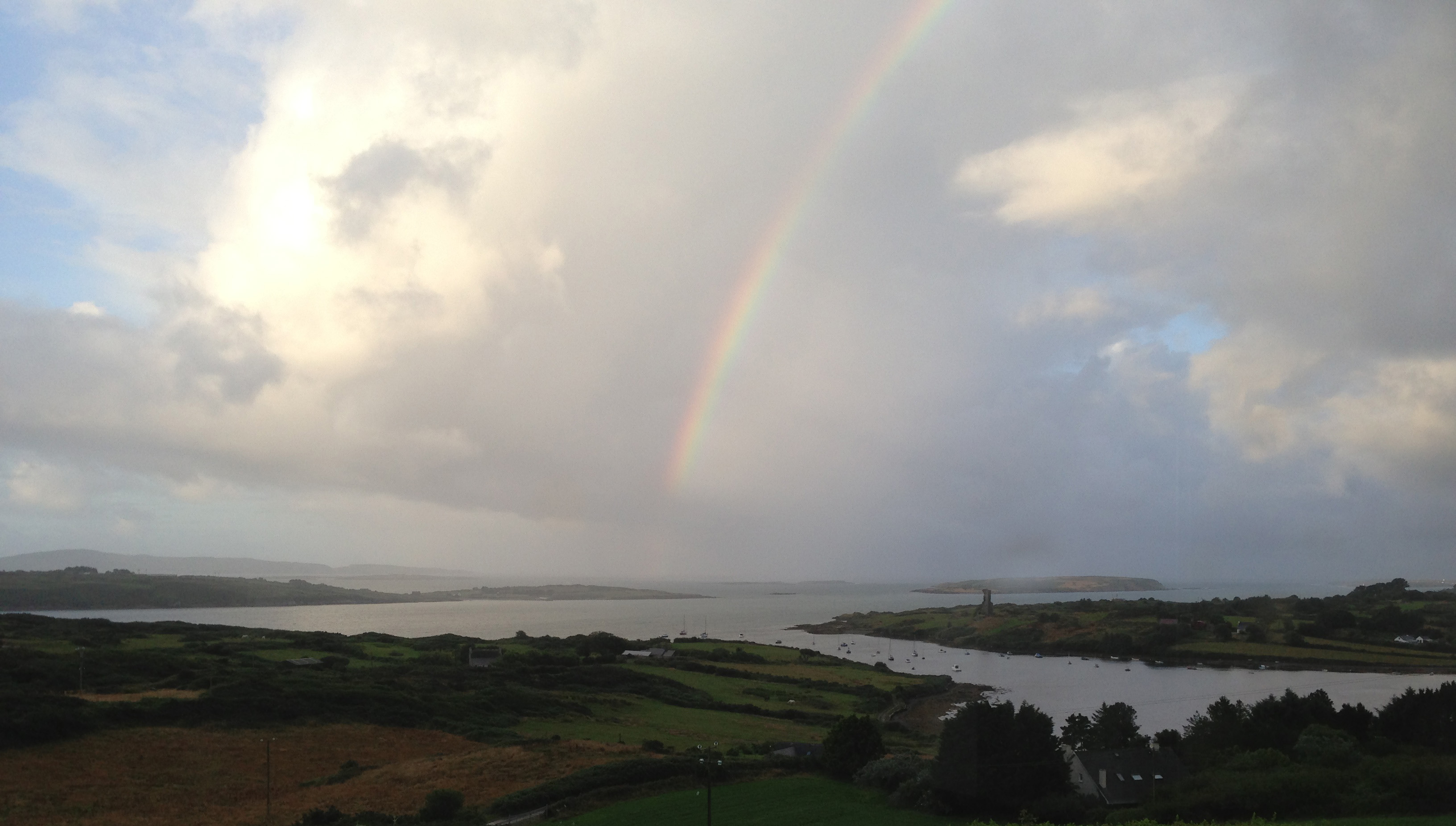
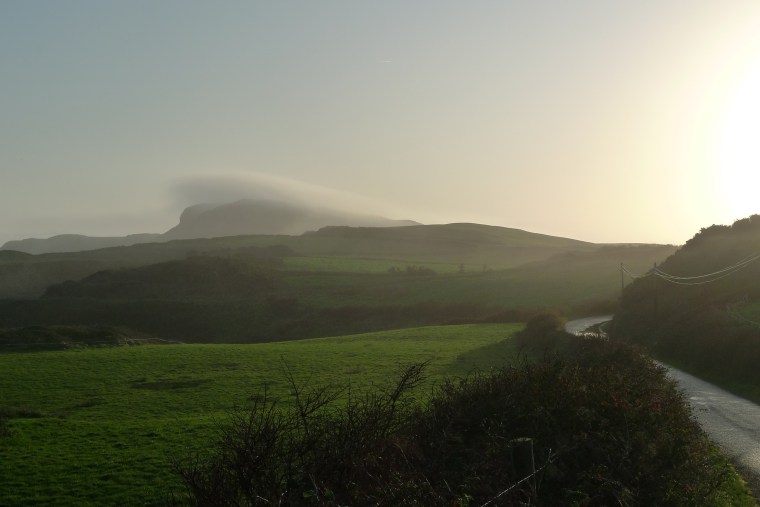
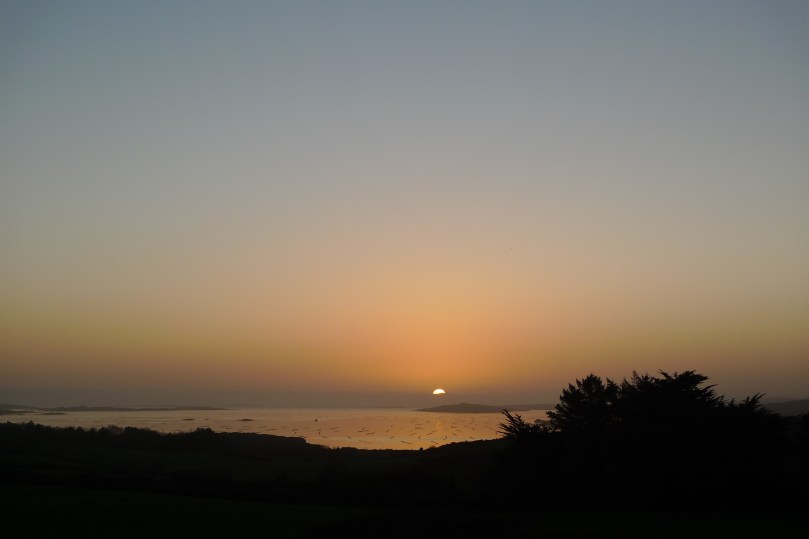
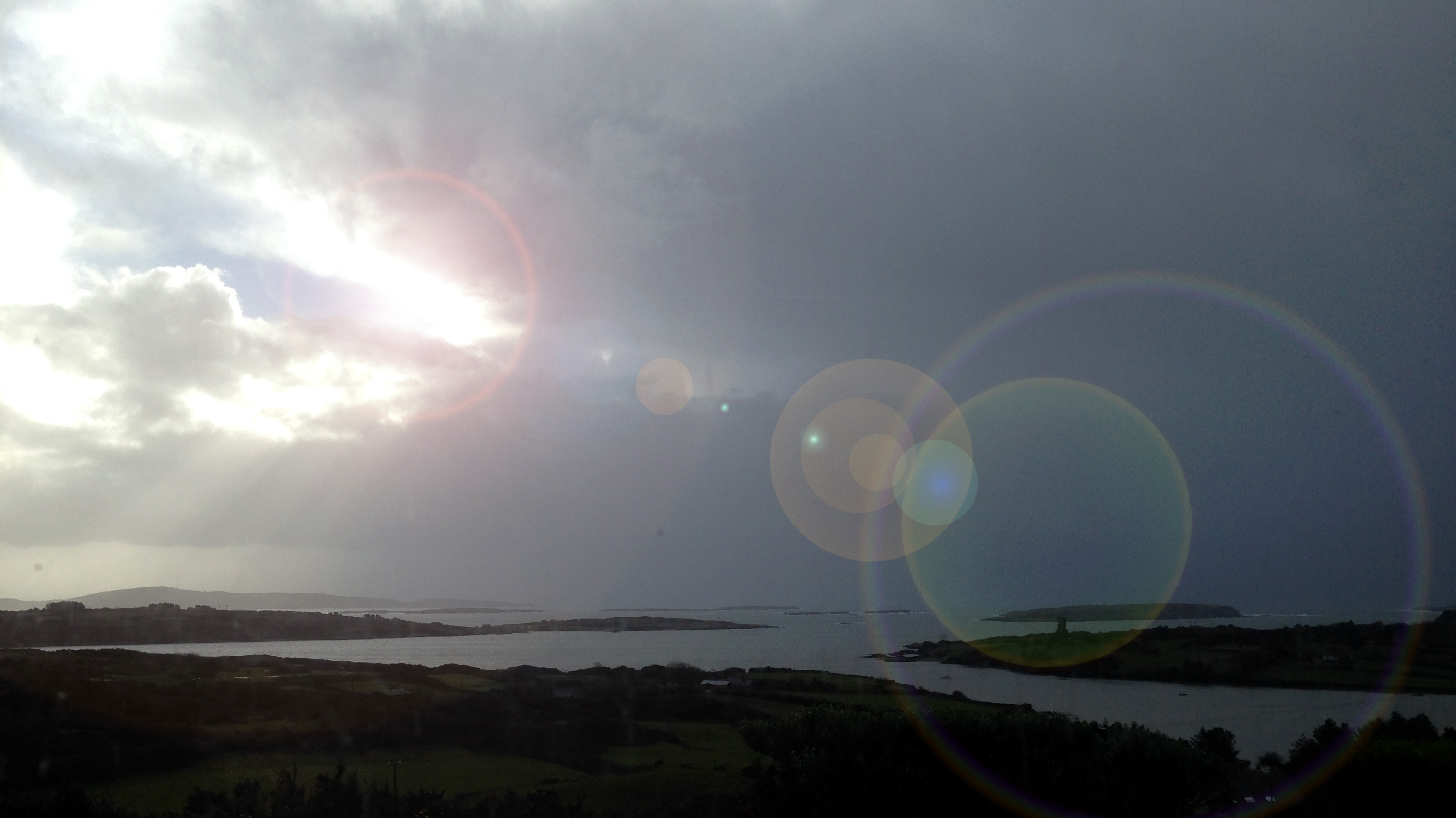
Distant Cape Clear - with solar effects

Distant Cape Clear – with solar effects

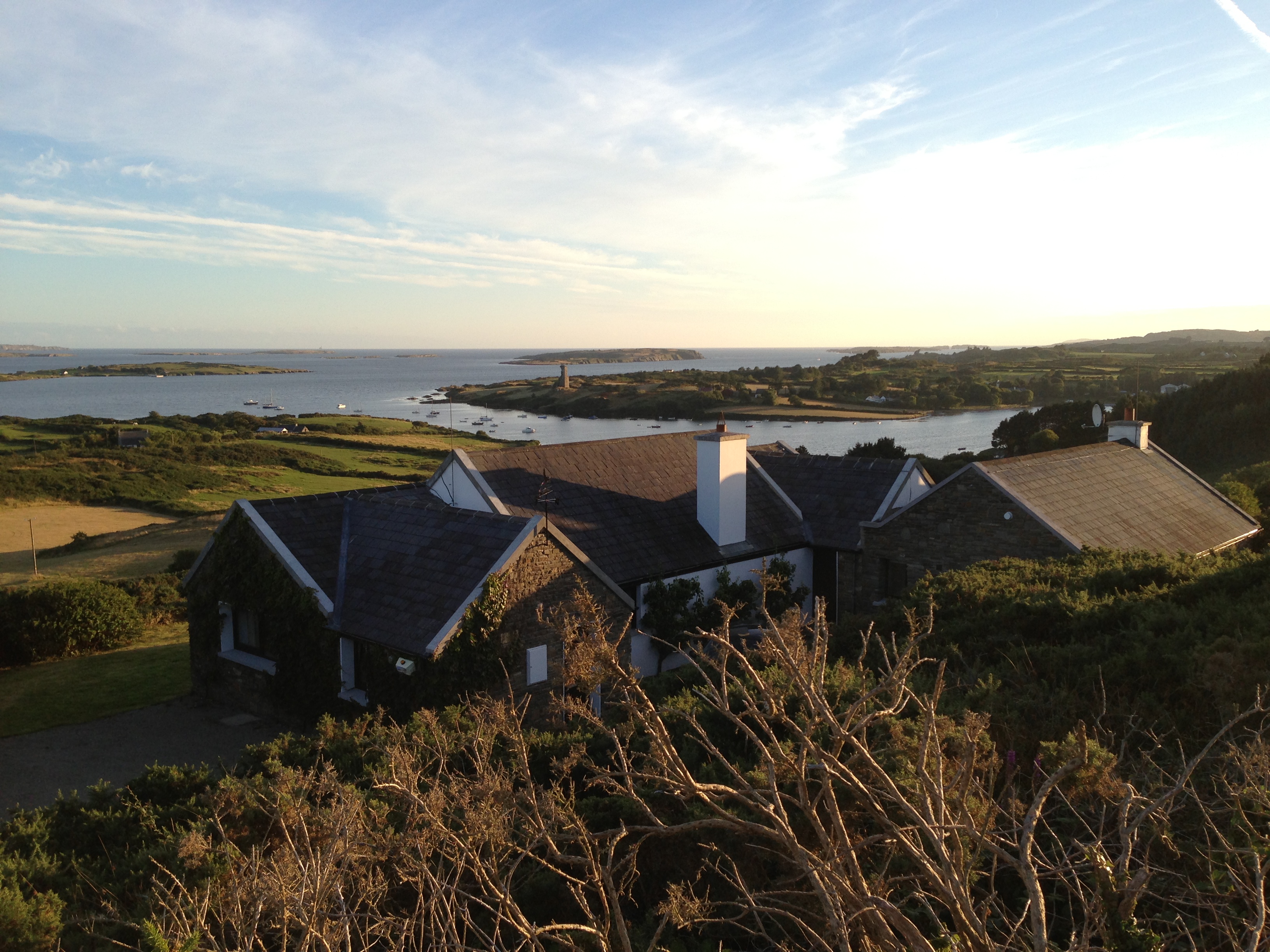
Always in our view from Nead an Iolair are the many islands of Roaringwater Bay: sometimes they are referred to as ‘Carbery’s Hundred Isles’. The largest of them – and the furthest out into the Atlantic – is Cape Clear. From our vantage point in Cappaghglass it sometimes floats on the horizon like a great seal under brooding skies, yet with the clarity of summer skies every hillside cottage can shine like a white jewel. I visited the island for the first time last weekend, drawn to its isolation and history – and by its own Saint – Ciarán, born on this most southerly point of Ireland and preceding Saint Patrick by some generations as the ‘Apostle of Eirinn’.
ghaeltact

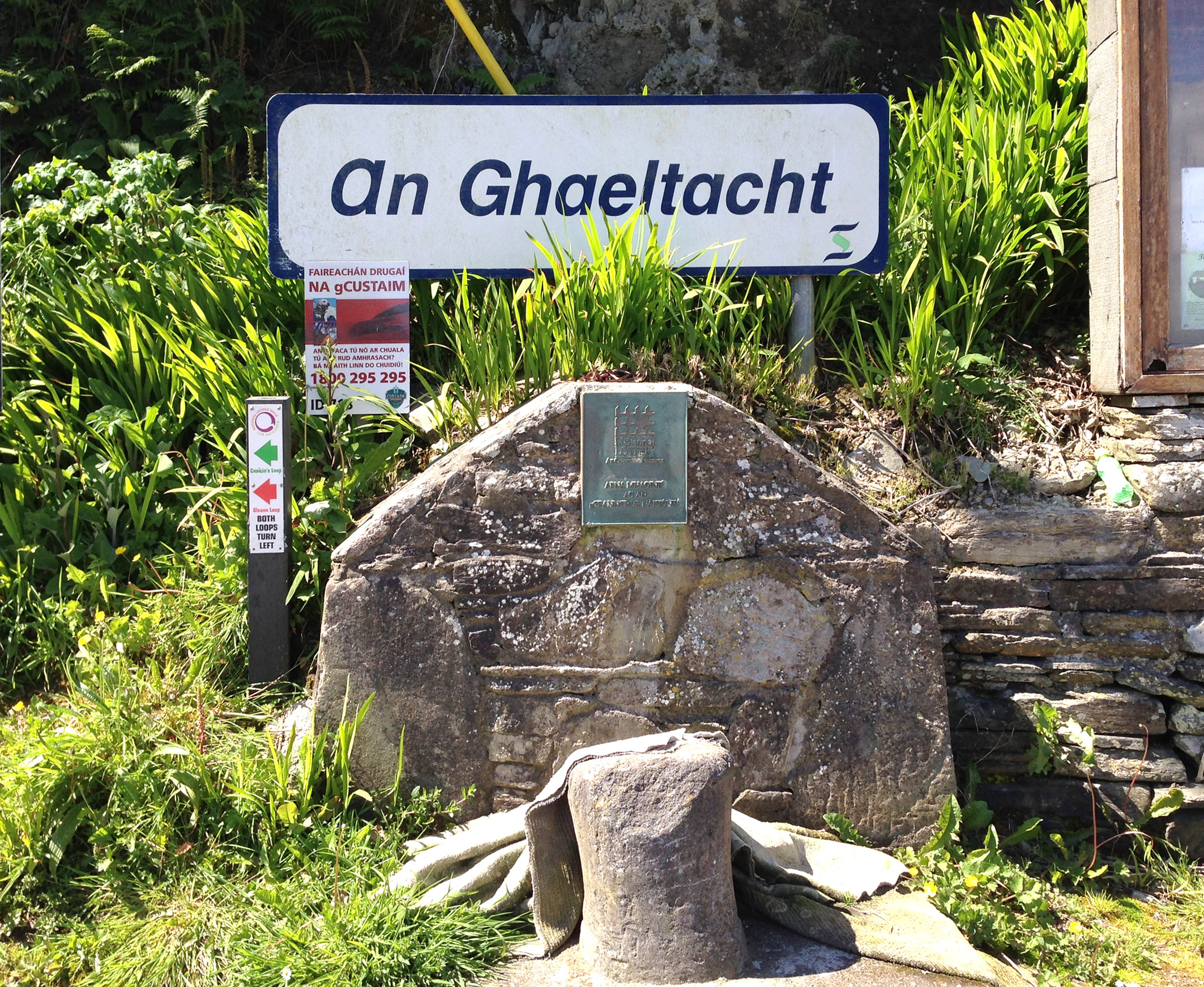
Cape Clear is a place apart. It is one of the Irish Gaeltacht areas – where Irish Gaelic is spoken as the first language. Oileán Chléire is the Island of Ciarán, and one of the first things to be seen after landing is an ancient stone by the quay – said to have been placed there by the Saint himself – and his holy well – while nearby are the ruins of an ancient church and burial ground.

Saint Ciarán’s life has inspired some colourful stories. Before he was conceived Ciarán’s mother (Liadán) had a dream that a star fell into her mouth. She related this dream to the tribal elders who were knowledgeable of such things, and they told her that she would bear a son whose fame and virtues would be known as far as the world’s end. Ciarán’s first disciples included a Boar, a Fox, a Brock and a Wolf: they all became monks and worked together to build the community.
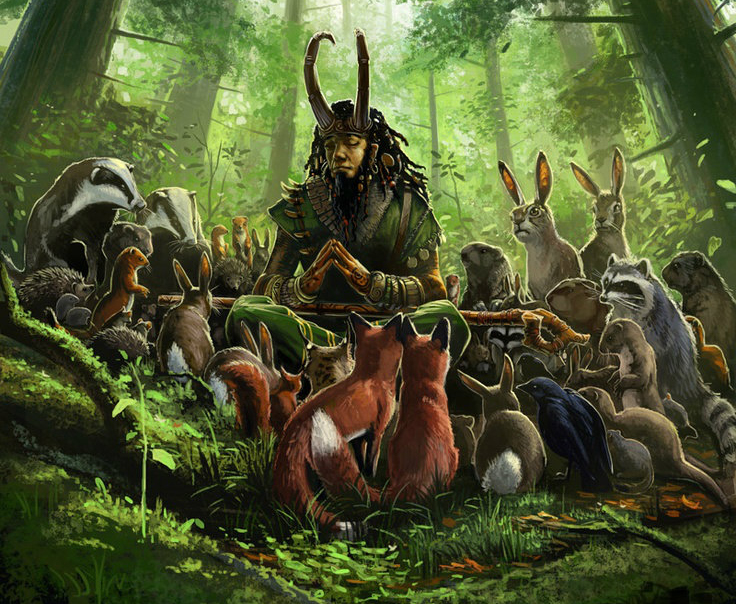
An interesting find: Ciarán as a Celtic God by Astrella

An interesting find: Ciarán as a Celtic god by Astrella
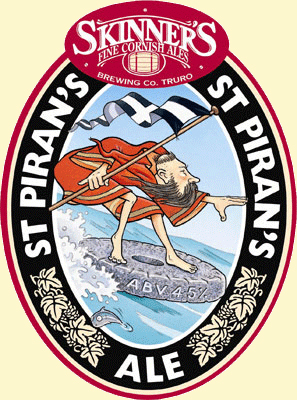
An unusual incarnation of the St Ciaran / Piran legend!

An unusual incarnation of the St Ciaran / Piran legend!

The Saint is also recognised in Cornwall, where he is known as Piran (or Perran) – scholars argue that in some ‘Celtic’ languages the C sound is interchangeable with the P sound. Certainly there is a legend that the Heathen Irish tied St Ciarán to a millstone and dropped him into the sea – and he then floated across to Cornwall where he converted the Heathen Cornish. Whatever the basis of this, both Piran and Ciarán share the same Saints Day: March 5th – which is also my birthday – so that puts me firmly into the picture!

Writers in the past have commented on the island’s particular character:

“…The natives of Cape Clear are distinct in a great measure from the inhabitants of the mainland; they have remained from time immemorial as a separate colony, always intermarrying amongst themselves; so that we must regard them as amongst the most typical specimens at the present day of the old Milesian race. The name of nearly all the islanders is O`Driscoll or Cadogan, the later being only a sobriquet for the former. Baltimore and Cape were originally the stronghold of this family, the principal Chieftain, O`Driscoll Mór, residing in Baltimore. There can be no doubt that they were the aboriginal race residing along the sea-coast of Carbery. The isolated position of the island and its difficulty of approach, have kept the population in a comparatively antique state and distinct condition during the lapse of centuries, so far as nationality and descent. Until the year 1710 Cape was an established monarchy, and an O`Driscoll – the head of the clan- was always styled, “King of the Island”. They had a code of laws handed down from father to son. The general punishment was by fine, unless some grave offence was committed, and then the delinquent was banished forever to the mainland, which was looked upon as a sentence worse than death…’ (from Sketches in Carbery by Daniel Donovan,1876)
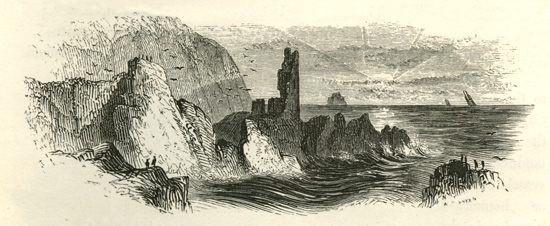
Dunanore – engraving by W Willes 1843

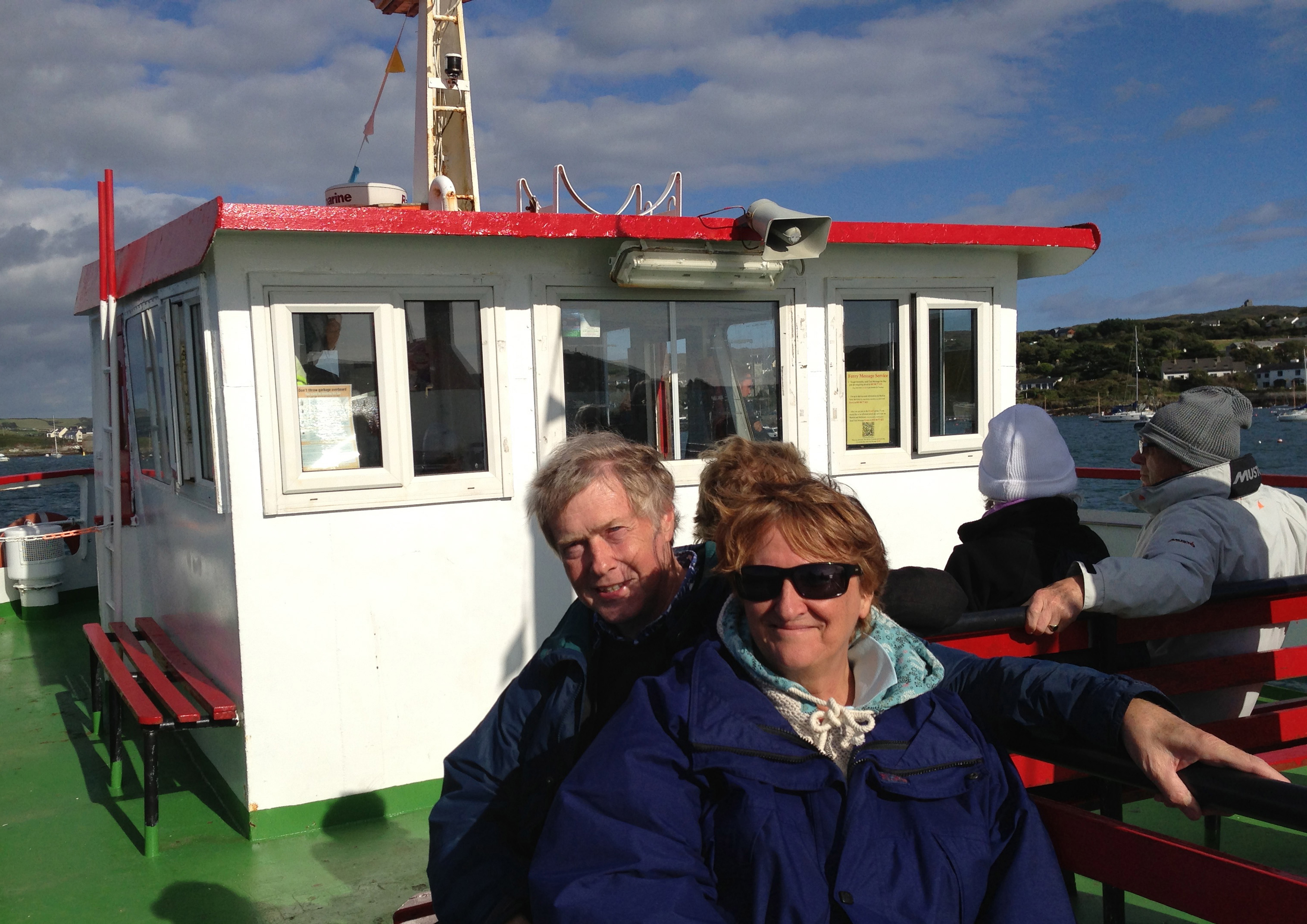
Our visit was organised by the Skibbereen and District Historical Society, and was masterminded by past Chairman Brendan McCarthy. He had arranged for the sun to be shining all day, and for the sea to be the calmest that anyone had known for years. A bonus was the presence of Dr Éamon Lankford – a knowledgeable and erudite local historian and toponymist whose projects have included setting up detailed place name archives for Cork County, Kerry, and Cork City. There are now over 200 large volumes of historic place name references and the work is still under way: examples from the city survey include Black Ash, Cáit Shea’s Lane, Murphy’s Farm, the Snotty Bridge, The Shaky Bridge, the Boggy Road, Tinker’s Cross, Skiddy’s home… Éamons unbounded energy has not stopped there – he has gone on to set up and run the Cape Clear Island Museum and Archive and written books on the Island’s people and landscape, on Saint Ciarán, on the Fastnet Rock, on Cape Clear place names- and has set up the Cape Clear Trail… Phew! We walked up the (very) steep hill to the Museum, which is housed in the restored old school building, and no-one could fail to be impressed by the sheer volume of information and artefacts it contains. Volunteers are needed to help run it through the summer months, so anyone fancying a bit of island life please make contact through the website. On our ferry trip from Baltimore and in the Museum Éamon kept us entertained and educated with stories, history and local lore.

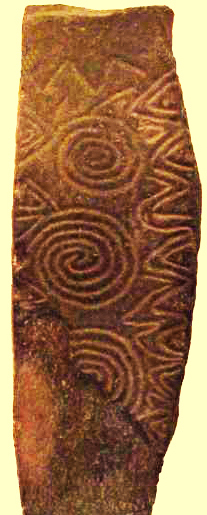
I was keen to visit the Museum because I knew it housed a replica of the passage grave art (carved stone) found on Cape Clear and now believed to have once been part of a passage tomb on the highest point of the island – Cill Leire Forabhain. In 1880 the original stone was turned up in a field and taken across to Sherkin by the then curate of that island to ornament his garden. He left Sherkin only a year later, and the stone became overgrown and forgotten. It was rediscovered in 1945 and given to the Cork Public Museum where it is now on display. The carvings on this stone are in the style of the other spectacular decorated stones in the Boyne Valley and at Loughcrew, rather than the simpler Rock Art we are working on in West Cork and Kerry (although this ‘simplicity’ is belied somewhat by the recent discovery at Derreennaclogh). Beside the replica stone in the Museum is a smaller piece of Rock Art, although debatably labelled as being caused by ‘solution pits’.
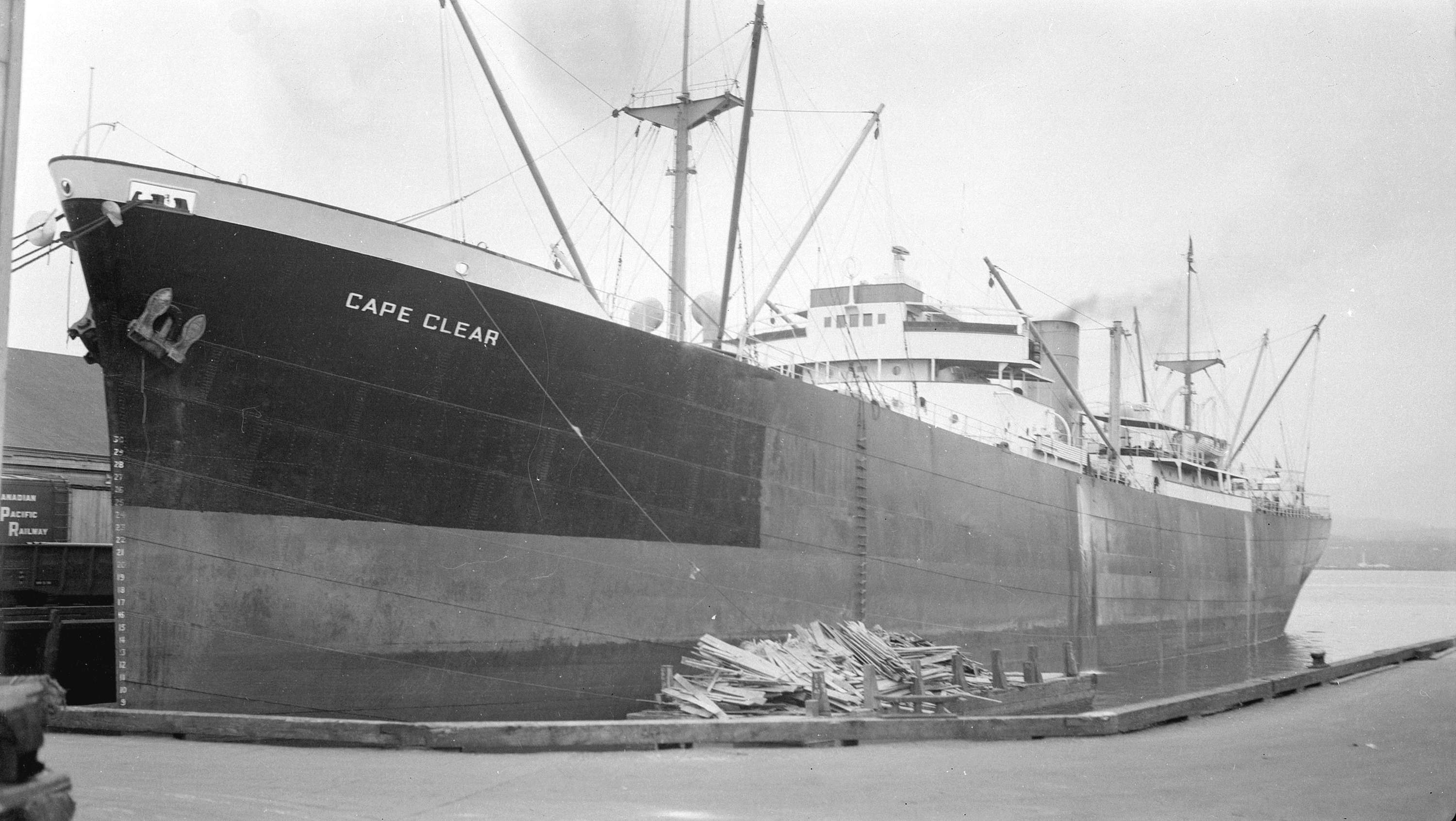
MV Cape Clear - built in Glasgow in 1939; went down in the Red Sea 1944

MV Cape Clear docked in Vancouver – built in Glasgow in 1939; went down in the Red Sea 1944

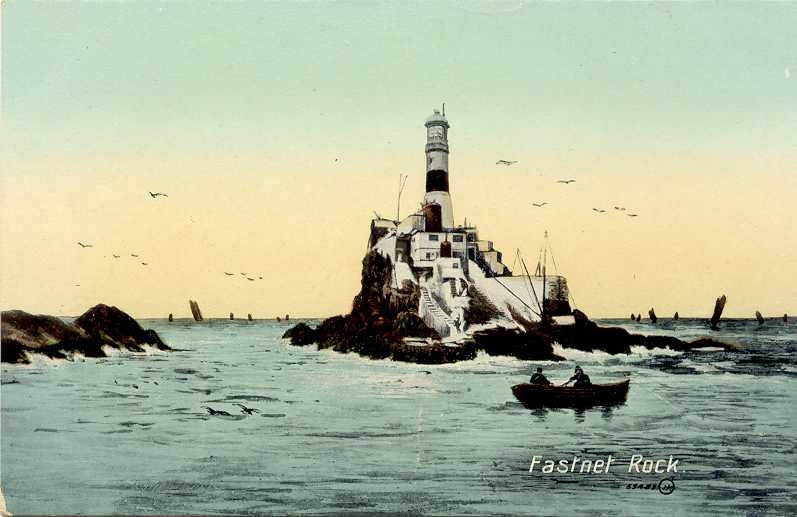
There is so much more to say about Cape Clear: it has given its name to a settlement in Victoria, Australia, supposedly named by gold miners from Ireland, and also to a number of ships built in Scotland. Talking of ships, the surroundings of the island have seen many a shipwreck: more than 50 wrecks have been recorded off Cape Clear between 1379 and 1944. This is partly because of the proximity to the notorious Fastnet Rock. FASTNET
We have to revisit Cape Clear again in the not too distant future, when we can devote more time to a full exploration of the island: it comprises 7 sq kilometres and 16 townlands. This time, however, it was down to the harbour for an excellent lunch before embarking on the ferry for the next stage of the trip to…. But that story must wait until another time!
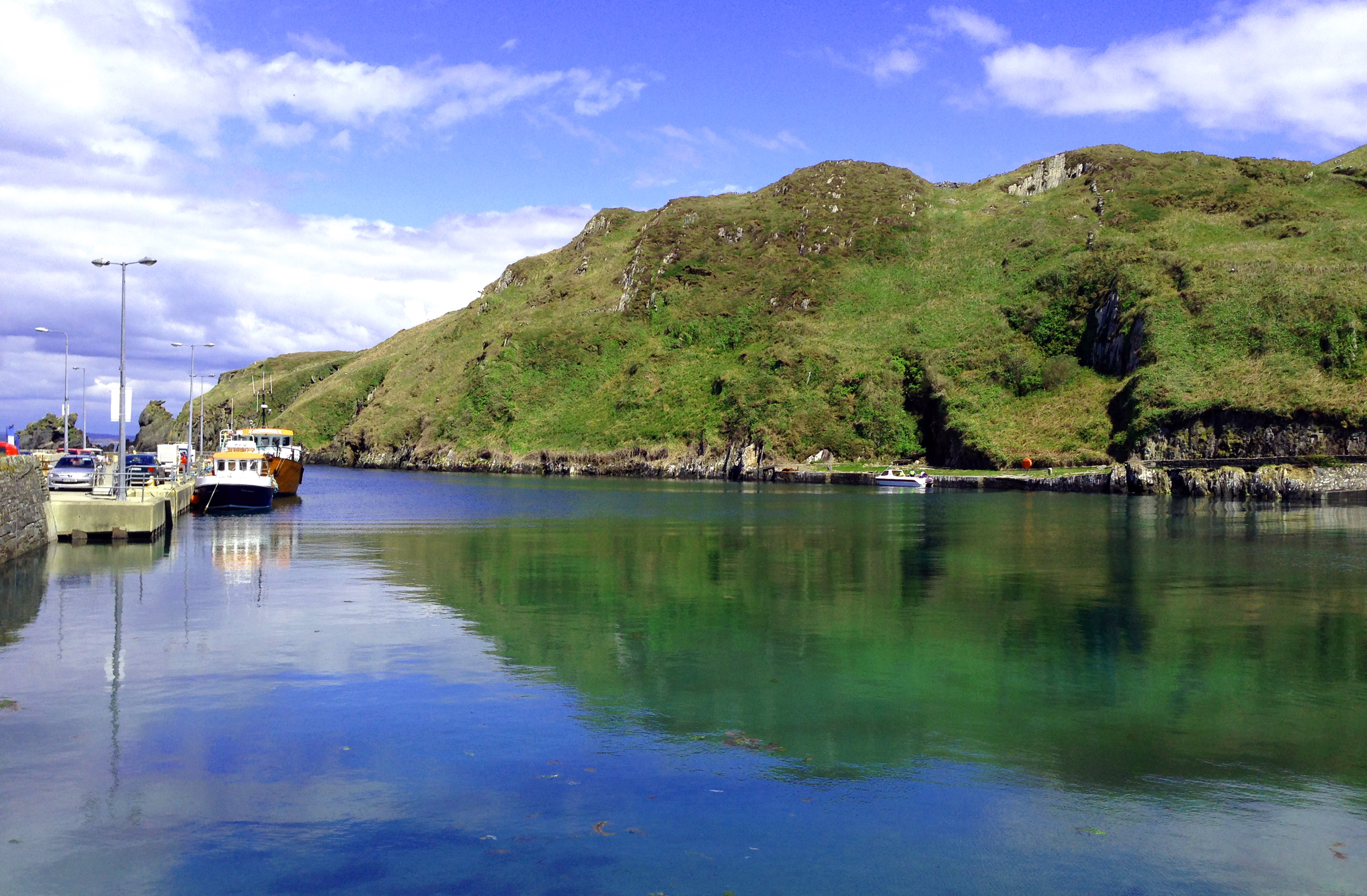
harbour

For me, small island communities have a very particular feel: it’s not just the silence and closeness to nature, but a real awareness of how fragile, yet tenacious, the tenets of human existence / subsistence can be. As I write this, Cape Clear is romantically shrouded in mist out there over the bay: only the highest ridge, the cairn, the watchtower and the old lighthouse visible in grey silhouette. It’s a place that will pull us back across the water very soon.
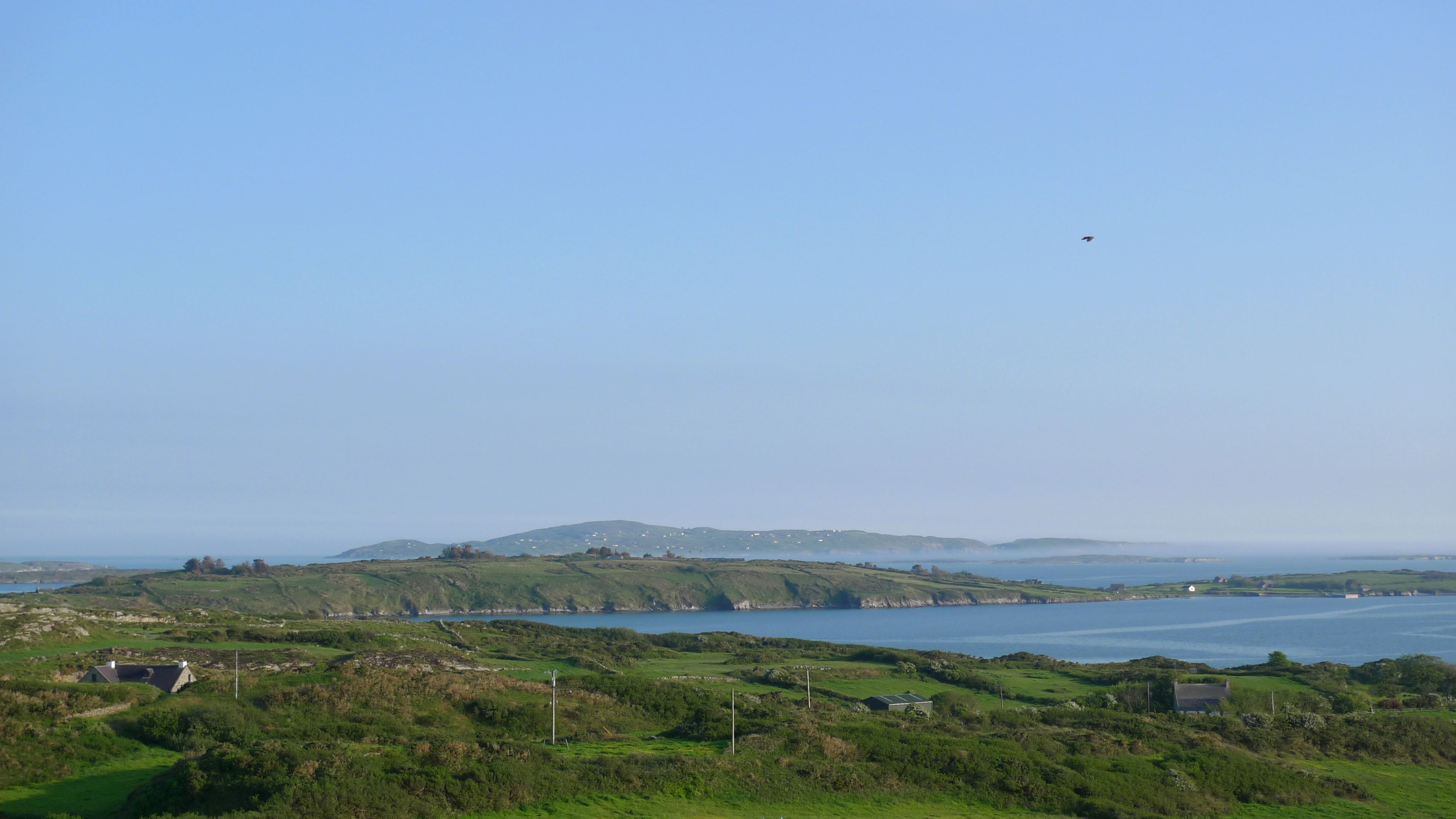
today

Today’s view of the Cape from Nead an Iolair
The Stones Speak

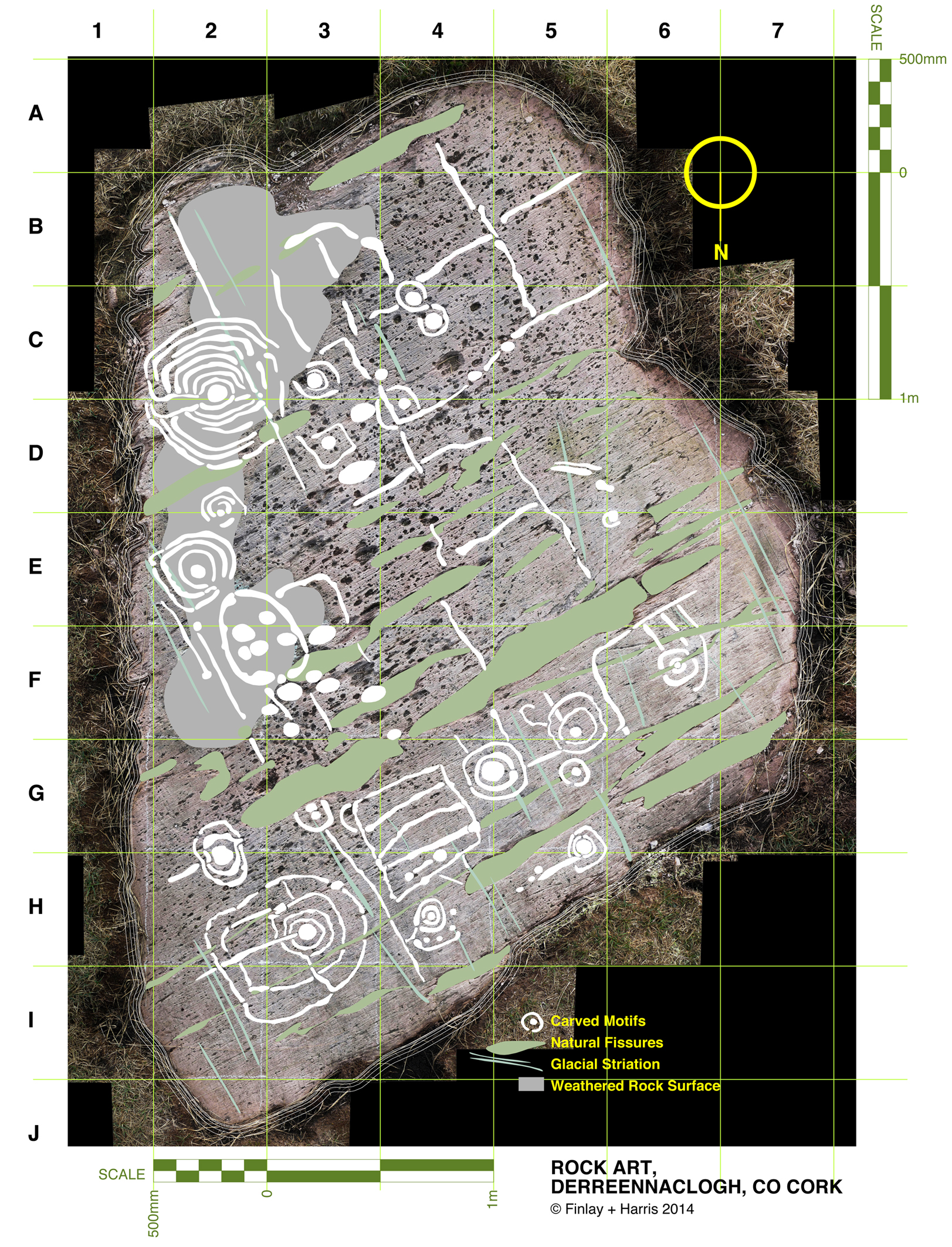
derr scale dwg 06

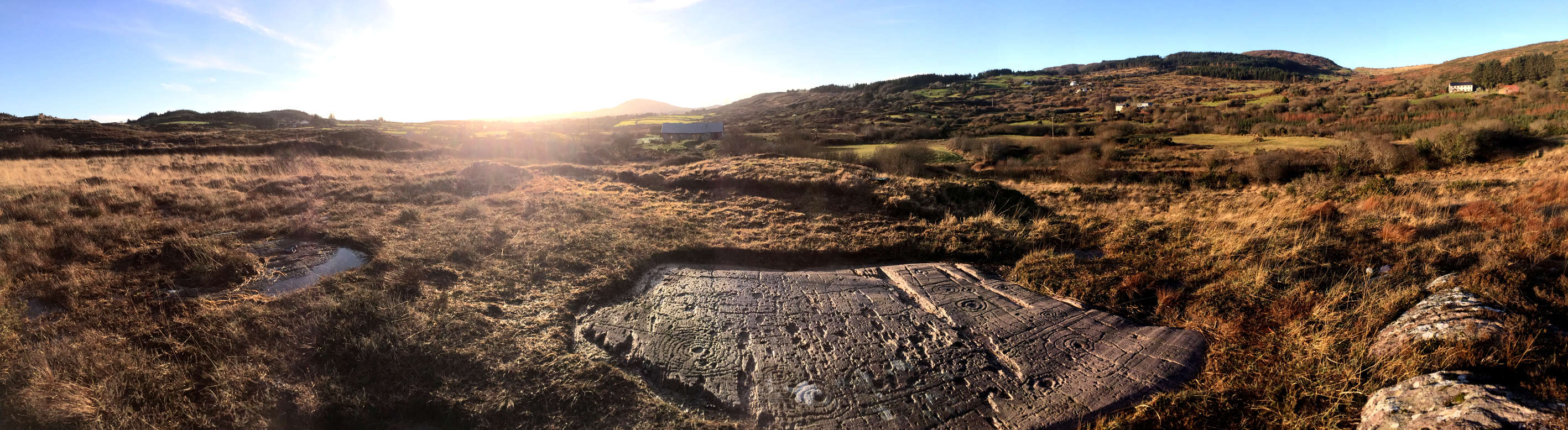
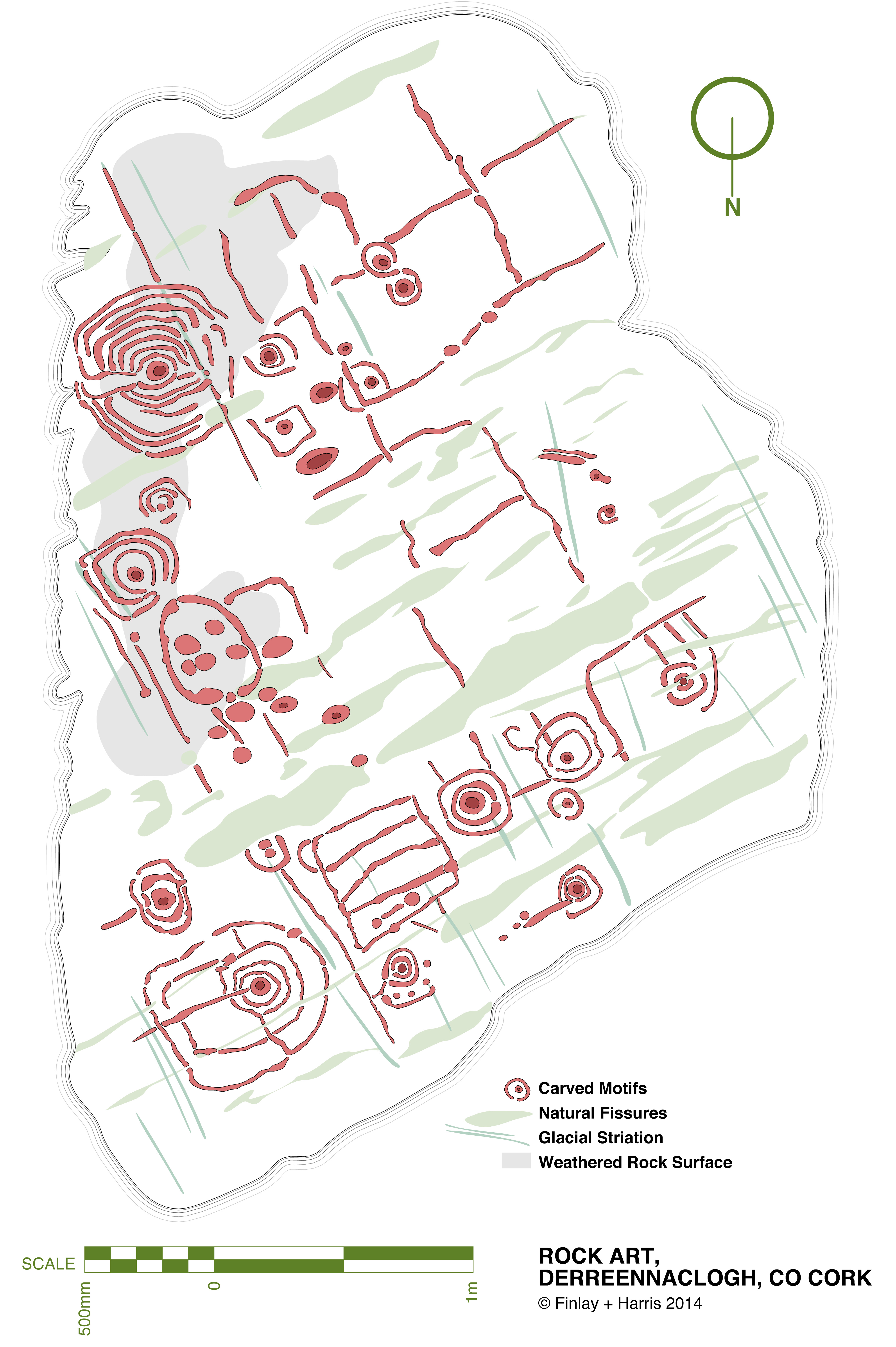
This drawing is a true scale representation of Rock Art on the horizontal surface of a large, earth-bound slab of sandstone in the townland of Derreennaclogh, Co Cork, Ireland. Archaeologists believe that carvings on this stone – and on very many others in Ireland and across the Atlantic coastline of Europe – were made by early farmers during the Neolithic or Early Bronze Age period, anywhere from 5,000 to 3,000 years ago. The carvings shown here were only discovered in the recent past: they had lain under a covering of peaty soil for hundreds or, perhaps, thousands of years and had therefore not suffered the natural weathering that many other examples of Rock Art exhibit. In one section – shown as ‘weathered rock’ on the drawing, the surface had previously been partly visible, and the curved lines which could be seen on this area led the finder of this piece to carefully pull back the overgrowth to reveal a remarkable Rock Art panel – perhaps one of the most complex and best preserved in Ireland.

The rock at Derreennaclogh: Mount Gabriel is prominent on the western horizon

The rock at Derreennaclogh: Mount Gabriel is prominent on the western horizon

I have been working on this scaled drawing for nearly a year. This long period is partly because my life has been filled with other things (such as moving permanently to West Cork and buying a house which has needed some upgrading), but also because I have been devising a method to measure and record in fine detail the carvings on the stone without any adverse intervention to the rock surface. When my partner Finola was writing her thesis for UCC in 1973 – The Rock Art of Cork and Kerry – it was normal practice to chalk in the carvings and trace over them using a wrapping film, these tracings then being transferred to high quality mylar and photographed for reproduction. Now the codes for archaeological work have changed and it is no longer acceptable to use chalk or any ‘rubbing’ technique: the thinking is that this could damage the surface. There is a whole debate here on how to best preserve our prehistoric heritage – and no doubt there are those who would say that the Derreennaclogh stone – with its carvings in such a remarkable state of preservation – should never have been uncovered at all, or should perhaps be covered over again in a way that will ensure the retention of its markings in a pristine state, while hopefully allowing occasional access for viewing. These matters are being considered in other areas where Rock Art occurs, particularly in Portugal – where some examples are much visited and provided with interpretation centres – and Scandinavia, where many petroglyphs are protected by toughened glass.

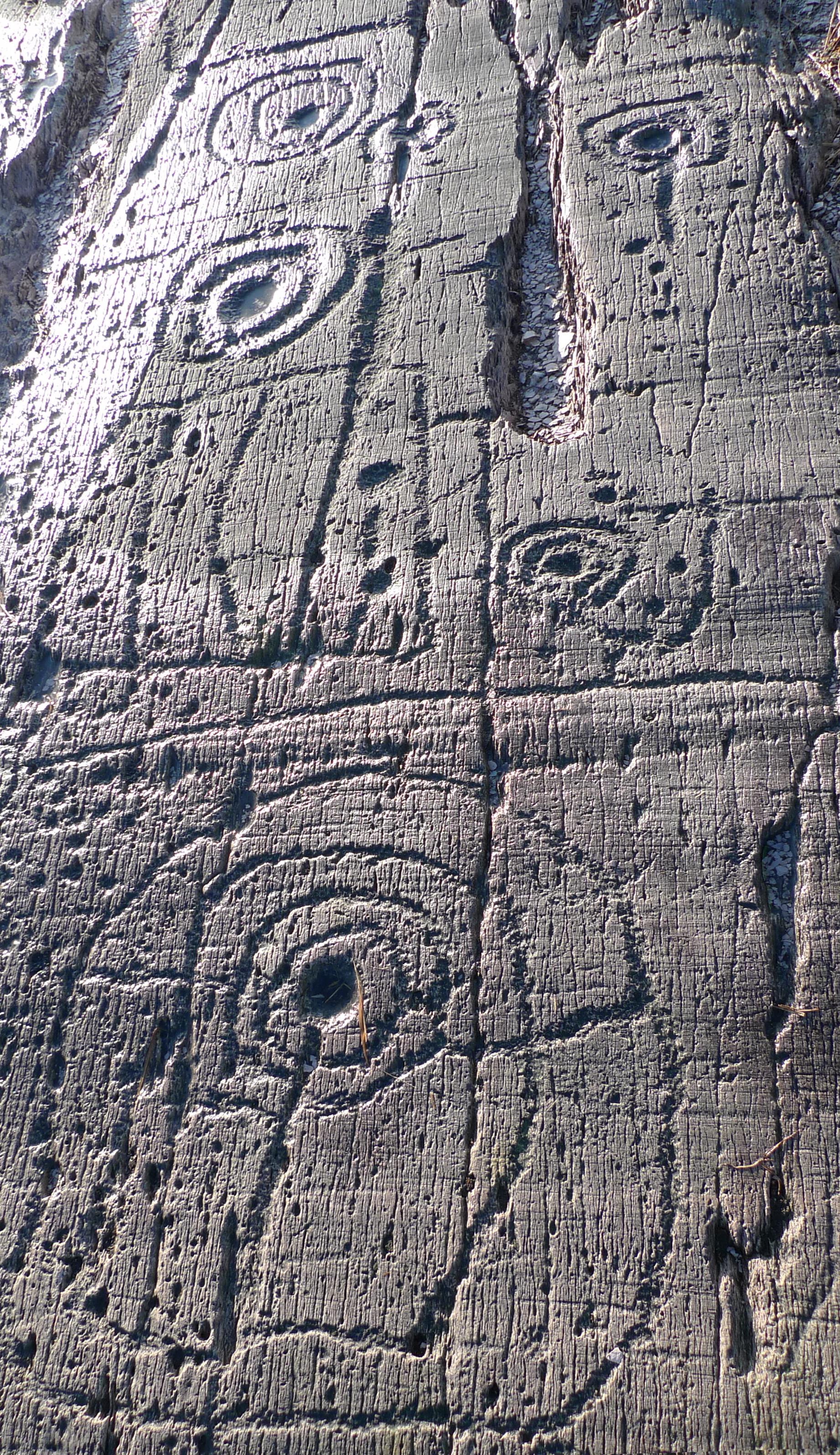
derr panel

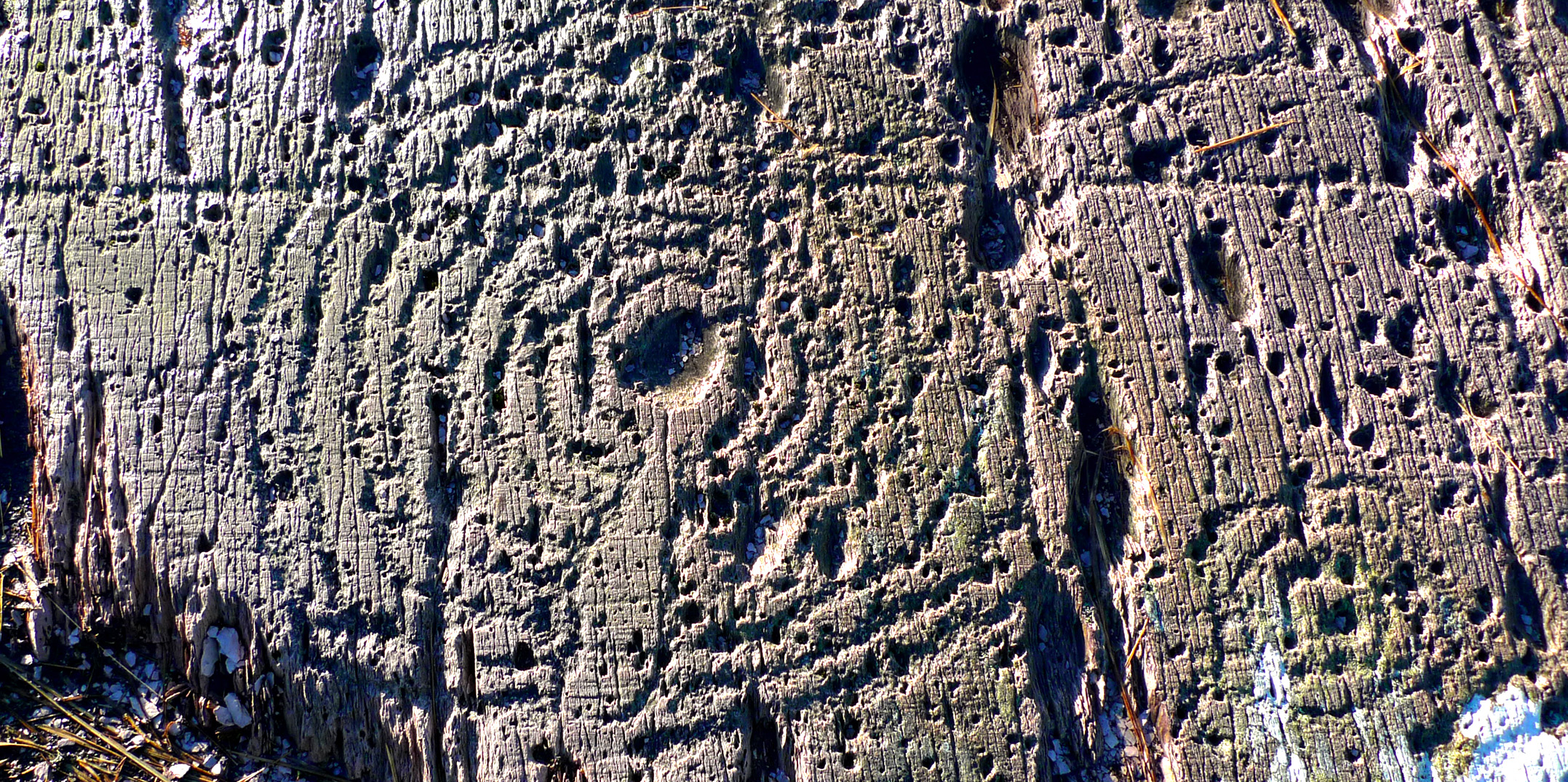
Motifs picked on the rock surface

I call my recording method, illustrated here, ‘visual rubbing’. It is not entirely without intervention, as I had to walk across the carved face of the rock, and place a camera tripod on the surface. I suppose this is a lesser evil when compared to some examples on open farmland where cattle walk freely across Rock Art panels or where – in places – rocks are being broken up to create new pastures: we have seen alarming signs of large excavator tracks passing right beside some good recorded pieces here in West Cork. Where the carved stones are listed in the Archaeological Record the landowner is always made aware that the monument is sacrosanct, but this does not guarantee practical conservation. Also, it may be argued that the topographical context of Rock Art is important (another debate) and that there should be restrictions in destructive activities to landscape in the vicinity of prime examples. Fortunately, the Derreennaclogh panels (there are two) are in bogland which is not currently grazed or used agriculturally.

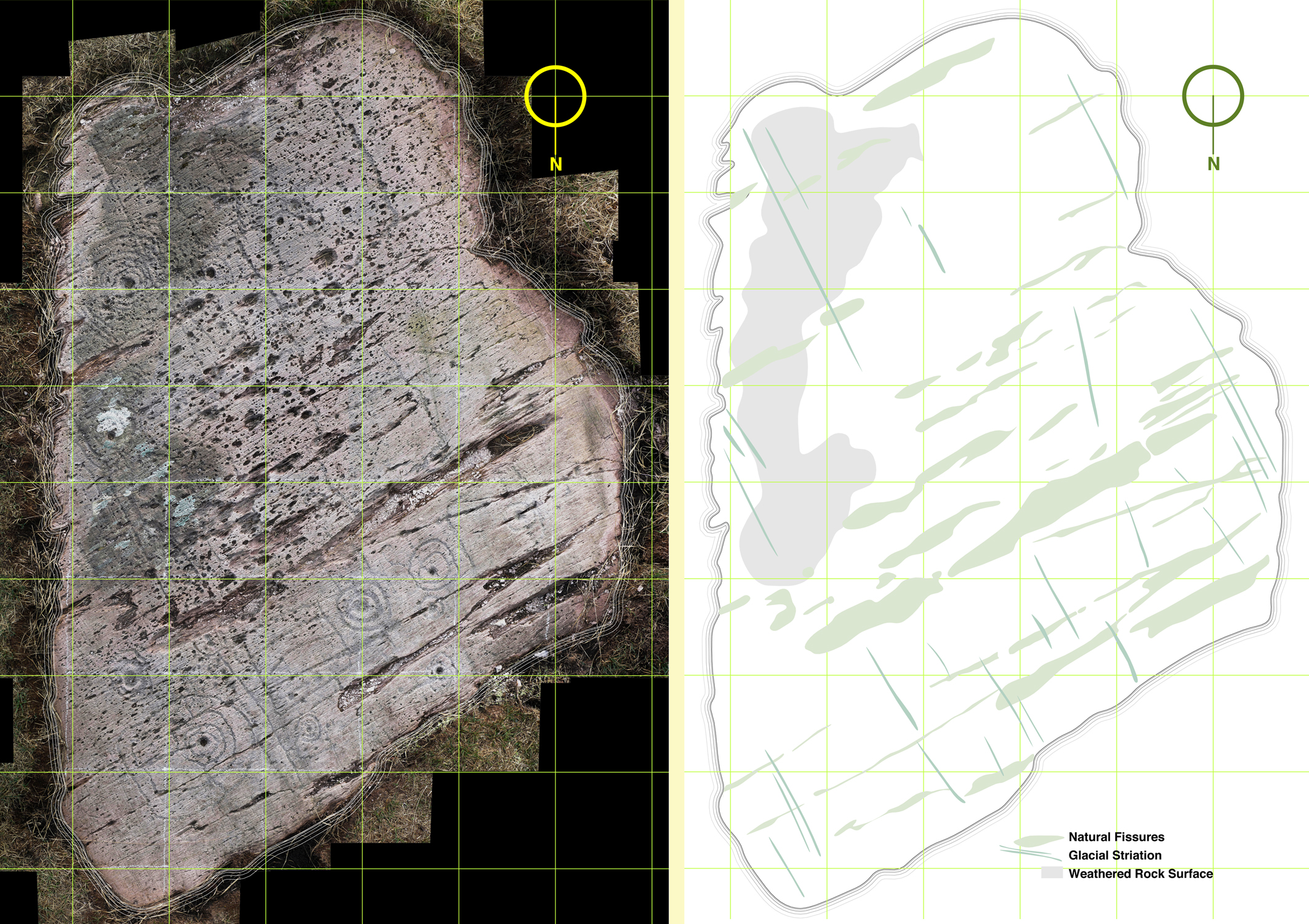
The rock measures about 3m by 4.5m at its extremities, and it was fairly easy to establish a 50cm grid using tapes. Fortuitously, one relatively straight side of the rock lies on a north – south line (magnetic north), and it was convenient to set my grid to compass orientation. The stone fills 55 of these grid squares and – using a Leica camera with a Vario-Summicron 2.8 lens – I took 55 high resolution photographs, each one centred on a grid square, and with the camera held a constant 1.5m above the flat rock surface. Back at the work station I stitched together all these photos using Photoshop, and this has given me a very accurate scaled base which is the bottom layer of the drawing I have subsequently created. My training as an architect has included using CAD techniques (Computer Aided Design), and I can trace very accurately the outlines of picked markings which show up on the photograph. The drawing is made as a digital file which can be reproduced physically to any size or scale, depending on the properties of the printer used. A CAD drawing can have any number of layers which can be switched on or off (or made transparent) to provide a matrix of information. My layers so far in ascending order are:

1   Photograph

2   Text and legends

3   Grid and grid reference numbers

4   Perimeter tracing of the rock

5   Tracings of the natural rock striations resulting from glacial movement (this appears to give the rock a definite directional ‘grain’)

6   Tracings of the natural rock fissures

7   Tracings of the rock carvings

The composite photograph (left) and tracing of natural features on the rock (right)

The composite photograph (left) and tracing of natural features on the rock (right)

I have added layers (5a, 6a and 7a) so that I have the outline tracings of carvings etc, but also ‘fills’ to these outlines. All these layers can be given different colourings. I have the intention also to separate out motifs depending on ‘motif type’: for example, the Archaeological records for West Cork distinguish between ‘Rock Art’ and ‘Cupmarked Stones’. Cupmarks are the simplest form of motif, and the most prolifically spread. The Cupmark is a concave depression, often surrounded by one or more concentric rings, and sometimes with a radial groove from the ring to the outermost circle or beyond. ‘Rock Art’ can include any other motifs – rings, squares, figures of eight, dumb-bells: the rock at Dereennaclogh provides examples of all these and more. A drawing layer devoted just to cupmarks would be useful.

Motifs traced over the photograph

Motifs traced over the photograph

The motifs are ideally traced on a large screen, which enables the picking to be clearly seen: ‘picking’ means the hammer-on-stone technique of carving out the shapes. So far I don’t have a layer which includes information on the depths of the carved motifs. This would in any case be subjective and could only be done by taking a large copy of the drawing to the rock, measuring the depths of each mark and recording this ready for transfer to the file back at the workstation. This is a future job, and will involve a more selective coding to show the extent of picking graphically, It would in any case be academic and not necessarily a true record of what was carved, because of erosion and wear factors. Derreennaclogh is a valuable trial for developing these techniques as the carvings are on the whole in very good condition. It is not so easy on other examples: there is a further debate waiting on how it might be possible to retrieve information from a more heavily worn rock surface. Laser scanning surveys are showing up some interesting possibilities but better still would be an ability to analyse the body of the rock in a way that would show up the ‘attack marks’ from the original picking which would have altered the molecular structure of the surface. Laser scanning and this ‘attack’ recording technique (if it were possible) could both require the hauling of relatively expensive and relatively unwieldly equipment out into the field. My ‘visual rubbing’ technique is tabled as a method to be applied anywhere that is humanly accessible, and is within the capability of a retired CAD-adept draughtsperson with time on his or her hands.

There are drawbacks to the ‘visual rubbing’. One is the subjectivity of it. No rock surface is completely flat or smooth. There are striations, faults, pits and holes. Some of these resemble the carved motifs (particularly when the rock has been severely weathered), so I have to make decisions at all times as to what is natural and what isn’t, and also on where the actual edge of the carving is. Often it seems possible that the natural features of a rock influenced or informed any ‘design’ intentions. I’m sure many of my decisions are arguable. I can only say that my guesses are ‘educated’ by experience.

Cupmark with eight rings at Derrennaclogh

Cupmark with eight rings at Derreennaclogh

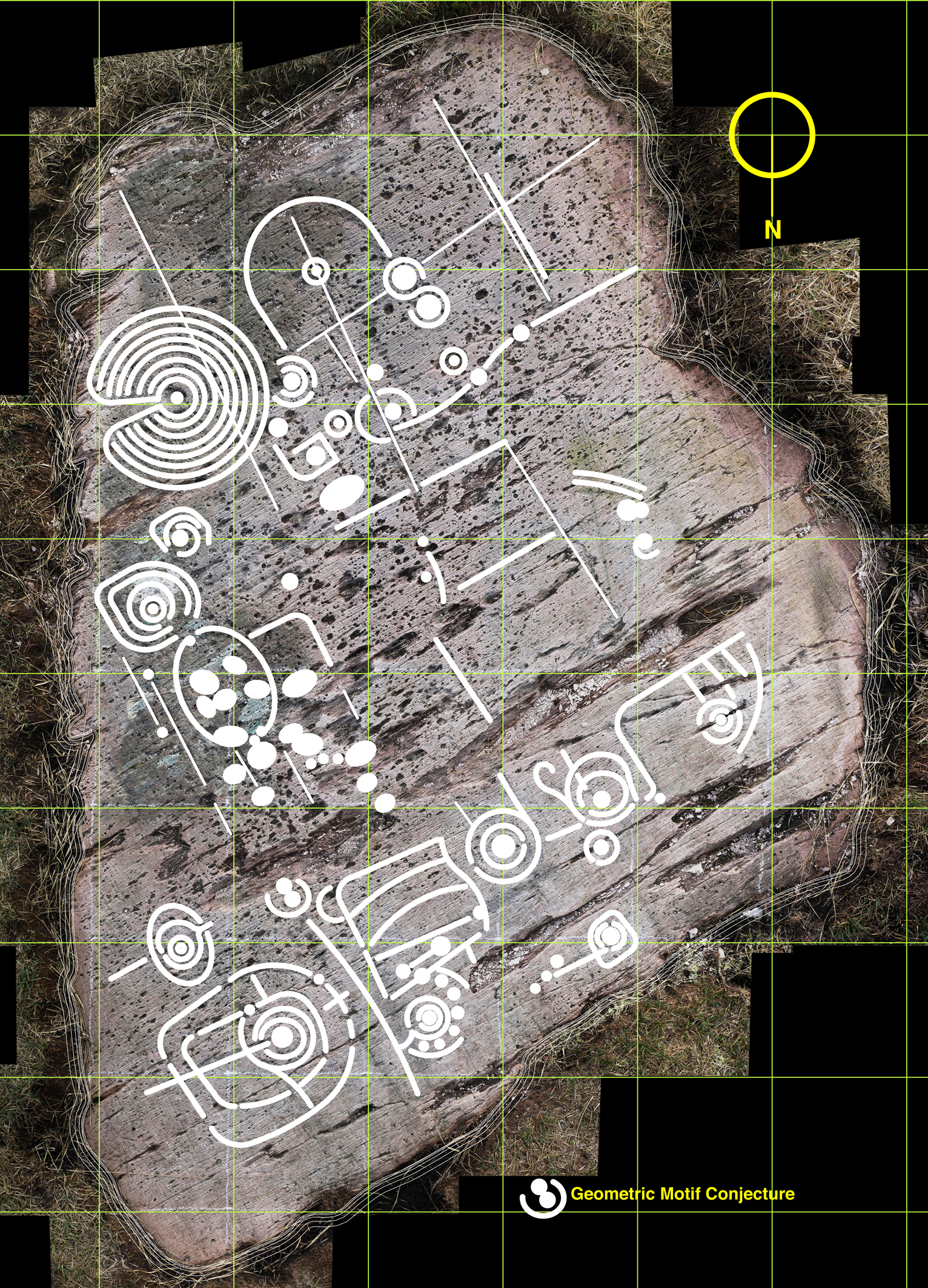
But this dilemma has led me to consider a further layer: intentions. I know this requires a leap of imagination and will seem bizarre – if not anathema – to trained academics, but when I am finely tracing some of the images I find myself asking what the carver originally set out to do in each individual case. So many of the marks are nearly geometric – concentric circles and parallel lines for example – but just don’t make it. Obviously there are limitations in the carving technique and you can’t rub out mistakes. Also it is interesting that some of the motifs seem to relate to natural striations and fissures – which is why I have shown the most prominent of these on separate layers. So here I am daring to have a ‘top’ layer which shows my interpretation of what the Rock Artist might have set out to do if he or she didn’t have the limitations of crud(ish) tools and materials. Please ignore this layer if you are not whimsically inclined – or a romantic. I am incurably romantic, and always still waiting for that moment when I am pensively standing on the rock and will be startled by the appearance beside me of a stray artist carver from 5,000 years ago. Miraculously we will be able to communicate – and, after that encounter, I will be able to provide the answer to the question that is always asked by voyeurs of prehistoric Rock Art: what does it all mean?

Whimsy - a conjectural geometric redrawing of the motifs at Derreennaclogh

Whimsy – a conjectural geometric redrawing of the motifs at Derreennaclogh

Old Stones

A classic piece of Rock Art - on display in Dublin's National Museum

A classic piece of Rock Art – on display in Dublin’s National Museum

As we enter October, we begin to look towards the dark part of our year – and to think of the Cailleach who, in these western parts of Munster, is known as The Hag of Beara: in early tales she is pictured as a prolific figure responsible for shaping the landscape by carrying huge stones in her apron and dropping them to form hills and outcrops, as well as ancient standing stones, circles and alignments. She is also seen wielding a great hammer with which she sculpts and refines her geological creations. She has had seven periods of youth, one after another, so that every man who lived with her came to die of old age. Her grandsons and great grandsons are so many that they make up entire tribes and races. She falls asleep on Bealtaine (May 1st) and wakes again on Samhain (November 1st) – we will be looking forward to the storms which will herald her coming. Until then she rests on a hillside overlooking Coulagh Bay, beyond Allihies on the remote Beara Peninsula, where her rocky incarnation depicts her as both a young maiden and an old crone.

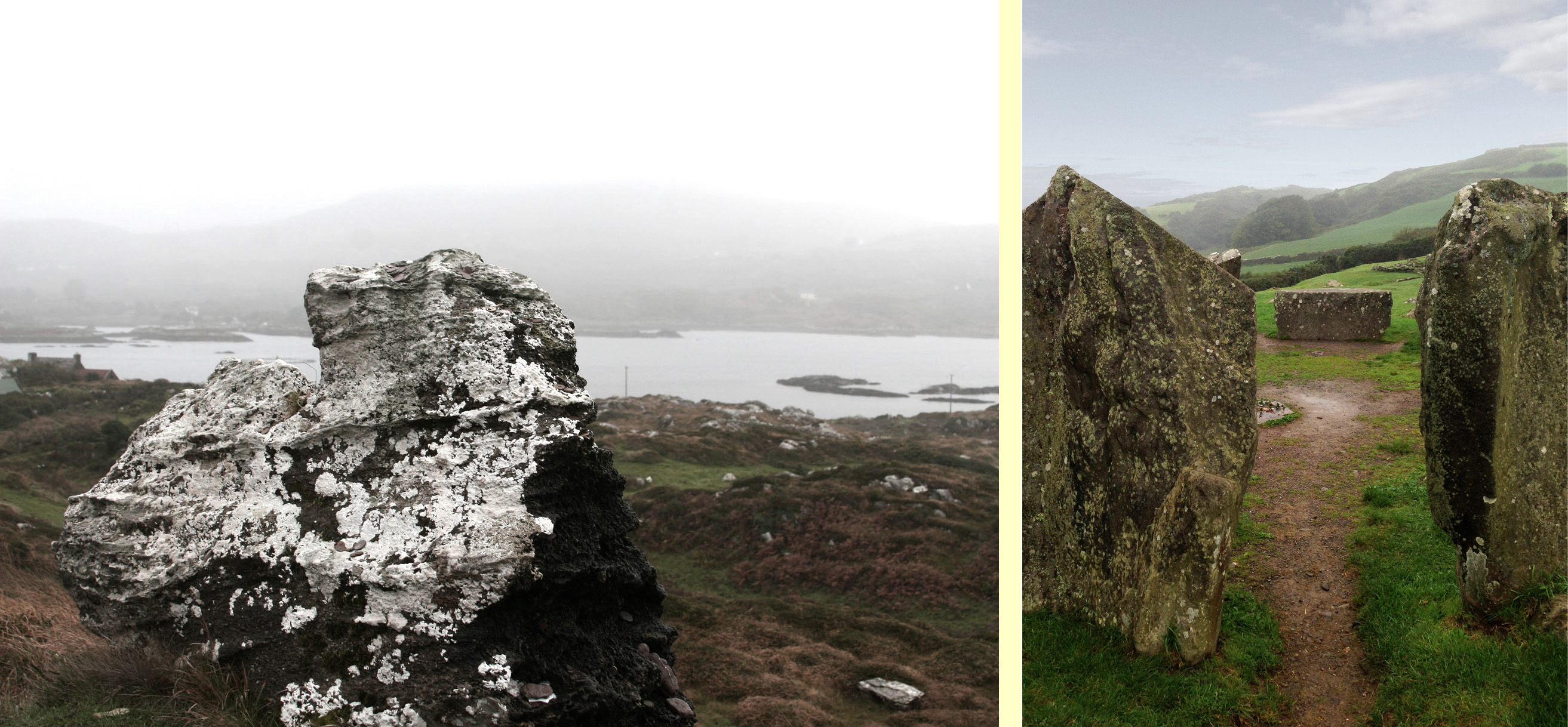
Monuments in the mist: The Hag of Beara and Drombeg Circle

Monuments in the mist: The Hag of Beara and Drombeg Circle

Ireland is stuck in a stream of warm air coming up from the tropics at the moment: this makes temperatures two or three degrees higher than the norm for early autumn, but also causes a damp landscape shrouded in fog: we have missed our view of the Fastnet for several days.

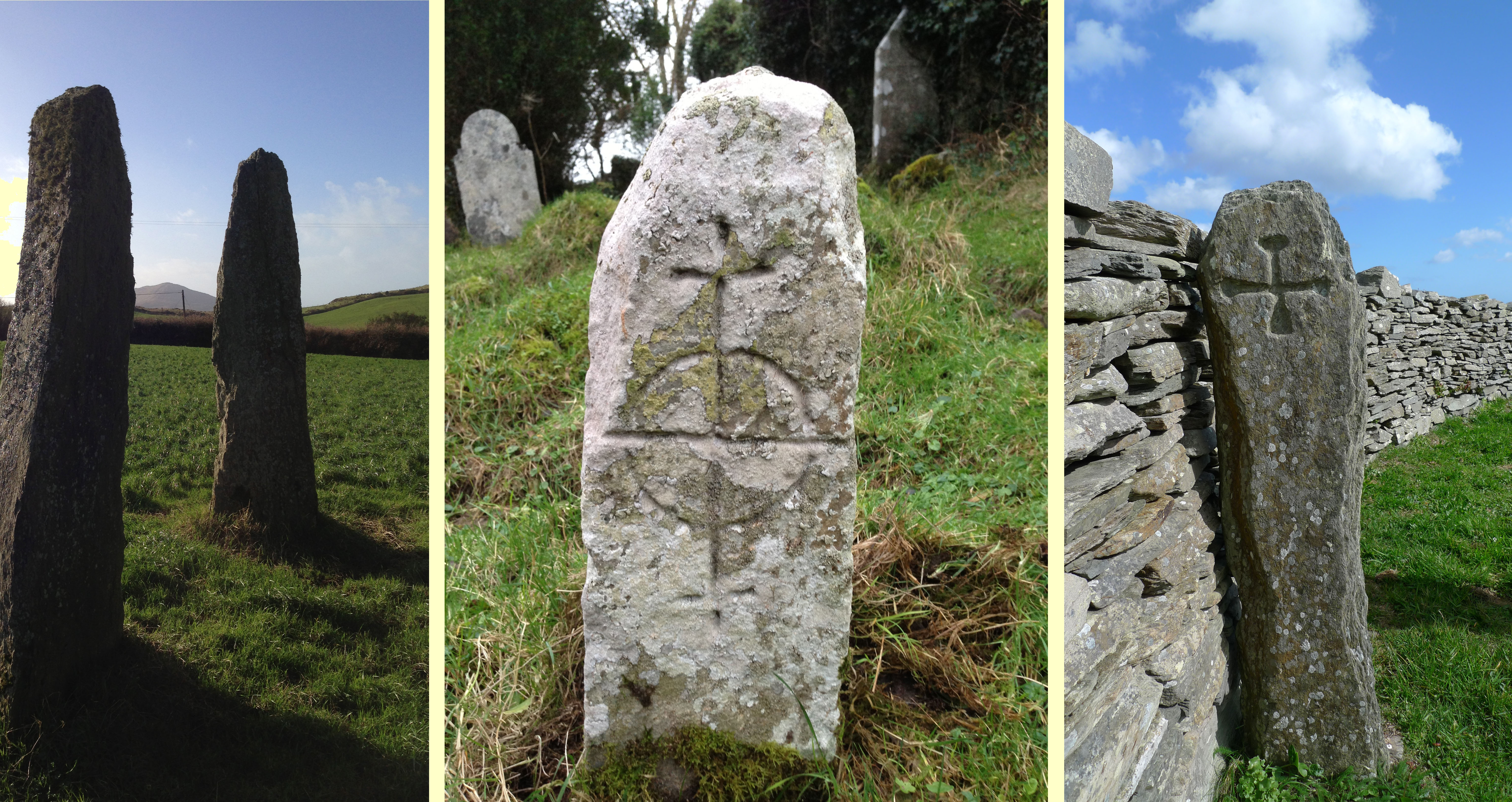
Standing stones

Some West Cork standing stones

The weather hasn’t hindered our exploration of Ireland’s old stones – the terrain created by the Hag. Yesterday we went to Drombeg Circle: a popular site for tourists. Many visitors will fail to notice the rock art carved on the recumbent stone that points out this megalithic monument’s alignment with the winter solstice. At the foot of another stone we found some enigmatic markings which I readily interpreted as a dancing Hare.

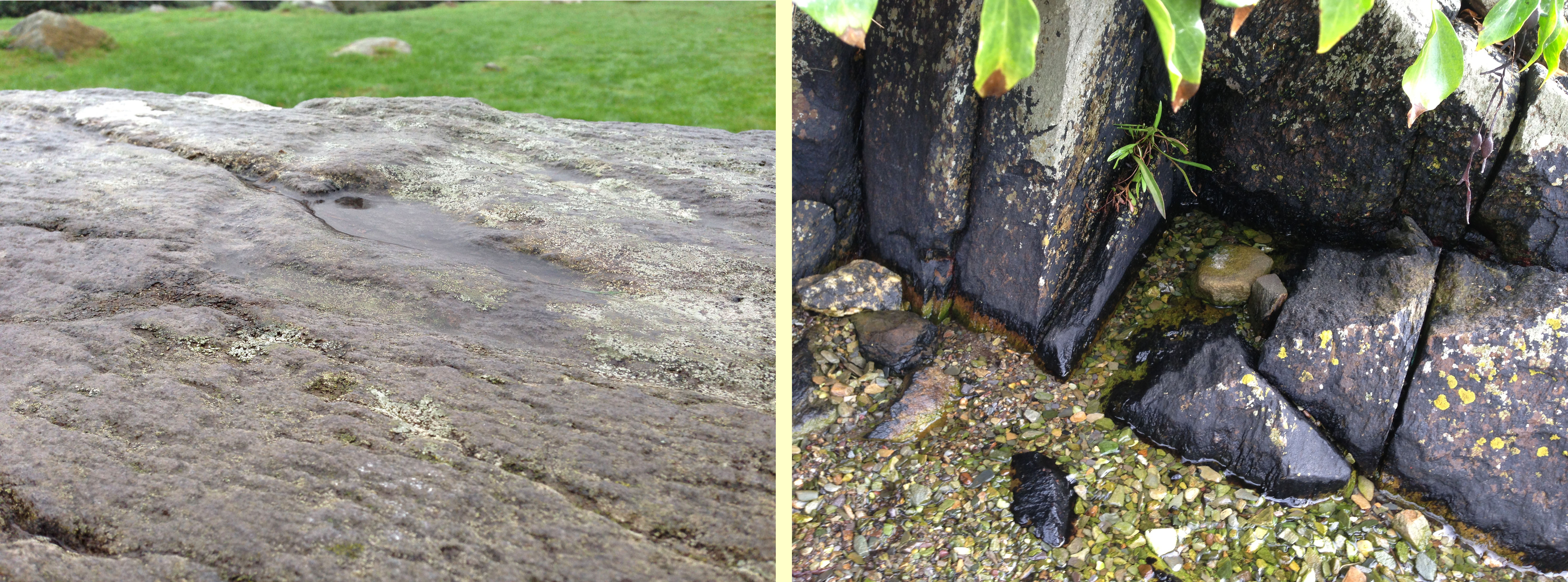
Drombeg Rock Art - and a mysterious Holy Well in Rossbrin Cove

Drombeg rock art – and a mysterious holy well in Rossbrin Cove

Bishops Luck - a megalithic close by Nead an Iolair: according to local legend, a

Bishop’s Luck – a megalith close by Nead an Iolair: according to local legend, a bishop is buried under this!

Ireland’s history is written in stone: the natural landscape; megalithic monuments; buildings – cottages, castles, farms, churches, lighthouses; every townland is rich in examples. Building material, track surfacing, grave marker and artists’ canvas (perhaps): stone has been a resource to aid human occupation for thousands of years.

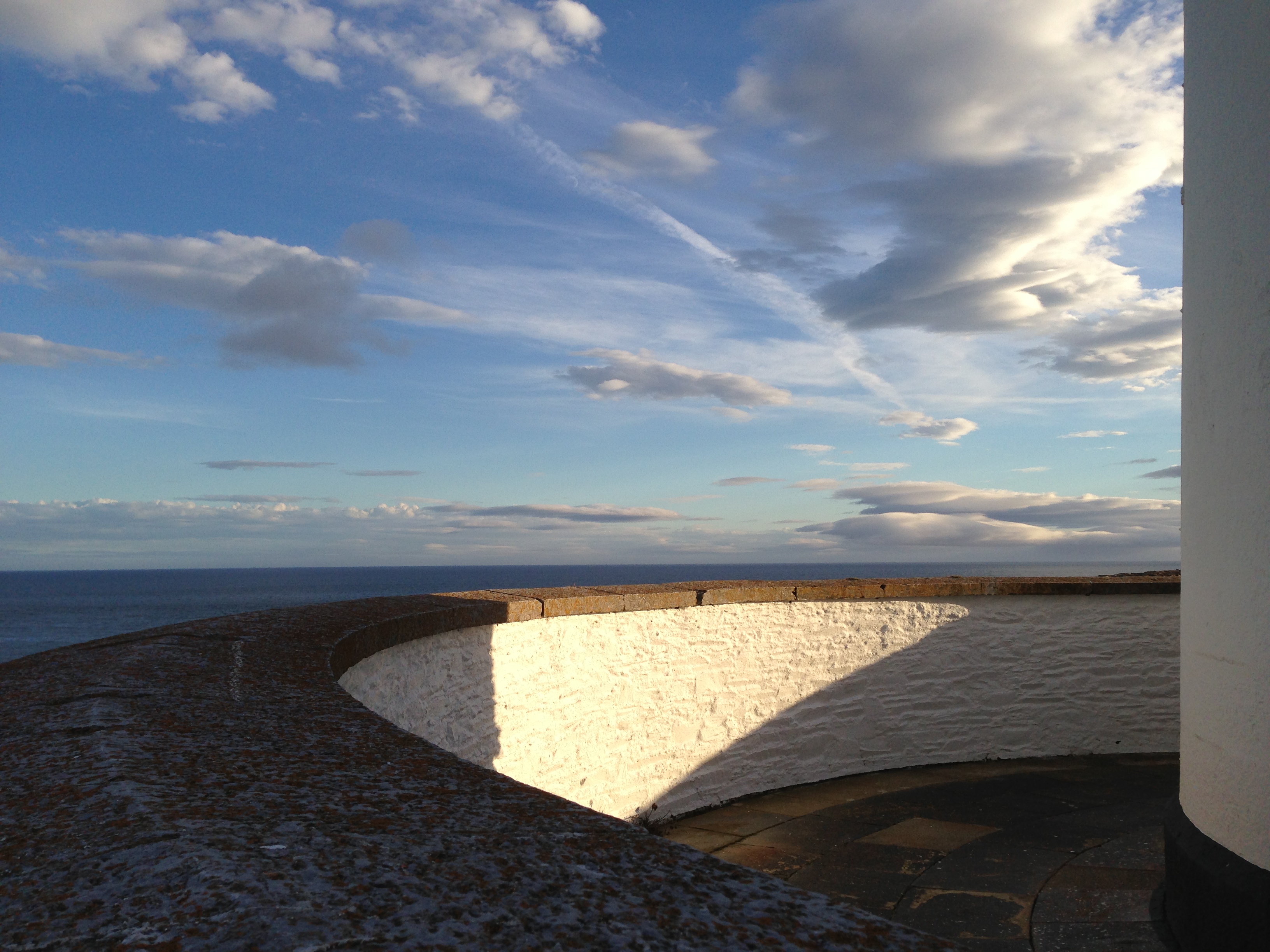
Stone in context: Galley Head Lighthouse

Stone in context: Galley Head Lighthouse

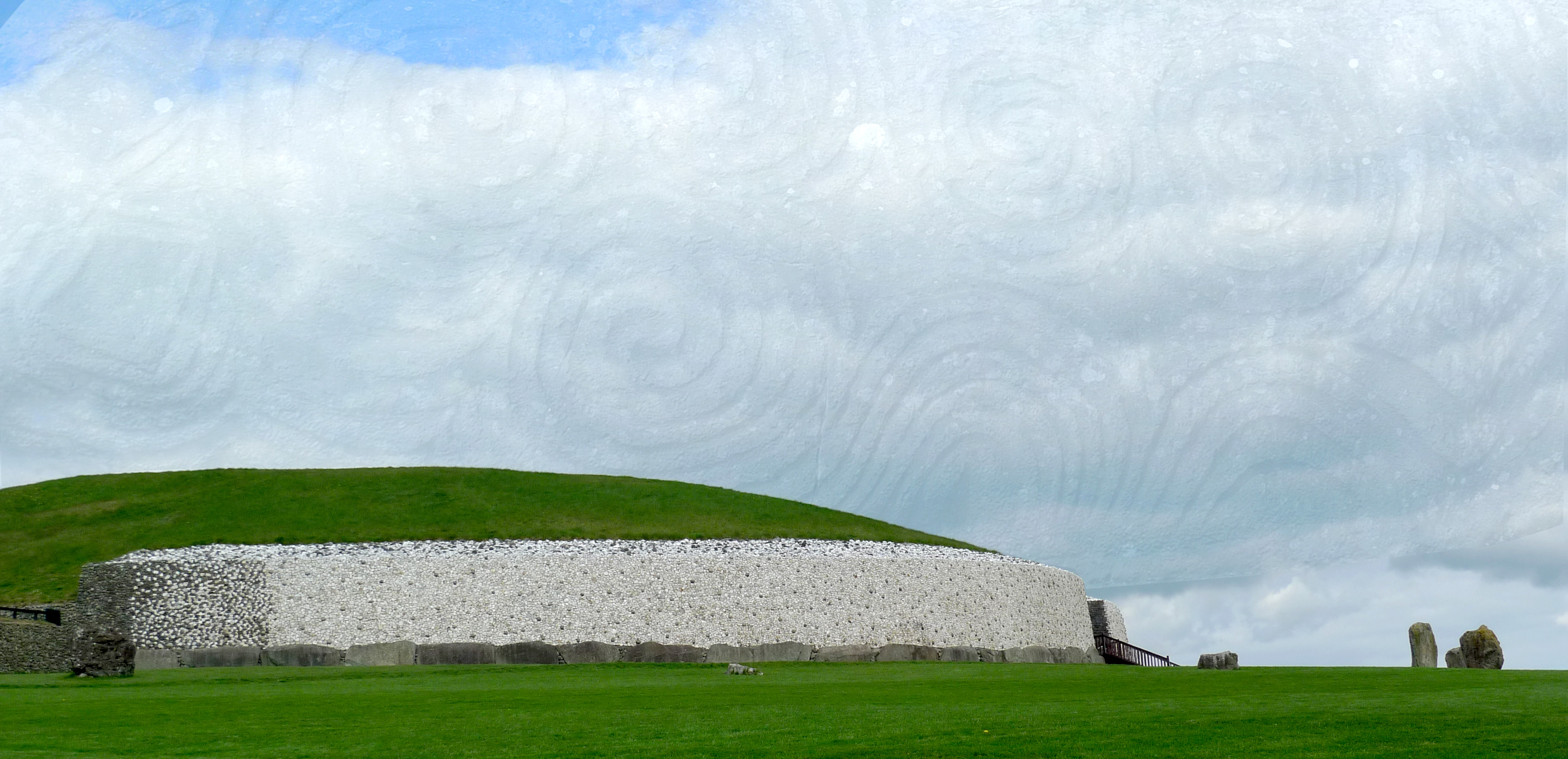
The ultimate stone monument - Newgrange Passage Grave, County Meath - the spectacular quartz facing is a conjectural reconstruction

The ultimate Neolithic stone monument – Newgrange Passage Grave, County Meath – the spectacular quartz facing is a conjectural reconstruction

At Sea Level

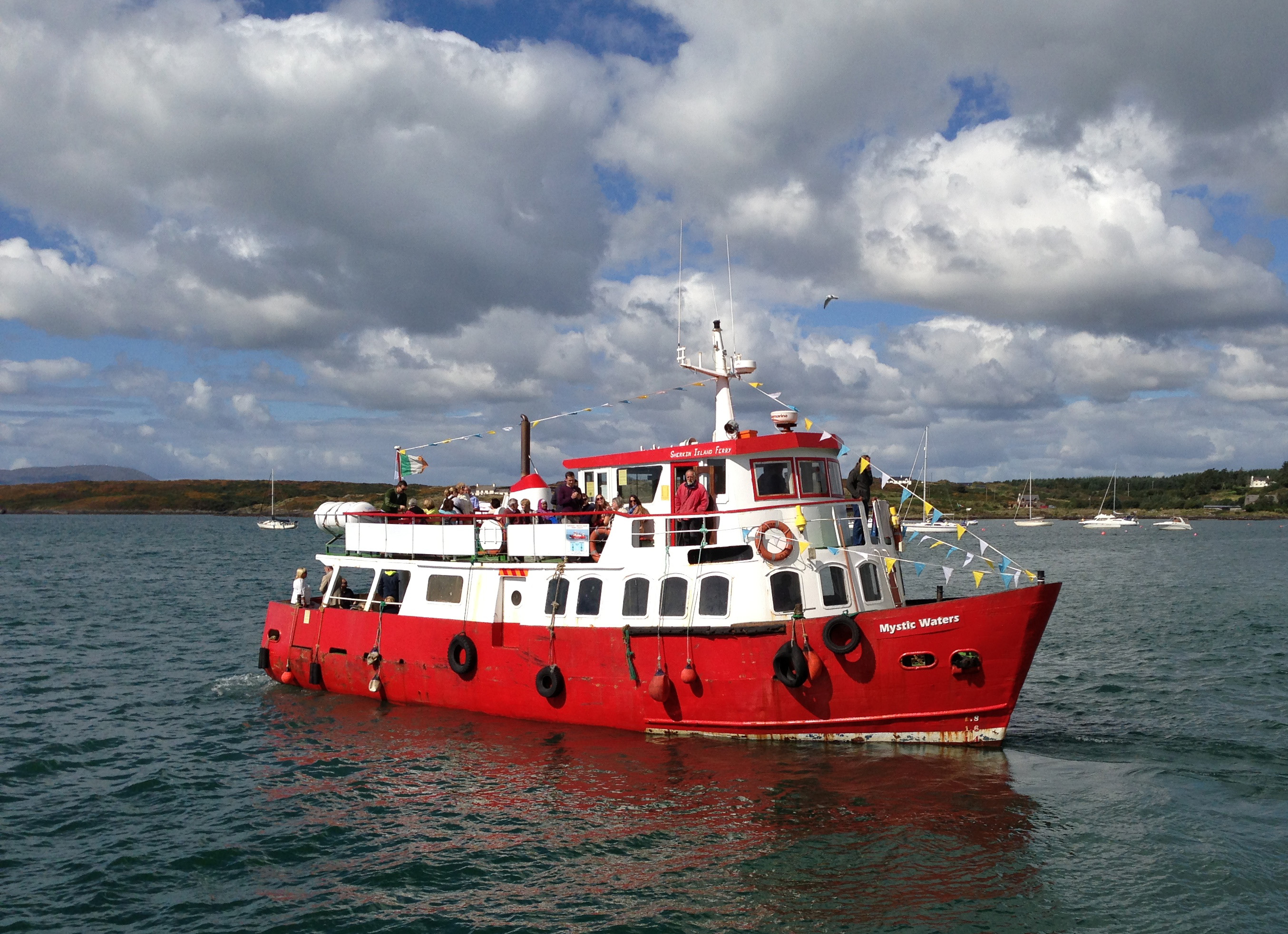
mysticwaters

THE SUMMER sun is falling soft on Carbery’s hundred isles,

The summer sun is gleaming still through Gabriel’s rough defiles;

Old Innisherkin’s crumbled fane looks like a moulting bird,

And in a calm and sleepy swell the ocean tide is heard…*

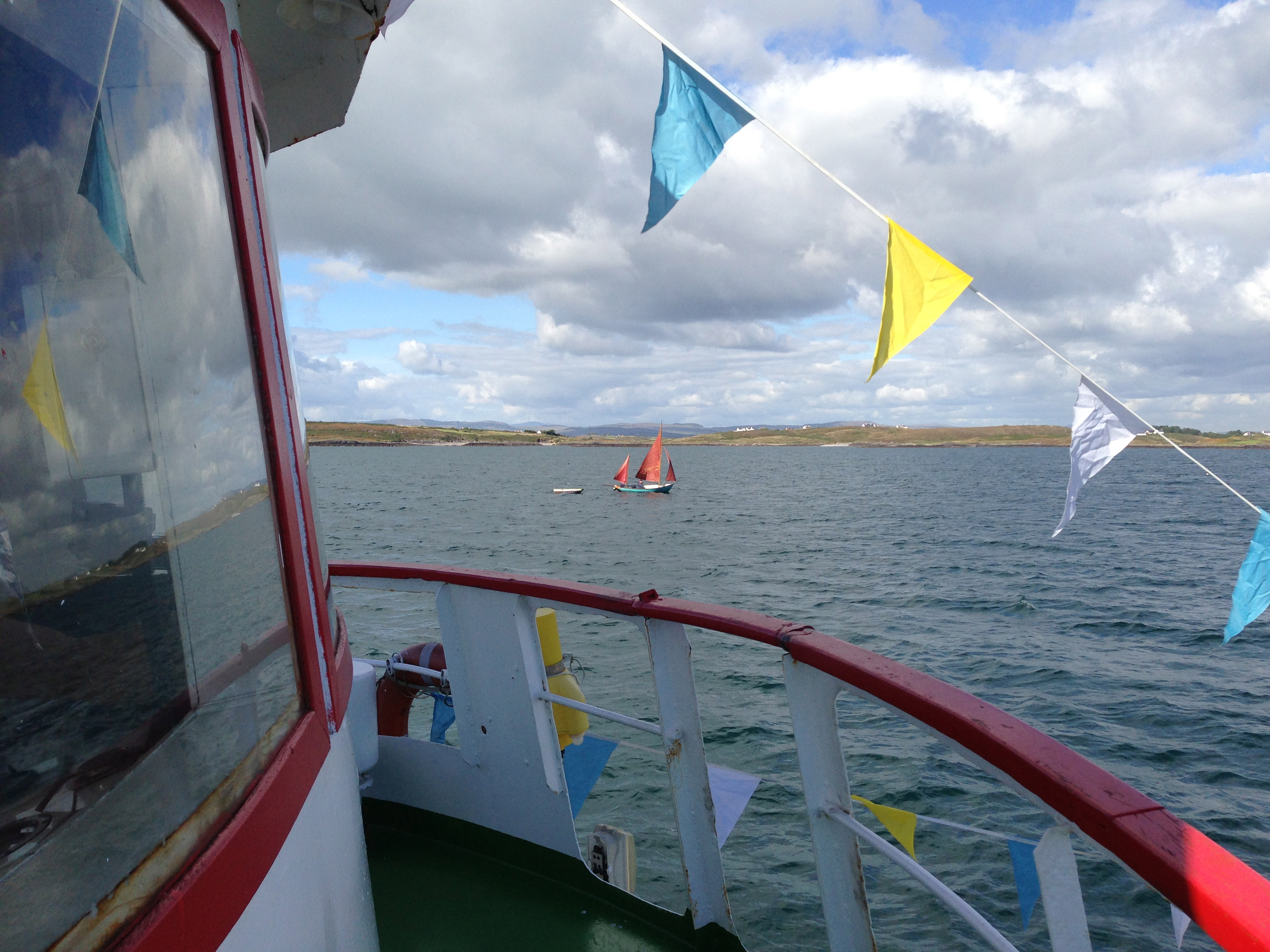
The little red boat that spends most of its days plying the ten minute crossing between the mainland and Sherkin island is occasionally let off its leash to go further afield and explore the Islands of Roaringwater Bay – ‘Carbery’s Hundred Isles’. We signed up for yesterday’s voyage: every day we look down over these waters from our nest up on the hill, and we welcomed the opportunity to explore our view from within it. This event was organised as part of the Taste of West Cork Food Festival, and we had the bonus of enjoying trays of good food and drink as we savoured the scenery.

carbery isles

The late summer sun was certainly ‘falling soft’ as Mystic Waters pulled away from Baltimore. Perhaps it was the last of the summer sun as our view from Nead an Iolair today has gone! There’s not one island to be seen through the driving rain, and the Atlantic storm is sending our weather-vane spinning…
aboard

Some of the ‘Hundred Isles’ are little more than perches for gulls and cormorants, but a few are still inhabited – Clear, Sherkin, Hare and Long Island – while ruined evidence remains to show that many more have once supported small farmsteads – The Skeams, The Carthys, Calf Islands and Castle. Horse Island is the residence of one family – with plans to establish a distillery there.

A traditional Hare island lobster boat - sailing past Hare Island

A traditional Hare Island lobster boat – sailing past Hare Island

Middle Calf

Middle Calf

capeclearstone3We didn’t land on any of the islands yesterday: we hope to visit some in the future. My first goal is the Middle Calf – a Hare Haven! But we do need to catch up on some Rock Art. There are marked stones on Horse Island while Clear (an Irish speaking community – part of the Gealtacht) supports a Neolithic chambered tomb which once contained a remarkable artefact: a carved stone with spirals, lines and zigzags, much more akin to the decorated boulders of the Boyne Valley Culture than the cups and rings of West Cork and Kerry. The stone (now – sadly – removed to the Cork City Museum) was part of a passage grave sited on the highest point of the island. Like the huge Newgrange monuments, the passage here is aligned on a solstice sunrise. As we look out through the mist today it’s a sobering thought that a sophisticated, scientifically aware society resided on these remote islands over 5,000 years ago.

* This poem was written by Thomas Osbourne Davis (1814 – 1845) and records the Sack of Baltimore of 1631 when Barbary pirates raided the town and took over 100 residents into slavery.

Relaunching

Image

Nead an Iolair
We have returned to West Cork, to the house we bought overlooking Roaringwater Bay, and this time it’s for keeps. Our first month has been a whirlwind of unpacking, sorting, making the house our own, meeting neighbours and friends from our winter stay, and taking in everything West Cork has to offer in the summer. Within a few days of arriving we had been to markets, a play, and several concerts; spent a day at an agricultural fair and another on a beach; attended gallery openings and a classic boat gathering; participated once again in the Friday night music sessions in Ballydehob; hosted dinner parties and been hosted in return; in short – settled back into the marvellous rhythm of West Cork life, but this time as permanent residents.

 Cruinniú na mBád: Ballydehob boat gathering

Cruinniú na mBád: Ballydehob boat gathering

We will be writing in Roaringwater Journal about aspects of life and why we love it here. An enormous part of it all, of course, is the people we meet – their open welcome and friendly acceptance has made us feel at home. But it’s more than that: people here are still close to the land, fiercely proud of this area, keepers of the lore and the history and uniquely expressive. Everyone loves to talk, so you’d better not be in a hurry. Today, for example…

After a late night at the session (made exceptional by the addition of a group of French musicians) we had slept in a bit and decided to head into Skibbereen to breakfast and the market. But even though it’s Saturday here comes Ger, the electrician, with the replacement bathroom fan. Abandoning the plan, we made breakfast for all of us and Ger, having installed the fan, regaled us with stories of the townland he comes from, a mile down the road. We told him we had tramped up and down the roads there, the other day, looking for a piece of rock art, a large boulder with cupmarks on the top, and couldn’t find it. He grinned, “’Tis in my yard,” he said. “The legend is that Finn McCool threw it down from Mount Gabriel.” We made a date to go next week to record it and moved on to discussing the theatre. Ger is an actor and knowledgeable dramatist and, over the eggs and toast, he gave us an insightful review of the recent “Fit Up Theatre” productions (excellent!) we had been going to.

West Cork Arts Centre

West Cork Arts Centre

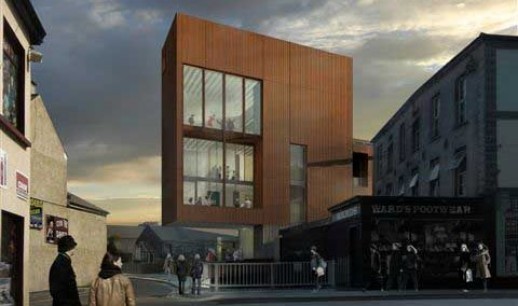
Then it was off to Skibb, to see if Richard, the cable guy, could come back and finish installing the wireless network in the house. In the store, the manager, who turned out to be Richard’s father, explained to us that Richard was on a hurling team that had just won the County finals for their division and needed to celebrate. With a twinkle in his eye, he suggested that we not look out for him before Wednesday. And while we were waiting, he added, why didn’t we take in this great presentation on Tuesday night, for which he would be delighted to sell us tickets. Half an hour later, we left the store, having been brought up to date on the plans for a new Arts Centre and been told the history of his name, family and business.

First Visitors

First Visitors

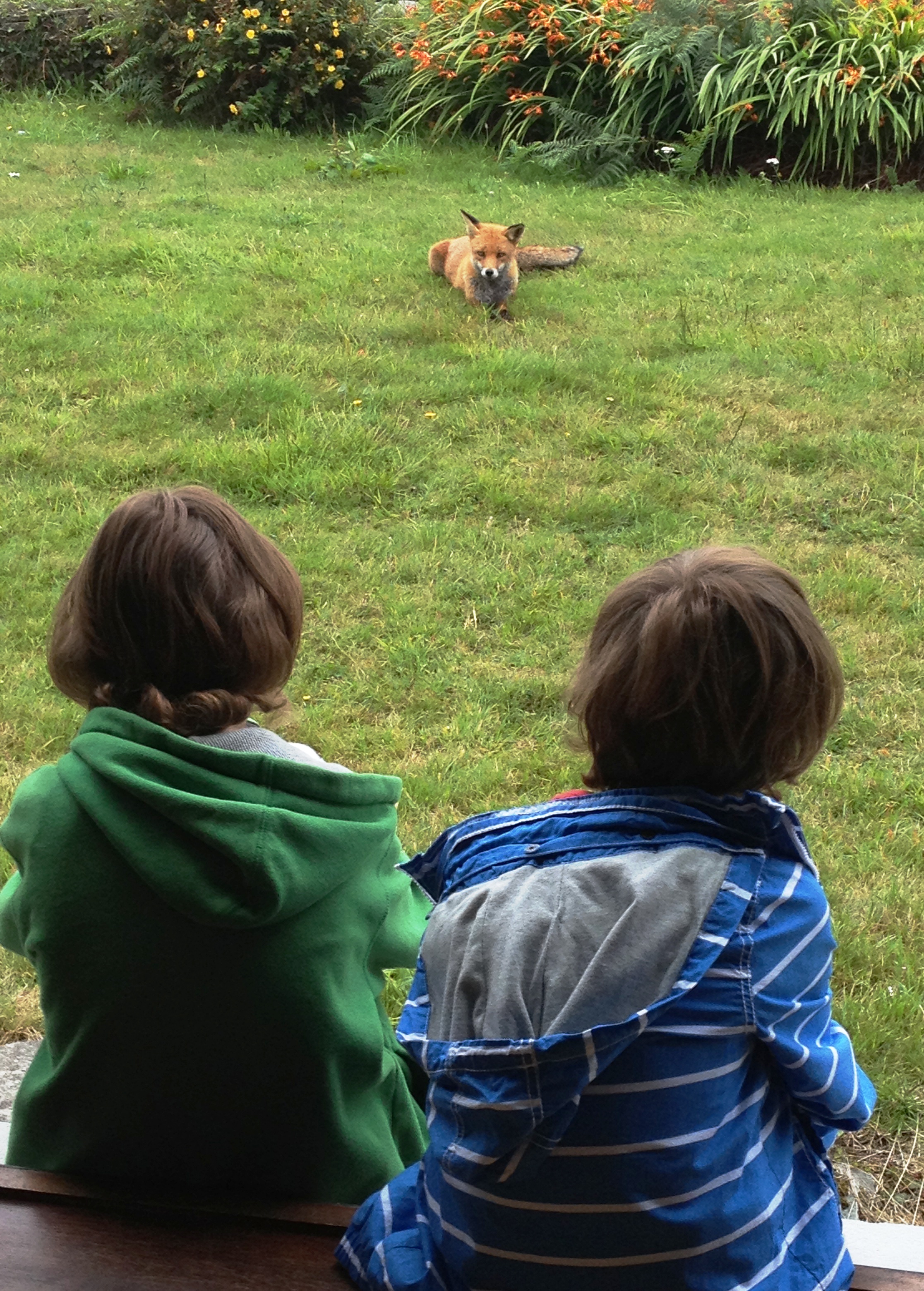
And so go our days. The summer is winding down and the villages will soon lose the tourist-mecca bustle. Already many of the houses in our little cove have the blinds down as their owners return to the city. There’s a slight hint of autumn in the evenings. Our walks are slowed by the temptations offered by the blackberry brambles, our mornings enlivened by visits from Ferdia, our friendly fox.

From Canada and from England, from cities, from careers and responsibilities, from vastly different lives, we have come together to this extraordinary place.

And now here we are – at home in West Cork.

A Place in the Heart

clarke

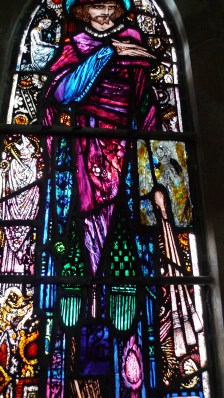
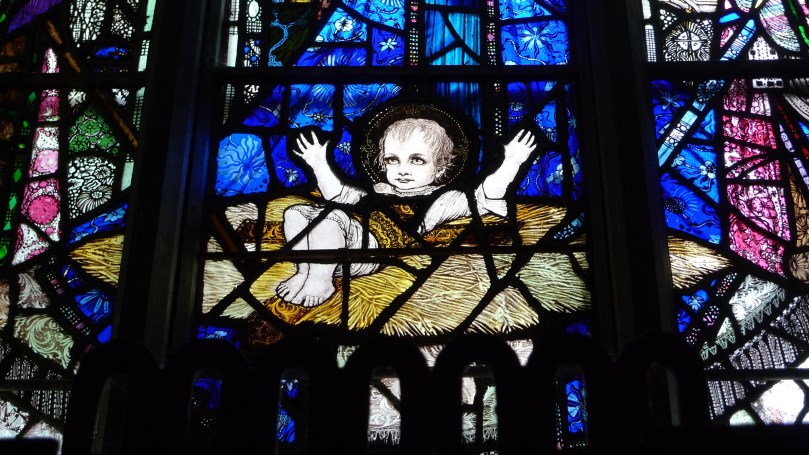
A church window by Harry Clarke: Ireland’s – and perhaps the world’s – foremost glass artist

At the ending of the year we are halfway through our winter adventures in West Cork. Today is a turning point: a transition. Traditionally, crossing over boundaries is rife with custom and superstition. Make sure you let your fire go out tonight, and kindle a new one in the hearth in the morning to ensure good health and good fortune. The Celts noted the importance of boundaries – they divided the year up into four parts: Imbolc, Beltaine, Lammas and Samhain. At each turning point there was a festival, usually involving fire. It’s interesting that our New Year is marked by fire – or fireworks – in many cultures.

ballin

clarke2

St Luke – another Harry Clarke window, in the church at Castletownshend

At this moment we are right in the middle of the Celtic dark time: Samhain – pronounced ‘Sow (female pig) – in’. This will end on February 1st, when Imbolc begins. Imbolc is ‘the beginning of the light’ – Candlemas in the church calendar. Certainly, in early February, we see the first green shoots of the Spring appearing.

castledesmond

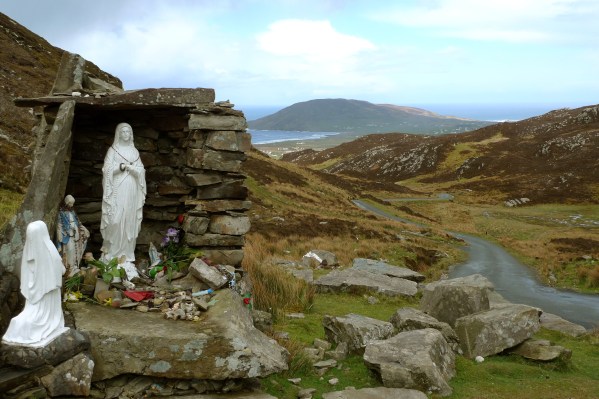
statuestat

This post is a bit of a reminiscence. A summing up of impressions and emotions through pictures from the last three months. The common theme is colour – whether in landscape or in architecture – because we have found this ‘green’ island to be full of so many colours. Hopefully a few of the photos capture something more, something deeper:  an inherent respect in this land for history, culture and holy places.

scene

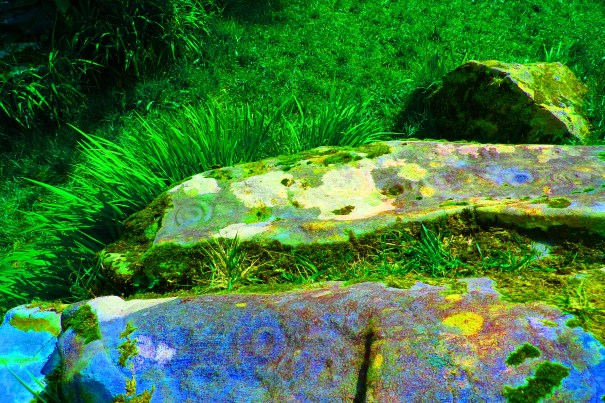
Rock Art - was it once painted?

Rock Art – was it once painted?

mussels

Mussel beds on Roaringwater Bay

HAPPY NEW YEAR from Ard Glas, on the shores of Roaringwater Bay!