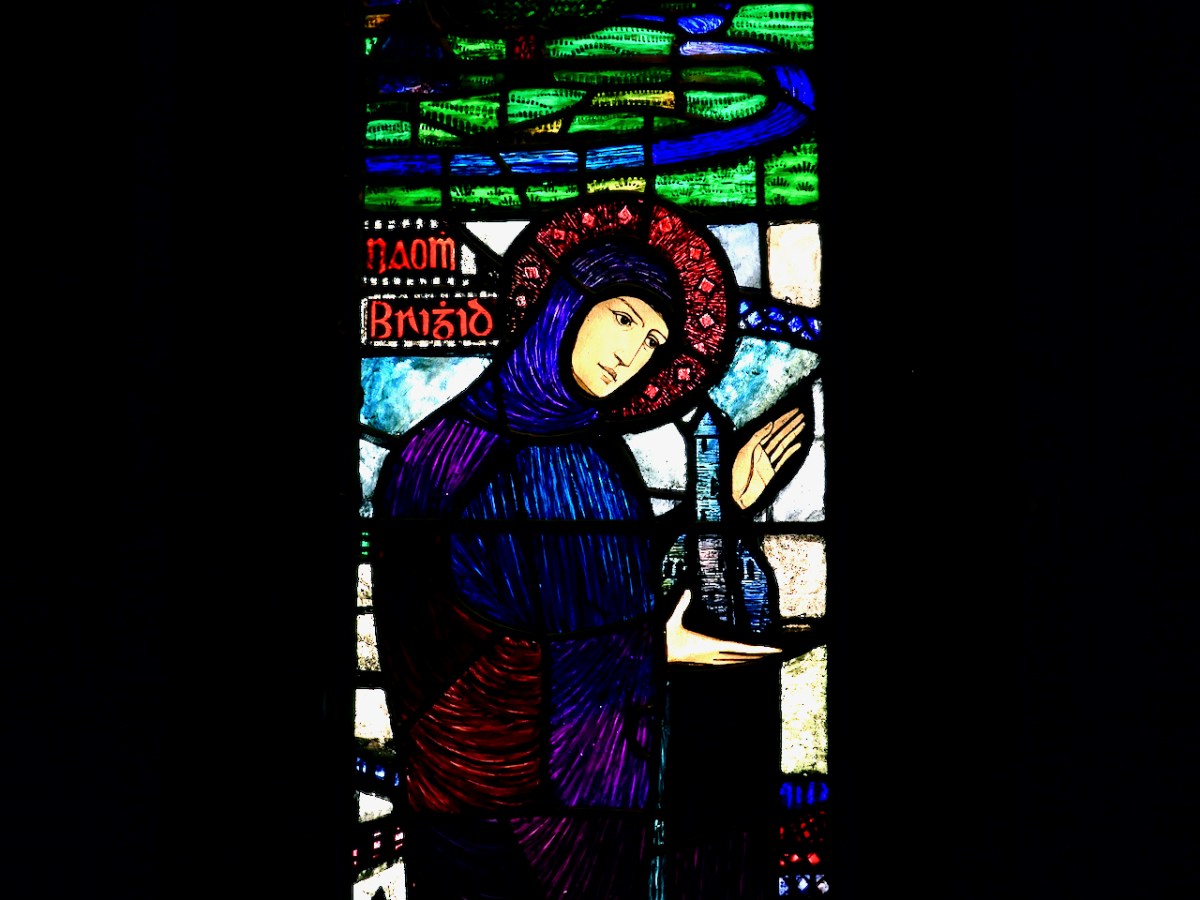
Brigid 1500: Mary of the Gael

St Brigid, according to some accounts, died in 524. Therefore, we are celebrating this year the 1500th anniversary of her death. Once again, I have gone back to primary sources for incidents from her life and am illustrating them with stained glass images. This year I have added as a source the famous Canon O’Hanlon’s Life, from his Lives of the Irish Saints Series, Vol 2, a work of overwhelming erudition.

The Patrick and Brigid window in Meath Hill, by George Walsh. I love that Brigid has precedence over Patrick in this enormous cruciform window

If you haven’t already done so, now is a good time to go back and read my 2022 post, St Brigid: Dove Among Birds, Vine Among Trees, Sun Among Stars and my 2023 post, Brigid: A Bishop in All But Name. In them, I explain what the original sources for the Life of Brigid are. They all contain similar accounts and may be ultimately based on a single source – the Life of St Brigid by St Ultán – and are laid out as a series of miracles that lead us from her birth to her death.
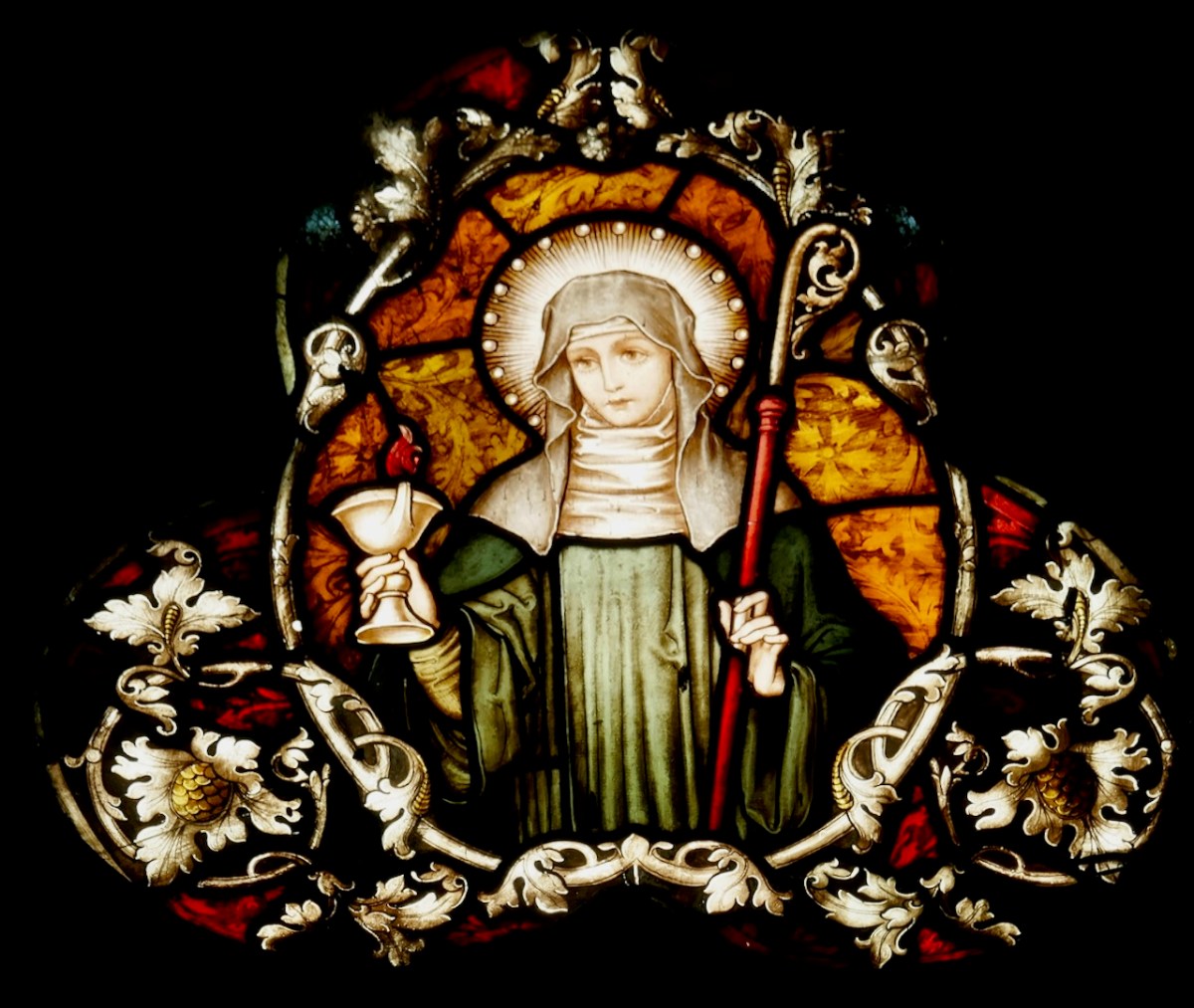
This is a detail from a window in Ballynahown, Co Westmeath, and is probably by Watson of Youghal. I like the clever way the oak leaves are used as frame and background

Many more miracles, legends, myths and stories accreted to her cult over the centuries. A good example of such a story is the one where she makes a cross from rushes – that one is nowhere to be found in the original Lives, but is an integral part of the folklore surrounding her, and therefore almost invariably found in her iconography.

This is a photo by Frank Fullard, used with permission and thanks. It is a simple treatment of St Brigid from Kilmaine, Co Mayo

She is associated with many places and numerous holy wells – just take a look at all the St Brigid’s wells Amanda has documented in Cork and Kerry. But of course it is Kildare that rightly claims her. Kildare (Cill Dara – the Church in the Oak Wood) is where she built her church and established her city. It is the origin of three of the attributes we see in many windows – a church, oak leaves and a lamp. (For the story about the Bishop’s Crozier, see the previous posts.)
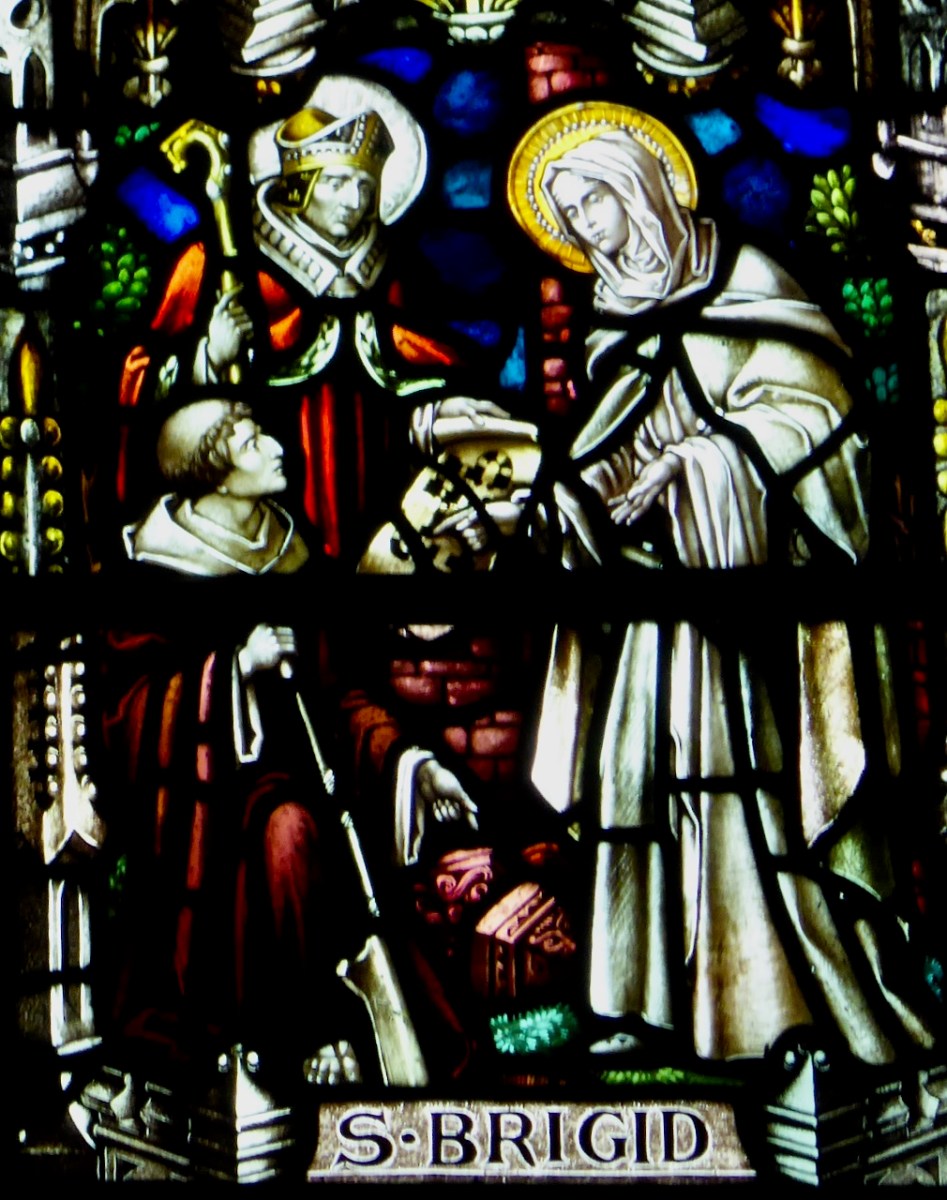
Detail from the Brigid Window in Carrickmacross – she’s consulting with her architects

The Book of Lismore has this story about building the church:

Brigit went to Bishop Mel, that he might come and mark out her city for her. When they came thereafter to the place in which Kildare stands to-day, that was the time that Ailill, son of Dunlang, chanced to be coming, with a hundred horseloads of peeled rods, over the midst of Kildare. Then maidens came from Brigit to ask for some of the rods, and refusal was given to them. The horses were (straightway) struck down under their horseloads to the ground. Then stakes and wattles were taken from them, and they arose not until Ailill had offered the hundred horseloads to Brigit. And therewith was built Saint Brigit’s great house in Kildare, and it is Ailill that fed the wrights and paid them their wages. So Brigit left (as a blessing) that the kingship of Leinster should be till doomsday from Ailill, son of Dunlang.
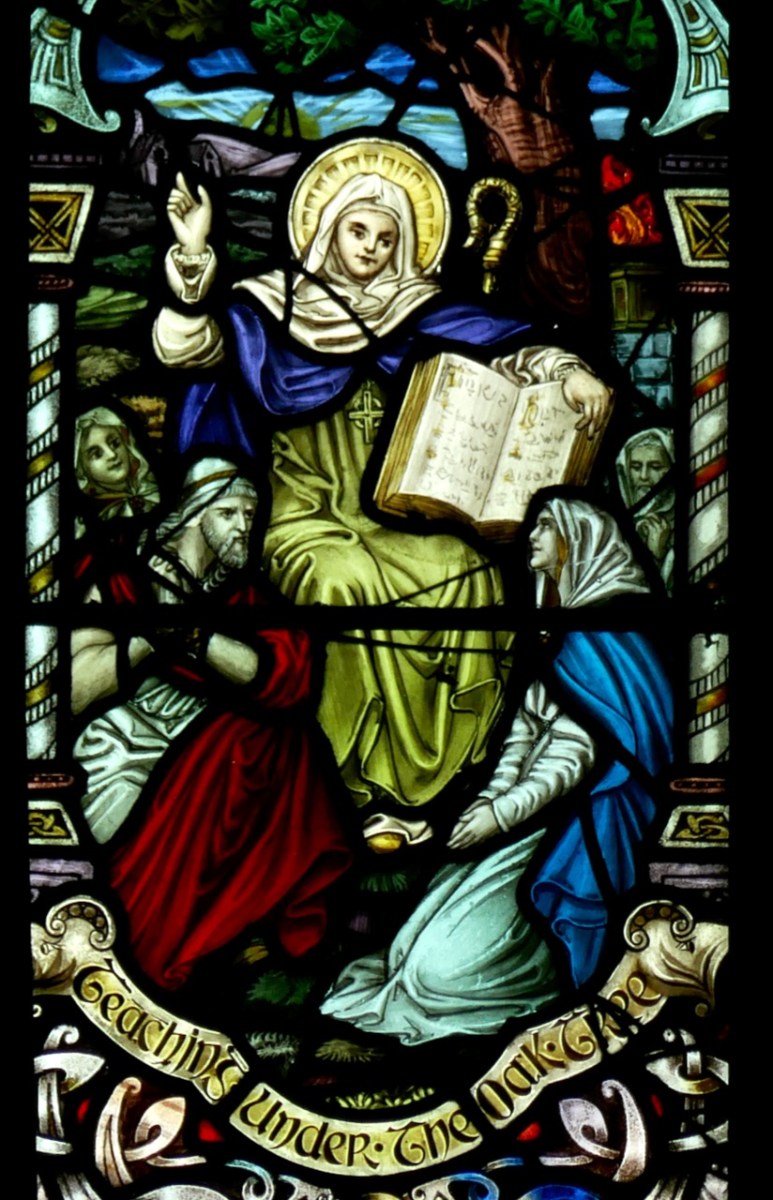
Detail from the Brigid window in Sneem, Co Kerry, by Watson of Youghal

It was a large establishment. O’Hanlon says:

We are informed, that her Rule was followed, for a long time, by the greatest part of those monasteries, belonging to sacred virgins in Ireland; nearly all of these acknowledging our saint as their mother and mistress, and the monastery of Kildare as the headquarters of their Order. Moreover, Cogitosus informs us, in his prologue to her life, that not only did she rule nuns, but also a large community of men, who lived in a separate monastery. This obliged the saint to call to her aid, and from out his solitude, the holy bishop, S. Conlaeth, to be the director and spiritual father of her religious; and, at the same time, to be bishop of the city. The church at Kildare, to suit the necessities of the double monastery and to accommodate the laity, was divided by partitions into three distinct parts. One of these was reserved for the monks; one for the nuns; while a third compartment was intended to suit the requirements of the laity.
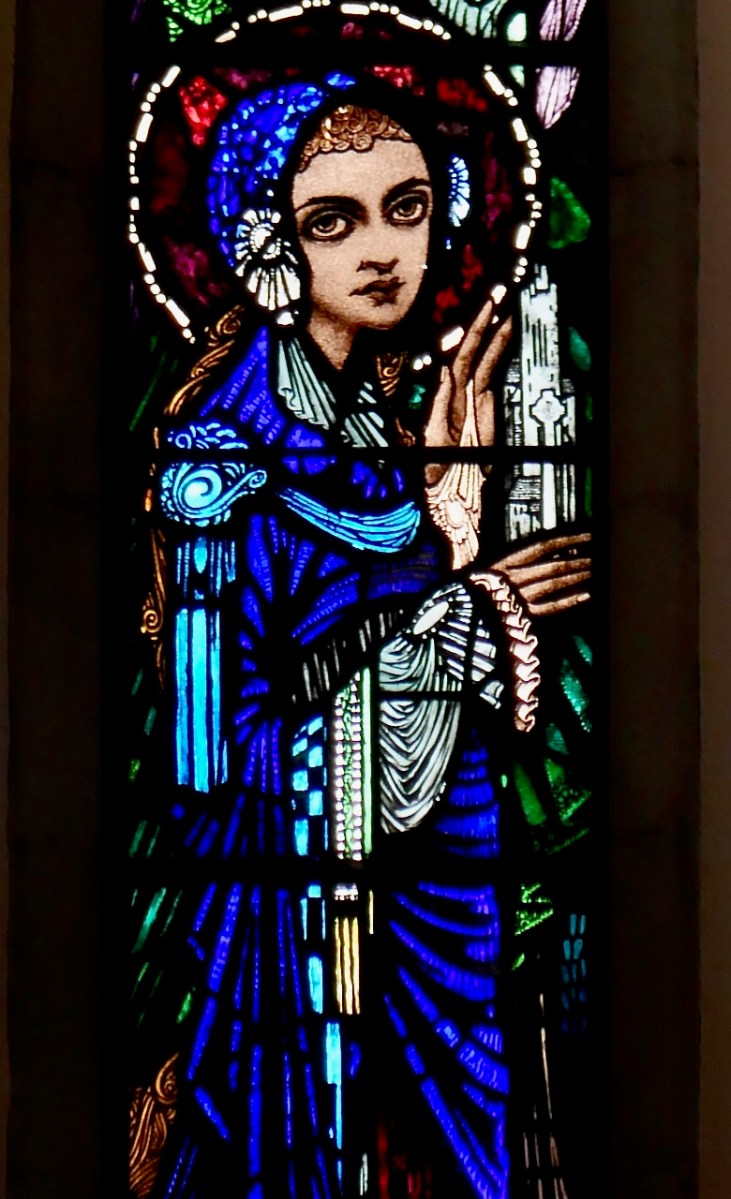
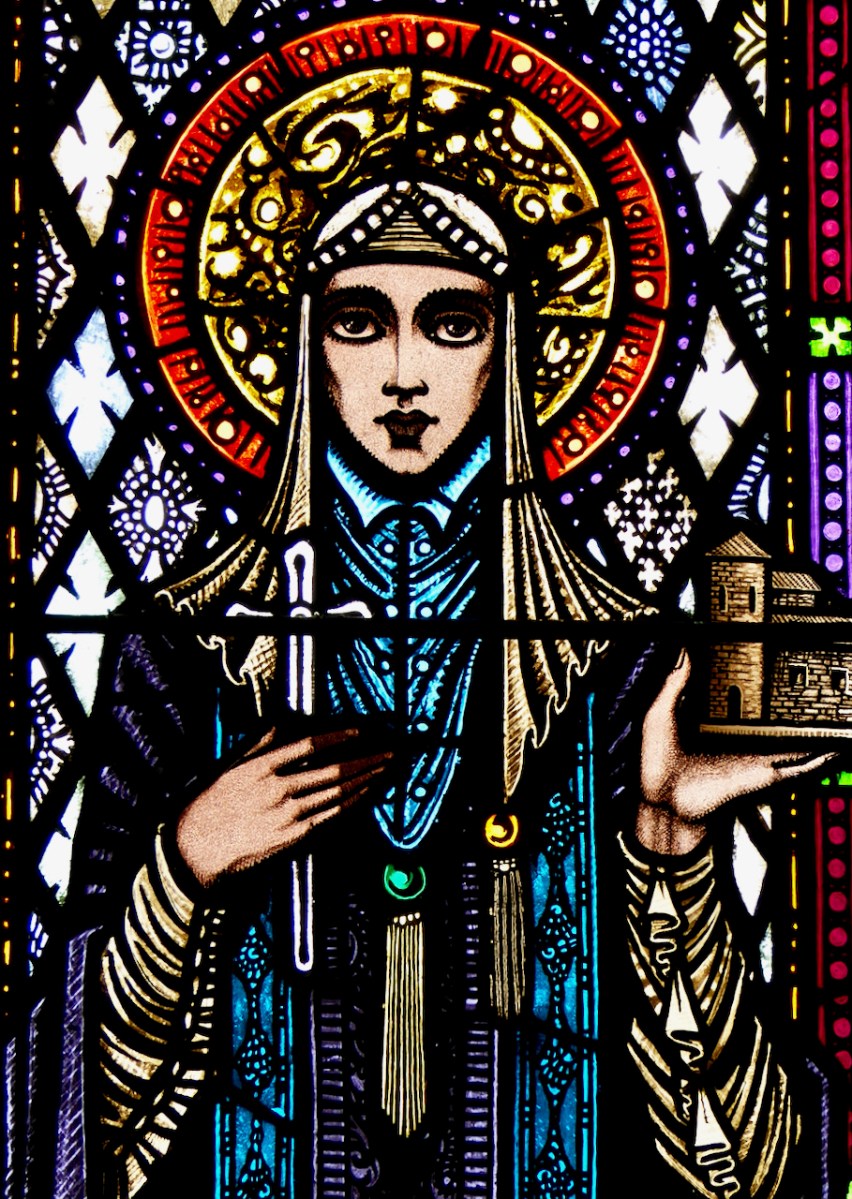
Harry Clarke’s 1924 window in Cloughjordan is of the Ascension with Irish Saints – this is a young St Brigid, holding her church

And what about the lamp? This is interesting, as its first appearance was not in any of the lives but in the writings of the notorious Giraldus Cambrensis, Gerald of Wales. He will get a post of his own in due course, but for the moment, if you are not familiar with him, there’s a delightful sketch of him and his writings about Ireland in the 12th century here.
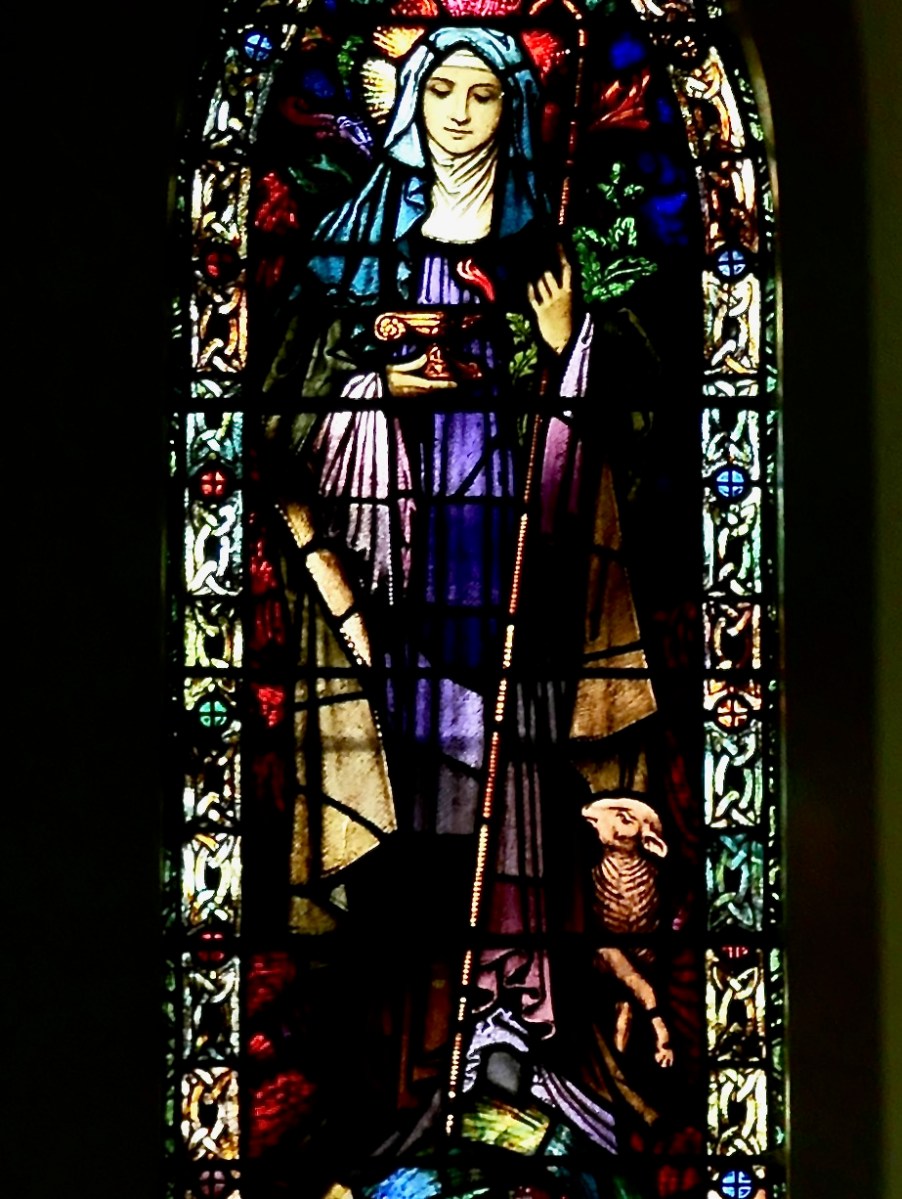
Brigid window in Kilgarvan, Co Kerry, by Earley and Co

Here is his story about the sacred fire, now usually rendered as a lamp, as faithfully related by O’Hanlon:

Speaking of Kildare city, in Leinster, which had become so renowned, owing to its connexion with our glorious abbess, Giraldus Cambrensis says, that foremost, among many miraculous things worthy of record, was St. Brigid’s inextinguishable fire. Not, that this fire itself was incapable of being extinguished, did it obtain any such name, but, because nuns and holy women had so carefully and sedulously supplied fuel to feed its flames, that from St. Brigid’s time to the twelfth century, when he wrote, it remained perpetually burning through a long lapse of years. What was still more remarkable, notwithstanding great heaps of wood, that must have been piled upon it, during such a prolonged interval, the ashes of this fire never increased.
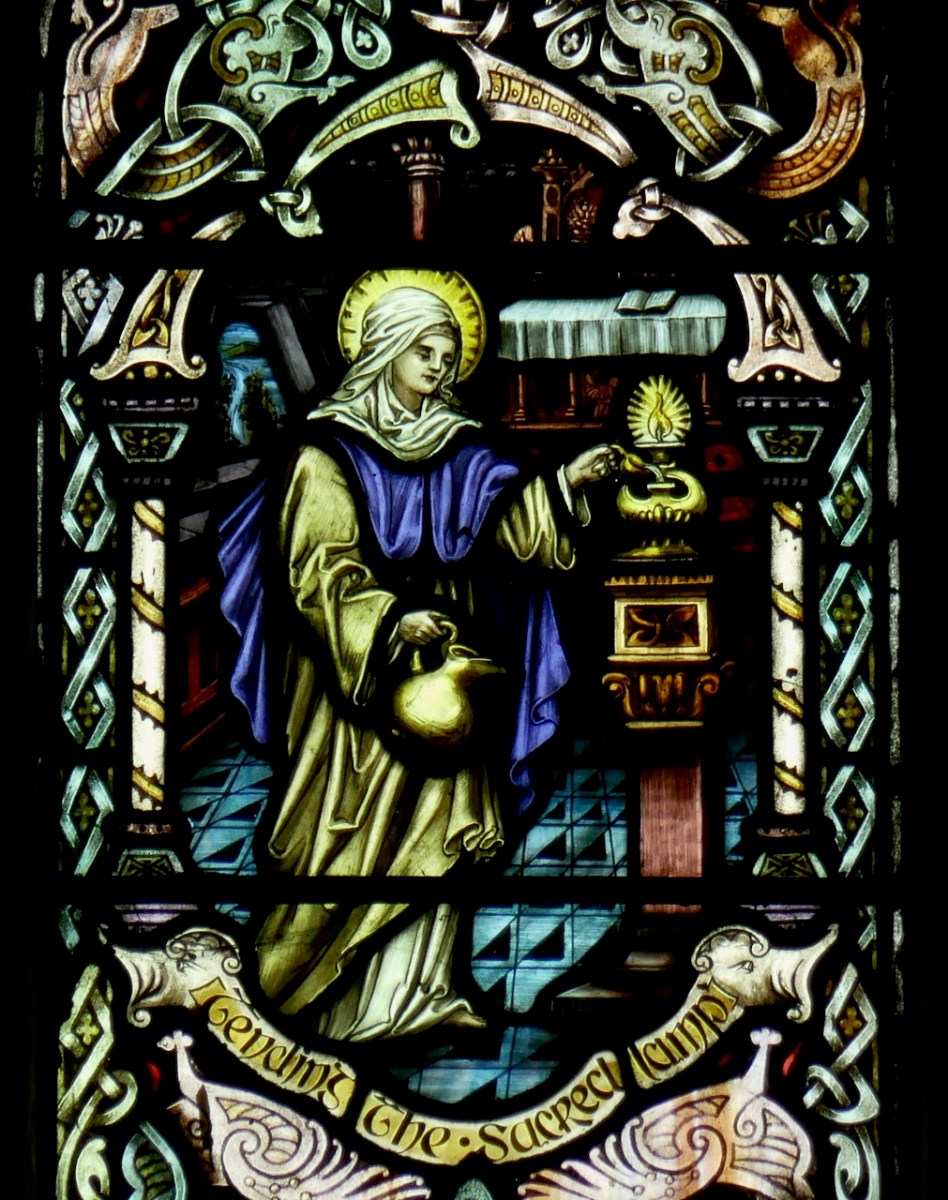
Another detail from the Watson window in Sneem

What is furthermore remarkable, from the time of St. Brigid and after her death until the twelfth century, an even number, including twenty nuns, and the abbess, had remained in Kildare nunnery. Each of these religious, in rotation, nightly watched this inextinguishable fire. On the twentieth night, having placed wood on its embers, the last nun said:” O Brigid, guard thy fires, for this night the duty devolves on thyself.” Then the nun left that pyre, but although the wood might have been all consumed before morning, yet the coals remained alive and inextinguishable. A circular hedge of shrubs or thorns surrounded it, and no male person dare presume to enter within that sacred enclosure, lest he might provoke Divine vengeance, as had been experienced by a certain rash man, who ventured to transgress this ordinance. Women only were allowed to tend that fire. Even these attendants were not permitted to blow it with their breath; but, they used boughs of trees as fans for this purpose.
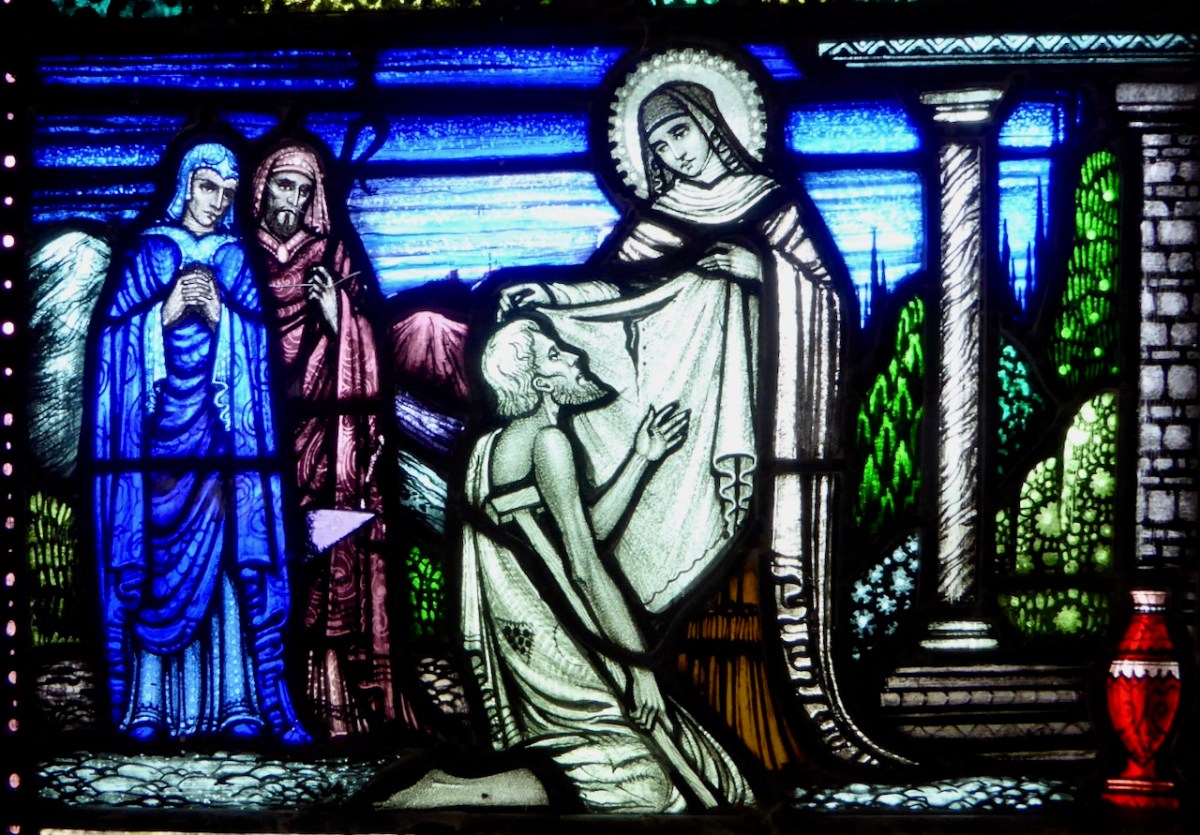
This is the predella from the Brigid window in Moone, by the Harry Clarke Studios (see blow for the main panel)

All of the Lives and O’Hanlon’s account tell of Brigid’s many miracles in providing food and clothing for the poor, in healing sicknesses, in turning the hearts of evildoers to God, in freeing slaves, and in punishing those who are selfish or cruel.
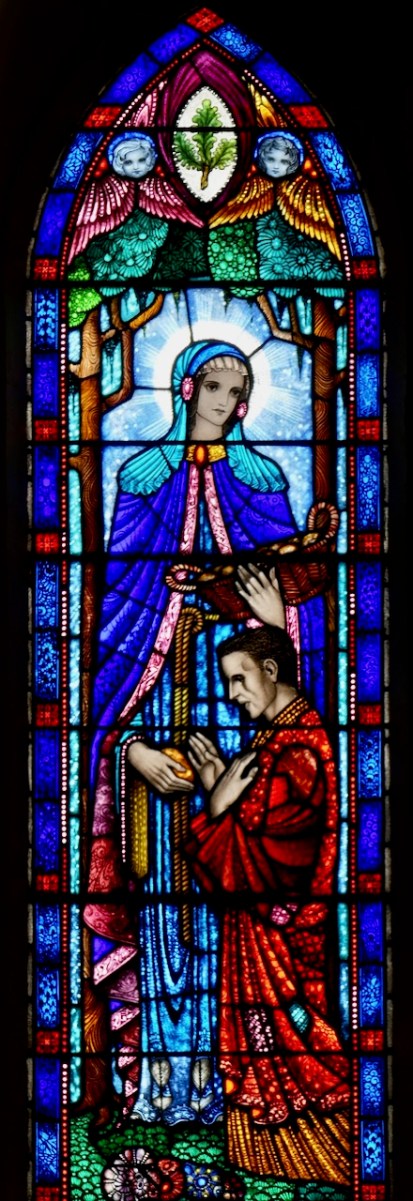
Brigid and the Beggar, by William Dowling, Gorey C of I

However, the story I like best perhaps is this one from the Vita Prima: 

In the same place also when saint Brigit was staying as a guest, a married man came with a request that saint Brigit should bless some water for him to sprinkle his wife with, for the wife actually hated the husband. So Brigit blessed some water and his house and food and drink and bed were sprinkled while his wife was away. And from that day on the wife loved her husband with a passionate love as long as she lived.

She may have been a nun, but she obviously served up a good love potion when the situation required it. This story is not only repeated in the Book of Lismore, but embellished, thus: 

When he had done thus, the wife gave exceeding great love to him, so that she could not keep apart from him, even on one side of the house ; but she was always at one of his hands. He went one day on a journey and left the wife asleep. When the woman awoke she rose up lightly and went after the husband, and saw him afar from her, with an arm of the sea between them. She cried out to her husband and said that she would go into the sea unless he came to her.
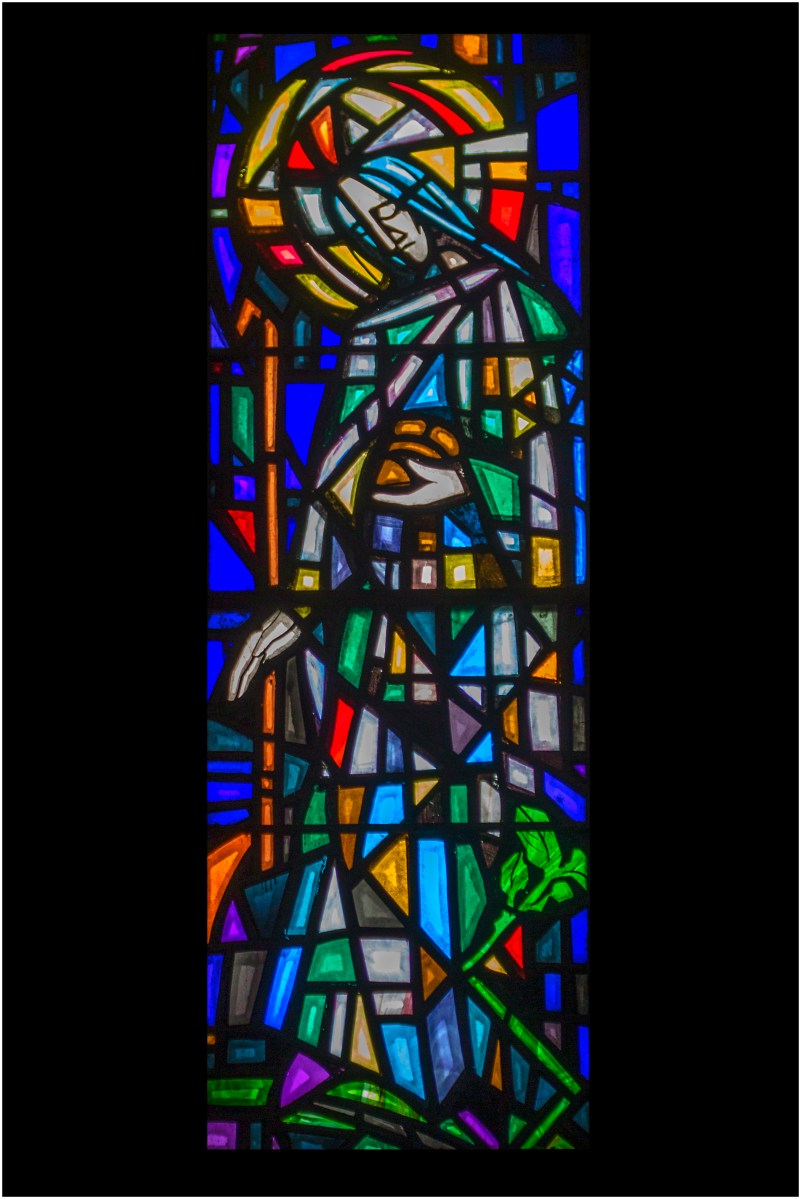
The aged St Brigid by George Stephen Walsh, in Ballintubber Abbey – another image generously loaned by Frank Fullard

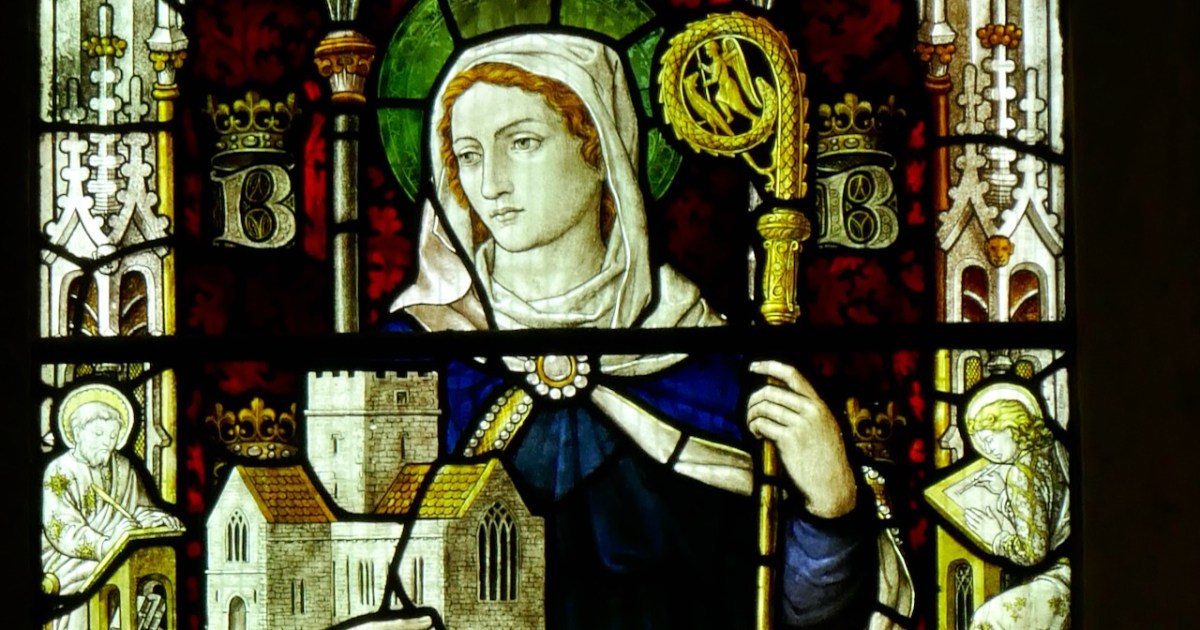
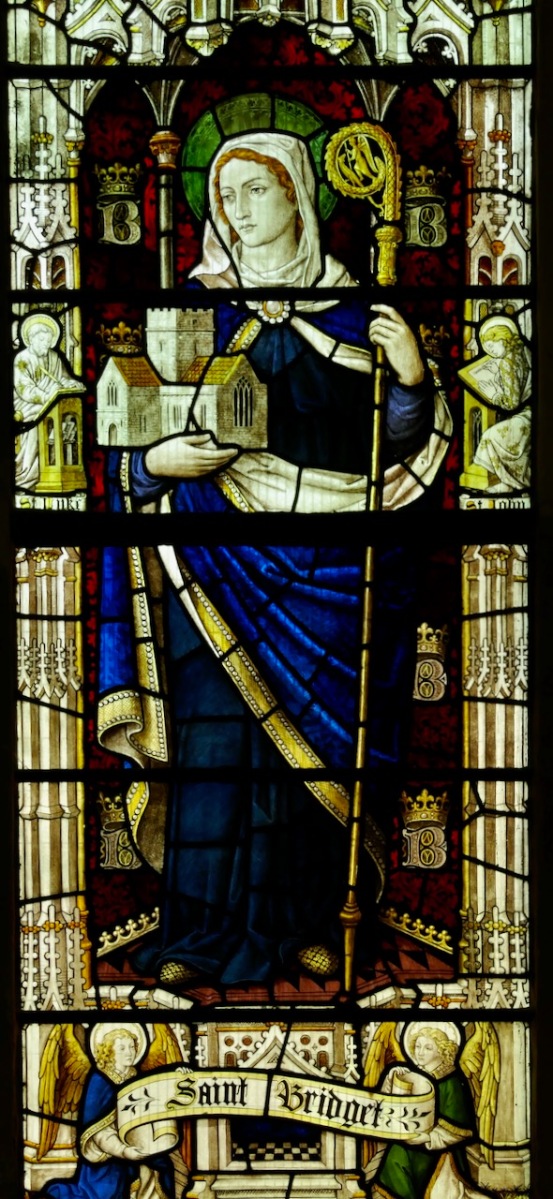
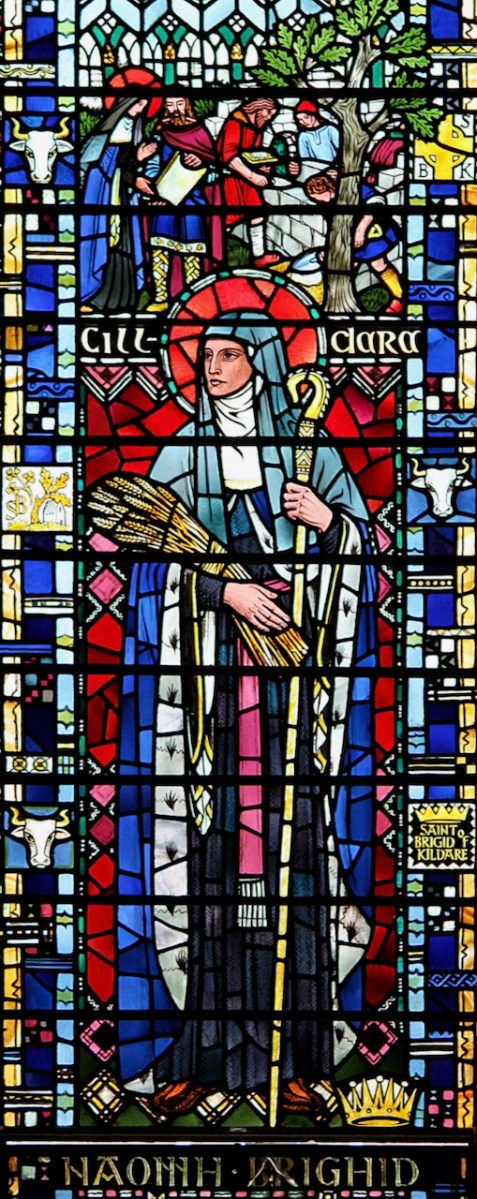
My final point for this post about St Brigid is the matter of where she is buried. Most authorities give this as Downpatrick, where she is laid to rest alongside Patrick and Columcille. However, a medieval legend grew that she went to Glastonbury in old age and died there. That is why she is venerated in Britain as well as in Ireland – the top photograph in this post is from the St Brigid window in Exeter Cathedral. Here’s the full window, in which she is flanked, for some reason, by St Luke and St John busily writing their gospels.
Here is another British window, this one designed by Nuttgens in 1952 for St Etheldreda’s Church in London. (Used with thanks under the Creative Commons License – original is here.) It’s a particularly good narrative window, showing the building of her church under the Oak Tree, her crozier, and two cows – there are many stories of milk and cows in the Lives.
But O’Hanlon is having none of the Glastonbury story.

We cannot receive as duly authenticated, or even as probable, several assertions of mediaeval and more recent writers, who have treated concerning this illustrious virgin. It has been stated, that about the year 488, Saint Brigid left Ireland, and proceeded towards Glastonbury. There, it is said, she remained, until advanced in years, on an island, and convenient to the monastery in that place. Whether she died there or returned to Ireland is doubted. But, it seems probable enough, such a tradition had its origin, owing to this circumstance, that a different St. Brigid, called of Inis-bridge, or of Bride’s Island, had been the person really meant. She lived many years on a small island, near Glastonbury, called Brigidae Insula i.e., Brigid’s Bridge. This latter St. Brigid is said to have been buried, at Glastonbury.
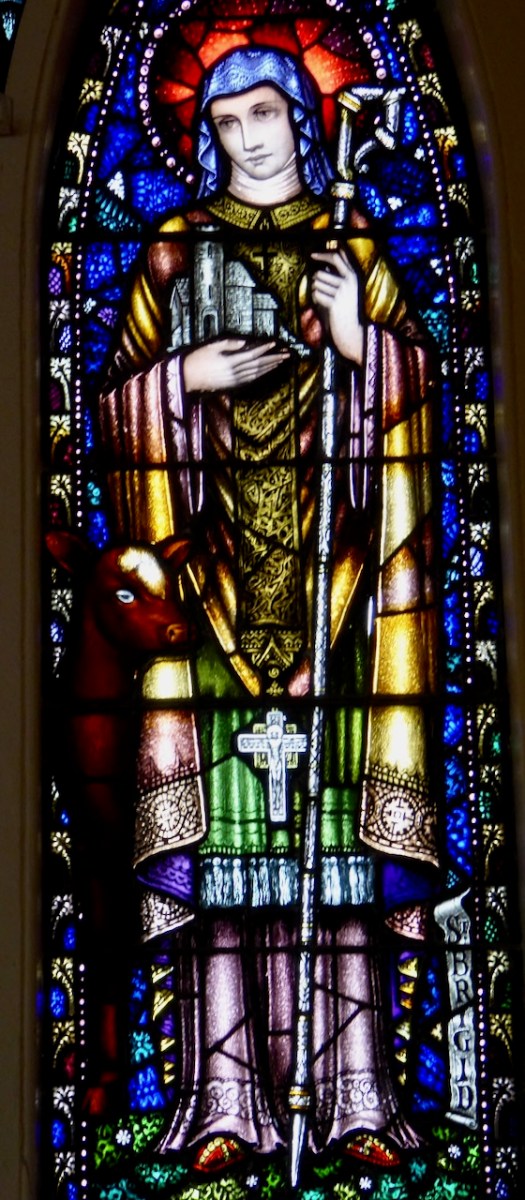
This Brigid window is in Moone, Co Kildare from the Harry Clarke Studios. It features, as do many Brigid windows I have seen, a deer, but I can find no mention of a deer in any of the Lives. Perhaps one of our readers knows where the deer icon comes from?

I will finish with a quote from the Book of Lismore, which gives me the title for this post, and gives Brigid one of her most frequent soubriquets.

It is she that helpeth every one who is in a strait and in danger: it is she that abateth the pestilences: it is she that quelleth the anger and the storm of the sea. She is the prophetess of Christ she is the Queen of the South: she is the Mary of the Gael
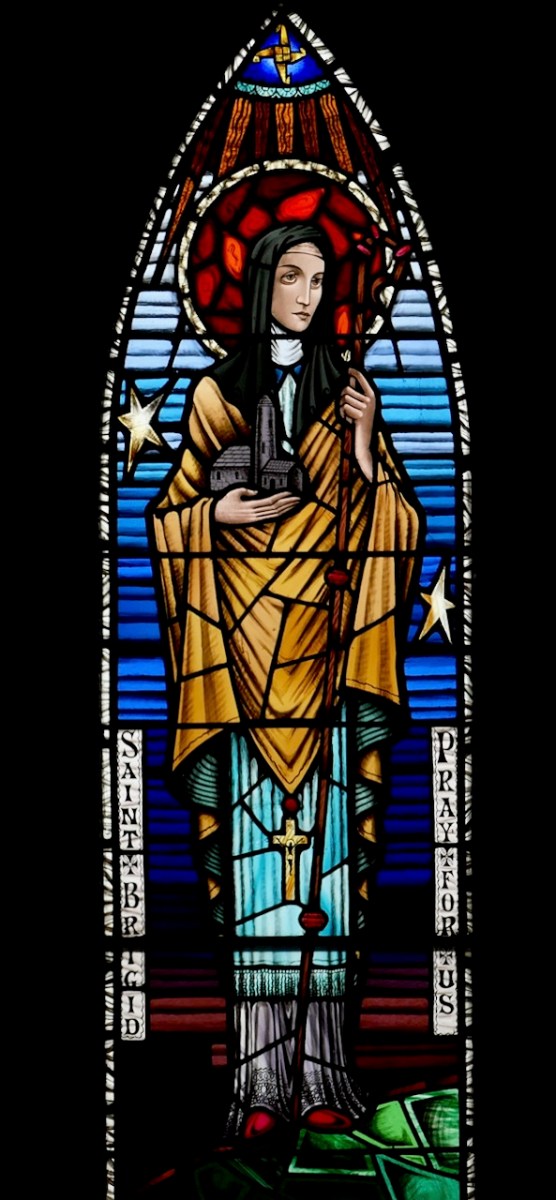
I don’t know whose window this is – it’s from Ballybunion – but I love the composition

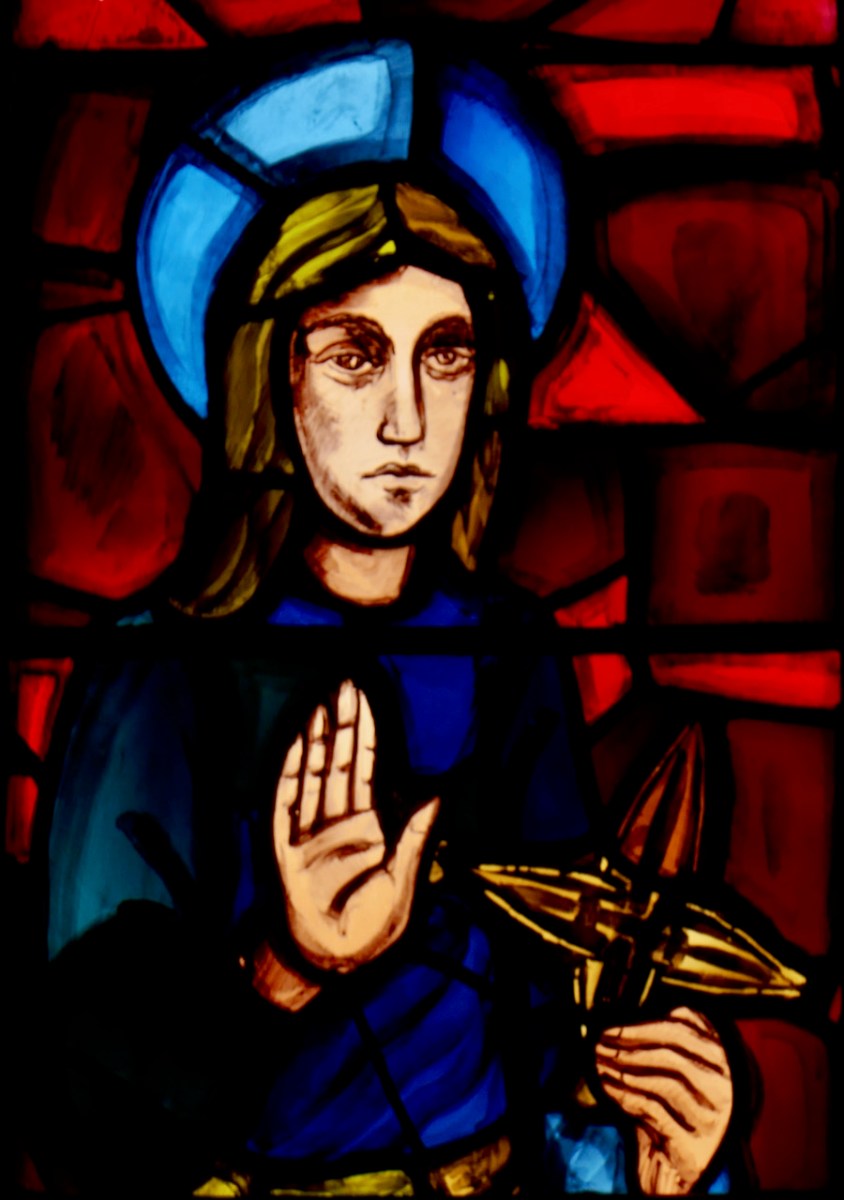
And a final image from Glynn, Co Wexford, because I love the pared-to-the-bone simplicity of this Richard King medallion..

Posts about St Brigid

St Brigid and AI

Brigid 1500: Mary of the Gael

Brigid: A Bishop in All But Name

St Brigid: Dove Among Birds, Vine Among Trees, Sun Among Stars

St Brigid: Dove Among Birds, Vine Among Trees, Sun Among Stars
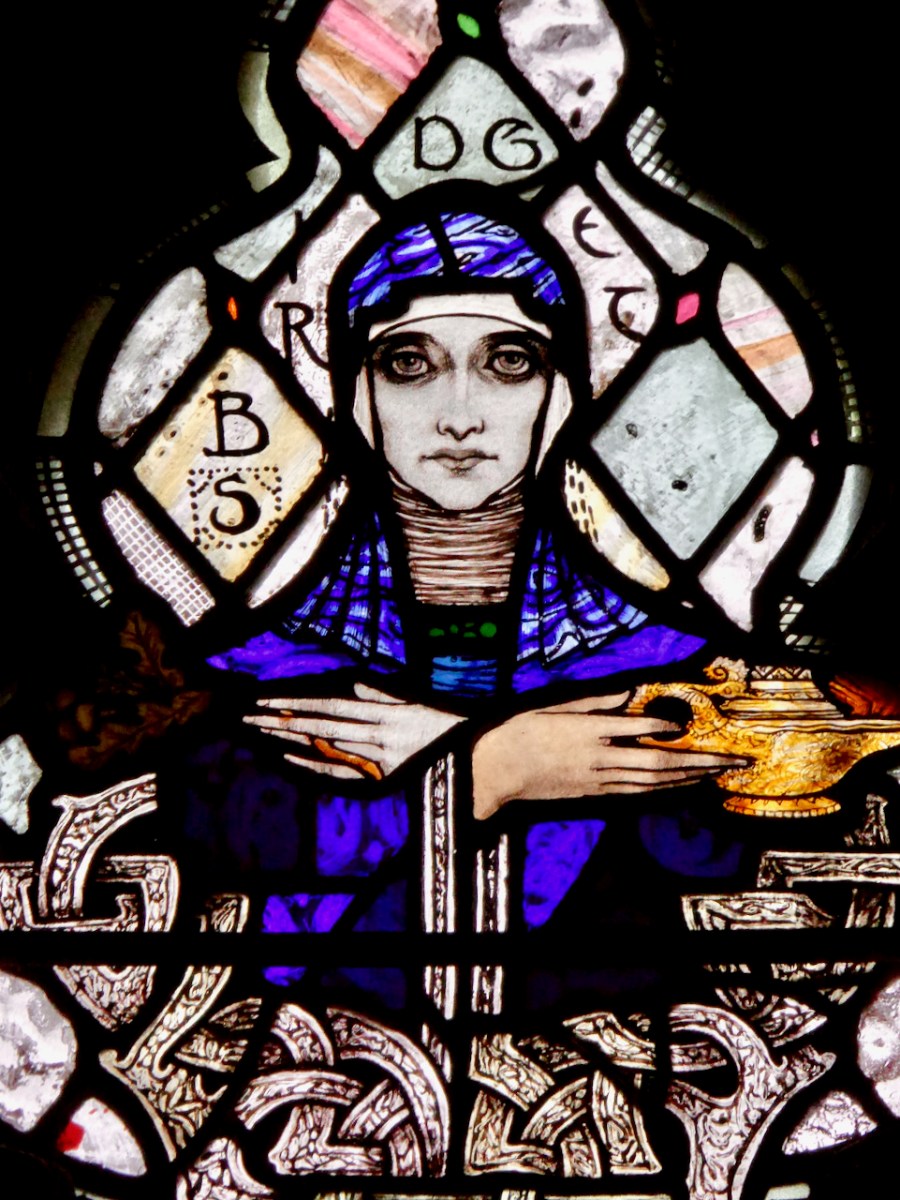
Starting next year, we’ve been given a new National Holiday! It falls on Feb 1, which is celebrated as St Brigid’s Day in Ireland. (Also Imbolc but that’s another story.) Although in my far-off youth I had a devotion to St Brigid and took her name as my Confirmation Name (is this just a Catholic thing?) I realised I knew very little about Brigid herself. So I set out to do some digging, using my own photographs of her image in stained glass to illustrate. That’s Harry Clarke’s take on Brigid above, from the Honan Chapel in Cork, and another one of his below, from Castletownshend.

Note the lamp, which is one of her attributes, since she is associated with a perpetual fire that miraculously never went out. Given this is Harry Clarke, the lamp looks suspiciously like something from the Arabian Nights.

For the life of Brigid, although there are many, many versions, I have turned to two sources. The primary source is The Life of Saint Brigit by Cogitosus*. Almost unbelievably, this Life dates from about 650 and is written in Hiberno-Latin. Cogitosus may have been a monk in Kildare, steeped in the cult of Brigid. Part of this cult was to claim the highest status for Kildare of all the Irish monastic settlements and therefore the Primacy over all Ireland – a claim that was eventually won by Armagh, which trumped Kildare by its appropriation of St Patrick. Cogitosus’s story is told in the form of 32 miracles, each of which leads us through Brigid’s life. 

Instead of an image of the saint, this window by George Walsh focusses on the Brigid’s Cross, another of her attributes, based on a story where she picked up rushes from the floor and wove them into a cross which healed a dying man. We like to make them every St Brigid’s Day and then hang them in the house to prevent damage by fire

My second source is the Life of Brigit from the Book of Lismore**, translated by Whitley Stokes. I love Stokes’s language, a form which he seems to have invented himself to convey something of the Medieval Irish he was translating (see this post on The White Hound of Brigown for more on this). The Book of Lismore dates to the fifteenth century and it is thought that the Lives of the Saints within it, or some of them, were written in the Abbey at Timoleague in West Cork. In both versions her name is given in translation as Brigit, rather than Brigid which is the more usual modern spelling used in Ireland.

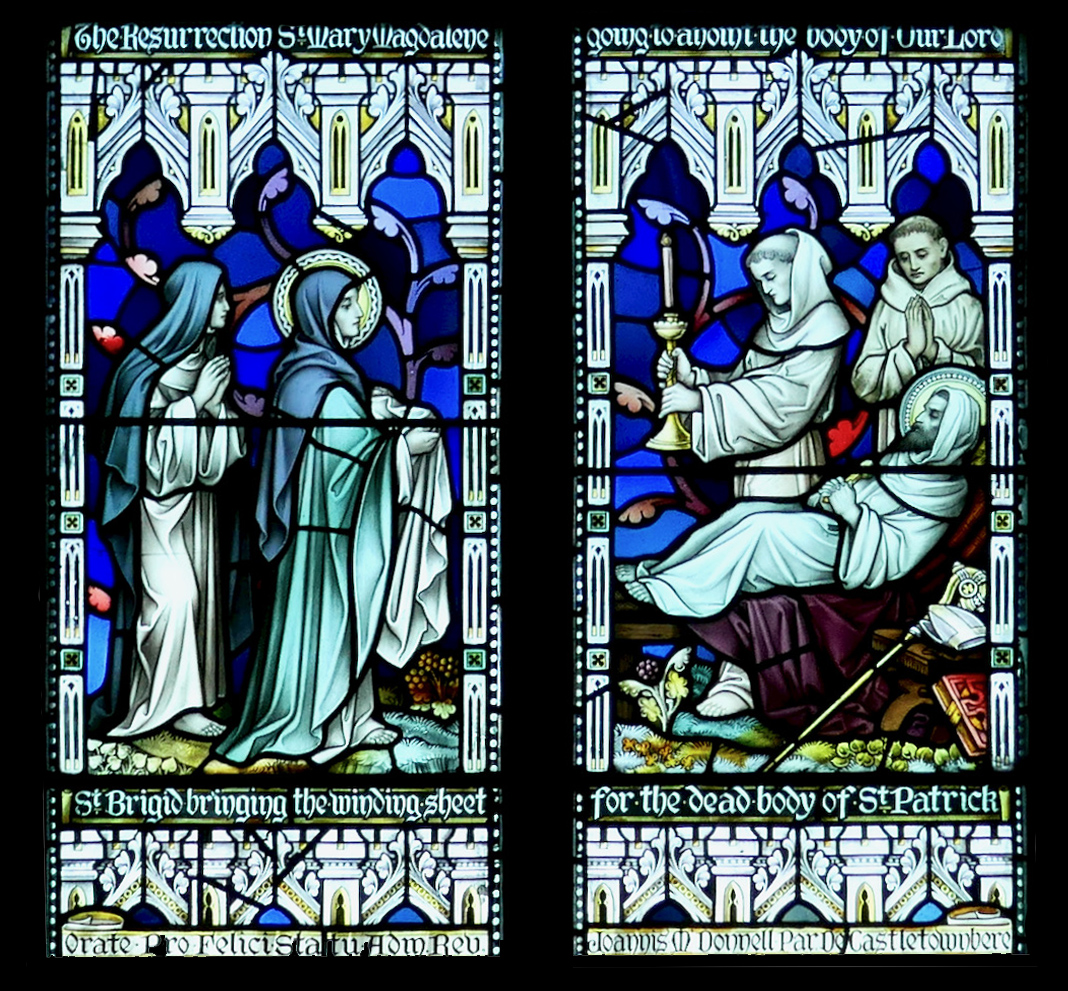
In this window, Brigid brings the winding sheet for the dead St Patrick, a story that does nor feature in either of the Lives I am using here. This is the lower section of a paired window in Killarney Cathedral, part of a series that draws parallels between the Life of Christ and the Lives of Irish Saints. In this case, Brigid is being compared to Mary Magdalene anointing the body of Christ

Many of the same stories occur in both lives. Significantly, though, Patrick is not mentioned in the earlier Life by Cogitosus, although he appears frequently in the Book of Lismore as if she and he were living contemporaneously. There are other differences, showing how the stories grew through the ages, but both agree that Brigid was the daughter of Dubhtach and a bondswoman called Broicsech. Like all good Irish saints, her birth and her greatness is foretold. From the Book of Lismore: 

The wizard went to meet him, and asked whose was the woman who was biding in the chariot. Mine, saith Dubthach . . .The wizard asks if she was pregnant by anyone. She is pregnant by me saith Dubthach. Said the wizard, Marvellous will be the child that is in her womb, her like will not be on earth. My wife compels me, saith Dubthach, to sell this bondmaid. Said the wizard, through grace of prophecy, the seed of thy wife shall serve the seed of the bondmaid, for the bondmaid will bring forth a daughter conspicuous, radiant, who will shine like a sun among the stars of heaven. Dubthach was thankful for that answer, for till then no daughter had been born to him.

This image of a young Brigid is by Evie Hone and is in Blackrock, Co Dublin. Evie Hone’s windows are pared-to-the-bone, deeply spiritual depictions inspired often by ancient Irish carvings.

I love the fact that Dubhtach rejoices to have a daughter since most of these stories glorify the birth of male babies. Brigid accomplishes many miracles as a child, mostly having to do with her charity and her faith. Here’s one such from Cogitosus: 

So, when she was old enough, she was sent by her mother to do the work of churning so that she could make up the butter from the cow’s milk which had been dashed; she too was meant to carry out this work, in the same way as other women were accustomed to do, and to deliver for use the complete yield of the cows and the customary weight and measure of butter at the appointed time with the others. However, this maiden with her most beautiful and generous disposition, preferring to obey God rather than men, distributed the milk and butter liberally to the poor and the guests. So, when as usual the appointed time came for all to hand in what the cows had yielded, her turn came. And when her workmates presented the finished result of their work, the aforementioned blessed maiden was also requested to hand in her work in like manner. 

In dread of her mother since she had nothing to show because she had given the lot away to the poor without a thought for the morrow, strengthened and inflamed with an ardor of faith so intense and unquenchable, she turned to the Lord and prayed. Without delay the Lord heard the maiden’s voice and prayers. And, being a helper in the hour of need, he came to her assistance with the generous bestowal of a divine gift, and lavishly restored the butter for the maiden who had confidence in him. Astonishingly, the very moment after her prayer, the most holy maiden proved that she had fulfilled her task by showing that nothing was missing from the fruit of her work, but that it was even more abundant than her workmates.

A rather sumptuous Brigid from the Harry Clarke Studios, in Ballinrobe

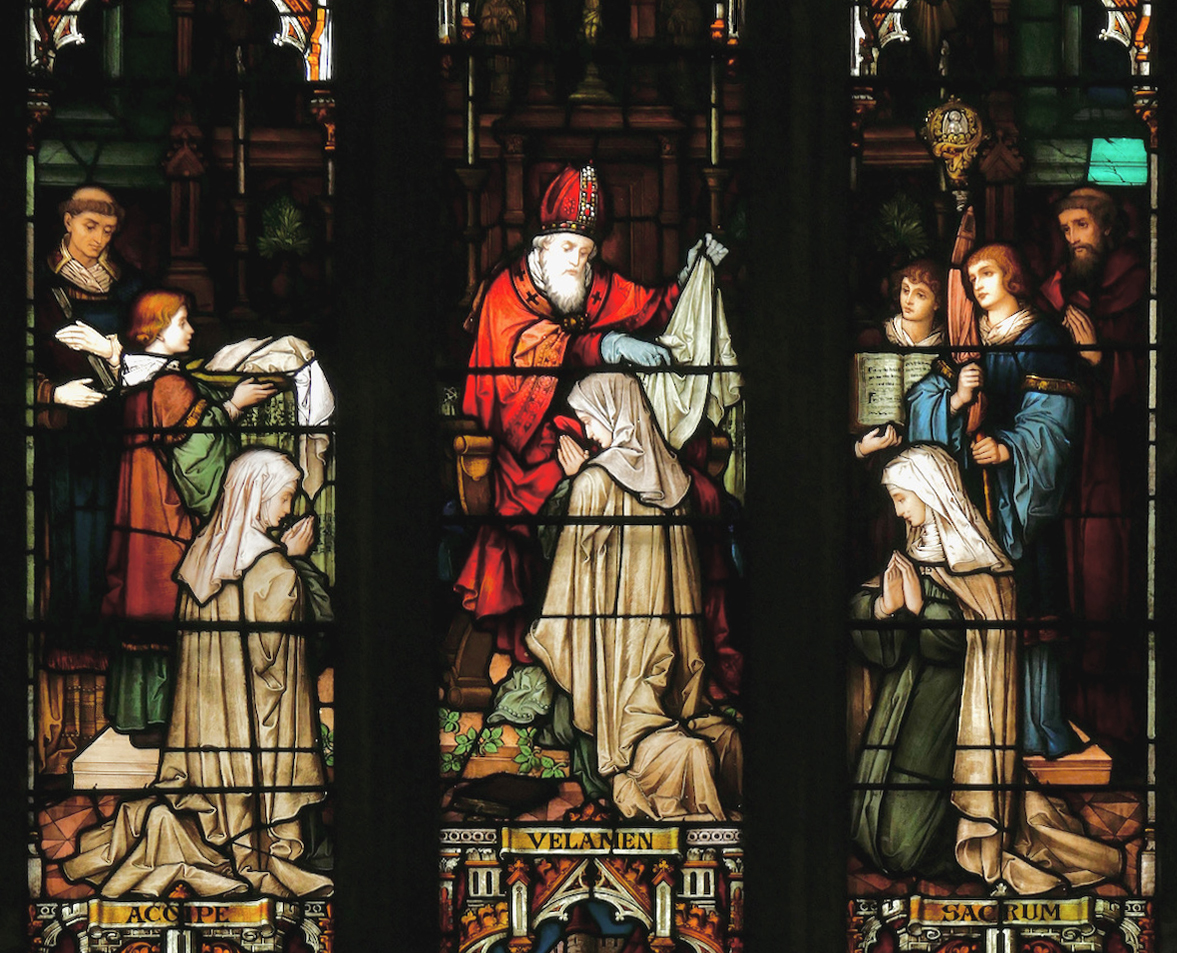
Eventually, determining to be a virgin and devote her life to God’s work, she took the veil. Cogitosus relates that 

Brigit, inspired from above and wanting to devote herself as a chaste virgin to God, went to the most holy bishop MacCaille of blessed memory. Seeing her heavenly desire and modesty and seeing so great a love of chastity in this remarkable maiden, he placed the white veil and white garment over her venerable head. 

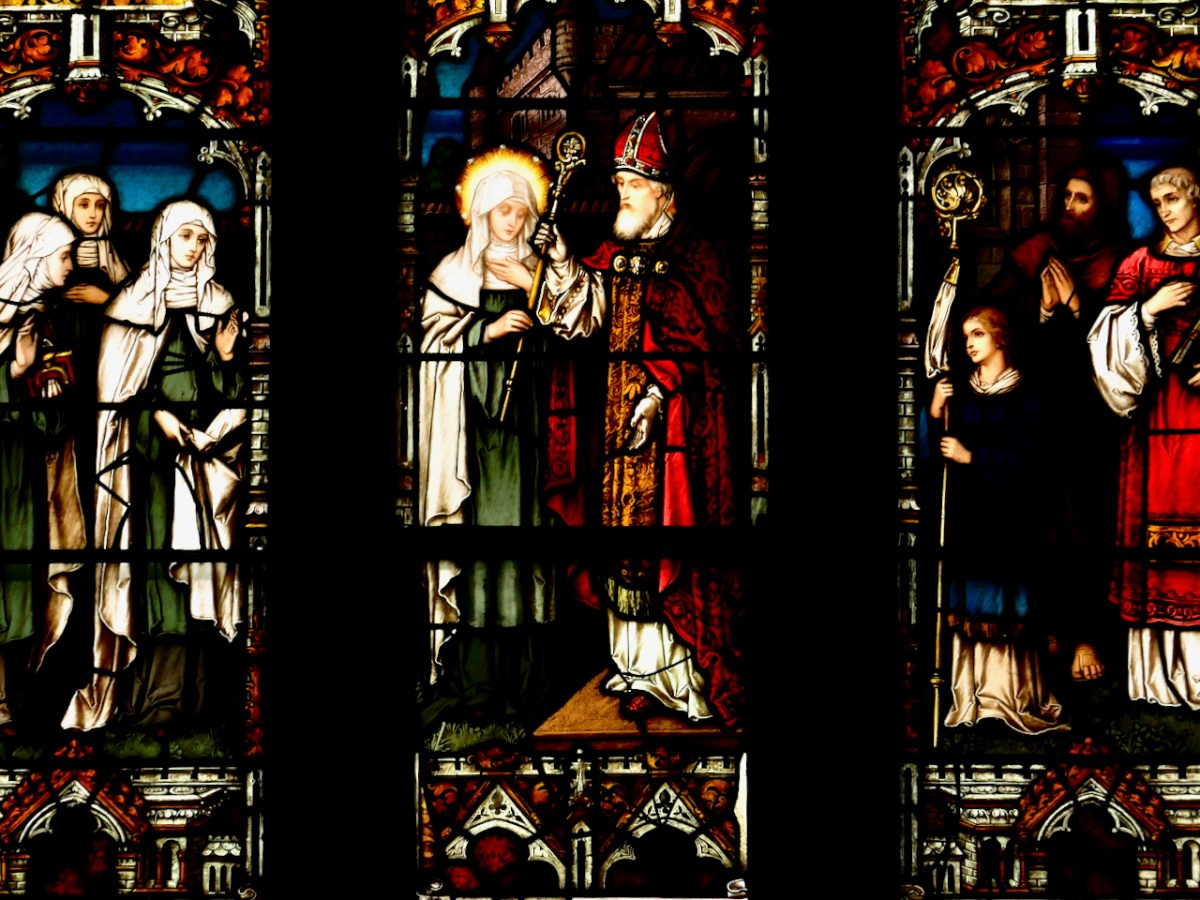
However, by the time the author of the Lismore life wrote his account, MacCaille had been relegated to inferior status and the Bishop who confers the veil is Mel, who is depicted in the window above, in Armagh Cathedral, performing the ceremony. By now, the story has acquired one of its most-quoted aspects – that Brigid, through divine intercession, is actually made a bishop. The next image, the lower panel of the previous window, shows Mel handing Brigid a crozier, symbol of episcopal authority. This large window is by Mayer of Munich.

Brigit and certain virgins along with her went to take the veil from Bishop Mel in Telcha Mide. Blithe was he to see them. For humility Brigit stayed so that she might be the last to whom a veil should be given. A fiery pillar rose from her head to the roof-ridge of the church. Then said Bishop Mel: Come, O Holy Brigit, that a veil may be sained on thy head before the other virgins. It came to pass then, through the grace of the Holy Ghost, that the form of ordaining a Bishop was read out over Brigit. Mac-caille said, that a bishop’s order should not be conferred on a woman. Said Bishop Mel: No power have I in this matter. That dignity hath been given by God unto Brigit, beyond every (other) woman. Wherefore the men of Ireland from that time to this give episcopal honour to Brigit’s successor.

Although she is associated with many places in Ireland (there are numerous townlands called Kilbride or Kilbreedy) it is the great city of Kildare that is most closely hers. She managed the city, the Lismore Life says, in partnership with Conleth, a hermit whom she persuades to join her. Cogitosus tell us:

And as by her wise administration she made provision in every detail for the souls of her people according to the rule, as she vigilantly watched over the Churches attached to her in many provinces and as she reflected that she could not be without a high priest to consecrate churches and confer ecclesiastical orders in them, she sent for Conleth, a famous man and a hermit endowed with every good disposition through whom God wrought many miracles, and calling him from the wilderness and his life of solitude, she set out to meet him, in order that he might govern the Church with her in the office of bishop and that her Churches might lack nothing as regards priestly orders. Thus, from then on the anointed head and primate of all the bishops and the most blessed chief abbess of the virgins governed their primatial Church by means of a mutually happy alliance and by the rudder of all the virtues. By the merits of both, their episcopal and conventual see spread on all sides like a fruitful vine with its growing branches and struck root in the whole island of Ireland. It has always been ruled over in happy succession according to a perpetual rite by the archbishop of the bishops of Ireland and the abbess whom all the abbesses of the Irish revere. 

This window by Watsons of Youghal is in St Carthage’s Catholic church in Lismore and is a great example of the Celtic Revival decoration they specialised in. Note the proliferation of oak leaves above her – Kildare is from Cill Dara, meaning Church of the Oakwood, and the oak leaf is one of her attributes, along with the lamp and the crozier, also shown

Cogitosus goes on to say this of Kildare and her establishment (and don’t forget he was writing in or around 650!): 

And who can express in words the exceeding beauty of this church and the countless wonders of that monastic city we are speaking of, if one may call it a city since it is not encircled by any surrounding wall. And yet, since numberless people assemble within it and since a city gets its name from the fact that many people congregate there, it is a vast and metropolitan city. In its suburbs, which saint Brigit had marked out by a definite boundary, no human foe or enemy attack is feared; on the contrary, together with all its outlying suburbs it is the safest city of refuge in the whole land of the Irish for all fugitives, and the treasures of kings are kept there; moreover it is looked upon as the most outstanding on account of its illustrious supremacy. 

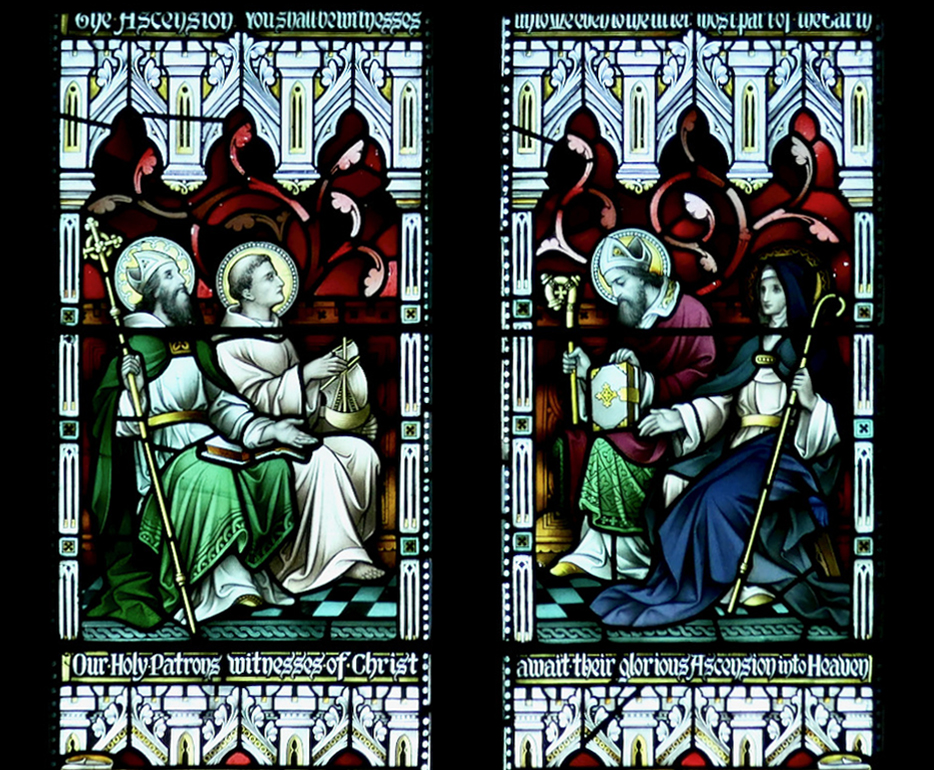
Today we honour St Brigid as one of the founding great women of our culture. She is often shown with Patrick and Columcille as one of the three great Patrons of Ireland. In the window above, also from Killarney Cathedral, Brendan has been added in because, well, we’re in Kerry.

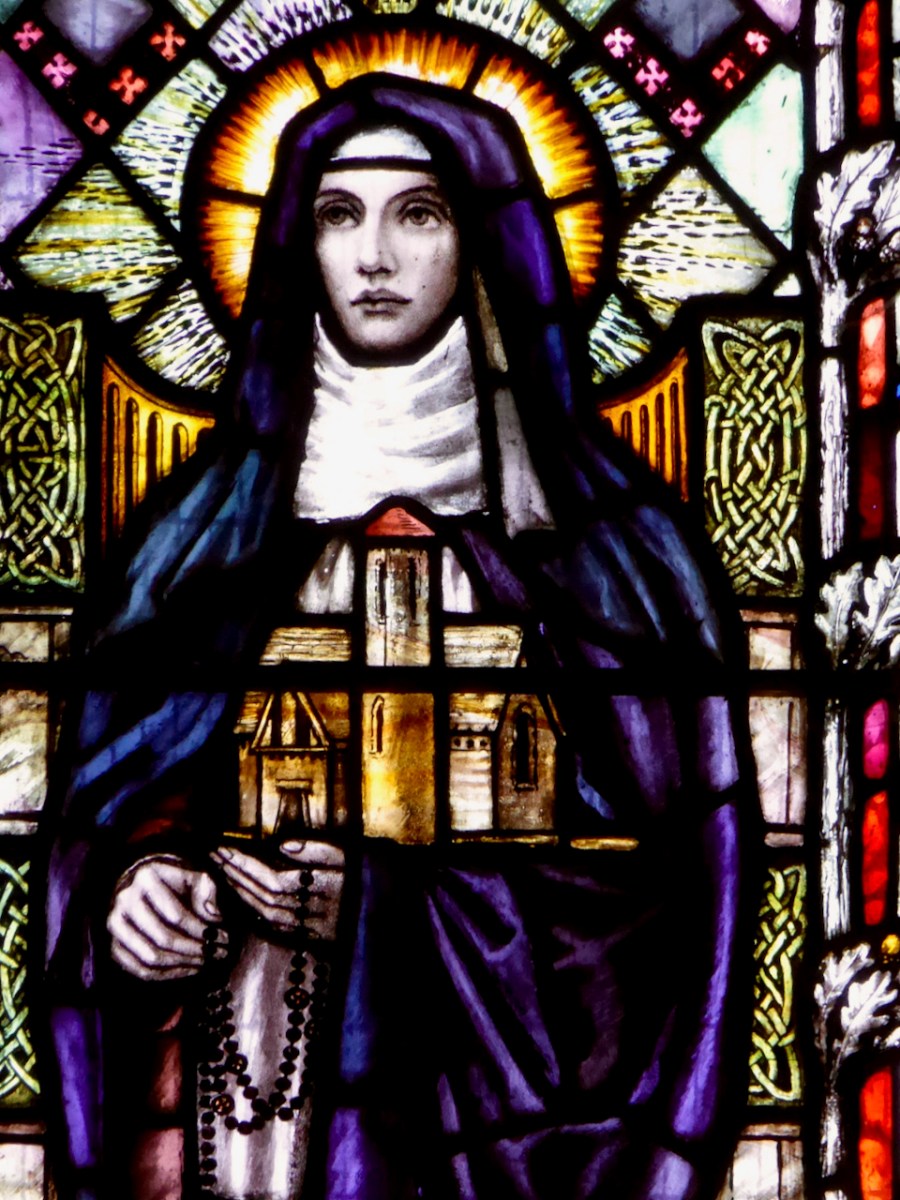
This window is in the Church of the Most Holy Rosary at Kilcoe, near us in West Cork. It’s a bit of a mixed metaphor – we see her holding her church, which is clearly based on the 12th century Cormac’s Chapel at Cashel, and surrounded by her oak leaves. However, she is also holding a set of rosary beads, something that doesn’t appear in Catholic imagery before the 13th century. It’s beautifully executed, though, by Catherine O’Brien of An Túr Gloine.

Brigid’s end was peaceful. As it is related in the Book of Lismore:

Now when it came to the ending days for Brigit, after founding and helping cells and churches and altars in abundance, after miracles and marvels whose number is as the sand of sea, or stars of heaven, after charity and mercy, then came Nindid Pure-hand from Rome of Latium. The reason why he was called Nindid Pure-hand was that he never put his hand to his side, when Brigit repeated a paternoster with him. And he gave communion and sacrifice to Brigit, who sent her spirit to heaven. Her relics are on earth with honour and dignity and primacy, with miracles and marvels.

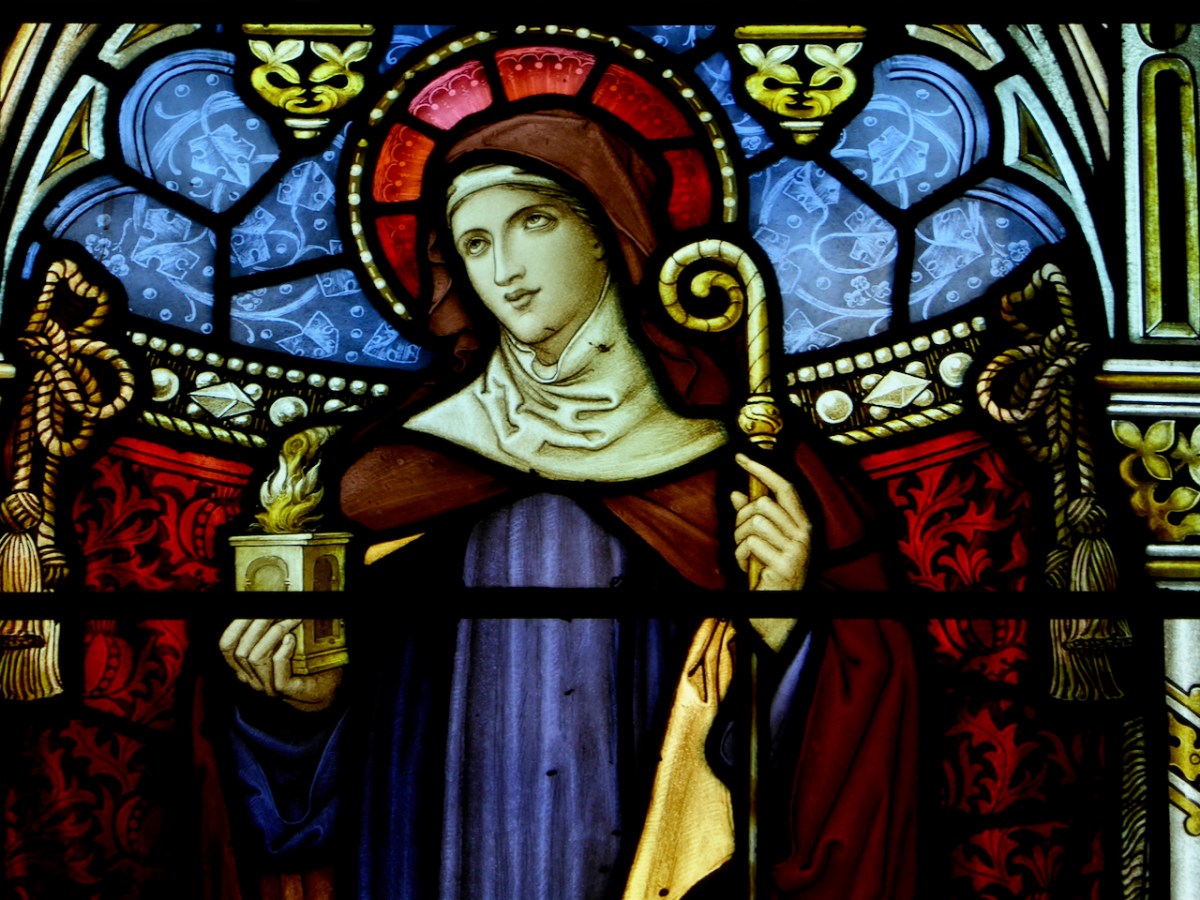
A conventional image of Bridget in the church in Goleen, West Cork, by Watsons of Youghal. She’s looking very saintly indeed. By now, you no doubt recognise all her attributes

Summing up her life and legacy, the anonymous author of her Life in the Book of Lismore says:

For everything that Brigit would ask of the Lord was granted her at once. For this was her desire: to satisfy the poor, to expel every hardship, to spare every miserable man. Now there never hath been anyone more bashful, or more modest, or more gentle, or more humble, or sager, or more harmonious than Brigit. She never washed her hands or her feet, or her head among men. She never looked at the face of a man. She never would speak without blushing. She was abstinent, she was innocent, she was prayerful, she was patient: she was glad in God’ s commandments: she was firm, she was humble, she was forgiving, she was loving: she was a consecrated casket for keeping Christ’s Body and his Blood: she was a temple of God. Her heart and her mind were a throne of rest for the Holy Ghost. She was simple (towards God): she was compassionate towards the wretched: she was splendid in miracles and marvels: wherefore her name among created things is Dove among birds, Vine among trees, Sun among stars. . . . She is the prophetess of Christ: she is the Queen of the South: she is the Mary of the Gael.

Brigid by Michael Healy, in the stained glass room at the National Gallery, holding her church with the round tower that can still be seen in Kildare.

It is entirely appropriate that a new National Holiday is named for Brigid. About time, in fact!

*Cogitosus’s “Life of St Brigit,” Content and Value. Author(s): Sean Connolly and J.-M. Picard. The Journal of the Royal Society of Antiquaries of Ireland , 1987, Vol. 117, pp. 5-27 
**Lives of Saints from the Book of Lismore, Edited with a Translation, Notes and Indices by Whitley Stokes, Oxford, 1890.

Posts about St Brigid

St Brigid and AI

Brigid 1500: Mary of the Gael

Brigid: A Bishop in All But Name

St Brigid: Dove Among Birds, Vine Among Trees, Sun Among Stars