Megalith or Monstrosity?

Some intriguing arrangements of stones here – and some enigmatic reporting of their significance as history. We are a long way from West Cork – in fact, over on Ireland’s east coast, among the fine estates of Killiney. We can’t help but search out examples of archaeology wherever we go, and a red dot on the Historic Environment map is always a good starting point, as is anything with an enigmatic name.

In this case, the red dot is just to the left of the ‘Pagan Temple’ at the top of the 25″ OS map – but look at all the other intriguing names in the locality!
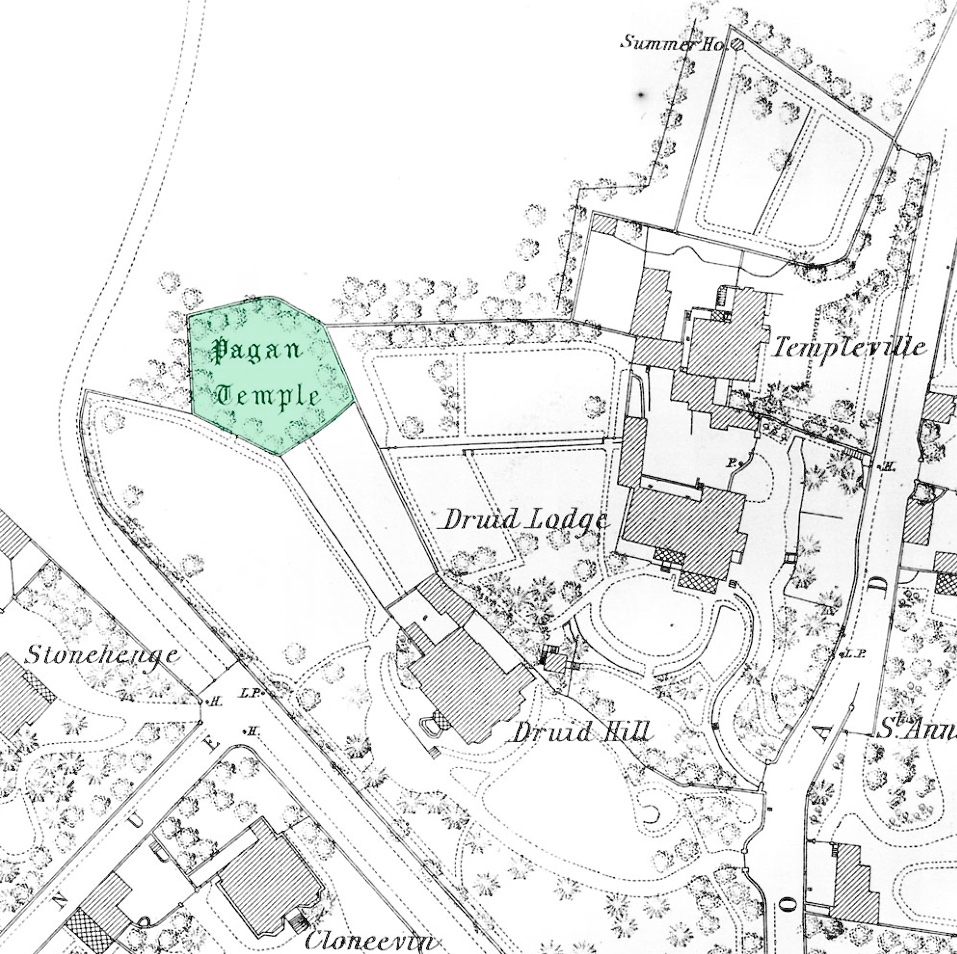
Here’s a close up -extracted from the 1888 OS map, highlighting the site that we are looking at today. With Templeville, Druid Lodge, Druid Hill and Stonehenge as neighbours, the Pagan Temple demands a closer look!
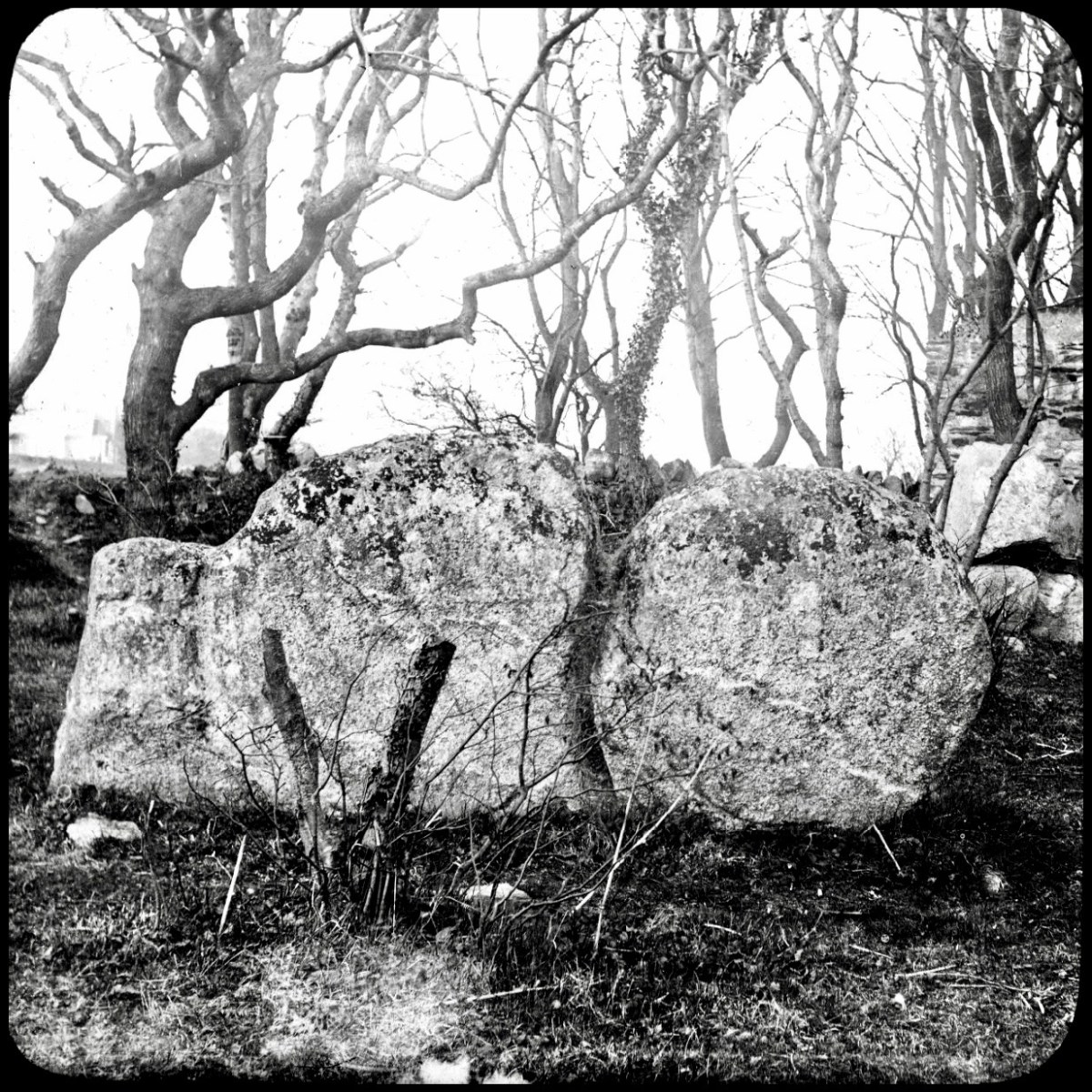
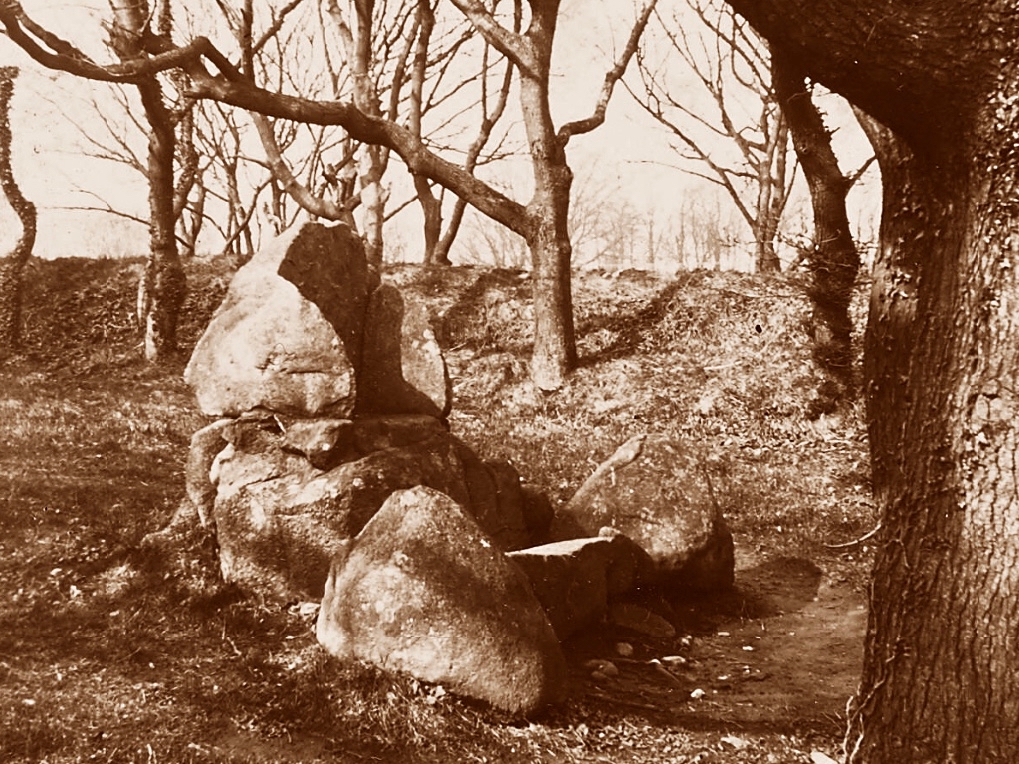
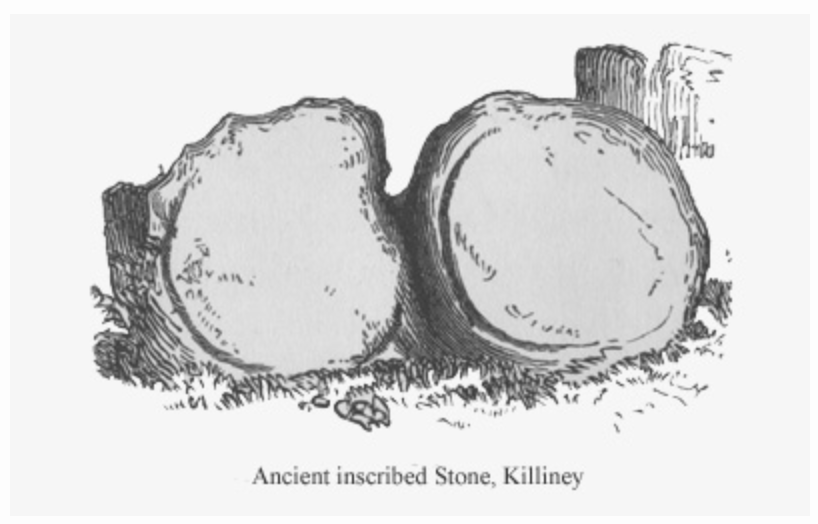
It was last week’s subject – the writer and photographer Thomas Holmes Mason – who directed us to this County Dublin location. As a significant producer of picture postcards, Mason has left a large body of work, even though many of his photographic plates were destroyed in a warehouse fire in 1963. The National Library of Ireland houses a comprehensive collection, and I am grateful to them for this image, above, which shows an intriguing stone formation on the Killiney ‘Pagan Temple’ site. It is referred to as The Sun and Moon stone by some antiquarians, and the following description appears on the current Historic Environment Viewer:

DU026-010—-

Scope note

Class: Megalithic structure

Townland: KILLINEY

Description: “. . .This enigmatic structure is located within an area enclosed by a hedge on top of Druid Hill. In the E side of the enclosure are three irregular granite boulders that form a façade behind which is a larger boulder containing a setting of stones that form a seat. To the W of this are two large granite slabs set on their long axis. There are tool marks present. This structure appears to be a folly but it may incorporate the remnants of an earlier monument . . .”

Archaeology.ie Historic Environment Viewer

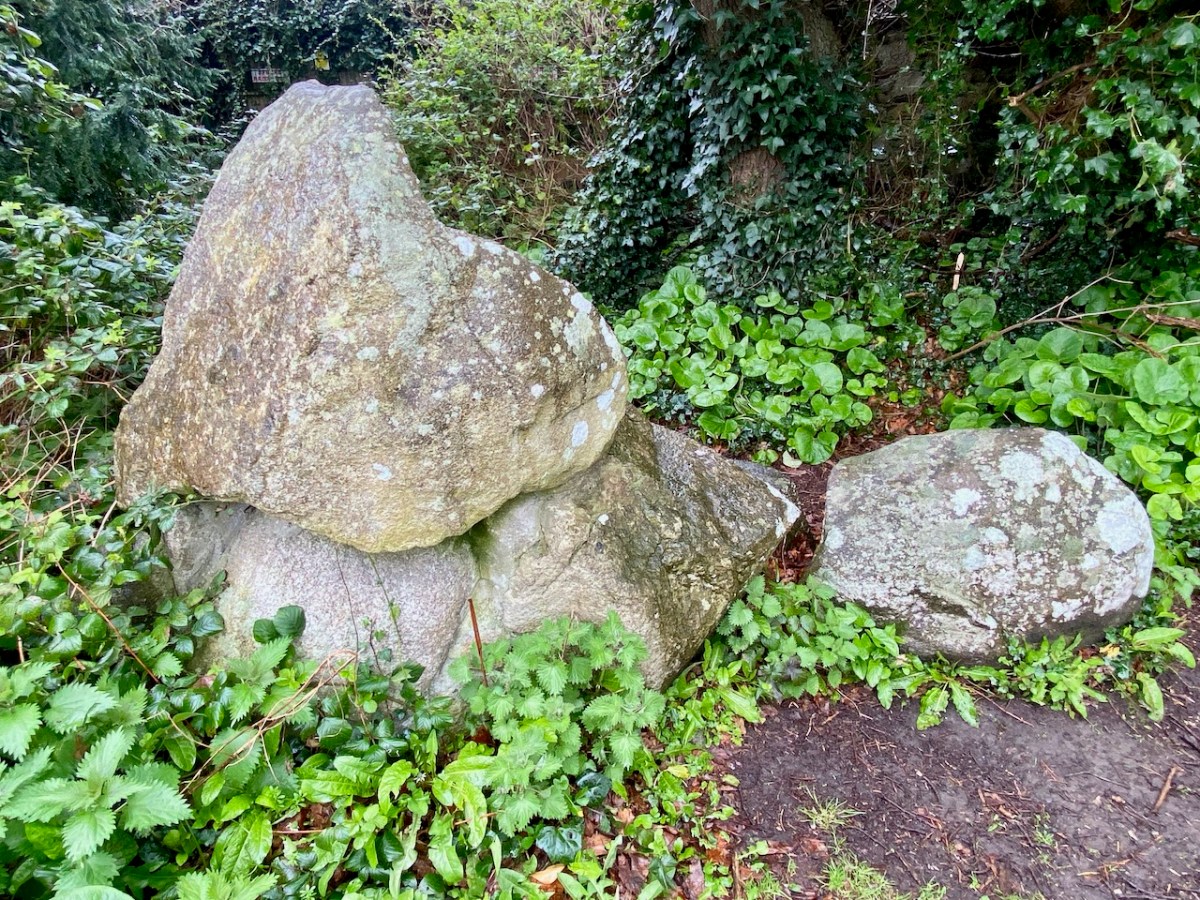
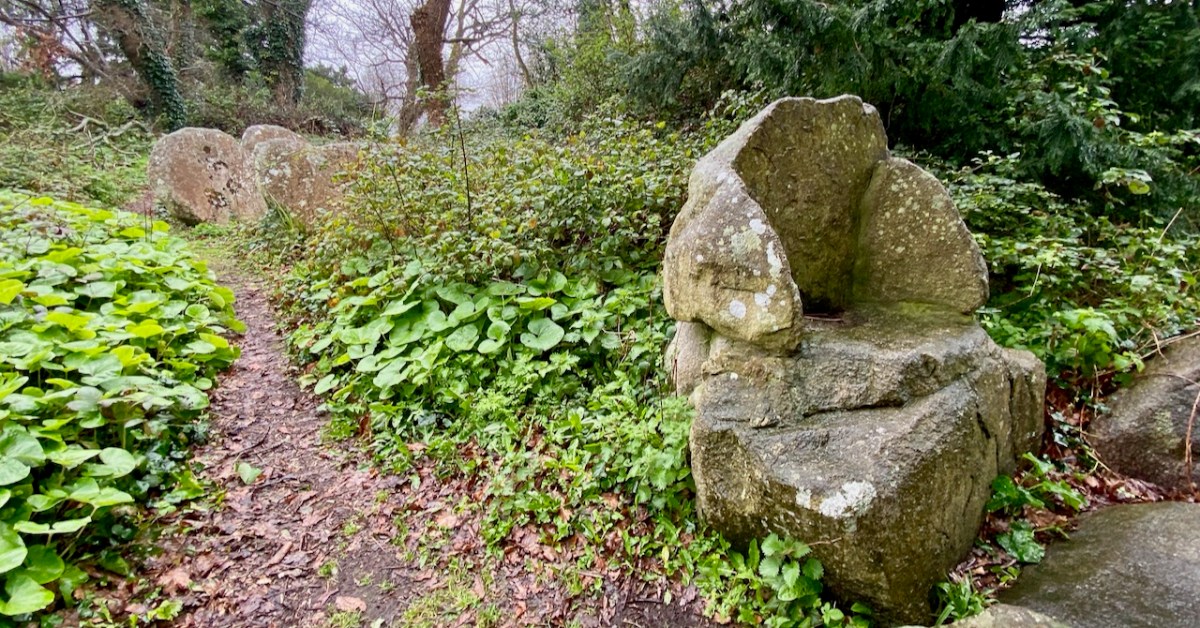
The Archaeology.ie write-up is accurate. In addition to the ‘chair’ (which Finola is elegantly modelling while trying not to sit in a puddle!) there are two further irregular granite boulders – but one of them (detailed in the T H Mason photograph) looks like two circles – hence ‘sun and moon’ – but is in fact a single boulder, here seen from the ‘front’ face:
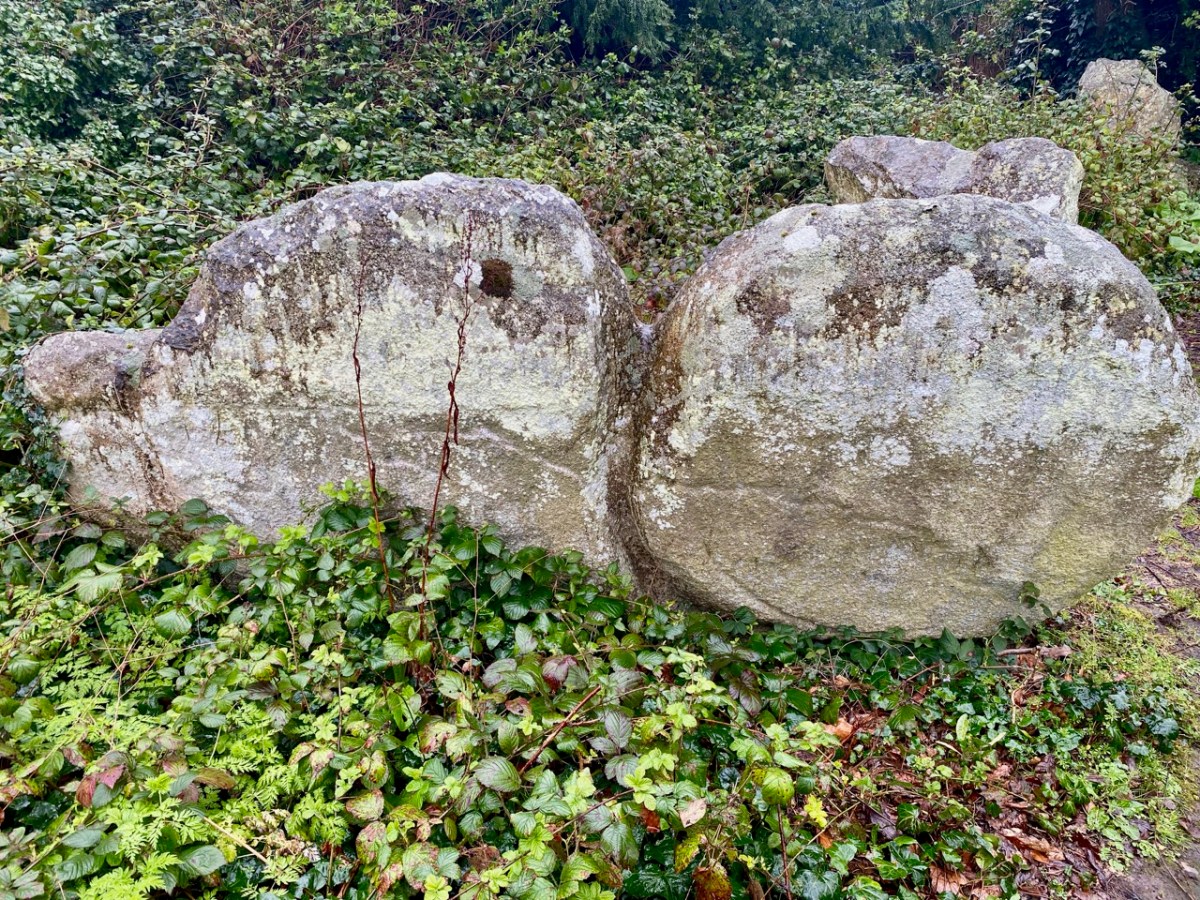
The right-hand side of this stone has some marks carved on it (by human hand) – possibly part of a large circle that outlines this half, while the vertical ‘groove’, central to the boulder, also appears to have been chased out. It’s worth noting as well, perhaps, that there are two small holes drilled on the back face of this stone, one on each side but not aligned on any centre. Additionally, there is also a small hole drilled on the back face of the second stone:

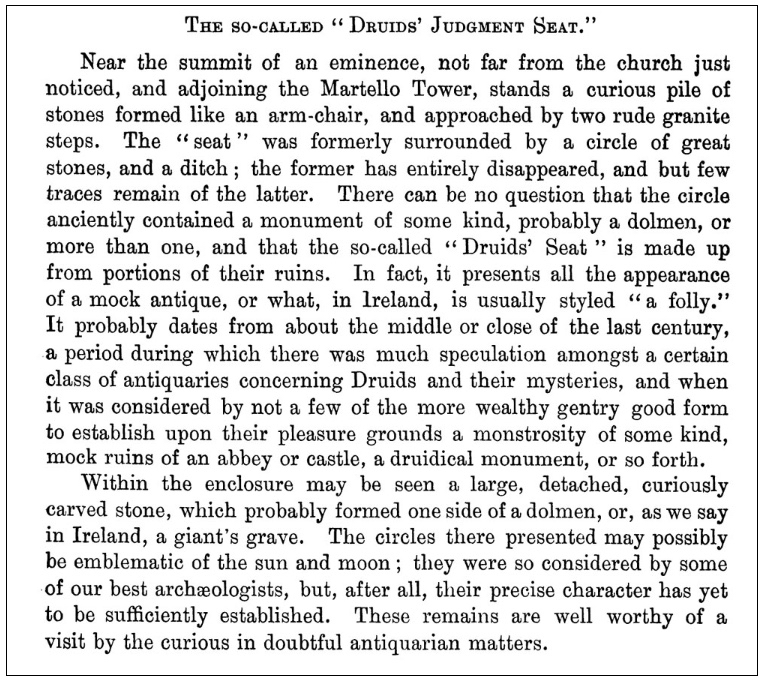
This article – by William Wakeman – appeared in The Journal of the Royal Society of Antiquaries of Ireland December, 1896. It introduces an element of scepticism, which we should perhaps explore. The excellent Killiney History website has collected together a number of writings and observations about this site.

John Dalton writing in 1858 seems quite satisfied of the antiquity of the Judgment Seat. The Gazetteer of Ireland states “A well-preserved Druidical circle with its priests’ seat and its sacrificing stone, occur within a carefully kept enclosure, behind Mount Druid demesne, and near the Martello Tower, but is made accessible by the proprietor to respectable visitors.”

Killineyhistory.ie
William Wakeman, a well known antiquarian of the last century, appears to have been the first to condemn these remains as spurious. “Formerly it was enclosed within a circle of great stones and a ditch. The circle has been destroyed and the ditch so altered that little of its original character remains. The seat is composed of large rough granite blocks and, if really of the period to which tradition refers it, an unusual degree of care must have been exercised for its preservation. The stones bear many indications of their having been at least rearranged at no very distant time. Small wedges have been introduced as props between the greater stones. The right arm is detached from the other part, to which it fits but clumsily. The whole, indeed, bears the appearance of a modern antique, composed of stones which once formed a portion of some ancient monument.”

Killineyhistory.ie
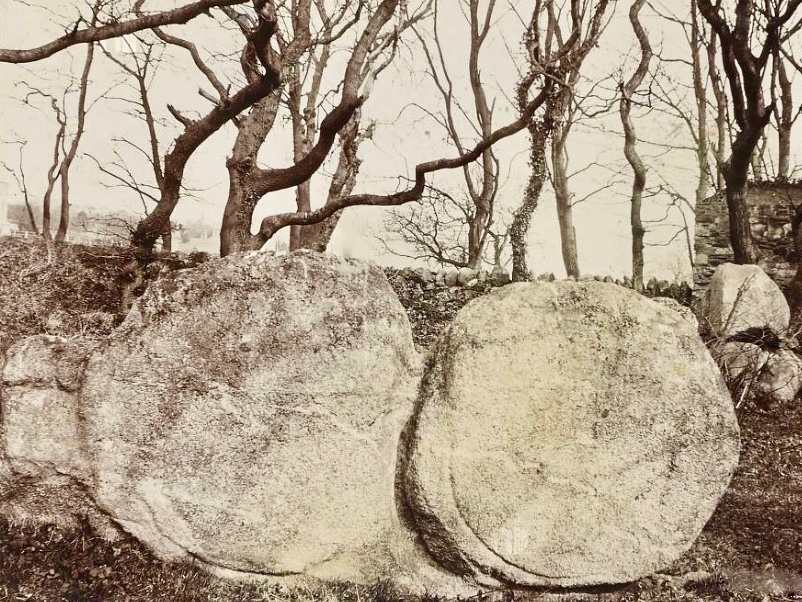
These photographs were taken by William Frazer in 1898. The arrangements of stones at that time are very similar to what we see today – well over a century later – but with far less growth of ground cover.
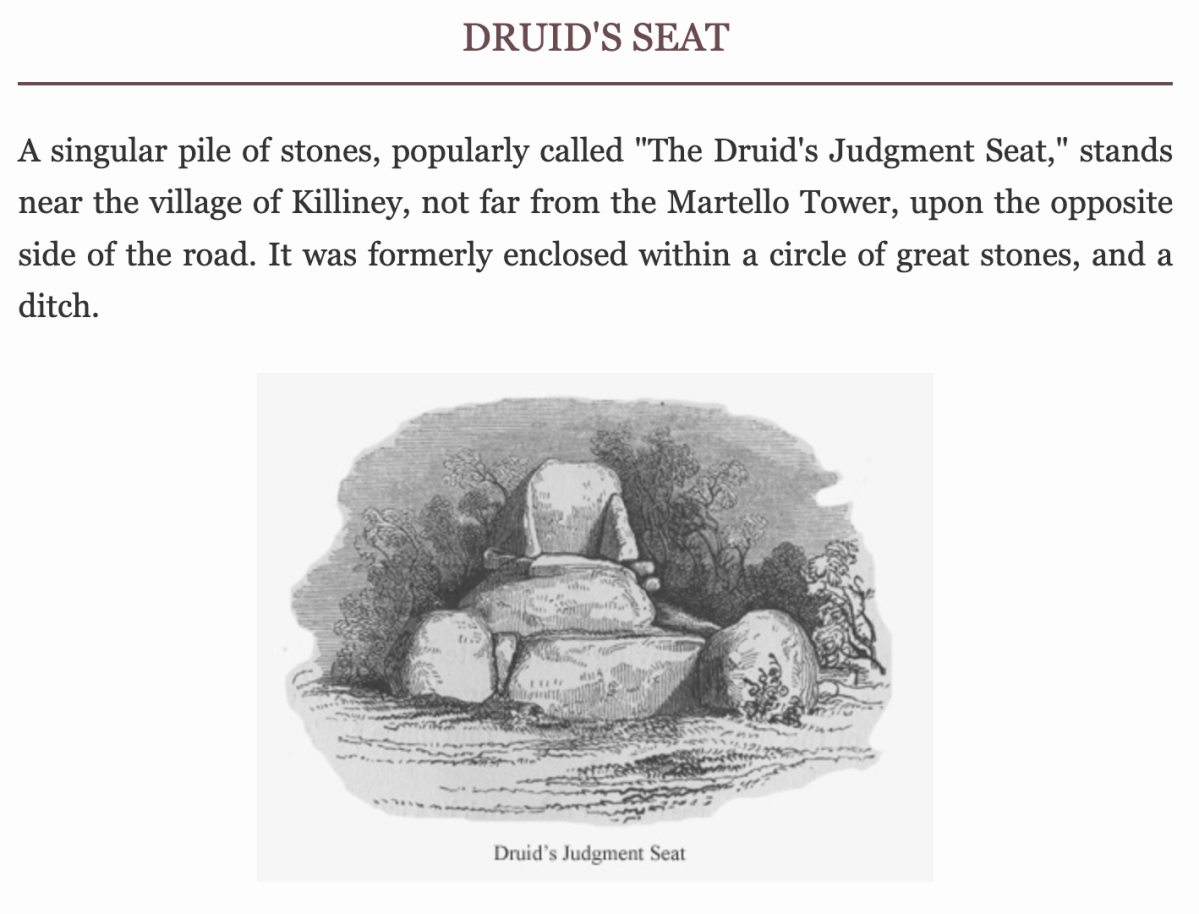
Above: Druid’s judgement Seat, Killiney – from Library of Ireland archives.

Elrington Ball [1863–1928] confirms this view of the Druid’s Judgment Seat. The stones of which it is composed formed part of a Sepulchral memorial dating from very early times, consisting of three small cromlechs, surrounded by a circle of upright stones about 135 feet in diameter, and, at the time of its first attracting attention, in the 18th Century when everything prehistoric was attributed to the Druids or the Danes, it was assumed to be a Pagan Temple . . . Near the circle was discovered at the same time an ancient burying place, and some stones with curious markings, which are still to be seen. The burying place was of considerable extent, the bodies, which were enclosed in coffins made of flags, having been laid in a number of rows of ten each . . .

Killineyhistory.ie

Finally Woodmartin [Traces of the Elder Faiths of Ireland 1902 Vol 11] makes the sweeping statement: the entire structure leaves the unmistakeable impression of very modern fabrication, and it is a mere clumsy attempt to gull the public . . . As seen to-day these relics of antiquity present rather an unlovely picture, in an obscure and ill-kept corner, surrounded by an unsightly hedge, where weeds and brambles share their ancient sanctity; they seem to arouse but little interest . . .

Killineyhistory.ie

Today, the jury seems to be out on what we are looking at on this site. Time has undoubtedly changed the shape of things: wouldn’t we like to go back a while and see the burying place of considerable extent with all those . . . bodies, which were enclosed in coffins made of flags, having been laid in a number of rows of ten each . . . ? But we do appreciate that a former landowner must have donated the land to excite our interest!
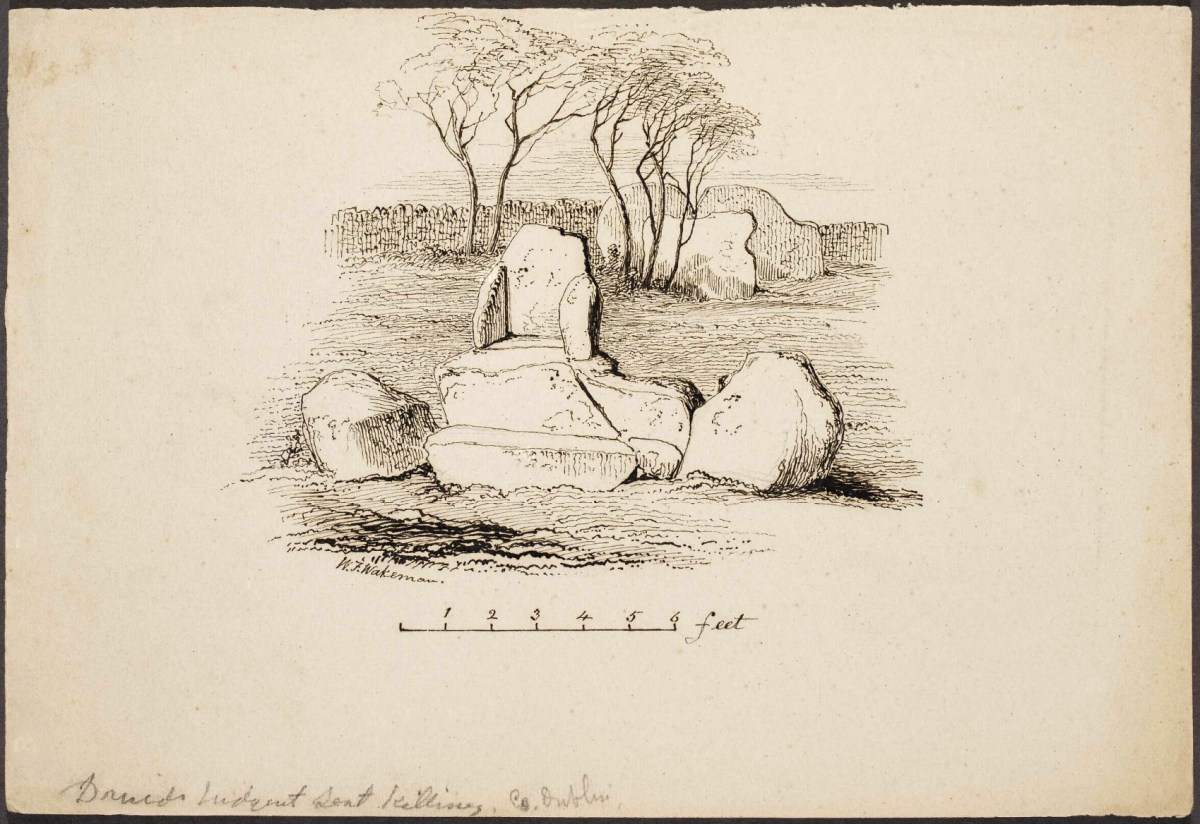
A good tailpiece from William Wakeman
Journey into Purgatory

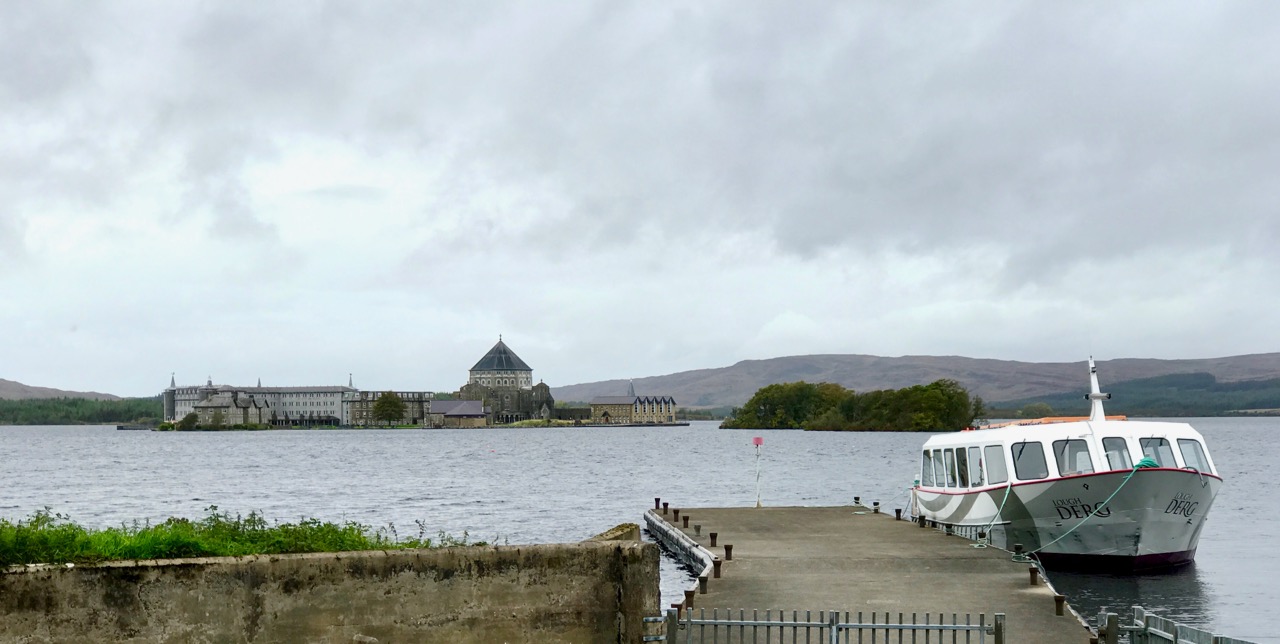
I was excited to be travelling to one of Ireland’s oldest – and most important – pilgrimage sites. Finola studies stained glass windows and their artists, and she knew that some particularly impressive Harry Clarke windows can be seen in the Basilica on Station Island, Lough Derg, in County Donegal. The roof of the Basilica, completed in 1931, towers over the island in the picture above, taken from the quay at Ballymacavany. Finola obtained special permission for us to visit the island to view and photograph the windows, after the main pilgrimage season was over: her account of them will appear in Roaringwater Journal in the near future.

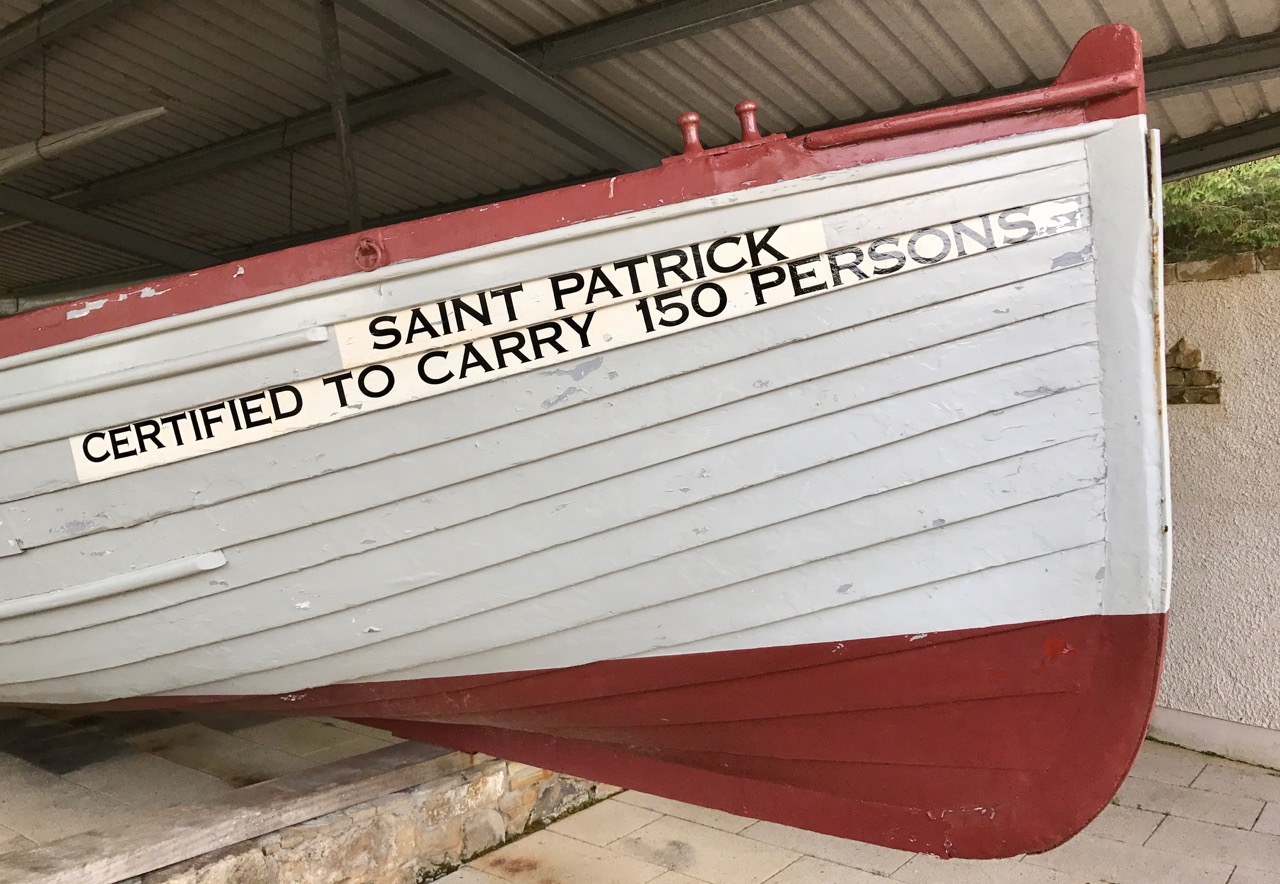
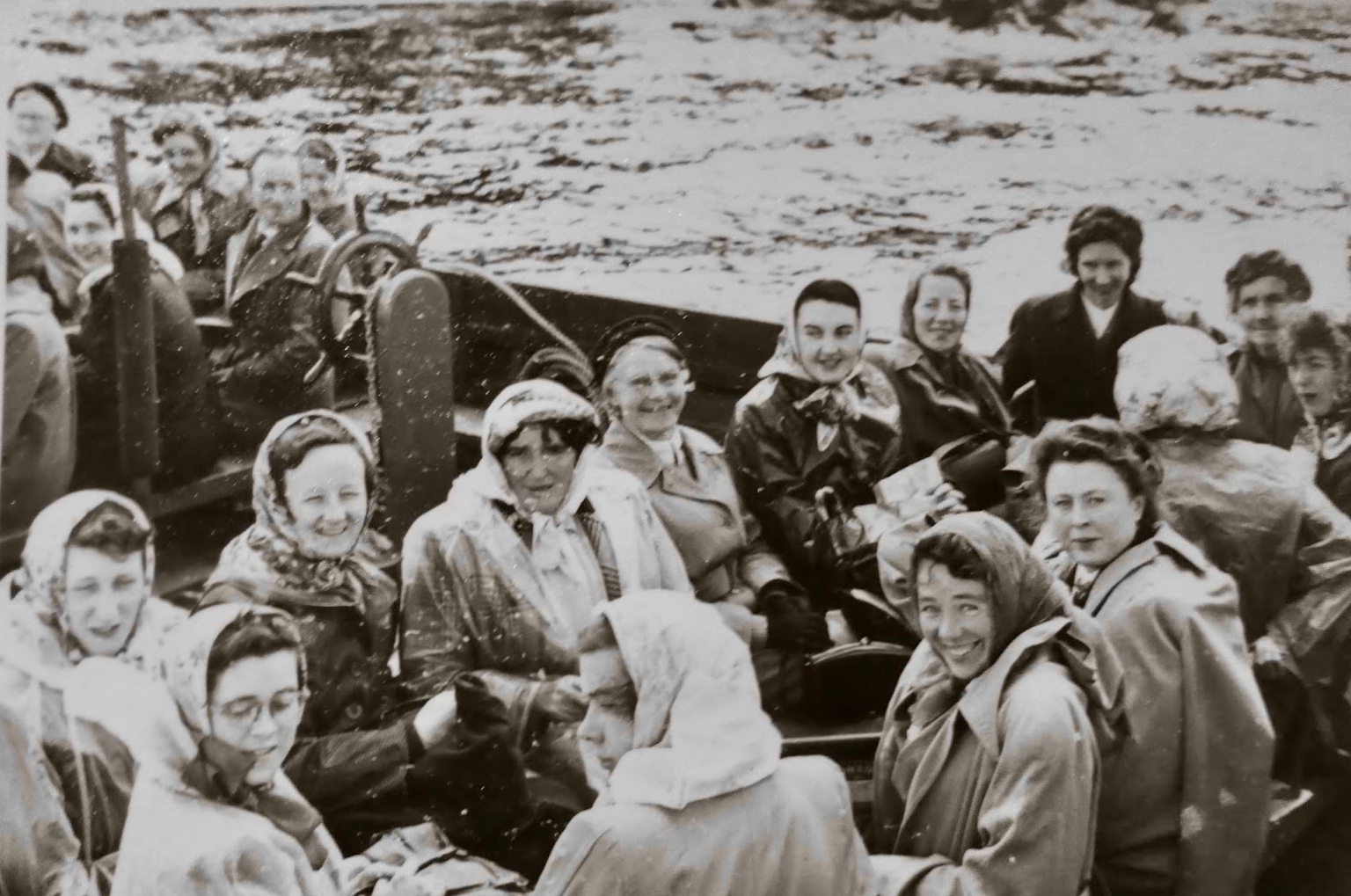
It’s salutary to learn how many people and families we know have taken part in the pilgrimage at Station Island. It’s a particularly austere experience, involving a three day cycle of prayer and liturgies, bare-footed and with very little food or sleep. Finola’s father undertook the pilgrimage in the 1950s: the photograph above was taken at around that time, when pilgrims were ferried over in large open boats once rowed by eight oarsmen and subsequently motorised. One of these historic boats is kept on display at Ballymacavany (below). Nowadays the journey is made in a modern covered launch, as seen in the header photo.

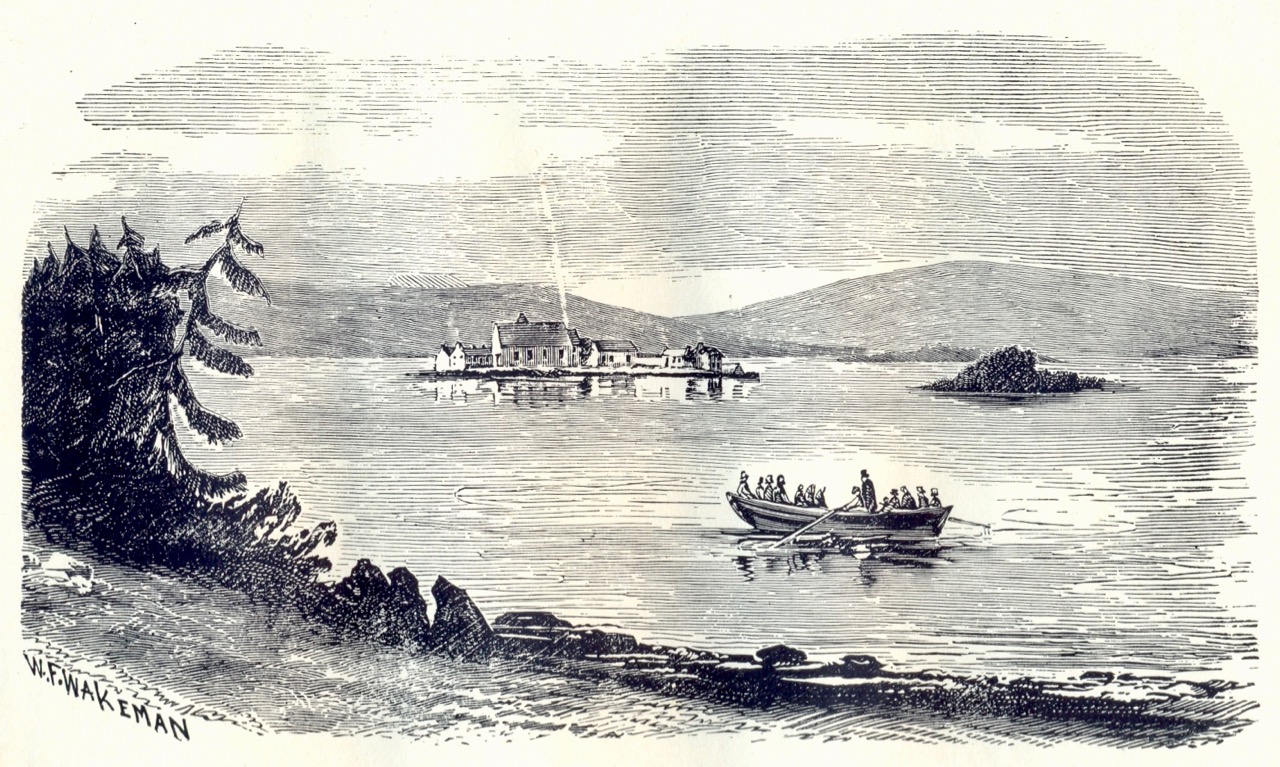
Records of the number of pilgrims who travelled to Station Island have only existed in comparatively recent times. The peak seems to have been just prior to the famine around 1846, when over 30,000 went there in one season. The drawing above is by William Frederick Wakeman, who was a draughtsman with the Ordnance Survey of Ireland, and was probably made at that time. Through the twentieth century numbers seldom fell below 10,000 pilgrims each season, but in many years was considerably more. This news item from the RTE Archives demonstrates the strength of the pilgrimage in the year 2000.

The island’s long history takes us back to the time of St Patrick. Despairing at the arduousness of persuading the Irish people to accept his Christian teachings he appealed to God to help. The story is admirably recounted by Dr Peter Harbison, Honorary Academic Editor in the Royal Irish Academy:

…St Patrick … was having difficulty convincing the pagan Irish of the 5th century of the truth of his teaching about heaven and hell; they were not prepared to believe him unless one of them had experienced it for themselves. To assist Patrick in his mission … Christ showed Patrick a dark pit in a deserted place and told him that whoever would enter the pit for a day and a night would be purged of his sins for the rest of his life. In the course of those twenty four hours, he would experience both the torments of the wicked and the delights of the blessed. St Patrick immediately had a church built, which he handed over to the Augustinian canons (who did not come to Ireland until the 12th century), locked the entrance to the pit and entrusted the key to the canons, so that no one would enter rashly without permission. Already during the lifetime of St Patrick a number of Irish entered the pit and were converted as a result of what they had seen. Thus the pit got the name of St Patrick’s Purgatory…

(from Pilgrimage in Ireland: the Monuments and the People by Peter Harbison, Barrie & Jenkins, 1991)

The entrance to this cave is on Station Island, and is the reason for the enduring popularity of the pilgrimage, which has persisted there for over 1500 years. In the medieval illustrations above, the gateway into Purgatory can be seen on the right, while on the left is a knight – Owein – whose terrifying adventures in the cave in medieval times have been written about in many languages: a summary can be found here.

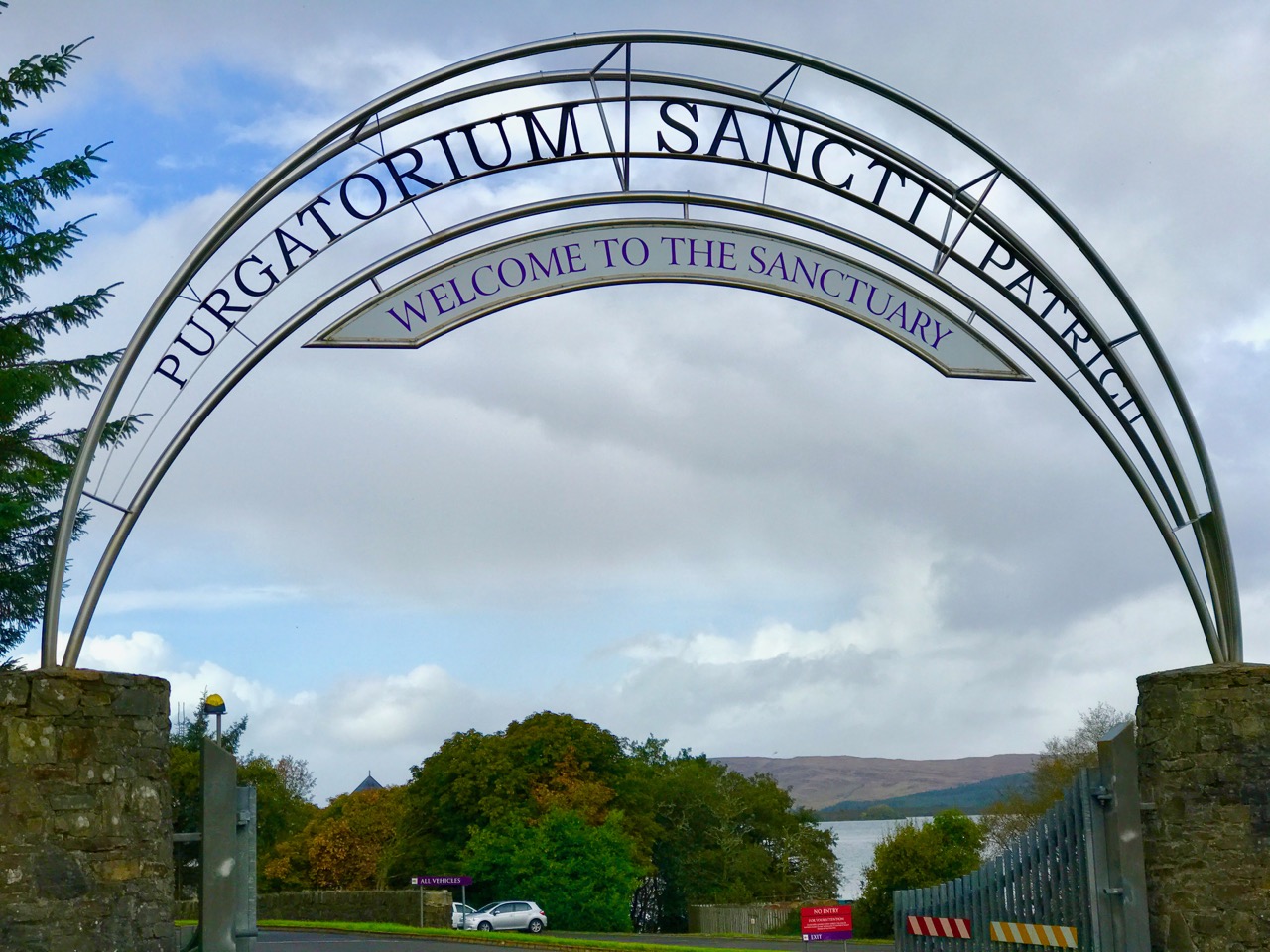
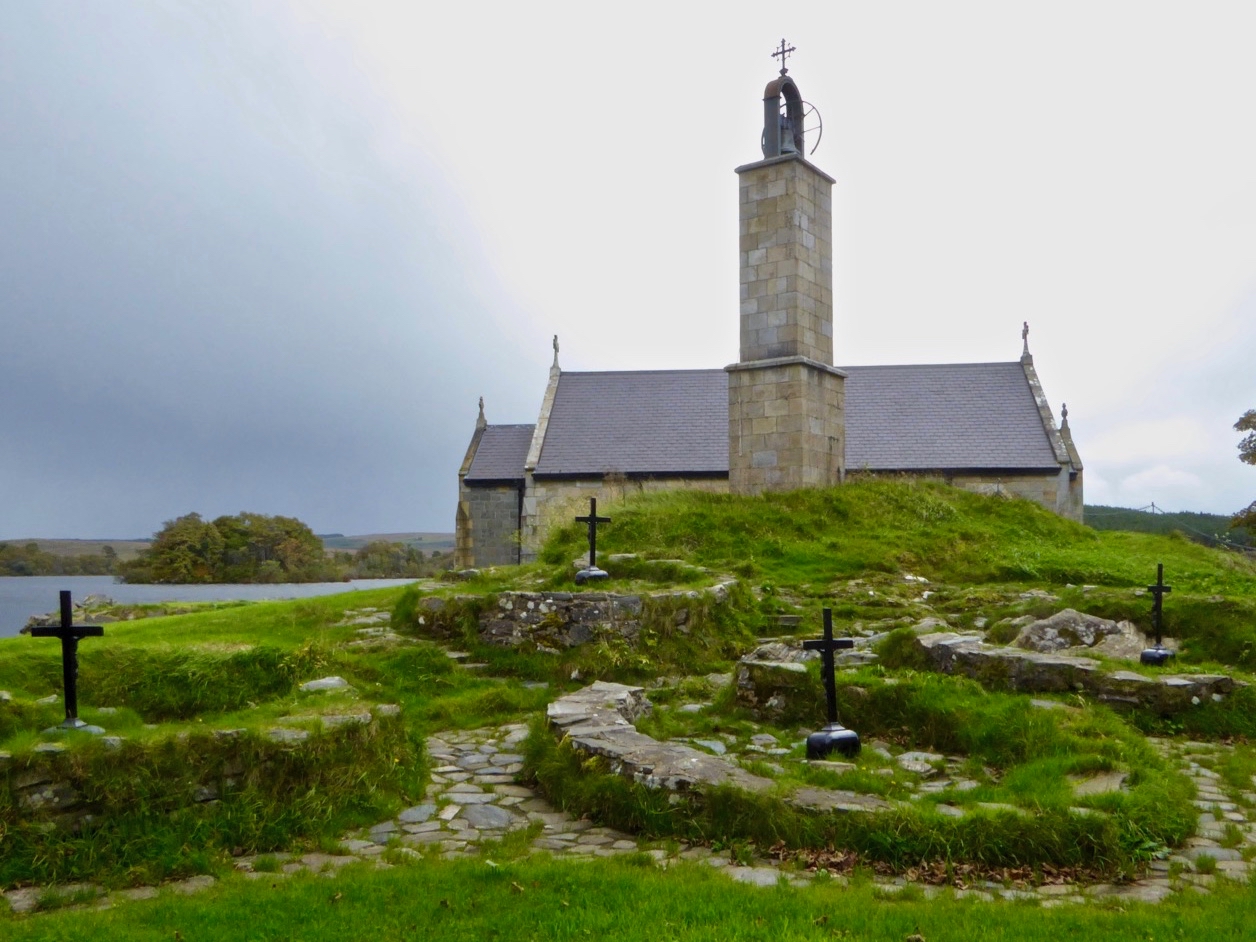
St Patrick’s Purgatory: the name is over the entrance at the reception centre at Ballymacavany, the point of departure for Station Island. The cave which marks the entrance into Purgatory was permanently sealed up in October 1632 when the pilgrimage was suppressed by order of the Privy Council for Ireland; in the same year the Anglican Bishop of Clogher, James Spottiswoode, personally supervised the destruction of everything on the island. Later, in 1704, an Act of Parliament imposed a fine of 10 shillings or a public whipping …as a penalty for going to such places of pilgrimage… The site of the cave entrance lies under the bell tower, seen above. In front are the penitential beds where pilgrims perform rounds to this day. It is thought that these formations are the remains of monks’ cells or ‘beehive huts’.

On the left is a map of Station Island by Thomas Carve, dated 1666. The words Caverna Purgatory, centre left, show the site of the cave entrance. In spite of the efforts of the Penal Laws to suppress the observances, pilgrimages have continued unabated. Above right is a photograph from the Lawrence Collection, dated 1903, showing pilgrims about to embark for the island.

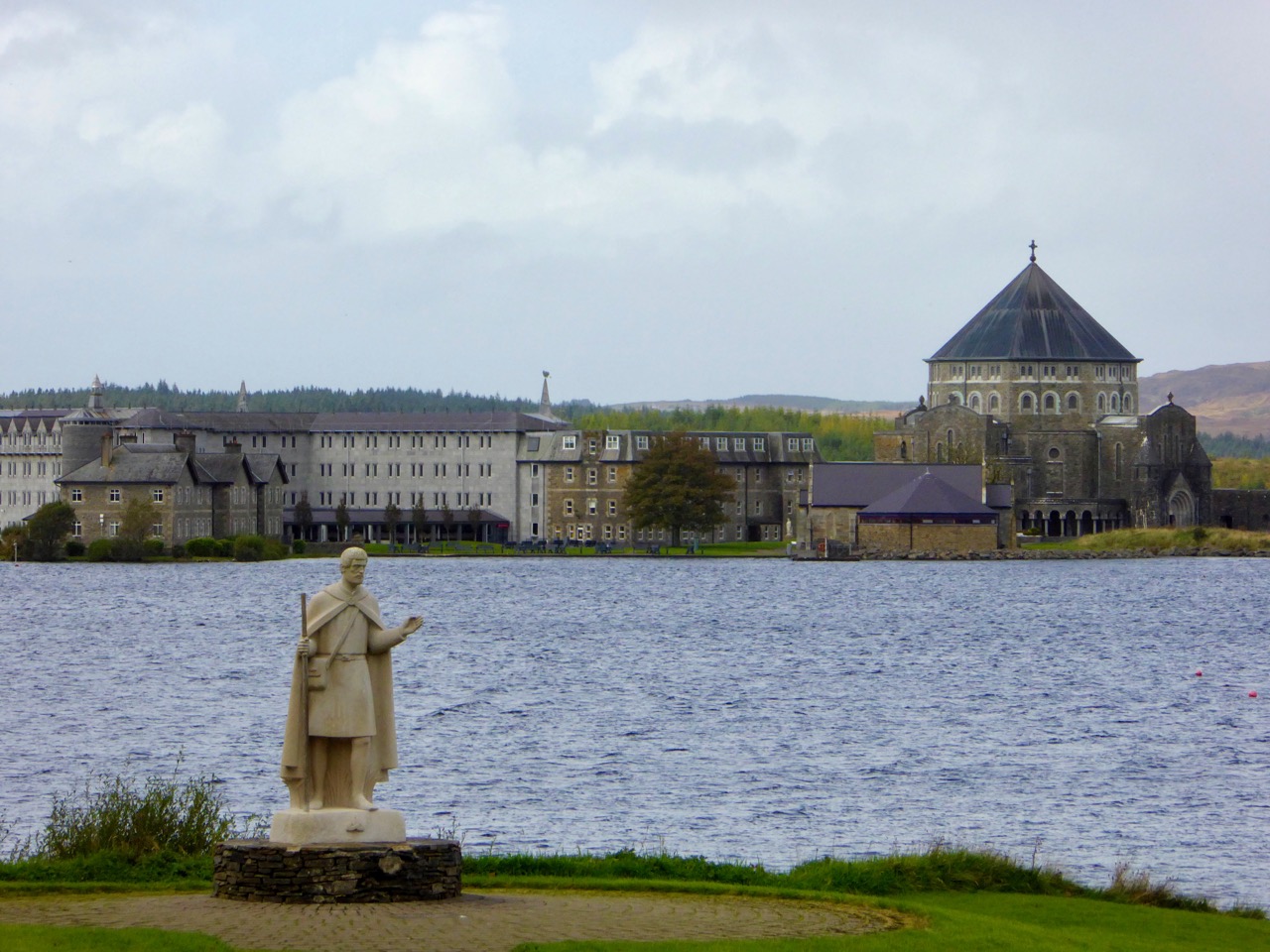
A young St Patrick portrayed as a pilgrim stands in front of the island: the Basilica is on the right. This view indicates the huge development  of the island since its complete destruction in the 18th century and shows the facilities provided for the many thousands who have come here over the generations.

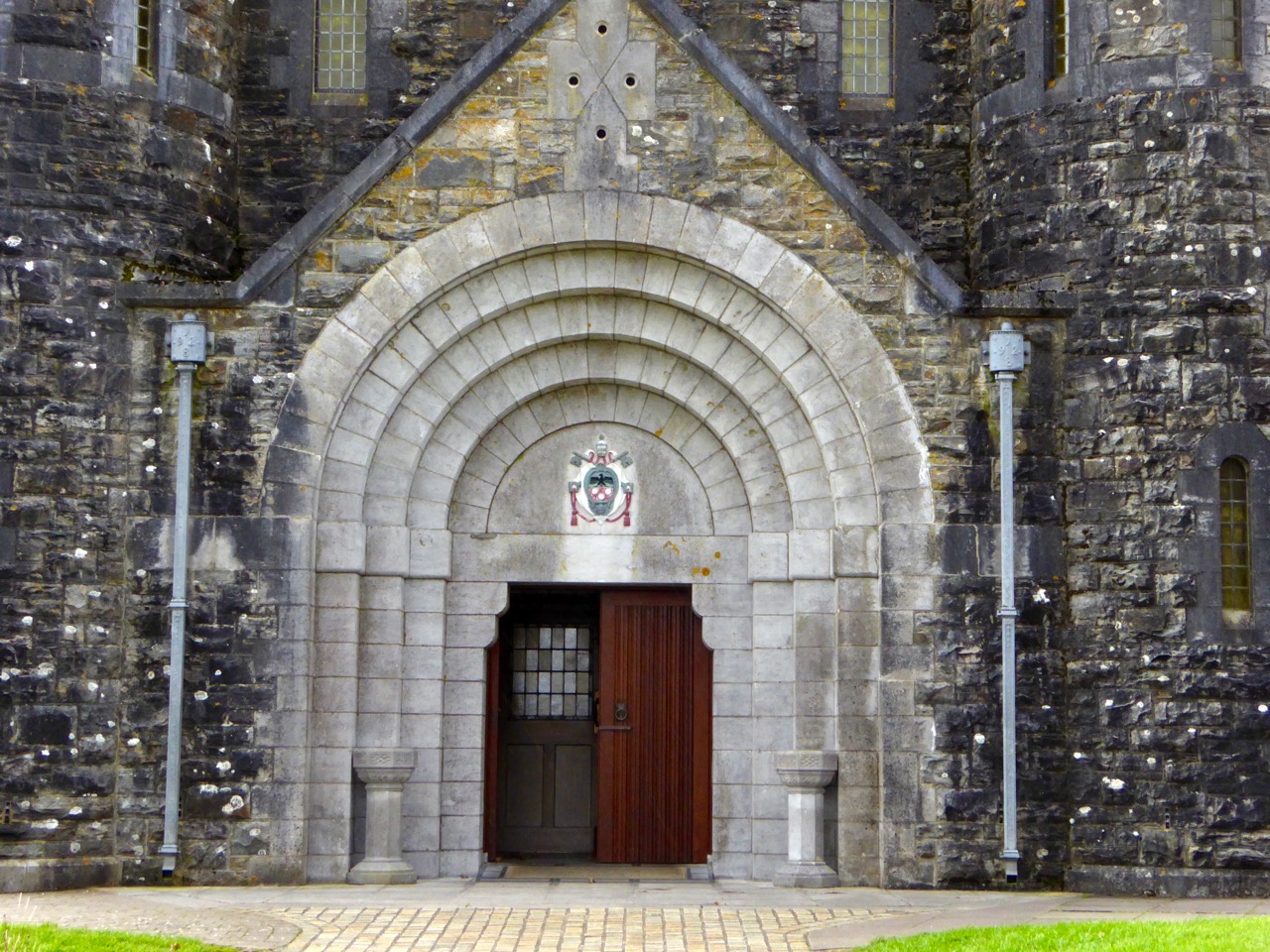
The Basilica is the focus of the pilgrimages today: it was formally consecrated in 1931. The entrance door is a modern interpretation of Romanesque architecture, while the tabernacle is an impressive example of fine bronze work.

Ireland’s great poets and writers have visited St Patrick’s Purgatory, and have responded to the experience:

Donnchadh Mór Ó Dálaigh (1244) “Chief in Ireland for poetry”:

Truagh mo thuras ar loch dearg
a Rí na gceall is na gclog
do chaoineadh do chneadh’s do
chréacht
‘s nach faghaim déar thar mo rosg.

(Sad is my pilgrimage to Lough Derg, O King of the cells and bells; I came to mourn your sufferings and wounds, but no tear will cross my eye)

Patrick Kavanagh:

Lough Derg, St. Patrick’s Purgatory in Donegal,
Christendom’s purge. Heretical
Around the edges: the centre’s hard
As the commonplace of a flamboyant bard.
The twentieth century blows across it now
But deeply it has kept an ancient vow.

W B Yeats:

Round Lough Derg’s holy island I went upon the stones,
I prayed at all the Stations upon my marrow-bones,
And there I found an old man beside me, nothing would he say
But fol de rol de rolly O.

Most impressive of all, perhaps, is Seamus Heaney whose moving contemplations took him back through his life experiences and produced twelve memorable poems in a volume entitled Station Island:

How well I know that fountain, filling, running,
although it is the night.
That eternal fountain, hidden away,
I know its haven and its secrecy
although it is the night.
But not its source because it does not have one,
which is all sources’ source and origin
although it is the night.
I know no sounding-line can find its bottom,
nobody ford or plumb its deepest fathom
although it is the night.
And its current so in flood it overspills
to water hell and heaven all peoples
although it is the night.
And the current that is generated there,
as far as it wills to, it can flow that far
although it is the night.

Finally, here’s a contemporary journalist’s view, well worth the read!


Discovering Carrowmore

stone and sky

At the heart of the Coolrea peninsula in County Sligo lies one of the greatest megalithic complexes of ancient Ireland, An Cheathrú Mhór or Carrowmore as we call it today: the Irish name means ‘The Great Quarter’. Spread over a plateau of some 150 acres and centred on the high point of Listoghil are thirty recognisable tomb sites but it is suggested that there were once at least a hundred monuments here.

Carrowmore 1

The Carrowmore monuments that we know today cover over 150 acres: it’s likely that there is much more to this site which has been lost, or which remains to be recovered

The changing landscape has taken its toll: from the 18th century onwards land clearance and quarrying have damaged and obliterated many of the remains and even as recently as 1983 Sligo County Council sought to place a municipal landfill dump adjacent to the known sites. Fortunately a few alert local residents objected and took the case to the High Court in Dublin. Initially their objections were overruled but in 1989 an appeal to the Supreme Court was successful and the very important landscape context of Carrowmore has been saved, hopefully for all time. In that same year the state commenced purchase of a part of the site and has developed a sensitively planned visitor facility now run by the Office of Public Works. Since then more of the surrounding site has been purchased and is in public ownership.

stone and skyscape

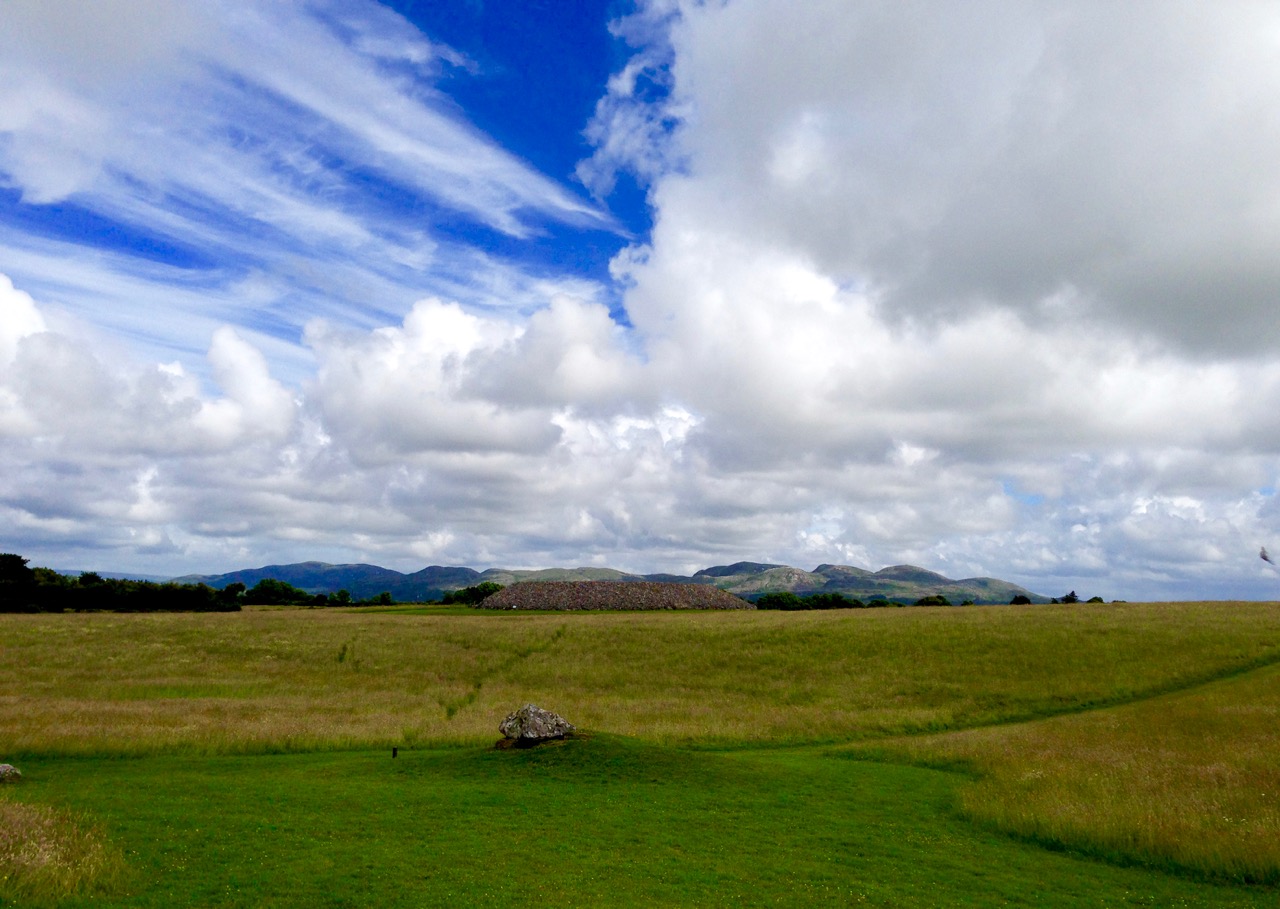
Carrowmore landscape: this view to the great central cairn on Listoghil shows the nature of the terrain and the context of the monuments which it is so important to preserve

It’s the integrity of the complex that is so special here. The monuments found at Carrowmore are called boulder circles, though several have central dolmens or rudimentary passages. Generally around 12 to 15 metres in diameter, the circles contain 30 to 40 boulders, usually of gneiss, the material of choice for the tombs. Sometimes an inner boulder circle is also present.They are considered to be an early type of chambered cairn, or passage grave, though in fact, they may be the ancestor of a few monument types. This is the view of local man Martin Byrne, historian, artist, musician and our tour guide for the day. He pointed out to us how the passage of each of the boulder groupings is oriented, not towards a solar or calendrical event but to Listoghil, where an enormous cairn encloses a box-like stone chamber with a large capstone.

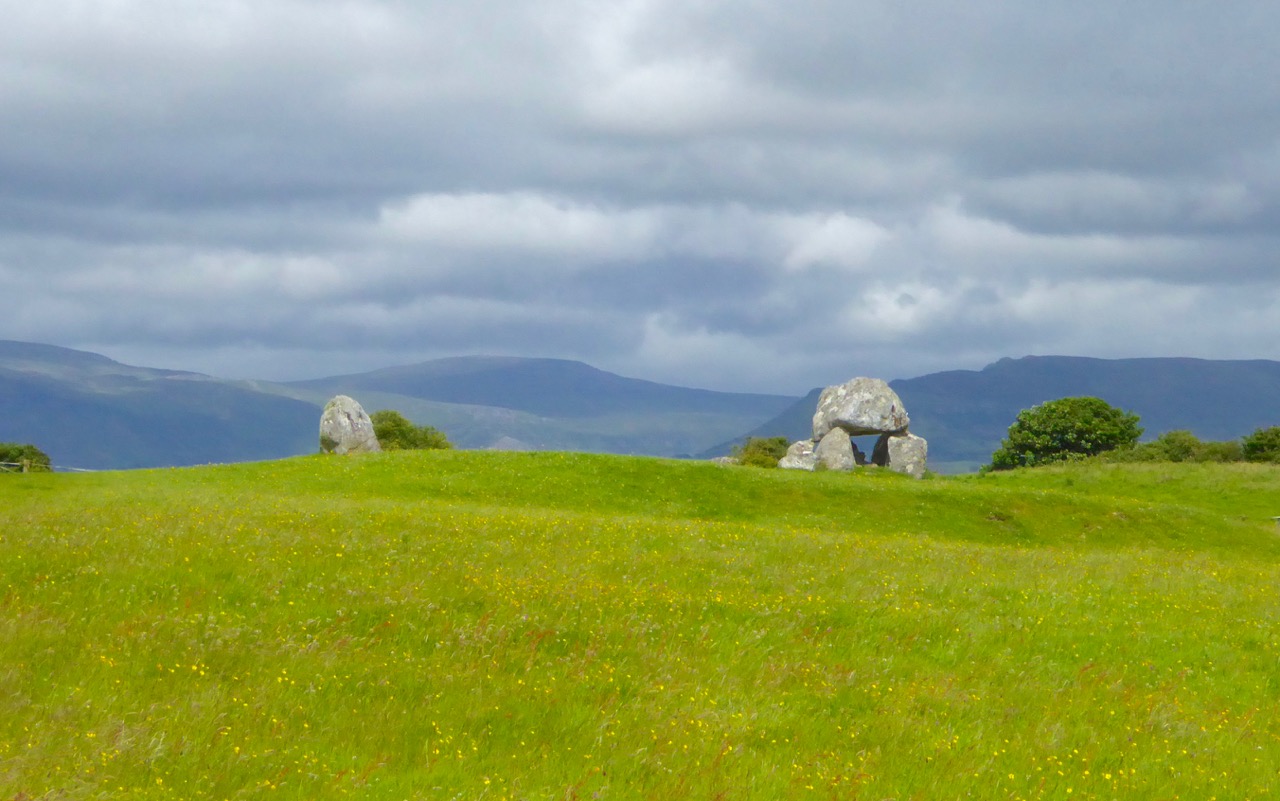
Monument, mountain and sky

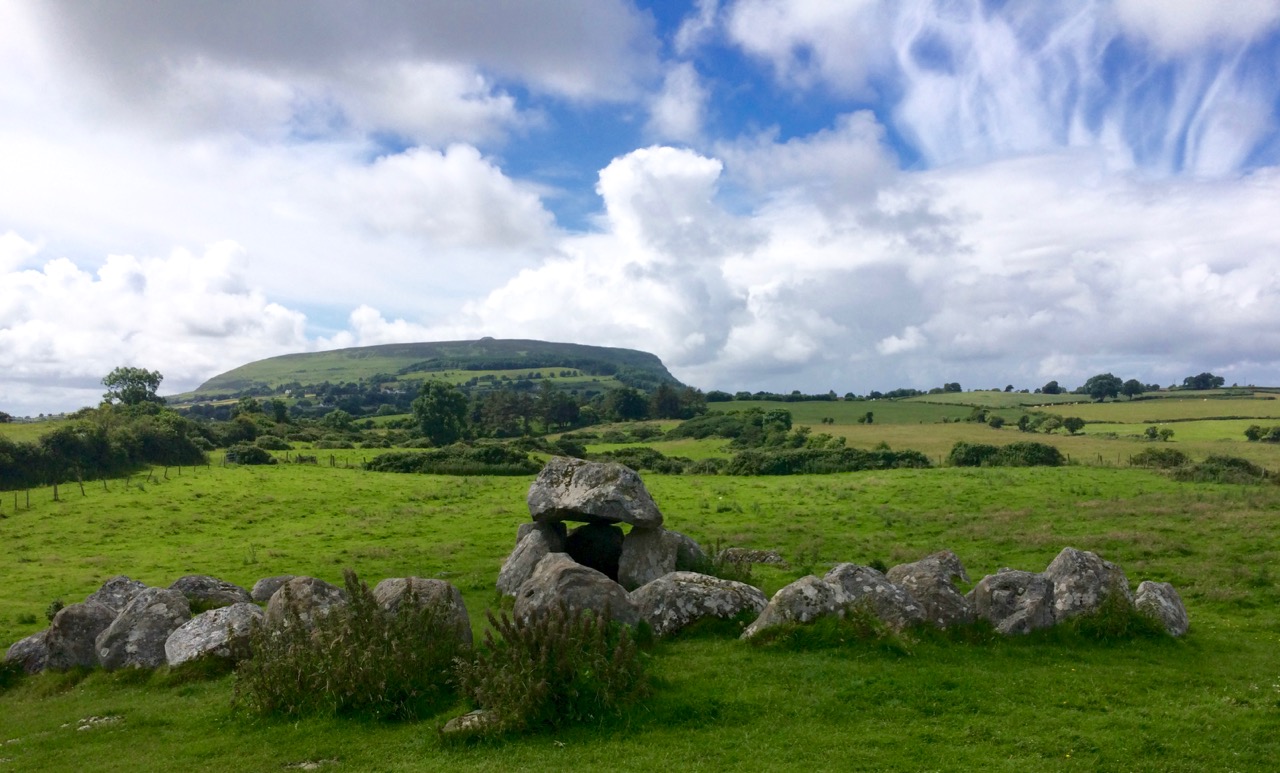
One of the boulder circles at Carrowmore with its central chambered tomb. This view is looking away from Listoghil and towards another significant landscape feature, Knocknarea, which is topped by the cairn known as Queen Maeve’s Tomb, 6 km to the west. There are 6 more mountain-top cairns on the peaks of the Ox Mountains to the south. The central focus of the Carrowmore complex is the cairn on Listoghil, although this is not as dramatically visible as many of the surrounding cairns

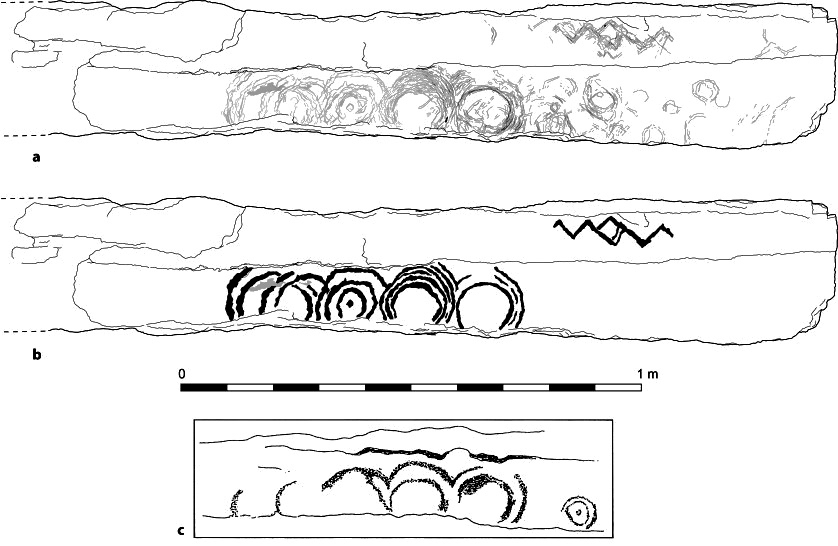
The chamber on Listoghil has been given a modern context, with the original cairn covering having been cut away to allow access. This chamber displays the only examples of rock art to be found so far within the Carrowmore complex. This is hard to see in normal lighting conditions, but successive observations have enabled these images to be made:

Listoghil carvings Guillaume Robin 1994

The formerly covered central chamber of the Listoghil cairn: top left is a photograph taken during excavations by Göran Burenhult in 1996-98 – this shows three boulders in front of the tomb which are said to have been an earlier Neolithic monument displaced by the tomb construction. Top right is the OPW interpretation board for the chamber and above are drawings of the rock art on the edge of the roof slab compiled by Guillaume Robin

It’s startling to discover that the Carrowmore complex could be over 6,000 years old: carbon dating from some of the finds has suggested this. If so, then it’s the earliest of the passage grave cemeteries in use in Ireland. Many cremated remains have been found over this site (spread over a long period of time), although unburnt human bones were also recovered in the Listoghil chamber. It could be speculated that the focal point of Listoghil must have been the resting place of a very important person – or dynasty; we will never know for sure. 

‘Accidental’ rock art and rock scribing noticed on monuments at Carrowmore: these boulders have natural markings on them but it is possible that the monument builders were attracted by these marks, which may themselves have inspired carvings

The Carrowmore complex has been visible enough historically to attract the attention of antiquarians – which is useful for later archaeologists, as some parts which are now lost have been historically recorded, albeit using methodology which would nowadays be considered inadequate. Gabriel Beranger, who was born in Rotterdam in 1725, settled in Dublin in 1760 and was a notable illustrator of antiquities in Ireland during a long lifetime; he visited and recorded Carrowmore. A local landlord, Roger Walker, carried out some excavations of the tombs in the 19th century but made no significant records; it is suggested that he was a treasure hunter. George Petrie surveyed the site and numbered the tombs in 1837 but it was another 50 years before archaeologist William Gregory Wood-Martin made the first methodically recorded excavations. William Wakeman produced some exquisite watercolour sketches in 1879. More recently Swedish archaeologist Göran Burenhult undertook detailed studies between 1977-1982 and 1994-1998 and this work included the excavation and subsequent reconstruction of the Listoghil cairn.

Upper Left: the work of Gabriel Beranger who visited the area in the 1700s – this shows Queen Maeve’s Tomb on Knocknarea. Upper right: William Wakeman’s watercolour of Tomb 4 in 1879 (Sligo County Library). Above: Listoghil chamber tomb today

Our guide Martin has studied the complexes at both Carrowmore and Carrowkeel (a future destination for us) for many years and is imbued with the archaeology and the landscape. He gently pointed us to the fact that relationships can perhaps be seen between the profiles of some of the boulders – particularly the capstones of the tombs – and the more distant landscape. I find this fascinating: I have always felt, as an architect, that there should be a conscious designed relationship between any building that is erected by human endeavour and the setting of that building within nature. Could these parallels that we might be seeing at Carrowmore be conscious?

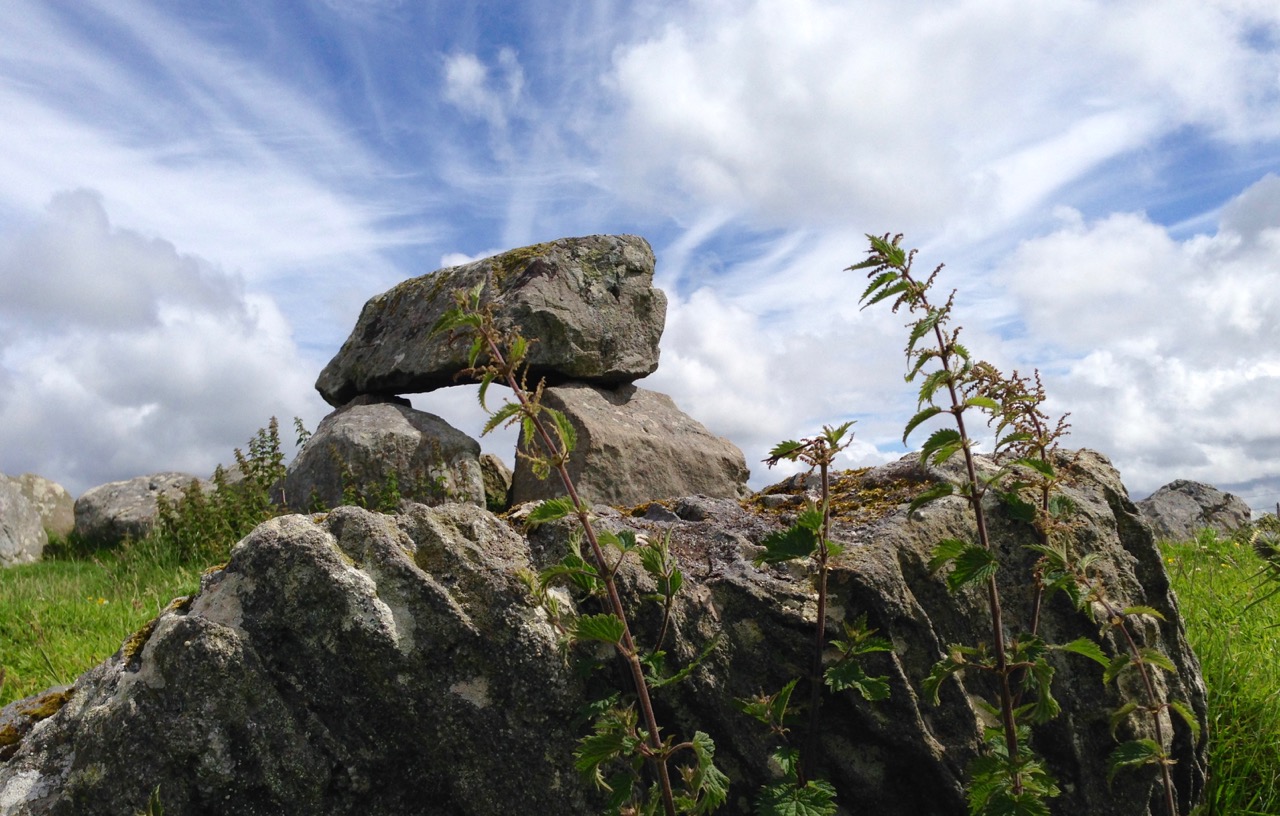
Dolmen and Mountain

Rocks reflecting nature? Were the capstones chosen to specifically echo the landscape context? A debatable – and very subjective – notion…

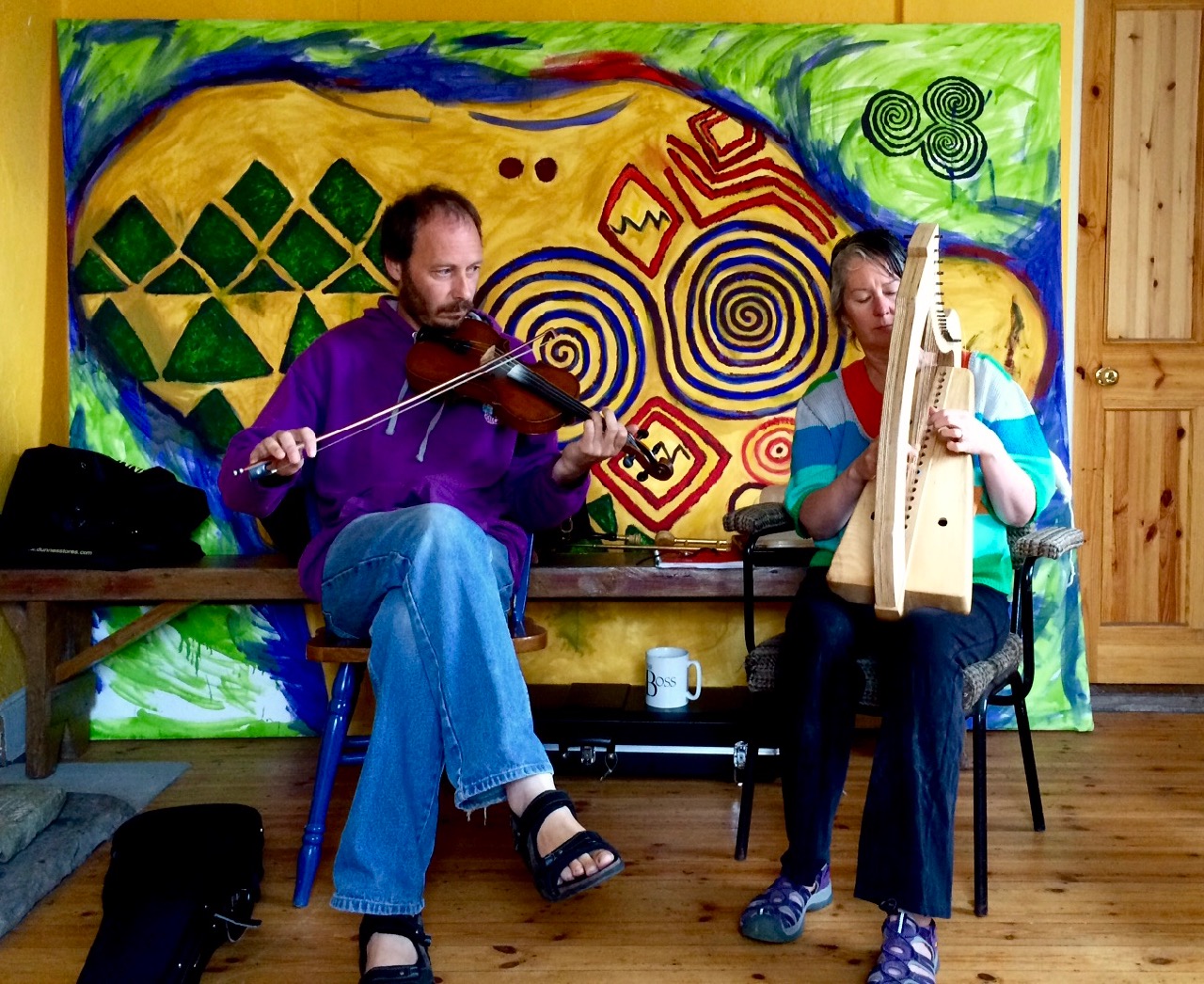
My day was made when I discovered that Martin was a musician – as is Margaret, and I joined them in their colourful house for a little session!

martin + margaret