Making Friends

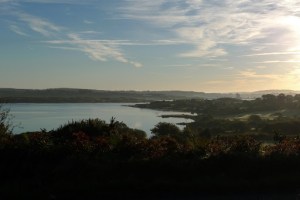
One of the joys of our sojourn here is being in communion with a whole world of wild creatures. The house, Ard Glas, is wonderfully situated, looking down over a sheltered inner stretch of Roaringwater Bay where there occurs rapid tidal movement creating – twice a day – mud flats teeming with waders, shorebirds, divers and seals.

Ard Glas

To date the spotting scope has shown up everything we might have expected – Curlews and Oystercatchers seeming the most prolific – and some surprises, including pure white Little Egrets, which are not supposed to be here at all! I’m sure I saw a Great Northern Diver, although it’s not impossible to mistake the profile and behaviour of a Cormorant for one of these most magical of birds. In the Canadian myth-time ‘Loon’ (as she is called over there) shares a high place in the panoply of Gods – or assistant Gods – close to the great creator, transformer and trickster Raven. It was Loon who helped the Great Spirit to recreate land after the all-consuming deluge because poor Loon was lonely: she missed the company of Human and Animals, who had all lived, worked and conversed as one race before the punishment of the flood was brought upon the world, largely through Man’s misdemeanours.

Loon

The Fox (or Foxes) frequently visit Ard Glas and the lanes around the townland, as do errant Cows who are either adept jailbreakers or who are being informally grazed on the ‘long acre’ – as Finola so aptly describes the Irish verges. This necessitates that we keep the gates closed, to preserve our neat lawn – whose pristine sheen we have already disturbed by installing a bird-table: a very Irish bird-table finely executed by our friend Danny and painted a most appropriate green. It has yet to receive a feathered visitor – but it’s early days…

Up in the hills – on the Sheep’s Head Way – the quest for friends continues: rewarded, yesterday, by a glimpse of one tenth of a Hare – the first seen to date on this visit. The one tenth was its backside and tail as it disappeared into the bracken: the tail was long and black striped, thus confirming the sighting as a Brown Hare, rather than an Irish Hare. Another excitement on that walk was an ‘almost certain’ Snow Bunting – distinctively white bodied and black winged in its adult male plumage: a rarity in Ireland, and in all likelihood just passing through: the species only breeds in northern Scotland, Iceland and Scandinavia.

I am always on the lookout for more Hares: they are my passion. I’m rather afraid that I won’t see them in the fields around Ard Glas, as there is a large Rabbit population established here – and Hares don’t like land which is used by Rabbits.
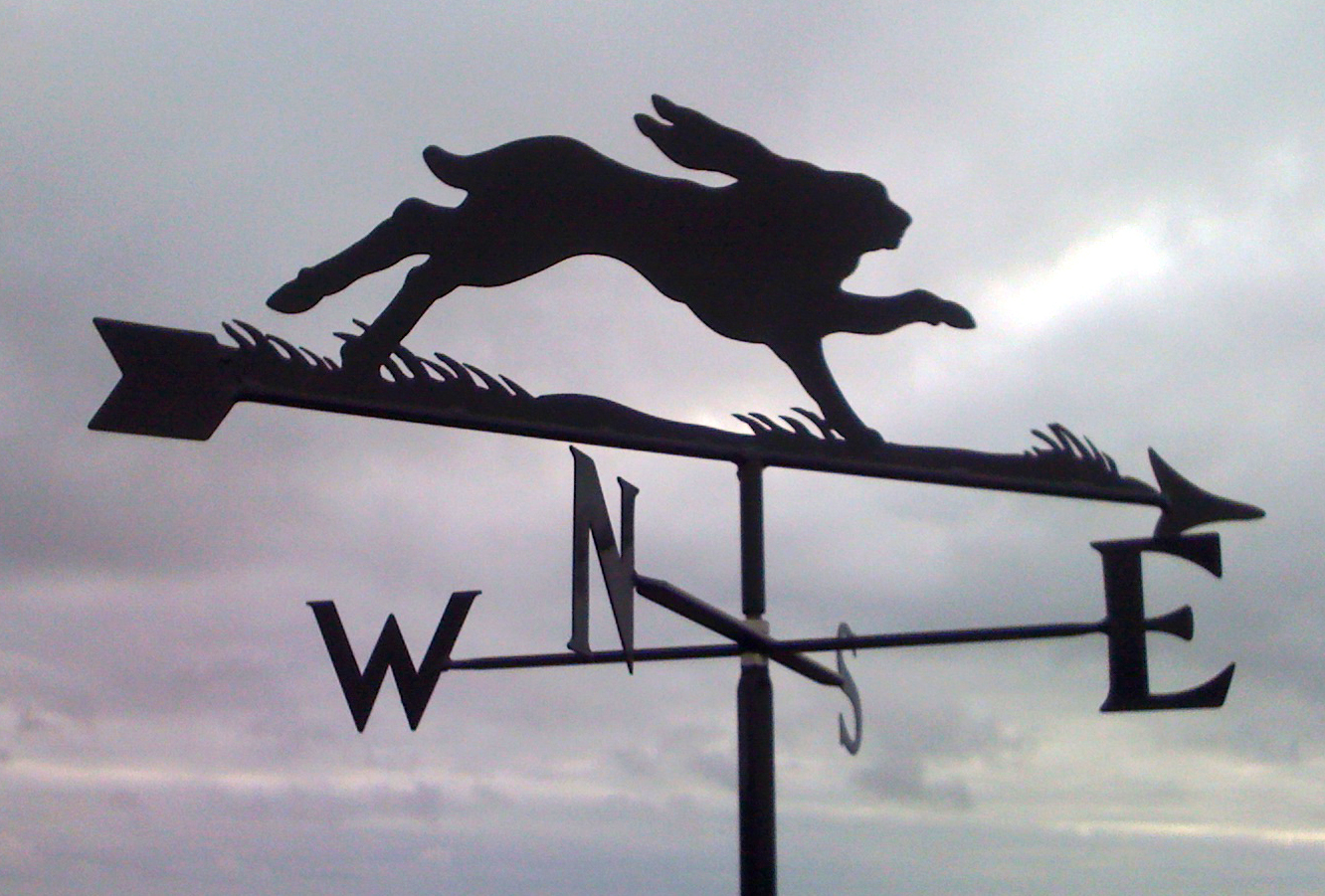
But there is rough and seemingly Rabbitless land up behind us, and I am optimistic that some sightings are to be had over the next few months. I have enjoyed many such sightings in the past around Danny’s townland of Ballybane West: I have seen groups of ten or a dozen racing around a field for no apparent reason (Haring?). They do seem to be animals which have a very strong will to confound and confuse, evidenced by a great lack of logical or consistent behaviours and by a whole wealth of folklore, some examples of which I might recount in future posts.
Hiking the Sheep’s Head Way

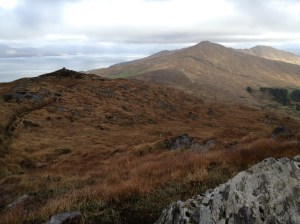
In my first post I complained about the endless rain. Fact is, in the first two weeks of October we have had some great weather, including several days of glorious sunshine and NO RAIN. We are fortunate to be within half an hour of the Sheep’s Head Way, a world-class system of marked trails with mountain, coastal and valley hikes of varying lengths but uniformly breath-taking scenery. On back-to-back sunny days this week we undertook to hike parts of the ridge trail that runs along the spine of the peninsula.


Our first hike took off north of Durrus at Booltinagh Mountain and ran south along the ridge to a high point and over the top to the Barna Mor, or Big Gap – an old donkey trail across the peninsula. Although the trail is well marked and clear it is soggy: waterproof boots are essential along with layers for taking off and putting back on as you heat up, cool off, or see a shower sweeping in from the south west. Our views were north to Bantry Bay, all the way back to Glengarriff Harbour and over to the Beara Peninsula. On the other side across Dunmanus Bay lay the Mizen, bathed in sunshine. We shared the trail with sheep, but saw no other walkers.

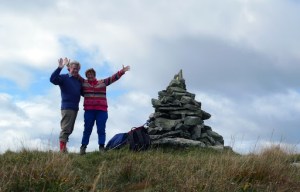
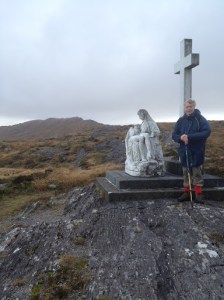
The next day we ventured further west to Kilcrohane, turning north up a steep and winding road to Finn McCool’s seat, a natural saddle on the ridge. This being Ireland, the trailhead is marked by a marble Pieta, perhaps dating to the Marian year of 1954 that saw so many such monuments erected all over Ireland. Once again, we had the mountain to ourselves. Although it was a bright day, a howling wind blew up from the sea below. We leaned into it, and tramped on, to the Peakeen cairn. Along the way we stopped to examine the remains of what may be a Neolithic passage grave, occupying a commanding knoll along the ridge. How important would you have to be to have your tomb in such a place? Perhaps as important to the people who built this monument as the crucifixion images of the Pieta was to the local residents in 1950s West Cork.

The passage grave is on the first knoll on the left
We wondered why this incredible, wild resource that is the Sheep’s Head Way is not a National Park – even a World Heritage Site. Perhaps the answer is that as long as people respect it (and they do – we saw no litter or vandalism) and as long as access is freely given by landowners, there is no need to administer it as a park. The website for the Way indicates that it receives funding from both Ireland and Europe, but that The Sheep’s Head Way committee is a voluntary committee, consisting of landowners/farmers and other representatives from the local community. What a fantastic job they have done!

West Cork Food

When we chose West Cork, we had no idea we were landing in Foodie Heaven: or rather, a former Foodie Heaven. The recession has hit local producers and fine dining establishments, many of which have closed.

The ‘Fuchsia Brand’ website – Fuchsia is the ubiquitous hedgerow flower hereabouts – a kind of West Cork quality assurance organization for local produce, hasn’t been updated since 2008, although other websites point to farmers’ markets and food festivals. The West Cork Artisan Awards website explains the West Cork food signature thus: It is the individual flourish in an artisan’s way of working that brings forth the best in everything, whether it’s the best loaf of bread, the best farmhouse cheese, the best potatoes, or the best beef. This is the West Cork way: a way of life first, a business second.

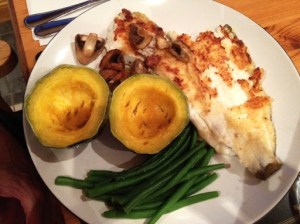
Whatever about the wonderful local cheeses, the yoghurt and sausages, what we have found here is that food tastes fresh and homegrown in a way I had almost forgotten in Canada. In the presence of new potatoes I believe in God, and my faith has been given a boost here with a bag of potatoes from Saturday’s Skibbereen market freshly dug that morning. The woman at the fish stall filleted a whole plaice for us and we bought some tiny round squash, about the size of hurling sliotars (like an American baseball). Saturday night’s dinner – delicious!
An Irish staple is boiled bacon and cabbage. I adapted that idea to a hearty soup with a base of leeks and lashings of root vegetables (squash, parsnips, beets, carrots and potatoes) and a great slab of green (unsmoked) bacon. We’ve been eating it for days now, with brown soda bread and aged Gubeen cheese.
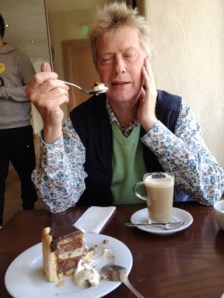
We have found excellent coffee almost everywhere we go, often accompanied by scones or lemon drizzle cake. On a recent trip to the Mizen we stopped at The Gateway Restaurant in Durrus for coffee and were seduced by their pear and chocolate tort: the perfect end to an afternoon meandering around the coast of West Cork .

Rossbrin Walk


Out of the blue, we have a day of brilliant sunshine, with no rain in the forecast (although the forecast has a tendency to change hourly) so we decide to take advantage of the day and get out for a good walk.

We have bought West Cork Walks by Damien Enright, the Schull and Ballydehob edition, and decide on a walk that takes Rossbrin Cove, only a couple of miles away, as its starting point. The book is well laid out, almost step-by-step. This proves to be a little distracting in places, with constant references to spring-blooming flowers and wildlife seen on one evening in April; however it pays off in the level of detail offered, without which we would undoubtedly have missed small features and background facts which enhanced our enjoyment of the walk.

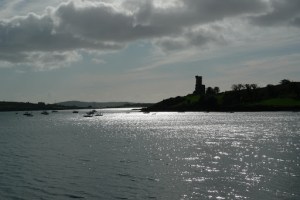
Rossbrin is a sheltered harbour, greatly used in the past by the islanders from Cape Clear, Horse Island, Hare Island, Castle Island and others that we can see once we reach the higher points. The most dominant feature of the cove is the O’Mahoney castle, an impossibly romantic tower house that rises from the western side of the inlet and that was, in the sixteenth century, the centre of a learned court led by Finghin O’Mahoney, the ‘scholar prince of Rossbrin’. Now, the cove is lined with houses, all of which have great views of the harbour, but many of which appear to be uninhabited. This is one of the legacies of the Celtic Tiger years, when the local economy was fuelled by a building boom of ‘holiday homes’ and Ballydehob was a thriving town with bookstores, galleries and prize-winning eateries.
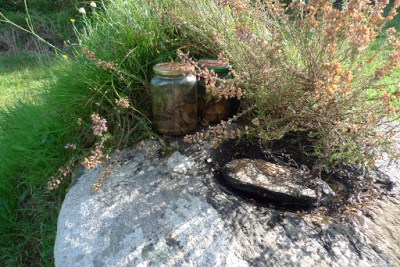
Leaving the cove behind we climb the steep hill behind the houses and are rewarded by expansive views across to the Baltimore Beacon and Sherkin Island. A mile or so along a pleasant country lane we come to Stouke Burial Ground. Among the gravestones, many for islanders, we find a bullaun stone, with two jars full of coins on top. A bullaun is a rock with a bowl-like depression in which water collects and that water is supposed to have curative powers. Robert dipped his finger in the Clonmacnoise bullaun and his wart was gone in a couple of weeks, although I tried it too and my wart still adorns my thumb. I give it another go, and we both add coins to the jars, a little in awe that in this remote place jars of money can remain untouched. Folk customs like this probably pre-date Christianity. A defining characteristic of Irish Christianity was that it blended the old pagan beliefs with the new religion in a seamless mosaic of customs and mythology. St. Brigid was probably a pre-Christian goddess; the old celebrations based on the solar calendar became saints’ days; the bullaun made an easy transition from the magical to the miraculous.
Carrying on, we come across two roadside stands and once again marvel that money can remain untouched as we deposit our coins into jars for honey and for apple chutney. We start on the downhill path back to the cove with the magnificent vista of Roaringwater Bay and its islands spread before us. Back at the cove we have time to sit on an upturned boat in the sun, munching on an apple and cheese, adding yet another waterfowl (a tufted duck) to the list of those we have seen since we arrived in West Cork, and contemplating the good fortune that has allowed us to fetch up in this extraordinary place.
Return to Roaringwater

Were we mad? Whose idea was it, exactly, to rent a house in West Cork for six months? After one glorious, seductive, deceitful day of sunshine, the rain has been unrelenting. Sometimes it’s a fine mist and sometimes it’s a downpour. Sometimes it makes your hair curl into tendrils and sometimes it soaks you to the underwear. The bay below the house, teeming with aquatic life on that sunny day, is now blanketed in grey fog.
And yet…and yet…the green lawn is drooping with fuchsia; a tiny robin is peeping at me from the hydrangeas and there is the possibility that the fox will come back for a visit. We think he took the leftover pork from the edge of the lawn – although the friendly dog that dropped by today did seem to go straight to the place we left it.
We spent a happy hour today at Whyte’s Books in Schull. They serve coffee and delicious cakes and have collections of book reviews in large binders. Browsers and buyers come and go. The local priest is after Salman Rushdie’s latest: “Destined to be a classic, Father” the owner assures him. An elderly German drinks hot chocolate and reads quietly, two Englishmen chat in a back room, a woman is looking for Alice Munro stories. We inquire about the Writing Circle to take place Monday nights and we Google the name of the instructor. All we can find is one 60-page self-published paperback and a couple of references to ‘aromatherapy and crystal workshops’. Perhaps we’ll give this one a miss.
Besides, I am already signed up for fitness classes, thanks to information from the friendly post-mistress. The classes are run by M, who is English, and doing it for free. The postmistress has already told me this, but it is confirmed when I go to buy trainers at the sporting goods shop in Skibbereen. When I say I need them for a fitness class the salesman says, “That would be M’s class out in Ballydehob, would it?” It turns out that this is the only fitness class in the area, and M has been in to order steps and weights. The only other local offering is “the occasional bit of yoga” run above a restaurant by the proprietor but only “when herself isn’t too busy with the food, like.”
We have decided we need discipline. Our resolutions go like this:
·         Get up early. Does 8:30 count?
·         Music practice every day so that Robert can learn new tunes on his squeezeboxes and so I can become a bodhran genius. I am setting my sights high, convinced that the fact I am having trouble keeping the beat is a mere temporary beginner stage.
·         Healthy activity every day. We envision long hikes over the rugged hills, strenuous climbs rewarded by sandwiches on a rock with sweeping vistas. So far we have walked down through the fields to the water (it was uphill all the way back), and along to lane to see what the neighbours’ houses looked like. Occasional houses, but little sign of neighbours.
·         Writing every day. We have in mind, ultimately, a collaborative writing project – the kind of blog that garners a devoted readership and establishes itself as a staple among the literary/naturalist/outdoorsy/amateur historian or archaeological set. To date we have each managed one email, and this.
We tell ourselves that we haven’t been here a week yet. That we have a whole six months. That we are still getting over jetlag. That we are still discovering how to just be together. That we will eschew the scone with our coffee from tomorrow on. That spending an hour looking through the spotting scope is an important way to orient ourselves to our environment. That the fact that we included ‘come and visit’ invitations to everyone we know at the end of our emails just means we are friendly types. That tomorrow we will do a section of the Sheep’s Head Way. And that right now is a good time for bodhran practice.
But wait! Is it? Can that shaft of watery light be…YES, it’s the sun! Hold that bodhran – I’m off down to the water.